SONIC & ULTRASONIC
INSTRUMENTATION &
IRRIGATION
‫عبد‬ ‫جعفر‬ ‫احمد‬
‫الحسن‬
‫الخامسة‬ ‫المرحلة‬
POWER-DRIVEN INSTRUMENTS:
OVERVIEW
Power-driven instruments are everyday mainstays in periodontal therapy
& maintenance. They may be used alone or combination with hand
instruments.
Power instrumentation has the potential to make scaling less demanding
& more time efficient. Potential hazards from using power-driven devices
include rough root surfaces, production of bioaerosols, & interference
with cardiac pacemakers.
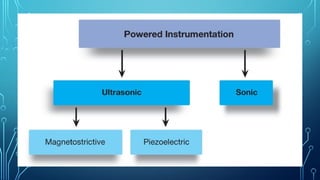
SONIC AND ULTRASONIC
These scalers convert high frequency electrical energy (ultrasonic)
or air pressure (sonic) into high frequency sound waves .
MECHANISM OF ACTION OF POWER
SCALERS
Various physical factors play a role in the mechanism of action of
power scalers. These factors include frequency, stroke, & water low.
In addition to rate of flow, the physiologic effects of water may
contribute to the efficacy of power instruments
MECHANISM OF ACTION OF
POWER SCALERS
Water contributes to three physiologic effects that play a role in the efficacy.
These are:
• Acoustic steaming: is unidirectional fluid flow caused by ultrasound waves.
• Acoustic turbulence: is created when the movement of the tip causes the
coolant to accelerate, producing an intensified swirling effect. This
turbulence continues until cavitation occurs
• Cavitation is the formation of bubbles in water caused by the high turbulence
TYPE & BENEFIT OF POWER
INSTRUMENTS
Sonic units
work at a frequency of 2000 - 6500 cycles per second & use a high-
or low-speed air source from the dental unit. A sonic scaler tip
travels
in an elliptical or orbital stroke pattern.
TYPE & BENEFIT OF POWER
INSTRUMENTS
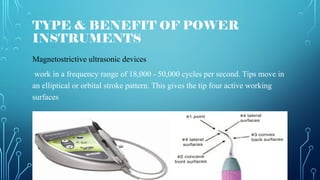
Magnetostrictive ultrasonic devices
work in a frequency range of 18,000 - 50,000 cycles per second. Tips move in
an elliptical or orbital stroke pattern. This gives the tip four active working
surfaces
TYPE & BENEFIT OF POWER
INSTRUMENTS
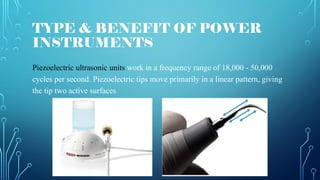
Piezoelectric ultrasonic units work in a frequency range of 18,000 - 50,000
cycles per second. Piezoelectric tips move primarily in a linear pattern, giving
the tip two active surfaces
INDICATIONS FOR USE OF
MECHANIZED INSTRUMENTS
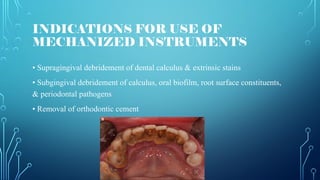
• Supragingival debridement of dental calculus & extrinsic stains
• Subgingival debridement of calculus, oral biofilm, root surface constituents,
& periodontal pathogens
• Removal of orthodontic cement
INDICATIONS FOR USE OF
MECHANIZED INSTRUMENTS
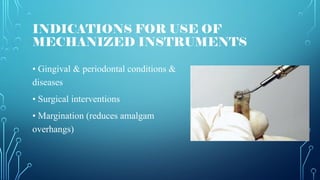
• Gingival & periodontal conditions &
diseases
• Surgical interventions
• Margination (reduces amalgam
overhangs)
CONTRAINDICATIONS
Contrnindication of ultrasonic device:
I - Infectious diseases .
2- Cardiac pacemaker & hearing aids .
3- Gag reflex
4- young children
5- pain.
PRECAUTIONS
• Unshielded pacemakers
• Infectious diseases: human immunodeficiency virus, hepatitis, tuberculosis
(active stages)
• Demineralized tooth surface
• Exposed dentin (especially associated with sensitivity)
• Restorative materials (porcelain, amalgam, gold, composite)
• Titanium implant abutments unless using special insert.
• Children (primary teeth)
• Immunosuppression from disease or chemotherapy
• Uncontrolled diabetes mellitus
ADVANTAGES OF ULTRASONIC
OVER HAND INSTRUMENTS
• Less effort, pressure, trauma,and time.
• Simple manipulation.
• Water spray clean debris.
DISADVANTAGES OF SONIC &
ULTRASONIC INSTRUMENTATIONS
• Client comfort (water spraying)
• Aerosol production
• Temporary hearing shifts
DISADVANTAGES OF SONIC &
ULTRASONIC INSTRUMENTATIONS
• Noise
• Less tactile sensation
• Reduced visibility
SPECIAL CONSIDERATIONS
➢ Root Surface Roughness
The data are mixed on whether power-driven instruments cause
more root surface roughness than hand instruments. Power-driven
instruments may increase the roughness of resin or glass ionomer
restorative materials; therefore, repolishing post scaling is
recommended.
SPECIAL CONSIDERATIONS
➢ Aerosol Production
Power-driven devices produce bioaerosols & splatter, which can
contaminate the operator & remain in the air for up to 30 minutes.
Good infection control practices can minimize the hazard. Data have
shown that preprocedural rinsing with 0.12% chlorhexidine & high-
speed evacuationare the most efficient ways to reduce bioaerosols.
SPECIAL CONSIDERATIONS
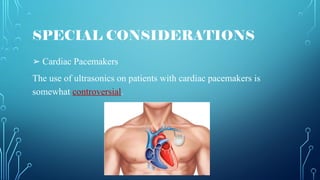
➢ Cardiac Pacemakers
The use of ultrasonics on patients with cardiac pacemakers is
somewhat controversial.
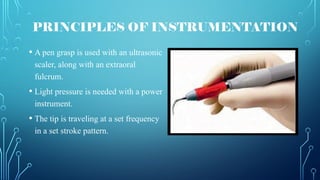
PRINCIPLES OF INSTRUMENTATION
• A pen grasp is used with an ultrasonic
scaler, along with an extraoral
fulcrum.
• Light pressure is needed with a power
instrument.
• The tip is traveling at a set frequency
in a set stroke pattern.
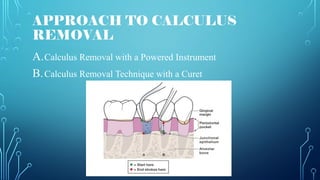
APPROACH TO CALCULUS
REMOVAL
A.Calculus Removal with a Powered Instrument
B.Calculus Removal Technique with a Curet
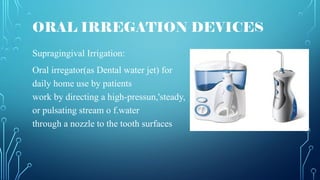
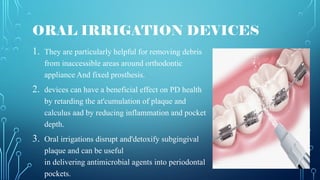
Supragingival Irrigation:
Oral irregator(as Dental water jet) for
daily home use by patients
work by directing a high-pressun,'steady,
or pulsating stream o f.water
through a nozzle to the tooth surfaces
ORAL IRREGATION DEVICES
ORAL IRRIGATION DEVICES
1. They are particularly helpful for removing debris
from inaccessible areas around orthodontic
appliance And fixed prosthesis.
2. devices can have a beneficial effect on PD health
by retarding the at'cumulation of plaque and
calculus aad by reducing inflammation and pocket
depth.
3. Oral irrigations disrupt and'detoxify subgingival
plaque and can be useful
in delivering antimicrobial agents into periodontal
pockets.
ORAL IRRIGATION DEVICES
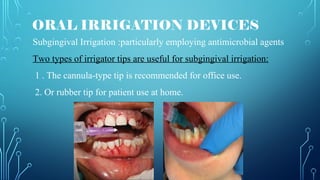
Subgingival Irrigation :particularly employing antimicrobial agents
Two types of irrigator tips are useful for subgingival irrigation:
1 . The cannula-type tip is recommended for office use.
2. Or rubber tip for patient use at home.
Thank you

sonic and ultrasonic.pptxbbbbbbbbbbbbbbbbbbbbb

  • 1.
    SONIC & ULTRASONIC INSTRUMENTATION& IRRIGATION ‫عبد‬ ‫جعفر‬ ‫احمد‬ ‫الحسن‬ ‫الخامسة‬ ‫المرحلة‬
  • 2.
    POWER-DRIVEN INSTRUMENTS: OVERVIEW Power-driven instrumentsare everyday mainstays in periodontal therapy & maintenance. They may be used alone or combination with hand instruments. Power instrumentation has the potential to make scaling less demanding & more time efficient. Potential hazards from using power-driven devices include rough root surfaces, production of bioaerosols, & interference with cardiac pacemakers.
  • 4.
    SONIC AND ULTRASONIC Thesescalers convert high frequency electrical energy (ultrasonic) or air pressure (sonic) into high frequency sound waves .
  • 5.
    MECHANISM OF ACTIONOF POWER SCALERS Various physical factors play a role in the mechanism of action of power scalers. These factors include frequency, stroke, & water low. In addition to rate of flow, the physiologic effects of water may contribute to the efficacy of power instruments
  • 6.
    MECHANISM OF ACTIONOF POWER SCALERS Water contributes to three physiologic effects that play a role in the efficacy. These are: • Acoustic steaming: is unidirectional fluid flow caused by ultrasound waves. • Acoustic turbulence: is created when the movement of the tip causes the coolant to accelerate, producing an intensified swirling effect. This turbulence continues until cavitation occurs • Cavitation is the formation of bubbles in water caused by the high turbulence
  • 7.
    TYPE & BENEFITOF POWER INSTRUMENTS Sonic units work at a frequency of 2000 - 6500 cycles per second & use a high- or low-speed air source from the dental unit. A sonic scaler tip travels in an elliptical or orbital stroke pattern.
  • 8.
    TYPE & BENEFITOF POWER INSTRUMENTS Magnetostrictive ultrasonic devices work in a frequency range of 18,000 - 50,000 cycles per second. Tips move in an elliptical or orbital stroke pattern. This gives the tip four active working surfaces
  • 9.
    TYPE & BENEFITOF POWER INSTRUMENTS Piezoelectric ultrasonic units work in a frequency range of 18,000 - 50,000 cycles per second. Piezoelectric tips move primarily in a linear pattern, giving the tip two active surfaces
  • 10.
    INDICATIONS FOR USEOF MECHANIZED INSTRUMENTS • Supragingival debridement of dental calculus & extrinsic stains • Subgingival debridement of calculus, oral biofilm, root surface constituents, & periodontal pathogens • Removal of orthodontic cement
  • 11.
    INDICATIONS FOR USEOF MECHANIZED INSTRUMENTS • Gingival & periodontal conditions & diseases • Surgical interventions • Margination (reduces amalgam overhangs)
  • 12.
    CONTRAINDICATIONS Contrnindication of ultrasonicdevice: I - Infectious diseases . 2- Cardiac pacemaker & hearing aids . 3- Gag reflex 4- young children 5- pain.
  • 13.
    PRECAUTIONS • Unshielded pacemakers •Infectious diseases: human immunodeficiency virus, hepatitis, tuberculosis (active stages) • Demineralized tooth surface • Exposed dentin (especially associated with sensitivity) • Restorative materials (porcelain, amalgam, gold, composite) • Titanium implant abutments unless using special insert. • Children (primary teeth) • Immunosuppression from disease or chemotherapy • Uncontrolled diabetes mellitus
  • 14.
    ADVANTAGES OF ULTRASONIC OVERHAND INSTRUMENTS • Less effort, pressure, trauma,and time. • Simple manipulation. • Water spray clean debris.
  • 15.
    DISADVANTAGES OF SONIC& ULTRASONIC INSTRUMENTATIONS • Client comfort (water spraying) • Aerosol production • Temporary hearing shifts
  • 16.
    DISADVANTAGES OF SONIC& ULTRASONIC INSTRUMENTATIONS • Noise • Less tactile sensation • Reduced visibility
  • 17.
    SPECIAL CONSIDERATIONS ➢ RootSurface Roughness The data are mixed on whether power-driven instruments cause more root surface roughness than hand instruments. Power-driven instruments may increase the roughness of resin or glass ionomer restorative materials; therefore, repolishing post scaling is recommended.
  • 18.
    SPECIAL CONSIDERATIONS ➢ AerosolProduction Power-driven devices produce bioaerosols & splatter, which can contaminate the operator & remain in the air for up to 30 minutes. Good infection control practices can minimize the hazard. Data have shown that preprocedural rinsing with 0.12% chlorhexidine & high- speed evacuationare the most efficient ways to reduce bioaerosols.
  • 19.
    SPECIAL CONSIDERATIONS ➢ CardiacPacemakers The use of ultrasonics on patients with cardiac pacemakers is somewhat controversial.
  • 20.
    PRINCIPLES OF INSTRUMENTATION •A pen grasp is used with an ultrasonic scaler, along with an extraoral fulcrum. • Light pressure is needed with a power instrument. • The tip is traveling at a set frequency in a set stroke pattern.
  • 21.
    APPROACH TO CALCULUS REMOVAL A.CalculusRemoval with a Powered Instrument B.Calculus Removal Technique with a Curet
  • 22.
    Supragingival Irrigation: Oral irregator(asDental water jet) for daily home use by patients work by directing a high-pressun,'steady, or pulsating stream o f.water through a nozzle to the tooth surfaces ORAL IRREGATION DEVICES
  • 23.
    ORAL IRRIGATION DEVICES 1.They are particularly helpful for removing debris from inaccessible areas around orthodontic appliance And fixed prosthesis. 2. devices can have a beneficial effect on PD health by retarding the at'cumulation of plaque and calculus aad by reducing inflammation and pocket depth. 3. Oral irrigations disrupt and'detoxify subgingival plaque and can be useful in delivering antimicrobial agents into periodontal pockets.
  • 24.
    ORAL IRRIGATION DEVICES SubgingivalIrrigation :particularly employing antimicrobial agents Two types of irrigator tips are useful for subgingival irrigation: 1 . The cannula-type tip is recommended for office use. 2. Or rubber tip for patient use at home.
  • 25.