Some of the bibliography docs
Karls Marx
https://www.marxists.org/archive/marx/works/1844/manuscripts
/labour.htm
A Vindication of the Rights of Woman
with Strictures on Political and Moral Subjects
Mary Wollstonecraft
Copyright © Jonathan Bennett 2017. All rights reserved
[Brackets] enclose editorial explanations. Small ·dots· enclose
material that has been added, but can be read as
though it were part of the original text. Occasional •bullets, and
also indenting of passages that are not quotations,
are meant as aids to grasping the structure of a sentence or a
thought. Every four-point ellipsis . . . . indicates the
omission of a brief passage that seems to present more
difficulty than it is worth. Longer omissions are reported
between brackets in normal-sized type.—If this work gets you
interested in its author, read Claire Tomalin’s fine
The Life and Death of Mary Wollstonecraft (1974).
First launched: April 2010
Contents
Dedicatory Letter 1
Introduction 4
Chapter 1: Human rights and the duties they involve 7
Chapter 2: The prevailing opinion about sexual differences 12
Chapter 3: The same subject continued 26
Chapter 4: The state of degradation to which woman is reduced
by various causes 36
The Rights of Woman Mary Wollstonecraft
Chapter 5: Writers who have rendered women objects of pity,
bordering on contempt 53
Section 1: Rousseau . . . . . . . . . . . . . . . . . . . . . . . . . . . . . . . .
. . . . . . . . . . . . . . . . . . . . . . . . . 53
Section 2: Fordyce . . . . . . . . . . . . . . . . . . . . . . . . . . . . . . . . .
. . . . . . . . . . . . . . . . . . . . . . . . . . . 61
Section 3: Gregory . . . . . . . . . . . . . . . . . . . . . . . . . . . . . . . . .
. . . . . . . . . . . . . . . . . . . . . . . . . . 62
Section 4: Some women . . . . . . . . . . . . . . . . . . . . . . . . . . . . .
. . . . . . . . . . . . . . . . . . . . . . . . . . 65
Section 5: Chesterfield . . . . . . . . . . . . . . . . . . . . . . . . . . . . . .
. . . . . . . . . . . . . . . . . . . . . . . . . . 66
Chapter 6: The effect that an early association of ideas has on
the character 71
Chapter 7: Modesty comprehensively considered and not as a
sexual virtue 75
Chapter 8: Morality undermined by sexual notions of the
importance of a good reputation 80
Chapter 9: The pernicious effects of the unnatural distinctions
established in society 85
Chapter 10: Parental Affection 89
Chapter 11: Duty to Parents 91
Chapter 12: National education 93
Chapter 13: Examples of the harm done by women’s ignorance
99
Section 1: Charlatans . . . . . . . . . . . . . . . . . . . . . . . . . . . . . . .
. . . . . . . . . . . . . . . . . . . . . . . . . . 99
Section 2: Novel-reading . . . . . . . . . . . . . . . . . . . . . . . . . . . . .
. . . . . . . . . . . . . . . . . . . . . . . . . . . 101
Section 3: Dressing up . . . . . . . . . . . . . . . . . . . . . . . . . . . . . .
. . . . . . . . . . . . . . . . . . . . . . . . . . 103
Section 4: Sensibility . . . . . . . . . . . . . . . . . . . . . . . . . . . . . . .
. . . . . . . . . . . . . . . . . . . . . . . . . . 103
Section 5: Ignorance about child-care . . . . . . . . . . . . . . . . . . .
. . . . . . . . . . . . . . . . . . . . . . . . . . . . . 104
Section 6: Concluding thoughts . . . . . . . . . . . . . . . . . . . . . . . .
. . . . . . . . . . . . . . . . . . . . . . . . . . . 105
The Rights of Woman Mary Wollstonecraft
Glossary
accomplishment: That is a kind of sneer-word when MW
uses it writing about the ‘accomplishments’ that women
are trained to have. To ‘accomplish’ something can be to
complete or finish it; a few decades ago some young women
were sent to a ‘finishing school’ before being launched into
society.
address: skill, elegance, dexterity; usually thought of (by
MW at least) as something learned, practised, contrived—not
natural. See page 58.
amuse: In MW’s time ‘amuse’ had a central meaning which
it now has only at the margins: to ‘amuse oneself by. . . ’ was
to pass the time by. . . . A child who is ‘amusing herself’ by
dressing her doll (page 29) needn’t be taking much pleasure
in this.
animal spirits: These figured in a theory, popularised
by Descartes: they were supposed to be an extremely
fine-divided liquid or gas—much less lumpy than water or
air—that could move with great speed and get in anywhere;
among their roles was to transmit causal influences from the
sense-organs to the brain, almost instantaneously.
brute, brutal: A brute is a lower or non-human animal. A
brutal or brutish way of behaving is one that falls below
a minimum standard for being human—e.g. the ‘brutal’
behaviour of a mother [on page 89] who indulges her child
without thinking about the effects of her conduct on the
child’s later development or on •other people.
docile: Strictly and originally this meant ‘able to learn’
and/or ‘willing to learn’. In MW’s usage, as in ours today,
a ‘docile’ person is one who is easy to manage, persuade,
manipulate, etc. One who is biddable.
education: In MW’s time this word had a wider meaning
than it tends to have today. It wouldn’t be far wrong to
replace most occurrences of it by ‘upbringing’. See MW’s
discussion of ‘education’ starting on page 14.
genius: In the present work this means something like
‘extremely high-level intellect’; similar to the word’s present
meaning, but not as strong.
he or she: MW never uses ‘he or she’, ‘his or hers’ or the like.
These occur in the present version to avoid the discomfort
we feel in her use of ‘it’, as when she says ‘every being’ can
become virtuous by the exercise of ‘its own reason’.
(im)mortal: MW ties •being immortal to •having reason and
to •being anwerable to God.
mistress: In this work, a ‘mistress of’ a family is in charge
of a family; and a ‘mistress of’ a man is a sexual partner of a
man. The word is not used here except in those two kinds of
context.
person: When MW refers to a woman’s ‘person’ she is
always referring to the woman herself considered as sexually
attractive. A man’s interest in a woman’s ‘person’ is his
sexual interest in her body, though clothing and jewellery
may also come into it.
prescription: In several important places MW uses ‘prescrip-
tion’ in its sense as a legal term, now obsolete, referring to
something’s being accepted or unchallenged etc. because it
has been in place for so long.
sceptre: An ornamental rod held in the hand of a monarch
as a symbol of royal authority. MW uses the word several
times, always as a metaphor for power or authority: ‘beauty
The Rights of Woman Mary Wollstonecraft
is woman’s sceptre’ means that beauty is woman’s source of
power.
sense: MW speaks of ‘a man of sense’ she means ‘a fairly
intelligent man’ or, in her terms, ‘a man with a fairly enlarged
understanding’.
sensibility: Capacity for refined emotion, readiness to feel
compassion for suffering, or the quality of being strongly
affected by emotional influences. MW uses the adjective
‘sensible’—e.g. on page 63—in pretty much our sense of it.
sentimental: This meant ‘having to do with feelings’; the
implication of shallow and unworthy feelings came after
MW’s time. On page 1 ‘sentimental lust’ presumably means
‘intense hankering for various kinds of feelings’.
sex: For MW ‘sex’ is a classificatory term—e.g. ‘I speak for
my sex’ meaning ‘I speak for all women’. (The use of ‘sex’
as short for ‘copulation’ is of more recent vintage.) See the
striking example on page 36. MW uses phrases about ‘giving
a sex to X’ meaning (page 6) treating X as though it related
to only one of the sexes, or (pages 24, 29 and 41) treating
X as though there were one version of it for females and a
different one for males.
subtlety: In MW’s usage this means something close to
‘address’ (see above).
vice, vicious: For an 18th century writer vice is simply
wrong conduct, with no necessary implication of anything
sexual (except perhaps on page 55); and a vicious person is
simply someone who often acts wrongly, with no necessary
implication of anything like savage cruelty.
virtue: On a few occasions in this work MW uses ‘virtue’
with some of its older sense of ‘power’. One example is on
page 36. On page 65 MW personifies virtue as feminine.
voluptuous: Having to do with sexual pleasure.
vulgar: In MW’s day ‘vulgar’ as applied to people meant
‘common, ordinary, not much educated, not very thoughtful’.
More generally, ‘vulgar x’ meant ‘the kind of x that would be
associated with vulgar people’.
woman: This version follows MW exactly in her uses of
‘woman’, ‘women’, ‘lady’, ‘female’ and ‘feminine’, and in her
use of the masculine counterparts of these.
The Rights of Woman Mary Wollstonecraft Dedicatory Letter
Dedicatory Letter
[This work appeared in 1792, when Talleyrand—as he is usually
called today—was active in the higher levels of the developing
French revolution. A
Constitution establishing France as a constitutional monarchy
had been established in 1791. The infamous ‘reign of terror’
was still a year away. Two
years earlier, MW had published a defence of the revolution
against Burke, entitled A Vindication of the Rights of Men.]
To M. Talleyrand-Périgord
former Bishop of Autun
Sir:
Having read with great pleasure a pamphlet on National
Education that you recently published, I dedicate this volume
to you, to induce you to reconsider the subject and maturely
weigh what I shall say about the rights of woman and
national education; and I’m calling with the firm tone of
humanity. [‘National education’ is the topic of the penultimate
chapter,
starting on page 93.] In these arguments, sir, I am not trying to
get anything for myself; I plead not for myself but for my for
my sex. ·My own personal wants, anyway, amount to very
little·. For many years I have regarded independence as the
great blessing of life, the basis of every virtue; and even if I
end up living on a barren heath, I will always guarantee my
independence by contracting my wants.
So it is my affection for the whole human race that
•makes my pen speed along to support what I believe to
be the cause of virtue, and •leads me to long to see woman’s
place in the world enable her to advance the progress of the
glorious principles that give a substance to morality, rather
than holding them back. My opinion about the rights and
duties of woman seems to flow so naturally from those simple
principles that it seems almost inevitable that some of the
enlarged minds who formed your admirable constitution will
agree with me.
[In this next paragraph, ‘essence’ is used not in the customary
philosophi-
cal sense, but in the sense involved in ‘essence of lavender’. A
‘voluptuary’
is someone devoted to the pursuit of luxury and sensual
pleasure.]
Knowledge is spread more widely in France than in any
·other· part of Europe; and I attribute this in large measure to
the social intercourse there has long been in France between
the sexes. It is true (I’m going to speak freely) that in France
the very essence of sensuality has been extracted for the
pleasure of the voluptuary, and a kind of sentimental lust
[see Glossary] has prevailed. This, together with the system of
deceptiveness that the whole spirit of their political and civil
government taught, have given a sinister sort of knowingness
to the French character. . . .and a polish of manners that
injures the substance by driving sincerity out of society. And
modesty—the fairest garb of virtue—has been more grossly
insulted in France than even in England; the ·minimal·
attention to decency that ·even· brutes instinctively observe
is regarded by French women as prudish!
Manners and morals are so closely related that they have
often been confused with one another; but although manners
should be only the natural reflection of morals, when various
causes have produced unnatural and corrupt manners that
infect even the young, morality becomes an empty name.
Personal restraint and respect for cleanliness and delicacy
in domestic life are the graceful pillars of modesty, but
French women almost despise them. If the pure flame
of patriotism has reached their hearts, they should work
1
The Rights of Woman Mary Wollstonecraft Dedicatory Letter
to improve the morals of their fellow-citizens by teaching
men not only •to respect modesty in women but •to become
modest themselves, as the only way to deserve women’s
respect.
Fighting for the rights of women, my main argument is
built on this simple principle: If woman isn’t fitted by educa-
tion to become man’s companion, she will stop the progress of
knowledge, because truth must be common to all; if it isn’t it
won’t be able to influence how people in general behave. And
how can woman be expected to cooperate if she doesn’t know
why she ought to be virtuous? if freedom doesn’t strengthen
her reason until she understands her •duty and sees how
it is connected with her real •good? If children are to be
brought up to understand the true principle of patriotism,
their mother must be a patriot; and the love of mankind,
from which an orderly sequence of virtues arises, can be
produced only by attending to the moral and civil interest
of mankind; but the upbringing and situation of woman at
present shuts her out from such investigations.
In this work I have produced many arguments that I
found conclusive, showing that the prevailing notion of ‘the
female character’ is subversive of morality. I have contended
that to make the human body and mind more perfect,
chastity must more universally prevail; and that chastity
will never be respected in the male world until the person of
a woman is not virtually idolized while the woman has little
virtue or sense. [see Glossary on ‘person’]. . . .
Consider these remarks dispassionately, Sir, for you
seemed to have a glimpse of this truth when you said
that ‘to see one half of the human race excluded by the
other half from all participation of government is a political
phenomenon that can’t possibly be explained according to
abstract principles’. If that is so, what does your constitution
rest on? If the abstract rights of man can stand discussion
and explanation, those of woman—by a parity of reasoning—
won’t shrink from the same test: though a different view
prevails in this country, built on the very arguments that
you use to justify the oppression of woman—prescription [see
Glossary].
I address you as a legislator: When men fight for their
freedom, fight to be allowed to judge for themselves concern-
ing their own happiness, isn’t it inconsistent and unjust
to hold women down? I know that you firmly believe you
are acting in the manner most likely to promote women’s
happiness; but who made man the exclusive judge ·of that·
if woman shares with him the gift of reason?
Tyrants of every kind, from the weak king to the weak
father of a family, use this same argument ·that ‘It is in
your own best interests’·. They are all eager to crush reason,
but they always say that they usurp reason’s throne only to
be useful. Isn’t that what you are doing when you force all
women, by denying them civil and political rights, to remain
walled in by their families and groping in the dark? Surely,
sir, you won’t say that a duty can be binding without being
founded on reason! Arguments •for civil and political rights
can be drawn •from reason; and with that splendid support,
the more understanding women acquire the more they will
be attached to their duty, understanding it. Unless they
understand it—unless their morals are based on the same
immutable principles as those of man—no authority can
make them act virtuously. They may be convenient slaves,
but slavery will have its constant effect, degrading the master
and the abject dependent.
If you are going to exclude women, without consulting
them, from sharing in the natural rights of mankind, then
defend yourself against accusations of injustice and inconsis-
tency by proving that women don’t have reason. If you don’t
do that, then this flaw in your New Constitution—the first
2
The Rights of Woman Mary Wollstonecraft Dedicatory Letter
constitution based on reason—will show for all times that
man must in some way act like a tyrant, and that tyranny,
in whatever part of society it raises its arrogant head, will
always undermine morality.
I have produced what seemed to me to be irrefutable
arguments, drawn from matters of fact, to prove my often-
repeated assertion that women cannot by force be confined
to domestic concerns. However ignorant they are, they will
get involved in more weighty affairs, neglecting private duties
only to disturb by cunning tricks the orderly plans of reason
that rise above their comprehension.
Also, while women are only made to acquire personal
accomplishments [see Glossary], men will seek pleasure in
variety, and faithless husbands will make faithless wives.
Indeed, such ignorant beings as wives are in such a system
will be very excusable when, not having been taught to
respect public good or allowed any civil rights, they try to
make things more fair by retaliation.
When the box of mischief has been thus opened in society,
what is to preserve private virtue, the only security of public
freedom and universal happiness?
·The answer is·: Let there be no coercion established in
society—·no laws that force people into this or that social
role or situation·. When that is achieved, the common law of
gravity will hold sway and the sexes will fall into their proper
places. With fairer laws forming your citizens, marriage can
become more sacred; your young men can choose wives from
motives of affection, and your maidens can allow love to root
out vanity.
The father of a family won’t weaken his constitution and
debase his sentiments by visiting prostitutes; he won’t in
obeying the call of ·sexual· appetite forget the purpose for
which it was implanted in him; and the mother won’t neglect
her children to practise the arts of teasing and flirting when
sense and modesty secure her the friendship of her husband.
But until men become attentive to the duty of a father,
you can’t expect women to spend in their nursery the time
that they. . . .choose to spend at their mirror; for this exercise
in cunning is only a natural instinct to enable them to obtain
indirectly a little of the power of which they are unjustly
denied a share. If women aren’t permitted to enjoy legitimate
rights, they will seek illicit privileges in ways that make both
men and themselves vicious [see Glossary].
I wish, sir, to get some investigations of this kind going in
France. If they lead to a confirmation of my principles, then
when your constitution is revised the rights of woman may
be •respected, if it has been fully proved that reason calls for
this •respect and loudly demands justice for one half of the
human race.
I am, sir,
Yours respectfully,
M. W.
3
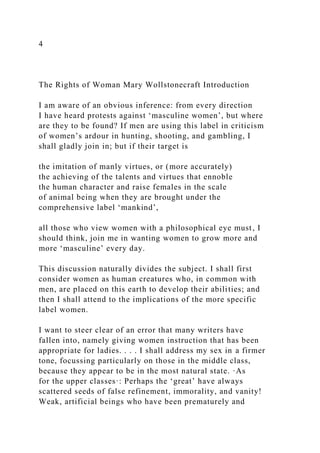
The Rights of Woman Mary Wollstonecraft Introduction
Introduction
After thinking about the sweep of history and viewing the
present world with anxious care, I find my spirits depressed
by the most melancholy emotions of sorrowful indignation.
I have had to admit, sadly, that either nature has made a
great difference between man and man, or that the world is
not yet anywhere near to being fully civilized. I have looked
into various books on education, and patiently observed the
conduct of parents and the management of schools; but all
this has given me is a deep conviction that •the neglected
education of my fellow creatures is the main source of the
misery I deplore, and that •women in particular are made
weak and wretched by a number of co-operating causes,
originating from one hasty conclusion [MW’s phrase]. The
conduct and manners of women, in fact, show clearly that
their minds are not in a healthy state; as with flowers planted
in soil that is too rich, strength and usefulness are sacrificed
to beauty; and the flamboyant leaves, after giving pleasure
to viewers, fade on the stalk, disregarded, long before it was
the time for them to reach maturity. This barren blooming is
caused partly by a false system of education, gathered from
the books on the subject by men. These writers, regarding
females as women rather than as human creatures, have
been more concerned to make them alluring mistresses than
affectionate wives and rational mothers; and this homage
to women’s attractions has distorted their understanding to
such an extent that almost all the civilized women of the
present century are anxious only to inspire •love, when they
ought to have the nobler aim of getting •respect for their
abilities and virtues.
In a book on female rights and manners, therefore, the
works written specifically for their improvement mustn’t be
overlooked; especially when the book says explicitly •that
women’s minds are weakened by false refinement, •that the
books of instruction written by men of genius [see Glossary]
have been as likely to do harm as more frivolous produc-
tions; and •that—when improvable reason is regarded as
the dignity that raises men above the lower animal and
puts a natural sceptre [see Glossary] in a feeble hand—those
‘instructive’ works regard woman (in true Moslem fashion) as
beings of a subordinate kind and not as a part of the human
species.
But don’t think that because I am a woman I mean stir
up violently the debated question about the equality and
inferiority of the ·female· sex; but that topic does lie across
my path, and if I sidle past it I’ll subject my main line of
reasoning to misunderstanding. So I shall pause here in
order to give a brief statement of my opinion about it. In
the government of the physical world—·as distinct from the
governments of the social or political world·—it is observable
that the female is, so far as strength is concerned, inferior to
the male.
This is the law of nature; and it doesn’t seem to be
suspended or repealed in favour of woman. This physical
superiority can’t be denied—and it is a noble privilege! But
men, not content with this natural pre-eminence, try to sink
us lower still, so as to make us merely alluring objects for
a moment; and women, intoxicated by the adoration that
men (under the influence of their senses) pay them, don’t try
to achieve a permanently important place in men’s feelings,
or to become the friends of the fellow creatures who find
amusement [see Glossary] in their society.
4
The Rights of Woman Mary Wollstonecraft Introduction
I am aware of an obvious inference: from every direction
I have heard protests against ‘masculine women’, but where
are they to be found? If men are using this label in criticism
of women’s ardour in hunting, shooting, and gambling, I
shall gladly join in; but if their target is
the imitation of manly virtues, or (more accurately)
the achieving of the talents and virtues that ennoble
the human character and raise females in the scale
of animal being when they are brought under the
comprehensive label ‘mankind’,
all those who view women with a philosophical eye must, I
should think, join me in wanting women to grow more and
more ‘masculine’ every day.
This discussion naturally divides the subject. I shall first
consider women as human creatures who, in common with
men, are placed on this earth to develop their abilities; and
then I shall attend to the implications of the more specific
label women.
I want to steer clear of an error that many writers have
fallen into, namely giving women instruction that has been
appropriate for ladies. . . . I shall address my sex in a firmer
tone, focussing particularly on those in the middle class,
because they appear to be in the most natural state. ·As
for the upper classes·: Perhaps the ‘great’ have always
scattered seeds of false refinement, immorality, and vanity!
Weak, artificial beings who have been prematurely and
unaturally raised above the ordinary wants and feelings of
mankind undermine the very foundation of virtue and spread
corruption through the whole mass of society! They have
a stronger claim to pity than any other class of mankind.
The upbringing of the rich tends to make them vain and
helpless, and their unfolding minds are not strengthened by
the practice of the duties that dignify the human character.
They live only to amuse [see Glossary] themselves, and—by a
law that also operates in nature—they soon come to have
nothing to offer except barren amusement.
That is enough about that for the present: I plan to take
the different ranks of society separately, and discuss the
moral character of women in each. I have mentioned the
subject ·of class-differences· here only because I think that
the essential task of an Introduction is to give a sketchy
account of the contents of the work it introduces.
I hope my own sex will excuse me if I treat them like
rational creatures, instead of flattering their fascinating
graces and viewing them as if they were in a state of perpetual
childhood and unable to stand alone. I earnestly wish to
point out what true dignity and human happiness consist in;
I want to persuade women to aim at strength of mind and
body, and to convince them •that the soft phrases
‘susceptibility of heart’
‘delicacy of sentiment’, and
‘refinement of taste’
are almost synonymous with expressions indicating weak-
ness, and •that creatures who are the objects only of pity
and the kind of love that has been called ‘pity’s sister’ will
soon become objects of contempt.
So I dismiss those pretty feminine phrases that the men
condescendingly use to make our slavish dependence easier
for us, and I despise the weak elegance of mind, exquisite
sensibility, and sweet docility [see Glossary] of manners that
are supposed to be the sexual characteristics of the weaker
sex. I want to show that elegance is inferior to virtue, that
the most praiseworthy ambition is to obtain a character as
a human being, whether male or female, and that lesser
ambitions should be tested against that one.
That is a rough sketch of my plan; and ·I offer now three
remarks about how I aim to carry it out·. (1) I shall refrain
from pruning my phrases and polishing my style, because
5
The Rights of Woman Mary Wollstonecraft Introduction
it is important to me to affect the thoughts and actions of
my readers, and I’ll do that better if I sometimes express my
conviction with the energetic emotions that I feel. (2) I shan’t
waste time elegantly shaping my sentences, or fabricating
the turgid bombast of artificial feelings that come from the
head and therefore never reach the heart; because I want to
persuade by the force of my arguments rather than to dazzle
by the elegance of my language. (3) I shall try to avoid the
flowery diction that has slid from essays into novels, and
from novels into familiar letters and conversation; because
I’ll be dealing with things, not words! In all this I’ll be anxious
to turn my sex into members of society who are more worthy
of respect..
These pretty nothings (these caricatures of the real beauty
of sensibility) drop glibly from the tongue, spoil one’s sense
of taste, and create a kind of sickly delicacy that turns
away from simple unadorned truth. [She means ‘delicacy’ in the
sense of pickiness, choosiness; readiness to push things to the
edge of
one’s plate.] A deluge of false sentiments and over-stretched
feelings, stifling the natural emotions of the heart, make
insipid the domestic pleasures that ought to sweeten the
exercise of the severe duties that prepare a rational and
immortal [see Glossary] being for a nobler field of action. [The
adjective ‘immortal’ suggests that the ‘nobler field of action’
that MW had
in mind is life after death.]
The education [see Glossary] of women has been attended to
more in recent years than formerly; but they’re still regarded
as a frivolous sex, and are ridiculed or pitied by writers
who try to improve them by satire or instruction. It is
acknowledged that they spend many of their earliest years
acquiring a smattering of accomplishments [see Glossary],
but strength of body and mind are sacrificed to libertine
notions of beauty, to the desire to get themselves settled
by marriage—the only way women can rise in the world.
This desire makes mere animals of them, and when they
marry they act as such children can be expected to act: they
dress, they paint, they give nicknames to God’s creatures.
Surely these weak beings are only fit for the seraglio! [= the
women’s quarters a Turkish palace; she is implying that women
are kept
there purely for sexual purposes.] Can they govern a family
with
judgment, or take care of the poor babes whom they bring
into the world?
The present conduct of the ·female· sex, its prevalent
fondness for pleasure in place of ambition and the nobler
passions that open and enlarge the soul, are evidence that
the instruction that women have received, with help
from the constitution of civil society, has only tended
to turn them into insignificant objects of desire, mere
propagators of fools!
If it can be proved that
men, in aiming to bring women to perfection without
cultivating their understandings, take them out of
their sphere of ·real· duties and make them ridiculous
and useless when the brief bloom of beauty is over,
I presume that rational men will excuse me for trying to
persuade them [i.e. women] to become more masculine and
worthy of respect.
Indeed the word ‘masculine’ is only a pointless scare-
word: there’s little reason to fear that women will acquire too
much courage or fortitude, because their visible inferiority in
bodily strength must make them to some extent dependent
on men in the various relations of life; but why should that
dependence be increased by prejudices that •give a sex to
virtue [see Glossary] and •can’t distinguish simple truths from
sensual daydreams?
Women are so much degraded by mistaken notions of
female excellence that this artificial weakness produces in
them a tendency to tyrannize, and gives birth to cunning—
6
The Rights of Woman Mary Wollstonecraft 1: Human right and
duties
the natural opponent of strength—which leads them to ex-
ploit those contemptible infantile airs that undermine esteem
even while they excite desire. Let men become more chaste
and modest, and if women don’t become correspondingly
wiser it will be clear that they have weaker understandings.
I hardly need to explain that I am talking about the
·female· sex in general. Many individual women have more
sense than their male relatives; some women govern their
husbands without degrading themselves, because intellect
will always govern. Where there’s a constant struggle for an
equilibrium, nothing will swing the scales its way unless it
naturally has greater weight.
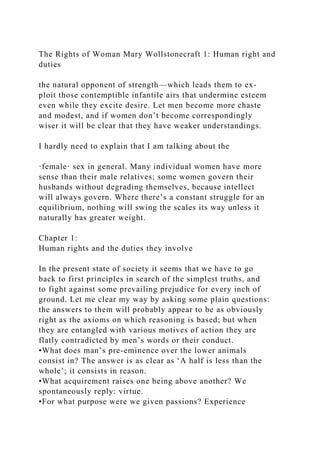
Chapter 1:
Human rights and the duties they involve
In the present state of society it seems that we have to go
back to first principles in search of the simplest truths, and
to fight against some prevailing prejudice for every inch of
ground. Let me clear my way by asking some plain questions:
the answers to them will probably appear to be as obviously
right as the axioms on which reasoning is based; but when
they are entangled with various motives of action they are
flatly contradicted by men’s words or their conduct.
•What does man’s pre-eminence over the lower animals
consist in? The answer is as clear as ‘A half is less than the
whole’; it consists in reason.
•What acquirement raises one being above another? We
spontaneously reply: virtue.
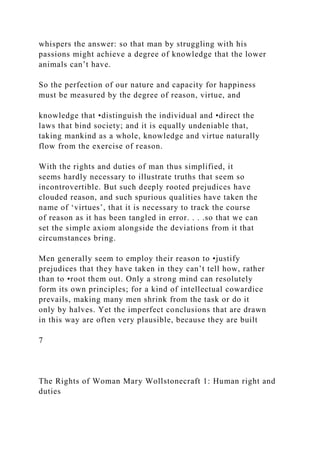
•For what purpose were we given passions? Experience
whispers the answer: so that man by struggling with his
passions might achieve a degree of knowledge that the lower
animals can’t have.
So the perfection of our nature and capacity for happiness
must be measured by the degree of reason, virtue, and
knowledge that •distinguish the individual and •direct the
laws that bind society; and it is equally undeniable that,
taking mankind as a whole, knowledge and virtue naturally
flow from the exercise of reason.
With the rights and duties of man thus simplified, it
seems hardly necessary to illustrate truths that seem so
incontrovertible. But such deeply rooted prejudices have
clouded reason, and such spurious qualities have taken the
name of ‘virtues’, that it is necessary to track the course
of reason as it has been tangled in error. . . .so that we can
set the simple axiom alongside the deviations from it that
circumstances bring.
Men generally seem to employ their reason to •justify
prejudices that they have taken in they can’t tell how, rather
than to •root them out. Only a strong mind can resolutely
form its own principles; for a kind of intellectual cowardice
prevails, making many men shrink from the task or do it
only by halves. Yet the imperfect conclusions that are drawn
in this way are often very plausible, because they are built
7
The Rights of Woman Mary Wollstonecraft 1: Human right and
duties
on partial experience, on views that are correct ·as far as
they go· but narrow.
Going back to first principles, vice [see Glossary] in all
its native ugliness slinks away from close investigation;
but shallow reasoners are always exclaiming that these
arguments ·from first principles· ‘prove too much’, and that
a given course of conduct is ‘expedient’ even if it is rotten at
the core. Thus •expediency is continually contrasted with
•simple principles, until truth is lost in a mist of words,
virtue is lost in forms [= ‘in mechanical rules of conduct’], and
the
tempting prejudices that claim the title ‘knowledge’ suppress
real knowledge.
The most wisely formed society is the one whose constitu-
tion is based on the nature of man—that statement, in the
abstract, strikes every thinking being so forcibly that it looks
like presumption to try to prove it; but we do need to prove it,
or reason will never be able to make prescription [see Glossary]
relax its grip. And yet urging prescription as an argument
to justify depriving men (or women) of their natural rights is
one of the absurd sophisms that daily insult common sense.
The bulk of the people of Europe are only very partially
civilized. Indeed, it’s an open question whether they have
acquired any virtues in exchange for the innocence ·they
have lost·, comparable with the misery produced by the vices
that have been plastered over unsightly ignorance, and the
freedom that has been traded away in exchange for glittering
slavery. The desire to dazzle by riches (the surest route
to pre-eminence!), the pleasure of commanding flattering
yes-men, and many other complicated low calculations of
stupid self-love, have all joined forces in overwhelming the
mass of mankind and making ‘liberty’ a convenient label for
mock patriotism.
For while rank and titles are held to be of the utmost
importance, before which genius ‘must hide its diminished
head’ [quoted from Milton’s Paradise Lost], it is almost always
disastrous for a nation when an able man without rank
or property pushes himself into the limelight. When such a
scheming obscure adventurer works to get a cardinal’s hat,
longing to be ranked with princes—or above them, by seizing
the triple crown ·worn by Popes·—the events involved in this
bring unheard-of misery to thousands of people.
So much wretchedness has flowed from hereditary hon-
ours, riches, and monarchy, that men of lively sensibility
have been reduced almost to blasphemy in their attempts
to justify God’s management of the world. They have
represented man as •independent of his Maker or as •a
lawless planet darting from its orbit to steal the celestial
fire of reason; and the vengeance of heaven. . . .punished his
boldness by introducing evil into the world.
Impressed by this view of the misery and disorder that
pervaded society, and weary from contending with artificial
fools, Rousseau fell in love with solitude; and in his optimism
he worked with uncommon eloquence to prove that man is
naturally a solitary animal. Misled by his respect for the
goodness of God, who certainly—for what man of sense [see
Glossary] and feeling can doubt it?—gave life only in order to
give happiness, he considered evil as. . . .the work of man;
not aware that he was exalting one ·divine· attribute at
the expense of another that is equally necessary to divine
perfection. [Jean-Jacques Rousseau, mentioned many times in
his
work, had died fourteen years before the pressent work
appeared.]
Constructed on the basis of a false hypothesis,
Rousseau’s arguments in favour of a state of nature are
plausible; but they are unsound, because the assertion that
a state of nature is preferable to the most perfect civilization
there could be is in effect a charge against supreme wisdom.
The paradoxical exclamation:
8
The Rights of Woman Mary Wollstonecraft 1: Human right and
duties
•God has made all things right, and
•evil has been introduced by the creature whom God
formed, knowing what he was forming
is as unphilosophical as it is impious.
The wise Being who created us and placed us
here. . . .allowed it to be the case—and thus willed it to be the
case—that our passions should help our reason to develop,
because he could see that present evil would produce future
good. Could the helpless creature whom God created out
of nothing break loose from his providence and boldly learn
to know good by practising evil without his permission? No.
How could ·Rousseau·, that energetic advocate for immortal-
ity, argue so inconsistently? If mankind had remained for
ever in the brutal state of nature, which even Rousseau’s
magic pen can’t paint as a state in which a single virtue took
root, it would have been clear. . . .that man was born to run
the circle of life and death, and adorn God’s garden for some
purpose that couldn’t easily be reconciled with his [= God’s]
attributes.
But if the whole divine plan was to be crowned by rational
creatures who would be allowed to rise in excellence through
the use of powers given to them for that purpose; if God in
his goodness thought fit to bring into existence a creature
above the brutes,1 one who could think and improve himself;
why should that incalculable •gift be openly called a •curse?
(A gift? Man was enabled to rise above the state in which
sensations gave him the sort of comfort that lower animals
are capable of; of course it was a gift!)
It might be regarded as a curse if our time in this world
was the whole span of our existence; for why should the
gracious fountain of life give us passions and the power of
reflecting, only to embitter our days and inspire us with
mistaken notions of dignity? Why would God lead us from
love of ourselves to the sublime emotions aroused by the
discovery of his wisdom and goodness, if these feelings
weren’t launched so as to improve our nature (of which they
are a part)2 and enable us to enjoy a more godlike portion
of happiness? Firmly convinced that no evil exists in the
world that God didn’t intend to occur, I build my belief on
the perfection of God.
Rousseau strains to prove that all was right originally;
a crowd of authors argues that all is now right; and I claim
that all will be right.
True to his first position which is nearly a state of
nature, Rousseau celebrates barbarism, and in his praise
of Fabricius [said to be one of the founders of ancient Rome] he
forgets that the Romans in conquering the world didn’t
dream of establishing their own liberty on a firm basis,
or of extending the reign of virtue. Eager to support his
system, he condemns as vicious [see Glossary] every effort of
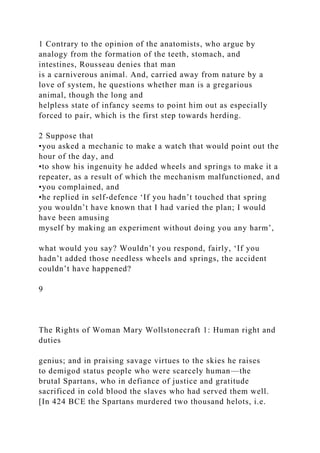
1 Contrary to the opinion of the anatomists, who argue by
analogy from the formation of the teeth, stomach, and
intestines, Rousseau denies that man
is a carniverous animal. And, carried away from nature by a
love of system, he questions whether man is a gregarious
animal, though the long and
helpless state of infancy seems to point him out as especially
forced to pair, which is the first step towards herding.
2 Suppose that
•you asked a mechanic to make a watch that would point out the
hour of the day, and
•to show his ingenuity he added wheels and springs to make it a
repeater, as a result of which the mechanism malfunctioned, and
•you complained, and
•he replied in self-defence ‘If you hadn’t touched that spring
you wouldn’t have known that I had varied the plan; I would
have been amusing
myself by making an experiment without doing you any harm’,
what would you say? Wouldn’t you respond, fairly, ‘If you
hadn’t added those needless wheels and springs, the accident
couldn’t have happened?
9
The Rights of Woman Mary Wollstonecraft 1: Human right and
duties
genius; and in praising savage virtues to the skies he raises
to demigod status people who were scarcely human—the
brutal Spartans, who in defiance of justice and gratitude
sacrificed in cold blood the slaves who had served them well.
[In 424 BCE the Spartans murdered two thousand helots, i.e.
slaves
serving as soldiers in the Spartan army. Thucydides wrote: ‘The
helots
were invited to select those of their number who claimed to
have most
distinguished themselves against the enemy, so that they could
be freed.
The object was to test them, thinking that the first to claim
freedom
would be the most apt to rebel. About two thousand were
selected and
rejoiced in their new freedom; but the Spartans secretly killed
each of
them.’]
Disgusted with artificial manners and virtues, Rousseau
didn’t sift through the subject but simply threw away the
wheat with the chaff, not pausing to consider whether
the evils that his ardent soul indignantly rejected were
•consequences of civilization or •vestiges of barbarism. He
saw vice trampling on virtue, and seeming-goodness taking
the place of the real thing; he saw talents bent by power
to sinister purposes; and he never thought of tracing the
gigantic harm back to •arbitrary power, back to •the heredi-
tary distinctions that clash with the mental superiority that
naturally raises a man above his fellows. He didn’t see that
it takes only a few generations for royal power to introduce
idiotism into the noble family line, and that it holds out baits
to make thousands idle and vicious. [MW adds harsh words
about the crimes that bring people to royal status, and about
the feeble passiveness of ‘millions of men’ who have let the
royal criminals get away with it. She continues:]
When the chief director of a society is instructed only in
how to invent crimes, or in the stupid routine of childish
ceremonies, how can it not be the case that the society has a
poisonous fog hovering over it? [MW’s ‘instructed in’ is
ambiguous:
she may mean that that’s all he is taught, or that it is all he
knows.]. . . .
In circumstances as good as they could possibly be, it
would still be impossible for any man to acquire enough
knowledge and strength of mind to perform the duties of
a king who has been entrusted with uncontrolled power.
Think how knowledge and strength of mind must be violated
when •the sheer fact that the man does become a king
poses an insuperable bar to his acquiring either wisdom
or virtue, when •all his feelings are stifled by flattery, and
when •thoughtfulness is shut out by pleasure! Surely it is
madness to make the fate of thousands depend on the whims
of a weak fellow creature whose very position in life puts him
necessarily below the poorest of his subjects! But one power
should not be thrown down in order to raise up another. Man
is weak, and all power intoxicates him; and the way power
is misused proves that the more equality there is among
men—·and thus the less power of men over men·—the more
virtue and happiness will reign in society. But this. . . .raises
an outcry: ‘If we don’t have absolute faith in the wisdom of
aniquity, the church is in danger’ or‘. . . the state is in danger’.
Those who are roused by the sight of human calamity to be
so bold as to attack human authority are reviled as despisers
of God and enemies of man. These are bitter libels, yet they
were levelled at one of the best of men (Dr. Price), whose
ashes still preach peace, and whose memory demands a
respectful pause when subjects that lay so near his heart are
discussed. [Richard Price, who died a year or so before the
present
work was published, had greatly influenced Mary
Wollstonecraft. He had
been reviled for his writings on the French Revolution. His
Review of the
Principal Questions in Morals is on the website from which the
present
text came.]
Now that I have attacked the ‘sacred’ majesty of kings,
you won’t be surprised when I add my firm conviction that
every profession whose power depends on large differences
of rank is highly injurious to morality.
10
The Rights of Woman Mary Wollstonecraft 1: Human right and
duties
A standing army, for instance, is incompatible with
freedom because strictness and rank are the very sinews
of military discipline; and despotism is necessary to give
vigour to enterprises that have one person in charge. A spirit
inspired by romantic notions of honour—a kind of morality
based on the fashion of the times—can be felt by only a few
officers, while the main body must be moved by command,
like the waves of the sea; for the strong wind of authority
pushes the crowd of subalterns forward, they scarcely know
or care why, with headlong fury. [Then as now, ‘subaltern’
mainly
meant ‘junior officer’, so the ‘main body’ presumably refers to
the main
body of the officers. The rank and file are not being talked
about here.]
·And armies are harmful in another way·. Nothing can
damage the morals of the inhabitants of country towns as
much as the occasional residence of a set of idle superficial
young men whose only occupation is gallantry, and whose
polished manners make vice more dangerous by concealing
its ugliness under gay ornamental drapery. An air of fashion,
which is really a badge of slavery, showing that the soul
doesn’t have a strong individual character, awes simple
country people into imitating the vices when they can’t catch
the slippery graces of social polish. Every military body is a
chain of despots who obey and give commands without using
their reason, and become dead weights of vice and folly on
the community. A man of rank or fortune whose connections
guarantee that he will rise has nothing to do but to pursue
some extravagant whim; while the needy gentleman who has
to rise ‘by his merit’, as they say, becomes a servile parasite
or a vile pander [= ‘pimp’, or perhaps merely ‘person whose job
it is to
satisfy his superiors’ desires’.]
Sailors, the gentlemen of the navy, can be described in
similar terms, except that their vices [see Glossary] are
different
and grosser. They are more positively indolent [= ‘wholly
idle’, ‘idly idle’] when they aren’t performing the ceremonials
required by their rank, whereas the insignificant fluttering
of soldiers could be called ‘active idleness’. More confined to
the society of men, sailors acquire a fondness for humour
and mischievous tricks; while soldiers, who are often in the
company of well-bred women, are infected with a ‘sensitive’
whiny way of speaking. But whether someone indulges in
·the sailor’s· horse-laugh or ·the soldier’s· polite simper, mind
is equally out of the question.
[This next paragraph refers to the Anglican church, of which
MW was
a member. A patron was a person, not himself a cleric, who had
sole
control over who became the well-paid rector or senior parson
of a
parish; and a curate was a junior parson who did most of the
parish
work and received a tiny fraction of the rector’s income.]
Let me extend the comparison to a profession where there is
certainly more mind to be found—the clergy. They have bet-
ter opportunities for improvement, but rank almost equally
cramps their faculties. The blind submission to forms of
belief that is imposed at college serves as a training for
the curate who most obsequiously respects the opinion of
his rector or patron—or he does if he means to rise in his
profession. There can hardly be a more striking contrast
than between •the servile, dependent manner of a poor curate
and •the top-of-the-world manner of a bishop. And
MW’s next phrase: the respect and contempt
perhaps meaning: the little respect and great contempt
they inspire makes the work they do in their separate func-
tions equally useless.
It is important to understand that every man’s character
is to some extent formed by his profession. A man with
a good mind may reflect his profession only in superficial
ways that wear off as you trace his individuality; while weak,
common men have hardly any character except what belongs
to their profession. . . .
11
The Rights of Woman Mary Wollstonecraft 2: Current views
about sexual differences
As society becomes more enlightened, therfore, it should
be very careful not to establish bodies of men who are bound
to be made foolish or vicious by the very constitution of their
profession.
In society’s infancy when men were just emerging out
of barbarism, chiefs and priests must have had unlimited
influence because they tapped into the most powerful springs
of savage conduct—hope and fear. Aristocracy is of course,
naturally the first form of government. But clashing in-
terests soon get out of balance, there is a confusion of
ambitious struggles, and what emerges is a monarchy and
hierarchy. . . . This appears to be the origin of monarchical
and priestly power, and the dawn of civilization. But such
combustible materials can’t be held down for long; and
foreign wars and uprisings at home give the ·common· people
a chance to acquire some power, which obliges their rulers
to gloss over their oppression with a show of right. Thus
as wars, agriculture, commerce, and literature expand the
mind, despots are forced to use •hidden corruption to keep
the power that was initially snatched by open force.3 And
this •lurking gangrene is spread most quickly by luxury and
superstition, the sure dregs of ambition. The idle puppet of a
·royal· court first becomes a luxurious monster or fastidious
pleasure-seeker, and the contagion that his unnatural state
spreads becomes the instrument of tyranny. [In this context,
‘luxury’ and its cognates refer to extreme and dissipated pursuit
and
enjoyment of sensual pleasures.]
It is the plague-carrying purple ·of royalty· that makes the
progress of civilization a curse, and warps the understanding
until men of good sense doubt whether the expansion of
intellect will bring more happiness or more misery. But the
nature of the poison points out the antidote; if Rousseau
had climbed one step higher in his investigation—or if his
eye could have pierced the foggy atmosphere that he was
hardly willing to breathe—his active mind would have darted
forward to contemplate •the perfection of man in the estab-
lishment of true civilization, instead of taking his ferocious
flight back to •the night of sensual ignorance.
Chapter 2:
The prevailing opinion about sexual differences
To explain and excuse the tyranny of man, many ingenious
arguments have been presented to prove that in the acquiring
of virtue the two sexes ought to have very different aims; or,
to put it bluntly, women aren’t thought to have enough
strength of mind to acquire virtue properly so-called. But
it would seem that if they have souls there is only one way
appointed by God to lead mankind to virtue or to happiness.
3 Men of abilities scatter seeds that grow and have a great
influence on the development of •public opinion; and once •that
gets the intellectual upper
hand through the exertion of reason, the overthrow of arbitrary
power is not very distant.
12
The Rights of Woman Mary Wollstonecraft 2: Current views
about sexual differences
If then women are not a swarm of insignificant ephemera
[insects like mayflies, that live for only one day], why should
they
be kept in ignorance under the pretty label ‘innocence’?
Men complain, with reason, about the follies and whims of
our sex, except when they sharply satirize our headstrong
passions and groveling vices. I would answer: Behold the
natural effect of ignorance! A mind that has only prejudices
to rest on will always be unstable, and the current will run
with destructive fury when there are no barriers to break
its force. Women are told from their infancy, and taught by
their mothers’ example, that
•a little knowledge of human weakness (properly called
‘cunning’),
•softness of temperament,
•outward obedience, and
•scrupulous attention to a puerile kind of propriety,
will obtain for them the protection of man; and if they are
also beautiful, that’s all they need for at least twenty years.
That is how Milton describes our first frail mother, ·Eve·;
though when he tells us that women are formed for softness
and sweet attractive grace I don’t understand him unless
in true Moslem fashion he means to deprive us of souls,
insinuating that all we were designed for was to use sweet
attractive grace and docile blind obedience to gratify the
senses of man when he can no longer soar on the wing of
contemplation.
Those who advise us only to turn ourselves into gentle
domestic animals—how grossly they insult us! For instance,
the ‘winning softness’ that is so warmly and frequently
recommended, that ‘governs by obeying’—what childish ex-
pressions! And a being who will sink to the level of governing
by such underhand methods—what an insignificant being
that must be! Can it be an immortal one? ‘Certainly,’ says
Lord Bacon, ‘man is of kin to the beasts by his body: and
if he be not of kin to God by his spirit, he is a base and
ignoble creature!’ Men, indeed, seem to me to act in a very
unphilosophical manner when they try to secure the good
conduct of women by keeping them always in a state of
childhood. Rousseau was more consistent when he wanted
to stop the progress of reason in both sexes; for if men eat
·fruit· of the tree of knowledge, women will come in for a taste,
but the imperfect cultivation that their understandings now
receive will give them only a knowledge of evil.
Children, I agree, should be innocent; but when ‘innocent’
is applied to men or women it is merely a polite word
for ‘weak’. If it is granted that women were destined by
Providence [= ‘God’] to acquire human virtues, and to use
their understandings to achieve the stability of character
that is the firmest ground to rest our future hopes on, then
they must be permitted to look to the fountain of light (·God·)
and not forced to steeer by the twinkling of a mere satellite
(·man·). Milton was of a very different opinion. . . ., but it
would be hard to make consistent two passages that I am
now going to contrast. But then great men often led by their
senses into such inconsistencies. [In these lines Eve is speaking
to Adam.]
To whom thus Eve with perfect beauty adorned:
My author and disposer, what thou bidst
Unargued I obey; so God ordains,
God is thy law, thou mine; to know no more
Is woman’s happiest knowledge and her praise.
These are exactly the arguments I have used to children!
But then I have added: ‘Your reason is now gaining strength.
Until it arrives at some degree of maturity, you must look up
to me for advice; but when it does arrive there, you ought to
think, and rely only on God.’
Yet, in these next lines, Milton seems to agree with me,
when he makes Adam protest to his Maker like this:
13
The Rights of Woman Mary Wollstonecraft 2: Current views
about sexual differences
Hast thou not made me here thy substitute,
And these inferior far beneath me set?
Among unequals what society
Can sort, what harmony or delight?
Which must be mutual, in proportion due
Given and received; but in disparity
The one intense, the other still remiss
Cannot well suit with either, but soon prove
Tedious alike: of fellowship I speak
Such as I seek, fit to participate
All rational delight. . . .
In discussing the manners of women, therefore, let us set
aside sensual arguments and work out what we should try
to make women in order to co-operate, if the expression isn’t
too bold, with God.
The sense of the word ‘education’ isn’t precisely defined,
so I should explain: by ‘individual education’ I mean
The kind of attention to a child that will slowly
sharpen the senses, form the temperament, regulate
the passions as they begin to bubble up, and set
the understanding to work before the body reaches
maturity; so that the ·fully mature· man will only have
to •continue the important task of learning to think
and reason, rather than .having to •start it.
I don’t believe that a private education can work the wonders
that some optimistic writers have attributed to it. [This topic
will be extensively discussed in chapter 12.] Men and women
must
be educated to a large extent by the opinions and manners
of the society they live in. In every age there has been a
stream of popular opinion that has carried everything along
with it, giving to that age a family character, so to speak. So
it’s reasonable to conclude that until society is differently
constituted, not much can be expected from education. All
I need for my present purpose, however, is this: Whatever
effect circumstances have on people’s abilities, everyone can
become virtuous by the exercise of his or her [see Glossary]
own reason; for if just one being was createdwith vicious
inclinations—i.e. was created positively bad—what could
save us from atheism? or if we worshipped a god, wouldn’t
we be worshipping a devil?
So the most perfect education, in my opinion, is the
use of the understanding in the way that is most likely to
strengthen the body and form the heart—i.e. to enable the
individual to attain such habits of virtue as will render him
or her independent. To describe as ‘virtuous’ anyone whose
whose virtues don’t result from the exercise of his or her own
reason is a farce. This was Rousseau’s opinion regarding
men: I extend it to women. . . . Still, the royal homage that
•women receive is so intoxicating that, until manners in
general come to be formed on more reasonable principles, it
may be impossible to convince •them that
•the illegitimate power that they get by degrading
themselves is a curse, and that
•if they want to enjoy the peaceful satisfaction that
unsophisticated affections impart, they must return
to nature and equality.
But for the present age we must wait until kings and nobles,
enlightened by reason and preferring the real dignity of
man to ·their present· childish state, throw off their gaudy
hereditary trappings. If that happens and women still don’t
resign the arbitrary power of beauty, they’ll be showing
that they have less mind than man. At the risk of seeming
arrogant, I must declare my firm belief that
Everyone who has have written about female edu-
cation and manners, from Rousseau to Dr Gregory,
has helped to make women •more artificial, weaker
characters than they would otherwise have been; and
14
The Rights of Woman Mary Wollstonecraft 2: Current views
about sexual differences
consequently •more useless members of society.
I could have expressed this conviction in a lower key; but
that would have been an insincere whine and not the faith-
ful expression of my feelings—of the clear conclusion that
experience and reflection have led me to draw. When I come
to the right place for that I’ll discuss the passages that I
especially disapprove of in the works of the authors I have
just mentioned [chapter 5]; but this is the right place to remark
that I object ·not just to isolated passages but· to the whole
purport of those books, which I think tend to degrade one
half of the human species, and make women pleasing at the
expense of every solid virtue.
Reasoning on Rousseau’s premises, we could say this:
If man did achieve a degree of perfection of mind when
his body arrived at maturity, it might be proper—so
as to make a man and his wife one—that she should
rely entirely on his understanding. Then the graceful
·female· ivy, clasping the ·male· oak that supported
it, would form a whole in which strength and beauty
would be equally conspicuous.
But alas! husbands as well as their wives are often only
overgrown children; indeed, thanks to early debauchery they
are hardly grown men in their outward form. We don’t need
a messenger angel fom heaven to tell us what happens when
the blind lead the blind.
In the present corrupt state of society many causes collab-
orate to enslave women by cramping their understandings
and sharpening their senses. One that silently does more
harm than all the rest, perhaps, is their disregard of order.
Do everything in an orderly manner is a most important
precept, but women, who in general; receive only a disorderly
kind of education [see the account of education on page 14],
seldom
attend to it with as much exactness as men do, because men
are from their infancy are broken into method. This negligent
kind of guesswork prevents women from generalizing matters
of fact [the meaning of this will become clear in the next
paragraph], so
what they did yesterday they do again today, merely because
they did it yesterday. Guesswork? Well, isn’t that the right
word for the random exertions of a sort of instinctive common
sense, never brought to the test of reason?
This off-hand neglect of the understanding in early life
has worse consequences than is commonly supposed. The
little knowledge acquired by women with strong minds is,
for various reasons, more random and episodic than the
knowledge of men; it is acquired more by •sheer observations
of real life than from •relating individual observations to the
results of experience generalized by theorizing. . . . What
women learn they learn by snatches; and—because learning
for them is in general only a secondary thing—they don’t
pursue any one branch ·of learning· with the persevering
eagerness that is needed to give vigour to the faculties and
clarity to the judgment. In the present state of society, a little
learning is required to support the character of a gentleman;
and boys are obliged to submit to a few years of ·intellectual·
discipline. But in the education of women the development
of the understanding is always subordinate to the acquiring
of some physical accomplishment; [and yet, MW continues,
on the physical side women don’t acquire the best kind
of grace and beauty, being barred from it by ‘confinement
and false notions of modesty’. She seems to be thinking
of something like the grace and beauty of an accomplished
female athlete.]. . . . Having no serious scientific study, if
women have natural soundness of judgment it is turned too
soon onto life and manners. They dwell on effects. . . .without
tracing them back to causes; and complicated rules to adjust
behaviour are a weak substitute for simple principles.
As a proof that education gives females this appearance
of weakness, consider the example of military men, who are
15
The Rights of Woman Mary Wollstonecraft 2: Current views
about sexual differences
(as women are) sent into the world before their minds have
been stored with knowledge or strengthened by principles.
The results are similar:
Soldiers acquire a little superficial knowledge,
snatched from the muddy current of conversation;
and by continually mixing with society they gain what
is termed ‘knowledge of the world’.
(This acquaintance with manners and customs has often
been confused with •knowledge of the human heart. But
that •honourable label can’t be deserved by the crude fruit
of casual observation, never brought to the test of judgment
based on combining experience with theory.) When the edu-
cation has been the same, where is the difference between
the sexes? The only difference I can see comes from the fact
that soldiers are free to see more of life than women are. . . .
Standing armies can never consist of resolute, robust
men; they may be well disciplined machines but they will
seldom contain men moved by strong passions or with very
vigorous faculties. And depth of understanding isn’t found in
an army more often than it is found among women; and the
cause is the same. Furthermore, officers are also particularly
attentive to their persons [see Glossary], and fond of dancing,
crowded rooms, adventures, and mockery. As with the ‘fair’
sex, the business of their lives is gallantry. They were taught
to please, and they only live to please. Yet they. . . .are still
regarded as superior to women, though it is hard to discover
what their superiority consists in other than what I have just
mentioned.
The great misfortune is that they both acquire •manners
before •morals, and •a knowledge of life before reflection
gives them •an acquaintance with the grand ideal outline of
human nature. It naturally follows that they, satisfied with
common nature, become a prey to prejudices, and blindly
submit to authority, simply believing what they are told. If
they have any sense, it is a kind of instinctive fast uptake
of social situations; but this fails when opinions are to be
analysed or arguments are to be pursued below the surface.
. . . .Riches and hereditary honours have made cyphers of
women. . . .and idleness has produced a mixture of gallantry
and despotism in society, which leads men who are slaves
of their mistresses to tyrannize over their sisters, wives, and
daughters. . . . Strengthen the female mind by enlarging it
and that will bring an end to blind obedience; but because
blind obedience is always sought for by power, tyrants and
sensualists are right to try to keep women in the dark: the
tyrants only want slaves, and the sensualists only want toys.
In fact, sensualists have been the most dangerous tyrants,
and women have been duped by their lovers, as princes are
by their ministers, while dreaming that they reigned over
them!
I am principally thinking of Rousseau, ·and specifically of
his work on education entitled Émile·. His character Sophie
·in that book· is a captivating one, no doubt, though it strikes
me as grossly unnatural; but what I am planning to attack is
not the superstructure but the foundation of her character,
the principles on which her education was built. Warmly
as I admire the genius [see Glossary] of that able writer. . . .,
indignation always takes place of admiration when I read
his voluptuous [see Glossary] day-dreams. Is this the man who
in his ardour for virtue wants to banish all the soft arts of
peace and almost carry us back to Spartan discipline? Is this
the man who loves to portray the useful struggles of passion,
the triumphs of good dispositions, and the heroic flights that
carry the glowing soul out of itself? How are these mighty
sentiments lowered when he describes the prettyfoot and
enticing airs of his little favourite! [That sentence is verbatim
MW.]
But I’ll set that aside for just now, and. . . .merely remark
that whoever has cast a benevolent eye on society must
16
The Rights of Woman Mary Wollstonecraft 2: Current views
about sexual differences
often have been gratified by the sight of humble mutual love,
not dignified by sentiment or strengthened by a union in
intellectual pursuits. The domestic trifles of the day have
provided material for cheerful conversation, and innocent ca-
resses have softened toils which didn’t require great exercise
of mind or stretch of thought. But hasn’t the sight of this
middling happiness aroused more tenderness than respect?
It is an emotion like what we feel when we see children are
playing;4 whereas the contemplation of the noble struggles
of suffering merit has created admiration and carried our
thoughts to that world where sensation will give place to
reason.
So women are to be considered either as •moral beings
or as •so weak that they must be entirely subjected to the
superior faculties of men.
Let us examine this question. Rousseau declares that
a woman should never for a moment feel herself to be
independent, that she should be •governed by fear to exercise
her ‘natural’ cunning, and •made a coquettish slave in order
to make her a more alluring object of desire, a ‘sweeter’
companion to man whenever he chooses to relax himself. He
carries his arguments (which he claims to infer from the indi-
cations of nature) still further, and indicates that truth and
fortitude—the corner-stones of all human virtue—should be
cultivated with certain restrictions, because with respect to
the female character obedience is the great lesson which
ought to be impressed ·on the woman· with unrelenting
rigour.
What nonsense! When will a great man arise with enough
strength of mind to puff away the fumes that pride and
sensuality have thus spread over the subject? If women are
by nature inferior to men, their virtues must be ·comparable
with men’s, meaning that they must be· the same in quality
if not in degree. . . .; so their conduct should be based on
the same principles as men’s conduct, and should have the
same aim.
Connected with man as daughters, wives, and mothers,
the moral character of women may be judged by how they
fulfill those simple duties; but the great end of their exertions
should be to develop their own faculties and acquire the
dignity of conscious virtue. They may try to make their road
pleasant; but they should never forget, as men do, that life
doesn’t yield the happiness that can satisfy an immortal
soul. I don’t mean to imply that either sex should be so
lost in abstract reflections or distant views as to forget the
affections and duties that •lie before them and •are indeed
the means appointed to produce the fruit of life; on the
contrary, I warmly recommend them even while I say that
they give most satisfaction when they are considered in their
true subordinate light. [These ‘affections and duties’ are
presumably
ones relating to sexual intercourse, the ‘appointed means’ to
continuing
the species.]
The dominant opinion that woman was created for man
may have been inferred from Moses’s poetical story; but
presumably very few who have thought about the subject
ever believed that Eve was literally one of Adam’s ribs; so that
inference must be dropped—or be admitted only as proving
from the remotest antiquity man found it convenient to exert
•his strength to subjugate his companion, and •his invention
to show that she ought to have her neck bent under the yoke
because she as well as the lower animals was created to do
his pleasure.
Don’t think I that I want to invert the order of things. I
have already conceded that the constitution of men’s bodies
4 Milton’s pleasing picture of •paradisiacal happiness has
always raised similar feelings in me; but instead of envying the
lovely pair, I have with
conscious dignity (or satanic pride!) turned to •hell for more
sublime things to think about. . . .
17
The Rights of Woman Mary Wollstonecraft 2: Current views
about sexual differences
(I’m speaking collectively of the whole sex) seem to indicate
that God designed them to attain a greater degree of virtue
[see Glossary] ·than women·. But I don’t see the faintest reason
to conclude that their virtues are different in kind ·from
women’s·. How could they be. if virtue has only one eternal
standard? If I am to be consistent in my reasoning, therefore,
I must put as much energy into maintaining ·with regard
to male virtue and female virtue· that •they have the same
simple direction as I put into maintaining that •there is a
God.
It follows from this that I mustn’t set up a contrast
between
•·female· cunning and ·male· wisdom,
•little ·female· cares and great ·male· exertions, or
•insipid ·female·softness (varnished over with the label
‘gentleness’) and the ·male· fortitude that can only be
inspired by grand views.
I shall be told that ·if women aimed at the same virtues as
men·, woman would then lose many of her special graces;
and the line I am taking here might be attacked by quoting
from a well-known poet—Alexander Pope, who has said on
behalf of the whole male sex:
Yet ne’er so sure our passions to create,
As when she touch’d the brink of all we hate.
I’ll leave it to you to decide in what light this joke places men
and women; and in the meanwhile I’ll content myself with
remarking that I can’t discover why females should always be
degraded by being made subservient to love or lust, unless
they are mortal [see Glossary].
Yes, yes—speaking disrespectfully of love is committing
high treason against sentiment and fine feelings! But I want
to speak the simple language of truth, addressing the head
rather than the heart. To try to reason •love out of the
world would be pointless and contrary to common sense;
but it appears less wild to try—·as I shall·—to restrain
•this tumultuous passion, and to prove that it shouldn’t
be allowed to dethrone superior powers or grab the sceptre
[see Glossary] that should always be wielded, coolly, by the
understanding.
Youth is the season for love in both sexes; but in those
days of thoughtless enjoyment one should prepare for the
more important years of life when reflection takes place of
sensation. [MW was 33 years old when this was published.] But
Rousseau and most of his male followers have strongly
maintained that the whole tendency of female education
ought to be directed towards one goal—to make women
pleasing.
If you support that opinion, let me reason with you. Do
you imagine that marriage can eradicate the habits of life?
The woman who has only been taught to please will soon find
that her charms are oblique sun-beams, and that they can’t
have much effect on her husband’s heart when he sees them
every day and when the summer ·of her physical beauty· is
past and gone. When that happens, she may
have enough energy to look into herself for comfort,
and cultivate the faculties she has idled;
or she may instead
try to please other men, and try in the emotions raised
by the expectation of new conquests to forget how her
love or pride has been humiliated.
Which do you think is more likely? When the husband
has stopped being a lover—and that time will inevitably
come—her desire to please will weaken, or become a spring
of bitterness; and love, perhaps the least durable of all the
passions, will give place to jealousy or vanity.
Now think about women who are restrained by principle
or prejudice. They would shrink from an intrigue [= ‘an
18
The Rights of Woman Mary Wollstonecraft 2: Current views
about sexual differences
extra-marital affair’] with real abhorrence, ·but play with the
idea because· they want to be convinced by the homage of
gallantry that they are cruelly neglected by their husbands;
or they spend days and weeks dreaming of the happiness
enjoyed by souls in harmony, until their health is under-
mined and their spirits broken by discontent. If that is right,
then how can it have been so necessary for them to study
the great art of pleasing? It is useful only to a mistress; the
chaste wife and serious mother should regard •her power to
please as merely the polish of her virtues, and •the affection
of her husband as merely one of the comforts that make her
task less difficult and her life happier. But whether she is
loved or neglected, her first wish should be to make herself
worthy of respect, and not rely for all her happiness on a
being who is subject to infirmities like her own!
The amiable Dr. Gregory fell into a similar error. I respect
his heart, but entirely disapprove of his celebrated A Father’s
Legacy to his Daughters.
He advises them to develop a fondness for dress, because
this, he says, is ‘natural’ to them. I can’t understand what
he or Rousseau mean in their frequent uses of the vague
word ‘natural’. If they told us that the soul before birth was
fond of dress and brought this inclination with it into a new
body, I would listen to them with a half smile, as I often do
when I hear someone pontificating about ‘innate elegance’.
But if Gregory meant to say only that using one’s faculties
will give one this fondness ·for dress·, I deny it. It is not
natural: it arises, like false ambition in men, from a love of
power.
[MW reports and scornfully rejects Gregory’s recommen-
dation to his daughters that they be careful to hold down
any feeeling that might lead them to be to be too vigorous in
dancing, because that might give men a wrong impression.
She concludes:] I hope that no sensible mother will restrain
the natural frankness of youth by instilling such indecent
cautions. . . .
Women ought to try to purify their hearts; but can they
do so when their undeveloped understandings make them
entirely dependent on their senses for occupation and amuse-
ment [see Glossary], when no noble undertaking raises them
above the day’s little vanities or enables them to curb the
wild emotions that agitate a reed over which every passing
breeze has power?
To gain the affections of a virtuous man, is affectation
necessary? [In that sentence ‘affectation’ means ‘pretence about
what
one’s actual feelings are’.] Nature has given woman a weaker
body than man; but to ensure her husband’s affections must
a wife lower herself to pretending to be sickly and delicate, in
order to secure her husband’s affection? ·It very often really
is pretending, on the part of· a wife who, by the exercise of
her mind and body while she was discharging the duties of a
daughter, wife, and mother, has allowed her constitution to
retain its natural strength and her nerves a healthy tone.
Weakness may excite tenderness, and gratify the arrogant
pride of man; but the lordly caresses of a protector won’t
please a noble mind that is panting for respect and deserves
to have it. Fondness is a poor substitute for friendship!
In a seraglio, I admit, all these arts are necessary [and
she develops this thought through a paragraph that doesn’t
add to the content of the chapter. It repeats that someone
who could settle for such a life cannot be one who ‘has an
immortal soul’.]
Besides, the woman who strengthens her body and exer-
cises her mind will, by managing her family and practising
various virtues, become the friend, and not the humble
dependent, of her husband; and if she deserves his respect
by having such solid qualities, she won’t find that she needs
to conceal her affection or pretend to an unnatural coldness
19
The Rights of Woman Mary Wollstonecraft 2: Current views
about sexual differences
of constitution [meaning ‘pretend to have little interest in sex’]
to
excite her husband’s passions. Look at history and you’ll
find that the women who have distinguished themselves
haven’t been the most beautiful or the most gentle of their
sex.
Nature—or, to speak more accurately, God—has made all
things right; but man has devised many inventions to spoil
God’s work. I’m referring to the part of Dr. Gregory’s book
where he advises a wife never to let her husband know the
extent of her sensibility or affection. . . . That is as ineffectual
as it is absurd! By its very nature love must be transitory.
Searching for a secret that would make it constant is as
wild as searching for the philosopher’s stone ·that can turn
lead into gold· or the grand panacea [that can cure every
disease];
and if the search succeeded ·and something was discovered
that would make love constant·, that would be useless, or
rather pernicious, to mankind. The most holy tie of society
is friendship. The shrewd satirist ·La Rochefoucauld· was
right when he said that ‘rare as true love is, true friendship
is still rarer’.
This is an obvious truth, and the reason for it is easy to
find, because it doesn’t lie deep.
Love, the common passion, in which
chance replaces choice, and
sensation replaces reason,
is felt to some degree by everyone. (I am not talking here
about emotions that rise above love, or ones that sink below
it.) This passion, naturally increased by suspense and
difficulties, draws the mind out of its usual state and exalts
the affections; but the fever of love is allowed to subside
by the security of marriage—·its release from the kinds of
suspense and difficulties that occur in a love affair·. The
only people who find a healthy temperature insipid are ones
who don’t have enough intellect to substitute
• the calm tenderness of friendship for blind admira-
tion, and
•the confidence of respect for the emotions of foolish
sensuality.
This is the course of nature; it has to be; love is inevitably
followed by either friendship or indifference. And this state
of affairs seems to harmonize perfectly with the how things
go generally in the moral world. Passions are spurs to action,
and open the mind; but when the object has been gained
and the satisfied mind relaxes in enjoyment, the passions
sink to the level of mere appetites, a matter of momentary
personal gratification. The man who had some virtue while
he was struggling for a crown often becomes a voluptuous
tyrant when he is wearing it; and when the lover continues
to exist in the husband the result is a foolish old man who
•is a prey to childish whims and foolish jealousies, and
•neglects the serious duties of life, and by whom
•the caresses that should arouse confidence in his
children are lavished on the overgrown child, his wife.
In order to fulfil the duties of life, and to be able to pursue
with vigour the various employments that form the moral
character, a master and mistress of a family ought not to
continue to love each other with passion. I mean that they
ought not to indulge emotions that disturb the order of
society and engross the thoughts that should be otherwise
employed. A mind that has never been absorbed by one
object lacks vigour; a mind that can be thus obsessed for a
long time is ·downright· weak.
. . . .I haven’t the faintest thought of producing a paradox
when I say: An unhappy marriage is often very advantageous
to a family, and a neglected wife is in general the best mother.
This would almost always be the case if the female mind were
more enlarged; ·let me explain why·.
20
The Rights of Woman Mary Wollstonecraft 2: Current views
about sexual differences
God’s plans seem to have ruled that, in most cases, what
we gain in present enjoyment is to be deducted from our
experience, which is the ·true· treasure of life; and that
when we are gathering the flowers of the day and revelling
in pleasure, the solid fruit of toil and wisdom is not to be
caught at the same time. The road forks here; we must go
to the right or to the left; and someone who spends his life
bounding from one pleasure to another mustn’t complain
if he acquires neither wisdom nor a character worthy of
respect.
* * * * *
[The preparer of this version is defeated by the following
paragraph—not
by its individual episodes but by how it meant to hang together.
So it is
passed on to you exactly as Mary Wollstonecraft wrote it. Good
Luck!]
Supposing, for a moment, that the soul is not immortal,
and that man was only created for the present scene,—I
think we should have reason to complain that love, infantine
fondness, ever grew insipid and palled upon the sense. Let us
eat, drink, and love, for to-morrow we die, would be, in fact,
the language of reason, the morality of life; and who but a fool
would part with a reality for a fleeting shadow? But, if awed
by observing the improvable powers of the mind, we disdain
to confine our wishes or thoughts to such a comparatively
mean field of action, that only appears grand and important,
as it is connected with a boundless prospect and sublime
hopes, what necessity is there for falsehood in conduct, and
why must the sacred majesty of truth be violated to detain
a deceitful good that saps the very foundation of virtue?
Why must the female mind be tainted by coquettish arts to
gratify the sensualist, and prevent love from subsiding into
friendship, or compassionate tenderness, when there are not
qualities on which friendship can be built? Let the honest
heart show itself, and reason teach passion to submit to
necessity; or, let the dignified pursuit of virtue and knowledge
raise the mind above those emotions which rather embitter
than sweeten the cup of life, when they are not restrained
within due bounds.
* * * * *
I’m not talking about the romantic passion that is the
concomitant of genius. Who can clip its wings? But that
grand passion is out of proportion to the little enjoyments
of life; what it is true to is only itself, what it feeds on is
only itself. The passions that have been celebrated for their
durability have always been unfortunate. They have been
strengthened by absence and by constitutional melancholy.
The imagination has hovered round a dimly seen form of
beauty; familiarity with it might have turned admiration
into disgust—or at least into indifference—and freed the
imagination to start fresh game [= ‘flush out new foxes or deer
or
hares to hunt’]. According to this view of things, it is perfectly
proper for Rousseau to make the heroine of his novel Julie
love her tutor when life was fading before her; but this is no
proof of the immortality of the passion.
Of the same sort is Gregory’s advice regarding delicacy of
sentiment. He advises a woman not to acquire sentiment if
she intends to marry. This intention is perfectly consistent
with his former advice, but here he calls sentiment ‘indelicate’
and earnestly persuades his daughters to conceal it even if
it governs their conduct—as if it were indelicate to have the
common appetites of human nature!
Noble morality! and consistent with the cautious pru-
dence of a little soul that can’t look further than the present
tiny fraction of ·our· existence [i.e. the part that concerns life
before
death, whose extent is tiny compared with the eternal life that
awaits us
after death]. •If all the faculties of woman’s mind are to be
cultivated only with respect to her dependence on man; if
21
The Rights of Woman Mary Wollstonecraft 2: Current views
about sexual differences
when she gets a husband she has reached her goal and. . . .is
satisfied with such a trivial crown, let her contentedly grovel
in the dirt, scarcely raised by her employments above the
lower animals. But •if she is struggling for the prize of
her high calling [presumably meaning God’s giving her the task
of
becoming as virtuous as possible], let her look beyond the
present
scene, let her develop her understanding without stopping to
consider what the husband she is going to marry will be like.
If she resolves to acquire the qualities that ennoble a rational
being, without being too anxious about present happiness, a
rough, inelegant husband may shock her taste but he won’t
destroy her peace of mind. She will model her soul not •to
make it fit with her companion’s frailties but • to enable it to
put up with them. His character may be a trial, but it won’t
be an impediment to virtue.
If Gregory meant to be talking only about romantic ex-
pectations of constant love and congenial feelings, he should
have remembered that •such expectations exist only when
the imagination is kept alive at the expense of reason, that
•advice can never make them go away, but that •experience
can do so.
I admit that many women who have developed in them-
selves a romantic unnatural delicacy of feeling have wasted
their lives in imagining how happy they would have been
with a husband who could love them with intense and
increasing affection all day every day. But they might as well
lament married as lament single; they wouldn’t be a jot more
unhappy with a bad husband than they are longing for a good
one. I agree that a proper education—or, more accurately, a
well-stocked mind—would enable a woman to live unmarried
with dignity; but what if she avoids cultivating her taste in
case her ·future· husband ·if she comes to have one· should
occasionally shock it? That is quitting a substance for a
shadow! The fact is that I don’t know what use an improved
taste is if it’s not to make the individual more independent
of life’s disasters, and to open up new sources of enjoyment
that depend only on the solitary operations of the mind.
People of taste (whether married or single, it makes no
difference) will always be disgusted by various things that
have no effect on less observant minds; but that fact on its
own mustn’t be allowed to disqualify taste. The question is:
in the whole sum of enjoyment is taste to be counted as a
blessing? Does taste procure more pain or more pleasure?
The answer will settle whether Gregory’s advice was good,
and will show how absurd and tyrannical it is to lay down
a system of slavery ·as he does·, or to try to educate moral
beings by any rules other than those deduced from pure
reason, which apply to the whole species.
Gentleness of manners, forbearance, and long-suffering
are such lovable godlike qualities that high-flying poetry has
attributed them to God; and there may be no representation
of his goodness that fastens on the human affections as
strongly as those that represent him abundant in mercy and
willing to pardon. Looked at this point of view, gentleness
has all the marks of grandeur combined with the winning
graces of kindness towards subordinates; but how different
gentleness looks when it is the submissive manner of a
dependent, the support of weakness that loves because it
needs protection, and is forbearing because it must silently
endure injuries, smiling under the lash at which it doesn’t
dare to snarl! This picture of degradation is the portrait of an
accomplished [see Glossary] woman, according to the received
opinion of female excellence as something different. . . .from
human excellence. Or they (for example Rousseau and
Swedenborg) kindly give Adam back his rib, making one
moral being of a man and woman, and not forgetting to give
her all the ‘submissive charms’ [that is a phrase from Milton].
22
The Rights of Woman Mary Wollstonecraft 2: Current views
about sexual differences
We aren’t told how women are to exist in a state of affairs
where there is no marriage. Moralists have agreed that the
tenor of life seems to prove that man is prepared by various
circumstances for a future state, but they are unanimous in
advising woman to provide only for the present. Gentleness,
docility [see Glossary], and spaniel-like affection are consis-
tently recommended as the cardinal virtues of the sex; and
one writer. . . .has declared that it is ‘masculine’ for a woman
to be sad. She was created to be the man’s toy, his rattle,
and it must jingle in his ears whenever he dismisses reason
and chooses to be amused.
It is absolutely correct to recommend gentleness in a
general way. A frail being—·and all humans are frail·—
should try to be gentle. But when forbearance confuses
right with wrong, it stops being a virtue. It may be found
agreeable in a companion, but that companion will always be
regarded as an inferior, and will inspire only a flat and lifeless
tenderness which easily degenerates into contempt. Still, if
advice really could make gentle a being to whom such a fine
polish isn’t natural, that would move things on a little in the
direction of true morality; but it’s easy to show that what
such advice actually produces is affectation, pretence, which
puts a stumbling block in the way of personal improvement,
so that the ·female· sex gets little benefit from sacrificing
solid virtues to the acquiring of superficial graces, even if for
a few years these graces give the individual a great deal of
power.
As a philosopher, I read with indignation the nice-
sounding descriptions that men use to soften their insults;
and as a moralist, I ask what they mean by such oxymorons
as ‘fair defects’, ‘amiable weaknesses’ and so on. [In Paradise
Lost Eve is called a ‘fair defect’.] If there is only one criterion
of
morals for men, only one model for them to follow, women
seem to be suspended by destiny. . . .: they don’t have the
unerring instinct of the lower animals, but nor are they
allowed to fix the eye of reason on a perfect model. They
were made to be loved, and must not aim at respect, lest
they should be hunted out of society as ‘masculine’.
Look at this topic now from a different angle. Do passive
idle women make the best wives? ·Never mind the after-life
just now·; let us confine our discussion to the present
moment of existence, and ask: How well do such weak
creatures perform their part? Do the women who by attain-
ing a few superficial accomplishments have strengthened
the common prejudice ·regarding women· contribute only
to the happiness of •their husbands? Do they display their
charms merely to entertain benbulthem? And do women
who were brought up on notions of passive obedience have
enough character to manage a family or educate children?
So far from it that after surveying the history of woman I
can’t help agreeing with the severest satirist who regards the
·female· sex as the weaker as well as the more oppressed
half of the species. What does history reveal except marks
of inferiority? How many women have freed themselves
from the humiliating yoke of sovereign man? So few that
the exceptions remind me of the ingenious conjecture that
Newton was probably a being of a superior order, accidentally
caged in a human body! Following that line of thought I have
been led to imagine that the few extraordinary women who
have rushed in various directions out of the orbit prescribed
to their sex were male •spirits confined by mistake in a
female body. But if it isn’t philosophical to think of sex
when the •soul is mentioned, the inferiority ·of women· must
depend on the organs, or else the heavenly fire that makes
the clay develop isn’t distributed in equal portions.
I am continuing to avoid any direct comparison between
the two sexes collectively; I do frankly acknowledge the
inferiority of woman according to the present appearance of
23
The Rights of Woman Mary Wollstonecraft 2: Current views
about sexual differences
things. And I insist that men have increased that inferiority
until women are almost sunk below the standard of rational
creatures. Let their faculties have room to unfold, and their
virtues to gain strength, and then determine where the whole
sex must stand in the intellectual scale. But don’t forget that
for a small number of distinguished women I do not ask for
a place [=? ‘a place on that scale’].
It’s hard for us dim-sighted mortals to say what height
human discoveries and improvements may arrive at when
we are freed from the gloom of despotism that makes us
stumble at every step. But there’s one prediction I am willing
to make without being gifted with a prophetic spirit: it is
that when morality is settled on a more solid basis, woman
will be either man’s friend or his slave. There will be no
question, as there is now, as to whether she is a moral
agent or ·rather· the link that unites man with the lower
animals. And if it does then turn out that like the lower
animals women were principally created for the use of man,
he will let them patiently bite the bridle [= ‘leave them to put
up
with their servitude] and not mock them with empty praise; and
if ·on the other hand· their rationality comes to be proved,
man won’t impede their improvement merely to gratify his
sensual appetites. He won’t use all the graces of rhetoric to
persuade them to submit their understandings uncritically
to the guidance of man. He won’t, when discussing the
education of women, assert that they ought never to have
the free use of reason. . . .
Surely there can be only one rule of right, if morality has
an eternal foundation; and whoever sacrifices virtue—strictly
so-called—to present convenience. . . .lives only for the pass-
ing day and can’t be an accountable [= ‘morally responsible’]
creature.
·If that is the category into which women belong·, then the
poet ·Matthew Prior· should have dropped his sneer when
he wrote ‘If weak women go astray, / The stars are more in
fault than they.’ Why? Because ·if women are like that, then
what he says about them is simply true and not a fit topic
for sneering sarcasm·. If it comes to be proved that women
will never
•exercise their own reason,
•be independent,
•rise above opinion,
•feel the dignity of a rational will that •bows only to
God and •often forgets that the universe contains any
being but itself and God
then quite certainly they are bound by the unbreakable
chain of destiny. [Let it be confessed that the final ‘God’ in the
above
indented passage replaces ‘the model of perfection to which its
ardent
gaze is turned, to adore attributes that, softened into virtues,
may be
imitated in kind, though the degree overwhelms the enraptured
mind’.]
I am proceeding by argument. I’m not willing to impress
by rhetoric when reason offers her sober light. [This is the
first time in this work that MW has treated reason as female.
There are
two others, on pages 32 and 65.] If women are really capable of
acting like rational creatures, let them not be treated like
slaves, or like lower animals who depend on the reason of
man when they associate with him. Instead, develop their
minds, give them the salutary, sublime curb of principle, and
let them attain conscious dignity by feeling that they depend
only on God. Teach them in common with man to submit to
necessity, instead of trying to make them more pleasing by
giving a sex [see Glossary] to morals.
And if it turns out that they can’t reach the same degree
of strength of mind, perseverance and fortitude ·as men can·,
let their virtues be the same in •kind ·as men’s· although
they can’t be the same in degree. And man’s superiority
will be equally clear, if not clearer; and truth. . . .would be
common to both. This wouldn’t invert the order of society
24
The Rights of Woman Mary Wollstonecraft 2: Current views
about sexual differences
as it is now. because woman would then have only the rank
that reason assigned to her, and she couldn’t employ her
skills to level the balance, let alone to make it swing the
other way.
These may be called ‘utopian’ dreams, ·but I shan’t be
deterred by that. I give· thanks to the Being who impressed
them on my soul, and gave me enough strength of mind
to dare to employ my own reason until—becoming depen-
dent only on him for the support of my virtue—I view with
indignation the mistaken notions that enslave my sex.
I love man as my fellow; but his sceptre doesn’t reign over
me unless I owe homage to the reason of an individual; and
even if I do, what I am submitting to is •reason, not to •man.
In fact, the behaviour of a ·morally· accountable being must
be regulated by the operations of his or her own reason—if
that is wrong, what foundation does the throne of God rest
on?
It seems to me that I have to dwell on these obvious truths
because females have been insulted, as it were; stripped of
the virtues that should clothe humanity, they have been
decked out with artificial graces that enable them to be
tyrants for a little time. Because in them love takes the place
every nobler passion, their sole ambition is to be beautiful,
to raise emotion instead of inspiring respect; and this ignoble
desire—like the servility in absolute monarchies—destroys
all strength of character. Liberty is the mother of virtue,
and if women are slaves by their very constitution, and not
allowed to breathe the sharp invigorating air of freedom,
they must always languish like exotics, and be regarded as
beautiful flaws in nature.
The argument about the subjection in which the sex has
always been held can be turned back on man. [She means
the argument from ‘prescription’; see Glossary, and see also the
end of
this paragraph.] The many have always been subject to the
few; and monsters who have shown almost no perception
of human excellence, have tyrannized over thousands of
their fellow creatures. Why have men with superior gifts
submitted to such degradation? Doesn’t everyone know
that kings, taken as a whole, have always been inferior in
abilities and virtue to the same number of men taken from
the common mass of mankind? Yet haven’t they been—and
aren’t they still—treated with a degree of reverence that is an
insult to reason? China isn’t the only country where a living
man has been made a God. Men have submitted to superior
strength so as to enjoy with impunity the pleasure of the
moment, and women have only done the same. Therefore
until it is proved that the courtier who servilely gives up his
birthright as a man is not a moral agent, it can’t be argued
that woman is essentially inferior to man because she has
always been subjugated. . . .
25
Dedicatory Letter IntroductionChapter 1: Human rights and the
duties they involveChapter 2: The prevailing opinion about
sexual differences
Final Essay Assignment
PHH 2010-U04: Intro to philosophy
Preamble
In your first essay, you were primarily tasked with reporting the
argument of a
philosopher as clearly and accurately as possible. For your
second essay, you were
asked to report the argument of a philosopher on the mind-body
problem or the free
will debate, present an objection to the argument, and then offer
a reply. For your final
essay, you will again begin by reporting the view of one of our
philosophers, but you
may choose which argument or topic you will discuss, after
which you will again
consider an objection and a reply.
It should be clear how this assignment, like the previous two
essays, will help students
advance toward the course goals. You will be asked to
demonstrate familiarity with the
course material (Goal 1), to identify an argument in the text
(Goal 2), to report it clearly
and precisely (Goal 3), and to engage with it productively (Goal
4). In short, this
assignment will help you to improve further those skills we
have been practicing all
semester.
Instructions before you write:
First, choose your author. You may choose any argument found
in our assigned
readings from the third unit, which includes Hobbes, Locke,
Rousseau, Mill,
Wollstonecraft, Beauvoir, Marx, DuBois, Singer, or Clifford.
Second, select one of the arguments that your author presents.
For example, you
could choose one of the social contract arguments from Hobbes,
Locke, or Rousseau;
you could choose the argument against censorship from Mill, or
the argument for
women’s equality from Wollstonecraft, or the argument that
capitalism dehumanizes
workers, or the argument that women or African-Americans bear
a special burden in
society from Beauvoir or DuBois.
Next, try to formulate the question that the author you have
chosen is trying to answer.
If you know what the author’s conclusion is, you should be able
to state explicitly
(maybe even more explicitly that the author ever did) a question
that the argument
seems to be trying to answer. The question might be: on what is
the legitimacy of the
sovereign (or the government) based? Or, what is the most
rational form of social
contract? Or, does capitalism dehumanize workers? Or, should
women be granted the
same rights as men? And so on.
Decide your own view concerning your chosen argument. Try
to write out your own
view in a single sentence, called a thesis statement. This thesis
statement should be
a direct and clear answer to the question you have just
formulated. You may find that
you agree with one of our authors. That’s fine; you will
therefore be backing them up,
adding your support to their argument. You may also chose to
disagree with one of our
authors, in which case you should try to provide a clear
alternative answer to the
question.
Only now should you begin writing your paper.
Once you begin writing:
Paragraph One: Introduce the topic, your chosen author, and
your main thesis. What question
do you take yourself to be answering? With what author will
you be engaging primarily? What is
that author’s main view concerning the question you are
discussing? And what view will you be
taking on the question?
Paragraph Two and Three (and perhaps Four): The argument
from your chosen author (with
which you will later agree or disagree).
Paragraph Four or Five: Consider an objection to your author’s
view. If you disagree with your
author, then this objection should be your own. If you agree
with your author, then this objection
should be from another author or from an imagined objector
Paragraph Five or Six: Imagine a reply from the original author
(or from yourself, if you agree
with the original author).
Last Paragraph or Two: Evaluate the debate and explain your
own view. Why do you agree or
disagree with the original author? What are the reasons you
have for agreeing or disagreeing
with the chosen author? Which argument is stronger?
This will likely be at least six or seven paragraphs. Remember,
though: I am more concerned
that you demonstrate progress toward the course goals (the
spirit of the assignment, one might
say) than if you follow the letter of the assignment.
In brief, your third and final essay should include the following:
1. A preview of what you will do. Identify your question,
briefly summarize your chosen
author, and then identify whether you will agree or disagree
with the author.
2. Your chosen author’s argument, presented at length
3. An objection to the author’s argument (either your own or
from someone else)
4. A final evaluation of the debate. Who wins? Why?
This is supposed to be very similar to the second paper, except
that you are now presenting
your own view rather than a second author from the class.
After having written:
Set aside your paper and come back to it later to reread it. Plan
on revising it at least once,
but preferably twice.
Finally, upload via the Turnitin module on Blackboard (the
same as with the previous essays),
before midnight of the the deadline listed on the syllabus.
If at any time you have trouble, or questions, or if you think
you might not make the deadline,
EMAIL ME! My email is [email protected] .
mailto:[email protected]
Rubric for the Essays
Note: These are the criteria by which your essay will be graded.
Take note of these when writing
and revising your essay! Note that the first three criteria listed
below are the most important
features that help you to achieve the course and assignment
goals, but the final two are not to
be neglected.
I would also direct you to review the Course Goals listed on the
syllabus, as those are the goals
toward these essays should help you to progress. Finally, if you
have any questions, email me!
For each category below, I will assign a score of zero to four,
with four being the best score. I
provide a brief description of what each score means in each
category. Students wishing to
receive an A, therefore, should write essays that have the
characteristics described under each
category as receiving a 4.
The Thesis
Is the thesis (i.e., the main claim or view being defended -- the
conclusion) clearly stated?
4: The thesis is stated clearly and accurately in the first
paragraph.
3: The thesis is stated, but not clearly, in the first paragraph, or
it is stated clearly in the second
paragraph.
2: The thesis is not stated clearly in the first paragraph nor in
the second, but it is suggested
there and elsewhere in the paper.
1: The thesis is never stated explicitly, but the reader can guess
what the thesis probably is.
0: There is no discernible thesis governing this paper at all/
The Argument
Are the reasons supporting the main claim presented clearly?
Do they in fact support the main
claim?
4: All of the relevant reasons in support of the thesis are stated
clearly and accurately in the
paragraphs following the statement of the thesis. Furthermore,
each reason is well-supported
with evidence from the text.
3: Most of the relevant reasons are present, stated clearly, and
have a good degree of support
provided from the text.
2: There are significant reasons omitted from this discussion, or
they are haphazardly
introduced, or they lack a significant amount of necessary
support the text.
1: No necessary and relevant reasons are provided explicitly,
but a charitable reader can guess
what the reasons are; furthermore, there is no evidence provided
form the text to establish
them.
0: The thesis entirely lacks any argument, either explicit or
implicit.
The Structure
Do the parts of the paper hang together well and form a
coherent whole? Are the transitions
among parts clear and precise?
4: The paragraphs are well-structured such that the thesis is
established first, followed with each
paragraph providing and exploring a distinct reason in support
of the thesis. The reader always
knows where they are in the conversation or development of the
argument and the purpose of
each paragraph is clear and distinct.
3: The paragraphs are roughly clear and hang together well-
enough to support the thesis. The
reader usually knows the purpose of each paragraph and how it
supports the thesis and
advances the discussion.
2: There are several paragraphs that are not relevant to
supporting the thesis or that create
confusion in the reader. The purpose of several paragraphs is
unclear, or they are redundant, or
simply not relevant to the larger discussion.
1: Many necessary parts of the discussion are omitted and the
paragraphs are disjointed and
difficult to follow, but the reader can usually guess at how the
reasons and discussion hang
together, but it takes work and charitable reading to do so. This
is a confusing paper.
0: There is no discernible structure to the thought presented in
this paper. It is not only
confusing to read but obviously confused in the author’s own
mind.
The Language
Is the writing clear? Is it readable? Are there grammar or
spelling errors?
4: The prose is readable, fluent, and never an obstacle to
understanding the train of thought.
3: There are some awkward sentences and some poor word
choices but they generally do not
obstruct understanding. Occasional re-reading may be necessary
to understand, but not much.
2: There are sufficient grammar and work choice errors to make
it difficult at times to understand
the author’s intent. Such papers have many sentences that
require several reads to figure out,
but, once they have been re-read, their meaning is clear enough.
1: There are stretches of this paper where the author’s meaning
is lost due to grammatical
confusion, awkward word choice, and a general failure of
writing. Even with careful re-reading
the meaning of the sentences is often lost.
0: This paper is a garbled mess that is almost entirely
unintelligible.
Citations
Are all of the the sources cited in such a way that a reader could
find the original source? Are
they cited clearly and carefully?
4: The reader always knows what is the author’s and what is not
and how to find the exact
passage in the original source.
3: The reader always knows what is the author’s and what not,
but the citations are vague.
2: The reader always knows what is the author’s and what is
not, but the citations are almost
non-existent, to the point as to be entirely useless (as when one
cites only the title of a book).
1: The reader cannot always tell which ideas are the author’s;
this is a paper in danger of
committing plagiarism.
0: This is a paper that presents others’ work as the author’s and
thus has committed plagiarism.
The Ethics of Belief (1877)
William K. Clifford
Originally published in Contemporary Review, 1877. Reprinted
in Lectures and Essays
(1879). Presently in print in The Ethics of Belief and Other
Essays (Prometheus Books,
1999).
I. THE DUTY OF INQUIRY
A shipowner was about to send to sea an emigrant-ship. He
knew that she was old, and
not overwell built at the first; that she had seen many seas and
climes, and often had
needed repairs. Doubts had been suggested to him that possibly
she was not seaworthy.
These doubts preyed upon his mind, and made him unhappy; he
thought that perhaps he
ought to have her thoroughly overhauled and refitted, even
though this should put him at
great expense. Before the ship sailed, however, he succeeded in
overcoming these
melancholy reflections. He said to himself that she had gone
safely through so many
voyages and weathered so many storms that it was idle to
suppose she would not come
safely home from this trip also. He would put his trust in
Providence, which could hardly
fail to protect all these unhappy families that were leaving their
fatherland to seek for
better times elsewhere. He would dismiss from his mind all
ungenerous suspicions about
the honesty of builders and contractors. In such ways he
acquired a sincere and
comfortable conviction that his vessel was thoroughly safe and
seaworthy; he watched
her departure with a light heart, and benevolent wishes for the
success of the exiles in
their strange new home that was to be; and he got his insurance-
money when she went
down in mid-ocean and told no tales.
What shall we say of him? Surely this, that he was verily guilty
of the death of those men.
It is admitted that he did sincerely believe in the soundness of
his ship; but the sincerity
of his conviction can in no wise help him, because he had no
right to believe on such
evidence as was before him. He had acquired his belief not by
honestly earning it in
patient investigation, but by stifling his doubts. And although in
the end he may have felt
so sure about it that he could not think otherwise, yet inasmuch
as he had knowingly and
willingly worked himself into that frame of mind, he must be
held responsible for it.
Let us alter the case a little, and suppose that the ship was not
unsound after all; that she
made her voyage safely, and many others after it. Will that
diminish the guilt of her
owner? Not one jot. When an action is once done, it is right or
wrong for ever; no
accidental failure of its good or evil fruits can possibly alter
that. The man would not
have been innocent, he would only have been not found out. The
question of right or
wrong has to do with the origin of his belief, not the matter of
it; not what it was, but how
he got it; not whether it turned out to be true or false, but
whether he had a right to
believe on such evidence as was before him.
There was once an island in which some of the inhabitants
professed a religion teaching
neither the doctrine of original sin nor that of eternal
punishment. A suspicion got abroad
that the professors of this religion had made use of unfair means
to get their doctrines
taught to children. They were accused of wresting the laws of
their country in such a way
as to remove children from the care of their natural and legal
guardians; and even of
stealing them away and keeping them concealed from their
friends and relations. A
certain number of men formed themselves into a society for the
purpose of agitating the
public about this matter. They published grave accusations
against individual citizens of
the highest position and character, and did all in their power to
injure these citizens in
their exercise of their professions. So great was the noise they
made, that a Commission
was appointed to investigate the facts; but after the Commission
had carefully inquired
into all the evidence that could be got, it appeared that the
accused were innocent. Not
only had they been accused on insufficient evidence, but the
evidence of their innocence
was such as the agitators might easily have obtained, if they had
attempted a fair inquiry.
After these disclosures the inhabitants of that country looked
upon the members of the
agitating society, not only as persons whose judgment was to be
distrusted, but also as no
longer to be counted honourable men. For although they had
sincerely and
conscientiously believed in the charges they had made, yet they
had no right to believe on
such evidence as was before them. Their sincere convictions,
instead of being honestly
earned by patient inquiring, were stolen by listening to the
voice of prejudice and passion.
Let us vary this case also, and suppose, other things remaining
as before, that a still more
accurate investigation proved the accused to have been really
guilty. Would this make
any difference in the guilt of the accusers? Clearly not; the
question is not whether their
belief was true or false, but whether they entertained it on
wrong grounds. They would no
doubt say, "Now you see that we were right after all; next time
perhaps you will believe
us." And they might be believed, but they would not thereby
become honourable men.
They would not be innocent, they would only be not found out.
Every one of them, if he
chose to examine himself in foro conscientiae, would know that
he had acquired and
nourished a belief, when he had no right to believe on such
evidence as was before him;
and therein he would know that he had done a wrong thing.
It may be said, however, that in both these supposed cases it is
not the belief which is
judged to be wrong, but the action following upon it. The
shipowner might say, "I am
perfectly certain that my ship is sound, but still I feel it my duty
to have her examined,
before trusting the lives of so many people to her." And it might
be said to the agitator,
"However convinced you were of the justice of your cause and
the truth of your
convictions, you ought not to have made a public attack upon
any man's character until
you had examined the evidence on both sides with the utmost
patience and care."
In the first place, let us admit that, so far as it goes, this view of
the case is right and
necessary; right, because even when a man's belief is so fixed
that he cannot think
otherwise, he still has a choice in the action suggested by it, and
so cannot escape the
duty of investigating on the ground of the strength of his
convictions; and necessary,
because those who are not yet capable of controlling their
feelings and thoughts must
have a plain rule dealing with overt acts."
But this being premised as necessary, it becomes clear that it is
not sufficient, and that
our previous judgment is required to supplement it. For it is not
possible so to sever the
belief from the action it suggests as to condemn the one without
condemning the other.
No man holding a strong belief on one side of a question, or
even wishing to hold a belief
on one side, can investigate it with such fairness and
completeness as if he were really in
doubt and unbiased; so that the existence of a belief not founded
on fair inquiry unfits a
man for the performance of this necessary duty.
Nor is it that truly a belief at all which has not some influence
upon the actions of him
who holds it. He who truly believes that which prompts him to
an action has looked upon
the action to lust after it, he has committed it already in his
heart. If a belief is not
realized immediately in open deeds, it is stored up for the
guidance of the future. It goes
to make a part of that aggregate of beliefs which is the link
between sensation and action
at every moment of all our lives, and which is so organized and
compacted together that
no part of it can be isolated from the rest, but every new
addition modifies the structure of
the whole. No real belief, however trifling and fragmentary it
may seem, is ever truly
insignificant; it prepares us to receive more of its like, confirms
those which resembled it
before, and weakens others; and so gradually it lays a stealthy
train in our inmost
thoughts, which may someday explode into overt action, and
leave its stamp upon our
character for ever.
And no one man's belief is in any case a private matter which
concerns himself alone.
Our lives are guided by that general conception of the course of
things which has been
created by society for social purposes. Our words, our phrases,
our forms and processes
and modes of thought, are common property, fashioned and
perfected from age to age; an
heirloom which every succeeding generation inherits as a
precious deposit and a sacred
trust to be handled on to the next one, not unchanged but
enlarged and purified, with
some clear marks of its proper handiwork. Into this, for good or
ill, is woven every belief
of every man who has speech of his fellows. An awful privilege,
and an awful
responsibility, that we should help to create the world in which
posterity will live.
In the two supposed cases which have been considered, it has
been judged wrong to
believe on insufficient evidence, or to nourish belief by
suppressing doubts and avoiding
investigation. The reason of this judgment is not far to seek: it
is that in both these cases
the belief held by one man was of great importance to other
men. But forasmuch as no
belief held by one man, however seemingly trivial the belief,
and however obscure the
believer, is ever actually insignificant or without its effect on
the fate of mankind, we
have no choice but to extend our judgment to all cases of belief
whatever. Belief, that
sacred faculty which prompts the decisions of our will, and
knits into harmonious
working all the compacted energies of our being, is ours not for
ourselves but for
humanity. It is rightly used on truths which have been
established by long experience and
waiting toil, and which have stood in the fierce light of free and
fearless questioning.
Then it helps to bind men together, and to strengthen and direct
their common action. It is
desecrated when given to unproved and unquestioned
statements, for the solace and
private pleasure of the believer; to add a tinsel splendour to the
plain straight road of our
life and display a bright mirage beyond it; or even to drown the
common sorrows of our
kind by a self-deception which allows them not only to cast
down, but also to degrade us.
Whoso would deserve well of his fellows in this matter will
guard the purity of his beliefs
with a very fanaticism of jealous care, lest at any time it should
rest on an unworthy
object, and catch a stain which can never be wiped away.
It is not only the leader of men, statesmen, philosopher, or poet,
that owes this bounden
duty to mankind. Every rustic who delivers in the village
alehouse his slow, infrequent
sentences, may help to kill or keep alive the fatal superstitions
which clog his race. Every
hard-worked wife of an artisan may transmit to her children
beliefs which shall knit
society together, or rend it in pieces. No simplicity of mind, no
obscurity of station, can
escape the universal duty of questioning all that we believe.
It is true that this duty is a hard one, and the doubt which comes
out of it is often a very
bitter thing. It leaves us bare and powerless where we thought
that we were safe and
strong. To know all about anything is to know how to deal with
it under all
circumstances. We feel much happier and more secure when we
think we know precisely
what to do, no matter what happens, than when we have lost our
way and do not know
where to turn. And if we have supposed ourselves to know all
about anything, and to be
capable of doing what is fit in regard to it, we naturally do not
like to find that we are
really ignorant and powerless, that we have to begin again at the
beginning, and try to
learn what the thing is and how it is to be dealt with--if indeed
anything can be learnt
about it. It is the sense of power attached to a sense of
knowledge that makes men
desirous of believing, and afraid of doubting.
This sense of power is the highest and best of pleasures when
the belief on which it is
founded is a true belief, and has been fairly earned by
investigation. For then we may
justly feel that it is common property, and hold good for others
as well as for ourselves.
Then we may be glad, not that I have learned secrets by which I
am safer and stronger,
but that we men have got mastery over more of the world; and
we shall be strong, not for
ourselves but in the name of Man and his strength. But if the
belief has been accepted on
insufficient evidence, the pleasure is a stolen one. Not only
does it deceive ourselves by
giving us a sense of power which we do not really possess, but
it is sinful, because it is
stolen in defiance of our duty to mankind. That duty is to guard
ourselves from such
beliefs as from pestilence, which may shortly master our own
body and then spread to the
rest of the town. What would be thought of one who, for the
sake of a sweet fruit, should
deliberately run the risk of delivering a plague upon his family
and his neighbours?
And, as in other such cases, it is not the risk only which has to
be considered; for a bad
action is always bad at the time when it is done, no matter what
happens afterwards.
Every time we let ourselves believe for unworthy reasons, we
weaken our powers of self-
control, of doubting, of judicially and fairly weighing evidence.
We all suffer severely
enough from the maintenance and support of false beliefs and
the fatally wrong actions
which they lead to, and the evil born when one such belief is
entertained is great and
wide. But a greater and wider evil arises when the credulous
character is maintained and
supported, when a habit of believing for unworthy reasons is
fostered and made
permanent. If I steal money from any person, there may be no
harm done from the mere
transfer of possession; he may not feel the loss, or it may
prevent him from using the
money badly. But I cannot help doing this great wrong towards
Man, that I make myself
dishonest. What hurts society is not that it should lose its
property, but that it should
become a den of thieves, for then it must cease to be society.
This is why we ought not to
do evil, that good may come; for at any rate this great evil has
come, that we have done
evil and are made wicked thereby. In like manner, if I let myself
believe anything on
insufficient evidence, there may be no great harm done by the
mere belief; it may be true
after all, or I may never have occasion to exhibit it in outward
acts. But I cannot help
doing this great wrong towards Man, that I make myself
credulous. The danger to society
is not merely that it should believe wrong things, though that is
great enough; but that it
should become credulous, and lose the habit of testing things
and inquiring into them; for
then it must sink back into savagery.
The harm which is done by credulity in a man is not confined to
the fostering of a
credulous character in others, and consequent support of false
beliefs. Habitual want of
care about what I believe leads to habitual want of care in
others about the truth of what
is told to me. Men speak the truth of one another when each
reveres the truth in his own
mind and in the other's mind; but how shall my friend revere the
truth in my mind when I
myself am careless about it, when I believe thing because I want
to believe them, and
because they are comforting and pleasant? Will he not learn to
cry, "Peace," to me, when
there is no peace? By such a course I shall surround myself with
a thick atmosphere of
falsehood and fraud, and in that I must live. It may matter little
to me, in my cloud-castle
of sweet illusions and darling lies; but it matters much to Man
that I have made my
neighbours ready to deceive. The credulous man is father to the
liar and the cheat; he
lives in the bosom of this his family, and it is no marvel if he
should become even as they
are. So closely are our duties knit together, that whoso shall
keep the whole law, and yet
offend in one point, he is guilty of all.
To sum up: it is wrong always, everywhere, and for anyone, to
believe anything upon
insufficient evidence.
If a man, holding a belief which he was taught in childhood or
persuaded of afterwards,
keeps down and pushes away any doubts which arise about it in
his mind, purposely
avoids the reading of books and the company of men that call
into question or discuss it,
and regards as impious those questions which cannot easily be
asked without disturbing
it--the life of that man is one long sin against mankind.
If this judgment seems harsh when applied to those simple souls
who have never known
better, who have been brought up from the cradle with a horror
of doubt, and taught that
their eternal welfare depends on what they believe, then it leads
to the very serious
question, Who hath made Israel to sin?
It may be permitted me to fortify this judgment with the
sentence of Milton--
A man may be a heretic in the truth; and if he believe things
only because his pastor says
so, or the assembly so determine, without knowing other reason,
though his belief be true,
yet the very truth he holds becomes his heresy.[1]
And with this famous aphorism of Coleridge--
He who begins by loving Christianity better than Truth, will
proceed by loving his own
sect or Church better than Christianity, and end loving himself
better than all.[2]
Inquiry into the evidence of a doctrine is not to be made once
for all, and then taken as
finally settled. It is never lawful to stifle a doubt; for either it
can be honestly answered
by means of the inquiry already made, or else it proves that the
inquiry was not complete.
"But," says one, "I am a busy man; I have no time for the long
course of study which
would be necessary to make me in any degree a competent judge
of certain questions, or
even able to understand the nature of the arguments."
Then he should have no time to believe.
II. THE WEIGHT OF AUTHORITY
Are we then to become universal sceptics, doubting everything,
afraid always to put one
foot before the other until we have personally tested the
firmness of the road? Are we to
deprive ourselves of the help and guidance of that vast body of
knowledge which is daily
growing upon the world, because neither we nor any other one
person can possibly test a
ON BULLSHIT (excerpt)
Harry Franfurt
One of the most salient features of our culture is that there is so
much bullshit. Everyone knows
this. Each of us contributes his share. But we tend to take the
situation for granted. Most
people are rather confident of their ability to recognize bullshit
and to avoid being taken in by it.
So the phenomenon has not aroused much deliberate concern, or
attracted much sustained
inquiry. In consequence, we have no clear understanding of
what bullshit is, why there is so
much of it, or what functions it serves. And we lack a
conscientiously developed appreciation
of what it means to us. In other words, we have no theory. I
propose to begin the development
of a theoretical understanding of bullshit, mainly by providing
some tentative and exploratory
philosophical analysis. I shall not consider the rhetorical uses
and misuses of bullshit. My aim
is simply to give a rough account of what bullshit is and how it
differs from what it is not, or
(putting it somewhat differently) to articulate, more or less
sketchily, the structure of its
concept. Any suggestion about what conditions are logically
both necessary and sufficient for
the constitution of bullshit is bound to be somewhat arbitrary.
For one thing, the expression is
often employed quite loosely, simply as a generic term of abuse,
with no very specific literal
meaning. For another, the phenomenon itself is so vast and
amorphous that no crisp and
perspicuous analysis of its concept can avoid being procrustean.
Nonetheless it should be
possible to say something helpful, even though it is not likely to
be decisive…
Telling a lie is an act with a sharp focus. It is designed to insert
a particular falsehood at a
specific point in a set or system of beliefs, in order to avoid the
consequences of having that
point occupied by the truth. This requires a degree of
craftsmanship, in which the teller of the
lie submits to objective constraints imposed by what he takes to
be the truth. The liar is
inescapably concerned with truth-values. In order to invent a lie
at all, he must think he knows
what is true. And in order to invent an effective lie, he must
design his falsehood under the
guidance of that truth. On the other hand, a person who
undertakes to bullshit his way through
has much more freedom. His focus is panoramic rather than
particular. He does not limit
himself to inserting a certain falsehood at a specific point, and
thus he is not constrained by
the truths surrounding that point or intersecting it. He is
prepared to fake the context as well,
so far as need requires. This freedom from the constraints to
which the liar must submit does
not necessarily mean, of course, that his task is easier than the
task of the liar. But the mode of
creativity upon which it relies is less analytical and less
deliberative than that which is mobilized
in lying. It is more expansive and independent, with mare
spacious opportunities for
improvisation, color, and imaginative play. This is less a matter
of craft than of art. Hence the
familiar notion of the bullshit artist. My guess is that the
recommendation offered by Arthur
Simpson’s father reflects the fact that he was more strongly
drawn to this mode of creativity,
regardless of its relative merit or effectiveness, than he was to
the more austere and rigorous
demands of lying.
What bullshit essentially misrepresents is neither the state of
affairs to which it refers nor the
beliefs of the speaker concerning that state of affairs. Those are
what lies misrepresent, by
virtue of being false. Since bullshit need not be false, it differs
from lies in its
misrepresentational intent. The bullshitter may not deceive us,
or even intend to do so, either
about the facts or about what he takes the facts to be. What he
does necessarily attempt to
deceive us about is his enterprise. His only indispensably
distinctive characteristic is that in a
certain way he misrepresents what he is up to.
This is the crux of the distinction between him and the liar.
Both he and the liar represent
themselves falsely as endeavoring to communicate the truth.
The success of each depends
upon deceiving us about that. But the fact about himself that the
liar hides is that he is
attempting to lead us away from a correct apprehension of
reality; we are not to know that he
wants us to believe something he supposes to be false. The fact
about himself that the
bullshitter hides, on the other hand, is that the truth-values of
his statements are of no central
interest to him; what we are not to understand is that his
intention is neither to report the truth
nor co conceal it. This does not mean that his speech is
anarchically impulsive, but that the
motive guiding and controlling it is unconcerned with how the
things about which he speaks
truly are.
It is impossible for someone to lie unless he thinks he knows
the truth. Producing bullshit
requires no such conviction. A person who lies is thereby
responding to the truth, and he is to
that extent respectful of it. When an honest man speaks, he says
only what he believes to be
true; and for the liar, it is correspondingly indispensable that he
considers his statements to be
false. For the bullshitter, however, all these bets are off: he is
neither on the side of the true nor
on the side of the false. His eye is not on the facts at all, as the
eyes of the honest man and of
the liar are, except insofar as they may be pertinent to his
interest in getting away with what he
says. He does not care whether the things he says describe
reality correctly. He just picks them
out, or makes them up, to suit his purpose.
The Second Sex
by Simone de Beauvoir (1949)
Excerpts
[F]irst we must ask: what is a woman? ‘Tota mulier in utero’,
says one, ‘woman is a womb’. But
in speaking of certain women, connoisseurs declare that they
are not women, although they
are equipped with a uterus like the rest. All agree in recognising
the fact that females exist in
the human species; today as always they make up about one half
of humanity. And yet we are
told that femininity is in danger; we are exhorted to be women,
remain women, become
women. It would appear, then, that every female human being is
not necessarily a woman; to
be so considered she must share in that mysterious and
threatened reality known as femininity.
Is this attribute something secreted by the ovaries? Or is it a
Platonic essence, a product of the
philosophic imagination? Is a rustling petticoat enough to bring
it down to earth? Although
some women try zealously to incarnate this essence, it is hardly
patentable. It is frequently
described in vague and dazzling terms that seem to have been
borrowed from the vocabulary
of the seers…
If her functioning as a female is not enough to define woman, if
we decline also to explain her
through ‘the eternal feminine’, and if nevertheless we admit,
provisionally, that women do exist,
then we must face the question “what is a woman”?
To state the question is, to me, to suggest, at once, a
preliminary answer. The fact that I ask it
is in itself significant. A man would never set out to write a
book on the peculiar situation of the
human male. But if I wish to define myself, I must first of all
say: ‘I am a woman’; on this truth
must be based all further discussion. A man never begins by
presenting himself as an
individual of a certain sex; it goes without saying that he is a
man. The terms masculine and
feminine are used symmetrically only as a matter of form, as on
legal papers. In actuality the
relation of the two sexes is not quite like that of two electrical
poles, for man represents both
the positive and the neutral, as is indicated by the common use
of man to designate human
beings in general; whereas woman represents only the negative,
defined by limiting criteria,
without reciprocity. In the midst of an abstract discussion it is
vexing to hear a man say: ‘You
think thus and so because you are a woman’; but I know that my
only defence is to reply: ‘I
think thus and so because it is true,’ thereby removing my
subjective self from the argument. It
would be out of the question to reply: ‘And you think the
contrary because you are a man’, for
it is understood that the fact of being a man is no peculiarity. A
man is in the right in being a
man; it is the woman who is in the wrong. It amounts to this:
just as for the ancients there was
an absolute vertical with reference to which the oblique was
defined, so there is an absolute
human type, the masculine. Woman has ovaries, a uterus: these
peculiarities imprison her in
her subjectivity, circumscribe her within the limits of her own
nature. It is often said that she
thinks with her glands. Man superbly ignores the fact that his
anatomy also includes glands,
such as the testicles, and that they secrete hormones. He thinks
of his body as a direct and
normal connection with the world, which he believes he
apprehends objectively, whereas he
regards the body of woman as a hindrance, a prison, weighed
down by everything peculiar to
it. ‘The female is a female by virtue of a certain lack of
qualities,’ said Aristotle; ‘we should
regard the female nature as afflicted with a natural
defectiveness.’ And St Thomas for his part
pronounced woman to be an ‘imperfect man’, an ‘incidental’
being. This is symbolised in
Genesis where Eve is depicted as made from what Bossuet
called ‘a supernumerary bone’ of
Adam.
Thus humanity is male and man defines woman not in herself
but as relative to him; she is not
regarded as an autonomous being. Michelet writes: ‘Woman, the
relative being ...’ And Benda
is most positive in his Rapport d’Uriel: ‘The body of man makes
sense in itself quite apart from
that of woman, whereas the latter seems wanting in significance
by itself ... Man can think of
himself without woman. She cannot think of herself without
man.’ And she is simply what man
decrees; thus she is called ‘the sex’, by which is meant that she
appears essentially to the male
as a sexual being. For him she is sex – absolute sex, no less.
She is defined and differentiated
with reference to man and not he with reference to her; she is
the incidental, the inessential as
opposed to the essential. He is the Subject, he is the Absolute –
she is the Other.’…
Now, woman has always been man’s dependant, if not his slave;
the two sexes have never
shared the world in equality. And even today woman is heavily
handicapped, though her
situation is beginning to change. Almost nowhere is her legal
status the same as man’s, and
frequently it is much to her disadvantage. Even when her rights
are legally recognised in the
abstract, long-standing custom prevents their full expression in
the mores. In the economic
sphere men and women can almost be said to make up two
castes; other things being equal,
the former hold the better jobs, get higher wages, and have more
opportunity for success than
their new competitors. In industry and politics men have a great
many more positions and they
monopolise the most important posts. In addition to all this,
they enjoy a traditional prestige
that the education of children tends in every way to support, for
the present enshrines the past
– and in the past all history has been made by men. At the
present time, when women are
beginning to take part in the affairs of the world, it is still a
world that belongs to men – they
have no doubt of it at all and women have scarcely any. To
decline to be the Other, to refuse to
be a party to the deal – this would be for women to renounce all
the advantages conferred
upon them by their alliance with the superior caste. Man-the-
sovereign will provide woman-
the-liege with material protection and will undertake the moral
justification of her existence;
thus she can evade at once both economic risk and the
metaphysical risk of a liberty in which
ends and aims must be contrived without assistance. Indeed,
along with the ethical urge of
each individual to affirm his subjective existence, there is also
the temptation to forgo liberty
and become a thing. This is an inauspicious road, for he who
takes it – passive, lost, ruined –
becomes henceforth the creature of another’s will, frustrated in
his transcendence and
deprived of every value. But it is an easy road; on it one avoids
the strain involved in
undertaking an authentic existence. When man makes of woman
the Other, he may, then,
expect to manifest deep-seated tendencies towards complicity.
Thus, woman may fail to lay
claim to the status of subject because she lacks definite
resources, because she feels the
necessary bond that ties her to man regardless of reciprocity,
and because she is often very
well pleased with her role as the Other…
These questions are not new, and they have often been
answered. But the very fact that
woman is the Other tends to cast suspicion upon all the
justifications that men have ever been
able to provide for it. These have all too evidently been dictated
by men’s interest. A little-
known feminist of the seventeenth century, Poulain de la Barre,
put it this way: ‘All that has
been written about women by men should be suspect, for the
men are at once judge and party
to the lawsuit.’ Everywhere, at all times, the males have
displayed their satisfaction in feeling
that they are the lords of creation. ‘Blessed be God ... that He
did not make me a woman,’ say
the Jews in their morning prayers, while their wives pray on a
note of resignation: ‘Blessed be
the Lord, who created me according to His will.’ The first
among the blessings for which Plato
thanked the gods was that he had been created free, not
enslaved; the second, a man, not a
woman. But the males could not enjoy this privilege fully unless
they believed it to be founded
on the absolute and the eternal; they sought to make the fact of
their supremacy into a right.
‘Being men, those who have made and compiled the laws have
favoured their own sex, and
jurists have elevated these laws into principles’, to quote
Poulain de la Barre once more.
Legislators, priests, philosophers, writers, and scientists have
striven to show that the
subordinate position of woman is willed in heaven and
advantageous on earth. The religions
invented by men reflect this wish for domination. In the legends
of Eve and Pandora men have
taken up arms against women. They have made use of
philosophy and theology, as the
quotations from Aristotle and St Thomas have shown. Since
ancient times satirists and
moralists have delighted in showing up the weaknesses of
women… This hostility may at times
be well founded, often it is gratuitous; but in truth it more or
less successfully conceals a desire
for self-justification. As Montaigne says, ‘It is easier to accuse
one sex than to excuse the
other’. Sometimes what is going on is clear enough. For
instance, the Roman law limiting the
rights of woman cited ‘the imbecility, the instability of the sex’
just when the weakening of
family ties seemed to threaten the interests of male heirs. And
in the effort to keep the married
woman under guardianship, appeal was made in the sixteenth
century to the authority of St
Augustine, who declared that ‘woman is a creature neither
decisive nor constant’, at a time
when the single woman was thought capable of managing her
property. Montaigne understood
clearly how arbitrary and unjust was woman’s appointed lot:
‘Women are not in the wrong
when they decline to accept the rules laid down for them, since
the men make these rules
without consulting them. No wonder intrigue and strife abound.’
But he did not go so far as to
champion their cause…
In proving woman’s inferiority, the anti-feminists then began to
draw not only upon religion,
philosophy, and theology, as before, but also upon science –
biology, experimental psychology,
etc. At most they were willing to grant ‘equality in difference’
to the other sex. That profitable
formula is most significant; it is precisely like the ‘equal but
separate’ formula of the Jim Crow
laws aimed at the North American Negroes. As is well known,
this so-called equalitarian
segregation has resulted only in the most extreme
discrimination. The similarity just noted is in
no way due to chance, for whether it is a race, a caste, a class,
or a sex that is reduced to a
position of inferiority, the methods of justification are the same.
‘The eternal feminine’
corresponds to ‘the black soul’ and to ‘the Jewish character’.
True, the Jewish problem is on
the whole very different from the other two – to the anti-Semite
the Jew is not so much an
inferior as he is an enemy for whom there is to be granted no
place on earth, for whom
annihilation is the fate desired. But there are deep similarities
between the situation of woman
and that of the Negro. Both are being emancipated today from a
like paternalism, and the
former master class wishes to ‘keep them in their place’ – that
is, the place chosen for them. In
both cases the former masters lavish more or less sincere
eulogies, either on the virtues of ‘the
good Negro’ with his dormant, childish, merry soul – the
submissive Negro – or on the merits of
the woman who is ‘truly feminine’ – that is, frivolous, infantile,
irresponsible the submissive
woman. In both cases the dominant class bases its argument on
a state of affairs that it has
itself created. As George Bernard Shaw puts it, in substance,
‘The American white relegates
the black to the rank of shoeshine boy; and he concludes from
this that the black is good for
nothing but shining shoes.’ This vicious circle is met with in all
analogous circumstances; when
an individual (or a group of individuals) is kept in a situation of
inferiority, the fact is that he is
inferior. But the significance of the verb to be must be rightly
understood here; it is in bad faith
to give it a static value when it really has the dynamic Hegelian
sense of ‘to have become’. Yes,
women on the whole are today inferior to men; that is, their
situation affords them fewer
possibilities. The question is: should that state of affairs
continue?
Many men hope that it will continue; not all have given up the
battle. The conservative
bourgeoisie still see in the emancipation of women a menace to
their morality and their
interests. Some men dread feminine competition. Recently a
male student wrote: ‘Every
woman student who goes into medicine or law robs us of a job.’
He never questioned his rights
in this world…
Chapter 1: Childhood
One is not born, but rather becomes, woman. No biological,
psychic, or economic destiny
defines the figure that the human female takes on in society; it
is civilization as a whole that
elaborates this intermediary product between the male and the
eunuch that is called feminine.
Only the mediation of another can constitute an individual as an
Other…The drama of birth and
weaning takes place in the same way for infants of both sexes…
the girl like the boy kisses,
touches, and caresses her mother in an aggressive manner; they
feel the same jealousy at the
birth of a new child; they show it with the same behavior:
anger, sulking, urinary problems; they
have recourse to the same coquetry to gain the love of adults.
Up to twelve, the girl is just as
sturdy as her brothers; she shows the same intellectual
aptitudes; she is not barred from
competing with them in any area. If well before puberty and
sometimes even starting from early
childhood she already appears sexually specified, it is not
because mysterious instincts
immediately destine her to passivity, coquetry, or motherhood
but because the intervention of
others in the infant’s life is almost originary, and her vocation
is imperiously breathed into her
from the first years of her life…
Conclusion
…no physiological destiny imposes an eternal hostility upon
Male and Female as such; even
the famous praying mantis devours her male only for want of
other food and for the good of the
species: it is to this, the species, that all individuals are
subordinated, from the top to the
bottom of the scale of animal life. Moreover, humanity is
something more than a mere [animal]
… Indeed, even with the most extreme bad faith, it is
impossible to demonstrate the existence
of a rivalry between the human male and female of a truly
physiological nature.
Society, being codified by man, decrees that woman is
inferior… The quarrel will go on as long
as men and women fail to recognise each other as equals; that is
to say, as long as femininity
is perpetuated as such. Which sex is the more eager to maintain
it? Woman, who is being
emancipated from it, wishes none the less to retain its
privileges; and man, in that case, wants
her to assume its limitations. ‘It is easier to accuse one sex than
to excuse the other,’ says
Montaigne. It is vain to apportion praise and blame. The truth is
that if the vicious circle is so
hard to break, it is because the two sexes are each the victim at
once of the other and of itself.
…But is it enough to change laws, institutions, customs, public
opinion, and the whole social
context, for men and women to become truly equal? ‘Women
will always be women,’ say the
sceptics. Other seers prophesy that in casting off their
femininity they will not succeed in
changing themselves into men and they will become monsters.
This would be to admit that the
woman of today is a creation of nature; it must be repeated once
more that in human society
nothing is natural and that woman, like much else, is a product
elaborated by civilisation. The
intervention of others in her destiny is fundamental: if this
action took a different direction, it
would produce a quite different result. Woman is determined
not by her hormones or by
mysterious instincts, but by the manner in which her body and
her relation to the world are
modified through the action of others than herself. The abyss
that separates the adolescent
boy and girl has been deliberately widened between them since
earliest childhood; later on,
woman could not be other than what she was made, and that
past was bound to shadow her
for life. If we appreciate its influence, we see dearly that her
destiny is not predetermined for all
eternity.
Some of the bibliography docsKarls Marxhttpswww.marxi.docx

Some of the bibliography docsKarls Marxhttpswww.marxi.docx

  • 1.
    Some of thebibliography docs Karls Marx https://www.marxists.org/archive/marx/works/1844/manuscripts /labour.htm A Vindication of the Rights of Woman with Strictures on Political and Moral Subjects Mary Wollstonecraft Copyright © Jonathan Bennett 2017. All rights reserved [Brackets] enclose editorial explanations. Small ·dots· enclose material that has been added, but can be read as though it were part of the original text. Occasional •bullets, and also indenting of passages that are not quotations, are meant as aids to grasping the structure of a sentence or a thought. Every four-point ellipsis . . . . indicates the omission of a brief passage that seems to present more difficulty than it is worth. Longer omissions are reported between brackets in normal-sized type.—If this work gets you interested in its author, read Claire Tomalin’s fine The Life and Death of Mary Wollstonecraft (1974). First launched: April 2010 Contents
  • 2.
    Dedicatory Letter 1 Introduction4 Chapter 1: Human rights and the duties they involve 7 Chapter 2: The prevailing opinion about sexual differences 12 Chapter 3: The same subject continued 26 Chapter 4: The state of degradation to which woman is reduced by various causes 36 The Rights of Woman Mary Wollstonecraft Chapter 5: Writers who have rendered women objects of pity, bordering on contempt 53 Section 1: Rousseau . . . . . . . . . . . . . . . . . . . . . . . . . . . . . . . . . . . . . . . . . . . . . . . . . . . . . . . . . 53 Section 2: Fordyce . . . . . . . . . . . . . . . . . . . . . . . . . . . . . . . . . . . . . . . . . . . . . . . . . . . . . . . . . . . . 61 Section 3: Gregory . . . . . . . . . . . . . . . . . . . . . . . . . . . . . . . . . . . . . . . . . . . . . . . . . . . . . . . . . . . 62 Section 4: Some women . . . . . . . . . . . . . . . . . . . . . . . . . . . . . . . . . . . . . . . . . . . . . . . . . . . . . . . 65 Section 5: Chesterfield . . . . . . . . . . . . . . . . . . . . . . . . . . . . . . . . . . . . . . . . . . . . . . . . . . . . . . . . 66 Chapter 6: The effect that an early association of ideas has on the character 71 Chapter 7: Modesty comprehensively considered and not as a sexual virtue 75
  • 3.
    Chapter 8: Moralityundermined by sexual notions of the importance of a good reputation 80 Chapter 9: The pernicious effects of the unnatural distinctions established in society 85 Chapter 10: Parental Affection 89 Chapter 11: Duty to Parents 91 Chapter 12: National education 93 Chapter 13: Examples of the harm done by women’s ignorance 99 Section 1: Charlatans . . . . . . . . . . . . . . . . . . . . . . . . . . . . . . . . . . . . . . . . . . . . . . . . . . . . . . . . . 99 Section 2: Novel-reading . . . . . . . . . . . . . . . . . . . . . . . . . . . . . . . . . . . . . . . . . . . . . . . . . . . . . . . . 101 Section 3: Dressing up . . . . . . . . . . . . . . . . . . . . . . . . . . . . . . . . . . . . . . . . . . . . . . . . . . . . . . . . 103 Section 4: Sensibility . . . . . . . . . . . . . . . . . . . . . . . . . . . . . . . . . . . . . . . . . . . . . . . . . . . . . . . . . 103 Section 5: Ignorance about child-care . . . . . . . . . . . . . . . . . . . . . . . . . . . . . . . . . . . . . . . . . . . . . . . . 104 Section 6: Concluding thoughts . . . . . . . . . . . . . . . . . . . . . . . . . . . . . . . . . . . . . . . . . . . . . . . . . . . 105 The Rights of Woman Mary Wollstonecraft Glossary accomplishment: That is a kind of sneer-word when MW uses it writing about the ‘accomplishments’ that women are trained to have. To ‘accomplish’ something can be to
  • 4.
    complete or finishit; a few decades ago some young women were sent to a ‘finishing school’ before being launched into society. address: skill, elegance, dexterity; usually thought of (by MW at least) as something learned, practised, contrived—not natural. See page 58. amuse: In MW’s time ‘amuse’ had a central meaning which it now has only at the margins: to ‘amuse oneself by. . . ’ was to pass the time by. . . . A child who is ‘amusing herself’ by dressing her doll (page 29) needn’t be taking much pleasure in this. animal spirits: These figured in a theory, popularised by Descartes: they were supposed to be an extremely fine-divided liquid or gas—much less lumpy than water or air—that could move with great speed and get in anywhere; among their roles was to transmit causal influences from the sense-organs to the brain, almost instantaneously. brute, brutal: A brute is a lower or non-human animal. A brutal or brutish way of behaving is one that falls below a minimum standard for being human—e.g. the ‘brutal’ behaviour of a mother [on page 89] who indulges her child without thinking about the effects of her conduct on the child’s later development or on •other people. docile: Strictly and originally this meant ‘able to learn’ and/or ‘willing to learn’. In MW’s usage, as in ours today, a ‘docile’ person is one who is easy to manage, persuade, manipulate, etc. One who is biddable. education: In MW’s time this word had a wider meaning than it tends to have today. It wouldn’t be far wrong to replace most occurrences of it by ‘upbringing’. See MW’s
  • 5.
    discussion of ‘education’starting on page 14. genius: In the present work this means something like ‘extremely high-level intellect’; similar to the word’s present meaning, but not as strong. he or she: MW never uses ‘he or she’, ‘his or hers’ or the like. These occur in the present version to avoid the discomfort we feel in her use of ‘it’, as when she says ‘every being’ can become virtuous by the exercise of ‘its own reason’. (im)mortal: MW ties •being immortal to •having reason and to •being anwerable to God. mistress: In this work, a ‘mistress of’ a family is in charge of a family; and a ‘mistress of’ a man is a sexual partner of a man. The word is not used here except in those two kinds of context. person: When MW refers to a woman’s ‘person’ she is always referring to the woman herself considered as sexually attractive. A man’s interest in a woman’s ‘person’ is his sexual interest in her body, though clothing and jewellery may also come into it. prescription: In several important places MW uses ‘prescrip- tion’ in its sense as a legal term, now obsolete, referring to something’s being accepted or unchallenged etc. because it has been in place for so long. sceptre: An ornamental rod held in the hand of a monarch as a symbol of royal authority. MW uses the word several times, always as a metaphor for power or authority: ‘beauty
  • 6.
    The Rights ofWoman Mary Wollstonecraft is woman’s sceptre’ means that beauty is woman’s source of power. sense: MW speaks of ‘a man of sense’ she means ‘a fairly intelligent man’ or, in her terms, ‘a man with a fairly enlarged understanding’. sensibility: Capacity for refined emotion, readiness to feel compassion for suffering, or the quality of being strongly affected by emotional influences. MW uses the adjective ‘sensible’—e.g. on page 63—in pretty much our sense of it. sentimental: This meant ‘having to do with feelings’; the implication of shallow and unworthy feelings came after MW’s time. On page 1 ‘sentimental lust’ presumably means ‘intense hankering for various kinds of feelings’. sex: For MW ‘sex’ is a classificatory term—e.g. ‘I speak for my sex’ meaning ‘I speak for all women’. (The use of ‘sex’ as short for ‘copulation’ is of more recent vintage.) See the striking example on page 36. MW uses phrases about ‘giving a sex to X’ meaning (page 6) treating X as though it related to only one of the sexes, or (pages 24, 29 and 41) treating X as though there were one version of it for females and a different one for males. subtlety: In MW’s usage this means something close to ‘address’ (see above). vice, vicious: For an 18th century writer vice is simply wrong conduct, with no necessary implication of anything sexual (except perhaps on page 55); and a vicious person is simply someone who often acts wrongly, with no necessary
  • 7.
    implication of anythinglike savage cruelty. virtue: On a few occasions in this work MW uses ‘virtue’ with some of its older sense of ‘power’. One example is on page 36. On page 65 MW personifies virtue as feminine. voluptuous: Having to do with sexual pleasure. vulgar: In MW’s day ‘vulgar’ as applied to people meant ‘common, ordinary, not much educated, not very thoughtful’. More generally, ‘vulgar x’ meant ‘the kind of x that would be associated with vulgar people’. woman: This version follows MW exactly in her uses of ‘woman’, ‘women’, ‘lady’, ‘female’ and ‘feminine’, and in her use of the masculine counterparts of these. The Rights of Woman Mary Wollstonecraft Dedicatory Letter Dedicatory Letter [This work appeared in 1792, when Talleyrand—as he is usually called today—was active in the higher levels of the developing French revolution. A Constitution establishing France as a constitutional monarchy had been established in 1791. The infamous ‘reign of terror’ was still a year away. Two years earlier, MW had published a defence of the revolution against Burke, entitled A Vindication of the Rights of Men.] To M. Talleyrand-Périgord former Bishop of Autun
  • 8.
    Sir: Having read withgreat pleasure a pamphlet on National Education that you recently published, I dedicate this volume to you, to induce you to reconsider the subject and maturely weigh what I shall say about the rights of woman and national education; and I’m calling with the firm tone of humanity. [‘National education’ is the topic of the penultimate chapter, starting on page 93.] In these arguments, sir, I am not trying to get anything for myself; I plead not for myself but for my for my sex. ·My own personal wants, anyway, amount to very little·. For many years I have regarded independence as the great blessing of life, the basis of every virtue; and even if I end up living on a barren heath, I will always guarantee my independence by contracting my wants. So it is my affection for the whole human race that •makes my pen speed along to support what I believe to be the cause of virtue, and •leads me to long to see woman’s place in the world enable her to advance the progress of the glorious principles that give a substance to morality, rather than holding them back. My opinion about the rights and duties of woman seems to flow so naturally from those simple principles that it seems almost inevitable that some of the enlarged minds who formed your admirable constitution will agree with me. [In this next paragraph, ‘essence’ is used not in the customary philosophi- cal sense, but in the sense involved in ‘essence of lavender’. A ‘voluptuary’ is someone devoted to the pursuit of luxury and sensual pleasure.]
  • 9.
    Knowledge is spreadmore widely in France than in any ·other· part of Europe; and I attribute this in large measure to the social intercourse there has long been in France between the sexes. It is true (I’m going to speak freely) that in France the very essence of sensuality has been extracted for the pleasure of the voluptuary, and a kind of sentimental lust [see Glossary] has prevailed. This, together with the system of deceptiveness that the whole spirit of their political and civil government taught, have given a sinister sort of knowingness to the French character. . . .and a polish of manners that injures the substance by driving sincerity out of society. And modesty—the fairest garb of virtue—has been more grossly insulted in France than even in England; the ·minimal· attention to decency that ·even· brutes instinctively observe is regarded by French women as prudish! Manners and morals are so closely related that they have often been confused with one another; but although manners should be only the natural reflection of morals, when various causes have produced unnatural and corrupt manners that infect even the young, morality becomes an empty name. Personal restraint and respect for cleanliness and delicacy in domestic life are the graceful pillars of modesty, but French women almost despise them. If the pure flame of patriotism has reached their hearts, they should work 1 The Rights of Woman Mary Wollstonecraft Dedicatory Letter to improve the morals of their fellow-citizens by teaching men not only •to respect modesty in women but •to become modest themselves, as the only way to deserve women’s respect.
  • 10.
    Fighting for therights of women, my main argument is built on this simple principle: If woman isn’t fitted by educa- tion to become man’s companion, she will stop the progress of knowledge, because truth must be common to all; if it isn’t it won’t be able to influence how people in general behave. And how can woman be expected to cooperate if she doesn’t know why she ought to be virtuous? if freedom doesn’t strengthen her reason until she understands her •duty and sees how it is connected with her real •good? If children are to be brought up to understand the true principle of patriotism, their mother must be a patriot; and the love of mankind, from which an orderly sequence of virtues arises, can be produced only by attending to the moral and civil interest of mankind; but the upbringing and situation of woman at present shuts her out from such investigations. In this work I have produced many arguments that I found conclusive, showing that the prevailing notion of ‘the female character’ is subversive of morality. I have contended that to make the human body and mind more perfect, chastity must more universally prevail; and that chastity will never be respected in the male world until the person of a woman is not virtually idolized while the woman has little virtue or sense. [see Glossary on ‘person’]. . . . Consider these remarks dispassionately, Sir, for you seemed to have a glimpse of this truth when you said that ‘to see one half of the human race excluded by the other half from all participation of government is a political phenomenon that can’t possibly be explained according to abstract principles’. If that is so, what does your constitution rest on? If the abstract rights of man can stand discussion and explanation, those of woman—by a parity of reasoning— won’t shrink from the same test: though a different view
  • 11.
    prevails in thiscountry, built on the very arguments that you use to justify the oppression of woman—prescription [see Glossary]. I address you as a legislator: When men fight for their freedom, fight to be allowed to judge for themselves concern- ing their own happiness, isn’t it inconsistent and unjust to hold women down? I know that you firmly believe you are acting in the manner most likely to promote women’s happiness; but who made man the exclusive judge ·of that· if woman shares with him the gift of reason? Tyrants of every kind, from the weak king to the weak father of a family, use this same argument ·that ‘It is in your own best interests’·. They are all eager to crush reason, but they always say that they usurp reason’s throne only to be useful. Isn’t that what you are doing when you force all women, by denying them civil and political rights, to remain walled in by their families and groping in the dark? Surely, sir, you won’t say that a duty can be binding without being founded on reason! Arguments •for civil and political rights can be drawn •from reason; and with that splendid support, the more understanding women acquire the more they will be attached to their duty, understanding it. Unless they understand it—unless their morals are based on the same immutable principles as those of man—no authority can make them act virtuously. They may be convenient slaves, but slavery will have its constant effect, degrading the master and the abject dependent. If you are going to exclude women, without consulting them, from sharing in the natural rights of mankind, then defend yourself against accusations of injustice and inconsis- tency by proving that women don’t have reason. If you don’t do that, then this flaw in your New Constitution—the first
  • 12.
    2 The Rights ofWoman Mary Wollstonecraft Dedicatory Letter constitution based on reason—will show for all times that man must in some way act like a tyrant, and that tyranny, in whatever part of society it raises its arrogant head, will always undermine morality. I have produced what seemed to me to be irrefutable arguments, drawn from matters of fact, to prove my often- repeated assertion that women cannot by force be confined to domestic concerns. However ignorant they are, they will get involved in more weighty affairs, neglecting private duties only to disturb by cunning tricks the orderly plans of reason that rise above their comprehension. Also, while women are only made to acquire personal accomplishments [see Glossary], men will seek pleasure in variety, and faithless husbands will make faithless wives. Indeed, such ignorant beings as wives are in such a system will be very excusable when, not having been taught to respect public good or allowed any civil rights, they try to make things more fair by retaliation. When the box of mischief has been thus opened in society, what is to preserve private virtue, the only security of public freedom and universal happiness? ·The answer is·: Let there be no coercion established in society—·no laws that force people into this or that social role or situation·. When that is achieved, the common law of gravity will hold sway and the sexes will fall into their proper places. With fairer laws forming your citizens, marriage can
  • 13.
    become more sacred;your young men can choose wives from motives of affection, and your maidens can allow love to root out vanity. The father of a family won’t weaken his constitution and debase his sentiments by visiting prostitutes; he won’t in obeying the call of ·sexual· appetite forget the purpose for which it was implanted in him; and the mother won’t neglect her children to practise the arts of teasing and flirting when sense and modesty secure her the friendship of her husband. But until men become attentive to the duty of a father, you can’t expect women to spend in their nursery the time that they. . . .choose to spend at their mirror; for this exercise in cunning is only a natural instinct to enable them to obtain indirectly a little of the power of which they are unjustly denied a share. If women aren’t permitted to enjoy legitimate rights, they will seek illicit privileges in ways that make both men and themselves vicious [see Glossary]. I wish, sir, to get some investigations of this kind going in France. If they lead to a confirmation of my principles, then when your constitution is revised the rights of woman may be •respected, if it has been fully proved that reason calls for this •respect and loudly demands justice for one half of the human race. I am, sir, Yours respectfully, M. W. 3
  • 14.
    The Rights ofWoman Mary Wollstonecraft Introduction Introduction After thinking about the sweep of history and viewing the present world with anxious care, I find my spirits depressed by the most melancholy emotions of sorrowful indignation. I have had to admit, sadly, that either nature has made a great difference between man and man, or that the world is not yet anywhere near to being fully civilized. I have looked into various books on education, and patiently observed the conduct of parents and the management of schools; but all this has given me is a deep conviction that •the neglected education of my fellow creatures is the main source of the misery I deplore, and that •women in particular are made weak and wretched by a number of co-operating causes, originating from one hasty conclusion [MW’s phrase]. The conduct and manners of women, in fact, show clearly that their minds are not in a healthy state; as with flowers planted in soil that is too rich, strength and usefulness are sacrificed to beauty; and the flamboyant leaves, after giving pleasure to viewers, fade on the stalk, disregarded, long before it was the time for them to reach maturity. This barren blooming is caused partly by a false system of education, gathered from the books on the subject by men. These writers, regarding females as women rather than as human creatures, have been more concerned to make them alluring mistresses than affectionate wives and rational mothers; and this homage to women’s attractions has distorted their understanding to such an extent that almost all the civilized women of the present century are anxious only to inspire •love, when they ought to have the nobler aim of getting •respect for their abilities and virtues.
  • 15.
    In a bookon female rights and manners, therefore, the works written specifically for their improvement mustn’t be overlooked; especially when the book says explicitly •that women’s minds are weakened by false refinement, •that the books of instruction written by men of genius [see Glossary] have been as likely to do harm as more frivolous produc- tions; and •that—when improvable reason is regarded as the dignity that raises men above the lower animal and puts a natural sceptre [see Glossary] in a feeble hand—those ‘instructive’ works regard woman (in true Moslem fashion) as beings of a subordinate kind and not as a part of the human species. But don’t think that because I am a woman I mean stir up violently the debated question about the equality and inferiority of the ·female· sex; but that topic does lie across my path, and if I sidle past it I’ll subject my main line of reasoning to misunderstanding. So I shall pause here in order to give a brief statement of my opinion about it. In the government of the physical world—·as distinct from the governments of the social or political world·—it is observable that the female is, so far as strength is concerned, inferior to the male. This is the law of nature; and it doesn’t seem to be suspended or repealed in favour of woman. This physical superiority can’t be denied—and it is a noble privilege! But men, not content with this natural pre-eminence, try to sink us lower still, so as to make us merely alluring objects for a moment; and women, intoxicated by the adoration that men (under the influence of their senses) pay them, don’t try to achieve a permanently important place in men’s feelings, or to become the friends of the fellow creatures who find amusement [see Glossary] in their society.
  • 16.
    4 The Rights ofWoman Mary Wollstonecraft Introduction I am aware of an obvious inference: from every direction I have heard protests against ‘masculine women’, but where are they to be found? If men are using this label in criticism of women’s ardour in hunting, shooting, and gambling, I shall gladly join in; but if their target is the imitation of manly virtues, or (more accurately) the achieving of the talents and virtues that ennoble the human character and raise females in the scale of animal being when they are brought under the comprehensive label ‘mankind’, all those who view women with a philosophical eye must, I should think, join me in wanting women to grow more and more ‘masculine’ every day. This discussion naturally divides the subject. I shall first consider women as human creatures who, in common with men, are placed on this earth to develop their abilities; and then I shall attend to the implications of the more specific label women. I want to steer clear of an error that many writers have fallen into, namely giving women instruction that has been appropriate for ladies. . . . I shall address my sex in a firmer tone, focussing particularly on those in the middle class, because they appear to be in the most natural state. ·As for the upper classes·: Perhaps the ‘great’ have always scattered seeds of false refinement, immorality, and vanity! Weak, artificial beings who have been prematurely and
  • 17.
    unaturally raised abovethe ordinary wants and feelings of mankind undermine the very foundation of virtue and spread corruption through the whole mass of society! They have a stronger claim to pity than any other class of mankind. The upbringing of the rich tends to make them vain and helpless, and their unfolding minds are not strengthened by the practice of the duties that dignify the human character. They live only to amuse [see Glossary] themselves, and—by a law that also operates in nature—they soon come to have nothing to offer except barren amusement. That is enough about that for the present: I plan to take the different ranks of society separately, and discuss the moral character of women in each. I have mentioned the subject ·of class-differences· here only because I think that the essential task of an Introduction is to give a sketchy account of the contents of the work it introduces. I hope my own sex will excuse me if I treat them like rational creatures, instead of flattering their fascinating graces and viewing them as if they were in a state of perpetual childhood and unable to stand alone. I earnestly wish to point out what true dignity and human happiness consist in; I want to persuade women to aim at strength of mind and body, and to convince them •that the soft phrases ‘susceptibility of heart’ ‘delicacy of sentiment’, and ‘refinement of taste’ are almost synonymous with expressions indicating weak- ness, and •that creatures who are the objects only of pity and the kind of love that has been called ‘pity’s sister’ will soon become objects of contempt.
  • 18.
    So I dismissthose pretty feminine phrases that the men condescendingly use to make our slavish dependence easier for us, and I despise the weak elegance of mind, exquisite sensibility, and sweet docility [see Glossary] of manners that are supposed to be the sexual characteristics of the weaker sex. I want to show that elegance is inferior to virtue, that the most praiseworthy ambition is to obtain a character as a human being, whether male or female, and that lesser ambitions should be tested against that one. That is a rough sketch of my plan; and ·I offer now three remarks about how I aim to carry it out·. (1) I shall refrain from pruning my phrases and polishing my style, because 5 The Rights of Woman Mary Wollstonecraft Introduction it is important to me to affect the thoughts and actions of my readers, and I’ll do that better if I sometimes express my conviction with the energetic emotions that I feel. (2) I shan’t waste time elegantly shaping my sentences, or fabricating the turgid bombast of artificial feelings that come from the head and therefore never reach the heart; because I want to persuade by the force of my arguments rather than to dazzle by the elegance of my language. (3) I shall try to avoid the flowery diction that has slid from essays into novels, and from novels into familiar letters and conversation; because I’ll be dealing with things, not words! In all this I’ll be anxious to turn my sex into members of society who are more worthy of respect.. These pretty nothings (these caricatures of the real beauty of sensibility) drop glibly from the tongue, spoil one’s sense
  • 19.
    of taste, andcreate a kind of sickly delicacy that turns away from simple unadorned truth. [She means ‘delicacy’ in the sense of pickiness, choosiness; readiness to push things to the edge of one’s plate.] A deluge of false sentiments and over-stretched feelings, stifling the natural emotions of the heart, make insipid the domestic pleasures that ought to sweeten the exercise of the severe duties that prepare a rational and immortal [see Glossary] being for a nobler field of action. [The adjective ‘immortal’ suggests that the ‘nobler field of action’ that MW had in mind is life after death.] The education [see Glossary] of women has been attended to more in recent years than formerly; but they’re still regarded as a frivolous sex, and are ridiculed or pitied by writers who try to improve them by satire or instruction. It is acknowledged that they spend many of their earliest years acquiring a smattering of accomplishments [see Glossary], but strength of body and mind are sacrificed to libertine notions of beauty, to the desire to get themselves settled by marriage—the only way women can rise in the world. This desire makes mere animals of them, and when they marry they act as such children can be expected to act: they dress, they paint, they give nicknames to God’s creatures. Surely these weak beings are only fit for the seraglio! [= the women’s quarters a Turkish palace; she is implying that women are kept there purely for sexual purposes.] Can they govern a family with judgment, or take care of the poor babes whom they bring into the world?
  • 20.
    The present conductof the ·female· sex, its prevalent fondness for pleasure in place of ambition and the nobler passions that open and enlarge the soul, are evidence that the instruction that women have received, with help from the constitution of civil society, has only tended to turn them into insignificant objects of desire, mere propagators of fools! If it can be proved that men, in aiming to bring women to perfection without cultivating their understandings, take them out of their sphere of ·real· duties and make them ridiculous and useless when the brief bloom of beauty is over, I presume that rational men will excuse me for trying to persuade them [i.e. women] to become more masculine and worthy of respect. Indeed the word ‘masculine’ is only a pointless scare- word: there’s little reason to fear that women will acquire too much courage or fortitude, because their visible inferiority in bodily strength must make them to some extent dependent on men in the various relations of life; but why should that dependence be increased by prejudices that •give a sex to virtue [see Glossary] and •can’t distinguish simple truths from sensual daydreams? Women are so much degraded by mistaken notions of female excellence that this artificial weakness produces in them a tendency to tyrannize, and gives birth to cunning— 6
  • 21.
    The Rights ofWoman Mary Wollstonecraft 1: Human right and duties the natural opponent of strength—which leads them to ex- ploit those contemptible infantile airs that undermine esteem even while they excite desire. Let men become more chaste and modest, and if women don’t become correspondingly wiser it will be clear that they have weaker understandings. I hardly need to explain that I am talking about the ·female· sex in general. Many individual women have more sense than their male relatives; some women govern their husbands without degrading themselves, because intellect will always govern. Where there’s a constant struggle for an equilibrium, nothing will swing the scales its way unless it naturally has greater weight. Chapter 1: Human rights and the duties they involve In the present state of society it seems that we have to go back to first principles in search of the simplest truths, and to fight against some prevailing prejudice for every inch of ground. Let me clear my way by asking some plain questions: the answers to them will probably appear to be as obviously right as the axioms on which reasoning is based; but when they are entangled with various motives of action they are flatly contradicted by men’s words or their conduct. •What does man’s pre-eminence over the lower animals consist in? The answer is as clear as ‘A half is less than the whole’; it consists in reason. •What acquirement raises one being above another? We spontaneously reply: virtue. •For what purpose were we given passions? Experience
  • 22.
    whispers the answer:so that man by struggling with his passions might achieve a degree of knowledge that the lower animals can’t have. So the perfection of our nature and capacity for happiness must be measured by the degree of reason, virtue, and knowledge that •distinguish the individual and •direct the laws that bind society; and it is equally undeniable that, taking mankind as a whole, knowledge and virtue naturally flow from the exercise of reason. With the rights and duties of man thus simplified, it seems hardly necessary to illustrate truths that seem so incontrovertible. But such deeply rooted prejudices have clouded reason, and such spurious qualities have taken the name of ‘virtues’, that it is necessary to track the course of reason as it has been tangled in error. . . .so that we can set the simple axiom alongside the deviations from it that circumstances bring. Men generally seem to employ their reason to •justify prejudices that they have taken in they can’t tell how, rather than to •root them out. Only a strong mind can resolutely form its own principles; for a kind of intellectual cowardice prevails, making many men shrink from the task or do it only by halves. Yet the imperfect conclusions that are drawn in this way are often very plausible, because they are built 7 The Rights of Woman Mary Wollstonecraft 1: Human right and duties
  • 23.
    on partial experience,on views that are correct ·as far as they go· but narrow. Going back to first principles, vice [see Glossary] in all its native ugliness slinks away from close investigation; but shallow reasoners are always exclaiming that these arguments ·from first principles· ‘prove too much’, and that a given course of conduct is ‘expedient’ even if it is rotten at the core. Thus •expediency is continually contrasted with •simple principles, until truth is lost in a mist of words, virtue is lost in forms [= ‘in mechanical rules of conduct’], and the tempting prejudices that claim the title ‘knowledge’ suppress real knowledge. The most wisely formed society is the one whose constitu- tion is based on the nature of man—that statement, in the abstract, strikes every thinking being so forcibly that it looks like presumption to try to prove it; but we do need to prove it, or reason will never be able to make prescription [see Glossary] relax its grip. And yet urging prescription as an argument to justify depriving men (or women) of their natural rights is one of the absurd sophisms that daily insult common sense. The bulk of the people of Europe are only very partially civilized. Indeed, it’s an open question whether they have acquired any virtues in exchange for the innocence ·they have lost·, comparable with the misery produced by the vices that have been plastered over unsightly ignorance, and the freedom that has been traded away in exchange for glittering slavery. The desire to dazzle by riches (the surest route to pre-eminence!), the pleasure of commanding flattering yes-men, and many other complicated low calculations of stupid self-love, have all joined forces in overwhelming the mass of mankind and making ‘liberty’ a convenient label for mock patriotism.
  • 24.
    For while rankand titles are held to be of the utmost importance, before which genius ‘must hide its diminished head’ [quoted from Milton’s Paradise Lost], it is almost always disastrous for a nation when an able man without rank or property pushes himself into the limelight. When such a scheming obscure adventurer works to get a cardinal’s hat, longing to be ranked with princes—or above them, by seizing the triple crown ·worn by Popes·—the events involved in this bring unheard-of misery to thousands of people. So much wretchedness has flowed from hereditary hon- ours, riches, and monarchy, that men of lively sensibility have been reduced almost to blasphemy in their attempts to justify God’s management of the world. They have represented man as •independent of his Maker or as •a lawless planet darting from its orbit to steal the celestial fire of reason; and the vengeance of heaven. . . .punished his boldness by introducing evil into the world. Impressed by this view of the misery and disorder that pervaded society, and weary from contending with artificial fools, Rousseau fell in love with solitude; and in his optimism he worked with uncommon eloquence to prove that man is naturally a solitary animal. Misled by his respect for the goodness of God, who certainly—for what man of sense [see Glossary] and feeling can doubt it?—gave life only in order to give happiness, he considered evil as. . . .the work of man; not aware that he was exalting one ·divine· attribute at the expense of another that is equally necessary to divine perfection. [Jean-Jacques Rousseau, mentioned many times in his work, had died fourteen years before the pressent work appeared.]
  • 25.
    Constructed on thebasis of a false hypothesis, Rousseau’s arguments in favour of a state of nature are plausible; but they are unsound, because the assertion that a state of nature is preferable to the most perfect civilization there could be is in effect a charge against supreme wisdom. The paradoxical exclamation: 8 The Rights of Woman Mary Wollstonecraft 1: Human right and duties •God has made all things right, and •evil has been introduced by the creature whom God formed, knowing what he was forming is as unphilosophical as it is impious. The wise Being who created us and placed us here. . . .allowed it to be the case—and thus willed it to be the case—that our passions should help our reason to develop, because he could see that present evil would produce future good. Could the helpless creature whom God created out of nothing break loose from his providence and boldly learn to know good by practising evil without his permission? No. How could ·Rousseau·, that energetic advocate for immortal- ity, argue so inconsistently? If mankind had remained for ever in the brutal state of nature, which even Rousseau’s magic pen can’t paint as a state in which a single virtue took root, it would have been clear. . . .that man was born to run the circle of life and death, and adorn God’s garden for some purpose that couldn’t easily be reconciled with his [= God’s] attributes.
  • 26.
    But if thewhole divine plan was to be crowned by rational creatures who would be allowed to rise in excellence through the use of powers given to them for that purpose; if God in his goodness thought fit to bring into existence a creature above the brutes,1 one who could think and improve himself; why should that incalculable •gift be openly called a •curse? (A gift? Man was enabled to rise above the state in which sensations gave him the sort of comfort that lower animals are capable of; of course it was a gift!) It might be regarded as a curse if our time in this world was the whole span of our existence; for why should the gracious fountain of life give us passions and the power of reflecting, only to embitter our days and inspire us with mistaken notions of dignity? Why would God lead us from love of ourselves to the sublime emotions aroused by the discovery of his wisdom and goodness, if these feelings weren’t launched so as to improve our nature (of which they are a part)2 and enable us to enjoy a more godlike portion of happiness? Firmly convinced that no evil exists in the world that God didn’t intend to occur, I build my belief on the perfection of God. Rousseau strains to prove that all was right originally; a crowd of authors argues that all is now right; and I claim that all will be right. True to his first position which is nearly a state of nature, Rousseau celebrates barbarism, and in his praise of Fabricius [said to be one of the founders of ancient Rome] he forgets that the Romans in conquering the world didn’t dream of establishing their own liberty on a firm basis, or of extending the reign of virtue. Eager to support his system, he condemns as vicious [see Glossary] every effort of
  • 27.
    1 Contrary tothe opinion of the anatomists, who argue by analogy from the formation of the teeth, stomach, and intestines, Rousseau denies that man is a carniverous animal. And, carried away from nature by a love of system, he questions whether man is a gregarious animal, though the long and helpless state of infancy seems to point him out as especially forced to pair, which is the first step towards herding. 2 Suppose that •you asked a mechanic to make a watch that would point out the hour of the day, and •to show his ingenuity he added wheels and springs to make it a repeater, as a result of which the mechanism malfunctioned, and •you complained, and •he replied in self-defence ‘If you hadn’t touched that spring you wouldn’t have known that I had varied the plan; I would have been amusing myself by making an experiment without doing you any harm’, what would you say? Wouldn’t you respond, fairly, ‘If you hadn’t added those needless wheels and springs, the accident couldn’t have happened? 9 The Rights of Woman Mary Wollstonecraft 1: Human right and duties genius; and in praising savage virtues to the skies he raises to demigod status people who were scarcely human—the brutal Spartans, who in defiance of justice and gratitude sacrificed in cold blood the slaves who had served them well. [In 424 BCE the Spartans murdered two thousand helots, i.e.
  • 28.
    slaves serving as soldiersin the Spartan army. Thucydides wrote: ‘The helots were invited to select those of their number who claimed to have most distinguished themselves against the enemy, so that they could be freed. The object was to test them, thinking that the first to claim freedom would be the most apt to rebel. About two thousand were selected and rejoiced in their new freedom; but the Spartans secretly killed each of them.’] Disgusted with artificial manners and virtues, Rousseau didn’t sift through the subject but simply threw away the wheat with the chaff, not pausing to consider whether the evils that his ardent soul indignantly rejected were •consequences of civilization or •vestiges of barbarism. He saw vice trampling on virtue, and seeming-goodness taking the place of the real thing; he saw talents bent by power to sinister purposes; and he never thought of tracing the gigantic harm back to •arbitrary power, back to •the heredi- tary distinctions that clash with the mental superiority that naturally raises a man above his fellows. He didn’t see that it takes only a few generations for royal power to introduce idiotism into the noble family line, and that it holds out baits to make thousands idle and vicious. [MW adds harsh words about the crimes that bring people to royal status, and about
  • 29.
    the feeble passivenessof ‘millions of men’ who have let the royal criminals get away with it. She continues:] When the chief director of a society is instructed only in how to invent crimes, or in the stupid routine of childish ceremonies, how can it not be the case that the society has a poisonous fog hovering over it? [MW’s ‘instructed in’ is ambiguous: she may mean that that’s all he is taught, or that it is all he knows.]. . . . In circumstances as good as they could possibly be, it would still be impossible for any man to acquire enough knowledge and strength of mind to perform the duties of a king who has been entrusted with uncontrolled power. Think how knowledge and strength of mind must be violated when •the sheer fact that the man does become a king poses an insuperable bar to his acquiring either wisdom or virtue, when •all his feelings are stifled by flattery, and when •thoughtfulness is shut out by pleasure! Surely it is madness to make the fate of thousands depend on the whims of a weak fellow creature whose very position in life puts him necessarily below the poorest of his subjects! But one power should not be thrown down in order to raise up another. Man is weak, and all power intoxicates him; and the way power is misused proves that the more equality there is among men—·and thus the less power of men over men·—the more virtue and happiness will reign in society. But this. . . .raises an outcry: ‘If we don’t have absolute faith in the wisdom of aniquity, the church is in danger’ or‘. . . the state is in danger’. Those who are roused by the sight of human calamity to be so bold as to attack human authority are reviled as despisers of God and enemies of man. These are bitter libels, yet they were levelled at one of the best of men (Dr. Price), whose ashes still preach peace, and whose memory demands a respectful pause when subjects that lay so near his heart are
  • 30.
    discussed. [Richard Price,who died a year or so before the present work was published, had greatly influenced Mary Wollstonecraft. He had been reviled for his writings on the French Revolution. His Review of the Principal Questions in Morals is on the website from which the present text came.] Now that I have attacked the ‘sacred’ majesty of kings, you won’t be surprised when I add my firm conviction that every profession whose power depends on large differences of rank is highly injurious to morality. 10 The Rights of Woman Mary Wollstonecraft 1: Human right and duties A standing army, for instance, is incompatible with freedom because strictness and rank are the very sinews of military discipline; and despotism is necessary to give vigour to enterprises that have one person in charge. A spirit inspired by romantic notions of honour—a kind of morality based on the fashion of the times—can be felt by only a few officers, while the main body must be moved by command, like the waves of the sea; for the strong wind of authority pushes the crowd of subalterns forward, they scarcely know or care why, with headlong fury. [Then as now, ‘subaltern’ mainly
  • 31.
    meant ‘junior officer’,so the ‘main body’ presumably refers to the main body of the officers. The rank and file are not being talked about here.] ·And armies are harmful in another way·. Nothing can damage the morals of the inhabitants of country towns as much as the occasional residence of a set of idle superficial young men whose only occupation is gallantry, and whose polished manners make vice more dangerous by concealing its ugliness under gay ornamental drapery. An air of fashion, which is really a badge of slavery, showing that the soul doesn’t have a strong individual character, awes simple country people into imitating the vices when they can’t catch the slippery graces of social polish. Every military body is a chain of despots who obey and give commands without using their reason, and become dead weights of vice and folly on the community. A man of rank or fortune whose connections guarantee that he will rise has nothing to do but to pursue some extravagant whim; while the needy gentleman who has to rise ‘by his merit’, as they say, becomes a servile parasite or a vile pander [= ‘pimp’, or perhaps merely ‘person whose job it is to satisfy his superiors’ desires’.] Sailors, the gentlemen of the navy, can be described in similar terms, except that their vices [see Glossary] are different and grosser. They are more positively indolent [= ‘wholly idle’, ‘idly idle’] when they aren’t performing the ceremonials required by their rank, whereas the insignificant fluttering of soldiers could be called ‘active idleness’. More confined to the society of men, sailors acquire a fondness for humour and mischievous tricks; while soldiers, who are often in the
  • 32.
    company of well-bredwomen, are infected with a ‘sensitive’ whiny way of speaking. But whether someone indulges in ·the sailor’s· horse-laugh or ·the soldier’s· polite simper, mind is equally out of the question. [This next paragraph refers to the Anglican church, of which MW was a member. A patron was a person, not himself a cleric, who had sole control over who became the well-paid rector or senior parson of a parish; and a curate was a junior parson who did most of the parish work and received a tiny fraction of the rector’s income.] Let me extend the comparison to a profession where there is certainly more mind to be found—the clergy. They have bet- ter opportunities for improvement, but rank almost equally cramps their faculties. The blind submission to forms of belief that is imposed at college serves as a training for the curate who most obsequiously respects the opinion of his rector or patron—or he does if he means to rise in his profession. There can hardly be a more striking contrast than between •the servile, dependent manner of a poor curate and •the top-of-the-world manner of a bishop. And MW’s next phrase: the respect and contempt perhaps meaning: the little respect and great contempt they inspire makes the work they do in their separate func- tions equally useless. It is important to understand that every man’s character is to some extent formed by his profession. A man with a good mind may reflect his profession only in superficial ways that wear off as you trace his individuality; while weak, common men have hardly any character except what belongs
  • 33.
    to their profession.. . . 11 The Rights of Woman Mary Wollstonecraft 2: Current views about sexual differences As society becomes more enlightened, therfore, it should be very careful not to establish bodies of men who are bound to be made foolish or vicious by the very constitution of their profession. In society’s infancy when men were just emerging out of barbarism, chiefs and priests must have had unlimited influence because they tapped into the most powerful springs of savage conduct—hope and fear. Aristocracy is of course, naturally the first form of government. But clashing in- terests soon get out of balance, there is a confusion of ambitious struggles, and what emerges is a monarchy and hierarchy. . . . This appears to be the origin of monarchical and priestly power, and the dawn of civilization. But such combustible materials can’t be held down for long; and foreign wars and uprisings at home give the ·common· people a chance to acquire some power, which obliges their rulers to gloss over their oppression with a show of right. Thus as wars, agriculture, commerce, and literature expand the mind, despots are forced to use •hidden corruption to keep the power that was initially snatched by open force.3 And this •lurking gangrene is spread most quickly by luxury and superstition, the sure dregs of ambition. The idle puppet of a ·royal· court first becomes a luxurious monster or fastidious pleasure-seeker, and the contagion that his unnatural state spreads becomes the instrument of tyranny. [In this context,
  • 34.
    ‘luxury’ and itscognates refer to extreme and dissipated pursuit and enjoyment of sensual pleasures.] It is the plague-carrying purple ·of royalty· that makes the progress of civilization a curse, and warps the understanding until men of good sense doubt whether the expansion of intellect will bring more happiness or more misery. But the nature of the poison points out the antidote; if Rousseau had climbed one step higher in his investigation—or if his eye could have pierced the foggy atmosphere that he was hardly willing to breathe—his active mind would have darted forward to contemplate •the perfection of man in the estab- lishment of true civilization, instead of taking his ferocious flight back to •the night of sensual ignorance. Chapter 2: The prevailing opinion about sexual differences To explain and excuse the tyranny of man, many ingenious arguments have been presented to prove that in the acquiring of virtue the two sexes ought to have very different aims; or, to put it bluntly, women aren’t thought to have enough strength of mind to acquire virtue properly so-called. But it would seem that if they have souls there is only one way appointed by God to lead mankind to virtue or to happiness. 3 Men of abilities scatter seeds that grow and have a great influence on the development of •public opinion; and once •that gets the intellectual upper hand through the exertion of reason, the overthrow of arbitrary power is not very distant. 12
  • 35.
    The Rights ofWoman Mary Wollstonecraft 2: Current views about sexual differences If then women are not a swarm of insignificant ephemera [insects like mayflies, that live for only one day], why should they be kept in ignorance under the pretty label ‘innocence’? Men complain, with reason, about the follies and whims of our sex, except when they sharply satirize our headstrong passions and groveling vices. I would answer: Behold the natural effect of ignorance! A mind that has only prejudices to rest on will always be unstable, and the current will run with destructive fury when there are no barriers to break its force. Women are told from their infancy, and taught by their mothers’ example, that •a little knowledge of human weakness (properly called ‘cunning’), •softness of temperament, •outward obedience, and •scrupulous attention to a puerile kind of propriety, will obtain for them the protection of man; and if they are also beautiful, that’s all they need for at least twenty years. That is how Milton describes our first frail mother, ·Eve·; though when he tells us that women are formed for softness and sweet attractive grace I don’t understand him unless in true Moslem fashion he means to deprive us of souls, insinuating that all we were designed for was to use sweet attractive grace and docile blind obedience to gratify the senses of man when he can no longer soar on the wing of
  • 36.
    contemplation. Those who adviseus only to turn ourselves into gentle domestic animals—how grossly they insult us! For instance, the ‘winning softness’ that is so warmly and frequently recommended, that ‘governs by obeying’—what childish ex- pressions! And a being who will sink to the level of governing by such underhand methods—what an insignificant being that must be! Can it be an immortal one? ‘Certainly,’ says Lord Bacon, ‘man is of kin to the beasts by his body: and if he be not of kin to God by his spirit, he is a base and ignoble creature!’ Men, indeed, seem to me to act in a very unphilosophical manner when they try to secure the good conduct of women by keeping them always in a state of childhood. Rousseau was more consistent when he wanted to stop the progress of reason in both sexes; for if men eat ·fruit· of the tree of knowledge, women will come in for a taste, but the imperfect cultivation that their understandings now receive will give them only a knowledge of evil. Children, I agree, should be innocent; but when ‘innocent’ is applied to men or women it is merely a polite word for ‘weak’. If it is granted that women were destined by Providence [= ‘God’] to acquire human virtues, and to use their understandings to achieve the stability of character that is the firmest ground to rest our future hopes on, then they must be permitted to look to the fountain of light (·God·) and not forced to steeer by the twinkling of a mere satellite (·man·). Milton was of a very different opinion. . . ., but it would be hard to make consistent two passages that I am now going to contrast. But then great men often led by their senses into such inconsistencies. [In these lines Eve is speaking to Adam.] To whom thus Eve with perfect beauty adorned:
  • 37.
    My author anddisposer, what thou bidst Unargued I obey; so God ordains, God is thy law, thou mine; to know no more Is woman’s happiest knowledge and her praise. These are exactly the arguments I have used to children! But then I have added: ‘Your reason is now gaining strength. Until it arrives at some degree of maturity, you must look up to me for advice; but when it does arrive there, you ought to think, and rely only on God.’ Yet, in these next lines, Milton seems to agree with me, when he makes Adam protest to his Maker like this: 13 The Rights of Woman Mary Wollstonecraft 2: Current views about sexual differences Hast thou not made me here thy substitute, And these inferior far beneath me set? Among unequals what society Can sort, what harmony or delight? Which must be mutual, in proportion due Given and received; but in disparity The one intense, the other still remiss Cannot well suit with either, but soon prove Tedious alike: of fellowship I speak Such as I seek, fit to participate All rational delight. . . . In discussing the manners of women, therefore, let us set aside sensual arguments and work out what we should try to make women in order to co-operate, if the expression isn’t
  • 38.
    too bold, withGod. The sense of the word ‘education’ isn’t precisely defined, so I should explain: by ‘individual education’ I mean The kind of attention to a child that will slowly sharpen the senses, form the temperament, regulate the passions as they begin to bubble up, and set the understanding to work before the body reaches maturity; so that the ·fully mature· man will only have to •continue the important task of learning to think and reason, rather than .having to •start it. I don’t believe that a private education can work the wonders that some optimistic writers have attributed to it. [This topic will be extensively discussed in chapter 12.] Men and women must be educated to a large extent by the opinions and manners of the society they live in. In every age there has been a stream of popular opinion that has carried everything along with it, giving to that age a family character, so to speak. So it’s reasonable to conclude that until society is differently constituted, not much can be expected from education. All I need for my present purpose, however, is this: Whatever effect circumstances have on people’s abilities, everyone can become virtuous by the exercise of his or her [see Glossary] own reason; for if just one being was createdwith vicious inclinations—i.e. was created positively bad—what could save us from atheism? or if we worshipped a god, wouldn’t we be worshipping a devil? So the most perfect education, in my opinion, is the use of the understanding in the way that is most likely to strengthen the body and form the heart—i.e. to enable the individual to attain such habits of virtue as will render him
  • 39.
    or her independent.To describe as ‘virtuous’ anyone whose whose virtues don’t result from the exercise of his or her own reason is a farce. This was Rousseau’s opinion regarding men: I extend it to women. . . . Still, the royal homage that •women receive is so intoxicating that, until manners in general come to be formed on more reasonable principles, it may be impossible to convince •them that •the illegitimate power that they get by degrading themselves is a curse, and that •if they want to enjoy the peaceful satisfaction that unsophisticated affections impart, they must return to nature and equality. But for the present age we must wait until kings and nobles, enlightened by reason and preferring the real dignity of man to ·their present· childish state, throw off their gaudy hereditary trappings. If that happens and women still don’t resign the arbitrary power of beauty, they’ll be showing that they have less mind than man. At the risk of seeming arrogant, I must declare my firm belief that Everyone who has have written about female edu- cation and manners, from Rousseau to Dr Gregory, has helped to make women •more artificial, weaker characters than they would otherwise have been; and 14 The Rights of Woman Mary Wollstonecraft 2: Current views about sexual differences consequently •more useless members of society.
  • 40.
    I could haveexpressed this conviction in a lower key; but that would have been an insincere whine and not the faith- ful expression of my feelings—of the clear conclusion that experience and reflection have led me to draw. When I come to the right place for that I’ll discuss the passages that I especially disapprove of in the works of the authors I have just mentioned [chapter 5]; but this is the right place to remark that I object ·not just to isolated passages but· to the whole purport of those books, which I think tend to degrade one half of the human species, and make women pleasing at the expense of every solid virtue. Reasoning on Rousseau’s premises, we could say this: If man did achieve a degree of perfection of mind when his body arrived at maturity, it might be proper—so as to make a man and his wife one—that she should rely entirely on his understanding. Then the graceful ·female· ivy, clasping the ·male· oak that supported it, would form a whole in which strength and beauty would be equally conspicuous. But alas! husbands as well as their wives are often only overgrown children; indeed, thanks to early debauchery they are hardly grown men in their outward form. We don’t need a messenger angel fom heaven to tell us what happens when the blind lead the blind. In the present corrupt state of society many causes collab- orate to enslave women by cramping their understandings and sharpening their senses. One that silently does more harm than all the rest, perhaps, is their disregard of order. Do everything in an orderly manner is a most important precept, but women, who in general; receive only a disorderly kind of education [see the account of education on page 14], seldom
  • 41.
    attend to itwith as much exactness as men do, because men are from their infancy are broken into method. This negligent kind of guesswork prevents women from generalizing matters of fact [the meaning of this will become clear in the next paragraph], so what they did yesterday they do again today, merely because they did it yesterday. Guesswork? Well, isn’t that the right word for the random exertions of a sort of instinctive common sense, never brought to the test of reason? This off-hand neglect of the understanding in early life has worse consequences than is commonly supposed. The little knowledge acquired by women with strong minds is, for various reasons, more random and episodic than the knowledge of men; it is acquired more by •sheer observations of real life than from •relating individual observations to the results of experience generalized by theorizing. . . . What women learn they learn by snatches; and—because learning for them is in general only a secondary thing—they don’t pursue any one branch ·of learning· with the persevering eagerness that is needed to give vigour to the faculties and clarity to the judgment. In the present state of society, a little learning is required to support the character of a gentleman; and boys are obliged to submit to a few years of ·intellectual· discipline. But in the education of women the development of the understanding is always subordinate to the acquiring of some physical accomplishment; [and yet, MW continues, on the physical side women don’t acquire the best kind of grace and beauty, being barred from it by ‘confinement and false notions of modesty’. She seems to be thinking of something like the grace and beauty of an accomplished female athlete.]. . . . Having no serious scientific study, if women have natural soundness of judgment it is turned too soon onto life and manners. They dwell on effects. . . .without tracing them back to causes; and complicated rules to adjust
  • 42.
    behaviour are aweak substitute for simple principles. As a proof that education gives females this appearance of weakness, consider the example of military men, who are 15 The Rights of Woman Mary Wollstonecraft 2: Current views about sexual differences (as women are) sent into the world before their minds have been stored with knowledge or strengthened by principles. The results are similar: Soldiers acquire a little superficial knowledge, snatched from the muddy current of conversation; and by continually mixing with society they gain what is termed ‘knowledge of the world’. (This acquaintance with manners and customs has often been confused with •knowledge of the human heart. But that •honourable label can’t be deserved by the crude fruit of casual observation, never brought to the test of judgment based on combining experience with theory.) When the edu- cation has been the same, where is the difference between the sexes? The only difference I can see comes from the fact that soldiers are free to see more of life than women are. . . . Standing armies can never consist of resolute, robust men; they may be well disciplined machines but they will seldom contain men moved by strong passions or with very vigorous faculties. And depth of understanding isn’t found in an army more often than it is found among women; and the cause is the same. Furthermore, officers are also particularly
  • 43.
    attentive to theirpersons [see Glossary], and fond of dancing, crowded rooms, adventures, and mockery. As with the ‘fair’ sex, the business of their lives is gallantry. They were taught to please, and they only live to please. Yet they. . . .are still regarded as superior to women, though it is hard to discover what their superiority consists in other than what I have just mentioned. The great misfortune is that they both acquire •manners before •morals, and •a knowledge of life before reflection gives them •an acquaintance with the grand ideal outline of human nature. It naturally follows that they, satisfied with common nature, become a prey to prejudices, and blindly submit to authority, simply believing what they are told. If they have any sense, it is a kind of instinctive fast uptake of social situations; but this fails when opinions are to be analysed or arguments are to be pursued below the surface. . . . .Riches and hereditary honours have made cyphers of women. . . .and idleness has produced a mixture of gallantry and despotism in society, which leads men who are slaves of their mistresses to tyrannize over their sisters, wives, and daughters. . . . Strengthen the female mind by enlarging it and that will bring an end to blind obedience; but because blind obedience is always sought for by power, tyrants and sensualists are right to try to keep women in the dark: the tyrants only want slaves, and the sensualists only want toys. In fact, sensualists have been the most dangerous tyrants, and women have been duped by their lovers, as princes are by their ministers, while dreaming that they reigned over them! I am principally thinking of Rousseau, ·and specifically of his work on education entitled Émile·. His character Sophie ·in that book· is a captivating one, no doubt, though it strikes
  • 44.
    me as grosslyunnatural; but what I am planning to attack is not the superstructure but the foundation of her character, the principles on which her education was built. Warmly as I admire the genius [see Glossary] of that able writer. . . ., indignation always takes place of admiration when I read his voluptuous [see Glossary] day-dreams. Is this the man who in his ardour for virtue wants to banish all the soft arts of peace and almost carry us back to Spartan discipline? Is this the man who loves to portray the useful struggles of passion, the triumphs of good dispositions, and the heroic flights that carry the glowing soul out of itself? How are these mighty sentiments lowered when he describes the prettyfoot and enticing airs of his little favourite! [That sentence is verbatim MW.] But I’ll set that aside for just now, and. . . .merely remark that whoever has cast a benevolent eye on society must 16 The Rights of Woman Mary Wollstonecraft 2: Current views about sexual differences often have been gratified by the sight of humble mutual love, not dignified by sentiment or strengthened by a union in intellectual pursuits. The domestic trifles of the day have provided material for cheerful conversation, and innocent ca- resses have softened toils which didn’t require great exercise of mind or stretch of thought. But hasn’t the sight of this middling happiness aroused more tenderness than respect? It is an emotion like what we feel when we see children are playing;4 whereas the contemplation of the noble struggles of suffering merit has created admiration and carried our thoughts to that world where sensation will give place to reason.
  • 45.
    So women areto be considered either as •moral beings or as •so weak that they must be entirely subjected to the superior faculties of men. Let us examine this question. Rousseau declares that a woman should never for a moment feel herself to be independent, that she should be •governed by fear to exercise her ‘natural’ cunning, and •made a coquettish slave in order to make her a more alluring object of desire, a ‘sweeter’ companion to man whenever he chooses to relax himself. He carries his arguments (which he claims to infer from the indi- cations of nature) still further, and indicates that truth and fortitude—the corner-stones of all human virtue—should be cultivated with certain restrictions, because with respect to the female character obedience is the great lesson which ought to be impressed ·on the woman· with unrelenting rigour. What nonsense! When will a great man arise with enough strength of mind to puff away the fumes that pride and sensuality have thus spread over the subject? If women are by nature inferior to men, their virtues must be ·comparable with men’s, meaning that they must be· the same in quality if not in degree. . . .; so their conduct should be based on the same principles as men’s conduct, and should have the same aim. Connected with man as daughters, wives, and mothers, the moral character of women may be judged by how they fulfill those simple duties; but the great end of their exertions should be to develop their own faculties and acquire the dignity of conscious virtue. They may try to make their road pleasant; but they should never forget, as men do, that life doesn’t yield the happiness that can satisfy an immortal
  • 46.
    soul. I don’tmean to imply that either sex should be so lost in abstract reflections or distant views as to forget the affections and duties that •lie before them and •are indeed the means appointed to produce the fruit of life; on the contrary, I warmly recommend them even while I say that they give most satisfaction when they are considered in their true subordinate light. [These ‘affections and duties’ are presumably ones relating to sexual intercourse, the ‘appointed means’ to continuing the species.] The dominant opinion that woman was created for man may have been inferred from Moses’s poetical story; but presumably very few who have thought about the subject ever believed that Eve was literally one of Adam’s ribs; so that inference must be dropped—or be admitted only as proving from the remotest antiquity man found it convenient to exert •his strength to subjugate his companion, and •his invention to show that she ought to have her neck bent under the yoke because she as well as the lower animals was created to do his pleasure. Don’t think I that I want to invert the order of things. I have already conceded that the constitution of men’s bodies 4 Milton’s pleasing picture of •paradisiacal happiness has always raised similar feelings in me; but instead of envying the lovely pair, I have with conscious dignity (or satanic pride!) turned to •hell for more sublime things to think about. . . . 17
  • 47.
    The Rights ofWoman Mary Wollstonecraft 2: Current views about sexual differences (I’m speaking collectively of the whole sex) seem to indicate that God designed them to attain a greater degree of virtue [see Glossary] ·than women·. But I don’t see the faintest reason to conclude that their virtues are different in kind ·from women’s·. How could they be. if virtue has only one eternal standard? If I am to be consistent in my reasoning, therefore, I must put as much energy into maintaining ·with regard to male virtue and female virtue· that •they have the same simple direction as I put into maintaining that •there is a God. It follows from this that I mustn’t set up a contrast between •·female· cunning and ·male· wisdom, •little ·female· cares and great ·male· exertions, or •insipid ·female·softness (varnished over with the label ‘gentleness’) and the ·male· fortitude that can only be inspired by grand views. I shall be told that ·if women aimed at the same virtues as men·, woman would then lose many of her special graces; and the line I am taking here might be attacked by quoting from a well-known poet—Alexander Pope, who has said on behalf of the whole male sex: Yet ne’er so sure our passions to create, As when she touch’d the brink of all we hate. I’ll leave it to you to decide in what light this joke places men and women; and in the meanwhile I’ll content myself with remarking that I can’t discover why females should always be
  • 48.
    degraded by beingmade subservient to love or lust, unless they are mortal [see Glossary]. Yes, yes—speaking disrespectfully of love is committing high treason against sentiment and fine feelings! But I want to speak the simple language of truth, addressing the head rather than the heart. To try to reason •love out of the world would be pointless and contrary to common sense; but it appears less wild to try—·as I shall·—to restrain •this tumultuous passion, and to prove that it shouldn’t be allowed to dethrone superior powers or grab the sceptre [see Glossary] that should always be wielded, coolly, by the understanding. Youth is the season for love in both sexes; but in those days of thoughtless enjoyment one should prepare for the more important years of life when reflection takes place of sensation. [MW was 33 years old when this was published.] But Rousseau and most of his male followers have strongly maintained that the whole tendency of female education ought to be directed towards one goal—to make women pleasing. If you support that opinion, let me reason with you. Do you imagine that marriage can eradicate the habits of life? The woman who has only been taught to please will soon find that her charms are oblique sun-beams, and that they can’t have much effect on her husband’s heart when he sees them every day and when the summer ·of her physical beauty· is past and gone. When that happens, she may have enough energy to look into herself for comfort, and cultivate the faculties she has idled; or she may instead
  • 49.
    try to pleaseother men, and try in the emotions raised by the expectation of new conquests to forget how her love or pride has been humiliated. Which do you think is more likely? When the husband has stopped being a lover—and that time will inevitably come—her desire to please will weaken, or become a spring of bitterness; and love, perhaps the least durable of all the passions, will give place to jealousy or vanity. Now think about women who are restrained by principle or prejudice. They would shrink from an intrigue [= ‘an 18 The Rights of Woman Mary Wollstonecraft 2: Current views about sexual differences extra-marital affair’] with real abhorrence, ·but play with the idea because· they want to be convinced by the homage of gallantry that they are cruelly neglected by their husbands; or they spend days and weeks dreaming of the happiness enjoyed by souls in harmony, until their health is under- mined and their spirits broken by discontent. If that is right, then how can it have been so necessary for them to study the great art of pleasing? It is useful only to a mistress; the chaste wife and serious mother should regard •her power to please as merely the polish of her virtues, and •the affection of her husband as merely one of the comforts that make her task less difficult and her life happier. But whether she is loved or neglected, her first wish should be to make herself worthy of respect, and not rely for all her happiness on a being who is subject to infirmities like her own!
  • 50.
    The amiable Dr.Gregory fell into a similar error. I respect his heart, but entirely disapprove of his celebrated A Father’s Legacy to his Daughters. He advises them to develop a fondness for dress, because this, he says, is ‘natural’ to them. I can’t understand what he or Rousseau mean in their frequent uses of the vague word ‘natural’. If they told us that the soul before birth was fond of dress and brought this inclination with it into a new body, I would listen to them with a half smile, as I often do when I hear someone pontificating about ‘innate elegance’. But if Gregory meant to say only that using one’s faculties will give one this fondness ·for dress·, I deny it. It is not natural: it arises, like false ambition in men, from a love of power. [MW reports and scornfully rejects Gregory’s recommen- dation to his daughters that they be careful to hold down any feeeling that might lead them to be to be too vigorous in dancing, because that might give men a wrong impression. She concludes:] I hope that no sensible mother will restrain the natural frankness of youth by instilling such indecent cautions. . . . Women ought to try to purify their hearts; but can they do so when their undeveloped understandings make them entirely dependent on their senses for occupation and amuse- ment [see Glossary], when no noble undertaking raises them above the day’s little vanities or enables them to curb the wild emotions that agitate a reed over which every passing breeze has power? To gain the affections of a virtuous man, is affectation necessary? [In that sentence ‘affectation’ means ‘pretence about what
  • 51.
    one’s actual feelingsare’.] Nature has given woman a weaker body than man; but to ensure her husband’s affections must a wife lower herself to pretending to be sickly and delicate, in order to secure her husband’s affection? ·It very often really is pretending, on the part of· a wife who, by the exercise of her mind and body while she was discharging the duties of a daughter, wife, and mother, has allowed her constitution to retain its natural strength and her nerves a healthy tone. Weakness may excite tenderness, and gratify the arrogant pride of man; but the lordly caresses of a protector won’t please a noble mind that is panting for respect and deserves to have it. Fondness is a poor substitute for friendship! In a seraglio, I admit, all these arts are necessary [and she develops this thought through a paragraph that doesn’t add to the content of the chapter. It repeats that someone who could settle for such a life cannot be one who ‘has an immortal soul’.] Besides, the woman who strengthens her body and exer- cises her mind will, by managing her family and practising various virtues, become the friend, and not the humble dependent, of her husband; and if she deserves his respect by having such solid qualities, she won’t find that she needs to conceal her affection or pretend to an unnatural coldness 19 The Rights of Woman Mary Wollstonecraft 2: Current views about sexual differences of constitution [meaning ‘pretend to have little interest in sex’] to
  • 52.
    excite her husband’spassions. Look at history and you’ll find that the women who have distinguished themselves haven’t been the most beautiful or the most gentle of their sex. Nature—or, to speak more accurately, God—has made all things right; but man has devised many inventions to spoil God’s work. I’m referring to the part of Dr. Gregory’s book where he advises a wife never to let her husband know the extent of her sensibility or affection. . . . That is as ineffectual as it is absurd! By its very nature love must be transitory. Searching for a secret that would make it constant is as wild as searching for the philosopher’s stone ·that can turn lead into gold· or the grand panacea [that can cure every disease]; and if the search succeeded ·and something was discovered that would make love constant·, that would be useless, or rather pernicious, to mankind. The most holy tie of society is friendship. The shrewd satirist ·La Rochefoucauld· was right when he said that ‘rare as true love is, true friendship is still rarer’. This is an obvious truth, and the reason for it is easy to find, because it doesn’t lie deep. Love, the common passion, in which chance replaces choice, and sensation replaces reason, is felt to some degree by everyone. (I am not talking here about emotions that rise above love, or ones that sink below it.) This passion, naturally increased by suspense and difficulties, draws the mind out of its usual state and exalts the affections; but the fever of love is allowed to subside by the security of marriage—·its release from the kinds of suspense and difficulties that occur in a love affair·. The
  • 53.
    only people whofind a healthy temperature insipid are ones who don’t have enough intellect to substitute • the calm tenderness of friendship for blind admira- tion, and •the confidence of respect for the emotions of foolish sensuality. This is the course of nature; it has to be; love is inevitably followed by either friendship or indifference. And this state of affairs seems to harmonize perfectly with the how things go generally in the moral world. Passions are spurs to action, and open the mind; but when the object has been gained and the satisfied mind relaxes in enjoyment, the passions sink to the level of mere appetites, a matter of momentary personal gratification. The man who had some virtue while he was struggling for a crown often becomes a voluptuous tyrant when he is wearing it; and when the lover continues to exist in the husband the result is a foolish old man who •is a prey to childish whims and foolish jealousies, and •neglects the serious duties of life, and by whom •the caresses that should arouse confidence in his children are lavished on the overgrown child, his wife. In order to fulfil the duties of life, and to be able to pursue with vigour the various employments that form the moral character, a master and mistress of a family ought not to continue to love each other with passion. I mean that they ought not to indulge emotions that disturb the order of society and engross the thoughts that should be otherwise employed. A mind that has never been absorbed by one object lacks vigour; a mind that can be thus obsessed for a long time is ·downright· weak.
  • 54.
    . . ..I haven’t the faintest thought of producing a paradox when I say: An unhappy marriage is often very advantageous to a family, and a neglected wife is in general the best mother. This would almost always be the case if the female mind were more enlarged; ·let me explain why·. 20 The Rights of Woman Mary Wollstonecraft 2: Current views about sexual differences God’s plans seem to have ruled that, in most cases, what we gain in present enjoyment is to be deducted from our experience, which is the ·true· treasure of life; and that when we are gathering the flowers of the day and revelling in pleasure, the solid fruit of toil and wisdom is not to be caught at the same time. The road forks here; we must go to the right or to the left; and someone who spends his life bounding from one pleasure to another mustn’t complain if he acquires neither wisdom nor a character worthy of respect. * * * * * [The preparer of this version is defeated by the following paragraph—not by its individual episodes but by how it meant to hang together. So it is passed on to you exactly as Mary Wollstonecraft wrote it. Good Luck!] Supposing, for a moment, that the soul is not immortal, and that man was only created for the present scene,—I
  • 55.
    think we shouldhave reason to complain that love, infantine fondness, ever grew insipid and palled upon the sense. Let us eat, drink, and love, for to-morrow we die, would be, in fact, the language of reason, the morality of life; and who but a fool would part with a reality for a fleeting shadow? But, if awed by observing the improvable powers of the mind, we disdain to confine our wishes or thoughts to such a comparatively mean field of action, that only appears grand and important, as it is connected with a boundless prospect and sublime hopes, what necessity is there for falsehood in conduct, and why must the sacred majesty of truth be violated to detain a deceitful good that saps the very foundation of virtue? Why must the female mind be tainted by coquettish arts to gratify the sensualist, and prevent love from subsiding into friendship, or compassionate tenderness, when there are not qualities on which friendship can be built? Let the honest heart show itself, and reason teach passion to submit to necessity; or, let the dignified pursuit of virtue and knowledge raise the mind above those emotions which rather embitter than sweeten the cup of life, when they are not restrained within due bounds. * * * * * I’m not talking about the romantic passion that is the concomitant of genius. Who can clip its wings? But that grand passion is out of proportion to the little enjoyments of life; what it is true to is only itself, what it feeds on is only itself. The passions that have been celebrated for their durability have always been unfortunate. They have been strengthened by absence and by constitutional melancholy. The imagination has hovered round a dimly seen form of beauty; familiarity with it might have turned admiration into disgust—or at least into indifference—and freed the imagination to start fresh game [= ‘flush out new foxes or deer
  • 56.
    or hares to hunt’].According to this view of things, it is perfectly proper for Rousseau to make the heroine of his novel Julie love her tutor when life was fading before her; but this is no proof of the immortality of the passion. Of the same sort is Gregory’s advice regarding delicacy of sentiment. He advises a woman not to acquire sentiment if she intends to marry. This intention is perfectly consistent with his former advice, but here he calls sentiment ‘indelicate’ and earnestly persuades his daughters to conceal it even if it governs their conduct—as if it were indelicate to have the common appetites of human nature! Noble morality! and consistent with the cautious pru- dence of a little soul that can’t look further than the present tiny fraction of ·our· existence [i.e. the part that concerns life before death, whose extent is tiny compared with the eternal life that awaits us after death]. •If all the faculties of woman’s mind are to be cultivated only with respect to her dependence on man; if 21 The Rights of Woman Mary Wollstonecraft 2: Current views about sexual differences when she gets a husband she has reached her goal and. . . .is satisfied with such a trivial crown, let her contentedly grovel in the dirt, scarcely raised by her employments above the lower animals. But •if she is struggling for the prize of her high calling [presumably meaning God’s giving her the task
  • 57.
    of becoming as virtuousas possible], let her look beyond the present scene, let her develop her understanding without stopping to consider what the husband she is going to marry will be like. If she resolves to acquire the qualities that ennoble a rational being, without being too anxious about present happiness, a rough, inelegant husband may shock her taste but he won’t destroy her peace of mind. She will model her soul not •to make it fit with her companion’s frailties but • to enable it to put up with them. His character may be a trial, but it won’t be an impediment to virtue. If Gregory meant to be talking only about romantic ex- pectations of constant love and congenial feelings, he should have remembered that •such expectations exist only when the imagination is kept alive at the expense of reason, that •advice can never make them go away, but that •experience can do so. I admit that many women who have developed in them- selves a romantic unnatural delicacy of feeling have wasted their lives in imagining how happy they would have been with a husband who could love them with intense and increasing affection all day every day. But they might as well lament married as lament single; they wouldn’t be a jot more unhappy with a bad husband than they are longing for a good one. I agree that a proper education—or, more accurately, a well-stocked mind—would enable a woman to live unmarried with dignity; but what if she avoids cultivating her taste in case her ·future· husband ·if she comes to have one· should occasionally shock it? That is quitting a substance for a shadow! The fact is that I don’t know what use an improved taste is if it’s not to make the individual more independent of life’s disasters, and to open up new sources of enjoyment
  • 58.
    that depend onlyon the solitary operations of the mind. People of taste (whether married or single, it makes no difference) will always be disgusted by various things that have no effect on less observant minds; but that fact on its own mustn’t be allowed to disqualify taste. The question is: in the whole sum of enjoyment is taste to be counted as a blessing? Does taste procure more pain or more pleasure? The answer will settle whether Gregory’s advice was good, and will show how absurd and tyrannical it is to lay down a system of slavery ·as he does·, or to try to educate moral beings by any rules other than those deduced from pure reason, which apply to the whole species. Gentleness of manners, forbearance, and long-suffering are such lovable godlike qualities that high-flying poetry has attributed them to God; and there may be no representation of his goodness that fastens on the human affections as strongly as those that represent him abundant in mercy and willing to pardon. Looked at this point of view, gentleness has all the marks of grandeur combined with the winning graces of kindness towards subordinates; but how different gentleness looks when it is the submissive manner of a dependent, the support of weakness that loves because it needs protection, and is forbearing because it must silently endure injuries, smiling under the lash at which it doesn’t dare to snarl! This picture of degradation is the portrait of an accomplished [see Glossary] woman, according to the received opinion of female excellence as something different. . . .from human excellence. Or they (for example Rousseau and Swedenborg) kindly give Adam back his rib, making one moral being of a man and woman, and not forgetting to give her all the ‘submissive charms’ [that is a phrase from Milton]. 22
  • 59.
    The Rights ofWoman Mary Wollstonecraft 2: Current views about sexual differences We aren’t told how women are to exist in a state of affairs where there is no marriage. Moralists have agreed that the tenor of life seems to prove that man is prepared by various circumstances for a future state, but they are unanimous in advising woman to provide only for the present. Gentleness, docility [see Glossary], and spaniel-like affection are consis- tently recommended as the cardinal virtues of the sex; and one writer. . . .has declared that it is ‘masculine’ for a woman to be sad. She was created to be the man’s toy, his rattle, and it must jingle in his ears whenever he dismisses reason and chooses to be amused. It is absolutely correct to recommend gentleness in a general way. A frail being—·and all humans are frail·— should try to be gentle. But when forbearance confuses right with wrong, it stops being a virtue. It may be found agreeable in a companion, but that companion will always be regarded as an inferior, and will inspire only a flat and lifeless tenderness which easily degenerates into contempt. Still, if advice really could make gentle a being to whom such a fine polish isn’t natural, that would move things on a little in the direction of true morality; but it’s easy to show that what such advice actually produces is affectation, pretence, which puts a stumbling block in the way of personal improvement, so that the ·female· sex gets little benefit from sacrificing solid virtues to the acquiring of superficial graces, even if for a few years these graces give the individual a great deal of power. As a philosopher, I read with indignation the nice- sounding descriptions that men use to soften their insults;
  • 60.
    and as amoralist, I ask what they mean by such oxymorons as ‘fair defects’, ‘amiable weaknesses’ and so on. [In Paradise Lost Eve is called a ‘fair defect’.] If there is only one criterion of morals for men, only one model for them to follow, women seem to be suspended by destiny. . . .: they don’t have the unerring instinct of the lower animals, but nor are they allowed to fix the eye of reason on a perfect model. They were made to be loved, and must not aim at respect, lest they should be hunted out of society as ‘masculine’. Look at this topic now from a different angle. Do passive idle women make the best wives? ·Never mind the after-life just now·; let us confine our discussion to the present moment of existence, and ask: How well do such weak creatures perform their part? Do the women who by attain- ing a few superficial accomplishments have strengthened the common prejudice ·regarding women· contribute only to the happiness of •their husbands? Do they display their charms merely to entertain benbulthem? And do women who were brought up on notions of passive obedience have enough character to manage a family or educate children? So far from it that after surveying the history of woman I can’t help agreeing with the severest satirist who regards the ·female· sex as the weaker as well as the more oppressed half of the species. What does history reveal except marks of inferiority? How many women have freed themselves from the humiliating yoke of sovereign man? So few that the exceptions remind me of the ingenious conjecture that Newton was probably a being of a superior order, accidentally caged in a human body! Following that line of thought I have been led to imagine that the few extraordinary women who have rushed in various directions out of the orbit prescribed to their sex were male •spirits confined by mistake in a female body. But if it isn’t philosophical to think of sex
  • 61.
    when the •soulis mentioned, the inferiority ·of women· must depend on the organs, or else the heavenly fire that makes the clay develop isn’t distributed in equal portions. I am continuing to avoid any direct comparison between the two sexes collectively; I do frankly acknowledge the inferiority of woman according to the present appearance of 23 The Rights of Woman Mary Wollstonecraft 2: Current views about sexual differences things. And I insist that men have increased that inferiority until women are almost sunk below the standard of rational creatures. Let their faculties have room to unfold, and their virtues to gain strength, and then determine where the whole sex must stand in the intellectual scale. But don’t forget that for a small number of distinguished women I do not ask for a place [=? ‘a place on that scale’]. It’s hard for us dim-sighted mortals to say what height human discoveries and improvements may arrive at when we are freed from the gloom of despotism that makes us stumble at every step. But there’s one prediction I am willing to make without being gifted with a prophetic spirit: it is that when morality is settled on a more solid basis, woman will be either man’s friend or his slave. There will be no question, as there is now, as to whether she is a moral agent or ·rather· the link that unites man with the lower animals. And if it does then turn out that like the lower animals women were principally created for the use of man, he will let them patiently bite the bridle [= ‘leave them to put up
  • 62.
    with their servitude]and not mock them with empty praise; and if ·on the other hand· their rationality comes to be proved, man won’t impede their improvement merely to gratify his sensual appetites. He won’t use all the graces of rhetoric to persuade them to submit their understandings uncritically to the guidance of man. He won’t, when discussing the education of women, assert that they ought never to have the free use of reason. . . . Surely there can be only one rule of right, if morality has an eternal foundation; and whoever sacrifices virtue—strictly so-called—to present convenience. . . .lives only for the pass- ing day and can’t be an accountable [= ‘morally responsible’] creature. ·If that is the category into which women belong·, then the poet ·Matthew Prior· should have dropped his sneer when he wrote ‘If weak women go astray, / The stars are more in fault than they.’ Why? Because ·if women are like that, then what he says about them is simply true and not a fit topic for sneering sarcasm·. If it comes to be proved that women will never •exercise their own reason, •be independent, •rise above opinion, •feel the dignity of a rational will that •bows only to God and •often forgets that the universe contains any being but itself and God then quite certainly they are bound by the unbreakable chain of destiny. [Let it be confessed that the final ‘God’ in the above indented passage replaces ‘the model of perfection to which its ardent
  • 63.
    gaze is turned,to adore attributes that, softened into virtues, may be imitated in kind, though the degree overwhelms the enraptured mind’.] I am proceeding by argument. I’m not willing to impress by rhetoric when reason offers her sober light. [This is the first time in this work that MW has treated reason as female. There are two others, on pages 32 and 65.] If women are really capable of acting like rational creatures, let them not be treated like slaves, or like lower animals who depend on the reason of man when they associate with him. Instead, develop their minds, give them the salutary, sublime curb of principle, and let them attain conscious dignity by feeling that they depend only on God. Teach them in common with man to submit to necessity, instead of trying to make them more pleasing by giving a sex [see Glossary] to morals. And if it turns out that they can’t reach the same degree of strength of mind, perseverance and fortitude ·as men can·, let their virtues be the same in •kind ·as men’s· although they can’t be the same in degree. And man’s superiority will be equally clear, if not clearer; and truth. . . .would be common to both. This wouldn’t invert the order of society 24 The Rights of Woman Mary Wollstonecraft 2: Current views about sexual differences
  • 64.
    as it isnow. because woman would then have only the rank that reason assigned to her, and she couldn’t employ her skills to level the balance, let alone to make it swing the other way. These may be called ‘utopian’ dreams, ·but I shan’t be deterred by that. I give· thanks to the Being who impressed them on my soul, and gave me enough strength of mind to dare to employ my own reason until—becoming depen- dent only on him for the support of my virtue—I view with indignation the mistaken notions that enslave my sex. I love man as my fellow; but his sceptre doesn’t reign over me unless I owe homage to the reason of an individual; and even if I do, what I am submitting to is •reason, not to •man. In fact, the behaviour of a ·morally· accountable being must be regulated by the operations of his or her own reason—if that is wrong, what foundation does the throne of God rest on? It seems to me that I have to dwell on these obvious truths because females have been insulted, as it were; stripped of the virtues that should clothe humanity, they have been decked out with artificial graces that enable them to be tyrants for a little time. Because in them love takes the place every nobler passion, their sole ambition is to be beautiful, to raise emotion instead of inspiring respect; and this ignoble desire—like the servility in absolute monarchies—destroys all strength of character. Liberty is the mother of virtue, and if women are slaves by their very constitution, and not allowed to breathe the sharp invigorating air of freedom, they must always languish like exotics, and be regarded as beautiful flaws in nature. The argument about the subjection in which the sex has
  • 65.
    always been heldcan be turned back on man. [She means the argument from ‘prescription’; see Glossary, and see also the end of this paragraph.] The many have always been subject to the few; and monsters who have shown almost no perception of human excellence, have tyrannized over thousands of their fellow creatures. Why have men with superior gifts submitted to such degradation? Doesn’t everyone know that kings, taken as a whole, have always been inferior in abilities and virtue to the same number of men taken from the common mass of mankind? Yet haven’t they been—and aren’t they still—treated with a degree of reverence that is an insult to reason? China isn’t the only country where a living man has been made a God. Men have submitted to superior strength so as to enjoy with impunity the pleasure of the moment, and women have only done the same. Therefore until it is proved that the courtier who servilely gives up his birthright as a man is not a moral agent, it can’t be argued that woman is essentially inferior to man because she has always been subjugated. . . . 25 Dedicatory Letter IntroductionChapter 1: Human rights and the duties they involveChapter 2: The prevailing opinion about sexual differences Final Essay Assignment PHH 2010-U04: Intro to philosophy Preamble In your first essay, you were primarily tasked with reporting the argument of a
  • 66.
    philosopher as clearlyand accurately as possible. For your second essay, you were asked to report the argument of a philosopher on the mind-body problem or the free will debate, present an objection to the argument, and then offer a reply. For your final essay, you will again begin by reporting the view of one of our philosophers, but you may choose which argument or topic you will discuss, after which you will again consider an objection and a reply. It should be clear how this assignment, like the previous two essays, will help students advance toward the course goals. You will be asked to demonstrate familiarity with the course material (Goal 1), to identify an argument in the text (Goal 2), to report it clearly and precisely (Goal 3), and to engage with it productively (Goal 4). In short, this assignment will help you to improve further those skills we have been practicing all semester. Instructions before you write: First, choose your author. You may choose any argument found in our assigned readings from the third unit, which includes Hobbes, Locke, Rousseau, Mill, Wollstonecraft, Beauvoir, Marx, DuBois, Singer, or Clifford. Second, select one of the arguments that your author presents. For example, you
  • 67.
    could choose oneof the social contract arguments from Hobbes, Locke, or Rousseau; you could choose the argument against censorship from Mill, or the argument for women’s equality from Wollstonecraft, or the argument that capitalism dehumanizes workers, or the argument that women or African-Americans bear a special burden in society from Beauvoir or DuBois. Next, try to formulate the question that the author you have chosen is trying to answer. If you know what the author’s conclusion is, you should be able to state explicitly (maybe even more explicitly that the author ever did) a question that the argument seems to be trying to answer. The question might be: on what is the legitimacy of the sovereign (or the government) based? Or, what is the most rational form of social contract? Or, does capitalism dehumanize workers? Or, should women be granted the same rights as men? And so on. Decide your own view concerning your chosen argument. Try to write out your own view in a single sentence, called a thesis statement. This thesis statement should be a direct and clear answer to the question you have just formulated. You may find that you agree with one of our authors. That’s fine; you will
  • 68.
    therefore be backingthem up, adding your support to their argument. You may also chose to disagree with one of our authors, in which case you should try to provide a clear alternative answer to the question. Only now should you begin writing your paper. Once you begin writing: Paragraph One: Introduce the topic, your chosen author, and your main thesis. What question do you take yourself to be answering? With what author will you be engaging primarily? What is that author’s main view concerning the question you are discussing? And what view will you be taking on the question? Paragraph Two and Three (and perhaps Four): The argument from your chosen author (with which you will later agree or disagree). Paragraph Four or Five: Consider an objection to your author’s view. If you disagree with your author, then this objection should be your own. If you agree with your author, then this objection should be from another author or from an imagined objector Paragraph Five or Six: Imagine a reply from the original author (or from yourself, if you agree with the original author). Last Paragraph or Two: Evaluate the debate and explain your own view. Why do you agree or
  • 69.
    disagree with theoriginal author? What are the reasons you have for agreeing or disagreeing with the chosen author? Which argument is stronger? This will likely be at least six or seven paragraphs. Remember, though: I am more concerned that you demonstrate progress toward the course goals (the spirit of the assignment, one might say) than if you follow the letter of the assignment. In brief, your third and final essay should include the following: 1. A preview of what you will do. Identify your question, briefly summarize your chosen author, and then identify whether you will agree or disagree with the author. 2. Your chosen author’s argument, presented at length 3. An objection to the author’s argument (either your own or from someone else) 4. A final evaluation of the debate. Who wins? Why? This is supposed to be very similar to the second paper, except that you are now presenting your own view rather than a second author from the class. After having written: Set aside your paper and come back to it later to reread it. Plan on revising it at least once, but preferably twice.
  • 70.
    Finally, upload viathe Turnitin module on Blackboard (the same as with the previous essays), before midnight of the the deadline listed on the syllabus. If at any time you have trouble, or questions, or if you think you might not make the deadline, EMAIL ME! My email is [email protected] . mailto:[email protected] Rubric for the Essays Note: These are the criteria by which your essay will be graded. Take note of these when writing and revising your essay! Note that the first three criteria listed below are the most important features that help you to achieve the course and assignment goals, but the final two are not to be neglected. I would also direct you to review the Course Goals listed on the syllabus, as those are the goals toward these essays should help you to progress. Finally, if you have any questions, email me! For each category below, I will assign a score of zero to four, with four being the best score. I provide a brief description of what each score means in each category. Students wishing to receive an A, therefore, should write essays that have the
  • 71.
    characteristics described undereach category as receiving a 4. The Thesis Is the thesis (i.e., the main claim or view being defended -- the conclusion) clearly stated? 4: The thesis is stated clearly and accurately in the first paragraph. 3: The thesis is stated, but not clearly, in the first paragraph, or it is stated clearly in the second paragraph. 2: The thesis is not stated clearly in the first paragraph nor in the second, but it is suggested there and elsewhere in the paper. 1: The thesis is never stated explicitly, but the reader can guess what the thesis probably is. 0: There is no discernible thesis governing this paper at all/ The Argument Are the reasons supporting the main claim presented clearly? Do they in fact support the main claim? 4: All of the relevant reasons in support of the thesis are stated clearly and accurately in the paragraphs following the statement of the thesis. Furthermore, each reason is well-supported with evidence from the text. 3: Most of the relevant reasons are present, stated clearly, and have a good degree of support provided from the text. 2: There are significant reasons omitted from this discussion, or they are haphazardly introduced, or they lack a significant amount of necessary support the text.
  • 72.
    1: No necessaryand relevant reasons are provided explicitly, but a charitable reader can guess what the reasons are; furthermore, there is no evidence provided form the text to establish them. 0: The thesis entirely lacks any argument, either explicit or implicit. The Structure Do the parts of the paper hang together well and form a coherent whole? Are the transitions among parts clear and precise? 4: The paragraphs are well-structured such that the thesis is established first, followed with each paragraph providing and exploring a distinct reason in support of the thesis. The reader always knows where they are in the conversation or development of the argument and the purpose of each paragraph is clear and distinct. 3: The paragraphs are roughly clear and hang together well- enough to support the thesis. The reader usually knows the purpose of each paragraph and how it supports the thesis and advances the discussion. 2: There are several paragraphs that are not relevant to supporting the thesis or that create confusion in the reader. The purpose of several paragraphs is unclear, or they are redundant, or simply not relevant to the larger discussion. 1: Many necessary parts of the discussion are omitted and the paragraphs are disjointed and difficult to follow, but the reader can usually guess at how the reasons and discussion hang
  • 73.
    together, but ittakes work and charitable reading to do so. This is a confusing paper. 0: There is no discernible structure to the thought presented in this paper. It is not only confusing to read but obviously confused in the author’s own mind. The Language Is the writing clear? Is it readable? Are there grammar or spelling errors? 4: The prose is readable, fluent, and never an obstacle to understanding the train of thought. 3: There are some awkward sentences and some poor word choices but they generally do not obstruct understanding. Occasional re-reading may be necessary to understand, but not much. 2: There are sufficient grammar and work choice errors to make it difficult at times to understand the author’s intent. Such papers have many sentences that require several reads to figure out, but, once they have been re-read, their meaning is clear enough. 1: There are stretches of this paper where the author’s meaning is lost due to grammatical confusion, awkward word choice, and a general failure of writing. Even with careful re-reading the meaning of the sentences is often lost. 0: This paper is a garbled mess that is almost entirely unintelligible. Citations Are all of the the sources cited in such a way that a reader could find the original source? Are they cited clearly and carefully? 4: The reader always knows what is the author’s and what is not
  • 74.
    and how tofind the exact passage in the original source. 3: The reader always knows what is the author’s and what not, but the citations are vague. 2: The reader always knows what is the author’s and what is not, but the citations are almost non-existent, to the point as to be entirely useless (as when one cites only the title of a book). 1: The reader cannot always tell which ideas are the author’s; this is a paper in danger of committing plagiarism. 0: This is a paper that presents others’ work as the author’s and thus has committed plagiarism. The Ethics of Belief (1877) William K. Clifford Originally published in Contemporary Review, 1877. Reprinted in Lectures and Essays (1879). Presently in print in The Ethics of Belief and Other Essays (Prometheus Books, 1999). I. THE DUTY OF INQUIRY A shipowner was about to send to sea an emigrant-ship. He knew that she was old, and
  • 75.
    not overwell builtat the first; that she had seen many seas and climes, and often had needed repairs. Doubts had been suggested to him that possibly she was not seaworthy. These doubts preyed upon his mind, and made him unhappy; he thought that perhaps he ought to have her thoroughly overhauled and refitted, even though this should put him at great expense. Before the ship sailed, however, he succeeded in overcoming these melancholy reflections. He said to himself that she had gone safely through so many voyages and weathered so many storms that it was idle to suppose she would not come safely home from this trip also. He would put his trust in Providence, which could hardly fail to protect all these unhappy families that were leaving their fatherland to seek for better times elsewhere. He would dismiss from his mind all ungenerous suspicions about the honesty of builders and contractors. In such ways he acquired a sincere and comfortable conviction that his vessel was thoroughly safe and seaworthy; he watched
  • 76.
    her departure witha light heart, and benevolent wishes for the success of the exiles in their strange new home that was to be; and he got his insurance- money when she went down in mid-ocean and told no tales. What shall we say of him? Surely this, that he was verily guilty of the death of those men. It is admitted that he did sincerely believe in the soundness of his ship; but the sincerity of his conviction can in no wise help him, because he had no right to believe on such evidence as was before him. He had acquired his belief not by honestly earning it in patient investigation, but by stifling his doubts. And although in the end he may have felt so sure about it that he could not think otherwise, yet inasmuch as he had knowingly and willingly worked himself into that frame of mind, he must be held responsible for it. Let us alter the case a little, and suppose that the ship was not unsound after all; that she made her voyage safely, and many others after it. Will that diminish the guilt of her
  • 77.
    owner? Not onejot. When an action is once done, it is right or wrong for ever; no accidental failure of its good or evil fruits can possibly alter that. The man would not have been innocent, he would only have been not found out. The question of right or wrong has to do with the origin of his belief, not the matter of it; not what it was, but how he got it; not whether it turned out to be true or false, but whether he had a right to believe on such evidence as was before him. There was once an island in which some of the inhabitants professed a religion teaching neither the doctrine of original sin nor that of eternal punishment. A suspicion got abroad that the professors of this religion had made use of unfair means to get their doctrines taught to children. They were accused of wresting the laws of their country in such a way as to remove children from the care of their natural and legal guardians; and even of stealing them away and keeping them concealed from their friends and relations. A
  • 78.
    certain number ofmen formed themselves into a society for the purpose of agitating the public about this matter. They published grave accusations against individual citizens of the highest position and character, and did all in their power to injure these citizens in their exercise of their professions. So great was the noise they made, that a Commission was appointed to investigate the facts; but after the Commission had carefully inquired into all the evidence that could be got, it appeared that the accused were innocent. Not only had they been accused on insufficient evidence, but the evidence of their innocence was such as the agitators might easily have obtained, if they had attempted a fair inquiry. After these disclosures the inhabitants of that country looked upon the members of the agitating society, not only as persons whose judgment was to be distrusted, but also as no longer to be counted honourable men. For although they had sincerely and conscientiously believed in the charges they had made, yet they
  • 79.
    had no rightto believe on such evidence as was before them. Their sincere convictions, instead of being honestly earned by patient inquiring, were stolen by listening to the voice of prejudice and passion. Let us vary this case also, and suppose, other things remaining as before, that a still more accurate investigation proved the accused to have been really guilty. Would this make any difference in the guilt of the accusers? Clearly not; the question is not whether their belief was true or false, but whether they entertained it on wrong grounds. They would no doubt say, "Now you see that we were right after all; next time perhaps you will believe us." And they might be believed, but they would not thereby become honourable men. They would not be innocent, they would only be not found out. Every one of them, if he chose to examine himself in foro conscientiae, would know that he had acquired and nourished a belief, when he had no right to believe on such evidence as was before him; and therein he would know that he had done a wrong thing.
  • 80.
    It may besaid, however, that in both these supposed cases it is not the belief which is judged to be wrong, but the action following upon it. The shipowner might say, "I am perfectly certain that my ship is sound, but still I feel it my duty to have her examined, before trusting the lives of so many people to her." And it might be said to the agitator, "However convinced you were of the justice of your cause and the truth of your convictions, you ought not to have made a public attack upon any man's character until you had examined the evidence on both sides with the utmost patience and care." In the first place, let us admit that, so far as it goes, this view of the case is right and necessary; right, because even when a man's belief is so fixed that he cannot think otherwise, he still has a choice in the action suggested by it, and so cannot escape the duty of investigating on the ground of the strength of his convictions; and necessary, because those who are not yet capable of controlling their feelings and thoughts must
  • 81.
    have a plainrule dealing with overt acts." But this being premised as necessary, it becomes clear that it is not sufficient, and that our previous judgment is required to supplement it. For it is not possible so to sever the belief from the action it suggests as to condemn the one without condemning the other. No man holding a strong belief on one side of a question, or even wishing to hold a belief on one side, can investigate it with such fairness and completeness as if he were really in doubt and unbiased; so that the existence of a belief not founded on fair inquiry unfits a man for the performance of this necessary duty. Nor is it that truly a belief at all which has not some influence upon the actions of him who holds it. He who truly believes that which prompts him to an action has looked upon the action to lust after it, he has committed it already in his heart. If a belief is not realized immediately in open deeds, it is stored up for the guidance of the future. It goes
  • 82.
    to make apart of that aggregate of beliefs which is the link between sensation and action at every moment of all our lives, and which is so organized and compacted together that no part of it can be isolated from the rest, but every new addition modifies the structure of the whole. No real belief, however trifling and fragmentary it may seem, is ever truly insignificant; it prepares us to receive more of its like, confirms those which resembled it before, and weakens others; and so gradually it lays a stealthy train in our inmost thoughts, which may someday explode into overt action, and leave its stamp upon our character for ever. And no one man's belief is in any case a private matter which concerns himself alone. Our lives are guided by that general conception of the course of things which has been created by society for social purposes. Our words, our phrases, our forms and processes and modes of thought, are common property, fashioned and perfected from age to age; an
  • 83.
    heirloom which everysucceeding generation inherits as a precious deposit and a sacred trust to be handled on to the next one, not unchanged but enlarged and purified, with some clear marks of its proper handiwork. Into this, for good or ill, is woven every belief of every man who has speech of his fellows. An awful privilege, and an awful responsibility, that we should help to create the world in which posterity will live. In the two supposed cases which have been considered, it has been judged wrong to believe on insufficient evidence, or to nourish belief by suppressing doubts and avoiding investigation. The reason of this judgment is not far to seek: it is that in both these cases the belief held by one man was of great importance to other men. But forasmuch as no belief held by one man, however seemingly trivial the belief, and however obscure the believer, is ever actually insignificant or without its effect on the fate of mankind, we have no choice but to extend our judgment to all cases of belief
  • 84.
    whatever. Belief, that sacredfaculty which prompts the decisions of our will, and knits into harmonious working all the compacted energies of our being, is ours not for ourselves but for humanity. It is rightly used on truths which have been established by long experience and waiting toil, and which have stood in the fierce light of free and fearless questioning. Then it helps to bind men together, and to strengthen and direct their common action. It is desecrated when given to unproved and unquestioned statements, for the solace and private pleasure of the believer; to add a tinsel splendour to the plain straight road of our life and display a bright mirage beyond it; or even to drown the common sorrows of our kind by a self-deception which allows them not only to cast down, but also to degrade us. Whoso would deserve well of his fellows in this matter will guard the purity of his beliefs with a very fanaticism of jealous care, lest at any time it should rest on an unworthy object, and catch a stain which can never be wiped away.
  • 85.
    It is notonly the leader of men, statesmen, philosopher, or poet, that owes this bounden duty to mankind. Every rustic who delivers in the village alehouse his slow, infrequent sentences, may help to kill or keep alive the fatal superstitions which clog his race. Every hard-worked wife of an artisan may transmit to her children beliefs which shall knit society together, or rend it in pieces. No simplicity of mind, no obscurity of station, can escape the universal duty of questioning all that we believe. It is true that this duty is a hard one, and the doubt which comes out of it is often a very bitter thing. It leaves us bare and powerless where we thought that we were safe and strong. To know all about anything is to know how to deal with it under all circumstances. We feel much happier and more secure when we think we know precisely what to do, no matter what happens, than when we have lost our way and do not know where to turn. And if we have supposed ourselves to know all about anything, and to be
  • 86.
    capable of doingwhat is fit in regard to it, we naturally do not like to find that we are really ignorant and powerless, that we have to begin again at the beginning, and try to learn what the thing is and how it is to be dealt with--if indeed anything can be learnt about it. It is the sense of power attached to a sense of knowledge that makes men desirous of believing, and afraid of doubting. This sense of power is the highest and best of pleasures when the belief on which it is founded is a true belief, and has been fairly earned by investigation. For then we may justly feel that it is common property, and hold good for others as well as for ourselves. Then we may be glad, not that I have learned secrets by which I am safer and stronger, but that we men have got mastery over more of the world; and we shall be strong, not for ourselves but in the name of Man and his strength. But if the belief has been accepted on insufficient evidence, the pleasure is a stolen one. Not only does it deceive ourselves by
  • 87.
    giving us asense of power which we do not really possess, but it is sinful, because it is stolen in defiance of our duty to mankind. That duty is to guard ourselves from such beliefs as from pestilence, which may shortly master our own body and then spread to the rest of the town. What would be thought of one who, for the sake of a sweet fruit, should deliberately run the risk of delivering a plague upon his family and his neighbours? And, as in other such cases, it is not the risk only which has to be considered; for a bad action is always bad at the time when it is done, no matter what happens afterwards. Every time we let ourselves believe for unworthy reasons, we weaken our powers of self- control, of doubting, of judicially and fairly weighing evidence. We all suffer severely enough from the maintenance and support of false beliefs and the fatally wrong actions which they lead to, and the evil born when one such belief is entertained is great and wide. But a greater and wider evil arises when the credulous character is maintained and
  • 88.
    supported, when ahabit of believing for unworthy reasons is fostered and made permanent. If I steal money from any person, there may be no harm done from the mere transfer of possession; he may not feel the loss, or it may prevent him from using the money badly. But I cannot help doing this great wrong towards Man, that I make myself dishonest. What hurts society is not that it should lose its property, but that it should become a den of thieves, for then it must cease to be society. This is why we ought not to do evil, that good may come; for at any rate this great evil has come, that we have done evil and are made wicked thereby. In like manner, if I let myself believe anything on insufficient evidence, there may be no great harm done by the mere belief; it may be true after all, or I may never have occasion to exhibit it in outward acts. But I cannot help doing this great wrong towards Man, that I make myself credulous. The danger to society
  • 89.
    is not merelythat it should believe wrong things, though that is great enough; but that it should become credulous, and lose the habit of testing things and inquiring into them; for then it must sink back into savagery. The harm which is done by credulity in a man is not confined to the fostering of a credulous character in others, and consequent support of false beliefs. Habitual want of care about what I believe leads to habitual want of care in others about the truth of what is told to me. Men speak the truth of one another when each reveres the truth in his own mind and in the other's mind; but how shall my friend revere the truth in my mind when I myself am careless about it, when I believe thing because I want to believe them, and because they are comforting and pleasant? Will he not learn to cry, "Peace," to me, when there is no peace? By such a course I shall surround myself with a thick atmosphere of falsehood and fraud, and in that I must live. It may matter little to me, in my cloud-castle of sweet illusions and darling lies; but it matters much to Man
  • 90.
    that I havemade my neighbours ready to deceive. The credulous man is father to the liar and the cheat; he lives in the bosom of this his family, and it is no marvel if he should become even as they are. So closely are our duties knit together, that whoso shall keep the whole law, and yet offend in one point, he is guilty of all. To sum up: it is wrong always, everywhere, and for anyone, to believe anything upon insufficient evidence. If a man, holding a belief which he was taught in childhood or persuaded of afterwards, keeps down and pushes away any doubts which arise about it in his mind, purposely avoids the reading of books and the company of men that call into question or discuss it, and regards as impious those questions which cannot easily be asked without disturbing it--the life of that man is one long sin against mankind. If this judgment seems harsh when applied to those simple souls who have never known
  • 91.
    better, who havebeen brought up from the cradle with a horror of doubt, and taught that their eternal welfare depends on what they believe, then it leads to the very serious question, Who hath made Israel to sin? It may be permitted me to fortify this judgment with the sentence of Milton-- A man may be a heretic in the truth; and if he believe things only because his pastor says so, or the assembly so determine, without knowing other reason, though his belief be true, yet the very truth he holds becomes his heresy.[1] And with this famous aphorism of Coleridge-- He who begins by loving Christianity better than Truth, will proceed by loving his own sect or Church better than Christianity, and end loving himself better than all.[2] Inquiry into the evidence of a doctrine is not to be made once for all, and then taken as finally settled. It is never lawful to stifle a doubt; for either it can be honestly answered by means of the inquiry already made, or else it proves that the inquiry was not complete.
  • 92.
    "But," says one,"I am a busy man; I have no time for the long course of study which would be necessary to make me in any degree a competent judge of certain questions, or even able to understand the nature of the arguments." Then he should have no time to believe. II. THE WEIGHT OF AUTHORITY Are we then to become universal sceptics, doubting everything, afraid always to put one foot before the other until we have personally tested the firmness of the road? Are we to deprive ourselves of the help and guidance of that vast body of knowledge which is daily growing upon the world, because neither we nor any other one person can possibly test a ON BULLSHIT (excerpt) Harry Franfurt One of the most salient features of our culture is that there is so much bullshit. Everyone knows
  • 93.
    this. Each ofus contributes his share. But we tend to take the situation for granted. Most people are rather confident of their ability to recognize bullshit and to avoid being taken in by it. So the phenomenon has not aroused much deliberate concern, or attracted much sustained inquiry. In consequence, we have no clear understanding of what bullshit is, why there is so much of it, or what functions it serves. And we lack a conscientiously developed appreciation of what it means to us. In other words, we have no theory. I propose to begin the development of a theoretical understanding of bullshit, mainly by providing some tentative and exploratory philosophical analysis. I shall not consider the rhetorical uses and misuses of bullshit. My aim is simply to give a rough account of what bullshit is and how it differs from what it is not, or (putting it somewhat differently) to articulate, more or less sketchily, the structure of its concept. Any suggestion about what conditions are logically both necessary and sufficient for the constitution of bullshit is bound to be somewhat arbitrary. For one thing, the expression is often employed quite loosely, simply as a generic term of abuse, with no very specific literal meaning. For another, the phenomenon itself is so vast and amorphous that no crisp and perspicuous analysis of its concept can avoid being procrustean. Nonetheless it should be possible to say something helpful, even though it is not likely to be decisive… Telling a lie is an act with a sharp focus. It is designed to insert a particular falsehood at a
  • 94.
    specific point ina set or system of beliefs, in order to avoid the consequences of having that point occupied by the truth. This requires a degree of craftsmanship, in which the teller of the lie submits to objective constraints imposed by what he takes to be the truth. The liar is inescapably concerned with truth-values. In order to invent a lie at all, he must think he knows what is true. And in order to invent an effective lie, he must design his falsehood under the guidance of that truth. On the other hand, a person who undertakes to bullshit his way through has much more freedom. His focus is panoramic rather than particular. He does not limit himself to inserting a certain falsehood at a specific point, and thus he is not constrained by the truths surrounding that point or intersecting it. He is prepared to fake the context as well, so far as need requires. This freedom from the constraints to which the liar must submit does not necessarily mean, of course, that his task is easier than the task of the liar. But the mode of creativity upon which it relies is less analytical and less deliberative than that which is mobilized in lying. It is more expansive and independent, with mare spacious opportunities for improvisation, color, and imaginative play. This is less a matter of craft than of art. Hence the familiar notion of the bullshit artist. My guess is that the recommendation offered by Arthur Simpson’s father reflects the fact that he was more strongly drawn to this mode of creativity, regardless of its relative merit or effectiveness, than he was to the more austere and rigorous demands of lying.
  • 95.
    What bullshit essentiallymisrepresents is neither the state of affairs to which it refers nor the beliefs of the speaker concerning that state of affairs. Those are what lies misrepresent, by virtue of being false. Since bullshit need not be false, it differs from lies in its misrepresentational intent. The bullshitter may not deceive us, or even intend to do so, either about the facts or about what he takes the facts to be. What he does necessarily attempt to deceive us about is his enterprise. His only indispensably distinctive characteristic is that in a certain way he misrepresents what he is up to. This is the crux of the distinction between him and the liar. Both he and the liar represent themselves falsely as endeavoring to communicate the truth. The success of each depends upon deceiving us about that. But the fact about himself that the liar hides is that he is attempting to lead us away from a correct apprehension of reality; we are not to know that he wants us to believe something he supposes to be false. The fact about himself that the bullshitter hides, on the other hand, is that the truth-values of his statements are of no central interest to him; what we are not to understand is that his intention is neither to report the truth nor co conceal it. This does not mean that his speech is anarchically impulsive, but that the motive guiding and controlling it is unconcerned with how the
  • 96.
    things about whichhe speaks truly are. It is impossible for someone to lie unless he thinks he knows the truth. Producing bullshit requires no such conviction. A person who lies is thereby responding to the truth, and he is to that extent respectful of it. When an honest man speaks, he says only what he believes to be true; and for the liar, it is correspondingly indispensable that he considers his statements to be false. For the bullshitter, however, all these bets are off: he is neither on the side of the true nor on the side of the false. His eye is not on the facts at all, as the eyes of the honest man and of the liar are, except insofar as they may be pertinent to his interest in getting away with what he says. He does not care whether the things he says describe reality correctly. He just picks them out, or makes them up, to suit his purpose. The Second Sex by Simone de Beauvoir (1949) Excerpts [F]irst we must ask: what is a woman? ‘Tota mulier in utero’, says one, ‘woman is a womb’. But in speaking of certain women, connoisseurs declare that they
  • 97.
    are not women,although they are equipped with a uterus like the rest. All agree in recognising the fact that females exist in the human species; today as always they make up about one half of humanity. And yet we are told that femininity is in danger; we are exhorted to be women, remain women, become women. It would appear, then, that every female human being is not necessarily a woman; to be so considered she must share in that mysterious and threatened reality known as femininity. Is this attribute something secreted by the ovaries? Or is it a Platonic essence, a product of the philosophic imagination? Is a rustling petticoat enough to bring it down to earth? Although some women try zealously to incarnate this essence, it is hardly patentable. It is frequently described in vague and dazzling terms that seem to have been borrowed from the vocabulary of the seers… If her functioning as a female is not enough to define woman, if we decline also to explain her through ‘the eternal feminine’, and if nevertheless we admit, provisionally, that women do exist, then we must face the question “what is a woman”? To state the question is, to me, to suggest, at once, a preliminary answer. The fact that I ask it is in itself significant. A man would never set out to write a book on the peculiar situation of the human male. But if I wish to define myself, I must first of all say: ‘I am a woman’; on this truth must be based all further discussion. A man never begins by
  • 98.
    presenting himself asan individual of a certain sex; it goes without saying that he is a man. The terms masculine and feminine are used symmetrically only as a matter of form, as on legal papers. In actuality the relation of the two sexes is not quite like that of two electrical poles, for man represents both the positive and the neutral, as is indicated by the common use of man to designate human beings in general; whereas woman represents only the negative, defined by limiting criteria, without reciprocity. In the midst of an abstract discussion it is vexing to hear a man say: ‘You think thus and so because you are a woman’; but I know that my only defence is to reply: ‘I think thus and so because it is true,’ thereby removing my subjective self from the argument. It would be out of the question to reply: ‘And you think the contrary because you are a man’, for it is understood that the fact of being a man is no peculiarity. A man is in the right in being a man; it is the woman who is in the wrong. It amounts to this: just as for the ancients there was an absolute vertical with reference to which the oblique was defined, so there is an absolute human type, the masculine. Woman has ovaries, a uterus: these peculiarities imprison her in her subjectivity, circumscribe her within the limits of her own nature. It is often said that she thinks with her glands. Man superbly ignores the fact that his anatomy also includes glands, such as the testicles, and that they secrete hormones. He thinks of his body as a direct and normal connection with the world, which he believes he apprehends objectively, whereas he regards the body of woman as a hindrance, a prison, weighed
  • 99.
    down by everythingpeculiar to it. ‘The female is a female by virtue of a certain lack of qualities,’ said Aristotle; ‘we should regard the female nature as afflicted with a natural defectiveness.’ And St Thomas for his part pronounced woman to be an ‘imperfect man’, an ‘incidental’ being. This is symbolised in Genesis where Eve is depicted as made from what Bossuet called ‘a supernumerary bone’ of Adam. Thus humanity is male and man defines woman not in herself but as relative to him; she is not regarded as an autonomous being. Michelet writes: ‘Woman, the relative being ...’ And Benda is most positive in his Rapport d’Uriel: ‘The body of man makes sense in itself quite apart from that of woman, whereas the latter seems wanting in significance by itself ... Man can think of himself without woman. She cannot think of herself without man.’ And she is simply what man decrees; thus she is called ‘the sex’, by which is meant that she appears essentially to the male as a sexual being. For him she is sex – absolute sex, no less. She is defined and differentiated with reference to man and not he with reference to her; she is the incidental, the inessential as opposed to the essential. He is the Subject, he is the Absolute – she is the Other.’… Now, woman has always been man’s dependant, if not his slave;
  • 100.
    the two sexeshave never shared the world in equality. And even today woman is heavily handicapped, though her situation is beginning to change. Almost nowhere is her legal status the same as man’s, and frequently it is much to her disadvantage. Even when her rights are legally recognised in the abstract, long-standing custom prevents their full expression in the mores. In the economic sphere men and women can almost be said to make up two castes; other things being equal, the former hold the better jobs, get higher wages, and have more opportunity for success than their new competitors. In industry and politics men have a great many more positions and they monopolise the most important posts. In addition to all this, they enjoy a traditional prestige that the education of children tends in every way to support, for the present enshrines the past – and in the past all history has been made by men. At the present time, when women are beginning to take part in the affairs of the world, it is still a world that belongs to men – they have no doubt of it at all and women have scarcely any. To decline to be the Other, to refuse to be a party to the deal – this would be for women to renounce all the advantages conferred upon them by their alliance with the superior caste. Man-the- sovereign will provide woman- the-liege with material protection and will undertake the moral justification of her existence; thus she can evade at once both economic risk and the metaphysical risk of a liberty in which ends and aims must be contrived without assistance. Indeed, along with the ethical urge of each individual to affirm his subjective existence, there is also
  • 101.
    the temptation toforgo liberty and become a thing. This is an inauspicious road, for he who takes it – passive, lost, ruined – becomes henceforth the creature of another’s will, frustrated in his transcendence and deprived of every value. But it is an easy road; on it one avoids the strain involved in undertaking an authentic existence. When man makes of woman the Other, he may, then, expect to manifest deep-seated tendencies towards complicity. Thus, woman may fail to lay claim to the status of subject because she lacks definite resources, because she feels the necessary bond that ties her to man regardless of reciprocity, and because she is often very well pleased with her role as the Other… These questions are not new, and they have often been answered. But the very fact that woman is the Other tends to cast suspicion upon all the justifications that men have ever been able to provide for it. These have all too evidently been dictated by men’s interest. A little- known feminist of the seventeenth century, Poulain de la Barre, put it this way: ‘All that has been written about women by men should be suspect, for the men are at once judge and party to the lawsuit.’ Everywhere, at all times, the males have displayed their satisfaction in feeling that they are the lords of creation. ‘Blessed be God ... that He did not make me a woman,’ say the Jews in their morning prayers, while their wives pray on a note of resignation: ‘Blessed be the Lord, who created me according to His will.’ The first among the blessings for which Plato
  • 102.
    thanked the godswas that he had been created free, not enslaved; the second, a man, not a woman. But the males could not enjoy this privilege fully unless they believed it to be founded on the absolute and the eternal; they sought to make the fact of their supremacy into a right. ‘Being men, those who have made and compiled the laws have favoured their own sex, and jurists have elevated these laws into principles’, to quote Poulain de la Barre once more. Legislators, priests, philosophers, writers, and scientists have striven to show that the subordinate position of woman is willed in heaven and advantageous on earth. The religions invented by men reflect this wish for domination. In the legends of Eve and Pandora men have taken up arms against women. They have made use of philosophy and theology, as the quotations from Aristotle and St Thomas have shown. Since ancient times satirists and moralists have delighted in showing up the weaknesses of women… This hostility may at times be well founded, often it is gratuitous; but in truth it more or less successfully conceals a desire for self-justification. As Montaigne says, ‘It is easier to accuse one sex than to excuse the other’. Sometimes what is going on is clear enough. For instance, the Roman law limiting the rights of woman cited ‘the imbecility, the instability of the sex’ just when the weakening of family ties seemed to threaten the interests of male heirs. And in the effort to keep the married
  • 103.
    woman under guardianship,appeal was made in the sixteenth century to the authority of St Augustine, who declared that ‘woman is a creature neither decisive nor constant’, at a time when the single woman was thought capable of managing her property. Montaigne understood clearly how arbitrary and unjust was woman’s appointed lot: ‘Women are not in the wrong when they decline to accept the rules laid down for them, since the men make these rules without consulting them. No wonder intrigue and strife abound.’ But he did not go so far as to champion their cause… In proving woman’s inferiority, the anti-feminists then began to draw not only upon religion, philosophy, and theology, as before, but also upon science – biology, experimental psychology, etc. At most they were willing to grant ‘equality in difference’ to the other sex. That profitable formula is most significant; it is precisely like the ‘equal but separate’ formula of the Jim Crow laws aimed at the North American Negroes. As is well known, this so-called equalitarian segregation has resulted only in the most extreme discrimination. The similarity just noted is in no way due to chance, for whether it is a race, a caste, a class, or a sex that is reduced to a position of inferiority, the methods of justification are the same. ‘The eternal feminine’ corresponds to ‘the black soul’ and to ‘the Jewish character’. True, the Jewish problem is on the whole very different from the other two – to the anti-Semite the Jew is not so much an inferior as he is an enemy for whom there is to be granted no
  • 104.
    place on earth,for whom annihilation is the fate desired. But there are deep similarities between the situation of woman and that of the Negro. Both are being emancipated today from a like paternalism, and the former master class wishes to ‘keep them in their place’ – that is, the place chosen for them. In both cases the former masters lavish more or less sincere eulogies, either on the virtues of ‘the good Negro’ with his dormant, childish, merry soul – the submissive Negro – or on the merits of the woman who is ‘truly feminine’ – that is, frivolous, infantile, irresponsible the submissive woman. In both cases the dominant class bases its argument on a state of affairs that it has itself created. As George Bernard Shaw puts it, in substance, ‘The American white relegates the black to the rank of shoeshine boy; and he concludes from this that the black is good for nothing but shining shoes.’ This vicious circle is met with in all analogous circumstances; when an individual (or a group of individuals) is kept in a situation of inferiority, the fact is that he is inferior. But the significance of the verb to be must be rightly understood here; it is in bad faith to give it a static value when it really has the dynamic Hegelian sense of ‘to have become’. Yes, women on the whole are today inferior to men; that is, their situation affords them fewer possibilities. The question is: should that state of affairs continue? Many men hope that it will continue; not all have given up the battle. The conservative bourgeoisie still see in the emancipation of women a menace to
  • 105.
    their morality andtheir interests. Some men dread feminine competition. Recently a male student wrote: ‘Every woman student who goes into medicine or law robs us of a job.’ He never questioned his rights in this world… Chapter 1: Childhood One is not born, but rather becomes, woman. No biological, psychic, or economic destiny defines the figure that the human female takes on in society; it is civilization as a whole that elaborates this intermediary product between the male and the eunuch that is called feminine. Only the mediation of another can constitute an individual as an Other…The drama of birth and weaning takes place in the same way for infants of both sexes… the girl like the boy kisses, touches, and caresses her mother in an aggressive manner; they feel the same jealousy at the birth of a new child; they show it with the same behavior: anger, sulking, urinary problems; they have recourse to the same coquetry to gain the love of adults. Up to twelve, the girl is just as sturdy as her brothers; she shows the same intellectual aptitudes; she is not barred from competing with them in any area. If well before puberty and sometimes even starting from early childhood she already appears sexually specified, it is not because mysterious instincts
  • 106.
    immediately destine herto passivity, coquetry, or motherhood but because the intervention of others in the infant’s life is almost originary, and her vocation is imperiously breathed into her from the first years of her life… Conclusion …no physiological destiny imposes an eternal hostility upon Male and Female as such; even the famous praying mantis devours her male only for want of other food and for the good of the species: it is to this, the species, that all individuals are subordinated, from the top to the bottom of the scale of animal life. Moreover, humanity is something more than a mere [animal] … Indeed, even with the most extreme bad faith, it is impossible to demonstrate the existence of a rivalry between the human male and female of a truly physiological nature. Society, being codified by man, decrees that woman is inferior… The quarrel will go on as long as men and women fail to recognise each other as equals; that is to say, as long as femininity is perpetuated as such. Which sex is the more eager to maintain it? Woman, who is being emancipated from it, wishes none the less to retain its privileges; and man, in that case, wants her to assume its limitations. ‘It is easier to accuse one sex than to excuse the other,’ says Montaigne. It is vain to apportion praise and blame. The truth is that if the vicious circle is so hard to break, it is because the two sexes are each the victim at
  • 107.
    once of theother and of itself. …But is it enough to change laws, institutions, customs, public opinion, and the whole social context, for men and women to become truly equal? ‘Women will always be women,’ say the sceptics. Other seers prophesy that in casting off their femininity they will not succeed in changing themselves into men and they will become monsters. This would be to admit that the woman of today is a creation of nature; it must be repeated once more that in human society nothing is natural and that woman, like much else, is a product elaborated by civilisation. The intervention of others in her destiny is fundamental: if this action took a different direction, it would produce a quite different result. Woman is determined not by her hormones or by mysterious instincts, but by the manner in which her body and her relation to the world are modified through the action of others than herself. The abyss that separates the adolescent boy and girl has been deliberately widened between them since earliest childhood; later on, woman could not be other than what she was made, and that past was bound to shadow her for life. If we appreciate its influence, we see dearly that her destiny is not predetermined for all eternity.