Solution Manual forChemistry, 9th Edition
download pdf
https://testbankmall.com/product/solution-manual-for-chemistry-9th-
edition/
Visit testbankmall.com to explore and download the complete
collection of test banks or solution manuals!
2.
We have selectedsome products that you may be interested in
Click the link to download now or visit testbankmall.com
for more options!.
Solution Manual for Chemistry 9th Edition by Zumdahl
https://testbankmall.com/product/solution-manual-for-chemistry-9th-
edition-by-zumdahl/
Solution Manual for Introductory Chemistry A Foundation
9th by Zumdahl
https://testbankmall.com/product/solution-manual-for-introductory-
chemistry-a-foundation-9th-by-zumdahl/
Test Bank for Chemistry, 9th Edition
https://testbankmall.com/product/test-bank-for-chemistry-9th-edition/
Test Bank for Understanding Anatomy & Physiology, 3rd
Edition, Gale Sloan Thompson,
https://testbankmall.com/product/test-bank-for-understanding-anatomy-
physiology-3rd-edition-gale-sloan-thompson/
3.
Test Bank forIntermediate Accounting, 10th Edition, David
Spiceland, Mark Nelson, Wayne Thomas, James Sepe
https://testbankmall.com/product/test-bank-for-intermediate-
accounting-10th-edition-david-spiceland-mark-nelson-wayne-thomas-
james-sepe/
Solutions Manual to accompany Water and Wastewater
Technology 7th edition 9780135114049
https://testbankmall.com/product/solutions-manual-to-accompany-water-
and-wastewater-technology-7th-edition-9780135114049/
Solution Manual for Chemistry: The Molecular Nature of
Matter, 7th Edition Neil D. Jespersen Alison Hyslop
https://testbankmall.com/product/solution-manual-for-chemistry-the-
molecular-nature-of-matter-7th-edition-neil-d-jespersen-alison-hyslop/
College Algebra 12th Edition Lial Solutions Manual
https://testbankmall.com/product/college-algebra-12th-edition-lial-
solutions-manual/
Test Bank for Introduction to Criminology: Why Do They Do
It? Second Edition
https://testbankmall.com/product/test-bank-for-introduction-to-
criminology-why-do-they-do-it-second-edition/
4.
Moral Issues inBusiness 12th Edition Shaw Solutions
Manual
https://testbankmall.com/product/moral-issues-in-business-12th-
edition-shaw-solutions-manual/
5.
d. Water (H2O)is always 1 g hydrogen for every 8 g of O present, whereas H2O2 is always 1
g hydrogen for every 16 g of O present. These are distinctly different compounds, each
with its own unique relative number and types of atoms present.
25
6.
26 CHAPTER 2ATOMS, MOLECULES, AND IONS
CHAPTER 2 ATOMS, MOLECULES, AND IONS 26
e. A chemical equation involves a reorganization of the atoms. Bonds are broken between
atoms in the reactants, and new bonds are formed in the products. The number and types
of atoms between reactants and products do not change. Because atoms are conserved in
a chemical reaction, mass is also conserved.
21. J. J. Thomson’s study of cathode-ray tubes led him to postulate the existence of negatively
charged particles that we now call electrons. Thomson also postulated that atoms must
contain positive charge in order for the atom to be electrically neutral. Ernest Rutherford and
his alpha bombardment of metal foil experiments led him to postulate the nuclear atom−an
atom with a tiny dense center of positive charge (the nucleus) with electrons moving about
the nucleus at relatively large distances away; the distance is so large that an atom is mostly
empty space.
22. The atom is composed of a tiny dense nucleus containing most of the mass of the atom. The
nucleus itself is composed of neutrons and protons. Neutrons have a mass slightly larger than
that of a proton and have no charge. Protons, on the other hand, have a 1+ relative charge as
compared to the 1– charged electrons; the electrons move about the nucleus at relatively large
distances. The volume of space that the electrons move about is so large, as compared to the
nucleus, that we say an atom is mostly empty space.
23. The number and arrangement of electrons in an atom determine how the atom will react with
other atoms, i.e., the electrons determine the chemical properties of an atom. The number of
neutrons present determines the isotope identity and the mass number.
24. Density = mass/volume; if the volumes are assumed equal, then the much more massive
proton would have a much larger density than the relatively light electron.
25. For lighter, stable isotopes, the number of protons in the nucleus is about equal to the number
of neutrons. When the number of protons and neutrons is equal to each other, the mass
number (protons + neutrons) will be twice the atomic number (protons). Therefore, for
lighter isotopes, the ratio of the mass number to the atomic number is close to 2. For
example, consider 28
Si, which has 14 protons and (28 – 14 =) 14 neutrons. Here, the mass
number to atomic number ratio is 28/14 = 2.0. For heavier isotopes, there are more neutrons
than protons in the nucleus. Therefore, the ratio of the mass number to the atomic number
increases steadily upward from 2 as the isotopes get heavier and heavier. For example, 238
U
has 92 protons and (238 – 92 =) 146 neutrons. The ratio of the mass number to the atomic
number for 238
U is 238/92 = 2.6.
26. Some properties of metals are
(1) conduct heat and electricity;
(2) malleable (can be hammered into sheets);
(3) ductile (can be pulled into wires);
(4) lustrous appearance;
(5) form cations when they form ionic compounds.
Nonmetals generally do not have these properties, and when they form ionic compounds,
nonmetals always form anions.
7.
27 CHAPTER 2ATOMS, MOLECULES, AND IONS
CHAPTER 2 ATOMS, MOLECULES, AND IONS 27
27. Carbon is a nonmetal. Silicon and germanium are called metalloids because they exhibit both
metallic and nonmetallic properties. Tin and lead are metals. Thus metallic character
increases as one goes down a family in the periodic table. The metallic character decreases
from left to right across the periodic table.
28. a. A molecule has no overall charge (an equal number of electrons and protons are present).
Ions, on the other hand, have extra electrons added or removed to form anions (negatively
charged ions) or cations (positively charged ions).
b. The sharing of electrons between atoms is a covalent bond. An ionic bond is the force of
attraction between two oppositely charged ions.
c. A molecule is a collection of atoms held together by covalent bonds. A compound is
composed of two or more different elements having constant composition. Covalent
and/or ionic bonds can hold the atoms together in a compound. Another difference is that
molecules do not necessarily have to be compounds. H2 is two hydrogen atoms held
together by a covalent bond. H2 is a molecule, but it is not a compound; H2 is a diatomic
element.
d. An anion is a negatively charged ion; e.g., Cl−
, O2−
, and SO4
2−
are all anions. A cation is a
positively charged ion, e.g., Na+
, Fe3+
, and NH4
+
are all cations.
29. a. This represents ionic bonding. Ionic bonding is the electrostatic attraction between
anions and cations.
b. This represents covalent bonding where electrons are shared between two atoms. This
could be the space-filling model for H2O or SF2 or NO2, etc.
30. Natural niacin and commercially produced niacin have the exact same formula of C6H5NO2.
Therefore, both sources produce niacin having an identical nutritional value. There may be
other compounds present in natural niacin that would increase the nutritional value, but the
nutritional value due to just niacin is identical to the commercially produced niacin.
31. Statements a and b are true. Counting over in the periodic table, element 118 will be the next
noble gas (a nonmetal). For statement c, hydrogen has mostly nonmetallic properties. For
statement d, a family of elements is also known as a group of elements. For statement e, two
items are incorrect. When a metal reacts with a nonmetal, an ionic compound is produced,
and the formula of the compound would be AX2 (alkaline earth metals form 2+ ions and halo-
gens form 1– ions in ionic compounds). The correct statement would be: When an alkaline earth
metal, A, reacts with a halogen, X, the formula of the ionic compound formed should be AX2.
32. a. Dinitrogen monoxide is correct. N and O are both nonmetals, resulting in a covalent
compound. We need to use the covalent rules of nomenclature. The other two names are
for ionic compounds.
b. Copper(I) oxide is correct. With a metal in a compound, we have an ionic compound.
Because copper, like most transition metals, forms at least a couple of different stable
charged ions in compounds, we must indicate the charge on copper in the name. Copper
oxide could be CuO or Cu2O, hence why we must give the charge of most transition
8.
28 CHAPTER 2ATOMS, MOLECULES, AND IONS
CHAPTER 2 ATOMS, MOLECULES, AND IONS 28
metal compounds. Dicopper monoxide is the name if this were a covalent compound, which
it is not.
c. Lithium oxide is correct. Lithium forms 1+ charged ions in stable ionic compounds.
Because lithium is assumed to form 1+ ions in compounds, we do not need to indicate the
charge of the metal ion in the compound. Dilithium monoxide would be the name if Li2O
were a covalent compound (a compound composed of only nonmetals).
Exercises
Development of the Atomic Theory
33. a. The composition of a substance depends on the numbers of atoms of each element
making up the compound (depends on the formula of the compound) and not on the
composition of the mixture from which it was formed.
b. Avogadro’s hypothesis (law) implies that volume ratios are proportional to molecule
ratios at constant temperature and pressure. H2(g) + Cl2(g) → 2 HCl(g). From the
balanced equation, the volume of HCl produced will be twice the volume of H2 (or Cl2)
reacted.
34. Avogadro’s hypothesis (law) implies that volume ratios are equal to molecule ratios at
constant temperature and pressure. Here, 1 volume of N2 reacts with 3 volumes of H2 to
produce 2 volumes of the gaseous product or in terms of molecule ratios:
1 N2 + 3 H2 → 2 product
In order for the equation to be balanced, the product must be NH3.
35. From the law of definite proportions, a given compound always contains exactly the same
proportion of elements by mass. The first sample of chloroform has a total mass of 12.0 g C
+ 106.4 g Cl + 1.01 g H = 119.41 g (carrying extra significant figures). The mass percent of
carbon in this sample of chloroform is:
12.0 g C
119.41g total
× 100 = 10.05% C by mass
From the law of definite proportions, the second sample of chloroform must also contain
10.05% C by mass. Let x = mass of chloroform in the second sample:
30.0 g C
x
× 100 = 10.05, x = 299 g chloroform
36. A compound will always have a constant composition by mass. From the initial data given,
the mass ratio of H : S : O in sulfuric acid (H2SO4) is:
2.02
:
2.02
32.07
:
2.02
64.00
= 1 : 15.9 : 31.7
2.02
If we have 7.27 g H, then we will have 7.27 × 15.9 = 116 g S and 7.27 × 31.7 = 230. g O in
the second sample of H2SO4.
9.
29 CHAPTER 2ATOMS, MOLECULES, AND IONS
CHAPTER 2 ATOMS, MOLECULES, AND IONS 29
37. Hydrazine: 1.44 × 10⁻¹
g H/g N; ammonia: 2.16 × 10⁻¹
g H/g N; hydrogen azide:
2.40 × 10⁻²
g H/g N. Let's try all of the ratios:
0.144
= 6.00;
0.0240
0.216
= 9.00;
0.0240
0.0240
= 1.00;
0.0240
0.216
= 1.50 =
3
0.144 2
All the masses of hydrogen in these three compounds can be expressed as simple whole-
number ratios. The g H/g N in hydrazine, ammonia, and hydrogen azide are in the ratios
6 : 9 : 1.
38. The law of multiple proportions does not involve looking at the ratio of the mass of one
element with the total mass of the compounds. To illustrate the law of multiple proportions,
we compare the mass of carbon that combines with 1.0 g of oxygen in each compound:
compound 1: 27.2 g C and 72.8 g O (100.0 − 27.2 = mass O)
compound 2: 42.9 g C and 57.1 g O (100.0 − 42.9 = mass O)
The mass of carbon that combines with 1.0 g of oxygen is:
compound 1:
compound 2:
27.2 g C
72.8 g O
42.9 g C
57.1g O
= 0.374 g C/g O
= 0.751 g C/g O
0.751
=
0.374
number.
2
; this supports the law of multiple proportions because this carbon ratio is a whole
1
39. For CO and CO2, it is easiest to concentrate on the mass of oxygen that combines with 1 g of
carbon. From the formulas (two oxygen atoms per carbon atom in CO2 versus one oxygen
atom per carbon atom in CO), CO2 will have twice the mass of oxygen that combines per
gram of carbon as compared to CO. For CO2 and C3O2, it is easiest to concentrate on the
mass of carbon that combines with 1 g of oxygen. From the formulas (three carbon atoms per
two oxygen atoms in C3O2 versus one carbon atom per two oxygen atoms in CO2), C3O2 will
have three times the mass of carbon that combines per gram of oxygen as compared to CO2.
As expected, the mass ratios are whole numbers as predicted by the law of multiple proportions.
40. Compound I:
14.0g R
3.00g Q
=
4.67g R
; compound II:
1.00g Q
7.00 g R
4.50 g Q
=
1.56 g R
1.00 g Q
The ratio of the masses of R that combine with 1.00 g Q is:
4.67
= 2.99 3
1.56
As expected from the law of multiple proportions, this ratio is a small whole number.
Because compound I contains three times the mass of R per gram of Q as compared with
compound II (RQ), the formula of compound I should be R3Q.
10.
30 CHAPTER 2ATOMS, MOLECULES, AND IONS
CHAPTER 2 ATOMS, MOLECULES, AND IONS 30
41. Mass is conserved in a chemical reaction because atoms are conserved. Chemical reactions
involve the reorganization of atoms, so formulas change in a chemical reaction, but the
number and types of atoms do not change. Because the atoms do not change in a chemical
reaction, mass must not change. In this equation we have two oxygen atoms and four hydrogen
atoms both before and after the reaction occurs.
42. Mass is conserved in a chemical reaction.
ethanol + oxygen → water + carbon dioxide
Mass: 46.0 g 96.0 g 54.0 g ?
Mass of reactants = 46.0 + 96.0 = 142.0 g = mass of products
142.0 g = 54.0 g + mass of CO2, mass of CO2 = 142.0 – 54.0 = 88.0 g
43. To get the atomic mass of H to be 1.00, we divide the mass of hydrogen that reacts with 1.00
g of oxygen by 0.126; that is,
the same division.
0.126
= 1.00. To get Na, Mg, and O on the same scale, we do
0.126
Na:
2.875
= 22.8; Mg:
0.126
1.500
= 11.9; O:
0.126
1.00
= 7.94
0.126
H O Na Mg
Relative value 1.00 7.94 22.8 11.9
Accepted value 1.008 16.00 22.99 24.31
For your information, the atomic masses of O and Mg are incorrect. The atomic masses of H
and Na are close to the values given in the periodic table. Something must be wrong about
the assumed formulas of the compounds. It turns out the correct formulas are H2O, Na2O,
and MgO. The smaller discrepancies result from the error in the assumed atomic mass of H.
44. If the formula is InO, then one atomic mass of In would combine with one atomic mass of O,
or:
A
=
16.00
4.784g In
, A = atomic mass of In = 76.54
1.000g O
If the formula is In2O3, then two times the atomic mass of In will combine with three times
the atomic mass of O, or:
2A
=
(3)16.00
4.784g In
, A = atomic mass of In = 114.8
1.000g O
The latter number is the atomic mass of In used in the modern periodic table.
The Nature of the Atom
45. From section 2.5, the nucleus has “a diameter of about 10−13
cm” and the electrons “move
11.
31 CHAPTER 2ATOMS, MOLECULES, AND IONS
CHAPTER 2 ATOMS, MOLECULES, AND IONS 31
about the nucleus at an average distance of about 10−8
cm from it.” We will use these
12.
32 CHAPTER 2ATOMS, MOLECULES, AND IONS
CHAPTER 2 ATOMS, MOLECULES, AND IONS 32
−13
statements to help determine the densities. Density of hydrogen nucleus (contains one proton
only):
4 4 − −
Vnucleus = r3
3
= (3.14)(5 10 14
cm)3
= 5 10 40
cm3
3
−24
d = density =
1.67 10 g
5 10−40
cm3
= 3 1015
g/cm3
Density of H atom (contains one proton and one electron):
4 − −
Vatom = (3.14)(1 10 8
cm)3
= 4 10 24
cm3
3
−24 −28
d =
1.67 10 g +9 10 g
4 10−24
cm3 = 0.4g/cm3
46. Because electrons move about the nucleus at an average distance of about 1 × 10⁻⁸
cm, the
diameter of an atom will be about 2 × 10⁻⁸
cm. Let's set up a ratio:
diameterof nucleus
=
1mm
=
1 10 cm
; solving:
diameterof atom diameterof model 2 10−8
cm
diameter of model = 2 × 10⁵
mm = 200 m
47. 5.93 10−18
C
1electroncharge
1.602 10−19
C
= 37 negative (electron) charges on the oil drop
48. First, divide all charges by the smallest quantity, 6.40 × 10⁻¹³
.
2.56 10−12
6.40 10−13
= 4.00;
7.68
0.640
= 12.0;
3.84
0.640
= 6.00
Because all charges are whole-number multiples of 6.40 × 10⁻¹³
zirkombs, the charge on one
electron could be 6.40 × 10⁻¹³
zirkombs. However, 6.40 × 10⁻¹³
zirkombs could be the
charge of two electrons (or three electrons, etc.). All one can conclude is that the charge of
an electron is 6.40 × 10⁻¹³
zirkombs or an integer fraction of 6.40 × 10⁻¹³
zirkombs.
49. sodium−Na; radium−Ra; iron−Fe; gold−Au; manganese−Mn; lead−Pb
50. fluorine−F; chlorine−Cl; bromine−Br; sulfur−S; oxygen−O; phosphorus−P
51. Sn−tin; Pt−platinum; Hg−mercury; Mg−magnesium; K−potassium; Ag−silver
52. As−arsenic; I−iodine; Xe−xenon; He−helium; C−carbon; Si−silicon
53. a. Metals: Mg, Ti, Au, Bi, Ge, Eu, and Am. Nonmetals: Si, B, At, Rn, and Br.
13.
33 CHAPTER 2ATOMS, MOLECULES, AND IONS
CHAPTER 2 ATOMS, MOLECULES, AND IONS 33
3
Na F O
23 19 16
b. Si, Ge, B, and At. The elements at the boundary between the metals and the nonmetals
are B, Si, Ge, As, Sb, Te, Po, and At. Aluminum has mostly properties of metals, so it is
generally not classified as a metalloid.
54. a. The noble gases are He, Ne, Ar, Kr, Xe, and Rn (helium, neon, argon, krypton, xenon,
and radon). Radon has only radioactive isotopes. In the periodic table, the whole number
enclosed in parentheses is the mass number of the longest-lived isotope of the element.
b. Promethium (Pm) has only radioactive isotopes.
55. a. transition metals b. alkaline earth metals c. alkali metals
d. noble gases e. halogens
56. Use the periodic table to identify the elements.
a. Cl; halogen b. Be; alkaline earth metal
c. Eu; lanthanide metal d. Hf; transition metal
e. He; noble gas f. U; actinide metal
g. Cs; alkali metal
17
57. a. Element 8 is oxygen. A = mass number = 9 + 8 = 17; 8 O
b. Chlorine is element 17.
37
17 Cl c. Cobalt is element 27.
60
27 Co
d. Z = 26; A = 26 + 31 = 57;
57
Fe e. Iodine is element 53.
131
26
f. Lithium is element 3.
7
Li
58. a. Cobalt is element 27. A = mass number = 27 + 31 = 58;
58
27 Co
53 I
10
b. 5 B c.
23
12 Mg d.
132
53 I e.
47
20 Ca f.
65
29Cu
59. Z is the atomic number and is equal to the number of protons in the nucleus. A is the mass
number and is equal to the number of protons plus neutrons in the nucleus. X is the symbol
of the element. See the front cover of the text which has a listing of the symbols for the
various elements and corresponding atomic number or see the periodic table on the cover to
determine the identity of the various atoms. Because all of the atoms have equal numbers of
protons and electrons, each atom is neutral in charge.
a. 11 b. 9 c. 8
60. The atomic number for carbon is 6. 14
C has 6 protons, 14 − 6 = 8 neutrons, and 6 electrons in
the neutral atom. 12
C has 6 protons, 12 – 6 = 6 neutrons, and 6 electrons in the neutral atom.
The only difference between an atom of 14
C and an atom of 12
C is that 14
C has two additional
neutrons.
14.
34 CHAPTER 2ATOMS, MOLECULES, AND IONS
CHAPTER 2 ATOMS, MOLECULES, AND IONS 34
c.
50
61. a.
79
35 Br: 35 protons, 79 – 35 = 44 neutrons. Because the charge of the atom is neutral,
the number of protons = the number of electrons = 35.
81
b. 35 Br: 35 protons, 46 neutrons, 35 electrons
239
94 Pu: 94 protons, 145 neutrons, 94 electrons
133
d. 55 Cs: 55 protons, 78 neutrons, 55 electrons
3
e. 1 H: 1 proton, 2 neutrons, 1 electron
56
f. 26 Fe: 26 protons, 30 neutrons, 26 electrons
62. a.
235
92U: 92 p, 143 n, 92 e b.
27
13 Al: 13 p, 14 n, 13 e c.
57
26 Fe: 26 p, 31 n, 26 e
208
d. 82Pb: 82 p, 126 n, 82 e e.
86
37 Rb: 37 p, 49 n, 37 e f.
41
20 Ca: 20 p, 21 n, 20 e
63. a. Ba is element 56. Ba2+
has 56 protons, so Ba2+
must have 54 electrons in order to have a
net charge of 2+.
b.
c.
d.
e.
f.
g.
Zn is element 30. Zn2+
has 30 protons and 28 electrons.
N is element 7. N3−
has 7 protons and 10 electrons.
Rb is element 37, Rb+
has 37 protons and 36 electrons.
Co is element 27. Co3+
has 27 protons and 24 electrons.
Te is element 52. Te2−
has 52 protons and 54 electrons.
Br is element 35. Br−
has 35 protons and 36 electrons.
64. a. 24
Mg: 12 protons, 12 neutrons, 12 electrons
12
b. 24
Mg2+
: 12 p, 12 n, 10 e c. 59
Co2+
: 27 p, 32 n, 25 e
12 27
d. 59
Co3+
: 27 p, 32 n, 24 e e. 59
Co: 27 p, 32 n, 27 e
27 27
f. 79
Se: 34 p, 45 n, 34 e g. 79
Se2−
: 34 p, 45 n, 36 e
34 34
h. 63
Ni: 28 p, 35 n, 28 e i. 59
Ni2+
: 28 p, 31 n, 26 e
28 28
65. Atomic number = 63 (Eu); net charge = +63 − 60 = 3+; mass number = 63 + 88 = 151;
151
symbol: 63Eu3+
Atomic number = 50 (Sn); mass number = 50 + 68 = 118; net charge = +50 − 48 = 2+;
symbol:
118
Sn2+
15.
35 CHAPTER 2ATOMS, MOLECULES, AND IONS
CHAPTER 2 ATOMS, MOLECULES, AND IONS 35
Symbol
Number of protons in
nucleus
Number of neutrons in
nucleus
Number of
electrons
Net
charge
53
Fe2+
26
26 27 24 2+
59 3+
26 Fe 26 33 23 3+
210 −
85 At 85 125 86 1–
27 3+
13 Al 13 14 10 3+
128 2−
52 Te 52 76 54
2–
66. Atomic number = 16 (S); net charge = +16 − 18 = 2−; mass number = 16 + 18 = 34;
34
symbol: 16 S2−
Atomic number = 16 (S); net charge = +16 − 18 = 2−; mass number = 16 + 16 = 32;
32
symbol: 16 S2−
67.
Symbol
Number of protons in
nucleus
Number of neutrons in
nucleus
Number of
electrons
Net
charge
238
92 U
92 146 92 0
40
20 Ca2+ 20 20 18 2+
51
23 V3+ 23 28 20 3+
89
39 Y
39 50 39 0
79
Br−
35
35 44 36 1−
31
P3−
15
15 16 18 3−
68.
16.
CHAPTER 2 ATOMS,MOLECULES, AND IONS 35
35 CHAPTER 2 ATOMS, MOLECULES, AND IONS
69. In ionic compounds, metals lose electrons to form cations, and nonmetals gain electrons to
form anions. Group 1A, 2A, and 3A metals form stable 1+, 2+, and 3+ charged cations,
respectively. Group 5A, 6A, and 7A nonmetals form 3−, 2−, and 1− charged anions,
respectively.
a. Lose 2 e−
to form Ra2+
. b. Lose 3 e−
to form In3+
. c. Gain 3 e−
to form P3−
.
d. Gain 2 e−
to form Te2−
. e. Gain 1 e−
to form Br−
. f. Lose 1 e−
to form Rb+
.
70. See Exercise 69 for a discussion of charges various elements form when in ionic compounds.
a. Element 13 is Al. Al forms 3+ charged ions in ionic compounds. Al3+
b. Se2−
c. Ba2+
d. N3−
e. Fr+
f. Br−
Nomenclature
71. a.
c.
e.
sodium bromide
calcium sulfide
SrF2
b.
d.
f.
rubidium oxide
aluminum iodide
Al2Se3
g. K3N h. Mg3P2
72. a. mercury(I) oxide b. iron(III) bromide
c. cobalt(II) sulfide d. titanium(IV) chloride
e.
g.
Sn3N2
HgO
f.
h.
CoI3
CrS3
73. a. cesium fluoride b. lithium nitride
c. silver sulfide (Silver only forms stable 1+ ions in compounds, so no Roman numerals are
needed.)
d. manganese(IV) oxide e. titanium(IV) oxide f. strontium phosphide
74. a.
b.
ZnCl2 (Zn only forms stable +2 ions in compounds, so no Roman numerals are needed.)
SnF4 c. Ca3N2 d. Al2S3
e. Hg2Se f. AgI (Ag only forms stable +1 ions in compounds.)
75. a. barium sulfite b. sodium nitrite
c. potassium permanganate d. potassium dichromate
76. a.
c.
Cr(OH)3
Pb(CO3)2
b.
d.
Mg(CN)2
NH4C2H3O2
77. a. dinitrogen tetroxide b. iodine trichloride
c. sulfur dioxide d. diphosphorus pentasulfide
17.
CHAPTER 2 ATOMS,MOLECULES, AND IONS 36
36 CHAPTER 2 ATOMS, MOLECULES, AND IONS
4 3
3
4
2
78. a.
c.
B2O3
N2O
b.
d.
AsF5
SCl6
79. a. copper(I) iodide b. copper(II) iodide c. cobalt(II) iodide
d. sodium carbonate e. sodium hydrogen carbonate or sodium bicarbonate
f.
i.
tetrasulfur tetranitride
barium chromate
g.
j.
selenium tetrachloride
ammonium nitrate
h. sodium hypochlorite
80. a. acetic acid b. ammonium nitrite c. cobalt(III) sulfide
d. iodine monochloride e. lead(II) phosphate f. potassium chlorate
g. sulfuric acid h. strontium nitride i. aluminum sulfite
j. tin(IV) oxide k. sodium chromate l. hypochlorous acid
Note: For the compounds named as acids, we assume these are dissolved in water.
81. In the case of sulfur, SO4
2−
is sulfate, and SO3
2−
is sulfite. By analogy:
SeO4
2−
: selenate; SeO3
2−
: selenite; TeO 2−
: tellurate; TeO 2−
: tellurite
82. From the anion names of hypochlorite (ClO−
), chlorite (ClO2
−
), chlorate (ClO −
), and
perchlorate (ClO4
−
), the oxyanion names for similar iodine ions would be hypoiodite (IO−
),
iodite (IO2
−
), iodate (IO3
−
), and periodate (IO −
). The corresponding acids would be
hypoiodous acid (HIO), iodous acid (HIO2), iodic acid (HIO3), and periodic acid (HIO4).
83. a. SF2 b. SF6 c. NaH2PO4
d. Li3N e. Cr2(CO3)3 f. SnF2
g. NH4C2H3O2 h. NH4HSO4 i. Co(NO3)3
j. Hg2Cl2; mercury(I) exists as Hg 2+
ions. k. KClO3 l. NaH
84. a. CrO3 b. S2Cl2 c. NiF2
d. K2HPO4 e. AlN
f. NH3 (Nitrogen trihydride is the systematic name.) g. MnS2
h. Na2Cr2O7 i. (NH4)2SO3 j. CI4
85. a. Na2O b. Na2O2 c. KCN
d.
g.
Cu(NO3)2
PbS2
e.
h.
SeBr4
CuCl
f. HIO2
i. GaAs (We would predict the stable ions to be Ga3+
and As3−
.)
j. CdSe (Cadmium only forms 2+ charged ions in compounds.)
k. ZnS (Zinc only forms 2+ charged ions in compounds.)
l. HNO2 m. P2O5
18.
CHAPTER 2 ATOMS,MOLECULES, AND IONS 37
37 CHAPTER 2 ATOMS, MOLECULES, AND IONS
2
86. a. (NH4)2HPO4 b. Hg2S c. SiO2
d. Na2SO3 e. Al(HSO4)3 f. NCl3
g. HBr h. HBrO2 i. HBrO4
j. KHS k. CaI2 l. CsClO4
87. a. nitric acid, HNO3 b. perchloric acid, HClO4 c. acetic acid, HC2H3O2
d. sulfuric acid, H2SO4 e. phosphoric acid, H3PO4
88. a. Iron forms 2+ and 3+ charged ions; we need to include a Roman numeral for iron.
Iron(III) chloride is correct.
b. This is a covalent compound, so use the covalent rules. Nitrogen dioxide is correct.
c. This is an ionic compound, so use the ionic rules. Calcium oxide is correct. Calcium only
forms stable 2+ ions when in ionic compounds, so no Roman numeral is needed.
d. This is an ionic compound, so use the ionic rules. Aluminum sulfide is correct.
e. This is an ionic compound, so use the ionic rules. Mg is magnesium. Magnesium acetate
is correct.
f. Phosphide is P3−
, while phosphate is PO4
3−
. Because phosphate has a 3− charge, the
charge on iron is 3+. Iron(III) phosphate is correct.
g. This is a covalent compound, so use the covalent rules. Diphosphorus pentasulfide is
correct.
h. Because each sodium is 1+ charged, we have the O 2−
(peroxide) ion present. Sodium
peroxide is correct. Note that sodium oxide would be Na2O.
i. HNO3 is nitric acid, not nitrate acid. Nitrate acid does not exist.
j. H2S is hydrosulfuric acid or dihydrogen sulfide or just hydrogen sulfide (common name).
H2SO4 is sulfuric acid.
Additional Exercises
89. Yes, 1.0 g H would react with 37.0 g 37
Cl, and 1.0 g H would react with 35.0 g 35
Cl.
No, the mass ratio of H/Cl would always be 1 g H/37 g Cl for 37
Cl and 1 g H/35 g Cl for 35
Cl.
As long as we had pure 37
Cl or pure 35
Cl, the ratios will always hold. If we have a mixture
(such as the natural abundance of chlorine), the ratio will also be constant as long as the
composition of the mixture of the two isotopes does not change.
90. Carbon (C); hydrogen (H); oxygen (O); nitrogen (N); phosphorus (P); sulfur (S)
19.
CHAPTER 2 ATOMS,MOLECULES, AND IONS 38
38 CHAPTER 2 ATOMS, MOLECULES, AND IONS
26
For lighter elements, stable isotopes usually have equal numbers of protons and neutrons in
the nucleus; these stable isotopes are usually the most abundant isotope for each element.
Therefore, a predicted stable isotope for each element is 12
C, 2
H, 16
O, 14
N, 30
P, and 32
S. These
are stable isotopes except for 30
P, which is radioactive. The most stable (and most abundant)
isotope of phosphorus is 31
P. There are exceptions. Also, the most abundant isotope for
hydrogen is 1
H; this has just a proton in the nucleus. 2
H (deuterium) is stable (not radioactive),
but 1
H is also stable as well as most abundant.
91. 53
Fe2+
has 26 protons, 53 – 26 = 27 neutrons, and two fewer electrons than protons (24
electrons) in order to have a net charge of 2+.
92. a.
b.
False. Neutrons have no charge; therefore, all particles in a nucleus are not charged.
False. The atom is best described as having a tiny dense nucleus containing most of the
mass of the atom with the electrons moving about the nucleus at relatively large distances
away; so much so that an atom is mostly empty space.
c. False. The mass of the nucleus makes up most of the mass of the entire atom.
d. True.
e. False. The number of protons in a neutral atom must equal the number of electrons.
93. From the Na2X formula, X has a 2− charge. Because 36 electrons are present, X has 34
protons and 79 − 34 = 45 neutrons, and is selenium.
a.
b.
c.
True. Nonmetals bond together using covalent bonds and are called covalent compounds.
False. The isotope has 34 protons.
False. The isotope has 45 neutrons.
d. False. The identity is selenium, Se.
94. a. Fe2+
: 26 protons (Fe is element 26.); protons − electrons = net charge, 26 − 2 = 24
electrons; FeO is the formula since the oxide ion has a 2− charge, and the name is
iron(II) oxide.
b. Fe3+
: 26 protons; 23 electrons; Fe2O3; iron(III) oxide
c. Ba2+
: 56 protons; 54 electrons; BaO; barium oxide
d. Cs+
: 55 protons; 54 electrons; Cs2O; cesium oxide
e. S2−
: 16 protons; 18 electrons; Al2S3; aluminum sulfide
f. P3−
: 15 protons; 18 electrons; AlP; aluminum phosphide
g. Br−
: 35 protons; 36 electrons; AlBr3; aluminum bromide
h. N3−
: 7 protons; 10 electrons; AlN; aluminum nitride
20.
CHAPTER 2 ATOMS,MOLECULES, AND IONS 39
39 CHAPTER 2 ATOMS, MOLECULES, AND IONS
4
4
95. a. Pb(C2H3O2)2: lead(II) acetate b. CuSO4: copper(II) sulfate
c. CaO: calcium oxide d. MgSO4: magnesium sulfate
e. Mg(OH)2: magnesium hydroxide f. CaSO4: calcium sulfate
g. N2O: dinitrogen monoxide or nitrous oxide (common name)
96. a. This is element 52, tellurium. Te forms stable 2 charged ions in ionic compounds (like
other oxygen family members).
b. Rubidium. Rb, element 37, forms stable 1+ charged ions.
c. Argon. Ar is element 18. d. Astatine. At is element 85.
97. From the XBr2 formula, the charge on element X is 2+. Therefore, the element has 88
protons, which identifies it as radium, Ra. 230 − 88 = 142 neutrons.
98. Because this is a relatively small number of neutrons, the number of protons will be very
close to the number of neutrons present. The heavier elements have significantly more
neutrons than protons in their nuclei. Because this element forms anions, it is a nonmetal and
will be a halogen because halogens form stable 1− charged ions in ionic compounds. From
the halogens listed, chlorine, with an average atomic mass of 35.45, fits the data. The two
isotopes are 35
Cl and 37
Cl, and the number of electrons in the 1− ion is 18. Note that because
the atomic mass of chlorine listed in the periodic table is closer to 35 than 37, we can assume
that 35
Cl is the more abundant isotope. This is discussed in Chapter 3.
99. a. Ca2+
and N3−
: Ca3N2, calcium nitride b. K+
and O2−
: K2O, potassium oxide
c. Rb+
and F−
: RbF, rubidium fluoride d. Mg2+
and S2−
: MgS, magnesium sulfide
e. Ba2+
and I−
: BaI2, barium iodide
f. Al3+
and Se2−
: Al2Se3, aluminum selenide
g. Cs+
and P3−
: Cs3P, cesium phosphide
h. In3+
and Br−
: InBr3, indium(III) bromide. In also forms In+
ions, but one would predict
In3+
ions from its position in the periodic table.
100. These compounds are similar to phosphate (PO 3-−
) compounds. Na3AsO4 contains Na+
ions
and AsO4
3−
ions. The name would be sodium arsenate. H3AsO4 is analogous to phosphoric
acid, H3PO4. H3AsO4 would be arsenic acid. Mg3(SbO4)2 contains Mg2+
ions and SbO 3−
ions, and the name would be magnesium antimonate.
101. a. Element 15 is phosphorus, P. This atom has 15 protons and 31 − 15 = 16 neutrons.
b. Element 53 is iodine, I. 53 protons; 74 neutrons
21.
CHAPTER 2 ATOMS,MOLECULES, AND IONS 40
40 CHAPTER 2 ATOMS, MOLECULES, AND IONS
c. Element 19 is potassium, K. 19 protons; 20 neutrons
d. Element 70 is ytterbium, Yb. 70 protons; 103 neutrons
102. Mass is conserved in a chemical reaction.
chromium(III) oxide + aluminum → chromium + aluminum oxide
Mass: 34.0 g 12.1 g 23.3 g ?
Mass aluminum oxide produced = (34.0 + 12.1) − 23.3 = 22.8 g
ChemWork Problems
The answers to the problems 103-108 (or a variation to these problems) are found in OWL. These
problems are also assignable in OWL.
Challenge Problems
109. Copper (Cu), silver (Ag), and gold (Au) make up the coinage metals.
110. Because the gases are at the same temperature and pressure, the volumes are directly proportional
to the number of molecules present. Let’s assume hydrogen and oxygen to be monatomic gases
and that water has the simplest possible formula (HO). We have the equation:
H + O → HO
But the volume ratios are also equal to the molecule ratios, which correspond to the
coefficients in the equation:
2 H + O → 2 HO
Because atoms cannot be created nor destroyed in a chemical reaction, this is not possible. To
correct this, we can make oxygen a diatomic molecule:
2 H + O2 → 2 HO
This does not require hydrogen to be diatomic. Of course, if we know water has the formula
H2O, we get:
2 H + O2 → 2 H2O
The only way to balance this is to make hydrogen diatomic:
2 H2 + O2 → 2 H2O
111. Avogadro proposed that equal volumes of gases (at constant temperature and pressure)
contain equal numbers of molecules. In terms of balanced equations, Avogadro’s hypothesis
(law) implies that volume ratios will be identical to molecule ratios. Assuming one molecule
of octane reacting, then 1 molecule of CxHy produces 8 molecules of CO2 and 9 molecules of
H2O. CxHy + n O2 → 8 CO2 + 9 H2O. Because all the carbon in octane ends up as carbon in
22.
CHAPTER 2 ATOMS,MOLECULES, AND IONS 41
41 CHAPTER 2 ATOMS, MOLECULES, AND IONS
CO2, octane must contain 8 atoms of C. Similarly, all hydrogen in octane ends up as
hydrogen in H2O, so one molecule of octane must contain 9 × 2 = 18 atoms of H. Octane
formula = C8H18, and the ratio of C : H = 8 : 18 or 4 : 9.
112. From Section 2.5 of the text, the average diameter of the nucleus is about 10−13
cm, and the
electrons move about the nucleus at an average distance of about 10−8
cm . From this, the
diameter of an atom is about 2 10−8
cm .
2 10−8
cm
1 10−13
cm
= 2 105
;
1mi
=
1grape
5280ft
=
1grape
63,360in
1grape
Because the grape needs to be 2 105
times smaller than a mile, the diameter of the grape
would need to be 63,360/(2 × 105
) 0.3 in. This is a reasonable size for a small grape.
113. The alchemists were incorrect. The solid residue must have come from the flask.
114. The equation for the reaction would be 2 Na(s) + Cl2(g) → 2 NaCl(s). The sodium reactant
exists as singular sodium atoms packed together very tightly and in a very organized fashion.
This type of packing of atoms represents the solid phase. The chlorine reactant exists as Cl2
molecules. In the picture of chlorine, there is a lot of empty space present. This only occurs
in the gaseous phase. When sodium and chlorine react, the ionic compound NaCl forms.
NaCl exists as separate Na+
and Cl−
ions. Because the ions are packed very closely together
and are packed in a very organized fashion, NaCl is depicted in the solid phase.
115. a. Both compounds have C2H6O as the formula. Because they have the same formula, their
mass percent composition will be identical. However, these are different compounds
with different properties because the atoms are bonded together differently. These
compounds are called isomers of each other.
b. When wood burns, most of the solid material in wood is converted to gases, which
escape. The gases produced are most likely CO2 and H2O.
c. The atom is not an indivisible particle but is instead composed of other smaller particles,
called electrons, neutrons, and protons.
d. The two hydride samples contain different isotopes of either hydrogen and/or lithium.
Although the compounds are composed of different isotopes, their properties are similar
because different isotopes of the same element have similar properties (except, of course,
their mass).
116. Let Xa be the formula for the atom/molecule X, Yb be the formula for the atom/molecule Y,
XcYd be the formula of compound I between X and Y, and XeYf be the formula of compound
II between X and Y. Using the volume data, the following would be the balanced equations for
the production of the two compounds.
Xa + 2 Yb → 2 XcYd; 2 Xa + Yb → 2 XeYf
From the balanced equations, a = 2c = e and b = d = 2f.
Substituting into the balanced equations:
23.
CHAPTER 2 ATOMS,MOLECULES, AND IONS 42
42 CHAPTER 2 ATOMS, MOLECULES, AND IONS
X2c + 2 Y2f → 2 XcY2f ; 2 X2c + Y2f → 2 X2cYf
For simplest formulas, assume that c = f = 1. Thus:
X2 + 2 Y2 → 2 XY2 and 2 X2 + Y2 → 2 X2Y
Compound I = XY2: If X has relative mass of 1.00,
Compound II = X2Y: If X has relative mass of 1.00,
1.00
1.00 + 2y
2.00
2.00 + y
= 0.3043, y = 1.14.
= 0.6364, y = 1.14.
The relative mass of Y is 1.14 times that of X. Thus, if X has an atomic mass of 100, then Y
will have an atomic mass of 114.
117. Most of the mass of the atom is due to the protons and the neutrons in the nucleus, and
protons and neutrons have about the same mass (1.67 10−24
g). The ratio of the mass of the
molecule to the mass of a nuclear particle will give a good approximation of the number of
nuclear particles (protons and neutrons) present.
7.31 10−23
g
1.67 10−24
g
= 43.8 44 nuclear particles
Thus there are 44 protons and neutrons present. If the number of protons equals the number
of neutrons, we have 22 protons in the molecule. One possibility would be the molecule CO2
[6 + 2(8) = 22 protons].
118. For each experiment, divide the larger number by the smaller. In doing so, we get:
experiment 1 X = 1.0 Y = 10.5
experiment 2 Y = 1.4 Z = 1.0
experiment 3 X = 1.0 Y = 3.5
Our assumption about formulas dictates the rest of the solution. For example, if we assume
that the formula of the compound in experiment 1 is XY and that of experiment 2 is YZ, we
get relative masses of:
X = 2.0; Y = 21; Z = 15 (= 21/1.4)
and a formula of X3Y for experiment 3 [three times as much X must be present in experiment
3 as compared to experiment 1 (10.5/3.5 = 3)].
However, if we assume the formula for experiment 2 is YZ and that of experiment 3 is XZ,
then we get:
X = 2.0; Y = 7.0; Z = 5.0 (= 7.0/1.4)
and a formula of XY3 for experiment 1. Any answer that is consistent with your initial
assumptions is correct.
24.
CHAPTER 2 ATOMS,MOLECULES, AND IONS 43
43 CHAPTER 2 ATOMS, MOLECULES, AND IONS
The answer to part d depends on which (if any) of experiments 1 and 3 have a formula of XY
in the compound. If the compound in experiment 1 has a formula of XY, then:
21 g XY ×
4.2 g Y
(4.2 + 0.4) gXY
= 19.2 g Y (and 1.8 g X)
If the compound in experiment 3 has the XY formula, then:
21 g XY
7.0 g Y
(7.0 + 2.0) g XY
= 16.3 g Y (and 4.7 g X)
Note that it could be that neither experiment 1 nor experiment 3 has XY as the formula.
Therefore, there is no way of knowing an absolute answer here.
Integrated Problems
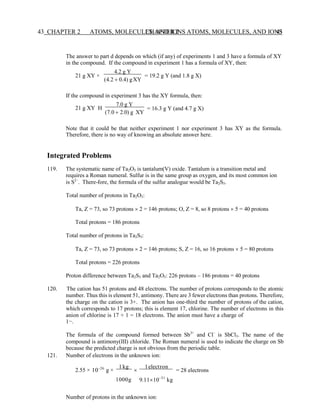
119. The systematic name of Ta2O5 is tantalum(V) oxide. Tantalum is a transition metal and
requires a Roman numeral. Sulfur is in the same group as oxygen, and its most common ion
is S2–
. There-fore, the formula of the sulfur analogue would be Ta2S5.
Total number of protons in Ta2O5:
Ta, Z = 73, so 73 protons 2 = 146 protons; O, Z = 8, so 8 protons 5 = 40 protons
Total protons = 186 protons
Total number of protons in Ta2S5:
Ta, Z = 73, so 73 protons 2 = 146 protons; S, Z = 16, so 16 protons 5 = 80 protons
Total protons = 226 protons
Proton difference between Ta2S5 and Ta2O5: 226 protons – 186 protons = 40 protons
120. The cation has 51 protons and 48 electrons. The number of protons corresponds to the atomic
number. Thus this is element 51, antimony. There are 3 fewer electrons than protons. Therefore,
the charge on the cation is 3+. The anion has one-third the number of protons of the cation,
which corresponds to 17 protons; this is element 17, chlorine. The number of electrons in this
anion of chlorine is 17 + 1 = 18 electrons. The anion must have a charge of
1−.
The formula of the compound formed between Sb3+
and Cl–
is SbCl3. The name of the
compound is antimony(III) chloride. The Roman numeral is used to indicate the charge on Sb
because the predicted charge is not obvious from the periodic table.
121. Number of electrons in the unknown ion:
2.55 × 10−26
g ×
1kg
1electron
= 28 electrons
1000g 9.1110−31
kg
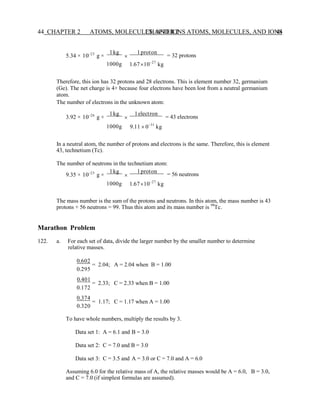
Number of protons in the unknown ion:
25.
CHAPTER 2 ATOMS,MOLECULES, AND IONS 44
44 CHAPTER 2 ATOMS, MOLECULES, AND IONS
5.34 × 10−23
g ×
1kg
1proton
= 32 protons
1000g 1.6710−27
kg
Therefore, this ion has 32 protons and 28 electrons. This is element number 32, germanium
(Ge). The net charge is 4+ because four electrons have been lost from a neutral germanium
atom.
The number of electrons in the unknown atom:
3.92 × 10−26
g ×
1kg
1electron
= 43 electrons
1000g 9.11 0−31
kg
In a neutral atom, the number of protons and electrons is the same. Therefore, this is element
43, technetium (Tc).
The number of neutrons in the technetium atom:
9.35 × 10−23
g ×
1kg
1proton
= 56 neutrons
1000g 1.6710−27
kg
The mass number is the sum of the protons and neutrons. In this atom, the mass number is 43
protons + 56 neutrons = 99. Thus this atom and its mass number is 99
Tc.
Marathon Problem
122. a. For each set of data, divide the larger number by the smaller number to determine
relative masses.
0.602
= 2.04; A = 2.04 when B = 1.00
0.295
0.401
= 2.33; C = 2.33 when B = 1.00
0.172
0.374
= 1.17; C = 1.17 when A = 1.00
0.320
To have whole numbers, multiply the results by 3.
Data set 1: A = 6.1 and B = 3.0
Data set 2: C = 7.0 and B = 3.0
Data set 3: C = 3.5 and A = 3.0 or C = 7.0 and A = 6.0
Assuming 6.0 for the relative mass of A, the relative masses would be A = 6.0, B = 3.0,
and C = 7.0 (if simplest formulas are assumed).
26.
CHAPTER 2 ATOMS,MOLECULES, AND IONS 45
45 CHAPTER 2 ATOMS, MOLECULES, AND IONS
2
3
2
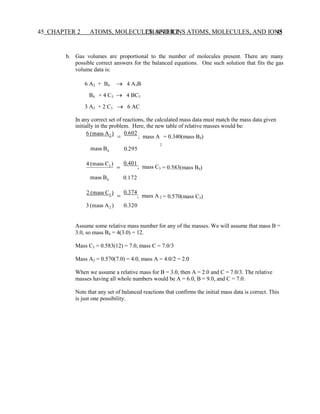
b. Gas volumes are proportional to the number of molecules present. There are many
possible correct answers for the balanced equations. One such solution that fits the gas
volume data is:
6 A2 + B4 → 4 A3B
B4 + 4 C3 → 4 BC3
3 A2 + 2 C3 → 6 AC
In any correct set of reactions, the calculated mass data must match the mass data given
initially in the problem. Here, the new table of relative masses would be:
6 (mass A2 )
=
0.602
; mass A = 0.340(mass B4)
mass B4
4 (mass C3 )
=
0.295
0.401
; mass C = 0.583(mass B4)
mass B4
2 (mass C3 )
0.172
=
0.374
; mass A = 0.570(mass C3)
3 (mass A2 ) 0.320
Assume some relative mass number for any of the masses. We will assume that mass B =
3.0, so mass B4 = 4(3.0) = 12.
Mass C3 = 0.583(12) = 7.0, mass C = 7.0/3
Mass A2 = 0.570(7.0) = 4.0, mass A = 4.0/2 = 2.0
When we assume a relative mass for B = 3.0, then A = 2.0 and C = 7.0/3. The relative
masses having all whole numbers would be A = 6.0, B = 9.0, and C = 7.0.
Note that any set of balanced reactions that confirms the initial mass data is correct. This
is just one possibility.
into a bachelor’sparadise, so successfully that any bachelor should
have frothed at the mouth with envy at the mere sight of it.
It had a fair-sized living room, with very masculine crash curtains,
darned in brilliant colours, and rough gray walls and an old Florentine
chest skillfully stuffed with the most expensive phonograph on the
market, and rows and rows of beautifully bound books. There was a
deep gray velvet sofa with three Chinese-red cushions in front of the
small black fireplace (of course it wasn’t possible to light a fire in it
without retiring from the apartment with a wet towel tied around the
head, crawling rather rapidly on the hands and knees because all the
first-aid books state that any fresh air will be near the floor—but what
of that? After all, you can’t have everything!)—and there were
wrought-iron lamps that threw the light at exactly the right angle for
reading, and very good English etchings and very gay Viennese prints
in red lacquer frames, and a really charming old Venetian mirror over
the mantel. It was a perfect room for a fastidious young man, and
Benedick loathed it with an awful loathing.
“All the elusive charm of a window in a furniture shop,” he
remarked pensively to his best friend—but at least he refrained from
destroying the pretty sister-in-law’s transports of altruistic enthusiasm,
and left it grimly alone, keeping his eyes averted from its charms as
frequently as possible, and leaving for South Carolina or northern
Canada on the slightest provocation—or else swinging off to Raoul’s at
twelve o’clock with a feeling of profound relief, when what he
fantastically referred to as “business” kept him chained to New York
and the highly successful living room.
“Business” for Benedick consisted largely of a series of more or less
amicable colloquies with a gray-faced, incisive gentleman in a large,
dark, shining office, and the even more occasional gift of his presence
at those convivial functions known as board meetings. His father, long
dead, had been imprudent enough to sow the wind of financial
speculation, and his unworthy son was now languidly engaged in
reaping a whirlwind of coupons and dividends. It is painful to dwell on
so rudimentary a lack of fair play on the part of Fate, though Benedick
occasionally did dwell on it, with a sardonic grin at the recollection of
the modest incomes received by the more prudent and thrifty members
29.
of the family.He made what atonement he could for his father’s
unjustifiable success by a series of astoundingly lavish gifts, however,
and wasted the rest of it more or less successfully.
“Business” had kept him in town on that March day when he first
saw her. He had arrived at Raoul’s doorstep at exactly five minutes past
twelve; he lunched early, because he was a disciple of the Continental
schedule, and it also avoided interruptions from over-fervent friends
who frequented the place. The pretty cashier with her red cheeks and
her elaborate Gallic coiffure bestowed her usual radiant smile on him,
and Benedick smiled back, with a swift response that many a
débutante would have given a large piece of her small soul to obtain.
Jules, the sallow and gentle-eyed, pulled out the little round chair with
its padded cushions, pushed in the little round table with its threadbare
and spotless cloth, and bent forward with pencil poised, the
embodiment of discreet and eager interest.
“Bonjour, monsieur! Monsieur désire?——”
This, after all, was nearer a home than anything that Larry
Benedick had known for many a weary year—this warm and peaceful
corner, with old Jules and young Geneviève spreading friendliness all
about him, with Raoul out in the tiled and copper-hung kitchen, alert to
turn his skill to service. Monsieur desired? Well, kidneys flamboyant,
perhaps—and then some artichokes with Raoul’s Hollandaise—and the
little curled pancakes with orange and burnt sugar in the chafing-dish.
Demi-tasse, of course, and Bénédictine. Not yesterday, you see, that
March afternoon!—Jules slipped away, as elated as though he were
bearing with him great good tidings, and the brown-and-gray kitten
came out from under the table, tapping at the cuff of his trousers with
an imperious paw, and he had a smile for it, too. Here in this tranquil
space Monsieur had all that he desired, had he not? Surely, all. He bent
forward to stroke the pink nose of his enterprising visitor, the smile
deepening until the dark face was suddenly young—and the brown
door opened and she came in.
Benedick knew quite well that it was a raw and abominable day
outside—but he could have sworn that he looked up because the room
was suddenly full of the smell of pear blossoms, and lilacs, and the
30.
damp moss thatgrows beside running brooks—and that he felt the
sunlight on his hands. There she stood, straight and slim, in her rough
green tweed, with her sapphire-blue scarf and the sapphire-blue
feather in the little tweed hat that she had pulled down over the bright
wings of her hair, her face as fresh and gay as though she had just
washed it in that running brook, her lovely mouse-coloured eyes soft
and mischievous, as though she were keeping some amusing secret.
There was mud on her high brown boots, and she was swinging a
shining new brief case in one bare hand. Benedick stared at that hand
incredulously. It wasn’t possible that anything real could be so
beautiful; velvet white, steel strong, fine and slim and flexible—such a
hand Ghirlan-daijo’s great ladies of the Renaissance lifted to their
hearts—such a hand a flying nymph on a Grecian frieze flung out in
quest of mercy. And yet there it was, so close to him that if he
stretched out his fingers he could touch it!
The owner of this white wonder stood poised for a moment,
apparently speculating as to whether this was the most perfect place in
the world in which to lunch; she cast a swift glance of appraisal about
the shadowed room with its hangings and cushions of faded peacock-
blue, with its coal fire glowing and purring in the corner and its pots of
pansies sitting briskly and competently along the deep window-sills;
she gave a swift nod of recognition, as though she had found
something that she had long been seeking, and slipped lightly into the
chair at the table next to Benedick’s. Her flying eyes had brushed by
the startled wonder of his face as though it had not been there, and it
was obvious that he was still not there, in so far as the lady was
concerned. She pounced exultantly on the carte du jour and gave it her
rapt and undivided attention; when Jules arrived carrying Benedick’s
luncheon as carefully as though it were a delicate and cherished baby
she was ready and waiting for him—and Jules succumbed instantly to
the hopeful friendliness of her voice.
But certainly, Mademoiselle could have sole bonne femme and
potatoes allumettes, and a small salad—oui, oui, entendu—bien
fatiguée, that salad, with a soupçon of garlic in a crust of bread, and
the most golden of oils—yes, and a soufflé of chocolate with a demi-
tasse in which should be just one dash of cognac—oh, rest assured of
31.
the quality ofthe cognac. Ah, it was to be seen that Mademoiselle was
fine gourmet—which was, alas, not too common a quality in ces
dames! Fifteen minutes would not be too long to wait, no? The
potatoes—bon, bon—Mademoiselle should see. Jules trotted rapidly off
in the direction of the kitchen, and Benedick’s luncheon grew cold
before him while he watched to see what the miracle at the table
beside him would do next.
How long, how long you had waited for her, Benedick the cynic—so
long that you had forgotten how lovely she would be. After all, it had
not been you who had waited; it had been a little black-headed, blue-
eyed dreamer, fast asleep these many years—you had forgotten him,
too, had you not? He was awake now with a vengeance, staring
through your incredulous eyes at the lovely lady of his dreams, sitting,
blithe and serene, within hand’s touch—the lovely lady who was not too
proud to have mud on her boots and who actually knew what to order
for lunch. All the girls that Benedick had ever known from the fuzzy-
headed little ladies in the chorus to the sleek-locked wives of his best
friend and his worst enemy, ordered chicken à la King and fruit salad
and indescribable horrors known as maple walnut sundaes and
chocolate marshmallow ice cream. But not this lady—oh, not this one!
He leaned forward, breathless; what further enchantments had she in
store? Well, next she took off her hat, tossing it recklessly across the
table, and the golden wings of her hair sprang out alive and joyous, like
something suddenly uncaged—and then she was uncaging something
else, a shabby brownish red book, prying it out of the depths of the
new brief case as though she could hardly wait; he could see from the
way that the white hands touched it that they loved it dearly—that they
had loved it dearly for a long, long time. It flew open, as though it
remembered the place itself, and she dipped her bright head to it, and
was off! Benedick pushed his untouched plate far from him, leaning
forward across the table, caution and courtesy and decent reserve
clean forgotten. What was she reading that could make her face dance
like that—all her face, the gold-tipped lashes and the brave lips, and
the elusive fugitive in the curve of the cheek turned toward him, too
fleeting to be a dimple—too enchanting not to be one—what in the
32.
name of heavenwas she reading? If only she would move her hand a
little—ah!
Something came pattering eagerly toward him out of the printed
page—a small, brisk, portly individual with long ears and a smart
waistcoat—his heart greeted it with a shout of incredulous delight. By
all that was wonderful, the White Rabbit! The dim room with its round
tables faded, faded—Benedick the cynic, Benedick the sceptic, faded
with it—he was back in another room, warm with firelight and bright
with lamplight, in which a small black-headed boy sat upright in a crib,
and listened to a lady reading from a red-brown book—a curly-headed
lady, soft-voiced, soft-handed, and soft-eyed, who for ten enchanted
years had read the lucky little boy to sleep; he had never believed in
fairy tales again, after that soft voice had trailed off into silence. But
now—now it was speaking once more—and once more he believed!
“Oh, the Duchess, the Duchess! Oh, my dear paws! Oh, my
fur and whiskers! She’ll have me arrested as sure as ferrets are
ferrets! Where can I have dropped them?”
The little boy was leaning forward, flushed and enchanted.
“Well, but motherie darling, where could he have dropped
them? Where could he have dropped those gloves?”
“Monsieur désire?”
Benedick stared blankly at the solicitous countenance, wrenching
himself back across the years. Monsieur desired—ah, Monsieur desired
—Monsieur desired——
He sat very still after that, until she had sipped the last drop of
black coffee out of the little blue cup, until she had pulled the hat down
over the golden wings and wrapped the sapphire scarf about her white
throat and wedged “Alice” back into the brief case, and smiled at Jules,
and smiled at Geneviève, and smiled at the gray kitten, and vanished
through the brown door.
He sat even stiller for quite a while after she had gone; and then
suddenly bounded to his feet and flung out of the room before the
33.
startled Jules couldask him whether there was not something that he
preferred to the untouched Bénédictine.
It was drizzling in the gray street and he turned his face to it as
though it were sunshine; he glanced in the direction of the large dark
office, and dismissed it with a light-hearted shrug. Business—business,
by the Lord! Not while there was still a spot to dream in undisturbed.
He raced up the apartment-house stairs three at a time, scorning the
elevator, and was in the living room before the petrified Harishidi could
do more than leap goggle-eyed from his post by the Florentine chest.
Harishidi had obviously been indulging his passion for Occidental music,
though you would not have gathered it from the look of horrified
rebuke that he directed at the Renaissance treasure’s spirited rendition
of the “Buzz Town Darkies’ Ball.” The look conveyed the unmistakable
impression that Harishidi had done everything in his power to prevent
the misguided instrument from breaking out in this unfortunate manner
during his master’s absence, but that his most earnest efforts had
proved of no avail. Benedick, however, was unimpressed.
“For the love of God, shut off that infernal noise!”
Harishidi flung himself virtuously on the offending treasure, and
Benedick stood deliberating for a moment.
“Bring me the records out of the drawer—no, over to the couch—
I’m half dead for sleep after that damned party. Get my pipe; the briar,
idiot. Matches. This the lot Mrs. Benedick sent?”
Harishidi acknowledged it freely, and Benedick shuffled rapidly
through the black disks. Cello rendition of “Eli Eli”; the Smith Sisters in
a saxophone medley; highly dramatic interpretation of the little idyll
from Samson et Delilah; “Kiss Your Baby and Away We Go” specially
rendered by Dolpho, the xylophone king—yes, here it was.
“An Elizabethan Song, sung by Mr. Roger Grahame of the Santa
Clara Opera Company.”
“Here you are, Hari; put this on your infernal machine. Take the
telephone off the hook and give me another of those cushions. Where’s
an ash tray? All right—let her rip!”
34.
“I play hernow?” demanded the incredulous Harishidi.
“You play her now, and you keep right on playing her until I tell you
to stop. What’s more, if I hear another word out of you, you’re fired. All
right—what are you waiting for? Go ahead!”
The quiet room was suddenly flooded with grace and gallantry and
a gay melancholy; a light tenor voice singing easily and happily of
something that was not joy—and was not sorrow—
“There was a lady, fair and kind,
Was never face so pleased my mind;
I did but see her, passing by,
And yet I love her till I die.
Till—I—die——”
Fair and kind—a lady with gold wings for hair and gray velvet for
eyes—a lady who knew what to have for lunch and who read “Alice in
Wonderland”—a lady who was tall and slim, and had a mouth like a
little girl, and mud on her high boots—white-handed and white-
throated—pear blossoms in the sunlight—fair and kind—
“Her gesture, motion, and her smile,
Her wit, her voice, my heart beguile,
Beguile my heart, I know not why,
And yet I love her till I die.
Till—I—die.”
Her grace, her voice—a lady who walked as though she were about
to dance—a lady who spoke as though she were about to sing—fair
and kind—gold and ivory—he had seen her before—she lived in a castle
and her hair hung down to her heels—he had ridden by on a black
horse and she had thrown him a rose—a castle by the sea—a castle
behind a hedge of thorns—a castle in a dreaming wood—but he had
found her and waked her with a kiss—no, no, it was he who had been
asleep—a long time—a long time asleep—he wanted to hear the end of
the story, but he was so warm and happy, it was hard to keep awake—
the firelight made strange shadows....
35.
“And so theyboth lived happily ever after!”
“Then he did find her, Motherie?”
“Of course, of course, he found her, Sleepy Head.”
“Ever, ever after, Motherie?”
“Ever, ever after, little boy.”...
Fair and kind, Golden Hair, smiling in the firelight—smile again—
ever after, she said—ever, ever after....
* * * * *
The next day he was at Raoul’s at a quarter to twelve, and when
Jules asked what Monsieur desired, he told him to bring anything, it
made no difference to him! The stupefied Jules departed to the
kitchen, where he was obliged to remain seated for several moments,
owing to a slight touch of vertigo, and Monsieur sat unmolested in his
chair in the corner, his eyes fastened on the brown door as though they
would never leave it. He was still sitting there, feverish and
preoccupied, half an hour later, having dutifully consumed everything
that Jules put before him without once removing his eyes from the
door. It wasn’t possible—it wasn’t possible that she wouldn’t come
again. Fate could not play him so scurvy a trick; but let him lay eyes on
her just once more, and he would take no further chances with Fate!
He would walk up to her the second that she crossed the threshold,
and demand her name and address and telephone number and
occupation—— And the door opened, and she came in, and he sat
riveted to his chair while she bestowed a bunch of violets the size of a
silver dollar on the enchanted Geneviève, a smile of joyous complicity
on the infatuated Jules, and a rapturous pat on the gray kitten. After a
while he transferred his gaze from the door to the table next to him,
but otherwise he did not stir. He was thinking a great many things very
rapidly—unflattering and derisive comments on the mentality of one
Larry Benedick. Idiot—ass! As though any lady who held her bright
head so high would not disdain him out of measure if she could get so
much as a glimpse into the depths of his fatuous and ignoble mind. Ask
her for her address indeed! His blood froze at the thought.
36.
The lady, inthe meantime, had ordered lunch and discarded her
hat and pried another treasure from the brief case; this time it was
brown and larger, and she held it so that Benedick could see the title
without irreparably ruining his eyes. “Tommy and Grizel”—the
unspeakable Tommy! She was reading it with breathless intensity, too,
and a look on her face that struck terror to his heart, a look at once
scornful and delighted and disturbed, as though Tommy himself were
sitting opposite her. So this—this was the kind of fellow that she liked
to lunch with—a sentimental, posturing young hypocrite, all arrogance
and blarney—it was incredible that she couldn’t see through him! What
magic had this worthless idiot for ladies?
Benedick glared at the humble-looking brown volume as though he
would cheerfully rip the heart out of it. He continued to glare until the
white hands put it back into the brief case with a lingering and regretful
touch, and carried it away through the door; no sooner had it closed
than he jammed on his hat and brushed rudely by the smiling
Geneviève and out into the wind-swept street. There he paused,
staring desperately about him, but the sapphire feather was nowhere
to be seen, and after a moment he started off at a tremendous pace
for his apartment, where he proceeded to keep his finger on the
elevator bell for a good minute and a half, and scowled forbiddingly at
the oblivious elevator boy for seven stories, and slammed the door of
the living room so vigorously that the red-lacquered frames leapt on
the wall.
He crossed the room in three lengthy strides, and slammed his
bedroom door behind him even more vigorously. The bedroom was
exactly half the size of the tiled bathroom, so that the artistic sister-in-
law had only been able to wedge in a Renaissance day-bed and a
painted tin scrap basket—but Benedick found it perfectly satisfactory,
as she had permitted him to use books instead of wall-paper. All the
ones that she considered too shabby for the living room rose in serried
ranks to the high ceiling—Benedick had substituted a nice arrangement
of green steps instead of a chair, and had discovered that he could put
either these or the scrap basket in the bathroom, if it was necessary to
move around. He mounted the steps now, and snatched a brown
volume from its peaceful niche on the top shelf next to “Sentimental
37.
Tommy,” climbed downand sat on the Renaissance day-bed, wrenched
the book open so violently that he nearly broke its back, and read
about what happened to Tommy on the last few pages—served him
damned well right, too, except that hanging was too good for him.
Sentiment! Sentiment was a loathsome thing, not to be borne for a
moment.
The third time that he read it he felt a little better, and he got up
and kicked the scrap basket hard, and telephoned to the incisive
gentleman in the office that he wouldn’t be around because he had
neuralgia and phlebitis and a jumping toothache, and telephoned his
ravished sister-in-law that he’d changed his mind and would be around
for dinner at eight if she’d swear to seat him next to a brunette.
Subsequently he was so attentive to the brunette that she went home
in a fever of excitement—and Benedick ground his teeth, and prayed
that somehow his golden lady might know about it and feel a pang of
the soft and bitter madness known as jealousy, which is the exclusive
prerogative of women. He lay with his head in the pillow on the
Renaissance bed most of the night, cursing his idiocy with profound
fervour, wondering what insanity had made him think for a moment
that he was interested in that yellow-haired girl, and resolving not to go
near Raoul’s for at least a week. She was probably someone’s
stenographer—or a lady authoress. Every now and then he slipped off
into horrid little dreams; he was building a gallows out of pear trees for
a gentleman called Tommy, and just when he had the noose ready, it
slipped about his own throat—and he could feel it tightening,
tightening, while someone laughed just behind him, very soft and clear
—he woke with a shiver, and the dawn was in the room. He wouldn’t
go to Raoul’s for a month....
At five minutes to twelve he crossed the threshold, and she was
there already with her hat off and a little fat green-and-gold book
propped up against her goblet. Thank God that she had left that brown
bounder at home! Benedick stared earnestly, and felt a deeper
gratitude to Robert Herrick and his songs than he had ever known
before. It was easy to see that she was safe in green meadows, brave
with cowslips and violets and hawthorn and silver streams, playing with
those charming maids, Corinna and Julia. Benedick breathed a sigh of
38.
relief, and whenher lunch arrived he was stricken again with
admiration at the perfection of her choice. Herrick himself could have
done no better; the whole-wheat bread, the primrose pats of butter,
the bowl in which the salad lurked discreetly—but he could see the
emerald green of cress, and something small and silver and something
round and ruddy—radishes and onions shining like jewels! There was a
jar of amber honey, a little blue pitcher of thick cream, and a great blue
bowl of crimson berries—strawberries in March, with a drift of fresh
green mint leaves about them. Here was a lady who was either
incredibly wealthy or incredibly spendthrift! She closed her book when
Jules put this other pastoral before her, and ate as though it might be a
long, long time before she would eat anything again, though she
managed to look as though she were singing all the time. There was a
bit of cream left for the kitten, and she fed it carefully, patted its white
whiskers, and was gone.
Benedick strolled out thoughtfully, remembering to smile at
Geneviève, and feeling more like a good little boy than a ripened cynic.
It was incredible how virtuous it made one feel to be happy! He wanted
to adopt a yellow dog and give money to a beggar and buy out a florist
shop. The florist shop was the only object accessible, and he walked in
promptly; the clerk had spoken to him before he realized that he
couldn’t send her flowers, because he didn’t happen to know who she
was. He might tell him to send them to the Loveliest Lady in New York,
but it was a little risky. However, he bought an armful of daffodils, and
a great many rose-red tulips, and enough blue and white hyacinths to
fill a garden, and went straight back to his apartment without even
waiting for change from the gold piece that he gave to the clerk. He
handed them over to the startled Harishidi with the curt order to put
them in water; never mind if he didn’t have enough vases. Put them in
high-ball glasses—finger-bowls—anywhere—he wanted them all over
the place. The buyer of flowers then retired and put on a gorgeous and
festively striped necktie, washed his face and hands with a bland and
pleasing soap, brushed his black hair until it shone, smiled gravely at
the dark face in the mirror, and returned to the sitting room. There he
selected a white hyacinth blossom with meticulous care, placed it in his
39.
buttonhole, and earnestlyrequested Harishidi to retire and remain in
retirement until summoned.
He spent quite a long time after that, drawing the curtains to shut
out the grayness, struggling despairingly over the diminutive fire, piling
the cushions so that they made a brilliant nest at one end of the velvet
sofa, placing a gold-tooled volume of Aucassin and Nicolette where she
could reach it easily—oh, if he could not send his flowers to her, he
would bring her to his flowers! He adjusted the reading lamp with its
painted parchment shade and dragged a stool up to the sofa. It was his
sister-in-law’s best find—a broad and solid stool, sedate and comely—
he sat there clasping his knees, his cheek against the velvet of the sofa
—waiting. After a long time, he drew a deep breath, and smiled into
the shadows. He did not turn his head; what need to turn it?
She was there—he could see her sinking far back into the scarlet
cushions, greeting his flowers with joyous eyes. She had on a cream-
coloured dress of some soft stuff, and a long chain of amber beads; the
lamplight fell on her hair and on her clasped hands—and still he sat
there, waiting. What need had they of speech? There was a perfume in
her hair—a perfume of springtime, fleeting and exquisite; if he reached
out his hand he could touch her. He sat very still; after a little while he
felt her hand on his dark head, but still he did not stir—he only smiled
more deeply into the shadows, and closed his eyes—— His eyes were
still closed when Harishidi came in to ask him if he had forgotten
dinner, and his lips were parted, like a little boy lost in a happy dream—
in a happy, happy dream....
After that, the days passed by in an orderly and enchanted
procession; he watched them bringing gifts to the corner table at
Raoul’s, feeling warm and grateful and safe; too content to risk his joy
by so much as stirring a finger. By and by he would speak to her, of
course; in some easy, simple way he would step across the threshold of
her life, and their hands would touch, never to fall apart again. She
would drop her brief case, perhaps, and he would give it back to her,
and she would smile; she would come into some drawing room where
he was standing waiting patiently and the hostess would say, “You
know Mr. Benedick, don’t you? He’s going to take you in to dinner.” He
would go to more dinners—surely she must dine somewhere, and
40.
dances—surely she danced!Or the gray kitten might capture that wisp
of a handkerchief, and bring it to him as booty—he would rescue it and
carry it back to her—and she would smile her thanks—she would smile
—— It would all be as simple as that—simpler, perhaps; for the time,
he asked no more than to let the days slip by while he sat watching her
across the table; that was enough.
Ah, those days! There was the one when she brought out a great
volume of Schopenhauer, and laughed all the time she read it; twice
she laughed aloud, and so gay and clear was her derision that Jules
joined in, too. It was probably the essay on Woman, Benedick decided
—the part where he said that ladies were little animals with long hair
and limited intelligence. There was the day when she read out of a slim
book of vellum about that small, enchanting mischief, Marjorie Fleming,
and when Jules put the iced melon down before her she did not see it
for almost a minute—her eyes were too full of tears. There was the day
when she read “War and Peace” with her hands over her ears and such
a look of terror on her face that Benedick had all that he could do to
keep from crossing over and putting his arms about her, to close out all
the dangers that she feared—even the ones she read about in books.
And suddenly March was over, and it was April, and there was the
day when she took a new volume out of the brief case—so new that it
still had its paper cover with large black letters announcing that it
contained desirable information about Small Country Houses for Limited
Incomes, Colonial Style. She read it with tremendous intensity and a
look wavering between rapture and despair; once she sighed forlornly,
and once she made a small, defiant face at some invisible adversary—
and once she patted a picture lingeringly.
After she had gone, Benedick took his sister-in-law’s automobile,
and drove out to Connecticut, and bought a house—a little old white
house with many-paned windows, that sat on a hill with lilac bushes
around it, and looked at the silver waters of the Sound. It was perfectly
preposterous that she shouldn’t have a house if she wanted it, and he
was glad that she wanted a small country house, Colonial style, even
though it didn’t necessarily imply a moderate income. For the first time
in his life he was glad that his income was not moderate. When he got
back to town he bought a gray roadster—not too heavy, so that she
41.
could drive it.She might want to be in and out of town a lot; you never
could tell.
He told his sister-in-law that he was going to raise Airedales,
because it was impossible to buy a decent puppy these days, and he
discoursed lucidly and affably about a highly respectable Scotch couple
that he was going to get to look after the white house and supervise
the Airedales. After that he devoted most of his leisure hours to antique
shops and auctions, where he purchased any amount of Sheraton
furniture and Lowestoft china and Bristol glass and hooked rugs and
old English chintzes for the benefit of the Airedale puppies and the
Scotch couple. He hadn’t as much time as formerly, because he had
been growing steadily more uncomfortable at the thought of explaining
to those gray eyes and gay lips the undeniable fact that he had twenty-
four hours of leisure to dispose of every day of his life; so he had
wandered over to the dark office one morning and remarked casually to
the gray gentleman at the desk that he might blow in every now and
then and see if there was anything around for him to do. It appeared
that there was plenty around—so much that he took to blowing in at
about nine and blowing out at about five—and he did it not so badly,
though a good clerk might have done it better. He continued to spend a
generous hour over lunch, however, proving a total loss to the firm for
a considerable time after he returned, sometimes in such an
abandoned mood that there was a flower in his buttonhole.
And then it was May, and the sapphire feather was gone, and she
would come in through the brown door with flowers on her drooping
hat and pale frocks tinted like flowers, cool and crisp as dresses in a
dream. She still had the brief case, but it was absurd to think that a
stenographer would wear such hats; anything so ravishing would cost a
year’s salary. When he wasn’t too busy watching the way her hair
rippled back, showing just the tips of her ears, he would wonder
whether she were a great heiress with an aversion to jewellery or a
successful novelist who had to choose between pearls and Raoul’s. He
had never seen even the smallest glint of jewels about her; never a
gleam of beads at her throat or a brooch at her waist or a ring on her
fingers—sometimes he thought that it would be pleasant to slip a long
string of pearls about her neck and a band of frosted diamonds about
42.
her wrist, tosee her eyes widen at their whiteness. Still, this way she
was dearer, with flowers for her jewels—better leave the pearls alone—
pearls were for tears.
It was incredible how radiant she looked those days; when she
came through the door with her flying step and her flying smile the
very kitten would purr at the sight of her; her eyes said that the secret
that they knew was more delightful and amusing than ever, and her
hands were always full of flowers.
And then there was the day that she came in looking so exultant
that she frightened him; it wasn’t fair that she should look so happy
when she didn’t know about the house on the hill, or the gray roadster,
or the lucky person who was going to give them to her—it wasn’t fair
and it was rather terrifying. Perhaps it would be better not to wait any
longer to tell her about them; she couldn’t be disdainful and unkind
through all that happiness. Of course he would lead up to it skilfully. He
wasn’t a blundering schoolboy; he was a man of the world, rather more
than sophisticated, with all his wits about him and a light touch. He
would catch her eye and smile, deferential and whimsical, and try some
casual opening—“Our friend the kitten” or “good old Jules slower than
usual—spring turns the best of us to idlers!” and the rest would follow
as the night the day—or better still, as the day the night. It mightn’t be
a bad idea to upset something—his wine glass, for instance; he raised
a reckless hand, with a swift glance at the next table—and then he
dropped it. She was reading a letter, an incredibly long letter, page
after page of someone’s office paper covered with thick black words
that marched triumphantly across the sheets, and her face was flooded
with such eloquent light that he jerked back his head swiftly, as though
he had been reading over her shoulder. He could not speak to her with
that light on her face; he sat watching her read it through twice, feeling
cold and sick and lonely. He was afraid—he was afraid—he would speak
to her to-morrow——
To-morrow came, and with it his lady in a green muslin frock, and a
shadowy hat wreathed with lilacs; he noted with a slow breath of relief
that she had no brief case, no book, no letters. His coast was clear
then at least; this day she had no better comrade to share her table—
he would go to her, and ask her to understand. He had risen to his feet
43.
before he sawthat she had not taken off her hat; she was sitting with
her head a little bent, as though she was looking at something on the
table, her face shadowed by the drooping hat, her hands clasped
before her—and then Benedick saw what she was looking at. There
was a ring on her finger, a small, trivial, inconsequential diamond,
sparkling in its little golden claw like a frivolous dewdrop; and suddenly
she bent her head, and kissed it. He sat down, slowly and stiffly—he
felt old. He did not even see her go; it was Jules’ voice that made him
lift his head.
“Ah, le printemps, le printemps! V’là la jolie demoiselle qui s’est
fiancée.”
“Yes,” said Benedick. “Spring—in spring it is agreeable to have a
fiancé.”
“Monsieur, perhaps, knows who she is?”
“No,” replied Monsieur amiably. “But she is, as you say, a pretty
girl.”
“She is more than that, if Monsieur pardons. The man whose bride
she will be has a little treasure straight from the good God. What a
nature—what a nature! Generous as a queen with her silver, but she
turns it to gold with her smile. Monsieur has perhaps noted her smile?”
“No,” replied Monsieur, still amiably. “Bring me a bottle of the
Widow Clicquot, however, and I will drink to her smile. Bring a large
bottle so that I can drink often. It might be better to bring two.”
He drank both of them under the eyes of the horrified Jules; it took
him all of the afternoon and part of the evening to accomplish it, but
he won out. All during the hours that he sat sipping the yellow stuff he
was driving his mind in circles, round and round over the same
unyielding ground, round and round again. It was a hideous mistake, of
course; there was nothing irretrievable in an engagement. He could
make her see how impossible it was in just a few minutes; it might be
a little hard on this other fellow at first, but that couldn’t be helped. He
hadn’t been looking for her, starving for her, longing for her all the days
of his life, this other fellow, had he? Probably he had told half-a-dozen
44.
girls he lovedthem—well, let him find another to tell. But Benedick—
whom else had Benedick loved? No one, no one, all the days of his life.
Surely she would see that; surely when he told her about the white
house and the gray roadster she would understand that he couldn’t let
her go. He had been lonely too long—he had been hard and bitter and
reckless too long—he would tell her how black and empty a thing was
loneliness; when she saw how desperately he needed her, she would
stay. When he told her about the two corner cupboards in the low-
ceilinged dining room, full of lilac lustre and sprigged Lowestoft, and
the painted red chairs in the kitchen, and the little stool for her feet
with the fat white poodle embroidered in cross-stitch, she would see all
the other things that he had never told her! There was the tarnished
mirror with the painted clipper spreading all its sails—he had hung it so
that it would catch her smile when she first crossed the threshold;
there was the little room at the head of the stairs that the sun always
shone into—he had built shelves there himself, and put in all his Jules
Verne and R. L. S. and Oliver Optic and Robin Hood and the Three
Musketeers and some unspeakably bad ones of Henty; he had been
waiting for her to tell him what kind of books little girls read, and then
he was going to put them in, too. Of course she couldn’t understand
those things unless he told her—to-morrow when she came he would
tell her everything and she would understand, and be sorry that she
had hurt him; she would never go away again.
At eleven o’clock Jules once more despairingly suggested that
Monsieur must be indeed fatigued, and that it would perhaps be better
if Monsieur retired. Monsieur, however, explained with great
determination and considerable difficulty that he had an extremely
important engagement to keep, and that all things considered, he
would wait there until he kept it. True, it was not until to-morrow, but
he was not going to take any chances; he would wait where he was.
Raoul was called in, and expostulated fervently, “Mais enfin, Monsieur!
Ce n’est pas convenable, Monsieur!”
Monsieur smiled at him, vague and obstinate, and Raoul finally
departed with a Gallic shrug, leaving poor Jules in charge, who sat
nodding reproachfully in a far corner, with an occasional harrowed
glance at the other occupant of the room. The other occupant sat very
45.
stiff and straightfar into the night; it was toward morning that he
made a curious sound, between defeat and despair, and dropped his
dark head on his arms, and slept. Once he stirred, and cried
desperately: “Don’t go—don’t go, don’t go!”
Jules was at his side in a moment, forgiving and solicitous.
“Monsieur désire?”
And Monsieur started up and stared at him strangely—only to
shake his head, and once more bury it deep in his arms. It was not
Jules who could get what Monsieur desired....
It was late the next morning when he waked and he consumed a
huge amount of black coffee, and sat back in his corner, haggard and
unshaven, with a withered flower in his buttonhole, waiting for her to
come through the door—but she did not come. Not that day, nor the
next, nor the next; he sat in his corner from twelve to two, waiting,
with a carefully mocking smile on his lips and a curious expression in
his eyes, wary and incredulous. He had worked himself into an
extremely reasonable state of mind; a state of mind in which he was
acidly amused at himself and tepidly interested in watching the curtain
fall on the comedy—he blamed a good deal on the spring and a taste
for ridiculously unbalanced literature; the whole performance was at
once diverting and distasteful. This kind of mania came from turning
his back on pleasant flirtations and normal affaires de cœur; it was a
neatly ironical punishment that the God of Comedy was meting out to
pay him for his overweening sense of superiority. Well, it was merited—
and it was over! But he still sat in the corner, watching, and the fourth
day the door opened, and she came in.
She had on a gray dress, with a trail of yellow roses across her hat
and a knot of them at her waist, and a breeze came in with her. She
stood hesitating for a moment in the sunlight, and then she went
quickly to where Geneviève sat at her high desk, and stretched out her
hands, with a pretty gesture, shy and proud. The sunlight fell across
them, catching at a circle above the diamond ring—a little golden circle,
very new and bright. Benedick rose to his feet, pushing back his chair—
he brushed by her so close that he could smell the roses; he closed the
brown door behind him gently and leaned against it, staring down the
46.
shining street, wherethe green leaves danced, joyous and sedate,
upon the stunted trees. Well, the curtain had fallen on the comedy;
that was over. After a minute, he shrugged his shoulders, and strolled
leisurely down to the real-estate agent and sold him the little white
house, lock, stock, and barrel, including some rather good china and a
lot of old junk that he had picked up here and there. It was fortunate
that the young couple from Gramercy Square wanted it; he was willing
to let it go for a song. Yes, there was a view of the Sound, and he’d
done quite a lot of planting; oh, yes, there was a room that could be
used as a nursery—lots of sun. There was his signature, and there was
the end of it—the papers could be sent to his lawyers. He then
sauntered over to his sister-in-law’s and presented her with the gray
roadster; he was about fed up with motoring, and he’d changed his
mind about Airedales. Dogs were a nuisance. After a little pleasant
banter he dropped in at the club and played three extremely brilliant
rubbers of auction, and signed up for a stag theatre party to see a
rather nasty little French farce. He didn’t touch any of the numerous
cocktails—he wasn’t going to pay her the compliment of getting drunk
again—but he laughed harder than any one at the farce, and made a
good many comments that were more amusing than the play, and his
best friend and his worst enemy agreed that they had never seen him
in such high spirits.
He went back to the apartment humming to himself, and yawned
ostentatiously for Harishidi’s benefit, and left word not to wake him in
the morning—and yawned again, and went to bed. He lay there in the
blackness for what seemed hours, listening to his heart beat; there was
a tune that kept going round in his head, some idiotic thing by an
Elizabethan—“Fair and kind”—he must go lighter on the coffee. “Was
never face so pleased my mind——” Coffee played the deuce with your
nerves. “Passing by——” Oh, to hell with it! He stumbled painfully out
of bed, groping his way to the living room, jerking on the light with a
violence that nearly broke the cord. One o’clock; the damned clock
must have stopped. No, it was still ticking away, relentless and
competent. He stood staring about him irresolutely for a moment, and
then moved slowly to the Florentine chest, fumbling at the drawer. Yes,
there it was—“An Elizabethan Song, Sung by Mr. Roger
47.
Grahame”—“There was alady, fair and kind”—There was a lady—— He
flung up the window with a gesture of passionate haste, and leaning
far out, hurled the little black disk into deeper blackness. Far off he
heard a tinkling splinter from the area; he closed the window, and
pulled the cord on the wrought-iron lamp, and stumbled back to the
Renaissance bed.
He was shaking uncontrollably, like someone in a chill, and he had
a sickening desire to weep—to lay his hot cheek against some kind
hand, and weep away the hardness and the bitterness and despair.
Loathsome, brain-sick fool! He clenched his hands and glared defiance
to the darkness, he who had not wept since a voice had ceased to read
him fairy tales a long time ago. After eternities of staring the hands
relaxed, and he turned his head, and slept. He woke with a start—there
was something salt and bitter on his lips; he brushed it away fiercely,
and the clock in the living room struck four. After that he did not sleep
again; he set his teeth and stared wide-eyed into the shadows—he
would not twice be trapped to shame. He was still lying there when the
sun drifted through the window; he turned his face to the wall, so that
he would not see it, but he did not unclench his teeth....
It was June, and he took a passage for Norway, and tore it up the
day that the boat sailed. There was a chance in a thousand that she
might need him, and it would be like that grim cat Fate to drop him off
in Norway when he might serve her. For two or three days she had
been looking pale; the triumphant happiness that for so long she had
flaunted in his face, joyous and unheeding, was wavering like the rose-
red in her lips. It was probably nothing but the heat; why couldn’t that
fool she had married see that she couldn’t stand heat? She should be
sitting somewhere against green pines, with the sea in her eyes and a
breeze lifting the bright hair from her forehead.
She never read any more. She sat idle with her hands linked before
her; it must be something worse than heat that was painting those
shadows under her eyes, that look of heart-breaking patience about
her lips. And Benedick, who had flinched from her happiness, suddenly
desired it more passionately than he had ever desired anything else in
his life. Let the cur who had touched that gay courage to this piteous
submission give it back—let him give it back—he would ask nothing
48.
more. How coulda man live black enough to make her suffer? She
hardly touched the food that was placed before her; Jules hovered
about her in distress, and she tried to smile at him—and Benedick
turned his eyes from that smile. She would sit very quiet, staring at her
linked hands with their two circles, as though she were afraid to
breathe—she, to whom the air had seemed flowers and wine and
music. Once he saw her lips shake, terribly, though a moment later she
lifted her head with the old, valiant gesture, and went out smiling.
Then for a day she did not come—for another day—for another—
and when once more she stood in the door, Benedick felt his heart give
a great leap, and stand still. She was in black, black from head to foot,
with a strange little veil that hid her eyes. She crossed the room to her
table, and sat down quietly, and ordered food, and ate, and drank a
little wine. After Jules had taken the things away she still sat there,
pressing her hands together, her lips quite steady—only when she
unlinked them, he saw the faint red crescents where the nails had cut.
So that was why she had had shadows painted beneath her eyes;
he had been ill, the man who had given her the rings; he had died. It
would be cruel to break the hushed silence that hung about her with
his clumsy pity, but soon he would go to her and say, “Do not be sad.
Sadness is an ugly thing, believe me. I cannot give you what he gave
you, perhaps, but here is the heart from my body. It is cold and hard
and empty; take it in your hands, and warm it. My need of you is
greater than your need of him—you can not leave me.” He would say
that to her, after a little while.
The gray kitten touched her black skirt with its paw, and she
caught it up swiftly, and laid her cheek against its fur. It was no longer
the round puff that she had first smiled on, but it was still soft—it still
purred. She put it down very gently, and rose, looking about her as on
that first day; at the place where the fire had burned in the corner, at
the pansies, jaded and drooping in their green pots; once again her
eyes swept by Benedick as though he were not there. They lingered on
Geneviève for a moment, and when they met Jules’ anxious, faithful
gaze she parted her lips as though to speak, and gave it up with a little
shake of her head, and smiled instead—a piteous and a lovely smile—
and she was gone....
49.
He never sawher again. That was not a hundred years ago—no,
and it was not yesterday; the steel has come into his hair and his eyes
since then, but sometimes he still goes to Raoul’s to lunch, and sits at
the corner table, where he can see the brown door. Who can tell when
it might open and let in the spring—who can tell what day might find
her standing there once more, with her gay eyes and her tilted lips and
the sunlight dancing in her hair?
Benedick’s best friend and his worst enemy and the world and his
pretty sister-in-law are very wise, no doubt, but once—once there was
a lady—— He never touched the tip of her fingers, but she was the
only lady that Benedick ever loved.
50.
D
LONG DISTANCE
EVON snappedthe stub of his cigarette into the fire with a
movement of amused impatience, his fingers more
eloquent than his thin, impassive countenance.
“Nothing, was it?”
“No, nothing—that unspeakable wind.” Anne Carver gave a last
reluctant glance over her shoulder into the shadowed hall, and
pulled the door to behind her, turning her face to the warm, bright
room with a rueful smile. “I’m sorry, Hal; it’s outrageous of me—
right in the middle of that thrilling story, too.”
In spite of her slim height and the sophisticated skill with which
she had wound her velvety black hair about her small head—in spite
of the length of filmy train that swept behind her, she looked like
some charming and contrite child as she came slowly across the
room to the deep chintz chair and the dancing warmth of the fire.
“But it’s nonsense, my dear girl; sheer, unmitigated nonsense!
Here you are spoiling what might have been a delightful evening by
working yourself up into a magnificent state of nerves, and over
what, I ask you? Over nothing, over less than nothing! Poor old
Derry telephones that he won’t be able to get out to-night because
he’s been dragged in on some fool party, and you apparently
interpret it into meaning that you’re never going to lay eyes on him
again in this world. You’ve been restless as a witch all evening—
every time a door’s slammed or a latch has rattled you’ve fairly leapt
out of your skin; and permit me to inform you that you’re getting me
51.
so that I’mabout to start leaping, too. Nice, cheerful atmosphere for
the stranger within your gates, my child.”
“I’m awfully sorry, Hal. I’ll be good, truly. It’s only that——”
“Only what, for the love of Heaven? You aren’t expecting him
back to-night, are you?”
“Well, of course, I know that he said he couldn’t possibly
manage it, but he might—he can manage anything. And he wanted
so dreadfully to see you; it’s been years, hasn’t it?”
“Three,” replied Devon concisely.
“Well, you see! And of course he’d want to see me dreadfully,
because it’s been years since he’s seen me, too; we have breakfast
at half-past seven. Isn’t that hideous? It takes him an hour to get
into town; I do hate that. A whole hour away—think of it——”
“Anne, I blush for you; I do indeed. It’s embarrassing for any
well-behaved bachelor to hear you talk. It’s sinful to lavish that
amount of devotion on any man that lives.”
“Not on Derry.” The clear face was a little flushed, but the
shining eyes met his unwaveringly. “You lavish it, too, Hal! I used to
be bored to distraction by the tales that you’d pour out for hours on
end about the fabulous student who was on his way back from Paris
to spread havoc amongst the maidens of America. I used to laugh at
you—remember?”
“Of course I remember.” The dark, ironic face was suddenly
touched with a very charming smile. “That first evening that I
brought him over after supper, and he talked until a quarter to one
until he had everyone as excited as he was about things that we
actually wouldn’t give a snap of our fingers for; I can see him
standing by the mantel now, with every golden hair on his head
ruffled up, and those crazy sherry-coloured eyes of his half mad with
excitement, ranting like a Frenchman and laughing like a lunatic—I
can see you with your face tilted up to him, forgetting that any of
the rest of us were alive—— You had on a gray dress and someone
52.
had sent youwhite flowers, and you were wearing a long string of
green beads that hung to your knees——”
“Hal, you’re making that up! Four years——”
“Is four years too long to remember green beads and white
flowers? Perhaps you’re right! But it isn’t too long to remember
Derry’s voice when he told us about the night that he and the
drunken cab driver spent in the Louvre, is it? Shades of Gargantua,
how that kid could laugh! After all, there’s never been any one else
just like him, has there?”
“Not ever—oh, not ever. It’s the cruellest shame that he couldn’t
be here now; he’d love it so, and you could have such a beautiful
time reminiscing—oh, I can’t bear having him away on a night like
this. When I went to the door just then those trees by the gate were
straining like dogs on a leash, and the wind had wrenched a great
branch off the lilac bush. I do hate November! And the rain like gray
floods—and so cold, Hal. He oughtn’t to be out in that, truly. He
ought to be here where he could play with us, where it’s warm and
kind and—safe. Do you suppose they were motoring?”
“I don’t suppose anything at all. My dear girl, you aren’t going to
start that all over again?”
“Ah, it’s frightfully silly, I know. Old married people—three-year-
old married people—they oughtn’t to mind things like that. But it’s
the first time that he’s been away all night, and I’m—oh, I’m
ridiculous. Scold me, scold me hard!”
“You’re a very difficult person to scold, all things considered. It’s
those unprincipled eyelashes, probably. First time in three years,
honestly, Anne? Good Lord, it’s unbelievable!”
“Hal!”
“Well, but my good child! Long Island and the twentieth century
and the tottering state of holy matrimony—it’s simply defying the
laws of gravity! Do you sit here hanging the crane every night of
your lives?”
53.
“Oh, Hal, youlovely idiot! Of course we don’t; we go out any
amount and have people here a lot, and go in town, too. Only we
happen to like each other—rather—and to like to play together—
rather—so we just go ahead and do it. It’s simply happened that up
to now nothing turned up that we couldn’t do together; of course it
was bound to happen sooner or later. Of course I know that, Hal.”
She leaned forward, the firelight painting flying shadows on the
vivid, high-bred little face. “But I’m an utter goose about Derry. I feel
empty when he isn’t around, and I don’t care who knows it.”
“A bit hard on the rest of us, isn’t it? Still, if it’s the same Derry
that I practically bestowed on you at the altar I’m rather inclined to
get your point of view. Not changed for the worse?”
“Changed for the better, thank you!” laughed Derry’s wife.
“Better and better and better every minute, once removed from your
sinister influence.” She smiled her gay affection at him, and then
suddenly the smile wavered, faded—she sprang to her feet, trailing
her blue-green draperies over to the long window.
“Don’t you hate that noise, Hal? No, listen. The rain’s out to
drown the world, and that wind——” She shivered, staring out into
the menacing blackness, raging like a wild beast on the other side of
the lighted window. “Poor Hal, it’s going to be simply awful for you!
It’s a good ten minutes’ walk to the club, and these back roads turn
into mud soup if it even showers! I do think it’s a wicked shame.”
“Perhaps I’d better be getting on my way——”
“No, no!” There was a note of sheer panic in her voice, though
she laughed it down valiantly. “Why, it can’t be eleven, and he isn’t
going to call up till twelve. You simply have to entertain me; I won’t
be abandoned yet. No, I mean it. Let’s start again—about Brazil. You
were telling me about Brazil——”
“You aren’t even remotely interested in Brazil,” he accused. “But
I’ll talk to you about any place from Peoria to Patagonia, if you’ll stop
wandering about like a lost soul, and come back to the fire, like a
good child.”
54.
“Yes,” replied thegood child obediently, dropping the curtain.
“Does—does it seem cold to you in here, Hal?”
“Cold? It’s heavenly warm; if I were a cat I’d purr for you.”
“It feels—cold, to me,” said Anne Carver, spreading her hands
before the leaping flames. “As though the wind had got in through
the window somehow, and into my blood—and into my bones——”
“Nonsense,” said Devon sharply. “You got chilled standing over
there; you’re an unconscionable goose, and I’m beginning to be
strongly out of patience with you. Sit down and put your feet on the
fender—want something over your shoulders?”
She shook her head, holding her hands closer to the fire.
“No, please—I’d rather not sit down just yet. It was the window,
of course. Don’t be cross; I do want to hear the rest of that about
Brazil. Some day I’m going there; some day I’m going to find a
country where there’s no such time as autumn—no such month as
November, full of dead leaves, and wind and cold—and emptiness.
Tell me what’s prettiest there; there must be so many pretty things?
Birds with shining feathers—butterflies like flowers—flowers like
butterflies—gold like sunshine and sunshine like gold—oh, I’m
warmer just for thinking of it! Tell me what was prettiest?”
“I saw nothing half so pretty as a lady with the lamplight falling
about her, bending over pansies black as her hair in a bowl green as
her eyes.”
“Oh!” She straightened swiftly, giving the flowers a last friendly
touch, and facing him, lightly flushed, lightly reproachful. “Green,
Hal? That’s not pretty at all—and it stands for something shameful.”
Devon raised quizzical eyebrows.
“Never felt the honest pangs of jealousy, Anne?”
“But how could I, even if I were capable of such cheapness and
ugliness? I’ve never in my life cared for any one but Derry.”
“And Derry, lovely lady, would never give you cause?”
55.
“Derry?” The startledincredulity of that cry rang into clear mirth.
“Why, Hal, it may be difficult for you to believe, but Derry loves me.”
Devon tapped the ashes off his cigarette, and sat staring for a
moment at the reddened tip.
“It doesn’t precisely strain my credulity to the breaking point,” he
replied drily. “No, I can imagine that Derry might love you. It hardly
requires any colossal stretch of imagination on my part, either. I’ve
loved you myself for thirteen years.”
“Hal!”
“Loved you with every drop of blood in my body. There’s no use
looking stricken and melodramatic, Anne. I’ve never worried you
much about it, have I?”
“No,” she whispered voicelessly.
“No. Well, then, don’t worry me about it now, there’s a good girl.
I’m off for Ceylon to-morrow, and I haven’t the most remote
intention of making a nuisance of myself to-night. You don’t have to
remind me of the fact that Derry’s my best friend, that I was his best
man, that you are his wife. I have an excellent memory for such
trifling details myself. It’s only fair to add, however, that I wouldn’t
give a tuppenny damn for the whole collection if it weren’t for one
other.”
“Which other?” she asked, her eyes meeting his steadily,
infinitely gentle and remote.
“The rather important one that you’re happy,” replied Devon
evenly. “I came all the way back from Brazil to find out whether he
was making you happy—and now I’m off to-morrow.”
“Happy is a poor word for what he has made me,” she said. “You
should have known that, you who know Derry. Oh, Hal—oh, Hal,
how could you?”
“It isn’t done, I know,” he assented. “It’s always the cad and the
villain who is caught out making love to his friend’s wife at all hours
56.
of the night.But there’s a slight distinction in my favour, you see; I
am loving you, not making love to you.”
“You’re hurting me,” she told him. “Pretty badly.”
“You have no right to be hurt. It’s nothing ugly that I am giving
you. Out of pain and bitterness and despair I’ve wrought something
rather fine; it isn’t like you to disdain it, my dear. Ever since you
were a little girl with dark braids swinging to your waist, I’ve brought
you presents; every corner of the earth I’ve ransacked just to have
you touch those gifts with your fingers, and say, ‘That’s lovely, Hal—
that’s lovely’—and smile. The only thing worth giving you was not in
my power to bestow, but I wanted to make sure that you had it, no
matter whose hands had held it out to you. Happiness is yours, Anne
—I have nothing left to give you but my love. I swear to you that
there is not one thing in it that gives you the right to say that it
hurts you. Believe me, you can take it in your hands—and smile.”
“Yes. Yes, Hal.” She smiled at him, grave and misty-eyed—and
he smiled back.
“Then that’s about all, my dear, and I’ll be going. It’s no hour at
all for a poor bachelor to be awake. Good-night, Anne; sweet
dreams to you.”
“Hal, I don’t want you to go—please, I don’t want you to go.”
There was something so desperate in her low entreaty that he
halted with lifted brows. “I know that it’s utterly foolish and
unreasonable—and—and selfish, but I simply can’t bear to be left
here alone until Derry calls me up. Please, please don’t leave me.”
“Very well.” He turned back to his chair slowly. “This isn’t like
you, you know.”
“I know.” She sat staring down at her locked fingers. “It isn’t a
bit like me; I haven’t any nerves at all, as a rule—not enough to
make me sympathetic even. Derry says my lack of imagination is
simply appalling—that unless I can see a thing or touch it or taste it
or smell it or hear it, I simply won’t believe that it exists—that I
57.
Welcome to ourwebsite – the perfect destination for book lovers and
knowledge seekers. We believe that every book holds a new world,
offering opportunities for learning, discovery, and personal growth.
That’s why we are dedicated to bringing you a diverse collection of
books, ranging from classic literature and specialized publications to
self-development guides and children's books.
More than just a book-buying platform, we strive to be a bridge
connecting you with timeless cultural and intellectual values. With an
elegant, user-friendly interface and a smart search system, you can
quickly find the books that best suit your interests. Additionally,
our special promotions and home delivery services help you save time
and fully enjoy the joy of reading.
Join us on a journey of knowledge exploration, passion nurturing, and
personal growth every day!
testbankmall.com

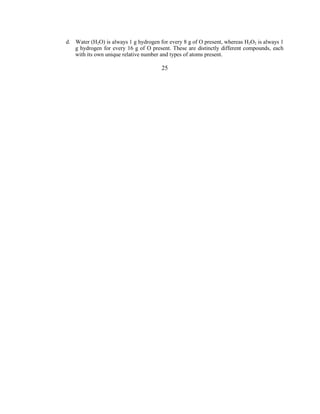
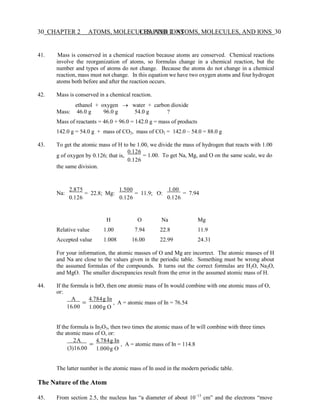

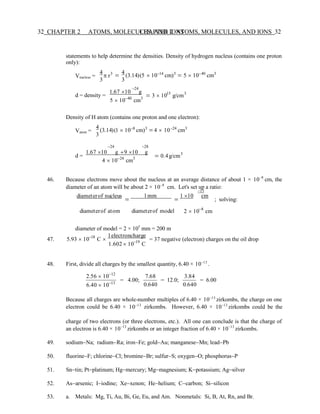
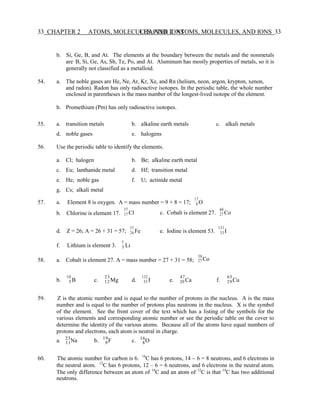
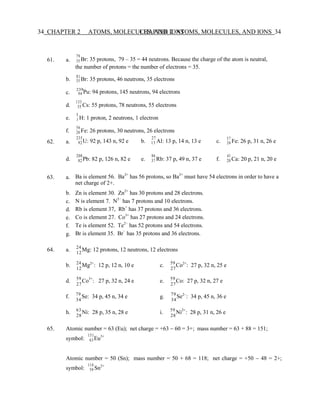
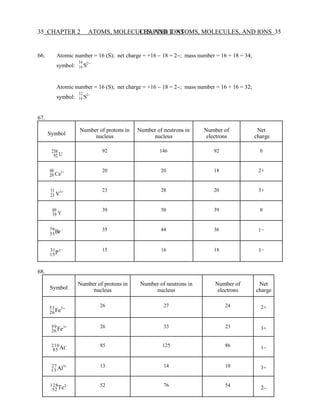
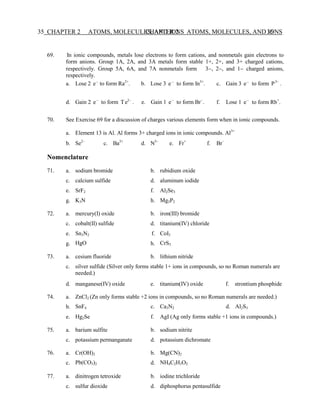
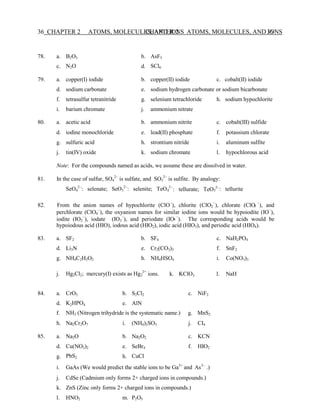
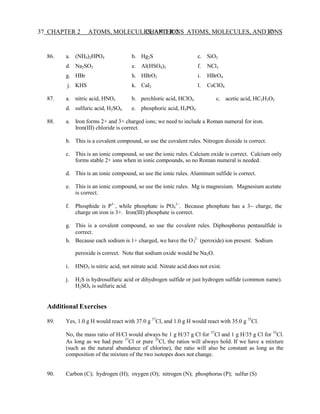
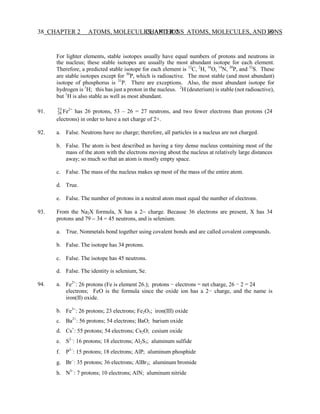
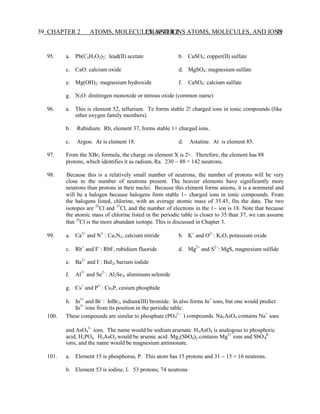
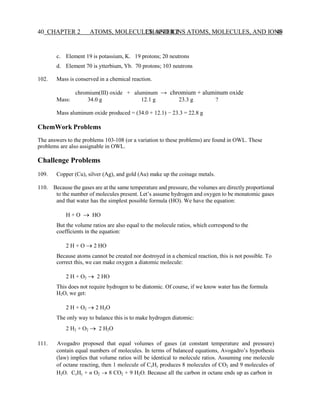
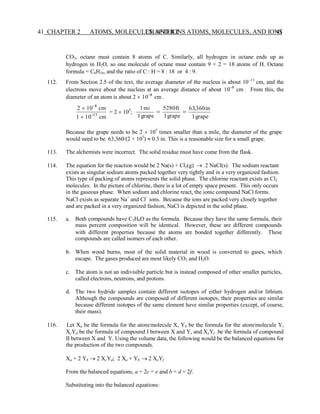
![CHAPTER 2 ATOMS, MOLECULES, AND IONS 42
42 CHAPTER 2 ATOMS, MOLECULES, AND IONS
X2c + 2 Y2f → 2 XcY2f ; 2 X2c + Y2f → 2 X2cYf
For simplest formulas, assume that c = f = 1. Thus:
X2 + 2 Y2 → 2 XY2 and 2 X2 + Y2 → 2 X2Y
Compound I = XY2: If X has relative mass of 1.00,
Compound II = X2Y: If X has relative mass of 1.00,
1.00
1.00 + 2y
2.00
2.00 + y
= 0.3043, y = 1.14.
= 0.6364, y = 1.14.
The relative mass of Y is 1.14 times that of X. Thus, if X has an atomic mass of 100, then Y
will have an atomic mass of 114.
117. Most of the mass of the atom is due to the protons and the neutrons in the nucleus, and
protons and neutrons have about the same mass (1.67 10−24
g). The ratio of the mass of the
molecule to the mass of a nuclear particle will give a good approximation of the number of
nuclear particles (protons and neutrons) present.
7.31 10−23
g
1.67 10−24
g
= 43.8 44 nuclear particles
Thus there are 44 protons and neutrons present. If the number of protons equals the number
of neutrons, we have 22 protons in the molecule. One possibility would be the molecule CO2
[6 + 2(8) = 22 protons].
118. For each experiment, divide the larger number by the smaller. In doing so, we get:
experiment 1 X = 1.0 Y = 10.5
experiment 2 Y = 1.4 Z = 1.0
experiment 3 X = 1.0 Y = 3.5
Our assumption about formulas dictates the rest of the solution. For example, if we assume
that the formula of the compound in experiment 1 is XY and that of experiment 2 is YZ, we
get relative masses of:
X = 2.0; Y = 21; Z = 15 (= 21/1.4)
and a formula of X3Y for experiment 3 [three times as much X must be present in experiment
3 as compared to experiment 1 (10.5/3.5 = 3)].
However, if we assume the formula for experiment 2 is YZ and that of experiment 3 is XZ,
then we get:
X = 2.0; Y = 7.0; Z = 5.0 (= 7.0/1.4)
and a formula of XY3 for experiment 1. Any answer that is consistent with your initial
assumptions is correct.](https://image.slidesharecdn.com/4129-250615124124-33ea978d/85/Solution-Manual-for-Chemistry-9th-Edition-23-320.jpg)