Solution Manual forChemistry, 9th Edition download
pdf
http://testbankbell.com/product/solution-manual-for-chemistry-9th-
edition/
Visit testbankbell.com today to download the complete set of
test banks or solution manuals!
2.
We have selectedsome products that you may be interested in
Click the link to download now or visit testbankbell.com
for more options!.
Solution Manual for Chemistry 9th Edition by Zumdahl
http://testbankbell.com/product/solution-manual-for-chemistry-9th-
edition-by-zumdahl/
Solution Manual for Introductory Chemistry A Foundation
9th by Zumdahl
http://testbankbell.com/product/solution-manual-for-introductory-
chemistry-a-foundation-9th-by-zumdahl/
Test Bank for Chemistry, 9th Edition
http://testbankbell.com/product/test-bank-for-chemistry-9th-edition/
Test Bank for Victimology: Legal, Psychological, and
Social Perspectives, 4th Edition, Harvey Wallace,
deceased, FresnoCliff Roberson
http://testbankbell.com/product/test-bank-for-victimology-legal-
psychological-and-social-perspectives-4th-edition-harvey-wallace-
deceased-fresnocliff-roberson/
3.
Bank Management &Financial Services Rose 9th Edition
Solutions Manual
http://testbankbell.com/product/bank-management-financial-services-
rose-9th-edition-solutions-manual/
Prentice Hall’s Federal Taxation 2012 Comprehensive Pope
Anderson Kramer 25th Edition Solutions Manual
http://testbankbell.com/product/prentice-halls-federal-
taxation-2012-comprehensive-pope-anderson-kramer-25th-edition-
solutions-manual/
Test Bank for Society: The Basics, 15th Edition, John J.
Macionis
http://testbankbell.com/product/test-bank-for-society-the-basics-15th-
edition-john-j-macionis/
Exploring Geology 4th Edition Test Bank Reynolds
http://testbankbell.com/product/exploring-geology-4th-edition-test-
bank-reynolds/
Test Bank for Conceptual Chemistry, 5/E 5th Edition John
A. Suchocki
http://testbankbell.com/product/test-bank-for-conceptual-
chemistry-5-e-5th-edition-john-a-suchocki/
4.
Test Bank forLiving Physical Geography, 2nd Edition,
Bruce Gervais,
http://testbankbell.com/product/test-bank-for-living-physical-
geography-2nd-edition-bruce-gervais/
5.
Solution Manual forChemistry, 9th Edition
Full download link at: https://testbankbell.com/product/solution-manual-for-
chemistry-9th-edition/
CHAPTER 2
ATOMS, MOLECULES, AND IONS
Questions
16. Some elements exist as molecular substances. That is, hydrogen normally exists as H2
molecules, not single hydrogen atoms. The same is true for N2, O2, F2, Cl2, etc.
17. A compound will always contain the same numbers (and types) of atoms. A given amount of
hydrogen will react only with a specific amount of oxygen. Any excess oxygen will remain
unreacted.
18. The halogens have a high affinity for electrons, and one important way they react is to form
anions of the type X−
. The alkali metals tend to give up electrons easily and in most of their
compounds exist as M+
cations. Note: These two very reactive groups are only one electron
away (in the periodic table) from the least reactive family of elements, the noble gases.
19. Law of conservation of mass: Mass is neither created nor destroyed. The total mass before a
chemical reaction always equals the total mass after a chemical reaction.
Law of definite proportion: A given compound always contains exactly the same proportion
of elements by mass. For example, water is always 1 g H for every 8 g oxygen.
Law of multiple proportions: When two elements form a series of compounds, the ratios of
the mass of the second element that combine with 1 g of the first element always can be reduced
to small whole numbers: For CO2 and CO discussed in Section 2.2, the mass ratios of oxygen
that react with 1 g carbon in each compound are in a 2 : 1 ratio.
20. a. The smaller parts are electrons and the nucleus. The nucleus is broken down into protons
and neutrons, which can be broken down into quarks. For our purpose, electrons,
neutrons, and protons are the key smaller parts of an atom.
b. All atoms of hydrogen have 1 proton in the nucleus. Different isotopes of hydrogen have
0, 1, or 2 neutrons in the nucleus. Because we are talking about atoms, this implies a
neutral charge, which dictates 1 electron present for all hydrogen atoms. If charged ions
were included, then different ions/atoms of H could have different numbers of electrons.
c. Hydrogen atoms always have 1 proton in the nucleus, and helium atoms always have 2
protons in the nucleus. The number of neutrons can be the same for a hydrogen atom and
a helium atom. Tritium (3
H) and 4
He both have 2 neutrons. Assuming neutral atoms, then
the number of electrons will be 1 for hydrogen and 2 for helium.
6.
d. Water (H2O)is always 1 g hydrogen for every 8 g of O present, whereas H2O2 is always 1
g hydrogen for every 16 g of O present. These are distinctly different compounds, each
with its own unique relative number and types of atoms present.
25
7.
26 CHAPTER 2ATOMS, MOLECULES, AND IONS
CHAPTER 2 ATOMS, MOLECULES, AND IONS 26
e. A chemical equation involves a reorganization of the atoms. Bonds are broken between
atoms in the reactants, and new bonds are formed in the products. The number and types
of atoms between reactants and products do not change. Because atoms are conserved in
a chemical reaction, mass is also conserved.
21. J. J. Thomson’s study of cathode-ray tubes led him to postulate the existence of negatively
charged particles that we now call electrons. Thomson also postulated that atoms must
contain positive charge in order for the atom to be electrically neutral. Ernest Rutherford and
his alpha bombardment of metal foil experiments led him to postulate the nuclear atom−an
atom with a tiny dense center of positive charge (the nucleus) with electrons moving about
the nucleus at relatively large distances away; the distance is so large that an atom is mostly
empty space.
22. The atom is composed of a tiny dense nucleus containing most of the mass of the atom. The
nucleus itself is composed of neutrons and protons. Neutrons have a mass slightly larger than
that of a proton and have no charge. Protons, on the other hand, have a 1+ relative charge as
compared to the 1– charged electrons; the electrons move about the nucleus at relatively large
distances. The volume of space that the electrons move about is so large, as compared to the
nucleus, that we say an atom is mostly empty space.
23. The number and arrangement of electrons in an atom determine how the atom will react with
other atoms, i.e., the electrons determine the chemical properties of an atom. The number of
neutrons present determines the isotope identity and the mass number.
24. Density = mass/volume; if the volumes are assumed equal, then the much more massive
proton would have a much larger density than the relatively light electron.
25. For lighter, stable isotopes, the number of protons in the nucleus is about equal to the number
of neutrons. When the number of protons and neutrons is equal to each other, the mass
number (protons + neutrons) will be twice the atomic number (protons). Therefore, for
lighter isotopes, the ratio of the mass number to the atomic number is close to 2. For
example, consider 28
Si, which has 14 protons and (28 – 14 =) 14 neutrons. Here, the mass
number to atomic number ratio is 28/14 = 2.0. For heavier isotopes, there are more neutrons
than protons in the nucleus. Therefore, the ratio of the mass number to the atomic number
increases steadily upward from 2 as the isotopes get heavier and heavier. For example, 238
U
has 92 protons and (238 – 92 =) 146 neutrons. The ratio of the mass number to the atomic
number for 238
U is 238/92 = 2.6.
26. Some properties of metals are
(1) conduct heat and electricity;
(2) malleable (can be hammered into sheets);
(3) ductile (can be pulled into wires);
(4) lustrous appearance;
(5) form cations when they form ionic compounds.
Nonmetals generally do not have these properties, and when they form ionic compounds,
nonmetals always form anions.
8.
27 CHAPTER 2ATOMS, MOLECULES, AND IONS
CHAPTER 2 ATOMS, MOLECULES, AND IONS 27
27. Carbon is a nonmetal. Silicon and germanium are called metalloids because they exhibit both
metallic and nonmetallic properties. Tin and lead are metals. Thus metallic character
increases as one goes down a family in the periodic table. The metallic character decreases
from left to right across the periodic table.
28. a. A molecule has no overall charge (an equal number of electrons and protons are present).
Ions, on the other hand, have extra electrons added or removed to form anions (negatively
charged ions) or cations (positively charged ions).
b. The sharing of electrons between atoms is a covalent bond. An ionic bond is the force of
attraction between two oppositely charged ions.
c. A molecule is a collection of atoms held together by covalent bonds. A compound is
composed of two or more different elements having constant composition. Covalent
and/or ionic bonds can hold the atoms together in a compound. Another difference is that
molecules do not necessarily have to be compounds. H2 is two hydrogen atoms held
together by a covalent bond. H2 is a molecule, but it is not a compound; H2 is a diatomic
element.
d. An anion is a negatively charged ion; e.g., Cl−
, O2−
, and SO4
2−
are all anions. A cation is a
positively charged ion, e.g., Na+
, Fe3+
, and NH4
+
are all cations.
29. a. This represents ionic bonding. Ionic bonding is the electrostatic attraction between
anions and cations.
b. This represents covalent bonding where electrons are shared between two atoms. This
could be the space-filling model for H2O or SF2 or NO2, etc.
30. Natural niacin and commercially produced niacin have the exact same formula of C6H5NO2.
Therefore, both sources produce niacin having an identical nutritional value. There may be
other compounds present in natural niacin that would increase the nutritional value, but the
nutritional value due to just niacin is identical to the commercially produced niacin.
31. Statements a and b are true. Counting over in the periodic table, element 118 will be the next
noble gas (a nonmetal). For statement c, hydrogen has mostly nonmetallic properties. For
statement d, a family of elements is also known as a group of elements. For statement e, two
items are incorrect. When a metal reacts with a nonmetal, an ionic compound is produced,
and the formula of the compound would be AX2 (alkaline earth metals form 2+ ions and halo-
gens form 1– ions in ionic compounds). The correct statement would be: When an alkaline earth
metal, A, reacts with a halogen, X, the formula of the ionic compound formed should be AX2.
32. a. Dinitrogen monoxide is correct. N and O are both nonmetals, resulting in a covalent
compound. We need to use the covalent rules of nomenclature. The other two names are
for ionic compounds.
b. Copper(I) oxide is correct. With a metal in a compound, we have an ionic compound.
Because copper, like most transition metals, forms at least a couple of different stable
charged ions in compounds, we must indicate the charge on copper in the name. Copper
oxide could be CuO or Cu2O, hence why we must give the charge of most transition
9.
28 CHAPTER 2ATOMS, MOLECULES, AND IONS
CHAPTER 2 ATOMS, MOLECULES, AND IONS 28
metal compounds. Dicopper monoxide is the name if this were a covalent compound, which
it is not.
c. Lithium oxide is correct. Lithium forms 1+ charged ions in stable ionic compounds.
Because lithium is assumed to form 1+ ions in compounds, we do not need to indicate the
charge of the metal ion in the compound. Dilithium monoxide would be the name if Li2O
were a covalent compound (a compound composed of only nonmetals).
Exercises
Development of the Atomic Theory
33. a. The composition of a substance depends on the numbers of atoms of each element
making up the compound (depends on the formula of the compound) and not on the
composition of the mixture from which it was formed.
b. Avogadro’s hypothesis (law) implies that volume ratios are proportional to molecule
ratios at constant temperature and pressure. H2(g) + Cl2(g) → 2 HCl(g). From the
balanced equation, the volume of HCl produced will be twice the volume of H2 (or Cl2)
reacted.
34. Avogadro’s hypothesis (law) implies that volume ratios are equal to molecule ratios at
constant temperature and pressure. Here, 1 volume of N2 reacts with 3 volumes of H2 to
produce 2 volumes of the gaseous product or in terms of molecule ratios:
1 N2 + 3 H2 → 2 product
In order for the equation to be balanced, the product must be NH3.
35. From the law of definite proportions, a given compound always contains exactly the same
proportion of elements by mass. The first sample of chloroform has a total mass of 12.0 g C
+ 106.4 g Cl + 1.01 g H = 119.41 g (carrying extra significant figures). The mass percent of
carbon in this sample of chloroform is:
12.0 g C
119.41g total
× 100 = 10.05% C by mass
From the law of definite proportions, the second sample of chloroform must also contain
10.05% C by mass. Let x = mass of chloroform in the second sample:
30.0 g C
x
× 100 = 10.05, x = 299 g chloroform
36. A compound will always have a constant composition by mass. From the initial data given,
the mass ratio of H : S : O in sulfuric acid (H2SO4) is:
2.02
:
2.02
32.07
:
2.02
64.00
= 1 : 15.9 : 31.7
2.02
If we have 7.27 g H, then we will have 7.27 × 15.9 = 116 g S and 7.27 × 31.7 = 230. g O in
the second sample of H2SO4.
10.
29 CHAPTER 2ATOMS, MOLECULES, AND IONS
CHAPTER 2 ATOMS, MOLECULES, AND IONS 29
37. Hydrazine: 1.44 × 10⁻¹
g H/g N; ammonia: 2.16 × 10⁻¹
g H/g N; hydrogen azide:
2.40 × 10⁻²
g H/g N. Let's try all of the ratios:
0.144
= 6.00;
0.0240
0.216
= 9.00;
0.0240
0.0240
= 1.00;
0.0240
0.216
= 1.50 =
3
0.144 2
All the masses of hydrogen in these three compounds can be expressed as simple whole-
number ratios. The g H/g N in hydrazine, ammonia, and hydrogen azide are in the ratios
6 : 9 : 1.
38. The law of multiple proportions does not involve looking at the ratio of the mass of one
element with the total mass of the compounds. To illustrate the law of multiple proportions,
we compare the mass of carbon that combines with 1.0 g of oxygen in each compound:
compound 1: 27.2 g C and 72.8 g O (100.0 − 27.2 = mass O)
compound 2: 42.9 g C and 57.1 g O (100.0 − 42.9 = mass O)
The mass of carbon that combines with 1.0 g of oxygen is:
compound 1:
compound 2:
27.2 g C
72.8 g O
42.9 g C
57.1g O
= 0.374 g C/g O
= 0.751 g C/g O
0.751
=
0.374
number.
2
; this supports the law of multiple proportions because this carbon ratio is a whole
1
39. For CO and CO2, it is easiest to concentrate on the mass of oxygen that combines with 1 g of
carbon. From the formulas (two oxygen atoms per carbon atom in CO2 versus one oxygen
atom per carbon atom in CO), CO2 will have twice the mass of oxygen that combines per
gram of carbon as compared to CO. For CO2 and C3O2, it is easiest to concentrate on the
mass of carbon that combines with 1 g of oxygen. From the formulas (three carbon atoms per
two oxygen atoms in C3O2 versus one carbon atom per two oxygen atoms in CO2), C3O2 will
have three times the mass of carbon that combines per gram of oxygen as compared to CO2.
As expected, the mass ratios are whole numbers as predicted by the law of multiple proportions.
40. Compound I:
14.0g R
3.00g Q
=
4.67g R
; compound II:
1.00g Q
7.00 g R
4.50 g Q
=
1.56 g R
1.00 g Q
The ratio of the masses of R that combine with 1.00 g Q is:
4.67
= 2.99 3
1.56
As expected from the law of multiple proportions, this ratio is a small whole number.
Because compound I contains three times the mass of R per gram of Q as compared with
compound II (RQ), the formula of compound I should be R3Q.
11.
30 CHAPTER 2ATOMS, MOLECULES, AND IONS
CHAPTER 2 ATOMS, MOLECULES, AND IONS 30
41. Mass is conserved in a chemical reaction because atoms are conserved. Chemical reactions
involve the reorganization of atoms, so formulas change in a chemical reaction, but the
number and types of atoms do not change. Because the atoms do not change in a chemical
reaction, mass must not change. In this equation we have two oxygen atoms and four hydrogen
atoms both before and after the reaction occurs.
42. Mass is conserved in a chemical reaction.
ethanol + oxygen → water + carbon dioxide
Mass: 46.0 g 96.0 g 54.0 g ?
Mass of reactants = 46.0 + 96.0 = 142.0 g = mass of products
142.0 g = 54.0 g + mass of CO2, mass of CO2 = 142.0 – 54.0 = 88.0 g
43. To get the atomic mass of H to be 1.00, we divide the mass of hydrogen that reacts with 1.00
g of oxygen by 0.126; that is,
the same division.
0.126
= 1.00. To get Na, Mg, and O on the same scale, we do
0.126
Na:
2.875
= 22.8; Mg:
0.126
1.500
= 11.9; O:
0.126
1.00
= 7.94
0.126
H O Na Mg
Relative value 1.00 7.94 22.8 11.9
Accepted value 1.008 16.00 22.99 24.31
For your information, the atomic masses of O and Mg are incorrect. The atomic masses of H
and Na are close to the values given in the periodic table. Something must be wrong about
the assumed formulas of the compounds. It turns out the correct formulas are H2O, Na2O,
and MgO. The smaller discrepancies result from the error in the assumed atomic mass of H.
44. If the formula is InO, then one atomic mass of In would combine with one atomic mass of O,
or:
A
=
16.00
4.784g In
, A = atomic mass of In = 76.54
1.000g O
If the formula is In2O3, then two times the atomic mass of In will combine with three times
the atomic mass of O, or:
2A
=
(3)16.00
4.784g In
, A = atomic mass of In = 114.8
1.000g O
The latter number is the atomic mass of In used in the modern periodic table.
The Nature of the Atom
45. From section 2.5, the nucleus has “a diameter of about 10−13
cm” and the electrons “move
12.
31 CHAPTER 2ATOMS, MOLECULES, AND IONS
CHAPTER 2 ATOMS, MOLECULES, AND IONS 31
about the nucleus at an average distance of about 10−8
cm from it.” We will use these
13.
32 CHAPTER 2ATOMS, MOLECULES, AND IONS
CHAPTER 2 ATOMS, MOLECULES, AND IONS 32
−13
statements to help determine the densities. Density of hydrogen nucleus (contains one proton
only):
4 4 − −
Vnucleus = r3
3
= (3.14)(5 10 14
cm)3
= 5 10 40
cm3
3
−24
d = density =
1.67 10 g
5 10−40
cm3
= 3 1015
g/cm3
Density of H atom (contains one proton and one electron):
4 − −
Vatom = (3.14)(1 10 8
cm)3
= 4 10 24
cm3
3
−24 −28
d =
1.67 10 g +9 10 g
4 10−24
cm3 = 0.4g/cm3
46. Because electrons move about the nucleus at an average distance of about 1 × 10⁻⁸
cm, the
diameter of an atom will be about 2 × 10⁻⁸
cm. Let's set up a ratio:
diameterof nucleus
=
1mm
=
1 10 cm
; solving:
diameterof atom diameterof model 2 10−8
cm
diameter of model = 2 × 10⁵
mm = 200 m
47. 5.93 10−18
C
1electroncharge
1.602 10−19
C
= 37 negative (electron) charges on the oil drop
48. First, divide all charges by the smallest quantity, 6.40 × 10⁻¹³
.
2.56 10−12
6.40 10−13
= 4.00;
7.68
0.640
= 12.0;
3.84
0.640
= 6.00
Because all charges are whole-number multiples of 6.40 × 10⁻¹³
zirkombs, the charge on one
electron could be 6.40 × 10⁻¹³
zirkombs. However, 6.40 × 10⁻¹³
zirkombs could be the
charge of two electrons (or three electrons, etc.). All one can conclude is that the charge of
an electron is 6.40 × 10⁻¹³
zirkombs or an integer fraction of 6.40 × 10⁻¹³
zirkombs.
49. sodium−Na; radium−Ra; iron−Fe; gold−Au; manganese−Mn; lead−Pb
50. fluorine−F; chlorine−Cl; bromine−Br; sulfur−S; oxygen−O; phosphorus−P
51. Sn−tin; Pt−platinum; Hg−mercury; Mg−magnesium; K−potassium; Ag−silver
52. As−arsenic; I−iodine; Xe−xenon; He−helium; C−carbon; Si−silicon
53. a. Metals: Mg, Ti, Au, Bi, Ge, Eu, and Am. Nonmetals: Si, B, At, Rn, and Br.
14.
33 CHAPTER 2ATOMS, MOLECULES, AND IONS
CHAPTER 2 ATOMS, MOLECULES, AND IONS 33
3
Na F O
23 19 16
b. Si, Ge, B, and At. The elements at the boundary between the metals and the nonmetals
are B, Si, Ge, As, Sb, Te, Po, and At. Aluminum has mostly properties of metals, so it is
generally not classified as a metalloid.
54. a. The noble gases are He, Ne, Ar, Kr, Xe, and Rn (helium, neon, argon, krypton, xenon,
and radon). Radon has only radioactive isotopes. In the periodic table, the whole number
enclosed in parentheses is the mass number of the longest-lived isotope of the element.
b. Promethium (Pm) has only radioactive isotopes.
55. a. transition metals b. alkaline earth metals c. alkali metals
d. noble gases e. halogens
56. Use the periodic table to identify the elements.
a. Cl; halogen b. Be; alkaline earth metal
c. Eu; lanthanide metal d. Hf; transition metal
e. He; noble gas f. U; actinide metal
g. Cs; alkali metal
17
57. a. Element 8 is oxygen. A = mass number = 9 + 8 = 17; 8 O
b. Chlorine is element 17.
37
17 Cl c. Cobalt is element 27.
60
27 Co
d. Z = 26; A = 26 + 31 = 57;
57
Fe e. Iodine is element 53.
131
26
f. Lithium is element 3.
7
Li
58. a. Cobalt is element 27. A = mass number = 27 + 31 = 58;
58
27 Co
53 I
10
b. 5 B c.
23
12 Mg d.
132
53 I e.
47
20 Ca f.
65
29Cu
59. Z is the atomic number and is equal to the number of protons in the nucleus. A is the mass
number and is equal to the number of protons plus neutrons in the nucleus. X is the symbol
of the element. See the front cover of the text which has a listing of the symbols for the
various elements and corresponding atomic number or see the periodic table on the cover to
determine the identity of the various atoms. Because all of the atoms have equal numbers of
protons and electrons, each atom is neutral in charge.
a. 11 b. 9 c. 8
60. The atomic number for carbon is 6. 14
C has 6 protons, 14 − 6 = 8 neutrons, and 6 electrons in
the neutral atom. 12
C has 6 protons, 12 – 6 = 6 neutrons, and 6 electrons in the neutral atom.
The only difference between an atom of 14
C and an atom of 12
C is that 14
C has two additional
neutrons.
15.
34 CHAPTER 2ATOMS, MOLECULES, AND IONS
CHAPTER 2 ATOMS, MOLECULES, AND IONS 34
c.
50
61. a.
79
35 Br: 35 protons, 79 – 35 = 44 neutrons. Because the charge of the atom is neutral,
the number of protons = the number of electrons = 35.
81
b. 35 Br: 35 protons, 46 neutrons, 35 electrons
239
94 Pu: 94 protons, 145 neutrons, 94 electrons
133
d. 55 Cs: 55 protons, 78 neutrons, 55 electrons
3
e. 1 H: 1 proton, 2 neutrons, 1 electron
56
f. 26 Fe: 26 protons, 30 neutrons, 26 electrons
62. a.
235
92U: 92 p, 143 n, 92 e b.
27
13 Al: 13 p, 14 n, 13 e c.
57
26 Fe: 26 p, 31 n, 26 e
208
d. 82Pb: 82 p, 126 n, 82 e e.
86
37 Rb: 37 p, 49 n, 37 e f.
41
20 Ca: 20 p, 21 n, 20 e
63. a. Ba is element 56. Ba2+
has 56 protons, so Ba2+
must have 54 electrons in order to have a
net charge of 2+.
b.
c.
d.
e.
f.
g.
Zn is element 30. Zn2+
has 30 protons and 28 electrons.
N is element 7. N3−
has 7 protons and 10 electrons.
Rb is element 37, Rb+
has 37 protons and 36 electrons.
Co is element 27. Co3+
has 27 protons and 24 electrons.
Te is element 52. Te2−
has 52 protons and 54 electrons.
Br is element 35. Br−
has 35 protons and 36 electrons.
64. a. 24
Mg: 12 protons, 12 neutrons, 12 electrons
12
b. 24
Mg2+
: 12 p, 12 n, 10 e c. 59
Co2+
: 27 p, 32 n, 25 e
12 27
d. 59
Co3+
: 27 p, 32 n, 24 e e. 59
Co: 27 p, 32 n, 27 e
27 27
f. 79
Se: 34 p, 45 n, 34 e g. 79
Se2−
: 34 p, 45 n, 36 e
34 34
h. 63
Ni: 28 p, 35 n, 28 e i. 59
Ni2+
: 28 p, 31 n, 26 e
28 28
65. Atomic number = 63 (Eu); net charge = +63 − 60 = 3+; mass number = 63 + 88 = 151;
151
symbol: 63Eu3+
Atomic number = 50 (Sn); mass number = 50 + 68 = 118; net charge = +50 − 48 = 2+;
symbol:
118
Sn2+
16.
35 CHAPTER 2ATOMS, MOLECULES, AND IONS
CHAPTER 2 ATOMS, MOLECULES, AND IONS 35
Symbol
Number of protons in
nucleus
Number of neutrons in
nucleus
Number of
electrons
Net
charge
53
Fe2+
26
26 27 24 2+
59 3+
26 Fe 26 33 23 3+
210 −
85 At 85 125 86 1–
27 3+
13 Al 13 14 10 3+
128 2−
52 Te 52 76 54
2–
66. Atomic number = 16 (S); net charge = +16 − 18 = 2−; mass number = 16 + 18 = 34;
34
symbol: 16 S2−
Atomic number = 16 (S); net charge = +16 − 18 = 2−; mass number = 16 + 16 = 32;
32
symbol: 16 S2−
67.
Symbol
Number of protons in
nucleus
Number of neutrons in
nucleus
Number of
electrons
Net
charge
238
92 U
92 146 92 0
40
20 Ca2+ 20 20 18 2+
51
23 V3+ 23 28 20 3+
89
39 Y
39 50 39 0
79
Br−
35
35 44 36 1−
31
P3−
15
15 16 18 3−
68.
17.
CHAPTER 2 ATOMS,MOLECULES, AND IONS 35
35 CHAPTER 2 ATOMS, MOLECULES, AND IONS
69. In ionic compounds, metals lose electrons to form cations, and nonmetals gain electrons to
form anions. Group 1A, 2A, and 3A metals form stable 1+, 2+, and 3+ charged cations,
respectively. Group 5A, 6A, and 7A nonmetals form 3−, 2−, and 1− charged anions,
respectively.
a. Lose 2 e−
to form Ra2+
. b. Lose 3 e−
to form In3+
. c. Gain 3 e−
to form P3−
.
d. Gain 2 e−
to form Te2−
. e. Gain 1 e−
to form Br−
. f. Lose 1 e−
to form Rb+
.
70. See Exercise 69 for a discussion of charges various elements form when in ionic compounds.
a. Element 13 is Al. Al forms 3+ charged ions in ionic compounds. Al3+
b. Se2−
c. Ba2+
d. N3−
e. Fr+
f. Br−
Nomenclature
71. a.
c.
e.
sodium bromide
calcium sulfide
SrF2
b.
d.
f.
rubidium oxide
aluminum iodide
Al2Se3
g. K3N h. Mg3P2
72. a. mercury(I) oxide b. iron(III) bromide
c. cobalt(II) sulfide d. titanium(IV) chloride
e.
g.
Sn3N2
HgO
f.
h.
CoI3
CrS3
73. a. cesium fluoride b. lithium nitride
c. silver sulfide (Silver only forms stable 1+ ions in compounds, so no Roman numerals are
needed.)
d. manganese(IV) oxide e. titanium(IV) oxide f. strontium phosphide
74. a.
b.
ZnCl2 (Zn only forms stable +2 ions in compounds, so no Roman numerals are needed.)
SnF4 c. Ca3N2 d. Al2S3
e. Hg2Se f. AgI (Ag only forms stable +1 ions in compounds.)
75. a. barium sulfite b. sodium nitrite
c. potassium permanganate d. potassium dichromate
76. a.
c.
Cr(OH)3
Pb(CO3)2
b.
d.
Mg(CN)2
NH4C2H3O2
77. a. dinitrogen tetroxide b. iodine trichloride
c. sulfur dioxide d. diphosphorus pentasulfide
18.
CHAPTER 2 ATOMS,MOLECULES, AND IONS 36
36 CHAPTER 2 ATOMS, MOLECULES, AND IONS
4 3
3
4
2
78. a.
c.
B2O3
N2O
b.
d.
AsF5
SCl6
79. a. copper(I) iodide b. copper(II) iodide c. cobalt(II) iodide
d. sodium carbonate e. sodium hydrogen carbonate or sodium bicarbonate
f.
i.
tetrasulfur tetranitride
barium chromate
g.
j.
selenium tetrachloride
ammonium nitrate
h. sodium hypochlorite
80. a. acetic acid b. ammonium nitrite c. cobalt(III) sulfide
d. iodine monochloride e. lead(II) phosphate f. potassium chlorate
g. sulfuric acid h. strontium nitride i. aluminum sulfite
j. tin(IV) oxide k. sodium chromate l. hypochlorous acid
Note: For the compounds named as acids, we assume these are dissolved in water.
81. In the case of sulfur, SO4
2−
is sulfate, and SO3
2−
is sulfite. By analogy:
SeO4
2−
: selenate; SeO3
2−
: selenite; TeO 2−
: tellurate; TeO 2−
: tellurite
82. From the anion names of hypochlorite (ClO−
), chlorite (ClO2
−
), chlorate (ClO −
), and
perchlorate (ClO4
−
), the oxyanion names for similar iodine ions would be hypoiodite (IO−
),
iodite (IO2
−
), iodate (IO3
−
), and periodate (IO −
). The corresponding acids would be
hypoiodous acid (HIO), iodous acid (HIO2), iodic acid (HIO3), and periodic acid (HIO4).
83. a. SF2 b. SF6 c. NaH2PO4
d. Li3N e. Cr2(CO3)3 f. SnF2
g. NH4C2H3O2 h. NH4HSO4 i. Co(NO3)3
j. Hg2Cl2; mercury(I) exists as Hg 2+
ions. k. KClO3 l. NaH
84. a. CrO3 b. S2Cl2 c. NiF2
d. K2HPO4 e. AlN
f. NH3 (Nitrogen trihydride is the systematic name.) g. MnS2
h. Na2Cr2O7 i. (NH4)2SO3 j. CI4
85. a. Na2O b. Na2O2 c. KCN
d.
g.
Cu(NO3)2
PbS2
e.
h.
SeBr4
CuCl
f. HIO2
i. GaAs (We would predict the stable ions to be Ga3+
and As3−
.)
j. CdSe (Cadmium only forms 2+ charged ions in compounds.)
k. ZnS (Zinc only forms 2+ charged ions in compounds.)
l. HNO2 m. P2O5
19.
CHAPTER 2 ATOMS,MOLECULES, AND IONS 37
37 CHAPTER 2 ATOMS, MOLECULES, AND IONS
2
86. a. (NH4)2HPO4 b. Hg2S c. SiO2
d. Na2SO3 e. Al(HSO4)3 f. NCl3
g. HBr h. HBrO2 i. HBrO4
j. KHS k. CaI2 l. CsClO4
87. a. nitric acid, HNO3 b. perchloric acid, HClO4 c. acetic acid, HC2H3O2
d. sulfuric acid, H2SO4 e. phosphoric acid, H3PO4
88. a. Iron forms 2+ and 3+ charged ions; we need to include a Roman numeral for iron.
Iron(III) chloride is correct.
b. This is a covalent compound, so use the covalent rules. Nitrogen dioxide is correct.
c. This is an ionic compound, so use the ionic rules. Calcium oxide is correct. Calcium only
forms stable 2+ ions when in ionic compounds, so no Roman numeral is needed.
d. This is an ionic compound, so use the ionic rules. Aluminum sulfide is correct.
e. This is an ionic compound, so use the ionic rules. Mg is magnesium. Magnesium acetate
is correct.
f. Phosphide is P3−
, while phosphate is PO4
3−
. Because phosphate has a 3− charge, the
charge on iron is 3+. Iron(III) phosphate is correct.
g. This is a covalent compound, so use the covalent rules. Diphosphorus pentasulfide is
correct.
h. Because each sodium is 1+ charged, we have the O 2−
(peroxide) ion present. Sodium
peroxide is correct. Note that sodium oxide would be Na2O.
i. HNO3 is nitric acid, not nitrate acid. Nitrate acid does not exist.
j. H2S is hydrosulfuric acid or dihydrogen sulfide or just hydrogen sulfide (common name).
H2SO4 is sulfuric acid.
Additional Exercises
89. Yes, 1.0 g H would react with 37.0 g 37
Cl, and 1.0 g H would react with 35.0 g 35
Cl.
No, the mass ratio of H/Cl would always be 1 g H/37 g Cl for 37
Cl and 1 g H/35 g Cl for 35
Cl.
As long as we had pure 37
Cl or pure 35
Cl, the ratios will always hold. If we have a mixture
(such as the natural abundance of chlorine), the ratio will also be constant as long as the
composition of the mixture of the two isotopes does not change.
90. Carbon (C); hydrogen (H); oxygen (O); nitrogen (N); phosphorus (P); sulfur (S)
20.
CHAPTER 2 ATOMS,MOLECULES, AND IONS 38
38 CHAPTER 2 ATOMS, MOLECULES, AND IONS
26
For lighter elements, stable isotopes usually have equal numbers of protons and neutrons in
the nucleus; these stable isotopes are usually the most abundant isotope for each element.
Therefore, a predicted stable isotope for each element is 12
C, 2
H, 16
O, 14
N, 30
P, and 32
S. These
are stable isotopes except for 30
P, which is radioactive. The most stable (and most abundant)
isotope of phosphorus is 31
P. There are exceptions. Also, the most abundant isotope for
hydrogen is 1
H; this has just a proton in the nucleus. 2
H (deuterium) is stable (not radioactive),
but 1
H is also stable as well as most abundant.
91. 53
Fe2+
has 26 protons, 53 – 26 = 27 neutrons, and two fewer electrons than protons (24
electrons) in order to have a net charge of 2+.
92. a.
b.
False. Neutrons have no charge; therefore, all particles in a nucleus are not charged.
False. The atom is best described as having a tiny dense nucleus containing most of the
mass of the atom with the electrons moving about the nucleus at relatively large distances
away; so much so that an atom is mostly empty space.
c. False. The mass of the nucleus makes up most of the mass of the entire atom.
d. True.
e. False. The number of protons in a neutral atom must equal the number of electrons.
93. From the Na2X formula, X has a 2− charge. Because 36 electrons are present, X has 34
protons and 79 − 34 = 45 neutrons, and is selenium.
a.
b.
c.
True. Nonmetals bond together using covalent bonds and are called covalent compounds.
False. The isotope has 34 protons.
False. The isotope has 45 neutrons.
d. False. The identity is selenium, Se.
94. a. Fe2+
: 26 protons (Fe is element 26.); protons − electrons = net charge, 26 − 2 = 24
electrons; FeO is the formula since the oxide ion has a 2− charge, and the name is
iron(II) oxide.
b. Fe3+
: 26 protons; 23 electrons; Fe2O3; iron(III) oxide
c. Ba2+
: 56 protons; 54 electrons; BaO; barium oxide
d. Cs+
: 55 protons; 54 electrons; Cs2O; cesium oxide
e. S2−
: 16 protons; 18 electrons; Al2S3; aluminum sulfide
f. P3−
: 15 protons; 18 electrons; AlP; aluminum phosphide
g. Br−
: 35 protons; 36 electrons; AlBr3; aluminum bromide
h. N3−
: 7 protons; 10 electrons; AlN; aluminum nitride
21.
CHAPTER 2 ATOMS,MOLECULES, AND IONS 39
39 CHAPTER 2 ATOMS, MOLECULES, AND IONS
4
4
95. a. Pb(C2H3O2)2: lead(II) acetate b. CuSO4: copper(II) sulfate
c. CaO: calcium oxide d. MgSO4: magnesium sulfate
e. Mg(OH)2: magnesium hydroxide f. CaSO4: calcium sulfate
g. N2O: dinitrogen monoxide or nitrous oxide (common name)
96. a. This is element 52, tellurium. Te forms stable 2 charged ions in ionic compounds (like
other oxygen family members).
b. Rubidium. Rb, element 37, forms stable 1+ charged ions.
c. Argon. Ar is element 18. d. Astatine. At is element 85.
97. From the XBr2 formula, the charge on element X is 2+. Therefore, the element has 88
protons, which identifies it as radium, Ra. 230 − 88 = 142 neutrons.
98. Because this is a relatively small number of neutrons, the number of protons will be very
close to the number of neutrons present. The heavier elements have significantly more
neutrons than protons in their nuclei. Because this element forms anions, it is a nonmetal and
will be a halogen because halogens form stable 1− charged ions in ionic compounds. From
the halogens listed, chlorine, with an average atomic mass of 35.45, fits the data. The two
isotopes are 35
Cl and 37
Cl, and the number of electrons in the 1− ion is 18. Note that because
the atomic mass of chlorine listed in the periodic table is closer to 35 than 37, we can assume
that 35
Cl is the more abundant isotope. This is discussed in Chapter 3.
99. a. Ca2+
and N3−
: Ca3N2, calcium nitride b. K+
and O2−
: K2O, potassium oxide
c. Rb+
and F−
: RbF, rubidium fluoride d. Mg2+
and S2−
: MgS, magnesium sulfide
e. Ba2+
and I−
: BaI2, barium iodide
f. Al3+
and Se2−
: Al2Se3, aluminum selenide
g. Cs+
and P3−
: Cs3P, cesium phosphide
h. In3+
and Br−
: InBr3, indium(III) bromide. In also forms In+
ions, but one would predict
In3+
ions from its position in the periodic table.
100. These compounds are similar to phosphate (PO 3-−
) compounds. Na3AsO4 contains Na+
ions
and AsO4
3−
ions. The name would be sodium arsenate. H3AsO4 is analogous to phosphoric
acid, H3PO4. H3AsO4 would be arsenic acid. Mg3(SbO4)2 contains Mg2+
ions and SbO 3−
ions, and the name would be magnesium antimonate.
101. a. Element 15 is phosphorus, P. This atom has 15 protons and 31 − 15 = 16 neutrons.
b. Element 53 is iodine, I. 53 protons; 74 neutrons
22.
CHAPTER 2 ATOMS,MOLECULES, AND IONS 40
40 CHAPTER 2 ATOMS, MOLECULES, AND IONS
c. Element 19 is potassium, K. 19 protons; 20 neutrons
d. Element 70 is ytterbium, Yb. 70 protons; 103 neutrons
102. Mass is conserved in a chemical reaction.
chromium(III) oxide + aluminum → chromium + aluminum oxide
Mass: 34.0 g 12.1 g 23.3 g ?
Mass aluminum oxide produced = (34.0 + 12.1) − 23.3 = 22.8 g
ChemWork Problems
The answers to the problems 103-108 (or a variation to these problems) are found in OWL. These
problems are also assignable in OWL.
Challenge Problems
109. Copper (Cu), silver (Ag), and gold (Au) make up the coinage metals.
110. Because the gases are at the same temperature and pressure, the volumes are directly proportional
to the number of molecules present. Let’s assume hydrogen and oxygen to be monatomic gases
and that water has the simplest possible formula (HO). We have the equation:
H + O → HO
But the volume ratios are also equal to the molecule ratios, which correspond to the
coefficients in the equation:
2 H + O → 2 HO
Because atoms cannot be created nor destroyed in a chemical reaction, this is not possible. To
correct this, we can make oxygen a diatomic molecule:
2 H + O2 → 2 HO
This does not require hydrogen to be diatomic. Of course, if we know water has the formula
H2O, we get:
2 H + O2 → 2 H2O
The only way to balance this is to make hydrogen diatomic:
2 H2 + O2 → 2 H2O
111. Avogadro proposed that equal volumes of gases (at constant temperature and pressure)
contain equal numbers of molecules. In terms of balanced equations, Avogadro’s hypothesis
(law) implies that volume ratios will be identical to molecule ratios. Assuming one molecule
of octane reacting, then 1 molecule of CxHy produces 8 molecules of CO2 and 9 molecules of
H2O. CxHy + n O2 → 8 CO2 + 9 H2O. Because all the carbon in octane ends up as carbon in
23.
CHAPTER 2 ATOMS,MOLECULES, AND IONS 41
41 CHAPTER 2 ATOMS, MOLECULES, AND IONS
CO2, octane must contain 8 atoms of C. Similarly, all hydrogen in octane ends up as
hydrogen in H2O, so one molecule of octane must contain 9 × 2 = 18 atoms of H. Octane
formula = C8H18, and the ratio of C : H = 8 : 18 or 4 : 9.
112. From Section 2.5 of the text, the average diameter of the nucleus is about 10−13
cm, and the
electrons move about the nucleus at an average distance of about 10−8
cm . From this, the
diameter of an atom is about 2 10−8
cm .
2 10−8
cm
1 10−13
cm
= 2 105
;
1mi
=
1grape
5280ft
=
1grape
63,360in
1grape
Because the grape needs to be 2 105
times smaller than a mile, the diameter of the grape
would need to be 63,360/(2 × 105
) 0.3 in. This is a reasonable size for a small grape.
113. The alchemists were incorrect. The solid residue must have come from the flask.
114. The equation for the reaction would be 2 Na(s) + Cl2(g) → 2 NaCl(s). The sodium reactant
exists as singular sodium atoms packed together very tightly and in a very organized fashion.
This type of packing of atoms represents the solid phase. The chlorine reactant exists as Cl2
molecules. In the picture of chlorine, there is a lot of empty space present. This only occurs
in the gaseous phase. When sodium and chlorine react, the ionic compound NaCl forms.
NaCl exists as separate Na+
and Cl−
ions. Because the ions are packed very closely together
and are packed in a very organized fashion, NaCl is depicted in the solid phase.
115. a. Both compounds have C2H6O as the formula. Because they have the same formula, their
mass percent composition will be identical. However, these are different compounds
with different properties because the atoms are bonded together differently. These
compounds are called isomers of each other.
b. When wood burns, most of the solid material in wood is converted to gases, which
escape. The gases produced are most likely CO2 and H2O.
c. The atom is not an indivisible particle but is instead composed of other smaller particles,
called electrons, neutrons, and protons.
d. The two hydride samples contain different isotopes of either hydrogen and/or lithium.
Although the compounds are composed of different isotopes, their properties are similar
because different isotopes of the same element have similar properties (except, of course,
their mass).
116. Let Xa be the formula for the atom/molecule X, Yb be the formula for the atom/molecule Y,
XcYd be the formula of compound I between X and Y, and XeYf be the formula of compound
II between X and Y. Using the volume data, the following would be the balanced equations for
the production of the two compounds.
Xa + 2 Yb → 2 XcYd; 2 Xa + Yb → 2 XeYf
From the balanced equations, a = 2c = e and b = d = 2f.
Substituting into the balanced equations:
24.
CHAPTER 2 ATOMS,MOLECULES, AND IONS 42
42 CHAPTER 2 ATOMS, MOLECULES, AND IONS
X2c + 2 Y2f → 2 XcY2f ; 2 X2c + Y2f → 2 X2cYf
For simplest formulas, assume that c = f = 1. Thus:
X2 + 2 Y2 → 2 XY2 and 2 X2 + Y2 → 2 X2Y
Compound I = XY2: If X has relative mass of 1.00,
Compound II = X2Y: If X has relative mass of 1.00,
1.00
1.00 + 2y
2.00
2.00 + y
= 0.3043, y = 1.14.
= 0.6364, y = 1.14.
The relative mass of Y is 1.14 times that of X. Thus, if X has an atomic mass of 100, then Y
will have an atomic mass of 114.
117. Most of the mass of the atom is due to the protons and the neutrons in the nucleus, and
protons and neutrons have about the same mass (1.67 10−24
g). The ratio of the mass of the
molecule to the mass of a nuclear particle will give a good approximation of the number of
nuclear particles (protons and neutrons) present.
7.31 10−23
g
1.67 10−24
g
= 43.8 44 nuclear particles
Thus there are 44 protons and neutrons present. If the number of protons equals the number
of neutrons, we have 22 protons in the molecule. One possibility would be the molecule CO2
[6 + 2(8) = 22 protons].
118. For each experiment, divide the larger number by the smaller. In doing so, we get:
experiment 1 X = 1.0 Y = 10.5
experiment 2 Y = 1.4 Z = 1.0
experiment 3 X = 1.0 Y = 3.5
Our assumption about formulas dictates the rest of the solution. For example, if we assume
that the formula of the compound in experiment 1 is XY and that of experiment 2 is YZ, we
get relative masses of:
X = 2.0; Y = 21; Z = 15 (= 21/1.4)
and a formula of X3Y for experiment 3 [three times as much X must be present in experiment
3 as compared to experiment 1 (10.5/3.5 = 3)].
However, if we assume the formula for experiment 2 is YZ and that of experiment 3 is XZ,
then we get:
X = 2.0; Y = 7.0; Z = 5.0 (= 7.0/1.4)
and a formula of XY3 for experiment 1. Any answer that is consistent with your initial
assumptions is correct.
25.
CHAPTER 2 ATOMS,MOLECULES, AND IONS 43
43 CHAPTER 2 ATOMS, MOLECULES, AND IONS
The answer to part d depends on which (if any) of experiments 1 and 3 have a formula of XY
in the compound. If the compound in experiment 1 has a formula of XY, then:
21 g XY ×
4.2 g Y
(4.2 + 0.4) gXY
= 19.2 g Y (and 1.8 g X)
If the compound in experiment 3 has the XY formula, then:
21 g XY
7.0 g Y
(7.0 + 2.0) g XY
= 16.3 g Y (and 4.7 g X)
Note that it could be that neither experiment 1 nor experiment 3 has XY as the formula.
Therefore, there is no way of knowing an absolute answer here.
Integrated Problems
119. The systematic name of Ta2O5 is tantalum(V) oxide. Tantalum is a transition metal and
requires a Roman numeral. Sulfur is in the same group as oxygen, and its most common ion
is S2–
. There-fore, the formula of the sulfur analogue would be Ta2S5.
Total number of protons in Ta2O5:
Ta, Z = 73, so 73 protons 2 = 146 protons; O, Z = 8, so 8 protons 5 = 40 protons
Total protons = 186 protons
Total number of protons in Ta2S5:
Ta, Z = 73, so 73 protons 2 = 146 protons; S, Z = 16, so 16 protons 5 = 80 protons
Total protons = 226 protons
Proton difference between Ta2S5 and Ta2O5: 226 protons – 186 protons = 40 protons
120. The cation has 51 protons and 48 electrons. The number of protons corresponds to the atomic
number. Thus this is element 51, antimony. There are 3 fewer electrons than protons. Therefore,
the charge on the cation is 3+. The anion has one-third the number of protons of the cation,
which corresponds to 17 protons; this is element 17, chlorine. The number of electrons in this
anion of chlorine is 17 + 1 = 18 electrons. The anion must have a charge of
1−.
The formula of the compound formed between Sb3+
and Cl–
is SbCl3. The name of the
compound is antimony(III) chloride. The Roman numeral is used to indicate the charge on Sb
because the predicted charge is not obvious from the periodic table.
121. Number of electrons in the unknown ion:
2.55 × 10−26
g ×
1kg
1electron
= 28 electrons
1000g 9.1110−31
kg
Number of protons in the unknown ion:
26.
CHAPTER 2 ATOMS,MOLECULES, AND IONS 44
44 CHAPTER 2 ATOMS, MOLECULES, AND IONS
5.34 × 10−23
g ×
1kg
1proton
= 32 protons
1000g 1.6710−27
kg
Therefore, this ion has 32 protons and 28 electrons. This is element number 32, germanium
(Ge). The net charge is 4+ because four electrons have been lost from a neutral germanium
atom.
The number of electrons in the unknown atom:
3.92 × 10−26
g ×
1kg
1electron
= 43 electrons
1000g 9.11 0−31
kg
In a neutral atom, the number of protons and electrons is the same. Therefore, this is element
43, technetium (Tc).
The number of neutrons in the technetium atom:
9.35 × 10−23
g ×
1kg
1proton
= 56 neutrons
1000g 1.6710−27
kg
The mass number is the sum of the protons and neutrons. In this atom, the mass number is 43
protons + 56 neutrons = 99. Thus this atom and its mass number is 99
Tc.
Marathon Problem
122. a. For each set of data, divide the larger number by the smaller number to determine
relative masses.
0.602
= 2.04; A = 2.04 when B = 1.00
0.295
0.401
= 2.33; C = 2.33 when B = 1.00
0.172
0.374
= 1.17; C = 1.17 when A = 1.00
0.320
To have whole numbers, multiply the results by 3.
Data set 1: A = 6.1 and B = 3.0
Data set 2: C = 7.0 and B = 3.0
Data set 3: C = 3.5 and A = 3.0 or C = 7.0 and A = 6.0
Assuming 6.0 for the relative mass of A, the relative masses would be A = 6.0, B = 3.0,
and C = 7.0 (if simplest formulas are assumed).
27.
CHAPTER 2 ATOMS,MOLECULES, AND IONS 45
45 CHAPTER 2 ATOMS, MOLECULES, AND IONS
2
3
2
b. Gas volumes are proportional to the number of molecules present. There are many
possible correct answers for the balanced equations. One such solution that fits the gas
volume data is:
6 A2 + B4 → 4 A3B
B4 + 4 C3 → 4 BC3
3 A2 + 2 C3 → 6 AC
In any correct set of reactions, the calculated mass data must match the mass data given
initially in the problem. Here, the new table of relative masses would be:
6 (mass A2 )
=
0.602
; mass A = 0.340(mass B4)
mass B4
4 (mass C3 )
=
0.295
0.401
; mass C = 0.583(mass B4)
mass B4
2 (mass C3 )
0.172
=
0.374
; mass A = 0.570(mass C3)
3 (mass A2 ) 0.320
Assume some relative mass number for any of the masses. We will assume that mass B =
3.0, so mass B4 = 4(3.0) = 12.
Mass C3 = 0.583(12) = 7.0, mass C = 7.0/3
Mass A2 = 0.570(7.0) = 4.0, mass A = 4.0/2 = 2.0
When we assume a relative mass for B = 3.0, then A = 2.0 and C = 7.0/3. The relative
masses having all whole numbers would be A = 6.0, B = 9.0, and C = 7.0.
Note that any set of balanced reactions that confirms the initial mass data is correct. This
is just one possibility.
O dyn Skutteris net dea.
Fiel, dou hest him by de hân,
Dy syn trou dy joech to pân.
Ryd den det it gûlt en giet:
Nin faem dy allinne stiet;
Alles rit wer pear oan pear,
Saske, is dyn ark al klear?
Liz’ nou oan, in tútsje ta,
Nin poepinne scil him ha.
Foi dat wier nin wachtsjen ljea!
Sûnder Skutters wier ’k ljeaver dea.
IN PEAR FERSKES UT DE
QUICKBORN.
(Platdútske rymkes, Klaus Groth) 1857.
Dr. E. HALBERTSMA.
JOUNFREDE.
De wrâld is o sa sêftkes,
As laei hja yn ’e slom,
Men heart nin sucht, nin laitsjen,
Hja libbet, mar is stom.
It sûzet troch ’e blêdden,
Sêft as in bernesliep;
Dat binn’ de widzesankjes
For kij en ’t froede skiep.
It doarpke laeit yn ’t tsjuster,
30.
In nevel laeit’er oer;
Twa ljeafsten heart men lústrjen,
As ’t frjeonlik dou-gekoer.
Men heart de kijkes snuven
Yn ’t lange, griene krûd,
Dat houwen en dat snuven
Dat is it ienichst lûd.
Dat ’s wis de Himelfrede,
Nin haet, nin niid, nin spot;
O! ’t is de tiid fen bidden,—
Hear my, o goede God!
SNEINSREST.
De stille rêst is yn it hûs, oer ’t fjild is nin getier,
En op ’e delle laeit it skaed, de sinn’ skynt op ’e wier.
Dêr is in plak for frede en rêst, binêst de jonge frou!
Hja triuwt hjar berntsje oan it boarst, sa ljeaflikjes en sa trou.
Nin wolk is yn ’e blauwe loft, op ’t wêzen nin fortriet,
Nin lûd is oer it stille fjild, as ’t plechtich klokgelied.
ALD-JONG.
Wy gongen togearre yn ’t fjild, myn Hans,
Wy gongen togearre to rêst,
Wy sieten togearre oan ’e disk,
Sa waerden wy griis op it lêst.
Trep op sa licht, trep ôf sa traech,
Sa mannich, mannich jier—
’k Ha dochs myn Hans yette krekt sa ljeaf
As do mei ’n kroes kop hier.
31.
NIJJIERS-WINSK FOR 1841.
DEWACHTMAN.
Toalf slacht de klok yn de âlde toer,
It winter-waer is kâld en sûr.
Ik wol mar út it wachthús gean:
Mar sjen ’k dêr jinsen immen stean?
Dêr komt in skynsel op my ta;
Hwet wol dy faem mei blommen ha?
De klean dy binne wyt en rea,
Dy flodderje hjar om de lea.
Ei, ljeafke! siz, ho lakest’ sa?
En rikst’ my moaije blomkes ta?
Dat is sa nuver hjir op strjitte,
Dat mei wol tsjoenderije hjitte.
IT NIJE JIER.
Ik bin ’t Nijjier, sa is myn namme;
Ik bin yet fen in âlde stamme:
Myn mem wier Hertha, de Godinne,
Fen alle minsken mem en minne;
Dy al hwet libben hat op ierde
De segen en ’t gelok ta fierde.
Kom, wachtman, lit my hjir hwet bliuwe;
It lykje hjir wol tsjeppe ljuwe,
En lit my einling hinne rinne,
Dêr al myn sisters gongen binne.
DE WACHTMAN.
Men acht hjir sokke fammen net,
Dy nachts op strjitte omrinne as slet.
IT NIJE JIER.
32.
Ik kom fenGod hjir yn it lân,
Om goed to dwaen mei ’n mylde hân;
Dêrom lit my mar feilich binnen,
Om ’t goede dalik to bigjinnen.
DE WACHTMAN.
Wel, bistou sa’n fornamen frou?
Kom, wolkom den yn ’t âlde Grou;
En strui den út, nei east en west,
Hwetstou fen God ontfinsen hest.
Jow sinneskyn genôch en rein
For ’t sie, dat yn de groun wirdt lein;
Jow de earme ljuwe wirk en brea
En berntsjes mei gesoune lea.
Jow rike ljuwe in edel hert
To heeljen earme ljuwe smert;
Biskerm de Keuning en syn hûs,
Jow frede yn paleis en klûs.
Stjûr ús in nije Grytman oer,
Dy de âlde liket yn ’t bistjûr;
En meits ek de âlde, as Gouverneur,
Der Friezen eare en freugde en fleur.
Skink ek de boarger goed gewin
En frede yn it húsgesin;
De keapman, skipper en de boer
Lit dy it goed gean op den djûr;
En ljue, dy tsjiere om in strie,
Bisêftsje dy mei goede rie.
Dy noait genôch ha, skink dy neat,
Dy binne dochs oan de earmesteat,
Mar bring forleeg’ne ljuwe treast
En de earme siken aldermeast.
En mennich faem, dy kreunt en stint,
En ’t wetter oer de wangen rint,
33.
Jaen dy yn’t ein hjar hertewinsk,
Jaen dy in keardel as in stins.
IT NIJE JIER.
Dat alles kin ik jimme bringe,
Mar ien ding wirdt ’er by bitinge:
Pas jimme op! De Grouster ljuwe
Moatte altyd âlde Friezen bliuwe.
En as hja ’t jier forkeard bigjinne,
Den koe it yet wol earsling rinne.
Wêz’ wirksom, kloek, mar ek pleizierich,
Den bliuwt ’t âld Grouwergea woltierich:
For loaijens bring ik mei in roede,
Dêrom wêz’ elk mar op syn hoede.
E. H.
DE GROUSTER ROTTELWACHT.
34.
GROUSTER ROTTELWACHTS
NIJJIERS-WINSK FOR1842.
Ho fljocht de tiid dochs foart!
Sa blaest de stoarm de weagen
Yn skom en bûrlen wei.—
In skynsel foar ús eagen!
Der ’s wer in jier ten ein;
Ho fol fen soarch en lêsten!
En mennich goede frjeon
Kaem yn it grêf to rêsten.
Wy libje yet, Godtank!
Kin men ’t wol libjen neame?
Hwent mennich fljocht ’er troch
As ’t foaltsje sûnder teame.
En mennich droamt ek mar;
Hy wit net det er libbet.
In oar is ’t libben sêd,
Dy klaget ef dy kibbet.
Is dat de tankberheit
For ’t goede dat wy krije?
“For ’t kwea”, ropt mennich licht:
O, lit ús dêr fen swije!
Hwet de iene ôfnimd wirdt,
Hat de oare wer oerfloedich:
De rykdom bringt syn soarch;
Dy soarch hat wirdt swiermoedich.
En de earme hat mar soarch
35.
For klean enfor hwet iten,
Dat faek fen rike ljue
Oerdedich wirdt forsmiten.
Syn greatste fyand is
De bittre kjeld en honger,
In hûsfol earme bern,
En ’t jamm’re brea-gelonger.
Sa hat elts hûs syn krús,
Syn swierrichheit en lêsten.
Is ’t op in sekfol goud
Wol altyd swiet to rêsten?
De nijjiersdei is dêr!
In dei fen lanterluijen.
De winsken heart m’ oeral
Sekfollen for ús struijen.
De ljuwe fen de stôk
En fen de âlde rottel,
Dy komme ’er ek wer oan
Mei hjar nijjiersgekwattel.
Elts rymt sa goed er kin;
Wy rime neat as winsken
For boer en edelman,
For goede en kweade minsken.
Us jonge Grytman earst
Wirdt winske heil en segen,
Gesontheit en gelok,
En elts him tagenegen.
De ljuwe fen ’t Bistjûr,
De Tsjinners fen de leare,
36.
De keapman ende boer
En dy de bern meneare;
Mar de earme minsken ek,
Dy sa nei wirk forlange,
Bifelle wy elts oan,
As kjeld en earmoed strange.
Dy winskj’ we in tankber hert
For alle goede dingen,
Dy ús de Himel jowt
Yn túzen segeningen.
Us Grouster fankes ljeaf,
Dy sa nei frijers wachtsje!
De hoop dy libbet yet:
Wol dêr foaral op achtsje.
Nou binne ús winsken út,
Wêz’ nou den ek tofreden.
Wêz’ bliid op dizze dei,
Mar mei forstân en reden.
E. H.
GROUSTER WEACHBRIEFKES 1839.
I.
In wird fen de Weachmasters oan de Merkegasten yn
Groustermerke.
Forline jier tochten wy: nou is ’t for ’t lêst det wy jimme hifkje,
frjeonen! Under de greate heap, dy ús de flesksek joegen to weagen,
wieren rju dy ’t ús skeetsk oanseagen, krekt eft se sizze woene:
“Jimme ha de skelm spile, feinten!”—Det dêr neat fen oan wier scille
37.
wy net sizze;mar, minsken! it koe net oars om it stik brea. Der binne
folle, dy gean mei in moed fen hûndert poun op ’e skealjen, en as wy
hjarren den mei ús wichten bitsjutte, det se to licht binne, den smite
se ús noartich it skrokke weachlean nei de kop en woene der ús wol
in mep by jaen. Der binne oare, dy ’t jier op jier tsjin wille en tank in
poun mannich oplizze. Dy tinke: nou bin ’k lykwol net groeid. En as
de punt fen de evener den yet altyd op hjar tawiist, den is ’t: “Hawar,
ik wol net wer.” En as wy dat hearre, den giet ús de moed yn ’e
hakken sitten. Noch hiene wy ljue, dy ’t keken op ’e wichten wieren,
en wy brûkten gûds dy ’t yn saun jier net by de itigmaster wêst hiene,
—net omdet wy dy man net bitrouden, mar omdet it sa’n ougrysliken
jild kostte. Wy bigripe net hwêrom se de eveners ek net itigje,—
hwent dat is in goudmyn for de biskiters. Mar ho stilder ho better.
Al dy minsken ha wy om ús eigen bilang hwet bigûchele en sa ha
wy de iene hwet jown en de oare hwet ontnomd, sûnder det wy it mês
der by hoefden.
Om nou dy noartige ljue ta klanten to hâlden, wolle wy hjarren
bitsjutte, det it gjin skande is al dript hjarren it fet ta de boksen út, ef
det men se mei in kearse fen efteren trochljochtsje kin. Dêrom ha wy
in list fen de Weachmasters út Ingelân en Frankryk komme litten,
dêr ’t wy jimme de útrinders fen opjaen scille.
George de Twade foun op in reiske yn ’t greefskip Lincoln ûnder
syn ûnderhearrigen ien, dy woech 583 poun. Hy wier om ’e mil 10
foet en 4 tomme tsjok, hy wier 6 foet en 4 tomme heech. Dy man syn
iten waerd net folle, mar hy pluze deis 18 poun flesk op, bûten ’t
byspil. Hy stoar yn syn tritichste jier. Ien fen syn saun berntsjes, in
jonge fen fiif jier, krige in pakje klean út ien fen de mouwen fen heite
jas.
Eduard Brimet, in Ingelsk keapman, stoar op dyselde âlderdom to
Mader yn Essex, dy woech 609 poun. Saun ordintlike mânljue koene
tagelyk yn syn jas biknoopt wirde. In forwoechsen skroar, dy ’t
graech in slok mochte, naem oan om for in skelling troch ien fen de
mouwen fen Brimet syn ûnderbaitsje to wramen. It keareltsje kaem
der troch, mar mei folle skreppen.
38.
Michel Sponer, ynde prowinsje Warwich, wier de baes fen alle
bealchseinen. Hy woech fjouwer wike foar syn dead 649 poun. Hy
wier 57 jier en koe net gean, mar ried alle dei yn in wein dêr ’t er
krekt yn koe en dêr ’t er út en yn takele wirde moast. Nei syn dead
wier er fen ’t iene skouder oan ’t oare 4 foet en 3 tomme. Op ’e
jiermerke to Atherston krige er rûzje mei in smous, dy him mei in
pinmes yn de termen rippe woe. Mar Abram koe mei it lytse mês net
troch ’t fet rikke; oars hie Michelom do in lyk wirden.
De Fransken dije sa goed net. De heechste dy dêr bikend is woech
385 poun.
Nou hwet fen de lichte ein.
In sweedsk skoenmaker woech op syn tritichste jier, mei ’t
skoatsfel foar, 43 poun en wier dôch 5 foet en 4 tomme heech. Hy is
mei in simmertwirre to Stokholm fen ’e strjitte ôf op ’e tsjerkegoate
set.
In dounsmaster to Rouaen woech mei fyoele en strykstok 33 poun
en in lead mannich. Hy wier 5 foet en 2 tomme heech. Hy naem
ienkear oan om in deuntsje to dounsjen op tûzen skriesaeijen. Hy die
dat al, mar twa aeijen, dy ’t net goed op ’t ein stiene, rekken stikken.
Sa forlear de man de weddenskip en do skeat er him sels foar de kop.
In skroar út Hamboarch, fen amper 5 foet heech, woech nei iten 32
poun. Hy iet folle fisk. By hirde wyn droech er lead yn ’e skoen om
fêst to stean.
Dit binne mar inkelde út de greate heap. Nou kinne wy jimme
fortelle fen ljue, dy ’t op in biezemstôk troch de loft fleane ef op
aeisdoppen nei Eastynjen reisgje. Mar dat binne tsjoensters, sokke
telle wy net. Bikreun der jimme mar net mear oer, det de iene in
hûndert poun mear hat as de oare. Wy woene ’t wol hwet liker ha yn
de wrâld. Mar wy wolle der ek net mear oer falle, al krije wy se as
salmen sa fet ef sa toar as stokfisken. Om’t it ús om jildfortsjinjen to
dwaen is, hâlde wy ús fen alle rie ôf. It giet en bliuwt dôch lyk as in
glûpert fen in jonge tsjin syn mem sei:
39.
De iene pronketsûpt en set,
De oare neat to bikken het.
De iene giet yn sydne klean,
De oare nei de lappen flean.
De iene laeit yn fear en plom,
De oare hat noch yn noch om.
De iene hat linnen yn ’e kast,
De oare hat neat oan ’e bast.
De iene yt dat hy graech mei,
De oare beane alle dei.
De iene yt tsjokke rizenbrij,
De oare keallesûpen lij.
De iene dy drinkt bier en wyn,
De oare slacht ’er wetter yn,
De iene kin fen fet net rinne,
De oare springt der ribskien hinne.
De iene hat neat yn ’e bûs,
De oare gounen by de rûs.
De iene nimt in wiif yn ’t bêd,
De oare is froulju wêrs en sêd.
Us heit dy skrept en docht syn bêst,
Us mem dy sûpt en fret fen ’t bêst.
“Kinste oars net, loebis?” sei syn mem. En hy striek út.
Nou farwol yn ’e merke! Wachtsje jimme for brân en snijen, en
foaral for de smouzen.
Grou, 24 Oktober 1839.
H. Epema, Weachmaster.
S. de Vries, Scriba.
GROUSTER WEACHBRIEFKES 1840.
II.
40.
Wy winskje jimmegelok mei ús nije Goeverneur. Jimme kenne
Sytsma as in Fries yn mirch en bien, dy it lân, dat er regearje scil, ken
en ’t der bêst mei mient. En nou sizze wy: Wolkom yn de merke,
folkje! de iene sa wol as de oare. Mei rokken en stokken, mei prûken
en broeken, mei jakken en pakken, mei linten en flinten, garren en
harren, allegearre wolkom!—Wy binne der wer mei de weagerij. Us
úthingboerd is net great en wy mjitte it nut en de lof fen ús wirk net
by Nederlânske jellens út, lyk as gelearde en ongelearde
swetshanzen. Wy mochten oars ris minder dwaen as sizze, en as
stadige lju den seine: “It feilt wol ’ris” ..... dat scoe ús searder dwaen
as det in lûdropper ús for biskiters útrachte. Mar wy wolle graech det
de ljue ús flitiger bisiikje, om ús en hjar eigen bêst. Wy habbe folle
bêste mingers, dy ’t ús jier op jier de rompslomp op ’e skealjen
bringe; mar der binne ek folle, dy der noait om tinke, eft se mei hjar
breasek foar- ef efterút gean: It griist ús!
Groustermerk sjen wy se ús foarby kuijerjen, dy de hele dei oars
neat dien habbe as hjar ierdske tabernakel goed to dwaen, mei kofje
en klontsjes as bargehokken, mei smoken en snuven, mei bittere,
kleare en swiete sûpkes, ef mei al hwet de tapkast for nektar to pronk
set mei forgulden letters,—mei gebradens, det it fet ta de hoeken fen
’e mûle út rint,—mei appelsmots en bofferts, det de knopen fen ’e
klean boarste, en den soms yet de hoekjes en herntsjes mei rinnend
gûd fol jiette, sûnder det se witte eft se der hwet mei bidijd ha. Hja
kinne sadwaende út de liken groeije, ef, as ’t forkeard gong, scoene se
’t hele grim kwyt wêze ear ’t se ’t tochten. En ho den to rie?
It is nuver! tinke wy wol ris. Ho faek sitte de ljue to rekkenjen mei
de pong, en as der in knoarke jild oerfortsjinne is, o! ho nochlik wirdt
den de kast op dien. En dat hearlike liif, dêr ’t safolle yn en om dien
wirdt, dêr ’t nachts en deis op arbeide wirdt om it goed to dwaen: dat
net to weagen om to sjen eft it helpt ef net; it is skande! Sadwaende
rinne de knapskrinkels gefaer om libbens-liif in stokfisk to wirden,
en de wyndrinkers, det de learen sek út it fetsoen tynt en hja gjin
minsken lyk binne. Dat kin sa net langer.
Wy scille de nije kening (hwent de âlde hear hat de effearen
oerjown; och! koene wy it ek sa fier bringe mei de weagerij!) forsiikje
41.
om in wet,det eltse jongkearel, dy ’t in wiif ha wol, op eltse foet
hichte 26 âlde pounen swier wêze moat, en dêrfen in sertefikaet
nimme fen de weachmasters. O hwet scoene se faek op ’e skealjen
komme, as se hwet lichtliddich wieren, en hwet scoene de breiden
hjar faek hifkje, eft se ’t wicht hast hiene. En wy, wy hiene kâns op in
stikelpingje as wy in trije for in fjouwer oanseagen. En it scoe spanne
ef wy biswieken lyk as folle, dy ’t offysjes habbe. As der gjin twang
komt, sjen wy net út, det it yn ’e heak to krijen is. Sa liket it wol, det
de minsken twongen wirde moatte, lyk as de baerch fen ’t âld wiif.
Hwet in gegnoar tsjin alles hwet om bêst dien wirdt. Hwet in gegei
oer de djûrte fen ’t skoallegean! Mar hja bigripe net, det it saunris sa
goed is as dat âlde ge-ab eb ib ob ub, en den wer ba be bi bo bu. Hwet
hiene de lju dy dat opsizze moasten, in wirk om troch ’e wrâld to
kommen, hwent hja wieren en bleauwen kouwedom. Hja tochten oer
’t forstân fen ’e bern lyk as oer hjar greiden,—det ús ljeaven Hear
beide grienje liet as ’t tiid wier, om ’t dy iere gêrskes dôch net
strieken. En sa tochten se noait om ontwikkeling! Ho dom, net?
Hwet is der do al in forstân forroaste en forwirden, omdet men net
wiste fen ontwikkelen! Nou leare se ommers fen alles yn in amerij.
Ja, al wolle jimme de bern ta kinsteners for Franconi opliede, in
leksum mannich yn ’e gymnastyk, en klear is ’t as in klontsje! O, as
jimme dy sprongen seagen!
Jimme binne oars ek dwersdriuwerich. Jouns wolle jimme net út
de herbergen ef jimm’ moatte der troch de frouljue ef brijleppel wei
tokke wirde. En den doare jimm’ ek yet sizze, det de foetten sear
dwaen, om ’t wiif hwet wys to meitsjen. Jimme wolle de wichten net
itigje litte al is ’t noch sa. Sokke stjonkerts wieren der op ’e 1e
Oktober yet 19 en dêr yet in dûbeldjerre ûnder. Jimme ..... mar hou!
wy binne weagers en wolle net yn de sek kypje. Mar men docht wol
rimpen in taest as men immen oansprekt.
Forline jier joegen wy in register fen swiere en lichte ljue, nou
scille wy it jaen fen greate en lytse. Dat is wol bûten ús fak, mar wy
dwane ’t om ’t bêst,—om sokke, dy ’t as in Itaeljaenske popelier yn ’e
hichte sketten binne, en sokke dy ’t men proppen ef kannestoppen
42.
neamt, to bitsjutten,det se de greatste en de lytste net binne en hjar
dêrom net skamje moatte om by ús op to stappen.
Yn ’t jier 1735 wier yn Parys ien to bisjen út Finlân, fen 6 foet en 8
tomme. Thoresbey yn Ingelân wier 7 foet en 5 tomme Ing. In tsjinner
by de hartoch fen Wurtemberg 7-1/2 foet Rynl. Ien yn Ingelân 7 f. 6 t.
Yet ien 7 f. 7 t. Id. 7 f. 8 t. Ing. Cajanus yn Finlân 7 f. 8 t. Rynl. ef 8 f.
Sweedsk. In boer yn Sweden allike heech. In soldaet fen de garde fen
de hartoch fen Bronswyk-Hanover 8 f. 6 t. Amsterdamsk. De reus
Gilli fen Trente, yn Tyrol, 8 f. 2 t. Sweedsk. In Sweed ûnder de garde
fen de kening fen Prussen 8 f. 6 t. Sw. Goliath fen Geth 9 f. 4 t. To
Rouaen is in reus to sjen wêst fen 8 foet en in mannich tomme. In
Fries, Britsanus Joulsma, fen Britsum, dy yn ’t jier tûzen libbe, wier
tsjiendeheal foet lang, do men syn geramte foun. Garapius seit, dat
hy in reusinne sjoen hat fen 10 foet.
Plynjus forhellet, det Orestis 10-1/2 foet wier, Funnam de
Skotsman 11 f. 6 t. Ingelsk.
Dat binne bazen, net? As sokken in sigaer yn ’e mûle hiene, den
koe men sizze: dêr is in man mei in sigaerke. Mar nou sjucht men
jonkjes mei in ontwikkeld forstân, sigaren smoken; dêr kin men fen
sizze: sjen! dêr giet in segaer mei in mantsje hinne. De geramten fen
Secondella en Pusio, biwarre yn de tunen fen Sallustus, wieren
langer as 10 foet.
Nou is ’t oan ’t gnob ta.
Bibé, by de kening fen Polen, Stanislaus, 33 tomme Franske mjitte,
is 23 jier âld wirden. In lyts forstân as de man. In Poalsk edelman, dy
men to Parys sjoen hat op syn 22ste jier, wier 28 tomme. In moai
mantsje dy forskate talen spriek. Syn âldste broer wier 34 tomme.
Ien to Bristol wier op syn 15de jier 31 Ing. tomme. Dy wier mar 13
poun swier en p.... dôch sa heech as de Gr.... brânspuit. In Fries, dy
him yn Amsterdam bisjen liet (lytse Wybren) wier op syn 26ste jier
29 tomme Amst. In kibich rimpen mantsje. In dwerch fen Norfolk
liet him it selde jier to Londen bisjen. Hy wier op syn 22ste jier 38
tomme en woech 27-1/2 poun Ing. Der is ûnder it kroas ien wêst, dy
43.
wier op 37jier 16 tomme. Sa’n frijer wier net ongeryflik, fammen! Dy
koene jimme by jimm’ yn in doaske ef koerke stekke.
Dy ’t ús nou net leauwe wol en tinkt, det wy jimme hwet op ’e
mouwe spjeldzje, dy kin ús neisjen hy: Schreber, Histoire des
quadrupèdes, en yn l’Histoire naturelle de l’homme & de la femme,
d’après Buffon, Cuvier, Lacépéde, Viret etc.
Nou yet in lytse, mar âlde rie. Snij net en lit jimme net snije, fen
bisneine noch onbisneine. It jouwe smetlappen yn ’e bûse, en dy
onthâldt men langst. Nim tsjin de kâlde loften hwet út ’e flesse, mar
safolle net, det jimm’ âlje lyk as de âld boer. Nim gjin oandiel yn ’e
lotterij by Abram, Izak en Jakob. Dat is ’t paed nei de rúchskerne.
Groustermerk 1840.
H. Epema, Weachmaster.
S. de Vries, Scriba.
GROUSTER WEACHBRIEFKES 1841.
III.
Ik tochte to nacht: dou komst’ noait wer yn Groustermerke. Ik
droomde, det ik mei in boat yn ’e Pikmar laei to angeljen, en sa kaem
der in âld earn oan, dy ’t my by de krage pakte, en dat wier hâld. Do
mei my en de angelstôk, dêr’t in pouns bears oan sparle, yn de
hichte. Ik fleach as in sweal by de wolken lâns, wol helte hirder as de
kening troch Akkrum flein is. En do ’k in stik nei Ingelân ta wier,
kaem der yet in earn oan, dy ’t in weachmaster fen domenijs yn ’e
flecht pakt hie. “Hwêr scille wy it soadtsje biplúzje, makker?” frege
dizze. “My tinkt”, sei myn sipier, “wy fleane mar efkes nei Amerika,
op ien fen de Cordilleras. Ik hâld fen ’e hichte. Den kin de tsjiissloft
der hwet ôfwaeije, en dines rûkt ek al nuver.” Yn ienen heakke myn
snoer oan de Sint-Paulustsjerke to Londen fêst. Ik mei in hoart los en
bigoun sa oeribel to gûlen fen “hein my, minsken, hein my!” det myn
wiif kjel to wekker waerd en sei: “Sit dy de weagerij wer yn ’e holle?
44.
Jimme wirde yetstapelgek mei jimme mirakels.” Ik sei: “Wyfke, as ik
1400 goune krige, sa lang as wy gjin grytman habbe, den woe ’k net
weage en den joech ik elts lid fen ’t bistjûr frij klontsje-iten op ’e heap
ta. Mar nou praktisearje ’k nachts en deis om frede mei myn mage to
hâlden. Nacht Jikke!”
Wy winskje jimme in plezierige merk ta, frjeonen! Himmen en
hjarren, sa ’t se ride en farre.
Oan de hirdsilers—in feger fen in koelte, det se de hânnen
allegearre fol habbe. Op it ein hwet tsiere en flokke oer lavearjen, fen
de wyn, silen, loeven, ôfhâlden, gybjen, knipgongen dwaen en elkoar
op ’e seilen farre,—det de romers op ’e tafel dounsje yn de wolken fen
tabaksreek. Mar de rûzje net langer as ien joun, en de oare deis
forgetten.
“Ljeafhabbers fen de pluzerij—smaeklik iten! Wêz’ net to haestich
en to roppich. Flij it goed, lyk as de hantsjemieren, hwent it merkjen
en ’t meanen komt op ’e hûd oan.
Ljue dy ’t it grim fen de tapkast ljeaver ha as hjar eigen, as hjar
bûse en forstân,—winskje wy safolle swiete swolgen, det se de
Boarnster toer for in útpluzer oansjen. Op in ljedder nei hûs, in
trochrookt noas, mei snijwirk en forguld, en den goenacht! yn ’e
hirddobbe, mei in wiet dweil om ’e hals.
De fjuchtersbazen—in dûbeld purgaesje om hwet oanslach to
habben, en oars neat as lij wetter to drinken. Helpt dat net, den nei
master Kloppenboarch om trochgeande fûstsâlve, en in moanne nei
Ljouwert útfenhûs.
De feinten en fammen winskje wy nochlike, ynnochlike,
trochnochlike, troch-enwertrochnochlike tútsjes, triuwkes, grypkes
en knypkes.
De âlde feinten—in dikkop brandewyn mei sûker en in tige griene
rite, det it hjarren yn ’t liif omkrâllet as in libben iel. Dêrmei yn ’e
Govert en op ’t lêst in âld slydtsje op ’e skette en mei Douwe Japiks
yn kennis.
Oan alle fammen, jonge sawol as útwiksele, hipskroarren en
tipskroarren, lapskroarren en knipskroarren, winskje wy in frijer, en
45.
is er hwetlicht ef in knoffeler,—den twa. Mochten der gûds foarby
reitsje,—dy keapje for in botsen taeimantsjes en geane dêr mei to
bêd.
Pake en beppe—moai skimerjen mei in romerfol brandewyn mei
sûker. Net folle kleije en kibje. Jimme habbe ek merke. Nacht pake!
nacht beppe! Goed bistopje!
Jonges en famkes winskje wy yntiids mei in liif fol poatstrou ef brij
op bêd. Den flokke se skraech safolle as fen tabak en jenever en den
heart men gjin wirden fen de ontwikkelde en gevormde jeugd, det
yen de grize oer de grouwe rint,—en hoeft men net eang to wêzen for
in geslacht, dat troch de âlden forlitten liket en oan de divel oerjown
is.
De kastleinen winskje wy folle pongen, mar gjin jild dêr ’t de mage
neijerhân wrake oer ropt. In sekfol pipermintsjes en in fetfol kâld
wetter by de doar, for de berntsjes, dy ’t miene det se jenever- ef
brandewyntoarst habbe.
Oan ljeafhabbers fen dounsjen—alderfreeslikste hege sprongen, op
de wize fen: “Ik scil dy wol krije, krije krije!”—Ef:
Rommert laeit by Tryn yn ’t hea
En Doekele is biskonken,
Harke laeit yn ’t baergehok,
De hele boel is dronken.
De baergen rinne yn it nôt.
Hwet is ’t in rare wrâld!
Hea! sjen ús jonggûd springen;
De keallen dounsje om ’e toer.
Hwet sjucht men nuvre dingen!
De wrâld is sûnder stjûr.
Oan ljue, dy to heech by hjar sels opsjugge, riede wy de stoarje fen
David Ipes to lêzen. En dy to rom mei hjar spil omslingerje, forwize
wy nei Japik fen ’e Geast. Neijer ynljochting by ús oan hûs, for fiif
stûren de man.
46.
Nou moatte wyjimme yette in âld wierheit fornije, lyk as Ulespegel
oan alle skroarren fen Prússen dien hat.
Pas op it âlde folkje, net om de ljue, mar om hjar streken. As
jimme praten hearre fen lotterij, nim den de pong en set der in
knoop op, net in knoffel- ef âldwiveknoop, mar ien dy’t fêst sit.
Wy scille jimme takomme jier in priuwke jaen, ho ’t ús bûrlju de
Fransken oer dat spil tinke. Troch dat hele greate ryk habbe se de
ienfâldige ljue de lantearne opstitsen yn in boekje: La Loterie
dévoilée. Mar ien bitingst: jimme earst net earm lotsje.
Nei de merk binne wy to sprekken by Hindrik Bearenboarch. Wy
jaen rie for alle lek en brek, mar net for in útlibbe merkepong. Us
eigen wier yn ’e tarring; dy ha wy, op rie fen goede frjeonen, nei ús
Hindrikje-moai to Berlyn stjûrd. Mar wy ha oars neat as in doaskefol
linten werom krige, mei in knipbriefke, det de ljue yn Nederlân dêr
bjuster mei tsjinne wieren. As hjar dat oan ’e rôk spjelde waerd, den
stiene se krekt eft se molken waerden ef det men hjarren lij wetter ta
de klompen yn geat. En den gûlden se “Hoera!” det se altyd heas
bleauwen.
Grou, 21 Oktober 1841.
H. Epema, Weachmaster.
S. de Vries, Scriba.
GROUSTER WEACHBRIEFKES 1842.
IV.
As ’t Grouster merk is, den tinke jimme oan ús, mar oars yn ’t hiele
jier net, ef jimme moatte in lek tsjettel, in smoarch klok ef in stikken
broek ha. Fen jier ta jier stean’ wy hjir to weagen, en for in cint twa
trije jaen wy jimme op de heap noch in goe’ rie mei; mar jimme
tinke: it is koartswyl, oars neat as koartswyl. Wier en net wier:
koartswyl en âld earnst troch eltsoar mjokse, en, om ’er rjocht foar út
to kommen, sit de koartswyl om de âld earnst hinne, lyk as it silver
47.
om de stjonkenepillen, dy de dokters fen allerlei kjitte by eltsoar
klieme. Dat sanikjen en eameljen fen dy Grouster weagers, sizze
jimme, wirdt ientoanich. Ja, it is sa, frjeonen, mar lang sa ientoanich
net as de tsjusternis yn Lâns- en Gritenij-kassen. Wy scille it lykwol
oars probearje, en kinne it allike goed weagje en noch better as baes
Oene. Baes Oene mei syn fet swolm oan ’t wang kaem by in
snijersbaes yn ’e stêd om rie en help. Dokter naem it him ôf en Oene
waerd genêzen. “Man, sei de master, dat was een waagstuk: van de
100 geen 10 dat lukt.” Nei nijjier kaem de rekkening fen Ljouwert,
mar Oenebaes sei: “lyk om lyk: hy hat ’er my oan weage, nou weagje
ik ’er him oan”, en bitelle net. Wy weagje it om jimme in stealtsje fen
ús filosofy to jaen. Bitelje ef net, dat litte wy oan jimme sels oer.
Hark:
Hwerom giet in apel, dy fen de beam falt, net krekt sa goed nei
boppen ta, ef hwerom bliuwt er net sweven twiske himel en ierde, lyk
as de Sint Jans triedden? hwent der is neat dat him foartstjit ef
driuwt. Hwerom fljucht in koegel, dy út in roer sketten wirdt, net
altyd foart as de foarsje fen it boskrûd him net mear driuwt? Hy is
dêr boppe ommers frij; dêr is ommers neat as de loft, dat him keart?
Ja, jimme scille sizze, omdet er swier is; mar hwerom is er swier?
Wy scille it jimme sizze: it is omdet alle lichamen hjir op ’e wrâld
troch it middelpunt fen de ierde oanlitsen wirde. Dat is de
natûrkindige oantrekkingskracht, heel ûnderskieden fen de natûrlike
oantrekkingskracht twiske feint en faem. Ho greater, mar boppe al
ho tichter in ding yn eltsoar sit, ho greater dy oantrekkingskracht nei
it middelpunt fen de ierde is, dat is, des to swierder is it. En dochs
giet dit yn alles net troch: hwent izer is hirder en tichter as lead, en it
is dochs lichter, en dat neame se specifyk gewicht. Dat dwane de
gelearden altyd, as se in ding net goed forklearje kinne; den bigjinne
se latyn to sprekken, om in boargerman yn de mist to fieren. Sa is
goud specifyk swierder as silver, wetter is specifyk swierder as oalje,
ensf.
Sa hawwe de minsken ek in ûnderskieden gewicht, en yn dat
opsicht is er ek al in stien ef in blok gelyk: ho greater en tichter de
minske is, ho swierder. En yn de rigel binne de minsken ek al de
48.
bargen gelyk: hobetter foer, ho loaijer libben, ho mear pounen; mar
dêr is ek al nin sizzen fen: hwent ús Dokterom, dat nin oerdedich iter
is, is meast de swierste klant, dy wy op ’e skealjen krije, en dy man
bokselt yet al frij hwet yn ’t fjild om, dy is folle op ’e soalen. Mar ús
nachtwekker, dy de minsken moarns út it bêd bûket, en dy in goed
bout skiepflêsk mei in kynsen ierdappels mei glâns yn trije miel
opfret, dy sjocht ’er út as in forlijd hjerstkeal: der sit nin groede yn.
It komt der ek net folle op oan ho swier in minske lichem weagt, as
er mar net to folle smoar hat, nei det er in beest is. Men sjocht
minsken mei in slach yn de rêch, mei lekkenske rokken en gledde
learzens, dy hawwe mear smoar as hjar takomt, en dat hearde
eigenlik yn de ierdappels, dy se ite. Al to swier is ek mar ongemaklik,
mar al to licht makket de minsken al to fluch, binamen de frouljue,
dy wirde den koart fen hakken. Swier en swier is twa; in swiere
pampus sit net altyd oan in gewichtich persoan: hwent in gewichtich
persoan moat eigenlik in man wêze, dy in great forstân hat en dy it
goed brûkt.
As der twa ljue om in ding forsiikje, in lichten en in swier man, en
as se beide op ’e skealjen komme, en de lichte man hat hûndert
goudstikken yn de bûsen, den wint er it; dat is: omdet it goud
swierder is as minskeflêsk en minske forstân.
Oerwicht is ek net goed by de minske; mennich minske wirdt
oerwichtich as er by in folle flesse sit ef in moai jongfaem, en den
forliest er it wiere gewicht. Oerwicht fen flêsk makket loai, mar
oerwicht fen forstân makket gek; oerwicht fen wille makket
droefheit; oerwicht fen fortrouwen makket skelmen; oerwicht fen jild
makket gjirrich ef geweldich. Koartom, de middelwei is hjir ek al wer
it bêste, en wy weage jimme flêsk en bloed mar; ho swier jimme oars
weage, dat moatte jimme sels witte. Wy sizze it jimme: skat jimme
net al to swier boppe in oar; it komt ornaris oars út. Warachtich, de
ûnderfining leart it: as immen al to folle sin oan him sels kriget, den
hat gjin minske op it lêst sin mear oan him: en dy in oar op ’e kop
sitte wol, dy rekket sels ûnder de foetten, lyk as...... mar wy scille mar
swije.
49.
Tawicht hoeve wynet to jaen; dêrom, as lytse baes op ’e skealjen
komt, den scil er de bom ôfsette; hy hoeft him syn lichtens net to
skamjen; hy is krûdigernôch for syn gewicht.
Nou yet in wirdtsje oan de merkegasten. Troude manljue! bliuw
mar net by de rollebol stean to spyljen; dat kinne jimme frouljue wol
ôf, nei ’t der forhelle wirdt: dy sette jimme jild al yn ’t aventûr: fen de
lotterijbriefkes wol to forstean, as jimme net thús binne, en sa kinne
jimme, sliepende wei, bûten jimme witten om, ryk wirde ef dea-
earm, sa it mar útkomt.
Dêrom, merkje ljeaver in bytsje mei fatsoen; den kinne jimme ’ris
laeitsje for jimme jild yn pleats fen skrieme.
Gean de jouns mei in dikkop Hubert en Wopke ûnder tekken, den
sliepe jimme as roazen, en nim de moarns twa romerfollen
Berenborch om ’t forstân op to skerpjen; mar pas op, det it stiel der
net ôfgiet: jimme smid kin ’t der net wer op lizze, lyk as op de
tjoksels.
H. Epema, Weachmaster,
S. de Vries, Scriba.
Grouster Merk, 1842.
E. H.
GROUSTER WEACHBRIEFKES 1843.
V.
Wy binne forline jier oan de filosofije west: dêr scille wy nou mar
net oan dwaen, hwent by filosofen en de dichters sjocht it ’er troch de
bank lang sa moai net út yn hjar huzen as yn hjar boeken. Wy scille
nou mar wer oan ’t weagen gean, en wy hoopje mar net, det jimme ’er
sa bang for wêze scille as dy man, dy for gjin kynsen bûter der in foet
opsette scoe. Hy hoefde it him oars noch net to skamjen; hy is yet sa
meager net as in skroar, dy in jier oan ’t liifrinnen west is.
50.
As jimme dersa bang for binne, den krije wy gjin jild yn de pong,
en by gefolch gjin ierdappels yn de kelder. In lege pong is dochs in
heislik ding, al sit ’er ek noch sa ’n moaije oranjestrik oan; ’t is dêrby
in twangneil, dy keuningen ta smouzen en de smouzen ta keuningen
makket.
Wier it det jimme forstân ef jimme jild hjir op de skealjen lein
waerd, den scoe mennich ien al foar de skealjen opstûke, dat koe
dochs bjuster ôffalle: hwent mennich ien hat yn de eagen fen him
sels en yn it each fen oare ljue in great forstân, en as dat op ’e
skealjen kaem, koe it ôffalle. Sa scoe it ek wol mei it jild gean, en dy
ljue, dy hjar jild afterbak hâlde, om net to heech yn de doarps-
omslach to kommen, wierne der it minste oan. Mar wy weage mar
flêsk en bloed, en dy him sels to licht achtet, dy kin sa folle lead yn ’e
bûsen stekke, as him sels goedtinkt, om mei fatsoen op ’e skealjen to
kommen; wy scille it der net úthelje, mar wy moatte dochs ien ding
sizze, wy scille alleman op ’e skealjen litte; wy hawwe ljeaver jonge
fammen op ’e skealjen, dy oan de lichte kant binne as âlde wiven, dy
hwet licht binne: hwent jonge frouljue binne trochstrings de
plezierichste merkegasten, en as âlde frouljue yn ’t gewicht ôffoelen,
den koene lichtgelovige ljue hjar for tsjoensters oansjen, en den
hiene wy de flok op ’e hals. Jonge ljue! bitrouwe jimme ús net, en
wolle jimme elkoar ’ris neihifkje, taest eltsoarren dêr oan, dêr it
jimme minst sear docht; wy kinne it net helpe as ’er yn sa ’n drokte
mistaesten dien wirde. Jimme sjonge allegearre: “Hoog om hoog, de
keel is droog.” Binne jimme den smids wirden? dy hawwe allegearre
in fonk yn de kiel, dy moatte se eaze ef forbarne; bakkersfeinten, dy
foar de oun fordroegje, dy moatte hjar wol ’ris útweakje. “Hoog om
hoog!” toe mar, de foet fen de romer mar nei de wolken ta; de
kastelein moat ek libje; tink mar net det it sûpe is: haw hjoed wille sa
folle as jimme opkinne, mar liz it sa oan, det jimme moarn gjin birou
hawwe.
Plezierige merke, frjeonen! en wachtsje jimme for de knyflokiters.
Grouster Merk.
51.
1843.
E. H.
It gewichtfen is
Ned. Pounen.
” Oncen.
H. Epema, Weachmaster.
S. de Vries, Scriba.
IN NIJ LIET OP GROUSTER MERKE.
Voys: Het zal wel gaan, wel gaan, wel gaan van avond in het
schuitje.
To liz’ mar, liz’ mar, liz’ mar oan,
Us mem dy wol ’t wol lije.
Hja sei tsjin heit: “wy ha ’t wol dien;
Us Tryn mei ek wol frije.
Strak scille wy skotse,
Trala, la la, tra lalderala;
Strak scille wy skotse,
It keallebout ropt ús ta.
Us omke hat it jak al oan;
Dêr sit de man to bazen;
Hy hat it by syn wiif fordoarn;
O, wé, hwet scil se raze!
Mar omke en moeike
Dy bruije ús allebeide net,
Wy scille mar skotse,
Hwet ha wy hjoed in pret.
In âlde, âlde, âlde prúk
Mei nou noch gnoarje en stinne,
52.
De faem enfeint dy krûpe oan;
En litte it gleske rinne.
Kom litte wy sjonge,
Trala, la la, la lalderala.
Kom, litte wy stampe;
De hospes wol ’t wol ha.
Nou romte, romte, romte mar!
Wy fleane nei de bûrren,
Dêr stean’ twa feinten yn it grien
To fjuchtsjen en to skoerren.
Wy sjonge ljeaver
Trala, la la, la lalderala.
Wy patsje de fammen
En sûpe astrinta.
J. H. H.
DE BRUNE EN DE BLES OP TRIJE
ROMERS.
53.
Brune: Ho! bist’dou dat, bleske? Wel, ik koe dy net goed langer,
dou sjochste der gammel út, ju, sa meager det men alle ribben wol yn
’e bealich telle kinn, en de stirt by ’t gat ôf? Fiterlokken ôfknipt? Dat
stiet der skean foar. Fij man, it griist my as ik dy goed bisjoch, en
hwet rint dy mâl gûd ta de noasters út. Ik wit net eft Frentsjer dyn
lêste merk net is, en den it baitsje nei de loaijer, feint; dou hast yn
rare hânnen west.
Bles: Ja, Brune, yn rare hânnen west. Ik bin nou trettsjin jier âld,
mar ik haw nuvere bazen hawn. Op myn tred jier for fyftich
dikketonnen to Eastermar forkoft, bin ik nei Wergea komd. Myn nije
baes sei, ik hie in stap út tûzen, dêrom moast ik oan ’t hirddraven.
Dat selde jier learde ik sa folle, det ik in priis to Weidum woun. Dat
klonk de hiele Zwette lâns, it wier oars safolle gerop net wirdich, it
like sulver, mar ik wit net hwet it wier. Myn baes dy in goed wird
dwaen koe, gong ’er lûd oer út, oeral wier ’t, as wy by in herberch
kamen: “dêr ha jy in aerdich bleske, keapman”.—“Ja, it spil stiet der
op sa it heart, der sit in puggel oan”. (Ik hie do oars in bealich as in
wynhoun.) “Rint it ek hwet oan?”—“Hwet oanrinne? Fleane, det it
yen grien en blau foar de eagen wirdt. To Weidum hat it de priis
woun, mar it like neat.” (Ik hie do oars sa folle as ik hysje koe).
Myn twade baes wier in stedman, dêr kaem ik yn ’t gasthús. Trije
Romers en ’t Swarteweister tolhûs wierne de fierste einen, mar dat
libben dûrre net lang, lyk as ’t mei folle moaije dingen giet. Myn baes
teach Freedtomiddeis al ier nei de Okse, om mei syn ljue oer
hirddravers to praten, yn pleats det er mei in skerldoekje foar, lyk as
to foaren foar syn toanbank stie, om in poun kofjebeane to weagen.
De mingers bleauwen wei en de nearring teach de doar út. Do by in
tsjok lân-notaris mei in liif as in hjerstkeal, dy wend wier, det de
hynzers it paed jouns sochten, as hysels it sûr hie; mar mei my koe it
treddeheal flesse minder lije; dat wier in great gat yn in minskemage,
en skolpere al to folle. Dêrom moast ik nei in oare baes en dat wier
Gleone Wiltsje. Do feije, det de stront fen de dyk fleach. As wy ta in
stêd útrieden, gong it sa hird, det de poarten ús fen de swang hast
efternei fleagen. De ljue bliid, det wy foarby wierne en de kreamers
alderbliidst. Dit dûrre sa lang, det ik stôkmeager wier en op trije
54.
foetten sprong, enmyn baes syn bûsjild op wier; hy hie de rekkening
net goed makke. Wy krigen beide rêst, ik op ’e stâl, en Wiltsjebaes
útfenhûs by in stêds rekkenmaster.
Do ik wer sahwet opfoerre wier, rekke ik by in keapman dy folle
hyngsteried. Dêr moast ik de telstap leare, mar dat gyng lyk as mei ús
skoalmaster: dy man wier gjin útrinder mei de pen, en do der in
frjemd poehaen yn ’t lân kaem mei in nije mode fen skrift, scoe
master yn in amerij in prefester yn ’t skriuwen wirde.
Mis wier it! Nin minske koe it nije skrift lêze, en do siktaris in brief
krige fen master, det it wiif yn ’t waerm bêd laei, lies notaris, det er in
kou slachte hie mei hûndert poun smoar, en sei hy: “Zoo, zoo, dat
meestert goed.”
It gyng my neat better fen de hirddraversstap ôf en springe lyk as
de eksters.
Bleske kriget in slach mei de swipe en tsjocht hinne.
Takommende jier komme se wol wer byinoar.
DE GRYTMAN.
Ik woe wol, det ik Grytman wier,
Sa’n ampt stiet my wol oan.
Dat baentsje is ek gâns net swier
En it fortsjinnet skoan.
It rjuchtshûs sit it hearlik op,
Men smookt en drinkt der ta.
En jowt Mynhear in foarstel op,
Den knikt Assessor: “ja”.
Wol er ljeaver swije,
Nigen is genôch.
O, hwet binn’ dy Hearen
Bargen oan ’e trôch.
55.
Hjar feinten hawwese ek goedkeap,
Hwent d’ earme Gritenij
Jowt jild, en den noch op ’e keap
In moaije liverei.
En hat Mynhear it podagra,
Wol hy fen reisgjen frij,
In rinner bringt him tiding ta,
Dy skikt de Gritenij.
Wol Mynhear út jeijen,
Boeren sjagglje mei.
Sizz’, hwa lykje dy sloven?
Lammen oan ’e wei.
En moat Mynhear it wird ris dwaen,
En falt it praet him swier:
Siktaris hat er by de hân,
Dat is syn offisier.
En is ’t forstân net al to great,
Is him de saek net klear,—
Dy leit him alle dingen bleat,
En sprekt mar for Mynhear.
Fjirtsjinhûndert goune
En sa’n tsjerkfoudij—
Is in akkefytsje,
’t Komt ’er aerdich by.
Mar komt der soms hwet jild to koart,
Hy skriuwt in omslach út,
En eft de boargerij al moart,
Biteljen is ’t bislút.
Hwer, sizz’ wy, is yn ’t hiele lân,
56.
Sa’n hear asGrytman is?
Hwa komt sa maklik oan it jild?
Net ien, dat is gewis.
Kom, myn goede Friezen,
Sjen mar ta en swij,
Wêz’ mar tige fleurich,
’t Sjongen is yet frij.
’k Woe dochs net, det ik Grytman wier,
Fen ’t brea fen d’ earme man,
Sok jild misgun ik him gjin hier,
De flok dy kleeft ’er oan.
Sa’n hounebaes fen ’t heech Bistjûr,
Op ’t great lâns tichelwirk,
Is der by alle Friezen oer,
Dy heart nou by de Turk.
E. H.
57.
FOEKE SKUTTER ENHOSPES-TRYN.
De Sneins op de neidei kaem Foeke yn de jachtweide stappen. Dêr
siet syn fryster Tryn to sliepen. Hja sprong einling fen ’e stoel, en sei
tsjin him: “Biste dêr, Foeke? Kom, ik bin bliid, det ik dy sjuch—en
dou griiste my ek mei dy heislike knevels. Kom, dat trefste goed; ús
Grytman hat hjir in flesse wyn stean litten, dêr is mar ien romerfol
út, en as er werkomt, den wol er dochs wer in nije hawwe”.—“Ja, mar
hwer is baes Abe?”—“Dy laeit op it noflik ear oer de matten yn ’t
keammerke”.—“Kom”, sei Foeke, “dat wier fiks! Den scille w’er in
sankje by hawwe,” en do songen se by elts romerfol in ferske, lyk as
hjir to lêzen stiet.
Hwer moastou nou hinne, myn skutter? (bis)
Nei Braban ta, myn ljeave Nynke!
Nei Braban ta, myn ljeave Tryn!
Kom, taepje ris yn. (bis).
Hwa scil dy dyn potstrou den koaitsje? (bis)
De kok, de kok, myn ljeave Nynke!
De kok, de kok, myn ljeave Tryn!
Kom, taepje ris yn. (bis).
As de potstrou den klutert, myn Foeke? (bis)
Riere, riere, myn ljeave bêste!
Riere, riere, myn ljeave Tryn!
Kom, taepje ris yn. (bis).
Hwet potstrou scil de kok dy d’n riere? (bis)
Ratsjetoe, myn ljeave Nynke!
Ratsjetoe, myn ljeave Tryn!
Kom, taepje ris yn. (bis).
Hwa scil dy dyn kofje den siede? (bis).
De pomp, de pomp, myn ljeave Nynke!
58.
De pomp, depomp, myn ljeave Tryn!
Kom, taepje ris yn. (bis).
As de saed den kâld wird, myn skutter? (bis)
Den in slokje, myn ljeave Nynke!
Den in slokje, myn ljeave Tryn!
Kom, taepje ris yn. (bis).
Hwer scilste op sliepe, myn skutter? (bis)
Op de striesek, myn ljeave Nynke!
Op de striesek, myn ljeave Tryn!
Kom, taepje ris yn. (bis).
Hwa scil dy dyn wrine den spriede? (bis)
De kapot, o myn ljeave Nynke!
De kapot, o myn ljeave Tryn!
Kom, taepje ris yn. (bis).
As it strie den to hird wirdt, myn skutter? (bis)
Skodzje, skodzje, myn ljeave Nynke,
Skodzje, skodzje, myn ljeave Tryn!
Kom, taepje ris yn. (bis).
Hwa jowt dy dyn bûsjild, myn skutter? (bis)
Keuning Willem, myn ljeave Nynke,
Keuning Willem, myn ljeave Tryn!
Kom, taepje ris yn. (bis).
As de tiid dy den lang falt, myn skutter? (bis)
Poetse, poetse, myn ljeave Nynke,
Poetse, poetse, myn ljeave Tryn!
Kom, taepje ris yn. (bis).
As de Brabanders komme, myn skutter? (bis)
Sjitte, sjitte, myn ljeave Nynke!
Sjitte, sjitte, myn ljeave Tryn!
59.
Fen boppen deld’r yn!
Kom, taepje ris yn.
Do wier de flesse leech, en hospes Abe kaem opljippende lilk út syn
fjouwerkant springen. “Hat dat sjongen en balten langer nôch dûrre?
Skear jimme der út, as jimme langer wolle. Nin minske kin rêste”, sei
er.
“Abe-baes”, sei Foeke, “is de holle tizich fen de moarns-slok? Haw
ik dat nou fortsjinne? Ik haw altyd in goed minger fen jo wêst; jy
hawwe mannich fen myn stûrkes yn ’e bûse. Ik stap ’er út, man!”—en
Tryn lei him de foarste finger oer de knevels, en joech him in tútsje
yn ’t foarhús—en do wier ’t út.
1831
EELTSJE HIDDES FEN GROUWERGEA.
DE BESTE FREED YN LJOUWTER
MERKE.
Voys: De bochel die pareert altyd.
To, Nies, ik wol de merk bisjen.
Hwet is it folk oan ’t djoeijen!
Der is gjin âld wiif by de wiel,
Nin boer tinkt om syn ploeijen.
Oeral yn ’e stêd
Is ’t minsken tsjep en glêd,
En lâns dy rygle kreammen
Frjemde ljue fen fier en hein,
Bern by hiele teammen;
De stêd is hjoed oerein.
Gleone Koen dy stiet ’er al
Mei syn forskimm’le koeke,
60.
De skarren forde flauwe ljue
Lit hy syn mingers rûke.
Sjen, dêr is gûchler Murk,
Hy is al drok oan ’t wirk.
Sjen, Nies, hwet mâlle freanjen!
Roel, syn feint, is mei to gong
Om hjar sels to leanjen
Mei in tsjokke boerepong.
Gauke bliest op syn trompet,
Set wangen as in bonge.
Bonsen mei syn klarinet
Gûlt ek al om ús pongen.
Hwet gappet Gelf der nei!
Hy is der heal yn wei.
Gelf, Gelf, dou wirdste lûse;
In pongeleger docht in taest.
Gelf slacht op syn bûse,
Ja, man hy is al leech.
Geale Romkes fen Sân-Lean
Is ek al moai bitritsen,
For tritich goune bûterjild,
Hy is ’er fen bilitsen.
Jan fingerhoed dêr nêst
Dy docht ek fiks syn bêst.
Hy tipelt mei syn fingers,
“Dêr is er net, en dêr is ’t wêst”.
In sûr fortsjinne goune
Skoert hy sa yn syn nêst.
Kom, gean wy by dy snaken wei,
Ik wol mei dy nei boppen.
Jakle Rientses fen Blauhûs
Dy hat ús niis al roppen,
Wy fleane nei de Kroan
61.
En dounsje tade moarn.
O Nieske hwet in wille,
Beits dyn spylfaem sit ’er al
Mei Mient fen Keimpetille,
Sjuch, sjuch, hja lizze al oan.
Wel, Nieske ljea, ho scil ’t nou, man?
Dou kinste sa ast wotte;
Dounsje ef patsje is hjir de kar.
Earst patsje, sei se, Botte.
Kom, kom, myn famke, kom!
En Nieske hinge er om.
Koal,[68] Koal, kom den ris harren,
It kielsgat wirdt ús beide soor;v Jaen ús hwet to smarren,
Wy dounsje dêrmei foar.
TJALLING HALBERTSMA.
IN JOUNPRAETSJE FEN ORK EN SINT
OER IT BANKEROTSPYLJEN.
Ork. Ho litste de holle sa hingje, heite? Haste forkeard iten yn ’t
liif?
Sint. Ik wit net, mar it moed sit net heech.
Ork. It moed net heech? Hwet skeelt der oan?
Sint. Der binne forskate lju, dy jild fen my ha moatte; dat is my
bjuster yn ’e wei. Ik bin sa net great brocht.—Dat paeit al mei goede
wirden, mar dêr wirdt nin kwitânsje op jown.
Ork. Den haste de kramp yn ’e pong, bigryp ik. Jonge! dat falt my
ôf mei dy. Dou hiest oars in moai spiltsje, tocht my, en dou gongst
der ek stil mei lâns. Ho is dat komd?
Sint. Ja, Ork-om, der waerd ridlik goed fortsjinne; mar der moat
safolle wêze, as men sa hwet meidwaen wol. It giet oars as by ús
62.
oarrememme tiden. Asdy sûpenbrij ietene en der gjin sjerp genôch
yn ’e kanne wier, den sei oarre: “It kin joun sa wol.” Krigen ús
grytmans en siktaris bern moadrige rokjes oan en wy mienden det wy
ek sa moasten,—ja wol! den sei oarremem: “Jonges, wy komme der
sa maklik net oan as sokke ljue. De âlde klean moatte earst oan ein,
en den scille wy ’t jild ris oertelle foar det wy de nije keapje.”—Sa giet
it nou net by ljue fen fetsoen. It wirdt der nou earst fen nomd en den
de pong neisjoen. Ja, as de lekkenkeaper komt om syn jild, wirde de
naden lostoarnd om de lêste stûr to finen.—Dêrby hab ik yet ek al
tsjinrekjes hawn yn ’e hânlinge.
Ork. Dou seiste dêr sa ien en oar, dêr is al oan. Mar dou moast der
sa swier net oer tille.
Sint. Ja, jy sizze wol. Mar de ljue falle my sa lêstich. De iene komt
mei swiete praetsjes, de oare mei flokwirden en drigeminten fen
rjuchtsjen en warren. Hjoeddei hab ik yet ien hawn, dy sei by de
foardoar: “Ik scil dy roepelje, divel!”
Ork. Dy hat dêrom yet net folle.
Sint. Dat is sa wol; mar as se it bargefel oantsjenne en oan bigjinne
to knipen, den moat ik der lykwol oan. Hja kinne my strûpe.
Ork. Net wier. Kom oan: ho sit dyn boel? Dou woest wol rie habbe,
net? Siz op, den!
Sint. Ja, dat kinn’ jy wol riede. As elts sines ha scil, kinne de einen
net oan elkoar komme.
Ork. Skeelt der folle oan?
Sint. Folle en folle is twa. In túzen goune ef tsjien scil der wêze
moatte om ’t gat to stopjen en ’t skip yn flot wetter to krijen.
Ork. En dêr woeste swier oer tille! Biste gek?
Sint. Ja, hwêr skoer ik it wei? De fortsjinsten wirde lytser en de
bilêstingen binne swier yn dizze dagen.
Ork. En dêr woest tsjin oan wrame, en al dyn libben oan ’e
flotgêrzen hingje? Mis, man! Ik wit better rie for dy.
Sint. En dat is?
Ork. In foech bankerot slaen.
63.
Sint. Fij Ork-om!dêr wird ik kjel fen. Bankerot?
Ork. Ja, bankerot. Witstou better rie?
Sint. Den bin ’k ’er ommers glêd út en oan ’e dyk.
Ork. Hwet praetsjes fen der út? Dou moaste fiif-en-tweintich-
tûzen goune oerhâlde. De krediteuren gnoarje allike folle, eft se in
dûbeltsje fen de goune krije ef tsjien stûren.
Sint. Dêr kin ’k net by. Ho giet dat?
Ork. It is gjin domme ljue’s wirk. Hark, ik scil ’t dy leare. Dou sitste
dûbeld en dwers yn ’e keappenskip en biste yet dwaender en litter.
Krûp in goe frjeon ûnder ’e side, dy ’t yn alle silen mak is, en gean dêr
mei nei de ondogenste abbekaet dy der to finen is. Den moat der
skreaun en leagen wirde, det de gleone lôge der nei fljucht. Den
binne der yette húsmiddels, dy ’t hjar fen sels oan ’e hân jowe.
Sint. Ork-om! Ork-om!
Ork. Hwet woeste oars?—Mar dou moast op ien ding divelsk passe.
Sint. En hwet scoe dat wêze?
Ork. Dat is dyn boek. Dat moaste moai skriuwe, det elts der yn lêze
kin, hofolle aste forlern en hwet greate bankerotten aste krige haste.
Dat moat goed mei eltsoar útkomme, hwent dêr binne se fûl op, mear
as op ’e pong. Ik wit de wei en ’k wol dy helpe.
Sint. Soa. En hwet den?
Ork. Aste den goed op ’t skerp stietste, liz den de kaeijen op ’e kiste
en siz tsjin dyn krediteuren: “Frjeonen, ik jaen my oer. Ik bin in
ongelokkich minske; hwent myn boel kin net út. Part it mei eltsoar.”
Sint. It liket my net goed ta, Ork-om!
Ork. Witste better? Hark, lit my earst útprate. Den komt dyn
namme in wike mannich yn ’e krante, en den litste de abbekaten en
krediteuren mei eltsoar flokke en tsiere en om de langste ein lûke. En
as dat spil oer is, stek den de kop út de fearren as in âld swan; den
bist genezen en sa soun as in fisk.
Sint. As ik jo goed fetsje, den wolle jy my in paed lâns liede, dêr in
earlik man net gean wol.
64.
Welcome to ourwebsite – the perfect destination for book lovers and
knowledge seekers. We believe that every book holds a new world,
offering opportunities for learning, discovery, and personal growth.
That’s why we are dedicated to bringing you a diverse collection of
books, ranging from classic literature and specialized publications to
self-development guides and children's books.
More than just a book-buying platform, we strive to be a bridge
connecting you with timeless cultural and intellectual values. With an
elegant, user-friendly interface and a smart search system, you can
quickly find the books that best suit your interests. Additionally,
our special promotions and home delivery services help you save time
and fully enjoy the joy of reading.
Join us on a journey of knowledge exploration, passion nurturing, and
personal growth every day!
testbankbell.com

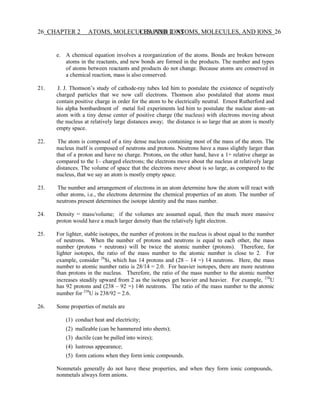
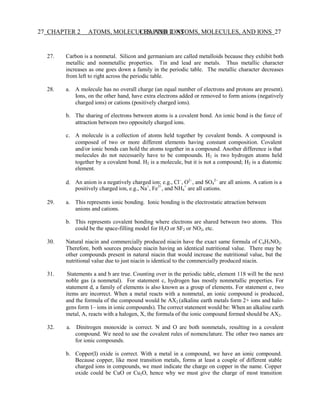
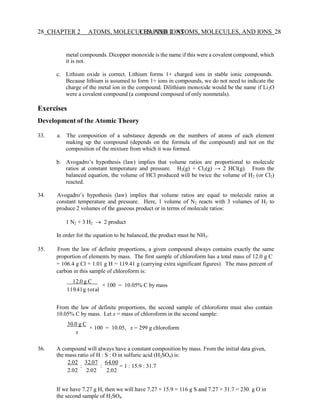
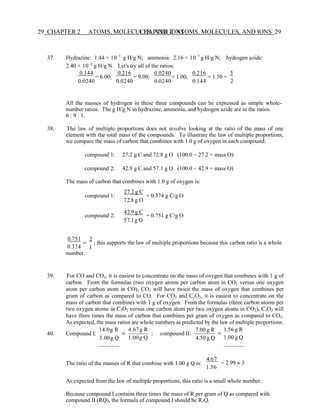
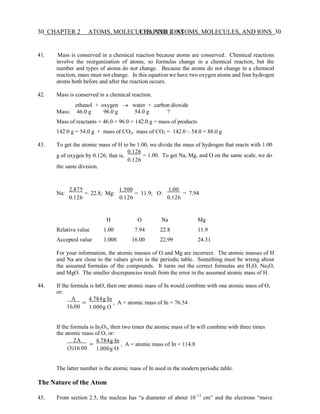
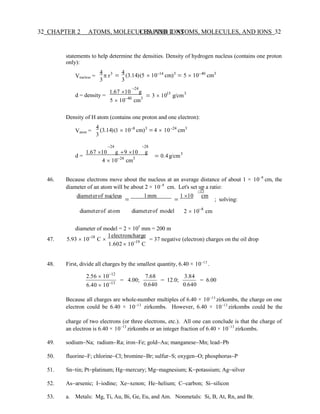
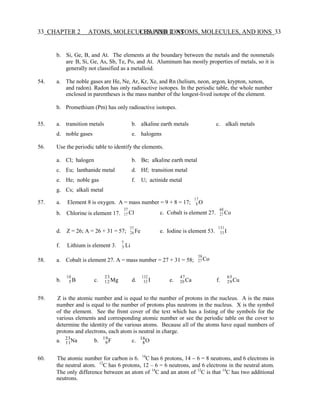
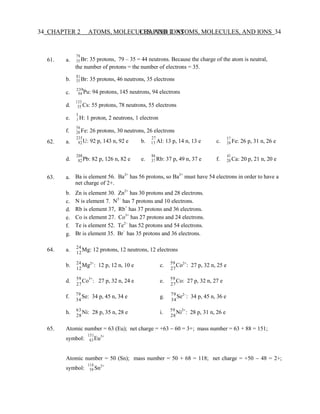
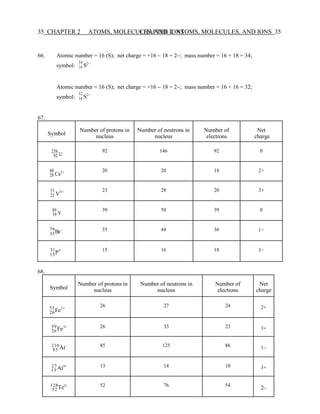
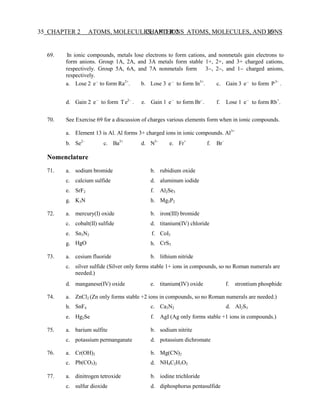
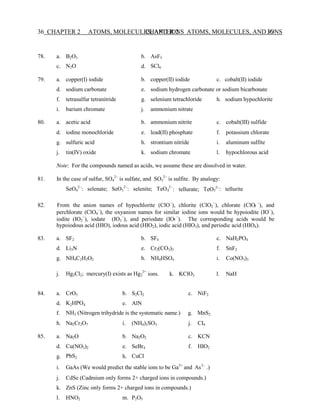
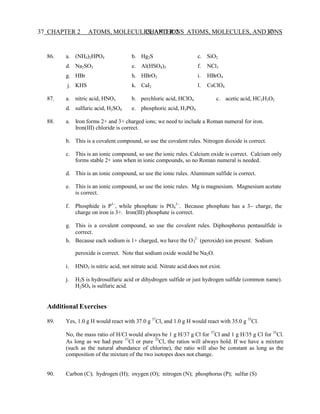
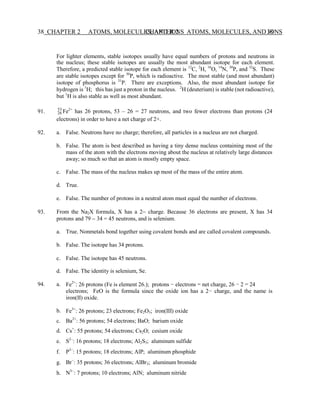
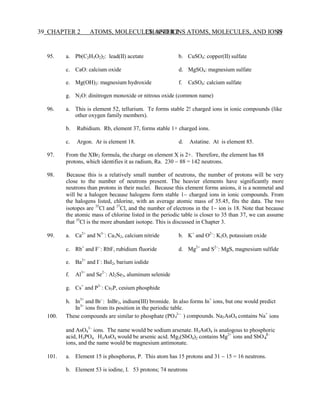
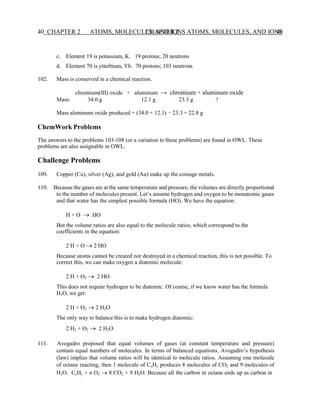
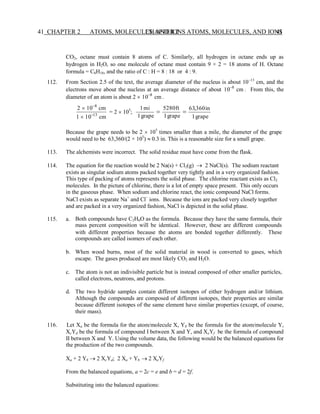
![CHAPTER 2 ATOMS, MOLECULES, AND IONS 42
42 CHAPTER 2 ATOMS, MOLECULES, AND IONS
X2c + 2 Y2f → 2 XcY2f ; 2 X2c + Y2f → 2 X2cYf
For simplest formulas, assume that c = f = 1. Thus:
X2 + 2 Y2 → 2 XY2 and 2 X2 + Y2 → 2 X2Y
Compound I = XY2: If X has relative mass of 1.00,
Compound II = X2Y: If X has relative mass of 1.00,
1.00
1.00 + 2y
2.00
2.00 + y
= 0.3043, y = 1.14.
= 0.6364, y = 1.14.
The relative mass of Y is 1.14 times that of X. Thus, if X has an atomic mass of 100, then Y
will have an atomic mass of 114.
117. Most of the mass of the atom is due to the protons and the neutrons in the nucleus, and
protons and neutrons have about the same mass (1.67 10−24
g). The ratio of the mass of the
molecule to the mass of a nuclear particle will give a good approximation of the number of
nuclear particles (protons and neutrons) present.
7.31 10−23
g
1.67 10−24
g
= 43.8 44 nuclear particles
Thus there are 44 protons and neutrons present. If the number of protons equals the number
of neutrons, we have 22 protons in the molecule. One possibility would be the molecule CO2
[6 + 2(8) = 22 protons].
118. For each experiment, divide the larger number by the smaller. In doing so, we get:
experiment 1 X = 1.0 Y = 10.5
experiment 2 Y = 1.4 Z = 1.0
experiment 3 X = 1.0 Y = 3.5
Our assumption about formulas dictates the rest of the solution. For example, if we assume
that the formula of the compound in experiment 1 is XY and that of experiment 2 is YZ, we
get relative masses of:
X = 2.0; Y = 21; Z = 15 (= 21/1.4)
and a formula of X3Y for experiment 3 [three times as much X must be present in experiment
3 as compared to experiment 1 (10.5/3.5 = 3)].
However, if we assume the formula for experiment 2 is YZ and that of experiment 3 is XZ,
then we get:
X = 2.0; Y = 7.0; Z = 5.0 (= 7.0/1.4)
and a formula of XY3 for experiment 1. Any answer that is consistent with your initial
assumptions is correct.](https://image.slidesharecdn.com/4129-250523003633-0076b30d/85/Solution-Manual-for-Chemistry-9th-Edition-24-320.jpg)
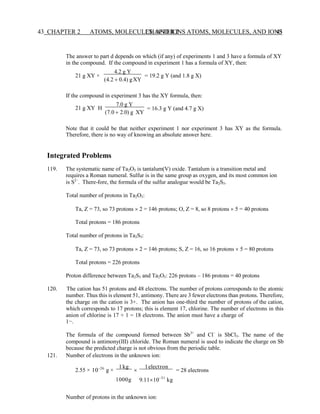
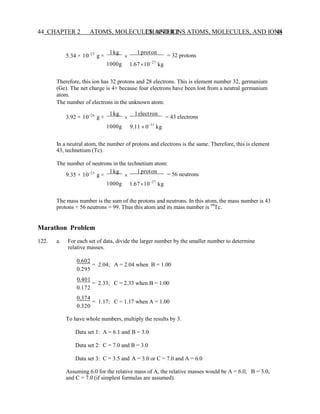
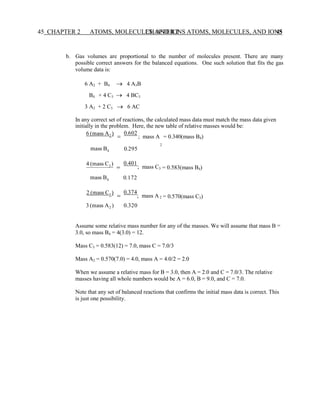

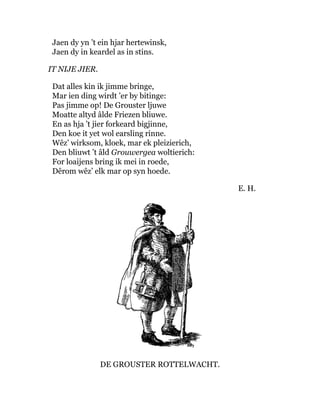
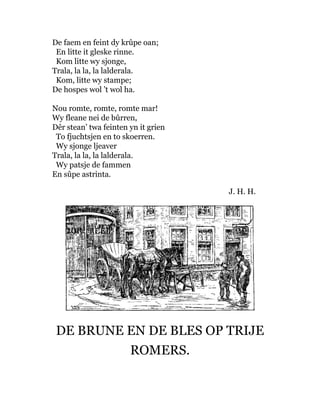
![En dounsje ta de moarn.
O Nieske hwet in wille,
Beits dyn spylfaem sit ’er al
Mei Mient fen Keimpetille,
Sjuch, sjuch, hja lizze al oan.
Wel, Nieske ljea, ho scil ’t nou, man?
Dou kinste sa ast wotte;
Dounsje ef patsje is hjir de kar.
Earst patsje, sei se, Botte.
Kom, kom, myn famke, kom!
En Nieske hinge er om.
Koal,[68] Koal, kom den ris harren,
It kielsgat wirdt ús beide soor;v Jaen ús hwet to smarren,
Wy dounsje dêrmei foar.
TJALLING HALBERTSMA.
IN JOUNPRAETSJE FEN ORK EN SINT
OER IT BANKEROTSPYLJEN.
Ork. Ho litste de holle sa hingje, heite? Haste forkeard iten yn ’t
liif?
Sint. Ik wit net, mar it moed sit net heech.
Ork. It moed net heech? Hwet skeelt der oan?
Sint. Der binne forskate lju, dy jild fen my ha moatte; dat is my
bjuster yn ’e wei. Ik bin sa net great brocht.—Dat paeit al mei goede
wirden, mar dêr wirdt nin kwitânsje op jown.
Ork. Den haste de kramp yn ’e pong, bigryp ik. Jonge! dat falt my
ôf mei dy. Dou hiest oars in moai spiltsje, tocht my, en dou gongst
der ek stil mei lâns. Ho is dat komd?
Sint. Ja, Ork-om, der waerd ridlik goed fortsjinne; mar der moat
safolle wêze, as men sa hwet meidwaen wol. It giet oars as by ús](https://image.slidesharecdn.com/4129-250523003633-0076b30d/85/Solution-Manual-for-Chemistry-9th-Edition-61-320.jpg)