Solution Manual forChemistry, 9th Edition
download
http://testbankbell.com/product/solution-manual-for-
chemistry-9th-edition/
Explore and download more test bank or solution manual
at testbankbell.com
2.
We have selectedsome products that you may be interested in
Click the link to download now or visit testbankbell.com
for more options!.
Solution Manual for Chemistry 9th Edition by Zumdahl
http://testbankbell.com/product/solution-manual-for-chemistry-9th-
edition-by-zumdahl/
Solution Manual for Introductory Chemistry A Foundation
9th by Zumdahl
http://testbankbell.com/product/solution-manual-for-introductory-
chemistry-a-foundation-9th-by-zumdahl/
Test Bank for Chemistry, 9th Edition
http://testbankbell.com/product/test-bank-for-chemistry-9th-edition/
Test Bank for Victimology: Legal, Psychological, and
Social Perspectives, 4th Edition, Harvey Wallace,
deceased, FresnoCliff Roberson
http://testbankbell.com/product/test-bank-for-victimology-legal-
psychological-and-social-perspectives-4th-edition-harvey-wallace-
deceased-fresnocliff-roberson/
3.
Bank Management &Financial Services Rose 9th Edition
Solutions Manual
http://testbankbell.com/product/bank-management-financial-services-
rose-9th-edition-solutions-manual/
Prentice Hall’s Federal Taxation 2012 Comprehensive Pope
Anderson Kramer 25th Edition Solutions Manual
http://testbankbell.com/product/prentice-halls-federal-
taxation-2012-comprehensive-pope-anderson-kramer-25th-edition-
solutions-manual/
Test Bank for Society: The Basics, 15th Edition, John J.
Macionis
http://testbankbell.com/product/test-bank-for-society-the-basics-15th-
edition-john-j-macionis/
Exploring Geology 4th Edition Test Bank Reynolds
http://testbankbell.com/product/exploring-geology-4th-edition-test-
bank-reynolds/
Test Bank for Conceptual Chemistry, 5/E 5th Edition John
A. Suchocki
http://testbankbell.com/product/test-bank-for-conceptual-
chemistry-5-e-5th-edition-john-a-suchocki/
4.
Test Bank forLiving Physical Geography, 2nd Edition,
Bruce Gervais,
http://testbankbell.com/product/test-bank-for-living-physical-
geography-2nd-edition-bruce-gervais/
5.
Solution Manual forChemistry, 9th Edition
Full download link at: https://testbankbell.com/product/solution-manual-for-
chemistry-9th-edition/
CHAPTER 2
ATOMS, MOLECULES, AND IONS
Questions
16. Some elements exist as molecular substances. That is, hydrogen normally exists as H2
molecules, not single hydrogen atoms. The same is true for N2, O2, F2, Cl2, etc.
17. A compound will always contain the same numbers (and types) of atoms. A given amount of
hydrogen will react only with a specific amount of oxygen. Any excess oxygen will remain
unreacted.
18. The halogens have a high affinity for electrons, and one important way they react is to form
anions of the type X−
. The alkali metals tend to give up electrons easily and in most of their
compounds exist as M+
cations. Note: These two very reactive groups are only one electron
away (in the periodic table) from the least reactive family of elements, the noble gases.
19. Law of conservation of mass: Mass is neither created nor destroyed. The total mass before a
chemical reaction always equals the total mass after a chemical reaction.
Law of definite proportion: A given compound always contains exactly the same proportion
of elements by mass. For example, water is always 1 g H for every 8 g oxygen.
Law of multiple proportions: When two elements form a series of compounds, the ratios of
the mass of the second element that combine with 1 g of the first element always can be reduced
to small whole numbers: For CO2 and CO discussed in Section 2.2, the mass ratios of oxygen
that react with 1 g carbon in each compound are in a 2 : 1 ratio.
20. a. The smaller parts are electrons and the nucleus. The nucleus is broken down into protons
and neutrons, which can be broken down into quarks. For our purpose, electrons,
neutrons, and protons are the key smaller parts of an atom.
b. All atoms of hydrogen have 1 proton in the nucleus. Different isotopes of hydrogen have
0, 1, or 2 neutrons in the nucleus. Because we are talking about atoms, this implies a
neutral charge, which dictates 1 electron present for all hydrogen atoms. If charged ions
were included, then different ions/atoms of H could have different numbers of electrons.
c. Hydrogen atoms always have 1 proton in the nucleus, and helium atoms always have 2
protons in the nucleus. The number of neutrons can be the same for a hydrogen atom and
a helium atom. Tritium (3
H) and 4
He both have 2 neutrons. Assuming neutral atoms, then
the number of electrons will be 1 for hydrogen and 2 for helium.
6.
d. Water (H2O)is always 1 g hydrogen for every 8 g of O present, whereas H2O2 is always 1
g hydrogen for every 16 g of O present. These are distinctly different compounds, each
with its own unique relative number and types of atoms present.
25
7.
26 CHAPTER 2ATOMS, MOLECULES, AND IONS
CHAPTER 2 ATOMS, MOLECULES, AND IONS 26
e. A chemical equation involves a reorganization of the atoms. Bonds are broken between
atoms in the reactants, and new bonds are formed in the products. The number and types
of atoms between reactants and products do not change. Because atoms are conserved in
a chemical reaction, mass is also conserved.
21. J. J. Thomson’s study of cathode-ray tubes led him to postulate the existence of negatively
charged particles that we now call electrons. Thomson also postulated that atoms must
contain positive charge in order for the atom to be electrically neutral. Ernest Rutherford and
his alpha bombardment of metal foil experiments led him to postulate the nuclear atom−an
atom with a tiny dense center of positive charge (the nucleus) with electrons moving about
the nucleus at relatively large distances away; the distance is so large that an atom is mostly
empty space.
22. The atom is composed of a tiny dense nucleus containing most of the mass of the atom. The
nucleus itself is composed of neutrons and protons. Neutrons have a mass slightly larger than
that of a proton and have no charge. Protons, on the other hand, have a 1+ relative charge as
compared to the 1– charged electrons; the electrons move about the nucleus at relatively large
distances. The volume of space that the electrons move about is so large, as compared to the
nucleus, that we say an atom is mostly empty space.
23. The number and arrangement of electrons in an atom determine how the atom will react with
other atoms, i.e., the electrons determine the chemical properties of an atom. The number of
neutrons present determines the isotope identity and the mass number.
24. Density = mass/volume; if the volumes are assumed equal, then the much more massive
proton would have a much larger density than the relatively light electron.
25. For lighter, stable isotopes, the number of protons in the nucleus is about equal to the number
of neutrons. When the number of protons and neutrons is equal to each other, the mass
number (protons + neutrons) will be twice the atomic number (protons). Therefore, for
lighter isotopes, the ratio of the mass number to the atomic number is close to 2. For
example, consider 28
Si, which has 14 protons and (28 – 14 =) 14 neutrons. Here, the mass
number to atomic number ratio is 28/14 = 2.0. For heavier isotopes, there are more neutrons
than protons in the nucleus. Therefore, the ratio of the mass number to the atomic number
increases steadily upward from 2 as the isotopes get heavier and heavier. For example, 238
U
has 92 protons and (238 – 92 =) 146 neutrons. The ratio of the mass number to the atomic
number for 238
U is 238/92 = 2.6.
26. Some properties of metals are
(1) conduct heat and electricity;
(2) malleable (can be hammered into sheets);
(3) ductile (can be pulled into wires);
(4) lustrous appearance;
(5) form cations when they form ionic compounds.
Nonmetals generally do not have these properties, and when they form ionic compounds,
nonmetals always form anions.
8.
27 CHAPTER 2ATOMS, MOLECULES, AND IONS
CHAPTER 2 ATOMS, MOLECULES, AND IONS 27
27. Carbon is a nonmetal. Silicon and germanium are called metalloids because they exhibit both
metallic and nonmetallic properties. Tin and lead are metals. Thus metallic character
increases as one goes down a family in the periodic table. The metallic character decreases
from left to right across the periodic table.
28. a. A molecule has no overall charge (an equal number of electrons and protons are present).
Ions, on the other hand, have extra electrons added or removed to form anions (negatively
charged ions) or cations (positively charged ions).
b. The sharing of electrons between atoms is a covalent bond. An ionic bond is the force of
attraction between two oppositely charged ions.
c. A molecule is a collection of atoms held together by covalent bonds. A compound is
composed of two or more different elements having constant composition. Covalent
and/or ionic bonds can hold the atoms together in a compound. Another difference is that
molecules do not necessarily have to be compounds. H2 is two hydrogen atoms held
together by a covalent bond. H2 is a molecule, but it is not a compound; H2 is a diatomic
element.
d. An anion is a negatively charged ion; e.g., Cl−
, O2−
, and SO4
2−
are all anions. A cation is a
positively charged ion, e.g., Na+
, Fe3+
, and NH4
+
are all cations.
29. a. This represents ionic bonding. Ionic bonding is the electrostatic attraction between
anions and cations.
b. This represents covalent bonding where electrons are shared between two atoms. This
could be the space-filling model for H2O or SF2 or NO2, etc.
30. Natural niacin and commercially produced niacin have the exact same formula of C6H5NO2.
Therefore, both sources produce niacin having an identical nutritional value. There may be
other compounds present in natural niacin that would increase the nutritional value, but the
nutritional value due to just niacin is identical to the commercially produced niacin.
31. Statements a and b are true. Counting over in the periodic table, element 118 will be the next
noble gas (a nonmetal). For statement c, hydrogen has mostly nonmetallic properties. For
statement d, a family of elements is also known as a group of elements. For statement e, two
items are incorrect. When a metal reacts with a nonmetal, an ionic compound is produced,
and the formula of the compound would be AX2 (alkaline earth metals form 2+ ions and halo-
gens form 1– ions in ionic compounds). The correct statement would be: When an alkaline earth
metal, A, reacts with a halogen, X, the formula of the ionic compound formed should be AX2.
32. a. Dinitrogen monoxide is correct. N and O are both nonmetals, resulting in a covalent
compound. We need to use the covalent rules of nomenclature. The other two names are
for ionic compounds.
b. Copper(I) oxide is correct. With a metal in a compound, we have an ionic compound.
Because copper, like most transition metals, forms at least a couple of different stable
charged ions in compounds, we must indicate the charge on copper in the name. Copper
oxide could be CuO or Cu2O, hence why we must give the charge of most transition
9.
28 CHAPTER 2ATOMS, MOLECULES, AND IONS
CHAPTER 2 ATOMS, MOLECULES, AND IONS 28
metal compounds. Dicopper monoxide is the name if this were a covalent compound, which
it is not.
c. Lithium oxide is correct. Lithium forms 1+ charged ions in stable ionic compounds.
Because lithium is assumed to form 1+ ions in compounds, we do not need to indicate the
charge of the metal ion in the compound. Dilithium monoxide would be the name if Li2O
were a covalent compound (a compound composed of only nonmetals).
Exercises
Development of the Atomic Theory
33. a. The composition of a substance depends on the numbers of atoms of each element
making up the compound (depends on the formula of the compound) and not on the
composition of the mixture from which it was formed.
b. Avogadro’s hypothesis (law) implies that volume ratios are proportional to molecule
ratios at constant temperature and pressure. H2(g) + Cl2(g) → 2 HCl(g). From the
balanced equation, the volume of HCl produced will be twice the volume of H2 (or Cl2)
reacted.
34. Avogadro’s hypothesis (law) implies that volume ratios are equal to molecule ratios at
constant temperature and pressure. Here, 1 volume of N2 reacts with 3 volumes of H2 to
produce 2 volumes of the gaseous product or in terms of molecule ratios:
1 N2 + 3 H2 → 2 product
In order for the equation to be balanced, the product must be NH3.
35. From the law of definite proportions, a given compound always contains exactly the same
proportion of elements by mass. The first sample of chloroform has a total mass of 12.0 g C
+ 106.4 g Cl + 1.01 g H = 119.41 g (carrying extra significant figures). The mass percent of
carbon in this sample of chloroform is:
12.0 g C
119.41g total
× 100 = 10.05% C by mass
From the law of definite proportions, the second sample of chloroform must also contain
10.05% C by mass. Let x = mass of chloroform in the second sample:
30.0 g C
x
× 100 = 10.05, x = 299 g chloroform
36. A compound will always have a constant composition by mass. From the initial data given,
the mass ratio of H : S : O in sulfuric acid (H2SO4) is:
2.02
:
2.02
32.07
:
2.02
64.00
= 1 : 15.9 : 31.7
2.02
If we have 7.27 g H, then we will have 7.27 × 15.9 = 116 g S and 7.27 × 31.7 = 230. g O in
the second sample of H2SO4.
10.
29 CHAPTER 2ATOMS, MOLECULES, AND IONS
CHAPTER 2 ATOMS, MOLECULES, AND IONS 29
37. Hydrazine: 1.44 × 10⁻¹
g H/g N; ammonia: 2.16 × 10⁻¹
g H/g N; hydrogen azide:
2.40 × 10⁻²
g H/g N. Let's try all of the ratios:
0.144
= 6.00;
0.0240
0.216
= 9.00;
0.0240
0.0240
= 1.00;
0.0240
0.216
= 1.50 =
3
0.144 2
All the masses of hydrogen in these three compounds can be expressed as simple whole-
number ratios. The g H/g N in hydrazine, ammonia, and hydrogen azide are in the ratios
6 : 9 : 1.
38. The law of multiple proportions does not involve looking at the ratio of the mass of one
element with the total mass of the compounds. To illustrate the law of multiple proportions,
we compare the mass of carbon that combines with 1.0 g of oxygen in each compound:
compound 1: 27.2 g C and 72.8 g O (100.0 − 27.2 = mass O)
compound 2: 42.9 g C and 57.1 g O (100.0 − 42.9 = mass O)
The mass of carbon that combines with 1.0 g of oxygen is:
compound 1:
compound 2:
27.2 g C
72.8 g O
42.9 g C
57.1g O
= 0.374 g C/g O
= 0.751 g C/g O
0.751
=
0.374
number.
2
; this supports the law of multiple proportions because this carbon ratio is a whole
1
39. For CO and CO2, it is easiest to concentrate on the mass of oxygen that combines with 1 g of
carbon. From the formulas (two oxygen atoms per carbon atom in CO2 versus one oxygen
atom per carbon atom in CO), CO2 will have twice the mass of oxygen that combines per
gram of carbon as compared to CO. For CO2 and C3O2, it is easiest to concentrate on the
mass of carbon that combines with 1 g of oxygen. From the formulas (three carbon atoms per
two oxygen atoms in C3O2 versus one carbon atom per two oxygen atoms in CO2), C3O2 will
have three times the mass of carbon that combines per gram of oxygen as compared to CO2.
As expected, the mass ratios are whole numbers as predicted by the law of multiple proportions.
40. Compound I:
14.0g R
3.00g Q
=
4.67g R
; compound II:
1.00g Q
7.00 g R
4.50 g Q
=
1.56 g R
1.00 g Q
The ratio of the masses of R that combine with 1.00 g Q is:
4.67
= 2.99 3
1.56
As expected from the law of multiple proportions, this ratio is a small whole number.
Because compound I contains three times the mass of R per gram of Q as compared with
compound II (RQ), the formula of compound I should be R3Q.
11.
30 CHAPTER 2ATOMS, MOLECULES, AND IONS
CHAPTER 2 ATOMS, MOLECULES, AND IONS 30
41. Mass is conserved in a chemical reaction because atoms are conserved. Chemical reactions
involve the reorganization of atoms, so formulas change in a chemical reaction, but the
number and types of atoms do not change. Because the atoms do not change in a chemical
reaction, mass must not change. In this equation we have two oxygen atoms and four hydrogen
atoms both before and after the reaction occurs.
42. Mass is conserved in a chemical reaction.
ethanol + oxygen → water + carbon dioxide
Mass: 46.0 g 96.0 g 54.0 g ?
Mass of reactants = 46.0 + 96.0 = 142.0 g = mass of products
142.0 g = 54.0 g + mass of CO2, mass of CO2 = 142.0 – 54.0 = 88.0 g
43. To get the atomic mass of H to be 1.00, we divide the mass of hydrogen that reacts with 1.00
g of oxygen by 0.126; that is,
the same division.
0.126
= 1.00. To get Na, Mg, and O on the same scale, we do
0.126
Na:
2.875
= 22.8; Mg:
0.126
1.500
= 11.9; O:
0.126
1.00
= 7.94
0.126
H O Na Mg
Relative value 1.00 7.94 22.8 11.9
Accepted value 1.008 16.00 22.99 24.31
For your information, the atomic masses of O and Mg are incorrect. The atomic masses of H
and Na are close to the values given in the periodic table. Something must be wrong about
the assumed formulas of the compounds. It turns out the correct formulas are H2O, Na2O,
and MgO. The smaller discrepancies result from the error in the assumed atomic mass of H.
44. If the formula is InO, then one atomic mass of In would combine with one atomic mass of O,
or:
A
=
16.00
4.784g In
, A = atomic mass of In = 76.54
1.000g O
If the formula is In2O3, then two times the atomic mass of In will combine with three times
the atomic mass of O, or:
2A
=
(3)16.00
4.784g In
, A = atomic mass of In = 114.8
1.000g O
The latter number is the atomic mass of In used in the modern periodic table.
The Nature of the Atom
45. From section 2.5, the nucleus has “a diameter of about 10−13
cm” and the electrons “move
12.
31 CHAPTER 2ATOMS, MOLECULES, AND IONS
CHAPTER 2 ATOMS, MOLECULES, AND IONS 31
about the nucleus at an average distance of about 10−8
cm from it.” We will use these
13.
32 CHAPTER 2ATOMS, MOLECULES, AND IONS
CHAPTER 2 ATOMS, MOLECULES, AND IONS 32
−13
statements to help determine the densities. Density of hydrogen nucleus (contains one proton
only):
4 4 − −
Vnucleus = r3
3
= (3.14)(5 10 14
cm)3
= 5 10 40
cm3
3
−24
d = density =
1.67 10 g
5 10−40
cm3
= 3 1015
g/cm3
Density of H atom (contains one proton and one electron):
4 − −
Vatom = (3.14)(1 10 8
cm)3
= 4 10 24
cm3
3
−24 −28
d =
1.67 10 g +9 10 g
4 10−24
cm3 = 0.4g/cm3
46. Because electrons move about the nucleus at an average distance of about 1 × 10⁻⁸
cm, the
diameter of an atom will be about 2 × 10⁻⁸
cm. Let's set up a ratio:
diameterof nucleus
=
1mm
=
1 10 cm
; solving:
diameterof atom diameterof model 2 10−8
cm
diameter of model = 2 × 10⁵
mm = 200 m
47. 5.93 10−18
C
1electroncharge
1.602 10−19
C
= 37 negative (electron) charges on the oil drop
48. First, divide all charges by the smallest quantity, 6.40 × 10⁻¹³
.
2.56 10−12
6.40 10−13
= 4.00;
7.68
0.640
= 12.0;
3.84
0.640
= 6.00
Because all charges are whole-number multiples of 6.40 × 10⁻¹³
zirkombs, the charge on one
electron could be 6.40 × 10⁻¹³
zirkombs. However, 6.40 × 10⁻¹³
zirkombs could be the
charge of two electrons (or three electrons, etc.). All one can conclude is that the charge of
an electron is 6.40 × 10⁻¹³
zirkombs or an integer fraction of 6.40 × 10⁻¹³
zirkombs.
49. sodium−Na; radium−Ra; iron−Fe; gold−Au; manganese−Mn; lead−Pb
50. fluorine−F; chlorine−Cl; bromine−Br; sulfur−S; oxygen−O; phosphorus−P
51. Sn−tin; Pt−platinum; Hg−mercury; Mg−magnesium; K−potassium; Ag−silver
52. As−arsenic; I−iodine; Xe−xenon; He−helium; C−carbon; Si−silicon
53. a. Metals: Mg, Ti, Au, Bi, Ge, Eu, and Am. Nonmetals: Si, B, At, Rn, and Br.
14.
33 CHAPTER 2ATOMS, MOLECULES, AND IONS
CHAPTER 2 ATOMS, MOLECULES, AND IONS 33
3
Na F O
23 19 16
b. Si, Ge, B, and At. The elements at the boundary between the metals and the nonmetals
are B, Si, Ge, As, Sb, Te, Po, and At. Aluminum has mostly properties of metals, so it is
generally not classified as a metalloid.
54. a. The noble gases are He, Ne, Ar, Kr, Xe, and Rn (helium, neon, argon, krypton, xenon,
and radon). Radon has only radioactive isotopes. In the periodic table, the whole number
enclosed in parentheses is the mass number of the longest-lived isotope of the element.
b. Promethium (Pm) has only radioactive isotopes.
55. a. transition metals b. alkaline earth metals c. alkali metals
d. noble gases e. halogens
56. Use the periodic table to identify the elements.
a. Cl; halogen b. Be; alkaline earth metal
c. Eu; lanthanide metal d. Hf; transition metal
e. He; noble gas f. U; actinide metal
g. Cs; alkali metal
17
57. a. Element 8 is oxygen. A = mass number = 9 + 8 = 17; 8 O
b. Chlorine is element 17.
37
17 Cl c. Cobalt is element 27.
60
27 Co
d. Z = 26; A = 26 + 31 = 57;
57
Fe e. Iodine is element 53.
131
26
f. Lithium is element 3.
7
Li
58. a. Cobalt is element 27. A = mass number = 27 + 31 = 58;
58
27 Co
53 I
10
b. 5 B c.
23
12 Mg d.
132
53 I e.
47
20 Ca f.
65
29Cu
59. Z is the atomic number and is equal to the number of protons in the nucleus. A is the mass
number and is equal to the number of protons plus neutrons in the nucleus. X is the symbol
of the element. See the front cover of the text which has a listing of the symbols for the
various elements and corresponding atomic number or see the periodic table on the cover to
determine the identity of the various atoms. Because all of the atoms have equal numbers of
protons and electrons, each atom is neutral in charge.
a. 11 b. 9 c. 8
60. The atomic number for carbon is 6. 14
C has 6 protons, 14 − 6 = 8 neutrons, and 6 electrons in
the neutral atom. 12
C has 6 protons, 12 – 6 = 6 neutrons, and 6 electrons in the neutral atom.
The only difference between an atom of 14
C and an atom of 12
C is that 14
C has two additional
neutrons.
34 CHAPTER 2ATOMS, MOLECULES, AND IONS
CHAPTER 2 ATOMS, MOLECULES, AND IONS 34
c.
50
61. a.
79
35 Br: 35 protons, 79 – 35 = 44 neutrons. Because the charge of the atom is neutral,
the number of protons = the number of electrons = 35.
81
b. 35 Br: 35 protons, 46 neutrons, 35 electrons
239
94 Pu: 94 protons, 145 neutrons, 94 electrons
133
d. 55 Cs: 55 protons, 78 neutrons, 55 electrons
3
e. 1 H: 1 proton, 2 neutrons, 1 electron
56
f. 26 Fe: 26 protons, 30 neutrons, 26 electrons
62. a.
235
92U: 92 p, 143 n, 92 e b.
27
13 Al: 13 p, 14 n, 13 e c.
57
26 Fe: 26 p, 31 n, 26 e
208
d. 82Pb: 82 p, 126 n, 82 e e.
86
37 Rb: 37 p, 49 n, 37 e f.
41
20 Ca: 20 p, 21 n, 20 e
63. a. Ba is element 56. Ba2+
has 56 protons, so Ba2+
must have 54 electrons in order to have a
net charge of 2+.
b.
c.
d.
e.
f.
g.
Zn is element 30. Zn2+
has 30 protons and 28 electrons.
N is element 7. N3−
has 7 protons and 10 electrons.
Rb is element 37, Rb+
has 37 protons and 36 electrons.
Co is element 27. Co3+
has 27 protons and 24 electrons.
Te is element 52. Te2−
has 52 protons and 54 electrons.
Br is element 35. Br−
has 35 protons and 36 electrons.
64. a. 24
Mg: 12 protons, 12 neutrons, 12 electrons
12
b. 24
Mg2+
: 12 p, 12 n, 10 e c. 59
Co2+
: 27 p, 32 n, 25 e
12 27
d. 59
Co3+
: 27 p, 32 n, 24 e e. 59
Co: 27 p, 32 n, 27 e
27 27
f. 79
Se: 34 p, 45 n, 34 e g. 79
Se2−
: 34 p, 45 n, 36 e
34 34
h. 63
Ni: 28 p, 35 n, 28 e i. 59
Ni2+
: 28 p, 31 n, 26 e
28 28
65. Atomic number = 63 (Eu); net charge = +63 − 60 = 3+; mass number = 63 + 88 = 151;
151
symbol: 63Eu3+
Atomic number = 50 (Sn); mass number = 50 + 68 = 118; net charge = +50 − 48 = 2+;
symbol:
118
Sn2+
17.
35 CHAPTER 2ATOMS, MOLECULES, AND IONS
CHAPTER 2 ATOMS, MOLECULES, AND IONS 35
Symbol
Number of protons in
nucleus
Number of neutrons in
nucleus
Number of
electrons
Net
charge
53
Fe2+
26
26 27 24 2+
59 3+
26 Fe 26 33 23 3+
210 −
85 At 85 125 86 1–
27 3+
13 Al 13 14 10 3+
128 2−
52 Te 52 76 54
2–
66. Atomic number = 16 (S); net charge = +16 − 18 = 2−; mass number = 16 + 18 = 34;
34
symbol: 16 S2−
Atomic number = 16 (S); net charge = +16 − 18 = 2−; mass number = 16 + 16 = 32;
32
symbol: 16 S2−
67.
Symbol
Number of protons in
nucleus
Number of neutrons in
nucleus
Number of
electrons
Net
charge
238
92 U
92 146 92 0
40
20 Ca2+ 20 20 18 2+
51
23 V3+ 23 28 20 3+
89
39 Y
39 50 39 0
79
Br−
35
35 44 36 1−
31
P3−
15
15 16 18 3−
68.
18.
CHAPTER 2 ATOMS,MOLECULES, AND IONS 35
35 CHAPTER 2 ATOMS, MOLECULES, AND IONS
69. In ionic compounds, metals lose electrons to form cations, and nonmetals gain electrons to
form anions. Group 1A, 2A, and 3A metals form stable 1+, 2+, and 3+ charged cations,
respectively. Group 5A, 6A, and 7A nonmetals form 3−, 2−, and 1− charged anions,
respectively.
a. Lose 2 e−
to form Ra2+
. b. Lose 3 e−
to form In3+
. c. Gain 3 e−
to form P3−
.
d. Gain 2 e−
to form Te2−
. e. Gain 1 e−
to form Br−
. f. Lose 1 e−
to form Rb+
.
70. See Exercise 69 for a discussion of charges various elements form when in ionic compounds.
a. Element 13 is Al. Al forms 3+ charged ions in ionic compounds. Al3+
b. Se2−
c. Ba2+
d. N3−
e. Fr+
f. Br−
Nomenclature
71. a.
c.
e.
sodium bromide
calcium sulfide
SrF2
b.
d.
f.
rubidium oxide
aluminum iodide
Al2Se3
g. K3N h. Mg3P2
72. a. mercury(I) oxide b. iron(III) bromide
c. cobalt(II) sulfide d. titanium(IV) chloride
e.
g.
Sn3N2
HgO
f.
h.
CoI3
CrS3
73. a. cesium fluoride b. lithium nitride
c. silver sulfide (Silver only forms stable 1+ ions in compounds, so no Roman numerals are
needed.)
d. manganese(IV) oxide e. titanium(IV) oxide f. strontium phosphide
74. a.
b.
ZnCl2 (Zn only forms stable +2 ions in compounds, so no Roman numerals are needed.)
SnF4 c. Ca3N2 d. Al2S3
e. Hg2Se f. AgI (Ag only forms stable +1 ions in compounds.)
75. a. barium sulfite b. sodium nitrite
c. potassium permanganate d. potassium dichromate
76. a.
c.
Cr(OH)3
Pb(CO3)2
b.
d.
Mg(CN)2
NH4C2H3O2
77. a. dinitrogen tetroxide b. iodine trichloride
c. sulfur dioxide d. diphosphorus pentasulfide
19.
CHAPTER 2 ATOMS,MOLECULES, AND IONS 36
36 CHAPTER 2 ATOMS, MOLECULES, AND IONS
4 3
3
4
2
78. a.
c.
B2O3
N2O
b.
d.
AsF5
SCl6
79. a. copper(I) iodide b. copper(II) iodide c. cobalt(II) iodide
d. sodium carbonate e. sodium hydrogen carbonate or sodium bicarbonate
f.
i.
tetrasulfur tetranitride
barium chromate
g.
j.
selenium tetrachloride
ammonium nitrate
h. sodium hypochlorite
80. a. acetic acid b. ammonium nitrite c. cobalt(III) sulfide
d. iodine monochloride e. lead(II) phosphate f. potassium chlorate
g. sulfuric acid h. strontium nitride i. aluminum sulfite
j. tin(IV) oxide k. sodium chromate l. hypochlorous acid
Note: For the compounds named as acids, we assume these are dissolved in water.
81. In the case of sulfur, SO4
2−
is sulfate, and SO3
2−
is sulfite. By analogy:
SeO4
2−
: selenate; SeO3
2−
: selenite; TeO 2−
: tellurate; TeO 2−
: tellurite
82. From the anion names of hypochlorite (ClO−
), chlorite (ClO2
−
), chlorate (ClO −
), and
perchlorate (ClO4
−
), the oxyanion names for similar iodine ions would be hypoiodite (IO−
),
iodite (IO2
−
), iodate (IO3
−
), and periodate (IO −
). The corresponding acids would be
hypoiodous acid (HIO), iodous acid (HIO2), iodic acid (HIO3), and periodic acid (HIO4).
83. a. SF2 b. SF6 c. NaH2PO4
d. Li3N e. Cr2(CO3)3 f. SnF2
g. NH4C2H3O2 h. NH4HSO4 i. Co(NO3)3
j. Hg2Cl2; mercury(I) exists as Hg 2+
ions. k. KClO3 l. NaH
84. a. CrO3 b. S2Cl2 c. NiF2
d. K2HPO4 e. AlN
f. NH3 (Nitrogen trihydride is the systematic name.) g. MnS2
h. Na2Cr2O7 i. (NH4)2SO3 j. CI4
85. a. Na2O b. Na2O2 c. KCN
d.
g.
Cu(NO3)2
PbS2
e.
h.
SeBr4
CuCl
f. HIO2
i. GaAs (We would predict the stable ions to be Ga3+
and As3−
.)
j. CdSe (Cadmium only forms 2+ charged ions in compounds.)
k. ZnS (Zinc only forms 2+ charged ions in compounds.)
l. HNO2 m. P2O5
20.
CHAPTER 2 ATOMS,MOLECULES, AND IONS 37
37 CHAPTER 2 ATOMS, MOLECULES, AND IONS
2
86. a. (NH4)2HPO4 b. Hg2S c. SiO2
d. Na2SO3 e. Al(HSO4)3 f. NCl3
g. HBr h. HBrO2 i. HBrO4
j. KHS k. CaI2 l. CsClO4
87. a. nitric acid, HNO3 b. perchloric acid, HClO4 c. acetic acid, HC2H3O2
d. sulfuric acid, H2SO4 e. phosphoric acid, H3PO4
88. a. Iron forms 2+ and 3+ charged ions; we need to include a Roman numeral for iron.
Iron(III) chloride is correct.
b. This is a covalent compound, so use the covalent rules. Nitrogen dioxide is correct.
c. This is an ionic compound, so use the ionic rules. Calcium oxide is correct. Calcium only
forms stable 2+ ions when in ionic compounds, so no Roman numeral is needed.
d. This is an ionic compound, so use the ionic rules. Aluminum sulfide is correct.
e. This is an ionic compound, so use the ionic rules. Mg is magnesium. Magnesium acetate
is correct.
f. Phosphide is P3−
, while phosphate is PO4
3−
. Because phosphate has a 3− charge, the
charge on iron is 3+. Iron(III) phosphate is correct.
g. This is a covalent compound, so use the covalent rules. Diphosphorus pentasulfide is
correct.
h. Because each sodium is 1+ charged, we have the O 2−
(peroxide) ion present. Sodium
peroxide is correct. Note that sodium oxide would be Na2O.
i. HNO3 is nitric acid, not nitrate acid. Nitrate acid does not exist.
j. H2S is hydrosulfuric acid or dihydrogen sulfide or just hydrogen sulfide (common name).
H2SO4 is sulfuric acid.
Additional Exercises
89. Yes, 1.0 g H would react with 37.0 g 37
Cl, and 1.0 g H would react with 35.0 g 35
Cl.
No, the mass ratio of H/Cl would always be 1 g H/37 g Cl for 37
Cl and 1 g H/35 g Cl for 35
Cl.
As long as we had pure 37
Cl or pure 35
Cl, the ratios will always hold. If we have a mixture
(such as the natural abundance of chlorine), the ratio will also be constant as long as the
composition of the mixture of the two isotopes does not change.
90. Carbon (C); hydrogen (H); oxygen (O); nitrogen (N); phosphorus (P); sulfur (S)
21.
CHAPTER 2 ATOMS,MOLECULES, AND IONS 38
38 CHAPTER 2 ATOMS, MOLECULES, AND IONS
26
For lighter elements, stable isotopes usually have equal numbers of protons and neutrons in
the nucleus; these stable isotopes are usually the most abundant isotope for each element.
Therefore, a predicted stable isotope for each element is 12
C, 2
H, 16
O, 14
N, 30
P, and 32
S. These
are stable isotopes except for 30
P, which is radioactive. The most stable (and most abundant)
isotope of phosphorus is 31
P. There are exceptions. Also, the most abundant isotope for
hydrogen is 1
H; this has just a proton in the nucleus. 2
H (deuterium) is stable (not radioactive),
but 1
H is also stable as well as most abundant.
91. 53
Fe2+
has 26 protons, 53 – 26 = 27 neutrons, and two fewer electrons than protons (24
electrons) in order to have a net charge of 2+.
92. a.
b.
False. Neutrons have no charge; therefore, all particles in a nucleus are not charged.
False. The atom is best described as having a tiny dense nucleus containing most of the
mass of the atom with the electrons moving about the nucleus at relatively large distances
away; so much so that an atom is mostly empty space.
c. False. The mass of the nucleus makes up most of the mass of the entire atom.
d. True.
e. False. The number of protons in a neutral atom must equal the number of electrons.
93. From the Na2X formula, X has a 2− charge. Because 36 electrons are present, X has 34
protons and 79 − 34 = 45 neutrons, and is selenium.
a.
b.
c.
True. Nonmetals bond together using covalent bonds and are called covalent compounds.
False. The isotope has 34 protons.
False. The isotope has 45 neutrons.
d. False. The identity is selenium, Se.
94. a. Fe2+
: 26 protons (Fe is element 26.); protons − electrons = net charge, 26 − 2 = 24
electrons; FeO is the formula since the oxide ion has a 2− charge, and the name is
iron(II) oxide.
b. Fe3+
: 26 protons; 23 electrons; Fe2O3; iron(III) oxide
c. Ba2+
: 56 protons; 54 electrons; BaO; barium oxide
d. Cs+
: 55 protons; 54 electrons; Cs2O; cesium oxide
e. S2−
: 16 protons; 18 electrons; Al2S3; aluminum sulfide
f. P3−
: 15 protons; 18 electrons; AlP; aluminum phosphide
g. Br−
: 35 protons; 36 electrons; AlBr3; aluminum bromide
h. N3−
: 7 protons; 10 electrons; AlN; aluminum nitride
22.
CHAPTER 2 ATOMS,MOLECULES, AND IONS 39
39 CHAPTER 2 ATOMS, MOLECULES, AND IONS
4
4
95. a. Pb(C2H3O2)2: lead(II) acetate b. CuSO4: copper(II) sulfate
c. CaO: calcium oxide d. MgSO4: magnesium sulfate
e. Mg(OH)2: magnesium hydroxide f. CaSO4: calcium sulfate
g. N2O: dinitrogen monoxide or nitrous oxide (common name)
96. a. This is element 52, tellurium. Te forms stable 2 charged ions in ionic compounds (like
other oxygen family members).
b. Rubidium. Rb, element 37, forms stable 1+ charged ions.
c. Argon. Ar is element 18. d. Astatine. At is element 85.
97. From the XBr2 formula, the charge on element X is 2+. Therefore, the element has 88
protons, which identifies it as radium, Ra. 230 − 88 = 142 neutrons.
98. Because this is a relatively small number of neutrons, the number of protons will be very
close to the number of neutrons present. The heavier elements have significantly more
neutrons than protons in their nuclei. Because this element forms anions, it is a nonmetal and
will be a halogen because halogens form stable 1− charged ions in ionic compounds. From
the halogens listed, chlorine, with an average atomic mass of 35.45, fits the data. The two
isotopes are 35
Cl and 37
Cl, and the number of electrons in the 1− ion is 18. Note that because
the atomic mass of chlorine listed in the periodic table is closer to 35 than 37, we can assume
that 35
Cl is the more abundant isotope. This is discussed in Chapter 3.
99. a. Ca2+
and N3−
: Ca3N2, calcium nitride b. K+
and O2−
: K2O, potassium oxide
c. Rb+
and F−
: RbF, rubidium fluoride d. Mg2+
and S2−
: MgS, magnesium sulfide
e. Ba2+
and I−
: BaI2, barium iodide
f. Al3+
and Se2−
: Al2Se3, aluminum selenide
g. Cs+
and P3−
: Cs3P, cesium phosphide
h. In3+
and Br−
: InBr3, indium(III) bromide. In also forms In+
ions, but one would predict
In3+
ions from its position in the periodic table.
100. These compounds are similar to phosphate (PO 3-−
) compounds. Na3AsO4 contains Na+
ions
and AsO4
3−
ions. The name would be sodium arsenate. H3AsO4 is analogous to phosphoric
acid, H3PO4. H3AsO4 would be arsenic acid. Mg3(SbO4)2 contains Mg2+
ions and SbO 3−
ions, and the name would be magnesium antimonate.
101. a. Element 15 is phosphorus, P. This atom has 15 protons and 31 − 15 = 16 neutrons.
b. Element 53 is iodine, I. 53 protons; 74 neutrons
23.
CHAPTER 2 ATOMS,MOLECULES, AND IONS 40
40 CHAPTER 2 ATOMS, MOLECULES, AND IONS
c. Element 19 is potassium, K. 19 protons; 20 neutrons
d. Element 70 is ytterbium, Yb. 70 protons; 103 neutrons
102. Mass is conserved in a chemical reaction.
chromium(III) oxide + aluminum → chromium + aluminum oxide
Mass: 34.0 g 12.1 g 23.3 g ?
Mass aluminum oxide produced = (34.0 + 12.1) − 23.3 = 22.8 g
ChemWork Problems
The answers to the problems 103-108 (or a variation to these problems) are found in OWL. These
problems are also assignable in OWL.
Challenge Problems
109. Copper (Cu), silver (Ag), and gold (Au) make up the coinage metals.
110. Because the gases are at the same temperature and pressure, the volumes are directly proportional
to the number of molecules present. Let’s assume hydrogen and oxygen to be monatomic gases
and that water has the simplest possible formula (HO). We have the equation:
H + O → HO
But the volume ratios are also equal to the molecule ratios, which correspond to the
coefficients in the equation:
2 H + O → 2 HO
Because atoms cannot be created nor destroyed in a chemical reaction, this is not possible. To
correct this, we can make oxygen a diatomic molecule:
2 H + O2 → 2 HO
This does not require hydrogen to be diatomic. Of course, if we know water has the formula
H2O, we get:
2 H + O2 → 2 H2O
The only way to balance this is to make hydrogen diatomic:
2 H2 + O2 → 2 H2O
111. Avogadro proposed that equal volumes of gases (at constant temperature and pressure)
contain equal numbers of molecules. In terms of balanced equations, Avogadro’s hypothesis
(law) implies that volume ratios will be identical to molecule ratios. Assuming one molecule
of octane reacting, then 1 molecule of CxHy produces 8 molecules of CO2 and 9 molecules of
H2O. CxHy + n O2 → 8 CO2 + 9 H2O. Because all the carbon in octane ends up as carbon in
24.
CHAPTER 2 ATOMS,MOLECULES, AND IONS 41
41 CHAPTER 2 ATOMS, MOLECULES, AND IONS
CO2, octane must contain 8 atoms of C. Similarly, all hydrogen in octane ends up as
hydrogen in H2O, so one molecule of octane must contain 9 × 2 = 18 atoms of H. Octane
formula = C8H18, and the ratio of C : H = 8 : 18 or 4 : 9.
112. From Section 2.5 of the text, the average diameter of the nucleus is about 10−13
cm, and the
electrons move about the nucleus at an average distance of about 10−8
cm . From this, the
diameter of an atom is about 2 10−8
cm .
2 10−8
cm
1 10−13
cm
= 2 105
;
1mi
=
1grape
5280ft
=
1grape
63,360in
1grape
Because the grape needs to be 2 105
times smaller than a mile, the diameter of the grape
would need to be 63,360/(2 × 105
) 0.3 in. This is a reasonable size for a small grape.
113. The alchemists were incorrect. The solid residue must have come from the flask.
114. The equation for the reaction would be 2 Na(s) + Cl2(g) → 2 NaCl(s). The sodium reactant
exists as singular sodium atoms packed together very tightly and in a very organized fashion.
This type of packing of atoms represents the solid phase. The chlorine reactant exists as Cl2
molecules. In the picture of chlorine, there is a lot of empty space present. This only occurs
in the gaseous phase. When sodium and chlorine react, the ionic compound NaCl forms.
NaCl exists as separate Na+
and Cl−
ions. Because the ions are packed very closely together
and are packed in a very organized fashion, NaCl is depicted in the solid phase.
115. a. Both compounds have C2H6O as the formula. Because they have the same formula, their
mass percent composition will be identical. However, these are different compounds
with different properties because the atoms are bonded together differently. These
compounds are called isomers of each other.
b. When wood burns, most of the solid material in wood is converted to gases, which
escape. The gases produced are most likely CO2 and H2O.
c. The atom is not an indivisible particle but is instead composed of other smaller particles,
called electrons, neutrons, and protons.
d. The two hydride samples contain different isotopes of either hydrogen and/or lithium.
Although the compounds are composed of different isotopes, their properties are similar
because different isotopes of the same element have similar properties (except, of course,
their mass).
116. Let Xa be the formula for the atom/molecule X, Yb be the formula for the atom/molecule Y,
XcYd be the formula of compound I between X and Y, and XeYf be the formula of compound
II between X and Y. Using the volume data, the following would be the balanced equations for
the production of the two compounds.
Xa + 2 Yb → 2 XcYd; 2 Xa + Yb → 2 XeYf
From the balanced equations, a = 2c = e and b = d = 2f.
Substituting into the balanced equations:
25.
CHAPTER 2 ATOMS,MOLECULES, AND IONS 42
42 CHAPTER 2 ATOMS, MOLECULES, AND IONS
X2c + 2 Y2f → 2 XcY2f ; 2 X2c + Y2f → 2 X2cYf
For simplest formulas, assume that c = f = 1. Thus:
X2 + 2 Y2 → 2 XY2 and 2 X2 + Y2 → 2 X2Y
Compound I = XY2: If X has relative mass of 1.00,
Compound II = X2Y: If X has relative mass of 1.00,
1.00
1.00 + 2y
2.00
2.00 + y
= 0.3043, y = 1.14.
= 0.6364, y = 1.14.
The relative mass of Y is 1.14 times that of X. Thus, if X has an atomic mass of 100, then Y
will have an atomic mass of 114.
117. Most of the mass of the atom is due to the protons and the neutrons in the nucleus, and
protons and neutrons have about the same mass (1.67 10−24
g). The ratio of the mass of the
molecule to the mass of a nuclear particle will give a good approximation of the number of
nuclear particles (protons and neutrons) present.
7.31 10−23
g
1.67 10−24
g
= 43.8 44 nuclear particles
Thus there are 44 protons and neutrons present. If the number of protons equals the number
of neutrons, we have 22 protons in the molecule. One possibility would be the molecule CO2
[6 + 2(8) = 22 protons].
118. For each experiment, divide the larger number by the smaller. In doing so, we get:
experiment 1 X = 1.0 Y = 10.5
experiment 2 Y = 1.4 Z = 1.0
experiment 3 X = 1.0 Y = 3.5
Our assumption about formulas dictates the rest of the solution. For example, if we assume
that the formula of the compound in experiment 1 is XY and that of experiment 2 is YZ, we
get relative masses of:
X = 2.0; Y = 21; Z = 15 (= 21/1.4)
and a formula of X3Y for experiment 3 [three times as much X must be present in experiment
3 as compared to experiment 1 (10.5/3.5 = 3)].
However, if we assume the formula for experiment 2 is YZ and that of experiment 3 is XZ,
then we get:
X = 2.0; Y = 7.0; Z = 5.0 (= 7.0/1.4)
and a formula of XY3 for experiment 1. Any answer that is consistent with your initial
assumptions is correct.
CHAPTER 2 ATOMS,MOLECULES, AND IONS 43
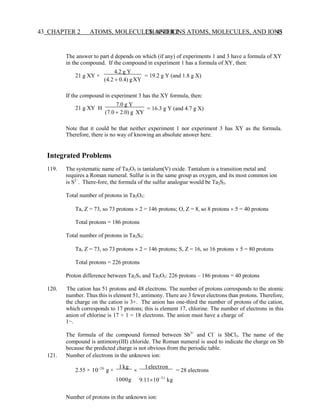
43 CHAPTER 2 ATOMS, MOLECULES, AND IONS
The answer to part d depends on which (if any) of experiments 1 and 3 have a formula of XY
in the compound. If the compound in experiment 1 has a formula of XY, then:
21 g XY ×
4.2 g Y
(4.2 + 0.4) gXY
= 19.2 g Y (and 1.8 g X)
If the compound in experiment 3 has the XY formula, then:
21 g XY
7.0 g Y
(7.0 + 2.0) g XY
= 16.3 g Y (and 4.7 g X)
Note that it could be that neither experiment 1 nor experiment 3 has XY as the formula.
Therefore, there is no way of knowing an absolute answer here.
Integrated Problems
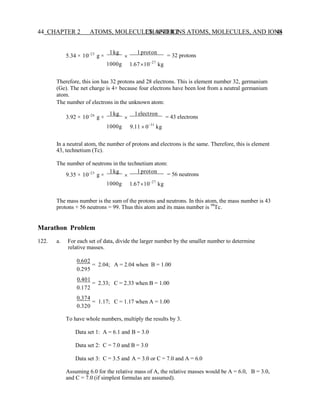
119. The systematic name of Ta2O5 is tantalum(V) oxide. Tantalum is a transition metal and
requires a Roman numeral. Sulfur is in the same group as oxygen, and its most common ion
is S2–
. There-fore, the formula of the sulfur analogue would be Ta2S5.
Total number of protons in Ta2O5:
Ta, Z = 73, so 73 protons 2 = 146 protons; O, Z = 8, so 8 protons 5 = 40 protons
Total protons = 186 protons
Total number of protons in Ta2S5:
Ta, Z = 73, so 73 protons 2 = 146 protons; S, Z = 16, so 16 protons 5 = 80 protons
Total protons = 226 protons
Proton difference between Ta2S5 and Ta2O5: 226 protons – 186 protons = 40 protons
120. The cation has 51 protons and 48 electrons. The number of protons corresponds to the atomic
number. Thus this is element 51, antimony. There are 3 fewer electrons than protons. Therefore,
the charge on the cation is 3+. The anion has one-third the number of protons of the cation,
which corresponds to 17 protons; this is element 17, chlorine. The number of electrons in this
anion of chlorine is 17 + 1 = 18 electrons. The anion must have a charge of
1−.
The formula of the compound formed between Sb3+
and Cl–
is SbCl3. The name of the
compound is antimony(III) chloride. The Roman numeral is used to indicate the charge on Sb
because the predicted charge is not obvious from the periodic table.
121. Number of electrons in the unknown ion:
2.55 × 10−26
g ×
1kg
1electron
= 28 electrons
1000g 9.1110−31
kg
Number of protons in the unknown ion:
28.
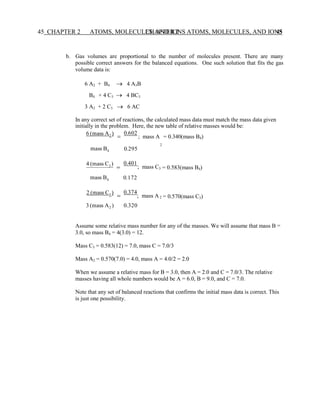
CHAPTER 2 ATOMS,MOLECULES, AND IONS 44
44 CHAPTER 2 ATOMS, MOLECULES, AND IONS
5.34 × 10−23
g ×
1kg
1proton
= 32 protons
1000g 1.6710−27
kg
Therefore, this ion has 32 protons and 28 electrons. This is element number 32, germanium
(Ge). The net charge is 4+ because four electrons have been lost from a neutral germanium
atom.
The number of electrons in the unknown atom:
3.92 × 10−26
g ×
1kg
1electron
= 43 electrons
1000g 9.11 0−31
kg
In a neutral atom, the number of protons and electrons is the same. Therefore, this is element
43, technetium (Tc).
The number of neutrons in the technetium atom:
9.35 × 10−23
g ×
1kg
1proton
= 56 neutrons
1000g 1.6710−27
kg
The mass number is the sum of the protons and neutrons. In this atom, the mass number is 43
protons + 56 neutrons = 99. Thus this atom and its mass number is 99
Tc.
Marathon Problem
122. a. For each set of data, divide the larger number by the smaller number to determine
relative masses.
0.602
= 2.04; A = 2.04 when B = 1.00
0.295
0.401
= 2.33; C = 2.33 when B = 1.00
0.172
0.374
= 1.17; C = 1.17 when A = 1.00
0.320
To have whole numbers, multiply the results by 3.
Data set 1: A = 6.1 and B = 3.0
Data set 2: C = 7.0 and B = 3.0
Data set 3: C = 3.5 and A = 3.0 or C = 7.0 and A = 6.0
Assuming 6.0 for the relative mass of A, the relative masses would be A = 6.0, B = 3.0,
and C = 7.0 (if simplest formulas are assumed).
29.
CHAPTER 2 ATOMS,MOLECULES, AND IONS 45
45 CHAPTER 2 ATOMS, MOLECULES, AND IONS
2
3
2
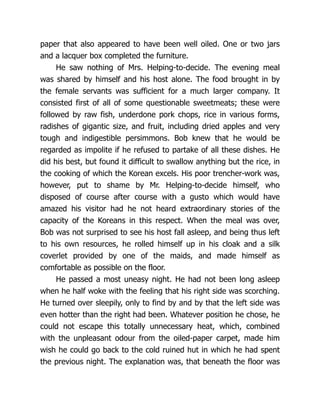
b. Gas volumes are proportional to the number of molecules present. There are many
possible correct answers for the balanced equations. One such solution that fits the gas
volume data is:
6 A2 + B4 → 4 A3B
B4 + 4 C3 → 4 BC3
3 A2 + 2 C3 → 6 AC
In any correct set of reactions, the calculated mass data must match the mass data given
initially in the problem. Here, the new table of relative masses would be:
6 (mass A2 )
=
0.602
; mass A = 0.340(mass B4)
mass B4
4 (mass C3 )
=
0.295
0.401
; mass C = 0.583(mass B4)
mass B4
2 (mass C3 )
0.172
=
0.374
; mass A = 0.570(mass C3)
3 (mass A2 ) 0.320
Assume some relative mass number for any of the masses. We will assume that mass B =
3.0, so mass B4 = 4(3.0) = 12.
Mass C3 = 0.583(12) = 7.0, mass C = 7.0/3
Mass A2 = 0.570(7.0) = 4.0, mass A = 4.0/2 = 2.0
When we assume a relative mass for B = 3.0, then A = 2.0 and C = 7.0/3. The relative
masses having all whole numbers would be A = 6.0, B = 9.0, and C = 7.0.
Note that any set of balanced reactions that confirms the initial mass data is correct. This
is just one possibility.
paper that alsoappeared to have been well oiled. One or two jars
and a lacquer box completed the furniture.
He saw nothing of Mrs. Helping-to-decide. The evening meal
was shared by himself and his host alone. The food brought in by
the female servants was sufficient for a much larger company. It
consisted first of all of some questionable sweetmeats; these were
followed by raw fish, underdone pork chops, rice in various forms,
radishes of gigantic size, and fruit, including dried apples and very
tough and indigestible persimmons. Bob knew that he would be
regarded as impolite if he refused to partake of all these dishes. He
did his best, but found it difficult to swallow anything but the rice, in
the cooking of which the Korean excels. His poor trencher-work was,
however, put to shame by Mr. Helping-to-decide himself, who
disposed of course after course with a gusto which would have
amazed his visitor had he not heard extraordinary stories of the
capacity of the Koreans in this respect. When the meal was over,
Bob was not surprised to see his host fall asleep, and being thus left
to his own resources, he rolled himself up in his cloak and a silk
coverlet provided by one of the maids, and made himself as
comfortable as possible on the floor.
He passed a most uneasy night. He had not been long asleep
when he half woke with the feeling that his right side was scorching.
He turned over sleepily, only to find by and by that the left side was
even hotter than the right had been. Whatever position he chose, he
could not escape this totally unnecessary heat, which, combined
with the unpleasant odour from the oiled-paper carpet, made him
wish he could go back to the cold ruined hut in which he had spent
the previous night. The explanation was, that beneath the floor was
32.
a cellar inwhich a fire had been lit, and the coolie had piled on
enough fuel to last through the night. This was a simple means of
heating the house, but Bob could not help wondering whether a
refrigerator would not perhaps form a more satisfactory bed-
chamber than an oven.
He was glad when morning came, and Mr. Helping-to-decide,
awaking from his heavy sleep, had sufficiently regained his senses to
discuss ways and means. It soon appeared that the trusty Korean
servant who was to have assisted Bob towards the Japanese lines
was absent, having gone to keep a watch on the Manchu brigands.
Mr. Helping-to-decide accordingly proposed that Bob should remain
with him until the man returned, and impressed upon him the
advisability of keeping within doors in order not to attract attention.
Bob was by no means pleased at the prospect of spending even one
day within these close walls, but seeing no help for it he submitted
with a good grace.
It was a dreary time. During the morning he was left to himself,
and to while away the hours he found nothing better to do than to
look out, through a slit in one of the tissued lattices, at what went
on in the street. But after the mid-day meal, Mr. Helping-to-decide
proposed a game of "go", which Bob knew from previous experience
might be spun out to any length. They were in the midst of the
game, when there was a great shouting and hurry-scurry in the
street; then the clatter of galloping horses. Mr. Helping-to-decide
sprang up in agitation, and Bob, going to his slit, saw a troop of
Cossacks headed by a tall Manchu galloping up the street, followed
by a band of riders, whom from their features and habiliments he
concluded to be Manchu bandits. Mr. Helping-to-decide stood in
33.
quivering helplessness. Thehorsemen reined up before his house;
some of them went round it in both directions, and the terrified
owner turned his white face to Bob and groaned.
When the house was surrounded, the commander of the
Cossacks shouted something which neither Bob nor the Korean
understood. But the cry was immediately repeated in the vernacular
by the tall Manchu; he had dismounted and was approaching the
house with the apparent intention of forcing an entrance through the
sliding lattice.
"What does he say?" asked Bob.
"He says, hon'ble sir, 'Bring out the spy'," faltered Mr. Helping-
to-decide. "This is indeed a critical moment. I am at a loss—
flabbergasted. I am driven to conclusion it is all u.p."
The Manchu had now come to the wall of the house, and
bellowed what was evidently a threatening message.
"'If the spy is not brought out instanter,'" translated Mr. Helping-
to-decide, "'he will conflagrate this residence and adjacent village,
with incidental murder of inhabitants.'"
Mr. Helping-to-decide wrung his hands in impotent despair.
"I shall give myself up," said Bob.
His host's agitation at once gave place to polite admiration and
a show of confidence at which Bob almost laughed. He recognized
that it was no laughing matter. The ruined state of the hamlet in
which he had met the tiger was clear evidence that the invader's
threat was no empty one, and the tales he had heard of the
Cossacks' brutality did not promise a pleasant experience to any
prisoner who fell into their power. But Bob felt that he had no
alternative. There was just a hope that as a British subject he would
34.
come off witha whole skin, but in any case it was impossible to let
the whole village suffer through any weakness of his. He therefore
pulled aside the lattice, stepped out, and with a bold bearing that ill-
matched his inward quaking, delivered himself up to the enemy.
The Cossack captain sat his horse side by side with the Manchu
a few paces in advance of his troop. As Bob approached, amid
perfect silence, he noticed that the Manchu leant quickly forward
and peered at him with an interest greater than the circumstances
seemed to warrant. Something in the man's face was familiar to Bob,
who, as the Manchu turned half round to speak to the Russian
officer, saw that he had only one ear. He remembered him clearly
now. He was the man who had been saved from drowning by the
Sardinia,—the man from whom Bob himself had saved Kobo's half-
throttled servant Taru in the Ueno Park. It was Kobo's old enemy, the
Manchu Tartar, Chang-Wo. The discovery did not tend to reassure
Bob, but for all his tremors at the dangerous possibilities of the
situation, he knew that his only chance was to maintain an air of
utter fearlessness, and no one could have guessed from his
undaunted attitude that he felt he was in a very tight place.
The Cossack captain looked hard at him for a moment, then
gruffly addressed him, presumably in Russian.
Bob shook his head, saying, in the best French he could
command, that he was sorry he was not familiar with the Russian
tongue. To his surprise, the Cossack did not understand him. Bob
had believed that every educated Russian knew French, and such
ignorance seemed to prove this officer a boor.
"So much the worse for me," thought Bob.
35.
The Cossack saida few words to the Manchu, who bent over
and began a catechism in pidgin English, interpreting each answer
as he received it to the Russian. Bob was surprised: on board the
Sardinia the man had professed to know no English. He had some
difficulty at first in understanding the strange idiom, but the general
purport of Chang-Wo's questions was clear.
"What-side belongey?"
"I am a British subject."
"What you pidgin?"
"I am in the Japanese service."
"What-for you Japan-side?"
Bob hesitated. It was not likely that the Manchu would know
what a range-finder was. He made an attempt to explain, but the
circumlocutions he had to use aroused the Manchu's suspicion, and
he interrupted impatiently:
"What you hab catchee in Korea?"
"I was left behind."
"What pidgin makee you hab got behind-side?"
"It was my bad luck—an accident."
"What-tim' you hab catchee accident?"
"Three days ago."
"What-side?"
"Near Yongampo."
"Supposey you tellum allo 'bout it?"
"Well, I got mixed up in a fight between Cossacks and
Japanese, and I was bowled over."
"Bowled over! What that say?"
"Hit, tumbled on the ground: savvy?"
36.
"How hab gotwailo?"
"On a horse."
"How horso belongey you?"
"Caught it."
"What-side horso this-tim'?"
"Dead."
"You come this-side sampan?"
"In a ship."
"What callum ship?'
"That I can't tell you."
"No savvy?"
"Oh yes, I know; but I can't say."
"What-for no tellum?"
"Because I'm in the Japanese service."
"What namee Japanese that-tim' Yongampo?"
"What do you mean?"
"Japanese belongey you come Yongampo. He namee—what?"
"I can't tell you that."
"What-for no tellum?"
"For the same reason as before."
"Muss tellum—velly soon."
"Very sorry; it's quite impossible."
"You belongey too muchee sassy. You no tellum, my hab got
whip."
Bob gave him a look, but said nothing. The Manchu raised his
whip and dealt him a sharp blow with the stock, which struck his
shoulder, only escaping his head because he swerved suddenly aside
as he saw it coming. The next moment the Manchu lay sprawling on
37.
the ground. Bobhad sprung at him and hit him so heavily and
unexpectedly beneath the jaw that he lost his balance and fell
backwards over his horse's haunches. He picked himself up, and
drawing his sword rushed at Bob, who stood with flaming eyes and
clenched fists ready to defend himself. But the Cossack officer
moved his horse a pace or two forward and interposed. He spoke a
few rapid words to the Manchu, saying in effect that the prisoner
was too valuable to be killed in a fit of temper; information could no
doubt be got out of him in course of time; and meanwhile he should
have a foretaste of the discipline awaiting him.
The Manchu gave way with a sullen scowl, and remounted his
horse. Then the captain gave an order; a trooper dismounted, and
came towards Bob with a narrow leather thong in his hand. Bob
instantly guessed what was to be done, and seeing the utter vanity
of resistance, he submitted quietly, while the thong was firmly bound
about his right wrist and then knotted to the near stirrup of the
captain's horse. Another order was then given; the whole troop set
off at a trot down the deserted street, and as Bob was dragged by
the side of the horse, the last object he remembered seeing was the
pale, terror-stricken face of Mr. Helping-to-decide peeping through
the broken lattice of his house.
CHAPTER XI
Tried and Sentenced
Under Escort—A Court-Martial—Leading Questions—The Bear's Claw
38.
Bob's sensations wereby no means agreeable as he kept pace
perforce with the Cossack's horse. The trot, fortunately, soon
slackened to a quick amble, or he must soon have been utterly
exhausted. In spite of the cold, the exertion of walking fast, heavily
clothed as he was, made him uncomfortably hot, and his physical
temperature was matched by his mental condition. He was in a rage;
not at being made a prisoner: that was only to have been expected:
but at being tied up like a dog, reminding him of the curs he had
seen chained to bakers' carts in French villages. Anger, however, was
a mere waste of energy, as he soon saw; at present he could only
make the best of a bad case,—keep up his courage and his pace
without reminders from the evil-looking knout he saw ready to the
Cossack's hand.
As he trudged along, two reflections were uppermost in his
mind. One was that, having been captured and treated with
indignity, he was justified in regarding himself now as a combatant;
this gave him a little consolation. The other was, that in Chang-Wo,
the Manchu, he had an enemy of a particularly dangerous kind. He
remembered Kobo's story of him; and the knowledge that this same
man was doing desperate work for the Russians in Korea was not
reassuring. The Manchu had evidently recognized him as the
stranger who had saved the little Japanese from his vengeance in
the Ueno Park, and clearly bore him no good-will on that account.
The road was a difficult one, leading over the rugged hills.
Darkness fell, and still the troop pushed on. At length, when Bob felt
on the point of collapsing, they rode into a town or village of fair
size, which, as he afterwards learnt, was Yong-cheng, on the Pekin
high-road. He expected that now at least he would be allowed rest
39.
and food, butas soon as the Cossacks arrived at the place they took
him before a Russian officer of some rank, apparently a lieutenant-
colonel. When preliminary explanations had been given, the colonel
ordered the prisoner to stand before him, and in peremptory tones
began to question him in French. Bob's French was not very fluent,
but he answered as well as he could, repeating the replies he had
previously given. He refused to say who had been in his company
before he made off on the Cossack's horse, and assured the Russian
that he knew absolutely nothing of any communications that may
have passed between this person and spies on shore. His
persistence made the officer more and more angry, until at last the
latter shouted:
"You're a liar! Tell me the truth, or I'll hang you on the spot."
"I have already told you the truth," said Bob quietly. "I don't
know whom my friend may have met at Yongampo, and if I did, I
could not tell you—surely you must see that?"
"You're an insolent puppy. A means will be found to loosen your
tongue. I'll give you a night to come to your senses.—Take him
away."
Bob, almost fainting with fatigue and hunger, was led away to a
close and dirty hovel, where he was given a hunk of coarse bread
and a fat sausage to eat, and there he remained in the custody of
two Cossacks through the night. At sunrise, feeling stiff and
dispirited, he was again taken before the officer, and again put
through an interrogatory, a trooper standing at his elbow holding a
knout ostentatiously in his view. But the colonel was again baffled;
he received no more information than before; and at length, with a
curse of impatience, he roared an order to his men. Bob expected
40.
the knout tobe immediately applied to his back, but to his surprise
he was led out into the open, and after a period of suspense he was
ordered to mount a horse that was brought up. A few minutes later
he was riding out of the village, a Cossack with cocked pistol on
each side of him, and the Manchu in the rear.
The explanation of this change in his destiny was that the
Russian colonel had not given up hope of obtaining information, and
was sending him to General Sassulitch at Wiju, where perhaps he
would be brought to reason. The Cossacks were ordered to guard
him carefully, but not to ill-use him, and Bob was somewhat
surprised, after what he had heard of the brutality of these reckless
soldiers, to find that he was treated with some consideration. The
whole of that day was occupied in the journey to Wiju. The country
was hilly and rugged, and Bob realized, from the slow rate of
progress of himself and his escort, that the transport of a whole
army would take much time, especially in this winter weather.
At various points along the road parties of Russian soldiers were
met with, but it was not until the three riders came within a few
miles of Wiju that Bob had striking evidence of the Russian
occupation. To the south of that frontier town large gangs of coolies
were at work throwing up entrenchments under the direction of
Russian officers. Bob was led close to a numerous party near the
high-road, employed in excavating a shelter trench. Their sullen
looks and reluctant movements indicated that they were forced
labourers, and in the hands of several of the Russians Bob noticed
ominous-looking whips. He was not surprised, for if they trusted to
the efficacy of the knout in their own army and navy, it was unlikely
that they would spare it in the case of Korean peasants.
41.
Like almost allKorean towns, Wiju stands on a hill; on one side
it overlooks a plain, on the other the river Yalu. Bob was glad
enough when, entering its walls and passing up the long straggling
street, filled with Russian soldiers, he was halted and dismounted at
a house over which a flag was flying. He was prepared by this time
for the worst. Several times on the way explanations on his account
had passed between his escort and enquiring soldiers, and he
inferred from their smiles and gestures that he must look for short
shrift. He expected now to be placed on trial as a spy, or perhaps
summarily disposed of without trial, probably after another attempt
to extort information from him. But after an hour's detention in the
house, during which he was given a scanty allowance of food, he
saw the Manchu Chang-Wo enter and deliver a message to the
officer in charge. He was immediately ordered out and made to
remount; his weary journey was evidently not yet ended. His
Cossack escort grunted their displeasure, and scowled at him with
dark looks, while the Manchu, who again accompanied them, urged
them to hasten their pace and complete their unwelcome task.
They rode smartly down the hill. Presently Bob saw in the dark
the waters of what was no doubt the Yalu before him, banked by
rugged bluffs on the other side. This, then, was the famous
boundary river dividing Korea from Manchuria. On the Korean side
the channel was still frozen over; but the current was deeper and
swifter under the Manchurian bank, where it was hemmed in by a
large island occupying a considerable part of what must be in time of
flood the bed of the river. In this part of the river large blocks of ice
were floating down with the stream. Bob had forborne to put any
questions to the Manchu; he would have liked to ask now what was
42.
to be donewith him, but on second thoughts he decided still to hold
his tongue. But in the course of the long wearisome ride he
distinguished the name Sassulitch more than once in a grumbling
conversation between his escort and the Manchu, though he was not
then aware that the owner of the name was a general of division.
It was late at night when they at length reached Antung, a low-
lying town on the river-side; dark as it was, Bob could see that the
place was substantially built. He was taken to a large go-down which
had been transformed into a barracks, and locked up in a room by
himself. He was very tired, and threw himself wearily down on the
straw mattress spread on the floor, hoping that for a few hours at
least he would not be interfered with. But he had barely fallen
asleep when he was roused by a heavy touch upon his arm. Sitting
up, he saw an armed Cossack holding a lighted taper. The man
motioned to him to get up, and feeling more dead than alive he
followed his guide out of the room, where he was joined by a squad
with fixed bayonets, then through the streets, until he arrived at a
large house more freely illuminated than any other, and guarded by
a sentry. In a few moments he found himself in a lofty room,
standing before a table on the other side of which sat a number of
Russian officers. On the table were placed a few flaring tallow
candles set in clumsy candlesticks, and a couple of circular oil-lamps
resembling those of English railway-carriages. At each end stood a
Russian foot-soldier with fixed bayonet. In conversation with one of
the officers Bob saw the big Manchu, the one-eared Chang-Wo.
For some moments he stood there, the object of keen scrutiny
to the officers, who stared at him with various degrees of curiosity,
and with varying expressions on their faces. Then the officer who
43.
was evidently ofthe highest rank among them,—it was General
Sassulitch himself,—motioned the Manchu aside and said a few
words in Russian to the younger officer at his right. The latter at
once addressed Bob, speaking in excellent English, with but faint
foreign accent.
"Prisoner, you are charged with being a Japanese spy. You are
English by nationality, it appears; what have you to say to the
charge?"
"I am an Englishman, it is true, sir," replied Bob. "As to the rest,
I am certainly not a spy."
"You had better give an account of yourself."
"My name is Robert Fawcett, and I am an engineer. I was sent
out a few months ago by my firm, at the request of the Japanese
government, to be at hand in case the range-finders on their ships
required attention. The vessel on which I was happened to come to
the mouth of the Yalu, and I had just landed when I was unlucky
enough to be knocked over by a Cossack's horse, and when I
recovered I thought the simplest way out of the difficulty was to
make my escape on the animal; its master was dead. The horse was
killed by a tiger. Since then I have been wandering about until I gave
myself up to a troop of your men. I have nothing more to say."
This reply was interpreted to the other officers, whose manner
of receiving it betokened for the most part blank incredulity. A few
words were exchanged among them, then the interpreter spoke
again.
"You shot the Cossack whose horse you stole?"
"No."
"Who did?"
44.
"I don't know.He was shot from the boat."
"You were armed?"
"No; I had nothing but my field-glass."
"You are not a soldier?"
"No; I am an engineer."
"A naval engineer?"
"Not specially. I've no naval experience except what I have
picked up."
"In what ships have you been?"
Bob hesitated for a moment. Then he reflected that there could
be no possible harm in mentioning the names of the vessels in which
he had served.
"In the Mikasa and Hatsuse."
"But neither of these brought you to Yongampo."
"No."
"What was the name of the vessel that did?"
Bob again hesitated. The Kasumi was engaged in secret service.
It was impossible for him to know what might be the ultimate effect
of betraying her identity. In so doing he would in any case associate
her commander with the expedition to Yongampo. He made his
decision.
"That, if you don't mind, I'd rather not say."
When this was explained to the officers they began to talk with
some excitement, and one of them thumped the table. The
interpreter continued:
"The general insists on knowing the name of the vessel."
"I am sorry, sir, but I can't tell you that."
"You know the consequence of refusing?"
45.
"I'm not surethat I do," said Bob with a faint smile; "but in any
case I can't tell."
A short consultation took place at the table, then the officer
resumed his questioning.
"You had just landed from the boat, you say. Had you not been
to Yongampo?"
"No."
"Who had?"
"I cannot say."
"Why did you land?"
"To help a friend of mine who was hard pressed by the
Cossacks."
"Had he been to Yongampo?"
"I cannot say."
"Who was he?"
"I really cannot tell you any more about him."
"Whom had he been to see?"
"I do not know."
"Was he also an Englishman?"
"I really cannot answer that question."
"Do you speak Japanese?"
"No."
"Chinese?"
"No."
"What language did you speak in Yongampo?"
"I have never been in Yongampo."
"How long have you been in the country?"
"In Manchuria?"
46.
"Don't prevaricate. Howlong have you been in these parts—
Manchuria or Korea?"
"A few days."
"How came you to be on friendly terms with the native in whose
house you were captured?"
"Excuse me, I gave myself up. As to your question, I happened
to do a little service, quite accidentally, to the Korean gentleman,
and he was more grateful than the circumstances really called for."
"When did you do him this service?"
"A week or two ago."
"Where?"
"In Seoul."
"What were you doing in Seoul?"
"Nothing—merely visiting the place."
Bob felt as soon as he had spoken that this, the literal truth,
would certainly be scouted by his judges as wildly improbable. For
some time, indeed, the officers had been showing signs of
impatience. Worn out as he was, Bob held himself erect before
them; he had replied to all his interrogator's questions in the same
self-possessed and courteous manner; and while one or two of the
Russians seemed impressed by his bearing, the majority were
growing more and more angry as they saw how barren was the
examination. They now formed a group about General Sassulitch,
and discussed the matter in excited tones. Then the Manchu was
called up and questioned, and from his gestures Bob guessed that
he was making very positive assertions. The discussion continued for
some time; then the Manchu was again dismissed, the group
47.
separated, and theyoung officer standing beside General Sassulitch
said:
"Prisoner, the officers of His Majesty the Tsar here assembled
cannot accept your denials. You were found within our lines; you
were undoubtedly associated with a Japanese who landed from
some vessel to enter into communications with a spy in Yongampo;
we have a witness here who declares that he saw you in Tokio, then
in Seoul, and recently in Yongampo—"
"Pardon my interrupting, sir, but that is false."
"Denial is useless. Our evidence is positive. By your own
confession you were concerned in the serious loss inflicted upon a
troop of Cossacks during the pursuit of the fugitive, who in all
probability was yourself; you confess to have made your escape on
the horse of a Cossack killed at that time; and you were captured at
the house of a Korean who is suspected on good grounds of
sympathy with the Japanese. There is no doubt in the mind of the
court that you are a spy; your claim to British citizenship cannot be
accepted as any palliation of your crime; the court condemns you to
the penalty of a spy: you will be shot."
Bob flushed slightly. There was a silence, then at a sign from
the officer the two soldiers at the end of the room approached him.
He gave a quick glance along the table; noticed one officer leaning
forward on his arms, his handsome face wearing a quizzical smile;
another lolling back in his chair with an air of boredom; a third
rolling a cigarette as though the matter were of complete
indifference to him; the general, stern and inscrutable, in the midst.
Then, between his two guards with fixed bayonets, he was marched
to his prison.
48.
It was alonger walk this time. He was not taken back to the go-
down where he had expected to pass the night, but to a tower or
keep built on the wall by the riverbank. It was now too dark to see
anything clearly; but as he was led into the building one of his
guards struck a light, and as he mounted the narrow stairway to the
fourth story he noticed several padlocked doors, showing that here
were other prisoners besides himself. He was taken into a small
room at the top of the building, a thick rug was thrown in after him,
the door was slammed, bolted, and padlocked, and he was left to his
meditations.
CHAPTER XII
At Midnight
Waiting—A Russian Offer—A Farewell Letter—What the Case Held—Kite-flying
Extraordinary—Prison-breaking—Free
Bob was so exhausted that he fell asleep at once, notwithstanding
the gravity of his position. When he awoke some hours after
daylight, he found some black bread and a plate of preserved beef
and a jug of vodka by his side.
"To keep up my courage," he said to himself. He was hungry,
and the bread and meat soon disappeared; but he found the vodka
too fiery for his palate, and wondered if he would be allowed some
water. He was to be shot, of course; when would that be? Shot! For
the first time the reality of last night's scene forced itself on his
49.
mind. He hadbeen so tired, and so strung-up in the determination
to say nothing that would betray Yamaguchi, that the matter as it
affected himself had not troubled him. But now—the thought of
death struck him for the first time. It was a strange idea. He was
well and strong; rather stiff and cramped, indeed, but that could
easily be cured. Yet in a short time he was to be dead. He could not
realize it; on board the Japanese vessels, in the poisonous box-
battery on the Mikasa, on the Kasumi's shot-pelted deck, the idea of
death had never been present to his mind. The oddness of it struck
him most of all. It seemed absurd that he should die, and for what
reason? His explanations had been too simple to be believed! He
thought over the past days; there was nothing in his actions he
could have altered, even if he had known that death was to come so
soon. "Well, it can't be helped," he concluded. "I only hope I sha'n't
funk it at the end."
Life was so vigorous in him at present, that he looked round his
narrow room in an instinctive quest for some means of escape. It
was about twelve feet square. The outer wall was of stone, some
eighteen inches thick, pierced by a single unglazed splay window,
narrowing from twenty inches broad on the inside to seven on the
outside. The bottom of the window was about three feet above the
floor, and it extended upwards for about an equal distance. Below it,
embedded in the wall, projected a narrow platform about a foot
high, which, Bob guessed, was intended to accommodate a
watchman or possibly a marksman, for the tower had evidently been
built as a watch-tower. Clambering up into the window-recess, Bob
looked through the open slit, and saw that it commanded a view
across the river, which flowed past at a depth of some eighty feet.
50.
The water-course wasobstructed by ice; to plunge into it was
impossible.
Returning to the floor, Bob noticed that the inner walls were of
brick, comparatively new in contrast with the mouldering stonework
of the outer wall. He concluded that at one time the whole story had
formed a single chamber, and that it had been partitioned off
recently, though in all probability before the advent of the Russians.
The door was of massive make, and hung on ponderous iron
clamps; it opened inwards, and there was no keyhole on the inner
side.
"Things look black," thought Bob, as he convinced himself that
there was no means of escaping from his dungeon. He tramped up
and down with bent head, idly speculating on the scenes the old
tower must have witnessed. How often in bygone days, he
wondered, had Chinese, Korean, or Japanese flotillas passed under
its walls up and down the Yalu? What romances might be woven
about the spot, going back into ages long anterior to ironclads and
machine-guns! He wished he knew something of the history of these
far Eastern countries, and was resolving to look it up on the first
opportunity when he suddenly remembered that he was to die, and
the remembrance brought him to a stand-still and gave his
imagination pause.
Looking again through the narrow opening, he saw in the
distance a troop of Cossacks picking their way across the hills. He
watched them with idle interest as they gained the summit and
disappeared at a trot over the crest. He followed them in fancy; they
were soldiers going perhaps to their death; and he wished that he
too might meet with death in some active, heroic way, instead of
51.
tamely as thetarget of a firing-party. He was drawn from his reverie
by the entrance of a soldier with a plate and jug. The man set the
food down on the stone platform and left without a word.
Alternately pacing the room, sitting on the platform, or listlessly
looking out upon the river, Bob passed the rest of the day. He saw
no ray of hope. The room was bare; it contained nothing but his rug;
everything had been taken from him; he had not even a penknife
with which to while away the hours, as many a prisoner had done
before him, in scratching initials or diagrams upon the walls.
"I wish they'd hurry up," he said to himself restlessly.
But the long day passed, and he was not summoned to his
doom. At night he was given another meal. He was standing when it
was brought him, and he moved towards the open door, without any
hope of escaping. Outside, by the dim light of the lamp carried by
the man inside, he saw another soldier armed with a rifle. The way
was effectually guarded. He spoke to the man, asking when his
execution was to take place. The man shook his head, evidently
understanding not a word. The door was shut, bolted, and
padlocked, and he was again left alone with his thoughts.
Next morning the soldier who brought him his food was
accompanied by the officer who had acted as interpreter at his
summary trial two nights before.
"Is my time up?" asked Bob almost eagerly.
"Not yet. The general will allow you another chance. Tell me
what you know of the Japanese spies in Yongampo and of the
Japanese with whom you landed, and the general will spare your life
and keep you as a prisoner of war until peace is signed in Tokio."
Bob looked at the officer in silence.
52.
"Come, why beobstinate? It isn't much to ask of you, and if
you're an Englishman and a non-combatant the Japanese are
nothing to you."
"You think I'll adopt that plea?" said Bob, with a touch of scorn.
"No thank you. You've treated me as a combatant; very well, I've
told you all I mean to tell you."
"You'll think better of it by and by. You've a day to think it over."
"I've thought it over."
"Well, think it over again. You'll come round, never fear."
The officer smiled as he went out. Bob spent the rest of the day
in tramping his cell, which was very cold, looking out of the window,
and wishing that they would not prolong his suspense. He expected
to receive another visit from the officer before night, but saw no
more of him until breakfast-time next morning.
"Well," said the Russian as he entered, "have you taken my
advice?"
"No."
"Still obstinate! Your execution is fixed for to-morrow morning—
the general gives you a long rope first, you see."
"That's a pleasant jest."
"Well, it's a pity for a young fellow like you to be so absurdly
obstinate. You've only to mention a couple of names and give us a
few particulars about men who can't possibly be of any interest to
you, and—"
"Excuse me; I am in the Japanese service."
"Nonsense, you're an Englishman. What have you in common
with the race of venomous conceited dwarfs who have dared to
measure themselves against the might of an empire like ours?"
53.
Bob stood withhis hands in his pockets looking at his tempter.
"They may be all that you say, though, as far as the war has
gone, it scarcely becomes a Russian to say it; but you, sir, ought to
know perfectly well that, whatever they may be, it is impossible for
me to betray them. I can't say any more; and I'd really be obliged to
you if you'd drop the subject. Your general has decided that I'm a
spy. I'm not a spy, but I can say nothing more to convince him. He
has made up his mind, and so have I. You said to-morrow morning?"
The officer looked at Bob with mingled annoyance and
admiration.
"What folly!" he exclaimed. "I can't but admire your constancy,
but I'm sorry for you. Yes, to-morrow morning, at dawn. You needn't
imagine you'll be let off, the general is determined."
"Very well."
"You can tell the man who brings you food if you change your
mind."
"I will—if I do!"
The officer turned away. As he was going out at the door, Bob
took a step forward, and spoke, with a little hesitation, and in a
different tone.
"One moment. Could you do me a favour?"
"What is that?" asked the Russian quickly.
"Send me pencil and paper and an envelope. I have some
friends at home—my father and mother—I should like—"
"I understand. You shall have the writing materials."
"And you will see that the letter is sent off?"
"Yes, yes; but it will not be necessary. Think over it." And he
hurried away.
54.
It was sometime before Bob touched the food that had been
brought to him. He was tired of waiting for the end. He longed for
life; yet if he was to die, he wished it over and done with; the
attempt to overcome his determination, the appeal to his self-
interest against his honour, wearied and troubled him. For a time he
tramped restlessly up and down, thinking gravely; then, catching
sight of the food, on the stone slab, he reflected that he could meet
his fate better fed than fasting, and he set-to with a will upon the
ample supply of beef and black bread and tea, which he had asked
for instead of vodka. After a while, however, he again fell into a fit of
abstraction; he ate mechanically, musing on many things. Breaking
one of the hard-crusted loaves, he saw a glitter like that of a golden
coin buried in the bread. For a moment his curiosity overcame the
gloom into which his long pondering had thrown him. He picked the
bread away from the strange intruder, and discovered that what he
had taken for a coin was the end of an empty cartridge-case.
"How did it get there?" he wondered, holding the case before
him. He remembered how puzzled King George had been to account
for the presence of the apple in the dumpling, and laughed aloud.
"No doubt about the bakery this bread came from," he thought.
"Well, better a cartridge-case than a beetle."
He was seated on his rug by the wall opposite the window,
where he was farthest away from the cutting wind that had been
blowing in all the morning. Raising his arm, he shied the cartridge-
case at the narrow opening; it struck the wall at the side of the
recess, fell on the sill, and rolled down the slight inward slope on to
the floor.
55.
"Wretched bad shot!"remarked Bob to himself and the four
walls. Then with a sudden start he remembered what was to happen
on the morrow. He shuddered involuntarily, and dreaded the
possibility of flinching when he stood actually face to face with
death. Yet why should he flinch? He remembered the fearless
manner with which the Japanese went open-eyed into mortal peril.
He thought of Kobo's serene, unperturbed manner. Was it for him,
an Englishman and a Christian, to show any more fear? The question
answered itself, and he fell into a quiet reverie.
Thus passed some hours; how many he could not tell, for his
watch had been removed. He was roused by the entrance of a man
with writing materials. Receiving them silently, he sat and pondered.
What could he say to the old folks at home? He wrote a full account
of all that had happened since his last letter, then tore it up. His
letter might be opened by the Russians; he must not give them any
information. At last, with a full heart, he penned a few words
intended for his parents' eyes alone. Then he sealed the letter, and
placed it in his pocket to give to the officer at the last moment.
He felt now cramped and chilled, and, rising, began to pace the
floor, walking from door to window and back from window to door.
As he did so, his eye lighted on the cartridge-case. At first he merely
glanced at it and passed on; then, spying it again, he looked a little
longer; the third time he began to feel some curiosity and interest;
the fourth time he stooped and picked it up, wondering again what
strange chance had brought it into so unlikely a resting-place. To
whom had it belonged? Whose rifle had fired it? How had it come
into the bakery? What careless fingers had worked it into the dough?
What a strange irony of fate, that a case once filled with an
56.
instrument of death,should now be choked with bread, an
instrument of life!
"A bad match!" he thought. "Out with you!"
He felt for his penknife to scrape out the bread from the case,
then remembered that his jailer had removed it. What was he to do?
Feeling by force of habit in his waistcoat pocket, he came upon a
little hole in the lining, and pushing his finger through, he touched a
single lucifer match that had found its way down. He enlarged the
hole, took out the match, and began to prise the caked flour bit by
bit from the cartridge-case. He was, glad of any little activity that
would enable him to kill time. Soon a little heap of crumbs lay on the
sill of the window-recess. Then, drawing the match once more from
the case, he saw that this time it had impaled, not a crumb, but a
piece of some white fluffy substance.
"What is this?" he thought, and with growing curiosity inserted
the match again. More fluff came out; it appeared to be cotton wool.
"Very odd!" he mused. He wetted the end of the match and
inserted it again. A little more of the wool adhered, but the next time
the match came out bare. He pushed it in again; but though he held
it with the extreme tips of his fingers, it touched nothing.
"Empty at last, I suppose. Yet it didn't touch the bottom of the
case. I wonder if it is empty."
He turned his back on the window and held the case up so that
the light fell into it. But it was too narrow for him to see anything,
supposing anything were there. He held it vertically, and shook it.
Something fell from it, and rolled across the floor of the room. It was
like a pea. Bob stooped and picked it up. It was a pea—no, it was a
small pellet of paper!
57.
Quick as thoughtBob slipped it into his pocket, glancing
instinctively towards the door and then to the opening in the wall.
There was no one to see him. He smiled and took the pellet from his
pocket. Unrolling it with infinite care, he found that it was a slip of
very thin rice-paper, and on it—yes, in small letters, faintly traced in
Indian ink, he saw the words:
"Be at window above river at dusk to-night."
That was all; there was no address, no signature. Yet, looking
again at the writing, Bob felt that he had seen it somewhere before.
Where? He could not remember, and as he stood trying to recall, he
heard the heavy tread of his jailer in the passage outside. Instantly
he slipped the paper into his pocket, flung the cartridge-case far out
into the river, and was walking up and down when the soldier threw
open the door and entered with his second meal.
That afternoon seemed to Bob interminable. He paced up and
down like a caged lion, waiting for the dark. He wondered who the
writer of the message was, what it implied, what possible plan of
deliverance was in contemplation—for surely it must mean that
someone was planning on his behalf. Many times he gazed out of
the window, searching the whole vista from the horizon to the river
below, knowing all the time that during the daylight nothing would
be done, yet looking and looking again. The hours passed slowly,
lingeringly. As night began to shadow the hills he ceased his restless
walk and remained fixed at the recess in the wall. The sky darkened,
his outlook shortened; he lost sight of the hills, at length he could
not see the opposite bank. He leant forward in the recess, till his
head touched the sides of the outer opening. The wind was fresh
and cold, but he heeded nothing. His eyes tried to penetrate the
58.
dark until hefelt that they were almost projecting from his head.
Thus he waited, waited, and shivered, looking, listening, seeing
nothing, hearing only the slow gurgle of the river as it rolled down
between its frozen borders, and the creaking and grinding of the ice
as the floating masses met, and parted, and met again.
So the hours passed, and Bob began to lose heart. Was the
message a Russian trap? Yet what could it gain? Was it genuine, but
his unknown correspondent had been prevented in some way from
keeping the implied appointment? A bugle-call struck his ear; and
when its echoes had died away the world relapsed into the same
silence, save for the occasional bark of a dog, the dull noises of the
ice-laden stream, and the sighing of the wind over the snowy wastes
beyond. It became colder; the wind blew more and more keen; and
at length, his limbs cramped, his fingers numbed, Bob had perforce
to move, and lift his rug from the floor and wrap it round him.
What was that? His hearing was now so acute that he fancied
he could have heard the world roll round. What was it? A rustle in
the dark; a faint rustle outside the window, like the scraping of a
bird's wing against the wall. He strained his eyes; stars were
glimmering cold and clear, but there was no moon, and he saw
nothing. Again, the same rustle. He tried to grope near enough to
the opening to thrust forth his head, and his shoulders stuck; it was
impossible, unless—yes, by turning on his side he could wriggle
himself to the slit, and he put his head out sideways. Something
touched his face, with the cold, filmy touch of a spider's web. He put
out his hand; it was gone. Would it return? He waited. Again the
same insubstantial contact; and now he seemed to see, against the
starlit sky, a gossamer thread. He clutched at it, but it eluded his
59.
Welcome to ourwebsite – the perfect destination for book lovers and
knowledge seekers. We believe that every book holds a new world,
offering opportunities for learning, discovery, and personal growth.
That’s why we are dedicated to bringing you a diverse collection of
books, ranging from classic literature and specialized publications to
self-development guides and children's books.
More than just a book-buying platform, we strive to be a bridge
connecting you with timeless cultural and intellectual values. With an
elegant, user-friendly interface and a smart search system, you can
quickly find the books that best suit your interests. Additionally,
our special promotions and home delivery services help you save time
and fully enjoy the joy of reading.
Join us on a journey of knowledge exploration, passion nurturing, and
personal growth every day!
testbankbell.com


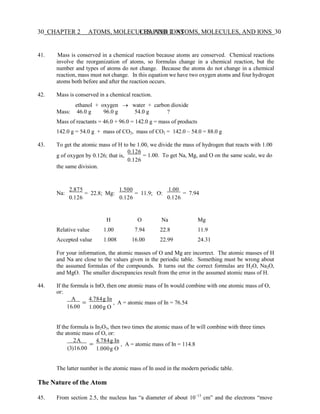
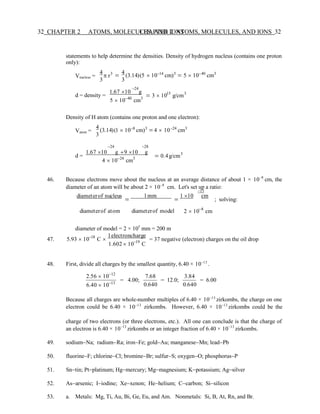
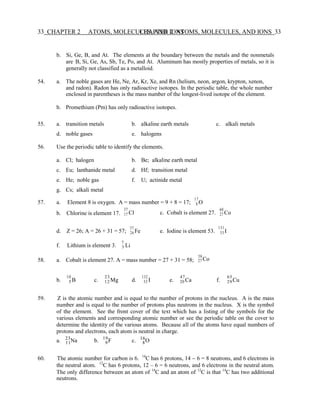

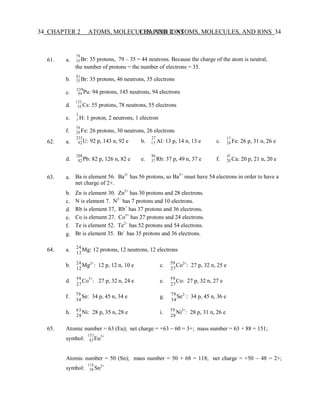
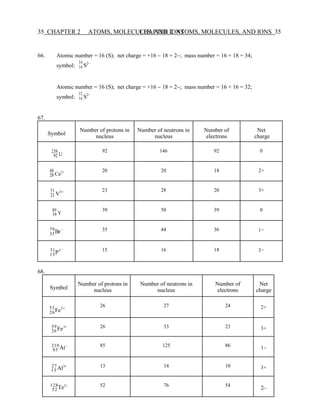
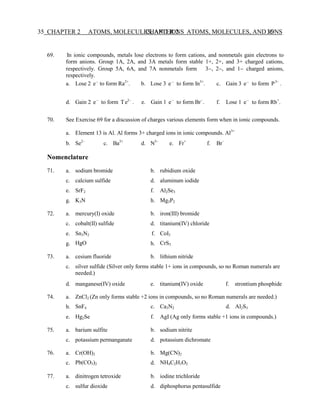
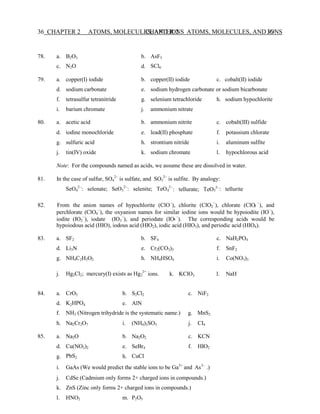
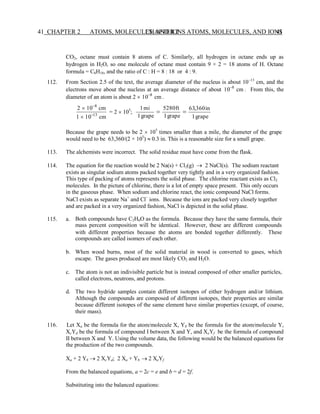
![CHAPTER 2 ATOMS, MOLECULES, AND IONS 42
42 CHAPTER 2 ATOMS, MOLECULES, AND IONS
X2c + 2 Y2f → 2 XcY2f ; 2 X2c + Y2f → 2 X2cYf
For simplest formulas, assume that c = f = 1. Thus:
X2 + 2 Y2 → 2 XY2 and 2 X2 + Y2 → 2 X2Y
Compound I = XY2: If X has relative mass of 1.00,
Compound II = X2Y: If X has relative mass of 1.00,
1.00
1.00 + 2y
2.00
2.00 + y
= 0.3043, y = 1.14.
= 0.6364, y = 1.14.
The relative mass of Y is 1.14 times that of X. Thus, if X has an atomic mass of 100, then Y
will have an atomic mass of 114.
117. Most of the mass of the atom is due to the protons and the neutrons in the nucleus, and
protons and neutrons have about the same mass (1.67 10−24
g). The ratio of the mass of the
molecule to the mass of a nuclear particle will give a good approximation of the number of
nuclear particles (protons and neutrons) present.
7.31 10−23
g
1.67 10−24
g
= 43.8 44 nuclear particles
Thus there are 44 protons and neutrons present. If the number of protons equals the number
of neutrons, we have 22 protons in the molecule. One possibility would be the molecule CO2
[6 + 2(8) = 22 protons].
118. For each experiment, divide the larger number by the smaller. In doing so, we get:
experiment 1 X = 1.0 Y = 10.5
experiment 2 Y = 1.4 Z = 1.0
experiment 3 X = 1.0 Y = 3.5
Our assumption about formulas dictates the rest of the solution. For example, if we assume
that the formula of the compound in experiment 1 is XY and that of experiment 2 is YZ, we
get relative masses of:
X = 2.0; Y = 21; Z = 15 (= 21/1.4)
and a formula of X3Y for experiment 3 [three times as much X must be present in experiment
3 as compared to experiment 1 (10.5/3.5 = 3)].
However, if we assume the formula for experiment 2 is YZ and that of experiment 3 is XZ,
then we get:
X = 2.0; Y = 7.0; Z = 5.0 (= 7.0/1.4)
and a formula of XY3 for experiment 1. Any answer that is consistent with your initial
assumptions is correct.](https://image.slidesharecdn.com/4129-250406035112-e73d1195/85/Solution-Manual-for-Chemistry-9th-Edition-25-320.jpg)