DEPARTMENT OF CIVIL ENGINEERING
Jain Institute of Technology, Davanagere
Seminar Presentation on
“APPLICATION OF WIND AND SOLAR ENERGY FOR IRRIGATION”
Presented by
Mr. VISHWASRADDY
(4Jd15CV117)
Under the Guidance of
Mrs, REKHAA M
Assistant Professor,
Department of Civil Engineering.
1
Contents
• Introduction
• Objectives
• Literature review
• Solar energy irrigation system
• Wind energy irrigation system
• Prediction of requirements
• Case study
• Applications ,Advantages & disadvantages
• Conclusion
• References
2
INTRODUCTION
• The supply of electricity is not reached up to some villages
• Solar and wind energy is most abundant sources of energy in the world.
• This type of irrigation system is suitable for farmers in the present state
of energy crisis in India.
• Provides free energy after an initial investment is made.
• It is an eco-friendly and green way for energy production.
• First goal is to satisfy agriculture needs during irrigation season (spring
and summer) and the second goal is to sell back excess electricity to the
utility.
3
OBJECTIVES
• Independence against the difficult weather conditions that induce anxiety in
the population.
• Establishment of a competitive and diversified agriculture because of the
weight of this sector in the national economy.
• Independence against the increasing price of oil and gas.
• Protect our environment from pollution cause by burning oil and gas.
4
LITERATURE REVIEW
• Ajith kumar singh,” developing hybrid wind and solar powered irrigation system, Harcourt
butler technological institute” April 2016
The projection for irrigation water demand basically depends on irrigated area, cropping pattern,
effective rainfall, water quality and availability of energy. Providing adequate and quality power to farmers
for irrigation purpose remains one of the major challenges before the country due to their remote location
hinders any access to a grid.
• Leon lylesand Edward l skidmore, “application of wind and solar energy to great
plainsirrigation pumping,US department of agriculture” January 1980
Here he investigated application of dedicated wind energy systems without energy storage for
irrigation in the Great Plains. Major uses of irrigation energy were identified as pumping for surface
distribution systems, which could be supplied by variable flow, and pumping for sprinkler systems using
constant flow.
5
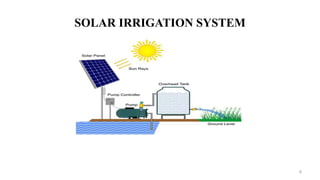
SOLAR IRRIGATION SYSTEM
6
Working process
• The fact that DC power is used in solar water pumps as opposed to AC powered
devices gives the advantage of the solar pumps being able to function under
circumstances of imperfect sunlight conditions.
• AC power on the other hand needs relatively unchanging voltage as well as
frequency to run smoothly. This DC use in solar water pumps allows the device to
operate on varying voltage and current.
7
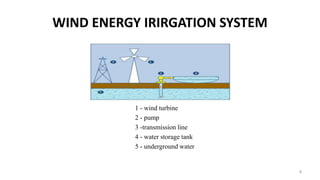
WIND ENERGY IRIRGATION SYSTEM
8
1 - wind turbine
2 - pump
3 -transmission line
4 - water storage tank
5 - underground water
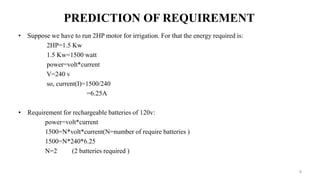
PREDICTION OF REQUIREMENT
• Suppose we have to run 2HP motor for irrigation. For that the energy required is:
2HP=1.5 Kw
1.5 Kw=1500 watt
power=volt*current
V=240 v
so, current(I)=1500/240
=6.25A
• Requirement for rechargeable batteries of 120v:
power=volt*current
1500=N*volt*current(N=number of require batteries )
1500=N*240*6.25
N=2 (2 batteries required )
9
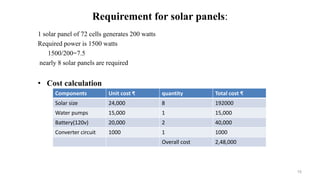
Requirement for solar panels:
1 solar panel of 72 cells generates 200 watts
Required power is 1500 watts
1500/200=7.5
nearly 8 solar panels are required
• Cost calculation
10
Components Unit cost ₹ quantity Total cost ₹
Solar size 24,000 8 192000
Water pumps 15,000 1 15,000
Battery(120v) 20,000 2 40,000
Converter circuit 1000 1 1000
Overall cost 2,48,000
11
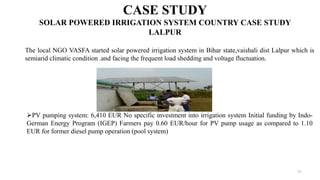
CASE STUDY
SOLAR POWERED IRRIGATION SYSTEM COUNTRY CASE STUDY
LALPUR
The local NGO VASFA started solar powered irrigation system in Bihar state,vaishali dist Lalpur which is
semiarid climatic condition .and facing the frequent load shedding and voltage fluctuation.
PV pumping system: 6,410 EUR No specific investment into irrigation system Initial funding by Indo-
German Energy Program (IGEP) Farmers pay 0.60 EUR/hour for PV pump usage as compared to 1.10
EUR for former diesel pump operation (pool system)
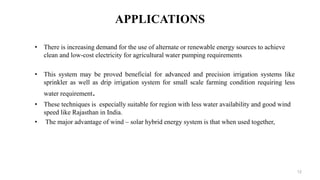
APPLICATIONS
• There is increasing demand for the use of alternate or renewable energy sources to achieve
clean and low-cost electricity for agricultural water pumping requirements
• This system may be proved beneficial for advanced and precision irrigation systems like
sprinkler as well as drip irrigation system for small scale farming condition requiring less
water requirement.
• These techniques is especially suitable for region with less water availability and good wind
speed like Rajasthan in India.
• The major advantage of wind – solar hybrid energy system is that when used together,
12
ADVANTAGES
• Solar and wind energy are pollution free and causes no
greenhouse gases to be emitted after installation .
• Reduced dependence on foreign oil and fossil fuels.
• Renewable clean power that is available every day of the year
even cloudy days produce some power .
• Return on investment unlike paying for utility bills.
• Excess power can b sold to the neighbor farmers.
• Wind turbines have a relatively small land footprint.
13
DISADVANTAGES
• High initial costs for materials and installation.
• No solar power at night so there is a need for a large battery bank.
Cloudy days do not produce much energy .
• We often hear that wind turbines pose threat to wildlife-primarily
birds and bats.
• Wind energy mainly high only on JUNE, JULY and AUGUST.
14
CONCLUSION
• Easy to implement system and environment friendly solution for
irrigation fields
• Found long successful for bore holes as they can pump over the
whole day
• In run this system is economical.
• system has an attractive usage for irrigation due to the lowest cost, the
highest percent of the sell energy and the highest reduction of Carbon
dioxide emission
15
REFERENCES
• Izzat malak, “pumping water using solar energy for irrigation, al akhawayn
university. morocco June 2016”
• Leon lylesand Edward l skidmore, “application of wind and solar energy to
great plains irrigation pumping ,US department of agriculture” in January
1980
• Fabio parig, Tanya kirilova, jerry hudgins, “wind for irrigation application,
department of electrical engineering university of Nebraska, USA” in 2014.
• Ajith kumar singh, “developing hybrid wind and solar powered irrigation
system, Harcourt butler technological institute” April 2016
16
Thank you
17

Solar energy irrigation engineering ppts

  • 1.
    DEPARTMENT OF CIVILENGINEERING Jain Institute of Technology, Davanagere Seminar Presentation on “APPLICATION OF WIND AND SOLAR ENERGY FOR IRRIGATION” Presented by Mr. VISHWASRADDY (4Jd15CV117) Under the Guidance of Mrs, REKHAA M Assistant Professor, Department of Civil Engineering. 1
  • 2.
    Contents • Introduction • Objectives •Literature review • Solar energy irrigation system • Wind energy irrigation system • Prediction of requirements • Case study • Applications ,Advantages & disadvantages • Conclusion • References 2
  • 3.
    INTRODUCTION • The supplyof electricity is not reached up to some villages • Solar and wind energy is most abundant sources of energy in the world. • This type of irrigation system is suitable for farmers in the present state of energy crisis in India. • Provides free energy after an initial investment is made. • It is an eco-friendly and green way for energy production. • First goal is to satisfy agriculture needs during irrigation season (spring and summer) and the second goal is to sell back excess electricity to the utility. 3
  • 4.
    OBJECTIVES • Independence againstthe difficult weather conditions that induce anxiety in the population. • Establishment of a competitive and diversified agriculture because of the weight of this sector in the national economy. • Independence against the increasing price of oil and gas. • Protect our environment from pollution cause by burning oil and gas. 4
  • 5.
    LITERATURE REVIEW • Ajithkumar singh,” developing hybrid wind and solar powered irrigation system, Harcourt butler technological institute” April 2016 The projection for irrigation water demand basically depends on irrigated area, cropping pattern, effective rainfall, water quality and availability of energy. Providing adequate and quality power to farmers for irrigation purpose remains one of the major challenges before the country due to their remote location hinders any access to a grid. • Leon lylesand Edward l skidmore, “application of wind and solar energy to great plainsirrigation pumping,US department of agriculture” January 1980 Here he investigated application of dedicated wind energy systems without energy storage for irrigation in the Great Plains. Major uses of irrigation energy were identified as pumping for surface distribution systems, which could be supplied by variable flow, and pumping for sprinkler systems using constant flow. 5
  • 6.
  • 7.
    Working process • Thefact that DC power is used in solar water pumps as opposed to AC powered devices gives the advantage of the solar pumps being able to function under circumstances of imperfect sunlight conditions. • AC power on the other hand needs relatively unchanging voltage as well as frequency to run smoothly. This DC use in solar water pumps allows the device to operate on varying voltage and current. 7
  • 8.
    WIND ENERGY IRIRGATIONSYSTEM 8 1 - wind turbine 2 - pump 3 -transmission line 4 - water storage tank 5 - underground water
  • 9.
    PREDICTION OF REQUIREMENT •Suppose we have to run 2HP motor for irrigation. For that the energy required is: 2HP=1.5 Kw 1.5 Kw=1500 watt power=volt*current V=240 v so, current(I)=1500/240 =6.25A • Requirement for rechargeable batteries of 120v: power=volt*current 1500=N*volt*current(N=number of require batteries ) 1500=N*240*6.25 N=2 (2 batteries required ) 9
  • 10.
    Requirement for solarpanels: 1 solar panel of 72 cells generates 200 watts Required power is 1500 watts 1500/200=7.5 nearly 8 solar panels are required • Cost calculation 10 Components Unit cost ₹ quantity Total cost ₹ Solar size 24,000 8 192000 Water pumps 15,000 1 15,000 Battery(120v) 20,000 2 40,000 Converter circuit 1000 1 1000 Overall cost 2,48,000
  • 11.
    11 CASE STUDY SOLAR POWEREDIRRIGATION SYSTEM COUNTRY CASE STUDY LALPUR The local NGO VASFA started solar powered irrigation system in Bihar state,vaishali dist Lalpur which is semiarid climatic condition .and facing the frequent load shedding and voltage fluctuation. PV pumping system: 6,410 EUR No specific investment into irrigation system Initial funding by Indo- German Energy Program (IGEP) Farmers pay 0.60 EUR/hour for PV pump usage as compared to 1.10 EUR for former diesel pump operation (pool system)
  • 12.
    APPLICATIONS • There isincreasing demand for the use of alternate or renewable energy sources to achieve clean and low-cost electricity for agricultural water pumping requirements • This system may be proved beneficial for advanced and precision irrigation systems like sprinkler as well as drip irrigation system for small scale farming condition requiring less water requirement. • These techniques is especially suitable for region with less water availability and good wind speed like Rajasthan in India. • The major advantage of wind – solar hybrid energy system is that when used together, 12
  • 13.
    ADVANTAGES • Solar andwind energy are pollution free and causes no greenhouse gases to be emitted after installation . • Reduced dependence on foreign oil and fossil fuels. • Renewable clean power that is available every day of the year even cloudy days produce some power . • Return on investment unlike paying for utility bills. • Excess power can b sold to the neighbor farmers. • Wind turbines have a relatively small land footprint. 13
  • 14.
    DISADVANTAGES • High initialcosts for materials and installation. • No solar power at night so there is a need for a large battery bank. Cloudy days do not produce much energy . • We often hear that wind turbines pose threat to wildlife-primarily birds and bats. • Wind energy mainly high only on JUNE, JULY and AUGUST. 14
  • 15.
    CONCLUSION • Easy toimplement system and environment friendly solution for irrigation fields • Found long successful for bore holes as they can pump over the whole day • In run this system is economical. • system has an attractive usage for irrigation due to the lowest cost, the highest percent of the sell energy and the highest reduction of Carbon dioxide emission 15
  • 16.
    REFERENCES • Izzat malak,“pumping water using solar energy for irrigation, al akhawayn university. morocco June 2016” • Leon lylesand Edward l skidmore, “application of wind and solar energy to great plains irrigation pumping ,US department of agriculture” in January 1980 • Fabio parig, Tanya kirilova, jerry hudgins, “wind for irrigation application, department of electrical engineering university of Nebraska, USA” in 2014. • Ajith kumar singh, “developing hybrid wind and solar powered irrigation system, Harcourt butler technological institute” April 2016 16
  • 17.