EP&A Envirotacinc
All Types Of Effecient Soil Stabilization Methods
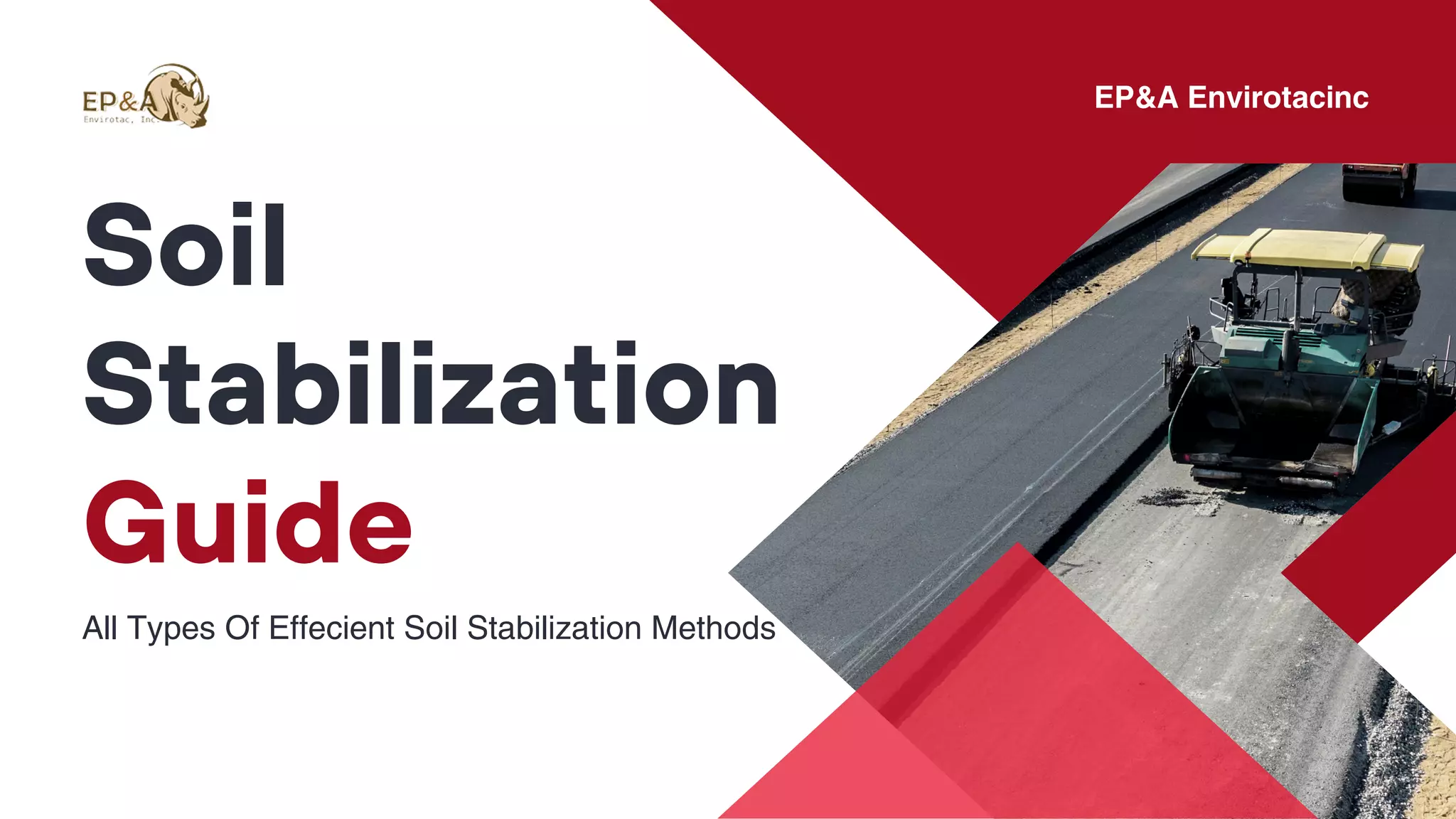
Soil
Stabilization
Guide
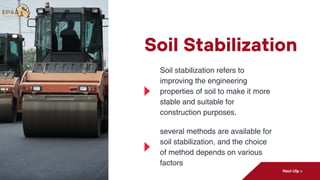
Soil Stabilization
Soil stabilization refers to
improving the engineering
properties of soil to make it more
stable and suitable for
construction purposes.
several methods are available for
soil stabilization, and the choice
of method depends on various
factors
Nect UIp >
Next Up >
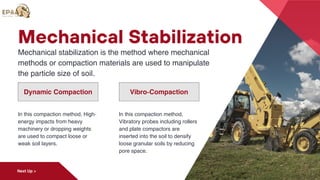
Dynamic Compaction Vibro-Compaction
Mechanical Stabilization
Mechanical stabilization is the method where mechanical
methods or compaction materials are used to manipulate
the particle size of soil.
In this compaction method, High-
energy impacts from heavy
machinery or dropping weights
are used to compact loose or
weak soil layers.
In this compaction method,
Vibratory probes including rollers
and plate compactors are
inserted into the soil to densify
loose granular soils by reducing
pore space.
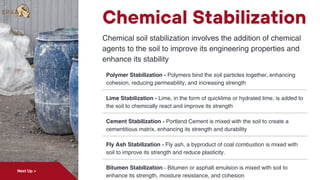
Polymer Stabilization - Polymers bind the soil particles together, enhancing
cohesion, reducing permeability, and increasing strength
Lime Stabilization - Lime, in the form of quicklime or hydrated lime, is added to
the soil to chemically react and improve its strength
Cement Stabilization - Portland Cement is mixed with the soil to create a
cementitious matrix, enhancing its strength and durability
Fly Ash Stabilization - Fly ash, a byproduct of coal combustion is mixed with
soil to improve its strength and reduce plasticity.
Bitumen Stabilization - Bitumen or asphalt emulsion is mixed with soil to
enhance its strength, moisture resistance, and cohesion
Next Up >
Chemical Stabilization
Chemical soil stabilization involves the addition of chemical
agents to the soil to improve its engineering properties and
enhance its stability
Large geotextile
tubes are used as
structural elements
for erosion control,
shoreline protection,
or slope
stabilization.
Geosynthetics
are used to
reinforce the soil
and enhance its
stability by
distributing loads
and reducing soil
movement.
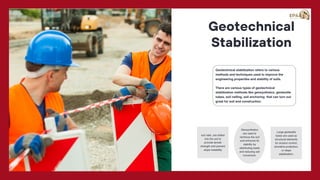
Geotechnical stabilization refers to various
methods and techniques used to improve the
engineering properties and stability of soils.
There are various types of geotechnical
stabilization methods like geosyntheics, geotextile
tubes, soil nailing, soil anchoring that can turn out
great for soil and construction.
soil nails, are drilled
into the soil to
provide tensile
strength and prevent
slope instability
Geotechnical
Stabilization
Biological Stabilization
Vegetation
Planting suitable vegetation helps
stabilize the soil through root systems
that bind the soil particles, reducing
erosion and enhancing slope stability
Bioengineering
Natural or synthetic materials, such as
biodegradable blankets or mats, are
used in combination with vegetation to
provide erosion control and slope
stabilization.
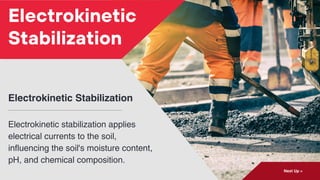
Electrokinetic Stabilization
Electrokinetic stabilization applies
electrical currents to the soil,
influencing the soil's moisture content,
pH, and chemical composition.
Next Up >
Electrokinetic
Stabilization
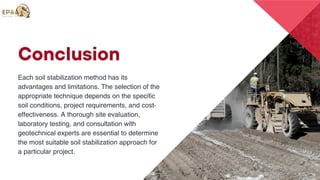
Conclusion
Each soil stabilization method has its
advantages and limitations. The selection of the
appropriate technique depends on the specific
soil conditions, project requirements, and cost-
effectiveness. A thorough site evaluation,
laboratory testing, and consultation with
geotechnical experts are essential to determine
the most suitable soil stabilization approach for
a particular project.

Soil Stabilization Guide

  • 1.
    EP&A Envirotacinc All TypesOf Effecient Soil Stabilization Methods Soil Stabilization Guide
  • 2.
    Soil Stabilization Soil stabilizationrefers to improving the engineering properties of soil to make it more stable and suitable for construction purposes. several methods are available for soil stabilization, and the choice of method depends on various factors Nect UIp >
  • 3.
    Next Up > DynamicCompaction Vibro-Compaction Mechanical Stabilization Mechanical stabilization is the method where mechanical methods or compaction materials are used to manipulate the particle size of soil. In this compaction method, High- energy impacts from heavy machinery or dropping weights are used to compact loose or weak soil layers. In this compaction method, Vibratory probes including rollers and plate compactors are inserted into the soil to densify loose granular soils by reducing pore space.
  • 4.
    Polymer Stabilization -Polymers bind the soil particles together, enhancing cohesion, reducing permeability, and increasing strength Lime Stabilization - Lime, in the form of quicklime or hydrated lime, is added to the soil to chemically react and improve its strength Cement Stabilization - Portland Cement is mixed with the soil to create a cementitious matrix, enhancing its strength and durability Fly Ash Stabilization - Fly ash, a byproduct of coal combustion is mixed with soil to improve its strength and reduce plasticity. Bitumen Stabilization - Bitumen or asphalt emulsion is mixed with soil to enhance its strength, moisture resistance, and cohesion Next Up > Chemical Stabilization Chemical soil stabilization involves the addition of chemical agents to the soil to improve its engineering properties and enhance its stability
  • 5.
    Large geotextile tubes areused as structural elements for erosion control, shoreline protection, or slope stabilization. Geosynthetics are used to reinforce the soil and enhance its stability by distributing loads and reducing soil movement. Geotechnical stabilization refers to various methods and techniques used to improve the engineering properties and stability of soils. There are various types of geotechnical stabilization methods like geosyntheics, geotextile tubes, soil nailing, soil anchoring that can turn out great for soil and construction. soil nails, are drilled into the soil to provide tensile strength and prevent slope instability Geotechnical Stabilization
  • 6.
    Biological Stabilization Vegetation Planting suitablevegetation helps stabilize the soil through root systems that bind the soil particles, reducing erosion and enhancing slope stability Bioengineering Natural or synthetic materials, such as biodegradable blankets or mats, are used in combination with vegetation to provide erosion control and slope stabilization.
  • 7.
    Electrokinetic Stabilization Electrokinetic stabilizationapplies electrical currents to the soil, influencing the soil's moisture content, pH, and chemical composition. Next Up > Electrokinetic Stabilization
  • 8.
    Conclusion Each soil stabilizationmethod has its advantages and limitations. The selection of the appropriate technique depends on the specific soil conditions, project requirements, and cost- effectiveness. A thorough site evaluation, laboratory testing, and consultation with geotechnical experts are essential to determine the most suitable soil stabilization approach for a particular project.