Analysis Of Soil Liquefaction
Potential Through Field Tests-Based
Method.
ABOUT PROJECT
• Introduction
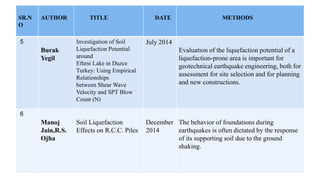
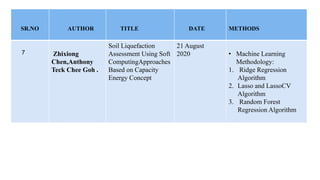
• Litreature Review
• Methodology
• Objective
• Site location
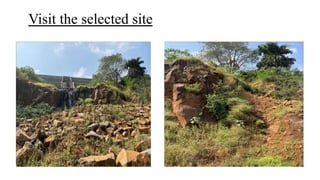
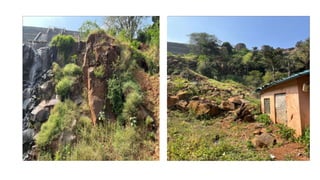
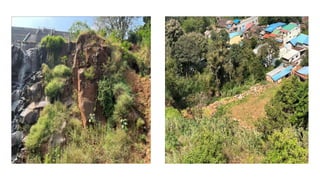
• Visit the site and collect the soil sample
• Different test carried out on soil sample and their results.
• Landslide Mitigation Techniques
• Conclusion
• Refrences
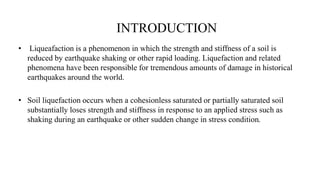
INTRODUCTION
• Liqueafaction is a phenomenon in which the strength and stiffness of a soil is
reduced by earthquake shaking or other rapid loading. Liquefaction and related
phenomena have been responsible for tremendous amounts of damage in historical
earthquakes around the world.
• Soil liquefaction occurs when a cohesionless saturated or partially saturated soil
substantially loses strength and stiffness in response to an applied stress such as
shaking during an earthquake or other sudden change in stress condition.
LITERATURE REVIEW
SR.
NO
AUTHORS TITLE DATE METHODS
1
Ali A.
Mahmood,
Catherine N.
Mulligan
LIQUEFACTION
STUDIES: A
REVIEW
June 2004 This paper presents a general
description of liquefaction and a review
of some of the recent research attempts
conducted to study liquefaction.
2 Michael K
SHARP,
Richard
LEDBETTER
CENTRIFUGE
RESEARCH OF
LIQUEFACTION
PHENOMENA
March
2008
This paper describes research currently
ongoing to investigate many aspects of
earthquake
engineering related to the prediction,
and further understanding of
liquefaction and liquefaction
related effects.
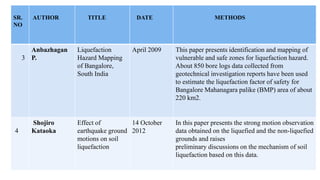
SR.
NO
AUTHOR TITLE DATE METHODS
3
Anbazhagan
P.
Liquefaction
Hazard Mapping
of Bangalore,
South India
April 2009 This paper presents identification and mapping of
vulnerable and safe zones for liquefaction hazard.
About 850 bore logs data collected from
geotechnical investigation reports have been used
to estimate the liquefaction factor of safety for
Bangalore Mahanagara palike (BMP) area of about
220 km2.
4
Shojiro
Kataoka
Effect of
earthquake ground
motions on soil
liquefaction
14 October
2012
In this paper presents the strong motion observation
data obtained on the liquefied and the non-liquefied
grounds and raises
preliminary discussions on the mechanism of soil
liquefaction based on this data.
SR.N
O
AUTHOR TITLE DATE METHODS
5
Burak
Yegil
Investigation of Soil
Liquefaction Potential
around
Efteni Lake in Duzce
Turkey: Using Empirical
Relationships
between Shear Wave
Velocity and SPT Blow
Count (N)
July 2014
Evaluation of the liquefaction potential of a
liquefaction-prone area is important for
geotechnical earthquake engineering, both for
assessment for site selection and for planning
and new constructions.
6
Manoj
Jain,R.S.
Ojha
Soil Liquefaction
Effects on R.C.C. Piles
December
2014
The behavior of foundations during
earthquakes is often dictated by the response
of its supporting soil due to the ground
shaking.
SR.NO AUTHOR TITLE DATE METHODS
7 Zhixiong
Chen,Anthony
Teck Chee Goh .
Soil Liquefaction
Assessment Using Soft
ComputingApproaches
Based on Capacity
Energy Concept
21 August
2020 • Machine Learning
Methodology:
1. Ridge Regression
Algorithm
2. Lasso and LassoCV
Algorithm
3. Random Forest
Regression Algorithm
OBJECTIVE
1. To determine the soil properties.
2. To improve the strenghth of soil.
3. Apply suitable Mitigation techniques.
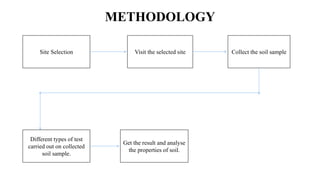
METHODOLOGY
Site Selection Visit the selected site Collect the soil sample
Different types of test
carried out on collected
soil sample.
Get the result and analyse
the properties of soil.
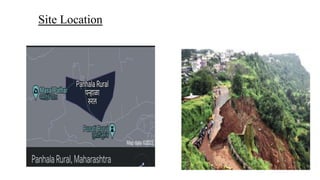
Site Location
Visit the selected site
Test carrird out on collected soil sample:
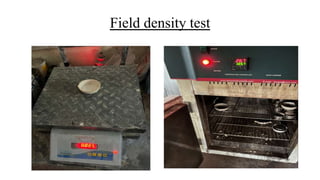
• Field density test
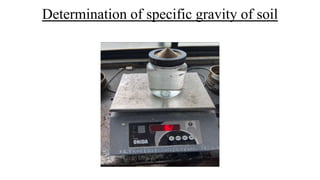
• Determination of specific gravity of soil
• Grain size distribution of soil by sieve analysis
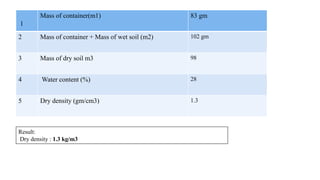
Field density test
1
Mass of container(m1) 83 gm
2 Mass of container + Mass of wet soil (m2) 102 gm
3 Mass of dry soil m3 98
4 Water content (%) 28
5 Dry density (gm/cm3) 1.3
Result:
Dry density : 1.3 kg/m3
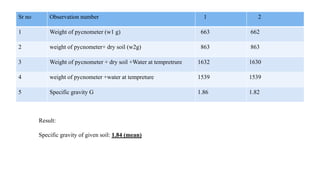
Determination of specific gravity of soil
Sr no Observation number 1 2
1 Weight of pycnometer (w1 g) 663 662
2 weight of pycnometer+ dry soil (w2g) 863 863
3 Weight of pycnometer + dry soil +Water at tempretrure 1632 1630
4 weight of pycnometer +water at tempreture 1539 1539
5 Specific gravity G 1.86 1.82
Result:
Specific gravity of given soil: 1.84 (mean)
Result:
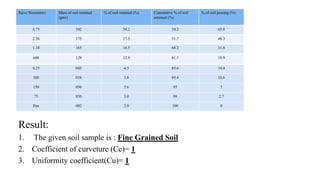
1. The given soil sample is : Fine Grained Soil
2. Coefficient of curveture (Cc)= 1
3. Uniformity coefficient(Cu)= 1
Sieve Sizes(mm) Mass of soil retained
(gms)
% of soil retained (%) Cumulative % of soil
retained (%)
% of soil passing (%)
4.75 342 34.2 34.2 65.8
2.36 175 17.5 51.7 48.3
1.18 165 16.5 68.2 31.8
600 129 12.9 81.1 18.9
4.25 045 4.5 85.6 14.4
300 038 3.8 89.4 10.6
150 056 5.6 95 5
75 030 3.0 98 2.7
Pan 002 2.0 100 0
Landslide Mitigation Techniques
1.Earth retaining systems using ground anchors
2.Soil Nails
3.Horizontal Drains used for Slope Stabilization
4.Planting of bamboo for prevent landslides
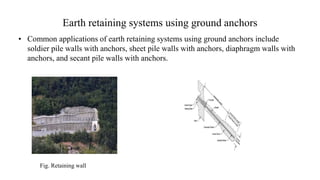
Earth retaining systems using ground anchors
• Common applications of earth retaining systems using ground anchors include
soldier pile walls with anchors, sheet pile walls with anchors, diaphragm walls with
anchors, and secant pile walls with anchors.
Fig. Retaining wall
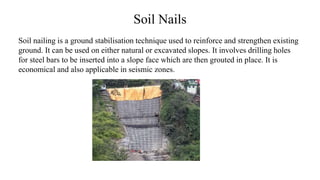
Soil Nails
Soil nailing is a ground stabilisation technique used to reinforce and strengthen existing
ground. It can be used on either natural or excavated slopes. It involves drilling holes
for steel bars to be inserted into a slope face which are then grouted in place. It is
economical and also applicable in seismic zones.
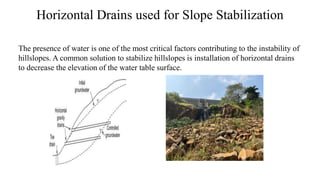
Horizontal Drains used for Slope Stabilization
The presence of water is one of the most critical factors contributing to the instability of
hillslopes. A common solution to stabilize hillslopes is installation of horizontal drains
to decrease the elevation of the water table surface.
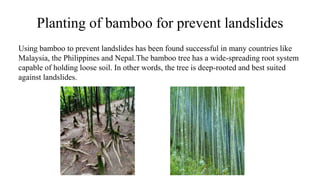
Planting of bamboo for prevent landslides
Using bamboo to prevent landslides has been found successful in many countries like
Malaysia, the Philippines and Nepal.The bamboo tree has a wide-spreading root system
capable of holding loose soil. In other words, the tree is deep-rooted and best suited
against landslides.
Conclusion
1.Water content of soil is suddenly increases due to heavy rainfall in less time , average
water content is about 39% and soil is latcratic type , having high to moderate
permeability due to this water percolate into soil and soil become highly saturated and
unstable and flows down-word.
2.From tha basic survey , due to absence of gutters and drainage media percolated water
does not have way to drain of and water remains as it is in soil.
3.By comparing the factor of safety for both situation we conclude that in monsoon
seasaon this slope very unstable and dangerous.
Refrences
1. Manoj Jain,R.S.Ojha (December 2014 ) , Soil Liquefaction Effects on R.C.C. Piles.
2. Burak Yegil (1 July 2014) , Investigation of Soil Liquefaction Potential around Efteni Lake
in Duzce Turkey: Using Empirical Relationships between Shear Wave Velocity and SPT Blow Count(N).
3. Shojiro Kataoka (1 December 2012) , Effect of earthquake ground motions on soil
liquefaction.
4. Ali A. Mahmood (5 June 2002) , Liquefaction studies: A review .
5. Anthony Teck Chee Goh (21 August 2020) , Soil Liquefaction Assessment Using Soft
Computing Approaches Based on Capacity Energy Concept.

Soil liquifaction 1.pptx

  • 1.
    Analysis Of SoilLiquefaction Potential Through Field Tests-Based Method.
  • 2.
    ABOUT PROJECT • Introduction •Litreature Review • Methodology • Objective • Site location • Visit the site and collect the soil sample • Different test carried out on soil sample and their results. • Landslide Mitigation Techniques • Conclusion • Refrences
  • 3.
    INTRODUCTION • Liqueafaction isa phenomenon in which the strength and stiffness of a soil is reduced by earthquake shaking or other rapid loading. Liquefaction and related phenomena have been responsible for tremendous amounts of damage in historical earthquakes around the world. • Soil liquefaction occurs when a cohesionless saturated or partially saturated soil substantially loses strength and stiffness in response to an applied stress such as shaking during an earthquake or other sudden change in stress condition.
  • 4.
    LITERATURE REVIEW SR. NO AUTHORS TITLEDATE METHODS 1 Ali A. Mahmood, Catherine N. Mulligan LIQUEFACTION STUDIES: A REVIEW June 2004 This paper presents a general description of liquefaction and a review of some of the recent research attempts conducted to study liquefaction. 2 Michael K SHARP, Richard LEDBETTER CENTRIFUGE RESEARCH OF LIQUEFACTION PHENOMENA March 2008 This paper describes research currently ongoing to investigate many aspects of earthquake engineering related to the prediction, and further understanding of liquefaction and liquefaction related effects.
  • 5.
    SR. NO AUTHOR TITLE DATEMETHODS 3 Anbazhagan P. Liquefaction Hazard Mapping of Bangalore, South India April 2009 This paper presents identification and mapping of vulnerable and safe zones for liquefaction hazard. About 850 bore logs data collected from geotechnical investigation reports have been used to estimate the liquefaction factor of safety for Bangalore Mahanagara palike (BMP) area of about 220 km2. 4 Shojiro Kataoka Effect of earthquake ground motions on soil liquefaction 14 October 2012 In this paper presents the strong motion observation data obtained on the liquefied and the non-liquefied grounds and raises preliminary discussions on the mechanism of soil liquefaction based on this data.
  • 6.
    SR.N O AUTHOR TITLE DATEMETHODS 5 Burak Yegil Investigation of Soil Liquefaction Potential around Efteni Lake in Duzce Turkey: Using Empirical Relationships between Shear Wave Velocity and SPT Blow Count (N) July 2014 Evaluation of the liquefaction potential of a liquefaction-prone area is important for geotechnical earthquake engineering, both for assessment for site selection and for planning and new constructions. 6 Manoj Jain,R.S. Ojha Soil Liquefaction Effects on R.C.C. Piles December 2014 The behavior of foundations during earthquakes is often dictated by the response of its supporting soil due to the ground shaking.
  • 7.
    SR.NO AUTHOR TITLEDATE METHODS 7 Zhixiong Chen,Anthony Teck Chee Goh . Soil Liquefaction Assessment Using Soft ComputingApproaches Based on Capacity Energy Concept 21 August 2020 • Machine Learning Methodology: 1. Ridge Regression Algorithm 2. Lasso and LassoCV Algorithm 3. Random Forest Regression Algorithm
  • 8.
    OBJECTIVE 1. To determinethe soil properties. 2. To improve the strenghth of soil. 3. Apply suitable Mitigation techniques.
  • 9.
    METHODOLOGY Site Selection Visitthe selected site Collect the soil sample Different types of test carried out on collected soil sample. Get the result and analyse the properties of soil.
  • 10.
  • 11.
  • 14.
    Test carrird outon collected soil sample: • Field density test • Determination of specific gravity of soil • Grain size distribution of soil by sieve analysis
  • 15.
  • 16.
    1 Mass of container(m1)83 gm 2 Mass of container + Mass of wet soil (m2) 102 gm 3 Mass of dry soil m3 98 4 Water content (%) 28 5 Dry density (gm/cm3) 1.3 Result: Dry density : 1.3 kg/m3
  • 17.
  • 18.
    Sr no Observationnumber 1 2 1 Weight of pycnometer (w1 g) 663 662 2 weight of pycnometer+ dry soil (w2g) 863 863 3 Weight of pycnometer + dry soil +Water at tempretrure 1632 1630 4 weight of pycnometer +water at tempreture 1539 1539 5 Specific gravity G 1.86 1.82 Result: Specific gravity of given soil: 1.84 (mean)
  • 19.
    Result: 1. The givensoil sample is : Fine Grained Soil 2. Coefficient of curveture (Cc)= 1 3. Uniformity coefficient(Cu)= 1 Sieve Sizes(mm) Mass of soil retained (gms) % of soil retained (%) Cumulative % of soil retained (%) % of soil passing (%) 4.75 342 34.2 34.2 65.8 2.36 175 17.5 51.7 48.3 1.18 165 16.5 68.2 31.8 600 129 12.9 81.1 18.9 4.25 045 4.5 85.6 14.4 300 038 3.8 89.4 10.6 150 056 5.6 95 5 75 030 3.0 98 2.7 Pan 002 2.0 100 0
  • 20.
    Landslide Mitigation Techniques 1.Earthretaining systems using ground anchors 2.Soil Nails 3.Horizontal Drains used for Slope Stabilization 4.Planting of bamboo for prevent landslides
  • 21.
    Earth retaining systemsusing ground anchors • Common applications of earth retaining systems using ground anchors include soldier pile walls with anchors, sheet pile walls with anchors, diaphragm walls with anchors, and secant pile walls with anchors. Fig. Retaining wall
  • 22.
    Soil Nails Soil nailingis a ground stabilisation technique used to reinforce and strengthen existing ground. It can be used on either natural or excavated slopes. It involves drilling holes for steel bars to be inserted into a slope face which are then grouted in place. It is economical and also applicable in seismic zones.
  • 23.
    Horizontal Drains usedfor Slope Stabilization The presence of water is one of the most critical factors contributing to the instability of hillslopes. A common solution to stabilize hillslopes is installation of horizontal drains to decrease the elevation of the water table surface.
  • 24.
    Planting of bamboofor prevent landslides Using bamboo to prevent landslides has been found successful in many countries like Malaysia, the Philippines and Nepal.The bamboo tree has a wide-spreading root system capable of holding loose soil. In other words, the tree is deep-rooted and best suited against landslides.
  • 25.
    Conclusion 1.Water content ofsoil is suddenly increases due to heavy rainfall in less time , average water content is about 39% and soil is latcratic type , having high to moderate permeability due to this water percolate into soil and soil become highly saturated and unstable and flows down-word. 2.From tha basic survey , due to absence of gutters and drainage media percolated water does not have way to drain of and water remains as it is in soil. 3.By comparing the factor of safety for both situation we conclude that in monsoon seasaon this slope very unstable and dangerous.
  • 26.
    Refrences 1. Manoj Jain,R.S.Ojha(December 2014 ) , Soil Liquefaction Effects on R.C.C. Piles. 2. Burak Yegil (1 July 2014) , Investigation of Soil Liquefaction Potential around Efteni Lake in Duzce Turkey: Using Empirical Relationships between Shear Wave Velocity and SPT Blow Count(N). 3. Shojiro Kataoka (1 December 2012) , Effect of earthquake ground motions on soil liquefaction. 4. Ali A. Mahmood (5 June 2002) , Liquefaction studies: A review . 5. Anthony Teck Chee Goh (21 August 2020) , Soil Liquefaction Assessment Using Soft Computing Approaches Based on Capacity Energy Concept.