Submitted to: Submitted By
Seminarppt.com Seminarppt.com
Seminar on
Software
Testing
SeminarPpt.com
Table Contents
✓Definition
✓Introduction
✓Types of Software Testing
✓History of Software Testing
✓Benefits of Software Testing
✓Conclusion
2
Definition
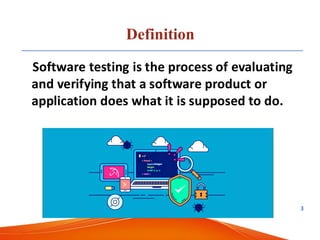
Software testing is the process of evaluating
and verifying that a software product or
application does what it is supposed to do.
3
Introduction
• Software testing identifies bugs and issues in the
development process so they're fixed prior to
product launch.
• This approach ensures that only quality products are
distributed to consumers, which in turn elevates
customer satisfaction and trust.
• The benefits of testing include preventing bugs,
reducing development costs and improving
performance.
4
5
Types of Software Testing
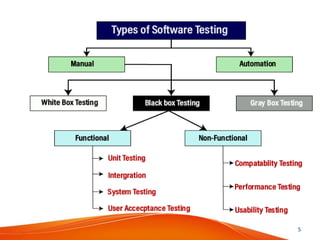
Manual testing
• The process of checking the functionality of an
application as per the customer needs without
taking any help of automation tools is known as
manual testing.
• While performing the manual testing on any
application, we do not need any specific
knowledge of any testing tool, rather than have a
proper understanding of the product so we can
easily prepare the test document.
●●●
6
Types of Software Testing
Automation testing
• Automation testing is a process of converting
any manual test cases into the test scripts with
the help of automation tools, or any
programming language is known as
automation testing.
• With the help of automation testing, we can
enhance the speed of our test execution
because here, we do not require any human
efforts.
●●●
7
Types of Software Testing
Acceptance testing:
• Verifying whether the whole system works as
intended.
Integration testing:
• Ensuring that software components or
functions operate together.
Unit testing:
• Validating that each software unit performs as
expected. A unit is the smallest testable
component of an application.
●●●
8
Types of Software Testing
Functional testing:
• Checking functions by emulating business
scenarios, based on functional requirements.
Black-box testing is a common way to verify
functions.
Stress testing:
• Testing how much strain the system can take
before it fails. Considered to be a type of non-
functional testing.
●●●
9
Types of Software Testing
Performance testing:
• Testing how the software performs under
different workloads. Load testing, for example,
is used to evaluate performance under real-life
load conditions.
Usability testing:
• Validating how well a customer can use a
system or web application to complete a task.
●●●
10
Types of Software Testing
Regression testing:
• Checking whether new features break or
degrade functionality. Sanity testing can
be used to verify menus, functions and
commands at the surface level, when
there is no time for a full regression test.
11
History of Software Testing
• Software testing arrived alongside the
development of software, which had its
beginnings just after the second world war.
• Computer scientist Tom Kilburn is credited
with writing the first piece of software, which
debuted on June 21, 1948, at the University
of Manchester in England.
• It performed mathematical calculations using
machine code instructions.
●●●
12
History of Software Testing
• Debugging was the main testing method at the
time and remained so for the next two decades.
• By the 1980s, development teams looked
beyond isolating and fixing software bugs to
testing applications in real-world settings.
• It set the stage for a broader view of testing,
which encompassed a quality assurance process
that was part of the software development life
cycle.
●●●
13
History of Software Testing
• “In the 1990s, there was a transition from
testing to a more comprehensive process called
quality assurance, which covers the entire
software development cycle and affects the
processes of planning, design, creation and
execution of test cases, support for existing test
cases and test environments,” says Alexander
Yaroshko in his post on the uTest developer site.
●●●
14
History of Software Testing
• “Testing had reached a qualitatively new level,
which led to the further development of
methodologies, the emergence of powerful
tools for managing the testing process and test
automation tools.”

15
Benefits of Software Testing
Cost-Effective:
• It is one of the important advantages of
software testing. Testing any IT project on
time helps you to save your money for the
long term. In case if the bugs caught in the
earlier stage of software testing, it costs
less to fix.
●●●
16
Benefits of Software Testing
Security:
• It is the most vulnerable and sensitive benefit
of software testing. People are looking for
trusted products. It helps in removing risks
and problems earlier.
Product quality:
• It is an essential requirement of any software
product. Testing ensures a quality product is
delivered to customers.
●●●
17
Benefits of Software Testing
Customer Satisfaction:
• The main aim of any product is to give
satisfaction to their customers. UI/UX
Testing ensures the best user experience.
18
19
Conclusion
✓ Software testing can be stated as the process of
verifying and validating whether a software or
application is bug-free, meets the technical
requirements as guided by its design and
development, and meets the user requirements
effectively and efficiently by handling all the
exceptional and boundary cases.
20
References
• Wikipedia.org
• Google.com
• Seminarppt.com
• Studymafia.org
software testing easy to learning best platform

software testing easy to learning best platform

  • 1.
    Submitted to: SubmittedBy Seminarppt.com Seminarppt.com Seminar on Software Testing SeminarPpt.com
  • 2.
    Table Contents ✓Definition ✓Introduction ✓Types ofSoftware Testing ✓History of Software Testing ✓Benefits of Software Testing ✓Conclusion 2
  • 3.
    Definition Software testing isthe process of evaluating and verifying that a software product or application does what it is supposed to do. 3
  • 4.
    Introduction • Software testingidentifies bugs and issues in the development process so they're fixed prior to product launch. • This approach ensures that only quality products are distributed to consumers, which in turn elevates customer satisfaction and trust. • The benefits of testing include preventing bugs, reducing development costs and improving performance. 4
  • 5.
  • 6.
    Types of SoftwareTesting Manual testing • The process of checking the functionality of an application as per the customer needs without taking any help of automation tools is known as manual testing. • While performing the manual testing on any application, we do not need any specific knowledge of any testing tool, rather than have a proper understanding of the product so we can easily prepare the test document. ●●● 6
  • 7.
    Types of SoftwareTesting Automation testing • Automation testing is a process of converting any manual test cases into the test scripts with the help of automation tools, or any programming language is known as automation testing. • With the help of automation testing, we can enhance the speed of our test execution because here, we do not require any human efforts. ●●● 7
  • 8.
    Types of SoftwareTesting Acceptance testing: • Verifying whether the whole system works as intended. Integration testing: • Ensuring that software components or functions operate together. Unit testing: • Validating that each software unit performs as expected. A unit is the smallest testable component of an application. ●●● 8
  • 9.
    Types of SoftwareTesting Functional testing: • Checking functions by emulating business scenarios, based on functional requirements. Black-box testing is a common way to verify functions. Stress testing: • Testing how much strain the system can take before it fails. Considered to be a type of non- functional testing. ●●● 9
  • 10.
    Types of SoftwareTesting Performance testing: • Testing how the software performs under different workloads. Load testing, for example, is used to evaluate performance under real-life load conditions. Usability testing: • Validating how well a customer can use a system or web application to complete a task. ●●● 10
  • 11.
    Types of SoftwareTesting Regression testing: • Checking whether new features break or degrade functionality. Sanity testing can be used to verify menus, functions and commands at the surface level, when there is no time for a full regression test. 11
  • 12.
    History of SoftwareTesting • Software testing arrived alongside the development of software, which had its beginnings just after the second world war. • Computer scientist Tom Kilburn is credited with writing the first piece of software, which debuted on June 21, 1948, at the University of Manchester in England. • It performed mathematical calculations using machine code instructions. ●●● 12
  • 13.
    History of SoftwareTesting • Debugging was the main testing method at the time and remained so for the next two decades. • By the 1980s, development teams looked beyond isolating and fixing software bugs to testing applications in real-world settings. • It set the stage for a broader view of testing, which encompassed a quality assurance process that was part of the software development life cycle. ●●● 13
  • 14.
    History of SoftwareTesting • “In the 1990s, there was a transition from testing to a more comprehensive process called quality assurance, which covers the entire software development cycle and affects the processes of planning, design, creation and execution of test cases, support for existing test cases and test environments,” says Alexander Yaroshko in his post on the uTest developer site. ●●● 14
  • 15.
    History of SoftwareTesting • “Testing had reached a qualitatively new level, which led to the further development of methodologies, the emergence of powerful tools for managing the testing process and test automation tools.” 15
  • 16.
    Benefits of SoftwareTesting Cost-Effective: • It is one of the important advantages of software testing. Testing any IT project on time helps you to save your money for the long term. In case if the bugs caught in the earlier stage of software testing, it costs less to fix. ●●● 16
  • 17.
    Benefits of SoftwareTesting Security: • It is the most vulnerable and sensitive benefit of software testing. People are looking for trusted products. It helps in removing risks and problems earlier. Product quality: • It is an essential requirement of any software product. Testing ensures a quality product is delivered to customers. ●●● 17
  • 18.
    Benefits of SoftwareTesting Customer Satisfaction: • The main aim of any product is to give satisfaction to their customers. UI/UX Testing ensures the best user experience. 18
  • 19.
  • 20.
    Conclusion ✓ Software testingcan be stated as the process of verifying and validating whether a software or application is bug-free, meets the technical requirements as guided by its design and development, and meets the user requirements effectively and efficiently by handling all the exceptional and boundary cases. 20
  • 21.
    References • Wikipedia.org • Google.com •Seminarppt.com • Studymafia.org