Software Engineering Research, Management and Applications Roger Lee
Software Engineering Research, Management and Applications Roger Lee
Software Engineering Research, Management and Applications Roger Lee
Software Engineering Research, Management and Applications Roger Lee
Software Engineering Research, Management and Applications Roger Lee
1.
Explore the fullebook collection and download it now at textbookfull.com
Software Engineering Research, Management and
Applications Roger Lee
https://textbookfull.com/product/software-engineering-
research-management-and-applications-roger-lee-2/
OR CLICK HERE
DOWLOAD EBOOK
Browse and Get More Ebook Downloads Instantly at https://textbookfull.com
Click here to visit textbookfull.com and download textbook now
2.
Your digital treasures(PDF, ePub, MOBI) await
Download instantly and pick your perfect format...
Read anywhere, anytime, on any device!
Software Engineering Research, Management and Applications
Roger Lee
https://textbookfull.com/product/software-engineering-research-
management-and-applications-roger-lee-2/
textbookfull.com
Software Engineering Research Management and Applications
1st Edition Roger Lee (Eds.)
https://textbookfull.com/product/software-engineering-research-
management-and-applications-1st-edition-roger-lee-eds/
textbookfull.com
Action Research in Software Engineering Theory and
Applications Miroslaw Staron
https://textbookfull.com/product/action-research-in-software-
engineering-theory-and-applications-miroslaw-staron/
textbookfull.com
Biota Grow 2C gather 2C cook Loucas
https://textbookfull.com/product/biota-grow-2c-gather-2c-cook-loucas/
textbookfull.com
3.
Software Engineering: APractitioner's Approach 9th
Edition Roger S. Pressman
https://textbookfull.com/product/software-engineering-a-practitioners-
approach-9th-edition-roger-s-pressman/
textbookfull.com
Integrating Research and Practice in Software Engineering
Stan Jarzabek
https://textbookfull.com/product/integrating-research-and-practice-in-
software-engineering-stan-jarzabek/
textbookfull.com
Applied Computing and Information Technology Roger Lee
https://textbookfull.com/product/applied-computing-and-information-
technology-roger-lee/
textbookfull.com
Computational Science Intelligence and Applied Informatics
Roger Lee
https://textbookfull.com/product/computational-science-intelligence-
and-applied-informatics-roger-lee/
textbookfull.com
Project Management and Engineering Research AEIPRO 2016
Ayuso Muñoz
https://textbookfull.com/product/project-management-and-engineering-
research-aeipro-2016-ayuso-munoz/
textbookfull.com
5.
Studies in ComputationalIntelligence 845
Roger Lee Editor
Software
Engineering
Research,
Management
and Applications
6.
Studies in ComputationalIntelligence
Volume 845
Series Editor
Janusz Kacprzyk, Polish Academy of Sciences, Warsaw, Poland
7.
The series “Studiesin Computational Intelligence” (SCI) publishes new develop-
ments and advances in the various areas of computational intelligence—quickly and
with a high quality. The intent is to cover the theory, applications, and design
methods of computational intelligence, as embedded in the fields of engineering,
computer science, physics and life sciences, as well as the methodologies behind
them. The series contains monographs, lecture notes and edited volumes in
computational intelligence spanning the areas of neural networks, connectionist
systems, genetic algorithms, evolutionary computation, artificial intelligence,
cellular automata, self-organizing systems, soft computing, fuzzy systems, and
hybrid intelligent systems. Of particular value to both the contributors and the
readership are the short publication timeframe and the world-wide distribution,
which enable both wide and rapid dissemination of research output.
The books of this series are submitted to indexing to Web of Science,
EI-Compendex, DBLP, SCOPUS, Google Scholar and Springerlink.
More information about this series at http://www.springer.com/series/7092
Foreword
The purpose ofthe 17th International Conference on Software Engineering,
Artificial Intelligence Research, Management and Applications (SERA 2019) held
on May 29–31, 2019 at Honolulu, Hawaii is aimed at bringing together scientists,
engineers, computer users, and students to share their experiences and exchange
new ideas and research results about all aspects (theory, applications, and tools) of
Software Engineering Research, Management and Applications, and to discuss the
practical challenges encountered along the way and the solutions adopted to solve
them. The conference organizers selected the best 13 papers from those papers
accepted for presentation at the conference in order to publish them in this volume.
The papers were chosen based on review scored submitted by members of the
program committee and underwent further rigorous rounds of review.
In chapter “A QoS Aware Uplink Scheduler for IoT in Emergency Over LTE/
LTE-A Networks”, Jin Zhang, Yalong Wu, Wei Yu, and Chao Lu propose a
Quality of Service (QoS)-aware Normal Round Robin Uplink Scheduler
(QNRR-US) over Long-Term Evolution (LTE)/LTE-Advance (LTE-A) networks,
to efficiently allocate network resources with the rapidly growing connected IoT
devices.
In chapter “Emulation-Based Performance Evaluation of the Delay Tolerant
Networking (DTN) in Dynamic Network Topologies”, Weichao Gao, Hengshuo
Liang, James Nguyen, Fan Liang, Wei Yu, Chao Lu, and Mont Orpilla addresses
the performance issue of DTN in dynamic networks by conducting a series of
emulation-based experiments. Based on the experimental results, they are able to
provide general guidelines to evaluate an application for the potential benefits of
DTN, and the direction of optimizing the configuration for different applications in
dynamic networks.
In chapter “Teaching Distributed Software Architecture by Building an
Industrial Level E-Commerce Application”, Bingyang Wei, Yihao Li, Lin Deng,
and Nicholas Visalli propose a Project-Based Learning experience, which brings an
open-source full-fledged system to the classroom in order to effectively teach dis-
tributed software architecture.
v
11.
In chapter “KNN-BasedOverlapping Samples Filter Approach for Classification
of Imbalanced Data”, Mar Mar Nwe and Khin Thidar Lynn propose an effective
under-sampling method for the classification of imbalanced and overlapping data
by using KNN-based overlapping samples filter approach. This paper summarizes
the performance analysis of three ensemble-based learning classifiers for the pro-
posed method.
In chapter “Spectrum-Based Bug Localization of Real-World Java Bugs”,
Cherry Oo and Hnin Min Oo propose an automated bug localization technique that
allows a programmer to be monitored up to the location of the error with little
human arbitration. They used the real-world Apache Commons Math and Apache
Commons Lang Java projects to examine the accuracy using spectrum-based bug
localization metric.
In chapter “The Role of Unconscious Bias in Software Project Failures”, Chris
Macnab and Sam Doctolero, address the alarming rate of Failures of The propose a
quantitative model of personalities that makes simple, testable predictions about
biases. They analyze the main biases of, in particular, software managers and how
their biases contribute to software failures.
In chapter “Analysis of Missing Data Using Matrix-Characterized
Approximations”, Thin Thin Soe and Myat Myat Min discuss the issues of verac-
ity related to data quality such as incomplete, inconsistent, vagueor noisy data that
creates a major challenge to data mining and data analysis. They present a rough
set-based matrix-represented approximations to compute lower and upper approxi-
mations. The experimental results show that the system outperforms when missing
data are characterized as “do not care” conditions than represented as lost values.
In chapter “Expansion of Cyber Attack Data from Unbalanced Datasets Using
Generative Adversarial Networks”, Tim Merino, Matt Stillwell, Mark Steele, Max
Coplan, Jon Patton, Alexander Stoyanov, and Lin Deng explore using Generative
Adversarial Networks (GANs) to improve the training and ultimately, performance
of cyberattack detection systems. They determine the feasibility of generating
cyberattack data from existing cyberattack datasets with the goal of balancing those
datasets with generated data.
In chapter “Fusion of Log-Mel Spectrogram and GLCM Feature in Acoustic
Scene Classification”, Mie Mie Oo and Lwin Lwin Oo address the important
problem of Acoustic Scene Classification (ASC). The purpose of the paper is to
extract the effective feature from the combination of signal processing approach and
image processing approach. The purpose of this feature is to reduce computational
time for classification.
In chapter “Improvement on Security of SMS Verification Codes”, Shushan
Zhao brings up the idea that requires the SMS verification code be sent to not only
the exact phone number but also the exact phone of the registered user and be used
to generate a One-time Passcode (OTP). They propose a possession-based SMS
verification framework and implementation algorithms in it, and analyze the
security and performance features of them.
vi Foreword
12.
In chapter “AnAlternative Development for RCANE Platform”, Toan Van
Nguyen and Geunwoong Ryu, proposed an RCANE platform that is presented to
solve the challenges of previous platforms and comply with the preconceived
perspectives of the current political, social, and economic systems to build up an
ecosystem for economy, society, and politics.
In chapter “Structural Relationship Data Analysis Between Relational Variables
and Benefit Sharing: Moderating Effect of Transaction-Specific Investment”,
Hae-Soo Pyun analyze the structural relationship data analysis between relational
variables and benefit sharing in the automobile industry, and analyze the moder-
ating effect of transaction-specific investment, to suggest the theoretical and prac-
tical implications. Based on the collected data, reliability analysis, validity analysis,
correlation analysis, and regression analysis were conducted.
In chapter “Beyond the Hawthorne Research: Relationship Between IT Company
Employees’ Perceived Physical Work Environment and Creative Behavior”,
Jin-Hua Zhang and Jun-Ho Lee demonstrates the relationship between IT company
employees’ perception of the organizational physical work environment, psycho-
logical well-being as a psychological factor, and creative behavior. Their study
demonstrates that perceived physical work environment has a significant effect on
creative behavior and that psychological well-being as a psychological factor.
It is our sincere hope that this volume provides stimulation and inspiration, and
that it will be used as a foundation for works to come.
May 2019 Program Chairs
Subrata Acharya
Towson University, Towson, USA
Foreword vii
13.
Contents
A QoS AwareUplink Scheduler for IoT in Emergency Over
LTE/LTE-A Networks . . . . . . . . . . . . . . . . . . . . . . . . . . . . . . . . . . . . . . 1
Jin Zhang, Yalong Wu, Wei Yu and Chao Lu
Emulation-Based Performance Evaluation of the Delay Tolerant
Networking (DTN) in Dynamic Network Topologies . . . . . . . . . . . . . . . 23
Weichao Gao, Hengshuo Liang, James Nguyen, Fan Liang, Wei Yu,
Chao Lu and Mont Orpilla
Teaching Distributed Software Architecture by Building an Industrial
Level E-Commerce Application . . . . . . . . . . . . . . . . . . . . . . . . . . . . . . . 43
Bingyang Wei, Yihao Li, Lin Deng and Nicholas Visalli
KNN-Based Overlapping Samples Filter Approach for Classification
of Imbalanced Data . . . . . . . . . . . . . . . . . . . . . . . . . . . . . . . . . . . . . . . . 55
Mar Mar Nwe and Khin Thidar Lynn
Spectrum-Based Bug Localization of Real-World Java Bugs . . . . . . . . . 75
Cherry Oo and Hnin Min Oo
The Role of Unconscious Bias in Software Project Failures . . . . . . . . . . 91
C. J. B. Macnab and Sam Doctolero
Analysis of Missing Data Using Matrix-Characterized
Approximations . . . . . . . . . . . . . . . . . . . . . . . . . . . . . . . . . . . . . . . . . . . 117
Thin Thin Soe and Myat Myat Min
Expansion of Cyber Attack Data from Unbalanced Datasets
Using Generative Adversarial Networks . . . . . . . . . . . . . . . . . . . . . . . . . 131
Tim Merino, Matt Stillwell, Mark Steele, Max Coplan, Jon Patton,
Alexander Stoyanov and Lin Deng
ix
Contributors
Max Coplan Departmentof Computer and Information Sciences, Department of
Physics, Astronomy and Geosciences, Towson University, Towson, MD, USA
Lin Deng Department of Computer and Information Sciences, Towson University,
Towson, MD, USA
Sam Doctolero Schulich School of Engineering, University of Calgary, Calgary,
Canada
Weichao Gao Department of Computer and Information Sciences, Towson
University, Towson, MD, USA
Jun-Ho Lee Department of Business Administration, Hoseo University, Cheonan,
Chungnam, Korea
Yihao Li Institute for Software Technology, Graz University of Technology, Graz,
Austria
Fan Liang Department of Computer and Information Sciences, Towson
University, Towson, MD, USA
Hengshuo Liang Department of Computer and Information Sciences, Towson
University, Towson, MD, USA
Chao Lu Department of Computer and Information Systems, Towson University,
Towson, MD, USA
Khin Thidar Lynn University of Computer Studies Mandalay, Mandalay,
Myanmar
C. J. B. Macnab Schulich School of Engineering, University of Calgary, Calgary,
Canada
Tim Merino Department of Computer and Information Sciences, Department of
Mathematics, Towson University, Towson, MD, USA
xi
16.
Myat Myat MinFaculty of Computer Science, University of Computer Studies,
Mandalay, Myanmar
James Nguyen US Army Command, Control, Computers, Communications,
Cyber, Intelligence, Surveillance and Reconnaissance Center, Aberdeen, MD, USA
Toan Van Nguyen RCANE Lab, Seoul, Korea
Mar Mar Nwe University of Computer Studies Mandalay, Mandalay, Myanmar
Cherry Oo Software Engineering Lab, University of Computer Studies,
Mandalay, Myanmar
Hnin Min Oo Software Engineering Lab, University of Computer Studies,
Mandalay, Myanmar
Lwin Lwin Oo University of Computer Studies, Mandalay (UCSM), Mandalay,
Myanmar
Mie Mie Oo University of Computer Studies, Mandalay (UCSM), Mandalay,
Myanmar
Mont Orpilla US Army Command, Control, Computers, Communications, Cyber,
Intelligence, Surveillance and Reconnaissance Center, Aberdeen, MD, USA
Jon Patton Department of Computer and Information Sciences, Department of
Mathematics, Towson University, Towson, MD, USA
Hae-Soo Pyun Department of Business Administration, Namseoul University,
Cheonan-Si, South Korea
Geunwoong Ryu RCANE Lab, Seoul, Korea
Thin Thin Soe Web Mining Lab, University of Computer Studies, Mandalay,
Myanmar
Mark Steele Department of Computer and Information Sciences, Department of
Mathematics, Towson University, Towson, MD, USA
Matt Stillwell Department of Computer and Information Sciences, Towson
University, Towson, MD, USA
Alexander Stoyanov Department of Computer and Information Sciences,
Department of Mathematics, Towson University, Towson, MD, USA
Nicholas Visalli Department of Computer and Information Sciences, Towson
University, Towson, MD, USA
Bingyang Wei Department of Computer Science, Texas Christian University, Fort
Worth, TX, USA
Yalong Wu Department of Computer and Information Systems, Towson
University, Towson, MD, USA
xii Contributors
17.
Wei Yu Departmentof Computer and Information Systems, Towson University,
Towson, MD, USA
Jin-Hua Zhang Department of Business Administration, Hoseo University,
Cheonan, Chungnam, Korea
Jin Zhang Department of Computer and Information Systems, Towson
University, Towson, MD, USA
Shushan Zhao University of Pittsburgh at Bradford, Bradford, PA, USA
Contributors xiii
2 J. Zhanget al.
Keywords IoT · Uplink scheduling · QoS aware · LTE networks · Bandwidth
distribution · Performance evaluation · Emergency
1 Introduction
The Internet of Things (IoT) is a promising technology which aims to connect the
global world via numerous smart sensors and actuating devices [1–4]. IoT devices are
deployed to support a variety of smart-world systems including smart home, smart
healthcare, smart transportation, smart grid, smart manufacturing, and smart agri-
culture, among others [5–15]. The network connection of IoT can be wired through
Ethernet cable or wireless through Bluetooth, ZigBee, Wi-Fi, or a cellular network
such as Long-Term Evolution (LTE), LTE Advanced (LTE-A), or the fifth genera-
tion (5G) of mobile communication [16, 17]. Due to the capability of supporting
complex territory, wireless networks, specifically LTE/LTE-A networks, become the
common infrastructure for IoT. Nonetheless, with the rapidly increasing number of
IoT devices around the world (forecast to reach 20.35 billion by 2019 [18]), the
shortage of bandwidth resource proves to be a challenging issue in a LTE/LTE-A
IoT network. To address the problem, a number of network resource allocations and
scheduling schemes have been proposed [19–21]. The 3rd Generation Partnership
Project (3GPP) also integrates high frequency transmission and mini-slot into 5G new
radio standard to overcome the gap between bandwidth shortage and the explosive
growth of IoT devices.
Nonetheless, some IoT applications have not been fully considered in these solu-
tions. For instance, IoT devices could generate a large bulk of data within a short time
period depending on applications, including emergency, failure detection, response,
and others [22]. The amount of data goes far beyond the capacity of bandwidth,
leading to the rapid deterioration of data transmission performance with respect to
throughput, packet loss ratio (PLR), and packet delay, especially of those transmis-
sions sending from IoT devices that deal with emergency and failure detection and
response. Given the importance of such information, it calls for designing mecha-
nisms to effective data transmission from those IoT devices in LTE/LTE-A networks.
In this paper, we made the following contributions.
• We propose a quality of service (QoS)-aware Normal Round Robin uplink traffic
scheduling (QNRR-US) scheme to handle data traffic from IoT devices that require
urgent treatment in the LTE/LTE-A network. The requirement of QoS in LTE is
recorded by QoS Class Identifier (QCI). The QoS-based scheduler in eNodeB
(eNB) allocates bandwidth resource according to QCI value. QNRR-US creates a
new critical emergency IoT data type with a higher priority level than normal data
types in a QCI table. Generally speaking, QNRR-US grants a minimum data rate
to IoT devices (called UEs in LTE/LTE-A) on the sequence of their priority. When
a data rate requested by IoT devices exceeds channel capacity, the data traffic with
low priority will be dropped. Thus, the IoT devices with high priority data obtain
20.
A QoS AwareUplink Scheduler for IoT in Emergency … 3
more bandwidth to transmit data. Furthermore, considering fairness, QNRR-US
reserves a limited amount of resource to IoT devices with lower priority data traffic.
• Considering that enormous IoT devices (which have the same priority) may report
urgentdataatthesametime,thedatatrafficisstillbeyondthecapacityofbandwidth
after dropping lower priority data traffic as QNRR-US does. To address this issue,
we propose the QoS aware Bound Round Robin uplink traffic scheduling (QBRR-
US) scheme, which is enhanced by QNRR-US. The core of QBRR-US is to adopt
the Bound Round Robin (BRR) algorithm and add priority into scheduling as
QNRR-US does. BRR algorithm separates emergency IoT devices with service
and waiting states, then pushes them in service and waiting queues. IoT devices
in service queue are allocated resources until all available resources have run out.
Those emergency IoT devices in a waiting queue have to wait until IoT devices
in a service queue have sent out their emergency information and dequeue from
the service queue. Then, the devices in the waiting queue have an opportunity to
enter service queue and join the BRR resource allocation process.
• To validate the effectiveness of QBRR-US, we design a simulation experiment
using NS-3 [23], which is an open source and widely used simulation platform
in networking research and education. It allows the designer to create and config-
ure network nodes, network channels, network devices, and network applications
separately. Thus, it provides ways to simulate the IoT application and infrastruc-
ture. Particularly, NS-3 includes sophisticated LTE/LTE-A network modules and
corresponding modules for network performance data collection, which benefits
us to build our simulation IoT network based on LTE/LTE-A. Our evaluated IoT
network consists of one eNB and a number of UEs as IoT devices, which are ran-
domly deployed on the communication coverage area of eNB. Due to collecting
data from IoT devices in main task in IoT networks, we mainly evaluate the uplink
transmissions from IoT devices to eNB. The first part of our experiment evaluated
the performance of an IoT network with increasing bandwidth and raising IoT
devices which are in emergency state. The results demonstrate that IoT uplink
performance deteriorates rapidly along the increasing of emergency IoT devices.
In second part, we implement the three uplink transmission scenarios using tra-
ditional proportional fair (PF) scheduler [24], QNRR-US, and QBRR-US that we
proposed. The simulation results show that our QBRR-US outperforms the other
two baseline uplink schedulers with respect to the throughput, PLR, and packet
delay of emergency traffic.
The remainder of this paper is organized as follows: In Sect.2, we conduct a
literature review. In Sect.3, we introduce a system model and an existing uplink
scheduler over LTE/LTE-A. In Sect.4, we present our proposed QNRR-US and
QBRR-US scheduling schemes. In Sect.5, we introduce the experimental design and
configuration and analyze the experimental results of QBRR-US and two baseline
schedulers with respect to a set of performance metrics. In Sect.6, we conclude the
paper and give final remarks.
21.
4 J. Zhanget al.
2 Related Works
In view of expanding connected IoT devices and limited network resources, resource
allocation and scheduling play a significant role in IoT networks performance. Con-
sidering most data transmission in IoT is from end-users, a body of research efforts
have been investigated on uplink scheduling for IoT applications [8, 11, 25–36].
Existing uplink scheduling schemes focus on diverse perspectives including specific
IoT applications, heterogeneous networks, and new features introduced in 5G.
There have been a number of research efforts devoted to improve uplink schedul-
ing for specific applications or network structure [26, 30, 31, 34, 35]. For example,
Wang et al. [32] proposed a scheduling algorithm for a camera surveillance system
in cellular networks to meet the coverage requirement by minimizing the number of
allocated RBs to each camera. Amarasekara et al. [35] designed two schedulers for
smart grid periodic and emergency situations as well as introduced random delay for
smart meter packet flows to ensure the data transmission in an emergency.
Regarding resource management and performance assessment on IoT networks,
there have been a number of existing efforts [21, 26, 31, 33, 37]. For example,
Ghavimi et al. [26] designed a scheduling algorithm based on a group-based M2M
communication, whichcluster M2Mdevices accordingtonot onlytheir QoSfeatures,
but also network transmission protocol. Also, the network throughput is optimized
via the Lagrange duality theory on resource allocation. Carlesso et al. and He et al.
presented scheduling algorithms for networks where smart grid and human to human
(H2H) coexist [31, 33]. Specifically, Carlesso et al. [31] proposed a scheduling pol-
icy for the co-existing network of smart grid and real-time application. The policy
reduced negative impact of smart grid periodic traffics on real-time traffic through
scheduling RBs based on the combined characteristics of smart grid traffic, includ-
ing channel quality, and traffic priority, etc. He et al. in [33] formulated the uplink
resource allocation problem to the sum-throughput optimization problem for a M2M
and H2H co-existence network, then solved the optimization problem by using the
Lagrange dual algorithm.
Related to the development of 5G, some research efforts have been conducted to
design uplink scheduling algorithms involving new features (such as transmission
repetition) of 5G. For example, Yu et al. [28] proposed an uplink link adaption scheme
involving transmission repetition. An inner loop link adaption in this scheme is used
to reduce block error ratio by adjusting repetition number while an outer loop link
adaption is applied to coordinate Modulation and Coding Scheme (MCS) value and
repetition number. Also, Liu et al. [29] developed a quality-of-control-driven uplink
scheduler to guarantee the stability of a control loop in 5G networks by handling the
control loop as a network application.
Unlike existing research efforts, in this paper we propose QBRR-US, a QoS-
aware uplink scheduler, for IoT in emergency situation in which a large burst of data
is generated within a short interval. The objective of QBRR-US is not to optimize
the whole network throughput like some researches have done. QBRR-US attempts
22.
A QoS AwareUplink Scheduler for IoT in Emergency … 5
to sustain the quality of emergency data transmission over a LTE/LTE-A network
to guarantee the throughput of data transmission from emergency IoT devices and
reduce the packet loss ratio and packet delay on uplink communication.
3 System Model
In this section, we first present scheduling process in a LTE/LTE-A network and then
describe the traditional PF scheduler used as baseline.
3.1 Resource Allocation
LTE adopts Orthogonal Frequency Division Multiple Access (OFDMA) modulation
scheme for downlink and Single Carrier FDMA (SC-FDMA) for uplink. In both
modulation schemes, to reduce process overhead, channel resource is grouped into
resource blocks (RBs). A RB has two dimensions: (i) frequency domain and (ii)
time domain. In frequency domain, bandwidth is divided into subcarriers spacing
of 15KHz. In time domain, time is split into time slots of 0.5ms. One RB consists
of 12 subcarriers and 1 time slot. Radio resource allocation is executed every 1ms,
which is defined as Transmission Time Interval (TTI). Then, a pair of time slots
(consisting of two consecutive RBs, also referred as one subframe) is the minimum
unit of resource distribution. One subframe contains 12 or 14 symbols (Fig.1).
Generally speaking, Media Access Control (MAC) layer scheduler allocates RBs
according to Channel Quality Indicator (CQI) and QCI report. In uplink scheduling,
RBs are allocated per UE, not per bearer. UE measures the radio channel quality
between UE and eNB, and then reports it through CQI to eNB. The eNB selects
Fig. 1 Subframe and
resource blocks
23.
6 J. Zhanget al.
a Modulation and Coding Scheme (MCS) value based on CQI report. Every MCS
value corresponds to a transport block size (TBS), which tells how many bits can be
transmitted per TTI. QCI demonstrates the transmission requirement of data traffic
or applications. Every QCI connects with a priority level. Commonly, the scheduler
in MAC layer will discard the lowest priority level traffic when congestion occurs.
3.2 Proportional Fair (PF) Scheduler
We consider the PF scheduler as the baseline scheme, in comparison with the QNRR
and QBRR uplink schedulers that we propose in this paper. The PF scheduler aims to
obtain the highest throughput in a LTE/LTE-A network. It does not consider the QoS
of individual traffic in scheduling. The same RB pair is allocated for a user when its
instantaneous channel quality is higher than its own average channel condition over
time. It also maintains a good trade-off between spectral efficiency and fairness.
The data rate is the indicator of channel quality. We now describe how to obtain
the data rate of one RB. Denote Ui as a user, i ∈ N as index for users, the symbol
as Sj and j ( j ∈ N) as the index of symbols, RBk as RB, k ∈ N as index for RB.
Also, denote Ns as the number of OFDM symbols in 1RB, and Mi, j as the number
of MCS constellation states used by the user Ui on symbol Sj , and Ci, j as the code
rate associated with Mi, j . The bit rate Ri,k for the user Ui on the RBk is defined as
Ri,k =
Ci, j log2 (Mi, j )Ns
τ
, (1)
where τ is the time duration of 1RB and its value is set to 0.5ms. At the start of
every TTI, RBs are assigned to users. The mapping relation between user and RB is
determined by
î = argmax
i=1,2,...,N
Ri,k
Ri
. (2)
Here, Ri is the historical throughput of user Ui , î is the index of user who has the
maximum ratio of current data rate to its throughput history. RBk should be allocated
to user Uî .
4 Our Approach
In this section, we first present the challenging issue of data transmission in emer-
gency IoT devices and then propose two uplink schedulers to address the issue.
24.
A QoS AwareUplink Scheduler for IoT in Emergency … 7
4.1 Problem Statement
Generally speaking, the IoT network consists of a connected massive number of
low-power devices that send small volumes of data traffic. In some situations, such
as emergency, or failure detection and recovery, IoT devices could generate a large
amount of data within a short period of time. For example, phasor measurement
unit (PMU) in the smart grid reports measurements in low frequency from 10 to 60
samples per second in normal cases. When an emergency occurs, the report rate could
reach 15,000 samples per second [38]. The data pattern of PMU in an emergency
can be represented in Fig.2.
IoT devices generate bulk data when an emergency occurs. Numerous emergency
IoT devices request connection approximately at the same time. In LTE/LTE-A, these
connection request means to activate large amount of random access procedure (used
by UEs to initiate connection with eNB in LTE/LTE-A), which results into heavy
control signal collision. Furthermore, the shortage of bandwidth prevents a number
of IoT devices from being granted resources in a timely manner. They have to hold the
data and wait for resources in future TTI. In view of the characteristics of IoT devices
(e.g., normally it is low cost and transmits small data load), emergency IoT devices
have limited ability to store data, the emergency data or fragment of them could be
lost before the emergency IoT device has opportunity to send it out. Nonetheless, the
integrity and timeliness of emergency data is crucial in emergency process. Main-
taining a quality and stable communication from emergency IoT devices to eNB
is more critical than getting a high overall throughput when an emergency situation
occurs. In summary, there are two key issues for IoT in an emergency, one is resource
shortage and the other is the integration of data.
For the first issue, increasing bandwidth is an obvious solution. Nonetheless,
given that an IoT device usually supports limited uplink bandwidth, raising uplink
bandwidth makes a limited improvement on bandwidth shortage for emergency data
traffic. Reasonable resource allocation is more efficient for increasing emergency
data traffic and reducing the packet loss rate. In this paper, our QNRR-US introduces
QoS into resource scheduling, and attaches a higher priority for emergency data than
normal IoT data. The resource allocation based on QoS means that high priority
emergency data traffic can preempt more resource from low priority data flow when
the channel resource is not sufficient for data transmission. Our designed QBRR-US
is a QoS concerned scheduler as QNRR-US. Different from QNRR-US, QBRR-
US builds a particular scheduling queue based on priority. QBRR-US confines the
Fig. 2 Emergency data
pattern
25.
8 J. Zhanget al.
numberofemergencyIoTdevicescompetingforresourcethroughthemanagementof
queue. Only partial emergency IoT devices take part into the resource allocation every
TTI. Furthermore, for those emergency IoT devices who get transmission resource,
QBRR-US adopts non-preemptive policy. Once an emergency device starts data
transmission, it is entitled to send whole bulk emergency data generated. QBRR-US
alleviates the transmission conflicts through reducing the connected emergency link
at the same time. Moreover, the non-preemptive policy ensures the bulk emergency
data will be sent with minimal delay.
4.2 QNRR Uplink Scheduler
QNRR uplink scheduler (QNRR-US) aims to promote the transmission performance
of emergency information. Considering the different levels of importance for emer-
gency IoT data and normal IoT data, QNRR-US introduces a QoS requirement into
resource processing. It attaches a higher priority to emergency data type than normal
data in QoS and records it into QCI table. QCI is a mechanism that 3GPP released in
LTE/LTE-A standard to ensure appropriate QoS for every bearer traffic [39]. A QCI
index has four main properties: resource type, priority level, packet delay budget, and
packet loss rate. The scheduler can determine the volume of resources and allocation
order for bearers based on their QCI. To support the emergency communication,
3GPP has successively added new QCI indexes for emergency situations including
QCI index 65 for Mission Critical-push-to-talk (MCPTT) voice, and index 69 for
MCPTT signaling in release 12. QNRR-US adds an emergency IoT data type with
high priority. We set the emergency property just below QCI index 65 and 69, which
is usually used for public safety or first response. The high priority of emergency IoT
data means that it is allowed to preempt the RBs from almost all data types except
the type of QCI index 65 and 69 for emergency IoT data traffic.
After locating the priority level of emergency data, QNRR-US processes and
forwards data traffic based on their priorities. For the normal situation, when the
data traffic from all flows do not reach the capacity of bandwidth, QNRR-US acts as
traditional QoS-aware uplink scheduler. There are three steps in scheduling for all
IoT devices which request connection: (i) allocating the minimum data rate for all
devices on the sequence of data traffic priority, (ii) allocating the remaining resource
for the UE that currently has the highest priority, (iii) if there is still resource left, go
run step (ii) for the next highest priority UE, till all RBs are assigned.
Once an emergency occurs, the data generated from emergency IoT devices usu-
ally overwhelms the capacity of bandwidth. In this situation, QNRR-US still dis-
tributes the resource on priority order of data traffic as step (i), but no step (ii) and
(iii) since eNB has not enough resource for all devices. Then, next TTI, step (i) is
repeated. All emergency devices have the same priority, eNB adopts round robin
26.
A QoS AwareUplink Scheduler for IoT in Emergency … 9
algorithm to ensure that all of them have the opportunity to send data. To avoid the
starvation, QNRR-US reserves fixed bandwidth for low priority data traffics. Through
introducing QoS into scheduling, emergency devices receive more resource than nor-
mal devices due to high priority.
We separate data flows into three categories: (i) data traffic of high priority level 1
(HD-L1), which is for public safety or first response, (ii) high priority level 2 (HD-L2)
data traffic, which is emergency IoT data traffic (ED), and (iii) low priority data traffic
(LD) of all normal data traffic. Notice that HD-L1 has the highest priority. HD-L2 is
the second highest priority for data traffic except the one in crisis. LD represents all
otherdataflowswithlowerprioritiesthanEDtrafficflows.TheQNRR-USscheduling
process is represented as Fig.3.
Three queues are built for devices with HD-L1, HD-L2, LD separately. From
Fig.3, we can see that HD-L1 data is allocated resource firstly. Then, all emergency
devices take part into the round robin scheduling. In TTI 1, after RBs allocation for
devices with HD-L1, only emergency device 1–5 (in HD-L2) get RBs because of
the shortage of resource. In TTI 2, eNB moves forward to distribute resource for
next group of emergency device 6–9 as round robin algorithm demands. QNRR-US
applies the round robin algorithm for all emergency devices. The communication
performance between emergency devices and eNB is improved comparing to a non-
QoS aware scheduler because more resources are allocated to high priority ED. The
devices with LD can only get resources from the preserved RBs that are reserved for
them.
Fig. 3 Queues and RBs allocation in QNRR-US
27.
10 J. Zhanget al.
4.3 QBRR Uplink Scheduler
QBRR-USadoptsaQoSawarestrategylikeQNRR-US.Theresourceallocationsteps
for a normal situation in QBRR-US is the same as QNRR-US. Nonetheless, when
an emergency occurs, eNB uses round robin algorithm just on partial emergency
devices in QBRR-US instead of all emergency devices in QNRR-US. The scheduler
process of QBRR-US is illustrated in Fig.4.
In QBRR-US, the ED queue is separated into two parts: a service queue and
a waiting queue. The eNB allocates resources to devices in HD-L1, HD-L2(ED)
service queue and LD. The devices in an ED waiting queue have to wait until some
devices dequeue from the ED service queue after the data transmission is complete.
For example, from Fig.4, we can see devices 1–5 get the RBs in TTI 1. In TTI 2,
same devices 1–5 obtain the RBs until they have sent out their bulk emergency data.
Then, those devices are dequeued from the ED service queue, the devices in the
waiting queue get into the service queue and join the resource allocation.
At the beginning, when an emergency appears, the ED service queue is empty,
all emergency devices enter a waiting queue by first come first service policy. The
first device in the waiting queue enters a service queue and eNB allocates RBs for
it. Afterwards, the next device moves from the waiting queue to the service queue
for RBs until available bandwidth capacity has run out. Then, QBRR-US handles
resource allocation as we represent in Fig.4.
TheRBsallocationalgorithmandqueuesmaintenancealgorithminQBRR-USare
described in Algorithms 1 and 2, respectively. We use QHD, QLD, QSED and QWED
to stand for HD-L1 queue, LD queue, ED service queue, and ED waiting queue,
respectively. Let D represent UE and eNB holds an allocation map of RBs, which is
defined as M(RB, D). Denote NRB as the number of RBs for network bandwidth, the
item (RBi , Ds) in map M presents that RBi is allocated to UEs, where 1 < i < NRB,
Fig. 4 Queues and RBs allocation in QBRR-US
28.
A QoS AwareUplink Scheduler for IoT in Emergency … 11
Table 1 Notations for Algorithms 1 and 2
RBi RB i
Ds: UE s
NRB: Number of RBs
Rmin: Minimum data rate
RRBi : Data rate of RBi
M(RB, D): Allocation map of RBs
(RBi , Ds): RBi is assigned to UEs
QH D: Queue of UEs with high priority data
QSE D: Service Queue of UEs with emergency data
QW E D: Waiting Queue of UEs with emergency data
QL D: Queue of UEs with low priority data
s ∈ N. If a Ds is in QHD, we record it as Ds ∈ QHD. So does Ds ∈ QLD, Ds ∈ QSED,
and Ds ∈ QWED. All notation for Algorithms 1 and 2 are listed in Table1.
Algorithm 1 RBs allocation in QBRR-US
Require: RB Map M(RBi , Ds), QH D, QSE D,QL D
Ensure: Updated M(RBi , Ds) for next TTI
1: while exist non-allocated RBi do
2: if QH D is not empty then
3: Ds ⇐ dequeue element from QH D
4: for current Rmin of Ds > 0 do
5: allocate RBi to Ds
6: update current Rmin by subtract RRBi
7: end for
8: else if QSE D is not empty And (NRB left) > (NRB for LD) then
9: Ds ⇐ dequeue element from QSE D
10: for current Rmin of Ds > 0 do
11: allocate RBi to Ds
12: update current Rmin by subtract RRBi
13: end for
14: else if QL D is not empty then
15: Ds ⇐ dequeue element from QL D
16: for current Rmin of Ds > 0 do
17: allocate RBi to Ds
18: update current Rmin by subtract RRBi
19: end for
20: end if
21: end while
Algorithm 1 indicates the RBs allocation process of QBRR-US in one TTI when
an emergency occurs. As a precondition, the devices requesting for resources should
have entered into scheduling queues, including HD queue, ED service queue, and
29.
12 J. Zhanget al.
LD queue. At the beginning of a new TTI, eNB starts allocating RBs one by one. If
there is an available RB, eNB checks the scheduling queues by priority order (e.g.,
HD, ED and LD). This RB will be allocated to the first device in the scheduling
queues. Given the shortage of resource, QBRR-US allocates a minimum data rate
for devices. Thus, after this RB allocation, eNB checks whether the allocated data
rate meets the device’s minimum data rate requirement. If so, jump to next device. If
not, allocate next RB for the same device. Algorithm 1 checks every RB and binds
it with a device. Thus, the time complexity of Algorithm 1 is the number of RBs,
denoted as O(NRB).
Algorithm 2 : Queues Maintenance in QBRR-US
Require: QH D, QSE D, QW E D,QL D
Ensure: updated queues of UE for next TTI
1: for new UE requests connection do
2: enter QH D,QW E D, and QL D based on priority level
3: end for
4: for all UE in QH D do
5: if UE has data to send then
6: distribute RBs to UE through Algorithm 1
7: update remaining data volume
8: else
9: dequeue UE from QH D
10: end if
11: end for
12: for all UE in QSE D do
13: if UE has data to send then
14: distribute RBs to UE through Algorithm 1
15: update remaining data volume
16: else
17: dequeue an UE from QSE D
18: moving a element form QW E D to QSE D
19: end if
20: end for
21: for all UE in QL D do
22: if UE has data to send then
23: distribute RBs to UE through Algorithm 1
24: update remaining data volume
25: else
26: dequeue UE from QL D queue
27: end if
28: end for
Algorithm 2 illustrates the queues maintenance of QBRR-US in emergency situa-
tion. QBRR-US maintains four queues: HD, LD, ED service, and ED waiting queue.
The elements in a scheduling queue also record the property of data volume that
needs to be transmitted, except UE index. All devices enter corresponding queues
based on priority level of their data flow. After eNB allocates RBs for a device in a
TTI, the remaining data volume of the device is reduced. eNB adjusts the amount of
30.
A QoS AwareUplink Scheduler for IoT in Emergency … 13
remaining data of devices in queue. If there is no data left, which means the device has
sent out whole emergent bulk data, it will be dequeued from the scheduling queue.
Particularly, when a device is dequeued from an ED service queue, the first element
in the waiting queue will move forward to the service queue. Algorithm 2 checks
elements in queues and allocates resources for them. Thus, the time complexity of
Algorithm 2 is the number of activated devices, denoted as O(NUE).
5 Performance Evaluation
In this section, we first illustrate the experiment design to validate the QBRR-US
that we proposed and details of the network configuration as well as parameters for
simulation scenarios. Then, we demonstrate the uplink communication performance
related to three key metrics (i.e., throughput, PLR, and delay) in an emergency along
with the increased number of IoT devices on distinct bandwidths. At last, we compare
the uplink transmission performance with PF, QNRR and QBRR uplink schedulers.
The experimental results validate that QBRR-US that we proposed effectively im-
proves the transmission performance regarding emergency throughput, PLR, and
packet delay.
5.1 Simulation Scenarios
Wedesignthreescenariosinourexperiment:PF,QNRRandQBRRscenarios.Specif-
ically, a PF scenario adopts PF uplink scheduler for uplink transmission. PF scheduler
aims to achieve the highest network throughput by distributing RBs according to the
quality of transmission channel. Those devices in good channel state will get more re-
sources for data transmission. QNRR and QBRR scenarios adopt QNRR and QBRR
uplink scheduler separately. Both of them are QoS aware scheduler. They maintain
scheduling queues of IoT devices according to the priority of their data traffics. The
eNB allocates RBs based on these scheduling queues. In QNRR scenarios, all UEs
enter scheduling queues and compete for resources, whether in normal or emergency
situations. Nonetheless, in QBRR scenarios, when the allocated data rate exceeds
the bandwidth capacity, like the situation in an emergency, partial devices are ex-
cluded from resource allocation in waiting state until some devices have sent out
their continuous bulk data and release RBs.
5.2 Scope of Experiment
In our experiment, the following key metrics are defined and employed to evalu-
ate the performance of IoT networks over LTE/LTE-A networks: (i) Throughput.
31.
14 J. Zhanget al.
It is defined as the number of bits per second (bps) that eNB receives from those
devices that report emergency information. As uploading is the main process of IoT
applications, we evaluate the uplink performance of LTE/LTE-A network. The de-
vices in an emergency send out a burst of data packets to eNB within a short period
of time. This metric demonstrates the volume of data that eNB receives from emer-
gency devices in unit time on the PDCP layer. (ii) Packet Loss Ratio. It is the ratio
between the actual received data bytes of eNB and total transmitted data bytes sent
from IoT device per second. It is also collected from the PDCP layer. (iii) Delay. It
is measured as the average transmitting time of packets from IoT devices to eNB.
Delay is collected from the PDCP layer, which means that every delay value is the
time interval starting from the moment when a packet is sent out from the device’s
PDCP layer to the moment when the eNB’s PDCP layer receives the packet.
5.3 Network Infrastructure and Parameters
In the following, we describe the network structure and configuration details in our
experiment. The simulation in our paper focuses on the wireless communication,
the Evolved Universal Terrestrial Radio Access (E-UTRA) section in LTE. E-UTRA
consists of eNBs and UEs. We build a single cell wireless network in NS-3. NS-3 is an
open source network platform for research and education [23]. It provides a delicate
LTE module and the trace methods to simulate the LTE network and measure the
network performance. It allows the designer to create node, protocol, and application
separately. The flexibility of NS-3 assists researchers to build complicated networks
as they require.
In our experiment, we position a macro cell (also called eNB in LTE) and all
UEs dispersed around it following the uniform distribution within its coverage. For
the three scenarios we described, we set 1/6 UEs as emergency IoT devices that
generate large amounts of emergency data. Other UEs remain in normal situations
with lower priority and periodic data generated. We ignored the data traffic of HD-L1
in the experiment setting because this type of data has no impact on our scheduling
performance evaluation. HD-L1 data traffic gets the same volume of resources in
QNRR and QBRR scenarios all the time. While in PF scenario, all UEs are processed
insamewaynomatterwhattype.AllparametersofourIoTsimulationoverLTE/LTE-
A network in NS-3 are listed as Table2.
Data Pattern. We adopt the profile of data load from a phasor measurement unit
(PMU) in the smart grid as a data pattern [40], which is an example for demonstrating
our approaches. The smart grid belongs to critical energy IoT systems. PMU is a
smart device used to measure AC waveforms (voltages and currents) on a electricity
grid. It reports the measurement results periodically. The reporting rate depends on
actual applications. Commonly speaking, the range of the reporting rate is from 10
samples to 120 samples per second in a smart grid [40]. We choose PMU reporting
rate as 48 samples per second for normal situation. In emergency situation, PMU
generates approximate 5000–15,000 samples per second [38]. We set the reporting
32.
A QoS AwareUplink Scheduler for IoT in Emergency … 15
Table 2 NS-3 simulation parameters
Parameter Value
UE Tx Power 23dBm
UE Height 1m
UE category CAT-0
eNB Tx Power 46dBm
eNB Height 30m
eNB Sensitivity Level −93.5dBm
UlEarfcn 18,100
Uplink Central Band Frequency 1930.0MHz
DlEarfcn 100
Downlink Central Band Frequency 2120.0MHz
Antennas SISOa
Uplink Data Rate 1Mbps
Propagation Loss Module COST231
Transport Layer Protocol UDPb
Uplink Bandwidth (MHz) 1.4, 3, 5, 10, 15, 20
Number of Uplink Resource Block 6, 15, 25, 50, 75, 100
Simulation Time 30s
aSingle Input Single Output (SISO)
bUser Datagram Protocol (UDP)
rate as 7000–7500 samples per second to simulate emergency situation. One PMU
sample is a packet of 38bytes. Then, the total sampling data rate of an emergency
UE is above 7000 sample×38bytes = 2.128Mbps to 7500 sample×38bytes, which
equals to 2.28Mbps.
Network Environment. We position all UEs in eNB coverage on suburban envi-
ronments. The coverage distance is determined by power of transmitter, sensitivity of
receiver, and transmission environment. First, the uplink transmitter should be UEs.
We adopted CAT-0 category on the UE end, which is a new UE category designed
for IoT and M2M networks in LTE release 12. According to 3GPP TS 36.101, its
transmission power was set to 23dBm. Second, from the 3GPP standard TS36.104
for LTE, the eNB reception radio sensitivity level was −98.8dBm for 1.4MHz,
−95dBm for 3MHz, −93.5dBm for the other 5, 10, 15, and 20MHz bandwidths
[41]. We consider −93.5dBm as the eNB radio sensitivity level to guarantee the
quality on all bandwidth. At last, we assumed the wireless network was located in a
suburban environment. NS-3 provided propagation loss model COST231 to mimic
suburban environment.
According to the settings of UE’s power, eNB’s sensitivity level, and propagation
model above, the transmission coverage for suburban environment in our experiment
should be 327m. We set it as 300m to rule out the impact of radio attenuation on
simulation results.
33.
16 J. Zhanget al.
Uplink Bandwidth Setting. According to 3GPP Specification 36.306, CAT-0 UE
supportsuplinkbandwidthof1.4,3,5,10,15and20MHz.Thecorrespondingnumber
of RBs for these bandwidths are 6, 15, 25, 50, 75, and 100. CAT-0 UE has only one
antenna and the uplink and downlink data rate of it reduces to 1Mbps comparing to
CAT-1. In the experiment, we first evaluated the uplink communication performance
with heavy data traffic on all six common bandwidths that CAT-0 supports. In view
of similar tendencies of simulation results on six bandwidths, we selected a middle
bandwidth 10MHz (50RBs) for our three evaluation scenarios (i.e., PF, QNRR, and
QBRR scenarios).
5.4 Network Performance in Emergency
Figures5, 6 and 7 show the uplink transmission performance (e.g., throughput, PLR
and delay) with increasing emergency UEs on all distinct uplink bandwidths that
CAT-0 supports. As a result of heavy traffic load in emergency, the total throughput
in emergency approximately equals the capacity of bandwidth, which does not reflect
any change of communication performance. The throughput in this plot is the average
throughput of individual UEs. From Fig.5, we can see that the average throughput
falls down fast along with the growth of UEs from 5 to 50, no matter the bandwidth.
It displays that extending bandwidth is not an effective method to maintain uplink
throughput in this heavy load situation. Furthermore, the packet loss ratio also grows
when more UEs start to transmit emergency information. From Fig.6, we can see
PLR increases from around 20% to over 80% when the number of activated UEs
grow from 5 to 50 on 10MHz bandwidth. The same tendency as PLR appears for
the average delay of packets showed in Fig.7. An increase of active emergency UEs
results in a rise of average delay with respect to packet transmission from UEs to eNB.
Fig. 5 Average throughput
in emergency
0
5
5
10
104
Average
Throughput
(bps/UE)
10
15
20
15
25
number of UEs
30
35
20
40
15
45
Bandwidth (MHz)
10
50
5
3
1.4
(Esce un Segretarioo Bidello o altro magnariso qualunque, a scelta del capo
comico).
[1019] Nota marginale del Manzoni: «Accennare qui più
distintamente le circostanze in cui si trovava il Duca alla morte di
suo padre».
SCENA V.
[corrispondente alla sc. III della stampa].
36.
IL DOGE
.......
Non fiaper questo che salirlo ancora
Un cauto e franco cavalier non voglia.
MARINO.
Ma in questa leale alma, che chiude
Tante virtù da farne appien securi,
Quella per certo esser non de’ sbandita
Che anco nel petto più volgar s’annida:
L’amor de’ suoi. Crederem noi ch’ei ci ami
Più del suo sangue, e possa un risoluto
Coral nemico esser di lui che tiensi
E la sua moglie e la sua figlia? d’uno
Che gli puote ogni dì mandar dicendo:
—Pensa ch’è in mano mia farti il più lieto
Marito e padre, o far che tu sia stato
Marito e padre?
IL DOGE.
Egli è fondato e grave
Questo sospetto; e in me pur nacque, e in tutti
Sarà nato, cred’io: pur, se mia mente
Troppo a persuäder non è leggiera,
Ragion dirò per cui sarà da voi
Sgombro, come da me. Spesso del Conte
Io l’animo tentai, se da quel lato
Speme o timor lo ritenesse ancora
Avvinto al Duca; e questo ognor vi scorsi:
Pei cari suoi tema ei non ha.—Filippo,
Ei mi dicea sovente, in ciò diverso
Da tanti suoi feroci avi, bruttarsi
D’inutil sangue non fu visto mai.
E sparger quello d’innocenti donne,
E t tt ffi i h li bb ?
37.
E strette affinisue, che gli varrebbe?
A farlo infame e obbrobrioso, al segno
In cui non puote un re tenersi in trono
S’ogni uomo in forza ed in valor non passa
Come in perfidia e in crudeltà! Speranza
Di riaverle per accordo, è sogno;
Chè il Duca è tal che non compensa mai
Con beneficj nuovi ingiurie antiche,
Nè mai dal far vendetta altro il ritenne
Che il non poter: quindi a colui che fatto
Gli sia nemico, un sol partito è buono:
Esserlo a morte.—Nè per questo il Conte
Vedovo tiensi; nè ogni speme ei lascia
Di conquistare i suoi, ma in noi la fonda.
Tôrgli tai pegni, collo Stato insieme,
Coll’armi nostre ei si confida; o trarlo
A tale estremo, ch’ei li renda almeno.
Ciò che quindi potea farcel sospetto,
A noi più ligio e più devoto il rende.
MARINO.
Poichè sì certo è di quest’uomo il Doge
.......
SCENA VI.
[corrispondente alla sc. V della stampa, dacchè nell’abbozzo manca
una scena che corrisponda alla IV, a quella cioè del monologo del
conte].
38.
IL CONTE.
Anco ilDoge hai tu detto?
MARCO.
Il Doge, e quanto
Ha di più illustre la città, s’aduna
Or nel Palazzo ad aspettarti; e vuole
Fino alla riva accompagnarti, in pieno
Corteggio.
IL CONTE.
Il premio che precorre all’opra
È incitamento a meritarlo; e spero
A questa alma tua patria offrir ben presto
Più che la mia riconoscenza. Or tutta
Abbila tu, ch’io qui ti vegga: acerbo
M’era il partir, se alla sfuggita, e tra la
Folla dei salutanti, oggi io doveva
Cercar lo sguardo dell’amico.
MARCO.
Pensa
S’io lascerei che tu partissi, senza
Darti un più speciale intimo addio.
Va, vinci, e torna. Oh come atteso e caro
Verrà quel nuncio, che la gloria tua
Con la salvezza della patria arrechi![1020]
IL CONTE.
Marco, ad impresa io non m’accinsi mai
Con maggior cor che a questa. È giunto il tempo
Che quell’ingrato, che da’ miei servigj
Estimarmi non seppe, or dal travaglio
Che gli darò m’estimi; e finalmente
39.
Che gli daròm estimi; e finalmente
Gli risovvenga che gli manca un uomo:
Quell’uom, su cui nelle più dure strette
Solea posarsi il suo pensier, gli manca,
Anzi è quel desso che l’incalza; e solo
Perch’egli il volle. Oh venga il dì che alcuno
Mi dica:—Io il vidi sbigottito, affranto,
Tra i fidi suoi, che non ardian levargli
Lo sguardo in fronte, e l’udii dire: io fui
Mal consigliato, allor che offesi il Conte!—
Questa parola t’uscirà dal labbro,
O Duca di Milano; ed anco io spero
A tal ridurti, che ti sembri acquisto
Conservar parte del tuo regno, e darmi
Ciò che a gran torto ora mi neghi, e ch’io
Ho di più caro al mondo. Or tu sei lieto
D’aver tai pegni; ma vedrai che importi
Tenersi in man quel ch’è dei prodi!—O amico,
Questo è il pensier che sempre è meco, e forte
Più che il desìo della vendetta: intera
Gioja mai non avrò, se d’essa a parte
La sposa mia, la figlia mia non viene.
So che in corte del Duca a lor non fassi
Altro che onor; son certo che un capello
Torcere a lor non ardirà: ma il giorno
Ch’io rivedrolle, e le potrò dir mie,
Sarà il più bello di mia vita.—Ascolta:
Non è d’alcuno l’avvenir, ma quale
È l’uom che sopra non vi fa disegno?
Or questo è il mio: se vincitor ritorno,
E non solo (chè, vinto e senza speme,
So quel che far dovrei), qui finalmente
Restarmi; il vecchio genitor con noi
Qui trarre; e, poi che questa nobil madre
M’ha nel suo glorioso antico grembo
Accolto, e dato di suo figlio il nome,
Esserlo e tutto e correr sempre il primo
40.
Esserlo, e tutto,e correr sempre, il primo
Tra i figli suoi, s’ella gli chiami all’arme,
Per guardar la santissima quiete
Che a lei senno e giustizia han partorita;
E se la spada mi perdona, e s’io,
Cresciuto in campo di battaglia, gli occhi
Non chiuderò sul campo, in questa sede
Chiudergli, fra i congiunti e fra gli amici,
Qualche desìo lasciando e qualche nome.
..............
A questa scena, che nell’abbozzo era anche indicata come 1ª dell’atto II,
seguivano una 2ª ed una 3ª, delle quali non v’ha traccia nella stampa, e che noi
riproduciamo qui sotto.
[1020] Nella stampa, con questi ultimi tre versi, di poco variati,
finisce l’Atto I.
Atto II.
SCENA II.
Via con molto popolo.
Due CITTADINI.
41.
1.º CITTADINO.
Io vengodal Palazzo: il Conte v’era
Arrivato in quel punto, ed il corteggio
Stava per avviarsi: non avremo
Ad aspettar qui molto.
2.º CITTADINO.
Assai son vago
Di veder questa festa. A stranier mai
Qui non si fece tanto onor, ch’io sappia.
1.º CITTADINO.
Trattasi d’un guerrier, che non ha forse
Chi il pareggi in Italia; d’uno, a cui
Presso che tutta si affidò la cura
Della nostra salvezza.
2.º CITTADINO.
Della nostra?
Tra vecchi amici e’ si può dir talvolta
Liberamente il ver: dovreste dire
Della salvezza dei Signori. Ormai
Che siam noi più, poi che ogni affar di Stato
È divenuto un loro affar? Che importa
A noi la guerra? ov’ella a ben riesca,
Tutto sarà per lor, gloria e guadagno.
1.º CITTADINO.
Ma se riesce a mal, parte del danno
Non saria nostro? Il Ciel ne tenga lunge
Questo malvagio Duca, e i suoi soldati,
E i suoi rettori, e i cortigiani; guai
Se gli caschiam nell’ugne! A qual mai prezzo
Comprar dovremmo il divenir più schiavi!
42.
Comprar dovremmo ildivenir più schiavi!
2.º CITTADINO.
Oh guai davvero!
1.º CITTADINO.
A ragion dunque io dissi
Che dal valore di quest’uom dipende
Or la nostra salvezza.
2.º CITTADINO.
È ver, pur troppo!
SCENA III.
BARTOLOMEO BUSSONE, e detti.
43.
BARTOLOMEO.
Di grazia, ocittadini, ella è ben questa
La via per cui deve passare il Conte
Di Carmagnola?
1.º CITTADINO.
È questa; egli non puote
Indugiar molto.
BARTOLOMEO.
Lode al Cielo, io fui
Ben avviato. Io m’era fatto in prima
Indicar la sua casa; ivi il richiesi:
Detto mi fu ch’egli partiva, e senza
Più tornare al palagio, e ch’io potrei
Di qui vederlo; e benchè nuovo affatto
Di questa terra, dimandando or questo
Or quello, al fine ove bramai mi trovo.
E appena in tempo; voi gli ultimi siete
Che importunai di mie richieste, e a voi
Rendo pur grazie. Io vengo assai da lunge
Per riveder quest’uomo, e favellargli.
1.º CITTADINO.
Per vederlo, o buon vecchio, acconcio è il luogo:
Noi pur qui siamo a questo fine; e quando
Cresca la folla, vi farem riparo
Sì che veggiate: ma parlargli è cosa
Da levarne il pensiero.
BARTOLOMEO.
Ov’ei mi scorga,
Avrò campo a parlargli.
44.
1.º CITTADINO.
Egli ècol Doge,
E con tal compagnia, da non tenersi
Così a bada per via. Ma voi, mi sembra
Siate suo paesano?
BARTOLOMEO.
Il sono, ed anche
Assai più che paesano: io son suo padre.
1.º CITTADINO.
Il Conte è vostro figlio?
BARTOLOMEO.
Io ve l’ho detto.
2.º CITTADINO.
Poss’io darvi un consiglio?
BARTOLOMEO.
Un buon consiglio
Vien sempre a tempo, e più d’ogni altro assai
N’ha mestier chi si trova in strania terra.
2.º CITTADINO.
S’io fossi voi, non vorrei qui mostrarmi;
E poi che al campo assai difficil cosa
Saria vedere il Conte, attenderei
Il suo ritorno, onde parlar con esso
Privatamente.
BARTOLOMEO.
Egli saria fidarsi
Troppo del tempo. Il figlio mio va in guerra,
45.
Troppo del tempo.Il figlio mio va in guerra,
Ed io, voi lo vedete, ho già vissuto
Più assai di quel che a viver mi rimane.
Ma perchè questo indugio?
2.º CITTADINO.
Tolga il Cielo
Ch’io voglia farvi dispiacer, ma il vostro
Figlio è patrizio veneziano e conte,
E sgradir gli potrà che innanzi a tutti,
E cotai testimonj, gli facciate
Risovvenir ch’ei non è nato tale.
BARTOLOMEO.
Egli? In qualunque luogo, in qualunque ora,
Gli si affacci suo padre, esser non puote
Che non n’abbia gran gioja: io lo conosco!
1.º CITTADINO.
(al 2.º)
Che importa a voi? Lasciatel far: vedremo
Come va questo fatto.
2.º CITTADINO.
Udite; ei giungono.
La scena 4ª manca; ma è indicata così: Il Doge, il Conte, e seguito.
Rinunziando poi a queste scene, nello stesso primo getto l’Atto II si apriva con
queste altre due scene, che pur esse furon da ultimo soppresse.
SCENA I.
Campo Veneziano presso Maclodio.—10 ottobre 1427.
MICHELETTO DI COTIGNOLA, LORENZO DI COTIGNOLA.
46.
LORENZO.
Fratello, io giungotardi; a quel ch’io veggio,
Qui s’è già fatto assai.
MICHELETTO.
Prode Lorenzo,
Oggi appunto di te mi chiese il Conte.
Non dubitar, tu vieni a tempo; il meglio
Riman da farsi.
LORENZO.
Io non avrei creduto,
Poi che Brescia fu presa, e poi che il Duca
Con tanta istanza domandò la pace
(E parea averne gran bisogno invero),
Che a nova guerra si verria sì tosto.
MICHELETTO.
Tu conosci Filippo. A piè d’un trono
Il fè nascer fortuna; a piè d’un trono,
Di cui nè un grado egli avria mai salito
Da sè. Fortuna, che il volea pur duca,
Gli diede un uom che per la mano il prese,
E in trono il pose. Or ei vi siede, e starvi
È risoluto ad ogni costo: appena
Sotto di sè crollar lo sente, ei cala
Tosto agli accordi: il rischio passa, e pargli
Che fermo ei sia, come ingrandirlo ei pensa.
Brescia ei diè per la pace: ai Milanesi
Parve il trattato obbrobrioso; ed era:
Armi in fretta gli offriro: ira e vergogna
Valsero al buon voler; quindi agli antichi
Disegni ei torna[1021]; eccolo in campo.
47.
LORENZO.
E mai
Ai nostridì, se mi fu detto il vero,
Due sì gran campi non fur visti a fronte.[1022]
MICHELETTO.
È il vero.
LORENZO.
E voi foste a giornata intanto
Più d’una volta.
MICHELETTO.
È ver, ma niuna è tale
Che una maggior non se ne aspetti; e questa
Non può tardar: nè passa dì che il Conte
Non provochi il nemico. Or, come vedi,
Da noi Maclodio è stretto; e due partiti
Gli rimangono soli: o noi cacciarne,
E non fia lieve; o abbandonar la terra,
E Cremona con essa: e saria questo
Non men onta che danno.[1023]
LORENZO.
Il Duca, udii,
Partì dal campo: e chi lasciovvi capo?
MICHELETTO.
Il Pergola, il Torello, il Piccinino,[1024]
Francesco Sforza.
LORENZO.
Egli non è guerriero,
Ma sa sceglierli almen: due volpi antiche
48.
Ma sa sceglierlialmen: due volpi antiche,
E due giovin leoni. E’ ci daranno
Da fare assai. Picciol pensiero al Conte
Esser non dee, trovarsi incontro uniti
Tai quattro condottieri.
MICHELETTO.
Egli avria caro
Che fosser dieci.
LORENZO.
Che di’ tu?
MICHELETTO.
Che dove
Son più le voglie, ivi la forza è meno.
Ognun di lor, se comandasse solo,
Fomidabil sarebbe: essi l’han môstro
In altre imprese; ma fra lor s’è messa
Tanta discordia, che ci sembra ormai
Piuttosto aver quattro drappelli a fronte
Che un esercito.
LORENZO.
Intendo.—Or non vorrei
Più ritardar di presentarmi al Conte.
Ove poss’io trovarlo?
MICHELETTO.
Alla sua tenda
Meglio è aspettarlo; ei tornerà fra breve.
Or sarà forse a visitare i posti,
O coi Provveditori a far consiglio.
LORENZO.
49.
Nojoso incarco!
MICHELETTO.
Sì davver,nojoso:
Per questo solo, io non invidio al Conte
Il supremo comando.
LORENZO.
E dritto estimi.
Metter campo e levarlo, e dar battaglia
O rifiutarla, come piace, e senza
Darne conto ad alcun, quello è comando.
Ma fin ch’io non vi giunga, infin ch’io deggia
Ordini udir da un uomo, io voglio almeno
Che la man che si leva a comandarmi
Sia vestita di ferro; e pensar ch’egli
Solo innanzi mi sta perchè si mosse
Prima di me; ch’ei cominciò com’io
Dall’obbedir. Ma portar nome, e il vano
Onor di sommo condottier?... che giova
Il far disegni per condur la guerra,
Se l’eseguirli in te non sta, se pria
Dèi conferirne.... e con chi mai? con tali
Che al tuo consiglio non vorresti al certo!
Cento partiti ti saranno in mente
Corsi e ricorsi, e raffrontati, in pria
Ch’ella un ne scelga e dica: il meglio è questo;
E quando il tieni e ten compiaci, all’alto
Giudizio di costor, siccome un reo,
Dèi trascinarlo, e perorar per esso.
E te felice s’egli è inteso, e trova
Grazie dinnanzi a lor! Quindi t’è forza
I lor consigli udir; che, per mostrarti
Ch’ei san che cosa è guerra e che rivolte
Hanno le antiche carte, ei ti diranno
Che Fabio vinse con gl’indugj e seppe
50.
Che Fabio vinsecon gl indugj e seppe
Evitar le giornate, e che Scipione
Portò la guerra in Africa piuttosto
Che difender l’Italia, od altrettali
Sciocche novelle. Allor che poi le trombe
Fan la chiamata, e che si monta in sella,
Il più munito, il più riposto loco
Devi trovar per essi; ed ivi stanno,
Finchè guizza nell’aria un brando ignudo,
Incantucciati ad aspettar l’evento.
Alfin tu siedi, se pur siedi; e stanco,
Anelante, sudante e polveroso,
Devi a lor presentarti, a render conto.
Sei vincitor? Lieti li vedi, e presti
A côrre il frutto delle tue fatiche;
Ma se vinto ritorni, in quel momento,
In cui solo vorresti a tuo bell’agio
Maledir la fortuna, in cui la molle
Parola di conforto anco ti annoja
Sul labbro dell’amico, onte e rimbrotti
Ingozzar ti bisogna, e far tua scusa,
Mentre innanzi e’ ti stan col sopracciglio
Con che sgridar son usi il siniscalco
Che a voglia lor non ordinò il convito.
Ci nomano lor genti, e come tali
Ci trattano a un bisogno; e van dicendo:
Non son essi pagati? E quando l’oro
Cambian col nostro sangue, ei fanno stima
Dare assai più che non ricevon.
MICHELETTO.
Odi
Strepito di tamburi? è questi il Conte;
Dànno le trombe il segno.
[1021] Cfr. «Adelchi», III, 1ª: «Torna agli antichi Disegni il
re?».
51.
[1022] Ora, attoII, sc. 1ª, dice il Pergola: «Italia forse Mai da’
barbari in poi non vide a fronte Due sì possenti eserciti».
[1023] Cfr. ora atto II, scena 1ª:
MALATESTI.
....Voi lo vedete; il Carmagnola
Ci provoca ogni dì: quasi ad insulto
Sugli occhi nostri alfin Maclodio ha stretto:
E due partiti ci rimangon soli:
O lui cacciarne, o abbandonar la terra,
Che saria danno e scorno.
[1024] Cfr. ora la nota f), a pag. 169 e 177.
SCENA II.
IL CONTE, e detti.
52.
CONTE.
Voi siete ilbenvenuto.
LORENZO.
Io deggio in prima
Scusarmi dell’indugio: io volli tutta
Radunar la mia gente....
CONTE.
E non potea
Venir più a tempo: io mi tenea sicuro,
Chè mancar non solete a questi inviti.
Voi prometteste novecento lance,
S’io non m’inganno.
LORENZO.
E tante io ne conduco.
CONTE.
Un buon drappello, ed un buon duca; e questo
Talor conta assai più.
LORENZO.
Tutto alla vostra
Scuola dovrò, s’io tal divenga un giorno.
CONTE.
Noi non staremo in ozio a lungo, io stimo.
Vi reco una novella: il Duca ha fatto
Un condottier supremo; al campo ei giunse,
E il comando pigliò: pur or l’avviso
N’ebbi.
LORENZO
53.
LORENZO.
CONTE.
Carlo Malatesti: unnome
Di lieto augurio.[1025] E a noi....s’aspetta
Torglielo, e farne più famoso il nostro.
Lorenzo, ov’è la vostra gente?
LORENZO.
È posta
All’entrata del campo; ivi ordinai
Ch’uom di sua schiera non uscisse, in fino
Che a voi piacesse di vederli.
CONTE.
Andiamo.
[1025] Variante marginale:
Di lieto augurio: sovverravvi forse
Che il portava colui cui Brescia io tolsi.
Coro dell’Atto II.
La sola strofa che nel manoscritto resti diversa, è la penultima:
Stolto anch’esso! Un più forte di lui
Gli domanda il rapito retaggio.
Stolto! ei venne sui campi non sui,
Senza gloria, non pianto, a perir.
E s’ei vive, e nell’empio viäggio
Lieto sempre e felice si mira,
Non lo segue, non veglia quell’ira,
Che l’attende all’estremo sospir?
54.
Del terzo Atto,nel manoscritto, «è ritentata due volte la prima scena: nel primo
getto sarebbe stata sino ad ho vinto, e di qui avrebbe continuato alla seconda. Nel
rimanente, l’atto manoscritto è conforme a quello della stampa: ma alla forma in
cui si legge, non giunge se non dopo molte e ripetute correzioni fatte nello
scriverlo».
Del quarto Atto, il manoscritto non giunge che al verso del soliloquio di Marco,
nella scena seconda: Stretto m’avete! Un nobile consiglio. Il rimanente dell’Atto
manca. «Sin dove il manoscritto resta, si conforma, eccetto variazioni di minor
conto, allo stampato. I personaggi della scena prima sono diversi da quelli che
v’hanno parte nella tragedia stampata: I tre Inquisitori di Stato seduti—Il
presidente solo parla—Marco in piedi».
Anche l’Atto quinto non è dissimile dallo stampato.
Il Bonghi avverte: «Quattordici fogli sciolti hanno rifacimenti di diverse parti del
dramma; ed un foglio, non di mano del Manzoni, porta una serie di emendamenti
e suggerimenti alla scena 1ª dell’atto II come si legge ora; sicchè è stata scritta
tra la seconda minuta e la terza».
55.
LETTRE A M.C***
SUR L’UNITÉ DE TEMPS ET DE LIEU
DANS LA TRAGÉDIE.
AVVERTENZA
La Lettera seguente non fu, la prima volta, pubblicata dal
Manzoni; bensì dal Fauriel, insieme con la traduzione francese delle
due tragedie, a Parigi, nei primi mesi del 1823.[1026] Fu ristampata
varie volte, e da varii, in Italia (p. es. in fondo al volume «Tragedie
ed altre poesie di A. M. milanese, con l’aggiunta di alcune prose sue
e di altri, ediz. 2ª fiorentina;[1027] Firenze, tip. all’insegna di Dante,
1827»; e nell’altra: «Opere di A. M. in versi e in prosa; Firenze,
Passigli, 1836»); e finalmente dal Manzoni medesimo tra le Opere
varie, nel 1845. Non vi fece alcun ritocco.
Fu scritta durante la lunga dimora, che fu anche l’ultima, fatta dal
poeta con la sua famiglia—i figliuoli sommavano già a cinque, e
l’ultimo, Enrico, era nato poco prima, nel giugno del 1819, e pendeva
dal seno materno—a Parigi. Eran partiti da Milano il 14 settembre del
1819, per la via di Torino, col proposito di traversare la Svizzera; ma,
dopo un sol giorno di sosta a Torino, «trovando che sarebbe stata
cosa troppo grave il viaggiare con una famiglia tanto numerosa e
con bambini tanto piccoli», proseguirono per la più corta. Rimasero
nella tanto sospirata, e ricca per essi di tanti cari e diversi ricordi,
metropoli francese, otto mesi; e, scriveva a una sua cugina l’amabile
signora Enrichetta, «in questo intervallo di tempo abbiamo avuto il
dolore di vedere la salute di mio marito non vantaggiarsi in alcun
modo». Da qualche anno, a Milano, il Manzoni era afflitto da una
grave malattia di nervi; e «noi», soggiungeva l’Enrichetta, «avevamo
sperato che il mutamento d’aria e un po’ di distrazione avrebbero
56.
contribuito alla suaguarigione». Invece, a Parigi, le cose non eran
punto migliorate: «egli ebbe in quella città una malattia assai lunga,
che ci tenne molto inquieti:... fu malato per quaranta giorni;... e
finalmente,... appena si trovò in condizione d’intraprenderlo, ci
rimettemmo in viaggio, per tornare in casa nostra». Viaggiarono a
piccole giornate, per non affaticare il convalescente; e l’8 agosto
1820, «nel maggior caldo», giunsero a Brusuglio: «ma noi
sopportavamo con piacere ogni disagio, nel desiderio di poterci
ritrovare di nuovo tranquillamente in casa nostra»[1028].
La Lettre à m. Chauvet rimase manoscritta nelle mani dell’amico
insigne, al quale la prima, e fin allora unica tragedia, era dedicata. Il
Manzoni, rimpatriato, gliene domanda conto, con quel garbo
signorile ed amabile che gli era abituale, in una lettera da Milano, 17
ottobre 1820:
57.
«J’ai honte devous parler encore de mon fameux coup de lance contre M.
Chauvet, mai je n’en fais ici mention que pour vous dire que dans le cas très
probable, que vous jugiez que la publication si tardive de ce pauvre factum ne
fût plus convenable, et que venant si long-tems après l’attaque elle n’eût tout-
à-fait l’air d’être le produit d’une mémoire d’auteur et d’une rancune vraiment
italienne, dans ce cas, dis-je, ne croyez pas me faire la plus petite peine en la
supprimant; mais si vous persistez dans la résolution de la livrer à
l’empressement du public, il vaudrait peut-être mieux la publier séparément,
d’abord pour ne pas retarder encore ou pour ne pas trop vous presser dans
votre travail sur le romantique, et pour beaucoup d’autres raisons dont je
vous épargne l’ennuyeuse énumération».[1029]
Nel poscritto poi d’un’altra lettera, pur da Milano, il 29 gennaio
1821, ripigliava (pag. 323):
«J’oubliais de vous dire encore de ne plus parler de ce petit avorton de
lettre à M. Chauvet. Si une bonne occasion se présentait, vous me feriez bien
plaisir de m’envoyer, à votre choix, ou la copie ou mon barbouillage, pour le
communiquer à Visconti et à quelques autres amis».
E in principio di un’altra, che parrebbe scritta alla fine del febbraio
di quell’anno, ripete ancora (pag. 323):
«Pour ma guerre avec M. Chauvet, n’y pensez plus absolument; il n’y a plus
ni spectateurs, ni combattants, le champ de bataille même a presque disparu.
Sérieusement, je vous prie de n’y plus songer».
Finalmente il Fauriel si fece vivo, e mandò all’amico una copia di
quella sua scrittura, qua e là ritoccata, e con l’assicurazione che un
giorno o l’altro, forse non molto lontano, sarebbe stata stampata. E il
Manzoni, il 3 novembre 1821 (pag. 330):
«J’oubliais de vous remercier de la copie que vous avez bien voulu faire tirer
et m’envoyer de la lettre à M. C..... A-t-elle paru? Et que va-t-elle devenir à la
veille, et surtout dans le plein jour de la superbe session qui va s’ouvrir? Qui
vaudra de la littérature à présent?... Ne m’oubliez pas auprès de Cousin».
Ma ripigliava subito, a buon conto, in un poscritto:
58.
«J’ouvre le paquetpour réunir cette feuille à la première, puisqu’on me l’a
rapporté, en disant qu’on me laissait encore quelques momens. Je ne sais que
vous dire de votre persistance si amicale à vouloir préserver du déluge cette
pauvre lettre a M. C..... Je vous remercie aussi de la pensée que vous avez
eue de publier en français la lettre de Goethe. Ces choses-là ne devraient
raisonnablement pas faire beaucoup de plaisir; mais quand elles en font, je
crois qu’il vaut mieux l’avouer que de dissimuler la reconnaissance, pour
feindre la modestie».
Certo, gli avvenimenti politici di quei giorni, in Francia, non erano
tali da lasciar prevedere che molti avrebbero avuto la voglia e la
calma di tener dietro a una discussione di critica letteraria! Il
Ministero moderato, nuovamente ricomposto dopo la sciagurata
elezione a deputato del pseudo-regicida abate Grégoire (settembre
1819) e dopo lo stolto attentato di cui cadde vittima il Duca di Berry
(13 febbraio 1820), si preparava ad affrontare, in un disperato
cimento, le Opposizioni riunite ai suoi danni. Era presieduto, per la
seconda volta, dal Duca di Richelieu, gentiluomo di vecchia razza,
impeccabile e insospettabile, che aveva per colleghi e collaboratori
principali i due più illustri parlamentari della Restaurazione, il Conte
De Serre, uno dei più formidabili oratori che abbia mai avuto la
tribuna francese, e il «cancelliere» Pasquier, oramai inviso agli
ultramonarchici per la politica liberale ch’ei seguiva nei riguardi
dell’Italia. La Destra reazionaria, rafforzata dalle ultime elezioni—in
grazia della nuova legge che la strenua difesa di Pasquier e di De
Serre era riuscita a condurre, l’anno innanzi, in porto, tra lo
scontento e le amarezze dei liberali dei due Centri, le invettive e le
minacce della Sinistra (Lafayette, Manuel), e i tumulti della piazza,—
era risoluta a buttarlo giù; e con essa cospirava, mancando alle sue
promesse, l’insofferente Conte d’Artois. Gli antichi amici, i così detti
«dottrinarii», che facevan capo al Royer-Collard, già professore alla
Scuola Normale e direttore generale per la Pubblica Istruzione, a
Camille Jordan, al duca Victor de Broglie (genero di mad.ᵐᵉ de
Staël), a De Barante, al Guizot, ora nicchiavano, offesi appunto dalla
malaugurata riforma della legge elettorale. Il vecchio re, Luigi XVIII,
abbindolato dalle grazie seducenti della Contessa Du Cayla, l’Esther,
come le piaceva chiamarsi, di quell’Assuero, non osava di mostrar più
59.
risolutamente le istintivesue simpatie pei suoi insigni ministri. A qual
sorte, dunque, andava incontro quell’onesto Ministero, sbattuto tra le
ambizioni irrompenti dei realisti arrabbiati e i risentimenti
appassionati dei liberali, tra le pretese della Destra che avrebbe
voluto «il re senza la carta» e quelle della Sinistra che avrebbe
voluto «la carta senza il re»? L’apertura della nuova sessione era,
quando il Manzoni scriveva, imminente, e la Destra con le armi al
piede, impaziente di dar battaglia.
Victor Cousin, quegli appunto a cui il Manzoni voleva esser
ricordato, ha narrato d’una scena, svoltasi proprio di quei giorni in
casa sua. V’eran raccolti, col Royer-Collard, già maestro e
predecessore del Cousin, parecchi degli amici del Centro, e
discutevan della condotta da tenere alla Camera. Conveniva meglio
lasciar in vita il ministero Richelieu-Pasquier-De Serre, ovvero
sgomberare la strada a un ministero De Villèle-Corbière, di pura
Destra? Meglio, si tendeva a concludere, attenersi a quest’ultimo
partito: i reazionarii, con le loro esagerazioni, non avrebbero potuto
rimanere in piedi nemmeno sei mesi, e i liberali avrebbero allora
potuto prendere una rivincita sicura, e formare uno schietto
ministero liberale, senza magagne e senza compromessi. Assisteva
alla conversazione un esiliato piemontese, Santorre di Santa-Rosa,
una delle vittime dell’ultima rivoluzione di Torino. Il quale, accorato,
si permise di osservare al Cousin: «Il vostro dovere di buoni cittadini
è di non combattere un ministero, ch’è l’ultima vostra risorsa contro
la fazione nemica d’ogni progresso. Non è permesso di fare il male
nella speranza del bene. Voi non siete punto sicuri di rovesciare più
tardi Corbière e De Villèle, ma siete invece sicuri di far il male,
permettendo che essi giungano al potere. S’io fossi deputato, farei
ogni sforzo per ringagliardire il ministero Richelieu contro la Corte e
la Destra». In cuor loro tutte quelle brave persone riconoscevan la
ragionevolezza di codeste osservazioni, ma, nel fatto, preferirono
una tattica che pareva abilissima.[1030] Solite illusioni dei
galantuomini, quando, maldestri come sono alle male arti,
sventuratamente si risolvono a prendere in prestito i metodi dei furbi
senza scrupolo!
60.
Il Manzoni riscrisseal Fauriel il 6 marzo del 1822. La catastrofe era
avvenuta, e forse già tutte le illusioni dissipate. Il 14 dicembre 1821,
il ministero liberale era stato rovesciato, e gli s’era sostituito un
ministero di monarchici intransigenti, punto disposti a lasciar presto il
potere. Vi entrarono col De Villèle e il Corbière, il De Peyronnet e
Mathieu de Montmorency, al quale ultimo, dopo il Congresso di
Verona, fu surrogato quello splendido vanesio ch’era, lo
Châteaubriand. «M. de Villèle», ha detto il De Mazade, «esprit plus
pratique et plus fin que supérieur, n’aimait pas les hommes brillans
autour de lui»; e anche lo Châteaubriand, nell’estate del 1824,
sarebbe stato da lui congedato. Intanto, il Richelieu era morto di
crepacuore, meno di sei mesi dopo la catastrofe, nella primavera del
1822; e il De Serre, che il Re volle si mandasse ambasciatore a
Napoli, moriva, anch’egli di crepacuore (il De Villèle aveva spiegata
ogni arte perchè questo Bonghi della Restaurazione non riuscisse
deputato nelle elezioni della primavera 1824!), il 21 luglio di
quell’anno medesimo, nella villa reale di Quisisana a Castellammare
di Stabia.[1031] Non sopravvisse che il Pasquier; il quale, ripensando
a quei tristi avvenimenti, scriveva quarant’anni più tardi: «En 1822, il
faut bien que je le dise, la maison de Bourbon a commis un grand
acte de déraison: elle a brisé, au moment où il pouvait lui être le
plus utile, l’instrument qui lui avait déjà rendu de si grands services.
La destruction du second ministère du duc de Richelieu a été, voyez-
vous, plus qu’une faute politique; elle a été un véritable crime!». La
reazione trionfatrice toccò anche più da vicino gli amici del Manzoni;
e, per esempio, fu chiusa la bocca al Cousin e al Guizot.[1032] I quali
non poteron riprendere i loro corsi se non nell’aprile del 1828,
quando una salutare, benchè effimera, bufera, rovesciò il ministero
De Villèle, facendo luogo a un ministero liberale con a capo il De
Martignac. (Il Cousin dettò allora la sua Introduction a l’Histoire de la
Philosophie, e il Guizot l’Histoire de la Civilisation en Europe).
Oramai si poteva anche riparlare di critica letteraria, e, se non
altro, propugnare lo sfranchimento dalla tirannia di Aristotile e di
Boileau. E il Manzoni riparla della sua Lettre à M. C... (pag. 333):
61.
«Parmi les correctionspar lesquelles vous avez bien voulu rendre un peu
plus française et un peu plus raisonnable ma pauvre lettre à M. C...., il y a
deux petits changements sur lesquels j’ai quelques difficultés à vous proposer.
Je vais le faire avec cette liberté que me donne votre ancienne bonté pour
moi. —1. Thèse toujours hasardeuse, dans la première page [312], ne me
semble pas rendre précisément mon idée, qui est d’exclure toute sorte de
raison, et toute chance de succès, du projet de défendre ses ouvrages, c’est-
à-dire de prouver que l’on a bien fait. Ne tenez aucun compte de cette
observation, si elle vous parait une vétille; dans l’autre cas, ayez la bonté de
substituer un autre mot».—[Ora è detto: «thèse toujours insoutenable»]. 2.
Dans l’endroit où j’ai parlé de l’étonnement d’une grande partie du public sur
ce que des grands revers n’avaient pas été suivis d’un suicide [pag. 362], mon
intention était de rappeler quelque chose de la vie réelle et de l’histoire de nos
jours. Dans la copie que vous avez eu la bonté de m’envoyer, cet étonnement
ne se rapporte qu’à des compositions dramatiques. Peut-être avez-vous eu
quelque motifs que je ne peux comprendre d’ici, pour retrancher tout ce qui
pourrait avoir rapport à des personnages et des événemens récens: pour ce
qui me regarde, je crois qu’il n’y aurait aucun inconvénient; pour toutes les
autres considérations, c’est à vous d’en juger, et de faire ce qui vous paraîtra
convenable. Voilà bien des raisonnemens pour deux phrases, et voilà toute
une feuille remplie de balivernes».
Ci manca il modo d’indagare se l’allusione, che nella forma
definiva della Lettera è abbastanza trasparente («l’époque où nous
nous trouvons a été bien féconde en catastrophes signalées, en
grandes espérances trompées...»), a Napoleone e ai fatali rovesci
che a lui e a tanti suoi fidi, e infidi, seguirono, fu in tutto o in parte
modificata. Ad ogni modo, appar chiaro che il Fauriel dovè ritoccare
il suo ritocco, dacchè nella stampa lo stupore del pubblico riguarda,
senza possibilità di equivoco, gli avvenimenti della storia
contemporanea, non già alcune presunte azioni drammatiche.
Il 29 maggio di quello stesso anno 1822, il Manzoni riscrive,
proponendo qualche altro cambiamento. Molto significativa è la sua
risoluzione di cancellare il nome dello Schiller, là dove lo aveva
messo in riga con lo Shakespeare e il Goethe. Dice (pag. 335):
«......il faut que je vous donne encore de l’ennui en vous priant de quelques
petites corrections. Il y a quelque part [pag. 375]: formule sacramentelle, à
quoi je voudrais substituer: mots techniques, ou tel autre tour que vous
62.
jugerez à propos.—Ensuite,je voudrais retrancher le nom de Schiller, qui s’y
trouve une fois, et d’une manière qui fait supposer une idée beaucoup plus
haute que je ne l’ai réellement de l’importance de cet écrivain au point de vue
dramatique [pag. 336]. Vous vous souviendrez peut-être des discours que
nous avons tenus sur ce sujet; vos idées ont donné aux miennes là-dessus
plus d’étendue et de courage; en relisant les tragédies de Schiller, je me suis
confirmé dans ces idées; enfin, je ne mérite ni n’ose le nommer.—Ce
retranchement rend nécessaire une autre petite correction (oh! pardon de
tant d’ennui que je vous cause!): il y a vers la fin [pag. 379]: si les trois
poëtes qui ont méprisé ces règles; on pourra mettre à la place: si tous les
poëtes... etc.—Enfin, à ces paroles [pag. 377]: les romantiques amis, il
faudrait substituer: les romantiques, ou ceux qu’on appelle romantiques, ou
telle autre expression que vous jugerez convenable».
Il curioso scrupolo di cercare un equivalente alle parole «formule
sacramentelle», non fu assecondato dal Fauriel; e dovè poi parere
eccessivo allo stesso Manzoni se, anche dopo, non ha cambiato. E
quanto allo Schiller, si può vedere più innanzi, nei Materiali estetici,
quel ch’egli prima ne pensasse e ne scrivesse.
Le correzioni e i ritocchi non erano ancora finiti. In un’altra lettera,
del 12 settembre 1822, il Manzoni ripiglia (pag. 343):
«Je croyais avoir fini, et il me souvient que j’ai encore de l’ennui à vous
donner sur..... c’en est trop! sur la lettre a M. Ch...... où j’ai une phrase qui me
donne un remords assez cuisant pour me déterminer à vous prier de faire
encore une correction. C’est à peu près au tiers de la lettre, où il est parlé du
mélange du comique et du sérieux. Voici la phrase téméraire [pag. 331]: Je
pense, comme un bon et loyal partisan du classique, que le mélange de deux
effets contraires détruit l’unité d’impression nécessaire pour produire l’émotion
et la sympathie. Là il me parait évident que je tombe dans l’inconvénient que
j’ai tant censuré, de fixer ou de reconnaître des bornes arbitraires, qui peut-
être n’ont pas été franchies, mais qui peuvent l’être dans l’avenir, avec
bonheur. Voici donc ce que je voudrais ajouter, après la sympathie, pour
correctif à cette phrase: ou, pour parler plus raisonnablement...»
E qui seguiva, con piccoli mutamenti di forma, che notiamo a suo
luogo, il brano com’è nella stampa, fino a: «mais c’est bien
certainement un point dont il n’y a pas de conséquences à tirer...»;
poi continuava:
63.
«Voilà ma lettreremplie de corrections... Bien entendu que cette correction
subira une recorrection de votre main, dont elle a bien besoin: car le peu de
français que j’avais, m’échappe de jour en jour».
Chi abbia l’occhio al brano aggiunto, s’accorge subito che il
Manzoni ha voluto, con le nuove e più precise dichiarazioni, scansare
il pericolo d’esser supposto un tiepido ammiratore, anzi un censore,
del Faust; del capolavoro di quel Goethe a cui oramai lo legavano
tante ragioni d’ammirazione e di gratitudine. Ouvrage étonnant, che
tutti reputavano, e reputano,[1033] un chef-d’oeuvre... à la seule
condition qu’on ne lui donnerait pas le nom de tragédie;... va bene;
ma, tra le opere dell’olimpico poeta, era poi proprio quella che il
nostro grande poeta, cui dava uggia il fantastico, l’impreciso, il vago,
e perciò propugnava la religione del vero storico anche nella poesia,
prediligeva e preferiva? «C’est ce que je n’ai ni le courage d’affirmer,
ni la docilité de répéter»!
In una lettera del 10 dicembre 1822 (pag. 345, dove per evidente
svista è stampato ottobre; ma cfr. pag. 198), il Manzoni sente ancora
il bisogno d’un cambiamento; e questa volta per evitare possibili noie
dalla Censura. Prega il Fauriel di procurare che i primi esemplari del
volume, che avrebbe contenute le due tragedie tradotte («Adelchi et
son frère aîné vestiti del dì delle feste»), gli articoli del Goethe e la
Lettera a Ch..., fossero spediti a Vienna.
«Voici pourquoi: l’admission ou le rejet des livres imprimés à l’étranger,
dans une langue étrangère, ne sont pas du ressort de la Censure de Milan; on
lui envoie à des périodes fixes un catalogue de Vienne, avec les qualifications
respectives, dont elle fait l’application aux livres qui lui sont présentés. Si un
livre n’est pas porté sur la liste, il faut alors envoyer à Vienne, non le titre,
mais l’ouvrage même pour qu’il y soit soumis à la Censure: c’est comme vous
voyez un retard considérable, que je voudrais éviter par le moyen d’une
expédition prompte à Vienne».
Non era prevedibile, in verità, che il volume incagliasse tra i battenti
della Censura;
64.
«mais quelque exemplerécent m’a donné sur la possibilité des refus en
général des idées qui autrefois m’auraient paru exagérées, même étranges.
Un libraire d’ici, ayant demandé la permission de publier une traduction des
Lettres de quelques Juifs par l’abbé Guénée, n’a pu l’obtenir; ayant fait
demander à Vienne le motif du refus, on lui a fait répondre que cet ouvrage
contenait des choses contraires aux lois existantes. Je connais un peu ce livre,
et je vous assure que j’ai de la peine à deviner par quel côté une telle
qualification peut lui être appliquée, quand ce ne serait par ce qui s’y trouve
contre les lois féodales, pour expliquer, et démontrer probable, la prospérité
contéstée des Juifs à une certaine époque».
Codesto strano caso suggeriva al Manzoni il curioso mutamento.
«Cela m’a fait ressouvenir que dans ma Lettre a M. Chauvet il y a un mot
sur la féodalité: si par quelque hasard l’impression avait avancé lentement, et
n’était pas encore arrivée a ce passage, il ne serait pas mal de faire
disparaître ce petit mot: quand ce ne serait que pour éviter au censeur qui a
approuvé ici ma Lettre le désagrément d’un damnatur, que je lui épargnerais
volontiers, pour lui d’abord, et ensuite parce que l’effet immanquable de ce
désagrément serait de le rendre encore plus difficile et cauteleux pour l’avenir.
Si le passage est imprimé, comme il est probable, n’y pensons plus, et qu’il
aille à la garde de Dieu: autrement, je vous propose une correction, que j’ai
préféré de faire comme j’ai pu, plutôt que d’avoir l’indiscretion de vous en
charger dans cette occasion».
Si era ancora in tempo, e la correzione fu fatta. Ma, purtroppo,
non siamo più al caso di ripristinare il testo, con quel motto contro la
feodalità. I periodi rifatti son quelli contenuti nel brano che va dal
capoverso: Le règne des erreurs grandes et petites... all’altro
seguente: Quand elles en sont à cette seconde époque... (pag. 377).
Differiscono dalla stampa per parecchi ritocchi di forma; che
sembran certo dovuti alle amorevoli cure del Fauriel.
Finalmente, e come Dio volle, il volume, con le tragedie tradotte e
la Lettera, venne fuori; e così il Fauriel ne scriveva al Manzoni in una
lettera senza data, ma che fu certamente scritta tra il marzo e l’aprile
del 1823 (pag. 203):
«Sachez que votre traduction a éprouvé une multitude de retards que je
n’avais nullement prévus, et auxquels je ne devais point m’attendre. Il n’y a
65.
guère qu’un moisou 6 semaines qu’elle est en vente, autant qu’un livre est en
vente ici avant que les journaux en aient bavardé à leur manière: c’est à quoi
je les provoque maintenant, faute de l’avoir pu faire dans le temps des
Chambres où la maudite politique prend toutes les colonnes de la littérature.
A ce que j’ai pu voir déjà et à ce que je présume, c’est la Lettre à M. Chauvet
qui produira le plus d’effet, et excitera le plus d’attention».
In un’altra lettera del Fauriel, del 23 luglio dello stesso anno (pag.
207), si danno queste ultime notizie circa l’accoglienza fatta in
Francia a quel singolare saggio di critica drammatica:
«Je ne crois pas vous avoir dit que M. Chauvet se proposait de répondre a
votre réponse; c’est ce que l’on m’a annoncé, ce que je ne crois guère, et ce
qui est assez indifférent.—Ce que je sais mieux, c’est que l’auteur de Marie
Stuard [Pietro Lebrun, che aveva data nel 1820 una tragedia di codesto nome,
molto bene accolta] a donné au théâtre une pièce [forse il Cid d’Andalousie]
conçue dans vos idées, qu’il adopte entièrement, et ne contestant que les
raisons par lesquelles vous combattez le mélange du comique et du sérieux. Il
tient lui à ce mélange, le croit dans le but comme dans les moyens de l’art, et
espère le faire passer sur notre scène, à la faveur de la popularité de Talma,
qui paraît être de son avis et de son goût. Vous voyez que vous n’avez pas
prêché tout à-fait dans le désert. Je pourrai bientôt ou vous en dire ou vous
en écrive davantage à ce sujet».
Per buona fortuna, le teorie drammatiche del Manzoni avevano
avuto in lui medesimo un ben più valido poeta, che non il signor
Pietro Lebrun. Il quale, nonostante il valido patrocinio del Talma,
andò incontro a un vero naufragio. E gli mancò la voglia e il coraggio
di ritentare il teatro. Si rivolse perciò al poema narrativo e
descrittivo: e il suo Voyage en Grèce, pel quale forse non gli
mancavano gl’incoraggiamenti dello stesso Fauriel, appassionato
raccoglitore dei Canti popolari della Grecia moderna, ebbe elogi ch’è
sperabile lo compensassero delle amarezze drammatiche.
★
Il Fauriel, pubblicando la Lettre à M. Chauvet, le premise
quest’Avvertenza:
66.
«Plusieurs de nosjournaux rendirent compte, avec plus ou moins d’éloges,
du Comte de Carmagnola de M. Manzoni, lorsqu’il parut, au commencement
de 1820, et notamment le Lycée Français, qui en donna une analyse étendue
et soignée, analyse où les beautés de la pièce annoncée étaient appréciées
avec beaucoup de goût et d’intérêt, et où le parti qu’avait pris l’auteur de
s’affranchir de la règle des unités était combattu par des raisons ingénieuses
et en partie nouvelles.
M. Manzoni, qui se trouvait alors à Paris, et qui eut connaissance de cet
extrait, ne fut ni insensible aux éloges donnés à son talent par un juge éclairé,
ni surpris des objections faites au système dramatique qu’il avait suivi. Mais,
loin de trouver ces objections sans réplique, il crut au contraire y apercevoir
des nouveaux motifs de persister dans son opinion sur la règle des unités; et
il céda à la tentation d’écrire, à ce sujet, quelques observations qu’il se
proposait d’adresser, en témoignage de reconnaissance et d’estime, à l’auteur
même de l’article qui les lui avait suggérées.
Des obstacles imprévus empêchèrent M. Manzoni de terminer sa lettre
assez tôt pour qu’elle pût avoir un à propos de circonstance, et de s’y
appliquer autant qu’il y était disposé. Bientôt après, obligé de repartir pour
l’Italie, il ne songeait plus à mettre au jour un écrit qu’il n’en estimait pas
digne, et auquel il n’avait pu donner tout le soin dont il était susceptible.
Cependant, ayant eu communication de cet écrit, j’en avais pensé autrement
que son auteur; je l’avais trouvé d’un mérite et d’un intérêt qui m’avaient fait
désirer sa publication, et qui me paroissaient rendre fort indifférent le retard
accidentel de cette publication. Je priai donc M. Manzoni, à son départ, de me
laisser le manuscrit de son ouvrage, en m’autorisant à le mettre au jour
quand et comme je le trouverais à propos. Cet ouvrage est celui qui suit, et
qui, je l’espère, ne sera pas réputé indigne des deux tragédies auxquelles je le
joins ici, comme une sorte d’appendice, qui aidera à comprendre les idées et
les vues d’après lesquelles elles ont été conçues et doivent être jugées.
Cet opuscule n’a pas seulement été composé en France; il l’a été en
quelque sorte, pour la France, et de plus, en français. Ce sont pour moi des
raisons de plus de souhaiter qu’il soit accueilli comme il me semble mériter de
l’être. Je dois, du reste, prier les lecteurs de ne pas y chercher plus que son
auteur n’a eu le dessein d’y mettre, et d’y voir moins un traité méthodique et
en forme sur le sujet indiqué par le titre, que l’effusion libre et abondante de
beaucoup d’idées fines ou profondes relatives à ce sujet, et qui ont jailli,
rapidement et comme à l’improviste, du choc accidentel des idées contraires».
Scherillo.
67.
Welcome to ourwebsite – the ideal destination for book lovers and
knowledge seekers. With a mission to inspire endlessly, we offer a
vast collection of books, ranging from classic literary works to
specialized publications, self-development books, and children's
literature. Each book is a new journey of discovery, expanding
knowledge and enriching the soul of the reade
Our website is not just a platform for buying books, but a bridge
connecting readers to the timeless values of culture and wisdom. With
an elegant, user-friendly interface and an intelligent search system,
we are committed to providing a quick and convenient shopping
experience. Additionally, our special promotions and home delivery
services ensure that you save time and fully enjoy the joy of reading.
Let us accompany you on the journey of exploring knowledge and
personal growth!
textbookfull.com





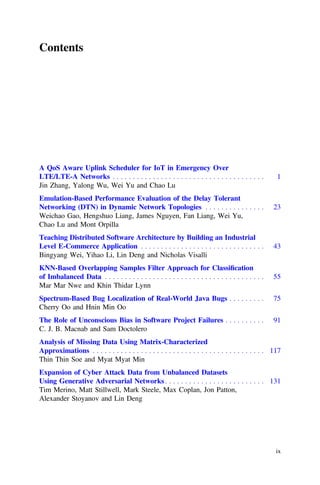
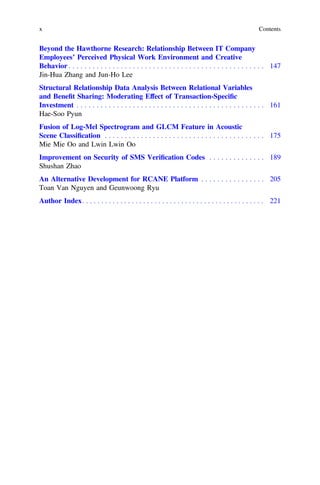

![2 J. Zhang et al.
Keywords IoT · Uplink scheduling · QoS aware · LTE networks · Bandwidth
distribution · Performance evaluation · Emergency
1 Introduction
The Internet of Things (IoT) is a promising technology which aims to connect the
global world via numerous smart sensors and actuating devices [1–4]. IoT devices are
deployed to support a variety of smart-world systems including smart home, smart
healthcare, smart transportation, smart grid, smart manufacturing, and smart agri-
culture, among others [5–15]. The network connection of IoT can be wired through
Ethernet cable or wireless through Bluetooth, ZigBee, Wi-Fi, or a cellular network
such as Long-Term Evolution (LTE), LTE Advanced (LTE-A), or the fifth genera-
tion (5G) of mobile communication [16, 17]. Due to the capability of supporting
complex territory, wireless networks, specifically LTE/LTE-A networks, become the
common infrastructure for IoT. Nonetheless, with the rapidly increasing number of
IoT devices around the world (forecast to reach 20.35 billion by 2019 [18]), the
shortage of bandwidth resource proves to be a challenging issue in a LTE/LTE-A
IoT network. To address the problem, a number of network resource allocations and
scheduling schemes have been proposed [19–21]. The 3rd Generation Partnership
Project (3GPP) also integrates high frequency transmission and mini-slot into 5G new
radio standard to overcome the gap between bandwidth shortage and the explosive
growth of IoT devices.
Nonetheless, some IoT applications have not been fully considered in these solu-
tions. For instance, IoT devices could generate a large bulk of data within a short time
period depending on applications, including emergency, failure detection, response,
and others [22]. The amount of data goes far beyond the capacity of bandwidth,
leading to the rapid deterioration of data transmission performance with respect to
throughput, packet loss ratio (PLR), and packet delay, especially of those transmis-
sions sending from IoT devices that deal with emergency and failure detection and
response. Given the importance of such information, it calls for designing mecha-
nisms to effective data transmission from those IoT devices in LTE/LTE-A networks.
In this paper, we made the following contributions.
• We propose a quality of service (QoS)-aware Normal Round Robin uplink traffic
scheduling (QNRR-US) scheme to handle data traffic from IoT devices that require
urgent treatment in the LTE/LTE-A network. The requirement of QoS in LTE is
recorded by QoS Class Identifier (QCI). The QoS-based scheduler in eNodeB
(eNB) allocates bandwidth resource according to QCI value. QNRR-US creates a
new critical emergency IoT data type with a higher priority level than normal data
types in a QCI table. Generally speaking, QNRR-US grants a minimum data rate
to IoT devices (called UEs in LTE/LTE-A) on the sequence of their priority. When
a data rate requested by IoT devices exceeds channel capacity, the data traffic with
low priority will be dropped. Thus, the IoT devices with high priority data obtain](https://image.slidesharecdn.com/58630-250307095214-b0155735/85/Software-Engineering-Research-Management-and-Applications-Roger-Lee-19-320.jpg)
![A QoS Aware Uplink Scheduler for IoT in Emergency … 3
more bandwidth to transmit data. Furthermore, considering fairness, QNRR-US
reserves a limited amount of resource to IoT devices with lower priority data traffic.
• Considering that enormous IoT devices (which have the same priority) may report
urgentdataatthesametime,thedatatrafficisstillbeyondthecapacityofbandwidth
after dropping lower priority data traffic as QNRR-US does. To address this issue,
we propose the QoS aware Bound Round Robin uplink traffic scheduling (QBRR-
US) scheme, which is enhanced by QNRR-US. The core of QBRR-US is to adopt
the Bound Round Robin (BRR) algorithm and add priority into scheduling as
QNRR-US does. BRR algorithm separates emergency IoT devices with service
and waiting states, then pushes them in service and waiting queues. IoT devices
in service queue are allocated resources until all available resources have run out.
Those emergency IoT devices in a waiting queue have to wait until IoT devices
in a service queue have sent out their emergency information and dequeue from
the service queue. Then, the devices in the waiting queue have an opportunity to
enter service queue and join the BRR resource allocation process.
• To validate the effectiveness of QBRR-US, we design a simulation experiment
using NS-3 [23], which is an open source and widely used simulation platform
in networking research and education. It allows the designer to create and config-
ure network nodes, network channels, network devices, and network applications
separately. Thus, it provides ways to simulate the IoT application and infrastruc-
ture. Particularly, NS-3 includes sophisticated LTE/LTE-A network modules and
corresponding modules for network performance data collection, which benefits
us to build our simulation IoT network based on LTE/LTE-A. Our evaluated IoT
network consists of one eNB and a number of UEs as IoT devices, which are ran-
domly deployed on the communication coverage area of eNB. Due to collecting
data from IoT devices in main task in IoT networks, we mainly evaluate the uplink
transmissions from IoT devices to eNB. The first part of our experiment evaluated
the performance of an IoT network with increasing bandwidth and raising IoT
devices which are in emergency state. The results demonstrate that IoT uplink
performance deteriorates rapidly along the increasing of emergency IoT devices.
In second part, we implement the three uplink transmission scenarios using tra-
ditional proportional fair (PF) scheduler [24], QNRR-US, and QBRR-US that we
proposed. The simulation results show that our QBRR-US outperforms the other
two baseline uplink schedulers with respect to the throughput, PLR, and packet
delay of emergency traffic.
The remainder of this paper is organized as follows: In Sect.2, we conduct a
literature review. In Sect.3, we introduce a system model and an existing uplink
scheduler over LTE/LTE-A. In Sect.4, we present our proposed QNRR-US and
QBRR-US scheduling schemes. In Sect.5, we introduce the experimental design and
configuration and analyze the experimental results of QBRR-US and two baseline
schedulers with respect to a set of performance metrics. In Sect.6, we conclude the
paper and give final remarks.](https://image.slidesharecdn.com/58630-250307095214-b0155735/85/Software-Engineering-Research-Management-and-Applications-Roger-Lee-20-320.jpg)
![4 J. Zhang et al.
2 Related Works
In view of expanding connected IoT devices and limited network resources, resource
allocation and scheduling play a significant role in IoT networks performance. Con-
sidering most data transmission in IoT is from end-users, a body of research efforts
have been investigated on uplink scheduling for IoT applications [8, 11, 25–36].
Existing uplink scheduling schemes focus on diverse perspectives including specific
IoT applications, heterogeneous networks, and new features introduced in 5G.
There have been a number of research efforts devoted to improve uplink schedul-
ing for specific applications or network structure [26, 30, 31, 34, 35]. For example,
Wang et al. [32] proposed a scheduling algorithm for a camera surveillance system
in cellular networks to meet the coverage requirement by minimizing the number of
allocated RBs to each camera. Amarasekara et al. [35] designed two schedulers for
smart grid periodic and emergency situations as well as introduced random delay for
smart meter packet flows to ensure the data transmission in an emergency.
Regarding resource management and performance assessment on IoT networks,
there have been a number of existing efforts [21, 26, 31, 33, 37]. For example,
Ghavimi et al. [26] designed a scheduling algorithm based on a group-based M2M
communication, whichcluster M2Mdevices accordingtonot onlytheir QoSfeatures,
but also network transmission protocol. Also, the network throughput is optimized
via the Lagrange duality theory on resource allocation. Carlesso et al. and He et al.
presented scheduling algorithms for networks where smart grid and human to human
(H2H) coexist [31, 33]. Specifically, Carlesso et al. [31] proposed a scheduling pol-
icy for the co-existing network of smart grid and real-time application. The policy
reduced negative impact of smart grid periodic traffics on real-time traffic through
scheduling RBs based on the combined characteristics of smart grid traffic, includ-
ing channel quality, and traffic priority, etc. He et al. in [33] formulated the uplink
resource allocation problem to the sum-throughput optimization problem for a M2M
and H2H co-existence network, then solved the optimization problem by using the
Lagrange dual algorithm.
Related to the development of 5G, some research efforts have been conducted to
design uplink scheduling algorithms involving new features (such as transmission
repetition) of 5G. For example, Yu et al. [28] proposed an uplink link adaption scheme
involving transmission repetition. An inner loop link adaption in this scheme is used
to reduce block error ratio by adjusting repetition number while an outer loop link
adaption is applied to coordinate Modulation and Coding Scheme (MCS) value and
repetition number. Also, Liu et al. [29] developed a quality-of-control-driven uplink
scheduler to guarantee the stability of a control loop in 5G networks by handling the
control loop as a network application.
Unlike existing research efforts, in this paper we propose QBRR-US, a QoS-
aware uplink scheduler, for IoT in emergency situation in which a large burst of data
is generated within a short interval. The objective of QBRR-US is not to optimize
the whole network throughput like some researches have done. QBRR-US attempts](https://image.slidesharecdn.com/58630-250307095214-b0155735/85/Software-Engineering-Research-Management-and-Applications-Roger-Lee-21-320.jpg)
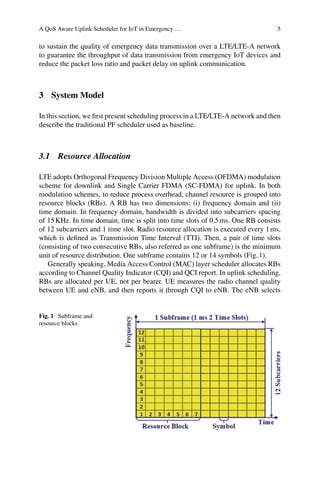
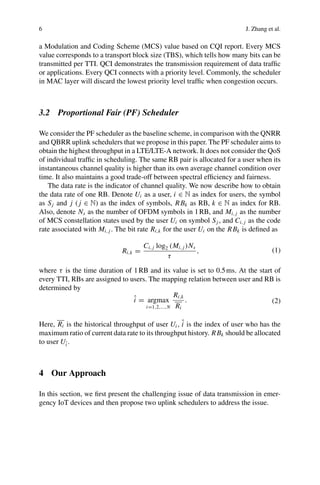
![A QoS Aware Uplink Scheduler for IoT in Emergency … 7
4.1 Problem Statement
Generally speaking, the IoT network consists of a connected massive number of
low-power devices that send small volumes of data traffic. In some situations, such
as emergency, or failure detection and recovery, IoT devices could generate a large
amount of data within a short period of time. For example, phasor measurement
unit (PMU) in the smart grid reports measurements in low frequency from 10 to 60
samples per second in normal cases. When an emergency occurs, the report rate could
reach 15,000 samples per second [38]. The data pattern of PMU in an emergency
can be represented in Fig.2.
IoT devices generate bulk data when an emergency occurs. Numerous emergency
IoT devices request connection approximately at the same time. In LTE/LTE-A, these
connection request means to activate large amount of random access procedure (used
by UEs to initiate connection with eNB in LTE/LTE-A), which results into heavy
control signal collision. Furthermore, the shortage of bandwidth prevents a number
of IoT devices from being granted resources in a timely manner. They have to hold the
data and wait for resources in future TTI. In view of the characteristics of IoT devices
(e.g., normally it is low cost and transmits small data load), emergency IoT devices
have limited ability to store data, the emergency data or fragment of them could be
lost before the emergency IoT device has opportunity to send it out. Nonetheless, the
integrity and timeliness of emergency data is crucial in emergency process. Main-
taining a quality and stable communication from emergency IoT devices to eNB
is more critical than getting a high overall throughput when an emergency situation
occurs. In summary, there are two key issues for IoT in an emergency, one is resource
shortage and the other is the integration of data.
For the first issue, increasing bandwidth is an obvious solution. Nonetheless,
given that an IoT device usually supports limited uplink bandwidth, raising uplink
bandwidth makes a limited improvement on bandwidth shortage for emergency data
traffic. Reasonable resource allocation is more efficient for increasing emergency
data traffic and reducing the packet loss rate. In this paper, our QNRR-US introduces
QoS into resource scheduling, and attaches a higher priority for emergency data than
normal IoT data. The resource allocation based on QoS means that high priority
emergency data traffic can preempt more resource from low priority data flow when
the channel resource is not sufficient for data transmission. Our designed QBRR-US
is a QoS concerned scheduler as QNRR-US. Different from QNRR-US, QBRR-
US builds a particular scheduling queue based on priority. QBRR-US confines the
Fig. 2 Emergency data
pattern](https://image.slidesharecdn.com/58630-250307095214-b0155735/85/Software-Engineering-Research-Management-and-Applications-Roger-Lee-24-320.jpg)
![8 J. Zhang et al.
numberofemergencyIoTdevicescompetingforresourcethroughthemanagementof
queue. Only partial emergency IoT devices take part into the resource allocation every
TTI. Furthermore, for those emergency IoT devices who get transmission resource,
QBRR-US adopts non-preemptive policy. Once an emergency device starts data
transmission, it is entitled to send whole bulk emergency data generated. QBRR-US
alleviates the transmission conflicts through reducing the connected emergency link
at the same time. Moreover, the non-preemptive policy ensures the bulk emergency
data will be sent with minimal delay.
4.2 QNRR Uplink Scheduler
QNRR uplink scheduler (QNRR-US) aims to promote the transmission performance
of emergency information. Considering the different levels of importance for emer-
gency IoT data and normal IoT data, QNRR-US introduces a QoS requirement into
resource processing. It attaches a higher priority to emergency data type than normal
data in QoS and records it into QCI table. QCI is a mechanism that 3GPP released in
LTE/LTE-A standard to ensure appropriate QoS for every bearer traffic [39]. A QCI
index has four main properties: resource type, priority level, packet delay budget, and
packet loss rate. The scheduler can determine the volume of resources and allocation
order for bearers based on their QCI. To support the emergency communication,
3GPP has successively added new QCI indexes for emergency situations including
QCI index 65 for Mission Critical-push-to-talk (MCPTT) voice, and index 69 for
MCPTT signaling in release 12. QNRR-US adds an emergency IoT data type with
high priority. We set the emergency property just below QCI index 65 and 69, which
is usually used for public safety or first response. The high priority of emergency IoT
data means that it is allowed to preempt the RBs from almost all data types except
the type of QCI index 65 and 69 for emergency IoT data traffic.
After locating the priority level of emergency data, QNRR-US processes and
forwards data traffic based on their priorities. For the normal situation, when the
data traffic from all flows do not reach the capacity of bandwidth, QNRR-US acts as
traditional QoS-aware uplink scheduler. There are three steps in scheduling for all
IoT devices which request connection: (i) allocating the minimum data rate for all
devices on the sequence of data traffic priority, (ii) allocating the remaining resource
for the UE that currently has the highest priority, (iii) if there is still resource left, go
run step (ii) for the next highest priority UE, till all RBs are assigned.
Once an emergency occurs, the data generated from emergency IoT devices usu-
ally overwhelms the capacity of bandwidth. In this situation, QNRR-US still dis-
tributes the resource on priority order of data traffic as step (i), but no step (ii) and
(iii) since eNB has not enough resource for all devices. Then, next TTI, step (i) is
repeated. All emergency devices have the same priority, eNB adopts round robin](https://image.slidesharecdn.com/58630-250307095214-b0155735/85/Software-Engineering-Research-Management-and-Applications-Roger-Lee-25-320.jpg)
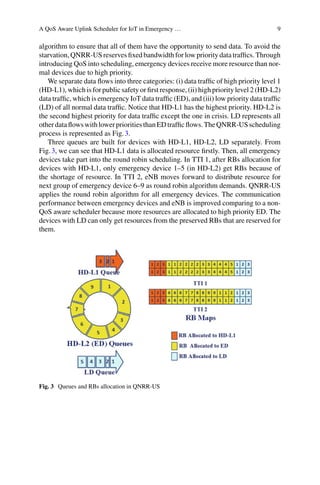
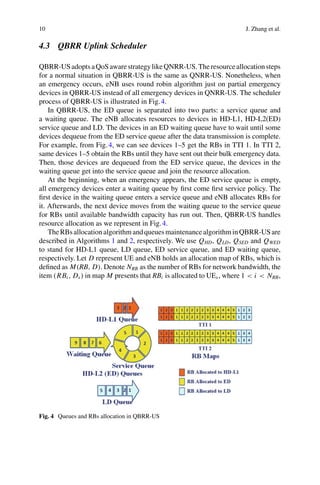
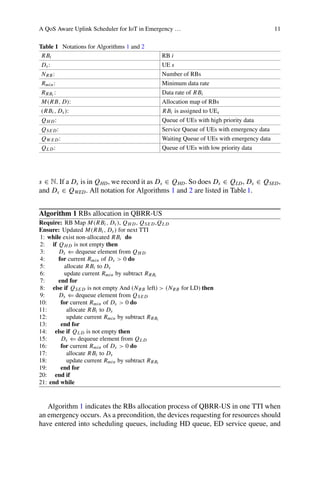
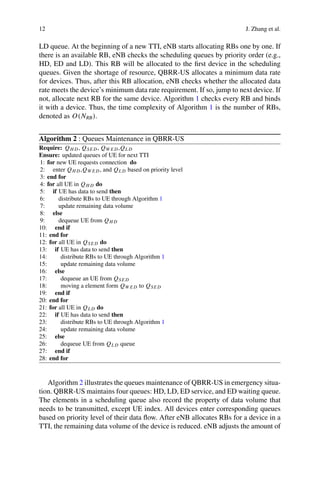
![14 J. Zhang et al.
It is defined as the number of bits per second (bps) that eNB receives from those
devices that report emergency information. As uploading is the main process of IoT
applications, we evaluate the uplink performance of LTE/LTE-A network. The de-
vices in an emergency send out a burst of data packets to eNB within a short period
of time. This metric demonstrates the volume of data that eNB receives from emer-
gency devices in unit time on the PDCP layer. (ii) Packet Loss Ratio. It is the ratio
between the actual received data bytes of eNB and total transmitted data bytes sent
from IoT device per second. It is also collected from the PDCP layer. (iii) Delay. It
is measured as the average transmitting time of packets from IoT devices to eNB.
Delay is collected from the PDCP layer, which means that every delay value is the
time interval starting from the moment when a packet is sent out from the device’s
PDCP layer to the moment when the eNB’s PDCP layer receives the packet.
5.3 Network Infrastructure and Parameters
In the following, we describe the network structure and configuration details in our
experiment. The simulation in our paper focuses on the wireless communication,
the Evolved Universal Terrestrial Radio Access (E-UTRA) section in LTE. E-UTRA
consists of eNBs and UEs. We build a single cell wireless network in NS-3. NS-3 is an
open source network platform for research and education [23]. It provides a delicate
LTE module and the trace methods to simulate the LTE network and measure the
network performance. It allows the designer to create node, protocol, and application
separately. The flexibility of NS-3 assists researchers to build complicated networks
as they require.
In our experiment, we position a macro cell (also called eNB in LTE) and all
UEs dispersed around it following the uniform distribution within its coverage. For
the three scenarios we described, we set 1/6 UEs as emergency IoT devices that
generate large amounts of emergency data. Other UEs remain in normal situations
with lower priority and periodic data generated. We ignored the data traffic of HD-L1
in the experiment setting because this type of data has no impact on our scheduling
performance evaluation. HD-L1 data traffic gets the same volume of resources in
QNRR and QBRR scenarios all the time. While in PF scenario, all UEs are processed
insamewaynomatterwhattype.AllparametersofourIoTsimulationoverLTE/LTE-
A network in NS-3 are listed as Table2.
Data Pattern. We adopt the profile of data load from a phasor measurement unit
(PMU) in the smart grid as a data pattern [40], which is an example for demonstrating
our approaches. The smart grid belongs to critical energy IoT systems. PMU is a
smart device used to measure AC waveforms (voltages and currents) on a electricity
grid. It reports the measurement results periodically. The reporting rate depends on
actual applications. Commonly speaking, the range of the reporting rate is from 10
samples to 120 samples per second in a smart grid [40]. We choose PMU reporting
rate as 48 samples per second for normal situation. In emergency situation, PMU
generates approximate 5000–15,000 samples per second [38]. We set the reporting](https://image.slidesharecdn.com/58630-250307095214-b0155735/85/Software-Engineering-Research-Management-and-Applications-Roger-Lee-31-320.jpg)
![A QoS Aware Uplink Scheduler for IoT in Emergency … 15
Table 2 NS-3 simulation parameters
Parameter Value
UE Tx Power 23dBm
UE Height 1m
UE category CAT-0
eNB Tx Power 46dBm
eNB Height 30m
eNB Sensitivity Level −93.5dBm
UlEarfcn 18,100
Uplink Central Band Frequency 1930.0MHz
DlEarfcn 100
Downlink Central Band Frequency 2120.0MHz
Antennas SISOa
Uplink Data Rate 1Mbps
Propagation Loss Module COST231
Transport Layer Protocol UDPb
Uplink Bandwidth (MHz) 1.4, 3, 5, 10, 15, 20
Number of Uplink Resource Block 6, 15, 25, 50, 75, 100
Simulation Time 30s
aSingle Input Single Output (SISO)
bUser Datagram Protocol (UDP)
rate as 7000–7500 samples per second to simulate emergency situation. One PMU
sample is a packet of 38bytes. Then, the total sampling data rate of an emergency
UE is above 7000 sample×38bytes = 2.128Mbps to 7500 sample×38bytes, which
equals to 2.28Mbps.
Network Environment. We position all UEs in eNB coverage on suburban envi-
ronments. The coverage distance is determined by power of transmitter, sensitivity of
receiver, and transmission environment. First, the uplink transmitter should be UEs.
We adopted CAT-0 category on the UE end, which is a new UE category designed
for IoT and M2M networks in LTE release 12. According to 3GPP TS 36.101, its
transmission power was set to 23dBm. Second, from the 3GPP standard TS36.104
for LTE, the eNB reception radio sensitivity level was −98.8dBm for 1.4MHz,
−95dBm for 3MHz, −93.5dBm for the other 5, 10, 15, and 20MHz bandwidths
[41]. We consider −93.5dBm as the eNB radio sensitivity level to guarantee the
quality on all bandwidth. At last, we assumed the wireless network was located in a
suburban environment. NS-3 provided propagation loss model COST231 to mimic
suburban environment.
According to the settings of UE’s power, eNB’s sensitivity level, and propagation
model above, the transmission coverage for suburban environment in our experiment
should be 327m. We set it as 300m to rule out the impact of radio attenuation on
simulation results.](https://image.slidesharecdn.com/58630-250307095214-b0155735/85/Software-Engineering-Research-Management-and-Applications-Roger-Lee-32-320.jpg)
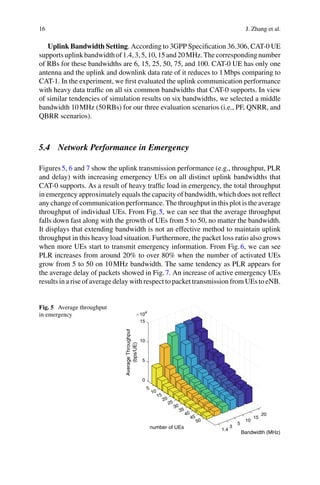

![(Esce un Segretario o Bidello o altro magnariso qualunque, a scelta del capo
comico).
[1019] Nota marginale del Manzoni: «Accennare qui più
distintamente le circostanze in cui si trovava il Duca alla morte di
suo padre».
SCENA V.
[corrispondente alla sc. III della stampa].](https://image.slidesharecdn.com/58630-250307095214-b0155735/85/Software-Engineering-Research-Management-and-Applications-Roger-Lee-35-320.jpg)
![E strette affini sue, che gli varrebbe?
A farlo infame e obbrobrioso, al segno
In cui non puote un re tenersi in trono
S’ogni uomo in forza ed in valor non passa
Come in perfidia e in crudeltà! Speranza
Di riaverle per accordo, è sogno;
Chè il Duca è tal che non compensa mai
Con beneficj nuovi ingiurie antiche,
Nè mai dal far vendetta altro il ritenne
Che il non poter: quindi a colui che fatto
Gli sia nemico, un sol partito è buono:
Esserlo a morte.—Nè per questo il Conte
Vedovo tiensi; nè ogni speme ei lascia
Di conquistare i suoi, ma in noi la fonda.
Tôrgli tai pegni, collo Stato insieme,
Coll’armi nostre ei si confida; o trarlo
A tale estremo, ch’ei li renda almeno.
Ciò che quindi potea farcel sospetto,
A noi più ligio e più devoto il rende.
MARINO.
Poichè sì certo è di quest’uomo il Doge
.......
SCENA VI.
[corrispondente alla sc. V della stampa, dacchè nell’abbozzo manca
una scena che corrisponda alla IV, a quella cioè del monologo del
conte].](https://image.slidesharecdn.com/58630-250307095214-b0155735/85/Software-Engineering-Research-Management-and-Applications-Roger-Lee-37-320.jpg)
![IL CONTE.
Anco il Doge hai tu detto?
MARCO.
Il Doge, e quanto
Ha di più illustre la città, s’aduna
Or nel Palazzo ad aspettarti; e vuole
Fino alla riva accompagnarti, in pieno
Corteggio.
IL CONTE.
Il premio che precorre all’opra
È incitamento a meritarlo; e spero
A questa alma tua patria offrir ben presto
Più che la mia riconoscenza. Or tutta
Abbila tu, ch’io qui ti vegga: acerbo
M’era il partir, se alla sfuggita, e tra la
Folla dei salutanti, oggi io doveva
Cercar lo sguardo dell’amico.
MARCO.
Pensa
S’io lascerei che tu partissi, senza
Darti un più speciale intimo addio.
Va, vinci, e torna. Oh come atteso e caro
Verrà quel nuncio, che la gloria tua
Con la salvezza della patria arrechi![1020]
IL CONTE.
Marco, ad impresa io non m’accinsi mai
Con maggior cor che a questa. È giunto il tempo
Che quell’ingrato, che da’ miei servigj
Estimarmi non seppe, or dal travaglio
Che gli darò m’estimi; e finalmente](https://image.slidesharecdn.com/58630-250307095214-b0155735/85/Software-Engineering-Research-Management-and-Applications-Roger-Lee-38-320.jpg)
![Esserlo, e tutto, e correr sempre, il primo
Tra i figli suoi, s’ella gli chiami all’arme,
Per guardar la santissima quiete
Che a lei senno e giustizia han partorita;
E se la spada mi perdona, e s’io,
Cresciuto in campo di battaglia, gli occhi
Non chiuderò sul campo, in questa sede
Chiudergli, fra i congiunti e fra gli amici,
Qualche desìo lasciando e qualche nome.
..............
A questa scena, che nell’abbozzo era anche indicata come 1ª dell’atto II,
seguivano una 2ª ed una 3ª, delle quali non v’ha traccia nella stampa, e che noi
riproduciamo qui sotto.
[1020] Nella stampa, con questi ultimi tre versi, di poco variati,
finisce l’Atto I.
Atto II.
SCENA II.
Via con molto popolo.
Due CITTADINI.](https://image.slidesharecdn.com/58630-250307095214-b0155735/85/Software-Engineering-Research-Management-and-Applications-Roger-Lee-40-320.jpg)
![LORENZO.
Fratello, io giungo tardi; a quel ch’io veggio,
Qui s’è già fatto assai.
MICHELETTO.
Prode Lorenzo,
Oggi appunto di te mi chiese il Conte.
Non dubitar, tu vieni a tempo; il meglio
Riman da farsi.
LORENZO.
Io non avrei creduto,
Poi che Brescia fu presa, e poi che il Duca
Con tanta istanza domandò la pace
(E parea averne gran bisogno invero),
Che a nova guerra si verria sì tosto.
MICHELETTO.
Tu conosci Filippo. A piè d’un trono
Il fè nascer fortuna; a piè d’un trono,
Di cui nè un grado egli avria mai salito
Da sè. Fortuna, che il volea pur duca,
Gli diede un uom che per la mano il prese,
E in trono il pose. Or ei vi siede, e starvi
È risoluto ad ogni costo: appena
Sotto di sè crollar lo sente, ei cala
Tosto agli accordi: il rischio passa, e pargli
Che fermo ei sia, come ingrandirlo ei pensa.
Brescia ei diè per la pace: ai Milanesi
Parve il trattato obbrobrioso; ed era:
Armi in fretta gli offriro: ira e vergogna
Valsero al buon voler; quindi agli antichi
Disegni ei torna[1021]; eccolo in campo.](https://image.slidesharecdn.com/58630-250307095214-b0155735/85/Software-Engineering-Research-Management-and-Applications-Roger-Lee-46-320.jpg)
![LORENZO.
E mai
Ai nostri dì, se mi fu detto il vero,
Due sì gran campi non fur visti a fronte.[1022]
MICHELETTO.
È il vero.
LORENZO.
E voi foste a giornata intanto
Più d’una volta.
MICHELETTO.
È ver, ma niuna è tale
Che una maggior non se ne aspetti; e questa
Non può tardar: nè passa dì che il Conte
Non provochi il nemico. Or, come vedi,
Da noi Maclodio è stretto; e due partiti
Gli rimangono soli: o noi cacciarne,
E non fia lieve; o abbandonar la terra,
E Cremona con essa: e saria questo
Non men onta che danno.[1023]
LORENZO.
Il Duca, udii,
Partì dal campo: e chi lasciovvi capo?
MICHELETTO.
Il Pergola, il Torello, il Piccinino,[1024]
Francesco Sforza.
LORENZO.
Egli non è guerriero,
Ma sa sceglierli almen: due volpi antiche](https://image.slidesharecdn.com/58630-250307095214-b0155735/85/Software-Engineering-Research-Management-and-Applications-Roger-Lee-47-320.jpg)
![Che Fabio vinse con gl indugj e seppe
Evitar le giornate, e che Scipione
Portò la guerra in Africa piuttosto
Che difender l’Italia, od altrettali
Sciocche novelle. Allor che poi le trombe
Fan la chiamata, e che si monta in sella,
Il più munito, il più riposto loco
Devi trovar per essi; ed ivi stanno,
Finchè guizza nell’aria un brando ignudo,
Incantucciati ad aspettar l’evento.
Alfin tu siedi, se pur siedi; e stanco,
Anelante, sudante e polveroso,
Devi a lor presentarti, a render conto.
Sei vincitor? Lieti li vedi, e presti
A côrre il frutto delle tue fatiche;
Ma se vinto ritorni, in quel momento,
In cui solo vorresti a tuo bell’agio
Maledir la fortuna, in cui la molle
Parola di conforto anco ti annoja
Sul labbro dell’amico, onte e rimbrotti
Ingozzar ti bisogna, e far tua scusa,
Mentre innanzi e’ ti stan col sopracciglio
Con che sgridar son usi il siniscalco
Che a voglia lor non ordinò il convito.
Ci nomano lor genti, e come tali
Ci trattano a un bisogno; e van dicendo:
Non son essi pagati? E quando l’oro
Cambian col nostro sangue, ei fanno stima
Dare assai più che non ricevon.
MICHELETTO.
Odi
Strepito di tamburi? è questi il Conte;
Dànno le trombe il segno.
[1021] Cfr. «Adelchi», III, 1ª: «Torna agli antichi Disegni il
re?».](https://image.slidesharecdn.com/58630-250307095214-b0155735/85/Software-Engineering-Research-Management-and-Applications-Roger-Lee-50-320.jpg)
![[1022] Ora, atto II, sc. 1ª, dice il Pergola: «Italia forse Mai da’
barbari in poi non vide a fronte Due sì possenti eserciti».
[1023] Cfr. ora atto II, scena 1ª:
MALATESTI.
....Voi lo vedete; il Carmagnola
Ci provoca ogni dì: quasi ad insulto
Sugli occhi nostri alfin Maclodio ha stretto:
E due partiti ci rimangon soli:
O lui cacciarne, o abbandonar la terra,
Che saria danno e scorno.
[1024] Cfr. ora la nota f), a pag. 169 e 177.
SCENA II.
IL CONTE, e detti.](https://image.slidesharecdn.com/58630-250307095214-b0155735/85/Software-Engineering-Research-Management-and-Applications-Roger-Lee-51-320.jpg)
![LORENZO.
CONTE.
Carlo Malatesti: un nome
Di lieto augurio.[1025] E a noi....s’aspetta
Torglielo, e farne più famoso il nostro.
Lorenzo, ov’è la vostra gente?
LORENZO.
È posta
All’entrata del campo; ivi ordinai
Ch’uom di sua schiera non uscisse, in fino
Che a voi piacesse di vederli.
CONTE.
Andiamo.
[1025] Variante marginale:
Di lieto augurio: sovverravvi forse
Che il portava colui cui Brescia io tolsi.
Coro dell’Atto II.
La sola strofa che nel manoscritto resti diversa, è la penultima:
Stolto anch’esso! Un più forte di lui
Gli domanda il rapito retaggio.
Stolto! ei venne sui campi non sui,
Senza gloria, non pianto, a perir.
E s’ei vive, e nell’empio viäggio
Lieto sempre e felice si mira,
Non lo segue, non veglia quell’ira,
Che l’attende all’estremo sospir?](https://image.slidesharecdn.com/58630-250307095214-b0155735/85/Software-Engineering-Research-Management-and-Applications-Roger-Lee-53-320.jpg)

![LETTRE A M. C***
SUR L’UNITÉ DE TEMPS ET DE LIEU
DANS LA TRAGÉDIE.
AVVERTENZA
La Lettera seguente non fu, la prima volta, pubblicata dal
Manzoni; bensì dal Fauriel, insieme con la traduzione francese delle
due tragedie, a Parigi, nei primi mesi del 1823.[1026] Fu ristampata
varie volte, e da varii, in Italia (p. es. in fondo al volume «Tragedie
ed altre poesie di A. M. milanese, con l’aggiunta di alcune prose sue
e di altri, ediz. 2ª fiorentina;[1027] Firenze, tip. all’insegna di Dante,
1827»; e nell’altra: «Opere di A. M. in versi e in prosa; Firenze,
Passigli, 1836»); e finalmente dal Manzoni medesimo tra le Opere
varie, nel 1845. Non vi fece alcun ritocco.
Fu scritta durante la lunga dimora, che fu anche l’ultima, fatta dal
poeta con la sua famiglia—i figliuoli sommavano già a cinque, e
l’ultimo, Enrico, era nato poco prima, nel giugno del 1819, e pendeva
dal seno materno—a Parigi. Eran partiti da Milano il 14 settembre del
1819, per la via di Torino, col proposito di traversare la Svizzera; ma,
dopo un sol giorno di sosta a Torino, «trovando che sarebbe stata
cosa troppo grave il viaggiare con una famiglia tanto numerosa e
con bambini tanto piccoli», proseguirono per la più corta. Rimasero
nella tanto sospirata, e ricca per essi di tanti cari e diversi ricordi,
metropoli francese, otto mesi; e, scriveva a una sua cugina l’amabile
signora Enrichetta, «in questo intervallo di tempo abbiamo avuto il
dolore di vedere la salute di mio marito non vantaggiarsi in alcun
modo». Da qualche anno, a Milano, il Manzoni era afflitto da una
grave malattia di nervi; e «noi», soggiungeva l’Enrichetta, «avevamo
sperato che il mutamento d’aria e un po’ di distrazione avrebbero](https://image.slidesharecdn.com/58630-250307095214-b0155735/85/Software-Engineering-Research-Management-and-Applications-Roger-Lee-55-320.jpg)
![contribuito alla sua guarigione». Invece, a Parigi, le cose non eran
punto migliorate: «egli ebbe in quella città una malattia assai lunga,
che ci tenne molto inquieti:... fu malato per quaranta giorni;... e
finalmente,... appena si trovò in condizione d’intraprenderlo, ci
rimettemmo in viaggio, per tornare in casa nostra». Viaggiarono a
piccole giornate, per non affaticare il convalescente; e l’8 agosto
1820, «nel maggior caldo», giunsero a Brusuglio: «ma noi
sopportavamo con piacere ogni disagio, nel desiderio di poterci
ritrovare di nuovo tranquillamente in casa nostra»[1028].
La Lettre à m. Chauvet rimase manoscritta nelle mani dell’amico
insigne, al quale la prima, e fin allora unica tragedia, era dedicata. Il
Manzoni, rimpatriato, gliene domanda conto, con quel garbo
signorile ed amabile che gli era abituale, in una lettera da Milano, 17
ottobre 1820:](https://image.slidesharecdn.com/58630-250307095214-b0155735/85/Software-Engineering-Research-Management-and-Applications-Roger-Lee-56-320.jpg)
![«J’ai honte de vous parler encore de mon fameux coup de lance contre M.
Chauvet, mai je n’en fais ici mention que pour vous dire que dans le cas très
probable, que vous jugiez que la publication si tardive de ce pauvre factum ne
fût plus convenable, et que venant si long-tems après l’attaque elle n’eût tout-
à-fait l’air d’être le produit d’une mémoire d’auteur et d’une rancune vraiment
italienne, dans ce cas, dis-je, ne croyez pas me faire la plus petite peine en la
supprimant; mais si vous persistez dans la résolution de la livrer à
l’empressement du public, il vaudrait peut-être mieux la publier séparément,
d’abord pour ne pas retarder encore ou pour ne pas trop vous presser dans
votre travail sur le romantique, et pour beaucoup d’autres raisons dont je
vous épargne l’ennuyeuse énumération».[1029]
Nel poscritto poi d’un’altra lettera, pur da Milano, il 29 gennaio
1821, ripigliava (pag. 323):
«J’oubliais de vous dire encore de ne plus parler de ce petit avorton de
lettre à M. Chauvet. Si une bonne occasion se présentait, vous me feriez bien
plaisir de m’envoyer, à votre choix, ou la copie ou mon barbouillage, pour le
communiquer à Visconti et à quelques autres amis».
E in principio di un’altra, che parrebbe scritta alla fine del febbraio
di quell’anno, ripete ancora (pag. 323):
«Pour ma guerre avec M. Chauvet, n’y pensez plus absolument; il n’y a plus
ni spectateurs, ni combattants, le champ de bataille même a presque disparu.
Sérieusement, je vous prie de n’y plus songer».
Finalmente il Fauriel si fece vivo, e mandò all’amico una copia di
quella sua scrittura, qua e là ritoccata, e con l’assicurazione che un
giorno o l’altro, forse non molto lontano, sarebbe stata stampata. E il
Manzoni, il 3 novembre 1821 (pag. 330):
«J’oubliais de vous remercier de la copie que vous avez bien voulu faire tirer
et m’envoyer de la lettre à M. C..... A-t-elle paru? Et que va-t-elle devenir à la
veille, et surtout dans le plein jour de la superbe session qui va s’ouvrir? Qui
vaudra de la littérature à présent?... Ne m’oubliez pas auprès de Cousin».
Ma ripigliava subito, a buon conto, in un poscritto:](https://image.slidesharecdn.com/58630-250307095214-b0155735/85/Software-Engineering-Research-Management-and-Applications-Roger-Lee-57-320.jpg)

![risolutamente le istintive sue simpatie pei suoi insigni ministri. A qual
sorte, dunque, andava incontro quell’onesto Ministero, sbattuto tra le
ambizioni irrompenti dei realisti arrabbiati e i risentimenti
appassionati dei liberali, tra le pretese della Destra che avrebbe
voluto «il re senza la carta» e quelle della Sinistra che avrebbe
voluto «la carta senza il re»? L’apertura della nuova sessione era,
quando il Manzoni scriveva, imminente, e la Destra con le armi al
piede, impaziente di dar battaglia.
Victor Cousin, quegli appunto a cui il Manzoni voleva esser
ricordato, ha narrato d’una scena, svoltasi proprio di quei giorni in
casa sua. V’eran raccolti, col Royer-Collard, già maestro e
predecessore del Cousin, parecchi degli amici del Centro, e
discutevan della condotta da tenere alla Camera. Conveniva meglio
lasciar in vita il ministero Richelieu-Pasquier-De Serre, ovvero
sgomberare la strada a un ministero De Villèle-Corbière, di pura
Destra? Meglio, si tendeva a concludere, attenersi a quest’ultimo
partito: i reazionarii, con le loro esagerazioni, non avrebbero potuto
rimanere in piedi nemmeno sei mesi, e i liberali avrebbero allora
potuto prendere una rivincita sicura, e formare uno schietto
ministero liberale, senza magagne e senza compromessi. Assisteva
alla conversazione un esiliato piemontese, Santorre di Santa-Rosa,
una delle vittime dell’ultima rivoluzione di Torino. Il quale, accorato,
si permise di osservare al Cousin: «Il vostro dovere di buoni cittadini
è di non combattere un ministero, ch’è l’ultima vostra risorsa contro
la fazione nemica d’ogni progresso. Non è permesso di fare il male
nella speranza del bene. Voi non siete punto sicuri di rovesciare più
tardi Corbière e De Villèle, ma siete invece sicuri di far il male,
permettendo che essi giungano al potere. S’io fossi deputato, farei
ogni sforzo per ringagliardire il ministero Richelieu contro la Corte e
la Destra». In cuor loro tutte quelle brave persone riconoscevan la
ragionevolezza di codeste osservazioni, ma, nel fatto, preferirono
una tattica che pareva abilissima.[1030] Solite illusioni dei
galantuomini, quando, maldestri come sono alle male arti,
sventuratamente si risolvono a prendere in prestito i metodi dei furbi
senza scrupolo!](https://image.slidesharecdn.com/58630-250307095214-b0155735/85/Software-Engineering-Research-Management-and-Applications-Roger-Lee-59-320.jpg)
![Il Manzoni riscrisse al Fauriel il 6 marzo del 1822. La catastrofe era
avvenuta, e forse già tutte le illusioni dissipate. Il 14 dicembre 1821,
il ministero liberale era stato rovesciato, e gli s’era sostituito un
ministero di monarchici intransigenti, punto disposti a lasciar presto il
potere. Vi entrarono col De Villèle e il Corbière, il De Peyronnet e
Mathieu de Montmorency, al quale ultimo, dopo il Congresso di
Verona, fu surrogato quello splendido vanesio ch’era, lo
Châteaubriand. «M. de Villèle», ha detto il De Mazade, «esprit plus
pratique et plus fin que supérieur, n’aimait pas les hommes brillans
autour de lui»; e anche lo Châteaubriand, nell’estate del 1824,
sarebbe stato da lui congedato. Intanto, il Richelieu era morto di
crepacuore, meno di sei mesi dopo la catastrofe, nella primavera del
1822; e il De Serre, che il Re volle si mandasse ambasciatore a
Napoli, moriva, anch’egli di crepacuore (il De Villèle aveva spiegata
ogni arte perchè questo Bonghi della Restaurazione non riuscisse
deputato nelle elezioni della primavera 1824!), il 21 luglio di
quell’anno medesimo, nella villa reale di Quisisana a Castellammare
di Stabia.[1031] Non sopravvisse che il Pasquier; il quale, ripensando
a quei tristi avvenimenti, scriveva quarant’anni più tardi: «En 1822, il
faut bien que je le dise, la maison de Bourbon a commis un grand
acte de déraison: elle a brisé, au moment où il pouvait lui être le
plus utile, l’instrument qui lui avait déjà rendu de si grands services.
La destruction du second ministère du duc de Richelieu a été, voyez-
vous, plus qu’une faute politique; elle a été un véritable crime!». La
reazione trionfatrice toccò anche più da vicino gli amici del Manzoni;
e, per esempio, fu chiusa la bocca al Cousin e al Guizot.[1032] I quali
non poteron riprendere i loro corsi se non nell’aprile del 1828,
quando una salutare, benchè effimera, bufera, rovesciò il ministero
De Villèle, facendo luogo a un ministero liberale con a capo il De
Martignac. (Il Cousin dettò allora la sua Introduction a l’Histoire de la
Philosophie, e il Guizot l’Histoire de la Civilisation en Europe).
Oramai si poteva anche riparlare di critica letteraria, e, se non
altro, propugnare lo sfranchimento dalla tirannia di Aristotile e di
Boileau. E il Manzoni riparla della sua Lettre à M. C... (pag. 333):](https://image.slidesharecdn.com/58630-250307095214-b0155735/85/Software-Engineering-Research-Management-and-Applications-Roger-Lee-60-320.jpg)
![«Parmi les corrections par lesquelles vous avez bien voulu rendre un peu
plus française et un peu plus raisonnable ma pauvre lettre à M. C...., il y a
deux petits changements sur lesquels j’ai quelques difficultés à vous proposer.
Je vais le faire avec cette liberté que me donne votre ancienne bonté pour
moi. —1. Thèse toujours hasardeuse, dans la première page [312], ne me
semble pas rendre précisément mon idée, qui est d’exclure toute sorte de
raison, et toute chance de succès, du projet de défendre ses ouvrages, c’est-
à-dire de prouver que l’on a bien fait. Ne tenez aucun compte de cette
observation, si elle vous parait une vétille; dans l’autre cas, ayez la bonté de
substituer un autre mot».—[Ora è detto: «thèse toujours insoutenable»]. 2.
Dans l’endroit où j’ai parlé de l’étonnement d’une grande partie du public sur
ce que des grands revers n’avaient pas été suivis d’un suicide [pag. 362], mon
intention était de rappeler quelque chose de la vie réelle et de l’histoire de nos
jours. Dans la copie que vous avez eu la bonté de m’envoyer, cet étonnement
ne se rapporte qu’à des compositions dramatiques. Peut-être avez-vous eu
quelque motifs que je ne peux comprendre d’ici, pour retrancher tout ce qui
pourrait avoir rapport à des personnages et des événemens récens: pour ce
qui me regarde, je crois qu’il n’y aurait aucun inconvénient; pour toutes les
autres considérations, c’est à vous d’en juger, et de faire ce qui vous paraîtra
convenable. Voilà bien des raisonnemens pour deux phrases, et voilà toute
une feuille remplie de balivernes».
Ci manca il modo d’indagare se l’allusione, che nella forma
definiva della Lettera è abbastanza trasparente («l’époque où nous
nous trouvons a été bien féconde en catastrophes signalées, en
grandes espérances trompées...»), a Napoleone e ai fatali rovesci
che a lui e a tanti suoi fidi, e infidi, seguirono, fu in tutto o in parte
modificata. Ad ogni modo, appar chiaro che il Fauriel dovè ritoccare
il suo ritocco, dacchè nella stampa lo stupore del pubblico riguarda,
senza possibilità di equivoco, gli avvenimenti della storia
contemporanea, non già alcune presunte azioni drammatiche.
Il 29 maggio di quello stesso anno 1822, il Manzoni riscrive,
proponendo qualche altro cambiamento. Molto significativa è la sua
risoluzione di cancellare il nome dello Schiller, là dove lo aveva
messo in riga con lo Shakespeare e il Goethe. Dice (pag. 335):
«......il faut que je vous donne encore de l’ennui en vous priant de quelques
petites corrections. Il y a quelque part [pag. 375]: formule sacramentelle, à
quoi je voudrais substituer: mots techniques, ou tel autre tour que vous](https://image.slidesharecdn.com/58630-250307095214-b0155735/85/Software-Engineering-Research-Management-and-Applications-Roger-Lee-61-320.jpg)
![jugerez à propos.—Ensuite, je voudrais retrancher le nom de Schiller, qui s’y
trouve une fois, et d’une manière qui fait supposer une idée beaucoup plus
haute que je ne l’ai réellement de l’importance de cet écrivain au point de vue
dramatique [pag. 336]. Vous vous souviendrez peut-être des discours que
nous avons tenus sur ce sujet; vos idées ont donné aux miennes là-dessus
plus d’étendue et de courage; en relisant les tragédies de Schiller, je me suis
confirmé dans ces idées; enfin, je ne mérite ni n’ose le nommer.—Ce
retranchement rend nécessaire une autre petite correction (oh! pardon de
tant d’ennui que je vous cause!): il y a vers la fin [pag. 379]: si les trois
poëtes qui ont méprisé ces règles; on pourra mettre à la place: si tous les
poëtes... etc.—Enfin, à ces paroles [pag. 377]: les romantiques amis, il
faudrait substituer: les romantiques, ou ceux qu’on appelle romantiques, ou
telle autre expression que vous jugerez convenable».
Il curioso scrupolo di cercare un equivalente alle parole «formule
sacramentelle», non fu assecondato dal Fauriel; e dovè poi parere
eccessivo allo stesso Manzoni se, anche dopo, non ha cambiato. E
quanto allo Schiller, si può vedere più innanzi, nei Materiali estetici,
quel ch’egli prima ne pensasse e ne scrivesse.
Le correzioni e i ritocchi non erano ancora finiti. In un’altra lettera,
del 12 settembre 1822, il Manzoni ripiglia (pag. 343):
«Je croyais avoir fini, et il me souvient que j’ai encore de l’ennui à vous
donner sur..... c’en est trop! sur la lettre a M. Ch...... où j’ai une phrase qui me
donne un remords assez cuisant pour me déterminer à vous prier de faire
encore une correction. C’est à peu près au tiers de la lettre, où il est parlé du
mélange du comique et du sérieux. Voici la phrase téméraire [pag. 331]: Je
pense, comme un bon et loyal partisan du classique, que le mélange de deux
effets contraires détruit l’unité d’impression nécessaire pour produire l’émotion
et la sympathie. Là il me parait évident que je tombe dans l’inconvénient que
j’ai tant censuré, de fixer ou de reconnaître des bornes arbitraires, qui peut-
être n’ont pas été franchies, mais qui peuvent l’être dans l’avenir, avec
bonheur. Voici donc ce que je voudrais ajouter, après la sympathie, pour
correctif à cette phrase: ou, pour parler plus raisonnablement...»
E qui seguiva, con piccoli mutamenti di forma, che notiamo a suo
luogo, il brano com’è nella stampa, fino a: «mais c’est bien
certainement un point dont il n’y a pas de conséquences à tirer...»;
poi continuava:](https://image.slidesharecdn.com/58630-250307095214-b0155735/85/Software-Engineering-Research-Management-and-Applications-Roger-Lee-62-320.jpg)
![«Voilà ma lettre remplie de corrections... Bien entendu que cette correction
subira une recorrection de votre main, dont elle a bien besoin: car le peu de
français que j’avais, m’échappe de jour en jour».
Chi abbia l’occhio al brano aggiunto, s’accorge subito che il
Manzoni ha voluto, con le nuove e più precise dichiarazioni, scansare
il pericolo d’esser supposto un tiepido ammiratore, anzi un censore,
del Faust; del capolavoro di quel Goethe a cui oramai lo legavano
tante ragioni d’ammirazione e di gratitudine. Ouvrage étonnant, che
tutti reputavano, e reputano,[1033] un chef-d’oeuvre... à la seule
condition qu’on ne lui donnerait pas le nom de tragédie;... va bene;
ma, tra le opere dell’olimpico poeta, era poi proprio quella che il
nostro grande poeta, cui dava uggia il fantastico, l’impreciso, il vago,
e perciò propugnava la religione del vero storico anche nella poesia,
prediligeva e preferiva? «C’est ce que je n’ai ni le courage d’affirmer,
ni la docilité de répéter»!
In una lettera del 10 dicembre 1822 (pag. 345, dove per evidente
svista è stampato ottobre; ma cfr. pag. 198), il Manzoni sente ancora
il bisogno d’un cambiamento; e questa volta per evitare possibili noie
dalla Censura. Prega il Fauriel di procurare che i primi esemplari del
volume, che avrebbe contenute le due tragedie tradotte («Adelchi et
son frère aîné vestiti del dì delle feste»), gli articoli del Goethe e la
Lettera a Ch..., fossero spediti a Vienna.
«Voici pourquoi: l’admission ou le rejet des livres imprimés à l’étranger,
dans une langue étrangère, ne sont pas du ressort de la Censure de Milan; on
lui envoie à des périodes fixes un catalogue de Vienne, avec les qualifications
respectives, dont elle fait l’application aux livres qui lui sont présentés. Si un
livre n’est pas porté sur la liste, il faut alors envoyer à Vienne, non le titre,
mais l’ouvrage même pour qu’il y soit soumis à la Censure: c’est comme vous
voyez un retard considérable, que je voudrais éviter par le moyen d’une
expédition prompte à Vienne».
Non era prevedibile, in verità, che il volume incagliasse tra i battenti
della Censura;](https://image.slidesharecdn.com/58630-250307095214-b0155735/85/Software-Engineering-Research-Management-and-Applications-Roger-Lee-63-320.jpg)
![guère qu’un mois ou 6 semaines qu’elle est en vente, autant qu’un livre est en
vente ici avant que les journaux en aient bavardé à leur manière: c’est à quoi
je les provoque maintenant, faute de l’avoir pu faire dans le temps des
Chambres où la maudite politique prend toutes les colonnes de la littérature.
A ce que j’ai pu voir déjà et à ce que je présume, c’est la Lettre à M. Chauvet
qui produira le plus d’effet, et excitera le plus d’attention».
In un’altra lettera del Fauriel, del 23 luglio dello stesso anno (pag.
207), si danno queste ultime notizie circa l’accoglienza fatta in
Francia a quel singolare saggio di critica drammatica:
«Je ne crois pas vous avoir dit que M. Chauvet se proposait de répondre a
votre réponse; c’est ce que l’on m’a annoncé, ce que je ne crois guère, et ce
qui est assez indifférent.—Ce que je sais mieux, c’est que l’auteur de Marie
Stuard [Pietro Lebrun, che aveva data nel 1820 una tragedia di codesto nome,
molto bene accolta] a donné au théâtre une pièce [forse il Cid d’Andalousie]
conçue dans vos idées, qu’il adopte entièrement, et ne contestant que les
raisons par lesquelles vous combattez le mélange du comique et du sérieux. Il
tient lui à ce mélange, le croit dans le but comme dans les moyens de l’art, et
espère le faire passer sur notre scène, à la faveur de la popularité de Talma,
qui paraît être de son avis et de son goût. Vous voyez que vous n’avez pas
prêché tout à-fait dans le désert. Je pourrai bientôt ou vous en dire ou vous
en écrive davantage à ce sujet».
Per buona fortuna, le teorie drammatiche del Manzoni avevano
avuto in lui medesimo un ben più valido poeta, che non il signor
Pietro Lebrun. Il quale, nonostante il valido patrocinio del Talma,
andò incontro a un vero naufragio. E gli mancò la voglia e il coraggio
di ritentare il teatro. Si rivolse perciò al poema narrativo e
descrittivo: e il suo Voyage en Grèce, pel quale forse non gli
mancavano gl’incoraggiamenti dello stesso Fauriel, appassionato
raccoglitore dei Canti popolari della Grecia moderna, ebbe elogi ch’è
sperabile lo compensassero delle amarezze drammatiche.
★
Il Fauriel, pubblicando la Lettre à M. Chauvet, le premise
quest’Avvertenza:](https://image.slidesharecdn.com/58630-250307095214-b0155735/85/Software-Engineering-Research-Management-and-Applications-Roger-Lee-65-320.jpg)