Computer And InformationScience Roger Lee
download
https://ebookbell.com/product/computer-and-information-science-
roger-lee-5221776
Explore and download more ebooks at ebookbell.com
2.
Here are somerecommended products that we believe you will be
interested in. You can click the link to download.
Computer And Information Science Roger Lee
https://ebookbell.com/product/computer-and-information-science-roger-
lee-47360966
Computer And Information Science Roger Lee
https://ebookbell.com/product/computer-and-information-science-roger-
lee-48673566
Computer And Information Science 2009 1st Edition Abhijit Mustafi
https://ebookbell.com/product/computer-and-information-
science-2009-1st-edition-abhijit-mustafi-2198554
Computer And Information Science 1st Edition Fabio Perez Marzullo
https://ebookbell.com/product/computer-and-information-science-1st-
edition-fabio-perez-marzullo-2201976
3.
Computer And InformationScience 2011 1st Edition Honghao Gao
https://ebookbell.com/product/computer-and-information-
science-2011-1st-edition-honghao-gao-2449622
Computer And Information Science 2010 1st Edition Taewan Gu Sejun Kim
https://ebookbell.com/product/computer-and-information-
science-2010-1st-edition-taewan-gu-sejun-kim-4194160
Computer And Information Science 2012 1st Edition Kashif Hameed
https://ebookbell.com/product/computer-and-information-
science-2012-1st-edition-kashif-hameed-4195222
Computer And Information Science 1st Edition Roger Lee Eds
https://ebookbell.com/product/computer-and-information-science-1st-
edition-roger-lee-eds-4932590
Computer And Information Science 2015 1st Edition Roger Lee Ed
https://ebookbell.com/product/computer-and-information-
science-2015-1st-edition-roger-lee-ed-5236292
Editor
Roger Lee
Software Engineeringand Information Institute
Central Michigan University
Michigan
USA
ISSN 1860-949X ISSN 1860-9503 (electronic)
ISBN 978-3-319-00803-5 ISBN 978-3-319-00804-2 (eBook)
DOI 10.1007/978-3-319-00804-2
Springer Cham Heidelberg New York Dordrecht London
Library of Congress Control Number: 2013939056
c
Springer International Publishing Switzerland 2013
This work is subject to copyright. All rights are reserved by the Publisher, whether the whole or part of
the material is concerned, specifically the rights of translation, reprinting, reuse of illustrations, recitation,
broadcasting, reproduction on microfilms or in any other physical way, and transmission or information
storage and retrieval, electronic adaptation, computer software, or by similar or dissimilar methodology
now known or hereafter developed. Exempted from this legal reservation are brief excerpts in connection
with reviews or scholarly analysis or material supplied specifically for the purpose of being entered
and executed on a computer system, for exclusive use by the purchaser of the work. Duplication of
this publication or parts thereof is permitted only under the provisions of the Copyright Law of the
Publisher’s location, in its current version, and permission for use must always be obtained from Springer.
Permissions for use may be obtained through RightsLink at the Copyright Clearance Center. Violations
are liable to prosecution under the respective Copyright Law.
The use of general descriptive names, registered names, trademarks, service marks, etc. in this publication
does not imply, even in the absence of a specific statement, that such names are exempt from the relevant
protective laws and regulations and therefore free for general use.
While the advice and information in this book are believed to be true and accurate at the date of pub-
lication, neither the authors nor the editors nor the publisher can accept any legal responsibility for any
errors or omissions that may be made. The publisher makes no warranty, express or implied, with respect
to the material contained herein.
Printed on acid-free paper
Springer is part of Springer Science+Business Media (www.springer.com)
9.
Preface
The 12th ACIS/IEEEInternational Conference on Computer Science and Informa-
tion Science, held in Toki Messe, Nigata, Japan on June 16–20 is aimed at bring-
ing together researchers and scientists, businessmen and entrepreneurs, teachers and
students to discuss the numerous fields of computer science, and to share ideas and
information in a meaningful way. This publication captures 20 of the conference’s
most promising papers, and we impatiently await the important contributions that
we know these authors will bring to the field.
In chapter 1, Mohamed Redha Sidoumou, Kamal Bechkoum and Karima Be-
natchba present a study that looks at modeling drivers’ behavior with a view to
contribute to the problem of road rage. The approach adopted is based on agent
technology, particularly multi-agent systems. The simulated model is then used to
suggest possible ways of alleviating this societal problem.
In chapter 2, Kai Shi et al. propose a general methodology to extend an existing
legacy reactive system with anticipatory ability without re-implementing the whole
of the legacy system. They also present three case studies to show how to apply their
methodology.
In chapter 3, Dapeng Liu, Shaochun Xu, and Huafu Liu review some research
fields of software testing, providing discussion on the issues that have emerged but
not clearly represented in previous literature, and try to establish a philosophical
viewpoint of understanding software testing. They point out that software testing
is intrinsically dynamic and by nature a representative problem of multi-objective
optimization.
In chapter 4, Teruhisa Hochin and Hiroki Nomiya propose semantic specializa-
tion. This specialization makes it possible for a shape graph, which corresponds to
a relation schema in the relational data model, to have elements and edges which
are different from those of the original shape graphs, but are semantically related to
them.
In chapter 5, Yücel Uğurlu proposes a novel approach to context recognition for
use in extracting user interests in e-learning systems. Experimental results show that
the proposed approach is robust and able to identify the proper context 96 percent
of the time.
10.
VI Preface
In chapter6, Satoshi Kimura and Hiroyuki Inaba propose a novel visualization
system of IDS considering order relation of IP addresses that emphasize the anoma-
lous warning events based on past tendency.
In chapter 7, Insu Song and John Vong present a mobile phone-based bank-
ing system, called ACMB (Affective Cashless Mobile Banking), for microfinance.
ACMB is designed to provide banking services to the world’s unbanked population
of 2.2 billion.
In chapter 8, Shuya Ishida et al. propose Shadow detection methods based on new
shadow models for object detection. The proposed model includes Normalized Vec-
tor Distance instead of Y component. It is a robust feature to illumination changes
and can remove a shadow effect in part. The proposed method can obtain shadow
regions more accurately by including Normalized Vector Distance in the shadow
model.
In chapter 9, Takuya Nakagawa, Yuji Iwahori and M.K. Bhuyan propose a new
method to improve the classification accuracy by multiple classes classification us-
ing multiple SVM. The proposed approach classifies the true and pseudo defects by
adding features to decrease the incorrect classification.
In chapter 10, Paulo Mauricio Goncalves Junior and Roberto Souto Maior de
Barros propose an improvement to RCD to perform the statistical tests in parallel
by the use of a thread pool and presents how parallelism impacts performance. RCD
is a framework for dealing with recurring concept drifts.
In chapter 11, Óscar Mortágua Pereira, Rui L. Aguiar, and Maribel Yasmina
Santos propse Concurrent Tuple Set Architecture (CTSA) to manage local mem-
ory structures. Their architecture is meant to overcome current fragilities present in
Call Level Interfaces.
In chapter 12, Masashi Kawaguchi, Naohiro Ishii and Masayoshi Umeno develop
a neuro chip and an artificial retina chip to comprise the neural network model and
simulate the biomedical vision system.
In chapter 13, Nomin Batnyam, Ariundelger Gantulga and Sejong Oh propose an
efficient method to facilitate SNP data classification. Single Nucleotide Polymor-
phism (SNP), a unit of genetic variations, has caught much attention recently, as it
is associated with complex diseases.
In chapter 14, Tomohiko Takagi and Zengo Furukawa show a novel construc-
tion technique of large operational profiles in order to effectively apply statistical
software testing to recent projects in which large software is developed in a short
timeframe.
In chapter 15, Ahmad Karawash, Hamid Mcheick, and Mohamed Dbouk discuss
a model for verifying service composition by building a distributed semi-compiler
of service process. They introduce a technique that solves the service composition
problems such as infinite loops, deadlock and replicate use of the service.
In chapter 16, James Church et al. look at one aspect of automated species identi-
fication: unfolding curved specimens, which commonly occur when specimens are
prepared for storage in natural history collections. They examine various techniques
for estimating the medial axis of an object, then propose a new method for medial
axis estimation based on localized spatial depth.
11.
Preface VII
In chapter17, Yi Chen et al. describe an upgrade version of MGMR, a pipelined
multi-GPU MapReduce system (PMGMR), which addresses the challenge of big
data. PMGMR employs the power of multiple GPUs, improves GPU utilization us-
ing new GPU features such as streams and Hyper-Q, and handles large data sets
which exceed GPU and even CPU memory.
In chapter 18, Shigeaki Tanimoto et al. propose and compile countermeasures to
21 risk factors identified through analysis of risk in a hybrid cloud configuration.
With recent progress in Internet services and high-speed network environments,
cloud computing has rapidly developed.
In chapter 19, Khan Md Mahfuzus Salam, Takadama Keiki, and Nishio Tetsuro
focus on the Pareto principal, which is widely known in the field of Economics.
Their motivation is to investigate the reason of why the Pareto principal exists in the
human society. They proposed a model for human-agent and conduct simulation.
In chapter 20, Yucong Duan et al. adopt an evolutionary strategy towards ap-
proaching a holistic solution for the improvement of the learning efficiency of sec-
ondary language (L2) learning.
It is our sincere hope that this volume provides stimulation and inspiration, and
that it will be used as a foundation for works to come.
June 2013 Tokuro Matsuo
Program Chair
X Contents
A ConcurrentTuple Set Architecture for Call Level Interfaces. . . . . . . . . 143
Óscar Mortágua Pereira, Rui L. Aguiar, Maribel Yasmina Santos
Analog Learning Neural Network Using Two-Stage Mode by Multiple
and Sample Hold Circuits . . . . . . . . . . . . . . . . . . . . . . . . . . . . . . . . . . . . . . . 159
Masashi Kawaguchi, Naohiro Ishii, Masayoshi Umeno
An Efficient Classification for Single Nucleotide Polymorphism (SNP)
Dataset . . . . . . . . . . . . . . . . . . . . . . . . . . . . . . . . . . . . . . . . . . . . . . . . . . . . . . . 171
Nomin Batnyam, Ariundelger Gantulga, Sejong Oh
Construction Technique of Large Operational Profiles for Statistical
Software Testing . . . . . . . . . . . . . . . . . . . . . . . . . . . . . . . . . . . . . . . . . . . . . . . 187
Tomohiko Takagi, Zengo Furukawa
Intelligent Web Based on Mathematic Theory – Case Study: Service
Composition Validation via Distributed Compiler and Graph Theory . . . 201
Ahmad Karawash, Hamid Mcheick, Mohamed Dbouk
Straightening 3-D Surface Scans of Curved Natural History
Specimens for Taxonomic Research . . . . . . . . . . . . . . . . . . . . . . . . . . . . . . . 215
James Church, Ray Schmidt, Henry Bart Jr., Xin Dang, Yixin Chen
Pipelined Multi-GPU MapReduce for Big-Data Processing . . . . . . . . . . . . 231
Yi Chen, Zhi Qiao, Spencer Davis, Hai Jiang, Kuan-Ching Li
A Study of Risk Management in Hybrid Cloud Configuration . . . . . . . . . 247
Shigeaki Tanimoto, Chihiro Murai, Yosiaki Seki, Motoi Iwashita,
Shinsuke Matsui, Hiroyuki Sato, Atsushi Kanai
Agent-Based Social Simulation to Investigate the Occurrence
of Pareto Principal in Human Society . . . . . . . . . . . . . . . . . . . . . . . . . . . . . . 259
Khan Md Mahfuzus Salam, Takadama Keiki, Nishio Tetsuro
Modeling Value Evaluation of Semantics Aided Secondary Language
Acquisition as Model Driven Knowledge Management . . . . . . . . . . . . . . . 267
Yucong Duan, Christophe Cruz, Abdelrahman Osman Elfaki, Yang Bai,
Wencai Du
Author Index . . . . . . . . . . . . . . . . . . . . . . . . . . . . . . . . . . . . . . . . . . . . . . . . . . . . . 279
14.
List of Contributors
RuiL. Aguiar
DETI–University of Aveiro, Portugal
ruilaa@ua.pt
Yang Bai
Hainan University, China
yang19828@yahoo.com
Henry Bart Jr.
Tulane University, USA
hbartjr@tulane.edu
Nomin Batnyam
Dankook University, South Korea
gngrfish@yahoo.com
Kamal Bechkoum
University of Northampton, UK
kamal.bechkoum@northampton.
ac.uk
Karima Benatchba
Ecole Nationale Supérieure d’Informatique,
Algeria
k_benatchba@esi.dz
M.K. Bhuyan
IIT Guwahati, India
mkb@iitg.ernet.in
Yixin Chen
University of Mississippi, USA
ychen@cs.olemiss.edu
Yi Chen
Arkansas State University, USA
yi.chen@smail.astate.edu
Jingde Cheng
Saitama University, Japan
cheng@aise.ics.saitama-u.ac.jp
James Church
University of Mississippi, USA
jcchurch@go.olemiss.edu
Christophe Cruz
Le2i, CNRS, Dijon, France
christophe.cruz@u-bourgogne.fr
Xin Dang
University of Mississippi, USA
xdang@olemiss.edu
Spencer Davis
Arkansas State University, USA
spencer.davisg@smail.astate.edu
Mohamed Dbouk
Lebanese University,
Rafic-Hariri Campus, Lebanon
mdbouk@ul.edu.lb
Roberto Souto Maior de Barros
Cidade Universitária, Brasil
roberto@cin.ufpe.br
15.
XII List ofContributors
Yucong Duan
Hainan University, China
duanyucong@hotmail.com
Wencai Du
Hainan University, China
wencai@hainu.edu.cn
Abdelrahman Osman Elfaki
MSU, Malaysia
abdelrahmanelfaki@gmail.com
Shinji Fukui
Aichi University of Education, Japan
sfukui@auecc.aichiedu.ac.jp
Zengo Furukawa
Kagawa University, Japan
zengog@eng.kagawa-u.ac.jp
Ariundelger Gantulga
Dankook University, South Korea
ariuka_family@yahoo.com
Paulo Mauricio Gonçalves Júnior
Cidade Universitária, Brasil
paulogoncalves@recife.
ifpe.edu.br
Yuichi Goto
Saitama University, Japan
gotoh@aise.ics.saitama-u.ac.jp
Teruhisa Hochin
Kyoto Institute of Technology, Japan
hochin@kit.ac.jp
Hiroyuki Inaba
Kyoto Institute of Technology, Japan
inaba@kit.ac.jp
Shuya Ishida
Chubu University, Japan
ishida@cvl.cs.chubu.ac.jp
Naohiro Ishii
Aichi Institute of Technology, Japan
ishii@aitech.ac.jp
Yuji Iwahori
Chubu University, Japan
iwahori@cs.chubu.ac.jp
Motoi Iwashita
Chiba Institute of Technology, Japan
iwashita.motoi@it-chiba.ac.jp
Hai Jiang
Arkansas State University, USA
hjiang@astate.edu
Atsushi Kanai
Hosei University, Japan
yoikana@hosei.ac.jp
Ahmad Karawash
University of Quebec at Chicoutimi,
Canada
ahmad.karawash1@uqac.ca
Masashi Kawaguchi
Suzuka National College of Technology,
Japan
masashi@elec.suzuka-ct.ac.jp
Takadama Keiki
The University of Electro-Communications,
Japan
keiki@inf.uec.ac.jp
Satoshi Kimura
Kyoto Institute of Technology, Japan
kimura08@sec.is.kit.ac.jp
Kuan-Ching Li
Providence University, Taiwan
kuan-cli@pu.edu.tw
Dapeng Liu
GradientX, USA
dapeng@gradientx.com
Huafu Liu
Changsha University, China
hfliu9063@163.com
16.
List of ContributorsXIII
Shinsuke Matsui
Chiba Institute of Technology,
Japan
matsui.shinsuke@it-chiba.ac.jp
Hamid Mcheick
University of Quebec at Chicoutimi,
Canada
hamid_mcheick@uqac.ca
Chihiro Murai
Chiba Institute of Technology, Japan
S0942124KM @it-chiba.ac.jp
Takuya Nakagawa
Chubu University, Japan
tnakagwa@cvl.cs.chubu.ac.jp
Hiroki Nomiya
Kyoto Institute of Technology, Japan
nomiya@kit.ac.jp
Sejong Oh
Dankook University, South Korea
dkumango@gmail.com
Óscar Mortágua Pereira
DETI–University of Aveiro, Portugal
omp@ua.pt
Zhi Qiao
Arkansas State University, USA
zhi.qiao@smail.astate.edu
Khan Md Mahfuzus Salam
The University of Electro-Communications,
Japan
kmahfuz@gmail.com
Maribel Yasmina Santos
DSI-Univerity of Minho, Portugal
maribel@dsi.uminho.pt
Hiroyuki Sato
The University of Tokyo, Japan
schuko@satolab.itc.
u-tokyo.ac.jp
Ray Schmidt
Tulane University, USA
rschmidt@tulane.edu
Yosiaki Seki
NTT Secure Platform Laboratories
seki.yoshiaki@lab.ntt.co.jp
Kai Shi
Saitama University, Japan
Northeastern University, China
shikai@aise.ics.saitama-u.ac.jp
shik@swc.neu.edu.cn
Mohamed Redha Sidoumou
University Saad Dahlab of
Blida, Algeria
sidoumoumr@hotmail.com
Insu Song
James Cook University Australia,
Singapore Campus, Singapore
insu.song@jcu.edu.au
Tomohiko Takagi
Kagawa University, Japan
ftakagi @eng.kagawa-u.ac.jp
Shigeaki Tanimoto
Chiba Institute of Technology, Japan
shigeaki.tanimoto@it-chiba.
ac.jp
Nishio Tetsuro
The University of Electro-Communications,
Japan
nishino@uec.ac.jp
Yücel Uğurlu
The University of Tokyo, Japan
yucel.ugurlu@ni.com
Masayoshi Umeno
Chubu University, Japan
umeno@solan.chubu.ac.jp
17.
XIV List ofContributors
John Vong
James Cook University Australia,
Singapore Campus, Singapore
john.vong@jcu.edu.au
Robert J. Woodham
University of British Columbia, Canada
woodham@cs.ubc.ca
Shaochun Xu
Changsha University, China
simon.xu@algomau.ca
Zhiliang Zhu
Northeastern University, China
zhuzl@swc.neu.edu.cn
2 M.R. Sidoumou,K. Bechkoum, and K. Benatchba
with ways of alleviating its negative impact. For the simulation to be effective we
need to model drivers’ behaviour in an environment similar to the real world where
car drivers and other users of the road compete for the same space.
Drivers’ behaviour modelling is a complex and multi-faceted-task. Before at-
tempting to model such a behaviour, we need to understand what constitutes hu-
man’s cognition. We need to know which parameters are influencing our decisions
while driving. We also need to know how these parameters are influenced and,
indeed, are there any inter-influences between these parameters.
There are many variables that contribute to humans’ cognition, but we are limit-
ing this list to the most relevant ones that are believed to have higher influence on
drivers’ behaviour. For example, cooking skills can be relevant in daily life cogni-
tion and some decisions are influenced by it, but we do not see any direct relevance
to the driving process. We also need to support the choice of our parameters by
borrowing concepts emanating from psychological and social studies. Such pa-
rameters include personality, emotional state, driving skills, age, gender and
knowledge of the map.
Once the parameters selected, we present the relationship between them and the
factors that affect them. For example: how is the personality affecting emotions?
How can emotions change over time and what are the effects of all of these vari-
ables on the drivers’ behaviour?
This modelling will help us create a drivers’ behaviour architecture giving us the
possibility to explore its implementation using techniques from AI. For this, intelli-
gent agents appear to be a good candidate given their attributes, such as learning
and the ability to cooperate.
In the literature we have reviewed, modelling driver behaviour focuses on low
level operations like eye movement, lane changing and cognitive reasoning. They
do not address the influence of personality and emotions. Our goal is to reduce road
rage and we think that personality and emotions are among the most influential
factors in road rage.
In addition to these introductory notes the remainder of this paper is organised
around the following sections:
Section two introduces the definition of Road Rage and the motivations behind
this work. The third section presents the variables that influence drivers’ behaviour
like personality and emotions with literature discussions. In the fourth section we
present our emotion model based on the OCC (named after its authors Orthony,
Clore and Collins) and a variation of cognitive maps. We give also an example
using our model. The fifth section is about modelling the full behaviour. In this
section we present our plan into modelling drivers’ behaviour using all the parame-
ters we discussed and our emotion model. Concluding remarks are presented in
section six.
2 Road Rage
Some disagreements exist among researchers on how to classify a specific reckless
driving behaviour as road rage [1]. According to [1] two definitions are used often
in research. The first one is: “an assault with a motor vehicle or other weapon on
other vehicles, precipitated by a specific incident” [2]. The second definition is: “a
deliberate attempt to harm other persons or property arising from an incident
20.
Drivers’ Behaviour Modellingfor Virtual Worlds 3
involving use of a motor vehicle” [3]. According to [1] the NHTSA (National
Highway Traffic Safety Administration) clearly distinguishes aggressive driving
from road rage. For example, from a legal point of view, aggressive driving like
speeding is a traffic offense, whereas road rage is a criminal offense [1]. Takaku
also quotes a study conducted by AAA’s (American Automobile Association)
Foundation for Traffic Safety that found that road-rage incidents increased by more
than 50% between 1990 and 1996. The study also quotes the cost of the society in
the region of $250 billion per year, in addition to the human casualties [4],[5]. A
study carried out by AAA Foundation looked at more than 10,000 road rage inci-
dents committed over seven years, and found they resulted in at least 218 fatalities
and another 12,610 injury cases. According to this study, 2.18% of road rages end
with death and a great deal of injury cases. From these studies it is pretty clear that
road rage is a serious problem that cannot be ignored. The aim of this work is to try
and contribute towards minimizing the impact of this problem. To do this we pro-
pose to simulate cars’ traffic using a number a parameters that influence road rage.
The next section outlines some of these influencing parameters.
3 Driver Behaviour Modelling: Influencing Factors
To model drivers’ behaviour we start by selecting the different parameters affecting
it. Those parameters can be psychological, Social or personal. For the purpose of
this work only the parameters that are likely to influence drivers’ behaviour are
explored. We assume that our drivers have a minimum level of driving capability
and therefore driver’s technical ability is not taken into account.
3.1 Personality
Personality is that pattern of characteristic thoughts, feelings, and behaviours that
distinguishes one person from another and that persists over time and situations [6].
Personality is an important factor in human behaviour since humans with the same
goal and in similar circumstances may behave differently according to their person-
alities. In our context, two drivers may behave differently under the same
circumstances.
In [7], it is stated that personality traits and gender were found to explain 37.3%
of the variance in risky driving behaviour. In [8] a study to understand the relation-
ship between personality and the number of fines received stated that conscien-
tiousness factor was a key to negatively predict the number and amount of financial
fines the drivers had during the last three years. The openness factor positively
predicted the number of fines they had in the last 3 years and the amount of finan-
cial fines during the last year. The extraversion factor both meaningfully and posi-
tively could predict only the amount of financial fines they had during the last year
[8]. According to [9] Personality and driving behaviour have strong correlations
[10]. Again, [11] is quoted in [9] to claim that most studies found significant posi-
tive relations between sensation seeking and aspects of aggressive and risky driv-
ing. The studies mentioned above all point to the same intuitive fact, namely that
the personality is a key influencing factor in drivers’ behaviour.
21.
4 M.R. Sidoumou,K. Bechkoum, and K. Benatchba
There are many personality models that consist of a set of dimensions, where
every dimension is a specific property [12]. In the past two decades there has been
remarkable progress in one of the oldest branches of personality psychology: the
study of traits or individual differences [13]. To integrate the personality factor in
our modelling we need to select a personality model. In [13] there is a growing
agreement among personality psychologists that most individual differences in
personality can be understood in terms of five basic dimensions: Neuroticism (N)
vs. Emotional Stability; Extraversion (E) or Surgency; Openness to Experience (O)
or Intellect; Agreeableness (A) vs. Antagonism; and Conscientiousness (C) or Will
to Achieve [14], [15], [16].
In [13] the five factors are described as follows:
• Neuroticism, it represents the individual's tendency to experience psychological
distress, and high standing on N is a feature of most psychiatric conditions. In-
deed, differential diagnosis often amounts to a determination of which aspect of
N (e.g., anxiety or depression) is most prominent.
• Extraversion is the dimension underlying a broad group of traits; including
sociability, activity, and the tendency to experience positive emotions such as
joy and pleasure. Patients with histrionic and schizoid personality disorders dif-
fer primarily along this dimension. [17] and [18] have pointed out that talkative
extraverts respond very differently to talk-oriented psychotherapies than do re-
served and reticent introverts.
• Openness is how ready you are to Experience. High-O individuals are imagina-
tive and sensitive to art and beauty and have a rich and complex emotional life.
They are intellectually curious, behaviourally flexible, and nondogmatic in their
attitudes and values [19].
• Agreeableness, like E, is primarily a dimension of interpersonal behaviour.
High-A individuals are trusting, sympathetic, and cooperative; low-A individu-
als are cynical, callous, and antagonistic.
• Conscientiousness is a dimension that contrasts scrupulous, well-organized, and
diligent people with lax, disorganized, and lackadaisical individuals. Conscien-
tiousness is associated with academic and vocational success [20].
Each dimension has six facets [12]. For the sake of simplicity these facets are not
covered in this research.
Several tests exist to measure the personality traits and their respective facets or
just the traits. Among the existing tests we can mention The NEO PI-R and The
NEO-FFI. According to [21] NEO PI-R is a 240-item inventory developed by Paul
Costa and Jeff McCrae. It measures not only the Big Five (the five traits), but also
six facets (subordinate dimensions) of each of the Big Five [21]. The NEO PI-R
is a commercial product, controlled by a for-profit corporation that expects people
to get permission and, in many cases; pay to use it [21]. Costa and McCrae have
also created the NEO-FFI, a 60-item truncated version of the NEO PI-R that only
measures the five factors. The NEO-FFI is also commercially controlled [21].
Another alternative test is The International Personality Item Pool. According to
[21] it is developed and maintained by Lew Goldberg, has scales constructed to
work as analogs to the commercial NEO PI-R and NEO-FFI scales (see below).
IPIP scales are 100% public domain - no permission is required for their use.
22.
Drivers’ Behaviour Modellingfor Virtual Worlds 5
We choose the OCEAN model because it is the most accepted model among
psychologists and the availability of free questionnaire to measure the personality
traits according to it.
3.2 Emotions
According to [22] emotions were seen as an undesirable product of the human
mind. Therefore the less the person is emotional the more intelligent and desirable
he/she is. An opposite view says that currently, researchers claim that emotions are
part of life and are necessary in intelligent behaviour [23], [24]. We outline the
importance of emotions in driving behaviour in what follows.
3.2.1 Importance of Emotions in Driving Behaviour
In [25] an experience has been done with happy, sad and neutral music alternated
with no-music phases while driving in a simulator. Results showed that happy mu-
sic distracted drivers as their mean speed unexpectedly decreased and their lateral
control deteriorated. Sad music caused drivers to drive slowly and kept their vehi-
cle in its lane.
According to [25] in one study, the author noticed that drivers who experienced
anger accelerated and committed more traffic violations than others and [26] con-
cluded that emotions influence traffic risk evaluation and general driving behav-
iour. [25] quote the work of [27] and [28] stating that anger is one of the most
common negative emotions experienced during driving, leading to aggressive driv-
ing behaviour. In this sense, angry drivers intentionally endanger others with
aggressive verbal and/or physical expressions [25]. Emotions like sadness, discon-
tentment or joy are likely to impact on attention, leading to a different driving style.
According to [29] a research study looked into the cause of accidents. Driver be-
haviour is one of the main reasons for this predicament while emotion plays a vital
role as it affects the driver’s behaviour itself. In understanding the correlation be-
tween drivers’ behaviour and emotion, the analysis results of an experience
conducted by [29] showed that for each driver pre- cursor emotion will affect the
emotion in pre-accident whereas negative emotions appear frequently in post-
accident compared to positive emotion. The studies above seem to be pointing to
the fact that emotions have a direct impact on drivers’ behaviour. For this reason a
model for emotions is considered as a key component of our system.
3.2.2 Emotion Models
Most evaluation models are based on the principle that emotions arise as a conse-
quence to a cognitive evaluation of the environment [30]. According to [30], Laza-
rus [31] created a model of assessment in which he unified evaluation (appraisal)
and adaptation (coping). In fact, he distinguished between two types of evaluation:
(1) primary, which assesses the relevance of an event and its congruence with the
goals or not, (2) the secondary assessing what can or should be done to respond to
this event [30]. According to [30], Roseman and Spindel [32] created a model in
which he identified five criteria for evaluating events. Depending on the values of
23.
6 M.R. Sidoumou,K. Bechkoum, and K. Benatchba
these criteria they characterize thirteen distinct emotions. The first criterion deter-
mines whether a situation is positive or negative relative to the goals of the individ-
ual. The second criterion determines whether the situation is in agreement or not
with the state of motivation. The third criterion is related to the certainty or uncer-
tainty of the event. The fourth criterion defines whether a person perceives himself
in a given situation, as strong or weak. The fifth criterion is the origin of the event,
whether it is related to the circumstances, or rather linked to the individual himself
or others. Among these models the OCC model [33], is one of the most used in
computing [30]. In OCC the authors define 22 types of emotion. Same types of
emotions are triggered in similar situations. To every emotion is defined an oppo-
site emotion. For example, sadness is the opposite of joy [30]. More recently,
Ortony (one of the authors of the model) has simplified OCC model by grouping
types of emotions to finally define five types of positive emotions and 6 types of
negative emotions [34]. According to [34] in the OCC model, three classes are
defined according to their triggering cause:
• The emotions triggered by an event affecting an object of the individual, such
as joy, hope or fear.
• The emotions triggered by an event affecting a principle or standard, such as
shame, pride or reproach.
• The emotions triggered by the perception of particular objects (animated or
unanimated, concrete or abstract) such as love or hate.
The authors define global variables that determine the intensity of the emotions and
local variables (specific to each of the above classes) that will determine both the
type and intensity of the emotions of each class. This model is the most widely
used model to simulate processes triggering emotions in computational systems
[34]. The figure 1 represents the original structure of the OCC model.
Fig. 1 Original structure of the OCC model [33]
24.
Drivers’ Behaviour Modellingfor Virtual Worlds 7
Let’s assume that the person being considered (as a potential case for road rage)
is described by a software agent. Let us also define the agent’s external world as a
set of events on the agent, actions of other agents and the agent’s own perceptions
of objects. Similarly, we define the agent’s internal world as a set of agent’s goals,
its standards and attitudes. These definitions are based on the work by [33]. These
two worlds will interact and trigger any one or more of the 22 emotions. The con-
crete definition of goals, standards and attitudes are domain specific and should be
defined by the final user. Figure 2 shows the specifications of the 22 emotions
presented in the OCC model.
The emotional model we propose in the next section is based on the OCC
model due to its simplicity, but also to the fairly comprehensive types of emotions
covered.
Fig. 2 Specifications of the 22 types of emotions [33]
3.3 Social and Personal Attributes
In what follows, we present the effects of personal/social attributes of drivers on their
driving behaviour. We included most of these attributes in our model. These are pre-
sented below. For the few that are not included, reasons of their omission are given.
• Gender: In [7], it is stated that personality traits and gender were found to ex-
plain 37.3% of the variance in risky driving behaviour.
• Age: A survey done by Jonah [11] states that young drivers [16, 24] are more
likely to engage in dangerous driving. [16, 19] age group were more likely to
have more accidents and violation rates than the others groups.
• Knowledge of the area: According to [9] Route knowledge has been identified
as important for the driving task [36].
• Fatigue: Many papers stated that fatigue has an influence on driver’s percep-
tions and evaluation/ response time.
• Type of the car: Depending on the type of the car some people will drive differ-
ently. For example a driver using a Land Rover will drive with a different way
than driving a small car. On the other hand some studies state that an over
reliance on automation will decrease driver’s vigilance.
25.
8 M.R. Sidoumou,K. Bechkoum, and K. Benatchba
Based on the findings of the studies above, the following parameters will be incor-
porated in our model: Gender, Age, Knowledge of the area, Type of the car. We
don’t include fatigue for the sake of simplicity of the modelling.
3.4 Cognitive Reactions
To every situation an agent could have a different reaction. This reaction could
depend on his personality, emotions or culture. The reactions of the agent (driver)
could have different impacts on the future outcomes of an encounter, e.g.: an
encounter might be a conflict between one driver and another. Depending on the
reactions we may boost the actual rage or lower it. For example, if a driver A is
blocking driver B and driver A is driving at a low speed. If B replies to A with an
insult or a gesture, A might do an action frustrating B even more. On the other hand
if driver B uses less aggressive manners to express his anger, A’s reaction may be
less aggressive too. Such actions may depend on the personality and the emotions
but they may also depend on the values of the persons. Is insulting someone OK for
our self-image or is it shameful? It is the society’s interpretation of the possible
reactions and to what extent a driver would go in a given situation. One of the solu-
tions we will exploit to alleviate the road rage problem is influencing the reactions
of people in negative emotional states. A way to influence those reactions is by
influencing the values of the society.
4 Proposed Emotional Model
Our agents will incorporate an emotional model. This model is used to simulate
human emotions by the agent. The agents are tasked to simulate the entire driver
behaviour. The emotional module is a part of this entire behaviour.
4.1 Architecture of the Model
Our emotional model will be based on the OCC model. Its aim is to predict the
emotions felt by the drivers and their intensities. The OCC model defines the stan-
dards, goals and attitudes [33] to evaluate the intensities of the felt emotions in any
particular group (event, object or agent) alongside with other variables. We add to
our model “the beliefs”. The beliefs are what a driver believe about a current situa-
tion and how does it interact with his standards, goals and attitudes. We have
chosen to use a probabilistic form of cognitive maps to represent beliefs and their
co-influence. In real life, a belief can influence another belief, e.g. if I believe that
if it rains then a football game may be delayed. The word “may” can be translated
into a probability. Thus, the belief “It rains” and the belief “Football game delayed”
are in a relationship of effect with a probability. Therefore, we believe that a proba-
bilistic cognitive map is a good representation of the beliefs and their relationships.
We distinguish two types of nodes in our cognitive map. The first type are
nodes representing a belief. The second type are nodes representing an effect. The
effect nodes will not have any incoming arcs (input) and they are marked with the
prefix “Eff”. The belief nodes are nodes representing a possible belief in the current
situation. The weights of the “arcs” are the probability of the belief to be true. For
26.
Drivers’ Behaviour Modellingfor Virtual Worlds 9
example if we have an “arc” from node A to Node B weighted to X, this means that
if A is true then B has a probability of X to be true.
In our model, emotions are triggered by modifications of beliefs and not di-
rectly via events, actions of agents or objects. An effect could trigger an event, an
action of an agent or the visibility of an object. Such unification of events, action of
agents and objects in effects is due to the fact that any situation could create many
events, actions or objects perceived at the same time. As an example: consider a
person ‘A’ driving a car who accidentally crashes into a driver ‘B’. Driver ‘A’ may
focus on the damage of the car and then perceive what happened as an event and
feel distress. Driver ‘A’ may focus on driver ‘B’ as a driver who is causing damage
to him (as an agent) and then feels reproach. And the last scenario, is that driver ‘A’
will perceive driver ‘B’ as a reckless driver (object) and feel hate for him. Accord-
ing to [33] some of those emotions could occur (e.g. ‘A’ feels only distress) and
some could occur successively; depending on the person experiencing the situation.
We believe that an effect could trigger many emotions at the same time and
then cause the change of several beliefs. An effect may not trigger the same emo-
tions in everybody. It could produce many events, actions and perceived objects but
this production could be different from one person to another. The order of percep-
tion may be different from one person to another too. An example of the probabilis-
tic cognitive map is presented in figure 3.
To determine which emotion is going to be felt after the modification of a be-
lief, we trace this modification to the effect triggering it. If this effect is perceived
as an event we will trigger an event-based emotion. The desirability of the variation
in the belief and its effects on the goals/standards/attitudes will determine whether
the emotion is positive or negative. Some beliefs’ variations might not trigger any
emotions directly.
We plan to use the profile (personality + social parameters+ previous emotions)
of the person to predict what a given driver may perceive and in what order through
live experience with drivers.
A
Eff1
a
b
Belief A: Blocked in the traffic jam for more than an hour
Belief B: Won’t watch the favorite TV program
Belief C: Won’t attend the conference
Eff1: An accident occurred ahead of your traffic line
Eff2: The road to home is being mended
a: The probability of the believability of belief B knowing belief A
b: The probability of the believability of belief C knowing belief A
c: The probability of the believability of belief A knowing effect Eff1
d: The probability of the believability of belief B knowing effect Eff2
c
d C
B
Eff2
Fig. 3 An example of the probabilistic cognitive map
27.
10 M.R. Sidoumou,K. Bechkoum, and K. Benatchba
4.2 Computation of the Intensities
Once the design of the probabilistic cognitive map completed, we proceed with
defining the intensities of the emotions felt. The intensities will depend on the be-
liefs variations, the personality, the importance of the goals/standards/attitudes
interacting with the targeted belief (e.g. in completing the goals positively or nega-
tively), the surprise element and the intensity of the current emotions.
The intensity of the felt emotions will decrease over time. The decreasing speed
will depend on the personality and social/personal attributes. Prospect relevant
emotions like fear and hope will not decrease over time but will turn into re-
lieved/fear confirmed and satisfaction/disappointment respectively depending on
the confirmation of those two emotions.
4.3 Scenarios
Here are scenarios giving more explanations about the emotional model:
Let a person named Bob who wants to go to a stadium to watch a football
game. Figure 4 presents the cognitive map of Bob’s beliefs. Here is the description
of those beliefs:
A: Traffic jam problem
B: Will be late to the stadium
C: The car was damaged (Event)
D: Seeing an unappealing object
E: A driver has damaged the car (action of an agent)
Eff1 and Eff2 are respectively an official visiting the town and a driver crashing
into Bob’s car causing damage to the car. As we can see the beliefs C and E are
two different beliefs. These beliefs are triggered by the same effect which is “a
driver crashing into Bob’s car causing damage to your car” and although they
appear to be similar but they might occur in two different consecutive moments
and they trigger two different emotions.
Any driver with the same goals as Bob’s goals and in similar external circum-
stances will have the same probabilistic cognitive map as Bob’s but with different
weights. The weights depend on personality and personal/social attributes of the
driver.
Bob’s weights are as follows: a=0.7, b= 1, c= 0.5, d= 0.8, e=1, f=1
Here we have two examples of what may happen:
• If Eff1 occurs, belief ‘A’ will be true at 70% and belief ‘B’ will be true at 70%
X 50% which is 35%. Belief ‘B’ will have an influence on Bob’s goal (arriving
to the stadium before the starting of the game). The variation of the veracity of
belief ‘B’ will trigger an emotion. To detect which emotion will be triggered
we need to look at the effect that was at the origin of the variation of belief ‘B’.
In this case Eff1 will be perceived as an event with a negative impact on the
driver. Because belief ‘B’ is not 100% true, the emotions that will be felt are
prospect relevant. In this case Bob will feel ‘Fear’. The intensity of this
28.
Drivers’ Behaviour Modellingfor Virtual Worlds 11
emotion will be determined by the personality/social attributes, surprise, the
previous emotional state and the importance of the goal. If the goal is met
‘Bob’ will feel relieved otherwise he will have his fears confirmed. In our
model prospect based emotions will not decrease over time because this type of
emotion depends on a probability and not on a fact; a belief not true yet but
may be true in the future. After their confirmation or disconfirmation the re-
sulted emotion will decrease over time. Here the emotion relief and fears-
confirmed will decrease over time (if felt).
• If ‘Eff2’ occurs, Bob may perceive this effect from three different angles. He
will perceive it as an event, an action of an agent and an object. Bob’s order of
perception will not be discussed here. If he starts by perceiving ‘Eff2’ as an
event then belief ‘C’ will be true at 90%. Belief ‘B’ will be affected also and
will be true at 100% X 80% which is 80%. The variation of belief ‘B’ will in-
teract with a goal and is originally triggered by an event. Thus, ‘Bob’ will per-
ceive fear. The intensity will depend on the same parameters cited above.
‘Bob’ will then perceive ‘Eff2’ as an action of an agent. Belief ‘E’ will be true at
100%. This belief has an interaction with the standards of ‘Bob’, which will trigger
action based emotions. In this case it is ‘reproach’ that will be felt. The intensity
depends on the same parameters mentioned above. The ‘reproach’ feeling will
decrease over time.
Finally ‘Bob’ will perceive ‘Eff2’ as an unappealing object which will trigger
‘hate’.
As mentioned above the order in which these perceptions (event, action and ob-
ject) occur will not be discussed here.
a
c/event
d
e/object
f/action
b/event
A
B
C
D
E
Eff1
Eff2
Fig. 4 Bob’s probabilistic cognitive map
5 Modelling the Behaviour
After modelling the emotional module, the next stage will be modelling the behav-
iour of the drivers. The behaviour of the driver will depend on the goals, personal-
ity, emotions, social/personal attributes and the values (a set of expected cognitive
reactions) of the driver. The emotional module will act as a precursor to the behav-
ioural module. A classification method must be defined (neural networks, genetic
29.
12 M.R. Sidoumou,K. Bechkoum, and K. Benatchba
algorithms, neuro-fuzzy) to predict drivers’ behaviours using the selected parame-
ters. The classes that the classification method will have to predict are the possible
reactions.
After modelling the entire drivers’ behaviours, we will simulate a whole driv-
ing behaviours in a virtual city with different types of drivers with different goals
for each. Each driver is represented by an agent. Agents are composed of an emo-
tional module and a behavioural module. Emotional module is meant to compute
agent’s emotions and their intensities. Behavioural module will use all the parame-
ters above to produce agent’s behaviour. The environment of the agents is a repre-
sentation of a 3D city and its roads. In this environment, there will be a lot of
interactions between agents since every agent has the possibility to initiate many
effects and then triggering a set of emotions on the other agents. The figure 5 pre-
sents the structure of agents.
We will use a monitoring system to observe the development of road rage and
the actions leading to road rage. We will try some possible solutions in our system
(like influencing personalities, influencing the values…) and evaluate them. The
solutions we will propose will not concern driver’s capabilities as we assume that
most drivers have a minimum level of driving aptitude. Our focus will be on
psychological and social aspects.
A 3D visualisation module is developed to monitor in a 3D environment the
dynamics of the city.
We plan to compute the number of negative actions carried out by the drivers
and how the propagation of those actions will affect them in the future. The aim of
this is to make the drivers aware of their actions and the impact of their actions on
them and other users of the road.
Fig. 5 Structure of agent
6 Conclusion and Future Work
Modelling human’s behaviour is not an easy task. Its complexity is as complex as
humans are. We needed to look at what constitute human’s cognition. The number
Effects (Pro-
duced by other
agents or the
world)
Emotional module
Behavioural
module
Personality,
Social/personal
attributes,
Actions and
Effects
Goals,
Standards,
Probabilistic cog-
nitive map (for
Agent External world
30.
Drivers’ Behaviour Modellingfor Virtual Worlds 13
of variables influencing human’s behaviour is very large. However, when looking
at it in the context of a specific aspect like driving behaviour, we could select less
parameters than the parameters needed to model an entire human’s behaviour.
Those selected parameters do not have the same importance during modelling the
different stages that constitute driver’s behaviour.
In this study, we started by exploring what influences drivers’ behaviour. For
this we selected personality, emotions, social/personal parameters and values. For
personality we used the OCEAN model and for emotion we proposed our own
model based on the OCC model where we have defined a set of interactions influ-
encing emotions. In the future, we will specify the interactions between various
types of simultaneous emotions and their impact on each other. For the sake of
simplicity we did not include driving abilities. Instead, we assume that all of the
drivers have a minimum level of driving skills. The solutions that we will be pro-
posing are psychological/social rather than based on driving skills.
The next stage in this research is to model the entire driving behaviour using
machine learning techniques.
References
1. Takaku, S.: Reducing road rage: An application of the dissonance-attribution model of
interpersonal forgiveness. Journal of Applied Social Psychology 36, 2362–2378 (2006)
2. National Highway Traffic Safety Administration: Welcome to Stop Aggressive Driv-
ing (2004), http://www.nhtsa.dot.gov/people/injury/aggressive/
Aggressive%20Web/sse_1.html (accessed November 20, 2012)
3. American Automobile Association Foundation for Traffic Safety. Aggressive driving:
Three studies. Author, Washington, DC (1997)
4. James, L., Nahl, D.: Road rage and aggressive driving: Steering clear of highway war-
fare, Amherst, Prometheus (2000)
5. Sharkin, B.S.: Road rage: Risk factors, assessment, and intervention strategies. Journal
of Counseling and Development 82, 191–198 (2004)
6. Phares, E.J.: Introduction to Psychology, 3rd edn. Harper Collins Publishers, New
York (1991)
7. Oltedal, S., Rundmo, T.: The effects of personality and gender on risky driving beha-
viour and accident involvement. Safety Science 44, 621–628 (2006)
8. Esmaeili, B., Far, H.R.I., Hosseini, H., Sharifi, M.: The Relationship between Perso-
nality Characteristics and Driving Behavior. World Academy of Science, Engineering
and Technology 67 (2012)
9. Oppenheim, I., Shinar, D., Carsten, O., Barnard, Y., Lai, F., Vanderhaegen, F., Polet,
P., Enjalbert, S., Pichon, M., Hasewinkel, H., Lützhöft, M., Kircher, A., Kecklund, L.:
Critical review of models and parameters for Driver models in different surface trans-
port systems and in different safety critical situations. ITERATE Delivrable 1.1 (2010)
10. Sumer, N., Lajunen, T., Ozkan, T.: Big Five personality traits as the distal predictors of
road accident involvement. In: Underwood, G. (ed.) Traffic and Transport Psychology,
pp. 215–227. Elsevier, Oxford (2005)
11. Jonah, B.A.: Sensation seeking and risky driving: A review and synthesis of the litera-
ture. Accident Analysis and Prevention 29, 651–665 (1997)
31.
14 M.R. Sidoumou,K. Bechkoum, and K. Benatchba
12. Ghasem-Aghaee, N., Khalesi, B., Kazemifard, M., Ören, T.I.: Anger and Aggressive
Behavior in Agent Simulation. In: Summer Computer Simulation Conference, Istan-
bul, Turkey, pp. 267–274 (2009)
13. Costa Jr., P.T., McCrae, R.R.: NEO PI-R Professional Manual. Psychological Assess-
ment Resources, Inc., Odessa (1992)
14. Digman, J.M.: Personality structure: Emergence of the five-factor model. Annual Re-
view of Psychology 41, 417–440 (1990)
15. John, O.P.: The “big five” factor taxonomy: Dimensions of personality in the natural
language and in questionnaires. In: Pervin, L. (ed.) Handbook of Personality Theory
and Research, pp. 66–100. Guilford, New York (1990)
16. Norman, W.X.: Toward an adequate taxonomy of personality attributes: Replicated
factor structure in peer nomination personality ratings. Journal of Abnormal and Social
Psychology 66, 574–583 (1963)
17. Wiggins, J.S., Pincus, A.L.: Conceptions of personality disorders and dimensions of
personality. Psychological Assessment: A Journal of Consulting and Clinical Psychol-
ogy 1, 305–316 (1989)
18. Miller, X.: The psychotherapeutic utility of the five-factor model of personality: A cli-
nician’s experience. Journal of Personality Assessment 57, 415–433 (1991)
19. McCrae, R.R., Costa Jr., P.T.: Openness to experience. In: Hogan, R., Jones, W.H.
(eds.) Perspectives in Personality, vol. 1, pp. 145–172. JAI Press, Greenwich (1985)
20. Digman, J.M., Xakemoto-Chock, N.K.: Factors in the natural language of personality:
Re-analysis, comparison, and interpretation of six major studies. Multivariate Beha-
vioral Research 16, 149–170 (1981)
21. Srivastava, S.: Measuring the Big Five Personality Factors (2012),
http://psdlab.uoregon.edu/bigfive.html (accessed November 29,
2012)
22. Miranda, J.M.: Modelling human behaviour at work: an agent-based simulation to
support the configuration of work teams. PhD thesis, Universidad complutense de Ma-
drid, Madrid (2011)
23. Damasio, A.R.: Descartes’ Error: Emotion, Reason and the Human Brain. Gros-
set/Putnam, New York (1994)
24. Gray, J., Braver, T., Raichele, M.: Integration of Emotion and Cognition in the Lateral
Prefrontal Cortex. National Academy of Sciences USA, 4115–4120 (2002)
25. Pêcher, C., Lemercier, C., Cellier, J.M.: Emotions drive attention: Effects on driver’s
behaviour. Safety Science 47(9), 1254–1259 (2009)
26. Mesken, J.: Determinants and consequence of drivers’ emotions. Ph.D. thesis, Univer-
sity of Groningen and SWOV, Groningen (2006)
27. Deffenbacher, J.L., Lynch, R.S., Oetting, E.R., Swaim, R.C.: The Driving Anger Ex-
pression Inventory: a measure of how people express their anger on the road. Beha-
viour Research and Therapy 40, 717–737 (2002)
28. Mesken, J., Hagenzieker, M.P., Rothengatter, T., de Waard, D.: Frequency, determi-
nants, and consequences of different drivers’ emotions: an on-the-road study using
self-reports (observed) behaviour, and physiology. Transportation Research Part F 10,
458–475 (2007)
29. Nor, N.M., Wahab, A., Kamaruddin, N., Majid, M.: Pre-post accident analysis relates
to pre-cursor emotion for driver behavior understanding. In: The 11th WSEAS Interna-
tional Conference on Applied Computer Science (ACS 2011), pp. 152–157 (2011)
32.
Drivers’ Behaviour Modellingfor Virtual Worlds 15
30. Chaffar, S., Frasson, C.: Apprentissage machine pour la prédiction de la réaction émo-
tionnelle de l’apprenant. Revue des Sciences et Technologies de l’Information et de la
Communication pour l’Éducation et la Formation (STICEF), numéro spécial sur les
dimensions émotionnelles de l’interaction en EIAH, 14 (2007)
31. Lazarus, R.: Emotion and Adaptation. Oxford University Press, NY (1991)
32. Roseman, I.J., Jose, P.E., Spindel, M.S.: Appraisals of Emotion-Eliciting Events: Test-
ing a Theory of Discrete Emotions. Journal of Personality and Social Psycholo-
gy 59(5), 899–915 (1990)
33. Ortony, A., Clore, G., Collins, A.: The Cognitive Structure of Emotions. University
Press, Cambridge (1988)
34. Ochs, M.: Modélisation, formalisation et mise en œuvre d’un agent rationnel dialo-
guant émotionnel empathique. Ph.D Thesis, Université Paris VIII, Paris (2007)
35. Jonah, B.A.: Age differences in risky driving. Health Education Research. Theory
Practice 5(2), 139–149 (1990)
36. Luther, R., Livingstone, H., Gipson, T., Grimes, E.: Understanding driver route know-
ledge. In: Wilson, J.R., Norris, B., Clarke, T., Mills, A. (eds.) People and Rail Sys-
tems: Human Factors at the Heart of the Railway, pp. 71–78. Ashgate, Aldershot
(2007)
33.
Making Existing ReactiveSystems Anticipatory
Kai Shi, Yuichi Goto, Zhiliang Zhu, and Jingde Cheng
Abstract. From the viewpoints of high safety and high security, any critical re-
active system should be anticipatory, i.e., the system should be able to detect and
predict accidents/attacks, take some actions to inform its users, and perform some
operations to defend the system from possible accidents/attacks anticipatorily. How-
ever, most of existing reactive systems are not so, furthermore, it is impractical, but
not impossible, to rebuild them to be anticipatory, because reimplementation of the
whole of a system results in high cost. Therefore, it is desirable to extend an existing
legacy reactive system with anticipatory ability without reimplementing the whole
of the legacy system. This paper proposes a general methodology to realize such
an extension. The novelty of the methodology is that it does not require reimple-
mentation the whole legacy system, does not affect the system’s original functions,
and can deal with various reactive systems by using the same process. By extending
an existing reactive system anticipatory using our methodology, we can get a new
generation system with high safety and high security. This paper also presents three
case studies to show how to apply our methodology.
1 Introduction
A reactive system maintains an ongoing interaction with its environment, as op-
posed to obtain a final result [10]. Various reactive systems play very important
roles in modern society, such as bank transfer systems, web servers, operating sys-
tems, computer networks, air/railway traffic control systems, elevator systems, and
nuclear power plant control systems. Since an accident or an attack of a critical
Kai Shi · Yuichi Goto · Jingde Cheng
Department of Information and Computer Sciences,
Saitama University, Saitama, 338-8570, Japan
e-mail: {shikai,gotoh,cheng}@aise.ics.saitama-u.ac.jp
Kai Shi · Zhiliang Zhu
Software College, Northeastern University, Shenyang, 110819, China
e-mail: {shik,zhuzl}@swc.neu.edu.cn
R. Lee (Ed.): Computer and Information Science, SCI 493, pp. 17–32.
DOI: 10.1007/978-3-319-00804-2_2 c
Springer International Publishing Switzerland 2013
34.
18 K. Shiet al.
reactive system may cause financial loss and even casualties, the biggest challenge
for reactive systems is not only to ensure the system functionality, but to prevent
these accidents and attacks [1, 14].
A traditional reactive system is passive, i.e., it only performs those operations in
response to instructions explicitly issued by users or application programs, but have
no ability to do something actively and anticipatorily by itself. Therefore, a passive
reactive system only has some quite weak capability to defend accidents and attacks
from its external environment. In order to prevent accidents/attacks beforehand, it is
desired that a reactive system is anticipatory, i.e., the system should be able to detect
and predict accidents/attacks, take some actions to inform its users, and perform
some operations to defend the system from possible accidents/attacks anticipatorily.
From the viewpoints of high safety and high security, any critical reactive system
should be anticipatory [3].
To build practical anticipatory systems [20] with high safety and high security,
Cheng proposed anticipatory reasoning-reacting system (ARRS) [3], which is a
computing system that can predict based on the predictive model, then take an-
ticipatory actions according to the predictions as well as take reactive actions to
the current situation based on the behavioral model. In other word, an ARRS is a
reactive system with ability of anticipation. Some prototypes of ARRSs were im-
plemented [12, 22].
The problem is that most of existing reactive systems are not anticipatory, fur-
thermore, it is impractical, but not impossible, to rebuild them to be anticipatory,
because reimplementation of the whole of a system results in high cost. If we can
extend an existing reactive system with anticipatory ability but preserving the sys-
tem’s original functions, we can improve the system safety or security at a relatively
small cost. However, there is no study about whether it is possible to extend an
existing reactive system to be an anticipatory and how to realize such an extension.
This paper argues it is possible to extend an existing legacy reactive system with
anticipatory ability without reimplementing the whole of the legacy system, and pro-
poses a general methodology to realize such an extension. By extending an existing
reactive system anticipatory using our methodology, we can get a new generation
system, indeed an ARRS, with higher safety and higher security. This paper also
presents three case studies to show how to apply our methodology to legacy reactive
systems.
The contributions of this paper are: 1) to propose a methodology which can ex-
tend various reactive systems with anticipatory ability as well as preserving the sys-
tem’s original functions without reimplementing the whole of the legacy system, and
2) through case studies to show the usefulness of anticipatory reasoning-reacting
systems.
2 Feasibility Analysis
Any reactive system M has a set I of inputs (e.g., inputs that represent events
and conditions produced by the environment), a set O of outputs (e.g., action
35.
Making Existing ReactiveSystems Anticipatory 19
instructions produced by M), and a reactive function fP mapping non-empty se-
quences of subset of I into a subset of O [10, 17]. Many reactive systems also
have some implemented mechanisms to take action instructions to prevent an on-
going/potential accident/attack, such as applying the brake in a railway system, and
blocking an intruder by configuring a firewall in computer networks. However, a tra-
ditional reactive system cannot take these action instructions anticipatorily, because
fP is passive. Therefore, we can add an additional anticipatory function fA shown in
figure 1, which can detect and predict accidents/attacks base on I, then choose ap-
propriate action instructions to handle these accidents/attacks, which can be taken
by the original reactive system. For most concurrent systems, the fA only carries out
some additional action instructions, while the system’s original reactive function is
kept, which means the original reactive actions and the anticipatory actions are taken
simultaneously. For those systems that anticipatory actions may affect the system’s
original reactive actions such as a critical sequence of actions, in most cases, the
system’s original reactive actions have a higher priority thus the anticipatory actions
must wait, because we do not want to affect the system’s original functions. How-
ever, in some situation, the original reactive actions may make against the safety or
security of the system, the original actions should be canceled, while the system’s
original functions are still kept in most of the time. We call the original reactive
system legacy system, and call the extended system target system, as the figure 1
shows.
As we discussed above, if we want to extend a legacy reactive system with antic-
ipation, the system must satisfy the following requirements.
• There must be some approaches to perceive adequate subset of I of the legacy
system for detection and prediction.
• The legacy system must have some implemented mechanism to take actions to
handle the ongoing/potential accidents/attacks.
Besides, for some extreme real time systems, it may be too late to predict and take
actions before the accidents/attacks cause pernicious consequences, thus such sys-
tems are not suitable to extend with anticipation.
Fig. 1 Extending a legacy reactive system with anticipatory function
ARRSs are suitable candidates of target systems for the extension. The most
important features of ARRSs are: 1) both the prediction and decision-making are
base on logic-based forward reasoning, and 2) an ARRS is an extension of a reactive
system. Logic reasoning based prediction and decision-making provides an area-
independent, task-independent, general-purpose reasoning mechanism [3, 6], which
36.
20 K. Shiet al.
can apply to different application area of the legacy systems. As an extension of a
reactive system, the ARRS’s architecture [9, 22] is fit to embrace an existing reactive
system.
3 Methodology
3.1 Target System
Our methodology aims to combine an existing reactive system, called legacy system,
with some components which can provide anticipatory ability, then get a new system
that in fact is an ARRS, called target system, which can deal with accidents/attacks
anticipatorily with preserving the original system functions. Figure 2 shows a gen-
eral architecture of the target system embracing a legacy reactive system. Figure 3
shows the data flow diagram of the target system. Besides the legacy system, the
target system includes following components.
There are three databases. LTDB is a logical theorem database, which stores frag-
ments of logical systems [3]. ETDB is an empirical theory database storing anticipa-
tory model. RDB is a rule database storing filter rules, translation rules, interesting
formula definitions, interesting terms, actions mapping rules, and condition-action
rules.
Observers and filter deal with the data from the legacy system. Observers per-
ceive the inputs of the legacy system that represent events and conditions produced
by the environment. Besides, the observers could also perceive the status of the
legacy system. In many cases, there are some sensors/monitors/statistical tools have
been implemented in the legacy system. If we can utilize these observers, we do not
need to implement new observers. Filter filters out the trivial sensory data and gener-
ates important and useful information for detection/prediction or decision-making.
Formula generator, forward reasoning engine, and formula chooser generate pre-
dictions or next actions. Formula generator encodes the sensory data into logical
formulas used by the forward reasoning engine according to the translation rules.
Forward reasoning engine is a program to automatically draw new conclusions by
repeatedly applying inference rules, to given premises and obtained conclusions
until some previously specified conditions are satisfied [7]. The forward reasoning
engine gets logical formulas translated at the formula generator, fragment of (a)
logic system(s), and the anticipatory model, and then it deduces candidates of pre-
dictions/next actions. Formula chooser chooses nontrivial conclusions from forward
reasoning engine according to interesting formula definitions and interesting terms.
Action planner receives candidates of next actions and current situation, and then
calculate the planned actions. The action planner has two functions: 1) the candi-
dates of actions are only based on qualitative information of the situation, while the
action planner can utilize quantitative information to revise the actions, and 2) to
make accurate plan, calculation is needed, such as to calculate how many special
actions should be taken to prevent a certain accident/attack.
37.
Making Existing ReactiveSystems Anticipatory 21
Enactor receives planned actions from action planner, matches the current situa-
tions to the situation-action rules to select appropriate actions to take, and then gives
corresponding instructions according to the actions mapping rules to invoke the ac-
tions of the legacy system. Besides, if the original reactive actions of the legacy
system may make against the safety or security of the system in some situation, the
enactor are also in charge of canceling these original actions. Condition-action rules
specify when an unexpected accident/attack occurs abruptly in real time, 1) which
reactive actions should be taken, and 2) which planned actions should be canceled.
Soft system bus [4] and central control components provide a communication
channel for each component and an infrastructure for persistent computing [4].
Fig. 2 Architecture of the target system
Fig. 3 Data flow diagram of the target system
3.2 Phases
In our methodology, there are five major phases to extend a legacy reactive system
with anticipatory ability.
38.
22 K. Shiet al.
Phase 1: Analyze the Target Domain
First, we analyze the possible accidents/attacks in the legacy system’s target domain.
We list possible accidents/attacks in the target domain, and then for each possible
accident/attack. We analyze each possible accident’s/attack’s causation, formation
process, and the consequence, as well as other attributes such as likelihood and
severity. Based on the severity and likelihood, we could sort these possible acci-
dents/attacks in order of importance.
Second, we analyze the possible (anticipatory) actions for defending against ac-
cidents/attacks in the target domain. For each possible accident/attack, we find out
whether it is possible to defend against it and what actions could defend against it,
both an ongoing one and a potential one.
Phase 2: Analyze the Legacy System
First, we need to understand the requirements of the legacy system. Second, for
the legacy system, we list the set I of inputs that represent events and conditions
produced by the environment and the set O of output action instructions produced
by the legacy system, and understand the function fP of the legacy system. Third,
we find out which anticipatory actions the legacy system has already had the abil-
ity to take, by comparing the outcome of phase 1.2 and the set O of outcome of
phase 2.2. Fourth, we analyze the legacy system to find out which ongoing/potential
accidents/attacks the system already has the ability to handle, and how the system
defends against them. After that, we could also find out which accidents/attacks that
the legacy system cannot handle or do not handle well, which may be the goals of
the target system. Fifth, we find out the approaches to perceive the inputs that repre-
sent events and conditions produced by the environment and (optional) status of the
legacy system itself, and the approaches to invoke these existing anticipatory action
instructions of the legacy system.
Phase 3: Define Requirements of the Target System
The requirements of target system include the functional requirements that specify
which accidents/attacks should be tackled, and which anticipatory actions should be
used to prevent against a certain accidents/attacks, and the non-functional require-
ments including performance, security, availability, etc.
Phase 4: Construct Anticipatory Model
First, before constructing anticipatory model, we need to choose the logic basic(s)
for the target domain. A model is a simplified representation of something [8]. In
the target system, an anticipatory model is represented by a set of logical formu-
las of a specific logic (or logics). Thus before we build an anticipatory model, we
must choose a logical basis for the model. Such logic must satisfy the following
requirements [3]. First, the logic must be able to underlie relevant reasoning as well
as truth-preserving reasoning in the sense of conditional. Second, the logic must be
able to underlie ampliative reasoning. Third, the logic must be able to underlie para-
complete and paraconsistent reasoning. Especially, the logic for prediction must be
able to underlie temporal reasoning.
Second, we construct world model. A world model represents status of the real
world and essential empirical knowledge (not related with time and behavior) in
39.
Making Existing ReactiveSystems Anticipatory 23
target domain. We use a vocabulary of predicates or constant terms to present the
status of the real world. In addition, if necessary, we collect and represent empirical
knowledge (not related with time and behavior) as conditionals (see “conditional 2”
[8]). The construction of the world model involves following steps. 1) In the target
domain, list possible objects and their properties and statuses. 2) List relationships
among the objects (if have). 3) List possible events and conditions produced by
the environment we concern. 4) Determine the essential empirical knowledge (not
related with time and behavior). 5) Formalize the information. For information got
from step 1) to 3), we use a vocabulary to represent, while for information got from
step 4), we use conditionals to represent.
Third, we construct predictive model. The predictive model represents the pre-
dictive knowledge used to make predictions. We are only interested in certain kinds
of predictions, while in the target system, they are mainly accidents/attacks and
other predictions, which can help to predict accidents/attacks. Therefore, the pre-
dictive model is assembled by conditionals, which can be used to get these in-
teresting predictions. The construction of the predictive model involves following
steps. 1) Determine which events/conditions (accidents/attacks and other predic-
tions, which can help to predict accidents/attacks) we concern in the target domain,
and list these events/conditions. 2) Determine the predictive knowledge related with
these events/conditions. 3) Formalize the knowledge as conditionals.
Fourth, we construct behavioral model. The behavioral model is used for quali-
tative decision, which represents the behavioral knowledge used to choose actions.
The purpose of qualitative decision is to find out “what actions should be taken?”
and “which actions should be taken first?” Thus, the result of qualitative decision is
a set of candidates of next actions, which are labeled as “obligatory”/“permitted”
and/or priorities. Therefore, the behavioral model is assembled by conditionals,
which can be used to get these results of qualitative decision. The construction of the
behavioral model involves following steps. 1) List possible actions that the system
can be taken to prevent accidents/attacks. 2) Decide which events/conditions cause
to take these actions. 3) Formalize the information. For information got from step
1), we use a vocabulary to represent, while for information got from step 2), we use
conditionals to represent.
Fifth, we evaluate the constructed anticipatory model. To evaluate anticipatory
model, we could utilize some (user-defined) evaluation criteria to evaluate the model
formally. Besides, in practical, we can use test set for evaluation, which is a set of
empirical/historical data about accidents and attacks in the target domain.
Phase 5: Implementation
Most components of the target system are general-purpose. Thus, we do not need
to rebuild them for different systems. There are some implemented components
can be used in this phase, such as a general-purpose forward reasoning engine [7].
We have also implemented a general filter, a semiautomatic formula generator, a
general formula chooser and a general enactor, which may deal with most cases.
Our methodology considers using these prepared components. Of course, one can
rebuild all of these components.
40.
24 K. Shiet al.
First, we implement observers or utilize some substitutes in the legacy system to
observe events and conditions produced by the environment, which relate to requi-
site events/conditions used by anticipatory model. Second, we configure filter rules
to filter nontrivial events/conditions used by anticipatory model. Third, we config-
ure the actions mapping rules. The mapping rules map the possible anticipatory
actions (based on behavioral model) are represented as logical formulas to concrete
instructions that the target system can execute. Fourth, we configure translation rules
according to the logic basis and anticipatory model. Fifth, we define the interesting
formulas and configure the interesting terms. Interesting terms specify which terms
we are interested: 1) for detection/prediction, the interesting terms are events and
conditions produced by the environment about accidents and attacks, and 2) for
decision-making, the interesting terms are the actions, which can be produced by
the system. Interesting formula definitions specify which formulas, formalized by
interesting term(s) and other symbols, we are interested. Sixth, we implement ac-
tion planner and configure calculate rules. Not all target systems need quantitative
calculation. Because quantitative calculation depends on the application domain, we
may resort to different algorithms thus build different action planners for different
target systems. Seventh, we implement the enactor and configure condition-action
rules. Eighth, we integrate all components. Ninth, we test the target system. Tenth,
we evaluate the target system before putting into service.
4 Case Study: Emergency Elevator Evacuation Systems
This case study is to apply our methodology to existing emergency elevator evac-
uation systems (EEES). This paper only presents important phases to apply our
methodology including the result of each phase. Refer to [23] for this research’s
motivation, system requirements, system implementation, and system evaluation.
Phase 1: Analyze the Target Domain
The possible accidents are disasters or other bad situations, such as fire, toxic fume,
biological/chemical leak, congestion, etc. The possible anticipatory actions for an
EEES is to dispatch the elevator cars anticipatorily, aiming to avoid disaster before-
hand and shorten the evacuation time.
Phase 2: Analyze the Legacy System
The set I includes: 1) the occupants’ direct operations to the elevator system, 2)
the emergency events, such as fire, bomb threats, biological or chemical threat,
and 3) occupants’ conditions, such as where the occupants and occupants with
disabilities or injuries are. For O, the actions are mainly dispatching the elevator
cars, furthermore, some elevator cars also support “shuttle mode”, to avoid time
needed for accelerating and decelerating smoothly [2], besides, the public address
system can give warnings and instructions to occupants. The anticipatory actions
are dispatching the elevator cars. The legacy system only ensures the safety of ele-
vator cars and evacuation floors, but cannot dispatch the elevator cars anticipatorily.
For I, there are many existing equipments can perceive the status of the building
41.
Making Existing ReactiveSystems Anticipatory 25
Table 1 Predicate dictionary of the world model
Predicate Meaning
Floor(f ) f is a floor
Lobby(l) l is an elevator lobby
U pstairs(f1, f2) f1 is upstairs of f2
Locate(l, f ) elevator lobby l locates in floor f
Elevator(e) e is an elevator car
Getatable(e,l) elevator e is getatable to lobby l
Occupied(r) region r has alive people
A fire(r) region r is afire
Smoke(r) region r is full of smoke
Person(o) o is a person
Priority(o, p) o has priority p for rescuing
In(o,r) o in the region r
Eliminated(et) emergency et has been eliminated
(including elevator systems and occupants) and occupants. Emergency sensors (e.g.,
heat detectors, smoke detectors, flame detectors, gas sensors, etc.) can detect emer-
gencies. The status of occupants, such as number of occupants in each floor/area,
and whether there are disabled or injured people, can be monitored by using RFID
[15] or cameras [11]. We can connect the filter directly to these sensors by invok-
ing the sensors’ driver program. For O, we can dispatch the elevator cars by giving
instructions to elevator control system of the legacy system. When an emergency
arises, the elevator control system could disable the regular dispatch mode, and re-
ceives instructions from enactor.
Phase 3: Define Requirements of the Target System
Because the purpose of emergency evacuation is to move people away from the
threat or actual occurrence of a hazard immediately and rapidly, we consider the tar-
get EEES should be safe, context aware, anticipatory, and instructional/informative
[23].
Phase 4: Construct Anticipatory Model
We chose temporal deontic relevant logics [5] as the logic basis to both predict and
make decisions. Such logics satisfied the requirements of phase 4.1.
In this case, we built the vocabulary as a predicate dictionary. Table 1 shows an
example. Moreover, we do not need other empirical knowledge in the world model.
In this case, the interesting predictions are emergencies. There are differ-
ent empirical theories for different emergencies. For example, in fire emer-
gency, to predict fire spread, we have following empirical theorem “the
upper floor of the afire floor will catch fire with highly probable” [16,
19]: ∀f1∀f2(U pstairs(f1, f2) ∧ Afire(f2) ∧ ¬Afire(f1) ⇒ F(Afire(f1))). To pre-
dict based on prediction, we have: ∀f1∀f2(Upstairs(f1, f2) ∧ F(Afire(f2)) ∧
¬Afire(f1) ⇒U(Afire(f2),F(Afire(f1)))), which means “if a floor will catch fire,
and then when this floor is really afire, its upstairs will catch fire”.
42.
26 K. Shiet al.
Because we use temporal deontic relevant logics as the logic basis, we
use “O” to specify an action is “obligatory” to do, and “P” for “permis-
sion”. In order to express more precision, we also introduces priority con-
stants (using floating number to express, smaller means higher priority):
CRITICAL HIGH MEDIUM NORMAL LOW PLANNING. As
shown in table 2, we built the vocabulary of actions (only the last one is an
explicit instruction to dispatch the elevator cars). There are three types of actions
in an anticipatory EEES: reactive, anticipatory, and routine. Reactive actions
deal with current crises. Anticipatory actions deal with predictive crises. Routine
actions are used in a full evacuation to egress all occupants in the building,
e.g., down peak. In a full evacuation scenario, the routine action could be down
peak. Now we show how to construct the behavioral empirical knowledge. For
example, in fire emergency, “the occupants of the fire floor are the occupants
at the highest risk and should be the ones to be evacuated first by the eleva-
tors” [18], which can be expressed as empirical theorem about reactive actions:
∀f(Afire(f) ∧ Floor(f) ∧ Occupied(f) ⇒ O(Pickup(f,CRITICAL,FIRE))).
To predict crises, we have empirical theorems about anticipatory
actions: ∀f(F(Afire(f)) ∧ Floor(f) ∧ Occupied(f) ⇒ O(Pickup
(f,HIGH,FIRE))) and ∀f∀a(U(a,F(Afire(f))) ∧ Floor(f) ∧ Occupied(f) ⇒ O
(Pickup(f,MEDIUM,FIRE))). To express routine actions, e.g., down peak can be
expressed as: ∀et∀f(FullEvacuation(et)∧ Floor(f) ∧ Occupied(f) ⇒ P(Pickup
(f,PriorCal(NORMAL, f),et))), which means when we want to apply full
evacuation because of emergency type et, we can pick up each floor with
priority PriorCal(NORMAL, f). PriorCal is a function to calculate priority,
which result is NORMAL − 0.001 × FloorNumber(f), meaning higher floor
has higher priority. To consider full evacuation when fire emergency, can be
expressed as empirical theorem: ∀r(Afire(r) ⇒ FullEvacuation(FIRE)). Be-
sides, because the aged and people with disabilities have higher priority in any
emergency, we have: ∀o∀p∀f(Person(o) ∧ Priority(o, p) ∧ Floor(f) ∧ In(o, f) ⇒
P(Pickup(f, p,ANY))). Because the elevator cars are the executor of the ac-
tions, we use Dispatch(e, f, p,et) to express the action elevator e to pick
up people on floor f with priority p because of emergency type et. We
have: ∀f∀p∀et∀e∀l(O(Pickup(f, p,et)) ∧ Elevator(e) ∧ Getatable(e,l) ∧
¬IsFire(l) ∧ Locate(l, f) ⇒ O(Dispatch(e, f, p,et))) and ∀f∀p∀et
∀e∀l(P(Pickup(f, p,et))∧Elevator(e)∧Getatable(e,l)∧¬IsFire(l)∧Locate(l, f)
⇒ P(Dispatch(e, f, p,et))). When certain emergency was eliminated (e.g. the fire
dies out), the anticipatory EEES should know the evacuation should stop, thus we
have: ∀et(Eliminated(et) ⇒ P(StopEvacuation(et))).
Phase 5: Implementation
Because we chose temporal deontic relevant logics as the logic basic, for prediction,
the interesting formula (IF) is defined as: 1) If A is an interesting term, then A is an
IF; 2) If A is an interesting term, then ¬A is an IF; 3) If A or B is IFs, then U(A,B)
is an IF; 4) If A is an IF, then ∀xA and ∃xA are IFs; 5) If A is an IF, then ΦA
is an IF, where Φ is one of {G, F}. For candidates of actions, the IF is defined as:
43.
Making Existing ReactiveSystems Anticipatory 27
Table 2 Predicate dictionary of the behavioral model
Predicate Meaning
Pickup(f, p,et) pick up people on floor f with priority p due to emergency type et
FullEvacuation(et) adopt full evacuation from the building because of emergency type et
StopEvacuation(et) stop the evacuation because of emergency type et
Dispatch(e, f, p,et)
an action that elevator e to pick up people on floor f with
priority p because of emergency type et
1) - 3) are as same as that of prediction; 4) If A is an IF, then ΦA is an IF, where Φ is
one of {O, P}. For the prediction of fire, Afire is an interesting term. For candidates
of actions, Pickup, FullEvacuation, StopEvacuation, and Dispatch are interesting
terms.
The action planner can refine the actions by quantitative calculation, in order to
plan precise elevator cars dispatch. The action planner outputs next planned actions
for each elevator car. An algorithm to calculate quantitative planned action refer to
[23].
We have following condition-action rule in the target system: “Never stop the
elevator car at an elevator lobby with an ongoing emergency.”
5 Case Study: Runway Incursion Prevention Systems
This case study is to apply our methodology to existing airport/on board
systems/equipments to build an anticipatory incursion prevention systems (ARIPS)
[25]. This paper only presents important phases to apply our methodology including
the result of each phase. We have submitted the this research’s motivation, system
requirements, system implementation, and system evaluation to some journal [25].
Phase 1: Analyze the Target Domain
The possible accidents are runway incursions and runway collisions. The possible
anticipatory actions include holding a taxiing aircraft/vehicle, stopping taking off,
stopping landing and going around, etc.
Phase 2: Analyze the Legacy System
The set I includes: 1) the locations of aircrafts/vehicles, and 2) the speed and accel-
eration of aircrafts/vehicles. These information are provided by traffic information
system [21] and traffic surveillance sensor system [21]. For set O, actions are in-
structions, which are carried out by human machine interface system, which gives
the alerts about runway incursions or collisions as well as the instructions for avoid-
ing runway incursions or collisions to both pilots/drivers and air traffic controllers,
and traffic signal system, which gives instructions to pilots/drivers by mainly using
lights through different light systems deployed in the airport. The anticipatory ac-
tions are some instructions in O, such as holding a taxiing aircraft/vehicle, stopping
44.
28 K. Shiet al.
taking off, and stopping landing and going around. The legacy system can only give
passive warnings, but cannot prevent runway incursions or collisions anticipatorily.
Phase 3: Define Requirements of the Target System
The target system should not only detect a runway incursion or predict an forth-
coming collisions, but also predict a runway incursion as early as an experienced
air traffic controller. Besides, the target system should give not only alerts but also
explicit instructions to pilots/drivers to avoid the incursions/collisions.
Phase 4: Construct Anticipatory Model
We chose temporal deontic relevant logics [5] as the logic basis to both predict and
make decisions.
For the world model, we built the vocabulary as a predicate dictionary (not shown
in this paper). Besides, we also need some empirical knowledge, such as “if a aircraft
is accelerating on a runway, then that aircraft is taking off” represented as At(o,r)∧
Runway(r)∧Aircra ft(o)∧Accelerate(o) ⇒ TakeOf fFrom(o,r).
In this case, the interesting predictions are runway incursions and runway colli-
sions. The predictive model includes the knowledge used for generating these inter-
esting predictions. For example, we have conditionals C2(r1,r2,r3)∧H(At(o,r1))∧
At(o,r2) ⇒ F(At(o,r3)) meaning “if an aircraft has crossed the hold line of a run-
way, then that aircraft will arrive at that runway”, and F(At(o,r)) ∧ Active(r) ⇒
F(RIby(o,r)) meaning “if an aircraft will arrive at a runway and that runway is
active (occupied for taking off or landing), then that aircraft will cause runway in-
cursion on that runway”.
The behavioral model specifies the actions to prevent a ongoing/furture
runway incursion/collision. For example, we have conditionals F(At(o,r)) ∧
F(RIby(o,r)) ⇒ O(Hold(o)) meaning “if an aircraft will arrive at a runway and
will cause a runway incursion on that runway, then the aircraft is obligatory to
hold in its position”, F(LandOn(o1,r)) ∧ F(RIby(o2,r)) ⇒ O(GoAround (o1))
meaning “if an aircraft is landing on a runway and there will be a runway in-
cursion on that runway, the aircraft should cancel landing and go around”, and
TakeOf fFrom(o1,r)∧F(RIby(o2,r)) ⇒ O(Evade (o1)) meaning “if aircraft is tak-
ing off form a runway and there will be a runway incursion on that runway, the
aircraft should cancel taking off, and evade potential collision”.
Phase 5: Implementation
Because we also chose temporal deontic relevant logics as the logic basic, the defi-
nition of interesting formula is as same as that in section 4. The interesting terms of
predictions are RIby, Collision, TakeOf fFrom, LandOn, OccupyIntersection, etc.
The interesting terms of decision making are GoAround, Evade, Hold, etc.
Action planner decides an instruction for real time operation. For example, if the
speed of aircraft is greater than V1, then that aircraft cannot stop taking off, because
V1 is the maximum speed in the takeoff at which the pilot can take the first action
(e.g., apply brakes, reduce thrust, deploy speed brakes) to stop the airplane within
the accelerate-stop distance.
45.
Making Existing ReactiveSystems Anticipatory 29
6 Case Study: Computing Services
This case study is to apply our methodology to existing computing services for
defending against malice. This paper only presents important phases to apply our
methodology to a computing service including the result of each phase. We have
submitted the this research’s motivation, system requirements, system implementa-
tion, and system evaluation to some conference [24].
Phase 1: Analyze the Target Domain
The possible attacks to a computing service includes DoS, probing, compromises,
and viruses/worms/Trojan horses [13]. The possible anticipatory actions include
blocking access from the attacker or to the target, killing connections to or from
a particular host, network, and port, changing an attack’s content, terminating a
network connection or a user session, and blocking access form certain hosts or
user accounts. Besides, the system could notify security administrators notifications
about important detections/predictions/responses about malicious activities.
Phase 2: Analyze the Legacy System
The set I includes network traffic and network data. To get these traffic/data, there
are two kinds of observers: inline observers and passive observers. An inline ob-
server is deployed so that the network traffic/data transfer it is monitoring must pass
through it, such as a hybrid firewall, a proxy, and a security gateway. A passive ob-
server is deployed so that it monitors a copy of the actual network traffic, NetFlow
or sFlow, host system status, and application logs and status. The actions in set O
are carried out by actuators. An actuator could be a firewall (either network firewall
or host-based firewall), a router, or a switch, which can block access from the at-
tacker or to the target; An actuator could be a program that kills connections to or
from a particular host, network, and port, such as Tcpkill; An actuator could be a
security proxy, which can change an attack’s content; An actuator could also be an
application service, while some application could terminate a network connection
or a user session, block access form certain hosts or user accounts.
Phase 3: Define Requirements of the Target System
The target system can identify suspicious activity, such as reconnaissance, then pre-
dict an imminent attack, besides, the system should also predict fatal attacks from
trivial attacks and other suspicious activities. The target system can choose and take
actions automatically to both stop an ongoing attacks and prevent an
imminent attack anticipatorily. The target system should use explicable model for
detecting/predicting malice and choosing actions, thus the system’s behaviors are
explicable. The target system can handle application level attacks. The target system
can be customized for different applications and different scenarios, while interop-
erability is one of foundations for customization.
Phase 4: Construct Anticipatory Model
We chose temporal deontic relevant logics [5] as the logic basis. We present pre-
venting web server against HTTP DoS attacks as an example. In predictive model,
“MaxConnection(ip addr) ⇒ HttpDos(ip addr)” means “if a host ip addr makes
46.
30 K. Shiet al.
more than max concurrent requests, it is taking a HTTP DoS attack.”, and
“TooFrequent(ip addr) ⇒ HttpDos(ip addr)” means “if a host ip addr requests
the same page more than a few times per second, it is taking a HTTP DoS attack.”
In behavioral model, HttpDos(ip addr) ⇒ Block(ip addr) means “if host ip addr
is taking a HTTP DoS attack, block it.”
Phase 5: Implementation
Because we also chose temporal deontic relevant logics as the logic basic, the def-
inition of interesting formula is as same as that in section 4. The interesting terms
of predictions are predicates of attacks, such as HttpDos. The interesting terms of
decision making are Block, Kill, ChangeContent, etc.
7 Discussion
Although there are some particularities in the three case studies, we can still argue
our methodology is a general one.
First, our case studies showed that our methodology can deal different kinds of
reactive systems. A reactive system can have following three kinds of functions [26].
• Informative: To provide information about the subject domain, such as to answer
questions and produce reports.
• Directive: To direct the entities in the subject domain, such as to control or guide
a physical entity.
• Manipulative: To manipulate lexical items in the subject domain, such as to cre-
ate, remove, or modify lexical items.
The legacy reactive systems in first and second case studies have directive and in-
formative functions, while the legacy reactive system in third case study has infor-
mative and manipulative functions. Therefore, from viewpoint of system function,
our case studies covers different kinds of reactive systems, thus, our methodology is
general.
Second, our case studies showed that our methodology can improve both the
legacy system’s safety and security. Safety is freedom of risk [8] (accidents or losses)
[14]. Security is prevention of or protection against access to information by unau-
thorized recipients or intention but unauthorized destruction or alteration of that
information [8]. Safety and security are closely related and similar, while the impor-
tant differences between them is that security focuses on malicious actions. Our first
and second case studies improve the system’s safety by avoiding disasters/accidents.
Our third case study improve the system’s security by preventing attacks/ malicious
behaviors.
The main particularity among the three case studies is quantitative calculating of
the action planer. The quantitative calculating for each case study is special, while
it cannot be used in other cases. At present, we can eliminate this particularity by
implementing different action planners for different target domains.
47.
Making Existing ReactiveSystems Anticipatory 31
8 Concluding Remarks
It is difficult to ensure reactive systems’ safety and security, because the problem
is not to ensure what should happen, but to ensure what should not happen [1, 14].
Furthermore, it is more challenging to improve existing reactive systems’ safety and
security. We have proposed a new approach by extending the systems with anticipa-
tory ability without reimplementing the whole of the existing system. The proposed
methodology can be used to extend various reactive systems with anticipatory abil-
ity, but preserve the system’s original functions.
We presented three case studies to show how to apply our methodology to legacy
reactive systems. We also discussed the generality of the case studies.
We can conclude: 1) it is possible to extend an existing reactive system with
anticipatory ability, 2) the anticipatory ability is useful to the legacy reactive system,
thus such an extension is rewarding, and 3) our method is effective, at least in the
three case studies.
To prove the generality of our proposed methodology, the best way is to apply our
methodology to various target domains. Thus, our future work is to find out some
other interesting areas, which require high safety or high security, then extends some
existing critical reactive systems in these areas with anticipatory ability.
References
1. Anderson, R.J.: Security engineering: a guide to building dependable distributed sys-
tems, 2nd edn. Wiley (2008)
2. Bukowski, R.W.: Emergency egress strategies for buildings. In: Proc. 11th International
Interflam Conference, pp. 159–168 (2007)
3. Cheng, J.: Temporal relevant logic as the logical basis of anticipatory reasoning-reacting
systems. In: Proc. Computing Anticipatory Systems: CASYS - 6th International Confer-
ence, AIP Conference Proceedings, vol. 718, pp. 362–375. AIP (2004)
4. Cheng, J.: Connecting components with soft system buses: A new methodology for de-
sign, development, and maintenance of reconfigurable, ubiquitous, and persistent reac-
tive systems. In: Proc. 19th International Conference on Advanced Information Network-
ing and Applications, pp. 667–672. IEEE Computer Society Press (2005)
5. Cheng, J.: Temporal deontic relevant logic as the logical basis for decision making based
on anticipatory reasoning. In: Proc. 2006 IEEE International Conference on Systems,
Man and Cybernetics, vol. 2, pp. 1036–1041. IEEE (2006)
6. Cheng, J.: Adaptive decision making by reasoning based on relevant logics. In: Proc.
Computational Intelligent: Foundations and Applications, 9th International FLINS Con-
ference, pp. 541–546. World Scientific (2010)
7. Cheng, J., Nara, S., Goto, Y.: FreeEnCal: A forward reasoning engine with general-
purpose. In: Apolloni, B., Howlett, R.J., Jain, L. (eds.) KES 2007, Part II. LNCS (LNAI),
vol. 4693, pp. 444–452. Springer, Heidelberg (2007)
8. Daintith, J., Wright, E.: A dictionary of computing, 6th edn. Oxford University Press
(2008)
9. Goto, Y., Kuboniwa, R., Cheng, J.: Development and maintenance environment for an-
ticipatory reasoning-reacting systems. International Journal of Computing Anticipatory
Systems 24, 61–72 (2011)
48.
32 K. Shiet al.
10. Harel, D., Pnueli, A.: On the development of reactive systems. Logics and Models of
Concurrent Systems, 477–498 (1985)
11. Kim, J.H., Moon, B.R.: Adaptive elevator group control with cameras. IEEE Transac-
tions on Industrial Electronics 48(2), 377–382 (2001)
12. Kitajima, N., Goto, Y., Cheng, J.: Development of a decision-maker in an anticipatory
reasoning-reacting system for terminal radar control. In: Corchado, E., Wu, X., Oja, E.,
Herrero, Á., Baruque, B. (eds.) HAIS 2009. LNCS, vol. 5572, pp. 68–76. Springer, Hei-
delberg (2009)
13. Lazarevic, A., Kumar, V., Srivastava, J.: Intrusion detection: A survey. Managing Cyber
Threats, 19–78 (2005)
14. Leveson, N.G.: Safeware: system safety and computers. Addison-Wesley (1995)
15. Luh, P.B., Xiong, B., Chang, S.C.: Group elevator scheduling with advance informa-
tion for normal and emergency modes. IEEE Transactions on Automation Science and
Engineering 5(2), 245–258 (2008)
16. Morris, B., Jackman, L.A.: An examination of fire spread in multi-storey buildings via
glazed curtain wall facades. Structural Engineer 81(9), 22–26 (2003)
17. Pnueli, A., Rosner, R.: On the synthesis of a reactive module. In: Proceedings of the 16th
ACM SIGPLAN-SIGACT Symposium on Principles of Programming Languages, pp.
179–190. ACM (1989)
18. Proulx, G.: Evacuation by elevators: who goes first? In: Proc. Workshop on Use of El-
evators in Fires and Other Emergencies, pp. 1–13. NRC Institute for Research in Con-
struction, National Research Council Canada (2004)
19. Quintiere, J.G.: Fire growth: an overview. Fire Technology 33(1), 7–31 (1997)
20. Rosen, R., Kineman, J.J., Rosen, J., Nadin, M.: Anticipatory systems: philosophical,
mathematical, and Methodological Foundations, 2nd edn. Springer (2012)
21. Schönefeld, J., Möller, D.P.F.: Runway incursion prevention systems: A review of run-
way incursion avoidance and alerting system approaches. Progress in Aerospace Sci-
ences 51, 31–49 (2012)
22. Shang, F., Nara, S., Omi, T., Goto, Y., Cheng, J.: A prototype implementation of an antic-
ipatory reasoning-reacting system. In: Proc. Computing Anticipatory Systems: CASYS -
7th International Conference, AIP Conference Proceedings, vol. 839, pp. 401–414. AIP
(2006)
23. Shi, K., Goto, Y., Zhu, Z., Cheng, J.: Anticipatory emergency elevator evacuation sys-
tems. In: Selamat, A., Nguyen, N.T., Haron, H. (eds.) ACIIDS 2013, Part I. LNCS,
vol. 7802, pp. 117–126. Springer, Heidelberg (2013)
24. Shi, K., Goto, Y., Zhu, Z., Cheng, J.: An anticipatory reasoning-reacting system for de-
fending against malice anticipatorily (submitted for publication, 2013)
25. Shi, K., Goto, Y., Zhu, Z., Cheng, J.: Anticipatory runway incursion prevention systems
(submitted for publication, 2013)
26. Wieringa, R.: Design methods for reactive systems: Yourdon, statemate, and the UML.
Morgan Kaufmann (2003)
34 D. Liu,S. Xu, and H. Liu
will help software quality. Software testing is an aggregation term which covers
many different topics, such as, unit testing, smoke testing, integration testing,
regression testing, etc. When we are talking about testing methods, the topic may
cover many different fields [1]. Thereafter there is no single standard for all to
simply compare different researches. Consequently, it is no surprise to see rarity
of meditation on testing at a philosophical level. Due to recent addition of detailed
researches on individual testing approaches, it seems there is a need to understand
and discuss further the software testing at higher level.
There are often different opinions on same topics which may look opposite to
each other while actually emphasize different aspects and complement each other
in harmony. For example, while some are trying to automate testing or to create
guidelines for testing efficiency, some argue that software testing asks for more
prompt human intelligence; while many papers focused on how to increase the
coverage of testing, some others realized that test cases can be impractically large
so that tried to reduce them. Such different arguments can actually be considered
simultaneously in one set of testing cases. Since designing testing strategies is a
multi-objective optimization by itself, there is no single best solution.
As an augment of existing research, it seems that software testing has all of the
following characteristics:
• May be different for different program frames;
• May be stately;
• Has to evolve along with development progress;
• Should be team work between development and QA;
• May be proactively integrated with development;
• May be better to be semi-automatic;
• Is a dynamic multi-objective evolutionary optimization problem.
In this work, we first try to conduct a brief survey on software testing literature,
particularly those most recent one, and then with the help of our working expe-
rience in IT industry, we try to understand software testing and provide some ob-
servations at higher level that is missing in related literature. It is our hope that our
observations could provide some good guidance for software development in or-
der to better evolve and select the test cases so that automatic testing become
possible. Those observations could also invoke research interests on them. It
might be necessary to point out that we do not intend to conduct a complete litera-
ture survey on software testing in this paper and also we do not propose a general
guideline for software testing. Moreover, we are not intended to appreciate any
technical details of specific testing approaches or techniques. Instead, we focus on
the ideology. As there is no panacea in software testing, we wish software devel-
opment management can benefit from our discussions.
The rest of the paper is organized as follows. Section 2 discusses some recent
representative publications. Section 3 presents our observations on software test-
ing based on literature review and our working experience in industry. Some con-
crete or imaginary examples are given. The conclusions are given in Section 4.
51.
Observations on SoftwareTesting and Its Optimization 35
2 Literature Review
In this section, we conduct a brief literature review on related fields of software
testing and summarize them according to different topics.
2.1 Testing Should be Proactive, But Not Passive
Ahamed [2] expressed an interesting idea that software testing, depending on the
testing method adopted, can be implemented at any time during the development
process. This proposal is meaningful since a testing team or group is often sepa-
rated from the development team in current IT industry. It is not rare that software
developers and testers complain the gap between them.
Their idea is similar to ours [3]. However, we pushed the idea of integrating
software testing into development stage at a higher level: we argued that software
developers would better “code to debugging”. Instead of occasionally considering
during development process, we propose to proactively and actively take consid-
eration of how to facilitate testing into the original system design. For example, a
module reads properties from a file whose file path has been explicitly specified in
source code as a constant literal. In this case, it is hard to test this module with
different file contents if testing is done in parallel mode. Certainly, this challenge
is conquerable since there have been a lot of effort and quite a few successful
solutions [4] to dynamically change program behaviors in runtime without the
need of modifying source code. However, using extra resource to test programs
adds more burdens. Since dynamically changing software behavior in testing has
to be done on concrete production code, tight coupling between testing code and
software implementation is hurdle for software evolution.
2.2 Human Intelligence vs. Machine Automation
Itkonen et al [5] conducted a controlled experiment to compare the defect detec-
tion efficiency between exploratory testing (ET) and test case based testing (TCT).
They found no significant differences in defect detection efficiency between TCT
and ET. Different from traditional testing, ET emphasizes individual tester’s skills
during test execution and does not rely on predesigned test cases. The distribu-
tions of detected defects did not differ significantly regarding technical type,
detection difficulty, or severity between TCT and ET. However, TCT produced
significantly more false defect reports than ET.
2.3 Automatic Augment
Fraser and Zeller [6] proposed an evolutionary approach to improve the readabili-
ty of automatic generation of test cases for programmers. Some portions of
52.
36 D. Liu,S. Xu, and H. Liu
sequences of method calls are randomly selected in order to shorten call chains
without altering overall coverage.
In contrast to random selection of test cases, Rubinov and Wuttke [7] presented
an approach to automatically augment test suites by utilizing existing test cases to
direct the generation of complex ones. In particular, they focused on automatic
generation of complex integration test cases from simple unit tests. The rationale
behind the approach was that since test cases contain information about object
interactions, they could be used to generate new test cases.
2.4 More Is Better
It is a popular view that a high coverage on source code or its structure will poten-
tially increase fault detection possibility. Although the size of test suites is not
equal to test coverage, it is commonly considered to be closely related to testing
effectiveness as well. Namin and Andrews [8] studied the influence of size and
coverage on test suite effectiveness and found that both factors independently
affect the effectiveness of test suites. Their experiment established accurate linear
relationship between (log(size) + coverage models) and test suite effectiveness.
There are also other factors affecting the testing effectiveness. Alshahwan and
Harman [9] argued that the variety of test outputs had positive relationship with
test effectiveness. Thereafter they introduced a test suite adequacy criterion based
on output uniqueness and formally proposed four definitions of output uniqueness
with varying degrees of strictness. In a preliminary evaluation on web application
testing they found that output uniqueness enhanced fault-finding effectiveness.
Their study showed that the approach outperformed random augmentation in fault
finding ability by an overall average of 280% in five medium sized, real world
web applications. Specifically, they augmented test suites by combining tradition-
al structural coverage criterion (branch coverage) with test cases that provide
unique outputs. However, output uniqueness alone should not be used as the only
criterion for selecting test cases though it is a helpful addition to traditional test
generation adequacy criteria. An obvious and simple example is that two different
errors that cause a web application to return a blank page would have the same
output. Fortunately, checking the output of a test case is often a comparatively
cheap operation which requires neither instrumentation of the code nor the build-
ing of intermediate structures, such as control flow graphs or data flow models.
Program faults with high severity often propagate to the observable output and
affect user perception of an application [10]. Intuitively, the output of testing pro-
vides a valuable resource for testers to identify unexpected behaviors that are more
critical from a user’s point of view, especially for applications with a lot of out-
puts, such as web applications whose whole user interface is often a product of
output. The complexity and richness of the output may most likely allow faults to
be propagated to the output and therefore the testing approach is more
effective.
53.
Observations on SoftwareTesting and Its Optimization 37
2.5 Test Reduction
It is well known that it is hard, even impossible, to create enough number of test
cases to cover complete combinations of execution branches. As a fact, most
researches on automated test case generation focus on the approaches which gen-
erate test cases to increase structural code coverage. Usually, such techniques
generate test cases based on information extracted from execution or source code.
While some research focuses on how to augment the size of test cases, some
others try to reduce the test size. The test suite reduction techniques often aim to
select, a minimal representative subset of test cases that retains the same code
coverage as the test suite. However, Hao et al. [11] pointed out that test suites
reduction approaches presented in previous literature lost fault detection capabili-
ty. In order to avoid such potential loss, they proposed an on-demand technique to
retain certain redundant test cases in the reduced test suite, which attempt to select
a representative subset satisfying the same test requirements as the initial test
suite. Their technique collects statistics about loss in fault-detection capability at
the level of individual statements and models the problem of test suite reduction as
an integer linear programming problem. They have evaluated the approach in the
contexts of three scenarios.
2.6 Testing Interacting Artifacts
A multithreaded unit test creates two or more threads, each executing one or more
methods on shared objects of the class under test. Such unit tests can be generated
at random, but basic random tests are either slow or do not trigger concurrency
bugs. Nistor et al [12] realized that testing multithreaded code was hard and ex-
pensive since a lot of tests are needed in order to achieve high effectiveness. They
proposed a novel technique, named Ballerina, for automated random generation of
efficient multithreaded tests that effectively trigger concurrency bugs. There were
only two threads in Ballerina, each executing a single, randomly selected method,
supervised by a clustering technique to reduce human effort in inspecting failures
of automatically generated multithreaded tests. Evaluation of Ballerina on 14 real-
world bugs from 6 popular codebases showed that Ballerina found bugs on aver-
age 2 to 10 times faster than basic random generation, and the clustering technique
reduces the number of inspected failures on average 4 to 8 times smaller.
Greiler et al [13] also pointed out that testing plug-in-based systems is chal-
lenging due to complex interactions among many different plug-ins, and variations
in versions and configurations. In a qualitative study, they interviewed 25 senior
practitioners about how they tested plug-in applications on the Eclipse plug-in
architecture. They found that while unit testing played a key role, the plug-in spe-
cific integration problems were often identified and resolved by the
community.
54.
38 D. Liu,S. Xu, and H. Liu
2.7 Exceptions and Consequences
Zhang and Elbaum [14] realized that validating how code handling exceptional
behavior is difficult, particularly when dealing with external resources. The rea-
sons include two aspects: 1) A systematic exploration of the space of exceptions
that may be thrown by the external resources is needed, and 2) The setup of the
context to trigger specific patterns of exceptions is required. They presented an
approach to address those difficulties by performing an exhaustive amplification
of the exceptional behavior space associated with an external resource that is
exercised by a test suite. Each amplification attempt tried to expose a program
exception handling code block to new behavior by mocking normal return from an
exception thrown by an external resource. The result of the experiment on availa-
ble historical data demonstrates that this technique is powerful enough to detect
65% of the faults reported in the bug reports, and is precise enough in that 77% of
the detected anomalies correspond to faults fixed by the developers.
Grechanik et al [15] mentioned that one important goal of performance testing
is to find situations when applications unexpectedly behave for certain combina-
tions of input values. They proposed a solution to automatically find performance
problems in applications using black-box software testing. Their implementation
is an adaptive and feedback-directed learning testing system that learns rules from
execution traces of applications and then uses these rules to select test input data
automatically for these applications to find more performance problems.
2.8 Test Data/Input
Fraser and Arcuri [16] claimed that although several promising techniques had
been proposed to automate different tasks in software testing, such as test data
generation for object-oriented software, reported studies only showed the feasibili-
ty of the proposed techniques, because the choice of the employed artifacts in
those case studies was usually done in a non-systematic way. The chosen case
studies might be biased, and thereafter they might not be a valid representative of
the addressed type of software. Fraser and Arcuri evaluated search-based software
testing when they were applied to test data generation for open source projects. In
order to achieve sound empirical results, they randomly chose 100 Java projects
from SourceForge (http://sourceforge.net/). The resulting case study was very
large (8,784 public classes for a total of 291,639 byte code level branches). Their
results showed that while high coverage on commonly used class types was
achievable in practice environmental dependencies prohibited such high coverage.
2.9 Tests Refactoring
After Estefo [17] realized that less effort was dedicated to making unit tests mod-
ular and extensible compared to a lot of researches on software maintainability, he
created a Tester (Surgeon), as a profiler for unit tests, collect information during
235 Vagyem észre,ha mellettem ül. Vegyem észre, ha mellettem ül.
237 Csapjunk egy hátalmas ünnepet, Csapjunk egy hatalmas ünnepet,
239 Sötétül háthatárom; Sötétül láthatárom;
242 Ejének egy-egy holdvilága volt. Éjének egy-egy holdvilága volt.
244 Ki irhatná le györelmeidet? Ki irhatná le gyötrelmeidet?
247 És vett beléje halálmagot? És vet beléje halálmagot?
258 Es a tenger meghallotta azt, És a tenger meghallotta azt,
260 Ambár a dajka elenyésze rég. Ámbár a dajka elenyésze rég.
264 Eltessük, ifjak, végszerelmemet. Éltessük, ifjak, végszerelmemet.
265 Mikent akkor zokogtam. Miként akkor zokogtam.
266 En nem irígylem koszorútokat: Én nem irígylem koszorútokat:
268 Nem törődnék aztán életökkel, Nem törődnek aztán életökkel,
278 Hüvös szárnya legyintgetl orczámat. Hüvös szárnya legyintgeti orczámat.
283 Tünik föl, hogyha távol nézheted Tünik föl, hogyha távol nézheted.
289 Pobarába, édes szerelem! Poharába, édes szerelem!
289 Lyánka, tőled egy tekintetet, Lyányka, tőled egy tekintetet,
292 Erőm fut, mint a gyáva hadsreg, Erőm fut, mint a gyáva hadsereg,
292 S rab voltam, míg a színésztarsaság S rab voltam, míg a színésztársaság
294 En leszek világod, Én leszek világod,
298 De miért is gondolok rá?… De mért is gondolok rá?…
299 És dalától reszkedett És dalától reszketett
303 Ez olajos-korsó az élet képe; Ez olajos-korsó az élet kéje;
305 Miért jár a nap keletről nyugatra? Mért jár a nap keletről nyugatra?
308 Vagy a szomszéd falu tarnyát? Vagy a szomszéd falu tornyát?
311
Kedv s bor bennök meg nem férve
már
Kedv s bor bennök meg nem férve
már.
313 Röpütt, a merre más elméje járt Röpült, a merre más elméje járt
316
Es elgondolkodtam. Jól tudom, az
gyakran
És elgondolkodtam. Jól tudom, az
gyakran
317 A czigánvok temetnek el A czigányok temetnek el
329 Tisztítottam más czizmáját, Tisztítottam más csizmáját,
333 Ad az isten egy kis műhelyt, Ád az isten egy kis műhelyt,
334 Csak ugy képzelemtalán. Csak ugy képzelem talán.
337
Ki feleségem mélyen, csendesen. (3.
sz.)
Kis feleségem mélyen, csendesen.
343 Igy maradj meg, szép Kolosvár, Igy maradj meg, szép Kolozsvár,
57.
347 Teremtve van-ea világ, »Teremtve van-e a világ,
355 Orökre elhagyj’ azt az ég. Örökre elhagyj’ azt az ég.
357 Oh de hát én, én meg mindezeknél Oh de hát én, én még mindezeknél
363 Mint a gyémánt a vérzős eb felett. Mint a gyémánt a vérzős seb felett.
374 A magyar istenére (4. sz.) A magyarok istenére
379 Röpül előttünk a magas Röpülj előttünk a magas
380 Egyik kezemben fegyverem, Egyik kezemben a fegyverem,
382 Félre, kislelkűek, a ki mostan is még Félre, kislelkűek, a kik mostan is még
382 Szól a király: mind elhagyott! Szól a király: »mind elhagyott!
396 Es a világ, a nagy világ, És a világ, a nagy világ,
402
Föl hazám, föl nemzetem, magyar
nép
Föl hazám, föl nemzetem, magyar
nép!
418 »Sujts, bakó, sujts, mig egy fej áll! »Sujts, bakó, sujts, mig egy fej áll!«
425
Szólt vissza a vár: »En azzal
törődjem,
Szólt vissza a vár: »Én azzal
törődjem,
434 Grécz, május 1.) (Grécz, május 1.)
435 Ejjelét üzé szét. Éjjelét üzé szét.
444 Es a fáradt földmives halad És a fáradt földmives halad
447 En is kakas vagyok talán; Én is kakas vagyok talán;
448 S jegyet vettem rajta..: még sincs, S jegyet vettem rajta… még sincs,
458 En szeretlek, és szerelmem, Én szeretlek, és szerelmem,
468 Farkaskaland (kép) 390 Farkaskaland (kép) 130
470 Ne bántson az meg 326 Ne bántson az meg 328
58.
*** END OFTHE PROJECT GUTENBERG EBOOK PETŐFI SÁNDOR
ÖSSZES KÖLTEMÉNYEI ***
Updated editions will replace the previous one—the old editions
will be renamed.
Creating the works from print editions not protected by U.S.
copyright law means that no one owns a United States
copyright in these works, so the Foundation (and you!) can copy
and distribute it in the United States without permission and
without paying copyright royalties. Special rules, set forth in the
General Terms of Use part of this license, apply to copying and
distributing Project Gutenberg™ electronic works to protect the
PROJECT GUTENBERG™ concept and trademark. Project
Gutenberg is a registered trademark, and may not be used if
you charge for an eBook, except by following the terms of the
trademark license, including paying royalties for use of the
Project Gutenberg trademark. If you do not charge anything for
copies of this eBook, complying with the trademark license is
very easy. You may use this eBook for nearly any purpose such
as creation of derivative works, reports, performances and
research. Project Gutenberg eBooks may be modified and
printed and given away—you may do practically ANYTHING in
the United States with eBooks not protected by U.S. copyright
law. Redistribution is subject to the trademark license, especially
commercial redistribution.
START: FULL LICENSE
PLEASE READ THISBEFORE YOU DISTRIBUTE OR USE THIS WORK
To protect the Project Gutenberg™ mission of promoting the
free distribution of electronic works, by using or distributing this
work (or any other work associated in any way with the phrase
“Project Gutenberg”), you agree to comply with all the terms of
the Full Project Gutenberg™ License available with this file or
online at www.gutenberg.org/license.
Section 1. General Terms of Use and
Redistributing Project Gutenberg™
electronic works
1.A. By reading or using any part of this Project Gutenberg™
electronic work, you indicate that you have read, understand,
agree to and accept all the terms of this license and intellectual
property (trademark/copyright) agreement. If you do not agree
to abide by all the terms of this agreement, you must cease
using and return or destroy all copies of Project Gutenberg™
electronic works in your possession. If you paid a fee for
obtaining a copy of or access to a Project Gutenberg™
electronic work and you do not agree to be bound by the terms
of this agreement, you may obtain a refund from the person or
entity to whom you paid the fee as set forth in paragraph 1.E.8.
1.B. “Project Gutenberg” is a registered trademark. It may only
be used on or associated in any way with an electronic work by
people who agree to be bound by the terms of this agreement.
There are a few things that you can do with most Project
Gutenberg™ electronic works even without complying with the
full terms of this agreement. See paragraph 1.C below. There
are a lot of things you can do with Project Gutenberg™
electronic works if you follow the terms of this agreement and
help preserve free future access to Project Gutenberg™
electronic works. See paragraph 1.E below.
61.
1.C. The ProjectGutenberg Literary Archive Foundation (“the
Foundation” or PGLAF), owns a compilation copyright in the
collection of Project Gutenberg™ electronic works. Nearly all the
individual works in the collection are in the public domain in the
United States. If an individual work is unprotected by copyright
law in the United States and you are located in the United
States, we do not claim a right to prevent you from copying,
distributing, performing, displaying or creating derivative works
based on the work as long as all references to Project
Gutenberg are removed. Of course, we hope that you will
support the Project Gutenberg™ mission of promoting free
access to electronic works by freely sharing Project Gutenberg™
works in compliance with the terms of this agreement for
keeping the Project Gutenberg™ name associated with the
work. You can easily comply with the terms of this agreement
by keeping this work in the same format with its attached full
Project Gutenberg™ License when you share it without charge
with others.
1.D. The copyright laws of the place where you are located also
govern what you can do with this work. Copyright laws in most
countries are in a constant state of change. If you are outside
the United States, check the laws of your country in addition to
the terms of this agreement before downloading, copying,
displaying, performing, distributing or creating derivative works
based on this work or any other Project Gutenberg™ work. The
Foundation makes no representations concerning the copyright
status of any work in any country other than the United States.
1.E. Unless you have removed all references to Project
Gutenberg:
1.E.1. The following sentence, with active links to, or other
immediate access to, the full Project Gutenberg™ License must
appear prominently whenever any copy of a Project
Gutenberg™ work (any work on which the phrase “Project
62.
Gutenberg” appears, orwith which the phrase “Project
Gutenberg” is associated) is accessed, displayed, performed,
viewed, copied or distributed:
This eBook is for the use of anyone anywhere in the United
States and most other parts of the world at no cost and
with almost no restrictions whatsoever. You may copy it,
give it away or re-use it under the terms of the Project
Gutenberg License included with this eBook or online at
www.gutenberg.org. If you are not located in the United
States, you will have to check the laws of the country
where you are located before using this eBook.
1.E.2. If an individual Project Gutenberg™ electronic work is
derived from texts not protected by U.S. copyright law (does not
contain a notice indicating that it is posted with permission of
the copyright holder), the work can be copied and distributed to
anyone in the United States without paying any fees or charges.
If you are redistributing or providing access to a work with the
phrase “Project Gutenberg” associated with or appearing on the
work, you must comply either with the requirements of
paragraphs 1.E.1 through 1.E.7 or obtain permission for the use
of the work and the Project Gutenberg™ trademark as set forth
in paragraphs 1.E.8 or 1.E.9.
1.E.3. If an individual Project Gutenberg™ electronic work is
posted with the permission of the copyright holder, your use and
distribution must comply with both paragraphs 1.E.1 through
1.E.7 and any additional terms imposed by the copyright holder.
Additional terms will be linked to the Project Gutenberg™
License for all works posted with the permission of the copyright
holder found at the beginning of this work.
1.E.4. Do not unlink or detach or remove the full Project
Gutenberg™ License terms from this work, or any files
63.
containing a partof this work or any other work associated with
Project Gutenberg™.
1.E.5. Do not copy, display, perform, distribute or redistribute
this electronic work, or any part of this electronic work, without
prominently displaying the sentence set forth in paragraph 1.E.1
with active links or immediate access to the full terms of the
Project Gutenberg™ License.
1.E.6. You may convert to and distribute this work in any binary,
compressed, marked up, nonproprietary or proprietary form,
including any word processing or hypertext form. However, if
you provide access to or distribute copies of a Project
Gutenberg™ work in a format other than “Plain Vanilla ASCII” or
other format used in the official version posted on the official
Project Gutenberg™ website (www.gutenberg.org), you must,
at no additional cost, fee or expense to the user, provide a copy,
a means of exporting a copy, or a means of obtaining a copy
upon request, of the work in its original “Plain Vanilla ASCII” or
other form. Any alternate format must include the full Project
Gutenberg™ License as specified in paragraph 1.E.1.
1.E.7. Do not charge a fee for access to, viewing, displaying,
performing, copying or distributing any Project Gutenberg™
works unless you comply with paragraph 1.E.8 or 1.E.9.
1.E.8. You may charge a reasonable fee for copies of or
providing access to or distributing Project Gutenberg™
electronic works provided that:
• You pay a royalty fee of 20% of the gross profits you derive
from the use of Project Gutenberg™ works calculated using the
method you already use to calculate your applicable taxes. The
fee is owed to the owner of the Project Gutenberg™ trademark,
but he has agreed to donate royalties under this paragraph to
the Project Gutenberg Literary Archive Foundation. Royalty
64.
payments must bepaid within 60 days following each date on
which you prepare (or are legally required to prepare) your
periodic tax returns. Royalty payments should be clearly marked
as such and sent to the Project Gutenberg Literary Archive
Foundation at the address specified in Section 4, “Information
about donations to the Project Gutenberg Literary Archive
Foundation.”
• You provide a full refund of any money paid by a user who
notifies you in writing (or by e-mail) within 30 days of receipt
that s/he does not agree to the terms of the full Project
Gutenberg™ License. You must require such a user to return or
destroy all copies of the works possessed in a physical medium
and discontinue all use of and all access to other copies of
Project Gutenberg™ works.
• You provide, in accordance with paragraph 1.F.3, a full refund of
any money paid for a work or a replacement copy, if a defect in
the electronic work is discovered and reported to you within 90
days of receipt of the work.
• You comply with all other terms of this agreement for free
distribution of Project Gutenberg™ works.
1.E.9. If you wish to charge a fee or distribute a Project
Gutenberg™ electronic work or group of works on different
terms than are set forth in this agreement, you must obtain
permission in writing from the Project Gutenberg Literary
Archive Foundation, the manager of the Project Gutenberg™
trademark. Contact the Foundation as set forth in Section 3
below.
1.F.
1.F.1. Project Gutenberg volunteers and employees expend
considerable effort to identify, do copyright research on,
transcribe and proofread works not protected by U.S. copyright
65.
law in creatingthe Project Gutenberg™ collection. Despite these
efforts, Project Gutenberg™ electronic works, and the medium
on which they may be stored, may contain “Defects,” such as,
but not limited to, incomplete, inaccurate or corrupt data,
transcription errors, a copyright or other intellectual property
infringement, a defective or damaged disk or other medium, a
computer virus, or computer codes that damage or cannot be
read by your equipment.
1.F.2. LIMITED WARRANTY, DISCLAIMER OF DAMAGES - Except
for the “Right of Replacement or Refund” described in
paragraph 1.F.3, the Project Gutenberg Literary Archive
Foundation, the owner of the Project Gutenberg™ trademark,
and any other party distributing a Project Gutenberg™ electronic
work under this agreement, disclaim all liability to you for
damages, costs and expenses, including legal fees. YOU AGREE
THAT YOU HAVE NO REMEDIES FOR NEGLIGENCE, STRICT
LIABILITY, BREACH OF WARRANTY OR BREACH OF CONTRACT
EXCEPT THOSE PROVIDED IN PARAGRAPH 1.F.3. YOU AGREE
THAT THE FOUNDATION, THE TRADEMARK OWNER, AND ANY
DISTRIBUTOR UNDER THIS AGREEMENT WILL NOT BE LIABLE
TO YOU FOR ACTUAL, DIRECT, INDIRECT, CONSEQUENTIAL,
PUNITIVE OR INCIDENTAL DAMAGES EVEN IF YOU GIVE
NOTICE OF THE POSSIBILITY OF SUCH DAMAGE.
1.F.3. LIMITED RIGHT OF REPLACEMENT OR REFUND - If you
discover a defect in this electronic work within 90 days of
receiving it, you can receive a refund of the money (if any) you
paid for it by sending a written explanation to the person you
received the work from. If you received the work on a physical
medium, you must return the medium with your written
explanation. The person or entity that provided you with the
defective work may elect to provide a replacement copy in lieu
of a refund. If you received the work electronically, the person
or entity providing it to you may choose to give you a second
opportunity to receive the work electronically in lieu of a refund.
66.
If the secondcopy is also defective, you may demand a refund
in writing without further opportunities to fix the problem.
1.F.4. Except for the limited right of replacement or refund set
forth in paragraph 1.F.3, this work is provided to you ‘AS-IS’,
WITH NO OTHER WARRANTIES OF ANY KIND, EXPRESS OR
IMPLIED, INCLUDING BUT NOT LIMITED TO WARRANTIES OF
MERCHANTABILITY OR FITNESS FOR ANY PURPOSE.
1.F.5. Some states do not allow disclaimers of certain implied
warranties or the exclusion or limitation of certain types of
damages. If any disclaimer or limitation set forth in this
agreement violates the law of the state applicable to this
agreement, the agreement shall be interpreted to make the
maximum disclaimer or limitation permitted by the applicable
state law. The invalidity or unenforceability of any provision of
this agreement shall not void the remaining provisions.
1.F.6. INDEMNITY - You agree to indemnify and hold the
Foundation, the trademark owner, any agent or employee of the
Foundation, anyone providing copies of Project Gutenberg™
electronic works in accordance with this agreement, and any
volunteers associated with the production, promotion and
distribution of Project Gutenberg™ electronic works, harmless
from all liability, costs and expenses, including legal fees, that
arise directly or indirectly from any of the following which you
do or cause to occur: (a) distribution of this or any Project
Gutenberg™ work, (b) alteration, modification, or additions or
deletions to any Project Gutenberg™ work, and (c) any Defect
you cause.
Section 2. Information about the Mission
of Project Gutenberg™
67.
Project Gutenberg™ issynonymous with the free distribution of
electronic works in formats readable by the widest variety of
computers including obsolete, old, middle-aged and new
computers. It exists because of the efforts of hundreds of
volunteers and donations from people in all walks of life.
Volunteers and financial support to provide volunteers with the
assistance they need are critical to reaching Project
Gutenberg™’s goals and ensuring that the Project Gutenberg™
collection will remain freely available for generations to come. In
2001, the Project Gutenberg Literary Archive Foundation was
created to provide a secure and permanent future for Project
Gutenberg™ and future generations. To learn more about the
Project Gutenberg Literary Archive Foundation and how your
efforts and donations can help, see Sections 3 and 4 and the
Foundation information page at www.gutenberg.org.
Section 3. Information about the Project
Gutenberg Literary Archive Foundation
The Project Gutenberg Literary Archive Foundation is a non-
profit 501(c)(3) educational corporation organized under the
laws of the state of Mississippi and granted tax exempt status
by the Internal Revenue Service. The Foundation’s EIN or
federal tax identification number is 64-6221541. Contributions
to the Project Gutenberg Literary Archive Foundation are tax
deductible to the full extent permitted by U.S. federal laws and
your state’s laws.
The Foundation’s business office is located at 809 North 1500
West, Salt Lake City, UT 84116, (801) 596-1887. Email contact
links and up to date contact information can be found at the
Foundation’s website and official page at
www.gutenberg.org/contact
68.
Section 4. Informationabout Donations to
the Project Gutenberg Literary Archive
Foundation
Project Gutenberg™ depends upon and cannot survive without
widespread public support and donations to carry out its mission
of increasing the number of public domain and licensed works
that can be freely distributed in machine-readable form
accessible by the widest array of equipment including outdated
equipment. Many small donations ($1 to $5,000) are particularly
important to maintaining tax exempt status with the IRS.
The Foundation is committed to complying with the laws
regulating charities and charitable donations in all 50 states of
the United States. Compliance requirements are not uniform
and it takes a considerable effort, much paperwork and many
fees to meet and keep up with these requirements. We do not
solicit donations in locations where we have not received written
confirmation of compliance. To SEND DONATIONS or determine
the status of compliance for any particular state visit
www.gutenberg.org/donate.
While we cannot and do not solicit contributions from states
where we have not met the solicitation requirements, we know
of no prohibition against accepting unsolicited donations from
donors in such states who approach us with offers to donate.
International donations are gratefully accepted, but we cannot
make any statements concerning tax treatment of donations
received from outside the United States. U.S. laws alone swamp
our small staff.
Please check the Project Gutenberg web pages for current
donation methods and addresses. Donations are accepted in a
number of other ways including checks, online payments and
69.
credit card donations.To donate, please visit:
www.gutenberg.org/donate.
Section 5. General Information About
Project Gutenberg™ electronic works
Professor Michael S. Hart was the originator of the Project
Gutenberg™ concept of a library of electronic works that could
be freely shared with anyone. For forty years, he produced and
distributed Project Gutenberg™ eBooks with only a loose
network of volunteer support.
Project Gutenberg™ eBooks are often created from several
printed editions, all of which are confirmed as not protected by
copyright in the U.S. unless a copyright notice is included. Thus,
we do not necessarily keep eBooks in compliance with any
particular paper edition.
Most people start at our website which has the main PG search
facility: www.gutenberg.org.
This website includes information about Project Gutenberg™,
including how to make donations to the Project Gutenberg
Literary Archive Foundation, how to help produce our new
eBooks, and how to subscribe to our email newsletter to hear
about new eBooks.
70.
Welcome to ourwebsite – the perfect destination for book lovers and
knowledge seekers. We believe that every book holds a new world,
offering opportunities for learning, discovery, and personal growth.
That’s why we are dedicated to bringing you a diverse collection of
books, ranging from classic literature and specialized publications to
self-development guides and children's books.
More than just a book-buying platform, we strive to be a bridge
connecting you with timeless cultural and intellectual values. With an
elegant, user-friendly interface and a smart search system, you can
quickly find the books that best suit your interests. Additionally,
our special promotions and home delivery services help you save time
and fully enjoy the joy of reading.
Join us on a journey of knowledge exploration, passion nurturing, and
personal growth every day!
ebookbell.com
















![2 M.R. Sidoumou, K. Bechkoum, and K. Benatchba
with ways of alleviating its negative impact. For the simulation to be effective we
need to model drivers’ behaviour in an environment similar to the real world where
car drivers and other users of the road compete for the same space.
Drivers’ behaviour modelling is a complex and multi-faceted-task. Before at-
tempting to model such a behaviour, we need to understand what constitutes hu-
man’s cognition. We need to know which parameters are influencing our decisions
while driving. We also need to know how these parameters are influenced and,
indeed, are there any inter-influences between these parameters.
There are many variables that contribute to humans’ cognition, but we are limit-
ing this list to the most relevant ones that are believed to have higher influence on
drivers’ behaviour. For example, cooking skills can be relevant in daily life cogni-
tion and some decisions are influenced by it, but we do not see any direct relevance
to the driving process. We also need to support the choice of our parameters by
borrowing concepts emanating from psychological and social studies. Such pa-
rameters include personality, emotional state, driving skills, age, gender and
knowledge of the map.
Once the parameters selected, we present the relationship between them and the
factors that affect them. For example: how is the personality affecting emotions?
How can emotions change over time and what are the effects of all of these vari-
ables on the drivers’ behaviour?
This modelling will help us create a drivers’ behaviour architecture giving us the
possibility to explore its implementation using techniques from AI. For this, intelli-
gent agents appear to be a good candidate given their attributes, such as learning
and the ability to cooperate.
In the literature we have reviewed, modelling driver behaviour focuses on low
level operations like eye movement, lane changing and cognitive reasoning. They
do not address the influence of personality and emotions. Our goal is to reduce road
rage and we think that personality and emotions are among the most influential
factors in road rage.
In addition to these introductory notes the remainder of this paper is organised
around the following sections:
Section two introduces the definition of Road Rage and the motivations behind
this work. The third section presents the variables that influence drivers’ behaviour
like personality and emotions with literature discussions. In the fourth section we
present our emotion model based on the OCC (named after its authors Orthony,
Clore and Collins) and a variation of cognitive maps. We give also an example
using our model. The fifth section is about modelling the full behaviour. In this
section we present our plan into modelling drivers’ behaviour using all the parame-
ters we discussed and our emotion model. Concluding remarks are presented in
section six.
2 Road Rage
Some disagreements exist among researchers on how to classify a specific reckless
driving behaviour as road rage [1]. According to [1] two definitions are used often
in research. The first one is: “an assault with a motor vehicle or other weapon on
other vehicles, precipitated by a specific incident” [2]. The second definition is: “a
deliberate attempt to harm other persons or property arising from an incident](https://image.slidesharecdn.com/2610888-250620031017-507343ec/85/Computer-And-Information-Science-Roger-Lee-19-320.jpg)
![Drivers’ Behaviour Modelling for Virtual Worlds 3
involving use of a motor vehicle” [3]. According to [1] the NHTSA (National
Highway Traffic Safety Administration) clearly distinguishes aggressive driving
from road rage. For example, from a legal point of view, aggressive driving like
speeding is a traffic offense, whereas road rage is a criminal offense [1]. Takaku
also quotes a study conducted by AAA’s (American Automobile Association)
Foundation for Traffic Safety that found that road-rage incidents increased by more
than 50% between 1990 and 1996. The study also quotes the cost of the society in
the region of $250 billion per year, in addition to the human casualties [4],[5]. A
study carried out by AAA Foundation looked at more than 10,000 road rage inci-
dents committed over seven years, and found they resulted in at least 218 fatalities
and another 12,610 injury cases. According to this study, 2.18% of road rages end
with death and a great deal of injury cases. From these studies it is pretty clear that
road rage is a serious problem that cannot be ignored. The aim of this work is to try
and contribute towards minimizing the impact of this problem. To do this we pro-
pose to simulate cars’ traffic using a number a parameters that influence road rage.
The next section outlines some of these influencing parameters.
3 Driver Behaviour Modelling: Influencing Factors
To model drivers’ behaviour we start by selecting the different parameters affecting
it. Those parameters can be psychological, Social or personal. For the purpose of
this work only the parameters that are likely to influence drivers’ behaviour are
explored. We assume that our drivers have a minimum level of driving capability
and therefore driver’s technical ability is not taken into account.
3.1 Personality
Personality is that pattern of characteristic thoughts, feelings, and behaviours that
distinguishes one person from another and that persists over time and situations [6].
Personality is an important factor in human behaviour since humans with the same
goal and in similar circumstances may behave differently according to their person-
alities. In our context, two drivers may behave differently under the same
circumstances.
In [7], it is stated that personality traits and gender were found to explain 37.3%
of the variance in risky driving behaviour. In [8] a study to understand the relation-
ship between personality and the number of fines received stated that conscien-
tiousness factor was a key to negatively predict the number and amount of financial
fines the drivers had during the last three years. The openness factor positively
predicted the number of fines they had in the last 3 years and the amount of finan-
cial fines during the last year. The extraversion factor both meaningfully and posi-
tively could predict only the amount of financial fines they had during the last year
[8]. According to [9] Personality and driving behaviour have strong correlations
[10]. Again, [11] is quoted in [9] to claim that most studies found significant posi-
tive relations between sensation seeking and aspects of aggressive and risky driv-
ing. The studies mentioned above all point to the same intuitive fact, namely that
the personality is a key influencing factor in drivers’ behaviour.](https://image.slidesharecdn.com/2610888-250620031017-507343ec/85/Computer-And-Information-Science-Roger-Lee-20-320.jpg)
![4 M.R. Sidoumou, K. Bechkoum, and K. Benatchba
There are many personality models that consist of a set of dimensions, where
every dimension is a specific property [12]. In the past two decades there has been
remarkable progress in one of the oldest branches of personality psychology: the
study of traits or individual differences [13]. To integrate the personality factor in
our modelling we need to select a personality model. In [13] there is a growing
agreement among personality psychologists that most individual differences in
personality can be understood in terms of five basic dimensions: Neuroticism (N)
vs. Emotional Stability; Extraversion (E) or Surgency; Openness to Experience (O)
or Intellect; Agreeableness (A) vs. Antagonism; and Conscientiousness (C) or Will
to Achieve [14], [15], [16].
In [13] the five factors are described as follows:
• Neuroticism, it represents the individual's tendency to experience psychological
distress, and high standing on N is a feature of most psychiatric conditions. In-
deed, differential diagnosis often amounts to a determination of which aspect of
N (e.g., anxiety or depression) is most prominent.
• Extraversion is the dimension underlying a broad group of traits; including
sociability, activity, and the tendency to experience positive emotions such as
joy and pleasure. Patients with histrionic and schizoid personality disorders dif-
fer primarily along this dimension. [17] and [18] have pointed out that talkative
extraverts respond very differently to talk-oriented psychotherapies than do re-
served and reticent introverts.
• Openness is how ready you are to Experience. High-O individuals are imagina-
tive and sensitive to art and beauty and have a rich and complex emotional life.
They are intellectually curious, behaviourally flexible, and nondogmatic in their
attitudes and values [19].
• Agreeableness, like E, is primarily a dimension of interpersonal behaviour.
High-A individuals are trusting, sympathetic, and cooperative; low-A individu-
als are cynical, callous, and antagonistic.
• Conscientiousness is a dimension that contrasts scrupulous, well-organized, and
diligent people with lax, disorganized, and lackadaisical individuals. Conscien-
tiousness is associated with academic and vocational success [20].
Each dimension has six facets [12]. For the sake of simplicity these facets are not
covered in this research.
Several tests exist to measure the personality traits and their respective facets or
just the traits. Among the existing tests we can mention The NEO PI-R and The
NEO-FFI. According to [21] NEO PI-R is a 240-item inventory developed by Paul
Costa and Jeff McCrae. It measures not only the Big Five (the five traits), but also
six facets (subordinate dimensions) of each of the Big Five [21]. The NEO PI-R
is a commercial product, controlled by a for-profit corporation that expects people
to get permission and, in many cases; pay to use it [21]. Costa and McCrae have
also created the NEO-FFI, a 60-item truncated version of the NEO PI-R that only
measures the five factors. The NEO-FFI is also commercially controlled [21].
Another alternative test is The International Personality Item Pool. According to
[21] it is developed and maintained by Lew Goldberg, has scales constructed to
work as analogs to the commercial NEO PI-R and NEO-FFI scales (see below).
IPIP scales are 100% public domain - no permission is required for their use.](https://image.slidesharecdn.com/2610888-250620031017-507343ec/85/Computer-And-Information-Science-Roger-Lee-21-320.jpg)
![Drivers’ Behaviour Modelling for Virtual Worlds 5
We choose the OCEAN model because it is the most accepted model among
psychologists and the availability of free questionnaire to measure the personality
traits according to it.
3.2 Emotions
According to [22] emotions were seen as an undesirable product of the human
mind. Therefore the less the person is emotional the more intelligent and desirable
he/she is. An opposite view says that currently, researchers claim that emotions are
part of life and are necessary in intelligent behaviour [23], [24]. We outline the
importance of emotions in driving behaviour in what follows.
3.2.1 Importance of Emotions in Driving Behaviour
In [25] an experience has been done with happy, sad and neutral music alternated
with no-music phases while driving in a simulator. Results showed that happy mu-
sic distracted drivers as their mean speed unexpectedly decreased and their lateral
control deteriorated. Sad music caused drivers to drive slowly and kept their vehi-
cle in its lane.
According to [25] in one study, the author noticed that drivers who experienced
anger accelerated and committed more traffic violations than others and [26] con-
cluded that emotions influence traffic risk evaluation and general driving behav-
iour. [25] quote the work of [27] and [28] stating that anger is one of the most
common negative emotions experienced during driving, leading to aggressive driv-
ing behaviour. In this sense, angry drivers intentionally endanger others with
aggressive verbal and/or physical expressions [25]. Emotions like sadness, discon-
tentment or joy are likely to impact on attention, leading to a different driving style.
According to [29] a research study looked into the cause of accidents. Driver be-
haviour is one of the main reasons for this predicament while emotion plays a vital
role as it affects the driver’s behaviour itself. In understanding the correlation be-
tween drivers’ behaviour and emotion, the analysis results of an experience
conducted by [29] showed that for each driver pre- cursor emotion will affect the
emotion in pre-accident whereas negative emotions appear frequently in post-
accident compared to positive emotion. The studies above seem to be pointing to
the fact that emotions have a direct impact on drivers’ behaviour. For this reason a
model for emotions is considered as a key component of our system.
3.2.2 Emotion Models
Most evaluation models are based on the principle that emotions arise as a conse-
quence to a cognitive evaluation of the environment [30]. According to [30], Laza-
rus [31] created a model of assessment in which he unified evaluation (appraisal)
and adaptation (coping). In fact, he distinguished between two types of evaluation:
(1) primary, which assesses the relevance of an event and its congruence with the
goals or not, (2) the secondary assessing what can or should be done to respond to
this event [30]. According to [30], Roseman and Spindel [32] created a model in
which he identified five criteria for evaluating events. Depending on the values of](https://image.slidesharecdn.com/2610888-250620031017-507343ec/85/Computer-And-Information-Science-Roger-Lee-22-320.jpg)
![6 M.R. Sidoumou, K. Bechkoum, and K. Benatchba
these criteria they characterize thirteen distinct emotions. The first criterion deter-
mines whether a situation is positive or negative relative to the goals of the individ-
ual. The second criterion determines whether the situation is in agreement or not
with the state of motivation. The third criterion is related to the certainty or uncer-
tainty of the event. The fourth criterion defines whether a person perceives himself
in a given situation, as strong or weak. The fifth criterion is the origin of the event,
whether it is related to the circumstances, or rather linked to the individual himself
or others. Among these models the OCC model [33], is one of the most used in
computing [30]. In OCC the authors define 22 types of emotion. Same types of
emotions are triggered in similar situations. To every emotion is defined an oppo-
site emotion. For example, sadness is the opposite of joy [30]. More recently,
Ortony (one of the authors of the model) has simplified OCC model by grouping
types of emotions to finally define five types of positive emotions and 6 types of
negative emotions [34]. According to [34] in the OCC model, three classes are
defined according to their triggering cause:
• The emotions triggered by an event affecting an object of the individual, such
as joy, hope or fear.
• The emotions triggered by an event affecting a principle or standard, such as
shame, pride or reproach.
• The emotions triggered by the perception of particular objects (animated or
unanimated, concrete or abstract) such as love or hate.
The authors define global variables that determine the intensity of the emotions and
local variables (specific to each of the above classes) that will determine both the
type and intensity of the emotions of each class. This model is the most widely
used model to simulate processes triggering emotions in computational systems
[34]. The figure 1 represents the original structure of the OCC model.
Fig. 1 Original structure of the OCC model [33]](https://image.slidesharecdn.com/2610888-250620031017-507343ec/85/Computer-And-Information-Science-Roger-Lee-23-320.jpg)
![Drivers’ Behaviour Modelling for Virtual Worlds 7
Let’s assume that the person being considered (as a potential case for road rage)
is described by a software agent. Let us also define the agent’s external world as a
set of events on the agent, actions of other agents and the agent’s own perceptions
of objects. Similarly, we define the agent’s internal world as a set of agent’s goals,
its standards and attitudes. These definitions are based on the work by [33]. These
two worlds will interact and trigger any one or more of the 22 emotions. The con-
crete definition of goals, standards and attitudes are domain specific and should be
defined by the final user. Figure 2 shows the specifications of the 22 emotions
presented in the OCC model.
The emotional model we propose in the next section is based on the OCC
model due to its simplicity, but also to the fairly comprehensive types of emotions
covered.
Fig. 2 Specifications of the 22 types of emotions [33]
3.3 Social and Personal Attributes
In what follows, we present the effects of personal/social attributes of drivers on their
driving behaviour. We included most of these attributes in our model. These are pre-
sented below. For the few that are not included, reasons of their omission are given.
• Gender: In [7], it is stated that personality traits and gender were found to ex-
plain 37.3% of the variance in risky driving behaviour.
• Age: A survey done by Jonah [11] states that young drivers [16, 24] are more
likely to engage in dangerous driving. [16, 19] age group were more likely to
have more accidents and violation rates than the others groups.
• Knowledge of the area: According to [9] Route knowledge has been identified
as important for the driving task [36].
• Fatigue: Many papers stated that fatigue has an influence on driver’s percep-
tions and evaluation/ response time.
• Type of the car: Depending on the type of the car some people will drive differ-
ently. For example a driver using a Land Rover will drive with a different way
than driving a small car. On the other hand some studies state that an over
reliance on automation will decrease driver’s vigilance.](https://image.slidesharecdn.com/2610888-250620031017-507343ec/85/Computer-And-Information-Science-Roger-Lee-24-320.jpg)
![8 M.R. Sidoumou, K. Bechkoum, and K. Benatchba
Based on the findings of the studies above, the following parameters will be incor-
porated in our model: Gender, Age, Knowledge of the area, Type of the car. We
don’t include fatigue for the sake of simplicity of the modelling.
3.4 Cognitive Reactions
To every situation an agent could have a different reaction. This reaction could
depend on his personality, emotions or culture. The reactions of the agent (driver)
could have different impacts on the future outcomes of an encounter, e.g.: an
encounter might be a conflict between one driver and another. Depending on the
reactions we may boost the actual rage or lower it. For example, if a driver A is
blocking driver B and driver A is driving at a low speed. If B replies to A with an
insult or a gesture, A might do an action frustrating B even more. On the other hand
if driver B uses less aggressive manners to express his anger, A’s reaction may be
less aggressive too. Such actions may depend on the personality and the emotions
but they may also depend on the values of the persons. Is insulting someone OK for
our self-image or is it shameful? It is the society’s interpretation of the possible
reactions and to what extent a driver would go in a given situation. One of the solu-
tions we will exploit to alleviate the road rage problem is influencing the reactions
of people in negative emotional states. A way to influence those reactions is by
influencing the values of the society.
4 Proposed Emotional Model
Our agents will incorporate an emotional model. This model is used to simulate
human emotions by the agent. The agents are tasked to simulate the entire driver
behaviour. The emotional module is a part of this entire behaviour.
4.1 Architecture of the Model
Our emotional model will be based on the OCC model. Its aim is to predict the
emotions felt by the drivers and their intensities. The OCC model defines the stan-
dards, goals and attitudes [33] to evaluate the intensities of the felt emotions in any
particular group (event, object or agent) alongside with other variables. We add to
our model “the beliefs”. The beliefs are what a driver believe about a current situa-
tion and how does it interact with his standards, goals and attitudes. We have
chosen to use a probabilistic form of cognitive maps to represent beliefs and their
co-influence. In real life, a belief can influence another belief, e.g. if I believe that
if it rains then a football game may be delayed. The word “may” can be translated
into a probability. Thus, the belief “It rains” and the belief “Football game delayed”
are in a relationship of effect with a probability. Therefore, we believe that a proba-
bilistic cognitive map is a good representation of the beliefs and their relationships.
We distinguish two types of nodes in our cognitive map. The first type are
nodes representing a belief. The second type are nodes representing an effect. The
effect nodes will not have any incoming arcs (input) and they are marked with the
prefix “Eff”. The belief nodes are nodes representing a possible belief in the current
situation. The weights of the “arcs” are the probability of the belief to be true. For](https://image.slidesharecdn.com/2610888-250620031017-507343ec/85/Computer-And-Information-Science-Roger-Lee-25-320.jpg)
![Drivers’ Behaviour Modelling for Virtual Worlds 9
example if we have an “arc” from node A to Node B weighted to X, this means that
if A is true then B has a probability of X to be true.
In our model, emotions are triggered by modifications of beliefs and not di-
rectly via events, actions of agents or objects. An effect could trigger an event, an
action of an agent or the visibility of an object. Such unification of events, action of
agents and objects in effects is due to the fact that any situation could create many
events, actions or objects perceived at the same time. As an example: consider a
person ‘A’ driving a car who accidentally crashes into a driver ‘B’. Driver ‘A’ may
focus on the damage of the car and then perceive what happened as an event and
feel distress. Driver ‘A’ may focus on driver ‘B’ as a driver who is causing damage
to him (as an agent) and then feels reproach. And the last scenario, is that driver ‘A’
will perceive driver ‘B’ as a reckless driver (object) and feel hate for him. Accord-
ing to [33] some of those emotions could occur (e.g. ‘A’ feels only distress) and
some could occur successively; depending on the person experiencing the situation.
We believe that an effect could trigger many emotions at the same time and
then cause the change of several beliefs. An effect may not trigger the same emo-
tions in everybody. It could produce many events, actions and perceived objects but
this production could be different from one person to another. The order of percep-
tion may be different from one person to another too. An example of the probabilis-
tic cognitive map is presented in figure 3.
To determine which emotion is going to be felt after the modification of a be-
lief, we trace this modification to the effect triggering it. If this effect is perceived
as an event we will trigger an event-based emotion. The desirability of the variation
in the belief and its effects on the goals/standards/attitudes will determine whether
the emotion is positive or negative. Some beliefs’ variations might not trigger any
emotions directly.
We plan to use the profile (personality + social parameters+ previous emotions)
of the person to predict what a given driver may perceive and in what order through
live experience with drivers.
A
Eff1
a
b
Belief A: Blocked in the traffic jam for more than an hour
Belief B: Won’t watch the favorite TV program
Belief C: Won’t attend the conference
Eff1: An accident occurred ahead of your traffic line
Eff2: The road to home is being mended
a: The probability of the believability of belief B knowing belief A
b: The probability of the believability of belief C knowing belief A
c: The probability of the believability of belief A knowing effect Eff1
d: The probability of the believability of belief B knowing effect Eff2
c
d C
B
Eff2
Fig. 3 An example of the probabilistic cognitive map](https://image.slidesharecdn.com/2610888-250620031017-507343ec/85/Computer-And-Information-Science-Roger-Lee-26-320.jpg)

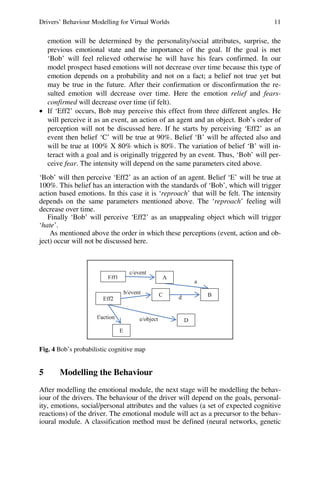
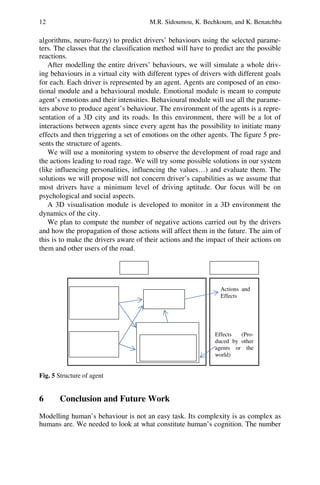

![Making Existing Reactive Systems Anticipatory
Kai Shi, Yuichi Goto, Zhiliang Zhu, and Jingde Cheng
Abstract. From the viewpoints of high safety and high security, any critical re-
active system should be anticipatory, i.e., the system should be able to detect and
predict accidents/attacks, take some actions to inform its users, and perform some
operations to defend the system from possible accidents/attacks anticipatorily. How-
ever, most of existing reactive systems are not so, furthermore, it is impractical, but
not impossible, to rebuild them to be anticipatory, because reimplementation of the
whole of a system results in high cost. Therefore, it is desirable to extend an existing
legacy reactive system with anticipatory ability without reimplementing the whole
of the legacy system. This paper proposes a general methodology to realize such
an extension. The novelty of the methodology is that it does not require reimple-
mentation the whole legacy system, does not affect the system’s original functions,
and can deal with various reactive systems by using the same process. By extending
an existing reactive system anticipatory using our methodology, we can get a new
generation system with high safety and high security. This paper also presents three
case studies to show how to apply our methodology.
1 Introduction
A reactive system maintains an ongoing interaction with its environment, as op-
posed to obtain a final result [10]. Various reactive systems play very important
roles in modern society, such as bank transfer systems, web servers, operating sys-
tems, computer networks, air/railway traffic control systems, elevator systems, and
nuclear power plant control systems. Since an accident or an attack of a critical
Kai Shi · Yuichi Goto · Jingde Cheng
Department of Information and Computer Sciences,
Saitama University, Saitama, 338-8570, Japan
e-mail: {shikai,gotoh,cheng}@aise.ics.saitama-u.ac.jp
Kai Shi · Zhiliang Zhu
Software College, Northeastern University, Shenyang, 110819, China
e-mail: {shik,zhuzl}@swc.neu.edu.cn
R. Lee (Ed.): Computer and Information Science, SCI 493, pp. 17–32.
DOI: 10.1007/978-3-319-00804-2_2 c
Springer International Publishing Switzerland 2013](https://image.slidesharecdn.com/2610888-250620031017-507343ec/85/Computer-And-Information-Science-Roger-Lee-33-320.jpg)
![18 K. Shi et al.
reactive system may cause financial loss and even casualties, the biggest challenge
for reactive systems is not only to ensure the system functionality, but to prevent
these accidents and attacks [1, 14].
A traditional reactive system is passive, i.e., it only performs those operations in
response to instructions explicitly issued by users or application programs, but have
no ability to do something actively and anticipatorily by itself. Therefore, a passive
reactive system only has some quite weak capability to defend accidents and attacks
from its external environment. In order to prevent accidents/attacks beforehand, it is
desired that a reactive system is anticipatory, i.e., the system should be able to detect
and predict accidents/attacks, take some actions to inform its users, and perform
some operations to defend the system from possible accidents/attacks anticipatorily.
From the viewpoints of high safety and high security, any critical reactive system
should be anticipatory [3].
To build practical anticipatory systems [20] with high safety and high security,
Cheng proposed anticipatory reasoning-reacting system (ARRS) [3], which is a
computing system that can predict based on the predictive model, then take an-
ticipatory actions according to the predictions as well as take reactive actions to
the current situation based on the behavioral model. In other word, an ARRS is a
reactive system with ability of anticipation. Some prototypes of ARRSs were im-
plemented [12, 22].
The problem is that most of existing reactive systems are not anticipatory, fur-
thermore, it is impractical, but not impossible, to rebuild them to be anticipatory,
because reimplementation of the whole of a system results in high cost. If we can
extend an existing reactive system with anticipatory ability but preserving the sys-
tem’s original functions, we can improve the system safety or security at a relatively
small cost. However, there is no study about whether it is possible to extend an
existing reactive system to be an anticipatory and how to realize such an extension.
This paper argues it is possible to extend an existing legacy reactive system with
anticipatory ability without reimplementing the whole of the legacy system, and pro-
poses a general methodology to realize such an extension. By extending an existing
reactive system anticipatory using our methodology, we can get a new generation
system, indeed an ARRS, with higher safety and higher security. This paper also
presents three case studies to show how to apply our methodology to legacy reactive
systems.
The contributions of this paper are: 1) to propose a methodology which can ex-
tend various reactive systems with anticipatory ability as well as preserving the sys-
tem’s original functions without reimplementing the whole of the legacy system, and
2) through case studies to show the usefulness of anticipatory reasoning-reacting
systems.
2 Feasibility Analysis
Any reactive system M has a set I of inputs (e.g., inputs that represent events
and conditions produced by the environment), a set O of outputs (e.g., action](https://image.slidesharecdn.com/2610888-250620031017-507343ec/85/Computer-And-Information-Science-Roger-Lee-34-320.jpg)
![Making Existing Reactive Systems Anticipatory 19
instructions produced by M), and a reactive function fP mapping non-empty se-
quences of subset of I into a subset of O [10, 17]. Many reactive systems also
have some implemented mechanisms to take action instructions to prevent an on-
going/potential accident/attack, such as applying the brake in a railway system, and
blocking an intruder by configuring a firewall in computer networks. However, a tra-
ditional reactive system cannot take these action instructions anticipatorily, because
fP is passive. Therefore, we can add an additional anticipatory function fA shown in
figure 1, which can detect and predict accidents/attacks base on I, then choose ap-
propriate action instructions to handle these accidents/attacks, which can be taken
by the original reactive system. For most concurrent systems, the fA only carries out
some additional action instructions, while the system’s original reactive function is
kept, which means the original reactive actions and the anticipatory actions are taken
simultaneously. For those systems that anticipatory actions may affect the system’s
original reactive actions such as a critical sequence of actions, in most cases, the
system’s original reactive actions have a higher priority thus the anticipatory actions
must wait, because we do not want to affect the system’s original functions. How-
ever, in some situation, the original reactive actions may make against the safety or
security of the system, the original actions should be canceled, while the system’s
original functions are still kept in most of the time. We call the original reactive
system legacy system, and call the extended system target system, as the figure 1
shows.
As we discussed above, if we want to extend a legacy reactive system with antic-
ipation, the system must satisfy the following requirements.
• There must be some approaches to perceive adequate subset of I of the legacy
system for detection and prediction.
• The legacy system must have some implemented mechanism to take actions to
handle the ongoing/potential accidents/attacks.
Besides, for some extreme real time systems, it may be too late to predict and take
actions before the accidents/attacks cause pernicious consequences, thus such sys-
tems are not suitable to extend with anticipation.
Fig. 1 Extending a legacy reactive system with anticipatory function
ARRSs are suitable candidates of target systems for the extension. The most
important features of ARRSs are: 1) both the prediction and decision-making are
base on logic-based forward reasoning, and 2) an ARRS is an extension of a reactive
system. Logic reasoning based prediction and decision-making provides an area-
independent, task-independent, general-purpose reasoning mechanism [3, 6], which](https://image.slidesharecdn.com/2610888-250620031017-507343ec/85/Computer-And-Information-Science-Roger-Lee-35-320.jpg)
![20 K. Shi et al.
can apply to different application area of the legacy systems. As an extension of a
reactive system, the ARRS’s architecture [9, 22] is fit to embrace an existing reactive
system.
3 Methodology
3.1 Target System
Our methodology aims to combine an existing reactive system, called legacy system,
with some components which can provide anticipatory ability, then get a new system
that in fact is an ARRS, called target system, which can deal with accidents/attacks
anticipatorily with preserving the original system functions. Figure 2 shows a gen-
eral architecture of the target system embracing a legacy reactive system. Figure 3
shows the data flow diagram of the target system. Besides the legacy system, the
target system includes following components.
There are three databases. LTDB is a logical theorem database, which stores frag-
ments of logical systems [3]. ETDB is an empirical theory database storing anticipa-
tory model. RDB is a rule database storing filter rules, translation rules, interesting
formula definitions, interesting terms, actions mapping rules, and condition-action
rules.
Observers and filter deal with the data from the legacy system. Observers per-
ceive the inputs of the legacy system that represent events and conditions produced
by the environment. Besides, the observers could also perceive the status of the
legacy system. In many cases, there are some sensors/monitors/statistical tools have
been implemented in the legacy system. If we can utilize these observers, we do not
need to implement new observers. Filter filters out the trivial sensory data and gener-
ates important and useful information for detection/prediction or decision-making.
Formula generator, forward reasoning engine, and formula chooser generate pre-
dictions or next actions. Formula generator encodes the sensory data into logical
formulas used by the forward reasoning engine according to the translation rules.
Forward reasoning engine is a program to automatically draw new conclusions by
repeatedly applying inference rules, to given premises and obtained conclusions
until some previously specified conditions are satisfied [7]. The forward reasoning
engine gets logical formulas translated at the formula generator, fragment of (a)
logic system(s), and the anticipatory model, and then it deduces candidates of pre-
dictions/next actions. Formula chooser chooses nontrivial conclusions from forward
reasoning engine according to interesting formula definitions and interesting terms.
Action planner receives candidates of next actions and current situation, and then
calculate the planned actions. The action planner has two functions: 1) the candi-
dates of actions are only based on qualitative information of the situation, while the
action planner can utilize quantitative information to revise the actions, and 2) to
make accurate plan, calculation is needed, such as to calculate how many special
actions should be taken to prevent a certain accident/attack.](https://image.slidesharecdn.com/2610888-250620031017-507343ec/85/Computer-And-Information-Science-Roger-Lee-36-320.jpg)
![Making Existing Reactive Systems Anticipatory 21
Enactor receives planned actions from action planner, matches the current situa-
tions to the situation-action rules to select appropriate actions to take, and then gives
corresponding instructions according to the actions mapping rules to invoke the ac-
tions of the legacy system. Besides, if the original reactive actions of the legacy
system may make against the safety or security of the system in some situation, the
enactor are also in charge of canceling these original actions. Condition-action rules
specify when an unexpected accident/attack occurs abruptly in real time, 1) which
reactive actions should be taken, and 2) which planned actions should be canceled.
Soft system bus [4] and central control components provide a communication
channel for each component and an infrastructure for persistent computing [4].
Fig. 2 Architecture of the target system
Fig. 3 Data flow diagram of the target system
3.2 Phases
In our methodology, there are five major phases to extend a legacy reactive system
with anticipatory ability.](https://image.slidesharecdn.com/2610888-250620031017-507343ec/85/Computer-And-Information-Science-Roger-Lee-37-320.jpg)
![22 K. Shi et al.
Phase 1: Analyze the Target Domain
First, we analyze the possible accidents/attacks in the legacy system’s target domain.
We list possible accidents/attacks in the target domain, and then for each possible
accident/attack. We analyze each possible accident’s/attack’s causation, formation
process, and the consequence, as well as other attributes such as likelihood and
severity. Based on the severity and likelihood, we could sort these possible acci-
dents/attacks in order of importance.
Second, we analyze the possible (anticipatory) actions for defending against ac-
cidents/attacks in the target domain. For each possible accident/attack, we find out
whether it is possible to defend against it and what actions could defend against it,
both an ongoing one and a potential one.
Phase 2: Analyze the Legacy System
First, we need to understand the requirements of the legacy system. Second, for
the legacy system, we list the set I of inputs that represent events and conditions
produced by the environment and the set O of output action instructions produced
by the legacy system, and understand the function fP of the legacy system. Third,
we find out which anticipatory actions the legacy system has already had the abil-
ity to take, by comparing the outcome of phase 1.2 and the set O of outcome of
phase 2.2. Fourth, we analyze the legacy system to find out which ongoing/potential
accidents/attacks the system already has the ability to handle, and how the system
defends against them. After that, we could also find out which accidents/attacks that
the legacy system cannot handle or do not handle well, which may be the goals of
the target system. Fifth, we find out the approaches to perceive the inputs that repre-
sent events and conditions produced by the environment and (optional) status of the
legacy system itself, and the approaches to invoke these existing anticipatory action
instructions of the legacy system.
Phase 3: Define Requirements of the Target System
The requirements of target system include the functional requirements that specify
which accidents/attacks should be tackled, and which anticipatory actions should be
used to prevent against a certain accidents/attacks, and the non-functional require-
ments including performance, security, availability, etc.
Phase 4: Construct Anticipatory Model
First, before constructing anticipatory model, we need to choose the logic basic(s)
for the target domain. A model is a simplified representation of something [8]. In
the target system, an anticipatory model is represented by a set of logical formu-
las of a specific logic (or logics). Thus before we build an anticipatory model, we
must choose a logical basis for the model. Such logic must satisfy the following
requirements [3]. First, the logic must be able to underlie relevant reasoning as well
as truth-preserving reasoning in the sense of conditional. Second, the logic must be
able to underlie ampliative reasoning. Third, the logic must be able to underlie para-
complete and paraconsistent reasoning. Especially, the logic for prediction must be
able to underlie temporal reasoning.
Second, we construct world model. A world model represents status of the real
world and essential empirical knowledge (not related with time and behavior) in](https://image.slidesharecdn.com/2610888-250620031017-507343ec/85/Computer-And-Information-Science-Roger-Lee-38-320.jpg)
![Making Existing Reactive Systems Anticipatory 23
target domain. We use a vocabulary of predicates or constant terms to present the
status of the real world. In addition, if necessary, we collect and represent empirical
knowledge (not related with time and behavior) as conditionals (see “conditional 2”
[8]). The construction of the world model involves following steps. 1) In the target
domain, list possible objects and their properties and statuses. 2) List relationships
among the objects (if have). 3) List possible events and conditions produced by
the environment we concern. 4) Determine the essential empirical knowledge (not
related with time and behavior). 5) Formalize the information. For information got
from step 1) to 3), we use a vocabulary to represent, while for information got from
step 4), we use conditionals to represent.
Third, we construct predictive model. The predictive model represents the pre-
dictive knowledge used to make predictions. We are only interested in certain kinds
of predictions, while in the target system, they are mainly accidents/attacks and
other predictions, which can help to predict accidents/attacks. Therefore, the pre-
dictive model is assembled by conditionals, which can be used to get these in-
teresting predictions. The construction of the predictive model involves following
steps. 1) Determine which events/conditions (accidents/attacks and other predic-
tions, which can help to predict accidents/attacks) we concern in the target domain,
and list these events/conditions. 2) Determine the predictive knowledge related with
these events/conditions. 3) Formalize the knowledge as conditionals.
Fourth, we construct behavioral model. The behavioral model is used for quali-
tative decision, which represents the behavioral knowledge used to choose actions.
The purpose of qualitative decision is to find out “what actions should be taken?”
and “which actions should be taken first?” Thus, the result of qualitative decision is
a set of candidates of next actions, which are labeled as “obligatory”/“permitted”
and/or priorities. Therefore, the behavioral model is assembled by conditionals,
which can be used to get these results of qualitative decision. The construction of the
behavioral model involves following steps. 1) List possible actions that the system
can be taken to prevent accidents/attacks. 2) Decide which events/conditions cause
to take these actions. 3) Formalize the information. For information got from step
1), we use a vocabulary to represent, while for information got from step 2), we use
conditionals to represent.
Fifth, we evaluate the constructed anticipatory model. To evaluate anticipatory
model, we could utilize some (user-defined) evaluation criteria to evaluate the model
formally. Besides, in practical, we can use test set for evaluation, which is a set of
empirical/historical data about accidents and attacks in the target domain.
Phase 5: Implementation
Most components of the target system are general-purpose. Thus, we do not need
to rebuild them for different systems. There are some implemented components
can be used in this phase, such as a general-purpose forward reasoning engine [7].
We have also implemented a general filter, a semiautomatic formula generator, a
general formula chooser and a general enactor, which may deal with most cases.
Our methodology considers using these prepared components. Of course, one can
rebuild all of these components.](https://image.slidesharecdn.com/2610888-250620031017-507343ec/85/Computer-And-Information-Science-Roger-Lee-39-320.jpg)
![24 K. Shi et al.
First, we implement observers or utilize some substitutes in the legacy system to
observe events and conditions produced by the environment, which relate to requi-
site events/conditions used by anticipatory model. Second, we configure filter rules
to filter nontrivial events/conditions used by anticipatory model. Third, we config-
ure the actions mapping rules. The mapping rules map the possible anticipatory
actions (based on behavioral model) are represented as logical formulas to concrete
instructions that the target system can execute. Fourth, we configure translation rules
according to the logic basis and anticipatory model. Fifth, we define the interesting
formulas and configure the interesting terms. Interesting terms specify which terms
we are interested: 1) for detection/prediction, the interesting terms are events and
conditions produced by the environment about accidents and attacks, and 2) for
decision-making, the interesting terms are the actions, which can be produced by
the system. Interesting formula definitions specify which formulas, formalized by
interesting term(s) and other symbols, we are interested. Sixth, we implement ac-
tion planner and configure calculate rules. Not all target systems need quantitative
calculation. Because quantitative calculation depends on the application domain, we
may resort to different algorithms thus build different action planners for different
target systems. Seventh, we implement the enactor and configure condition-action
rules. Eighth, we integrate all components. Ninth, we test the target system. Tenth,
we evaluate the target system before putting into service.
4 Case Study: Emergency Elevator Evacuation Systems
This case study is to apply our methodology to existing emergency elevator evac-
uation systems (EEES). This paper only presents important phases to apply our
methodology including the result of each phase. Refer to [23] for this research’s
motivation, system requirements, system implementation, and system evaluation.
Phase 1: Analyze the Target Domain
The possible accidents are disasters or other bad situations, such as fire, toxic fume,
biological/chemical leak, congestion, etc. The possible anticipatory actions for an
EEES is to dispatch the elevator cars anticipatorily, aiming to avoid disaster before-
hand and shorten the evacuation time.
Phase 2: Analyze the Legacy System
The set I includes: 1) the occupants’ direct operations to the elevator system, 2)
the emergency events, such as fire, bomb threats, biological or chemical threat,
and 3) occupants’ conditions, such as where the occupants and occupants with
disabilities or injuries are. For O, the actions are mainly dispatching the elevator
cars, furthermore, some elevator cars also support “shuttle mode”, to avoid time
needed for accelerating and decelerating smoothly [2], besides, the public address
system can give warnings and instructions to occupants. The anticipatory actions
are dispatching the elevator cars. The legacy system only ensures the safety of ele-
vator cars and evacuation floors, but cannot dispatch the elevator cars anticipatorily.
For I, there are many existing equipments can perceive the status of the building](https://image.slidesharecdn.com/2610888-250620031017-507343ec/85/Computer-And-Information-Science-Roger-Lee-40-320.jpg)
![Making Existing Reactive Systems Anticipatory 25
Table 1 Predicate dictionary of the world model
Predicate Meaning
Floor(f ) f is a floor
Lobby(l) l is an elevator lobby
U pstairs(f1, f2) f1 is upstairs of f2
Locate(l, f ) elevator lobby l locates in floor f
Elevator(e) e is an elevator car
Getatable(e,l) elevator e is getatable to lobby l
Occupied(r) region r has alive people
A fire(r) region r is afire
Smoke(r) region r is full of smoke
Person(o) o is a person
Priority(o, p) o has priority p for rescuing
In(o,r) o in the region r
Eliminated(et) emergency et has been eliminated
(including elevator systems and occupants) and occupants. Emergency sensors (e.g.,
heat detectors, smoke detectors, flame detectors, gas sensors, etc.) can detect emer-
gencies. The status of occupants, such as number of occupants in each floor/area,
and whether there are disabled or injured people, can be monitored by using RFID
[15] or cameras [11]. We can connect the filter directly to these sensors by invok-
ing the sensors’ driver program. For O, we can dispatch the elevator cars by giving
instructions to elevator control system of the legacy system. When an emergency
arises, the elevator control system could disable the regular dispatch mode, and re-
ceives instructions from enactor.
Phase 3: Define Requirements of the Target System
Because the purpose of emergency evacuation is to move people away from the
threat or actual occurrence of a hazard immediately and rapidly, we consider the tar-
get EEES should be safe, context aware, anticipatory, and instructional/informative
[23].
Phase 4: Construct Anticipatory Model
We chose temporal deontic relevant logics [5] as the logic basis to both predict and
make decisions. Such logics satisfied the requirements of phase 4.1.
In this case, we built the vocabulary as a predicate dictionary. Table 1 shows an
example. Moreover, we do not need other empirical knowledge in the world model.
In this case, the interesting predictions are emergencies. There are differ-
ent empirical theories for different emergencies. For example, in fire emer-
gency, to predict fire spread, we have following empirical theorem “the
upper floor of the afire floor will catch fire with highly probable” [16,
19]: ∀f1∀f2(U pstairs(f1, f2) ∧ Afire(f2) ∧ ¬Afire(f1) ⇒ F(Afire(f1))). To pre-
dict based on prediction, we have: ∀f1∀f2(Upstairs(f1, f2) ∧ F(Afire(f2)) ∧
¬Afire(f1) ⇒U(Afire(f2),F(Afire(f1)))), which means “if a floor will catch fire,
and then when this floor is really afire, its upstairs will catch fire”.](https://image.slidesharecdn.com/2610888-250620031017-507343ec/85/Computer-And-Information-Science-Roger-Lee-41-320.jpg)
![26 K. Shi et al.
Because we use temporal deontic relevant logics as the logic basis, we
use “O” to specify an action is “obligatory” to do, and “P” for “permis-
sion”. In order to express more precision, we also introduces priority con-
stants (using floating number to express, smaller means higher priority):
CRITICAL HIGH MEDIUM NORMAL LOW PLANNING. As
shown in table 2, we built the vocabulary of actions (only the last one is an
explicit instruction to dispatch the elevator cars). There are three types of actions
in an anticipatory EEES: reactive, anticipatory, and routine. Reactive actions
deal with current crises. Anticipatory actions deal with predictive crises. Routine
actions are used in a full evacuation to egress all occupants in the building,
e.g., down peak. In a full evacuation scenario, the routine action could be down
peak. Now we show how to construct the behavioral empirical knowledge. For
example, in fire emergency, “the occupants of the fire floor are the occupants
at the highest risk and should be the ones to be evacuated first by the eleva-
tors” [18], which can be expressed as empirical theorem about reactive actions:
∀f(Afire(f) ∧ Floor(f) ∧ Occupied(f) ⇒ O(Pickup(f,CRITICAL,FIRE))).
To predict crises, we have empirical theorems about anticipatory
actions: ∀f(F(Afire(f)) ∧ Floor(f) ∧ Occupied(f) ⇒ O(Pickup
(f,HIGH,FIRE))) and ∀f∀a(U(a,F(Afire(f))) ∧ Floor(f) ∧ Occupied(f) ⇒ O
(Pickup(f,MEDIUM,FIRE))). To express routine actions, e.g., down peak can be
expressed as: ∀et∀f(FullEvacuation(et)∧ Floor(f) ∧ Occupied(f) ⇒ P(Pickup
(f,PriorCal(NORMAL, f),et))), which means when we want to apply full
evacuation because of emergency type et, we can pick up each floor with
priority PriorCal(NORMAL, f). PriorCal is a function to calculate priority,
which result is NORMAL − 0.001 × FloorNumber(f), meaning higher floor
has higher priority. To consider full evacuation when fire emergency, can be
expressed as empirical theorem: ∀r(Afire(r) ⇒ FullEvacuation(FIRE)). Be-
sides, because the aged and people with disabilities have higher priority in any
emergency, we have: ∀o∀p∀f(Person(o) ∧ Priority(o, p) ∧ Floor(f) ∧ In(o, f) ⇒
P(Pickup(f, p,ANY))). Because the elevator cars are the executor of the ac-
tions, we use Dispatch(e, f, p,et) to express the action elevator e to pick
up people on floor f with priority p because of emergency type et. We
have: ∀f∀p∀et∀e∀l(O(Pickup(f, p,et)) ∧ Elevator(e) ∧ Getatable(e,l) ∧
¬IsFire(l) ∧ Locate(l, f) ⇒ O(Dispatch(e, f, p,et))) and ∀f∀p∀et
∀e∀l(P(Pickup(f, p,et))∧Elevator(e)∧Getatable(e,l)∧¬IsFire(l)∧Locate(l, f)
⇒ P(Dispatch(e, f, p,et))). When certain emergency was eliminated (e.g. the fire
dies out), the anticipatory EEES should know the evacuation should stop, thus we
have: ∀et(Eliminated(et) ⇒ P(StopEvacuation(et))).
Phase 5: Implementation
Because we chose temporal deontic relevant logics as the logic basic, for prediction,
the interesting formula (IF) is defined as: 1) If A is an interesting term, then A is an
IF; 2) If A is an interesting term, then ¬A is an IF; 3) If A or B is IFs, then U(A,B)
is an IF; 4) If A is an IF, then ∀xA and ∃xA are IFs; 5) If A is an IF, then ΦA
is an IF, where Φ is one of {G, F}. For candidates of actions, the IF is defined as:](https://image.slidesharecdn.com/2610888-250620031017-507343ec/85/Computer-And-Information-Science-Roger-Lee-42-320.jpg)
![Making Existing Reactive Systems Anticipatory 27
Table 2 Predicate dictionary of the behavioral model
Predicate Meaning
Pickup(f, p,et) pick up people on floor f with priority p due to emergency type et
FullEvacuation(et) adopt full evacuation from the building because of emergency type et
StopEvacuation(et) stop the evacuation because of emergency type et
Dispatch(e, f, p,et)
an action that elevator e to pick up people on floor f with
priority p because of emergency type et
1) - 3) are as same as that of prediction; 4) If A is an IF, then ΦA is an IF, where Φ is
one of {O, P}. For the prediction of fire, Afire is an interesting term. For candidates
of actions, Pickup, FullEvacuation, StopEvacuation, and Dispatch are interesting
terms.
The action planner can refine the actions by quantitative calculation, in order to
plan precise elevator cars dispatch. The action planner outputs next planned actions
for each elevator car. An algorithm to calculate quantitative planned action refer to
[23].
We have following condition-action rule in the target system: “Never stop the
elevator car at an elevator lobby with an ongoing emergency.”
5 Case Study: Runway Incursion Prevention Systems
This case study is to apply our methodology to existing airport/on board
systems/equipments to build an anticipatory incursion prevention systems (ARIPS)
[25]. This paper only presents important phases to apply our methodology including
the result of each phase. We have submitted the this research’s motivation, system
requirements, system implementation, and system evaluation to some journal [25].
Phase 1: Analyze the Target Domain
The possible accidents are runway incursions and runway collisions. The possible
anticipatory actions include holding a taxiing aircraft/vehicle, stopping taking off,
stopping landing and going around, etc.
Phase 2: Analyze the Legacy System
The set I includes: 1) the locations of aircrafts/vehicles, and 2) the speed and accel-
eration of aircrafts/vehicles. These information are provided by traffic information
system [21] and traffic surveillance sensor system [21]. For set O, actions are in-
structions, which are carried out by human machine interface system, which gives
the alerts about runway incursions or collisions as well as the instructions for avoid-
ing runway incursions or collisions to both pilots/drivers and air traffic controllers,
and traffic signal system, which gives instructions to pilots/drivers by mainly using
lights through different light systems deployed in the airport. The anticipatory ac-
tions are some instructions in O, such as holding a taxiing aircraft/vehicle, stopping](https://image.slidesharecdn.com/2610888-250620031017-507343ec/85/Computer-And-Information-Science-Roger-Lee-43-320.jpg)
![28 K. Shi et al.
taking off, and stopping landing and going around. The legacy system can only give
passive warnings, but cannot prevent runway incursions or collisions anticipatorily.
Phase 3: Define Requirements of the Target System
The target system should not only detect a runway incursion or predict an forth-
coming collisions, but also predict a runway incursion as early as an experienced
air traffic controller. Besides, the target system should give not only alerts but also
explicit instructions to pilots/drivers to avoid the incursions/collisions.
Phase 4: Construct Anticipatory Model
We chose temporal deontic relevant logics [5] as the logic basis to both predict and
make decisions.
For the world model, we built the vocabulary as a predicate dictionary (not shown
in this paper). Besides, we also need some empirical knowledge, such as “if a aircraft
is accelerating on a runway, then that aircraft is taking off” represented as At(o,r)∧
Runway(r)∧Aircra ft(o)∧Accelerate(o) ⇒ TakeOf fFrom(o,r).
In this case, the interesting predictions are runway incursions and runway colli-
sions. The predictive model includes the knowledge used for generating these inter-
esting predictions. For example, we have conditionals C2(r1,r2,r3)∧H(At(o,r1))∧
At(o,r2) ⇒ F(At(o,r3)) meaning “if an aircraft has crossed the hold line of a run-
way, then that aircraft will arrive at that runway”, and F(At(o,r)) ∧ Active(r) ⇒
F(RIby(o,r)) meaning “if an aircraft will arrive at a runway and that runway is
active (occupied for taking off or landing), then that aircraft will cause runway in-
cursion on that runway”.
The behavioral model specifies the actions to prevent a ongoing/furture
runway incursion/collision. For example, we have conditionals F(At(o,r)) ∧
F(RIby(o,r)) ⇒ O(Hold(o)) meaning “if an aircraft will arrive at a runway and
will cause a runway incursion on that runway, then the aircraft is obligatory to
hold in its position”, F(LandOn(o1,r)) ∧ F(RIby(o2,r)) ⇒ O(GoAround (o1))
meaning “if an aircraft is landing on a runway and there will be a runway in-
cursion on that runway, the aircraft should cancel landing and go around”, and
TakeOf fFrom(o1,r)∧F(RIby(o2,r)) ⇒ O(Evade (o1)) meaning “if aircraft is tak-
ing off form a runway and there will be a runway incursion on that runway, the
aircraft should cancel taking off, and evade potential collision”.
Phase 5: Implementation
Because we also chose temporal deontic relevant logics as the logic basic, the defi-
nition of interesting formula is as same as that in section 4. The interesting terms of
predictions are RIby, Collision, TakeOf fFrom, LandOn, OccupyIntersection, etc.
The interesting terms of decision making are GoAround, Evade, Hold, etc.
Action planner decides an instruction for real time operation. For example, if the
speed of aircraft is greater than V1, then that aircraft cannot stop taking off, because
V1 is the maximum speed in the takeoff at which the pilot can take the first action
(e.g., apply brakes, reduce thrust, deploy speed brakes) to stop the airplane within
the accelerate-stop distance.](https://image.slidesharecdn.com/2610888-250620031017-507343ec/85/Computer-And-Information-Science-Roger-Lee-44-320.jpg)
![Making Existing Reactive Systems Anticipatory 29
6 Case Study: Computing Services
This case study is to apply our methodology to existing computing services for
defending against malice. This paper only presents important phases to apply our
methodology to a computing service including the result of each phase. We have
submitted the this research’s motivation, system requirements, system implementa-
tion, and system evaluation to some conference [24].
Phase 1: Analyze the Target Domain
The possible attacks to a computing service includes DoS, probing, compromises,
and viruses/worms/Trojan horses [13]. The possible anticipatory actions include
blocking access from the attacker or to the target, killing connections to or from
a particular host, network, and port, changing an attack’s content, terminating a
network connection or a user session, and blocking access form certain hosts or
user accounts. Besides, the system could notify security administrators notifications
about important detections/predictions/responses about malicious activities.
Phase 2: Analyze the Legacy System
The set I includes network traffic and network data. To get these traffic/data, there
are two kinds of observers: inline observers and passive observers. An inline ob-
server is deployed so that the network traffic/data transfer it is monitoring must pass
through it, such as a hybrid firewall, a proxy, and a security gateway. A passive ob-
server is deployed so that it monitors a copy of the actual network traffic, NetFlow
or sFlow, host system status, and application logs and status. The actions in set O
are carried out by actuators. An actuator could be a firewall (either network firewall
or host-based firewall), a router, or a switch, which can block access from the at-
tacker or to the target; An actuator could be a program that kills connections to or
from a particular host, network, and port, such as Tcpkill; An actuator could be a
security proxy, which can change an attack’s content; An actuator could also be an
application service, while some application could terminate a network connection
or a user session, block access form certain hosts or user accounts.
Phase 3: Define Requirements of the Target System
The target system can identify suspicious activity, such as reconnaissance, then pre-
dict an imminent attack, besides, the system should also predict fatal attacks from
trivial attacks and other suspicious activities. The target system can choose and take
actions automatically to both stop an ongoing attacks and prevent an
imminent attack anticipatorily. The target system should use explicable model for
detecting/predicting malice and choosing actions, thus the system’s behaviors are
explicable. The target system can handle application level attacks. The target system
can be customized for different applications and different scenarios, while interop-
erability is one of foundations for customization.
Phase 4: Construct Anticipatory Model
We chose temporal deontic relevant logics [5] as the logic basis. We present pre-
venting web server against HTTP DoS attacks as an example. In predictive model,
“MaxConnection(ip addr) ⇒ HttpDos(ip addr)” means “if a host ip addr makes](https://image.slidesharecdn.com/2610888-250620031017-507343ec/85/Computer-And-Information-Science-Roger-Lee-45-320.jpg)
![30 K. Shi et al.
more than max concurrent requests, it is taking a HTTP DoS attack.”, and
“TooFrequent(ip addr) ⇒ HttpDos(ip addr)” means “if a host ip addr requests
the same page more than a few times per second, it is taking a HTTP DoS attack.”
In behavioral model, HttpDos(ip addr) ⇒ Block(ip addr) means “if host ip addr
is taking a HTTP DoS attack, block it.”
Phase 5: Implementation
Because we also chose temporal deontic relevant logics as the logic basic, the def-
inition of interesting formula is as same as that in section 4. The interesting terms
of predictions are predicates of attacks, such as HttpDos. The interesting terms of
decision making are Block, Kill, ChangeContent, etc.
7 Discussion
Although there are some particularities in the three case studies, we can still argue
our methodology is a general one.
First, our case studies showed that our methodology can deal different kinds of
reactive systems. A reactive system can have following three kinds of functions [26].
• Informative: To provide information about the subject domain, such as to answer
questions and produce reports.
• Directive: To direct the entities in the subject domain, such as to control or guide
a physical entity.
• Manipulative: To manipulate lexical items in the subject domain, such as to cre-
ate, remove, or modify lexical items.
The legacy reactive systems in first and second case studies have directive and in-
formative functions, while the legacy reactive system in third case study has infor-
mative and manipulative functions. Therefore, from viewpoint of system function,
our case studies covers different kinds of reactive systems, thus, our methodology is
general.
Second, our case studies showed that our methodology can improve both the
legacy system’s safety and security. Safety is freedom of risk [8] (accidents or losses)
[14]. Security is prevention of or protection against access to information by unau-
thorized recipients or intention but unauthorized destruction or alteration of that
information [8]. Safety and security are closely related and similar, while the impor-
tant differences between them is that security focuses on malicious actions. Our first
and second case studies improve the system’s safety by avoiding disasters/accidents.
Our third case study improve the system’s security by preventing attacks/ malicious
behaviors.
The main particularity among the three case studies is quantitative calculating of
the action planer. The quantitative calculating for each case study is special, while
it cannot be used in other cases. At present, we can eliminate this particularity by
implementing different action planners for different target domains.](https://image.slidesharecdn.com/2610888-250620031017-507343ec/85/Computer-And-Information-Science-Roger-Lee-46-320.jpg)
![Making Existing Reactive Systems Anticipatory 31
8 Concluding Remarks
It is difficult to ensure reactive systems’ safety and security, because the problem
is not to ensure what should happen, but to ensure what should not happen [1, 14].
Furthermore, it is more challenging to improve existing reactive systems’ safety and
security. We have proposed a new approach by extending the systems with anticipa-
tory ability without reimplementing the whole of the existing system. The proposed
methodology can be used to extend various reactive systems with anticipatory abil-
ity, but preserve the system’s original functions.
We presented three case studies to show how to apply our methodology to legacy
reactive systems. We also discussed the generality of the case studies.
We can conclude: 1) it is possible to extend an existing reactive system with
anticipatory ability, 2) the anticipatory ability is useful to the legacy reactive system,
thus such an extension is rewarding, and 3) our method is effective, at least in the
three case studies.
To prove the generality of our proposed methodology, the best way is to apply our
methodology to various target domains. Thus, our future work is to find out some
other interesting areas, which require high safety or high security, then extends some
existing critical reactive systems in these areas with anticipatory ability.
References
1. Anderson, R.J.: Security engineering: a guide to building dependable distributed sys-
tems, 2nd edn. Wiley (2008)
2. Bukowski, R.W.: Emergency egress strategies for buildings. In: Proc. 11th International
Interflam Conference, pp. 159–168 (2007)
3. Cheng, J.: Temporal relevant logic as the logical basis of anticipatory reasoning-reacting
systems. In: Proc. Computing Anticipatory Systems: CASYS - 6th International Confer-
ence, AIP Conference Proceedings, vol. 718, pp. 362–375. AIP (2004)
4. Cheng, J.: Connecting components with soft system buses: A new methodology for de-
sign, development, and maintenance of reconfigurable, ubiquitous, and persistent reac-
tive systems. In: Proc. 19th International Conference on Advanced Information Network-
ing and Applications, pp. 667–672. IEEE Computer Society Press (2005)
5. Cheng, J.: Temporal deontic relevant logic as the logical basis for decision making based
on anticipatory reasoning. In: Proc. 2006 IEEE International Conference on Systems,
Man and Cybernetics, vol. 2, pp. 1036–1041. IEEE (2006)
6. Cheng, J.: Adaptive decision making by reasoning based on relevant logics. In: Proc.
Computational Intelligent: Foundations and Applications, 9th International FLINS Con-
ference, pp. 541–546. World Scientific (2010)
7. Cheng, J., Nara, S., Goto, Y.: FreeEnCal: A forward reasoning engine with general-
purpose. In: Apolloni, B., Howlett, R.J., Jain, L. (eds.) KES 2007, Part II. LNCS (LNAI),
vol. 4693, pp. 444–452. Springer, Heidelberg (2007)
8. Daintith, J., Wright, E.: A dictionary of computing, 6th edn. Oxford University Press
(2008)
9. Goto, Y., Kuboniwa, R., Cheng, J.: Development and maintenance environment for an-
ticipatory reasoning-reacting systems. International Journal of Computing Anticipatory
Systems 24, 61–72 (2011)](https://image.slidesharecdn.com/2610888-250620031017-507343ec/85/Computer-And-Information-Science-Roger-Lee-47-320.jpg)
![34 D. Liu, S. Xu, and H. Liu
will help software quality. Software testing is an aggregation term which covers
many different topics, such as, unit testing, smoke testing, integration testing,
regression testing, etc. When we are talking about testing methods, the topic may
cover many different fields [1]. Thereafter there is no single standard for all to
simply compare different researches. Consequently, it is no surprise to see rarity
of meditation on testing at a philosophical level. Due to recent addition of detailed
researches on individual testing approaches, it seems there is a need to understand
and discuss further the software testing at higher level.
There are often different opinions on same topics which may look opposite to
each other while actually emphasize different aspects and complement each other
in harmony. For example, while some are trying to automate testing or to create
guidelines for testing efficiency, some argue that software testing asks for more
prompt human intelligence; while many papers focused on how to increase the
coverage of testing, some others realized that test cases can be impractically large
so that tried to reduce them. Such different arguments can actually be considered
simultaneously in one set of testing cases. Since designing testing strategies is a
multi-objective optimization by itself, there is no single best solution.
As an augment of existing research, it seems that software testing has all of the
following characteristics:
• May be different for different program frames;
• May be stately;
• Has to evolve along with development progress;
• Should be team work between development and QA;
• May be proactively integrated with development;
• May be better to be semi-automatic;
• Is a dynamic multi-objective evolutionary optimization problem.
In this work, we first try to conduct a brief survey on software testing literature,
particularly those most recent one, and then with the help of our working expe-
rience in IT industry, we try to understand software testing and provide some ob-
servations at higher level that is missing in related literature. It is our hope that our
observations could provide some good guidance for software development in or-
der to better evolve and select the test cases so that automatic testing become
possible. Those observations could also invoke research interests on them. It
might be necessary to point out that we do not intend to conduct a complete litera-
ture survey on software testing in this paper and also we do not propose a general
guideline for software testing. Moreover, we are not intended to appreciate any
technical details of specific testing approaches or techniques. Instead, we focus on
the ideology. As there is no panacea in software testing, we wish software devel-
opment management can benefit from our discussions.
The rest of the paper is organized as follows. Section 2 discusses some recent
representative publications. Section 3 presents our observations on software test-
ing based on literature review and our working experience in industry. Some con-
crete or imaginary examples are given. The conclusions are given in Section 4.](https://image.slidesharecdn.com/2610888-250620031017-507343ec/85/Computer-And-Information-Science-Roger-Lee-50-320.jpg)
![Observations on Software Testing and Its Optimization 35
2 Literature Review
In this section, we conduct a brief literature review on related fields of software
testing and summarize them according to different topics.
2.1 Testing Should be Proactive, But Not Passive
Ahamed [2] expressed an interesting idea that software testing, depending on the
testing method adopted, can be implemented at any time during the development
process. This proposal is meaningful since a testing team or group is often sepa-
rated from the development team in current IT industry. It is not rare that software
developers and testers complain the gap between them.
Their idea is similar to ours [3]. However, we pushed the idea of integrating
software testing into development stage at a higher level: we argued that software
developers would better “code to debugging”. Instead of occasionally considering
during development process, we propose to proactively and actively take consid-
eration of how to facilitate testing into the original system design. For example, a
module reads properties from a file whose file path has been explicitly specified in
source code as a constant literal. In this case, it is hard to test this module with
different file contents if testing is done in parallel mode. Certainly, this challenge
is conquerable since there have been a lot of effort and quite a few successful
solutions [4] to dynamically change program behaviors in runtime without the
need of modifying source code. However, using extra resource to test programs
adds more burdens. Since dynamically changing software behavior in testing has
to be done on concrete production code, tight coupling between testing code and
software implementation is hurdle for software evolution.
2.2 Human Intelligence vs. Machine Automation
Itkonen et al [5] conducted a controlled experiment to compare the defect detec-
tion efficiency between exploratory testing (ET) and test case based testing (TCT).
They found no significant differences in defect detection efficiency between TCT
and ET. Different from traditional testing, ET emphasizes individual tester’s skills
during test execution and does not rely on predesigned test cases. The distribu-
tions of detected defects did not differ significantly regarding technical type,
detection difficulty, or severity between TCT and ET. However, TCT produced
significantly more false defect reports than ET.
2.3 Automatic Augment
Fraser and Zeller [6] proposed an evolutionary approach to improve the readabili-
ty of automatic generation of test cases for programmers. Some portions of](https://image.slidesharecdn.com/2610888-250620031017-507343ec/85/Computer-And-Information-Science-Roger-Lee-51-320.jpg)
![36 D. Liu, S. Xu, and H. Liu
sequences of method calls are randomly selected in order to shorten call chains
without altering overall coverage.
In contrast to random selection of test cases, Rubinov and Wuttke [7] presented
an approach to automatically augment test suites by utilizing existing test cases to
direct the generation of complex ones. In particular, they focused on automatic
generation of complex integration test cases from simple unit tests. The rationale
behind the approach was that since test cases contain information about object
interactions, they could be used to generate new test cases.
2.4 More Is Better
It is a popular view that a high coverage on source code or its structure will poten-
tially increase fault detection possibility. Although the size of test suites is not
equal to test coverage, it is commonly considered to be closely related to testing
effectiveness as well. Namin and Andrews [8] studied the influence of size and
coverage on test suite effectiveness and found that both factors independently
affect the effectiveness of test suites. Their experiment established accurate linear
relationship between (log(size) + coverage models) and test suite effectiveness.
There are also other factors affecting the testing effectiveness. Alshahwan and
Harman [9] argued that the variety of test outputs had positive relationship with
test effectiveness. Thereafter they introduced a test suite adequacy criterion based
on output uniqueness and formally proposed four definitions of output uniqueness
with varying degrees of strictness. In a preliminary evaluation on web application
testing they found that output uniqueness enhanced fault-finding effectiveness.
Their study showed that the approach outperformed random augmentation in fault
finding ability by an overall average of 280% in five medium sized, real world
web applications. Specifically, they augmented test suites by combining tradition-
al structural coverage criterion (branch coverage) with test cases that provide
unique outputs. However, output uniqueness alone should not be used as the only
criterion for selecting test cases though it is a helpful addition to traditional test
generation adequacy criteria. An obvious and simple example is that two different
errors that cause a web application to return a blank page would have the same
output. Fortunately, checking the output of a test case is often a comparatively
cheap operation which requires neither instrumentation of the code nor the build-
ing of intermediate structures, such as control flow graphs or data flow models.
Program faults with high severity often propagate to the observable output and
affect user perception of an application [10]. Intuitively, the output of testing pro-
vides a valuable resource for testers to identify unexpected behaviors that are more
critical from a user’s point of view, especially for applications with a lot of out-
puts, such as web applications whose whole user interface is often a product of
output. The complexity and richness of the output may most likely allow faults to
be propagated to the output and therefore the testing approach is more
effective.](https://image.slidesharecdn.com/2610888-250620031017-507343ec/85/Computer-And-Information-Science-Roger-Lee-52-320.jpg)
![Observations on Software Testing and Its Optimization 37
2.5 Test Reduction
It is well known that it is hard, even impossible, to create enough number of test
cases to cover complete combinations of execution branches. As a fact, most
researches on automated test case generation focus on the approaches which gen-
erate test cases to increase structural code coverage. Usually, such techniques
generate test cases based on information extracted from execution or source code.
While some research focuses on how to augment the size of test cases, some
others try to reduce the test size. The test suite reduction techniques often aim to
select, a minimal representative subset of test cases that retains the same code
coverage as the test suite. However, Hao et al. [11] pointed out that test suites
reduction approaches presented in previous literature lost fault detection capabili-
ty. In order to avoid such potential loss, they proposed an on-demand technique to
retain certain redundant test cases in the reduced test suite, which attempt to select
a representative subset satisfying the same test requirements as the initial test
suite. Their technique collects statistics about loss in fault-detection capability at
the level of individual statements and models the problem of test suite reduction as
an integer linear programming problem. They have evaluated the approach in the
contexts of three scenarios.
2.6 Testing Interacting Artifacts
A multithreaded unit test creates two or more threads, each executing one or more
methods on shared objects of the class under test. Such unit tests can be generated
at random, but basic random tests are either slow or do not trigger concurrency
bugs. Nistor et al [12] realized that testing multithreaded code was hard and ex-
pensive since a lot of tests are needed in order to achieve high effectiveness. They
proposed a novel technique, named Ballerina, for automated random generation of
efficient multithreaded tests that effectively trigger concurrency bugs. There were
only two threads in Ballerina, each executing a single, randomly selected method,
supervised by a clustering technique to reduce human effort in inspecting failures
of automatically generated multithreaded tests. Evaluation of Ballerina on 14 real-
world bugs from 6 popular codebases showed that Ballerina found bugs on aver-
age 2 to 10 times faster than basic random generation, and the clustering technique
reduces the number of inspected failures on average 4 to 8 times smaller.
Greiler et al [13] also pointed out that testing plug-in-based systems is chal-
lenging due to complex interactions among many different plug-ins, and variations
in versions and configurations. In a qualitative study, they interviewed 25 senior
practitioners about how they tested plug-in applications on the Eclipse plug-in
architecture. They found that while unit testing played a key role, the plug-in spe-
cific integration problems were often identified and resolved by the
community.](https://image.slidesharecdn.com/2610888-250620031017-507343ec/85/Computer-And-Information-Science-Roger-Lee-53-320.jpg)
![38 D. Liu, S. Xu, and H. Liu
2.7 Exceptions and Consequences
Zhang and Elbaum [14] realized that validating how code handling exceptional
behavior is difficult, particularly when dealing with external resources. The rea-
sons include two aspects: 1) A systematic exploration of the space of exceptions
that may be thrown by the external resources is needed, and 2) The setup of the
context to trigger specific patterns of exceptions is required. They presented an
approach to address those difficulties by performing an exhaustive amplification
of the exceptional behavior space associated with an external resource that is
exercised by a test suite. Each amplification attempt tried to expose a program
exception handling code block to new behavior by mocking normal return from an
exception thrown by an external resource. The result of the experiment on availa-
ble historical data demonstrates that this technique is powerful enough to detect
65% of the faults reported in the bug reports, and is precise enough in that 77% of
the detected anomalies correspond to faults fixed by the developers.
Grechanik et al [15] mentioned that one important goal of performance testing
is to find situations when applications unexpectedly behave for certain combina-
tions of input values. They proposed a solution to automatically find performance
problems in applications using black-box software testing. Their implementation
is an adaptive and feedback-directed learning testing system that learns rules from
execution traces of applications and then uses these rules to select test input data
automatically for these applications to find more performance problems.
2.8 Test Data/Input
Fraser and Arcuri [16] claimed that although several promising techniques had
been proposed to automate different tasks in software testing, such as test data
generation for object-oriented software, reported studies only showed the feasibili-
ty of the proposed techniques, because the choice of the employed artifacts in
those case studies was usually done in a non-systematic way. The chosen case
studies might be biased, and thereafter they might not be a valid representative of
the addressed type of software. Fraser and Arcuri evaluated search-based software
testing when they were applied to test data generation for open source projects. In
order to achieve sound empirical results, they randomly chose 100 Java projects
from SourceForge (http://sourceforge.net/). The resulting case study was very
large (8,784 public classes for a total of 291,639 byte code level branches). Their
results showed that while high coverage on commonly used class types was
achievable in practice environmental dependencies prohibited such high coverage.
2.9 Tests Refactoring
After Estefo [17] realized that less effort was dedicated to making unit tests mod-
ular and extensible compared to a lot of researches on software maintainability, he
created a Tester (Surgeon), as a profiler for unit tests, collect information during](https://image.slidesharecdn.com/2610888-250620031017-507343ec/85/Computer-And-Information-Science-Roger-Lee-54-320.jpg)