1Dr. Vahid Garousi
Software engineering of scientific and engineering
software:
a few project experiences and a review of literature
Dr. Vahid Garousi
Associate Professor of Software Engineering
Information Technology Group
Wageningen University, Netherlands
www.vgarousi.com
www.wur.nl/inf
@vgarousi
Talk @ VORtech BV
Jan. 15, 2018
2Dr. Vahid Garousi
About me
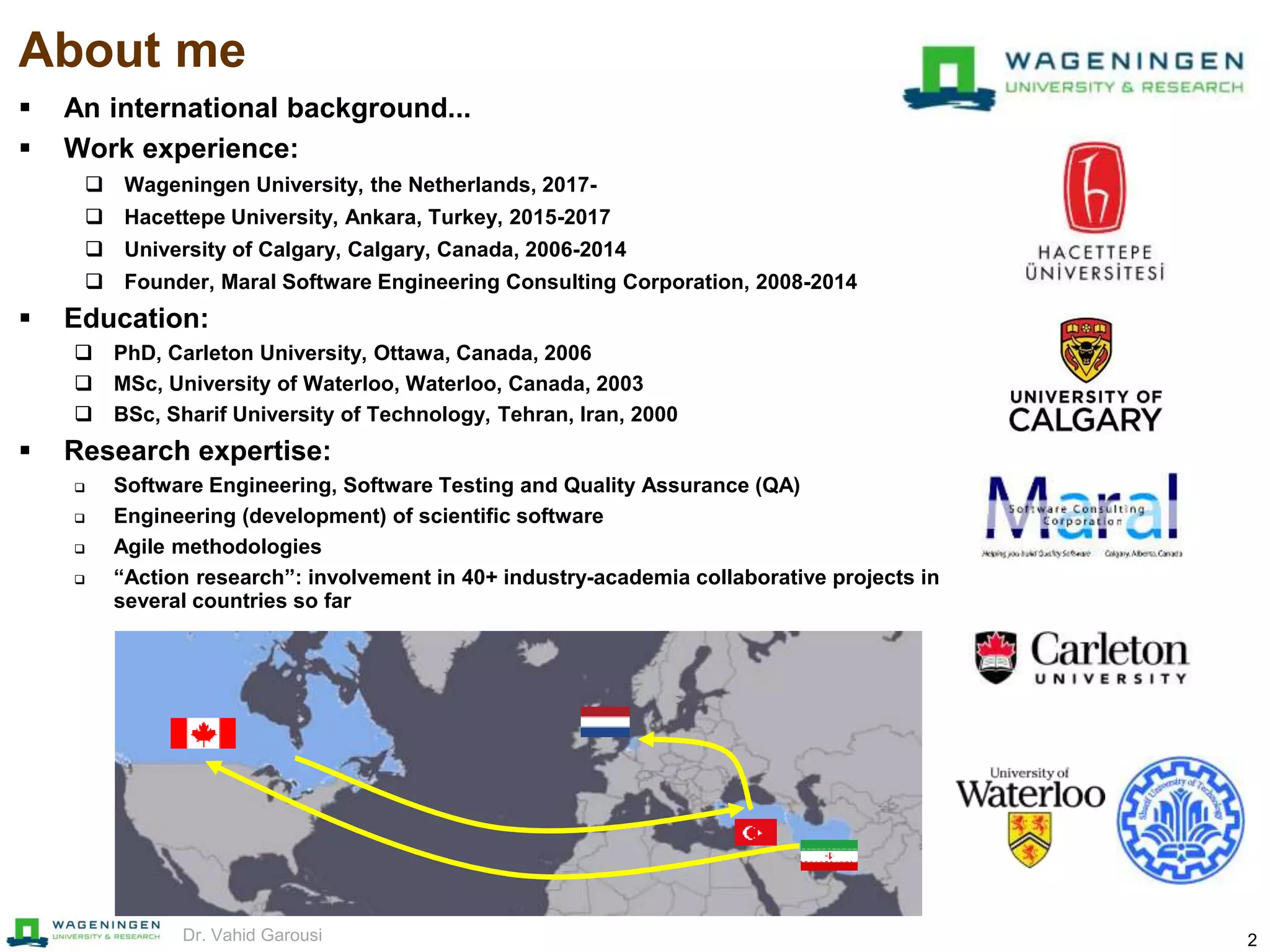
 An international background...
 Work experience:
 Wageningen University, the Netherlands, 2017-
 Hacettepe University, Ankara, Turkey, 2015-2017
 University of Calgary, Calgary, Canada, 2006-2014
 Founder, Maral Software Engineering Consulting Corporation, 2008-2014
 Education:
 PhD, Carleton University, Ottawa, Canada, 2006
 MSc, University of Waterloo, Waterloo, Canada, 2003
 BSc, Sharif University of Technology, Tehran, Iran, 2000
 Research expertise:
 Software Engineering, Software Testing and Quality Assurance (QA)
 Engineering (development) of scientific software
 Agile methodologies
 “Action research”: involvement in 40+ industry-academia collaborative projects in
several countries so far
3Dr. Vahid Garousi
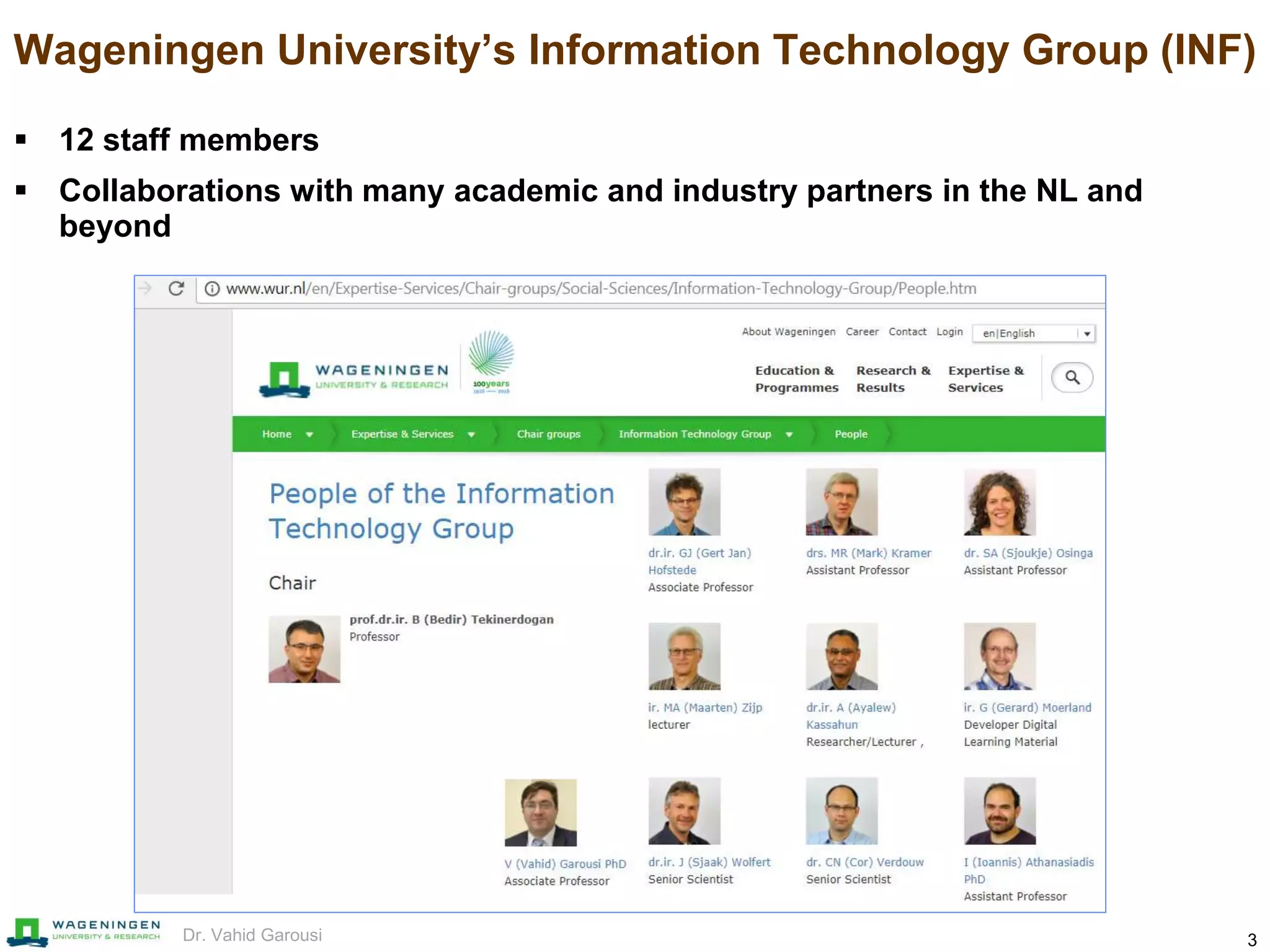
Wageningen University’s Information Technology Group (INF)
 12 staff members
 Collaborations with many academic and industry partners in the NL and
beyond
4Dr. Vahid Garousi
Context
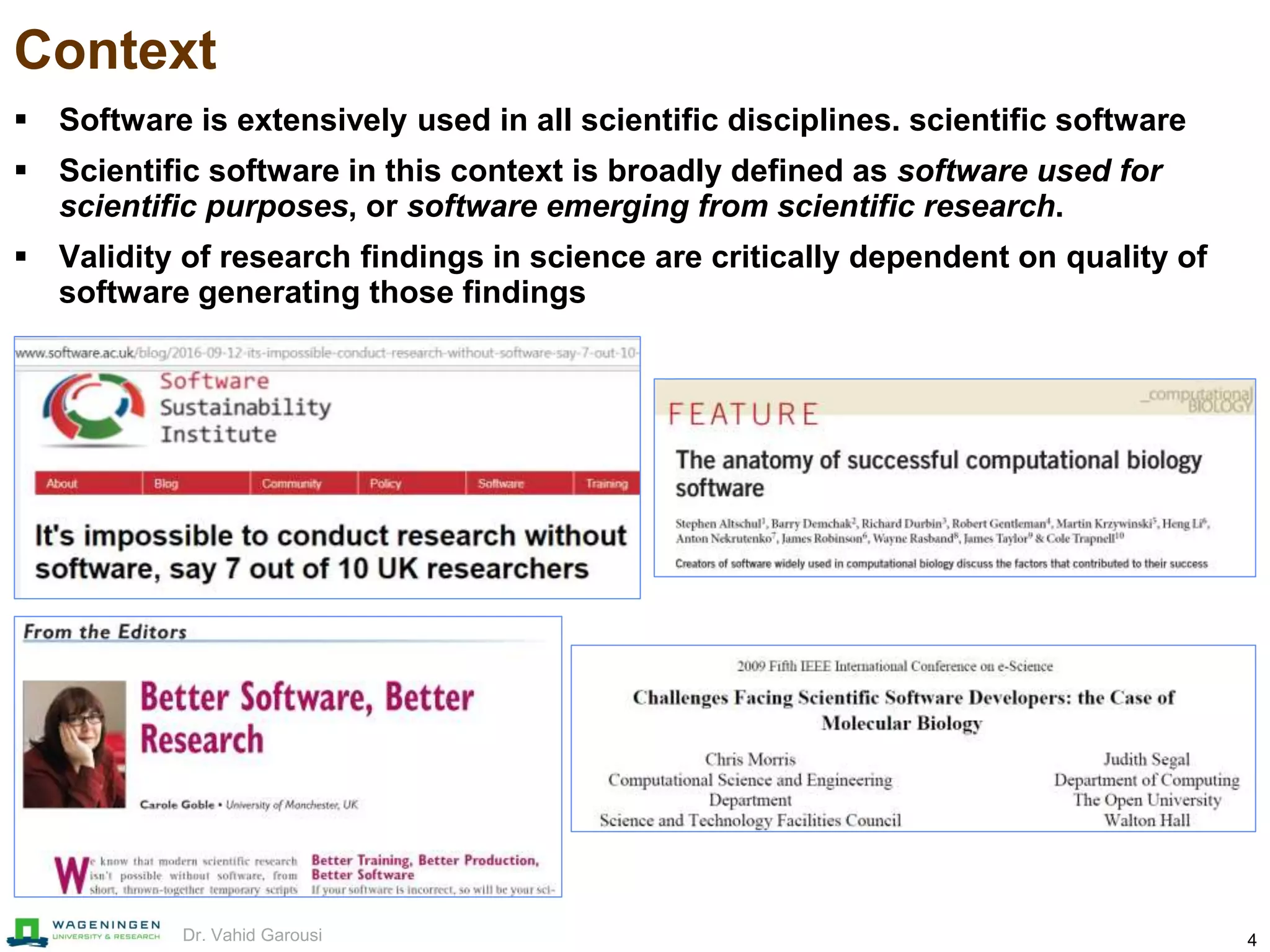
 Software is extensively used in all scientific disciplines. scientific software
 Scientific software in this context is broadly defined as software used for
scientific purposes, or software emerging from scientific research.
 Validity of research findings in science are critically dependent on quality of
software generating those findings
5Dr. Vahid Garousi
Context
 But when developing scientific software...
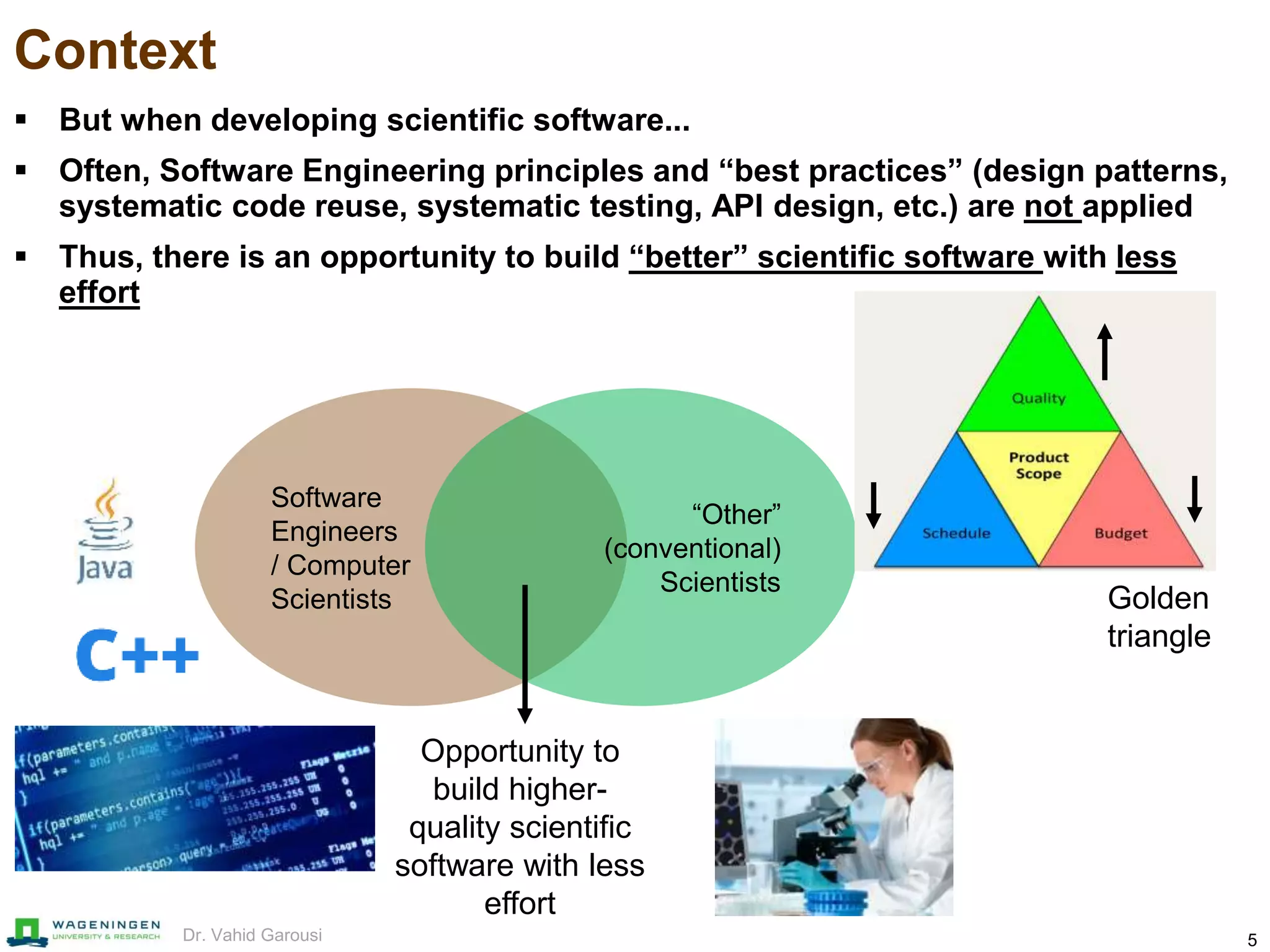
 Often, Software Engineering principles and “best practices” (design patterns,
systematic code reuse, systematic testing, API design, etc.) are not applied
 Thus, there is an opportunity to build “better” scientific software with less
effort
Software
Engineers
/ Computer
Scientists
“Other”
(conventional)
Scientists
Opportunity to
build higher-
quality scientific
software with less
effort
Golden
triangle
6Dr. Vahid Garousi
Outline of the talk
 Context
 Experience from engineering of a scientific software for
oil pipelines
 A brief review of:
 the world-wide community in this area
 the research literature in this area
 Possible areas of collaboration among us, and
Interactive discussions
7Dr. Vahid Garousi
Engineering (developing) of a scientific software for oil pipelines
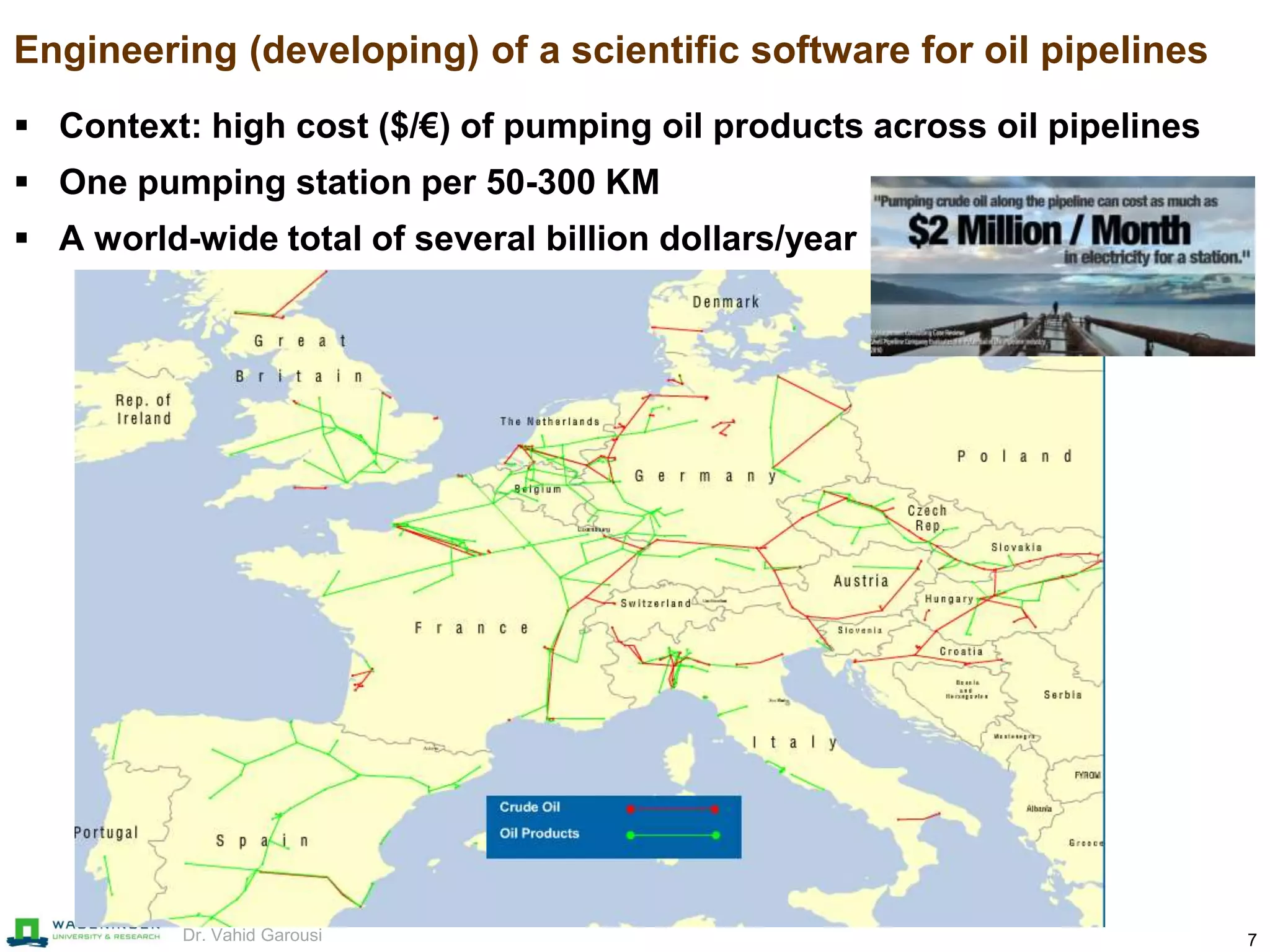
 Context: high cost ($/€) of pumping oil products across oil pipelines
 One pumping station per 50-300 KM
 A world-wide total of several billion dollars/year
8Dr. Vahid Garousi
A software for reducing pumping costs in oil pipelines
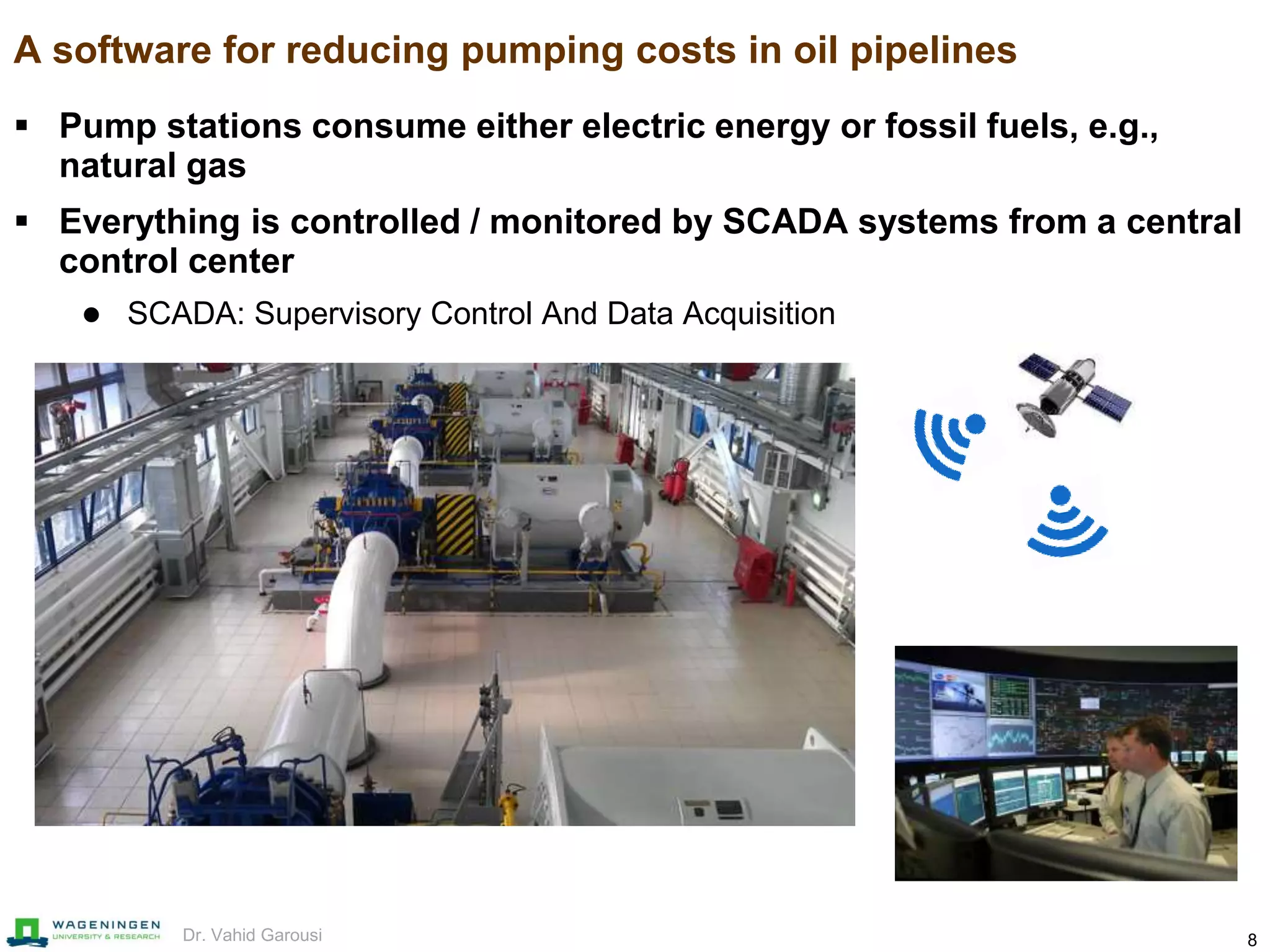
 Pump stations consume either electric energy or fossil fuels, e.g.,
natural gas
 Everything is controlled / monitored by SCADA systems from a central
control center
 SCADA: Supervisory Control And Data Acquisition
9Dr. Vahid Garousi
Engineering (developing) of a scientific software for oil pipelines
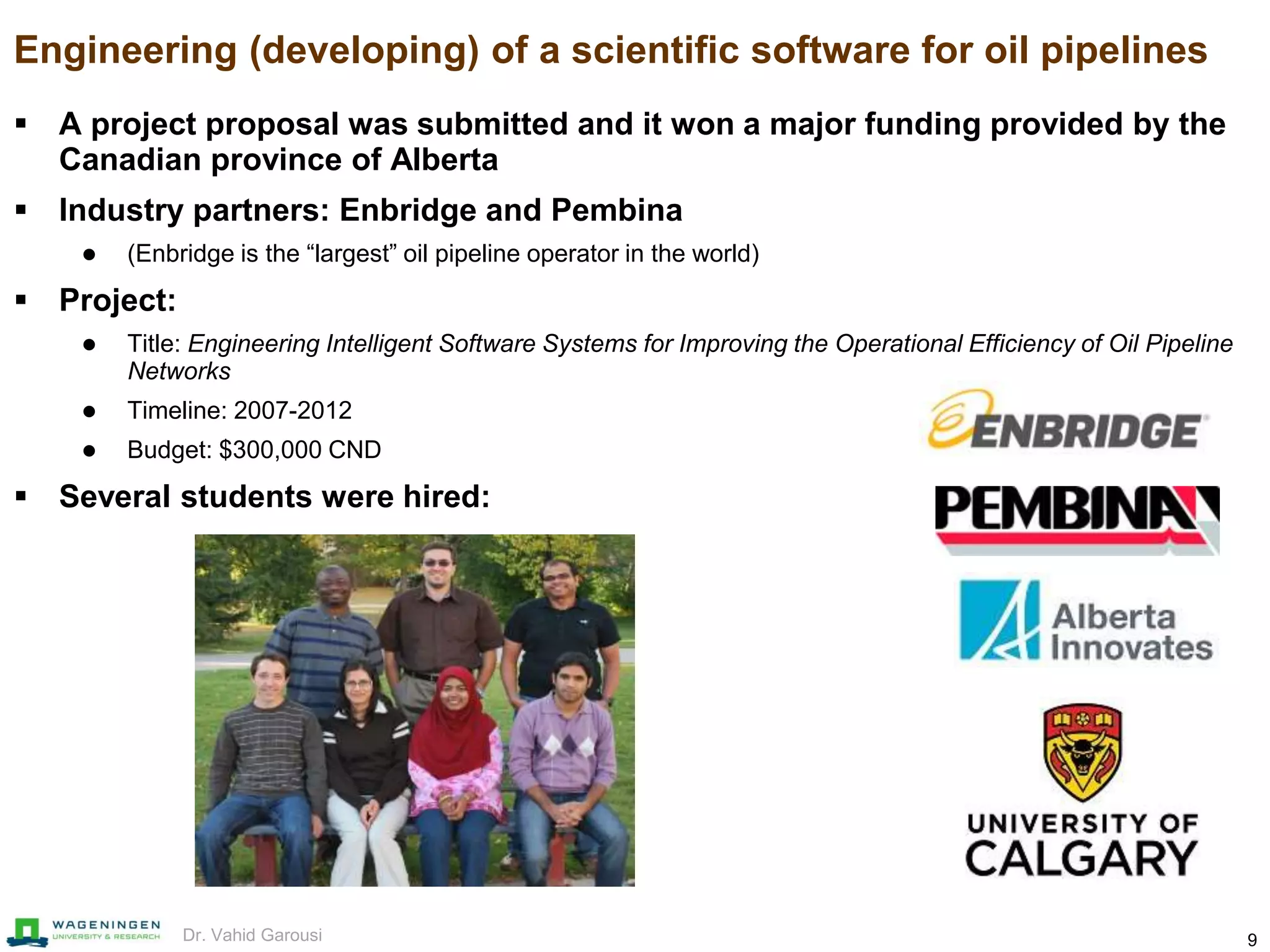
 A project proposal was submitted and it won a major funding provided by the
Canadian province of Alberta
 Industry partners: Enbridge and Pembina
 (Enbridge is the “largest” oil pipeline operator in the world)
 Project:
 Title: Engineering Intelligent Software Systems for Improving the Operational Efficiency of Oil Pipeline
Networks
 Timeline: 2007-2012
 Budget: $300,000 CND
 Several students were hired:
10Dr. Vahid Garousi
Engineering (developing) of a scientific software for oil pipelines
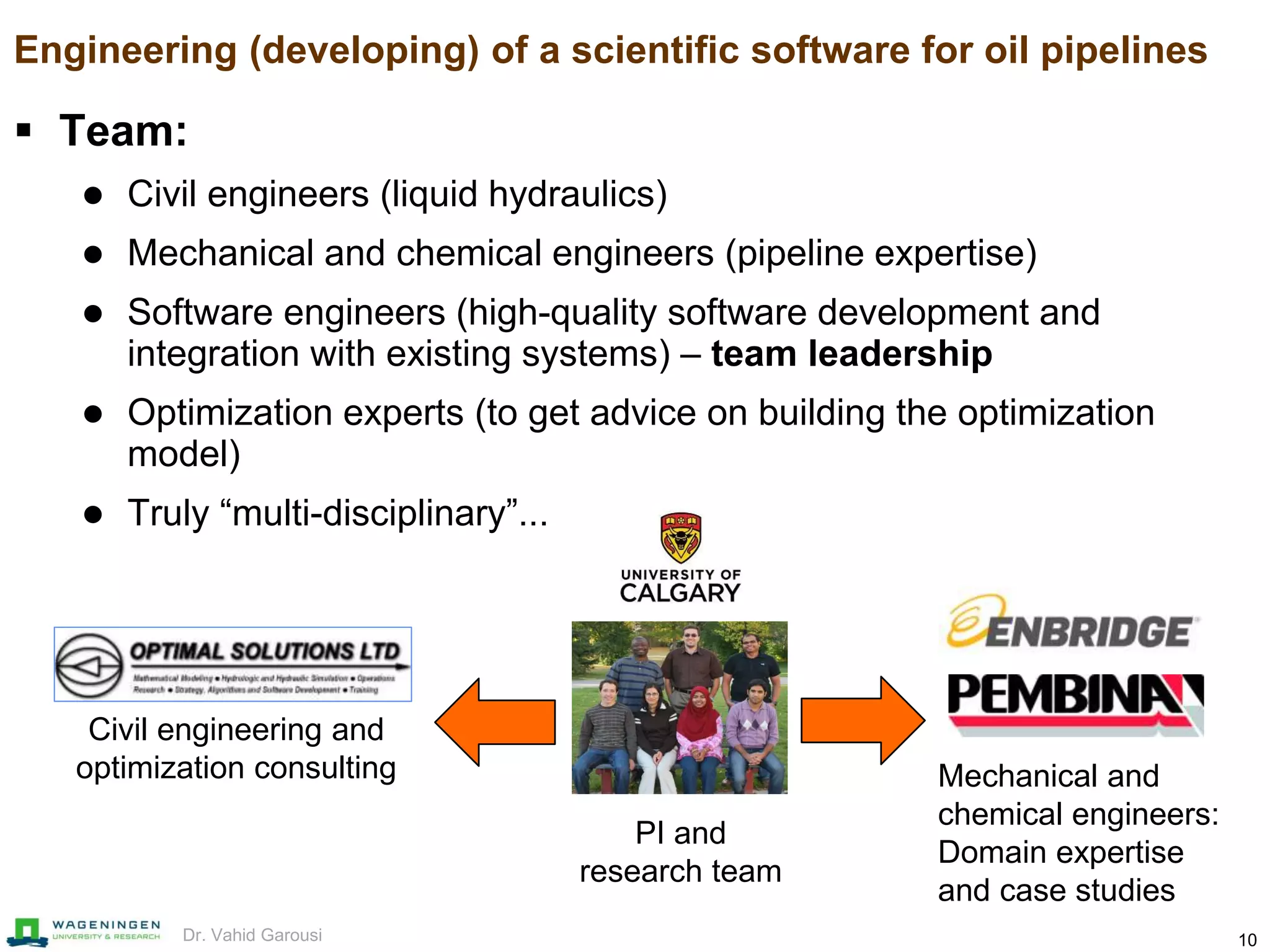
 Team:
 Civil engineers (liquid hydraulics)
 Mechanical and chemical engineers (pipeline expertise)
 Software engineers (high-quality software development and
integration with existing systems) – team leadership
 Optimization experts (to get advice on building the optimization
model)
 Truly “multi-disciplinary”...
Mechanical and
chemical engineers:
Domain expertise
and case studies
Civil engineering and
optimization consulting
PI and
research team
11Dr. Vahid Garousi
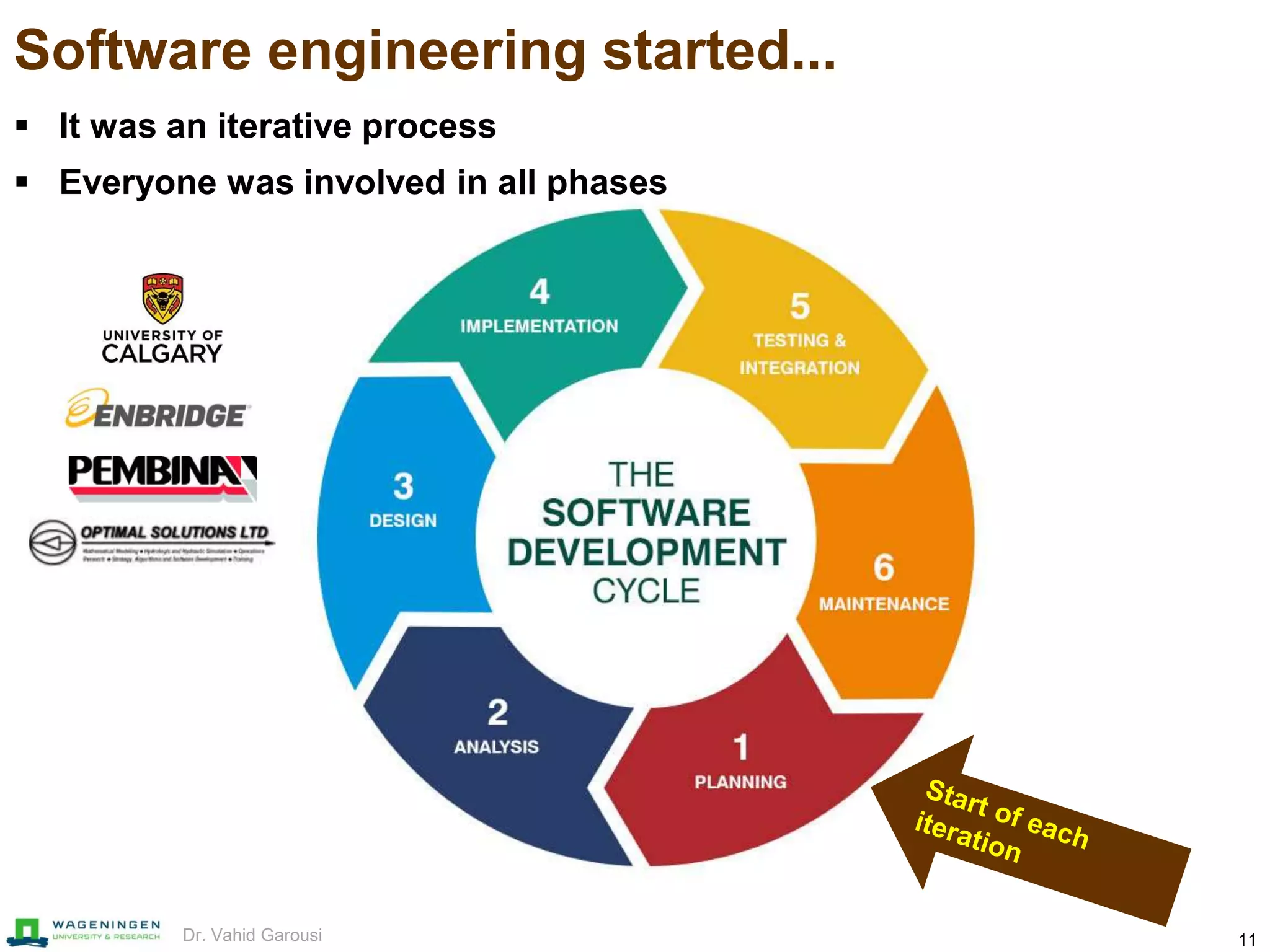
Software engineering started...
 It was an iterative process
 Everyone was involved in all phases
12Dr. Vahid Garousi
The product: OptimalPipeline software
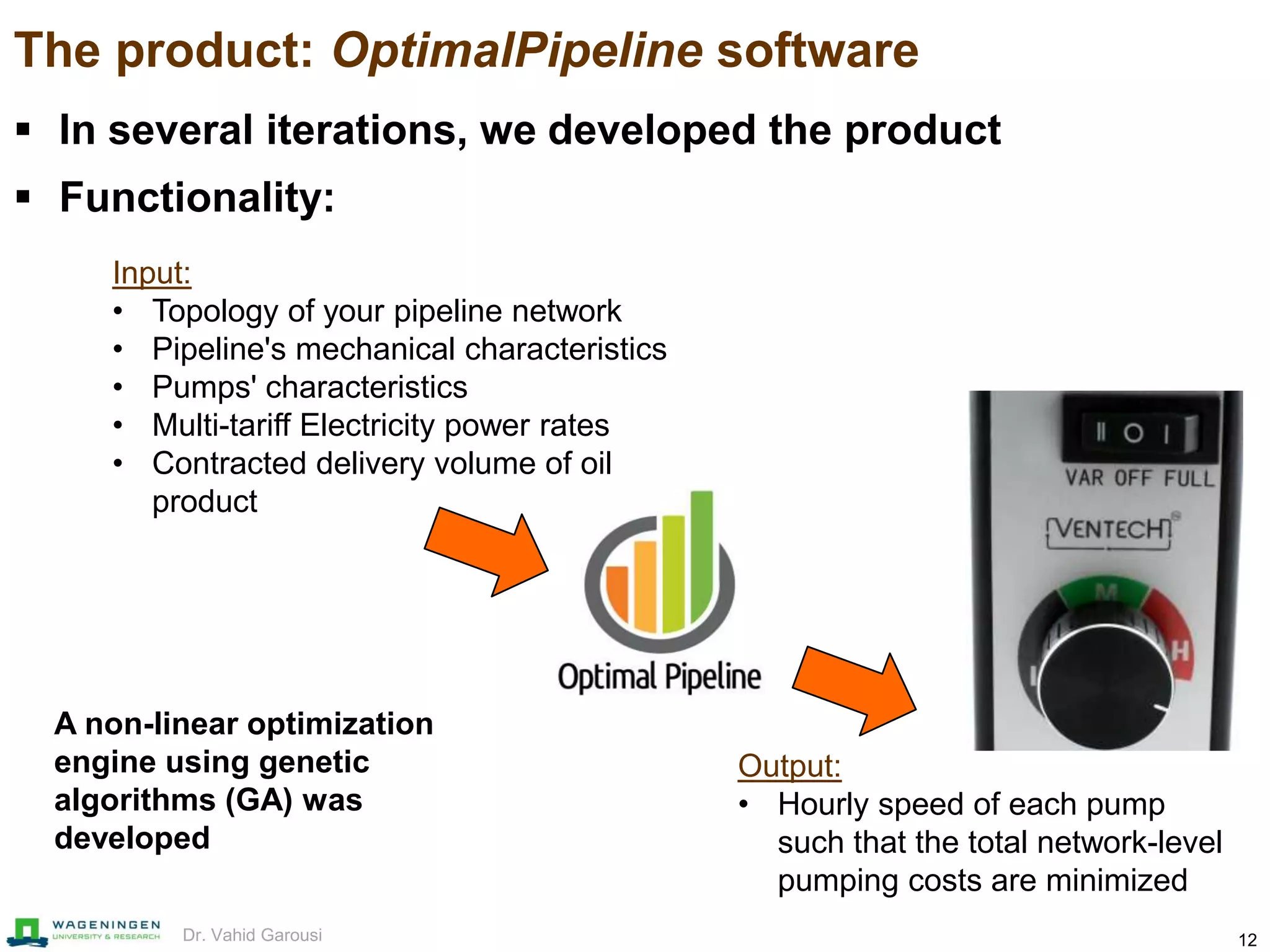
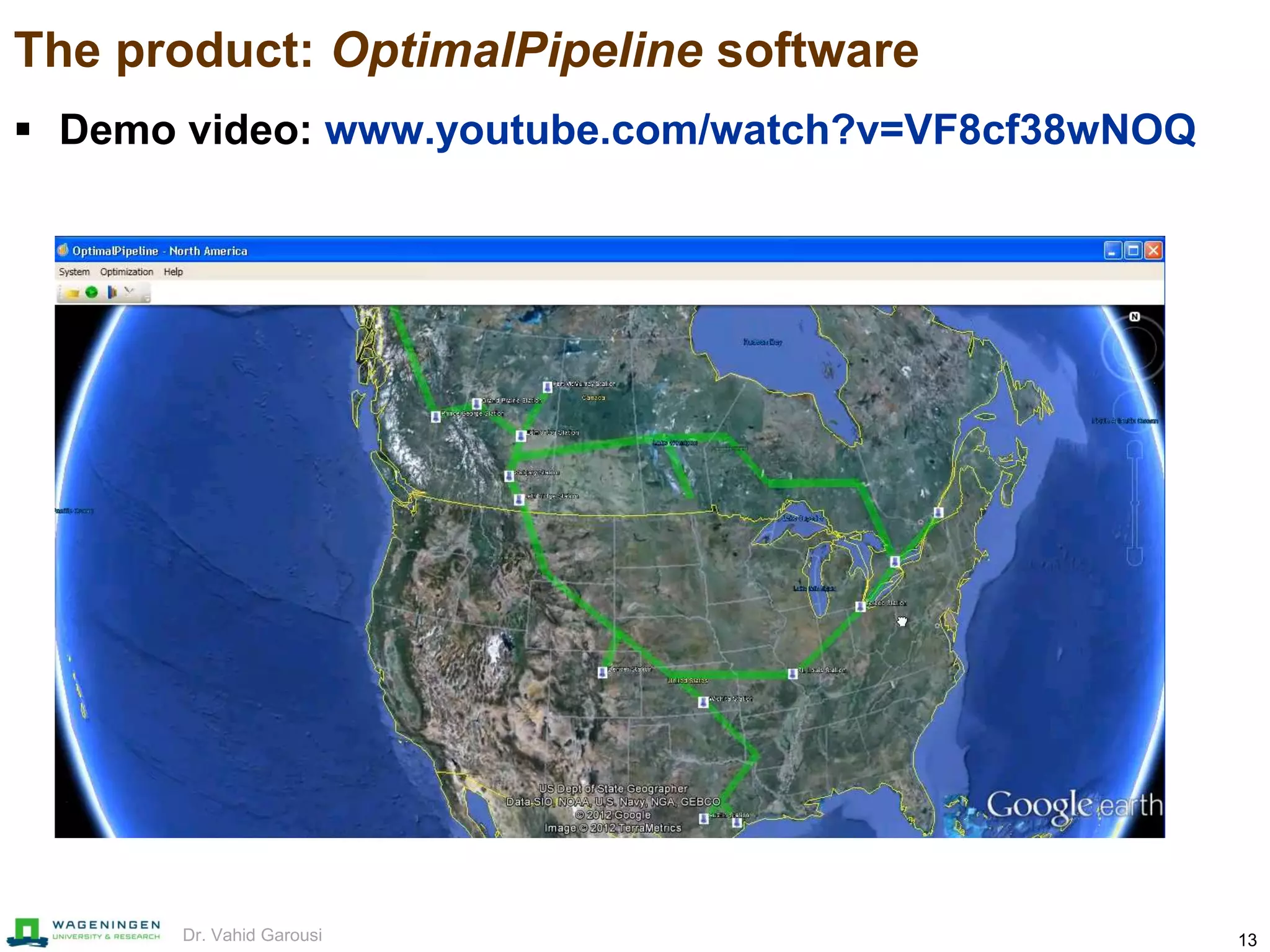
 In several iterations, we developed the product
 Functionality:
Output:
• Hourly speed of each pump
such that the total network-level
pumping costs are minimized
Input:
• Topology of your pipeline network
• Pipeline's mechanical characteristics
• Pumps' characteristics
• Multi-tariff Electricity power rates
• Contracted delivery volume of oil
product
A non-linear optimization
engine using genetic
algorithms (GA) was
developed
13Dr. Vahid Garousi
The product: OptimalPipeline software
 Demo video: www.youtube.com/watch?v=VF8cf38wNOQ
14Dr. Vahid Garousi
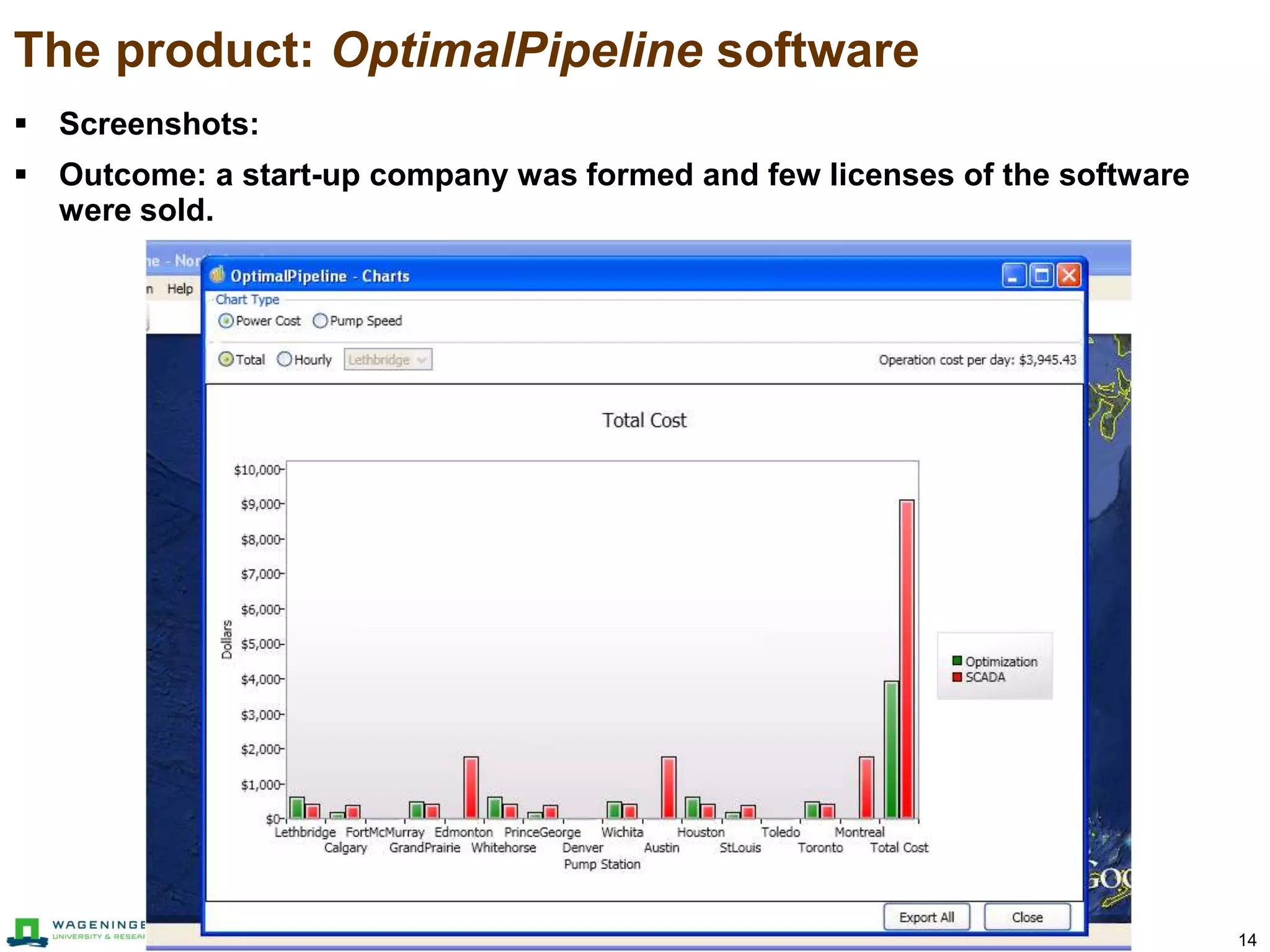
The product: OptimalPipeline software
 Screenshots:
 Outcome: a start-up company was formed and few licenses of the software
were sold.
15Dr. Vahid Garousi
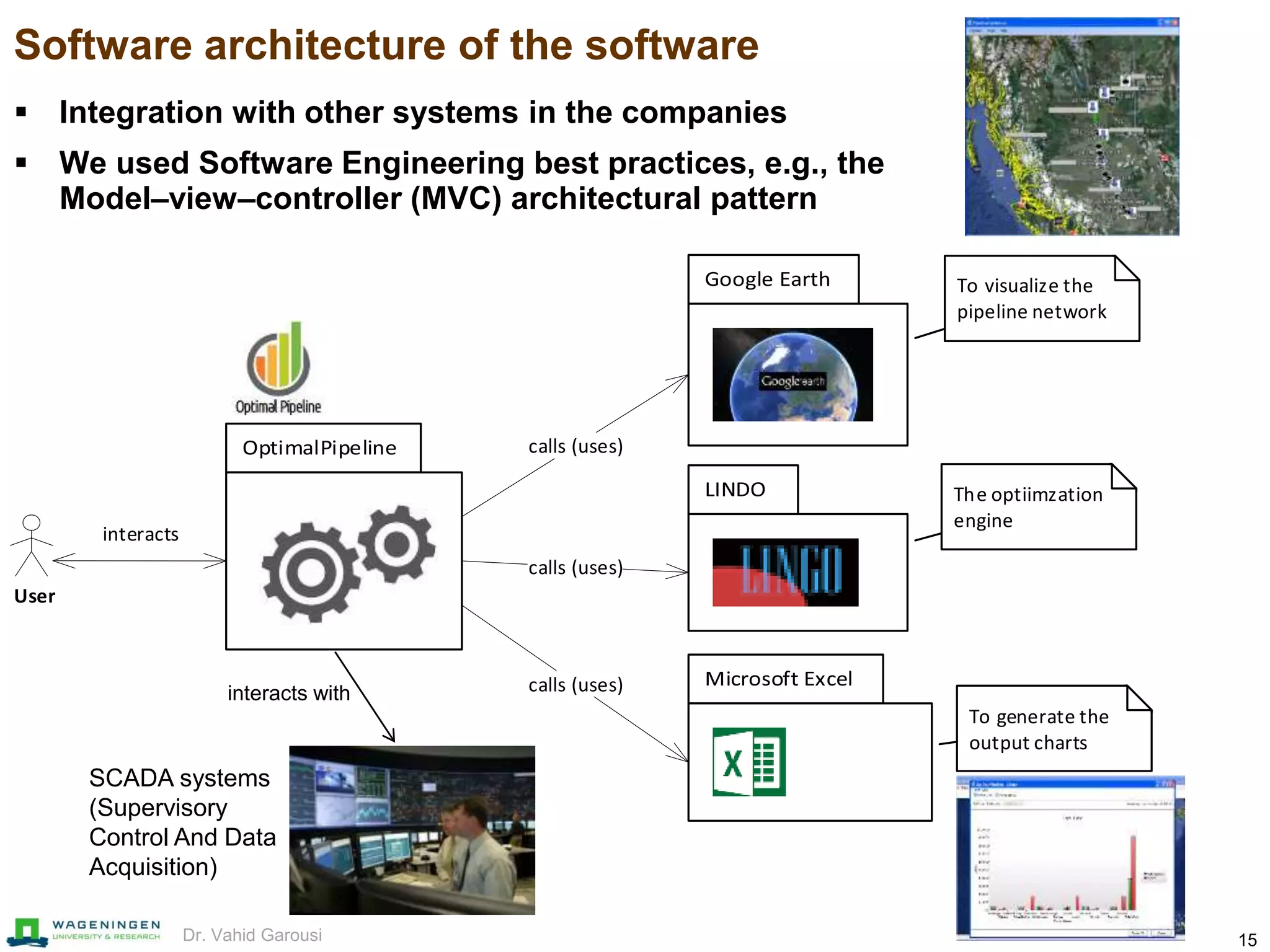
Software architecture of the software
 Integration with other systems in the companies
 We used Software Engineering best practices, e.g., the
Model–view–controller (MVC) architectural pattern
User
interacts
calls (uses)
calls (uses)
calls (uses)
To visualize the
pipeline network
The optiimzation
engine
To generate the
output charts
interacts with
SCADA systems
(Supervisory
Control And Data
Acquisition)
16Dr. Vahid Garousi
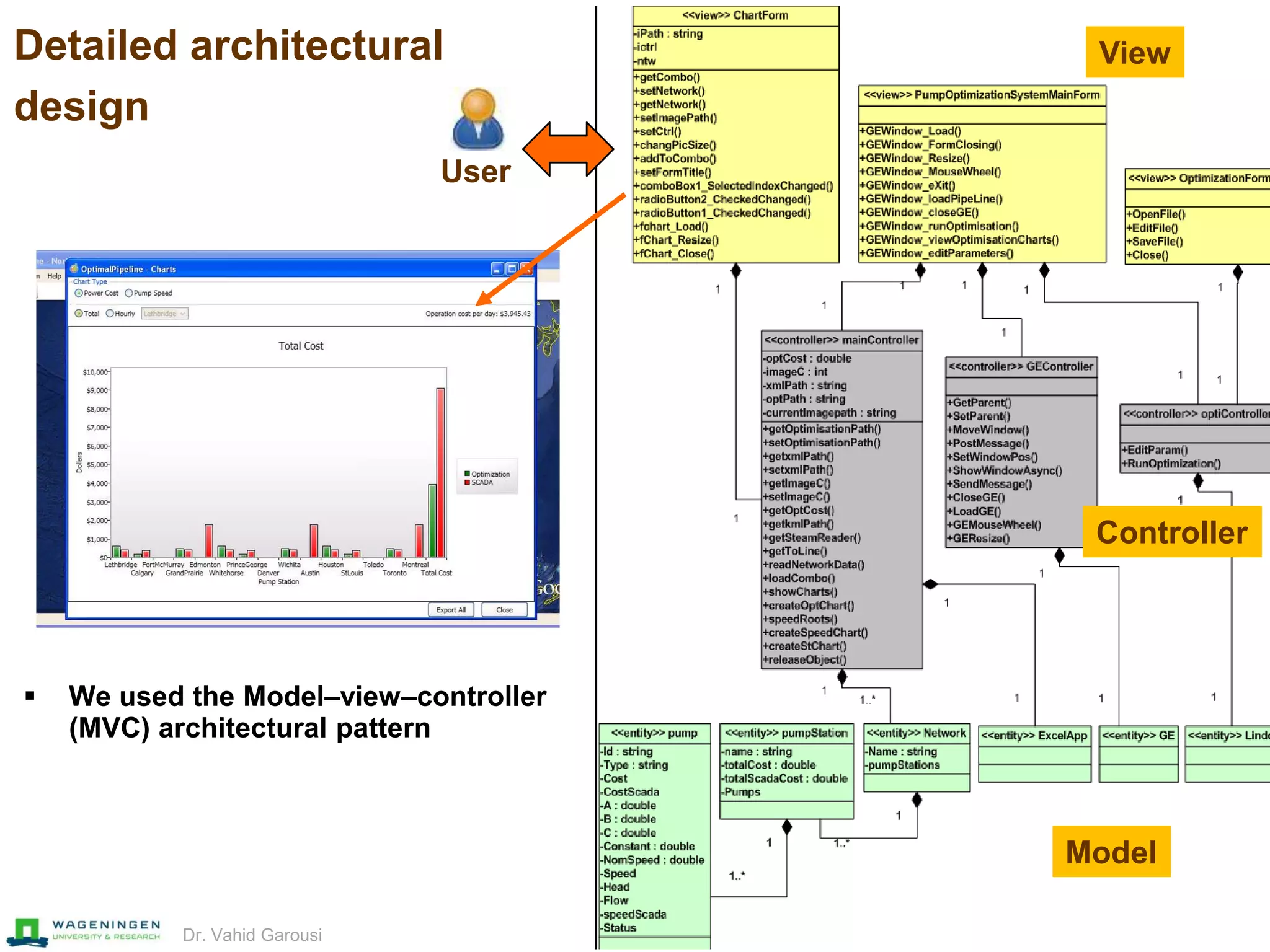
Detailed architectural
design
 We used the Model–view–controller
(MVC) architectural pattern
View
Controller
Model
User
17Dr. Vahid Garousi
Experience and lessons learned w.r.t. development of scientific software
 While the multi-disciplinary nature of the project made it quite successful, it
also caused challenges at times
 We observed success stories and challenges similar to what are reported in
the literature, e.g.:
 The vocabulary used by conventional scientists (engineers) and software
engineers are not the same! Reason: their background and expertise differ
 There is a need for both sides to learn from the other side
 With perseverance, the experience is fulfilling and the resulting outcome is
higher quality, if the system was to be developed ONLY by “one” of the two
sides
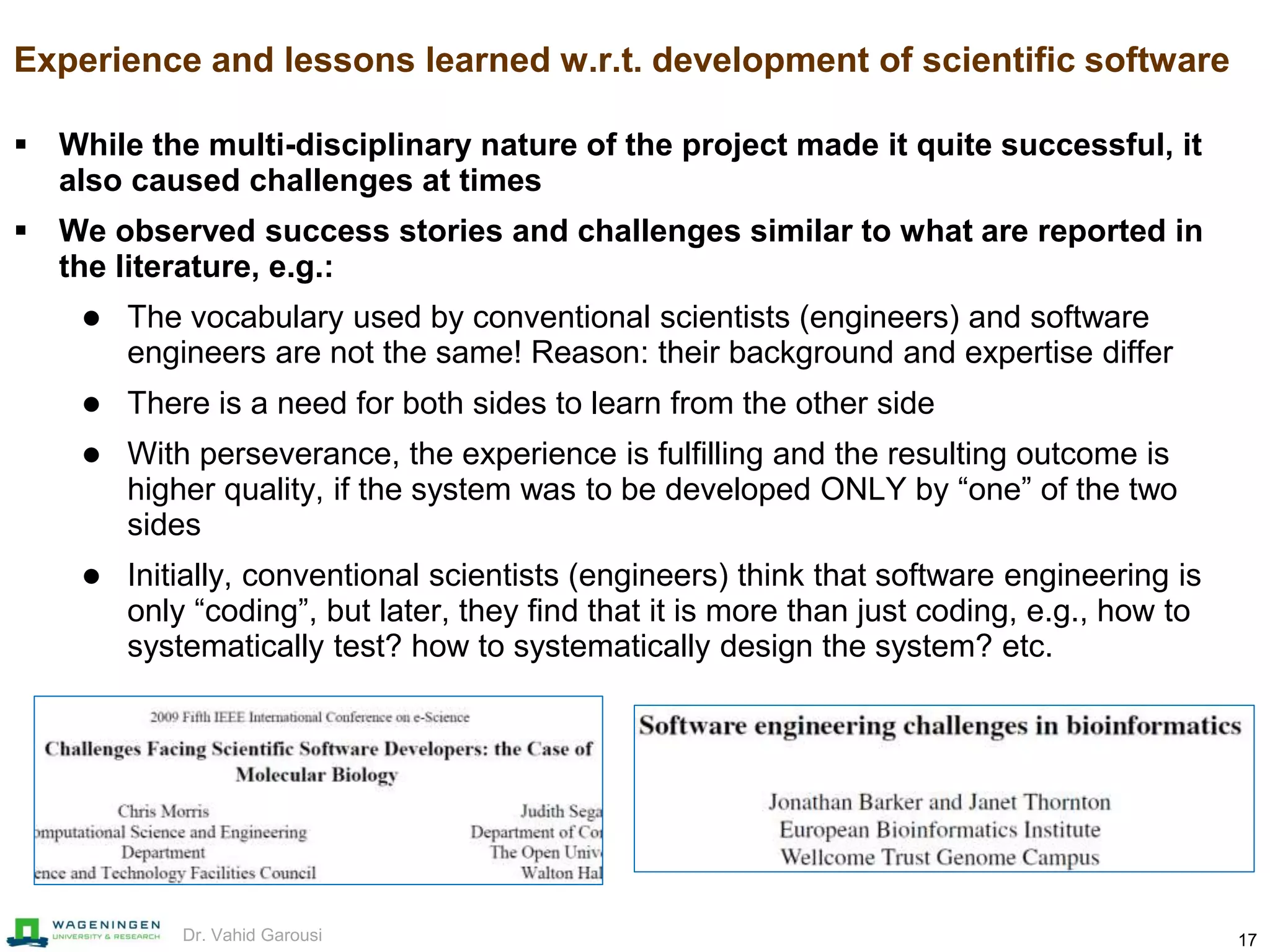
 Initially, conventional scientists (engineers) think that software engineering is
only “coding”, but later, they find that it is more than just coding, e.g., how to
systematically test? how to systematically design the system? etc.
18Dr. Vahid Garousi
Experience and lessons learned w.r.t. development of scientific software
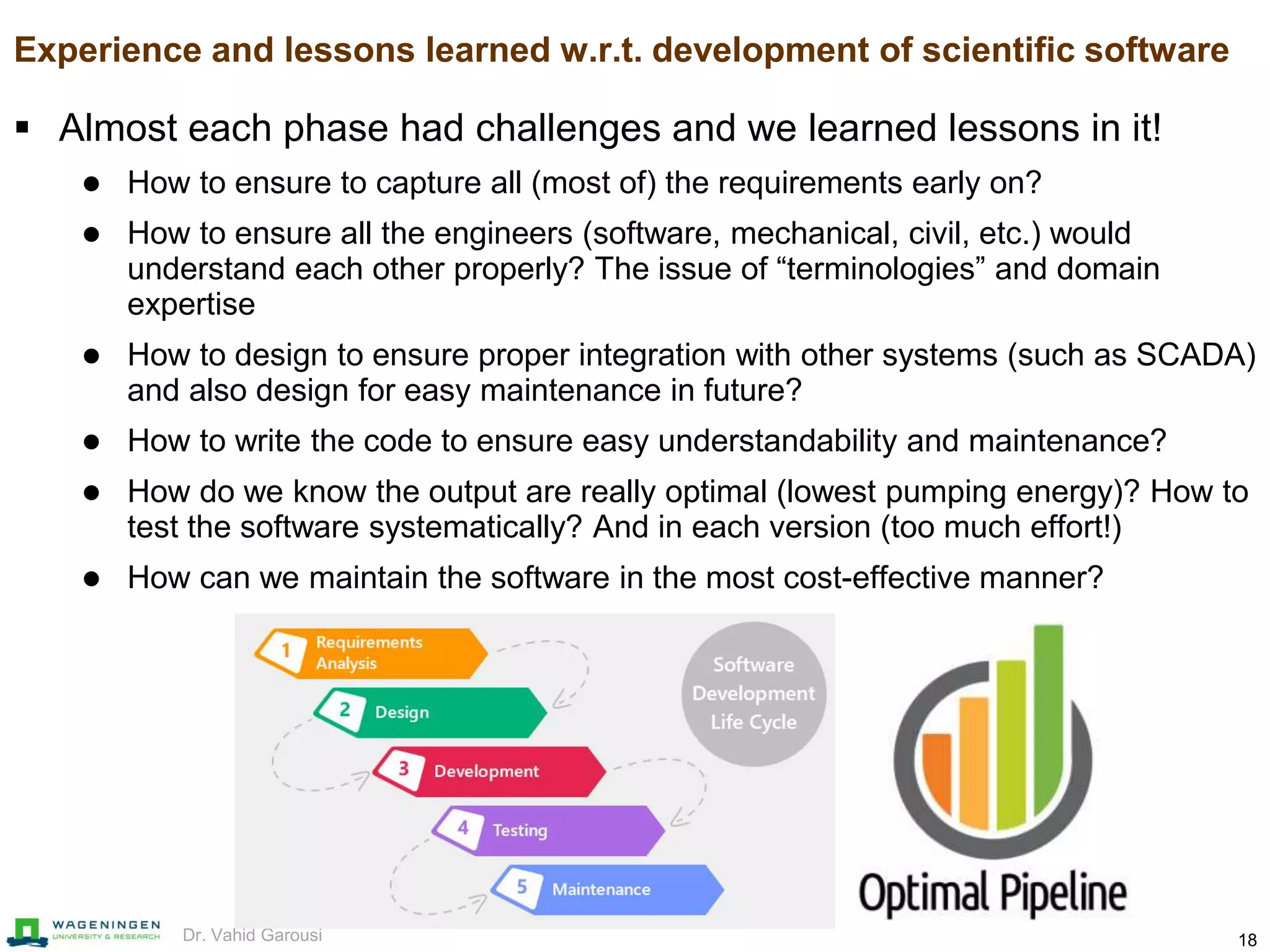
 Almost each phase had challenges and we learned lessons in it!
 How to ensure to capture all (most of) the requirements early on?
 How to ensure all the engineers (software, mechanical, civil, etc.) would
understand each other properly? The issue of “terminologies” and domain
expertise
 How to design to ensure proper integration with other systems (such as SCADA)
and also design for easy maintenance in future?
 How to write the code to ensure easy understandability and maintenance?
 How do we know the output are really optimal (lowest pumping energy)? How to
test the software systematically? And in each version (too much effort!)
 How can we maintain the software in the most cost-effective manner?
19Dr. Vahid Garousi
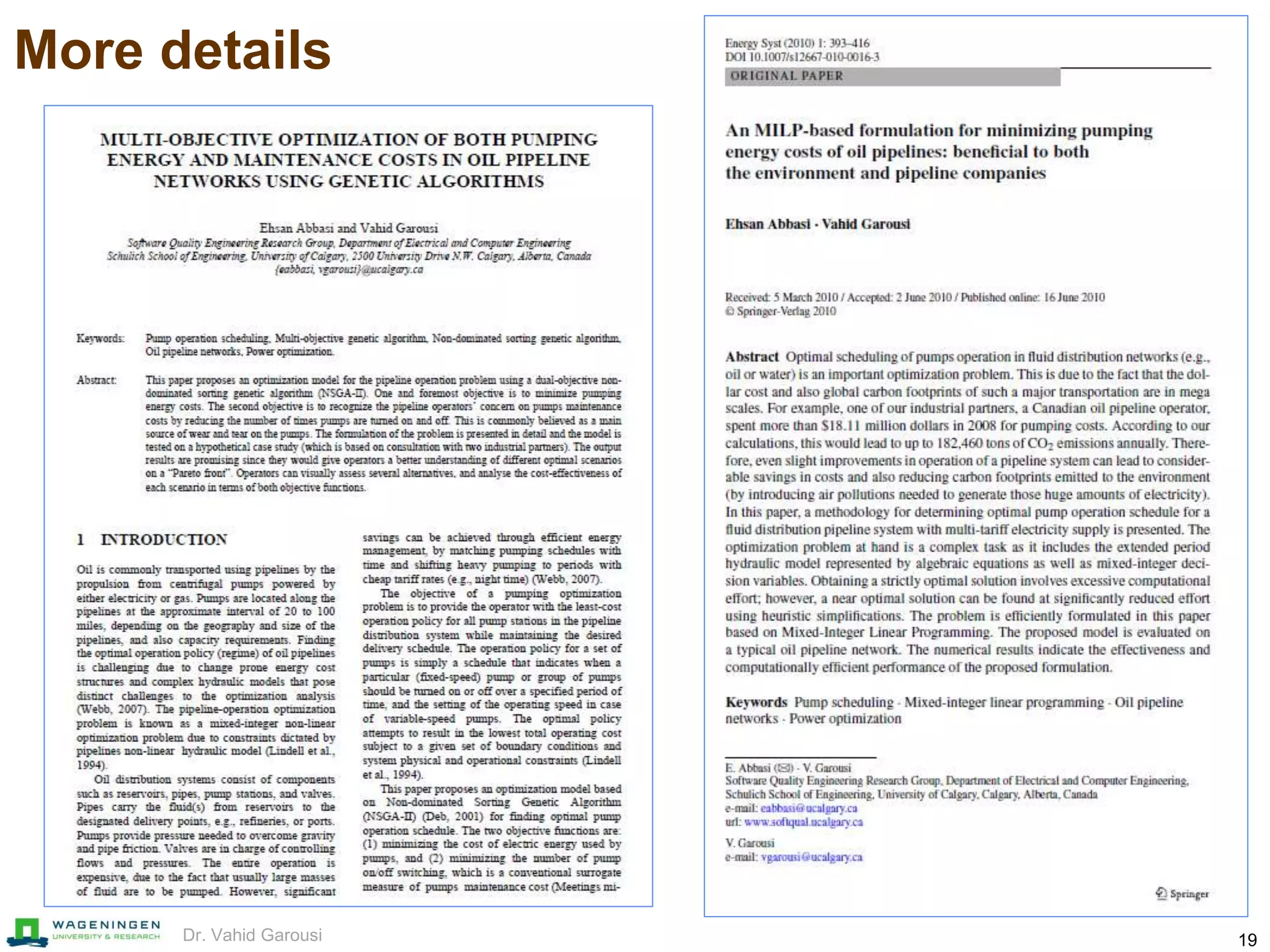
More details
20Dr. Vahid Garousi
My other involvement in development of scientific software
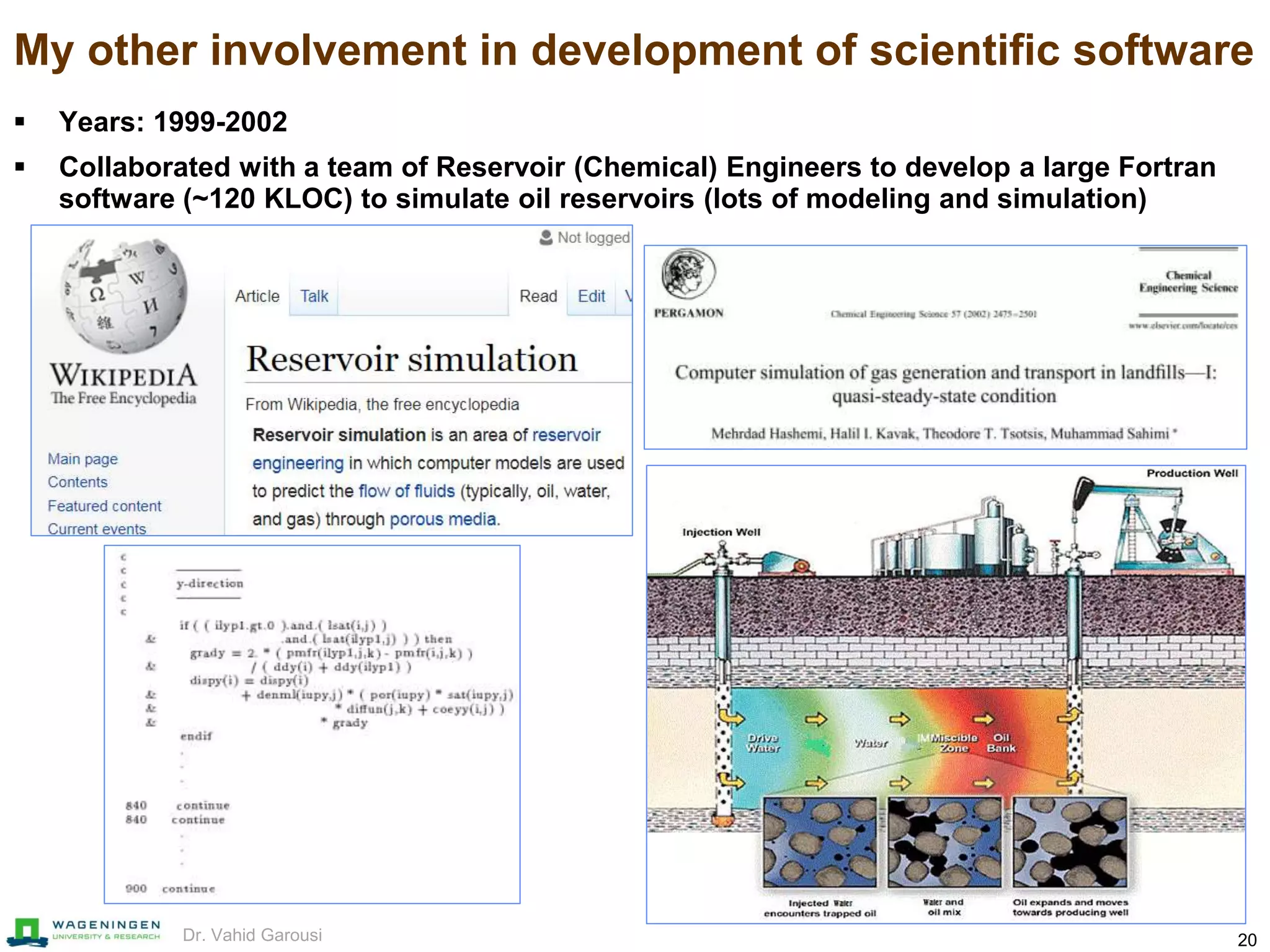
 Years: 1999-2002
 Collaborated with a team of Reservoir (Chemical) Engineers to develop a large Fortran
software (~120 KLOC) to simulate oil reservoirs (lots of modeling and simulation)
21Dr. Vahid Garousi
Outline of the talk
 Context
 Experience from engineering of a scientific software for
oil pipelines
 A brief review of:
 the world-wide community in this area
 the research literature in this area
 Possible areas of collaboration among us, and
Interactive discussions
22Dr. Vahid Garousi
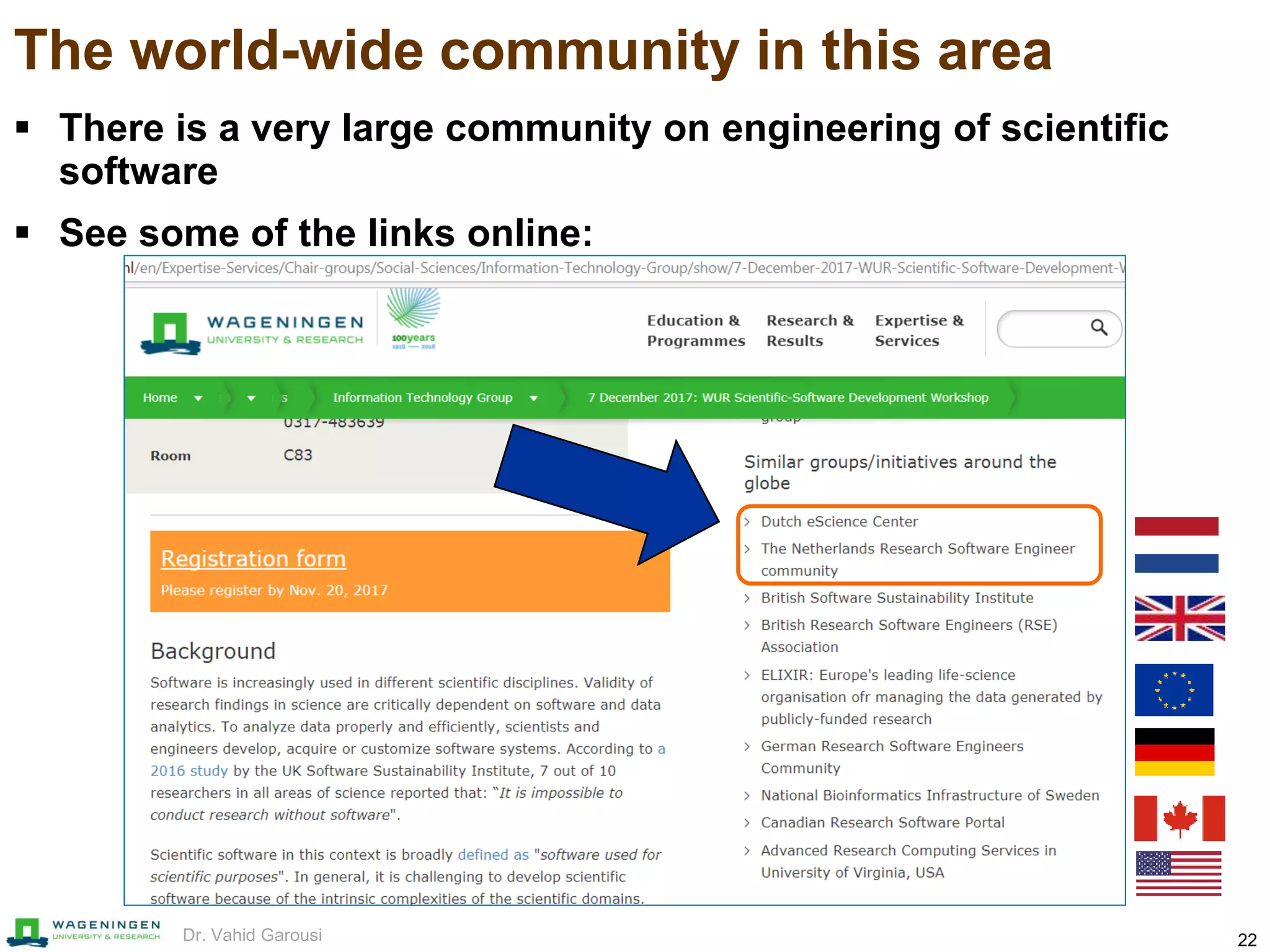
The world-wide community in this area
 There is a very large community on engineering of scientific
software
 See some of the links online:
23Dr. Vahid Garousi
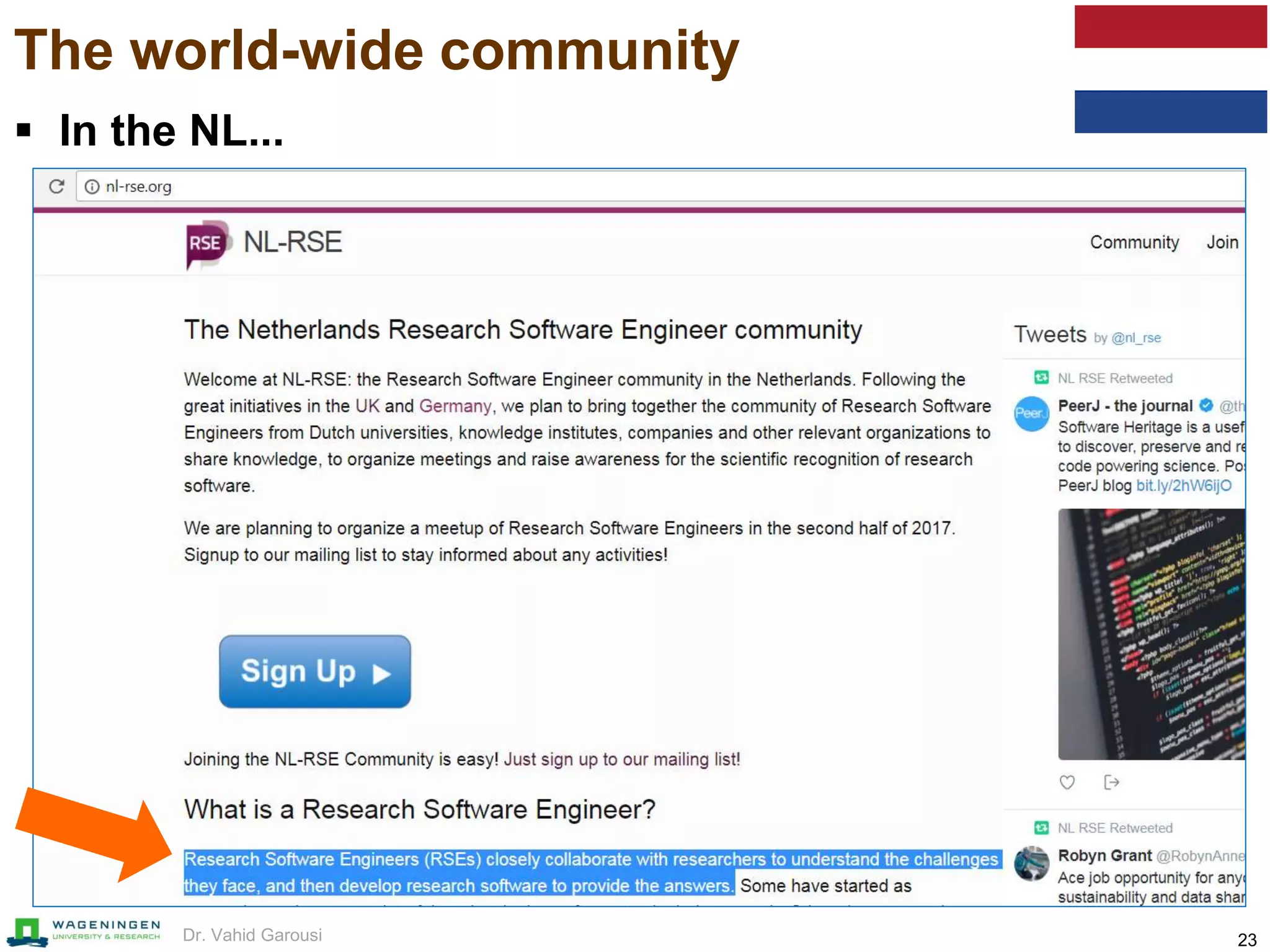
The world-wide community
 In the NL...
24Dr. Vahid Garousi
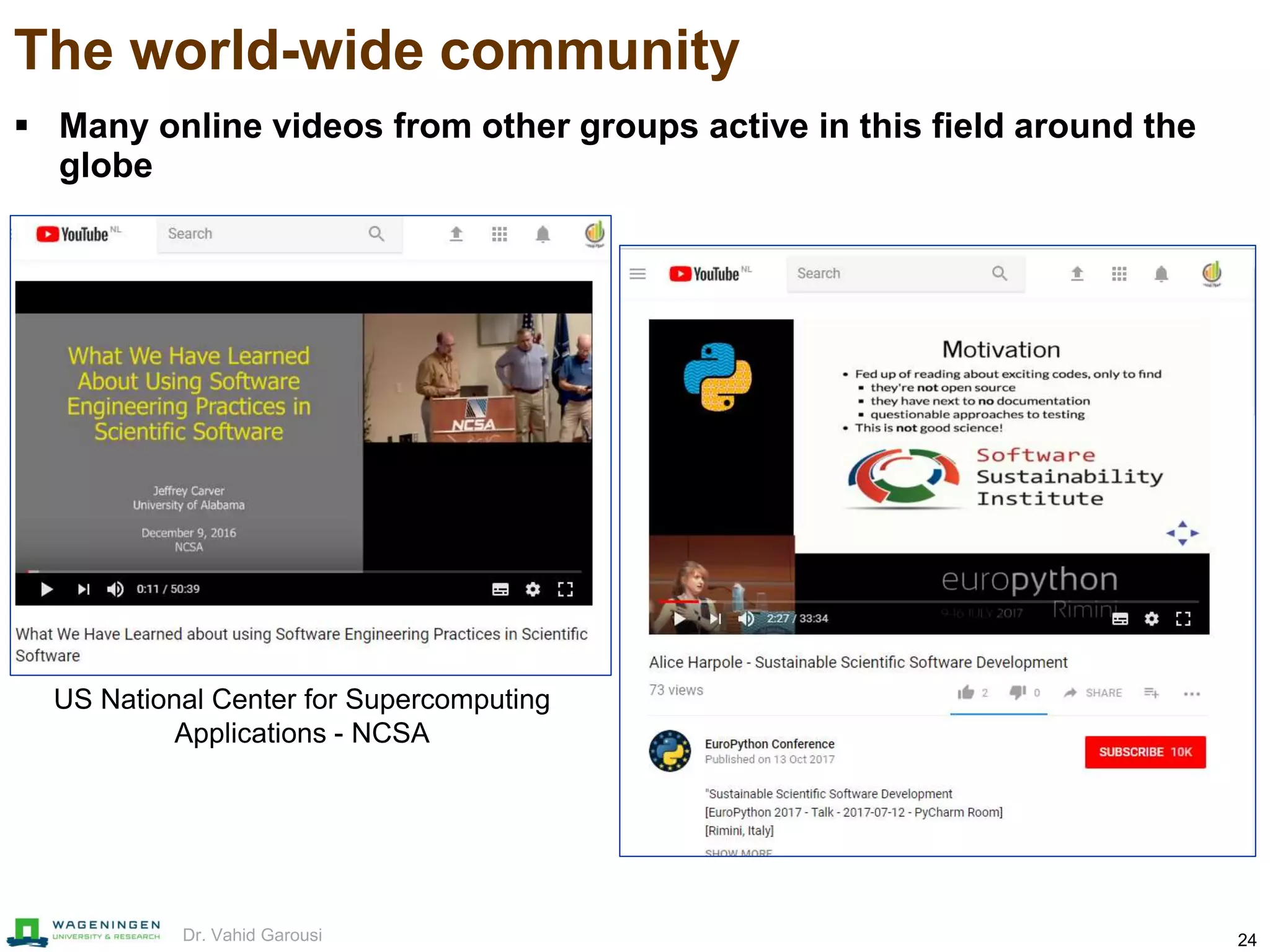
The world-wide community
 Many online videos from other groups active in this field around the
globe
US National Center for Supercomputing
Applications - NCSA
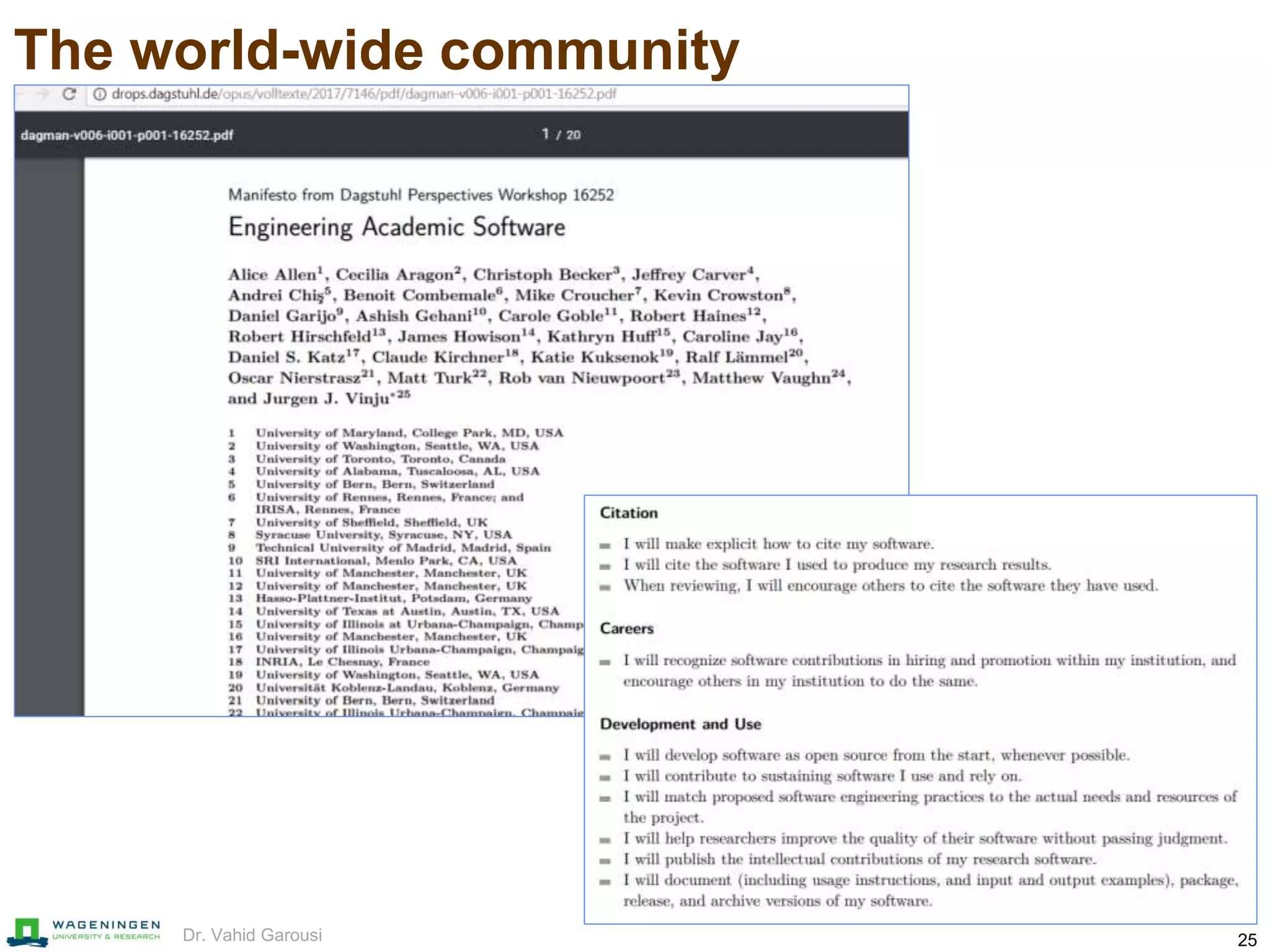
25Dr. Vahid Garousi
The world-wide community
26Dr. Vahid Garousi
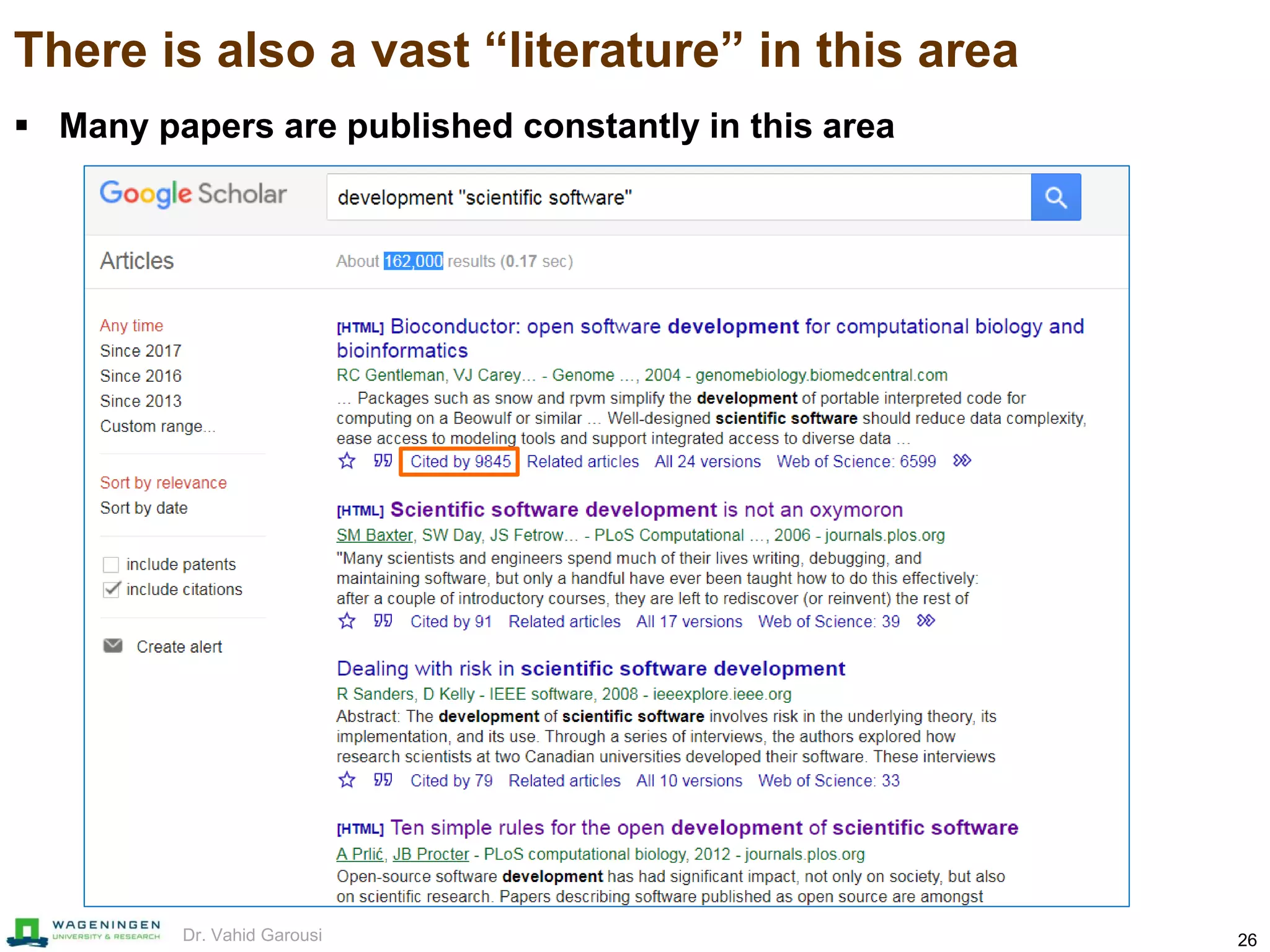
There is also a vast “literature” in this area
 Many papers are published constantly in this area
27Dr. Vahid Garousi
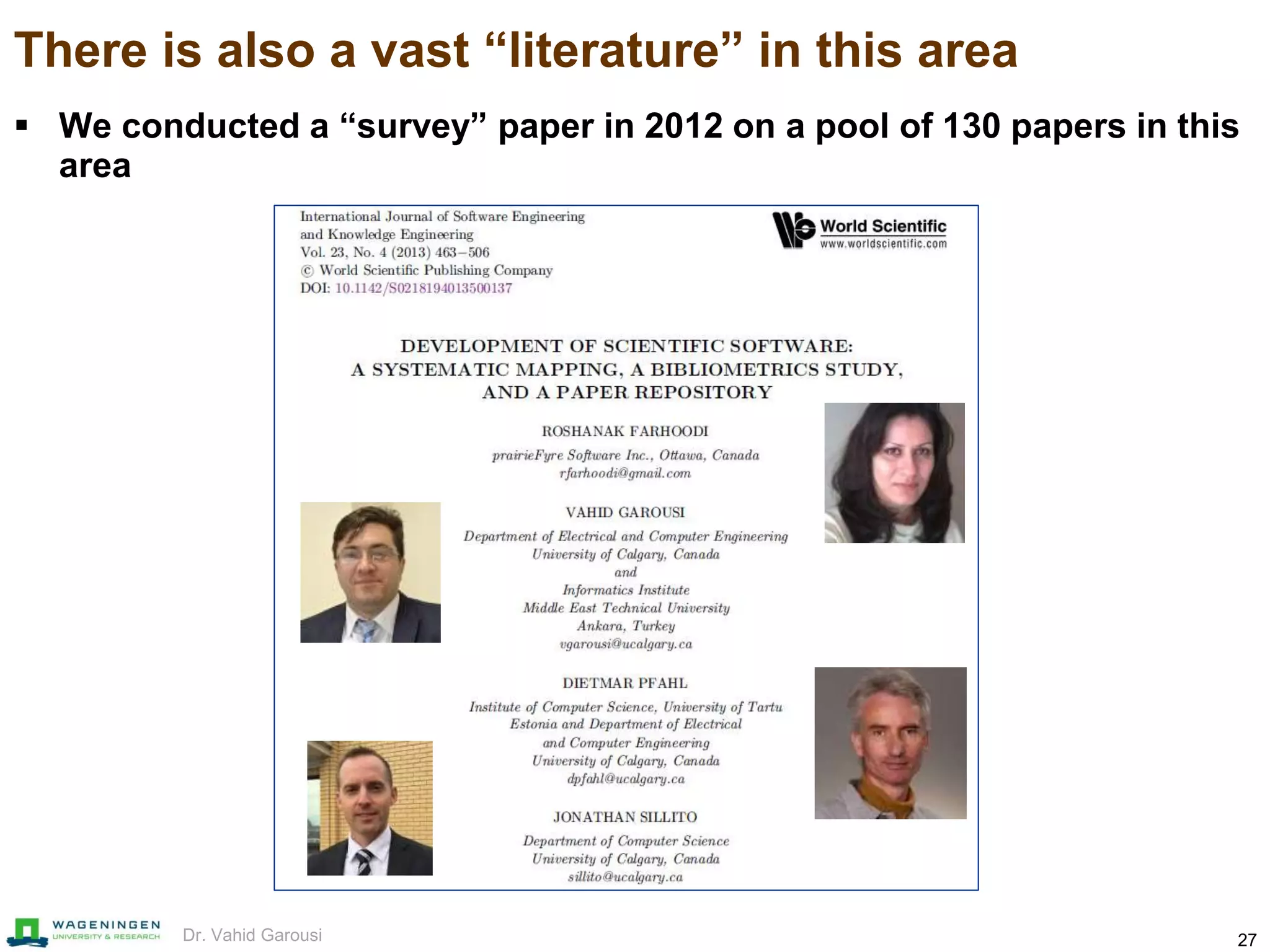
There is also a vast “literature” in this area
 We conducted a “survey” paper in 2012 on a pool of 130 papers in this
area
28Dr. Vahid Garousi
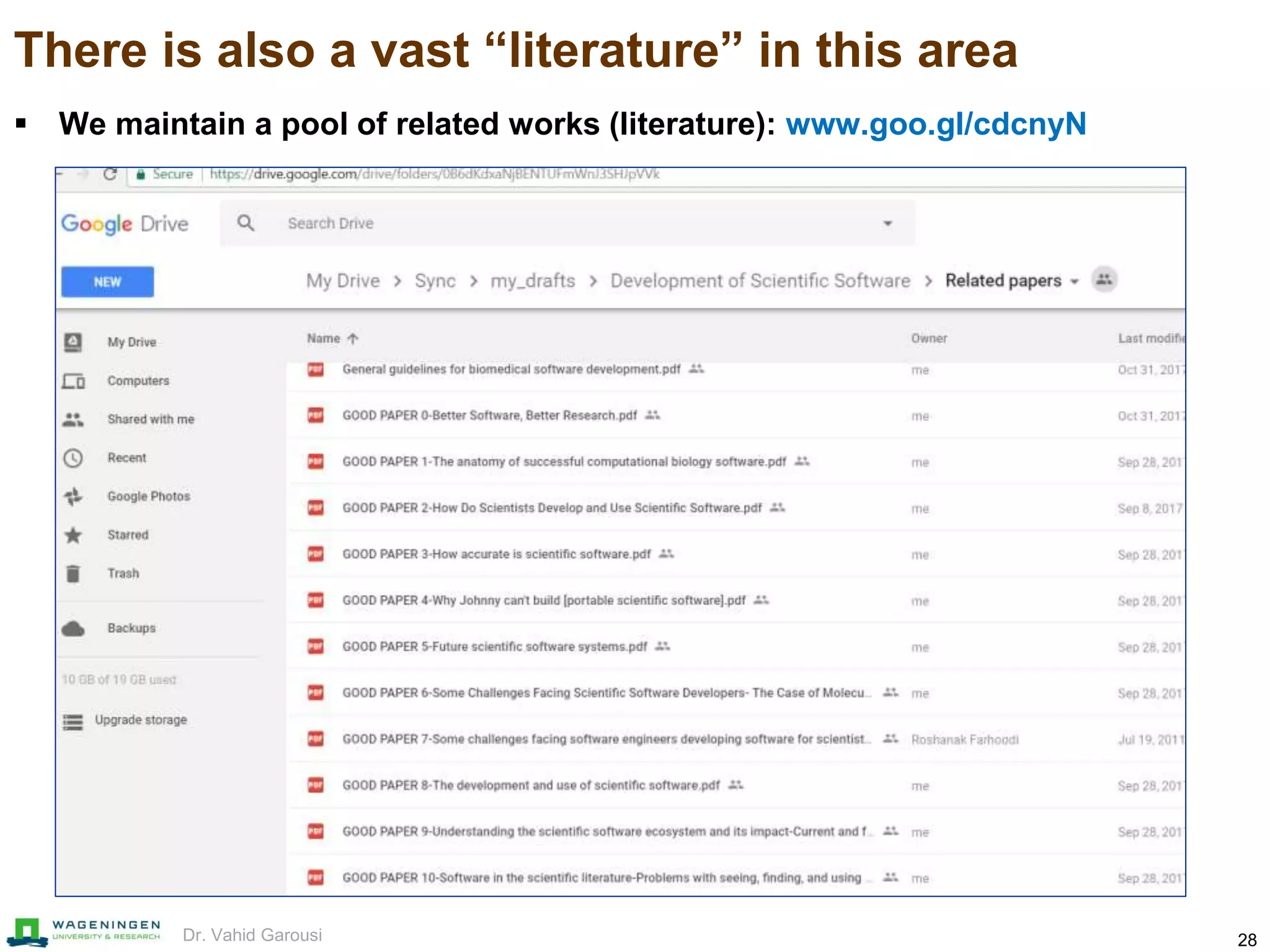
There is also a vast “literature” in this area
 We maintain a pool of related works (literature): www.goo.gl/cdcnyN
29Dr. Vahid Garousi
From our survey paper
 Pool: 130 papers in this area
30Dr. Vahid Garousi
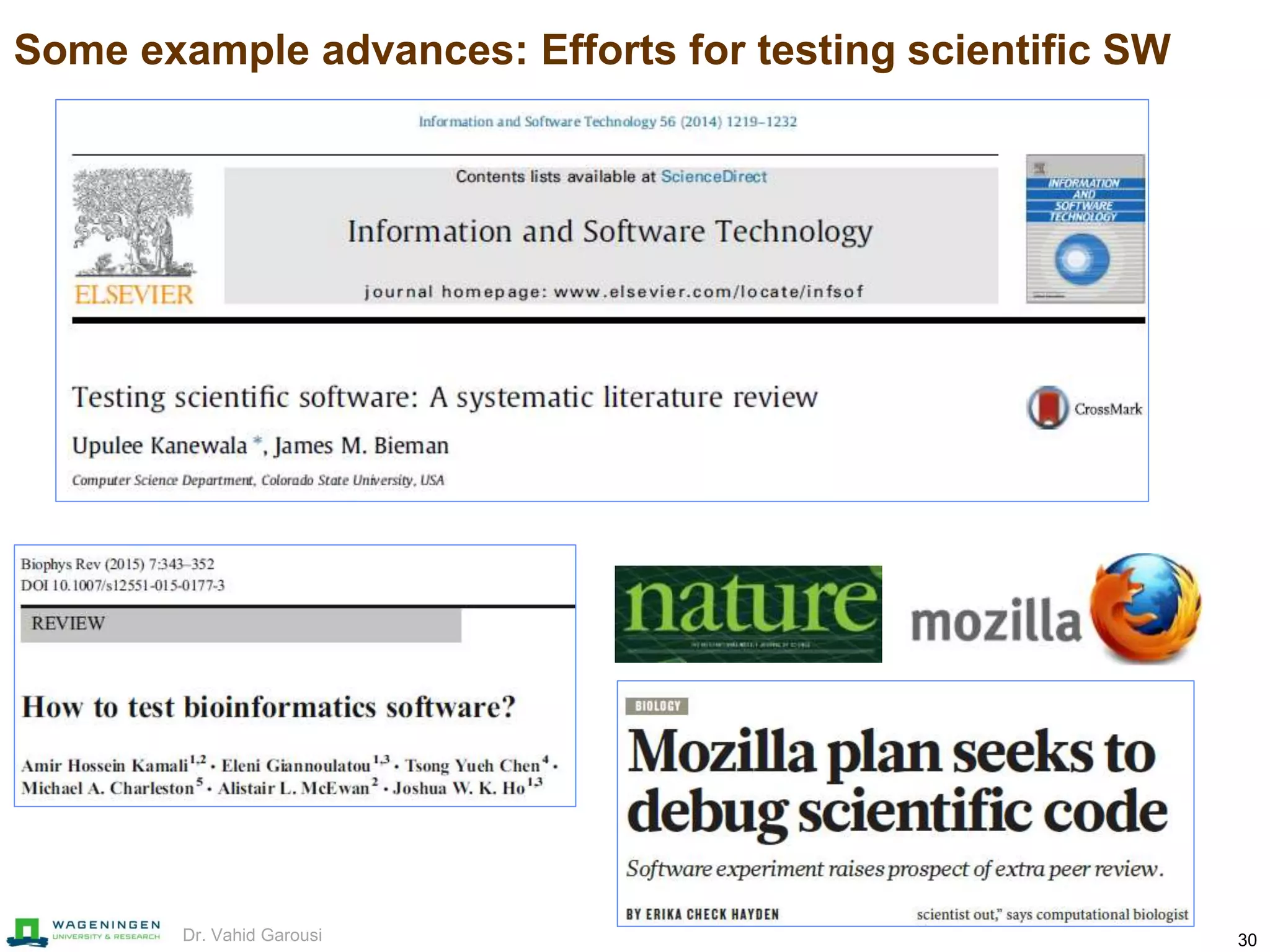
Some example advances: Efforts for testing scientific SW
31Dr. Vahid Garousi
Some example advances: Efforts for testing scientific SW
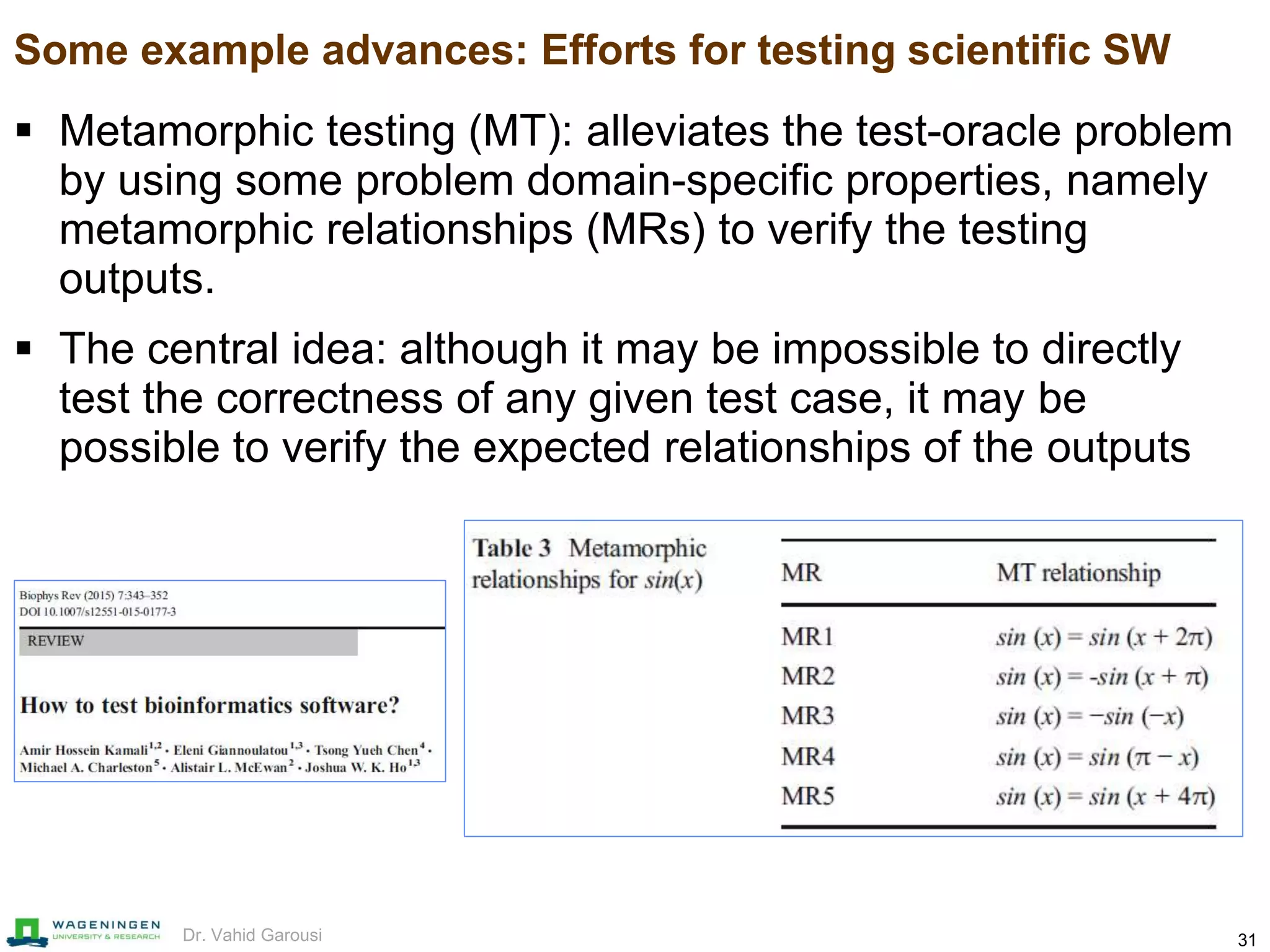
 Metamorphic testing (MT): alleviates the test-oracle problem
by using some problem domain-specific properties, namely
metamorphic relationships (MRs) to verify the testing
outputs.
 The central idea: although it may be impossible to directly
test the correctness of any given test case, it may be
possible to verify the expected relationships of the outputs
32Dr. Vahid Garousi
END of the talk
 Context
 Experience from engineering of a scientific software for
oil pipelines
 A brief review of:
 the world-wide community in this area
 the research literature in this area
 Possible areas of collaboration among us, and
Interactive discussions
Questions and discussions
33Dr. Vahid Garousi
BACK-UP SLIDES
34Dr. Vahid Garousi
Possible areas of collaboration among us
 We have a vision to build a
grass-roots community of
scientific software developers in
WUR
 What we in the Information
Technology Group can offer you:
 Development of scientific software
with high-quality and least effort,
which will be easy to maintain in
future
 Joint work and helping you with
software engineering aspects
 Result for you: Better software ->
Better research!
Let’s discuss possible
areas of collaboration
among us
35Dr. Vahid Garousi
Outline of the talk
 Context
 What is “software engineering” after all? (in two slides!)
 Experience from engineering of a scientific software for
reducing pumping costs in oil pipelines
 A brief review of:
 the world-wide community in this area
 the research literature in this area
 Possible areas of collaboration among us, and
Interactive discussions
36Dr. Vahid Garousi
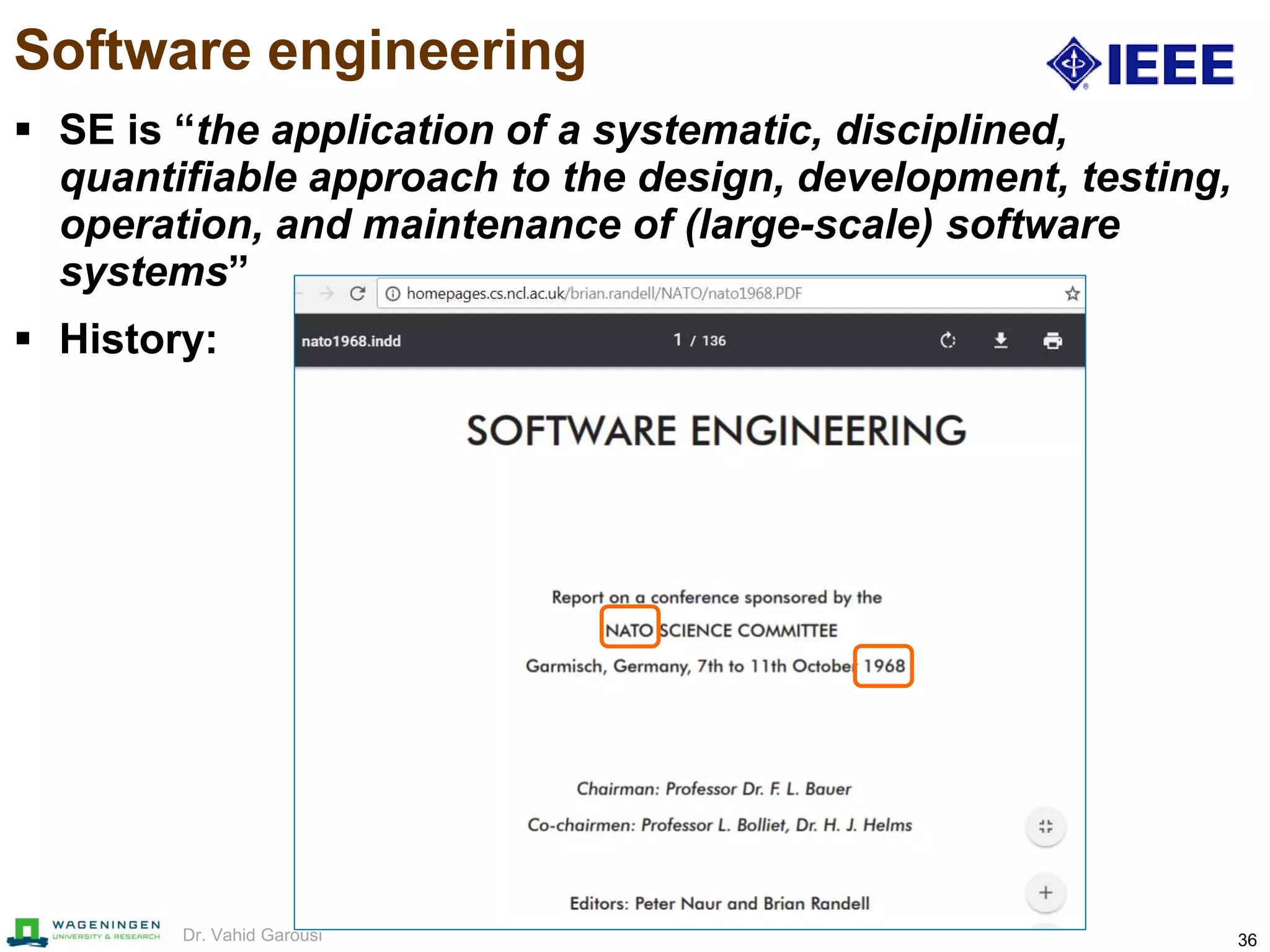
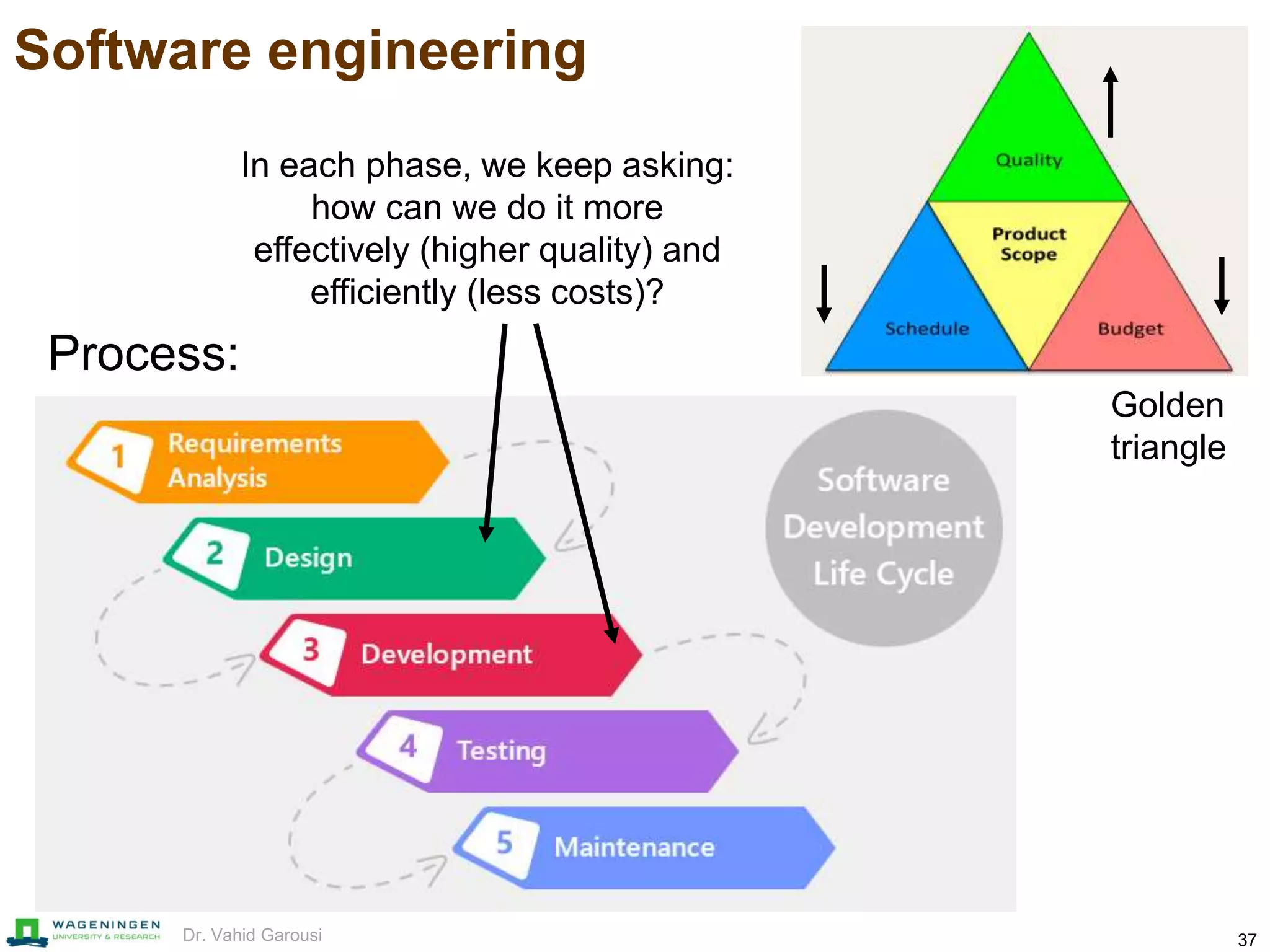
Software engineering
 SE is “the application of a systematic, disciplined,
quantifiable approach to the design, development, testing,
operation, and maintenance of (large-scale) software
systems”
 History:
37Dr. Vahid Garousi
Software engineering
Process:
Golden
triangle
In each phase, we keep asking:
how can we do it more
effectively (higher quality) and
efficiently (less costs)?
38Dr. Vahid Garousi
Invitation to a survey by the NL-RSE
 https://softwaresaved.limequery.com/776594?lang=en

Software engineering of scientific software

  • 1.
    1Dr. Vahid Garousi Softwareengineering of scientific and engineering software: a few project experiences and a review of literature Dr. Vahid Garousi Associate Professor of Software Engineering Information Technology Group Wageningen University, Netherlands www.vgarousi.com www.wur.nl/inf @vgarousi Talk @ VORtech BV Jan. 15, 2018
  • 2.
    2Dr. Vahid Garousi Aboutme  An international background...  Work experience:  Wageningen University, the Netherlands, 2017-  Hacettepe University, Ankara, Turkey, 2015-2017  University of Calgary, Calgary, Canada, 2006-2014  Founder, Maral Software Engineering Consulting Corporation, 2008-2014  Education:  PhD, Carleton University, Ottawa, Canada, 2006  MSc, University of Waterloo, Waterloo, Canada, 2003  BSc, Sharif University of Technology, Tehran, Iran, 2000  Research expertise:  Software Engineering, Software Testing and Quality Assurance (QA)  Engineering (development) of scientific software  Agile methodologies  “Action research”: involvement in 40+ industry-academia collaborative projects in several countries so far
  • 3.
    3Dr. Vahid Garousi WageningenUniversity’s Information Technology Group (INF)  12 staff members  Collaborations with many academic and industry partners in the NL and beyond
  • 4.
    4Dr. Vahid Garousi Context Software is extensively used in all scientific disciplines. scientific software  Scientific software in this context is broadly defined as software used for scientific purposes, or software emerging from scientific research.  Validity of research findings in science are critically dependent on quality of software generating those findings
  • 5.
    5Dr. Vahid Garousi Context But when developing scientific software...  Often, Software Engineering principles and “best practices” (design patterns, systematic code reuse, systematic testing, API design, etc.) are not applied  Thus, there is an opportunity to build “better” scientific software with less effort Software Engineers / Computer Scientists “Other” (conventional) Scientists Opportunity to build higher- quality scientific software with less effort Golden triangle
  • 6.
    6Dr. Vahid Garousi Outlineof the talk  Context  Experience from engineering of a scientific software for oil pipelines  A brief review of:  the world-wide community in this area  the research literature in this area  Possible areas of collaboration among us, and Interactive discussions
  • 7.
    7Dr. Vahid Garousi Engineering(developing) of a scientific software for oil pipelines  Context: high cost ($/€) of pumping oil products across oil pipelines  One pumping station per 50-300 KM  A world-wide total of several billion dollars/year
  • 8.
    8Dr. Vahid Garousi Asoftware for reducing pumping costs in oil pipelines  Pump stations consume either electric energy or fossil fuels, e.g., natural gas  Everything is controlled / monitored by SCADA systems from a central control center  SCADA: Supervisory Control And Data Acquisition
  • 9.
    9Dr. Vahid Garousi Engineering(developing) of a scientific software for oil pipelines  A project proposal was submitted and it won a major funding provided by the Canadian province of Alberta  Industry partners: Enbridge and Pembina  (Enbridge is the “largest” oil pipeline operator in the world)  Project:  Title: Engineering Intelligent Software Systems for Improving the Operational Efficiency of Oil Pipeline Networks  Timeline: 2007-2012  Budget: $300,000 CND  Several students were hired:
  • 10.
    10Dr. Vahid Garousi Engineering(developing) of a scientific software for oil pipelines  Team:  Civil engineers (liquid hydraulics)  Mechanical and chemical engineers (pipeline expertise)  Software engineers (high-quality software development and integration with existing systems) – team leadership  Optimization experts (to get advice on building the optimization model)  Truly “multi-disciplinary”... Mechanical and chemical engineers: Domain expertise and case studies Civil engineering and optimization consulting PI and research team
  • 11.
    11Dr. Vahid Garousi Softwareengineering started...  It was an iterative process  Everyone was involved in all phases
  • 12.
    12Dr. Vahid Garousi Theproduct: OptimalPipeline software  In several iterations, we developed the product  Functionality: Output: • Hourly speed of each pump such that the total network-level pumping costs are minimized Input: • Topology of your pipeline network • Pipeline's mechanical characteristics • Pumps' characteristics • Multi-tariff Electricity power rates • Contracted delivery volume of oil product A non-linear optimization engine using genetic algorithms (GA) was developed
  • 13.
    13Dr. Vahid Garousi Theproduct: OptimalPipeline software  Demo video: www.youtube.com/watch?v=VF8cf38wNOQ
  • 14.
    14Dr. Vahid Garousi Theproduct: OptimalPipeline software  Screenshots:  Outcome: a start-up company was formed and few licenses of the software were sold.
  • 15.
    15Dr. Vahid Garousi Softwarearchitecture of the software  Integration with other systems in the companies  We used Software Engineering best practices, e.g., the Model–view–controller (MVC) architectural pattern User interacts calls (uses) calls (uses) calls (uses) To visualize the pipeline network The optiimzation engine To generate the output charts interacts with SCADA systems (Supervisory Control And Data Acquisition)
  • 16.
    16Dr. Vahid Garousi Detailedarchitectural design  We used the Model–view–controller (MVC) architectural pattern View Controller Model User
  • 17.
    17Dr. Vahid Garousi Experienceand lessons learned w.r.t. development of scientific software  While the multi-disciplinary nature of the project made it quite successful, it also caused challenges at times  We observed success stories and challenges similar to what are reported in the literature, e.g.:  The vocabulary used by conventional scientists (engineers) and software engineers are not the same! Reason: their background and expertise differ  There is a need for both sides to learn from the other side  With perseverance, the experience is fulfilling and the resulting outcome is higher quality, if the system was to be developed ONLY by “one” of the two sides  Initially, conventional scientists (engineers) think that software engineering is only “coding”, but later, they find that it is more than just coding, e.g., how to systematically test? how to systematically design the system? etc.
  • 18.
    18Dr. Vahid Garousi Experienceand lessons learned w.r.t. development of scientific software  Almost each phase had challenges and we learned lessons in it!  How to ensure to capture all (most of) the requirements early on?  How to ensure all the engineers (software, mechanical, civil, etc.) would understand each other properly? The issue of “terminologies” and domain expertise  How to design to ensure proper integration with other systems (such as SCADA) and also design for easy maintenance in future?  How to write the code to ensure easy understandability and maintenance?  How do we know the output are really optimal (lowest pumping energy)? How to test the software systematically? And in each version (too much effort!)  How can we maintain the software in the most cost-effective manner?
  • 19.
  • 20.
    20Dr. Vahid Garousi Myother involvement in development of scientific software  Years: 1999-2002  Collaborated with a team of Reservoir (Chemical) Engineers to develop a large Fortran software (~120 KLOC) to simulate oil reservoirs (lots of modeling and simulation)
  • 21.
    21Dr. Vahid Garousi Outlineof the talk  Context  Experience from engineering of a scientific software for oil pipelines  A brief review of:  the world-wide community in this area  the research literature in this area  Possible areas of collaboration among us, and Interactive discussions
  • 22.
    22Dr. Vahid Garousi Theworld-wide community in this area  There is a very large community on engineering of scientific software  See some of the links online:
  • 23.
    23Dr. Vahid Garousi Theworld-wide community  In the NL...
  • 24.
    24Dr. Vahid Garousi Theworld-wide community  Many online videos from other groups active in this field around the globe US National Center for Supercomputing Applications - NCSA
  • 25.
    25Dr. Vahid Garousi Theworld-wide community
  • 26.
    26Dr. Vahid Garousi Thereis also a vast “literature” in this area  Many papers are published constantly in this area
  • 27.
    27Dr. Vahid Garousi Thereis also a vast “literature” in this area  We conducted a “survey” paper in 2012 on a pool of 130 papers in this area
  • 28.
    28Dr. Vahid Garousi Thereis also a vast “literature” in this area  We maintain a pool of related works (literature): www.goo.gl/cdcnyN
  • 29.
    29Dr. Vahid Garousi Fromour survey paper  Pool: 130 papers in this area
  • 30.
    30Dr. Vahid Garousi Someexample advances: Efforts for testing scientific SW
  • 31.
    31Dr. Vahid Garousi Someexample advances: Efforts for testing scientific SW  Metamorphic testing (MT): alleviates the test-oracle problem by using some problem domain-specific properties, namely metamorphic relationships (MRs) to verify the testing outputs.  The central idea: although it may be impossible to directly test the correctness of any given test case, it may be possible to verify the expected relationships of the outputs
  • 32.
    32Dr. Vahid Garousi ENDof the talk  Context  Experience from engineering of a scientific software for oil pipelines  A brief review of:  the world-wide community in this area  the research literature in this area  Possible areas of collaboration among us, and Interactive discussions Questions and discussions
  • 33.
  • 34.
    34Dr. Vahid Garousi Possibleareas of collaboration among us  We have a vision to build a grass-roots community of scientific software developers in WUR  What we in the Information Technology Group can offer you:  Development of scientific software with high-quality and least effort, which will be easy to maintain in future  Joint work and helping you with software engineering aspects  Result for you: Better software -> Better research! Let’s discuss possible areas of collaboration among us
  • 35.
    35Dr. Vahid Garousi Outlineof the talk  Context  What is “software engineering” after all? (in two slides!)  Experience from engineering of a scientific software for reducing pumping costs in oil pipelines  A brief review of:  the world-wide community in this area  the research literature in this area  Possible areas of collaboration among us, and Interactive discussions
  • 36.
    36Dr. Vahid Garousi Softwareengineering  SE is “the application of a systematic, disciplined, quantifiable approach to the design, development, testing, operation, and maintenance of (large-scale) software systems”  History:
  • 37.
    37Dr. Vahid Garousi Softwareengineering Process: Golden triangle In each phase, we keep asking: how can we do it more effectively (higher quality) and efficiently (less costs)?
  • 38.
    38Dr. Vahid Garousi Invitationto a survey by the NL-RSE  https://softwaresaved.limequery.com/776594?lang=en