The Basics- Functionalism
•Society can be understood scientifically
• Human behaviour governed by a set of
‘laws’ that maintain the ‘health’ of wider
society
• Society can only be understood as a whole
with looking at how all parts work together
• Consensus theory – based on shared values
1. All societies have basic needs that should be met if they are to survive and prosper (e.g. food and housing
for the population).
2. Society made of interconnected parts like a machine. Parts have to work together for society to survive.
3. Value consensus – general agreement among members of society about important values they hold in
common.
4. Society needs order and stability if it is to survive.
5. Social order – maintained by effective socialisation and social control.
3.
The Basics- Marxism
•Conflict theory – emphasises the differences
that exist in society.
• Infrastructure – forces of production and
social relationships dependent on them.
• Superstructure – Other aspects of society,
e.g. education, beliefs and values.
1. Focuses on analysing and understanding relationships that exist between social classes in society.
2. Society is structured in such a way that keeps the rich rich and the poor poor.
3. Ruling class ideology prevents many ordinary working people from really understanding the nature of
society.
4. False consciousness – Mistaken belief that capitalist society is basically fair and that real opportunities are
available to all
4.
The Basics –New Right
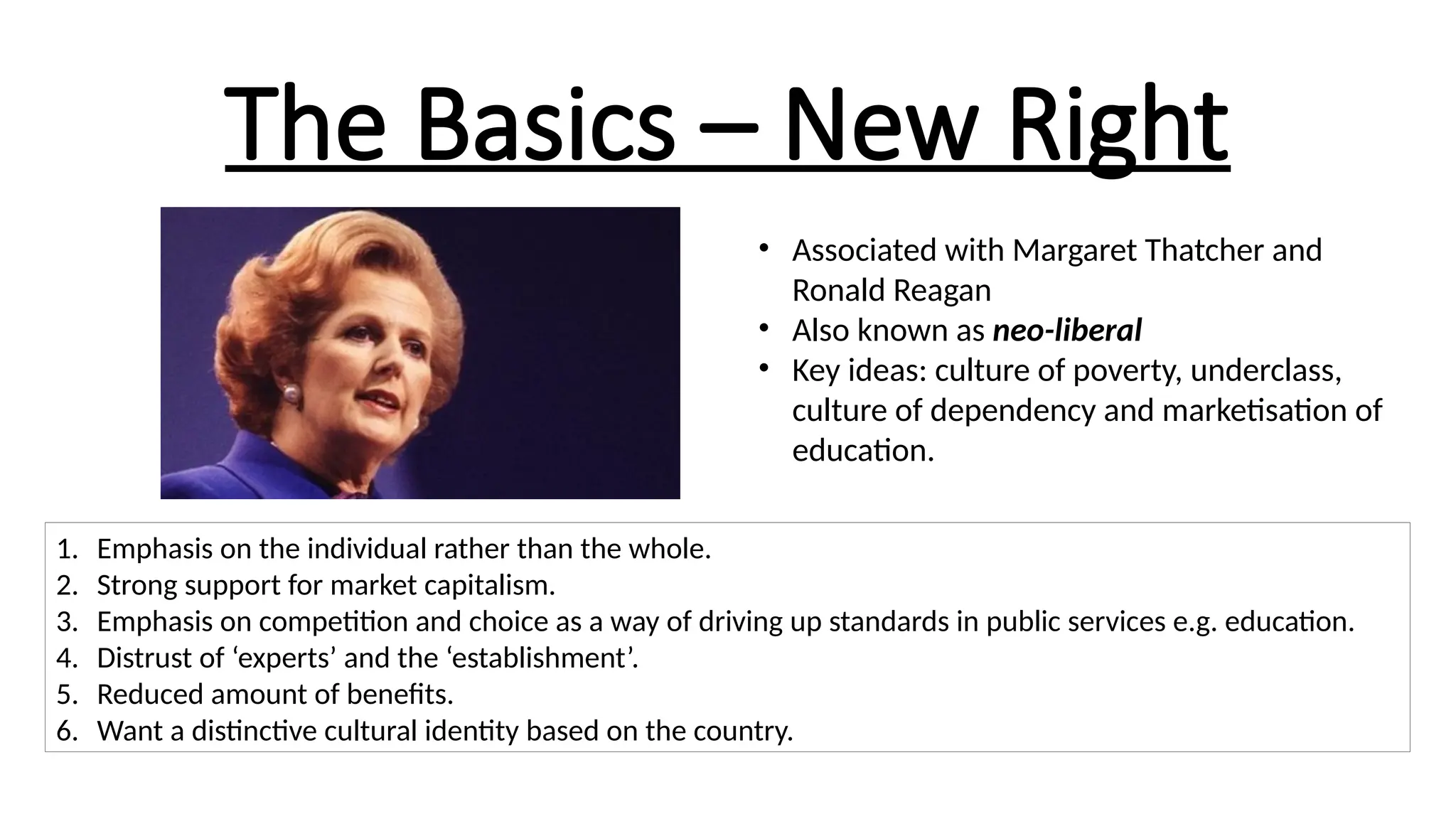
• Associated with Margaret Thatcher and
Ronald Reagan
• Also known as neo-liberal
• Key ideas: culture of poverty, underclass,
culture of dependency and marketisation of
education.
1. Emphasis on the individual rather than the whole.
2. Strong support for market capitalism.
3. Emphasis on competition and choice as a way of driving up standards in public services e.g. education.
4. Distrust of ‘experts’ and the ‘establishment’.
5. Reduced amount of benefits.
6. Want a distinctive cultural identity based on the country.
5.
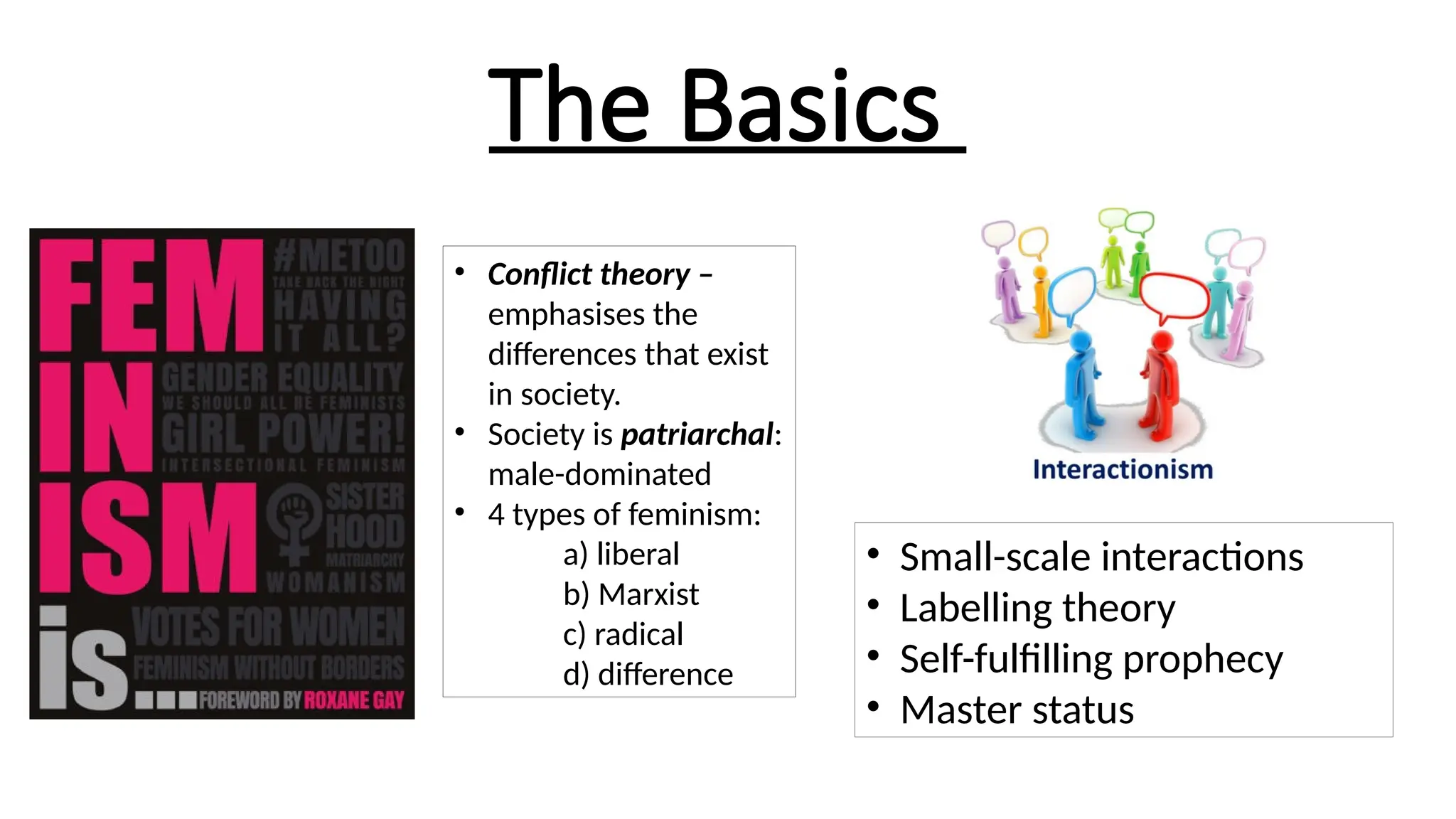
The Basics
• Conflicttheory –
emphasises the
differences that exist
in society.
• Society is patriarchal:
male-dominated
• 4 types of feminism:
a) liberal
b) Marxist
c) radical
d) difference
• Small-scale interactions
• Labelling theory
• Self-fulfilling prophecy
• Master status
6.
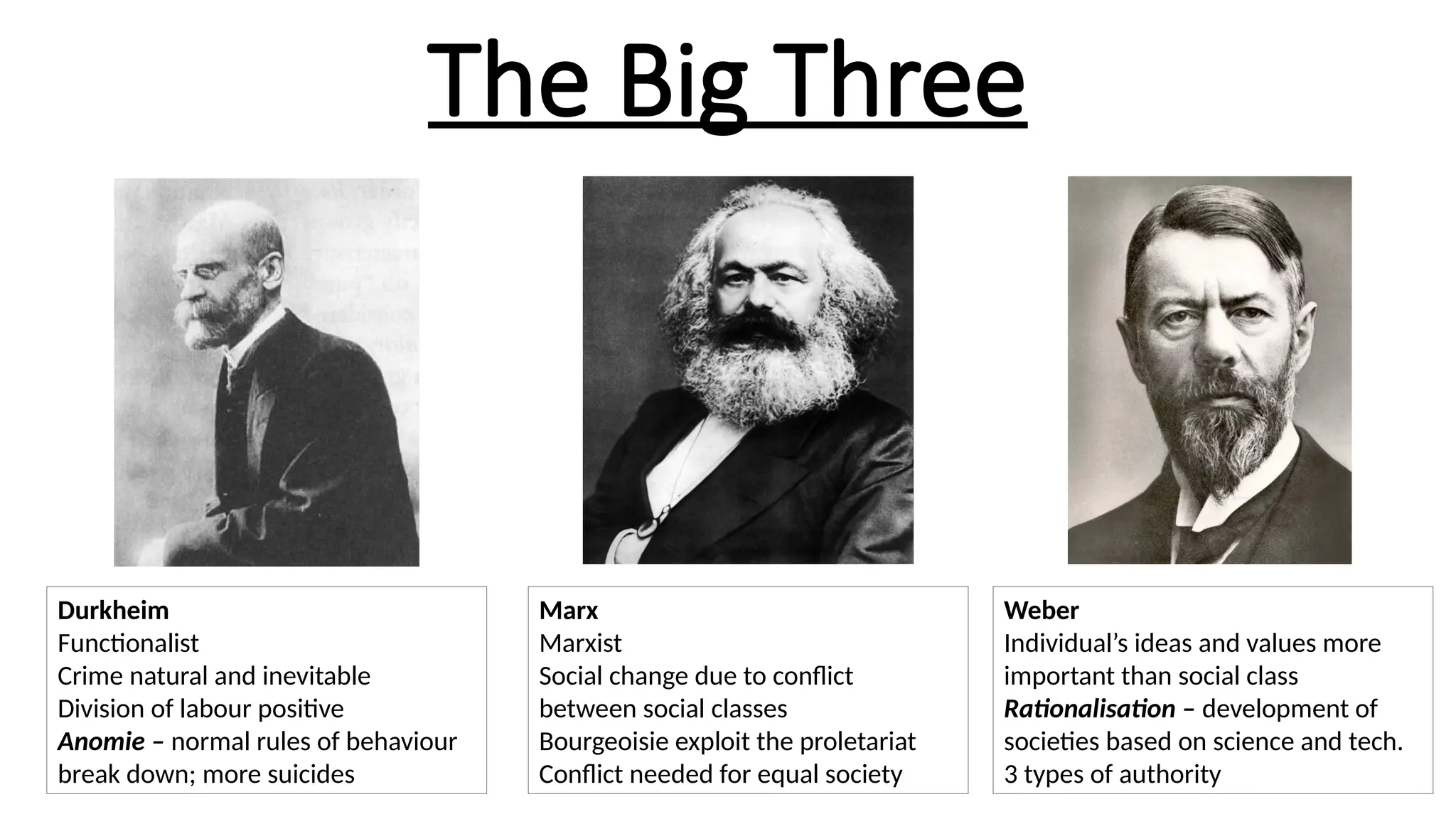
The Big Three
Durkheim
Functionalist
Crimenatural and inevitable
Division of labour positive
Anomie – normal rules of behaviour
break down; more suicides
Marx
Marxist
Social change due to conflict
between social classes
Bourgeoisie exploit the proletariat
Conflict needed for equal society
Weber
Individual’s ideas and values more
important than social class
Rationalisation – development of
societies based on science and tech.
3 types of authority
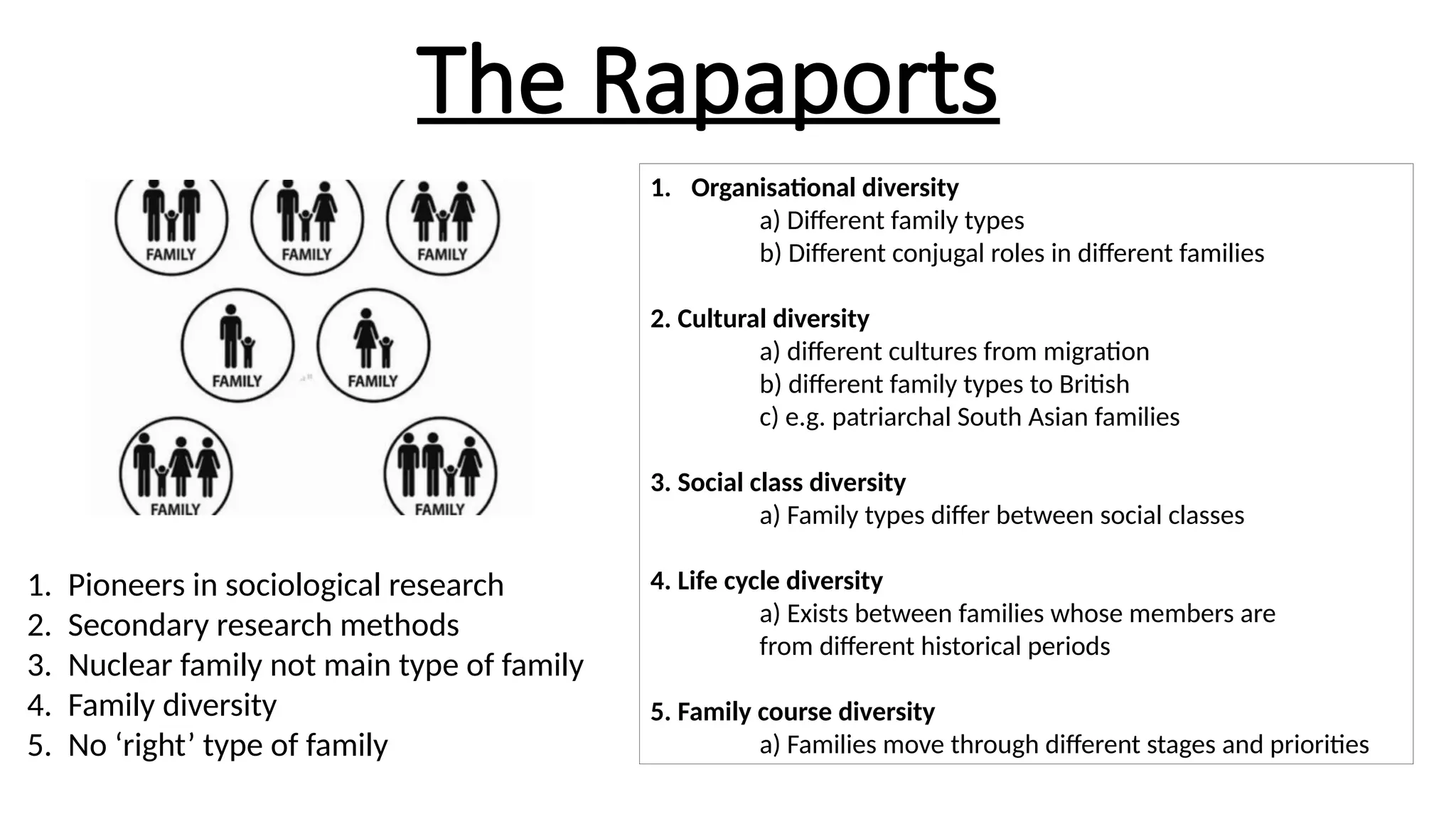
The Rapaports
1. Pioneersin sociological research
2. Secondary research methods
3. Nuclear family not main type of family
4. Family diversity
5. No ‘right’ type of family
1. Organisational diversity
a) Different family types
b) Different conjugal roles in different families
2. Cultural diversity
a) different cultures from migration
b) different family types to British
c) e.g. patriarchal South Asian families
3. Social class diversity
a) Family types differ between social classes
4. Life cycle diversity
a) Exists between families whose members are
from different historical periods
5. Family course diversity
a) Families move through different stages and priorities
9.
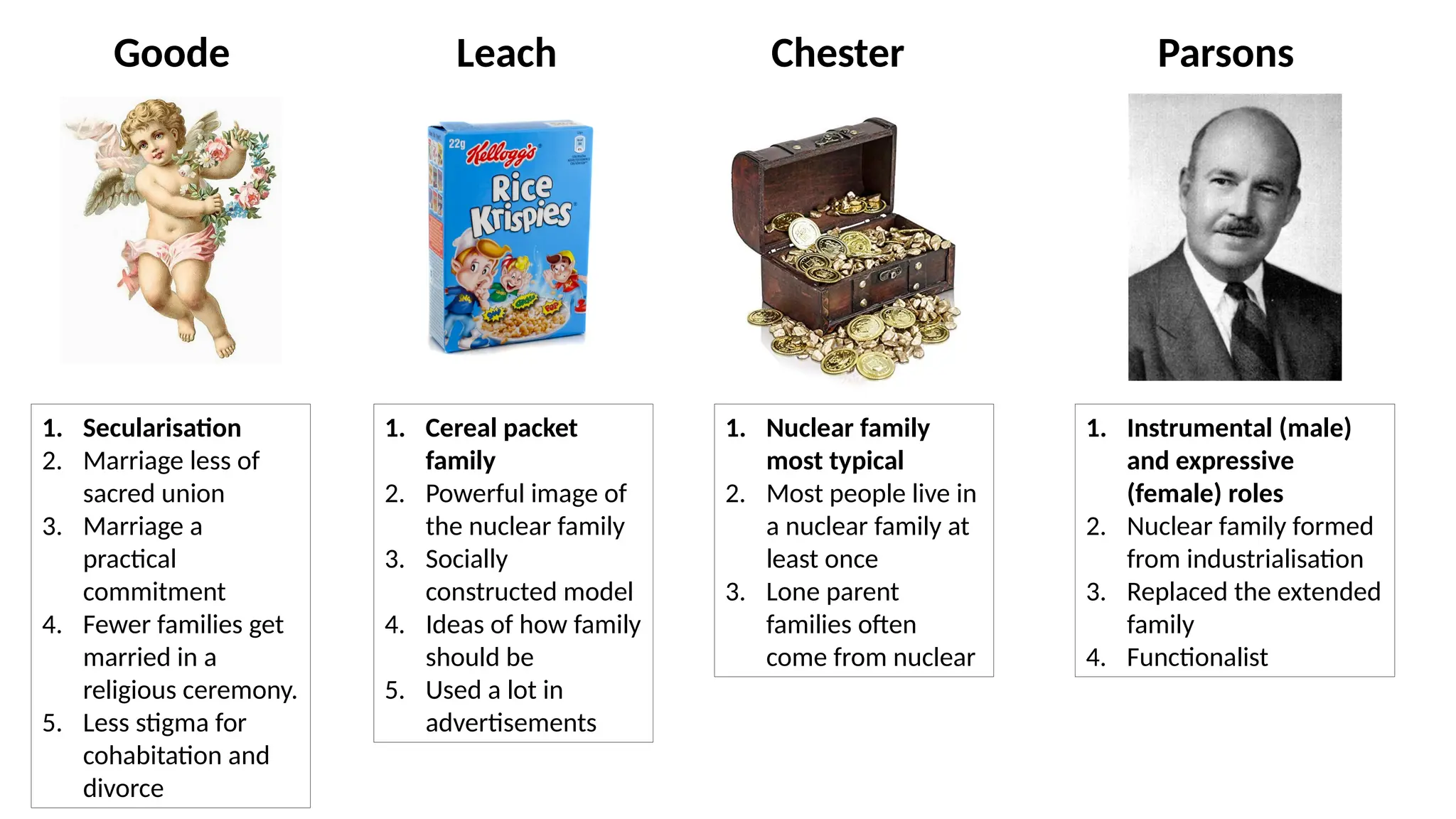
Goode
1. Secularisation
2. Marriageless of
sacred union
3. Marriage a
practical
commitment
4. Fewer families get
married in a
religious ceremony.
5. Less stigma for
cohabitation and
divorce
Leach
1. Cereal packet
family
2. Powerful image of
the nuclear family
3. Socially
constructed model
4. Ideas of how family
should be
5. Used a lot in
advertisements
Chester
1. Nuclear family
most typical
2. Most people live in
a nuclear family at
least once
3. Lone parent
families often
come from nuclear
Parsons
1. Instrumental (male)
and expressive
(female) roles
2. Nuclear family formed
from industrialisation
3. Replaced the extended
family
4. Functionalist
10.
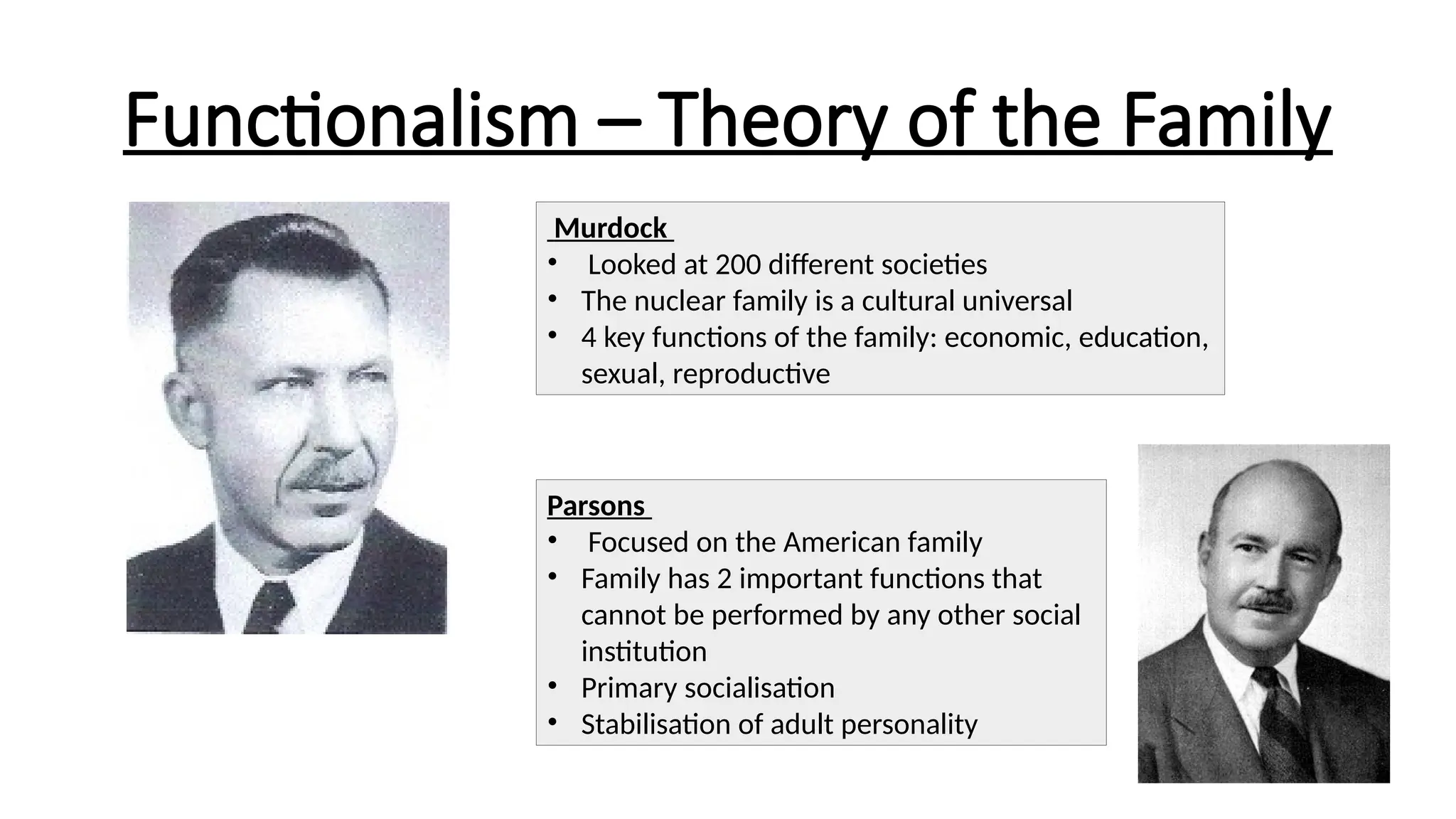
Functionalism – Theoryof the Family
Murdock
• Looked at 200 different societies
• The nuclear family is a cultural universal
• 4 key functions of the family: economic, education,
sexual, reproductive
Parsons
• Focused on the American family
• Family has 2 important functions that
cannot be performed by any other social
institution
• Primary socialisation
• Stabilisation of adult personality
11.
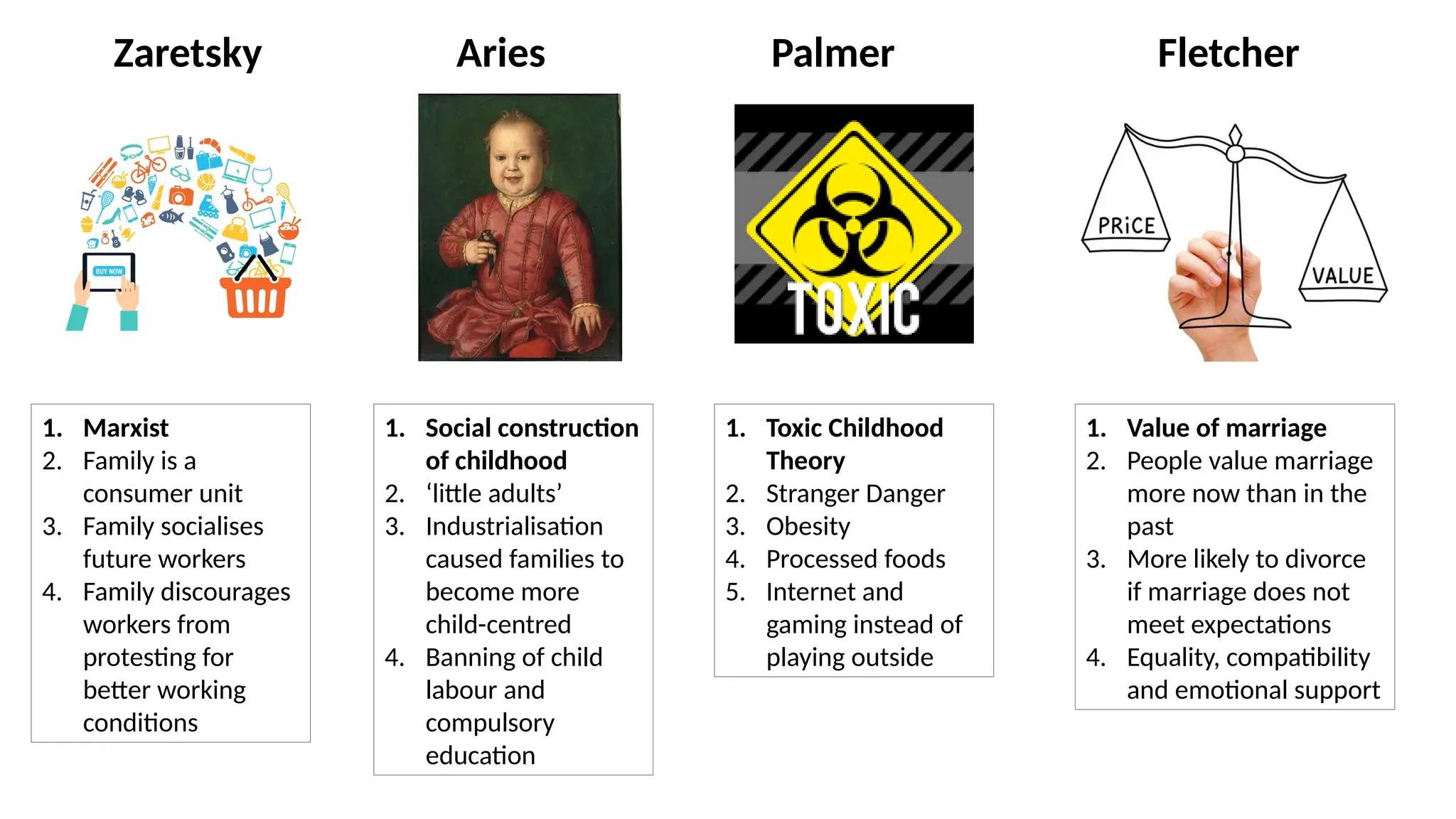
Zaretsky
1. Marxist
2. Familyis a
consumer unit
3. Family socialises
future workers
4. Family discourages
workers from
protesting for
better working
conditions
Aries
1. Social construction
of childhood
2. ‘little adults’
3. Industrialisation
caused families to
become more
child-centred
4. Banning of child
labour and
compulsory
education
Palmer
1. Toxic Childhood
Theory
2. Stranger Danger
3. Obesity
4. Processed foods
5. Internet and
gaming instead of
playing outside
Fletcher
1. Value of marriage
2. People value marriage
more now than in the
past
3. More likely to divorce
if marriage does not
meet expectations
4. Equality, compatibility
and emotional support
12.
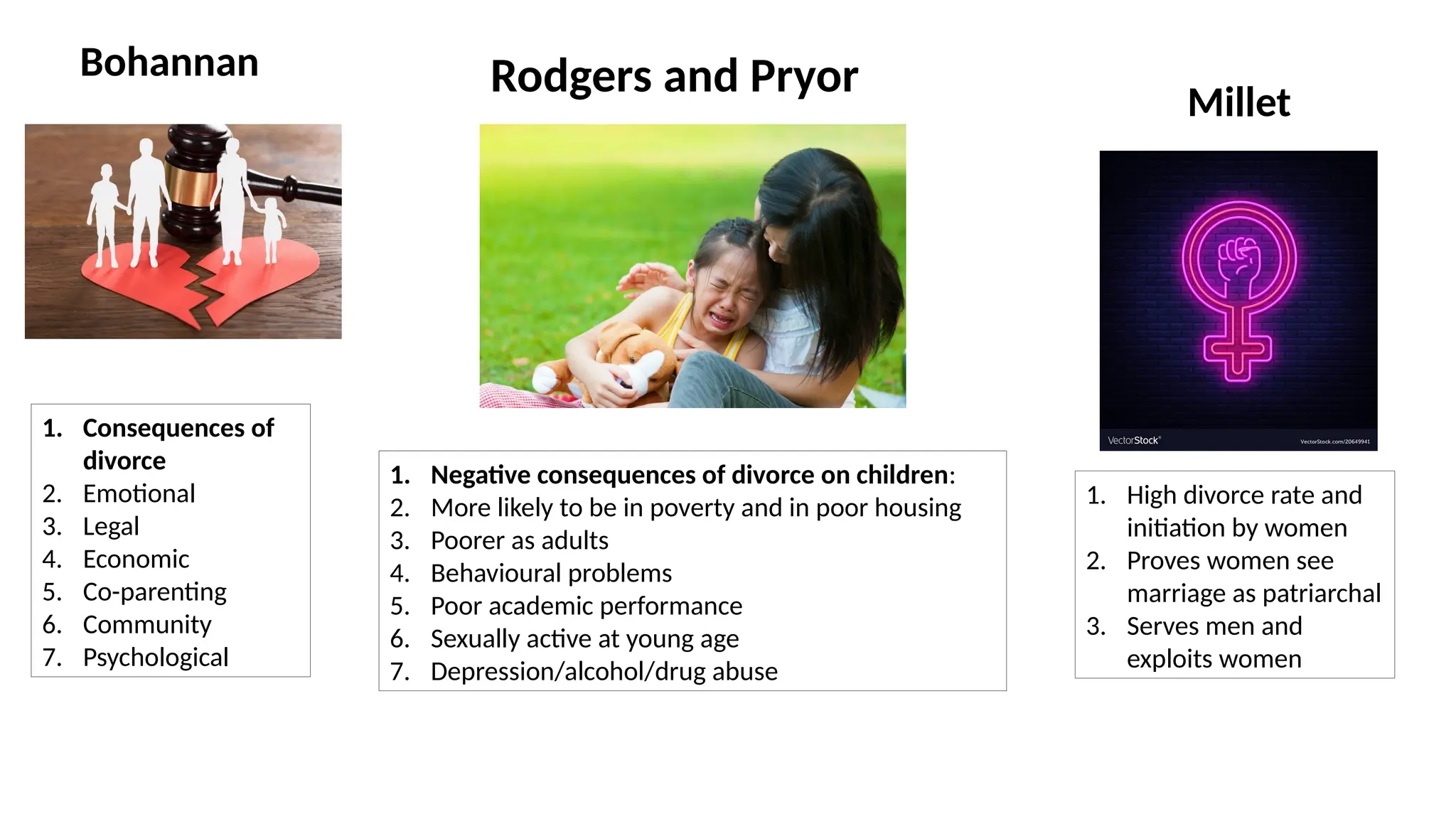
Bohannan
1. Consequences of
divorce
2.Emotional
3. Legal
4. Economic
5. Co-parenting
6. Community
7. Psychological
Rodgers and Pryor
1. Negative consequences of divorce on children:
2. More likely to be in poverty and in poor housing
3. Poorer as adults
4. Behavioural problems
5. Poor academic performance
6. Sexually active at young age
7. Depression/alcohol/drug abuse
Millet
1. High divorce rate and
initiation by women
2. Proves women see
marriage as patriarchal
3. Serves men and
exploits women
13.
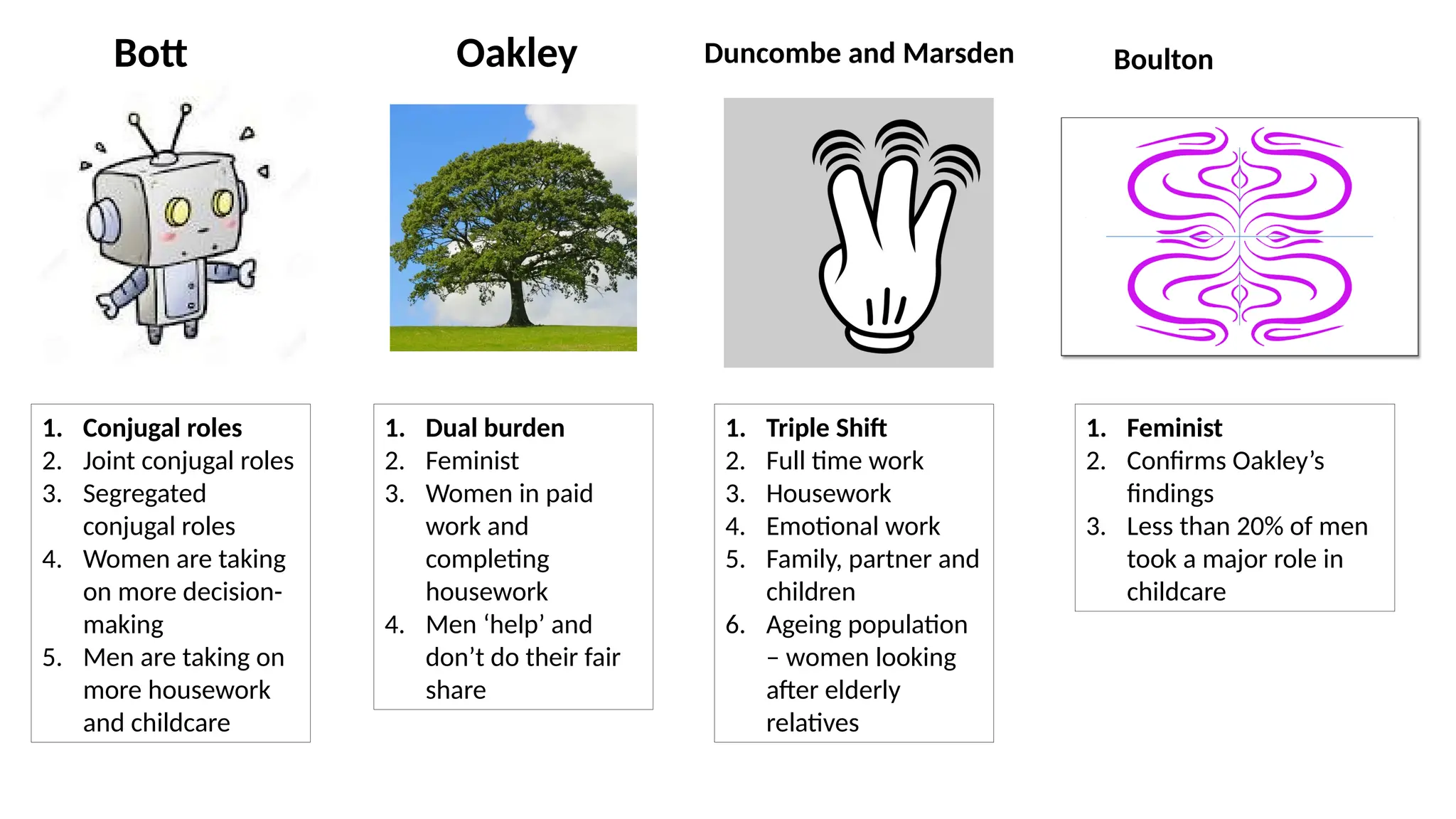
Bott
1. Conjugal roles
2.Joint conjugal roles
3. Segregated
conjugal roles
4. Women are taking
on more decision-
making
5. Men are taking on
more housework
and childcare
Oakley
1. Dual burden
2. Feminist
3. Women in paid
work and
completing
housework
4. Men ‘help’ and
don’t do their fair
share
Duncombe and Marsden
1. Triple Shift
2. Full time work
3. Housework
4. Emotional work
5. Family, partner and
children
6. Ageing population
– women looking
after elderly
relatives
Boulton
1. Feminist
2. Confirms Oakley’s
findings
3. Less than 20% of men
took a major role in
childcare
14.
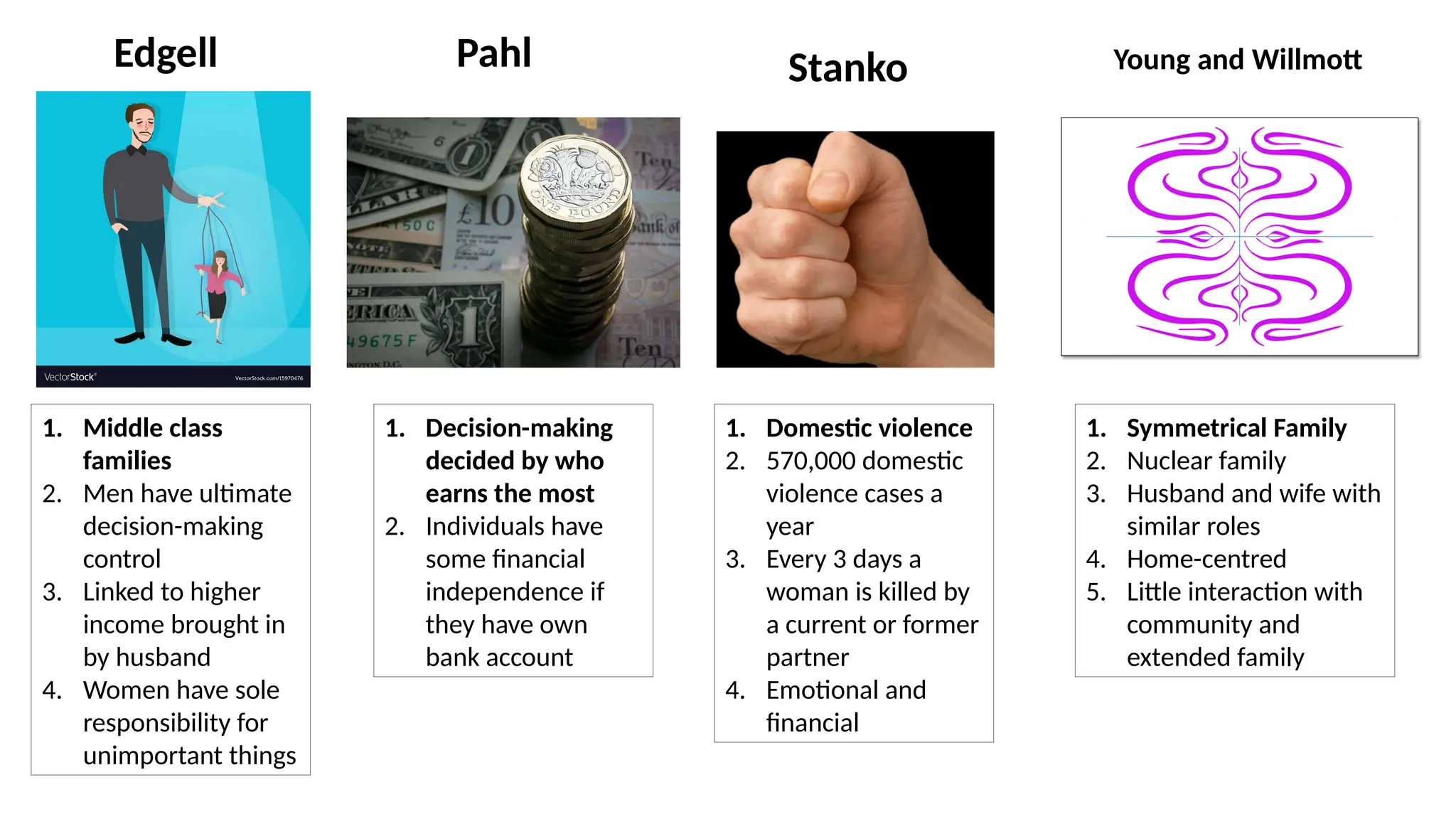
Edgell
1. Middle class
families
2.Men have ultimate
decision-making
control
3. Linked to higher
income brought in
by husband
4. Women have sole
responsibility for
unimportant things
Pahl
1. Decision-making
decided by who
earns the most
2. Individuals have
some financial
independence if
they have own
bank account
Stanko
1. Domestic violence
2. 570,000 domestic
violence cases a
year
3. Every 3 days a
woman is killed by
a current or former
partner
4. Emotional and
financial
Young and Willmott
1. Symmetrical Family
2. Nuclear family
3. Husband and wife with
similar roles
4. Home-centred
5. Little interaction with
community and
extended family
15.
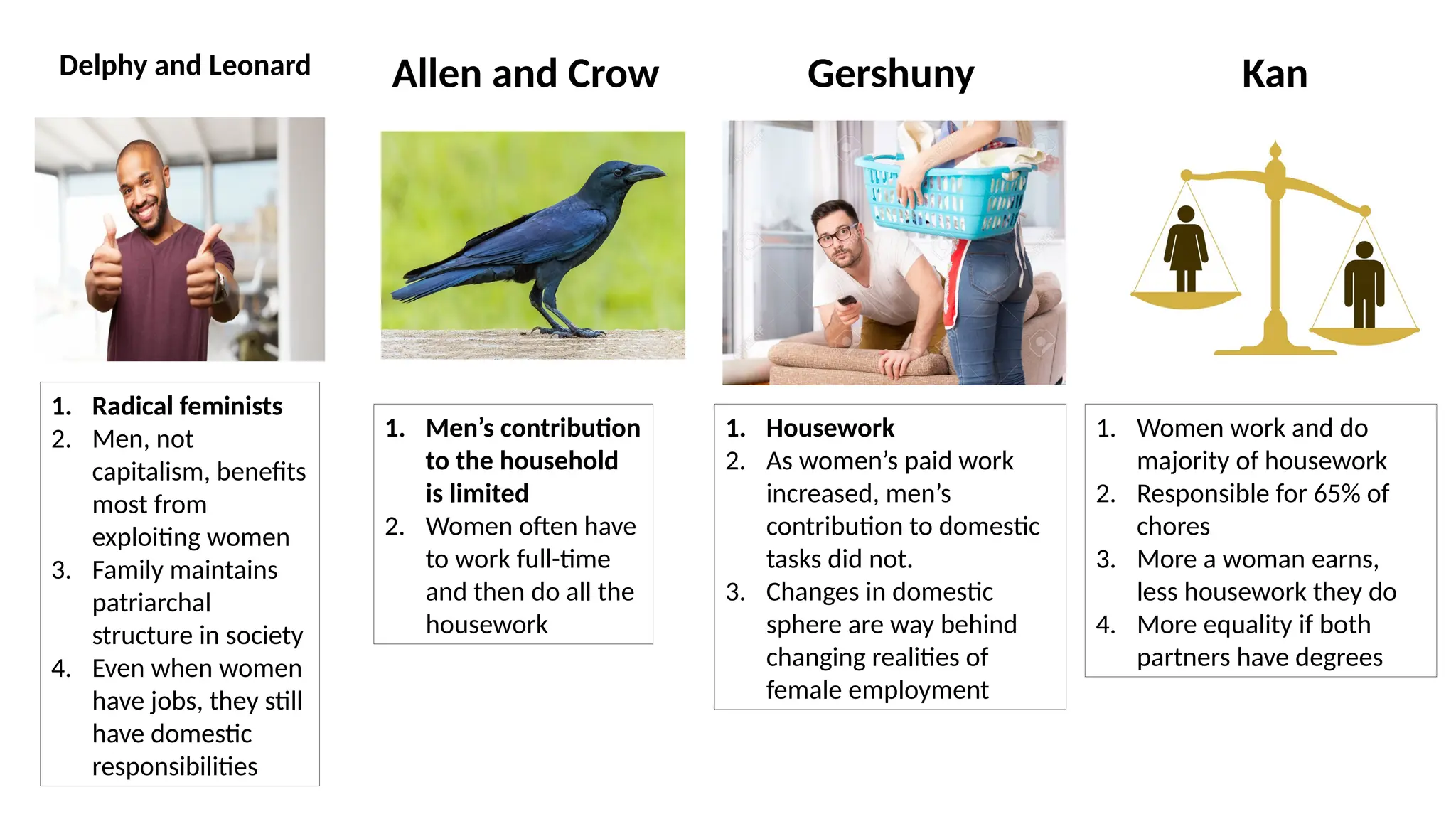
Delphy and Leonard
1.Radical feminists
2. Men, not
capitalism, benefits
most from
exploiting women
3. Family maintains
patriarchal
structure in society
4. Even when women
have jobs, they still
have domestic
responsibilities
Allen and Crow
1. Men’s contribution
to the household
is limited
2. Women often have
to work full-time
and then do all the
housework
Gershuny
1. Housework
2. As women’s paid work
increased, men’s
contribution to domestic
tasks did not.
3. Changes in domestic
sphere are way behind
changing realities of
female employment
Kan
1. Women work and do
majority of housework
2. Responsible for 65% of
chores
3. More a woman earns,
less housework they do
4. More equality if both
partners have degrees
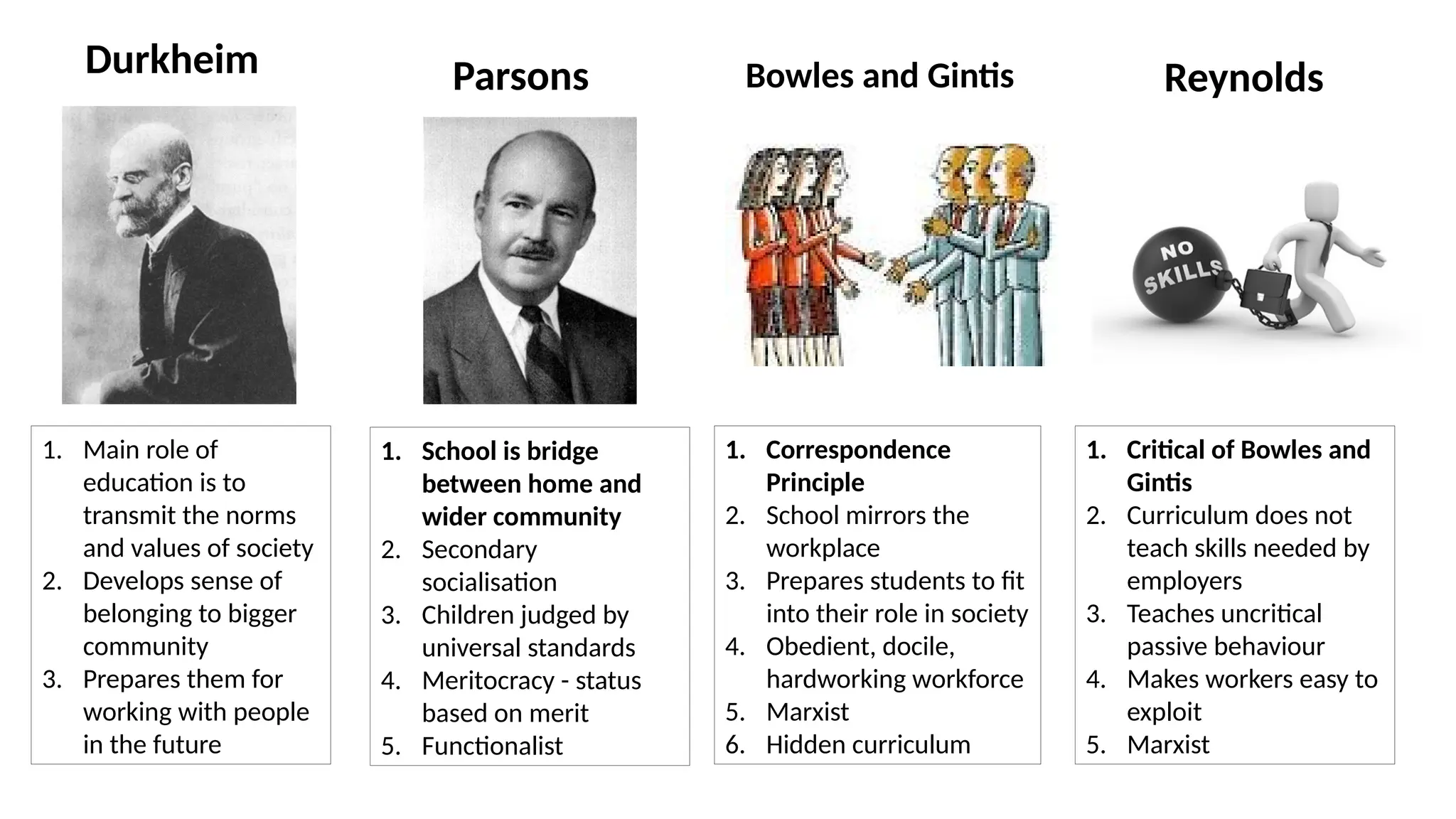
Durkheim
1. Main roleof
education is to
transmit the norms
and values of society
2. Develops sense of
belonging to bigger
community
3. Prepares them for
working with people
in the future
Bowles and Gintis
1. Correspondence
Principle
2. School mirrors the
workplace
3. Prepares students to fit
into their role in society
4. Obedient, docile,
hardworking workforce
5. Marxist
6. Hidden curriculum
Reynolds
1. Critical of Bowles and
Gintis
2. Curriculum does not
teach skills needed by
employers
3. Teaches uncritical
passive behaviour
4. Makes workers easy to
exploit
5. Marxist
Parsons
1. School is bridge
between home and
wider community
2. Secondary
socialisation
3. Children judged by
universal standards
4. Meritocracy - status
based on merit
5. Functionalist
18.
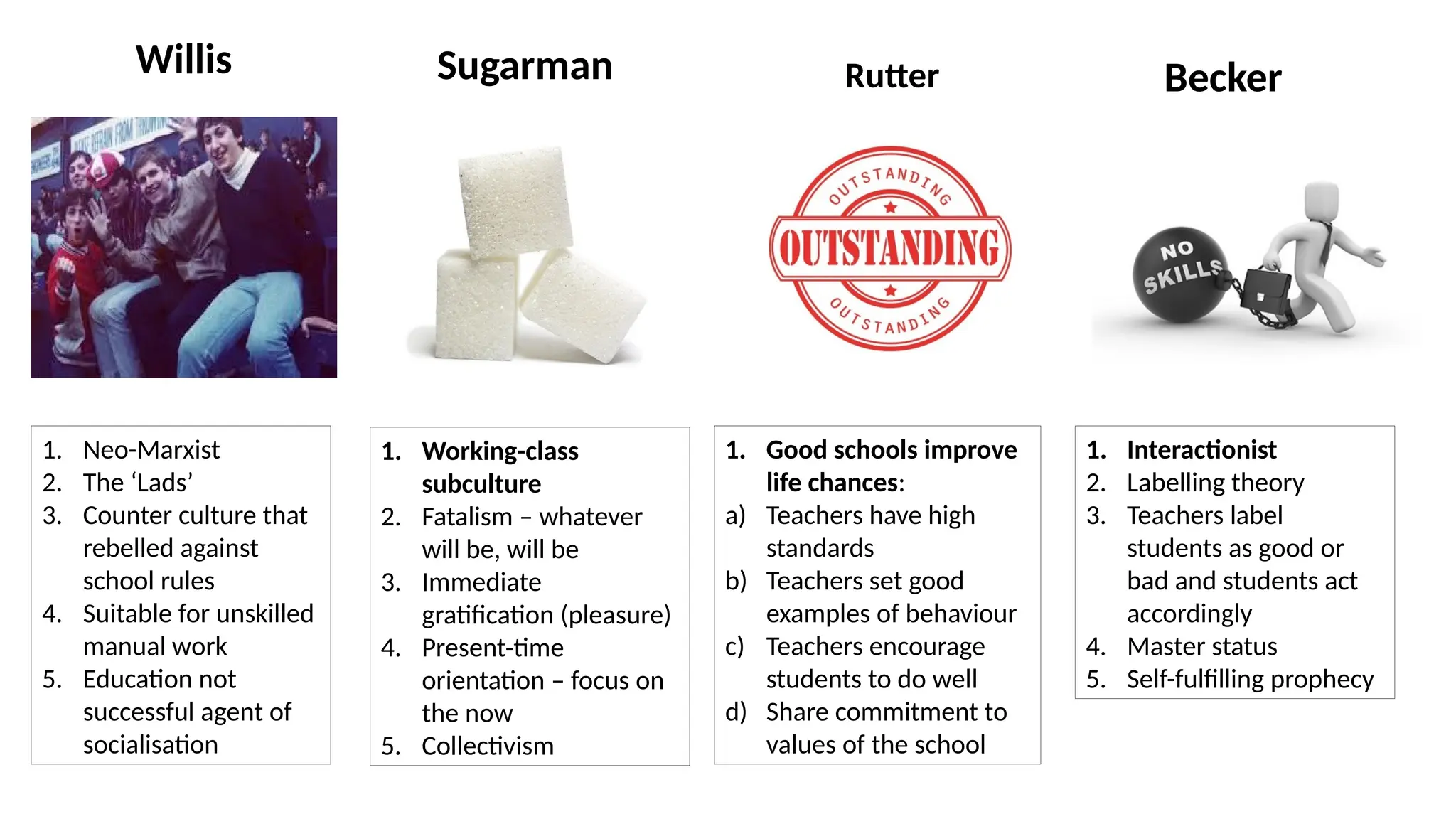
Willis
1. Neo-Marxist
2. The‘Lads’
3. Counter culture that
rebelled against
school rules
4. Suitable for unskilled
manual work
5. Education not
successful agent of
socialisation
Rutter
1. Good schools improve
life chances:
a) Teachers have high
standards
b) Teachers set good
examples of behaviour
c) Teachers encourage
students to do well
d) Share commitment to
values of the school
Becker
1. Interactionist
2. Labelling theory
3. Teachers label
students as good or
bad and students act
accordingly
4. Master status
5. Self-fulfilling prophecy
Sugarman
1. Working-class
subculture
2. Fatalism – whatever
will be, will be
3. Immediate
gratification (pleasure)
4. Present-time
orientation – focus on
the now
5. Collectivism
19.
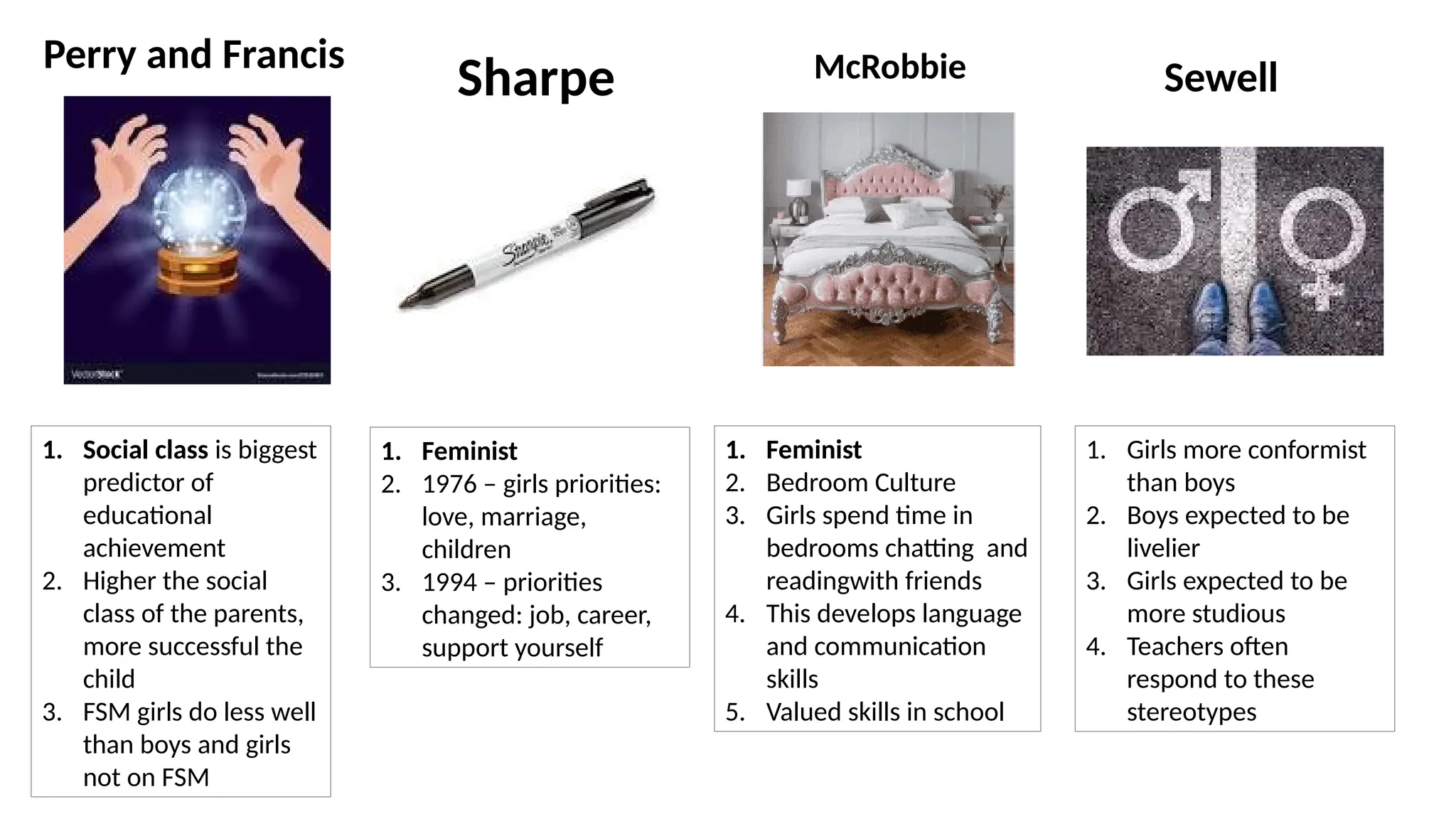
Perry and Francis
1.Social class is biggest
predictor of
educational
achievement
2. Higher the social
class of the parents,
more successful the
child
3. FSM girls do less well
than boys and girls
not on FSM
McRobbie
1. Feminist
2. Bedroom Culture
3. Girls spend time in
bedrooms chatting and
readingwith friends
4. This develops language
and communication
skills
5. Valued skills in school
Sewell
1. Girls more conformist
than boys
2. Boys expected to be
livelier
3. Girls expected to be
more studious
4. Teachers often
respond to these
stereotypes
Sharpe
1. Feminist
2. 1976 – girls priorities:
love, marriage,
children
3. 1994 – priorities
changed: job, career,
support yourself
20.
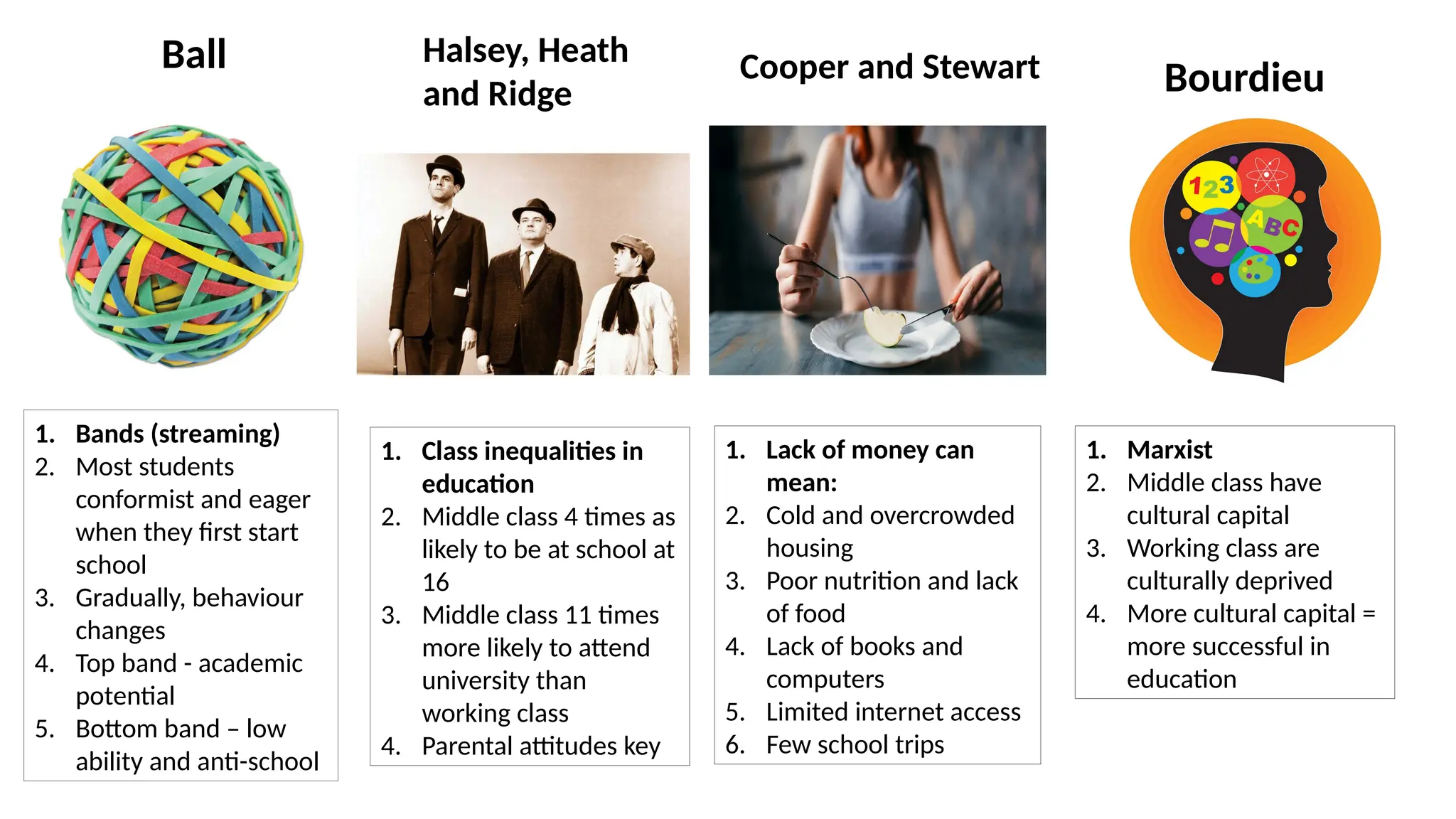
Ball
1. Bands (streaming)
2.Most students
conformist and eager
when they first start
school
3. Gradually, behaviour
changes
4. Top band - academic
potential
5. Bottom band – low
ability and anti-school
Cooper and Stewart
1. Lack of money can
mean:
2. Cold and overcrowded
housing
3. Poor nutrition and lack
of food
4. Lack of books and
computers
5. Limited internet access
6. Few school trips
Bourdieu
1. Marxist
2. Middle class have
cultural capital
3. Working class are
culturally deprived
4. More cultural capital =
more successful in
education
Halsey, Heath
and Ridge
1. Class inequalities in
education
2. Middle class 4 times as
likely to be at school at
16
3. Middle class 11 times
more likely to attend
university than
working class
4. Parental attitudes key
21.
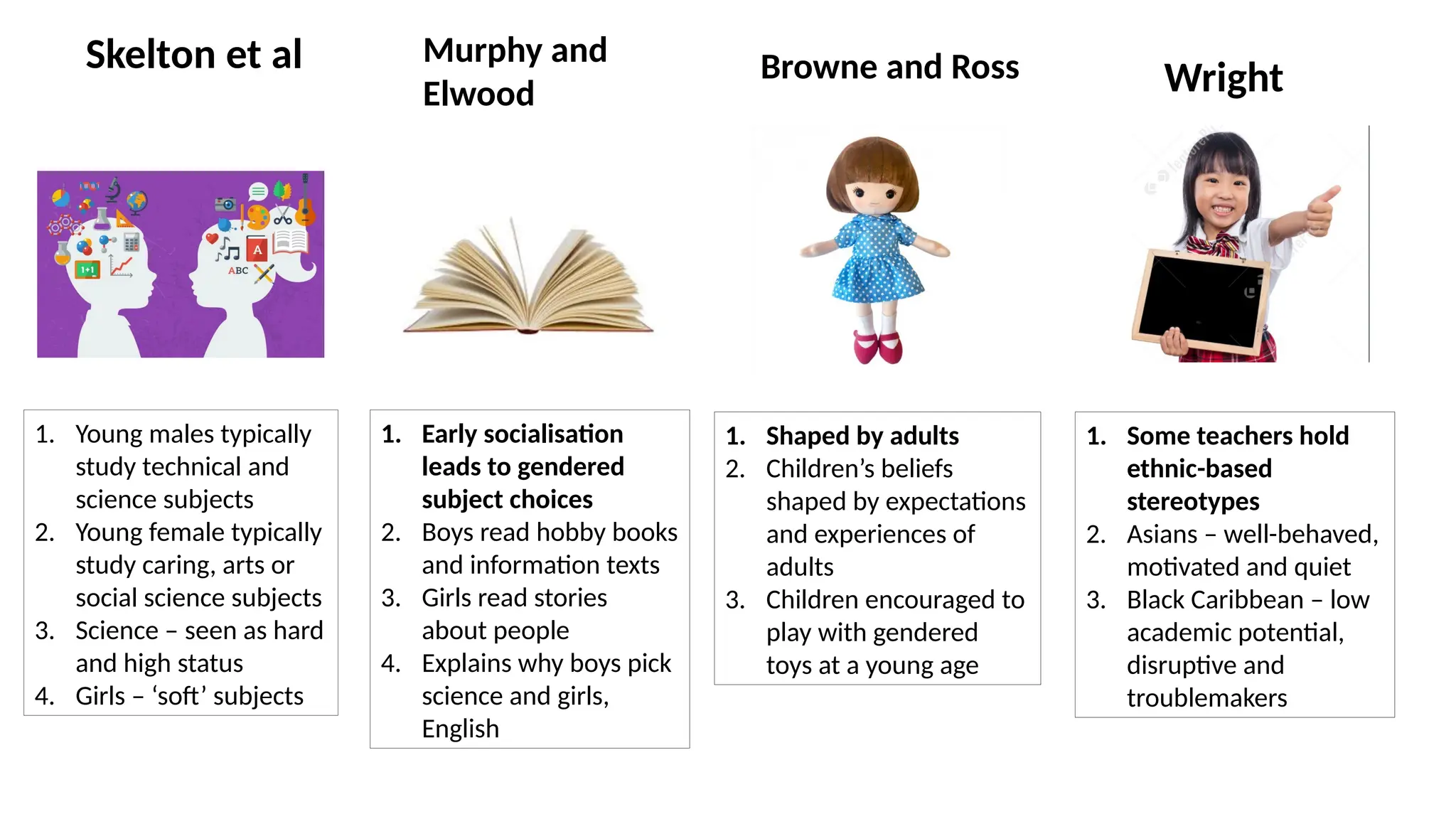
Skelton et al
1.Young males typically
study technical and
science subjects
2. Young female typically
study caring, arts or
social science subjects
3. Science – seen as hard
and high status
4. Girls – ‘soft’ subjects
Browne and Ross
1. Shaped by adults
2. Children’s beliefs
shaped by expectations
and experiences of
adults
3. Children encouraged to
play with gendered
toys at a young age
Wright
1. Some teachers hold
ethnic-based
stereotypes
2. Asians – well-behaved,
motivated and quiet
3. Black Caribbean – low
academic potential,
disruptive and
troublemakers
Murphy and
Elwood
1. Early socialisation
leads to gendered
subject choices
2. Boys read hobby books
and information texts
3. Girls read stories
about people
4. Explains why boys pick
science and girls,
English
Davis and Moore
1.Functionalists
2. Social stratification is
a universal necessity
3. For society to
function effectively:
a) All roles must be
filled
b) Necessary training
c) Meritocracy – best
people to fill roles
Weber
1. Life chances
2. Market situation
3. People make
judgements about
others and give them
status
4. Life style
5. Party – organised group
that exercise power
Halsey, Heath
and Ridge
1. Boy from middle class
home more likely to go
to university than a
boy from working class
background
2. Lack of grants caused
inequality in higher
education
Marx
1. Class conflict
2. Polarisation of the
social classes
3. Industrialisation
4. Alienation
5. Crisis of capitalism
24.
Goldthorpe
1. New workingclass
2. Home-centred
3. Individualism
4. Home owners and in
well-paid
employment
5. Affluent worker
6. Embourgeoisement
Rowntree
1. Earliest systematic
studies of poverty
2. Created idea of the
‘poverty line’
3. Primary (absolute) and
secondary (relative)
poverty
4. Significant decline in
poverty rates from
1899-1950s
Townsend
1. Relative deprivation
2. 60 indicators of
poverty
3. E.g. diet, fuel, clothing
4. Manual workers more
likely to live in RD
5. 25% of households are
living in poverty
Sorokin
1. Rejected American
Dream
2. Opportunities for
social mobility in
America similar to
other advanced
industrial countries
25.
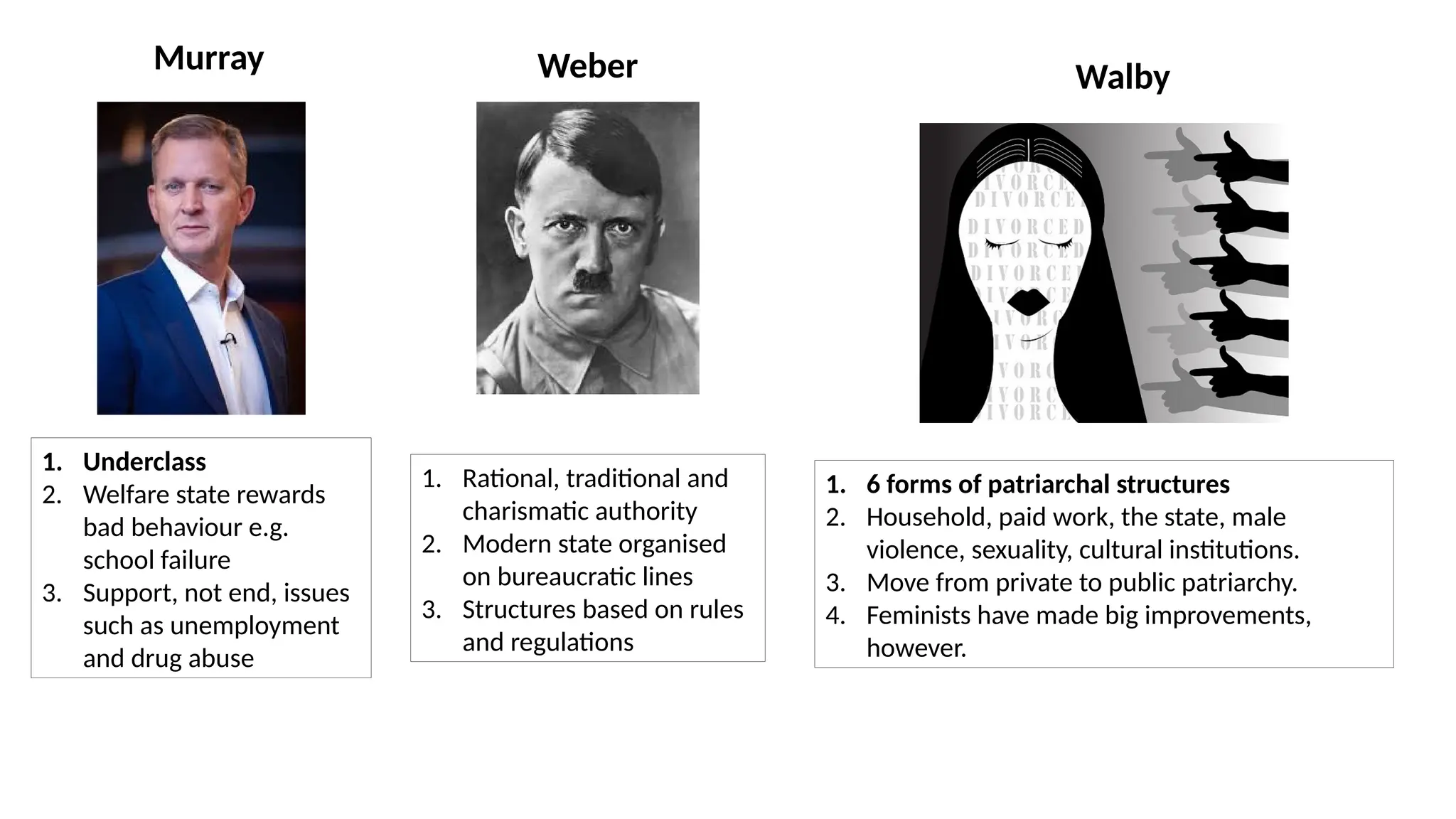
Murray
1. Underclass
2. Welfarestate rewards
bad behaviour e.g.
school failure
3. Support, not end, issues
such as unemployment
and drug abuse
Walby
1. 6 forms of patriarchal structures
2. Household, paid work, the state, male
violence, sexuality, cultural institutions.
3. Move from private to public patriarchy.
4. Feminists have made big improvements,
however.
Weber
1. Rational, traditional and
charismatic authority
2. Modern state organised
on bureaucratic lines
3. Structures based on rules
and regulations
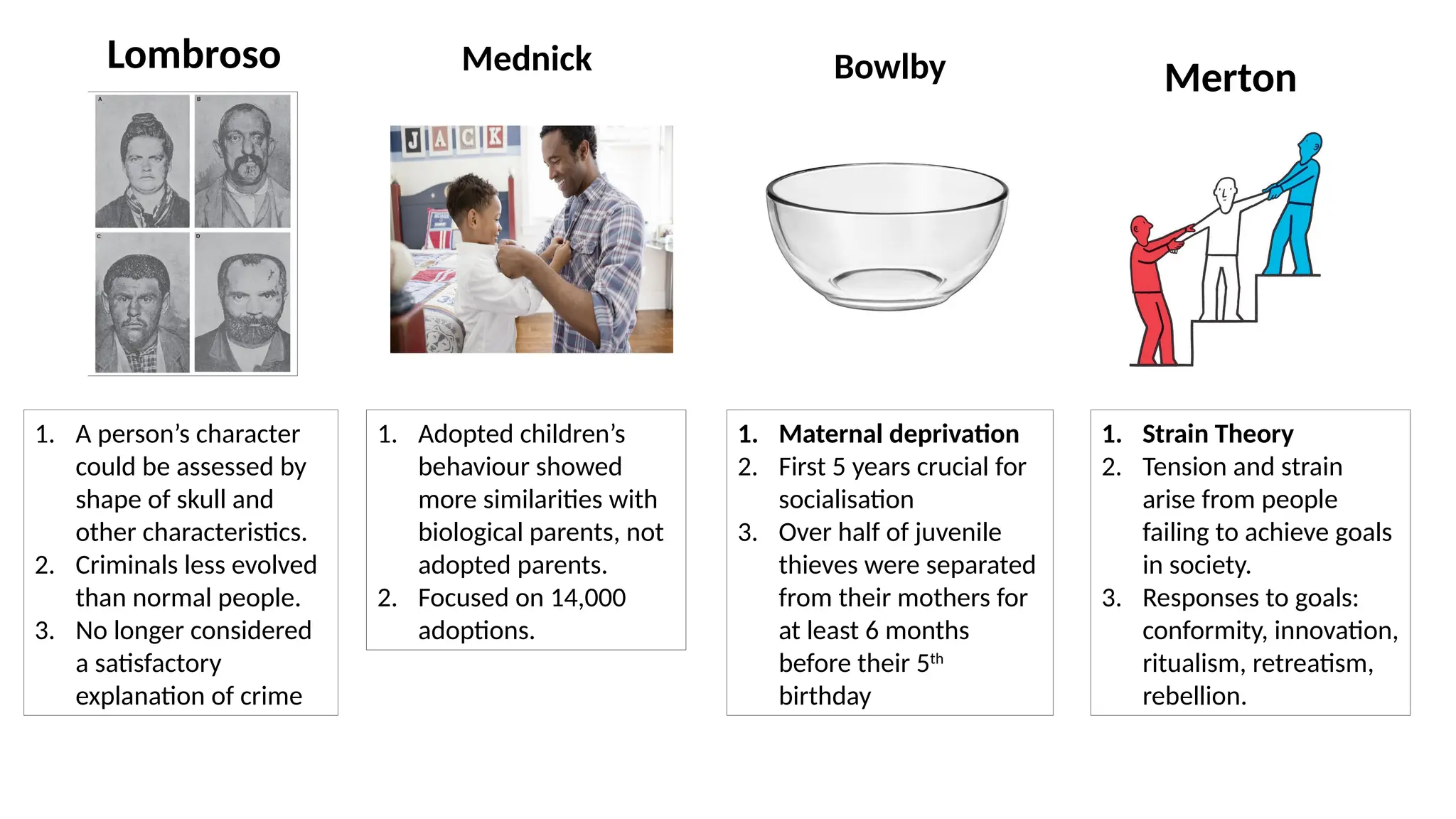
Lombroso
1. A person’scharacter
could be assessed by
shape of skull and
other characteristics.
2. Criminals less evolved
than normal people.
3. No longer considered
a satisfactory
explanation of crime
Bowlby
1. Maternal deprivation
2. First 5 years crucial for
socialisation
3. Over half of juvenile
thieves were separated
from their mothers for
at least 6 months
before their 5th
birthday
Merton
1. Strain Theory
2. Tension and strain
arise from people
failing to achieve goals
in society.
3. Responses to goals:
conformity, innovation,
ritualism, retreatism,
rebellion.
Mednick
1. Adopted children’s
behaviour showed
more similarities with
biological parents, not
adopted parents.
2. Focused on 14,000
adoptions.
28.
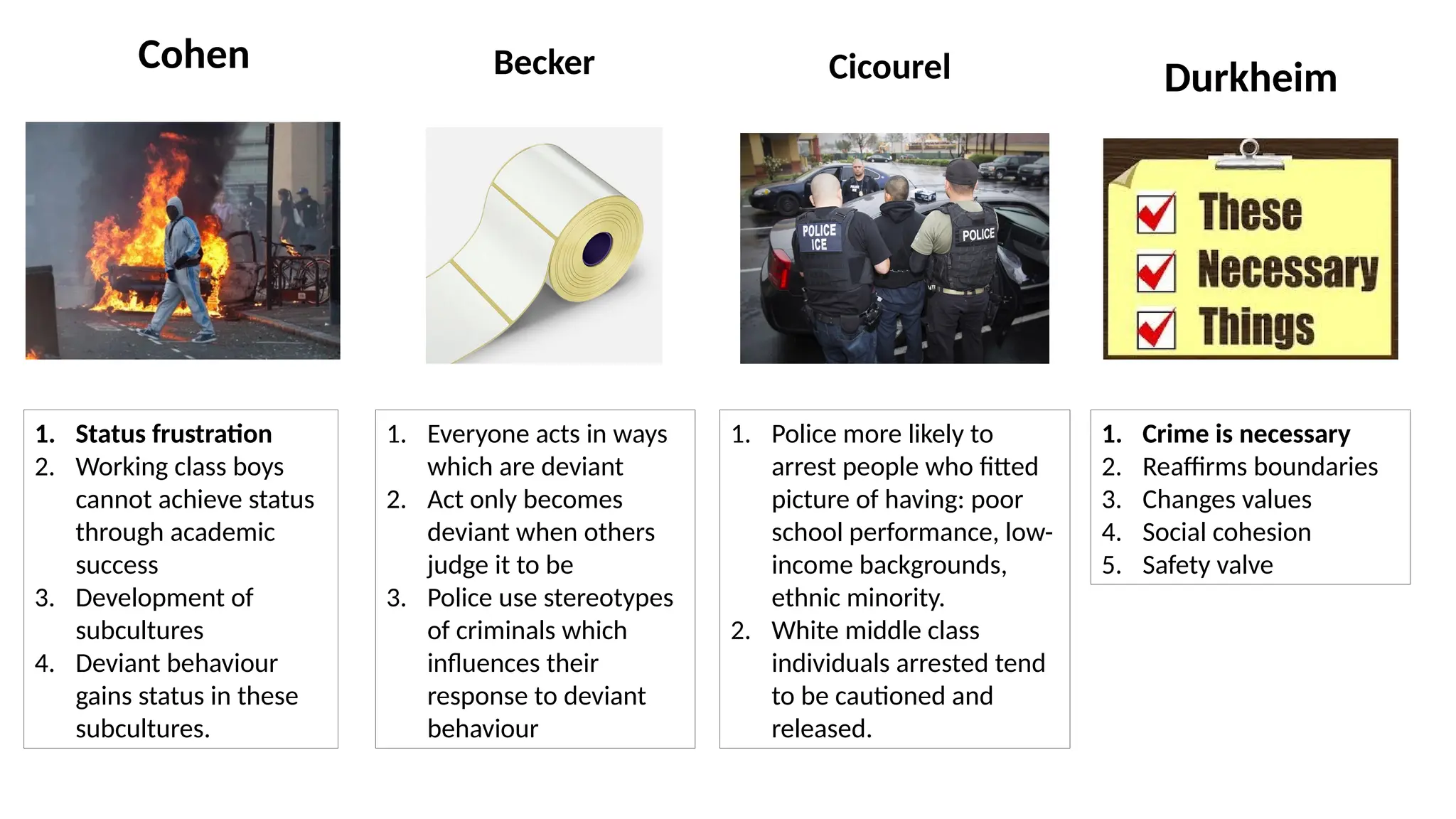
Cohen
1. Status frustration
2.Working class boys
cannot achieve status
through academic
success
3. Development of
subcultures
4. Deviant behaviour
gains status in these
subcultures.
Cicourel
1. Police more likely to
arrest people who fitted
picture of having: poor
school performance, low-
income backgrounds,
ethnic minority.
2. White middle class
individuals arrested tend
to be cautioned and
released.
Durkheim
1. Crime is necessary
2. Reaffirms boundaries
3. Changes values
4. Social cohesion
5. Safety valve
Becker
1. Everyone acts in ways
which are deviant
2. Act only becomes
deviant when others
judge it to be
3. Police use stereotypes
of criminals which
influences their
response to deviant
behaviour
29.
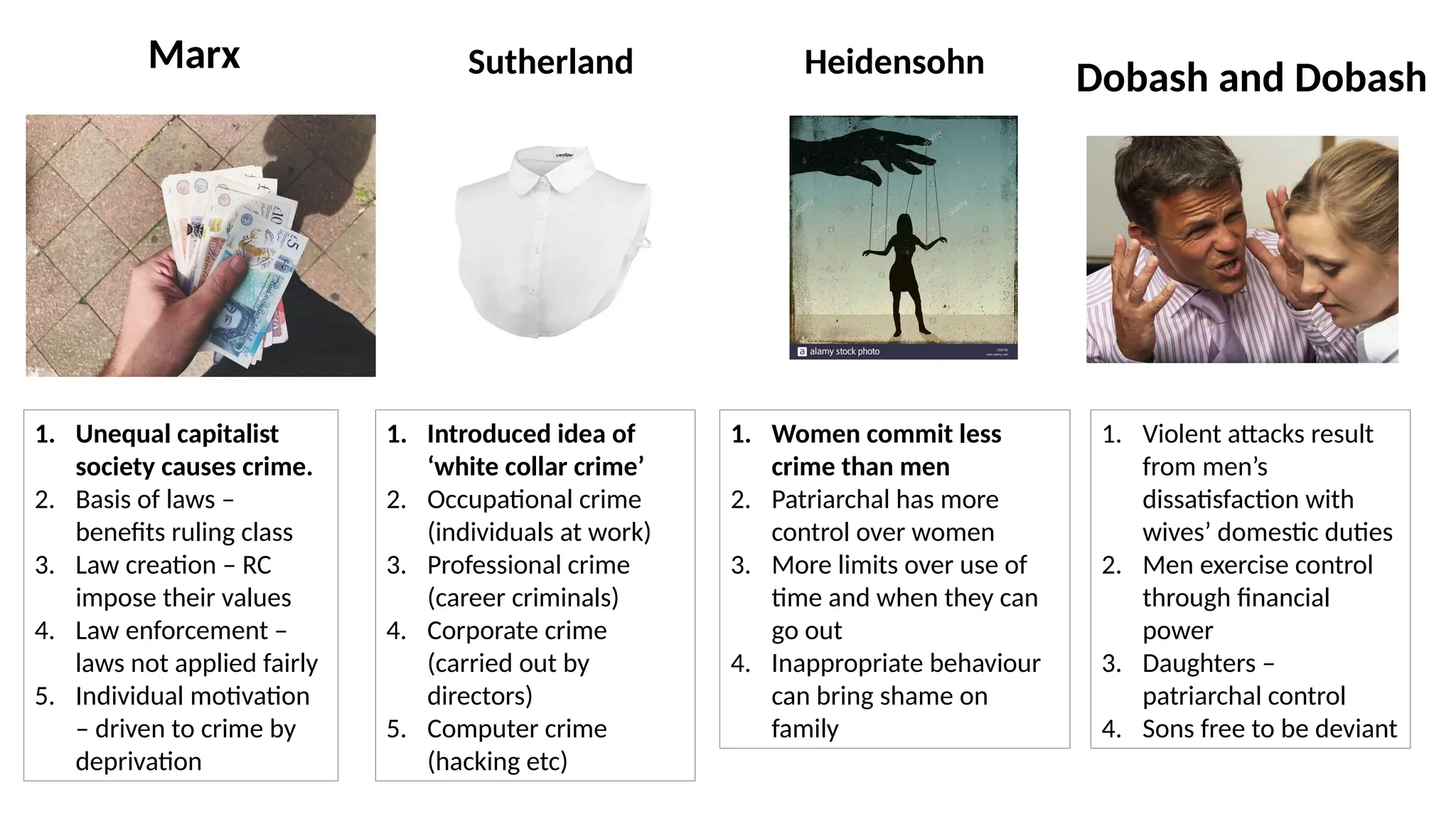
Marx
1. Unequal capitalist
societycauses crime.
2. Basis of laws –
benefits ruling class
3. Law creation – RC
impose their values
4. Law enforcement –
laws not applied fairly
5. Individual motivation
– driven to crime by
deprivation
Heidensohn
1. Women commit less
crime than men
2. Patriarchal has more
control over women
3. More limits over use of
time and when they can
go out
4. Inappropriate behaviour
can bring shame on
family
Dobash and Dobash
1. Violent attacks result
from men’s
dissatisfaction with
wives’ domestic duties
2. Men exercise control
through financial
power
3. Daughters –
patriarchal control
4. Sons free to be deviant
Sutherland
1. Introduced idea of
‘white collar crime’
2. Occupational crime
(individuals at work)
3. Professional crime
(career criminals)
4. Corporate crime
(carried out by
directors)
5. Computer crime
(hacking etc)
30.
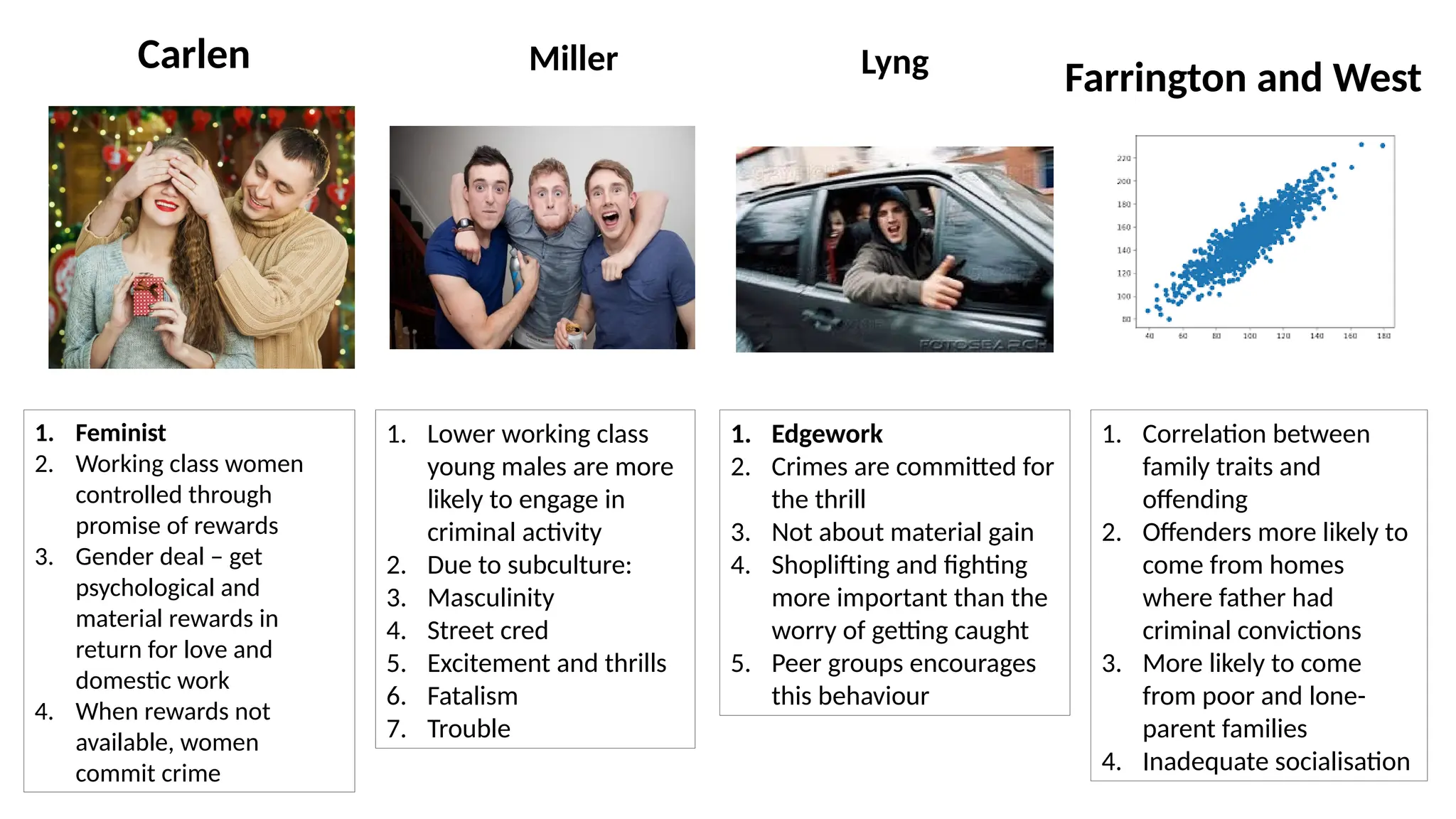
Carlen
1. Feminist
2. Workingclass women
controlled through
promise of rewards
3. Gender deal – get
psychological and
material rewards in
return for love and
domestic work
4. When rewards not
available, women
commit crime
Lyng
1. Edgework
2. Crimes are committed for
the thrill
3. Not about material gain
4. Shoplifting and fighting
more important than the
worry of getting caught
5. Peer groups encourages
this behaviour
Farrington and West
1. Correlation between
family traits and
offending
2. Offenders more likely to
come from homes
where father had
criminal convictions
3. More likely to come
from poor and lone-
parent families
4. Inadequate socialisation
Miller
1. Lower working class
young males are more
likely to engage in
criminal activity
2. Due to subculture:
3. Masculinity
4. Street cred
5. Excitement and thrills
6. Fatalism
7. Trouble
31.
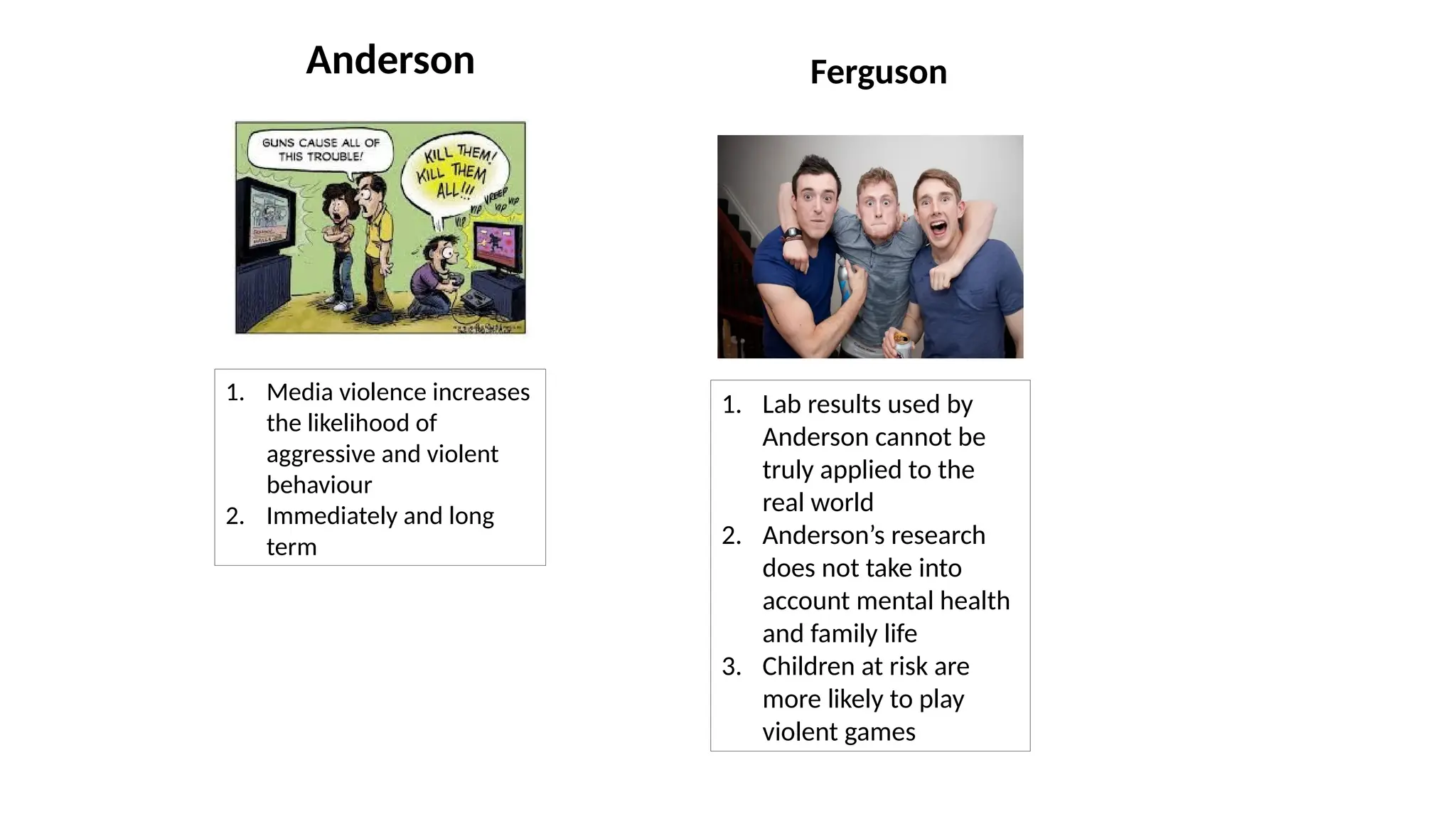
Anderson
1. Media violenceincreases
the likelihood of
aggressive and violent
behaviour
2. Immediately and long
term
Ferguson
1. Lab results used by
Anderson cannot be
truly applied to the
real world
2. Anderson’s research
does not take into
account mental health
and family life
3. Children at risk are
more likely to play
violent games


![[DSC Europe 25] Dusan Nesic - Securing Tomorrow’s Infrastructure: Why Cyber-P...](https://cdn.slidesharecdn.com/ss_thumbnails/qikbszfftyowjm2q6duw-1-251211083848-8f2ead6b-thumbnail.jpg?width=640&height=640&fit=bounds)

![[DSC Europe 25] Behzad Hosseini - AI Agents in the Wild: Deploying Models tha...](https://cdn.slidesharecdn.com/ss_thumbnails/3qtejajvsjqrzwfept2c-10-251212103250-7f2b1068-thumbnail.jpg?width=640&height=640&fit=bounds)


![[DSC Europe 25] Ivan Peric - Intelligence Swarm Logic and Techno-Functional M...](https://cdn.slidesharecdn.com/ss_thumbnails/7my7c97fsduiccadgavw-2-251212103249-5a03f7c6-thumbnail.jpg?width=640&height=640&fit=bounds)

![[DSC Europe 25] Nikolay Burlutskiy - Best Practices for Building Enterprise M...](https://cdn.slidesharecdn.com/ss_thumbnails/uirvaiuvq8y1w8hzd9tx-7-251212103249-2619edb4-thumbnail.jpg?width=640&height=640&fit=bounds)


![[DSC Europe 25] Jovan Bogicevic - Legacy to AI-Driven Defense: Transforming D...](https://cdn.slidesharecdn.com/ss_thumbnails/rsarluadt563hntyfc8q-3-251211083849-3e7bc4c0-thumbnail.jpg?width=640&height=640&fit=bounds)
![[DSC Europe 25] Miodrag Pesovic & Vladislav Radonjic - Federated Data Archite...](https://cdn.slidesharecdn.com/ss_thumbnails/gsbe3y5it5uhndi4e08e-1-251212103249-f1008e0c-thumbnail.jpg?width=640&height=640&fit=bounds)
![[DSC Europe 25] Kaja Kandare - LLM as a judge.pptx](https://cdn.slidesharecdn.com/ss_thumbnails/arxyccaxsdsd1ba99wjw-7-251212104007-2b4e3f64-thumbnail.jpg?width=640&height=640&fit=bounds)
