Outline:
• Act 1:Liberalism v.s. Critical Theory and Human Capabilities
• Act 2: Pragmatism and Critical Pragmatism
• Act 3: World Systems and Dependency Theory
• Act 4: Postcolonialism
• Act 5: Spiritual, Ecological and Concluding Thoughts
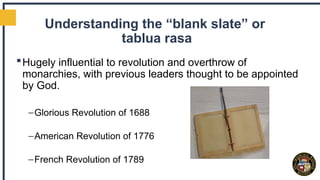
Understanding the “blankslate” or
tablua rasa
Hugely influential to revolution and overthrow of
monarchies, with previous leaders thought to be appointed
by God.
–Glorious Revolution of 1688
–American Revolution of 1776
–French Revolution of 1789
6.
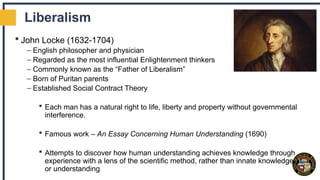
Liberalism
John Locke(1632-1704)
– English philosopher and physician
– Regarded as the most influential Enlightenment thinkers
– Commonly known as the “Father of Liberalism”
– Born of Puritan parents
– Established Social Contract Theory
Each man has a natural right to life, liberty and property without governmental
interference.
Famous work – An Essay Concerning Human Understanding (1690)
Attempts to discover how human understanding achieves knowledge through
experience with a lens of the scientific method, rather than innate knowledge
or understanding
7.
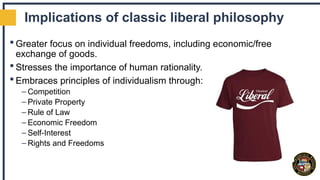
Implications of classicliberal philosophy
Greater focus on individual freedoms, including economic/free
exchange of goods.
Stresses the importance of human rationality.
Embraces principles of individualism through:
– Competition
– Private Property
– Rule of Law
– Economic Freedom
– Self-Interest
– Rights and Freedoms
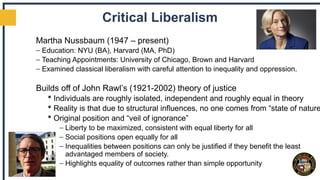
Critical Liberalism
Martha Nussbaum(1947 – present)
– Education: NYU (BA), Harvard (MA, PhD)
– Teaching Appointments: University of Chicago, Brown and Harvard
– Examined classical liberalism with careful attention to inequality and oppression.
Builds off of John Rawl’s (1921-2002) theory of justice
Individuals are roughly isolated, independent and roughly equal in theory
Reality is that due to structural influences, no one comes from “state of nature
Original position and “veil of ignorance”
– Liberty to be maximized, consistent with equal liberty for all
– Social positions open equally for all
– Inequalities between positions can only be justified if they benefit the least
advantaged members of society.
– Highlights equality of outcomes rather than simple opportunity
10.
Human Capabilities Approach
Amartya Sen (1933- present)
Economist and philosopher
Meaningful understanding of reason, equality, and freedom must take into account the
actual existing capabilities that people poses and their exercise to living a fully formed
human life.
Held from a concrete list to define those capabilities.
Reliance on Economic Theory to enhance environmental conditions to flourish capabilities.
“Poverty is not just a lack of money; it is not having the capability to realize one’s full
potential as a human being” – A. Sen
11.
Human Capabilities List– Nussbaum
What do you believe are the potential strengths
and weaknesses of Nussbaum’s list and the
human capabilities approach?
12.
Linking Social Transformation
-RootedCosmopolitianism-
Kwame Anthony Appiah (1954 – present )
– British born Ghanaian-American philosopher
– Education: Bryanston School, University of Cambridge
– Particular attention to understanding how the role of identity in human
life (and lives) requires attention to :
– Qualities and capabilities of an individual,
– Norms of behavior available in a social context and
– Existing conditions under which one’s awareness of these qualities and
norms originate.
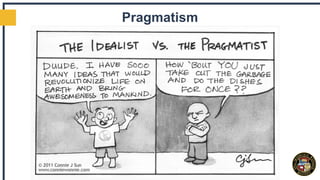
Pragmatism
What isyour definition of pragmatism?
Would you consider yourself a pragmatist? Why or why not?
17.
Intersections Between Pragmatist& Critical Theories
Classical pragmatism: John Dewey
– Instrumentalism: Dewey viewed “knowledge and truth, along with all other
skills, ideas, or resources, as tools proven more or less valuable strictly by
their helpfulness in solving human problems” (p. 227).
– Criticism: Classical pragmatism “tend[s] to gloss over social conflict” (p. 227).
Critical pragmatists
– Cornel West (Prophetic pragmatist)
• Integrate race, politics, and religion;
• Fight for social justice & human rights
– Nancy Fraser (Feminist pragmatist)
• (Mal)distribution: economic subordination;
• (Mal)recognition: cultural subordination
• “Bring a pragmatic sensibility to the rigorous
application of critical theory” (p. 229)
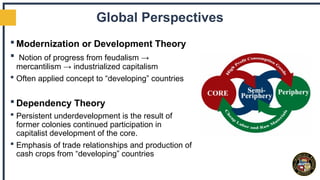
Global Perspectives
Modernizationor Development Theory
Notion of progress from feudalism →
mercantilism → industrialized capitalism
Often applied concept to “developing” countries
Dependency Theory
Persistent underdevelopment is the result of
former colonies continued participation in
capitalist development of the core.
Emphasis of trade relationships and production of
cash crops from “developing” countries
21.
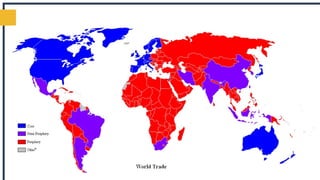
World-Systems Theory
ImmanuelWallerstein (1930 – present)
American sociologist, historical social scientist,
and world-systems analyst.
Relies on the interdependence of social and economic systems
with focus on broader historical considerations.
Specifically, he also examined how these interactions impact
education.
22.
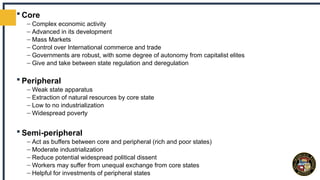
Core
– Complexeconomic activity
– Advanced in its development
– Mass Markets
– Control over International commerce and trade
– Governments are robust, with some degree of autonomy from capitalist elites
– Give and take between state regulation and deregulation
Peripheral
– Weak state apparatus
– Extraction of natural resources by core state
– Low to no industrialization
– Widespread poverty
Semi-peripheral
– Act as buffers between core and peripheral (rich and poor states)
– Moderate industrialization
– Reduce potential widespread political dissent
– Workers may suffer from unequal exchange from core states
– Helpful for investments of peripheral states
24.
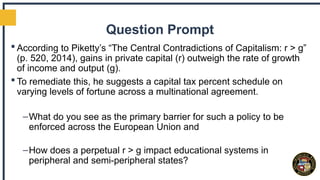
Question Prompt
Accordingto Piketty’s “The Central Contradictions of Capitalism: r > g”
(p. 520, 2014), gains in private capital (r) outweigh the rate of growth
of income and output (g).
To remediate this, he suggests a capital tax percent schedule on
varying levels of fortune across a multinational agreement.
–What do you see as the primary barrier for such a policy to be
enforced across the European Union and
–How does a perpetual r > g impact educational systems in
peripheral and semi-peripheral states?
Postcolonialism
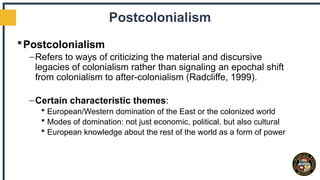
Postcolonialism
–Refers to waysof criticizing the material and discursive
legacies of colonialism rather than signaling an epochal shift
from colonialism to after-colonialism (Radcliffe, 1999).
–Certain characteristic themes:
European/Western domination of the East or the colonized world
Modes of domination: not just economic, political, but also cultural
European knowledge about the rest of the world as a form of power
27.
Postcolonialism
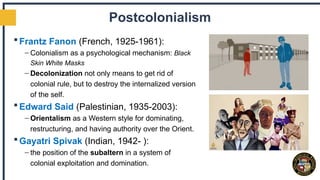
Frantz Fanon (French,1925-1961):
– Colonialism as a psychological mechanism: Black
Skin White Masks
– Decolonization not only means to get rid of
colonial rule, but to destroy the internalized version
of the self.
Edward Said (Palestinian, 1935-2003):
– Orientalism as a Western style for dominating,
restructuring, and having authority over the Orient.
Gayatri Spivak (Indian, 1942- ):
– the position of the subaltern in a system of
colonial exploitation and domination.
28.
Can the SubalternSpeak?
Subaltern: People of underclass in a society on whom the dominant
power put forth its hegemonic power and impact (Gramsci, 1971).
Spivak: The subaltern cannot speak (1988).
Do you think Spivak’s claim is still relevant today? Why or Why not?
Group Activity
Who is the subaltern in education?
– PK-12
– Higher education
What should/can we do for the subaltern group(s)?
29.
Postcolonialism
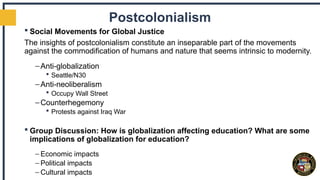
Social Movementsfor Global Justice
The insights of postcolonialism constitute an inseparable part of the movements
against the commodification of humans and nature that seems intrinsic to modernity.
–Anti-globalization
Seattle/N30
–Anti-neoliberalism
Occupy Wall Street
–Counterhegemony
Protests against Iraq War
Group Discussion: How is globalization affecting education? What are some
implications of globalization for education?
– Economic impacts
– Political impacts
– Cultural impacts
30.
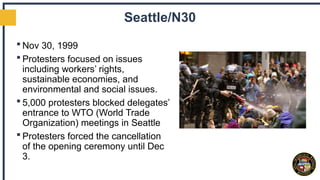
Seattle/N30
Nov 30,1999
Protesters focused on issues
including workers’ rights,
sustainable economies, and
environmental and social issues.
5,000 protesters blocked delegates’
entrance to WTO (World Trade
Organization) meetings in Seattle
Protesters forced the cancellation
of the opening ceremony until Dec
3.
31.
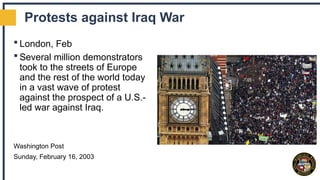
Protests against IraqWar
London, Feb
Several million demonstrators
took to the streets of Europe
and the rest of the world today
in a vast wave of protest
against the prospect of a U.S.-
led war against Iraq.
Washington Post
Sunday, February 16, 2003
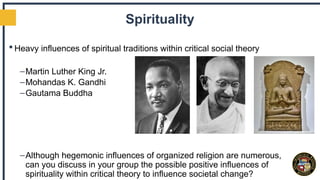
Spirituality
Heavy influencesof spiritual traditions within critical social theory
–Martin Luther King Jr.
–Mohandas K. Gandhi
–Gautama Buddha
–Although hegemonic influences of organized religion are numerous,
can you discuss in your group the possible positive influences of
spirituality within critical theory to influence societal change?
34.
Concerns of Anthropocentrismand Ecology
Can you reflect on other ties within your community between ecology and education?
35.
Personal Reflection
In yoursmall group, take 5 mins to talk about:
Global take-away from the course-
–A-ha moments or surprises;
–Connections to personal experiences or research interests;
–How you will use exposure to these theoretical frameworks
into your ongoing efforts within and outside of the classroom
#17 by bringing in the critical perspective (p. 226) to support radical social transformation
American philosophy has never taken the Afro-American experience seriously. A philosophy which takes seriously the Afro-American experience. pursues concrete practices of freedom.
(mal)distribution and (mal)recognition are two axes of (in)justice.
insisted that “redistribution’ of material goods” is as important as the “recognition of marginalized identities” for social justice.
Before we take the break, let’s watch the video about the how she talks about her work and how critical theory and pragmatism intersect.
We can see both of them integrate race, politics, religion, and feminist work to support social change,. any reactions to their work? What do you find is interesting about their work? Or anything is still missing from their work?
4:15
https://www.youtube.com/watch?v=5Eb2LLa4UMM
https://www.youtube.com/watch?v=RjLwI2ZwcsU
#26 Studies the material and discursive legacy of colonialism and imperialism, focusing on the consequences of the control and exploitation of colonized people
India, Africa, Latin America
Focus on forms of European knowledge about the rest of the world, and how this knowledge itself is a form of power.
#27 Fanon: psychologist. He look at colonialism from a psychology perspective. Colonialism is as not just an economic and political, but also a psychological mechanism
The colonized person becomes an ‘object’ for the colonizer; loses his/her identity.
He has a famous book called Black Skin White Masks. I am going to show you a video about it.
Orientalism: American and European’s misleading representation and incorrect assumptions about the East. This assumption reduced the eastern countries to a few stereotypes. ignore the complexity, diversity, and humanity that eastern people represent. When you watch the video, I’d like you to think about what are some examples of orientalism you have seen in the daily life.
In this video, we can see that Western countries print a picture of eastern countries that they need civilizing. We can still see the idea of orientalism today. people still ask me whether Chinese eat dogs. Chopsticks. Uncivilized and non intellectual
Spivak: Spivak borrows the term “subaltern” from Gramsci
https://www.youtube.com/watch?v=z2OJ6lE36gE
https://www.youtube.com/watch?v=4QYrAqrpshw
#28 Subaltern has no history and they cannot speak.
1) = cannot be heard or understood.
-- does not have the master’s language to speak; -- is not in a speaking position;
2) -- have no resisting consciousness.
#29 Although colonialism is no longer a major force in shaping the world, capitalism has reinvented itself, for example economic globalization.
Globalization is double-edge sord.
the negative consequences of globalization gave rise to the emergence of anti-globalization movements.
The anti-globalization movement, or counter-globalization movement, is a social movement critical of economic globalization.
There are some movements to dismantle hegemonic power.

![Intersections Between Pragmatist & Critical Theories
Classical pragmatism: John Dewey
– Instrumentalism: Dewey viewed “knowledge and truth, along with all other
skills, ideas, or resources, as tools proven more or less valuable strictly by
their helpfulness in solving human problems” (p. 227).
– Criticism: Classical pragmatism “tend[s] to gloss over social conflict” (p. 227).
Critical pragmatists
– Cornel West (Prophetic pragmatist)
• Integrate race, politics, and religion;
• Fight for social justice & human rights
– Nancy Fraser (Feminist pragmatist)
• (Mal)distribution: economic subordination;
• (Mal)recognition: cultural subordination
• “Bring a pragmatic sensibility to the rigorous
application of critical theory” (p. 229)](https://image.slidesharecdn.com/socialtheorypresentationupdated1128-250312050921-b333c83d/85/Social-Theory-Presentation-Updated_11_28-17-320.jpg)