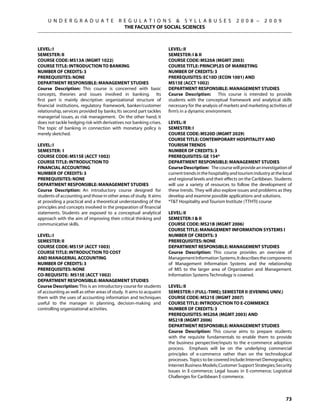
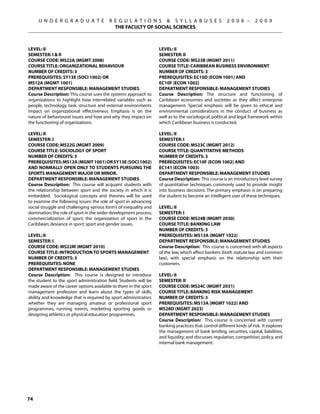
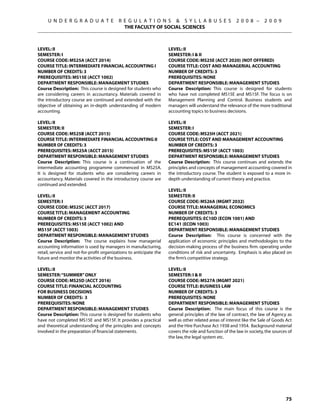
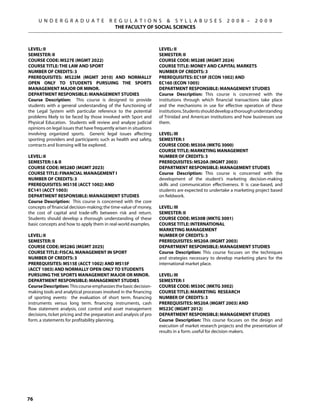
U N D E R G R A D U A T E                                        R E G U L A T I O N S & S Y L L A B U S E S                                                       2 0 0 8 –              2 0 0 9
                                                                            THE FACULTY OF SOCIAL SCIENCES


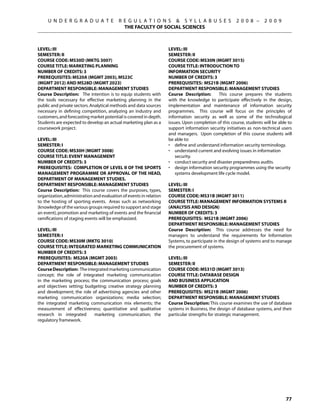
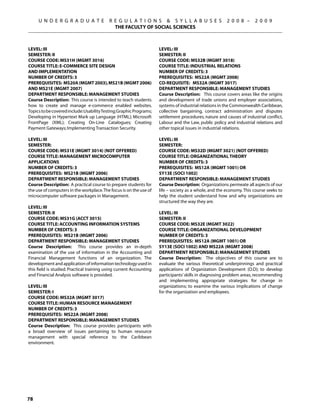
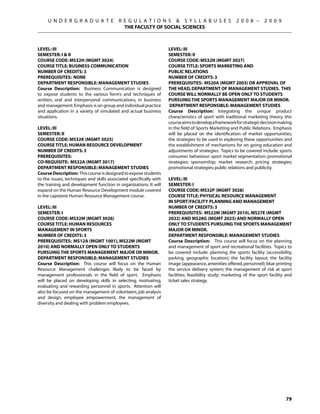
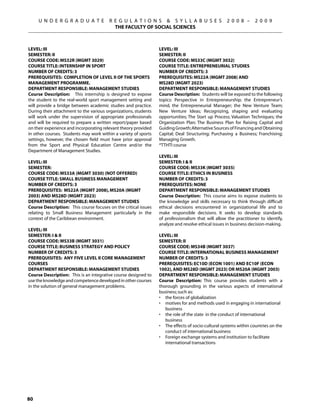
CONTENTS
Message from the Dean............................................................................2
Staff Listing....................................................................................................3
Definitions ....................................................................................................7
General Information & Regulations......................................................7
Student Prizes............................................................................................ 21
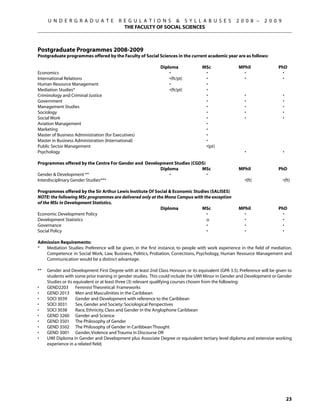
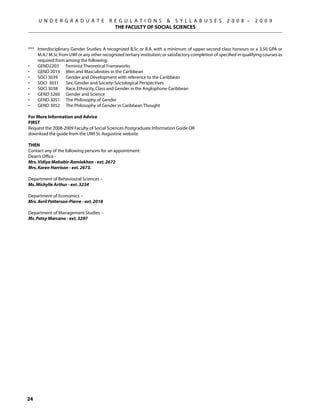
Postgraduate Studies.............................................................................. 22
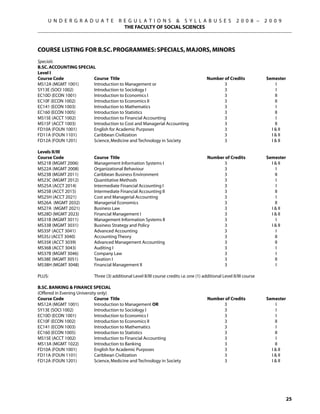
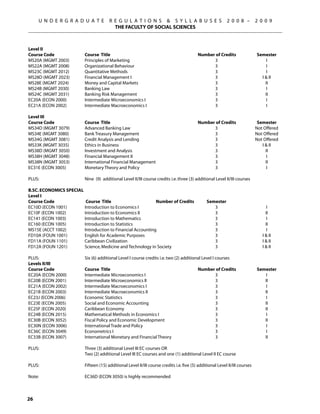
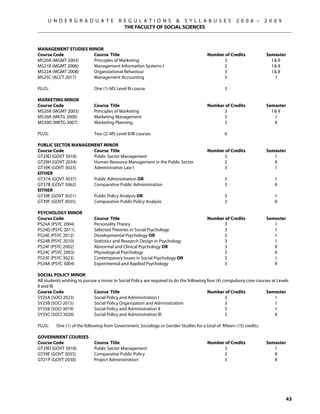
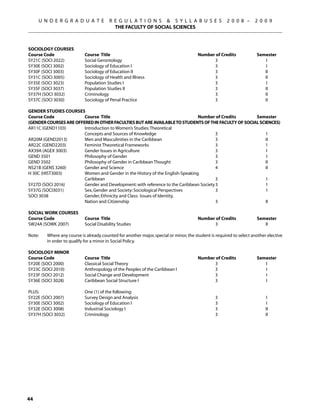
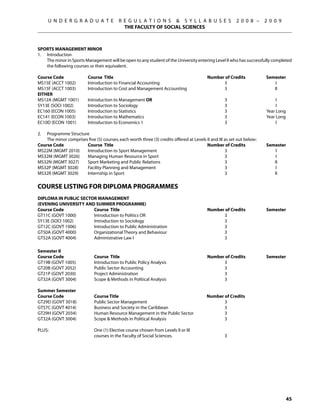
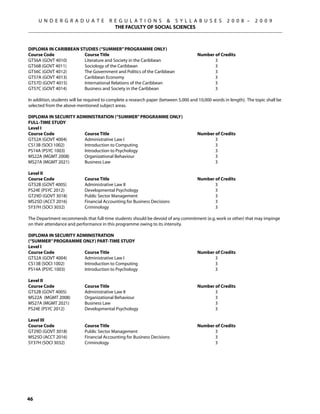
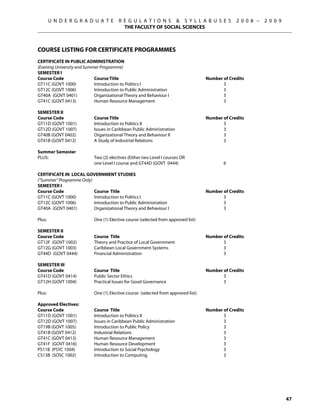
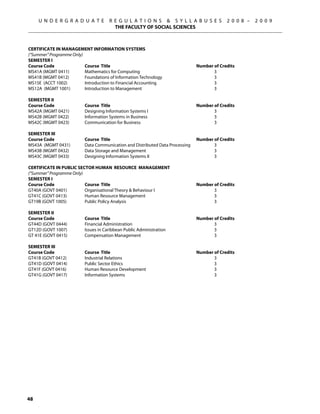
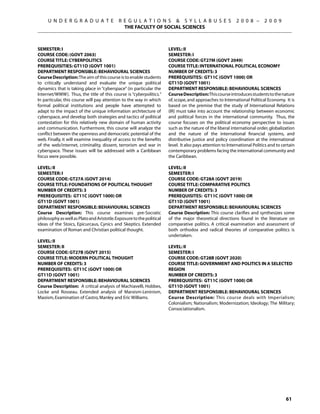
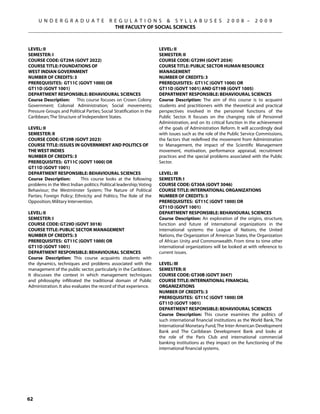
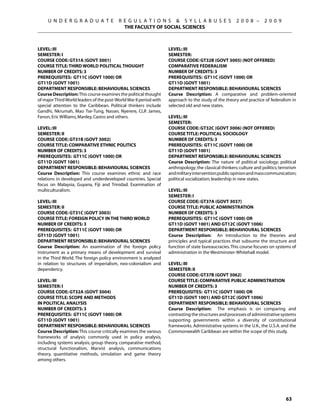
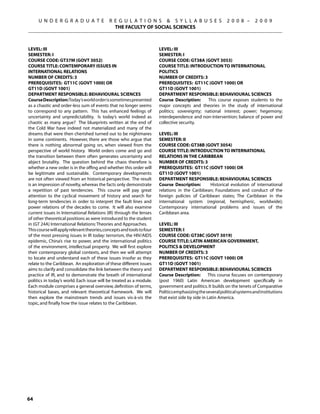
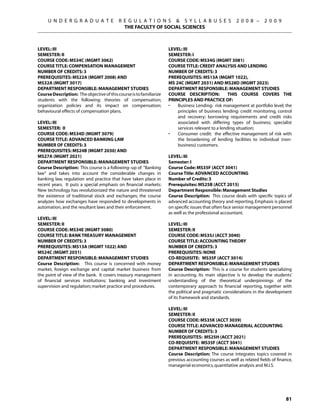
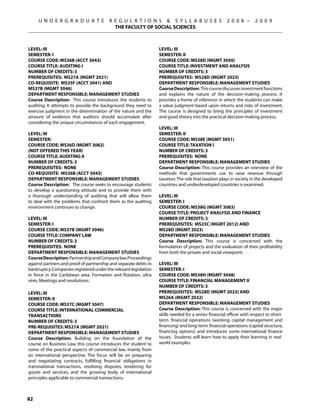
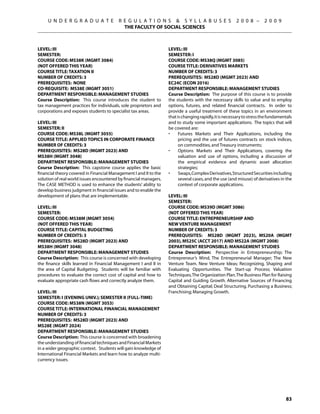
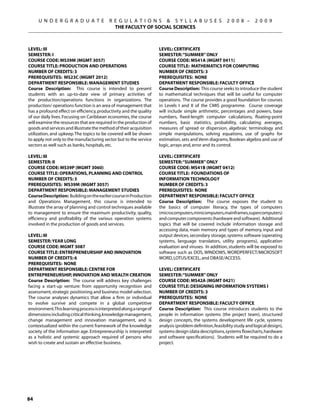
Course Listing ........................................................................................... 25
Specials
	 Accounting............................................................................................ 25
	 Banking and Finance.......................................................................... 25
	 Economics.............................................................................................. 26
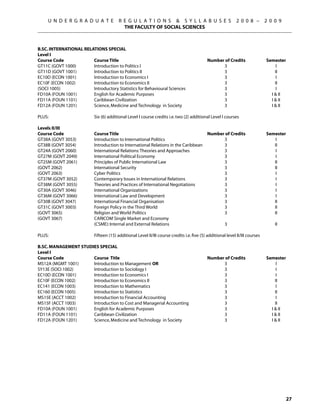
	 International Relations...................................................................... 27
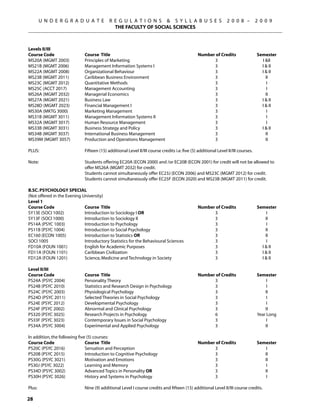
	 Management Studies......................................................................... 27
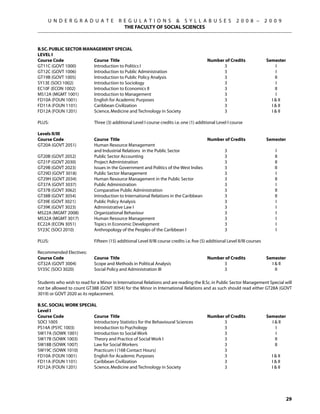
	 Psychology............................................................................................. 28
	 Public Sector Management ............................................................ 29
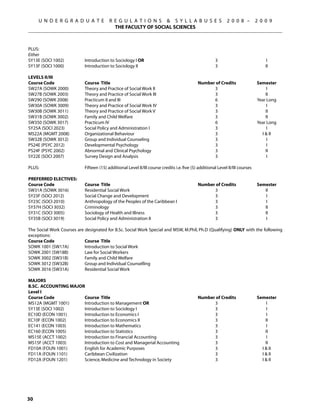
	 Social Work ........................................................................................... 29
Majors
	 Accounting............................................................................................ 30
	 Economics.............................................................................................. 31
	 Government.......................................................................................... 32
	 Hospitality Option............................................................................... 32
	 Tourism Option.................................................................................... 33
	 International Tourism Management............................................. 34                                   Diploma
	 Leadership and Management......................................................... 35                              	 Public Sector Management............................................................. 45
	 Management Studies......................................................................... 38                     	 Caribbean Studies............................................................................... 46
	 Psychology . .......................................................................................... 39         	 Security Administration.................................................................... 46
	 Sociology................................................................................................ 39       Certificates
	 Sports Management ......................................................................... 40                     	 Public Administration........................................................................ 47
Minors                                                                                                               	 Local Government Studies............................................................... 47
	 Accounting............................................................................................ 41          	 Management Information Systems.............................................. 48
	 Criminology........................................................................................... 41	         	 Public Sector Human Resource Management.......................... 48
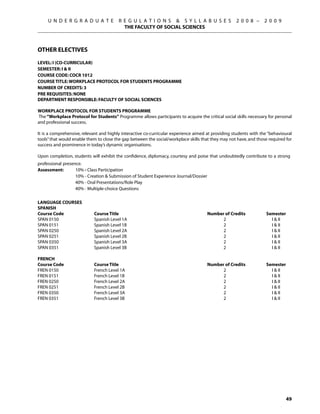
  Economics.............................................................................................. 41         Other Electives
	 Finance.................................................................................................... 42     	 Workplace Protocol for Students . ................................................ 49
	 Gender and Development Studies............................................... 42                                   	 Language Courses............................................................................... 49
	 Government ......................................................................................... 42            Course Descriptions for all Courses................................................... 50
	 Human Resource Management .................................................... 42                                  Appendices: Special Regulation
	 International Relations...................................................................... 42                   	 I. 	 “Summer” School....................................................................... 97	
	 Management Information Systems.............................................. 42                                      II.	 Degrees in Hospitality & Tourism Management............ 98
	 Management Studies......................................................................... 43	                    	 III. 	 Dip. in Public Sector Management...................................... 99	
  Marketing............................................................................................... 43          IV. 	 Dip. in Caribbean Studies........................................................ 99
	 Public Sector Management............................................................. 43                           	 V. 	 Dip. in Security Administration............................................. 99
	 Psychology . .......................................................................................... 43         	 VI. 	 Cert. in Public Administration..............................................100
	 Social Policy . ........................................................................................ 43        	 VII. 	 Cert. in Local Government Studies....................................100
	 Sociology................................................................................................ 44       	 VIII. 	 Cert. in Management Information Systems....................100
	 Sports Management........................................................................... 45                    	 IX. 	 Cert. in Public Sector Human Resource Management.. 101
U N D E R G R A D U A T E   R E G U L A T I O N S  S Y L L A B U S E S            2 0 0 8 –       2 0 0 9
                                  THE FACULTY OF SOCIAL SCIENCES


                                                   MESSAGE FROM THE DEAN
                                                   Greetings from the Faculty of Social Sciences!
                                                   I take pleasure in directing your attention to the contents of the
                                                   Faculty of Social Sciences Regulations and Syllabus booklet. It is
                                                   designed to provide the student and other interested persons
                                                   with a condensed and informative introduction to the Faculty’s
                                                   undergraduate programmes.

                                                   We at the Faculty trust that you will make good use of this op-
                                                   portunity to review the courses we offer. As you discover the wide
                                                   range of possibilities that the Faculty places at your disposal, do
                                                   not hesitate to ask questions and provide us with suggestions
                                                   to make this brochure easier to use.

                                                   Once again, I invite you to explore our environment. It is our
                                                   proud tradition to encourage you to ask questions about, and to
                                                   provide answers to, the challenges and issues facing the Carib-
                                                   bean and the wider world.

                                                   Please ensure that you read this booklet carefully.

                                                   Best wishes,
                                                   Hamid Ghany
                                                   Dean, Faculty of Social Sciences
U N D E R G R A D U A T E            R E G U L A T I O N S  S Y L L A B U S E S                 2 0 0 8 –     2 0 0 9
                                            THE FACULTY OF SOCIAL SCIENCES


Staff Listing                                                     IT OFFICER I
The Faculty Office is located in the new Social Sciences          Mr. Manohar Sookhoo
Administration Building                                           B.Sc., M.Sc. UWI
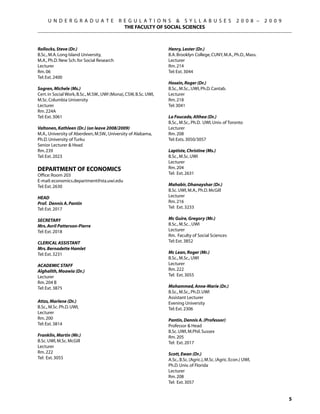
Telephone: 1 (868) 662 2002 Ext. 2027                             Implementation, monitoring and security of the
Fax: 1 (868) 662 6295                                             Faculty’s Computer System
E-mail: fss@fss.uwi.tt                                            Tel: Ext.. 3851

Dean                                                              PC support technician
Dr. Hamid Ghany                                                   Mr. Nigel Moorgan
Administration of Faculty’s affairs                               B.Sc. Information Systems and Management
Tel: Ext. 2028                                                    Installation, maintenance and security of the Faculty’s
                                                                  computer system
Ag. Dean’s Secretary                                              Tel: Ext. 2574
Mrs. Chanroutee Naraine
B.Sc.                                                             Ag. ACCOUNTING ASSISTANT
Coordinates meetings, schedules and visits, ATSS, HRM             Ms. Melissa Dilbar
Tel: Ext. 2027                                                    B.Sc.
                                                                  Processing all Faculty financial transactions
Ag. Secretary/Stenographer                                        Tel: Ext. 2407
Ms. Alicia Blaise-Fergus
Student matters (course registration, appointments with the       Clerical AssistantS
Deputy Dean (Undergraduate Studies)                               Ms. Merquina Lawson
Tel: Ext. 3042                                                    Assists with classroom and tutorial scheduling
                                                                  Tel: Ext. 2406
Secretary/Stenographer
Mrs. Karen Harrison                                               Ms. Jeselle Joseph
Postgraduate student matters, appointments with the Deputy        Administration
Dean (Graduate Studies and Research)                              Tel: Ext. 2404
and Secretary to Faculty Board
Tel: Ext. 2673                                                    Mrs. Melissa Robertson-Llewellyn
                                                                  Administration
Administrative Assistants                                         Tel: Ext 2406
Mrs. Sandra Roopchand-Khan
B.Sc.                                                             Ms. Bernadette Bethel
Undergraduate Programmes, Faculty’s business projects,            “Summer” School Administration
Study Abroad Programmes and Events Management                     Tel: Ext. 2408
(FSS Computer Laboratory, ATSS staff and the Faculty’s website)
Tel: Ext. 3232                                                    Ms. Romona Ramnarain
                                                                  Administration
Mrs. Sharon Reddock                                               Tel: Ext. 2405
Centre for Criminology and Criminal Justice
and Distance Education Programme                                  Mr. Azariah Hoyte
Tel: Ext. 3352                                                    Administration
                                                                  Tel: Ext. 3048
Mrs. Vidiya Mahabir-Ramlakhan
Graduate Studies and Maintenance of Plant and Equipment           Mr. Kwasi Jobity
Tel: Ext. 2672                                                    Banner Support
                                                                  Tel: Ext. 2674
Mrs. Marissa Joseph-Victor
APS                                                               OFFICE ASSISTANTS
Faculty’s Evening University and “Summer” School Programmes       Mr. David Johnson
Tel: Ext. 2408, 3048 or 645-5383                                  Maintenance Supervisor
	                                                                 Tel: Ext. 3870
U N D E R G R A D U A T E              R E G U L A T I O N S  S Y L L A B U S E S                 2 0 0 8 –      2 0 0 9
                                              THE FACULTY OF SOCIAL SCIENCES


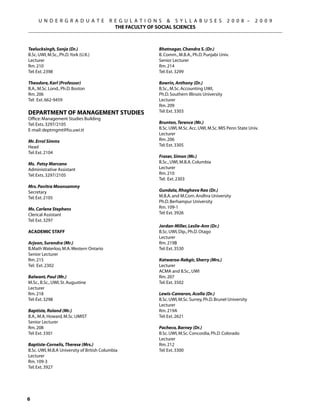
Mr. Emrold Sampson                                                 Cameron-Padmore, Jacqueline (Mrs.)
Day Programmes                                                     B.Sc., UWI, M.Sc. Columbia University
Tel: Ext. 2409                                                     Lecturer/Practicum Coordinator
                                                                   Rm. 213
Mr. Ronnie Budhooram                                               Tel: Ext. 3046
Evening University Programmes
Tel: Ext. 2409                                                     Chadee, Derek (Dr.)
                                                                   B.Sc., Ph.D. UWI
Mr. Geeno Sookhoo                                                  Senior Lecturer
Day Programmes                                                     Rm. 04
Tel: Ext. 2409                                                     Tel: Exts. 2172/2402

Mr. Anthony Sumair-Worrell                                         Onwubiko Agozino (Professor)
Evening University Programmes                                      B.Sc. Calabar, M.Phil. Cambridge University, Ph.D. Edinburgh
Tel: Ext. 2409                                                     Tel: Exts. 2172/ 2402

Department of Behavioural Sciences                                 Ghany, Hamid (Dr.)
Office: Rooms 233, 235, 237                                        B.A. UWI, M.A. Fordham, Ph.D. London
Tel: Exts. 2539, 2024, 2020                                        Senior Lecturer, Office of the Dean
E-mail: deptbhsc@fss.uwi.tt                                        Tel: Ext. 2028

Head                                                               Hadeed, Linda (Dr.)
Mustapha, Nasser (Dr.)                                             B.A. Pennsylvania, M.SW., Ph.D. Columbia University
B.Sc., M.Phil., Ph.D. UWI                                          Lecturer
Tel: Ext. 2023                                                     Rm. 212
                                                                   Tel: Ext. 3576
Secretary
Mrs. Nisha Alladin-Motilal                                         Holder-Dolly, Jennifer (Dr.)
Tel: Ext. 2020                                                     B.Sc., UWI, M.Sc. Col.,Ph.D. Union Institute  Ohio University,
                                                                   Lecturer
Administrative Assistant                                           Deane House
Ms. Wenda Rocke                                                    Tel: 663 6810
Tel: Ext. 3865
                                                                   Kamugisha, Aaron
ACADEMIC STAFF                                                     B.Sc., M.Phil UWI, Ph.D York
Alea, Nicole (Dr.)
B.Sc., M.Sc., Ph.D University of Florida                           Mahabir, Raghunath (Dr.)
Rm. 02                                                             B.A., M.Sc. Ph.D., UWI
Tel: Ext. 2671                                                     Lecturer
                                                                   Campus House
Bissessar, Anne Marie (Dr.)                                        Tel: Ext. 3663
B.A., M.Sc., Ph.D. UWI
Senior Lecturer                                                    Marshall, Ronald (Dr.)
Rm. 207                                                            B.A. UWI, M.A., Ph.D. Howard University
Tel: Ext. 2019                                                     Lecturer
                                                                   Rm. 225A
Brown, Dennis A (Dr.) (on leave 2008/2009)                         Tel: Ext. 3056
B.Sc., M.Sc., Ph.D.UWI
Lecturer                                                           Phillips, Daphne (Dr.)
Rm. 220                                                            B.Sc., M.Sc. UWI, Ph.D. Illinois
Tel: Ext. 3053                                                     Lecturer
                                                                   Tel: Ext. 2670
Cambridge, Innette (Dr.)
B.A. Moorhead, L.Soc., M.Soc. Paris, Ph.D. University of Bristol   Ragoonath, Bishnu (Dr.)
Lecturer                                                           B.Sc. M.Sc., Ph.D. UWI
Rm. 211                                                            Senior Lecturer
Tel: Ext. 3062                                                     Rm. 209
                                                                   Tel: Ext. 3047
U N D E R G R A D U A T E             R E G U L A T I O N S  S Y L L A B U S E S                   2 0 0 8 –   2 0 0 9
                                             THE FACULTY OF SOCIAL SCIENCES


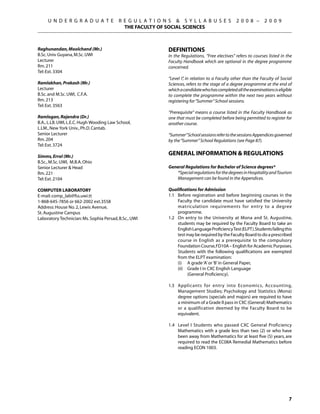
Rollocks, Steve (Dr.)                                             Henry, Lester (Dr.)
B.Sc., M.A. Long Island University,                               B.A. Brooklyn College, CUNY, M.A., Ph.D., Mass.
M.A., Ph.D. New Sch. for Social Research                          Lecturer
Lecturer                                                          Rm. 214
Rm. 06                                                            Tel: Ext. 3044
Tel: Ext. 2400
                                                                  Hosein, Roger (Dr.)
Sogren, Michele (Ms.)                                             B.Sc., M.Sc., UWI, Ph.D. Cantab.
Cert. in Social Work, B.Sc., M.SW., UWI (Mona), CSW, B.Sc. UWI,   Lecturer
M.Sc. Columbia University                                         Rm. 218
Lecturer                                                          Tel: 3041
Rm. 224A
Tel: Ext. 3061                                                    La Foucade, Althea (Dr.)
                                                                  B.Sc., M.Sc., Ph.D. UWI, Univ. of Toronto
Valtonen, Kathleen (Dr.) (on leave 2008/2009)                     Lecturer
M.A., University of Aberdeen, M.SW., University of Alabama,       Rm. 208
Ph.D. University of Turku                                         Tel: Exts. 3050/3057
Senior Lecturer  Head
Rm. 239                                                           Laptiste, Christine (Ms.)
Tel: Ext. 2023                                                    B.Sc., M.Sc. UWI
                                                                  Lecturer
Department of Economics                                           Rm. 204
Office: Room 203                                                  Tel: Ext. 2631
E-mail: economics.department@sta.uwi.edu
Tel: Ext. 2630                                                    Mahabir, Dhanayshar (Dr.)
                                                                  B.Sc. UWI, M.A., Ph.D. McGill
Head                                                              Lecturer
Prof. Dennis A. Pantin                                            Rm. 216
Tel: Ext. 2017                                                    Tel: Ext. 3233

Secretary                                                         Mc Guire, Gregory (Mr.)
Mrs. Avril Patterson-Pierre                                       B.Sc., M.Sc. , UWI
Tel: Ext. 2018                                                    Lecturer
                                                                  Rm. Faculty of Social Sciences
Clerical Assistant                                                Tel: Ext. 3852
Mrs. Bernadette Hamlet
Tel: Ext. 3231                                                    Mc Lean, Roger (Mr.)
                                                                  B.Sc., M.Sc., UWI
ACADEMIC STAFF                                                    Lecturer
Alghalith, Moawia (Dr.)                                           Rm. 222
Lecturer                                                          Tel: Ext. 3055
Rm. 204 B
Tel: Ext. 3875                                                    Mohammed, Anne-Marie (Dr.)
                                                                  B.Sc., M.Sc., Ph.D. UWI
                                                                  Assistant Lecturer
Attzs, Marlene (Dr.)                                              Evening University
B.Sc., M.Sc. Ph.D. UWI,                                           Tel: Ext. 2306
Lecturer
Rm. 200                                                           Pantin, Dennis A. (Professor)
Tel: Ext. 3814                                                    Professor  Head
                                                                  B.Sc. UWI, M.Phil. Sussex
Franklin, Martin (Mr.)                                            Rm. 205
B.Sc. UWI, M.Sc. McGill                                           Tel: Ext. 2017
Lecturer
Rm. 222                                                           Scott, Ewan (Dr.)
Tel: Ext. 3055                                                    A.Sc., B.Sc. (Agric.), M.Sc. (Agric. Econ.) UWI,
                                                                  Ph.D. Univ. of Florida
                                                                  Lecturer
                                                                  Rm. 208
                                                                  Tel: Ext. 3057
U N D E R G R A D U A T E            R E G U L A T I O N S  S Y L L A B U S E S             2 0 0 8 –     2 0 0 9
                                            THE FACULTY OF SOCIAL SCIENCES


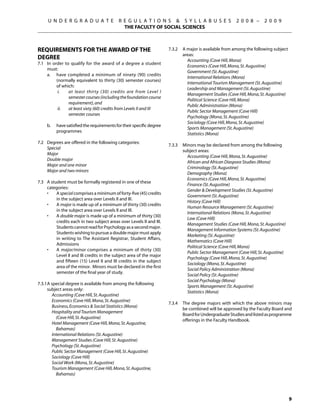
Teelucksingh, Sonja (Dr.)                                    Bhatnagar, Chandra S. (Dr.)
B.Sc. UWI, M.Sc., Ph.D. York (U.K.)                          B. Comm., M.B.A., Ph.D. Punjabi Univ.
Lecturer                                                     Senior Lecturer
Rm. 210                                                      Rm. 214
Tel: Ext. 2398                                               Tel: Ext. 3299

Theodore, Karl (Professor)                                   Bowrin, Anthony (Dr.)
B.A., M.Sc. Lond., Ph.D. Boston                              B.Sc., M.Sc. Accounting UWI,
Rm. 206                                                      Ph.D. Southern Illinois University
Tel: Ext. 662-9459                                           Lecturer
                                                             Rm. 209
Department of Management Studies                             Tel: Ext. 3303
Office: Management Studies Building
Tel: Exts. 3297/2105                                         Brunton, Terence (Mr.)
E-mail: deptmgmt@fss.uwi.tt                                  B.Sc. UWI, M.Sc. Acc. UWI, M.Sc. MIS Penn State Univ.
                                                             Lecturer
Mr. Errol Simms                                              Rm. 206
Head                                                         Tel: Ext. 3305
Tel: Ext. 2104
                                                             Fraser, Simon (Mr.)
Ms. Patsy Marcano                                            B.Sc., UWI, M.B.A. Columbia
Administrative Assistant                                     Lecturer
Tel: Exts. 3297/2105                                         Rm. 210
                                                             Tel: Ext. 2303
Mrs. Pavitra Moonsammy
Secretary                                                    Gundala, Rhaghava Rao (Dr.)
Tel: Ext. 2105                                               M.B.A. and M.Com. Andhra University
                                                             Ph.D. Berhampur University
Ms. Carlene Stephens                                         Rm. 109-1
Clerical Assistant                                           Tel: Ext. 3926
Tel: Ext. 3297
                                                             Jordan-Miller, Leslie-Ann (Dr.)
ACADEMIC STAFF                                               B.Sc. UWI, Dip., Ph.D. Otago
                                                             Lecturer
Arjoon, Surendra (Mr.)                                       Rm. 219B
B.Math Waterloo, M.A. Western Ontario                        Tel: Ext. 3530
Senior Lecturer
Rm. 215                                                      Katwaroo-Rabgir, Sherry (Mrs.)
Tel: Ext. 2302                                               Lecturer
                                                             ACMA and B.Sc., UWI
Balwant, Paul (Mr.)                                          Rm. 207
M.Sc., B.Sc., UWI, St. Augustine                             Tel: Ext. 3502
Lecturer
Rm. 218                                                      Lewis-Cameron, Acolla (Dr.)
Tel: Ext. 3298                                               B.Sc. UWI, M.Sc. Surrey, Ph.D. Brunel University
                                                             Lecturer
Baptiste, Roland (Mr.)                                       Rm. 219A
B.A., M.A. Howard, M.Sc. UMIST                               Tel: Ext. 2621
Senior Lecturer
Rm. 208                                                      Pacheco, Barney (Dr.)
Tel: Ext. 3301                                               B.Sc. UWI, M.Sc. Concordia, Ph.D. Colorado
                                                             Lecturer
Baptiste-Cornelis, Therese (Mrs.)                            Rm. 212
B.Sc. UWI, M.B.A University of British Columbia              Tel: Ext. 3300
Lecturer
Rm. 109-3
Tel: Ext. 3927
U N D E R G R A D U A T E            R E G U L A T I O N S  S Y L L A B U S E S             2 0 0 8 –      2 0 0 9
                                            THE FACULTY OF SOCIAL SCIENCES


Raghunandan, Moolchand (Mr.)                                 DEFINITIONS
B.Sc. Univ Guyana, M.Sc. UWI                                 In the Regulations, “Free electives” refers to courses listed in the
Lecturer                                                     Faculty Handbook which are optional in the degree programme
Rm. 211                                                      concerned.
Tel: Ext. 3304
                                                             “Level I” in relation to a Faculty other than the Faculty of Social
                                                                     ,
Ramlakhan, Prakash (Mr.)                                     Sciences, refers to the stage of a degree programme at the end of
Lecturer                                                     which a candidate who has completed all the examinations is eligible
B.Sc. and M.Sc. UWI, C.F.A.                                  to complete the programme within the next two years without
Rm. 213                                                      registering for “Summer” School sessions.
Tel: Ext. 3563
                                                             “Prerequisite” means a course listed in the Faculty Handbook as
Ramlogan, Rajendra (Dr.)                                     one that must be completed before being permitted to register for
B.A., L.LB. UWI, L.E.C. Hugh Wooding Law School,             another course.
L.LM., New York Univ., Ph.D. Cantab.
Senior Lecturer                                              “Summer” School sessions refer to the sessions Appendices governed
Rm. 204                                                      by the “Summer” School Regulations (see Page 87).
Tel: Ext. 3724

Simms, Errol (Mr.)
                                                             GENERAL INFORMATION  REGULATIONS
B.Sc., M.Sc. UWI, M.B.A. Ohio
Senior Lecturer  Head                                       General Regulations for Bachelor of Science degrees*
Rm. 221                                                      	   *Special regulations for the degrees in Hospitality and Tourism
Tel: Ext. 2104                                                   Management can be found in the Appendices.

Computer Laboratory                                          Qualifications for Admission
E-mail: comp_lab@fss.uwi.tt                                  1.1	 Before registration and before beginning courses in the
1-868-645-7856 or 662-2002 ext.3558                               Faculty the candidate must have satisfied the University
Address: House No. 2, Lewis Avenue,                               matriculation requirements for entry to a degree
St. Augustine Campus                                              programme.
Laboratory Technician: Ms. Sophia Persad, B.Sc., UWI         1.2	 On entry to the University at Mona and St. Augustine,
                                                                  students may be required by the Faculty Board to take an
                                                                  English Language Proficiency Test (ELPT). Students failing this
                                                                  test may be required by the Faculty Board to do a prescribed
                                                                  course in English as a prerequisite to the compulsory
                                                                  Foundation Course, FD10A – English for Academic Purposes.
                                                                  Students with the following qualifications are exempted
                                                                  from the ELPT examination:
                                                             	    (i)	 A grade ‘A’ or ‘B’ in General Paper,
                                                             	    (ii)	 Grade I in CXC English Language
                                                             		         (General Proficiency).

                                                             1.3	 Applicants for entry into Economics, Accounting,
                                                                  Management Studies; Psychology and Statistics (Mona)
                                                                  degree options (specials and majors) are required to have
                                                                  a minimum of a Grade II pass in CXC (General) Mathematics
                                                                  or a qualification deemed by the Faculty Board to be
                                                                  equivalent.

                                                             1.4 Level I Students who passed CXC General Proficiency
                                                                 Mathematics with a grade less than two (2) or who have
                                                                 been away from Mathematics for at least five (5) years, are
                                                                 required to read the EC08A Remedial Mathematics before
                                                                 reading ECON 1003.
U N D E R G R A D U A T E              R E G U L A T I O N S  S Y L L A B U S E S                         2 0 0 8 –      2 0 0 9
                                               THE FACULTY OF SOCIAL SCIENCES


Transfers                                                               4.6	 Subject to Faculty regulations, co-curricular credits will
Inter- and Intra-Faculty Transfers                                           form part of the ninety (90) credits REQUIREDfor a degree.
2.1	 Students in another Faculty who have completed Level I of a             However, in special circumstances, if credits are earned in
     degree programme of The University of the West Indies are               excess of those required for the degree, these credits and
     eligible for transfer to the Level II of a degree programme             the associated activity will be included on the student’s
     offered by the Faculty of Social Sciences. Such students must,          transcript.
     at the time of transfer, have passed courses which satisfy
     the Level I requirements of the Faculty of Social Sciences,        4.7	 Co-curricular course credits can only be counted as/in
     as well as the prerequisites of the relevant courses of the             place of Level One course credits.
     programme into which they are seeking a transfer.
                                                                        	         Co-curricular course offered by the Faculty of Social
2.2	 Transfers may also be offered to any student registered in                   Sciences: “Workplace Protocol for Students Programme”
     any other Faculty of The University of the West Indies who
     has successfully completed the Level I prerequisites to Levels     Level I Requirements
     II and III courses in the intended Major or Special and has        5.1	 Students must satisfy the requirements for a minimum of
     also completed the required foundation course(s).                       thirty (30) credits at Level I comprising:
                                                                        	    a.	 such foundation courses as are required and offered;
2.3	 For transfer to the Level II of a degree programme offered         	    b.	 other compulsory courses in the chosen degree option as
     by the Faculty of Social Sciences (Mona), students registered                specified in the Faculty Handbook;
     prior to 1998-99 may include among the courses passed:             	    c.	 free electives to bring the total credits to thirty (30).
     Essentials in English (UC010, UC001) or Use of English
     (UC120).                                                           Foundation Courses
                                                                        5.2	 a.	 As of 1998-99 all students registered in The University of
Course of Study                                                                  the West Indies will be required to complete a minimum
3.	   Candidates for any of the degree programmes must pursue                    of nine (9) credits of foundation courses. These courses
      a course of study comprising at least ninety (90) credits with             are Level I courses designed to promote sensitivity to,
      at least thirty (30) credits at Level I and sixty (60) credits             and awareness of, distinctive characteristic features
      at Levels II and III. The Faculty Board may require that                   of Caribbean cosmologies, identities and culture. The
      registration in particular courses be timed to such as to                  foundation courses comprise:
      ensure that the course of study extends over either at least      	    	   i.	 FD10A (FOUN 1001) - English for Academic
      five (5) semesters and two (2) “Summer” School sessions or                       Purposes
      six (6) semesters.                                                		       ii.	 FD12A (FOUN 1201) - Science, Medicine and
                                                                                       Technology in Society
	     *Special regulations exist for the B.Sc. Degrees in Hospitality   		       iii.	 FD11A (FOUN 1101) - Caribbean Civilization
      and Tourism Management (See page 88).                             		       iv.	 FD13A (FOUN 1301) - Law, Governance, Economy
                                                                                       and Society
                                                                        		       v. 	 any other course approved for this purpose by the
Co-curricular Credits                                                                  Board of Undergraduate Studies
4.1	 Students will be eligible for no more than three (3) credits
     for involvement in co-curricular activities. The activities may
                                                                        	         b.	 Students registered in the Faculty of Social Sciences will
     be Campus specific.
                                                                                      be required to include among such foundation courses
                                                                                      English for Academic Purposes.
4.2	 Co-curricular credits will be awarded on the following
                                                                              	
     basis:
                                                                        	         c. 	   The elective Foundation course Law, Governance,
	    a.	 students must be involved in the activity for at least
                                                                                         Economy and Society will not count for credit in the
          one (1) semester;
                                                                                         programme of the Faculty of Social Sciences except
	    b.	 explicit learning outcomes must be identified for each
                                                                                         with the permission of the Dean.
          activity;
	    c.	 there must be clearly defined mode(s) of assessment
                                                                        	         d.	    Exemption in whole or in part from the requirements
          for each activity.
                                                                                         under [4.2(a–b)] may be granted from time to time by
                                                                                         the Board for Undergraduate Studies.
4.3	 A Faculty Coordinator will be appointed, with the
     responsibility for the awarding co-curricular credits.
                                                                        Requirements for Entry to Level II and
4.4	 Co-curricular activities will be graded Pass/Fail.                 III
                                                                        6.	       Students are required to satisfy prerequisites (where they
4.5 	 All co-curricular activities/programmes must be approved                    exist) for Level II and III courses.
      in advance by the Faculty and Academic Board.
U N D E R G R A D U A T E            R E G U L A T I O N S  S Y L L A B U S E S                 2 0 0 8 –      2 0 0 9
                                              THE FACULTY OF SOCIAL SCIENCES


Requirements for the Award of the                                     7.3.2	 A major is available from among the following subject
                                                                      	      areas:
Degree                                                                     	   Accounting (Cave Hill, Mona)
7.1	 In order to qualify for the award of a degree a student
                                                                           	   Economics (Cave Hill, Mona, St. Augustine)
     must:	
                                                                           	   Government (St. Augustine)
	    a.	 have completed a minimum of ninety (90) credits
                                                                           	   International Relations (Mona)
          (normally equivalent to thirty (30) semester courses)
                                                                           	   International Tourism Management (St. Augustine)
          of which:
                                                                           	   Leadership and Management (St. Augustine)
       		 i.	   at least thirty (30) credits are from Level I
                                                                           	   Management Studies (Cave Hill, Mona, St. Augustine)
                semester courses (including the foundation course
                                                                           	   Political Science (Cave Hill, Mona)
                requirement), and
                                                                           	   Public Administration (Mona)
       		 ii.	  at least sixty (60) credits from Levels II and III
                                                                           	   Public Sector Management (Cave Hill)
       			      semester courses
                                                                           	   Psychology (Mona, St. Augustine)
	
                                                                           	   Sociology (Cave Hill, Mona, St. Augustine)
	    b.	 have satisfied the requirements for their specific degree
                                                                           	   Sports Management (St. Augustine)
          programmes
                                                                           	   Statistics (Mona)
7.2	   Degrees are offered in the following categories:
                                                                      7.3.3	 Minors may be declared from among the following
	      Special
                                                                      	      subject areas:
	      Major
                                                                           	   Accounting (Cave Hill, Mona, St. Augustine)
	      Double major
                                                                           	   African and African Diaspora Studies (Mona)
	      Major and one minor
                                                                           	   Criminology (St. Augustine)
	      Major and two minors
                                                                           	   Demography (Mona)
                                                                           	   Economics (Cave Hill, Mona, St. Augustine)
7.3	 A student must be formally registered in one of these
                                                                           	   Finance (St. Augustine)
	    categories:
                                                                           	   Gender  Development Studies (St. Augustine)
	    •	   A special comprises a minimum of forty-five (45) credits
                                                                           	   Government (St. Augustine)
          in the subject area over Levels II and III.
                                                                           	   History (Cave Hill)
	    •	   A major is made up of a minimum of thirty (30) credits
                                                                           	   Human Resource Management (St. Augustine)
          in the subject area over Levels II and III.
                                                                           	   International Relations (Mona, St. Augustine)
	    •	   A double major is made up of a minimum of thirty (30)
                                                                           	   Law (Cave Hill)
          credits each in two subject areas over Levels II and III.
                                                                           	   Management Studies (Cave Hill, Mona, St. Augustine)
          Students cannot read for Psychology as a second major.
                                                                           	   Management Information Systems (St. Augustine)
          Students wishing to pursue a double major must apply
                                                                           	   Marketing (St. Augustine)
          in writing to The Assistant Registrar, Student Affairs,
                                                                           	   Mathematics (Cave Hill)
          Admissions
                                                                           	   Political Science (Cave Hill, Mona)
	    •	   A major/minor comprises a minimum of thirty (30)
                                                                           	   Public Sector Management (Cave Hill, St. Augustine)
          Level II and III credits in the subject area of the major
                                                                           	   Psychology (Cave Hill, Mona, St. Augustine)
          and fifteen (15) Level II and III credits in the subject
                                                                           	   Sociology (Mona, St. Augustine)
          area of the minor. Minors must be declared in the first
                                                                           	   Social Policy Administration (Mona)
          semester of the final year of study.
                                                                           	   Social Policy (St. Augustine)
                                                                           	   Social Psychology (Mona)
7.3.1	A special degree is available from among the following
                                                                           	   Sports Management (St. Augustine)
      subject areas only:
                                                                           	   Statistics (Mona)
      	 Accounting (Cave Hill, St. Augustine)
      	 Economics (Cave Hill, Mona, St. Augustine)
                                                                      7.3.4	 The degree majors with which the above minors may
      	 Business, Economics  Social Statistics (Mona)
                                                                             be combined will be approved by the Faculty Board and
      	 Hospitality and Tourism Management
                                                                             Board for Undergraduate Studies and listed as programme
      		 (Cave Hill, St. Augustine)	
                                                                             offerings in the Faculty Handbook.
      	 Hotel Management (Cave Hill, Mona, St. Augustine, 		
      		 Bahamas)
      	 International Relations (St. Augustine)	
      	 Management Studies (Cave Hill, St. Augustine)
      	 Psychology (St. Augustine)
      	 Public Sector Management (Cave Hill, St. Augustine)
      	 Sociology (Cave Hill)
      	 Social Work (Mona, St. Augustine)
      	 Tourism Management (Cave Hill, Mona, St. Augustine, 	
      		 Bahamas)
U N D E R G R A D U A T E              R E G U L A T I O N S  S Y L L A B U S E S                      2 0 0 8 –      2 0 0 9
                                               THE FACULTY OF SOCIAL SCIENCES


7.3.5	 Students may also request to combine a Social Sciences          Regulations for Part-time
       major with a minor offered by another Faculty. To do
       this, the permission of the Deans of both Faculties must
                                                                       Programme
                                                                       9.	   a.	   A part-time programme is offered for Level I of the B.Sc.
       be obtained. At St. Augustine, which includes students
                                                                                   degree at all campuses with the exception of the St.
       may register in the Faculty for a double major a major
                                                                                   Augustine Campus where only the B.Sc. in Accounting is
       offered by another Faculty. By special arrangement with
                                                                                   part-time. Equivalent registration is available under the
       the Faculty of Science  Agriculture (St. Augustine),
                                                                                   Evening University programme (see Evening University
       students may register for a double major comprising any
                                                                                   regulations). Part-time registration is permitted Levels
       of the majors offered in the Faculty of Social Sciences and
                                                                                   II and III are available in all programmes offered at the
       Mathematics in the Faculty of Science  Agriculture (St.
                                                                                   Cave Hill Campus. At the Mona Campus part-time
       Augustine).To do this, the permission of the Deans of both
                                                                                   registration is permitted in the B.Sc. Management
       faculties must be obtained.
                                                                                   Studies (major), B.Sc. Accounting (major) and the B.Sc.
                                                                                   International Relations (major). Part-time registration
7.3.6	 A student may with the permission of the Dean change
                                                                                   is not permitted at Levels II and III at the St. Augustine
       any Major, Special or Minor for which they registered.
                                                                                   Campus execpt in the B.Sc. in Accounting.

Regulations for Full-time Programme                                     	    b.	   The Faculty Board may require that the timing of
8.	   A full-time student:                                                         registration in particular courses ensure that the course
	     a.	 shall complete the degree programme in not more than                     of study for the Level I programme extends over at least
           eleven (11) semesters and five (5) “Summer” School                      three (3) semesters inclusive of one (1) “Summer” School
           sessions;                                                               session.

	     b. 	 will, unless the Academic Board approves otherwise on       	     c.	   A part-time student whose GPA for a given semester
           the recommendation of the Faculty Board, be required                    is less than or equal to 0.75 shall be deemed to be
           to register for ten (10) semester courses in any one                    performing unsatisfactorily, and shall be placed on
           (1) year and five (5) semester courses in any one (1)                   warning. A student on warning whose GPA for the
           semester. Permission may be sought for not more than                    succeeding semester is less than 0.75, will be required
           one additional course for the year by any student who                   to withdraw.
           needs that course for completion of the requirements
           for their degree or who has been awarded a grade of         	     d.	   Once a part-time student transfers into the full-time
           ‘A’ as the examination mark for more than half of their                 programme, he/she is required to maintain the rate of
           courses which have been registered in the Faculty.                      progress associated with the full-time programme.

	     c. 	   a student whose GPA for a given semester is               		          N.B.Credits gained from courses done in another
             less than or equal to 0.75 shall be deemed to be                      programme will not be counted towards the rate of
             performing unsatisfactorily and shall be placed on                    progress.
             warning. A student on warning whose GPA for the
             succeeding semester is less than 0.75, will be required
             to withdraw.
                                                                       Registration / Examinations
                                                                       10.	 a.	    Students will be examined during each semester and
	
                                                                                   the “Summer” session in the courses for which they are
	 	 N.B. Credits gained from courses done in another
                                                                                   registered.
    programme will not be counted towards the rate of
    progress.
                                                                       	     b.	   a course may be examined by one or more of the
		 Full-time students may engage in employment for not
                                                                                   following methods:
    more than twelve (12) hours per week.
                                                                       		          i.	 written examination papers
                                                                       		          ii.	 oral examination (under the conditions in
                                                                                         Regulation 12 - see next page)
                                                                       		          iii.	 practical examinations
                                                                       		          iv.	 coursework (which may include written in-
                                                                                         course tests, practical work, dissertations, essays,
                                                                                         projects, studies and other forms of coursework
                                                                                         as approved by the Faculty Board or the Campus
                                                                                         Committee on Examinations).

                                                                       	     c.	   In the Faculty of Social Sciences at the St. Augustine
                                                                                   Campus a course normally constitutes three (3)
                                                                                   credits.


10
U N D E R G R A D U A T E               R E G U L A T I O N S  S Y L L A B U S E S                       2 0 0 8 –      2 0 0 9
                                               THE FACULTY OF SOCIAL SCIENCES


	   d.	    A student failing a course may, subject to the rate of       Coursework
           progress requirements of these regulations, be allowed       11.	 a.	    In the case of examination by coursework a student
           to substitute another approved course in a subsequent                    gaining an overall mark higher than 40% but passing in
           semester or repeat the failed course.                                    only one component will be required to repeat at the
                                                                                    next available sitting the component that was failed.
	   e.	    All optional courses (electives) listed in the various
           degree programmes in the Faculty Handbook will not           	     b.	   Only a coursework mark of 40% will be transferred within
           necessarily be available in any one year.                                the period outlined i.e. 2 year limit. A student who meets
                                                                                    this requirement must not attempt coursework for the
	   f.	    Deadlines for changes of registration including                          said period, as this approval will become null and void.
           withdrawal from or addition of courses will be as
           prescribed in University Regulations.                        	     c.	   A student who is absent from a coursework examination
                                                                                    may apply to the Dean of the Faculty for exemption
	   g.	    Students wishing to pursue a course not for credit (NFC)                 from this examination no later than one (1) week after
           must seek approval prior to taking the course. All such                  the date of this examination. He/she must at the same
           requests must be made, in writing, to the Dean of the                    time submit to the Campus Registrar justification for
           Faculty.                                                                 such absence (such as, in case of illness, a medical
                                                                                    certificate complying with any applicable Examination
	   h.	    Registration for a course constitutes registration for the               Regulations). The Dean shall consider any such request
           examination in that course.                                              for exemption in consultation with the relevant Head
                                                                                    of Department and course lecturer. If the exemption is
	   i. 	   A student will be deemed to have registered for a course                 granted, the percentage mark available to be awarded
           when his/her financial obligations to the University                     for the final examination will be increased accordingly.
           have been fulfilled.
                                                                        	     d.	   A student may request to submit coursework
	   j.	    A student who does not take an examination in a course                   assignments, essays, etc. after the stipulated deadline
           for which he/she is registered is deemed to have failed                  date on the basis of appropriate justification (such as,
           that examination unless permission to be absent has                      in case of illness, a medical certificate complying with
           been granted.                                                            any applicable Examination Regulations). This request
                                                                                    must be normally made within forty-eight (48) hours
	   k.	    A student who, on grounds of illness or in other special                 after the stipulated deadline date and must be addressed
           circumstances as referred to in Examination Regulation                   to the Dean, who in consultation with the relevant
           25, fails to take an examination in a course for which                   Head of Department and course lecturer may allow
           he/she is registered, may be given special consideration                 the extension. The Dean, acting on the advice of the
           by the Board of Examiners to take the examination at                     relevant Head of Department and course lecturer, may
           the next available opportunity, without penalty.                         consider requests for exemption from submission of the
                                                                                    coursework assignment, essays, etc. If the exemption is
	   l.	    Students are asked to pay special attention to                           granted, the percentage mark available to be awarded
           Examination Regulation 23 which states:                                  for the final examination will be increased accordingly.

 		        “Any candidate who has been absent from the
           University for a prolonged period during the year for
                                                                        Oral Examination for
           any reason other than illness or whose attendance at         Final Year Students
           prescribed lectures, classes, practical classes, tutorial    12. 	 a.	   The Board of Examiners MAY recommend to the
           or clinical instructions has been unsatisfactory or who                  department concerned that a student who has failed
           has failed to submit essays or other exercises set by his                the last one or two course(s) required to complete their
           teachers may be debarred by the relevant Academic                        degree be offered an oral examination in the course(s)
           Board, on the recommendation of the relevant Faculty                     provided that he/she has obtained, in each instance, a
           Board, from taking any University examinations.”                         mark of at least 35% for the course(s).

                                                                        	     b.	   If an oral examination is granted the student may
                                                                                    choose to decline the offer.

                                                                        	     c.	   The oral examination, which will be of a maximum
                                                                                    length of one (1) hour, will be held as soon as possible
                                                                                    after the previous examination. The student must
                                                                                    contact the department concerned immediately so that
                                                                                    arrangements may be made for the oral examination.


                                                                                                                                          11
U N D E R G R A D U A T E            R E G U L A T I O N S  S Y L L A B U S E S                      2 0 0 8 –       2 0 0 9
                                                THE FACULTY OF SOCIAL SCIENCES


	    d.	    The oral examination will concern the course as a                b.	   From UWI Diplomas –
            whole, and not be restricted to the questions set in         	         A student who, prior to pursuing a Degree, has
            the examination, which the student sat previously. The                 successfully completed a Diploma
            first examiner and at least one other examiner must be           	     (i)	 will receive credits and exemptions up to a maximum
            present at an oral examination.                                             of eighteen (18) credits/exemptions, i.e. 6 courses, of
                                                                                        which nine (9) credits/exemptions must be Level I
	    e.	    If the examination is passed, the student cannot be                         courses.
            awarded a grade higher than 40% (C) and this grade
            will replace the once up to this point previously gained         c.	   A student who has successfully pursued both a UWI
            for course.                                                            Certificate and Diploma
                                                                             	     (i)	 will receive credits and exemptions up to a maximum
	    f.	    If he/she fails the oral examination, the student will not                  of twenty-seven (27) credits/exemptions, i.e. 9
            have any right of appeal or review.                                         courses, of which eighteen (18) credits/exemptions
                                                                                        must be Level I courses.
	    g.	    A student will be allowed only one (1) oral examination
            for any one (1) course.                                          d.	   A student who is currently enrolled in a Degree
                                                                                   programme, and pursues courses in the “Summer”
Policy Statement on the Award of                                                   Programme, will be granted credits and exemptions
                                                                                   for all courses pursued towards the completion of
Exemptions and/or Exemptions and                                                   his/her degree, providing that the course(s) pursued
Credits for Undergraduate Studies in                                               in the “Summer” Programme is/are deemed the same
The Faculty of Social Sciences                                                     or equivalent to that offered in the normal stream.
13.	 The granting of exemptions and credit/exemptions are as
     follows:-                                                               e.	   A student who has successfully completed individual
     a.	 From UWI Certificates –                                                   courses in the “Summer” Programme before enrolment
     	    A student who, prior to taking the Certificate has:                      in a Degree programme, i.e. did not enrol in any of the
     	    (i)	 normal level matriculation (five (5) O-Levels and                   Certificate or Diploma programmes, will be granted up
               two (2) or more A-Levels) will receive credits and                  to a maximum of twelve (12) exemptions/credits i.e. 4
               exemptions for all Level I courses successfully                     courses.
               completed up to a maximum of thirty (30) credits/
               exemptions, i.e. 10 courses.                                  f.	   A student who has been accepted to pursue any
                                                                                   Certificate or undergraduate Diploma programme
     	      (ii)	 lower level matriculation (a minimum of five (5)                 offered by the Faculty of Social Sciences, and has
                  O-Levels) will receive credits and exemptions for                successfully completed a TLI approved programme,
                  all Level I courses successfully completed up to a               will be granted up to a maximum of nine (9) credits/
                  maximum of eighteen (18) credits/exemptions, i.e. 6              exemptions.
                  courses.*
                                                                             g.	   A student seeking exemptions/credits in excess of
     	      (iii)	 no matriculation/mature route (up to four (4)                   the limits stated in f. above will be granted exemption
                   O-Levels) will receive credits and exemptions for               only and will be required to pursue a substitute course
                   all Level I courses successfully completed up to a              relevant to the field of study.
                   maximum of twelve (12) credits/exemptions, i.e. 4
                   courses. *                                                h.	   From three-year Associate Degree Programme
                                                                                   Accredited Tertiary Learning Institutions (TLI):
	           *no credit from a particular course which means that
            they must do another course approved fro their deree             	     (i)	   Credits/ exemptions will be granted for all courses
            programme.                                                                    that have been assessed by UWI (in 1998) for
                                                                                          equivalency with specific UWI courses if a minimum
	           Also, the granting of credits and exemptions in no way                        B grade (TLI grading) has been achieved. *
            exempts a student from the University requirement of
            pursuing and passing nine (9) credits of foundation              	     *This exercise is an on-going one and TLI courses approved
            courses.                                                               by the relevant Assessment Committee after 1998 will be
                                                                                   granted exemptions/credits.
	           The granting of exemptions and credits/exemptions
            must be based on equivalency to courses in each                  i.	   From other universities:
            degree option.                                                   	     (i)	 A student transferring from another university to
                                                                                        register for a UWI degree will have to do a minimum
	           In keeping with UWI’s policy, exemptions and credits/                       of two years of full-time study (60 credits).
            exemptions will only be granted for courses which
            have been successfully pursued within the last five (5)
            years.

12
U N D E R G R A D U A T E                R E G U L A T I O N S  S Y L L A B U S E S                        2 0 0 8 –       2 0 0 9
                                               THE FACULTY OF SOCIAL SCIENCES


	      (ii)	 Unless Departments already have a record of                  Withdrawal
             the particular courses, course outlines are to be            14.1	A student whose GPA for a given semester is less than or equal
             submitted for departments to make an assessment.                  to 0.75 shall be deemed to be performing unsatisfactorily, and
             Any course approved by departments will earn                      shall be placed on warning. A student on warning whose GPA
             students credit/exemption from UWI equivalent                     for the succeeding semester is less than 0.75, will be required
             courses – up to the limit indicated by (a) above i.e.             to withdraw
             up to a maximum of 30 credits/exemptions.
                                                                          14.2	 A candidate who has been required to withdraw from the
	      (iii)	 Exemptions only may be granted for any course(s)                 Faculty may apply to the Faculty for re-admission one (1)
              in excess of limit indicated.                                    year after withdrawal. Each case will be considered on its
                                                                               own merit, but will only succeed if the Faculty is satisfied that
j.	    Students doing Study Abroad (Exchange Programmes)                       the circumstances attending the reasons for the withdrawal
       at other universities:                                                  have altered substantially.
	      (i)	 Students who seek to do part of their programme at
            another university (a maximum of two (2) semesters            14.3	Students thus admitted to a Faculty may in accordance with
            which must not include the final semester of full-                 its regulations be granted exemption from Level I courses
            time study) must have the courses they intend to do                subject to there being no change in the content of the
            at the overseas university assessed for equivalence                courses and provided that no more than five (5) years have
            by the relevant department at St. Augustine BEFORE                 elapsed since the date of withdrawal. Level II University
            proceeding to study abroad.                                        courses, for the purposes of exemption, may be treated in
                                                                               the same way as Level I Faculty courses.
	      The request to study abroad and the course approved
       by the department must then be submitted through the
       Faculty to obtain Academic Board approval.                         14.4	Students from one faculty who had been required to
                                                                               withdraw from the University for failing to complete their
	      (ii)	 When the students’ results are received from the                  degree programme within the stipulated period may be
             overseas university, and have been evaluated and                  admitted to another faculty after a minimum period of one
             approved, the student will then receive credit for                (1) year has elapsed since their withdrawal. Such students
             the courses as substitutes for the St. Augustine                  may be granted exemption from Level I courses relevant to
             equivalent.                                                       the new programme subject to Regulations 13.3 and 13.4
                                                                               above.
	      (iii)	 It should be noted that first year (100 level) courses in
              the American four-year undergraduate programme              14.5	Students required to withdraw from the University for failing
              or elsewhere, will NOT usually warrant any exemption             to complete their Diploma or Certificate programme may be
              from UWI courses.                                                re-admitted to the Faculty after a minimum period of one (1)
                                                                               year has elapsed since their withdrawal. Such students shall
k.	    Students doing a course(s) at other universities to                     not be granted exemptions from courses in the programme
       complete their degree programme:                                        previously passed.
                                                                          	
	      (i)	   In an instance where students may be migrating/
              must be away from the country for a significant
                                                                          Leave of Absence
                                                                          15.	 i. 	   A candidate who for good reason wishes to be absent
              period and have few courses to complete their UWI
                                                                                      from an academic programme for a semester or more
              degree there may be discretionary decisions made
                                                                                      must apply for formal leave of absence to the Campus
              by the Faculty and sanctioned by Academic Board
                                                                                      Faculty Board, through the appropriate Dean, stating
              to accommodate them.
                                                                                      the reason for the application.

                                                                          	     ii. 	 The length of such leave of absence, if granted, will
                                                                                      be subject to approval by the Academic Board of
                                                                                      the Campus concerned, but will not exceed one (1)
                                                                                      academic year in the first instance terminating at the
                                                                                      end of the academic year for which the application is
                                                                                      approved.

                                                                          	     iii. 	 Leave of absence will not be granted for more than two
                                                                                       (2) consecutive academic years.


                                                                                                                                            13
U N D E R G R A D U A T E                 R E G U L A T I O N S  S Y L L A B U S E S                       2 0 0 8 –        2 0 0 9
                                                 THE FACULTY OF SOCIAL SCIENCES


	    iv.	 Leave of absence may be granted for one (1) semester             Award of Degrees
          or for an academic year.                                         18. 	 Notification of Results
                                                                           	     For those candidates who have completed the requirements
	    v. 	   Applications for leave of absence for a semester shall               of the B.Sc. degree a pass list shall be published and arranged
            normally be submitted by the end of the third week of                alphabetically in the following categories:
            the relevant semester.                                         	     i.	 First Class Honours
                                                                           	     ii.	 Second Class Honours
	    vi.	 Applications for leave of absence for the academic year          		           Upper Division
          shall normally be submitted by the end of the third              		           Lower Division
          week of Semester I.                                              	     iii.	 Pass

	    vii.	 A student who voluntarily withdraws from the
           University and who applies for re-admission within
                                                                           Award of Honours –
           five (5) years shall be granted exemption and credit            Grade Point Average System (GPA)
           for courses previously passed, subject to the time limit        Regulations governing Award of
           for the maintenance of credit stipulated in the relevant
           Faculty Regulations. All grades previously obtained
                                                                           Degrees
                                                                           19.	 (i) 	 The class of degree to be awarded shall be determined
           shall be used in the determination of the student’s
                                                                                      on the basis of a weighted Grade Point Average
           GPA.
                                                                                      (GPA).

Admission Criteria for Courses                                             	    (ii)	 In the calculation of the weighted GPA, a weight of zero
Offered by the Department of                                                          shall be attached to all Level I courses.
Management Studies                                                         	    (iii) 	 Levels II and III courses shall have equal weight in the
16.	 Students who wish to pursue Management Studies courses
                                                                                        determination of the weighted GPA.
     and programmes and were not admitted under any of the
     approved Management Studies specializations, majors or
                                                                           	    (iv) 	 A course designated at registration as not for credit (NFC)
     minors or approved double majors offered in conjunction
                                                                                       shall not count in the determination of the weighted
     with the Faculty of Science and Agriculture must:
                                                                                       GPA.
	    (i) 	 attain a cumulative GPA of at least 3.3 (B+ average) in their
                                                                           	    (v) 	 Core courses satisfying the requirements of
           previous courses in order to be eligible for admission into
                                                                                      specializations, majors and minors must be taken into
           Levels II /III Management courses.
                                                                                      account in the determination of the weighted GPA.
                                                                           	
	    (ii)	 Students who are desirous of pursuing Level I Management
                                                                           	 (vi)	 The class of degree shall be awarded as follows:
           Studies courses will only be admitted with the approval
                                                                           		      First Class Honours – Weighted GPA of 3.60 and
           of the Head of the Department of Management Studies
                                                                                   above
           or his/her designated nominee(s)
                                                                           		      Second Class Honours, Upper Division – Weighted GPA
                                                                                   3.00 – 3.59
Admission Criteria for Courses                                             		      Second Class Honours, Lower Division – Weighted GPA
Offered by the Department of                                                       2.00 – 2.99
                                                                           		      Pass – Weighted GPA 1.00 – 1.99
ECONOMICS
17.	 Students who wish to pursue the Major in Economics and
     were not admitted under any of the approved Econmics
     specializations, majors or minors must:

	    (i) 	 attain a cumulative GPA of at least 3.0 in their previous
           courses in order to be eligible for admission into Levels II
           /III Economics courses.


14
U N D E R G R A D U A T E                R E G U L A T I O N S  S Y L L A B U S E S                      2 0 0 8 –      2 0 0 9
                                                THE FACULTY OF SOCIAL SCIENCES


Marking Scheme for Examinations in                                        2.	   All applications for an aegrotat degree, diploma or
                                                                                certificate must be referred by the Registrar to the Faculty
the Faculty of Social Sciences                                                  Board of Examiners and the Board for Examinations for
20.	 (i)	 In the determination of GPA, the grades with
                                                                                a recommendation to Board for Undergraduate Studies.
          corresponding quality points shall be as defined in the
                                                                                Applications from or on behalf of candidates must be
          University Regulations governing the GPA.
                                                                                accompanied by a medical certificate signed by (a) University
                                                                                Health Officer, or (b) the Dean of the Faculty of Medical
	    (ii)	 The authorized marking scheme is as follows:
                                                                                Sciences in consultation with the appropriate members
                                                                                of the Medical School, (c) or other medical personnel
	          GRADE	          GPA	            MARKS
                                                                                appointed for this purpose by the University, and shall reach
                                                                                the Registrar not later than thirty (30) days from the last
	          A+	             4.3	            86 and over
                                                                                examination paper written by the candidate.
	          A	              4.0	            70 – 85
	          A-	             3.7	            67 – 69
                                                                          3.	   In assessing an application for an aegrotat degree, diploma
	          B+	             3.3	            63 – 66
                                                                                or certificate, reports from the appropriate Heads of
	          B	              3.0	            60 – 62
                                                                                Departments on the candidate’s work should be taken into
	          B-	             2.7	            57 – 59
                                                                                consideration. Oral examinations, where possible, by internal
	          C+	             2.3	            53 – 56
                                                                                examiners may be an aspect of examinations for the award
	          C	              2.0	            50 – 52
                                                                                of an aegrotat degree.
	          C-	             1.7	            47 – 49
	          D+	             1.3	            43 – 46
                                                                          4.	   An aegrotat degree, diploma or certificate will be awarded
	          D	              1.0	            40 – 42
                                                                                without distinction or class.
	          F	              0.0	            Less than 40
                                                                          5.	   Holders of an aegrotat degree, diploma or certificate will
Award of Aegrotat Degree                                                        not be permitted to re-enter for the same examination but
(Degree, Diploma  Certificate Programmes)                                      may proceed to a higher degree if accepted by the Board
1.	 A candidate taking examinations in respect of a final degree,               for Graduate Studies.
    diploma or certificate programme and who had been absent
    through illness from one or more papers, may apply for the
    award of an aegrotat degree, diploma or certificate on the
                                                                          REGULATIONS GOVERNING THE UWI
    following conditions.                                                 EVENING UNIVERSITY For BSc Degrees in
	   a.	 Where the whole of the final examination for a degree,            the Faculty of Social Sciences
          diploma or certificate is taken at the end of the final year
          of the course and he/she has completed more than half
          of the final examination but has been absent from the           Qualifications for Admission
          remainder of that examination.                                  1.1	 Before registration and before beginning courses in the
                                                                               Evening University the candidate must have satisfied the
	    b.	   Where the final examination is in two or more parts (the            University matriculation requirements for entry to a degree
           award of the degree, diploma or certificate depending               programme.
           on performance in each of these parts) and he/she has
           successfully completed the first one or two parts and more     1.2	 On entry to the Evening University, students may be
           than half of the final part, but has been absent from the           required by the Faculty Board to take an English Language
           remainder of the examination for the final part.                    Proficiency Test (ELPT). Students failing this test may be
                                                                               required by the Faculty Board to do a prescribed course
	    c.	   Where the final examination is in two parts and the                 in English as a prerequisite to the compulsory Foundation
           student has completed the first part (second year) with a           Course, FD10A – English for Academic Purposes. Students
           B average or higher and his coursework during the final             with the following qualifications are exempt from the ELPT
           year of the course has been of a consistently high standard,        examination:
           but he/she has been absent from the other part of the          	    (i)	 A grade ‘A’ or ‘B’ in General Paper,
           examinations.                                                  	    (ii)	 Grade I in CXC English Language
                                                                          		         (General Proficiency).
	    d.	   The examiners consider that in the work which the
           candidate has submitted at such of the final examination       1.3	 Applicants for entry into Economics, Accounting,
           as he/she had attended, he/she reached a standard which,            Management Studies, Sports Management, Banking and
           if also reached in the remainder of the examination, would          Finance, Psychology and Computer Science degree options
           have qualified him/her for the award of a degree, diploma           (specials and majors) are required to have a minimum of a
           or certificate.                                                     Grade II pass in CXC (General) Mathematics or a qualification
                                                                               deemed by the Faculty Board to be equivalent.


                                                                                                                                         15
U N D E R G R A D U A T E                 R E G U L A T I O N S  S Y L L A B U S E S                                    2 0 0 8 –        2 0 0 9
                                                  THE FACULTY OF SOCIAL SCIENCES


Course of Study                                                              Foundation Courses
2.	   Candidates for any of the degree programmes must pursue                5.	       a.	          As of 1998–99 all students registered in The University of
      a course of study comprising at least ninety (90) credits, at                                 the West Indies will be required to complete a minimum
      least thirty (30) credits at Level I and at least sixty (60) credits                          of nine (9) credits of foundation courses. These courses
      at Levels II and III. The Faculty Board may require that the                                  are Level I courses designed to promote sensitivity to,
      timing of registration in particular courses may be such as                                   and awareness of, distinctive characteristic features of
      to ensure that the programme of study extends over at least                                   Caribbean cosmologies, identities and culture.
      six (6) semesters and two (2) “Summer” School sessions.
                                                                             		                     The foundation courses comprise:
Co-Curricular Credits                                                                               i.	   FD10A (FOUN 1001) - English for Academic
3.1	 Students will be eligible for no more than three (3) credits                                   	     Purposes
     for involvement in co-curricular activities. The activities may                                ii.	  FD12A (FOUN 1201) - Science, Medicine and
     be campus specific.                                                                            	     Technology in Society
                                                                                                    iii.	 FD11A (FOUN 1101) - Caribbean Civilization
3.2	 Co-curricular credits will be awarded on the following                                         iv.	  FD13A (FOUN 1301) - Law, Governance, Economy
     basis:                                                                                               and Society
	    a.	 students must be involved in the activity for at least one                                 v. 	  any other course approved for the purpose by
          (1) semester;                                                                                   the Board of Undergraduate Studies
	    b.	 explicit learning outcomes must be identified for each
          activity;                                                          	         b.	          Students registered in the Faculty of Social Sciences will
	    c.	 there must be clearly defined mode(s) of assessment for                                    be required to include among such foundation courses
          each activity.                                                                            English for Academic Purposes.
                                                                                   	
3.3	 A Faculty Coordinator will be appointed with responsibility             	         c. 	         The elective Foundation Course, Law, Governance,
     for the award of co-curricular credits.                                                        Economy and Society will not count for credit in the
                                                                                                    programme of the Faculty of Social Sciences except
3.4	 The grading of co-curricular activities will be pass/fail.                                     with the permission of the Dean.

3.5 	 All co-curricular activities/programmes must be approved               	         d.	          Exemption in whole or in part from the requirements
      in advance by the Faculty and Academic Board.                                                 under [5(a–b)] may be granted from time to time by
                                                                                                    the Board for Undergraduate Studies.
3.6	 Subject to Faculty regulations, co-curricular credits will
     form. part of the ninety (90) credits for a degree. However,            Requirements for Entry to Levels II
     in special circumstances, if credits are earned in excess of            and III
     those required for the degree, these and the associated                 6.	              Students are required to satisfy prerequisites (where they
     activity will be included on the student’s transcript.                                   exist) for Levels Il and III courses.
3.7	 Co-curricular course credits can only be counted as/in
     place of Level One course credits.                                      Requirements for the Award of the
                                                                             Degree
	     Co-curricular course offered by the Faculty of Social                  7.1	             In order to qualify for the award of a degree a student
      Sciences: “Workplace Protocol for Students Programme”                                   must:	
                                                                                              a.	 have completed a minimum of ninety (90) credits
Level I Requirements                                                                                  (normally equivalent to thirty (30) semester courses)
4.	   Students must satisfy the requirements for a minimum of                                         of which:
      thirty (30) credits at Level I comprising:                                                 i.	 at least thirty (30) credits are from Level I semester
	     a.	 such foundation courses as are required and offered;                                        courses (including the foundation course
	     b.	 other compulsory courses in the chosen degree option                                        requirement), and
           as specified in the Faculty Handbook;                                                 ii.	 at least sixty (60) credits from Levels II and III semester
	     c.	 free electives to bring the total credits to thirty (30).                                   courses
                                                                             	
                                                                                              b.	     have satisfied the requirements for their specific
                                                                                                      degree programmes

                                                                             7.2	             Degrees are offered in the following categories:
                                                                             	                Special
                                                                             	                Major
                                                                             	                Double major
                                                                             	                Major and Minor
                                                                             	                Major and Two Minors

16
U N D E R G R A D U A T E              R E G U L A T I O N S  S Y L L A B U S E S                       2 0 0 8 –      2 0 0 9
                                                  THE FACULTY OF SOCIAL SCIENCES


7.3	      A student must be formally registered in one of these            7.3.6	 A student may, with the permission of the Dean, change
          categories:                                                             any major for which that student is registered.
          •	 A special comprises a minimum of forty-five (45)
              credits in the subject area over Levels II and III           Rate of Progress/Credits Regulations
          •	 A major is made up of a minimum of thirty (30) credits
              in the subject area over Levels II and III                   for the Evening University
          •	 A double major is made up of a minimum of thirty              programmes
              (30) credits each in two subject areas over Levels II        8.	   An Evening University student:
              and III                                                      	     a.	 shall complete the degree programme in not more than
          •	 A minor comprises a minimum of fifteen (15) credits                     fifteen (15) semesters and seven (7) “Summer” School
              in the subject area over Levels II and III                             sessions;
          •	 A major/minor comprises a minimum of thirty (30)
              Levels II and III credits in the subject area of the major   	     b.	   will, unless the Academic Board approves otherwise
              and fifteen (15) Levels II and III credits in the subject                on the recommendation of the Faculty Board, be
              area of the minor.                                                       required to register for a maximum of eight (8) courses
                                                                                       per year/four (4) courses per semester, i.e. twenty-four
7.3.2	    A major is available from among the following areas:                         (24) credits per year/twelve (12) credits per semester,
	         B.Sc. Accounting                                                             provided that permission may be sought for not more
	         B.Sc. Economics	                                                             than one additional course per semester by any student
	         B.Sc. Government			                                                          who needs that one course for completion of the
	         B.Sc. Hospitality  Tourism (Hospitality Option)                             requirements for the degree or who has been awarded
	         B.Sc. Hospitality  Tourism (Tourism Option)	                                a grade of ‘A’ as the examination mark for more than
	         B.Sc. Hotel Management (Bahamas)                                             half of the courses for which that student has been
	         B.Sc. International Tourism Management                                       examined when registered in the Faculty.
	         B.Sc. Leadership and Management
	         B.Sc. Management Studies		                                       	     c.	   An Evening University student whose GPA for a given
	         B.Sc. Psychology                                                             semester is less than or equal to 0.75 shall be deemed
	         B.Sc. Sociology                                                              to be performing unsatisfactorily, and shall be placed
	         B.Sc. Sports Management                                                      on warning. A student on warning whose GPA for the
                                                                                       succeeding semester is less than 0.75, will be required to
7.3.3	    A Special is available in the following areas:                               withdraw.
	         B.Sc. Accounting
	         B. Sc. Economics                                                 	     d.	   Once an Evening University student transfers into
	         B.Sc. International Relations                                                another programme, he/she is required to maintain
	         B.Sc. Management Studies                                                     the rate of progress associated with that programme.
	         B. Sc. Public Sector Management
	         B.Sc. Banking and Finance                                        N.B.		      Credits gained from courses done in another
	         B.Sc. Psychology                                                             programme will not be counted towards the rate of
	         B.Sc. Social Work                                                            progress.

7.3.4	 The degree majors/minors with which the above listed                Registration/Examinations
       majors may be combined will be approved by the Faculty              9.	   a.	   Students will be examined during each semester and
       Board and Board for Undergraduate Studies and listed as                         the “Summer” School session in the courses for which
       programme offerings in the Faculty Handbook.                                    they are registered.
7.3.5	 Students may also request to combine a Social Sciences              	     b.	   A course may be examined by one or more of the
       major with a minor offered by another faculty. To do                            following methods:
       this, the permission of the Deans of both faculties must                        i.	   written examination papers
       be sought and obtained. Students may also apply to                              ii.	  oral (under the conditions in Regulation
       register in the Faculty of Social Sciences for a double major                   	     10 below)
       involving any of the Faculty of Social Sciences majors                          iii.	 practical examinations
       and any other majors offered in another faculty at the St.                      iv.	  coursework (which may include written in-
       Augustine campus.To do this, the permission of the Deans                              course tests, on-line tests, practical work,
       of both faculties must be sought and obtained. By special                             dissertations, essays, projects, studies and other
       arrangement with the Faculty of Science  Agriculture                                 form’s of coursework exercise as approved by
       (St. Augustine), students may register for a double major                             the Faculty Board, or the Campus Committee on
       comprising any of the majors offered in the Faculty of                                Examinations as appropriate).
       Social Sciences as one of the two required subject areas
       and Mathematics in the Faculty of Science  Agriculture             	     c.	   In the Faculty of Social Sciences, St. Augustine Campus
       (St. Augustine) as the other.                                                   a course constitutes three (3) credits, unless otherwise
                                                                                       specified.

                                                                                                                                             17
U N D E R G R A D U A T E              R E G U L A T I O N S  S Y L L A B U S E S                       2 0 0 8 –       2 0 0 9
                                               THE FACULTY OF SOCIAL SCIENCES


	    d.	   A student failing an elective course may, subject to the     Coursework
           rate of progress requirements of these regulations be        10.	 a.	   In the case of examination by coursework a student
           allowed to substitute another approved course in a                      gaining an overall mark higher than 40% but passing
           subsequent semester or repeat the failed course.                        in only one component will be required to repeat at the
                                                                                   next available sitting the component that was failed.
	    e.	   All optional courses (electives) listed in the various
           degree programmes in the Faculty Handbook will not           	    b.	   A student who is absent from a coursework examination
           necessarily be available in any one year.                               may apply to the Dean of the Faculty for exemption
                                                                                   from this examination no later than one (1) week
	    f.	   Deadlines for changes of registration including                         following the date of this examination. He/she must
           withdrawal from or addition of courses will be as                       at the same time submit to the Campus Registrar
           prescribed in University Regulations.                                   justification for such absence (such as, in case of illness,
                                                                                   a medical certificate complying with any applicable
	    g.	   Students wishing to pursue a course not for credit (NFC)                Examination Regulations). The Dean shall consider any
           must seek approval prior to taking the course. All such                 such request for exemption in consultation with the
           requests must be made, in writing, to the Dean of the                   relevant Head of Department and course lecturer. If the
           Faculty.                                                                exemption is granted, the percentage mark available to
                                                                                   be awarded for the final examination will be increased
	    h.	   Registration for a course constitutes registration for the              correspondingly.
           examination in that course.
                                                                        	    c.	   A student may request to submit coursework
	    i.	   A student will be deemed to have registered for a course                assignments, essays, etc. after the stipulated deadline
           when his/her financial obligations to the University                    date on the basis of appropriate justification (such
           have been fulfilled.                                                    as, in case of illness, a medical certificate complying
                                                                                   with any applicable Examination Regulations). This
	    j.	   A student who does not take an examination in a course                  request must be made normally within forty-eight (48)
           for which he/she is registered is deemed to have failed                 hours after the stipulated deadline date and must be
           that examination unless permission to be absent has                     addressed to the Dean, who in consultation with the
           been granted.                                                           relevant Head of Department and course lecturer may
                                                                                   allow the extension. The Dean, acting on advice of
	    k.	   A student who, on grounds of illness or in other special                the relevant Head of Department and course lecturer,
           circumstances as referred to in Examination Regulation                  may consider requests for exemption from submission
           25 fails to take an examination in a course for which                   of the coursework assignment, essays, etc. If the
           he/she is registered, may be given special consideration                exemption is granted, the percentage mark available to
           by the Board of Examiners to take the examination                       be awarded for the final examination will be increased
           at the next available opportunity, without academic                     correspondingly.
           penalty.
                                                                        Oral Examination for Final Year Students
	    l.	   Students are asked to pay special attention to               11. 	 a.	 The Board of Examiners MAY recommend to the
           Examination Regulation 23 which states:                                Department concerned that a student who has failed
                                                                                  the last one or two course(s) required to complete
		         “Any candidate who has been absent from the                            the degree be offered an oral examination in that
           University for a prolonged period during the year for                  one or those two course(s) provided that he/she has
           any reason other than illness or whose attendance at                   obtained in each instance a mark of at least 35% for
           prescribed lectures, classes, practical classes, tutorial              the course(s).
           or clinical instructions has been unsatisfactory or who
           has failed to submit essays or other exercises set by his    	    b.	   If an oral examination is granted the student may
           teachers may be debarred by the relevant Academic                       choose to decline the offer.
           Board, on the recommendation of the relevant Faculty
           Board, from taking any University examinations.”             	    c.	   The oral examination, which will be of maximum length
                                                                                   of one (1) hour, will be held as soon as possible after
	    m.	 An Evening University student is subject to all the rules                 the previous examination. The student must contact
         and policies on examination matters and exemption                         the Department concerned immediately so that
         and credits as stated in the Regulations  Syllabuses                     arrangements may be made for the oral examination.
         Booklet of the Faculty of Social Sciences, and other
         University documents, except when otherwise stated.            	    d.	   The oral examination will concern the course as a
                                                                                   whole, and not be restricted to the questions set in the
                                                                                   examination, which the student did. The first examiner
                                                                                   and at least one other examiner shall normally be
                                                                                   present at an oral examination.


18
U N D E R G R A D U A T E              R E G U L A T I O N S  S Y L L A B U S E S                      2 0 0 8 –     2 0 0 9
                                               THE FACULTY OF SOCIAL SCIENCES


	    e.	   If the examination is passed, the student cannot be          13.3	 Students thus admitted to a Faculty may in accordance
           awarded a grade higher than 40% - D and this grade will            with its regulations be granted exemption from Level I
           replace that previously gained for the entire evaluation           courses subject to there being no change in the content
           in that course.                                                    of the courses and provided that no more than five (5)
                                                                              years have elapsed since the date of withdrawal. Level II
	    f.	   If he/she fails the oral examination, the student will not         University courses, for the purposes of exemption, may be
           have any right of appeal or review.                                treated in the same way as Level I Faculty courses.

	    g.	   A student will be allowed only one (1) oral examination      13.4	 Students whose performance in the Level I programme
           for any one (1) course.                                            indicated general weakness (e.g. bare passes in all courses)
                                                                              may be required by the Faculty to repeat Level I Faculty
Transfers                                                                     courses.
Inter and Intra Faculty Transfers
12.1	Students registered in programmes offered by the Faculty           13.5	 Students from one faculty who had been required to
     of Social Sciences who have completed Level I of a degree                withdraw from the University for failing to complete their
     programme of The University of the West Indies are eligible              degree programme within the stipulated period may be
     for transfer to the Level II of a degree programme offered               admitted to another faculty after a minimum period of one
     by the Evening University. Such students must at the time                (1) year has elapsed since their withdrawal. Such students
     of transfer, have passed courses which satisfy the Level                 may be granted exemption from Level I courses relevant to
     I requirements of the Evening University as well as the                  the new programme subject to Regulations 13.3 and 13.4
     prerequisites of the relevant courses of the programme into              above.
     which the transfer is sought. All transfers will be subject to
     availability of space.                                             13.6	 Students required to withdraw from the University for
                                                                              failing to complete their Degree, Diploma or Certificate
	    Note: Transfers will be considered at the end of Semester                Programme may be re-admitted to the Faculty after a
     II and will be subject to (i) availability of space; and (ii)            minimum period of one (1) year has elapsed since their
     achievement of a B+ average in courses previously                        withdrawal. Such students shall not be granted exemptions
     pursued.                                                                 from courses in the programme previously passed.
                                                                        	
12.2	Transfer to the Evening University may also be offered to          Leave of Absence
     any student registered in any other Faculty of The University      14.	 i. 	    A candidate who for good reason wishes to be absent
     of the West Indies and who has successfully completed the                       from an academic programme for a semester or more
     Level I prerequisites to Levels II and III courses in the area                  must apply for formal leave of absence to the Campus
     of intended major or special and has also completed the                         Faculty Board, through the appropriate Dean, stating
     required foundation courses. All transfers will be subject                      the reason for the application.
     to availability of space.                                          	
                                                                        	     ii.	   The length of such leave of absence, if granted, will
	    Note: Transfers will be considered at the end of Semester                       be subject to approval by the Academic Board of
     II and will be subject to (i) availability of space; and (ii)                   the campus concerned, but will not exceed one (1)
     achievement of a B+ average in courses previously                               academic year in the first instance exterminating the
     pursued.                                                                        end of the academic year for which the application is
                                                                                     approved.
Withdrawal
13.1	 A student whose GPA for a given semester is less than or equal    	     iii. 	 Leave of absence will not be granted for more than two
      to 0.75 shall be deemed to be performing unsatisfactorily, and                 (2) consecutive academic years.
      shall be placed on warning. A student on warning whose GPA
      for the succeeding semester is less than 0.75, will be required   	     iv.	 Leave of absence may be granted for one (1) semester
      to withdraw.                                                                 or for an academic year.

13.2	 A candidate who has been required to withdraw from the            	     v. 	   Applications for leave of absence for a semester shall
      Faculty may apply to the Faculty for re-admission one (1)                      normally be submitted by the end of the third week of
      year after withdrawal. Each case will be considered on its                     the relevant semester.
      own merit, but will only succeed if the Faculty is satisfied
      that the circumstances attending the reasons for the              	     vi. 	 Applications for leave of absence for the academic year
      withdrawal have altered substantially.                                        shall normally be submitted by the end of the third
                                                                                    week of Semester I.


                                                                                                                                       19
U N D E R G R A D U A T E               R E G U L A T I O N S  S Y L L A B U S E S                       2 0 0 8 –      2 0 0 9
                                               THE FACULTY OF SOCIAL SCIENCES


Award of Degrees                                                        General Regulations for
15. 	 Notification of Results                                           Diploma Programmes
	     For those candidates who have completed the requirements
      of the B.Sc. degree a pass list shall be published and arranged
      alphabetically in the following categories:                       Evening University Study
	     i.	 First Class Honours                                           1. 	 An evening student shall normally complete the Diploma
	     ii.	 Second Class Honours                                              Programme in not more than three (3) consecutive
		          Upper Division                                                   semesters, ie. two (2) semesters and one (1) summer school
		          Lower Division                                                   session.
	     iii.	 Pass
                                                                        2.	   An evening student whose GPA for a given semester is less
Award of Honours –                                                            than or equal to 0.75 shall be deemed to be performing
                                                                              unsatisfactorily, and shall be placed on warning. An evening
Grade Point Average System (GPA)                                              student on warning whose GPA for the succeeding semester
16.	 (i) 	 The class of degree to be awarded shall be determined              is less than 0.75 will be required to withdraw.
             on the basis of a weighted Grade Point Average
             (GPA).                                                     3.	   An evening student shall normally register for a maximum
	    (ii)	 In the calculation of the weighted GPA, a weight of zero           of ten (12) courses per year/ four (4) courses per semester
             shall be attached to all Level I courses.                        and four (4) courses in the summer school session.
	    (iii) 	 Levels II and III courses shall have equal weight in the
             determination of the weighted GPA.
	    (iv) 	 A course designated at registration as not for credit       Entry to Examination
             (NFC) shall not count in the determination of the          4.	   Entry to the examination will be made at the same time as
             weighted GPA.                                                    registration for the course. Such registration shall take place
	    (v) 	 Core courses satisfying the requirements of                        during the University registration period.
             specializations, majors and minors must be taken into
             account in the determination of the weighted GPA.          	     A fine will be imposed on students whose registration forms
	    (vi)	 The class of degree shall be awarded as follows:                   are received late.

		 First Class Honours                                                  Notification of Results
			       Weighted GPA of 3.60 and above                                5.	   Candidates who gain the award of the Diploma with
		 Second Class Honours, Upper Division                                       outstanding merit may be awarded a distinction.
			       Weighted GPA 3.00 – 3.59
		 Second Class Honours, Lower Division                                 	     a.	   For the award of the Diploma with Distinction candidates
			       Weighted GPA 2.00 – 2.99                                                  must achieve either:
		 Pass - Weighted GPA 1.00 – 1.99                                                  (i)	   At least eight (8) grades of A and four (4) grades
                                                                                           of B+ or;
Marking Scheme for Examinations in                                                  (ii)	 At least ten (10) grades of A and two (2) grades
                                                                                           of B.
the Faculty of Social Sciences
17.	 (i)	 In the determination of GPA, the grades with corresponding    	     b.	   For the award of the Diploma with Honours candidates
           quality points shall be as defined in the University                     must achieve either:
           Regulations governing the GPA.                                           (i)	   At least eight (8) grades of B+ and four (4) grades
	    (ii)	 The authorized marking scheme is as follows:                                    of B or;
	          GRADE	       GPA	        MARKS                                           (ii)	 At least ten (10) grades of B+ (including all the
	             A+	        4.3	       86 and over                                            compulsory subjects) and two (2) grades of C.
	             A	         4.0	       70 – 85
	             A-	        3.7	       67 – 69                             6.	   The results of the examination shall be published in a
	             B+	        3.3	       63 – 66                                   separate pass list in which the names of the successful
	             B	         3.0	       60 – 62                                   candidates shall be arranged alphabetically as follows:-
	             B-	        2.7	       57 – 59                             	     i.	 Distinction
	             C+	        2.3	       53 – 56                             	     ii.	 Honours
	             C	         2.0	       50 – 52                             	     iii.	 Pass
	             C-	        1.7	       47 – 49
	             D+	        1.3	       43 – 46
	             D	         1.0	       40 – 42
	             F	         0.0	       Less than 40


20
U N D E R G R A D U A T E            R E G U L A T I O N S  S Y L L A B U S E S                        2 0 0 8 –        2 0 0 9
                                             THE FACULTY OF SOCIAL SCIENCES


Oral Examination for                                                 student Prizes
Diploma Students                                                     The following prizes are awarded to students in the Faculty of
11.	 Oral examinations are available to Diploma students under       Social Sciences each year:-
     the same regulations that govern such examinations in the
     undergraduate programme EXCEPT that only ONE (1) Oral           Campus Faculty Prizes
     Supplemental will be offered to Diploma students who fail       i.	    A First Year Faculty prize of books is awarded to the Level I
     with a mark of 35% - 39%.                                              student with the best academic performance Second Year
                                                                            Faculty prize of books is awarded to the Level II student with
Award of the Diploma                                                        the best academic performance.
12.	 The report of the examiners and the pass list shall be laid     ii	    A Silver Gilt medal is awarded to the Level III (Final) year student
     before the Senate for approval.                                        with the best academic performance.


General Regulations for Certificate                                  Cross-Campus Faculty Prizes
                                                                     i.	    Three prizes of books are awarded to students obtaining the
Programmes                                                                  highest marks at the Level I Social Sciences examinations on
Evening University Study                                                    each campus.
1. 	 An evening student shall normally complete the Certificate
     Programme in not more than three (3) consecutive                Charles M. Kennedy Prize
     semesters, ie. two (2) semesters and one (1) summer school      ii.	   One cash prize is awarded to the student with the highest marks
     session.                                                               in the B.Sc. (Economics) degree in all courses taken at the Levels
                                                                            II and III examinations.
2.	   An evening student whose GPA for a given semester is less
      than or equal to 0.75 shall be deemed to be performing
      unsatisfactorily, and shall be placed on warning. An evening   Hugh Springer Prize
      student on warning whose GPA for the succeeding semester       iii.	 One prize, half the value of which is for books, is awarded to
      is less than 0.75 will be required to withdraw.                      the most distinguished Final Year student in the Faculties of
                                                                           Humanities and Education and the Faculty of Social Sciences
3.	   An evening student shall normally register for a maximum             who have completed Levels II and III examinations.
      of ten (10) courses per year/ four (4) courses per semester
      and two (2) courses in the summer school session.              George Wadinambiaratchi Prize
                                                                     vi.	 This prize consists of a plaque and a cheque in the amount
Oral Examination for Certificate Students                                 of TT$2,500 and is awarded to the student graduating at
4.	 Oral examinations are available to students in this                   the top of the class in the B.Sc. Management Studies special
     programme under the same regulations that govern such                programme.
     examinations in the undergraduate programme EXCEPT that
     only ONE (1) Oral Supplemental will be offered to Certificate
     students who fail with a mark of 35% - 39%.

Award of the Certificate
5.	 In order to be awarded a Certificate, candidates must
    complete thirty (30) credits, (equivalent to ten (10) semester
    courses), and have satisfied the Examiners for the award of
    the Certificate. The report of the examiners and the pass list
    shall be laid before the Senate for approval.


                                                                                                                                            21
U N D E R G R A D U A T E            R E G U L A T I O N S  S Y L L A B U S E S                   2 0 0 8 –      2 0 0 9
                                            THE FACULTY OF SOCIAL SCIENCES


Time to start thinking about …                                      M.Sc. Programmes
                                                                    These are also referred to as “Taught” as opposed to “Research”
Postgraduate studies in the                                         programmes. To be admitted to the prescribed course of study
                                                                    for the M.Sc., candidates must
Faculty of Social Sciences                                          i.	 hold a bachelor’s degree from an approved university.
                                                                    ii.	 normally the class of degree should be at least lower second
Before you select your programme of study or your courses for             class honours.
the year, consider whether or not you would like to proceed to      iii.	 in some programmes, practical experience or other
the postgraduate level after graduation. In most professions a            qualifications of special relevance to the course programme
Bachelor’s degree is only the first step in the learning process          may be required.
that you should continue throughout your professional career.       iv.	 in some programmes, applicants may have to write an
                                                                          entrance examination or may have to do qualifying courses.
However, your choices at the undergraduate level can affect               in the latter instance, that student will be deemed to be a
your postgraduate options. This brief guide provides you with             qualifying student.
basic Information on the Faculty’s current graduate programme,
our research areas and any undergraduate requirements or            M.Phil./Ph.D. Programmes
prerequisites. For more detailed information and advice, please     The Master of Philosophy (M.Phil.) and the Doctor of Philosophy
consult the Postgraduate Information Guide and speak with           (Ph.D.) degrees are research degrees. Research degrees involve
your Academic Advisor.                                              independent study, directed by a supervisor, and the production
                                                                    of a thesis. The essential difference between the Master and
About Postgraduate Study                                            Doctoral levels, aside from the length of the registration period,
The Faculty of Social Sciences at the University of the West        lies in the quality of a successful Ph.D. thesis, which must be
Indies offers 4 Diploma programmes, 14 MSc programmes,              judged to be the result of original research, to be an addition to
10 MPhil programmes and 8 PhD programmes. Our Diploma               knowledge and to be worthy of publication either in full or in an
and taught Masters programmes (eg. MSc ) are particularly           abridged form in a refereed journal.
well suited to those who have already embarked upon their
professional career and are looking to gain deeper insight into a   The award of a Ph.D. also requires the candidate to defend his/
specialised area In their field. Our research programmes (MPhil     her thesis at a public oral examination. Many research degrees
and PhD) allow students to follow their passion and provide         now contain a taught element. The intention of these taught
the opportunity, resources and support for you to develop your      courses is to provide students with research techniques and
own innovative ideas and approaches to the problems facing          skills that will not only help them to complete their current
the Caribbean and the world today.                                  research topic, but will also stand them in good stead for life
                                                                    after University.
                                                                    Students will be considered for the M.Phil./Ph.D. programmes
Definitions and Admission Requirements                                    having satisfied the criteria set below:
Below are brief descriptions of the different types of programmes   i	    Candidates seeking entry to the M.Phil. programme should
offered by the Faculty and the general admission requirements.            hold a Bachelor’s degree (Second Class Honours or above)
Please consult the Postgraduate Information Guide for more                in the area in which they wish to pursue.
detailed information.                                               ii.	 Candidates seeking entry into the Ph.D. programmes should
                                                                          hold Master’s degree from an approved University with a
Postgraduate Diplomas - These programmes involve                          specialty in the area of study.
a mix of taught classes, examinations, coursework and a written     iii.	 Students may be required to attend an interview prior to
paper. The duration is generally one year for full-time study and         being accepted.
two years for part-time study. To be admitted to the prescribed     iv.	 Students applying for M.Phil. or Ph.D. degrees must prepare
course of study for the Postgraduate Diploma, candidates must             an appropriate research proposal for consideration.
i.	 hold a bachelor’s degree from an approved university.
ii.	 normally the class of degree should be at least lower second
      class honours.
iii.	 in some programmes, practical experience or other
      qualifications of special relevance to the course programme
      may be required.
iv.	 in some programmes, applicants may have to write an
      entrance examination.


22
U N D E R G R A D U A T E           R E G U L A T I O N S  S Y L L A B U S E S                 2 0 0 8 –     2 0 0 9
                                           THE FACULTY OF SOCIAL SCIENCES


Postgraduate Programmes 2008-2009
Postgraduate programmes offered by the Faculty of Social Sciences in the current academic year are as follows:
	
		                                                         Diploma	           MSc	             MPhil	PhD
Economics	                                                     •	               •	                •	           •
International Relations	                                       •(ft/pt)	        •	                •	           •
Human Resource Management	                                     •	               •		
Mediation Studies*	                                            •(ft/pt)	        •		
Criminology and Criminal Justice		                                              •	                •	           •
Government		                                                                    •	                •	           •
Management Studies		                                                            •	                •	           •
Sociology		                                                                     •	                •	           •
Social Work		                                                                   •	                •	           •
Aviation Management		                                                           •		
Marketing		                                                                     •		
Master of Business Administration (for Executives)		                            •		
Master in Business Administration (International)		                             •		
Public Sector Management		                                                      •(pt)		
Psychology			                                                                                     •	           •
				
Programmes offered by the Centre For Gender and Development Studies (CGDS)
		                                                         Diploma	           MSc	             MPhil	PhD
Gender  Development **	                                       •	               •		
Interdisciplinary Gender Studies***			                                                            •(ft)	       •(ft)
				
Programmes offered by the Sir Arthur Lewis Institute Of Social  Economic Studies (SALISES)
NOTE: the following MSc programmes are delivered only at the Mona Campus with the exception
of the MSc in Development Statistics.
		                                                         Diploma	           MSc	             MPhil	PhD
Economic Development Policy		                                                   •	                •	           •
Development Statistics		                                                        o	                •	           •
Governance		                                                                    •	                •	           •
Social Policy		                                                                 •	                •	           •

Admission Requirements:
* 	 Mediation Studies: Preference will be given, in the first instance, to people with work experience in the field of mediation.
    Competence in Social Work, Law, Business, Politics, Probation, Corrections, Psychology, Human Resource Management and
    Communication would be a distinct advantage.

** 	 Gender and Development: First Degree with at least 2nd Class Honours or its equivalent (GPA 3.5). Preference will be given to
     students with some prior training in gender studies. This could include the UWI Minor in Gender and Development or Gender
     Studies or its equivalent or at least three (3) relevant qualifying courses chosen from the following:
•	   GEND2203	 Feminist Theoretical Frameworks
•	   GEND 2013	 Men and Masculinities in the Caribbean
•	   SOCI 3039	      Gender and Development with reference to the Caribbean
•	   SOCI 3031	      Sex, Gender and Society: Sociological Perspectives
•	   SOCI 3038	      Race, Ethnicity, Class and Gender in the Anglophone Caribbean
•	   GEND 3260	 Gender and Science
•	   GEND 3501	 The Philosophy of Gender
•	   GEND 3502	 The Philosophy of Gender in Caribbean Thought
•	   GEND 3001	 Gender, Violence and Trauma in Discourse OR
•	   UWI Diploma in Gender and Development plus Associate Degree or equivalent tertiary level diploma and extensive working
     experience in a related field;


                                                                                                                               23
U N D E R G R A D U A T E             R E G U L A T I O N S  S Y L L A B U S E S                   2 0 0 8 –      2 0 0 9
                                             THE FACULTY OF SOCIAL SCIENCES


***	 Interdisciplinary Gender Studies: A recognized B.Sc or B.A. with a minimum of upper second class honours or a 3.50 GPA or
     M.A./ M.Sc from UWI or any other recognized tertiary institution; or satisfactory completion of specified in qualifying courses as
     required from among the following:
•	   GEND2203	 Feminist Theoretical Frameworks
•	   GEND 2013	 Men and Masculinities in the Caribbean
•	   SOCI 3039	     Gender and Development with reference to the Caribbean
•	   SOCI 3031	 Sex, Gender and Society: Sociological Perspectives
•	   SOCI 3038 	 Race, Ethnicity, Class and Gender in the Anglophone Caribbean
•	   GEND 3260	 Gender and Science
•	   GEND 3051	 The Philosophy of Gender
•	   GEND 3052	 The Philosophy of Gender in Caribbean Thought

For More Information and Advice
FIRST
Request the 2008-2009 Faculty of Social Sciences Postgraduate Information Guide OR
download the guide from the UWI St. Augustine website.

THEN
Contact any of the following persons for an appointment:
Dean’s Office -
Mrs. Vidiya Mahabir-Ramlakhan - ext. 2672
Mrs. Karen Harrison - ext. 2673.

Department of Behavioural Sciences –
Ms. Michylle Arthur - ext. 3234

Department of Economics –
Mrs. Avril Patterson-Pierre - ext. 2018

Department of Management Studies –
Ms. Patsy Marcano - ext. 3297


24
U N D E R G R A D U A T E            R E G U L A T I O N S  S Y L L A B U S E S                        2 0 0 8 –     2 0 0 9
                                            THE FACULTY OF SOCIAL SCIENCES


Course LISTING for B.Sc. Programmes: Specials, Majors, Minors
Specials
B.Sc. Accounting Special
Level I
Course Code	           Course Title	                                                        Number of Credits	             Semester
MS12A (MGMT 1001)	     Introduction to Management or	                                              3	                          I
SY13E (SOCI 1002)	     Introduction to Sociology I	                                                3	                          I
EC10D (ECON 1001)	     Introduction to Economics I	                                                3	                          II
EC10F (ECON 1002)	     Introduction to Economics II	                                               3	                          II
EC141 (ECON 1003)	     Introduction to Mathematics	                                                3	                           I
EC160 (ECON 1005)	     Introduction to Statistics	                                                 3	                          II
MS15E (ACCT 1002)	     Introduction to Financial Accounting	                                       3	                           I
MS15F (ACCT 1003)	     Introduction to Cost and Managerial Accounting	                             3	                          II
FD10A (FOUN 1001)	     English for Academic Purposes	                                              3	                        I  II
FD11A (FOUN 1101)	     Caribbean Civilization	                                                     3	                        I  II
FD12A (FOUN 1201)	     Science, Medicine and Technology in Society	                                3	                        I  II

Levels II/III
Course Code	                Course Title	                                                   Number of Credits	             Semester
MS21B (MGMT 2006)	          Management Information Systems I	                                     3	                         I  II
MS22A (MGMT 2008)	          Organizational Behaviour	                                             3	                            I
MS23B (MGMT 2011)	          Caribbean Business Environment	                                       3	                           II
MS23C (MGMT 2012)	          Quantitative Methods	                                                 3	                            I
MS25A (ACCT 2014)	          Intermediate Financial Accounting I	                                  3	                            I
MS25B (ACCT 2015)	          Intermediate Financial Accounting II	                                 3	                           II
MS25H (ACCT 2021)	          Cost and Managerial Accounting	                                       3	                            I
MS26A (MGMT 2032)	          Managerial Economics	                                                 3	                           II
MS27A (MGMT 2021)	          Business Law	                                                         3	                         I  II
MS28D (MGMT 2023)	          Financial Management I	                                               3	                         I  II
MS31B (MGMT 3011)	          Management Information Systems II	                                    3	                            I
MS33B (MGMT 3031)	          Business Strategy and Policy	                                         3	                         I  II
MS35F (ACCT 3041)	          Advanced Accounting	                                                  3	                            I
MS35J (ACCT 3040)	          Accounting Theory	                                                    3	                           II
MS35K (ACCT 3039)	          Advanced Management Accounting	                                       3	                           II
MS36B (ACCT 3043)	          Auditing I	                                                           3	                            I
MS37B (MGMT 3046)	          Company Law	                                                          3	                            I
MS38E (MGMT 3051)	          Taxation I	                                                           3	                           II
MS38H (MGMT 3048)	          Financial Management II	                                              3	                            I

PLUS:	                      Three (3) additional Level II/III course credits i.e. one (1) additional Level II/III course

B.Sc. Banking  Finance Special
(Offered in Evening University only)
Course Code	                 Course Title	                                                  Number of Credits	             Semester
MS12A (MGMT 1001)	           Introduction to Management or	                                       3	                           I
SY13E (SOCI 1002)	           Introduction to Sociology I	                                         3	                           I
EC10D (ECON 1001)	           Introduction to Economics I	                                         3	                           I
EC10F (ECON 1002)	           Introduction to Economics II	                                        3	                           II
EC141 (ECON 1003)	           Introduction to Mathematics 	                                        3	                            I
EC160 (ECON 1005)	           Introduction to Statistics 	                                         3	                           II
MS15E (ACCT 1002)	           Introduction to Financial Accounting	                                3	                            I
MS13A (MGMT 1022)	           Introduction to Banking	                                             3	                           II
FD10A (FOUN 1001)	           English for Academic Purposes	                                       3	                         I  II
FD11A (FOUN 1101)	           Caribbean Civilization	                                              3	                         I  II
FD12A (FOUN 1201)	           Science, Medicine and Technology in Society	                         3	                         I  II


                                                                                                                                      25
U N D E R G R A D U A T E          R E G U L A T I O N S  S Y L L A B U S E S                         2 0 0 8 –         2 0 0 9
                                          THE FACULTY OF SOCIAL SCIENCES


Level II
Course Code	              Course Title	                                                    Number of Credits	                 Semester
MS20A (MGMT 2003)	        Principles of Marketing	                                               3	                               I
MS22A (MGMT 2008)	        Organizational Behaviour	                                              3	                               I
MS23C (MGMT 2012)	        Quantitative Methods	                                                  3	                               I
MS28D (MGMT 2023)	        Financial Management I	                                                3	                             I  II
MS28E (MGMT 2024)	        Money and Capital Markets	                                             3	                               II
MS24B (MGMT 2030)	        Banking Law	                                                           3	                                I
MS24C (MGMT 2031)	        Banking Risk Management	                                               3	                               II
EC20A (ECON 2000)	        Intermediate Microeconomics I	                                         3	                                I
EC21A (ECON 2002)	        Intermediate Macroeconomics I	                                         3	                                I

Level III
Course Code	              Course Title	                                                    Number of Credits	                  Semester
MS34D (MGMT 3079)	        Advanced Banking Law	                                                  3	                           Not Offered
MS34E (MGMT 3080)	        Bank Treasury Management	                                              3	                           Not Offered
MS34G (MGMT 3081)	        Credit Analysis and Lending	                                           3	                           Not Offered
MS33K (MGMT 3035)	        Ethics in Business	                                                    3	                              I  II
MS38D (MGMT 3050)	        Investment and Analysis	                                               3	                                II
MS38H (MGMT 3048)	        Financial Management II	                                               3	                                 I
MS38N (MGMT 3053)	        International Financial Management	                                    3	                                II
EC31E (ECON 3005)	        Monetary Theory and Policy	                                            3	                                 I

PLUS:	                    Nine (9) additional Level II/III course credits i.e. three (3) additional Level II/III courses

B.Sc. Economics Special
Level I
Course Code	             Course Title                       Number of Credits	                  Semester
EC10D (ECON 1001)	      Introduction to Economics I	                                               3	                              I
EC10F (ECON 1002)	      Introduction to Economics II	                                              3	                              II
EC141 (ECON 1003)	      Introduction to Mathematics	                                               3	                               I
EC160 (ECON 1005)	      Introduction to Statistics	                                                3	                              II
MS15E (ACCT 1002)	      Introduction to Financial Accounting	                                      3	                               I
FD10A (FOUN 1001)	      English for Academic Purposes	                                             3	                            I  II
FD11A (FOUN 1101)	      Caribbean Civilization	                                                    3	                            I  II
FD12A (FOUN 1201)	      Science, Medicine and Technology in Society	                               3	                            I  II

PLUS:	                    Six (6) additional Level I course credits i.e. two (2) additional Level I courses
Levels II/III
Course Code	              Course Title	                                                    Number of Credits	                 Semester
EC20A (ECON 2000)	        Intermediate Microeconomics I	                                         3	                              I
EC20B (ECON 2001)	        Intermediate Microeconomics II	                                        3	                              II
EC21A (ECON 2002)	        Intermediate Macroeconomics I	                                         3	                               I
EC21B (ECON 2003)	        Intermediate Macroeconomics II	                                        3	                              II
EC23J (ECON 2006)	        Economic Statistics	                                                   3	                               I
EC23E (ECON 2005)	        Social and Economic Accounting	                                        3	                              II
EC25F (ECON 2020)	        Caribbean Economy	                                                     3	                              II
EC24B (ECON 2015)	        Mathematical Methods in Economics I	                                   3	                               I
EC30B (ECON 3052)	        Fiscal Policy and Economic Development	                                3	                              II
EC30N (ECON 3006)	        International Trade and Policy	                                        3	                               I
EC36C (ECON 3049)	        Econometrics I	                                                        3	                               I
EC33B (ECON 3007)	        International Monetary and Financial Theory	                           3	                              II

PLUS:	                    Three (3) additional Level III EC courses OR
	                         Two (2) additional Level III EC courses and one (1) additional Level II EC course

PLUS:	                    Fifteen (15) additional Level II/III course credits i.e. five (5) additional Level II/III courses

Note: 	                   EC36D (ECON 3050) is highly recommended


26
U N D E R G R A D U A T E            R E G U L A T I O N S  S Y L L A B U S E S                          2 0 0 8 –        2 0 0 9
                                            THE FACULTY OF SOCIAL SCIENCES


B.Sc. INTERNATIONAL RELATIONS Special
Level I
Course Code	            Course Title	                                                  Number of Credits	                       Semester
GT11C (GOVT 1000)	      Introduction to Politics I	                                               3	                                I
GT11D (GOVT 1001)	      Introduction to Politics II	                                              3	                                II	
EC10D (ECON 1001)	      Introduction to Economics I	                                              3	                                 I
EC10F (ECON 1002)	      Introduction to Economics II	                                             3	                                II
(SOCI 1005)	            Introductory Statistics for Behavioural Sciences	                         3	                                 I
FD10A (FOUN 1001)	      English for Academic Purposes	                                            3	                              I  II
FD11A (FOUN 1101)	      Caribbean Civilization	                                                   3	                              I  II
FD12A (FOUN 1201)	      Science, Medicine and Technology in Society	                              3	                              I  II
	
PLUS:	                  Six (6) additional Level I course credits i.e. two (2) additional Level I courses

Levels II/III
Course Code	                Course Title	                                             Number of Credits	                        Semester
GT38A (GOVT 3053)	          Introduction to International Politics	                         3	                                      I
GT38B (GOVT 3054)	          Introduction to International Relations in the Caribbean	       3	                                     II
GT24A (GOVT 2060)	          International Relations: Theories and Approaches	               3	                                     I
GT27M (GOVT 2049)	          International Political Economy	                                3	                                      I
GT25M (GOVT 2061)	          Principles of Public International Law	                         3	                                     II
(GOVT 2062)	                International Security	                                         3	                                     II
(GOVT 2063)	                Cyber Politics	                                                 3	                                      I
GT37M (GOVT 3052)	          Contemporary Issues in International Relations	                 3	                                      I
GT38M (GOVT 3055)	          Theories and Practices of International Negotiations	           3	                                      I
GT30A (GOVT 3046)	          International Organizations	                                    3	                                      I
GT36M (GOVT 3066)	          International Law and Development	                              3	                                      I
GT30B (GOVT 3047)	          International Financial Organisation	                           3	                                     II
GT31C (GOVT 3003)	          Foreign Policy in the Third World	                              3	                                     II
(GOVT 3065)	                Religion and World Politics	                                    3	                                     II
(GOVT 3067)	                CARICOM Single Market and Economy
	                           (CSME): Internal and External Relations	                        3	                                      II

PLUS:	                      Fifteen (15) additional Level II/III course credits i.e. five (5) additional level II/III courses

B.Sc. Management Studies Special
Level I
Course Code	          Course Title	                                                           Number of Credits	                Semester
MS12A (MGMT 1001)	    Introduction to Management or	                                                3	                              I
SY13E (SOCI 1002)	    Introduction to Sociology I	                                                  3	                              I
EC10D (ECON 1001)	    Introduction to Economics I	                                                  3	                              I
EC10F (ECON 1002)	    Introduction to Economics II	                                                 3	                              II
EC141 (ECON 1003)	    Introduction to Mathematics	                                                  3	                               I
EC160 (ECON 1005)	    Introduction to Statistics	                                                   3	                              II
MS15E (ACCT 1002)	    Introduction to Financial Accounting	                                         3	                               I
MS15F (ACCT 1003)	    Introduction to Cost and Managerial Accounting	                               3	                              II
FD10A (FOUN 1001)	    English for Academic Purposes	                                                3	                            I  II
FD11A (FOUN 1101)	    Caribbean Civilization	                                                       3	                            I  II
FD12A (FOUN 1201)	    Science, Medicine and Technology in Society	                                  3	                            I  II


                                                                                                                                           27
U N D E R G R A D U A T E            R E G U L A T I O N S  S Y L L A B U S E S                          2 0 0 8 –         2 0 0 9
                                             THE FACULTY OF SOCIAL SCIENCES


Levels II/III
Course Code	                 Course Title	                                                     Number of Credits	                 Semester
MS20A (MGMT 2003)	           Principles of Marketing	                                                3	                             I II
MS21B (MGMT 2006)	           Management Information Systems I	                                       3	                             I  II
MS22A (MGMT 2008)	           Organizational Behaviour	                                               3	                             I  II
MS23B (MGMT 2011)	           Caribbean Business Environment	                                         3	                               II
MS23C (MGMT 2012)	           Quantitative Methods	                                                   3	                                I
MS25C (ACCT 2017)	           Management Accounting	                                                  3	                                I
MS26A (MGMT 2032)	           Managerial Economics	                                                   3	                               II
MS27A (MGMT 2021)	           Business Law	                                                           3	                             I  II
MS28D (MGMT 2023)	           Financial Management I	                                                 3	                             I  II
MS30A (MKTG 3000)	           Marketing Management	                                                   3	                                I
MS31B (MGMT 3011)	           Management Information Systems II	                                      3	                                I
MS32A (MGMT 3017)	           Human Resource Management	                                              3	                                I
MS33B (MGMT 3031)	           Business Strategy and Policy	                                           3	                             I  II
MS34B (MGMT 3037)	           International Business Management	                                      3	                               II
MS39M (MGMT 3057)	           Production and Operations Management	                                   3	                               II

PLUS:	                       Fifteen (15) additional Level II/III course credits i.e. five (5) additional Level II/III courses.

Note:	                       Students offering EC20A (ECON 2000) and /or EC20B (ECON 2001) for credit will not be allowed to 	
	                            offer MS26A (MGMT 2032) for credit.
	                            Students cannot simultaneously offer EC23J (ECON 2006) and MS23C (MGMT 2012) for credit.
	                            Students cannot simultaneously offer EC25F (ECON 2020) and MS23B (MGMT 2011) for credit.

B.Sc. Psychology Special
(Not offered in the Evening University)
Level 1
Course Code	                 Course Title	                                                     Number of Credits	                 Semester
SY13E (SOCI 1002) 	          Introduction to Sociology I OR	                                         3	                               I	
SY13F (SOCI 1000)	           Introduction to Sociology II	                                           3	                               II		
PS14A (PSYC 1003)	           Introduction to Psychology	                                             3	                                I	
PS11B (PSYC 1004)	           Introduction to Social Psychology	                                      3	                               II	
EC160 (ECON 1005)	           Introduction to Statistics OR	                                          3	                               II
SOCI 1005 	                  Introductory Statistics for the Behavioural Sciences 	                  3	                               I		
FD10A (FOUN 1001)	           English for Academic Purposes	                                          3	                             I  II	
FD11A (FOUN 1101)	           Caribbean Civilization	                                                 3	                             I  II	
FD12A (FOUN 1201)	           Science, Medicine and Technology in Society	                            3	                             I  II

Level II/III
Course Code	                 Course Title	                                                     Number of Credits	                 Semester
PS24A (PSYC 2004)	           Personality Theory	                                                     3	                                I	
PS24B (PSYC 2010)	           Statistics and Research Design in Psychology	                           3	                                I	
PS24C (PSYC 2003)	           Physiological Psychology	                                               3	                               II		
PS24D (PSYC 2011)	           Selected Theories in Social Psychology	                                 3	                                I	
PS24E (PSYC 2012)	           Developmental Psychology	                                               3	                                I	
PS24F (PSYC 2002)	           Abnormal and Clinical Psychology	                                       3	                               II	
PS320 (PSYC 3025)	           Research Projects in Psychology 	                                       6	                           Year Long	
PS33F (PSYC 3023)	           Contemporary Issues in Social Psychology	                               3	                                I	
PS34A (PSYC 3004)	           Experimental and Applied Psychology	                                    3	                               II	

In addition, the following five (5) courses:
Course Code	                   Course Title	                                                   Number of Credits	                 Semester
PS20C (PSYC 2016)	             Sensation and Perception	                                             3	                               I	
PS20B (PSYC 2015)	             Introduction to Cognitive Psychology	                                 3	                              II
PS30G (PSYC 3021)	             Motivation and Emotions	                                              3	                              II	
PS30J (PSYC 3022)	             Learning and Memory	                                                  3	                               I		
PS34D (PSYC 3002) 	            Advanced Topics in Personality OR	                                    3	                              II	
PS30H (PSYC 3026)	             History and Systems in Psychology	                                    3	                               I	

Plus: 	                      Nine (9) additional Level I course credits and fifteen (15) additional Level II/III course credits.

28
U N D E R G R A D U A T E             R E G U L A T I O N S  S Y L L A B U S E S                         2 0 0 8 –         2 0 0 9
                                             THE FACULTY OF SOCIAL SCIENCES


B.Sc. Public Sector Management Special
Level I
Course Code	            Course Title	                                                         Number of Credits	                 Semester
GT11C (GOVT 1000)	      Introduction to Politics I	                                                 3	                               I
GT12C (GOVT 1006)	      Introduction to Public Administration	                                      3	                               I
GT19B (GOVT 1005)	      Introduction to Public Policy Analysis	                                     3	                               II
SY13E (SOCI 1002)	      Introduction to Sociology	                                                  3	                                I
EC10F (ECON 1002)	      Introduction to Economics II	                                               3	                               II
MS12A (MGMT 1001) 	     Introduction to Management	                                                 3	                                I	
FD10A (FOUN 1001)	      English for Academic Purposes	                                              3	                             I  II
FD11A (FOUN 1101)	      Caribbean Civilization	                                                     3	                             I  II
FD12A (FOUN 1201)	      Science, Medicine and Technology in Society	                                3	                             I  II

PLUS: 	                      Three (3) additional Level I course credits i.e. one (1) additional Level I course

Levels II/III
Course Code	                 Course Title	                                             Number of Credits	                        Semester
GT20A (GOVT 2051)	           Human Resource Management
	                            and Industrial Relations in the Public Sector	                  3	                                        I
GT20B (GOVT 2052) 	          Public Sector Accounting	                                       3	                                       II
GT21P (GOVT 2030) 	          Project Administration	                                         3	                                       II
GT29B (GOVT 2023) 	          Issues in the Government and Politics of the West Indies	       3	                                       II
GT29D (GOVT 3018) 	          Public Sector Management	                                       3	                                        I
GT29H (GOVT 2034)	           Human Resource Management in the Public Sector	                 3	                                       II
GT37A (GOVT 3037)	           Public Administration	                                          3	                                        I
GT37B (GOVT 3062) 	          Comparative Public Administration	                              3	                                       II
GT38B (GOVT 3054)	           Introduction to International Relations in the Caribbean	       3	                                       II
GT39E (GOVT 3021)	           Public Policy Analysis	                                         3	                                        I
GT39K (GOVT 3023)	           Administrative Law I	                                           3	                                        I
MS22A (MGMT 2008)	           Organizational Behaviour	                                       3	                                        I
MS32A (MGMT 3017)	           Human Resource Management	                                      3	                                        I
EC22A (ECON 3051)	           Topics in Economic Development	                                 3	                                        I
SY23C (SOCI 2010)	           Anthropology of the Peoples of the Caribbean I	                 3	                                        I

PLUS:	                       Fifteen (15) additional Level II/III course credits i.e. five (5) additional Level II/III courses

Recommended Electives:
Course Code	                 Course Title	                                                    Number of Credits	                 Semester
GT32A (GOVT 3004)	           Scope and Methods in Political Analysis	                               3	                             I  II
SY35C (SOCI 3020)	           Social Policy and Administration III	                                  3	                               II

Students who wish to read for a Minor in International Relations and are reading the B.Sc. in Public Sector Management Special will
not be allowed to count GT38B (GOVT 3054) for the Minor in International Relations and as such should read either GT28A (GOVT
3019) or GOVT 2020 as its replacement.

B.Sc. Social Work Special
Level I
Course Code	            Course Title	                                                         Number of Credits	                 Semester
SOCI 1005	              Introductory Statistics for the Behavioural Sciences	                       3	                             I  II
PS14A (PSYC 1003)	      Introduction to Psychology	                                                 3	                               I
SW17A (SOWK 1001)	      Introduction to Social Work	                                                3	                               I
SW17B (SOWK 1003)	      Theory and Practice of Social Work I	                                       3	                               II	
SW18B (SOWK 1007)	      Law for Social Workers	                                                     3	                               II
SW19C (SOWK 1010)	      Practicum I (168 Contact Hours)	                                            3
FD10A (FOUN 1001) 	     English for Academic Purposes	                                              3	                              I  II
FD11A (FOUN 1101)	      Caribbean Civilization	                                                     3	                              I  II
FD12A (FOUN 1201)	      Science, Medicine and Technology in Society	                                3	                              I  II


                                                                                                                                             29
U N D E R G R A D U A T E            R E G U L A T I O N S  S Y L L A B U S E S                         2 0 0 8 –         2 0 0 9
                                            THE FACULTY OF SOCIAL SCIENCES


PLUS:	
Either	
SY13E (SOCI 1002)	          Introduction to Sociology I OR 	                                           3	                           I
SY13F (SOCI 1000)	          Introduction to Sociology II	                                              3	                           II

Levels II/III
Course Code	                Course Title	                                                    Number of Credits	                 Semester
SW27A (SOWK 2000)	          Theory and Practice of Social Work II	                                 3	                                I
SW27B (SOWK 2003)	          Theory and Practice of Social Work III	                                3	                               II
SW290 (SOWK 2008)	          Practicum II and III	                                                  6	                           Year Long
SW30A (SOWK 3009)	          Theory and Practice of Social Work IV	                                 3	                                I
SW30B (SOWK 3011)	          Theory and Practice of Social Work V	                                  3	                               II
SW31B (SOWK 3002)	          Family and Child Welfare	                                              3	                               II
SW350 (SOWK 3017)	          Practicum IV 	                                                         6	                           Year Long	
SY25A (SOCI 2023)	          Social Policy and Administration I	                                    3	                                I
MS22A (MGMT 2008)	          Organizational Behaviour	                                              3	                             I  II
SW32B (SOWK 3012)	          Group and Individual Counseling	                                       3	                                I
PS24E (PSYC 2012)	          Developmental Psychology	                                              3	                                I
PS24F (PSYC 2002)	          Abnormal and Clinical Psychology	                                      3	                               II
SY22E (SOCI 2007)	          Survey Design and Analysis	                                            3	                                I

PLUS: 	                     Fifteen (15) additional Level II/III course credits i.e. five (5) additional Level II/III courses

Preferred Electives:
Course Code	                Course Title	                                                    Number of Credits	                 Semester
SW31A (SOWK 3016)	          Residential Social Work	                                               3	                              II
SY23F (SOCI 2012)	          Social Change and Development	                                         3	                               I	
SY23C (SOCI 2010)	          Anthropology of the Peoples of the Caribbean I	                        3	                               I	
SY37H (SOCI 3032)	          Criminology	                                                           3	                              II
SY31C (SOCI 3005)	          Sociology of Health and Illness	                                       3	                              II
SY35B (SOCI 3019)	          Social Policy and Administration II	                                   3	                               I

The Social Work Courses are designated for B.Sc. Social Work Special and MSW, M.Phil, Ph.D (Qualifying) ONLY with the following
exceptions:
Course Code	                Course Title	
SOWK 1001 (SW17A)	          Introduction to Social Work
SOWK 2001 (SW18B)	          Law for Social Workers
SOWK 3002 (SW31B)	          Family and Child Welfare
SOWK 3012 (SW32B)	          Group and Individual Counselling
SOWK 3016 (SW31A)	          Residential Social Work

Majors
B.Sc. Accounting Major
Level I
Course Code	          Course Title	                                                          Number of Credits	                 Semester
MS12A (MGMT 1001)	    Introduction to Management OR	                                               3	                               I
SY13E (SOCI 1002)	    Introduction to Sociology I	                                                 3	                               I
EC10D (ECON 1001)	    Introduction to Economics I	                                                 3	                               I
EC10F (ECON 1002)	    Introduction to Economics II	                                                3	                               II
EC141 (ECON 1003)	    Introduction to Mathematics	                                                 3	                                I
EC160 (ECON 1005)	    Introduction to Statistics 	                                                 3	                               II
MS15E (ACCT 1002)	    Introduction to Financial Accounting	                                        3	                                I
MS15F (ACCT 1003)	    Introduction to Cost and Managerial Accounting	                              3	                               II
FD10A (FOUN 1001)	    English for Academic Purposes	                                               3	                             I  II
FD11A (FOUN 1101)	    Caribbean Civilization	                                                      3	                             I  II
FD12A (FOUN 1201)	    Science, Medicine and Technology in Society	                                 3	                             I  II


30
U N D E R G R A D U A T E           R E G U L A T I O N S  S Y L L A B U S E S                       2 0 0 8 –       2 0 0 9
                                              THE FACULTY OF SOCIAL SCIENCES


Level II
Course Code	                   Course Title	                                                  Number of Credits	                  Semester
MS25H (ACCT2021)	              Cost and Managerial Accounting	                                      3	                               I
MS25A (ACCT2014)	              Intermediate Financial Accounting I	                                 3	                               I
MS25B (ACCT2015) 	             Intermediate Financial Accounting II	                                3	                               II

PLUS: 	                        Twenty one (21) additional approved Level II/III course credits i.e seven (7) additional Level II/III

Level III
Course Code	                   Course Title	                                                  Number of Credits	                  Semester
MS35F (ACCT3041) 	             Advanced Accounting	                                                 3	                                 I
MS31B (MGMT3011)	              Management Information Systems II	                                   3	                                 I
MS36B (ACCT3043) 	             Auditing I	                                                          3	                                 I	
MS37B (MGMT3046)	              Company Law	                                                         3	                                 I
MS38E (MGMT3051) 	             Taxation	                                                            3	                                 II
MS35K (ACCT3039) 	             Advanced Management Accounting	                                      3	                                 II
PLUS:	                         One approved MS elective	                                            3	                              I or II

PLUS:	                         Nine (9) additional approved Level II/III course credits i.e. three (3) additional Level II/III courses

B.Sc. Economics Major
Level I
Course Code	                   Course Title	                                                  Number of Credits	                  Semester
EC10D (ECON 1001)	             Introduction to Economics I	                                         3	                                I
EC10F (ECON 1002)	             Introduction to Economics II	                                        3	                                II
EC141 (ECON 1003)	             Introduction to Mathematics	                                         3	                                 I
EC160 (ECON 1005)	             Introduction to Statistics	                                          3	                                II
MS15E (ACCT 1002)	             Introduction to Financial Accounting	                                3	                              I  II
FD10A (FOUN 1001)	             English for Academic Purposes	                                       3	                              I  II
FD11A (FOUN 1101)	             Caribbean Civilization	                                              3	                              I  II
FD12A (FOUN 1201)	             Science, Medicine and Technology in Society	                         3	                              I  II

PLUS: 	                        Six (6) additional Level I course credits i.e. two (2) additional Level I courses

Levels II/III
Course Code	                   Course Title	                                                  Number of Credits	                  Semester
EC20A (ECON 2000)	             Intermediate Microeconomics I	                                       3	                               I
EC20B (ECON 2001)	             Intermediate Microeconomics II	                                      3	                               II
EC21A (ECON 2002)	             Intermediate Macroeconomics I	                                       3	                                I
EC21B (ECON 2003)	             Intermediate Macroeconomics II	                                      3	                               II
EC23J (ECON 2006)	             Economic Statistics	                                                 3	                                I
	
PLUS: 	                        Five (5) additional Level II/III Economics courses at least two of which must be at Level III
PLUS: 	                        Thirty (30) additional Level II/III course credits i.e. ten (10) additional Level II/III courses

Note:
i.	        EC36C (ECON 3049) and EC36D (ECON 3050) are highly recommended
ii.	       Students in the Economics special/major doing both M 25A (MATH 2140) and M 25B (MATH 2150) will be exempt from EC23J
           (ECON 2006) (which must be replaced by an elective EC level II/III course).
iii.	      No student will receive credit for EC23J (ECON 2006) if he/she is at the same time receiving credit for M 25A (MATH 2140) and/or
           M 25B (MATH 2150).
iv.	       Students offering EC20A (ECON 2000) and /or EC20B (ECON 2001) for credit will not be allowed to offer MS26A (MGMT 2032)
           for credit.
v.	        Students cannot simultaneously offer EC23J (ECON 2006) and MS23C (MGMT 2012) for credit.
vi.	       Students cannot simultaneously offer EC25F (ECON 2020) and MS23B (MGMT 2011) for credit.


                                                                                                                                              31
U N D E R G R A D U A T E              R E G U L A T I O N S  S Y L L A B U S E S                        2 0 0 8 –         2 0 0 9
                                              THE FACULTY OF SOCIAL SCIENCES


B.Sc. Government Major
Level I
Course Code	          Course Title	                                                            Number of Credits	                Semester
GT11C (GOVT 1000)	    Introduction to Politics I	                                                    3	                              I
GT11D (GOVT 1001)	    Introduction to Politics II	                                                   3	                              II	
GT19B (GOVT 1005)	    Introduction to Public Policy Analysis	                                        3	                              II
GT12C (GOVT 1006)	    Introduction to Public Administration	                                         3	                               I
(SOCI 1005)	          Introductory Statistics for the Behavioural Sciences	                          3	                              II
FD10A (FOUN 1001)	    English for Academic Purposes	                                                 3	                            I  II
FD11A (FOUN 1101)	    Caribbean Civilization	                                                        3	                            I  II
FD12A (FOUN 1201)	    Science, Medicine and Technology in Society	                                   3	                            I  II

PLUS: 	                       Fifteen (15) additional Level I course credits.

Levels II/III
Course Code	                  Course Title	                                             Number of Credits	                       Semester
GT27B (GOVT 2015) 	           Modern Political Thought	                                       3	                                    II
GT28A (GOVT 2019)	            Comparative Politics	                                           3	                                     I
GT29B (GOVT 2023)	            Issues in the Government and Politics of the West Indies	       3	                                    II
GT32A (GOVT 3004)	            Scope and Methods in Political Analysis	                        3	                                     I
GT37A (GOVT 3037) 	           Public Administration	                                          3	                                     I
GT38A (GOVT 3053)	            Introduction to International Politics	                         3	                                     I
GT38B (GOVT 3054)	            Introduction to International Relations in the Caribbean	       3	                                    II
GT38C (GOVT 3019) 	           Latin American Government, Politics and Development	            3	                                     I
GT39E (GOVT 3021) 	           Public Policy Analysis	                                         3	                                     I
GT39K (GOVT 3023)	            Administrative Law I	                                           3	                                     I

PLUS: 	                       Thirty (30) additional Level II/III course credits i.e. ten (10) additional Level II/III courses

Note: The courses GT38A (GOVT 3053) and GT38B (GOVT 3054) are core courses to both the B.Sc. (Government) Major and the Minor in
International Relations. As such, B.Sc. (Government) major students, in addition to pursuing GT30A (GOVT 3046), GT30B (GOVT 3047)
and GT31C (GOVT 3003), will be required to pursue the two (2) of the courses listed below in order to qualify for Minor in International
Relations:

Course Code	            Course Title	                                   Number of Credits	                                       Semester
GT31A (GOVT 3001)	      Third World Political Thought	                        3	                                                    I
OR
GT38D (GOVT 3020)	      Power and Politics in Latin America	                  3	                                                     II
OR
GT24A (GOVT 2060)	      International Relations: Themes and Approaches	       3	                                                     I
	
B.Sc. Hospitality and Tourism Management Major (Hospitality Option) 	
Year III
Semester: I
Course Code	            Course Title	                                   Number of Credits	                                       Semester
MS22A (MGMT 2008)	      Organizational Behaviour	                             3	                                                   I  II
MS23C (MGMT 2012)	      Quantitative Methods 	                                3	                                                      I
MS20D (MGMT 2029)	      Contemporary Hospitality and Tourism Trends	          3	                                                      I
HM30B (HOTL 3001)	      Meetings  Conventions Management	                    3	                                                      I
FD 10A (FOUN 1001)	     English for Academic Purposes	                        3	                                                   I  II

Year III
Semester II
Course Code	                  Course Title	                                                    Number of Credits	                Semester
MS26A (MGMT 2032)	            Managerial Economics	                                                  3	                              II
MS28D (MGMT 2023)	            Financial Management I	                                                3	                              II
MS21B (MGMT 2006)	            Management Information Systems I	                                      3	                            I  II
HM22A (HOTL 2010)	            Cruise Line Operations  Management	                                   3	                              II
FD11A (FOUN 1101)	            Caribbean Civilization OR	                                             3	                            I  II
FD 12A (FOUN 1201) 	          Science, Medicine and Technology in Society	                           3	                            I  II


32
U N D E R G R A D U A T E         R E G U L A T I O N S  S Y L L A B U S E S                 2 0 0 8 –     2 0 0 9
                                         THE FACULTY OF SOCIAL SCIENCES


Year IV
Semester I
Course Code	               Course Title	                                            Number of Credits	            Semester
MS32A (MGMT 3017)	         Human Resource Management	                                     3	                         I
TR31A (TOUR 3003) 	        Integrated Service Management	                                 3	                         I
HM30A (HOTL 3000)	         Resort Planning  Development	                                 3	                         I
Elective	                  Two (2) Electives	                                             6

Year IV
Semester II
Course Code	               Course Title	                                            Number of Credits	            Semester
MS33B (MGMT 3031)	         Business Strategy and Policy	                                  3	                        I  II
MS30D (MKTG 3007)	         Marketing Planning	                                            3	                          II
MS33C (MGMT 3032)	         Entrepreneurial Studies	                                       3	                          II	
HM33B (HOTL 3004)	         Hospitality  Tourism Research Project	                        3	                          II	
MS32B (MGMT 3018)	         Industrial Relations	                                          3	                          II

Recommended Electives:
Course Code	             Course Title	                                           Number of Credits	           Semester
TR32B (TOUR 3008)	       Tourism Impact Analysis	                                          3
TR21C (TOUR 2005)	       Transportation and Travel	                                        3	                      I
TR31B (TOUR 3004)	       Tourism Destination Marketing	                                    3	                      I
TR31C (TOUR 3005)	       Tourism Planning and Development	                                 3	                      I
AM33D (AGBU 3003)	       Introduction to Ecotourism	                                       3	                      II
MS21E (MGMT 2007)	       Introduction to E-Commerce	                                       3	                       I
MS27A (MGMT 2021)	       Business Law 	                                                    3	                    I  II
MS34C (MGMT 3062) 	      Compensation Management 	                                         3	                      II
MS32H (MGMT 3024)	       Business Communication 	                                          3	                    I  II
MS32K (MGMT 3025	        Human Resource Development 	                                      3	                      II
MS33K (MGMT 3035)	       Ethics in Business	                                               3	                    I  II
Note: Any student who completed Resort Planning at TTHTI will not be allowed to register for HOTL 3000 Resort Planning and
Development.

Languages: 	               Any foreign language being offered by Centre for Language and Learning (CLL) (not for credit)

Seminar: 	                 Advanced Professional Seminar in Hospitality and Tourism Management

Any other course(s) offered by any other department(s) and approved by the Head, Department of Management Studies and the
Head of the other department(s) concerned.

B.Sc. Hospitality and Tourism Management Major (Tourism Option)
Year III
Semester I
Course Code	            Course Title	                                               Number of Credits	            Semester
MS22A (MGMT 2008)	      Organizational Behaviour	                                         3	                        I  II
MS23C (MGMT 2012)	      Quantitative Methods	                                             3	                           I
MS20D (MGMT 2029)	      Contemporary Hospitality and Tourism Trends	                      3	                           I
MS30C (MKTG 3002)	      Marketing Research	                                               3	                           I
FD10A (FOUN 1001)	      English for Academic Purposes	                                    3	                        I  II

Year III
Semester II
Course Code	               Course Title	                                            Number of Credits	            Semester
MS26A (MGMT 2032)	         Managerial Economics	                                          3	                          II
MS28D (MGMT 2023) 	        Financial Management I	                                        3	                        I  II
MS21B (MGMT 2006)	         Management Information Systems I	                              3	                        I  II
TR21C (TOUR 2005)	         Transportation and Travel	                                     3	                           I
FD11A (FOUN 1101)	         Caribbean Civilization OR	                                     3	                        I  II
FD 12A (FOUN 1201) 	       Science, Medicine and Technology in Society	                   3	                        I  II	


                                                                                                                              33
U N D E R G R A D U A T E         R E G U L A T I O N S  S Y L L A B U S E S                 2 0 0 8 –     2 0 0 9
                                         THE FACULTY OF SOCIAL SCIENCES


Year IV
Semester I
Course Code	               Course Title	                                            Number of Credits	            Semester
MS32A (MGMT 3017)	         Human Resource Management	                                     3	                         I
TR31A (TOUR 3003)	         Integrated Service Management	                                 3	                         I
TR31C (TOUR 3005)	         Tourism Planning and Development	                              3	                         I
Elective	                  Two (2) Electives	                                             6

Year IV
Semester II
Course Code	               Course Title	                                            Number of Credits	            Semester
MS33B (MGMT 3031) 	        Business Strategy and Policy	                                  3	                        I  II
MS30D (MKTG 3007)	         Marketing Planning	                                            3	                          II
MS33C (MGMT 3032)	         Entrepreneurial Studies	                                       3	                          II
TR31B (TOUR 3004)	         Tourism Destination Marketing	                                 3	                           I
MS32B (MGMT 3018)	         Industrial Relations	                                          3	                          II

Recommended Electives:
Course Code	             Course Title	                                           Number of Credits	           Semester
TR32B (TOUR 3008)	       Tourism Impact Analysis	                                          3	                      II
TR21C (TOUR 2005)	       Transportation and Travel	                                        3	                      II
TR31B (TOUR 3004)	       Tourism Destination Marketing	                                    3	                      II
HM22A (HOTL 2010)	       Cruise Line Operations and Management	                            3	                      II
HM33B (HOTL 3004)	       Hospitality and Tourism Research Project	                         3	                      II
HM30A (HOTL 3000)	       Resort Planning and Development	                                  3	                       I
HM30B (HOTL 3001)	       Meetings and Convention Management	                               3	                       I
AM33D (AGBU 3003)	       Introduction to Ecotourism	                                       3	                      II	
MS21E (MGMT 2007)	       Introduction to E-Commerce	                                       3	                       I
MS27A (MGMT 2021)	       Business Law 	                                                    3	                    I  II
MS34C (MGMT 3062) 	      Compensation Management 	                                         3	                      II
MS32H (MGMT 3024)	       Business Communication 	                                          3	                    I  II
MS32K (MGMT 3025	        Human Resource Development 	                                      3	                      II
MS33K (MGMT 3035)	       Ethics in Business	                                               3	                    I  II
Note: Any student who completed Resort Planning at TTHTI will not be allowed to register for HOTL 3000 Resort Planning and
Development.

Languages:	                Any foreign language being offered by Centre for Language and Learning (CLL) (not for credit)

Any other course(s) offered by any other department(s) and approved by the Head, Department of Management Studies and the
Head of the other department(s) concerned.

B.Sc. International Tourism Management Major
Level I
Course Code	            Course Title	                                               Number of Credits	            Semester
MS12A (MGMT 1001)	      Introduction to Management	                                       3	                          I
EC10D (ECON 1001)	      Introduction to Economics I	                                      3	                          I
EC141 (ECON 1003)	      Introduction to Mathematics	                                      3	                          I
EC160 (ECON 1005)	      Introduction to Statistics	                                       3	                          II
MS15E (ACCT 1002)	      Introduction to Financial Accounting	                             3	                           I
TOUR 1001	              Introduction to International Tourism	                            3	                           I
MS15F (ACCT 1003)	      Introduction to Cost and Managerial Accounting	                   3	                          II
FD10A (FOUN 1001)	      English for Academic Purposes	                                    3	                        I  II
FD11A (FOUN 1101)	      Caribbean Civilization	                                           3	                        I  II
FD12A (FOUN 1201)	      Science, Medicine and Technology in Society	                      3	                        I  II


34
U N D E R G R A D U A T E          R E G U L A T I O N S  S Y L L A B U S E S               2 0 0 8 –    2 0 0 9
                                           THE FACULTY OF SOCIAL SCIENCES


Level II
Course Code	                Course Title	                                             Number of Credits	         Semester
MS20A (MGMT 2003)	          Principles of Marketing	                                        3	                     I  II	
MS22A (MGMT 2008)	          Organisational Behaviour	                                       3	                     I  II
HM30B (HOTL 3001)	          Meetings  Convention Mgmt	                                     3	                        I
MS20D (MGMT 2029)	          Contemporary Hospitality  Tourism Trends	                      3	                        I
MS28D (MGMT 2023)	          Financial Management I	                                         3	                     I  II
MS21B (MGMT 2006)	          Management Information Systems I	                               3	                     I  II
AM33D (AGBU 3003)	          Introduction to Ecotourism	                                     3	                       II
TR21C (TOUR 2005)	          Transportation  Travel	                                        3	                        I

PLUS : 	                    Two (2) additional Level II/III courses

Level III
Course Code	                Course Title	                                             Number of Credits	         Semester
MS32A (MGMT 3017)	          Human Resource Management	                                      3	                       I
MS33B (MGMT 3031)	          Business Strategy  Policy	                                     3	                     I  II
TR31C (TOUR 3005)	          Tourism Planning  Policy Development	                          3	                        I
TR31A (TOUR 3003)	          Integrated Service Management	                                  3	                        I
MS26A (MGMT 2032)	          Managerial Economics	                                           3	                       II
TR31B (TOUR 3004)	          Tourism Destination Marketing	                                  3	                        I
HM33B (HOTL 3004)	          Hospitality  Tourism Research Project	                         3	                       II
TR32B (TOUR 3008)	          Tourism Impact Analysis	                                        3	                       II

PLUS : 	                    Two (2) additional Level II/III courses

Note:
1. LANG 0100 - Language Requirement: It is compulsory for all students to complete Level one (1) in any foreign
    language being offered by Centre for Language and Learning (CLL). This is a departmental requirement with no
    credits attached

2.   TOUR 3088- Internship: It is compulsory for all students to complete a six (6) month internship at the end of the final
     semester of this degree program. This is a departmental requirement with no credits attached


B.SC. LEADERSHIP AND MANAGEMENT
(Evening University Only)
Level I
Course Code	              Course Title	                                               Number of Credits	         Semester
MS12A (MGMT 1001)	        Introduction to Management	                                       3	                      I
MS15E (ACCT 1002)	        Introduction to Financial Accounting	                             3	                      I
GT11C (GOVT 1000)	        Introduction to Politics I	                                       3	                      I
PS14A (PSYC 1003)	        Introduction to Psychology	                                       3	                      I
(HIST 1001)	              The Caribbean World to C.1660	                                    3	                      I
(COMS 1101) 	             Communication Skills	                                             3	                      I

Three foundation courses from the following:
FD10A (FOUN 1001)	          English for Academic Purposes	                                    3	                    I  II
FD11A (FOUN 1101)	          Caribbean Civilization	                                           3	                    I  II
FD12A (FOUN 1201)	          Science, Medicine and Technology in Society	                      3	                    I  II
FD13A (FOUN 1301)	          Law, Governance, Economy and Society	                             3	                    I  II

PLUS:	                      A co-curricular 3-credit programme on Armed Forces and	
	                           (i) A Management/Leadership Seminar
  	                         (ii) Spanish Language (not for credit)


                                                                                                                             35
U N D E R G R A D U A T E           R E G U L A T I O N S  S Y L L A B U S E S                    2 0 0 8 –   2 0 0 9
                                            THE FACULTY OF SOCIAL SCIENCES


Level II	                    (i) Eight core courses in Leadership and Management and
	                            (ii) Two electives that would inform the student’s choice of option at Level III

Course Code	                 Course Title	                                              Number of Credits	           Semester
GT39K (GOVT 3023)	           Administrative Law I	                                            3	                        I
GT20C (GOVT 2053)	           Introduction to Public Information Systems 	                     3	                        I
Either
GT29H (GOVT 2034)	           Public Sector Human Resource Management OR	                         3	                      I
GT29D (GOVT 3018)	           Public Sector Management	                                           3	                      I
MS22A (MGMT 2008)	           Organizational Behaviour	                                           3	                      I
GT28B (GOVT 2020)	           Government and Politics an a Selected Region	                       3	                      I
GT38A (GOVT 3053)	           Introduction to International Politics	                             3	                      I
GT32C (GOVT 3006)	           Political Sociology	                                                3
(ENGR 3001)	                 Natural Hazards  Disaster Management in the Caribbean	             3

PLUS:	                       Two Electives*
Electives will comprise Level I courses in the option selected for Level III options from either Engineering, or Humanities and
Education, or Science  Agriculture and Medicine or Social Sciences.

Level III	                   Students would be required to select an option from EITHER Social Sciences OR Engineering 	
	                            OR Humanities and Education OR Science, Agriculture and Medicine.

Level III options must comprise
•	   EITHER one major in the subject area, OR
•	   two minors in the subject area, OR
•	   one minor AND five electives in the subject area
•	   OR ten courses to be selected from Levels I, II and III of the subject area by consultation with the
	    Faculty student advisor.

Level III Options
Option 1 – Engineering  Operations
(This option was designed specifically for Defence Force Personnel)

Semester I – 10 Credits
CVNG 1003: 	                 Construction Techniques			
CVNG 1005: 	                 Science of Materials B			
MENG 1005: 	                 Workshop Technology			
MENG 1000: 	                 Engineering Graphics				

Semester II – 14 Credits
CHNG 2005: 	                 Plant  Safety Engineering			
SURV 2004: 	                 Surveying for Civil Engineers		
SURV 2001: 	                 Elements of GIS				
IENG 2004: 	                 Industrial Database  Design			
IENG 2003: 	                 Engineering Economics  Financial Management				
	
Semester III – 9 Credits
IENG 3016:	                  Applied Project Management			
IENG 3000:	                  Industrial Management			
IENG 3001:	                  Production Planning  Control		

AND either one additional course taken from level II or III in the subject area OR an approved Project

Option II - Humanities and Education
•	  EITHER one major in the subject area, OR
•	  two minors in the subject area, OR
•	  one minor AND five electives in the subject area
•	  OR ten courses taken from Levels II and III of the subject area by consultation with the Faculty student advisor.


36
U N D E R G R A D U A T E         R E G U L A T I O N S  S Y L L A B U S E S               2 0 0 8 –     2 0 0 9
                                         THE FACULTY OF SOCIAL SCIENCES


Majors
    Communication Studies
    History
    Latin American Studies
    Spanish
    Festival Arts

Minors
   Communication Studies
   Cultural Studies
   History
   Music
   Spanish
   Festival Arts

Option III - Science, Agriculture and Medicine
•	  EITHER one major in the subject area, OR
•	  two minors in the subject area, OR
•	  one minor AND five electives in the subject area
•	  OR ten courses taken from Levels II and III of the subject area by consultation with the Faculty student advisor.

Majors	
    Mathematics
    Physics
    Chemistry
    Computer Science
    Biology
    Nutritional Sciences
    Environment and Natural Resource Management

Minors
   Mathematics
   Statistics
   Computer Science
   Entrepreneurship
   Chemistry
   Biotechnology
   Biology
   Environmental and Natural Resource Management
   Environmental Biology
   Electronics
   Material Science
   Environmental Physics
   Food and Food Service Management
   Family and Consumer Sciences
   Zoology
   Botany
   Marine Biology
   Sport Nutrition

Option IV - Social Sciences
•	  EITHER one major in the subject area, OR
•	  two minors in the subject area, OR
•	  one minor AND five electives in the subject area
•	  OR ten courses taken from Levels II and III of the subject area by consultation with the Faculty student advisor.


                                                                                                                         37
U N D E R G R A D U A T E          R E G U L A T I O N S  S Y L L A B U S E S                 2 0 0 8 –   2 0 0 9
                                          THE FACULTY OF SOCIAL SCIENCES


Major
    Management Studies

Minors
   Finance
   Government
   Human Resource Management
   International Relations
   Management Studies
   Management Information Systems
   Marketing
   Public Sector Management
   Psychology
   Sociology
   Social Policy Administration
   Social Policy
   Social Psychology
   Sports Management

B.SC. MANAGEMENT STUDIES MAJOR
Level I
Course Code	          Course Title	                                                 Number of Credits	          Semester
MS12A (MGMT 1001)	    Introduction to Management or	                                      3	                        I
SY13E (SOCI 1002)	    Introduction to Sociology I	                                        3	                        I
EC10D (ECON 1001)	    Introduction to Economics I	                                        3	                        I
EC10F (ECON 1002)	    Introduction to Economics II	                                       3	                        II
EC141 (ECON 1003)	    Introduction to Mathematics	                                        3	                         I
EC160 (ECON 1005)	    Introduction to Statistics	                                         3	                        II
MS15E (ACCT 1002)	    Introduction to Financial Accounting	                               3	                         I
MS15F (ACCT 1003)	    Introduction to Cost and Managerial Accounting	                     3	                        II
FD10A (FOUN 1001)	    English for Academic Purposes	                                      3	                      I  II
FD11A (FOUN 1101)	    Caribbean Civilization	                                             3	                      I  II
FD12A (FOUN 1201)	    Science, Medicine and Technology in Society	                        3	                      I  II

Levels II/III
Semester
Course Code	                Course Title	                                           Number of Credits	          Semester
MS28D (MGMT 2023)	          Financial Management I	                                       3	                      I  II
MS21B (MGMT 2006)	          Management Information Systems I	                             3	                      I  II
MS22A (MGMT 2008)	          Organizational Behaviour	                                     3	                      I  II
MS20A (MGMT 2003)	          Principles of Marketing	                                      3	                      I  II
MS32A (MGMT 3017)	          Human Resource Management	                                    3	                         I
MS33B (MGMT 3031)	          Business Strategy and Policy	                                 3	                      I  II

PLUS:	                        Four (4) elective MS courses drawn from Levels II or III
PLUS:	                        Thirty (30) additional Level II/III course credits
Note:	
i. 	 Students offering EC20A (ECON 2000) and /or EC20B (ECON 2001) for credit will not be allowed
	     to offer MS26A (MGMT 2032) for credit.
ii.	 Students cannot simultaneously offer EC23J (ECON 2006) and MS23C (MGMT 2012) for credit.
iii.	 Students cannot simultaneously offer EC25F (ECON 2020) and MS23B (MGMT 2011)for credit.


38
U N D E R G R A D U A T E          R E G U L A T I O N S  S Y L L A B U S E S             2 0 0 8 –   2 0 0 9
                                          THE FACULTY OF SOCIAL SCIENCES


B.Sc. Psychology Major
Level I
Course Code	           Course Title	                                               Number of Credits	       Semester
SY13E (SOCI 1002)	     Introduction to Sociology I OR	                                   3	                      I
SY13F (SOCI 1000)	     Introduction to Sociology II	                                     3	                     II
PS14A (PSYC 1003)	     Introduction to Psychology	                                       3	                      I
PS11B (PSYC 1004)	     Introduction to Social Psychology	                                3	                     II
EC160 (ECON 1005)	     Introduction to Statistics OR	                                    3	                     II
SOCI 1005	             Introductory Statistics for the Behavioural Sciences	             3	                     I
FD10A (FOUN 1001)	     English for Academic Purposes	                                    3	                   I  II
FD11A (FOUN 1101)	     Caribbean Civilization	                                           3	                   I  II
FD12A (FOUN 1201)	     Science, Medicine and Technology in Society	                      3	                   I  II

PLUS: 	                    Nine (9) additional Level I course credits.

Levels II/III
Semester
Course Code	               Course Title	                                           Number of Credits	       Semester
PS24A (PSYC 2004)	         Personality Theory	                                           3	                      I
PS24B (PSYC 2010)	         Statistics and Research Design in Psychology	                 3	                      I
PS24C (PSYC 2003)	         Physiological Psychology	                                     3	                     II
PS24D (PSYC 2011)	         Selected Theories in Social Psychology	                       3	                      I	
PS24E (PSYC 2012)	         Developmental Psychology	                                     3	                      I	
PS24F (PSYC 2002)	         Abnormal and Clinical Psychology	                             3	                     II
PS320 (PSYC 3025)	         Research Project in Psychology	                               6	                 Year Long
PS33F (PSYC 3023)	         Contemporary Issues in Social Psychology	                     3	                      I
PS34A (PSYC 3004)	         Experimental and Applied Psychology	                          3	                     II
PLUS:	                     Thirty (30) additional Level II/III course credits

B.Sc. Sociology Major
Level I
Course Code	               Course Title	                                           Number of Credits	       Semester
SY13E (SOCI 1002)	         Introduction to Sociology I	                                  3	                      I
SY13F (SOCI 1000)	         Introduction to Sociology II	                                 3	                     II
SOCI 1005	                 Introductory Statistics for the Behavioural Sciences	         3	                   I  II
FD10A (FOUN 1001)	         English for Academic Purposes	                                3	                   I  II
FD11A (FOUN 1101)	         Caribbean Civilization	                                       3	                   I  II
FD12A (FOUN 1201)	         Science, Medication and Technology in Society	                3	                   I  II

PLUS:	                     Twelve (12) additional Level I course credits.

Levels II/III
Course Code	               Course Title	                                           Number of Credits	       Semester
SY20E (SOCI 2000)	         Classical Social Theory	                                      3	                    I
SY20F (SOCI 2001)	         Modern Social Theory	                                         3	                    II
SY22E (SOCI 2007)	         Survey Design and Analysis	                                   3	                     I
SY22F (SOCI 2006)	         Qualitative Methods in Sociological Research	                 3	                    II
SY23C (SOCI 2010)	         Anthropology of the Peoples of the Caribbean I	               3	                     I
SY23D (SOCI 2011)	         Anthropology of the Peoples of the Caribbean II	              3	                    II
SY23F (SOCI 2012)	         Social Change and Development	                                3	                     I
SY31F (SOCI 3006)	         The Third World in Global Development	                        3	                    II
SY32E (SOCI 3008)	         Industrial Sociology I: Theory and Methods	                   3	                    II
SY36E (SOCI 3028)	         Caribbean Social Structure I	                                 3	                     I

PLUS:	                     Thirty (30) additional Level II/III course credits


                                                                                                                        39
U N D E R G R A D U A T E             R E G U L A T I O N S  S Y L L A B U S E S                     2 0 0 8 –      2 0 0 9
                                             THE FACULTY OF SOCIAL SCIENCES


B.Sc. Sports Management Major
Level I
Course Code	          Course Title	                                                        Number of Credits	              Semester
MS12A (MGMT 1001)	    Introduction to Management OR	                                             3	                            I
SY13E (SOCI 1002)	    Introduction to Sociology I	                                               3	                            I
MS15E (ACCT 1002)	    Introduction to Financial Accounting	                                      3	                             I
MS15F (ACCT 1003)	    Introduction to Cost and Managerial Accounting	                            3	                            II
EC160 (ECON 1005)	    Introduction to Statistics	                                                3	                            II
EC141 (ECON 1003)	    Introduction to Mathematics	                                               3	                             I
EC10D (ECON 1001)	    Introduction to Economics 1	                                               3	                             I
FD10A (FOUN 1001)	    English for Academic Purposes	                                             3	                          I  II
FD12A (FOUN 1201)	    Science, Medicine and Technology in Society	                               3	                          I  II
FD11A (FOUN 1101)	    Caribbean Civilization	                                                    3	                          I  II

PLUS: 	                       One (1) Elective chosen from Level I courses.

Level II
Semester I
Course Code	                  Course Title	                                                Number of Credits	              Semester
MS22G (MGMT 2009)	            Sociology of Sport	                                                3	                           I
MS22M (MGMT 2010)	            Introduction to Sports Management	                                 3	                           I

Level II
Semester II
Course Code	                  Course Title	                                                Number of Credits	              Semester
MS27E (MGMT 2022)	            The Law and Sport	                                                 3	                           II
MS28G (MGMT 2025)	            Fiscal Management in Sport	                                        3	                           II

PLUS:	                        Eighteen (18) additional Level II/III course credits

Level III
Semester I
Course Code	                  Course Title	                                                Number of Credits	              Semester
MS33K (MGMT 3035)	            Ethics in Business	                                                3	                          I  II
MS32P (MGMT 3028)	            Physical Resource Management in Sport/
	                             Facility Planning and Management	                                     3	                          I
MS32M (MGMT 3026)	            Human Resources Management in Sports	                                 3	                          I
One (1) Elective*

Level III
Semester II
Course Code	                  Course Title	                                                Number of Credits	              Semester
MS32N (MGMT 3027)	            Sports Marketing and Public Relations	                             3	                           II
MS32R (MGMT 3029)	            Internship in Sport	                                               3	                           II

PLUS:	                        Twelve (12) additional Level II/III course credits

* The elective may be taken in Semester II of Level III depending on the course to be selected, drawn from among those listed below.
It is to be noted that all the following electives may not be offered in a given year. Thus the approval of the Head of the Department is
required before signing for the elective.

Recommended Electives:
Level
Course Code	                  Course Title	                                     Number of Credits	 Semester
MS30C (MKTG 3002)	            Marketing Research	                                     3	              I
MS39M (MGMT 3057)	            Production and Operations Management	                   3	              I
MS30M (MKTG 3010)	            Integrated Marketing Communication	                     3	              I
EC64B	                        Applied Microeconomics (Sport)
SP42A	                        Issues and Values in Sport and Physical Education			


40
U N D E R G R A D U A T E             R E G U L A T I O N S  S Y L L A B U S E S                   2 0 0 8 –      2 0 0 9
                                             THE FACULTY OF SOCIAL SCIENCES


Minors
Accounting Minor
Course Code	                  Course Title	                                               Number of Credits	             Semester
MS25A (ACCT 2014)	            Intermediate Financial Accounting I	                              3	                           I
MS25B (ACCT 2015)	            Intermediate Financial Accounting II	                             3	                           II
MS28D (MGMT 2023)	            Financial Management I	                                           3	                         I  II

PLUS:	                        Two (2) additional MS Level II/III courses

CRIMINOLOGY MINOR
Course Code	                  Course Title	                                               Number of Credits	             Semester
GT23B (GOVT 2011)	            Criminal Justice Systems	                                         3	                            I		
SY37C (SOCI 3030) 	           Sociology of Penal Practice	                                      3	                            I		
SY37H (SOCI 3032)	            Criminology	                                                      3	                            II
SY39B (SOCI 3036)	            Police and Society	                                               3	                            II

PLUS: One (1) of the following:
SY22E (SOCI 2007)	           Survey Design and Analysis	                                           3 	                           I
SY22F (SOCI 2006)	           Qualitative Methods	                                                  3	                           II

Note: Where any course is already counted for another major, special or minor, the student is required to select another Level II/III
elective in order to qualify for a minor in Criminology


Economics Minor
Course Code	                  Course Title	                                               Number of Credits	             Semester
EC20A (ECON 2000)	            Intermediate Microeconomics I	                                    3	                          I
EC21A (ECON 2002)	            Intermediate Macroeconomics I	                                    3	                          I

PLUS:	                        Three (3) other Level II/III EC courses
	                             at least one of which should be at Level III.

Finance Minor
Course Code	                  Course Title	                                               Number of Credits	             Semester
MS28E (MGMT 2024)	            Money and Capital Markets	                                        3	                          II
MS38H (MGMT 3048)	            Financial Management II	                                          3	                           I
MS38L (MGMT 3055)	            Applied Topics in Corporate Finance	                              3	                           I

PLUS: 	                       One (1) of:
MS38D (MGMT 3050)	            Investment and Analysis	                                             3	                        II	
MS38M (MGMT 3054)	            Capital Budgeting	                                                   3	                   Not Offered
MS38N (MGMT 3053)	            International Financial Management	                                  3	                        II

PLUS: 	                       One (1) Management Studies Elective	                                 3


                                                                                                                                     41
U N D E R G R A D U A T E            R E G U L A T I O N S  S Y L L A B U S E S                   2 0 0 8 –     2 0 0 9
                                            THE FACULTY OF SOCIAL SCIENCES


Gender and Development Studies Minor
This minor is now being offered in the Faculty of Social Sciences. Fifteen (15) credits are available for this minor – three (3) core
courses and two (2) elective courses. The introductory course (AR11C)(GEND 1103): Introduction to Women’s Studies, although not
a required course is highly recommended for persons wishing to do this minor. The required courses are:
Level
Semester
Course Code	                  Course Title	                                                Number of Credits	              Semester
AR22C (GEND 2203)	            Feminist Theoretical Frameworks	                                      3	                            I
SY27D (SOCI 2016)	            Gender and Development: with reference to Caribbean Society	          3	                            I
SY37G (SOCI 3031)	            Sex, Gender and Society: Sociological Perspectives	                   3	                           II
			
PLUS:	                        Two (2) electives chosen from the following courses:
SOCI 3038	                    Gender, Race and Class: Issues of Identity, Nation and Citizenship	 3	                             II
GEND 3051	                    Gender and Philosophy I	                                              3	                            I
GEND 3052	                    Gender and Philosophy II	                                             3	                           II
AX39A (AGEX 3003)	            Gender Issues in Agriculture	                                         3	                            I
NS21B (GEND 3260)	            Gender and Science	                                                   3	                           II
H30C (HIST 3003)	             Women  Gender in the History of the English-speaking Caribbean	3	                                  I
SY35C (SOCI 3020)	            Social Policy and Administration III	                                 3	                           II
L25A (LING 2501) 	            Language, Gender and Sex 	                                            3	                            I
AR20M (GEND 2013)	            Men and Masculinities in the Caribbean 	                              3	                           II

Or any other approved courses. Please note that all courses may not be offered in any given year.
Government Minor
Course Code	               Course Title	                                               Number of Credits	              Semester
GT37A (GOVT 3037)	         Public Administration	                                              3	                         I
GT39E (GOVT 3021)	         Public Policy Analysis	                                             3	                          I
GT29B (GOVT 2023)	         Issues in Government and Politics of the West Indies OR	            3	                         II
GT38C (GOVT 3019)	         Latin American Government, Politics and Development	                3	                          I
GT38A (GOVT 3053)	         Introduction to International Politics OR	                           3	                         I
GT38B (GOVT 3054)	         Introduction to International Relations in the Caribbean	            3	                        II

PLUS: 	                      One (1) of:
GT27B (GOVT 2015)	           Modern Political Thought	                                            3	                        II
GT28A (GOVT 2019)	           Comparative Politics	                                                3	                         I
GT39K (GOVT 3023)	           Administrative Law I	                                                3	                         I

Human Resource Management Minor
Course Code	        Course Title	                                                       Number of Credits	             Semester
MS22A (MGMT 2008)	  Organizational Behaviour	                                                 3	                         I  II
MS32A (MGMT 3017)	  Human Resource Management	                                                3	                            I
MS34C (MGMT 3062)	  Compensation Management	                                                  3	                           II

PLUS:	                       Two (2) MS Level II/III courses	                                     6

International Relations Minor
Course Code	          Course Title	                                             Number of Credits	                     Semester
GT24A (GOVT 2060)	    International Relations: Theories  Approaches	                 3	                                  I
GT30A (GOVT 3046)	    International Organizations OR	                                 3	                                  I
GT30B (GOVT 3047)	    International Financial Organizations	                          3	                                  II	
GT38A (GOVT 3053)	    Introduction to International Politics	                         3	                                   I
GT38B (GOVT 3054)	    Introduction to International Relations in the Caribbean	       3	                                  II
GT31C (GOVT 3003)	    Foreign Policy in the Third World	                              3	                                  II

Management Information Systems Minor
Course Code	        Course Title	                                                       Number of Credits	             Semester
MS21B (MGMT 2006)	  Management Information Systems I	                                         3	                         I  II
MS31B (MGMT 3011)	  Management Information Systems II	                                        3	                            I
MS31D (MGMT 3013)	  Database Design and Business Application	                                 3	                           II

PLUS:	                       Two (2) MS Level II/III courses	                                     6

42
U N D E R G R A D U A T E            R E G U L A T I O N S  S Y L L A B U S E S                   2 0 0 8 –      2 0 0 9
                                            THE FACULTY OF SOCIAL SCIENCES


Management Studies Minor
Course Code	        Course Title	                                                       Number of Credits	             Semester
MS20A (MGMT 2003)	  Principles of Marketing	                                                  3	                         I  II
MS21B (MGMT 2006)	  Management Information Systems I	                                         3	                         I  II
MS22A (MGMT 2008)	  Organizational Behaviour	                                                 3	                         I  II
MS25C (ACCT 2017)	  Management Accounting	                                                    3	                            I

PLUS:	                       One (1) MS Level III course	                                         3

Marketing Minor
Course Code	                 Course Title	                                              Number of Credits	             Semester
MS20A (MGMT 2003)	           Principles of Marketing	                                         3	                         I  II
MS30A (MKTG 3000)	           Marketing Management	                                            3	                            I
MS30D (MKTG 3007)	           Marketing Planning	                                              3	                           II

PLUS:	                       Two (2) MS Level II/III courses	                                     6

Public Sector Management Minor
Course Code	         Course Title	                                                      Number of Credits	             Semester
GT29D (GOVT 3018)	   Public Sector Management	                                                3	                          I
GT29H (GOVT 2034)	   Human Resource Management in the Public Sector	                          3	                          II
GT39K (GOVT 3023)	   Administrative Law I 	                                                   3	                           I
EITHER			
GT37A (GOVT 3037)	   Public Administration OR	                                                    3	                       I
GT37B (GOVT 3062)	   Comparative Public Administration 	                                          3	                       II
EITHER			
GT39E (GOVT 3021)	   Public Policy Analysis OR	                                                   3	                       I
GT39F (GOVT 3035)	   Comparative Public Policy Analysis	                                          3	                       II

Psychology Minor
Course Code	                 Course Title	                                              Number of Credits	             Semester
PS24A (PSYC 2004)	           Personality Theory	                                              3	                           I
PS24D (PSYC 2011)	           Selected Theories in Social Psychology	                          3	                           I
PS24E (PSYC 2012)	           Developmental Psychology OR	                                     3	                           I
PS24B (PSYC 2010)	           Statistics and Research Design in Psychology	                    3	                           I
PS24F (PSYC 2002)	           Abnormal and Clinical Psychology OR	                             3	                          II	
PS24C (PSYC 2003)	           Physiological Psychology	                                        3	                          II
PS33F (PSYC 3023)	           Contemporary Issues in Social Psychology OR	                     3	                           I
PS34A (PSYC 3004)	           Experimental and Applied Psychology	                             3	                          II

Social Policy Minor
All students wishing to pursue a minor in Social Policy are required to do the following four (4) compulsory core courses at Levels
II and III.
Course Code	                 Course Title	                                               Number of Credits	            Semester
SY25A (SOCI 2023)	           Social Policy and Administration I	                                   3	                       I
SY25B (SOCI 2015)	           Social Policy Organization and Administration	                        3	                       I
SY35B (SOCI 3019)	           Social Policy and Administration II	                                  3	                       I
SY35C (SOCI 3020)	           Social Policy and Administration III	                                 3	                       II

PLUS: 	   One (1) of the following from Government, Sociology or Gender Studies for a total of fifteen (15) credits.

Government courses
Course Code	                 Course Title	                                              Number of Credits	             Semester
GT29D (GOVT 3018)	           Public Sector Management	                                        3	                          I
GT39F (GOVT 3035)	           Comparative Public Policy	                                       3	                          II
GT21P (GOVT 2030)	           Project Administration	                                          3	                          II


                                                                                                                                  43
U N D E R G R A D U A T E           R E G U L A T I O N S  S Y L L A B U S E S                  2 0 0 8 –      2 0 0 9
                                           THE FACULTY OF SOCIAL SCIENCES


Sociology courses
Course Code	                Course Title	                                              Number of Credits	             Semester
SY21C (SOCI 2022)	          Social Gerontology	                                              3	                          I
SY30E (SOCI 3002)	          Sociology of Education I	                                        3	                          I
SY30F (SOCI 3003)	          Sociology of Education II	                                       3	                          II
SY31C (SOCI 3005)	          Sociology of Health and Illness	                                 3	                          II
SY35E (SOCI 3023)	          Population Studies I	                                            3	                           I
SY35F (SOCI 3037)	          Population Studies II	                                           3	                          II
SY37H (SOCI 3032)	          Criminology	                                                     3	                          II
SY37C (SOCI 3030)	          Sociology of Penal Practice	                                     3	                          II		

Gender Studies courses
Course Code	            Course Title	                                          Number of Credits	   Semester
(GENDER COURSES ARE OFFERED IN OTHER FACULTIES BUT ARE AVAILABLE TO STUDENTS OF THE FACULTY OF SOCIAL SCIENCES)
AR11C (GEND1103)	       Introduction to Women’s Studies: Theoretical
	                       Concepts and Sources of Knowledge	                              3	               1
AR20M (GEND2013)	       Men and Masculinities in the Caribbean	                         3	               II
AR22C (GEND2203) 	      Feminist Theoretical Frameworks	                                3	               1
AX39A (AGEX 3003)	      Gender Issues in Agriculture	                                   3	                I
GEND 3501	              Philosophy of Gender	                                           3	                I
GEND 3502	              Philosophy of Gender in Caribbean Thought	                      3	               II
NS21B (GENS 3260)	      Gender and Science	                                             4	               II
H 30C (HIST3003)	       Women and Gender in the History of the English-Speaking
	                       Caribbean	                                                      3	                I
SY27D (SOCI 2016)	      Gender and Development: with reference to the Caribbean Society	3	               1
SY37G (SOCI3031)	       Sex, Gender and Society: Sociological Perspectives	             3	               1		
SOCI 3038	              Gender, Ethnicity and Class: Issues of Identity,
	                       Nation and Citizenship	                                         3	               II

Social Work courses
Course Code	                Course Title	                                              Number of Credits	             Semester
SW24A (SOWK 2007) 	         Social Disability Studies	                                       3	                          II

Note:	   Where any course is already counted for another major, special or minor, the student is required to select another elective
         in order to qualify for a minor in Social Policy.

Sociology Minor
Course Code	                Course Title	                                              Number of Credits	             Semester
SY20E (SOCI 2000)	          Classical Social Theory	                                         3	                          I
SY23C (SOCI 2010)	          Anthropology of the Peoples of the Caribbean I	                  3	                          I
SY23F (SOCI 2012)	          Social Change and Development	                                   3	                          I
SY36E (SOCI 3028)	          Caribbean Social Structure I	                                    3	                          I

PLUS: 		                    One (1) of the following:
SY22E (SOCI 2007)	          Survey Design and Analysis	                                         3	                         I	
SY30E (SOCI 3002)	          Sociology of Education I	                                           3	                         I
SY32E (SOCI 3008)	          Industrial Sociology I	                                             3	                         II
SY37H (SOCI 3032)	          Criminology	                                                        3	                         II


44
U N D E R G R A D U A T E             R E G U L A T I O N S  S Y L L A B U S E S                    2 0 0 8 –     2 0 0 9
                                             THE FACULTY OF SOCIAL SCIENCES


Sports Management Minor
1.	 Introduction
	   The minor in Sports Management will be open to any student of the University entering Level II who has successfully completed
    the following courses or their equivalent.

Course Code	              Course Title	                                                   Number of Credits	            Semester
MS15E (ACCT 1002)	        Introduction to Financial Accounting	                                 3	                         I
MS15F (ACCT 1003)	        Introduction to Cost and Management Accounting 	                      3	                         II
Either	
MS12A (MGMT 1001)	        Introduction to Management OR	                                           3	                        I
SY13E (SOCI 1002)	        Introduction to Sociology	                                               3	                        I
EC160 (ECON 1005)	        Introduction to Statistics 	                                             3	                   Year Long
EC141 (ECON 1003) 	       Introduction to Mathematics	                                             3	                   Year Long
EC10D (ECON 1001)	        Introduction to Economics 1	                                             3	                        I	

2.	 Programme Structure
	   The minor comprises five (5) courses, each worth three (3) credits offered at Levels II and III as set out below:
Course Code	           Course Title	                                                     Number of Credits	             Semester
MS22M (MGMT 2010)	     Introduction to Sport Management	                                            3	                     I
MS32M (MGMT 3026) 	 Managing Human Resource in Sport	                                               3	                     I
MS32N (MGMT 3027)	     Sport Marketing and Public Relations	                                        3	                     II
MS32P (MGMT 3028)	     Facility Planning and Management	                                            3	                      I
MS32R (MGMT 3029)	     Internship in Sport	                                                         3	                     II

Course LISTING for diploma programmes
Diploma in Public Sector Management
(Evening university and summer programme)
Course Code	           Course Title	                                                      Number of Credits	            Semester
GT11C (GOVT 1000)	     Introduction to Politics OR	                                             3	
SY13E (SOCI 1002)	     Introduction to Sociology	                                               3	
GT12C (GOVT 1006)	     Introduction to Public Administration	                                   3	
GT50A (GOVT 4000)	     Organizational Theory and Behaviour	                                     3	
GT52A (GOVT 4004)	     Administrative Law I	                                                    3	

Semester II
Course Code	                  Course Title	                                               Number of Credits	            Semester
GT19B (GOVT 1005)	            Introduction to Public Policy Analysis	                           3	
GT20B (GOVT 2052)	            Public Sector Accounting	                                         3	
GT21P (GOVT 2030)	            Project Administration	                                           3	
GT32A (GOVT 3004)	            Scope  Methods in Political Analysis	                            3

Summer Semester
Course Code 	                 Course Title                       	                        Number of Credits
GT29D (GOVT 3018)	            Public Sector Management	                                          3
GT57C (GOVT 4014)	            Business and Society in the Caribbean	                             3	
GT29H (GOVT 2034)	            Human Resource Management in the Public Sector	                    3	
GT32A (GOVT 3004)	            Scope  Methods in Political Analysis	                             3	
	
PLUS: 	                       One (1) Elective course chosen from Levels II or III
	                             courses in the Faculty of Social Sciences.	                          3


                                                                                                                                    45
U N D E R G R A D U A T E           R E G U L A T I O N S  S Y L L A B U S E S                  2 0 0 8 –     2 0 0 9
                                           THE FACULTY OF SOCIAL SCIENCES


Diploma in Caribbean Studies (“Summer” Programme Only)
Course Code	           Course Title                        	                          Number of Credits
GT56A (GOVT 4010)	     Literature and Society in the Caribbean	                              3
GT56B (GOVT 4011)	     Sociology of the Caribbean	                                           3
GT56C (GOVT 4012)	     The Government and Politics of the Caribbean	                         3
GT57A (GOVT 4013)	     Caribbean Economy	                                                    3
GT57D (GOVT 4015)	     International Relations of the Caribbean	                             3
GT57C (GOVT 4014)	     Business and Society in the Caribbean	                                3

In addition, students will be required to complete a research paper (between 5,000 and 10,000 words in length). The topic shall be
selected from the above-mentioned subject areas.

Diploma in Security Administration (“Summer” Programme Only)
FULL-TIME STUDY
Level I
Course Code	           Course Title                	                                  Number of Credits
GT52A (GOVT 4004)	     Administrative Law I	                                                 3
CS13B (SOCI 1002)	     Introduction to Computing	                                            3
PS14A (PSYC 1003)	     Introduction to Psychology	                                           3
MS22A (MGMT 2008)	     Organizational Behaviour	                                             3
MS27A (MGMT 2021)	     Business Law	                                                         3

Level II
Course Code	                 Course Title                       	                     Number of Credits
GT52B (GOVT 4005)	           Administrative Law II	                                          3
PS24E (PSYC 2012)	           Developmental Psychology	                                       3
GT29D (GOVT 3018)	           Public Sector Management	                                       3
MS25D (ACCT 2016)	           Financial Accounting for Business Decisions	                    3
SY37H (SOCI 3032)	           Criminology	                                                    3

The Department recommends that full-time students should be devoid of any commitment (e.g. work or other) that may impinge
on their attendance and performance in this programme owing to its intensity.

Diploma in Security Administration
(“Summer” Programme Only) PART-TIME STUDY
Level I
Course Code	           Course Title                             	                     Number of Credits
GT52A (GOVT 4004)	     Administrative Law I	                                                 3
CS13B (SOCI 1002)	     Introduction to Computing	                                            3
PS14A (PSYC 1003) 	    Introduction to Psychology	                                           3

Level II
Course Code	                 Course Title                       	                     Number of Credits
GT52B (GOVT 4005)	           Administrative Law II	                                          3
MS22A (MGMT 2008)	           Organizational Behaviour	                                       3
MS27A (MGMT 2021)	           Business Law	                                                   3
PS24E (PSYC 2012)	           Developmental Psychology	                                       3

Level III
Course Code	                 Course Title                       	                     Number of Credits
GT29D (GOVT 3018)	           Public Sector Management	                                       3
MS25D (ACCT 2016)	           Financial Accounting for Business Decisions	                    3
SY37H (SOCI 3032)	           Criminology	                                                    3


46
U N D E R G R A D U A T E           R E G U L A T I O N S  S Y L L A B U S E S             2 0 0 8 –   2 0 0 9
                                           THE FACULTY OF SOCIAL SCIENCES


Course LISTING for certificate programmes
Certificate in Public Administration
(Evening university and summer programme)
Semester I
Course Code	                Course Title                        	                   Number of Credits
GT11C (GOVT 1000)	          Introduction to Politics I 	                                   3	
GT12C (GOVT 1006)	          Introduction to Public Administration	                         3	
GT40A (GOVT 0401)	          Organizational Theory and Behaviour I	                         3	
GT41C (GOVT 0413)	          Human Resource Management 	                                    3	

Semester II
Course Code	                Course Title                       	                    Number of Credits
GT11D (GOVT 1001)	          Introduction to Politics II 	                                  3	
GT12D (GOVT 1007)	          Issues in Caribbean Public Administration	                     3	
GT40B (GOVT 0402)	          Organizational Theory and Behaviour II	                        3	
GT41B (GOVT 0412)	          A Study of Industrial Relations	                               3	

Summer Semester
PLUS: 		                    Two (2) electives (Either two Level I courses OR
		                          one Level I course and GT44D (GOVT 0444)	                      6	

CERTIFICATE IN LOCAL GOVERNMENT STUDIES
(“Summer” Programme Only)
SEMESTER I
Course Code	              Course Title	                                             Number of Credits
GT11C (GOVT 1000)	        Introduction to Politics I	                                      3
GT12C (GOVT 1006)	        Introduction to Public Administration	                           3
GT40A (GOVT 0401)	        Organizational Theory and Behaviour I 	                          3

Plus: 		                    One (1) Elective course (selected from approved list)

SEMESTER II
Course Code	                Course Title	                                           Number of Credits
GT12F (GOVT 1002)	          Theory and Practice of Local Government	                       3
GT12G (GOVT 1003)	          Caribbean Local Government Systems	                            3
GT44D (GOVT 0444)	          Financial Administration	                                      3

SEMESTER III
Course Code	                Course Title	                                           Number of Credits
GT41D (GOVT 0414)	          Public Sector Ethics	                                          3
GT12H (GOVT 1004)	          Practical Issues for Good Governance	                          3

Plus: 		                    One (1) Elective course (selected from approved list)

Approved Electives:
Course Code	                Course Title	                                           Number of Credits
GT11D (GOVT 1001)	          Introduction to Politics II	                                   3
GT12D (GOVT 1007)	          Issues in Caribbean Public Administration	                     3
GT19B (GOVT 1005)	          Introduction to Public Policy	                                 3
GT41B (GOVT 0412)	          Industrial Relations	                                          3
GT41C (GOVT 0413)	          Human Resource Management	                                     3
GT41F (GOVT 0416)	          Human Resource Development	                                    3
PS11B (PSYC 1004)	          Introduction to Social Psychology	                             3
CS13B (SOSC 1002)	          Introduction to Computing	                                     3


                                                                                                                       47
U N D E R G R A D U A T E        R E G U L A T I O N S  S Y L L A B U S E S            2 0 0 8 –   2 0 0 9
                                        THE FACULTY OF SOCIAL SCIENCES


CERTIFICATE IN MANAGEMENT INFORMATION SYSTEMS
(“Summer” Programme Only)
SEMESTER I
Course Code	              Course Title	                                         Number of Credits
MS41A (MGMT 0411)	        Mathematics for Computing	                                   3		
MS41B (MGMT 0412)	        Foundations of Information Technology	                       3
MS15E (ACCT 1002)	        Introduction to Financial Accounting	                        3
MS12A (MGMT 1001)	        Introduction to Management	                                  3

SEMESTER II
Course Code	              Course Title	                                         Number of Credits
MS42A (MGMT 0421)	        Designing Information Systems I	                             3
MS42B (MGMT 0422)	        Information Systems in Business	                             3
MS42C (MGMT 0423)	        Communication for Business	                                  3

SEMESTER III
Course Code	              Course Title	                                         Number of Credits
MS43A (MGMT 0431)	        Data Communication and Distributed Data Processing	          3
MS43B (MGMT 0432)	        Data Storage and Management	                                 3
MS43C (MGMT 0433)	        Designing Information Systems II	                            3

CERTIFICATE IN PUBLIC SECTOR HUMAN RESOURCE MANAGEMENT
(“Summer” Programme Only)
SEMESTER I
Course Code	              Course Title	                                         Number of Credits
GT40A (GOVT 0401)	        Organisational Theory  Behaviour I	                         3
GT41C (GOVT 0413)	        Human Resource Management	                                   3
GT19B (GOVT 1005)	        Public Policy Analysis	                                      3

SEMESTER II
Course Code	              Course Title	                                         Number of Credits
GT44D (GOVT 0444)	        Financial Administration	                                    3
GT12D (GOVT 1007)	        Issues in Caribbean Public Administration	                   3
GT 41E (GOVT 0415)	       Compensation Management	                                     3

SEMESTER III
Course Code	              Course Title	                                         Number of Credits
GT41B (GOVT 0412)	        Industrial Relations	                                        3	
GT41D (GOVT 0414)	        Public Sector Ethics	                                        3
GT41F (GOVT 0416)	        Human Resource Development	                                  3
GT41G (GOVT 0417)	        Information Systems	                                         3


48
U N D E R G R A D U A T E           R E G U L A T I O N S  S Y L L A B U S E S                2 0 0 8 –      2 0 0 9
                                           THE FACULTY OF SOCIAL SCIENCES


OTHER ELECTIVES
LEVEL: I (CO-CURRICULAR)
SEMESTER: I  II
COURSE CODE: COCR 1012
COURSE TITLE: WORKPLACE PROTOCOL FOR STUDENTS PROGRAMME
NUMBER OF CREDITS: 3
PRE REQUISITES: NONE
Department Responsible: FACULTY OF SOCIAL SCIENCES

WORKPLACE PROTOCOL FOR STUDENTS PROGRAMME
 The “Workplace Protocol for Students” Programme allows participants to acquire the critical social skills necessary for personal
and professional success.
  
It is a comprehensive, relevant and highly interactive co-curricular experience aimed at providing students with the “behavioural
tools” that would enable them to close the gap between the social/workplace skills that they may not have, and those required for
success and prominence in today’s dynamic organisations.
  
Upon completion, students will exhibit the confidence, diplomacy, courtesy and poise that undoubtedly contribute to a strong
professional presence.
Assessment: 	      10% - Class Participation
		                 10% - Creation  Submission of Student Experience Journal/Dossier
		                 40% - Oral Presentations/Role Play
		                 40% - Multiple-choice Questions

LANGUAGE COURSES
SPANISH
Course Code	                Course Title	                                              Number of Credits	           Semester
SPAN 0150	                  Spanish Level 1A	                                                2	                       I  II
SPAN 0151	                  Spanish Level 1B	                                                2	                       I  II
SPAN 0250	                  Spanish Level 2A	                                                2	                       I  II
SPAN 0251	                  Spanish Level 2B	                                                2	                       I  II
SPAN 0350	                  Spanish Level 3A	                                                2	                       I  II
SPAN 0351	                  Spanish Level 3B	                                                2	                       I  II

FRENCH
Course Code	                Course Title	                                              Number of Credits	           Semester
FREN 0150	                  French Level 1A	                                                 2	                       I  II
FREN 0151	                  French Level 1B	                                                 2	                       I  II
FREN 0250	                  French Level 2A	                                                 2	                       I  II
FREN 0251	                  French Level 2B	                                                 2	                       I  II
FREN 0350	                  French Level 3A	                                                 2	                       I  II
FREN 0351	                  French Level 3B	                                                 2	                       I  II


                                                                                                                               49
U N D E R G R A D U A T E             R E G U L A T I O N S  S Y L L A B U S E S                   2 0 0 8 –      2 0 0 9
                                             THE FACULTY OF SOCIAL SCIENCES


Course descriptions                                                  LEVEL: I
(According to Alphabetical order of Course Codes)                    SEMESTER: I  II
                                                                     COURSE CODE: FREN 0251
Note:                                                                COURSE TITLE: FRENCH LEVEL 2B
i.	   Some of the following courses may not be offered in a given    NUMBER OF CREDITS: 2
      academic year. Before attempting to register for a course,     PREREQUISITE: FREN 0250
      students should verify that the course is being offered and    Department Responsible: CENTRE FOR LANGUAGE
      determine the semester in which it is offered.                 LEARNING (CLL)
ii.	  When choosing courses, students should plan their              Course Description: A four skill (listening, speaking, reading and
      course load carefully and ensure that they register for the    writing) course that builds on the work done in Level 2A French.
      prerequisites for courses they intend to take in the future.   Students will be able to function more independently in a variety
                                                                     of familiar situations and topics.
                                                                     Assessment: 100% in course
CO-CURRICULAR COURSE DESCRIPTIONS
LEVEL: I
SEMESTER: I  II                                                     LEVEL: I
COURSE CODE: FREN 0150                                               SEMESTER: I  II
COURSE TITLE: FRENCH LEVEL 1A                                        COURSE CODE: FREN 0350
NUMBER OF CREDITS: 2                                                 COURSE TITLE: FRENCH LEVEL 3A
PREREQUISITE: None                                                   NUMBER OF CREDITS: 2
Department Responsible: CENTRE FOR LANGUAGE                          PREREQUISITE: FREN 0251
LEARNING (CLL)                                                       Department Responsible: CENTRE FOR LANGUAGE
Course Description: A four skill (listening, speaking,               LEARNING (CLL)
reading and writing) course that introduces students to the          Course Description: A four skill (listening, speaking, reading
French language and to some of its cultural aspects. Students        and writing) course that builds on the work done in Level 2B
will develop an initial ability to communicate in the target         French. Students will start showing a degree of fluency in the
language in situations relating to their personal lives. Students    four different skills. Students will demonstrate more of the
will be introduced to the concept of learner autonomy in             behaviours and attitudes of independent learners.
language learning.                                                   Assessment: 100% in course
Assessment: 100% in course
                                                                     LEVEL: I
LEVEL: I                                                             SEMESTER: I  II
SEMESTER: I  II                                                     COURSE CODE: FREN 0351
COURSE CODE: FREN 0151                                               COURSE TITLE: FRENCH LEVEL 3B
COURSE TITLE: FRENCH LEVEL 1B                                        NUMBER OF CREDITS: 2
NUMBER OF CREDITS: 2                                                 PREREQUISITE: FREN 0350
PREREQUISITE: FREN 0150                                              Department Responsible: CENTRE FOR LANGUAGE
Department Responsible: CENTRE FOR LANGUAGE                          LEARNING (CLL)
LEARNING (CLL)                                                       Course Description: A four skill (listening, speaking, reading and
Course Description: A four skill (listening, speaking, reading and   writing) course that builds on the work done in Level 3A French.
writing) course that builds on the work done in Level IA French.     Students will be able to demonstrate increased ease when
Students will enhance their ability to communicate in the            interacting orally and in writing. Students will demonstrate
target language in situations relating to themselves and areas       more of the behaviours and attitudes of independent learners.
of immediate relevance. Students will continue to develop their      Assessment: 100% in course
autonomy in language learning.
Assessment: 100% in course                                           LEVEL: I
                                                                     SEMESTER: I  II
                                                                     COURSE CODE: SPAN 0150
LEVEL: I
                                                                     COURSE TITLE: SPANISH LEVEL IA
SEMESTER: I  II                                                     NUMBER OF CREDITS: 2
COURSE CODE: FREN 0250                                               PREREQUISITE: None
COURSE TITLE: FRENCH LEVEL 2A                                        Department Responsible: CENTRE FOR LANGUAGE
NUMBER OF CREDITS: 2                                                 LEARNING (CLL)
PREREQUISITE: FREN 0151                                              Course Description: A four skill (listening, speaking,
Department Responsible: CENTRE FOR LANGUAGE                          reading and writing) course that introduces students to the
LEARNING (CLL)                                                       Spanish language and to some of its cultural aspects. Students
Course Description: A four skill (listening, speaking, reading and   will develop an initial ability to communicate in the target
writing) course that builds on the work done in Level 1B French.     language in situations relating to their personal lives. Students
Students will be able to function increasingly independently in      will be introduced to the concept of learner autonomy in
all four skills in familiar situations and topics.                   language learning.
Assessment: 100% in course                                           Assessment: 100% in course

50
U N D E R G R A D U A T E             R E G U L A T I O N S  S Y L L A B U S E S                   2 0 0 8 –      2 0 0 9
                                             THE FACULTY OF SOCIAL SCIENCES


LEVEL: I                                                             LEVEL: I
SEMESTER: I  II                                                     SEMESTER: I  II
COURSE CODE: SPAN 0151                                               COURSE CODE: SPAN O351
COURSE TITLE: SPANISH LEVEL 1B                                       COURSE TITLE: SPANISH LEVEL 3B
NUMBER OF CREDITS: 2                                                 NUMBER OF CREDITS: 2
PREREQUISITE: SPAN 0150                                              PREREQUISITE: SPAN 0350
Department Responsible: CENTRE FOR LANGUAGE                          Department Responsible: CENTRE FOR
LEARNING (CLL)                                                       LANGUAGE LEARNING (CLL)
Course Description: A four skill (listening, speaking, reading       Course Description: A four skill (listening, speaking, reading and
and writing) course that builds on the work done in Level 1A         writing) course that builds on the work done in Level 3A Spanish.
Spanish. Students will enhance their ability to communicate          Students will be able to demonstrate increased ease when
in the target language in situations relating to themselves          interacting orally and in writing. Students will demonstrate
and areas of immediate relevance. Students will continue to          more of the behaviours and attitudes of independent learners.
develop their autonomy in language learning.                         Assessment: 100% in course
Assessment: 100% in course
                                                                     FACULTY OF SOCIAL SCIENCES
LEVEL: I
                                                                     COURSE DESCRIPTIONS
SEMESTER: I  II                                                     Level: I
COURSE CODE: SPAN 0250                                               Semester: “SUMMER” ONLY
COURSE TITLE: SPANISH LEVEL 2A                                       Course Code: CS13B (SOSC 1002)
NUMBER OF CREDITS: 2                                                 Course Title: INTRODUCTION TO COMPUTING
PREREQUISITE: SPAN 0151                                              Number of Credits: 3
Department Responsible: CENTRE FOR LANGUAGE                          Prerequisites: None
LEARNING (CLL)                                                       Department Responsible: Faculty of
Course Description: A four skill (listening, speaking, reading and   Social Sciences
writing) course that builds on the work done in Level 1B Spanish.    Course Description: This course seeks to provide the rudiments
Students will be able to function increasingly independently in      of computers to all undergraduates enrolled in the Faculty of
all four skills in familiar situations and topics.                   Social Sciences. Classroom teaching is accompanied by hands-on
Assessment: 100% in course                                           practical sessions in the computer laboratory where the student
                                                                     is introduced to electronic spreadsheets, word processing,
LEVEL: I                                                             database systems and the like.
SEMESTER: I  II
COURSE CODE: SPAN 0251                                               Level: I
COURSE TITLE: SPANISH LEVEL 2B                                       Semester: “SUMMER” ONLY
NUMBER OF CREDITS: 2                                                 Course Code: EC01A (ECON 0001)
PREREQUISITE: SPAN 0250                                              Course Title: REMEDIAL MATHEMATICS
Department Responsible: CENTRE FOR LANGUAGE                          Number of Credits: 3
LEARNING (CLL)                                                       Prerequisites: None
Course Description: A four skill (listening, speaking, reading and   Department Responsible: FACULTY OF SOCIAL
writing) course that builds on the work done in Level 2A Spanish.    SCIENCES
Students will be able to function more independently in a variety    Course Description: This course is intended for those first-
of familiar situations and topics.                                   year students who have either been away from mathematics
Assessment: 100% in course                                           for several years or possess a weak foundation in mathematics.
                                                                     It provides a refresher in the basic concepts of algebra, sets
LEVEL: I                                                             and manipulative mathematics. No doubt that you have
                                                                     been exposed to much of this material at secondary school.
SEMESTER: I  II
                                                                     However, because these topics and tools are important in
COURSE CODE: SPAN 0350
                                                                     handling mathematics over the next three years of study, a
COURSE TITLE: SPANISH LEVEL 3A
                                                                     second exposure to them just prior to starting EC140 would
NUMBER OF CREDITS: 2
                                                                     be beneficial. Class sizes are small so as to provide the much-
PREREQUISITE: SPAN 0251
                                                                     needed one on one attention to students.
Department Responsible: CENTRE FOR LANGUAGE
LEARNING (CLL)
Course Description: A four skill (listening, speaking, reading
and writing) course that builds on the work done in Level 2B
Spanish. Students will start showing a degree of fluency in
the four different skills. Students will demonstrate more of the
behaviours and attitudes of independent learners.
Assessment: 100% in course


                                                                                                                                   51
U N D E R G R A D U A T E              R E G U L A T I O N S  S Y L L A B U S E S                 2 0 0 8 –     2 0 0 9
                                              THE FACULTY OF SOCIAL SCIENCES


Level: I                                                              Level: II
Semester: I                                                           Semester: I
Course Code: EC10D (ECON 1001)                                        Course Code: EC20A (ECON 2000)
Course Title: INTRODUCTION TO ECONOMICS I                             Course Title: INTERMEDIATE MICROECONOMICS I
Number of Credits: 3                                                  Number of Credits: 3
Prerequisites: None                                                   Prerequisites: EC10D (econ 1001), EC10F (econ 1002)
Department Responsible: Economics                                     AND EC141 (econ 1003)
Course Description: This course provides students to the history      Department Responsible: Economics
of economic thought highlighting some of the key economic             Course Description: This course presents a rigorous analysis
issues, which have preoccupied the discipline from its origins.       of the theory of household behaviour and demonstrates that
The course also provides an introduction to the basic principles      microeconomics is central to an understanding of consumer/
of micro-economic analysis together with the main perspectives        household decision-making. At the end of the course you will
on the functioning of the macro-economy. The microeconomic            understand (i) how microeconomic theory can be used to explain
analysis is illustrated by reference to a key export sector in the    household behaviour and (ii) how to use the model of consumer
Caribbean (e.g. oil or bananas). The implications of trends in the    choice to demonstrate the effect of government policy on
latter for the Balance of Payments and macro economy conclude         household decision-making.
this first semester course.
                                                                      Level: II
Level: I                                                              Semester: II
Semester: II                                                          Course Code: EC20B (ECON 2001)
Course Code: EC10F (ECON 1002)                                        Course Title: INTERMEDIATE MICROECONOMICS II
Course Title: INTRODUCTION TO ECONOMICS II                            Number of Credits: 3
Number of Credits: 3                                                  Prerequisites: EC10D (econ 1001), EC10F (econ 1002)
Prerequisites: None                                                   AND EC141 (econ 1003)
Co-requisite: EC10D (ECON 1001)                                       Department Responsible: Economics
Department Responsible: Economics                                     Course Description: This course presents a rigorous analysis
Course Description: This course emphasizes macro-economic             of the theory of firm. behaviour and welfare economics and
theory and policy and the related national income accounting          demonstrates that microeconomics is central to an understanding
together with international trade and the balance of payments.        of business decision-making and government intervention in
There is a significant stress on the implications of these economic   markets. At the end of the course you will understand (i) how
issues for the Caribbean reality.                                     microeconomic theory can be used to explain firm. behaviour
                                                                      and (ii) the conditions under which a case can be made for
Level: I                                                              government intervention in markets.
Semester: I
Course Code: EC141 (ECON 1003)                                        Level: II
Course Title: INTRODUCTION TO MATHEMATICS I                           Semester: I
Number of Credits: 3                                                  Course Code: EC21A (ECON 2002)
Prerequisites: Grade II pass at CXC                                   Course Title: INTERMEDIATE MACROECONOMICS I
(General) Mathematics OR EC01A OR equivalent                          Number of Credits: 3
Department Responsible: Economics                                     Prerequisites: EC10D (econ 1001) AND
Course Description: Set theory, relations and functions. Number       EC10F (econ 1002)
theory, functions and equations. Calculus of functions of a single    Department Responsible: Economics
variable.                                                             Course Description: Theories and Models; Theories of Aggregate
                                                                      Demand - Consumption; Investment; Theories of Money;
Note:	  Students who have a pass in A-Level Mathematics may           Securities and the Rate of Interest; Basic Income-generation
be exempt from this course and are strongly advised to apply for      Models: Neo-Classical, Keynesian, The Challenge to Keynes:
such exemption.                                                       Current theories; The Labour Market in Developing Countries.

Level: I
Semester: II
Course Code: EC160 (ECON 1005)
Course Title: INTRODUCTION TO STATISTICS
Number of Credits: 3
Prerequisites: None
Department Responsible: Economics
Course Description: Collection and compilation of data.
Descriptive statistics, Probability and probability distributions,
Sampling distributions, Estimation, Hypothesis testing, Simple
correlation and regression. Teaching is accompanied by
computer applications using MINITAB.


52
U N D E R G R A D U A T E              R E G U L A T I O N S  S Y L L A B U S E S                      2 0 0 8 –       2 0 0 9
                                              THE FACULTY OF SOCIAL SCIENCES


Level: II                                                              Level: II
Semester: II                                                           Semester: I
Course Code: EC21B (ECON 2003)                                         Course Code: EC23J (ECON 2006)
Course Title: INTERMEDIATE MACROECONOMICS II                           Course Title: ECONOMIC STATISTICS
Number of Credits: 3                                                   (STATISTICAL METHODS IN ECONOMICS)
Prerequisites: EC10D (econ 1001) AND                                   Number of Credits: 3
EC10F (econ 1002)                                                      Prerequisites: EC141 (ECON 1003) AND
Department Responsible: Economics                                      EC160 (eCON 1005)
Course Description: The Role of Government: Keynesian view,            Department Responsible: Economics
Alternative view; The Open Economy: Income Generation, Balance         Course Description: This course seeks to provide students of
of Payments Adjustment; The Supply of Money: Determination of          Economics and the Social Sciences with a sound understanding
the Supply, Constraints of Fiscal and Monetary Policy; Dynamic         of statistical concepts and techniques used in modern economic
theories in investment; Accelerator theories, Paths of Capital         analysis.
Accumulation; Growth; Models of Caribbean Economy.
                                                                       Level: II
Level: II                                                              Semester: I
Semester: I                                                            Course Code: EC24B (ECON 2015)
Course Code: EC22A (ECON 3051)                                         Course Title: MATHEMATICAL METHODS IN
Course Title: TOPICS IN ECONOMIC DEVELOPMENT                           ECONOMICS I
Number of Credits: 3                                                   Number of Credits: 3
Prerequisites: EC10D (ECON 1001) AND                                   Prerequisites: EC141 (ECON 1003) AND E
EC10F (ECON 1002)                                                      C10D (ECON 1001) OR EC10F (ECON 1002)
Department Responsible: Economics                                      Department Responsible: Economics
Course Description: The course introduces the student to some          Course Description:        Sets and Propositions, Boolean
of the main development issues that have contributed to the            Algebra, Groups, Rings, Number Systems, Transformation and
development paths pursed either collectively or individually by        Linear Systems, Matrices – determinants, Inversion, Rank and
countries of the Caribbean. In this regard the course examines         Equivalence, Linear dependence and Independence, Vectors and
some of the fundamental theories on Caribbean Economic De-             Vector Spaces, Eigenvalues and Eigenvectors, Quadratic form’s,
velopment such as those as proposed by Sir Arthur Lewis and            Linear and Quadratic programming, Optimization methods.
Lloyd Best. Current development concerns and issues which              Graphs and Sub graphs, Isomorphisms, Directed graphs,
are particularly important to Caribbean Small Island Developing        Hamiltonian and Eulerian Graphs, Planar graphs, Trees (Binary
States (SIDS), e.g. health, education and natural disasters are also   Trees, Spanning trees).
dealt with in this course.
                                                                       Level: II
This course includes an on-line component worth 40% of final           Semester: II
marks and a final exam which accounts for 60% of final marks.          Course Code: EC24C (ECON 2016)
Students must pass both components of the course in order to           Course Title: MATHEMATICAL METHODS
pass it.                                                               IN ECONOMICS II
                                                                       Number of Credits: 3
Level: II                                                              Prerequisites: EC141 (ECON 1003) AND
Semester: II                                                           EC10D (ECON 1001) OR EC10F (ECON 1002)
Course Code: EC23E (ECON 2005)                                         Department Responsible: Economics
Course Title: SOCIAL AND ECONOMIC ACCOUNTING                           Course Description: Remainder Theorem, Partial Fractions,
Number of Credits: 3                                                   Fourier Series, Functions and Relations of a single variable – limits,
Prerequisites: EC10D (econ 1001), EC10F (econ 1002                     continuity, differentiation, maxima and minima. Double and
AND MS15E (ACCT 1002)                                                  multiple integrals, functions of several variables – partial and total
Department Responsible: Economics                                      differentiation, differentials, Taylor Expansion, Eulers Theorem,
Course Description: This course seeks to provide students              Jacobians, Optimization (Constrained and Unconstrained),
with a thorough understanding of the structure and problems            Complex numbers, Differential and Difference Equations
associated with the preparation of national and regional               (including stochastic difference equations).
economic and social accounts. It also gives an introductory
treatment of data management.


                                                                                                                                         53
U N D E R G R A D U A T E             R E G U L A T I O N S  S Y L L A B U S E S                    2 0 0 8 –      2 0 0 9
                                             THE FACULTY OF SOCIAL SCIENCES


Level: II                                                            Level: III
Semester: II                                                         Semester: II
Course Code: EC25F (ECON 2020)                                       Course Code: EC30J (ECON 3002)
Course Title: CARIBBEAN ECONOMY                                      Course Title: SOCIAL ECONOMICS
Number of Credits: 3                                                 Number of Credits: 3
Prerequisites: EC10D (econ 1001) AND                                 Prerequisites: EC21A (ECON 2002)
EC10F (econ 1002)                                                    Department Responsible: Economics
Department Responsible: Economics                                    Course Description: This course is designed to give students
Course Description: The objective of this course is to expose        a feel for the main economic issues involved in the assessment
students to the literature on Caribbean economic theory and          of major social sectors by focusing the tools of economic
policy analysis. The course provides a critical review of economic   analysis in Health, Housing, Education, Poverty Alleviation, the
strategies pursued or proposed for the Caribbean.                    Environment, and on Gender and Racial/Ethnic Discrimination
                                                                     and their elimination.
Level: III
Semester: II                                                         Level: III
Course Code: EC30A (ECON 3066)                                       Semester:
Course Title: CORPORATE FINANCE                                      Course Code: EC30L (ECON 3004) (NOT OFFERED)
Number of Credits: 3                                                 Course Title: INDUSTRIAL ECONOMICS II
Prerequisites: MS15F (ACCT 1003) AND                                 Number of Credits: 3
EC31E (ECON 3005)                                                    Prerequisites: None
Co-requisite: EC31G (ECON 3011)                                      Co-requisite: EC30F (ECON 3001)
Department Responsible: Economics                                    Department Responsible: Economics
Course Description: The objective of this course is to provide       Course Description: The course takes participants through
students with the basic practical tools of Portfolio Analysis and    alternative strategies for the development of industry in
Investment in the Modern Corporate Economy.                          developing countries, with special reference to the Caribbean.The
                                                                     course draws on the experiences of other countries and analyses
Level: III                                                           the Caribbean record.
Semester: II
Course Code: EC30B (ECON 3052)                                       Level: III
Course Title: ECONOMIC DEVELOPMENT                                   Semester: I
Number of Credits: 3                                                 Course Code: EC30N (ECON 3006)
Prerequisites: EC21A (ECON 2002) AND                                 Course Title: INTERNATIONAL TRADE THEORY
EC21B (ECON 2003)                                                    AND POLICY
Department Responsible: Economics                                    Number of Credits: 3
Course Description: The theoretical and empirical significance       Prerequisites: EC20A (ECON 2000), EC21A (ECON 2002)
of the fiscal disequilibrium problem in developing countries.        AND EC21B (ECON 2003)
Approaches to the fiscal disequilibrium problem: Budget and          Department Responsible: Economics
Expenditure Reform. The disequilibrium problem: Tax Reform.,         Course Description: The theory of international trade including
Fiscal Policy options for a small open economy.                      alternative theories of trade; the structure of world trade and the
                                                                     main factors influencing trade (trade in services); the relationship
Level: III                                                           between trade, growth and development; international trade
Semester: I                                                          policy; regional economic integration including North-South
Course Code: EC30F (ECON 3001)                                       cooperation; international investments: the multinational firm.;
Course Title: INDUSTRIAL ECONOMICS I                                 institutions and agreements which influence international trade
Number of Credits: 3                                                 (WTO, LOME, etc.).
Prerequisites: EC20A (ECON 2000), EC20B (ECON 2001)
AND EC21A (ECON 2002)                                                Level: III
Department Responsible: Economics                                    Semester: II
Course Description: This course introduces the student to            Course Code: EC30Q (ECON 3008)
industrial organization theory, traditional and modern, the issues   Course Title: HISTORY OF ECONOMIC THOUGHT
of structure and strategy in the modern business enterprise, and     Number of Credits: 3
the economic implications thereof.                                   Prerequisites: EC10D (ECON 1001) AND
                                                                     EC10F (ECON 1002)
                                                                     Department Responsible: Economics
                                                                     Course Description: Examination of the development of
                                                                     Economic analysis – Early Economic Thought,The Classical School,
                                                                     Marxist School, Neoclassical and Keynesian Schools. Selected
                                                                     Modern Trends and Controversies; Development Economics; the
                                                                     Establishment of Caribbean Economics.


54
U N D E R G R A D U A T E            R E G U L A T I O N S  S Y L L A B U S E S                   2 0 0 8 –      2 0 0 9
                                            THE FACULTY OF SOCIAL SCIENCES


Level: III                                                          Level: III
Semester: I                                                         Semester:
Course Code: EC31E (ECON 3005)                                      Course Code: EC33C (ECON 3026)
Course Title: MONETARY THEORY AND POLICY	                           (NOT OFFERED this year)
Number of Credits: 3                                                Course Title: HUMAN RESOURCE POLICY AND PLANNING
Prerequisites: EC20A (ECON 2000) AND                                Number of Credits:3
EC21A (ECON 2002)                                                   Prerequisites: EC20A (ECON 2000) AND
Department Responsible: Economics                                   EC21A (ECON 2002)
Course Description: The objective of this course is to provide      Department Responsible: Economics
students with a solid grounding in (i) the fundamentals of          Course Description: This course is designed to give students an
monetary theory and (ii) the effects of monetary policy on the      orientation to the problems of employment generation generally,
macro economy. Experiences of both developed and developing         in a developing world context.
countries will be used to highlight the links between theory and
policy.                                                             Level: III
                                                                    Semester:
Level: III                                                          Course Code: EC33D (ECON 3024)
Semester: II                                                        (NOT OFFERED this year)
Course Code: EC31G (ECON 3011)                                      Course Title: ECONOMICS OF EDUCATION AND
Course Title: ECONOMICS OF FINANCIAL INSTITUTIONS                   MANPOWER PLANNING
Number of Credits: 3                                                Number of Credits: 3
Prerequisites: EC20A (ECON 2000) AND                                Prerequisites: EC20A (ECON 2000), EC21A (ECON 2002)
EC20B (ECON 2001)                                                   AND EC21B (ECON 2003)
Department Responsible: Economics                                   Department Responsible: Economics
Course Description: This course seeks to provide students with      Course Description: This course is designed to provide students
a background to the workings of the Financial Systems in Market     with insights into the links between the educational and training
Economies generally and within the Caribbean Economic context       systems and the preparation of human resources for the labour
in particular.                                                      market.

Level: III                                                          Level: III
Semester: II                                                        Semester: I
Course Code: EC32F (ECON 3020)                                      Course Code: EC33E (ECON 3016)
Course Title: ECONOMIC INTEGRATION                                  Course Title: PUBLIC SECTOR ECONOMICS
Number of Credits: 3                                                Number of Credits: 3
Prerequisites: EC20A (ECON 2000) AND                                Prerequisites: EC20A (ECON 2000), EC20B (ECON 2001),
EC21A (ECON 2002)                                                   EC21A (ECON 2002) AND EC21B (ECON 2003)
Department Responsible: Economics                                   Department Responsible: Economics
Course Description: Definition and rationale for Integration;       Course Description: The Role of Government in the Economy;
Theory of Economic Integration; Integration Instruments; Selected   The Role of Government in developing countries and the
problems of integration schemes; Caribbean Integration; Case        Caribbean; Public Finance - Taxation (direct and indirect) and its
studies of other regional groupings.                                impact on the economy; the Theory of Public Sector Pricing and
                                                                    Production; The Scope and Limitations of Public Economic Policy
Level: III                                                          and the Design of Public Policy.
Semester: II
Course Code: EC33B (ECON 3007)                                      Level: III
Course Title: INTERNATIONAL MONETARY                                Semester: I
 FINANCIAL THEORY                                                  Course Code: EC33H (ECON 3027)
Number of Credits: 3                                                Course Title: ECONOMIC PLANNING AND PROJECT
Prerequisites: None	                                                APPRAISAL
Co-requisite: EC31E (ECON 3005)                                     Number of Credits: 3
Department Responsible: Economics                                   Prerequisites: EC20A (ECON 2000), EC20B (ECON 2001),
Course Description: The Balance of Payments; The Foreign            EC21A (ECON 2002) AND EC21B (ECON 2003)
Exchange Market (Euro-Currency Market and Analysis of the           Department Responsible: Economics
Efficient Market Hypothesis); International Adjustment and          Course Description: This course introduces students to the
Stabilisation; The International Monetary System (History,          principles of macroeconomic planning in a mixed economy and
Problems and Proposals for Reform.); International Capital          examines the methodological issues involved in integrating
Markets and the Movement of Capital; The International Debt         planning and the market. The efficiency of planning in
Problem.                                                            comparative term’s will be examined as well as the specifics of
                                                                    sectoral planning within the domestic economy.


                                                                                                                                  55
U N D E R G R A D U A T E            R E G U L A T I O N S  S Y L L A B U S E S                     2 0 0 8 –       2 0 0 9
                                            THE FACULTY OF SOCIAL SCIENCES


Level: III                                                          Level: III
Semester: II                                                        Semester: II
Course Code: EC34D (ECON 3034)                                      Course Code: EC36D (ECON 3050)
Course Title: RESOURCE AND                                          Course Title: ECONOMETRICS II
ENVIRONMENTAL ECONOMICS                                             Number of Credits: 3
Number of Credits: 3                                                Prerequisites: None
Prerequisites: EC20A (ECON 2000)                                    Co-requisite: EC36C (ECON 3049)
Co-requisite: EC38E (ECON 3056)                                     Department Responsible: Economics
Department Responsible: Economics                                   Course Description: This course, a follow up to EC36C, deals with
Course Description: This course covers the economics of natural     modern econometric methods, principally those involving time
resources (both renewable and non-renewable); environmental         series analysis like unit root testing, co-integration, VAR modelling,
and ecological economics together with the economics of             ARIMA modelling and so on.
sustainable development in small islands of the Caribbean.
                                                                    Level: III
Level: III                                                          Semester: II
Semester:                                                           Course Code: EC38E (ECON 3056)
Course Code: EC35B (ECON 3042)                                      Course Title: PROJECT EVALUATION
(NOT OFFERED this year)                                             Number of Credits: 3
Course Title: SELECTED ISSUES IN PUBLIC FINANCE                     Prerequisites: EC20A (ECON 2000) AND
Number of Credits: 3                                                EC20B (ECON 2001)
Prerequisites: None                                                 Department Responsible: Economics
Co-requisite: EC30B (ECON 3052)                                     Course Description: This course provides the tools for planning
Department Responsible: Economics                                   projects (industrial, infrastructural, agricultural and social) in an
Course Description: Privatization, Resource Allocation and          economy. The issues addressed include project identification,
Income Distribution; Economic Considerations of Health Sector       the project cycle, project appraisal and investment and project
Policy; Social Security in Development Context; Ricardian           finance.
Equivalence; Fiscal Policy and Borrowing Conditionality; Other
Topical Issues Relevant to the Caribbean.                           Level: III
                                                                    Semester: I
Level: III                                                          Course Code: EC38F (ECON 3057)
Semester:                                                           Course Title: HEALTH ECONOMICS
Course Code: EC35J (ECON 3029) (NOT OFFERED)                        Number of Credits: 3
Course Title: LABOUR ECONOMICS                                      Prerequisites: EC20A (ECON 2000) , EC20B (ECON 2001),
Number of Credits: 3                                                EC21A (ECON 2002) AND EC21B (ECON 2003)
Prerequisites: EC20A (ECON 2000) AND                                Department Responsible: Economics
EC21B (ECON 2003)                                                   Course Description:         This course introduces students to
Department Responsible: Economics                                   the issues surrounding the objective of providing health
Course Description: This course will focus on the traditional       care consistent with the reality of scarce resources and the
themes in Labour Economics and will also provide insights into      overriding concern with improving the quality of life. Students
the special problems of Labour Economics in the Caribbean and       will be exposed to the use of economic analysis in the design
a developing world context.                                         of health policy. Special emphasis will be placed on elucidating
                                                                    the relationship between epidemiology and the allocation of
Level: III                                                          resources.
Semester: I
Course Code: EC36C (ECON 3049)                                      Level: III
Course Title: ECONOMETRICS I                                        Semester: II
Number of Credits: 3                                                Course Code: EC38J (ECON 3058)
Prerequisites: EC23J (ECON 2006) OR M25B (ACCT 2015.                Course Title: ECONOMICS OF CULTURE
EC23E (ECON 2005) recommended                                       Number of Credits: 3
Department Responsible: Economics                                   Prerequisites: EC20A (ECON 2000) AND
Course Description: The main objective of this course is to         EC21A (ECON 2002)
provide a fairly sound foundation in the theory and practice of     Department Responsible: Economics
standard econometric methods. Lectures will be supplemented         Course Description: Cultural Authenticity and Economics;
by practical laboratory sessions involving the use of econometric   Microeconomics of Culture; Case Studies of Festivals of the
software like Eviews.                                               Caribbean region; Microeconomic Policy in Sport and Cultural
                                                                    Development; Economics of Cultural Exports.


56
U N D E R G R A D U A T E            R E G U L A T I O N S  S Y L L A B U S E S                 2 0 0 8 –      2 0 0 9
                                            THE FACULTY OF SOCIAL SCIENCES


Level: III                                                         Level: III
Semester:                                                          Semester: I
Course Code: EC39A (ECON 3059) (NOT OFFERED)                       Course Code: EC39F (ECON 3067)
Course Title: ECONOMICS OF DEBT MANAGEMENT                         Course Title: ENERGY ECONOMICS I
Number of Credits: 3                                               Number of Credits: 3
Prerequisites: EC21A (ECON 2002), EC21B (ECON 2003)                Prerequisites: EC20A (ECON 2000) AND
AND EC160 (ECON 1003)                                              EC21A (ECON 2002)
Department Responsible: Economics                                  Department Responsible: Economics
Course Description: This course begins with a review of the        Course Description: This course covers select topics in
principal forms of foreign indebtedness and their measurement      Energy Economics. It is designed to introduce students to key
together with the empirical trends in foreign indebtedness of      microeconomic issues, and to allow them to better understand
countries of the Periphery since the 1970s. The course then        the dynamics of the constituent parts of the energy value chain
moves to the theory of foreign debt management and then            from exploration and production to refining and marketing. It
relates this to the actual experience of foreign indebtedness      will cover issues such as oil and gas markets and pricing, legal
from the turn of the 1970s.The course concludes with the outline   arrangements covering oil and gas exploration and production,
of a model and framework for foreign borrowing including the       upstream cost and production economics, plant economics and
use of computerized debt-monitoring systems.                       gas contracts issues. Special emphasis will be placed on the LNG
                                                                   industry; students are also introduced to the economics of gas
Level: III                                                         use in selected end markets. The programme will also introduce
Semester:                                                          a tour of plants and facilities in the energy sector.
Course Code: EC39B (ECON 3060) (NOT OFFERED)
Course Title: ECONOMICS OF FOREIGN INVESTMENT AND                  Level: III
TRANSNATIONAL CORPORATIONS                                         Semester: II
Number of Credits: 3                                               Course Code: EC39G (ECON 3068)
Prerequisites: EC20A (ECON 2000) AND                               Course Title: ENERGY ECONOMICS II
EC21A (ECON 2002)                                                  Number of Credits: 3
Department Responsible: Economics                                  Prerequisites: EC39F (econ 3067), EC21A (econ 2002)
Course Description:      Determinants of Foreign Investment;       AND EC21B (econ 2003)
Form’s of TNC participation - Equity (wholly-owned, joint          Department Responsible: Economics
venture), non-equity form’s (management contracts, etc.). The      Course Description: This course covers additional to)pics in
legal framework (including bilateral Investments treaties, code    Energy Economics, with emphasis on macroeconomics issues.
of conduct, Foreign Investment Act); The management of TNCs;       Topics to be covered include oil price shocks and the global
Negotiations with TNCs; Case Studies of negotiations and joint     economy, the problems associated with managing oil wealth,
ventures.                                                          resource based industrialization strategies, energy policy and
                                                                   the environment.
Level: III
Semester:                                                          Level: I
Course Code: EC39D (ECON 3061) (NOT OFFERED)                       Semester: I
Course Title: ECONOMICS OF TECHNOLOGY AND                          Course Code: GT11C (GOVT 1000)
TECHNOLOGY POLICY                                                  Course Title: INTRODUCTION TO POLITICS 1
Number of Credits: 3                                               Number of Credits: 3
Prerequisites: EC20A (ECON 2000) AND                               Prerequisites: None
EC21A (ECON 2002)                                                  Department Responsible: Behavioural Sciences
Department Responsible: Economics                                  Course Description: Topics include: the nature of Politics;
Course Description: Technology theory and policy in                theories of State; Concepts of Rights; Weber and Marx; Executives
mainstream economics and the developed, industrial                 and Legislatures; Parties; Pressure Groups; British Government;
economies: neoclassical, Evolutionary Schumpeterian and            American Government; West Indian Government; Relations
Marxist paradigms; modes of technology policy in the developed     among States.
market economies. Development of technological capabilities
in the Caribbean and the Third World.


                                                                                                                                57
U N D E R G R A D U A T E              R E G U L A T I O N S  S Y L L A B U S E S                      2 0 0 8 –       2 0 0 9
                                              THE FACULTY OF SOCIAL SCIENCES


Level: I                                                               Level: I
Semester: II                                                           Semester: I
Course Code: GT11D (GOVT 1001)                                         Course Code: GT12G (GOVT 1003)
Course Title: INTRODUCTION TO POLITICS II                              Course Title: CARIBBEAN LOCAL GOVERNMENT SYSTEMS
Number of Credits: 3                                                   Number of Credits: 3
Prerequisites: None                                                    Prerequisites: None
Department Responsible: Behavioural Sciences                           Department Responsible: Behavioural Sciences
Course Description: This course introduces students to a basic         Course Description: This course will allow students to develop a
understanding of the structure and processes of modern politics.       basic understanding of how the local government system in the
It builds on the fundamental topics and theories introduced in         Commonwealth Caribbean operates. To this end, it will trace the
GT11C. Also some new material and topic areas are covered. At          evolution of Caribbean systems of local government and treat
the same time, the course is also designed to provide students         in detail with the different form’s of local government as exist in
with an awareness of political ideas and concepts based on the         the region. The course will allow for analysis of constraints within
writings of a variety of thinkers and philosophers.                    the local government systems, as well as to explore the various
                                                                       local, regional and international organizations, which play a part
Level: I                                                               in seeking the advancement of Caribbean local government.
Semester: I
Course Code: GT12C (GOVT 1006)                                         Level: I
Course Title: INTRODUCTION TO PUBLIC                                   Semester: II
ADMINISTRATION                                                         Course Code: GT12H (GOVT 1004)
Number of Credits: 3                                                   Course Title: PRACTICAL ISSUES FOR
Prerequisites: None                                                    GOOD GOVERNANCE
Department Responsible: Behavioural Sciences                           Number of Credits: 3
Course Description: This course is a general introduction to the       Prerequisites: None
discipline and practice of public administration. It focuses on the    Department Responsible: Behavioural Sciences
meaning, scope and importance of public administration and its         Course Description: This course consists of four basic modules
development as an academic discipline. The course will examine         related to the practical operations of local government. The first
the various administrative theories, principles, techniques and        module deals with the issue of the changing role of the state in the
concepts.                                                              context of structural adjustment.The second module extends this
                                                                       debate by focusing on the implications of governance as opposed
Level: I                                                               to government, and thereupon review the concept of the civil
Semester: II                                                           society. The third module relates to the issue of development, a
Course Code: GT12D (GOVT 1007)                                         critical issue affecting all local government systems, while the final
Course Title: ISSUES IN CARIBBEAN                                      module seeks to facilitate local governments in better treating
PUBLIC ADMINISTRATION                                                  with the various publics and thus exposes the students to the
Number of Credits: 3                                                   basis of public relations.
Prerequisites: None
Co-requisite: GT12C (govt 1006)                                        Level: I
Department Responsible: Behavioural Sciences                           Semester: II
Course Description: Building on the theoretical framework in           Course Code: GT19B (GOVT 1005)
the Introduction to Public Administration course, this course          Course Title: INTRODUCTION TO PUBLIC
focuses on specific issues in the practice and operationalization of   POLICY ANALYSIS
public administration as it affects the Commonwealth Caribbean.        Number of Credits: 3
Students are required to work on a project (case study) to assess      Prerequisites: None
and analyze the operationalization of an aspect or concept of          Department Responsible: Behavioural Sciences
public administration within a public sector environment.              Course Description: This course introduces students to the
                                                                       concepts and process of public policy. It is a precursor to
Level: I                                                               the Levels III courses GT39E Public Policy Analysis and GT39F
Semester: “SUMMER” ONLY                                                Comparative Public Policy.
Course Code: GT12F (GOVT 1002)
Course Title: theory and practice of local
government
Number of Credits: 3
Prerequisites: None
Department Responsible: Behavioural Sciences
Course Description: This course aims to give students a greater
understanding on the concept of local government.  It will also
seek to give students an appreciation of the operations of local
government systems not only in the Commonwealth Caribbean
but also in different parts of the world.


58
U N D E R G R A D U A T E             R E G U L A T I O N S  S Y L L A B U S E S                    2 0 0 8 –      2 0 0 9
                                             THE FACULTY OF SOCIAL SCIENCES


Level: II                                                             Level: II
Semester: I                                                           Semester: I
Course Code: GT20A (GOVT 2051)                                        Course Code: GT20C (GOVT 2053)
Course Title: HUMAN RESOURCE MANAGEMENT AND                           Course Title: INTRODUCTION TO PUBLIC
INDUSTRIAL RELATIONS IN THE PUBLIC SECTOR                              INFORMATION SYSTEMS
Number of Credits: 3                                                  Number of Credits: 3
Prerequisites: GT11C (govt 1000) OR                                   Prerequisites: GT11C (govt 1000) OR
GT11D (govt 1001) AND GT19B (govt 1005)                               GT11D (govt 1001)
Department Responsible: Behavioural Sciences                          Department Responsible: Behavioural Sciences
Course Description: The aim of this course is to provide              Course Description: This course serve as an introduction to
students with an understanding of the issues surrounding the          information systems in public administration. It is designed to:
transformation of Industrial Relations (IR) in the modern public      i.	 familiarize students as to the use of information technology
service. While the impetus to reform. has been led by the private           in the public sector.
sector, several change factors and peculiar environmental             ii.	 provide an understanding of the nature of information
conditions have given rise to specific challenges and                       systems in general, focusing on, but not limited to, the
opportunities for efficiency-driven public sector management.               public sector.
The course will present a theoretical and conceptual appreciation     iii.	 introduce the student to IT-related policies and issues
of the evolution of public sector industrial relations leading into         associated with public information systems.
the advent of Human Resource Management (HRM.). This form’s
a backdrop to an analysis on the more critical and fundamental        Level: II
conceptual and empirical changes from the movement from IR            Semester: II
to HRM. There will be a sharp focus on the differences between        Course Code: GT20D (GOVT 2054)
IR and HRM. in the public service, the tensions therein and the       Course Title: INTRODUCTION TO E-GOVERNMENT
emerging challenges to public sector unions, managers and             Number of Credits: 3
change agents. The course is both multi-disciplinary, drawing         Prerequisites: GT11C (govt 1000) OR
on the intellectual origins of IR and HRM., while it is comparative   GT11D (govt 1001)
and will analyse developments in the public service from a            Department Responsible: Behavioural Sciences
developing country perspective. On completion, students will be       Course Description: This introductory course describes the
better able to comprehend and resolve the myriad of employee          components and models of e-government along with its social
and labour based challenges inherent in the transformation            and technical factors that need to be considered. The course
of the public service, whether driven by local or multinational       further explains the present policies and programs, and issues
policy obligations and imperatives.                                   and values relevant to e-government initiatives. It also focuses on
Target Group: Students enrolled in the second and third year of       the opportunities and challenges of e-government, including the
any degree programme. It is specifically aimed at public officers     information gap and information security, through case studies.
enrolled in the B.Sc. Government, Public Sector Management            Throughout this course, the student will obtain practical and
and the Diploma in Public Sector Management.                          theoretical knowledge on e-government.

Level: II                                                             Level: II
Semester: II                                                          Semester: II
Course Code: GT20B (GOVT 2052)                                        Course Code: GT21P (GOVT 2030)
Course Title: PUBLIC SECTOR ACCOUNTING                                Course Title: PROJECT ADMINISTRATION
Number of Credits: 3                                                  Number of Credits: 3
Prerequisites: GT11C (govt 1000) OR                                   Prerequisites: GT11C (govt 1000) OR
GT11D (govt 1001)                                                     GT11D (govt 1001) and gt19b (GOVT 1005)
Department Responsible: Behavioural Sciences                          Department Responsible: Behavioural Sciences
Course Description:         Without public sector accounting          Course Description: This course provides an understanding
experience, students will lack a frame of reference in attempting     of the dynamics, techniques and problems associated with
to apply accounting concepts and principles to public sector          the administration of a project in the Public Sector. Emphasis
transactions. This course will facilitate students’ understanding     is placed on exposing students to a theoretical appreciation of
of accounting in the public sector, inclusive of the Public Service   some of the debates surrounding the intellectual framework
and State Enterprises. To this end, it will provide knowledge on      of contemporary development cooperation. The desire of
both not-for-profit organizations, e.g. Government Ministries,        modern states to achieve rapid infrastructural development
Local Government, Regional and Municipal Corporations,                as a prerequisite for foreign investment, economic growth and
The Tobago House of Assembly, Statutory Bodies, and State             employment creation has ushered in a phase of unparalleled
Enterprises, which operate as commercial entities. This course        country-to-country aid and an assortment of contractual
will emphasize different types of accounting systems pertaining       relationships within the multilateral lending community. This
to the varying categories of public sector organizations.             course focuses on the practical problems of public management
Target Group: Students enrolled in the second and third year of       in relation to project administration and evaluation within the
any degree programme. It is specifically aimed at public officers     context of actual experiences in the Caribbean.
enrolled in the B.Sc. Government, Public Sector Management
and the Diploma in Public Sector Management.

                                                                                                                                     59
U N D E R G R A D U A T E             R E G U L A T I O N S  S Y L L A B U S E S                   2 0 0 8 –      2 0 0 9
                                             THE FACULTY OF SOCIAL SCIENCES


Level: II                                                            Level: Ii
Semester: I                                                          Semester: II
Course Code: GT23B (GOVT 2011)                                       Course Code: GT25M (GOVT 2061)
Course Title: CRIMINAL JUSTICE SYSTEMS                               Course Title: Principles of Public
Number of Credits: 3                                                 International Law
Prerequisites: GT11C (GOVT 1000), GT11D (GOVT 1001),                 Number of Credits: 3
SY13E (SOCI 1002) OR SY13F (SOCI 1000)                               Prerequisites: GT11C (govt 1000) OR
Department Responsible: BEHAVIOURAL SCIENCES                         GT11D (govt 1001)
Course Description: This course examines the institutional           Department Responsible: Behavioural Sciences
arrangements devised by societies to respond to crime. It            Course Description: This course introduces students of the
provides an overview of the Criminal Justice System - and            study of Public International Law as an important aspect of
while not being explicitly comparative, locates the Caribbean        International Relations (IR). It emphasizes the nature and
in the wider international context offering some comparisons         sources of International Law, and underlines the role of law in
and contrasts with both the developed and some developing            the maintenance of order and peace in the international system.
countries. It involves a survey of the police, courts and            The course also considers the relevance of International Law in
corrections. General issues for consideration include – how and      the resolution of certain discrete areas of concern facing the
why the system developed in the region as it did; how theories       international community, such as human rights protection, and
relate to policies and how the existing system may be reformed       the implementation of the principle of self-determination. The
and/or transformed.                                                  course exposes students to the concepts and techniques which
                                                                     form the basis for legal discourses at the international level,
Level: Ii                                                            and applies some of these concepts and techniques to current
Semester: I                                                          events in the Caribbean and elsewhere.
Course Code: GT24A (GOVT 2060)
Course Title: International relations: Theories                      SEMESTER: II
and Approaches                                                       COURSE CODE: (GOVT 2062)
Number of Credits: 3                                                 COURSE TITLE: INTERNATIONAL SECURITY
Prerequisites: GT11C (govt 1000) OR                                  NUMBER OF CREDITS: 3
GT11D (govt 1001)                                                    PREREQUISITIES: GT11D (GOVT 1001)
Department Responsible: Behavioural Sciences                         DEPARTMENT RESPONSIBLE: BEHAVIOURAL SCIENCES
Course Description: Theory is central to the discipline of           Course Description: The concept of international security is
International Relations (IR). It is theory that distinguishes the    featured as an alternative lens to power as a way of looking at
field from the study of history, current affairs of journalism and   the study of International Relations (IR). The main approach is
makes the subject area more than simple descriptive thought.         through the work of the Copenhagen school of security studies,
This course examines the evolution of theory in IR from post-        which means that the following themes are strongly emphasized:
Westphalian era (1648-the present) and provides an overview          the salience of levels of analysis (individual, national, regional,
of some of the main theoretical approaches to the study of IR        global) in thinking about international security; the use of
from traditional Idealism and Realism; to radical Postmodernism      sectors to understand the new (or liberal) international security
and Feminism; as well as Now-Marxist perspectives of the             agenda (military, political, economic, societal, environmental);
developing world.                                                    and the understanding of security agendas not only in material
                                                                     terms (balancing, bandwagoning), but as socially constructed
                                                                     through the processes of securitisation and desecuritisation.
                                                                     The course will start with theory, but then work its way towards
                                                                     an extensive empirical look at both ‘unipolarity’ and regional
                                                                     security as ways of understanding the contemporary agenda of
                                                                     international security.


60
U N D E R G R A D U A T E              R E G U L A T I O N S  S Y L L A B U S E S                     2 0 0 8 –       2 0 0 9
                                              THE FACULTY OF SOCIAL SCIENCES


SEMESTER: I                                                            Level: Ii
COURSE CODE: (GOVT 2063)                                               Semester: I
COURSE TITLE: CYBERPOLITICS                                            Course Code: GT27M (GOVT 2049)
PREREQUISITIES: GT11D (GOVT 1001)                                      Course Title: International political economy
DEPARTMENT RESPONSIBLE: BEHAVIOURAL SCIENCES                           Number of Credits: 3
Course Description: The aim of this course is to enable students       Prerequisites: GT11C (govt 1000) OR
to critically understand and evaluate the unique political             GT11D (govt 1001)
dynamics that is taking place in “cyberspace” (in particular the       Department Responsible: Behavioural Sciences
Internet/WWW).  Thus, the title of this course is “cyberpolitics.”     Course Description: This course introduces students to the nature
In particular, this course will pay attention to the way in which      of, scope, and approaches to International Political Economy. It is
formal political institutions and people have attempted to             based on the premise that the study of International Relations
adapt to the impact of the unique information architecture of          (IR) must take into account the relationship between economic
cyberspace, and develop both strategies and tactics of political       and political forces in the international community. Thus, the
contestation for this relatively new domain of human activity          course focuses on the political economy perspective to issues
and communication. Furthermore, this course will analyze the           such as the nature of the liberal international order, globalization
conflict between the openness and democratic potential of the          and the nature of the international financial systems, and
web. Finally, it will examine inequality of access to the benefits     distributive justice and policy coordination at the international
of the web/internet, criminality, dissent, terrorism and war in        level. It also pays attention to International Politics and to certain
cyberspace. These issues will be addressed with a Caribbean            contemporary problems facing the international community and
focus were possible.                                                   the Caribbean.

Level: II                                                              Level: II
Semester: I                                                            Semester: I
Course Code: GT27A (GOVT 2014)                                         Course Code: GT28A (GOVT 2019)
Course Title: FOUNDATIONS OF POLITICAL THOUGHT                         Course Title: COMPARATIVE POLITICS
Number of Credits: 3                                                   Number of Credits: 3
Prerequisites: GT11C (govt 1000) OR                                    Prerequisites: GT11C (govt 1000) OR
GT11D (govt 1001)                                                      GT11D (govt 1001)
Department Responsible: Behavioural Sciences                           Department Responsible: Behavioural Sciences
Course Description: This course examines pre-Socratic                  Course Description: This course clarifies and synthesizes some
philosophy as well as Plato and Aristotle. Exposure to the political   of the major theoretical directions found in the literature on
ideas of the Stoics, Epicurcaus, Cynics and Skeptics. Extended         comparative politics. A critical examination and assessment of
examination of Roman and Christian political thought.                  both orthodox and radical theories of comparative politics is
                                                                       undertaken.
Level: II
Semester: II                                                           Level: II
Course Code: GT27B (GOVT 2015)                                         Semester: I
Course Title: MODERN POLITICAL THOUGHT                                 Course Code: GT28B (GOVT 2020)
Number of Credits: 3                                                   Course Title: GOVERNMENT AND POLITICS IN A SELECTED
Prerequisites: GT11C (govt 1000) OR                                    REGION
GT11D (govt 1001)                                                      Number of Credits: 3
Department Responsible: Behavioural Sciences                           Prerequisites: GT11C (govt 1000) OR
Course Description: A critical analysis of Machiavelli, Hobbes,        GT11D (govt 1001)
Locke and Rosseau. Extended analysis of Marxism-Leninism,              Department Responsible: Behavioural Sciences
Maoism, Examination of Castro, Manley and Eric Williams.               Course Description: This course deals with Imperialism;
                                                                       Colonialism; Nationalism; Modernization; Ideology; The Military;
                                                                       Consociationalism.


                                                                                                                                        61
U N D E R G R A D U A T E             R E G U L A T I O N S  S Y L L A B U S E S                   2 0 0 8 –     2 0 0 9
                                             THE FACULTY OF SOCIAL SCIENCES


Level: II                                                             Level: II
Semester: I                                                           Semester: II
Course Code: GT29A (GOVT 2022)                                        Course Code: GT29H (GOVT 2034)
Course Title: FOUNDATIONS OF                                          Course Title: PUBLIC SECTOR HUMAN RESOURCE
WEST INDIAN GOVERNMENT                                                MANAGEMENT
Number of Credits: 3                                                  Number of Credits: 3
Prerequisites: GT11C (govt 1000) OR                                   Prerequisites: GT11C (govt 1000) OR
GT11D (govt 1001)                                                     GT11D (govt 1001) and gt19b (GOVT 1005)
Department Responsible: Behavioural Sciences                          Department Responsible: Behavioural Sciences
Course Description:     This course focuses on Crown Colony           Course Description: The aim of this course is to acquaint
Government; Colonial Administration; Social movements;                students and practitioners with the theoretical and practical
Pressure Groups and Political Parties; Social Stratification in the   perspectives involved in the personnel functions of the
Caribbean; The Structure of Independent States.                       Public Sector. It focuses on the changing role of Personnel
                                                                      Administration, and on its critical function in the achievement
Level: II                                                             of the goals of Administration Reform. It will accordingly deal
Semester: II                                                          with issues such as the role of the Public Service Commissions,
Course Code: GT29B (GOVT 2023)                                        the factors that redefined the movement from Administration
Course Title: ISSUES IN GOVERNMENT AND POLITICS OF                    to Management, the impact of the Scientific Management
THE WEST INDIES                                                       movement, motivation, performance appraisal, recruitment
Number of Credits: 3                                                  practices and the special problems associated with the Public
Prerequisites: GT11C (govt 1000) OR                                   Sector.
GT11D (govt 1001)
Department Responsible: Behavioural Sciences                          Level: III
Course Description:         This course looks at the following        Semester: I
problems in the West Indian politics: Political leadership; Voting    Course Code: GT30A (GOVT 3046)
Behaviour; the Westminster System; The Nature of Political            Course Title: INTERNATIONAL ORGANIZATIONS
Parties; Foreign Policy; Ethnicity and Politics; The Role of the      Number of Credits: 3
Opposition; Military Intervention.                                    Prerequisites: GT11C (govt 1000) OR
                                                                      GT11D (govt 1001)
Level: II                                                             Department Responsible: Behavioural Sciences
Semester: I                                                           Course Description: An exploration of the origins, structure,
Course Code: GT29D (GOVT 3018)                                        function and future of international organizations in the
Course Title: PUBLIC SECTOR MANAGEMENT                                international systems: the League of Nations, the United
Number of Credits: 3                                                  Nations, the Organization of American States, the Organization
Prerequisites: GT11C (govt 1000) OR                                   of African Unity and Commonwealth. From time to time other
GT11D (govt 1001)                                                     international organizations will be looked at with reference to
Department Responsible: Behavioural Sciences                          current issues.
Course Description: This course acquaints students with
the dynamics, techniques and problems associated with the             Level: III
management of the public sector, particularly in the Caribbean.       Semester: II
It discusses the context in which management techniques               Course Code: GT30B (GOVT 3047)
and philosophy infiltrated the traditional domain of Public           Course Title: INTERNATIONAL FINANCIAL
Administration. It also evaluates the record of that experience.      ORGANIZATIONS
                                                                      Number of Credits: 3
                                                                      Prerequisites: GT11C (govt 1000) OR
                                                                      GT11D (govt 1001)
                                                                      Department Responsible: Behavioural Sciences
                                                                      Course Description: This course examines the politics of
                                                                      such international financial institutions as the World Bank, The
                                                                      International Monetary Fund, The Inter-American Development
                                                                      Bank and The Caribbean Development Bank and looks at
                                                                      the role of the Paris Club and international commercial
                                                                      banking institutions as they impact on the functioning of the
                                                                      international financial systems.


62
U N D E R G R A D U A T E            R E G U L A T I O N S  S Y L L A B U S E S                   2 0 0 8 –      2 0 0 9
                                            THE FACULTY OF SOCIAL SCIENCES


Level: III                                                          Level: III
Semester: I                                                         Semester:
Course Code: GT31A (GOVT 3001)                                      Course Code: GT32B (GOVT 3005) (NOT OFFERED)
Course Title: THIRD WORLD POLITICAL THOUGHT                         COMPARATIVE FEDERALISM
Number of Credits: 3                                                Number of Credits: 3
Prerequisites: GT11C (govt 1000) OR                                 Prerequisites: GT11C (govt 1000) OR
GT11D (govt 1001)                                                   GT11D (govt 1001)
Department Responsible: Behavioural Sciences                        Department Responsible: Behavioural Sciences
Course Description: This course examines the political thought      Course Description: A comparative and problem-oriented
of major Third World leaders of the post-World War II period with   approach to the study of the theory and practice of federalism in
special attention to the Caribbean. Political thinkers include      selected old and new states.
Gandhi, Nkrumah, Mao Tse-Tung, Nasser, Nyerere, CLR James,
Fanon, Eric Williams, Manley, Castro and others.                    Level: III
                                                                    Semester:
Level: III                                                          Course Code: GT32C (GOVT 3006) (NOT OFFERED)
Semester: II                                                        Course Title: POLITICAL SOCIOLOGY
Course Code: GT31B (GOVT 3002)                                      Number of Credits: 3
Course Title: COMPARATIVE ETHNIC POLITICS                           Prerequisites: GT11C (govt 1000) OR
Number of Credits: 3                                                GT11D (govt 1001)
Prerequisites: GT11C (govt 1000) OR                                 Department Responsible: Behavioural Sciences
GT11D (govt 1001)                                                   Course Description: The nature of political sociology; political
Department Responsible: Behavioural Sciences                        anthropology; the classical thinkers; culture and politics; terrorism
Course Description: This course examines ethnic and race            and military intervention; public opinion and mass communication;
relations in developed and underdeveloped countries. Special        political socialization; leadership in new states.
focus on Malaysia, Guyana, Fiji and Trinidad. Examination of
multiculturalism.                                                   Level: III
                                                                    Semester: I
Level: III                                                          Course Code: GT37A (GOVT 3037)
Semester: II                                                        Course Title: PUBLIC ADMINISTRATION
Course Code: GT31C (GOVT 3003)                                      Number of Credits: 3
Course Title: FOREIGN POLICY IN THE THIRD WORLD                     Prerequisites: GT11C (govt 1000) OR
Number of Credits: 3                                                GT11D (govt 1001) and GT12C (GOVT 1006)
Prerequisites: GT11C (govt 1000) OR                                 Department Responsible: Behavioural Sciences
GT11D (govt 1001)                                                   Course Description: An introduction to the theories and
Department Responsible: Behavioural Sciences                        principles and typical practices that subsume the structure and
Course Description: An examination of the foreign policy            function of state bureaucracies. This course focuses on systems of
instrument as a primary means of development and survival           administration in the Westminster-Whitehall model.
in the Third World. The foreign policy environment is analyzed
in relation to structures of imperialism, neo-colonialism and       Level: III
dependency.                                                         Semester: II
                                                                    Course Code: GT37B (GOVT 3062)
Level: III                                                          Course Title: COMPARATIVE PUBLIC ADMINISTRATION
Semester: I                                                         Number of Credits: 3
Course Code: GT32A (GOVT 3004)                                      Prerequisites: GT11C (govt 1000) OR
Course Title: SCOPE AND METHODS                                     GT11D (govt 1001) and GT12C (GOVT 1006)
IN POLITICAL ANALYSIS                                               Department Responsible: Behavioural Sciences
Number of Credits: 3                                                Course Description: The emphasis is on comparing and
Prerequisites: GT11C (govt 1000) OR                                 contrasting the structures and processes of administrative systems
GT11D (govt 1001)                                                   supporting governments within a diversity of constitutional
Department Responsible: Behavioural Sciences                        frameworks. Administrative systems in the U.K., the U.S.A. and the
Course Description: This course critically examines the various     Commonwealth Caribbean are within the scope of this study.
frameworks of analysis commonly used in policy analysis,
including systems analysis, group theory, comparative method,
structural functionalism, Marxist analysis, communications
theory, quantitative methods, simulation and game theory
among others.


                                                                                                                                   63
U N D E R G R A D U A T E              R E G U L A T I O N S  S Y L L A B U S E S                    2 0 0 8 –       2 0 0 9
                                              THE FACULTY OF SOCIAL SCIENCES


Level: IiI                                                             Level: III
Semester: I                                                            Semester: I
Course Code: GT37M (GOVT 3052)                                         Course Code: GT38A (GOVT 3053)
Course Title: Contemporary issues in                                   Course Title: INTRODUCTION TO INTERNATIONAL
international relations                                                POLITICS
Number of Credits: 3                                                   Number of Credits: 3
Prerequisites: GT11C (govt 1000) OR                                    Prerequisites: GT11C (govt 1000) OR
GT11D (govt 1001)                                                      GT11D (govt 1001)
Department Responsible: Behavioural Sciences                           Department Responsible: Behavioural Sciences
Course Description: Today’s world order is sometimes presented         Course Description:     This course exposes students to the
as a chaotic and order-less sum of events that no longer seems         major concepts and theories in the study of international
to correspond to any pattern. This has enhanced feelings of            politics; sovereignty; national interest; power; hegemony;
uncertainty and unpredictability. Is today’s world indeed as           interdependence and non-intervention; balance of power and
chaotic as many argue? The blueprints written at the end of            collective security.
the Cold War have indeed not materialized and many of the
dreams that were then cherished turned out to be nightmares            Level: III
in some continents. However, there are those who argue that            Semester: II
there is nothing abnormal going on, when viewed from the               Course Code: GT38B (GOVT 3054)
perspective of world history. World orders come and go and             Course Title: INTRODUCTION TO INTERNATIONAL
the transition between them often generates uncertainty and            RELATIONS IN THE CARIBBEAN
abject brutality. The question behind the chaos therefore is           Number of Credits: 3
whether a new order is in the offing and whether this order will       Prerequisites: GT11C (govt 1000) OR
be legitimate and sustainable. Contemporary developments               GT11D (govt 1001)
are not often viewed from an historical perspective. The result        Department Responsible: Behavioural Sciences
is an impression of novelty, whereas the facts only demonstrate        Course Description:      Historical evolution of international
a repetition of past tendencies. This course will pay great            relations in the Caribbean; Foundations and conduct of the
attention to the cyclical movement of history and search for           foreign policies of Caribbean states; The Caribbean in the
long-term tendencies in order to interpret the fault lines and         international system (regional, hemispheric, worldwide);
power relations of the decades to come. It will also examine           Contemporary international problems and issues of the
current issues in International Relations (IR) through the lenses      Caribbean area.
of other theoretical positions as were introduced to the student
in (GT 24A) International Relations: Theories and Approaches.          Level: III
This course will apply relevant theories, concepts and tools to four   Semester: I
of the most pressing issues in IR today: terrorism, the HIV/AIDS       Course Code: GT38C (GOVT 3019)
epidemic, China’s rise to power, and the international politics        Course Title: LATIN AMERICAN GOVERNMENT,
of the environment, intellectual property. We will first explore       POLITICS  DEVELOPMENT
their contemporary global contexts, and then we will attempt           Number of Credits: 3
to locate and understand each of these issues insofar as they          Prerequisites: GT11C (govt 1000) OR
relate to the Caribbean. An exploration of these different issues      GT11D (govt 1001)
aims to clarify and consolidate the link between the theory and        Department Responsible: Behavioural Sciences
practice of IR, and to demonstrate the breath of international         Course Description:        This course focuses on contemporary
politics in today’s world. Each issue will be treated as a module.     (post 1960) Latin American development specifically in
Each module comprises a general overview, definition of terms,         government and politics. It builds on the tenets of Comparative
historical bases, and relevant theoretical framework. We will          Politics emphasizing the several political systems and institutions
then explore the mainstream trends and issues vis-à-vis the            that exist side by side in Latin America.
topic, and finally how the issue relates to the Caribbean.


64
U N D E R G R A D U A T E             R E G U L A T I O N S  S Y L L A B U S E S                  2 0 0 8 –      2 0 0 9
                                             THE FACULTY OF SOCIAL SCIENCES


Level: III                                                           SEMESTER: II
Semester: II                                                         COURSE CODE: (GOVT 3065)
Course Code: GT38D (GOVT 3020)                                       COURSE TITLE: RELIGION AND WORLD POLITICS
Course Title: POWER AND POLITICS IN LATIN AMERICA                    NUMBER OF CREDITS: 3
Number of Credits: 3                                                 PREREQISITIES: GT11D (GOVT 1001) AND
Prerequisites: GT11C (govt 1000) OR                                  GT24A (GOVT 2060)
GT11D (govt 1001)                                                    DEPARTMENT RESPONSIBLE: BEHAVIOURAL SCIENCES
Department Responsible: Behavioural Sciences                         Course Description: The last several decades have seen
Course Description: The course focuses on specialized topics         a resurgence of religion in world politics. Political science
which impact upon and influence the power structure within           continues to focus attention on key questions of war and peace,
the Latin American polity. To do so, however, it is necessary to     democracy and dictatorship, and the state and the economy.
ontextualize the notion of power within Latin America cultures,      Religion is not displacing those topics. But its resilience in
and it is here the course will take its point of departure. The      advanced industrialized societies and its vibrancy in the
course will thus critically examine seven agents/mechanisms          developing world are casting established research agendas
which directly and/or indirectly impact and affect the power         in a new light. International terrorism, for example, raises
structure in Latin America, with particular respect to the post      questions about the religious sources of violence. Drives for
1960 era. While there are no prerequisites for this course, it may   democratization and human rights focus attention on their
be instructive to note that this course complements the course       compatibility or incompatibility with particular religious
GT38C. This latter course focuses on more generalized issues,        traditions. Breakthroughs in the life sciences set off political
and more so, do so in a comparative way, while GT38D focuses         and religious controversies about the promise of technology
on specific issues which may not necessarily be generalized for      and the sanctity of human life. And economic and political
the entire region. Accordingly, the topics will be treated in a      globalization generates contacts across cultures and creates
more country mode of discussion.                                     new opportunities for interreligious conflict and cooperation.
                                                                     The course will explore the intersection of religion and
Level: IiI                                                           politics in these four areas -- violence, democracy, science, and
Semester: I                                                          globalization. It will be heavy on theory: the very best efforts
Course Code: GT38M (GOVT 3055)                                       to conceptualize the intersection of religion and politics in a
Course Title: theory and practices of                                changing world. But it will also be problem driven.
international negotiations
Number of Credits: 3                                                 SEMESTER: I
Prerequisites: GT11C (govt 1000) OR                                  COURSE CODE: GT36M (GOVT 3066)
GT11D (govt 1001)                                                    COURSE TITLE: INTERNATIONAL LAW AND DEVELOPMENT
Department Responsible: Behavioural Sciences                         NUMBER OF CREDITS: 3
Course Description: Negotiation is a prominent feature in            PREREQISITIES: GT24A (GOVT 2060) AND
International Relations (IR). The course provides students with      GT25M (GOVT 2061)
an understanding of the theoretical and practical aspects of         DEPARTMENT RESPONSIBLE: BEHAVIOURAL SCIENCES
international negotiation with the aim to understand how             Course Description: This course examines some of the ways in
outcomes come about and how outcomes can be improved.                which Public International Law contributes, or may contribute,
Appropriate case studies will be expected to use these               to development in a number of discrete contexts.  In particular,
illustrations to supplement their knowledge of theoretical           it requires students to examine international legal rules with
issues.                                                              respect to Human Rights, the Law of the Sea, Counter-Narcotics
                                                                     efforts, Trade and Investment, and to assess the extent to which
                                                                     these rules promote or undermine economic development. 
                                                                     This course is intended to build on the foundation created in
                                                                     Principles of Public International Law (GT 25M).


                                                                                                                                  65
U N D E R G R A D U A T E            R E G U L A T I O N S  S Y L L A B U S E S                2 0 0 8 –      2 0 0 9
                                            THE FACULTY OF SOCIAL SCIENCES


SEMESTER: II                                                       Level: III
COURSE CODE: (GOVT 3067)                                           Semester: I
COURSE TITLE: CARICOM SINGLE MARKET AND ECONOMY                    Course Code: GT39K (GOVT 3023)
(CSME) : INTERNAL AND EXTERNAL RELATIONS                           Course Title: ADMINISTRATIVE LAW I
NUMBER OF CREDITS: 3                                               Number of Credits: 3
PREREQUISITIES: GT11D (GOVT 1001) AND                              Prerequisites: GT11C (govt 1000) OR
GT24A (GOVT 2060)                                                  GT11D (govt 1001)
DEPARTMENT RESPONSIBLE: BEHAVIOURAL SCIENCES                       Department Responsible: Behavioural Sciences
Course Description: This course provides specific knowledge of     Course Description: This course traces the development
the CARICOM (Caribbean Common Market) Single Market and            of representative and responsible government in the
Economy (CSME) as an actor in the international environment        Commonwealth Caribbean since 1945. It examines the
as well as skills in international negotiations and diplomacy.     constitutional environment and the legal framework since
It also examines theories of Integration. The course aims at a     independence, the separation of powers and the limitations
comprehensive understanding of the CSME’s external relations       placed on the Executive and the Legislature, the administration
bringing together an interdisciplinary analysis of its internal    of justice and the exercise of emergency powers.
decision-making processes with developments in the broader
context of international relations and diplomacy.                  Level: III
                                                                   Semester: II
Level: III                                                         Course Code: GT39L (GOVT 3024)
Semester: I                                                        Course Title: ADMINISTRATIVE LAW II
Course Code: GT39E (GOVT 3021)                                     Number of Credits: 3
Course Title: PUBLIC POLICY ANALYSIS                               Prerequisites: GT11C (govt 1000) OR
Number of Credits: 3                                               GT11D (govt 1001)
Prerequisites: GT11C (govt 1000) OR GT11D (govt                    Department Responsible: Behavioural Sciences
1001) and GT12C (GOVT 1006) AND gt19B (GOVT 1005)                  Course Description: This course examines the legal and
Department Responsible: Behavioural Sciences                       constitutional effect of sovereignty in the Commonwealth
Course Description: This course sets forth the theoretical         Caribbean, the relationship between the citizen and the
variables which influence public policy formulation and            State, emergency powers and national security, the role of
implementation. Emphasis is on the application of the systems      the Ombudsman, Parliament and parliamentary procedure,
approach to the analysis of public decisions.                      Commonwealth Caribbean Republics and their Presidents,
                                                                   constitutional interpretation and issues in constitutional
Level: III                                                         reform.
Semester: II
Course Code: GT39F (GOVT 3035)                                     Level: CERTIFICATE
Course Title: COMPARATIVE PUBLIC POLICY ANALYSIS                   Semester: I
Number of Credits: 3                                               Course Code: GT40A (GOVT 0401)
Prerequisites: GT11C (govt 1000) OR GT11D (govt                    Course Title: ORGANIZATIONAL THEORY AND
1001) and GT12C (GOVT 1006) AND gt19B (GOVT 1005)                  BEHAVIOUR I
Department Responsible: Behavioural Sciences                       Number of Credits: 3
Course Description:       This course focuses on case histories    Prerequisites: None
in various analytic categories of public policy analysis. Issues   Department Responsible: Behavioural Sciences
related to ideology and public bureaucracy; interest groups        Course Description: The course will comprise the following
and political parties; rationality and politics are examined       topics: Behaviour; Characteristics of organizations; Classical
comparatively, especially in relation to Third World and           theory; The Human Relations Movement; Characteristics of
Caribbean case histories.                                          modern organizational theory; motivation and productivity;
                                                                   Organizational development; Organizational Theory and
                                                                   Behaviour.


66
U N D E R G R A D U A T E               R E G U L A T I O N S  S Y L L A B U S E S                    2 0 0 8 –      2 0 0 9
                                               THE FACULTY OF SOCIAL SCIENCES


Level: CERTIFICATE                                                      Level: CERTIFICATE
Semester: II                                                            Semester: I
Course Code: GT40B (GOVT 0402)                                          Course Code: GT41C (GOVT 0413)
Course Title: ORGANIZATIONAL THEORY AND                                 Course Title: HUMAN RESOURCE MANAGEMENT
BEHAVIOUR II                                                            Number of Credits: 3
Number of Credits: 3                                                    Prerequisites: None
Prerequisites: None                                                     Department Responsible: Behavioural Sciences
Department Responsible: Behavioural Sciences                            Course Description: This course will seek to explore in greater
Course Description: This course will include the following              Human Resource considerations with specific reference to the
topics: The Characteristics of Organizations; Overview of               Public Sector. The following topics will be dealt with: Defining
Organization and management theory; Administrative                      Human Resource Management; Role and function of Personnel
Theory and Bureaucracy; The Human Relations Movement;                   Agencies and Service Commissions; Issues affecting Human
Modern Organizational Theory; Typologies of Organizations;              Resource Management in the Public Sector – gender, inequality,
Motivation; Job design and Productivity; Stress Management;             discrimination etc.; The Role and function of the Organization
Decision-making; Communication Organizational Change and                and Management Division; Environmental ergonomics,
Development.                                                            Physical facility, employee safety, health and welfare; Employee
                                                                        assistance programme; Strategic Planning; Corruption, Training
Level: CERTIFICATE                                                      and Performance Evaluation.
Semester:
Course Code: GT41A (GOVT 0411) (NOT OFFERED)                            Level: CERTIFICATE
Course Title: A STUDY OF PERSONNEL MANAGEMENT                           Semester: “SUMMER” ONLY
Number of Credits:3                                                     Course Code: GT41D (GOVT 0414)
Prerequisites: None                                                     Course Title: PUBLIC SECTOR ETHICS
Department Responsible: Behavioural Sciences                            Number of Credits: 3
Course Description: This course will cover the concept and              Prerequisites: None
philosophy of Personnel Management; The Personnel Functions;            Department Responsible: Faculty Office
Human Resource Development; Organization of the Personnel               Course Description: The aim of this course is to enable
Management function; Relationships in Personnel Management;             students to examine the implications of ethical decisions in
The Meaning and Organization of Work; Employee Needs;                   organizational life. It seeks to provide managers with guidelines
Inter-personal Relationships; Human Resource Selection and              and theories, which link ethical issues and economic practice.
Development; Worker Welfare and Job Tenure; Interviewing.               The course will look at the following issues: ethical theories, the
                                                                        social responsibility of business, ethics and decision-making,
Level: CERTIFICATE                                                      insider trading, whistle-blowing, ethics and salesmanship and
Semester: II                                                            business ethics in a global environment.
Course Code: GT41B (GOVT 0412)
Course Title: A STUDY OF INDUSTRIAL RELATIONS                           Level: CERTIFICATE
Number of Credits: 3                                                    Semester: “SUMMER” ONLY
Prerequisites: None                                                     Course Code: GT41E (GOVT 0415)
Department Responsible: Behavioural Sciences                            Course Title: COMPENSATION MANAGEMENT
Course Description:         This course of study looks at the           Number of Credits: 3
concepts, attitudes and approaches to Industrial Relations;             Prerequisites: None
Trade Unionism; Trade Unions and the wider society; Collective          Department Responsible: Faculty Office
Bargaining; Management-worker Conflict; Causes and patterns             Course Description: This course will expose students to
of strikes and their resolutions; The Role of the State in Industrial   such issues as wage policy, remuneration packages, perks and
Relations.                                                              bonuses, methods of evaluation, motivation, performance and
                                                                        morale of employees and, the legal aspects of compensation.


                                                                                                                                       67
U N D E R G R A D U A T E            R E G U L A T I O N S  S Y L L A B U S E S                   2 0 0 8 –      2 0 0 9
                                            THE FACULTY OF SOCIAL SCIENCES


Level: CERTIFICATE                                                  Level: DIPLOMA
Semester: “SUMMER” ONLY                                             Semester: I
Course Code: GT41F (GOVT 0416)                                      Course Code: GT50A (GOVT 4000)
Course Title: HUMAN RESOURCE DEVELOPMENT                            Course Title: ORGANIZATIONAL THEORY AND
Number of Credits: 3                                                BEHAVIOUR
Prerequisites: None                                                 Number of Credits: 3
Department Responsible: Faculty Office                              Prerequisites: None
Course Description:      This course is designed to further         Department Responsible: Behavioural Sciences
develop the material covered in the Human Resource                  Course Description: This course will focus on the study of
Management course as well as to expose students to issues           organizational relationships and human behaviour in public
and techniques associated with the development of human             and private enterprise; the purpose of organizations; the nature
resources in the public sector. Course coverage will include        of organizations; the dynamics of organizations.
the internal and external environment as it affects human
resource development, human resource decision-making, equal         Level: DIPLOMA
employment opportunities, employers and employee rights,            Semester:
strategic training, improving productivity and quality and,         Course Code: GT50B (GOVT 4001) (NOT OFFERED)
leadership and management.                                          Course Title: ORGANIZATIONAL THEORY
                                                                    AND PERSONNEL MANAGEMENT
Level: CERTIFICATE                                                  Number of Credits: 3
Semester: “SUMMER” ONLY                                             Prerequisites: None
Course Code: GT 41G (GOVT 0417)                                     Department Responsible: Behavioural Sciences
Course Title: INFORM.ATION SYSTEMS                                  Course Description: The nature and purpose of organizations:
Number of Credits: 3                                                hierarchy in organizations, responsibility and authority in
Prerequisites: None                                                 organizations, formal and informal relationships in organizations.
Department Responsible: Faculty Office                              Management by objectives: performance appraisal; policy
Course Description: The purpose of this course is to                formulation; decision-making; long range planning. Industrial-
acquaint students, lower level supervisors and managers             labour relations and personnel management (the making of
with an introduction to information systems. The importance         labour relations; collective bargaining; participation; recruitment
of information for organizations, and for coping with the           and selection; training).
increasing global changes make it imperative to possess
accurate data on which to base policy. The course will focus on     Level: DIPLOMA
people, data and procedures and will necessarily involve some       Semester:
computer techniques. Topics will include information theory,        Course Code: GT51A (GOVT 4002) (NOT OFFERED)
systems analysis, human and organizational communication,           Course Title: PUBLIC ADMINISTRATION
telecommunications and computing.                                   Number of Credits: 3
                                                                    Prerequisites: None
Level: CERTIFICATE                                                  Department Responsible: Behavioural Sciences
Semester: II                                                        Course Description: This course introduces the student to the
Course Code: GT44D (GOVT 0444)                                      theories and principles as well as the typical practices which
Course Title: FINANCIAL ADMINISTRATION                              subsume the structure and function of state bureaucracies.
Number of Credits: 3                                                This course of study will focus principally on systems of
Prerequisites: None                                                 administration in the Westminster Whitehall tradition with
Department Responsible: Behavioural Sciences                        appropriate references to other systems of administration.
Course Description: This course is intended to give the student
a general understanding of the various aspects of public sector     Level: DIPLOMA
financial administration.The following topics will be covered:The   Semester:
National Budget; Recurrent and Capital Expenditure; Revenue;        Course Code: GT51B (GOVT 4003) (NOT OFFERED)
Financial Administration in State Enterprises/Statutory Boards;     Course Title: DEVELOPMENT ADMINISTRATION:
Role and function of the Auditor-General; Role and function of      THE CARIBBEAN AND THIRD WORLD
Treasury Division.                                                  Number of Credits: 3
                                                                    Prerequisites: None
                                                                    Department Responsible: Behavioural Sciences
                                                                    Course Description:        This course is designed to provide
                                                                    students with an understanding of administrative systems in
                                                                    the Commonwealth Caribbean and the Third World generally in
                                                                    the context of the political, social and economic environment in
                                                                    which these systems operate. It focuses on the structures and
                                                                    processes of public administration in this region and on the
                                                                    problems and issues that are associated with both administrative
                                                                    reforms and social and economic transformation.


68
U N D E R G R A D U A T E                R E G U L A T I O N S  S Y L L A B U S E S                      2 0 0 8 –       2 0 0 9
                                                THE FACULTY OF SOCIAL SCIENCES


Level: DIPLOMA                                                           Level: DIPLOMA
Semester: I                                                              Semester:
Course Code: GT52A (GOVT 4004)                                           Course Code: GT55A (GOVT 4008) (NOT OFFERED)
Course Title: ADMINISTRATIVE LAW I                                       Course Title: PUBLIC ENTERPRISE
Number of Credits: 3                                                     Number of Credits: 3
Prerequisites: None                                                      Prerequisites: None
Department Responsible: Behavioural Sciences                             Department Responsible: Behavioural Sciences
Course Description: This course examines the emergence                   Course Description: The objectives of this segment of the
of sovereign states in the Commonwealth Caribbean, their                 course of study of Public Enterprises are: to understand the
constitutional environment and the legal framework; the powers           political and social rationalizations for the establishment of public
of the Executive, Parliament and the Judiciary; the judicial             enterprises and to evaluate their importance as administrative
options available to the citizen for redress and the powers of           devices in the context of both the developed world as well as the
the State to infringe the rights of the citizen.                         developing; to analyze the structural/functional characteristics
                                                                         of the principal types of organizations devised for the operation
Level: DIPLOMA                                                           and management of public enterprises with particular attention
Semester: “SUMMER” ONLY                                                  to the implications of these characteristics for the performance
Course Code: GT52B (GOVT 4005)                                           and control of public enterprises.
Course Title: ADMINISTRATIVE LAW II
Number of Credits: 3                                                     Level: DIPLOMA
Prerequisites: None                                                      Semester:
Department Responsible: Behavioural Sciences                             Course Code: GT55B (GOVT 4009) (NOT OFFERED)
Course Description: This course examines the legal and                   Course Title: PUBLIC ENTERPRISE IN THE THIRD WORLD
constitutional effect of sovereignty in the Commonwealth                 Number of Credits: 3
Caribbean; the doctrines of collective and ministerial                   Prerequisites: None
responsibility together with the variations of the doctrine              Department Responsible: Behavioural Sciences
of parliamentary supremacy and the power of the courts to                Course Description: This course is a sequel to the successful
overrule executive and legislative action; the concept of checks         completion of the programme of study in Semester I. The
and balances on the actions of the State.                                focus would be on the experiences of Caribbean governments
                                                                         in particular and Third World governments generally in the
Level: DIPLOMA                                                           operation of public enterprises. Special attention will be paid to
Semester:                                                                (i) methodologies and mechanisms employed in planning the
Course Code: GT54A (GOVT 4006) (NOT OFFERED)                             range of activities undertaken by public enterprises in these
Course Title: STATISTICS                                                 countries; and (ii) evaluation of their performances and their
Number of Credits: 3                                                     impact on the socio-economic well-being of the societies they
Prerequisites: None                                                      serve.
Department Responsible: Behavioural Sciences
Course Description: The nature and scope of statistics: Data             Level: DIPLOMA
collection; Testing and reliability of data; Classification and          Semester: “SUMMER” ONLY
tabulation; Presentation of statistics in diagrammatic form.;            Course Code: GT56A (GOVT 4010)
Frequency distributions and descriptive statistical measures;            Course Title: LITERATURE AND SOCIETY
Index number theory and practice; Regression and correlation;            IN THE CARIBBEAN
Time series analysis; Probability theory; Estimation theory; Non-        Number of Credits: 3
Parametric research.                                                     Prerequisites: None
                                                                         Department Responsible: Faculty Office
Level: DIPLOMA                                                           Course Description: This course attempts to give an overview
Semester:                                                                of issues in the development of Caribbean societies, using
Course Code: GT54B (GOVT 4007) (NOT OFFERED)                             literary texts of high artistic merit to look, from a different angle,
Course Title: METHODS OF POLITICAL RESERACH                              at major Caribbean issues: history, race, gender, developmental
Number of Credits: 3                                                     problems, independence and sovereignty.
Prerequisites: None
Department Responsible: Behavioural Sciences
Course Description: The nature, scope and objectives of
scientific research in the field of social sciences; The logic, models
and techniques of scientific analysis and explanation; The
nature, purpose and types of research designs; The problems
and techniques of data collection; The methods and techniques
of data analysis, interpretation and presentation.


                                                                                                                                           69
U N D E R G R A D U A T E             R E G U L A T I O N S  S Y L L A B U S E S                  2 0 0 8 –      2 0 0 9
                                             THE FACULTY OF SOCIAL SCIENCES


Level: DIPLOMA                                                       Level: DIPLOMA
Semester: “SUMMER” ONLY                                              Semester: “SUMMER” ONLY
Course Code: GT56B (GOVT 4011)                                       Course Code: GT57A (GOVT 4013)
Course Title: SOCIOLOGY OF THE CARIBBEAN                             Course Title: CARIBBEAN ECONOMY
Number of Credits: 3                                                 Number of Credits: 3
Prerequisites: None                                                  Prerequisites: None
Department Responsible: Faculty Office                               Department Responsible: Faculty Office
Course Description: The purpose of this course is to provide         Course Description: The course seeks to introduce students to
students with a basic understanding of Caribbean sociology.          the principal aspects of the Caribbean economy. The following
Contemporary Caribbean societies are relatively young                topics will be covered:
societies. These societies emerged out of the colonial encounter     •	   Introduction to the Caribbean region: essential
between Europe and peoples from other lands with their own                characteristics of the Caribbean – geographical and
unique characteristics. Though young, what has emerged in                 demographical features, quality of life, principal products,
Caribbean societies of today are extremely complex socio-                 principal economic problems.
cultural formations, a situation which is accounted for in no        •	   Introduction to Caribbean economic thought: Arthur
small measure by the introduction into the region of such a               Lewis, the structural and radical schools and other currents
wide variety of peoples of diverse origins. While clearly defining        in Caribbean economic thought.
the Caribbean character of these societies, the course will also     •	   Developmental strategies: industrialization by invitation,
seek to explore the rich diversity of Caribbean social life.              state intervention, neo-liberalism economic co-operation
                                                                          and integration: CARIFTA, CARICOM, OECS, monetary and
Level: DIPLOMA                                                            political unions.
Semester: “SUMMER” ONLY                                              •	   Current economic problems: crisis and debt, intervention
Course Code: GT56C (GOVT 4012)                                            of the multilateral organizations (IMF, World Bank) and
Course Title: THE GOVERNMENT AND POLITICS                                 structural adjustment, privatization and economic
OF THE CARIBBEAN                                                          liberalization, the effect of the global economy.
Number of Credits: 3
Prerequisites: None                                                  Level: DIPLOMA
Department Responsible: Faculty Office                               Semester: I
Course Description: The aim of this course is to provide             Course Code: GT57C (GOVT 4014)
students with an understanding of the forces that have shaped        Course Title: BUSINESS AND SOCIETY IN THE CARIBBEAN
and continue to shape the politics of the region. While the major    Number of Credits: 3
focus will be on the English-speaking Caribbean, some attempt        Prerequisites: None
will be made, where appropriate, to incorporate the French           Department Responsible: Behavioural Sciences
and Hispanic experiences. The course will attempt to cover the       Course Description: This course attempts to delineate and
following areas and issues: The Colonial legacy; Models for the      analyze some of the major factors affecting business enterprise
analysis of Caribbean politics; Political systems in the Caribbean   in the Caribbean. The emphasis is on economic and social
- presidential vs. parliamentary; Political parties and pressure     trends within the Caribbean region in relation to problems
groups; Voting behaviour; Ethnicity and politics                     such as fiscal policy, social structure, business ethics, labour
                                                                     relations and the relations of the Caribbean within international
                                                                     institutions such as INAF, IBRD and GATT, along with the issue of
                                                                     technology.


70
U N D E R G R A D U A T E            R E G U L A T I O N S  S Y L L A B U S E S                  2 0 0 8 –       2 0 0 9
                                            THE FACULTY OF SOCIAL SCIENCES


Level: DIPLOMA                                                     Level: II
Semester: “SUMMER” ONLY                                            Semester:
Course Code: GT57D (GOVT 4015)                                     Course Code: HM20B (HOTL 2002)
Course Title: INTERNATIONAL RELATIONS                              (NOT OFFEREDthis year)
OF THE CARIBBEAN                                                   Course Title: HOTEL AND RESTAURANT MANAGEMENT
Number of Credits: 3                                               Number of Credits: 3
Prerequisites: None                                                Prerequisites: HTM 228*
Department Responsible: Faculty Office                             Department Responsible: Management Studies
Course Description: The course is designed to give students        Course Description: This course is intended to provide the
an appreciation for the set of attributes, values, structures      grounding necessary to allow students to: (a) identify the
and processes that shape relations between the Caribbean           factors that make the difference between success and failure
and other actors within the world-system. Specific attention       in the accommodation and restaurant business; (b) develop
will be given to the historic origins and contexts of the varied   a marketing plan to attract customers; (c) design and price a
interactions and transactions that have contributed to the         menu for maximum promotional effect; (d) provide service to
present form. of the world-system and the specificity of the       the customer that will make them want to return; (e) design
Caribbean in it.                                                   the front office to add to the customer experience; (f ) design
                                                                   the back of the house to increase employee productivity; (g)
While the principal focus of the course will be on the             develop procedures for effective purchasing, receiving, storing
Commonwealth Caribbean, the affairs of the wider region will       and issuing of items; (h) prevent food-borne diseases; (i) analyze
not be neglected. The role of countries such as Cuba, Haiti and    financial statements systematically to determine the profitability
the Dominican Republic in the international relations of the       of the operation; (j) efficiently staff the operations with quality
Caribbean will be discussed to illustrate diversity as well as     employees.
commonality.                                                       *TT Hospitality and Tourism Institute (TTHTI) course

Topics to be covered will include:                                 Level: II
•	  International relations of the Caribbean: A perspective        Semester: II
•	  Attributes and determinants of Caribbean international         Course Code: HM22A (HOTL 2010)
    relations                                                      Course Title: CRUISE LINE OPERATIONS
•	  Intra-Caribbean relations: The quest for integration.          AND MANAGEMENT
                                                                   Number of Credits: 3
Level: II                                                          Prerequisites: None
Semester:                                                          Department Responsible: Management Studies
Course Code: HM20A (HOTL 2001)                                     Course Description: The cruise industry is one of the fastest
(NOT OFFERED this year)                                            growing sectors in the tourism and hospitality field. This course
Course Title: PROPERTY AND FACILITIES MANAGEMENT                   is designed to give students a comprehensive overview of
Number of Credits: 3                                               the cruise industry. Some of the main topics to be discussed
Prerequisites: HTM 228*                                            include:
Department Responsible: Management Studies                         •	 Cruise history and evolution
Course Description: This course provides the opportunity for       •	 The relationship between cruise and other segments of the
students to explore the management of the physical product            hospitality industry
and the implications for service management. Students will also    •	 Identification of trends and shifts in the cruise industry/
examine the range of maintenance and refurbishment policies,          market
engineering policies, environmental and energy commonly            •	 Operating and maintenance procedures
encountered in the management of accommodation. The                •	 Sales and Marketing
course also investigates the multi-faceted nature of the Rooms     •	 Ship profiles and itineraries
Division and looks at the different systems of accommodation       •	 Impacts of cruise industry
management to be found in the range of accommodation               •	 Career opportunities
types. Legislation relating to property management and space
requirements will also be discussed.
*TT Hospitality and Tourism Institute (TTHTI) course


                                                                                                                                  71
U N D E R G R A D U A T E             R E G U L A T I O N S  S Y L L A B U S E S                   2 0 0 8 –       2 0 0 9
                                             THE FACULTY OF SOCIAL SCIENCES


Level: III                                                           Level: III
Semester: I                                                          Semester: II
Course Code: HM30A (HOTL 3000)                                       Course Code: HM33B (HOTL 3004)
Course Title: RESORT PLANNING AND DEVELOPMENT                        Course Title: HOSPITALITY AND
Number of Credits: 3                                                 TOURISM RESEARCH PROJECT
Prerequisites: HM20A (HOTL 2001)                                     Number of Credits: 3
Department Responsible: Management Studies                           Prerequisites: All core courses of
Course Description:       This course will explore the resort        the Hospitality option to date
development patterns from a historical to a present day              Department Responsible: Management Studies
perspective. It will also examine the management of resorts          Course Description:        The course objective is to involve
with special emphasis on all-inclusive resorts. Marketing and        students with strategic management process as it applies
needs assessment of consumers are included in the topics             to the hospitality and tourism industry. It seeks to develop a
covered.                                                             critical approach to theoretical and practical aspects of strategic
                                                                     management, particularly focusing on the process, content and
Level: III                                                           context of strategy. The wide-ranging debate on the variety of
Semester: I                                                          approaches to strategic management is investigated. Students
Course Code: HM30B (HOTL 3001)                                       are encouraged to tackle complex issues, understand the inter-
Course Title: MEETINGS AND CONVENTION                                related aspects of organizational change, and develop solutions
MANAGEMENT                                                           to multi-faceted problems. The rich academic literature is
Number of Credits: 3                                                 explored, but with a consistent view of the importance of
Prerequisites: HTM 226*                                              applying theory in a number of different business contexts.
Department Responsible: Management Studies
Course Description: This course will examine the planning,           Level: III
arranging and organization of conventions, meetings and              Semester:
expositions. The focus will be on the role and the relationship      Course Code: HM35A (HOTL 3003)
of the major players in the convention, meeting and exposition       (NOT OFFERED this year)
industry and its importance in the overall hospitality industry.     Course Title: ENTERTAINMENT MANAGEMENT
*TT Hospitality and Tourism Institute (TTHTI) course                Number of Credits: 3
                                                                     Prerequisites: None
Level: III                                                           Department Responsible: Management Studies
Semester:                                                            Course Description: This course covers the types of live
Course Code: HM30C (HOTL 3002)                                       entertainment and logistics of special events management
(NOT OFFERED this year)                                              – crowd control, special effects, lighting, decorations, sound and
Course Title: MANAGEMENT OF QUALITY                                  protocol for fairs, festivals, sporting events and grand openings.
Number of Credits: 3                                                 This course will also introduce the student to the planning and
Prerequisites: None                                                  organization of different aspects of entertainment. The role
Department Responsible: Management Studies                           of the hotel entertainment director, the role of the producer/
Course Description: The aim of this course is to sensitize           presenter, with emphasis on contracts with performers, unions,
hospitality and tourism management students to the critical          agents and managers will be covered. Copyright laws and
importance of service excellence and professionalism in the          immigration laws as they relate to performers will also be
hospitality and tourism industry. The course examines the            covered.
service characteristics of hospitality and tourism systems and the
implications of these characteristics on the design, operations      Level: I
and management of such systems. Topics to be covered include         Semester: I
the nature of the service process, understanding the service         Course Code: MS12A (MGMT 1001)
encounter, defining and meeting the service expectations             Course Title: INTRODUCTION TO MANAGEMENT
and delivery. Problems of service delivery, personal problems,       Number of Credits: 3
motivation, training, stress, seasonality and quality control will   Prerequisites: None
also be emphasized.                                                  Department Responsible: Management Studies
                                                                     Course Description: The objectives are to expose students
                                                                     to the process of management in both profit and non-profit
                                                                     organizations, to stimulate students to think of managerial
                                                                     issues from both local and global perspectives and to introduce
                                                                     students to ethical and environmental considerations in
                                                                     business.


72
U N D E R G R A D U A T E             R E G U L A T I O N S  S Y L L A B U S E S                   2 0 0 8 –       2 0 0 9
                                             THE FACULTY OF SOCIAL SCIENCES


Level: I                                                             Level: II
Semester: II                                                         Semester: I  II
Course Code: MS13A (MGMT 1022)                                       Course Code: MS20A (MGMT 2003)
Course Title: INTRODUCTION TO BANKING                                Course Title: PRINCIPLES OF MARKETING
Number of Credits: 3                                                 Number of Credits: 3
Prerequisites: None                                                  Prerequisites: EC10D (ECON 1001) AND
Department Responsible: Management Studies                           MS15E (ACCT 1002)
Course Description: This course is concerned with basic              Department Responsible: Management Studies
concepts, theories and issues involved in banking. Its               Course Description:       This course is intended to provide
first part is mainly descriptive: organizational structure of        students with the conceptual framework and analytical skills
financial institutions, regulatory framework, banker/customer        necessary for the analysis of markets and marketing activities of
relationship, services provided by banks; Its second part tackles    firm’s in a dynamic environment.
managerial issues, as risk management. On the other hand, it
does not tackle hedging risk with derivatives nor banking crises.    Level: II
The topic of banking in connection with monetary policy is           Semester: I
merely sketched.                                                     Course Code: MS20D (MGMT 2029)
                                                                     Course Title: CONTEMPORARY HOSPITALITY AND
Level: I                                                             TOURISM TRENDS
Semester: I                                                          Number of Credits: 3
Course Code: MS15E (ACCT 1002)                                       Prerequisites: GE 154*
Course Title: INTRODUCTION TO                                        Department Responsible: Management Studies
FINANCIAL ACCOUNTING                                                 Course Description: The course will provide an investigation of
Number of Credits: 3                                                 current trends in the hospitality and tourism industry at the local
Prerequisites: None                                                  and regional levels and their effects on the Caribbean. Students
Department Responsible: Management Studies                           will use a variety of resources to follow the development of
Course Description: An introductory course designed for              these trends. They will also explore issues and problems as they
students of accounting and those in other areas of study. It aims    develop and examine possible applications and solutions.
at providing a practical and a theoretical understanding of the      *TT Hospitality and Tourism Institute (TTHTI) course
principles and concepts involved in the preparation of financial
statements. Students are exposed to a conceptual analytical          Level: II
approach with the aim of improving their critical thinking and       Semester: I  II
communicative skills.                                                Course Code: MS21B (MGMT 2006)
                                                                     Course Title: MANAGEMENT INFORMATION SYSTEMS I
Level: I                                                             Number of Credits: 3
Semester: II                                                         Prerequisites: None
Course Code: MS15F (ACCT 1003)                                       Department Responsible: Management Studies
Course Title: INTRODUCTION TO COST                                   Course Description: This course provides an overview of
AND MANAGERIAL ACCOUNTING                                            Management Information Systems. It describes the components
Number of Credits: 3                                                 of Management Information Systems and the relationship
Prerequisites: None                                                  of MIS to the larger area of Organization and Management.
Co-requisite: MS15E (ACCT 1002)                                      Information Systems Technology is covered.
Department Responsible: Management Studies
Course Description: This is an introductory course for students      Level: II
of accounting as well as other areas of study. It aims to acquaint   Semester: I (FULL-TIME); SEMESTER II (EVENING UNIV.)
them with the uses of accounting information and techniques          Course Code: MS21E (MGMT 2007)
useful to the manager in planning, decision-making and               Course Title: INTRODUCTION TO E-COMMERCE
controlling organizational activities.                               Number of Credits: 3
                                                                     Prerequisites: MS20A (MGMT 2003) AND
                                                                     MS21B (MGMT 2006)
                                                                     Department Responsible: Management Studies
                                                                     Course Description: This course aims to prepare students
                                                                     with the requisite fundamentals to enable them to provide
                                                                     the business perspective/inputs to the e-commerce adoption
                                                                     process. Emphasis will be on the underlying commercial
                                                                     principles of e-commerce rather than on the technological
                                                                     processes. Topics to be covered include: Internet Demographics;
                                                                     Internet Business Models; Customer Support Strategies; Security
                                                                     Issues in E-commerce; Legal Issues in E-commerce; Logistical
                                                                     Challenges for Caribbean E-commerce.


                                                                                                                                    73
U N D E R G R A D U A T E           R E G U L A T I O N S  S Y L L A B U S E S                   2 0 0 8 –      2 0 0 9
                                           THE FACULTY OF SOCIAL SCIENCES


Level: II                                                          Level: II
Semester: I  II                                                   Semester: II
Course Code: MS22A (MGMT 2008)                                     Course Code: MS23B (MGMT 2011)
Course Title: ORGANIZATIONAL BEHAVIOUR                             Course Title: CARIBBEAN BUSINESS ENVIRONMENT
Number of Credits: 3                                               Number of Credits: 3
Prerequisites: SY13E (SOCI 1002) OR                                Prerequisites: EC10D (ECON 1001) AND
MS12A (MGMT 1001)                                                  EC10F (ECON 1002)
Department Responsible: Management Studies                         Department Responsible: Management Studies
Course Description: This course uses the systems approach to       Course Description: The structure and functioning of
organizations to highlight how interrelated variables such as      Caribbean economies and societies as they affect enterprise
people, technology, task, structure and external environments      management. Special emphasis will be given to ethical and
impact on organizational effectiveness. Emphasis is on the         environmental considerations in the conduct of business as
nature of behavioural issues and how and why they impact on        well as to the sociological, political and legal framework within
the functioning of organizations.                                  which Caribbean business is conducted.

Level: II                                                          Level: II
Semester: I                                                        Semester: I
Course Code: MS22G (MGMT 2009)                                     Course Code: MS23C (MGMT 2012)
Course Title: SOCIOLOGY OF SPORT                                   Course Title: QUANTITATIVE METHODS
Number of Credits: 3                                               Number of Credits: 3
Prerequisites: MS12A (MGMT 1001) OR SY13E (SOCI 1002)              Prerequisites: EC10F (ECON 1002) AND
and normally open only to students pursuing the                    EC141 (ECON 1003)
Sports Management Major or Minor.                                  Department Responsible: Management Studies
Department Responsible: Management Studies                         Course Description: This course is an introductory level survey
Course Description: This course will acquaint students with        of quantitative techniques commonly used to provide insight
the relationship between sport and the society in which it is      into business decisions. The primary emphasis is on preparing
embedded. Sociological concepts and theories will be used          the student to become an intelligent user of these techniques.
to examine the following issues: the role of sport in advancing
social struggle and challenging various form’s of inequality and   Level: II
domination; the role of sport in the wider development process;    Semester: I
commercialization of sport; the organization of sport in the       Course Code: MS24B (MGMT 2030)
Caribbean; deviance in sport; sport and gender issues.             Course Title: BANKING LAW
                                                                   Number of Credits: 3
Level: II                                                          Prerequisites: MS13A (MGMT 1022)
SEMESTER: I                                                        Department Responsible: Management Studies
Course Code: MS22M (MGMT 2010)                                     Course Description: This course is concerned with all aspects
Course Title: INTRODUCTION TO SPORTS MANAGEMENT                    of the law, which affect bankers (both statute law and common
Number of Credits: 3                                               law), with special emphasis on the relationship with their
Prerequisites: None                                                customers.
Department Responsible: Management Studies
Course Description: This course is designed to introduce           Level: II
the student to the sport administration field. Students will be    Semester: II
made aware of the career options available to them in the sport    Course Code: MS24C (MGMT 2031)
management profession and learn about the types of skills,         Course Title: BANKING RISK MANAGEMENT
ability and knowledge that is required by sport administrators     Number of Credits: 3
whether they are managing amateur or professional sport            Prerequisites: MS13A (MGMT 1022) AND
programmes, running events, marketing sporting goods or            MS28D (MGMT 2023)
designing athletics or physical education programmes.              Department Responsible: Management Studies
                                                                   Course Description: This course is concerned with current
                                                                   banking practices that control different kinds of risk. It explores
                                                                   the management of bank lending, securities, capital, liabilities,
                                                                   and liquidity; and discusses regulation, competition, policy, and
                                                                   internal bank management.


74
U N D E R G R A D U A T E             R E G U L A T I O N S  S Y L L A B U S E S                   2 0 0 8 –      2 0 0 9
                                             THE FACULTY OF SOCIAL SCIENCES


Level: II                                                            Level: II
Semester: I                                                          Semester: I  II
Course Code: MS25A (ACCT 2014)                                       Course Code: MS25E (ACCT 2020) (NOT OFFERED)
Course Title: INTERMEDIATE FINANCIAL ACCOUNTING I                    Course Title: COST AND MANAGERIAL ACCOUNTING
Number of Credits: 3                                                 Number of Credits: 3
Prerequisites: MS15E (ACCT 1002)                                     Prerequisites: None
Department Responsible: Management Studies                           Department Responsible: Management Studies
Course Description: This course is designed for students who         Course Description: This course is designed for students
are considering careers in accountancy. Materials covered in         who have not completed MS15E and MS15F. The focus is on
the introductory course are continued and extended with the          Management Planning and Control. Business students and
objective of obtaining an in-depth understanding of modern           managers will understand the relevance of the more traditional
accounting.                                                          accounting topics to business decisions.

Level: II                                                            Level: II
Semester: II                                                         Semester: I
Course Code: MS25B (ACCT 2015)                                       Course Code: MS25H (ACCT 2021)
Course Title: INTERMEDIATE FINANCIAL ACCOUNTING II                   Course Title: COST AND MANAGEMENT ACCOUNTING
Number of Credits: 3                                                 Number of Credits: 3
Prerequisites: MS25A (ACCT 2015)                                     Prerequisites: MS15F (ACCT 1003)
Department Responsible: Management Studies                           Department Responsible: Management Studies
Course Description: This course is a continuation of the             Course Description: This course continues and extends the
intermediate accounting programme commenced in MS25A.                principles and concepts of management accounting covered in
It is designed for students who are considering careers in           the introductory course. The student is exposed to a more in-
accountancy. Materials covered in the introductory course are        depth understanding of current theory and practice.
continued and extended.
                                                                     Level: II
Level: II                                                            Semester: II
Semester: I                                                          Course Code: MS26A (MGMT 2032)
Course Code: MS25C (ACCT 2017)                                       Course Title: MANAGERIAL ECONOMICS
Course Title: MANAGEMENT ACCOUNTING                                  Number of Credits: 3
Number of Credits: 3                                                 Prerequisites: EC10D (ECON 1001) AND
Prerequisites: MS15E (ACCT 1002) AND                                 EC141 (ECON 1003)
MS15F (aCCT 1003)                                                    Department Responsible: Management Studies
Department Responsible: Management Studies                           Course Description: This course is concerned with the
Course Description: The course explains how managerial               application of economic principles and methodologies to the
accounting information is used by managers in manufacturing,         decision-making process of the business firm. operating under
retail, service and not-for-profit organizations to anticipate the   conditions of risk and uncertainty. Emphasis is also placed on
future and monitor the activities of the business.                   the firm’s competitive strategy.

Level: II                                                            Level: II
Semester: “SUMMER” ONLY                                              Semester: I  II
Course Code: MS25D (ACCT 2016)                                       Course Code: MS27A (MGMT 2021)
Course Title: FINANCIAL ACCOUNTING                                   Course Title: BUSINESS LAW
FOR BUSINESS DECISIONS                                               Number of Credits: 3
Number of Credits: 3                                                 Prerequisites: None
Prerequisites: None                                                  Department Responsible: Management Studies
Department Responsible: Management Studies                           Course Description: The main focus of this course is the
Course Description: This course is designed for students who         general principles of the law of contract, the law of Agency as
have not completed MS15E and MS15F. It provides a practical          well as other related areas of interest like the Sale of Goods Act
and theoretical understanding of the principles and concepts         and the Hire Purchase Act 1938 and 1954. Background material
involved in the preparation of financial statements.                 covers the role and function of the law in society, the sources of
                                                                     the law, the legal system etc.


                                                                                                                                   75
U N D E R G R A D U A T E             R E G U L A T I O N S  S Y L L A B U S E S                 2 0 0 8 –     2 0 0 9
                                             THE FACULTY OF SOCIAL SCIENCES


Level: II                                                            Level: II
Semester: II                                                         Semester: II
Course Code: MS27E (MGMT 2022)                                       Course Code: MS28E (MGMT 2024)
Course Title: THE LAW AND SPORT                                      Course Title: MONEY AND CAPITAL MARKETS
Number of Credits: 3                                                 Number of Credits: 3
Prerequisites: MS22M (MGMT 2010) and normally                        Prerequisites: EC10F (ECON 1002) AND
open only to students pursuing the Sports                            EC160 (ECON 1005)
Management Major or Minor.                                           Department Responsible: Management Studies
Department Responsible: Management Studies                           Course Description: This course is concerned with the
Course Description: This course is designed to provide               institutions through which financial transactions take place
students with a general understanding of the functioning of          and the mechanisms in use for effective operation of these
the Legal System with particular reference to the potential          institutions. Students should develop a thorough understanding
problems likely to be faced by those involved with Sport and         of Trinidad and American institutions and how businesses use
Physical Education. Students will review and analyze judicial        them.
opinions on legal issues that have frequently arisen in situations
involving organized sports. Generic legal issues affecting           Level: III
sporting providers and participants such as health and safety,       Semester: I
contracts and licensing will be explored.                            Course Code: MS30A (MKTG 3000)
                                                                     Course Title: MARKETING MANAGEMENT
Level: II                                                            Number of Credits: 3
Semester: I  II                                                     Prerequisites: MS20A (MGMT 2003)
Course Code: MS28D (MGMT 2023)                                       Department Responsible: Management Studies
Course Title: FINANCIAL MANAGEMENT I                                 Course Description: This course is concerned with the
Number of Credits: 3                                                 development of the student’s marketing decision-making
Prerequisites: MS15E (ACCT 1002) AND                                 skills and communication effectiveness. It is case-based, and
EC141 (ACCT 1003)                                                    students are expected to undertake a marketing project based
Department Responsible: Management Studies                           on fieldwork.
Course Description: This course is concerned with the core
concepts of financial decision-making; the time-value of money,      Level: III
the cost of capital and trade-offs between risk and return.          Semester: II
Students should develop a thorough understanding of these            Course Code: MS30B (MKTG 3001)
basic concepts and how to apply them in real-world examples.         Course Title: INTERNATIONAL
                                                                     MARKETING MANAGEMENT
Level: II                                                            Number of Credits: 3
Semester: II                                                         Prerequisites: MS20A (MGMT 2003)
Course Code: MS28G (MGMT 2025)                                       Department Responsible: Management Studies
Course Title: FISCAL MANAGEMENT IN SPORT                             Course Description: This course focuses on the techniques
Number of Credits: 3                                                 and strategies necessary to develop marketing plans for the
Prerequisites: MS15E (ACCT 1002) AND MS15F                           international market place.
(aCCT 1003) and normally open only to students
pursuing the Sports Management Major or Minor.                       Level: III
Department Responsible: Management Studies                           Semester: I
Course Description: This course emphasizes the basic decision-       Course Code: MS30C (MKTG 3002)
making tools and analytical processes involved in the financing      Course Title: MARKETING RESEARCH
of sporting events: the evaluation of short term. financing          Number of Credits: 3
instruments versus long term. financing instruments, cash            Prerequisites: MS20A (MGMT 2003) AND
flow statement analysis, cost control and asset management           MS23C (MGMT 2012)
decisions, ticket pricing and the preparation and analysis of pro    Department Responsible: Management Studies
form. a statements for profitability planning.                       Course Description: This course focuses on the design and
                                                                     execution of market research projects and the presentation of
                                                                     results in a form. useful for decision makers.


76
U N D E R G R A D U A T E            R E G U L A T I O N S  S Y L L A B U S E S                  2 0 0 8 –     2 0 0 9
                                            THE FACULTY OF SOCIAL SCIENCES


Level: III                                                          Level: III
Semester: II                                                        Semester: II
Course Code: MS30D (MKTG 3007)                                      Course Code: MS30N (MGMT 3015)
Course Title: MARKETING PLANNING                                    Course Title: INTRODUCTION TO
Number of Credits: 3                                                INFORMATION SECURITY
Prerequisites: MS20A (MGMT 2003), MS23C                             Number of Credits: 3
(MGMT 2012) AND MS28D (MGMT 2023)                                   Prerequisites: MS21B (MGMT 2006)
Department Responsible: Management Studies                          Department Responsible: Management Studies
Course Description: The intention is to equip students with         Course Description:      This course prepares the students
the tools necessary for effective marketing planning in the         with the knowledge to participate effectively in the design,
public and private sectors. Analytical methods and data sources     implementation and maintenance of information security
necessary in defining competition, analyzing an industry and        programmes. This course will focus on the principles of
customers, and forecasting market potential is covered in depth.    information security as well as some of the technological
Students are expected to develop an actual marketing plan as a      issues. Upon completion of this course, students will be able to
coursework project.                                                 support information security initiatives as non-technical users
                                                                    and managers. Upon completion of this course students will
Level: III                                                          be able to:
Semester: I                                                         •	 define and understand information security terminology.
Course Code: MS30H (MGMT 3008)                                      •	 understand current and evolving issues in information
Course Title: EVENT MANAGEMENT                                          security.
Number of Credits: 3                                                •	 conduct security and disaster preparedness audits.
Prerequisites: Completion of Level II of the Sports                 •	 design information security programmes using the security
Management Programme or approval of the Head,                           systems development life cycle model.
Department of Management Studies.
Department Responsible: Management Studies                          Level: III
Course Description: This course covers the purposes, types,         Semester: I
organization, administration and evaluation of events in relation   Course Code: MS31B (MGMT 3011)
to the hosting of sporting events. Areas such as networking         Course Title: MANAGEMENT INFORMATION SYSTEMS II
(knowledge of the various groups required to support and stage      (Analysis and Design)
an event), promotion and marketing of events and the financial      Number of Credits: 3
ramifications of staging events will be emphasized.                 Prerequisites: MS21B (MGMT 2006)
                                                                    Department Responsible: Management Studies
Level: III                                                          Course Description: This course addresses the need for
Semester: I                                                         managers to understand the requirements for Information
Course Code: MS30M (MKTG 3010)                                      Systems, to participate in the design of systems and to manage
Course Title: INTEGRATED MARKETING COMMUNICATION                    the procurement of systems.
Number of Credits: 3
Prerequisites: MS20A (MGMT 2003)                                    Level: III
Department Responsible: Management Studies                          Semester: II
Course Description: The integrated marketing communication          Course Code: MS31D (MGMT 3013)
concept; the role of integrated marketing communication             Course Title: DATABASE DESIGN
in the marketing process; the communication process; goals          AND BUSINESS APPLICATION
and objectives setting; budgeting; creative strategy planning       Number of Credits: 3
and development; the role of advertising agencies and other         Prerequisites: MS21B (MGMT 2006)
marketing communication organizations; media selection;             Department Responsible: Management Studies
the integrated marketing communication mix elements; the            Course Description: This course examines the use of database
measurement of effectiveness; quantitative and qualitative          systems in Business, the design of database systems, and their
research in integrated      marketing communication; the            particular strengths for strategic management.
regulatory framework.


                                                                                                                                77
U N D E R G R A D U A T E             R E G U L A T I O N S  S Y L L A B U S E S                  2 0 0 8 –     2 0 0 9
                                             THE FACULTY OF SOCIAL SCIENCES


Level: III                                                           Level: III
Semester: II                                                         Semester: II
Course Code: MS31H (MGMT 3016)                                       Course Code: MS32B (MGMT 3018)
Course Title: E-COMMERCE SITE DESIGN                                 Course Title: INDUSTRIAL RELATIONS
AND IMPLEMENTATION                                                   Number of Credits: 3
Number of Credits: 3                                                 Prerequisites: MS22A (MGMT 2008)
Prerequisites: MS20A (MGMT 2003), MS21B (MGMT 2006)                  Co-requisite: MS32A (MGMT 3017)
AND MS21E (MGMT 2007)                                                Department Responsible: Management Studies
Department Responsible: Management Studies                           Course Description: This course covers areas like the origins
Course Description: This course is intended to teach students        and development of trade unions and employer associations,
how to create and manage e-commerce enabled websites.                systems of industrial relations in the Commonwealth Caribbean,
Topics to be covered include: Usability Testing; Graphic Programs;   collective bargaining, contract administration and disputes
Developing in Hypertext Mark up Language (HTML); Microsoft           settlement procedures, nature and causes of industrial conflict,
FrontPage (XML); Creating On-Line Catalogues; Creating               Labour and the Law, public policy and industrial relations and
Payment Gateways; Implementing Transaction Security.                 other topical issues in industrial relations.

Level: III                                                           Level: III
Semester:                                                            Semester:
Course Code: MS31E (MGMT 3014) (NOT OFFERED)                         Course Code: MS32D (MGMT 3021) (NOT OFFERED)
Course Title: MANAGEMENT MICROCOMPUTER                               Course Title: ORGANIZATIONAL THEORY
APPLICATIONS                                                         Number of Credits: 3
Number of Credits: 3                                                 Prerequisites: MS12A (MGMT 1001) OR
Prerequisites: MS21B (MGMT 2006)                                     SY13E (SOCI 1002)
Department Responsible: Management Studies                           Department Responsible: Management Studies
Course Description: A practical course to prepare students for       Course Description: Organizations permeate all aspects of our
the use of computers in the workplace. The focus is on the use of    life – society as a whole, and the economy. This course seeks to
microcomputer software packages in Management.                       help the student understand how and why organizations are
                                                                     structured the way they are.
Level: III
Semester: II                                                         Level: III
Course Code: MS31G (ACCT 3015)                                       Semester: II
Course Title: ACCOUNTING INFORMATION SYSTEMS                         Course Code: MS32E (MGMT 3022)
Number of Credits: 3                                                 Course Title: ORGANIZATIONAL DEVELOPMENT
Prerequisites: MS21B (MGMT 2006)                                     Number of Credits: 3
Department Responsible: Management Studies                           Prerequisites: MS12A (MGMT 1001) OR
Course Description: This course provides an in-depth                 SY13E (SOCI 1002) AND MS22A (MGMT 2008)
examination of the use of information in the Accounting and          Department Responsible: Management Studies
Financial Management functions of an organization. The               Course Description: The objectives of this course are to
development and application of information technology used in        evaluate the various theoretical underpinnings and practical
this field is studied. Practical training using current Accounting   applications of Organization Development (O.D); to develop
and Financial Analysis software is provided.                         participants’ skills in diagnosing problem areas, recommending
                                                                     and implementing appropriate strategies for change in
Level: III                                                           organizations; to examine the various implications of change
Semester: I                                                          for the organization and employees.
Course Code: MS32A (MGMT 3017)
Course Title: HUMAN RESOURCE MANAGEMENT
Number of Credits: 3
Prerequisites: MS22A (MGMT 2008)
Department Responsible: Management Studies
Course Description: This course provides participants with
a broad overview of issues pertaining to human resource
management with special reference to the Caribbean
environment.


78
U N D E R G R A D U A T E            R E G U L A T I O N S  S Y L L A B U S E S                   2 0 0 8 –      2 0 0 9
                                            THE FACULTY OF SOCIAL SCIENCES


Level: III                                                          Level: III
Semester: I  II                                                    Semester: II
Course Code: MS32H (MGMT 3024)                                      Course Code: MS32N (MGMT 3027)
Course Title: BUSINESS COMMUNICATION                                Course Title: SPORTS MARKETING AND
Number of Credits: 3                                                PUBLIC RELATIONS
Prerequisites: None                                                 Number of Credits: 3
Department Responsible: Management Studies                          Prerequisites: MS20A (MGMT 2003) or approval of
Course Description: Business Communication is designed              the Head, Department of Management Studies. This
to expose students to the various form’s and techniques of          course will normally be open only to students
written, oral and interpersonal communications, in business         pursuing the Sports Management Major or Minor.
and management. Emphasis is on group and individual practice         Department Responsible: Management Studies
and application in a variety of simulated and actual business       Course Description: Integrating the unique product
situations.                                                         characteristics of sport with traditional marketing theory, this
                                                                    course aims to develop a framework for strategic decision making
Level: III                                                          in the field of Sports Marketing and Public Relations. Emphasis
Semester: II                                                        will be placed on the identification of market opportunities,
Course Code: MS32K (MGMT 3025)                                      the strategies to be used in exploring these opportunities and
Course Title: HUMAN RESOURCE DEVELOPMENT                            the establishment of mechanisms for on going education and
Number of Credits: 3                                                adjustments of strategies. Topics to be covered include: sports
Prerequisites:                                                      consumer behaviour; sport market segmentation; promotional
Co-requisite: MS32A (MGMT 3017)                                     strategies; sponsorship; market research; pricing strategies;
Department Responsible: Management Studies                          promotional strategies; public relations and publicity.
Course Description: This course is designed to expose students
to the issues, techniques and skills associated specifically with   Level: III
the training and development function in organizations. It will     Semester: I
expand on the Human Resource Development module covered             Course Code: MS32P (MGMT 3028)
in the capstone Human Resource Management course.                   Course Title: PHYSICAL RESOURCE MANAGEMENT
                                                                    IN SPORT/FACILITY PLANNING AND MANAGEMENT
Level: III                                                          Number of Credits: 3
Semester: I                                                         Prerequisites: MS22M (MGMT 2010), MS27E (MGMT
Course Code: MS32M (MGMT 3026)                                      2022) AND MS28G (MGMT 2025) and normally open
Course Title: HUMAN RESOURCES                                       only to students pursuing the Sports Management
MANAGEMENT IN SPORTS                                                Major or Minor.
Number of Credits: 3                                                Department Responsible: Management Studies
Prerequisites: MS12A (MGMT 1001), MS22M (MGMT                       Course Description: This course will focus on the planning
2010) and normally open only to students                            and management of sport and recreational facilities. Topics to
pursuing the Sports Management Major or Minor.                      be covered include: planning the sports facility (accessibility,
Department Responsible: Management Studies                          parking, geographic location); the facility layout; the facility
Course Description: This course will focus on the Human             image (appearance, amenities offered, personnel); blue printing
Resource Management challenges likely to be faced by                the service delivery system; the management of risk at sport
management professionals in the field of sport. Emphasis            facilities; feasibility study; marketing of the sport facility and
will be placed on developing skills in selecting, motivating,       ticket sales strategy.
evaluating and rewarding personnel in sports. Attention will
also be focused on the management of volunteers, job analysis
and design, employee empowerment, the management of
diversity and dealing with problem employees.


                                                                                                                                  79
U N D E R G R A D U A T E          R E G U L A T I O N S  S Y L L A B U S E S                 2 0 0 8 –     2 0 0 9
                                          THE FACULTY OF SOCIAL SCIENCES


Level: III                                                       Level: III
Semester: II                                                     Semester: II
Course Code: MS32R (MGMT 3029)                                   Course Code: MS33C (MGMT 3032)
Course Title: INTERNSHIP IN SPORT                                Course Title: ENTREPRENEURIAL STUDIES
Number of Credits: 3                                             Number of Credits: 3
Prerequisites: Completion of Level II of the Sports              Prerequisites: MS22A (MGMT 2008) AND
Management Programme.                                            MS28D (MGMT 2023)
Department Responsible: Management Studies                       Department Responsible: Management Studies
Course Description: This internship is designed to expose        Course Description: Students will be exposed to the following
the student to the real-world sport management setting and       topics: Perspective in Entrepreneurship; the Entrepreneur’s
will provide a bridge between academic studies and practice.     mind, the Entrepreneurial Manager; the New Venture Team;
During their attachment to the various organizations, students   New Venture Ideas; Recognizing, shaping and evaluating
will work under the supervision of appropriate professionals     opportunities; The Start up Process; Valuation Techniques; the
and will be required to prepare a written report/paper based     Organization Plan; The Business Plan for Raising Capital and
on their experience and incorporating relevant theory provided   Guiding Growth; Alternative Sources of Financing and Obtaining
in other courses. Students may work within a variety of sports   Capital; Deal Structuring; Purchasing a Business; Franchising;
settings, however, the chosen field must have prior approval     Managing Growth.
from the Sport and Physical Education Centre and/or the          *TTHTI course
Department of Management Studies.
                                                                 Level: III
Level: III                                                       Semester: I  II
Semester:                                                        Course Code: MS33K (MGMT 3035)
Course Code: MS33A (MGMT 3030) (NOT OFFERED)                     Course Title: ETHICS IN BUSINESS
Course Title: SMALL BUSINESS MANAGEMENT                          Number of Credits: 3
Number of Credits: 3                                             Prerequisites: None
Prerequisites: MS22A (MGMT 2008), MS20A (MGMT                    Department Responsible: Management Studies
2003) AND MS28D (MGMT 2023)                                      Course Description: This course aims to expose students to
Department Responsible: Management Studies                       the knowledge and skills necessary to think through difficult
Course Description: This course focuses on the critical issues   ethical decisions encountered in organizational life and to
relating to Small Business Management particularly in the        make responsible decisions. It seeks to develop standards
context of the Caribbean environment.                            of professionalism that will allow the practitioner to identify,
                                                                 analyze and resolve ethical issues in business decision-making.
Level: III
Semester: I  II                                                 Level: III
Course Code: MS33B (MGMT 3031)                                   Semester: II
Course Title: BUSINESS STRATEGY AND POLICY                       Course Code: MS34B (MGMT 3037)
Number of Credits: 3                                             Course Title: INTERNATIONAL BUSINESS MANAGEMENT
Prerequisites: Any Five Level II core Management                 Number of Credits: 3
courses                                                          Prerequisites: EC10D (ECON 1001) AND EC10F (ECON
Department Responsible: Management Studies                       1002), AND MS28D (MGMT 2023) OR MS20A (MGMT 2003)
Course Description: This is an integrative course designed to    Department Responsible: Management Studies
use the knowledge and competence developed in other courses      Course Description: This course provides students with a
in the solution of general management problems.                  thorough grounding in the various aspects of international
                                                                 business; such as:
                                                                 •	 the forces of globalization
                                                                 •	 motives for and methods used in engaging in international
                                                                    business
                                                                 •	 the role of the state in the conduct of international
                                                                    business
                                                                 •	 The effects of socio-cultural systems within countries on the
                                                                    conduct of international business
                                                                 •	 Foreign exchange systems and institution to facilitate
                                                                    international transactions


80
U N D E R G R A D U A T E             R E G U L A T I O N S  S Y L L A B U S E S                  2 0 0 8 –      2 0 0 9
                                             THE FACULTY OF SOCIAL SCIENCES


Level: III                                                           Level: III
Semester: II                                                         Semester: I
Course Code: MS34C (MGMT 3062)                                       Course Code: MS34G (MGMT 3081)
Course Title: COMPENSATION MANAGEMENT                                Course Title: CREDIT ANALYSIS AND LENDING
Number of Credits: 3                                                 Number of Credits: 3
Prerequisites: MS22A (MGMT 2008) AND                                 Prerequisites: MS13A (MGMT 1022),
MS32A (MGMT 3017)                                                    MS 24C (MGMT 2031) AND MS28D (MGMT 2023)
Department Responsible: Management Studies                           Department Responsible: Management Studies
Course Description: The objective of this course is to familiarize   Course Description:            This course covers the
students with the following: theories of compensation;               principles and practice of:
organization policies and its impact on compensation;                •	  Business Lending: risk management at portfolio level; the
behavioural effects of compensation plans.                               principles of business lending: credit monitoring, control
                                                                         and recovery; borrowing requirements and credit risks
Level: III                                                               associated with differing types of business; specialist
Semester: II                                                             services relevant to a lending situation;
Course Code: MS34D (MGMT 3079)                                       •	  Consumer credit: the effective management of risk with
Course Title: ADVANCED BANKING LAW                                       the broadening of lending facilities to individual (non-
Number of Credits: 3                                                     business) customers.
Prerequisites: MS24B (MGMT 2030) AND
MS27A (MGMT 2021)                                                    Level: III
Department Responsible: Management Studies                           Semester: I
Course Description: This course is a following–up of “Banking        Course Code: MS35F (ACCT 3041)
law“ and takes into account the considerable changes in              Course Title: ADVANCED ACCOUNTING
banking law, regulation and practice that have taken place in        Number of Credits: 3
recent years. It puts a special emphasis on financial markets:       Prerequisites: MS25B (ACCT 2015)
New technology has revolutionized the nature and threatened          Department Responsible: Management Studies
the existence of traditional stock and exchanges; the course         Course Description: This course deals with specific topics of
analyzes how exchanges have responded to developments in             advanced accounting theory and reporting. Emphasis is placed
automation, and the resultant laws and their enforcement.            on specific issues that often face senior management personnel
                                                                     as well as the professional accountant.
Level: III
Semester: II                                                         Level: III
Course Code: MS34E (MGMT 3080)                                       Semester: II
Course Title: BANK TREASURY MANAGEMENT                               Course Code: MS35J (ACCT 3040)
Number of Credits: 3                                                 Course Title: ACCOUNTING THEORY
Prerequisites: MS13A (MGMT 1022) AND                                 Number of Credits: 3
MS24C (MGMT 2031)                                                    Prerequisites: None
Department Responsible: Management Studies                           Co-requisite: MS35F (ACCT 3014)
Course Description: This course is concerned with money              Department Responsible: Management Studies
market, foreign exchange and capital market business from            Course Description: This is a course for students specializing
the point of view of the bank. It covers treasury management         in accounting. Its main objective is to develop the students’
of financial services institutions; banking and investment           understanding of the theoretical underpinnings of the
supervision and regulation; market practice and procedures.          contemporary approach to financial reporting, together with
                                                                     the political and pragmatic considerations in the development
                                                                     of its framework and standards.

                                                                     Level: III
                                                                     Semester: II
                                                                     Course Code: MS35K (ACCT 3039)
                                                                     Course Title: ADVANCED MANAGERIAL ACCOUNTING
                                                                     Number of Credits: 3
                                                                     Prerequisites: MS25H (ACCT 2021)
                                                                     Co-requisite: MS35F (ACCT 3041)
                                                                     Department Responsible: Management Studies
                                                                     Course Description: The course integrates topics covered in
                                                                     previous accounting courses as well as related fields of finance,
                                                                     managerial economics, quantitative analysis and M.I.S.


                                                                                                                                  81
U N D E R G R A D U A T E           R E G U L A T I O N S  S Y L L A B U S E S                  2 0 0 8 –      2 0 0 9
                                           THE FACULTY OF SOCIAL SCIENCES


Level: III                                                        Level: III
Semester: I                                                       Semester: II
Course Code: MS36B (ACCT 3043)                                    Course Code: MS38D (MGMT 3050)
Course Title: AUDITING I                                          Course Title: INVESTMENT AND ANALYSIS
Number of Credits: 3                                              Number of Credits: 3
Prerequisites: MS27A (MGMT 2021)                                  Prerequisites: MS28D (MGMT 2023)
Co-requisite: MS35F (ACCT 3041) AND                               Department Responsible: Management Studies
MS37B (MGMT 3046)                                                 Course Description: This course discusses investment functions
Department Responsible: Management Studies                        and explains the nature of the decision-making process. It
Course Description: This course introduces the students to        provides a frame of reference in which the students can make
auditing. It attempts to provide the background they need to      a value judgment based upon returns and risks of investment.
exercise judgment in the determination of the nature and the      The course is designed to bring the principles of investment
amount of evidence that auditors should accumulate after          and good theory into the practical decision-making process.
considering the unique circumstances of each engagement.
                                                                  Level: III
Level: III                                                        Semester: II
Semester:                                                         Course Code: MS38E (MGMT 3051)
Course Code: MS36D (MGMT 3082)                                    Course Title: TAXATION I
(NOT OFFERED this year)                                           Number of Credits: 3
Course Title: AUDITING II                                         Prerequisites: None
Number of Credits: 3                                              Department Responsible: Management Studies
Prerequisites: None                                               Course Description: This course provides an overview of the
Co-requisite: MS36B (ACCT 3043)                                   methods that governments use to raise revenue through
Department Responsible: Management Studies                        taxation. The role that taxation plays in society in the developed
Course Description: The course seeks to encourage students        countries and underdeveloped countries is examined.
to develop a questioning attitude and to provide them with
a thorough understanding of auditing that will allow them         Level: III
to deal with the problems that confront them as the auditing      Semester: I
environment continues to change.                                  Course Code: MS38G (MGMT 3083)
                                                                  Course Title: PROJECT ANALYSIS AND FINANCE
Level: III                                                        Number of Credits: 3
Semester: I                                                       Prerequisites: MS23C (MGMT 2012) AND
Course Code: MS37B (MGMT 3046)                                    MS28D (MGMT 2023)
Course Title: COMPANY LAW                                         Department Responsible: Management Studies
Number of Credits: 3                                              Course Description: This course is concerned with the
Prerequisites: None                                               formulation of projects and the evaluation of their profitability
Department Responsible: Management Studies                        from both the private and social viewpoint.
Course Description: Partnership and Company law.Proceedings
against partners and proof of partnership and separate debts in   Level: III
bankruptcy. Companies registered under the relevant legislation   Semester: I
in force in the Caribbean area. Formation and flotation, ultra    Course Code: MS38H (MGMT 3048)
vires. Meetings and resolutions.                                  Course Title: FINANCIAL MANAGEMENT II
                                                                  Number of Credits: 3
LEVEL: III                                                        Prerequisites: MS28D (MGMT 2023) AND
SEMESTER: II                                                      MS26A (MGMT 2032)
COURSE CODE: MS37C (MGMT 3047)                                    Department Responsible: Management Studies
COURSE TITLE: INTERNATIONAL COMMERCIAL                            Course Description: This course is concerned with the major
TRANSACTIONS                                                      skills needed for a senior financial officer with respect to short-
NUMBER OF CREDITS: 3                                              term. financial operations (working capital management and
PRE-REQUISITES: MS27A (MGMT 2021)                                 financing) and long-term. financial operations (capital structure,
DEPARTMENT RESPONSIBLE: MANAGEMENT STUDIES                        financing options) and introduces some international finance
Course Description: Building on the foundation of the             issues. Students will learn how to apply their learning in real-
course on Business Law, this course introduces the student to     world examples.
some of the practical aspects of commercial law, mainly from
an international perspective. The focus will be on preparing
and negotiating contracts, fulfilling financial obligations in
transnational transactions, resolving disputes, tendering for
goods and services, and the growing body of international
principles applicable to commercial transactions.


82
U N D E R G R A D U A T E           R E G U L A T I O N S  S Y L L A B U S E S                    2 0 0 8 –      2 0 0 9
                                           THE FACULTY OF SOCIAL SCIENCES


Level: III                                                         Level: III
Semester:                                                          Semester: I
Course Code: MS38K (MGMT 3084)                                     Course Code: MS38Q (MGMT 3085)
(NOT OFFERED this year)                                            Course Title: DERIVATIVES MARKETS
Course Title: TAXATION II                                          Number of Credits: 3
Number of Credits: 3                                               Prerequisites: MS28D (MGMT 2023) AND
Prerequisites: None                                                EC24C (ECON 2016)
Co-requisite: MS38E (MGMT 3051)                                    Department Responsible: Management Studies
Department Responsible: Management Studies                         Course Description: The purpose of this course is to provide
Course Description: This course introduces the student to          the students with the necessary skills to value and to employ
tax management practices for individuals, sole proprietors and     options, futures, and related financial contracts. In order to
corporations and exposes students to specialist tax areas.         provide a useful treatment of these topics in an environment
                                                                   that is changing rapidly, it is necessary to stress the fundamentals
Level: III                                                         and to study some important applications. The topics that will
Semester: II                                                       be covered are:
Course Code: MS38L (MGMT 3055)                                     •	    Futures Markets and Their Applications, including the
Course Title: APPLIED TOPICS IN CORPORATE FINANCE                        pricing and the use of futures contracts on stock indices,
Number of Credits: 3                                                     on commodities, and Treasury instruments;
Prerequisites: MS28D (MGMT 2023) and                               •	    Options Markets and Their Applications, covering the
MS38H (MGMT 3048)                                                        valuation and use of options, including a discussion of
Department Responsible: Management Studies                               the empirical evidence and dynamic asset allocation
Course Description: This capstone course applies the basic               strategies;
financial theory covered in Financial Management I and II to the   •	    Swaps, Complex Derivatives, Structured Securities including
solution of real world issues encountered by financial managers.         several cases, and the use (and misuse) of derivatives in the
The CASE METHOD is used to enhance the students’ ability to              context of corporate applications.
develop business judgment in financial issues and to enable the
development of plans that are implementable.                       Level: III
                                                                   Semester:
Level: III                                                         Course Code: MS39D (MGMT 3086)
Semester:                                                          (NOT OFFERED this year)
Course Code: MS38M (MGMT 3054)                                     Course Title: ENTREPRENEURSHIP AND
(NOT OFFERED this year)                                            NEW VENTURE MANAGEMENT
Course Title: CAPITAL BUDGETING                                    Number of Credits: 3
Number of Credits: 3                                               Prerequisites: MS28D (MGMT 2023), MS20A (MGMT
Prerequisites: MS28D (MGMT 2023) and                               2003), MS25C (ACCT 2017) AND MS22A (MGMT 2008)
MS38H (MGMT 3048)                                                  Department Responsible: Management Studies
Department Responsible: Management Studies                         Course Description: Perspective in Entrepreneurship; The
Course Description: This course is concerned with developing       Entrepreneur’s Mind, The Entrepreneurial Manager; The New
the finance skills learned in Financial Management I and II in     Venture Team. New Venture Ideas; Recognizing, Shaping and
the area of Capital Budgeting. Students will be familiar with      Evaluating Opportunities. The Start-up Process; Valuation
procedures to evaluate the correct cost of capital and how to      Techniques, The Organization Plan. The Business Plan for Raising
evaluate appropriate cash flows and correctly analyze them.        Capital and Guiding Growth. Alternative Sources of Financing
                                                                   and Obtaining Capital; Deal Structuring. Purchasing a Business;
Level: III                                                         Franchising; Managing Growth.
Semester: i (Evening univ.); semester Ii (full-time)
Course Code: MS38N (MGMT 3053)
Course Title: INTERNATIONAL FINANCIAL MANAGEMENT
Number of Credits: 3
Prerequisites: MS28D (MGMT 2023) AND
MS28E (MGMT 2024)
Department Responsible: Management Studies
Course Description: This course is concerned with broadening
the understanding of financial techniques and Financial Markets
in a wider geographic context. Students will gain knowledge of
International Financial Markets and learn how to analyze multi-
currency issues.


                                                                                                                                   83
U N D E R G R A D U A T E            R E G U L A T I O N S  S Y L L A B U S E S                    2 0 0 8 –      2 0 0 9
                                            THE FACULTY OF SOCIAL SCIENCES


Level: III                                                          Level: CERTIFICATE
Semester: I                                                         Semester: “SUMMER” ONLY
Course Code: MS39M (MGMT 3057)                                      Course Code: MS41A (MGMT 0411)
Course Title: PRODUCTION AND OPERATIONS                             Course Title: MATHEMATICS FOR COMPUTING
Number of Credits: 3                                                Number of Credits: 3
Prerequisites: MS23C (MGMT 2012)                                    Prerequisites: None
Department Responsible: Management Studies                          Department Responsible: Faculty Office
Course Description: This course is intended to present              Course Description: This course seeks to introduce the student
students with an up-to-date view of primary activities of           to mathematical techniques that will be useful for computer
the production/operations functions in organizations. The           operations. The course provides a good foundation for courses
production/ operations function is an area of management that       in Levels I and II of the CMIS programme. Course coverage
has a profound effect on efficiency, productivity and the quality   will include simple arithmetic, percentages and powers, base
of our daily lives. Focusing on Caribbean economies, the course     numbers, fixed-length computer calculations, floating-point
will examine the resources that are required in the production of   numbers, basic statistics, probability, calculating averages,
goods and services and illustrate the method of their acquisition   measures of spread or dispersion, algebraic terminology and
utilization, and upkeep. The topics to be covered will be shown     simple manipulations, solving equations, use of graphs for
to apply not only to the manufacturing sector but to the service    estimation, sets and Venn diagrams, Boolean algebra and use of
sectors as well such as banks, hospitals, etc.                      logic, arrays and, error and its control.

Level: III                                                          Level: CERTIFICATE
Semester: II                                                        Semester: “SUMMER” ONLY
Course Code: MS39P (MGMT 3060)                                      Course Code: MS41B (MGMT 0412)
Course Title: OPERATIONS, PLANNING AND CONTROL                      Course Title: FOUNDATIONS OF
Number of Credits: 3                                                INFORMATION TECHNOLOGY
Prerequisites: MS39M (MGMT 3057)                                    Number of Credits: 3
Department Responsible: Management Studies                          Prerequisites: None
Course Description: Building on the earlier course in Production    Department Responsible: Faculty Office
and Operations Management, this course is intended to               Course Description: The course exposes the student to
illustrate the array of planning and control techniques available   the basics of computer literacy, the types of computers
to management to ensure the maximum productivity, quality,          (microcomputers,minicomputers,mainframes,supercomputers)
efficiency and profitability of the various operation systems       and computer components (hardware and software). Additional
involved in the production of goods and services.                   topics that will be covered include information storage and
                                                                    accessing data, main memory and types of memory, input and
Level: III                                                          output devices, secondary storage, systems software (operating
Semester: YEAR LONG                                                 systems, language translators, utility programs), application
Course Code: MGMT 3087                                              evaluation and viruses. In addition, students will be exposed to
Course Title: ENTREPRENEURSHIP AND INNOVATION                       software such as DOS, WINDOWS, WORDPERFECT/MICROSOFT
Number of Credits: 6                                                WORD, LOTUS/EXCEL, and DBASE/ACCESS.
Prerequisites: NONE
Department Responsible: CENTRE FOR                                  Level: CERTIFICATE
ENTREPRENEURSHIP, innovation and wealth creation                    Semester: “SUMMER” ONLY
Course Description: The course will address key challenges          Course Code: MS42A (MGMT 0421)
facing a start-up venture: from opportunity recognition and         Course Title: DESIGNING INFORMATION SYSTEMS I
assessment, strategic positioning and business model selection.     Number of Credits: 3
The course analyses dynamics that allow a firm or individual        Prerequisites: None
to evolve survive and compete in a global competitive               Department Responsible: Faculty Office
environment.This learning process is interpreted along a range of   Course Description: This course introduces students to the
dimensions including critical thinking, knowledge management,       people in information systems (the project team), structured
change management and innovation management, and is                 design concepts, the systems development life cycle, systems
contextualized within the current framework of the knowledge        analysis (problem definition, feasibility study and logical design),
society of the information age. Entrepreneurship is interpreted     systems design (data descriptions, systems flowcharts, hardware
as a holistic and systemic approach required of persons who         and software specifications). Students will be required to do a
wish to create and sustain an effective business.                   project.


84
U N D E R G R A D U A T E             R E G U L A T I O N S  S Y L L A B U S E S                    2 0 0 8 –      2 0 0 9
                                             THE FACULTY OF SOCIAL SCIENCES


Level: CERTIFICATE                                                   Level: CERTIFICATE
Semester: “SUMMER” ONLY                                              Semester: “SUMMER” ONLY
Course Code: MS42B (MGMT 0422)                                       Course Code: MS43C (MGMT 0433)
Course Title: INFORMATION SYSTEMS IN BUSINESS                        Course Title: DESIGNING INFORMATION SYSTEMS II
Number of Credits: 3                                                 Number of Credits: 3
Prerequisites: None                                                  Prerequisites: MS42A (MGMT 0421)
Department Responsible: Faculty Office                               Department Responsible: Faculty Office
Course Description: The course is geared towards giving              Course Description: Students will be exposed to systems
students an understanding of information systems, the various        development and systems implementation, systems
types of information systems and their uses, and the people          maintenance,     prototyping,  computer-aided  software
involved in the creation of information systems. Students will       engineering and CASE methodology, program designs and
therefore cover topics such as the data processing cycle, the        program writing, and programming languages.
need for information, functions and levels of management: the
decision-making process - types of management decisions.             Level: I
There will also be further use of DOS, WINDOWS, WORDPERFECT          Semester: II
or MICROSOFT WORD, LOTUS or EXCEL, and DBASE/ACCESS.                 Course Code: PS11B (PSYC 1004)
                                                                     Course Title: INTRODUCTION TO SOCIAL PSYCHOLOGY
Level: CERTIFICATE                                                   Number of Credits: 3
Semester: “SUMMER” ONLY                                              Prerequisites: None
Course Code: MS42C (MGMT 0423)                                       Department Responsible: Behavioural Sciences
 Course Title: COMMUNICATION FOR BUSINESS                            Course Description: This course seeks to introduce students
Number of Credits: 3                                                 to the field of Social Psychology as the scientific study of how
Prerequisites: None                                                  people think about, influence, and relate to one another while
Department Responsible: Faculty Office                               introducing its scope of study and its methodology. This course
Course Description: This course is intended to expose students       intends to give students an appreciation for the combined
to various forms of business communication, both verbal and          analysis of psychological and sociological perspectives in
nonverbal. Upon completion of the course, students should            studying human behaviour. Social Psychology will, therefore,
be able to prepare summaries, business letters, reports, essays,     be constructed as an interactionist discipline.
projects and papers and also make oral presentations.
                                                                     Students will be exposed to numerous social psychological
Level: CERTIFICATE                                                   concepts, particularly in the light of empirical research, including
Semester: “SUMMER” ONLY                                              primary and secondary socialization and its consequences
Course Code: MS43A (MGMT 0431)                                       in relationships; self and personality development; attitude
Course Title: DATA COMMUNICATION AND                                 formation and measurement; persuasion; conformity,
DISTRIBUTED DATA PROCESSING                                          compliance, obedience and deviance; group behaviour;
Number of Credits: 3                                                 interpersonal relations; impression formation, aggression and
Prerequisites: None                                                  altruistic behaviour.
Department Responsible: Faculty Office
Course Description: Topics to be covered include the                 Each topic will be covered in sufficient depth for students to
transmission of data and transmission media, data                    be able to appreciate classical social psychological concepts
communication conventions, managing communication traffic,           and findings. Students will also develop a keen appreciation
communication networks (e.g. LANs, WANs), centralized and            for social psychology as a tool for national, as well as personal
distributed data systems and distributed data.                       development.

Level: CERTIFICATE
Semester: “SUMMER” ONLY
Course Code: MS43B (MGMT 0432)
Course Title: DATA STORAGE AND MANAGEMENT
Number of Credits: 3
Prerequisites: None
Department Responsible: Faculty Office
Course Description: This course exposes students to the
following topics: storage technology (magnetic tape, magnetic
disk, optical disk), file organization: (sequential, direct), data
management and database management systems (DBMS), types
of DBMS and DBMS software, organizational and procedural
controls in DBMS design and use, and DBMS evaluation. This
course has a project component.


                                                                                                                                     85
U N D E R G R A D U A T E            R E G U L A T I O N S  S Y L L A B U S E S                   2 0 0 8 –      2 0 0 9
                                            THE FACULTY OF SOCIAL SCIENCES


Level: I                                                            Level: II
Semester: I                                                         Semester: I
Course Code: PS14A (PSYC 1003)                                      Course Code: PS20C (PSYC 2016)
Course Title: INTRODUCTION TO PSYCHOLOGY                            Course Title: SENSATION AND PERCEPTION
Number of Credits: 3                                                Number of Credits: 3
Prerequisites: None                                                 Prerequisites: PS14A (PSYC 1003) OR PS11B (PSYC 1004)
Department Responsible: Behavioural Sciences                        Department Responsible: Behavioural Sciences
Course Description: The concepts and practice of psychology         Course Description: Sensation includes all of the biological
are becoming increasingly important in our society. This course     mechanisms that detect physical stimuli and translate them
allows students to gain an understanding of basic principles        into neural activity. Perception refers to the processes the
in psychology. It also illustrates some basic techniques of         brain uses to actively interpret sensory information, and form.
measuring human behaviour. An attempt will also be made to          a representation of the external world. The study of sensation
indicate where psychological principles could play an effective     and perception is rich with tradition, having roots in philosophy,
part in understanding and solving certain problems.                 biology, and psychology. More recently there has been additional
                                                                    influence from computer science and engineering, in an attempt
The course is organized into seven sections. An attempt will        to make machines that can extract and utilize information from
also be made to use a multi-disciplinary approach through           the environment. The focus of this course will be the biology
illustrations. The theme of humanistic psychology will be           and theories of sensation and perception and , in particular, the
used alongside the Freudian and Behaviouristic approaches           experimental evidence on which our understanding is based.
to explore whether human beings have the inherent nature to
transcend the environment or to remain always at the mercy          Level: II
of environmental forces. Among the topic areas dealt with in        Semester: I
this course are: sensation and perception, learning, motivation,    Course Code: PS24A (PSYC 2004)
memory, emotions, intelligence, personality, development and        Course Title: PERSONALITY THEORY
research methods.                                                   Number of Credits: 3
                                                                    Prerequisites: PS14A (PSYC 1003) OR PS11B (PSYC 1004)
This course is a prerequisite for all other second and third year   Department Responsible: Behavioural Sciences
psychology courses. Students are expected to attend all lectures    Course Description: The psychological approach to personality.
and undertake consistent reading on their own.                      How personality is defined and measured: A comparison of
                                                                    selected theories in personality (e.g. Erikson, Freud, Rogers). A
Level: II                                                           central issue is: the relationship between the social environment
Semester: II                                                        and personality formation.
Course Code: PS20B (PSYC 2015)
Course Title: INTRODUCTION TO                                       Level: II
COGNITIVE PSYCHOLOGY                                                Semester: I
Number of Credits: 3                                                Course Code: PS24B (PSYC 2010)
Prerequisites: PS14A (PSYC 1003) OR PS11B (PSYC 1004)               Course Title: STATISTICS AND RESEARCH DESIGN IN
Department Responsible: Behavioural Sciences                        PSYCHOLOGY
Course Description: What’s going on inside my head when I try       Number of Credits: 3
to solve this calculus problem? How do I remember where I last      Prerequisites: PS14A (PSYC 1003) OR PS11B (PSYC 1004)
left my bicycle? How do I understand this paragraph of text? This   AND EC160 (ECON 1005) OR SOCI 1005
course addresses such questions. Cognitive psychology deals         Department Responsible: Behavioural Sciences
with how the mind works and what Mechanisms operate when            Course Description: Parametric and non-parametric statistical
we solve problems, or remember, and how we use language.            procedures and their descriptive and inferential application
This course will introduce students to the major concepts           to behavioural research are applied to a variety of research
and theories of cognitive psychology including decision             questions and experimental designs emphasizing those used
making, language, and thinking as well as to the research and       in psychological research. Computer programming for data
experimental methods used in the discipline.                        organization and analysis is taught. Concepts and techniques
                                                                    learnt in this course are generously applied throughout later
                                                                    psychology courses.


86
U N D E R G R A D U A T E             R E G U L A T I O N S  S Y L L A B U S E S                   2 0 0 8 –      2 0 0 9
                                             THE FACULTY OF SOCIAL SCIENCES


Level: II                                                            Level: II
Semester: II                                                         Semester: II
Course Code: PS24C (PSYC 2003)                                       Course Code: PS24F (PSYC 2002)
Course Title: PHYSIOLOGICAL PSYCHOLOGY                               Course Title: ABNORMAL AND CLINICAL PSYCHOLOGY
Number of Credits: 3                                                 Number of Credits: 3
Prerequisites: PS14A (PSYC 1003) OR PS11B (PSYC 1004)                Prerequisites: PS14A (PSYC 1003) OR PS11B (PSYC 1004)
Department Responsible: Behavioural Sciences                         Department Responsible: Behavioural Sciences
Course Description:        The relationship between neuro-           Course Description: The first section deals with tests
biological processes and psychological processes is examined.        of personality which are used within the clinic. Students
This course focuses on the organization of the nervous system,       critically appraise and administer them. The second deals with
the role of the neurobiological process in sensory experiences,      psychological abnormalities. Students recognise and identify
sleep, attention, arousal, motivation, emotions, learning,           them; recognise the level of assistance required in dealing with
memory and language. Both experimental and clinical data are         them and the impact of psychological disorders on other family
considered.                                                          members; understand some of their causes.

Level: II                                                            Level: III
Semester: I                                                          Semester: II
Course Code: PS24D (PSYC 2011)                                       Course Code: PS30G (PSYC 3021)
Course Title: SELECTED THEORIES IN SOCIAL                            Course Title: MOTIVATION AND EMOTIONS
PSYCHOLOGY                                                           Number of Credits: 3
Number of Credits: 3                                                 Prerequisites: PS14A (PSYC 1003) OR PS11B (PSYC 1004)
Prerequisites: PS14A (PSYC 1003) OR PS11B (PSYC 1004)                Department Responsible: Behavioural Sciences
Department Responsible: Behavioural Sciences                         Course Description: This course seeks to assist students in
Course Description: This course presents students with an            understanding the psychological bases for human motivation
overview of the theories and content areas in social psychology.     and emotion. Theoretical as well as experimental points
Social psychology is the broadest of the branches of psychology,     of view will be considered ranging from the infancy of the
analyzing how the individual influences, and is in turn influenced   subject to present time. It begins by examining the historical
by the actual or imagined presence of others. This course gives      underpinnings of the subject, then analyzing the basic drives
students an understanding of the processes and forces that           that we possess, continuing with our emotions, the brain and
shape and are shaped by human interaction.                           its role in feeling, mood disorders, motivation and finally social
                                                                     interaction that is emotionally charged.
Core topics will include: attribution theories, social exchange
theories, field theory, consistency theories, reactance theory,      Level: III
theories on self, social comparison theory, social cognition and     Semester: I
social perception.                                                   Course Code: PS30H (PSYC 3026)
                                                                     Course Title: HISTORY AND SYSTEMS IN PSYCHOLOGY
The course is divided into four sections. These sections will        Number of Credits: 3
introduce students to specific theories and concepts in social       Prerequisites: PS14A (PSYC 1003) OR PS11B (PSYC 1004)
psychology. All lectures and tutorials are essential.                Department Responsible: Behavioural Sciences
                                                                     Course Description: The purpose of this course is to familiarise
Level: II                                                            students with the various systems of thought that have
Semester: I                                                          developed over the lifespan of psychology from its philosophical
Course Code: PS24E (PSYC 2012)                                       origins to recent perspectives. This course will primarily rely
Course Title: DEVELOPMENTAL PSYCHOLOGY                               upon readings, class presentation, and class discussion to
Number of Credits: 3                                                 convey this body of knowledge.
Prerequisites: PS14A (PSYC 1003) OR PS11B (PSYC 1004)
Department Responsible: Behavioural Sciences
Course Description: This course focuses on theories and
patterns of human development from pre-natal stages to old
age. The interplay between cultural norm’s and psychological
patterns is examined, and the factors related to healthy growth
and development from an individual and a societal perspective
are explored. The course also examines preventive and
rehabilitative measures.


                                                                                                                                   87
U N D E R G R A D U A T E             R E G U L A T I O N S  S Y L L A B U S E S                  2 0 0 8 –     2 0 0 9
                                             THE FACULTY OF SOCIAL SCIENCES


Level: III                                                           Level: III
Semester: I                                                          Semester: II
Course Code: PS30J (PSYC 3022)                                       Course Code: PS34B (PSYC 3014)
Course Title: LEARNING AND MEMORY                                    Course Title: INDUSTRIAL AND
Number of Credits: 3                                                 ORGANIZATIONAL PSYCHOLOGY
Prerequisites: PS14A (PSYC 1003) OR PS11B (PSYC 1004)                Number of Credits: 3
Department Responsible: Behavioural Sciences                         Prerequisites: PS14A (PSYC 1003) OR PS11B (PSYC 1004)
Course Description: This course looks at similarities and            Department Responsible: Behavioural Sciences
differences between behavioral and cognitive approaches              Course Description: This course explores the applications of
to a variety of topics, beginning with classical and operant         psychological theories and concepts to problems encountered
conditioning, proceeding to verbal learning and concept              in work environments with special reference to the Caribbean.
learning, and ending with coverage of memory and forgetting.
A theme that will be developed is that the two approaches are        Level: III
better seen as complementary than as competitive and that            Semester:
one gets a more comprehensive picture of the learning process        Course Code: PS34C (PSYC 3024) (NOT OFFERED)
by considering both approaches than one alone.                       Course Title: PSYCHOLOGY OF ETHNIC RELATIONS
                                                                     Number of Credits: 3
Level: III                                                           Prerequisites: PS14A (PSYC 1003) OR PS11B (PSYC 1004)
Semester: I                                                          Department Responsible: Behavioural Sciences
Course Code: PS33F (PSYC 3023)                                       Course Description: The psychological dynamics of prejudice
Course Title: CONTEMPORARY ISSUES IN                                 and theories of racial prejudice are examined in the context
SOCIAL PSYCHOLOGY                                                    of attitude formation and change. An examination of the
Number of Credits: 3                                                 psychological impact which the history and economic structure
Prerequisites: PS14A (PSYC 1003) OR PS11B (PSYC 1004)                of Caribbean societies have on race relations.
Department Responsible: Behavioural Sciences
Course Description: This course emphasizes the linkages              Level: III
between social psychological theory and social issues. It            Semester: II
illustrates how social psychological theories and/or principles      Course Code: PS34D (PSYC 3002)
(for example, equity theory, dissonance reduction, prejudice etc.)   Course Title: ADVANCED TOPICS IN PERSONALITY
can be applied to help understand and solve social problems          Number of Credits: 3
(e.g. poverty, crime, racism) in Caribbean societies, Trinidad and   Prerequisites: PS14A (PSYC 1003) OR PS11B (PSYC 1004)
Tobago in particular.                                                Department Responsible: Behavioural Sciences
                                                                     Course Description: This course examines personality theories,
Level: III                                                           personality characteristics including traits, aptitudes, values,
Semester: II                                                         style and interests, the role of personal factors, biological
Course Code: PS34A (PSYC 3004)                                       and environmental influences on personality. Definitions of
Course Title: EXPERIMENTAL AND APPLIED PSYCHOLOGY                    personality derived from classical and modern theorists are
Number of Credits: 3                                                 examined. Emphasis is placed on primary sources.
Prerequisites: PS14A (PSYC 1003) OR PS11B (PSYC 1004)
AND EC160 (ECON 1005) OR SOCI 1005                                   Level: III
Department Responsible: Behavioural Sciences                         Semester: II
Course Description:       Students acquire basic skills in           Course Code: PS34E (PSYC 3003)
psychological experimentation and also an understanding of           Course Title: Community  ENVIRONMENTAL
how psychological concepts can be applied towards solving            PSYCHOLOGY
human problems. Experimental work will emphasize theories            Number of Credits: 3
and concepts obtained from psychology courses previously             Prerequisites: PS14A (PSYC 1003) OR PS11B (PSYC 1004)
or concurrently taken, showing the value and implications of         Department Responsible: Behavioural Sciences
experimental work in psychology.                                     Course Description: Theories developed in a variety of areas
                                                                     – social psychology, sociology, ethnology, political science,
                                                                     architecture and anthropology are synthesized to understand
                                                                     and assess the interaction between the individual and his
                                                                     environment.


88
U N D E R G R A D U A T E            R E G U L A T I O N S  S Y L L A B U S E S                  2 0 0 8 –      2 0 0 9
                                            THE FACULTY OF SOCIAL SCIENCES


Level: III                                                         Level: I
Semester:                                                          Semester: II
Course Code: PS34F (PSYC 3000) (NOT OFFERED)                       Course Code: SW18B (SOWK 1007)
Course Title: PSYCHOLOGY OF POLITICS                               Course Title: LAW FOR SOCIAL WORKERS
Number of Credits: 3                                               Number of Credits: 3
Prerequisites: PS14A (PSYC 1003) OR PS11B (PSYC 1004)              Prerequisites: None
Department Responsible: Behavioural Sciences                       Department Responsible: Behavioural Sciences
Course Description: This course uses theories and research         Course Description: An introduction to legal principles and
findings from psychology (e.g. attitude formation, leadership,     Social Legislation in the West Indies, the Court System (including
group dynamics, persuasion) to understand and explain political    Tribunals); Professional Role of the Social Worker in court in
behaviour.                                                         term’s of duty to the Court and to the client, the importance of
                                                                   the Social Enquiry Report. Laws relating to the Family, the Aged
Level: III                                                         and Juvenile Crime.
Semester: (YEAR LONG)
Course Code: PS320 (PSYC 3025)                                     Level: I
Course Title: RESEARCH PROJECT IN PSYCHOLOGY                       Semester: II
Number of Credits: 6                                               Course Code: SW19C (SOWK 1010)
Prerequisites: PS14A (PSYC 1003) OR PS11B (PSYC 1004)              Course Title: PRACTICUM 1
AND PS24B (PSYC 2010)                                              (Students are required to complete
Department Responsible: Behavioural Sciences                       168 contact hours)
Course Description: In order to pursue this course, students       Number of Credits: 3
must be in Level 3 registered in the Psychology (Major/            Prerequisites: SW17A (SOWK 1001)
Specialization) Programme. A project to develop student’s          Co-requisite: SW17B (SOWK 1003)
capability in formulating research themes, data collection and     Department Responsible: Behavioural Sciences
analysis from a psychological perspective. This full year course   Course Description: Students registered for SW19C are
involves seminar-type classes and close frequent consultations     required to read SW17B concurrently, and must have successfully
with a Project Supervisor from the Department’s staff. Such        completed SW17A.
research projects are normally carried out at the Psychological
Research Centre.                                                   Level: II
                                                                   Semester: II
Level: I                                                           Course Code: SW24A (SOWK 2007)
Semester: I                                                        Course Title: SOCIAL DIABILITY STUDIES
Course Code: SW17A (SOWK 1001)                                     Number of Credits: 3
Course Title: INTRODUCTION TO SOCIAL WORK                          Prerequisites: NONE
Number of Credits: 3                                               Department Responsible: Behavioural Sciences
Prerequisites: None                                                Course Description: This course introduces the student to
Department Responsible: Behavioural Sciences                       Disability Studies. It identifies the ways in which differently
Course Description: This course covers the practice of social      abled persons are marginalized and restricted and experience
work in a developmental context with specific reference to the     discrimination within an unadaptive society. Via descriptions of
Caribbean region. It treats specific developmental and social      the current status of persons with disabilities in the Caribbean
problems, the existing structure of social work in selected        context, it examines the interaction of persons with disabilities
countries, and the history of the development of social work.      within the existing political, social and cultural and legal
The course includes visits to selected social agencies followed    systems. The historical struggles for rights and services by the
by class discussion and report writing.                            disabled are highlighted. Policy needs for future development
                                                                   are outlined. This course is taught in partnership with persons
Level: I                                                           with disabilities and is grounded in the epistemological belief
Semester: II                                                       that the creation of knowledge about disability should be with/
Course Code: SW17B (SOWK 1003)                                     by people with disabilities.
Course Title: THEORY AND PRACTICE OF SOCIAL WORK I
Number of Credits: 3
Prerequisites: SW17A (SOWK 1001)
Department Responsible: Behavioural Sciences
Course Description: This course examines and explores
theories of Social Work and their applicability in shaping the
Social worker’s response to the developmental imperatives of
Caribbean people. The helping relationship in this context is
critically appraised, exploring the processes of interviewing,
relationship building, strategies of empowerment, assessment
and intervention planning.


                                                                                                                                 89
U N D E R G R A D U A T E            R E G U L A T I O N S  S Y L L A B U S E S                  2 0 0 8 –      2 0 0 9
                                            THE FACULTY OF SOCIAL SCIENCES


Level: II                                                           Level: III
Semester: I                                                         Semester: I
Course Code: SW27A (SOWK 2000)                                      Course Code: SW30A (SOWK 3009)
Course Title: THEORY AND PRACTICE OF SOCIAL WORK II                 Course Title: THEORY AND PRACTICE OF SOCIAL WORK IV
Number of Credits: 3                                                Number of Credits: 3
Prerequisites: SW17A (SOWK 1001) AND                                Prerequisites: SW27A (SOWK 2000) and
SW17B (SOWK 1003)                                                   SW27B (SOWK 2003)
Department Responsible: Behavioural Sciences                        Department Responsible: Behavioural Sciences
Course Description: A critical appraisal of theories of social      Course Description: This course deals primarily with the theory
work is continued. The skills and knowledge of the social worker;   and practice of community organization and change – basic
basic principles of social case work, development of practice       concepts, assumptions, values and ethics, strategies and skills
skills for working with individuals and families, are explored in   are examined. Contemporary community organization practices
general and analyzed within the Caribbean context.                  are examined and their relevance to the developmental needs of
                                                                    Caribbean societies is explored. Students undertake this critical
Level: II                                                           appraisal both in the classroom and through engagement in a
Semester: II                                                        community group project in selected communities.
Course Code: SW27B (SOWK 2003)
Course Title: THEORY AND PRACTICE OF SOCIAL WORK III                Level: III
Number of Credits: 3                                                Semester: II
Prerequisites: SW17A (SOWK 1001),                                   Course Code: SW30B (SOWK 3011)
SW17B (SOWK 1003) AND SW27A (SOWK 2000)                             Course Title: THEORY AND PRACTICE OF SOCIAL WORK V
Department Responsible: Behavioural Sciences                        (HUMAN RESOURCE MANAGEMENT PRACTICE)
Course Description: The course examines the concepts and            Number of Credits: 3
theoretical foundations of practice with groups in Social Work.     Prerequisites: SW27A (SOWK 2000), SW27B (SOWK 2003)
It focuses primarily on the small group, examining stages of        AND SW30A (SOWK 3009)
development, group dynamics, functions, types and intervention      Department Responsible: Behavioural Sciences
modalities and skills used in working in this modality.             Course Description: Students acquire a critical understanding
                                                                    of, and operational skills in, Human Resource Management
Level: II                                                           and Management of Social Work practice. The course focuses
Semester: (YEAR LONG)                                               on key issues in the management of practice and induction
Course Code: SW290 (SOWK 2008)                                      of beginning practitioners, and on the basic elements of the
Course Title: PRACTICUM II AND PRACTICUM III                        personnel function with an overview of the personnel function
(Year long: Students are required to complete 336                   in Trinidad  Tobago.
contact hours). This course extends from January
to April.                                                           Level: III
Number of Credits: 6                                                Semester: II
Prerequisites: SW17A (SOWK 1001),                                   Course Code: SW31A (SOWK 3016)
SW17B (SOWK 1003), SW19C (SOWK 1010)                                Course Title: RESIDENTIAL SOCIAL WORK
Co-requisiteS: SW27A (SOWK 2000) and                                Number of Credits: 3
SW27B (SOWK 2003)                                                   Prerequisites: PS24E (PSYC 2012)
Department Responsible: Behavioural Sciences                        Department Responsible: Behavioural Sciences
Course Description: Students registered for SW290 (Year long        Course Description: A general and comparative study of
practicum II and III) are required to read SW27A and SW27B          Institutional Care in relation to the child, the elderly, the
concurrently.                                                       physically and mentally handicapped and the adult offender.
The primary purpose of the placement remains the development        Special emphasis will be placed on Institutional Care in the
of students’ practice skills. Students are encouraged throughout    Caribbean. The course focuses on the practice skills required for
this placement to evaluate their own skill development              institutional care.
performance. Where possible Semester I will emphasize case
work and Semester II will emphasize group work. SW290 will be
assessed at 40% at the end of the first semester and 60% at the
end of the second semester.


90
U N D E R G R A D U A T E                R E G U L A T I O N S  S Y L L A B U S E S                   2 0 0 8 –     2 0 0 9
                                                THE FACULTY OF SOCIAL SCIENCES


Level: III                                                               Level: I
Semester: II                                                             Semester: I
Course Code: SW31B (SOWK 3002)                                           Course Code: SY13E (SOCI 1002)
Course Title: FAMILY AND CHILD WELFARE                                   Course Title: INTRODUCTION TO SOCIOLOGY I
Number of Credits: 3                                                     Number of Credits: 3
Prerequisites: PS24E (PSYC 2012) AND                                     Prerequisites: None
PS24F (PSYC 2002)                                                        Department Responsible: Behavioural Sciences
Department Responsible: Behavioural Sciences                             Course Description: What is Sociology about? Structures of
Course Description: This course explores the function of the             Power. An analysis of social institutions and processes.
family and various family form’s and structures, with specific
reference to the Caribbean context. The course of study                  Level: I
examines the scope of family treatment, theoretical approaches           Semester: II
and several intervention modalities for families and children.           Course Code: SY13F (SOCI 1000)
                                                                         Course Title: INTRODUCTION TO SOCIOLOGY II
Level: III                                                               Number of Credits: 3
Semester: I                                                              Prerequisites: None
Course Code: SW32B (SOWK 3012)                                           Department Responsible: Behavioural Sciences
Course Title: GROUP AND INDIVIDUAL COUNSELLING                           Course Description: Sociological Perspectives. Major Themes
Number of Credits: 3                                                     on Social Change and Development in the modern world.
Prerequisites: PS24E (PSYC 2012) AND
PS24F (PSYC 2002)                                                        LEVEL: I
Department Responsible: Behavioural Sciences                             SEMESTER: I  II
Course Description: This course examines several theoretical             COURSE CODE: SOCI 1005
approaches to group and individual counseling and the                    COURSE TITLE: INTRODUCTORY STATISTICS FOR
appropriateness and validity of these modalities for varying             THE BEHAVIOURAL SCIENCES
client populations. The applicability of these approaches and            NUMBER OF CREDITS: 3
concepts to the Caribbean context is critically analyzed.                PREREQUISITES:  NONE
                                                                         Department Responsible: Behavioural Sciences
Level: III                                                               Course Description:  Introduction to Statistics for the
Semester: YEAR LONG                                                      Behavioural Sciences represents an attempt to understand
Course Code: SW350 (SOWK 3017)                                           social and behavioural phenomena from a measurement
Course Title: PRACTICUM IV                                               perspective.  Given the wide variation in measurement, based on
Number of Credits: 6                                                     the nature of the population that is being measured, this course
Prerequisites: SW19C (SOWK 1010), SW290                                  will sensitize students to varying methods of data collection,
(SOWK 2008), SW27A (SOWK 2000), SW27B (SOWK 2003)                        treatment and analysis consistent with ongoing changes and
Co-requisite: SW30A (SOWK 3009) and                                      variations in behavioural phenomena.  To this end, the objective
SW30B (SOWK 3011)                                                        of this course is to train students to measure, understand and
Department Responsible: Behavioural Sciences                             interpret behavioural phenomena.
Course Description: This course is oriented to the development
of students’ research and practice skills in an employment               Level: II
setting.                                                                 Semester: I
Students registered for SW350 are required to have successfully          Course Code: SY20E (SOCI 2000)
completed the following courses at the previous level: SW27A,            Course Title: CLASSICAL SOCIAL THEORY
SW27B and SW290.                                                         Number of Credits: 3
                                                                         Prerequisites: SY13E (SOCI 1002) OR SY13F (sOCI 1000)
Level: III                                                               Department Responsible: Behavioural Sciences
Semester: II                                                             Course Description: This course introduces students to the
Course Code: SOWK 3019                                                   works of pioneering sociological thinkers who dominated
Course Title: SOCIAL WORK PRACtice IN                                    sociological theorizing in the 19th and early 20th centuries,
RURAL COMMUNITIES                                                        critically evaluating the theoretical contributions of August
Number of Credits: 3                                                     Comte, Herbert Spencer, Emile Durkheim, Max Weber, Karl Marx
Prerequisites: SW27A (SOWK 2000)                                         and Vilfredo Pareto.
Department Responsible: Behavioural Sciences
Course Description: This course is designed to prepare students
for generalist social work practice in rural areas, and to familiarize
students with issues unique to rural communities. Throughout
the course, special emphasis will be given to the service needs
of populations at risk and to the social service delivery issues
encountered in rural communities in the Caribbean.


                                                                                                                                     91
U N D E R G R A D U A T E             R E G U L A T I O N S  S Y L L A B U S E S                   2 0 0 8 –       2 0 0 9
                                             THE FACULTY OF SOCIAL SCIENCES


Level: II                                                            Level: II
Semester: II                                                         Semester:
Course Code: SY20F (SOCI 2001)                                       Course Code: SY21H (SOCI 2003) (NOT OFFERED)
Course Title: MODERN SOCIAL THEORY                                   Course Title: SOCIOLOGY OF A DIASPORIC COMMUNITY
Number of Credits: 3                                                 Number of Credits: 3
Prerequisites: SY13E (SOCI 1002) OR SY13F (sOCI 1000)                Prerequisites: SY13E (SOCI 1002) OR SY13F (sOCI 1000)
Department Responsible: Behavioural Sciences                         Department Responsible: Behavioural Sciences
Course Description: Topics include Modern Structuralism:             Course Description: This course exposes students to the
Structural-functionalism; Conflict theory. Phenomenological          dynamics of a diasporic community in a post-colonial democracy.
and Interactionist perspectives: Ethnomethodology; Symbolic          Focusing on the Caribbean region it deals with the processes of
Interactionism. Third World and Caribbean Perspectives: Frantz       continuity and change among the people of Indian descent, and
Fanon and the Sociology of Colonialism; Pluralism, Creole and        the issues confronting this community and the wider society in
Plantation Society models and beyond.                                which it lives.

Level: II                                                            Level: II
Semester: I                                                          Semester: I
Course Code: SY21C (SOCI 2022)                                       Course Code: SY22E (SOCI 2007)
Course Title: SOCIAL GERONTOLGY                                      Course Title: SURVEY DESIGN AND ANALYSIS
Number of Credits: 3                                                 Number of Credits: 3
Prerequisites: NONE                                                  Prerequisites: SY13E (SOCI 1002) OR SY13F (sOCI 1000)
Department Responsible: Behavioural Sciences                         AND EC160 (ECON 1005) OR SOCI 1005
Course Description: This course is designed to introduce             Department Responsible: Behavioural Sciences
students to the field of social gerontology and will focus on the    Course Description: This course allows students to understand
social dimensions of the ageing. Within this setting students        the various interconnections betweens the methodologies
are introduced to the demographic, biological, psychological         (used in survey designs) and reliability of findings. Students gain
and sociological theories of ageing, the social attitudes towards    hands-on experience with the computer, as it relates to the data
ageing and the effects of these attitudes on older persons and       entry of the actual survey which the student conducts in a test
their participation in society. The major issues around the social   of understanding phenomena and research.
consequences of the policies for the elderly in the Caribbean are
discussed. This course contributes to an improved awareness          Level: II
of the continuity of life and assists in dispelling fears and        Semester: II
misconceptions of ageing. Through project activities, this           Course Code: SY22F (SOCI 2006)
course provides the opportunity to determine the extent to           Course Title: QUALITATIVE METHODS
which various theories on ageing apply to the Caribbean.             IN SOCIOLOGICAL RESEARCH
                                                                     Number of Credits: 3
Level: II                                                            Prerequisites: SY13E (SOCI 1002) OR SY13F (sOCI 1000)
Semester:                                                            Department Responsible: Behavioural Sciences
Course Code: SY21G (SOCI 2002) (NOT OFFERED)                         Course Description:       This course exposes student to field
Course Title: SOCIAL BACKGROUND OF INDIAN                            research, both within the community and in organizations. The
DIASPORA                                                             object is to understand the meaning of the members’ world;
Number of Credits: 3                                                 how their perception images and interpretations shape the
Prerequisites: SY13E (SOCI 1002) OR SY13F (sOCI 1000)                members and the wider community. Students are trained to
Department Responsible: Behavioural Sciences                         undertake qualitative research in this area by understanding
Course Description: This course introduces students to the           phenomena in selected areas.
sociological phenomenon of diaspora from a socio-historical
perspective. It focuses on the indentured immigration during         Level: II
1838-1917, especially to the Caribbean region, and the emergent      Semester: I
scenario in the decades immediately following the abolition of       Course Code: SY23C (SOCI 2010)
the indenture system.                                                Course Title: ANTHROPOLOGY OF THE PEOPLES
                                                                     OF THE CARIBBEAN I
                                                                     Number of Credits: 3
                                                                     Prerequisites: SY13E (SOCI 1002) OR SY13F (sOCI 1000)
                                                                     Department Responsible: Behavioural Sciences
                                                                     Course Description: An introductory course which treats:
                                                                     1.	 What is Anthropology?
                                                                     2.	 Anthropological methods and their problems.
                                                                     3.	 The cultural background of the Caribbean peoples.
                                                                     4.	 The concepts of culture, culture contact, acculturation,
                                                                         interculturation, syncretism.
                                                                     5.	 Identity, culture and Caribbean society.


92
U N D E R G R A D U A T E               R E G U L A T I O N S  S Y L L A B U S E S                    2 0 0 8 –      2 0 0 9
                                               THE FACULTY OF SOCIAL SCIENCES


Level: II                                                               Level: IIi
Semester: I                                                             Semester: I
Course Code: SY23F (SOCI 2012)                                          Course Code: SY27D (SOCI 3039)
Course Title: SOCIAL CHANGE AND DEVELOPMENT                             Course Title: GENDER AND DEVELOPMENT:
Number of Credits: 3                                                    WITH REFERENCE TO CARIBBEAN SOCIETY
Prerequisites: SY13E (SOCI 1002) OR SY13F (sOCI 1000)                   Number of Credits: 3
Department Responsible: Behavioural Sciences                            Prerequisites: SY13E (SOCI 1002) OR SY13F (sOCI 1000)
Course Description: This course addresses the problematic,              Department Responsible: CENTRE FOR GENDER AND
theories, critiques of social development and considers relevant        DEVELOPMENT STUDIES/Behavioural Sciences
strategies.                                                             Course Description: This course traces the emergence of the
                                                                        specialized field of women/gender and development since
Level: II                                                               the 1970s. The feminist critique of ‘development’ is examined
Semester: I                                                             as well as the social, political and economic aspects of gender
Course Code: SY25A (SOCI 2023)                                          relations and their relation to the so-called development
Course Title: SOCIAL POLICY AND ADMINISTRATION I                        process. The course has a practical focus and provides an
Number of Credits: 3                                                    introduction to frameworks for gender analysis which influence
Prerequisites: SY13E (SOCI 1002) AND SY13F (sOCI                        policy decisions.
1000) OR SW17A (SOWK 1001) AND SW17B (SOWK 1003)
Department Responsible: Behavioural Sciences                            Level: III
Course Description: Sub-theme – The Development of Social               Semester: I
Policy. This introductory course is essential for a minor in a Social   Course Code: SY30E (SOCI 3002)
Policy. It covers the scope of social policy; the development of        Course Title: SOCIOLOGY OF EDUCATION I:
the welfare state; history of social policy in Trinidad  Tobago        PERSPECTIVES AND ISSUES
and key theoretical concepts for understanding and delivering           Number of Credits: 3
social services.                                                        Prerequisites: SY13E (SOCI 1002) OR SY13F (sOCI 1000)
                                                                        Department Responsible: Behavioural Sciences
Level: II                                                               Course Description: Topics include: The growth and
Semester: II                                                            development of Education as a distinct branch of study in
Course Code: SY25B (SOCI 2015)                                          Sociology;Theoretical perspectives in the Sociology of Education;
Course Title: SOCIAL POLICY ORGANIZATION AND                            Education and Society: Education and Social Stratification;
ADMINISTRATION                                                          Education and gender; Education and race; Education and Social
Number of Credits: 3                                                    Change; The teaching profession; The school as an organization;
Prerequisites: SY13E (SOCI 1002) AND SY13F (sOCI                        The Sociology of Educational Knowledge.
1000) OR SW17A (SOWK 1001) AND SW17B (SOWK 1003)
Department Responsible: Behavioural Sciences                            Level: III
Course Description: Sub-theme – The organization of social              Semester: II
services. This course concentrates on the organization and              Course Code: SY30F (SOCI 3003)
delivery of social services for mezzo-policy practice. It examines      Course Title: SOCIOLOGY OF EDUCATION II: EDUCATION
the range of social services that can assist to improve the well-       AND SOCIETY
being of persons in the society. These include private practice,        Number of Credits: 3
educational programmes, residential programmes, home                    Prerequisites: SY13E (SOCI 1002) OR SY13F (sOCI 1000)
services and development agencies within the NGO sector.                Department Responsible: Behavioural Sciences
                                                                        Course Description: Topics include: Educational Systems in
Level: II                                                               developed and developing nations: An overview; Educational
Semester: II                                                            Systems in the Caribbean: Historical perspective; The school
Course Code: SY23D (SOCI 2011)                                          system in the contemporary Caribbean with special reference
Course Title: ANTHROPOLOGY OF THE PEOPLES                               to Trinidad; Higher Education in the Caribbean: status and issues;
OF THE CARIBBEAN II                                                     The teaching profession in the Caribbean; The role of Education
Number of Credits: 3                                                    in decolonisation; Main problematic issues in the contemporary
Prerequisites: SY13E (SOCI 1002) OR SY13F (sOCI 1000)                   Caribbean.
Co-requisite: SY23C (SOCI 2010)
Department Responsible: Behavioural Sciences
Course Description: Building on Anthropology of the Peoples
of the Caribbean I, students learn about some of the important
institutions and processes of social change in Caribbean society.
Urbanization and the changing ethnic and class relations in
named Caribbean societies are considered, as are the various
theoretical perspectives on the region, focusing on religion,
the family, gender relations, “family land” “higglering” and “the
                                          ,
informal sector”.


                                                                                                                                      93
U N D E R G R A D U A T E              R E G U L A T I O N S  S Y L L A B U S E S                   2 0 0 8 –      2 0 0 9
                                              THE FACULTY OF SOCIAL SCIENCES


Level: III                                                             Level: III
Semester: II                                                           Semester:
Course Code: SY31C (SOCI 3005)                                         Course Code: SY32F (SOCI 3010) (NOT OFFERED)
Course Title: SOCIOLOGY OF HEALTH AND ILLNESS                          Course Title: INDUSTRIAL SOCIOLOGY II:
Number of Credits: 3                                                   SOCIOLOGY OF INDUSTRIAL RELATIONS
Prerequisites: SY13E (SOCI 1002) OR SY13F (sOCI 1000);                 Number of Credits: 3
AND SY20E (SOCI 2000) OR SY20F (SOCI 2001)                             Prerequisites: SY20E (SOCI 2000) AND
Department Responsible: Behavioural Sciences                           SY20F (SOCI 2001) OR MS32D (MGMT 3021)
Course Description: This course enables students to identify           Department Responsible: Behavioural Sciences
the relationship between social factors and illness. It explains       Course Description: As a follow up to SY32E, it focuses on
how age, sex, class, ethnicity and culture can determine how           the issue of industrial relations and conflict drawing on the
a disease can become prevalent in one group as opposed to              Caribbean experience.
another. It also highlights the relationship between doctor and
patient, and treats with the role of institutions such as hospitals,   Level: III
nursing homes, and health organization and reorganization              Semester: I
within the Caribbean and beyond.                                       Course Code: SY35B (SOCI 3019)
                                                                       Course Title: SOCIAL POLICY AND ADMINISTRATION II
Level: III                                                             Number of Credits: 3
Semester: II                                                           Prerequisites: SY13E (SOCI 1002) AND SY13F (sOCI
Course Code: SY31F (SOCI 3006)                                         1000) OR SW17A (SOWK 1001) AND SW17B (SOWK 1003)
Course Title: THE THIRD WORLD IN                                       Department Responsible: Behavioural Sciences
GLOBAL DEVELOPMENT                                                     Course Description: Sub-theme – Social Policy Analysis
Number of Credits: 3                                                   This course equips students with in-depth knowledge of the
Prerequisites: SY13E (SOCI 1002) OR SY13F (sOCI 1000);                 contribution of social policy to social development. The course
AND SY20E (SOCI 2000) OR SY20F (SOCI 2001)                             content covers comparative social policy; the use of frameworks
Department Responsible: Behavioural Sciences                           for social policy analysis and detailed analysis of some selected
Course Description: This course examines the current state of          areas e.g. poverty, the family, housing, employment, social work
world development and the place of the Third World, in general         services, mental health, the environment and cooperatives.
and the English-speaking Caribbean in particular, within it. It is
a companion to SY23F - Social Change and Development, and              Level: III
takes up the theme of fundamental changes in global techno-            Semester: II
economic arrangements and their reflection in the nature of            Course Code: SY35C (SOCI 3020)
developmental theory. This is done through an examination of           Course Title: SOCIAL POLICY AND ADMINISTRATION III
current social issues in Caribbean development.                        Number of Credits: 3
                                                                       Prerequisites: SY13E (SOCI 1002) AND SY13F (sOCI
Level: III                                                             1000) OR SW17A (SOWK 1001) AND SW17B (SOWK 1003)
Semester: II                                                           Department Responsible: Behavioural Sciences
Course Code: SY32E (SOCI 3008)                                         Course Description: Sub-theme – Social Planning
Course Title: INDUSTRIAL SOCIOLOGY I: THEORY AND                       This course is designed to empower social development
METHODS                                                                workers to actively improve policy and planning skills. Course
Number of Credits: 3                                                   content covers social planning practice, current trends as
Prerequisites: SY20E (SOCI 2000) AND                                   gender planning, community care, sustainable development;
SY20F (SOCI 2001) OR MS32D (MGMT 3021)                                 and technical skills such as the preparation of appraisals and
Department Responsible: Behavioural Sciences                           evaluations.
Course Description: This course focuses on the sociological
study of work and industry. It assumes prior exposure to               Level: III
Sociological Theory or Organizational Theory and Behaviour             Semester: I
as it seeks to apply those insights to the understanding of the        Course Code: SY35E (SOCI 3023)
structure and dynamics of work and industry.                           Course Title: POPULATION STUDIES I
                                                                       Number of Credits: 3
                                                                       Prerequisites: SY13E (SOCI 1002) OR SY13F (sOCI 1000);
                                                                       AND SY20E (SOCI 2000) OR SY20F (SOCI 2001)
                                                                       Department Responsible: Behavioural Sciences
                                                                       Course Description: This course provides students with
                                                                       an insight into how the study of human behaviour may be
                                                                       approached in a scientific way through the application of
                                                                       theories and methods which have been developed from the
                                                                       perspective of a phased schedule of activities.


94
U N D E R G R A D U A T E             R E G U L A T I O N S  S Y L L A B U S E S                     2 0 0 8 –      2 0 0 9
                                             THE FACULTY OF SOCIAL SCIENCES


Level: III                                                            Level: III
Semester: II                                                          Semester: II
Course Code: SY35F (SOCI 3037)                                        Course Code: SY37C (SOCI 3030)
Course Title: POPULATION STUDIES II                                   Course Title: SOCIOLOGY OF PENAL PRACTICE
Number of Credits: 3                                                  Number of Credits: 3
Prerequisites: SY13E (SOCI 1002) OR SY13F (sOCI 1000);                Prerequisites: SY13E (SOCI 1002) OR SY13F (sOCI 1000);
AND SY20E (SOCI 2000) OR SY20F (SOCI 2001)                            AND SY20E (SOCI 2000) OR SY20F (SOCI 2001)
Department Responsible: Behavioural Sciences                          Department Responsible: Behavioural Sciences
Course Description: Students make the linkage between                 Course Description:       This course considers the sociology
population and other aspects of the universe,i.e.the environment,     of policing, lower and higher courts, imprisonment, capital
the economy etc. Next, considerations are given to the kinds of       punishment, welfare alternatives to prison, and attempts
policies and control measures which may be adopted in respect         to develop popular justice. A considerable literature from a
of the population growth phenomenon. Students consider the            developmental perspective is available on the police, on courts,
links between population and development and perform. basic           and on alternative strategies.
demographic techniques.
                                                                      Level: III
Level: III                                                            Semester: II
Semester: I                                                           Course Code: SY37G (SOCI 3031)
Course Code: SY36E (SOCI 3028)                                        Course Title: SEX, GENDER AND SOCIETY
Course Title: CARIBBEAN SOCIAL STRUCTURE I                            Number of Credits: 3
Number of Credits: 3                                                  Prerequisites: SY13E (SOCI 1002) OR SY13F (sOCI 1000);
Prerequisites: SY13E (SOCI 1002) OR SY13F (sOCI 1000);                AND SY20E (SOCI 2000) OR SY20F (SOCI 2001) OR AR21C
AND SY20E (SOCI 2000) OR SY20F (SOCI 2001)                            Department Responsible: CENTRE FOR GENDER AND
Department Responsible: Behavioural Sciences                          DEVELOPMENT STUDIES/ Behavioural Sciences
Course Description: Insights into Caribbean social structure          Course Description: This course seeks to critically examine the
and the advent of the colonists from the 16th to the 20th centuries   sociological tradition of women, family and gender. It reviews
are offered, allowing students to understand the relationship         the biological, anthropological and social approaches to the
among ethnicity, race, class and colour in West Indian societies,     origins of sex differences and examines the changes in the
and how the historical legacy of slavery and indentureship            sexual division of labour in human history. Finally it examines
produce cultural traditions and customs impacting on social           the significance of sexuality and its control in the ordering and
structure and society.                                                structure of society.

Level: III                                                            Level: III
Semester:                                                             Semester: II
Course Code: SY36F (SOCI 3029) (NOT OFFERED)                          Course Code: SY37H (SOCI 3032)
Course Title: CARIBBEAN SOCIAL STRUCTURE II                           Course Title: CRIMINOLOGY
Number of Credits: 3                                                  Number of Credits: 3
Prerequisites: SY13E (SOCI 1002) OR SY13F (sOCI 1000);                Prerequisites: SY13E (SOCI 1002) OR SY13F (sOCI 1000);
AND SY20E (SOCI 2000) OR SY20F (SOCI 2001)                            AND SY20E (SOCI 2000) OR SY20F (SOCI 2001)
Department Responsible: Behavioural Sciences                          Department Responsible: Behavioural Sciences
Course Description: This course shows the interrelationship           Course Description: This course seeks to provide students
between macro external factors and Caribbean social structure,        with a basic understanding of the major theories of crime and
examining the relationship between the phenomenon of                  deviance and their relevance in term’s of research and policy
Caribbean migration, Caribbean societal development from              development. It also seeks to provide students with a working
post- emancipation to pre-independent times, and the issues of        understanding of selected issues on crime with a local and
globalization, liberalization, religion, class and ethnicity on the   Caribbean focus. Some of these selected issues include: theories
Caribbean social structure in contemporary times.                     of crime, Caribbean Criminology, the Muslimeen Insurrection,
                                                                      juvenile delinquency, white-collar crimes, crime statistics, fear of
                                                                      crime, community policing, victimization, gender and crime, and
                                                                      crime research and policy.


                                                                                                                                      95
U N D E R G R A D U A T E              R E G U L A T I O N S  S Y L L A B U S E S                   2 0 0 8 –      2 0 0 9
                                              THE FACULTY OF SOCIAL SCIENCES


Level: III                                                             Level: III
Semester: II                                                           Semester: I
Course Code: SY39B (SOCI3036)                                          Course Code: TR31A (TOUR 3003)
Course Title: POLICE AND SOCIETY                                       Course Title: INTEGRATED SERVICE MANAGEMENT
Number of Credits: 3                                                   Number of Credits: 3
Prerequisites: SY13E OR SY13F AND SY20E OR SY20F                       Prerequisites: HTM 233* AND HTM 259*
Department Responsible: BEHAVIOURAL SCIENCES                           Department Responsible: Management Studies
Course Description: In Police  Society we examine and critique        Course Description: This course will examine the many facets
two of the essential institutions in society intended to treat or      of receptive and customer services within the context of the
deal with crime: law enforcement and corrections. We will also         Hospitality and Tourism industry. Students will be given the
as part of the content of the course develop complimentary             framework in which to develop skills, knowledge and attitude
research knowledge on deportees.                                       necessary for the implementation as well as the development
                                                                       of policies, procedures, service systems and strategies that will
LEVEL: III                                                             ensure quality service, customer satisfaction and the creation of
SEMESTER: II                                                           a service-oriented environment in the organization.
COURSE CODE: SOCI 3038                                                 *TT Hospitality and Tourism Institute (TTHTI) course
COURSE TITLE: GENDER, ETHNICITY AND CLASS IN
THE ANGLOPHONE CARIBBEAN                                               Level: III
NUMBER OF CREDITS: 3                                                   Semester: I
PREREQUISITES: Any of the following: SY13E (SOCI                       Course Code: TR31B (TOUR 3004)
1002) AND SY13F (sOCI 1000); HIST2003; HIST2004; HIST                  Course Title: TOURISM DESTINATION MARKETING
2005; HIST 3001; HIST 3002; HIST 3003; HIST 3005; HIST                 Number of Credits: 3
3601; SOCI 3029; GEND 2203                                             Prerequisites: BC 222* AND HTM 233*
DEPARTMENT RESPONSBILE: CENTRE FOR GENDER AND                          Department Responsible: Management Studies
DEVELOPMENT STUDIES / BEHAVIOURAL SCIENCES                             Course Description: This course examines the variables involved
Course Description: This course seeks to raise the level or            in the marketing of tourist destinations. Special attention is
discourse on ‘race’ and ethnic relations on our societies and          given to planning and operations of events and attractions in
establish the centrality of gender to issues of ‘race’, ethnicity      Trinidad and Tobago.
and culture. At the end of this course the student should be           *TT Hospitality and Tourism Institute (TTHTI) course
more familiar with the historical background to contemporary
relations; have a better understanding of the ways in which            Level: III
women and men are differently located within the discourse on          Semester: I
race and class in the region; and an appreciation of the new ways      Course Code: TR31C (TOUR 3005)
in which scholars have sought to understand and conceptualise          Course Title: TOURISM PLANNING AND DEVELOPMENT
these complex interactions. It is hoped that this course will          Number of Credits: 3
contribute to a more informed approach to inter-ethnic and             Prerequisites: HTM 258* AND HTM 259*
gender relations in the region. This course is intended for senior     Department Responsible: Management Studies
undergraduates and should be open to students from a range             Course Description: This course aims to provide an
of faculties. Some knowledge of sociology would be an asset.           understanding of the process of tourism development planning
                                                                       and the creation of national Tourism Master Plans. Topics covered
Level: II                                                              will include concepts, objectives and methods of planning in
Semester: Ii                                                           the context of the physical environment; assessment of tourism
Course Code: TR21C (TOUR 2005)                                         potential; survey and analysis of tourism resources conservation
Course Title: TRANSPORTATION AND TRAVEL                                policies; pollution control; infrastructure development. Tourism
Number of Credits: 3                                                   development plans of Caribbean destinations will be reviewed
Prerequisites: HTM 163* AND HTM 150*                                   and evaluated.
Department Responsible: Management Studies                             *TT Hospitality and Tourism Institute (TTHTI) course
Course Description: This course offers an analysis of the
development, role and operation of transportation services in the      LEVEL: III
tourism industry. Topics covered include: the interrelationship of     SEMESTER: II
transportation and tourism; the significance of different modes        COURSE CODE: TR32B (TOUR 3008)
of transportation for tourism; the structure of the international      COURSE TITLE: TOURISM IMPACT ANALYSIS
air transportation industry; scheduled and charter services in         NUMBER OF CREDITS: 3
the air transportation; cruise, ferries and yachting transportation;   PRE-REQUISITES: None
the economics of operation of passenger transport; economic            DEPARTMENT RESPONSIBLE: MANAGEMENT STUDIES
and legal regulation of transportation. Future trends in travel        Course Description: This course evaluates the various tools/
and transportation will also be discussed.                             mechanisms for assessing the various impacts of tourism;
*TT Hospitality and Tourism Institute (TTHTI) course                  assesses the value of tourism management strategies on
                                                                       destinations, with particular reference to ‘ethical and fairly
                                                                       traded tourism’; and examines the applicability of sustainable
                                                                       tourism within the context of sustainable development.

96
U N D E R G R A D U A T E              R E G U L A T I O N S  S Y L L A B U S E S                       2 0 0 8 –       2 0 0 9
                                               THE FACULTY OF SOCIAL SCIENCES


APPENDICES                                                              Late Registration
                                                                        11.	 In cases where results are declared after May 31, students
I.	   Special  Regulations                 Governing           the           may be permitted to register up to the end of the second
                                                                             week of the “Summer” School session.
      “Summer” School
                                                                        Examinations
1.	   “Summer” School Students shall be required to comply
                                                                        12.	 Examinations for courses taught in the “Summer” School
      with the General Regulations for students.
                                                                             shall be conducted in accordance with the University
                                                                             Examination Regulations.
Period of Study
2.	 Classes in the“Summer”School shall normally be conducted
                                                                          * 	 For categories (i) and (ii) of Clause 7 - students must submit a
    during the period June 1 and July 31.
                                                                              copy of their most recent grade slip. For category (iii) of Clause
                                                                              7 - students must submit their original CXC and/or GCE O- and
3.	   The minimum contact period in the “Summer” School shall
                                                                              A-Level Certificates.
      be no less than thirteen (13) hours per credit.
                                                                        13.	 Question papers for “Summer” School examinations should
Eligibility for Admission to the “Summer” School
                                                                             ideally be submitted to the Registry at the same time as
4.	 The following categories are eligible for admission to the
                                                                             the Semester I or Semester II question papers, and in any
     “Summer” School:-
                                                                             case shall be submitted no later than the beginning of the
	    i.	 Registered students of the University who have not yet
                                                                             “Summer” School.
           completed the requirements of the degree, diploma or
           certificate programme for which they are registered.
                                                                        14.	 “Summer” School students shall write the University
	    ii.	 Students of the University who have been granted (a)
                                                                             examinations appropriate to the course(s) for which they
           leave of absence for Semester I and/or Semester II or part
                                                                             are registered.
           thereof preceding the “Summer” School or (b) deferral of
           entry.
                                                                        Declaration of Results
	    iii.	 Other persons not students of the University who are
                                                                        15.	 Results for the “Summer” School examinations shall be
           eligible to matriculate at either the normal or lower
                                                                             dealt with in accordance with the University Examinations
           level.
                                                                             Regulations and shall be declared no later than August 31.
5.	   “Summer” School students who have not been offered
                                                                        16.	 Students who register for a course and do not write the
      a place at the University have no automatic right of
                                                                             examination shall be deemed by the Board of Examiners to
      acceptance into any Faculty of the University (Ref. 7 (iii)
                                                                             have failed the course unless an application for withdrawal
      above).
                                                                             has been received by the Registry within the time specified
                                                                             below.
Applications
6.	 Applications for admission to a “Summer” School must be
                                                                        Change of Registration
    made on the appropriate form. and shall be submitted to
                                                                        17.	 “Summer” School students may apply for a change of
    the Registry no later than Monday following the last day of
                                                                             registration by submitting a change of registration (“add/
    Semester II together with appropriate documentation.*
                                                                             drop”) form. to the Registry no later than the end of the
                                                                             second week of the “Summer” School session.
7. 	 Offers of entry to the “Summer” School shall be made by
     the Registry no later than May 26 or one (1) week prior to
                                                                        Application for Withdrawal
     the start of the “Summer” School.
                                                                        18.	 “Summer” School students may apply to withdraw from a
                                                                             course or courses by writing to the Campus Registrar.
Registration
8.	 “Summer” School Students shall be required to pay
                                                                        19.	 Applications for withdrawal from a course must reach the
    the appropriate fees and to complete and submit their
                                                                             Campus Registrar no later than the end of the 2nd week of
    registration form’s to the Registry no later than May 31.
                                                                             the “Summer” School session.
9.	   “Summer” School Students shall not normally be permitted
                                                                        Credit/Exemption
      to register for more than three (3) one-semester courses
                                                                        20.	 Registered students of the University including those on
      (usually nine (9) credits) in any given “Summer” School.
                                                                             approved leave of absence shall be given credit for courses
                                                                             successfully completed at the “Summer” School (Ref. 7 (i)
10.	 Registration for a course offered in the “Summer” School
                                                                              (ii) above). Unless they register expressly not for credit
     implies registration for the examination of that course.
                                                                             students may not subsequently have such credit altered.


                                                                                                                                            97
U N D E R G R A D U A T E              R E G U L A T I O N S  S Y L L A B U S E S                     2 0 0 8 –      2 0 0 9
                                              THE FACULTY OF SOCIAL SCIENCES


21.	 Persons in categories (iii) of Regulation 7 above who are        3.	   Class of Degree
     accepted into the University may be granted credit/              	     This will be determined in accordance with existing UWI
     exemption for courses successfully completed in the                    regulations.
     “Summer” School provided that five (5) years have not
     elapsed since the completion of the relevant course(s).          4. 	Programme Summary
                                                                      	   This four-year programme consists of a common core of
Note: Participation of students in the “Summer” session shall             Hospitality and Tourism courses along with Business and
    be optional.                                                          Management courses. Additionally, students choose from
                                                                          two specialist areas: Hospitality Management (viz. Culinary
Policy for Exemption and Credits for “Summer” School                      Management, Food and Beverage Management, Hotel
Programmes                                                                Operations Management) and Tourism Management.
22.	 Students who hold certificates (e.g. CPA, CPSHRM. and
     CLGS) entering any Certificate programme offered by the                The majority of vocational courses, particularly in Hospitality
     Faculty of Social Sciences, “Summer” Programme may be                  Management, are undertaken during the first two years of
     granted no more than nine (9) credits in cases where they              study at the Trinidad and Tobago Hospitality and Tourism
     are eligible for exemptions and credits.                               Institute. Students will receive practical exposure to
                                                                            kitchen, restaurant and other hotel operational areas at
23.	 Students requesting exemptions and credits for more than               the Trinidad and Tobago Hospitality and Tourism Institute.
     nine (9) credits may be granted exemptions only and be                 Students will also be given the opportunity to gain hands-
     required to replace the others with any Level I or Certificate         on experience, and a realistic appreciation of the working
     courses for credits.                                                   environment of the industry through an internship scheme
                                                                            for which TTHTI has primary responsibility.
24.	 Students who hold B.Sc. Degrees, entering the Diploma
     in Security Administration (DSA) offered by the Faculty of       5.	Admissions Criteria
     Social Sciences,“Summer” Programme may also be granted           	  In order to be admitted to the second phase of B.Sc.
     no more than nine (9) credits.                                      Programme at UWI, St. Augustine, students must complete
                                                                         the Trinidad and Tobago Hospitality and Tourism Institute
25.	 Students requesting exemptions and credits for more than            (TTHTI) Associate Degree programme in Hospitality and
     nine (9) credits may be granted exemptions only and be              Tourism Management, with a minimum Grade Point
     required to replace the others with any Level I or any Level        Average (GPA) of 3.0, based on the TTHTI Grade Point
     II or III courses once they have the prerequisites.                 System.
                                                                      	  Graduates of other Associate Degree programmes
     Key: 	CPA:	 	  Certificate in Public Administration                 equivalent to TTHTI’s revised programme will be considered
     	     CPSHRM.:	Certificate in Public Sector Human                   for admission.
     			            Resource Management                               	  Graduates of TTHTI up to the Year 2001 who are admitted
          	CLGS:	 Certificate in Local Government 	                      will be required to successfully complete EC141 and EC160
                                                                         at The University of the West Indies. TTHTI Graduates
                                                                         of 2002 and beyond will not be required to do these
Ii.	 Special Regulations for Degrees                            in       subjects.
     Hospitality and Tourism Management
                                                                      6.	   Foundation Courses
1.	Introduction                                                       	     Completion of the degree requires at least 6 credits
	   The University of the West Indies, St. Augustine in                     of foundation courses. (Refer to the section – Course
    collaboration with the Trinidad and Tobago Hospitality                  Requirements for Bachelor of Science Programmes:
    and Tourism Institute (TTHTI) offers a Degree Programme                 Specializations, Majors and Minors)
    in Hospitality and Tourism Management, which is delivered
    through the Department of Management Studies at the St.           7.	   “Summer” Internships
    Augustine campus, and the Trinidad and Tobago Hospitality         	     The programme includes three (3) internships, each of eight
    and Tourism Institute (TTHTI) at Chaguaramas.                           (8) weeks duration. Two (2) internships are administered by
                                                                            TTHTI for the first two (2) years of the programme. The third
2.	Programme Structure                                                      internship commences at the end of the Year III at UWI.
	  Years I and II are administered at TTHTI and Years III and IV      	     These internships are conducted at approved Hospitality
   are administered at UWI, St. Augustine. In order to qualify              and Tourism organizations. The primary responsibility for
   for the award of the degree a student must:                              the internships rests with TTHTI, given its established links
	  (i)	 at least 75 from Year I and Year II at TTHTI, and                   with the industry.
	  (ii)	 at least 60 from Year III and Year IV at UWI (including
         foundation course requirement)
	  (b)	 have satisfied the compulsory requirement for either
         the Hospitality or Tourism major.


98
U N D E R G R A D U A T E              R E G U L A T I O N S  S Y L L A B U S E S                    2 0 0 8 –      2 0 0 9
                                               THE FACULTY OF SOCIAL SCIENCES


Iii.	 Special Regulations for the Diploma in                            Target Audience
      Public Sector Management (All Semesters)                          4.	 (i)	 Former graduates of The University of the West Indies
                                                                                  whose first degree did not include the Social Sciences
1.	   The Diploma in Public Sector Management will be                             or who want to upgrade their skills.
      awarded to persons who, having completed the course of            	   (ii)	 Persons outside the Caribbean whose ambition it is to
      study prescribed by these regulations, have satisfied the                   acquire some specialist knowledge of the Caribbean.
      examiners in the examination for the Diploma.
                                                                        Qualifications for Admission
Qualifications for Admission                                            5.	 A first degree in any field or equivalent qualification.
2.	 To be admitted to the prescribed course of study for the
    Diploma, candidates must:-                                          Award of Diploma
	   i.	 be graduates of an approved university;                         6.	 The Diploma will normally be conferred only after successful
OR	 ii.	 hold an approved technical or professional                         completion of all required courses.
		        qualification awarded by an approved body;
OR	 iii.	 have in the opinion of the University, practical experience   V.	 Special Regulations for the Diploma
          or other qualifications of special relevance to the course.   	   In Security Administration
          Persons seeking admission, who do not satisfy the             	   (“Summer” Programme Only)
          requirements at (i) or (ii) will normally be required to
          have had about five (5) years experience in executive or      1.	   The Diploma in Security Administration (DSA) is an intensive
          administrative work.                                                programme designed to better prepare public and private
                                                                              sector security officials and executives to administer their
3.	   A candidate registered for the Diploma in Public Sector                 respective duties.
      Management who reaches the prescribed standard for
      the Diploma in Public Sector Management in each of ten            Duration
      (10) papers; and fails to reach a standard, in the last two (2)   2.	 Approximately one (1) academic year (over two (2)
      papers, high enough for referral, may be recommended by               “Summer”s) for full-time study or approximately two (2)
      examiners for a Certificate in Public Administration.                 academic years (over three (3) “Summer”s) for part-time
                                                                            study.
4.	   A student who has been referred in two (2) papers in the
      Diploma in Public Sector Management and who on re-                Target Audience
      examination fails to reach the prescribed standard may be         3.	 The DSA is aimed at first division officers, middle and senior
      recommended by the examiners for a Certificate in Public              level ranks in the Police Service, Defence force, Prisons and
      Administration.                                                       Fire Services and also private security firm’s.

Award of Diploma                                                        Qualifications for Admission
5.	 The Diploma will normally be conferred only after successful        4.	 Candidates will be accepted into the DSA based on either
    completion of all required courses.                                     of the following:
                                                                        	   •	   Holder of an approved university degree.
IV.	 SPECIAL Regulations for the Diploma in                             	   •	   Holder of approved technical or professional
     Caribbean Studies (“Summer” Programme Only)                                 qualifications.
                                                                        	   •	   Practical experience or other qualifications bearing
1.	   This programme is structured on the assumption that                        special relevance to the course.
      to understand the Caribbean an integrated approach                	   •	   Graduate of the Security Management programme
      is necessary and must accordingly involve the various                      offered by the UWI School of Continuing Studies.
      disciplines in the Arts and Social Sciences. The Diploma
      therefore will consist of a broad range of subjects taken         Award of Diploma
      over an intensive four-month period.                              5.	 The Diploma shall be awarded to persons who have
                                                                            completed thirty (30) credits (equivalent to ten (10)
2.	   Lectures/seminars and tutorials will normally be conducted            semester courses) and have satisfied the examiners of the
      in English.                                                           Diploma.

Duration
3.	 Two (2) “Summer” semesters


                                                                                                                                       99
U N D E R G R A D U A T E             R E G U L A T I O N S  S Y L L A B U S E S                     2 0 0 8 –      2 0 0 9
                                              THE FACULTY OF SOCIAL SCIENCES


VI.	 Special Regulations for the Certificate in                        Qualifications for Admission
     Public Administration (All Semesters)                             4.	 To be admitted to the CLGS, candidates must satisfy lower
                                                                           level matriculation, that is, five (5) O-Levels inclusive of
1.	   The Certificate in Public Administration shall be awarded            English Language. In addition, they must have at least five
      to persons who, having completed the course of study                 (5) years of practical work experience. Special consideration
      prescribed by these Regulations, have satisfied the                  will be given to unqualified mature persons who have
      examiners in the examination for the Certificate.                    substantive working experience.

Qualifications for Admission                                           5.	   Cognizant of the specific focus of this programme,
2.	 To be admitted to the prescribed course of study for the                 preferential consideration will be given to Councillors
    Certificate in Public Administration, candidates must:-                  and Aldermen. For such candidates, the five-year working
	   i.	 be matriculated students of the University; and                      experience criterion will be waived for those who satisfy
	   ii.	 have in the opinion of the University, practical experience         the lower level matriculation. For unqualified Councillors
         or other qualifications of special relevance to the course.         and Aldermen, they should have served at least one year in
         Persons seeking admission will normally be required                 office.
         to have had about five years’ experience of civil service
         work or other relevant experience.                            Award of Certificate
                                                                       6.	 The CLGS will be awarded to candidates who have
3.	   Candidates seeking admission, who do not satisfy the                 completed thirty (30) credits (equivalent to ten (10)
      requirements at 2(i) but who are deemed capable of doing             semester courses) and have satisfied the examiners for the
      the standard of work required for the Certificate may be             Certificate.
      permitted to enter the Certificate course, at the discretion
      of the Faculty.
                                                                       VIII.	Special Regulations for the Certificate in
Award of the Certificate                                                     Management InfoRmation Systems
4.	 In order to be awarded the Certificate in Public                   	     (“Summer” Programme Only)
    Administration, a student must complete thirty (30) credits
    (equivalent to ten (10) semester courses).                         1.	   The Certificate in Management Information Systems
                                                                             (CMIS) is part of the Faculty’s drive to better serve the MIS
                                                                             environment. Upon completion, participants should be
VII.	 Special Regulations for the Certificate in                             able to function competently and efficiently in an MIS or
      Local Government Studies                                               any other environment in which the computer plays a key
	     (“Summer” Programme Only)                                              role.

                                                                       Duration
1.	   The Certificate in Local Government Studies (CLGS) allows
                                                                       2.	 Approximately two (2) academic years (over three (3)
      students to develop a basic understanding of how local
                                                                           “Summers”)
      government systems operate in the Commonwealth
      Caribbean. The course of study analyzes different form’s
                                                                       Target Audience
      of local government as they exist in the region as well as
                                                                       3.	 This course is intended principally for persons currently
      give appreciation of local government systems in different
                                                                           employed in computer related occupations but who lack
      parts of the world. Other issues to be considered will be
                                                                           formal training in the area.
      constraints within the local government systems along
      with various local, regional and international organizations
                                                                       Qualifications for Admission
      that play a part in the advancement of Caribbean local
                                                                       4.	 (i)	 Five (5) Ordinary Level/CXC General passes, including
      government.
                                                                                 Mathematics and English Language, or some
                                                                                 equivalent qualification
Duration
                                                                       	   (ii)	 At least two (2) years experience in a computer
2.	 Approximately two (2) academic years (over three (3)
                                                                                 environment	
    “Summer” Semesters).
                                                                       Award of Certificate
Target Audience
                                                                       5.	 The CMIS shall be awarded to persons who have completed
3.	 The CLGS is specifically targeted to persons working in
                                                                           thirty (30) credits (equivalent to ten (10) semester courses)
    local government organizations and/or persons who wish
                                                                           and have satisfied the examiners for the Certificate.
    to better understand the operations of such systems.


100
U N D E R G R A D U A T E             R E G U L A T I O N S  S Y L L A B U S E S   2 0 0 8 –   2 0 0 9
                                              THE FACULTY OF SOCIAL SCIENCES


IX.	 Special Regulations for the Certificate
     in Public Sector Human Resource
     Management (“Summer” Programme Only)

1.	   The intention of this programme is to sensitize lower level
      managers within the public sector, and even the private
      sector to some of the changes taking place within the
      public sector and hopefully, to equip them to face these
      changes.

2.	   In recent years, the public sectors in the Caribbean, as
      elsewhere, have been involved in attempts at administrative
      reform.

3.	   A critical focus of this “new management philosophy” is
      human resource management. Indeed the new thrust is
      increasingly a change from what was traditionally regarded
      as personnel administration to what is now perceived as a
      question of the proper management of human resources.
      This has necessitated a fundamental restructuring of the
      various units involved in human resource management
      within the local and regional public services.

Duration
4.	 Approximately two (2) academic years (over three (3)
    “Summers”)

Target Audience
5.	 The programme will prove useful particularly to public
    servants at the levels of Administrative Officer IIs,
    Cadets, Administrative Assistants and Clerk IVs as well as
    Supervisors of equivalent status.

6.	   The programme is focused on five core areas,
	     a.	 Organizational Theory and Behaviour
	     b.	 Industrial Relations
	     c.	 Human Resource Management
	     d.	 Compensation Management
	     e.	 Human Resource Development

Qualifications for Admission
7.	 To be admitted to the Certificate in Public Sector Human
    Resource Management (CHRM), candidates must (i) satisfy
    lower level matriculation, that is, five (5) O-Levels inclusive
    of English Language and (ii) possess practical experience
    or other qualifications of special relevance to the course.

8.	   Persons seeking admission will normally be required to
      have had about five (5) years’ experience of civil service
      work or other relevant experience.

9.	   The Faculty may use its discretion in accepting candidates
      who do not satisfy the requirements mentioned above but
      who are deemed capable of doing the standard of work
      required for the Certificate.

Award of Certificate
10.	 The CHRM shall be awarded to persons who have completed
     thirty (30) credits (equivalent to ten (10) semester courses)
     and have satisfied the examiners for the Certificate.


                                                                                                                101
U N D E R G R A D U A T E   R E G U L A T I O N S  S Y L L A B U S E S   2 0 0 8 –   2 0 0 9
                                    THE FACULTY OF SOCIAL SCIENCES


102
U N D E R G R A D U A T E   R E G U L A T I O N S  S Y L L A B U S E S   2 0 0 8 –   2 0 0 9
                              THE FACULTY OF SOCIAL SCIENCES


                                                                                                103
U N D E R G R A D U A T E   R E G U L A T I O N S  S Y L L A B U S E S   2 0 0 8 –   2 0 0 9
                                    THE FACULTY OF SOCIAL SCIENCES


104
Social sciences guide_08

Social sciences guide_08

  • 2.
    U N DE R G R A D U A T E R E G U L A T I O N S & S Y L L A B U S E S 2 0 0 8 – 2 0 0 9 THE FACULTY OF SOCIAL SCIENCES CONTENTS Message from the Dean............................................................................2 Staff Listing....................................................................................................3 Definitions ....................................................................................................7 General Information & Regulations......................................................7 Student Prizes............................................................................................ 21 Postgraduate Studies.............................................................................. 22 Course Listing ........................................................................................... 25 Specials Accounting............................................................................................ 25 Banking and Finance.......................................................................... 25 Economics.............................................................................................. 26 International Relations...................................................................... 27 Management Studies......................................................................... 27 Psychology............................................................................................. 28 Public Sector Management ............................................................ 29 Social Work ........................................................................................... 29 Majors Accounting............................................................................................ 30 Economics.............................................................................................. 31 Government.......................................................................................... 32 Hospitality Option............................................................................... 32 Tourism Option.................................................................................... 33 International Tourism Management............................................. 34 Diploma Leadership and Management......................................................... 35 Public Sector Management............................................................. 45 Management Studies......................................................................... 38 Caribbean Studies............................................................................... 46 Psychology . .......................................................................................... 39 Security Administration.................................................................... 46 Sociology................................................................................................ 39 Certificates Sports Management ......................................................................... 40 Public Administration........................................................................ 47 Minors Local Government Studies............................................................... 47 Accounting............................................................................................ 41 Management Information Systems.............................................. 48 Criminology........................................................................................... 41 Public Sector Human Resource Management.......................... 48 Economics.............................................................................................. 41 Other Electives Finance.................................................................................................... 42 Workplace Protocol for Students . ................................................ 49 Gender and Development Studies............................................... 42 Language Courses............................................................................... 49 Government ......................................................................................... 42 Course Descriptions for all Courses................................................... 50 Human Resource Management .................................................... 42 Appendices: Special Regulation International Relations...................................................................... 42 I. “Summer” School....................................................................... 97 Management Information Systems.............................................. 42 II. Degrees in Hospitality & Tourism Management............ 98 Management Studies......................................................................... 43 III. Dip. in Public Sector Management...................................... 99 Marketing............................................................................................... 43 IV. Dip. in Caribbean Studies........................................................ 99 Public Sector Management............................................................. 43 V. Dip. in Security Administration............................................. 99 Psychology . .......................................................................................... 43 VI. Cert. in Public Administration..............................................100 Social Policy . ........................................................................................ 43 VII. Cert. in Local Government Studies....................................100 Sociology................................................................................................ 44 VIII. Cert. in Management Information Systems....................100 Sports Management........................................................................... 45 IX. Cert. in Public Sector Human Resource Management.. 101
  • 3.
    U N DE R G R A D U A T E R E G U L A T I O N S S Y L L A B U S E S 2 0 0 8 – 2 0 0 9 THE FACULTY OF SOCIAL SCIENCES MESSAGE FROM THE DEAN Greetings from the Faculty of Social Sciences! I take pleasure in directing your attention to the contents of the Faculty of Social Sciences Regulations and Syllabus booklet. It is designed to provide the student and other interested persons with a condensed and informative introduction to the Faculty’s undergraduate programmes. We at the Faculty trust that you will make good use of this op- portunity to review the courses we offer. As you discover the wide range of possibilities that the Faculty places at your disposal, do not hesitate to ask questions and provide us with suggestions to make this brochure easier to use. Once again, I invite you to explore our environment. It is our proud tradition to encourage you to ask questions about, and to provide answers to, the challenges and issues facing the Carib- bean and the wider world. Please ensure that you read this booklet carefully. Best wishes, Hamid Ghany Dean, Faculty of Social Sciences
  • 4.
    U N DE R G R A D U A T E R E G U L A T I O N S S Y L L A B U S E S 2 0 0 8 – 2 0 0 9 THE FACULTY OF SOCIAL SCIENCES Staff Listing IT OFFICER I The Faculty Office is located in the new Social Sciences Mr. Manohar Sookhoo Administration Building B.Sc., M.Sc. UWI Telephone: 1 (868) 662 2002 Ext. 2027 Implementation, monitoring and security of the Fax: 1 (868) 662 6295 Faculty’s Computer System E-mail: fss@fss.uwi.tt Tel: Ext.. 3851 Dean PC support technician Dr. Hamid Ghany Mr. Nigel Moorgan Administration of Faculty’s affairs B.Sc. Information Systems and Management Tel: Ext. 2028 Installation, maintenance and security of the Faculty’s computer system Ag. Dean’s Secretary Tel: Ext. 2574 Mrs. Chanroutee Naraine B.Sc. Ag. ACCOUNTING ASSISTANT Coordinates meetings, schedules and visits, ATSS, HRM Ms. Melissa Dilbar Tel: Ext. 2027 B.Sc. Processing all Faculty financial transactions Ag. Secretary/Stenographer Tel: Ext. 2407 Ms. Alicia Blaise-Fergus Student matters (course registration, appointments with the Clerical AssistantS Deputy Dean (Undergraduate Studies) Ms. Merquina Lawson Tel: Ext. 3042 Assists with classroom and tutorial scheduling Tel: Ext. 2406 Secretary/Stenographer Mrs. Karen Harrison Ms. Jeselle Joseph Postgraduate student matters, appointments with the Deputy Administration Dean (Graduate Studies and Research) Tel: Ext. 2404 and Secretary to Faculty Board Tel: Ext. 2673 Mrs. Melissa Robertson-Llewellyn Administration Administrative Assistants Tel: Ext 2406 Mrs. Sandra Roopchand-Khan B.Sc. Ms. Bernadette Bethel Undergraduate Programmes, Faculty’s business projects, “Summer” School Administration Study Abroad Programmes and Events Management Tel: Ext. 2408 (FSS Computer Laboratory, ATSS staff and the Faculty’s website) Tel: Ext. 3232 Ms. Romona Ramnarain Administration Mrs. Sharon Reddock Tel: Ext. 2405 Centre for Criminology and Criminal Justice and Distance Education Programme Mr. Azariah Hoyte Tel: Ext. 3352 Administration Tel: Ext. 3048 Mrs. Vidiya Mahabir-Ramlakhan Graduate Studies and Maintenance of Plant and Equipment Mr. Kwasi Jobity Tel: Ext. 2672 Banner Support Tel: Ext. 2674 Mrs. Marissa Joseph-Victor APS OFFICE ASSISTANTS Faculty’s Evening University and “Summer” School Programmes Mr. David Johnson Tel: Ext. 2408, 3048 or 645-5383 Maintenance Supervisor Tel: Ext. 3870
  • 5.
    U N DE R G R A D U A T E R E G U L A T I O N S S Y L L A B U S E S 2 0 0 8 – 2 0 0 9 THE FACULTY OF SOCIAL SCIENCES Mr. Emrold Sampson Cameron-Padmore, Jacqueline (Mrs.) Day Programmes B.Sc., UWI, M.Sc. Columbia University Tel: Ext. 2409 Lecturer/Practicum Coordinator Rm. 213 Mr. Ronnie Budhooram Tel: Ext. 3046 Evening University Programmes Tel: Ext. 2409 Chadee, Derek (Dr.) B.Sc., Ph.D. UWI Mr. Geeno Sookhoo Senior Lecturer Day Programmes Rm. 04 Tel: Ext. 2409 Tel: Exts. 2172/2402 Mr. Anthony Sumair-Worrell Onwubiko Agozino (Professor) Evening University Programmes B.Sc. Calabar, M.Phil. Cambridge University, Ph.D. Edinburgh Tel: Ext. 2409 Tel: Exts. 2172/ 2402 Department of Behavioural Sciences Ghany, Hamid (Dr.) Office: Rooms 233, 235, 237 B.A. UWI, M.A. Fordham, Ph.D. London Tel: Exts. 2539, 2024, 2020 Senior Lecturer, Office of the Dean E-mail: deptbhsc@fss.uwi.tt Tel: Ext. 2028 Head Hadeed, Linda (Dr.) Mustapha, Nasser (Dr.) B.A. Pennsylvania, M.SW., Ph.D. Columbia University B.Sc., M.Phil., Ph.D. UWI Lecturer Tel: Ext. 2023 Rm. 212 Tel: Ext. 3576 Secretary Mrs. Nisha Alladin-Motilal Holder-Dolly, Jennifer (Dr.) Tel: Ext. 2020 B.Sc., UWI, M.Sc. Col.,Ph.D. Union Institute Ohio University, Lecturer Administrative Assistant Deane House Ms. Wenda Rocke Tel: 663 6810 Tel: Ext. 3865 Kamugisha, Aaron ACADEMIC STAFF B.Sc., M.Phil UWI, Ph.D York Alea, Nicole (Dr.) B.Sc., M.Sc., Ph.D University of Florida Mahabir, Raghunath (Dr.) Rm. 02 B.A., M.Sc. Ph.D., UWI Tel: Ext. 2671 Lecturer Campus House Bissessar, Anne Marie (Dr.) Tel: Ext. 3663 B.A., M.Sc., Ph.D. UWI Senior Lecturer Marshall, Ronald (Dr.) Rm. 207 B.A. UWI, M.A., Ph.D. Howard University Tel: Ext. 2019 Lecturer Rm. 225A Brown, Dennis A (Dr.) (on leave 2008/2009) Tel: Ext. 3056 B.Sc., M.Sc., Ph.D.UWI Lecturer Phillips, Daphne (Dr.) Rm. 220 B.Sc., M.Sc. UWI, Ph.D. Illinois Tel: Ext. 3053 Lecturer Tel: Ext. 2670 Cambridge, Innette (Dr.) B.A. Moorhead, L.Soc., M.Soc. Paris, Ph.D. University of Bristol Ragoonath, Bishnu (Dr.) Lecturer B.Sc. M.Sc., Ph.D. UWI Rm. 211 Senior Lecturer Tel: Ext. 3062 Rm. 209 Tel: Ext. 3047
  • 6.
    U N DE R G R A D U A T E R E G U L A T I O N S S Y L L A B U S E S 2 0 0 8 – 2 0 0 9 THE FACULTY OF SOCIAL SCIENCES Rollocks, Steve (Dr.) Henry, Lester (Dr.) B.Sc., M.A. Long Island University, B.A. Brooklyn College, CUNY, M.A., Ph.D., Mass. M.A., Ph.D. New Sch. for Social Research Lecturer Lecturer Rm. 214 Rm. 06 Tel: Ext. 3044 Tel: Ext. 2400 Hosein, Roger (Dr.) Sogren, Michele (Ms.) B.Sc., M.Sc., UWI, Ph.D. Cantab. Cert. in Social Work, B.Sc., M.SW., UWI (Mona), CSW, B.Sc. UWI, Lecturer M.Sc. Columbia University Rm. 218 Lecturer Tel: 3041 Rm. 224A Tel: Ext. 3061 La Foucade, Althea (Dr.) B.Sc., M.Sc., Ph.D. UWI, Univ. of Toronto Valtonen, Kathleen (Dr.) (on leave 2008/2009) Lecturer M.A., University of Aberdeen, M.SW., University of Alabama, Rm. 208 Ph.D. University of Turku Tel: Exts. 3050/3057 Senior Lecturer Head Rm. 239 Laptiste, Christine (Ms.) Tel: Ext. 2023 B.Sc., M.Sc. UWI Lecturer Department of Economics Rm. 204 Office: Room 203 Tel: Ext. 2631 E-mail: economics.department@sta.uwi.edu Tel: Ext. 2630 Mahabir, Dhanayshar (Dr.) B.Sc. UWI, M.A., Ph.D. McGill Head Lecturer Prof. Dennis A. Pantin Rm. 216 Tel: Ext. 2017 Tel: Ext. 3233 Secretary Mc Guire, Gregory (Mr.) Mrs. Avril Patterson-Pierre B.Sc., M.Sc. , UWI Tel: Ext. 2018 Lecturer Rm. Faculty of Social Sciences Clerical Assistant Tel: Ext. 3852 Mrs. Bernadette Hamlet Tel: Ext. 3231 Mc Lean, Roger (Mr.) B.Sc., M.Sc., UWI ACADEMIC STAFF Lecturer Alghalith, Moawia (Dr.) Rm. 222 Lecturer Tel: Ext. 3055 Rm. 204 B Tel: Ext. 3875 Mohammed, Anne-Marie (Dr.) B.Sc., M.Sc., Ph.D. UWI Assistant Lecturer Attzs, Marlene (Dr.) Evening University B.Sc., M.Sc. Ph.D. UWI, Tel: Ext. 2306 Lecturer Rm. 200 Pantin, Dennis A. (Professor) Tel: Ext. 3814 Professor Head B.Sc. UWI, M.Phil. Sussex Franklin, Martin (Mr.) Rm. 205 B.Sc. UWI, M.Sc. McGill Tel: Ext. 2017 Lecturer Rm. 222 Scott, Ewan (Dr.) Tel: Ext. 3055 A.Sc., B.Sc. (Agric.), M.Sc. (Agric. Econ.) UWI, Ph.D. Univ. of Florida Lecturer Rm. 208 Tel: Ext. 3057
  • 7.
    U N DE R G R A D U A T E R E G U L A T I O N S S Y L L A B U S E S 2 0 0 8 – 2 0 0 9 THE FACULTY OF SOCIAL SCIENCES Teelucksingh, Sonja (Dr.) Bhatnagar, Chandra S. (Dr.) B.Sc. UWI, M.Sc., Ph.D. York (U.K.) B. Comm., M.B.A., Ph.D. Punjabi Univ. Lecturer Senior Lecturer Rm. 210 Rm. 214 Tel: Ext. 2398 Tel: Ext. 3299 Theodore, Karl (Professor) Bowrin, Anthony (Dr.) B.A., M.Sc. Lond., Ph.D. Boston B.Sc., M.Sc. Accounting UWI, Rm. 206 Ph.D. Southern Illinois University Tel: Ext. 662-9459 Lecturer Rm. 209 Department of Management Studies Tel: Ext. 3303 Office: Management Studies Building Tel: Exts. 3297/2105 Brunton, Terence (Mr.) E-mail: deptmgmt@fss.uwi.tt B.Sc. UWI, M.Sc. Acc. UWI, M.Sc. MIS Penn State Univ. Lecturer Mr. Errol Simms Rm. 206 Head Tel: Ext. 3305 Tel: Ext. 2104 Fraser, Simon (Mr.) Ms. Patsy Marcano B.Sc., UWI, M.B.A. Columbia Administrative Assistant Lecturer Tel: Exts. 3297/2105 Rm. 210 Tel: Ext. 2303 Mrs. Pavitra Moonsammy Secretary Gundala, Rhaghava Rao (Dr.) Tel: Ext. 2105 M.B.A. and M.Com. Andhra University Ph.D. Berhampur University Ms. Carlene Stephens Rm. 109-1 Clerical Assistant Tel: Ext. 3926 Tel: Ext. 3297 Jordan-Miller, Leslie-Ann (Dr.) ACADEMIC STAFF B.Sc. UWI, Dip., Ph.D. Otago Lecturer Arjoon, Surendra (Mr.) Rm. 219B B.Math Waterloo, M.A. Western Ontario Tel: Ext. 3530 Senior Lecturer Rm. 215 Katwaroo-Rabgir, Sherry (Mrs.) Tel: Ext. 2302 Lecturer ACMA and B.Sc., UWI Balwant, Paul (Mr.) Rm. 207 M.Sc., B.Sc., UWI, St. Augustine Tel: Ext. 3502 Lecturer Rm. 218 Lewis-Cameron, Acolla (Dr.) Tel: Ext. 3298 B.Sc. UWI, M.Sc. Surrey, Ph.D. Brunel University Lecturer Baptiste, Roland (Mr.) Rm. 219A B.A., M.A. Howard, M.Sc. UMIST Tel: Ext. 2621 Senior Lecturer Rm. 208 Pacheco, Barney (Dr.) Tel: Ext. 3301 B.Sc. UWI, M.Sc. Concordia, Ph.D. Colorado Lecturer Baptiste-Cornelis, Therese (Mrs.) Rm. 212 B.Sc. UWI, M.B.A University of British Columbia Tel: Ext. 3300 Lecturer Rm. 109-3 Tel: Ext. 3927
  • 8.
    U N DE R G R A D U A T E R E G U L A T I O N S S Y L L A B U S E S 2 0 0 8 – 2 0 0 9 THE FACULTY OF SOCIAL SCIENCES Raghunandan, Moolchand (Mr.) DEFINITIONS B.Sc. Univ Guyana, M.Sc. UWI In the Regulations, “Free electives” refers to courses listed in the Lecturer Faculty Handbook which are optional in the degree programme Rm. 211 concerned. Tel: Ext. 3304 “Level I” in relation to a Faculty other than the Faculty of Social , Ramlakhan, Prakash (Mr.) Sciences, refers to the stage of a degree programme at the end of Lecturer which a candidate who has completed all the examinations is eligible B.Sc. and M.Sc. UWI, C.F.A. to complete the programme within the next two years without Rm. 213 registering for “Summer” School sessions. Tel: Ext. 3563 “Prerequisite” means a course listed in the Faculty Handbook as Ramlogan, Rajendra (Dr.) one that must be completed before being permitted to register for B.A., L.LB. UWI, L.E.C. Hugh Wooding Law School, another course. L.LM., New York Univ., Ph.D. Cantab. Senior Lecturer “Summer” School sessions refer to the sessions Appendices governed Rm. 204 by the “Summer” School Regulations (see Page 87). Tel: Ext. 3724 Simms, Errol (Mr.) GENERAL INFORMATION REGULATIONS B.Sc., M.Sc. UWI, M.B.A. Ohio Senior Lecturer Head General Regulations for Bachelor of Science degrees* Rm. 221 *Special regulations for the degrees in Hospitality and Tourism Tel: Ext. 2104 Management can be found in the Appendices. Computer Laboratory Qualifications for Admission E-mail: comp_lab@fss.uwi.tt 1.1 Before registration and before beginning courses in the 1-868-645-7856 or 662-2002 ext.3558 Faculty the candidate must have satisfied the University Address: House No. 2, Lewis Avenue, matriculation requirements for entry to a degree St. Augustine Campus programme. Laboratory Technician: Ms. Sophia Persad, B.Sc., UWI 1.2 On entry to the University at Mona and St. Augustine, students may be required by the Faculty Board to take an English Language Proficiency Test (ELPT). Students failing this test may be required by the Faculty Board to do a prescribed course in English as a prerequisite to the compulsory Foundation Course, FD10A – English for Academic Purposes. Students with the following qualifications are exempted from the ELPT examination: (i) A grade ‘A’ or ‘B’ in General Paper, (ii) Grade I in CXC English Language (General Proficiency). 1.3 Applicants for entry into Economics, Accounting, Management Studies; Psychology and Statistics (Mona) degree options (specials and majors) are required to have a minimum of a Grade II pass in CXC (General) Mathematics or a qualification deemed by the Faculty Board to be equivalent. 1.4 Level I Students who passed CXC General Proficiency Mathematics with a grade less than two (2) or who have been away from Mathematics for at least five (5) years, are required to read the EC08A Remedial Mathematics before reading ECON 1003.
  • 9.
    U N DE R G R A D U A T E R E G U L A T I O N S S Y L L A B U S E S 2 0 0 8 – 2 0 0 9 THE FACULTY OF SOCIAL SCIENCES Transfers 4.6 Subject to Faculty regulations, co-curricular credits will Inter- and Intra-Faculty Transfers form part of the ninety (90) credits REQUIREDfor a degree. 2.1 Students in another Faculty who have completed Level I of a However, in special circumstances, if credits are earned in degree programme of The University of the West Indies are excess of those required for the degree, these credits and eligible for transfer to the Level II of a degree programme the associated activity will be included on the student’s offered by the Faculty of Social Sciences. Such students must, transcript. at the time of transfer, have passed courses which satisfy the Level I requirements of the Faculty of Social Sciences, 4.7 Co-curricular course credits can only be counted as/in as well as the prerequisites of the relevant courses of the place of Level One course credits. programme into which they are seeking a transfer. Co-curricular course offered by the Faculty of Social 2.2 Transfers may also be offered to any student registered in Sciences: “Workplace Protocol for Students Programme” any other Faculty of The University of the West Indies who has successfully completed the Level I prerequisites to Levels Level I Requirements II and III courses in the intended Major or Special and has 5.1 Students must satisfy the requirements for a minimum of also completed the required foundation course(s). thirty (30) credits at Level I comprising: a. such foundation courses as are required and offered; 2.3 For transfer to the Level II of a degree programme offered b. other compulsory courses in the chosen degree option as by the Faculty of Social Sciences (Mona), students registered specified in the Faculty Handbook; prior to 1998-99 may include among the courses passed: c. free electives to bring the total credits to thirty (30). Essentials in English (UC010, UC001) or Use of English (UC120). Foundation Courses 5.2 a. As of 1998-99 all students registered in The University of Course of Study the West Indies will be required to complete a minimum 3. Candidates for any of the degree programmes must pursue of nine (9) credits of foundation courses. These courses a course of study comprising at least ninety (90) credits with are Level I courses designed to promote sensitivity to, at least thirty (30) credits at Level I and sixty (60) credits and awareness of, distinctive characteristic features at Levels II and III. The Faculty Board may require that of Caribbean cosmologies, identities and culture. The registration in particular courses be timed to such as to foundation courses comprise: ensure that the course of study extends over either at least i. FD10A (FOUN 1001) - English for Academic five (5) semesters and two (2) “Summer” School sessions or Purposes six (6) semesters. ii. FD12A (FOUN 1201) - Science, Medicine and Technology in Society *Special regulations exist for the B.Sc. Degrees in Hospitality iii. FD11A (FOUN 1101) - Caribbean Civilization and Tourism Management (See page 88). iv. FD13A (FOUN 1301) - Law, Governance, Economy and Society v. any other course approved for this purpose by the Co-curricular Credits Board of Undergraduate Studies 4.1 Students will be eligible for no more than three (3) credits for involvement in co-curricular activities. The activities may b. Students registered in the Faculty of Social Sciences will be Campus specific. be required to include among such foundation courses English for Academic Purposes. 4.2 Co-curricular credits will be awarded on the following basis: c. The elective Foundation course Law, Governance, a. students must be involved in the activity for at least Economy and Society will not count for credit in the one (1) semester; programme of the Faculty of Social Sciences except b. explicit learning outcomes must be identified for each with the permission of the Dean. activity; c. there must be clearly defined mode(s) of assessment d. Exemption in whole or in part from the requirements for each activity. under [4.2(a–b)] may be granted from time to time by the Board for Undergraduate Studies. 4.3 A Faculty Coordinator will be appointed, with the responsibility for the awarding co-curricular credits. Requirements for Entry to Level II and 4.4 Co-curricular activities will be graded Pass/Fail. III 6. Students are required to satisfy prerequisites (where they 4.5 All co-curricular activities/programmes must be approved exist) for Level II and III courses. in advance by the Faculty and Academic Board.
  • 10.
    U N DE R G R A D U A T E R E G U L A T I O N S S Y L L A B U S E S 2 0 0 8 – 2 0 0 9 THE FACULTY OF SOCIAL SCIENCES Requirements for the Award of the 7.3.2 A major is available from among the following subject areas: Degree Accounting (Cave Hill, Mona) 7.1 In order to qualify for the award of a degree a student Economics (Cave Hill, Mona, St. Augustine) must: Government (St. Augustine) a. have completed a minimum of ninety (90) credits International Relations (Mona) (normally equivalent to thirty (30) semester courses) International Tourism Management (St. Augustine) of which: Leadership and Management (St. Augustine) i. at least thirty (30) credits are from Level I Management Studies (Cave Hill, Mona, St. Augustine) semester courses (including the foundation course Political Science (Cave Hill, Mona) requirement), and Public Administration (Mona) ii. at least sixty (60) credits from Levels II and III Public Sector Management (Cave Hill) semester courses Psychology (Mona, St. Augustine) Sociology (Cave Hill, Mona, St. Augustine) b. have satisfied the requirements for their specific degree Sports Management (St. Augustine) programmes Statistics (Mona) 7.2 Degrees are offered in the following categories: 7.3.3 Minors may be declared from among the following Special subject areas: Major Accounting (Cave Hill, Mona, St. Augustine) Double major African and African Diaspora Studies (Mona) Major and one minor Criminology (St. Augustine) Major and two minors Demography (Mona) Economics (Cave Hill, Mona, St. Augustine) 7.3 A student must be formally registered in one of these Finance (St. Augustine) categories: Gender Development Studies (St. Augustine) • A special comprises a minimum of forty-five (45) credits Government (St. Augustine) in the subject area over Levels II and III. History (Cave Hill) • A major is made up of a minimum of thirty (30) credits Human Resource Management (St. Augustine) in the subject area over Levels II and III. International Relations (Mona, St. Augustine) • A double major is made up of a minimum of thirty (30) Law (Cave Hill) credits each in two subject areas over Levels II and III. Management Studies (Cave Hill, Mona, St. Augustine) Students cannot read for Psychology as a second major. Management Information Systems (St. Augustine) Students wishing to pursue a double major must apply Marketing (St. Augustine) in writing to The Assistant Registrar, Student Affairs, Mathematics (Cave Hill) Admissions Political Science (Cave Hill, Mona) • A major/minor comprises a minimum of thirty (30) Public Sector Management (Cave Hill, St. Augustine) Level II and III credits in the subject area of the major Psychology (Cave Hill, Mona, St. Augustine) and fifteen (15) Level II and III credits in the subject Sociology (Mona, St. Augustine) area of the minor. Minors must be declared in the first Social Policy Administration (Mona) semester of the final year of study. Social Policy (St. Augustine) Social Psychology (Mona) 7.3.1 A special degree is available from among the following Sports Management (St. Augustine) subject areas only: Statistics (Mona) Accounting (Cave Hill, St. Augustine) Economics (Cave Hill, Mona, St. Augustine) 7.3.4 The degree majors with which the above minors may Business, Economics Social Statistics (Mona) be combined will be approved by the Faculty Board and Hospitality and Tourism Management Board for Undergraduate Studies and listed as programme (Cave Hill, St. Augustine) offerings in the Faculty Handbook. Hotel Management (Cave Hill, Mona, St. Augustine, Bahamas) International Relations (St. Augustine) Management Studies (Cave Hill, St. Augustine) Psychology (St. Augustine) Public Sector Management (Cave Hill, St. Augustine) Sociology (Cave Hill) Social Work (Mona, St. Augustine) Tourism Management (Cave Hill, Mona, St. Augustine, Bahamas)
  • 11.
    U N DE R G R A D U A T E R E G U L A T I O N S S Y L L A B U S E S 2 0 0 8 – 2 0 0 9 THE FACULTY OF SOCIAL SCIENCES 7.3.5 Students may also request to combine a Social Sciences Regulations for Part-time major with a minor offered by another Faculty. To do this, the permission of the Deans of both Faculties must Programme 9. a. A part-time programme is offered for Level I of the B.Sc. be obtained. At St. Augustine, which includes students degree at all campuses with the exception of the St. may register in the Faculty for a double major a major Augustine Campus where only the B.Sc. in Accounting is offered by another Faculty. By special arrangement with part-time. Equivalent registration is available under the the Faculty of Science Agriculture (St. Augustine), Evening University programme (see Evening University students may register for a double major comprising any regulations). Part-time registration is permitted Levels of the majors offered in the Faculty of Social Sciences and II and III are available in all programmes offered at the Mathematics in the Faculty of Science Agriculture (St. Cave Hill Campus. At the Mona Campus part-time Augustine).To do this, the permission of the Deans of both registration is permitted in the B.Sc. Management faculties must be obtained. Studies (major), B.Sc. Accounting (major) and the B.Sc. International Relations (major). Part-time registration 7.3.6 A student may with the permission of the Dean change is not permitted at Levels II and III at the St. Augustine any Major, Special or Minor for which they registered. Campus execpt in the B.Sc. in Accounting. Regulations for Full-time Programme b. The Faculty Board may require that the timing of 8. A full-time student: registration in particular courses ensure that the course a. shall complete the degree programme in not more than of study for the Level I programme extends over at least eleven (11) semesters and five (5) “Summer” School three (3) semesters inclusive of one (1) “Summer” School sessions; session. b. will, unless the Academic Board approves otherwise on c. A part-time student whose GPA for a given semester the recommendation of the Faculty Board, be required is less than or equal to 0.75 shall be deemed to be to register for ten (10) semester courses in any one performing unsatisfactorily, and shall be placed on (1) year and five (5) semester courses in any one (1) warning. A student on warning whose GPA for the semester. Permission may be sought for not more than succeeding semester is less than 0.75, will be required one additional course for the year by any student who to withdraw. needs that course for completion of the requirements for their degree or who has been awarded a grade of d. Once a part-time student transfers into the full-time ‘A’ as the examination mark for more than half of their programme, he/she is required to maintain the rate of courses which have been registered in the Faculty. progress associated with the full-time programme. c. a student whose GPA for a given semester is N.B.Credits gained from courses done in another less than or equal to 0.75 shall be deemed to be programme will not be counted towards the rate of performing unsatisfactorily and shall be placed on progress. warning. A student on warning whose GPA for the succeeding semester is less than 0.75, will be required to withdraw. Registration / Examinations 10. a. Students will be examined during each semester and the “Summer” session in the courses for which they are N.B. Credits gained from courses done in another registered. programme will not be counted towards the rate of progress. b. a course may be examined by one or more of the Full-time students may engage in employment for not following methods: more than twelve (12) hours per week. i. written examination papers ii. oral examination (under the conditions in Regulation 12 - see next page) iii. practical examinations iv. coursework (which may include written in- course tests, practical work, dissertations, essays, projects, studies and other forms of coursework as approved by the Faculty Board or the Campus Committee on Examinations). c. In the Faculty of Social Sciences at the St. Augustine Campus a course normally constitutes three (3) credits. 10
  • 12.
    U N DE R G R A D U A T E R E G U L A T I O N S S Y L L A B U S E S 2 0 0 8 – 2 0 0 9 THE FACULTY OF SOCIAL SCIENCES d. A student failing a course may, subject to the rate of Coursework progress requirements of these regulations, be allowed 11. a. In the case of examination by coursework a student to substitute another approved course in a subsequent gaining an overall mark higher than 40% but passing in semester or repeat the failed course. only one component will be required to repeat at the next available sitting the component that was failed. e. All optional courses (electives) listed in the various degree programmes in the Faculty Handbook will not b. Only a coursework mark of 40% will be transferred within necessarily be available in any one year. the period outlined i.e. 2 year limit. A student who meets this requirement must not attempt coursework for the f. Deadlines for changes of registration including said period, as this approval will become null and void. withdrawal from or addition of courses will be as prescribed in University Regulations. c. A student who is absent from a coursework examination may apply to the Dean of the Faculty for exemption g. Students wishing to pursue a course not for credit (NFC) from this examination no later than one (1) week after must seek approval prior to taking the course. All such the date of this examination. He/she must at the same requests must be made, in writing, to the Dean of the time submit to the Campus Registrar justification for Faculty. such absence (such as, in case of illness, a medical certificate complying with any applicable Examination h. Registration for a course constitutes registration for the Regulations). The Dean shall consider any such request examination in that course. for exemption in consultation with the relevant Head of Department and course lecturer. If the exemption is i. A student will be deemed to have registered for a course granted, the percentage mark available to be awarded when his/her financial obligations to the University for the final examination will be increased accordingly. have been fulfilled. d. A student may request to submit coursework j. A student who does not take an examination in a course assignments, essays, etc. after the stipulated deadline for which he/she is registered is deemed to have failed date on the basis of appropriate justification (such as, that examination unless permission to be absent has in case of illness, a medical certificate complying with been granted. any applicable Examination Regulations). This request must be normally made within forty-eight (48) hours k. A student who, on grounds of illness or in other special after the stipulated deadline date and must be addressed circumstances as referred to in Examination Regulation to the Dean, who in consultation with the relevant 25, fails to take an examination in a course for which Head of Department and course lecturer may allow he/she is registered, may be given special consideration the extension. The Dean, acting on the advice of the by the Board of Examiners to take the examination at relevant Head of Department and course lecturer, may the next available opportunity, without penalty. consider requests for exemption from submission of the coursework assignment, essays, etc. If the exemption is l. Students are asked to pay special attention to granted, the percentage mark available to be awarded Examination Regulation 23 which states: for the final examination will be increased accordingly. “Any candidate who has been absent from the University for a prolonged period during the year for Oral Examination for any reason other than illness or whose attendance at Final Year Students prescribed lectures, classes, practical classes, tutorial 12. a. The Board of Examiners MAY recommend to the or clinical instructions has been unsatisfactory or who department concerned that a student who has failed has failed to submit essays or other exercises set by his the last one or two course(s) required to complete their teachers may be debarred by the relevant Academic degree be offered an oral examination in the course(s) Board, on the recommendation of the relevant Faculty provided that he/she has obtained, in each instance, a Board, from taking any University examinations.” mark of at least 35% for the course(s). b. If an oral examination is granted the student may choose to decline the offer. c. The oral examination, which will be of a maximum length of one (1) hour, will be held as soon as possible after the previous examination. The student must contact the department concerned immediately so that arrangements may be made for the oral examination. 11
  • 13.
    U N DE R G R A D U A T E R E G U L A T I O N S S Y L L A B U S E S 2 0 0 8 – 2 0 0 9 THE FACULTY OF SOCIAL SCIENCES d. The oral examination will concern the course as a b. From UWI Diplomas – whole, and not be restricted to the questions set in A student who, prior to pursuing a Degree, has the examination, which the student sat previously. The successfully completed a Diploma first examiner and at least one other examiner must be (i) will receive credits and exemptions up to a maximum present at an oral examination. of eighteen (18) credits/exemptions, i.e. 6 courses, of which nine (9) credits/exemptions must be Level I e. If the examination is passed, the student cannot be courses. awarded a grade higher than 40% (C) and this grade will replace the once up to this point previously gained c. A student who has successfully pursued both a UWI for course. Certificate and Diploma (i) will receive credits and exemptions up to a maximum f. If he/she fails the oral examination, the student will not of twenty-seven (27) credits/exemptions, i.e. 9 have any right of appeal or review. courses, of which eighteen (18) credits/exemptions must be Level I courses. g. A student will be allowed only one (1) oral examination for any one (1) course. d. A student who is currently enrolled in a Degree programme, and pursues courses in the “Summer” Policy Statement on the Award of Programme, will be granted credits and exemptions for all courses pursued towards the completion of Exemptions and/or Exemptions and his/her degree, providing that the course(s) pursued Credits for Undergraduate Studies in in the “Summer” Programme is/are deemed the same The Faculty of Social Sciences or equivalent to that offered in the normal stream. 13. The granting of exemptions and credit/exemptions are as follows:- e. A student who has successfully completed individual a. From UWI Certificates – courses in the “Summer” Programme before enrolment A student who, prior to taking the Certificate has: in a Degree programme, i.e. did not enrol in any of the (i) normal level matriculation (five (5) O-Levels and Certificate or Diploma programmes, will be granted up two (2) or more A-Levels) will receive credits and to a maximum of twelve (12) exemptions/credits i.e. 4 exemptions for all Level I courses successfully courses. completed up to a maximum of thirty (30) credits/ exemptions, i.e. 10 courses. f. A student who has been accepted to pursue any Certificate or undergraduate Diploma programme (ii) lower level matriculation (a minimum of five (5) offered by the Faculty of Social Sciences, and has O-Levels) will receive credits and exemptions for successfully completed a TLI approved programme, all Level I courses successfully completed up to a will be granted up to a maximum of nine (9) credits/ maximum of eighteen (18) credits/exemptions, i.e. 6 exemptions. courses.* g. A student seeking exemptions/credits in excess of (iii) no matriculation/mature route (up to four (4) the limits stated in f. above will be granted exemption O-Levels) will receive credits and exemptions for only and will be required to pursue a substitute course all Level I courses successfully completed up to a relevant to the field of study. maximum of twelve (12) credits/exemptions, i.e. 4 courses. * h. From three-year Associate Degree Programme Accredited Tertiary Learning Institutions (TLI): *no credit from a particular course which means that they must do another course approved fro their deree (i) Credits/ exemptions will be granted for all courses programme. that have been assessed by UWI (in 1998) for equivalency with specific UWI courses if a minimum Also, the granting of credits and exemptions in no way B grade (TLI grading) has been achieved. * exempts a student from the University requirement of pursuing and passing nine (9) credits of foundation *This exercise is an on-going one and TLI courses approved courses. by the relevant Assessment Committee after 1998 will be granted exemptions/credits. The granting of exemptions and credits/exemptions must be based on equivalency to courses in each i. From other universities: degree option. (i) A student transferring from another university to register for a UWI degree will have to do a minimum In keeping with UWI’s policy, exemptions and credits/ of two years of full-time study (60 credits). exemptions will only be granted for courses which have been successfully pursued within the last five (5) years. 12
  • 14.
    U N DE R G R A D U A T E R E G U L A T I O N S S Y L L A B U S E S 2 0 0 8 – 2 0 0 9 THE FACULTY OF SOCIAL SCIENCES (ii) Unless Departments already have a record of Withdrawal the particular courses, course outlines are to be 14.1 A student whose GPA for a given semester is less than or equal submitted for departments to make an assessment. to 0.75 shall be deemed to be performing unsatisfactorily, and Any course approved by departments will earn shall be placed on warning. A student on warning whose GPA students credit/exemption from UWI equivalent for the succeeding semester is less than 0.75, will be required courses – up to the limit indicated by (a) above i.e. to withdraw up to a maximum of 30 credits/exemptions. 14.2 A candidate who has been required to withdraw from the (iii) Exemptions only may be granted for any course(s) Faculty may apply to the Faculty for re-admission one (1) in excess of limit indicated. year after withdrawal. Each case will be considered on its own merit, but will only succeed if the Faculty is satisfied that j. Students doing Study Abroad (Exchange Programmes) the circumstances attending the reasons for the withdrawal at other universities: have altered substantially. (i) Students who seek to do part of their programme at another university (a maximum of two (2) semesters 14.3 Students thus admitted to a Faculty may in accordance with which must not include the final semester of full- its regulations be granted exemption from Level I courses time study) must have the courses they intend to do subject to there being no change in the content of the at the overseas university assessed for equivalence courses and provided that no more than five (5) years have by the relevant department at St. Augustine BEFORE elapsed since the date of withdrawal. Level II University proceeding to study abroad. courses, for the purposes of exemption, may be treated in the same way as Level I Faculty courses. The request to study abroad and the course approved by the department must then be submitted through the Faculty to obtain Academic Board approval. 14.4 Students from one faculty who had been required to withdraw from the University for failing to complete their (ii) When the students’ results are received from the degree programme within the stipulated period may be overseas university, and have been evaluated and admitted to another faculty after a minimum period of one approved, the student will then receive credit for (1) year has elapsed since their withdrawal. Such students the courses as substitutes for the St. Augustine may be granted exemption from Level I courses relevant to equivalent. the new programme subject to Regulations 13.3 and 13.4 above. (iii) It should be noted that first year (100 level) courses in the American four-year undergraduate programme 14.5 Students required to withdraw from the University for failing or elsewhere, will NOT usually warrant any exemption to complete their Diploma or Certificate programme may be from UWI courses. re-admitted to the Faculty after a minimum period of one (1) year has elapsed since their withdrawal. Such students shall k. Students doing a course(s) at other universities to not be granted exemptions from courses in the programme complete their degree programme: previously passed. (i) In an instance where students may be migrating/ must be away from the country for a significant Leave of Absence 15. i. A candidate who for good reason wishes to be absent period and have few courses to complete their UWI from an academic programme for a semester or more degree there may be discretionary decisions made must apply for formal leave of absence to the Campus by the Faculty and sanctioned by Academic Board Faculty Board, through the appropriate Dean, stating to accommodate them. the reason for the application. ii. The length of such leave of absence, if granted, will be subject to approval by the Academic Board of the Campus concerned, but will not exceed one (1) academic year in the first instance terminating at the end of the academic year for which the application is approved. iii. Leave of absence will not be granted for more than two (2) consecutive academic years. 13
  • 15.
    U N DE R G R A D U A T E R E G U L A T I O N S S Y L L A B U S E S 2 0 0 8 – 2 0 0 9 THE FACULTY OF SOCIAL SCIENCES iv. Leave of absence may be granted for one (1) semester Award of Degrees or for an academic year. 18. Notification of Results For those candidates who have completed the requirements v. Applications for leave of absence for a semester shall of the B.Sc. degree a pass list shall be published and arranged normally be submitted by the end of the third week of alphabetically in the following categories: the relevant semester. i. First Class Honours ii. Second Class Honours vi. Applications for leave of absence for the academic year Upper Division shall normally be submitted by the end of the third Lower Division week of Semester I. iii. Pass vii. A student who voluntarily withdraws from the University and who applies for re-admission within Award of Honours – five (5) years shall be granted exemption and credit Grade Point Average System (GPA) for courses previously passed, subject to the time limit Regulations governing Award of for the maintenance of credit stipulated in the relevant Faculty Regulations. All grades previously obtained Degrees 19. (i) The class of degree to be awarded shall be determined shall be used in the determination of the student’s on the basis of a weighted Grade Point Average GPA. (GPA). Admission Criteria for Courses (ii) In the calculation of the weighted GPA, a weight of zero Offered by the Department of shall be attached to all Level I courses. Management Studies (iii) Levels II and III courses shall have equal weight in the 16. Students who wish to pursue Management Studies courses determination of the weighted GPA. and programmes and were not admitted under any of the approved Management Studies specializations, majors or (iv) A course designated at registration as not for credit (NFC) minors or approved double majors offered in conjunction shall not count in the determination of the weighted with the Faculty of Science and Agriculture must: GPA. (i) attain a cumulative GPA of at least 3.3 (B+ average) in their (v) Core courses satisfying the requirements of previous courses in order to be eligible for admission into specializations, majors and minors must be taken into Levels II /III Management courses. account in the determination of the weighted GPA. (ii) Students who are desirous of pursuing Level I Management (vi) The class of degree shall be awarded as follows: Studies courses will only be admitted with the approval First Class Honours – Weighted GPA of 3.60 and of the Head of the Department of Management Studies above or his/her designated nominee(s) Second Class Honours, Upper Division – Weighted GPA 3.00 – 3.59 Admission Criteria for Courses Second Class Honours, Lower Division – Weighted GPA Offered by the Department of 2.00 – 2.99 Pass – Weighted GPA 1.00 – 1.99 ECONOMICS 17. Students who wish to pursue the Major in Economics and were not admitted under any of the approved Econmics specializations, majors or minors must: (i) attain a cumulative GPA of at least 3.0 in their previous courses in order to be eligible for admission into Levels II /III Economics courses. 14
  • 16.
    U N DE R G R A D U A T E R E G U L A T I O N S S Y L L A B U S E S 2 0 0 8 – 2 0 0 9 THE FACULTY OF SOCIAL SCIENCES Marking Scheme for Examinations in 2. All applications for an aegrotat degree, diploma or certificate must be referred by the Registrar to the Faculty the Faculty of Social Sciences Board of Examiners and the Board for Examinations for 20. (i) In the determination of GPA, the grades with a recommendation to Board for Undergraduate Studies. corresponding quality points shall be as defined in the Applications from or on behalf of candidates must be University Regulations governing the GPA. accompanied by a medical certificate signed by (a) University Health Officer, or (b) the Dean of the Faculty of Medical (ii) The authorized marking scheme is as follows: Sciences in consultation with the appropriate members of the Medical School, (c) or other medical personnel GRADE GPA MARKS appointed for this purpose by the University, and shall reach the Registrar not later than thirty (30) days from the last A+ 4.3 86 and over examination paper written by the candidate. A 4.0 70 – 85 A- 3.7 67 – 69 3. In assessing an application for an aegrotat degree, diploma B+ 3.3 63 – 66 or certificate, reports from the appropriate Heads of B 3.0 60 – 62 Departments on the candidate’s work should be taken into B- 2.7 57 – 59 consideration. Oral examinations, where possible, by internal C+ 2.3 53 – 56 examiners may be an aspect of examinations for the award C 2.0 50 – 52 of an aegrotat degree. C- 1.7 47 – 49 D+ 1.3 43 – 46 4. An aegrotat degree, diploma or certificate will be awarded D 1.0 40 – 42 without distinction or class. F 0.0 Less than 40 5. Holders of an aegrotat degree, diploma or certificate will Award of Aegrotat Degree not be permitted to re-enter for the same examination but (Degree, Diploma Certificate Programmes) may proceed to a higher degree if accepted by the Board 1. A candidate taking examinations in respect of a final degree, for Graduate Studies. diploma or certificate programme and who had been absent through illness from one or more papers, may apply for the award of an aegrotat degree, diploma or certificate on the REGULATIONS GOVERNING THE UWI following conditions. EVENING UNIVERSITY For BSc Degrees in a. Where the whole of the final examination for a degree, the Faculty of Social Sciences diploma or certificate is taken at the end of the final year of the course and he/she has completed more than half of the final examination but has been absent from the Qualifications for Admission remainder of that examination. 1.1 Before registration and before beginning courses in the Evening University the candidate must have satisfied the b. Where the final examination is in two or more parts (the University matriculation requirements for entry to a degree award of the degree, diploma or certificate depending programme. on performance in each of these parts) and he/she has successfully completed the first one or two parts and more 1.2 On entry to the Evening University, students may be than half of the final part, but has been absent from the required by the Faculty Board to take an English Language remainder of the examination for the final part. Proficiency Test (ELPT). Students failing this test may be required by the Faculty Board to do a prescribed course c. Where the final examination is in two parts and the in English as a prerequisite to the compulsory Foundation student has completed the first part (second year) with a Course, FD10A – English for Academic Purposes. Students B average or higher and his coursework during the final with the following qualifications are exempt from the ELPT year of the course has been of a consistently high standard, examination: but he/she has been absent from the other part of the (i) A grade ‘A’ or ‘B’ in General Paper, examinations. (ii) Grade I in CXC English Language (General Proficiency). d. The examiners consider that in the work which the candidate has submitted at such of the final examination 1.3 Applicants for entry into Economics, Accounting, as he/she had attended, he/she reached a standard which, Management Studies, Sports Management, Banking and if also reached in the remainder of the examination, would Finance, Psychology and Computer Science degree options have qualified him/her for the award of a degree, diploma (specials and majors) are required to have a minimum of a or certificate. Grade II pass in CXC (General) Mathematics or a qualification deemed by the Faculty Board to be equivalent. 15
  • 17.
    U N DE R G R A D U A T E R E G U L A T I O N S S Y L L A B U S E S 2 0 0 8 – 2 0 0 9 THE FACULTY OF SOCIAL SCIENCES Course of Study Foundation Courses 2. Candidates for any of the degree programmes must pursue 5. a. As of 1998–99 all students registered in The University of a course of study comprising at least ninety (90) credits, at the West Indies will be required to complete a minimum least thirty (30) credits at Level I and at least sixty (60) credits of nine (9) credits of foundation courses. These courses at Levels II and III. The Faculty Board may require that the are Level I courses designed to promote sensitivity to, timing of registration in particular courses may be such as and awareness of, distinctive characteristic features of to ensure that the programme of study extends over at least Caribbean cosmologies, identities and culture. six (6) semesters and two (2) “Summer” School sessions. The foundation courses comprise: Co-Curricular Credits i. FD10A (FOUN 1001) - English for Academic 3.1 Students will be eligible for no more than three (3) credits Purposes for involvement in co-curricular activities. The activities may ii. FD12A (FOUN 1201) - Science, Medicine and be campus specific. Technology in Society iii. FD11A (FOUN 1101) - Caribbean Civilization 3.2 Co-curricular credits will be awarded on the following iv. FD13A (FOUN 1301) - Law, Governance, Economy basis: and Society a. students must be involved in the activity for at least one v. any other course approved for the purpose by (1) semester; the Board of Undergraduate Studies b. explicit learning outcomes must be identified for each activity; b. Students registered in the Faculty of Social Sciences will c. there must be clearly defined mode(s) of assessment for be required to include among such foundation courses each activity. English for Academic Purposes. 3.3 A Faculty Coordinator will be appointed with responsibility c. The elective Foundation Course, Law, Governance, for the award of co-curricular credits. Economy and Society will not count for credit in the programme of the Faculty of Social Sciences except 3.4 The grading of co-curricular activities will be pass/fail. with the permission of the Dean. 3.5 All co-curricular activities/programmes must be approved d. Exemption in whole or in part from the requirements in advance by the Faculty and Academic Board. under [5(a–b)] may be granted from time to time by the Board for Undergraduate Studies. 3.6 Subject to Faculty regulations, co-curricular credits will form. part of the ninety (90) credits for a degree. However, Requirements for Entry to Levels II in special circumstances, if credits are earned in excess of and III those required for the degree, these and the associated 6. Students are required to satisfy prerequisites (where they activity will be included on the student’s transcript. exist) for Levels Il and III courses. 3.7 Co-curricular course credits can only be counted as/in place of Level One course credits. Requirements for the Award of the Degree Co-curricular course offered by the Faculty of Social 7.1 In order to qualify for the award of a degree a student Sciences: “Workplace Protocol for Students Programme” must: a. have completed a minimum of ninety (90) credits Level I Requirements (normally equivalent to thirty (30) semester courses) 4. Students must satisfy the requirements for a minimum of of which: thirty (30) credits at Level I comprising: i. at least thirty (30) credits are from Level I semester a. such foundation courses as are required and offered; courses (including the foundation course b. other compulsory courses in the chosen degree option requirement), and as specified in the Faculty Handbook; ii. at least sixty (60) credits from Levels II and III semester c. free electives to bring the total credits to thirty (30). courses b. have satisfied the requirements for their specific degree programmes 7.2 Degrees are offered in the following categories: Special Major Double major Major and Minor Major and Two Minors 16
  • 18.
    U N DE R G R A D U A T E R E G U L A T I O N S S Y L L A B U S E S 2 0 0 8 – 2 0 0 9 THE FACULTY OF SOCIAL SCIENCES 7.3 A student must be formally registered in one of these 7.3.6 A student may, with the permission of the Dean, change categories: any major for which that student is registered. • A special comprises a minimum of forty-five (45) credits in the subject area over Levels II and III Rate of Progress/Credits Regulations • A major is made up of a minimum of thirty (30) credits in the subject area over Levels II and III for the Evening University • A double major is made up of a minimum of thirty programmes (30) credits each in two subject areas over Levels II 8. An Evening University student: and III a. shall complete the degree programme in not more than • A minor comprises a minimum of fifteen (15) credits fifteen (15) semesters and seven (7) “Summer” School in the subject area over Levels II and III sessions; • A major/minor comprises a minimum of thirty (30) Levels II and III credits in the subject area of the major b. will, unless the Academic Board approves otherwise and fifteen (15) Levels II and III credits in the subject on the recommendation of the Faculty Board, be area of the minor. required to register for a maximum of eight (8) courses per year/four (4) courses per semester, i.e. twenty-four 7.3.2 A major is available from among the following areas: (24) credits per year/twelve (12) credits per semester, B.Sc. Accounting provided that permission may be sought for not more B.Sc. Economics than one additional course per semester by any student B.Sc. Government who needs that one course for completion of the B.Sc. Hospitality Tourism (Hospitality Option) requirements for the degree or who has been awarded B.Sc. Hospitality Tourism (Tourism Option) a grade of ‘A’ as the examination mark for more than B.Sc. Hotel Management (Bahamas) half of the courses for which that student has been B.Sc. International Tourism Management examined when registered in the Faculty. B.Sc. Leadership and Management B.Sc. Management Studies c. An Evening University student whose GPA for a given B.Sc. Psychology semester is less than or equal to 0.75 shall be deemed B.Sc. Sociology to be performing unsatisfactorily, and shall be placed B.Sc. Sports Management on warning. A student on warning whose GPA for the succeeding semester is less than 0.75, will be required to 7.3.3 A Special is available in the following areas: withdraw. B.Sc. Accounting B. Sc. Economics d. Once an Evening University student transfers into B.Sc. International Relations another programme, he/she is required to maintain B.Sc. Management Studies the rate of progress associated with that programme. B. Sc. Public Sector Management B.Sc. Banking and Finance N.B. Credits gained from courses done in another B.Sc. Psychology programme will not be counted towards the rate of B.Sc. Social Work progress. 7.3.4 The degree majors/minors with which the above listed Registration/Examinations majors may be combined will be approved by the Faculty 9. a. Students will be examined during each semester and Board and Board for Undergraduate Studies and listed as the “Summer” School session in the courses for which programme offerings in the Faculty Handbook. they are registered. 7.3.5 Students may also request to combine a Social Sciences b. A course may be examined by one or more of the major with a minor offered by another faculty. To do following methods: this, the permission of the Deans of both faculties must i. written examination papers be sought and obtained. Students may also apply to ii. oral (under the conditions in Regulation register in the Faculty of Social Sciences for a double major 10 below) involving any of the Faculty of Social Sciences majors iii. practical examinations and any other majors offered in another faculty at the St. iv. coursework (which may include written in- Augustine campus.To do this, the permission of the Deans course tests, on-line tests, practical work, of both faculties must be sought and obtained. By special dissertations, essays, projects, studies and other arrangement with the Faculty of Science Agriculture form’s of coursework exercise as approved by (St. Augustine), students may register for a double major the Faculty Board, or the Campus Committee on comprising any of the majors offered in the Faculty of Examinations as appropriate). Social Sciences as one of the two required subject areas and Mathematics in the Faculty of Science Agriculture c. In the Faculty of Social Sciences, St. Augustine Campus (St. Augustine) as the other. a course constitutes three (3) credits, unless otherwise specified. 17
  • 19.
    U N DE R G R A D U A T E R E G U L A T I O N S S Y L L A B U S E S 2 0 0 8 – 2 0 0 9 THE FACULTY OF SOCIAL SCIENCES d. A student failing an elective course may, subject to the Coursework rate of progress requirements of these regulations be 10. a. In the case of examination by coursework a student allowed to substitute another approved course in a gaining an overall mark higher than 40% but passing subsequent semester or repeat the failed course. in only one component will be required to repeat at the next available sitting the component that was failed. e. All optional courses (electives) listed in the various degree programmes in the Faculty Handbook will not b. A student who is absent from a coursework examination necessarily be available in any one year. may apply to the Dean of the Faculty for exemption from this examination no later than one (1) week f. Deadlines for changes of registration including following the date of this examination. He/she must withdrawal from or addition of courses will be as at the same time submit to the Campus Registrar prescribed in University Regulations. justification for such absence (such as, in case of illness, a medical certificate complying with any applicable g. Students wishing to pursue a course not for credit (NFC) Examination Regulations). The Dean shall consider any must seek approval prior to taking the course. All such such request for exemption in consultation with the requests must be made, in writing, to the Dean of the relevant Head of Department and course lecturer. If the Faculty. exemption is granted, the percentage mark available to be awarded for the final examination will be increased h. Registration for a course constitutes registration for the correspondingly. examination in that course. c. A student may request to submit coursework i. A student will be deemed to have registered for a course assignments, essays, etc. after the stipulated deadline when his/her financial obligations to the University date on the basis of appropriate justification (such have been fulfilled. as, in case of illness, a medical certificate complying with any applicable Examination Regulations). This j. A student who does not take an examination in a course request must be made normally within forty-eight (48) for which he/she is registered is deemed to have failed hours after the stipulated deadline date and must be that examination unless permission to be absent has addressed to the Dean, who in consultation with the been granted. relevant Head of Department and course lecturer may allow the extension. The Dean, acting on advice of k. A student who, on grounds of illness or in other special the relevant Head of Department and course lecturer, circumstances as referred to in Examination Regulation may consider requests for exemption from submission 25 fails to take an examination in a course for which of the coursework assignment, essays, etc. If the he/she is registered, may be given special consideration exemption is granted, the percentage mark available to by the Board of Examiners to take the examination be awarded for the final examination will be increased at the next available opportunity, without academic correspondingly. penalty. Oral Examination for Final Year Students l. Students are asked to pay special attention to 11. a. The Board of Examiners MAY recommend to the Examination Regulation 23 which states: Department concerned that a student who has failed the last one or two course(s) required to complete “Any candidate who has been absent from the the degree be offered an oral examination in that University for a prolonged period during the year for one or those two course(s) provided that he/she has any reason other than illness or whose attendance at obtained in each instance a mark of at least 35% for prescribed lectures, classes, practical classes, tutorial the course(s). or clinical instructions has been unsatisfactory or who has failed to submit essays or other exercises set by his b. If an oral examination is granted the student may teachers may be debarred by the relevant Academic choose to decline the offer. Board, on the recommendation of the relevant Faculty Board, from taking any University examinations.” c. The oral examination, which will be of maximum length of one (1) hour, will be held as soon as possible after m. An Evening University student is subject to all the rules the previous examination. The student must contact and policies on examination matters and exemption the Department concerned immediately so that and credits as stated in the Regulations Syllabuses arrangements may be made for the oral examination. Booklet of the Faculty of Social Sciences, and other University documents, except when otherwise stated. d. The oral examination will concern the course as a whole, and not be restricted to the questions set in the examination, which the student did. The first examiner and at least one other examiner shall normally be present at an oral examination. 18
  • 20.
    U N DE R G R A D U A T E R E G U L A T I O N S S Y L L A B U S E S 2 0 0 8 – 2 0 0 9 THE FACULTY OF SOCIAL SCIENCES e. If the examination is passed, the student cannot be 13.3 Students thus admitted to a Faculty may in accordance awarded a grade higher than 40% - D and this grade will with its regulations be granted exemption from Level I replace that previously gained for the entire evaluation courses subject to there being no change in the content in that course. of the courses and provided that no more than five (5) years have elapsed since the date of withdrawal. Level II f. If he/she fails the oral examination, the student will not University courses, for the purposes of exemption, may be have any right of appeal or review. treated in the same way as Level I Faculty courses. g. A student will be allowed only one (1) oral examination 13.4 Students whose performance in the Level I programme for any one (1) course. indicated general weakness (e.g. bare passes in all courses) may be required by the Faculty to repeat Level I Faculty Transfers courses. Inter and Intra Faculty Transfers 12.1 Students registered in programmes offered by the Faculty 13.5 Students from one faculty who had been required to of Social Sciences who have completed Level I of a degree withdraw from the University for failing to complete their programme of The University of the West Indies are eligible degree programme within the stipulated period may be for transfer to the Level II of a degree programme offered admitted to another faculty after a minimum period of one by the Evening University. Such students must at the time (1) year has elapsed since their withdrawal. Such students of transfer, have passed courses which satisfy the Level may be granted exemption from Level I courses relevant to I requirements of the Evening University as well as the the new programme subject to Regulations 13.3 and 13.4 prerequisites of the relevant courses of the programme into above. which the transfer is sought. All transfers will be subject to availability of space. 13.6 Students required to withdraw from the University for failing to complete their Degree, Diploma or Certificate Note: Transfers will be considered at the end of Semester Programme may be re-admitted to the Faculty after a II and will be subject to (i) availability of space; and (ii) minimum period of one (1) year has elapsed since their achievement of a B+ average in courses previously withdrawal. Such students shall not be granted exemptions pursued. from courses in the programme previously passed. 12.2 Transfer to the Evening University may also be offered to Leave of Absence any student registered in any other Faculty of The University 14. i. A candidate who for good reason wishes to be absent of the West Indies and who has successfully completed the from an academic programme for a semester or more Level I prerequisites to Levels II and III courses in the area must apply for formal leave of absence to the Campus of intended major or special and has also completed the Faculty Board, through the appropriate Dean, stating required foundation courses. All transfers will be subject the reason for the application. to availability of space. ii. The length of such leave of absence, if granted, will Note: Transfers will be considered at the end of Semester be subject to approval by the Academic Board of II and will be subject to (i) availability of space; and (ii) the campus concerned, but will not exceed one (1) achievement of a B+ average in courses previously academic year in the first instance exterminating the pursued. end of the academic year for which the application is approved. Withdrawal 13.1 A student whose GPA for a given semester is less than or equal iii. Leave of absence will not be granted for more than two to 0.75 shall be deemed to be performing unsatisfactorily, and (2) consecutive academic years. shall be placed on warning. A student on warning whose GPA for the succeeding semester is less than 0.75, will be required iv. Leave of absence may be granted for one (1) semester to withdraw. or for an academic year. 13.2 A candidate who has been required to withdraw from the v. Applications for leave of absence for a semester shall Faculty may apply to the Faculty for re-admission one (1) normally be submitted by the end of the third week of year after withdrawal. Each case will be considered on its the relevant semester. own merit, but will only succeed if the Faculty is satisfied that the circumstances attending the reasons for the vi. Applications for leave of absence for the academic year withdrawal have altered substantially. shall normally be submitted by the end of the third week of Semester I. 19
  • 21.
    U N DE R G R A D U A T E R E G U L A T I O N S S Y L L A B U S E S 2 0 0 8 – 2 0 0 9 THE FACULTY OF SOCIAL SCIENCES Award of Degrees General Regulations for 15. Notification of Results Diploma Programmes For those candidates who have completed the requirements of the B.Sc. degree a pass list shall be published and arranged alphabetically in the following categories: Evening University Study i. First Class Honours 1. An evening student shall normally complete the Diploma ii. Second Class Honours Programme in not more than three (3) consecutive Upper Division semesters, ie. two (2) semesters and one (1) summer school Lower Division session. iii. Pass 2. An evening student whose GPA for a given semester is less Award of Honours – than or equal to 0.75 shall be deemed to be performing unsatisfactorily, and shall be placed on warning. An evening Grade Point Average System (GPA) student on warning whose GPA for the succeeding semester 16. (i) The class of degree to be awarded shall be determined is less than 0.75 will be required to withdraw. on the basis of a weighted Grade Point Average (GPA). 3. An evening student shall normally register for a maximum (ii) In the calculation of the weighted GPA, a weight of zero of ten (12) courses per year/ four (4) courses per semester shall be attached to all Level I courses. and four (4) courses in the summer school session. (iii) Levels II and III courses shall have equal weight in the determination of the weighted GPA. (iv) A course designated at registration as not for credit Entry to Examination (NFC) shall not count in the determination of the 4. Entry to the examination will be made at the same time as weighted GPA. registration for the course. Such registration shall take place (v) Core courses satisfying the requirements of during the University registration period. specializations, majors and minors must be taken into account in the determination of the weighted GPA. A fine will be imposed on students whose registration forms (vi) The class of degree shall be awarded as follows: are received late. First Class Honours Notification of Results Weighted GPA of 3.60 and above 5. Candidates who gain the award of the Diploma with Second Class Honours, Upper Division outstanding merit may be awarded a distinction. Weighted GPA 3.00 – 3.59 Second Class Honours, Lower Division a. For the award of the Diploma with Distinction candidates Weighted GPA 2.00 – 2.99 must achieve either: Pass - Weighted GPA 1.00 – 1.99 (i) At least eight (8) grades of A and four (4) grades of B+ or; Marking Scheme for Examinations in (ii) At least ten (10) grades of A and two (2) grades of B. the Faculty of Social Sciences 17. (i) In the determination of GPA, the grades with corresponding b. For the award of the Diploma with Honours candidates quality points shall be as defined in the University must achieve either: Regulations governing the GPA. (i) At least eight (8) grades of B+ and four (4) grades (ii) The authorized marking scheme is as follows: of B or; GRADE GPA MARKS (ii) At least ten (10) grades of B+ (including all the A+ 4.3 86 and over compulsory subjects) and two (2) grades of C. A 4.0 70 – 85 A- 3.7 67 – 69 6. The results of the examination shall be published in a B+ 3.3 63 – 66 separate pass list in which the names of the successful B 3.0 60 – 62 candidates shall be arranged alphabetically as follows:- B- 2.7 57 – 59 i. Distinction C+ 2.3 53 – 56 ii. Honours C 2.0 50 – 52 iii. Pass C- 1.7 47 – 49 D+ 1.3 43 – 46 D 1.0 40 – 42 F 0.0 Less than 40 20
  • 22.
    U N DE R G R A D U A T E R E G U L A T I O N S S Y L L A B U S E S 2 0 0 8 – 2 0 0 9 THE FACULTY OF SOCIAL SCIENCES Oral Examination for student Prizes Diploma Students The following prizes are awarded to students in the Faculty of 11. Oral examinations are available to Diploma students under Social Sciences each year:- the same regulations that govern such examinations in the undergraduate programme EXCEPT that only ONE (1) Oral Campus Faculty Prizes Supplemental will be offered to Diploma students who fail i. A First Year Faculty prize of books is awarded to the Level I with a mark of 35% - 39%. student with the best academic performance Second Year Faculty prize of books is awarded to the Level II student with Award of the Diploma the best academic performance. 12. The report of the examiners and the pass list shall be laid ii A Silver Gilt medal is awarded to the Level III (Final) year student before the Senate for approval. with the best academic performance. General Regulations for Certificate Cross-Campus Faculty Prizes i. Three prizes of books are awarded to students obtaining the Programmes highest marks at the Level I Social Sciences examinations on Evening University Study each campus. 1. An evening student shall normally complete the Certificate Programme in not more than three (3) consecutive Charles M. Kennedy Prize semesters, ie. two (2) semesters and one (1) summer school ii. One cash prize is awarded to the student with the highest marks session. in the B.Sc. (Economics) degree in all courses taken at the Levels II and III examinations. 2. An evening student whose GPA for a given semester is less than or equal to 0.75 shall be deemed to be performing unsatisfactorily, and shall be placed on warning. An evening Hugh Springer Prize student on warning whose GPA for the succeeding semester iii. One prize, half the value of which is for books, is awarded to is less than 0.75 will be required to withdraw. the most distinguished Final Year student in the Faculties of Humanities and Education and the Faculty of Social Sciences 3. An evening student shall normally register for a maximum who have completed Levels II and III examinations. of ten (10) courses per year/ four (4) courses per semester and two (2) courses in the summer school session. George Wadinambiaratchi Prize vi. This prize consists of a plaque and a cheque in the amount Oral Examination for Certificate Students of TT$2,500 and is awarded to the student graduating at 4. Oral examinations are available to students in this the top of the class in the B.Sc. Management Studies special programme under the same regulations that govern such programme. examinations in the undergraduate programme EXCEPT that only ONE (1) Oral Supplemental will be offered to Certificate students who fail with a mark of 35% - 39%. Award of the Certificate 5. In order to be awarded a Certificate, candidates must complete thirty (30) credits, (equivalent to ten (10) semester courses), and have satisfied the Examiners for the award of the Certificate. The report of the examiners and the pass list shall be laid before the Senate for approval. 21
  • 23.
    U N DE R G R A D U A T E R E G U L A T I O N S S Y L L A B U S E S 2 0 0 8 – 2 0 0 9 THE FACULTY OF SOCIAL SCIENCES Time to start thinking about … M.Sc. Programmes These are also referred to as “Taught” as opposed to “Research” Postgraduate studies in the programmes. To be admitted to the prescribed course of study for the M.Sc., candidates must Faculty of Social Sciences i. hold a bachelor’s degree from an approved university. ii. normally the class of degree should be at least lower second Before you select your programme of study or your courses for class honours. the year, consider whether or not you would like to proceed to iii. in some programmes, practical experience or other the postgraduate level after graduation. In most professions a qualifications of special relevance to the course programme Bachelor’s degree is only the first step in the learning process may be required. that you should continue throughout your professional career. iv. in some programmes, applicants may have to write an entrance examination or may have to do qualifying courses. However, your choices at the undergraduate level can affect in the latter instance, that student will be deemed to be a your postgraduate options. This brief guide provides you with qualifying student. basic Information on the Faculty’s current graduate programme, our research areas and any undergraduate requirements or M.Phil./Ph.D. Programmes prerequisites. For more detailed information and advice, please The Master of Philosophy (M.Phil.) and the Doctor of Philosophy consult the Postgraduate Information Guide and speak with (Ph.D.) degrees are research degrees. Research degrees involve your Academic Advisor. independent study, directed by a supervisor, and the production of a thesis. The essential difference between the Master and About Postgraduate Study Doctoral levels, aside from the length of the registration period, The Faculty of Social Sciences at the University of the West lies in the quality of a successful Ph.D. thesis, which must be Indies offers 4 Diploma programmes, 14 MSc programmes, judged to be the result of original research, to be an addition to 10 MPhil programmes and 8 PhD programmes. Our Diploma knowledge and to be worthy of publication either in full or in an and taught Masters programmes (eg. MSc ) are particularly abridged form in a refereed journal. well suited to those who have already embarked upon their professional career and are looking to gain deeper insight into a The award of a Ph.D. also requires the candidate to defend his/ specialised area In their field. Our research programmes (MPhil her thesis at a public oral examination. Many research degrees and PhD) allow students to follow their passion and provide now contain a taught element. The intention of these taught the opportunity, resources and support for you to develop your courses is to provide students with research techniques and own innovative ideas and approaches to the problems facing skills that will not only help them to complete their current the Caribbean and the world today. research topic, but will also stand them in good stead for life after University. Students will be considered for the M.Phil./Ph.D. programmes Definitions and Admission Requirements having satisfied the criteria set below: Below are brief descriptions of the different types of programmes i Candidates seeking entry to the M.Phil. programme should offered by the Faculty and the general admission requirements. hold a Bachelor’s degree (Second Class Honours or above) Please consult the Postgraduate Information Guide for more in the area in which they wish to pursue. detailed information. ii. Candidates seeking entry into the Ph.D. programmes should hold Master’s degree from an approved University with a Postgraduate Diplomas - These programmes involve specialty in the area of study. a mix of taught classes, examinations, coursework and a written iii. Students may be required to attend an interview prior to paper. The duration is generally one year for full-time study and being accepted. two years for part-time study. To be admitted to the prescribed iv. Students applying for M.Phil. or Ph.D. degrees must prepare course of study for the Postgraduate Diploma, candidates must an appropriate research proposal for consideration. i. hold a bachelor’s degree from an approved university. ii. normally the class of degree should be at least lower second class honours. iii. in some programmes, practical experience or other qualifications of special relevance to the course programme may be required. iv. in some programmes, applicants may have to write an entrance examination. 22
  • 24.
    U N DE R G R A D U A T E R E G U L A T I O N S S Y L L A B U S E S 2 0 0 8 – 2 0 0 9 THE FACULTY OF SOCIAL SCIENCES Postgraduate Programmes 2008-2009 Postgraduate programmes offered by the Faculty of Social Sciences in the current academic year are as follows: Diploma MSc MPhil PhD Economics • • • • International Relations •(ft/pt) • • • Human Resource Management • • Mediation Studies* •(ft/pt) • Criminology and Criminal Justice • • • Government • • • Management Studies • • • Sociology • • • Social Work • • • Aviation Management • Marketing • Master of Business Administration (for Executives) • Master in Business Administration (International) • Public Sector Management •(pt) Psychology • • Programmes offered by the Centre For Gender and Development Studies (CGDS) Diploma MSc MPhil PhD Gender Development ** • • Interdisciplinary Gender Studies*** •(ft) •(ft) Programmes offered by the Sir Arthur Lewis Institute Of Social Economic Studies (SALISES) NOTE: the following MSc programmes are delivered only at the Mona Campus with the exception of the MSc in Development Statistics. Diploma MSc MPhil PhD Economic Development Policy • • • Development Statistics o • • Governance • • • Social Policy • • • Admission Requirements: * Mediation Studies: Preference will be given, in the first instance, to people with work experience in the field of mediation. Competence in Social Work, Law, Business, Politics, Probation, Corrections, Psychology, Human Resource Management and Communication would be a distinct advantage. ** Gender and Development: First Degree with at least 2nd Class Honours or its equivalent (GPA 3.5). Preference will be given to students with some prior training in gender studies. This could include the UWI Minor in Gender and Development or Gender Studies or its equivalent or at least three (3) relevant qualifying courses chosen from the following: • GEND2203 Feminist Theoretical Frameworks • GEND 2013 Men and Masculinities in the Caribbean • SOCI 3039 Gender and Development with reference to the Caribbean • SOCI 3031 Sex, Gender and Society: Sociological Perspectives • SOCI 3038 Race, Ethnicity, Class and Gender in the Anglophone Caribbean • GEND 3260 Gender and Science • GEND 3501 The Philosophy of Gender • GEND 3502 The Philosophy of Gender in Caribbean Thought • GEND 3001 Gender, Violence and Trauma in Discourse OR • UWI Diploma in Gender and Development plus Associate Degree or equivalent tertiary level diploma and extensive working experience in a related field; 23
  • 25.
    U N DE R G R A D U A T E R E G U L A T I O N S S Y L L A B U S E S 2 0 0 8 – 2 0 0 9 THE FACULTY OF SOCIAL SCIENCES *** Interdisciplinary Gender Studies: A recognized B.Sc or B.A. with a minimum of upper second class honours or a 3.50 GPA or M.A./ M.Sc from UWI or any other recognized tertiary institution; or satisfactory completion of specified in qualifying courses as required from among the following: • GEND2203 Feminist Theoretical Frameworks • GEND 2013 Men and Masculinities in the Caribbean • SOCI 3039 Gender and Development with reference to the Caribbean • SOCI 3031 Sex, Gender and Society: Sociological Perspectives • SOCI 3038 Race, Ethnicity, Class and Gender in the Anglophone Caribbean • GEND 3260 Gender and Science • GEND 3051 The Philosophy of Gender • GEND 3052 The Philosophy of Gender in Caribbean Thought For More Information and Advice FIRST Request the 2008-2009 Faculty of Social Sciences Postgraduate Information Guide OR download the guide from the UWI St. Augustine website. THEN Contact any of the following persons for an appointment: Dean’s Office - Mrs. Vidiya Mahabir-Ramlakhan - ext. 2672 Mrs. Karen Harrison - ext. 2673. Department of Behavioural Sciences – Ms. Michylle Arthur - ext. 3234 Department of Economics – Mrs. Avril Patterson-Pierre - ext. 2018 Department of Management Studies – Ms. Patsy Marcano - ext. 3297 24
  • 26.
    U N DE R G R A D U A T E R E G U L A T I O N S S Y L L A B U S E S 2 0 0 8 – 2 0 0 9 THE FACULTY OF SOCIAL SCIENCES Course LISTING for B.Sc. Programmes: Specials, Majors, Minors Specials B.Sc. Accounting Special Level I Course Code Course Title Number of Credits Semester MS12A (MGMT 1001) Introduction to Management or 3 I SY13E (SOCI 1002) Introduction to Sociology I 3 I EC10D (ECON 1001) Introduction to Economics I 3 II EC10F (ECON 1002) Introduction to Economics II 3 II EC141 (ECON 1003) Introduction to Mathematics 3 I EC160 (ECON 1005) Introduction to Statistics 3 II MS15E (ACCT 1002) Introduction to Financial Accounting 3 I MS15F (ACCT 1003) Introduction to Cost and Managerial Accounting 3 II FD10A (FOUN 1001) English for Academic Purposes 3 I II FD11A (FOUN 1101) Caribbean Civilization 3 I II FD12A (FOUN 1201) Science, Medicine and Technology in Society 3 I II Levels II/III Course Code Course Title Number of Credits Semester MS21B (MGMT 2006) Management Information Systems I 3 I II MS22A (MGMT 2008) Organizational Behaviour 3 I MS23B (MGMT 2011) Caribbean Business Environment 3 II MS23C (MGMT 2012) Quantitative Methods 3 I MS25A (ACCT 2014) Intermediate Financial Accounting I 3 I MS25B (ACCT 2015) Intermediate Financial Accounting II 3 II MS25H (ACCT 2021) Cost and Managerial Accounting 3 I MS26A (MGMT 2032) Managerial Economics 3 II MS27A (MGMT 2021) Business Law 3 I II MS28D (MGMT 2023) Financial Management I 3 I II MS31B (MGMT 3011) Management Information Systems II 3 I MS33B (MGMT 3031) Business Strategy and Policy 3 I II MS35F (ACCT 3041) Advanced Accounting 3 I MS35J (ACCT 3040) Accounting Theory 3 II MS35K (ACCT 3039) Advanced Management Accounting 3 II MS36B (ACCT 3043) Auditing I 3 I MS37B (MGMT 3046) Company Law 3 I MS38E (MGMT 3051) Taxation I 3 II MS38H (MGMT 3048) Financial Management II 3 I PLUS: Three (3) additional Level II/III course credits i.e. one (1) additional Level II/III course B.Sc. Banking Finance Special (Offered in Evening University only) Course Code Course Title Number of Credits Semester MS12A (MGMT 1001) Introduction to Management or 3 I SY13E (SOCI 1002) Introduction to Sociology I 3 I EC10D (ECON 1001) Introduction to Economics I 3 I EC10F (ECON 1002) Introduction to Economics II 3 II EC141 (ECON 1003) Introduction to Mathematics 3 I EC160 (ECON 1005) Introduction to Statistics 3 II MS15E (ACCT 1002) Introduction to Financial Accounting 3 I MS13A (MGMT 1022) Introduction to Banking 3 II FD10A (FOUN 1001) English for Academic Purposes 3 I II FD11A (FOUN 1101) Caribbean Civilization 3 I II FD12A (FOUN 1201) Science, Medicine and Technology in Society 3 I II 25
  • 27.
    U N DE R G R A D U A T E R E G U L A T I O N S S Y L L A B U S E S 2 0 0 8 – 2 0 0 9 THE FACULTY OF SOCIAL SCIENCES Level II Course Code Course Title Number of Credits Semester MS20A (MGMT 2003) Principles of Marketing 3 I MS22A (MGMT 2008) Organizational Behaviour 3 I MS23C (MGMT 2012) Quantitative Methods 3 I MS28D (MGMT 2023) Financial Management I 3 I II MS28E (MGMT 2024) Money and Capital Markets 3 II MS24B (MGMT 2030) Banking Law 3 I MS24C (MGMT 2031) Banking Risk Management 3 II EC20A (ECON 2000) Intermediate Microeconomics I 3 I EC21A (ECON 2002) Intermediate Macroeconomics I 3 I Level III Course Code Course Title Number of Credits Semester MS34D (MGMT 3079) Advanced Banking Law 3 Not Offered MS34E (MGMT 3080) Bank Treasury Management 3 Not Offered MS34G (MGMT 3081) Credit Analysis and Lending 3 Not Offered MS33K (MGMT 3035) Ethics in Business 3 I II MS38D (MGMT 3050) Investment and Analysis 3 II MS38H (MGMT 3048) Financial Management II 3 I MS38N (MGMT 3053) International Financial Management 3 II EC31E (ECON 3005) Monetary Theory and Policy 3 I PLUS: Nine (9) additional Level II/III course credits i.e. three (3) additional Level II/III courses B.Sc. Economics Special Level I Course Code Course Title Number of Credits Semester EC10D (ECON 1001) Introduction to Economics I 3 I EC10F (ECON 1002) Introduction to Economics II 3 II EC141 (ECON 1003) Introduction to Mathematics 3 I EC160 (ECON 1005) Introduction to Statistics 3 II MS15E (ACCT 1002) Introduction to Financial Accounting 3 I FD10A (FOUN 1001) English for Academic Purposes 3 I II FD11A (FOUN 1101) Caribbean Civilization 3 I II FD12A (FOUN 1201) Science, Medicine and Technology in Society 3 I II PLUS: Six (6) additional Level I course credits i.e. two (2) additional Level I courses Levels II/III Course Code Course Title Number of Credits Semester EC20A (ECON 2000) Intermediate Microeconomics I 3 I EC20B (ECON 2001) Intermediate Microeconomics II 3 II EC21A (ECON 2002) Intermediate Macroeconomics I 3 I EC21B (ECON 2003) Intermediate Macroeconomics II 3 II EC23J (ECON 2006) Economic Statistics 3 I EC23E (ECON 2005) Social and Economic Accounting 3 II EC25F (ECON 2020) Caribbean Economy 3 II EC24B (ECON 2015) Mathematical Methods in Economics I 3 I EC30B (ECON 3052) Fiscal Policy and Economic Development 3 II EC30N (ECON 3006) International Trade and Policy 3 I EC36C (ECON 3049) Econometrics I 3 I EC33B (ECON 3007) International Monetary and Financial Theory 3 II PLUS: Three (3) additional Level III EC courses OR Two (2) additional Level III EC courses and one (1) additional Level II EC course PLUS: Fifteen (15) additional Level II/III course credits i.e. five (5) additional Level II/III courses Note: EC36D (ECON 3050) is highly recommended 26
  • 28.
    U N DE R G R A D U A T E R E G U L A T I O N S S Y L L A B U S E S 2 0 0 8 – 2 0 0 9 THE FACULTY OF SOCIAL SCIENCES B.Sc. INTERNATIONAL RELATIONS Special Level I Course Code Course Title Number of Credits Semester GT11C (GOVT 1000) Introduction to Politics I 3 I GT11D (GOVT 1001) Introduction to Politics II 3 II EC10D (ECON 1001) Introduction to Economics I 3 I EC10F (ECON 1002) Introduction to Economics II 3 II (SOCI 1005) Introductory Statistics for Behavioural Sciences 3 I FD10A (FOUN 1001) English for Academic Purposes 3 I II FD11A (FOUN 1101) Caribbean Civilization 3 I II FD12A (FOUN 1201) Science, Medicine and Technology in Society 3 I II PLUS: Six (6) additional Level I course credits i.e. two (2) additional Level I courses Levels II/III Course Code Course Title Number of Credits Semester GT38A (GOVT 3053) Introduction to International Politics 3 I GT38B (GOVT 3054) Introduction to International Relations in the Caribbean 3 II GT24A (GOVT 2060) International Relations: Theories and Approaches 3 I GT27M (GOVT 2049) International Political Economy 3 I GT25M (GOVT 2061) Principles of Public International Law 3 II (GOVT 2062) International Security 3 II (GOVT 2063) Cyber Politics 3 I GT37M (GOVT 3052) Contemporary Issues in International Relations 3 I GT38M (GOVT 3055) Theories and Practices of International Negotiations 3 I GT30A (GOVT 3046) International Organizations 3 I GT36M (GOVT 3066) International Law and Development 3 I GT30B (GOVT 3047) International Financial Organisation 3 II GT31C (GOVT 3003) Foreign Policy in the Third World 3 II (GOVT 3065) Religion and World Politics 3 II (GOVT 3067) CARICOM Single Market and Economy (CSME): Internal and External Relations 3 II PLUS: Fifteen (15) additional Level II/III course credits i.e. five (5) additional level II/III courses B.Sc. Management Studies Special Level I Course Code Course Title Number of Credits Semester MS12A (MGMT 1001) Introduction to Management or 3 I SY13E (SOCI 1002) Introduction to Sociology I 3 I EC10D (ECON 1001) Introduction to Economics I 3 I EC10F (ECON 1002) Introduction to Economics II 3 II EC141 (ECON 1003) Introduction to Mathematics 3 I EC160 (ECON 1005) Introduction to Statistics 3 II MS15E (ACCT 1002) Introduction to Financial Accounting 3 I MS15F (ACCT 1003) Introduction to Cost and Managerial Accounting 3 II FD10A (FOUN 1001) English for Academic Purposes 3 I II FD11A (FOUN 1101) Caribbean Civilization 3 I II FD12A (FOUN 1201) Science, Medicine and Technology in Society 3 I II 27
  • 29.
    U N DE R G R A D U A T E R E G U L A T I O N S S Y L L A B U S E S 2 0 0 8 – 2 0 0 9 THE FACULTY OF SOCIAL SCIENCES Levels II/III Course Code Course Title Number of Credits Semester MS20A (MGMT 2003) Principles of Marketing 3 I II MS21B (MGMT 2006) Management Information Systems I 3 I II MS22A (MGMT 2008) Organizational Behaviour 3 I II MS23B (MGMT 2011) Caribbean Business Environment 3 II MS23C (MGMT 2012) Quantitative Methods 3 I MS25C (ACCT 2017) Management Accounting 3 I MS26A (MGMT 2032) Managerial Economics 3 II MS27A (MGMT 2021) Business Law 3 I II MS28D (MGMT 2023) Financial Management I 3 I II MS30A (MKTG 3000) Marketing Management 3 I MS31B (MGMT 3011) Management Information Systems II 3 I MS32A (MGMT 3017) Human Resource Management 3 I MS33B (MGMT 3031) Business Strategy and Policy 3 I II MS34B (MGMT 3037) International Business Management 3 II MS39M (MGMT 3057) Production and Operations Management 3 II PLUS: Fifteen (15) additional Level II/III course credits i.e. five (5) additional Level II/III courses. Note: Students offering EC20A (ECON 2000) and /or EC20B (ECON 2001) for credit will not be allowed to offer MS26A (MGMT 2032) for credit. Students cannot simultaneously offer EC23J (ECON 2006) and MS23C (MGMT 2012) for credit. Students cannot simultaneously offer EC25F (ECON 2020) and MS23B (MGMT 2011) for credit. B.Sc. Psychology Special (Not offered in the Evening University) Level 1 Course Code Course Title Number of Credits Semester SY13E (SOCI 1002) Introduction to Sociology I OR 3 I SY13F (SOCI 1000) Introduction to Sociology II 3 II PS14A (PSYC 1003) Introduction to Psychology 3 I PS11B (PSYC 1004) Introduction to Social Psychology 3 II EC160 (ECON 1005) Introduction to Statistics OR 3 II SOCI 1005 Introductory Statistics for the Behavioural Sciences 3 I FD10A (FOUN 1001) English for Academic Purposes 3 I II FD11A (FOUN 1101) Caribbean Civilization 3 I II FD12A (FOUN 1201) Science, Medicine and Technology in Society 3 I II Level II/III Course Code Course Title Number of Credits Semester PS24A (PSYC 2004) Personality Theory 3 I PS24B (PSYC 2010) Statistics and Research Design in Psychology 3 I PS24C (PSYC 2003) Physiological Psychology 3 II PS24D (PSYC 2011) Selected Theories in Social Psychology 3 I PS24E (PSYC 2012) Developmental Psychology 3 I PS24F (PSYC 2002) Abnormal and Clinical Psychology 3 II PS320 (PSYC 3025) Research Projects in Psychology 6 Year Long PS33F (PSYC 3023) Contemporary Issues in Social Psychology 3 I PS34A (PSYC 3004) Experimental and Applied Psychology 3 II In addition, the following five (5) courses: Course Code Course Title Number of Credits Semester PS20C (PSYC 2016) Sensation and Perception 3 I PS20B (PSYC 2015) Introduction to Cognitive Psychology 3 II PS30G (PSYC 3021) Motivation and Emotions 3 II PS30J (PSYC 3022) Learning and Memory 3 I PS34D (PSYC 3002) Advanced Topics in Personality OR 3 II PS30H (PSYC 3026) History and Systems in Psychology 3 I Plus: Nine (9) additional Level I course credits and fifteen (15) additional Level II/III course credits. 28
  • 30.
    U N DE R G R A D U A T E R E G U L A T I O N S S Y L L A B U S E S 2 0 0 8 – 2 0 0 9 THE FACULTY OF SOCIAL SCIENCES B.Sc. Public Sector Management Special Level I Course Code Course Title Number of Credits Semester GT11C (GOVT 1000) Introduction to Politics I 3 I GT12C (GOVT 1006) Introduction to Public Administration 3 I GT19B (GOVT 1005) Introduction to Public Policy Analysis 3 II SY13E (SOCI 1002) Introduction to Sociology 3 I EC10F (ECON 1002) Introduction to Economics II 3 II MS12A (MGMT 1001) Introduction to Management 3 I FD10A (FOUN 1001) English for Academic Purposes 3 I II FD11A (FOUN 1101) Caribbean Civilization 3 I II FD12A (FOUN 1201) Science, Medicine and Technology in Society 3 I II PLUS: Three (3) additional Level I course credits i.e. one (1) additional Level I course Levels II/III Course Code Course Title Number of Credits Semester GT20A (GOVT 2051) Human Resource Management and Industrial Relations in the Public Sector 3 I GT20B (GOVT 2052) Public Sector Accounting 3 II GT21P (GOVT 2030) Project Administration 3 II GT29B (GOVT 2023) Issues in the Government and Politics of the West Indies 3 II GT29D (GOVT 3018) Public Sector Management 3 I GT29H (GOVT 2034) Human Resource Management in the Public Sector 3 II GT37A (GOVT 3037) Public Administration 3 I GT37B (GOVT 3062) Comparative Public Administration 3 II GT38B (GOVT 3054) Introduction to International Relations in the Caribbean 3 II GT39E (GOVT 3021) Public Policy Analysis 3 I GT39K (GOVT 3023) Administrative Law I 3 I MS22A (MGMT 2008) Organizational Behaviour 3 I MS32A (MGMT 3017) Human Resource Management 3 I EC22A (ECON 3051) Topics in Economic Development 3 I SY23C (SOCI 2010) Anthropology of the Peoples of the Caribbean I 3 I PLUS: Fifteen (15) additional Level II/III course credits i.e. five (5) additional Level II/III courses Recommended Electives: Course Code Course Title Number of Credits Semester GT32A (GOVT 3004) Scope and Methods in Political Analysis 3 I II SY35C (SOCI 3020) Social Policy and Administration III 3 II Students who wish to read for a Minor in International Relations and are reading the B.Sc. in Public Sector Management Special will not be allowed to count GT38B (GOVT 3054) for the Minor in International Relations and as such should read either GT28A (GOVT 3019) or GOVT 2020 as its replacement. B.Sc. Social Work Special Level I Course Code Course Title Number of Credits Semester SOCI 1005 Introductory Statistics for the Behavioural Sciences 3 I II PS14A (PSYC 1003) Introduction to Psychology 3 I SW17A (SOWK 1001) Introduction to Social Work 3 I SW17B (SOWK 1003) Theory and Practice of Social Work I 3 II SW18B (SOWK 1007) Law for Social Workers 3 II SW19C (SOWK 1010) Practicum I (168 Contact Hours) 3 FD10A (FOUN 1001) English for Academic Purposes 3 I II FD11A (FOUN 1101) Caribbean Civilization 3 I II FD12A (FOUN 1201) Science, Medicine and Technology in Society 3 I II 29
  • 31.
    U N DE R G R A D U A T E R E G U L A T I O N S S Y L L A B U S E S 2 0 0 8 – 2 0 0 9 THE FACULTY OF SOCIAL SCIENCES PLUS: Either SY13E (SOCI 1002) Introduction to Sociology I OR 3 I SY13F (SOCI 1000) Introduction to Sociology II 3 II Levels II/III Course Code Course Title Number of Credits Semester SW27A (SOWK 2000) Theory and Practice of Social Work II 3 I SW27B (SOWK 2003) Theory and Practice of Social Work III 3 II SW290 (SOWK 2008) Practicum II and III 6 Year Long SW30A (SOWK 3009) Theory and Practice of Social Work IV 3 I SW30B (SOWK 3011) Theory and Practice of Social Work V 3 II SW31B (SOWK 3002) Family and Child Welfare 3 II SW350 (SOWK 3017) Practicum IV 6 Year Long SY25A (SOCI 2023) Social Policy and Administration I 3 I MS22A (MGMT 2008) Organizational Behaviour 3 I II SW32B (SOWK 3012) Group and Individual Counseling 3 I PS24E (PSYC 2012) Developmental Psychology 3 I PS24F (PSYC 2002) Abnormal and Clinical Psychology 3 II SY22E (SOCI 2007) Survey Design and Analysis 3 I PLUS: Fifteen (15) additional Level II/III course credits i.e. five (5) additional Level II/III courses Preferred Electives: Course Code Course Title Number of Credits Semester SW31A (SOWK 3016) Residential Social Work 3 II SY23F (SOCI 2012) Social Change and Development 3 I SY23C (SOCI 2010) Anthropology of the Peoples of the Caribbean I 3 I SY37H (SOCI 3032) Criminology 3 II SY31C (SOCI 3005) Sociology of Health and Illness 3 II SY35B (SOCI 3019) Social Policy and Administration II 3 I The Social Work Courses are designated for B.Sc. Social Work Special and MSW, M.Phil, Ph.D (Qualifying) ONLY with the following exceptions: Course Code Course Title SOWK 1001 (SW17A) Introduction to Social Work SOWK 2001 (SW18B) Law for Social Workers SOWK 3002 (SW31B) Family and Child Welfare SOWK 3012 (SW32B) Group and Individual Counselling SOWK 3016 (SW31A) Residential Social Work Majors B.Sc. Accounting Major Level I Course Code Course Title Number of Credits Semester MS12A (MGMT 1001) Introduction to Management OR 3 I SY13E (SOCI 1002) Introduction to Sociology I 3 I EC10D (ECON 1001) Introduction to Economics I 3 I EC10F (ECON 1002) Introduction to Economics II 3 II EC141 (ECON 1003) Introduction to Mathematics 3 I EC160 (ECON 1005) Introduction to Statistics 3 II MS15E (ACCT 1002) Introduction to Financial Accounting 3 I MS15F (ACCT 1003) Introduction to Cost and Managerial Accounting 3 II FD10A (FOUN 1001) English for Academic Purposes 3 I II FD11A (FOUN 1101) Caribbean Civilization 3 I II FD12A (FOUN 1201) Science, Medicine and Technology in Society 3 I II 30
  • 32.
    U N DE R G R A D U A T E R E G U L A T I O N S S Y L L A B U S E S 2 0 0 8 – 2 0 0 9 THE FACULTY OF SOCIAL SCIENCES Level II Course Code Course Title Number of Credits Semester MS25H (ACCT2021) Cost and Managerial Accounting 3 I MS25A (ACCT2014) Intermediate Financial Accounting I 3 I MS25B (ACCT2015) Intermediate Financial Accounting II 3 II PLUS: Twenty one (21) additional approved Level II/III course credits i.e seven (7) additional Level II/III Level III Course Code Course Title Number of Credits Semester MS35F (ACCT3041) Advanced Accounting 3 I MS31B (MGMT3011) Management Information Systems II 3 I MS36B (ACCT3043) Auditing I 3 I MS37B (MGMT3046) Company Law 3 I MS38E (MGMT3051) Taxation 3 II MS35K (ACCT3039) Advanced Management Accounting 3 II PLUS: One approved MS elective 3 I or II PLUS: Nine (9) additional approved Level II/III course credits i.e. three (3) additional Level II/III courses B.Sc. Economics Major Level I Course Code Course Title Number of Credits Semester EC10D (ECON 1001) Introduction to Economics I 3 I EC10F (ECON 1002) Introduction to Economics II 3 II EC141 (ECON 1003) Introduction to Mathematics 3 I EC160 (ECON 1005) Introduction to Statistics 3 II MS15E (ACCT 1002) Introduction to Financial Accounting 3 I II FD10A (FOUN 1001) English for Academic Purposes 3 I II FD11A (FOUN 1101) Caribbean Civilization 3 I II FD12A (FOUN 1201) Science, Medicine and Technology in Society 3 I II PLUS: Six (6) additional Level I course credits i.e. two (2) additional Level I courses Levels II/III Course Code Course Title Number of Credits Semester EC20A (ECON 2000) Intermediate Microeconomics I 3 I EC20B (ECON 2001) Intermediate Microeconomics II 3 II EC21A (ECON 2002) Intermediate Macroeconomics I 3 I EC21B (ECON 2003) Intermediate Macroeconomics II 3 II EC23J (ECON 2006) Economic Statistics 3 I PLUS: Five (5) additional Level II/III Economics courses at least two of which must be at Level III PLUS: Thirty (30) additional Level II/III course credits i.e. ten (10) additional Level II/III courses Note: i. EC36C (ECON 3049) and EC36D (ECON 3050) are highly recommended ii. Students in the Economics special/major doing both M 25A (MATH 2140) and M 25B (MATH 2150) will be exempt from EC23J (ECON 2006) (which must be replaced by an elective EC level II/III course). iii. No student will receive credit for EC23J (ECON 2006) if he/she is at the same time receiving credit for M 25A (MATH 2140) and/or M 25B (MATH 2150). iv. Students offering EC20A (ECON 2000) and /or EC20B (ECON 2001) for credit will not be allowed to offer MS26A (MGMT 2032) for credit. v. Students cannot simultaneously offer EC23J (ECON 2006) and MS23C (MGMT 2012) for credit. vi. Students cannot simultaneously offer EC25F (ECON 2020) and MS23B (MGMT 2011) for credit. 31
  • 33.
    U N DE R G R A D U A T E R E G U L A T I O N S S Y L L A B U S E S 2 0 0 8 – 2 0 0 9 THE FACULTY OF SOCIAL SCIENCES B.Sc. Government Major Level I Course Code Course Title Number of Credits Semester GT11C (GOVT 1000) Introduction to Politics I 3 I GT11D (GOVT 1001) Introduction to Politics II 3 II GT19B (GOVT 1005) Introduction to Public Policy Analysis 3 II GT12C (GOVT 1006) Introduction to Public Administration 3 I (SOCI 1005) Introductory Statistics for the Behavioural Sciences 3 II FD10A (FOUN 1001) English for Academic Purposes 3 I II FD11A (FOUN 1101) Caribbean Civilization 3 I II FD12A (FOUN 1201) Science, Medicine and Technology in Society 3 I II PLUS: Fifteen (15) additional Level I course credits. Levels II/III Course Code Course Title Number of Credits Semester GT27B (GOVT 2015) Modern Political Thought 3 II GT28A (GOVT 2019) Comparative Politics 3 I GT29B (GOVT 2023) Issues in the Government and Politics of the West Indies 3 II GT32A (GOVT 3004) Scope and Methods in Political Analysis 3 I GT37A (GOVT 3037) Public Administration 3 I GT38A (GOVT 3053) Introduction to International Politics 3 I GT38B (GOVT 3054) Introduction to International Relations in the Caribbean 3 II GT38C (GOVT 3019) Latin American Government, Politics and Development 3 I GT39E (GOVT 3021) Public Policy Analysis 3 I GT39K (GOVT 3023) Administrative Law I 3 I PLUS: Thirty (30) additional Level II/III course credits i.e. ten (10) additional Level II/III courses Note: The courses GT38A (GOVT 3053) and GT38B (GOVT 3054) are core courses to both the B.Sc. (Government) Major and the Minor in International Relations. As such, B.Sc. (Government) major students, in addition to pursuing GT30A (GOVT 3046), GT30B (GOVT 3047) and GT31C (GOVT 3003), will be required to pursue the two (2) of the courses listed below in order to qualify for Minor in International Relations: Course Code Course Title Number of Credits Semester GT31A (GOVT 3001) Third World Political Thought 3 I OR GT38D (GOVT 3020) Power and Politics in Latin America 3 II OR GT24A (GOVT 2060) International Relations: Themes and Approaches 3 I B.Sc. Hospitality and Tourism Management Major (Hospitality Option) Year III Semester: I Course Code Course Title Number of Credits Semester MS22A (MGMT 2008) Organizational Behaviour 3 I II MS23C (MGMT 2012) Quantitative Methods 3 I MS20D (MGMT 2029) Contemporary Hospitality and Tourism Trends 3 I HM30B (HOTL 3001) Meetings Conventions Management 3 I FD 10A (FOUN 1001) English for Academic Purposes 3 I II Year III Semester II Course Code Course Title Number of Credits Semester MS26A (MGMT 2032) Managerial Economics 3 II MS28D (MGMT 2023) Financial Management I 3 II MS21B (MGMT 2006) Management Information Systems I 3 I II HM22A (HOTL 2010) Cruise Line Operations Management 3 II FD11A (FOUN 1101) Caribbean Civilization OR 3 I II FD 12A (FOUN 1201) Science, Medicine and Technology in Society 3 I II 32
  • 34.
    U N DE R G R A D U A T E R E G U L A T I O N S S Y L L A B U S E S 2 0 0 8 – 2 0 0 9 THE FACULTY OF SOCIAL SCIENCES Year IV Semester I Course Code Course Title Number of Credits Semester MS32A (MGMT 3017) Human Resource Management 3 I TR31A (TOUR 3003) Integrated Service Management 3 I HM30A (HOTL 3000) Resort Planning Development 3 I Elective Two (2) Electives 6 Year IV Semester II Course Code Course Title Number of Credits Semester MS33B (MGMT 3031) Business Strategy and Policy 3 I II MS30D (MKTG 3007) Marketing Planning 3 II MS33C (MGMT 3032) Entrepreneurial Studies 3 II HM33B (HOTL 3004) Hospitality Tourism Research Project 3 II MS32B (MGMT 3018) Industrial Relations 3 II Recommended Electives: Course Code Course Title Number of Credits Semester TR32B (TOUR 3008) Tourism Impact Analysis 3 TR21C (TOUR 2005) Transportation and Travel 3 I TR31B (TOUR 3004) Tourism Destination Marketing 3 I TR31C (TOUR 3005) Tourism Planning and Development 3 I AM33D (AGBU 3003) Introduction to Ecotourism 3 II MS21E (MGMT 2007) Introduction to E-Commerce 3 I MS27A (MGMT 2021) Business Law 3 I II MS34C (MGMT 3062) Compensation Management 3 II MS32H (MGMT 3024) Business Communication 3 I II MS32K (MGMT 3025 Human Resource Development 3 II MS33K (MGMT 3035) Ethics in Business 3 I II Note: Any student who completed Resort Planning at TTHTI will not be allowed to register for HOTL 3000 Resort Planning and Development. Languages: Any foreign language being offered by Centre for Language and Learning (CLL) (not for credit) Seminar: Advanced Professional Seminar in Hospitality and Tourism Management Any other course(s) offered by any other department(s) and approved by the Head, Department of Management Studies and the Head of the other department(s) concerned. B.Sc. Hospitality and Tourism Management Major (Tourism Option) Year III Semester I Course Code Course Title Number of Credits Semester MS22A (MGMT 2008) Organizational Behaviour 3 I II MS23C (MGMT 2012) Quantitative Methods 3 I MS20D (MGMT 2029) Contemporary Hospitality and Tourism Trends 3 I MS30C (MKTG 3002) Marketing Research 3 I FD10A (FOUN 1001) English for Academic Purposes 3 I II Year III Semester II Course Code Course Title Number of Credits Semester MS26A (MGMT 2032) Managerial Economics 3 II MS28D (MGMT 2023) Financial Management I 3 I II MS21B (MGMT 2006) Management Information Systems I 3 I II TR21C (TOUR 2005) Transportation and Travel 3 I FD11A (FOUN 1101) Caribbean Civilization OR 3 I II FD 12A (FOUN 1201) Science, Medicine and Technology in Society 3 I II 33
  • 35.
    U N DE R G R A D U A T E R E G U L A T I O N S S Y L L A B U S E S 2 0 0 8 – 2 0 0 9 THE FACULTY OF SOCIAL SCIENCES Year IV Semester I Course Code Course Title Number of Credits Semester MS32A (MGMT 3017) Human Resource Management 3 I TR31A (TOUR 3003) Integrated Service Management 3 I TR31C (TOUR 3005) Tourism Planning and Development 3 I Elective Two (2) Electives 6 Year IV Semester II Course Code Course Title Number of Credits Semester MS33B (MGMT 3031) Business Strategy and Policy 3 I II MS30D (MKTG 3007) Marketing Planning 3 II MS33C (MGMT 3032) Entrepreneurial Studies 3 II TR31B (TOUR 3004) Tourism Destination Marketing 3 I MS32B (MGMT 3018) Industrial Relations 3 II Recommended Electives: Course Code Course Title Number of Credits Semester TR32B (TOUR 3008) Tourism Impact Analysis 3 II TR21C (TOUR 2005) Transportation and Travel 3 II TR31B (TOUR 3004) Tourism Destination Marketing 3 II HM22A (HOTL 2010) Cruise Line Operations and Management 3 II HM33B (HOTL 3004) Hospitality and Tourism Research Project 3 II HM30A (HOTL 3000) Resort Planning and Development 3 I HM30B (HOTL 3001) Meetings and Convention Management 3 I AM33D (AGBU 3003) Introduction to Ecotourism 3 II MS21E (MGMT 2007) Introduction to E-Commerce 3 I MS27A (MGMT 2021) Business Law 3 I II MS34C (MGMT 3062) Compensation Management 3 II MS32H (MGMT 3024) Business Communication 3 I II MS32K (MGMT 3025 Human Resource Development 3 II MS33K (MGMT 3035) Ethics in Business 3 I II Note: Any student who completed Resort Planning at TTHTI will not be allowed to register for HOTL 3000 Resort Planning and Development. Languages: Any foreign language being offered by Centre for Language and Learning (CLL) (not for credit) Any other course(s) offered by any other department(s) and approved by the Head, Department of Management Studies and the Head of the other department(s) concerned. B.Sc. International Tourism Management Major Level I Course Code Course Title Number of Credits Semester MS12A (MGMT 1001) Introduction to Management 3 I EC10D (ECON 1001) Introduction to Economics I 3 I EC141 (ECON 1003) Introduction to Mathematics 3 I EC160 (ECON 1005) Introduction to Statistics 3 II MS15E (ACCT 1002) Introduction to Financial Accounting 3 I TOUR 1001 Introduction to International Tourism 3 I MS15F (ACCT 1003) Introduction to Cost and Managerial Accounting 3 II FD10A (FOUN 1001) English for Academic Purposes 3 I II FD11A (FOUN 1101) Caribbean Civilization 3 I II FD12A (FOUN 1201) Science, Medicine and Technology in Society 3 I II 34
  • 36.
    U N DE R G R A D U A T E R E G U L A T I O N S S Y L L A B U S E S 2 0 0 8 – 2 0 0 9 THE FACULTY OF SOCIAL SCIENCES Level II Course Code Course Title Number of Credits Semester MS20A (MGMT 2003) Principles of Marketing 3 I II MS22A (MGMT 2008) Organisational Behaviour 3 I II HM30B (HOTL 3001) Meetings Convention Mgmt 3 I MS20D (MGMT 2029) Contemporary Hospitality Tourism Trends 3 I MS28D (MGMT 2023) Financial Management I 3 I II MS21B (MGMT 2006) Management Information Systems I 3 I II AM33D (AGBU 3003) Introduction to Ecotourism 3 II TR21C (TOUR 2005) Transportation Travel 3 I PLUS : Two (2) additional Level II/III courses Level III Course Code Course Title Number of Credits Semester MS32A (MGMT 3017) Human Resource Management 3 I MS33B (MGMT 3031) Business Strategy Policy 3 I II TR31C (TOUR 3005) Tourism Planning Policy Development 3 I TR31A (TOUR 3003) Integrated Service Management 3 I MS26A (MGMT 2032) Managerial Economics 3 II TR31B (TOUR 3004) Tourism Destination Marketing 3 I HM33B (HOTL 3004) Hospitality Tourism Research Project 3 II TR32B (TOUR 3008) Tourism Impact Analysis 3 II PLUS : Two (2) additional Level II/III courses Note: 1. LANG 0100 - Language Requirement: It is compulsory for all students to complete Level one (1) in any foreign language being offered by Centre for Language and Learning (CLL). This is a departmental requirement with no credits attached 2. TOUR 3088- Internship: It is compulsory for all students to complete a six (6) month internship at the end of the final semester of this degree program. This is a departmental requirement with no credits attached B.SC. LEADERSHIP AND MANAGEMENT (Evening University Only) Level I Course Code Course Title Number of Credits Semester MS12A (MGMT 1001) Introduction to Management 3 I MS15E (ACCT 1002) Introduction to Financial Accounting 3 I GT11C (GOVT 1000) Introduction to Politics I 3 I PS14A (PSYC 1003) Introduction to Psychology 3 I (HIST 1001) The Caribbean World to C.1660 3 I (COMS 1101) Communication Skills 3 I Three foundation courses from the following: FD10A (FOUN 1001) English for Academic Purposes 3 I II FD11A (FOUN 1101) Caribbean Civilization 3 I II FD12A (FOUN 1201) Science, Medicine and Technology in Society 3 I II FD13A (FOUN 1301) Law, Governance, Economy and Society 3 I II PLUS: A co-curricular 3-credit programme on Armed Forces and (i) A Management/Leadership Seminar (ii) Spanish Language (not for credit) 35
  • 37.
    U N DE R G R A D U A T E R E G U L A T I O N S S Y L L A B U S E S 2 0 0 8 – 2 0 0 9 THE FACULTY OF SOCIAL SCIENCES Level II (i) Eight core courses in Leadership and Management and (ii) Two electives that would inform the student’s choice of option at Level III Course Code Course Title Number of Credits Semester GT39K (GOVT 3023) Administrative Law I 3 I GT20C (GOVT 2053) Introduction to Public Information Systems 3 I Either GT29H (GOVT 2034) Public Sector Human Resource Management OR 3 I GT29D (GOVT 3018) Public Sector Management 3 I MS22A (MGMT 2008) Organizational Behaviour 3 I GT28B (GOVT 2020) Government and Politics an a Selected Region 3 I GT38A (GOVT 3053) Introduction to International Politics 3 I GT32C (GOVT 3006) Political Sociology 3 (ENGR 3001) Natural Hazards Disaster Management in the Caribbean 3 PLUS: Two Electives* Electives will comprise Level I courses in the option selected for Level III options from either Engineering, or Humanities and Education, or Science Agriculture and Medicine or Social Sciences. Level III Students would be required to select an option from EITHER Social Sciences OR Engineering OR Humanities and Education OR Science, Agriculture and Medicine. Level III options must comprise • EITHER one major in the subject area, OR • two minors in the subject area, OR • one minor AND five electives in the subject area • OR ten courses to be selected from Levels I, II and III of the subject area by consultation with the Faculty student advisor. Level III Options Option 1 – Engineering Operations (This option was designed specifically for Defence Force Personnel) Semester I – 10 Credits CVNG 1003: Construction Techniques CVNG 1005: Science of Materials B MENG 1005: Workshop Technology MENG 1000: Engineering Graphics Semester II – 14 Credits CHNG 2005: Plant Safety Engineering SURV 2004: Surveying for Civil Engineers SURV 2001: Elements of GIS IENG 2004: Industrial Database Design IENG 2003: Engineering Economics Financial Management Semester III – 9 Credits IENG 3016: Applied Project Management IENG 3000: Industrial Management IENG 3001: Production Planning Control AND either one additional course taken from level II or III in the subject area OR an approved Project Option II - Humanities and Education • EITHER one major in the subject area, OR • two minors in the subject area, OR • one minor AND five electives in the subject area • OR ten courses taken from Levels II and III of the subject area by consultation with the Faculty student advisor. 36
  • 38.
    U N DE R G R A D U A T E R E G U L A T I O N S S Y L L A B U S E S 2 0 0 8 – 2 0 0 9 THE FACULTY OF SOCIAL SCIENCES Majors Communication Studies History Latin American Studies Spanish Festival Arts Minors Communication Studies Cultural Studies History Music Spanish Festival Arts Option III - Science, Agriculture and Medicine • EITHER one major in the subject area, OR • two minors in the subject area, OR • one minor AND five electives in the subject area • OR ten courses taken from Levels II and III of the subject area by consultation with the Faculty student advisor. Majors Mathematics Physics Chemistry Computer Science Biology Nutritional Sciences Environment and Natural Resource Management Minors Mathematics Statistics Computer Science Entrepreneurship Chemistry Biotechnology Biology Environmental and Natural Resource Management Environmental Biology Electronics Material Science Environmental Physics Food and Food Service Management Family and Consumer Sciences Zoology Botany Marine Biology Sport Nutrition Option IV - Social Sciences • EITHER one major in the subject area, OR • two minors in the subject area, OR • one minor AND five electives in the subject area • OR ten courses taken from Levels II and III of the subject area by consultation with the Faculty student advisor. 37
  • 39.
    U N DE R G R A D U A T E R E G U L A T I O N S S Y L L A B U S E S 2 0 0 8 – 2 0 0 9 THE FACULTY OF SOCIAL SCIENCES Major Management Studies Minors Finance Government Human Resource Management International Relations Management Studies Management Information Systems Marketing Public Sector Management Psychology Sociology Social Policy Administration Social Policy Social Psychology Sports Management B.SC. MANAGEMENT STUDIES MAJOR Level I Course Code Course Title Number of Credits Semester MS12A (MGMT 1001) Introduction to Management or 3 I SY13E (SOCI 1002) Introduction to Sociology I 3 I EC10D (ECON 1001) Introduction to Economics I 3 I EC10F (ECON 1002) Introduction to Economics II 3 II EC141 (ECON 1003) Introduction to Mathematics 3 I EC160 (ECON 1005) Introduction to Statistics 3 II MS15E (ACCT 1002) Introduction to Financial Accounting 3 I MS15F (ACCT 1003) Introduction to Cost and Managerial Accounting 3 II FD10A (FOUN 1001) English for Academic Purposes 3 I II FD11A (FOUN 1101) Caribbean Civilization 3 I II FD12A (FOUN 1201) Science, Medicine and Technology in Society 3 I II Levels II/III Semester Course Code Course Title Number of Credits Semester MS28D (MGMT 2023) Financial Management I 3 I II MS21B (MGMT 2006) Management Information Systems I 3 I II MS22A (MGMT 2008) Organizational Behaviour 3 I II MS20A (MGMT 2003) Principles of Marketing 3 I II MS32A (MGMT 3017) Human Resource Management 3 I MS33B (MGMT 3031) Business Strategy and Policy 3 I II PLUS: Four (4) elective MS courses drawn from Levels II or III PLUS: Thirty (30) additional Level II/III course credits Note: i. Students offering EC20A (ECON 2000) and /or EC20B (ECON 2001) for credit will not be allowed to offer MS26A (MGMT 2032) for credit. ii. Students cannot simultaneously offer EC23J (ECON 2006) and MS23C (MGMT 2012) for credit. iii. Students cannot simultaneously offer EC25F (ECON 2020) and MS23B (MGMT 2011)for credit. 38
  • 40.
    U N DE R G R A D U A T E R E G U L A T I O N S S Y L L A B U S E S 2 0 0 8 – 2 0 0 9 THE FACULTY OF SOCIAL SCIENCES B.Sc. Psychology Major Level I Course Code Course Title Number of Credits Semester SY13E (SOCI 1002) Introduction to Sociology I OR 3 I SY13F (SOCI 1000) Introduction to Sociology II 3 II PS14A (PSYC 1003) Introduction to Psychology 3 I PS11B (PSYC 1004) Introduction to Social Psychology 3 II EC160 (ECON 1005) Introduction to Statistics OR 3 II SOCI 1005 Introductory Statistics for the Behavioural Sciences 3 I FD10A (FOUN 1001) English for Academic Purposes 3 I II FD11A (FOUN 1101) Caribbean Civilization 3 I II FD12A (FOUN 1201) Science, Medicine and Technology in Society 3 I II PLUS: Nine (9) additional Level I course credits. Levels II/III Semester Course Code Course Title Number of Credits Semester PS24A (PSYC 2004) Personality Theory 3 I PS24B (PSYC 2010) Statistics and Research Design in Psychology 3 I PS24C (PSYC 2003) Physiological Psychology 3 II PS24D (PSYC 2011) Selected Theories in Social Psychology 3 I PS24E (PSYC 2012) Developmental Psychology 3 I PS24F (PSYC 2002) Abnormal and Clinical Psychology 3 II PS320 (PSYC 3025) Research Project in Psychology 6 Year Long PS33F (PSYC 3023) Contemporary Issues in Social Psychology 3 I PS34A (PSYC 3004) Experimental and Applied Psychology 3 II PLUS: Thirty (30) additional Level II/III course credits B.Sc. Sociology Major Level I Course Code Course Title Number of Credits Semester SY13E (SOCI 1002) Introduction to Sociology I 3 I SY13F (SOCI 1000) Introduction to Sociology II 3 II SOCI 1005 Introductory Statistics for the Behavioural Sciences 3 I II FD10A (FOUN 1001) English for Academic Purposes 3 I II FD11A (FOUN 1101) Caribbean Civilization 3 I II FD12A (FOUN 1201) Science, Medication and Technology in Society 3 I II PLUS: Twelve (12) additional Level I course credits. Levels II/III Course Code Course Title Number of Credits Semester SY20E (SOCI 2000) Classical Social Theory 3 I SY20F (SOCI 2001) Modern Social Theory 3 II SY22E (SOCI 2007) Survey Design and Analysis 3 I SY22F (SOCI 2006) Qualitative Methods in Sociological Research 3 II SY23C (SOCI 2010) Anthropology of the Peoples of the Caribbean I 3 I SY23D (SOCI 2011) Anthropology of the Peoples of the Caribbean II 3 II SY23F (SOCI 2012) Social Change and Development 3 I SY31F (SOCI 3006) The Third World in Global Development 3 II SY32E (SOCI 3008) Industrial Sociology I: Theory and Methods 3 II SY36E (SOCI 3028) Caribbean Social Structure I 3 I PLUS: Thirty (30) additional Level II/III course credits 39
  • 41.
    U N DE R G R A D U A T E R E G U L A T I O N S S Y L L A B U S E S 2 0 0 8 – 2 0 0 9 THE FACULTY OF SOCIAL SCIENCES B.Sc. Sports Management Major Level I Course Code Course Title Number of Credits Semester MS12A (MGMT 1001) Introduction to Management OR 3 I SY13E (SOCI 1002) Introduction to Sociology I 3 I MS15E (ACCT 1002) Introduction to Financial Accounting 3 I MS15F (ACCT 1003) Introduction to Cost and Managerial Accounting 3 II EC160 (ECON 1005) Introduction to Statistics 3 II EC141 (ECON 1003) Introduction to Mathematics 3 I EC10D (ECON 1001) Introduction to Economics 1 3 I FD10A (FOUN 1001) English for Academic Purposes 3 I II FD12A (FOUN 1201) Science, Medicine and Technology in Society 3 I II FD11A (FOUN 1101) Caribbean Civilization 3 I II PLUS: One (1) Elective chosen from Level I courses. Level II Semester I Course Code Course Title Number of Credits Semester MS22G (MGMT 2009) Sociology of Sport 3 I MS22M (MGMT 2010) Introduction to Sports Management 3 I Level II Semester II Course Code Course Title Number of Credits Semester MS27E (MGMT 2022) The Law and Sport 3 II MS28G (MGMT 2025) Fiscal Management in Sport 3 II PLUS: Eighteen (18) additional Level II/III course credits Level III Semester I Course Code Course Title Number of Credits Semester MS33K (MGMT 3035) Ethics in Business 3 I II MS32P (MGMT 3028) Physical Resource Management in Sport/ Facility Planning and Management 3 I MS32M (MGMT 3026) Human Resources Management in Sports 3 I One (1) Elective* Level III Semester II Course Code Course Title Number of Credits Semester MS32N (MGMT 3027) Sports Marketing and Public Relations 3 II MS32R (MGMT 3029) Internship in Sport 3 II PLUS: Twelve (12) additional Level II/III course credits * The elective may be taken in Semester II of Level III depending on the course to be selected, drawn from among those listed below. It is to be noted that all the following electives may not be offered in a given year. Thus the approval of the Head of the Department is required before signing for the elective. Recommended Electives: Level Course Code Course Title Number of Credits Semester MS30C (MKTG 3002) Marketing Research 3 I MS39M (MGMT 3057) Production and Operations Management 3 I MS30M (MKTG 3010) Integrated Marketing Communication 3 I EC64B Applied Microeconomics (Sport) SP42A Issues and Values in Sport and Physical Education 40
  • 42.
    U N DE R G R A D U A T E R E G U L A T I O N S S Y L L A B U S E S 2 0 0 8 – 2 0 0 9 THE FACULTY OF SOCIAL SCIENCES Minors Accounting Minor Course Code Course Title Number of Credits Semester MS25A (ACCT 2014) Intermediate Financial Accounting I 3 I MS25B (ACCT 2015) Intermediate Financial Accounting II 3 II MS28D (MGMT 2023) Financial Management I 3 I II PLUS: Two (2) additional MS Level II/III courses CRIMINOLOGY MINOR Course Code Course Title Number of Credits Semester GT23B (GOVT 2011) Criminal Justice Systems 3 I SY37C (SOCI 3030) Sociology of Penal Practice 3 I SY37H (SOCI 3032) Criminology 3 II SY39B (SOCI 3036) Police and Society 3 II PLUS: One (1) of the following: SY22E (SOCI 2007) Survey Design and Analysis 3 I SY22F (SOCI 2006) Qualitative Methods 3 II Note: Where any course is already counted for another major, special or minor, the student is required to select another Level II/III elective in order to qualify for a minor in Criminology Economics Minor Course Code Course Title Number of Credits Semester EC20A (ECON 2000) Intermediate Microeconomics I 3 I EC21A (ECON 2002) Intermediate Macroeconomics I 3 I PLUS: Three (3) other Level II/III EC courses at least one of which should be at Level III. Finance Minor Course Code Course Title Number of Credits Semester MS28E (MGMT 2024) Money and Capital Markets 3 II MS38H (MGMT 3048) Financial Management II 3 I MS38L (MGMT 3055) Applied Topics in Corporate Finance 3 I PLUS: One (1) of: MS38D (MGMT 3050) Investment and Analysis 3 II MS38M (MGMT 3054) Capital Budgeting 3 Not Offered MS38N (MGMT 3053) International Financial Management 3 II PLUS: One (1) Management Studies Elective 3 41
  • 43.
    U N DE R G R A D U A T E R E G U L A T I O N S S Y L L A B U S E S 2 0 0 8 – 2 0 0 9 THE FACULTY OF SOCIAL SCIENCES Gender and Development Studies Minor This minor is now being offered in the Faculty of Social Sciences. Fifteen (15) credits are available for this minor – three (3) core courses and two (2) elective courses. The introductory course (AR11C)(GEND 1103): Introduction to Women’s Studies, although not a required course is highly recommended for persons wishing to do this minor. The required courses are: Level Semester Course Code Course Title Number of Credits Semester AR22C (GEND 2203) Feminist Theoretical Frameworks 3 I SY27D (SOCI 2016) Gender and Development: with reference to Caribbean Society 3 I SY37G (SOCI 3031) Sex, Gender and Society: Sociological Perspectives 3 II PLUS: Two (2) electives chosen from the following courses: SOCI 3038 Gender, Race and Class: Issues of Identity, Nation and Citizenship 3 II GEND 3051 Gender and Philosophy I 3 I GEND 3052 Gender and Philosophy II 3 II AX39A (AGEX 3003) Gender Issues in Agriculture 3 I NS21B (GEND 3260) Gender and Science 3 II H30C (HIST 3003) Women Gender in the History of the English-speaking Caribbean 3 I SY35C (SOCI 3020) Social Policy and Administration III 3 II L25A (LING 2501) Language, Gender and Sex 3 I AR20M (GEND 2013) Men and Masculinities in the Caribbean 3 II Or any other approved courses. Please note that all courses may not be offered in any given year. Government Minor Course Code Course Title Number of Credits Semester GT37A (GOVT 3037) Public Administration 3 I GT39E (GOVT 3021) Public Policy Analysis 3 I GT29B (GOVT 2023) Issues in Government and Politics of the West Indies OR 3 II GT38C (GOVT 3019) Latin American Government, Politics and Development 3 I GT38A (GOVT 3053) Introduction to International Politics OR 3 I GT38B (GOVT 3054) Introduction to International Relations in the Caribbean 3 II PLUS: One (1) of: GT27B (GOVT 2015) Modern Political Thought 3 II GT28A (GOVT 2019) Comparative Politics 3 I GT39K (GOVT 3023) Administrative Law I 3 I Human Resource Management Minor Course Code Course Title Number of Credits Semester MS22A (MGMT 2008) Organizational Behaviour 3 I II MS32A (MGMT 3017) Human Resource Management 3 I MS34C (MGMT 3062) Compensation Management 3 II PLUS: Two (2) MS Level II/III courses 6 International Relations Minor Course Code Course Title Number of Credits Semester GT24A (GOVT 2060) International Relations: Theories Approaches 3 I GT30A (GOVT 3046) International Organizations OR 3 I GT30B (GOVT 3047) International Financial Organizations 3 II GT38A (GOVT 3053) Introduction to International Politics 3 I GT38B (GOVT 3054) Introduction to International Relations in the Caribbean 3 II GT31C (GOVT 3003) Foreign Policy in the Third World 3 II Management Information Systems Minor Course Code Course Title Number of Credits Semester MS21B (MGMT 2006) Management Information Systems I 3 I II MS31B (MGMT 3011) Management Information Systems II 3 I MS31D (MGMT 3013) Database Design and Business Application 3 II PLUS: Two (2) MS Level II/III courses 6 42
  • 44.
    U N DE R G R A D U A T E R E G U L A T I O N S S Y L L A B U S E S 2 0 0 8 – 2 0 0 9 THE FACULTY OF SOCIAL SCIENCES Management Studies Minor Course Code Course Title Number of Credits Semester MS20A (MGMT 2003) Principles of Marketing 3 I II MS21B (MGMT 2006) Management Information Systems I 3 I II MS22A (MGMT 2008) Organizational Behaviour 3 I II MS25C (ACCT 2017) Management Accounting 3 I PLUS: One (1) MS Level III course 3 Marketing Minor Course Code Course Title Number of Credits Semester MS20A (MGMT 2003) Principles of Marketing 3 I II MS30A (MKTG 3000) Marketing Management 3 I MS30D (MKTG 3007) Marketing Planning 3 II PLUS: Two (2) MS Level II/III courses 6 Public Sector Management Minor Course Code Course Title Number of Credits Semester GT29D (GOVT 3018) Public Sector Management 3 I GT29H (GOVT 2034) Human Resource Management in the Public Sector 3 II GT39K (GOVT 3023) Administrative Law I 3 I EITHER GT37A (GOVT 3037) Public Administration OR 3 I GT37B (GOVT 3062) Comparative Public Administration 3 II EITHER GT39E (GOVT 3021) Public Policy Analysis OR 3 I GT39F (GOVT 3035) Comparative Public Policy Analysis 3 II Psychology Minor Course Code Course Title Number of Credits Semester PS24A (PSYC 2004) Personality Theory 3 I PS24D (PSYC 2011) Selected Theories in Social Psychology 3 I PS24E (PSYC 2012) Developmental Psychology OR 3 I PS24B (PSYC 2010) Statistics and Research Design in Psychology 3 I PS24F (PSYC 2002) Abnormal and Clinical Psychology OR 3 II PS24C (PSYC 2003) Physiological Psychology 3 II PS33F (PSYC 3023) Contemporary Issues in Social Psychology OR 3 I PS34A (PSYC 3004) Experimental and Applied Psychology 3 II Social Policy Minor All students wishing to pursue a minor in Social Policy are required to do the following four (4) compulsory core courses at Levels II and III. Course Code Course Title Number of Credits Semester SY25A (SOCI 2023) Social Policy and Administration I 3 I SY25B (SOCI 2015) Social Policy Organization and Administration 3 I SY35B (SOCI 3019) Social Policy and Administration II 3 I SY35C (SOCI 3020) Social Policy and Administration III 3 II PLUS: One (1) of the following from Government, Sociology or Gender Studies for a total of fifteen (15) credits. Government courses Course Code Course Title Number of Credits Semester GT29D (GOVT 3018) Public Sector Management 3 I GT39F (GOVT 3035) Comparative Public Policy 3 II GT21P (GOVT 2030) Project Administration 3 II 43
  • 45.
    U N DE R G R A D U A T E R E G U L A T I O N S S Y L L A B U S E S 2 0 0 8 – 2 0 0 9 THE FACULTY OF SOCIAL SCIENCES Sociology courses Course Code Course Title Number of Credits Semester SY21C (SOCI 2022) Social Gerontology 3 I SY30E (SOCI 3002) Sociology of Education I 3 I SY30F (SOCI 3003) Sociology of Education II 3 II SY31C (SOCI 3005) Sociology of Health and Illness 3 II SY35E (SOCI 3023) Population Studies I 3 I SY35F (SOCI 3037) Population Studies II 3 II SY37H (SOCI 3032) Criminology 3 II SY37C (SOCI 3030) Sociology of Penal Practice 3 II Gender Studies courses Course Code Course Title Number of Credits Semester (GENDER COURSES ARE OFFERED IN OTHER FACULTIES BUT ARE AVAILABLE TO STUDENTS OF THE FACULTY OF SOCIAL SCIENCES) AR11C (GEND1103) Introduction to Women’s Studies: Theoretical Concepts and Sources of Knowledge 3 1 AR20M (GEND2013) Men and Masculinities in the Caribbean 3 II AR22C (GEND2203) Feminist Theoretical Frameworks 3 1 AX39A (AGEX 3003) Gender Issues in Agriculture 3 I GEND 3501 Philosophy of Gender 3 I GEND 3502 Philosophy of Gender in Caribbean Thought 3 II NS21B (GENS 3260) Gender and Science 4 II H 30C (HIST3003) Women and Gender in the History of the English-Speaking Caribbean 3 I SY27D (SOCI 2016) Gender and Development: with reference to the Caribbean Society 3 1 SY37G (SOCI3031) Sex, Gender and Society: Sociological Perspectives 3 1 SOCI 3038 Gender, Ethnicity and Class: Issues of Identity, Nation and Citizenship 3 II Social Work courses Course Code Course Title Number of Credits Semester SW24A (SOWK 2007) Social Disability Studies 3 II Note: Where any course is already counted for another major, special or minor, the student is required to select another elective in order to qualify for a minor in Social Policy. Sociology Minor Course Code Course Title Number of Credits Semester SY20E (SOCI 2000) Classical Social Theory 3 I SY23C (SOCI 2010) Anthropology of the Peoples of the Caribbean I 3 I SY23F (SOCI 2012) Social Change and Development 3 I SY36E (SOCI 3028) Caribbean Social Structure I 3 I PLUS: One (1) of the following: SY22E (SOCI 2007) Survey Design and Analysis 3 I SY30E (SOCI 3002) Sociology of Education I 3 I SY32E (SOCI 3008) Industrial Sociology I 3 II SY37H (SOCI 3032) Criminology 3 II 44
  • 46.
    U N DE R G R A D U A T E R E G U L A T I O N S S Y L L A B U S E S 2 0 0 8 – 2 0 0 9 THE FACULTY OF SOCIAL SCIENCES Sports Management Minor 1. Introduction The minor in Sports Management will be open to any student of the University entering Level II who has successfully completed the following courses or their equivalent. Course Code Course Title Number of Credits Semester MS15E (ACCT 1002) Introduction to Financial Accounting 3 I MS15F (ACCT 1003) Introduction to Cost and Management Accounting 3 II Either MS12A (MGMT 1001) Introduction to Management OR 3 I SY13E (SOCI 1002) Introduction to Sociology 3 I EC160 (ECON 1005) Introduction to Statistics 3 Year Long EC141 (ECON 1003) Introduction to Mathematics 3 Year Long EC10D (ECON 1001) Introduction to Economics 1 3 I 2. Programme Structure The minor comprises five (5) courses, each worth three (3) credits offered at Levels II and III as set out below: Course Code Course Title Number of Credits Semester MS22M (MGMT 2010) Introduction to Sport Management 3 I MS32M (MGMT 3026) Managing Human Resource in Sport 3 I MS32N (MGMT 3027) Sport Marketing and Public Relations 3 II MS32P (MGMT 3028) Facility Planning and Management 3 I MS32R (MGMT 3029) Internship in Sport 3 II Course LISTING for diploma programmes Diploma in Public Sector Management (Evening university and summer programme) Course Code Course Title Number of Credits Semester GT11C (GOVT 1000) Introduction to Politics OR 3 SY13E (SOCI 1002) Introduction to Sociology 3 GT12C (GOVT 1006) Introduction to Public Administration 3 GT50A (GOVT 4000) Organizational Theory and Behaviour 3 GT52A (GOVT 4004) Administrative Law I 3 Semester II Course Code Course Title Number of Credits Semester GT19B (GOVT 1005) Introduction to Public Policy Analysis 3 GT20B (GOVT 2052) Public Sector Accounting 3 GT21P (GOVT 2030) Project Administration 3 GT32A (GOVT 3004) Scope Methods in Political Analysis 3 Summer Semester Course Code Course Title Number of Credits GT29D (GOVT 3018) Public Sector Management 3 GT57C (GOVT 4014) Business and Society in the Caribbean 3 GT29H (GOVT 2034) Human Resource Management in the Public Sector 3 GT32A (GOVT 3004) Scope Methods in Political Analysis 3 PLUS: One (1) Elective course chosen from Levels II or III courses in the Faculty of Social Sciences. 3 45
  • 47.
    U N DE R G R A D U A T E R E G U L A T I O N S S Y L L A B U S E S 2 0 0 8 – 2 0 0 9 THE FACULTY OF SOCIAL SCIENCES Diploma in Caribbean Studies (“Summer” Programme Only) Course Code Course Title Number of Credits GT56A (GOVT 4010) Literature and Society in the Caribbean 3 GT56B (GOVT 4011) Sociology of the Caribbean 3 GT56C (GOVT 4012) The Government and Politics of the Caribbean 3 GT57A (GOVT 4013) Caribbean Economy 3 GT57D (GOVT 4015) International Relations of the Caribbean 3 GT57C (GOVT 4014) Business and Society in the Caribbean 3 In addition, students will be required to complete a research paper (between 5,000 and 10,000 words in length). The topic shall be selected from the above-mentioned subject areas. Diploma in Security Administration (“Summer” Programme Only) FULL-TIME STUDY Level I Course Code Course Title Number of Credits GT52A (GOVT 4004) Administrative Law I 3 CS13B (SOCI 1002) Introduction to Computing 3 PS14A (PSYC 1003) Introduction to Psychology 3 MS22A (MGMT 2008) Organizational Behaviour 3 MS27A (MGMT 2021) Business Law 3 Level II Course Code Course Title Number of Credits GT52B (GOVT 4005) Administrative Law II 3 PS24E (PSYC 2012) Developmental Psychology 3 GT29D (GOVT 3018) Public Sector Management 3 MS25D (ACCT 2016) Financial Accounting for Business Decisions 3 SY37H (SOCI 3032) Criminology 3 The Department recommends that full-time students should be devoid of any commitment (e.g. work or other) that may impinge on their attendance and performance in this programme owing to its intensity. Diploma in Security Administration (“Summer” Programme Only) PART-TIME STUDY Level I Course Code Course Title Number of Credits GT52A (GOVT 4004) Administrative Law I 3 CS13B (SOCI 1002) Introduction to Computing 3 PS14A (PSYC 1003) Introduction to Psychology 3 Level II Course Code Course Title Number of Credits GT52B (GOVT 4005) Administrative Law II 3 MS22A (MGMT 2008) Organizational Behaviour 3 MS27A (MGMT 2021) Business Law 3 PS24E (PSYC 2012) Developmental Psychology 3 Level III Course Code Course Title Number of Credits GT29D (GOVT 3018) Public Sector Management 3 MS25D (ACCT 2016) Financial Accounting for Business Decisions 3 SY37H (SOCI 3032) Criminology 3 46
  • 48.
    U N DE R G R A D U A T E R E G U L A T I O N S S Y L L A B U S E S 2 0 0 8 – 2 0 0 9 THE FACULTY OF SOCIAL SCIENCES Course LISTING for certificate programmes Certificate in Public Administration (Evening university and summer programme) Semester I Course Code Course Title Number of Credits GT11C (GOVT 1000) Introduction to Politics I 3 GT12C (GOVT 1006) Introduction to Public Administration 3 GT40A (GOVT 0401) Organizational Theory and Behaviour I 3 GT41C (GOVT 0413) Human Resource Management 3 Semester II Course Code Course Title Number of Credits GT11D (GOVT 1001) Introduction to Politics II 3 GT12D (GOVT 1007) Issues in Caribbean Public Administration 3 GT40B (GOVT 0402) Organizational Theory and Behaviour II 3 GT41B (GOVT 0412) A Study of Industrial Relations 3 Summer Semester PLUS: Two (2) electives (Either two Level I courses OR one Level I course and GT44D (GOVT 0444) 6 CERTIFICATE IN LOCAL GOVERNMENT STUDIES (“Summer” Programme Only) SEMESTER I Course Code Course Title Number of Credits GT11C (GOVT 1000) Introduction to Politics I 3 GT12C (GOVT 1006) Introduction to Public Administration 3 GT40A (GOVT 0401) Organizational Theory and Behaviour I 3 Plus: One (1) Elective course (selected from approved list) SEMESTER II Course Code Course Title Number of Credits GT12F (GOVT 1002) Theory and Practice of Local Government 3 GT12G (GOVT 1003) Caribbean Local Government Systems 3 GT44D (GOVT 0444) Financial Administration 3 SEMESTER III Course Code Course Title Number of Credits GT41D (GOVT 0414) Public Sector Ethics 3 GT12H (GOVT 1004) Practical Issues for Good Governance 3 Plus: One (1) Elective course (selected from approved list) Approved Electives: Course Code Course Title Number of Credits GT11D (GOVT 1001) Introduction to Politics II 3 GT12D (GOVT 1007) Issues in Caribbean Public Administration 3 GT19B (GOVT 1005) Introduction to Public Policy 3 GT41B (GOVT 0412) Industrial Relations 3 GT41C (GOVT 0413) Human Resource Management 3 GT41F (GOVT 0416) Human Resource Development 3 PS11B (PSYC 1004) Introduction to Social Psychology 3 CS13B (SOSC 1002) Introduction to Computing 3 47
  • 49.
    U N DE R G R A D U A T E R E G U L A T I O N S S Y L L A B U S E S 2 0 0 8 – 2 0 0 9 THE FACULTY OF SOCIAL SCIENCES CERTIFICATE IN MANAGEMENT INFORMATION SYSTEMS (“Summer” Programme Only) SEMESTER I Course Code Course Title Number of Credits MS41A (MGMT 0411) Mathematics for Computing 3 MS41B (MGMT 0412) Foundations of Information Technology 3 MS15E (ACCT 1002) Introduction to Financial Accounting 3 MS12A (MGMT 1001) Introduction to Management 3 SEMESTER II Course Code Course Title Number of Credits MS42A (MGMT 0421) Designing Information Systems I 3 MS42B (MGMT 0422) Information Systems in Business 3 MS42C (MGMT 0423) Communication for Business 3 SEMESTER III Course Code Course Title Number of Credits MS43A (MGMT 0431) Data Communication and Distributed Data Processing 3 MS43B (MGMT 0432) Data Storage and Management 3 MS43C (MGMT 0433) Designing Information Systems II 3 CERTIFICATE IN PUBLIC SECTOR HUMAN RESOURCE MANAGEMENT (“Summer” Programme Only) SEMESTER I Course Code Course Title Number of Credits GT40A (GOVT 0401) Organisational Theory Behaviour I 3 GT41C (GOVT 0413) Human Resource Management 3 GT19B (GOVT 1005) Public Policy Analysis 3 SEMESTER II Course Code Course Title Number of Credits GT44D (GOVT 0444) Financial Administration 3 GT12D (GOVT 1007) Issues in Caribbean Public Administration 3 GT 41E (GOVT 0415) Compensation Management 3 SEMESTER III Course Code Course Title Number of Credits GT41B (GOVT 0412) Industrial Relations 3 GT41D (GOVT 0414) Public Sector Ethics 3 GT41F (GOVT 0416) Human Resource Development 3 GT41G (GOVT 0417) Information Systems 3 48
  • 50.
    U N DE R G R A D U A T E R E G U L A T I O N S S Y L L A B U S E S 2 0 0 8 – 2 0 0 9 THE FACULTY OF SOCIAL SCIENCES OTHER ELECTIVES LEVEL: I (CO-CURRICULAR) SEMESTER: I II COURSE CODE: COCR 1012 COURSE TITLE: WORKPLACE PROTOCOL FOR STUDENTS PROGRAMME NUMBER OF CREDITS: 3 PRE REQUISITES: NONE Department Responsible: FACULTY OF SOCIAL SCIENCES WORKPLACE PROTOCOL FOR STUDENTS PROGRAMME The “Workplace Protocol for Students” Programme allows participants to acquire the critical social skills necessary for personal and professional success.   It is a comprehensive, relevant and highly interactive co-curricular experience aimed at providing students with the “behavioural tools” that would enable them to close the gap between the social/workplace skills that they may not have, and those required for success and prominence in today’s dynamic organisations.   Upon completion, students will exhibit the confidence, diplomacy, courtesy and poise that undoubtedly contribute to a strong professional presence. Assessment: 10% - Class Participation 10% - Creation Submission of Student Experience Journal/Dossier 40% - Oral Presentations/Role Play 40% - Multiple-choice Questions LANGUAGE COURSES SPANISH Course Code Course Title Number of Credits Semester SPAN 0150 Spanish Level 1A 2 I II SPAN 0151 Spanish Level 1B 2 I II SPAN 0250 Spanish Level 2A 2 I II SPAN 0251 Spanish Level 2B 2 I II SPAN 0350 Spanish Level 3A 2 I II SPAN 0351 Spanish Level 3B 2 I II FRENCH Course Code Course Title Number of Credits Semester FREN 0150 French Level 1A 2 I II FREN 0151 French Level 1B 2 I II FREN 0250 French Level 2A 2 I II FREN 0251 French Level 2B 2 I II FREN 0350 French Level 3A 2 I II FREN 0351 French Level 3B 2 I II 49
  • 51.
    U N DE R G R A D U A T E R E G U L A T I O N S S Y L L A B U S E S 2 0 0 8 – 2 0 0 9 THE FACULTY OF SOCIAL SCIENCES Course descriptions LEVEL: I (According to Alphabetical order of Course Codes) SEMESTER: I II COURSE CODE: FREN 0251 Note: COURSE TITLE: FRENCH LEVEL 2B i. Some of the following courses may not be offered in a given NUMBER OF CREDITS: 2 academic year. Before attempting to register for a course, PREREQUISITE: FREN 0250 students should verify that the course is being offered and Department Responsible: CENTRE FOR LANGUAGE determine the semester in which it is offered. LEARNING (CLL) ii. When choosing courses, students should plan their Course Description: A four skill (listening, speaking, reading and course load carefully and ensure that they register for the writing) course that builds on the work done in Level 2A French. prerequisites for courses they intend to take in the future. Students will be able to function more independently in a variety of familiar situations and topics. Assessment: 100% in course CO-CURRICULAR COURSE DESCRIPTIONS LEVEL: I SEMESTER: I II LEVEL: I COURSE CODE: FREN 0150 SEMESTER: I II COURSE TITLE: FRENCH LEVEL 1A COURSE CODE: FREN 0350 NUMBER OF CREDITS: 2 COURSE TITLE: FRENCH LEVEL 3A PREREQUISITE: None NUMBER OF CREDITS: 2 Department Responsible: CENTRE FOR LANGUAGE PREREQUISITE: FREN 0251 LEARNING (CLL) Department Responsible: CENTRE FOR LANGUAGE Course Description: A four skill (listening, speaking, LEARNING (CLL) reading and writing) course that introduces students to the Course Description: A four skill (listening, speaking, reading French language and to some of its cultural aspects. Students and writing) course that builds on the work done in Level 2B will develop an initial ability to communicate in the target French. Students will start showing a degree of fluency in the language in situations relating to their personal lives. Students four different skills. Students will demonstrate more of the will be introduced to the concept of learner autonomy in behaviours and attitudes of independent learners. language learning. Assessment: 100% in course Assessment: 100% in course LEVEL: I LEVEL: I SEMESTER: I II SEMESTER: I II COURSE CODE: FREN 0351 COURSE CODE: FREN 0151 COURSE TITLE: FRENCH LEVEL 3B COURSE TITLE: FRENCH LEVEL 1B NUMBER OF CREDITS: 2 NUMBER OF CREDITS: 2 PREREQUISITE: FREN 0350 PREREQUISITE: FREN 0150 Department Responsible: CENTRE FOR LANGUAGE Department Responsible: CENTRE FOR LANGUAGE LEARNING (CLL) LEARNING (CLL) Course Description: A four skill (listening, speaking, reading and Course Description: A four skill (listening, speaking, reading and writing) course that builds on the work done in Level 3A French. writing) course that builds on the work done in Level IA French. Students will be able to demonstrate increased ease when Students will enhance their ability to communicate in the interacting orally and in writing. Students will demonstrate target language in situations relating to themselves and areas more of the behaviours and attitudes of independent learners. of immediate relevance. Students will continue to develop their Assessment: 100% in course autonomy in language learning. Assessment: 100% in course LEVEL: I SEMESTER: I II COURSE CODE: SPAN 0150 LEVEL: I COURSE TITLE: SPANISH LEVEL IA SEMESTER: I II NUMBER OF CREDITS: 2 COURSE CODE: FREN 0250 PREREQUISITE: None COURSE TITLE: FRENCH LEVEL 2A Department Responsible: CENTRE FOR LANGUAGE NUMBER OF CREDITS: 2 LEARNING (CLL) PREREQUISITE: FREN 0151 Course Description: A four skill (listening, speaking, Department Responsible: CENTRE FOR LANGUAGE reading and writing) course that introduces students to the LEARNING (CLL) Spanish language and to some of its cultural aspects. Students Course Description: A four skill (listening, speaking, reading and will develop an initial ability to communicate in the target writing) course that builds on the work done in Level 1B French. language in situations relating to their personal lives. Students Students will be able to function increasingly independently in will be introduced to the concept of learner autonomy in all four skills in familiar situations and topics. language learning. Assessment: 100% in course Assessment: 100% in course 50
  • 52.
    U N DE R G R A D U A T E R E G U L A T I O N S S Y L L A B U S E S 2 0 0 8 – 2 0 0 9 THE FACULTY OF SOCIAL SCIENCES LEVEL: I LEVEL: I SEMESTER: I II SEMESTER: I II COURSE CODE: SPAN 0151 COURSE CODE: SPAN O351 COURSE TITLE: SPANISH LEVEL 1B COURSE TITLE: SPANISH LEVEL 3B NUMBER OF CREDITS: 2 NUMBER OF CREDITS: 2 PREREQUISITE: SPAN 0150 PREREQUISITE: SPAN 0350 Department Responsible: CENTRE FOR LANGUAGE Department Responsible: CENTRE FOR LEARNING (CLL) LANGUAGE LEARNING (CLL) Course Description: A four skill (listening, speaking, reading Course Description: A four skill (listening, speaking, reading and and writing) course that builds on the work done in Level 1A writing) course that builds on the work done in Level 3A Spanish. Spanish. Students will enhance their ability to communicate Students will be able to demonstrate increased ease when in the target language in situations relating to themselves interacting orally and in writing. Students will demonstrate and areas of immediate relevance. Students will continue to more of the behaviours and attitudes of independent learners. develop their autonomy in language learning. Assessment: 100% in course Assessment: 100% in course FACULTY OF SOCIAL SCIENCES LEVEL: I COURSE DESCRIPTIONS SEMESTER: I II Level: I COURSE CODE: SPAN 0250 Semester: “SUMMER” ONLY COURSE TITLE: SPANISH LEVEL 2A Course Code: CS13B (SOSC 1002) NUMBER OF CREDITS: 2 Course Title: INTRODUCTION TO COMPUTING PREREQUISITE: SPAN 0151 Number of Credits: 3 Department Responsible: CENTRE FOR LANGUAGE Prerequisites: None LEARNING (CLL) Department Responsible: Faculty of Course Description: A four skill (listening, speaking, reading and Social Sciences writing) course that builds on the work done in Level 1B Spanish. Course Description: This course seeks to provide the rudiments Students will be able to function increasingly independently in of computers to all undergraduates enrolled in the Faculty of all four skills in familiar situations and topics. Social Sciences. Classroom teaching is accompanied by hands-on Assessment: 100% in course practical sessions in the computer laboratory where the student is introduced to electronic spreadsheets, word processing, LEVEL: I database systems and the like. SEMESTER: I II COURSE CODE: SPAN 0251 Level: I COURSE TITLE: SPANISH LEVEL 2B Semester: “SUMMER” ONLY NUMBER OF CREDITS: 2 Course Code: EC01A (ECON 0001) PREREQUISITE: SPAN 0250 Course Title: REMEDIAL MATHEMATICS Department Responsible: CENTRE FOR LANGUAGE Number of Credits: 3 LEARNING (CLL) Prerequisites: None Course Description: A four skill (listening, speaking, reading and Department Responsible: FACULTY OF SOCIAL writing) course that builds on the work done in Level 2A Spanish. SCIENCES Students will be able to function more independently in a variety Course Description: This course is intended for those first- of familiar situations and topics. year students who have either been away from mathematics Assessment: 100% in course for several years or possess a weak foundation in mathematics. It provides a refresher in the basic concepts of algebra, sets LEVEL: I and manipulative mathematics. No doubt that you have been exposed to much of this material at secondary school. SEMESTER: I II However, because these topics and tools are important in COURSE CODE: SPAN 0350 handling mathematics over the next three years of study, a COURSE TITLE: SPANISH LEVEL 3A second exposure to them just prior to starting EC140 would NUMBER OF CREDITS: 2 be beneficial. Class sizes are small so as to provide the much- PREREQUISITE: SPAN 0251 needed one on one attention to students. Department Responsible: CENTRE FOR LANGUAGE LEARNING (CLL) Course Description: A four skill (listening, speaking, reading and writing) course that builds on the work done in Level 2B Spanish. Students will start showing a degree of fluency in the four different skills. Students will demonstrate more of the behaviours and attitudes of independent learners. Assessment: 100% in course 51
  • 53.
    U N DE R G R A D U A T E R E G U L A T I O N S S Y L L A B U S E S 2 0 0 8 – 2 0 0 9 THE FACULTY OF SOCIAL SCIENCES Level: I Level: II Semester: I Semester: I Course Code: EC10D (ECON 1001) Course Code: EC20A (ECON 2000) Course Title: INTRODUCTION TO ECONOMICS I Course Title: INTERMEDIATE MICROECONOMICS I Number of Credits: 3 Number of Credits: 3 Prerequisites: None Prerequisites: EC10D (econ 1001), EC10F (econ 1002) Department Responsible: Economics AND EC141 (econ 1003) Course Description: This course provides students to the history Department Responsible: Economics of economic thought highlighting some of the key economic Course Description: This course presents a rigorous analysis issues, which have preoccupied the discipline from its origins. of the theory of household behaviour and demonstrates that The course also provides an introduction to the basic principles microeconomics is central to an understanding of consumer/ of micro-economic analysis together with the main perspectives household decision-making. At the end of the course you will on the functioning of the macro-economy. The microeconomic understand (i) how microeconomic theory can be used to explain analysis is illustrated by reference to a key export sector in the household behaviour and (ii) how to use the model of consumer Caribbean (e.g. oil or bananas). The implications of trends in the choice to demonstrate the effect of government policy on latter for the Balance of Payments and macro economy conclude household decision-making. this first semester course. Level: II Level: I Semester: II Semester: II Course Code: EC20B (ECON 2001) Course Code: EC10F (ECON 1002) Course Title: INTERMEDIATE MICROECONOMICS II Course Title: INTRODUCTION TO ECONOMICS II Number of Credits: 3 Number of Credits: 3 Prerequisites: EC10D (econ 1001), EC10F (econ 1002) Prerequisites: None AND EC141 (econ 1003) Co-requisite: EC10D (ECON 1001) Department Responsible: Economics Department Responsible: Economics Course Description: This course presents a rigorous analysis Course Description: This course emphasizes macro-economic of the theory of firm. behaviour and welfare economics and theory and policy and the related national income accounting demonstrates that microeconomics is central to an understanding together with international trade and the balance of payments. of business decision-making and government intervention in There is a significant stress on the implications of these economic markets. At the end of the course you will understand (i) how issues for the Caribbean reality. microeconomic theory can be used to explain firm. behaviour and (ii) the conditions under which a case can be made for Level: I government intervention in markets. Semester: I Course Code: EC141 (ECON 1003) Level: II Course Title: INTRODUCTION TO MATHEMATICS I Semester: I Number of Credits: 3 Course Code: EC21A (ECON 2002) Prerequisites: Grade II pass at CXC Course Title: INTERMEDIATE MACROECONOMICS I (General) Mathematics OR EC01A OR equivalent Number of Credits: 3 Department Responsible: Economics Prerequisites: EC10D (econ 1001) AND Course Description: Set theory, relations and functions. Number EC10F (econ 1002) theory, functions and equations. Calculus of functions of a single Department Responsible: Economics variable. Course Description: Theories and Models; Theories of Aggregate Demand - Consumption; Investment; Theories of Money; Note: Students who have a pass in A-Level Mathematics may Securities and the Rate of Interest; Basic Income-generation be exempt from this course and are strongly advised to apply for Models: Neo-Classical, Keynesian, The Challenge to Keynes: such exemption. Current theories; The Labour Market in Developing Countries. Level: I Semester: II Course Code: EC160 (ECON 1005) Course Title: INTRODUCTION TO STATISTICS Number of Credits: 3 Prerequisites: None Department Responsible: Economics Course Description: Collection and compilation of data. Descriptive statistics, Probability and probability distributions, Sampling distributions, Estimation, Hypothesis testing, Simple correlation and regression. Teaching is accompanied by computer applications using MINITAB. 52
  • 54.
    U N DE R G R A D U A T E R E G U L A T I O N S S Y L L A B U S E S 2 0 0 8 – 2 0 0 9 THE FACULTY OF SOCIAL SCIENCES Level: II Level: II Semester: II Semester: I Course Code: EC21B (ECON 2003) Course Code: EC23J (ECON 2006) Course Title: INTERMEDIATE MACROECONOMICS II Course Title: ECONOMIC STATISTICS Number of Credits: 3 (STATISTICAL METHODS IN ECONOMICS) Prerequisites: EC10D (econ 1001) AND Number of Credits: 3 EC10F (econ 1002) Prerequisites: EC141 (ECON 1003) AND Department Responsible: Economics EC160 (eCON 1005) Course Description: The Role of Government: Keynesian view, Department Responsible: Economics Alternative view; The Open Economy: Income Generation, Balance Course Description: This course seeks to provide students of of Payments Adjustment; The Supply of Money: Determination of Economics and the Social Sciences with a sound understanding the Supply, Constraints of Fiscal and Monetary Policy; Dynamic of statistical concepts and techniques used in modern economic theories in investment; Accelerator theories, Paths of Capital analysis. Accumulation; Growth; Models of Caribbean Economy. Level: II Level: II Semester: I Semester: I Course Code: EC24B (ECON 2015) Course Code: EC22A (ECON 3051) Course Title: MATHEMATICAL METHODS IN Course Title: TOPICS IN ECONOMIC DEVELOPMENT ECONOMICS I Number of Credits: 3 Number of Credits: 3 Prerequisites: EC10D (ECON 1001) AND Prerequisites: EC141 (ECON 1003) AND E EC10F (ECON 1002) C10D (ECON 1001) OR EC10F (ECON 1002) Department Responsible: Economics Department Responsible: Economics Course Description: The course introduces the student to some Course Description: Sets and Propositions, Boolean of the main development issues that have contributed to the Algebra, Groups, Rings, Number Systems, Transformation and development paths pursed either collectively or individually by Linear Systems, Matrices – determinants, Inversion, Rank and countries of the Caribbean. In this regard the course examines Equivalence, Linear dependence and Independence, Vectors and some of the fundamental theories on Caribbean Economic De- Vector Spaces, Eigenvalues and Eigenvectors, Quadratic form’s, velopment such as those as proposed by Sir Arthur Lewis and Linear and Quadratic programming, Optimization methods. Lloyd Best. Current development concerns and issues which Graphs and Sub graphs, Isomorphisms, Directed graphs, are particularly important to Caribbean Small Island Developing Hamiltonian and Eulerian Graphs, Planar graphs, Trees (Binary States (SIDS), e.g. health, education and natural disasters are also Trees, Spanning trees). dealt with in this course. Level: II This course includes an on-line component worth 40% of final Semester: II marks and a final exam which accounts for 60% of final marks. Course Code: EC24C (ECON 2016) Students must pass both components of the course in order to Course Title: MATHEMATICAL METHODS pass it. IN ECONOMICS II Number of Credits: 3 Level: II Prerequisites: EC141 (ECON 1003) AND Semester: II EC10D (ECON 1001) OR EC10F (ECON 1002) Course Code: EC23E (ECON 2005) Department Responsible: Economics Course Title: SOCIAL AND ECONOMIC ACCOUNTING Course Description: Remainder Theorem, Partial Fractions, Number of Credits: 3 Fourier Series, Functions and Relations of a single variable – limits, Prerequisites: EC10D (econ 1001), EC10F (econ 1002 continuity, differentiation, maxima and minima. Double and AND MS15E (ACCT 1002) multiple integrals, functions of several variables – partial and total Department Responsible: Economics differentiation, differentials, Taylor Expansion, Eulers Theorem, Course Description: This course seeks to provide students Jacobians, Optimization (Constrained and Unconstrained), with a thorough understanding of the structure and problems Complex numbers, Differential and Difference Equations associated with the preparation of national and regional (including stochastic difference equations). economic and social accounts. It also gives an introductory treatment of data management. 53
  • 55.
    U N DE R G R A D U A T E R E G U L A T I O N S S Y L L A B U S E S 2 0 0 8 – 2 0 0 9 THE FACULTY OF SOCIAL SCIENCES Level: II Level: III Semester: II Semester: II Course Code: EC25F (ECON 2020) Course Code: EC30J (ECON 3002) Course Title: CARIBBEAN ECONOMY Course Title: SOCIAL ECONOMICS Number of Credits: 3 Number of Credits: 3 Prerequisites: EC10D (econ 1001) AND Prerequisites: EC21A (ECON 2002) EC10F (econ 1002) Department Responsible: Economics Department Responsible: Economics Course Description: This course is designed to give students Course Description: The objective of this course is to expose a feel for the main economic issues involved in the assessment students to the literature on Caribbean economic theory and of major social sectors by focusing the tools of economic policy analysis. The course provides a critical review of economic analysis in Health, Housing, Education, Poverty Alleviation, the strategies pursued or proposed for the Caribbean. Environment, and on Gender and Racial/Ethnic Discrimination and their elimination. Level: III Semester: II Level: III Course Code: EC30A (ECON 3066) Semester: Course Title: CORPORATE FINANCE Course Code: EC30L (ECON 3004) (NOT OFFERED) Number of Credits: 3 Course Title: INDUSTRIAL ECONOMICS II Prerequisites: MS15F (ACCT 1003) AND Number of Credits: 3 EC31E (ECON 3005) Prerequisites: None Co-requisite: EC31G (ECON 3011) Co-requisite: EC30F (ECON 3001) Department Responsible: Economics Department Responsible: Economics Course Description: The objective of this course is to provide Course Description: The course takes participants through students with the basic practical tools of Portfolio Analysis and alternative strategies for the development of industry in Investment in the Modern Corporate Economy. developing countries, with special reference to the Caribbean.The course draws on the experiences of other countries and analyses Level: III the Caribbean record. Semester: II Course Code: EC30B (ECON 3052) Level: III Course Title: ECONOMIC DEVELOPMENT Semester: I Number of Credits: 3 Course Code: EC30N (ECON 3006) Prerequisites: EC21A (ECON 2002) AND Course Title: INTERNATIONAL TRADE THEORY EC21B (ECON 2003) AND POLICY Department Responsible: Economics Number of Credits: 3 Course Description: The theoretical and empirical significance Prerequisites: EC20A (ECON 2000), EC21A (ECON 2002) of the fiscal disequilibrium problem in developing countries. AND EC21B (ECON 2003) Approaches to the fiscal disequilibrium problem: Budget and Department Responsible: Economics Expenditure Reform. The disequilibrium problem: Tax Reform., Course Description: The theory of international trade including Fiscal Policy options for a small open economy. alternative theories of trade; the structure of world trade and the main factors influencing trade (trade in services); the relationship Level: III between trade, growth and development; international trade Semester: I policy; regional economic integration including North-South Course Code: EC30F (ECON 3001) cooperation; international investments: the multinational firm.; Course Title: INDUSTRIAL ECONOMICS I institutions and agreements which influence international trade Number of Credits: 3 (WTO, LOME, etc.). Prerequisites: EC20A (ECON 2000), EC20B (ECON 2001) AND EC21A (ECON 2002) Level: III Department Responsible: Economics Semester: II Course Description: This course introduces the student to Course Code: EC30Q (ECON 3008) industrial organization theory, traditional and modern, the issues Course Title: HISTORY OF ECONOMIC THOUGHT of structure and strategy in the modern business enterprise, and Number of Credits: 3 the economic implications thereof. Prerequisites: EC10D (ECON 1001) AND EC10F (ECON 1002) Department Responsible: Economics Course Description: Examination of the development of Economic analysis – Early Economic Thought,The Classical School, Marxist School, Neoclassical and Keynesian Schools. Selected Modern Trends and Controversies; Development Economics; the Establishment of Caribbean Economics. 54
  • 56.
    U N DE R G R A D U A T E R E G U L A T I O N S S Y L L A B U S E S 2 0 0 8 – 2 0 0 9 THE FACULTY OF SOCIAL SCIENCES Level: III Level: III Semester: I Semester: Course Code: EC31E (ECON 3005) Course Code: EC33C (ECON 3026) Course Title: MONETARY THEORY AND POLICY (NOT OFFERED this year) Number of Credits: 3 Course Title: HUMAN RESOURCE POLICY AND PLANNING Prerequisites: EC20A (ECON 2000) AND Number of Credits:3 EC21A (ECON 2002) Prerequisites: EC20A (ECON 2000) AND Department Responsible: Economics EC21A (ECON 2002) Course Description: The objective of this course is to provide Department Responsible: Economics students with a solid grounding in (i) the fundamentals of Course Description: This course is designed to give students an monetary theory and (ii) the effects of monetary policy on the orientation to the problems of employment generation generally, macro economy. Experiences of both developed and developing in a developing world context. countries will be used to highlight the links between theory and policy. Level: III Semester: Level: III Course Code: EC33D (ECON 3024) Semester: II (NOT OFFERED this year) Course Code: EC31G (ECON 3011) Course Title: ECONOMICS OF EDUCATION AND Course Title: ECONOMICS OF FINANCIAL INSTITUTIONS MANPOWER PLANNING Number of Credits: 3 Number of Credits: 3 Prerequisites: EC20A (ECON 2000) AND Prerequisites: EC20A (ECON 2000), EC21A (ECON 2002) EC20B (ECON 2001) AND EC21B (ECON 2003) Department Responsible: Economics Department Responsible: Economics Course Description: This course seeks to provide students with Course Description: This course is designed to provide students a background to the workings of the Financial Systems in Market with insights into the links between the educational and training Economies generally and within the Caribbean Economic context systems and the preparation of human resources for the labour in particular. market. Level: III Level: III Semester: II Semester: I Course Code: EC32F (ECON 3020) Course Code: EC33E (ECON 3016) Course Title: ECONOMIC INTEGRATION Course Title: PUBLIC SECTOR ECONOMICS Number of Credits: 3 Number of Credits: 3 Prerequisites: EC20A (ECON 2000) AND Prerequisites: EC20A (ECON 2000), EC20B (ECON 2001), EC21A (ECON 2002) EC21A (ECON 2002) AND EC21B (ECON 2003) Department Responsible: Economics Department Responsible: Economics Course Description: Definition and rationale for Integration; Course Description: The Role of Government in the Economy; Theory of Economic Integration; Integration Instruments; Selected The Role of Government in developing countries and the problems of integration schemes; Caribbean Integration; Case Caribbean; Public Finance - Taxation (direct and indirect) and its studies of other regional groupings. impact on the economy; the Theory of Public Sector Pricing and Production; The Scope and Limitations of Public Economic Policy Level: III and the Design of Public Policy. Semester: II Course Code: EC33B (ECON 3007) Level: III Course Title: INTERNATIONAL MONETARY Semester: I FINANCIAL THEORY Course Code: EC33H (ECON 3027) Number of Credits: 3 Course Title: ECONOMIC PLANNING AND PROJECT Prerequisites: None APPRAISAL Co-requisite: EC31E (ECON 3005) Number of Credits: 3 Department Responsible: Economics Prerequisites: EC20A (ECON 2000), EC20B (ECON 2001), Course Description: The Balance of Payments; The Foreign EC21A (ECON 2002) AND EC21B (ECON 2003) Exchange Market (Euro-Currency Market and Analysis of the Department Responsible: Economics Efficient Market Hypothesis); International Adjustment and Course Description: This course introduces students to the Stabilisation; The International Monetary System (History, principles of macroeconomic planning in a mixed economy and Problems and Proposals for Reform.); International Capital examines the methodological issues involved in integrating Markets and the Movement of Capital; The International Debt planning and the market. The efficiency of planning in Problem. comparative term’s will be examined as well as the specifics of sectoral planning within the domestic economy. 55
  • 57.
    U N DE R G R A D U A T E R E G U L A T I O N S S Y L L A B U S E S 2 0 0 8 – 2 0 0 9 THE FACULTY OF SOCIAL SCIENCES Level: III Level: III Semester: II Semester: II Course Code: EC34D (ECON 3034) Course Code: EC36D (ECON 3050) Course Title: RESOURCE AND Course Title: ECONOMETRICS II ENVIRONMENTAL ECONOMICS Number of Credits: 3 Number of Credits: 3 Prerequisites: None Prerequisites: EC20A (ECON 2000) Co-requisite: EC36C (ECON 3049) Co-requisite: EC38E (ECON 3056) Department Responsible: Economics Department Responsible: Economics Course Description: This course, a follow up to EC36C, deals with Course Description: This course covers the economics of natural modern econometric methods, principally those involving time resources (both renewable and non-renewable); environmental series analysis like unit root testing, co-integration, VAR modelling, and ecological economics together with the economics of ARIMA modelling and so on. sustainable development in small islands of the Caribbean. Level: III Level: III Semester: II Semester: Course Code: EC38E (ECON 3056) Course Code: EC35B (ECON 3042) Course Title: PROJECT EVALUATION (NOT OFFERED this year) Number of Credits: 3 Course Title: SELECTED ISSUES IN PUBLIC FINANCE Prerequisites: EC20A (ECON 2000) AND Number of Credits: 3 EC20B (ECON 2001) Prerequisites: None Department Responsible: Economics Co-requisite: EC30B (ECON 3052) Course Description: This course provides the tools for planning Department Responsible: Economics projects (industrial, infrastructural, agricultural and social) in an Course Description: Privatization, Resource Allocation and economy. The issues addressed include project identification, Income Distribution; Economic Considerations of Health Sector the project cycle, project appraisal and investment and project Policy; Social Security in Development Context; Ricardian finance. Equivalence; Fiscal Policy and Borrowing Conditionality; Other Topical Issues Relevant to the Caribbean. Level: III Semester: I Level: III Course Code: EC38F (ECON 3057) Semester: Course Title: HEALTH ECONOMICS Course Code: EC35J (ECON 3029) (NOT OFFERED) Number of Credits: 3 Course Title: LABOUR ECONOMICS Prerequisites: EC20A (ECON 2000) , EC20B (ECON 2001), Number of Credits: 3 EC21A (ECON 2002) AND EC21B (ECON 2003) Prerequisites: EC20A (ECON 2000) AND Department Responsible: Economics EC21B (ECON 2003) Course Description: This course introduces students to Department Responsible: Economics the issues surrounding the objective of providing health Course Description: This course will focus on the traditional care consistent with the reality of scarce resources and the themes in Labour Economics and will also provide insights into overriding concern with improving the quality of life. Students the special problems of Labour Economics in the Caribbean and will be exposed to the use of economic analysis in the design a developing world context. of health policy. Special emphasis will be placed on elucidating the relationship between epidemiology and the allocation of Level: III resources. Semester: I Course Code: EC36C (ECON 3049) Level: III Course Title: ECONOMETRICS I Semester: II Number of Credits: 3 Course Code: EC38J (ECON 3058) Prerequisites: EC23J (ECON 2006) OR M25B (ACCT 2015. Course Title: ECONOMICS OF CULTURE EC23E (ECON 2005) recommended Number of Credits: 3 Department Responsible: Economics Prerequisites: EC20A (ECON 2000) AND Course Description: The main objective of this course is to EC21A (ECON 2002) provide a fairly sound foundation in the theory and practice of Department Responsible: Economics standard econometric methods. Lectures will be supplemented Course Description: Cultural Authenticity and Economics; by practical laboratory sessions involving the use of econometric Microeconomics of Culture; Case Studies of Festivals of the software like Eviews. Caribbean region; Microeconomic Policy in Sport and Cultural Development; Economics of Cultural Exports. 56
  • 58.
    U N DE R G R A D U A T E R E G U L A T I O N S S Y L L A B U S E S 2 0 0 8 – 2 0 0 9 THE FACULTY OF SOCIAL SCIENCES Level: III Level: III Semester: Semester: I Course Code: EC39A (ECON 3059) (NOT OFFERED) Course Code: EC39F (ECON 3067) Course Title: ECONOMICS OF DEBT MANAGEMENT Course Title: ENERGY ECONOMICS I Number of Credits: 3 Number of Credits: 3 Prerequisites: EC21A (ECON 2002), EC21B (ECON 2003) Prerequisites: EC20A (ECON 2000) AND AND EC160 (ECON 1003) EC21A (ECON 2002) Department Responsible: Economics Department Responsible: Economics Course Description: This course begins with a review of the Course Description: This course covers select topics in principal forms of foreign indebtedness and their measurement Energy Economics. It is designed to introduce students to key together with the empirical trends in foreign indebtedness of microeconomic issues, and to allow them to better understand countries of the Periphery since the 1970s. The course then the dynamics of the constituent parts of the energy value chain moves to the theory of foreign debt management and then from exploration and production to refining and marketing. It relates this to the actual experience of foreign indebtedness will cover issues such as oil and gas markets and pricing, legal from the turn of the 1970s.The course concludes with the outline arrangements covering oil and gas exploration and production, of a model and framework for foreign borrowing including the upstream cost and production economics, plant economics and use of computerized debt-monitoring systems. gas contracts issues. Special emphasis will be placed on the LNG industry; students are also introduced to the economics of gas Level: III use in selected end markets. The programme will also introduce Semester: a tour of plants and facilities in the energy sector. Course Code: EC39B (ECON 3060) (NOT OFFERED) Course Title: ECONOMICS OF FOREIGN INVESTMENT AND Level: III TRANSNATIONAL CORPORATIONS Semester: II Number of Credits: 3 Course Code: EC39G (ECON 3068) Prerequisites: EC20A (ECON 2000) AND Course Title: ENERGY ECONOMICS II EC21A (ECON 2002) Number of Credits: 3 Department Responsible: Economics Prerequisites: EC39F (econ 3067), EC21A (econ 2002) Course Description: Determinants of Foreign Investment; AND EC21B (econ 2003) Form’s of TNC participation - Equity (wholly-owned, joint Department Responsible: Economics venture), non-equity form’s (management contracts, etc.). The Course Description: This course covers additional to)pics in legal framework (including bilateral Investments treaties, code Energy Economics, with emphasis on macroeconomics issues. of conduct, Foreign Investment Act); The management of TNCs; Topics to be covered include oil price shocks and the global Negotiations with TNCs; Case Studies of negotiations and joint economy, the problems associated with managing oil wealth, ventures. resource based industrialization strategies, energy policy and the environment. Level: III Semester: Level: I Course Code: EC39D (ECON 3061) (NOT OFFERED) Semester: I Course Title: ECONOMICS OF TECHNOLOGY AND Course Code: GT11C (GOVT 1000) TECHNOLOGY POLICY Course Title: INTRODUCTION TO POLITICS 1 Number of Credits: 3 Number of Credits: 3 Prerequisites: EC20A (ECON 2000) AND Prerequisites: None EC21A (ECON 2002) Department Responsible: Behavioural Sciences Department Responsible: Economics Course Description: Topics include: the nature of Politics; Course Description: Technology theory and policy in theories of State; Concepts of Rights; Weber and Marx; Executives mainstream economics and the developed, industrial and Legislatures; Parties; Pressure Groups; British Government; economies: neoclassical, Evolutionary Schumpeterian and American Government; West Indian Government; Relations Marxist paradigms; modes of technology policy in the developed among States. market economies. Development of technological capabilities in the Caribbean and the Third World. 57
  • 59.
    U N DE R G R A D U A T E R E G U L A T I O N S S Y L L A B U S E S 2 0 0 8 – 2 0 0 9 THE FACULTY OF SOCIAL SCIENCES Level: I Level: I Semester: II Semester: I Course Code: GT11D (GOVT 1001) Course Code: GT12G (GOVT 1003) Course Title: INTRODUCTION TO POLITICS II Course Title: CARIBBEAN LOCAL GOVERNMENT SYSTEMS Number of Credits: 3 Number of Credits: 3 Prerequisites: None Prerequisites: None Department Responsible: Behavioural Sciences Department Responsible: Behavioural Sciences Course Description: This course introduces students to a basic Course Description: This course will allow students to develop a understanding of the structure and processes of modern politics. basic understanding of how the local government system in the It builds on the fundamental topics and theories introduced in Commonwealth Caribbean operates. To this end, it will trace the GT11C. Also some new material and topic areas are covered. At evolution of Caribbean systems of local government and treat the same time, the course is also designed to provide students in detail with the different form’s of local government as exist in with an awareness of political ideas and concepts based on the the region. The course will allow for analysis of constraints within writings of a variety of thinkers and philosophers. the local government systems, as well as to explore the various local, regional and international organizations, which play a part Level: I in seeking the advancement of Caribbean local government. Semester: I Course Code: GT12C (GOVT 1006) Level: I Course Title: INTRODUCTION TO PUBLIC Semester: II ADMINISTRATION Course Code: GT12H (GOVT 1004) Number of Credits: 3 Course Title: PRACTICAL ISSUES FOR Prerequisites: None GOOD GOVERNANCE Department Responsible: Behavioural Sciences Number of Credits: 3 Course Description: This course is a general introduction to the Prerequisites: None discipline and practice of public administration. It focuses on the Department Responsible: Behavioural Sciences meaning, scope and importance of public administration and its Course Description: This course consists of four basic modules development as an academic discipline. The course will examine related to the practical operations of local government. The first the various administrative theories, principles, techniques and module deals with the issue of the changing role of the state in the concepts. context of structural adjustment.The second module extends this debate by focusing on the implications of governance as opposed Level: I to government, and thereupon review the concept of the civil Semester: II society. The third module relates to the issue of development, a Course Code: GT12D (GOVT 1007) critical issue affecting all local government systems, while the final Course Title: ISSUES IN CARIBBEAN module seeks to facilitate local governments in better treating PUBLIC ADMINISTRATION with the various publics and thus exposes the students to the Number of Credits: 3 basis of public relations. Prerequisites: None Co-requisite: GT12C (govt 1006) Level: I Department Responsible: Behavioural Sciences Semester: II Course Description: Building on the theoretical framework in Course Code: GT19B (GOVT 1005) the Introduction to Public Administration course, this course Course Title: INTRODUCTION TO PUBLIC focuses on specific issues in the practice and operationalization of POLICY ANALYSIS public administration as it affects the Commonwealth Caribbean. Number of Credits: 3 Students are required to work on a project (case study) to assess Prerequisites: None and analyze the operationalization of an aspect or concept of Department Responsible: Behavioural Sciences public administration within a public sector environment. Course Description: This course introduces students to the concepts and process of public policy. It is a precursor to Level: I the Levels III courses GT39E Public Policy Analysis and GT39F Semester: “SUMMER” ONLY Comparative Public Policy. Course Code: GT12F (GOVT 1002) Course Title: theory and practice of local government Number of Credits: 3 Prerequisites: None Department Responsible: Behavioural Sciences Course Description: This course aims to give students a greater understanding on the concept of local government.  It will also seek to give students an appreciation of the operations of local government systems not only in the Commonwealth Caribbean but also in different parts of the world. 58
  • 60.
    U N DE R G R A D U A T E R E G U L A T I O N S S Y L L A B U S E S 2 0 0 8 – 2 0 0 9 THE FACULTY OF SOCIAL SCIENCES Level: II Level: II Semester: I Semester: I Course Code: GT20A (GOVT 2051) Course Code: GT20C (GOVT 2053) Course Title: HUMAN RESOURCE MANAGEMENT AND Course Title: INTRODUCTION TO PUBLIC INDUSTRIAL RELATIONS IN THE PUBLIC SECTOR INFORMATION SYSTEMS Number of Credits: 3 Number of Credits: 3 Prerequisites: GT11C (govt 1000) OR Prerequisites: GT11C (govt 1000) OR GT11D (govt 1001) AND GT19B (govt 1005) GT11D (govt 1001) Department Responsible: Behavioural Sciences Department Responsible: Behavioural Sciences Course Description: The aim of this course is to provide Course Description: This course serve as an introduction to students with an understanding of the issues surrounding the information systems in public administration. It is designed to: transformation of Industrial Relations (IR) in the modern public i. familiarize students as to the use of information technology service. While the impetus to reform. has been led by the private in the public sector. sector, several change factors and peculiar environmental ii. provide an understanding of the nature of information conditions have given rise to specific challenges and systems in general, focusing on, but not limited to, the opportunities for efficiency-driven public sector management. public sector. The course will present a theoretical and conceptual appreciation iii. introduce the student to IT-related policies and issues of the evolution of public sector industrial relations leading into associated with public information systems. the advent of Human Resource Management (HRM.). This form’s a backdrop to an analysis on the more critical and fundamental Level: II conceptual and empirical changes from the movement from IR Semester: II to HRM. There will be a sharp focus on the differences between Course Code: GT20D (GOVT 2054) IR and HRM. in the public service, the tensions therein and the Course Title: INTRODUCTION TO E-GOVERNMENT emerging challenges to public sector unions, managers and Number of Credits: 3 change agents. The course is both multi-disciplinary, drawing Prerequisites: GT11C (govt 1000) OR on the intellectual origins of IR and HRM., while it is comparative GT11D (govt 1001) and will analyse developments in the public service from a Department Responsible: Behavioural Sciences developing country perspective. On completion, students will be Course Description: This introductory course describes the better able to comprehend and resolve the myriad of employee components and models of e-government along with its social and labour based challenges inherent in the transformation and technical factors that need to be considered. The course of the public service, whether driven by local or multinational further explains the present policies and programs, and issues policy obligations and imperatives. and values relevant to e-government initiatives. It also focuses on Target Group: Students enrolled in the second and third year of the opportunities and challenges of e-government, including the any degree programme. It is specifically aimed at public officers information gap and information security, through case studies. enrolled in the B.Sc. Government, Public Sector Management Throughout this course, the student will obtain practical and and the Diploma in Public Sector Management. theoretical knowledge on e-government. Level: II Level: II Semester: II Semester: II Course Code: GT20B (GOVT 2052) Course Code: GT21P (GOVT 2030) Course Title: PUBLIC SECTOR ACCOUNTING Course Title: PROJECT ADMINISTRATION Number of Credits: 3 Number of Credits: 3 Prerequisites: GT11C (govt 1000) OR Prerequisites: GT11C (govt 1000) OR GT11D (govt 1001) GT11D (govt 1001) and gt19b (GOVT 1005) Department Responsible: Behavioural Sciences Department Responsible: Behavioural Sciences Course Description: Without public sector accounting Course Description: This course provides an understanding experience, students will lack a frame of reference in attempting of the dynamics, techniques and problems associated with to apply accounting concepts and principles to public sector the administration of a project in the Public Sector. Emphasis transactions. This course will facilitate students’ understanding is placed on exposing students to a theoretical appreciation of of accounting in the public sector, inclusive of the Public Service some of the debates surrounding the intellectual framework and State Enterprises. To this end, it will provide knowledge on of contemporary development cooperation. The desire of both not-for-profit organizations, e.g. Government Ministries, modern states to achieve rapid infrastructural development Local Government, Regional and Municipal Corporations, as a prerequisite for foreign investment, economic growth and The Tobago House of Assembly, Statutory Bodies, and State employment creation has ushered in a phase of unparalleled Enterprises, which operate as commercial entities. This course country-to-country aid and an assortment of contractual will emphasize different types of accounting systems pertaining relationships within the multilateral lending community. This to the varying categories of public sector organizations. course focuses on the practical problems of public management Target Group: Students enrolled in the second and third year of in relation to project administration and evaluation within the any degree programme. It is specifically aimed at public officers context of actual experiences in the Caribbean. enrolled in the B.Sc. Government, Public Sector Management and the Diploma in Public Sector Management. 59
  • 61.
    U N DE R G R A D U A T E R E G U L A T I O N S S Y L L A B U S E S 2 0 0 8 – 2 0 0 9 THE FACULTY OF SOCIAL SCIENCES Level: II Level: Ii Semester: I Semester: II Course Code: GT23B (GOVT 2011) Course Code: GT25M (GOVT 2061) Course Title: CRIMINAL JUSTICE SYSTEMS Course Title: Principles of Public Number of Credits: 3 International Law Prerequisites: GT11C (GOVT 1000), GT11D (GOVT 1001), Number of Credits: 3 SY13E (SOCI 1002) OR SY13F (SOCI 1000) Prerequisites: GT11C (govt 1000) OR Department Responsible: BEHAVIOURAL SCIENCES GT11D (govt 1001) Course Description: This course examines the institutional Department Responsible: Behavioural Sciences arrangements devised by societies to respond to crime. It Course Description: This course introduces students of the provides an overview of the Criminal Justice System - and study of Public International Law as an important aspect of while not being explicitly comparative, locates the Caribbean International Relations (IR). It emphasizes the nature and in the wider international context offering some comparisons sources of International Law, and underlines the role of law in and contrasts with both the developed and some developing the maintenance of order and peace in the international system. countries. It involves a survey of the police, courts and The course also considers the relevance of International Law in corrections. General issues for consideration include – how and the resolution of certain discrete areas of concern facing the why the system developed in the region as it did; how theories international community, such as human rights protection, and relate to policies and how the existing system may be reformed the implementation of the principle of self-determination. The and/or transformed. course exposes students to the concepts and techniques which form the basis for legal discourses at the international level, Level: Ii and applies some of these concepts and techniques to current Semester: I events in the Caribbean and elsewhere. Course Code: GT24A (GOVT 2060) Course Title: International relations: Theories SEMESTER: II and Approaches COURSE CODE: (GOVT 2062) Number of Credits: 3 COURSE TITLE: INTERNATIONAL SECURITY Prerequisites: GT11C (govt 1000) OR NUMBER OF CREDITS: 3 GT11D (govt 1001) PREREQUISITIES: GT11D (GOVT 1001) Department Responsible: Behavioural Sciences DEPARTMENT RESPONSIBLE: BEHAVIOURAL SCIENCES Course Description: Theory is central to the discipline of Course Description: The concept of international security is International Relations (IR). It is theory that distinguishes the featured as an alternative lens to power as a way of looking at field from the study of history, current affairs of journalism and the study of International Relations (IR). The main approach is makes the subject area more than simple descriptive thought. through the work of the Copenhagen school of security studies, This course examines the evolution of theory in IR from post- which means that the following themes are strongly emphasized: Westphalian era (1648-the present) and provides an overview the salience of levels of analysis (individual, national, regional, of some of the main theoretical approaches to the study of IR global) in thinking about international security; the use of from traditional Idealism and Realism; to radical Postmodernism sectors to understand the new (or liberal) international security and Feminism; as well as Now-Marxist perspectives of the agenda (military, political, economic, societal, environmental); developing world. and the understanding of security agendas not only in material terms (balancing, bandwagoning), but as socially constructed through the processes of securitisation and desecuritisation. The course will start with theory, but then work its way towards an extensive empirical look at both ‘unipolarity’ and regional security as ways of understanding the contemporary agenda of international security. 60
  • 62.
    U N DE R G R A D U A T E R E G U L A T I O N S S Y L L A B U S E S 2 0 0 8 – 2 0 0 9 THE FACULTY OF SOCIAL SCIENCES SEMESTER: I Level: Ii COURSE CODE: (GOVT 2063) Semester: I COURSE TITLE: CYBERPOLITICS Course Code: GT27M (GOVT 2049) PREREQUISITIES: GT11D (GOVT 1001) Course Title: International political economy DEPARTMENT RESPONSIBLE: BEHAVIOURAL SCIENCES Number of Credits: 3 Course Description: The aim of this course is to enable students Prerequisites: GT11C (govt 1000) OR to critically understand and evaluate the unique political GT11D (govt 1001) dynamics that is taking place in “cyberspace” (in particular the Department Responsible: Behavioural Sciences Internet/WWW).  Thus, the title of this course is “cyberpolitics.”  Course Description: This course introduces students to the nature In particular, this course will pay attention to the way in which of, scope, and approaches to International Political Economy. It is formal political institutions and people have attempted to based on the premise that the study of International Relations adapt to the impact of the unique information architecture of (IR) must take into account the relationship between economic cyberspace, and develop both strategies and tactics of political and political forces in the international community. Thus, the contestation for this relatively new domain of human activity course focuses on the political economy perspective to issues and communication. Furthermore, this course will analyze the such as the nature of the liberal international order, globalization conflict between the openness and democratic potential of the and the nature of the international financial systems, and web. Finally, it will examine inequality of access to the benefits distributive justice and policy coordination at the international of the web/internet, criminality, dissent, terrorism and war in level. It also pays attention to International Politics and to certain cyberspace. These issues will be addressed with a Caribbean contemporary problems facing the international community and focus were possible.   the Caribbean. Level: II Level: II Semester: I Semester: I Course Code: GT27A (GOVT 2014) Course Code: GT28A (GOVT 2019) Course Title: FOUNDATIONS OF POLITICAL THOUGHT Course Title: COMPARATIVE POLITICS Number of Credits: 3 Number of Credits: 3 Prerequisites: GT11C (govt 1000) OR Prerequisites: GT11C (govt 1000) OR GT11D (govt 1001) GT11D (govt 1001) Department Responsible: Behavioural Sciences Department Responsible: Behavioural Sciences Course Description: This course examines pre-Socratic Course Description: This course clarifies and synthesizes some philosophy as well as Plato and Aristotle. Exposure to the political of the major theoretical directions found in the literature on ideas of the Stoics, Epicurcaus, Cynics and Skeptics. Extended comparative politics. A critical examination and assessment of examination of Roman and Christian political thought. both orthodox and radical theories of comparative politics is undertaken. Level: II Semester: II Level: II Course Code: GT27B (GOVT 2015) Semester: I Course Title: MODERN POLITICAL THOUGHT Course Code: GT28B (GOVT 2020) Number of Credits: 3 Course Title: GOVERNMENT AND POLITICS IN A SELECTED Prerequisites: GT11C (govt 1000) OR REGION GT11D (govt 1001) Number of Credits: 3 Department Responsible: Behavioural Sciences Prerequisites: GT11C (govt 1000) OR Course Description: A critical analysis of Machiavelli, Hobbes, GT11D (govt 1001) Locke and Rosseau. Extended analysis of Marxism-Leninism, Department Responsible: Behavioural Sciences Maoism, Examination of Castro, Manley and Eric Williams. Course Description: This course deals with Imperialism; Colonialism; Nationalism; Modernization; Ideology; The Military; Consociationalism. 61
  • 63.
    U N DE R G R A D U A T E R E G U L A T I O N S S Y L L A B U S E S 2 0 0 8 – 2 0 0 9 THE FACULTY OF SOCIAL SCIENCES Level: II Level: II Semester: I Semester: II Course Code: GT29A (GOVT 2022) Course Code: GT29H (GOVT 2034) Course Title: FOUNDATIONS OF Course Title: PUBLIC SECTOR HUMAN RESOURCE WEST INDIAN GOVERNMENT MANAGEMENT Number of Credits: 3 Number of Credits: 3 Prerequisites: GT11C (govt 1000) OR Prerequisites: GT11C (govt 1000) OR GT11D (govt 1001) GT11D (govt 1001) and gt19b (GOVT 1005) Department Responsible: Behavioural Sciences Department Responsible: Behavioural Sciences Course Description: This course focuses on Crown Colony Course Description: The aim of this course is to acquaint Government; Colonial Administration; Social movements; students and practitioners with the theoretical and practical Pressure Groups and Political Parties; Social Stratification in the perspectives involved in the personnel functions of the Caribbean; The Structure of Independent States. Public Sector. It focuses on the changing role of Personnel Administration, and on its critical function in the achievement Level: II of the goals of Administration Reform. It will accordingly deal Semester: II with issues such as the role of the Public Service Commissions, Course Code: GT29B (GOVT 2023) the factors that redefined the movement from Administration Course Title: ISSUES IN GOVERNMENT AND POLITICS OF to Management, the impact of the Scientific Management THE WEST INDIES movement, motivation, performance appraisal, recruitment Number of Credits: 3 practices and the special problems associated with the Public Prerequisites: GT11C (govt 1000) OR Sector. GT11D (govt 1001) Department Responsible: Behavioural Sciences Level: III Course Description: This course looks at the following Semester: I problems in the West Indian politics: Political leadership; Voting Course Code: GT30A (GOVT 3046) Behaviour; the Westminster System; The Nature of Political Course Title: INTERNATIONAL ORGANIZATIONS Parties; Foreign Policy; Ethnicity and Politics; The Role of the Number of Credits: 3 Opposition; Military Intervention. Prerequisites: GT11C (govt 1000) OR GT11D (govt 1001) Level: II Department Responsible: Behavioural Sciences Semester: I Course Description: An exploration of the origins, structure, Course Code: GT29D (GOVT 3018) function and future of international organizations in the Course Title: PUBLIC SECTOR MANAGEMENT international systems: the League of Nations, the United Number of Credits: 3 Nations, the Organization of American States, the Organization Prerequisites: GT11C (govt 1000) OR of African Unity and Commonwealth. From time to time other GT11D (govt 1001) international organizations will be looked at with reference to Department Responsible: Behavioural Sciences current issues. Course Description: This course acquaints students with the dynamics, techniques and problems associated with the Level: III management of the public sector, particularly in the Caribbean. Semester: II It discusses the context in which management techniques Course Code: GT30B (GOVT 3047) and philosophy infiltrated the traditional domain of Public Course Title: INTERNATIONAL FINANCIAL Administration. It also evaluates the record of that experience. ORGANIZATIONS Number of Credits: 3 Prerequisites: GT11C (govt 1000) OR GT11D (govt 1001) Department Responsible: Behavioural Sciences Course Description: This course examines the politics of such international financial institutions as the World Bank, The International Monetary Fund, The Inter-American Development Bank and The Caribbean Development Bank and looks at the role of the Paris Club and international commercial banking institutions as they impact on the functioning of the international financial systems. 62
  • 64.
    U N DE R G R A D U A T E R E G U L A T I O N S S Y L L A B U S E S 2 0 0 8 – 2 0 0 9 THE FACULTY OF SOCIAL SCIENCES Level: III Level: III Semester: I Semester: Course Code: GT31A (GOVT 3001) Course Code: GT32B (GOVT 3005) (NOT OFFERED) Course Title: THIRD WORLD POLITICAL THOUGHT COMPARATIVE FEDERALISM Number of Credits: 3 Number of Credits: 3 Prerequisites: GT11C (govt 1000) OR Prerequisites: GT11C (govt 1000) OR GT11D (govt 1001) GT11D (govt 1001) Department Responsible: Behavioural Sciences Department Responsible: Behavioural Sciences Course Description: This course examines the political thought Course Description: A comparative and problem-oriented of major Third World leaders of the post-World War II period with approach to the study of the theory and practice of federalism in special attention to the Caribbean. Political thinkers include selected old and new states. Gandhi, Nkrumah, Mao Tse-Tung, Nasser, Nyerere, CLR James, Fanon, Eric Williams, Manley, Castro and others. Level: III Semester: Level: III Course Code: GT32C (GOVT 3006) (NOT OFFERED) Semester: II Course Title: POLITICAL SOCIOLOGY Course Code: GT31B (GOVT 3002) Number of Credits: 3 Course Title: COMPARATIVE ETHNIC POLITICS Prerequisites: GT11C (govt 1000) OR Number of Credits: 3 GT11D (govt 1001) Prerequisites: GT11C (govt 1000) OR Department Responsible: Behavioural Sciences GT11D (govt 1001) Course Description: The nature of political sociology; political Department Responsible: Behavioural Sciences anthropology; the classical thinkers; culture and politics; terrorism Course Description: This course examines ethnic and race and military intervention; public opinion and mass communication; relations in developed and underdeveloped countries. Special political socialization; leadership in new states. focus on Malaysia, Guyana, Fiji and Trinidad. Examination of multiculturalism. Level: III Semester: I Level: III Course Code: GT37A (GOVT 3037) Semester: II Course Title: PUBLIC ADMINISTRATION Course Code: GT31C (GOVT 3003) Number of Credits: 3 Course Title: FOREIGN POLICY IN THE THIRD WORLD Prerequisites: GT11C (govt 1000) OR Number of Credits: 3 GT11D (govt 1001) and GT12C (GOVT 1006) Prerequisites: GT11C (govt 1000) OR Department Responsible: Behavioural Sciences GT11D (govt 1001) Course Description: An introduction to the theories and Department Responsible: Behavioural Sciences principles and typical practices that subsume the structure and Course Description: An examination of the foreign policy function of state bureaucracies. This course focuses on systems of instrument as a primary means of development and survival administration in the Westminster-Whitehall model. in the Third World. The foreign policy environment is analyzed in relation to structures of imperialism, neo-colonialism and Level: III dependency. Semester: II Course Code: GT37B (GOVT 3062) Level: III Course Title: COMPARATIVE PUBLIC ADMINISTRATION Semester: I Number of Credits: 3 Course Code: GT32A (GOVT 3004) Prerequisites: GT11C (govt 1000) OR Course Title: SCOPE AND METHODS GT11D (govt 1001) and GT12C (GOVT 1006) IN POLITICAL ANALYSIS Department Responsible: Behavioural Sciences Number of Credits: 3 Course Description: The emphasis is on comparing and Prerequisites: GT11C (govt 1000) OR contrasting the structures and processes of administrative systems GT11D (govt 1001) supporting governments within a diversity of constitutional Department Responsible: Behavioural Sciences frameworks. Administrative systems in the U.K., the U.S.A. and the Course Description: This course critically examines the various Commonwealth Caribbean are within the scope of this study. frameworks of analysis commonly used in policy analysis, including systems analysis, group theory, comparative method, structural functionalism, Marxist analysis, communications theory, quantitative methods, simulation and game theory among others. 63
  • 65.
    U N DE R G R A D U A T E R E G U L A T I O N S S Y L L A B U S E S 2 0 0 8 – 2 0 0 9 THE FACULTY OF SOCIAL SCIENCES Level: IiI Level: III Semester: I Semester: I Course Code: GT37M (GOVT 3052) Course Code: GT38A (GOVT 3053) Course Title: Contemporary issues in Course Title: INTRODUCTION TO INTERNATIONAL international relations POLITICS Number of Credits: 3 Number of Credits: 3 Prerequisites: GT11C (govt 1000) OR Prerequisites: GT11C (govt 1000) OR GT11D (govt 1001) GT11D (govt 1001) Department Responsible: Behavioural Sciences Department Responsible: Behavioural Sciences Course Description: Today’s world order is sometimes presented Course Description: This course exposes students to the as a chaotic and order-less sum of events that no longer seems major concepts and theories in the study of international to correspond to any pattern. This has enhanced feelings of politics; sovereignty; national interest; power; hegemony; uncertainty and unpredictability. Is today’s world indeed as interdependence and non-intervention; balance of power and chaotic as many argue? The blueprints written at the end of collective security. the Cold War have indeed not materialized and many of the dreams that were then cherished turned out to be nightmares Level: III in some continents. However, there are those who argue that Semester: II there is nothing abnormal going on, when viewed from the Course Code: GT38B (GOVT 3054) perspective of world history. World orders come and go and Course Title: INTRODUCTION TO INTERNATIONAL the transition between them often generates uncertainty and RELATIONS IN THE CARIBBEAN abject brutality. The question behind the chaos therefore is Number of Credits: 3 whether a new order is in the offing and whether this order will Prerequisites: GT11C (govt 1000) OR be legitimate and sustainable. Contemporary developments GT11D (govt 1001) are not often viewed from an historical perspective. The result Department Responsible: Behavioural Sciences is an impression of novelty, whereas the facts only demonstrate Course Description: Historical evolution of international a repetition of past tendencies. This course will pay great relations in the Caribbean; Foundations and conduct of the attention to the cyclical movement of history and search for foreign policies of Caribbean states; The Caribbean in the long-term tendencies in order to interpret the fault lines and international system (regional, hemispheric, worldwide); power relations of the decades to come. It will also examine Contemporary international problems and issues of the current issues in International Relations (IR) through the lenses Caribbean area. of other theoretical positions as were introduced to the student in (GT 24A) International Relations: Theories and Approaches. Level: III This course will apply relevant theories, concepts and tools to four Semester: I of the most pressing issues in IR today: terrorism, the HIV/AIDS Course Code: GT38C (GOVT 3019) epidemic, China’s rise to power, and the international politics Course Title: LATIN AMERICAN GOVERNMENT, of the environment, intellectual property. We will first explore POLITICS DEVELOPMENT their contemporary global contexts, and then we will attempt Number of Credits: 3 to locate and understand each of these issues insofar as they Prerequisites: GT11C (govt 1000) OR relate to the Caribbean. An exploration of these different issues GT11D (govt 1001) aims to clarify and consolidate the link between the theory and Department Responsible: Behavioural Sciences practice of IR, and to demonstrate the breath of international Course Description: This course focuses on contemporary politics in today’s world. Each issue will be treated as a module. (post 1960) Latin American development specifically in Each module comprises a general overview, definition of terms, government and politics. It builds on the tenets of Comparative historical bases, and relevant theoretical framework. We will Politics emphasizing the several political systems and institutions then explore the mainstream trends and issues vis-à-vis the that exist side by side in Latin America. topic, and finally how the issue relates to the Caribbean. 64
  • 66.
    U N DE R G R A D U A T E R E G U L A T I O N S S Y L L A B U S E S 2 0 0 8 – 2 0 0 9 THE FACULTY OF SOCIAL SCIENCES Level: III SEMESTER: II Semester: II COURSE CODE: (GOVT 3065) Course Code: GT38D (GOVT 3020) COURSE TITLE: RELIGION AND WORLD POLITICS Course Title: POWER AND POLITICS IN LATIN AMERICA NUMBER OF CREDITS: 3 Number of Credits: 3 PREREQISITIES: GT11D (GOVT 1001) AND Prerequisites: GT11C (govt 1000) OR GT24A (GOVT 2060) GT11D (govt 1001) DEPARTMENT RESPONSIBLE: BEHAVIOURAL SCIENCES Department Responsible: Behavioural Sciences Course Description: The last several decades have seen Course Description: The course focuses on specialized topics a resurgence of religion in world politics. Political science which impact upon and influence the power structure within continues to focus attention on key questions of war and peace, the Latin American polity. To do so, however, it is necessary to democracy and dictatorship, and the state and the economy. ontextualize the notion of power within Latin America cultures, Religion is not displacing those topics. But its resilience in and it is here the course will take its point of departure. The advanced industrialized societies and its vibrancy in the course will thus critically examine seven agents/mechanisms developing world are casting established research agendas which directly and/or indirectly impact and affect the power in a new light. International terrorism, for example, raises structure in Latin America, with particular respect to the post questions about the religious sources of violence. Drives for 1960 era. While there are no prerequisites for this course, it may democratization and human rights focus attention on their be instructive to note that this course complements the course compatibility or incompatibility with particular religious GT38C. This latter course focuses on more generalized issues, traditions. Breakthroughs in the life sciences set off political and more so, do so in a comparative way, while GT38D focuses and religious controversies about the promise of technology on specific issues which may not necessarily be generalized for and the sanctity of human life. And economic and political the entire region. Accordingly, the topics will be treated in a globalization generates contacts across cultures and creates more country mode of discussion. new opportunities for interreligious conflict and cooperation. The course will explore the intersection of religion and Level: IiI politics in these four areas -- violence, democracy, science, and Semester: I globalization. It will be heavy on theory: the very best efforts Course Code: GT38M (GOVT 3055) to conceptualize the intersection of religion and politics in a Course Title: theory and practices of changing world. But it will also be problem driven. international negotiations Number of Credits: 3 SEMESTER: I Prerequisites: GT11C (govt 1000) OR COURSE CODE: GT36M (GOVT 3066) GT11D (govt 1001) COURSE TITLE: INTERNATIONAL LAW AND DEVELOPMENT Department Responsible: Behavioural Sciences NUMBER OF CREDITS: 3 Course Description: Negotiation is a prominent feature in PREREQISITIES: GT24A (GOVT 2060) AND International Relations (IR). The course provides students with GT25M (GOVT 2061) an understanding of the theoretical and practical aspects of DEPARTMENT RESPONSIBLE: BEHAVIOURAL SCIENCES international negotiation with the aim to understand how Course Description: This course examines some of the ways in outcomes come about and how outcomes can be improved. which Public International Law contributes, or may contribute, Appropriate case studies will be expected to use these to development in a number of discrete contexts.  In particular, illustrations to supplement their knowledge of theoretical it requires students to examine international legal rules with issues. respect to Human Rights, the Law of the Sea, Counter-Narcotics efforts, Trade and Investment, and to assess the extent to which these rules promote or undermine economic development.  This course is intended to build on the foundation created in Principles of Public International Law (GT 25M). 65
  • 67.
    U N DE R G R A D U A T E R E G U L A T I O N S S Y L L A B U S E S 2 0 0 8 – 2 0 0 9 THE FACULTY OF SOCIAL SCIENCES SEMESTER: II Level: III COURSE CODE: (GOVT 3067) Semester: I COURSE TITLE: CARICOM SINGLE MARKET AND ECONOMY Course Code: GT39K (GOVT 3023) (CSME) : INTERNAL AND EXTERNAL RELATIONS Course Title: ADMINISTRATIVE LAW I NUMBER OF CREDITS: 3 Number of Credits: 3 PREREQUISITIES: GT11D (GOVT 1001) AND Prerequisites: GT11C (govt 1000) OR GT24A (GOVT 2060) GT11D (govt 1001) DEPARTMENT RESPONSIBLE: BEHAVIOURAL SCIENCES Department Responsible: Behavioural Sciences Course Description: This course provides specific knowledge of Course Description: This course traces the development the CARICOM (Caribbean Common Market) Single Market and of representative and responsible government in the Economy (CSME) as an actor in the international environment Commonwealth Caribbean since 1945. It examines the as well as skills in international negotiations and diplomacy. constitutional environment and the legal framework since It also examines theories of Integration. The course aims at a independence, the separation of powers and the limitations comprehensive understanding of the CSME’s external relations placed on the Executive and the Legislature, the administration bringing together an interdisciplinary analysis of its internal of justice and the exercise of emergency powers. decision-making processes with developments in the broader context of international relations and diplomacy. Level: III Semester: II Level: III Course Code: GT39L (GOVT 3024) Semester: I Course Title: ADMINISTRATIVE LAW II Course Code: GT39E (GOVT 3021) Number of Credits: 3 Course Title: PUBLIC POLICY ANALYSIS Prerequisites: GT11C (govt 1000) OR Number of Credits: 3 GT11D (govt 1001) Prerequisites: GT11C (govt 1000) OR GT11D (govt Department Responsible: Behavioural Sciences 1001) and GT12C (GOVT 1006) AND gt19B (GOVT 1005) Course Description: This course examines the legal and Department Responsible: Behavioural Sciences constitutional effect of sovereignty in the Commonwealth Course Description: This course sets forth the theoretical Caribbean, the relationship between the citizen and the variables which influence public policy formulation and State, emergency powers and national security, the role of implementation. Emphasis is on the application of the systems the Ombudsman, Parliament and parliamentary procedure, approach to the analysis of public decisions. Commonwealth Caribbean Republics and their Presidents, constitutional interpretation and issues in constitutional Level: III reform. Semester: II Course Code: GT39F (GOVT 3035) Level: CERTIFICATE Course Title: COMPARATIVE PUBLIC POLICY ANALYSIS Semester: I Number of Credits: 3 Course Code: GT40A (GOVT 0401) Prerequisites: GT11C (govt 1000) OR GT11D (govt Course Title: ORGANIZATIONAL THEORY AND 1001) and GT12C (GOVT 1006) AND gt19B (GOVT 1005) BEHAVIOUR I Department Responsible: Behavioural Sciences Number of Credits: 3 Course Description: This course focuses on case histories Prerequisites: None in various analytic categories of public policy analysis. Issues Department Responsible: Behavioural Sciences related to ideology and public bureaucracy; interest groups Course Description: The course will comprise the following and political parties; rationality and politics are examined topics: Behaviour; Characteristics of organizations; Classical comparatively, especially in relation to Third World and theory; The Human Relations Movement; Characteristics of Caribbean case histories. modern organizational theory; motivation and productivity; Organizational development; Organizational Theory and Behaviour. 66
  • 68.
    U N DE R G R A D U A T E R E G U L A T I O N S S Y L L A B U S E S 2 0 0 8 – 2 0 0 9 THE FACULTY OF SOCIAL SCIENCES Level: CERTIFICATE Level: CERTIFICATE Semester: II Semester: I Course Code: GT40B (GOVT 0402) Course Code: GT41C (GOVT 0413) Course Title: ORGANIZATIONAL THEORY AND Course Title: HUMAN RESOURCE MANAGEMENT BEHAVIOUR II Number of Credits: 3 Number of Credits: 3 Prerequisites: None Prerequisites: None Department Responsible: Behavioural Sciences Department Responsible: Behavioural Sciences Course Description: This course will seek to explore in greater Course Description: This course will include the following Human Resource considerations with specific reference to the topics: The Characteristics of Organizations; Overview of Public Sector. The following topics will be dealt with: Defining Organization and management theory; Administrative Human Resource Management; Role and function of Personnel Theory and Bureaucracy; The Human Relations Movement; Agencies and Service Commissions; Issues affecting Human Modern Organizational Theory; Typologies of Organizations; Resource Management in the Public Sector – gender, inequality, Motivation; Job design and Productivity; Stress Management; discrimination etc.; The Role and function of the Organization Decision-making; Communication Organizational Change and and Management Division; Environmental ergonomics, Development. Physical facility, employee safety, health and welfare; Employee assistance programme; Strategic Planning; Corruption, Training Level: CERTIFICATE and Performance Evaluation. Semester: Course Code: GT41A (GOVT 0411) (NOT OFFERED) Level: CERTIFICATE Course Title: A STUDY OF PERSONNEL MANAGEMENT Semester: “SUMMER” ONLY Number of Credits:3 Course Code: GT41D (GOVT 0414) Prerequisites: None Course Title: PUBLIC SECTOR ETHICS Department Responsible: Behavioural Sciences Number of Credits: 3 Course Description: This course will cover the concept and Prerequisites: None philosophy of Personnel Management; The Personnel Functions; Department Responsible: Faculty Office Human Resource Development; Organization of the Personnel Course Description: The aim of this course is to enable Management function; Relationships in Personnel Management; students to examine the implications of ethical decisions in The Meaning and Organization of Work; Employee Needs; organizational life. It seeks to provide managers with guidelines Inter-personal Relationships; Human Resource Selection and and theories, which link ethical issues and economic practice. Development; Worker Welfare and Job Tenure; Interviewing. The course will look at the following issues: ethical theories, the social responsibility of business, ethics and decision-making, Level: CERTIFICATE insider trading, whistle-blowing, ethics and salesmanship and Semester: II business ethics in a global environment. Course Code: GT41B (GOVT 0412) Course Title: A STUDY OF INDUSTRIAL RELATIONS Level: CERTIFICATE Number of Credits: 3 Semester: “SUMMER” ONLY Prerequisites: None Course Code: GT41E (GOVT 0415) Department Responsible: Behavioural Sciences Course Title: COMPENSATION MANAGEMENT Course Description: This course of study looks at the Number of Credits: 3 concepts, attitudes and approaches to Industrial Relations; Prerequisites: None Trade Unionism; Trade Unions and the wider society; Collective Department Responsible: Faculty Office Bargaining; Management-worker Conflict; Causes and patterns Course Description: This course will expose students to of strikes and their resolutions; The Role of the State in Industrial such issues as wage policy, remuneration packages, perks and Relations. bonuses, methods of evaluation, motivation, performance and morale of employees and, the legal aspects of compensation. 67
  • 69.
    U N DE R G R A D U A T E R E G U L A T I O N S S Y L L A B U S E S 2 0 0 8 – 2 0 0 9 THE FACULTY OF SOCIAL SCIENCES Level: CERTIFICATE Level: DIPLOMA Semester: “SUMMER” ONLY Semester: I Course Code: GT41F (GOVT 0416) Course Code: GT50A (GOVT 4000) Course Title: HUMAN RESOURCE DEVELOPMENT Course Title: ORGANIZATIONAL THEORY AND Number of Credits: 3 BEHAVIOUR Prerequisites: None Number of Credits: 3 Department Responsible: Faculty Office Prerequisites: None Course Description: This course is designed to further Department Responsible: Behavioural Sciences develop the material covered in the Human Resource Course Description: This course will focus on the study of Management course as well as to expose students to issues organizational relationships and human behaviour in public and techniques associated with the development of human and private enterprise; the purpose of organizations; the nature resources in the public sector. Course coverage will include of organizations; the dynamics of organizations. the internal and external environment as it affects human resource development, human resource decision-making, equal Level: DIPLOMA employment opportunities, employers and employee rights, Semester: strategic training, improving productivity and quality and, Course Code: GT50B (GOVT 4001) (NOT OFFERED) leadership and management. Course Title: ORGANIZATIONAL THEORY AND PERSONNEL MANAGEMENT Level: CERTIFICATE Number of Credits: 3 Semester: “SUMMER” ONLY Prerequisites: None Course Code: GT 41G (GOVT 0417) Department Responsible: Behavioural Sciences Course Title: INFORM.ATION SYSTEMS Course Description: The nature and purpose of organizations: Number of Credits: 3 hierarchy in organizations, responsibility and authority in Prerequisites: None organizations, formal and informal relationships in organizations. Department Responsible: Faculty Office Management by objectives: performance appraisal; policy Course Description: The purpose of this course is to formulation; decision-making; long range planning. Industrial- acquaint students, lower level supervisors and managers labour relations and personnel management (the making of with an introduction to information systems. The importance labour relations; collective bargaining; participation; recruitment of information for organizations, and for coping with the and selection; training). increasing global changes make it imperative to possess accurate data on which to base policy. The course will focus on Level: DIPLOMA people, data and procedures and will necessarily involve some Semester: computer techniques. Topics will include information theory, Course Code: GT51A (GOVT 4002) (NOT OFFERED) systems analysis, human and organizational communication, Course Title: PUBLIC ADMINISTRATION telecommunications and computing. Number of Credits: 3 Prerequisites: None Level: CERTIFICATE Department Responsible: Behavioural Sciences Semester: II Course Description: This course introduces the student to the Course Code: GT44D (GOVT 0444) theories and principles as well as the typical practices which Course Title: FINANCIAL ADMINISTRATION subsume the structure and function of state bureaucracies. Number of Credits: 3 This course of study will focus principally on systems of Prerequisites: None administration in the Westminster Whitehall tradition with Department Responsible: Behavioural Sciences appropriate references to other systems of administration. Course Description: This course is intended to give the student a general understanding of the various aspects of public sector Level: DIPLOMA financial administration.The following topics will be covered:The Semester: National Budget; Recurrent and Capital Expenditure; Revenue; Course Code: GT51B (GOVT 4003) (NOT OFFERED) Financial Administration in State Enterprises/Statutory Boards; Course Title: DEVELOPMENT ADMINISTRATION: Role and function of the Auditor-General; Role and function of THE CARIBBEAN AND THIRD WORLD Treasury Division. Number of Credits: 3 Prerequisites: None Department Responsible: Behavioural Sciences Course Description: This course is designed to provide students with an understanding of administrative systems in the Commonwealth Caribbean and the Third World generally in the context of the political, social and economic environment in which these systems operate. It focuses on the structures and processes of public administration in this region and on the problems and issues that are associated with both administrative reforms and social and economic transformation. 68
  • 70.
    U N DE R G R A D U A T E R E G U L A T I O N S S Y L L A B U S E S 2 0 0 8 – 2 0 0 9 THE FACULTY OF SOCIAL SCIENCES Level: DIPLOMA Level: DIPLOMA Semester: I Semester: Course Code: GT52A (GOVT 4004) Course Code: GT55A (GOVT 4008) (NOT OFFERED) Course Title: ADMINISTRATIVE LAW I Course Title: PUBLIC ENTERPRISE Number of Credits: 3 Number of Credits: 3 Prerequisites: None Prerequisites: None Department Responsible: Behavioural Sciences Department Responsible: Behavioural Sciences Course Description: This course examines the emergence Course Description: The objectives of this segment of the of sovereign states in the Commonwealth Caribbean, their course of study of Public Enterprises are: to understand the constitutional environment and the legal framework; the powers political and social rationalizations for the establishment of public of the Executive, Parliament and the Judiciary; the judicial enterprises and to evaluate their importance as administrative options available to the citizen for redress and the powers of devices in the context of both the developed world as well as the the State to infringe the rights of the citizen. developing; to analyze the structural/functional characteristics of the principal types of organizations devised for the operation Level: DIPLOMA and management of public enterprises with particular attention Semester: “SUMMER” ONLY to the implications of these characteristics for the performance Course Code: GT52B (GOVT 4005) and control of public enterprises. Course Title: ADMINISTRATIVE LAW II Number of Credits: 3 Level: DIPLOMA Prerequisites: None Semester: Department Responsible: Behavioural Sciences Course Code: GT55B (GOVT 4009) (NOT OFFERED) Course Description: This course examines the legal and Course Title: PUBLIC ENTERPRISE IN THE THIRD WORLD constitutional effect of sovereignty in the Commonwealth Number of Credits: 3 Caribbean; the doctrines of collective and ministerial Prerequisites: None responsibility together with the variations of the doctrine Department Responsible: Behavioural Sciences of parliamentary supremacy and the power of the courts to Course Description: This course is a sequel to the successful overrule executive and legislative action; the concept of checks completion of the programme of study in Semester I. The and balances on the actions of the State. focus would be on the experiences of Caribbean governments in particular and Third World governments generally in the Level: DIPLOMA operation of public enterprises. Special attention will be paid to Semester: (i) methodologies and mechanisms employed in planning the Course Code: GT54A (GOVT 4006) (NOT OFFERED) range of activities undertaken by public enterprises in these Course Title: STATISTICS countries; and (ii) evaluation of their performances and their Number of Credits: 3 impact on the socio-economic well-being of the societies they Prerequisites: None serve. Department Responsible: Behavioural Sciences Course Description: The nature and scope of statistics: Data Level: DIPLOMA collection; Testing and reliability of data; Classification and Semester: “SUMMER” ONLY tabulation; Presentation of statistics in diagrammatic form.; Course Code: GT56A (GOVT 4010) Frequency distributions and descriptive statistical measures; Course Title: LITERATURE AND SOCIETY Index number theory and practice; Regression and correlation; IN THE CARIBBEAN Time series analysis; Probability theory; Estimation theory; Non- Number of Credits: 3 Parametric research. Prerequisites: None Department Responsible: Faculty Office Level: DIPLOMA Course Description: This course attempts to give an overview Semester: of issues in the development of Caribbean societies, using Course Code: GT54B (GOVT 4007) (NOT OFFERED) literary texts of high artistic merit to look, from a different angle, Course Title: METHODS OF POLITICAL RESERACH at major Caribbean issues: history, race, gender, developmental Number of Credits: 3 problems, independence and sovereignty. Prerequisites: None Department Responsible: Behavioural Sciences Course Description: The nature, scope and objectives of scientific research in the field of social sciences; The logic, models and techniques of scientific analysis and explanation; The nature, purpose and types of research designs; The problems and techniques of data collection; The methods and techniques of data analysis, interpretation and presentation. 69
  • 71.
    U N DE R G R A D U A T E R E G U L A T I O N S S Y L L A B U S E S 2 0 0 8 – 2 0 0 9 THE FACULTY OF SOCIAL SCIENCES Level: DIPLOMA Level: DIPLOMA Semester: “SUMMER” ONLY Semester: “SUMMER” ONLY Course Code: GT56B (GOVT 4011) Course Code: GT57A (GOVT 4013) Course Title: SOCIOLOGY OF THE CARIBBEAN Course Title: CARIBBEAN ECONOMY Number of Credits: 3 Number of Credits: 3 Prerequisites: None Prerequisites: None Department Responsible: Faculty Office Department Responsible: Faculty Office Course Description: The purpose of this course is to provide Course Description: The course seeks to introduce students to students with a basic understanding of Caribbean sociology. the principal aspects of the Caribbean economy. The following Contemporary Caribbean societies are relatively young topics will be covered: societies. These societies emerged out of the colonial encounter • Introduction to the Caribbean region: essential between Europe and peoples from other lands with their own characteristics of the Caribbean – geographical and unique characteristics. Though young, what has emerged in demographical features, quality of life, principal products, Caribbean societies of today are extremely complex socio- principal economic problems. cultural formations, a situation which is accounted for in no • Introduction to Caribbean economic thought: Arthur small measure by the introduction into the region of such a Lewis, the structural and radical schools and other currents wide variety of peoples of diverse origins. While clearly defining in Caribbean economic thought. the Caribbean character of these societies, the course will also • Developmental strategies: industrialization by invitation, seek to explore the rich diversity of Caribbean social life. state intervention, neo-liberalism economic co-operation and integration: CARIFTA, CARICOM, OECS, monetary and Level: DIPLOMA political unions. Semester: “SUMMER” ONLY • Current economic problems: crisis and debt, intervention Course Code: GT56C (GOVT 4012) of the multilateral organizations (IMF, World Bank) and Course Title: THE GOVERNMENT AND POLITICS structural adjustment, privatization and economic OF THE CARIBBEAN liberalization, the effect of the global economy. Number of Credits: 3 Prerequisites: None Level: DIPLOMA Department Responsible: Faculty Office Semester: I Course Description: The aim of this course is to provide Course Code: GT57C (GOVT 4014) students with an understanding of the forces that have shaped Course Title: BUSINESS AND SOCIETY IN THE CARIBBEAN and continue to shape the politics of the region. While the major Number of Credits: 3 focus will be on the English-speaking Caribbean, some attempt Prerequisites: None will be made, where appropriate, to incorporate the French Department Responsible: Behavioural Sciences and Hispanic experiences. The course will attempt to cover the Course Description: This course attempts to delineate and following areas and issues: The Colonial legacy; Models for the analyze some of the major factors affecting business enterprise analysis of Caribbean politics; Political systems in the Caribbean in the Caribbean. The emphasis is on economic and social - presidential vs. parliamentary; Political parties and pressure trends within the Caribbean region in relation to problems groups; Voting behaviour; Ethnicity and politics such as fiscal policy, social structure, business ethics, labour relations and the relations of the Caribbean within international institutions such as INAF, IBRD and GATT, along with the issue of technology. 70
  • 72.
    U N DE R G R A D U A T E R E G U L A T I O N S S Y L L A B U S E S 2 0 0 8 – 2 0 0 9 THE FACULTY OF SOCIAL SCIENCES Level: DIPLOMA Level: II Semester: “SUMMER” ONLY Semester: Course Code: GT57D (GOVT 4015) Course Code: HM20B (HOTL 2002) Course Title: INTERNATIONAL RELATIONS (NOT OFFEREDthis year) OF THE CARIBBEAN Course Title: HOTEL AND RESTAURANT MANAGEMENT Number of Credits: 3 Number of Credits: 3 Prerequisites: None Prerequisites: HTM 228* Department Responsible: Faculty Office Department Responsible: Management Studies Course Description: The course is designed to give students Course Description: This course is intended to provide the an appreciation for the set of attributes, values, structures grounding necessary to allow students to: (a) identify the and processes that shape relations between the Caribbean factors that make the difference between success and failure and other actors within the world-system. Specific attention in the accommodation and restaurant business; (b) develop will be given to the historic origins and contexts of the varied a marketing plan to attract customers; (c) design and price a interactions and transactions that have contributed to the menu for maximum promotional effect; (d) provide service to present form. of the world-system and the specificity of the the customer that will make them want to return; (e) design Caribbean in it. the front office to add to the customer experience; (f ) design the back of the house to increase employee productivity; (g) While the principal focus of the course will be on the develop procedures for effective purchasing, receiving, storing Commonwealth Caribbean, the affairs of the wider region will and issuing of items; (h) prevent food-borne diseases; (i) analyze not be neglected. The role of countries such as Cuba, Haiti and financial statements systematically to determine the profitability the Dominican Republic in the international relations of the of the operation; (j) efficiently staff the operations with quality Caribbean will be discussed to illustrate diversity as well as employees. commonality. *TT Hospitality and Tourism Institute (TTHTI) course Topics to be covered will include: Level: II • International relations of the Caribbean: A perspective Semester: II • Attributes and determinants of Caribbean international Course Code: HM22A (HOTL 2010) relations Course Title: CRUISE LINE OPERATIONS • Intra-Caribbean relations: The quest for integration. AND MANAGEMENT Number of Credits: 3 Level: II Prerequisites: None Semester: Department Responsible: Management Studies Course Code: HM20A (HOTL 2001) Course Description: The cruise industry is one of the fastest (NOT OFFERED this year) growing sectors in the tourism and hospitality field. This course Course Title: PROPERTY AND FACILITIES MANAGEMENT is designed to give students a comprehensive overview of Number of Credits: 3 the cruise industry. Some of the main topics to be discussed Prerequisites: HTM 228* include: Department Responsible: Management Studies • Cruise history and evolution Course Description: This course provides the opportunity for • The relationship between cruise and other segments of the students to explore the management of the physical product hospitality industry and the implications for service management. Students will also • Identification of trends and shifts in the cruise industry/ examine the range of maintenance and refurbishment policies, market engineering policies, environmental and energy commonly • Operating and maintenance procedures encountered in the management of accommodation. The • Sales and Marketing course also investigates the multi-faceted nature of the Rooms • Ship profiles and itineraries Division and looks at the different systems of accommodation • Impacts of cruise industry management to be found in the range of accommodation • Career opportunities types. Legislation relating to property management and space requirements will also be discussed. *TT Hospitality and Tourism Institute (TTHTI) course 71
  • 73.
    U N DE R G R A D U A T E R E G U L A T I O N S S Y L L A B U S E S 2 0 0 8 – 2 0 0 9 THE FACULTY OF SOCIAL SCIENCES Level: III Level: III Semester: I Semester: II Course Code: HM30A (HOTL 3000) Course Code: HM33B (HOTL 3004) Course Title: RESORT PLANNING AND DEVELOPMENT Course Title: HOSPITALITY AND Number of Credits: 3 TOURISM RESEARCH PROJECT Prerequisites: HM20A (HOTL 2001) Number of Credits: 3 Department Responsible: Management Studies Prerequisites: All core courses of Course Description: This course will explore the resort the Hospitality option to date development patterns from a historical to a present day Department Responsible: Management Studies perspective. It will also examine the management of resorts Course Description: The course objective is to involve with special emphasis on all-inclusive resorts. Marketing and students with strategic management process as it applies needs assessment of consumers are included in the topics to the hospitality and tourism industry. It seeks to develop a covered. critical approach to theoretical and practical aspects of strategic management, particularly focusing on the process, content and Level: III context of strategy. The wide-ranging debate on the variety of Semester: I approaches to strategic management is investigated. Students Course Code: HM30B (HOTL 3001) are encouraged to tackle complex issues, understand the inter- Course Title: MEETINGS AND CONVENTION related aspects of organizational change, and develop solutions MANAGEMENT to multi-faceted problems. The rich academic literature is Number of Credits: 3 explored, but with a consistent view of the importance of Prerequisites: HTM 226* applying theory in a number of different business contexts. Department Responsible: Management Studies Course Description: This course will examine the planning, Level: III arranging and organization of conventions, meetings and Semester: expositions. The focus will be on the role and the relationship Course Code: HM35A (HOTL 3003) of the major players in the convention, meeting and exposition (NOT OFFERED this year) industry and its importance in the overall hospitality industry. Course Title: ENTERTAINMENT MANAGEMENT *TT Hospitality and Tourism Institute (TTHTI) course Number of Credits: 3 Prerequisites: None Level: III Department Responsible: Management Studies Semester: Course Description: This course covers the types of live Course Code: HM30C (HOTL 3002) entertainment and logistics of special events management (NOT OFFERED this year) – crowd control, special effects, lighting, decorations, sound and Course Title: MANAGEMENT OF QUALITY protocol for fairs, festivals, sporting events and grand openings. Number of Credits: 3 This course will also introduce the student to the planning and Prerequisites: None organization of different aspects of entertainment. The role Department Responsible: Management Studies of the hotel entertainment director, the role of the producer/ Course Description: The aim of this course is to sensitize presenter, with emphasis on contracts with performers, unions, hospitality and tourism management students to the critical agents and managers will be covered. Copyright laws and importance of service excellence and professionalism in the immigration laws as they relate to performers will also be hospitality and tourism industry. The course examines the covered. service characteristics of hospitality and tourism systems and the implications of these characteristics on the design, operations Level: I and management of such systems. Topics to be covered include Semester: I the nature of the service process, understanding the service Course Code: MS12A (MGMT 1001) encounter, defining and meeting the service expectations Course Title: INTRODUCTION TO MANAGEMENT and delivery. Problems of service delivery, personal problems, Number of Credits: 3 motivation, training, stress, seasonality and quality control will Prerequisites: None also be emphasized. Department Responsible: Management Studies Course Description: The objectives are to expose students to the process of management in both profit and non-profit organizations, to stimulate students to think of managerial issues from both local and global perspectives and to introduce students to ethical and environmental considerations in business. 72
  • 74.
    U N DE R G R A D U A T E R E G U L A T I O N S S Y L L A B U S E S 2 0 0 8 – 2 0 0 9 THE FACULTY OF SOCIAL SCIENCES Level: I Level: II Semester: II Semester: I II Course Code: MS13A (MGMT 1022) Course Code: MS20A (MGMT 2003) Course Title: INTRODUCTION TO BANKING Course Title: PRINCIPLES OF MARKETING Number of Credits: 3 Number of Credits: 3 Prerequisites: None Prerequisites: EC10D (ECON 1001) AND Department Responsible: Management Studies MS15E (ACCT 1002) Course Description: This course is concerned with basic Department Responsible: Management Studies concepts, theories and issues involved in banking. Its Course Description: This course is intended to provide first part is mainly descriptive: organizational structure of students with the conceptual framework and analytical skills financial institutions, regulatory framework, banker/customer necessary for the analysis of markets and marketing activities of relationship, services provided by banks; Its second part tackles firm’s in a dynamic environment. managerial issues, as risk management. On the other hand, it does not tackle hedging risk with derivatives nor banking crises. Level: II The topic of banking in connection with monetary policy is Semester: I merely sketched. Course Code: MS20D (MGMT 2029) Course Title: CONTEMPORARY HOSPITALITY AND Level: I TOURISM TRENDS Semester: I Number of Credits: 3 Course Code: MS15E (ACCT 1002) Prerequisites: GE 154* Course Title: INTRODUCTION TO Department Responsible: Management Studies FINANCIAL ACCOUNTING Course Description: The course will provide an investigation of Number of Credits: 3 current trends in the hospitality and tourism industry at the local Prerequisites: None and regional levels and their effects on the Caribbean. Students Department Responsible: Management Studies will use a variety of resources to follow the development of Course Description: An introductory course designed for these trends. They will also explore issues and problems as they students of accounting and those in other areas of study. It aims develop and examine possible applications and solutions. at providing a practical and a theoretical understanding of the *TT Hospitality and Tourism Institute (TTHTI) course principles and concepts involved in the preparation of financial statements. Students are exposed to a conceptual analytical Level: II approach with the aim of improving their critical thinking and Semester: I II communicative skills. Course Code: MS21B (MGMT 2006) Course Title: MANAGEMENT INFORMATION SYSTEMS I Level: I Number of Credits: 3 Semester: II Prerequisites: None Course Code: MS15F (ACCT 1003) Department Responsible: Management Studies Course Title: INTRODUCTION TO COST Course Description: This course provides an overview of AND MANAGERIAL ACCOUNTING Management Information Systems. It describes the components Number of Credits: 3 of Management Information Systems and the relationship Prerequisites: None of MIS to the larger area of Organization and Management. Co-requisite: MS15E (ACCT 1002) Information Systems Technology is covered. Department Responsible: Management Studies Course Description: This is an introductory course for students Level: II of accounting as well as other areas of study. It aims to acquaint Semester: I (FULL-TIME); SEMESTER II (EVENING UNIV.) them with the uses of accounting information and techniques Course Code: MS21E (MGMT 2007) useful to the manager in planning, decision-making and Course Title: INTRODUCTION TO E-COMMERCE controlling organizational activities. Number of Credits: 3 Prerequisites: MS20A (MGMT 2003) AND MS21B (MGMT 2006) Department Responsible: Management Studies Course Description: This course aims to prepare students with the requisite fundamentals to enable them to provide the business perspective/inputs to the e-commerce adoption process. Emphasis will be on the underlying commercial principles of e-commerce rather than on the technological processes. Topics to be covered include: Internet Demographics; Internet Business Models; Customer Support Strategies; Security Issues in E-commerce; Legal Issues in E-commerce; Logistical Challenges for Caribbean E-commerce. 73
  • 75.
    U N DE R G R A D U A T E R E G U L A T I O N S S Y L L A B U S E S 2 0 0 8 – 2 0 0 9 THE FACULTY OF SOCIAL SCIENCES Level: II Level: II Semester: I II Semester: II Course Code: MS22A (MGMT 2008) Course Code: MS23B (MGMT 2011) Course Title: ORGANIZATIONAL BEHAVIOUR Course Title: CARIBBEAN BUSINESS ENVIRONMENT Number of Credits: 3 Number of Credits: 3 Prerequisites: SY13E (SOCI 1002) OR Prerequisites: EC10D (ECON 1001) AND MS12A (MGMT 1001) EC10F (ECON 1002) Department Responsible: Management Studies Department Responsible: Management Studies Course Description: This course uses the systems approach to Course Description: The structure and functioning of organizations to highlight how interrelated variables such as Caribbean economies and societies as they affect enterprise people, technology, task, structure and external environments management. Special emphasis will be given to ethical and impact on organizational effectiveness. Emphasis is on the environmental considerations in the conduct of business as nature of behavioural issues and how and why they impact on well as to the sociological, political and legal framework within the functioning of organizations. which Caribbean business is conducted. Level: II Level: II Semester: I Semester: I Course Code: MS22G (MGMT 2009) Course Code: MS23C (MGMT 2012) Course Title: SOCIOLOGY OF SPORT Course Title: QUANTITATIVE METHODS Number of Credits: 3 Number of Credits: 3 Prerequisites: MS12A (MGMT 1001) OR SY13E (SOCI 1002) Prerequisites: EC10F (ECON 1002) AND and normally open only to students pursuing the EC141 (ECON 1003) Sports Management Major or Minor. Department Responsible: Management Studies Department Responsible: Management Studies Course Description: This course is an introductory level survey Course Description: This course will acquaint students with of quantitative techniques commonly used to provide insight the relationship between sport and the society in which it is into business decisions. The primary emphasis is on preparing embedded. Sociological concepts and theories will be used the student to become an intelligent user of these techniques. to examine the following issues: the role of sport in advancing social struggle and challenging various form’s of inequality and Level: II domination; the role of sport in the wider development process; Semester: I commercialization of sport; the organization of sport in the Course Code: MS24B (MGMT 2030) Caribbean; deviance in sport; sport and gender issues. Course Title: BANKING LAW Number of Credits: 3 Level: II Prerequisites: MS13A (MGMT 1022) SEMESTER: I Department Responsible: Management Studies Course Code: MS22M (MGMT 2010) Course Description: This course is concerned with all aspects Course Title: INTRODUCTION TO SPORTS MANAGEMENT of the law, which affect bankers (both statute law and common Number of Credits: 3 law), with special emphasis on the relationship with their Prerequisites: None customers. Department Responsible: Management Studies Course Description: This course is designed to introduce Level: II the student to the sport administration field. Students will be Semester: II made aware of the career options available to them in the sport Course Code: MS24C (MGMT 2031) management profession and learn about the types of skills, Course Title: BANKING RISK MANAGEMENT ability and knowledge that is required by sport administrators Number of Credits: 3 whether they are managing amateur or professional sport Prerequisites: MS13A (MGMT 1022) AND programmes, running events, marketing sporting goods or MS28D (MGMT 2023) designing athletics or physical education programmes. Department Responsible: Management Studies Course Description: This course is concerned with current banking practices that control different kinds of risk. It explores the management of bank lending, securities, capital, liabilities, and liquidity; and discusses regulation, competition, policy, and internal bank management. 74
  • 76.
    U N DE R G R A D U A T E R E G U L A T I O N S S Y L L A B U S E S 2 0 0 8 – 2 0 0 9 THE FACULTY OF SOCIAL SCIENCES Level: II Level: II Semester: I Semester: I II Course Code: MS25A (ACCT 2014) Course Code: MS25E (ACCT 2020) (NOT OFFERED) Course Title: INTERMEDIATE FINANCIAL ACCOUNTING I Course Title: COST AND MANAGERIAL ACCOUNTING Number of Credits: 3 Number of Credits: 3 Prerequisites: MS15E (ACCT 1002) Prerequisites: None Department Responsible: Management Studies Department Responsible: Management Studies Course Description: This course is designed for students who Course Description: This course is designed for students are considering careers in accountancy. Materials covered in who have not completed MS15E and MS15F. The focus is on the introductory course are continued and extended with the Management Planning and Control. Business students and objective of obtaining an in-depth understanding of modern managers will understand the relevance of the more traditional accounting. accounting topics to business decisions. Level: II Level: II Semester: II Semester: I Course Code: MS25B (ACCT 2015) Course Code: MS25H (ACCT 2021) Course Title: INTERMEDIATE FINANCIAL ACCOUNTING II Course Title: COST AND MANAGEMENT ACCOUNTING Number of Credits: 3 Number of Credits: 3 Prerequisites: MS25A (ACCT 2015) Prerequisites: MS15F (ACCT 1003) Department Responsible: Management Studies Department Responsible: Management Studies Course Description: This course is a continuation of the Course Description: This course continues and extends the intermediate accounting programme commenced in MS25A. principles and concepts of management accounting covered in It is designed for students who are considering careers in the introductory course. The student is exposed to a more in- accountancy. Materials covered in the introductory course are depth understanding of current theory and practice. continued and extended. Level: II Level: II Semester: II Semester: I Course Code: MS26A (MGMT 2032) Course Code: MS25C (ACCT 2017) Course Title: MANAGERIAL ECONOMICS Course Title: MANAGEMENT ACCOUNTING Number of Credits: 3 Number of Credits: 3 Prerequisites: EC10D (ECON 1001) AND Prerequisites: MS15E (ACCT 1002) AND EC141 (ECON 1003) MS15F (aCCT 1003) Department Responsible: Management Studies Department Responsible: Management Studies Course Description: This course is concerned with the Course Description: The course explains how managerial application of economic principles and methodologies to the accounting information is used by managers in manufacturing, decision-making process of the business firm. operating under retail, service and not-for-profit organizations to anticipate the conditions of risk and uncertainty. Emphasis is also placed on future and monitor the activities of the business. the firm’s competitive strategy. Level: II Level: II Semester: “SUMMER” ONLY Semester: I II Course Code: MS25D (ACCT 2016) Course Code: MS27A (MGMT 2021) Course Title: FINANCIAL ACCOUNTING Course Title: BUSINESS LAW FOR BUSINESS DECISIONS Number of Credits: 3 Number of Credits: 3 Prerequisites: None Prerequisites: None Department Responsible: Management Studies Department Responsible: Management Studies Course Description: The main focus of this course is the Course Description: This course is designed for students who general principles of the law of contract, the law of Agency as have not completed MS15E and MS15F. It provides a practical well as other related areas of interest like the Sale of Goods Act and theoretical understanding of the principles and concepts and the Hire Purchase Act 1938 and 1954. Background material involved in the preparation of financial statements. covers the role and function of the law in society, the sources of the law, the legal system etc. 75
  • 77.
    U N DE R G R A D U A T E R E G U L A T I O N S S Y L L A B U S E S 2 0 0 8 – 2 0 0 9 THE FACULTY OF SOCIAL SCIENCES Level: II Level: II Semester: II Semester: II Course Code: MS27E (MGMT 2022) Course Code: MS28E (MGMT 2024) Course Title: THE LAW AND SPORT Course Title: MONEY AND CAPITAL MARKETS Number of Credits: 3 Number of Credits: 3 Prerequisites: MS22M (MGMT 2010) and normally Prerequisites: EC10F (ECON 1002) AND open only to students pursuing the Sports EC160 (ECON 1005) Management Major or Minor. Department Responsible: Management Studies Department Responsible: Management Studies Course Description: This course is concerned with the Course Description: This course is designed to provide institutions through which financial transactions take place students with a general understanding of the functioning of and the mechanisms in use for effective operation of these the Legal System with particular reference to the potential institutions. Students should develop a thorough understanding problems likely to be faced by those involved with Sport and of Trinidad and American institutions and how businesses use Physical Education. Students will review and analyze judicial them. opinions on legal issues that have frequently arisen in situations involving organized sports. Generic legal issues affecting Level: III sporting providers and participants such as health and safety, Semester: I contracts and licensing will be explored. Course Code: MS30A (MKTG 3000) Course Title: MARKETING MANAGEMENT Level: II Number of Credits: 3 Semester: I II Prerequisites: MS20A (MGMT 2003) Course Code: MS28D (MGMT 2023) Department Responsible: Management Studies Course Title: FINANCIAL MANAGEMENT I Course Description: This course is concerned with the Number of Credits: 3 development of the student’s marketing decision-making Prerequisites: MS15E (ACCT 1002) AND skills and communication effectiveness. It is case-based, and EC141 (ACCT 1003) students are expected to undertake a marketing project based Department Responsible: Management Studies on fieldwork. Course Description: This course is concerned with the core concepts of financial decision-making; the time-value of money, Level: III the cost of capital and trade-offs between risk and return. Semester: II Students should develop a thorough understanding of these Course Code: MS30B (MKTG 3001) basic concepts and how to apply them in real-world examples. Course Title: INTERNATIONAL MARKETING MANAGEMENT Level: II Number of Credits: 3 Semester: II Prerequisites: MS20A (MGMT 2003) Course Code: MS28G (MGMT 2025) Department Responsible: Management Studies Course Title: FISCAL MANAGEMENT IN SPORT Course Description: This course focuses on the techniques Number of Credits: 3 and strategies necessary to develop marketing plans for the Prerequisites: MS15E (ACCT 1002) AND MS15F international market place. (aCCT 1003) and normally open only to students pursuing the Sports Management Major or Minor. Level: III Department Responsible: Management Studies Semester: I Course Description: This course emphasizes the basic decision- Course Code: MS30C (MKTG 3002) making tools and analytical processes involved in the financing Course Title: MARKETING RESEARCH of sporting events: the evaluation of short term. financing Number of Credits: 3 instruments versus long term. financing instruments, cash Prerequisites: MS20A (MGMT 2003) AND flow statement analysis, cost control and asset management MS23C (MGMT 2012) decisions, ticket pricing and the preparation and analysis of pro Department Responsible: Management Studies form. a statements for profitability planning. Course Description: This course focuses on the design and execution of market research projects and the presentation of results in a form. useful for decision makers. 76
  • 78.
    U N DE R G R A D U A T E R E G U L A T I O N S S Y L L A B U S E S 2 0 0 8 – 2 0 0 9 THE FACULTY OF SOCIAL SCIENCES Level: III Level: III Semester: II Semester: II Course Code: MS30D (MKTG 3007) Course Code: MS30N (MGMT 3015) Course Title: MARKETING PLANNING Course Title: INTRODUCTION TO Number of Credits: 3 INFORMATION SECURITY Prerequisites: MS20A (MGMT 2003), MS23C Number of Credits: 3 (MGMT 2012) AND MS28D (MGMT 2023) Prerequisites: MS21B (MGMT 2006) Department Responsible: Management Studies Department Responsible: Management Studies Course Description: The intention is to equip students with Course Description: This course prepares the students the tools necessary for effective marketing planning in the with the knowledge to participate effectively in the design, public and private sectors. Analytical methods and data sources implementation and maintenance of information security necessary in defining competition, analyzing an industry and programmes. This course will focus on the principles of customers, and forecasting market potential is covered in depth. information security as well as some of the technological Students are expected to develop an actual marketing plan as a issues. Upon completion of this course, students will be able to coursework project. support information security initiatives as non-technical users and managers. Upon completion of this course students will Level: III be able to: Semester: I • define and understand information security terminology. Course Code: MS30H (MGMT 3008) • understand current and evolving issues in information Course Title: EVENT MANAGEMENT security. Number of Credits: 3 • conduct security and disaster preparedness audits. Prerequisites: Completion of Level II of the Sports • design information security programmes using the security Management Programme or approval of the Head, systems development life cycle model. Department of Management Studies. Department Responsible: Management Studies Level: III Course Description: This course covers the purposes, types, Semester: I organization, administration and evaluation of events in relation Course Code: MS31B (MGMT 3011) to the hosting of sporting events. Areas such as networking Course Title: MANAGEMENT INFORMATION SYSTEMS II (knowledge of the various groups required to support and stage (Analysis and Design) an event), promotion and marketing of events and the financial Number of Credits: 3 ramifications of staging events will be emphasized. Prerequisites: MS21B (MGMT 2006) Department Responsible: Management Studies Level: III Course Description: This course addresses the need for Semester: I managers to understand the requirements for Information Course Code: MS30M (MKTG 3010) Systems, to participate in the design of systems and to manage Course Title: INTEGRATED MARKETING COMMUNICATION the procurement of systems. Number of Credits: 3 Prerequisites: MS20A (MGMT 2003) Level: III Department Responsible: Management Studies Semester: II Course Description: The integrated marketing communication Course Code: MS31D (MGMT 3013) concept; the role of integrated marketing communication Course Title: DATABASE DESIGN in the marketing process; the communication process; goals AND BUSINESS APPLICATION and objectives setting; budgeting; creative strategy planning Number of Credits: 3 and development; the role of advertising agencies and other Prerequisites: MS21B (MGMT 2006) marketing communication organizations; media selection; Department Responsible: Management Studies the integrated marketing communication mix elements; the Course Description: This course examines the use of database measurement of effectiveness; quantitative and qualitative systems in Business, the design of database systems, and their research in integrated marketing communication; the particular strengths for strategic management. regulatory framework. 77
  • 79.
    U N DE R G R A D U A T E R E G U L A T I O N S S Y L L A B U S E S 2 0 0 8 – 2 0 0 9 THE FACULTY OF SOCIAL SCIENCES Level: III Level: III Semester: II Semester: II Course Code: MS31H (MGMT 3016) Course Code: MS32B (MGMT 3018) Course Title: E-COMMERCE SITE DESIGN Course Title: INDUSTRIAL RELATIONS AND IMPLEMENTATION Number of Credits: 3 Number of Credits: 3 Prerequisites: MS22A (MGMT 2008) Prerequisites: MS20A (MGMT 2003), MS21B (MGMT 2006) Co-requisite: MS32A (MGMT 3017) AND MS21E (MGMT 2007) Department Responsible: Management Studies Department Responsible: Management Studies Course Description: This course covers areas like the origins Course Description: This course is intended to teach students and development of trade unions and employer associations, how to create and manage e-commerce enabled websites. systems of industrial relations in the Commonwealth Caribbean, Topics to be covered include: Usability Testing; Graphic Programs; collective bargaining, contract administration and disputes Developing in Hypertext Mark up Language (HTML); Microsoft settlement procedures, nature and causes of industrial conflict, FrontPage (XML); Creating On-Line Catalogues; Creating Labour and the Law, public policy and industrial relations and Payment Gateways; Implementing Transaction Security. other topical issues in industrial relations. Level: III Level: III Semester: Semester: Course Code: MS31E (MGMT 3014) (NOT OFFERED) Course Code: MS32D (MGMT 3021) (NOT OFFERED) Course Title: MANAGEMENT MICROCOMPUTER Course Title: ORGANIZATIONAL THEORY APPLICATIONS Number of Credits: 3 Number of Credits: 3 Prerequisites: MS12A (MGMT 1001) OR Prerequisites: MS21B (MGMT 2006) SY13E (SOCI 1002) Department Responsible: Management Studies Department Responsible: Management Studies Course Description: A practical course to prepare students for Course Description: Organizations permeate all aspects of our the use of computers in the workplace. The focus is on the use of life – society as a whole, and the economy. This course seeks to microcomputer software packages in Management. help the student understand how and why organizations are structured the way they are. Level: III Semester: II Level: III Course Code: MS31G (ACCT 3015) Semester: II Course Title: ACCOUNTING INFORMATION SYSTEMS Course Code: MS32E (MGMT 3022) Number of Credits: 3 Course Title: ORGANIZATIONAL DEVELOPMENT Prerequisites: MS21B (MGMT 2006) Number of Credits: 3 Department Responsible: Management Studies Prerequisites: MS12A (MGMT 1001) OR Course Description: This course provides an in-depth SY13E (SOCI 1002) AND MS22A (MGMT 2008) examination of the use of information in the Accounting and Department Responsible: Management Studies Financial Management functions of an organization. The Course Description: The objectives of this course are to development and application of information technology used in evaluate the various theoretical underpinnings and practical this field is studied. Practical training using current Accounting applications of Organization Development (O.D); to develop and Financial Analysis software is provided. participants’ skills in diagnosing problem areas, recommending and implementing appropriate strategies for change in Level: III organizations; to examine the various implications of change Semester: I for the organization and employees. Course Code: MS32A (MGMT 3017) Course Title: HUMAN RESOURCE MANAGEMENT Number of Credits: 3 Prerequisites: MS22A (MGMT 2008) Department Responsible: Management Studies Course Description: This course provides participants with a broad overview of issues pertaining to human resource management with special reference to the Caribbean environment. 78
  • 80.
    U N DE R G R A D U A T E R E G U L A T I O N S S Y L L A B U S E S 2 0 0 8 – 2 0 0 9 THE FACULTY OF SOCIAL SCIENCES Level: III Level: III Semester: I II Semester: II Course Code: MS32H (MGMT 3024) Course Code: MS32N (MGMT 3027) Course Title: BUSINESS COMMUNICATION Course Title: SPORTS MARKETING AND Number of Credits: 3 PUBLIC RELATIONS Prerequisites: None Number of Credits: 3 Department Responsible: Management Studies Prerequisites: MS20A (MGMT 2003) or approval of Course Description: Business Communication is designed the Head, Department of Management Studies. This to expose students to the various form’s and techniques of course will normally be open only to students written, oral and interpersonal communications, in business pursuing the Sports Management Major or Minor. and management. Emphasis is on group and individual practice Department Responsible: Management Studies and application in a variety of simulated and actual business Course Description: Integrating the unique product situations. characteristics of sport with traditional marketing theory, this course aims to develop a framework for strategic decision making Level: III in the field of Sports Marketing and Public Relations. Emphasis Semester: II will be placed on the identification of market opportunities, Course Code: MS32K (MGMT 3025) the strategies to be used in exploring these opportunities and Course Title: HUMAN RESOURCE DEVELOPMENT the establishment of mechanisms for on going education and Number of Credits: 3 adjustments of strategies. Topics to be covered include: sports Prerequisites: consumer behaviour; sport market segmentation; promotional Co-requisite: MS32A (MGMT 3017) strategies; sponsorship; market research; pricing strategies; Department Responsible: Management Studies promotional strategies; public relations and publicity. Course Description: This course is designed to expose students to the issues, techniques and skills associated specifically with Level: III the training and development function in organizations. It will Semester: I expand on the Human Resource Development module covered Course Code: MS32P (MGMT 3028) in the capstone Human Resource Management course. Course Title: PHYSICAL RESOURCE MANAGEMENT IN SPORT/FACILITY PLANNING AND MANAGEMENT Level: III Number of Credits: 3 Semester: I Prerequisites: MS22M (MGMT 2010), MS27E (MGMT Course Code: MS32M (MGMT 3026) 2022) AND MS28G (MGMT 2025) and normally open Course Title: HUMAN RESOURCES only to students pursuing the Sports Management MANAGEMENT IN SPORTS Major or Minor. Number of Credits: 3 Department Responsible: Management Studies Prerequisites: MS12A (MGMT 1001), MS22M (MGMT Course Description: This course will focus on the planning 2010) and normally open only to students and management of sport and recreational facilities. Topics to pursuing the Sports Management Major or Minor. be covered include: planning the sports facility (accessibility, Department Responsible: Management Studies parking, geographic location); the facility layout; the facility Course Description: This course will focus on the Human image (appearance, amenities offered, personnel); blue printing Resource Management challenges likely to be faced by the service delivery system; the management of risk at sport management professionals in the field of sport. Emphasis facilities; feasibility study; marketing of the sport facility and will be placed on developing skills in selecting, motivating, ticket sales strategy. evaluating and rewarding personnel in sports. Attention will also be focused on the management of volunteers, job analysis and design, employee empowerment, the management of diversity and dealing with problem employees. 79
  • 81.
    U N DE R G R A D U A T E R E G U L A T I O N S S Y L L A B U S E S 2 0 0 8 – 2 0 0 9 THE FACULTY OF SOCIAL SCIENCES Level: III Level: III Semester: II Semester: II Course Code: MS32R (MGMT 3029) Course Code: MS33C (MGMT 3032) Course Title: INTERNSHIP IN SPORT Course Title: ENTREPRENEURIAL STUDIES Number of Credits: 3 Number of Credits: 3 Prerequisites: Completion of Level II of the Sports Prerequisites: MS22A (MGMT 2008) AND Management Programme. MS28D (MGMT 2023) Department Responsible: Management Studies Department Responsible: Management Studies Course Description: This internship is designed to expose Course Description: Students will be exposed to the following the student to the real-world sport management setting and topics: Perspective in Entrepreneurship; the Entrepreneur’s will provide a bridge between academic studies and practice. mind, the Entrepreneurial Manager; the New Venture Team; During their attachment to the various organizations, students New Venture Ideas; Recognizing, shaping and evaluating will work under the supervision of appropriate professionals opportunities; The Start up Process; Valuation Techniques; the and will be required to prepare a written report/paper based Organization Plan; The Business Plan for Raising Capital and on their experience and incorporating relevant theory provided Guiding Growth; Alternative Sources of Financing and Obtaining in other courses. Students may work within a variety of sports Capital; Deal Structuring; Purchasing a Business; Franchising; settings, however, the chosen field must have prior approval Managing Growth. from the Sport and Physical Education Centre and/or the *TTHTI course Department of Management Studies. Level: III Level: III Semester: I II Semester: Course Code: MS33K (MGMT 3035) Course Code: MS33A (MGMT 3030) (NOT OFFERED) Course Title: ETHICS IN BUSINESS Course Title: SMALL BUSINESS MANAGEMENT Number of Credits: 3 Number of Credits: 3 Prerequisites: None Prerequisites: MS22A (MGMT 2008), MS20A (MGMT Department Responsible: Management Studies 2003) AND MS28D (MGMT 2023) Course Description: This course aims to expose students to Department Responsible: Management Studies the knowledge and skills necessary to think through difficult Course Description: This course focuses on the critical issues ethical decisions encountered in organizational life and to relating to Small Business Management particularly in the make responsible decisions. It seeks to develop standards context of the Caribbean environment. of professionalism that will allow the practitioner to identify, analyze and resolve ethical issues in business decision-making. Level: III Semester: I II Level: III Course Code: MS33B (MGMT 3031) Semester: II Course Title: BUSINESS STRATEGY AND POLICY Course Code: MS34B (MGMT 3037) Number of Credits: 3 Course Title: INTERNATIONAL BUSINESS MANAGEMENT Prerequisites: Any Five Level II core Management Number of Credits: 3 courses Prerequisites: EC10D (ECON 1001) AND EC10F (ECON Department Responsible: Management Studies 1002), AND MS28D (MGMT 2023) OR MS20A (MGMT 2003) Course Description: This is an integrative course designed to Department Responsible: Management Studies use the knowledge and competence developed in other courses Course Description: This course provides students with a in the solution of general management problems. thorough grounding in the various aspects of international business; such as: • the forces of globalization • motives for and methods used in engaging in international business • the role of the state in the conduct of international business • The effects of socio-cultural systems within countries on the conduct of international business • Foreign exchange systems and institution to facilitate international transactions 80
  • 82.
    U N DE R G R A D U A T E R E G U L A T I O N S S Y L L A B U S E S 2 0 0 8 – 2 0 0 9 THE FACULTY OF SOCIAL SCIENCES Level: III Level: III Semester: II Semester: I Course Code: MS34C (MGMT 3062) Course Code: MS34G (MGMT 3081) Course Title: COMPENSATION MANAGEMENT Course Title: CREDIT ANALYSIS AND LENDING Number of Credits: 3 Number of Credits: 3 Prerequisites: MS22A (MGMT 2008) AND Prerequisites: MS13A (MGMT 1022), MS32A (MGMT 3017) MS 24C (MGMT 2031) AND MS28D (MGMT 2023) Department Responsible: Management Studies Department Responsible: Management Studies Course Description: The objective of this course is to familiarize Course Description: This course covers the students with the following: theories of compensation; principles and practice of: organization policies and its impact on compensation; • Business Lending: risk management at portfolio level; the behavioural effects of compensation plans. principles of business lending: credit monitoring, control and recovery; borrowing requirements and credit risks Level: III associated with differing types of business; specialist Semester: II services relevant to a lending situation; Course Code: MS34D (MGMT 3079) • Consumer credit: the effective management of risk with Course Title: ADVANCED BANKING LAW the broadening of lending facilities to individual (non- Number of Credits: 3 business) customers. Prerequisites: MS24B (MGMT 2030) AND MS27A (MGMT 2021) Level: III Department Responsible: Management Studies Semester: I Course Description: This course is a following–up of “Banking Course Code: MS35F (ACCT 3041) law“ and takes into account the considerable changes in Course Title: ADVANCED ACCOUNTING banking law, regulation and practice that have taken place in Number of Credits: 3 recent years. It puts a special emphasis on financial markets: Prerequisites: MS25B (ACCT 2015) New technology has revolutionized the nature and threatened Department Responsible: Management Studies the existence of traditional stock and exchanges; the course Course Description: This course deals with specific topics of analyzes how exchanges have responded to developments in advanced accounting theory and reporting. Emphasis is placed automation, and the resultant laws and their enforcement. on specific issues that often face senior management personnel as well as the professional accountant. Level: III Semester: II Level: III Course Code: MS34E (MGMT 3080) Semester: II Course Title: BANK TREASURY MANAGEMENT Course Code: MS35J (ACCT 3040) Number of Credits: 3 Course Title: ACCOUNTING THEORY Prerequisites: MS13A (MGMT 1022) AND Number of Credits: 3 MS24C (MGMT 2031) Prerequisites: None Department Responsible: Management Studies Co-requisite: MS35F (ACCT 3014) Course Description: This course is concerned with money Department Responsible: Management Studies market, foreign exchange and capital market business from Course Description: This is a course for students specializing the point of view of the bank. It covers treasury management in accounting. Its main objective is to develop the students’ of financial services institutions; banking and investment understanding of the theoretical underpinnings of the supervision and regulation; market practice and procedures. contemporary approach to financial reporting, together with the political and pragmatic considerations in the development of its framework and standards. Level: III Semester: II Course Code: MS35K (ACCT 3039) Course Title: ADVANCED MANAGERIAL ACCOUNTING Number of Credits: 3 Prerequisites: MS25H (ACCT 2021) Co-requisite: MS35F (ACCT 3041) Department Responsible: Management Studies Course Description: The course integrates topics covered in previous accounting courses as well as related fields of finance, managerial economics, quantitative analysis and M.I.S. 81
  • 83.
    U N DE R G R A D U A T E R E G U L A T I O N S S Y L L A B U S E S 2 0 0 8 – 2 0 0 9 THE FACULTY OF SOCIAL SCIENCES Level: III Level: III Semester: I Semester: II Course Code: MS36B (ACCT 3043) Course Code: MS38D (MGMT 3050) Course Title: AUDITING I Course Title: INVESTMENT AND ANALYSIS Number of Credits: 3 Number of Credits: 3 Prerequisites: MS27A (MGMT 2021) Prerequisites: MS28D (MGMT 2023) Co-requisite: MS35F (ACCT 3041) AND Department Responsible: Management Studies MS37B (MGMT 3046) Course Description: This course discusses investment functions Department Responsible: Management Studies and explains the nature of the decision-making process. It Course Description: This course introduces the students to provides a frame of reference in which the students can make auditing. It attempts to provide the background they need to a value judgment based upon returns and risks of investment. exercise judgment in the determination of the nature and the The course is designed to bring the principles of investment amount of evidence that auditors should accumulate after and good theory into the practical decision-making process. considering the unique circumstances of each engagement. Level: III Level: III Semester: II Semester: Course Code: MS38E (MGMT 3051) Course Code: MS36D (MGMT 3082) Course Title: TAXATION I (NOT OFFERED this year) Number of Credits: 3 Course Title: AUDITING II Prerequisites: None Number of Credits: 3 Department Responsible: Management Studies Prerequisites: None Course Description: This course provides an overview of the Co-requisite: MS36B (ACCT 3043) methods that governments use to raise revenue through Department Responsible: Management Studies taxation. The role that taxation plays in society in the developed Course Description: The course seeks to encourage students countries and underdeveloped countries is examined. to develop a questioning attitude and to provide them with a thorough understanding of auditing that will allow them Level: III to deal with the problems that confront them as the auditing Semester: I environment continues to change. Course Code: MS38G (MGMT 3083) Course Title: PROJECT ANALYSIS AND FINANCE Level: III Number of Credits: 3 Semester: I Prerequisites: MS23C (MGMT 2012) AND Course Code: MS37B (MGMT 3046) MS28D (MGMT 2023) Course Title: COMPANY LAW Department Responsible: Management Studies Number of Credits: 3 Course Description: This course is concerned with the Prerequisites: None formulation of projects and the evaluation of their profitability Department Responsible: Management Studies from both the private and social viewpoint. Course Description: Partnership and Company law.Proceedings against partners and proof of partnership and separate debts in Level: III bankruptcy. Companies registered under the relevant legislation Semester: I in force in the Caribbean area. Formation and flotation, ultra Course Code: MS38H (MGMT 3048) vires. Meetings and resolutions. Course Title: FINANCIAL MANAGEMENT II Number of Credits: 3 LEVEL: III Prerequisites: MS28D (MGMT 2023) AND SEMESTER: II MS26A (MGMT 2032) COURSE CODE: MS37C (MGMT 3047) Department Responsible: Management Studies COURSE TITLE: INTERNATIONAL COMMERCIAL Course Description: This course is concerned with the major TRANSACTIONS skills needed for a senior financial officer with respect to short- NUMBER OF CREDITS: 3 term. financial operations (working capital management and PRE-REQUISITES: MS27A (MGMT 2021) financing) and long-term. financial operations (capital structure, DEPARTMENT RESPONSIBLE: MANAGEMENT STUDIES financing options) and introduces some international finance Course Description: Building on the foundation of the issues. Students will learn how to apply their learning in real- course on Business Law, this course introduces the student to world examples. some of the practical aspects of commercial law, mainly from an international perspective. The focus will be on preparing and negotiating contracts, fulfilling financial obligations in transnational transactions, resolving disputes, tendering for goods and services, and the growing body of international principles applicable to commercial transactions. 82
  • 84.
    U N DE R G R A D U A T E R E G U L A T I O N S S Y L L A B U S E S 2 0 0 8 – 2 0 0 9 THE FACULTY OF SOCIAL SCIENCES Level: III Level: III Semester: Semester: I Course Code: MS38K (MGMT 3084) Course Code: MS38Q (MGMT 3085) (NOT OFFERED this year) Course Title: DERIVATIVES MARKETS Course Title: TAXATION II Number of Credits: 3 Number of Credits: 3 Prerequisites: MS28D (MGMT 2023) AND Prerequisites: None EC24C (ECON 2016) Co-requisite: MS38E (MGMT 3051) Department Responsible: Management Studies Department Responsible: Management Studies Course Description: The purpose of this course is to provide Course Description: This course introduces the student to the students with the necessary skills to value and to employ tax management practices for individuals, sole proprietors and options, futures, and related financial contracts. In order to corporations and exposes students to specialist tax areas. provide a useful treatment of these topics in an environment that is changing rapidly, it is necessary to stress the fundamentals Level: III and to study some important applications. The topics that will Semester: II be covered are: Course Code: MS38L (MGMT 3055) • Futures Markets and Their Applications, including the Course Title: APPLIED TOPICS IN CORPORATE FINANCE pricing and the use of futures contracts on stock indices, Number of Credits: 3 on commodities, and Treasury instruments; Prerequisites: MS28D (MGMT 2023) and • Options Markets and Their Applications, covering the MS38H (MGMT 3048) valuation and use of options, including a discussion of Department Responsible: Management Studies the empirical evidence and dynamic asset allocation Course Description: This capstone course applies the basic strategies; financial theory covered in Financial Management I and II to the • Swaps, Complex Derivatives, Structured Securities including solution of real world issues encountered by financial managers. several cases, and the use (and misuse) of derivatives in the The CASE METHOD is used to enhance the students’ ability to context of corporate applications. develop business judgment in financial issues and to enable the development of plans that are implementable. Level: III Semester: Level: III Course Code: MS39D (MGMT 3086) Semester: (NOT OFFERED this year) Course Code: MS38M (MGMT 3054) Course Title: ENTREPRENEURSHIP AND (NOT OFFERED this year) NEW VENTURE MANAGEMENT Course Title: CAPITAL BUDGETING Number of Credits: 3 Number of Credits: 3 Prerequisites: MS28D (MGMT 2023), MS20A (MGMT Prerequisites: MS28D (MGMT 2023) and 2003), MS25C (ACCT 2017) AND MS22A (MGMT 2008) MS38H (MGMT 3048) Department Responsible: Management Studies Department Responsible: Management Studies Course Description: Perspective in Entrepreneurship; The Course Description: This course is concerned with developing Entrepreneur’s Mind, The Entrepreneurial Manager; The New the finance skills learned in Financial Management I and II in Venture Team. New Venture Ideas; Recognizing, Shaping and the area of Capital Budgeting. Students will be familiar with Evaluating Opportunities. The Start-up Process; Valuation procedures to evaluate the correct cost of capital and how to Techniques, The Organization Plan. The Business Plan for Raising evaluate appropriate cash flows and correctly analyze them. Capital and Guiding Growth. Alternative Sources of Financing and Obtaining Capital; Deal Structuring. Purchasing a Business; Level: III Franchising; Managing Growth. Semester: i (Evening univ.); semester Ii (full-time) Course Code: MS38N (MGMT 3053) Course Title: INTERNATIONAL FINANCIAL MANAGEMENT Number of Credits: 3 Prerequisites: MS28D (MGMT 2023) AND MS28E (MGMT 2024) Department Responsible: Management Studies Course Description: This course is concerned with broadening the understanding of financial techniques and Financial Markets in a wider geographic context. Students will gain knowledge of International Financial Markets and learn how to analyze multi- currency issues. 83
  • 85.
    U N DE R G R A D U A T E R E G U L A T I O N S S Y L L A B U S E S 2 0 0 8 – 2 0 0 9 THE FACULTY OF SOCIAL SCIENCES Level: III Level: CERTIFICATE Semester: I Semester: “SUMMER” ONLY Course Code: MS39M (MGMT 3057) Course Code: MS41A (MGMT 0411) Course Title: PRODUCTION AND OPERATIONS Course Title: MATHEMATICS FOR COMPUTING Number of Credits: 3 Number of Credits: 3 Prerequisites: MS23C (MGMT 2012) Prerequisites: None Department Responsible: Management Studies Department Responsible: Faculty Office Course Description: This course is intended to present Course Description: This course seeks to introduce the student students with an up-to-date view of primary activities of to mathematical techniques that will be useful for computer the production/operations functions in organizations. The operations. The course provides a good foundation for courses production/ operations function is an area of management that in Levels I and II of the CMIS programme. Course coverage has a profound effect on efficiency, productivity and the quality will include simple arithmetic, percentages and powers, base of our daily lives. Focusing on Caribbean economies, the course numbers, fixed-length computer calculations, floating-point will examine the resources that are required in the production of numbers, basic statistics, probability, calculating averages, goods and services and illustrate the method of their acquisition measures of spread or dispersion, algebraic terminology and utilization, and upkeep. The topics to be covered will be shown simple manipulations, solving equations, use of graphs for to apply not only to the manufacturing sector but to the service estimation, sets and Venn diagrams, Boolean algebra and use of sectors as well such as banks, hospitals, etc. logic, arrays and, error and its control. Level: III Level: CERTIFICATE Semester: II Semester: “SUMMER” ONLY Course Code: MS39P (MGMT 3060) Course Code: MS41B (MGMT 0412) Course Title: OPERATIONS, PLANNING AND CONTROL Course Title: FOUNDATIONS OF Number of Credits: 3 INFORMATION TECHNOLOGY Prerequisites: MS39M (MGMT 3057) Number of Credits: 3 Department Responsible: Management Studies Prerequisites: None Course Description: Building on the earlier course in Production Department Responsible: Faculty Office and Operations Management, this course is intended to Course Description: The course exposes the student to illustrate the array of planning and control techniques available the basics of computer literacy, the types of computers to management to ensure the maximum productivity, quality, (microcomputers,minicomputers,mainframes,supercomputers) efficiency and profitability of the various operation systems and computer components (hardware and software). Additional involved in the production of goods and services. topics that will be covered include information storage and accessing data, main memory and types of memory, input and Level: III output devices, secondary storage, systems software (operating Semester: YEAR LONG systems, language translators, utility programs), application Course Code: MGMT 3087 evaluation and viruses. In addition, students will be exposed to Course Title: ENTREPRENEURSHIP AND INNOVATION software such as DOS, WINDOWS, WORDPERFECT/MICROSOFT Number of Credits: 6 WORD, LOTUS/EXCEL, and DBASE/ACCESS. Prerequisites: NONE Department Responsible: CENTRE FOR Level: CERTIFICATE ENTREPRENEURSHIP, innovation and wealth creation Semester: “SUMMER” ONLY Course Description: The course will address key challenges Course Code: MS42A (MGMT 0421) facing a start-up venture: from opportunity recognition and Course Title: DESIGNING INFORMATION SYSTEMS I assessment, strategic positioning and business model selection. Number of Credits: 3 The course analyses dynamics that allow a firm or individual Prerequisites: None to evolve survive and compete in a global competitive Department Responsible: Faculty Office environment.This learning process is interpreted along a range of Course Description: This course introduces students to the dimensions including critical thinking, knowledge management, people in information systems (the project team), structured change management and innovation management, and is design concepts, the systems development life cycle, systems contextualized within the current framework of the knowledge analysis (problem definition, feasibility study and logical design), society of the information age. Entrepreneurship is interpreted systems design (data descriptions, systems flowcharts, hardware as a holistic and systemic approach required of persons who and software specifications). Students will be required to do a wish to create and sustain an effective business. project. 84
  • 86.
    U N DE R G R A D U A T E R E G U L A T I O N S S Y L L A B U S E S 2 0 0 8 – 2 0 0 9 THE FACULTY OF SOCIAL SCIENCES Level: CERTIFICATE Level: CERTIFICATE Semester: “SUMMER” ONLY Semester: “SUMMER” ONLY Course Code: MS42B (MGMT 0422) Course Code: MS43C (MGMT 0433) Course Title: INFORMATION SYSTEMS IN BUSINESS Course Title: DESIGNING INFORMATION SYSTEMS II Number of Credits: 3 Number of Credits: 3 Prerequisites: None Prerequisites: MS42A (MGMT 0421) Department Responsible: Faculty Office Department Responsible: Faculty Office Course Description: The course is geared towards giving Course Description: Students will be exposed to systems students an understanding of information systems, the various development and systems implementation, systems types of information systems and their uses, and the people maintenance, prototyping, computer-aided software involved in the creation of information systems. Students will engineering and CASE methodology, program designs and therefore cover topics such as the data processing cycle, the program writing, and programming languages. need for information, functions and levels of management: the decision-making process - types of management decisions. Level: I There will also be further use of DOS, WINDOWS, WORDPERFECT Semester: II or MICROSOFT WORD, LOTUS or EXCEL, and DBASE/ACCESS. Course Code: PS11B (PSYC 1004) Course Title: INTRODUCTION TO SOCIAL PSYCHOLOGY Level: CERTIFICATE Number of Credits: 3 Semester: “SUMMER” ONLY Prerequisites: None Course Code: MS42C (MGMT 0423) Department Responsible: Behavioural Sciences Course Title: COMMUNICATION FOR BUSINESS Course Description: This course seeks to introduce students Number of Credits: 3 to the field of Social Psychology as the scientific study of how Prerequisites: None people think about, influence, and relate to one another while Department Responsible: Faculty Office introducing its scope of study and its methodology. This course Course Description: This course is intended to expose students intends to give students an appreciation for the combined to various forms of business communication, both verbal and analysis of psychological and sociological perspectives in nonverbal. Upon completion of the course, students should studying human behaviour. Social Psychology will, therefore, be able to prepare summaries, business letters, reports, essays, be constructed as an interactionist discipline. projects and papers and also make oral presentations. Students will be exposed to numerous social psychological Level: CERTIFICATE concepts, particularly in the light of empirical research, including Semester: “SUMMER” ONLY primary and secondary socialization and its consequences Course Code: MS43A (MGMT 0431) in relationships; self and personality development; attitude Course Title: DATA COMMUNICATION AND formation and measurement; persuasion; conformity, DISTRIBUTED DATA PROCESSING compliance, obedience and deviance; group behaviour; Number of Credits: 3 interpersonal relations; impression formation, aggression and Prerequisites: None altruistic behaviour. Department Responsible: Faculty Office Course Description: Topics to be covered include the Each topic will be covered in sufficient depth for students to transmission of data and transmission media, data be able to appreciate classical social psychological concepts communication conventions, managing communication traffic, and findings. Students will also develop a keen appreciation communication networks (e.g. LANs, WANs), centralized and for social psychology as a tool for national, as well as personal distributed data systems and distributed data. development. Level: CERTIFICATE Semester: “SUMMER” ONLY Course Code: MS43B (MGMT 0432) Course Title: DATA STORAGE AND MANAGEMENT Number of Credits: 3 Prerequisites: None Department Responsible: Faculty Office Course Description: This course exposes students to the following topics: storage technology (magnetic tape, magnetic disk, optical disk), file organization: (sequential, direct), data management and database management systems (DBMS), types of DBMS and DBMS software, organizational and procedural controls in DBMS design and use, and DBMS evaluation. This course has a project component. 85
  • 87.
    U N DE R G R A D U A T E R E G U L A T I O N S S Y L L A B U S E S 2 0 0 8 – 2 0 0 9 THE FACULTY OF SOCIAL SCIENCES Level: I Level: II Semester: I Semester: I Course Code: PS14A (PSYC 1003) Course Code: PS20C (PSYC 2016) Course Title: INTRODUCTION TO PSYCHOLOGY Course Title: SENSATION AND PERCEPTION Number of Credits: 3 Number of Credits: 3 Prerequisites: None Prerequisites: PS14A (PSYC 1003) OR PS11B (PSYC 1004) Department Responsible: Behavioural Sciences Department Responsible: Behavioural Sciences Course Description: The concepts and practice of psychology Course Description: Sensation includes all of the biological are becoming increasingly important in our society. This course mechanisms that detect physical stimuli and translate them allows students to gain an understanding of basic principles into neural activity. Perception refers to the processes the in psychology. It also illustrates some basic techniques of brain uses to actively interpret sensory information, and form. measuring human behaviour. An attempt will also be made to a representation of the external world. The study of sensation indicate where psychological principles could play an effective and perception is rich with tradition, having roots in philosophy, part in understanding and solving certain problems. biology, and psychology. More recently there has been additional influence from computer science and engineering, in an attempt The course is organized into seven sections. An attempt will to make machines that can extract and utilize information from also be made to use a multi-disciplinary approach through the environment. The focus of this course will be the biology illustrations. The theme of humanistic psychology will be and theories of sensation and perception and , in particular, the used alongside the Freudian and Behaviouristic approaches experimental evidence on which our understanding is based. to explore whether human beings have the inherent nature to transcend the environment or to remain always at the mercy Level: II of environmental forces. Among the topic areas dealt with in Semester: I this course are: sensation and perception, learning, motivation, Course Code: PS24A (PSYC 2004) memory, emotions, intelligence, personality, development and Course Title: PERSONALITY THEORY research methods. Number of Credits: 3 Prerequisites: PS14A (PSYC 1003) OR PS11B (PSYC 1004) This course is a prerequisite for all other second and third year Department Responsible: Behavioural Sciences psychology courses. Students are expected to attend all lectures Course Description: The psychological approach to personality. and undertake consistent reading on their own. How personality is defined and measured: A comparison of selected theories in personality (e.g. Erikson, Freud, Rogers). A Level: II central issue is: the relationship between the social environment Semester: II and personality formation. Course Code: PS20B (PSYC 2015) Course Title: INTRODUCTION TO Level: II COGNITIVE PSYCHOLOGY Semester: I Number of Credits: 3 Course Code: PS24B (PSYC 2010) Prerequisites: PS14A (PSYC 1003) OR PS11B (PSYC 1004) Course Title: STATISTICS AND RESEARCH DESIGN IN Department Responsible: Behavioural Sciences PSYCHOLOGY Course Description: What’s going on inside my head when I try Number of Credits: 3 to solve this calculus problem? How do I remember where I last Prerequisites: PS14A (PSYC 1003) OR PS11B (PSYC 1004) left my bicycle? How do I understand this paragraph of text? This AND EC160 (ECON 1005) OR SOCI 1005 course addresses such questions. Cognitive psychology deals Department Responsible: Behavioural Sciences with how the mind works and what Mechanisms operate when Course Description: Parametric and non-parametric statistical we solve problems, or remember, and how we use language. procedures and their descriptive and inferential application This course will introduce students to the major concepts to behavioural research are applied to a variety of research and theories of cognitive psychology including decision questions and experimental designs emphasizing those used making, language, and thinking as well as to the research and in psychological research. Computer programming for data experimental methods used in the discipline. organization and analysis is taught. Concepts and techniques learnt in this course are generously applied throughout later psychology courses. 86
  • 88.
    U N DE R G R A D U A T E R E G U L A T I O N S S Y L L A B U S E S 2 0 0 8 – 2 0 0 9 THE FACULTY OF SOCIAL SCIENCES Level: II Level: II Semester: II Semester: II Course Code: PS24C (PSYC 2003) Course Code: PS24F (PSYC 2002) Course Title: PHYSIOLOGICAL PSYCHOLOGY Course Title: ABNORMAL AND CLINICAL PSYCHOLOGY Number of Credits: 3 Number of Credits: 3 Prerequisites: PS14A (PSYC 1003) OR PS11B (PSYC 1004) Prerequisites: PS14A (PSYC 1003) OR PS11B (PSYC 1004) Department Responsible: Behavioural Sciences Department Responsible: Behavioural Sciences Course Description: The relationship between neuro- Course Description: The first section deals with tests biological processes and psychological processes is examined. of personality which are used within the clinic. Students This course focuses on the organization of the nervous system, critically appraise and administer them. The second deals with the role of the neurobiological process in sensory experiences, psychological abnormalities. Students recognise and identify sleep, attention, arousal, motivation, emotions, learning, them; recognise the level of assistance required in dealing with memory and language. Both experimental and clinical data are them and the impact of psychological disorders on other family considered. members; understand some of their causes. Level: II Level: III Semester: I Semester: II Course Code: PS24D (PSYC 2011) Course Code: PS30G (PSYC 3021) Course Title: SELECTED THEORIES IN SOCIAL Course Title: MOTIVATION AND EMOTIONS PSYCHOLOGY Number of Credits: 3 Number of Credits: 3 Prerequisites: PS14A (PSYC 1003) OR PS11B (PSYC 1004) Prerequisites: PS14A (PSYC 1003) OR PS11B (PSYC 1004) Department Responsible: Behavioural Sciences Department Responsible: Behavioural Sciences Course Description: This course seeks to assist students in Course Description: This course presents students with an understanding the psychological bases for human motivation overview of the theories and content areas in social psychology. and emotion. Theoretical as well as experimental points Social psychology is the broadest of the branches of psychology, of view will be considered ranging from the infancy of the analyzing how the individual influences, and is in turn influenced subject to present time. It begins by examining the historical by the actual or imagined presence of others. This course gives underpinnings of the subject, then analyzing the basic drives students an understanding of the processes and forces that that we possess, continuing with our emotions, the brain and shape and are shaped by human interaction. its role in feeling, mood disorders, motivation and finally social interaction that is emotionally charged. Core topics will include: attribution theories, social exchange theories, field theory, consistency theories, reactance theory, Level: III theories on self, social comparison theory, social cognition and Semester: I social perception. Course Code: PS30H (PSYC 3026) Course Title: HISTORY AND SYSTEMS IN PSYCHOLOGY The course is divided into four sections. These sections will Number of Credits: 3 introduce students to specific theories and concepts in social Prerequisites: PS14A (PSYC 1003) OR PS11B (PSYC 1004) psychology. All lectures and tutorials are essential. Department Responsible: Behavioural Sciences Course Description: The purpose of this course is to familiarise Level: II students with the various systems of thought that have Semester: I developed over the lifespan of psychology from its philosophical Course Code: PS24E (PSYC 2012) origins to recent perspectives. This course will primarily rely Course Title: DEVELOPMENTAL PSYCHOLOGY upon readings, class presentation, and class discussion to Number of Credits: 3 convey this body of knowledge. Prerequisites: PS14A (PSYC 1003) OR PS11B (PSYC 1004) Department Responsible: Behavioural Sciences Course Description: This course focuses on theories and patterns of human development from pre-natal stages to old age. The interplay between cultural norm’s and psychological patterns is examined, and the factors related to healthy growth and development from an individual and a societal perspective are explored. The course also examines preventive and rehabilitative measures. 87
  • 89.
    U N DE R G R A D U A T E R E G U L A T I O N S S Y L L A B U S E S 2 0 0 8 – 2 0 0 9 THE FACULTY OF SOCIAL SCIENCES Level: III Level: III Semester: I Semester: II Course Code: PS30J (PSYC 3022) Course Code: PS34B (PSYC 3014) Course Title: LEARNING AND MEMORY Course Title: INDUSTRIAL AND Number of Credits: 3 ORGANIZATIONAL PSYCHOLOGY Prerequisites: PS14A (PSYC 1003) OR PS11B (PSYC 1004) Number of Credits: 3 Department Responsible: Behavioural Sciences Prerequisites: PS14A (PSYC 1003) OR PS11B (PSYC 1004) Course Description: This course looks at similarities and Department Responsible: Behavioural Sciences differences between behavioral and cognitive approaches Course Description: This course explores the applications of to a variety of topics, beginning with classical and operant psychological theories and concepts to problems encountered conditioning, proceeding to verbal learning and concept in work environments with special reference to the Caribbean. learning, and ending with coverage of memory and forgetting. A theme that will be developed is that the two approaches are Level: III better seen as complementary than as competitive and that Semester: one gets a more comprehensive picture of the learning process Course Code: PS34C (PSYC 3024) (NOT OFFERED) by considering both approaches than one alone. Course Title: PSYCHOLOGY OF ETHNIC RELATIONS Number of Credits: 3 Level: III Prerequisites: PS14A (PSYC 1003) OR PS11B (PSYC 1004) Semester: I Department Responsible: Behavioural Sciences Course Code: PS33F (PSYC 3023) Course Description: The psychological dynamics of prejudice Course Title: CONTEMPORARY ISSUES IN and theories of racial prejudice are examined in the context SOCIAL PSYCHOLOGY of attitude formation and change. An examination of the Number of Credits: 3 psychological impact which the history and economic structure Prerequisites: PS14A (PSYC 1003) OR PS11B (PSYC 1004) of Caribbean societies have on race relations. Department Responsible: Behavioural Sciences Course Description: This course emphasizes the linkages Level: III between social psychological theory and social issues. It Semester: II illustrates how social psychological theories and/or principles Course Code: PS34D (PSYC 3002) (for example, equity theory, dissonance reduction, prejudice etc.) Course Title: ADVANCED TOPICS IN PERSONALITY can be applied to help understand and solve social problems Number of Credits: 3 (e.g. poverty, crime, racism) in Caribbean societies, Trinidad and Prerequisites: PS14A (PSYC 1003) OR PS11B (PSYC 1004) Tobago in particular. Department Responsible: Behavioural Sciences Course Description: This course examines personality theories, Level: III personality characteristics including traits, aptitudes, values, Semester: II style and interests, the role of personal factors, biological Course Code: PS34A (PSYC 3004) and environmental influences on personality. Definitions of Course Title: EXPERIMENTAL AND APPLIED PSYCHOLOGY personality derived from classical and modern theorists are Number of Credits: 3 examined. Emphasis is placed on primary sources. Prerequisites: PS14A (PSYC 1003) OR PS11B (PSYC 1004) AND EC160 (ECON 1005) OR SOCI 1005 Level: III Department Responsible: Behavioural Sciences Semester: II Course Description: Students acquire basic skills in Course Code: PS34E (PSYC 3003) psychological experimentation and also an understanding of Course Title: Community ENVIRONMENTAL how psychological concepts can be applied towards solving PSYCHOLOGY human problems. Experimental work will emphasize theories Number of Credits: 3 and concepts obtained from psychology courses previously Prerequisites: PS14A (PSYC 1003) OR PS11B (PSYC 1004) or concurrently taken, showing the value and implications of Department Responsible: Behavioural Sciences experimental work in psychology. Course Description: Theories developed in a variety of areas – social psychology, sociology, ethnology, political science, architecture and anthropology are synthesized to understand and assess the interaction between the individual and his environment. 88
  • 90.
    U N DE R G R A D U A T E R E G U L A T I O N S S Y L L A B U S E S 2 0 0 8 – 2 0 0 9 THE FACULTY OF SOCIAL SCIENCES Level: III Level: I Semester: Semester: II Course Code: PS34F (PSYC 3000) (NOT OFFERED) Course Code: SW18B (SOWK 1007) Course Title: PSYCHOLOGY OF POLITICS Course Title: LAW FOR SOCIAL WORKERS Number of Credits: 3 Number of Credits: 3 Prerequisites: PS14A (PSYC 1003) OR PS11B (PSYC 1004) Prerequisites: None Department Responsible: Behavioural Sciences Department Responsible: Behavioural Sciences Course Description: This course uses theories and research Course Description: An introduction to legal principles and findings from psychology (e.g. attitude formation, leadership, Social Legislation in the West Indies, the Court System (including group dynamics, persuasion) to understand and explain political Tribunals); Professional Role of the Social Worker in court in behaviour. term’s of duty to the Court and to the client, the importance of the Social Enquiry Report. Laws relating to the Family, the Aged Level: III and Juvenile Crime. Semester: (YEAR LONG) Course Code: PS320 (PSYC 3025) Level: I Course Title: RESEARCH PROJECT IN PSYCHOLOGY Semester: II Number of Credits: 6 Course Code: SW19C (SOWK 1010) Prerequisites: PS14A (PSYC 1003) OR PS11B (PSYC 1004) Course Title: PRACTICUM 1 AND PS24B (PSYC 2010) (Students are required to complete Department Responsible: Behavioural Sciences 168 contact hours) Course Description: In order to pursue this course, students Number of Credits: 3 must be in Level 3 registered in the Psychology (Major/ Prerequisites: SW17A (SOWK 1001) Specialization) Programme. A project to develop student’s Co-requisite: SW17B (SOWK 1003) capability in formulating research themes, data collection and Department Responsible: Behavioural Sciences analysis from a psychological perspective. This full year course Course Description: Students registered for SW19C are involves seminar-type classes and close frequent consultations required to read SW17B concurrently, and must have successfully with a Project Supervisor from the Department’s staff. Such completed SW17A. research projects are normally carried out at the Psychological Research Centre. Level: II Semester: II Level: I Course Code: SW24A (SOWK 2007) Semester: I Course Title: SOCIAL DIABILITY STUDIES Course Code: SW17A (SOWK 1001) Number of Credits: 3 Course Title: INTRODUCTION TO SOCIAL WORK Prerequisites: NONE Number of Credits: 3 Department Responsible: Behavioural Sciences Prerequisites: None Course Description: This course introduces the student to Department Responsible: Behavioural Sciences Disability Studies. It identifies the ways in which differently Course Description: This course covers the practice of social abled persons are marginalized and restricted and experience work in a developmental context with specific reference to the discrimination within an unadaptive society. Via descriptions of Caribbean region. It treats specific developmental and social the current status of persons with disabilities in the Caribbean problems, the existing structure of social work in selected context, it examines the interaction of persons with disabilities countries, and the history of the development of social work. within the existing political, social and cultural and legal The course includes visits to selected social agencies followed systems. The historical struggles for rights and services by the by class discussion and report writing. disabled are highlighted. Policy needs for future development are outlined. This course is taught in partnership with persons Level: I with disabilities and is grounded in the epistemological belief Semester: II that the creation of knowledge about disability should be with/ Course Code: SW17B (SOWK 1003) by people with disabilities. Course Title: THEORY AND PRACTICE OF SOCIAL WORK I Number of Credits: 3 Prerequisites: SW17A (SOWK 1001) Department Responsible: Behavioural Sciences Course Description: This course examines and explores theories of Social Work and their applicability in shaping the Social worker’s response to the developmental imperatives of Caribbean people. The helping relationship in this context is critically appraised, exploring the processes of interviewing, relationship building, strategies of empowerment, assessment and intervention planning. 89
  • 91.
    U N DE R G R A D U A T E R E G U L A T I O N S S Y L L A B U S E S 2 0 0 8 – 2 0 0 9 THE FACULTY OF SOCIAL SCIENCES Level: II Level: III Semester: I Semester: I Course Code: SW27A (SOWK 2000) Course Code: SW30A (SOWK 3009) Course Title: THEORY AND PRACTICE OF SOCIAL WORK II Course Title: THEORY AND PRACTICE OF SOCIAL WORK IV Number of Credits: 3 Number of Credits: 3 Prerequisites: SW17A (SOWK 1001) AND Prerequisites: SW27A (SOWK 2000) and SW17B (SOWK 1003) SW27B (SOWK 2003) Department Responsible: Behavioural Sciences Department Responsible: Behavioural Sciences Course Description: A critical appraisal of theories of social Course Description: This course deals primarily with the theory work is continued. The skills and knowledge of the social worker; and practice of community organization and change – basic basic principles of social case work, development of practice concepts, assumptions, values and ethics, strategies and skills skills for working with individuals and families, are explored in are examined. Contemporary community organization practices general and analyzed within the Caribbean context. are examined and their relevance to the developmental needs of Caribbean societies is explored. Students undertake this critical Level: II appraisal both in the classroom and through engagement in a Semester: II community group project in selected communities. Course Code: SW27B (SOWK 2003) Course Title: THEORY AND PRACTICE OF SOCIAL WORK III Level: III Number of Credits: 3 Semester: II Prerequisites: SW17A (SOWK 1001), Course Code: SW30B (SOWK 3011) SW17B (SOWK 1003) AND SW27A (SOWK 2000) Course Title: THEORY AND PRACTICE OF SOCIAL WORK V Department Responsible: Behavioural Sciences (HUMAN RESOURCE MANAGEMENT PRACTICE) Course Description: The course examines the concepts and Number of Credits: 3 theoretical foundations of practice with groups in Social Work. Prerequisites: SW27A (SOWK 2000), SW27B (SOWK 2003) It focuses primarily on the small group, examining stages of AND SW30A (SOWK 3009) development, group dynamics, functions, types and intervention Department Responsible: Behavioural Sciences modalities and skills used in working in this modality. Course Description: Students acquire a critical understanding of, and operational skills in, Human Resource Management Level: II and Management of Social Work practice. The course focuses Semester: (YEAR LONG) on key issues in the management of practice and induction Course Code: SW290 (SOWK 2008) of beginning practitioners, and on the basic elements of the Course Title: PRACTICUM II AND PRACTICUM III personnel function with an overview of the personnel function (Year long: Students are required to complete 336 in Trinidad Tobago. contact hours). This course extends from January to April. Level: III Number of Credits: 6 Semester: II Prerequisites: SW17A (SOWK 1001), Course Code: SW31A (SOWK 3016) SW17B (SOWK 1003), SW19C (SOWK 1010) Course Title: RESIDENTIAL SOCIAL WORK Co-requisiteS: SW27A (SOWK 2000) and Number of Credits: 3 SW27B (SOWK 2003) Prerequisites: PS24E (PSYC 2012) Department Responsible: Behavioural Sciences Department Responsible: Behavioural Sciences Course Description: Students registered for SW290 (Year long Course Description: A general and comparative study of practicum II and III) are required to read SW27A and SW27B Institutional Care in relation to the child, the elderly, the concurrently. physically and mentally handicapped and the adult offender. The primary purpose of the placement remains the development Special emphasis will be placed on Institutional Care in the of students’ practice skills. Students are encouraged throughout Caribbean. The course focuses on the practice skills required for this placement to evaluate their own skill development institutional care. performance. Where possible Semester I will emphasize case work and Semester II will emphasize group work. SW290 will be assessed at 40% at the end of the first semester and 60% at the end of the second semester. 90
  • 92.
    U N DE R G R A D U A T E R E G U L A T I O N S S Y L L A B U S E S 2 0 0 8 – 2 0 0 9 THE FACULTY OF SOCIAL SCIENCES Level: III Level: I Semester: II Semester: I Course Code: SW31B (SOWK 3002) Course Code: SY13E (SOCI 1002) Course Title: FAMILY AND CHILD WELFARE Course Title: INTRODUCTION TO SOCIOLOGY I Number of Credits: 3 Number of Credits: 3 Prerequisites: PS24E (PSYC 2012) AND Prerequisites: None PS24F (PSYC 2002) Department Responsible: Behavioural Sciences Department Responsible: Behavioural Sciences Course Description: What is Sociology about? Structures of Course Description: This course explores the function of the Power. An analysis of social institutions and processes. family and various family form’s and structures, with specific reference to the Caribbean context. The course of study Level: I examines the scope of family treatment, theoretical approaches Semester: II and several intervention modalities for families and children. Course Code: SY13F (SOCI 1000) Course Title: INTRODUCTION TO SOCIOLOGY II Level: III Number of Credits: 3 Semester: I Prerequisites: None Course Code: SW32B (SOWK 3012) Department Responsible: Behavioural Sciences Course Title: GROUP AND INDIVIDUAL COUNSELLING Course Description: Sociological Perspectives. Major Themes Number of Credits: 3 on Social Change and Development in the modern world. Prerequisites: PS24E (PSYC 2012) AND PS24F (PSYC 2002) LEVEL: I Department Responsible: Behavioural Sciences SEMESTER: I II Course Description: This course examines several theoretical COURSE CODE: SOCI 1005 approaches to group and individual counseling and the COURSE TITLE: INTRODUCTORY STATISTICS FOR appropriateness and validity of these modalities for varying THE BEHAVIOURAL SCIENCES client populations. The applicability of these approaches and NUMBER OF CREDITS: 3 concepts to the Caribbean context is critically analyzed. PREREQUISITES:  NONE Department Responsible: Behavioural Sciences Level: III Course Description:  Introduction to Statistics for the Semester: YEAR LONG Behavioural Sciences represents an attempt to understand Course Code: SW350 (SOWK 3017) social and behavioural phenomena from a measurement Course Title: PRACTICUM IV perspective.  Given the wide variation in measurement, based on Number of Credits: 6 the nature of the population that is being measured, this course Prerequisites: SW19C (SOWK 1010), SW290 will sensitize students to varying methods of data collection, (SOWK 2008), SW27A (SOWK 2000), SW27B (SOWK 2003) treatment and analysis consistent with ongoing changes and Co-requisite: SW30A (SOWK 3009) and variations in behavioural phenomena.  To this end, the objective SW30B (SOWK 3011) of this course is to train students to measure, understand and Department Responsible: Behavioural Sciences interpret behavioural phenomena. Course Description: This course is oriented to the development of students’ research and practice skills in an employment Level: II setting. Semester: I Students registered for SW350 are required to have successfully Course Code: SY20E (SOCI 2000) completed the following courses at the previous level: SW27A, Course Title: CLASSICAL SOCIAL THEORY SW27B and SW290. Number of Credits: 3 Prerequisites: SY13E (SOCI 1002) OR SY13F (sOCI 1000) Level: III Department Responsible: Behavioural Sciences Semester: II Course Description: This course introduces students to the Course Code: SOWK 3019 works of pioneering sociological thinkers who dominated Course Title: SOCIAL WORK PRACtice IN sociological theorizing in the 19th and early 20th centuries, RURAL COMMUNITIES critically evaluating the theoretical contributions of August Number of Credits: 3 Comte, Herbert Spencer, Emile Durkheim, Max Weber, Karl Marx Prerequisites: SW27A (SOWK 2000) and Vilfredo Pareto. Department Responsible: Behavioural Sciences Course Description: This course is designed to prepare students for generalist social work practice in rural areas, and to familiarize students with issues unique to rural communities. Throughout the course, special emphasis will be given to the service needs of populations at risk and to the social service delivery issues encountered in rural communities in the Caribbean. 91
  • 93.
    U N DE R G R A D U A T E R E G U L A T I O N S S Y L L A B U S E S 2 0 0 8 – 2 0 0 9 THE FACULTY OF SOCIAL SCIENCES Level: II Level: II Semester: II Semester: Course Code: SY20F (SOCI 2001) Course Code: SY21H (SOCI 2003) (NOT OFFERED) Course Title: MODERN SOCIAL THEORY Course Title: SOCIOLOGY OF A DIASPORIC COMMUNITY Number of Credits: 3 Number of Credits: 3 Prerequisites: SY13E (SOCI 1002) OR SY13F (sOCI 1000) Prerequisites: SY13E (SOCI 1002) OR SY13F (sOCI 1000) Department Responsible: Behavioural Sciences Department Responsible: Behavioural Sciences Course Description: Topics include Modern Structuralism: Course Description: This course exposes students to the Structural-functionalism; Conflict theory. Phenomenological dynamics of a diasporic community in a post-colonial democracy. and Interactionist perspectives: Ethnomethodology; Symbolic Focusing on the Caribbean region it deals with the processes of Interactionism. Third World and Caribbean Perspectives: Frantz continuity and change among the people of Indian descent, and Fanon and the Sociology of Colonialism; Pluralism, Creole and the issues confronting this community and the wider society in Plantation Society models and beyond. which it lives. Level: II Level: II Semester: I Semester: I Course Code: SY21C (SOCI 2022) Course Code: SY22E (SOCI 2007) Course Title: SOCIAL GERONTOLGY Course Title: SURVEY DESIGN AND ANALYSIS Number of Credits: 3 Number of Credits: 3 Prerequisites: NONE Prerequisites: SY13E (SOCI 1002) OR SY13F (sOCI 1000) Department Responsible: Behavioural Sciences AND EC160 (ECON 1005) OR SOCI 1005 Course Description: This course is designed to introduce Department Responsible: Behavioural Sciences students to the field of social gerontology and will focus on the Course Description: This course allows students to understand social dimensions of the ageing. Within this setting students the various interconnections betweens the methodologies are introduced to the demographic, biological, psychological (used in survey designs) and reliability of findings. Students gain and sociological theories of ageing, the social attitudes towards hands-on experience with the computer, as it relates to the data ageing and the effects of these attitudes on older persons and entry of the actual survey which the student conducts in a test their participation in society. The major issues around the social of understanding phenomena and research. consequences of the policies for the elderly in the Caribbean are discussed. This course contributes to an improved awareness Level: II of the continuity of life and assists in dispelling fears and Semester: II misconceptions of ageing. Through project activities, this Course Code: SY22F (SOCI 2006) course provides the opportunity to determine the extent to Course Title: QUALITATIVE METHODS which various theories on ageing apply to the Caribbean. IN SOCIOLOGICAL RESEARCH Number of Credits: 3 Level: II Prerequisites: SY13E (SOCI 1002) OR SY13F (sOCI 1000) Semester: Department Responsible: Behavioural Sciences Course Code: SY21G (SOCI 2002) (NOT OFFERED) Course Description: This course exposes student to field Course Title: SOCIAL BACKGROUND OF INDIAN research, both within the community and in organizations. The DIASPORA object is to understand the meaning of the members’ world; Number of Credits: 3 how their perception images and interpretations shape the Prerequisites: SY13E (SOCI 1002) OR SY13F (sOCI 1000) members and the wider community. Students are trained to Department Responsible: Behavioural Sciences undertake qualitative research in this area by understanding Course Description: This course introduces students to the phenomena in selected areas. sociological phenomenon of diaspora from a socio-historical perspective. It focuses on the indentured immigration during Level: II 1838-1917, especially to the Caribbean region, and the emergent Semester: I scenario in the decades immediately following the abolition of Course Code: SY23C (SOCI 2010) the indenture system. Course Title: ANTHROPOLOGY OF THE PEOPLES OF THE CARIBBEAN I Number of Credits: 3 Prerequisites: SY13E (SOCI 1002) OR SY13F (sOCI 1000) Department Responsible: Behavioural Sciences Course Description: An introductory course which treats: 1. What is Anthropology? 2. Anthropological methods and their problems. 3. The cultural background of the Caribbean peoples. 4. The concepts of culture, culture contact, acculturation, interculturation, syncretism. 5. Identity, culture and Caribbean society. 92
  • 94.
    U N DE R G R A D U A T E R E G U L A T I O N S S Y L L A B U S E S 2 0 0 8 – 2 0 0 9 THE FACULTY OF SOCIAL SCIENCES Level: II Level: IIi Semester: I Semester: I Course Code: SY23F (SOCI 2012) Course Code: SY27D (SOCI 3039) Course Title: SOCIAL CHANGE AND DEVELOPMENT Course Title: GENDER AND DEVELOPMENT: Number of Credits: 3 WITH REFERENCE TO CARIBBEAN SOCIETY Prerequisites: SY13E (SOCI 1002) OR SY13F (sOCI 1000) Number of Credits: 3 Department Responsible: Behavioural Sciences Prerequisites: SY13E (SOCI 1002) OR SY13F (sOCI 1000) Course Description: This course addresses the problematic, Department Responsible: CENTRE FOR GENDER AND theories, critiques of social development and considers relevant DEVELOPMENT STUDIES/Behavioural Sciences strategies. Course Description: This course traces the emergence of the specialized field of women/gender and development since Level: II the 1970s. The feminist critique of ‘development’ is examined Semester: I as well as the social, political and economic aspects of gender Course Code: SY25A (SOCI 2023) relations and their relation to the so-called development Course Title: SOCIAL POLICY AND ADMINISTRATION I process. The course has a practical focus and provides an Number of Credits: 3 introduction to frameworks for gender analysis which influence Prerequisites: SY13E (SOCI 1002) AND SY13F (sOCI policy decisions. 1000) OR SW17A (SOWK 1001) AND SW17B (SOWK 1003) Department Responsible: Behavioural Sciences Level: III Course Description: Sub-theme – The Development of Social Semester: I Policy. This introductory course is essential for a minor in a Social Course Code: SY30E (SOCI 3002) Policy. It covers the scope of social policy; the development of Course Title: SOCIOLOGY OF EDUCATION I: the welfare state; history of social policy in Trinidad Tobago PERSPECTIVES AND ISSUES and key theoretical concepts for understanding and delivering Number of Credits: 3 social services. Prerequisites: SY13E (SOCI 1002) OR SY13F (sOCI 1000) Department Responsible: Behavioural Sciences Level: II Course Description: Topics include: The growth and Semester: II development of Education as a distinct branch of study in Course Code: SY25B (SOCI 2015) Sociology;Theoretical perspectives in the Sociology of Education; Course Title: SOCIAL POLICY ORGANIZATION AND Education and Society: Education and Social Stratification; ADMINISTRATION Education and gender; Education and race; Education and Social Number of Credits: 3 Change; The teaching profession; The school as an organization; Prerequisites: SY13E (SOCI 1002) AND SY13F (sOCI The Sociology of Educational Knowledge. 1000) OR SW17A (SOWK 1001) AND SW17B (SOWK 1003) Department Responsible: Behavioural Sciences Level: III Course Description: Sub-theme – The organization of social Semester: II services. This course concentrates on the organization and Course Code: SY30F (SOCI 3003) delivery of social services for mezzo-policy practice. It examines Course Title: SOCIOLOGY OF EDUCATION II: EDUCATION the range of social services that can assist to improve the well- AND SOCIETY being of persons in the society. These include private practice, Number of Credits: 3 educational programmes, residential programmes, home Prerequisites: SY13E (SOCI 1002) OR SY13F (sOCI 1000) services and development agencies within the NGO sector. Department Responsible: Behavioural Sciences Course Description: Topics include: Educational Systems in Level: II developed and developing nations: An overview; Educational Semester: II Systems in the Caribbean: Historical perspective; The school Course Code: SY23D (SOCI 2011) system in the contemporary Caribbean with special reference Course Title: ANTHROPOLOGY OF THE PEOPLES to Trinidad; Higher Education in the Caribbean: status and issues; OF THE CARIBBEAN II The teaching profession in the Caribbean; The role of Education Number of Credits: 3 in decolonisation; Main problematic issues in the contemporary Prerequisites: SY13E (SOCI 1002) OR SY13F (sOCI 1000) Caribbean. Co-requisite: SY23C (SOCI 2010) Department Responsible: Behavioural Sciences Course Description: Building on Anthropology of the Peoples of the Caribbean I, students learn about some of the important institutions and processes of social change in Caribbean society. Urbanization and the changing ethnic and class relations in named Caribbean societies are considered, as are the various theoretical perspectives on the region, focusing on religion, the family, gender relations, “family land” “higglering” and “the , informal sector”. 93
  • 95.
    U N DE R G R A D U A T E R E G U L A T I O N S S Y L L A B U S E S 2 0 0 8 – 2 0 0 9 THE FACULTY OF SOCIAL SCIENCES Level: III Level: III Semester: II Semester: Course Code: SY31C (SOCI 3005) Course Code: SY32F (SOCI 3010) (NOT OFFERED) Course Title: SOCIOLOGY OF HEALTH AND ILLNESS Course Title: INDUSTRIAL SOCIOLOGY II: Number of Credits: 3 SOCIOLOGY OF INDUSTRIAL RELATIONS Prerequisites: SY13E (SOCI 1002) OR SY13F (sOCI 1000); Number of Credits: 3 AND SY20E (SOCI 2000) OR SY20F (SOCI 2001) Prerequisites: SY20E (SOCI 2000) AND Department Responsible: Behavioural Sciences SY20F (SOCI 2001) OR MS32D (MGMT 3021) Course Description: This course enables students to identify Department Responsible: Behavioural Sciences the relationship between social factors and illness. It explains Course Description: As a follow up to SY32E, it focuses on how age, sex, class, ethnicity and culture can determine how the issue of industrial relations and conflict drawing on the a disease can become prevalent in one group as opposed to Caribbean experience. another. It also highlights the relationship between doctor and patient, and treats with the role of institutions such as hospitals, Level: III nursing homes, and health organization and reorganization Semester: I within the Caribbean and beyond. Course Code: SY35B (SOCI 3019) Course Title: SOCIAL POLICY AND ADMINISTRATION II Level: III Number of Credits: 3 Semester: II Prerequisites: SY13E (SOCI 1002) AND SY13F (sOCI Course Code: SY31F (SOCI 3006) 1000) OR SW17A (SOWK 1001) AND SW17B (SOWK 1003) Course Title: THE THIRD WORLD IN Department Responsible: Behavioural Sciences GLOBAL DEVELOPMENT Course Description: Sub-theme – Social Policy Analysis Number of Credits: 3 This course equips students with in-depth knowledge of the Prerequisites: SY13E (SOCI 1002) OR SY13F (sOCI 1000); contribution of social policy to social development. The course AND SY20E (SOCI 2000) OR SY20F (SOCI 2001) content covers comparative social policy; the use of frameworks Department Responsible: Behavioural Sciences for social policy analysis and detailed analysis of some selected Course Description: This course examines the current state of areas e.g. poverty, the family, housing, employment, social work world development and the place of the Third World, in general services, mental health, the environment and cooperatives. and the English-speaking Caribbean in particular, within it. It is a companion to SY23F - Social Change and Development, and Level: III takes up the theme of fundamental changes in global techno- Semester: II economic arrangements and their reflection in the nature of Course Code: SY35C (SOCI 3020) developmental theory. This is done through an examination of Course Title: SOCIAL POLICY AND ADMINISTRATION III current social issues in Caribbean development. Number of Credits: 3 Prerequisites: SY13E (SOCI 1002) AND SY13F (sOCI Level: III 1000) OR SW17A (SOWK 1001) AND SW17B (SOWK 1003) Semester: II Department Responsible: Behavioural Sciences Course Code: SY32E (SOCI 3008) Course Description: Sub-theme – Social Planning Course Title: INDUSTRIAL SOCIOLOGY I: THEORY AND This course is designed to empower social development METHODS workers to actively improve policy and planning skills. Course Number of Credits: 3 content covers social planning practice, current trends as Prerequisites: SY20E (SOCI 2000) AND gender planning, community care, sustainable development; SY20F (SOCI 2001) OR MS32D (MGMT 3021) and technical skills such as the preparation of appraisals and Department Responsible: Behavioural Sciences evaluations. Course Description: This course focuses on the sociological study of work and industry. It assumes prior exposure to Level: III Sociological Theory or Organizational Theory and Behaviour Semester: I as it seeks to apply those insights to the understanding of the Course Code: SY35E (SOCI 3023) structure and dynamics of work and industry. Course Title: POPULATION STUDIES I Number of Credits: 3 Prerequisites: SY13E (SOCI 1002) OR SY13F (sOCI 1000); AND SY20E (SOCI 2000) OR SY20F (SOCI 2001) Department Responsible: Behavioural Sciences Course Description: This course provides students with an insight into how the study of human behaviour may be approached in a scientific way through the application of theories and methods which have been developed from the perspective of a phased schedule of activities. 94
  • 96.
    U N DE R G R A D U A T E R E G U L A T I O N S S Y L L A B U S E S 2 0 0 8 – 2 0 0 9 THE FACULTY OF SOCIAL SCIENCES Level: III Level: III Semester: II Semester: II Course Code: SY35F (SOCI 3037) Course Code: SY37C (SOCI 3030) Course Title: POPULATION STUDIES II Course Title: SOCIOLOGY OF PENAL PRACTICE Number of Credits: 3 Number of Credits: 3 Prerequisites: SY13E (SOCI 1002) OR SY13F (sOCI 1000); Prerequisites: SY13E (SOCI 1002) OR SY13F (sOCI 1000); AND SY20E (SOCI 2000) OR SY20F (SOCI 2001) AND SY20E (SOCI 2000) OR SY20F (SOCI 2001) Department Responsible: Behavioural Sciences Department Responsible: Behavioural Sciences Course Description: Students make the linkage between Course Description: This course considers the sociology population and other aspects of the universe,i.e.the environment, of policing, lower and higher courts, imprisonment, capital the economy etc. Next, considerations are given to the kinds of punishment, welfare alternatives to prison, and attempts policies and control measures which may be adopted in respect to develop popular justice. A considerable literature from a of the population growth phenomenon. Students consider the developmental perspective is available on the police, on courts, links between population and development and perform. basic and on alternative strategies. demographic techniques. Level: III Level: III Semester: II Semester: I Course Code: SY37G (SOCI 3031) Course Code: SY36E (SOCI 3028) Course Title: SEX, GENDER AND SOCIETY Course Title: CARIBBEAN SOCIAL STRUCTURE I Number of Credits: 3 Number of Credits: 3 Prerequisites: SY13E (SOCI 1002) OR SY13F (sOCI 1000); Prerequisites: SY13E (SOCI 1002) OR SY13F (sOCI 1000); AND SY20E (SOCI 2000) OR SY20F (SOCI 2001) OR AR21C AND SY20E (SOCI 2000) OR SY20F (SOCI 2001) Department Responsible: CENTRE FOR GENDER AND Department Responsible: Behavioural Sciences DEVELOPMENT STUDIES/ Behavioural Sciences Course Description: Insights into Caribbean social structure Course Description: This course seeks to critically examine the and the advent of the colonists from the 16th to the 20th centuries sociological tradition of women, family and gender. It reviews are offered, allowing students to understand the relationship the biological, anthropological and social approaches to the among ethnicity, race, class and colour in West Indian societies, origins of sex differences and examines the changes in the and how the historical legacy of slavery and indentureship sexual division of labour in human history. Finally it examines produce cultural traditions and customs impacting on social the significance of sexuality and its control in the ordering and structure and society. structure of society. Level: III Level: III Semester: Semester: II Course Code: SY36F (SOCI 3029) (NOT OFFERED) Course Code: SY37H (SOCI 3032) Course Title: CARIBBEAN SOCIAL STRUCTURE II Course Title: CRIMINOLOGY Number of Credits: 3 Number of Credits: 3 Prerequisites: SY13E (SOCI 1002) OR SY13F (sOCI 1000); Prerequisites: SY13E (SOCI 1002) OR SY13F (sOCI 1000); AND SY20E (SOCI 2000) OR SY20F (SOCI 2001) AND SY20E (SOCI 2000) OR SY20F (SOCI 2001) Department Responsible: Behavioural Sciences Department Responsible: Behavioural Sciences Course Description: This course shows the interrelationship Course Description: This course seeks to provide students between macro external factors and Caribbean social structure, with a basic understanding of the major theories of crime and examining the relationship between the phenomenon of deviance and their relevance in term’s of research and policy Caribbean migration, Caribbean societal development from development. It also seeks to provide students with a working post- emancipation to pre-independent times, and the issues of understanding of selected issues on crime with a local and globalization, liberalization, religion, class and ethnicity on the Caribbean focus. Some of these selected issues include: theories Caribbean social structure in contemporary times. of crime, Caribbean Criminology, the Muslimeen Insurrection, juvenile delinquency, white-collar crimes, crime statistics, fear of crime, community policing, victimization, gender and crime, and crime research and policy. 95
  • 97.
    U N DE R G R A D U A T E R E G U L A T I O N S S Y L L A B U S E S 2 0 0 8 – 2 0 0 9 THE FACULTY OF SOCIAL SCIENCES Level: III Level: III Semester: II Semester: I Course Code: SY39B (SOCI3036) Course Code: TR31A (TOUR 3003) Course Title: POLICE AND SOCIETY Course Title: INTEGRATED SERVICE MANAGEMENT Number of Credits: 3 Number of Credits: 3 Prerequisites: SY13E OR SY13F AND SY20E OR SY20F Prerequisites: HTM 233* AND HTM 259* Department Responsible: BEHAVIOURAL SCIENCES Department Responsible: Management Studies Course Description: In Police Society we examine and critique Course Description: This course will examine the many facets two of the essential institutions in society intended to treat or of receptive and customer services within the context of the deal with crime: law enforcement and corrections. We will also Hospitality and Tourism industry. Students will be given the as part of the content of the course develop complimentary framework in which to develop skills, knowledge and attitude research knowledge on deportees. necessary for the implementation as well as the development of policies, procedures, service systems and strategies that will LEVEL: III ensure quality service, customer satisfaction and the creation of SEMESTER: II a service-oriented environment in the organization. COURSE CODE: SOCI 3038 *TT Hospitality and Tourism Institute (TTHTI) course COURSE TITLE: GENDER, ETHNICITY AND CLASS IN THE ANGLOPHONE CARIBBEAN Level: III NUMBER OF CREDITS: 3 Semester: I PREREQUISITES: Any of the following: SY13E (SOCI Course Code: TR31B (TOUR 3004) 1002) AND SY13F (sOCI 1000); HIST2003; HIST2004; HIST Course Title: TOURISM DESTINATION MARKETING 2005; HIST 3001; HIST 3002; HIST 3003; HIST 3005; HIST Number of Credits: 3 3601; SOCI 3029; GEND 2203 Prerequisites: BC 222* AND HTM 233* DEPARTMENT RESPONSBILE: CENTRE FOR GENDER AND Department Responsible: Management Studies DEVELOPMENT STUDIES / BEHAVIOURAL SCIENCES Course Description: This course examines the variables involved Course Description: This course seeks to raise the level or in the marketing of tourist destinations. Special attention is discourse on ‘race’ and ethnic relations on our societies and given to planning and operations of events and attractions in establish the centrality of gender to issues of ‘race’, ethnicity Trinidad and Tobago. and culture. At the end of this course the student should be *TT Hospitality and Tourism Institute (TTHTI) course more familiar with the historical background to contemporary relations; have a better understanding of the ways in which Level: III women and men are differently located within the discourse on Semester: I race and class in the region; and an appreciation of the new ways Course Code: TR31C (TOUR 3005) in which scholars have sought to understand and conceptualise Course Title: TOURISM PLANNING AND DEVELOPMENT these complex interactions. It is hoped that this course will Number of Credits: 3 contribute to a more informed approach to inter-ethnic and Prerequisites: HTM 258* AND HTM 259* gender relations in the region. This course is intended for senior Department Responsible: Management Studies undergraduates and should be open to students from a range Course Description: This course aims to provide an of faculties. Some knowledge of sociology would be an asset. understanding of the process of tourism development planning and the creation of national Tourism Master Plans. Topics covered Level: II will include concepts, objectives and methods of planning in Semester: Ii the context of the physical environment; assessment of tourism Course Code: TR21C (TOUR 2005) potential; survey and analysis of tourism resources conservation Course Title: TRANSPORTATION AND TRAVEL policies; pollution control; infrastructure development. Tourism Number of Credits: 3 development plans of Caribbean destinations will be reviewed Prerequisites: HTM 163* AND HTM 150* and evaluated. Department Responsible: Management Studies *TT Hospitality and Tourism Institute (TTHTI) course Course Description: This course offers an analysis of the development, role and operation of transportation services in the LEVEL: III tourism industry. Topics covered include: the interrelationship of SEMESTER: II transportation and tourism; the significance of different modes COURSE CODE: TR32B (TOUR 3008) of transportation for tourism; the structure of the international COURSE TITLE: TOURISM IMPACT ANALYSIS air transportation industry; scheduled and charter services in NUMBER OF CREDITS: 3 the air transportation; cruise, ferries and yachting transportation; PRE-REQUISITES: None the economics of operation of passenger transport; economic DEPARTMENT RESPONSIBLE: MANAGEMENT STUDIES and legal regulation of transportation. Future trends in travel Course Description: This course evaluates the various tools/ and transportation will also be discussed. mechanisms for assessing the various impacts of tourism; *TT Hospitality and Tourism Institute (TTHTI) course assesses the value of tourism management strategies on destinations, with particular reference to ‘ethical and fairly traded tourism’; and examines the applicability of sustainable tourism within the context of sustainable development. 96
  • 98.
    U N DE R G R A D U A T E R E G U L A T I O N S S Y L L A B U S E S 2 0 0 8 – 2 0 0 9 THE FACULTY OF SOCIAL SCIENCES APPENDICES Late Registration 11. In cases where results are declared after May 31, students I. Special Regulations Governing the may be permitted to register up to the end of the second week of the “Summer” School session. “Summer” School Examinations 1. “Summer” School Students shall be required to comply 12. Examinations for courses taught in the “Summer” School with the General Regulations for students. shall be conducted in accordance with the University Examination Regulations. Period of Study 2. Classes in the“Summer”School shall normally be conducted * For categories (i) and (ii) of Clause 7 - students must submit a during the period June 1 and July 31. copy of their most recent grade slip. For category (iii) of Clause 7 - students must submit their original CXC and/or GCE O- and 3. The minimum contact period in the “Summer” School shall A-Level Certificates. be no less than thirteen (13) hours per credit. 13. Question papers for “Summer” School examinations should Eligibility for Admission to the “Summer” School ideally be submitted to the Registry at the same time as 4. The following categories are eligible for admission to the the Semester I or Semester II question papers, and in any “Summer” School:- case shall be submitted no later than the beginning of the i. Registered students of the University who have not yet “Summer” School. completed the requirements of the degree, diploma or certificate programme for which they are registered. 14. “Summer” School students shall write the University ii. Students of the University who have been granted (a) examinations appropriate to the course(s) for which they leave of absence for Semester I and/or Semester II or part are registered. thereof preceding the “Summer” School or (b) deferral of entry. Declaration of Results iii. Other persons not students of the University who are 15. Results for the “Summer” School examinations shall be eligible to matriculate at either the normal or lower dealt with in accordance with the University Examinations level. Regulations and shall be declared no later than August 31. 5. “Summer” School students who have not been offered 16. Students who register for a course and do not write the a place at the University have no automatic right of examination shall be deemed by the Board of Examiners to acceptance into any Faculty of the University (Ref. 7 (iii) have failed the course unless an application for withdrawal above). has been received by the Registry within the time specified below. Applications 6. Applications for admission to a “Summer” School must be Change of Registration made on the appropriate form. and shall be submitted to 17. “Summer” School students may apply for a change of the Registry no later than Monday following the last day of registration by submitting a change of registration (“add/ Semester II together with appropriate documentation.* drop”) form. to the Registry no later than the end of the second week of the “Summer” School session. 7. Offers of entry to the “Summer” School shall be made by the Registry no later than May 26 or one (1) week prior to Application for Withdrawal the start of the “Summer” School. 18. “Summer” School students may apply to withdraw from a course or courses by writing to the Campus Registrar. Registration 8. “Summer” School Students shall be required to pay 19. Applications for withdrawal from a course must reach the the appropriate fees and to complete and submit their Campus Registrar no later than the end of the 2nd week of registration form’s to the Registry no later than May 31. the “Summer” School session. 9. “Summer” School Students shall not normally be permitted Credit/Exemption to register for more than three (3) one-semester courses 20. Registered students of the University including those on (usually nine (9) credits) in any given “Summer” School. approved leave of absence shall be given credit for courses successfully completed at the “Summer” School (Ref. 7 (i) 10. Registration for a course offered in the “Summer” School (ii) above). Unless they register expressly not for credit implies registration for the examination of that course. students may not subsequently have such credit altered. 97
  • 99.
    U N DE R G R A D U A T E R E G U L A T I O N S S Y L L A B U S E S 2 0 0 8 – 2 0 0 9 THE FACULTY OF SOCIAL SCIENCES 21. Persons in categories (iii) of Regulation 7 above who are 3. Class of Degree accepted into the University may be granted credit/ This will be determined in accordance with existing UWI exemption for courses successfully completed in the regulations. “Summer” School provided that five (5) years have not elapsed since the completion of the relevant course(s). 4. Programme Summary This four-year programme consists of a common core of Note: Participation of students in the “Summer” session shall Hospitality and Tourism courses along with Business and be optional. Management courses. Additionally, students choose from two specialist areas: Hospitality Management (viz. Culinary Policy for Exemption and Credits for “Summer” School Management, Food and Beverage Management, Hotel Programmes Operations Management) and Tourism Management. 22. Students who hold certificates (e.g. CPA, CPSHRM. and CLGS) entering any Certificate programme offered by the The majority of vocational courses, particularly in Hospitality Faculty of Social Sciences, “Summer” Programme may be Management, are undertaken during the first two years of granted no more than nine (9) credits in cases where they study at the Trinidad and Tobago Hospitality and Tourism are eligible for exemptions and credits. Institute. Students will receive practical exposure to kitchen, restaurant and other hotel operational areas at 23. Students requesting exemptions and credits for more than the Trinidad and Tobago Hospitality and Tourism Institute. nine (9) credits may be granted exemptions only and be Students will also be given the opportunity to gain hands- required to replace the others with any Level I or Certificate on experience, and a realistic appreciation of the working courses for credits. environment of the industry through an internship scheme for which TTHTI has primary responsibility. 24. Students who hold B.Sc. Degrees, entering the Diploma in Security Administration (DSA) offered by the Faculty of 5. Admissions Criteria Social Sciences,“Summer” Programme may also be granted In order to be admitted to the second phase of B.Sc. no more than nine (9) credits. Programme at UWI, St. Augustine, students must complete the Trinidad and Tobago Hospitality and Tourism Institute 25. Students requesting exemptions and credits for more than (TTHTI) Associate Degree programme in Hospitality and nine (9) credits may be granted exemptions only and be Tourism Management, with a minimum Grade Point required to replace the others with any Level I or any Level Average (GPA) of 3.0, based on the TTHTI Grade Point II or III courses once they have the prerequisites. System. Graduates of other Associate Degree programmes Key: CPA: Certificate in Public Administration equivalent to TTHTI’s revised programme will be considered CPSHRM.: Certificate in Public Sector Human for admission. Resource Management Graduates of TTHTI up to the Year 2001 who are admitted CLGS: Certificate in Local Government will be required to successfully complete EC141 and EC160 at The University of the West Indies. TTHTI Graduates of 2002 and beyond will not be required to do these Ii. Special Regulations for Degrees in subjects. Hospitality and Tourism Management 6. Foundation Courses 1. Introduction Completion of the degree requires at least 6 credits The University of the West Indies, St. Augustine in of foundation courses. (Refer to the section – Course collaboration with the Trinidad and Tobago Hospitality Requirements for Bachelor of Science Programmes: and Tourism Institute (TTHTI) offers a Degree Programme Specializations, Majors and Minors) in Hospitality and Tourism Management, which is delivered through the Department of Management Studies at the St. 7. “Summer” Internships Augustine campus, and the Trinidad and Tobago Hospitality The programme includes three (3) internships, each of eight and Tourism Institute (TTHTI) at Chaguaramas. (8) weeks duration. Two (2) internships are administered by TTHTI for the first two (2) years of the programme. The third 2. Programme Structure internship commences at the end of the Year III at UWI. Years I and II are administered at TTHTI and Years III and IV These internships are conducted at approved Hospitality are administered at UWI, St. Augustine. In order to qualify and Tourism organizations. The primary responsibility for for the award of the degree a student must: the internships rests with TTHTI, given its established links (i) at least 75 from Year I and Year II at TTHTI, and with the industry. (ii) at least 60 from Year III and Year IV at UWI (including foundation course requirement) (b) have satisfied the compulsory requirement for either the Hospitality or Tourism major. 98
  • 100.
    U N DE R G R A D U A T E R E G U L A T I O N S S Y L L A B U S E S 2 0 0 8 – 2 0 0 9 THE FACULTY OF SOCIAL SCIENCES Iii. Special Regulations for the Diploma in Target Audience Public Sector Management (All Semesters) 4. (i) Former graduates of The University of the West Indies whose first degree did not include the Social Sciences 1. The Diploma in Public Sector Management will be or who want to upgrade their skills. awarded to persons who, having completed the course of (ii) Persons outside the Caribbean whose ambition it is to study prescribed by these regulations, have satisfied the acquire some specialist knowledge of the Caribbean. examiners in the examination for the Diploma. Qualifications for Admission Qualifications for Admission 5. A first degree in any field or equivalent qualification. 2. To be admitted to the prescribed course of study for the Diploma, candidates must:- Award of Diploma i. be graduates of an approved university; 6. The Diploma will normally be conferred only after successful OR ii. hold an approved technical or professional completion of all required courses. qualification awarded by an approved body; OR iii. have in the opinion of the University, practical experience V. Special Regulations for the Diploma or other qualifications of special relevance to the course. In Security Administration Persons seeking admission, who do not satisfy the (“Summer” Programme Only) requirements at (i) or (ii) will normally be required to have had about five (5) years experience in executive or 1. The Diploma in Security Administration (DSA) is an intensive administrative work. programme designed to better prepare public and private sector security officials and executives to administer their 3. A candidate registered for the Diploma in Public Sector respective duties. Management who reaches the prescribed standard for the Diploma in Public Sector Management in each of ten Duration (10) papers; and fails to reach a standard, in the last two (2) 2. Approximately one (1) academic year (over two (2) papers, high enough for referral, may be recommended by “Summer”s) for full-time study or approximately two (2) examiners for a Certificate in Public Administration. academic years (over three (3) “Summer”s) for part-time study. 4. A student who has been referred in two (2) papers in the Diploma in Public Sector Management and who on re- Target Audience examination fails to reach the prescribed standard may be 3. The DSA is aimed at first division officers, middle and senior recommended by the examiners for a Certificate in Public level ranks in the Police Service, Defence force, Prisons and Administration. Fire Services and also private security firm’s. Award of Diploma Qualifications for Admission 5. The Diploma will normally be conferred only after successful 4. Candidates will be accepted into the DSA based on either completion of all required courses. of the following: • Holder of an approved university degree. IV. SPECIAL Regulations for the Diploma in • Holder of approved technical or professional Caribbean Studies (“Summer” Programme Only) qualifications. • Practical experience or other qualifications bearing 1. This programme is structured on the assumption that special relevance to the course. to understand the Caribbean an integrated approach • Graduate of the Security Management programme is necessary and must accordingly involve the various offered by the UWI School of Continuing Studies. disciplines in the Arts and Social Sciences. The Diploma therefore will consist of a broad range of subjects taken Award of Diploma over an intensive four-month period. 5. The Diploma shall be awarded to persons who have completed thirty (30) credits (equivalent to ten (10) 2. Lectures/seminars and tutorials will normally be conducted semester courses) and have satisfied the examiners of the in English. Diploma. Duration 3. Two (2) “Summer” semesters 99
  • 101.
    U N DE R G R A D U A T E R E G U L A T I O N S S Y L L A B U S E S 2 0 0 8 – 2 0 0 9 THE FACULTY OF SOCIAL SCIENCES VI. Special Regulations for the Certificate in Qualifications for Admission Public Administration (All Semesters) 4. To be admitted to the CLGS, candidates must satisfy lower level matriculation, that is, five (5) O-Levels inclusive of 1. The Certificate in Public Administration shall be awarded English Language. In addition, they must have at least five to persons who, having completed the course of study (5) years of practical work experience. Special consideration prescribed by these Regulations, have satisfied the will be given to unqualified mature persons who have examiners in the examination for the Certificate. substantive working experience. Qualifications for Admission 5. Cognizant of the specific focus of this programme, 2. To be admitted to the prescribed course of study for the preferential consideration will be given to Councillors Certificate in Public Administration, candidates must:- and Aldermen. For such candidates, the five-year working i. be matriculated students of the University; and experience criterion will be waived for those who satisfy ii. have in the opinion of the University, practical experience the lower level matriculation. For unqualified Councillors or other qualifications of special relevance to the course. and Aldermen, they should have served at least one year in Persons seeking admission will normally be required office. to have had about five years’ experience of civil service work or other relevant experience. Award of Certificate 6. The CLGS will be awarded to candidates who have 3. Candidates seeking admission, who do not satisfy the completed thirty (30) credits (equivalent to ten (10) requirements at 2(i) but who are deemed capable of doing semester courses) and have satisfied the examiners for the the standard of work required for the Certificate may be Certificate. permitted to enter the Certificate course, at the discretion of the Faculty. VIII. Special Regulations for the Certificate in Award of the Certificate Management InfoRmation Systems 4. In order to be awarded the Certificate in Public (“Summer” Programme Only) Administration, a student must complete thirty (30) credits (equivalent to ten (10) semester courses). 1. The Certificate in Management Information Systems (CMIS) is part of the Faculty’s drive to better serve the MIS environment. Upon completion, participants should be VII. Special Regulations for the Certificate in able to function competently and efficiently in an MIS or Local Government Studies any other environment in which the computer plays a key (“Summer” Programme Only) role. Duration 1. The Certificate in Local Government Studies (CLGS) allows 2. Approximately two (2) academic years (over three (3) students to develop a basic understanding of how local “Summers”) government systems operate in the Commonwealth Caribbean. The course of study analyzes different form’s Target Audience of local government as they exist in the region as well as 3. This course is intended principally for persons currently give appreciation of local government systems in different employed in computer related occupations but who lack parts of the world. Other issues to be considered will be formal training in the area. constraints within the local government systems along with various local, regional and international organizations Qualifications for Admission that play a part in the advancement of Caribbean local 4. (i) Five (5) Ordinary Level/CXC General passes, including government. Mathematics and English Language, or some equivalent qualification Duration (ii) At least two (2) years experience in a computer 2. Approximately two (2) academic years (over three (3) environment “Summer” Semesters). Award of Certificate Target Audience 5. The CMIS shall be awarded to persons who have completed 3. The CLGS is specifically targeted to persons working in thirty (30) credits (equivalent to ten (10) semester courses) local government organizations and/or persons who wish and have satisfied the examiners for the Certificate. to better understand the operations of such systems. 100
  • 102.
    U N DE R G R A D U A T E R E G U L A T I O N S S Y L L A B U S E S 2 0 0 8 – 2 0 0 9 THE FACULTY OF SOCIAL SCIENCES IX. Special Regulations for the Certificate in Public Sector Human Resource Management (“Summer” Programme Only) 1. The intention of this programme is to sensitize lower level managers within the public sector, and even the private sector to some of the changes taking place within the public sector and hopefully, to equip them to face these changes. 2. In recent years, the public sectors in the Caribbean, as elsewhere, have been involved in attempts at administrative reform. 3. A critical focus of this “new management philosophy” is human resource management. Indeed the new thrust is increasingly a change from what was traditionally regarded as personnel administration to what is now perceived as a question of the proper management of human resources. This has necessitated a fundamental restructuring of the various units involved in human resource management within the local and regional public services. Duration 4. Approximately two (2) academic years (over three (3) “Summers”) Target Audience 5. The programme will prove useful particularly to public servants at the levels of Administrative Officer IIs, Cadets, Administrative Assistants and Clerk IVs as well as Supervisors of equivalent status. 6. The programme is focused on five core areas, a. Organizational Theory and Behaviour b. Industrial Relations c. Human Resource Management d. Compensation Management e. Human Resource Development Qualifications for Admission 7. To be admitted to the Certificate in Public Sector Human Resource Management (CHRM), candidates must (i) satisfy lower level matriculation, that is, five (5) O-Levels inclusive of English Language and (ii) possess practical experience or other qualifications of special relevance to the course. 8. Persons seeking admission will normally be required to have had about five (5) years’ experience of civil service work or other relevant experience. 9. The Faculty may use its discretion in accepting candidates who do not satisfy the requirements mentioned above but who are deemed capable of doing the standard of work required for the Certificate. Award of Certificate 10. The CHRM shall be awarded to persons who have completed thirty (30) credits (equivalent to ten (10) semester courses) and have satisfied the examiners for the Certificate. 101
  • 103.
    U N DE R G R A D U A T E R E G U L A T I O N S S Y L L A B U S E S 2 0 0 8 – 2 0 0 9 THE FACULTY OF SOCIAL SCIENCES 102
  • 104.
    U N DE R G R A D U A T E R E G U L A T I O N S S Y L L A B U S E S 2 0 0 8 – 2 0 0 9 THE FACULTY OF SOCIAL SCIENCES 103
  • 105.
    U N DE R G R A D U A T E R E G U L A T I O N S S Y L L A B U S E S 2 0 0 8 – 2 0 0 9 THE FACULTY OF SOCIAL SCIENCES 104