Social Media Analytics
“Socialmedia analytics (SMA) refers to
the approach of collecting data from
social media sites and blogs and
evaluating that data to make business
decisions. This process goes beyond the
usual monitoring or a basic analysis of
retweets or ‘likes’ to develop an in-
depth idea of the social consumer.”
2
3.
Social Media Analytics
Socialmedia analytics is the ability to gather and
find meaning in data gathered from social
channels to support business decisions — and
measure the performance of actions based on
those decisions through social media.
4.
Social Media Analytics
Socialmedia analytics uses specifically designed
software platforms that work similarly to web
search tools. Data about keywords or topics is
retrieved through search queries or web
‘crawlers’ that span channels. Fragments of text
are returned, loaded into a database, categorized
and analyzed to derive meaningful insights.
5.
Social Media Analytics
Socialmedia analytics includes the concept of
social listening. Listening is monitoring social
channels for problems and opportunities. Social
media analytics tools typically incorporate
listening into more comprehensive reporting
that involves listening and performance analysis.
6.
Why is socialmedia analytics important?
• Spot trends related to offerings and brands
• Understand conversations — what is being said and
how it is being received
• Derive customer sentiment towards products and
services
• Gauge response to social media and other
communications
• Identify high-value features for a product or service
• Uncover what competitors are saying and its
effectiveness
7.
Why is socialmedia analytics important?
Product development - Analyzing an aggregate
of Facebook posts, tweets and Amazon product
reviews can deliver a clearer picture of customer
pain points, shifting needs and desired features.
Trends can be identified and tracked to shape
the management of existing product lines as
well as guide new product development.
8.
Why is socialmedia analytics important?
• Customer experience - An IBM study discovered
“organizations are evolving from product-led to
experience-led businesses.” Behavioral analysis can be
applied across social channels to capitalize on micro-
moments to delight customers and increase loyalty and
lifetime value.
Branding - Social media may be the world’s largest focus
group. Natural language processing and sentiment
analysis can continually monitor positive or negative
expectations to maintain brand health, refine
positioning and develop new brand attributes.
9.
Why is socialmedia analytics important?
• Competitive Analysis - Understanding what
competitors are doing and how customers are
responding is always critical. For example, a
competitor may indicate that they are foregoing a
niche market, creating an opportunity. Or a spike in
positive mentions for a new product can alert
organizations to market disruptors.
10.
Why is socialmedia analytics important?
• Operational efficiency – Deep analysis of social
media can help organizations improve how they
gauge demand. Retailers and others can use that
information to manage inventory and suppliers,
reduce costs and optimize resources.
11.
Key capabilities ofeffective social media
analytics
Natural language processing and machine learning
technologies identify entities and relationships in
unstructured data — information not pre-formatted to
work with data analytics. Virtually all social media
content is unstructured. These technologies are critical
to deriving meaningful insights.
12.
Key capabilities ofeffective social media
analytics
• Segmentation is a fundamental need in social media
analytics. It categorizes social media participants by
geography, age, gender, marital status, parental
status and other demographics. It can help identify
influencers in those categories. Messages, initiatives
and responses can be better tuned and targeted by
understanding who is interacting on key topics.
13.
Key capabilities ofeffective social media
analytics
• Behavior analysis is used to understand the concerns
of social media participants by assigning behavioral
types such as user, recommender, prospective user
and detractor. Understanding these roles helps
develop targeted messages and responses to meet,
change or deflect their perceptions.
14.
Key capabilities ofeffective social media
analytics
• Sentiment analysis measures the tone and intent of
social media comments. It typically involves natural
language processing technologies to help understand
entities and relationships to reveal positive, negative,
neutral or ambivalent attributes.
15.
Key capabilities ofeffective social media
analytics
• Share of voice analyzes prevalence and intensity in
conversations regarding brand, products, services,
reputation and more. It helps determine key issues
and important topics. It also helps classify
discussions as positive, negative, neutral or
ambivalent.
16.
Key capabilities ofeffective social media
analytics
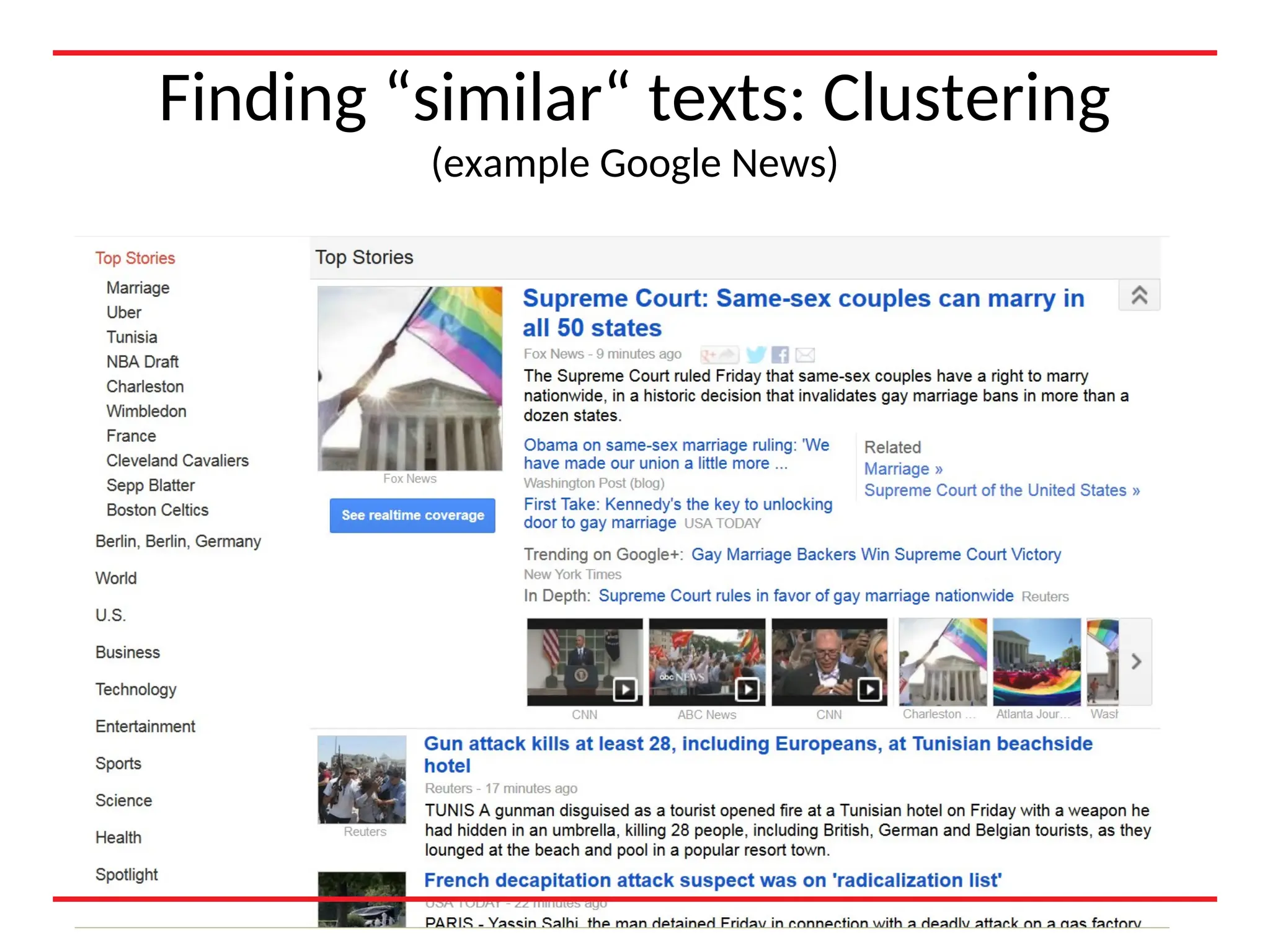
• Clustering analysis can uncover hidden
conversations and unexpected insights. It makes
associations between keywords or phrases that
appear together frequently and derives new topics,
issues and opportunities. The people that make
baking soda, for example, discovered new uses and
opportunities using clustering analysis.
17.
Key capabilities ofeffective social media
analytics
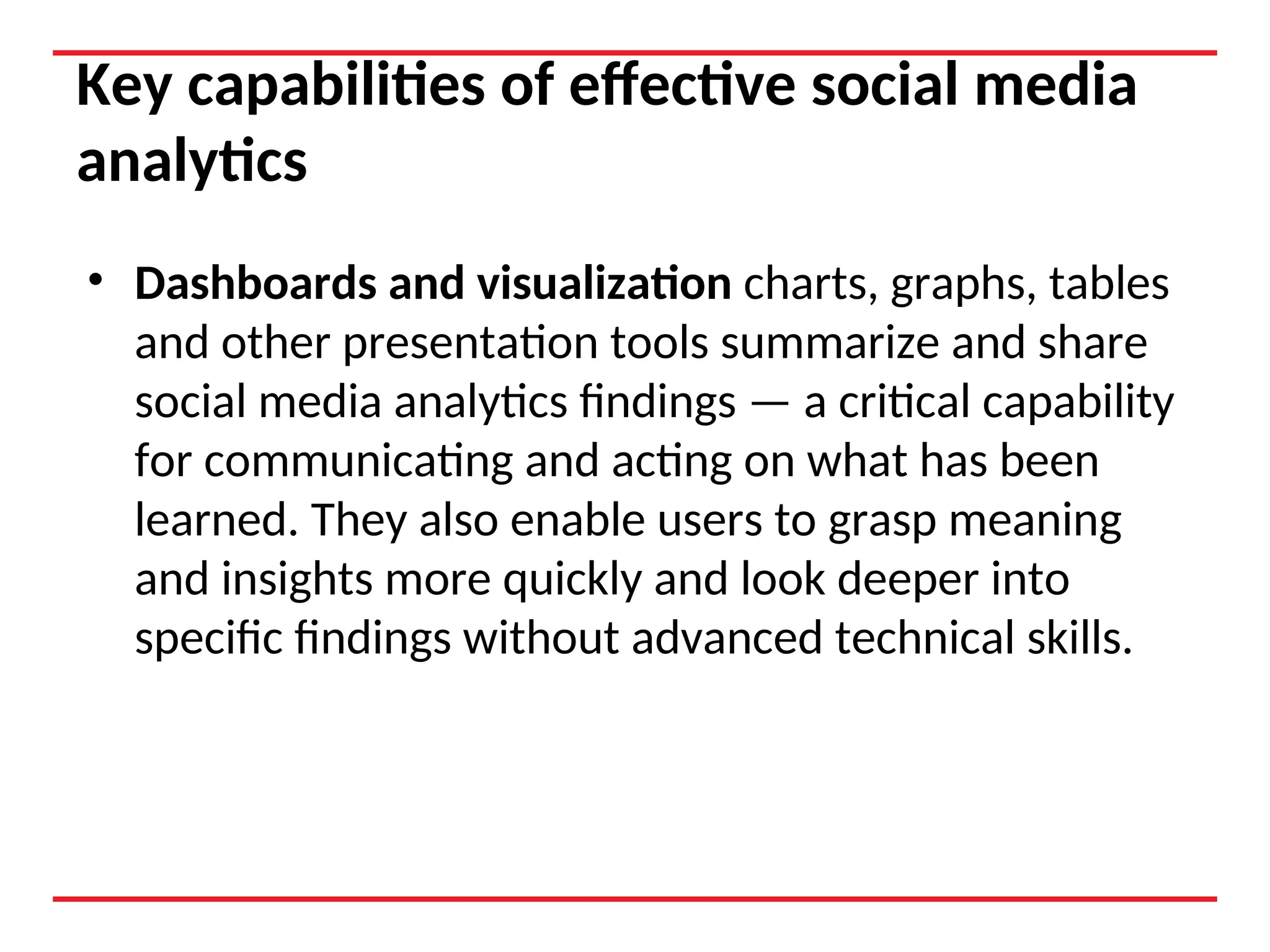
• Dashboards and visualization charts, graphs, tables
and other presentation tools summarize and share
social media analytics findings — a critical capability
for communicating and acting on what has been
learned. They also enable users to grasp meaning
and insights more quickly and look deeper into
specific findings without advanced technical skills.
Starting questions fortoday
• What is a text?
• What questions can we ask of a text?
• What kind of answers "make us happy"?
20.
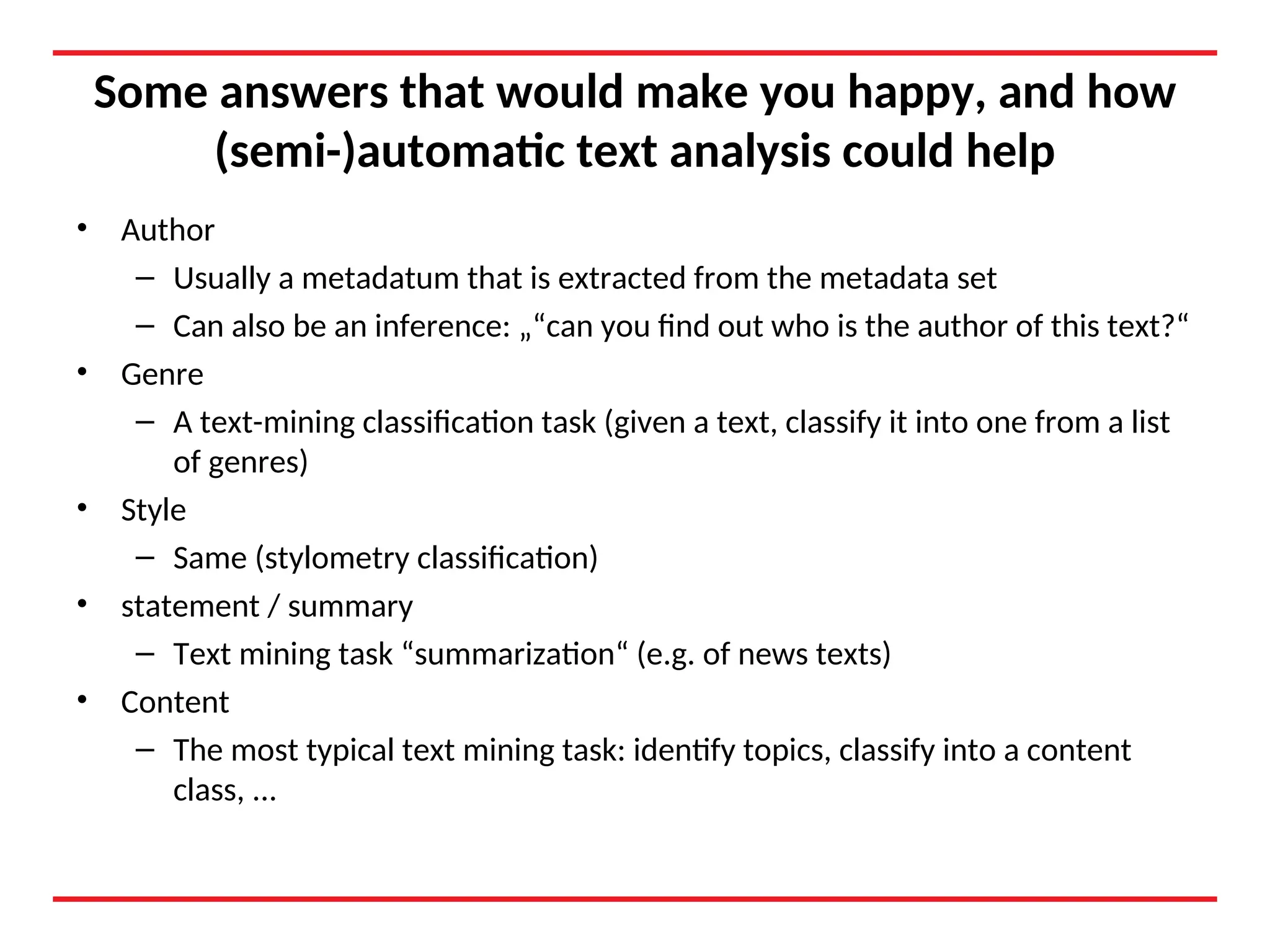
Some answers thatwould make you happy, and how
(semi-)automatic text analysis could help
• Author
– Usually a metadatum that is extracted from the metadata set
– Can also be an inference: „“can you find out who is the author of this text?“
• Genre
– A text-mining classification task (given a text, classify it into one from a list
of genres)
• Style
– Same (stylometry classification)
• statement / summary
– Text mining task “summarization“ (e.g. of news texts)
• Content
– The most typical text mining task: identify topics, classify into a content
class, ...
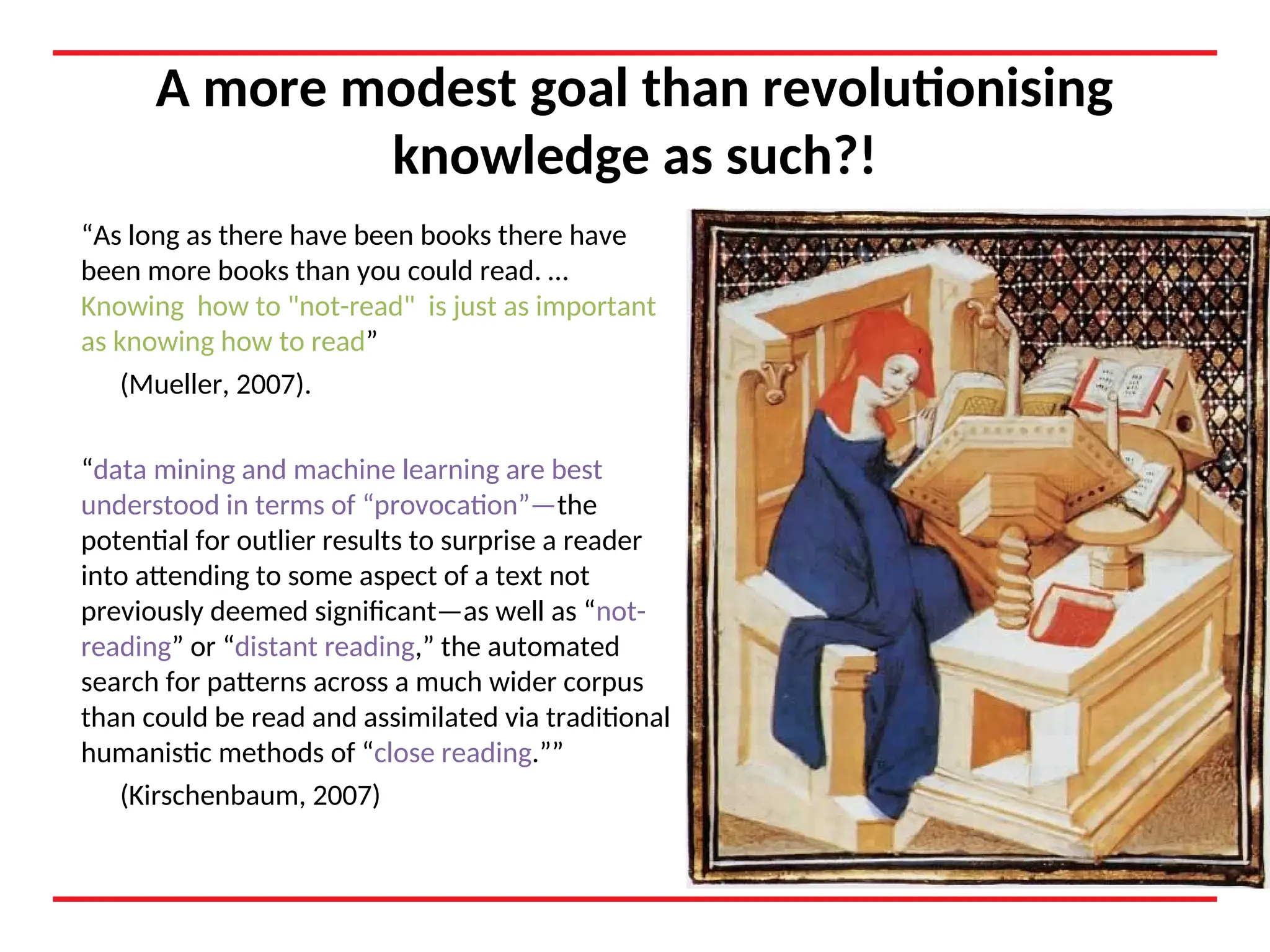
A more modestgoal than revolutionising
knowledge as such?!
“As long as there have been books there have
been more books than you could read. …
Knowing how to "not-read" is just as important
as knowing how to read”
(Mueller, 2007).
“data mining and machine learning are best
understood in terms of “provocation”—the
potential for outlier results to surprise a reader
into attending to some aspect of a text not
previously deemed significant—as well as “not-
reading” or “distant reading,” the automated
search for patterns across a much wider corpus
than could be read and assimilated via traditional
humanistic methods of “close reading.””
(Kirschenbaum, 2007)
23.
Origins of textmining. Or: What is a
text for information retrieval?
Let‘s do some reverse engineering ...
23
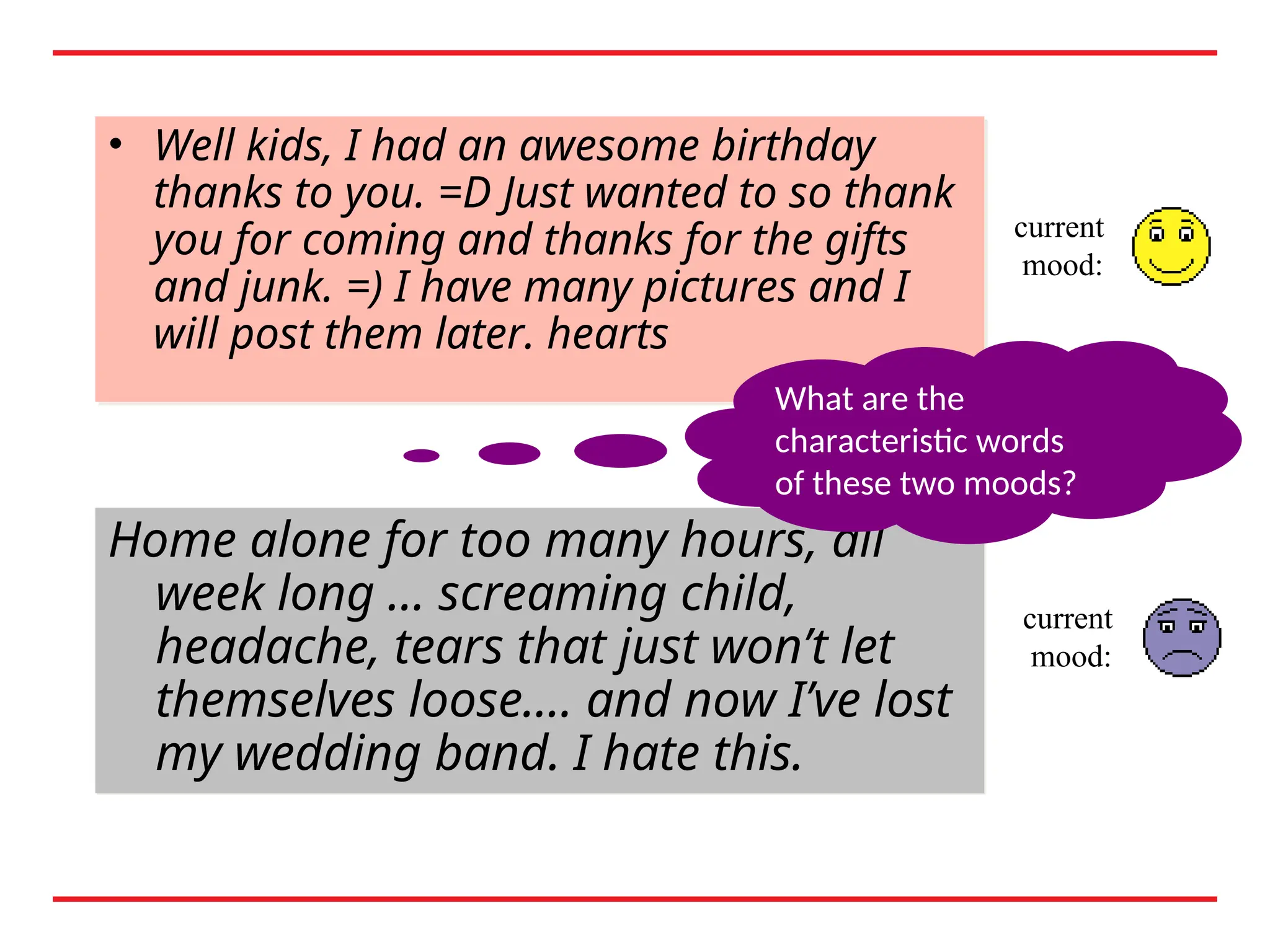
• Well kids,I had an awesome birthday
thanks to you. =D Just wanted to so thank
you for coming and thanks for the gifts
and junk. =) I have many pictures and I
will post them later. hearts
current
mood:
Home alone for too many hours, all
week long ... screaming child,
headache, tears that just won’t let
themselves loose.... and now I’ve lost
my wedding band. I hate this.
current
mood:
What are the
characteristic words
of these two moods?
#22 http://s666.photobucket.com/user/pinacothecae/media/CB/medievalwoman_scholar.jpg.html
Kirschenbaum 20
07
Kirschenbaum, M. "The Remaking of Reading: Data Mining and the Digital Humanities." In NGDM 07: National Science Foundation Symposium on Next Generation of Data Mining and Cyber-Enabled Discovery for Innovation. http://www.cs.umbc.edu/~hillol/NGDM07/abstracts/talks/MKirschenbaum.pdf
The Remaking of Reading: Data Mining and the Digital Humanities
Matthew G. Kirschenbaum
http://www.csee.umbc.edu/~hillol/NGDM07/abstracts/talks/MKirschenbaum.pdf
Mueller, M. “Notes towards a user manual of MONK.”
https://apps.lis.uiuc.edu/wiki/display/MONK/Notes+towards+a+
user+manual+of+Monk, 2007.



![[DSC Europe 25] Vid Stimac - Policy Parsimony: Between Oversimplifying and Ov...](https://cdn.slidesharecdn.com/ss_thumbnails/eqlepagzqp2rhg3gbluh-dsc-stimac-251120-251205090438-059e7f54-thumbnail.jpg?width=640&height=640&fit=bounds)


![[DSC Europe 25] Andy Cotgreave - Nothing is new in analytics.pptx](https://cdn.slidesharecdn.com/ss_thumbnails/mba4vzcurvoh5lfrd5zw-6-251205194645-341bbbbe-thumbnail.jpg?width=640&height=640&fit=bounds)


![[DSC Europe 25] Boris Perkovic - Lost in performance.pptx](https://cdn.slidesharecdn.com/ss_thumbnails/uq5hrp7vsuahqkxzifux-1-251204082258-fd2ee09d-thumbnail.jpg?width=640&height=640&fit=bounds)
![[DSC Europe 25] Max Talanov - Non digital NNs.pptx](https://cdn.slidesharecdn.com/ss_thumbnails/wif8tr3gtua74qvtopke-non-digital-nns-251205090438-26b0eea6-thumbnail.jpg?width=640&height=640&fit=bounds)


