Social Learning An Introduction to Mechanisms Methods and Models William Hoppitt
Social Learning An Introduction to Mechanisms Methods and Models William Hoppitt
Social Learning An Introduction to Mechanisms Methods and Models William Hoppitt
Social Learning An Introduction to Mechanisms Methods and Models William Hoppitt
Social Learning An Introduction to Mechanisms Methods and Models William Hoppitt
1.
Social Learning AnIntroduction to Mechanisms
Methods and Models William Hoppitt pdf download
https://ebookfinal.com/download/social-learning-an-introduction-
to-mechanisms-methods-and-models-william-hoppitt/
Explore and download more ebooks or textbooks
at ebookfinal.com
2.
Here are somerecommended products for you. Click the link to
download, or explore more at ebookfinal
Research for Social Workers An Introduction to Methods 2nd
Edition Margaret Alston
https://ebookfinal.com/download/research-for-social-workers-an-
introduction-to-methods-2nd-edition-margaret-alston/
Brain Aging Models Methods and Mechanisms 1st Edition
David R. Riddle
https://ebookfinal.com/download/brain-aging-models-methods-and-
mechanisms-1st-edition-david-r-riddle/
Bacterial Disease Mechanisms An Introduction to Cellular
Microbiology 1st Edition Michael Wilson
https://ebookfinal.com/download/bacterial-disease-mechanisms-an-
introduction-to-cellular-microbiology-1st-edition-michael-wilson/
An Introduction to Generalized Linear Models 3rd Edition
Annette J. Dobson
https://ebookfinal.com/download/an-introduction-to-generalized-linear-
models-3rd-edition-annette-j-dobson/
3.
Social Capital AnIntroduction to Managing Networks
Kenneth W. Koput
https://ebookfinal.com/download/social-capital-an-introduction-to-
managing-networks-kenneth-w-koput/
An Introduction to Social Media Marketing 1st Edition Alan
Charlesworth
https://ebookfinal.com/download/an-introduction-to-social-media-
marketing-1st-edition-alan-charlesworth/
An Introduction to Machine Learning Interpretability 1st
Edition Patrick Hall And Navdeep Gill
https://ebookfinal.com/download/an-introduction-to-machine-learning-
interpretability-1st-edition-patrick-hall-and-navdeep-gill/
Principles and Methods of Social Research 2nd Edition
William D. Crano
https://ebookfinal.com/download/principles-and-methods-of-social-
research-2nd-edition-william-d-crano/
An Introduction to Numerical Methods A MATLAB Approach
Third Edition Guenther
https://ebookfinal.com/download/an-introduction-to-numerical-methods-
a-matlab-approach-third-edition-guenther/
5.
Social Learning AnIntroduction to Mechanisms Methods
and Models William Hoppitt Digital Instant Download
Author(s): WilliamHoppitt; Kevin N. Lala
ISBN(s): 9781400846504, 1400846501
Edition: Course Book
File Details: PDF, 1.85 MB
Year: 2013
Language: english
Contents
Acknowledgments ix
1 Introduction
What Is Social Learning?
Social transmission
Imitation
Innovation
Why Study Social Learning?
Summary of the Book
2 A Brief History of Social Learning Research
The Evolution of Mind
Social Learning Mechanisms
Animal“Culture”
The Diffusion of Innovations
Child Development
Cultural Evolution
Conclusions
3 Methods for Studying Social Learning in the Laboratory
Traditional Social Learning Studies
Alternative Experimental Approaches
Transmission chain studies
Diffusion studies
11.
vi Contents
Innovation
TheBiological Bases of Social Learning
Neuroendocrinological studies
Social learning of fear
Neural mechanisms of observational learning
Conclusions
4 Social Learning Mechanisms
A Classification of Social Learning Mechanisms
Stimulus enhancement
Local enhancement
Observational conditioning
Response facilitation
Social facilitation
Imitation
Observational R-S learning
Emulation
Opportunity providing
(Inadvertent) coaching
Distinguishing Social Learning Mechanisms
Stimulus enhancement
Local enhancement
Observational conditioning
Response facilitation
Contextual imitation
Production imitation
Observational R-S learning
Emulation
Opportunity providing
(Inadvertent) coaching
A Pragmatic Approach to Characterizing Mechanisms of Social Transmission
Teaching
Summary
5 Statistical Methods for Diffusion Data
Diffusion Curve Analysis
Network-Based Diffusion Analysis (NBDA)
Inclusion of individual-level variables
Model selection and inference
Modeling multiple diffusions
Choosing a social network
“Untransmitted” social effects
Related methods
Is NBDA realistic?
Examples
12.
Contents vii
Spatial Spreadof a Behavioral Trait
Wave of advance models
Other approaches for spatial data
Summary
6 Repertoire-Based Methods for Detecting and Quantifying Social
Transmission
The Group-Contrasts Approach
The Method of Exclusion
Basic and advanced methods of exclusion
Methods for assessing the genetic hypothesis
Methods for assessing the ecological hypothesis
Further problems with the method of exclusion
A Model-Fitting Approach
A matrix regression approach
Examples
A return to group comparisons
A Causal Modeling Framework
Relationship to the matrix regression approach
Ruling out homophily
Ruling out unknown ecological variables
Relationship to the method of exclusion
Conclusions
7 Developmental Methods for Studying Social Learning
Observational Data
Describing the developmental process
Modeling probability of acquisition
Modeling time of acquisition
Modeling proficiency of trait performance
Modeling option choice
Limitations of observational data
Experimental Manipulations
Diffusion experiments
Manipulation of social experience
Translocation studies
Conclusions
8 Social Learning Strategies
Why Social Learning Is Strategic
“When”Strategies
Copy when established behavior is unproductive
Copy when asocial learning is costly
Copy when uncertain
Copy when prior information is outdated
13.
viii Contents
Copy whendissatisfied
Is copying a first or last resort?
“Who”Strategies
Frequency-dependent biases
Success biases
Kin and age biases
“What”Strategies
Random Copying
Statistical Methods for Detecting Social Learning Strategies
Meta-strategies, Best Strategies, and Hierarchical Control
9 Modeling Social Learning and Culture
Introduction
Why model?
Operationalizing the culture concept
Parallels between biological and cultural evolution
Theoretical Approaches to Social Learning and Cultural Evolution
Population-genetic style models of cultural evolution
Population-genetic style models of gene-culture coevolution
Neutral models and random copying
Social foraging theory
Spatially explicit models
Reaction-diffusion models
Agent-based models
Phylogenetic models
Conclusions
10 Conclusions
References
Index
14.
ix
Acknowledgments
We would liketo thank the following people for commenting on one or more
chapters, clarifying issues, or helpful discussion: Michal Arbilly, Nicola Atton,
Pat Bateson, Dora Biro, Neeltje Boogert, Richard Byrne, Laura Chouinard-Thuly,
Nicolas Claidiere, Alice Cowie, Catharine Cross, Lewis Dean, Adrian de Froment,
Cara Evans, Laurel Fogarty, Dorothy Fragaszy, Mathias Franz, Jeff Galef, Grant
Hamilton, Celia Heyes, Joseph Henrich, Tanya Humle, Jeremy Kendal, Rachel
Kendal, Kevin Langergraber, Hannah Lewis, Stephen Lycett, Elizabeth Lonsdorf,
Joah Madden, Janet Mann, Luke Matthews, Emily Messer, Tom Morgan, Eric Pat-
terson, Susan Perry, Simon Reader, Luke Rendell, Brooke Sargeant, Peter Slater,
Kim Sterelny, Sally Street, Chris Templeton, Alex Thornton, Peter Tyack, Erica
van der Waal, Mike Webster, and Andrew Whiten. We are also extremely grate-
ful to the wonderful Katherine Meacham for tireless administrative support. We
thank Alison Kalett and Quinn Fusting at Princeton University Press for sup-
porting the book’s publication, for processing the proposal and manuscript ex-
pediently, and for helping us to improve it in numerous ways; we also thank two
anonymous PUP referees who provided very helpful feedback on an earlier draft.
Sections 4.1 and 4.2 of the book are based on a paper we published previously in
Advances in Behavior (Hoppitt and Laland 2008a), and section 4.4 is based on
part of a paper we published with colleagues in Trends in Ecology and Evolution
(Hoppitt et al. 2008). Finally, we gratefully acknowledge funding from the BBSRC
and ERC.
William Hoppitt and Kevin N. Laland
St Andrews, August 2012
1
The study ofsocial learning sits at the interface of a truly astonishing number of
academic disciplines. How many other fields could boast being central to both
social anthropology and human evolution; core material for both experimental
psychologists and theoretically minded economists; or emerging influences in
the fields of both cognitive neuroscience and artificial intelligence?
The observation that many animals, including humans, acquire valuable life
skills and knowledge through copying others has been the focus of attention of
animal behaviorists dating back to Darwin. Likewise, social learning, the diffu-
sion of innovations, conformity, and social influences on child development have
been key concepts within the social sciences for over a century. However, in re-
cent decades, the field of social learning has received such unprecedented atten-
tion spread across the sciences, social sciences, and humanities, and experienced
such growth, that researchers within the field have referred to an “explosion of
interest” in the topic (Galef and Giraldeau 2001; Shettleworth 2001). Long gone
are the days when research on imitation could (ungenerously) be characterized
as the esoteric province of an obscure branch of comparative psychology. Now,
social learning is a rapidly growing subfield of animal cognition research; while
biological anthropologists and archaeologists are constructing models of cultural
evolution, economists are frequently talking norms and herding behavior, neuro-
scientists are mapping circuitry associated with social influences on decision
making, and engineers are building imitating robots.
The diverse backgrounds of the researchers studying social learning contribute
to the field’s controversies. East African but not West African chimpanzees use
stalks to fish for termites, while western but not eastern chimps crack open nuts
with stone hammers. Capuchin monkeys in Costa Rica exhibit extraordinary
Chapter 1
Introduction
19.
2 Chapter 1
socialconventions, such as sniffing each other’s hands and placing fingers in each
other’s mouths. Humpback whales and chaffinches sing different songs than their
fellow conspecifics living in different regions. If these, and other, animal tradi-
tions are acquired through social learning, are behavioral scientists justified in
speaking of animals possessing “culture”? Or are anthropologists correct to assert
that human cultures are so imbued with meaning, so permeated with symbolism,
and so reliant on uniquely human aspects of cognition, that to liken them to the
behavioral traditions of animals is, frankly, ridiculous? Is human social learning
shaped by evolved structure in the mind then biased to acquire content—from
choosing sugar rich foods to admiring specific body shapes—that proved adap-
tive among our Pleistocene ancestors, as suggested by many evolutionary psy-
chologists? Or is human learning dominated by general rules (e.g., copying the
highest payoff behavior or conforming to the local norm) that are for the most
part acquired independently of their content, as claimed by cultural evolution-
ists? Is imitation critically dependent on the ability to take another individual’s
perspective, to understand their goals, or on complex cognition? Are socially
learned traditions constrained in order to be adaptive? Can cultural processes
support a viable form of group selection? And so on, and so forth. The contro-
versies are multiple, ripe, and engaging, enriched by the varied standpoints that
characterize adjacent disciplines struggling to understand a common topic.
The disparate backgrounds of those drawn into the field have also contributed
to the newly emerging methods that are appearing to address these challenges.
Until recently, experimental studies of social learning were restricted to behav-
ioral investigations, typically conducted in the laboratories of comparative or de-
velopmental psychologists, and focused on very specific questions, such as: “Can
animals imitate?” or “Do children acquire violent dispositions from others?”
Similarly, with the exception of some early experiments on birdsong learning,
biologists’ interest in social learning was pursued almost entirely through obser-
vations and recordings of the natural behavior of animals, largely by ethologists
and primatologists.
In recent years, however, new methods have become available, considerably
expanding the social learning researcher’s toolbox. These include (i) experi-
mental and statistical methods that allow researchers to categorize cases of so-
cial learning according to their underlying psychological processes and learning
mechanisms; (ii) neuroscientific methods for identifying the brain structures,
neural circuitry, and physiological processes underlying both social learning and
social influences on decision making; (iii) mathematical and statistical methods
for identifying social learning when it occurs in natural populations (or in natu-
ralistic contexts in captivity); (iv) experimental and statistical methods to pre-
dict and explain when humans and other animals copy, from whom they learn
(“social learning strategies”), and to also detect the strategies deployed; and (v)
mathematical methods for predicting the pattern of diffusion of novel learned in-
novations, and for modeling cultural evolution and gene-culture coevolution. Fi-
nally, numerous and diverse tools and procedures are available for applying social
learning methods outside of academia. These range from commercial hatcheries
20.
Introduction 3
training hatchery-rearedfish to recognize predators and thereby enhance re-
stocking efforts, to predicting the pattern of spread of technological innovations
and identifying likely targets for uptake.
This book is designed to be a complete and accessible practical guide for the
social learning researcher and their students, as well as for others whose interest
in social learning is less central. As it currently stands, there is no single source
that reviews the aforementioned conceptual and methodological developments,
and the field’s new theory and tools are to be found in a diverse collection of
articles in academic journals. This book is first and foremost a monograph on
social learning concepts and methods; it seeks to summarize and extend new
developments in the field, rendering the new tools available to a broader constitu-
ency and heightening awareness of this emerging research topic. However, such is
the growth of interest in social learning that we envisage the material contained
in this book to be of interest to many individuals, academic and nonacademic,
who are not directly connected to the immediate field. Social learning and imita-
tion, including their mechanisms, methods, and models, have become central
to a broad range of disciplines, and significant progress in their scientific under-
standing is potentially of widespread interest, both within and outside academia.
In order to discuss the conceptual foundations of social learning some defini-
tions will be necessary from the outset. Certain terms, including “social learn-
ing,” “imitation,” “innovation,” “tradition,” and “culture,” will appear repeatedly
throughout this book. In almost all cases, there exists no universally accepted
definition, and in many instances the terms are the focus of considerable debate.
Accordingly, at the outset we provide initial definitions for these labels, though
later in the book we will suggest refinements. A summary of these definitions is
given in box 1.1, with a justification presented below.
1.1 What Is Social Learning?
The most commonly used definition of social learning is “learning that is influ-
enced by observation of, or interaction with, another animal (typically a conspe-
cific) or its products” (Heyes 1994); this draws on a similar earlier generic definition
by Box (1984). This definition is extremely broad, and indeed might be regarded
as problematically so. The concern here is that the phrase “influenced by” lacks
specificity. To take matters to the extreme, the presence of another individual might
even impede learning, yet would still meet the above definition, because the other’s
activities constitute an influence on learning. It is then perhaps not surprising that
others have used the term “social learning” to refer to a more specific concept. For
example, Lonsdorf and Bonnie (2010) restrict social learning to cases in which see-
ing another individual performing a behavior pattern causes the observer to learn
the same pattern; this approximates our use of the term “social transmission.”
This ambiguity in the meaning of the term “social learning” has the poten-
tial to lead researchers into the logical error of equivocation, which occurs when
the meaning of a term is changed during a line of reasoning. For example, those
21.
4 Chapter 1
definitionsof “culture” (see below) that emphasize geographic differences in be-
havior caused by social learning (e.g., Laland and Hoppitt 2003) typically have in
mind a narrower conception of social learning, more akin to the Lonsdorf and
Bonnie definition than the broader Heyes definition. There could be a danger that
researchers might prematurely make the claim of culture if variant forms of social
learning in the broader sense were identified for a given species. This is particu-
larly problematic if different researchers interpret the term “social learning” with
variant levels of breadth, unaware of discrepancies in usage.
On the face of it, a solution might be to adopt a narrower definition of social
learning, with another term for the broader category; for example, “socially bi-
ased learning” could be used (e.g., Humle et al. 2009). However, there are two
concerns here. First, the broad definition is widely used and accepted, and hence
it may lead to further confusion if we to advocate a change in usage. Second and
more importantly, narrower definitions could miss out on some phenomena of
interest to those who would consider themselves social learning researchers. For
example, a definition that requires matching behavior would not include cases
where an observer learns what not to do, perhaps after watching another indi-
vidual make a mistake. Consequently, on balance, we maintain that a broad and
generic term still has some currency and propose the following definition, modi-
fied from Heyes (1994):
Social learning is learning that is facilitated by observation of, or interac-
tion with, another individual (or its products).
Our use of the term “facilitated” restricts forms of social interaction that
generate social learning to those that have a positive influence on the observer
Box 1.1
Preliminary definitions
Social learning is learning that is facilitated by observation of, or interaction with, another individual
or its products.
Social transmission occurs when the prior acquisition of a behavioral trait T by one individual A,
when expressed either directly in the performance of T or in some other behavior associated with T,
exerts a lasting positive causal influence on the rate at which another individual, B, acquires and/or
performs T.
An innovation (sensu product) is a new or modified learned behavior not previously found in the
population.
Innovation (sensu process) is a process that introduces novel behavioral variants into a population’s
repertoire and results in new or modified learned behavior.
A tradition is a distinctive behavior pattern shared by two or more individuals in a social unit that
persists over time and that new practitioners acquire in part through socially aided learning.
Cultures are those group-typical behavior patterns shared by members of a community that rely on
socially learned and transmitted information.
22.
Introduction 5
learning. Instanceswhere social interaction impedes learning are better captured
by a different term, such as “social inhibition” (Brown and Laland 2002). Even
with this refinement, the definition of social learning remains broad, meaning a
researcher’s primary task is to investigate the manner in which learning is social,
rather than to answer whether learning is social learning or not. This kind of
reasoning justifies researchers’ tendency to focus on general social processes
thought to be widely important in promoting social learning, potentially across
different contexts and modalities, rather than on isolated or specialized instances.
Throughout this book we will refer to the individual who learns socially as the
“observer” and the individual that they learn from as the “demonstrator.” While
we acknowledge drawbacks to both of these terms, there are no obviously supe-
rior alternatives.1
1.2 Social Transmission
Notwithstanding the utility of a generic term, researchers clearly require more
specific terms to describe different types of social learning. In recent years there
has been a concerted effort to develop methods to “detect social learning” in nat-
ural populations (see chapters 5–7). Such methods are not really aimed at detect-
ing social learning in the broad sense, but rather to detect what we term “social
transmission.” This term was initially coined by Galef (1976), and subsequently
described as “cases of social learning that result in increased homogeneity of be-
havior of interactants that extends beyond the period of their interaction” (Galef
1988, 13). Familiar examples include the spread of sweet potato washing in Japa-
nese monkeys (Kawai 1965) and hybrid-corn use by American farmers (Ryan
and Gross 1943). Our definition of social transmission is very much in the same
spirit as Galef’s, but is designed to confer greater precision:
Social transmission occurs when the prior acquisition of a behavioral trait
T by one individual A, when expressed either directly in the performance
of T or in some other behavior associated with T, exerts a lasting positive
causal influence on the rate at which another individual B acquires and/or
performs T.2
1
The term “observer” would mislead if it implied that social learning is solely reliant on vision; how-
ever, our usage is not constrained to any sensory modality. Likewise, “demonstrator” might imply the de-
liberate production of the target behavior, an implication that we do not wish to be drawn. In the majority
of instances of animal social learning the “demonstrator” makes no attempt to transmit knowledge. In this
regard, the term “‘model” is arguably preferable, being more neutral, but it brings with it the potential for
confusion in discussions of mathematical and statistical models of social learning. A host of other terms
(“actor,” “transmitter,” “receiver,” “source,” “sink,” “learner”) are used in the social learning literature but all
suffer from drawbacks.
2
This definition is adapted from Hoppitt, Boogert, and Laland (2010), in which we provided a defini-
tion of social transmission that also allowed “information” to be transmitted instead of a behavioral trait.
In principle, the definition could be used for a piece of information, but in practice it might be difficult to
detect unless the information is associated with an observable behavioral trait.
23.
6 Chapter 1
Herea behavioral trait is a target behavior pattern, which might be specific to a
particular context (e.g., pigeons pecking at a lever in response to a green light;
Dorrance and Zentall 2002). Inclusion of the phrase, “expressed either directly in
the performance of T or in some other behavior associated with T” is recognition
of the fact that acquired information and behavior can be transmitted with or
without performance of the trait. Examples of the latter are not uncommon. In the
case of humans, for example, we can provide written or spoken instructions on
how to perform the trait, instead of demonstrating it directly. For example, social
transmission of a recipe between chefs might occur when one chef passes a recipe
to another. The number of times a chef cooks the recipe might have no causal
influence on the acquisition of the recipe by others, but we would still consider
this social transmission (see fig. 1.1c). In the case of other animals, signals such
as food calls (e.g., the vocalizations of callitrichid monkeys that recruit infants to
a desirable or novel food source [Rapaport and Brown 2008], or mother hens that
warn their chicks from consuming a toxic foods [Nicol and Pope 1996]) or the
opportunity teaching exhibited by several carnivores (e.g., when meerkat helpers
provision pups with disabled prey; Thornton and McAuliffe 2006) can facilitate
social transmission without direct performance of the trait by a demonstrator.
We also recognize two types of social transmission, which we call social trans-
mission of trait acquisition (where the effect of social transmission is on the rate
at which B acquires T) and social transmission of trait performance (where the
effect is on the rate at which B performs T). In practice, many cases are likely
to involve both the social transmission of trait acquisition and of trait perfor-
mance—where individuals who observe a demonstrator both acquire the trait
sooner and perform it more frequently once they acquire it, than individuals who
do not observe a demonstrator. Nonetheless, we see the two as logically distinct.
Observers might acquire T sooner, but may not perform T any more frequently
than individuals who have acquired it asocially.3
It might seem strange to some readers to discuss a rate at which acquisition of
a trait occurs, when each individual can only acquire a trait once (except when
an individual has forgotten a trait and then does learn it again). Here our use of
the term “rate” is in the sense of a “hazard rate” in time to event or in “survival”
models—comparable to the rate of death or the rate at which a machine com-
ponent fails—which therefore refers to the pattern of learning spread across a
sample of individuals.4
For example, if a large sample of individuals all had a
learning rate of 0.5 per hour, we would expect the mean time to acquisition to be
1/0.5=2 hours.
3
When we use the term “asocial” in contrast to “social transmission,” we mean that it has not been
socially transmitted; we do not mean that it has not been affected by any social cues.
4
We suggest the rate at which individuals acquire a trait as the most general criterion. Note, were we
instead to utilize the probability that another acquires the trait, this would not allow for the fact that in-
dividuals who are not influenced by informed individuals might also reliably acquire the trait, but tend to
do so later. Nonetheless, rates can easily be converted into a probability of acquisition for a specified time
period, so the probability of acquisition within an individual’s lifetime or an experimental trial can still be
used to detect social transmission.
24.
Introduction 7
Our definitionalso covers the case in which there are two or more traits that
are alternative variants for the same function, and (1) the variant possessed by A
causes B to be more likely to acquire the same variant,5
and/or (2) the preferences
of A for one variant causes B to develop a similar preference. Definitions in terms
of rates also have the advantage that they allow researchers to model trait acquisi-
tion or performance as a stochastic process, and thereby infer social transmission
from relatively complex patterns of acquisition or performance (see chapter 5).
As indicated above, we interpret the phrase “performance” broadly to encompass
transmission mediated by an animal’s products, including, in the case of humans,
signs, signals, and linguistic information.
There are clearly a number of causal routes by which a trait T could be socially
transmitted between individuals A and B. Figure 1.1 illustrates three such cases.
Perhaps the most obvious is social transmission through observation: B observ-
ing trait T being performed by A, causes B to acquire T (fig. 1.1a). It is this causal
pathway that most traditional observer-demonstrator experiments aim to detect.
5
For example. if each individual sticks with whichever variant it acquires first, the probability that it
will acquire variant a rather than another variant, is
x
/
pa a x
λ λ
= / , where lx is the rate of acquisition of
variant x. Therefore, a positive causal influence on la is also a positive causal influence on pa.
Acquisition
of trait by A
Performance
of trait by A
Observation
of trait by B
Acquisition
of trait by B
Social transmission of a trait through observation
For example, classic demonstrator-observer experiment
Acquisition
of trait by A
Performance
of trait by A
Acquisition
of trait by A
Performance
of trait by A
Products of
the trait
Instructions to B of
how to perform trait
Acquisition
of trait by B
(Open milk bottles)
Exposure to
products
Acquisition
of trait by B
Social transmission of a trait through exposure to products
Social transmission of a trait through verbal or written instruction
(a)
(b)
(c)
For example, tits opening milk bottles
For example, passing of recipes between chefs
Figure 1.1. Three causal pathways through which information can be socially transmitted from indi-
vidual A to individual B. An arrow represents a direct causal influence between two types of event (i.e.,
one that is not mediated through another type of event present in the graph). For example, in (a) if B
observes A performing the trait, then A’s action must be a cause of B observing the trait. In this case,
observation of the trait then causes B to acquire the trait. In (a) the causal influence of the performance
of the trait by A on the acquisition of the trait by B is mediated entirely through observation, whereas in
(b) it is mediated entirely through exposure to a product. In reality, both causal pathways might oper-
ate. See Shipley 2000 for an accessible introduction to causal graphs (see also chapter 6).
25.
8 Chapter 1
Thereare also a number of documented cases where the physical products of the
performance of T (excluding visual and auditory cues) can play a role in social
transmission (fig. 1.1b). For example, Heyes and Dawson (1990) found that in
rats the trait of pushing a joystick in a particular direction for a food reward was
socially transmitted from trained demonstrators to observers, and that olfactory
cues left on the joystick were sufficient for this effect to occur (Mitchell et al. 1999;
see also Galef and Beck 1985; Laland and Plotkin 1991). Some researchers argue
that social transmission mediated through physical traces left by animals in their
environment is likely to be highly important in natural populations (Fragaszy,
2012b). We discuss several such examples in chapter 3.
It is also possible that both types of social transmission could operate indi-
rectly through the behavior of an intermediate individual. A possible example
of such transmission is provided by brown-headed cowbirds (Molothrus ater).
Freeberg (1996, 1998) found that female cowbirds prefer to mate with males from
the same cultural background, and that this preference seems to be based largely
on the males’ vocalizations. It has also been shown that females respond to pre-
ferred song types with the wing stroke display, which causes males to perform
those song types more frequently (West and King 1988). This suggests the songs
heard by a female during development cause her to respond to those types later
by performing the wing stroke display. This in turn causes the males with which
she interacts to perform those song types more. This would mean that song type
performance is transmitted between males through the mating preferences of
females, and mating preferences are transmitted between females through the
singing of males.
Note also, we place emphasis on social transmission as a whole, rather than
on a more specific subset of social learning, such as social transmission through
direct observation. We do this because the term identifies with precision the sub-
set of social learning that can result in the spread of a trait through a population
of animals, in terms of either acquisition or frequency of performance. There
is clearly some utility for a generic term for processes that can underpin such a
diffusion.
An obvious experimental procedure for detecting social transmission in a
laboratory setting is the traditional demonstrator-observer experiment, which
we discuss in detail in chapters 3 and 4. Briefly, the experimenter exposes naïve
observers to demonstrators performing the trait in question (for example, the
solution to a foraging task), and compares the observers’ rate of acquisition or
performance with that of control subjects. The exact way in which the experiment
is set up determines which types of social transmission can be detected—for ex-
ample, if observers are not allowed access to the products of a demonstrator’s be-
havior the experimenter will not detect the social transmission pathway depicted
in figure 1.1b.
Historically, demonstrator-observer experiments have frequently sought to
determine whether subjects have a capacity for a specific mechanism of social
learning, such as imitation. In chapter 4 we discuss such mechanisms and de-
scribe how they can be distinguished. However, laboratory experiments do not
M. Zotenberg thenremarks on the missing vol. 4 of Galland, and
quotes extracts from Galland’s Diary, shewing that Nos. 191, 192
and 192a, which were surreptitiously introduced into his work
without his knowledge, and greatly to his annoyance, were
translated by Petis de la Croix, and were probably intended to be
included in the Thousand and One Days, which was published in
1710. “Comme la plupart de ces contes, ils sont tirés de l’ouvrage
turc intitulé الشدة بعد الفرج, dont ils forment le 6e
, le 8e
et le 9e
récit.” (Zotenberg, p. 27.)
Then follows Section iii., one of the most important in the book, in
which extracts from Galland’s Diary of 1709 are quoted, shewing
that he was then in constant communication with a Christian
Maronite of Aleppo, named Hanna (Jean), who was brought to Paris
by the traveller Paul Lucas, and who related stories to Galland, of
which the latter took copious notes, and most of which he worked
up into the later volumes of his “Mille et une Nuit” (sic). Among
these were 193, 194a, 194b, 59, 197, 198, 174, 195, 194c, 196. The
following tales he did not use: An Arab story of two cousins, Camar
eddin and Bedr el Bodour; the Golden City (another version of the
story of the Three Princes, in No. 198, combined with the story of
the woman who slew pretenders who were unable to solve a riddle);
The Three Princes, the Genius Morhagian, and his Daughters; and
the story of the seller of ptisanne (or diet-drinks) and his son
Hassan.
Further extracts from Galland’s Diary are added, extending from the
time of Hanna’s departure from Paris between June and October,
1709, and the completion of the 12th volume of the Mille et une Nuit
in 1712. These relate to the gradual progress of the work; and to
business in connection with it; and Hanna’s name is occasionally
mentioned.
Hanna supplied Galland with a written version of No. 193, and
probably of 194 a-c; (i.e. most of the tales in vols. 9 and 10); but
the tales in vols. 11 and 12 were apparently edited by Galland from
his notes and recollections of Hanna’s narrations. These are Nos.
28.
195, 196, 59,197 and 198. M. Zotenberg concludes that Hanna
possessed a MS. containing all these tales, part of which he copied
for Galland, and that this copy, like several other important volumes
which Galland is known or believed to have possessed, was lost. M.
Zotenberg thinks that we may expect to meet with most of Hanna’s
tales either in other copies of the Nights, or in some other collection
of the same kind. The latter supposition appears to me to be by far
the most probable.
[Section IV.]—M. Zotenberg proceeds to give an account of one or
two very important MSS. of the Nights in the Bibliothèque Nationale.
One of these is a MS. which belonged to the elder Caussin, and was
carefully copied by Michael Sabbagh from a MS. of Baghdad. Prof.
Fleischer, who examined it, states (Journal Asiatique, 1827, t. II., p.
221) that it follows the text of Habicht, but in a more developed
form. M. Zotenberg copies a note at the end, finishing up with the
word كبيكج (Kabíkaj) thrice repeated. This, he explains, “est le nom
du génie préposé au régne des insectes. Les scribes, parfois,
l’invoquent pour preserver leurs manuscrits de l’atteinte de vers.”
This MS. was copied at Paris on European paper at the beginning of
the century, though Caussin de Perceval was not acquainted with it
in 1806, but only with a MS. of the Egyptian redaction. This MS.
agrees with Galland’s only as far as the 69th Night. It differs from it
in two other points; it contains No. 1c. and the end of No. 3
coincides with the end of Night 69. The contents of Nights 70–1001
are as follows: 246, 4, 5, 6, 20, 7, 153, 21, 170, 247, The Unhappy
Lover confined in the Madhouse (probably = 204c), 8, 191, 193,
174, 9, 9b (not 9a, or 9aa) and as episodes, 155, 32, and the story
of the two brothers ’Amír and Ghadir, and their children Djamil and
Bathina.
Another MS., used by Chavis and Cazotte, and Caussin de Perceval,
was written in the year 1772. It has hitherto been overlooked,
because it was erroneously stated in the late M. Reinaud’s Catalogue
to be a MS. containing part of the 1001 Nights, extending from Night
282 to Night 631, and copied by Chavis. It is not from Chavis’ hand,
29.
and does notform part of the ordinary version of the Nights, but
contains the following tales: 174, 248, Story of King Sapor, 246, 3a,
36, 3c, 153, Story of the Intendant, the Interpreter, and the Young
Man; 247, 204c, 240, 250, Story of the Caliph and the Fisherman,
(probably = 156); the Cat and the Fox, and the Little Bird and the
Fowler.
Another MS., really written by Chavis, commences exactly where Vol.
3 of Galland’s MS. leaves off; i.e. in the middle of No. 21, and
extends from Night 281 to Night 631. M. Zotenberg supposes it to
have been written to supply the place of the last volume of Galland’s
set. It contains the following tales, in addition to the conclusion of
No. 21: 170, 247, 204c, 8, 191, 193 and 174. M. Zotenberg suggests
that the first part of this MS. may have been copied from Galland’s
last volume, which may have existed at the time in private hands.
The two last MSS. contain nearly the same tales, though with
numerous variations. M. Zotenberg discusses the hypothesis of
Chavis’ MS. being a translation from the French, and definitely
rejects it.
[Section V.]—Here M. Zotenberg discusses the MSS. of the Nights in
general, and divides them into three categories. I. MSS. proceeding
from Muslim parts of Asia. These, except the MSS. of Michael
Sabbagh and that of Chavis, contain only the first part of the work.
They are all more or less incomplete, and stop short in the middle of
the text. They are not quite uniform, especially in their readings, but
generally contain the same tales arranged in the same order. II.
Recent MSS. of Egyptian origin, characterised by a special style, and
a more condensed narrative; by the nature and arrangement of the
tales; by a great number of anecdotes and fables; and by the early
part of the work containing the great romance of chivalry of King
Omar Bin Al-Nu’uman. III. MSS. mostly of Egyptian origin, differing
as much among themselves in the arrangement of the tales, as do
those of the other groups.
The following MSS. are mentioned as belonging to the first group:—
I. Galland’s MS. in the Bibliothèque Nationale, Nos. 1506–1508.
30.
II. MS. inthe Vatican, No. 782.
III. Dr. Russell’s MS. from Aleppo.
IV. MS. in the Bibl. Nat. (Suppl. 1715, I. and II.).
V. MS. in the Library of Christ Church College, Oxford (No. ccvii.).
VI. MS. in the Library of the India Office, London (No. 2699).
VII. Sir W. Jones’ MS., used by Richardson.
VIII. Rich’s MS. in the Library of the British Museum (Addit. 7404).
IX. MS. in Bibl. Nat. (Suppl. 2522 and 2523).
X. MS. in Bibl. Nat. (Suppl. 1716).
The following MSS. are enumerated as belonging to the second
group:—
I. Salt’s MS. (printed in Calcutta in 4 vols).
II.-IV. Three complete MSS. in Bibliothèque Nationale (Suppl. Arabe, Nos. 1717,
1718, 1719).
V. Incomplete MS. of Vol. II. in Bibl. Nat. (Suppl. Arabe, Nos. 2198 to 2200).
VI. Incomplete MS. of Vol. 4 (Suppl. Arabe, Nos. 2519 to 2521).
VII. Odd vol. containing Nights 656 to 1001 (Suppl. Arabe, No. 1721, III).
XII. MS. containing Nights 284 to 327. (Suppl. Arabe, No. 1720.)
XIII. MS. in British Museum (Oriental MSS., Nos. 1593 to 1598).
XIV. Ditto, (Oriental MSS., Nos. 2916 to 2919).
XV. Burckhardt’s MS. in the University Library at Cambridge (B. MSS. 106 to 109).
XVI. MS. in the Vatican (Nos. 778 to 781).
XVII. MS. in the Ducal Library at Gotha.
XVIII. Odd vol. in ditto.
XIX. MS. in the Royal Library at Munich.
XX. Ditto, incomplete (De Sacy’s).
XXI. Fragment in the Library of the Royal and Imperial Library at Vienna (No. CL.).
XXII. MS. in the Imperial Public Library at St. Petersburg (Von Hammer’s).
XXIII. MS. in the Library of the Institute for the Study of Oriental languages at St.
Petersburg (Italinski’s).
XXIV. Dr. Clarke’s MS. (cf. Nights, x., App. pp. 502–506).
31.
XXV. Caussin dePerceval’s MS
XXVI. Sir W. Ouseley’s MSS.
The above list does not include copies or fragments in various
libraries of which M. Zotenberg has no sufficient information, nor
miscellaneous collections in which tales from the Nights are mixed
with others.
Portions of Habicht’s MS. appear to belong to the Egyptian
recension, and others to have come from further East.
There is a MS. in the Bibliothèque Nationale (Suppl. Arabe, No.
1721, IV.) from Egypt, containing the first 210 Nights, which
somewhat resembles Habicht’s MS. both in style and in the
arrangement of the tales. The Third Shaykh’s Story (No. 1 c.) is
entirely different from those in the ordinary MSS., nor is it the same
as that in the Turkish version of the Nights, which is again quite
different from either. In this MS. (No. 1721, IV.) No. 6 is followed by
Nos. 7, 174, and 133.
Then follow notices of Anderson’s MS., used by Scott, but which
cannot now be traced; the Calcutta edition of the first 200 Nights;
and of the Wortley Montague MS. These form M. Zotenberg’s third
group of MSS.
M. Zotenberg does not enter into the question of the original form,
date and constituents of the primitive work, but concludes that the
complete work as we now have it, only assumed its present form at
a comparatively recent period. But it must not be forgotten that the
details, description, manners, and style of the tales composing this
vast collection, are undergoing daily alteration both from narrators
and copyists.
Then follows an Appendix, in which M. Zotenberg has copied two
tales from Galland’s journals, which he took down as related by the
Maronite Hanna. One of these is new to me; it is the story of the
Three Princes, and the Genius Morhagian and his Daughters (added
at the end of this section); and the other is the well-known story of
the Envious Sisters.
32.
The remainder ofM. Zotenberg’s volume contains the Arabic text of
the story of ’Ala Al-Din, or the Wonderful Lamp, with numerous
critical notes, most of which refer to Galland’s version. A few pages
of Chavis’ text are added for comparison.
The story itself, M. Zotenberg remarks, is modern, giving a faithful
picture of Egyptian manners under the reign of the last Mamlouk
Sultans. Some expressions which occur in the French-Arabic
Dictionary of Ellions Bocthor and of A. Caussin de Perceval, are
apparently derived from the story of ’Ala Al-Din.
33.
STORY OF THETHREE PRINCES AND THE
GENIUS MORHAGIAN AND HIS DAUGHTERS.
[Reprinted by M. Zotenberg (pp. 53–61) from Galland’s Journal, MS. français, No.
15277, pp. 120–131.] The passages in brackets are added by the present
translator (chiefly where Galland has inserted “etc.”) to fill up the sense.
When the Sultan of Samarcand had reached a great age, he called
the three princes, his sons, and after observing that he was much
pleased to see how much they loved and revered him, he gave them
leave to ask for whatever they most desired. They had only to
speak, and he was ready to grant them whatever they asked, let it
be what it might, on the sole condition that he should satisfy the
eldest first, and the two younger ones afterwards, each in his turn.
The eldest prince, whose name was Rostam, begged the Sultan to
build him a cabinet of bricks of gold and silver alternately, and
roofed with all kinds of precious stones.
The Sultan issued his orders that very day, but before the roof of the
cabinet was finished, indeed before any furniture had been put into
it, Prince Rostam asked his father’s leave to sleep there. The Sultan
tried to dissuade him, saying that [the roof] ought to be finished
first; but the prince was so impatient that he ordered his bed to be
removed there, and he lay down. He was reading the Koran about
midnight, when suddenly the floor opened and he beheld a most
hideous genius named Morhagian rise from the ground, who cried
out, “You are a prince, but even if you were the Sultan himself, I
would not refrain from taking vengeance for your rashness in
entering this house which has been built just above the palace of my
eldest daughter.” At the same time he paced around the cabinet, and
struck its walls, when the whole cabinet was reduced to dust so fine
that the wind carried it away, and left not a trace of it. The prince
drew his sword, and pursued the genius, who took to flight until he
came to a well, into which he plunged [and vanished]. When the
prince appeared before his father the Sultan next morning, he was
34.
overwhelmed with confusion[not only at what had happened, but
on account of his disobedience to his father, who reproached him
severely for having disregarded his advice.]
The second prince, whose name was Gaiath Eddin (Ghayáth al-Dín),
then requested the Sultan to build him a cabinet constructed entirely
of the bones of fishes. The Sultan ordered it to be built, at great
expense. Prince Gaiath Eddin had no more patience to wait till it was
quite finished than his brother Rostam. He lay down in the cabinet,
notwithstanding the Sultan’s warnings, but took care to keep his
sword by his side. The genius Morhagian appeared to him also at
midnight, paid him the same compliment, and told him that the
cabinet was built over the palace of his second daughter. He reduced
it to dust, and Prince Gaiath Eddin pursued him, sword in hand, to
the well, where he escaped; and next day the prince appeared
before his father, the Sultan [as crestfallen as his brother].
The third prince, who was named Badialzaman (Badíu ’l-Zamán =
Rarity of the Age), obtained leave from the Sultan to build a cabinet
entirely of rock crystal. He went to sleep there before it was entirely
finished, but without saying anything to the Sultan, as he was
resolved to see whether Morhagian would treat him in the same
way. Morhagian arrived at midnight, and declared that the cabinet
was built over the palace of his third daughter. He destroyed the
cabinet, and when the prince seized his sword, Morhagian took to
flight. The prince wounded him three times before he reached the
well, but he nevertheless succeeded in escaping.
Prince Badialzaman did not present himself to the Sultan, but went
to the two princes, his brothers, and urged them to pursue the
genius in the well itself. The three went together, and the eldest was
let down into the well by a rope, but after descending a certain
distance, he cried out, and asked to be drawn up again. He excused
his failure by saying that he felt a burning heat [and was almost
suffocated]. The same thing happened to Prince Gaiath Eddin, who
likewise cried out till he was drawn up. Prince Badialzaman then had
himself let down but commanded his brothers not to draw him up
35.
again, even ifhe should cry out. They let him down, and he cried
out, but he continued to descend till he reached the bottom of the
well, when he untied himself from the rope, and called out to his
brothers that the air was very foul. At the bottom of the well he
found an open door, and he advanced for some distance between
two walls, at the end of which he found a golden door, which he
opened, and beheld a magnificent palace. He entered and passed
through the kitchen and the storerooms, which were filled with all
kinds of provisions, and then inspected the rooms, when he entered
one magnificently furnished with sofas and divans. He was curious to
find out who lived there, so he hid himself. Soon afterwards he
beheld a flight of doves alight at the edge of a basin of water in the
middle of the court. The doves plunged into the water, and emerged
from it as women, each of whom immediately set about her
appointed work. One went to the store room, another to the kitchen,
a third began to sweep [and so on]. They prepared a feast [as if for
expected guests]. Some time afterwards, Badialzaman beheld
another flight of ten doves of different colours, who surrounded an
eleventh, which was quite white, and these also perched on the
edge of the basin. The ten doves plunged into the basin and came
forth as women, more beautiful than the first and more
magnificently robed. They took the white dove and plunged her into
a smaller basin, which was [filled with] rose [water] and she became
a woman of extraordinary beauty. She was the eldest daughter of
the genius, and her name was Fattane. (Fattánah = The Temptress.)
Two of her attendants then took Fattane under the armpits, and led
her to her apartment, followed by the others. She took her seat on a
small raised sofa, and her women separated, some to the right and
some to the left, and set about their work. Prince Badialzaman had
dropped his handkerchief. One of the waiting women saw it and
picked it up, and when she looked round, she saw the prince. She
was alarmed, and warned Fattane, who sent some of her women to
see who the stranger was. The prince came forward, and presented
himself before Fattane, who beheld a young prince, and gave him a
most gracious reception. She made him sit next to her, and inquired
36.
what brought himthere? He told his story from the beginning to the
end, and asked where he could find the genius, on whom he wished
to take vengeance. Fattane smiled, and told him to think no more
about it, but only to enjoy himself in the good company in which he
found himself. They spread the table, and she made him sit next to
her, and her women played on all kinds of musical instruments
before they retired to rest.
Fattane persuaded the prince to stay with her from day to day: but
on the fortieth day he declared that he could wait no longer, and
that it was absolutely necessary for him to find out where Morhagian
dwelt. The princess acknowledged that he was her father, and told
him that his strength was so great [that nobody could overcome
him]. She added that she could not inform him where to find him,
but that her second sister would tell him. She sent one of her
women to guide him to her sister’s palace through a door of
communication, and to introduce him. He was well received by the
fairy, for whom he had a letter, and he found her younger and more
beautiful than Fattane. He begged her to inform him where he could
find the genius, but she changed the subject of conversation,
entertained him magnificently, and kept him with her for forty days.
On the fortieth day she permitted him to depart, gave him a letter,
and sent him to her youngest sister, who was a still more beautiful
fairy. He was received and welcomed with joy. She promised to show
him Morhagian’s dwelling, and she also entertained him for forty
days. On the fortieth day she tried to dissuade him from his
enterprise, but he insisted. She told him that Morhagian would grasp
his head in one hand, and his feet in the other, and would tear him
asunder in the middle. But this did not move him, and she then told
him that he would find Morhagian in a dwelling, long, high and wide
in proportion to his bulk. The prince sought him out, and the
moment he caught sight of him, he rushed at him, sword in hand.
Morhagian stretched out his hand, seized his head in one hand and
his feet in the other, rent him in two with very little effort, and threw
him out of a window which overlooked a garden.
37.
Two women sentby the youngest princess each took a piece of the
body of the prince, and brought it to their mistress, who put them
together, reunited them, and restored life to the prince by applying
water [of life?] to the wounds. She then asked the prince where he
came from, and it seemed to him that he had just awakened from
sleep; and she then recalled everything to his recollection. But this
did not weaken his firm resolve to kill the genius. The fairy begged
him to eat, but he refused; and she then urged that Morhagian was
her father, and that he could only be killed by his own sword, which
the prince could not obtain.[435]
“You may say what you please,”
answered the prince; “but there is no help for it, and he must die by
my hand [to atone for the wrongs which my brothers and I have
suffered from him].”
Then the princess made him swear solemnly to take her as his bride,
and taught him how he might succeed in killing the genius. “You
cannot hope to kill him while he wakes,” said she, “but when he
sleeps it is not quite impossible. If he sleeps, you will hear him
snore, but he will sleep with his eyes open, which is a sign that he
has fallen into a very profound slumber. As he fills the whole room,
step upon him and seize his sword which hangs above his head, and
then strike him on the neck. The blow will not kill him, but as he
wakes, he will tell you to strike him a second time. But beware of
doing this, [for if you strike him again, the wound will heal of itself,
and he will spring up and kill you, and me after you].”
Then Badialzaman returned to Morhagian’s room, and found him
snoring so loud that everything around him shook. The prince
entered, though not without trembling, and walked over him till he
was able to seize the sword when he struck him a violent blow on
the neck. Morhagian awoke, cursing his daughter, and cried out to
the prince, whom he recognised, “Make an end of me.” The prince
answered that what he had done was enough, and he left him, and
Morhagian died.
The prince carried off Morhagian’s sword, which he thought would
be useful to him in other encounters; and as he went, he passed a
38.
magnificent stable inwhich he saw a splendid horse. He returned to
the fairy and related to her what he had done, and added that he
would like to carry off the horse, but he feared it would be very
difficult. “Not so difficult as you think,” said she. “Go and cut off
some hair from his tail, and take care of it, and whenever you are in
need, burn one or two of the hairs, and he will be with you
immediately [and will bring you whatever you require].”
After this the three fairies assembled together, and the prince
promised that the two princes, his brothers, should marry the other
two sisters. Each fairy reduced her palace to the size of a small ball,
which she gave to the prince.
The prince then took the three fairies to the bottom of the well. His
father, the Sultan, had long believed that he was dead, and had put
on mourning for him. His two brothers often came to the well, and
they happened to be there just at the time. Badialzaman attracted
their attention by his shouts, told them what had happened, and
added that he had brought the three fairies with him. He asked for a
rope and fastened the eldest fairy to it, calling out, “Pull away, Prince
Rostam, I send you your good fortune.” The rope was let down
again, and he fastened the second fairy to it, calling out “Brother
Gaiath Eddin, pull up your good fortune too.”
The third fairy, who was to marry Badialzaman, begged him to allow
himself to be drawn up before her [as she was distrustful of his
brothers], but he would not listen to her. As soon as the two princes
had drawn her up so high that they could see her, they began to
dispute who should have her. Then the fairy cried out to
Badialzaman, “Prince, did I not warn you of this?”
The princes were obliged to agree that the Sultan should settle their
dispute. When the third fairy had been drawn out of the well, the
three fairies endeavoured to persuade the two princes to draw up
their youngest brother, but they refused, and compelled them to
follow them. While they carried off the youngest princess, the other
two asked leave to say adieu to prince Badialzaman. They cried out
from the top of the well, “Prince, have patience till Friday, when you
39.
will see sixbulls pass by—three red ones and three black ones.
Mount upon one of the red ones and he will bring you up to the
earth, but take good care not to mount upon a black one, for he
would carry you down to the Seventh Earth.”[436]
The princes carried off the three fairies, and on Friday, three days
afterwards, the six bulls appeared. Badialzaman was about to mount
upon a red one, when a black one prevented him, and compelled
him to mount his back, when he plunged through the earth till he
stopped at a large town in another world. He entered the town, and
took up his abode with an old woman, to whom he gave a piece of
gold to provide him with something to eat, for he was almost
famished. When he had eaten enough, he asked for something to
drink. “You cannot be a native of this country,” said the old woman
[“or you would not ask for drink”]. She then brought him a sponge,
saying that she had no other water. She then informed him that the
town was supplied with water from a very copious spring, the flow of
which was interrupted by a monster. They were obliged to offer up a
girl to be devoured by it on every Friday. To-day the princess, the
Sultan’s daughter, was to be given up to him, and while the monster
emerged from his lair to devour her, enough water would flow for
everyone to supply himself until the following Friday.
Badialzaman then requested the old woman to show him the way to
the place where the princess was already exposed; but she was so
much afraid that he had much trouble in persuading her to come out
of her house to show him what direction to take. He went out of the
town, and went on till he saw the princess who made a sign to him
from a distance to approach no nearer; and the nearer he came, the
more anxiety she displayed. As soon as he was within hearing, he
shouted to her not to be afraid; and he sat down beside her, and fell
asleep, after having begged her to wake him as soon as the monster
appeared. Presently a tear from the princess fell upon his face, and
he woke up, and saw the monster, which he slew with the sword of
Morhagian, and the water flowed in abundance. The princess
thanked her deliverer, and begged him to take her back to the Sultan
her father, who would give proofs of his gratitude; but he excused
40.
himself. She thenmarked his shoulder with the blood of the monster
without his noticing it. The princess then returned to the town, and
was led back to the palace, where she related to the Sultan [all that
had happened]. Then the Sultan commanded that all the men in the
town should pass before himself and the princess under pain of
death. Badialzaman tried to conceal himself in a khan, but he was
compelled to come with the others. The princess recognised him,
and threw an apple at him to point him out. He was seized, and
brought before the Sultan, who demanded what he could do to
serve him. The prince hesitated, but at length he requested the
Sultan to show him the way to return to the world from whence he
came. The Sultan was furious, and would have ordered him to be
burned as a heretic [but the princess interceded for his life]. The
Sultan then treated him as a madman, and drove him ignominiously
from the town, and he wandered away without knowing where he
was going. At length he arrived at a mountain of rock, where he saw
a great serpent rising from his lair to prey on young Rokhs. He slew
the serpent with the sword of Morhagian, and the father and mother
of the Rokhs arrived at the moment, and asked him to demand
whatever he desired in return. He hesitated awhile, but at length he
asked them to show him the way to the upper world. The male Rokh
then told him to prepare ten quarters of mutton, to mount on his
back, and to give him some of the meat whenever he should turn his
head either to one side or to the other on the journey.
The prince mounted on the back of the Rokh, the Rokh stamped
with his foot, and the earth opened before them wherever he
turned. They reached the bottom of the well when the Rokh turned
his head, but there was no more meat left, so the prince cut off the
calf of his leg, and give it to him. When the Rokh arrived at the top
of the well, the prince leaped to the ground, when the Rokh
perceived [that he was lame, when he inquired the reason, and the
prince explained what had happened]. The Rokh then disgorged the
calf of the leg, and returned it to its place, when it grew fast, and
the prince was cured immediately.
41.
As the princeleft the well, he met a peasant, and changed clothes
with him, but he kept the sword, the three balls, and the horse-hair.
He went into the town, where he took lodgings with a tailor, and
kept himself in retirement. The prince gradually rose in the tailor’s
esteem by letting him perceive that he knew how to sew, [and all
the arts of an accomplished tailor]. Presently, preparations were
made for the wedding of Prince Rostam, and the tailor with whom
Badialzaman lodged was ordered to prepare the fairy’s robes.
Badialzaman, who slept in the shop, took clothes from one of the
balls similar to those which were already far advanced, and put them
in the place of the others. The tailor was astonished [at their fine
workmanship] and wished to take the prince with him to receive a
present, but he refused, alleging as an excuse that he had so lately
come to the town. When the fairies saw the clothes, they thought it
a good omen.
The wedding day arrived, and they threw the jaríd,[437]
[and
practised other martial exercises]. It was a grand festival, and all the
shops were closed. The tailor wished to take the prince to see the
spectacle, but he put him off with an excuse. However, he went to a
retired part of the town, where he struck fire with a gun,[438]
and
burned a little of the horse-hair. The horse appeared, and he told
him to bring him a complete outfit all in red, and that he should
likewise appear with trappings, jewels &c., and a reed (jaríd) of the
same colour. The prince then mounted the horse, and proceeded to
the race-course, where his appearance excited general admiration.
At the close of the sports, he cut off the head of Prince Rostam, and
the horsemen pursued him, but were unable to overtake him, and
soon lost sight of him. He returned to the shop dressed as usual
before the arrival of the tailor, who related to him what had
happened, of which he pretended to be entirely ignorant. There was
a great mourning at the court; but three months afterwards, fresh
robes were ordered for the wedding of the second prince. The fairies
were confirmed in their suspicions when they saw the fresh clothes
[which Badialzaman sent them].
42.
On the weddingday they again assembled to throw the jaríd. Prince
Badialzaman now presented himself on the white horse, robed in
white, and with pearls and jewels to match, and again he attracted
general admiration. He pushed himself into the midst of a guard of
eight hundred horsemen, and slew Gaiath Eddin. They rushed upon
him, and he allowed himself to be carried before the Sultan, who
recognised him, [and pronounced his decision], “A brother who has
been abandoned to die by his brothers, has a right to kill them.”
After this, Prince Badialzaman espoused the youngest princess, and
the two others were given in marriage to two princes who were
related to the Sultan.
43.
CAZOTTE’S CONTINUATION, ANDTHE
COMPOSITE EDITIONS OF THE ARABIAN
NIGHTS (pp. 470–475).
P. 475.—There is a small Dutch work, the title of which is as follows:
Oostersche Vertellingen, uit de Duizend-en-een-Nacht: Naar de
Hoogduitsche Bewerking van M. Claudius,[439]
voor de Nederlandsche
Jeugduiitgegeven door J. J. A. Gouverneur. Te Groningen, bij B.
Wolters (n.d. 8vo.), pp. 281, col. front. (illustrating No. 170).
A composite juvenile edition, including Introduction (very short), and
Nos. 251g, 36a, 163 (complete form), 6ef, 4, 5, 1, 52, 170, 6ee,
223, 207c, 6, 194c, 206a, 204h, 2a, 174a and Introduction, (a.)
Derived from at least four different sources.
44.
TRANSLATIONS OF THEPRINTED TEXTS (pp.
495–496).
Under this heading I have to record Sir Richard and Lady Burton’s
own works.
Lady Burton’s Edition of her husband’s Arabian Nights, translated
literally from the Arabic, prepared for household reading by Justin
Huntly Mc.Carthy, M.P., London, Waterlow and Sons, Roy. 8vo. 6
vols.
In preparing this edition for the press, as much as possible has been
retained, both of the translation and notes; and it has not been
found necessary to omit altogether more than a very few of the least
important tales. The contents of the 6 volumes are as follows:—
Vol I. (1886), Frontispiece (Portrait of Lady Burton), Preface,
Translator’s Foreword, Introduction, 1–9 (pp. xxiii. 476).
Vol. II. (1886), Frontispiece (Portrait of Sir Richard F. Burton), 9
(continued), 9a–29 (pp. ii. 526).
Vol. III. (1887), 29 (continued)–133e (pp. viii. 511).
Vol. IV. (1887), 133e (continued)–154a (pp. iv. 514).
Vol. V. (1887), 154a (continued)–163 (pp. iv. 516).
Vol. VI. (1886) [? 1888], 163 (continued)–169 (pp. ii. 486).
Also includes Terminal Essay, Index to Tales and Proper Names;
Contributions to Bibliography, as far as it relates to Galland’s MS. and
Translations!; Comparative Table of Tales; Opinions of the Press; and
Letters from Scholars.
45.
Supplemental Nights tothe Book of the Thousand Nights and a
Night, with notes anthropological and explanatory, by Richard F.
Burton. Benares, printed by the Kamashastra Society for private
subscribers only. Roy. 8vo.
The contents of the 6 volumes are as follows:
Vol. I. (1886) Translator’s Foreword, 170–181bb (pp. xi. 370).
Vol. II. (1886) 182–189. Appendix: Variants and analogues of some
of the tales in vols. i. and ii., by Mr. W. A. Clouston (pp. ix. 392).
These two volumes contain the tales peculiar to the Breslau Text,
and cover the same ground as Mr. Payne’s 3 vols. of “Tales from the
Arabic.”
Vol. III. (1887) Foreword, 191–198. Appendix: Variants and
Analogues of the Tales in the Supplemental Nights, vol. iii., by Mr. W.
A. Clouston (pp. xvi. 661).
This volume, the bulkiest of the whole series, contains such of
Galland’s tales as are not to be found in the ordinary texts of the
Nights.
Vol. IV. (1887) The Translator’s Foreword, 203–209; App. A. Ineptiæ
Bodleianæ; App. B. The three untranslated tales in Mr. E. J. W. Gibb’s
“Forty Vezirs” (pp. xv., 381).
Vol. V. (1888) 210–241a, Translator’s Foreword; App. i. Catalogue of
Wortley Montague Manuscript; Contents; App. ii. Notes on the
Stories contained in vols. iv. and v. of Supplemental Nights, by Mr. W.
F. Kirby (pp. viii. 515).
These two volumes contain tales translated from the Wortley
Montague MS., used by Jonathan Scott, and now in the Bodleian
Library at Oxford. The following tales, not in our table, are added:—
Vol. IV. Story of the Limping Schoolmaster (between 204i and 204j).
How Drummer Abu Kasim became a Kazi, and Story of the Kazi and
his Slipper. (These two tales come between 206a and 206b.)
46.
Adventure of theFruit-seller and the Concubine (between 207c and
207d).
Tale of the third Larrikin concerning himself (between 208 and 209).
On the other hand, a few tales in the MS. are omitted as repetitions,
or as too unimportant to be worth translating:—
Vol. VI. (1888). Translators Foreword: 248; 246; The Linguist-Dame,
the Duenna, and the King’s Son; 247; The Pleasant History of the
Cock and the Fox; History of what befel the Fowl-let with the Fowler;
249; 250.
App. i. Index to the Tales and Proper Names; ii. Alphabetical Table of
the Notes (Anthropological, &c.); iii. Notes on the Stories contained
in vol. vi. of Supplementary Nights, by W. F. Kirby; iv. Additional
Notes on the Bibliography of the Thousand and One Nights, by W. F.
Kirby (pp. 201, 384.); v. The Biography of the Book and the
Reviewers Reviewed, Opinions of the Press.
This volume contains the originals of Chavis and Cazotte’s Tales,
omitting the four doubtful ones (cf. Nights, x. App., pp. 470, 471).
47.
COLLECTIONS OF SELECTEDTALES (pp. 496–
497.)
“We have also ‘Aladdin or the Wonderful Lamp,’ ‘Sindbad the Sailor,
or the Old Man of the Sea’ and ‘Ali Baba, or the Forty Thieves,’
revised by M. E. Braddon, author of ‘Lady Audley’s Secret,’ etc.
Illustrated by Gustav Doré and other artists. London: J. & R.
Maxwell.
“Miss Braddon has contented herself with ‘Englishing’ the vulgar
version, whose Gallicisms are so offensive to the national ear.” (Sir R.
F. Burton, in litt.)
48.
I.
IMITATIONS AND MISCELLANEOUSWORKS
HAVING MORE OR LESS CONNECTION WITH
THE NIGHTS. (Pp. 507–513.) B. ENGLISH (pp.
512, 513.)
13. History of Rhedi, the Hermit of Mount Ararat, an Oriental Tale.
By—Mackenzie, 16mo., Dublin, 1781.
I have not seen this little book.
14. Miscellanies, consisting of poems, classical extracts, Oriental
Apologues. By William Beloe, F.S.A, Translator of Herodotus, &c.
London, 1795.
Includes some genuine Oriental tales, such as a version of that of
Básim the Smith.
15. The Orientalist, Letters of a Rabbi, with Notes by James Noble,
Oriental Master in the Scottish Naval and Military Academy.
Edinburgh, 1831.
Noticed by Mr. W. A. Clouston, Suppl. Nights, iii., p. 573.
16. The Adventures of the Caliph Haroun Al-raschid. Recounted by
the Author of “Mary Powell” [Miss Manning]. 8vo., London, 1855;
Arthur Hall, Virtue & Co.
17. The 1001 Days, a Companion to the Arabian Nights, with
introduction by Miss [J.] Pardoe. 8vo, London, 1857, woodcuts.
A miscellaneous collection (partly derived from “Les Mille et un
Jours”) (cf. Nights, x., pp. 499, 500). I have also seen a similar
miscellaneous collection in French under the latter title. The tales in
the English work are as follows:
Hassan Abdallah, or the Enchanted Keys.
Story of Hassan.
49.
II.
III.
IV.
V.
VI.
VII.
VIII.
IX.
X.
Story of theBasket Maker.
Story of the Dervise Abounader.
Soliman Bey and the Story Tellers.
The First Story Teller.
The Second Story Teller.
The Third Story Teller.
Prince Khalaf and the Princess of China.
Story of Prince Al-Abbas.
Story of Liri-in.
The Wise Dey.
The Tunisian Sage.
The Nose for Gold.
The Treasures of Basra.
History of Aboulcassem.
The Old Camel.
The Story of Medjeddin (Grimm’s “Haschem,” cf. Nights, x.
pp. 474, 475).
King Bedreddin Lolo and his Vizier.
Story of the Old Slippers.
Story of Atalmulk, surnamed the Sorrowful Vizier, and the
Princess Zelica.
Story of Malek and the Princess Schirine.
18. The Modern Arabian Nights. By Arthur A’ Beckett and Linley
Sambourne. London: Bradbury, Agnew & Co., 1877, sm. 4to., with
comic coloured frontispieces and woodcuts.
Four clever satires (social and political) as follows:
50.
1.
2.
3.
4.
Alley Baber andSon, a Mock Exchange Story.
Ned Redding and the Beautiful Persian.
The Ride of Captain Alf Rashit to Ke-Vere-Street.
Mr. O’Laddin and the Wonderful Lamp.
19. Tales of the Caliph. By Al Arawiyah, 8vo., London, T. Fisher
Unwin, 1887.
Belongs to Class 5 (Imitations). Consists of fictitious adventures
supposed to have happened to Harun Al Rashid, chiefly during his
nocturnal rambles.
51.
SEPARATE EDITIONS OFSINGLE OR
COMPOSITE TALES (pp. 497–499).
P. 498, line 12.—No. 184 was published under the title of “Woman’s
Wit” in the “Literary Souvenir” for 1831, pp. 217–237, derived from
Langlés’ version (Mr. L. C. Smithers in litt.).
52.
TRANSLATION OF COGNATEORIENTAL
ROMANCES ILLUSTRATIVE OF THE NIGHTS
(pp. 499–502).
P. 499, No. 1, Les Mille et un Jours.
Mr. L. C. Smithers (in litt.) notes English editions published in 1781
and 1809, the latter under the title of “The Persian and Turkish
Tales.”
P. 501, No. 5. Recueil de Contes Populaires de la Kabylie du
Djurdjura recueillis et traduits par J. Rivière. 12mo. Paris: Leroux.
1882.
This collection is intended to illustrate the habits and ideas of the
people. The tales are very short, and probably very much abridged,
but many of them illustrate the Nights. I may note the following
tales as specially interesting from their connection with the Nights,
or with important tales in other collections, Oriental or otherwise.
Thadhillala. A brief abstract of No. 151.
Les deux Frères. A variant of Herodotus’ Story of Rhampsinitus.
L’homme de bien et le méchant. A variant of No. 262; or Schiller’s
Fridolin.
Le Corbeau et l’Enfant. Here a child is stolen and a crow left in its
place.
H’ab Sliman. Here an ugly girl with foul gifts is substituted for her
opposite.
Le roi et son fils. Here we find the counterpart of Schaibar (from No.
197), who, however, is a cannibal and devours everybody.
Les Enfants et la Chauve-sourie. Resembles No. 198.
53.
Welcome to ourwebsite – the ideal destination for book lovers and
knowledge seekers. With a mission to inspire endlessly, we offer a
vast collection of books, ranging from classic literary works to
specialized publications, self-development books, and children's
literature. Each book is a new journey of discovery, expanding
knowledge and enriching the soul of the reade
Our website is not just a platform for buying books, but a bridge
connecting readers to the timeless values of culture and wisdom. With
an elegant, user-friendly interface and an intelligent search system,
we are committed to providing a quick and convenient shopping
experience. Additionally, our special promotions and home delivery
services ensure that you save time and fully enjoy the joy of reading.
Let us accompany you on the journey of exploring knowledge and
personal growth!
ebookfinal.com




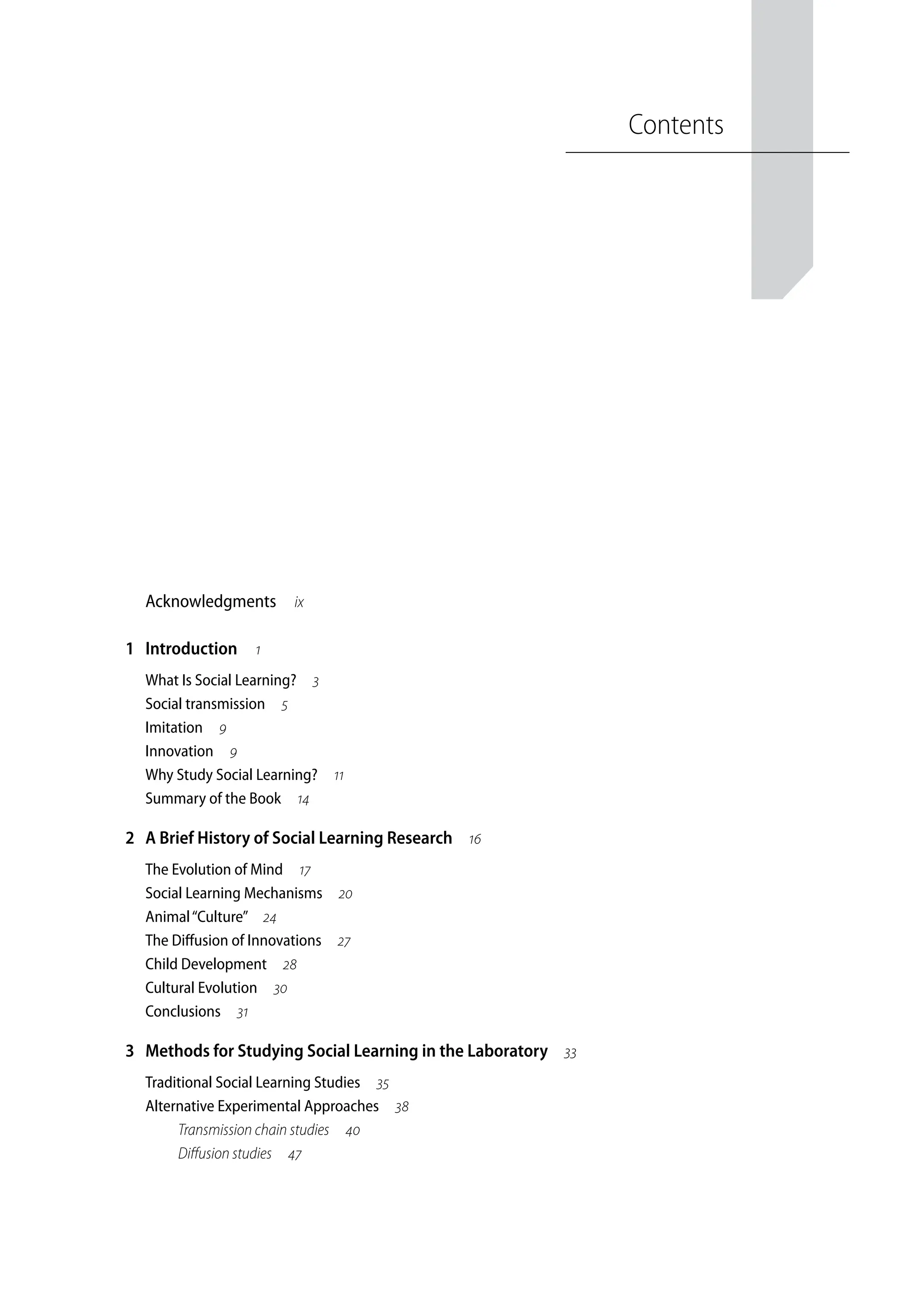
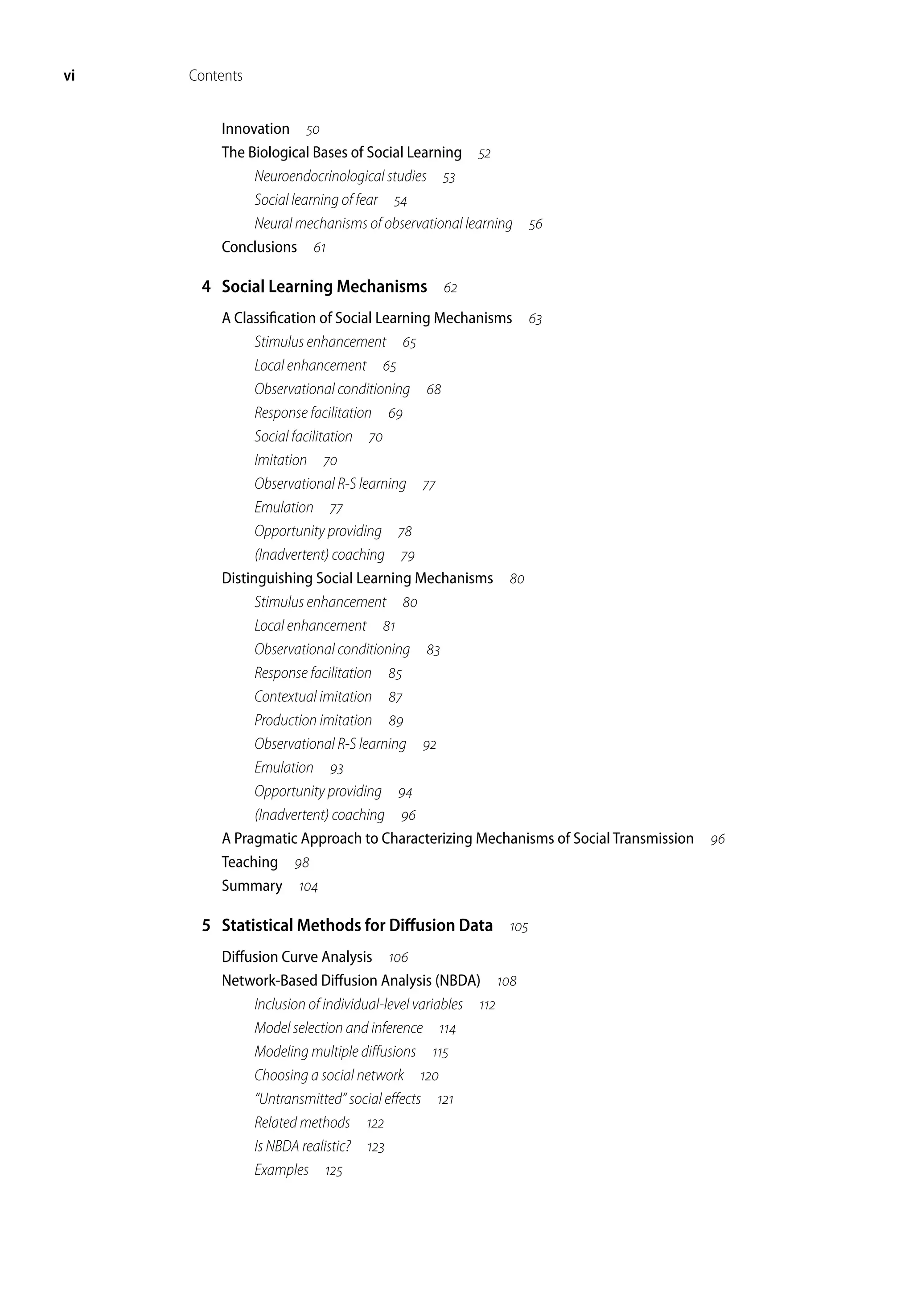
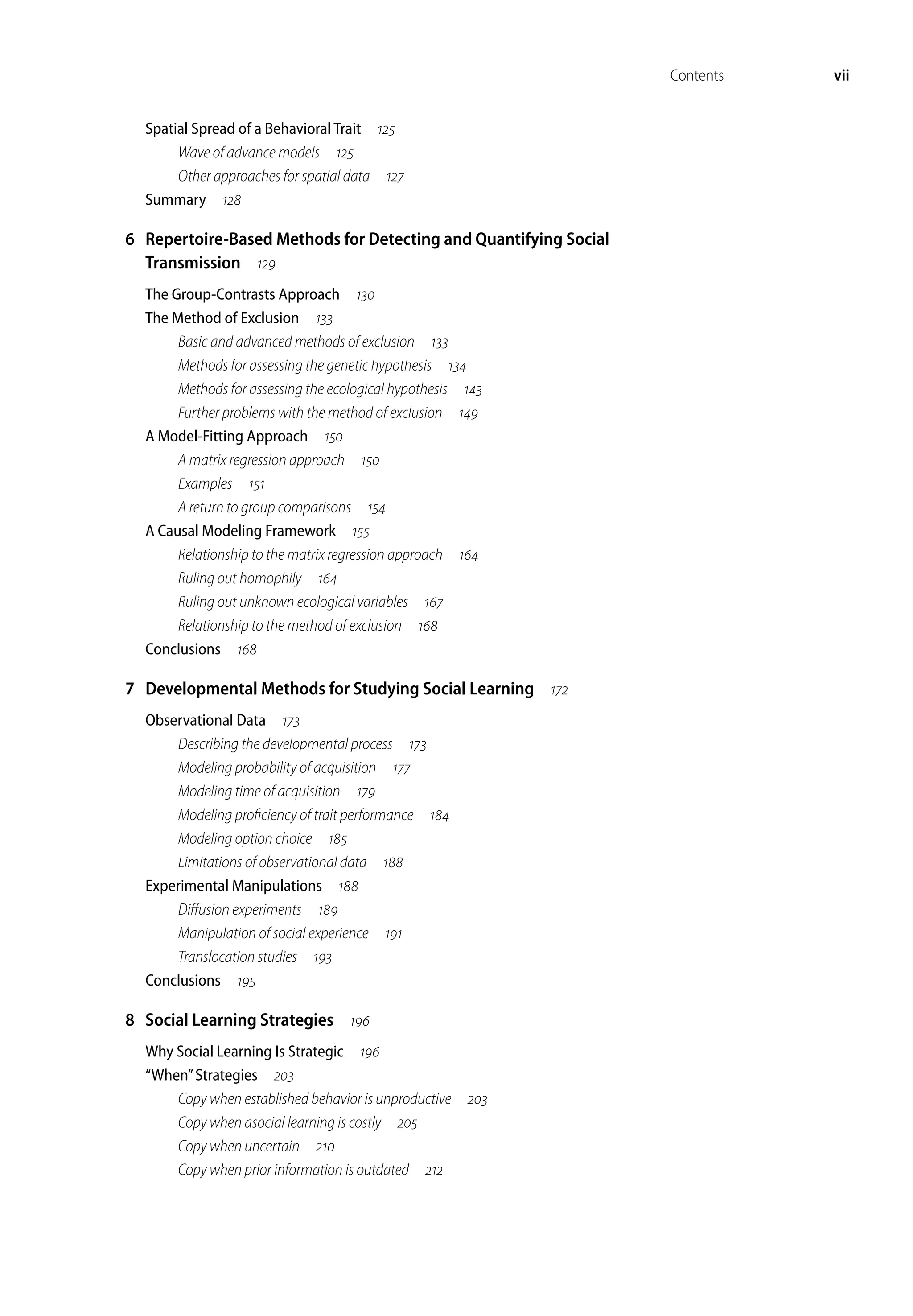



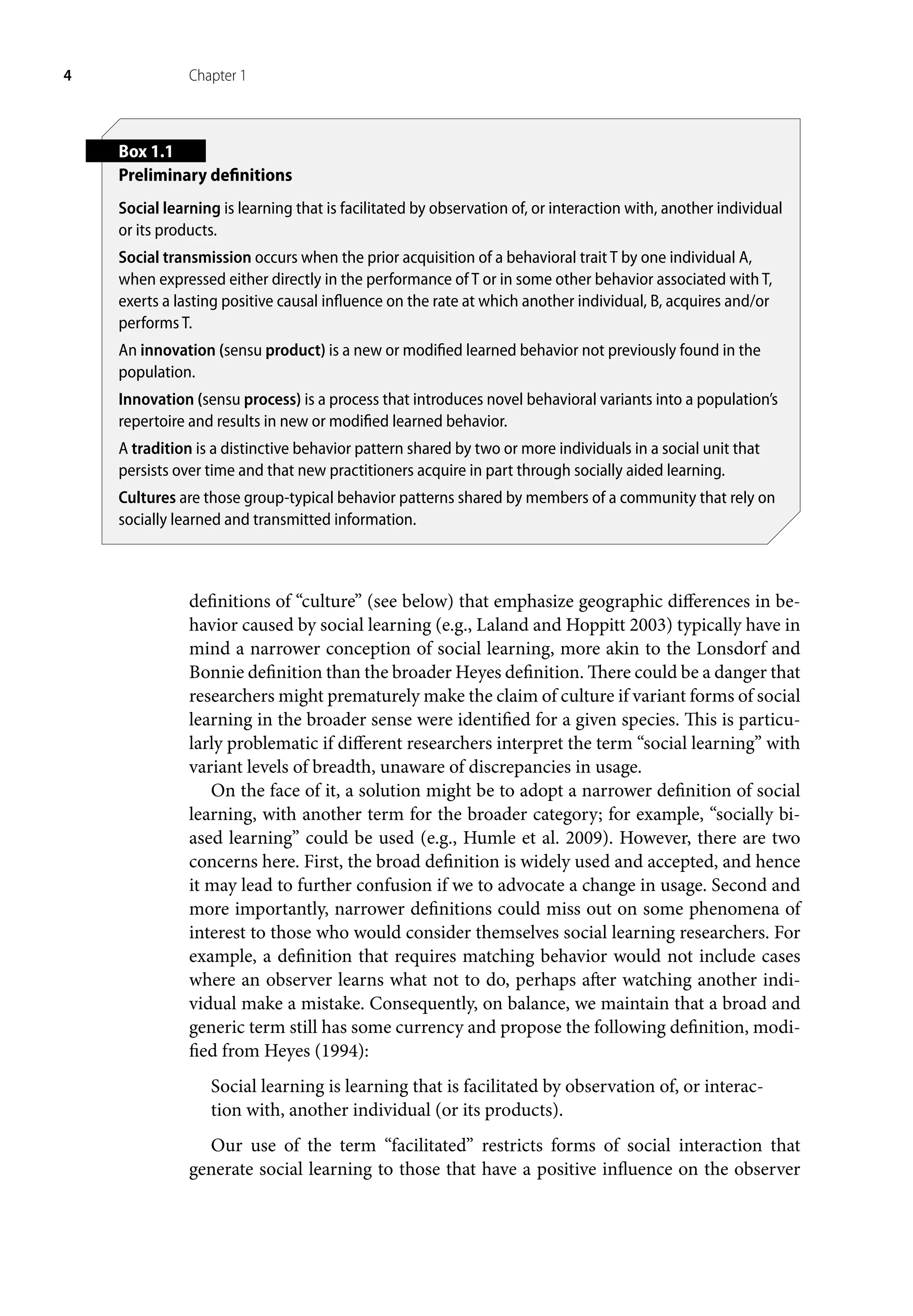
![6 Chapter 1
Here a behavioral trait is a target behavior pattern, which might be specific to a
particular context (e.g., pigeons pecking at a lever in response to a green light;
Dorrance and Zentall 2002). Inclusion of the phrase, “expressed either directly in
the performance of T or in some other behavior associated with T” is recognition
of the fact that acquired information and behavior can be transmitted with or
without performance of the trait. Examples of the latter are not uncommon. In the
case of humans, for example, we can provide written or spoken instructions on
how to perform the trait, instead of demonstrating it directly. For example, social
transmission of a recipe between chefs might occur when one chef passes a recipe
to another. The number of times a chef cooks the recipe might have no causal
influence on the acquisition of the recipe by others, but we would still consider
this social transmission (see fig. 1.1c). In the case of other animals, signals such
as food calls (e.g., the vocalizations of callitrichid monkeys that recruit infants to
a desirable or novel food source [Rapaport and Brown 2008], or mother hens that
warn their chicks from consuming a toxic foods [Nicol and Pope 1996]) or the
opportunity teaching exhibited by several carnivores (e.g., when meerkat helpers
provision pups with disabled prey; Thornton and McAuliffe 2006) can facilitate
social transmission without direct performance of the trait by a demonstrator.
We also recognize two types of social transmission, which we call social trans-
mission of trait acquisition (where the effect of social transmission is on the rate
at which B acquires T) and social transmission of trait performance (where the
effect is on the rate at which B performs T). In practice, many cases are likely
to involve both the social transmission of trait acquisition and of trait perfor-
mance—where individuals who observe a demonstrator both acquire the trait
sooner and perform it more frequently once they acquire it, than individuals who
do not observe a demonstrator. Nonetheless, we see the two as logically distinct.
Observers might acquire T sooner, but may not perform T any more frequently
than individuals who have acquired it asocially.3
It might seem strange to some readers to discuss a rate at which acquisition of
a trait occurs, when each individual can only acquire a trait once (except when
an individual has forgotten a trait and then does learn it again). Here our use of
the term “rate” is in the sense of a “hazard rate” in time to event or in “survival”
models—comparable to the rate of death or the rate at which a machine com-
ponent fails—which therefore refers to the pattern of learning spread across a
sample of individuals.4
For example, if a large sample of individuals all had a
learning rate of 0.5 per hour, we would expect the mean time to acquisition to be
1/0.5=2 hours.
3
When we use the term “asocial” in contrast to “social transmission,” we mean that it has not been
socially transmitted; we do not mean that it has not been affected by any social cues.
4
We suggest the rate at which individuals acquire a trait as the most general criterion. Note, were we
instead to utilize the probability that another acquires the trait, this would not allow for the fact that in-
dividuals who are not influenced by informed individuals might also reliably acquire the trait, but tend to
do so later. Nonetheless, rates can easily be converted into a probability of acquisition for a specified time
period, so the probability of acquisition within an individual’s lifetime or an experimental trial can still be
used to detect social transmission.](https://image.slidesharecdn.com/910-250413014047-49245f3c/75/Social-Learning-An-Introduction-to-Mechanisms-Methods-and-Models-William-Hoppitt-23-2048.jpg)
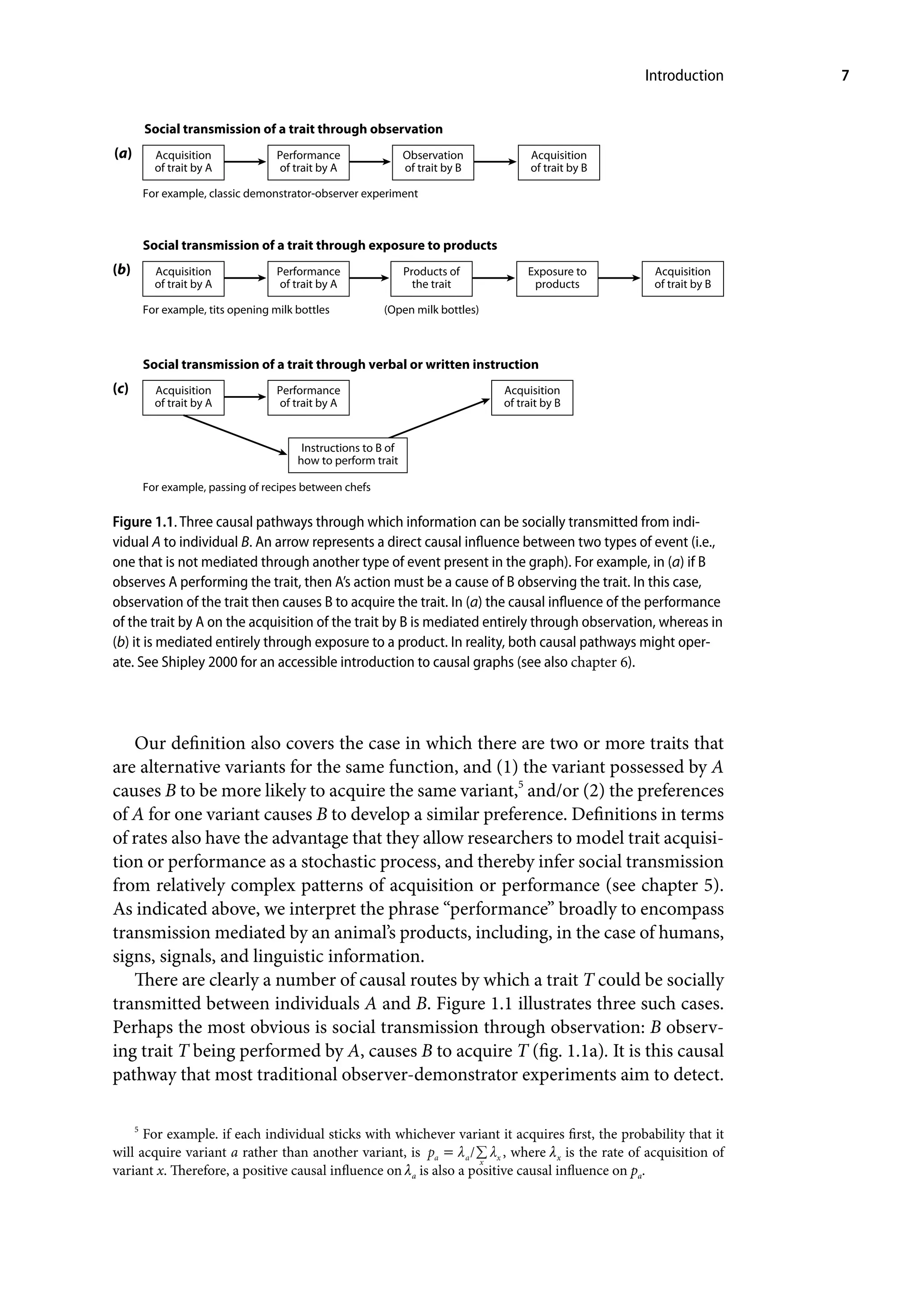

![195, 196, 59, 197 and 198. M. Zotenberg concludes that Hanna
possessed a MS. containing all these tales, part of which he copied
for Galland, and that this copy, like several other important volumes
which Galland is known or believed to have possessed, was lost. M.
Zotenberg thinks that we may expect to meet with most of Hanna’s
tales either in other copies of the Nights, or in some other collection
of the same kind. The latter supposition appears to me to be by far
the most probable.
[Section IV.]—M. Zotenberg proceeds to give an account of one or
two very important MSS. of the Nights in the Bibliothèque Nationale.
One of these is a MS. which belonged to the elder Caussin, and was
carefully copied by Michael Sabbagh from a MS. of Baghdad. Prof.
Fleischer, who examined it, states (Journal Asiatique, 1827, t. II., p.
221) that it follows the text of Habicht, but in a more developed
form. M. Zotenberg copies a note at the end, finishing up with the
word كبيكج (Kabíkaj) thrice repeated. This, he explains, “est le nom
du génie préposé au régne des insectes. Les scribes, parfois,
l’invoquent pour preserver leurs manuscrits de l’atteinte de vers.”
This MS. was copied at Paris on European paper at the beginning of
the century, though Caussin de Perceval was not acquainted with it
in 1806, but only with a MS. of the Egyptian redaction. This MS.
agrees with Galland’s only as far as the 69th Night. It differs from it
in two other points; it contains No. 1c. and the end of No. 3
coincides with the end of Night 69. The contents of Nights 70–1001
are as follows: 246, 4, 5, 6, 20, 7, 153, 21, 170, 247, The Unhappy
Lover confined in the Madhouse (probably = 204c), 8, 191, 193,
174, 9, 9b (not 9a, or 9aa) and as episodes, 155, 32, and the story
of the two brothers ’Amír and Ghadir, and their children Djamil and
Bathina.
Another MS., used by Chavis and Cazotte, and Caussin de Perceval,
was written in the year 1772. It has hitherto been overlooked,
because it was erroneously stated in the late M. Reinaud’s Catalogue
to be a MS. containing part of the 1001 Nights, extending from Night
282 to Night 631, and copied by Chavis. It is not from Chavis’ hand,](https://image.slidesharecdn.com/910-250413014047-49245f3c/75/Social-Learning-An-Introduction-to-Mechanisms-Methods-and-Models-William-Hoppitt-28-2048.jpg)
![and does not form part of the ordinary version of the Nights, but
contains the following tales: 174, 248, Story of King Sapor, 246, 3a,
36, 3c, 153, Story of the Intendant, the Interpreter, and the Young
Man; 247, 204c, 240, 250, Story of the Caliph and the Fisherman,
(probably = 156); the Cat and the Fox, and the Little Bird and the
Fowler.
Another MS., really written by Chavis, commences exactly where Vol.
3 of Galland’s MS. leaves off; i.e. in the middle of No. 21, and
extends from Night 281 to Night 631. M. Zotenberg supposes it to
have been written to supply the place of the last volume of Galland’s
set. It contains the following tales, in addition to the conclusion of
No. 21: 170, 247, 204c, 8, 191, 193 and 174. M. Zotenberg suggests
that the first part of this MS. may have been copied from Galland’s
last volume, which may have existed at the time in private hands.
The two last MSS. contain nearly the same tales, though with
numerous variations. M. Zotenberg discusses the hypothesis of
Chavis’ MS. being a translation from the French, and definitely
rejects it.
[Section V.]—Here M. Zotenberg discusses the MSS. of the Nights in
general, and divides them into three categories. I. MSS. proceeding
from Muslim parts of Asia. These, except the MSS. of Michael
Sabbagh and that of Chavis, contain only the first part of the work.
They are all more or less incomplete, and stop short in the middle of
the text. They are not quite uniform, especially in their readings, but
generally contain the same tales arranged in the same order. II.
Recent MSS. of Egyptian origin, characterised by a special style, and
a more condensed narrative; by the nature and arrangement of the
tales; by a great number of anecdotes and fables; and by the early
part of the work containing the great romance of chivalry of King
Omar Bin Al-Nu’uman. III. MSS. mostly of Egyptian origin, differing
as much among themselves in the arrangement of the tales, as do
those of the other groups.
The following MSS. are mentioned as belonging to the first group:—
I. Galland’s MS. in the Bibliothèque Nationale, Nos. 1506–1508.](https://image.slidesharecdn.com/910-250413014047-49245f3c/75/Social-Learning-An-Introduction-to-Mechanisms-Methods-and-Models-William-Hoppitt-29-2048.jpg)
![STORY OF THE THREE PRINCES AND THE
GENIUS MORHAGIAN AND HIS DAUGHTERS.
[Reprinted by M. Zotenberg (pp. 53–61) from Galland’s Journal, MS. français, No.
15277, pp. 120–131.] The passages in brackets are added by the present
translator (chiefly where Galland has inserted “etc.”) to fill up the sense.
When the Sultan of Samarcand had reached a great age, he called
the three princes, his sons, and after observing that he was much
pleased to see how much they loved and revered him, he gave them
leave to ask for whatever they most desired. They had only to
speak, and he was ready to grant them whatever they asked, let it
be what it might, on the sole condition that he should satisfy the
eldest first, and the two younger ones afterwards, each in his turn.
The eldest prince, whose name was Rostam, begged the Sultan to
build him a cabinet of bricks of gold and silver alternately, and
roofed with all kinds of precious stones.
The Sultan issued his orders that very day, but before the roof of the
cabinet was finished, indeed before any furniture had been put into
it, Prince Rostam asked his father’s leave to sleep there. The Sultan
tried to dissuade him, saying that [the roof] ought to be finished
first; but the prince was so impatient that he ordered his bed to be
removed there, and he lay down. He was reading the Koran about
midnight, when suddenly the floor opened and he beheld a most
hideous genius named Morhagian rise from the ground, who cried
out, “You are a prince, but even if you were the Sultan himself, I
would not refrain from taking vengeance for your rashness in
entering this house which has been built just above the palace of my
eldest daughter.” At the same time he paced around the cabinet, and
struck its walls, when the whole cabinet was reduced to dust so fine
that the wind carried it away, and left not a trace of it. The prince
drew his sword, and pursued the genius, who took to flight until he
came to a well, into which he plunged [and vanished]. When the
prince appeared before his father the Sultan next morning, he was](https://image.slidesharecdn.com/910-250413014047-49245f3c/75/Social-Learning-An-Introduction-to-Mechanisms-Methods-and-Models-William-Hoppitt-33-2048.jpg)
![overwhelmed with confusion [not only at what had happened, but
on account of his disobedience to his father, who reproached him
severely for having disregarded his advice.]
The second prince, whose name was Gaiath Eddin (Ghayáth al-Dín),
then requested the Sultan to build him a cabinet constructed entirely
of the bones of fishes. The Sultan ordered it to be built, at great
expense. Prince Gaiath Eddin had no more patience to wait till it was
quite finished than his brother Rostam. He lay down in the cabinet,
notwithstanding the Sultan’s warnings, but took care to keep his
sword by his side. The genius Morhagian appeared to him also at
midnight, paid him the same compliment, and told him that the
cabinet was built over the palace of his second daughter. He reduced
it to dust, and Prince Gaiath Eddin pursued him, sword in hand, to
the well, where he escaped; and next day the prince appeared
before his father, the Sultan [as crestfallen as his brother].
The third prince, who was named Badialzaman (Badíu ’l-Zamán =
Rarity of the Age), obtained leave from the Sultan to build a cabinet
entirely of rock crystal. He went to sleep there before it was entirely
finished, but without saying anything to the Sultan, as he was
resolved to see whether Morhagian would treat him in the same
way. Morhagian arrived at midnight, and declared that the cabinet
was built over the palace of his third daughter. He destroyed the
cabinet, and when the prince seized his sword, Morhagian took to
flight. The prince wounded him three times before he reached the
well, but he nevertheless succeeded in escaping.
Prince Badialzaman did not present himself to the Sultan, but went
to the two princes, his brothers, and urged them to pursue the
genius in the well itself. The three went together, and the eldest was
let down into the well by a rope, but after descending a certain
distance, he cried out, and asked to be drawn up again. He excused
his failure by saying that he felt a burning heat [and was almost
suffocated]. The same thing happened to Prince Gaiath Eddin, who
likewise cried out till he was drawn up. Prince Badialzaman then had
himself let down but commanded his brothers not to draw him up](https://image.slidesharecdn.com/910-250413014047-49245f3c/75/Social-Learning-An-Introduction-to-Mechanisms-Methods-and-Models-William-Hoppitt-34-2048.jpg)
![again, even if he should cry out. They let him down, and he cried
out, but he continued to descend till he reached the bottom of the
well, when he untied himself from the rope, and called out to his
brothers that the air was very foul. At the bottom of the well he
found an open door, and he advanced for some distance between
two walls, at the end of which he found a golden door, which he
opened, and beheld a magnificent palace. He entered and passed
through the kitchen and the storerooms, which were filled with all
kinds of provisions, and then inspected the rooms, when he entered
one magnificently furnished with sofas and divans. He was curious to
find out who lived there, so he hid himself. Soon afterwards he
beheld a flight of doves alight at the edge of a basin of water in the
middle of the court. The doves plunged into the water, and emerged
from it as women, each of whom immediately set about her
appointed work. One went to the store room, another to the kitchen,
a third began to sweep [and so on]. They prepared a feast [as if for
expected guests]. Some time afterwards, Badialzaman beheld
another flight of ten doves of different colours, who surrounded an
eleventh, which was quite white, and these also perched on the
edge of the basin. The ten doves plunged into the basin and came
forth as women, more beautiful than the first and more
magnificently robed. They took the white dove and plunged her into
a smaller basin, which was [filled with] rose [water] and she became
a woman of extraordinary beauty. She was the eldest daughter of
the genius, and her name was Fattane. (Fattánah = The Temptress.)
Two of her attendants then took Fattane under the armpits, and led
her to her apartment, followed by the others. She took her seat on a
small raised sofa, and her women separated, some to the right and
some to the left, and set about their work. Prince Badialzaman had
dropped his handkerchief. One of the waiting women saw it and
picked it up, and when she looked round, she saw the prince. She
was alarmed, and warned Fattane, who sent some of her women to
see who the stranger was. The prince came forward, and presented
himself before Fattane, who beheld a young prince, and gave him a
most gracious reception. She made him sit next to her, and inquired](https://image.slidesharecdn.com/910-250413014047-49245f3c/75/Social-Learning-An-Introduction-to-Mechanisms-Methods-and-Models-William-Hoppitt-35-2048.jpg)
![what brought him there? He told his story from the beginning to the
end, and asked where he could find the genius, on whom he wished
to take vengeance. Fattane smiled, and told him to think no more
about it, but only to enjoy himself in the good company in which he
found himself. They spread the table, and she made him sit next to
her, and her women played on all kinds of musical instruments
before they retired to rest.
Fattane persuaded the prince to stay with her from day to day: but
on the fortieth day he declared that he could wait no longer, and
that it was absolutely necessary for him to find out where Morhagian
dwelt. The princess acknowledged that he was her father, and told
him that his strength was so great [that nobody could overcome
him]. She added that she could not inform him where to find him,
but that her second sister would tell him. She sent one of her
women to guide him to her sister’s palace through a door of
communication, and to introduce him. He was well received by the
fairy, for whom he had a letter, and he found her younger and more
beautiful than Fattane. He begged her to inform him where he could
find the genius, but she changed the subject of conversation,
entertained him magnificently, and kept him with her for forty days.
On the fortieth day she permitted him to depart, gave him a letter,
and sent him to her youngest sister, who was a still more beautiful
fairy. He was received and welcomed with joy. She promised to show
him Morhagian’s dwelling, and she also entertained him for forty
days. On the fortieth day she tried to dissuade him from his
enterprise, but he insisted. She told him that Morhagian would grasp
his head in one hand, and his feet in the other, and would tear him
asunder in the middle. But this did not move him, and she then told
him that he would find Morhagian in a dwelling, long, high and wide
in proportion to his bulk. The prince sought him out, and the
moment he caught sight of him, he rushed at him, sword in hand.
Morhagian stretched out his hand, seized his head in one hand and
his feet in the other, rent him in two with very little effort, and threw
him out of a window which overlooked a garden.](https://image.slidesharecdn.com/910-250413014047-49245f3c/75/Social-Learning-An-Introduction-to-Mechanisms-Methods-and-Models-William-Hoppitt-36-2048.jpg)
![Two women sent by the youngest princess each took a piece of the
body of the prince, and brought it to their mistress, who put them
together, reunited them, and restored life to the prince by applying
water [of life?] to the wounds. She then asked the prince where he
came from, and it seemed to him that he had just awakened from
sleep; and she then recalled everything to his recollection. But this
did not weaken his firm resolve to kill the genius. The fairy begged
him to eat, but he refused; and she then urged that Morhagian was
her father, and that he could only be killed by his own sword, which
the prince could not obtain.[435]
“You may say what you please,”
answered the prince; “but there is no help for it, and he must die by
my hand [to atone for the wrongs which my brothers and I have
suffered from him].”
Then the princess made him swear solemnly to take her as his bride,
and taught him how he might succeed in killing the genius. “You
cannot hope to kill him while he wakes,” said she, “but when he
sleeps it is not quite impossible. If he sleeps, you will hear him
snore, but he will sleep with his eyes open, which is a sign that he
has fallen into a very profound slumber. As he fills the whole room,
step upon him and seize his sword which hangs above his head, and
then strike him on the neck. The blow will not kill him, but as he
wakes, he will tell you to strike him a second time. But beware of
doing this, [for if you strike him again, the wound will heal of itself,
and he will spring up and kill you, and me after you].”
Then Badialzaman returned to Morhagian’s room, and found him
snoring so loud that everything around him shook. The prince
entered, though not without trembling, and walked over him till he
was able to seize the sword when he struck him a violent blow on
the neck. Morhagian awoke, cursing his daughter, and cried out to
the prince, whom he recognised, “Make an end of me.” The prince
answered that what he had done was enough, and he left him, and
Morhagian died.
The prince carried off Morhagian’s sword, which he thought would
be useful to him in other encounters; and as he went, he passed a](https://image.slidesharecdn.com/910-250413014047-49245f3c/75/Social-Learning-An-Introduction-to-Mechanisms-Methods-and-Models-William-Hoppitt-37-2048.jpg)
![magnificent stable in which he saw a splendid horse. He returned to
the fairy and related to her what he had done, and added that he
would like to carry off the horse, but he feared it would be very
difficult. “Not so difficult as you think,” said she. “Go and cut off
some hair from his tail, and take care of it, and whenever you are in
need, burn one or two of the hairs, and he will be with you
immediately [and will bring you whatever you require].”
After this the three fairies assembled together, and the prince
promised that the two princes, his brothers, should marry the other
two sisters. Each fairy reduced her palace to the size of a small ball,
which she gave to the prince.
The prince then took the three fairies to the bottom of the well. His
father, the Sultan, had long believed that he was dead, and had put
on mourning for him. His two brothers often came to the well, and
they happened to be there just at the time. Badialzaman attracted
their attention by his shouts, told them what had happened, and
added that he had brought the three fairies with him. He asked for a
rope and fastened the eldest fairy to it, calling out, “Pull away, Prince
Rostam, I send you your good fortune.” The rope was let down
again, and he fastened the second fairy to it, calling out “Brother
Gaiath Eddin, pull up your good fortune too.”
The third fairy, who was to marry Badialzaman, begged him to allow
himself to be drawn up before her [as she was distrustful of his
brothers], but he would not listen to her. As soon as the two princes
had drawn her up so high that they could see her, they began to
dispute who should have her. Then the fairy cried out to
Badialzaman, “Prince, did I not warn you of this?”
The princes were obliged to agree that the Sultan should settle their
dispute. When the third fairy had been drawn out of the well, the
three fairies endeavoured to persuade the two princes to draw up
their youngest brother, but they refused, and compelled them to
follow them. While they carried off the youngest princess, the other
two asked leave to say adieu to prince Badialzaman. They cried out
from the top of the well, “Prince, have patience till Friday, when you](https://image.slidesharecdn.com/910-250413014047-49245f3c/75/Social-Learning-An-Introduction-to-Mechanisms-Methods-and-Models-William-Hoppitt-38-2048.jpg)
![will see six bulls pass by—three red ones and three black ones.
Mount upon one of the red ones and he will bring you up to the
earth, but take good care not to mount upon a black one, for he
would carry you down to the Seventh Earth.”[436]
The princes carried off the three fairies, and on Friday, three days
afterwards, the six bulls appeared. Badialzaman was about to mount
upon a red one, when a black one prevented him, and compelled
him to mount his back, when he plunged through the earth till he
stopped at a large town in another world. He entered the town, and
took up his abode with an old woman, to whom he gave a piece of
gold to provide him with something to eat, for he was almost
famished. When he had eaten enough, he asked for something to
drink. “You cannot be a native of this country,” said the old woman
[“or you would not ask for drink”]. She then brought him a sponge,
saying that she had no other water. She then informed him that the
town was supplied with water from a very copious spring, the flow of
which was interrupted by a monster. They were obliged to offer up a
girl to be devoured by it on every Friday. To-day the princess, the
Sultan’s daughter, was to be given up to him, and while the monster
emerged from his lair to devour her, enough water would flow for
everyone to supply himself until the following Friday.
Badialzaman then requested the old woman to show him the way to
the place where the princess was already exposed; but she was so
much afraid that he had much trouble in persuading her to come out
of her house to show him what direction to take. He went out of the
town, and went on till he saw the princess who made a sign to him
from a distance to approach no nearer; and the nearer he came, the
more anxiety she displayed. As soon as he was within hearing, he
shouted to her not to be afraid; and he sat down beside her, and fell
asleep, after having begged her to wake him as soon as the monster
appeared. Presently a tear from the princess fell upon his face, and
he woke up, and saw the monster, which he slew with the sword of
Morhagian, and the water flowed in abundance. The princess
thanked her deliverer, and begged him to take her back to the Sultan
her father, who would give proofs of his gratitude; but he excused](https://image.slidesharecdn.com/910-250413014047-49245f3c/75/Social-Learning-An-Introduction-to-Mechanisms-Methods-and-Models-William-Hoppitt-39-2048.jpg)
![himself. She then marked his shoulder with the blood of the monster
without his noticing it. The princess then returned to the town, and
was led back to the palace, where she related to the Sultan [all that
had happened]. Then the Sultan commanded that all the men in the
town should pass before himself and the princess under pain of
death. Badialzaman tried to conceal himself in a khan, but he was
compelled to come with the others. The princess recognised him,
and threw an apple at him to point him out. He was seized, and
brought before the Sultan, who demanded what he could do to
serve him. The prince hesitated, but at length he requested the
Sultan to show him the way to return to the world from whence he
came. The Sultan was furious, and would have ordered him to be
burned as a heretic [but the princess interceded for his life]. The
Sultan then treated him as a madman, and drove him ignominiously
from the town, and he wandered away without knowing where he
was going. At length he arrived at a mountain of rock, where he saw
a great serpent rising from his lair to prey on young Rokhs. He slew
the serpent with the sword of Morhagian, and the father and mother
of the Rokhs arrived at the moment, and asked him to demand
whatever he desired in return. He hesitated awhile, but at length he
asked them to show him the way to the upper world. The male Rokh
then told him to prepare ten quarters of mutton, to mount on his
back, and to give him some of the meat whenever he should turn his
head either to one side or to the other on the journey.
The prince mounted on the back of the Rokh, the Rokh stamped
with his foot, and the earth opened before them wherever he
turned. They reached the bottom of the well when the Rokh turned
his head, but there was no more meat left, so the prince cut off the
calf of his leg, and give it to him. When the Rokh arrived at the top
of the well, the prince leaped to the ground, when the Rokh
perceived [that he was lame, when he inquired the reason, and the
prince explained what had happened]. The Rokh then disgorged the
calf of the leg, and returned it to its place, when it grew fast, and
the prince was cured immediately.](https://image.slidesharecdn.com/910-250413014047-49245f3c/75/Social-Learning-An-Introduction-to-Mechanisms-Methods-and-Models-William-Hoppitt-40-2048.jpg)
![As the prince left the well, he met a peasant, and changed clothes
with him, but he kept the sword, the three balls, and the horse-hair.
He went into the town, where he took lodgings with a tailor, and
kept himself in retirement. The prince gradually rose in the tailor’s
esteem by letting him perceive that he knew how to sew, [and all
the arts of an accomplished tailor]. Presently, preparations were
made for the wedding of Prince Rostam, and the tailor with whom
Badialzaman lodged was ordered to prepare the fairy’s robes.
Badialzaman, who slept in the shop, took clothes from one of the
balls similar to those which were already far advanced, and put them
in the place of the others. The tailor was astonished [at their fine
workmanship] and wished to take the prince with him to receive a
present, but he refused, alleging as an excuse that he had so lately
come to the town. When the fairies saw the clothes, they thought it
a good omen.
The wedding day arrived, and they threw the jaríd,[437]
[and
practised other martial exercises]. It was a grand festival, and all the
shops were closed. The tailor wished to take the prince to see the
spectacle, but he put him off with an excuse. However, he went to a
retired part of the town, where he struck fire with a gun,[438]
and
burned a little of the horse-hair. The horse appeared, and he told
him to bring him a complete outfit all in red, and that he should
likewise appear with trappings, jewels &c., and a reed (jaríd) of the
same colour. The prince then mounted the horse, and proceeded to
the race-course, where his appearance excited general admiration.
At the close of the sports, he cut off the head of Prince Rostam, and
the horsemen pursued him, but were unable to overtake him, and
soon lost sight of him. He returned to the shop dressed as usual
before the arrival of the tailor, who related to him what had
happened, of which he pretended to be entirely ignorant. There was
a great mourning at the court; but three months afterwards, fresh
robes were ordered for the wedding of the second prince. The fairies
were confirmed in their suspicions when they saw the fresh clothes
[which Badialzaman sent them].](https://image.slidesharecdn.com/910-250413014047-49245f3c/75/Social-Learning-An-Introduction-to-Mechanisms-Methods-and-Models-William-Hoppitt-41-2048.jpg)
![On the wedding day they again assembled to throw the jaríd. Prince
Badialzaman now presented himself on the white horse, robed in
white, and with pearls and jewels to match, and again he attracted
general admiration. He pushed himself into the midst of a guard of
eight hundred horsemen, and slew Gaiath Eddin. They rushed upon
him, and he allowed himself to be carried before the Sultan, who
recognised him, [and pronounced his decision], “A brother who has
been abandoned to die by his brothers, has a right to kill them.”
After this, Prince Badialzaman espoused the youngest princess, and
the two others were given in marriage to two princes who were
related to the Sultan.](https://image.slidesharecdn.com/910-250413014047-49245f3c/75/Social-Learning-An-Introduction-to-Mechanisms-Methods-and-Models-William-Hoppitt-42-2048.jpg)
![CAZOTTE’S CONTINUATION, AND THE
COMPOSITE EDITIONS OF THE ARABIAN
NIGHTS (pp. 470–475).
P. 475.—There is a small Dutch work, the title of which is as follows:
Oostersche Vertellingen, uit de Duizend-en-een-Nacht: Naar de
Hoogduitsche Bewerking van M. Claudius,[439]
voor de Nederlandsche
Jeugduiitgegeven door J. J. A. Gouverneur. Te Groningen, bij B.
Wolters (n.d. 8vo.), pp. 281, col. front. (illustrating No. 170).
A composite juvenile edition, including Introduction (very short), and
Nos. 251g, 36a, 163 (complete form), 6ef, 4, 5, 1, 52, 170, 6ee,
223, 207c, 6, 194c, 206a, 204h, 2a, 174a and Introduction, (a.)
Derived from at least four different sources.](https://image.slidesharecdn.com/910-250413014047-49245f3c/75/Social-Learning-An-Introduction-to-Mechanisms-Methods-and-Models-William-Hoppitt-43-2048.jpg)
![TRANSLATIONS OF THE PRINTED TEXTS (pp.
495–496).
Under this heading I have to record Sir Richard and Lady Burton’s
own works.
Lady Burton’s Edition of her husband’s Arabian Nights, translated
literally from the Arabic, prepared for household reading by Justin
Huntly Mc.Carthy, M.P., London, Waterlow and Sons, Roy. 8vo. 6
vols.
In preparing this edition for the press, as much as possible has been
retained, both of the translation and notes; and it has not been
found necessary to omit altogether more than a very few of the least
important tales. The contents of the 6 volumes are as follows:—
Vol I. (1886), Frontispiece (Portrait of Lady Burton), Preface,
Translator’s Foreword, Introduction, 1–9 (pp. xxiii. 476).
Vol. II. (1886), Frontispiece (Portrait of Sir Richard F. Burton), 9
(continued), 9a–29 (pp. ii. 526).
Vol. III. (1887), 29 (continued)–133e (pp. viii. 511).
Vol. IV. (1887), 133e (continued)–154a (pp. iv. 514).
Vol. V. (1887), 154a (continued)–163 (pp. iv. 516).
Vol. VI. (1886) [? 1888], 163 (continued)–169 (pp. ii. 486).
Also includes Terminal Essay, Index to Tales and Proper Names;
Contributions to Bibliography, as far as it relates to Galland’s MS. and
Translations!; Comparative Table of Tales; Opinions of the Press; and
Letters from Scholars.](https://image.slidesharecdn.com/910-250413014047-49245f3c/75/Social-Learning-An-Introduction-to-Mechanisms-Methods-and-Models-William-Hoppitt-44-2048.jpg)
![I.
IMITATIONS AND MISCELLANEOUS WORKS
HAVING MORE OR LESS CONNECTION WITH
THE NIGHTS. (Pp. 507–513.) B. ENGLISH (pp.
512, 513.)
13. History of Rhedi, the Hermit of Mount Ararat, an Oriental Tale.
By—Mackenzie, 16mo., Dublin, 1781.
I have not seen this little book.
14. Miscellanies, consisting of poems, classical extracts, Oriental
Apologues. By William Beloe, F.S.A, Translator of Herodotus, &c.
London, 1795.
Includes some genuine Oriental tales, such as a version of that of
Básim the Smith.
15. The Orientalist, Letters of a Rabbi, with Notes by James Noble,
Oriental Master in the Scottish Naval and Military Academy.
Edinburgh, 1831.
Noticed by Mr. W. A. Clouston, Suppl. Nights, iii., p. 573.
16. The Adventures of the Caliph Haroun Al-raschid. Recounted by
the Author of “Mary Powell” [Miss Manning]. 8vo., London, 1855;
Arthur Hall, Virtue & Co.
17. The 1001 Days, a Companion to the Arabian Nights, with
introduction by Miss [J.] Pardoe. 8vo, London, 1857, woodcuts.
A miscellaneous collection (partly derived from “Les Mille et un
Jours”) (cf. Nights, x., pp. 499, 500). I have also seen a similar
miscellaneous collection in French under the latter title. The tales in
the English work are as follows:
Hassan Abdallah, or the Enchanted Keys.
Story of Hassan.](https://image.slidesharecdn.com/910-250413014047-49245f3c/75/Social-Learning-An-Introduction-to-Mechanisms-Methods-and-Models-William-Hoppitt-48-2048.jpg)