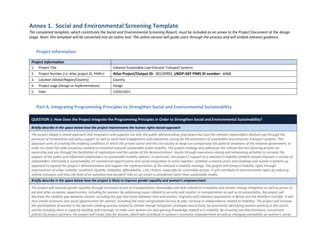
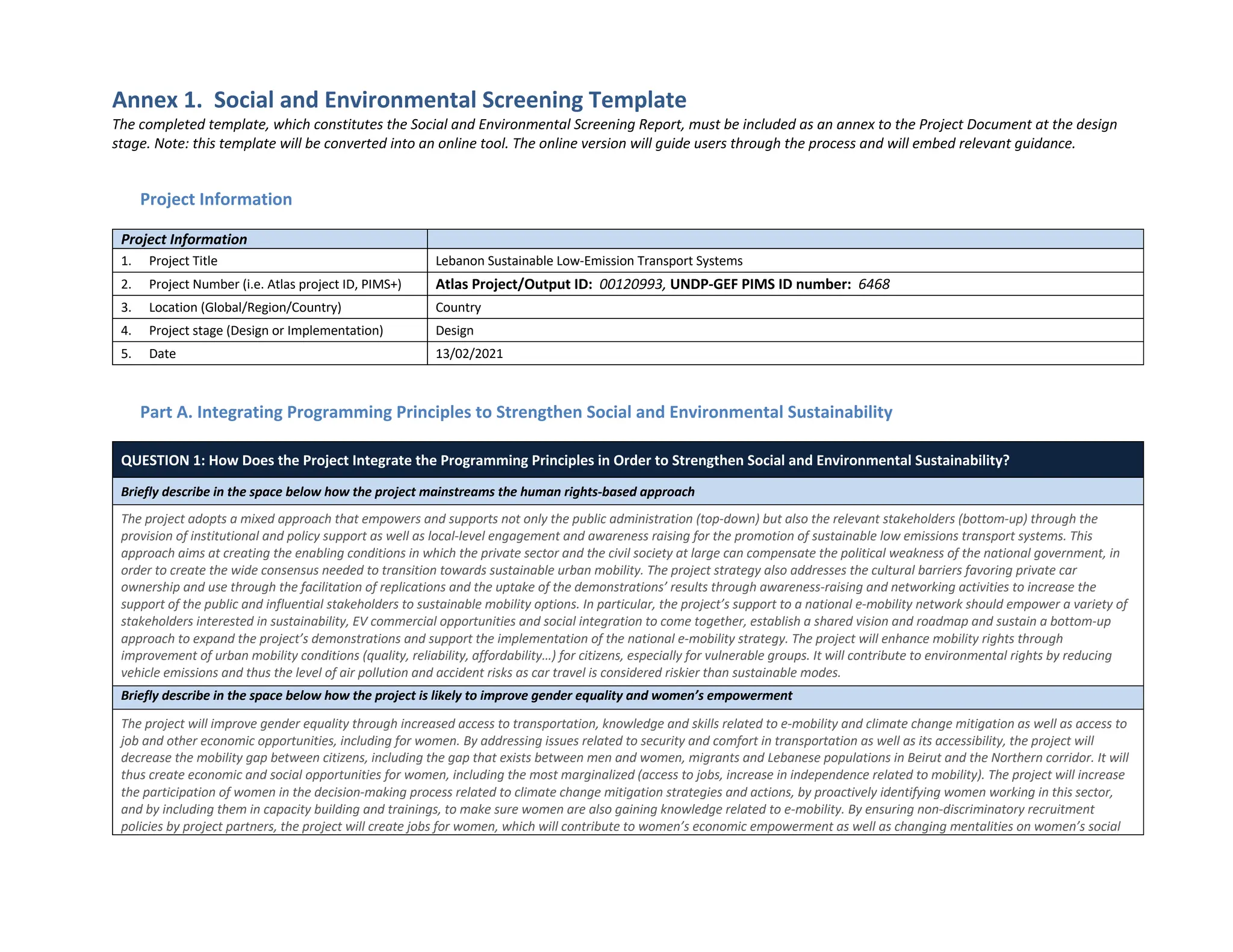
Annex 1. Social and Environmental Screening Template
The completed template, which constitutes the Social and Environmental Screening Report, must be included as an annex to the Project Document at the design
stage. Note: this template will be converted into an online tool. The online version will guide users through the process and will embed relevant guidance.
Project Information
Project Information
1. Project Title Lebanon Sustainable Low-Emission Transport Systems
2. Project Number (i.e. Atlas project ID, PIMS+) Atlas Project/Output ID: 00120993, UNDP-GEF PIMS ID number: 6468
3. Location (Global/Region/Country) Country
4. Project stage (Design or Implementation) Design
5. Date 13/02/2021
Part A. Integrating Programming Principles to Strengthen Social and Environmental Sustainability
QUESTION 1: How Does the Project Integrate the Programming Principles in Order to Strengthen Social and Environmental Sustainability?
Briefly describe in the space below how the project mainstreams the human rights-based approach
The project adopts a mixed approach that empowers and supports not only the public administration (top-down) but also the relevant stakeholders (bottom-up) through the
provision of institutional and policy support as well as local-level engagement and awareness raising for the promotion of sustainable low emissions transport systems. This
approach aims at creating the enabling conditions in which the private sector and the civil society at large can compensate the political weakness of the national government, in
order to create the wide consensus needed to transition towards sustainable urban mobility. The project strategy also addresses the cultural barriers favoring private car
ownership and use through the facilitation of replications and the uptake of the demonstrations’ results through awareness-raising and networking activities to increase the
support of the public and influential stakeholders to sustainable mobility options. In particular, the project’s support to a national e-mobility network should empower a variety of
stakeholders interested in sustainability, EV commercial opportunities and social integration to come together, establish a shared vision and roadmap and sustain a bottom-up
approach to expand the project’s demonstrations and support the implementation of the national e-mobility strategy. The project will enhance mobility rights through
improvement of urban mobility conditions (quality, reliability, affordability…) for citizens, especially for vulnerable groups. It will contribute to environmental rights by reducing
vehicle emissions and thus the level of air pollution and accident risks as car travel is considered riskier than sustainable modes.
Briefly describe in the space below how the project is likely to improve gender equality and women’s empowerment
The project will improve gender equality through increased access to transportation, knowledge and skills related to e-mobility and climate change mitigation as well as access to
job and other economic opportunities, including for women. By addressing issues related to security and comfort in transportation as well as its accessibility, the project will
decrease the mobility gap between citizens, including the gap that exists between men and women, migrants and Lebanese populations in Beirut and the Northern corridor. It will
thus create economic and social opportunities for women, including the most marginalized (access to jobs, increase in independence related to mobility). The project will increase
the participation of women in the decision-making process related to climate change mitigation strategies and actions, by proactively identifying women working in this sector,
and by including them in capacity building and trainings, to make sure women are also gaining knowledge related to e-mobility. By ensuring non-discriminatory recruitment
policies by project partners, the project will create jobs for women, which will contribute to women’s economic empowerment as well as changing mentalities on women’s social
roles as bus drivers or car companies’ managers. The collection of data disaggregated by sex, age and place of residence will support the development of a better understanding of
the mobility gap and gender inequalities, to adapt the project accordingly and ensure that gender equality is improved.
Briefly describe in the space below how the project mainstreams sustainability and resilience
The project will reduce GHG emissions as well as other vehicle emissions that deteriorate urban air quality. Electric vehicles increase the resilience of the transport sector by (1)
providing an alternative to fuel dependence and (2) by associating EVs to distributed generation of renewable energy (solar panels in the bus depot in Jbeil).By creating a favorable
institutional and regulatory framework for sustainable mobility and promoting innovative transport management practices (including EV deployment), the project will contribute
to point 112 of the GEF-7 Programming Directions to accelerate “the speed and scale of sustainable energy investment in developing countries” and to point 113, developing
“innovative business models that go beyond business as usual”. In addition, the project’s demonstrations are expected to accelerate the transition to low-emission urban mobility.
The current poor quality of sustainable transport modes in Lebanese cities- electrified or not- is unable to attract car users and needs to be improved with the guidance of
consistent quality roadmaps associating public transport and soft modes.
Briefly describe in the space below how the project strengthens accountability to stakeholders
Through adoption of the national e-mobility strategy, the Project will improve governance (participation, transparency and accountability) providing a clear vision for all
stakeholders. It will also improve stakeholder participation in policy design (through the preparation of the national e-mobility strategy). The co-design of pilots in Jbeil will
facilitate the participation of residents and local businesses. Project monitoring and evaluation provides enhanced information on the urban transport sector, which can empower
stakeholders in their relations with the government, based on more factual evidence. The project will strengthen the networking of stakeholders interested in e-mobility, so that
they can better keep the government accountable on its decisions in this field. The project will also empower bus operators, giving them access to technologies (e-buses) and to
innovative management processes (green public transport certificate), strengthening their capacities to lobby and keep the national government accountable.
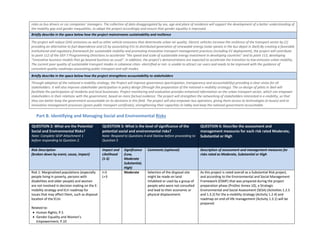
Part B. Identifying and Managing Social and Environmental Risks
QUESTION 2: What are the Potential
Social and Environmental Risks?
Note: Complete SESP Attachment 1
before responding to Question 2.
QUESTION 3: What is the level of significance of the
potential social and environmental risks?
Note: Respond to Questions 4 and 5below before proceeding to
Question 5
QUESTION 6: Describe the assessment and
management measures for each risk rated Moderate,
Substantial or High
Risk Description
(broken down by event, cause, impact)
Impact and
Likelihood
(1-5)
Significance
(Low,
Moderate
Substantial,
High)
Comments (optional) Description of assessment and management measures for
risks rated as Moderate, Substantial or High
Risk 1: Marginalized populations (especially
people living in poverty, persons with
disabilities and older people) and women
are not involved in decision making on the E-
mobility strategy and ELV roadmap for
issues that may affect them, such as disposal
location of the ELVs
Related to:
• Human Rights; P.5
• Gender Equality and Women’s
Empowerment; P.10
I=3
L=3
Moderate Selection of the disposal site
might be made on land
inhabited or used by a group of
people who were not consulted
and lead to their economic or
physical displacement.
As this project is rated overall as a Substantial Risk project,
and according to the Environmental and Social Management
Framework (ESMF) that was prepared during the project
preparation phase (ProDoc Annex 10), a Strategic
Environmental and Social Assessment (SESA) (Activities 1.2.5
and 1.3.2) for the e-mobility strategy (Activity 1.2.4) and
roadmap on end-of-life management (Activity 1.3.1) will be
prepared.
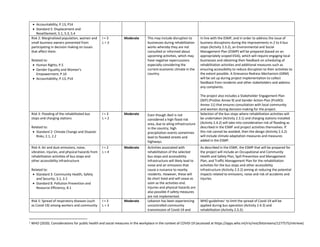
• Accountability; P.13, P14
• Standard 5: Displacement and
Resettlement; 5.1, 5.3, 5.4
Risk 2: Marginalized population, women and
small business owners prevented from
participating in decision making on issues
that affect them.
Related to:
• Human Rights; P.5
• Gender Equality and Women’s
Empowerment; P.10
• Accountability; P.13, P14
I = 3
L = 3
Moderate This may include disruption to
businesses during rehabilitation
works whereby they are not
consulted or informed about
upcoming activities, which may
have negative repercussions
especially considering the
current economic climate in the
country.
In line with the ESMF, and in order to address the issue of
business disruptions during the improvements in 2 to 4 bus
stops (Activity 2.3.2), an Environmental and Social
Management Plan (ESMP) will be prepared (based on an
appropriately scoped ESIA), which will require engaging local
businesses and obtaining their feedback on scheduling of
rehabilitation activities and additional measures such as
ensuring accessibility to reduce disruption to their activities to
the extent possible. A Grievance Redress Mechanism (GRM)
will be set up during project implementation to collect
feedback from residents and other stakeholders and address
any complaints.
The project also includes a Stakeholder Engagement Plan
(SEP) (ProDoc Annex 9) and Gender Action Plan (ProDOc
Annex 11) that ensures consultation with local community
and women during decision-making for the project.
Risk 3: Flooding of the rehabilitated bus
stops and charging stations
Related to:
• Standard 2: Climate Change and Disaster
Risks; 2.1, 2.2
I = 3
L = 2
Moderate Even though Jbeil is not
considered a high flood risk
area, due to ailing infrastructure
in the country, high
precipitation events sometimes
lead to flooded streets and
highways.
Selection of the bus stops where rehabilitation activities will
be undertaken (Activity 2.3.1) and charging stations installed
(Activity 2.4.2) will take into consideration risk of flooding as
described in the ESMF and project activities themselves. If
this risk cannot be avoided, then the design (Activity 2.3.2)
will include climate adaptation measures and measures
added in the ESMP.
Risk 4: Air and dust emissions, noise,
vibration, injuries, and physical hazards from
rehabilitation activities of bus stops and
other accessibility infrastructure
Related to:
• Standard 3: Community Health, Safety
and Security; 3.1, 3.2
• Standard 8: Pollution Prevention and
Resource Efficiency; 8.1
I = 2
L = 4
Moderate Activities associated with
rehabilitation of the selected
bus stops and accessibility
infrastructure will likely lead to
noise and air emissions that
cause a nuisance to nearby
residents. However, these will
be short lived and will cease as
soon as the activities end.
Injuries and physical hazards are
also possible if safety measures
are not implemented.
As described in the ESMF, the ESMP that will be prepared for
the project will include an Occupational and Community
Health and Safety Plan, Spill Prevention and Management
Plan, and Traffic Management Plan for the rehabilitation
activities for the bus stops and other accessibility
infrastructure (Activity 2.3.2) aiming at reducing the potential
impacts related to emissions, noise and risk of accidents and
injuries.
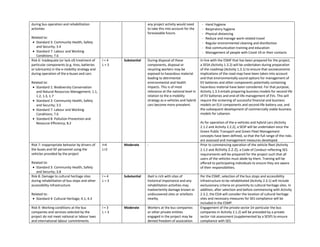
Risk 5: Spread of respiratory diseases (such
as Covid-19) among workers and community
I = 3
L = 3
Moderate Lebanon has been experiencing
uncontrolled community
transmission of Covid-19 and
WHO guidelines1 to limit the spread of Covid-19 will be
applied during bus operation (Activity 2.4.3) and
rehabilitation (Activity 2.3.2):
1 WHO (2020). Considerations for public health and social measures in the workplace in the context of COVID-19 (accessed at https://apps.who.int/iris/rest/bitstreams/1277575/retrieve)
during bus operation and rehabilitation
activities
Related to:
• Standard 3: Community Health, Safety
and Security; 3.4
• Standard 7: Labour and Working
Conditions; 7.6
any project activity would need
to take this into account for the
foreseeable future.
- Hand hygiene
- Respiratory hygiene
- Physical distancing
- Reduce and manage work-related travel
- Regular environmental cleaning and disinfection
- Risk communication training and education
- Management of people with Covid-19 or their contacts
Risk 6: Inadequate (or lack of) treatment of
particular components (e.g. tires, batteries
or lubricants) in the e-mobility strategy and
during operation of the e-buses and cars
Related to:
• Standard 1: Biodiversity Conservation
and Natural Resources Management; 1.1,
1.2, 1.3, 1.7
• Standard 3: Community Health, Safety
and Security; 3.5
• Standard 7: Labour and Working
Conditions; 7.6
• Standard 8: Pollution Prevention and
Resource Efficiency; 8.2
I = 4
L = 3
Substantial During disposal of these
components, disposal or
recycling workers may be
exposed to hazardous material
leading to detrimental
environmental and health
impacts. This is of most
relevance at the national level in
relation to the e-mobility
strategy as e-vehicles and hybrid
cars become more prevalent.
In line with the ESMF that has been prepared for the project,
a SESA (Activity 1.3.2) will be undertaken during preparation
of the roadmap (Activity 1.3.1) to ensure that socioeconomic
implications of the road map have been taken into account
and that environmentally sound options for management of
EV batteries and other components potentially containing
hazardous material have been considered. For that purpose,
Activity 1.3.3 entails preparing business models for second life
of EV batteries and end-of-life management of EVs. This will
require the screening of successful financial and business
models on ELV components and second-life battery use, and
the subsequent development of commercially viable business
models for Lebanon.
As for operation of the e-vehicles and hybrid cars (Activity
2.1.2 and Activity 2.2.2), a SESP will be undertaken once the
Green Public Transport and Green Fleet Management
concepts have been defined, so that the full range of the risks
are assessed and management measures developed.
Risk 7: Inappropriate behavior by drivers of
the buses and ISF personnel using the
vehicles provided by the project
Related to:
• Standard 3: Community Health, Safety
and Security; 3.8
I=4
L=2
Moderate - Prior to commencing operation of the vehicle fleet (Activity
2.1.2 and Activity 2.2.2), a Code of Conduct reflecting SES
requirements will be prepared for the project such that all
users of the vehicles must abide by them. Training will be
offered to participating individuals to ensure they are aware
of their responsibilities.
Risk 8: Damage to cultural heritage sites
during rehabilitation of bus stops and other
accessibility infrastructure
Related to:
• Standard 4: Cultural Heritage; 4.1, 4.3
I = 4
L = 3
Substantial Jbeil is rich with sites of
historical importance and any
rehabilitation activities may
inadvertently damage known or
undiscovered sites or artefacts
nearby.
Per the ESMF, selection of the bus stops and accessibility
infrastructure to be rehabilitated (Activity 2.3.1) will include
exclusionary criteria on proximity to cultural heritage sites. In
addition, after selection and before commencing with Activity
2.3.2, the ESIA will consider the location of cultural heritage
sites and necessary measures for SES compliance will be
included in the ESMP.
Risk 9: Working conditions at the bus
companies and services selected by the
project do not meet national or labour laws
and international labour commitments
I = 3
L = 3
Moderate Workers at the bus companies
or other private entities
engaged in the project may be
denied freedom of association
Engagement of the private sector (in particular the bus
companies in Activity 2.1.2) will be preceded by a private
sector risk assessment (supplemented by a SESP) to ensure
compliance with SES.
Related to:
• Standard 7: Labour and Working
Conditions; 7.1, 7.2, 7.3, 7.4, 7.5
and collective bargaining and
exposed to discriminatory
working conditions and/or lack
of equal opportunities.
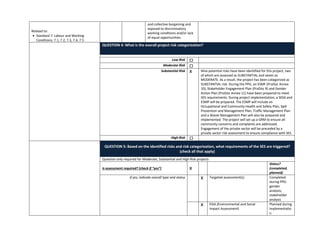
QUESTION 4: What is the overall project risk categorization?
Low Risk ☐
Moderate Risk ☐
Substantial Risk X Nine potential risks have been identified for this project, two
of which are assessed as SUBSTANTIAL and seven as
MODERATE. As a result, the project has been categorized as
SUBSTANTIAL risk. During the PPG, an ESMF (ProDoc Annex
10), Stakeholder Engagement Plan (ProDoc 9) and Gender
Action Plan (ProDoc Annex 11) have been prepared to meet
SES requirements. During project implementation, a SESA and
ESMP will be prepared. The ESMP will include an
Occupational and Community Health and Safety Plan, Spill
Prevention and Management Plan, Traffic Management Plan
and a Waste Management Plan will also be prepared and
implemented. The project will set up a GRM to ensure all
community concerns and complaints are addressed.
Engagement of the private sector will be preceded by a
private sector risk assessment to ensure compliance with SES.
High Risk ☐
QUESTION 5: Based on the identified risks and risk categorization, what requirements of the SES are triggered?
(check all that apply)
Question only required for Moderate, Substantial and High Risk projects
Is assessment required? (check if “yes”) X
Status?
(completed,
planned)
if yes, indicate overall type and status X Targeted assessment(s) Completed
during PPG:
gender
analysis,
stakeholder
analysis
X ESIA (Environmental and Social
Impact Assessment)
Planned during
implementatio
n
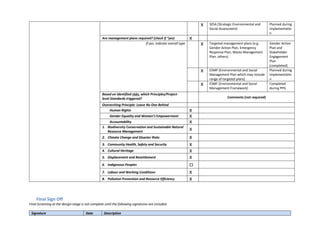
X SESA (Strategic Environmental and
Social Assessment)
Planned during
implementatio
n
Are management plans required? (check if “yes) X
If yes, indicate overall type X Targeted management plans (e.g.
Gender Action Plan, Emergency
Response Plan, Waste Management
Plan, others)
Gender Action
Plan and
Stakeholder
Engagement
Plan
(completed)
X ESMP (Environmental and Social
Management Plan which may include
range of targeted plans)
Planned during
implementatio
n
X ESMF (Environmental and Social
Management Framework)
Completed
during PPG
Based on identified risks, which Principles/Project-
level Standards triggered? Comments (not required)
Overarching Principle: Leave No One Behind
Human Rights X
Gender Equality and Women’s Empowerment X
Accountability X
1. Biodiversity Conservation and Sustainable Natural
Resource Management X
2. Climate Change and Disaster Risks X
3. Community Health, Safety and Security X
4. Cultural Heritage X
5. Displacement and Resettlement X
6. Indigenous Peoples ☐
7. Labour and Working Conditions X
8. Pollution Prevention and Resource Efficiency X
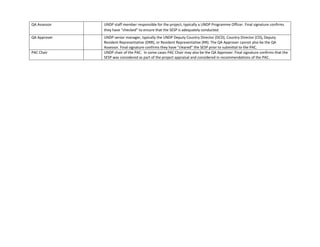
Final Sign Off
Final Screening at the design-stage is not complete until the following signatures are included
Signature Date Description
QA Assessor UNDP staff member responsible for the project, typically a UNDP Programme Officer. Final signature confirms
they have “checked” to ensure that the SESP is adequately conducted.
QA Approver UNDP senior manager, typically the UNDP Deputy Country Director (DCD), Country Director (CD), Deputy
Resident Representative (DRR), or Resident Representative (RR). The QA Approver cannot also be the QA
Assessor. Final signature confirms they have “cleared” the SESP prior to submittal to the PAC.
PAC Chair UNDP chair of the PAC. In some cases PAC Chair may also be the QA Approver. Final signature confirms that the
SESP was considered as part of the project appraisal and considered in recommendations of the PAC.

Social Environmental Screening Assessment.pdf

  • 1.
    Annex 1. Socialand Environmental Screening Template The completed template, which constitutes the Social and Environmental Screening Report, must be included as an annex to the Project Document at the design stage. Note: this template will be converted into an online tool. The online version will guide users through the process and will embed relevant guidance. Project Information Project Information 1. Project Title Lebanon Sustainable Low-Emission Transport Systems 2. Project Number (i.e. Atlas project ID, PIMS+) Atlas Project/Output ID: 00120993, UNDP-GEF PIMS ID number: 6468 3. Location (Global/Region/Country) Country 4. Project stage (Design or Implementation) Design 5. Date 13/02/2021 Part A. Integrating Programming Principles to Strengthen Social and Environmental Sustainability QUESTION 1: How Does the Project Integrate the Programming Principles in Order to Strengthen Social and Environmental Sustainability? Briefly describe in the space below how the project mainstreams the human rights-based approach The project adopts a mixed approach that empowers and supports not only the public administration (top-down) but also the relevant stakeholders (bottom-up) through the provision of institutional and policy support as well as local-level engagement and awareness raising for the promotion of sustainable low emissions transport systems. This approach aims at creating the enabling conditions in which the private sector and the civil society at large can compensate the political weakness of the national government, in order to create the wide consensus needed to transition towards sustainable urban mobility. The project strategy also addresses the cultural barriers favoring private car ownership and use through the facilitation of replications and the uptake of the demonstrations’ results through awareness-raising and networking activities to increase the support of the public and influential stakeholders to sustainable mobility options. In particular, the project’s support to a national e-mobility network should empower a variety of stakeholders interested in sustainability, EV commercial opportunities and social integration to come together, establish a shared vision and roadmap and sustain a bottom-up approach to expand the project’s demonstrations and support the implementation of the national e-mobility strategy. The project will enhance mobility rights through improvement of urban mobility conditions (quality, reliability, affordability…) for citizens, especially for vulnerable groups. It will contribute to environmental rights by reducing vehicle emissions and thus the level of air pollution and accident risks as car travel is considered riskier than sustainable modes. Briefly describe in the space below how the project is likely to improve gender equality and women’s empowerment The project will improve gender equality through increased access to transportation, knowledge and skills related to e-mobility and climate change mitigation as well as access to job and other economic opportunities, including for women. By addressing issues related to security and comfort in transportation as well as its accessibility, the project will decrease the mobility gap between citizens, including the gap that exists between men and women, migrants and Lebanese populations in Beirut and the Northern corridor. It will thus create economic and social opportunities for women, including the most marginalized (access to jobs, increase in independence related to mobility). The project will increase the participation of women in the decision-making process related to climate change mitigation strategies and actions, by proactively identifying women working in this sector, and by including them in capacity building and trainings, to make sure women are also gaining knowledge related to e-mobility. By ensuring non-discriminatory recruitment policies by project partners, the project will create jobs for women, which will contribute to women’s economic empowerment as well as changing mentalities on women’s social
  • 2.
    roles as busdrivers or car companies’ managers. The collection of data disaggregated by sex, age and place of residence will support the development of a better understanding of the mobility gap and gender inequalities, to adapt the project accordingly and ensure that gender equality is improved. Briefly describe in the space below how the project mainstreams sustainability and resilience The project will reduce GHG emissions as well as other vehicle emissions that deteriorate urban air quality. Electric vehicles increase the resilience of the transport sector by (1) providing an alternative to fuel dependence and (2) by associating EVs to distributed generation of renewable energy (solar panels in the bus depot in Jbeil).By creating a favorable institutional and regulatory framework for sustainable mobility and promoting innovative transport management practices (including EV deployment), the project will contribute to point 112 of the GEF-7 Programming Directions to accelerate “the speed and scale of sustainable energy investment in developing countries” and to point 113, developing “innovative business models that go beyond business as usual”. In addition, the project’s demonstrations are expected to accelerate the transition to low-emission urban mobility. The current poor quality of sustainable transport modes in Lebanese cities- electrified or not- is unable to attract car users and needs to be improved with the guidance of consistent quality roadmaps associating public transport and soft modes. Briefly describe in the space below how the project strengthens accountability to stakeholders Through adoption of the national e-mobility strategy, the Project will improve governance (participation, transparency and accountability) providing a clear vision for all stakeholders. It will also improve stakeholder participation in policy design (through the preparation of the national e-mobility strategy). The co-design of pilots in Jbeil will facilitate the participation of residents and local businesses. Project monitoring and evaluation provides enhanced information on the urban transport sector, which can empower stakeholders in their relations with the government, based on more factual evidence. The project will strengthen the networking of stakeholders interested in e-mobility, so that they can better keep the government accountable on its decisions in this field. The project will also empower bus operators, giving them access to technologies (e-buses) and to innovative management processes (green public transport certificate), strengthening their capacities to lobby and keep the national government accountable. Part B. Identifying and Managing Social and Environmental Risks QUESTION 2: What are the Potential Social and Environmental Risks? Note: Complete SESP Attachment 1 before responding to Question 2. QUESTION 3: What is the level of significance of the potential social and environmental risks? Note: Respond to Questions 4 and 5below before proceeding to Question 5 QUESTION 6: Describe the assessment and management measures for each risk rated Moderate, Substantial or High Risk Description (broken down by event, cause, impact) Impact and Likelihood (1-5) Significance (Low, Moderate Substantial, High) Comments (optional) Description of assessment and management measures for risks rated as Moderate, Substantial or High Risk 1: Marginalized populations (especially people living in poverty, persons with disabilities and older people) and women are not involved in decision making on the E- mobility strategy and ELV roadmap for issues that may affect them, such as disposal location of the ELVs Related to: • Human Rights; P.5 • Gender Equality and Women’s Empowerment; P.10 I=3 L=3 Moderate Selection of the disposal site might be made on land inhabited or used by a group of people who were not consulted and lead to their economic or physical displacement. As this project is rated overall as a Substantial Risk project, and according to the Environmental and Social Management Framework (ESMF) that was prepared during the project preparation phase (ProDoc Annex 10), a Strategic Environmental and Social Assessment (SESA) (Activities 1.2.5 and 1.3.2) for the e-mobility strategy (Activity 1.2.4) and roadmap on end-of-life management (Activity 1.3.1) will be prepared.
  • 3.
    • Accountability; P.13,P14 • Standard 5: Displacement and Resettlement; 5.1, 5.3, 5.4 Risk 2: Marginalized population, women and small business owners prevented from participating in decision making on issues that affect them. Related to: • Human Rights; P.5 • Gender Equality and Women’s Empowerment; P.10 • Accountability; P.13, P14 I = 3 L = 3 Moderate This may include disruption to businesses during rehabilitation works whereby they are not consulted or informed about upcoming activities, which may have negative repercussions especially considering the current economic climate in the country. In line with the ESMF, and in order to address the issue of business disruptions during the improvements in 2 to 4 bus stops (Activity 2.3.2), an Environmental and Social Management Plan (ESMP) will be prepared (based on an appropriately scoped ESIA), which will require engaging local businesses and obtaining their feedback on scheduling of rehabilitation activities and additional measures such as ensuring accessibility to reduce disruption to their activities to the extent possible. A Grievance Redress Mechanism (GRM) will be set up during project implementation to collect feedback from residents and other stakeholders and address any complaints. The project also includes a Stakeholder Engagement Plan (SEP) (ProDoc Annex 9) and Gender Action Plan (ProDOc Annex 11) that ensures consultation with local community and women during decision-making for the project. Risk 3: Flooding of the rehabilitated bus stops and charging stations Related to: • Standard 2: Climate Change and Disaster Risks; 2.1, 2.2 I = 3 L = 2 Moderate Even though Jbeil is not considered a high flood risk area, due to ailing infrastructure in the country, high precipitation events sometimes lead to flooded streets and highways. Selection of the bus stops where rehabilitation activities will be undertaken (Activity 2.3.1) and charging stations installed (Activity 2.4.2) will take into consideration risk of flooding as described in the ESMF and project activities themselves. If this risk cannot be avoided, then the design (Activity 2.3.2) will include climate adaptation measures and measures added in the ESMP. Risk 4: Air and dust emissions, noise, vibration, injuries, and physical hazards from rehabilitation activities of bus stops and other accessibility infrastructure Related to: • Standard 3: Community Health, Safety and Security; 3.1, 3.2 • Standard 8: Pollution Prevention and Resource Efficiency; 8.1 I = 2 L = 4 Moderate Activities associated with rehabilitation of the selected bus stops and accessibility infrastructure will likely lead to noise and air emissions that cause a nuisance to nearby residents. However, these will be short lived and will cease as soon as the activities end. Injuries and physical hazards are also possible if safety measures are not implemented. As described in the ESMF, the ESMP that will be prepared for the project will include an Occupational and Community Health and Safety Plan, Spill Prevention and Management Plan, and Traffic Management Plan for the rehabilitation activities for the bus stops and other accessibility infrastructure (Activity 2.3.2) aiming at reducing the potential impacts related to emissions, noise and risk of accidents and injuries. Risk 5: Spread of respiratory diseases (such as Covid-19) among workers and community I = 3 L = 3 Moderate Lebanon has been experiencing uncontrolled community transmission of Covid-19 and WHO guidelines1 to limit the spread of Covid-19 will be applied during bus operation (Activity 2.4.3) and rehabilitation (Activity 2.3.2): 1 WHO (2020). Considerations for public health and social measures in the workplace in the context of COVID-19 (accessed at https://apps.who.int/iris/rest/bitstreams/1277575/retrieve)
  • 4.
    during bus operationand rehabilitation activities Related to: • Standard 3: Community Health, Safety and Security; 3.4 • Standard 7: Labour and Working Conditions; 7.6 any project activity would need to take this into account for the foreseeable future. - Hand hygiene - Respiratory hygiene - Physical distancing - Reduce and manage work-related travel - Regular environmental cleaning and disinfection - Risk communication training and education - Management of people with Covid-19 or their contacts Risk 6: Inadequate (or lack of) treatment of particular components (e.g. tires, batteries or lubricants) in the e-mobility strategy and during operation of the e-buses and cars Related to: • Standard 1: Biodiversity Conservation and Natural Resources Management; 1.1, 1.2, 1.3, 1.7 • Standard 3: Community Health, Safety and Security; 3.5 • Standard 7: Labour and Working Conditions; 7.6 • Standard 8: Pollution Prevention and Resource Efficiency; 8.2 I = 4 L = 3 Substantial During disposal of these components, disposal or recycling workers may be exposed to hazardous material leading to detrimental environmental and health impacts. This is of most relevance at the national level in relation to the e-mobility strategy as e-vehicles and hybrid cars become more prevalent. In line with the ESMF that has been prepared for the project, a SESA (Activity 1.3.2) will be undertaken during preparation of the roadmap (Activity 1.3.1) to ensure that socioeconomic implications of the road map have been taken into account and that environmentally sound options for management of EV batteries and other components potentially containing hazardous material have been considered. For that purpose, Activity 1.3.3 entails preparing business models for second life of EV batteries and end-of-life management of EVs. This will require the screening of successful financial and business models on ELV components and second-life battery use, and the subsequent development of commercially viable business models for Lebanon. As for operation of the e-vehicles and hybrid cars (Activity 2.1.2 and Activity 2.2.2), a SESP will be undertaken once the Green Public Transport and Green Fleet Management concepts have been defined, so that the full range of the risks are assessed and management measures developed. Risk 7: Inappropriate behavior by drivers of the buses and ISF personnel using the vehicles provided by the project Related to: • Standard 3: Community Health, Safety and Security; 3.8 I=4 L=2 Moderate - Prior to commencing operation of the vehicle fleet (Activity 2.1.2 and Activity 2.2.2), a Code of Conduct reflecting SES requirements will be prepared for the project such that all users of the vehicles must abide by them. Training will be offered to participating individuals to ensure they are aware of their responsibilities. Risk 8: Damage to cultural heritage sites during rehabilitation of bus stops and other accessibility infrastructure Related to: • Standard 4: Cultural Heritage; 4.1, 4.3 I = 4 L = 3 Substantial Jbeil is rich with sites of historical importance and any rehabilitation activities may inadvertently damage known or undiscovered sites or artefacts nearby. Per the ESMF, selection of the bus stops and accessibility infrastructure to be rehabilitated (Activity 2.3.1) will include exclusionary criteria on proximity to cultural heritage sites. In addition, after selection and before commencing with Activity 2.3.2, the ESIA will consider the location of cultural heritage sites and necessary measures for SES compliance will be included in the ESMP. Risk 9: Working conditions at the bus companies and services selected by the project do not meet national or labour laws and international labour commitments I = 3 L = 3 Moderate Workers at the bus companies or other private entities engaged in the project may be denied freedom of association Engagement of the private sector (in particular the bus companies in Activity 2.1.2) will be preceded by a private sector risk assessment (supplemented by a SESP) to ensure compliance with SES.
  • 5.
    Related to: • Standard7: Labour and Working Conditions; 7.1, 7.2, 7.3, 7.4, 7.5 and collective bargaining and exposed to discriminatory working conditions and/or lack of equal opportunities. QUESTION 4: What is the overall project risk categorization? Low Risk ☐ Moderate Risk ☐ Substantial Risk X Nine potential risks have been identified for this project, two of which are assessed as SUBSTANTIAL and seven as MODERATE. As a result, the project has been categorized as SUBSTANTIAL risk. During the PPG, an ESMF (ProDoc Annex 10), Stakeholder Engagement Plan (ProDoc 9) and Gender Action Plan (ProDoc Annex 11) have been prepared to meet SES requirements. During project implementation, a SESA and ESMP will be prepared. The ESMP will include an Occupational and Community Health and Safety Plan, Spill Prevention and Management Plan, Traffic Management Plan and a Waste Management Plan will also be prepared and implemented. The project will set up a GRM to ensure all community concerns and complaints are addressed. Engagement of the private sector will be preceded by a private sector risk assessment to ensure compliance with SES. High Risk ☐ QUESTION 5: Based on the identified risks and risk categorization, what requirements of the SES are triggered? (check all that apply) Question only required for Moderate, Substantial and High Risk projects Is assessment required? (check if “yes”) X Status? (completed, planned) if yes, indicate overall type and status X Targeted assessment(s) Completed during PPG: gender analysis, stakeholder analysis X ESIA (Environmental and Social Impact Assessment) Planned during implementatio n
  • 6.
    X SESA (StrategicEnvironmental and Social Assessment) Planned during implementatio n Are management plans required? (check if “yes) X If yes, indicate overall type X Targeted management plans (e.g. Gender Action Plan, Emergency Response Plan, Waste Management Plan, others) Gender Action Plan and Stakeholder Engagement Plan (completed) X ESMP (Environmental and Social Management Plan which may include range of targeted plans) Planned during implementatio n X ESMF (Environmental and Social Management Framework) Completed during PPG Based on identified risks, which Principles/Project- level Standards triggered? Comments (not required) Overarching Principle: Leave No One Behind Human Rights X Gender Equality and Women’s Empowerment X Accountability X 1. Biodiversity Conservation and Sustainable Natural Resource Management X 2. Climate Change and Disaster Risks X 3. Community Health, Safety and Security X 4. Cultural Heritage X 5. Displacement and Resettlement X 6. Indigenous Peoples ☐ 7. Labour and Working Conditions X 8. Pollution Prevention and Resource Efficiency X Final Sign Off Final Screening at the design-stage is not complete until the following signatures are included Signature Date Description
  • 7.
    QA Assessor UNDPstaff member responsible for the project, typically a UNDP Programme Officer. Final signature confirms they have “checked” to ensure that the SESP is adequately conducted. QA Approver UNDP senior manager, typically the UNDP Deputy Country Director (DCD), Country Director (CD), Deputy Resident Representative (DRR), or Resident Representative (RR). The QA Approver cannot also be the QA Assessor. Final signature confirms they have “cleared” the SESP prior to submittal to the PAC. PAC Chair UNDP chair of the PAC. In some cases PAC Chair may also be the QA Approver. Final signature confirms that the SESP was considered as part of the project appraisal and considered in recommendations of the PAC.