SOCIAL CONNECTION
FAKHRUDDIN AHMED
SOCIAL CONNECTION
DEFINITION
Wikipedia defines Social Connection as follows:
Social connection is the experience of feeling close and connected to
others. It involves feeling loved, cared for, and valued, and forms the
basis of interpersonal relationships.
In humans (one of the most social species), social connection is
essential to nearly every aspect of health and well-being. Lack of
connection, or loneliness, has been linked to inflammation,
accelerated aging and cardiovascular health risk, suicide, and all-
cause mortality.
SOCIAL CONNECTION
NEED FOR SOCIAL CONNECTION
Social connection and belonging may in fact be a basic need, as
powerful as our need for food or water. Mammals are born relatively
helpless, and rely on their caregivers not only for affection, but for
survival. This may be evolutionarily why mammals need and seek
connection, and also for why they suffer prolonged distress and health
consequences when that need is not met.
SOCIAL CONNECTION
TYPES OF SOCIAL CONNECTION
* Affection *
Friendship * Interpersonal
relationships * Intimate relationships
* Human bonding * Love
In this presentation I will discuss only “Affection” and “Friendship”
which will be sufficient to demonstrate the importance of Social
Connection in human life specially the Seniors. I will then move on to
two related subjects which are very important from Senior’s point of
view which are
* Social isolation and * Social support.
SOCIAL CONNECTION
AFFECTION
Affection or fondness is a "disposition or state of mind or body" that is
often associated with a feeling or type of love. "Affection" is popularly
used to denote a feeling or type of love, amounting to more than
goodwill or friendship. More specifically, the word is also used to
indicate emotional states, the object of which is a living thing such as a
human or animal. Affection can be communicated by looks, words,
gestures, or touches. It conveys love and social connection.
SOCIAL CONNECTION
Benefits of Affection
Affection exchange can be seen as an adaptive human behavior that
contributes to greater physical and mental well-being. People who
communicate positive feelings towards others show health benefits
that include lower stress hormones, lower cholesterol, lower blood
pressure and a stronger immune system. The affectionate person
notices benefits internally when they express affection and not merely
feel it; if this affection is not reciprocated by the receiver, the giver still
feels the effects of the affection.
We should therefore cultivate affection with other human beings like
children, grand children, neighbours, old class fellows, office mates
etc. Even pets can be good objects of affection.
SOCIAL CONNECTION
FRIENDSHIP
Friendship is mutual affection between people. Stronger bond than an
"acquaintance" or an "association".
Some important features of Friendship:
1. Self disclosure. (willingness to share aspects of personal nature)
2. Instrumental aid. (help each other practically like driving a friend
to the airport)
3. Similarity. (in world view or culture or religion or life experiences)
4. Enjoyment. (enjoy company of each other)
5. Agency. (sharing of each other’s information, skills or resources)
SOCIAL CONNECTION
Benefits of Friendship to the Seniors:
1. Results in increased ability to accomplish activities of daily living,
2. Decreased instances of hospitalization, improved psychological well
being and better outcomes related to rehabilitation.
3. As family responsibilities and vocational pressures lessen, friendships
become more important.
4. It serves as a protective factor against depression and loneliness, and
compensate for potential losses in social support previously given by
family members.
5. For people who cannot go out as often, interactions with friends allow
for continued societal interaction.
SOCIAL CONNECTION
SOCIAL ISOLATION
Social isolation is a state of complete or near-complete lack of contact between an
individual and society. It differs from loneliness, which reflects temporary and
involuntary lack of contact with other humans in the world.
SYMPTOMS
Every day aspects of deep-rooted social isolation can mean:
● staying home for an indefinite period of time due to lack of access to social
situations rather than a desire to be alone;
● both not contacting, and not being contacted by, any acquaintances, even
peripherally; for example, never being called by anybody on the telephone and
never having anyone visit one's residence;
● a lack of meaningful, extended relationships, and especially close intimacy
(both emotional and physical).
SOCIAL CONNECTION
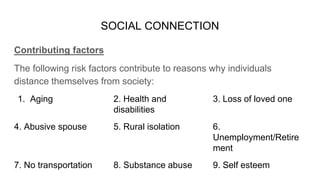
Contributing factors
The following risk factors contribute to reasons why individuals
distance themselves from society:
1. Aging 2. Health and
disabilities
3. Loss of loved one
4. Abusive spouse 5. Rural isolation 6.
Unemployment/Retire
ment
7. No transportation 8. Substance abuse 9. Self esteem
SOCIAL CONNECTION
Consequences of disconnection
A wide range of mammals, including rats, prairie voles, guinea pigs,
cattle, sheep, primates, and humans, experience distress and long-
term deficits when separated from their parent. In humans, long-lasting
health consequences result from early experiences of disconnection.
Disconnection or Chronic loneliness (loneliness which exists for a
significant amount of time in one's life) is generally correlated with
negative effects, including increased obesity, substance use disorder,
risk of depression, cardiovascular disease, risk of high blood pressure,
and high cholesterol. Chronic loneliness is also correlated with an
increased risk of death and suicidal thoughts.
SOCIAL CONNECTION
SOCIAL SUPPORT
Social support is the perception and actuality that one is cared for,
has assistance available from other people, and that one is part of a
supportive social network.
Social support can be categorized as follows:
1. Emotional support.
2. Tangible support.
3. Informational support.
4. Companionship support.
SOCIAL CONNECTION
SOCIAL SUPPORT
1. Emotional support.
Emotional support is the offering of empathy, concern, affection, love,
trust, acceptance, intimacy, encouragement, or caring. It is the warmth
and nurturance provided by sources of social support. Providing
emotional support can let the individual know that he or she is valued.
Sources of this support to the seniors are family members, friends,
social/religious groups and old fellow workers as well as pets.
SOCIAL CONNECTION
SOCIAL SUPPORT
2. Tangible support.
Tangible support is the provision of financial assistance, material
goods, or services. Also called instrumental support, this form of
social support encompasses the concrete, direct ways people
assist others.
This is usually provided by the immediate family members or the
Government through public aid.
SOCIAL CONNECTION
SOCIAL SUPPORT
3. Informational support.
Informational support is the provision of advice, guidance, suggestions, or
useful information to someone. This type of information has the potential to
help others problem-solve.
This category of social support can be provided by a variety of sources like
family members, friends/colleagues, Government sources, and
community/religious centres.
SOCIAL CONNECTION
SOCIAL SUPPORT
4. Companionship support.
Companionship support is the type of support that gives someone a
sense of social belonging (and is also called belonging). This can be
seen as the presence of companions to engage in shared social
activities. Formerly, it was also referred to as "esteem support" or
"appraisal support", but these have since developed into alternative
forms of support under the name "appraisal support" along with
normative and instrumental support.
SOCIAL CONNECTION
CONCLUDING REMARKS
1. Basic need.
2. Shared responsibility.
3. Individual role.
4. Family's role.
5. Neighbours’ role.
6. Community’s role.
7. Government role.
8. Importance of Social Support cannot be overemphasized.
THANK YOU

Social Connection.pptx

  • 1.
  • 2.
    SOCIAL CONNECTION DEFINITION Wikipedia definesSocial Connection as follows: Social connection is the experience of feeling close and connected to others. It involves feeling loved, cared for, and valued, and forms the basis of interpersonal relationships. In humans (one of the most social species), social connection is essential to nearly every aspect of health and well-being. Lack of connection, or loneliness, has been linked to inflammation, accelerated aging and cardiovascular health risk, suicide, and all- cause mortality.
  • 3.
    SOCIAL CONNECTION NEED FORSOCIAL CONNECTION Social connection and belonging may in fact be a basic need, as powerful as our need for food or water. Mammals are born relatively helpless, and rely on their caregivers not only for affection, but for survival. This may be evolutionarily why mammals need and seek connection, and also for why they suffer prolonged distress and health consequences when that need is not met.
  • 4.
    SOCIAL CONNECTION TYPES OFSOCIAL CONNECTION * Affection * Friendship * Interpersonal relationships * Intimate relationships * Human bonding * Love In this presentation I will discuss only “Affection” and “Friendship” which will be sufficient to demonstrate the importance of Social Connection in human life specially the Seniors. I will then move on to two related subjects which are very important from Senior’s point of view which are * Social isolation and * Social support.
  • 5.
    SOCIAL CONNECTION AFFECTION Affection orfondness is a "disposition or state of mind or body" that is often associated with a feeling or type of love. "Affection" is popularly used to denote a feeling or type of love, amounting to more than goodwill or friendship. More specifically, the word is also used to indicate emotional states, the object of which is a living thing such as a human or animal. Affection can be communicated by looks, words, gestures, or touches. It conveys love and social connection.
  • 6.
    SOCIAL CONNECTION Benefits ofAffection Affection exchange can be seen as an adaptive human behavior that contributes to greater physical and mental well-being. People who communicate positive feelings towards others show health benefits that include lower stress hormones, lower cholesterol, lower blood pressure and a stronger immune system. The affectionate person notices benefits internally when they express affection and not merely feel it; if this affection is not reciprocated by the receiver, the giver still feels the effects of the affection. We should therefore cultivate affection with other human beings like children, grand children, neighbours, old class fellows, office mates etc. Even pets can be good objects of affection.
  • 7.
    SOCIAL CONNECTION FRIENDSHIP Friendship ismutual affection between people. Stronger bond than an "acquaintance" or an "association". Some important features of Friendship: 1. Self disclosure. (willingness to share aspects of personal nature) 2. Instrumental aid. (help each other practically like driving a friend to the airport) 3. Similarity. (in world view or culture or religion or life experiences) 4. Enjoyment. (enjoy company of each other) 5. Agency. (sharing of each other’s information, skills or resources)
  • 8.
    SOCIAL CONNECTION Benefits ofFriendship to the Seniors: 1. Results in increased ability to accomplish activities of daily living, 2. Decreased instances of hospitalization, improved psychological well being and better outcomes related to rehabilitation. 3. As family responsibilities and vocational pressures lessen, friendships become more important. 4. It serves as a protective factor against depression and loneliness, and compensate for potential losses in social support previously given by family members. 5. For people who cannot go out as often, interactions with friends allow for continued societal interaction.
  • 9.
    SOCIAL CONNECTION SOCIAL ISOLATION Socialisolation is a state of complete or near-complete lack of contact between an individual and society. It differs from loneliness, which reflects temporary and involuntary lack of contact with other humans in the world. SYMPTOMS Every day aspects of deep-rooted social isolation can mean: ● staying home for an indefinite period of time due to lack of access to social situations rather than a desire to be alone; ● both not contacting, and not being contacted by, any acquaintances, even peripherally; for example, never being called by anybody on the telephone and never having anyone visit one's residence; ● a lack of meaningful, extended relationships, and especially close intimacy (both emotional and physical).
  • 10.
    SOCIAL CONNECTION Contributing factors Thefollowing risk factors contribute to reasons why individuals distance themselves from society: 1. Aging 2. Health and disabilities 3. Loss of loved one 4. Abusive spouse 5. Rural isolation 6. Unemployment/Retire ment 7. No transportation 8. Substance abuse 9. Self esteem
  • 11.
    SOCIAL CONNECTION Consequences ofdisconnection A wide range of mammals, including rats, prairie voles, guinea pigs, cattle, sheep, primates, and humans, experience distress and long- term deficits when separated from their parent. In humans, long-lasting health consequences result from early experiences of disconnection. Disconnection or Chronic loneliness (loneliness which exists for a significant amount of time in one's life) is generally correlated with negative effects, including increased obesity, substance use disorder, risk of depression, cardiovascular disease, risk of high blood pressure, and high cholesterol. Chronic loneliness is also correlated with an increased risk of death and suicidal thoughts.
  • 12.
    SOCIAL CONNECTION SOCIAL SUPPORT Socialsupport is the perception and actuality that one is cared for, has assistance available from other people, and that one is part of a supportive social network. Social support can be categorized as follows: 1. Emotional support. 2. Tangible support. 3. Informational support. 4. Companionship support.
  • 13.
    SOCIAL CONNECTION SOCIAL SUPPORT 1.Emotional support. Emotional support is the offering of empathy, concern, affection, love, trust, acceptance, intimacy, encouragement, or caring. It is the warmth and nurturance provided by sources of social support. Providing emotional support can let the individual know that he or she is valued. Sources of this support to the seniors are family members, friends, social/religious groups and old fellow workers as well as pets.
  • 14.
    SOCIAL CONNECTION SOCIAL SUPPORT 2.Tangible support. Tangible support is the provision of financial assistance, material goods, or services. Also called instrumental support, this form of social support encompasses the concrete, direct ways people assist others. This is usually provided by the immediate family members or the Government through public aid.
  • 15.
    SOCIAL CONNECTION SOCIAL SUPPORT 3.Informational support. Informational support is the provision of advice, guidance, suggestions, or useful information to someone. This type of information has the potential to help others problem-solve. This category of social support can be provided by a variety of sources like family members, friends/colleagues, Government sources, and community/religious centres.
  • 16.
    SOCIAL CONNECTION SOCIAL SUPPORT 4.Companionship support. Companionship support is the type of support that gives someone a sense of social belonging (and is also called belonging). This can be seen as the presence of companions to engage in shared social activities. Formerly, it was also referred to as "esteem support" or "appraisal support", but these have since developed into alternative forms of support under the name "appraisal support" along with normative and instrumental support.
  • 17.
    SOCIAL CONNECTION CONCLUDING REMARKS 1.Basic need. 2. Shared responsibility. 3. Individual role. 4. Family's role. 5. Neighbours’ role. 6. Community’s role. 7. Government role. 8. Importance of Social Support cannot be overemphasized.
  • 18.