Social Behavior Change
Communication
By Alfrique Otieno Mwana
Outline
- Understand behavior change
- Communication 4 development
- Social behavior change communication
- Model of change
- Stage 1 - Exploring SBCC
- Stage 2 – The new picture
- Stage 3 – Action
As change agents we emphasize on certain behaviours but fail to loo at
the underlying issues that affect adoption or rejaction of behaviour
Some people believe they have little choice
Some want conrete solutions
Understanding Behaviour
Change
1.. Group process is important
1. We were encultured to behave is a certain manner by the association we grew
up in or we find ourselves in. e.g. community and social groups
2. Behavior change is difficult
1. Behavior is hard to change because of our present behavior
o HABIT – as behavior are repeated habits are formed. The stronger the habit the harder it is
to break
CONT'
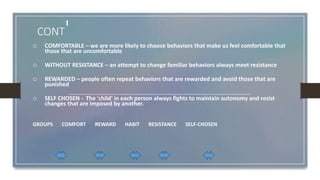
o COMFORTABLE – we are more likely to choose behaviors that make us feel comfortable that
those that are uncomfortable
o WITHOUT RESISTANCE – an attempt to change familiar behaviors always meet resistance
o REWARDED – people often repeat behaviors that are rewarded and avoid those that are
punished
o SELF CHOSEN - The 'child' in each person always fights to maintain autonomy and resist
changes that are imposed by another.
GROUPS COMFORT REWARD HABIT RESISTANCE SELF-CHOSEN
CONT'
3. How behavior changes
- Acceptance - Know and accept the present reality – behavior
- Choose and commit self to a possible new behavior
- ACT
4.. Belief is essential
- Change cannot occur without the basic belief an attitude that CHANGE IS POSSIBLE
- BASIC BELIEF IS -
• I need to change
• I have the capacity to change
• I can ask for spiritual power to change
CONT'
5.Helping others to change
- We help people to go through the BASIC BELIEF PROCESS
- We MUST believe in their capacity to change
- We MUST be willing to support then through the change
process
- We must have positive attitude and supporting skills and
develop relationships that catalyse change.
Understanding terms
Social - relations we have with others in comunity or organisation
Behavior- how we conduct ourselves towards others or a stimuli
Change - replacing something
Communication -exchange of information
Development - a process of changing a situation
Communication 4 development
C4D is evidence based process that utilizes a mix of
communication tools, channels and approaches to
facilitate participation and engagement with
communities, networks for positive social and behavior
change in both development and humanitarian contexts.
C4D is about unlocking the solutions that will help people
create change for themselves, their families, their
communities, or for a social cause (Unicef).
Communication 4 development
Development Communication was conceptualized over
fifty (50) years ago and arose out of the needs and crises of
the developing world and it keeps evolving.
In the 1980s, there was a new paradigm which adapted the
view that participation, horizontal
communication, collective action and an appreciation for
diversity and multiple viewpoints were central
to sustainable development.
Social Behavior Change Communication
- Is the strategic use of communication approaches to promote
changes in knowledge, attitudes, norms, beliefs and behaviors.
- Previously known as behavior change communication (BCC),
- SBCC is grounded in theory and is evidence-based. SBCC
programs are designed based on existing data and they follow a
systematic process, analyzing the problem in to define barriers
and motivators to change, and design a comprehensive set of
tailored interventions that promote the desired behaviors. (What Is
Social and Behavior Change Communication? – Emergency Communication Preparedness Implementation Kit, 2010)
Similarities between SBCC and C4D
- Evidence based process
- Social and behavior change
- Participation and engagement
- C4D combines the best of science and art.
- C4D uses all available and relevant platforms, channels and tools to
communicate and engage across all levels of society.
- Human centered insight makes C4D programmes prime for scale up.
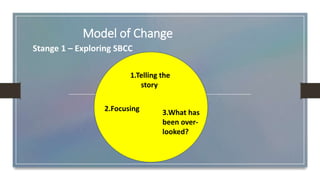
Model of Change
Stange 1 – Exploring SBCC
1.Telling the
story
2.Focusing 3.What has
been over-
looked?
Groups engagement
Telling the story
1. What do you value most in your life?
2. What pressures are put on you and by whom?
3. What makes your life difficult or easy?
4. What bothers you most about SBCCe?
5. What are the falsehoods and contradictions in SBCC?

Social Behavior Change Communication.pptx

  • 1.
  • 2.
    Outline - Understand behaviorchange - Communication 4 development - Social behavior change communication - Model of change - Stage 1 - Exploring SBCC - Stage 2 – The new picture - Stage 3 – Action
  • 3.
    As change agentswe emphasize on certain behaviours but fail to loo at the underlying issues that affect adoption or rejaction of behaviour Some people believe they have little choice Some want conrete solutions
  • 4.
    Understanding Behaviour Change 1.. Groupprocess is important 1. We were encultured to behave is a certain manner by the association we grew up in or we find ourselves in. e.g. community and social groups 2. Behavior change is difficult 1. Behavior is hard to change because of our present behavior o HABIT – as behavior are repeated habits are formed. The stronger the habit the harder it is to break
  • 5.
    CONT' o COMFORTABLE –we are more likely to choose behaviors that make us feel comfortable that those that are uncomfortable o WITHOUT RESISTANCE – an attempt to change familiar behaviors always meet resistance o REWARDED – people often repeat behaviors that are rewarded and avoid those that are punished o SELF CHOSEN - The 'child' in each person always fights to maintain autonomy and resist changes that are imposed by another. GROUPS COMFORT REWARD HABIT RESISTANCE SELF-CHOSEN
  • 6.
    CONT' 3. How behaviorchanges - Acceptance - Know and accept the present reality – behavior - Choose and commit self to a possible new behavior - ACT 4.. Belief is essential - Change cannot occur without the basic belief an attitude that CHANGE IS POSSIBLE - BASIC BELIEF IS - • I need to change • I have the capacity to change • I can ask for spiritual power to change
  • 7.
    CONT' 5.Helping others tochange - We help people to go through the BASIC BELIEF PROCESS - We MUST believe in their capacity to change - We MUST be willing to support then through the change process - We must have positive attitude and supporting skills and develop relationships that catalyse change.
  • 8.
    Understanding terms Social -relations we have with others in comunity or organisation Behavior- how we conduct ourselves towards others or a stimuli Change - replacing something Communication -exchange of information Development - a process of changing a situation
  • 9.
    Communication 4 development C4Dis evidence based process that utilizes a mix of communication tools, channels and approaches to facilitate participation and engagement with communities, networks for positive social and behavior change in both development and humanitarian contexts. C4D is about unlocking the solutions that will help people create change for themselves, their families, their communities, or for a social cause (Unicef).
  • 10.
    Communication 4 development DevelopmentCommunication was conceptualized over fifty (50) years ago and arose out of the needs and crises of the developing world and it keeps evolving. In the 1980s, there was a new paradigm which adapted the view that participation, horizontal communication, collective action and an appreciation for diversity and multiple viewpoints were central to sustainable development.
  • 11.
    Social Behavior ChangeCommunication - Is the strategic use of communication approaches to promote changes in knowledge, attitudes, norms, beliefs and behaviors. - Previously known as behavior change communication (BCC), - SBCC is grounded in theory and is evidence-based. SBCC programs are designed based on existing data and they follow a systematic process, analyzing the problem in to define barriers and motivators to change, and design a comprehensive set of tailored interventions that promote the desired behaviors. (What Is Social and Behavior Change Communication? – Emergency Communication Preparedness Implementation Kit, 2010)
  • 12.
    Similarities between SBCCand C4D - Evidence based process - Social and behavior change - Participation and engagement - C4D combines the best of science and art. - C4D uses all available and relevant platforms, channels and tools to communicate and engage across all levels of society. - Human centered insight makes C4D programmes prime for scale up.
  • 13.
    Model of Change Stange1 – Exploring SBCC 1.Telling the story 2.Focusing 3.What has been over- looked?
  • 14.
    Groups engagement Telling thestory 1. What do you value most in your life? 2. What pressures are put on you and by whom? 3. What makes your life difficult or easy? 4. What bothers you most about SBCCe? 5. What are the falsehoods and contradictions in SBCC?