How Social Systems & Cultural Systems Work A Comparison of Cities as Social Systems to Countries as Cultural Systems
Example 1: The Social Dynamics of Cities (Urban Systems)
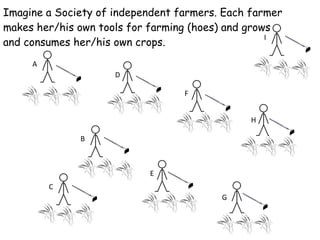
A B C D E F G H I Imagine a Society of independent farmers. Each farmer makes her/his own tools for farming (hoes) and grows and consumes her/his own crops.
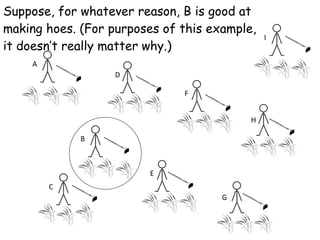
A B C D E F G H I Suppose, for whatever reason, B is good at making hoes. (For purposes of this example, it doesn’t really matter why.)
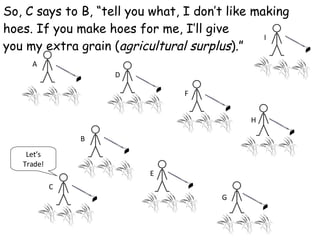
A B C D E F G H I Let’s Trade! So, C says to B, “tell you what, I don’t like making hoes. If you make hoes for me, I’ll give you my extra grain ( agricultural surplus ).”
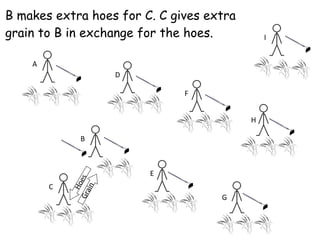
A B C D E F G H I B makes extra hoes for C. C gives extra grain to B in exchange for the hoes. Hoes Grain
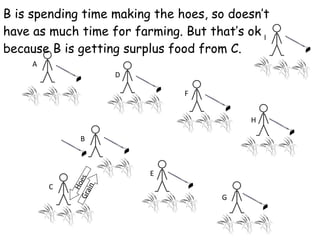
A B C D E F G H I B is spending time making the hoes, so doesn’t have as much time for farming. But that’s ok because B is getting surplus food from C. Hoes Grain
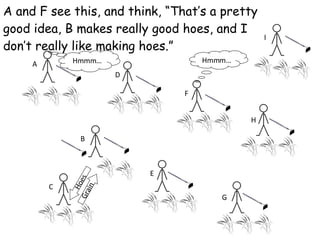
A B C D E F G H I Hmmm… Hmmm… A and F see this, and think, “That’s a pretty good idea, B makes really good hoes, and I don’t really like making hoes.” Hoes Grain
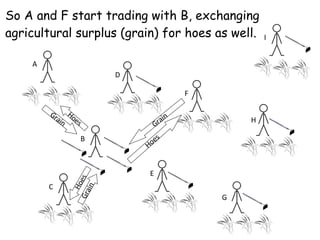
A B C D E F G H I Grain Hoes Hoes Grain So A and F start trading with B, exchanging agricultural surplus (grain) for hoes as well. Hoes Grain
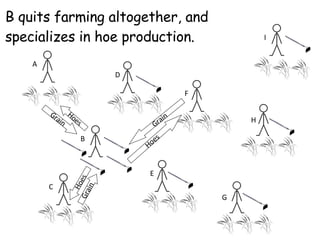
A B C D E F G H I Grain Hoes Hoes Grain B quits farming altogether, and specializes in hoe production. Hoes Grain
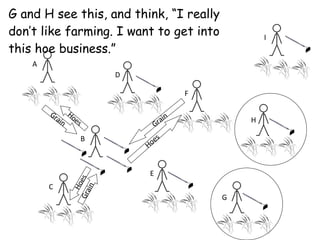
A B C D E F G H I Grain Hoes Hoes Grain G and H see this, and think, “I really don’t like farming. I want to get into this hoe business.” Hoes Grain
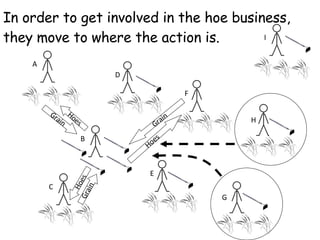
A B C D E F G H I Grain Hoes Hoes Grain In order to get involved in the hoe business, they move to where the action is. Hoes Grain
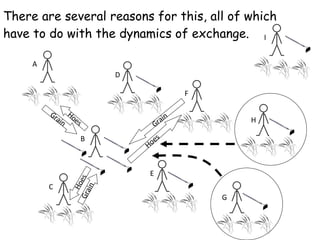
A B C D E F G H I Grain Hoes Hoes Grain There are several reasons for this, all of which have to do with the dynamics of exchange. Hoes Grain
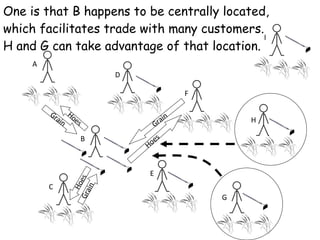
A B C D E F G H I Grain Hoes Hoes Grain One is that B happens to be centrally located, which facilitates trade with many customers. H and G can take advantage of that location.  Hoes Grain
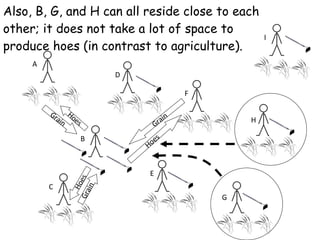
A B C D E F G H I Grain Hoes Hoes Grain Also, B, G, and H can all reside close to each other; it does not take a lot of space to produce hoes (in contrast to agriculture). Hoes Grain
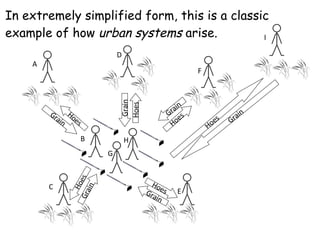
A B C D E F G H I Grain Hoes Hoes Grain Hoes Grain Grain Grain Hoes Hoes Grain Hoes In extremely simplified form, this is a classic example of how  urban systems  arise.
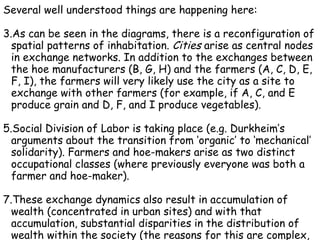
Several well understood things are happening here: As can be seen in the diagrams, there is a reconfiguration of spatial patterns of inhabitation.  Cities  arise as central nodes in exchange networks. In addition to the exchanges between the hoe manufacturers (B, G, H) and the farmers (A, C, D, E, F, I), the farmers will very likely use the city as a site to exchange with other farmers (for example, if A, C, and E produce grain and D, F, and I produce vegetables). Social Division of Labor is taking place (e.g. Durkheim’s arguments about the transition from ‘organic’ to ‘mechanical’ solidarity). Farmers and hoe-makers arise as two distinct occupational classes (where previously everyone was both a farmer and hoe-maker). These exchange dynamics also result in accumulation of wealth (concentrated in urban sites) and with that accumulation, substantial disparities in the distribution of wealth within the society (the reasons for this are complex, and not represented in the diagram; but this seems to inevitably occur under the conditions outlined here; see for example Marx’s analysis of  Capital).
The important point here is that all of this has to do primarily with Social (Exchange) Dynamics. It is driven by the entailments of the exchange relationships; not primarily what people think about those relationships. People do ‘think’ and make decisions (in a rational choice way), but the system is not dependent on what people believe about these exchanges (other than believing that the exchanges are worth doing).
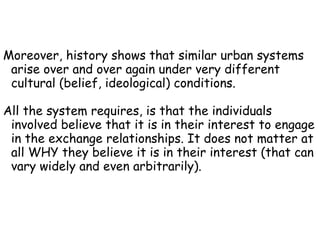
Moreover, history shows that similar urban systems arise over and over again under very different cultural (belief, ideological) conditions. All the system requires, is that the individuals involved believe that it is in their interest to engage in the exchange relationships. It does not matter at all WHY they believe it is in their interest (that can vary widely and even arbitrarily).
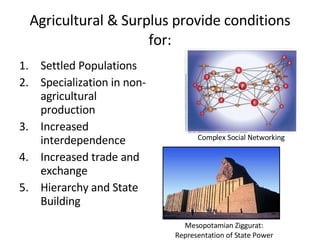
Agricultural & Surplus provide conditions for: Settled Populations Specialization in non-agricultural production Increased interdependence Increased trade and exchange Hierarchy and State Building Complex Social Networking Mesopotamian Ziggurat: Representation of State Power
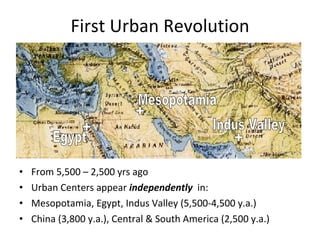
First Urban Revolution From 5,500 – 2,500 yrs ago Urban Centers appear  independently   in: Mesopotamia, Egypt, Indus Valley (5,500-4,500 y.a.) China (3,800 y.a.), Central & South America (2,500 y.a.)  Mesopotamia Egypt Indus Valley + + +
Example 2: The Cultural Dynamics of Countries (“Territorial Nation-States”)
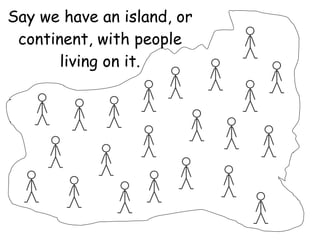
Say we have an island, or continent, with people living on it.
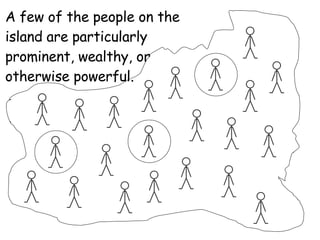
A few of the people on the island are particularly prominent, wealthy, or otherwise powerful.
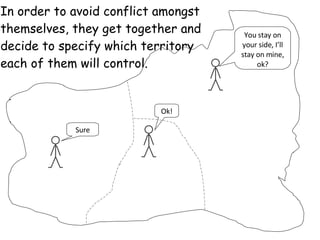
In order to avoid conflict amongst themselves, they get together and decide to specify which territory each of them will control. You stay on your side, I’ll stay on mine, ok? Ok! Sure
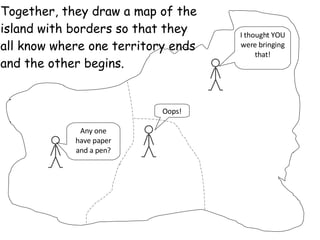
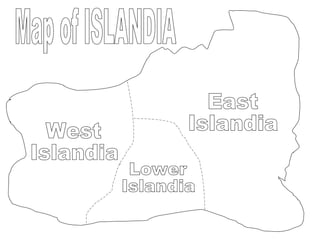
Together, they draw a map of the island with borders so that they all know where one territory ends and the other begins. I thought YOU were bringing that! Oops! Any one have paper and a pen?
Map of ISLANDIA West Islandia East Islandia Lower Islandia
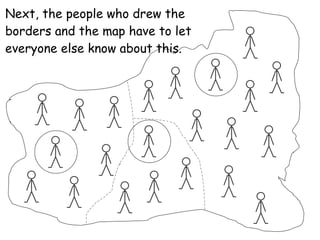
Next, the people who drew the borders and the map have to let everyone else know about this.
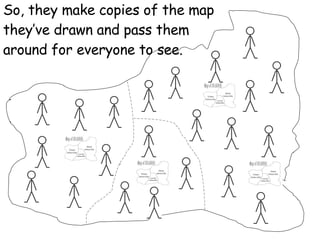
So, they make copies of the map they’ve drawn and pass them around for everyone to see.
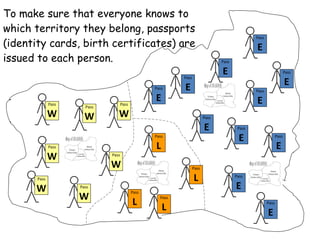
To make sure that everyone knows to which territory they belong, passports (identity cards, birth certificates) are issued to each person. Pass W Pass W Pass W Pass W Pass W Pass W Pass W Pass E Pass E Pass E Pass E Pass E Pass E Pass E Pass E Pass E Pass E Pass E Pass L Pass L Pass L Pass L
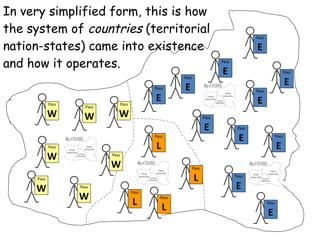
In very simplified form, this is how the system of  countries  (territorial nation-states) came into existence and how it operates. Pass W Pass W Pass W Pass W Pass W Pass W Pass W Pass E Pass E Pass E Pass E Pass E Pass E Pass E Pass E Pass E Pass E Pass E Pass L Pass L Pass L Pass L
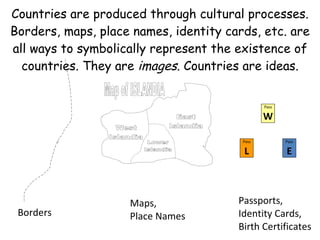
Borders Maps, Place Names Pass W Pass L Pass E Passports, Identity Cards, Birth Certificates  Countries are produced through cultural processes. Borders, maps, place names, identity cards, etc. are all ways to symbolically represent the existence of countries. They are  images . Countries are ideas.
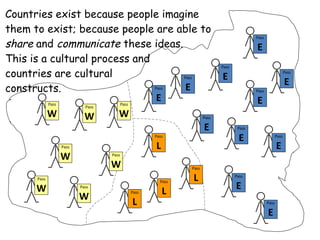
Countries exist because people imagine them to exist; because people are able to  share  and  communicate  these ideas. This is a cultural process and countries are cultural constructs. Pass W Pass W Pass W Pass W Pass W Pass W Pass W Pass E Pass E Pass E Pass E Pass E Pass E Pass E Pass E Pass E Pass E Pass E Pass L Pass L Pass L Pass L
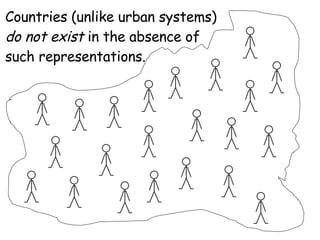
Countries (unlike urban systems)  do not exist  in the absence of such representations.
Social & Cultural Systems The Comparison of Cities as Social Systems and Countries as Cultural Systems illustrates the distinction between the two. But neither exists without the other. We always live our lives in social systems (of relationship and exchange) and cultural systems (of beliefs and ideas).

Social And Cultural Systems

  • 1.
    How Social Systems& Cultural Systems Work A Comparison of Cities as Social Systems to Countries as Cultural Systems
  • 2.
    Example 1: TheSocial Dynamics of Cities (Urban Systems)
  • 3.
    A B CD E F G H I Imagine a Society of independent farmers. Each farmer makes her/his own tools for farming (hoes) and grows and consumes her/his own crops.
  • 4.
    A B CD E F G H I Suppose, for whatever reason, B is good at making hoes. (For purposes of this example, it doesn’t really matter why.)
  • 5.
    A B CD E F G H I Let’s Trade! So, C says to B, “tell you what, I don’t like making hoes. If you make hoes for me, I’ll give you my extra grain ( agricultural surplus ).”
  • 6.
    A B CD E F G H I B makes extra hoes for C. C gives extra grain to B in exchange for the hoes. Hoes Grain
  • 7.
    A B CD E F G H I B is spending time making the hoes, so doesn’t have as much time for farming. But that’s ok because B is getting surplus food from C. Hoes Grain
  • 8.
    A B CD E F G H I Hmmm… Hmmm… A and F see this, and think, “That’s a pretty good idea, B makes really good hoes, and I don’t really like making hoes.” Hoes Grain
  • 9.
    A B CD E F G H I Grain Hoes Hoes Grain So A and F start trading with B, exchanging agricultural surplus (grain) for hoes as well. Hoes Grain
  • 10.
    A B CD E F G H I Grain Hoes Hoes Grain B quits farming altogether, and specializes in hoe production. Hoes Grain
  • 11.
    A B CD E F G H I Grain Hoes Hoes Grain G and H see this, and think, “I really don’t like farming. I want to get into this hoe business.” Hoes Grain
  • 12.
    A B CD E F G H I Grain Hoes Hoes Grain In order to get involved in the hoe business, they move to where the action is. Hoes Grain
  • 13.
    A B CD E F G H I Grain Hoes Hoes Grain There are several reasons for this, all of which have to do with the dynamics of exchange. Hoes Grain
  • 14.
    A B CD E F G H I Grain Hoes Hoes Grain One is that B happens to be centrally located, which facilitates trade with many customers. H and G can take advantage of that location. Hoes Grain
  • 15.
    A B CD E F G H I Grain Hoes Hoes Grain Also, B, G, and H can all reside close to each other; it does not take a lot of space to produce hoes (in contrast to agriculture). Hoes Grain
  • 16.
    A B CD E F G H I Grain Hoes Hoes Grain Hoes Grain Grain Grain Hoes Hoes Grain Hoes In extremely simplified form, this is a classic example of how urban systems arise.
  • 17.
    Several well understoodthings are happening here: As can be seen in the diagrams, there is a reconfiguration of spatial patterns of inhabitation. Cities arise as central nodes in exchange networks. In addition to the exchanges between the hoe manufacturers (B, G, H) and the farmers (A, C, D, E, F, I), the farmers will very likely use the city as a site to exchange with other farmers (for example, if A, C, and E produce grain and D, F, and I produce vegetables). Social Division of Labor is taking place (e.g. Durkheim’s arguments about the transition from ‘organic’ to ‘mechanical’ solidarity). Farmers and hoe-makers arise as two distinct occupational classes (where previously everyone was both a farmer and hoe-maker). These exchange dynamics also result in accumulation of wealth (concentrated in urban sites) and with that accumulation, substantial disparities in the distribution of wealth within the society (the reasons for this are complex, and not represented in the diagram; but this seems to inevitably occur under the conditions outlined here; see for example Marx’s analysis of Capital).
  • 18.
    The important pointhere is that all of this has to do primarily with Social (Exchange) Dynamics. It is driven by the entailments of the exchange relationships; not primarily what people think about those relationships. People do ‘think’ and make decisions (in a rational choice way), but the system is not dependent on what people believe about these exchanges (other than believing that the exchanges are worth doing).
  • 19.
    Moreover, history showsthat similar urban systems arise over and over again under very different cultural (belief, ideological) conditions. All the system requires, is that the individuals involved believe that it is in their interest to engage in the exchange relationships. It does not matter at all WHY they believe it is in their interest (that can vary widely and even arbitrarily).
  • 20.
    Agricultural & Surplusprovide conditions for: Settled Populations Specialization in non-agricultural production Increased interdependence Increased trade and exchange Hierarchy and State Building Complex Social Networking Mesopotamian Ziggurat: Representation of State Power
  • 21.
    First Urban RevolutionFrom 5,500 – 2,500 yrs ago Urban Centers appear independently in: Mesopotamia, Egypt, Indus Valley (5,500-4,500 y.a.) China (3,800 y.a.), Central & South America (2,500 y.a.) Mesopotamia Egypt Indus Valley + + +
  • 22.
    Example 2: TheCultural Dynamics of Countries (“Territorial Nation-States”)
  • 23.
    Say we havean island, or continent, with people living on it.
  • 24.
    A few ofthe people on the island are particularly prominent, wealthy, or otherwise powerful.
  • 25.
    In order toavoid conflict amongst themselves, they get together and decide to specify which territory each of them will control. You stay on your side, I’ll stay on mine, ok? Ok! Sure
  • 26.
    Together, they drawa map of the island with borders so that they all know where one territory ends and the other begins. I thought YOU were bringing that! Oops! Any one have paper and a pen?
  • 27.
    Map of ISLANDIAWest Islandia East Islandia Lower Islandia
  • 28.
    Next, the peoplewho drew the borders and the map have to let everyone else know about this.
  • 29.
    So, they makecopies of the map they’ve drawn and pass them around for everyone to see.
  • 30.
    To make surethat everyone knows to which territory they belong, passports (identity cards, birth certificates) are issued to each person. Pass W Pass W Pass W Pass W Pass W Pass W Pass W Pass E Pass E Pass E Pass E Pass E Pass E Pass E Pass E Pass E Pass E Pass E Pass L Pass L Pass L Pass L
  • 31.
    In very simplifiedform, this is how the system of countries (territorial nation-states) came into existence and how it operates. Pass W Pass W Pass W Pass W Pass W Pass W Pass W Pass E Pass E Pass E Pass E Pass E Pass E Pass E Pass E Pass E Pass E Pass E Pass L Pass L Pass L Pass L
  • 32.
    Borders Maps, PlaceNames Pass W Pass L Pass E Passports, Identity Cards, Birth Certificates Countries are produced through cultural processes. Borders, maps, place names, identity cards, etc. are all ways to symbolically represent the existence of countries. They are images . Countries are ideas.
  • 33.
    Countries exist becausepeople imagine them to exist; because people are able to share and communicate these ideas. This is a cultural process and countries are cultural constructs. Pass W Pass W Pass W Pass W Pass W Pass W Pass W Pass E Pass E Pass E Pass E Pass E Pass E Pass E Pass E Pass E Pass E Pass E Pass L Pass L Pass L Pass L
  • 34.
    Countries (unlike urbansystems) do not exist in the absence of such representations.
  • 35.
    Social & CulturalSystems The Comparison of Cities as Social Systems and Countries as Cultural Systems illustrates the distinction between the two. But neither exists without the other. We always live our lives in social systems (of relationship and exchange) and cultural systems (of beliefs and ideas).