1/5/2013 CUbRIK Presentation 0
Building social graphs from images
through expert-based crowdsourcing
M. Dionisio, P. Fraternali, D. Martinenghi, C. Pasini, M.
Tagliasacchi, S. Zagorac (Politecnico Di Milano, Italy)
E. Harloff, I. Micheel, J. Novak
(European Institute for Participatory Media, Germany)
1/5/2013 CUbRIK Presentation 1
The CUbRIK project
 CUbRIK is a research project
financed by the European
Union whose main goals are:
1. Advance the architecture of
multimedia search
2. Exploit the human contribution
in multimedia search
3. Use open source components
provided by the community
4. Start up a search business
ecosystem
1/5/2013 CUbRIK Presentation 2
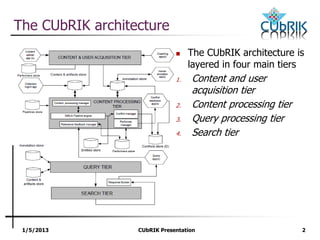
The CUbRIK architecture
 The CUbRIK architecture is
layered in four main tiers
1. Content and user
acquisition tier
2. Content processing tier
3. Query processing tier
4. Search tier
1/5/2013 CUbRIK Presentation 3
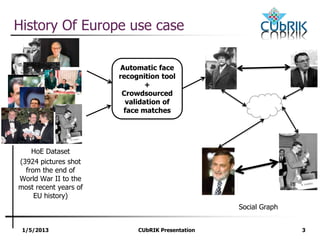
History Of Europe use case
HoE Dataset
(3924 pictures shot
from the end of
World War II to the
most recent years of
EU history)
Automatic face
recognition tool
+
Crowdsourced
validation of
face matches
Social Graph
1/5/2013 CUbRIK Presentation 4
Content processing pipeline
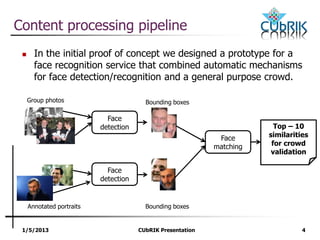
 In the initial proof of concept we designed a prototype for a
face recognition service that combined automatic mechanisms
for face detection/recognition and a general purpose crowd.
Group photos
Face
detection
Bounding boxes
Face
matching
Annotated portraits
Face
detection
Bounding boxes
Top – 10
similarities
for crowd
validation
1/5/2013 CUbRIK Presentation 5
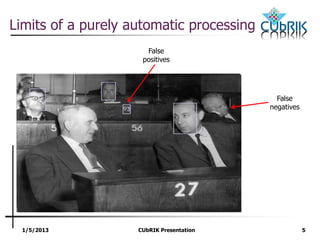
Limits of a purely automatic processing
False
negatives
False
positives
1/5/2013 CUbRIK Presentation 6
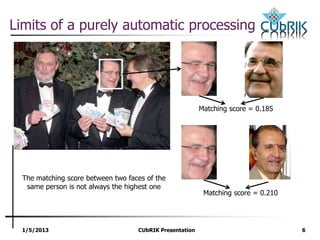
Limits of a purely automatic processing
Matching score = 0.185
Matching score = 0.210
The matching score between two faces of the
same person is not always the highest one
1/5/2013 CUbRIK Presentation 7
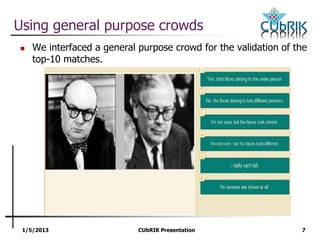
Using general purpose crowds
 We interfaced a general purpose crowd for the validation of the
top-10 matches.
1/5/2013 CUbRIK Presentation 8
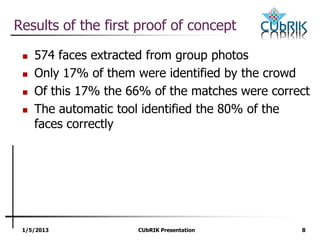
Results of the first proof of concept
 574 faces extracted from group photos
 Only 17% of them were identified by the crowd
 Of this 17% the 66% of the matches were correct
 The automatic tool identified the 80% of the
faces correctly
1/5/2013 CUbRIK Presentation 9
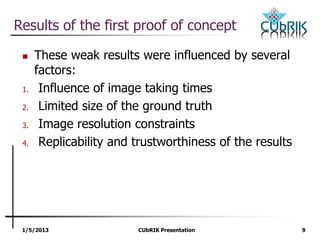
Results of the first proof of concept
 These weak results were influenced by several
factors:
1. Influence of image taking times
2. Limited size of the ground truth
3. Image resolution constraints
4. Replicability and trustworthiness of the results
1/5/2013 CUbRIK Presentation 10
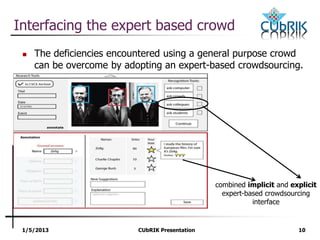
Interfacing the expert based crowd
 The deficiencies encountered using a general purpose crowd
can be overcome by adopting an expert-based crowdsourcing.
combined implicit and explicit
expert-based crowdsourcing
interface
1/5/2013 CUbRIK Presentation 11
Interfacing the expert based crowd
 Indications suggest that the expert-based strategy can
succeed:
1. Experts’ knowledge can overcome the drawbacks both
of the automatic tool and of the general purpose crowd
2. They can use the already existing community means to
contact colleagues and cooperate to fulfill the task.
1/5/2013 CUbRIK Presentation 12
Interfacing the expert based crowd
Thank you!

So human presentation

  • 1.
    1/5/2013 CUbRIK Presentation0 Building social graphs from images through expert-based crowdsourcing M. Dionisio, P. Fraternali, D. Martinenghi, C. Pasini, M. Tagliasacchi, S. Zagorac (Politecnico Di Milano, Italy) E. Harloff, I. Micheel, J. Novak (European Institute for Participatory Media, Germany)
  • 2.
    1/5/2013 CUbRIK Presentation1 The CUbRIK project  CUbRIK is a research project financed by the European Union whose main goals are: 1. Advance the architecture of multimedia search 2. Exploit the human contribution in multimedia search 3. Use open source components provided by the community 4. Start up a search business ecosystem
  • 3.
    1/5/2013 CUbRIK Presentation2 The CUbRIK architecture  The CUbRIK architecture is layered in four main tiers 1. Content and user acquisition tier 2. Content processing tier 3. Query processing tier 4. Search tier
  • 4.
    1/5/2013 CUbRIK Presentation3 History Of Europe use case HoE Dataset (3924 pictures shot from the end of World War II to the most recent years of EU history) Automatic face recognition tool + Crowdsourced validation of face matches Social Graph
  • 5.
    1/5/2013 CUbRIK Presentation4 Content processing pipeline  In the initial proof of concept we designed a prototype for a face recognition service that combined automatic mechanisms for face detection/recognition and a general purpose crowd. Group photos Face detection Bounding boxes Face matching Annotated portraits Face detection Bounding boxes Top – 10 similarities for crowd validation
  • 6.
    1/5/2013 CUbRIK Presentation5 Limits of a purely automatic processing False negatives False positives
  • 7.
    1/5/2013 CUbRIK Presentation6 Limits of a purely automatic processing Matching score = 0.185 Matching score = 0.210 The matching score between two faces of the same person is not always the highest one
  • 8.
    1/5/2013 CUbRIK Presentation7 Using general purpose crowds  We interfaced a general purpose crowd for the validation of the top-10 matches.
  • 9.
    1/5/2013 CUbRIK Presentation8 Results of the first proof of concept  574 faces extracted from group photos  Only 17% of them were identified by the crowd  Of this 17% the 66% of the matches were correct  The automatic tool identified the 80% of the faces correctly
  • 10.
    1/5/2013 CUbRIK Presentation9 Results of the first proof of concept  These weak results were influenced by several factors: 1. Influence of image taking times 2. Limited size of the ground truth 3. Image resolution constraints 4. Replicability and trustworthiness of the results
  • 11.
    1/5/2013 CUbRIK Presentation10 Interfacing the expert based crowd  The deficiencies encountered using a general purpose crowd can be overcome by adopting an expert-based crowdsourcing. combined implicit and explicit expert-based crowdsourcing interface
  • 12.
    1/5/2013 CUbRIK Presentation11 Interfacing the expert based crowd  Indications suggest that the expert-based strategy can succeed: 1. Experts’ knowledge can overcome the drawbacks both of the automatic tool and of the general purpose crowd 2. They can use the already existing community means to contact colleagues and cooperate to fulfill the task.
  • 13.
    1/5/2013 CUbRIK Presentation12 Interfacing the expert based crowd Thank you!