
SoC System Manager (SSM)


The Industry’s First SoC IP Subsystem Dedicated
       To System Resource Management
Co-Developed By:
                                                  1
SoC Complexity Accelerating
                                                            "Average" Number of IP Blocks on SoCs Today

                                    Source: Semico Research
                             100
                              90
 Avg. Number of SIP Blocks


                              80
                              70                                                   Over 50 IP Blocks!
                              60
                              50
                              40
                              30
                              20
                              10
                               0
                                                                     2002


                                                                            2003


                                                                                    2004


                                                                                           2005


                                                                                                  2006


                                                                                                           2007


                                                                                                                  2008
                                                              2001
                                                     2000
                                    1998


                                           1999


                                                                                                                         2009*


                                                                                                                                 2010*


                                                                                                                                                         2013*
                                                                                                                                         2011*


                                                                                                                                                 2012*
                                                  Avg. Number of CPU / DSP / Controllers                 Avg. Number of 'Other' SIP Blocks
                                                  Avg. Number of Embedded Memory Blocks                    Total SIP Blocks


                                   Volume Consumer Markets
                                       Driving the Trend
                                                                                                                                                                 2
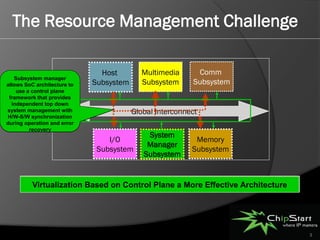
The Resource Management Challenge

                                 Host        Multimedia      Comm
   Lack of directmanager
    Subsystem hardware
allows SoC architecture to
   connectivity & complex      Subsystem     Subsystem      Subsystem
     use a control plane
   interconnect arbitration
 complicates that provides
 framework ability for host
  independent top down
  to manage system state
changesmanagement H/W-
system and maintain with                   Global Interconnect
H/W-S/W synchronization
S/W synchronization during
during operation and error
operation and error recovery
          recovery
                                               System
                                   I/O                       Memory
                                               Manager
                                Subsystem                   Subsystem
                                              Subsystem


               How Will the System Be Managed?
       Host Visibility and ControlControl Plane aOptimize System Management
        Virtualization Based on Inadequate to More Effective Architecture


                                                                              3
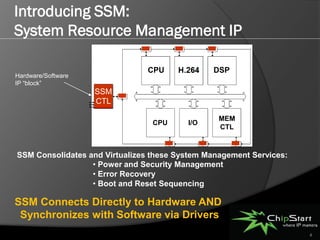
Introducing SSM:
System Resource Management IP

                               CPU             DSP
Hardware/Software
IP “block”
                    SSM
                    SSM
                    H/W
                    CTL

                                                 MEM
                                 CPU     I/O
                                                 CTL


SSM Consolidates and Virtualizes these System Management Services:
                  • Power and Security Management
                  • Error Recovery
                  • Boot and Reset Sequencing

SSM Connects Directly to Hardware AND
 Synchronizes with Software via Drivers
                                                                     4
SSM Advantages
   Lowers development costs and risks
     Design and verify at architecture stage
     Pre-verify system management policies and reuse
   Increases the value of the SoC deliverable
     Improves software-system management control
     Mitigates hardware-software dependencies
   Creates new opportunities to innovate
     New power management schemes made possible
     Increasing integration complexities manageable

Shift System Management Out of the Design
          and into the Architecture
                                                        5
The “Ripple Savings” Effect
   Architecture
     Top down system management provides high reuse framework for streamlining
      product line management.
   Design
     Pre-defined topology eliminates creating ad hoc solutions during the design process.
   Verification
     Test schemes predesigned during architecture development accelerates starting
      point for verification script generation.
   Software Development
     Shift to architecture significantly reduces burden to create similar solutions and
      provides more chip behavior predictability before chip design commences.
   Bring Up and Test
     Provides unique post silicon control of IP cores for checkout and functional
      verification. Scripts also a way to implement potential work-arounds.
   Production Engineering
     Consistent testing methodology throughout all phases of the development cycle
      yields a comprehensive suite of testing sequences that are also easily modified.

    Savings Multiply During Development
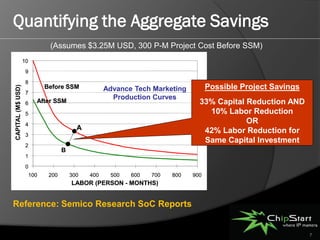
Quantifying the Aggregate Savings
                               (Assumes $3.25M USD, 300 P-M Project Cost Before SSM)
                   10
                    9

                    8
                              Before SSM                                            Possible Project Savings
CAPITAL (M$ USD)


                    7
                                                     Advance Tech Marketing
                                                       Production Curves
                    6     After SSM                                             33% Capital Reduction AND
                    5                                                             10% Labor Reduction
                    4
                                                                                            OR
                                           A                                     42% Labor Reduction for
                    3
                                                                                 Same Capital Investment
                    2
                                     B
                    1
                    0
                        100    200       300   400    500   600   700   800   900
                                         LABOR (PERSON - MONTHS)


Reference: Semico Research SoC Reports


                                                                                                               7
SSM Use Models


                 8
SSM Use Models
   SSM facilitates the management of system resources such
    as power management, security, error recover, and boot
    and reset sequencing
   Control of these system resources, and the ability to
    communicate directly with software, makes SSM an
    excellent resource for many different uses:
     Hardware Development
      ○ Architecture Enhancement
          Top down system management provides high reuse framework for streamlining system
            resource management across product lines
      ○ Design Acceleration
          Pre-defined topology within the architecture eliminates creating ad hoc solutions during the
            design process.
      ○ Verification
          Test schemes predesigned during architecture development can be used to accelerate the
            starting point for verification test generation.
SSM Use Models… continued
   Software Development
     Shift to architecture significantly reduces burden to create similar system
       management solutions in software and creates clear methodology for maintaining
       synchronization between software and underlying IP hardware during operation
   Bring Up and Test
     Provides unique post silicon control of IP cores for debugging. Scripts also a way to
       implement potential work-arounds to problems associated with IP block state
       changes.
   Production Engineering Testing
     Consistent testing methodology throughout all phases of the development cycle yields
       a comprehensive suite of testing sequences that are also easily modified.
   Remote Diagnostics and Updating
     SSM can deliver IP block state data to a remote host using a communications link or
      a JTAG port for debugging and monitoring functions.
     SSM can be used to coordinate firmware and software updates remotely through the
      use of its communications bus and connectivity to the IP blocks.
          
SSM Technical Overview


                         11
SSM Hardware Connectivity

 SSM register
  blocks and
  control bus                  CPU             DSP

                   SSM
                   SSM
                   CTL
                   H/W

                                                MEM
                                CPU      I/O
                                                CTL


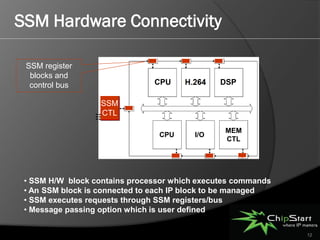
 • SSM H/W block contains processor which executes commands
 • An SSM block is connected to each IP block to be managed
 • SSM executes requests through SSM registers/bus
 • Message passing option which is user defined


                                                              12
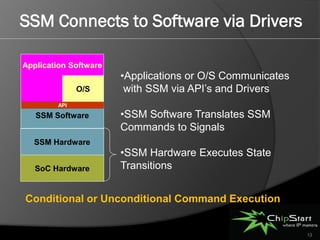
SSM Connects to Software via Drivers

Application Software
                       •Applications or O/S Communicates
              O/S       with SSM via API’s and Drivers
        API

   SSM Software        •SSM Software Translates SSM
                       Commands to Signals
  SSM Hardware
                       •SSM Hardware Executes State
   SoC Hardware        Transitions


Conditional or Unconditional Command Execution


                                                           13
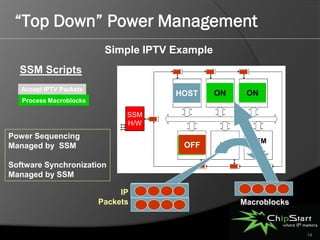
“Top Down” Power Management
                          Simple IPTV Example
  SSM Scripts
   Accept IPTV Packets
                                       CPU
                                      HOST   ON
                                             OFF      DSP
                                                      ON
                                                      OFF
   Process Macroblocks

                               SSM
                               H/W
Power Sequencing
                                                        MEM
Managed by SSM                         OFF
                                       CPU
                                       ON       I/O
                                                        CTL

Software Synchronization
Managed by SSM

                              IP
                         Packets                      Macroblocks


                                                                    14
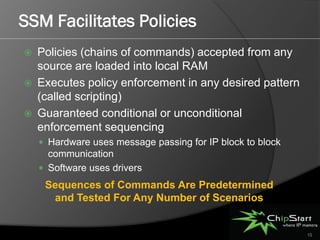
SSM Facilitates Policies
   Policies (chains of commands) accepted from any
    source are loaded into local RAM
   Executes policy enforcement in any desired pattern
    (called scripting)
   Guaranteed conditional or unconditional
    enforcement sequencing
     Hardware uses message passing for IP block to block
      communication
     Software uses drivers
     Sequences of Commands Are Predetermined
      and Tested For Any Number of Scenarios


                                                            15
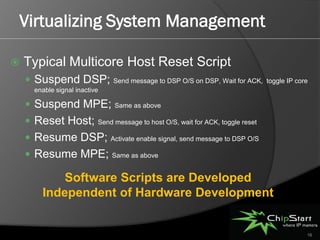
Virtualizing System Management

   Typical Multicore Host Reset Script
     Suspend DSP;             Send message to DSP O/S on DSP, Wait for ACK, toggle IP core
     enable signal inactive

     Suspend MPE;             Same as above

     Reset Host;         Send message to host O/S, wait for ACK, toggle reset

     Resume DSP;             Activate enable signal, send message to DSP O/S

     Resume MPE;             Same as above


           Software Scripts are Developed
       Independent of Hardware Development


                                                                                          16
SSM Advantages

   Simplifies accessibility and control of all managed IP blocks
   Guaranteed synchronization between hardware and
    software while executing complex sequences
   Virtualization of system management functions
     Compartmentalizes instantiation dependencies
     Improves software’s ability to control hardware


                 Saves Time and Money
          Offers SoC Architecture Consistency


                                                              17
SSM Subsystem Components

   Hardware (Soft IP)
     SSM Controller
     SSM Register bus connection


   Software
     SSM software
     API
     Drivers


                                    18
SSM Addresses Key System Issues

   Standardizes Management of Key System Functions
     Power, security, error recovery, boot sequencing


   Eases Hardware Software Integration

   Provides A Reusable Architecture Across Many SoCs

      A Subsystem Suited for Universal Adoption


                                                         19
About ChipStart

 ChipStart is the only, full-function
  semiconductor IP solution alternative
 IP Subsystem Solutions oriented
 Experienced team (+250 years in IP)
 Delivering value with integration


               ChipStart LLC - CONFIDENTIAL
ChipStart Contact Page
ChipStart LLC                                                Northeast USA
228 Hamilton Ave., 3rd Floor                                 Cambridge, MA 02140
Palo Alto, CA 94301                                          Office:     +1.617.678.9814
Office:      +1.650.461.9195
Email:       info@chip-start.com
                                                             Central USA
ChipStart UK                                                 Austin, TX   78726
Maidenhead, Berkshire SL6 4LZ                                Office:      +1.512.560.4672
Office:     +44 20 3286 0905
                                                             Northwest USA
ChipStart France                                             Evergreen, CO 80439
91570 Bievres                                                Office:     +1. 303.506.1088
Office:     +33-682-652-808
                                                             ChipStart Canada
ChipStart Israel                                             Oakville, ON L6J 0A2
Raanana, 43380                                               Office:     +1.905.634.6688
Office:     +972 9 7713312                                   Fax:        +1.905.592.2048

ChipStart Japan                                              ChipStart China
Level 28, Shinagawa Intercity Tower A                        Unit A, 14F, Asia Harvest Commercial Centre
2-15-1 Konan, Minato-ku                                      Shau Kei Wan, Hong Kong
Tokyo 108-6028                                               Office:        +86 138 2336 5688
Office:      +81-3-45789359
FAX:         +81-3- 6717-4141


                                        www.chip-start.com

Managing IP Subsystems at the System Level

  • 1.
    SoC System Manager(SSM) The Industry’s First SoC IP Subsystem Dedicated To System Resource Management Co-Developed By: 1
  • 2.
    SoC Complexity Accelerating "Average" Number of IP Blocks on SoCs Today Source: Semico Research 100 90 Avg. Number of SIP Blocks 80 70 Over 50 IP Blocks! 60 50 40 30 20 10 0 2002 2003 2004 2005 2006 2007 2008 2001 2000 1998 1999 2009* 2010* 2013* 2011* 2012* Avg. Number of CPU / DSP / Controllers Avg. Number of 'Other' SIP Blocks Avg. Number of Embedded Memory Blocks Total SIP Blocks Volume Consumer Markets Driving the Trend 2
  • 3.
    The Resource ManagementChallenge Host Multimedia Comm Lack of directmanager Subsystem hardware allows SoC architecture to connectivity & complex Subsystem Subsystem Subsystem use a control plane interconnect arbitration complicates that provides framework ability for host independent top down to manage system state changesmanagement H/W- system and maintain with Global Interconnect H/W-S/W synchronization S/W synchronization during during operation and error operation and error recovery recovery System I/O Memory Manager Subsystem Subsystem Subsystem How Will the System Be Managed? Host Visibility and ControlControl Plane aOptimize System Management Virtualization Based on Inadequate to More Effective Architecture 3
  • 4.
    Introducing SSM: System ResourceManagement IP CPU DSP Hardware/Software IP “block” SSM SSM H/W CTL MEM CPU I/O CTL SSM Consolidates and Virtualizes these System Management Services: • Power and Security Management • Error Recovery • Boot and Reset Sequencing SSM Connects Directly to Hardware AND Synchronizes with Software via Drivers 4
  • 5.
    SSM Advantages  Lowers development costs and risks  Design and verify at architecture stage  Pre-verify system management policies and reuse  Increases the value of the SoC deliverable  Improves software-system management control  Mitigates hardware-software dependencies  Creates new opportunities to innovate  New power management schemes made possible  Increasing integration complexities manageable Shift System Management Out of the Design and into the Architecture 5
  • 6.
    The “Ripple Savings”Effect  Architecture  Top down system management provides high reuse framework for streamlining product line management.  Design  Pre-defined topology eliminates creating ad hoc solutions during the design process.  Verification  Test schemes predesigned during architecture development accelerates starting point for verification script generation.  Software Development  Shift to architecture significantly reduces burden to create similar solutions and provides more chip behavior predictability before chip design commences.  Bring Up and Test  Provides unique post silicon control of IP cores for checkout and functional verification. Scripts also a way to implement potential work-arounds.  Production Engineering  Consistent testing methodology throughout all phases of the development cycle yields a comprehensive suite of testing sequences that are also easily modified. Savings Multiply During Development
  • 7.
    Quantifying the AggregateSavings (Assumes $3.25M USD, 300 P-M Project Cost Before SSM) 10 9 8 Before SSM Possible Project Savings CAPITAL (M$ USD) 7 Advance Tech Marketing Production Curves 6 After SSM 33% Capital Reduction AND 5 10% Labor Reduction 4 OR A 42% Labor Reduction for 3 Same Capital Investment 2 B 1 0 100 200 300 400 500 600 700 800 900 LABOR (PERSON - MONTHS) Reference: Semico Research SoC Reports 7
  • 8.
  • 9.
    SSM Use Models  SSM facilitates the management of system resources such as power management, security, error recover, and boot and reset sequencing  Control of these system resources, and the ability to communicate directly with software, makes SSM an excellent resource for many different uses:  Hardware Development ○ Architecture Enhancement  Top down system management provides high reuse framework for streamlining system resource management across product lines ○ Design Acceleration  Pre-defined topology within the architecture eliminates creating ad hoc solutions during the design process. ○ Verification  Test schemes predesigned during architecture development can be used to accelerate the starting point for verification test generation.
  • 10.
    SSM Use Models…continued  Software Development  Shift to architecture significantly reduces burden to create similar system management solutions in software and creates clear methodology for maintaining synchronization between software and underlying IP hardware during operation  Bring Up and Test  Provides unique post silicon control of IP cores for debugging. Scripts also a way to implement potential work-arounds to problems associated with IP block state changes.  Production Engineering Testing  Consistent testing methodology throughout all phases of the development cycle yields a comprehensive suite of testing sequences that are also easily modified.  Remote Diagnostics and Updating  SSM can deliver IP block state data to a remote host using a communications link or a JTAG port for debugging and monitoring functions.  SSM can be used to coordinate firmware and software updates remotely through the use of its communications bus and connectivity to the IP blocks. 
  • 11.
  • 12.
    SSM Hardware Connectivity SSM register blocks and control bus CPU DSP SSM SSM CTL H/W MEM CPU I/O CTL • SSM H/W block contains processor which executes commands • An SSM block is connected to each IP block to be managed • SSM executes requests through SSM registers/bus • Message passing option which is user defined 12
  • 13.
    SSM Connects toSoftware via Drivers Application Software •Applications or O/S Communicates O/S with SSM via API’s and Drivers API SSM Software •SSM Software Translates SSM Commands to Signals SSM Hardware •SSM Hardware Executes State SoC Hardware Transitions Conditional or Unconditional Command Execution 13
  • 14.
    “Top Down” PowerManagement Simple IPTV Example SSM Scripts Accept IPTV Packets CPU HOST ON OFF DSP ON OFF Process Macroblocks SSM H/W Power Sequencing MEM Managed by SSM OFF CPU ON I/O CTL Software Synchronization Managed by SSM IP Packets Macroblocks 14
  • 15.
    SSM Facilitates Policies  Policies (chains of commands) accepted from any source are loaded into local RAM  Executes policy enforcement in any desired pattern (called scripting)  Guaranteed conditional or unconditional enforcement sequencing  Hardware uses message passing for IP block to block communication  Software uses drivers Sequences of Commands Are Predetermined and Tested For Any Number of Scenarios 15
  • 16.
    Virtualizing System Management  Typical Multicore Host Reset Script  Suspend DSP; Send message to DSP O/S on DSP, Wait for ACK, toggle IP core enable signal inactive  Suspend MPE; Same as above  Reset Host; Send message to host O/S, wait for ACK, toggle reset  Resume DSP; Activate enable signal, send message to DSP O/S  Resume MPE; Same as above Software Scripts are Developed Independent of Hardware Development 16
  • 17.
    SSM Advantages  Simplifies accessibility and control of all managed IP blocks  Guaranteed synchronization between hardware and software while executing complex sequences  Virtualization of system management functions  Compartmentalizes instantiation dependencies  Improves software’s ability to control hardware Saves Time and Money Offers SoC Architecture Consistency 17
  • 18.
    SSM Subsystem Components  Hardware (Soft IP)  SSM Controller  SSM Register bus connection  Software  SSM software  API  Drivers 18
  • 19.
    SSM Addresses KeySystem Issues  Standardizes Management of Key System Functions  Power, security, error recovery, boot sequencing  Eases Hardware Software Integration  Provides A Reusable Architecture Across Many SoCs A Subsystem Suited for Universal Adoption 19
  • 20.
    About ChipStart  ChipStartis the only, full-function semiconductor IP solution alternative  IP Subsystem Solutions oriented  Experienced team (+250 years in IP)  Delivering value with integration ChipStart LLC - CONFIDENTIAL
  • 21.
    ChipStart Contact Page ChipStartLLC Northeast USA 228 Hamilton Ave., 3rd Floor Cambridge, MA 02140 Palo Alto, CA 94301 Office: +1.617.678.9814 Office: +1.650.461.9195 Email: info@chip-start.com Central USA ChipStart UK Austin, TX 78726 Maidenhead, Berkshire SL6 4LZ Office: +1.512.560.4672 Office: +44 20 3286 0905 Northwest USA ChipStart France Evergreen, CO 80439 91570 Bievres Office: +1. 303.506.1088 Office: +33-682-652-808 ChipStart Canada ChipStart Israel Oakville, ON L6J 0A2 Raanana, 43380 Office: +1.905.634.6688 Office: +972 9 7713312 Fax: +1.905.592.2048 ChipStart Japan ChipStart China Level 28, Shinagawa Intercity Tower A Unit A, 14F, Asia Harvest Commercial Centre 2-15-1 Konan, Minato-ku Shau Kei Wan, Hong Kong Tokyo 108-6028 Office: +86 138 2336 5688 Office: +81-3-45789359 FAX: +81-3- 6717-4141 www.chip-start.com