Strategic Marketing Management “ Marketing is Managing profitable customer relationships.” “ Fulfilling customers wants and desires in order to make a profit” “ The process by which companies create value for customers and build strong customer relationships in order to capture value from customers in return”
Strategic Marketing Management New Definition of Marketing (est. in 2007)  Marketing is the activity, set of institutions, and processes for creating, communicating, delivering, and exchanging offerings that have value for customers, clients, partners, and society at large.  (American Marketing Association)
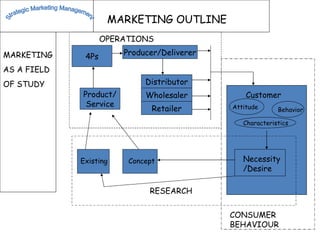
Product/ Service Producer/Deliverer Retailer Distributor Wholesaler Customer RESEARCH Attitude Behavior Characteristics Necessity/Desire Existing Concept MARKETING OUTLINE MARKETING AS A FIELD  OF STUDY OPERATIONS CONSUMER BEHAVIOUR 4Ps Strategic Marketing Management
Strategic Marketing Management Anticipating customer need Developing and Selling Product  Concept Creating/anticipating demand Fulfilling demand Making and delivering a product to the customer
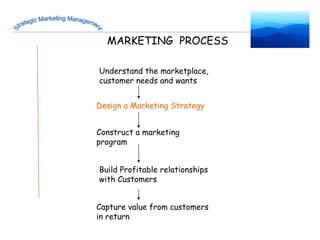
Strategic Marketing Management MARKETING  PROCESS Understand the marketplace, customer needs and wants Design a Marketing Strategy Construct a marketing program  Build Profitable relationships with Customers Capture value from customers in return
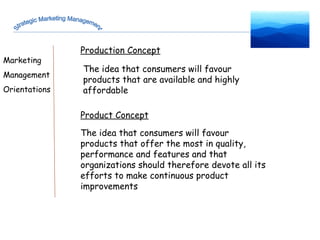
Strategic Marketing Management Marketing  Management Orientations  Production Concept Product Concept The idea that consumers will favour products that are available and highly affordable The idea that consumers will favour products that offer the most in quality, performance and features and that organizations should therefore devote all its efforts to make continuous product improvements
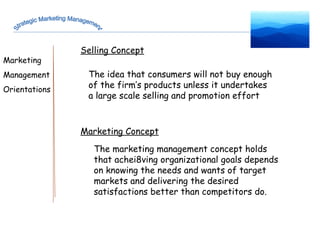
Strategic Marketing Management Selling Concept Marketing Concept The idea that consumers will not buy enough of the firm’s products unless it undertakes a large scale selling and promotion effort The marketing management concept holds that achei8ving organizational goals depends on knowing the needs and wants of target markets and delivering the desired satisfactions better than competitors do. Marketing  Management Orientations
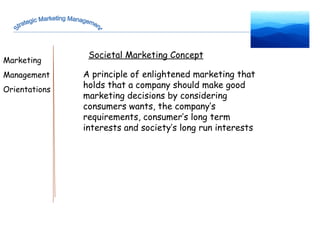
Strategic Marketing Management Marketing  Management Orientations  A principle of enlightened marketing that holds that a company should make good marketing decisions by considering consumers wants, the company’s requirements, consumer’s long term interests and society’s long run interests Societal Marketing Concept
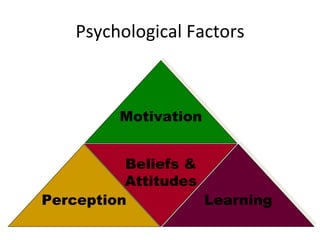
Psychological Factors Perception Learning Beliefs & Attitudes Motivation
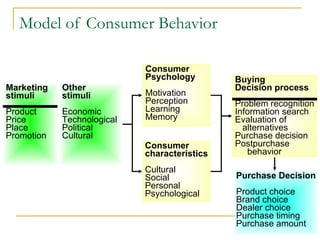
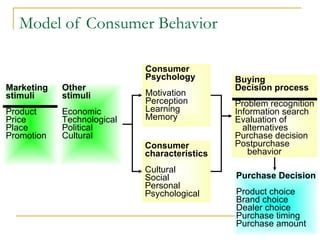
Model of Consumer Behavior Consumer Psychology Motivation Perception Learning Memory Purchase Decision Product choice Brand choice Dealer choice Purchase timing Purchase amount Consumer characteristics Cultural Social Personal Psychological Buying Decision process Problem recognition Information search Evaluation of alternatives Purchase decision Postpurchase  behavior Other stimuli Economic Technological Political Cultural Marketing stimuli Product Price Place Promotion
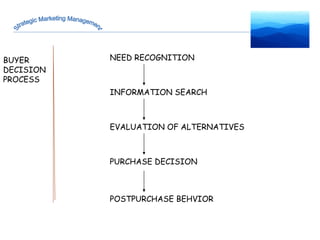
Strategic Marketing Management NEED RECOGNITION INFORMATION SEARCH PURCHASE DECISION POSTPURCHASE BEHVIOR EVALUATION OF ALTERNATIVES BUYER DECISION PROCESS
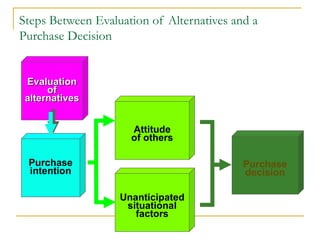
Steps Between Evaluation of Alternatives and a Purchase Decision Evaluation of alternatives Purchase decision Unanticipated situational factors Attitude of others Purchase intention
Strategic Marketing Management
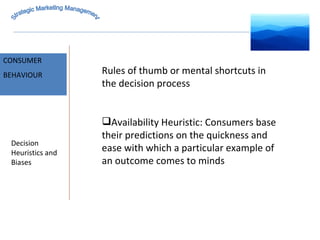
Marketing Management MARKET INTELLIGENCE CONSUMER  BEHAVIOUR Decision Heuristics and Biases Rules of thumb or mental shortcuts in the decision process  Availability Heuristic: Consumers base their predictions on the quickness and ease with which a particular example of an outcome comes to minds
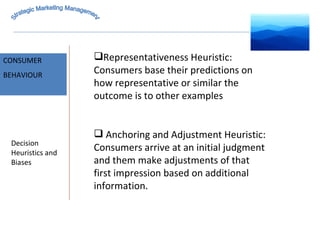
Marketing Management MARKET INTELLIGENCE CONSUMER  BEHAVIOUR Decision Heuristics and Biases Representativeness Heuristic: Consumers base their predictions on how representative or similar the outcome is to other examples Anchoring and Adjustment Heuristic: Consumers arrive at an initial judgment and them make adjustments of that first impression based on additional information.
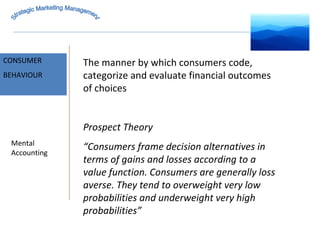
Marketing Management MARKET INTELLIGENCE CONSUMER  BEHAVIOUR Mental Accounting The manner by which consumers code, categorize and evaluate financial outcomes of choices Prospect Theory “ Consumers frame decision alternatives in terms of gains and losses according to a value function. Consumers are generally loss averse. They tend to overweight very low probabilities and underweight very high probabilities”
Marketing Management MARKET INTELLIGENCE CONSUMER  BEHAVIOUR Mental Accounting Consumers tend to segregate gains Consumers tend to integrate losses Consumers tend to integrate smaller losses with larger gains. “Cancellation Principle” Consumers tend to segregate small gains from large losses. “Silver-lining Principle”
Marketing Management MARKET INTELLIGENCE CONSUMER  BEHAVIOUR Mapping the Customer’s Consumption System/Customer Activity Cycle/Customer Scenario How are consumers thinking? Introspective method Retrospective method Prospective method Prescriptive method
Marketing Management MARKET INTELLIGENCE CONSUMER  BEHAVIOUR Biases in Decision Making Plugging-in Frame Blindness Lack of frame control Overconfidence in judgment Shortsighted shortcuts Shooting form the hip Group failure Pg 202 Marketing Management  Jay Russo and Kevin Schoemaker
Marketing Management MARKET INTELLIGENCE CONSUMER  BEHAVIOUR Biases in Decision Making by Marketing Managers Fooling yourself about feedback Not keeping track Failure to audit your decision process
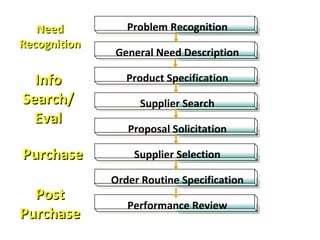
Problem Recognition Post Purchase Purchase Info Search/ Eval Need Recognition General Need Description Product Specification Supplier Search Proposal Solicitation Supplier Selection Order Routine Specification Performance Review
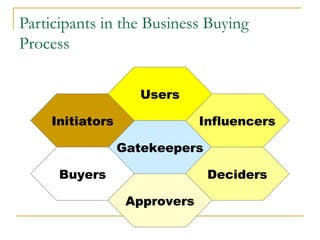
Participants in the Business Buying Process Gatekeepers Initiators Buyers Influencers Deciders Users Approvers
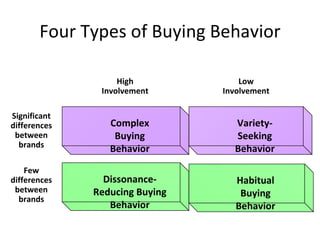
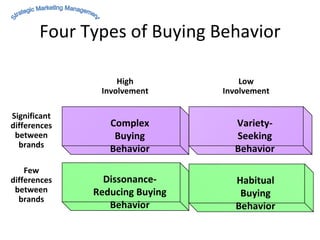
Four Types of Buying Behavior Complex Buying Behavior Dissonance- Reducing Buying Behavior Variety- Seeking Behavior Habitual Buying Behavior Significant differences between brands Few differences between brands High Involvement Low Involvement
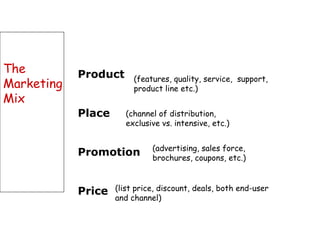
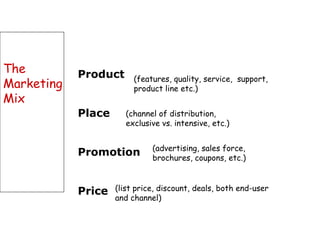
Product Place Promotion Price (features, quality, service,  support,  product line etc.) (channel of distribution, exclusive vs. intensive, etc.) (advertising, sales force, brochures, coupons, etc.) (list price, discount, deals, both end-user and channel) The Marketing Mix
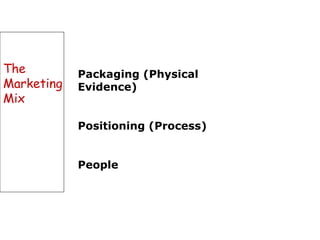
Packaging (Physical Evidence) Positioning (Process) People The Marketing Mix
Product Place Promotion Price (features, quality, service,  support,  product line etc.) (channel of distribution, exclusive vs. intensive, etc.) (advertising, sales force, brochures, coupons, etc.) (list price, discount, deals, both end-user and channel) The Marketing Mix
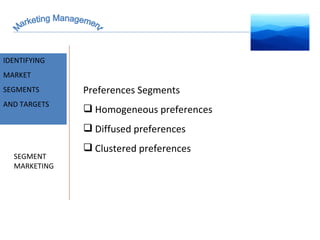
Marketing Management MARKET INTELLIGENCE IDENTIFYING  MARKET SEGMENTS  AND TARGETS Preferences Segments Homogeneous preferences Diffused preferences Clustered preferences SEGMENT MARKETING
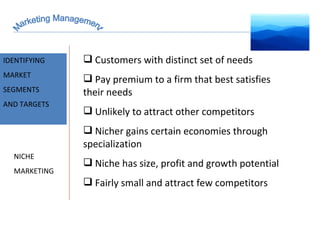
Marketing Management MARKET INTELLIGENCE IDENTIFYING  MARKET SEGMENTS  AND TARGETS Customers with distinct set of needs Pay premium to a firm that best satisfies their needs Unlikely to attract other competitors Nicher gains certain economies through specialization Niche has size, profit and growth potential Fairly small and attract few competitors  NICHE MARKETING
Marketing Management MARKET INTELLIGENCE IDENTIFYING  MARKET SEGMENTS  AND TARGETS LOCAL MARKETING CUSTOMERIZATION Customized Marketing One-to-one Marketing
Marketing Management MARKET INTELLIGENCE IDENTIFYING  MARKET SEGMENTS  AND TARGETS GEOGRAPHIC VARIABLES Geographic region City size Density Climate
Marketing Management MARKET INTELLIGENCE IDENTIFYING  MARKET SEGMENTS  AND TARGETS DEMOGRAPHIC VARIABLES Demographic age Family size Family Life cycle Gender Income  Occupation Education Religion
Marketing Management MARKET INTELLIGENCE IDENTIFYING  MARKET SEGMENTS  AND TARGETS DEMOGRAPHIC VARIABLES Race Generation Nationality Social Class
Marketing Management MARKET INTELLIGENCE IDENTIFYING  MARKET SEGMENTS  AND TARGETS PRIZM (Potential Rating Index by Zip Markets) Combines Geographic and Psychographic segmentation variables together Examples Blue Blood Estates, Winner’s Circle, Hometown Retired, Latino America, Shotguns and Pickups, Black Country Folk, Young Digerati, Beltway Boomers, The Cosmopolitans, Old Milltowns
Marketing Management MARKET INTELLIGENCE IDENTIFYING  MARKET SEGMENTS  AND TARGETS PSYCHOGRAPHIC VARIABLES Psychographic Lifestyle (Culture oriented, Sports oriented, Outdoor oriented) Personality (Compulsive, Gregarious, Authoritarian, Ambitious)
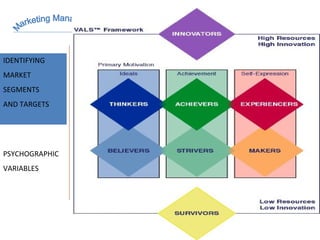
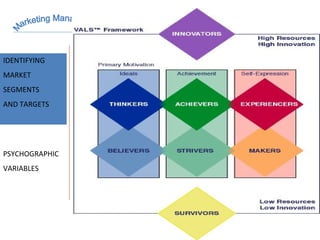
Marketing Management MARKET INTELLIGENCE IDENTIFYING  MARKET SEGMENTS  AND TARGETS PSYCHOGRAPHIC VARIABLES VALS Framework
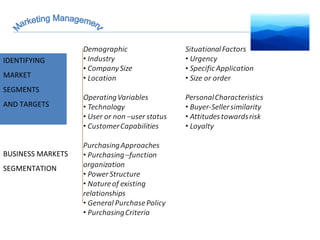
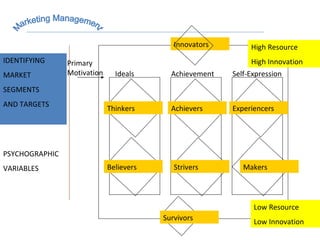
Marketing Management MARKET INTELLIGENCE IDENTIFYING  MARKET SEGMENTS  AND TARGETS PSYCHOGRAPHIC VARIABLES Innovators Survivors Thinkers Believers Achievers Strivers Experiencers Makers Ideals Achievement Self-Expression Primary Motivation High Resource High Innovation Low Resource Low Innovation
Marketing Management MARKET INTELLIGENCE IDENTIFYING  MARKET SEGMENTS  AND TARGETS PSYCHOGRAPHIC VARIABLES Groups with Higher Resources Innovators – Successful, Sophisticated, Active, “Take Charge” people, with high self esteem. Purchases often reflect cultivated tastes for relatively upscale, niche-oriented products and services Thinkers – Mature, satisfied and reflective people who are motivated by ideals and value order, knowledge and responsibility. Favour durability, functionality and value in products
Marketing Management MARKET INTELLIGENCE IDENTIFYING  MARKET SEGMENTS  AND TARGETS PSYCHOGRAPHIC VARIABLES Groups with Higher Resources Achievers – successful goal-oriented people who focus on career and family. Favour premium products that demonstrate success to their peers Experiencers – Young, enthusiastic, impulsive people who seek variety and excitement. Spend comparatively high proportion of their income on fashion, entertainment and socializing
Marketing Management MARKET INTELLIGENCE IDENTIFYING  MARKET SEGMENTS  AND TARGETS PSYCHOGRAPHIC VARIABLES Groups with Lower Resources Believers – Conservative, conventional and traditional people with concrete beliefs. Favour familiar products and are loyal to established brands Strivers – Trendy and fun-loving people who are resource constrained. Favour stylish products that emulate the purchases of those with greater material wealth
Marketing Management MARKET INTELLIGENCE IDENTIFYING  MARKET SEGMENTS  AND TARGETS PSYCHOGRAPHIC VARIABLES Groups with Lower Resources Makers – Practical down-to-earth, self-sufficient people who like to work with their hands. Favour products with a practical or functional purpose. Survivors – Elderly, passive people who are concerned about change. Loyal to their favourite brands
Marketing Management MARKET INTELLIGENCE IDENTIFYING  MARKET SEGMENTS  AND TARGETS BEHAVIORAL VARIABLES Behavioral Occasions (Regular Occasion, Special Occasion) Benefits (Quality, Service, Economy, Speed) User Status (Non-user, Ex-user, Potential User, First time user, Regular User) Usage Rate (Light user, Medium user, Heavy user)
Marketing Management MARKET INTELLIGENCE IDENTIFYING  MARKET SEGMENTS  AND TARGETS BEHAVIORAL VARIABLES Loyalty Status (None, Medium, Strong, Absolute) Readiness Stage (Unaware, Aware, Informed, Interested, Desirous, Intending to buy) Attitude toward product (Enthusiastic, Positive, Indifferent, Negative, Hostile)
Marketing Management MARKET INTELLIGENCE IDENTIFYING  MARKET SEGMENTS  AND TARGETS BEHAVIORAL VARIABLES Behavioral Segmentation Breakdown (Pg 257 MM )
Marketing Management MARKET INTELLIGENCE IDENTIFYING  MARKET SEGMENTS  AND TARGETS BEHAVIORAL VARIABLES The Conversion Model Measures the strength of Psychological Commitment  between brands and consumers and their willingness and openness to change
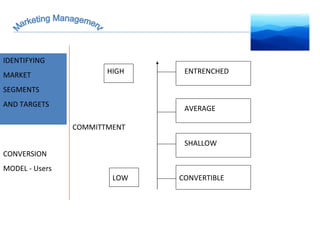
Marketing Management MARKET INTELLIGENCE IDENTIFYING  MARKET SEGMENTS  AND TARGETS CONVERSION  MODEL - Users COMMITTMENT LOW HIGH CONVERTIBLE SHALLOW AVERAGE ENTRENCHED
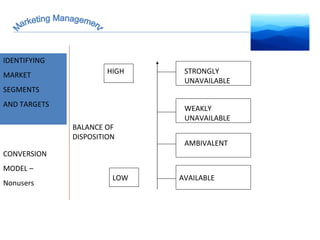
Marketing Management MARKET INTELLIGENCE IDENTIFYING  MARKET SEGMENTS  AND TARGETS CONVERSION  MODEL –  Nonusers BALANCE OF DISPOSITION  LOW HIGH AVAILABLE AMBIVALENT WEAKLY UNAVAILABLE STRONGLY UNAVAILABLE
Marketing Management MARKET INTELLIGENCE IDENTIFYING  MARKET SEGMENTS  AND TARGETS BUSINESS MARKETS SEGMENTATION
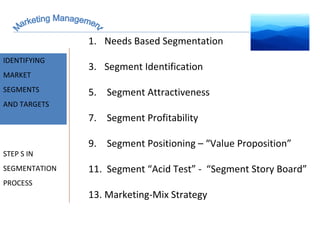
Marketing Management MARKET INTELLIGENCE IDENTIFYING  MARKET SEGMENTS  AND TARGETS STEP S IN  SEGMENTATION PROCESS Needs Based Segmentation Segment Identification Segment Attractiveness Segment Profitability Segment Positioning – “Value Proposition” Segment “Acid Test” -  “Segment Story Board”  Marketing-Mix Strategy
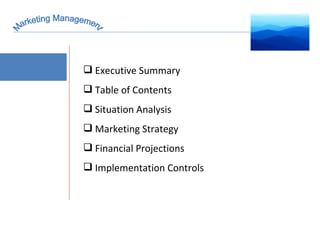
Marketing Management BRAND EQUITY Executive Summary  Table of Contents Situation Analysis Marketing Strategy Financial Projections Implementation Controls
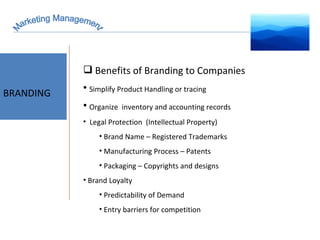
Marketing Management BRAND EQUITY BRANDING Benefits of Branding to Companies Simplify Product Handling or tracing Organize  inventory and accounting records Legal Protection  (Intellectual Property) Brand Name – Registered Trademarks Manufacturing Process – Patents Packaging – Copyrights and designs  Brand Loyalty Predictability of Demand Entry barriers for competition
Marketing Management BRANDING Benefits of Branding Marketing Advantages Improved Perceptions of Product Performance Greater Loyalty Less Vulnerability to Competitive Marketing Actions Larger Margins More Inelastic Consumer Response to Price Increases More Elastic Consumer Response to Price Decreases
Marketing Management BRANDING Benefits of Branding Marketing Advantages Greater Trade Cooperation and Support Increased Marketing Communication Effectiveness Possible Licensing Opportunities Additional Brand Extension Opportunities
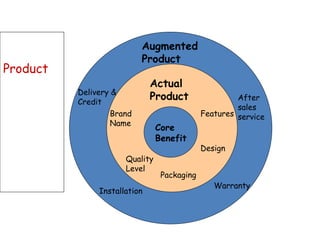
Product Core Benefit Actual Product Brand Name Quality Level Packaging Features Design Augmented Product Delivery & Credit Installation Warranty After sales service
Product PRODUCT LINE A group of products that are closely related because they function in a similar manner, are sold to the same customer groups, are marketed through the same types of outlets or fall within given price ranges  PRODUCT MIX The set of all product lines and items that a particular seller offers for sale
Product BRAND EQUITY The positive differential effect that knowing the brand name has on customer response to the product or service  BRAND POSITIONING Product Attributes Benefits Beliefs and Values
Product BRAND NAME SELECTION Selection Protection BRAND SPONSORSHIP Manufacturer’s brand Private brand Licensing Co-branding
Product BRAND DEVELOPMENT Line Extension Brand Extension Multibrands New brands
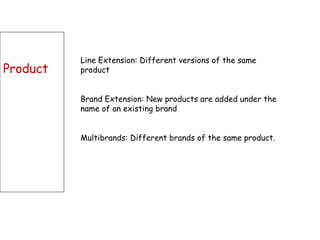
Product Line Extension: Different versions of the same product Brand Extension: New products are added under the name of an existing brand Multibrands: Different brands of the same product.
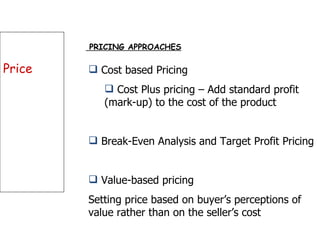
Price PRICING APPROACHES Cost based Pricing Cost Plus pricing – Add standard profit (mark-up) to the cost of the product Break-Even Analysis and Target Profit Pricing Value-based pricing Setting price based on buyer’s perceptions of value rather than on the seller’s cost
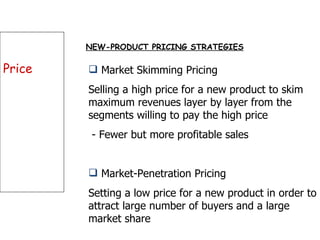
Price NEW-PRODUCT PRICING STRATEGIES Market Skimming Pricing Selling a high price for a new product to skim maximum revenues layer by layer from the segments willing to pay the high price - Fewer but more profitable sales Market-Penetration Pricing  Setting a low price for a new product in order to attract large number of buyers and a large market share
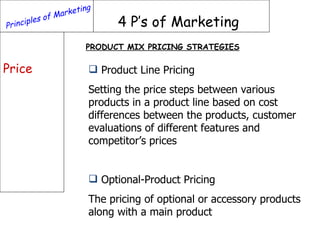
Principles of Marketing 4 P’s of Marketing Price PRODUCT MIX PRICING STRATEGIES Product Line Pricing Setting the price steps between various products in a product line based on cost differences between the products, customer evaluations of different features and competitor’s prices Optional-Product Pricing  The pricing of optional or accessory products along with a main product
Price PRODUCT MIX PRICING STRATEGIES Captive Product Pricing Setting a price for products that must be used along with a main product e.g blades for razors, cartridges for printers By-Product Pricing Setting a price for by products in order to make the main product’s price more competitive
Price PRICE ADJUSTMENT STRATEGIES Discount Allowance Segmented Pricing Psychological Geographical  Promotional International
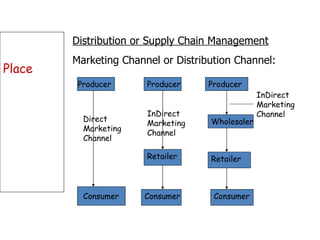
Place Distribution or Supply Chain Management Marketing Channel or Distribution Channel: Producer Consumer Producer Retailer Consumer Consumer Retailer Wholesaler Producer Direct MarketingChannel InDirect Marketing Channel InDirect Marketing Channel
Promotion Advertising Sales Promotion Personal Selling Public Relations Direct Marketing
Customer Value and Loyalty “ A deeply held commitment to re-buy or re-patronize a preferred product or service in the future despite situational influences and marketing efforts having the potential to cause switching behavior” - Oliver Loyalty Value Proposition Consists of the whole cluster of benefits a company promises to deliver to its customers Strategic Marketing Management
CustomerSatisfaction Elements of company performance On-time transportation Completeness of order Repurchase intention  Product Quality Customer Service Measuring Satisfaction Strategic Marketing Management
STRATEGY FORMULATION LEVELS Product / Brand Level SBU Level  Corporate Level  Strategic Marketing Management
ANALYSIS TOOLS BCG Matrix SWOT Analysis / TOWS  Analysis Customer Matrix Customer Profitability Analysis Intensive Growth Strategies Strategic Marketing Management
MARKETING MANAGEMENT  TASKS Developing Marketing Strategies and  Plans Capturing Marketing Insights Connecting with Customers Building Strong Brands Shaping the Market Offerings Delivering Value Communicating Value  Creating Long-term Growth Strategic Marketing Management
MARKET INTELLIGENCE Market Scanning Internal External Strategic Marketing Management
Marketing Management MARKET INTELLIGENCE Internal Reports – Sales, Prices, Inventories Order-to-Payment Cycle Sales Force Data Warehouses, Data Mining Internal MARKET INTELLIGENCE Market Scanning
MARKET INTELLIGENCE Sales Force to spot and report new development Distributors, Retailers and other intermediaries External Networking – competitor products, trade shows, competitor reports,  Advisory Panel Government data resources Information Suppliers – Gartner, AC Nielsen, Biz360 Customer feed back External MARKET INTELLIGENCE Market Scanning Strategic Marketing Management
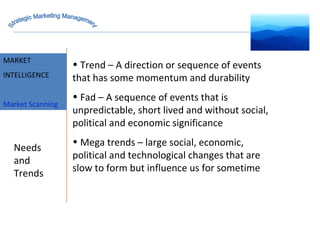
MARKET INTELLIGENCE Trend – A direction or sequence of events that has some momentum and durability Fad – A sequence of events that is unpredictable, short lived and without social, political and economic significance Mega trends – large social, economic, political and technological changes that are slow to form but influence us for sometime Needs and Trends MARKET INTELLIGENCE Market Scanning Strategic Marketing Management
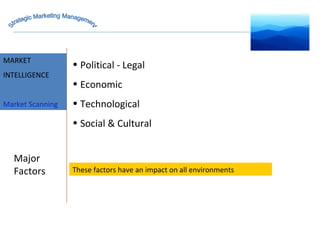
MARKET INTELLIGENCE Political - Legal Economic Technological Social & Cultural Major Factors  These factors have an impact on all environments MARKET INTELLIGENCE Market Scanning Strategic Marketing Management
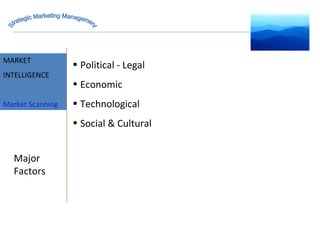
MARKET INTELLIGENCE Political - Legal Economic Technological Social & Cultural Major Factors  MARKET INTELLIGENCE Market Scanning Strategic Marketing Management
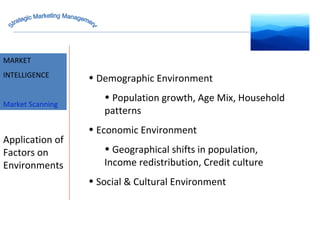
MARKET INTELLIGENCE Demographic Environment Population growth, Age Mix, Household patterns Economic Environment Geographical shifts in population, Income redistribution, Credit culture Social & Cultural Environment  Application of Factors on Environments  MARKET INTELLIGENCE Market Scanning Strategic Marketing Management
MARKET INTELLIGENCE Social & Cultural Environment  Views of themselves Views of others Views of organizations Views of society Views of nature Views of the universe Application of Factors on Environments  MARKET INTELLIGENCE Market Scanning Strategic Marketing Management
MARKET INTELLIGENCE Social & Cultural Environment  Core Values Secondary Beliefs Application of Factors on Environments  MARKET INTELLIGENCE Market Scanning Strategic Marketing Management
MARKET INTELLIGENCE Natural Environment  Consumption of vital resources - Oil, Water, Metals, Nuclear  Materials - Global Warming, Weather    patterns Application of Factors on Environments  MARKET INTELLIGENCE Market Scanning Strategic Marketing Management
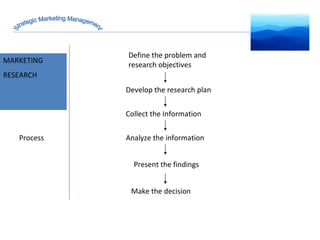
MARKET INTELLIGENCE MARKETING RESEARCH Define the problem and research objectives Develop the research plan Collect the Information Analyze the information Present the findings Make the decision Process Strategic Marketing Management
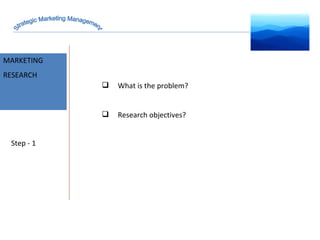
MARKET INTELLIGENCE MARKETING RESEARCH Step - 1 What is the problem? Research objectives?  Strategic Marketing Management
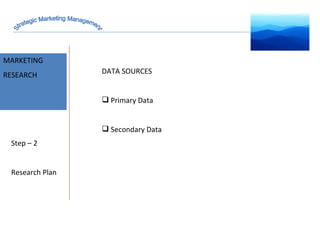
MARKET INTELLIGENCE MARKETING RESEARCH Step – 2 Research Plan DATA SOURCES Primary Data Secondary Data Strategic Marketing Management
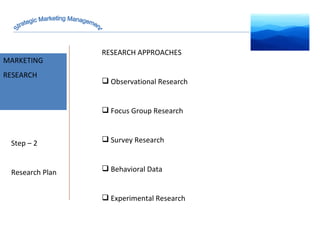
MARKET INTELLIGENCE MARKETING RESEARCH Step – 2 Research Plan RESEARCH APPROACHES Observational Research Focus Group Research Survey Research Behavioral Data Experimental Research Strategic Marketing Management
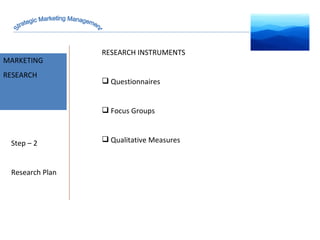
MARKET INTELLIGENCE MARKETING RESEARCH Step – 2 Research Plan RESEARCH INSTRUMENTS Questionnaires Focus Groups Qualitative Measures  Strategic Marketing Management
MARKET INTELLIGENCE MARKETING RESEARCH Step – 2 Research Plan RESEARCH INSTRUMENTS Qualitative Measures  Shadowing Behaviour mapping Consumer journey Camera journals  Extreme user interviews Unfocus groups  Strategic Marketing Management
MARKET INTELLIGENCE MARKETING RESEARCH Step – 2 Research Plan Analyze the Information Advanced Statistical Techniques Frequencies Crosstabs Factor Analysis Cluster Analysis Discriminant Analysis Regression Analysis Strategic Marketing Management
MARKET INTELLIGENCE MARKETING RESEARCH Step – 2 Research Plan Present the findings Make the decision Strategic Marketing Management
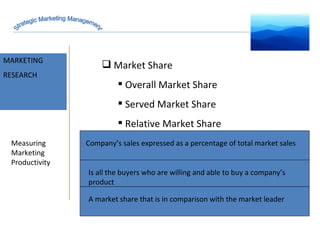
MARKET INTELLIGENCE MARKETING RESEARCH Measuring Marketing Productivity Sales Analysis Sales variance analysis Micro-sales analysis Market Share Overall Market Share Served Market Share Relative Market Share Strategic Marketing Management
MARKET INTELLIGENCE MARKETING RESEARCH Measuring Marketing Productivity Market Share Overall Market Share Served Market Share Relative Market Share Company’s sales expressed as a percentage of total market sales Is all the buyers who are willing and able to buy a company’s product A market share that is in comparison with the market leader Strategic Marketing Management
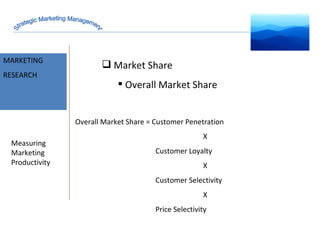
MARKET INTELLIGENCE MARKETING RESEARCH Measuring Marketing Productivity Market Share Overall Market Share Overall Market Share = Customer Penetration  X   Customer Loyalty X   Customer Selectivity X   Price Selectivity Strategic Marketing Management
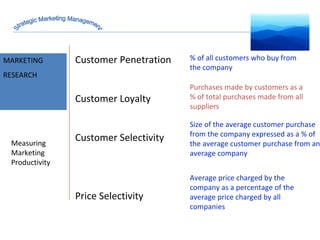
MARKET INTELLIGENCE MARKETING RESEARCH Measuring Marketing Productivity Customer Penetration  Customer Loyalty Customer Selectivity Price Selectivity % of all customers who buy from the company Purchases made by customers as a % of total purchases made from all suppliers Size of the average customer purchase from the company expressed as a % of the average customer purchase from an average company Average price charged by the company as a percentage of the average price charged by all companies Strategic Marketing Management
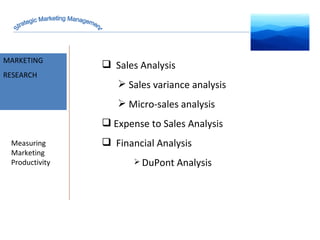
MARKET INTELLIGENCE MARKETING RESEARCH Measuring Marketing Productivity Sales Analysis Sales variance analysis Micro-sales analysis Expense to Sales Analysis Financial Analysis DuPont Analysis Strategic Marketing Management
MARKET INTELLIGENCE MARKETING RESEARCH Measuring Marketing Productivity Profitability Analysis Strategic Marketing Management
Marketing Management MARKET INTELLIGENCE MARKETING RESEARCH Forecasting and Demand Measurement Measures of Market Demand Potential Market: Is the set of consumers who profess a sufficient level of interest in a market offer. They must have enough income and have access to the product offer.
MARKET INTELLIGENCE MARKETING RESEARCH Forecasting and Demand Measurement Measures of Market Demand Available Market: Is the set of consumers who have interest, income, access and qualifications for the particular market offer. Strategic Marketing Management
MARKET INTELLIGENCE MARKETING RESEARCH Forecasting and Demand Measurement Measures of Market Demand Target Market: Is the part of the qualified market that the company decides to pursue. Strategic Marketing Management
MARKET INTELLIGENCE MARKETING RESEARCH Forecasting and Demand Measurement Measures of Market Demand Penetrated Market: The set of consumers who are buying the company’s product. Strategic Marketing Management
MARKET INTELLIGENCE MARKETING RESEARCH Forecasting and Demand Measurement Market Demand Is the total volume that would be bought by a defined consumer group, in a defined geographical area in a defined time period, in a defined marketing environment under a defined marketing program Strategic Marketing Management
MARKET INTELLIGENCE MARKETING RESEARCH Forecasting and Demand Measurement Estimating Future Demand Past Data Analysis Time-Series analysis Exponential Smoothing Statistical Demand Analysis Econometric Analysis Strategic Marketing Management
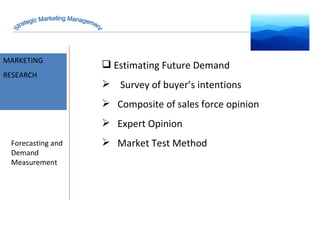
MARKET INTELLIGENCE MARKETING RESEARCH Forecasting and Demand Measurement Estimating Future Demand   Survey of buyer’s intentions Composite of sales force opinion Expert Opinion Market Test Method Strategic Marketing Management
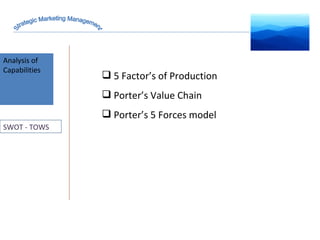
5 Factor’s of Production Porter’s Value Chain Porter’s 5 Forces model Strategic Marketing Management Analysis of Capabilities SWOT - TOWS
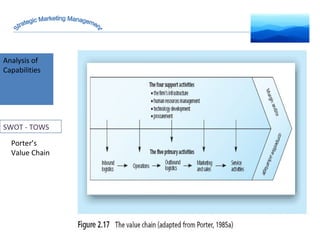
Analysis of Capabilities Porter’s Value Chain Strategic Marketing Management SWOT - TOWS
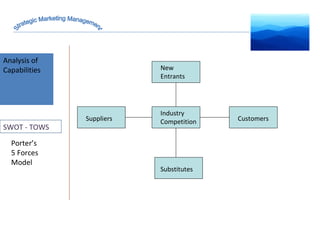
Analysis of Capabilities Porter’s  5 Forces Model Strategic Marketing Management New Entrants Suppliers Industry Competition Substitutes Customers SWOT - TOWS
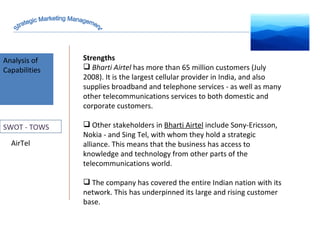
Analysis of Capabilities AirTel Strategic Marketing Management SWOT - TOWS Strengths Bharti Airtel  has more than 65 million customers (July 2008). It is the largest cellular provider in India, and also supplies broadband and telephone services - as well as many other telecommunications services to both domestic and corporate customers. Other stakeholders in  Bharti Airtel  include Sony-Ericsson, Nokia - and Sing Tel, with whom they hold a strategic alliance. This means that the business has access to knowledge and technology from other parts of the telecommunications world.  The company has covered the entire Indian nation with its network. This has underpinned its large and rising customer base.
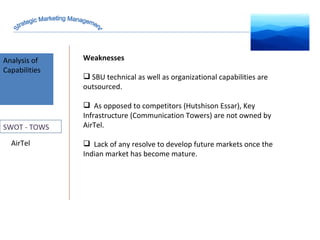
Analysis of Capabilities AirTel Strategic Marketing Management SWOT - TOWS Weaknesses SBU technical as well as organizational capabilities are outsourced.  As opposed to competitors (Hutshison Essar), Key Infrastructure (Communication Towers) are not owned by AirTel. Lack of any resolve to develop future markets once the Indian market has become mature.
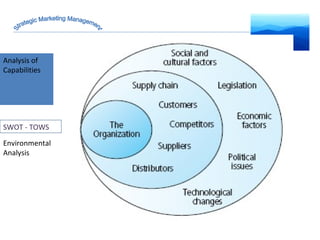
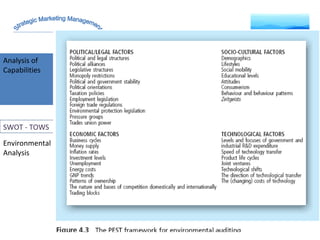
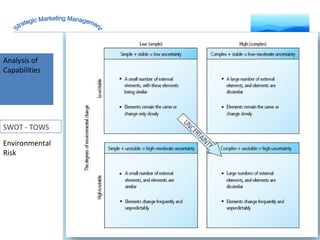
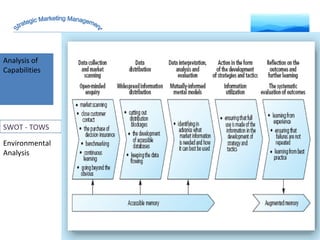
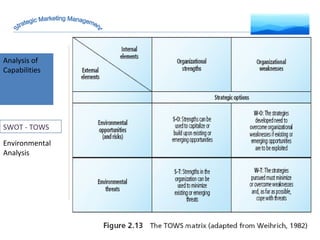
Analysis of Capabilities Environmental Analysis Strategic Marketing Management SWOT - TOWS
Analysis of Capabilities Environmental Risk  Strategic Marketing Management SWOT - TOWS
Analysis of Capabilities Environmental Analysis Strategic Marketing Management SWOT - TOWS
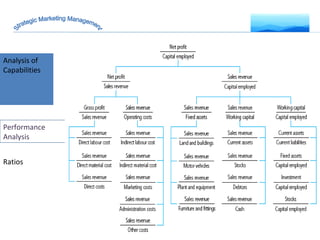
Analysis of Capabilities Ratios Strategic Marketing Management Performance Analysis
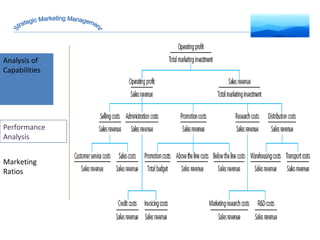
Analysis of Capabilities Marketing Ratios Strategic Marketing Management Performance Analysis
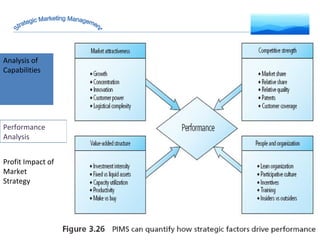
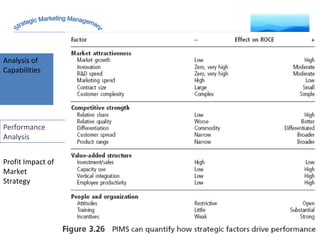
Analysis of Capabilities Profit Impact of Market Strategy Strategic Marketing Management Performance Analysis
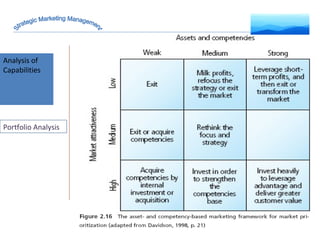
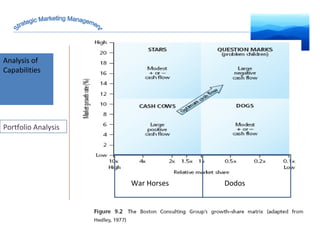
Analysis of Capabilities Strategic Marketing Management Portfolio Analysis
Analysis of Capabilities Strategic Marketing Management Portfolio Analysis War Horses Dodos
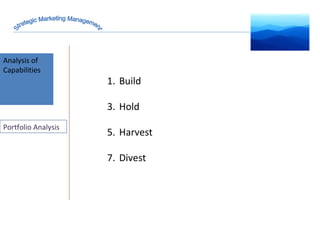
Analysis of Capabilities Strategic Marketing Management Portfolio Analysis Build Hold Harvest Divest
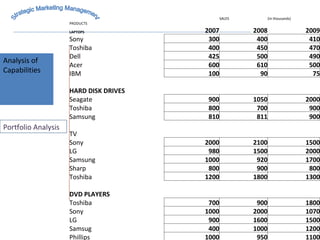
Analysis of Capabilities Strategic Marketing Management Portfolio Analysis SALES (In thousands) PRODUCTS LAPTOPS 2007 2008 2009 Sony 300 400 410 Toshiba 400 450 470 Dell 425 500 490 Acer 600 610 500 IBM 100 90 75 HARD DISK DRIVES Seagate 900 1050 2000 Toshiba 800 700 900 Samsung 810 811 900 TV Sony 2000 2100 1500 LG 980 1500 2000 Samsung 1000 920 1700 Sharp 800 900 800 Toshiba 1200 1800 1300 DVD PLAYERS Toshiba 700 900 1800 Sony 1000 2000 1070 LG 900 1600 1500 Samsug 400 1000 1200 Phillips 1000 950 1100
Model of Consumer Behavior Consumer Psychology Motivation Perception Learning Memory Purchase Decision Product choice Brand choice Dealer choice Purchase timing Purchase amount Consumer characteristics Cultural Social Personal Psychological Buying Decision process Problem recognition Information search Evaluation of alternatives Purchase decision Postpurchase  behavior Other stimuli Economic Technological Political Cultural Marketing stimuli Product Price Place Promotion
Four Types of Buying Behavior Complex Buying Behavior Dissonance- Reducing Buying Behavior Variety- Seeking Behavior Habitual Buying Behavior Significant differences between brands Few differences between brands High Involvement Low Involvement Strategic Marketing Management
MARKET INTELLIGENCE CONSUMER  BEHAVIOUR Decision Heuristics and Biases Rules of thumb or mental shortcuts in the decision process  Availability Heuristic: Consumers base their predictions on the quickness and ease with which a particular example of an outcome comes to minds  Strategic Marketing Management
MARKET INTELLIGENCE CONSUMER  BEHAVIOUR Decision Heuristics and Biases Representativeness Heuristic: Consumers base their predictions on how representative or similar the outcome is to other examples Anchoring and Adjustment Heuristic: Consumers arrive at an initial judgment and them make adjustments of that first impression based on additional information. Strategic Marketing Management
MARKET INTELLIGENCE CONSUMER  BEHAVIOUR Mental Accounting The manner by which consumers code, categorize and evaluate financial outcomes of choices Prospect Theory “ Consumers frame decision alternatives in terms of gains and losses according to a value function. Consumers are generally loss averse. They tend to overweight very low probabilities and underweight very high probabilities” Strategic Marketing Management
MARKET INTELLIGENCE CONSUMER  BEHAVIOUR Mental Accounting Consumers tend to segregate gains Consumers tend to integrate losses Consumers tend to integrate smaller losses with larger gains. “Cancellation Principle” Consumers tend to segregate small gains from large losses. “Silver-lining Principle” Strategic Marketing Management
MARKET INTELLIGENCE CONSUMER  BEHAVIOUR Mapping the Customer’s Consumption System/Customer Activity Cycle/Customer Scenario How are consumers thinking? Introspective method Retrospective method Prospective method Prescriptive method Strategic Marketing Management
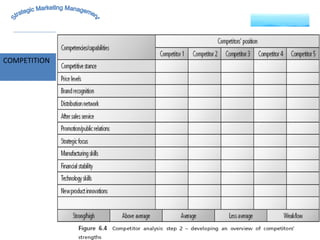
MARKET INTELLIGENCE COMPETITION Strategic Marketing Management 1 Against whom are we competing? 2 What strengths and weaknesses do they possess? 3 What are their objectives? 4 What strategies are they pursuing and how successful are they? 5 How are they likely to behave and, in particular, how are they likely to react to offensive  moves?
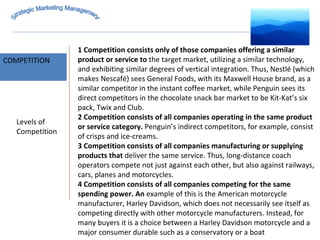
MARKET INTELLIGENCE COMPETITION Strategic Marketing Management Levels of Competition 1 Competition consists only of those companies offering a similar product or service to  the target market, utilizing a similar technology, and exhibiting similar degrees of vertical integration. Thus, Nestlé (which makes Nescafé) sees General Foods, with its Maxwell House brand, as a similar competitor in the instant coffee market, while Penguin sees its direct competitors in the chocolate snack bar market to be Kit-Kat’s six pack, Twix and Club. 2 Competition consists of all companies operating in the same product or service category.  Penguin’s indirect competitors, for example, consist of crisps and ice-creams. 3 Competition consists of all companies manufacturing or supplying products that  deliver the same service. Thus, long-distance coach operators compete not just against each other, but also against railways, cars, planes and motorcycles. 4 Competition consists of all companies competing for the same spending power. An  example of this is the American motorcycle manufacturer, Harley Davidson, which does not necessarily see itself as competing directly with other motorcycle manufacturers. Instead, for many buyers it is a choice between a Harley Davidson motorcycle and a major consumer durable such as a conservatory or a boat
MARKET INTELLIGENCE COMPETITION Strategic Marketing Management
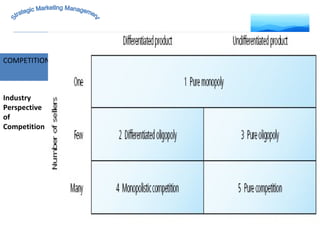
MARKET INTELLIGENCE COMPETITION Strategic Marketing Management Industry Perspective of Competition Market Perspective of Competition
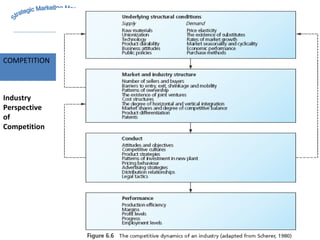
MARKET INTELLIGENCE COMPETITION Strategic Marketing Management Industry Perspective  of  Competition
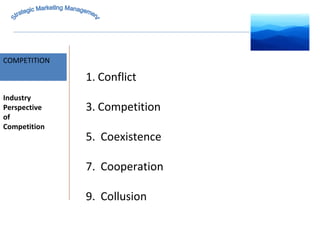
MARKET INTELLIGENCE COMPETITION Strategic Marketing Management Industry Perspective  of  Competition Conflict Competition  Coexistence Cooperation Collusion
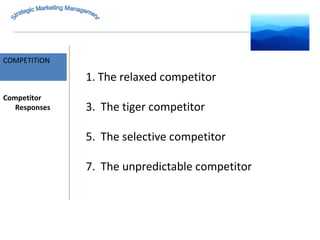
MARKET INTELLIGENCE COMPETITION Strategic Marketing Management Competitor Responses The relaxed competitor The tiger competitor The selective competitor The unpredictable competitor
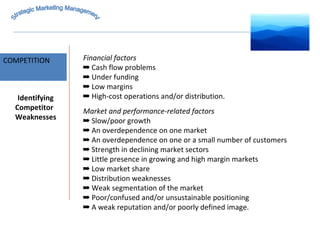
MARKET INTELLIGENCE COMPETITION Strategic Marketing Management Identifying Competitor Weaknesses Financial factors ➡  Cash flow problems ➡  Under funding ➡  Low margins ➡  High-cost operations and/or distribution. Market and performance-related factors ➡  Slow/poor growth ➡  An overdependence on one market ➡  An overdependence on one or a small number of customers ➡  Strength in declining market sectors ➡  Little presence in growing and high margin markets ➡  Low market share ➡  Distribution weaknesses ➡  Weak segmentation of the market ➡  Poor/confused and/or unsustainable positioning ➡  A weak reputation and/or poorly defined image.
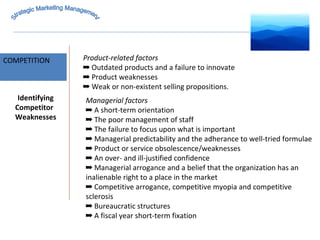
MARKET INTELLIGENCE COMPETITION Strategic Marketing Management Identifying Competitor Weaknesses Product-related factors ➡  Outdated products and a failure to innovate ➡  Product weaknesses ➡  Weak or non-existent selling propositions. Managerial factors ➡  A short-term orientation ➡  The poor management of staff ➡  The failure to focus upon what is important ➡  Managerial predictability and the adherance to well-tried formulae ➡  Product or service obsolescence/weaknesses ➡  An over- and ill-justified confidence ➡  Managerial arrogance and a belief that the organization has an inalienable right to a place in the market ➡  Competitive arrogance, competitive myopia and competitive sclerosis ➡  Bureaucratic structures ➡  A fiscal year short-term fixation
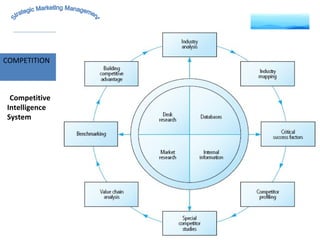
MARKET INTELLIGENCE COMPETITION Strategic Marketing Management Competitive Intelligence System
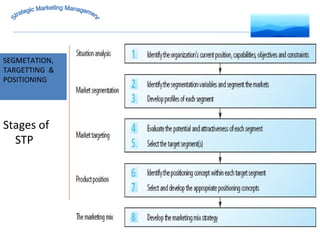
MARKET INTELLIGENCE SEGMETATION, TARGETTING  & POSITIONING Strategic Marketing Management Stages of STP
Marketing Management MARKET INTELLIGENCE IDENTIFYING  MARKET SEGMENTS  AND TARGETS PSYCHOGRAPHIC VARIABLES VALS Framework
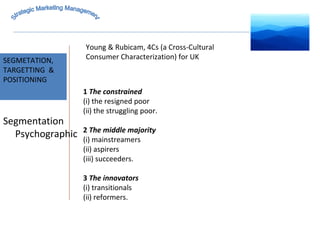
MARKET INTELLIGENCE SEGMETATION, TARGETTING  & POSITIONING Strategic Marketing Management Segmentation Psychographic Young & Rubicam, 4Cs (a Cross-Cultural Consumer Characterization) for UK 1  The constrained (i) the resigned poor (ii) the struggling poor. 2  The middle majority (i) mainstreamers (ii) aspirers (iii) succeeders. 3  The innovators (i) transitionals (ii) reformers.
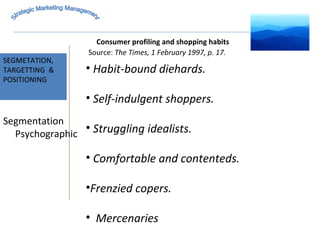
MARKET INTELLIGENCE Source:  The Times, 1 February 1997, p. 17. SEGMETATION, TARGETTING  & POSITIONING Strategic Marketing Management Segmentation Psychographic Consumer profiling and shopping habits Habit-bound diehards. Self-indulgent shoppers. Struggling idealists. Comfortable and contenteds. Frenzied copers. Mercenaries
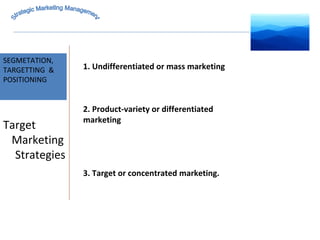
MARKET INTELLIGENCE SEGMETATION, TARGETTING  & POSITIONING Strategic Marketing Management Target Marketing Strategies 1. Undifferentiated or mass marketing 2. Product-variety or differentiated marketing 3. Target or concentrated marketing.
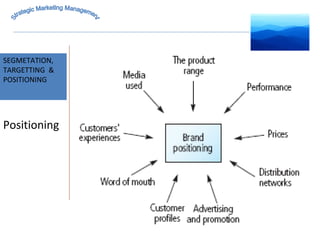
MARKET INTELLIGENCE SEGMETATION, TARGETTING  & POSITIONING Strategic Marketing Management Positioning
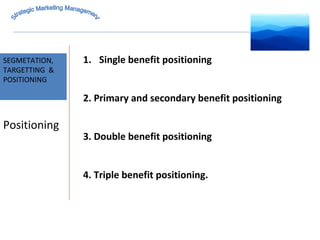
MARKET INTELLIGENCE SEGMETATION, TARGETTING  & POSITIONING Strategic Marketing Management Positioning Single benefit positioning 2. Primary and secondary benefit positioning 3. Double benefit positioning 4. Triple benefit positioning.
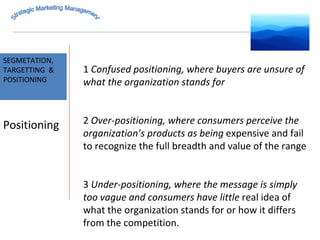
MARKET INTELLIGENCE SEGMETATION, TARGETTING  & POSITIONING Strategic Marketing Management Positioning 1  Confused positioning, where buyers are unsure of what the organization stands for 2  Over-positioning, where consumers perceive the organization’s products as being  expensive and fail to recognize the full breadth and value of the range 3  Under-positioning, where the message is simply too vague and consumers have little  real idea of what the organization stands for or how it differs from the competition.
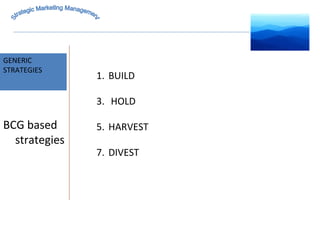
MARKET INTELLIGENCE GENERIC  STRATEGIES Strategic Marketing Management BCG based strategies BUILD HOLD HARVEST DIVEST
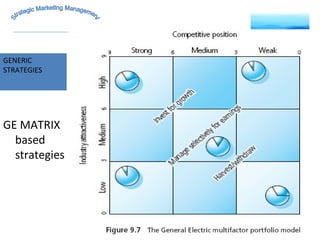
MARKET INTELLIGENCE GENERIC  STRATEGIES Strategic Marketing Management GE MATRIX based strategies
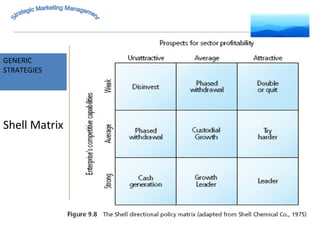
MARKET INTELLIGENCE GENERIC  STRATEGIES Strategic Marketing Management Shell Matrix
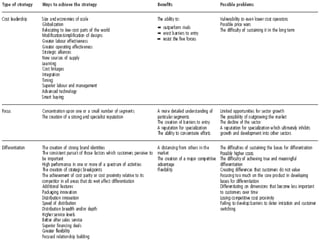
MARKET INTELLIGENCE GENERIC  STRATEGIES Strategic Marketing Management PORTER’S  STRATEGIES
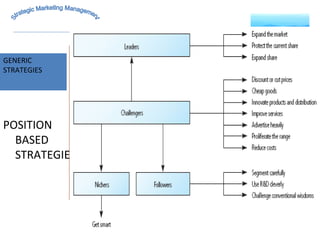
MARKET INTELLIGENCE GENERIC  STRATEGIES Strategic Marketing Management POSITION BASED STRATEGIES
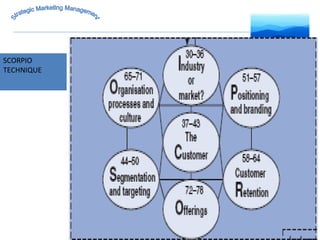
MARKET INTELLIGENCE SCORPIO  TECHNIQUE Strategic Marketing Management
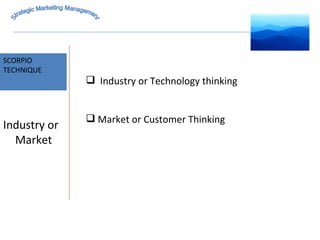
MARKET INTELLIGENCE SCORPIO  TECHNIQUE Strategic Marketing Management Industry or Market Industry or Technology thinking Market or Customer Thinking
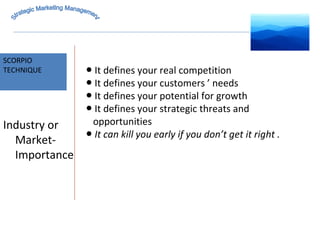
MARKET INTELLIGENCE SCORPIO  TECHNIQUE Strategic Marketing Management Industry or Market-Importance ●  It defines your real competition ●  It defines your customers ’ needs ●  It defines your potential for growth ●  It defines your strategic threats and  opportunities ●  It can kill you early if you don’t get it right .
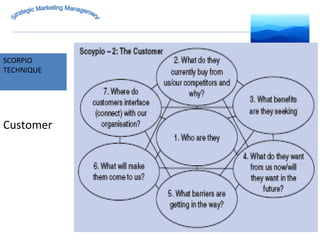
MARKET INTELLIGENCE SCORPIO  TECHNIQUE Strategic Marketing Management Customer
MARKET INTELLIGENCE SCORPIO  TECHNIQUE Strategic Marketing Management Customer Market Research Consumer Insights
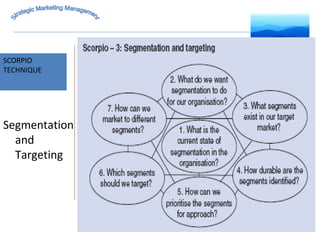
MARKET INTELLIGENCE SCORPIO  TECHNIQUE Strategic Marketing Management Segmentation and Targeting
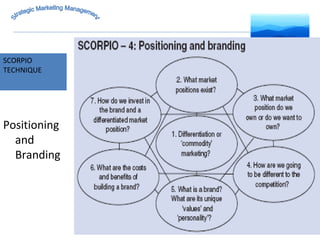
MARKET INTELLIGENCE SCORPIO  TECHNIQUE Strategic Marketing Management Positioning and Branding
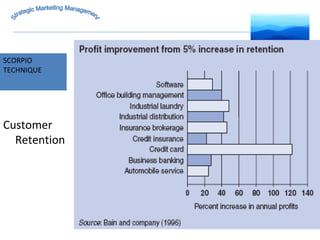
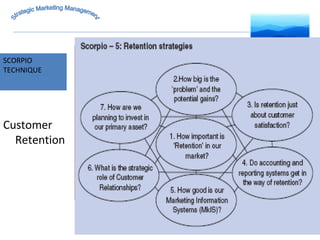
MARKET INTELLIGENCE SCORPIO  TECHNIQUE Strategic Marketing Management Customer Retention
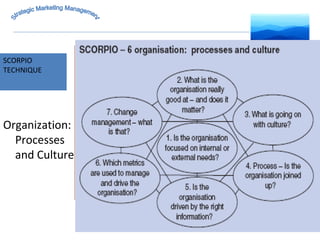
MARKET INTELLIGENCE SCORPIO  TECHNIQUE Strategic Marketing Management Organization: Processes and Culture
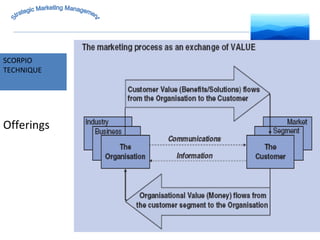
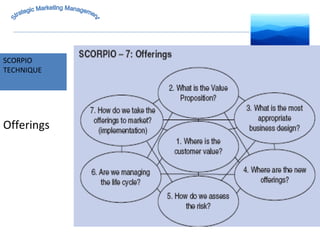
MARKET INTELLIGENCE SCORPIO  TECHNIQUE Strategic Marketing Management Offerings

Smm spring 2010

  • 1.
    Strategic Marketing Management“ Marketing is Managing profitable customer relationships.” “ Fulfilling customers wants and desires in order to make a profit” “ The process by which companies create value for customers and build strong customer relationships in order to capture value from customers in return”
  • 2.
    Strategic Marketing ManagementNew Definition of Marketing (est. in 2007) Marketing is the activity, set of institutions, and processes for creating, communicating, delivering, and exchanging offerings that have value for customers, clients, partners, and society at large. (American Marketing Association)
  • 3.
    Product/ Service Producer/DelivererRetailer Distributor Wholesaler Customer RESEARCH Attitude Behavior Characteristics Necessity/Desire Existing Concept MARKETING OUTLINE MARKETING AS A FIELD OF STUDY OPERATIONS CONSUMER BEHAVIOUR 4Ps Strategic Marketing Management
  • 4.
    Strategic Marketing ManagementAnticipating customer need Developing and Selling Product Concept Creating/anticipating demand Fulfilling demand Making and delivering a product to the customer
  • 5.
    Strategic Marketing ManagementMARKETING PROCESS Understand the marketplace, customer needs and wants Design a Marketing Strategy Construct a marketing program Build Profitable relationships with Customers Capture value from customers in return
  • 6.
    Strategic Marketing ManagementMarketing Management Orientations Production Concept Product Concept The idea that consumers will favour products that are available and highly affordable The idea that consumers will favour products that offer the most in quality, performance and features and that organizations should therefore devote all its efforts to make continuous product improvements
  • 7.
    Strategic Marketing ManagementSelling Concept Marketing Concept The idea that consumers will not buy enough of the firm’s products unless it undertakes a large scale selling and promotion effort The marketing management concept holds that achei8ving organizational goals depends on knowing the needs and wants of target markets and delivering the desired satisfactions better than competitors do. Marketing Management Orientations
  • 8.
    Strategic Marketing ManagementMarketing Management Orientations A principle of enlightened marketing that holds that a company should make good marketing decisions by considering consumers wants, the company’s requirements, consumer’s long term interests and society’s long run interests Societal Marketing Concept
  • 9.
    Psychological Factors PerceptionLearning Beliefs & Attitudes Motivation
  • 10.
    Model of ConsumerBehavior Consumer Psychology Motivation Perception Learning Memory Purchase Decision Product choice Brand choice Dealer choice Purchase timing Purchase amount Consumer characteristics Cultural Social Personal Psychological Buying Decision process Problem recognition Information search Evaluation of alternatives Purchase decision Postpurchase behavior Other stimuli Economic Technological Political Cultural Marketing stimuli Product Price Place Promotion
  • 11.
    Strategic Marketing ManagementNEED RECOGNITION INFORMATION SEARCH PURCHASE DECISION POSTPURCHASE BEHVIOR EVALUATION OF ALTERNATIVES BUYER DECISION PROCESS
  • 12.
    Steps Between Evaluationof Alternatives and a Purchase Decision Evaluation of alternatives Purchase decision Unanticipated situational factors Attitude of others Purchase intention
  • 13.
  • 14.
    Marketing Management MARKETINTELLIGENCE CONSUMER BEHAVIOUR Decision Heuristics and Biases Rules of thumb or mental shortcuts in the decision process Availability Heuristic: Consumers base their predictions on the quickness and ease with which a particular example of an outcome comes to minds
  • 15.
    Marketing Management MARKETINTELLIGENCE CONSUMER BEHAVIOUR Decision Heuristics and Biases Representativeness Heuristic: Consumers base their predictions on how representative or similar the outcome is to other examples Anchoring and Adjustment Heuristic: Consumers arrive at an initial judgment and them make adjustments of that first impression based on additional information.
  • 16.
    Marketing Management MARKETINTELLIGENCE CONSUMER BEHAVIOUR Mental Accounting The manner by which consumers code, categorize and evaluate financial outcomes of choices Prospect Theory “ Consumers frame decision alternatives in terms of gains and losses according to a value function. Consumers are generally loss averse. They tend to overweight very low probabilities and underweight very high probabilities”
  • 17.
    Marketing Management MARKETINTELLIGENCE CONSUMER BEHAVIOUR Mental Accounting The manner by which consumers code, categorize and evaluate financial outcomes of choices Prospect Theory “ Consumers frame decision alternatives in terms of gains and losses according to a value function. Consumers are generally loss averse. They tend to overweight very low probabilities and underweight very high probabilities”
  • 18.
    Marketing Management MARKETINTELLIGENCE CONSUMER BEHAVIOUR Mental Accounting Consumers tend to segregate gains Consumers tend to integrate losses Consumers tend to integrate smaller losses with larger gains. “Cancellation Principle” Consumers tend to segregate small gains from large losses. “Silver-lining Principle”
  • 19.
    Marketing Management MARKETINTELLIGENCE CONSUMER BEHAVIOUR Mapping the Customer’s Consumption System/Customer Activity Cycle/Customer Scenario How are consumers thinking? Introspective method Retrospective method Prospective method Prescriptive method
  • 20.
    Marketing Management MARKETINTELLIGENCE CONSUMER BEHAVIOUR Biases in Decision Making Plugging-in Frame Blindness Lack of frame control Overconfidence in judgment Shortsighted shortcuts Shooting form the hip Group failure Pg 202 Marketing Management Jay Russo and Kevin Schoemaker
  • 21.
    Marketing Management MARKETINTELLIGENCE CONSUMER BEHAVIOUR Biases in Decision Making by Marketing Managers Fooling yourself about feedback Not keeping track Failure to audit your decision process
  • 22.
    Problem Recognition PostPurchase Purchase Info Search/ Eval Need Recognition General Need Description Product Specification Supplier Search Proposal Solicitation Supplier Selection Order Routine Specification Performance Review
  • 23.
    Participants in theBusiness Buying Process Gatekeepers Initiators Buyers Influencers Deciders Users Approvers
  • 24.
    Four Types ofBuying Behavior Complex Buying Behavior Dissonance- Reducing Buying Behavior Variety- Seeking Behavior Habitual Buying Behavior Significant differences between brands Few differences between brands High Involvement Low Involvement
  • 25.
    Product Place PromotionPrice (features, quality, service, support, product line etc.) (channel of distribution, exclusive vs. intensive, etc.) (advertising, sales force, brochures, coupons, etc.) (list price, discount, deals, both end-user and channel) The Marketing Mix
  • 26.
    Packaging (Physical Evidence)Positioning (Process) People The Marketing Mix
  • 27.
    Product Place PromotionPrice (features, quality, service, support, product line etc.) (channel of distribution, exclusive vs. intensive, etc.) (advertising, sales force, brochures, coupons, etc.) (list price, discount, deals, both end-user and channel) The Marketing Mix
  • 28.
    Marketing Management MARKETINTELLIGENCE IDENTIFYING MARKET SEGMENTS AND TARGETS Preferences Segments Homogeneous preferences Diffused preferences Clustered preferences SEGMENT MARKETING
  • 29.
    Marketing Management MARKETINTELLIGENCE IDENTIFYING MARKET SEGMENTS AND TARGETS Customers with distinct set of needs Pay premium to a firm that best satisfies their needs Unlikely to attract other competitors Nicher gains certain economies through specialization Niche has size, profit and growth potential Fairly small and attract few competitors NICHE MARKETING
  • 30.
    Marketing Management MARKETINTELLIGENCE IDENTIFYING MARKET SEGMENTS AND TARGETS LOCAL MARKETING CUSTOMERIZATION Customized Marketing One-to-one Marketing
  • 31.
    Marketing Management MARKETINTELLIGENCE IDENTIFYING MARKET SEGMENTS AND TARGETS GEOGRAPHIC VARIABLES Geographic region City size Density Climate
  • 32.
    Marketing Management MARKETINTELLIGENCE IDENTIFYING MARKET SEGMENTS AND TARGETS DEMOGRAPHIC VARIABLES Demographic age Family size Family Life cycle Gender Income Occupation Education Religion
  • 33.
    Marketing Management MARKETINTELLIGENCE IDENTIFYING MARKET SEGMENTS AND TARGETS DEMOGRAPHIC VARIABLES Race Generation Nationality Social Class
  • 34.
    Marketing Management MARKETINTELLIGENCE IDENTIFYING MARKET SEGMENTS AND TARGETS DEMOGRAPHIC VARIABLES Race Generation Nationality Social Class
  • 35.
    Marketing Management MARKETINTELLIGENCE IDENTIFYING MARKET SEGMENTS AND TARGETS PRIZM (Potential Rating Index by Zip Markets) Combines Geographic and Psychographic segmentation variables together Examples Blue Blood Estates, Winner’s Circle, Hometown Retired, Latino America, Shotguns and Pickups, Black Country Folk, Young Digerati, Beltway Boomers, The Cosmopolitans, Old Milltowns
  • 36.
    Marketing Management MARKETINTELLIGENCE IDENTIFYING MARKET SEGMENTS AND TARGETS PSYCHOGRAPHIC VARIABLES Psychographic Lifestyle (Culture oriented, Sports oriented, Outdoor oriented) Personality (Compulsive, Gregarious, Authoritarian, Ambitious)
  • 37.
    Marketing Management MARKETINTELLIGENCE IDENTIFYING MARKET SEGMENTS AND TARGETS PSYCHOGRAPHIC VARIABLES VALS Framework
  • 38.
    Marketing Management MARKETINTELLIGENCE IDENTIFYING MARKET SEGMENTS AND TARGETS PSYCHOGRAPHIC VARIABLES Innovators Survivors Thinkers Believers Achievers Strivers Experiencers Makers Ideals Achievement Self-Expression Primary Motivation High Resource High Innovation Low Resource Low Innovation
  • 39.
    Marketing Management MARKETINTELLIGENCE IDENTIFYING MARKET SEGMENTS AND TARGETS PSYCHOGRAPHIC VARIABLES Groups with Higher Resources Innovators – Successful, Sophisticated, Active, “Take Charge” people, with high self esteem. Purchases often reflect cultivated tastes for relatively upscale, niche-oriented products and services Thinkers – Mature, satisfied and reflective people who are motivated by ideals and value order, knowledge and responsibility. Favour durability, functionality and value in products
  • 40.
    Marketing Management MARKETINTELLIGENCE IDENTIFYING MARKET SEGMENTS AND TARGETS PSYCHOGRAPHIC VARIABLES Groups with Higher Resources Achievers – successful goal-oriented people who focus on career and family. Favour premium products that demonstrate success to their peers Experiencers – Young, enthusiastic, impulsive people who seek variety and excitement. Spend comparatively high proportion of their income on fashion, entertainment and socializing
  • 41.
    Marketing Management MARKETINTELLIGENCE IDENTIFYING MARKET SEGMENTS AND TARGETS PSYCHOGRAPHIC VARIABLES Groups with Lower Resources Believers – Conservative, conventional and traditional people with concrete beliefs. Favour familiar products and are loyal to established brands Strivers – Trendy and fun-loving people who are resource constrained. Favour stylish products that emulate the purchases of those with greater material wealth
  • 42.
    Marketing Management MARKETINTELLIGENCE IDENTIFYING MARKET SEGMENTS AND TARGETS PSYCHOGRAPHIC VARIABLES Groups with Lower Resources Makers – Practical down-to-earth, self-sufficient people who like to work with their hands. Favour products with a practical or functional purpose. Survivors – Elderly, passive people who are concerned about change. Loyal to their favourite brands
  • 43.
    Marketing Management MARKETINTELLIGENCE IDENTIFYING MARKET SEGMENTS AND TARGETS BEHAVIORAL VARIABLES Behavioral Occasions (Regular Occasion, Special Occasion) Benefits (Quality, Service, Economy, Speed) User Status (Non-user, Ex-user, Potential User, First time user, Regular User) Usage Rate (Light user, Medium user, Heavy user)
  • 44.
    Marketing Management MARKETINTELLIGENCE IDENTIFYING MARKET SEGMENTS AND TARGETS BEHAVIORAL VARIABLES Loyalty Status (None, Medium, Strong, Absolute) Readiness Stage (Unaware, Aware, Informed, Interested, Desirous, Intending to buy) Attitude toward product (Enthusiastic, Positive, Indifferent, Negative, Hostile)
  • 45.
    Marketing Management MARKETINTELLIGENCE IDENTIFYING MARKET SEGMENTS AND TARGETS BEHAVIORAL VARIABLES Behavioral Segmentation Breakdown (Pg 257 MM )
  • 46.
    Marketing Management MARKETINTELLIGENCE IDENTIFYING MARKET SEGMENTS AND TARGETS BEHAVIORAL VARIABLES The Conversion Model Measures the strength of Psychological Commitment between brands and consumers and their willingness and openness to change
  • 47.
    Marketing Management MARKETINTELLIGENCE IDENTIFYING MARKET SEGMENTS AND TARGETS CONVERSION MODEL - Users COMMITTMENT LOW HIGH CONVERTIBLE SHALLOW AVERAGE ENTRENCHED
  • 48.
    Marketing Management MARKETINTELLIGENCE IDENTIFYING MARKET SEGMENTS AND TARGETS CONVERSION MODEL – Nonusers BALANCE OF DISPOSITION LOW HIGH AVAILABLE AMBIVALENT WEAKLY UNAVAILABLE STRONGLY UNAVAILABLE
  • 49.
    Marketing Management MARKETINTELLIGENCE IDENTIFYING MARKET SEGMENTS AND TARGETS BUSINESS MARKETS SEGMENTATION
  • 50.
    Marketing Management MARKETINTELLIGENCE IDENTIFYING MARKET SEGMENTS AND TARGETS STEP S IN SEGMENTATION PROCESS Needs Based Segmentation Segment Identification Segment Attractiveness Segment Profitability Segment Positioning – “Value Proposition” Segment “Acid Test” - “Segment Story Board” Marketing-Mix Strategy
  • 51.
    Marketing Management BRANDEQUITY Executive Summary Table of Contents Situation Analysis Marketing Strategy Financial Projections Implementation Controls
  • 52.
    Marketing Management BRANDEQUITY BRANDING Benefits of Branding to Companies Simplify Product Handling or tracing Organize inventory and accounting records Legal Protection (Intellectual Property) Brand Name – Registered Trademarks Manufacturing Process – Patents Packaging – Copyrights and designs Brand Loyalty Predictability of Demand Entry barriers for competition
  • 53.
    Marketing Management BRANDINGBenefits of Branding Marketing Advantages Improved Perceptions of Product Performance Greater Loyalty Less Vulnerability to Competitive Marketing Actions Larger Margins More Inelastic Consumer Response to Price Increases More Elastic Consumer Response to Price Decreases
  • 54.
    Marketing Management BRANDINGBenefits of Branding Marketing Advantages Greater Trade Cooperation and Support Increased Marketing Communication Effectiveness Possible Licensing Opportunities Additional Brand Extension Opportunities
  • 55.
    Marketing Management BRANDINGBenefits of Branding Marketing Advantages Greater Trade Cooperation and Support Increased Marketing Communication Effectiveness Possible Licensing Opportunities Additional Brand Extension Opportunities
  • 56.
    Product Core BenefitActual Product Brand Name Quality Level Packaging Features Design Augmented Product Delivery & Credit Installation Warranty After sales service
  • 57.
    Product PRODUCT LINEA group of products that are closely related because they function in a similar manner, are sold to the same customer groups, are marketed through the same types of outlets or fall within given price ranges PRODUCT MIX The set of all product lines and items that a particular seller offers for sale
  • 58.
    Product BRAND EQUITYThe positive differential effect that knowing the brand name has on customer response to the product or service BRAND POSITIONING Product Attributes Benefits Beliefs and Values
  • 59.
    Product BRAND NAMESELECTION Selection Protection BRAND SPONSORSHIP Manufacturer’s brand Private brand Licensing Co-branding
  • 60.
    Product BRAND DEVELOPMENTLine Extension Brand Extension Multibrands New brands
  • 61.
    Product Line Extension:Different versions of the same product Brand Extension: New products are added under the name of an existing brand Multibrands: Different brands of the same product.
  • 62.
    Price PRICING APPROACHESCost based Pricing Cost Plus pricing – Add standard profit (mark-up) to the cost of the product Break-Even Analysis and Target Profit Pricing Value-based pricing Setting price based on buyer’s perceptions of value rather than on the seller’s cost
  • 63.
    Price NEW-PRODUCT PRICINGSTRATEGIES Market Skimming Pricing Selling a high price for a new product to skim maximum revenues layer by layer from the segments willing to pay the high price - Fewer but more profitable sales Market-Penetration Pricing Setting a low price for a new product in order to attract large number of buyers and a large market share
  • 64.
    Principles of Marketing4 P’s of Marketing Price PRODUCT MIX PRICING STRATEGIES Product Line Pricing Setting the price steps between various products in a product line based on cost differences between the products, customer evaluations of different features and competitor’s prices Optional-Product Pricing The pricing of optional or accessory products along with a main product
  • 65.
    Price PRODUCT MIXPRICING STRATEGIES Captive Product Pricing Setting a price for products that must be used along with a main product e.g blades for razors, cartridges for printers By-Product Pricing Setting a price for by products in order to make the main product’s price more competitive
  • 66.
    Price PRICE ADJUSTMENTSTRATEGIES Discount Allowance Segmented Pricing Psychological Geographical Promotional International
  • 67.
    Place Distribution orSupply Chain Management Marketing Channel or Distribution Channel: Producer Consumer Producer Retailer Consumer Consumer Retailer Wholesaler Producer Direct MarketingChannel InDirect Marketing Channel InDirect Marketing Channel
  • 68.
    Promotion Advertising SalesPromotion Personal Selling Public Relations Direct Marketing
  • 69.
    Customer Value andLoyalty “ A deeply held commitment to re-buy or re-patronize a preferred product or service in the future despite situational influences and marketing efforts having the potential to cause switching behavior” - Oliver Loyalty Value Proposition Consists of the whole cluster of benefits a company promises to deliver to its customers Strategic Marketing Management
  • 70.
    CustomerSatisfaction Elements ofcompany performance On-time transportation Completeness of order Repurchase intention Product Quality Customer Service Measuring Satisfaction Strategic Marketing Management
  • 71.
    STRATEGY FORMULATION LEVELSProduct / Brand Level SBU Level Corporate Level Strategic Marketing Management
  • 72.
    ANALYSIS TOOLS BCGMatrix SWOT Analysis / TOWS Analysis Customer Matrix Customer Profitability Analysis Intensive Growth Strategies Strategic Marketing Management
  • 73.
    MARKETING MANAGEMENT TASKS Developing Marketing Strategies and Plans Capturing Marketing Insights Connecting with Customers Building Strong Brands Shaping the Market Offerings Delivering Value Communicating Value Creating Long-term Growth Strategic Marketing Management
  • 74.
    MARKET INTELLIGENCE MarketScanning Internal External Strategic Marketing Management
  • 75.
    Marketing Management MARKETINTELLIGENCE Internal Reports – Sales, Prices, Inventories Order-to-Payment Cycle Sales Force Data Warehouses, Data Mining Internal MARKET INTELLIGENCE Market Scanning
  • 76.
    MARKET INTELLIGENCE SalesForce to spot and report new development Distributors, Retailers and other intermediaries External Networking – competitor products, trade shows, competitor reports, Advisory Panel Government data resources Information Suppliers – Gartner, AC Nielsen, Biz360 Customer feed back External MARKET INTELLIGENCE Market Scanning Strategic Marketing Management
  • 77.
    MARKET INTELLIGENCE Trend– A direction or sequence of events that has some momentum and durability Fad – A sequence of events that is unpredictable, short lived and without social, political and economic significance Mega trends – large social, economic, political and technological changes that are slow to form but influence us for sometime Needs and Trends MARKET INTELLIGENCE Market Scanning Strategic Marketing Management
  • 78.
    MARKET INTELLIGENCE Political- Legal Economic Technological Social & Cultural Major Factors These factors have an impact on all environments MARKET INTELLIGENCE Market Scanning Strategic Marketing Management
  • 79.
    MARKET INTELLIGENCE Political- Legal Economic Technological Social & Cultural Major Factors MARKET INTELLIGENCE Market Scanning Strategic Marketing Management
  • 80.
    MARKET INTELLIGENCE DemographicEnvironment Population growth, Age Mix, Household patterns Economic Environment Geographical shifts in population, Income redistribution, Credit culture Social & Cultural Environment Application of Factors on Environments MARKET INTELLIGENCE Market Scanning Strategic Marketing Management
  • 81.
    MARKET INTELLIGENCE Social& Cultural Environment Views of themselves Views of others Views of organizations Views of society Views of nature Views of the universe Application of Factors on Environments MARKET INTELLIGENCE Market Scanning Strategic Marketing Management
  • 82.
    MARKET INTELLIGENCE Social& Cultural Environment Core Values Secondary Beliefs Application of Factors on Environments MARKET INTELLIGENCE Market Scanning Strategic Marketing Management
  • 83.
    MARKET INTELLIGENCE NaturalEnvironment Consumption of vital resources - Oil, Water, Metals, Nuclear Materials - Global Warming, Weather patterns Application of Factors on Environments MARKET INTELLIGENCE Market Scanning Strategic Marketing Management
  • 84.
    MARKET INTELLIGENCE MARKETINGRESEARCH Define the problem and research objectives Develop the research plan Collect the Information Analyze the information Present the findings Make the decision Process Strategic Marketing Management
  • 85.
    MARKET INTELLIGENCE MARKETINGRESEARCH Step - 1 What is the problem? Research objectives? Strategic Marketing Management
  • 86.
    MARKET INTELLIGENCE MARKETINGRESEARCH Step – 2 Research Plan DATA SOURCES Primary Data Secondary Data Strategic Marketing Management
  • 87.
    MARKET INTELLIGENCE MARKETINGRESEARCH Step – 2 Research Plan RESEARCH APPROACHES Observational Research Focus Group Research Survey Research Behavioral Data Experimental Research Strategic Marketing Management
  • 88.
    MARKET INTELLIGENCE MARKETINGRESEARCH Step – 2 Research Plan RESEARCH INSTRUMENTS Questionnaires Focus Groups Qualitative Measures Strategic Marketing Management
  • 89.
    MARKET INTELLIGENCE MARKETINGRESEARCH Step – 2 Research Plan RESEARCH INSTRUMENTS Qualitative Measures Shadowing Behaviour mapping Consumer journey Camera journals Extreme user interviews Unfocus groups Strategic Marketing Management
  • 90.
    MARKET INTELLIGENCE MARKETINGRESEARCH Step – 2 Research Plan Analyze the Information Advanced Statistical Techniques Frequencies Crosstabs Factor Analysis Cluster Analysis Discriminant Analysis Regression Analysis Strategic Marketing Management
  • 91.
    MARKET INTELLIGENCE MARKETINGRESEARCH Step – 2 Research Plan Present the findings Make the decision Strategic Marketing Management
  • 92.
    MARKET INTELLIGENCE MARKETINGRESEARCH Measuring Marketing Productivity Sales Analysis Sales variance analysis Micro-sales analysis Market Share Overall Market Share Served Market Share Relative Market Share Strategic Marketing Management
  • 93.
    MARKET INTELLIGENCE MARKETINGRESEARCH Measuring Marketing Productivity Market Share Overall Market Share Served Market Share Relative Market Share Company’s sales expressed as a percentage of total market sales Is all the buyers who are willing and able to buy a company’s product A market share that is in comparison with the market leader Strategic Marketing Management
  • 94.
    MARKET INTELLIGENCE MARKETINGRESEARCH Measuring Marketing Productivity Market Share Overall Market Share Overall Market Share = Customer Penetration X Customer Loyalty X Customer Selectivity X Price Selectivity Strategic Marketing Management
  • 95.
    MARKET INTELLIGENCE MARKETINGRESEARCH Measuring Marketing Productivity Customer Penetration Customer Loyalty Customer Selectivity Price Selectivity % of all customers who buy from the company Purchases made by customers as a % of total purchases made from all suppliers Size of the average customer purchase from the company expressed as a % of the average customer purchase from an average company Average price charged by the company as a percentage of the average price charged by all companies Strategic Marketing Management
  • 96.
    MARKET INTELLIGENCE MARKETINGRESEARCH Measuring Marketing Productivity Sales Analysis Sales variance analysis Micro-sales analysis Expense to Sales Analysis Financial Analysis DuPont Analysis Strategic Marketing Management
  • 97.
    MARKET INTELLIGENCE MARKETINGRESEARCH Measuring Marketing Productivity Profitability Analysis Strategic Marketing Management
  • 98.
    Marketing Management MARKETINTELLIGENCE MARKETING RESEARCH Forecasting and Demand Measurement Measures of Market Demand Potential Market: Is the set of consumers who profess a sufficient level of interest in a market offer. They must have enough income and have access to the product offer.
  • 99.
    MARKET INTELLIGENCE MARKETINGRESEARCH Forecasting and Demand Measurement Measures of Market Demand Available Market: Is the set of consumers who have interest, income, access and qualifications for the particular market offer. Strategic Marketing Management
  • 100.
    MARKET INTELLIGENCE MARKETINGRESEARCH Forecasting and Demand Measurement Measures of Market Demand Target Market: Is the part of the qualified market that the company decides to pursue. Strategic Marketing Management
  • 101.
    MARKET INTELLIGENCE MARKETINGRESEARCH Forecasting and Demand Measurement Measures of Market Demand Penetrated Market: The set of consumers who are buying the company’s product. Strategic Marketing Management
  • 102.
    MARKET INTELLIGENCE MARKETINGRESEARCH Forecasting and Demand Measurement Market Demand Is the total volume that would be bought by a defined consumer group, in a defined geographical area in a defined time period, in a defined marketing environment under a defined marketing program Strategic Marketing Management
  • 103.
    MARKET INTELLIGENCE MARKETINGRESEARCH Forecasting and Demand Measurement Estimating Future Demand Past Data Analysis Time-Series analysis Exponential Smoothing Statistical Demand Analysis Econometric Analysis Strategic Marketing Management
  • 104.
    MARKET INTELLIGENCE MARKETINGRESEARCH Forecasting and Demand Measurement Estimating Future Demand Survey of buyer’s intentions Composite of sales force opinion Expert Opinion Market Test Method Strategic Marketing Management
  • 105.
    5 Factor’s ofProduction Porter’s Value Chain Porter’s 5 Forces model Strategic Marketing Management Analysis of Capabilities SWOT - TOWS
  • 106.
    Analysis of CapabilitiesPorter’s Value Chain Strategic Marketing Management SWOT - TOWS
  • 107.
    Analysis of CapabilitiesPorter’s 5 Forces Model Strategic Marketing Management New Entrants Suppliers Industry Competition Substitutes Customers SWOT - TOWS
  • 108.
    Analysis of CapabilitiesAirTel Strategic Marketing Management SWOT - TOWS Strengths Bharti Airtel has more than 65 million customers (July 2008). It is the largest cellular provider in India, and also supplies broadband and telephone services - as well as many other telecommunications services to both domestic and corporate customers. Other stakeholders in Bharti Airtel include Sony-Ericsson, Nokia - and Sing Tel, with whom they hold a strategic alliance. This means that the business has access to knowledge and technology from other parts of the telecommunications world. The company has covered the entire Indian nation with its network. This has underpinned its large and rising customer base.
  • 109.
    Analysis of CapabilitiesAirTel Strategic Marketing Management SWOT - TOWS Weaknesses SBU technical as well as organizational capabilities are outsourced. As opposed to competitors (Hutshison Essar), Key Infrastructure (Communication Towers) are not owned by AirTel. Lack of any resolve to develop future markets once the Indian market has become mature.
  • 110.
    Analysis of CapabilitiesEnvironmental Analysis Strategic Marketing Management SWOT - TOWS
  • 111.
    Analysis of CapabilitiesEnvironmental Analysis Strategic Marketing Management SWOT - TOWS
  • 112.
    Analysis of CapabilitiesEnvironmental Risk Strategic Marketing Management SWOT - TOWS
  • 113.
    Analysis of CapabilitiesEnvironmental Analysis Strategic Marketing Management SWOT - TOWS
  • 114.
    Analysis of CapabilitiesEnvironmental Analysis Strategic Marketing Management SWOT - TOWS
  • 115.
    Analysis of CapabilitiesRatios Strategic Marketing Management Performance Analysis
  • 116.
    Analysis of CapabilitiesMarketing Ratios Strategic Marketing Management Performance Analysis
  • 117.
    Analysis of CapabilitiesProfit Impact of Market Strategy Strategic Marketing Management Performance Analysis
  • 118.
    Analysis of CapabilitiesProfit Impact of Market Strategy Strategic Marketing Management Performance Analysis
  • 119.
    Analysis of CapabilitiesStrategic Marketing Management Portfolio Analysis
  • 120.
    Analysis of CapabilitiesStrategic Marketing Management Portfolio Analysis War Horses Dodos
  • 121.
    Analysis of CapabilitiesStrategic Marketing Management Portfolio Analysis Build Hold Harvest Divest
  • 122.
    Analysis of CapabilitiesStrategic Marketing Management Portfolio Analysis SALES (In thousands) PRODUCTS LAPTOPS 2007 2008 2009 Sony 300 400 410 Toshiba 400 450 470 Dell 425 500 490 Acer 600 610 500 IBM 100 90 75 HARD DISK DRIVES Seagate 900 1050 2000 Toshiba 800 700 900 Samsung 810 811 900 TV Sony 2000 2100 1500 LG 980 1500 2000 Samsung 1000 920 1700 Sharp 800 900 800 Toshiba 1200 1800 1300 DVD PLAYERS Toshiba 700 900 1800 Sony 1000 2000 1070 LG 900 1600 1500 Samsug 400 1000 1200 Phillips 1000 950 1100
  • 123.
    Model of ConsumerBehavior Consumer Psychology Motivation Perception Learning Memory Purchase Decision Product choice Brand choice Dealer choice Purchase timing Purchase amount Consumer characteristics Cultural Social Personal Psychological Buying Decision process Problem recognition Information search Evaluation of alternatives Purchase decision Postpurchase behavior Other stimuli Economic Technological Political Cultural Marketing stimuli Product Price Place Promotion
  • 124.
    Four Types ofBuying Behavior Complex Buying Behavior Dissonance- Reducing Buying Behavior Variety- Seeking Behavior Habitual Buying Behavior Significant differences between brands Few differences between brands High Involvement Low Involvement Strategic Marketing Management
  • 125.
    MARKET INTELLIGENCE CONSUMER BEHAVIOUR Decision Heuristics and Biases Rules of thumb or mental shortcuts in the decision process Availability Heuristic: Consumers base their predictions on the quickness and ease with which a particular example of an outcome comes to minds Strategic Marketing Management
  • 126.
    MARKET INTELLIGENCE CONSUMER BEHAVIOUR Decision Heuristics and Biases Representativeness Heuristic: Consumers base their predictions on how representative or similar the outcome is to other examples Anchoring and Adjustment Heuristic: Consumers arrive at an initial judgment and them make adjustments of that first impression based on additional information. Strategic Marketing Management
  • 127.
    MARKET INTELLIGENCE CONSUMER BEHAVIOUR Mental Accounting The manner by which consumers code, categorize and evaluate financial outcomes of choices Prospect Theory “ Consumers frame decision alternatives in terms of gains and losses according to a value function. Consumers are generally loss averse. They tend to overweight very low probabilities and underweight very high probabilities” Strategic Marketing Management
  • 128.
    MARKET INTELLIGENCE CONSUMER BEHAVIOUR Mental Accounting The manner by which consumers code, categorize and evaluate financial outcomes of choices Prospect Theory “ Consumers frame decision alternatives in terms of gains and losses according to a value function. Consumers are generally loss averse. They tend to overweight very low probabilities and underweight very high probabilities” Strategic Marketing Management
  • 129.
    MARKET INTELLIGENCE CONSUMER BEHAVIOUR Mental Accounting Consumers tend to segregate gains Consumers tend to integrate losses Consumers tend to integrate smaller losses with larger gains. “Cancellation Principle” Consumers tend to segregate small gains from large losses. “Silver-lining Principle” Strategic Marketing Management
  • 130.
    MARKET INTELLIGENCE CONSUMER BEHAVIOUR Mapping the Customer’s Consumption System/Customer Activity Cycle/Customer Scenario How are consumers thinking? Introspective method Retrospective method Prospective method Prescriptive method Strategic Marketing Management
  • 131.
    MARKET INTELLIGENCE COMPETITIONStrategic Marketing Management 1 Against whom are we competing? 2 What strengths and weaknesses do they possess? 3 What are their objectives? 4 What strategies are they pursuing and how successful are they? 5 How are they likely to behave and, in particular, how are they likely to react to offensive moves?
  • 132.
    MARKET INTELLIGENCE COMPETITIONStrategic Marketing Management Levels of Competition 1 Competition consists only of those companies offering a similar product or service to the target market, utilizing a similar technology, and exhibiting similar degrees of vertical integration. Thus, Nestlé (which makes Nescafé) sees General Foods, with its Maxwell House brand, as a similar competitor in the instant coffee market, while Penguin sees its direct competitors in the chocolate snack bar market to be Kit-Kat’s six pack, Twix and Club. 2 Competition consists of all companies operating in the same product or service category. Penguin’s indirect competitors, for example, consist of crisps and ice-creams. 3 Competition consists of all companies manufacturing or supplying products that deliver the same service. Thus, long-distance coach operators compete not just against each other, but also against railways, cars, planes and motorcycles. 4 Competition consists of all companies competing for the same spending power. An example of this is the American motorcycle manufacturer, Harley Davidson, which does not necessarily see itself as competing directly with other motorcycle manufacturers. Instead, for many buyers it is a choice between a Harley Davidson motorcycle and a major consumer durable such as a conservatory or a boat
  • 133.
    MARKET INTELLIGENCE COMPETITIONStrategic Marketing Management
  • 134.
    MARKET INTELLIGENCE COMPETITIONStrategic Marketing Management Industry Perspective of Competition Market Perspective of Competition
  • 135.
    MARKET INTELLIGENCE COMPETITIONStrategic Marketing Management Industry Perspective of Competition
  • 136.
    MARKET INTELLIGENCE COMPETITIONStrategic Marketing Management Industry Perspective of Competition
  • 137.
    MARKET INTELLIGENCE COMPETITIONStrategic Marketing Management Industry Perspective of Competition Conflict Competition Coexistence Cooperation Collusion
  • 138.
    MARKET INTELLIGENCE COMPETITIONStrategic Marketing Management Competitor Responses The relaxed competitor The tiger competitor The selective competitor The unpredictable competitor
  • 139.
    MARKET INTELLIGENCE COMPETITIONStrategic Marketing Management Identifying Competitor Weaknesses Financial factors ➡ Cash flow problems ➡ Under funding ➡ Low margins ➡ High-cost operations and/or distribution. Market and performance-related factors ➡ Slow/poor growth ➡ An overdependence on one market ➡ An overdependence on one or a small number of customers ➡ Strength in declining market sectors ➡ Little presence in growing and high margin markets ➡ Low market share ➡ Distribution weaknesses ➡ Weak segmentation of the market ➡ Poor/confused and/or unsustainable positioning ➡ A weak reputation and/or poorly defined image.
  • 140.
    MARKET INTELLIGENCE COMPETITIONStrategic Marketing Management Identifying Competitor Weaknesses Product-related factors ➡ Outdated products and a failure to innovate ➡ Product weaknesses ➡ Weak or non-existent selling propositions. Managerial factors ➡ A short-term orientation ➡ The poor management of staff ➡ The failure to focus upon what is important ➡ Managerial predictability and the adherance to well-tried formulae ➡ Product or service obsolescence/weaknesses ➡ An over- and ill-justified confidence ➡ Managerial arrogance and a belief that the organization has an inalienable right to a place in the market ➡ Competitive arrogance, competitive myopia and competitive sclerosis ➡ Bureaucratic structures ➡ A fiscal year short-term fixation
  • 141.
    MARKET INTELLIGENCE COMPETITIONStrategic Marketing Management Competitive Intelligence System
  • 142.
    MARKET INTELLIGENCE SEGMETATION,TARGETTING & POSITIONING Strategic Marketing Management Stages of STP
  • 143.
    Marketing Management MARKETINTELLIGENCE IDENTIFYING MARKET SEGMENTS AND TARGETS PSYCHOGRAPHIC VARIABLES VALS Framework
  • 144.
    MARKET INTELLIGENCE SEGMETATION,TARGETTING & POSITIONING Strategic Marketing Management Segmentation Psychographic Young & Rubicam, 4Cs (a Cross-Cultural Consumer Characterization) for UK 1 The constrained (i) the resigned poor (ii) the struggling poor. 2 The middle majority (i) mainstreamers (ii) aspirers (iii) succeeders. 3 The innovators (i) transitionals (ii) reformers.
  • 145.
    MARKET INTELLIGENCE Source: The Times, 1 February 1997, p. 17. SEGMETATION, TARGETTING & POSITIONING Strategic Marketing Management Segmentation Psychographic Consumer profiling and shopping habits Habit-bound diehards. Self-indulgent shoppers. Struggling idealists. Comfortable and contenteds. Frenzied copers. Mercenaries
  • 146.
    MARKET INTELLIGENCE SEGMETATION,TARGETTING & POSITIONING Strategic Marketing Management Target Marketing Strategies 1. Undifferentiated or mass marketing 2. Product-variety or differentiated marketing 3. Target or concentrated marketing.
  • 147.
    MARKET INTELLIGENCE SEGMETATION,TARGETTING & POSITIONING Strategic Marketing Management Positioning
  • 148.
    MARKET INTELLIGENCE SEGMETATION,TARGETTING & POSITIONING Strategic Marketing Management Positioning Single benefit positioning 2. Primary and secondary benefit positioning 3. Double benefit positioning 4. Triple benefit positioning.
  • 149.
    MARKET INTELLIGENCE SEGMETATION,TARGETTING & POSITIONING Strategic Marketing Management Positioning 1 Confused positioning, where buyers are unsure of what the organization stands for 2 Over-positioning, where consumers perceive the organization’s products as being expensive and fail to recognize the full breadth and value of the range 3 Under-positioning, where the message is simply too vague and consumers have little real idea of what the organization stands for or how it differs from the competition.
  • 150.
    MARKET INTELLIGENCE GENERIC STRATEGIES Strategic Marketing Management BCG based strategies BUILD HOLD HARVEST DIVEST
  • 151.
    MARKET INTELLIGENCE GENERIC STRATEGIES Strategic Marketing Management GE MATRIX based strategies
  • 152.
    MARKET INTELLIGENCE GENERIC STRATEGIES Strategic Marketing Management Shell Matrix
  • 153.
    MARKET INTELLIGENCE GENERIC STRATEGIES Strategic Marketing Management PORTER’S STRATEGIES
  • 154.
    MARKET INTELLIGENCE GENERIC STRATEGIES Strategic Marketing Management PORTER’S STRATEGIES
  • 155.
    MARKET INTELLIGENCE GENERIC STRATEGIES Strategic Marketing Management POSITION BASED STRATEGIES
  • 156.
    MARKET INTELLIGENCE SCORPIO TECHNIQUE Strategic Marketing Management
  • 157.
    MARKET INTELLIGENCE SCORPIO TECHNIQUE Strategic Marketing Management Industry or Market Industry or Technology thinking Market or Customer Thinking
  • 158.
    MARKET INTELLIGENCE SCORPIO TECHNIQUE Strategic Marketing Management Industry or Market-Importance ● It defines your real competition ● It defines your customers ’ needs ● It defines your potential for growth ● It defines your strategic threats and opportunities ● It can kill you early if you don’t get it right .
  • 159.
    MARKET INTELLIGENCE SCORPIO TECHNIQUE Strategic Marketing Management Customer
  • 160.
    MARKET INTELLIGENCE SCORPIO TECHNIQUE Strategic Marketing Management Customer Market Research Consumer Insights
  • 161.
    MARKET INTELLIGENCE SCORPIO TECHNIQUE Strategic Marketing Management Segmentation and Targeting
  • 162.
    MARKET INTELLIGENCE SCORPIO TECHNIQUE Strategic Marketing Management Positioning and Branding
  • 163.
    MARKET INTELLIGENCE SCORPIO TECHNIQUE Strategic Marketing Management Customer Retention
  • 164.
    MARKET INTELLIGENCE SCORPIO TECHNIQUE Strategic Marketing Management Customer Retention
  • 165.
    MARKET INTELLIGENCE SCORPIO TECHNIQUE Strategic Marketing Management Organization: Processes and Culture
  • 166.
    MARKET INTELLIGENCE SCORPIO TECHNIQUE Strategic Marketing Management Offerings
  • 167.
    MARKET INTELLIGENCE SCORPIO TECHNIQUE Strategic Marketing Management Offerings