Optimising
Corporate
Wellbeing
An industry reflection
on 2017.
by
2
As the economic and regulatory pressures on
businesses increase, it is imperative that key
improvement metrics pertaining to staff are
leveraged to their utmost. Irrespective of the size
and turnover of the organisation, common
pressures appear at a management and board
level. Drivers around productivity, staff retention,
occupational health and safety and training
transcend every industry group; every sector,
every geography. The need to prioritise staff
development has never been greater. A focus on
balancing productivity measures whilst optimising
staff welfare has risen to the forefront of board
priorities. This is in part due to continued
legislative attention, but also to the growing
demand for employers to match staff values.
The desire to implement a Corporate Wellbeing
strategy has been publicised by the vast majority
of large private organisations and the public
sector in 2017. As organisational policies are
developed with the intention of creating and
maintaining a relevant human resources strategy,
few have perfected the formula. Like no time
before, the intention to tick a regulatory box, is no
longer deemed sufficient. The paradigm shifts to
empowering the workforce has commenced.
This movement has also seen the appointment of
executives to manage this key focus; heads of
culture and people, heads of workplace safety
and general managers of corporate welfare, to
name a few. This crucial paradigm shift is no
longer being delegated to the average Human
Resources representative.
The introduction of Wearable Technologies and
Artificial Intelligence has added to the
complexity, leading to widespread inactivity
despite its best of intentions. The desire to blend
comprehensive workforce reform and healthy
standard is evident; but is desire enough?
78% of
of HR Professionals surveyed
said that wellbeing was key
to their business strategy.
Deciding on the offering was
the difficulty.
Foreword
Corporate Wellbeing
3
According to the US Government Centre for
Disease Control and Agius, Occupational Health
and Workplace Health Programs can be defined
as:
“Occupational Health is the promotion and
maintenance of the highest degree of
physical, mental and social well-being of
workers in all occupations by preventing
departures from health, controlling risks and
the adaption of work to people, and people
to their jobs.”
“Workplace health programs are a
coordinated and comprehensive set of health
promotion and protection strategies
implemented at the worksite that includes
programs, policies, benefits, environmental
supports, and links to the surrounding
community designed to encourage the health
and safety of all employees.”
These can be broken down further into four
subsections – Health-Related Programs, Health
Related Policies, Health Benefits and
Environmental Supports.
Experience has taught us that any one of the
four concepts in isolation is insufficient to instil
healthy values and behaviours. A policy
unsupported by practical application may satisfy
a legislative requirement, but will not ensure
healthy choices are adopted by the workforce.
The advent of technology is further complicating
the path forward for many organisations. For all
its good points it adds a layer of complexity to
the transformation.
The inclusion of Technology within a workplace
wellbeing program enables a coordinated
approach across large organisations. It
transcends geographical divide of the workforce
and the devices selected cater to differing roles
of workers within a complex organisation.
Furthermore, it reduces the cost of educating and
communicating with a workforce in the form of
real-time applications.
87%
of HR Professionals surveyed said
they were planning to invest in or
improve their existing corporate
wellbeing offering.
4
However, it can still be viewed as complex,
specialised, and overwhelming by the sheer
number of devices and platform choices now
available. Technologies that promote healthy
choices and enhance tractability of these choices
amongst peer groups are crucial to sustaining
ongoing participation from the workforce.
Despite this, 89% of employers surveyed
admitted to postponing the implementation of a
wellbeing program due to insufficient confidence
in technology options. A further 54% had ceased
supporting a wellbeing program due to poor
technology operation and low take-up statistics
within the workforce.
Paralysed by choice, it is not uncommon for
organisations to make small changes to their
previous policy, or the appointment of a staff
member to investigate options without realistic
timeframes set in place. The drafting of a new
company policy to depict the organisational
commitment to the cause is another stalling tactic
that once again fails to address the statistics. The
adoption of an Employee Access Program is one
example of this movement. Whilst catering to
stress and mental health issues is one crucial
element to adopting a Workplace Health
Program, it is just one of the elements needed to
see cultural shift. If physical, nutritional,
behavioural and sleep requirements of
employees are not addressed, policy and mental
health programs will not create a healthy
environment, nor a lasting change.
92%
of managers surveyed agree that a
corporate wellbeing program can
have a positive effect on
operational productivity and
employment engagement metrics.
The benefit of a
structured corporate
wellbeing program on
productivity and
employee engagement
5
Safety vs Productivity
Productivity and profitability are key metrics in
any daily organisational function and continued
viability. It is ethically and legally wrong to
trade-off employee safety in order to realise key
performance targets. The concept of a trade-off
between safety and productivity is not new to
business. Sadly, there are no shortage of
historical examples of workplace fatalities and
injuries at hand of management. A large
percentage of these have resulted in severe
financial and corporate penalties being handed
down by industry bodies and the courts. This has
now led to widespread legislative reform around
Workplace and Occupational Health and Safety
guidelines.
The safety of employees and their productivity
levels should not sit at a juxtapose position
within the boardroom. Intrinsically, managers
suspect that increasing the focus on safe
operating procedures need not compromise
current productivity levels. There is an increase of
listed organisations striving to promote a safe
environment; focusing on the manner of which
the work is performed and the effect this process
has on the worker themselves. The concept of
physical safety alone is slowly falling to the
wayside, replaced with a desire to invest in the
‘whole’ of the employee. The manner at which
they perform their work has equal importance to
the quality of the work.
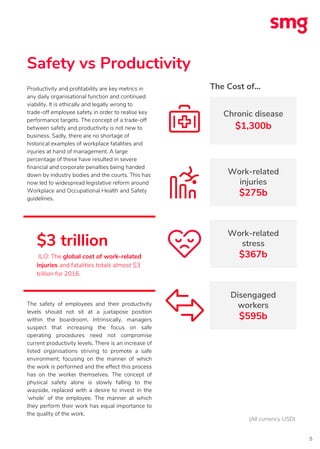
$3 trillion
ILO: The global cost of work-related
injuries and fatalities totals almost $3
trillion for 2016.
Chronic disease
$1,300b
Work-related
injuries
$275b
Work-related
stress
$367b
Disengaged
workers
$595b
The Cost of...
(All currency USD)
6
The statistics around repetitive injuries and
accidents in the workplace continue to force a
rethink of the causes of the risk to staff. No
longer are machines and vehicles the primary
cause of workplace productivity losses. These
have been replaced with mobility, disease and
stress related episodes. A broken limb is visible,
instant and is able to be treated. A disengaged,
stressed and overwhelmed workforce can greatly
reduce productivity, leading to the risk of mental
health claims and chronic disease.
According to leading medical research in
Australia, organisations that implement a health
and wellbeing strategy not only reduce the
instance of workplace injuries by 42%, they can
decrease their employees’ overall health risk
factors by up to 56%.
So why aren’t workplace wellbeing programs
standard across all industry? Procrastination, or
lack of priority aside, the statistics around
organisations that have attempted to implement
a workplace wellbeing program, and failed, are
climbing.
So why aren’t workplace wellbeing
programs standard across all
industry?
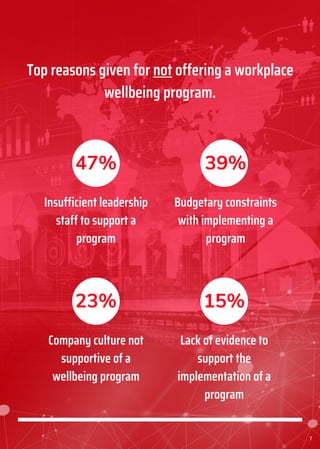
Top reasons given for not offering a workplace
wellbeing program.
7
47%
Insufficient leadership
staff to support a
program
39%
Budgetary constraints
with implementing a
program
23%
Company culture not
supportive of a
wellbeing program
15%
Lack of evidence to
support the
implementation of a
program
The Two Main Causes of Wellbeing
Program Failure
8
Two of the greatest factors that lead to failure in
this space are; failing to have the wellbeing
program operational at all times, and appointing
the HR manager as the sole champion and
keeper of the program.
For a workplace wellbeing program to be
successful, organisations must ensure that the
program has been implemented fully, is
operational at all times and is readily accessible
to staff both during working hours and in their
downtime. This theme is enabled largely through
the use of mobile technologies that reach further
than the desktop mouse or the lunchroom
noticeboard.
HR Managers may be useful advocates of the
program from a logical point of context with
legislation and policy. However, for a workplace
program to be adopted widely and maintained,
an organisation will need to recruit internal
champions that have personal values in
alignment with the goals of the program.
Research has shown that having staff champions
across all echelon of the workplace will have a
greater utilisation factor and results achieved
during the program. Messaging needs to be led
from the top-down, with participation throughout
the entire organisation.
Of the organisations that have adopted a
wellbeing program, 72% of workplaces surveyed
shared that they thought their organisation could
do more to promote existing programs.
Under-utilising and a reduction in benefits and
productivity will lead to loss of confidence and
the removal of the program in the long-run. A
well-structured and researched program can be
incorrectly labelled as underperforming and
benched prematurely. This in turn creates a loss
in confidence within the management and
employees and a willingness to resist any new
programs.
Employers that invest greater energy, messaging
and promoting of new programs to their
employees often finds innovative, real-time
methods of communications. The use of social
media channels, regular briefings, non-financial
incentives and peer visibility have resulted in
early adoption by workers. This enables an
organisation to tie the program back to current
company values, missions and goals. This may
be promoted externally in addition to internally.
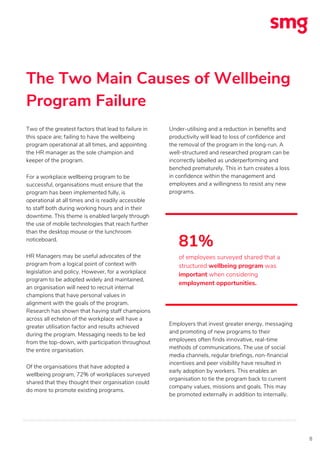
81%
of employees surveyed shared that a
structured wellbeing program was
important when considering
employment opportunities.
Four Pillars
9
One way to ensure a Corporate Wellbeing program is multi-faceted is to adopt a holistic approach
focusing on the needs of employees and the organisation. The ability to combine policy requirements,
with safety and productivity considerations, along with both mental and physical employee optimisations
will create wellbeing change.
Mental Health:
Research into the effects of stress and
disengagement of employees on the workplace is
prominent. For a Corporate Wellbeing program
to thrive, assumptions around employee starting
points are dangerous. For some workers,
privately assessing stress levels or performing
convenient exercises to
improve their mental state will hold a higher
intrinsic value than going for a run, ride or swim.
The stigma attached to mental health issues
forces a large percentage of the workforce to
experience difficulties and challenges in private.
Fears of retaliation by management if a worker
accesses an EAP service sadly linger. By
including relevant, real-time and private scientific
designed mental health exercises in a Corporate
Wellbeing program, in conjunction with
additional services, such as EAP’s, optimal
benefits can be delivered.
Physical Activity:
If you look into any organisation across the globe
you will see the workforce can be separated into
four distinct groups:
The Athletes: The athletes of any organisation
are easy to identify. By the time they come into
work each morning they have already put in at
least three hours in the gym, or gone for a
21-mile run, or swam the equivalent of the
English Channel (and back), while looking like a
cover model from sports illustrated. These
individuals have the ability,
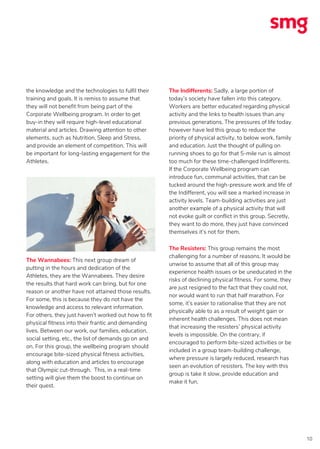
The four main focus points of an effective Corporate Wellbeing program
should be: Mental Health, Physical Activity, Nutrition and Sleep.
10
the knowledge and the technologies to fulfil their
training and goals. It is remiss to assume that
they will not benefit from being part of the
Corporate Wellbeing program. In order to get
buy-in they will require high-level educational
material and articles. Drawing attention to other
elements, such as Nutrition, Sleep and Stress,
and provide an element of competition. This will
be important for long-lasting engagement for the
Athletes.
The Wannabees: This next group dream of
putting in the hours and dedication of the
Athletes, they are the Wannabees. They desire
the results that hard work can bring, but for one
reason or another have not attained those results.
For some, this is because they do not have the
knowledge and access to relevant information.
For others, they just haven’t worked out how to fit
physical fitness into their frantic and demanding
lives. Between our work, our families, education,
social setting, etc., the list of demands go on and
on. For this group, the wellbeing program should
encourage bite-sized physical fitness activities,
along with education and articles to encourage
that Olympic cut-through. This, in a real-time
setting will give them the boost to continue on
their quest.
The Indifferents: Sadly, a large portion of
today’s society have fallen into this category.
Workers are better educated regarding physical
activity and the links to health issues than any
previous generations. The pressures of life today
however have led this group to reduce the
priority of physical activity, to below work, family
and education. Just the thought of pulling on
running shoes to go for that 5-mile run is almost
too much for these time-challenged Indifferents.
If the Corporate Wellbeing program can
introduce fun, communal activities, that can be
tucked around the high-pressure work and life of
the Indifferent, you will see a marked increase in
activity levels. Team-building activities are just
another example of a physical activity that will
not evoke guilt or conflict in this group. Secretly,
they want to do more, they just have convinced
themselves it’s not for them.
The Resisters: This group remains the most
challenging for a number of reasons. It would be
unwise to assume that all of this group may
experience health issues or be uneducated in the
risks of declining physical fitness. For some, they
are just resigned to the fact that they could not,
nor would want to run that half marathon. For
some, it’s easier to rationalise that they are not
physically able to as a result of weight gain or
inherent health challenges. This does not mean
that increasing the resisters’ physical activity
levels is impossible. On the contrary, if
encouraged to perform bite-sized activities or be
included in a group team-building challenge,
where pressure is largely reduced, research has
seen an evolution of resisters. The key with this
group is take it slow, provide education and
make it fun.
11
Nutrition:
There are no shortage of programs, educational
material or applications that focus solely on
nutrition. The ability simply to scan a food
packet, or record dinner servings have been
available to consumers for quite some time.
Experts would argue that if an individual only
focused on one element to improve that health,
nutrition over any other element is most
important.
With a highly nutritious diet, conditions and
diseases and weight can be addressed and
controlled and maintained. But nutrition alone,
and the method that nutrition is addressed is
critical to continued engagement. It is not difficult
to include an element of nutrition in a Corporate
Wellbeing program, but for maximum effect, the
ability for nutrition to be linked with multiple
holistic elements, such as activity and sleep is
essential. The most effective Corporate
Wellbeing programs will utilise technologies to
provide real-time access for their employees to
nutritional databases,.
Sleep:
The lack of sleep has been labelled one of the
greatest risks to workforces in 2017. Insufficient
sleep over a period of time can increase the risk
of chronic health conditions
including heart disease, diabetes, weight gain,
stress and mental health issues to name a few.
Increased life pressures, access to on-demand
entertainment sources and stress over work are
listed as the three greatest barriers to sleep. In
addition to these barriers, statistics show a
miseducation of the actual quantity of sleep
needed to maintain health is sadly lacking. The
average adult requires between 6 – 8 hours of
uninterrupted sleep per 24-hour cycle. However,
they are currently only getting between 3:30 and
5:30 hours of sleep. And the quality of this sleep
is up for debate. It is possible for a Corporate
Wellbeing program to address and provide
education around this critical element of
wellbeing to its workforce. With the inclusion of
technologies to actively monitor and encourage
increased quality to that sleep.
13%
of HR Professionals surveyed said
their existing Corporate Wellbeing
program focused on two or more
elements.
12
Wearables, whilst not a new technology, are
evolving. For a Corporate Wellbeing program to
be fully adopted by the workforce and to have a
long-lasting effect of positive change, technology
must be involved. The role of technology in the
formula for success is imperative. It must deliver
material and messaging to the users of the
program in a real-time, geographically diverse
manner. This communication and messaging is
enriched when delivered in a two-way, real-time,
continuous process.
The use of wearables, when combined with a
Corporate Wellbeing platform and application,
optimises the two-way, real-time, mobility of the
process. Wearables alone, once again cannot
provide a comprehensive, long-lasting program,
but as part of a quality Corporate Wellbeing
program, they provide an integral linking of
components.
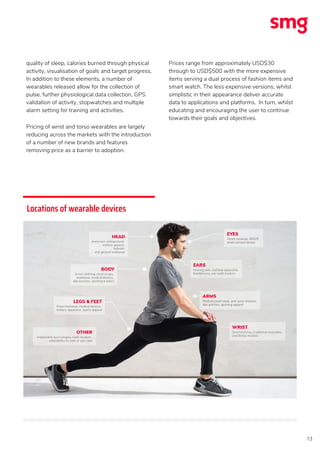
As traditional wearables, or extremity wearables
(wrists and torso) continue to grow in popularity,
advancements in medical research has seen a
number of new technologies enter the
marketplace. Whilst impressive in the many and
varied applications and the roles they will play in
big data, it is not necessary to consider the
majority of the following device types in the
pursuit of a Corporate Wellbeing program.
At their most basic format, a reliable traditional
wearable must be able to provide the user and
the program the following information units:
Time and date, both manual and automatic
tracking of activity (for example: steps,
swimming, bike riding distance), duration and
Sales of wearables continued
to increase in 2017 by 17% with
over 310m devices sold and
revenue est at $30.5Bn.
Wearables
13
quality of sleep, calories burned through physical
activity, visualisation of goals and target progress.
In addition to these elements, a number of
wearables released allow for the collection of
pulse, further physiological data collection, GPS
validation of activity, stopwatches and multiple
alarm setting for training and activities.
Pricing of wrist and torso wearables are largely
reducing across the markets with the introduction
of a number of new brands and features
removing price as a barrier to adoption.
Prices range from approximately USD$30
through to USD$500 with the more expensive
items serving a dual process of fashion items and
smart watch. The less expensive versions, whilst
simplistic in their appearance deliver accurate
data to applications and platforms. In turn, whilst
educating and encouraging the user to continue
towards their goals and objectives.
Locations of wearable devices
Artificial Intelligence
14
Up to now, this paper has investigated the
elements of a quality Corporate Wellbeing
program. It has considered the users of the
program, the organisation and the workforce.
Highlighting elements that ensure a long-lasting
and engaging program. Holistically focusing on
improving the overall health, engagement and
productivity of the workforce.
A traditional Corporate Wellbeing program, even
with the inclusion of technologies and wearables
may develop a single and two-dimensional
approach to change. They are not forward
thinking and lack the dynamic nature a modern
organisation needs in terms of Corporate
Wellbeing and growth.
In the pursuit of productivity and growth, it is
more than just communications, education and
messaging that is exchanged between the users
and the organisation. In its simplest term, the
very fuel that enables the vehicle to progress is
raw data. To some, this data will seem like a
bi-product of the process. This is true; however,
the world is scrambling to acquire this valuable
bi-product for one very good reason.
If raw data is the fuel that drives any successful
program, the use of Artificial Intelligence is the
supercharger in this vehicle. Artificial Intelligence
(AI), can dissect mass amounts of raw data into a
format that business advisors and key
management can interpret. But the benefits of
this commodity do not stop with data
interpretation.
If raw data is the fuel that drives the
engine, Artificial Intelligence is the
supercharger.
15
The main gift that AI gives to the Wellbeing
program is the ability to identify trends, produce
progress forecasts and provide predictive analytics
of the workforce. It allows organisations and the
program to issue personalised recommendations or
action plans, enhancing engagement and
commitment to the cause.
Despite its undeniable benefits to an organisation,
across multiple facets of business development, AI
in its purest form remains elusive to most
organisations. Start-ups and Fortune 500 alike race
to develop user-friendly computational models and
engines and to promote their wares to the masses.
The insights that these engines produce remain
elusive. As they cannot be replicated by
conventional tools and techniques, and would be
prohibitively expensive to reproduce.
15
“Start-ups and Fortune 500 alike race to develop user-friendly computational
models and engines and to promote their wares to the masses.”
Smart technology yields far greater intelligence in
an efficient and cost-effective manner,
something traditional techniques will never
match. The role that AI plays in Corporate
Wellbeing is to enable users to benefit from
these action plans, predictive analytics and
personalised recommendations in a real-time,
collaborative manner. Experts have said that to
make the most out of AI you must have the
wisdom to make sense of the output. Modern
advancements in AI and the collaboration of
Corporate Wellbeing programs mean the heavy
lifting has been done for the organisations. With
end users being the greatest beneficiaries of the
operation.
16
In Summary
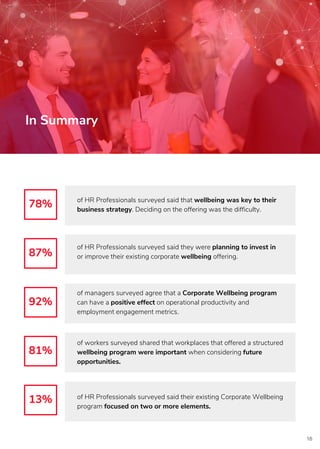
78%
87%
92%
81%
13%
of HR Professionals surveyed said that wellbeing was key to their
business strategy. Deciding on the offering was the difficulty.
of HR Professionals surveyed said they were planning to invest in
or improve their existing corporate wellbeing offering.
of managers surveyed agree that a Corporate Wellbeing program
can have a positive effect on operational productivity and
employment engagement metrics.
of workers surveyed shared that workplaces that offered a structured
wellbeing program were important when considering future
opportunities.
of HR Professionals surveyed said their existing Corporate Wellbeing
program focused on two or more elements.
17
· The two main reasons that Corporate Wellbeing
programs fail are not having the wellbeing
program operational at all times, and appointing
the HR manager as the sole champion and
keeper of the program.
· USD 3 trillion ILO: The Global cost of
work-related injuries and fatalities totals almost
$3 trillion for 2016.
· Organisations that implement a health and
wellbeing strategy not only reduce that instance
of workplace injuries and accidents by 42%, they
can reduce their employees’ overall health risk
factors by up to 56%.
· An effective Corporate Wellbeing program will
focus on Mental Health, Physical Activity, Sleep
and Nutrition.
· Sales of wearables continued to increase in
2017 by 17% with over 310m devices sold and
revenue estimated to have been $30.5Bn.
· The role of technology is to provide two-way,
real-time communication and access to the
program for all users at all times.
· The role that AI plays in Corporate Wellbeing is
to enable the users of the program to benefit from
action plans, predictive analytics and
personalised recommendations in a real-time,
collaborative manner.
Sources:
1. Meritan Health. United States. Make Wellness Work for. You Building an effective wellness strategy. 2005.
https://www.meritain.com/Media/Default/White%20Papers/White%20Paper%20-%20Wellness.pdf
2. "Safety and health at work", 2017. http://www.ilo.org/global/topics/safety-and-health-at-work/lang--en/index.htm
3. https://www.osha.gov/oshstats/work.html
4. Walters, Robert. Australia. The value of promoting employee health and wellbeing, Robert Walters Whitepaper. 2017.
https://www.robertwalters.com/content/dam/robert-walters/corporate/news-and-pr/files/whitepapers/health-and-wellbeing-whitepaper-aus.pdf
5. Optum, United States. Employee health: Are you leading or lagging? 8th annual “Wellness in the Workplace” study. 2016.
https://www.optum.com/resources/library/workplace-wellness.html
6. "This is the future of corporate wellness programs". 2017. https://www.fastcompany.com/40418593/this-is-the-future-of-corporate-wellness-program
7. www.corporatewellnessmagazine.com>
8. "The top corporate wellness trends to watch for in 2017". 2017.
https://www.forbes.com/sites/alankohll/2017/01/18/the-top-corporate-wellness-trends-to-watch-for-in-2017/#7e7ad72f7b28
9. Albrecht, Henry"Back to the Future: How the Evolution of Corporate Wellness Influences Its Destiny". 2017.
https://www.huffingtonpost.com/henry-albrecht/back-to-the-future-how-th_b_9637092.html
About SMG
SMG, one of the world’s leading SaaS
health technology companies.
Integrating all data channels with machine
learning, we provide the power to deliver on
demand analytical insights, trends and
predictions.
SMG offers a range of innovative solutions
unique to the specialised requirements within
private and public sectors. This includes but is not
limited to; corporate wellness and employee
engagement, enterprise and healthcare services,
insurance and community services. Currently we
work with leading organisations across multiple
sectors globally.
SMG is headquartered in Brisbane, Australia with
teams located globally.
SMG Products
© SMG Corporation Pty Ltd, 2018. This paper is for informational purposes only.
Learn more at
smg-corporate.com

SMGs 2017-corporate-wellbeing-report

  • 1.
  • 2.
    2 As the economicand regulatory pressures on businesses increase, it is imperative that key improvement metrics pertaining to staff are leveraged to their utmost. Irrespective of the size and turnover of the organisation, common pressures appear at a management and board level. Drivers around productivity, staff retention, occupational health and safety and training transcend every industry group; every sector, every geography. The need to prioritise staff development has never been greater. A focus on balancing productivity measures whilst optimising staff welfare has risen to the forefront of board priorities. This is in part due to continued legislative attention, but also to the growing demand for employers to match staff values. The desire to implement a Corporate Wellbeing strategy has been publicised by the vast majority of large private organisations and the public sector in 2017. As organisational policies are developed with the intention of creating and maintaining a relevant human resources strategy, few have perfected the formula. Like no time before, the intention to tick a regulatory box, is no longer deemed sufficient. The paradigm shifts to empowering the workforce has commenced. This movement has also seen the appointment of executives to manage this key focus; heads of culture and people, heads of workplace safety and general managers of corporate welfare, to name a few. This crucial paradigm shift is no longer being delegated to the average Human Resources representative. The introduction of Wearable Technologies and Artificial Intelligence has added to the complexity, leading to widespread inactivity despite its best of intentions. The desire to blend comprehensive workforce reform and healthy standard is evident; but is desire enough? 78% of of HR Professionals surveyed said that wellbeing was key to their business strategy. Deciding on the offering was the difficulty. Foreword
  • 3.
    Corporate Wellbeing 3 According tothe US Government Centre for Disease Control and Agius, Occupational Health and Workplace Health Programs can be defined as: “Occupational Health is the promotion and maintenance of the highest degree of physical, mental and social well-being of workers in all occupations by preventing departures from health, controlling risks and the adaption of work to people, and people to their jobs.” “Workplace health programs are a coordinated and comprehensive set of health promotion and protection strategies implemented at the worksite that includes programs, policies, benefits, environmental supports, and links to the surrounding community designed to encourage the health and safety of all employees.” These can be broken down further into four subsections – Health-Related Programs, Health Related Policies, Health Benefits and Environmental Supports. Experience has taught us that any one of the four concepts in isolation is insufficient to instil healthy values and behaviours. A policy unsupported by practical application may satisfy a legislative requirement, but will not ensure healthy choices are adopted by the workforce. The advent of technology is further complicating the path forward for many organisations. For all its good points it adds a layer of complexity to the transformation. The inclusion of Technology within a workplace wellbeing program enables a coordinated approach across large organisations. It transcends geographical divide of the workforce and the devices selected cater to differing roles of workers within a complex organisation. Furthermore, it reduces the cost of educating and communicating with a workforce in the form of real-time applications. 87% of HR Professionals surveyed said they were planning to invest in or improve their existing corporate wellbeing offering.
  • 4.
    4 However, it canstill be viewed as complex, specialised, and overwhelming by the sheer number of devices and platform choices now available. Technologies that promote healthy choices and enhance tractability of these choices amongst peer groups are crucial to sustaining ongoing participation from the workforce. Despite this, 89% of employers surveyed admitted to postponing the implementation of a wellbeing program due to insufficient confidence in technology options. A further 54% had ceased supporting a wellbeing program due to poor technology operation and low take-up statistics within the workforce. Paralysed by choice, it is not uncommon for organisations to make small changes to their previous policy, or the appointment of a staff member to investigate options without realistic timeframes set in place. The drafting of a new company policy to depict the organisational commitment to the cause is another stalling tactic that once again fails to address the statistics. The adoption of an Employee Access Program is one example of this movement. Whilst catering to stress and mental health issues is one crucial element to adopting a Workplace Health Program, it is just one of the elements needed to see cultural shift. If physical, nutritional, behavioural and sleep requirements of employees are not addressed, policy and mental health programs will not create a healthy environment, nor a lasting change. 92% of managers surveyed agree that a corporate wellbeing program can have a positive effect on operational productivity and employment engagement metrics. The benefit of a structured corporate wellbeing program on productivity and employee engagement
  • 5.
    5 Safety vs Productivity Productivityand profitability are key metrics in any daily organisational function and continued viability. It is ethically and legally wrong to trade-off employee safety in order to realise key performance targets. The concept of a trade-off between safety and productivity is not new to business. Sadly, there are no shortage of historical examples of workplace fatalities and injuries at hand of management. A large percentage of these have resulted in severe financial and corporate penalties being handed down by industry bodies and the courts. This has now led to widespread legislative reform around Workplace and Occupational Health and Safety guidelines. The safety of employees and their productivity levels should not sit at a juxtapose position within the boardroom. Intrinsically, managers suspect that increasing the focus on safe operating procedures need not compromise current productivity levels. There is an increase of listed organisations striving to promote a safe environment; focusing on the manner of which the work is performed and the effect this process has on the worker themselves. The concept of physical safety alone is slowly falling to the wayside, replaced with a desire to invest in the ‘whole’ of the employee. The manner at which they perform their work has equal importance to the quality of the work. $3 trillion ILO: The global cost of work-related injuries and fatalities totals almost $3 trillion for 2016. Chronic disease $1,300b Work-related injuries $275b Work-related stress $367b Disengaged workers $595b The Cost of... (All currency USD)
  • 6.
    6 The statistics aroundrepetitive injuries and accidents in the workplace continue to force a rethink of the causes of the risk to staff. No longer are machines and vehicles the primary cause of workplace productivity losses. These have been replaced with mobility, disease and stress related episodes. A broken limb is visible, instant and is able to be treated. A disengaged, stressed and overwhelmed workforce can greatly reduce productivity, leading to the risk of mental health claims and chronic disease. According to leading medical research in Australia, organisations that implement a health and wellbeing strategy not only reduce the instance of workplace injuries by 42%, they can decrease their employees’ overall health risk factors by up to 56%. So why aren’t workplace wellbeing programs standard across all industry? Procrastination, or lack of priority aside, the statistics around organisations that have attempted to implement a workplace wellbeing program, and failed, are climbing. So why aren’t workplace wellbeing programs standard across all industry?
  • 7.
    Top reasons givenfor not offering a workplace wellbeing program. 7 47% Insufficient leadership staff to support a program 39% Budgetary constraints with implementing a program 23% Company culture not supportive of a wellbeing program 15% Lack of evidence to support the implementation of a program
  • 8.
    The Two MainCauses of Wellbeing Program Failure 8 Two of the greatest factors that lead to failure in this space are; failing to have the wellbeing program operational at all times, and appointing the HR manager as the sole champion and keeper of the program. For a workplace wellbeing program to be successful, organisations must ensure that the program has been implemented fully, is operational at all times and is readily accessible to staff both during working hours and in their downtime. This theme is enabled largely through the use of mobile technologies that reach further than the desktop mouse or the lunchroom noticeboard. HR Managers may be useful advocates of the program from a logical point of context with legislation and policy. However, for a workplace program to be adopted widely and maintained, an organisation will need to recruit internal champions that have personal values in alignment with the goals of the program. Research has shown that having staff champions across all echelon of the workplace will have a greater utilisation factor and results achieved during the program. Messaging needs to be led from the top-down, with participation throughout the entire organisation. Of the organisations that have adopted a wellbeing program, 72% of workplaces surveyed shared that they thought their organisation could do more to promote existing programs. Under-utilising and a reduction in benefits and productivity will lead to loss of confidence and the removal of the program in the long-run. A well-structured and researched program can be incorrectly labelled as underperforming and benched prematurely. This in turn creates a loss in confidence within the management and employees and a willingness to resist any new programs. Employers that invest greater energy, messaging and promoting of new programs to their employees often finds innovative, real-time methods of communications. The use of social media channels, regular briefings, non-financial incentives and peer visibility have resulted in early adoption by workers. This enables an organisation to tie the program back to current company values, missions and goals. This may be promoted externally in addition to internally. 81% of employees surveyed shared that a structured wellbeing program was important when considering employment opportunities.
  • 9.
    Four Pillars 9 One wayto ensure a Corporate Wellbeing program is multi-faceted is to adopt a holistic approach focusing on the needs of employees and the organisation. The ability to combine policy requirements, with safety and productivity considerations, along with both mental and physical employee optimisations will create wellbeing change. Mental Health: Research into the effects of stress and disengagement of employees on the workplace is prominent. For a Corporate Wellbeing program to thrive, assumptions around employee starting points are dangerous. For some workers, privately assessing stress levels or performing convenient exercises to improve their mental state will hold a higher intrinsic value than going for a run, ride or swim. The stigma attached to mental health issues forces a large percentage of the workforce to experience difficulties and challenges in private. Fears of retaliation by management if a worker accesses an EAP service sadly linger. By including relevant, real-time and private scientific designed mental health exercises in a Corporate Wellbeing program, in conjunction with additional services, such as EAP’s, optimal benefits can be delivered. Physical Activity: If you look into any organisation across the globe you will see the workforce can be separated into four distinct groups: The Athletes: The athletes of any organisation are easy to identify. By the time they come into work each morning they have already put in at least three hours in the gym, or gone for a 21-mile run, or swam the equivalent of the English Channel (and back), while looking like a cover model from sports illustrated. These individuals have the ability, The four main focus points of an effective Corporate Wellbeing program should be: Mental Health, Physical Activity, Nutrition and Sleep.
  • 10.
    10 the knowledge andthe technologies to fulfil their training and goals. It is remiss to assume that they will not benefit from being part of the Corporate Wellbeing program. In order to get buy-in they will require high-level educational material and articles. Drawing attention to other elements, such as Nutrition, Sleep and Stress, and provide an element of competition. This will be important for long-lasting engagement for the Athletes. The Wannabees: This next group dream of putting in the hours and dedication of the Athletes, they are the Wannabees. They desire the results that hard work can bring, but for one reason or another have not attained those results. For some, this is because they do not have the knowledge and access to relevant information. For others, they just haven’t worked out how to fit physical fitness into their frantic and demanding lives. Between our work, our families, education, social setting, etc., the list of demands go on and on. For this group, the wellbeing program should encourage bite-sized physical fitness activities, along with education and articles to encourage that Olympic cut-through. This, in a real-time setting will give them the boost to continue on their quest. The Indifferents: Sadly, a large portion of today’s society have fallen into this category. Workers are better educated regarding physical activity and the links to health issues than any previous generations. The pressures of life today however have led this group to reduce the priority of physical activity, to below work, family and education. Just the thought of pulling on running shoes to go for that 5-mile run is almost too much for these time-challenged Indifferents. If the Corporate Wellbeing program can introduce fun, communal activities, that can be tucked around the high-pressure work and life of the Indifferent, you will see a marked increase in activity levels. Team-building activities are just another example of a physical activity that will not evoke guilt or conflict in this group. Secretly, they want to do more, they just have convinced themselves it’s not for them. The Resisters: This group remains the most challenging for a number of reasons. It would be unwise to assume that all of this group may experience health issues or be uneducated in the risks of declining physical fitness. For some, they are just resigned to the fact that they could not, nor would want to run that half marathon. For some, it’s easier to rationalise that they are not physically able to as a result of weight gain or inherent health challenges. This does not mean that increasing the resisters’ physical activity levels is impossible. On the contrary, if encouraged to perform bite-sized activities or be included in a group team-building challenge, where pressure is largely reduced, research has seen an evolution of resisters. The key with this group is take it slow, provide education and make it fun.
  • 11.
    11 Nutrition: There are noshortage of programs, educational material or applications that focus solely on nutrition. The ability simply to scan a food packet, or record dinner servings have been available to consumers for quite some time. Experts would argue that if an individual only focused on one element to improve that health, nutrition over any other element is most important. With a highly nutritious diet, conditions and diseases and weight can be addressed and controlled and maintained. But nutrition alone, and the method that nutrition is addressed is critical to continued engagement. It is not difficult to include an element of nutrition in a Corporate Wellbeing program, but for maximum effect, the ability for nutrition to be linked with multiple holistic elements, such as activity and sleep is essential. The most effective Corporate Wellbeing programs will utilise technologies to provide real-time access for their employees to nutritional databases,. Sleep: The lack of sleep has been labelled one of the greatest risks to workforces in 2017. Insufficient sleep over a period of time can increase the risk of chronic health conditions including heart disease, diabetes, weight gain, stress and mental health issues to name a few. Increased life pressures, access to on-demand entertainment sources and stress over work are listed as the three greatest barriers to sleep. In addition to these barriers, statistics show a miseducation of the actual quantity of sleep needed to maintain health is sadly lacking. The average adult requires between 6 – 8 hours of uninterrupted sleep per 24-hour cycle. However, they are currently only getting between 3:30 and 5:30 hours of sleep. And the quality of this sleep is up for debate. It is possible for a Corporate Wellbeing program to address and provide education around this critical element of wellbeing to its workforce. With the inclusion of technologies to actively monitor and encourage increased quality to that sleep. 13% of HR Professionals surveyed said their existing Corporate Wellbeing program focused on two or more elements.
  • 12.
    12 Wearables, whilst nota new technology, are evolving. For a Corporate Wellbeing program to be fully adopted by the workforce and to have a long-lasting effect of positive change, technology must be involved. The role of technology in the formula for success is imperative. It must deliver material and messaging to the users of the program in a real-time, geographically diverse manner. This communication and messaging is enriched when delivered in a two-way, real-time, continuous process. The use of wearables, when combined with a Corporate Wellbeing platform and application, optimises the two-way, real-time, mobility of the process. Wearables alone, once again cannot provide a comprehensive, long-lasting program, but as part of a quality Corporate Wellbeing program, they provide an integral linking of components. As traditional wearables, or extremity wearables (wrists and torso) continue to grow in popularity, advancements in medical research has seen a number of new technologies enter the marketplace. Whilst impressive in the many and varied applications and the roles they will play in big data, it is not necessary to consider the majority of the following device types in the pursuit of a Corporate Wellbeing program. At their most basic format, a reliable traditional wearable must be able to provide the user and the program the following information units: Time and date, both manual and automatic tracking of activity (for example: steps, swimming, bike riding distance), duration and Sales of wearables continued to increase in 2017 by 17% with over 310m devices sold and revenue est at $30.5Bn. Wearables
  • 13.
    13 quality of sleep,calories burned through physical activity, visualisation of goals and target progress. In addition to these elements, a number of wearables released allow for the collection of pulse, further physiological data collection, GPS validation of activity, stopwatches and multiple alarm setting for training and activities. Pricing of wrist and torso wearables are largely reducing across the markets with the introduction of a number of new brands and features removing price as a barrier to adoption. Prices range from approximately USD$30 through to USD$500 with the more expensive items serving a dual process of fashion items and smart watch. The less expensive versions, whilst simplistic in their appearance deliver accurate data to applications and platforms. In turn, whilst educating and encouraging the user to continue towards their goals and objectives. Locations of wearable devices
  • 14.
    Artificial Intelligence 14 Up tonow, this paper has investigated the elements of a quality Corporate Wellbeing program. It has considered the users of the program, the organisation and the workforce. Highlighting elements that ensure a long-lasting and engaging program. Holistically focusing on improving the overall health, engagement and productivity of the workforce. A traditional Corporate Wellbeing program, even with the inclusion of technologies and wearables may develop a single and two-dimensional approach to change. They are not forward thinking and lack the dynamic nature a modern organisation needs in terms of Corporate Wellbeing and growth. In the pursuit of productivity and growth, it is more than just communications, education and messaging that is exchanged between the users and the organisation. In its simplest term, the very fuel that enables the vehicle to progress is raw data. To some, this data will seem like a bi-product of the process. This is true; however, the world is scrambling to acquire this valuable bi-product for one very good reason. If raw data is the fuel that drives any successful program, the use of Artificial Intelligence is the supercharger in this vehicle. Artificial Intelligence (AI), can dissect mass amounts of raw data into a format that business advisors and key management can interpret. But the benefits of this commodity do not stop with data interpretation. If raw data is the fuel that drives the engine, Artificial Intelligence is the supercharger.
  • 15.
    15 The main giftthat AI gives to the Wellbeing program is the ability to identify trends, produce progress forecasts and provide predictive analytics of the workforce. It allows organisations and the program to issue personalised recommendations or action plans, enhancing engagement and commitment to the cause. Despite its undeniable benefits to an organisation, across multiple facets of business development, AI in its purest form remains elusive to most organisations. Start-ups and Fortune 500 alike race to develop user-friendly computational models and engines and to promote their wares to the masses. The insights that these engines produce remain elusive. As they cannot be replicated by conventional tools and techniques, and would be prohibitively expensive to reproduce. 15 “Start-ups and Fortune 500 alike race to develop user-friendly computational models and engines and to promote their wares to the masses.” Smart technology yields far greater intelligence in an efficient and cost-effective manner, something traditional techniques will never match. The role that AI plays in Corporate Wellbeing is to enable users to benefit from these action plans, predictive analytics and personalised recommendations in a real-time, collaborative manner. Experts have said that to make the most out of AI you must have the wisdom to make sense of the output. Modern advancements in AI and the collaboration of Corporate Wellbeing programs mean the heavy lifting has been done for the organisations. With end users being the greatest beneficiaries of the operation.
  • 16.
    16 In Summary 78% 87% 92% 81% 13% of HRProfessionals surveyed said that wellbeing was key to their business strategy. Deciding on the offering was the difficulty. of HR Professionals surveyed said they were planning to invest in or improve their existing corporate wellbeing offering. of managers surveyed agree that a Corporate Wellbeing program can have a positive effect on operational productivity and employment engagement metrics. of workers surveyed shared that workplaces that offered a structured wellbeing program were important when considering future opportunities. of HR Professionals surveyed said their existing Corporate Wellbeing program focused on two or more elements.
  • 17.
    17 · The twomain reasons that Corporate Wellbeing programs fail are not having the wellbeing program operational at all times, and appointing the HR manager as the sole champion and keeper of the program. · USD 3 trillion ILO: The Global cost of work-related injuries and fatalities totals almost $3 trillion for 2016. · Organisations that implement a health and wellbeing strategy not only reduce that instance of workplace injuries and accidents by 42%, they can reduce their employees’ overall health risk factors by up to 56%. · An effective Corporate Wellbeing program will focus on Mental Health, Physical Activity, Sleep and Nutrition. · Sales of wearables continued to increase in 2017 by 17% with over 310m devices sold and revenue estimated to have been $30.5Bn. · The role of technology is to provide two-way, real-time communication and access to the program for all users at all times. · The role that AI plays in Corporate Wellbeing is to enable the users of the program to benefit from action plans, predictive analytics and personalised recommendations in a real-time, collaborative manner. Sources: 1. Meritan Health. United States. Make Wellness Work for. You Building an effective wellness strategy. 2005. https://www.meritain.com/Media/Default/White%20Papers/White%20Paper%20-%20Wellness.pdf 2. "Safety and health at work", 2017. http://www.ilo.org/global/topics/safety-and-health-at-work/lang--en/index.htm 3. https://www.osha.gov/oshstats/work.html 4. Walters, Robert. Australia. The value of promoting employee health and wellbeing, Robert Walters Whitepaper. 2017. https://www.robertwalters.com/content/dam/robert-walters/corporate/news-and-pr/files/whitepapers/health-and-wellbeing-whitepaper-aus.pdf 5. Optum, United States. Employee health: Are you leading or lagging? 8th annual “Wellness in the Workplace” study. 2016. https://www.optum.com/resources/library/workplace-wellness.html 6. "This is the future of corporate wellness programs". 2017. https://www.fastcompany.com/40418593/this-is-the-future-of-corporate-wellness-program 7. www.corporatewellnessmagazine.com> 8. "The top corporate wellness trends to watch for in 2017". 2017. https://www.forbes.com/sites/alankohll/2017/01/18/the-top-corporate-wellness-trends-to-watch-for-in-2017/#7e7ad72f7b28 9. Albrecht, Henry"Back to the Future: How the Evolution of Corporate Wellness Influences Its Destiny". 2017. https://www.huffingtonpost.com/henry-albrecht/back-to-the-future-how-th_b_9637092.html
  • 18.
    About SMG SMG, oneof the world’s leading SaaS health technology companies. Integrating all data channels with machine learning, we provide the power to deliver on demand analytical insights, trends and predictions. SMG offers a range of innovative solutions unique to the specialised requirements within private and public sectors. This includes but is not limited to; corporate wellness and employee engagement, enterprise and healthcare services, insurance and community services. Currently we work with leading organisations across multiple sectors globally. SMG is headquartered in Brisbane, Australia with teams located globally. SMG Products © SMG Corporation Pty Ltd, 2018. This paper is for informational purposes only. Learn more at smg-corporate.com