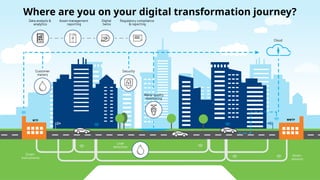
Where are youon your digital transformation journey?
3.
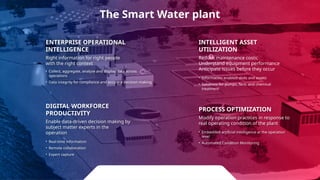
ENTERPRISE OPERATIONAL
INTELLIGENCE
Right informationfor right people
with the right context
• Collect, aggregate, analyze and display data across
operations
• Data integrity for compliance and accurate decision making
The Smart Water plant
INTELLIGENT ASSET
UTILIZATION
Reduce maintenance costs:
Understand equipment performance
Anticipate issues before they occur
• Information enabled skids and assets
• Solutions for pumps, fans, and chemical
treatment
DIGITAL WORKFORCE
PRODUCTIVITY
Enable data-driven decision making by
subject matter experts in the
operation
• Real-time information
• Remote collaboration
• Expert capture
PROCESS OPTIMIZATION
Modify operation practices in response to
real operating condition of the plant
• Embedded artificial intelligence at the operation
level
• Automated Condition Monitoring
4.
Source: Bluefield Research:
WATERINDUSTRY 4.0:
U.S. & CANADA DIGITAL WATER MARKET
FORECAST, 2019-2030
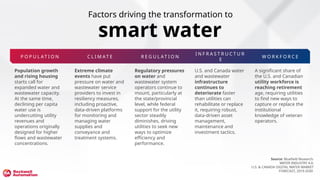
Population growth
and rising housing
starts call for
expanded water and
wastewater capacity.
At the same time,
declining per capita
water use is
undercutting utility
revenues and
operations originally
designed for higher
flows and wastewater
concentrations.
Extreme climate
events have put
pressure on water and
wastewater service
providers to invest in
resiliency measures,
including proactive,
data-driven platforms
for monitoring and
managing water
supplies and
conveyance and
treatment systems.
Regulatory pressures
on water and
wastewater system
operators continue to
mount, particularly at
the state/provincial
level, while federal
support for the utility
sector steadily
diminishes, driving
utilities to seek new
ways to optimize
efficiency and
performance.
U.S. and Canada water
and wastewater
infrastructure
continues to
deteriorate faster
than utilities can
rehabilitate or replace
it, requiring robust,
data-driven asset
management,
maintenance and
investment tactics.
A significant share of
the U.S. and Canadian
utility workforce is
reaching retirement
age, requiring utilities
to find new ways to
capture or replace the
institutional
knowledge of veteran
operators.
P O P U L AT I O N C L I M A T E R E G U L A T I O N
I N F R A S T R U C T U R
E
W O R K F O R C E
smart water
Factors driving the transformation to
5.
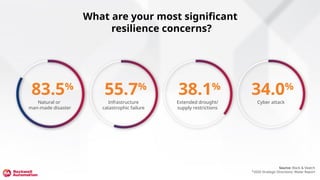
What are yourmost significant
resilience concerns?
Source: Black & Veatch
*2020 Strategic Directions: Water Report
83.5%
Natural or
man-made disaster
55.7%
Infrastructure
catastrophic failure
38.1%
Extended drought/
supply restrictions
34.0%
Cyber attack
6.
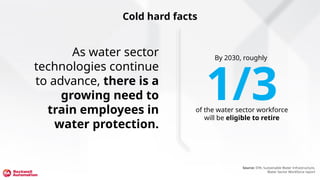
As water sector
technologiescontinue
to advance, there is a
growing need to
train employees in
water protection.
Cold hard facts
Source: EPA: Sustainable Water Infrastructure,
Water Sector Workforce report
1/3
By 2030, roughly
of the water sector workforce
will be eligible to retire
8.
desired
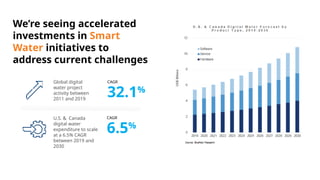
We’re seeing accelerated
investmentsin Smart
Water initiatives to
address current challenges
CAGR
32.1%
Global digital
water project
activity between
2011 and 2019
U.S. & Canada
digital water
expenditure to scale
at a 6.5% CAGR
between 2019 and
2030
CAGR
6.5%
9.
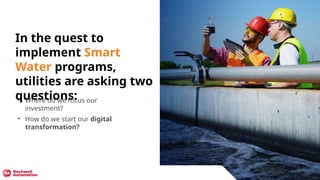
• Where dowe focus our
investment?
• How do we start our digital
transformation?
In the quest to
implement Smart
Water programs,
utilities are asking two
questions: Our digital
water solutions
ensure compliance,
optimize efficiency,
save time and
ensure safety
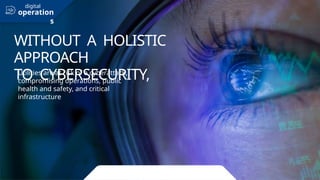
Utilities are atrisk of a cyberattack,
compromising operations, public
health and safety, and critical
infrastructure
WITHOUT A HOLISTIC
APPROACH
TO CYBERSECURITY,
operation
s
digital
14.
desired
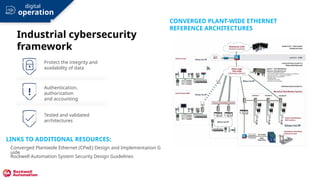
Industrial cybersecurity
framework
Authentication,
authorization
and accounting
Protectthe integrity and
availability of data
Tested and validated
architectures
CONVERGED PLANT-WIDE ETHERNET
REFERENCE ARCHITECTURES
Converged Plantwide Ethernet (CPwE) Design and Implementation G
uide
Rockwell Automation System Security Design Guidelines
LINKS TO ADDITIONAL RESOURCES:
operation
s
digital
15.
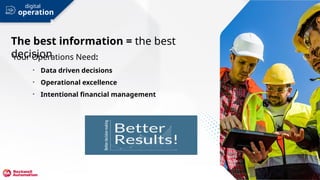
Your Operations Need:
•Data driven decisions
• Operational excellence
• Intentional financial management
The best information = the best
decision
operation
s
digital
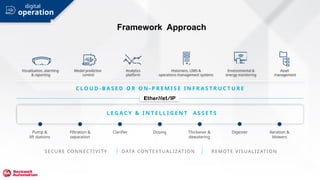
Dosing
Filtration &
separation
Clarifier
Pump &
liftstations
Thickener &
dewatering
Aeration &
blowers
Visualization, alarming
& reporting
Analytics
platform
Historians, LIMS &
operations management systems
Environmental &
energy monitoring
C L O U D - B A S E D O R O N - P R E M I S E I N F R A S T R U C T U R E
L E G A C Y & I N T E L L I G E N T A S S E T S
SECURE CONNECTIVITY DATA CONTEXTUALIZATION REMOTE VISUALIZATION
Digester
Model predictive
control
Framework Approach
Asset
management
operation
s
digital
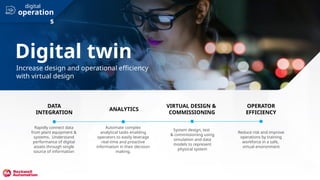
Digital twin
Rapidly connectdata
from plant equipment &
systems. Understand
performance of digital
assets through single
source of information
Automate complex
analytical tasks enabling
operators to easily leverage
real-time and proactive
information in their decision
making.
Reduce risk and improve
operations by training
workforce in a safe,
virtual environment
Increase design and operational efficiency
with virtual design
System design, test
& commissioning using
simulation and data
models to represent
physical system
VIRTUAL DESIGN &
COMMISSIONING
OPERATOR
EFFICIENCY
ANALYTICS
DATA
INTEGRATION
operation
s
digital
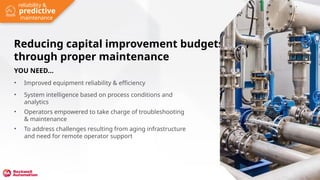
YOU NEED...
• Improvedequipment reliability & efficiency
• System intelligence based on process conditions and
analytics
• Operators empowered to take charge of troubleshooting
& maintenance
• To address challenges resulting from aging infrastructure
and need for remote operator support
Reducing capital improvement budgets
through proper maintenance
NEED NEW
PHOTO
predictive
reliability &
maintenance
25.
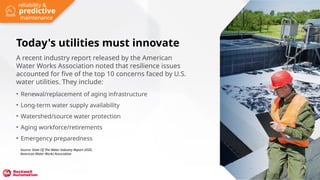
Today's utilities mustinnovate
A recent industry report released by the American
Water Works Association noted that resilience issues
accounted for five of the top 10 concerns faced by U.S.
water utilities. They include:
• Renewal/replacement of aging infrastructure
• Long-term water supply availability
• Watershed/source water protection
• Aging workforce/retirements
• Emergency preparedness
Source: State Of The Water Industry Report 2020,
American Water Works Association
predictive
reliability &
maintenance
26.
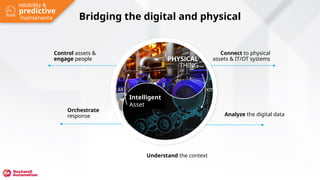
Bridging the digitaland physical
Connect to physical
assets & IT/OT systems
Understand the context
Analyze the digital data
Orchestrate
response
Control assets &
engage people
predictive
reliability &
maintenance
Intelligent
Asset
27.
predictive
reliability &
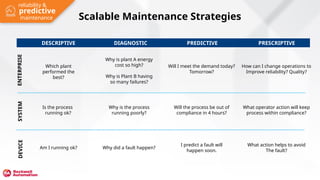
maintenance ScalableMaintenance Strategies
DEVICE
SYSTEM
ENTERPRISE
DESCRIPTIVE DIAGNOSTIC PREDICTIVE PRESCRIPTIVE
Which plant
performed the
best?
Why is plant A energy
cost so high?
Why is Plant B having
so many failures?
Will I meet the demand today?
Tomorrow?
How can I change operations to
Improve reliability? Quality?
Is the process
running ok?
Why is the process
running poorly?
Will the process be out of
compliance in 4 hours?
What operator action will keep
process within compliance?
Am I running ok? Why did a fault happen?
I predict a fault will
happen soon.
What action helps to avoid
The fault?
28.
Click to addscreenshot
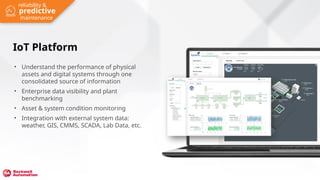
IoT Platform
• Understand the performance of physical
assets and digital systems through one
consolidated source of information
• Enterprise data visibility and plant
benchmarking
• Asset & system condition monitoring
• Integration with external system data:
weather, GIS, CMMS, SCADA, Lab Data, etc.
predictive
reliability &
maintenance
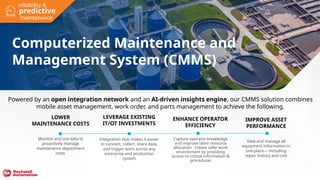
Computerized Maintenance and
ManagementSystem (CMMS)
LOWER
MAINTENANCE COSTS
Monitor and use data to
proactively manage
maintenance department
costs
LEVERAGE EXISTING
IT/OT INVESTMENTS
Integration Hub makes it easier
to connect, collect, share data,
and trigger work across any
enterprise and production
system
IMPROVE ASSET
PERFORMANCE
View and manage all
equipment information in
one place— including
repair history and cost
ENHANCE OPERATOR
EFFICIENCY
Capture operator knowledge
and improve labor resource
allocation. Create safer work
environment by providing
access to critical information &
procedures
Powered by an open integration network and an AI-driven insights engine, our CMMS solution combines
mobile asset management, work order, and parts management to achieve the following.
predictive
reliability &
maintenance
operations
remote
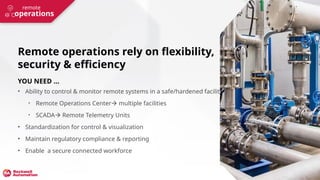
Remote operations relyon flexibility,
security & efficiency
YOU NEED ...
• Ability to control & monitor remote systems in a safe/hardened facility
• Remote Operations Center multiple facilities
• SCADA Remote Telemetry Units
• Standardization for control & visualization
• Maintain regulatory compliance & reporting
• Enable a secure connected workforce
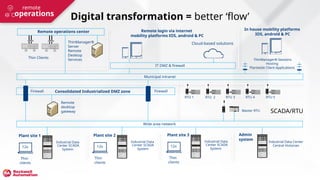
38.
Remote operations center
ConsolidatedIndustrialized DMZ zone
Digital transformation = better ‘flow’
Thin Clients
ThinManager®
Server
Remote
Desktop
Services
Remote login via internet
mobility platforms IOS, android & PC
IT DMZ & firewall
Cloud-based solutions
Municipal intranet
In house mobility platforms
IOS, android & PC
ThinManager® Sessions
Hosting
Plantwide Client Applications
Firewall
Firewall
SCADA/RTU
Remote
desktop
gateway Master RTU
RTU 1 RTU 2 RTU 3 RTU 4 RTU 5
Wide area network
Plant site 1
12x
Thin
clients
Industrial Data
Center SCADA
System
Plant site 2
12x
Thin
clients
Industrial Data
Center SCADA
System
Plant site 3
12x
Thin
clients
Industrial Data
Center SCADA
System
Admin
system
Industrial Data Center
Central Historian
operations
remote
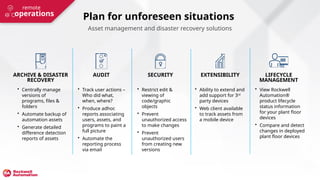
Plan for unforeseensituations
Asset management and disaster recovery solutions
ARCHIVE & DISASTER
RECOVERY
AUDIT SECURITY EXTENSIBILITY LIFECYCLE
MANAGEMENT
• Centrally manage
versions of
programs, files &
folders
• Automate backup of
automation assets
• Generate detailed
difference detection
reports of assets
• Track user actions –
Who did what,
when, where?
• Produce adhoc
reports associating
users, assets, and
programs to paint a
full picture
• Automate the
reporting process
via email
• Restrict edit &
viewing of
code/graphic
objects
• Prevent
unauthorized access
to make changes
• Prevent
unauthorized users
from creating new
versions
• Ability to extend and
add support for 3rd
party devices
• Web client available
to track assets from
a mobile device
• View Rockwell
Automation®
product lifecycle
status information
for your plant floor
devices
• Compare and detect
changes in deployed
plant floor devices
operations
remote
41.
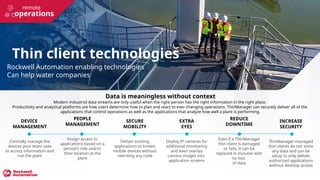
DEVICE
MANAGEMENT
Centrally manage the
devicesyour team uses
to access information and
run the plant
PEOPLE
MANAGEMENT
Assign access to
applications based on a
person’s role and/or
their location at the
plant
SECURE
MOBILITY
Deliver existing
applications to known
mobile devices without
rewriting any code
EXTRA
EYES
Deploy IP cameras for
additional monitoring
and even overlay
camera images into
application screens
REDUCE
DOWNTIME
Even if a ThinManager
thin client is damaged
or fails. It can be
replaced in minutes with
no loss
of data
INCREASE
SECURITY
ThinManager-managed
thin clients do not store
any data and can be
setup to only deliver
authorized applications
without desktop access
operations
remote
Thin client technologies
Rockwell Automation enabling technologies
Can help water companies
Data is meaningless without context
Modern industrial data streams are only useful when the right person has the right information in the right place.
Productivity and analytical platforms are how users determine how to plan and react to ever-changing operations. ThinManager can securely deliver all of the
applications that control operations as well as the applications that analyze how well a plant is performing.
42.
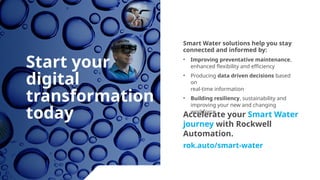
Accelerate your SmartWater
journey with Rockwell
Automation.
rok.auto/smart-water
Smart Water solutions help you stay
connected and informed by:
• Improving preventative maintenance,
enhanced flexibility and efficiency
• Producing data driven decisions based
on
real-time information
• Building resiliency, sustainability and
improving your new and changing
workforce
Start your
digital
transformation
today
Editor's Notes
#1
Open discussion on the many terminologies regarding digital water, smart water, etc.
Context: this presentation targeted at North American customers in public w/ww utility
Audience: City manager, City Planner, Bureau Chief, General Manager, Directors of Engineering/Operations, IT manager , Plant superintendent/director, Consultant
Visionaries & Early Adopters
Control over Budgets, Operations, and Maintenance
Executive Summary - Source: Bluefield Research WATER INDUSTRY 4.0: U.S. & CANADA DIGITAL WATER MARKET FORECAST, 2019-2030
A global economic transition is underway, resulting from the proliferation of a suite of new technologies and business models for connectivity, mobility, automation, and data analytics. As this digital transformation—referred to by some as “Industry 4.0” or the “Fourth Industrial Revolution”—proceeds apace, the traditionally conservative water & wastewater sector will face mounting pressure to adapt from customers, partners, and stakeholders. This pressure will be compounded by a host of economic, environmental, regulatory, and cultural changes, which will challenge utilities’ core business & operating models and make status quo approaches to water, wastewater, and stormwater management increasingly untenable.
In the United States & Canada, these developments have set the stage for more than US$92.6 billion in cumulative digital water expenditure by water & wastewater utilities from 2019 through 2030. This includes spending on connected hardware, data-driven software, and digitally-enabled professional services. As such, the annual U.S. & Canada digital water market is expected to scale at a 6.5% compound annual growth rate (CAGR) from US$5.4 billion in 2019 to US$10.8 billion in 2030, far outpacing the growth rates found in more traditional segments of the municipal water & wastewater industry.
#2 Digital transformation in the Water & Wastewater sector is increasing as plants become integrated into Smart Cities to support the sustainable use of water.
To accelerate this “transformation” to digital operations Rockwell Automation brings its Connected Enterprise® message to water utilities and organizations investing in Smart technologies and solutions
Water, and how you manage it, plays a critical role in the Smart Cities of tomorrow.
Moving forward, you need the technology and systems to allow more informed
decision-making and improve performance.
#3 Any water or wastewater network involves large numbers of physical assets, often dispersed across a large area. Increased connectivity to these assets allows utilities to replace any guesswork with data driven decisions, and to enhance their planning with predictive modelling and advanced analytics
Brining together the OT and IT to detect and diagnose complications, optimize network flow and manage consumption. The solutions they offer utilize a number of building blocks including:
AI (artificial intelligence) ML (machine learning) and immersive technologies are already transforming Water Section assisting systems that are DATA RICH but also information RICH.
AI can recognize patters in data to optimize the planning and execution of projects and provide a clearer insight into resource loss in real time.
AR VR (augmented reality/virtual reality) technologies offer new ways to support decision making in the field by providing holographic representations of physical assets and offer immersive situational training for workers.
Digital Water offers multiple advantages. Customer benefits include affordability, fairer billing and reliability
Operational benefits of Preventative Maintenance and enhanced flexibility and efficiency
Financial benefits reduced operational expenditure and increased revenue potential
Resiliency benefits of greater sustainability and enhanced workforce development
Digital Water cannot eliminate these challenges completely, but can present smarter more effective methods of addressing the issues we face. Drop by Drop, our glass of intelligent solutions is being filled with digital water. Question remains is whether the glass is half empty or half full.
#4 Population Change is exerting pressure on infrastructure by growth and movement
Climate…increasing frequency of extreme climate events
Regulatory pressure…complex regulatory requirements from EPA, State, and Local authorities: water quality, reporting, and cyber security
Deteriorating infrastructure– Government Water/Wastewater Sector is not priority in funding unless an incident occurs. Multiple Data Sources Reside in Silos – data across multiple departments and systems are not homogenized. Less than 50% of Utilities have assess the vulnerability & resilience of all key asset
Aging workforce -In the past, tribal knowledge was critical to operations• The experience is subjective and cannot be easily transferred. “Standard practices” cannot be replicated, putting operations at risk as your experienced workers leave or retire. The next generation or workers will rely on data driven decision making
EPA estimates “roughly one-third of the water sector workforce eligible to retire in the next 10 years. Additionally, as the technologies that are used in the water sector become more advanced (e.g., state of the art water reuse technology), there is a growing need to train and employ water protection specialists with specialized technical skills.” Source: https://www.epa.gov/sustainable-water-infrastructure/water-sector-workforce
#5 Source: 2020 Black & Veatch Strategic Directions Water Report (pg. 12)
This online survey was conducted from 3 March through 30 March 2020 and reflects the input of 279 qualified utility, municipal, commercial and community stakeholders in North America.
Without question, the water industry is an asset-intensive, rate-restricted industry that requires informed decision-making to effectively balance capital investment and rising operational expenses with resistance to rate increases. This makes the water sector notoriously complex, variable, and uncertain. The COVID-19 pandemic amplified that, exposing weaknesses in utilities’ resilience planning — or pressing water providers to finally develop a robust resilience blueprint if they lacked one in the first place.
#6 With respect to workforce challenges: the EPA estimates “roughly one-third of the water sector workforce eligible to retire in the next 10 years. Additionally, as the technologies that are used in the water sector become more advanced (e.g., state of the art water reuse technology), there is a growing need to train and employ water protection specialists with specialized technical skills.” Source: https://www.epa.gov/sustainable-water-infrastructure/water-sector-workforce
#8 The past decade has seen a rapid uptake of Smart Water digital technologies in the water utility sector.
Globally, digital water project activity expanded at a 32.1% compound annual growth rate (CAGR) between 2011 and 2019.
In the U.S. & Canada, Bluefield forecasts digital water expenditure to scale at a 6.5% CAGR between 2019 and 2030, three to four times the rate of growth projected for total utility capital expenditure (2.6% CAGR) and operating expenditure (1.7% CAGR).
Professional services represent a significant share of spend.
In the U.S. & Canada, Bluefield projects that setup & implementation service (e.g., hardware installation, software integration) will account for US$31.0 billion in digital water expenditure between 2019 and 2030, or 33.5% of total digital water spend over this period. These figures do not include spend on indirect digital support services such as technology planning & roadmapping, systems engineering & design, procurement assistance, and change management, which represent additional digital water market opportunities for engineering consultancies.
Source: Bluefield research
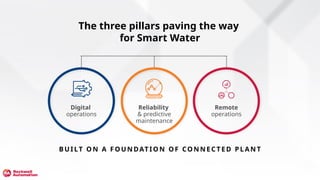
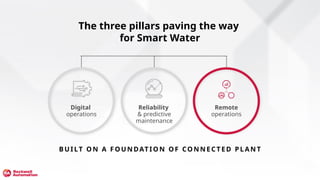
#9 There are many terms being used to describe the exciting transformation currently taking place in the water sector including: Digital Water, Internet of Water, Water 4.0, & Smart Water.
“In the face of extreme water challenges, water and wastewater utilities have been compelled to turn to new and innovative solutions: digital technologies. Digital technologies offer unlimited potential to transform the world’s water systems, helping utilities become more resilient, innovative, and efficient, and in turn helping them build a stronger and more economically viable foundation for the future. Exploiting the value of data, automation, and artificial intelligence allows water utilities to extend water resources, reduce non-revenue water, expand infrastructure life cycles, provide the basis for financial security, and more. “ SOURCE: IWA Digital Water, Industry Leaders Chart the Transformation Journey 2019
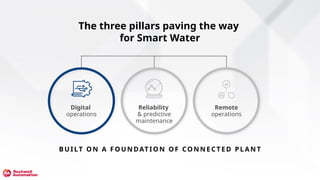
#10 Digital operations- Having the right information instantaneously to make critical decisions.
Eliminate Manual Data Collection & IT staff to create reports from desperate data sources-
Leverage data to more efficiently operate plant i.e. lower chemical & power usage
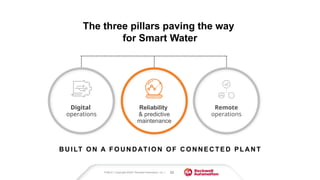
System Resiliency (Reliability)- Reducing CAPEX needs through proper Maintenance & equipment monitoring
Decrease main and collection system breaks and loss due to leakage ( Analytics & MPC)
Maintain lower pressure particularly on older susceptible infrastructure with (Analytics & AI)
Remote operations- Municipalities need to have flexibility to control their operations securely from a remote location to accommodate safety of personnel and facilitate efficient operation.
Protect against cyber-security threats- Municipalities face multiple cyber security risks as they move to Smart Water.
#11 Digital operations- Having the right information instantaneously to make critical decisions.
Eliminate Manual Data Collection & IT staff to create reports from desperate data sources-
Leverage data to more efficiently operate plant i.e. lower chemical & power usage
System Resiliency (Reliability)- Reducing CAPEX needs through proper Maintenance & equipment monitoring
Decrease main and collection system breaks and loss due to leakage ( Analytics & MPC)
Maintain lower pressure particularly on older susceptible infrastructure with (Analytics & AI)
Remote operations- Municipalities need to have flexibility to control their operations securely from a remote location to accommodate safety of personnel and facilitate efficient operation.
Protect against cyber-security threats- Municipalities face multiple cyber security risks as they move to Smart Water.
#12 Many facets to Digital Operations – Not one Technology, not one solution.
Mention ROI to setup this section.
#13 This is a global concern and not an exclusive issue for W/WW, but here in the US recently we’ve seen critical infrastructure, including water come under attack from cyber threats. As assets in the plant become connected, digital assets, it is an imperative that they are protected.
Rockwell has responded by offering Network services and aligning ourselves with technology partnerships with industry leaders such as Claroty and Cisco to offer solutions to customers that provide a proactive approach to cybersecurity that goes beyond waiting to respond to an attack.
#14 Customers can refer to the Converged Plantwide Ethernet (CPwE) Design and Implementation Guide for best practices for deploying network segmentation and broader defense in depth strategies. Customers can also refer to the Rockwell Automation System Security Design Guidelines on how to use Rockwell Automation products to improve the security of their automation systems.
Mention partnership w/industry leaders like Cisco & Claroty,
#15 Better Data , yields better decisions, BETTER decisions yields results. Better results yields enhanced financial management of an operation.
i.e. open/close valve to improve efficiency (chemical usage) , better process control decisions based on analytics, etc.
Need to see information rather than really on expert’s experience
Should also address workforce challenges: i.e. aging workforce, lack of experienced operators, etc. could impact future performance
"Reduce dependance on experienced operators“
The future will give better information to make decisions as well as make those decision for youocess control decisions based on analytics, etc.
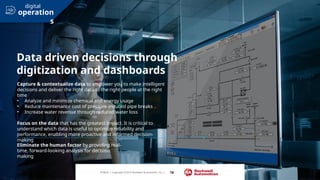
#16 Where does data come from? Disparate systems across plant, RTUs, LIMS, Smart instruments, HMI, CMMS, financial management system, etc.
Examples:
Able to know precisely how much is cost to treat w/ww
Pinpoint water loss
Analyze blower efficiency
Multiple municipalities and consultants currently pursuing Smart Water/Digital Water initiative's.
Asset Management key area (covered later in presentation), also several opportunities w/Power & Condition monitoring
#17 (speaker guidance: review use cases within the plant here and discuss how to optimize these areas of operations. Talk to ethernet architecture for design and bridge between IT and OT)
Rockwell Automation is uniquely positioned to help as we offer the horizontal information solutions at the top, but we understand and help design the infrastructure in between, including the network and the data. Yes, data has an infrastructure.
Analogies: Leak detection (Windsor Canada) à MPC, Energy management à pump optimization, blower efficiency, Advanced analytics à comparing 2 plants
https://www.rockwellautomation.com/en-us/company/news/case-studies/enwin-utilities-reduces-main-breaks-by-21-percent.html
Speaker guidance: potential product platform references:
Logix based on Control System/Integrated Architecture
Advanced Analytics or Model Predictive Control
Logix AI & Edge ML
Thingworx IIOT Platform
Data View and/or Power BI – to display information
Small Systems – HMI could be IIOT Platform
Innovation Suite for Large or Multi. Plant Ops.
ViewSE with RTUs, LV, MV VFDs
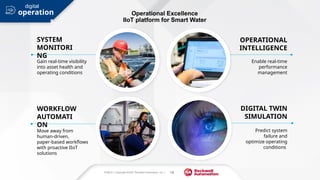
#18 IIoT has the power to infuse intelligence into every process in your operations.
The broad connectivity and flexible capabilities of InnovationSuite open the door to a broad range of use cases such as:
Remote system monitoring: gain real-time visibility into asset health and operating conditions across multiple sites with IIoT sensors to establish a centralized view of operations and predict problems before they occur.
Operational intelligence: Enable real-time performance management with visibility from shop floor to top floor that can reduce costs, increase manufacturing flexibility, and improve organization agility. Role-based dashboards give your people access to the information they need, when they need it, all in a single pane of glass so they can clearly see what action is required.
Workflow automation: Move away from human-driven, paper-based workflows with proactive IIoT solutions that automate processes like service communications, inventory management, and work order creation. InnovationSuite makes it easy to orchestrate the flow of data between sources and databases, building your intelligent enterprise.
Digital twin simulation: Predict equipment failure and optimize operating conditions in the physical world by comparing digital twin simulations and real-time physical asset data.
T: And we’re bringing these use cases to life for our customers.
<click>
#19 Early on in our pilot work, we grouped the types of solutions our customers expect into 3 main value streams. Asset Management and reliability which is all about improving uptime and reducing maintenance of assets, Operation Productivity which is focused on improving asset, workforce and energy optimization, and last Enterprise risk, helping our customers keep plants safe from malicious intrusion and ensuring a safe and secure work environments. The solutions offered as part of these three value streams help our customers achieve the overall return from their investment in our products, solutions and services.
PTC found similar outcomes. We strengthen some of their offerings – like Order Management with our MES. They strengthen our capabilities with advanced applications for Remote Monitoring – for example.
Make your data actionable across the enterprise
FactoryTalk InnovationSuite blends advanced analytics with information from your MES to turn insights into actions. By adding context to your analytics, the suite supports quality initiatives, compliance and continuous improvement. In addition, the AR features work with your MES to enhance visibility and improve operational effectiveness.
All through a single pane of glass
InnovationSuite provides a single pane of glass through a centralized dashboard to give you immediate visibility into the data you need, whether it is from a lone facility or an entire global network of facilities. This 360-degree view allows you to optimize global operations by combining, comparing, and analyzing information in real time from machine to machine, line to line, process to process, and facility to facility .
Easy-to-understand visualizations
An intuitive, user-friendly interface gives employees a view of the enterprise tailored to their role, connecting and contextualizing data from other systems through one common window.
Enterprise-wide visibility and control
The solution creates a digital representation of each physical asset and process, then connects that representation to all relevant data so it can monitor the asset. With complete visibility into the data, users have access to the information they need for job roles across the enterprise, including MES, enterprise resource planning (ERP), customer resource management (CRM) and finance.
Are you missing opportunities because you can’t access the data you need quickly enough? The opportunities are limited only by your business need and your imagination.
http://rockwell.lookbookhq.com/dashboardmonth/dashboard-overview-3
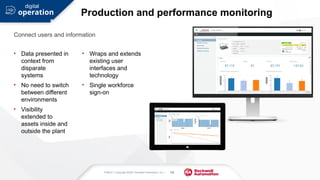
Data presented in context from disparate systems
No need to switch between different environments
Visibility extended to assets inside and outside the plant
Wraps and extends existing user interfaces and technology
Embedded HMI Content
Analytics and Results
Benchmarks across operational assets
Workforce Instructions and Work Plans
Single workforce sign-on
ThinManager can then distribute ThingWorx and other Visuals (Live Video, non-Integrated Applications, Enterprise Tools, etc.)
#20 iEarly on in our pilot work, we grouped the types of solutions our customers expect into 3 main value streams. Asset Management and reliability which is all about improving uptime and reducing maintenance of assets, Operation Productivity which is focused on improving asset, workforce and energy optimization, and last Enterprise risk, helping our customers keep plants safe from malicious intrusion and ensuring a safe and secure work environments. The solutions offered as part of these three value streams help our customers achieve the overall return from their investment in our products, solutions and services.
PTC found similar outcomes. We strengthen some of their offerings – like Order Management with our MES. They strengthen our capabilities with advanced applications for Remote Monitoring – for example.
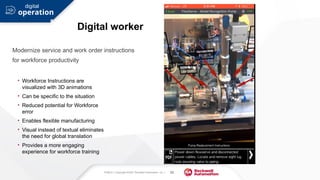
Workforce Instructions are visualized with 3D animations
Can be specific to the situation (part, process, step – not just equipment)
Reduced potential for Workforce error (Error Proofing enabler)
Enables flexible manufacturing (different part, same line / lot size of one, etc.)
Visual instead of textual eliminates the need for global translation
Provides a more engaging experience for workforce training
Workforce Instructions are visualized with 3D animations
Can be specific to the situation (part, process, step – not just equipment)
Reduced potential for Workforce error (Error Proofing enabler)
Enables flexible manufacturing (different part, same line / lot size of one, etc.)
Visual instead of textual eliminates the need for global translation
Provides a more engaging experience for workforce training
#21 What is Digital Twin. A representation on the real-world in a virtual model.
FAT test by the System Integrator to verify high fidelity operation of a SCADA system without it being connected to real assets.
This could be for real-time operator training on a simulated system
Rockwell Automations customers are using a variety of technologies including Emulation & Simulation. We are releasing Logix Echo next month. A high fidelity Logix Controller simulation that requires no modification of the controller code to run in emulation.
The PlantPAx HMI Graphics offer built in simulation- objects can run in “simulation” mode.
Vuforia- virtual tool for skills training
Digital twin of a compressor to optimize efficiency. Build the load curves right into software to simulate runtime dynamics.
#22 Digital operations- Having the right information instantaneously to make critical decisions.
Eliminate Manual Data Collection & IT staff to create reports from desperate data sources-
Leverage data to more efficiently operate plant i.e. lower chemical & power usage
System Resiliency (Reliability)- Reducing CAPEX needs through proper Maintenance & equipment monitoring
Decrease main and collection system breaks and loss due to leakage ( Analytics & MPC)
Maintain lower pressure particularly on older susceptible infrastructure with (Analytics & AI)
Remote operations- Municipalities need to have flexibility to control their operations securely from a remote location to accommodate safety of personnel and facilitate efficient operation.
Protect against cyber-security threats- Municipalities face multiple cyber security risks as they move to Smart Water.
#23 Let’s take next few minutes to discuss reliability and predictive maintenance
#24 While being challenged to maintain or reduce their capital improvement budgets, utilities seek ways to improve;
system reliability & efficiency
Present useful & contextualized data to operators and key decision makers
Empower operators to perform necessary tasks
Address fact that a significant amount of equipment operating today has outlived or approaching its original design lifespan.
And, as previously mentioned, many skilled operators will be approaching retirement age over next few years.
Speaker guidance: potential product platform references:
HMI/CMMS Integration
FT Analytics for Devices
Vuforia – Chalk & Expert Capture
Thingworks IIOT/Dataview
#25 A 2020 report produced by the American Water Works Association found that resilience related issues accounted for 5 of the top 10 concerns
that were top of mind for US water utilities (in addition to concerns related to financing, public awareness, compliance, & ground water management issues).
To improve overall system reliability, I’ll summarize a few areas where automation and digital technology operating in a smart water plant can have a positive impact.
#26
As once manual processes and information previously recorded on clipboards and spreadsheets move to technology driven control environments, this creates opportunity to use information to more efficiently control, monitor and predict potential future state for assets and systems.
Today we control and monitor assets and key process indicators for systems operating in water & wastewater plants, and we do it quite well.
The BRIDGE that we’re referring to on this slide is where we connect information from the physical world with analytical engines and tools that can predict an outcome before it occurs,and take action NOT just send a message or sound an alarm.
Looking at this graphic, starting with “Control assets & engage people”, then moving clockwise here we are referring to Logix controllers, FactoryTalk View visualization and SCADA systems operating in the plant. As we move to the right to CONNECT those digital systems to the IT infrastructure. We then take that data, contextualize it, analyze it, and ultimately orchestrate a response which could manifest itself as a parameter change or a maintenance work order is issued to change a bearing , before it fails. Another outcome could be use a Digital Twin to run simulation on a Logix controller for our application code and test system performance, before pouring the footings.
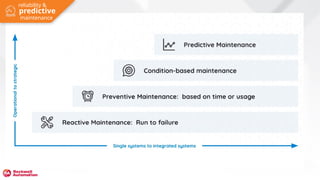
#27 On the previous slide we touched on analytics and 1 potential use case with the bearing replacement scenario I mentioned. The bottom row of this table depicts different levels, as we look from left to right, of different maintenance strategy approaches. (read & summarize slide headers)
Using that bearing failure prediction example, what I described previously would be using a Predictive maintenance strategy to anticipate a failure. To take that to another level would be a Prescriptive approach where the analytics engine recommends a course of action. At the Device level, Rockwell’s solution could incorporate Factory Talk Analytics for Devices or a Logix AI (module
As we move up from the Device level, it becomes more important to aggregate & contextualize available data from disparate systems operating in the plant or system. This is where an IOT platform like Thingworx can be used-which I’ll describe in greater depth in a moment….
#28 Rockwell Automation’s IOT platform is the FactoryTalk InnovationSuite.
InnovationSuite is more than just an analytics engine, it is a great platform to quickly and easily represent an asset or group of assets in a digital format so you can quickly connect all of the data that is important about an asset or system, and begin to immediately monitor the performance, as well as predict the performance of that equipment.
This helps users to understand the performance of physical assets and digital systems through one consolidated source of information – a single pane of glass, if you will– intelligently combining production information with IT system data.
Once you have this collection of data sources, you can rapidly build and deploy impactful applications to decision makers from plant floor to the plant superintendent.
The InnovationSuite brings you a set of capabilities to grab vast amounts of data from any data source, quickly, organize that data, add context to give you the ability to add historical, real-time and proactive insights to new and existing assets.
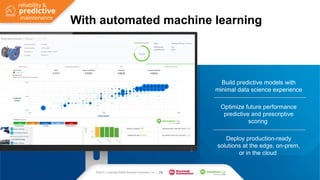
#29 Our analytics strategy centers on removing barriers to data analytics so you can focus on the benefits and value of your data—like optimizing efficiency, predicting problems, and preventing downtime. In this demonstration we’ll see the value of leveraging analytics to predict equipment failures before they occur using predictive analytics.
<click>
A maintenance engineer can monitor equipment health in this dashboard and predict failures based on live data and analyzed historical data. They can see the contributing factors as well as the level of risk of the failure. The dashboard also suggests action as necessary to avoid the issue. Because this solution is integrated with the field service management system, service can be scheduled in the same view. This means the potential future problem is addressed before a major issue occurs that negatively impacts to operations.
Concurrently, a notification is sent to plant manager about the predicted failure and when service is scheduled. Notification settings can be customized in the same dashboard to keep key stakeholders up to date.
<click>
The underlying predictive model for a use case like this can be created using automated machine learning (AutoML). With AutoML, your process engineers can develop Machine Learning models for common industrial use cases without any Machine Learning algorithm experience.
AutoML will choose the best-suited algorithm for the specific use case and report how closely the model correlates with the data set. This accelerates time to value by extending basic data science capabilities to the people most familiar with your complex manufacturing processes. For example, on this screenshot you can see the results of a model predicting the asset health of a specific pump. This model correlates to the actual data with an R-squared value of 0.87 – meaning this model predictions correlate fairly closely with the actual dataset.
T: But sometimes it’s necessary to dig deeper into the data for insights than what’s possible with AutoML….
<click>
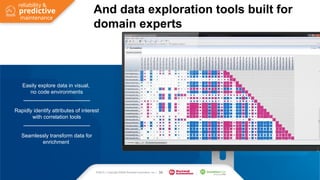
#30 Data exploration and data preparation is challenging for data scientists who don’t understand the underlying operational processes. However, asking your process engineers to dive into Python or Excel is rarely option either. That’s why we built graphical, no code environment to equip domain experts to apply their OT expertise in data exploration scenarios.
These tools make it simple to review data, remove outliers, and identify attributes that correspond with equipment failure or other negative events. Then, they can create datasets in the same tool for use in model training and evaluation.
<click>
In this demo, we see an operator explore historical OT data from a turbine emissions analyzer.
It’s easy to select data of interest if known, or select all the data if you don’t know where to start, and visualize the data in a variety of plots. Here we see the data in an xy chart – but due to outliers it’s difficult to see the data of interest. The user can quickly cut to the data of interest in a few clicks.
After determining a dataset of interest, you can start to dig into insights. Using a ranked correlation, you can quickly find variables most correlated with a target KPI like efficiency. You can also leverage a correlation analysis to cut to a different view of the same information.
And you can customize the correlation search over a range to find variables correlated to efficiency with either a delay or no time offset. This will show for each variable at what time delay the maximum correlation occurs.
Because conditions around turbines change rapidly, it can be interesting to dig in with a delay correlation. This allows you to see the correlation at each time step within the range before and after time zero. If we reduce the search criteria and look at every step, you can find the actual maximum delay for this attribute occurs with a step of 7.
T: These data exploration and preparation tools are extremely useful for developing hypotheses and ultimately Machine Learning model development.
<click>
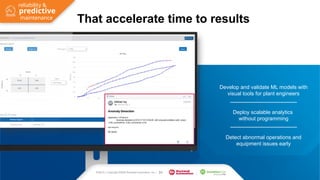
#31 Once you’ve prepared a dataset for analysis, purpose-built tools accelerate time to results and drive results toward action.
Process engineers can leverage historian data to detect anomalies in operations. They can simply model normal behavior using an imported dataset or collect live data if existing data isn’t available.
Once “normal behavior” has been established, they can turn on predictive mode to look for events that fall outside the bandwidth of “normal”.
<click>
The application can alert operators of these deviations, helping you identify issues in your process that you didn't see before.
T: These powerful analytics tools elevate process engineers to citizen data scientist and help uncover insights about operations you’ve never seen before.
<click>
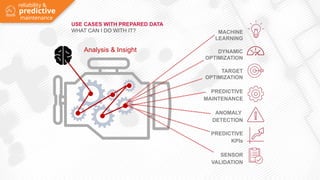
#32 Once you have useful data to target your business, there are a lot of places Machine Learning can be applied.
#33 But first let’s talk about Computerized Maintenance and Management Systems or CMMS…..
Rockwell recently added to our solution portfolio by acquiring Fiix Software, which for over 12 years has offered a cloud based CMMS system.
Powered by the most open integration network –meaning platform agnostic-- and an AI-driven insights engine, the Fiix platform combines mobile asset management, work order, and parts management
Advantages for integrating a CMMS solution include:
Lower overall maintenance budgets by closely monitoring and managing maintenance department costs
Connect, collect, share data, and trigger work orders across the plant, thus improving efficiency
Capture operator knowledge and improve labor resource allocation.
Create safer work environment by providing access to critical information & procedures
View and manage all equipment information from a single system— including repair history and costs
#35 Digital operations- Having the right information instantaneously to make critical decisions.
Eliminate Manual Data Collection & IT staff to create reports from desperate data sources-
Leverage data to more efficiently operate plant i.e. lower chemical & power usage
System Resiliency (Reliability)- Reducing CAPEX needs through proper Maintenance & equipment monitoring
Decrease main and collection system breaks and loss due to leakage ( Analytics & MPC)
Maintain lower pressure particularly on older susceptible infrastructure with (Analytics & AI)
Remote operations- Municipalities need to have flexibility to control their operations securely from a remote location to accommodate safety of personnel and facilitate efficient operation.
Protect against cyber-security threats- Municipalities face multiple cyber security risks as they move to Smart Water.
#37 Remote connectivity for SCADA and RTUs has been pervasive in Water/Wastewater applications. A basic framework for constructing solutions as been around for many years. That paradigm is changing. Commercial Cellular backbones are replacing municipal owned infrastructure with great cost savings and reliability enhancements.
The need for general remote connectivity has exploded with Covid.
1.Has it been done securely ?
2.Have municipal policy and procedures kept up with the connectivity.
3.Does it facilitate the needs of the organization.
4.Is Centralized Control from a Emergency Operations Center planned.
5.Does the local controls and infrastructure support this ?
#38 Rockwell Automation and CISCO has constructed a number of White Papers and Design & Implementation Guides labeled CPWE. Converged Plantwide Ethernet.
These go through the considerations and best in class design for performance and security around a control system.
Speaker guidance: potential product platform references:
Logix based control/Integrated Architecture
CPWE based network architectures
FactoryTalk for SCADA
Thin Manager solutions for plant & enterprise
Asset Centre – Disaster Recovery
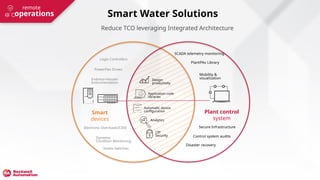
#39 Smart devices have grown to encompass a lot of motor-load level value and can provide industry-leading performance and configurability.
Allen Bradley Smart Devices are Self-contained, ready-to-use assets that provide many benefits such as adaptive control, predictive maintenance, flexibility, and configurability.
Rockwell’s premier integrated architecture gives customers a logical control platform that is scalable, flexible, and
Integrated Architecture also provides many benefits, such as secure infrastructure and scalable architecture.
Premier Integration is an experience that you have when connecting smart devices with integrated architecture. Premier Integration enables data to be accessed across the enterprise which enables users to easily take advantage of multiple levels of extensions.
We will also show how Premier Integration aligns with different user needs, from Design, into operation and maintenance.
#40 FactoryTalk AssetCentre is part of Rockwell Automation’s FactoryTalk software suite. We have various purpose built products available in the portfolio to serve customers to achieve their business objectives. Think of it as suite of products – we have software package that enables you to configure PLC, visualize and control machine via HMI, collect historical data from critical assets, and asset management capability to manage your plant infrastructure.
FactoryTalk AssetCentre is part of the suite and is geared towards maintenance role within a plant to really help customers with the some of the business challenges and risks that we discussed earlier. We help customer manage your assets with capabilities around archive, disaster recovery, and security.
The archive is a intuitive tool that allow customers to manage critical configuration and program files into an electronic repository with version control. Disaster recovery allows for automated backup and compares of the files that you are most interested in. The audit capability tracks the changes, and security allows user to restrict access by role or person to the set of assets that you are managing.
We also allow for 3rd party extension to support more 3rd party devices natively.
And last but not least, we have capability to support process device configuration using FDT-DTM technology.
Now, before we dig deeper on each of these topics, we have couple more survey questions where we would like to get your feedback. I am going to pause here, so you can respond to them.
#41 Thin client technology is made for harsh environments. Centralized
device management and content delivery will reduce unplanned
downtime and improve security and productivity across multiple
plants.
Increase Productivity
Replace PCs with thin clients to reduce maintenance and downtime
Improve Visualization
Enhance the end user experience on all devices by delivering rolebased
content in a customized layout
Increase Security
Increase security by reducing your network attack surface area and
centrally managing all devices and users
Secure Mobility
Deploy the most secure industrial mobility
solution without writing or rewriting any code