Article
Remodeling of consumer engagement
model and enhanced customer experi-
ence are of paramount importance in the
new consumer-centric digitized utilities
landscape.
Rolling out smart meters and the relevant
remote monitoring systems is only part
of the journey towards smart utilities.
Transforming the back-end IT systems to
support the emerging business models is
vital.
Smarter pricing and advanced customer
management, empowered by the predic-
tions and trends brought by purpose-
built analytics, are needed to effectively
address the utility market challenges
ahead.
The New Utilities Landscape
................................................................................................
Utilities industry tends to become one of
the fastest growing industries, boosted by
ongoing technological advances. New busi-
ness strategies and new activity domains,
such as alternative energy sources and
environmental preservation, are some of
the developments shaping the new utilities
landscape. According to the latest reports,
this traditionally slow moving industry is
now one of the fastest growing M2M/IoT
verticals, bearing high expectations for op-
timized services, reduced costs, and cus-
tomer satisfaction. In the EU, 80% of the
utilities’ consumer base is expected to be
equipped with smart meter technology by
2020. The EU member states have already
started the roll-out and monitoring of smart
meters which are destined to change the
way utility services are managed and of-
fered to consumers.
The new utilities landscape covers diverse
types of regulated and unregulated mar-
kets. It involves a plethora of technologies,
players and business synergies that influ-
ence operation and service rollout.
All utility sector stakeholders, such as
energy producers, energy wholesal-
ers, smart meter providers, connec-
tivity providers and Utility Service
Providers (USPs), are struggling
to (re)define their role within the
“under formulation” value fabric.
In this quest, traditional electric-
ity providers are reassessing their
strategy and some of them have
successfully expanded their activi-
ties to other business areas, pene-
trating other utilities (e.g. Gas, Water)
or even the Telco and Internet market.
For example, a power company in Northern
Europe has introduced triple play services
besides its electricity offerings.
At the same time, newcomers entering the
utilities market, including energy resellers
as well as municipal, commercial, and com-
munity service providers (e.g. Smart Grid
and Smart Home), race to be better posi-
tioned and adapt to the new market reality.
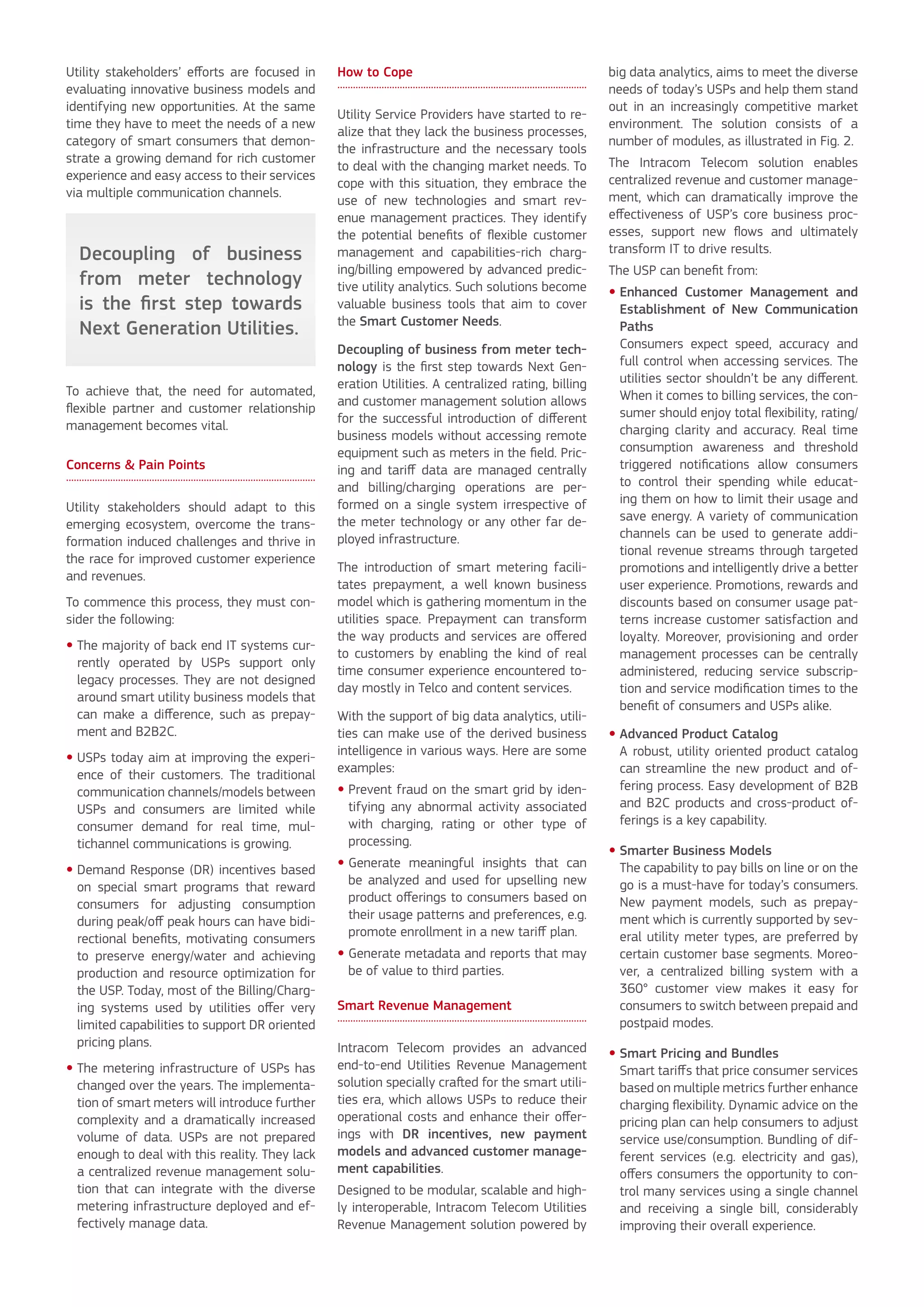
In this challenging ecosystem (Fig. 1), al-
liances and synergies among partners are
being dynamically shaped, aiming to ad-
dress new opportunities through complex
business relations and interactions.
Smart Revenue Management Makes Utilities Smarter
Iraklis Pilatos (Product Manager, Revenue Management Solutions, Telco Software, Intracom Telecom)
Dimitrios Paschalis (Principal OBSS Product Marketing Engineer, Telco Software, Intracom Telecom)
Smart Home
Smart
Meters
kWh
Smart Energy
App
Smart Utility App
Energy Providers
AlternativeEnergyProducers
Gas Providers
Thermal Providers
Utility Reseller
s
WaterProviders
Fig. 1: Smart Utilities Value Fabric example
Utility stakeholders’ efforts are focused in
evaluating innovative business models and
identifying new opportunities. At the same
time they have to meet the needs of a new
category of smart consumers that demon-
strate a growing demand for rich customer
experience and easy access to their services
via multiple communication channels.
To achieve that, the need for automated,
flexible partner and customer relationship
management becomes vital.
Concerns & Pain Points
................................................................................................
Utility stakeholders should adapt to this
emerging ecosystem, overcome the trans-
formation induced challenges and thrive in
the race for improved customer experience
and revenues.
To commence this process, they must con-
sider the following:
The majority of back end IT systems cur-
rently operated by USPs support only
legacy processes. They are not designed
around smart utility business models that
can make a difference, such as prepay-
ment and B2B2C.
USPs today aim at improving the experi-
ence of their customers. The traditional
communication channels/models between
USPs and consumers are limited while
consumer demand for real time, mul-
tichannel communications is growing.
Demand Response (DR) incentives based
on special smart programs that reward
consumers for adjusting consumption
during peak/off peak hours can have bidi-
rectional benefits, motivating consumers
to preserve energy/water and achieving
production and resource optimization for
the USP. Today, most of the Billing/Charg-
ing systems used by utilities offer very
limited capabilities to support DR oriented
pricing plans.
The metering infrastructure of USPs has
changed over the years. The implementa-
tion of smart meters will introduce further
complexity and a dramatically increased
volume of data. USPs are not prepared
enough to deal with this reality. They lack
a centralized revenue management solu-
tion that can integrate with the diverse
metering infrastructure deployed and ef-
fectively manage data.
•
•
•
•
How to Cope
................................................................................................
Utility Service Providers have started to re-
alize that they lack the business processes,
the infrastructure and the necessary tools
to deal with the changing market needs. To
cope with this situation, they embrace the
use of new technologies and smart rev-
enue management practices. They identify
the potential benefits of flexible customer
management and capabilities-rich charg-
ing/billing empowered by advanced predic-
tive utility analytics. Such solutions become
valuable business tools that aim to cover
the Smart Customer Needs.
Decoupling of business from meter tech-
nology is the first step towards Next Gen-
eration Utilities. A centralized rating, billing
and customer management solution allows
for the successful introduction of different
business models without accessing remote
equipment such as meters in the field. Pric-
ing and tariff data are managed centrally
and billing/charging operations are per-
formed on a single system irrespective of
the meter technology or any other far de-
ployed infrastructure.
The introduction of smart metering facili-
tates prepayment, a well known business
model which is gathering momentum in the
utilities space. Prepayment can transform
the way products and services are offered
to customers by enabling the kind of real
time consumer experience encountered to-
day mostly in Telco and content services.
With the support of big data analytics, utili-
ties can make use of the derived business
intelligence in various ways. Here are some
examples:
Prevent fraud on the smart grid by iden-
tifying any abnormal activity associated
with charging, rating or other type of
processing.
Generate meaningful insights that can
be analyzed and used for upselling new
product offerings to consumers based on
their usage patterns and preferences, e.g.
promote enrollment in a new tariff plan.
Generate metadata and reports that may
be of value to third parties.
Smart Revenue Management
................................................................................................
Intracom Telecom provides an advanced
end-to-end Utilities Revenue Management
solution specially crafted for the smart utili-
ties era, which allows USPs to reduce their
operational costs and enhance their offer-
ings with DR incentives, new payment
models and advanced customer manage-
ment capabilities.
Designed to be modular, scalable and high-
ly interoperable, Intracom Telecom Utilities
Revenue Management solution powered by
•
•
•
big data analytics, aims to meet the diverse
needs of today’s USPs and help them stand
out in an increasingly competitive market
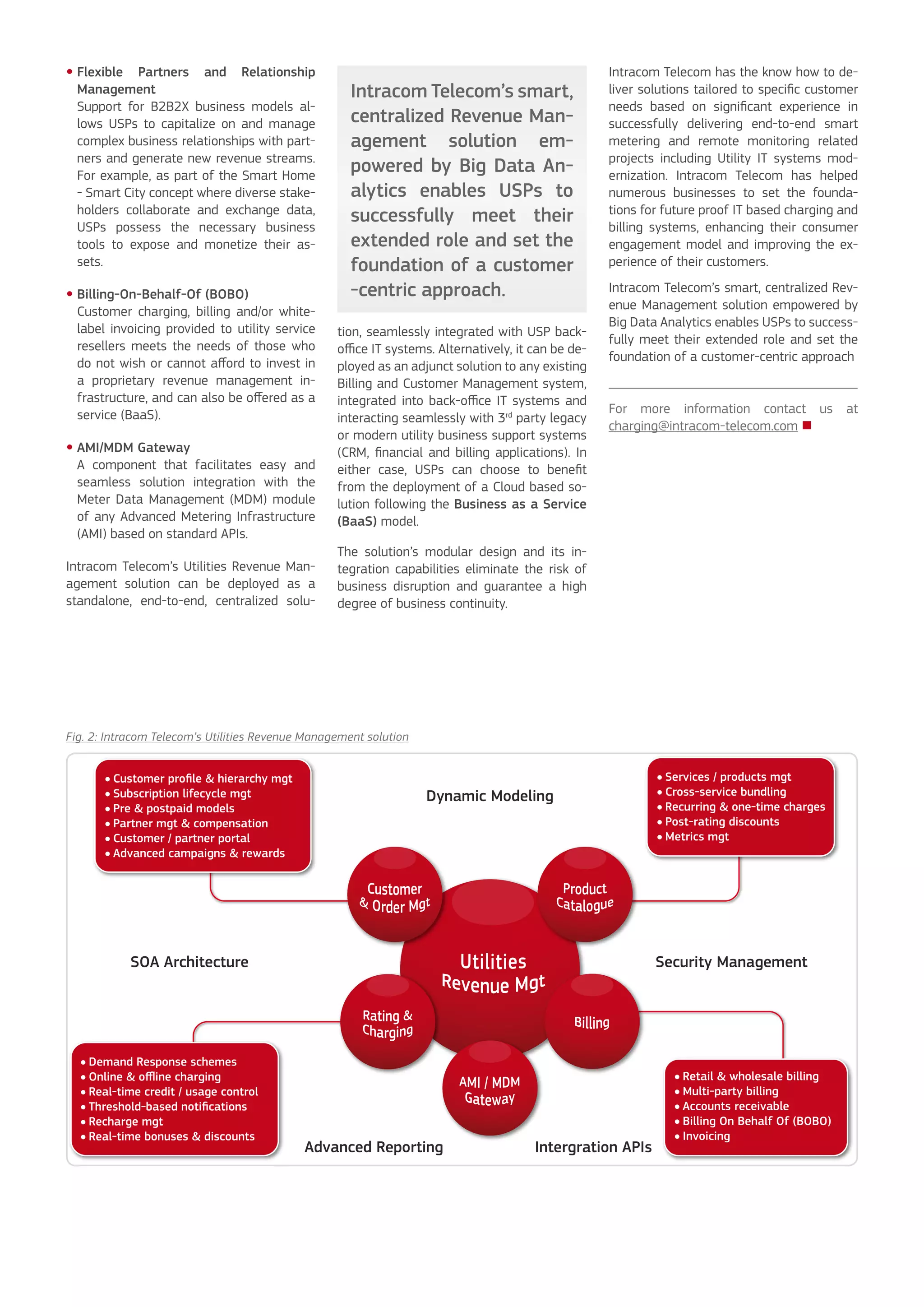
environment. The solution consists of a
number of modules, as illustrated in Fig. 2.
The Intracom Telecom solution enables
centralized revenue and customer manage-
ment, which can dramatically improve the
effectiveness of USP’s core business proc-
esses, support new flows and ultimately
transform IT to drive results.
The USP can benefit from:
Enhanced Customer Management and
Establishment of New Communication
Paths
Consumers expect speed, accuracy and
full control when accessing services. The
utilities sector shouldn’t be any different.
When it comes to billing services, the con-
sumer should enjoy total flexibility, rating/
charging clarity and accuracy. Real time
consumption awareness and threshold
triggered notifications allow consumers
to control their spending while educat-
ing them on how to limit their usage and
save energy. A variety of communication
channels can be used to generate addi-
tional revenue streams through targeted
promotions and intelligently drive a better
user experience. Promotions, rewards and
discounts based on consumer usage pat-
terns increase customer satisfaction and
loyalty. Moreover, provisioning and order
management processes can be centrally
administered, reducing service subscrip-
tion and service modification times to the
benefit of consumers and USPs alike.
Advanced Product Catalog
A robust, utility oriented product catalog
can streamline the new product and of-
fering process. Easy development of B2B
and B2C products and cross-product of-
ferings is a key capability.
Smarter Business Models
The capability to pay bills on line or on the
go is a must-have for today’s consumers.
New payment models, such as prepay-
ment which is currently supported by sev-
eral utility meter types, are preferred by
certain customer base segments. Moreo-
ver, a centralized billing system with a
360° customer view makes it easy for
consumers to switch between prepaid and
postpaid modes.
Smart Pricing and Bundles
Smart tariffs that price consumer services
based on multiple metrics further enhance
charging flexibility. Dynamic advice on the
pricing plan can help consumers to adjust
service use/consumption. Bundling of dif-
ferent services (e.g. electricity and gas),
offers consumers the opportunity to con-
trol many services using a single channel
and receiving a single bill, considerably
improving their overall experience.
•
•
•
•
Decoupling of business
from meter technology
is the first step towards
Next Generation Utilities.
Flexible Partners and Relationship
Management
Support for B2B2X business models al-
lows USPs to capitalize on and manage
complex business relationships with part-
ners and generate new revenue streams.
For example, as part of the Smart Home
- Smart City concept where diverse stake-
holders collaborate and exchange data,
USPs possess the necessary business
tools to expose and monetize their as-
sets.
Billing-On-Behalf-Of (BOBO)
Customer charging, billing and/or white-
label invoicing provided to utility service
resellers meets the needs of those who
do not wish or cannot afford to invest in
a proprietary revenue management in-
frastructure, and can also be offered as a
service (BaaS).
AMI/MDM Gateway
A component that facilitates easy and
seamless solution integration with the
Meter Data Management (MDM) module
of any Advanced Metering Infrastructure
(AMI) based on standard APIs.
Intracom Telecom’s Utilities Revenue Man-
agement solution can be deployed as a
standalone, end-to-end, centralized solu-
•
•
•
tion, seamlessly integrated with USP back-
office IT systems. Alternatively, it can be de-
ployed as an adjunct solution to any existing
Billing and Customer Management system,
integrated into back-office IT systems and
interacting seamlessly with 3rd
party legacy
or modern utility business support systems
(CRM, financial and billing applications). In
either case, USPs can choose to benefit
from the deployment of a Cloud based so-
lution following the Business as a Service
(BaaS) model.
The solution’s modular design and its in-
tegration capabilities eliminate the risk of
business disruption and guarantee a high
degree of business continuity.
Intracom Telecom has the know how to de-
liver solutions tailored to specific customer
needs based on significant experience in
successfully delivering end-to-end smart
metering and remote monitoring related
projects including Utility IT systems mod-
ernization. Intracom Telecom has helped
numerous businesses to set the founda-
tions for future proof IT based charging and
billing systems, enhancing their consumer
engagement model and improving the ex-
perience of their customers.
Intracom Telecom’s smart, centralized Rev-
enue Management solution empowered by
Big Data Analytics enables USPs to success-
fully meet their extended role and set the
foundation of a customer-centric approach
For more information contact us at
charging@intracom-telecom.com 
Intracom Telecom’s smart,
centralized Revenue Man-
agement solution em-
powered by Big Data An-
alytics enables USPs to
successfully meet their
extended role and set the
foundation of a customer
-centric approach.
Fig. 2: Intracom Telecom’s Utilities Revenue Management solution

Smart revenue mgt. makes utilities smarter interview feb 2015

  • 1.
    Article Remodeling of consumerengagement model and enhanced customer experi- ence are of paramount importance in the new consumer-centric digitized utilities landscape. Rolling out smart meters and the relevant remote monitoring systems is only part of the journey towards smart utilities. Transforming the back-end IT systems to support the emerging business models is vital. Smarter pricing and advanced customer management, empowered by the predic- tions and trends brought by purpose- built analytics, are needed to effectively address the utility market challenges ahead. The New Utilities Landscape ................................................................................................ Utilities industry tends to become one of the fastest growing industries, boosted by ongoing technological advances. New busi- ness strategies and new activity domains, such as alternative energy sources and environmental preservation, are some of the developments shaping the new utilities landscape. According to the latest reports, this traditionally slow moving industry is now one of the fastest growing M2M/IoT verticals, bearing high expectations for op- timized services, reduced costs, and cus- tomer satisfaction. In the EU, 80% of the utilities’ consumer base is expected to be equipped with smart meter technology by 2020. The EU member states have already started the roll-out and monitoring of smart meters which are destined to change the way utility services are managed and of- fered to consumers. The new utilities landscape covers diverse types of regulated and unregulated mar- kets. It involves a plethora of technologies, players and business synergies that influ- ence operation and service rollout. All utility sector stakeholders, such as energy producers, energy wholesal- ers, smart meter providers, connec- tivity providers and Utility Service Providers (USPs), are struggling to (re)define their role within the “under formulation” value fabric. In this quest, traditional electric- ity providers are reassessing their strategy and some of them have successfully expanded their activi- ties to other business areas, pene- trating other utilities (e.g. Gas, Water) or even the Telco and Internet market. For example, a power company in Northern Europe has introduced triple play services besides its electricity offerings. At the same time, newcomers entering the utilities market, including energy resellers as well as municipal, commercial, and com- munity service providers (e.g. Smart Grid and Smart Home), race to be better posi- tioned and adapt to the new market reality. In this challenging ecosystem (Fig. 1), al- liances and synergies among partners are being dynamically shaped, aiming to ad- dress new opportunities through complex business relations and interactions. Smart Revenue Management Makes Utilities Smarter Iraklis Pilatos (Product Manager, Revenue Management Solutions, Telco Software, Intracom Telecom) Dimitrios Paschalis (Principal OBSS Product Marketing Engineer, Telco Software, Intracom Telecom) Smart Home Smart Meters kWh Smart Energy App Smart Utility App Energy Providers AlternativeEnergyProducers Gas Providers Thermal Providers Utility Reseller s WaterProviders Fig. 1: Smart Utilities Value Fabric example
  • 2.
    Utility stakeholders’ effortsare focused in evaluating innovative business models and identifying new opportunities. At the same time they have to meet the needs of a new category of smart consumers that demon- strate a growing demand for rich customer experience and easy access to their services via multiple communication channels. To achieve that, the need for automated, flexible partner and customer relationship management becomes vital. Concerns & Pain Points ................................................................................................ Utility stakeholders should adapt to this emerging ecosystem, overcome the trans- formation induced challenges and thrive in the race for improved customer experience and revenues. To commence this process, they must con- sider the following: The majority of back end IT systems cur- rently operated by USPs support only legacy processes. They are not designed around smart utility business models that can make a difference, such as prepay- ment and B2B2C. USPs today aim at improving the experi- ence of their customers. The traditional communication channels/models between USPs and consumers are limited while consumer demand for real time, mul- tichannel communications is growing. Demand Response (DR) incentives based on special smart programs that reward consumers for adjusting consumption during peak/off peak hours can have bidi- rectional benefits, motivating consumers to preserve energy/water and achieving production and resource optimization for the USP. Today, most of the Billing/Charg- ing systems used by utilities offer very limited capabilities to support DR oriented pricing plans. The metering infrastructure of USPs has changed over the years. The implementa- tion of smart meters will introduce further complexity and a dramatically increased volume of data. USPs are not prepared enough to deal with this reality. They lack a centralized revenue management solu- tion that can integrate with the diverse metering infrastructure deployed and ef- fectively manage data. • • • • How to Cope ................................................................................................ Utility Service Providers have started to re- alize that they lack the business processes, the infrastructure and the necessary tools to deal with the changing market needs. To cope with this situation, they embrace the use of new technologies and smart rev- enue management practices. They identify the potential benefits of flexible customer management and capabilities-rich charg- ing/billing empowered by advanced predic- tive utility analytics. Such solutions become valuable business tools that aim to cover the Smart Customer Needs. Decoupling of business from meter tech- nology is the first step towards Next Gen- eration Utilities. A centralized rating, billing and customer management solution allows for the successful introduction of different business models without accessing remote equipment such as meters in the field. Pric- ing and tariff data are managed centrally and billing/charging operations are per- formed on a single system irrespective of the meter technology or any other far de- ployed infrastructure. The introduction of smart metering facili- tates prepayment, a well known business model which is gathering momentum in the utilities space. Prepayment can transform the way products and services are offered to customers by enabling the kind of real time consumer experience encountered to- day mostly in Telco and content services. With the support of big data analytics, utili- ties can make use of the derived business intelligence in various ways. Here are some examples: Prevent fraud on the smart grid by iden- tifying any abnormal activity associated with charging, rating or other type of processing. Generate meaningful insights that can be analyzed and used for upselling new product offerings to consumers based on their usage patterns and preferences, e.g. promote enrollment in a new tariff plan. Generate metadata and reports that may be of value to third parties. Smart Revenue Management ................................................................................................ Intracom Telecom provides an advanced end-to-end Utilities Revenue Management solution specially crafted for the smart utili- ties era, which allows USPs to reduce their operational costs and enhance their offer- ings with DR incentives, new payment models and advanced customer manage- ment capabilities. Designed to be modular, scalable and high- ly interoperable, Intracom Telecom Utilities Revenue Management solution powered by • • • big data analytics, aims to meet the diverse needs of today’s USPs and help them stand out in an increasingly competitive market environment. The solution consists of a number of modules, as illustrated in Fig. 2. The Intracom Telecom solution enables centralized revenue and customer manage- ment, which can dramatically improve the effectiveness of USP’s core business proc- esses, support new flows and ultimately transform IT to drive results. The USP can benefit from: Enhanced Customer Management and Establishment of New Communication Paths Consumers expect speed, accuracy and full control when accessing services. The utilities sector shouldn’t be any different. When it comes to billing services, the con- sumer should enjoy total flexibility, rating/ charging clarity and accuracy. Real time consumption awareness and threshold triggered notifications allow consumers to control their spending while educat- ing them on how to limit their usage and save energy. A variety of communication channels can be used to generate addi- tional revenue streams through targeted promotions and intelligently drive a better user experience. Promotions, rewards and discounts based on consumer usage pat- terns increase customer satisfaction and loyalty. Moreover, provisioning and order management processes can be centrally administered, reducing service subscrip- tion and service modification times to the benefit of consumers and USPs alike. Advanced Product Catalog A robust, utility oriented product catalog can streamline the new product and of- fering process. Easy development of B2B and B2C products and cross-product of- ferings is a key capability. Smarter Business Models The capability to pay bills on line or on the go is a must-have for today’s consumers. New payment models, such as prepay- ment which is currently supported by sev- eral utility meter types, are preferred by certain customer base segments. Moreo- ver, a centralized billing system with a 360° customer view makes it easy for consumers to switch between prepaid and postpaid modes. Smart Pricing and Bundles Smart tariffs that price consumer services based on multiple metrics further enhance charging flexibility. Dynamic advice on the pricing plan can help consumers to adjust service use/consumption. Bundling of dif- ferent services (e.g. electricity and gas), offers consumers the opportunity to con- trol many services using a single channel and receiving a single bill, considerably improving their overall experience. • • • • Decoupling of business from meter technology is the first step towards Next Generation Utilities.
  • 3.
    Flexible Partners andRelationship Management Support for B2B2X business models al- lows USPs to capitalize on and manage complex business relationships with part- ners and generate new revenue streams. For example, as part of the Smart Home - Smart City concept where diverse stake- holders collaborate and exchange data, USPs possess the necessary business tools to expose and monetize their as- sets. Billing-On-Behalf-Of (BOBO) Customer charging, billing and/or white- label invoicing provided to utility service resellers meets the needs of those who do not wish or cannot afford to invest in a proprietary revenue management in- frastructure, and can also be offered as a service (BaaS). AMI/MDM Gateway A component that facilitates easy and seamless solution integration with the Meter Data Management (MDM) module of any Advanced Metering Infrastructure (AMI) based on standard APIs. Intracom Telecom’s Utilities Revenue Man- agement solution can be deployed as a standalone, end-to-end, centralized solu- • • • tion, seamlessly integrated with USP back- office IT systems. Alternatively, it can be de- ployed as an adjunct solution to any existing Billing and Customer Management system, integrated into back-office IT systems and interacting seamlessly with 3rd party legacy or modern utility business support systems (CRM, financial and billing applications). In either case, USPs can choose to benefit from the deployment of a Cloud based so- lution following the Business as a Service (BaaS) model. The solution’s modular design and its in- tegration capabilities eliminate the risk of business disruption and guarantee a high degree of business continuity. Intracom Telecom has the know how to de- liver solutions tailored to specific customer needs based on significant experience in successfully delivering end-to-end smart metering and remote monitoring related projects including Utility IT systems mod- ernization. Intracom Telecom has helped numerous businesses to set the founda- tions for future proof IT based charging and billing systems, enhancing their consumer engagement model and improving the ex- perience of their customers. Intracom Telecom’s smart, centralized Rev- enue Management solution empowered by Big Data Analytics enables USPs to success- fully meet their extended role and set the foundation of a customer-centric approach For more information contact us at charging@intracom-telecom.com  Intracom Telecom’s smart, centralized Revenue Man- agement solution em- powered by Big Data An- alytics enables USPs to successfully meet their extended role and set the foundation of a customer -centric approach. Fig. 2: Intracom Telecom’s Utilities Revenue Management solution