Case Presentation
A 14 Years old male patient had ON and OFF complaints of of
Shortness of breath which progressed gradually , Cough with
expectoration , Loss of appetite and associated weight loss – 4kg since
november 2024 . no history of any comorbities . NO significant past
history
• Birth History –
 Term baby, mode of delivery – LSCS
 Birth weight - 4.5kg
 Non consanguineous marriage
CXR(12/2/25)
Right upper zone peripheral wedge-
shaped
consolidation with right hilar
prominence
CECT CHEST done outside on 13/02/25
• Patchy consolidatory changes with air bronchogram
seen in anterior segment of right upper lobe
• Multiple enlarged by perihilar, paratracheal and
mediastinal lymph nodes seen compressing the
adjacent structures
• Patient was started on empirical ATT therapy.
• Bronchoscopy (outiside center) done on 22/2/25 showed
right main bronchus obliterated with extensive compression
• Right middle lobe bronchus was not seen, right lower lobe
bronchus necrotic debris was seen
• BAL analysis was done which showed
GeneXpert -MTB - Negative
AFB smear- Negative
FUNGAL KOH mount -negative
• Following this EBUS was done on 25/2/25 which showed
Negative for granulomas and malignancy
SYMPTOMS DOESNT RESOLVE - PET-CT done
• Showed Right supraclavicular lymph
node 1.3* 0.7cm (SUV max 4.91)
• FDG avid discrete and conglomerated
upper and lower paratracheal,
• perivascular, subcarinal and right
hilar
• LN (5.9x5.6x5.4cm) SUV 25.88. Lesion
• encases right pulmonary artery and
right main bronchus.
• Moderate pericardial effusion seen.
• Hepatomegaly
• FNAC - Supraclavicular LN (17/3/25)
showed Reactive hyperplasia.
2D echo showed large pericardial effusion with ejection fraction 60%,
normal biventricular function, trivial MR/TR/mild PAH.
Pericardiocentesis was done.
Pericardial fluid analysis -
ADA 9.8 (normal=0 t0 30), LDH for 25, protein 6.27, glucose 97, albumin
2.51.
MTB not detected.
Cytology revealed - lymphocytic effusion with few eosinophils
Then, Referred to our centre
• On clinical examination patient had severe SOB
• Cough with thin mucoid expectoration
• LAB PARAMETERS Normocytic normochromic,
leukocytosis with eosinophilia.
• LFT , serum creatinine - normal limits.
• .
XRAY
CECT CHEST
Bilateral mild pleural effusion with subsegmental collapse of underlying lung.
Patchy areas of consolidation with adjacent minimal ground glassing noted in anterior segment of
left
upper lobe, left lingula, posterior segment of right upper lobe, lateral segment of right middle lobe
and
also in basal segments of both lower lobes. Post-contrast no obvious enhancement detected.
===> Possibly infective aetiology
Ill-defined soft tissue
density noted in
mediastinum completely
encasing the mediastinal
vessels, mediastinal lymph
nodes with lateral extension
into adjacent hila causing
mild to moderate
compression pulmonary
vessels, superior and
inferior vena cava with
associated minimal to mild
compression bilateral Atria
noted.
Post-contrast there is mildly
enhancing noted.
There is thin irregular
peripheral calcific specks
involving pericardium in
superior mediastinum
noted.
Few prominent enhancing
prevascular, right and left
paratracheal lymph nodes
noted within the above
=> possibly represent
granulomatous infective aetiology -
suggested clinical/HPE correlation.
CT Guided Biopsy from the Mediastinal Lesion was done
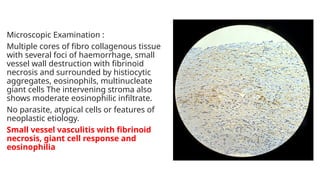
Microscopic Examination :
Multiple cores of fibro collagenous tissue
with several foci of haemorrhage, small
vessel wall destruction with fibrinoid
necrosis and surrounded by histiocytic
aggregates, eosinophils, multinucleate
giant cells The intervening stroma also
shows moderate eosinophilic infiltrate.
No parasite, atypical cells or features of
neoplastic etiology.
Small vessel vasculitis with fibrinoid
necrosis, giant cell response and
eosinophilia
FURTHER WORKUP
C-ANCA/P-ANCA – Negative
ANA By IF – Negative
Fungal Workup – Negative
Parasitic workup – Negative
Serum IgG4 – 11.60 g/L (0.03 – 2.0)
Total Serum IgG – 2245.18 mg/dL
Sr. IgG4/Sr. IgG – 51.7%
Differential diagnosis
Treatment Received -
• 3 Doses of Pulse corticosteroids – Inj. Methyl Prednisolone 10mg/kg
• Followed by Inj Methyl Prednisolone1mg/kg.
• Patient Recovered well with weaned off oxygen support within
3 days of treatment.
followup scan during treatment CT 05/ 04/2024
As compared to previous CT dated 28th March 2025 :
There is significant decrease in bilateral pleural effusion.
There is complete resolution of passive collapse of posterobasal segment of right lower
lobe
Discussion

small vessel vasculitis case presentation

  • 1.
    Case Presentation A 14Years old male patient had ON and OFF complaints of of Shortness of breath which progressed gradually , Cough with expectoration , Loss of appetite and associated weight loss – 4kg since november 2024 . no history of any comorbities . NO significant past history • Birth History –  Term baby, mode of delivery – LSCS  Birth weight - 4.5kg  Non consanguineous marriage
  • 2.
    CXR(12/2/25) Right upper zoneperipheral wedge- shaped consolidation with right hilar prominence
  • 3.
    CECT CHEST doneoutside on 13/02/25 • Patchy consolidatory changes with air bronchogram seen in anterior segment of right upper lobe • Multiple enlarged by perihilar, paratracheal and mediastinal lymph nodes seen compressing the adjacent structures • Patient was started on empirical ATT therapy.
  • 5.
    • Bronchoscopy (outisidecenter) done on 22/2/25 showed right main bronchus obliterated with extensive compression • Right middle lobe bronchus was not seen, right lower lobe bronchus necrotic debris was seen • BAL analysis was done which showed GeneXpert -MTB - Negative AFB smear- Negative FUNGAL KOH mount -negative • Following this EBUS was done on 25/2/25 which showed Negative for granulomas and malignancy
  • 7.
    SYMPTOMS DOESNT RESOLVE- PET-CT done • Showed Right supraclavicular lymph node 1.3* 0.7cm (SUV max 4.91) • FDG avid discrete and conglomerated upper and lower paratracheal, • perivascular, subcarinal and right hilar • LN (5.9x5.6x5.4cm) SUV 25.88. Lesion • encases right pulmonary artery and right main bronchus. • Moderate pericardial effusion seen. • Hepatomegaly • FNAC - Supraclavicular LN (17/3/25) showed Reactive hyperplasia.
  • 8.
    2D echo showedlarge pericardial effusion with ejection fraction 60%, normal biventricular function, trivial MR/TR/mild PAH. Pericardiocentesis was done. Pericardial fluid analysis - ADA 9.8 (normal=0 t0 30), LDH for 25, protein 6.27, glucose 97, albumin 2.51. MTB not detected. Cytology revealed - lymphocytic effusion with few eosinophils
  • 9.
    Then, Referred toour centre • On clinical examination patient had severe SOB • Cough with thin mucoid expectoration • LAB PARAMETERS Normocytic normochromic, leukocytosis with eosinophilia. • LFT , serum creatinine - normal limits. • .
  • 10.
  • 11.
    CECT CHEST Bilateral mildpleural effusion with subsegmental collapse of underlying lung. Patchy areas of consolidation with adjacent minimal ground glassing noted in anterior segment of left upper lobe, left lingula, posterior segment of right upper lobe, lateral segment of right middle lobe and also in basal segments of both lower lobes. Post-contrast no obvious enhancement detected. ===> Possibly infective aetiology
  • 12.
    Ill-defined soft tissue densitynoted in mediastinum completely encasing the mediastinal vessels, mediastinal lymph nodes with lateral extension into adjacent hila causing mild to moderate compression pulmonary vessels, superior and inferior vena cava with associated minimal to mild compression bilateral Atria noted. Post-contrast there is mildly enhancing noted. There is thin irregular peripheral calcific specks involving pericardium in superior mediastinum noted. Few prominent enhancing prevascular, right and left paratracheal lymph nodes noted within the above
  • 13.
    => possibly represent granulomatousinfective aetiology - suggested clinical/HPE correlation.
  • 14.
    CT Guided Biopsyfrom the Mediastinal Lesion was done
  • 16.
    Microscopic Examination : Multiplecores of fibro collagenous tissue with several foci of haemorrhage, small vessel wall destruction with fibrinoid necrosis and surrounded by histiocytic aggregates, eosinophils, multinucleate giant cells The intervening stroma also shows moderate eosinophilic infiltrate. No parasite, atypical cells or features of neoplastic etiology. Small vessel vasculitis with fibrinoid necrosis, giant cell response and eosinophilia
  • 17.
    FURTHER WORKUP C-ANCA/P-ANCA –Negative ANA By IF – Negative Fungal Workup – Negative Parasitic workup – Negative Serum IgG4 – 11.60 g/L (0.03 – 2.0) Total Serum IgG – 2245.18 mg/dL Sr. IgG4/Sr. IgG – 51.7%
  • 18.
  • 19.
    Treatment Received - •3 Doses of Pulse corticosteroids – Inj. Methyl Prednisolone 10mg/kg • Followed by Inj Methyl Prednisolone1mg/kg. • Patient Recovered well with weaned off oxygen support within 3 days of treatment.
  • 20.
    followup scan duringtreatment CT 05/ 04/2024 As compared to previous CT dated 28th March 2025 : There is significant decrease in bilateral pleural effusion. There is complete resolution of passive collapse of posterobasal segment of right lower lobe
  • 22.