Karen Sands, CA Tax Partner Five Key Challenges to Retirement Income & Estate Planning Thursday, March 17, 2011
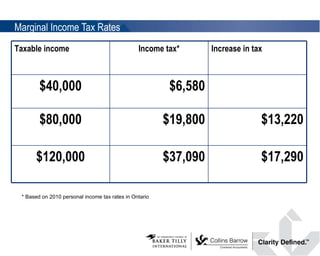
Marginal Income Tax Rates * Based on 2010   personal   income tax   rates   in Ontario $17,290 $37,090 $120,000 $13,220 $19,800 $80,000 $6,580 $40,000 Increase in tax Income tax* Taxable income
Marginal Income Tax Rates One person earning $80,000 and other with no income versus each spouse earning $40,000 Savings: $4,500 annually One earning $120,000, other nothing vs each earning $60,000 Savings: $9,100 annually Similar results if split income among other family members
How do we do this? Income Splitting
Income Splitting First, need to look at where your income comes from…employment (hard to split unless own your own business), pensions (tax rules now allow for this in some cases), investment income, business income, rental income (all have potential)…
Income Splitting Let’s first look at investment income…not easy, we must consider the attribution rules: Income and capital gains – spouse Income only – minor children Income – adult children if purpose test met Kiddie tax
Income Splitting How do we get around the attribution rules? Loan to spouse or adult children for business purposes Prescribed rate loan – spouse, adult children – only 1% still!! Higher income spouse pay expenses; lower income spouse invests Lower income spouse replaces non-income producing assets with income bearing assets Invest in assets generating capital gains for children   Gift to children (watch for potential tax on gift)
Income Splitting Pay reasonable salary to spouse/family members for work done for business Have spouse/family members own shares in your corporation (where possible) Split CPP with spouse Elect to  split pension income  on personal tax return What qualifies as pension income? If under age 65 registered pension plan (RPP) payments or RRSP, RRIF, DPSP payments – ONLY if received due to death of spouse If age 65 or older RPP payments annuity from RRSP, DPSP or non registered annuity or any RRIF payment
A dollar is a dollar…or is it? Income Splitting Tax free income Tax preferred income Tax deferred income
Tax free income Capital gain on principal residence – generally one per couple, generally need to live there $750,000 capital gains exemption Gifts or inheritance – tax free to recipient Life insurance proceeds $2,000 annual pension income (same definitions as for pension splitting – depends on age – under age 65 generally only RPP income)
Tax preferred Income Eligible  dividends from Canadian corporations  At top rate, Ontario 2010: 27%  5% interest equal to 3.7% in dividends at top rate Ineligible dividends from Canadian corporations At top rate, Ontario 2010: 33% A resident of Ontario could earn $40,000 in dividends with no other income and pay less than $900 in income tax Capital gains  50% taxable therefore maximum tax rate 23% Compare to interest income taxed at 46% at top rate
Tax deferred income RRSPs RESPs Business income left in company after lower rate corporate tax RRSP withdrawals Note that tax is only deferred until you withdraw funds Keep marginal rates in mind May want to draw out some income before 71 to… Use up lowest tax bracket Spread income out over more years to avoid or minimize OAS clawback Convert to RRIF to pension split (after age 65)
Income Tax on Death Generally considered to have sold all your assets for their fair market value immediately prior to death Therefore death generally triggers all accrued capital gains (and losses) on assets and recapture/terminal losses on depreciable business assets Capital gain or loss = difference between adjusted cost base and value at date of death
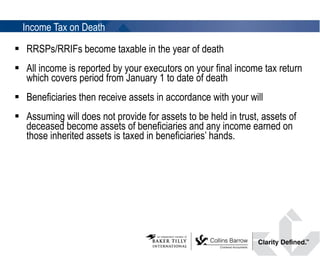
Income Tax on Death RRSPs/RRIFs become taxable in the year of death All income is reported by your executors on your final income tax return which covers period from January 1 to date of death Beneficiaries then receive assets in accordance with your will Assuming will does not provide for assets to be held in trust, assets of deceased become assets of beneficiaries and any income earned on those inherited assets is taxed in beneficiaries’ hands.
Income Tax on Death – some exceptions Assets left to spouse Rollover of qualified farm property to a child RRSP/RRIF left to: Spouse  Minor dependant child Infirm child
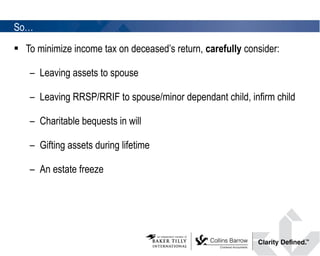
So… To minimize income tax on deceased’s return,  carefully  consider: Leaving assets to spouse  Leaving RRSP/RRIF to spouse/minor dependant child, infirm child Charitable bequests in will  Gifting assets during lifetime  An estate freeze
And so… What planning can be done to minimize the income taxes paid by your heirs? Set up spousal trust in your will Set up multiple testamentary trusts in your will
Spousal Trust Assets roll to spousal trust as if left outright to spouse and income taxed in trust Income earned on assets left to spouse is taxed in the trust (not taxable to beneficiary spouse unless take steps to make this happen) Since trust created on death, trust income is subject to marginal rates  Potentially less income tax than spouse would pay When assets sold by spousal trust or when spouse dies, capital gains triggered at that time
Spousal Trust/Testamentary Trusts Upon surviving spouse’s death, deceased’s will provides what is to happen to residue Allows you to state desired ownership ultimately of assets not used by spouse Will could provide for residue to be held in trust for benefit of children Could set up separate trust for each child (if size of estate warrants) File separate T3 return for each trust set up in will (spousal and other trusts), return filed annually within 90 days of year end
Benefit of Marginal Rates - example If spouse already has own income of $60,000 per year, additional income earned on assets left to him/her by deceased would be taxed at rates 31% to 43% Say leave $1 M of assets and can earn 6%, tax on that extra $60k of income would be about $24k if earned directly by surviving spouse If taxed in spousal trust, tax would be about $14k therefore spouse can save $10k annually in income tax by you setting up spousal trust in your will Similar results for trusts set up for children
Partner Attention  A Highly Collaborate Culture including  the assignment of Colleague Assurance  Partners on mandates Accountability – for the client, the engagement and our people Experience & Industry-specific Expertise With 36 offices from coast to coast, our audit, tax and advisory professionals make your business our focus. WHY COLLINS BARROW? Karen Sands, CA Tax Partner Collins Barrow SEO LLP [email_address]

Key Challenges to Retirement Income & Estate Planning

  • 1.
    Karen Sands, CATax Partner Five Key Challenges to Retirement Income & Estate Planning Thursday, March 17, 2011
  • 2.
    Marginal Income TaxRates * Based on 2010 personal income tax rates in Ontario $17,290 $37,090 $120,000 $13,220 $19,800 $80,000 $6,580 $40,000 Increase in tax Income tax* Taxable income
  • 3.
    Marginal Income TaxRates One person earning $80,000 and other with no income versus each spouse earning $40,000 Savings: $4,500 annually One earning $120,000, other nothing vs each earning $60,000 Savings: $9,100 annually Similar results if split income among other family members
  • 4.
    How do wedo this? Income Splitting
  • 5.
    Income Splitting First,need to look at where your income comes from…employment (hard to split unless own your own business), pensions (tax rules now allow for this in some cases), investment income, business income, rental income (all have potential)…
  • 6.
    Income Splitting Let’sfirst look at investment income…not easy, we must consider the attribution rules: Income and capital gains – spouse Income only – minor children Income – adult children if purpose test met Kiddie tax
  • 7.
    Income Splitting Howdo we get around the attribution rules? Loan to spouse or adult children for business purposes Prescribed rate loan – spouse, adult children – only 1% still!! Higher income spouse pay expenses; lower income spouse invests Lower income spouse replaces non-income producing assets with income bearing assets Invest in assets generating capital gains for children Gift to children (watch for potential tax on gift)
  • 8.
    Income Splitting Payreasonable salary to spouse/family members for work done for business Have spouse/family members own shares in your corporation (where possible) Split CPP with spouse Elect to split pension income on personal tax return What qualifies as pension income? If under age 65 registered pension plan (RPP) payments or RRSP, RRIF, DPSP payments – ONLY if received due to death of spouse If age 65 or older RPP payments annuity from RRSP, DPSP or non registered annuity or any RRIF payment
  • 9.
    A dollar isa dollar…or is it? Income Splitting Tax free income Tax preferred income Tax deferred income
  • 10.
    Tax free incomeCapital gain on principal residence – generally one per couple, generally need to live there $750,000 capital gains exemption Gifts or inheritance – tax free to recipient Life insurance proceeds $2,000 annual pension income (same definitions as for pension splitting – depends on age – under age 65 generally only RPP income)
  • 11.
    Tax preferred IncomeEligible dividends from Canadian corporations At top rate, Ontario 2010: 27% 5% interest equal to 3.7% in dividends at top rate Ineligible dividends from Canadian corporations At top rate, Ontario 2010: 33% A resident of Ontario could earn $40,000 in dividends with no other income and pay less than $900 in income tax Capital gains 50% taxable therefore maximum tax rate 23% Compare to interest income taxed at 46% at top rate
  • 12.
    Tax deferred incomeRRSPs RESPs Business income left in company after lower rate corporate tax RRSP withdrawals Note that tax is only deferred until you withdraw funds Keep marginal rates in mind May want to draw out some income before 71 to… Use up lowest tax bracket Spread income out over more years to avoid or minimize OAS clawback Convert to RRIF to pension split (after age 65)
  • 13.
    Income Tax onDeath Generally considered to have sold all your assets for their fair market value immediately prior to death Therefore death generally triggers all accrued capital gains (and losses) on assets and recapture/terminal losses on depreciable business assets Capital gain or loss = difference between adjusted cost base and value at date of death
  • 14.
    Income Tax onDeath RRSPs/RRIFs become taxable in the year of death All income is reported by your executors on your final income tax return which covers period from January 1 to date of death Beneficiaries then receive assets in accordance with your will Assuming will does not provide for assets to be held in trust, assets of deceased become assets of beneficiaries and any income earned on those inherited assets is taxed in beneficiaries’ hands.
  • 15.
    Income Tax onDeath – some exceptions Assets left to spouse Rollover of qualified farm property to a child RRSP/RRIF left to: Spouse Minor dependant child Infirm child
  • 16.
    So… To minimizeincome tax on deceased’s return, carefully consider: Leaving assets to spouse Leaving RRSP/RRIF to spouse/minor dependant child, infirm child Charitable bequests in will Gifting assets during lifetime An estate freeze
  • 17.
    And so… Whatplanning can be done to minimize the income taxes paid by your heirs? Set up spousal trust in your will Set up multiple testamentary trusts in your will
  • 18.
    Spousal Trust Assetsroll to spousal trust as if left outright to spouse and income taxed in trust Income earned on assets left to spouse is taxed in the trust (not taxable to beneficiary spouse unless take steps to make this happen) Since trust created on death, trust income is subject to marginal rates Potentially less income tax than spouse would pay When assets sold by spousal trust or when spouse dies, capital gains triggered at that time
  • 19.
    Spousal Trust/Testamentary TrustsUpon surviving spouse’s death, deceased’s will provides what is to happen to residue Allows you to state desired ownership ultimately of assets not used by spouse Will could provide for residue to be held in trust for benefit of children Could set up separate trust for each child (if size of estate warrants) File separate T3 return for each trust set up in will (spousal and other trusts), return filed annually within 90 days of year end
  • 20.
    Benefit of MarginalRates - example If spouse already has own income of $60,000 per year, additional income earned on assets left to him/her by deceased would be taxed at rates 31% to 43% Say leave $1 M of assets and can earn 6%, tax on that extra $60k of income would be about $24k if earned directly by surviving spouse If taxed in spousal trust, tax would be about $14k therefore spouse can save $10k annually in income tax by you setting up spousal trust in your will Similar results for trusts set up for children
  • 21.
    Partner Attention A Highly Collaborate Culture including the assignment of Colleague Assurance Partners on mandates Accountability – for the client, the engagement and our people Experience & Industry-specific Expertise With 36 offices from coast to coast, our audit, tax and advisory professionals make your business our focus. WHY COLLINS BARROW? Karen Sands, CA Tax Partner Collins Barrow SEO LLP [email_address]

Editor's Notes

  • #4 Stress that this is savings – not deferral and that it is an annual savings