BASICS OF ENGLISH GRAMMAR
PRESENT TENSE BE,
DEMONSTRATIVES,
POSSESSIVE ADJECTIVES,
PRESENT CONTINOUS, CAN,
PREPOSITIONS
PRESENT TENSE BE
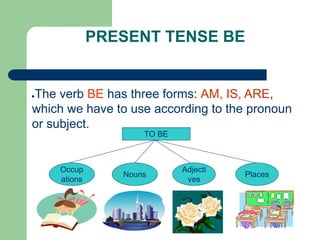
●The verb BE has three forms: AM, IS, ARE,
which we have to use according to the pronoun
or subject.
TO BE
Occup
ations
Nouns
Adjecti
ves
Places
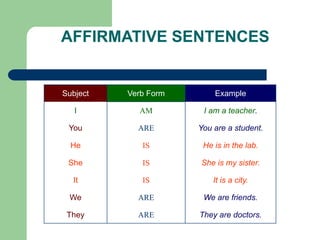
AFFIRMATIVE SENTENCES
They are doctors.
ARE
They
We are friends.
ARE
We
It is a city.
IS
It
She is my sister.
IS
She
He is in the lab.
IS
He
You are a student.
ARE
You
I am a teacher.
AM
I
Example
Verb Form
Subject
NEGATIVE SENTENCES
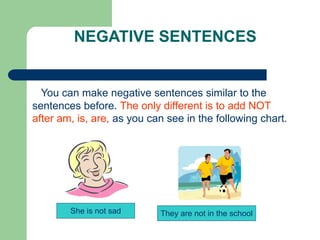
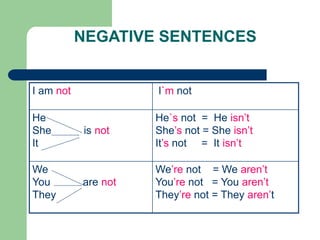
You can make negative sentences similar to the
sentences before. The only different is to add NOT
after am, is, are, as you can see in the following chart.
She is not sad They are not in the school
NEGATIVE SENTENCES
We’re not = We aren’t
You’re not = You aren’t
They’re not = They aren’t
We
You are not
They
He`s not = He isn’t
She’s not = She isn’t
It’s not = It isn’t
He
She is not
It
I`m not
I am not
REVIEW
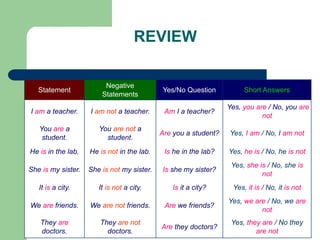
Are they doctors?
Are we friends?
Is it a city?
Is she my sister?
Is he in the lab?
Are you a student?
Am I a teacher?
Yes/No Question
They are not
doctors.
We are not friends.
It is not a city.
She is not my sister.
He is not in the lab.
You are not a
student.
I am not a teacher.
Negative
Statements
Yes, they are / No they
are not
They are
doctors.
Yes, we are / No, we are
not
We are friends.
Yes, it is / No, it is not
It is a city.
Yes, she is / No, she is
not
She is my sister.
Yes, he is / No, he is not
He is in the lab.
Yes, I am / No, I am not
You are a
student.
Yes, you are / No, you are
not
I am a teacher.
Short Answers
Statement
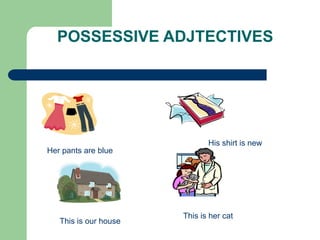
POSSESSIVE ADJECTIVES
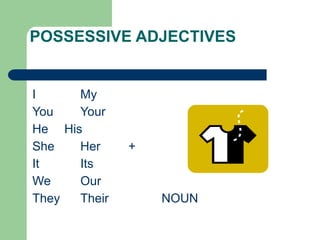
I My
You Your
He His
She Her +
It Its
We Our
They Their NOUN
POSSESSIVE ADJTECTIVES
This is our house
Her pants are blue
His shirt is new
This is her cat
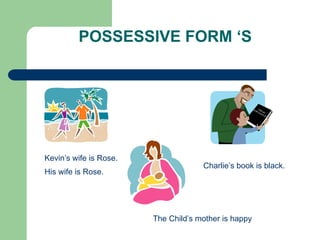
POSSESSIVE FORM ‘S
Kevin’s wife is Rose.
His wife is Rose.
Charlie’s book is black.
The Child’s mother is happy
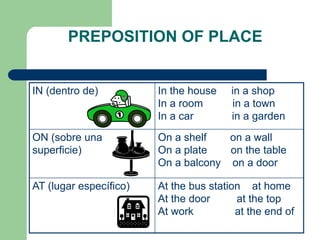
PREPOSITION OF PLACE
At the bus station at home
At the door at the top
At work at the end of
AT (lugar específico)
On a shelf on a wall
On a plate on the table
On a balcony on a door
ON (sobre una
superficie)
In the house in a shop
In a room in a town
In a car in a garden
IN (dentro de)
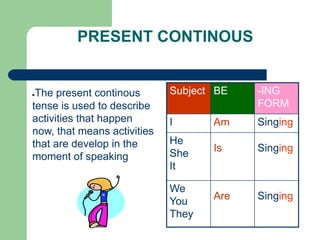
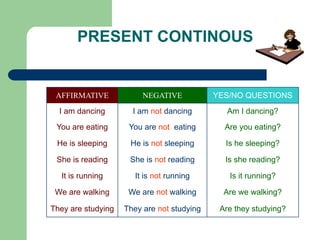
PRESENT CONTINOUS
●The present continous
tense is used to describe
activities that happen
now, that means activities
that are develop in the
moment of speaking
Singing
Are
We
You
They
Singing
Is
He
She
It
Singing
Am
I
-ING
FORM
BE
Subject
PRESENT CONTINOUS
They are not studying
We are not walking
It is not running
She is not reading
He is not sleeping
You are not eating
I am not dancing
NEGATIVE
Are they studying?
They are studying
Are we walking?
We are walking
Is it running?
It is running
Is she reading?
She is reading
Is he sleeping?
He is sleeping
Are you eating?
You are eating
Am I dancing?
I am dancing
YES/NO QUESTIONS
AFFIRMATIVE
RULES
coming
lose - losing
live – living
Remove E, then add
–INGcome
1 vowel + 1
consonant + E-
swim - swimming
hit - hitting
get – getting
Double the consonant,
then add –ING
1 vowel + 1
consonant
Examples
How to make the -ING
form
Verb ending in...
say - saying
go - going
walk - walking
Add –ING
[anything else]

Slides Grammar.pdf

  • 1.
    BASICS OF ENGLISHGRAMMAR PRESENT TENSE BE, DEMONSTRATIVES, POSSESSIVE ADJECTIVES, PRESENT CONTINOUS, CAN, PREPOSITIONS
  • 2.
    PRESENT TENSE BE ●Theverb BE has three forms: AM, IS, ARE, which we have to use according to the pronoun or subject. TO BE Occup ations Nouns Adjecti ves Places
  • 3.
    AFFIRMATIVE SENTENCES They aredoctors. ARE They We are friends. ARE We It is a city. IS It She is my sister. IS She He is in the lab. IS He You are a student. ARE You I am a teacher. AM I Example Verb Form Subject
  • 4.
    NEGATIVE SENTENCES You canmake negative sentences similar to the sentences before. The only different is to add NOT after am, is, are, as you can see in the following chart. She is not sad They are not in the school
  • 5.
    NEGATIVE SENTENCES We’re not= We aren’t You’re not = You aren’t They’re not = They aren’t We You are not They He`s not = He isn’t She’s not = She isn’t It’s not = It isn’t He She is not It I`m not I am not
  • 6.
    REVIEW Are they doctors? Arewe friends? Is it a city? Is she my sister? Is he in the lab? Are you a student? Am I a teacher? Yes/No Question They are not doctors. We are not friends. It is not a city. She is not my sister. He is not in the lab. You are not a student. I am not a teacher. Negative Statements Yes, they are / No they are not They are doctors. Yes, we are / No, we are not We are friends. Yes, it is / No, it is not It is a city. Yes, she is / No, she is not She is my sister. Yes, he is / No, he is not He is in the lab. Yes, I am / No, I am not You are a student. Yes, you are / No, you are not I am a teacher. Short Answers Statement
  • 7.
    POSSESSIVE ADJECTIVES I My YouYour He His She Her + It Its We Our They Their NOUN
  • 8.
    POSSESSIVE ADJTECTIVES This isour house Her pants are blue His shirt is new This is her cat
  • 9.
    POSSESSIVE FORM ‘S Kevin’swife is Rose. His wife is Rose. Charlie’s book is black. The Child’s mother is happy
  • 10.
    PREPOSITION OF PLACE Atthe bus station at home At the door at the top At work at the end of AT (lugar específico) On a shelf on a wall On a plate on the table On a balcony on a door ON (sobre una superficie) In the house in a shop In a room in a town In a car in a garden IN (dentro de)
  • 11.
    PRESENT CONTINOUS ●The presentcontinous tense is used to describe activities that happen now, that means activities that are develop in the moment of speaking Singing Are We You They Singing Is He She It Singing Am I -ING FORM BE Subject
  • 12.
    PRESENT CONTINOUS They arenot studying We are not walking It is not running She is not reading He is not sleeping You are not eating I am not dancing NEGATIVE Are they studying? They are studying Are we walking? We are walking Is it running? It is running Is she reading? She is reading Is he sleeping? He is sleeping Are you eating? You are eating Am I dancing? I am dancing YES/NO QUESTIONS AFFIRMATIVE
  • 13.
    RULES coming lose - losing live– living Remove E, then add –INGcome 1 vowel + 1 consonant + E- swim - swimming hit - hitting get – getting Double the consonant, then add –ING 1 vowel + 1 consonant Examples How to make the -ING form Verb ending in... say - saying go - going walk - walking Add –ING [anything else]