Research Objectives
Introduction
Research objectives are concise statements that outline
the specific goals and aims of a research study. They

provide a clear and focused direction, guiding the
research process and helping researchers address the
main questions or hypotheses of their investigation.
Research objectives
Setting clear research objectives enhances the efficiency
and effectiveness of a study by providing a well-defined
roadmap for researchers to follow, reducing ambiguity,
and ensuring focus.
Benefits of Setting Clear
Research Objectives
How to Formulate Research
Objectives?
To formulate research objectives, begin by identifying the main
purpose of the study and the specific research questions or
hypotheses that need to be addressed. Craft clear, concise
statements that outline the intended outcomes and guide the
research toward achieving its defined goals.
Research objectives are of paramount importance as they provide
a clear roadmap for the study, guiding researchers toward specific
goals and helping them stay on track. They also aid in evaluating
the success and relevance of the research, ensuring that it
contributes effectively to the existing body of knowledge.
Importance of Research
Objectives
Research Questions
Research questions are specific, focused inquiries
that guide a research study and help researchers
explore, describe, explain, or predict relationships
between variables, aiming to address the main
research problem and contribute to the existing
body of knowledge.
Types Of Research
Objectives
It includes exploratory objectives, which seek to gain insights into
a relatively unexplored subject; descriptive objectives, which aim
to provide a detailed account of the characteristics or behaviors of
a specific population or phenomenon; and explanatory objectives,
which focus on identifying causal relationships between variables
to explain why certain events or phenomena occur.
Exploratory Objectives Descriptive Objectives
Explanatory Objectives Predictive Objectives
Comparative Objectives Evaluative Objectives
Developmental Objectives Theoretical Objectives
Normative Objectives Action-oriented Objectives
Types Of Research Objectives
Components Of Research
Objectives
Effective research objectives consist of specific, measurable,
achievable, relevant, and time-bound (SMART) components,
providing clarity and guiding the research study toward desired
outcomes and focused investigation.
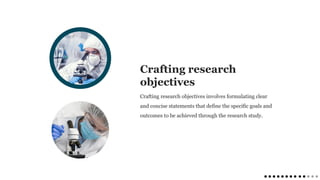
Crafting research
objectives
Crafting research objectives involves formulating clear
and concise statements that define the specific goals and
outcomes to be achieved through the research study.
Characteristics Of
Objectives
Well-defined objectives are characterized by their clarity,
specificity, measurability, achievability, and relevance,
providing a clear direction and focus for the research study
Clarity
Well-defined objectives should be
clear and unambiguous, leaving no
room for misinterpretation or
confusion.
Specificity
Objectives should be specific, clearly
stating what is to be achieved or
investigated, leaving no room for
statements.
Measurability
Well-defined objectives should be
measurable, allowing for the
assessment of progress or
achievement.
Relevance
Objectives should be directly
related to the research
problem, addressing the core
issues or gaps
Common Mistakes to
Avoid
A common mistake to avoid in research objectives is
formulating them in a vague or unclear manner,
which can lead to a lack of focus and hinder the
research's progress and success.
Conclusion
In conclusion, research objectives are vital elements that provide
a clear direction, purpose, and measurable targets for a research
study, ensuring its success and meaningful contributions to the
field of knowledge. By avoiding common mistakes such as
vagueness or lack of specificity, researchers can craft effective
objectives that guide their investigation and lead to valuable
outcomes.
Icons
Icons
How To Edit Shapes
You can add and edit some shapes to your presentation to present your data in a visual way.
• Choose your favourite infographic and insert it in your presentation using Ctrl C + Ctrl V or
Cmd C + Cmd V in Mac.
• Select one of the parts and ungroup it by right-clicking and choosing “Ungroup”.
• Change the color by clicking on the paint bucket.
• Then resize the element by clicking and dragging one of the square-shaped points of its
bounding box (the cursor should look like a double-headed arrow). Remember to hold Shift
while dragging to keep the proportions.
• Group the elements again by selecting them, right-clicking and choosing “Group”.
• Repeat the steps above with the other parts and when you’re done editing, copy the end
result and paste it into your presentation.
• Remember to choose the “Keep source formatting” option so that it keeps the design. For
more info, please visit Slideegg (Tips & Tricks).
Terms Of Use (Free Users)
If you are a free subscriber, you should credit SlideEgg by keeping the “Thank You” slide.
Kindly refer to the following slide for the Terms of Use for premium users.
You can:
• Customize or edit this template
• Use this template for both business and personal endeavors.
You can not:
• Sell, rent, or second-license SlideEgg content or its altered version.
Promulgate, unless explicitly permitted, SlideEgg content, by SlideEgg.
• Incorporate SlideEgg content in any database or file online or offline.
• Obtain SlideEgg content’s copyright.
Kindly refer to our Tutorial page or FAQ for advanced slide modification guidelines.
Terms Of Use (Premium Users)
Being a premium subscriber, you have the privilege of using this PPT template
without giving attribution to SlideEgg or keeping the “Thank You” slide.
You can:
• Customize or edit this template.
• Use this template for both business and personal endeavors.
• Circulate or share the editable format of this template with anyone you want.
You can not:
• Sell, rent or second-license SlideEgg content or the altered version of it.
Promulgate or include the templates in any other services database
• that performs as distribution or resale platform, unless explicitly permitted, by SlideEgg.
• Incorporate the elements used in SlideEgg’s templates separately.
• Obtain SlideEgg’s copyright for the elements used in this template as a logo or trademark.
Kindly refer to our Tutorial page or FAQ for advanced slide modification guidelines.
www.slideegg.com
Thank You!
We respect your valuable time with SlideEgg!
If you have any questions, please reach us
CREDIT: SlideEgg created this PowerPoint template.
Let this slide be kept for attribution.
Do you have a design request, please visit our redesign page.

Slide Egg_900030-Research Objectives (1).pptx

  • 1.
  • 2.
    Introduction Research objectives areconcise statements that outline the specific goals and aims of a research study. They provide a clear and focused direction, guiding the research process and helping researchers address the main questions or hypotheses of their investigation. Research objectives

  • 3.
    Setting clear researchobjectives enhances the efficiency and effectiveness of a study by providing a well-defined roadmap for researchers to follow, reducing ambiguity, and ensuring focus. Benefits of Setting Clear Research Objectives
  • 4.
    How to FormulateResearch Objectives? To formulate research objectives, begin by identifying the main purpose of the study and the specific research questions or hypotheses that need to be addressed. Craft clear, concise statements that outline the intended outcomes and guide the research toward achieving its defined goals.
  • 5.
    Research objectives areof paramount importance as they provide a clear roadmap for the study, guiding researchers toward specific goals and helping them stay on track. They also aid in evaluating the success and relevance of the research, ensuring that it contributes effectively to the existing body of knowledge. Importance of Research Objectives
  • 6.
    Research Questions Research questionsare specific, focused inquiries that guide a research study and help researchers explore, describe, explain, or predict relationships between variables, aiming to address the main research problem and contribute to the existing body of knowledge.
  • 7.
    Types Of Research Objectives Itincludes exploratory objectives, which seek to gain insights into a relatively unexplored subject; descriptive objectives, which aim to provide a detailed account of the characteristics or behaviors of a specific population or phenomenon; and explanatory objectives, which focus on identifying causal relationships between variables to explain why certain events or phenomena occur.
  • 8.
    Exploratory Objectives DescriptiveObjectives Explanatory Objectives Predictive Objectives Comparative Objectives Evaluative Objectives Developmental Objectives Theoretical Objectives Normative Objectives Action-oriented Objectives Types Of Research Objectives
  • 9.
    Components Of Research Objectives Effectiveresearch objectives consist of specific, measurable, achievable, relevant, and time-bound (SMART) components, providing clarity and guiding the research study toward desired outcomes and focused investigation.
  • 10.
    Crafting research objectives Crafting researchobjectives involves formulating clear and concise statements that define the specific goals and outcomes to be achieved through the research study.
  • 11.
    Characteristics Of Objectives Well-defined objectivesare characterized by their clarity, specificity, measurability, achievability, and relevance, providing a clear direction and focus for the research study Clarity Well-defined objectives should be clear and unambiguous, leaving no room for misinterpretation or confusion. Specificity Objectives should be specific, clearly stating what is to be achieved or investigated, leaving no room for statements. Measurability Well-defined objectives should be measurable, allowing for the assessment of progress or achievement. Relevance Objectives should be directly related to the research problem, addressing the core issues or gaps
  • 12.
    Common Mistakes to Avoid Acommon mistake to avoid in research objectives is formulating them in a vague or unclear manner, which can lead to a lack of focus and hinder the research's progress and success.
  • 13.
    Conclusion In conclusion, researchobjectives are vital elements that provide a clear direction, purpose, and measurable targets for a research study, ensuring its success and meaningful contributions to the field of knowledge. By avoiding common mistakes such as vagueness or lack of specificity, researchers can craft effective objectives that guide their investigation and lead to valuable outcomes.
  • 14.
  • 15.
  • 16.
    How To EditShapes You can add and edit some shapes to your presentation to present your data in a visual way. • Choose your favourite infographic and insert it in your presentation using Ctrl C + Ctrl V or Cmd C + Cmd V in Mac. • Select one of the parts and ungroup it by right-clicking and choosing “Ungroup”. • Change the color by clicking on the paint bucket. • Then resize the element by clicking and dragging one of the square-shaped points of its bounding box (the cursor should look like a double-headed arrow). Remember to hold Shift while dragging to keep the proportions. • Group the elements again by selecting them, right-clicking and choosing “Group”. • Repeat the steps above with the other parts and when you’re done editing, copy the end result and paste it into your presentation. • Remember to choose the “Keep source formatting” option so that it keeps the design. For more info, please visit Slideegg (Tips & Tricks).
  • 17.
    Terms Of Use(Free Users) If you are a free subscriber, you should credit SlideEgg by keeping the “Thank You” slide. Kindly refer to the following slide for the Terms of Use for premium users. You can: • Customize or edit this template • Use this template for both business and personal endeavors. You can not: • Sell, rent, or second-license SlideEgg content or its altered version. Promulgate, unless explicitly permitted, SlideEgg content, by SlideEgg. • Incorporate SlideEgg content in any database or file online or offline. • Obtain SlideEgg content’s copyright. Kindly refer to our Tutorial page or FAQ for advanced slide modification guidelines.
  • 18.
    Terms Of Use(Premium Users) Being a premium subscriber, you have the privilege of using this PPT template without giving attribution to SlideEgg or keeping the “Thank You” slide. You can: • Customize or edit this template. • Use this template for both business and personal endeavors. • Circulate or share the editable format of this template with anyone you want. You can not: • Sell, rent or second-license SlideEgg content or the altered version of it. Promulgate or include the templates in any other services database • that performs as distribution or resale platform, unless explicitly permitted, by SlideEgg. • Incorporate the elements used in SlideEgg’s templates separately. • Obtain SlideEgg’s copyright for the elements used in this template as a logo or trademark. Kindly refer to our Tutorial page or FAQ for advanced slide modification guidelines.
  • 19.
    www.slideegg.com Thank You! We respectyour valuable time with SlideEgg! If you have any questions, please reach us CREDIT: SlideEgg created this PowerPoint template. Let this slide be kept for attribution. Do you have a design request, please visit our redesign page.