Helping private tenants 
achieve financial inclusion 
2013 
Sliced Bread Consulting 
Ltd
Helping private tenants 
achieve financial inclusion 
Claire Whyley, Andrea Finney and Dawn Muspratt 
2013 
© 2013 by Sliced Bread Consulting. All rights reserved 
www.slicedbreadconsulting.org.uk 
Helping private tenants achieve financial inclusion I
Helping private tenants achieve financial inclusion I I Acknowledgements 
This project could not have been completed without the generous support of the 
Nationwide Foundation and the Nationwide Building Society. We are extremely grateful to 
both organisations and, in particular, to Lisa Suchet and Dion Alday for their interest and 
commitment to the project. 
The research phase of the project, in particular, benefitted considerably from the input of 
an expert Advisory Group and we offer sincere thanks to the members of that group: Andy 
Brittan, Department for Work and Pensions; Linzi Cooke, BIG; Chris Hobson, National Housing 
Federation; Robbie de Santos, Shelter; Liz Stannard, Citizen’s Advice; Peter Tutton, Stepchange; 
Danielle Walker-Palmour, Friends Provident Foundation; Sian Williams, Toynbee Hall. 
Thanks are also due to a number of stakeholders who provided input throughout the project 
and, in particular, at its early stages: Jacky Peacock, Brent Private Tenants Rights Group; Felicity 
Ridgeway, Department for Work and Pensions; Susan Aktemel, Homes for Good; Chris Norris, 
National Landlords Association; Sharon Wheeler, Chartered Institute of Housing; Katija Dew, 
Wales Cooperative. 
A number of organisations helped us with the fieldwork for this study. Recruitment to the focus 
groups was conducted by Protel Ltd. Jacky Peacock of Brent Private Tenants Rights Group and 
James Berry of Bristol Credit Union also provided invaluable help with recruitment. Michaela 
Cummings, of Transcribe, provided transcripts of the focus group discussions. 
At the Personal Finance Research Centre, we would also like to thank David Collings for 
administrative support and David Hayes for input to the quantitative analysis. 
Last but not least, we would like to extend sincere thanks to the private tenants who gave up 
their time to participate in the focus groups and to share their stories with us. Without them, 
this project would not have been possible and we are indebted to them.
Foreword 
In early 2012 the Nationwide Foundation embarked on a strategic review of its charitable 
giving. It had been supporting people in need with their housing and finance issues and the 
Foundation’s Board was keen to look at how it could do this more effectively. Alongside this, the 
Nationwide Building Society had launched its new corporate citizenship strategy which aimed 
by 2017 to empower 1 million people to start saving and to help 750,000 people into a home 
of their own. During this time, the Foundation was approached by Sliced Bread Consulting and 
Bristol University’s Personal Finance Research Centre, to co-fund with the Society, this piece of 
research designed to fill a glaring knowledge gap at the time. 
Over the years charitable funders, corporates, charities and government have dedicated 
many millions trying to get more people banked and be in better control of their finances, in 
particular, targeting those in social housing. However, as this goes to print, the waiting list for 
social housing stands at 1.8m, meaning the private rented sector is the only real alternative for 
many on low incomes. As such, it is expected to account for 20% of all households by 2016, a 
massive rise from just 9% in the late 1980s. 
The needs of low income families and individuals with no other option than to live in the private 
rented sector needs the attention of all relevant service providers, policy makers, funders and 
charities more than ever. The fact this research evidences that a notable proportion of those 
in the private rented sector are managing their tenancies and household budgets whilst being 
financially excluded really highlights a space where more can and must be done to help. 
In April 2013, as this research report was drawing to a close, the Nationwide Foundation 
launched its new funding strategy encompassing an aim to create decent, affordable homes for 
people in need and this includes a specific focus on the private rented sector. 
The Nationwide Foundation and Nationwide Building Society are delighted to have jointly 
funded this insightful piece of research. 
Lisa Suchet, Chief Executive of the Nationwide Foundation 
Helping private tenants achieve financial inclusion I I I 
Helping private tenants achieve financial inclusion 1
Executive Summary 
Private tenants are being left behind in progress towards financial inclusion. Although 
significant progress has been made since the early 2000s in increasing access to 
transactional banking, overall, financially excluded private tenants – being harder to 
identify and to reach – have rarely been targeted with help and support. As a result, the 
proportion of private tenants without bank accounts has remained fairly constant, in 
contrast with declining numbers of unbanked homeowners and social tenants. Being 
a private tenant has become a bigger indicator of the likelihood of an adult living in an 
unbanked household than being a social tenant. Heavy targeting of financial inclusion 
initiatives towards social tenants, who are easier to reach, has left private tenants 
trapped in something of a policy vacuum, and reduced opportunities for learning about 
how to reach this group with interventions and services that might benefit them. 
This project aimed to address the ‘policy silence’ around private tenants and 
financial inclusion. 
Key findings 
 One in ten private tenants – an estimated 0.65m people – was without a transaction 
bank account in 2009-10. 
 The likelihood of being unbanked is particularly high among private tenants on the 
lowest household incomes; with high material deprivation scores; without any formal 
qualifications; unable to work due to illness of disability; and in receipt of income-replacement 
benefits. 
 The youngest and oldest private tenants face increased risk of being unbanked 
compared with others; as do single pensioners; people living in Northern Ireland; 
those born outside of the UK; people with an Indian, Pakistani or Bangladeshi 
background; and those with a long-standing limiting illness. 
 Unbanked private tenants fall into three main ‘clusters’: 
Z deprived and (economically) inactive; 
Z ‘better-off’ 20 and 30-somethings in couples; 
Z young, single adults. 
 Financially excluded private tenants face additional constraints in their choice of 
housing, exacerbated by their lack of transactional banking facilities and/or the fact 
that they receive social security benefits; often live in very poor quality housing and 
find it extremely difficult to get their landlords to carry out repairs; and feel trapped in 
unsatisfactory properties by high moving costs. 
 Financially excluded private tenants believe that nobody is interested in their needs 
or looking after their interests. 
 Financial exclusion among private tenants is similar to that of other social groups, 
featuring deeply entrenched disengagement from financial services; some negative 
past experiences; a belief that providers are ‘not interested in people like us’; and a 
feeling of anxiety at the very mention of financial services. 
 Financially excluded private tenants experience a number of adverse impacts, 
including the ‘poverty premium’ associated with paying for goods and services in 
cash; increasing difficulties in operating wholly in cash; restricted access to goods 
and services; constraints on money management; difficulties securing employment; 
and low self-esteem. 
Helping private tenants achieve financial inclusion IV
 Financial exclusion compounds many of the vulnerabilities associated with living in 
the private rented sector and, conversely, being a private tenant can exacerbate the 
impact of being financially excluded. 
 Barriers to financial inclusion for private tenants include application refusal; 
conditions attached to basic bank accounts that reduce their perceived utility; fears 
about the risk of exposure to fees, penalty charges and indebtedness as a result of 
becoming banked. Financially excluded private tenants also believe that banks are 
not interested in serving them. 
Project aims and objectives 
The overall aim of this project was to understand the number and characteristics of 
financially excluded private tenants; explore the specific barriers they face in accessing 
and using financial services; and develop effective solutions to reduce exclusion 
among this hard-to-reach group. Specifically, the project was designed to: 
 provide a robust evidence base to illustrate the circumstances, characteristics and 
vulnerability factors associated with being a private tenant; 
 identify the sub-groups within the private tenant population that are vulnerable to 
being financially excluded; 
 explore needs, experiences and attitudes to financial services among vulnerable 
private tenants and identify the barriers they face in accessing and using them; 
 explore the design and delivery factors that would increase the likely success of 
interventions to increase access to financial services among private tenants and 
identify opportunities to extend and adapt existing initiatives to reach private tenants; 
 involve key stakeholders in financial inclusion and housing policy to raise awareness 
of the needs of private tenants, develop strategies to increase their access to 
financial services, and identify appropriate indicators of success. 
Research methods 
The project used a combination of quantitative, qualitative and consultative methods 
to deliver these objectives, including; 
 Bi-variate and multi-variate analysis of the Family Resources Survey and the Wealth 
and Assets Survey to identify key sub groups within the private tenant population that 
are vulnerable to financial exclusion and the factors that influence the likelihood of 
financial exclusion. 
 Focus group research with vulnerable private tenants to provide a detailed 
understanding of the attitudes, needs and experiences of private tenants in relation 
to financial services; the dynamics associated with access to financial services 
among them; needs and aspirations for financial inclusion; and overlaps in contact 
points with other financially excluded groups which may provide efficient points at 
which interventions could be adapted and targeted for private tenants. 
 A programme of stakeholder engagement and consultation to maximise awareness 
and influence, and ensure that the project is informed by existing knowledge and 
expertise. 
Helping private tenants achieve financial inclusion V
Policy recommendations 
The evidence collected as part of this research project indicates that there is an urgent 
and growing need for policy change to address four key problems. 
The on-going vulnerability of many of the people living in private rented housing. 
Continuing barriers to the achievement of meaningful and sustained financial 
inclusion for all of those who need or want financial products and services. 
The difficulties associated with delivering help with financial inclusion to private 
tenants. 
The invisibility of vulnerable private tenants in policymaking. 
Below, we consider the case and actions associated with each of these, in turn. 
Reducing vulnerability among private sector tenants 
It is abundantly clear from this research, and other work, that there are some 
fundamental and structural weaknesses in the private rental housing market. These 
weaknesses impact widely on private tenants, but fall most heavily on those who are 
already vulnerable as a result of wider problems such as poverty, social and financial 
exclusion. 
Considerably more attention must be given to making private renting a more secure 
and comfortable long-term housing option in the UK, with particular focus given to the 
protection of more vulnerable people from the worst aspects of the sector. The work 
of Shelter, Crisis and other similar organisations is essential in achieving this, and we 
hope that the evidence generated by this project helps to inform and shape on-going 
debate and action in this area. 
Meeting financial inclusion needs 
While this research focussed on financial exclusion among private tenants, it is clear 
from the findings that many of the remaining obstacles to financial inclusion apply 
equally to everyone who is unable to access the financial products and services that 
they need. The recommendations outlined below, therefore, while designed to address 
the financial inclusion needs identified among private tenants will, in fact, benefit all of 
those who are affected by financial exclusion, regardless of housing tenure. 
The Government – in particular, HM Treasury (HMT) – and the new regulator, the 
Financial Conduct Authority (FCA), which, as part of its competition objective, 
is required to ‘have regard to’ issues relating to consumers’ access to financial 
services, have a responsibility to ‘lead the charge’ in relation to financial inclusion. 
This includes setting out a vision for financial inclusion and clarity on standards 
that financial services providers are expected to meet to fulfil their obligations to 
consumers who find it difficult to access financial services. This should include 
policies on access, marketing and promotion of basic financial services, as well as 
product features. 
Helping private tenants achieve financial inclusion VI
As part of this, HMT and the FCA should stimulate a renewed debate on financial 
inclusion – informed by the considerable bank of evidence and experience that has 
accumulated since the early 2000s – to identify the outcomes that financial inclusion 
is expected to deliver to those who gain access to financial services. This will ensure 
that financial inclusion delivers sustained and meaningful benefits to consumers. 
The needs of private tenants must be recognised and considered as part of this 
debate. 
Critically, HMT and the FCA should confirm an on-going commitment to the 
importance of basic banking services and the need to design, deliver and promote 
basic bank accounts in a way that makes users, and prospective users, of these 
accounts feel welcome and valued as customers. 
Further, by requiring basic bank account providers to make market share data 
publicly available, showing the number of bank accounts they hold and the number 
of new basic bank accounts they are opening, the Government and the FCA could 
increase the incentives for banks to excel and compete in the provision of these 
accounts. Data-sharing on basic bank accounts would also make it easier for HMT 
and the FCA to identify banks that are not ‘pulling their weight’ in terms of providing 
access to banking services. 
Ahead of the forthcoming EU Directive the retail banking industry – led by the British 
Bankers Association (BBA) and the current market leaders in basic bank account 
provision – must commit to the provision of basic minimum standards in basic 
banking, relating to availability, product features and marketing/promotion, so that 
people who want to access banking services can be confident about the service they 
can expect. 
The banking industry needs to achieve a sustained improvement in standards of 
training at branch level, to remove unnecessary barriers to financial inclusion relating 
to Identification and Verification requirements and to the promotion of basic bank 
accounts. The particular needs of vulnerable private tenants should be included in 
this training. 
The FCA should resume the regular mystery shopping exercise formerly conducted 
by the Banking Code Standards Board, to ensure that basic bank accounts are 
appropriately marketed and promoted at branch level. 
The Payments Council should lead the payments services industry in innovation 
around electronic payments to develop and promote alternatives to direct debits, 
which offer security to payment originators and are more closely aligned to the needs 
of consumers on low or unstable incomes. Making electronic payment services 
work for consumers on low or unstable incomes is critical to ensuring that financial 
inclusion delivers meaningful benefits, in terms of a reduction in the ‘poverty 
premium’ and the removal of the ‘revolving door’ in banking, created by inflexible 
payment services and the application of penalty charges. 
Delivering support with financial inclusion to private tenants 
Policy change in this area need to address two key issues. First, the fact that, because 
of difficulties associated with reaching and targeting private tenants, they have tended 
to be excluded from initiatives aimed at increasing financial inclusion and financial 
capability. Second, that where people become banked as a result of pressure from a 
Helping private tenants achieve financial inclusion VII
third party to do so in order to achieve a particular outcome – as was the case with 
Local Housing Allowance – the result can be that people end up with a bank account 
but do not ‘feel’ financially included and, critically, experience few, if any, benefits of 
becoming banked. 
To address the first of these problems: 
Government, in particular, DWP, and funders of initiatives aimed at supporting 
people to access and use financial services need to ensure that private tenants 
are not structurally excluded from existing and future financial inclusion/financial 
capability initiatives. 
Government – in particular, the Department for Work and Pensions (DWP), and 
HMT – should make it clear that the financial inclusion needs of private tenants 
must be recognised and addressed, and prioritise efforts to reach and deliver 
services to this group. 
In the context of the current welfare reform agenda DWP, in particular, should ensure 
that opportunities to learn from the huge investment, to date, in delivering financial 
inclusion initiatives are maximised and applied to private tenants. 
To address the second problem and, again, in the context of recent and forthcoming 
welfare reforms: 
Government – especially, DWP – must ensure that initiatives to encourage and 
support people into banking focus on the incentives and benefits to becoming 
banked, so that those who open accounts feel ‘banked’ and gain meaningful benefits 
from having an account. 
DWP should ensure that the roll-out of information and support in relation to 
Universal Credit and other aspects of welfare reform outlined in Chapter 1 
successfully reaches private tenants who will be affected. 
Promoting the visibility of private tenants 
The research highlights a clear need for private tenants to be better represented and 
to have an organisation that they trust to advocate on their behalf. In particular, it is 
important that the needs of the most vulnerable private tenants are recognised in 
policymaking and practice. 
Government, led by the department for Communities and Local Government (CLG) 
must acknowledge the degree of vulnerability among some private tenants and 
ensure that this is recognised more explicitly in policy and practice. 
A national organisation specifically for private tenants is required to represent and 
advocate on their behalf, and provide high quality advice and support to them. 
We hope that CLG, the housing policy sector and potential funders promote the 
development of this organisation to ensure that it meet the needs of private tenants, 
in general, and vulnerable private tenants, in particular. 
Helping private tenants achieve financial inclusion VIII
Contents 
Executive Summary IV 
Chapter 1 Introduction 2 
Chapter 2 Identifying financially excluded private tenants 9 
Chapter 3 Understanding financially excluded private tenants 16 
Chapter 4 The nature of financial exclusion among private tenants 23 
Chapter 5 The impact of financial exclusion 32 
Chapter 6 Barriers to financial inclusion 39 
Chapter 7 Meeting the needs of financially excluded private tenants 45 
Endnotes 52 
Appendices 54
1 
Introduction
Since the early 2000s, when financial inclusion became a priority for the Government 
of the time1 some significant achievements have been made in increasing access 
to transactional banking and, to a more limited degree, other financial products. In 
December 2004 the Government agreed a shared goal with the banking industry of 
halving the number of adults in the UK who were living in households without a bank 
account. The Financial Inclusion Taskforce was set up in February 2005 to, among 
other things, monitor progress towards the shared goal and report to HM Treasury and 
the banking industry on whether the goal had been achieved. The baseline for the goal 
was the 2002 - 03 Family Resources Survey (FRS), which reported 2.8 million adults 
living in 1.8 million households without access to a bank account (defined as a current 
account, basic bank account or saving account). By 2007/08, FRS data indicated that 
the shared goal had been met, with the number of unbanked adults having fallen to 
0.89m people, living in 0. 69m households.2 Research commissioned by the Taskforce 
showed that 1.1 million people had been moved into banking, almost 600, 000 of 
whom had incomes in the lowest quintile.3 
Financial inclusion and private 
sector tenants 
Despite this notable achievement, access to banking for financially excluded private 
sector tenants remained highly problematic, as a result of circumstances, risk factors 
and barriers which were, until this project, largely unknown. 
While vulnerable private tenants are likely to share many characteristics with social 
tenants, unlike their counterparts in the social housing sector they have, to date, been 
largely ignored in financial inclusion initiatives. This is primarily due to the additional 
challenges associated with identifying and reaching vulnerable private tenants, as 
a group. Social tenants have, historically, been an easier target audience for policy 
interventions than vulnerable private tenants, who are more geographically and 
demographically dispersed and who lack both an organised and socially responsible 
landlord infrastructure and a collective voice. 
Logistic regression analysis conducted by the Personal Finance Research Centre,4 
found being a private tenant to be a bigger predictor of the likelihood of an adult living 
in an unbanked household than being a social tenant, increasing the odds more 
than five times (compared with owner occupiers) to social tenants’ three to four times 
higher odds (See Appendix 1 ). Only having a very low income and being economically 
inactive had a similar degree of influence. The statistical significance of private 
tenancy in predicting banking exclusion suggested that this group may be facing 
specific barriers to achieving financial inclusion in comparison with other excluded 
groups. 
Further , the well recognised importance of banking exclusion as an indicator of 
wider financial exclusion, observed in previous research,5 suggested that vulnerable 
private sector tenants were highly likely to lack access to other products, as well as 
banking. We knew already, for example, that private tenants faced specific difficulties 
in accessing home contents insurance,6 and that this was an area that the Financial 
Inclusion Taskforce considered to be under-examined during its lifespan. As a result, 
private tenants have, effectively, been excluded from the benefits of financial inclusion. 
Helping private tenants achieve financial inclusion 3
Prior to this project, we knew very little about the number of private tenants who 
were vulnerable to financial exclusion; their characteristics and circumstances; or 
the barriers they faced in accessing and using financial services. In addition, heavy 
targeting of financial inclusion initiatives towards social tenants has unwittingly left 
vulnerable private tenants trapped in something of a policy vacuum, and reduced 
opportunities for learning about how to reach this group with interventions and 
services that may benefit them.7 
The growth of the private rented sector 
The private rented sector is, by far, the fastest growing tenure in the UK, increasing 
by 69% in the last ten years. In England, more than 8.5m people rent from a private 
landlord,8 and the 2011-12 English Housing Survey indicates that for the first time 
since the 1960s private tenants outnumber social tenants.9 Private tenants now 
comprise one in seven of all households.10 
Historically, private tenancy has been a choice for many people in the sector, often 
temporary and closely related to age and life-stage. Yet this is no longer true for a large 
proportion of private tenants. In 2008/9, 41% of private tenants did not expect to 
become home owners in the future.11 A recent survey of private tenants conducted by 
Shelter found that 55% of private renters wanted to own their own home but believed 
they would never be able to afford it.12 This group is set to grow further, with continuing 
restrictions on access to mortgage finance,13 and as former homeowners whose 
homes have been re-possessed return to the private rented sector, possibly with 
significant debts and credit impairment. 
Shelter now refers to private renting as ‘the new normal - the only realistic option for 
a rapidly growing number of ordinary hard working families up and down the country 
who cannot afford to buy a home of their own or access social housing’.14 
The changing face of the private 
rented sector 
Shelter argues that the private rented market is not suitable for the current population 
of renters, having developed – largely unchecked – to fill the gap created by 
declining home ownership and the contraction in social housing stock.15 Over half of 
households in the private rented sector are headed by someone aged over 35, and a 
third comprise families with children. The number of families with children who rent 
privately has increased by 86% in the last five years.16 
Recent Shelter research highlights a number of significant weaknesses in the sector, 
which impact adversely on private tenants, relating to the lack of stability created by 
the prevalence of short term contracts; problems with the affordability of housing; 
and poor conditions. As a result, private renters make up a disproportionate share of 
people approaching Shelter for advice, comprising 43% of Shelter clients. 
Insecurity 
The prevalence of 6 or 12 month contracts for private rented housing results in 
widespread uncertainty for tenants and a high level of churn in the sector. A recent 
mystery shopping exercise among letting agents found that 29 out of 30 said they 
Helping private tenants achieve financial inclusion 4
would only let properties on 6 or 12 month Assured Shorthold Tenancy agreement,17 
and a mystery shopping exercise among tenants found that those who wanted longer 
term tenancies were largely unable to get them.18 Due to the prevalence of short-term 
tenancies, private tenants move more often than people living in any other tenure, 
incurring all the associated costs. Private tenants with children – of which there are 1.3 
million – are eleven times more likely to have moved within the previous twelve months 
than are home owners with children.19 As a result of the insecurity created by short-term 
tenancy agreements, 44% of tenants said that they were not able to make their 
rented property feel like ‘home’. 
A YouGov poll commissioned by Shelter in 201120 found that two thirds (66%) of 
renters wanted the option of longer-term tenancies and four fifths (79%) wanted to 
know that their rent would not increase above a certain level. 
Affordability 
Renting is no longer a cheaper alternative to home ownership. Private rents in 
England have risen twice as fast as wages over the last decade.21 Shelter research 
shows that rents rose in four in five areas in England, by 2% in almost half of local 
areas and by more than 4% in one in five, at a time of 0% wage inflation.22 More 
significantly, the research found the average rent on a home to be more costly than 
paying a mortgage in every region in England, with private renters paying an average 
of £75 per month more than homeowners, even taking homeowners’ repair and 
maintenance costs into account. Recent research by Halifax has found that private 
renters spend an extra month at work each year paying for housing costs compared 
with homeowners.23 
Citizen’s Advice has also highlighted the extent to which private renters are ‘trapped 
into higher fuel bills’ because they rely on their landlords to make their homes energy 
efficient.24 They estimate that around 680,000 private tenants who live in the coldest 
homes spend, on average, £488 per year on wasted energy, and over 40% of them are 
living in fuel poverty. 
The impact of these additional costs is compounded by the fact that private renters 
typically earn less than homeowners.25 As a result, more than half of families living in 
the private rented sector were found to have £50 a month or less leftover after paying 
their rent and for other essentials.26 
Poor conditions 
Complaints relating to the condition of private rented housing are also increasing. 
In 2010/11 local authorities dealt with in excess of 86,000 complaints from private 
tenants, and an estimated 350,000 private tenants experienced problems with their 
housing during the same period. Complaints about the most serious health and safety 
hazards in the sector have increased by 25% in the past two years.27 Shelter attributes 
the extent of housing problems in the sector down to ‘a large number of amateur 
landlords failing to offer good standards to their tenants, and a small minority of rogue 
landlords who deliberately prey on the vulnerable’. 28 They also note, however, that 
many local authorities are not sending out a tough message on standards to private 
landlords and that enforcement teams face significant barriers to taking action against 
rogue landlords. In addition, demand for private rented housing in many areas is so 
high that landlords have little incentive to improve the condition of their properties, 
with tenants fearful that complaining about the condition of the property could result 
in retaliatory eviction.29 
Helping private tenants achieve financial inclusion 5
Increasing vulnerability in the private 
rented sector 
While it seems likely that a growing proportion of private tenants will remain in the 
sector for longer than they would like, their housing tenure is unlikely to be indicative 
of significant longterm disadvantage or financial exclusion. Private tenants on low 
incomes and, in particular, those in receipt of benefits are, however, likely to be made 
significantly more vulnerable as a result of a number of recent and forthcoming policy 
changes. In April 2013, at the time of writing, these include: 
Local Housing Allowance (LHA), which replaced Housing Benefit for private tenants 
in 2008. Entitlement to LHA is based on Local Housing Allowance rates published 
by local authorities, which cap payments according to average rents in the area. The 
number of bedrooms for which a household is entitled to claim LHA is calculated 
according to the number and age of household members. LHA is paid directly to the 
claimant, rather than to their landlord. 
The package of changes to LHA, aimed largely at curtailing the cost of LHA and 
Housing Benefit, announced in the June 2010 budget and rolled out between April 
2011-April 2013. These changes were estimated as being likely to reduce claimants 
incomes by 7%, on average, leaving 42,000-84,000 households, containing between 
27,000-54,000 dependent children, with disposable incomes below £100 a week.30 
Shelter argues that breaking the link between Local Housing Allowance rates 
and rents, including the cap on up-rating and the overall benefit cap, will further 
compound affordability problems for low-income families to the extent that ‘the 
most vulnerable tenants will be forced to the bottom of the sector, and will become 
increasingly exposed to the practices of rogue landlords’.31 
The 2011 Localism Act, which means that local authorities are no longer obliged to 
house families at risk of homelessness in local social housing, but can now place 
them with private landlords anywhere in the country on a one-year lease.32 Research 
conducted by the Brent Private Tenants Rights Group has found that private 
tenancies arranged by local authorities are less likely to be successful than those 
secured through lettings and estate agents.33 
The 2012 Local Government and Finance Act passes responsibility for Council Tax 
Benefit (CTB) from central Government to local authorities, requiring them to devise 
their own systems of Council Tax Benefit from 2013 but with just 90% of the current 
CTB budget. Some English local authorities are funding the 10% saving by passing 
the costs on to recipients of Council Tax Support, so that some people who currently 
receive 100% CTB will be required to pay a proportion of their Council Tax from 2013- 
14. Some – Brent, Colchester and Chelmsford – are requiring as much as a 20% 
contribution from recipients.34 The Welsh and Scottish Governments have agreed 
to plug the funding gap rather than pass the cuts on, but the Welsh Assembly has 
committed to this for 2013-14 only. 
The under-occupancy penalty – or ‘bedroom tax’ - which reduces the Housing Benefit 
entitlement of social tenants deemed to have spare bedrooms in their home, 
coupled with a shortage of one and two bedroom properties in the social housing 
sector, is likely to displace some social tenants into the private rented sector. 
Helping private tenants achieve financial inclusion 6
The introduction of Universal Credit, which merges all benefits into a single payment, 
being rolled out in initial pilot areas in the North West of England from April 2013 and 
signalling significant changes for benefit recipients. In addition to serious concerns 
expressed by consumer groups, think tanks, and debt charities about factors such as 
the shift to a single monthly payment in arrears, the cap on total benefit entitlement, 
and payment of the housing component directly to tenants,35 there are also fears 
that the new IT system required to operate the scheme will not be robust enough to 
ensure people receive the money they are entitled to.36 
A cap on total annual benefit income, of £26,000, will mean that Housing Benefit 
and Local Housing Allowance will be reduced for households whose benefit income 
exceeds the cap. Fears have been expressed that the cap will force benefit recipients 
out of more affluent areas and create ‘ghettos’ in cheaper areas.37 
Stakeholders consulted throughout this study, which included a number of housing 
policymakers and practitioners working at local level, agreed that the most vulnerable 
people in society are now likely to end up living in the private rented sector, rather than 
in social housing. 
Aims and objectives of this project 
The overall aim of this project was to understand the nature and characteristics of 
financially excluded private tenants; explore the specific barriers they face in accessing 
and using financial services; and develop effective solutions to reduce exclusion 
among this hard-to-reach group. 
The specific project objectives were to: 
provide a robust evidence base to illustrate the circumstances, characteristics and 
vulnerability factors associated with being a private tenant; 
identify the sub-groups within the private tenant population that are vulnerable to 
being financially excluded; 
explore needs, experiences and attitudes to financial services among vulnerable 
private tenants and identify the barriers they face in accessing and using them; 
explore the design and delivery factors that would increase the likely success of 
interventions to increase access to financial services among private tenants and 
identify opportunities to extend and adapt existing initiatives to reach private tenants; 
involve key stakeholders in the financial inclusion and housing community to raise 
awareness of the needs of private tenants, develop strategies to increase their 
access to financial services, and identify appropriate indicators of success. 
Helping private tenants achieve financial inclusion 7
Research Methods 
The project used a combination of quantitative, qualitative and consultative methods 
to deliver these objectives, including. 
Bi-variate and multi-variate analysis of the Family Resources Survey and the Wealth 
and Assets Survey to identify key sub groups within the private tenant population that 
are vulnerable to financial exclusion and the factors that influence the likelihood of 
financial exclusion. 
Focus group research with vulnerable private tenants to provide a detailed 
understanding of the attitudes, needs and experiences of private tenants in relation 
to financial services; the dynamics associated with access to financial services 
among them; needs and aspirations for financial inclusion; and overlaps in contact 
points with other financially excluded groups which may provide efficient points at 
which interventions could be adapted and targeted for private tenants. 
A programme of stakeholder engagement and consultation to maximise awareness 
and influence, and ensure that the project is informed by existing knowledge and 
expertise. 
The project also benefitted from an expert Advisory Group which provided input 
throughout, contributing to the design of the data collection stages, commenting on 
the analysis and helping to shape the conclusions and recommendations. 
This report 
This report presents the findings from the research and the stakeholder consultation 
conducted for the project, and outlines the key conclusions and recommendations 
developed from it. Chapter 2, following, outlines the quantitative findings from this 
research, identifying both the number of financially excluded private tenants and 
their characteristics. Chapter 3 describes the circumstances and experiences of 
financially excluded private tenants in more detail, and Chapters 4 and 5 explore the 
dynamics and the impact of financial exclusion among this group. Chapter 6 identifies 
the barriers to financial inclusion experienced by the private tenants we spoke to and 
Chapter 7 presents our conclusions and policy recommendations. 
Helping private tenants achieve financial inclusion 8
2 
Identifying financially 
excluded private tenants 
Helping private tenants achieve financial inclusion 7
Chapter 1 highlighted the heightened risk of financial exclusion that vulnerable private 
tenants are likely to face. Being a private tenant was, all other things being equal, a 
strong driver of being unbanked.38 Until now, however, the number of private tenants 
who are financially excluded, and the characteristics of these private tenants, has 
been unknown. This chapter considers the findings of new analysis of national survey 
data to explore levels of financial exclusion among private tenants in the UK and 
identify the characteristics of private tenants who are unbanked. For the purposes of 
this analysis, private tenants are defined as people living in a home with a landlord 
other than a local authority or housing association, including those living rent-free and 
part-buying, part-renting. This includes household members who are not necessarily 
responsible for paying the rent. 
This analysis finds that a large number of private tenants, more than half a million 
across the UK, are without direct access to a transaction bank account and that levels 
of banking exclusion among private tenants – unlike social tenants and homeowners 
– are not showing signs of decreasing. It also highlights the importance of having an 
unsigned written rental agreement and being a non-householder as predictors of being 
unbanked among private tenants. 
Cluster analysis identified three groups of unbanked private tenants: one group being 
characterised by poverty, deprivation and economic inactivity (including pensioners); 
one typified by better-off couples in their 20s and 30s; and another dominated by 
young, single non-householders. Bank account holding by other household members is 
neither a full nor sufficient explanation for why these groups did not have transaction 
bank account. The surveys and survey measures used are shown in Box 1, Appendix 2. 
How many private tenants are financially 
excluded in the UK? 
One in ten private tenants was without transaction bank account in 2009-10 (Figure 
2.1). This is equivalent to an estimated 0.65 million unbanked private tenants across 
the UK. Nearly six in ten private tenants were without a saving or investment account 
or home contents insurance.39 Active use of ‘alternative’ or sub-prime credit (as a proxy 
Helping private tenants achieve financial inclusion 10 
80 
70 
60 
50 
40 
30 
20 
10 
0 
Percentage 
Figure 2.1 Levels of exclusion, by product and tenure type 
No transaction bank 
account 
No savings account No contents Alternative credit 
insurance 
18 
74 
58 59 
33 
67 
13 
4 1 
0.1 
10 6 
Social tenants 
Private tenants 
Home owners 
Source: FRS 2009-10 *WAS, 2006-08. Base is all respondents in categories shown (n= 43,756 (FRS) / 53,298 (WAS)) except for contents 
insurance, which is limited to individuals where the benefit unit representative is aged under 65 (n=31,572).
for credit exclusion) was much lower, at just one per cent of all private tenants.40 
Figure 2.1 also shows how levels of exclusion on these products compared to people 
drawn from other housing tenures. In each case, private tenants were rather more 
likely than owner occupiers to be excluded. They were somewhat less likely than social 
tenants to be excluded. 
Figure 2.2 compares the recent trend in financial exclusion in relation to transaction 
banking for the same three tenure groups. This tentatively suggests that while the 
proportion of owner occupiers and especially social tenants without bank accounts 
has reduced slightly over time, the picture among private tenants is one of no change 
in recent years. In other words, financial exclusion in the private rented sector is 
persisting. This resonates with the way financial inclusion initiatives tend to have been 
targeted in the UK, as discussed in Chapter 1. 
Social tenants 
Private tenants 
Home owners 
Who are the unbanked private tenants? 
As reported above, some 0.65 million people living in the private rented sector in the 
UK are unbanked. These are, however, unlikely to reflect a single, homogenous group 
of people. Further analysis was therefore undertaken to identify the demographic and 
other characteristics of private tenants who do not have a transaction bank account, 
based on their socio-demographic and other characteristics. Only by understanding 
which characteristics explain being unbanked and the different types of private 
tenants who are unbanked can policy and practice be tailored and targeted effectively 
among this group. 
Which private tenants are at greatest risk 
of being unbanked? 
We have explored the characteristics of unbanked private tenants in 2009-10 in two 
ways. First, we have examined the proportions of private tenants without a transaction 
bank account in 2009-10 in the context of a wide range of demographic and socio-economic 
characteristics (Tables A1 and A2, Appendix 3). This analysis is helpful for 
identifying the characteristics of private tenants at greatest risk of exclusion. In turn, 
this can help policy makers and practitioners to target their efforts among the groups 
where exclusion is most often felt. 
However, many of these characteristics are themselves inter-related. For example, 
Helping private tenants achieve financial inclusion 11 
25 
20 
15 
10 
5 
0 
Percentage 
Figure 2.2 Levels of banking exclusion over time, by tenure type 
2007/2008 2008/2009 2009/2010 
Source: FRS 2007/08-2009/10. Base is all respondents in categories shown (n=43,756 in 2009-10).
living on a low income and being materially deprived might both increase the risk of 
being unbanked, but are also likely to be closely related to each other. This makes it 
difficult to know which characteristics are important drivers of being unbanked in their 
own right, and therefore what levers policy makers and practitioners might apply when 
addressing financial exclusion. Regression analysis, which controls for these inter-relationships, 
was therefore undertaken on the same 2009-10 data to help identify the 
unique and independent influence of each characteristic on the propensity for private 
tenants to be unbanked (Table A3, Appendix 3).41 
Looking across both types of analyses, it is clear that socio-economic characteristics 
are particularly important for understanding where financial exclusion 
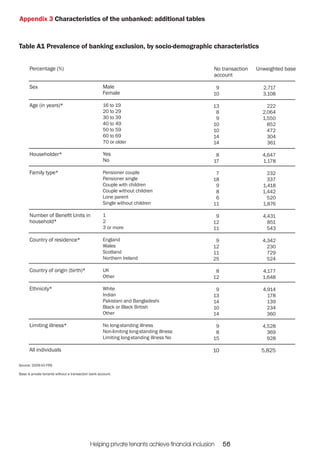
disproportionately falls. Compared with the average of 10 per cent, the likelihood of 
being unbanked was particularly high among private tenants on the lowest household 
incomes (26 per cent), those with high material deprivation scores (19 per cent), 
people without any formal qualifications (19 per cent), those unable to work because 
of permanent illness of disability (25 per cent) and those in receipt of income-replacement 
benefits (18 per cent). Notably, there was also some variation depending 
on the number of bills or credit commitments private tenants had fallen behind on. 
Altogether, these findings suggest that private tenants who are financially excluded are 
also vulnerable on other dimensions. 
Many of these same characteristics were also significant in the regression analysis. 
For example, being in the lower income category increased the odds of being 
unbanked some 3.9 times compared with those in the lowest-income category. And 
having no formal qualifications was associated with 3.1 times the odds of being 
unbanked compared with having a degree-level qualification. Receipt of social security 
benefits and arrears on household bills and commitments were not significant in 
the regression, however. This suggests that the apparent relationship between these 
characteristics is better explained by other, related characteristics such as income. 
Socio-demographic characteristics were generally less powerful indicators of being 
unbanked. Even so, the youngest and oldest private tenants were at increased risk 
of being unbanked compared with others, as were single pensioners, people living in 
Northern Ireland,42 those born outside of the UK, people with an Indian or a Pakistani 
or Bangladeshi background, and those with a long-standing limiting illness. The risk 
did not differ by gender. The regression analysis confirmed that the relationship of age 
(albeit only weakly), country of residence and place of birth to being unbanked was 
independent of other factors. Other demographic characteristics were not significant in 
the regression analysis. 
These findings are broadly consistent with published statistics on those at risk of being 
unbanked, regardless of tenure type.43 They suggest that, with the possible exception 
of country of residence and whether or not someone was born in the UK, the scope 
for targeting financially excluded private tenants for intervention effectively based on 
demographic characteristics is limited. The greater potential appears to lie in targeting 
based on socio-economic characteristics. 
Also consistent with previous research,44 the propensity to be unbanked was 
particularly high among private tenants with a Post Office Card Account (POCA; 47 
per cent). The regression results confirm that holding a POCA is the single strongest 
predictor of being unbanked among private tenants, the odds of being unbanked 
some 9.6 times higher among those with a POCA than those without. This strongly 
suggests that private tenants who hold POCAs are a key group for policy makers and 
Helping private tenants achieve financial inclusion 12
practitioners to target, many of whom will be identifiable to DWP and local government 
through welfare payment mechanisms. 
Of particular interest here is the finding that certain types of rental arrangements – 
having an assured tenancy and having an unsigned written agreement – increased the 
risk that someone was unbanked (Table A2). The type of rental agreement was also 
highly significant in the regression analysis, whereby the odds of being unbanked were 
some 4.4 times higher if someone had an unsigned written agreement than if they 
had either a signed written agreement or even an unwritten rental agreement. The 
type of dwelling and whether or not the property was furnished were not significant 
in the analysis. This suggests that the nature of the tenancy itself is important 
for understanding financial exclusion among private tenants. However, why this 
is the case and the direction of the relationship cannot be determined from this 
analysis alone. It is possible, for example, that financially excluded private tenants 
disproportionately enter into certain types of tenancies, rather than the nature of the 
tenancy leading or in some way contributing to financial exclusion. 
What are the dominant profiles of 
unbanked private tenants? 
The final stage of our analysis sought to identify the main profiles of private tenants 
that do not have a transaction bank account based on their socio-demographic 
and other characteristics. This extends the previous analysis by taking into account 
multiple characteristics, drawing on those characteristics found to be independently 
related to being unbanked in the regression analysis reported above. Alongside the 
added value this analysis will have for policy makers and practitioners in focussing 
financial inclusion work, it was also undertaken on a more practical level to help 
inform the recruitment of participants to the qualitative phase of this study. 
To do this, we undertook cluster analysis, a statistical approach to segmentation 
or typology construction, again using 2009-10 data. The particular strength of this 
approach is that the groups (or clusters) emerge from the data, rather than being 
imposed on the data by the researcher (for example, based on prior theory). Here, the 
cluster analysis examined all possible combinations of respondents’ characteristics 
and summarised these into the most dominant profiles. The analysis was limited to 
unbanked private tenants, so the clusters that emerged represent different profiles of 
unbanked private tenants. The cluster analysis process is explained further in Box 2, 
Appendix 2. 
Over and above the measures that helped to drive the clustering process, we were 
especially interested to consider the extent to which people in each of the clusters 
were in receipt of housing benefit at the time of the survey (either which they received 
or someone else in their household received). Thirty-two per cent of unbanked private 
tenants overall lived in a household receiving housing benefit. 
The analysis suggested that unbanked private tenants can be summarised into three 
main clusters. Each cluster was similar in size, making up 35 per cent, 36 per cent 
Cluster 1 appears to be disproportionately poor and deprived pensioners. 
Cluster 2 is characterised by better-off 20- and 30-somethings living in couples. 
 Cluster 3 is young adults living with parents or in households of non-UK descent. 
Helping private tenants achieve financial inclusion 13
and 29 per cent of all unbanked private tenants respectively. We explore each 
cluster in more detail below. The composition of the clusters is shown in Table A4, 
Appendix 3). 
Cluster 1 deprived and (economically) inactive 
The private tenants making up Cluster 1 were very often householders (i.e. the 
person(s) in whose name the home was owned or rented; 88 per cent), living in a 
household with only one benefit unit (94 per cent). They were highly likely to be living 
in a household with a lower income (especially on low-to-middle incomes) and to 
be economically inactive – and especially likely to be retired or permanently sick/ 
disabled. Reflecting this, a larger proportion than the average were aged over 60 (29 
per cent compared with 12 per cent), although a broad range of ages from youngest 
to oldest was represented by the group, or lone parents (nine per cent, compared with 
four per cent). They were also highly likely to report moderate or high levels of material 
and social deprivation. Most strikingly they were disproportionately likely to have a 
POCA. 
As might be expected given the socio-economic profile of this group, a much larger 
than average proportion of private tenants in this cluster were in receipt of housing 
benefit (62 per cent). This may make this group particularly amenable to targeting in 
work that promotes financial inclusion. 
Cluster 2 ‘better-‐off’ couples 
Cluster 2 is made up disproportionately of the under 60s, especially those in their 20s 
or 30s, who make up three-quarters of this group. A large proportion of them – seven 
in ten – were also living as part of a couple. Reflecting this, and like the first cluster, 
they were likely to be householders, in households with one benefit unit. Apart from 
this they were, on the whole, very different types of people to those in Cluster 1. The 
private tenants in Cluster 2 were not, on the whole, badly off financially. They were 
much more likely than the average to have higher household incomes (especially of 
£500 per week or more), to be working full-time or part-time and to have achieved a 
degree-level qualification (or higher). More than a half of them (51 per cent) had not 
been deprived on any item of material or social deprivation (compared with 34 per 
cent of all unbanked private tenants). 
Compared with unbanked private tenants as a whole, a slightly higher than average 
proportion of people in this cluster had a signed written tenancy agreement; and they 
were less likely to be in receipt of housing benefit (15 per cent). 
While the deprived and (economically inactive) cluster described above appears to 
conform to a stereotypical and recognisable group of unbanked individuals, Cluster 
2 is, to a great extent, a surprising group to find among the unbanked. But making 
up 35 per cent of all unbanked private tenants, they are a substantial and seemingly 
important group. 
Cluster 3 young, single adults 
Members of Cluster 3 are concentrated among the under 30s and are mainly non-householders 
(81 per cent) living in a household with more than one benefit unit. 
Seven in ten people in this cluster were single adults without children. Although a large 
proportion were drawn from households with incomes of £300 or more per week they 
were twice as likely as the average to be categorised as having ‘other’ employment 
status (reflecting that they were temporarily sick or disabled or students). Altogether, 
Helping private tenants achieve financial inclusion 14
this suggests that these were younger people still living in their family home or in 
shared accommodation. ‘Young single adults’ were slightly less likely than average to 
live in a household receiving housing benefit (25 per cent respectively). 
Like the second cluster, the composition of this group is again fairly surprising, 
particularly given its relative size. It underlines how little has been known about 
financially excluded private tenants prior to this study. 
How any of these groups manage to meet their rental payments (assuming they 
are responsible for these, which will not be the case for all – particularly non-householders) 
without having recourse to their own bank accounts and why they do 
not have them is not clear from this analysis. The focus groups undertaken in the last 
stage of the research project were designed to explore this. 
We were, however, able to analyse the data further to look at whether other benefit 
unit and household members had transaction bank accounts, given that we might 
expect some of the unbanked to have access to these (and thereby avoid or diminish 
the need for them to have an account in their own name or jointly with someone else). 
The results are shown in Figure 2.3. 
30 
In benefit unit 
In househoid 
20 
17 17 
39 
76 
People in the ‘deprived and (economically) inactive’ cluster were least likely of all 
the groups to have potential access to an account in this way, either in their benefit 
unit (17 per cent) or in their household more generally (20 per cent;). Three in ten of 
the unbanked ‘better-off couples’ lived with someone else in their benefit unit who 
did have an account, rising to 39 per cent when taking into account all household 
members. In contrast, some three-quarters (76 per cent) of people in the ‘Young, 
single adults’ cluster lived in a household where another household member had 
a transaction bank account. Account holding by others in the household, and 
particularly the benefit unit, is not therefore a full or sufficient explanation for 
why these groups did not have transaction bank account, and therefore how they 
managed their finances on a day-to-day basis. 
The following chapters explore the experiences of financially excluded private 
tenants in more detail, drawing on the qualitative phase of the research. 
Helping private tenants achieve financial inclusion 15 
80 
70 
60 
50 
40 
30 
20 
10 
0 
Percentage 
Figure 2.3 Whether unbanked private tenants live in a household with access 
to a transaction account, by cluster 
Better off couples Deprived, economically inactive Young adults 
Source: 2009-10 FRS Base is private tenants without a transaction bank account.
3 
Understanding financially 
excluded private tenants
The quantitative phase of the project, reported in Chapter 2, identifies the number and 
characteristics of financially excluded private tenants. This analysis was used to inform 
and shape focus group research with financially excluded private tenants, to explore 
their needs, experiences and attitudes to financial services and identify the barriers 
they face in accessing and using them. After briefly outlining the methods used for the 
focus group research, this chapter describes the characteristics and circumstances 
of financially excluded private tenants in more detail, based on the focus groups, in 
relation to peoples’ routes into the private rented sector and their experiences of it. 
Subsequent chapters explore the nature and impact of financial exclusion in this group. 
The key weaknesses in the private rented sector identified in Chapter 1 – unaffordable 
rents, insecurity and poor conditions – impacted heavily on financially excluded private 
tenants. They faced greatly constrained choice in housing, exacerbated by their lack 
of transactional banking facilities and/or the fact that they were in receipt of social 
security benefits. Several also lived in housing that was of poor quality, in some cases 
unsafe, and found it extremely difficult to get their landlords to carry out repairs. Short-term 
tenancies made them feel insecure, and high moving costs meant that many felt 
‘trapped’ in unsatisfactory properties. Most said that private rented properties do not 
‘feel like home’. These problems were compounded by a strong sense of isolation, with 
most private tenants believing that nobody was interested in their needs or looking 
after their interests. 
The focus group research 
Five focus groups were held with unbanked and marginally banked private tenants. 
Each group comprised between eight and twelve participants. All five of the focus 
groups included a mix of men and women and were held during October and 
November 2012. 
The focus groups took place in Brent, Bristol and Leeds in order to provide a 
geographical context to the research, where relevant. In particular, Brent is known to 
have a local, specialist advice service for private tenants, whereas Bristol and Leeds 
do not. The specification for the recruitment of participants to the focus groups was 
informed by the findings of the quantitative analysis and tailored to ensure a broad 
perspective on financially excluded private tenants. 
Recruitment to the focus groups was undertaken by professional recruiters, Protel, 
using a recruitment questionnaire designed by the research team. The research 
instruments used for the focus groups are included in Appendix 4. 
In Brent, participants were recruited with the help of Brent Private Tenants Rights 
Group, who contacted clients they thought likely to meet the criteria for inclusion in 
the research and put them in touch with the recruiter, who then administered the 
recruitment questionnaire. In Bristol, the recruiters were assisted by Bristol Credit 
Union, which provided partial postcode details of members using a Rent Payment 
Account, an account designed for private tenants without access to transactional 
banking facilities to enable them to pay their rent electronically. This enabled the 
recruiters to identify the areas of Bristol where unbanked private tenants were likely 
to be concentrated, and to conduct free recruitment in those areas. Participants in 
the focus groups in Leeds were recruited via free recruitment in areas of low quality, 
private rented housing and via local housing crisis services. Participants 
received an incentive payment of £30 for participation in the research, which 
Helping private tenants achieve financial inclusion 17
was paid once the focus groups had concluded. 
The final composition of the groups (which is outlined below in Box 4.1) reflects a 
slight modification to the original specification due to practical difficulties in identifying 
suitable private tenants in some areas. 
Box 3.1 – Composition of the five focus groups 
Group 1 -‐ Young singles and couples – unbanked 
aged early 20s to mid 30s; 
no transaction bank account; 
may have a savings account, credit union account or POCA and/or might have held a 
transactional bank account in the past; 
economically active – in full or part-‐time employment. 
Group 2 – ‘Middle years’ unbanked 
aged 40 -‐ 59 
no transaction bank account; 
may have a savings account, credit union account or POCA and/or might have held a 
transaction bank account in the past; 
mix of economically active and inactive. 
Group 3 – ‘Middle years’ marginally banked 
aged 40-‐ 59; 
have a transaction bank account that can receive money and make direct debit 
payments but make little or no use of it for financial transactions e.g. bill payment; 
mix of economically active and inactive. 
Group 4 – Poorer pensioners -‐ unbanked 
women aged 60+, men aged 65+; 
receiving Pension Credit; 
no transaction bank account; 
may have savings account, credit union account or a POCA and/or might have held a 
transaction bank account in the past. 
Group 5 -‐ People using housing crisis services or in temporary accommodation 
any age 
any family status; 
unbanked or marginally banked. 
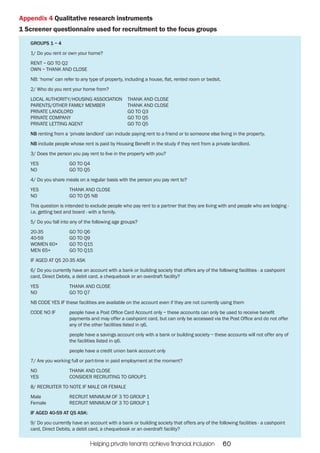
The focus group discussions were facilitated using a bespoke topic guide (see 
Appendix 4). This covered six substantive topic areas: experience of being a private 
tenant; attitudes towards financial services; views and experiences of financial 
products; aspirations and priorities for financial inclusion; overcoming barriers to 
financial exclusion; and lifestyle mapping to track the services and organisation private 
tenants have contact with in their daily lives. The discussions were recorded (with the 
permission of the participants), transcribed in full and analysed thematically. 
It is not possible to generalise from or quantify the findings of a qualitative sample 
such as this, but focus groups are an extremely valuable tool for exploring, in depth, 
the thoughts, attitudes, needs and experiences of particular groups. The focus groups 
conducted for this project enabled us to explore people’s experiences in the private 
rented sector, as a backdrop to their financial exclusion, as well as their experiences of 
and needs for financial products and services. The remainder of this chapter describes 
Helping private tenants achieve financial inclusion 18
focus group participants’ routes into private sector housing, and their experiences 
of living in the sector. 
Routes into the private rented sector 
To provide a context for the wider discussion, and to ease them into the focus groups, 
participants were asked about their experience of the private rented sector and other 
tenures, their reasons for currently being in the sector and their feelings about private 
renting. The routes by which people had found themselves in the private rented 
sector, and their expectations about the future provide an illuminating backdrop to the 
situations and circumstances of financially excluded private tenants. The focus group 
participants had entered the private rented sector by three main routes. 
Route 1 – long-‐term private tenants 
Some had lived long-term in the private sector, with little or no experience of any other 
tenure and no expectation of moving out of their current tenure in the future. Most of 
this group had simply never had another option, home ownership being completely out 
of reach and with little hope of meeting the criteria for priority in social housing. In some 
respects this group was slightly less vulnerable than other participants, being less likely 
to have experienced serious adverse life events and with relatively stable lifestyles. 
Paul is in his early sixties, and has retired early from his job as a labourer on building 
sites, due to ill health. He has lived in his current rented flat for twenty four years, having 
moved there when his marriage broke down. Paul is a regulated tenant, which means 
his tenancy is protected. 
Route 2 – new, younger tenants likely to be in the 
sector long term 
A second group were younger people, relatively new to the private rented sector with 
no experience in any other tenure and no expectation that their housing tenure will 
change in the future. Many people in this group were extremely vulnerable, with 
several having entered the sector from a period of homelessness or at high risk of 
becoming homeless. 
They were also more likely to live in circumstances which appear to be unsustainable 
in the medium- or long-term, and to have serious concerns about their future. 
Billy moved to Leeds from a small town nearby, having previously been in foster care, 
which made him a priority for temporary accommodation until the age of 21.. 
He filled in his application and had to wait around six weeks for an appointment. 
Billy: So I’ve gone to [the local authority] just before I was 21 and, you know, I ’ d 
been in foster care so, you know, I got deemed as priority. They’ve made me an 
appointment, so I filled the form in... but when I actually made the appointment it 
was about four weeks before I turned 21 , and then they made my appointment 
and it was about five, six weeks after... and it went after my 21st birthday. Only a 
few days after , but then when I’ve gone back to my appointment they knocked 
me back... they was like ‘Oh well , because you’re over 21...’ 
Facilitator: Where were you living at that point? 
Billy: Well , I was on the streets. 
Helping private tenants achieve financial inclusion 19
Route 3 – older tenants, ‘fallen out’ of other tenures 
The third group was also relatively new to the private rented sector, many having 
‘fallen out’ of other tenures due to serious, disruptive life events. While some were 
owner-occupiers, who had fallen on extreme financial difficulties caused by ill-health, 
indebtedness or relationship breakdown, others had entered the private rented sector 
from social housing, having needed to move home quickly or to a specific area. Some 
of the homeowners in this group hoped to move back to owner-occupation when their 
situation improved. Others, however, were less optimistic, concerned that they would 
be unable to afford to continue living in the private rented sector let alone move back 
into home ownership, and expressed deep concern and anxiety about the future. 
Michelle is in her early sixties, recently separated from her husband, she rents a room 
in a shared house. Her husband, who stayed in the marital home which they own 
jointly with a mortgage, is paying the rent on her behalf until their property sells. She 
worries, however , that her share of the equity in the property will not be sufficient for 
her to buy somewhere to live or to rent in the long term. 
My husband is paying the rent because we’ve just split up after 36 years of mar-‐ 
riage... And what I come out with, out the house [sale] ain’t going to be enough to 
buy a flat or anything like that. And I’m 60 next year , I’m not going to be able to get 
a mortgage because I haven’t got any working years left. So I don’t know... 
Michelle does not know what she will do in the future, or where she will be able to 
afford to live. She has contemplated moving abroad, in order to be able to buy 
somewhere with the money she will have available. She is reluctant, however , to 
move away from her friends and family , especially as she approaches old age. 
Well I don’t particularly like it [the idea of moving abroad]. I don’t think you can 
beat England, and I won’t want to and that’ll be a last resort. But I can’t see 
what else I’m going to do. 
Financially excluded private tenants and 
housing 
As we might expect, the focus groups highlighted a striking degree of social exclusion 
among unbanked and marginally banked private tenants. In addition, they illustrate 
the way that the key weaknesses of the private rental market identified in Chapter 
1 – affordability, insecurity and poor conditions – impact on the lives and experiences 
of this vulnerable group of private tenants. It is important to note that these factors 
impacted more heavily on private tenants who were completely financially excluded – 
those without a bank account altogether – than they did on those who had access to a 
bank account, even if they made little use of it. 
Constrained choice 
Unbanked private tenants had very limited choice in terms of the properties and 
geographical areas they lived in and the landlords they rented from. Most of the focus 
group participants remarked on the difficulty of finding properties that they could 
afford and many were living in areas that they did not like, or did not feel safe, because 
they could not afford the rents in ‘better’ areas. 
Helping private tenants achieve financial inclusion 20
I’ve never had much problems there but from time to time it can get a little bit 
hairy, you know... You’ve got to be careful, you’ve got to know and be experienced 
about your whereabouts and things like that, and you’ve got to be alert... The 
neighbours aren’t too bad, though they very very rarely speak to each other or me. 
You can be very isolated where I am. 
Many also remarked on the stigma associated with being on benefits and being 
unbanked, which meant that some landlords were reluctant to let properties to them. 
Few landlords wish to receive payment in cash and some landlords are prevented from 
letting properties to people receiving Housing Benefit due to conditions imposed by 
their mortgage lender. 
Participant 1: In the private sector, if you’re paying by Housing Benefit, you get a 
bit of a stigma attached to you. 
Participant 2: Yeah, they don’t want unemployed people... 
Participant 3: It says on a lot of them ‘No DSS’. 
Participant 4: A lot of private people they don’t even want you as a tenant unless 
you’re working, and if you fall out of work then it’s ‘Well, you’d better find a job 
because you’re not living here.’ 
Participant 1 But when they say that, ‘No DHSS’ it makes you feel like... 
Participant 3: Scum. 
In addition, landlords who will accept tenants who are unbanked or receiving benefits 
are able to place strict conditions on tenancies including, in some cases, no children, 
which further restricted participants’ choice of property. Some of the stakeholders who 
were involved in this project confirmed that it was not unusual for landlords operating 
at this end of the market to refuse to let properties to people with children. 
Poor quality and unsafe housing 
Many of the focus group participants were living in poor quality properties, in dire need 
of repair. Getting landlords to carry out repairs was raised as a significant problem 
throughout the focus groups and most participants reported difficulties in this area. As 
a result, several of the people who took part in this research were living in properties 
with serious defects, including collapsed ceilings, dangerously rotten floorboards and 
the lack of a working toilet. 
It’s [the toilet] been broken 6 months or something like that now... It’s got to the 
point where... there’s a library across the road from where we are, so we use the 
toilet there, but on a night time it’s got to a point where we have to like ask our 
neighbours and stuff like that. 
The ceiling fell in... I reported it, and I’ve reported it three times now. Six months 
later it’s still like it. Luckily I was at work when it happened, if I’d have been sat on 
the toilet I’d be dead... Three bags of rubble [got taken away]. They’ve come and 
inspected it three times now and then gone away humming and hah-ing. 
The main factor to which people attributed their difficulty in getting landlords to carry 
out repairs was a lack of bargaining power, due to their limited potential to find better 
quality accommodation. In addition, many were fearful of pressing too hard for repairs, 
in case the landlord increased their rent or, worse, decided not to renew their tenancy. 
I have to top [rent] up... and that’s because of repairs that I got done]. The rent 
went up [after the repairs were done’. If I was in a six month contract I’d be 
terrified, because the landlord can do what they like with you... It’s very hard to get 
Helping private tenants achieve financial inclusion 21
a repair done. And... they always remember it when they want to put your rent up. 
Insecure tenancies 
Lack of tenure security was also a stark reality for many of the focus group 
participants. Not all of the private tenants who took part in this research had a formal 
contract with their landlord. The vast majority of those that did were on short-term 
tenancy agreements, aware that their landlord could increase the rent or terminate 
the agreement at six monthly intervals. They also felt very vulnerable to changes of 
landlord, when the property they were living in changed hands, which could result in a 
rent increase or the termination of their tenancy. 
The burden of high moving costs 
Unbanked private tenants frequently expressed the view that they were ‘stuck’ in their 
current property because of the high costs associated with moving. This often included 
registration and administration fees charged by letting agents, as well as the need to 
find money for a deposit on a new property. Being unable to put down a deposit on a 
new property before the deposit on their existing property was released was cited as a 
significant barrier to moving out of unsuitable or poor quality properties by a number 
of respondents. 
You’ve got to come up with a bond and all that... I got lucky I got a cheap bond on 
this place because it was so long ago. I only had to pay like £300 bond. The places 
I’ve been looking at they want, like, £400-£500, it’s daft, you know. 
Never feeling ‘at home’ 
Many of the financially excluded private tenants who took part in this research 
remarked on the fact that they were living, sometimes long-term, in properties that 
‘didn’t feel like home’. 
... when you’re in the private sector, a lot of them [landlords] say you can’t 
decorate. And you think, ‘Well, it’s never your home.’ 
My landlord said I could decorate if I wanted to, but what’s the point, when the 
house is a s**t tip anyway and all the repairs need doing. 
Isolated and disconnected 
The difficulties experienced by the focus group participants were further compounded 
by a profound sense of isolation and disconnection. Many spoke of private tenants 
being without a voice and expressed a belief that their needs are unrecognised by 
Central and Local Government and that nobody is looking out for their interests. 
There’s nowhere, you don’t feel like you’ve got anywhere to turn to. 
Once they’ve [local authority] got you into a property that’s their case closed. 
That’s it. They’ve got you in somewhere... You’re the landlord’s problem after that? 
There’s no one to keep us in the loop. We’re [private tenants] at the bottom of the 
food chain. 
The following chapter explores the nature of financial exclusion among private tenants 
and its impact on this group. 
Helping private tenants achieve financial inclusion 22
4 
The nature of financial 
exclusion among 
private tenants 
Helping private tenants achieve financial inclusion 23
This chapter outlines the nature and extent of financial exclusion among the private 
tenants who took part in the focus groups, covering their access to banking facilities; 
previous experiences of financial inclusion; approaches to money management; and 
appetite for wider financial inclusion. The impact of the financial exclusion experienced 
by this group is explored in Chapter 5. 
As we might expect, the nature of financial exclusion among private tenants has 
parallels with the experience of other social groups.45 As such, key features include 
deeply entrenched disengagement from financial services; some negative experiences 
among those who have been financially included in the past; a belief that providers 
are ‘not interested in people like us’; and a feeling of anxiety at the very mention of 
financial services. 
Ears prick, hairs on the neck go and you go ‘Boom!’ you’re alert then. And then 
sometimes you can put your head in your hands like that and worry. Worry comes 
straight onto you then. ‘Financial’. Bang! Oh, worry, worry, worry. 
Fear of debt was prevalent among the private tenants in the focus groups, as is the 
case with other groups of financially excluded people, with a strong association made 
between engagement with financial services and the risk of indebtedness. Those with 
previous experience of being banked retained a strong memory of ‘hard sell’ practices 
around credit products. 
Current banking status and use of 
accounts 
As outlined in Box 3.1, participants were selected for inclusion in the focus groups 
on the basis that they did not have access to a transactional bank account at all or 
– in the case of one of the groups – had an account but made little, if any, use of the 
transactional facilities that were available to them. As a result, the majority of focus 
group participants described themselves as being unbanked, with no access to any 
kind of bank account in their own name. 
During the focus groups, however, when people were describing their previous 
experiences of using financial services, several mentioned having had accounts in 
the past which – while they had stopped using them – they had never closed. While 
some of these accounts may have been closed by the bank involved, it is very likely 
that some of the focus group participants did, in fact, still have active bank accounts 
which they had simply left dormant. The significant point here is that, as a result of 
the circumstances in which people had ceased using an account, described in detail 
below, these focus group participants’ perception of themselves was – very much – as 
being completely unbanked, because they did not have banking facilities that they 
were able to use. 
Participants to one of the focus groups were selected on the basis that they were 
‘marginally’ banked – defined as having access to an account but making little or no 
use of the transactional facilities attached to it. This group was mainly using basic 
bank accounts, although some had full current accounts and a very small number had 
a credit union bank account. 
It was clear from the discussion that a few of the marginally banked participants had 
Helping private tenants achieve financial inclusion 24
opened accounts solely in response to the introduction of Local Housing Allowance 
paid, in most cases, to tenants rather than directly to landlords. It is interesting to note 
that these respondents did not, in fact, perceive themselves to be banked or even see 
themselves as being the account holder. Rather, they expressed a belief that their rent 
was still being paid directly to their landlord. Further discussion indicated that this is 
because they do not access any of the money paid into the account and do not use the 
account for any other purpose. This has important implications for the empowerment 
agenda which underpins the introduction of both Local Housing Allowance and, from 
2013, Universal Credit. 
She [landlady] said, ‘I want you to put it into the Credit Union so it comes to me 
faster... So I’m just like the middleman. I don’t even know if she’s got it or nothing, 
you know,. I don’t even see the money. I don’t even see it... I don’t even know when 
it comes or how much she’s getting or what. I don’t know. 
Facilitator: How about you, how does it [paying rent] work for you? 
Participant: Direct to the landlord 
Facilitator: So not through a bank account or Credit Union or anything like that. 
Participant: Yes, through direct debit 
Among unbanked participants, those who were in receipt of welfare benefits held Post 
Office Card Accounts. These accounts were used to receive benefit income, which 
can be withdrawn at the Post Office, over-the-counter or from an ATM, but do not offer 
any additional functionality. A key indicator of the vulnerability of this group, however, 
is that one respondent was still receiving her benefits by girocheque, having been 
deemed unable to cope with the transition to direct payment of benefits when it was 
introduced in 2003. 
A small number of unbanked participants who were not in receipt of benefits and, 
therefore, not entitled to a POCA, used an account belonging to a friend or relative. 
These accounts were used, mostly, to make payments but also on occasion to receive 
income as well. One or two of those who were unbanked had savings accounts that 
they used to receive income, but, given the nature of these accounts, were unable to 
make any payments from them. 
The remainder of unbanked private tenants without POCAs operated a completely 
cash-based lifestyle. 
As has been identified among other groups of people who are unbanked or only 
marginally banked, there was a strong preference for cash money management among 
financially excluded private tenants. This was largely because, as other research has 
shown,46 cash budgeting affords a high degree of control, flexibility and transparency. 
A relatively widespread mistrust of banks – especially among those who had poor 
previous experience of being banked – was also expressed, which consolidated the 
preference for cash. 
By definition, given the nature of the sample, use of transactional banking was limited, 
even among those with access to facilities. Several people with bank accounts had 
one or two direct debits, largely for things that they could not pay for in cash and, in 
fact, the need to pay for something by direct debit had been the key motivator for 
opening an account for some. But direct debits were rarely used for large, essential 
bills or for bills where the level of the monthly payment might vary according to usage. 
The main reason for limited use of direct debits among those with accounts was a fear 
Helping private tenants achieve financial inclusion 25
of incurring penalty charges. Even for those who did make use of direct debits, then, 
the majority of money management was done in cash. 
Previous experience of banking 
As we would expect to find, a high proportion of the currently unbanked among our 
focus group participants had previously held bank accounts but ‘fallen out’ of banking 
having experienced one or more of a range of difficulties identified in other research as 
being highly problematic for people with low or unstable incomes.47 
Several people had closed their bank account when job loss or ill-health meant that 
they no longer needed an account to receive income. Others had fallen out of the 
banking system due to relationship breakdown, whereby people who had used a 
joint account, often for many years, found themselves without access to any kind of 
account. This was particularly true among women who had not been the main wage 
earner in the household. 
Many previously banked private tenants had experienced quite significant problems 
triggered by penalty charges being applied to their accounts in respect of unpaid 
direct debits or use of unauthorised overdrafts. Problems were related largely to 
uncertainty over exactly when payments would leave the account and the struggle to 
keep sufficient money in the account to cover direct debits that are due for payment. 
Although the level of penalty charges has reduced in recent years, they still represent 
a disproportionate share of a low-income consumer’s budget. Several focus group 
participants had experience of an unpaid direct debit charge being applied to 
their account pushing them into a costly unauthorised overdraft. A few people had 
personal experience of multiple charges being applied to their account during a single 
budgeting period, or knew other people to whom this had happened. 
That’s why I had to close my account, because when I went out of work, all the 
bills came in.... and fair do’s it was due and everything like that, but I ended up 
sometimes £150 in bank charges. 
Several of the previously banked participants had experienced a build-up of overdraft 
debt, often triggered by penalty charges and unauthorised overdraft fees, which made 
it impossible for them to continue using the account. A few had had the account 
closed by the bank; others had simply ceased to use it and, as described earlier in this 
chapter, did not see themselves as having a bank account at all. 
An interesting finding was that several unbanked people had ended up closing or 
ceasing to use a bank account due to unresolved misunderstandings with the account 
provider. These difficulties were often in relation to newly opened accounts, and it 
seems likely that, in some cases, these misunderstandings arose because people 
did not fully understand the account they had been given. In particular, a number of 
people had been confused by monthly payments being taken from their account by 
the provider which seem likely to be account fees relating to packaged or other fee-charging 
bank accounts. This raises two potential issues with the account opening 
process. First, it indicates that account features are not always clearly explained to 
new customers and that this can happen with credit union bank accounts as well as in 
high street banks. 
Helping private tenants achieve financial inclusion 26
I ended up stopping it [credit union bank account] because they kept sending 
me these letters because I’d not actually set up the account but then they were 
charging me for the account, that I didn’t even have, so... 
Second, it raises an important question about the effectiveness of some banks’ 
sales processes in relation to bank accounts. The very low incomes and unstable 
employment circumstances of the majority of people who took part in this research 
makes it highly unlikely that a fee-charging packaged bank account would have been 
the most appropriate product for them. 
While some people had made attempts to resolve these issues with their account 
provider, but been unsuccessful, others had simply ceased to use the account 
because they no longer trusted the provider. As such, their accounts had fallen 
into disuse. 
One previously banked private tenant had closed his account having been told by 
branch staff that as a basic bank account holder he was not allowed to use the ATM 
located inside the branch and instead had to use the one outside on the street. 
When I went to draw money from the inside of the bank the teller wouldn’t deal 
with me, she wouldn’t let me deal with the inside [ATM] machine. I had to use the 
outside one.’ 
As well as feeling deeply insulted and humiliated, he also felt that using an external 
ATM exposed him to an increased risk of theft and, to a lesser extent, fraud. As a 
result, he closed his account because of the anxiety he felt around accessing cash and 
because he felt he was not valued as a customer. 
We checked with the provider of this account and it is not, in fact, the company’s 
policy to restrict use of ATMs for basic bank account holders. This highlights a ‘policy/ 
practice’ gap between account providers’ policies on basic banking and the practice 
that pervades at branch level which is, of course, what shapes people’s perceptions 
of the utility of bank accounts and the extent to which they might be welcome as 
customers. 
Wider financial exclusion 
As we would expect, given the strong evidence that bank accounts act as a ‘gateway’ 
to wider financial inclusion, there was very limited penetration of other financial 
products among unbanked private tenants. Overall, there was little demand for wider 
financial inclusion, and relatively few people identified significant unmet needs. Where 
people did have a need for a financial product they were often able to find ‘work-arounds’ 
that fulfilled the need in some other way. And while marginally banked private 
tenants were using some other financial products, often accessed via their bank 
account, financial inclusion was also relatively limited among this group. 
Savings 
Most people who took part in the research expressed a strong desire to be able to 
save, but only a handful were able to do so. The very low incomes on which most were 
managing made it extremely difficult to cover their essential outgoings, let alone put 
money aside. 
Helping private tenants achieve financial inclusion 27
But it’s very hard on the little bit of money you get to save anything... A few bob, 
you know, you couldn’t really save anything. 
One or two had savings accounts, usually held at the Post Office. One used this to 
receive his income from employment rather than as a savings account. The other did 
occasionally pay small amounts of money into the account to help pay his coach fare 
to visit family. A few other people talked of ‘saving up’ for particular expenses, but 
rather than deposit this into an account of any kind, tended to give small amounts of 
cash to a third party, usually a relative, to keep for them so that they were not tempted 
to spend it. 
Insurance 
The most commonly referred to insurance products were motor and mobile phone 
insurance. Home contents insurance was fairly widely known, albeit with some 
significant misunderstandings regarding its coverage, but demand was relatively low. 
Motor insurance 
While the majority of the people who took part in the research did not own a car, 
for those who did, their vehicle tended to be something of a lifeline, essential for 
employment or to transport children to and from school. Motor insurance is extremely 
difficult to obtain without a bank account, with most providers preferring electronic 
payment either by direct debit or credit/debit card. Unbanked people in one area were 
aware of just one insurer that would take cash via a local branch office. They saved up 
cash at home throughout the year in order to be able to pay the premium in full. 
I basically just, you know, I save it in my home... I do [named insurance provider], 
you can go and pay cash. I try to save it up, so it’s like £135 per year, so I try to 
save it up. 
They were relieved to be able to access insurance without a bank account, but 
recognised that they would be unable to shop-around or change provider should their 
premiums increase because they were not aware of any other providers willing to 
accept cash. 
Others, including one or two of those who held bank accounts, paid for motor 
insurance via a third party’s – usually a parent or other relatives - account, either using 
their credit or debit card or via a direct debit. They would either give the third party 
the money for the premium in full – having saved up in cash – or make regular cash 
payments to cover the direct debit. 
My insurance company wouldn’t take cash. I went in and it’s £472 or something, 
and they wouldn’t take cash, so I had to get my dad to pay it, with this card, and 
then I gave him the cash. 
These arrangements provided access to motor insurance for those who were 
unbanked, and enabled those who were banked but who lacked confidence in or 
mistrusted electronic payments to obtain cover without fear of incurring penalty 
charges or getting into debt. 
Mobile phone insurance 
Most unbanked or marginally banked private tenants had pay-as-you-go mobile 
phones, rather than contract arrangements. Most believed that this precluded them 
Helping private tenants achieve financial inclusion 28
from being able to obtain insurance cover for their handset, although one participant 
talked of a new deal he had recently found where he had got insurance cover as a free 
gift when he bought his pay-as-you go handset. 
Home contents insurance 
Very few people in the focus groups – whether unbanked or marginally banked – had 
home contents cover. Two, however, had taken out Post Office home contents policies, 
having found them to be more affordable. 
Most of those who did not have this insurance recognised the term ‘home contents 
insurance’ but there were, however, some quite significant misconceptions about 
whose responsibility it was to insure contents. 
If we’re talking about the house then it is the landlord [who is responsible for 
insuring home contents] 
As a result, several people did not have this insurance because they believed that 
it would be their landlord’s responsibility to replace their goods if anything should 
happen to them. Equally, one person had taken out a policy believing it would provide 
some protection for the young family living upstairs from him in the event of a fire. 
I’ve just renewed my [home contents] insurance... because I’ve got to have the 
minimum basic insurance because I don’t believe... that my landlady has got 
proper insurance cover... And there’s people live above me with children and I feel 
responsible that I should have some form of insurance, you know. 
The general consensus, however, was that the price of home contents insurance 
premiums – because of the areas in which they lived – was so far in excess of the 
value of their belongings that they it simply did not offer value for money. 
What I was paying every year, I might as well just go out and buy new stuff, 
you know. 
It depends where you live, your postcode, doesn’t it? It goes on your postcode. It’s 
extortionate in Leeds 6, because it’s student-ville... Because there’s that many 
robberies, burglaries because of the students. Chestnut Avenue in Leeds is the 
most burgled street in Leeds. 
I just expect to replace my own stuff, me, I wouldn’t [take out insurance] 
Everything I own is second hand. Everything. 
This reflected both the low monetary value of their home contents, and their 
expectation that they would replace them with second hand goods rather than 
brand new. 
There was also some degree of scepticism about the extent to which insurance 
companies could be trusted to pay out on a home contents policy. This did not seem 
to be based on personal experience, but there was a strong sense that insurers would 
‘wriggle out’ of claims and that if a payout was made, the insurance premium would 
immediately increase. 
While there was, in general, little appetite for home contents insurance among either 
unbanked or marginally banked participants, those who had previously held a policy 
Helping private tenants achieve financial inclusion 29
were more likely to express a need for this type of insurance and to worry about being 
without it. This was particularly the case for people who had become unbanked due to 
relationship breakdown, who had previously experienced a very different lifestyle and 
standard of living. 
We always did have contents insurance... and we had to claim when we were 
broken into twice. But, yes, when I’ve got my own place and I’ve got my own things 
again I’d like to feel it was insured. 
Quite a number of focus group participants were aware that local authorities and 
Housing Associations offered low-cost insurance with rent schemes to their tenants 
and felt that this was yet another way in which they were disadvantaged in comparison 
with other people in their circumstances. 
Because of you’re a tenant of Bristol City Council, you can get contents insurance 
very, very cheaply... But private, you got to go and source that yourself, which is a 
lot more [expensive]. 
Some of those who were marginally banked had purchased policies for individual 
items, such as household appliances and central heating systems, as an alternative 
to home contents insurance, in order to give them peace of mind that they would not 
face a large bill should something go wrong. 
Credit 
Perhaps not surprisingly, credit was the most mentioned and widely used financial 
product, although both the appetite for credit and use of it was still fairly limited. There 
was wide recognition that access to credit is severely constrained without a bank 
account. Focus group participants noted that even payday lenders are out of reach of 
the unbanked. 
In general, given their severely constrained financial circumstances, private tenants 
without bank accounts, were deeply fearful of debt, knowing that the struggle to 
cover their essential outgoings would make finding extra money to repay credit nigh 
on impossible. Even those who were marginally banked made very little use of credit, 
especially in the form of arranged overdrafts, and were nervous about borrowing. 
Previous experience of borrowing-related debt problems acted as an on-going 
disincentive to further borrowing for several and one said he would go back to work on 
building sites, despite serious health problems, rather than borrow again. 
Some used, or had in the past used, sub-prime lenders – home credit companies, 
pawnshops, cash converters and rent-to-own outlets like Brighthouse . One or two of 
the marginally banked or those who had been banked in the past had used payday 
lenders. There was a general recognition, however, that lenders that were prepared 
to lend to people without bank accounts were very expensive and that the level of 
repayments could seriously de-stabilise already finely balanced budgets. 
I think they only really help, well – they don’t help they make them poorer to 
be honest, but it’s only the poorest people that have to go to those kinds of 
companies. If you don’t have a bank account you can’t get a bank loan, you 
can’t get an overdraft... Which is why the poorest people end up paying 
well over the odds in interest. 
Helping private tenants achieve financial inclusion 30
As a consequence, the majority expressed a strong preference for informal borrowing 
from friends or family or ‘going without’ rather than using credit. Participants with 
young children, however, found it impossible to go without some of the things they 
needed, particularly child-related expenses. As a consequence, these individuals 
found it difficult to resist the ‘high pressure’ sales tactics of the home credit agents 
they borrowed from. 
Participant 1: They even come and knock on your door and that, sometimes out 
of the blue... Yeah, especially at this time of the year they do it because they know 
people are needing money a bit more, so. 
Participant 2: Yeah, well, they’re keeping you in their pocket. As soon as they 
know you’ve paid so much money back they’ll be saying to you, ‘Oh, here’s 
another £600’. 
And those who were desperately struggling to make ends meet recognised that they 
were susceptible to these tactics, despite knowing the high rates of interest involved, 
simply because their need for money was so great. 
If someone come and knocked on my door tonight and said, ‘I’m offering you a 
£100 loan, but you’re going to end up paying back £500, I’d still take it. 
Many of those who had previously been banked felt that they had had their fingers 
burnt as a result of access to overdrafts and did not consider overdrafts to offer good 
value for money. This seems largely related to inadvertent use of an unauthorised 
overdraft, rather than an arranged overdraft facility. There were exceptions, however. 
Those who had lost access to a bank account due to relationship breakdown, felt that 
overdrafts provided an important safety net without which they felt very insecure. 
Credit cards were out of reach for the vast majority of the people who took part in 
this research and were viewed with a high degree of nervousness by many. This was 
especially the case for those who had built up problematic credit card debt in the past. 
While there was some use of credit cards among the marginally banked they tended 
to be used only for specific purposes, largely payments that could not be made any 
other way, or emergencies. Wherever possible, people preferred to repay any credit 
card borrowing in full when their statement came rather than build up a debt and incur 
interest. One person would save up sufficient cash to repay any credit card spending in 
full before she felt comfortable using the card. 
The following chapter explores the impact of financial inclusion on private tenants. 
Helping private tenants achieve financial inclusion 31
5 
The impact of financial 
exclusion 
Helping private tenants achieve financial inclusion 32
It is clear from the focus groups for this research – and from a large body of other 
research evidence48 – that people without bank accounts or who are only marginally 
banked generally operate quite sophisticated cash budgets, which work well for them 
by providing a high degree of control, flexibility and transparency. Nevertheless, the 
private tenants who took part in our focus groups identified a number of adverse 
impacts of being financially excluded. These include the ‘poverty premium’ associated 
with paying for goods and services in cash; increasing difficulties in operating wholly 
in cash; restricted access to goods and services; constraints on money management; 
difficulties securing employment; and low self-esteem. Many of these impacts will be 
common across the financially excluded population, regardless of housing tenure. 
It is clear, however, that financial exclusion compounds many of the vulnerabilities 
associated with living in the private rented sector and, conversely, that being a private 
tenant can exacerbate the impact of being financially excluded. 
The extra costs of paying in cash 
One of the most frequently cited and damaging impacts of being financially excluded 
relates to the additional costs associated with making payments in cash and a widely 
felt injustice that the poorest people end up paying more, even for essential goods and 
services. In 2010, this ‘poverty premium’ was estimated at £1280 per year49. 
The vast majority of the private tenants who took part in the focus groups were paying 
some additional costs because they did not have a bank account or preferred not 
to use electronic payments. Most used pre-payment meters for fuel and many were 
aware that they were paying higher tariffs than customers paying by direct debit. 
Some felt this was unfair because fuel companies receive advance payment from pre-payment 
meter customer, without any risk that they will build up arrears. While many 
preferred paying for fuel this way, some had had a pre-payment meter imposed on 
them by their fuel company or their landlord. 
When I’ve been in Council [accommodation] you don’t have to use one [a 
pre-payment meter] but every private one I’ve had to pay [using] pre-payment 
meters because obviously if you move out they don’t want a £600 bill on their 
doorstep... So they put these meters in but you’re the one that’s paying for them. 
Reluctant pre-payment meter users who had had to pay a deposit to the fuel company 
for the meter and/or the payment key or card required to use them, and those who 
were aware that they would be charged a fee to have the meter removed, felt this 
added insult to injury. 
I went down to them and they want £36 off me to take [the meter] out. I’m 
perfectly happy to go to the Post Office and swipe and pay what they want on a 
sensible [instalment] basis, and they won’t back down and I can’t afford £36. 
People on pay-as-you go mobile phones also felt that they paid more for phone calls, 
as well as missing out on other facilities and offers made available only to those 
paying by direct debit. 
But, again, Pay-As-You-Go, you pay way over the odds. Way over the odds. 
Conversely, being on a contract brought its own disadvantages. Those who had 
contracts for mobile telephones, cable tv or broadband services were paying an 
administrative fee, of between £2 and £5, every time they were issued with a paper bill 
Helping private tenants achieve financial inclusion 33
against which they could make a payment in cash. 
Yeah, you get charged for paper bills. So if you haven’t got a direct debit, for [cable 
services provider] it’s like £2 [per month] for a paper bill... which I know it’s only £2 
but it all adds up at the end of the day. 
While people were largely grateful that they could make cash payments, they did note 
that the cost of paying these fees on multiple bills could add up to quite a significant 
amount, especially for people living on very low incomes. 
When you’ve got five or six of them at £2, that’s a weeks’ shopping when you’re on 
benefits, you know. 
In addition, a number of participants, some of whom were already struggling 
financially, had had to pay a proportion of pay cheques or benefit cheques to 
commercial cheque cashers because they did not have a bank account. 
I used to get paid by [giro]cheque, because it’s all BACS nowadays, so it’s like... 
you go to a cheque man, and he takes his commission. 
One participant referred to this as ‘the little people’ always paying more than 
everyone else. 
Despite their awareness of the extra costs involved, however, the majority of the 
people who took part in the focus groups felt that the benefits of cash money 
management outweighed the costs by some degree. For a start, they felt that the 
charges for cash payments still worked out a lot cheaper than paying penalty charges 
for failed direct debits, which were also more disruptive to their budget because of 
their unpredictability. 
In addition, they valued the peace of mind that cash budgeting afforded them, 
believing it to be the most reliable way to keep track of their money and avoid falling 
into debt. 
It’s how I prefer to do it. I won’t have a bank account, I can’t, I don’t trust direct 
debit, I don’t trust direct debit. 
I don’t like direct debit, I prefer to go to the Post Office, get a receipt every time... I 
like to always have my receipt. 
Those who had paid bills by direct debit in the past, however, expressed particular 
resentment about the extra costs they faced as a result of using pre-payment meters. 
When I was working and that I used to pay through the bank, a direct debit... 
because I know about it, you see, I know what I’m missing. When I’m using the 
card and the key it really makes me mad,. It really gets me down, you know. 
Because if you’ve got any kind of head on your shoulders, right, it’s lunacy to be 
giving people money for nothing, right. I mean, I’m finding it hard to get out of the 
debt I’m in... but I’m just paying money for nothing. But if I had a bank account 
and I could pay direct debits... I wouldn’t have to pay for the cards, I wouldn’t have 
to pay for the key, and I could cut them people right out... So the amount of money 
I’d save would be unbelievable really. 
Helping private tenants achieve financial inclusion 34
Risks and constraints on money 
management 
While many people – with and without bank accounts – operate very successful 
approaches to money management, the people who took part in the focus groups 
identified a number of benefits of having an account. While these do not necessarily 
apply to everyone who took part in the groups, they do, nevertheless, reflect key needs 
among some unbanked private tenants. 
Several people recognised the risks associated with keeping and carrying money in 
cash. This was particularly the case for women and especially older women and those 
who had previously been banked. People who were fearful about the loss or theft of 
money held in cash felt that being able to keep money in a bank account would provide 
considerable peace of mind. 
I think that security is the main answer isn’t it? Because it’s better just to have a 
little card on you than a pocket full of cash. 
Some others, often younger people who had not established smooth-running strategies 
for managing on a low income, thought that having an account in which to keep money 
would reduce the temptation to spend and, potentially, help them build up savings. 
A number of people who received benefit income into POCAs spoke of the limitations of 
these accounts. Particular problems were raised in relation to accessing cash, because 
of the limited range of options for withdrawing money from POCAs and the resulting 
queues at Post Offices. 
It’s a pity the Post Office don’t let you use your card, in the shops, you know. That 
would be handy if they could do that. 
I’d love to go to a cashpoint and put a card in. 
Finally, a few people felt that having a payment card to make payments, in shops or via 
remote transactions, would make life much easier and, potentially, less costly. 
Increasing difficulty operating a cash budget 
As well as the extra costs, people who took part in the focus groups, especially those 
who were completely unbanked, were very vocal about the increasing difficulty they 
faced in operating a cash budget because cash payments are now unacceptable 
in many circumstances. There was a strong feeling that having a bank account is 
becoming essential. One unbanked private tenant had recently found himself unable to 
give money to charity because they were not able to take a cash donation. 
I was walking through Bedminster and there was a girl working for [charity], you 
know, and I stopped and she said, ‘Would you like to make a donation?’ so I put my 
hand in my pocket and she said, ‘No, I can’t take cash’. I said, ‘You know, I’m willing 
to give you £2 or a fiver or whatever and she said, ‘No, it has to be a direct debit’. I 
said, ‘Well, I can’t help you then’. 
Another had gone to a mobile phone shop to pay off arrears on his account, having had 
a collections letter from his mobile phone provider, only to be told that he could not 
Helping private tenants achieve financial inclusion 35
make a cash payment against his account in the shop. 
I remember once I owed, I got a contract out with [mobile phone provider] it 
were, a long time ago when I were working with my dad, and I owed them £30 
or something like that... I’ve gone to the [mobile phone provider’s] shop... with 
the money and... the guy behind the counter he looked at me like I were daft... 
and he was like, ‘Well you can’t pay that here... you’ve got to do it through a bank 
account’... and I was like, ‘I’m stood in a [mobile phone provider] shop, I owe 
[mobile phone provider] £30, I’ve got £30 to pay you, but you’re telling me I can’t 
give you it because I’ve got to do it through a bank account’. It’s unbelievable. 
As a result, several felt they would end up feeling forced to open an account despite 
the fact that they did not want one, were very unlikely to use it for money management, 
and saw no benefits to having one. 
I’m not personally interested in getting an account but I feel that sooner or later I’m 
going to have to because... in the next few years everything is going to be computer, 
and over the phone and direct debits, you know, and there’s going to be so many 
things you can’t do. 
Restricted access to goods and services 
Linked to the difficulty in paying for things in cash, people also highlighted a range of 
goods and services that cannot be accessed without a bank account. Some of these 
goods and services were identified both by people who did not have an account and 
those who were banked but did not want to pay for things using direct debit. This 
included insurance policies, especially motor insurance, and mobile phone contracts 
which people considered to be important, if not essential. Being unable to access 
these kinds of goods and services could impact quite significantly on people’s lives, 
requiring them to find coping strategies which either enabled them to obtain them 
via a third party account or to manage without them. In addition, several people 
mentioned that they were unable to join a gym without a bank account. 
People without a bank account recognised that they were unable to take advantage of 
telephone and online shopping. While the appetite for this was limited among those 
who had never been banked, in particular, they recognised remote shopping as being 
more convenient, offering a wider range of choice and, often, providing access to 
cheaper goods. Those who had shopped remotely in the past, found it difficult to lose. 
Restricted access to other 
financial products 
Improved access to other financial goods and services was also seen as an attractive 
outcome of becoming banked for many of the people who took part in the focus groups. 
Although the appetite for wider financial inclusion was relatively limited and specific to 
particular unmet needs, the focus group participants did, nevertheless, identify wider 
financial inclusion as a key benefit of becoming banked. Access to lower-cost credit was 
frequently cited here as an area of unmet need that could be addressed if they became 
banked. People also believed that having a bank account would improve their credit 
rating which would, in turn, improve their access to mainstream credit. 
Helping private tenants achieve financial inclusion 36
If you’ve got money in your bank it will help your credit rating. 
Restricted access to employment 
A number of people believed that having access to a bank account would help them to 
secure better paid and ‘more legitimate’ employment. 
Well, without a bank account you can’t go and get a job... How are you meant to 
get paid because not many companies pay you cash, do they? 
This was not just a problem for those who were without work, it was also a particular 
issue for younger unbanked private tenants who were in work. Being without a bank 
account into which their salary could be paid, this group was heavily concentrated in 
low-paid, casual and informal work, such as waitressing, labouring and security work, 
often involving long, irregular and/or anti-social hours. They were aware that, because 
many of them were working informally, they may not be protected by legislation relating 
to the minimum wage, health and safety or employment rights. Some also felt very 
dependent on their employer and, as a result, relatively powerless as employees, 
because they knew they would find it very difficult to find alternative employment. 
Access to transactional banking facilities would, they felt, enable them to apply for 
a wider range of jobs, without having to restrict themselves to employers who were 
prepared to pay them in cash. The kinds of jobs where their wages would be paid 
electronically would, they felt, be better paid – in that they would pay, at least, the 
minimum wage – and might also offer them a safer, more secure working environment 
and more contractual security. 
Low self-‐esteem 
Finally, many of the unbanked private tenants in the focus groups aspired to ownership 
of a bank account because they believed it would increase their credibility and make 
them feel more a part of mainstream society. Several spoke of the higher sense of self-esteem 
they thought they would develop if they had a bank account. 
Because it gives you credibility doesn’t it? 
This feeling was particularly strongly among people who had never been banked, 
and those who had fallen out of the banking system due to an adverse event, such 
as indebtedness or relationship breakdown, rather than those who had chosen to 
withdraw from formal financial services. 
The impact of financial exclusion on 
private tenants 
While there is no evidence from this research of a causal link between being a private 
tenant and being financially excluded, there is compelling evidence that each one can 
reinforce the other, compounding the impact of each. 
It was clear from the focus groups that being financially excluded can significantly 
exacerbate the difficulties associated with affordability, insecurity and conditions that 
Helping private tenants achieve financial inclusion 37
have been found to apply across the private rented sector.50 Caps on Local Housing 
Allowance which require people to find the money to ‘top-up’ their benefit payment 
have made it considerably more difficult for private tenants in low-paid work or on 
benefits to afford private sector rents. One person in the focus groups was having to 
draw on savings in order to cover his rent, and thought he could do this for another 
three months before he would have to move. Another was already trying to find a 
property with lower rent than his current bedsit because he could no longer afford to 
cover the shortfall between his LHA payment and the rent he owed, and had fallen into 
arrears. Affordability was, without doubt, a critical consideration for everyone in the 
focus groups, but few could think of areas where rents would be cheaper than their 
current property, without moving long distances from their support networks and, in 
some cases, employment. 
Further, being unable to pay rent by direct debit imposed significant additional 
restrictions on private tenants’ choice of property, because relatively few landlords 
were prepared to accept rent in cash. In addition, without a bank account they are 
very unlikely to pass a credit check that would enable them to widen their access to 
properties by registering with letting or estate agents. 
This lack of choice means that, not only are some private tenants subject to very 
restrictive clauses in tenancy contracts, such as being unable to have children living 
in the property, but they are also more likely to put up with properties that are in a 
poor state of repair. Recognition of their lack of bargaining power in the private rental 
market results in little expectation among financially excluded private tenants that they 
would find a better deal elsewhere. Further, those who would like to move can, without 
access to savings or short-term credit, find themselves severely restricted in their 
ability to cover moving costs and pay a deposit on a new property. 
Finally, the absence of financial inclusion and financial capability initiatives targeted at 
private tenants, in comparison with social tenants, means that difficulties in accessing 
and using financial services, and with problematic debt tend to remain unresolved 
often, as a result, becoming more deeply entrenched. 
There is also evidence, however, that being a private tenant can compound the impact 
of being financially excluded in a number of ways. First, the high mobility rates among 
private tenants due to the prevalence of short-term contracts, and the absence of 
formal contracts in some cases, can make it more difficult to prove their identity in 
order to access banking services. Insistence by some private landlords that tenants 
pay for fuel via pre-payment meters also means they do not receive utility bills that 
would help them establish their identity when accessing financial services. Moreover, 
having no choice but to use a pre-payment meter for fuel significantly increases the 
poverty premium for private tenants due to higher tariffs and the requirement to pay 
deposits on payment cards and keys. Even where a landlord is prepared to allow 
a tenant to have a pre-payment meter removed, the cost of this falls on tenants, 
themselves, and can be prohibitive, locking them into an on-going cycle of paying more 
for essential bills. 
Finally, the isolation of private tenants can also reinforce the impacts of financial 
exclusion. Being geographically dispersed, unlike social tenants, makes them harder to 
reach and financial inclusion initiatives have tended not to target this group. They also 
tend not to come into contact with other advice agencies that could help them become 
more financially included. As a result, financially excluded private tenants’ belief that 
nobody is interested in helping them is reinforced, resulting in very low expectations 
that their circumstances will change. 
Helping private tenants achieve financial inclusion 38
6 
Barriers to financial inclusion 
Helping private tenants achieve financial inclusion 39
While private tenants who took part in the focus groups could identify potential 
benefits and incentives to becoming banked, many of them also experienced very real 
barriers to financial inclusion. These include both practical obstacles and perceived 
barriers. 
It was clear from the focus groups that a number of practical barriers to account 
opening remain, including application refusal linked either to an inability to 
meet identification requirements for account opening or to previous episodes of 
indebtedness. In addition, some of the conditions attached to basic bank accounts 
in recent years are off-putting for people who are aware of them, impacting on the 
perceived utility of these accounts. Moreover, people expressed very real fears about 
the risk of exposure to fees, penalty charges and indebtedness as a result of becoming 
banked. Perceived barriers related largely to people’s views of banks, and the extent to 
which banks were interested in serving them. Fears around the security of electronic 
payments were also prominent among the focus group participants. 
Practical barriers 
Despite the positive progress that has been made in encouraging and supporting 
people to open bank accounts, there remain a number of practical barriers to 
becoming banked which relate largely to the design, structure and delivery of bank 
accounts. 
Application refusal 
A number of people who took part in the focus groups had applied for a bank account 
and been refused, often by several banks. 
There’s a lot of things you can’t do... You need ID to get a bank account, and you 
need a bank account to get ID 
In some cases, this was because they had been unable to comply with the standard 
identification and verification requirements, because they had neither a passport or 
driving licence nor the money to obtain these documents. The Joint Moneylaundering 
Steering Group has issued guidance,51 to support banks in opening accounts for those 
who are financially excluded and who are unable to produce the standard forms of 
identification required for account opening, but it is clear that staff in bank branches 
are not always aware of this guidance and do not implement it. This is another 
example of the gap between banks’ policies on access to banking and the information 
and treatment that customers sometimes receive in bank branches. 
Others had had applications for a bank account refused by multiple banks due to 
previous episodes of indebtedness and/or difficulties with a bank account in the past 
which often had not been fully resolved. As we saw in Chapter 4, several people had 
simply walked away from bank accounts because overdrafts and charges had built up 
on their account. Where these accounts had not been closed and were still in debit, 
people were unable to open a new account. 
Conditions attached to basic bank accounts 
A number of banks, especially in recent years, have applied conditions to their basic 
bank accounts, such as restricted ATM or branch counter access, which can both limit 
their utility and make people reluctant to use them because they feel that they are not 
welcome as customers. Several people in the focus groups were adamant that they 
Helping private tenants achieve financial inclusion 40
did not want a bank account that did not fully meet their needs or made them feel 
stigmatised as a ‘second class customer’. 
Lack of control and transparency with electronic payments 
While many people in the focus groups were aware that they could save money on 
their household bills and, potentially, other areas of expenditure if they were able 
to make electronic payments, most were also very aware of the potential difficulties 
attached to account-based money management. 
In particular, they were concerned about their lack of control over direct debits, 
which could come out of their account earlier or later than anticipated, creating 
significant disruption to their budget and uncertainty over whether payments had 
actually been made. 
I tell you what annoys me, when they take it out before the date it’s due out, and 
then you get charged. I got charged £35. 
Direct debit payments for utility bills, which involve varying amounts according to 
usage, created an especially high degree of anxiety and resistance, even though 
people were aware that this is where they could make significant financial savings. 
In addition, the fixed payment schedules associated with direct debits reduces 
people’s capacity to juggle payments, when money is tight, in order to balance the 
budget. While those taking part in the focus groups could appreciate the peace 
of mind associated with knowing that payments for essential bills would be made 
automatically, many simply did not have sufficient funds to make regular payments 
every month. 
Risk of exposure to fees and charges 
Most of the people who had previously been banked had had experience of incurring 
penalty charges and unauthorised overdraft fees. In addition, the majority of those 
who had never been banked still, nevertheless, perceived exposure to penalty charges 
as a key risk attached to becoming banked. Although the level of these charges has 
reduced in recent years, people still felt a profound sense of injustice in relation to 
both their application and the amounts of money involved. As a result, few people were 
attracted to the idea of paying bills through their account and fear of incurring charges 
was a significant deterrent to becoming banked for the majority of the people who took 
part in the focus groups. 
Well if the bank didn’t have all them £25 charges... then the bank would be better, 
but you’re better off paying by paper bill and paying £4 every month so, you know, 
you’re not going to get a massive £25 shock. 
People were also aware that payments made using debit cards could also take varying 
amounts of time to show up on a statement, making it difficult to keep track of their 
budget and creating the risk of inadvertently over-spending. In addition, several people 
had experience of being charged a fee in relation to low-value transactions made on 
debit cards, which further eroded their budgets. 
If you buy something from the shop with a debit card they charge 7% on everything 
you spend, do you know what I mean? So it’s quite a lot really... just to buy 
something from there. 
Helping private tenants achieve financial inclusion 41
The same was true of charges for accessing cash via some ATMs. Even people who 
had not used a fee-charging ATM knew that this was a big issue, especially in the areas 
where many of them lived, and were resentful at the idea of having to ‘pay to access 
our own money’. 
Well, there’s a shop in town I go to quite often, and...they’ve got a cash machine in 
there and.. it don’t matter even if you draw out £10 or £200 it’s £1.80. So you’re 
charged £1.80. My husband’s account, he puts his money in and he’ll get charged 
... and another £6-£7 can come off his money [in ATM charges]... how can you get 
charged on your own money? That’s what I don’t understand. It’s our money, it 
don’t matter where you go to get it out, it’s your money. 
Risk of indebtedness 
Many people in the focus groups felt that use of bank accounts exposed them to a risk 
of indebtedness which made them deeply uncomfortable. 
A number of people were also aware, sometimes as a result of bitter experience, that it 
is possible to go into an unauthorised overdraft, even with basic bank accounts that do 
not provide an overdraft facility, as a result of using electronic payments. 
Participant: As long as it didn’t have an overdraft or anything like that, because 
you get charged extra. I’d rather not have an overdraft. 
Facilitator: Would that stop you? If somebody offered you a bank account 
tomorrow but you had to have an overdraft? 
Participant: No, I wouldn’t take it. 
The fear of building up an overdraft debt that they would struggle to repay was very 
strong among the vulnerable private tenants who took part in the focus groups and 
this, too, was a significant barrier to use of bank accounts. 
In addition, many of the people who took part in the focus groups – regardless of 
whether they had previously held accounts – had a strong sense that banks’ primary 
objective was to encourage people to borrow in order to make money out of them. 
Those who had been banked in the past could recall occasions when they felt their 
bank had been pushing them to use credit, often irresponsibly. Those who had never 
held accounts had also developed this perception from talking to friends and family, 
and from media reports. 
It’s just, before, the banks they just want to give you everything, as soon as you’ve 
got a bit of money, they’re like, ‘Have a credit card, have this, have that. ’ And it’s 
like you’re, you fall into a trap where you say, ‘Oh, go on then, I’ll just spend it’... 
and then it mounts up. 
As a consequence, many of the vulnerable private tenants who took part in the 
focus groups associated becoming banked with a significantly increased risk of 
falling into debt. 
You’ve got to be strong not to take the card when they offer you. 
In fact, one participant who had ceased using his bank account following a build up 
of debt identified the fact that the banks were no longer trying to get him to take out 
credit cards as one of few advantages of being unbanked. 
Helping private tenants achieve financial inclusion 42
Facilitator: So, for you, are there advantages to being unbanked? 
Participant: You don’t get banks pushing credit cards on to you, you know. The 
Post Offices don’t do it to you, the banks constantly used to. 
Perceived barriers 
As well as these practical obstacles, participants in the focus groups identified a 
number of perceived barriers, which eroded their appetite for banking. 
Lack of need for a bank account 
Most people, at some point in the focus groups, expressed a lack of perceived need 
for a bank account, being happy to manage their money in cash because they were 
not convinced that the benefits of becoming banked would offset the risks. In practice 
it seems that, while people were aware of a number of costs and complications that 
were caused by being without a bank account, they also felt that the strategies they 
had developed to address this were familiar, trusted and relatively successful. This 
reduced the extent to which they felt the need of a bank account. 
I basically just go and I pay my bills and what we have left over, which is a very 
small amount, I buy food and it’s ‘living’ money, but, to be honest, it’s not really 
worth putting it in the bank, what’s left over. 
This view was most noticeable among people who had never been banked, or who 
had only had negative experiences of banking. People who had used a bank account 
successfully in the past generally did not share this view. 
Lack of trust in high street banks 
In addition, many of the focus group participants had very low levels of trust in the 
high street banks. Most had picked up on the negative image of banks, in particular, 
from media coverage and word-of-mouth reports from friends and family. People who 
had had negative experiences of being banked in the past often felt this particularly 
strongly, but the view was also pervasive among those who had never been banked. 
I feel let down by the banks, that’s why I would never go back to them... Because 
when I fell ill I went straight to them and said, ‘I cannot keep up with your 
repayments’ and they’ve said, ‘Nothing we can do, go to Citizen’s Advice’. I said, 
‘I’m coming to you straightaway, i don’t want no one banging on my door’, and they 
still say, ‘You’ve got to pay it back no matter what’. So we pay it back each loan, 
each credit card, £1 every month. 
A belief that banks don’t want to serve them 
Most of the people in the focus groups expressed a belief that banks are not 
interested in helping people like them. Some thought this was because they were too 
poor for the banks to be able to make money out of them. 
You see, I had a lot of money at one time, I’m not going to boast or brag about 
anything but... I was in a good position years ago. But... saying, ‘I want to try and 
pay into a basic account’, well, straightaway, the bank sees this... and say, ‘No... 
you’re worth nothing to us. You’re not worth nothing to us. So you can’t do this, you 
can’t do that, you’re a liability so you can’t have a basic account’. 
Helping private tenants achieve financial inclusion 43
Helping private tenants achieve financial inclusion 44 Again, this view was most pronounced among the never-banked and those who had 
had negative experiences of being banked. 
To o little money to open an account 
A number of the unbanked private tenants in the focus groups thought they simply had 
too little money to open a bank account. When this was explored further, it captured 
two distinct viewpoints. 
The first was, simply, that because their income was accounted for almost as soon as 
it was received, leaving them little, if any, disposable income, they really did not need 
an account because they would be making so little use of it. The second, however, was 
based on misconceptions built up as a result of conversations with friends and family 
and, sometimes, from information given by banks. Several people believed that they 
needed either to have a particular amount of money in order to open an account and/ 
or a minimum amount of money going through the account each month. 
Participant 1: You can’t just go and open a bank account now can you? 
Participant 2: You’ve got to have x amount of cash haven’t you? 
Participant 3: Yeah, you’ve got to have a load of money... you can’t just go in and 
put a pound in. 
One person had been refused a bank account some time ago because he did not have 
the £50 required to open it and, subsequently, believed that this was a requirement for 
all bank accounts. 
I’ve tried, they wanted £50 in there for me to open it, and I don’t have that sort of 
money to open a bank account. 
Fears about security and fraud 
Other research has identified an exaggerated sense of the risk of fraud associated 
with use of electronic payments among people with little experience of transactional 
banking52 and this was also in evidence among unbanked private tenants. Focus 
group participants were very fearful that keeping money in a bank account and, in 
particular, using debit cards and electronic payments, would expose them to fraud 
and identity theft. They had little confidence that the banks would help them to resolve 
these issues and, more importantly, were extremely worried about how they would 
cope should their already limited resources be further eroded or if they were to incur 
additional costs or debts as a result of fraud.
7 
Meeting the needs of 
financially excluded 
private tenants 
Helping private tenants achieve financial inclusion 1
This research has shown that financially excluded private tenants are vulnerable on 
a number of dimensions, not just in relation to their financial exclusion. The difficult 
housing conditions many of the participants of this research were living with were 
particularly evident. More generally, this particular subset of private tenants was – on 
the whole – apparently poor and socially excluded. 
It is important to note, however, that the poverty and social exclusion evidenced among 
the people participating in the focus groups for this study may at least partly reflect 
the research design. Due to the dispersed nature of the private tenant population the 
sample design and recruitment strategy for the qualitative element of the study was 
necessarily targeted. Although better-off financially excluded private tenants (identified 
in the survey analysis for this study) were not excluded from the qualitative research 
it is possible that their experiences and views are not represented in our findings. It is 
important, therefore, to see the findings from the research in this context. 
Dispelling common ‘myths’ 
The focus groups provided extremely rich evidence to challenge several 
common misperceptions about private tenants. 
First, they illustrated very clearly that private tenants are not all in the 
private rented sector by choice. Although some people could identify some 
advantages of living in the private rented sector, largely relating to mobility, 
it was not the preferred tenure of the vast majority of people who took part in 
the focus groups. 
Second, the findings from the groups established unequivocally that it is 
possible to rent privatively without having a bank account. Although the 
popular perception is that having a bank account through which to pay rent is 
a prerequisite to a private tenancy, this is certainly not the case. 
Third, the focus group research illustrated that financial exclusion impacts 
as profoundly on private tenants as it does on social tenants. Indeed, in 
many respects financially excluded private tenants are more vulnerable than 
their counterparts in social housing, because they do not have a socially 
responsible landlord looking out for their interests. 
Conclusions 
The financial exclusion experienced by this subset of private tenants is – to a great 
extent – characteristic of financial exclusion experienced by other groups (including 
those living in the social rented sector), evidenced in previous research. 
As such, while most were without a transaction bank account of any kind at the time 
of the research, with others using an account in only very limited ways, they included 
people who had ‘fallen out’ of banking for reasons ranging from life events to having 
become disenfranchised with the account or provider. Where bank accounts were 
(still) held, fear of penalty charges meant only limited use of direct debits for fear of 
incurring penalty charges. Financial exclusion was also apparent beyond the banking 
realm, with saving account holding being desirable but uncommon, consumer credit – 
where used – used tentatively and reluctantly, and insurance cover being piecemeal, 
expensive and difficult to secure. 
The impacts of financial exclusion for the private tenants taking part in the research 
were wide-ranging, just as they are among other groups. They include the extra costs 
Helping private tenants achieve financial inclusion 46
of paying in cash; restricted access to goods and services; including financial services; 
risks associated with cash budgeting, restricted access to employment; and 
low self-esteem. 
The relationship between private renting and financial 
exclusion 
The causes of the financial exclusion experienced by these private tenants and the 
problems they were facing as a result of poor housing conditions are likely to have their 
roots in similar, common factors, namely those relating to poverty and social exclusion 
generally. It seems unlikely that their financial exclusion directly causes private tenants 
to live in poor housing conditions within this sector. Nor does it seem likely that the 
financial exclusion that these private tenants experienced is the direct result of their 
poor housing conditions. Nonetheless, our research suggests that a relationship 
between the financial exclusion of these tenants and their housing situations does exist. 
First, these tenants’ financial exclusion appears to compound and reinforce the 
difficulties they experience in the private rental market. For unbanked private tenants 
in particular, the need to make alternative arrangements for the payment of rent and 
deposits constrains their rental accommodation and landlord choices, in real and 
perceived ways. Few landlords would take payments in cash. And without a bank 
account it was difficult to build up a credit rating, which is relied upon, particularly 
by high street letting agents, to approve tenants. There is also some evidence that 
financially excluded private tenants are subject to more stringent tenancy agreements 
in some cases, including prohibiting children from living in the property. 
All of this contributed to a perception among the vulnerable private tenants we spoke 
to that they are ‘lucky’ to have found a landlord willing to take them on as a tenant. 
In turn, this led some to put up with desperately and unacceptably poor housing 
conditions, feeling powerless to negotiate better conditions for themselves and their 
family, lest they receive a retaliatory rent increase or notice of eviction. The situation 
was compounded in some instances because of insecurity of tenure, including where 
people did not have a formal contract with their landlord. 
Conversely, the isolation and remoteness of these vulnerable private tenants appears 
to make them particularly susceptible to financial exclusion and reinforcement of that 
exclusion. This reflects the fact that private tenants are, unlike many social tenants, 
generally dispersed populations and that financial inclusion initiatives have not tended 
to reach them. This group does not frequently come into contact with organisations 
and agencies that could help them become financially included and capitalise on the 
most appropriate products and services for their needs. This in turn reinforces a belief 
among this subset of financially excluded private tenants that nobody is interested in 
their needs and they therefore have very low expectations of receiving help. 
The needs of financially excluded private tenants 
The needs of financially excluded private tenants are closely related to those of other 
financially excluded social groups. As evidenced in this research, financially excluded 
people need help resolving problem debt, which makes them a bad risk for bank 
account providers; they need support opening (appropriate) accounts; and they need 
money advice to help them maximise their available incomes. 
There is also a continuing mismatch between the needs of financially excluded 
consumers and the products (and services) available: 
Helping private tenants achieve financial inclusion 47
The removal of features such as access to the LINK network and over-the-counter 
cash withdrawal from some basic bank accounts has raised fears of a weakening 
commitment to these accounts among the high street banks. These moves are also 
both reducing the perceived attractiveness and utility of basic bank accounts among 
current and potential customers, and sending a message that basic bank account 
customers are not welcome or valued. 
Helping private tenants achieve financial inclusion 48 Direct debits have proved unsuitable for many people on low or variable incomes 
as a means of reducing the poverty premium, making accounts difficult for people 
on low incomes to use bank accounts successfully and acting as a deterrent to 
becoming banked for some consumers. 
There is a clear link between even basic bank accounts and the risk of indebtedness 
which creates a continuing ‘revolving door’ effect and acts as a significant deterrent 
to becoming banked for many people without accounts. 
There are, however, additional needs that financially excluded private tenants face 
above and beyond those of groups researched elsewhere, notably social tenants. 
These derive from the particular vulnerabilities that private tenants face, due to their 
isolation and dispersal in the population and the impact of their financial exclusion 
on their housing choices and opportunities. This research has shown that financially 
excluded private tenants believe that nobody is interested in their needs and have very 
low expectations of receiving help. 
They need better advocacy from policy makers both centrally and locally. 
Their problems need better recognition by service providers who come into contact 
with vulnerable private tenants in other contexts. 
They need specialist advice services that are able to address the complex and 
interrelated issues facing them and which are recognised by private tenants as being 
targeted at them and tailored to their interests. 
Opportunities to meet these needs 
Despite their isolation and dispersal, private tenants do, nonetheless, come into 
contact with a range of frontline public services. With appropriate and sufficient 
awareness-raising among the staff delivering these frontline services, these contact 
points present a vital opportunity for vulnerable private tenants to be signposted and 
referred to services providing specialist advice and financial inclusion support. The key 
challenge here will lie in ensuring the messages connect with practitioners working at 
the local level in diverse fields, from the local CABx which is likely to be well-equipped 
to recognise problems relating to financial exclusion currently, to the GP surgery which 
is not. Universal Credit and other recent policy changes provide a critical and timely 
opportunity to tackle financial exclusion among private tenants and ensure that 
information and support reaches this group effectively. 
It is not necessarily the case that new services are needed to meet the needs of 
financially excluded private tenants. The dynamics of financial exclusion among private 
tenants are little different to other excluded groups, so it should be possible to meet 
their needs within the remit of existing financial inclusion initiatives. However, a new 
organisation, carefully branded to instil confidence among private tenants, could 
develop resources to support existing advice agencies, and refer clients appropriately 
to those services.
Policy recommendations 
The evidence collected as part of this research project indicates that there is an urgent 
or growing need for policy change to address four key problems. 
The on-going vulnerability of many of the people living in private rented housing. 
Continuing barriers to the achievement of meaningful and sustained financial 
inclusion for all of those who need or want financial products and services. 
The difficulties associated with delivering help with financial inclusion to private 
tenants. 
The invisibility of vulnerable private tenants in policymaking. 
Below, we consider the case and actions associated with each of these, in turn. 
Reducing vulnerability among private sector tenants 
It is abundantly clear from this research, and other work, that there are some 
fundamental and structural weaknesses in the private rental housing market. These 
weaknesses impact widely on private tenants, but fall most heavily on those who are 
already vulnerable as a result of wider problems such as poverty, social and financial 
exclusion. 
It is beyond the scope of this project, and the technical and policy expertise of the 
research team, to make specific recommendations in this report on how to reduce 
vulnerability among private tenants. There is no doubt, however, that considerable 
attention must be given to making private renting a more secure and comfortable 
long-term housing option in the UK, with particular focus given to the protection of 
more vulnerable people from the worst aspects of the sector. The work of Shelter, 
Crisis and other similar organisations is essential in achieving this, and we hope that 
the evidence generated by this project helps to inform and shape on-going debate and 
action in this area. 
Meeting financial inclusion needs 
While this research focussed on financial exclusion among private tenants, it is clear 
from the findings that many of the remaining obstacles to financial inclusion apply 
equally to everyone who is unable to access the financial products and services that 
they need. The recommendations outlined below, therefore, while designed to address 
the financial inclusion needs identified among private tenants will, in fact, benefit all of 
those who are affected by financial exclusion, regardless of housing tenure. 
The Government – in particular, HM Treasury (HMT) - and the new regulator, the 
Financial Conduct Authority (FCA), which, as part of its competition objective, 
is required to ‘have regard to’ issues relating to consumers’ access to financial 
services, have a responsibility to ‘lead the charge’ in relation to financial inclusion. 
This includes setting out a vision for financial inclusion and clarity on the standards 
that financial services providers are expected to meet to fulfil their obligations to 
consumers who find it difficult to access financial services. This should include 
policies on access, marketing and promotion of basic financial services, as well as 
product features. 
Helping private tenants achieve financial inclusion 49
As part of this, HMT and the FCA should stimulate a renewed debate on financial 
inclusion – informed by the considerable bank of evidence and experience that has 
accumulated since the early 2000s – to identify the outcomes that financial inclusion 
is expected to deliver to those who gain access to financial services. This will ensure 
that the financial inclusion delivers sustained and meaningful benefits to consumers. 
The needs of private tenants must be recognised and considered as part of this 
debate. 
Helping private tenants achieve financial inclusion 50 Critically, the HMT and the FCA should confirm an on-going commitment to the 
importance of basic banking services and the importance that basic bank accounts 
are designed, delivered and promoted in a way that makes users, and prospective 
users, of these accounts feel welcome and valued as customers. 
Further, by requiring basic bank account providers to make market share data 
publicly available, showing the number of basic bank accounts they hold and the 
number of new basic bank accounts they are opening, the Government and the 
FCA could increase the incentives for banks to excel and compete in the provision 
of these accounts. Data-sharing on basic bank accounts would also make it easier 
for HMT and the FCA to identify banks that are not ‘pulling their weight’ in terms of 
providing access to banking services. 
Ahead of the forthcoming EU Directive the retail banking industry – led by the British 
Bankers Association (BBA) and the current market leaders in basic bank account 
provision – must commit to the provision of basic minimum standards in basic 
banking, relating to availability, product features and marketing/promotion, so that 
people who want to access banking services can be confident about the service they 
can expect. 
The banking industry needs to achieve a sustained improvement in standards of 
training at branch level, to remove unnecessary barriers to financial inclusion relating 
to Identification and Verification requirements and to the promotion of basic bank 
accounts. The particular needs of vulnerable private tenants should be included in 
this training. 
The FCA should resume the regular mystery shopping exercise formerly conducted 
by the Banking Code Standards Board, to ensure that basic bank accounts are 
appropriately marketed and promoted at branch level. 
The Payments Council should lead the payments services industry in innovation 
around electronic payments to develop and promote alternatives to direct debits, 
which offer security to payment originators and are more closely aligned to the needs 
of consumers on low or unstable incomes. Making electronic payment services 
work for consumers on low or unstable incomes is critical to ensuring that financial 
inclusion delivers meaningful benefits, in terms of a reduction in the ‘poverty 
premium’ and the removal of the ‘revolving door’ in banking, created by inflexible 
payment services and the application of penalty charges. 
Delivering support with financial inclusion to private tenants 
Policy change in this area need to address two key issues. First, the fact that, because 
of difficulties associated with reaching and targeting private tenants, they have tended 
to be excluded from initiatives aimed at increasing financial inclusion and financial 
capability. Second, that where people become banked as a result of pressure from a
third party to do so in order to achieve a particular outcome – as was the case with 
Local Housing Allowance – the result can be that people end up with a bank account 
but do not ‘feel’ financially included and, critically, experience few, if any, benefits of 
becoming banked. 
To address the first of these problems: 
Government, in particular DWP, and funders of initiatives aimed at supporting people 
to access and use financial services need to ensure that private tenants are not 
structurally excluded from existing and future financial inclusion/financial capability 
initiatives. 
Government – in particular, the Department for Work and Pensions (DWP), and HMT 
should make it clear that the financial inclusion needs of private tenants must be 
recognised and addressed, and prioritise efforts to reach and deliver services to this 
group. 
In the context of the current welfare reform agenda DWP, in particular, should ensure 
that opportunities to learn from the huge investment, to date, in delivering financial 
inclusion initiatives are maximised and applied to private tenants. 
To address the second problem and, again, in the context of recent and forthcoming 
welfare reforms: 
Government – especially, DWP - must ensure that initiatives to encourage and 
support people into banking focus on the incentives and benefits to becoming 
banked, ensuring that those who open accounts feel ‘banked’ and gain meaningful 
benefits from having an account. 
DWP should ensure that the roll-out of information and support in relation to 
Universal Credit and others aspects of welfare reform outlined in Chapter 1 
successfully reaches private tenants who will be affected. 
Promoting the visibility of private tenants 
The research highlights a clear need for private tenants to be better represented and 
to have an organisation that they trust to advocate on their behalf. In particular, it is 
important that the needs of the most vulnerable private tenants are recognised in 
policymaking and practice. 
Government, led by the department for Communities and Local Government (CLG) 
must acknowledge the degree of vulnerability among some private tenants ensure 
that this is recognised more explicitly in policy and practice. 
A national organisation specifically for private tenants is required to represent and 
advocate on their behalf, and provide high quality advice and support to them. 
We hope that CLG, the housing policy sector and potential funders promote the 
development of this organisation to ensure that it meet the needs of private tenants, 
in general, and vulnerable private tenants, in particular. 
Helping private tenants achieve financial inclusion 51
Endnotes 
1 Pre-Budget Report, Promoting Financial Inclusion, HMT 2004 http://webarchive.nationalarchives.gov. 
uk/20100104214853/http://hm-treasury.gov.uk/d/pbr04_profininc_complete_394.pdf 
2 Fourth Annual Banking Report October 2009 HMT, 2009 
3 Realising Banking Inclusion, Ellison, Whyley and Forster, HMT 2010 
4 Finney A and Kempson E Regression analysis of the unbanked Personal Finance Research Centre, 2009 
5 Kept out or opted out? Kempson and Whyley, 1999; In or out? Financial exclusion: a review of research and 
literature, Kempson et al, 2001; Financial Inclusion – an action plan 2008-11, HM Treasury, 2007; On the margins, 
Whyley and Ellison, 2010; Financial inclusion evidence review: the costs of banking exclusion and the benefits of 
access to bank accounts, Whyley, 2010; Realising banking inclusion, Ellison, Whyley and Forster, 2010; 
Kempson and Collard, 2012. 
6 Paying for Peace of Mind, Whyley et al, 1997 
7 Programmes targeted at social tenants include, Now Let’s Talk Money; the work of the Financial Inclusion Champions 
Programme; and the current Increasing Financial Confidence programme run by Big Lottery. 
8 The rent trap and the fading dream of owning a home, Shelter 2013 
9 More private than social tenants in England BBC Business News http://www.bbc.co.uk/news/business-21357841 
10 See table 1 in http://www.communities.gov.uk/documents/statistics/pdf/1851086.pdf 
11 English House Conditions Survey Headline Report 2008/9, Communities and Local Government, 2010 
12 The rent trap and the fading dream of owning a home, Shelter 2013 
13 Mortgage lending rebounded in July lenders say 20/8/2012 http://www.bbc.co.uk/news/business-19316713 
14 Shelter submission to the House of Commons Communities and Local Government Select Committee, 
January 2013 
15 ibid 
16 Shelter, A better deal, 2012 
17 Shelter, Letting agent mystery shopping exercise (landlord scenario), 2012. 
18 Shelter, A better deal, 2012 
19 Two cheers 11/12/12 http://www.insidehousing.co.uk/home/blogs/two-cheers/;6524987.blog 
20 ibid 
21 Shelter Private Rent Watch Report 1 – Analysis of local rent levels and affordability, 2011 
22 The rent trap and the fading dream of owning a home, Shelter 2013 
23 Inside Housing, Renters work an extra month to afford housing, May 13th 2013 
24 Private tenants are trapped into higher fuel bills 13/12/2011 http://www.citizensadvice.org.uk/press_20111213 
25 Department for Communities and Local Government 2012. English Housing Survey 2010-11. 
26 The rent trap and the fading dream of owning a home, Shelter 2013 
27 Shelter, Asserting authority: calling time on rogue landlords, 2013 
28 ibid 
29 Shelter submission to the House of Commons Communities and Local Government Select Committee, 
January 2013 
30 Fenton A, How will changes to Local Housing Allowance affect low-income tenants of private rented housing. 
University of Cambridge, 2010 
31 Shelter submission to the House of Commons Communities and Local Government Select Committee, 
January 2013 
32 Why 2013 will be a boom year for bailiffs and slum landlords Polly Toynbee, 22nd November 2012 
http://m.guardian.co.uk/commentisfree/2012/nov/22/2013-boom-year-for-bailliffs-and-slum-landlords 
33 Homes through agencies a better route 10/6/2008 http://www.insidehousing.co.uk/homes-through-agencies-a-better- 
Helping private tenants achieve financial inclusion 52 
route 
34 Debt threat as council tax benefit changes The Independent 18/1/2013 http://www.independent.co.uk/money/ 
tax/debt-threat-as-council-tax-benefit-changes-8458132.html 
35 Keohane and Shorthouse Sink or Swim? The impact of Universal Credit Social Market Foundation, 2012 
36 Government brings in trouble-shooter to get its Universal Credit benefits programme on track before launch The 
Independent 18/2/13 http://www.independent.co.uk/news/uk/politics/government-brings-in-troubleshooter-to-get-its-universal- 
credit-benefits-programme-on-track-before-launch-8500355.html 
37 Towns fear benefits cap will create ‘seaside ghettos’ of problem families, The Times, April 13th 2013 
38 Regression analysis of the unbanked using the 2006-07 Family resources Survey Finney, A. and 
Kempson, E. (2009) 
39 Based on the 2009-10 Family Resources Survey (FRS), the latest data on banking account, saving and investment 
and home contents insurance holding in the UK at the time of the analysis. [Department for Work and Pensions, 
National Centre for Social Research and Office for National Statistics; 2006/07 Family Resources Survey. Distributed 
by the Economic and Social Data Service. Crown Copyright material is reproduced with the permission of the Controller 
of HMSO and the Queen’s Printer for Scotland.] See Box 1, Appendix 2 for definitions of the financial exclusion 
measures used.
40 Based on the 2006-08 Wealth and Assets Survey (WAS), the latest available source of data on levels of credit 
exclusion, as indicated by the use of ‘alternative’ sources of credit, at the time of the analysis. [Office for National 
Statistics. Social Survey Division, Wealth and Assets Survey, Wave 1, 2006-2008: Special Licence Access [computer 
file]. 6th Edition. Colchester, Essex: UK Data Archive [distributor], April 2011. SN: 6415.] See Box 1, Appendix 2 for 
definitions of the financial exclusion measures used. 
41 For technical reasons (known as multicollinearity) not all characteristics of interest can be included as predictors in 
a regression analysis and some categories have to be collapsed. The researcher must therefore make some decisions 
around which characteristics to omit altogether and which to collapse into a smaller number of categories, while 
ensuring that a good mix of predictors remains. 
42 Further analysis suggests that, within England, people living in East Midlands (15 per cent) and North West and 
Merseyside (13 per cent) were at the high end of the range, while those in the South east (five per cent) and South 
West of England (six per cent) were at the low end of the range. 
43 Statistical release: Households without access to bank accounts 2008-2009 HM Treasury (2010) 
44 Regression analysis of the unbanked using the 2006-07 Family resources Survey, Finney, A. and 
Kempson, E. (2009) 
45 See, for example, Kept Out or Opted Out? Kempson E and Whyley C¸1999; Whyley C, Financial Inclusion Evidence 
Review: the costs of banking exclusion and the benefits of access to bank accounts, Financial Inclusion Taskforce, 
2010; A Vision for Financial Inclusion, Kempson E and Collard S¸ 2012 
46 Out or Opted Out? Kempson E and Whyley C¸1999; Three Steps to Inclusive Banking, O Reilly N, 2006; The cost 
of cash, Kearton L, 2009; Realising banking inclusion, Ellison E, Whyley C and Forster R, 2010; The best of British 
Banking, Consumer Focus, 2012 
47 Realising banking inclusion, Ellison E, Whyley C and Forster R, 2010; Access to cash: qualitative research, 
Policis and Toynbee Hall, 2013 
48 Kept out or opted out? Kempson and Whyley, 1999; Financial exclusion among older people, Andrew Irving 
Associates, 2006; Research into access to financial services among those on the margins of banking, BMRB, 
2006; Three steps to inclusive banking, O’Reilly 2006; Below the Breadline, Harris et al, 2009; The cost of cash, 
Kearton, 2009; Research on motivations and barriers to becoming banked, GfK NOP Social Research, 2010; On the 
margins, Consumer Focus, 2010; Realising banking inclusion, Ellison, Whyley and Forster, 2010; The golden economy: 
the consumer market place in an ageing society, Age UK, 2011; The Best of British Banking, Consumer Focus, 2012 
49 The UK poverty rip-off: the poverty premium 2010, Save the Children, 2011 
50 Shelter submission to the House of Commons Communities and Local Government Select Committee, 
January 2013 
51 Joint Moneylaundering Steering Group Guidance, 2007 
52 Three steps to inclusive banking, O’Reilly, 2006; Consumer Research with ‘Older’ Old Consumers and those living 
with physical, cognitive or sensory disabilities, Policis and Toynbee Hall, 2012; Access to cash: qualitative research, 
Policis and Toynbee Hall, 2013 
Helping private tenants achieve financial inclusion 53
Appendix 1 Logistic regression predicting adults living in an unbanked household, adults 
below state pension age (from Finney and Kempson, Regression analysis of the unbanked, 2009) 
Age 
Significance 
(p-value) 
Odds ratio 
(ExpB) 
Gender 
Household 
composition 
Respondent is the 
HRP+ 
Children* 
Ethnic group 
Long-standing illness 
Age left full-time 
education 
Employment status 
Housing tenure 
Household income 
Income-replacement 
benefits 
Country in the UK 
Post Office Card 
Account 
Constant 
0.042 
0.013 
0.007 
0.059 
0.394 
0.004 
0.000 
0.000 
0.002 
0.000 
0.015 
0.000 
0.000 
0.000 
0.013 
0.000 
0.076 
0.000 
0.000 
0.965 
0.006 
0.012 
0.009 
0.000 
0.025 
0.927 
0.000 
0.416 
0.087 
0.042 
0.000 
0.000 
0.000 
0.639 
0.000 
0.000 
0.000 
0.000 
0.000 
0.000 
0.000 
0.000 
0.000 
0.095 
0.003 
0.024 
0.906 
0.912 
0.002 
0.000 
0.000 
* 
1.7* 
1.7** 
1.4 
1.2 
1.4** 
** 
2.2** 
1.7** 
2.6** 
0.6* 
** 
0.6** 
0.5** 
1.4* 
** 
1.9 
4.5** 
2.4** 
1.0 
** 
0.6* 
0.7** 
** 
2.3* 
1.0 
** 
1.2 
1.5 
1.9* 
2.2** 
4.2** 
3.1** 
0.8 
** 
4.0** 
3.4** 
5.2** 
** 
12.0** 
5.4** 
2.6** 
2.5** 
0.6 
1.4** 
* 
1.0 
1.0 
2.0** 
22.8** 
0.0 
55 to 59 (women) or 64 (men) (reference) 
16 to 24 
25 to 34 
35 to 44 
45 to 54 
Male (reference if female) 
Two adults, one or more children (reference) 
Single adult, no children 
Two adults, no children 
One adult, one or more children 
Other 
Single adult household (reference) 
Yes 
No 
None (Yes is reference) 
White (reference) 
Indian 
Pakistani or Bangladeshi 
Black or Black British 
Other 
No (reference) 
Yes, non-limiting 
Yes, limiting 
20 or older (reference) 
16 or under 
17 -19 
Full-time employment (reference) 
Part-time employment 
Unemployed 
Retired 
Looking after family/home 
Permanently sick/disabled 
Other Inactive 
Other (Temporarily sick or disabled and students) 
Owned outright or with mortgage (reference) 
Rented from Council 
Rented from Housing Association 
Rented privately 
£500 or more (reference) 
Under £100 a week 
£100 and less than £200 
£200 and less than £300 
£300 and less than £400 
£400 or more 
Some received (reference is none) 
England (reference) 
Wales 
Scotland 
Northern Ireland 
Yes (reference is none) 
R2 (Nagelkerke) =.510 ‘HRP’ denotes household reference person. ‘+’ indicates that these variables were included in an otherwise identical regression but which excluded household 
composition (to avoid multicollinearity) Strong predictors (contributing at least a 1 per cent improvement in the model) are, in order of strength: Post Office Card Account, income, 
tenure and employment status. No measures were not found to be non-significant in the model 
Source: 2006-07 Family Resources Survey 
Helping private tenants achieve financial inclusion 54
Appendix 2 Survey analysis: further information 
Box 1 Financial exclusion measures used in the survey analysis 
Measure 
Whether holds a transaction bank 
account 
Whether holds saving or investments 
Whether has home contents 
insurance 
Whether has active ‘alternative’ 
sources of credit 
Notes 
Defined as a current or basic bank 
account held in own name or jointly 
with someone else. Used by the 
Financial Inclusion Taskforce to 
monitor the ‘unbanked’ 
Saving and investment accounts 
cannot be separated out in the data. 
Also includes credit union account, 
regardless of type 
Self-report, captured in the suite of 
material deprivation indicators, only 
where the benefit unit was aged 
under 65. Exclusion is defined as 
being without this product type (even 
if the respondent did not want or 
need it) 
Use of home credit (including home 
collected hire purchase), pawnbroking 
and payday lending as a proxy for 
exclusion from ‘mainstream’ credit. 
Helping private tenants achieve financial inclusion 55 
Survey 
2009-10 Family Survey 
Resources Survey 
Coverage: UK; 
individuals 
2006-08 Wealth and 
Assets Survey 
Coverage: GB; 
individuals 
Coverage: GB; 
The unit of measurement shown is the one used in this analysis, which is not necessarily the same as the 
unit of measurement used in other analysis, including in the main reports from the survey. ‘Individuals’ 
refers to adults aged 16 and over and not in full-time education. 
Box 2 Cluster analysis of unbanked private tenants 
Cluster analysis is used in research to identify ‘natural’ structures within data, based on a set of variables 
defined by the researcher (the ‘cluster variate’). It allocates cases (in this case people) into groups in such a 
way that maximises similarity (homogeneity) within each group while simultaneously maximising differences 
(heterogeneity) between the groups. 
The variables that were used to drive the cluster analysis (i.e. the ‘cluster variate’) were those measures that 
were statistically significant in predicting being unbanked in the logistic regression analysis: age; whether 
a householder; family type; number of benefit units in household; country of residence; country of origin; 
highest qualification achieved; employment status; household income; material and social deprivation; 
POCA-holding; and type of contract/rental agreement. Because cluster analysis is not suitable for measures 
with more than two categories, these measures were collapsed into binary variables, distinguishing those 
categories that increased the odds of being unbanked statistically from the reference category in the 
regression and others that did not differ significantly from the reference. 
In this analysis, we have used the Quick (K-means) cluster method and requested models for 2- to 8-cluster 
solutions inclusive. In each model a case was selected at random by the programme to act as the initial 
cluster centre, to which subsequent cases were added (if similar) or used to start another cluster (if different). 
The 3- and 5-cluster solutions appeared to be the most efficient models. We therefore settled on the 3-cluster 
solution as the most parsimonious (simplest robust) solution.
Appendix 3 Characteristics of the unbanked: additional tables 
Table A1 Prevalence of banking exclusion, by socio-demographic characteristics 
Percentage (%) 
Sex 
Age (in years)* 
Householder* 
Family type* 
Number of Benefit Units in 
household* 
Country of residence* 
Country of origin (birth)* 
Ethnicity* 
Limiting illness* 
All individuals 
9 
10 
13 
89 
10 
10 
14 
14 
8 
17 
7 
18 
986 
11 
9 
12 
11 
9 
12 
11 
25 
8 
12 
9 
13 
14 
10 
14 
9 
8 
15 
10 
2,717 
3,108 
222 
2,064 
1,550 
852 
472 
304 
361 
4,647 
1,178 
232 
337 
1,418 
1,442 
520 
1,876 
4,431 
851 
543 
4,342 
230 
729 
524 
4,177 
1,648 
4,914 
178 
139 
234 
360 
4,528 
369 
928 
5,825 
Male 
Female 
16 to 19 
20 to 29 
30 to 39 
40 to 49 
50 to 59 
60 to 69 
70 or older 
Yes 
No 
Pensioner couple 
Pensioner single 
Couple with children 
Couple without children 
Lone parent 
Single without children 
12 
3 or more 
England 
Wales 
Scotland 
Northern Ireland 
UK 
Other 
White 
Indian 
Pakistani and Bangladeshi 
Black or Black British 
Other 
No long-standing illness 
Non-limiting long-standing illness 
Limiting long-standing illness No 
No transaction Unweighted base 
account 
Source: 2009-10 FRS 
Base is private tenants without a transaction bank account. 
Helping private tenants achieve financial inclusion 56
Table A2 Prevalence of banking exclusion, by socio-economic characteristics 
Helping private tenants achieve financial inclusion 57 
Percentage (%) 
Highest qualification* 
Employment Status* 
Social security benefits received* 
Householder income* 
Type of dwelling 
Type of rental agreement* 
Type of rental 
Whether property rented 
furnished 
Material and social deprivation 
(item score)* 
Post Office Card Account* 
Arrears on bills or commitments* 
All individuals 
68 
19 
21 
66 
12 
15 
15 
25 
29 
10 
8 
16 
11 
18 
26 
17 
13 
11 
8 
7 
10 
9 
10 
8 
28 
11 
8 
13 
8 
11 
99 
977 
11 
12 
19 
8 
47 
9 
10 
16 
12 
10 
1,505 
3,134 
106 
1,080 
2,794 
778 
385 
505 
372 
362 
181 
448 
4,135 
326 
576 
788 
173 
404 
746 
831 
753 
2,918 
3,917 
1,829 
79 
4,181 
72 
650 
2,884 
1,051 
720 
1,469 
1,005 
3,351 
2,109 
1,002 
577 
940 
895 
302 
5,578 
247 
4,956 
391 
229 
249 
5,825 
Degree level or equivalent 
Other qualification 
No formal qualifications 
Missing and not asked (aged 75+)1 
Full time employment 
Part-time employment 
Unemployed 
Retired 
Looking after family/home 
Permanently sick/disabled 
Other Inactive 
Other (temp. sick/disabled and student) 
None 
Council Tax Benefit (with or without 
income-replacement benefit) 
Housing Benefit (with or without Council Tax 
Benefit) 
Income-replacement benefit and Housing 
Benefit (with or without Council Tax Benefit) 
Under £100 a week 
£100 and less than £200 
£200 and less than £300 
£300 and less than £400 
£400 and less than £500 
£500 or more 
House or bungalow 
Flat or maisonette 
Flat or maisonette 
Signed written agreement 
An unsigned written agreement 
An unsigned agreement 
Assured Shorthold/Short Assured 
Assured 
Other type of let 
Furnished 
Partially Furnished 
Unfurnished 
None 
1235 
8 to 10 
No 
Yes 
None 
12 
3 or more 
No transaction Unweighted base 
account 
Source: 2009-10 FRS Base is private tenants without a transaction bank account
Table A3 Regression predicting being unbanked 
Sex 
Age (in years) 
Householder* 
Family type* 
No of benefits units in household* 
Country of residence* 
Country of birth* 
Ethnicity 
Limiting illness 
Highest qualification* 
Employment status* 
Social security benefits received 
Household income* 
Type of rental agreement 
Whether property rented 
furnished 
Material and social deprivation 
(item score)* 
Post Office Card Account* 
Arrears on bills or commitments 
.038 
.010 
.002 
.004 
.093 
.000 
.000 
.000 
.000 
.000 
0.023 
.000 
.572 
.341 
.000 
.000 
.595 
.493 
.632 
.248 
.000 
.083 
.086 
.000 
.000 
.086 
.000 
.000 
.051 
.108 
.570 
.011 
.000 
.000 
.004 
.034 
.066 
.954 
.000 
.979 
.000 
.441 
.311 
.187 
.761 
.000 
.000 
.000 
.001 
.000 
.271 
.571 
.110 
1.7 
2.0 
2.0 
1.5 
2.4 
3.1 
3.6 
3.2 
1.3 
1.1 
1.2 
2.7 
1.8 
1.1 
.9 
.8 
1.3 
3.1 
2.9 
1.4 
1.5 
2.1 
1.3 
1.1 
1.5 
3.9 
1.8 
1.4 
1.3 
1.0 
1.0 
4.4 
1.2 
1.2 
1.0 
1.8 
1.7 
2.2 
9.6 
1.1 
1.3 
60 or older 
16 to 29* 
30 to 39* 
40 to 49* 
50 to 59* 
No (Ref is yes) 
Lone parent 
Couple with children* 
Couple without children* 
Single without children 
2 or more (Ref is 1)* 
England 
Wales 
Scotland 
Northern Ireland* 
Other (Ref is UK/Britain) 
None white (Ref is White) 
No long-standing illness 
Non limiting long-standing illness 
Limiting long-standing illness 
Degree level or equivalent 
Other qualifiaction 
No formal qualifiactions* 
Missing and not asked (aged 75+)1* 
Part-time employment 
Full-time employment 
Unemployed 
Inactive* 
None 
Council Tax Benefit (with or without income-replacement 
benefit) . 
Housing Benefit (with or without Council Tax 
Benefit) 
Income-replacement benefit and Housing 
Benefit (with or without Council Tax Benefit) 
£500 or more 
Under £100 a week* 
£100 and less than £200* 
£200 and less than £300* 
£300 and less than £400 
£400 and less than £500 
An unwritten agreement 
Signed written agreement 
An unsigned written agreement* 
Missing 
Unfurnished 
Furnished 
Partially Furnished 
1 or 2 
None* 
3 to 7* 
8 to 10* 
Yes (Ref is No) 
None 
1 
2 or more 
Sig (p-value) Odds ratio (Exp-B) 
Male (Ref is female) .725 1.0 
Constant .000 .002 
Nagelkerke R2 .217 
Unweighted base 5,825 
Source: 2009-10 FRS Base is private tenants without a transaction bank account 
Helping private tenants achieve financial inclusion 58
Table A4 Composition of the unbanked clusters, by characteristics 
Source: 2009-10 FRS. Base is private tenants without a transaction bank account. Showing the expanded versions of the binary variables used in the cluster analysis process. Figures 
in bold are those that are statistically significantly greater than the average for all individuals. 
Helping private tenants achieve financial inclusion 59 
Column Percentage (%) 
Age in years 
Householder 
Family type 
Number of Benefit 
Units in household 
Country of residence 
Country of origin 
Highest qualification 
Employment Status 
Household income 
Material and social 
deprivation 
Has a Post Office Card 
Account 
Type of contract/agreement 
Unweighted base 
2 
22 
21 
17 
10 
14 
12 
88 
17 
16 
9 
58 
94 
6 
76 
59 
10 
82 
18 
4 
30 
4 
62 
3 
2 
9 
22 
9 
33 
14 
8 
14 
29 
37 
11 
4 
5 
6 
23 
48 
23 
55 
45 
62 
3 
12 
23 
226 
19 
44 
14 
7 
72 
7 
81 
19 
14 
16 
1 
69 
16 
84 
80 
488 42 
58 
16 
48 
2 
34 
22 
8 
78 
10 
10 
13 
21 
10 
3 
8 
18 
13 
48 
41 
22 
33 
4 
93 
7 
66 
3 
14 
17 
184 
7 
38 
23 
14 
7 
66 
36 
64 
21 
25 
4 
50 
64 
36 
80 
588 
61 
39 
18 
46 
3 
33 
32 
899899 
10 
8 
11 
16 
15 
10 
39 
34 
20 
36 
10 
84 
16 
67 
4 
12 
17 
631 
16 to 19 
20 to 29 
30 to 39 
40 to 49 
50 to 59 
60 to 69 
70 and over 
No 
Yes 
Couple with children 
Couple without children 
Lone parent 
Single without children 
One 
Two or more 
England 
Wales 
Scotland 
Northern Ireland 
UK 
Elsewhere 
Degree level or equivalent 
Other qualifications 
No formal qualifications 
Missing (aged 75+) 
Working full time 
Working part-time 
Unemployed 
Retired 
Looking after family/home 
Permanently sick/disabled 
Other Inactive 
Other 
Under £100 a week 
£100 and less than £200 
£200 and less than £300 
£300 and less than £400 
£400 and less than £500 
£500 or more 
None 
Low 
Moderate 
High 
No 
Yes 
Signed written agreement 
Unsigned written agreement 
An unwritten agreement 
Missing 
Cluster 1 Cluster 2 Cluster 3 All 
0 
44 
17 
5 
20 
14 
86 
31 
39 
3 
26 
83 
17 
83 
566 
62 
38 
31 
57 
3 
9 
65 
13 
12 
06122 
345 
16 
13 
59 
51 
14 
30 
4 
99 
1 
73 
4 
9 
13 
221
Appendix 4 Qualitative research instruments 
1 Screener questionnaire used for recruitment to the focus groups 
GROUPS 1 – 4 
1/ Do you rent or own your home? 
RENT – GO TO Q2 
OWN – THANK AND CLOSE 
NB: ‘home’ can refer to any type of property, including a house, flat, rented room or bedsit. 
2/ Who do you rent your home from? 
LOCAL AUTHORITY/HOUSING ASSOCIATION THANK AND CLOSE 
PARENTS/OTHER FAMILY MEMBER THANK AND CLOSE 
PRIVATE LANDLORD GO TO Q3 
PRIVATE COMPANY GO TO Q5 
PRIVATE LETTING AGENT GO TO Q5 
NB renting from a ‘private landlord’ can include paying rent to a friend or to someone else living in the property. 
NB include people whose rent is paid by Housing Benefit in the study if they rent from a private landlord. 
3/ Does the person you pay rent to live in the property with you? 
YES GO TO Q4 
NO GO TO Q5 
4/ Do you share meals on a regular basis with the person you pay rent to? 
YES THANK AND CLOSE 
NO GO TO Q5 NB 
This question is intended to exclude people who pay rent to a partner that they are living with and people who are lodging - 
i.e. getting bed and board - with a family. 
5/ Do you fall into any of the following age groups? 
20-35 GO TO Q6 
40-59 GO TO Q9 
WOMEN 60+ GO TO Q15 
MEN 65+ GO TO Q15 
IF AGED AT Q5 20-35 ASK 
6/ Do you currently have an account with a bank or building society that offers any of the following facilities - a cashpoint 
card, Direct Debits, a debit card, a chequebook or an overdraft facility? 
YES THANK AND CLOSE 
NO GO TO Q7 
NB CODE YES IF these facilities are available on the account even if they are not currently using them 
CODE NO IF people have a Post Office Card Account only – these accounts can only be used to receive benefit 
payments and may offer a cashpoint card, but can only be accessed via the Post Office and do not offer 
any of the other facilities listed in q6. 
people have a savings account only with a bank or building society – these accounts will not offer any of 
the facilities listed in q6. 
people have a credit union bank account only 
7/ Are you working full or part-time in paid employment at the moment? 
NO THANK AND CLOSE 
YES CONSIDER RECRUITING TO GROUP1 
8/ RECRUITER TO NOTE IF MALE OR FEMALE 
Male RECRUIT MINIMUM OF 3 TO GROUP 1 
Female RECRUIT MINIMUM OF 3 TO GROUP 1 
IF AGED 40-59 AT Q5 ASK: 
9/ Do you currently have an account with a bank or building society that offers any of the following facilities - a cashpoint 
card, Direct Debits, a debit card, a chequebook or an overdraft facility? 
Helping private tenants achieve financial inclusion 60
NO GO TO Q10 
YES GO TO Q12 
NB CODE YES IF these facilities are available on the account even if they are not currently using them 
CODE NO IF people have a Post Office Card Account only – these accounts can only be used to receive benefit 
payments and may offer a cashpoint card, but can only be accessed via the Post Office and do not offer 
any of the other facilities listed in q19. 
people have a savings account only with a bank or building society – these accounts will not offer any of 
the facilities listed in q19. 
people have a credit union bank account only 
10/ Are you working full or part-time in paid employment at the moment? 
YES RECRUIT MINIMUM OF 3 ECONOMICALLY ACTIVE TO GROUP 2 
NO RECRUIT MINIMUM OF 3 ECONOMICALLY INACTIVE TO GROUP 2 
11/ RECRUITER TO NOTE IF MALE OR FEMALE 
Male RECRUIT MINIMUM OF 3 TO GROUP 2 
Female RECRUIT MINIMUM OF 3 TO GROUP 2 
IF YES AT Q9 
12/ Which of the following best describes the way that you are currently using this account? 
a) I pay most/all of my regular household bills by direct debit from this account 
b) I pay one or two of my regular bills by direct debit and the rest in cash or by cheque 
c) I pay most/all of my regular bills by cheque or in cash 
IF a) THANK AND CLOSE 
IF b) or c) GO TO Q13 
13/ Are you working full or part-time in paid employment at the moment? 
YES RECRUIT MINIMUM OF 3 ECONOMICALLY ACTIVE TO GROUP 3 
NO RECRUIT MINIMUM OF 3 ECONOMICALLY INACTIVE TO GROUP 3 
14/ RECRUITER TO NOTE IF MALE OR FEMALE 
Male RECRUIT MINIMUM OF 3 TO GROUP 3 
Female RECRUIT MINIMUM OF 3 TO GROUP 3 
IF AGED MALE AGED 65+ OR FEMALE AGED 60+ AT Q5 
15/ Do you currently have an account with a bank or building society that offers any of the following facilities - a cashpoint 
card, Direct Debits, a debit card, a chequebook or an overdraft facility? 
NO GO TO Q16 
YES THANK AND CLOSE 
NB CODE YES IF respondents these facilities are available on the account even if they are not using them 
CODE NO IF people have a Post Office Card Account only – these accounts can only be used to receive benefit 
payments and may offer a cashpoint card, but can only be accessed via the Post Office and do not offer 
any of the other facilities listed in q15 
people have a savings account only with a bank or building society – these accounts will not offer any of 
the facilities listed in q15. 
people have a credit union bank account only. 
16/ Are you currently receiving Pension Credit 
Yes GO TO Q17 
No THANK AND CLOSE 
17/ RECRUITER TO NOTE IF MALE OR FEMALE 
Male RECRUIT MINIMUM OF 3 TO GROUP 4 
Female RECRUIT MINIMUM OF 3 TO GROUP 4 
Group 5 
ASK OF PEOPLE USING HOUSING CRISIS SERVICES 
Helping private tenants achieve financial inclusion 61
1/ Do you rent or own your home? 
RENT – GO TO Q2 
OWN – THANK AND CLOSE 
NB: ‘home’ can refer to any type of property, including a house, flat, rented room or bedsit. 
2/ Who do you pay your rent to? 
LOCAL AUTHORITY/HOUSING ASSOCIATION THANK AND CLOSE 
PARENTS/OTHER FAMILY MEMBER THANK AND CLOSE 
PRIVATE LANDLORD/ GO TO Q3 
PRIVATE COMPANY GO TO Q5 
PRIVATE LETTING AGENT GO TO Q5 
NB renting from a ‘private landlord’ can include paying rent to a friend or to someone else living in the property. 
3/ Does the person you pay rent to live in the property with you? 
YES GO TO Q4 
NO GO TO Q5 
4/ Do you share meals on a regular basis with the person you pay rent to? 
YES THANK AND CLOSE 
NO GO TO Q5 
NB This question is intended to exclude people who pay rent to a partner that they are living with and people who are 
lodging - i.e. getting bed and board - with a family. 
ASK OF PEOPLE LIVING IN TEMPORARY ACCOMODATION 
1/ Before you moved into your current accommodation did you rent or own your home? 
RENT – GO TO Q2 
OWN – THANK AND CLOSE 
NB: ‘home’ can refer to any type of property, including a house, flat, rented room or bedsit. 
2/ Who did you pay your rent to? 
LOCAL AUTHORITY/HOUSING ASSOCIATION THANK AND CLOSE 
PARENTS/OTHER FAMILY MEMBER THANK AND CLOSE 
PRIVATE LANDLORD/ GO TO Q3 
PRIVATE COMPANY GO TO Q5 
PRIVATE LETTING AGENT GO TO Q5 
NB renting from a ‘private landlord’ can include paying rent to a friend or to someone else living in the property. 
3/ Did the person you paid rent to live in the property with you? 
YES GO TO Q4 
NO GO TO Q5 
4/ Did you share meals on a regular basis with the person you paid rent to? 
YES THANK AND CLOSE 
NO GO TO Q5 
NB This question is intended to exclude people who paid rent to a partner that they were living with and people who were 
lodging - i.e. getting bed and board - with a family. 
5/ Do you currently have an account with a bank or building society that offers any of the following facilities - a cashpoint 
card, Direct Debits, a debit card, a chequebook or an overdraft facility? 
YES GO TO Q6 
NO GO TO Q7 
NB CODE YES IF these facilities are available on the account even if they are not currently using them 
CODE NO IF people have a Post Office Card Account only – these accounts can only be used to receive benefit 
payments and may offer a cashpoint card, but can only be accessed via the Post Office and do not offer 
any of the other facilities listed in q19. 
people have a savings account only with a bank or building society – these accounts will not offer any of 
the facilities listed in q19. 
Helping private tenants achieve financial inclusion 62
people have a credit union bank account only 
IF YES AT Q5 
6/ Which of the following best describes the way that you are currently using this account? 
a) I pay most/all of my regular household bills by direct debit from this account 
b) I pay one or two of my regular bills by direct debit and the rest in cash or by cheque 
c) I pay most/all of my regular bills by cheque or in cash 
IF a) THANK AND CLOSE 
IF b) or c) GO TO Q7 
7/ RECRUITER TO NOTE IF MALE OR FEMALE 
Male RECRUIT MINIMUM OF 3 TO GROUP 5 
Female RECRUIT MINIMUM OF 3 TO GROUP 5 
2 Private tenants and financial inclusion: topic guide for focus groups 
Preamble (5 mins) 
Introduce moderators and Sliced Bread/PFRC. 
Explain research and what it aims to achieve 
Process 
90 min discussion 
want to hear their views 
important that everyone speaks up o fine to disagree with each other 
try not to interrupt/talk over each other 
Next steps/outputs 
Confidentiality 
Permission to tape record. 
Introductions (5 mins) 
name, age, family/household circumstances 
length of time renting and in current property 
Experience of being a private tenant (5 mins) 
likes/dislikes – current property and tenure in general 
likes/dislikes about the area 
Attitudes to financial products/services (5 mins) 
what do they think of as ‘financial products 
how important is it to have access to them – overall/personally 
Aspirations/priorities for financial inclusion (10 mins) 
needs – money management/saving/protection/borrowing 
priorities for inclusion/order of importance 
key factors determining importance 
Views and experience of financial products (40 mins) 
Banking current product holding 
previous product holding 
perceptions of banking products – useful, desirable, important to have? 
reasons for using/not using 
key barriers to use 
Savings products current product holding 
previous product holding 
perceptions of savings products – useful, desirable, important to have? 
reasons for using/not using 
key barriers to use 
Helping private tenants achieve financial inclusion 63
Insurance products – focus on insuring contents – white goods, valuables, contents etc 
current product holding 
previous product holding 
perceptions of insurance products – useful, desirable, important to have? 
reasons for using/not using 
key barriers to use 
Credit products current product holding 
previous product holding 
perceptions of credit products – useful, desirable, important to have? 
Overcoming barriers to financial inclusion (15 mins) 
What would make financial products more accessible/usable? 
Design factors – what would products offer? 
Delivery factors – who would provide them/how would they be made available? 
Other factors - confidence, capability etc 
Lifestyle mapping (10 mins) 
Places/services – school, shops, workplace, health services etc 
visited daily 
weekly 
fortnightly 
monthly 
Who would they trust to provide information/support in using financial products? 
key factors in trustworthiness 
THANK AND CLOSE 
Helping private tenants achieve financial inclusion 64
Helping Private Tenants Achieving Financial Inclusion

Helping Private Tenants Achieving Financial Inclusion

  • 1.
    Helping private tenants achieve financial inclusion 2013 Sliced Bread Consulting Ltd
  • 3.
    Helping private tenants achieve financial inclusion Claire Whyley, Andrea Finney and Dawn Muspratt 2013 © 2013 by Sliced Bread Consulting. All rights reserved www.slicedbreadconsulting.org.uk Helping private tenants achieve financial inclusion I
  • 4.
    Helping private tenantsachieve financial inclusion I I Acknowledgements This project could not have been completed without the generous support of the Nationwide Foundation and the Nationwide Building Society. We are extremely grateful to both organisations and, in particular, to Lisa Suchet and Dion Alday for their interest and commitment to the project. The research phase of the project, in particular, benefitted considerably from the input of an expert Advisory Group and we offer sincere thanks to the members of that group: Andy Brittan, Department for Work and Pensions; Linzi Cooke, BIG; Chris Hobson, National Housing Federation; Robbie de Santos, Shelter; Liz Stannard, Citizen’s Advice; Peter Tutton, Stepchange; Danielle Walker-Palmour, Friends Provident Foundation; Sian Williams, Toynbee Hall. Thanks are also due to a number of stakeholders who provided input throughout the project and, in particular, at its early stages: Jacky Peacock, Brent Private Tenants Rights Group; Felicity Ridgeway, Department for Work and Pensions; Susan Aktemel, Homes for Good; Chris Norris, National Landlords Association; Sharon Wheeler, Chartered Institute of Housing; Katija Dew, Wales Cooperative. A number of organisations helped us with the fieldwork for this study. Recruitment to the focus groups was conducted by Protel Ltd. Jacky Peacock of Brent Private Tenants Rights Group and James Berry of Bristol Credit Union also provided invaluable help with recruitment. Michaela Cummings, of Transcribe, provided transcripts of the focus group discussions. At the Personal Finance Research Centre, we would also like to thank David Collings for administrative support and David Hayes for input to the quantitative analysis. Last but not least, we would like to extend sincere thanks to the private tenants who gave up their time to participate in the focus groups and to share their stories with us. Without them, this project would not have been possible and we are indebted to them.
  • 5.
    Foreword In early2012 the Nationwide Foundation embarked on a strategic review of its charitable giving. It had been supporting people in need with their housing and finance issues and the Foundation’s Board was keen to look at how it could do this more effectively. Alongside this, the Nationwide Building Society had launched its new corporate citizenship strategy which aimed by 2017 to empower 1 million people to start saving and to help 750,000 people into a home of their own. During this time, the Foundation was approached by Sliced Bread Consulting and Bristol University’s Personal Finance Research Centre, to co-fund with the Society, this piece of research designed to fill a glaring knowledge gap at the time. Over the years charitable funders, corporates, charities and government have dedicated many millions trying to get more people banked and be in better control of their finances, in particular, targeting those in social housing. However, as this goes to print, the waiting list for social housing stands at 1.8m, meaning the private rented sector is the only real alternative for many on low incomes. As such, it is expected to account for 20% of all households by 2016, a massive rise from just 9% in the late 1980s. The needs of low income families and individuals with no other option than to live in the private rented sector needs the attention of all relevant service providers, policy makers, funders and charities more than ever. The fact this research evidences that a notable proportion of those in the private rented sector are managing their tenancies and household budgets whilst being financially excluded really highlights a space where more can and must be done to help. In April 2013, as this research report was drawing to a close, the Nationwide Foundation launched its new funding strategy encompassing an aim to create decent, affordable homes for people in need and this includes a specific focus on the private rented sector. The Nationwide Foundation and Nationwide Building Society are delighted to have jointly funded this insightful piece of research. Lisa Suchet, Chief Executive of the Nationwide Foundation Helping private tenants achieve financial inclusion I I I Helping private tenants achieve financial inclusion 1
  • 6.
    Executive Summary Privatetenants are being left behind in progress towards financial inclusion. Although significant progress has been made since the early 2000s in increasing access to transactional banking, overall, financially excluded private tenants – being harder to identify and to reach – have rarely been targeted with help and support. As a result, the proportion of private tenants without bank accounts has remained fairly constant, in contrast with declining numbers of unbanked homeowners and social tenants. Being a private tenant has become a bigger indicator of the likelihood of an adult living in an unbanked household than being a social tenant. Heavy targeting of financial inclusion initiatives towards social tenants, who are easier to reach, has left private tenants trapped in something of a policy vacuum, and reduced opportunities for learning about how to reach this group with interventions and services that might benefit them. This project aimed to address the ‘policy silence’ around private tenants and financial inclusion. Key findings  One in ten private tenants – an estimated 0.65m people – was without a transaction bank account in 2009-10.  The likelihood of being unbanked is particularly high among private tenants on the lowest household incomes; with high material deprivation scores; without any formal qualifications; unable to work due to illness of disability; and in receipt of income-replacement benefits.  The youngest and oldest private tenants face increased risk of being unbanked compared with others; as do single pensioners; people living in Northern Ireland; those born outside of the UK; people with an Indian, Pakistani or Bangladeshi background; and those with a long-standing limiting illness.  Unbanked private tenants fall into three main ‘clusters’: Z deprived and (economically) inactive; Z ‘better-off’ 20 and 30-somethings in couples; Z young, single adults.  Financially excluded private tenants face additional constraints in their choice of housing, exacerbated by their lack of transactional banking facilities and/or the fact that they receive social security benefits; often live in very poor quality housing and find it extremely difficult to get their landlords to carry out repairs; and feel trapped in unsatisfactory properties by high moving costs.  Financially excluded private tenants believe that nobody is interested in their needs or looking after their interests.  Financial exclusion among private tenants is similar to that of other social groups, featuring deeply entrenched disengagement from financial services; some negative past experiences; a belief that providers are ‘not interested in people like us’; and a feeling of anxiety at the very mention of financial services.  Financially excluded private tenants experience a number of adverse impacts, including the ‘poverty premium’ associated with paying for goods and services in cash; increasing difficulties in operating wholly in cash; restricted access to goods and services; constraints on money management; difficulties securing employment; and low self-esteem. Helping private tenants achieve financial inclusion IV
  • 7.
     Financial exclusioncompounds many of the vulnerabilities associated with living in the private rented sector and, conversely, being a private tenant can exacerbate the impact of being financially excluded.  Barriers to financial inclusion for private tenants include application refusal; conditions attached to basic bank accounts that reduce their perceived utility; fears about the risk of exposure to fees, penalty charges and indebtedness as a result of becoming banked. Financially excluded private tenants also believe that banks are not interested in serving them. Project aims and objectives The overall aim of this project was to understand the number and characteristics of financially excluded private tenants; explore the specific barriers they face in accessing and using financial services; and develop effective solutions to reduce exclusion among this hard-to-reach group. Specifically, the project was designed to:  provide a robust evidence base to illustrate the circumstances, characteristics and vulnerability factors associated with being a private tenant;  identify the sub-groups within the private tenant population that are vulnerable to being financially excluded;  explore needs, experiences and attitudes to financial services among vulnerable private tenants and identify the barriers they face in accessing and using them;  explore the design and delivery factors that would increase the likely success of interventions to increase access to financial services among private tenants and identify opportunities to extend and adapt existing initiatives to reach private tenants;  involve key stakeholders in financial inclusion and housing policy to raise awareness of the needs of private tenants, develop strategies to increase their access to financial services, and identify appropriate indicators of success. Research methods The project used a combination of quantitative, qualitative and consultative methods to deliver these objectives, including;  Bi-variate and multi-variate analysis of the Family Resources Survey and the Wealth and Assets Survey to identify key sub groups within the private tenant population that are vulnerable to financial exclusion and the factors that influence the likelihood of financial exclusion.  Focus group research with vulnerable private tenants to provide a detailed understanding of the attitudes, needs and experiences of private tenants in relation to financial services; the dynamics associated with access to financial services among them; needs and aspirations for financial inclusion; and overlaps in contact points with other financially excluded groups which may provide efficient points at which interventions could be adapted and targeted for private tenants.  A programme of stakeholder engagement and consultation to maximise awareness and influence, and ensure that the project is informed by existing knowledge and expertise. Helping private tenants achieve financial inclusion V
  • 8.
    Policy recommendations Theevidence collected as part of this research project indicates that there is an urgent and growing need for policy change to address four key problems. The on-going vulnerability of many of the people living in private rented housing. Continuing barriers to the achievement of meaningful and sustained financial inclusion for all of those who need or want financial products and services. The difficulties associated with delivering help with financial inclusion to private tenants. The invisibility of vulnerable private tenants in policymaking. Below, we consider the case and actions associated with each of these, in turn. Reducing vulnerability among private sector tenants It is abundantly clear from this research, and other work, that there are some fundamental and structural weaknesses in the private rental housing market. These weaknesses impact widely on private tenants, but fall most heavily on those who are already vulnerable as a result of wider problems such as poverty, social and financial exclusion. Considerably more attention must be given to making private renting a more secure and comfortable long-term housing option in the UK, with particular focus given to the protection of more vulnerable people from the worst aspects of the sector. The work of Shelter, Crisis and other similar organisations is essential in achieving this, and we hope that the evidence generated by this project helps to inform and shape on-going debate and action in this area. Meeting financial inclusion needs While this research focussed on financial exclusion among private tenants, it is clear from the findings that many of the remaining obstacles to financial inclusion apply equally to everyone who is unable to access the financial products and services that they need. The recommendations outlined below, therefore, while designed to address the financial inclusion needs identified among private tenants will, in fact, benefit all of those who are affected by financial exclusion, regardless of housing tenure. The Government – in particular, HM Treasury (HMT) – and the new regulator, the Financial Conduct Authority (FCA), which, as part of its competition objective, is required to ‘have regard to’ issues relating to consumers’ access to financial services, have a responsibility to ‘lead the charge’ in relation to financial inclusion. This includes setting out a vision for financial inclusion and clarity on standards that financial services providers are expected to meet to fulfil their obligations to consumers who find it difficult to access financial services. This should include policies on access, marketing and promotion of basic financial services, as well as product features. Helping private tenants achieve financial inclusion VI
  • 9.
    As part ofthis, HMT and the FCA should stimulate a renewed debate on financial inclusion – informed by the considerable bank of evidence and experience that has accumulated since the early 2000s – to identify the outcomes that financial inclusion is expected to deliver to those who gain access to financial services. This will ensure that financial inclusion delivers sustained and meaningful benefits to consumers. The needs of private tenants must be recognised and considered as part of this debate. Critically, HMT and the FCA should confirm an on-going commitment to the importance of basic banking services and the need to design, deliver and promote basic bank accounts in a way that makes users, and prospective users, of these accounts feel welcome and valued as customers. Further, by requiring basic bank account providers to make market share data publicly available, showing the number of bank accounts they hold and the number of new basic bank accounts they are opening, the Government and the FCA could increase the incentives for banks to excel and compete in the provision of these accounts. Data-sharing on basic bank accounts would also make it easier for HMT and the FCA to identify banks that are not ‘pulling their weight’ in terms of providing access to banking services. Ahead of the forthcoming EU Directive the retail banking industry – led by the British Bankers Association (BBA) and the current market leaders in basic bank account provision – must commit to the provision of basic minimum standards in basic banking, relating to availability, product features and marketing/promotion, so that people who want to access banking services can be confident about the service they can expect. The banking industry needs to achieve a sustained improvement in standards of training at branch level, to remove unnecessary barriers to financial inclusion relating to Identification and Verification requirements and to the promotion of basic bank accounts. The particular needs of vulnerable private tenants should be included in this training. The FCA should resume the regular mystery shopping exercise formerly conducted by the Banking Code Standards Board, to ensure that basic bank accounts are appropriately marketed and promoted at branch level. The Payments Council should lead the payments services industry in innovation around electronic payments to develop and promote alternatives to direct debits, which offer security to payment originators and are more closely aligned to the needs of consumers on low or unstable incomes. Making electronic payment services work for consumers on low or unstable incomes is critical to ensuring that financial inclusion delivers meaningful benefits, in terms of a reduction in the ‘poverty premium’ and the removal of the ‘revolving door’ in banking, created by inflexible payment services and the application of penalty charges. Delivering support with financial inclusion to private tenants Policy change in this area need to address two key issues. First, the fact that, because of difficulties associated with reaching and targeting private tenants, they have tended to be excluded from initiatives aimed at increasing financial inclusion and financial capability. Second, that where people become banked as a result of pressure from a Helping private tenants achieve financial inclusion VII
  • 10.
    third party todo so in order to achieve a particular outcome – as was the case with Local Housing Allowance – the result can be that people end up with a bank account but do not ‘feel’ financially included and, critically, experience few, if any, benefits of becoming banked. To address the first of these problems: Government, in particular, DWP, and funders of initiatives aimed at supporting people to access and use financial services need to ensure that private tenants are not structurally excluded from existing and future financial inclusion/financial capability initiatives. Government – in particular, the Department for Work and Pensions (DWP), and HMT – should make it clear that the financial inclusion needs of private tenants must be recognised and addressed, and prioritise efforts to reach and deliver services to this group. In the context of the current welfare reform agenda DWP, in particular, should ensure that opportunities to learn from the huge investment, to date, in delivering financial inclusion initiatives are maximised and applied to private tenants. To address the second problem and, again, in the context of recent and forthcoming welfare reforms: Government – especially, DWP – must ensure that initiatives to encourage and support people into banking focus on the incentives and benefits to becoming banked, so that those who open accounts feel ‘banked’ and gain meaningful benefits from having an account. DWP should ensure that the roll-out of information and support in relation to Universal Credit and other aspects of welfare reform outlined in Chapter 1 successfully reaches private tenants who will be affected. Promoting the visibility of private tenants The research highlights a clear need for private tenants to be better represented and to have an organisation that they trust to advocate on their behalf. In particular, it is important that the needs of the most vulnerable private tenants are recognised in policymaking and practice. Government, led by the department for Communities and Local Government (CLG) must acknowledge the degree of vulnerability among some private tenants and ensure that this is recognised more explicitly in policy and practice. A national organisation specifically for private tenants is required to represent and advocate on their behalf, and provide high quality advice and support to them. We hope that CLG, the housing policy sector and potential funders promote the development of this organisation to ensure that it meet the needs of private tenants, in general, and vulnerable private tenants, in particular. Helping private tenants achieve financial inclusion VIII
  • 11.
    Contents Executive SummaryIV Chapter 1 Introduction 2 Chapter 2 Identifying financially excluded private tenants 9 Chapter 3 Understanding financially excluded private tenants 16 Chapter 4 The nature of financial exclusion among private tenants 23 Chapter 5 The impact of financial exclusion 32 Chapter 6 Barriers to financial inclusion 39 Chapter 7 Meeting the needs of financially excluded private tenants 45 Endnotes 52 Appendices 54
  • 12.
  • 13.
    Since the early2000s, when financial inclusion became a priority for the Government of the time1 some significant achievements have been made in increasing access to transactional banking and, to a more limited degree, other financial products. In December 2004 the Government agreed a shared goal with the banking industry of halving the number of adults in the UK who were living in households without a bank account. The Financial Inclusion Taskforce was set up in February 2005 to, among other things, monitor progress towards the shared goal and report to HM Treasury and the banking industry on whether the goal had been achieved. The baseline for the goal was the 2002 - 03 Family Resources Survey (FRS), which reported 2.8 million adults living in 1.8 million households without access to a bank account (defined as a current account, basic bank account or saving account). By 2007/08, FRS data indicated that the shared goal had been met, with the number of unbanked adults having fallen to 0.89m people, living in 0. 69m households.2 Research commissioned by the Taskforce showed that 1.1 million people had been moved into banking, almost 600, 000 of whom had incomes in the lowest quintile.3 Financial inclusion and private sector tenants Despite this notable achievement, access to banking for financially excluded private sector tenants remained highly problematic, as a result of circumstances, risk factors and barriers which were, until this project, largely unknown. While vulnerable private tenants are likely to share many characteristics with social tenants, unlike their counterparts in the social housing sector they have, to date, been largely ignored in financial inclusion initiatives. This is primarily due to the additional challenges associated with identifying and reaching vulnerable private tenants, as a group. Social tenants have, historically, been an easier target audience for policy interventions than vulnerable private tenants, who are more geographically and demographically dispersed and who lack both an organised and socially responsible landlord infrastructure and a collective voice. Logistic regression analysis conducted by the Personal Finance Research Centre,4 found being a private tenant to be a bigger predictor of the likelihood of an adult living in an unbanked household than being a social tenant, increasing the odds more than five times (compared with owner occupiers) to social tenants’ three to four times higher odds (See Appendix 1 ). Only having a very low income and being economically inactive had a similar degree of influence. The statistical significance of private tenancy in predicting banking exclusion suggested that this group may be facing specific barriers to achieving financial inclusion in comparison with other excluded groups. Further , the well recognised importance of banking exclusion as an indicator of wider financial exclusion, observed in previous research,5 suggested that vulnerable private sector tenants were highly likely to lack access to other products, as well as banking. We knew already, for example, that private tenants faced specific difficulties in accessing home contents insurance,6 and that this was an area that the Financial Inclusion Taskforce considered to be under-examined during its lifespan. As a result, private tenants have, effectively, been excluded from the benefits of financial inclusion. Helping private tenants achieve financial inclusion 3
  • 14.
    Prior to thisproject, we knew very little about the number of private tenants who were vulnerable to financial exclusion; their characteristics and circumstances; or the barriers they faced in accessing and using financial services. In addition, heavy targeting of financial inclusion initiatives towards social tenants has unwittingly left vulnerable private tenants trapped in something of a policy vacuum, and reduced opportunities for learning about how to reach this group with interventions and services that may benefit them.7 The growth of the private rented sector The private rented sector is, by far, the fastest growing tenure in the UK, increasing by 69% in the last ten years. In England, more than 8.5m people rent from a private landlord,8 and the 2011-12 English Housing Survey indicates that for the first time since the 1960s private tenants outnumber social tenants.9 Private tenants now comprise one in seven of all households.10 Historically, private tenancy has been a choice for many people in the sector, often temporary and closely related to age and life-stage. Yet this is no longer true for a large proportion of private tenants. In 2008/9, 41% of private tenants did not expect to become home owners in the future.11 A recent survey of private tenants conducted by Shelter found that 55% of private renters wanted to own their own home but believed they would never be able to afford it.12 This group is set to grow further, with continuing restrictions on access to mortgage finance,13 and as former homeowners whose homes have been re-possessed return to the private rented sector, possibly with significant debts and credit impairment. Shelter now refers to private renting as ‘the new normal - the only realistic option for a rapidly growing number of ordinary hard working families up and down the country who cannot afford to buy a home of their own or access social housing’.14 The changing face of the private rented sector Shelter argues that the private rented market is not suitable for the current population of renters, having developed – largely unchecked – to fill the gap created by declining home ownership and the contraction in social housing stock.15 Over half of households in the private rented sector are headed by someone aged over 35, and a third comprise families with children. The number of families with children who rent privately has increased by 86% in the last five years.16 Recent Shelter research highlights a number of significant weaknesses in the sector, which impact adversely on private tenants, relating to the lack of stability created by the prevalence of short term contracts; problems with the affordability of housing; and poor conditions. As a result, private renters make up a disproportionate share of people approaching Shelter for advice, comprising 43% of Shelter clients. Insecurity The prevalence of 6 or 12 month contracts for private rented housing results in widespread uncertainty for tenants and a high level of churn in the sector. A recent mystery shopping exercise among letting agents found that 29 out of 30 said they Helping private tenants achieve financial inclusion 4
  • 15.
    would only letproperties on 6 or 12 month Assured Shorthold Tenancy agreement,17 and a mystery shopping exercise among tenants found that those who wanted longer term tenancies were largely unable to get them.18 Due to the prevalence of short-term tenancies, private tenants move more often than people living in any other tenure, incurring all the associated costs. Private tenants with children – of which there are 1.3 million – are eleven times more likely to have moved within the previous twelve months than are home owners with children.19 As a result of the insecurity created by short-term tenancy agreements, 44% of tenants said that they were not able to make their rented property feel like ‘home’. A YouGov poll commissioned by Shelter in 201120 found that two thirds (66%) of renters wanted the option of longer-term tenancies and four fifths (79%) wanted to know that their rent would not increase above a certain level. Affordability Renting is no longer a cheaper alternative to home ownership. Private rents in England have risen twice as fast as wages over the last decade.21 Shelter research shows that rents rose in four in five areas in England, by 2% in almost half of local areas and by more than 4% in one in five, at a time of 0% wage inflation.22 More significantly, the research found the average rent on a home to be more costly than paying a mortgage in every region in England, with private renters paying an average of £75 per month more than homeowners, even taking homeowners’ repair and maintenance costs into account. Recent research by Halifax has found that private renters spend an extra month at work each year paying for housing costs compared with homeowners.23 Citizen’s Advice has also highlighted the extent to which private renters are ‘trapped into higher fuel bills’ because they rely on their landlords to make their homes energy efficient.24 They estimate that around 680,000 private tenants who live in the coldest homes spend, on average, £488 per year on wasted energy, and over 40% of them are living in fuel poverty. The impact of these additional costs is compounded by the fact that private renters typically earn less than homeowners.25 As a result, more than half of families living in the private rented sector were found to have £50 a month or less leftover after paying their rent and for other essentials.26 Poor conditions Complaints relating to the condition of private rented housing are also increasing. In 2010/11 local authorities dealt with in excess of 86,000 complaints from private tenants, and an estimated 350,000 private tenants experienced problems with their housing during the same period. Complaints about the most serious health and safety hazards in the sector have increased by 25% in the past two years.27 Shelter attributes the extent of housing problems in the sector down to ‘a large number of amateur landlords failing to offer good standards to their tenants, and a small minority of rogue landlords who deliberately prey on the vulnerable’. 28 They also note, however, that many local authorities are not sending out a tough message on standards to private landlords and that enforcement teams face significant barriers to taking action against rogue landlords. In addition, demand for private rented housing in many areas is so high that landlords have little incentive to improve the condition of their properties, with tenants fearful that complaining about the condition of the property could result in retaliatory eviction.29 Helping private tenants achieve financial inclusion 5
  • 16.
    Increasing vulnerability inthe private rented sector While it seems likely that a growing proportion of private tenants will remain in the sector for longer than they would like, their housing tenure is unlikely to be indicative of significant longterm disadvantage or financial exclusion. Private tenants on low incomes and, in particular, those in receipt of benefits are, however, likely to be made significantly more vulnerable as a result of a number of recent and forthcoming policy changes. In April 2013, at the time of writing, these include: Local Housing Allowance (LHA), which replaced Housing Benefit for private tenants in 2008. Entitlement to LHA is based on Local Housing Allowance rates published by local authorities, which cap payments according to average rents in the area. The number of bedrooms for which a household is entitled to claim LHA is calculated according to the number and age of household members. LHA is paid directly to the claimant, rather than to their landlord. The package of changes to LHA, aimed largely at curtailing the cost of LHA and Housing Benefit, announced in the June 2010 budget and rolled out between April 2011-April 2013. These changes were estimated as being likely to reduce claimants incomes by 7%, on average, leaving 42,000-84,000 households, containing between 27,000-54,000 dependent children, with disposable incomes below £100 a week.30 Shelter argues that breaking the link between Local Housing Allowance rates and rents, including the cap on up-rating and the overall benefit cap, will further compound affordability problems for low-income families to the extent that ‘the most vulnerable tenants will be forced to the bottom of the sector, and will become increasingly exposed to the practices of rogue landlords’.31 The 2011 Localism Act, which means that local authorities are no longer obliged to house families at risk of homelessness in local social housing, but can now place them with private landlords anywhere in the country on a one-year lease.32 Research conducted by the Brent Private Tenants Rights Group has found that private tenancies arranged by local authorities are less likely to be successful than those secured through lettings and estate agents.33 The 2012 Local Government and Finance Act passes responsibility for Council Tax Benefit (CTB) from central Government to local authorities, requiring them to devise their own systems of Council Tax Benefit from 2013 but with just 90% of the current CTB budget. Some English local authorities are funding the 10% saving by passing the costs on to recipients of Council Tax Support, so that some people who currently receive 100% CTB will be required to pay a proportion of their Council Tax from 2013- 14. Some – Brent, Colchester and Chelmsford – are requiring as much as a 20% contribution from recipients.34 The Welsh and Scottish Governments have agreed to plug the funding gap rather than pass the cuts on, but the Welsh Assembly has committed to this for 2013-14 only. The under-occupancy penalty – or ‘bedroom tax’ - which reduces the Housing Benefit entitlement of social tenants deemed to have spare bedrooms in their home, coupled with a shortage of one and two bedroom properties in the social housing sector, is likely to displace some social tenants into the private rented sector. Helping private tenants achieve financial inclusion 6
  • 17.
    The introduction ofUniversal Credit, which merges all benefits into a single payment, being rolled out in initial pilot areas in the North West of England from April 2013 and signalling significant changes for benefit recipients. In addition to serious concerns expressed by consumer groups, think tanks, and debt charities about factors such as the shift to a single monthly payment in arrears, the cap on total benefit entitlement, and payment of the housing component directly to tenants,35 there are also fears that the new IT system required to operate the scheme will not be robust enough to ensure people receive the money they are entitled to.36 A cap on total annual benefit income, of £26,000, will mean that Housing Benefit and Local Housing Allowance will be reduced for households whose benefit income exceeds the cap. Fears have been expressed that the cap will force benefit recipients out of more affluent areas and create ‘ghettos’ in cheaper areas.37 Stakeholders consulted throughout this study, which included a number of housing policymakers and practitioners working at local level, agreed that the most vulnerable people in society are now likely to end up living in the private rented sector, rather than in social housing. Aims and objectives of this project The overall aim of this project was to understand the nature and characteristics of financially excluded private tenants; explore the specific barriers they face in accessing and using financial services; and develop effective solutions to reduce exclusion among this hard-to-reach group. The specific project objectives were to: provide a robust evidence base to illustrate the circumstances, characteristics and vulnerability factors associated with being a private tenant; identify the sub-groups within the private tenant population that are vulnerable to being financially excluded; explore needs, experiences and attitudes to financial services among vulnerable private tenants and identify the barriers they face in accessing and using them; explore the design and delivery factors that would increase the likely success of interventions to increase access to financial services among private tenants and identify opportunities to extend and adapt existing initiatives to reach private tenants; involve key stakeholders in the financial inclusion and housing community to raise awareness of the needs of private tenants, develop strategies to increase their access to financial services, and identify appropriate indicators of success. Helping private tenants achieve financial inclusion 7
  • 18.
    Research Methods Theproject used a combination of quantitative, qualitative and consultative methods to deliver these objectives, including. Bi-variate and multi-variate analysis of the Family Resources Survey and the Wealth and Assets Survey to identify key sub groups within the private tenant population that are vulnerable to financial exclusion and the factors that influence the likelihood of financial exclusion. Focus group research with vulnerable private tenants to provide a detailed understanding of the attitudes, needs and experiences of private tenants in relation to financial services; the dynamics associated with access to financial services among them; needs and aspirations for financial inclusion; and overlaps in contact points with other financially excluded groups which may provide efficient points at which interventions could be adapted and targeted for private tenants. A programme of stakeholder engagement and consultation to maximise awareness and influence, and ensure that the project is informed by existing knowledge and expertise. The project also benefitted from an expert Advisory Group which provided input throughout, contributing to the design of the data collection stages, commenting on the analysis and helping to shape the conclusions and recommendations. This report This report presents the findings from the research and the stakeholder consultation conducted for the project, and outlines the key conclusions and recommendations developed from it. Chapter 2, following, outlines the quantitative findings from this research, identifying both the number of financially excluded private tenants and their characteristics. Chapter 3 describes the circumstances and experiences of financially excluded private tenants in more detail, and Chapters 4 and 5 explore the dynamics and the impact of financial exclusion among this group. Chapter 6 identifies the barriers to financial inclusion experienced by the private tenants we spoke to and Chapter 7 presents our conclusions and policy recommendations. Helping private tenants achieve financial inclusion 8
  • 19.
    2 Identifying financially excluded private tenants Helping private tenants achieve financial inclusion 7
  • 20.
    Chapter 1 highlightedthe heightened risk of financial exclusion that vulnerable private tenants are likely to face. Being a private tenant was, all other things being equal, a strong driver of being unbanked.38 Until now, however, the number of private tenants who are financially excluded, and the characteristics of these private tenants, has been unknown. This chapter considers the findings of new analysis of national survey data to explore levels of financial exclusion among private tenants in the UK and identify the characteristics of private tenants who are unbanked. For the purposes of this analysis, private tenants are defined as people living in a home with a landlord other than a local authority or housing association, including those living rent-free and part-buying, part-renting. This includes household members who are not necessarily responsible for paying the rent. This analysis finds that a large number of private tenants, more than half a million across the UK, are without direct access to a transaction bank account and that levels of banking exclusion among private tenants – unlike social tenants and homeowners – are not showing signs of decreasing. It also highlights the importance of having an unsigned written rental agreement and being a non-householder as predictors of being unbanked among private tenants. Cluster analysis identified three groups of unbanked private tenants: one group being characterised by poverty, deprivation and economic inactivity (including pensioners); one typified by better-off couples in their 20s and 30s; and another dominated by young, single non-householders. Bank account holding by other household members is neither a full nor sufficient explanation for why these groups did not have transaction bank account. The surveys and survey measures used are shown in Box 1, Appendix 2. How many private tenants are financially excluded in the UK? One in ten private tenants was without transaction bank account in 2009-10 (Figure 2.1). This is equivalent to an estimated 0.65 million unbanked private tenants across the UK. Nearly six in ten private tenants were without a saving or investment account or home contents insurance.39 Active use of ‘alternative’ or sub-prime credit (as a proxy Helping private tenants achieve financial inclusion 10 80 70 60 50 40 30 20 10 0 Percentage Figure 2.1 Levels of exclusion, by product and tenure type No transaction bank account No savings account No contents Alternative credit insurance 18 74 58 59 33 67 13 4 1 0.1 10 6 Social tenants Private tenants Home owners Source: FRS 2009-10 *WAS, 2006-08. Base is all respondents in categories shown (n= 43,756 (FRS) / 53,298 (WAS)) except for contents insurance, which is limited to individuals where the benefit unit representative is aged under 65 (n=31,572).
  • 21.
    for credit exclusion)was much lower, at just one per cent of all private tenants.40 Figure 2.1 also shows how levels of exclusion on these products compared to people drawn from other housing tenures. In each case, private tenants were rather more likely than owner occupiers to be excluded. They were somewhat less likely than social tenants to be excluded. Figure 2.2 compares the recent trend in financial exclusion in relation to transaction banking for the same three tenure groups. This tentatively suggests that while the proportion of owner occupiers and especially social tenants without bank accounts has reduced slightly over time, the picture among private tenants is one of no change in recent years. In other words, financial exclusion in the private rented sector is persisting. This resonates with the way financial inclusion initiatives tend to have been targeted in the UK, as discussed in Chapter 1. Social tenants Private tenants Home owners Who are the unbanked private tenants? As reported above, some 0.65 million people living in the private rented sector in the UK are unbanked. These are, however, unlikely to reflect a single, homogenous group of people. Further analysis was therefore undertaken to identify the demographic and other characteristics of private tenants who do not have a transaction bank account, based on their socio-demographic and other characteristics. Only by understanding which characteristics explain being unbanked and the different types of private tenants who are unbanked can policy and practice be tailored and targeted effectively among this group. Which private tenants are at greatest risk of being unbanked? We have explored the characteristics of unbanked private tenants in 2009-10 in two ways. First, we have examined the proportions of private tenants without a transaction bank account in 2009-10 in the context of a wide range of demographic and socio-economic characteristics (Tables A1 and A2, Appendix 3). This analysis is helpful for identifying the characteristics of private tenants at greatest risk of exclusion. In turn, this can help policy makers and practitioners to target their efforts among the groups where exclusion is most often felt. However, many of these characteristics are themselves inter-related. For example, Helping private tenants achieve financial inclusion 11 25 20 15 10 5 0 Percentage Figure 2.2 Levels of banking exclusion over time, by tenure type 2007/2008 2008/2009 2009/2010 Source: FRS 2007/08-2009/10. Base is all respondents in categories shown (n=43,756 in 2009-10).
  • 22.
    living on alow income and being materially deprived might both increase the risk of being unbanked, but are also likely to be closely related to each other. This makes it difficult to know which characteristics are important drivers of being unbanked in their own right, and therefore what levers policy makers and practitioners might apply when addressing financial exclusion. Regression analysis, which controls for these inter-relationships, was therefore undertaken on the same 2009-10 data to help identify the unique and independent influence of each characteristic on the propensity for private tenants to be unbanked (Table A3, Appendix 3).41 Looking across both types of analyses, it is clear that socio-economic characteristics are particularly important for understanding where financial exclusion disproportionately falls. Compared with the average of 10 per cent, the likelihood of being unbanked was particularly high among private tenants on the lowest household incomes (26 per cent), those with high material deprivation scores (19 per cent), people without any formal qualifications (19 per cent), those unable to work because of permanent illness of disability (25 per cent) and those in receipt of income-replacement benefits (18 per cent). Notably, there was also some variation depending on the number of bills or credit commitments private tenants had fallen behind on. Altogether, these findings suggest that private tenants who are financially excluded are also vulnerable on other dimensions. Many of these same characteristics were also significant in the regression analysis. For example, being in the lower income category increased the odds of being unbanked some 3.9 times compared with those in the lowest-income category. And having no formal qualifications was associated with 3.1 times the odds of being unbanked compared with having a degree-level qualification. Receipt of social security benefits and arrears on household bills and commitments were not significant in the regression, however. This suggests that the apparent relationship between these characteristics is better explained by other, related characteristics such as income. Socio-demographic characteristics were generally less powerful indicators of being unbanked. Even so, the youngest and oldest private tenants were at increased risk of being unbanked compared with others, as were single pensioners, people living in Northern Ireland,42 those born outside of the UK, people with an Indian or a Pakistani or Bangladeshi background, and those with a long-standing limiting illness. The risk did not differ by gender. The regression analysis confirmed that the relationship of age (albeit only weakly), country of residence and place of birth to being unbanked was independent of other factors. Other demographic characteristics were not significant in the regression analysis. These findings are broadly consistent with published statistics on those at risk of being unbanked, regardless of tenure type.43 They suggest that, with the possible exception of country of residence and whether or not someone was born in the UK, the scope for targeting financially excluded private tenants for intervention effectively based on demographic characteristics is limited. The greater potential appears to lie in targeting based on socio-economic characteristics. Also consistent with previous research,44 the propensity to be unbanked was particularly high among private tenants with a Post Office Card Account (POCA; 47 per cent). The regression results confirm that holding a POCA is the single strongest predictor of being unbanked among private tenants, the odds of being unbanked some 9.6 times higher among those with a POCA than those without. This strongly suggests that private tenants who hold POCAs are a key group for policy makers and Helping private tenants achieve financial inclusion 12
  • 23.
    practitioners to target,many of whom will be identifiable to DWP and local government through welfare payment mechanisms. Of particular interest here is the finding that certain types of rental arrangements – having an assured tenancy and having an unsigned written agreement – increased the risk that someone was unbanked (Table A2). The type of rental agreement was also highly significant in the regression analysis, whereby the odds of being unbanked were some 4.4 times higher if someone had an unsigned written agreement than if they had either a signed written agreement or even an unwritten rental agreement. The type of dwelling and whether or not the property was furnished were not significant in the analysis. This suggests that the nature of the tenancy itself is important for understanding financial exclusion among private tenants. However, why this is the case and the direction of the relationship cannot be determined from this analysis alone. It is possible, for example, that financially excluded private tenants disproportionately enter into certain types of tenancies, rather than the nature of the tenancy leading or in some way contributing to financial exclusion. What are the dominant profiles of unbanked private tenants? The final stage of our analysis sought to identify the main profiles of private tenants that do not have a transaction bank account based on their socio-demographic and other characteristics. This extends the previous analysis by taking into account multiple characteristics, drawing on those characteristics found to be independently related to being unbanked in the regression analysis reported above. Alongside the added value this analysis will have for policy makers and practitioners in focussing financial inclusion work, it was also undertaken on a more practical level to help inform the recruitment of participants to the qualitative phase of this study. To do this, we undertook cluster analysis, a statistical approach to segmentation or typology construction, again using 2009-10 data. The particular strength of this approach is that the groups (or clusters) emerge from the data, rather than being imposed on the data by the researcher (for example, based on prior theory). Here, the cluster analysis examined all possible combinations of respondents’ characteristics and summarised these into the most dominant profiles. The analysis was limited to unbanked private tenants, so the clusters that emerged represent different profiles of unbanked private tenants. The cluster analysis process is explained further in Box 2, Appendix 2. Over and above the measures that helped to drive the clustering process, we were especially interested to consider the extent to which people in each of the clusters were in receipt of housing benefit at the time of the survey (either which they received or someone else in their household received). Thirty-two per cent of unbanked private tenants overall lived in a household receiving housing benefit. The analysis suggested that unbanked private tenants can be summarised into three main clusters. Each cluster was similar in size, making up 35 per cent, 36 per cent Cluster 1 appears to be disproportionately poor and deprived pensioners. Cluster 2 is characterised by better-off 20- and 30-somethings living in couples.  Cluster 3 is young adults living with parents or in households of non-UK descent. Helping private tenants achieve financial inclusion 13
  • 24.
    and 29 percent of all unbanked private tenants respectively. We explore each cluster in more detail below. The composition of the clusters is shown in Table A4, Appendix 3). Cluster 1 deprived and (economically) inactive The private tenants making up Cluster 1 were very often householders (i.e. the person(s) in whose name the home was owned or rented; 88 per cent), living in a household with only one benefit unit (94 per cent). They were highly likely to be living in a household with a lower income (especially on low-to-middle incomes) and to be economically inactive – and especially likely to be retired or permanently sick/ disabled. Reflecting this, a larger proportion than the average were aged over 60 (29 per cent compared with 12 per cent), although a broad range of ages from youngest to oldest was represented by the group, or lone parents (nine per cent, compared with four per cent). They were also highly likely to report moderate or high levels of material and social deprivation. Most strikingly they were disproportionately likely to have a POCA. As might be expected given the socio-economic profile of this group, a much larger than average proportion of private tenants in this cluster were in receipt of housing benefit (62 per cent). This may make this group particularly amenable to targeting in work that promotes financial inclusion. Cluster 2 ‘better-‐off’ couples Cluster 2 is made up disproportionately of the under 60s, especially those in their 20s or 30s, who make up three-quarters of this group. A large proportion of them – seven in ten – were also living as part of a couple. Reflecting this, and like the first cluster, they were likely to be householders, in households with one benefit unit. Apart from this they were, on the whole, very different types of people to those in Cluster 1. The private tenants in Cluster 2 were not, on the whole, badly off financially. They were much more likely than the average to have higher household incomes (especially of £500 per week or more), to be working full-time or part-time and to have achieved a degree-level qualification (or higher). More than a half of them (51 per cent) had not been deprived on any item of material or social deprivation (compared with 34 per cent of all unbanked private tenants). Compared with unbanked private tenants as a whole, a slightly higher than average proportion of people in this cluster had a signed written tenancy agreement; and they were less likely to be in receipt of housing benefit (15 per cent). While the deprived and (economically inactive) cluster described above appears to conform to a stereotypical and recognisable group of unbanked individuals, Cluster 2 is, to a great extent, a surprising group to find among the unbanked. But making up 35 per cent of all unbanked private tenants, they are a substantial and seemingly important group. Cluster 3 young, single adults Members of Cluster 3 are concentrated among the under 30s and are mainly non-householders (81 per cent) living in a household with more than one benefit unit. Seven in ten people in this cluster were single adults without children. Although a large proportion were drawn from households with incomes of £300 or more per week they were twice as likely as the average to be categorised as having ‘other’ employment status (reflecting that they were temporarily sick or disabled or students). Altogether, Helping private tenants achieve financial inclusion 14
  • 25.
    this suggests thatthese were younger people still living in their family home or in shared accommodation. ‘Young single adults’ were slightly less likely than average to live in a household receiving housing benefit (25 per cent respectively). Like the second cluster, the composition of this group is again fairly surprising, particularly given its relative size. It underlines how little has been known about financially excluded private tenants prior to this study. How any of these groups manage to meet their rental payments (assuming they are responsible for these, which will not be the case for all – particularly non-householders) without having recourse to their own bank accounts and why they do not have them is not clear from this analysis. The focus groups undertaken in the last stage of the research project were designed to explore this. We were, however, able to analyse the data further to look at whether other benefit unit and household members had transaction bank accounts, given that we might expect some of the unbanked to have access to these (and thereby avoid or diminish the need for them to have an account in their own name or jointly with someone else). The results are shown in Figure 2.3. 30 In benefit unit In househoid 20 17 17 39 76 People in the ‘deprived and (economically) inactive’ cluster were least likely of all the groups to have potential access to an account in this way, either in their benefit unit (17 per cent) or in their household more generally (20 per cent;). Three in ten of the unbanked ‘better-off couples’ lived with someone else in their benefit unit who did have an account, rising to 39 per cent when taking into account all household members. In contrast, some three-quarters (76 per cent) of people in the ‘Young, single adults’ cluster lived in a household where another household member had a transaction bank account. Account holding by others in the household, and particularly the benefit unit, is not therefore a full or sufficient explanation for why these groups did not have transaction bank account, and therefore how they managed their finances on a day-to-day basis. The following chapters explore the experiences of financially excluded private tenants in more detail, drawing on the qualitative phase of the research. Helping private tenants achieve financial inclusion 15 80 70 60 50 40 30 20 10 0 Percentage Figure 2.3 Whether unbanked private tenants live in a household with access to a transaction account, by cluster Better off couples Deprived, economically inactive Young adults Source: 2009-10 FRS Base is private tenants without a transaction bank account.
  • 26.
    3 Understanding financially excluded private tenants
  • 27.
    The quantitative phaseof the project, reported in Chapter 2, identifies the number and characteristics of financially excluded private tenants. This analysis was used to inform and shape focus group research with financially excluded private tenants, to explore their needs, experiences and attitudes to financial services and identify the barriers they face in accessing and using them. After briefly outlining the methods used for the focus group research, this chapter describes the characteristics and circumstances of financially excluded private tenants in more detail, based on the focus groups, in relation to peoples’ routes into the private rented sector and their experiences of it. Subsequent chapters explore the nature and impact of financial exclusion in this group. The key weaknesses in the private rented sector identified in Chapter 1 – unaffordable rents, insecurity and poor conditions – impacted heavily on financially excluded private tenants. They faced greatly constrained choice in housing, exacerbated by their lack of transactional banking facilities and/or the fact that they were in receipt of social security benefits. Several also lived in housing that was of poor quality, in some cases unsafe, and found it extremely difficult to get their landlords to carry out repairs. Short-term tenancies made them feel insecure, and high moving costs meant that many felt ‘trapped’ in unsatisfactory properties. Most said that private rented properties do not ‘feel like home’. These problems were compounded by a strong sense of isolation, with most private tenants believing that nobody was interested in their needs or looking after their interests. The focus group research Five focus groups were held with unbanked and marginally banked private tenants. Each group comprised between eight and twelve participants. All five of the focus groups included a mix of men and women and were held during October and November 2012. The focus groups took place in Brent, Bristol and Leeds in order to provide a geographical context to the research, where relevant. In particular, Brent is known to have a local, specialist advice service for private tenants, whereas Bristol and Leeds do not. The specification for the recruitment of participants to the focus groups was informed by the findings of the quantitative analysis and tailored to ensure a broad perspective on financially excluded private tenants. Recruitment to the focus groups was undertaken by professional recruiters, Protel, using a recruitment questionnaire designed by the research team. The research instruments used for the focus groups are included in Appendix 4. In Brent, participants were recruited with the help of Brent Private Tenants Rights Group, who contacted clients they thought likely to meet the criteria for inclusion in the research and put them in touch with the recruiter, who then administered the recruitment questionnaire. In Bristol, the recruiters were assisted by Bristol Credit Union, which provided partial postcode details of members using a Rent Payment Account, an account designed for private tenants without access to transactional banking facilities to enable them to pay their rent electronically. This enabled the recruiters to identify the areas of Bristol where unbanked private tenants were likely to be concentrated, and to conduct free recruitment in those areas. Participants in the focus groups in Leeds were recruited via free recruitment in areas of low quality, private rented housing and via local housing crisis services. Participants received an incentive payment of £30 for participation in the research, which Helping private tenants achieve financial inclusion 17
  • 28.
    was paid oncethe focus groups had concluded. The final composition of the groups (which is outlined below in Box 4.1) reflects a slight modification to the original specification due to practical difficulties in identifying suitable private tenants in some areas. Box 3.1 – Composition of the five focus groups Group 1 -‐ Young singles and couples – unbanked aged early 20s to mid 30s; no transaction bank account; may have a savings account, credit union account or POCA and/or might have held a transactional bank account in the past; economically active – in full or part-‐time employment. Group 2 – ‘Middle years’ unbanked aged 40 -‐ 59 no transaction bank account; may have a savings account, credit union account or POCA and/or might have held a transaction bank account in the past; mix of economically active and inactive. Group 3 – ‘Middle years’ marginally banked aged 40-‐ 59; have a transaction bank account that can receive money and make direct debit payments but make little or no use of it for financial transactions e.g. bill payment; mix of economically active and inactive. Group 4 – Poorer pensioners -‐ unbanked women aged 60+, men aged 65+; receiving Pension Credit; no transaction bank account; may have savings account, credit union account or a POCA and/or might have held a transaction bank account in the past. Group 5 -‐ People using housing crisis services or in temporary accommodation any age any family status; unbanked or marginally banked. The focus group discussions were facilitated using a bespoke topic guide (see Appendix 4). This covered six substantive topic areas: experience of being a private tenant; attitudes towards financial services; views and experiences of financial products; aspirations and priorities for financial inclusion; overcoming barriers to financial exclusion; and lifestyle mapping to track the services and organisation private tenants have contact with in their daily lives. The discussions were recorded (with the permission of the participants), transcribed in full and analysed thematically. It is not possible to generalise from or quantify the findings of a qualitative sample such as this, but focus groups are an extremely valuable tool for exploring, in depth, the thoughts, attitudes, needs and experiences of particular groups. The focus groups conducted for this project enabled us to explore people’s experiences in the private rented sector, as a backdrop to their financial exclusion, as well as their experiences of and needs for financial products and services. The remainder of this chapter describes Helping private tenants achieve financial inclusion 18
  • 29.
    focus group participants’routes into private sector housing, and their experiences of living in the sector. Routes into the private rented sector To provide a context for the wider discussion, and to ease them into the focus groups, participants were asked about their experience of the private rented sector and other tenures, their reasons for currently being in the sector and their feelings about private renting. The routes by which people had found themselves in the private rented sector, and their expectations about the future provide an illuminating backdrop to the situations and circumstances of financially excluded private tenants. The focus group participants had entered the private rented sector by three main routes. Route 1 – long-‐term private tenants Some had lived long-term in the private sector, with little or no experience of any other tenure and no expectation of moving out of their current tenure in the future. Most of this group had simply never had another option, home ownership being completely out of reach and with little hope of meeting the criteria for priority in social housing. In some respects this group was slightly less vulnerable than other participants, being less likely to have experienced serious adverse life events and with relatively stable lifestyles. Paul is in his early sixties, and has retired early from his job as a labourer on building sites, due to ill health. He has lived in his current rented flat for twenty four years, having moved there when his marriage broke down. Paul is a regulated tenant, which means his tenancy is protected. Route 2 – new, younger tenants likely to be in the sector long term A second group were younger people, relatively new to the private rented sector with no experience in any other tenure and no expectation that their housing tenure will change in the future. Many people in this group were extremely vulnerable, with several having entered the sector from a period of homelessness or at high risk of becoming homeless. They were also more likely to live in circumstances which appear to be unsustainable in the medium- or long-term, and to have serious concerns about their future. Billy moved to Leeds from a small town nearby, having previously been in foster care, which made him a priority for temporary accommodation until the age of 21.. He filled in his application and had to wait around six weeks for an appointment. Billy: So I’ve gone to [the local authority] just before I was 21 and, you know, I ’ d been in foster care so, you know, I got deemed as priority. They’ve made me an appointment, so I filled the form in... but when I actually made the appointment it was about four weeks before I turned 21 , and then they made my appointment and it was about five, six weeks after... and it went after my 21st birthday. Only a few days after , but then when I’ve gone back to my appointment they knocked me back... they was like ‘Oh well , because you’re over 21...’ Facilitator: Where were you living at that point? Billy: Well , I was on the streets. Helping private tenants achieve financial inclusion 19
  • 30.
    Route 3 –older tenants, ‘fallen out’ of other tenures The third group was also relatively new to the private rented sector, many having ‘fallen out’ of other tenures due to serious, disruptive life events. While some were owner-occupiers, who had fallen on extreme financial difficulties caused by ill-health, indebtedness or relationship breakdown, others had entered the private rented sector from social housing, having needed to move home quickly or to a specific area. Some of the homeowners in this group hoped to move back to owner-occupation when their situation improved. Others, however, were less optimistic, concerned that they would be unable to afford to continue living in the private rented sector let alone move back into home ownership, and expressed deep concern and anxiety about the future. Michelle is in her early sixties, recently separated from her husband, she rents a room in a shared house. Her husband, who stayed in the marital home which they own jointly with a mortgage, is paying the rent on her behalf until their property sells. She worries, however , that her share of the equity in the property will not be sufficient for her to buy somewhere to live or to rent in the long term. My husband is paying the rent because we’ve just split up after 36 years of mar-‐ riage... And what I come out with, out the house [sale] ain’t going to be enough to buy a flat or anything like that. And I’m 60 next year , I’m not going to be able to get a mortgage because I haven’t got any working years left. So I don’t know... Michelle does not know what she will do in the future, or where she will be able to afford to live. She has contemplated moving abroad, in order to be able to buy somewhere with the money she will have available. She is reluctant, however , to move away from her friends and family , especially as she approaches old age. Well I don’t particularly like it [the idea of moving abroad]. I don’t think you can beat England, and I won’t want to and that’ll be a last resort. But I can’t see what else I’m going to do. Financially excluded private tenants and housing As we might expect, the focus groups highlighted a striking degree of social exclusion among unbanked and marginally banked private tenants. In addition, they illustrate the way that the key weaknesses of the private rental market identified in Chapter 1 – affordability, insecurity and poor conditions – impact on the lives and experiences of this vulnerable group of private tenants. It is important to note that these factors impacted more heavily on private tenants who were completely financially excluded – those without a bank account altogether – than they did on those who had access to a bank account, even if they made little use of it. Constrained choice Unbanked private tenants had very limited choice in terms of the properties and geographical areas they lived in and the landlords they rented from. Most of the focus group participants remarked on the difficulty of finding properties that they could afford and many were living in areas that they did not like, or did not feel safe, because they could not afford the rents in ‘better’ areas. Helping private tenants achieve financial inclusion 20
  • 31.
    I’ve never hadmuch problems there but from time to time it can get a little bit hairy, you know... You’ve got to be careful, you’ve got to know and be experienced about your whereabouts and things like that, and you’ve got to be alert... The neighbours aren’t too bad, though they very very rarely speak to each other or me. You can be very isolated where I am. Many also remarked on the stigma associated with being on benefits and being unbanked, which meant that some landlords were reluctant to let properties to them. Few landlords wish to receive payment in cash and some landlords are prevented from letting properties to people receiving Housing Benefit due to conditions imposed by their mortgage lender. Participant 1: In the private sector, if you’re paying by Housing Benefit, you get a bit of a stigma attached to you. Participant 2: Yeah, they don’t want unemployed people... Participant 3: It says on a lot of them ‘No DSS’. Participant 4: A lot of private people they don’t even want you as a tenant unless you’re working, and if you fall out of work then it’s ‘Well, you’d better find a job because you’re not living here.’ Participant 1 But when they say that, ‘No DHSS’ it makes you feel like... Participant 3: Scum. In addition, landlords who will accept tenants who are unbanked or receiving benefits are able to place strict conditions on tenancies including, in some cases, no children, which further restricted participants’ choice of property. Some of the stakeholders who were involved in this project confirmed that it was not unusual for landlords operating at this end of the market to refuse to let properties to people with children. Poor quality and unsafe housing Many of the focus group participants were living in poor quality properties, in dire need of repair. Getting landlords to carry out repairs was raised as a significant problem throughout the focus groups and most participants reported difficulties in this area. As a result, several of the people who took part in this research were living in properties with serious defects, including collapsed ceilings, dangerously rotten floorboards and the lack of a working toilet. It’s [the toilet] been broken 6 months or something like that now... It’s got to the point where... there’s a library across the road from where we are, so we use the toilet there, but on a night time it’s got to a point where we have to like ask our neighbours and stuff like that. The ceiling fell in... I reported it, and I’ve reported it three times now. Six months later it’s still like it. Luckily I was at work when it happened, if I’d have been sat on the toilet I’d be dead... Three bags of rubble [got taken away]. They’ve come and inspected it three times now and then gone away humming and hah-ing. The main factor to which people attributed their difficulty in getting landlords to carry out repairs was a lack of bargaining power, due to their limited potential to find better quality accommodation. In addition, many were fearful of pressing too hard for repairs, in case the landlord increased their rent or, worse, decided not to renew their tenancy. I have to top [rent] up... and that’s because of repairs that I got done]. The rent went up [after the repairs were done’. If I was in a six month contract I’d be terrified, because the landlord can do what they like with you... It’s very hard to get Helping private tenants achieve financial inclusion 21
  • 32.
    a repair done.And... they always remember it when they want to put your rent up. Insecure tenancies Lack of tenure security was also a stark reality for many of the focus group participants. Not all of the private tenants who took part in this research had a formal contract with their landlord. The vast majority of those that did were on short-term tenancy agreements, aware that their landlord could increase the rent or terminate the agreement at six monthly intervals. They also felt very vulnerable to changes of landlord, when the property they were living in changed hands, which could result in a rent increase or the termination of their tenancy. The burden of high moving costs Unbanked private tenants frequently expressed the view that they were ‘stuck’ in their current property because of the high costs associated with moving. This often included registration and administration fees charged by letting agents, as well as the need to find money for a deposit on a new property. Being unable to put down a deposit on a new property before the deposit on their existing property was released was cited as a significant barrier to moving out of unsuitable or poor quality properties by a number of respondents. You’ve got to come up with a bond and all that... I got lucky I got a cheap bond on this place because it was so long ago. I only had to pay like £300 bond. The places I’ve been looking at they want, like, £400-£500, it’s daft, you know. Never feeling ‘at home’ Many of the financially excluded private tenants who took part in this research remarked on the fact that they were living, sometimes long-term, in properties that ‘didn’t feel like home’. ... when you’re in the private sector, a lot of them [landlords] say you can’t decorate. And you think, ‘Well, it’s never your home.’ My landlord said I could decorate if I wanted to, but what’s the point, when the house is a s**t tip anyway and all the repairs need doing. Isolated and disconnected The difficulties experienced by the focus group participants were further compounded by a profound sense of isolation and disconnection. Many spoke of private tenants being without a voice and expressed a belief that their needs are unrecognised by Central and Local Government and that nobody is looking out for their interests. There’s nowhere, you don’t feel like you’ve got anywhere to turn to. Once they’ve [local authority] got you into a property that’s their case closed. That’s it. They’ve got you in somewhere... You’re the landlord’s problem after that? There’s no one to keep us in the loop. We’re [private tenants] at the bottom of the food chain. The following chapter explores the nature of financial exclusion among private tenants and its impact on this group. Helping private tenants achieve financial inclusion 22
  • 33.
    4 The natureof financial exclusion among private tenants Helping private tenants achieve financial inclusion 23
  • 34.
    This chapter outlinesthe nature and extent of financial exclusion among the private tenants who took part in the focus groups, covering their access to banking facilities; previous experiences of financial inclusion; approaches to money management; and appetite for wider financial inclusion. The impact of the financial exclusion experienced by this group is explored in Chapter 5. As we might expect, the nature of financial exclusion among private tenants has parallels with the experience of other social groups.45 As such, key features include deeply entrenched disengagement from financial services; some negative experiences among those who have been financially included in the past; a belief that providers are ‘not interested in people like us’; and a feeling of anxiety at the very mention of financial services. Ears prick, hairs on the neck go and you go ‘Boom!’ you’re alert then. And then sometimes you can put your head in your hands like that and worry. Worry comes straight onto you then. ‘Financial’. Bang! Oh, worry, worry, worry. Fear of debt was prevalent among the private tenants in the focus groups, as is the case with other groups of financially excluded people, with a strong association made between engagement with financial services and the risk of indebtedness. Those with previous experience of being banked retained a strong memory of ‘hard sell’ practices around credit products. Current banking status and use of accounts As outlined in Box 3.1, participants were selected for inclusion in the focus groups on the basis that they did not have access to a transactional bank account at all or – in the case of one of the groups – had an account but made little, if any, use of the transactional facilities that were available to them. As a result, the majority of focus group participants described themselves as being unbanked, with no access to any kind of bank account in their own name. During the focus groups, however, when people were describing their previous experiences of using financial services, several mentioned having had accounts in the past which – while they had stopped using them – they had never closed. While some of these accounts may have been closed by the bank involved, it is very likely that some of the focus group participants did, in fact, still have active bank accounts which they had simply left dormant. The significant point here is that, as a result of the circumstances in which people had ceased using an account, described in detail below, these focus group participants’ perception of themselves was – very much – as being completely unbanked, because they did not have banking facilities that they were able to use. Participants to one of the focus groups were selected on the basis that they were ‘marginally’ banked – defined as having access to an account but making little or no use of the transactional facilities attached to it. This group was mainly using basic bank accounts, although some had full current accounts and a very small number had a credit union bank account. It was clear from the discussion that a few of the marginally banked participants had Helping private tenants achieve financial inclusion 24
  • 35.
    opened accounts solelyin response to the introduction of Local Housing Allowance paid, in most cases, to tenants rather than directly to landlords. It is interesting to note that these respondents did not, in fact, perceive themselves to be banked or even see themselves as being the account holder. Rather, they expressed a belief that their rent was still being paid directly to their landlord. Further discussion indicated that this is because they do not access any of the money paid into the account and do not use the account for any other purpose. This has important implications for the empowerment agenda which underpins the introduction of both Local Housing Allowance and, from 2013, Universal Credit. She [landlady] said, ‘I want you to put it into the Credit Union so it comes to me faster... So I’m just like the middleman. I don’t even know if she’s got it or nothing, you know,. I don’t even see the money. I don’t even see it... I don’t even know when it comes or how much she’s getting or what. I don’t know. Facilitator: How about you, how does it [paying rent] work for you? Participant: Direct to the landlord Facilitator: So not through a bank account or Credit Union or anything like that. Participant: Yes, through direct debit Among unbanked participants, those who were in receipt of welfare benefits held Post Office Card Accounts. These accounts were used to receive benefit income, which can be withdrawn at the Post Office, over-the-counter or from an ATM, but do not offer any additional functionality. A key indicator of the vulnerability of this group, however, is that one respondent was still receiving her benefits by girocheque, having been deemed unable to cope with the transition to direct payment of benefits when it was introduced in 2003. A small number of unbanked participants who were not in receipt of benefits and, therefore, not entitled to a POCA, used an account belonging to a friend or relative. These accounts were used, mostly, to make payments but also on occasion to receive income as well. One or two of those who were unbanked had savings accounts that they used to receive income, but, given the nature of these accounts, were unable to make any payments from them. The remainder of unbanked private tenants without POCAs operated a completely cash-based lifestyle. As has been identified among other groups of people who are unbanked or only marginally banked, there was a strong preference for cash money management among financially excluded private tenants. This was largely because, as other research has shown,46 cash budgeting affords a high degree of control, flexibility and transparency. A relatively widespread mistrust of banks – especially among those who had poor previous experience of being banked – was also expressed, which consolidated the preference for cash. By definition, given the nature of the sample, use of transactional banking was limited, even among those with access to facilities. Several people with bank accounts had one or two direct debits, largely for things that they could not pay for in cash and, in fact, the need to pay for something by direct debit had been the key motivator for opening an account for some. But direct debits were rarely used for large, essential bills or for bills where the level of the monthly payment might vary according to usage. The main reason for limited use of direct debits among those with accounts was a fear Helping private tenants achieve financial inclusion 25
  • 36.
    of incurring penaltycharges. Even for those who did make use of direct debits, then, the majority of money management was done in cash. Previous experience of banking As we would expect to find, a high proportion of the currently unbanked among our focus group participants had previously held bank accounts but ‘fallen out’ of banking having experienced one or more of a range of difficulties identified in other research as being highly problematic for people with low or unstable incomes.47 Several people had closed their bank account when job loss or ill-health meant that they no longer needed an account to receive income. Others had fallen out of the banking system due to relationship breakdown, whereby people who had used a joint account, often for many years, found themselves without access to any kind of account. This was particularly true among women who had not been the main wage earner in the household. Many previously banked private tenants had experienced quite significant problems triggered by penalty charges being applied to their accounts in respect of unpaid direct debits or use of unauthorised overdrafts. Problems were related largely to uncertainty over exactly when payments would leave the account and the struggle to keep sufficient money in the account to cover direct debits that are due for payment. Although the level of penalty charges has reduced in recent years, they still represent a disproportionate share of a low-income consumer’s budget. Several focus group participants had experience of an unpaid direct debit charge being applied to their account pushing them into a costly unauthorised overdraft. A few people had personal experience of multiple charges being applied to their account during a single budgeting period, or knew other people to whom this had happened. That’s why I had to close my account, because when I went out of work, all the bills came in.... and fair do’s it was due and everything like that, but I ended up sometimes £150 in bank charges. Several of the previously banked participants had experienced a build-up of overdraft debt, often triggered by penalty charges and unauthorised overdraft fees, which made it impossible for them to continue using the account. A few had had the account closed by the bank; others had simply ceased to use it and, as described earlier in this chapter, did not see themselves as having a bank account at all. An interesting finding was that several unbanked people had ended up closing or ceasing to use a bank account due to unresolved misunderstandings with the account provider. These difficulties were often in relation to newly opened accounts, and it seems likely that, in some cases, these misunderstandings arose because people did not fully understand the account they had been given. In particular, a number of people had been confused by monthly payments being taken from their account by the provider which seem likely to be account fees relating to packaged or other fee-charging bank accounts. This raises two potential issues with the account opening process. First, it indicates that account features are not always clearly explained to new customers and that this can happen with credit union bank accounts as well as in high street banks. Helping private tenants achieve financial inclusion 26
  • 37.
    I ended upstopping it [credit union bank account] because they kept sending me these letters because I’d not actually set up the account but then they were charging me for the account, that I didn’t even have, so... Second, it raises an important question about the effectiveness of some banks’ sales processes in relation to bank accounts. The very low incomes and unstable employment circumstances of the majority of people who took part in this research makes it highly unlikely that a fee-charging packaged bank account would have been the most appropriate product for them. While some people had made attempts to resolve these issues with their account provider, but been unsuccessful, others had simply ceased to use the account because they no longer trusted the provider. As such, their accounts had fallen into disuse. One previously banked private tenant had closed his account having been told by branch staff that as a basic bank account holder he was not allowed to use the ATM located inside the branch and instead had to use the one outside on the street. When I went to draw money from the inside of the bank the teller wouldn’t deal with me, she wouldn’t let me deal with the inside [ATM] machine. I had to use the outside one.’ As well as feeling deeply insulted and humiliated, he also felt that using an external ATM exposed him to an increased risk of theft and, to a lesser extent, fraud. As a result, he closed his account because of the anxiety he felt around accessing cash and because he felt he was not valued as a customer. We checked with the provider of this account and it is not, in fact, the company’s policy to restrict use of ATMs for basic bank account holders. This highlights a ‘policy/ practice’ gap between account providers’ policies on basic banking and the practice that pervades at branch level which is, of course, what shapes people’s perceptions of the utility of bank accounts and the extent to which they might be welcome as customers. Wider financial exclusion As we would expect, given the strong evidence that bank accounts act as a ‘gateway’ to wider financial inclusion, there was very limited penetration of other financial products among unbanked private tenants. Overall, there was little demand for wider financial inclusion, and relatively few people identified significant unmet needs. Where people did have a need for a financial product they were often able to find ‘work-arounds’ that fulfilled the need in some other way. And while marginally banked private tenants were using some other financial products, often accessed via their bank account, financial inclusion was also relatively limited among this group. Savings Most people who took part in the research expressed a strong desire to be able to save, but only a handful were able to do so. The very low incomes on which most were managing made it extremely difficult to cover their essential outgoings, let alone put money aside. Helping private tenants achieve financial inclusion 27
  • 38.
    But it’s veryhard on the little bit of money you get to save anything... A few bob, you know, you couldn’t really save anything. One or two had savings accounts, usually held at the Post Office. One used this to receive his income from employment rather than as a savings account. The other did occasionally pay small amounts of money into the account to help pay his coach fare to visit family. A few other people talked of ‘saving up’ for particular expenses, but rather than deposit this into an account of any kind, tended to give small amounts of cash to a third party, usually a relative, to keep for them so that they were not tempted to spend it. Insurance The most commonly referred to insurance products were motor and mobile phone insurance. Home contents insurance was fairly widely known, albeit with some significant misunderstandings regarding its coverage, but demand was relatively low. Motor insurance While the majority of the people who took part in the research did not own a car, for those who did, their vehicle tended to be something of a lifeline, essential for employment or to transport children to and from school. Motor insurance is extremely difficult to obtain without a bank account, with most providers preferring electronic payment either by direct debit or credit/debit card. Unbanked people in one area were aware of just one insurer that would take cash via a local branch office. They saved up cash at home throughout the year in order to be able to pay the premium in full. I basically just, you know, I save it in my home... I do [named insurance provider], you can go and pay cash. I try to save it up, so it’s like £135 per year, so I try to save it up. They were relieved to be able to access insurance without a bank account, but recognised that they would be unable to shop-around or change provider should their premiums increase because they were not aware of any other providers willing to accept cash. Others, including one or two of those who held bank accounts, paid for motor insurance via a third party’s – usually a parent or other relatives - account, either using their credit or debit card or via a direct debit. They would either give the third party the money for the premium in full – having saved up in cash – or make regular cash payments to cover the direct debit. My insurance company wouldn’t take cash. I went in and it’s £472 or something, and they wouldn’t take cash, so I had to get my dad to pay it, with this card, and then I gave him the cash. These arrangements provided access to motor insurance for those who were unbanked, and enabled those who were banked but who lacked confidence in or mistrusted electronic payments to obtain cover without fear of incurring penalty charges or getting into debt. Mobile phone insurance Most unbanked or marginally banked private tenants had pay-as-you-go mobile phones, rather than contract arrangements. Most believed that this precluded them Helping private tenants achieve financial inclusion 28
  • 39.
    from being ableto obtain insurance cover for their handset, although one participant talked of a new deal he had recently found where he had got insurance cover as a free gift when he bought his pay-as-you go handset. Home contents insurance Very few people in the focus groups – whether unbanked or marginally banked – had home contents cover. Two, however, had taken out Post Office home contents policies, having found them to be more affordable. Most of those who did not have this insurance recognised the term ‘home contents insurance’ but there were, however, some quite significant misconceptions about whose responsibility it was to insure contents. If we’re talking about the house then it is the landlord [who is responsible for insuring home contents] As a result, several people did not have this insurance because they believed that it would be their landlord’s responsibility to replace their goods if anything should happen to them. Equally, one person had taken out a policy believing it would provide some protection for the young family living upstairs from him in the event of a fire. I’ve just renewed my [home contents] insurance... because I’ve got to have the minimum basic insurance because I don’t believe... that my landlady has got proper insurance cover... And there’s people live above me with children and I feel responsible that I should have some form of insurance, you know. The general consensus, however, was that the price of home contents insurance premiums – because of the areas in which they lived – was so far in excess of the value of their belongings that they it simply did not offer value for money. What I was paying every year, I might as well just go out and buy new stuff, you know. It depends where you live, your postcode, doesn’t it? It goes on your postcode. It’s extortionate in Leeds 6, because it’s student-ville... Because there’s that many robberies, burglaries because of the students. Chestnut Avenue in Leeds is the most burgled street in Leeds. I just expect to replace my own stuff, me, I wouldn’t [take out insurance] Everything I own is second hand. Everything. This reflected both the low monetary value of their home contents, and their expectation that they would replace them with second hand goods rather than brand new. There was also some degree of scepticism about the extent to which insurance companies could be trusted to pay out on a home contents policy. This did not seem to be based on personal experience, but there was a strong sense that insurers would ‘wriggle out’ of claims and that if a payout was made, the insurance premium would immediately increase. While there was, in general, little appetite for home contents insurance among either unbanked or marginally banked participants, those who had previously held a policy Helping private tenants achieve financial inclusion 29
  • 40.
    were more likelyto express a need for this type of insurance and to worry about being without it. This was particularly the case for people who had become unbanked due to relationship breakdown, who had previously experienced a very different lifestyle and standard of living. We always did have contents insurance... and we had to claim when we were broken into twice. But, yes, when I’ve got my own place and I’ve got my own things again I’d like to feel it was insured. Quite a number of focus group participants were aware that local authorities and Housing Associations offered low-cost insurance with rent schemes to their tenants and felt that this was yet another way in which they were disadvantaged in comparison with other people in their circumstances. Because of you’re a tenant of Bristol City Council, you can get contents insurance very, very cheaply... But private, you got to go and source that yourself, which is a lot more [expensive]. Some of those who were marginally banked had purchased policies for individual items, such as household appliances and central heating systems, as an alternative to home contents insurance, in order to give them peace of mind that they would not face a large bill should something go wrong. Credit Perhaps not surprisingly, credit was the most mentioned and widely used financial product, although both the appetite for credit and use of it was still fairly limited. There was wide recognition that access to credit is severely constrained without a bank account. Focus group participants noted that even payday lenders are out of reach of the unbanked. In general, given their severely constrained financial circumstances, private tenants without bank accounts, were deeply fearful of debt, knowing that the struggle to cover their essential outgoings would make finding extra money to repay credit nigh on impossible. Even those who were marginally banked made very little use of credit, especially in the form of arranged overdrafts, and were nervous about borrowing. Previous experience of borrowing-related debt problems acted as an on-going disincentive to further borrowing for several and one said he would go back to work on building sites, despite serious health problems, rather than borrow again. Some used, or had in the past used, sub-prime lenders – home credit companies, pawnshops, cash converters and rent-to-own outlets like Brighthouse . One or two of the marginally banked or those who had been banked in the past had used payday lenders. There was a general recognition, however, that lenders that were prepared to lend to people without bank accounts were very expensive and that the level of repayments could seriously de-stabilise already finely balanced budgets. I think they only really help, well – they don’t help they make them poorer to be honest, but it’s only the poorest people that have to go to those kinds of companies. If you don’t have a bank account you can’t get a bank loan, you can’t get an overdraft... Which is why the poorest people end up paying well over the odds in interest. Helping private tenants achieve financial inclusion 30
  • 41.
    As a consequence,the majority expressed a strong preference for informal borrowing from friends or family or ‘going without’ rather than using credit. Participants with young children, however, found it impossible to go without some of the things they needed, particularly child-related expenses. As a consequence, these individuals found it difficult to resist the ‘high pressure’ sales tactics of the home credit agents they borrowed from. Participant 1: They even come and knock on your door and that, sometimes out of the blue... Yeah, especially at this time of the year they do it because they know people are needing money a bit more, so. Participant 2: Yeah, well, they’re keeping you in their pocket. As soon as they know you’ve paid so much money back they’ll be saying to you, ‘Oh, here’s another £600’. And those who were desperately struggling to make ends meet recognised that they were susceptible to these tactics, despite knowing the high rates of interest involved, simply because their need for money was so great. If someone come and knocked on my door tonight and said, ‘I’m offering you a £100 loan, but you’re going to end up paying back £500, I’d still take it. Many of those who had previously been banked felt that they had had their fingers burnt as a result of access to overdrafts and did not consider overdrafts to offer good value for money. This seems largely related to inadvertent use of an unauthorised overdraft, rather than an arranged overdraft facility. There were exceptions, however. Those who had lost access to a bank account due to relationship breakdown, felt that overdrafts provided an important safety net without which they felt very insecure. Credit cards were out of reach for the vast majority of the people who took part in this research and were viewed with a high degree of nervousness by many. This was especially the case for those who had built up problematic credit card debt in the past. While there was some use of credit cards among the marginally banked they tended to be used only for specific purposes, largely payments that could not be made any other way, or emergencies. Wherever possible, people preferred to repay any credit card borrowing in full when their statement came rather than build up a debt and incur interest. One person would save up sufficient cash to repay any credit card spending in full before she felt comfortable using the card. The following chapter explores the impact of financial inclusion on private tenants. Helping private tenants achieve financial inclusion 31
  • 42.
    5 The impactof financial exclusion Helping private tenants achieve financial inclusion 32
  • 43.
    It is clearfrom the focus groups for this research – and from a large body of other research evidence48 – that people without bank accounts or who are only marginally banked generally operate quite sophisticated cash budgets, which work well for them by providing a high degree of control, flexibility and transparency. Nevertheless, the private tenants who took part in our focus groups identified a number of adverse impacts of being financially excluded. These include the ‘poverty premium’ associated with paying for goods and services in cash; increasing difficulties in operating wholly in cash; restricted access to goods and services; constraints on money management; difficulties securing employment; and low self-esteem. Many of these impacts will be common across the financially excluded population, regardless of housing tenure. It is clear, however, that financial exclusion compounds many of the vulnerabilities associated with living in the private rented sector and, conversely, that being a private tenant can exacerbate the impact of being financially excluded. The extra costs of paying in cash One of the most frequently cited and damaging impacts of being financially excluded relates to the additional costs associated with making payments in cash and a widely felt injustice that the poorest people end up paying more, even for essential goods and services. In 2010, this ‘poverty premium’ was estimated at £1280 per year49. The vast majority of the private tenants who took part in the focus groups were paying some additional costs because they did not have a bank account or preferred not to use electronic payments. Most used pre-payment meters for fuel and many were aware that they were paying higher tariffs than customers paying by direct debit. Some felt this was unfair because fuel companies receive advance payment from pre-payment meter customer, without any risk that they will build up arrears. While many preferred paying for fuel this way, some had had a pre-payment meter imposed on them by their fuel company or their landlord. When I’ve been in Council [accommodation] you don’t have to use one [a pre-payment meter] but every private one I’ve had to pay [using] pre-payment meters because obviously if you move out they don’t want a £600 bill on their doorstep... So they put these meters in but you’re the one that’s paying for them. Reluctant pre-payment meter users who had had to pay a deposit to the fuel company for the meter and/or the payment key or card required to use them, and those who were aware that they would be charged a fee to have the meter removed, felt this added insult to injury. I went down to them and they want £36 off me to take [the meter] out. I’m perfectly happy to go to the Post Office and swipe and pay what they want on a sensible [instalment] basis, and they won’t back down and I can’t afford £36. People on pay-as-you go mobile phones also felt that they paid more for phone calls, as well as missing out on other facilities and offers made available only to those paying by direct debit. But, again, Pay-As-You-Go, you pay way over the odds. Way over the odds. Conversely, being on a contract brought its own disadvantages. Those who had contracts for mobile telephones, cable tv or broadband services were paying an administrative fee, of between £2 and £5, every time they were issued with a paper bill Helping private tenants achieve financial inclusion 33
  • 44.
    against which theycould make a payment in cash. Yeah, you get charged for paper bills. So if you haven’t got a direct debit, for [cable services provider] it’s like £2 [per month] for a paper bill... which I know it’s only £2 but it all adds up at the end of the day. While people were largely grateful that they could make cash payments, they did note that the cost of paying these fees on multiple bills could add up to quite a significant amount, especially for people living on very low incomes. When you’ve got five or six of them at £2, that’s a weeks’ shopping when you’re on benefits, you know. In addition, a number of participants, some of whom were already struggling financially, had had to pay a proportion of pay cheques or benefit cheques to commercial cheque cashers because they did not have a bank account. I used to get paid by [giro]cheque, because it’s all BACS nowadays, so it’s like... you go to a cheque man, and he takes his commission. One participant referred to this as ‘the little people’ always paying more than everyone else. Despite their awareness of the extra costs involved, however, the majority of the people who took part in the focus groups felt that the benefits of cash money management outweighed the costs by some degree. For a start, they felt that the charges for cash payments still worked out a lot cheaper than paying penalty charges for failed direct debits, which were also more disruptive to their budget because of their unpredictability. In addition, they valued the peace of mind that cash budgeting afforded them, believing it to be the most reliable way to keep track of their money and avoid falling into debt. It’s how I prefer to do it. I won’t have a bank account, I can’t, I don’t trust direct debit, I don’t trust direct debit. I don’t like direct debit, I prefer to go to the Post Office, get a receipt every time... I like to always have my receipt. Those who had paid bills by direct debit in the past, however, expressed particular resentment about the extra costs they faced as a result of using pre-payment meters. When I was working and that I used to pay through the bank, a direct debit... because I know about it, you see, I know what I’m missing. When I’m using the card and the key it really makes me mad,. It really gets me down, you know. Because if you’ve got any kind of head on your shoulders, right, it’s lunacy to be giving people money for nothing, right. I mean, I’m finding it hard to get out of the debt I’m in... but I’m just paying money for nothing. But if I had a bank account and I could pay direct debits... I wouldn’t have to pay for the cards, I wouldn’t have to pay for the key, and I could cut them people right out... So the amount of money I’d save would be unbelievable really. Helping private tenants achieve financial inclusion 34
  • 45.
    Risks and constraintson money management While many people – with and without bank accounts – operate very successful approaches to money management, the people who took part in the focus groups identified a number of benefits of having an account. While these do not necessarily apply to everyone who took part in the groups, they do, nevertheless, reflect key needs among some unbanked private tenants. Several people recognised the risks associated with keeping and carrying money in cash. This was particularly the case for women and especially older women and those who had previously been banked. People who were fearful about the loss or theft of money held in cash felt that being able to keep money in a bank account would provide considerable peace of mind. I think that security is the main answer isn’t it? Because it’s better just to have a little card on you than a pocket full of cash. Some others, often younger people who had not established smooth-running strategies for managing on a low income, thought that having an account in which to keep money would reduce the temptation to spend and, potentially, help them build up savings. A number of people who received benefit income into POCAs spoke of the limitations of these accounts. Particular problems were raised in relation to accessing cash, because of the limited range of options for withdrawing money from POCAs and the resulting queues at Post Offices. It’s a pity the Post Office don’t let you use your card, in the shops, you know. That would be handy if they could do that. I’d love to go to a cashpoint and put a card in. Finally, a few people felt that having a payment card to make payments, in shops or via remote transactions, would make life much easier and, potentially, less costly. Increasing difficulty operating a cash budget As well as the extra costs, people who took part in the focus groups, especially those who were completely unbanked, were very vocal about the increasing difficulty they faced in operating a cash budget because cash payments are now unacceptable in many circumstances. There was a strong feeling that having a bank account is becoming essential. One unbanked private tenant had recently found himself unable to give money to charity because they were not able to take a cash donation. I was walking through Bedminster and there was a girl working for [charity], you know, and I stopped and she said, ‘Would you like to make a donation?’ so I put my hand in my pocket and she said, ‘No, I can’t take cash’. I said, ‘You know, I’m willing to give you £2 or a fiver or whatever and she said, ‘No, it has to be a direct debit’. I said, ‘Well, I can’t help you then’. Another had gone to a mobile phone shop to pay off arrears on his account, having had a collections letter from his mobile phone provider, only to be told that he could not Helping private tenants achieve financial inclusion 35
  • 46.
    make a cashpayment against his account in the shop. I remember once I owed, I got a contract out with [mobile phone provider] it were, a long time ago when I were working with my dad, and I owed them £30 or something like that... I’ve gone to the [mobile phone provider’s] shop... with the money and... the guy behind the counter he looked at me like I were daft... and he was like, ‘Well you can’t pay that here... you’ve got to do it through a bank account’... and I was like, ‘I’m stood in a [mobile phone provider] shop, I owe [mobile phone provider] £30, I’ve got £30 to pay you, but you’re telling me I can’t give you it because I’ve got to do it through a bank account’. It’s unbelievable. As a result, several felt they would end up feeling forced to open an account despite the fact that they did not want one, were very unlikely to use it for money management, and saw no benefits to having one. I’m not personally interested in getting an account but I feel that sooner or later I’m going to have to because... in the next few years everything is going to be computer, and over the phone and direct debits, you know, and there’s going to be so many things you can’t do. Restricted access to goods and services Linked to the difficulty in paying for things in cash, people also highlighted a range of goods and services that cannot be accessed without a bank account. Some of these goods and services were identified both by people who did not have an account and those who were banked but did not want to pay for things using direct debit. This included insurance policies, especially motor insurance, and mobile phone contracts which people considered to be important, if not essential. Being unable to access these kinds of goods and services could impact quite significantly on people’s lives, requiring them to find coping strategies which either enabled them to obtain them via a third party account or to manage without them. In addition, several people mentioned that they were unable to join a gym without a bank account. People without a bank account recognised that they were unable to take advantage of telephone and online shopping. While the appetite for this was limited among those who had never been banked, in particular, they recognised remote shopping as being more convenient, offering a wider range of choice and, often, providing access to cheaper goods. Those who had shopped remotely in the past, found it difficult to lose. Restricted access to other financial products Improved access to other financial goods and services was also seen as an attractive outcome of becoming banked for many of the people who took part in the focus groups. Although the appetite for wider financial inclusion was relatively limited and specific to particular unmet needs, the focus group participants did, nevertheless, identify wider financial inclusion as a key benefit of becoming banked. Access to lower-cost credit was frequently cited here as an area of unmet need that could be addressed if they became banked. People also believed that having a bank account would improve their credit rating which would, in turn, improve their access to mainstream credit. Helping private tenants achieve financial inclusion 36
  • 47.
    If you’ve gotmoney in your bank it will help your credit rating. Restricted access to employment A number of people believed that having access to a bank account would help them to secure better paid and ‘more legitimate’ employment. Well, without a bank account you can’t go and get a job... How are you meant to get paid because not many companies pay you cash, do they? This was not just a problem for those who were without work, it was also a particular issue for younger unbanked private tenants who were in work. Being without a bank account into which their salary could be paid, this group was heavily concentrated in low-paid, casual and informal work, such as waitressing, labouring and security work, often involving long, irregular and/or anti-social hours. They were aware that, because many of them were working informally, they may not be protected by legislation relating to the minimum wage, health and safety or employment rights. Some also felt very dependent on their employer and, as a result, relatively powerless as employees, because they knew they would find it very difficult to find alternative employment. Access to transactional banking facilities would, they felt, enable them to apply for a wider range of jobs, without having to restrict themselves to employers who were prepared to pay them in cash. The kinds of jobs where their wages would be paid electronically would, they felt, be better paid – in that they would pay, at least, the minimum wage – and might also offer them a safer, more secure working environment and more contractual security. Low self-‐esteem Finally, many of the unbanked private tenants in the focus groups aspired to ownership of a bank account because they believed it would increase their credibility and make them feel more a part of mainstream society. Several spoke of the higher sense of self-esteem they thought they would develop if they had a bank account. Because it gives you credibility doesn’t it? This feeling was particularly strongly among people who had never been banked, and those who had fallen out of the banking system due to an adverse event, such as indebtedness or relationship breakdown, rather than those who had chosen to withdraw from formal financial services. The impact of financial exclusion on private tenants While there is no evidence from this research of a causal link between being a private tenant and being financially excluded, there is compelling evidence that each one can reinforce the other, compounding the impact of each. It was clear from the focus groups that being financially excluded can significantly exacerbate the difficulties associated with affordability, insecurity and conditions that Helping private tenants achieve financial inclusion 37
  • 48.
    have been foundto apply across the private rented sector.50 Caps on Local Housing Allowance which require people to find the money to ‘top-up’ their benefit payment have made it considerably more difficult for private tenants in low-paid work or on benefits to afford private sector rents. One person in the focus groups was having to draw on savings in order to cover his rent, and thought he could do this for another three months before he would have to move. Another was already trying to find a property with lower rent than his current bedsit because he could no longer afford to cover the shortfall between his LHA payment and the rent he owed, and had fallen into arrears. Affordability was, without doubt, a critical consideration for everyone in the focus groups, but few could think of areas where rents would be cheaper than their current property, without moving long distances from their support networks and, in some cases, employment. Further, being unable to pay rent by direct debit imposed significant additional restrictions on private tenants’ choice of property, because relatively few landlords were prepared to accept rent in cash. In addition, without a bank account they are very unlikely to pass a credit check that would enable them to widen their access to properties by registering with letting or estate agents. This lack of choice means that, not only are some private tenants subject to very restrictive clauses in tenancy contracts, such as being unable to have children living in the property, but they are also more likely to put up with properties that are in a poor state of repair. Recognition of their lack of bargaining power in the private rental market results in little expectation among financially excluded private tenants that they would find a better deal elsewhere. Further, those who would like to move can, without access to savings or short-term credit, find themselves severely restricted in their ability to cover moving costs and pay a deposit on a new property. Finally, the absence of financial inclusion and financial capability initiatives targeted at private tenants, in comparison with social tenants, means that difficulties in accessing and using financial services, and with problematic debt tend to remain unresolved often, as a result, becoming more deeply entrenched. There is also evidence, however, that being a private tenant can compound the impact of being financially excluded in a number of ways. First, the high mobility rates among private tenants due to the prevalence of short-term contracts, and the absence of formal contracts in some cases, can make it more difficult to prove their identity in order to access banking services. Insistence by some private landlords that tenants pay for fuel via pre-payment meters also means they do not receive utility bills that would help them establish their identity when accessing financial services. Moreover, having no choice but to use a pre-payment meter for fuel significantly increases the poverty premium for private tenants due to higher tariffs and the requirement to pay deposits on payment cards and keys. Even where a landlord is prepared to allow a tenant to have a pre-payment meter removed, the cost of this falls on tenants, themselves, and can be prohibitive, locking them into an on-going cycle of paying more for essential bills. Finally, the isolation of private tenants can also reinforce the impacts of financial exclusion. Being geographically dispersed, unlike social tenants, makes them harder to reach and financial inclusion initiatives have tended not to target this group. They also tend not to come into contact with other advice agencies that could help them become more financially included. As a result, financially excluded private tenants’ belief that nobody is interested in helping them is reinforced, resulting in very low expectations that their circumstances will change. Helping private tenants achieve financial inclusion 38
  • 49.
    6 Barriers tofinancial inclusion Helping private tenants achieve financial inclusion 39
  • 50.
    While private tenantswho took part in the focus groups could identify potential benefits and incentives to becoming banked, many of them also experienced very real barriers to financial inclusion. These include both practical obstacles and perceived barriers. It was clear from the focus groups that a number of practical barriers to account opening remain, including application refusal linked either to an inability to meet identification requirements for account opening or to previous episodes of indebtedness. In addition, some of the conditions attached to basic bank accounts in recent years are off-putting for people who are aware of them, impacting on the perceived utility of these accounts. Moreover, people expressed very real fears about the risk of exposure to fees, penalty charges and indebtedness as a result of becoming banked. Perceived barriers related largely to people’s views of banks, and the extent to which banks were interested in serving them. Fears around the security of electronic payments were also prominent among the focus group participants. Practical barriers Despite the positive progress that has been made in encouraging and supporting people to open bank accounts, there remain a number of practical barriers to becoming banked which relate largely to the design, structure and delivery of bank accounts. Application refusal A number of people who took part in the focus groups had applied for a bank account and been refused, often by several banks. There’s a lot of things you can’t do... You need ID to get a bank account, and you need a bank account to get ID In some cases, this was because they had been unable to comply with the standard identification and verification requirements, because they had neither a passport or driving licence nor the money to obtain these documents. The Joint Moneylaundering Steering Group has issued guidance,51 to support banks in opening accounts for those who are financially excluded and who are unable to produce the standard forms of identification required for account opening, but it is clear that staff in bank branches are not always aware of this guidance and do not implement it. This is another example of the gap between banks’ policies on access to banking and the information and treatment that customers sometimes receive in bank branches. Others had had applications for a bank account refused by multiple banks due to previous episodes of indebtedness and/or difficulties with a bank account in the past which often had not been fully resolved. As we saw in Chapter 4, several people had simply walked away from bank accounts because overdrafts and charges had built up on their account. Where these accounts had not been closed and were still in debit, people were unable to open a new account. Conditions attached to basic bank accounts A number of banks, especially in recent years, have applied conditions to their basic bank accounts, such as restricted ATM or branch counter access, which can both limit their utility and make people reluctant to use them because they feel that they are not welcome as customers. Several people in the focus groups were adamant that they Helping private tenants achieve financial inclusion 40
  • 51.
    did not wanta bank account that did not fully meet their needs or made them feel stigmatised as a ‘second class customer’. Lack of control and transparency with electronic payments While many people in the focus groups were aware that they could save money on their household bills and, potentially, other areas of expenditure if they were able to make electronic payments, most were also very aware of the potential difficulties attached to account-based money management. In particular, they were concerned about their lack of control over direct debits, which could come out of their account earlier or later than anticipated, creating significant disruption to their budget and uncertainty over whether payments had actually been made. I tell you what annoys me, when they take it out before the date it’s due out, and then you get charged. I got charged £35. Direct debit payments for utility bills, which involve varying amounts according to usage, created an especially high degree of anxiety and resistance, even though people were aware that this is where they could make significant financial savings. In addition, the fixed payment schedules associated with direct debits reduces people’s capacity to juggle payments, when money is tight, in order to balance the budget. While those taking part in the focus groups could appreciate the peace of mind associated with knowing that payments for essential bills would be made automatically, many simply did not have sufficient funds to make regular payments every month. Risk of exposure to fees and charges Most of the people who had previously been banked had had experience of incurring penalty charges and unauthorised overdraft fees. In addition, the majority of those who had never been banked still, nevertheless, perceived exposure to penalty charges as a key risk attached to becoming banked. Although the level of these charges has reduced in recent years, people still felt a profound sense of injustice in relation to both their application and the amounts of money involved. As a result, few people were attracted to the idea of paying bills through their account and fear of incurring charges was a significant deterrent to becoming banked for the majority of the people who took part in the focus groups. Well if the bank didn’t have all them £25 charges... then the bank would be better, but you’re better off paying by paper bill and paying £4 every month so, you know, you’re not going to get a massive £25 shock. People were also aware that payments made using debit cards could also take varying amounts of time to show up on a statement, making it difficult to keep track of their budget and creating the risk of inadvertently over-spending. In addition, several people had experience of being charged a fee in relation to low-value transactions made on debit cards, which further eroded their budgets. If you buy something from the shop with a debit card they charge 7% on everything you spend, do you know what I mean? So it’s quite a lot really... just to buy something from there. Helping private tenants achieve financial inclusion 41
  • 52.
    The same wastrue of charges for accessing cash via some ATMs. Even people who had not used a fee-charging ATM knew that this was a big issue, especially in the areas where many of them lived, and were resentful at the idea of having to ‘pay to access our own money’. Well, there’s a shop in town I go to quite often, and...they’ve got a cash machine in there and.. it don’t matter even if you draw out £10 or £200 it’s £1.80. So you’re charged £1.80. My husband’s account, he puts his money in and he’ll get charged ... and another £6-£7 can come off his money [in ATM charges]... how can you get charged on your own money? That’s what I don’t understand. It’s our money, it don’t matter where you go to get it out, it’s your money. Risk of indebtedness Many people in the focus groups felt that use of bank accounts exposed them to a risk of indebtedness which made them deeply uncomfortable. A number of people were also aware, sometimes as a result of bitter experience, that it is possible to go into an unauthorised overdraft, even with basic bank accounts that do not provide an overdraft facility, as a result of using electronic payments. Participant: As long as it didn’t have an overdraft or anything like that, because you get charged extra. I’d rather not have an overdraft. Facilitator: Would that stop you? If somebody offered you a bank account tomorrow but you had to have an overdraft? Participant: No, I wouldn’t take it. The fear of building up an overdraft debt that they would struggle to repay was very strong among the vulnerable private tenants who took part in the focus groups and this, too, was a significant barrier to use of bank accounts. In addition, many of the people who took part in the focus groups – regardless of whether they had previously held accounts – had a strong sense that banks’ primary objective was to encourage people to borrow in order to make money out of them. Those who had been banked in the past could recall occasions when they felt their bank had been pushing them to use credit, often irresponsibly. Those who had never held accounts had also developed this perception from talking to friends and family, and from media reports. It’s just, before, the banks they just want to give you everything, as soon as you’ve got a bit of money, they’re like, ‘Have a credit card, have this, have that. ’ And it’s like you’re, you fall into a trap where you say, ‘Oh, go on then, I’ll just spend it’... and then it mounts up. As a consequence, many of the vulnerable private tenants who took part in the focus groups associated becoming banked with a significantly increased risk of falling into debt. You’ve got to be strong not to take the card when they offer you. In fact, one participant who had ceased using his bank account following a build up of debt identified the fact that the banks were no longer trying to get him to take out credit cards as one of few advantages of being unbanked. Helping private tenants achieve financial inclusion 42
  • 53.
    Facilitator: So, foryou, are there advantages to being unbanked? Participant: You don’t get banks pushing credit cards on to you, you know. The Post Offices don’t do it to you, the banks constantly used to. Perceived barriers As well as these practical obstacles, participants in the focus groups identified a number of perceived barriers, which eroded their appetite for banking. Lack of need for a bank account Most people, at some point in the focus groups, expressed a lack of perceived need for a bank account, being happy to manage their money in cash because they were not convinced that the benefits of becoming banked would offset the risks. In practice it seems that, while people were aware of a number of costs and complications that were caused by being without a bank account, they also felt that the strategies they had developed to address this were familiar, trusted and relatively successful. This reduced the extent to which they felt the need of a bank account. I basically just go and I pay my bills and what we have left over, which is a very small amount, I buy food and it’s ‘living’ money, but, to be honest, it’s not really worth putting it in the bank, what’s left over. This view was most noticeable among people who had never been banked, or who had only had negative experiences of banking. People who had used a bank account successfully in the past generally did not share this view. Lack of trust in high street banks In addition, many of the focus group participants had very low levels of trust in the high street banks. Most had picked up on the negative image of banks, in particular, from media coverage and word-of-mouth reports from friends and family. People who had had negative experiences of being banked in the past often felt this particularly strongly, but the view was also pervasive among those who had never been banked. I feel let down by the banks, that’s why I would never go back to them... Because when I fell ill I went straight to them and said, ‘I cannot keep up with your repayments’ and they’ve said, ‘Nothing we can do, go to Citizen’s Advice’. I said, ‘I’m coming to you straightaway, i don’t want no one banging on my door’, and they still say, ‘You’ve got to pay it back no matter what’. So we pay it back each loan, each credit card, £1 every month. A belief that banks don’t want to serve them Most of the people in the focus groups expressed a belief that banks are not interested in helping people like them. Some thought this was because they were too poor for the banks to be able to make money out of them. You see, I had a lot of money at one time, I’m not going to boast or brag about anything but... I was in a good position years ago. But... saying, ‘I want to try and pay into a basic account’, well, straightaway, the bank sees this... and say, ‘No... you’re worth nothing to us. You’re not worth nothing to us. So you can’t do this, you can’t do that, you’re a liability so you can’t have a basic account’. Helping private tenants achieve financial inclusion 43
  • 54.
    Helping private tenantsachieve financial inclusion 44 Again, this view was most pronounced among the never-banked and those who had had negative experiences of being banked. To o little money to open an account A number of the unbanked private tenants in the focus groups thought they simply had too little money to open a bank account. When this was explored further, it captured two distinct viewpoints. The first was, simply, that because their income was accounted for almost as soon as it was received, leaving them little, if any, disposable income, they really did not need an account because they would be making so little use of it. The second, however, was based on misconceptions built up as a result of conversations with friends and family and, sometimes, from information given by banks. Several people believed that they needed either to have a particular amount of money in order to open an account and/ or a minimum amount of money going through the account each month. Participant 1: You can’t just go and open a bank account now can you? Participant 2: You’ve got to have x amount of cash haven’t you? Participant 3: Yeah, you’ve got to have a load of money... you can’t just go in and put a pound in. One person had been refused a bank account some time ago because he did not have the £50 required to open it and, subsequently, believed that this was a requirement for all bank accounts. I’ve tried, they wanted £50 in there for me to open it, and I don’t have that sort of money to open a bank account. Fears about security and fraud Other research has identified an exaggerated sense of the risk of fraud associated with use of electronic payments among people with little experience of transactional banking52 and this was also in evidence among unbanked private tenants. Focus group participants were very fearful that keeping money in a bank account and, in particular, using debit cards and electronic payments, would expose them to fraud and identity theft. They had little confidence that the banks would help them to resolve these issues and, more importantly, were extremely worried about how they would cope should their already limited resources be further eroded or if they were to incur additional costs or debts as a result of fraud.
  • 55.
    7 Meeting theneeds of financially excluded private tenants Helping private tenants achieve financial inclusion 1
  • 56.
    This research hasshown that financially excluded private tenants are vulnerable on a number of dimensions, not just in relation to their financial exclusion. The difficult housing conditions many of the participants of this research were living with were particularly evident. More generally, this particular subset of private tenants was – on the whole – apparently poor and socially excluded. It is important to note, however, that the poverty and social exclusion evidenced among the people participating in the focus groups for this study may at least partly reflect the research design. Due to the dispersed nature of the private tenant population the sample design and recruitment strategy for the qualitative element of the study was necessarily targeted. Although better-off financially excluded private tenants (identified in the survey analysis for this study) were not excluded from the qualitative research it is possible that their experiences and views are not represented in our findings. It is important, therefore, to see the findings from the research in this context. Dispelling common ‘myths’ The focus groups provided extremely rich evidence to challenge several common misperceptions about private tenants. First, they illustrated very clearly that private tenants are not all in the private rented sector by choice. Although some people could identify some advantages of living in the private rented sector, largely relating to mobility, it was not the preferred tenure of the vast majority of people who took part in the focus groups. Second, the findings from the groups established unequivocally that it is possible to rent privatively without having a bank account. Although the popular perception is that having a bank account through which to pay rent is a prerequisite to a private tenancy, this is certainly not the case. Third, the focus group research illustrated that financial exclusion impacts as profoundly on private tenants as it does on social tenants. Indeed, in many respects financially excluded private tenants are more vulnerable than their counterparts in social housing, because they do not have a socially responsible landlord looking out for their interests. Conclusions The financial exclusion experienced by this subset of private tenants is – to a great extent – characteristic of financial exclusion experienced by other groups (including those living in the social rented sector), evidenced in previous research. As such, while most were without a transaction bank account of any kind at the time of the research, with others using an account in only very limited ways, they included people who had ‘fallen out’ of banking for reasons ranging from life events to having become disenfranchised with the account or provider. Where bank accounts were (still) held, fear of penalty charges meant only limited use of direct debits for fear of incurring penalty charges. Financial exclusion was also apparent beyond the banking realm, with saving account holding being desirable but uncommon, consumer credit – where used – used tentatively and reluctantly, and insurance cover being piecemeal, expensive and difficult to secure. The impacts of financial exclusion for the private tenants taking part in the research were wide-ranging, just as they are among other groups. They include the extra costs Helping private tenants achieve financial inclusion 46
  • 57.
    of paying incash; restricted access to goods and services; including financial services; risks associated with cash budgeting, restricted access to employment; and low self-esteem. The relationship between private renting and financial exclusion The causes of the financial exclusion experienced by these private tenants and the problems they were facing as a result of poor housing conditions are likely to have their roots in similar, common factors, namely those relating to poverty and social exclusion generally. It seems unlikely that their financial exclusion directly causes private tenants to live in poor housing conditions within this sector. Nor does it seem likely that the financial exclusion that these private tenants experienced is the direct result of their poor housing conditions. Nonetheless, our research suggests that a relationship between the financial exclusion of these tenants and their housing situations does exist. First, these tenants’ financial exclusion appears to compound and reinforce the difficulties they experience in the private rental market. For unbanked private tenants in particular, the need to make alternative arrangements for the payment of rent and deposits constrains their rental accommodation and landlord choices, in real and perceived ways. Few landlords would take payments in cash. And without a bank account it was difficult to build up a credit rating, which is relied upon, particularly by high street letting agents, to approve tenants. There is also some evidence that financially excluded private tenants are subject to more stringent tenancy agreements in some cases, including prohibiting children from living in the property. All of this contributed to a perception among the vulnerable private tenants we spoke to that they are ‘lucky’ to have found a landlord willing to take them on as a tenant. In turn, this led some to put up with desperately and unacceptably poor housing conditions, feeling powerless to negotiate better conditions for themselves and their family, lest they receive a retaliatory rent increase or notice of eviction. The situation was compounded in some instances because of insecurity of tenure, including where people did not have a formal contract with their landlord. Conversely, the isolation and remoteness of these vulnerable private tenants appears to make them particularly susceptible to financial exclusion and reinforcement of that exclusion. This reflects the fact that private tenants are, unlike many social tenants, generally dispersed populations and that financial inclusion initiatives have not tended to reach them. This group does not frequently come into contact with organisations and agencies that could help them become financially included and capitalise on the most appropriate products and services for their needs. This in turn reinforces a belief among this subset of financially excluded private tenants that nobody is interested in their needs and they therefore have very low expectations of receiving help. The needs of financially excluded private tenants The needs of financially excluded private tenants are closely related to those of other financially excluded social groups. As evidenced in this research, financially excluded people need help resolving problem debt, which makes them a bad risk for bank account providers; they need support opening (appropriate) accounts; and they need money advice to help them maximise their available incomes. There is also a continuing mismatch between the needs of financially excluded consumers and the products (and services) available: Helping private tenants achieve financial inclusion 47
  • 58.
    The removal offeatures such as access to the LINK network and over-the-counter cash withdrawal from some basic bank accounts has raised fears of a weakening commitment to these accounts among the high street banks. These moves are also both reducing the perceived attractiveness and utility of basic bank accounts among current and potential customers, and sending a message that basic bank account customers are not welcome or valued. Helping private tenants achieve financial inclusion 48 Direct debits have proved unsuitable for many people on low or variable incomes as a means of reducing the poverty premium, making accounts difficult for people on low incomes to use bank accounts successfully and acting as a deterrent to becoming banked for some consumers. There is a clear link between even basic bank accounts and the risk of indebtedness which creates a continuing ‘revolving door’ effect and acts as a significant deterrent to becoming banked for many people without accounts. There are, however, additional needs that financially excluded private tenants face above and beyond those of groups researched elsewhere, notably social tenants. These derive from the particular vulnerabilities that private tenants face, due to their isolation and dispersal in the population and the impact of their financial exclusion on their housing choices and opportunities. This research has shown that financially excluded private tenants believe that nobody is interested in their needs and have very low expectations of receiving help. They need better advocacy from policy makers both centrally and locally. Their problems need better recognition by service providers who come into contact with vulnerable private tenants in other contexts. They need specialist advice services that are able to address the complex and interrelated issues facing them and which are recognised by private tenants as being targeted at them and tailored to their interests. Opportunities to meet these needs Despite their isolation and dispersal, private tenants do, nonetheless, come into contact with a range of frontline public services. With appropriate and sufficient awareness-raising among the staff delivering these frontline services, these contact points present a vital opportunity for vulnerable private tenants to be signposted and referred to services providing specialist advice and financial inclusion support. The key challenge here will lie in ensuring the messages connect with practitioners working at the local level in diverse fields, from the local CABx which is likely to be well-equipped to recognise problems relating to financial exclusion currently, to the GP surgery which is not. Universal Credit and other recent policy changes provide a critical and timely opportunity to tackle financial exclusion among private tenants and ensure that information and support reaches this group effectively. It is not necessarily the case that new services are needed to meet the needs of financially excluded private tenants. The dynamics of financial exclusion among private tenants are little different to other excluded groups, so it should be possible to meet their needs within the remit of existing financial inclusion initiatives. However, a new organisation, carefully branded to instil confidence among private tenants, could develop resources to support existing advice agencies, and refer clients appropriately to those services.
  • 59.
    Policy recommendations Theevidence collected as part of this research project indicates that there is an urgent or growing need for policy change to address four key problems. The on-going vulnerability of many of the people living in private rented housing. Continuing barriers to the achievement of meaningful and sustained financial inclusion for all of those who need or want financial products and services. The difficulties associated with delivering help with financial inclusion to private tenants. The invisibility of vulnerable private tenants in policymaking. Below, we consider the case and actions associated with each of these, in turn. Reducing vulnerability among private sector tenants It is abundantly clear from this research, and other work, that there are some fundamental and structural weaknesses in the private rental housing market. These weaknesses impact widely on private tenants, but fall most heavily on those who are already vulnerable as a result of wider problems such as poverty, social and financial exclusion. It is beyond the scope of this project, and the technical and policy expertise of the research team, to make specific recommendations in this report on how to reduce vulnerability among private tenants. There is no doubt, however, that considerable attention must be given to making private renting a more secure and comfortable long-term housing option in the UK, with particular focus given to the protection of more vulnerable people from the worst aspects of the sector. The work of Shelter, Crisis and other similar organisations is essential in achieving this, and we hope that the evidence generated by this project helps to inform and shape on-going debate and action in this area. Meeting financial inclusion needs While this research focussed on financial exclusion among private tenants, it is clear from the findings that many of the remaining obstacles to financial inclusion apply equally to everyone who is unable to access the financial products and services that they need. The recommendations outlined below, therefore, while designed to address the financial inclusion needs identified among private tenants will, in fact, benefit all of those who are affected by financial exclusion, regardless of housing tenure. The Government – in particular, HM Treasury (HMT) - and the new regulator, the Financial Conduct Authority (FCA), which, as part of its competition objective, is required to ‘have regard to’ issues relating to consumers’ access to financial services, have a responsibility to ‘lead the charge’ in relation to financial inclusion. This includes setting out a vision for financial inclusion and clarity on the standards that financial services providers are expected to meet to fulfil their obligations to consumers who find it difficult to access financial services. This should include policies on access, marketing and promotion of basic financial services, as well as product features. Helping private tenants achieve financial inclusion 49
  • 60.
    As part ofthis, HMT and the FCA should stimulate a renewed debate on financial inclusion – informed by the considerable bank of evidence and experience that has accumulated since the early 2000s – to identify the outcomes that financial inclusion is expected to deliver to those who gain access to financial services. This will ensure that the financial inclusion delivers sustained and meaningful benefits to consumers. The needs of private tenants must be recognised and considered as part of this debate. Helping private tenants achieve financial inclusion 50 Critically, the HMT and the FCA should confirm an on-going commitment to the importance of basic banking services and the importance that basic bank accounts are designed, delivered and promoted in a way that makes users, and prospective users, of these accounts feel welcome and valued as customers. Further, by requiring basic bank account providers to make market share data publicly available, showing the number of basic bank accounts they hold and the number of new basic bank accounts they are opening, the Government and the FCA could increase the incentives for banks to excel and compete in the provision of these accounts. Data-sharing on basic bank accounts would also make it easier for HMT and the FCA to identify banks that are not ‘pulling their weight’ in terms of providing access to banking services. Ahead of the forthcoming EU Directive the retail banking industry – led by the British Bankers Association (BBA) and the current market leaders in basic bank account provision – must commit to the provision of basic minimum standards in basic banking, relating to availability, product features and marketing/promotion, so that people who want to access banking services can be confident about the service they can expect. The banking industry needs to achieve a sustained improvement in standards of training at branch level, to remove unnecessary barriers to financial inclusion relating to Identification and Verification requirements and to the promotion of basic bank accounts. The particular needs of vulnerable private tenants should be included in this training. The FCA should resume the regular mystery shopping exercise formerly conducted by the Banking Code Standards Board, to ensure that basic bank accounts are appropriately marketed and promoted at branch level. The Payments Council should lead the payments services industry in innovation around electronic payments to develop and promote alternatives to direct debits, which offer security to payment originators and are more closely aligned to the needs of consumers on low or unstable incomes. Making electronic payment services work for consumers on low or unstable incomes is critical to ensuring that financial inclusion delivers meaningful benefits, in terms of a reduction in the ‘poverty premium’ and the removal of the ‘revolving door’ in banking, created by inflexible payment services and the application of penalty charges. Delivering support with financial inclusion to private tenants Policy change in this area need to address two key issues. First, the fact that, because of difficulties associated with reaching and targeting private tenants, they have tended to be excluded from initiatives aimed at increasing financial inclusion and financial capability. Second, that where people become banked as a result of pressure from a
  • 61.
    third party todo so in order to achieve a particular outcome – as was the case with Local Housing Allowance – the result can be that people end up with a bank account but do not ‘feel’ financially included and, critically, experience few, if any, benefits of becoming banked. To address the first of these problems: Government, in particular DWP, and funders of initiatives aimed at supporting people to access and use financial services need to ensure that private tenants are not structurally excluded from existing and future financial inclusion/financial capability initiatives. Government – in particular, the Department for Work and Pensions (DWP), and HMT should make it clear that the financial inclusion needs of private tenants must be recognised and addressed, and prioritise efforts to reach and deliver services to this group. In the context of the current welfare reform agenda DWP, in particular, should ensure that opportunities to learn from the huge investment, to date, in delivering financial inclusion initiatives are maximised and applied to private tenants. To address the second problem and, again, in the context of recent and forthcoming welfare reforms: Government – especially, DWP - must ensure that initiatives to encourage and support people into banking focus on the incentives and benefits to becoming banked, ensuring that those who open accounts feel ‘banked’ and gain meaningful benefits from having an account. DWP should ensure that the roll-out of information and support in relation to Universal Credit and others aspects of welfare reform outlined in Chapter 1 successfully reaches private tenants who will be affected. Promoting the visibility of private tenants The research highlights a clear need for private tenants to be better represented and to have an organisation that they trust to advocate on their behalf. In particular, it is important that the needs of the most vulnerable private tenants are recognised in policymaking and practice. Government, led by the department for Communities and Local Government (CLG) must acknowledge the degree of vulnerability among some private tenants ensure that this is recognised more explicitly in policy and practice. A national organisation specifically for private tenants is required to represent and advocate on their behalf, and provide high quality advice and support to them. We hope that CLG, the housing policy sector and potential funders promote the development of this organisation to ensure that it meet the needs of private tenants, in general, and vulnerable private tenants, in particular. Helping private tenants achieve financial inclusion 51
  • 62.
    Endnotes 1 Pre-BudgetReport, Promoting Financial Inclusion, HMT 2004 http://webarchive.nationalarchives.gov. uk/20100104214853/http://hm-treasury.gov.uk/d/pbr04_profininc_complete_394.pdf 2 Fourth Annual Banking Report October 2009 HMT, 2009 3 Realising Banking Inclusion, Ellison, Whyley and Forster, HMT 2010 4 Finney A and Kempson E Regression analysis of the unbanked Personal Finance Research Centre, 2009 5 Kept out or opted out? Kempson and Whyley, 1999; In or out? Financial exclusion: a review of research and literature, Kempson et al, 2001; Financial Inclusion – an action plan 2008-11, HM Treasury, 2007; On the margins, Whyley and Ellison, 2010; Financial inclusion evidence review: the costs of banking exclusion and the benefits of access to bank accounts, Whyley, 2010; Realising banking inclusion, Ellison, Whyley and Forster, 2010; Kempson and Collard, 2012. 6 Paying for Peace of Mind, Whyley et al, 1997 7 Programmes targeted at social tenants include, Now Let’s Talk Money; the work of the Financial Inclusion Champions Programme; and the current Increasing Financial Confidence programme run by Big Lottery. 8 The rent trap and the fading dream of owning a home, Shelter 2013 9 More private than social tenants in England BBC Business News http://www.bbc.co.uk/news/business-21357841 10 See table 1 in http://www.communities.gov.uk/documents/statistics/pdf/1851086.pdf 11 English House Conditions Survey Headline Report 2008/9, Communities and Local Government, 2010 12 The rent trap and the fading dream of owning a home, Shelter 2013 13 Mortgage lending rebounded in July lenders say 20/8/2012 http://www.bbc.co.uk/news/business-19316713 14 Shelter submission to the House of Commons Communities and Local Government Select Committee, January 2013 15 ibid 16 Shelter, A better deal, 2012 17 Shelter, Letting agent mystery shopping exercise (landlord scenario), 2012. 18 Shelter, A better deal, 2012 19 Two cheers 11/12/12 http://www.insidehousing.co.uk/home/blogs/two-cheers/;6524987.blog 20 ibid 21 Shelter Private Rent Watch Report 1 – Analysis of local rent levels and affordability, 2011 22 The rent trap and the fading dream of owning a home, Shelter 2013 23 Inside Housing, Renters work an extra month to afford housing, May 13th 2013 24 Private tenants are trapped into higher fuel bills 13/12/2011 http://www.citizensadvice.org.uk/press_20111213 25 Department for Communities and Local Government 2012. English Housing Survey 2010-11. 26 The rent trap and the fading dream of owning a home, Shelter 2013 27 Shelter, Asserting authority: calling time on rogue landlords, 2013 28 ibid 29 Shelter submission to the House of Commons Communities and Local Government Select Committee, January 2013 30 Fenton A, How will changes to Local Housing Allowance affect low-income tenants of private rented housing. University of Cambridge, 2010 31 Shelter submission to the House of Commons Communities and Local Government Select Committee, January 2013 32 Why 2013 will be a boom year for bailiffs and slum landlords Polly Toynbee, 22nd November 2012 http://m.guardian.co.uk/commentisfree/2012/nov/22/2013-boom-year-for-bailliffs-and-slum-landlords 33 Homes through agencies a better route 10/6/2008 http://www.insidehousing.co.uk/homes-through-agencies-a-better- Helping private tenants achieve financial inclusion 52 route 34 Debt threat as council tax benefit changes The Independent 18/1/2013 http://www.independent.co.uk/money/ tax/debt-threat-as-council-tax-benefit-changes-8458132.html 35 Keohane and Shorthouse Sink or Swim? The impact of Universal Credit Social Market Foundation, 2012 36 Government brings in trouble-shooter to get its Universal Credit benefits programme on track before launch The Independent 18/2/13 http://www.independent.co.uk/news/uk/politics/government-brings-in-troubleshooter-to-get-its-universal- credit-benefits-programme-on-track-before-launch-8500355.html 37 Towns fear benefits cap will create ‘seaside ghettos’ of problem families, The Times, April 13th 2013 38 Regression analysis of the unbanked using the 2006-07 Family resources Survey Finney, A. and Kempson, E. (2009) 39 Based on the 2009-10 Family Resources Survey (FRS), the latest data on banking account, saving and investment and home contents insurance holding in the UK at the time of the analysis. [Department for Work and Pensions, National Centre for Social Research and Office for National Statistics; 2006/07 Family Resources Survey. Distributed by the Economic and Social Data Service. Crown Copyright material is reproduced with the permission of the Controller of HMSO and the Queen’s Printer for Scotland.] See Box 1, Appendix 2 for definitions of the financial exclusion measures used.
  • 63.
    40 Based onthe 2006-08 Wealth and Assets Survey (WAS), the latest available source of data on levels of credit exclusion, as indicated by the use of ‘alternative’ sources of credit, at the time of the analysis. [Office for National Statistics. Social Survey Division, Wealth and Assets Survey, Wave 1, 2006-2008: Special Licence Access [computer file]. 6th Edition. Colchester, Essex: UK Data Archive [distributor], April 2011. SN: 6415.] See Box 1, Appendix 2 for definitions of the financial exclusion measures used. 41 For technical reasons (known as multicollinearity) not all characteristics of interest can be included as predictors in a regression analysis and some categories have to be collapsed. The researcher must therefore make some decisions around which characteristics to omit altogether and which to collapse into a smaller number of categories, while ensuring that a good mix of predictors remains. 42 Further analysis suggests that, within England, people living in East Midlands (15 per cent) and North West and Merseyside (13 per cent) were at the high end of the range, while those in the South east (five per cent) and South West of England (six per cent) were at the low end of the range. 43 Statistical release: Households without access to bank accounts 2008-2009 HM Treasury (2010) 44 Regression analysis of the unbanked using the 2006-07 Family resources Survey, Finney, A. and Kempson, E. (2009) 45 See, for example, Kept Out or Opted Out? Kempson E and Whyley C¸1999; Whyley C, Financial Inclusion Evidence Review: the costs of banking exclusion and the benefits of access to bank accounts, Financial Inclusion Taskforce, 2010; A Vision for Financial Inclusion, Kempson E and Collard S¸ 2012 46 Out or Opted Out? Kempson E and Whyley C¸1999; Three Steps to Inclusive Banking, O Reilly N, 2006; The cost of cash, Kearton L, 2009; Realising banking inclusion, Ellison E, Whyley C and Forster R, 2010; The best of British Banking, Consumer Focus, 2012 47 Realising banking inclusion, Ellison E, Whyley C and Forster R, 2010; Access to cash: qualitative research, Policis and Toynbee Hall, 2013 48 Kept out or opted out? Kempson and Whyley, 1999; Financial exclusion among older people, Andrew Irving Associates, 2006; Research into access to financial services among those on the margins of banking, BMRB, 2006; Three steps to inclusive banking, O’Reilly 2006; Below the Breadline, Harris et al, 2009; The cost of cash, Kearton, 2009; Research on motivations and barriers to becoming banked, GfK NOP Social Research, 2010; On the margins, Consumer Focus, 2010; Realising banking inclusion, Ellison, Whyley and Forster, 2010; The golden economy: the consumer market place in an ageing society, Age UK, 2011; The Best of British Banking, Consumer Focus, 2012 49 The UK poverty rip-off: the poverty premium 2010, Save the Children, 2011 50 Shelter submission to the House of Commons Communities and Local Government Select Committee, January 2013 51 Joint Moneylaundering Steering Group Guidance, 2007 52 Three steps to inclusive banking, O’Reilly, 2006; Consumer Research with ‘Older’ Old Consumers and those living with physical, cognitive or sensory disabilities, Policis and Toynbee Hall, 2012; Access to cash: qualitative research, Policis and Toynbee Hall, 2013 Helping private tenants achieve financial inclusion 53
  • 64.
    Appendix 1 Logisticregression predicting adults living in an unbanked household, adults below state pension age (from Finney and Kempson, Regression analysis of the unbanked, 2009) Age Significance (p-value) Odds ratio (ExpB) Gender Household composition Respondent is the HRP+ Children* Ethnic group Long-standing illness Age left full-time education Employment status Housing tenure Household income Income-replacement benefits Country in the UK Post Office Card Account Constant 0.042 0.013 0.007 0.059 0.394 0.004 0.000 0.000 0.002 0.000 0.015 0.000 0.000 0.000 0.013 0.000 0.076 0.000 0.000 0.965 0.006 0.012 0.009 0.000 0.025 0.927 0.000 0.416 0.087 0.042 0.000 0.000 0.000 0.639 0.000 0.000 0.000 0.000 0.000 0.000 0.000 0.000 0.000 0.095 0.003 0.024 0.906 0.912 0.002 0.000 0.000 * 1.7* 1.7** 1.4 1.2 1.4** ** 2.2** 1.7** 2.6** 0.6* ** 0.6** 0.5** 1.4* ** 1.9 4.5** 2.4** 1.0 ** 0.6* 0.7** ** 2.3* 1.0 ** 1.2 1.5 1.9* 2.2** 4.2** 3.1** 0.8 ** 4.0** 3.4** 5.2** ** 12.0** 5.4** 2.6** 2.5** 0.6 1.4** * 1.0 1.0 2.0** 22.8** 0.0 55 to 59 (women) or 64 (men) (reference) 16 to 24 25 to 34 35 to 44 45 to 54 Male (reference if female) Two adults, one or more children (reference) Single adult, no children Two adults, no children One adult, one or more children Other Single adult household (reference) Yes No None (Yes is reference) White (reference) Indian Pakistani or Bangladeshi Black or Black British Other No (reference) Yes, non-limiting Yes, limiting 20 or older (reference) 16 or under 17 -19 Full-time employment (reference) Part-time employment Unemployed Retired Looking after family/home Permanently sick/disabled Other Inactive Other (Temporarily sick or disabled and students) Owned outright or with mortgage (reference) Rented from Council Rented from Housing Association Rented privately £500 or more (reference) Under £100 a week £100 and less than £200 £200 and less than £300 £300 and less than £400 £400 or more Some received (reference is none) England (reference) Wales Scotland Northern Ireland Yes (reference is none) R2 (Nagelkerke) =.510 ‘HRP’ denotes household reference person. ‘+’ indicates that these variables were included in an otherwise identical regression but which excluded household composition (to avoid multicollinearity) Strong predictors (contributing at least a 1 per cent improvement in the model) are, in order of strength: Post Office Card Account, income, tenure and employment status. No measures were not found to be non-significant in the model Source: 2006-07 Family Resources Survey Helping private tenants achieve financial inclusion 54
  • 65.
    Appendix 2 Surveyanalysis: further information Box 1 Financial exclusion measures used in the survey analysis Measure Whether holds a transaction bank account Whether holds saving or investments Whether has home contents insurance Whether has active ‘alternative’ sources of credit Notes Defined as a current or basic bank account held in own name or jointly with someone else. Used by the Financial Inclusion Taskforce to monitor the ‘unbanked’ Saving and investment accounts cannot be separated out in the data. Also includes credit union account, regardless of type Self-report, captured in the suite of material deprivation indicators, only where the benefit unit was aged under 65. Exclusion is defined as being without this product type (even if the respondent did not want or need it) Use of home credit (including home collected hire purchase), pawnbroking and payday lending as a proxy for exclusion from ‘mainstream’ credit. Helping private tenants achieve financial inclusion 55 Survey 2009-10 Family Survey Resources Survey Coverage: UK; individuals 2006-08 Wealth and Assets Survey Coverage: GB; individuals Coverage: GB; The unit of measurement shown is the one used in this analysis, which is not necessarily the same as the unit of measurement used in other analysis, including in the main reports from the survey. ‘Individuals’ refers to adults aged 16 and over and not in full-time education. Box 2 Cluster analysis of unbanked private tenants Cluster analysis is used in research to identify ‘natural’ structures within data, based on a set of variables defined by the researcher (the ‘cluster variate’). It allocates cases (in this case people) into groups in such a way that maximises similarity (homogeneity) within each group while simultaneously maximising differences (heterogeneity) between the groups. The variables that were used to drive the cluster analysis (i.e. the ‘cluster variate’) were those measures that were statistically significant in predicting being unbanked in the logistic regression analysis: age; whether a householder; family type; number of benefit units in household; country of residence; country of origin; highest qualification achieved; employment status; household income; material and social deprivation; POCA-holding; and type of contract/rental agreement. Because cluster analysis is not suitable for measures with more than two categories, these measures were collapsed into binary variables, distinguishing those categories that increased the odds of being unbanked statistically from the reference category in the regression and others that did not differ significantly from the reference. In this analysis, we have used the Quick (K-means) cluster method and requested models for 2- to 8-cluster solutions inclusive. In each model a case was selected at random by the programme to act as the initial cluster centre, to which subsequent cases were added (if similar) or used to start another cluster (if different). The 3- and 5-cluster solutions appeared to be the most efficient models. We therefore settled on the 3-cluster solution as the most parsimonious (simplest robust) solution.
  • 66.
    Appendix 3 Characteristicsof the unbanked: additional tables Table A1 Prevalence of banking exclusion, by socio-demographic characteristics Percentage (%) Sex Age (in years)* Householder* Family type* Number of Benefit Units in household* Country of residence* Country of origin (birth)* Ethnicity* Limiting illness* All individuals 9 10 13 89 10 10 14 14 8 17 7 18 986 11 9 12 11 9 12 11 25 8 12 9 13 14 10 14 9 8 15 10 2,717 3,108 222 2,064 1,550 852 472 304 361 4,647 1,178 232 337 1,418 1,442 520 1,876 4,431 851 543 4,342 230 729 524 4,177 1,648 4,914 178 139 234 360 4,528 369 928 5,825 Male Female 16 to 19 20 to 29 30 to 39 40 to 49 50 to 59 60 to 69 70 or older Yes No Pensioner couple Pensioner single Couple with children Couple without children Lone parent Single without children 12 3 or more England Wales Scotland Northern Ireland UK Other White Indian Pakistani and Bangladeshi Black or Black British Other No long-standing illness Non-limiting long-standing illness Limiting long-standing illness No No transaction Unweighted base account Source: 2009-10 FRS Base is private tenants without a transaction bank account. Helping private tenants achieve financial inclusion 56
  • 67.
    Table A2 Prevalenceof banking exclusion, by socio-economic characteristics Helping private tenants achieve financial inclusion 57 Percentage (%) Highest qualification* Employment Status* Social security benefits received* Householder income* Type of dwelling Type of rental agreement* Type of rental Whether property rented furnished Material and social deprivation (item score)* Post Office Card Account* Arrears on bills or commitments* All individuals 68 19 21 66 12 15 15 25 29 10 8 16 11 18 26 17 13 11 8 7 10 9 10 8 28 11 8 13 8 11 99 977 11 12 19 8 47 9 10 16 12 10 1,505 3,134 106 1,080 2,794 778 385 505 372 362 181 448 4,135 326 576 788 173 404 746 831 753 2,918 3,917 1,829 79 4,181 72 650 2,884 1,051 720 1,469 1,005 3,351 2,109 1,002 577 940 895 302 5,578 247 4,956 391 229 249 5,825 Degree level or equivalent Other qualification No formal qualifications Missing and not asked (aged 75+)1 Full time employment Part-time employment Unemployed Retired Looking after family/home Permanently sick/disabled Other Inactive Other (temp. sick/disabled and student) None Council Tax Benefit (with or without income-replacement benefit) Housing Benefit (with or without Council Tax Benefit) Income-replacement benefit and Housing Benefit (with or without Council Tax Benefit) Under £100 a week £100 and less than £200 £200 and less than £300 £300 and less than £400 £400 and less than £500 £500 or more House or bungalow Flat or maisonette Flat or maisonette Signed written agreement An unsigned written agreement An unsigned agreement Assured Shorthold/Short Assured Assured Other type of let Furnished Partially Furnished Unfurnished None 1235 8 to 10 No Yes None 12 3 or more No transaction Unweighted base account Source: 2009-10 FRS Base is private tenants without a transaction bank account
  • 68.
    Table A3 Regressionpredicting being unbanked Sex Age (in years) Householder* Family type* No of benefits units in household* Country of residence* Country of birth* Ethnicity Limiting illness Highest qualification* Employment status* Social security benefits received Household income* Type of rental agreement Whether property rented furnished Material and social deprivation (item score)* Post Office Card Account* Arrears on bills or commitments .038 .010 .002 .004 .093 .000 .000 .000 .000 .000 0.023 .000 .572 .341 .000 .000 .595 .493 .632 .248 .000 .083 .086 .000 .000 .086 .000 .000 .051 .108 .570 .011 .000 .000 .004 .034 .066 .954 .000 .979 .000 .441 .311 .187 .761 .000 .000 .000 .001 .000 .271 .571 .110 1.7 2.0 2.0 1.5 2.4 3.1 3.6 3.2 1.3 1.1 1.2 2.7 1.8 1.1 .9 .8 1.3 3.1 2.9 1.4 1.5 2.1 1.3 1.1 1.5 3.9 1.8 1.4 1.3 1.0 1.0 4.4 1.2 1.2 1.0 1.8 1.7 2.2 9.6 1.1 1.3 60 or older 16 to 29* 30 to 39* 40 to 49* 50 to 59* No (Ref is yes) Lone parent Couple with children* Couple without children* Single without children 2 or more (Ref is 1)* England Wales Scotland Northern Ireland* Other (Ref is UK/Britain) None white (Ref is White) No long-standing illness Non limiting long-standing illness Limiting long-standing illness Degree level or equivalent Other qualifiaction No formal qualifiactions* Missing and not asked (aged 75+)1* Part-time employment Full-time employment Unemployed Inactive* None Council Tax Benefit (with or without income-replacement benefit) . Housing Benefit (with or without Council Tax Benefit) Income-replacement benefit and Housing Benefit (with or without Council Tax Benefit) £500 or more Under £100 a week* £100 and less than £200* £200 and less than £300* £300 and less than £400 £400 and less than £500 An unwritten agreement Signed written agreement An unsigned written agreement* Missing Unfurnished Furnished Partially Furnished 1 or 2 None* 3 to 7* 8 to 10* Yes (Ref is No) None 1 2 or more Sig (p-value) Odds ratio (Exp-B) Male (Ref is female) .725 1.0 Constant .000 .002 Nagelkerke R2 .217 Unweighted base 5,825 Source: 2009-10 FRS Base is private tenants without a transaction bank account Helping private tenants achieve financial inclusion 58
  • 69.
    Table A4 Compositionof the unbanked clusters, by characteristics Source: 2009-10 FRS. Base is private tenants without a transaction bank account. Showing the expanded versions of the binary variables used in the cluster analysis process. Figures in bold are those that are statistically significantly greater than the average for all individuals. Helping private tenants achieve financial inclusion 59 Column Percentage (%) Age in years Householder Family type Number of Benefit Units in household Country of residence Country of origin Highest qualification Employment Status Household income Material and social deprivation Has a Post Office Card Account Type of contract/agreement Unweighted base 2 22 21 17 10 14 12 88 17 16 9 58 94 6 76 59 10 82 18 4 30 4 62 3 2 9 22 9 33 14 8 14 29 37 11 4 5 6 23 48 23 55 45 62 3 12 23 226 19 44 14 7 72 7 81 19 14 16 1 69 16 84 80 488 42 58 16 48 2 34 22 8 78 10 10 13 21 10 3 8 18 13 48 41 22 33 4 93 7 66 3 14 17 184 7 38 23 14 7 66 36 64 21 25 4 50 64 36 80 588 61 39 18 46 3 33 32 899899 10 8 11 16 15 10 39 34 20 36 10 84 16 67 4 12 17 631 16 to 19 20 to 29 30 to 39 40 to 49 50 to 59 60 to 69 70 and over No Yes Couple with children Couple without children Lone parent Single without children One Two or more England Wales Scotland Northern Ireland UK Elsewhere Degree level or equivalent Other qualifications No formal qualifications Missing (aged 75+) Working full time Working part-time Unemployed Retired Looking after family/home Permanently sick/disabled Other Inactive Other Under £100 a week £100 and less than £200 £200 and less than £300 £300 and less than £400 £400 and less than £500 £500 or more None Low Moderate High No Yes Signed written agreement Unsigned written agreement An unwritten agreement Missing Cluster 1 Cluster 2 Cluster 3 All 0 44 17 5 20 14 86 31 39 3 26 83 17 83 566 62 38 31 57 3 9 65 13 12 06122 345 16 13 59 51 14 30 4 99 1 73 4 9 13 221
  • 70.
    Appendix 4 Qualitativeresearch instruments 1 Screener questionnaire used for recruitment to the focus groups GROUPS 1 – 4 1/ Do you rent or own your home? RENT – GO TO Q2 OWN – THANK AND CLOSE NB: ‘home’ can refer to any type of property, including a house, flat, rented room or bedsit. 2/ Who do you rent your home from? LOCAL AUTHORITY/HOUSING ASSOCIATION THANK AND CLOSE PARENTS/OTHER FAMILY MEMBER THANK AND CLOSE PRIVATE LANDLORD GO TO Q3 PRIVATE COMPANY GO TO Q5 PRIVATE LETTING AGENT GO TO Q5 NB renting from a ‘private landlord’ can include paying rent to a friend or to someone else living in the property. NB include people whose rent is paid by Housing Benefit in the study if they rent from a private landlord. 3/ Does the person you pay rent to live in the property with you? YES GO TO Q4 NO GO TO Q5 4/ Do you share meals on a regular basis with the person you pay rent to? YES THANK AND CLOSE NO GO TO Q5 NB This question is intended to exclude people who pay rent to a partner that they are living with and people who are lodging - i.e. getting bed and board - with a family. 5/ Do you fall into any of the following age groups? 20-35 GO TO Q6 40-59 GO TO Q9 WOMEN 60+ GO TO Q15 MEN 65+ GO TO Q15 IF AGED AT Q5 20-35 ASK 6/ Do you currently have an account with a bank or building society that offers any of the following facilities - a cashpoint card, Direct Debits, a debit card, a chequebook or an overdraft facility? YES THANK AND CLOSE NO GO TO Q7 NB CODE YES IF these facilities are available on the account even if they are not currently using them CODE NO IF people have a Post Office Card Account only – these accounts can only be used to receive benefit payments and may offer a cashpoint card, but can only be accessed via the Post Office and do not offer any of the other facilities listed in q6. people have a savings account only with a bank or building society – these accounts will not offer any of the facilities listed in q6. people have a credit union bank account only 7/ Are you working full or part-time in paid employment at the moment? NO THANK AND CLOSE YES CONSIDER RECRUITING TO GROUP1 8/ RECRUITER TO NOTE IF MALE OR FEMALE Male RECRUIT MINIMUM OF 3 TO GROUP 1 Female RECRUIT MINIMUM OF 3 TO GROUP 1 IF AGED 40-59 AT Q5 ASK: 9/ Do you currently have an account with a bank or building society that offers any of the following facilities - a cashpoint card, Direct Debits, a debit card, a chequebook or an overdraft facility? Helping private tenants achieve financial inclusion 60
  • 71.
    NO GO TOQ10 YES GO TO Q12 NB CODE YES IF these facilities are available on the account even if they are not currently using them CODE NO IF people have a Post Office Card Account only – these accounts can only be used to receive benefit payments and may offer a cashpoint card, but can only be accessed via the Post Office and do not offer any of the other facilities listed in q19. people have a savings account only with a bank or building society – these accounts will not offer any of the facilities listed in q19. people have a credit union bank account only 10/ Are you working full or part-time in paid employment at the moment? YES RECRUIT MINIMUM OF 3 ECONOMICALLY ACTIVE TO GROUP 2 NO RECRUIT MINIMUM OF 3 ECONOMICALLY INACTIVE TO GROUP 2 11/ RECRUITER TO NOTE IF MALE OR FEMALE Male RECRUIT MINIMUM OF 3 TO GROUP 2 Female RECRUIT MINIMUM OF 3 TO GROUP 2 IF YES AT Q9 12/ Which of the following best describes the way that you are currently using this account? a) I pay most/all of my regular household bills by direct debit from this account b) I pay one or two of my regular bills by direct debit and the rest in cash or by cheque c) I pay most/all of my regular bills by cheque or in cash IF a) THANK AND CLOSE IF b) or c) GO TO Q13 13/ Are you working full or part-time in paid employment at the moment? YES RECRUIT MINIMUM OF 3 ECONOMICALLY ACTIVE TO GROUP 3 NO RECRUIT MINIMUM OF 3 ECONOMICALLY INACTIVE TO GROUP 3 14/ RECRUITER TO NOTE IF MALE OR FEMALE Male RECRUIT MINIMUM OF 3 TO GROUP 3 Female RECRUIT MINIMUM OF 3 TO GROUP 3 IF AGED MALE AGED 65+ OR FEMALE AGED 60+ AT Q5 15/ Do you currently have an account with a bank or building society that offers any of the following facilities - a cashpoint card, Direct Debits, a debit card, a chequebook or an overdraft facility? NO GO TO Q16 YES THANK AND CLOSE NB CODE YES IF respondents these facilities are available on the account even if they are not using them CODE NO IF people have a Post Office Card Account only – these accounts can only be used to receive benefit payments and may offer a cashpoint card, but can only be accessed via the Post Office and do not offer any of the other facilities listed in q15 people have a savings account only with a bank or building society – these accounts will not offer any of the facilities listed in q15. people have a credit union bank account only. 16/ Are you currently receiving Pension Credit Yes GO TO Q17 No THANK AND CLOSE 17/ RECRUITER TO NOTE IF MALE OR FEMALE Male RECRUIT MINIMUM OF 3 TO GROUP 4 Female RECRUIT MINIMUM OF 3 TO GROUP 4 Group 5 ASK OF PEOPLE USING HOUSING CRISIS SERVICES Helping private tenants achieve financial inclusion 61
  • 72.
    1/ Do yourent or own your home? RENT – GO TO Q2 OWN – THANK AND CLOSE NB: ‘home’ can refer to any type of property, including a house, flat, rented room or bedsit. 2/ Who do you pay your rent to? LOCAL AUTHORITY/HOUSING ASSOCIATION THANK AND CLOSE PARENTS/OTHER FAMILY MEMBER THANK AND CLOSE PRIVATE LANDLORD/ GO TO Q3 PRIVATE COMPANY GO TO Q5 PRIVATE LETTING AGENT GO TO Q5 NB renting from a ‘private landlord’ can include paying rent to a friend or to someone else living in the property. 3/ Does the person you pay rent to live in the property with you? YES GO TO Q4 NO GO TO Q5 4/ Do you share meals on a regular basis with the person you pay rent to? YES THANK AND CLOSE NO GO TO Q5 NB This question is intended to exclude people who pay rent to a partner that they are living with and people who are lodging - i.e. getting bed and board - with a family. ASK OF PEOPLE LIVING IN TEMPORARY ACCOMODATION 1/ Before you moved into your current accommodation did you rent or own your home? RENT – GO TO Q2 OWN – THANK AND CLOSE NB: ‘home’ can refer to any type of property, including a house, flat, rented room or bedsit. 2/ Who did you pay your rent to? LOCAL AUTHORITY/HOUSING ASSOCIATION THANK AND CLOSE PARENTS/OTHER FAMILY MEMBER THANK AND CLOSE PRIVATE LANDLORD/ GO TO Q3 PRIVATE COMPANY GO TO Q5 PRIVATE LETTING AGENT GO TO Q5 NB renting from a ‘private landlord’ can include paying rent to a friend or to someone else living in the property. 3/ Did the person you paid rent to live in the property with you? YES GO TO Q4 NO GO TO Q5 4/ Did you share meals on a regular basis with the person you paid rent to? YES THANK AND CLOSE NO GO TO Q5 NB This question is intended to exclude people who paid rent to a partner that they were living with and people who were lodging - i.e. getting bed and board - with a family. 5/ Do you currently have an account with a bank or building society that offers any of the following facilities - a cashpoint card, Direct Debits, a debit card, a chequebook or an overdraft facility? YES GO TO Q6 NO GO TO Q7 NB CODE YES IF these facilities are available on the account even if they are not currently using them CODE NO IF people have a Post Office Card Account only – these accounts can only be used to receive benefit payments and may offer a cashpoint card, but can only be accessed via the Post Office and do not offer any of the other facilities listed in q19. people have a savings account only with a bank or building society – these accounts will not offer any of the facilities listed in q19. Helping private tenants achieve financial inclusion 62
  • 73.
    people have acredit union bank account only IF YES AT Q5 6/ Which of the following best describes the way that you are currently using this account? a) I pay most/all of my regular household bills by direct debit from this account b) I pay one or two of my regular bills by direct debit and the rest in cash or by cheque c) I pay most/all of my regular bills by cheque or in cash IF a) THANK AND CLOSE IF b) or c) GO TO Q7 7/ RECRUITER TO NOTE IF MALE OR FEMALE Male RECRUIT MINIMUM OF 3 TO GROUP 5 Female RECRUIT MINIMUM OF 3 TO GROUP 5 2 Private tenants and financial inclusion: topic guide for focus groups Preamble (5 mins) Introduce moderators and Sliced Bread/PFRC. Explain research and what it aims to achieve Process 90 min discussion want to hear their views important that everyone speaks up o fine to disagree with each other try not to interrupt/talk over each other Next steps/outputs Confidentiality Permission to tape record. Introductions (5 mins) name, age, family/household circumstances length of time renting and in current property Experience of being a private tenant (5 mins) likes/dislikes – current property and tenure in general likes/dislikes about the area Attitudes to financial products/services (5 mins) what do they think of as ‘financial products how important is it to have access to them – overall/personally Aspirations/priorities for financial inclusion (10 mins) needs – money management/saving/protection/borrowing priorities for inclusion/order of importance key factors determining importance Views and experience of financial products (40 mins) Banking current product holding previous product holding perceptions of banking products – useful, desirable, important to have? reasons for using/not using key barriers to use Savings products current product holding previous product holding perceptions of savings products – useful, desirable, important to have? reasons for using/not using key barriers to use Helping private tenants achieve financial inclusion 63
  • 74.
    Insurance products –focus on insuring contents – white goods, valuables, contents etc current product holding previous product holding perceptions of insurance products – useful, desirable, important to have? reasons for using/not using key barriers to use Credit products current product holding previous product holding perceptions of credit products – useful, desirable, important to have? Overcoming barriers to financial inclusion (15 mins) What would make financial products more accessible/usable? Design factors – what would products offer? Delivery factors – who would provide them/how would they be made available? Other factors - confidence, capability etc Lifestyle mapping (10 mins) Places/services – school, shops, workplace, health services etc visited daily weekly fortnightly monthly Who would they trust to provide information/support in using financial products? key factors in trustworthiness THANK AND CLOSE Helping private tenants achieve financial inclusion 64