Dr. U.S. PAUL RUSSEL
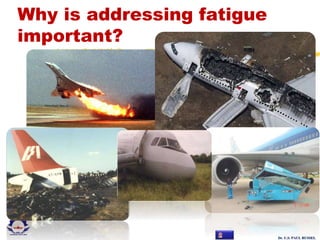
Why is addressing fatigue
important?
Dr. U.S. PAUL RUSSEL
Objective
 Explain How Sleep Cycles, Hours and Circadian
Rhythm Disturbances Can Develop Into Short - Term,
Cumulative and Chronic Effects on Performance and
contribute to accidents.
Dr. U.S. PAUL RUSSEL
Why Should We Care ?
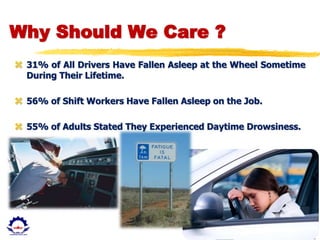
 31% of All Drivers Have Fallen Asleep at the Wheel Sometime
During Their Lifetime.
 56% of Shift Workers Have Fallen Asleep on the Job.
 55% of Adults Stated They Experienced Daytime Drowsiness.
Dr. U.S. PAUL RUSSEL
The Human Toll
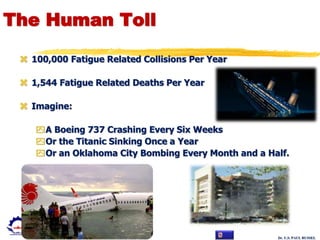
 100,000 Fatigue Related Collisions Per Year
 1,544 Fatigue Related Deaths Per Year
 Imagine:
A Boeing 737 Crashing Every Six Weeks
Or the Titanic Sinking Once a Year
Or an Oklahoma City Bombing Every Month and a Half.
Dr. U.S. PAUL RUSSEL
What is Fatigue?
 Fatigue Is a Complex State Characterized by a Lack of
Alertness and Reduced Mental and Physical
Performance, Often Accompanied by Drowsiness.
 Misconception: Fatigue Is Not Just Falling Asleep.
Dr. U.S. PAUL RUSSEL
What happens when fatigue
occurs?
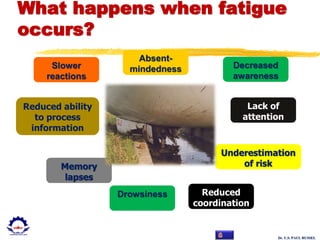
Slower
reactions
Reduced ability
to process
information
Memory
lapses
Absent-
mindedness Decreased
awareness
Lack of
attention
Underestimation
of risk
Reduced
coordination
Drowsiness
Dr. U.S. PAUL RUSSEL
Fatigue
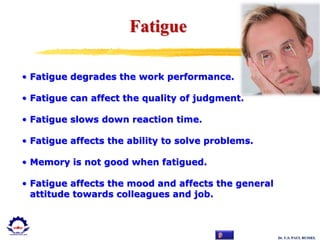
• Fatigue degrades the work performance.
• Fatigue can affect the quality of judgment.
• Fatigue slows down reaction time.
• Fatigue affects the ability to solve problems.
• Memory is not good when fatigued.
• Fatigue affects the mood and affects the general
attitude towards colleagues and job.
Dr. U.S. PAUL RUSSEL
Effects of flight operations on fatigue : it is measurable
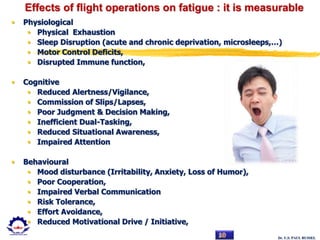
• Physiological
• Physical Exhaustion
• Sleep Disruption (acute and chronic deprivation, microsleeps,…)
• Motor Control Deficits,
• Disrupted Immune function,
• Cognitive
• Reduced Alertness/Vigilance,
• Commission of Slips/Lapses,
• Poor Judgment & Decision Making,
• Inefficient Dual-Tasking,
• Reduced Situational Awareness,
• Impaired Attention
• Behavioural
• Mood disturbance (Irritability, Anxiety, Loss of Humor),
• Poor Cooperation,
• Impaired Verbal Communication
• Risk Tolerance,
• Effort Avoidance,
• Reduced Motivational Drive / Initiative,
Dr. U.S. PAUL RUSSEL
Fatigue Signs and Symptoms
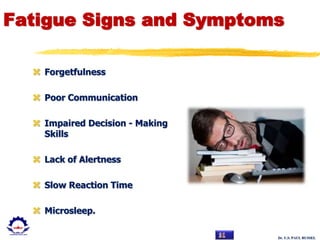
 Forgetfulness
 Poor Communication
 Impaired Decision - Making
Skills
 Lack of Alertness
 Slow Reaction Time
 Microsleep.
Dr. U.S. PAUL RUSSEL
Fatigue Signs and Symptoms
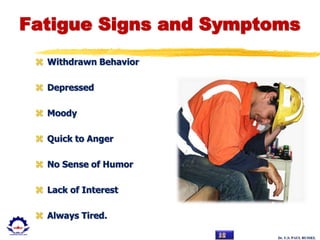
 Withdrawn Behavior
 Depressed
 Moody
 Quick to Anger
 No Sense of Humor
 Lack of Interest
 Always Tired.
Dr. U.S. PAUL RUSSEL
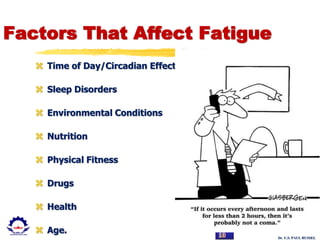
Factors That Affect Fatigue
 Time of Day/Circadian Effects
 Sleep Disorders
 Environmental Conditions
 Nutrition
 Physical Fitness
 Drugs
 Health
 Age.
Dr. U.S. PAUL RUSSEL
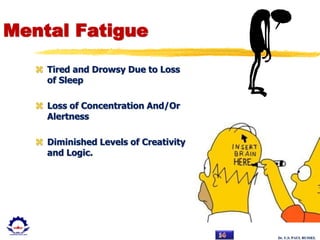
Mental Fatigue
 Tired and Drowsy Due to Loss
of Sleep
 Loss of Concentration And/Or
Alertness
 Diminished Levels of Creativity
and Logic.
Dr. U.S. PAUL RUSSEL
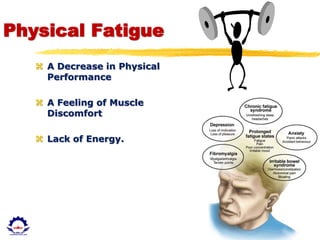
Physical Fatigue
 A Decrease in Physical
Performance
 A Feeling of Muscle
Discomfort
 Lack of Energy.
Dr. U.S. PAUL RUSSEL
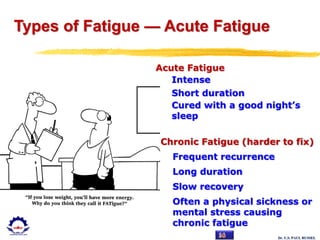
Chronic Fatigue (harder to fix)
Frequent recurrence
Long duration
Slow recovery
Often a physical sickness or
mental stress causing
chronic fatigue
Acute Fatigue
Intense
Short duration
Cured with a good night’s
sleep
Types of Fatigue — Acute Fatigue
Dr. U.S. PAUL RUSSEL
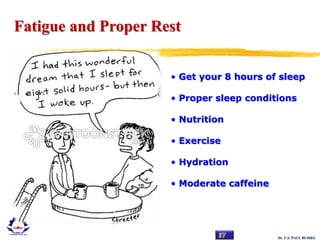
• Get your 8 hours of sleep
• Proper sleep conditions
• Nutrition
• Exercise
• Hydration
• Moderate caffeine
Fatigue and Proper Rest
Dr. U.S. PAUL RUSSEL
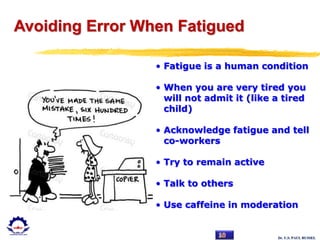
• Fatigue is a human condition
• When you are very tired you
will not admit it (like a tired
child)
• Acknowledge fatigue and tell
co-workers
• Try to remain active
• Talk to others
• Use caffeine in moderation
Avoiding Error When Fatigued
Dr. U.S. PAUL RUSSEL
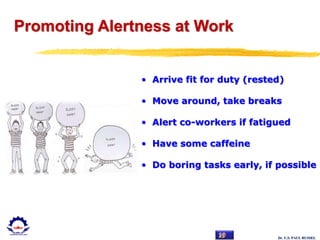
• Arrive fit for duty (rested)
• Move around, take breaks
• Alert co-workers if fatigued
• Have some caffeine
• Do boring tasks early, if possible
Promoting Alertness at Work
Dr. U.S. PAUL RUSSEL
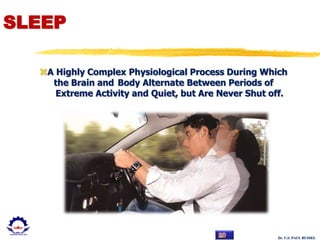
SLEEP
A Highly Complex Physiological Process During Which
the Brain and Body Alternate Between Periods of
Extreme Activity and Quiet, but Are Never Shut off.
Dr. U.S. PAUL RUSSEL
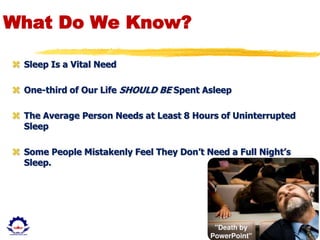
What Do We Know?
 Sleep Is a Vital Need
 One-third of Our Life SHOULD BE Spent Asleep
 The Average Person Needs at Least 8 Hours of Uninterrupted
Sleep
 Some People Mistakenly Feel They Don’t Need a Full Night’s
Sleep.
Dr. U.S. PAUL RUSSEL
Accumulating a Sleep Debt
 Sleep Loss Is Cumulative and Builds a Debt
 Most People Get 1 to 1.5 Hours Less Sleep Per Night Than They
Need
 People whose sleep was restricted to 4 to 5 hours per night for
one week needed two full nights sleep to recover vigilance,
performance, and normal mood
 How Do You Get Out of Sleep Debt? SLEEP!.
Wake Up and Get
Some Sleep!
An Introduction to
“Preventing Drowsy Driving Among
Shift Workers”
Dr. U.S. PAUL RUSSEL
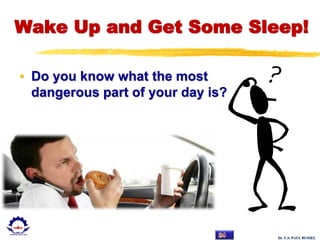
Wake Up and Get Some Sleep!
• Do you know what the most
dangerous part of your day is?
Dr. U.S. PAUL RUSSEL
The most dangerous part
of your day is...
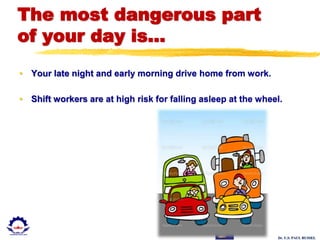
• Your late night and early morning drive home from work.
• Shift workers are at high risk for falling asleep at the wheel.
Dr. U.S. PAUL RUSSEL
Why is your commute so
dangerous?
• Lack of sleep
– Shift workers get an average of
5 hours of sleep a day.
– One hour to an hour- and-a-half
less than non-shift workers
Dr. U.S. PAUL RUSSEL
Why is your commute so
dangerous?
• Time since sleeping
– A shift worker who sleeps until 1:00
p.m. and gets off work at 7:00 a.m.
is driving after being awake for 18
hours
– Twice as long as a daytime worker
Dr. U.S. PAUL RUSSEL
Why is your commute so
dangerous?
• The Circadian Factor
– The human body is governed by an internal clock called
“Circadian Rhythm”
– Each 24-hour cycle makes you want to sleep when it’s dark and
be awake when it’s light
– Causes periods of sleepiness between midnight and 6:00 a.m.
and again in the mid-afternoon
Dr. U.S. PAUL RUSSEL
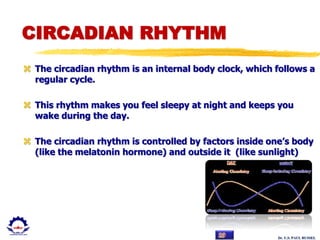
CIRCADIAN RHYTHM
 The circadian rhythm is an internal body clock, which follows a
regular cycle.
 This rhythm makes you feel sleepy at night and keeps you
wake during the day.
 The circadian rhythm is controlled by factors inside one’s body
(like the melatonin hormone) and outside it (like sunlight)
Dr. U.S. PAUL RUSSEL
How much do you know
about sleep?
Test your sleep knowledge by
taking the Sleep IQ Test.
Dr. U.S. PAUL RUSSEL
TEST RESULTS
 1. False. While your body rests your brain doesn’t.
An active brain during sleep prepares us for alertness
and peak functioning the next day.
 2. True. Sleep need is biological. While children need more
sleep than adults, how much sleep any individual needs is
genetically determined.
Most adults need eight hours of sleep to function at their
best. How to determine what you need? Sleep until you
wake up on your own…without an alarm clock.
Feel rested? That’s your sleep need. You can teach
yourself to sleep less, but not to need less sleep.
Dr. U.S. PAUL RUSSEL
 3. False. When people are active, they usually don’t feel sleepy.
 When they take a break from activity, or feel bored, they may
notice that they are sleepy.
However, what causes sleepiness most is sleep loss: not
getting the sleep you need. Adults who don’t get enough good
sleep feel sleepy when they’re bored. Boredom, like a warm or
dark room, doesn’t cause sleepiness, it merely unmasks it.
 4. True. Sleep is as necessary to health as food and water, and
rest is no substitute for sleep.
As noted above, sleep is an active process needed for health
and alertness. When you don’t get enough sleep you need,
your body builds up a sleep debt. Sooner or later, this debt
must be paid…with sleep. If you drive when you are sleepy,
you place yourself and others at risk because drowsy drivers
can fall asleep at the wheel with little or no warning.
TEST RESULTS
Dr. U.S. PAUL RUSSEL
 5. False. Snoring may indicate the presence of a life-
threatening sleep disorder called sleep apnea. People with
sleep apnea snore loudly and arouse repeatedly during the
night, gasping for breath. These repeated awakenings lead to
severe daytime sleepiness, which raises the risk for accidents
and heart problems. Yet 95% of those with sleep apnea remain
unaware that they have a serious disorder.
The good news: with treatment, patients can improve their
sleep and alertness, and reduce their risk for accidents and
health problems. Physicians and sleep specialists should be
consulted.
 6. True. Though many people fail to remember their dreams,
dreaming does occur for every person, every night. Dreams are
most vivid during REM or rapid eye movement sleep.
TEST RESULTS
Dr. U.S. PAUL RUSSEL
 7. False. Sleep need remains unchanged throughout adulthood.
Older people may wake more frequently through the night and
may sleep less, but their sleep is no less than during young
adulthood.
When older people sleep less at night, they tend to sleep
more during the day. Sleep difficulties are not a normal part
of aging, although they are all too common. If poor sleep
habits, pain, or health conditions make sleeping difficult, a
physician can help.
 8. True. Researchers asked thousands of people over the years if
they’re sleepy, only to be told “no” just before the individuals fell
asleep. What does this mean? Many people don’t know if they
are sleepy, when they are sleepy, or why they are sleepy. When
driving, don’t think you can tough if out if you’re sleepy but only
a few miles from your destination. If you are sleepy enough, you
can fall asleep…..anywhere.
TEST RESULTS
Dr. U.S. PAUL RUSSEL
 9. False. If you’re having trouble staying awake while driving,
the only short-term solution is to pull over at a safe place and
take a short nap or have a caffeinated drink. Doing both – for
example, drinking coffee then napping before the caffeine kicks
in – may be even better.
 However, the only long-term solution is prevention…starting out well rested
after a good night’s sleep. Research shows that loud radios, like chewing
gum and open windows, fails to keep sleepy drivers alert.
 10. False. Stress is the number one reason people report
insomnia (difficulty falling or staying asleep). However stress
accounts for only a fraction of people who suffer either chronic
insomnia or difficulty staying alert during the day.
 Sleep disorders have a variety of causes. Sleep apnea, for example, is caused
by an obstruction in the airway during sleep. Narcolepsy, which is
characterized by severe daytime sleepiness and sudden sleep attacks,
appears to be genetic. No one knows yet what causes restless legs
syndrome, in which creepy, crawly feelings arise in the legs and are relieved
momentarily by motion.
TEST RESULTS
Dr. U.S. PAUL RUSSEL
 11. True. All living things (people, animals, even plants) have a
circadian or about 24-hour rhythm.
 This affects when we feel sleepy and alert. Light and dark cycles
set these circadian rhythms. When you travel across time zones,
your circadian rhythm adjusts when the light and dark cycle
changes. For shift workers, the light and dark cycle doesn’t
change. Therefore a shift worker’s circadian rhythm never
adjusts.
 Whether you work the night shift or not, you are likely to feel
more sleepy between midnight and six a.m. And no matter how
many years one works the night shift, sleeping during the day
remains difficult. Shift workers should avoid caffeine during the
last half of their workdays, block out noise and light at bedtime,
and stay away from alcohol and alerting activities before going
to sleep.
TEST RESULTS
Dr. U.S. PAUL RUSSEL
 12. False. Unfortunately, many people who suffer from
sleep disorders don’t realize that they have a disorder or
that it can be treated. But sleep disorders don’t disappear
without treatment.
Treatment may be behavioral (for example, going to
sleep and waking at the same time every day,
scheduling naps, or losing weight), pharmacological
(involving medication), surgical, or a combination.
Untreated sleep disorders may have serious negative
effects, worsening quality of life, school and work
performance, and relationships. Worse, untreated sleep
disorders may lead to accidents and death.
TEST RESULTS
Dr. U.S. PAUL RUSSEL
TEST RESULTS
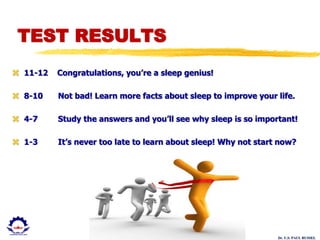
 11-12 Congratulations, you’re a sleep genius!
 8-10 Not bad! Learn more facts about sleep to improve your life.
 4-7 Study the answers and you’ll see why sleep is so important!
 1-3 It’s never too late to learn about sleep! Why not start now?
Dr. U.S. PAUL RUSSEL
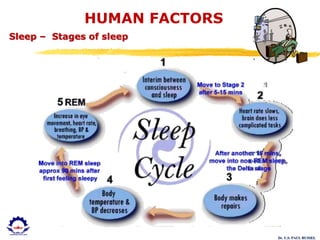
HUMAN FACTORS
Sleep – Stages of sleep
Dr. U.S. PAUL RUSSEL
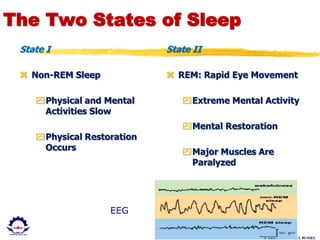
The Two States of Sleep
State I
 Non-REM Sleep
Physical and Mental
Activities Slow
Physical Restoration
Occurs
State II
 REM: Rapid Eye Movement
Extreme Mental Activity
Mental Restoration
Major Muscles Are
Paralyzed
EEG
Dr. U.S. PAUL RUSSEL
Stages of Sleep
 Stage 1
transitional stage, when you're between waking and
sleep.
Your brain waves and muscle activity slow.
Sometimes people's bodies jerk just before they fall
asleep (hypnic jerk)
Dr. U.S. PAUL RUSSEL
Stages of Sleep
 Stage 2
Light sleep stage.
Eye movements cease.
Body temperature drops, and heart and brain activity
slows.
Periods of muscle tone and muscle relaxation, and that
occasional brain-wave spikes, called sleep spindles,
occur during this stage of sleep.
Dr. U.S. PAUL RUSSEL
Stages of Sleep
 Stage 3 and 4
Delta sleep.
These are the deep sleep stages, and this is when body
restoration and repair occurs.
Temperature drops even further during this phase, brain
waves are slow and there is decreased muscle tone.
People woken during delta sleep are often groggy and
disoriented.
Night terrors occur during this sleep stage.
Dr. U.S. PAUL RUSSEL
Stages of Sleep
 REM Sleep
Dreaming, believed to be a way of organizing the day's
experiences, occurs during REM sleep.
Have you ever wanted to scream during a nightmare
and been unable to?
Muscles become temporarily paralyzed during REM.
Dr. U.S. PAUL RUSSEL
Stages of Sleep
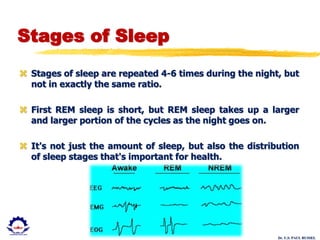
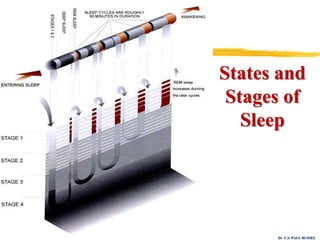
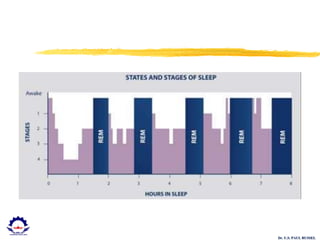
 Stages of sleep are repeated 4-6 times during the night, but
not in exactly the same ratio.
 First REM sleep is short, but REM sleep takes up a larger
and larger portion of the cycles as the night goes on.
 It's not just the amount of sleep, but also the distribution
of sleep stages that's important for health.
Dr. U.S. PAUL RUSSEL
States and
Stages of
Sleep
Dr. U.S. PAUL RUSSEL
Presentation
Time!!
Is best when people
and presenters are
alert!
Timing is Everything?
Dr. U.S. PAUL RUSSEL
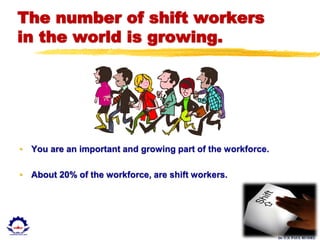
The number of shift workers
in the world is growing.
• You are an important and growing part of the workforce.
• About 20% of the workforce, are shift workers.
Dr. U.S. PAUL RUSSEL
Our bodies are designed to
sleep at night.
• Shift work goes against our natural 24-hour
“Circadian Rhythm.”
• Levels of natural chemicals rise and fall from
daybreak to day’s end.
• You feel sleepy at night, alert during the day.
Dr. U.S. PAUL RUSSEL
Shift work and sleepiness put
you at risk for problems.
• Chronic sleep deprivation
• Disrupted sleep patterns
• Reduced alertness
• Increased crashes
on the job
• Falling asleep while driving or
working
• Low morale
• Decreased motivation and
productivity
• Job burnout
Dr. U.S. PAUL RUSSEL
MELATONIN
 MELATONIN IS A NATURAL hormone made by our
body's pineal gland.
 And when the sun goes down, and darkness comes,
the pineal gland "goes to work."
 As Melatonin production rises, we begin to feel less
alert.
 Body temperature starts to fall as well.
Dr. U.S. PAUL RUSSEL
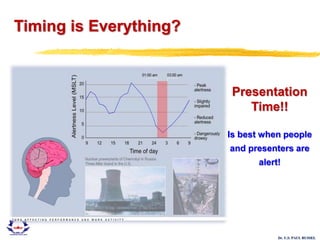
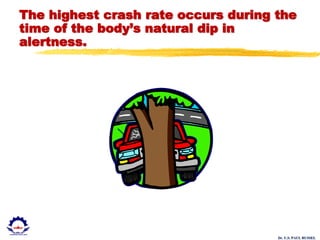
The highest crash rate occurs during the
time of the body’s natural dip in
alertness.
Dr. U.S. PAUL RUSSEL
Coincidence?
I don’t think so.
• Being sleepy behind the wheel is dangerous.
• Drowsiness impairs driving skills.
• Drowsy drivers make poor decisions.
• Drowsiness reduces response time and the ability to react.
• Drowsiness causes decreased awareness, tunnel vision,
wandering thoughts and shortened attention spans.
Dr. U.S. PAUL RUSSEL
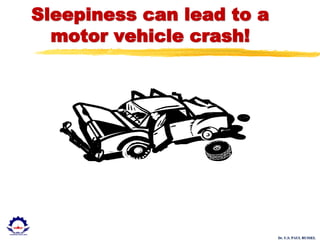
Sleepiness can lead to a
motor vehicle crash!
Dr. U.S. PAUL RUSSEL
Look for the warning signs
of drowsy driving.
• You can’t stop yawning.
• Your eyelids droop or blink
frequently.
• You have trouble keeping your
eyes open and focused
especially at stoplights.
• Your mind wanders or you have
disconnected thoughts.
• You can’t remember driving the
last few miles.
• Your driving becomes sloppy—
you weave between lanes,
tailgate or miss traffic signals.
• You hit rumble strips or
grooves in the road.
Dr. U.S. PAUL RUSSEL
Even one warning sign is
one too many!
• These things will not keep you awake while driving.
– Turning the volume up on the radio
– Singing loudly
– Chewing gum or eating
– Getting out of the car and running around
– Slapping yourself
– Sticking your head out the window
Dr. U.S. PAUL RUSSEL
Sleep is the only preventive
measure against drowsy driving.
• If you find yourself behind the wheel drowsy, there are things
you can do to get home safely.
• Don’t attempt to drive drowsy!
Dr. U.S. PAUL RUSSEL
Tips for getting home safely.
• Pull off the road to a safe place.
• Drink two cups of coffee and take a
15-20 minute nap.
• You’ll get some sleep while the
caffeine takes effect.
• When you get home, don’t go to
sleep right away; let the effects of
the caffeine wear off.
Dr. U.S. PAUL RUSSEL
Tips for getting home safely.
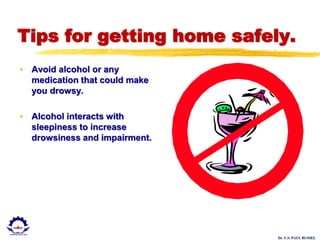
• Avoid alcohol or any
medication that could make
you drowsy.
• Alcohol interacts with
sleepiness to increase
drowsiness and impairment.
Dr. U.S. PAUL RUSSEL
Tips for getting home safely.
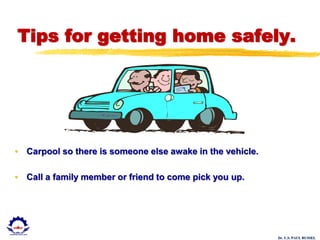
• Carpool so there is someone else awake in the vehicle.
• Call a family member or friend to come pick you up.
Dr. U.S. PAUL RUSSEL
Tips for getting home safely.
• Take a taxi or public transportation.
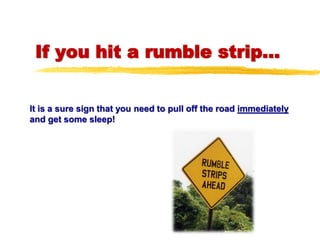
If you hit a rumble strip...
It is a sure sign that you need to pull off the road immediately
and get some sleep!
Wake Up and
Get Some Sleep!
Facts and Myths about Sleep
and Drowsy Driving
Dr. U.S. PAUL RUSSEL
Shift workers are at high risk
for a drowsy driving crash!
• Late night and early morning driving times are most hazardous.
• Highest crash rate occurs between midnight and 6:00 a.m. when
the body naturally experiences sleepiness.
• Fall-asleep-crashes are often fatal.
Dr. U.S. PAUL RUSSEL
Fall-asleep-crashes are
often fatal. Why?
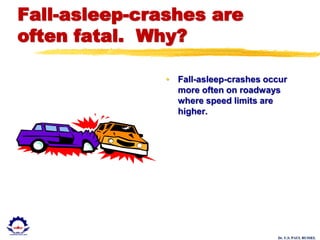
• Fall-asleep-crashes occur
more often on roadways
where speed limits are
higher.
Dr. U.S. PAUL RUSSEL
Fall-asleep-crashes are
often fatal. Why?
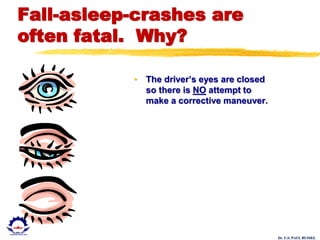
• The driver’s eyes are closed
so there is NO attempt to
make a corrective maneuver.
Dr. U.S. PAUL RUSSEL
Fall-asleep-crashes are
often fatal. Why?
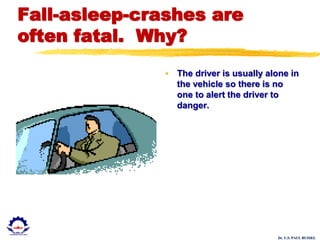
• The driver is usually alone in
the vehicle so there is no
one to alert the driver to
danger.
Dr. U.S. PAUL RUSSEL
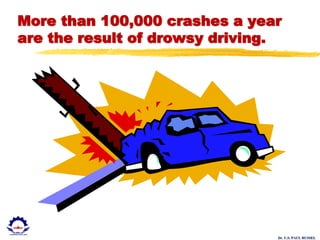
More than 100,000 crashes a year
are the result of drowsy driving.
Dr. U.S. PAUL RUSSEL
True or False?
• Coffee overcomes the effects of drowsiness while driving.
• I can tell when I’m going to fall asleep.
• I’m a safe driver so it doesn’t matter if I’m sleepy.
• I can’t take naps.
• Being sleepy makes you misperceive things.
Dr. U.S. PAUL RUSSEL
Coffee overcomes the effects of
drowsiness while driving. FALSE.
• Stimulants alone are no substitute for sleep.
• Coffee or cola might help you feel alert, but
only for a short time.
• You still could have “micro sleeps” lasting 4
to 5 seconds.
• Stimulants combined with sleep will increase
alertness.
Dr. U.S. PAUL RUSSEL
I can tell when I’m going to
fall asleep. FALSE.
• You can’t control or tell when
you are about to fall asleep.
• Sleep is not voluntary.
• You can fall asleep and not
even know it.
• You can’t tell how long you’ve
been asleep.
Dr. U.S. PAUL RUSSEL
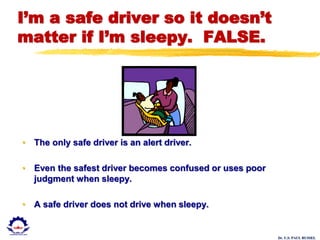
I’m a safe driver so it doesn’t
matter if I’m sleepy. FALSE.
• The only safe driver is an alert driver.
• Even the safest driver becomes confused or uses poor
judgment when sleepy.
• A safe driver does not drive when sleepy.
Dr. U.S. PAUL RUSSEL
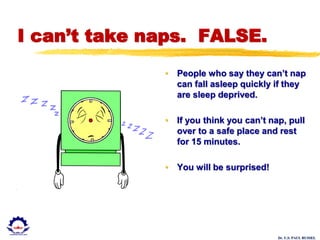
I can’t take naps. FALSE.
• People who say they can’t nap
can fall asleep quickly if they
are sleep deprived.
• If you think you can’t nap, pull
over to a safe place and rest
for 15 minutes.
• You will be surprised!
Dr. U.S. PAUL RUSSEL
Being sleepy makes you
misperceive things. TRUE.
• A drowsy driver does not process information as fast or
accurately as an alert driver.
• A drowsy driver is unable to react quickly enough to avoid a
crash.
• The average person needs 7 to 8 hours of sleep per day for
optimal performance.
Dr. U.S. PAUL RUSSEL
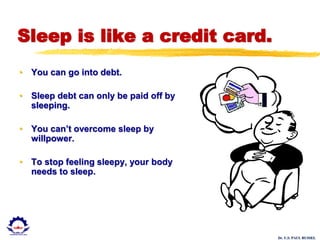
Sleep is like a credit card.
• You can go into debt.
• Sleep debt can only be paid off by
sleeping.
• You can’t overcome sleep by
willpower.
• To stop feeling sleepy, your body
needs to sleep.
Dr. U.S. PAUL RUSSEL
Make sleep your number
one priority.
Dr. U.S. PAUL RUSSEL
Tips to help you get better
sleep.
• Make your room dark—just like nighttime. The darker the better.
• Block outside sounds by wearing earplugs or using a noisy fan.
• Lower the thermostat to 24 degrees before going to bed.
• Try to stick to a regular sleep schedule, even on your days off.
Dr. U.S. PAUL RUSSEL
If lifestyle changes aren’t enough,
you may have a sleep disorder.
• Sleep Apnea: you stop breathing during sleep from 10 to 60
seconds accompanied by loud snoring.
• Periodic Limb Movement Disorder: involuntarily movement of legs
and arms during sleep resulting in difficulty staying asleep.
• Narcolepsy: sudden wave of sleepiness and fall asleep several
times during the day.
Dr. U.S. PAUL RUSSEL
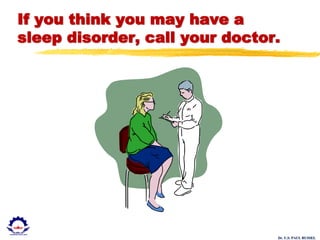
If you think you may have a
sleep disorder, call your doctor.
Wake Up and Get
Some Sleep!
Dealing with Family
and Friends
Dr. U.S. PAUL RUSSEL
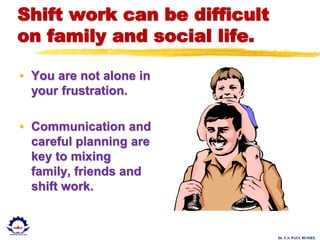
Shift work can be difficult
on family and social life.
• You are not alone in
your frustration.
• Communication and
careful planning are
key to mixing
family, friends and
shift work.
Dr. U.S. PAUL RUSSEL
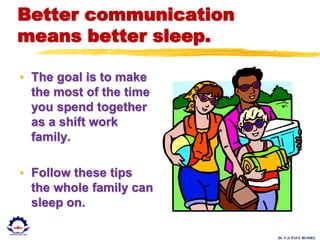
Better communication
means better sleep.
• The goal is to make
the most of the time
you spend together
as a shift work
family.
• Follow these tips
the whole family can
sleep on.
Dr. U.S. PAUL RUSSEL
Hold regular family meetings,
once or twice a week.
• Open up the lines of communication.
• Discuss problems or concerns about your
schedule.
• Deal with minor problems early on, before
they become major problems.
• Determine solutions together as a family.
• Be receptive to all ideas.
Dr. U.S. PAUL RUSSEL
Keep household members in
touch with you, and each other.
• Set up a bulletin board in your house where
everyone can leave you notes, school work,
drawings, reminders.
• Rent or purchase a camcorder to capture special
moments you may miss.
• Designate a time each week to relax with your
partner.
• Plan a “family day” once a month.
• Schedule family events and get-togethers on your
day off.
Dr. U.S. PAUL RUSSEL
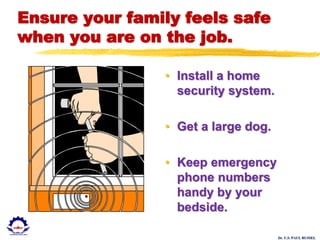
Ensure your family feels safe
when you are on the job.
• Install a home
security system.
• Get a large dog.
• Keep emergency
phone numbers
handy by your
bedside.
Dr. U.S. PAUL RUSSEL
Single life is tough for shift
workers too.
• Seek sports that require no set schedule such
as bowling or tennis.
• Work out at a gym.
• Attend workshops or hobby clubs on your
days off.
• Volunteer.
• Socialize with co-workers or other shift
workers.
• Work with your supervisor well in advance to
request nights off for special occasions.
Dr. U.S. PAUL RUSSEL
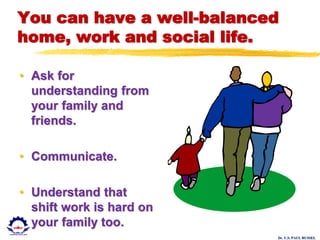
You can have a well-balanced
home, work and social life.
• Ask for
understanding from
your family and
friends.
• Communicate.
• Understand that
shift work is hard on
your family too.
Dr. U.S. PAUL RUSSEL
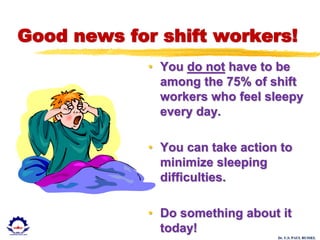
Good news for shift workers!
• You do not have to be
among the 75% of shift
workers who feel sleepy
every day.
• You can take action to
minimize sleeping
difficulties.
• Do something about it
today!
Wake Up and Get
Some Sleep!
Habits to Help Improve
Your Sleep
Dr. U.S. PAUL RUSSEL
Sleep “Hygiene”?
Sleep hygiene refers to the habits, environmental factors, and
practices that may influence the length and quality of one's
sleep.
Coined by Peter Hauri.
Dr. U.S. PAUL RUSSEL
How much sleep do I need?
 A general guideline for adults is 7-8 hours of sleep a night.
 Older adults need a similar amount, but the sleep may be
lighter and may include a brief nap during the day.
Dr. U.S. PAUL RUSSEL
What happens when I don’t
get enough sleep?
 Impaired mood, memory, and concentration.
 Dampened immune system
 Increased risk of accidents
 Stressed relationships.
Dr. U.S. PAUL RUSSEL
4 General Areas to Sleep
Hygiene
 Our circadian rhythm, or 24-hour cycle
 Aging
 Psychological stressors -- those factors can cause difficulty
falling asleep and disturb the quality of your sleep
 Common social or recreational drugs like nicotine, caffeine,
and alcohol
Dr. U.S. PAUL RUSSEL
Aging
After the age of 40 our sleep patterns change, and we have
many more nocturnal awakenings than in our younger
years.
These awakenings not only directly affect the quality of our
sleep, but they also interact with any other condition that
may cause arousals or awakenings, like the withdrawal
syndrome that occurs after drinking alcohol close to
bedtime.
The more awakenings we have at night, the more likely we
will awaken feeling unrefreshed and unrestored.
Dr. U.S. PAUL RUSSEL
Psychological Stressors
 Psychological stressors like deadlines, exams, marital
conflict, and job crises may prevent us from falling asleep
or wake us from sleep throughout the night.
 It takes time to "turn off" all the noise from the day.
 If you work right up to the time you turn out the lights, or
are reviewing all the day's events and planning tomorrow
(sound familiar?), you simply cannot just "flip a switch"
and drop off to a blissful night's sleep.
Dr. U.S. PAUL RUSSEL
How to deal with stressors
 Develop some kind of pre-sleep ritual to break the
connection between all the stress and bedtime.
 These rituals can be as short as 10 minutes or as long as an
hour.
 Some find relief in making a list of all the stressors of the
day, along with a plan to deal with them, as it serves to end
the day.
 Combining this with a period of relaxation, perhaps by
reading something light, meditating, or taking a hot bath
can also help you get better sleep.
 And don't look at that clock!
Dr. U.S. PAUL RUSSEL
Social or Recreational
Drugs
 Social or recreational drugs like caffeine, nicotine, and
alcohol may have a larger impact on your sleep than you
realize.
 Caffeine, which can stay in your system as long as 14
hours, increases the number of times you awaken at night
and decreases the total amount of sleep time.
Dr. U.S. PAUL RUSSEL
Social or Recreational
Drugs
 The effects of nicotine are similar to those of caffeine, with
a difference being that at low doses, nicotine tends to act
as a sedative, while at high doses it causes arousals during
sleep.
 Alcohol may initially sedate you, making it easier to fall
asleep; however, as it is metabolized and cleared from your
system during sleep, it causes arousals that can last as long
as two to three hours after it has been eliminated.
Dr. U.S. PAUL RUSSEL
Tips
 Don’t go to bed unless you are sleepy
If you are not sleepy at bedtime, then do something
else. Read a book, listen to soft music or browse
through a magazine.
Find something relaxing, but not stimulating, to take
your mind off of worries about sleep. This will relax your
body and distract your mind.
Dr. U.S. PAUL RUSSEL
Tips
 If you are not asleep after 20 minutes, then get out of the
bed.
Find something else to do that will make you feel
relaxed. If you can, do this in another room.
Your bedroom should be where you go to sleep.
It is not a place to go when you are bored.
Once you feel sleepy again, go back to bed.
Dr. U.S. PAUL RUSSEL
Tips
 Begin rituals that help you relax each night before bed.
This can include such things as a warm bath, light snack
or a few minutes of reading.
Dr. U.S. PAUL RUSSEL
Things I have heard people do
 Reading a light, entertaining book or magazine
 Listening to soft music
 Making simple preparations for the next day
 A light bedtime snack, a cup of hot tea, or a glass of warm milk
 Hobbies such as knitting or jigsaw puzzles
 Listening to books on tape
Dr. U.S. PAUL RUSSEL
Tips
 Get up at the same time every morning.
Do this even on weekends and holidays.
Dr. U.S. PAUL RUSSEL
Tips
 Get a full night’s sleep on a regular basis.
Get enough sleep so that you feel well-rested nearly
every day.
Dr. U.S. PAUL RUSSEL
Tips
 Avoid taking naps if you can.
If you must take a nap, try to keep it short (less than
one hour).
Never take a nap after 3 p.m.
Dr. U.S. PAUL RUSSEL
Tips
 Keep a regular schedule.
Regular times for meals, medications, chores, and other
activities help keep the inner body clock running
smoothly.
Dr. U.S. PAUL RUSSEL
Tips
 Don’t read, write, eat, watch TV, talk on the phone, or play
cards in bed.
Dr. U.S. PAUL RUSSEL
Tips
 Do not have any caffeine after lunch.
Dr. U.S. PAUL RUSSEL
Tips
 Do not have a beer, a glass of wine, or any other alcohol
within six hours of your bedtime.
Dr. U.S. PAUL RUSSEL
Tips
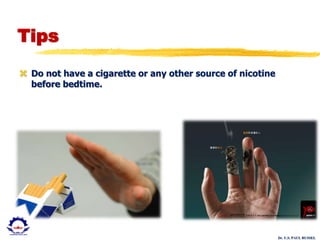
 Do not have a cigarette or any other source of nicotine
before bedtime.
Dr. U.S. PAUL RUSSEL
Tips
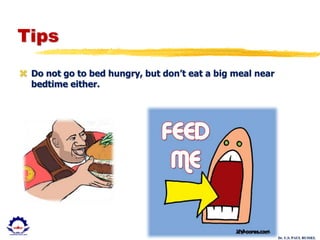
 Do not go to bed hungry, but don’t eat a big meal near
bedtime either.
Dr. U.S. PAUL RUSSEL
Tips
 Avoid any tough exercise within six hours of your bedtime.

You should exercise on a regular basis, but do it earlier
in the day.
Talk to your doctor before you begin an exercise
program.
Dr. U.S. PAUL RUSSEL
Tips
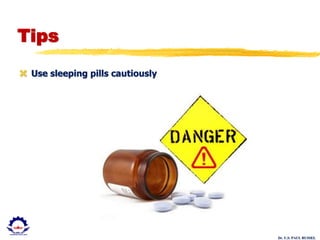
 Use sleeping pills cautiously
Dr. U.S. PAUL RUSSEL
Tips
 Try to get rid of or deal with things that make you worry.

If you are unable to do this, then find a time during the
day to get all of your worries out of your system.
Your bed is a place to rest, not a place to worry.
Dr. U.S. PAUL RUSSEL
Tips
 Make your bedroom quiet, dark, and a little bit cool.
An easy way to remember this: it should remind you of a
cave.
it seems to work for bats.
Bats are champion sleepers.
They get about 16 hours of sleep each day.
Maybe it’s because they sleep in dark, cool caves.
Dr. U.S. PAUL RUSSEL
A Word About Television
 Many people fall asleep with the television on in their room.
 Watching television before bedtime is often a bad idea.
 Television is a very engaging medium that tends to keep
people up.
 We generally recommend that the television not be in the
bedroom.
Dr. U.S. PAUL RUSSEL
A Word About Television
 Late night news or prime time shows frequently have
disturbing, violent material.
 Even non-violent programming can have commercials
which are jarring and louder than the actual program.
 Light and noise.
 The continuous flickering light coming from the TV (or a
computer screen) can interfere with the body’s clock, which
is sensitive to any light.
Dr. U.S. PAUL RUSSEL
Better sleep tips.
• Maintain or improve your overall health.
– Eat well and get exercise at least three
times a week.
– Allow at least three hours between
exercise and bedtime.
Dr. U.S. PAUL RUSSEL
Better sleep tips.
• Avoid caffeine several hours
before going to bed.
– Its stimulating effects will
peak two to four hours
later and may linger for
several hours more.
Dr. U.S. PAUL RUSSEL
Better sleep tips.
• Avoid alcohol before going to bed.
– It may make you fall asleep
faster, but will make it harder to
stay asleep.
– Alcohol deprives your body of
deep rest and you end up
sleeping in fragments.
Dr. U.S. PAUL RUSSEL
Better sleep tips.
• Know the side effects of
medications.
– Some medications can
increase sleepiness and
make driving dangerous.
– Others can cause
sleeping difficulties.
– Read all labels and talk
to your doctor.
Dr. U.S. PAUL RUSSEL
Better sleep tips.
• Change the time you go to sleep.
– After driving home from work, don’t go to bed
right away.
– Take a few hours to unwind and relax.
Dr. U.S. PAUL RUSSEL
Better sleep tips.
• Develop a relaxing sleep ritual
before bed.
– Take a warm bath.
– Listen to soothing music.
– Read until you feel sleepy
(but nothing too exciting
or stimulating).
Dr. U.S. PAUL RUSSEL
Better sleep tips.
• Don’t make bedtime the time to solve problems.
– Try to clear your mind.
– Make a list of things you are concerned about or need to do
the next day so you don’t worry about them when you are
trying to sleep.
Dr. U.S. PAUL RUSSEL
Give it a chance to work.
• Try these tips for a few weeks
and you should notice changes
in how you feel.
• After trying these tips, if you still
don’t feel better, you may need
to see your doctor.
Dr. U.S. PAUL RUSSEL
Shift work has advantages.
• Public places are less crowded in the daytime.
• Movies are at a discount during the day.
• Less traffic!
• Child care is easier.
• You can attend daytime events such as a soccer game without
taking time off from work.
• Tending to personal business such as car repairs is easier.
• Night work is often less stressful.
• Others?
Dr. U.S. PAUL RUSSEL
What have we all learned?
• Sharing stories and lessons
learned with each other is
important.
• We can motivate one another to
make positive lifestyle changes
that will keep us safe and
happy.

SLEEP and how HUMAN FACTORS affect the work.pptx

  • 1.
  • 2.
    Dr. U.S. PAULRUSSEL Why is addressing fatigue important?
  • 3.
    Dr. U.S. PAULRUSSEL Objective  Explain How Sleep Cycles, Hours and Circadian Rhythm Disturbances Can Develop Into Short - Term, Cumulative and Chronic Effects on Performance and contribute to accidents.
  • 4.
    Dr. U.S. PAULRUSSEL Why Should We Care ?  31% of All Drivers Have Fallen Asleep at the Wheel Sometime During Their Lifetime.  56% of Shift Workers Have Fallen Asleep on the Job.  55% of Adults Stated They Experienced Daytime Drowsiness.
  • 5.
    Dr. U.S. PAULRUSSEL The Human Toll  100,000 Fatigue Related Collisions Per Year  1,544 Fatigue Related Deaths Per Year  Imagine: A Boeing 737 Crashing Every Six Weeks Or the Titanic Sinking Once a Year Or an Oklahoma City Bombing Every Month and a Half.
  • 6.
  • 7.
    Dr. U.S. PAULRUSSEL What is Fatigue?  Fatigue Is a Complex State Characterized by a Lack of Alertness and Reduced Mental and Physical Performance, Often Accompanied by Drowsiness.  Misconception: Fatigue Is Not Just Falling Asleep.
  • 8.
    Dr. U.S. PAULRUSSEL What happens when fatigue occurs? Slower reactions Reduced ability to process information Memory lapses Absent- mindedness Decreased awareness Lack of attention Underestimation of risk Reduced coordination Drowsiness
  • 9.
    Dr. U.S. PAULRUSSEL Fatigue • Fatigue degrades the work performance. • Fatigue can affect the quality of judgment. • Fatigue slows down reaction time. • Fatigue affects the ability to solve problems. • Memory is not good when fatigued. • Fatigue affects the mood and affects the general attitude towards colleagues and job.
  • 10.
    Dr. U.S. PAULRUSSEL Effects of flight operations on fatigue : it is measurable • Physiological • Physical Exhaustion • Sleep Disruption (acute and chronic deprivation, microsleeps,…) • Motor Control Deficits, • Disrupted Immune function, • Cognitive • Reduced Alertness/Vigilance, • Commission of Slips/Lapses, • Poor Judgment & Decision Making, • Inefficient Dual-Tasking, • Reduced Situational Awareness, • Impaired Attention • Behavioural • Mood disturbance (Irritability, Anxiety, Loss of Humor), • Poor Cooperation, • Impaired Verbal Communication • Risk Tolerance, • Effort Avoidance, • Reduced Motivational Drive / Initiative,
  • 11.
    Dr. U.S. PAULRUSSEL Fatigue Signs and Symptoms  Forgetfulness  Poor Communication  Impaired Decision - Making Skills  Lack of Alertness  Slow Reaction Time  Microsleep.
  • 12.
    Dr. U.S. PAULRUSSEL Fatigue Signs and Symptoms  Withdrawn Behavior  Depressed  Moody  Quick to Anger  No Sense of Humor  Lack of Interest  Always Tired.
  • 13.
    Dr. U.S. PAULRUSSEL Factors That Affect Fatigue  Time of Day/Circadian Effects  Sleep Disorders  Environmental Conditions  Nutrition  Physical Fitness  Drugs  Health  Age.
  • 14.
    Dr. U.S. PAULRUSSEL Mental Fatigue  Tired and Drowsy Due to Loss of Sleep  Loss of Concentration And/Or Alertness  Diminished Levels of Creativity and Logic.
  • 15.
    Dr. U.S. PAULRUSSEL Physical Fatigue  A Decrease in Physical Performance  A Feeling of Muscle Discomfort  Lack of Energy.
  • 16.
    Dr. U.S. PAULRUSSEL Chronic Fatigue (harder to fix) Frequent recurrence Long duration Slow recovery Often a physical sickness or mental stress causing chronic fatigue Acute Fatigue Intense Short duration Cured with a good night’s sleep Types of Fatigue — Acute Fatigue
  • 17.
    Dr. U.S. PAULRUSSEL • Get your 8 hours of sleep • Proper sleep conditions • Nutrition • Exercise • Hydration • Moderate caffeine Fatigue and Proper Rest
  • 18.
    Dr. U.S. PAULRUSSEL • Fatigue is a human condition • When you are very tired you will not admit it (like a tired child) • Acknowledge fatigue and tell co-workers • Try to remain active • Talk to others • Use caffeine in moderation Avoiding Error When Fatigued
  • 19.
    Dr. U.S. PAULRUSSEL • Arrive fit for duty (rested) • Move around, take breaks • Alert co-workers if fatigued • Have some caffeine • Do boring tasks early, if possible Promoting Alertness at Work
  • 20.
    Dr. U.S. PAULRUSSEL SLEEP A Highly Complex Physiological Process During Which the Brain and Body Alternate Between Periods of Extreme Activity and Quiet, but Are Never Shut off.
  • 21.
    Dr. U.S. PAULRUSSEL What Do We Know?  Sleep Is a Vital Need  One-third of Our Life SHOULD BE Spent Asleep  The Average Person Needs at Least 8 Hours of Uninterrupted Sleep  Some People Mistakenly Feel They Don’t Need a Full Night’s Sleep.
  • 22.
    Dr. U.S. PAULRUSSEL Accumulating a Sleep Debt  Sleep Loss Is Cumulative and Builds a Debt  Most People Get 1 to 1.5 Hours Less Sleep Per Night Than They Need  People whose sleep was restricted to 4 to 5 hours per night for one week needed two full nights sleep to recover vigilance, performance, and normal mood  How Do You Get Out of Sleep Debt? SLEEP!.
  • 23.
    Wake Up andGet Some Sleep! An Introduction to “Preventing Drowsy Driving Among Shift Workers”
  • 24.
    Dr. U.S. PAULRUSSEL Wake Up and Get Some Sleep! • Do you know what the most dangerous part of your day is?
  • 25.
    Dr. U.S. PAULRUSSEL The most dangerous part of your day is... • Your late night and early morning drive home from work. • Shift workers are at high risk for falling asleep at the wheel.
  • 26.
    Dr. U.S. PAULRUSSEL Why is your commute so dangerous? • Lack of sleep – Shift workers get an average of 5 hours of sleep a day. – One hour to an hour- and-a-half less than non-shift workers
  • 27.
    Dr. U.S. PAULRUSSEL Why is your commute so dangerous? • Time since sleeping – A shift worker who sleeps until 1:00 p.m. and gets off work at 7:00 a.m. is driving after being awake for 18 hours – Twice as long as a daytime worker
  • 28.
    Dr. U.S. PAULRUSSEL Why is your commute so dangerous? • The Circadian Factor – The human body is governed by an internal clock called “Circadian Rhythm” – Each 24-hour cycle makes you want to sleep when it’s dark and be awake when it’s light – Causes periods of sleepiness between midnight and 6:00 a.m. and again in the mid-afternoon
  • 29.
    Dr. U.S. PAULRUSSEL CIRCADIAN RHYTHM  The circadian rhythm is an internal body clock, which follows a regular cycle.  This rhythm makes you feel sleepy at night and keeps you wake during the day.  The circadian rhythm is controlled by factors inside one’s body (like the melatonin hormone) and outside it (like sunlight)
  • 30.
    Dr. U.S. PAULRUSSEL How much do you know about sleep? Test your sleep knowledge by taking the Sleep IQ Test.
  • 31.
    Dr. U.S. PAULRUSSEL TEST RESULTS  1. False. While your body rests your brain doesn’t. An active brain during sleep prepares us for alertness and peak functioning the next day.  2. True. Sleep need is biological. While children need more sleep than adults, how much sleep any individual needs is genetically determined. Most adults need eight hours of sleep to function at their best. How to determine what you need? Sleep until you wake up on your own…without an alarm clock. Feel rested? That’s your sleep need. You can teach yourself to sleep less, but not to need less sleep.
  • 32.
    Dr. U.S. PAULRUSSEL  3. False. When people are active, they usually don’t feel sleepy.  When they take a break from activity, or feel bored, they may notice that they are sleepy. However, what causes sleepiness most is sleep loss: not getting the sleep you need. Adults who don’t get enough good sleep feel sleepy when they’re bored. Boredom, like a warm or dark room, doesn’t cause sleepiness, it merely unmasks it.  4. True. Sleep is as necessary to health as food and water, and rest is no substitute for sleep. As noted above, sleep is an active process needed for health and alertness. When you don’t get enough sleep you need, your body builds up a sleep debt. Sooner or later, this debt must be paid…with sleep. If you drive when you are sleepy, you place yourself and others at risk because drowsy drivers can fall asleep at the wheel with little or no warning. TEST RESULTS
  • 33.
    Dr. U.S. PAULRUSSEL  5. False. Snoring may indicate the presence of a life- threatening sleep disorder called sleep apnea. People with sleep apnea snore loudly and arouse repeatedly during the night, gasping for breath. These repeated awakenings lead to severe daytime sleepiness, which raises the risk for accidents and heart problems. Yet 95% of those with sleep apnea remain unaware that they have a serious disorder. The good news: with treatment, patients can improve their sleep and alertness, and reduce their risk for accidents and health problems. Physicians and sleep specialists should be consulted.  6. True. Though many people fail to remember their dreams, dreaming does occur for every person, every night. Dreams are most vivid during REM or rapid eye movement sleep. TEST RESULTS
  • 34.
    Dr. U.S. PAULRUSSEL  7. False. Sleep need remains unchanged throughout adulthood. Older people may wake more frequently through the night and may sleep less, but their sleep is no less than during young adulthood. When older people sleep less at night, they tend to sleep more during the day. Sleep difficulties are not a normal part of aging, although they are all too common. If poor sleep habits, pain, or health conditions make sleeping difficult, a physician can help.  8. True. Researchers asked thousands of people over the years if they’re sleepy, only to be told “no” just before the individuals fell asleep. What does this mean? Many people don’t know if they are sleepy, when they are sleepy, or why they are sleepy. When driving, don’t think you can tough if out if you’re sleepy but only a few miles from your destination. If you are sleepy enough, you can fall asleep…..anywhere. TEST RESULTS
  • 35.
    Dr. U.S. PAULRUSSEL  9. False. If you’re having trouble staying awake while driving, the only short-term solution is to pull over at a safe place and take a short nap or have a caffeinated drink. Doing both – for example, drinking coffee then napping before the caffeine kicks in – may be even better.  However, the only long-term solution is prevention…starting out well rested after a good night’s sleep. Research shows that loud radios, like chewing gum and open windows, fails to keep sleepy drivers alert.  10. False. Stress is the number one reason people report insomnia (difficulty falling or staying asleep). However stress accounts for only a fraction of people who suffer either chronic insomnia or difficulty staying alert during the day.  Sleep disorders have a variety of causes. Sleep apnea, for example, is caused by an obstruction in the airway during sleep. Narcolepsy, which is characterized by severe daytime sleepiness and sudden sleep attacks, appears to be genetic. No one knows yet what causes restless legs syndrome, in which creepy, crawly feelings arise in the legs and are relieved momentarily by motion. TEST RESULTS
  • 36.
    Dr. U.S. PAULRUSSEL  11. True. All living things (people, animals, even plants) have a circadian or about 24-hour rhythm.  This affects when we feel sleepy and alert. Light and dark cycles set these circadian rhythms. When you travel across time zones, your circadian rhythm adjusts when the light and dark cycle changes. For shift workers, the light and dark cycle doesn’t change. Therefore a shift worker’s circadian rhythm never adjusts.  Whether you work the night shift or not, you are likely to feel more sleepy between midnight and six a.m. And no matter how many years one works the night shift, sleeping during the day remains difficult. Shift workers should avoid caffeine during the last half of their workdays, block out noise and light at bedtime, and stay away from alcohol and alerting activities before going to sleep. TEST RESULTS
  • 37.
    Dr. U.S. PAULRUSSEL  12. False. Unfortunately, many people who suffer from sleep disorders don’t realize that they have a disorder or that it can be treated. But sleep disorders don’t disappear without treatment. Treatment may be behavioral (for example, going to sleep and waking at the same time every day, scheduling naps, or losing weight), pharmacological (involving medication), surgical, or a combination. Untreated sleep disorders may have serious negative effects, worsening quality of life, school and work performance, and relationships. Worse, untreated sleep disorders may lead to accidents and death. TEST RESULTS
  • 38.
    Dr. U.S. PAULRUSSEL TEST RESULTS  11-12 Congratulations, you’re a sleep genius!  8-10 Not bad! Learn more facts about sleep to improve your life.  4-7 Study the answers and you’ll see why sleep is so important!  1-3 It’s never too late to learn about sleep! Why not start now?
  • 39.
    Dr. U.S. PAULRUSSEL HUMAN FACTORS Sleep – Stages of sleep
  • 40.
    Dr. U.S. PAULRUSSEL The Two States of Sleep State I  Non-REM Sleep Physical and Mental Activities Slow Physical Restoration Occurs State II  REM: Rapid Eye Movement Extreme Mental Activity Mental Restoration Major Muscles Are Paralyzed EEG
  • 41.
    Dr. U.S. PAULRUSSEL Stages of Sleep  Stage 1 transitional stage, when you're between waking and sleep. Your brain waves and muscle activity slow. Sometimes people's bodies jerk just before they fall asleep (hypnic jerk)
  • 42.
    Dr. U.S. PAULRUSSEL Stages of Sleep  Stage 2 Light sleep stage. Eye movements cease. Body temperature drops, and heart and brain activity slows. Periods of muscle tone and muscle relaxation, and that occasional brain-wave spikes, called sleep spindles, occur during this stage of sleep.
  • 43.
    Dr. U.S. PAULRUSSEL Stages of Sleep  Stage 3 and 4 Delta sleep. These are the deep sleep stages, and this is when body restoration and repair occurs. Temperature drops even further during this phase, brain waves are slow and there is decreased muscle tone. People woken during delta sleep are often groggy and disoriented. Night terrors occur during this sleep stage.
  • 44.
    Dr. U.S. PAULRUSSEL Stages of Sleep  REM Sleep Dreaming, believed to be a way of organizing the day's experiences, occurs during REM sleep. Have you ever wanted to scream during a nightmare and been unable to? Muscles become temporarily paralyzed during REM.
  • 45.
    Dr. U.S. PAULRUSSEL Stages of Sleep  Stages of sleep are repeated 4-6 times during the night, but not in exactly the same ratio.  First REM sleep is short, but REM sleep takes up a larger and larger portion of the cycles as the night goes on.  It's not just the amount of sleep, but also the distribution of sleep stages that's important for health.
  • 46.
    Dr. U.S. PAULRUSSEL States and Stages of Sleep
  • 47.
  • 48.
    Dr. U.S. PAULRUSSEL Presentation Time!! Is best when people and presenters are alert! Timing is Everything?
  • 49.
    Dr. U.S. PAULRUSSEL The number of shift workers in the world is growing. • You are an important and growing part of the workforce. • About 20% of the workforce, are shift workers.
  • 50.
    Dr. U.S. PAULRUSSEL Our bodies are designed to sleep at night. • Shift work goes against our natural 24-hour “Circadian Rhythm.” • Levels of natural chemicals rise and fall from daybreak to day’s end. • You feel sleepy at night, alert during the day.
  • 51.
    Dr. U.S. PAULRUSSEL Shift work and sleepiness put you at risk for problems. • Chronic sleep deprivation • Disrupted sleep patterns • Reduced alertness • Increased crashes on the job • Falling asleep while driving or working • Low morale • Decreased motivation and productivity • Job burnout
  • 52.
    Dr. U.S. PAULRUSSEL MELATONIN  MELATONIN IS A NATURAL hormone made by our body's pineal gland.  And when the sun goes down, and darkness comes, the pineal gland "goes to work."  As Melatonin production rises, we begin to feel less alert.  Body temperature starts to fall as well.
  • 53.
    Dr. U.S. PAULRUSSEL The highest crash rate occurs during the time of the body’s natural dip in alertness.
  • 54.
    Dr. U.S. PAULRUSSEL Coincidence? I don’t think so. • Being sleepy behind the wheel is dangerous. • Drowsiness impairs driving skills. • Drowsy drivers make poor decisions. • Drowsiness reduces response time and the ability to react. • Drowsiness causes decreased awareness, tunnel vision, wandering thoughts and shortened attention spans.
  • 55.
    Dr. U.S. PAULRUSSEL Sleepiness can lead to a motor vehicle crash!
  • 56.
    Dr. U.S. PAULRUSSEL Look for the warning signs of drowsy driving. • You can’t stop yawning. • Your eyelids droop or blink frequently. • You have trouble keeping your eyes open and focused especially at stoplights. • Your mind wanders or you have disconnected thoughts. • You can’t remember driving the last few miles. • Your driving becomes sloppy— you weave between lanes, tailgate or miss traffic signals. • You hit rumble strips or grooves in the road.
  • 57.
    Dr. U.S. PAULRUSSEL Even one warning sign is one too many! • These things will not keep you awake while driving. – Turning the volume up on the radio – Singing loudly – Chewing gum or eating – Getting out of the car and running around – Slapping yourself – Sticking your head out the window
  • 58.
    Dr. U.S. PAULRUSSEL Sleep is the only preventive measure against drowsy driving. • If you find yourself behind the wheel drowsy, there are things you can do to get home safely. • Don’t attempt to drive drowsy!
  • 59.
    Dr. U.S. PAULRUSSEL Tips for getting home safely. • Pull off the road to a safe place. • Drink two cups of coffee and take a 15-20 minute nap. • You’ll get some sleep while the caffeine takes effect. • When you get home, don’t go to sleep right away; let the effects of the caffeine wear off.
  • 60.
    Dr. U.S. PAULRUSSEL Tips for getting home safely. • Avoid alcohol or any medication that could make you drowsy. • Alcohol interacts with sleepiness to increase drowsiness and impairment.
  • 61.
    Dr. U.S. PAULRUSSEL Tips for getting home safely. • Carpool so there is someone else awake in the vehicle. • Call a family member or friend to come pick you up.
  • 62.
    Dr. U.S. PAULRUSSEL Tips for getting home safely. • Take a taxi or public transportation.
  • 63.
    If you hita rumble strip... It is a sure sign that you need to pull off the road immediately and get some sleep!
  • 64.
    Wake Up and GetSome Sleep! Facts and Myths about Sleep and Drowsy Driving
  • 65.
    Dr. U.S. PAULRUSSEL Shift workers are at high risk for a drowsy driving crash! • Late night and early morning driving times are most hazardous. • Highest crash rate occurs between midnight and 6:00 a.m. when the body naturally experiences sleepiness. • Fall-asleep-crashes are often fatal.
  • 66.
    Dr. U.S. PAULRUSSEL Fall-asleep-crashes are often fatal. Why? • Fall-asleep-crashes occur more often on roadways where speed limits are higher.
  • 67.
    Dr. U.S. PAULRUSSEL Fall-asleep-crashes are often fatal. Why? • The driver’s eyes are closed so there is NO attempt to make a corrective maneuver.
  • 68.
    Dr. U.S. PAULRUSSEL Fall-asleep-crashes are often fatal. Why? • The driver is usually alone in the vehicle so there is no one to alert the driver to danger.
  • 69.
    Dr. U.S. PAULRUSSEL More than 100,000 crashes a year are the result of drowsy driving.
  • 70.
    Dr. U.S. PAULRUSSEL True or False? • Coffee overcomes the effects of drowsiness while driving. • I can tell when I’m going to fall asleep. • I’m a safe driver so it doesn’t matter if I’m sleepy. • I can’t take naps. • Being sleepy makes you misperceive things.
  • 71.
    Dr. U.S. PAULRUSSEL Coffee overcomes the effects of drowsiness while driving. FALSE. • Stimulants alone are no substitute for sleep. • Coffee or cola might help you feel alert, but only for a short time. • You still could have “micro sleeps” lasting 4 to 5 seconds. • Stimulants combined with sleep will increase alertness.
  • 72.
    Dr. U.S. PAULRUSSEL I can tell when I’m going to fall asleep. FALSE. • You can’t control or tell when you are about to fall asleep. • Sleep is not voluntary. • You can fall asleep and not even know it. • You can’t tell how long you’ve been asleep.
  • 73.
    Dr. U.S. PAULRUSSEL I’m a safe driver so it doesn’t matter if I’m sleepy. FALSE. • The only safe driver is an alert driver. • Even the safest driver becomes confused or uses poor judgment when sleepy. • A safe driver does not drive when sleepy.
  • 74.
    Dr. U.S. PAULRUSSEL I can’t take naps. FALSE. • People who say they can’t nap can fall asleep quickly if they are sleep deprived. • If you think you can’t nap, pull over to a safe place and rest for 15 minutes. • You will be surprised!
  • 75.
    Dr. U.S. PAULRUSSEL Being sleepy makes you misperceive things. TRUE. • A drowsy driver does not process information as fast or accurately as an alert driver. • A drowsy driver is unable to react quickly enough to avoid a crash. • The average person needs 7 to 8 hours of sleep per day for optimal performance.
  • 76.
    Dr. U.S. PAULRUSSEL Sleep is like a credit card. • You can go into debt. • Sleep debt can only be paid off by sleeping. • You can’t overcome sleep by willpower. • To stop feeling sleepy, your body needs to sleep.
  • 77.
    Dr. U.S. PAULRUSSEL Make sleep your number one priority.
  • 78.
    Dr. U.S. PAULRUSSEL Tips to help you get better sleep. • Make your room dark—just like nighttime. The darker the better. • Block outside sounds by wearing earplugs or using a noisy fan. • Lower the thermostat to 24 degrees before going to bed. • Try to stick to a regular sleep schedule, even on your days off.
  • 79.
    Dr. U.S. PAULRUSSEL If lifestyle changes aren’t enough, you may have a sleep disorder. • Sleep Apnea: you stop breathing during sleep from 10 to 60 seconds accompanied by loud snoring. • Periodic Limb Movement Disorder: involuntarily movement of legs and arms during sleep resulting in difficulty staying asleep. • Narcolepsy: sudden wave of sleepiness and fall asleep several times during the day.
  • 80.
    Dr. U.S. PAULRUSSEL If you think you may have a sleep disorder, call your doctor.
  • 81.
    Wake Up andGet Some Sleep! Dealing with Family and Friends
  • 82.
    Dr. U.S. PAULRUSSEL Shift work can be difficult on family and social life. • You are not alone in your frustration. • Communication and careful planning are key to mixing family, friends and shift work.
  • 83.
    Dr. U.S. PAULRUSSEL Better communication means better sleep. • The goal is to make the most of the time you spend together as a shift work family. • Follow these tips the whole family can sleep on.
  • 84.
    Dr. U.S. PAULRUSSEL Hold regular family meetings, once or twice a week. • Open up the lines of communication. • Discuss problems or concerns about your schedule. • Deal with minor problems early on, before they become major problems. • Determine solutions together as a family. • Be receptive to all ideas.
  • 85.
    Dr. U.S. PAULRUSSEL Keep household members in touch with you, and each other. • Set up a bulletin board in your house where everyone can leave you notes, school work, drawings, reminders. • Rent or purchase a camcorder to capture special moments you may miss. • Designate a time each week to relax with your partner. • Plan a “family day” once a month. • Schedule family events and get-togethers on your day off.
  • 86.
    Dr. U.S. PAULRUSSEL Ensure your family feels safe when you are on the job. • Install a home security system. • Get a large dog. • Keep emergency phone numbers handy by your bedside.
  • 87.
    Dr. U.S. PAULRUSSEL Single life is tough for shift workers too. • Seek sports that require no set schedule such as bowling or tennis. • Work out at a gym. • Attend workshops or hobby clubs on your days off. • Volunteer. • Socialize with co-workers or other shift workers. • Work with your supervisor well in advance to request nights off for special occasions.
  • 88.
    Dr. U.S. PAULRUSSEL You can have a well-balanced home, work and social life. • Ask for understanding from your family and friends. • Communicate. • Understand that shift work is hard on your family too.
  • 89.
    Dr. U.S. PAULRUSSEL Good news for shift workers! • You do not have to be among the 75% of shift workers who feel sleepy every day. • You can take action to minimize sleeping difficulties. • Do something about it today!
  • 90.
    Wake Up andGet Some Sleep! Habits to Help Improve Your Sleep
  • 91.
    Dr. U.S. PAULRUSSEL Sleep “Hygiene”? Sleep hygiene refers to the habits, environmental factors, and practices that may influence the length and quality of one's sleep. Coined by Peter Hauri.
  • 92.
    Dr. U.S. PAULRUSSEL How much sleep do I need?  A general guideline for adults is 7-8 hours of sleep a night.  Older adults need a similar amount, but the sleep may be lighter and may include a brief nap during the day.
  • 93.
    Dr. U.S. PAULRUSSEL What happens when I don’t get enough sleep?  Impaired mood, memory, and concentration.  Dampened immune system  Increased risk of accidents  Stressed relationships.
  • 94.
    Dr. U.S. PAULRUSSEL 4 General Areas to Sleep Hygiene  Our circadian rhythm, or 24-hour cycle  Aging  Psychological stressors -- those factors can cause difficulty falling asleep and disturb the quality of your sleep  Common social or recreational drugs like nicotine, caffeine, and alcohol
  • 95.
    Dr. U.S. PAULRUSSEL Aging After the age of 40 our sleep patterns change, and we have many more nocturnal awakenings than in our younger years. These awakenings not only directly affect the quality of our sleep, but they also interact with any other condition that may cause arousals or awakenings, like the withdrawal syndrome that occurs after drinking alcohol close to bedtime. The more awakenings we have at night, the more likely we will awaken feeling unrefreshed and unrestored.
  • 96.
    Dr. U.S. PAULRUSSEL Psychological Stressors  Psychological stressors like deadlines, exams, marital conflict, and job crises may prevent us from falling asleep or wake us from sleep throughout the night.  It takes time to "turn off" all the noise from the day.  If you work right up to the time you turn out the lights, or are reviewing all the day's events and planning tomorrow (sound familiar?), you simply cannot just "flip a switch" and drop off to a blissful night's sleep.
  • 97.
    Dr. U.S. PAULRUSSEL How to deal with stressors  Develop some kind of pre-sleep ritual to break the connection between all the stress and bedtime.  These rituals can be as short as 10 minutes or as long as an hour.  Some find relief in making a list of all the stressors of the day, along with a plan to deal with them, as it serves to end the day.  Combining this with a period of relaxation, perhaps by reading something light, meditating, or taking a hot bath can also help you get better sleep.  And don't look at that clock!
  • 98.
    Dr. U.S. PAULRUSSEL Social or Recreational Drugs  Social or recreational drugs like caffeine, nicotine, and alcohol may have a larger impact on your sleep than you realize.  Caffeine, which can stay in your system as long as 14 hours, increases the number of times you awaken at night and decreases the total amount of sleep time.
  • 99.
    Dr. U.S. PAULRUSSEL Social or Recreational Drugs  The effects of nicotine are similar to those of caffeine, with a difference being that at low doses, nicotine tends to act as a sedative, while at high doses it causes arousals during sleep.  Alcohol may initially sedate you, making it easier to fall asleep; however, as it is metabolized and cleared from your system during sleep, it causes arousals that can last as long as two to three hours after it has been eliminated.
  • 100.
    Dr. U.S. PAULRUSSEL Tips  Don’t go to bed unless you are sleepy If you are not sleepy at bedtime, then do something else. Read a book, listen to soft music or browse through a magazine. Find something relaxing, but not stimulating, to take your mind off of worries about sleep. This will relax your body and distract your mind.
  • 101.
    Dr. U.S. PAULRUSSEL Tips  If you are not asleep after 20 minutes, then get out of the bed. Find something else to do that will make you feel relaxed. If you can, do this in another room. Your bedroom should be where you go to sleep. It is not a place to go when you are bored. Once you feel sleepy again, go back to bed.
  • 102.
    Dr. U.S. PAULRUSSEL Tips  Begin rituals that help you relax each night before bed. This can include such things as a warm bath, light snack or a few minutes of reading.
  • 103.
    Dr. U.S. PAULRUSSEL Things I have heard people do  Reading a light, entertaining book or magazine  Listening to soft music  Making simple preparations for the next day  A light bedtime snack, a cup of hot tea, or a glass of warm milk  Hobbies such as knitting or jigsaw puzzles  Listening to books on tape
  • 104.
    Dr. U.S. PAULRUSSEL Tips  Get up at the same time every morning. Do this even on weekends and holidays.
  • 105.
    Dr. U.S. PAULRUSSEL Tips  Get a full night’s sleep on a regular basis. Get enough sleep so that you feel well-rested nearly every day.
  • 106.
    Dr. U.S. PAULRUSSEL Tips  Avoid taking naps if you can. If you must take a nap, try to keep it short (less than one hour). Never take a nap after 3 p.m.
  • 107.
    Dr. U.S. PAULRUSSEL Tips  Keep a regular schedule. Regular times for meals, medications, chores, and other activities help keep the inner body clock running smoothly.
  • 108.
    Dr. U.S. PAULRUSSEL Tips  Don’t read, write, eat, watch TV, talk on the phone, or play cards in bed.
  • 109.
    Dr. U.S. PAULRUSSEL Tips  Do not have any caffeine after lunch.
  • 110.
    Dr. U.S. PAULRUSSEL Tips  Do not have a beer, a glass of wine, or any other alcohol within six hours of your bedtime.
  • 111.
    Dr. U.S. PAULRUSSEL Tips  Do not have a cigarette or any other source of nicotine before bedtime.
  • 112.
    Dr. U.S. PAULRUSSEL Tips  Do not go to bed hungry, but don’t eat a big meal near bedtime either.
  • 113.
    Dr. U.S. PAULRUSSEL Tips  Avoid any tough exercise within six hours of your bedtime.  You should exercise on a regular basis, but do it earlier in the day. Talk to your doctor before you begin an exercise program.
  • 114.
    Dr. U.S. PAULRUSSEL Tips  Use sleeping pills cautiously
  • 115.
    Dr. U.S. PAULRUSSEL Tips  Try to get rid of or deal with things that make you worry.  If you are unable to do this, then find a time during the day to get all of your worries out of your system. Your bed is a place to rest, not a place to worry.
  • 116.
    Dr. U.S. PAULRUSSEL Tips  Make your bedroom quiet, dark, and a little bit cool. An easy way to remember this: it should remind you of a cave. it seems to work for bats. Bats are champion sleepers. They get about 16 hours of sleep each day. Maybe it’s because they sleep in dark, cool caves.
  • 117.
    Dr. U.S. PAULRUSSEL A Word About Television  Many people fall asleep with the television on in their room.  Watching television before bedtime is often a bad idea.  Television is a very engaging medium that tends to keep people up.  We generally recommend that the television not be in the bedroom.
  • 118.
    Dr. U.S. PAULRUSSEL A Word About Television  Late night news or prime time shows frequently have disturbing, violent material.  Even non-violent programming can have commercials which are jarring and louder than the actual program.  Light and noise.  The continuous flickering light coming from the TV (or a computer screen) can interfere with the body’s clock, which is sensitive to any light.
  • 119.
    Dr. U.S. PAULRUSSEL Better sleep tips. • Maintain or improve your overall health. – Eat well and get exercise at least three times a week. – Allow at least three hours between exercise and bedtime.
  • 120.
    Dr. U.S. PAULRUSSEL Better sleep tips. • Avoid caffeine several hours before going to bed. – Its stimulating effects will peak two to four hours later and may linger for several hours more.
  • 121.
    Dr. U.S. PAULRUSSEL Better sleep tips. • Avoid alcohol before going to bed. – It may make you fall asleep faster, but will make it harder to stay asleep. – Alcohol deprives your body of deep rest and you end up sleeping in fragments.
  • 122.
    Dr. U.S. PAULRUSSEL Better sleep tips. • Know the side effects of medications. – Some medications can increase sleepiness and make driving dangerous. – Others can cause sleeping difficulties. – Read all labels and talk to your doctor.
  • 123.
    Dr. U.S. PAULRUSSEL Better sleep tips. • Change the time you go to sleep. – After driving home from work, don’t go to bed right away. – Take a few hours to unwind and relax.
  • 124.
    Dr. U.S. PAULRUSSEL Better sleep tips. • Develop a relaxing sleep ritual before bed. – Take a warm bath. – Listen to soothing music. – Read until you feel sleepy (but nothing too exciting or stimulating).
  • 125.
    Dr. U.S. PAULRUSSEL Better sleep tips. • Don’t make bedtime the time to solve problems. – Try to clear your mind. – Make a list of things you are concerned about or need to do the next day so you don’t worry about them when you are trying to sleep.
  • 126.
    Dr. U.S. PAULRUSSEL Give it a chance to work. • Try these tips for a few weeks and you should notice changes in how you feel. • After trying these tips, if you still don’t feel better, you may need to see your doctor.
  • 127.
    Dr. U.S. PAULRUSSEL Shift work has advantages. • Public places are less crowded in the daytime. • Movies are at a discount during the day. • Less traffic! • Child care is easier. • You can attend daytime events such as a soccer game without taking time off from work. • Tending to personal business such as car repairs is easier. • Night work is often less stressful. • Others?
  • 128.
    Dr. U.S. PAULRUSSEL What have we all learned? • Sharing stories and lessons learned with each other is important. • We can motivate one another to make positive lifestyle changes that will keep us safe and happy.