slang
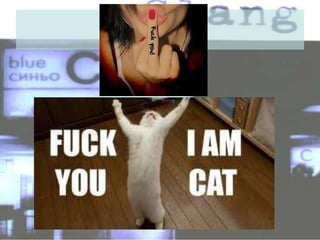
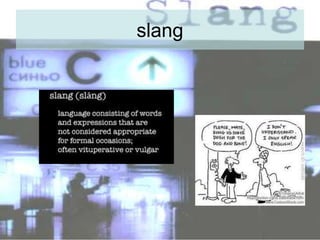
Slang
• is the use of informal words or expressions
that are not considered standard in the
speaker’s language.
• is often used by people in a group that are
familiar with it like teenagers.
• makes speech more emotionally
expressive and shorter.
• is usually taboo when speaking to people of
higher social status.
English or American slang?
• Cockney is history
• The globalisation of culture tends to be
the culture that is globalised in English or
more precise, in American English.
• The vehicle: Rap, hip hop, rock music, …
• http://www.youtube.com/watch?v=u4DJnb
kAvTk
Bad language is nothing new
• Slang says a lot about attitudes,
particularly male attitudes.
• It is related with insults, with racism, with
nationalism, with all forms of cruelty.
• There are 1500 words for fucking, but
there is not word for love.
16th Century
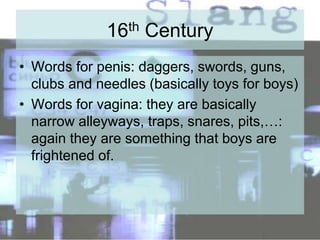
• Words for penis: daggers, swords, guns,
clubs and needles (basically toys for boys)
• Words for vagina: they are basically
narrow alleyways, traps, snares, pits,…:
again they are something that boys are
frightened of.
Slang of American youth
• Slang is ephemeral, and so to survive it
must constantly regenerate;
• Both the ephemeral and regenerative
traits are nowhere more apparent than in
the slang of American youth.
The medium can be the message.
• Slang is the “tribe” identity and the
manifestation of the identity’s benefits.
• At times the primary message is not in the
meaning of what is said.
4 Factors
• The four factors that are the most likely to
produce slang are youth, oppression,
sports and vice, which provide an impetus
to coin and use slang for different
sociolinguistic reasons.
• Of these four factors, youth is the most
powerful stimulus for the creation and
distribution of slang.
My generation
• When we are young, we are subject to the
generational imperative to invent a slang
vocabulary that we perceive as our own.
• We reject the slang of our older brothers
and sisters (let alone our parents) in favor
of a new lexicon.
Born in the USA
• The Global Spread of American Slang
lets young people around the world share
a common culture.
• American slang has become a global
code, with colorful examples from the
music scene.
• http://www.youtube.com/watch?v=u4DJnb
kAvTk
http://www.pbs.org/speak/words/sezwho/globalslang/
Cool, wicked, chill, dope, nerd.
• Young people around the world use this
kind of slang to show they’re connected to
American pop culture.
• Slang’s main social function is to signal
belonging: American slang marks the
speaker or writer as an active and
informed member of global youth
culture.
Exclusive and global
• Vernacular English is powerfully expressive
because — paradoxically — it is both exclusive
and global. In any host society.
• American slang lives in a world of linguistic and
cultural knowledge not available at school.
• American slang lives in the specialized media of
the young, such as CD booklets, songs and
video clips, magazines and Web sites.
Global code for youth
• Through the media, young people enter
fan communities where they learn to
incorporate certain forms of English into
both their speech and writing to show that
they’re a part of youth culture.
• As a result, American slang have become
a global code for youth worldwide
included in a local code — the national
language.
Flipped out = flipar
• When host languages incorporate slang,
speakers inflect loan nouns and verbs just
like native items and build compounds of
English and native nouns.
• For instance, flipped out comes as
ausgeflippt in German, flippato in Italian,
flippé in French, and fliparisménos in
Greek, and flipar in Spanish.
Signals social identity abroad
• Items such as hi, cool and cu ( as in ‘see you’ )
are spreading into general German and Spanish
slang, openers such as aight heads have a
specific social meaning among hip-hop
enthusiasts.
• They identify writer (and addressee) not only as
trendy young people, but as members of the
same fan community, (in this case, Hip Hop).
Conversational Routines
• greetings and farewells — hi, hey, what's
up, bye, cu, peace, cheers
• thanks and apologies — thanx, sorry
• discourse markers — ok, anyway,
whatever, yeah, yes
• various “chunks” — no way! that's all! I'm
ready! let's go! shut up!
Non-standard spellings
• In print and on the Internet, English often
comes with non-standard spellings that
may indicate colloquial or non-standard
pronunciation or may serve as purely
visual distinction.
Vernacular spelling patterns
The following vernacular spelling patterns are
common in various countries:
• participial suffix -in' (e.g. livin', movin', rockin')
• reductions, assimilations (e.g. wanna, ya, mo')
• noun plural ending -a/-ah instead of -er (e.g.
brotha, sistah)
• noun plural ending -z for -s (e.g. newz, boyz,
beatz, propz)
• spelling variants ph and k (e.g. phat, phunky,
kool, komradz)
• lexical substitutions (e.g. u, 2, 4, cu la8tr)
Slang, Globalization and English
as a Foreign Language
• American slang has a global currency in
youth-cultural contexts.
• It is not transmitted through the
institutional teaching of EFL.
• It is the outcome of rapid linguistic transfer
via non-curricular sources, reaching
teenagers before entering English-
language dictionaries.
Slang and EFL
• However, American slang does not
threaten institutional EFL. The relationship
is best viewed as complementary, both
linguistically and in terms of language
attitudes.
• Knowledge of slang extends the
knowledge of English with respect to
particular semantic fields and speech
styles.
Slang and EFL
• Although slang could never substitute for
EFL in its instrumental value, it clearly
connects foreign-language learning with
adolescent cultural experience.
webs
• http://www.slangvocabulary.com/wp/
• http://www.peevish.co.uk/slang/
• http://onlineslangdictionary.com/
• http://www.slangvocabulary.com/wp/
• http://www.urbandictionary.com/
• http://jonathongreen.co.uk/
• http://www.alphadictionary.com/slang/K.html

Slang

  • 2.
  • 3.
    Slang • is theuse of informal words or expressions that are not considered standard in the speaker’s language. • is often used by people in a group that are familiar with it like teenagers. • makes speech more emotionally expressive and shorter. • is usually taboo when speaking to people of higher social status.
  • 4.
    English or Americanslang? • Cockney is history • The globalisation of culture tends to be the culture that is globalised in English or more precise, in American English. • The vehicle: Rap, hip hop, rock music, … • http://www.youtube.com/watch?v=u4DJnb kAvTk
  • 5.
    Bad language isnothing new • Slang says a lot about attitudes, particularly male attitudes. • It is related with insults, with racism, with nationalism, with all forms of cruelty. • There are 1500 words for fucking, but there is not word for love.
  • 6.
    16th Century • Wordsfor penis: daggers, swords, guns, clubs and needles (basically toys for boys) • Words for vagina: they are basically narrow alleyways, traps, snares, pits,…: again they are something that boys are frightened of.
  • 7.
    Slang of Americanyouth • Slang is ephemeral, and so to survive it must constantly regenerate; • Both the ephemeral and regenerative traits are nowhere more apparent than in the slang of American youth.
  • 8.
    The medium canbe the message. • Slang is the “tribe” identity and the manifestation of the identity’s benefits. • At times the primary message is not in the meaning of what is said.
  • 9.
    4 Factors • Thefour factors that are the most likely to produce slang are youth, oppression, sports and vice, which provide an impetus to coin and use slang for different sociolinguistic reasons. • Of these four factors, youth is the most powerful stimulus for the creation and distribution of slang.
  • 10.
    My generation • Whenwe are young, we are subject to the generational imperative to invent a slang vocabulary that we perceive as our own. • We reject the slang of our older brothers and sisters (let alone our parents) in favor of a new lexicon.
  • 11.
    Born in theUSA • The Global Spread of American Slang lets young people around the world share a common culture. • American slang has become a global code, with colorful examples from the music scene. • http://www.youtube.com/watch?v=u4DJnb kAvTk http://www.pbs.org/speak/words/sezwho/globalslang/
  • 12.
    Cool, wicked, chill,dope, nerd. • Young people around the world use this kind of slang to show they’re connected to American pop culture. • Slang’s main social function is to signal belonging: American slang marks the speaker or writer as an active and informed member of global youth culture.
  • 13.
    Exclusive and global •Vernacular English is powerfully expressive because — paradoxically — it is both exclusive and global. In any host society. • American slang lives in a world of linguistic and cultural knowledge not available at school. • American slang lives in the specialized media of the young, such as CD booklets, songs and video clips, magazines and Web sites.
  • 14.
    Global code foryouth • Through the media, young people enter fan communities where they learn to incorporate certain forms of English into both their speech and writing to show that they’re a part of youth culture. • As a result, American slang have become a global code for youth worldwide included in a local code — the national language.
  • 15.
    Flipped out =flipar • When host languages incorporate slang, speakers inflect loan nouns and verbs just like native items and build compounds of English and native nouns. • For instance, flipped out comes as ausgeflippt in German, flippato in Italian, flippé in French, and fliparisménos in Greek, and flipar in Spanish.
  • 16.
    Signals social identityabroad • Items such as hi, cool and cu ( as in ‘see you’ ) are spreading into general German and Spanish slang, openers such as aight heads have a specific social meaning among hip-hop enthusiasts. • They identify writer (and addressee) not only as trendy young people, but as members of the same fan community, (in this case, Hip Hop).
  • 17.
    Conversational Routines • greetingsand farewells — hi, hey, what's up, bye, cu, peace, cheers • thanks and apologies — thanx, sorry • discourse markers — ok, anyway, whatever, yeah, yes • various “chunks” — no way! that's all! I'm ready! let's go! shut up!
  • 18.
    Non-standard spellings • Inprint and on the Internet, English often comes with non-standard spellings that may indicate colloquial or non-standard pronunciation or may serve as purely visual distinction.
  • 19.
    Vernacular spelling patterns Thefollowing vernacular spelling patterns are common in various countries: • participial suffix -in' (e.g. livin', movin', rockin') • reductions, assimilations (e.g. wanna, ya, mo') • noun plural ending -a/-ah instead of -er (e.g. brotha, sistah) • noun plural ending -z for -s (e.g. newz, boyz, beatz, propz) • spelling variants ph and k (e.g. phat, phunky, kool, komradz) • lexical substitutions (e.g. u, 2, 4, cu la8tr)
  • 20.
    Slang, Globalization andEnglish as a Foreign Language • American slang has a global currency in youth-cultural contexts. • It is not transmitted through the institutional teaching of EFL. • It is the outcome of rapid linguistic transfer via non-curricular sources, reaching teenagers before entering English- language dictionaries.
  • 21.
    Slang and EFL •However, American slang does not threaten institutional EFL. The relationship is best viewed as complementary, both linguistically and in terms of language attitudes. • Knowledge of slang extends the knowledge of English with respect to particular semantic fields and speech styles.
  • 22.
    Slang and EFL •Although slang could never substitute for EFL in its instrumental value, it clearly connects foreign-language learning with adolescent cultural experience.
  • 23.
    webs • http://www.slangvocabulary.com/wp/ • http://www.peevish.co.uk/slang/ •http://onlineslangdictionary.com/ • http://www.slangvocabulary.com/wp/ • http://www.urbandictionary.com/ • http://jonathongreen.co.uk/ • http://www.alphadictionary.com/slang/K.html