SkyhookDM: Towards an
Arrow-Native Storage System
Jayjeet Chakraborty, Ivo Jimenez, Sebastiaan Rodriguez Alvarez,
Alexandru Uta, Jeff LeFevre, Carlos Maltzahn
Agenda
● Broader Problem and Solution
● Our approach
● Background
● Design and Architecture
● Evaluations
2
The Broader Problem
● With high speed storage devices like NVMe SSDs serving upto 3GB/s and
networks supporting 25-100Gb/s, CPU is the new bottleneck
● Client-side computation of data and reading from efficient storage formats like
Parquet, ORC exhausts the clients CPUs
● Leads to severely hampered scalability, latency, and throughput
3
Computational Storage as a Solution
● Offload as much compute as possible to the storage layer
● Use the idle CPUs of the storage nodes to perform data filtering, decoding,
decompression
● Accelerated queries due to reduced data movement and increased scalability
4
How is our approach (Skyhook) different ?
● Most computational storage systems require hardware support like SSDs
embedded with FPGAs for offloading compute
○ No extra hardware, use storage nodes CPU, start offloading instantly
○ Does it work ? What are the challenges ?
● Enable compute offloading in existing programmable storage systems without
code changes
○ Easily test out computational storage with your existing storage infrastructure
● Embed data access libraries directly into the storage system
○ Offload metadata management to the storage layer
5
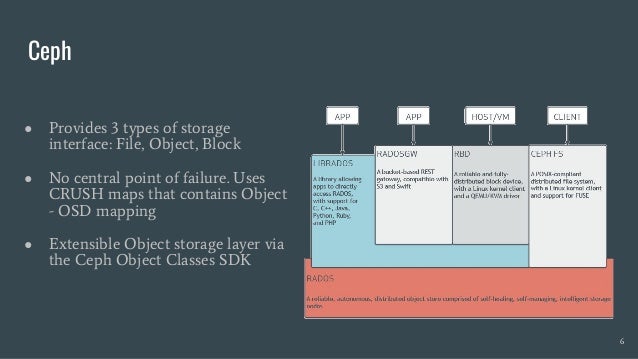
● Provides 3 types of storage
interface: File, Object, Block
● No central point of failure. Uses
CRUSH maps that contains Object
- OSD mapping
● Extensible Object storage layer via
the Ceph Object Classes SDK
Ceph
6
Object Class Mechanism
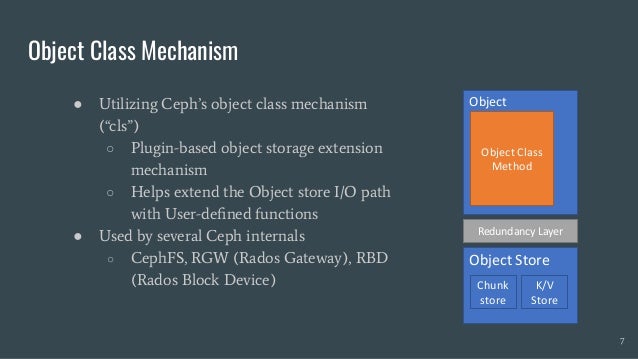
● Utilizing Ceph’s object class mechanism
(“cls”)
○ Plugin-based object storage extension
mechanism
○ Helps extend the Object store I/O path
with User-defined functions
● Used by several Ceph internals
○ CephFS, RGW (Rados Gateway), RBD
(Rados Block Device)
Object
Object Class
Method
Object Store
Redundancy Layer
K/V
Store
Chunk
store
7
Object Class Mechanism
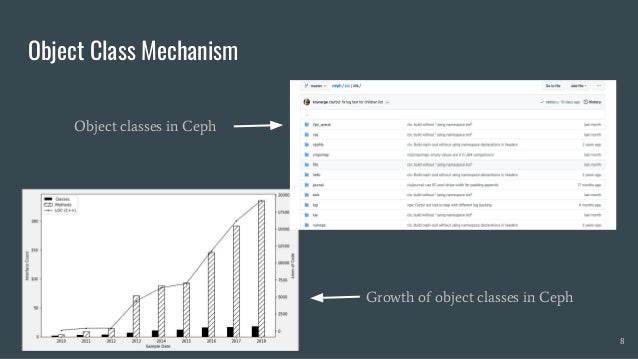
Object classes in Ceph
Growth of object classes in Ceph
8
Apache Arrow
9
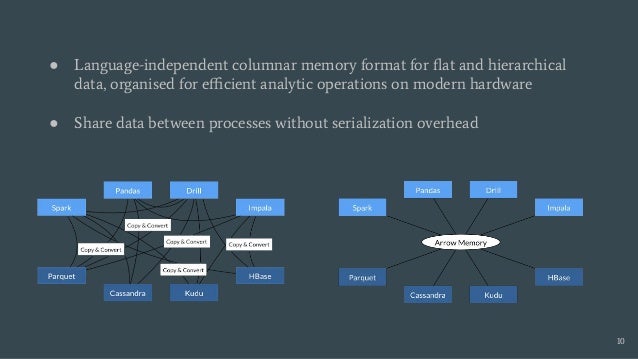
● Language-independent columnar memory format for flat and hierarchical
data, organised for efficient analytic operations on modern hardware
● Share data between processes without serialization overhead
10
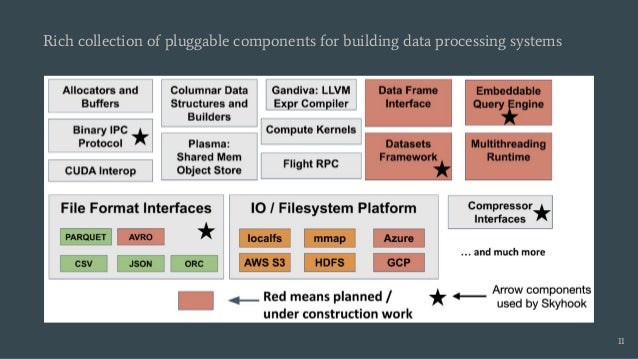
Rich collection of pluggable components for building data processing systems
11
Design Paradigm
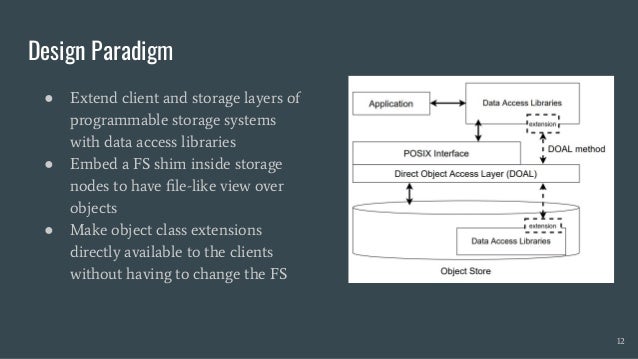
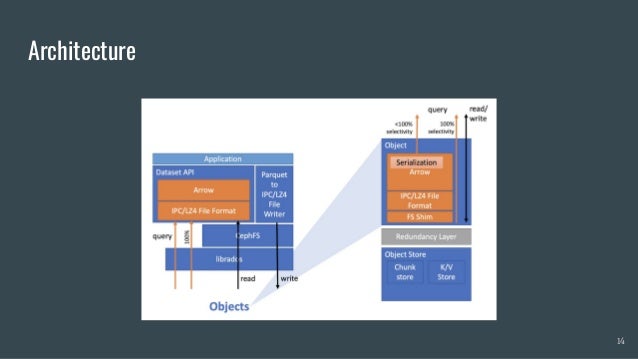
● Extend client and storage layers of
programmable storage systems
with data access libraries
● Embed a FS shim inside storage
nodes to have file-like view over
objects
● Make object class extensions
directly available to the clients
without having to change the FS
12
File Layout
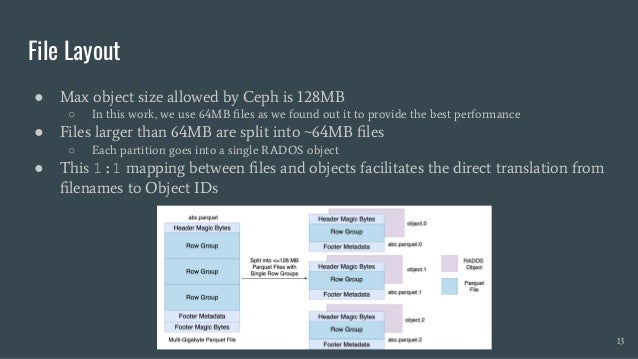
● Max object size allowed by Ceph is 128MB
○ In this work, we use 64MB files as we found out it to provide the best performance
● Files larger than 64MB are split into ~64MB files
○ Each partition goes into a single RADOS object
● This 1:1 mapping between files and objects facilitates the direct translation from
filenames to Object IDs
13
Architecture
14
Using Skyhook from Arrow
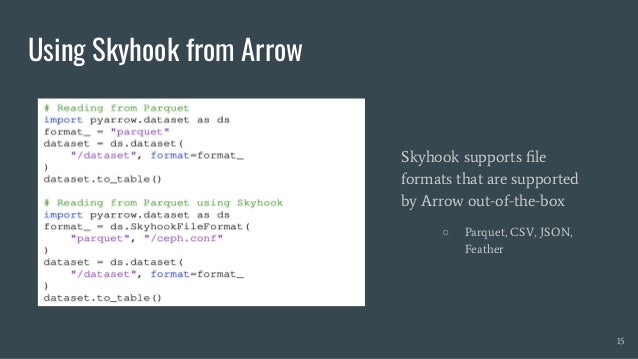
Skyhook supports file
formats that are supported
by Arrow out-of-the-box
○ Parquet, CSV, JSON,
Feather
15
Evaluations
16
Query Latency
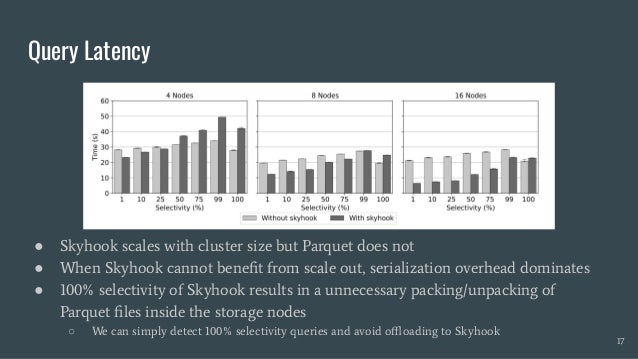
● Skyhook scales with cluster size but Parquet does not
● When Skyhook cannot benefit from scale out, serialization overhead dominates
● 100% selectivity of Skyhook results in a unnecessary packing/unpacking of
Parquet files inside the storage nodes
○ We can simply detect 100% selectivity queries and avoid offloading to Skyhook
17
CPU usage
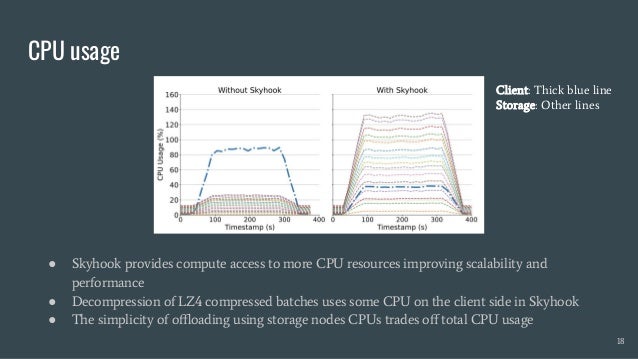
● Skyhook provides compute access to more CPU resources improving scalability and
performance
● Decompression of LZ4 compressed batches uses some CPU on the client side in Skyhook
● The simplicity of offloading using storage nodes CPUs trades off total CPU usage
18
Client: Thick blue line
Storage: Other lines
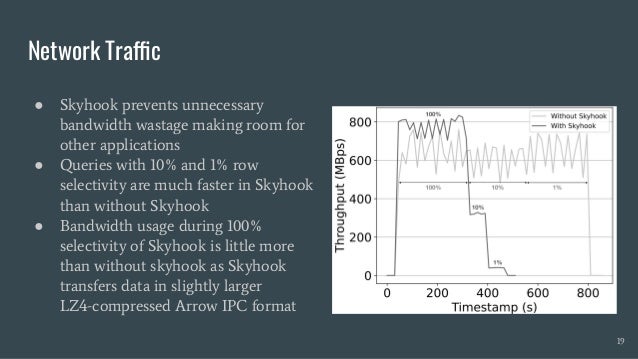
Network Traffic
● Skyhook prevents unnecessary
bandwidth wastage making room for
other applications
● Queries with 10% and 1% row
selectivity are much faster in Skyhook
than without Skyhook
● Bandwidth usage during 100%
selectivity of Skyhook is little more
than without skyhook as Skyhook
transfers data in slightly larger
LZ4-compressed Arrow IPC format
19
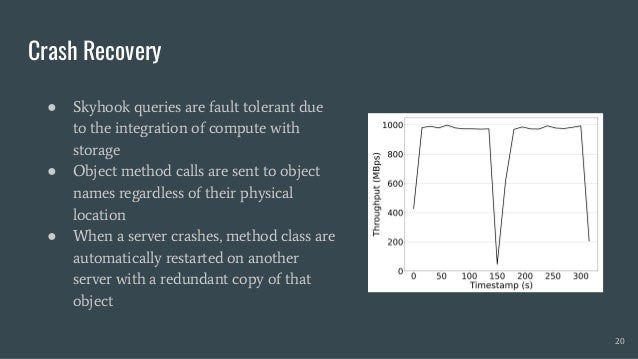
Crash Recovery
● Skyhook queries are fault tolerant due
to the integration of compute with
storage
● Object method calls are sent to object
names regardless of their physical
location
● When a server crashes, method class are
automatically restarted on another
server with a redundant copy of that
object
20
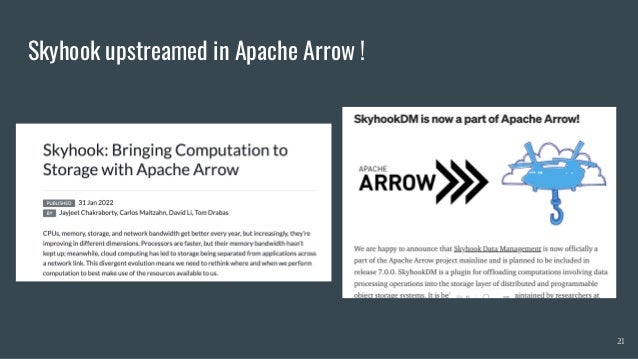
Skyhook upstreamed in Apache Arrow !
21
Future Work
● Support RDMA to transfer result Arrow Record Batches from storage to the client
○ This is to avoid the memory-to-wire serialization overhead
● Move to embedding the Arrow Streaming Compute Engine instead of the Arrow
Dataset API to support offloading more complex compute operations
○ Requires having a streaming interface in Ceph Object Class SDK
● Use Gandiva to accelerate Arrow query processing inside the storage layer
○ Leverage SIMD processing capabilities of modern processors
22
Thank You
jayjeetc@ucsc.edu
23
https://iris-hep.org/projects/skyhookdm.html

Skyhook: Towards an Arrow-Native Storage System, CCGrid 2022

  • 1.
    SkyhookDM: Towards an Arrow-NativeStorage System Jayjeet Chakraborty, Ivo Jimenez, Sebastiaan Rodriguez Alvarez, Alexandru Uta, Jeff LeFevre, Carlos Maltzahn
  • 2.
    Agenda ● Broader Problemand Solution ● Our approach ● Background ● Design and Architecture ● Evaluations 2
  • 3.
    The Broader Problem ●With high speed storage devices like NVMe SSDs serving upto 3GB/s and networks supporting 25-100Gb/s, CPU is the new bottleneck ● Client-side computation of data and reading from efficient storage formats like Parquet, ORC exhausts the clients CPUs ● Leads to severely hampered scalability, latency, and throughput 3
  • 4.
    Computational Storage asa Solution ● Offload as much compute as possible to the storage layer ● Use the idle CPUs of the storage nodes to perform data filtering, decoding, decompression ● Accelerated queries due to reduced data movement and increased scalability 4
  • 5.
    How is ourapproach (Skyhook) different ? ● Most computational storage systems require hardware support like SSDs embedded with FPGAs for offloading compute ○ No extra hardware, use storage nodes CPU, start offloading instantly ○ Does it work ? What are the challenges ? ● Enable compute offloading in existing programmable storage systems without code changes ○ Easily test out computational storage with your existing storage infrastructure ● Embed data access libraries directly into the storage system ○ Offload metadata management to the storage layer 5
  • 6.
    ● Provides 3types of storage interface: File, Object, Block ● No central point of failure. Uses CRUSH maps that contains Object - OSD mapping ● Extensible Object storage layer via the Ceph Object Classes SDK Ceph 6
  • 7.
    Object Class Mechanism ●Utilizing Ceph’s object class mechanism (“cls”) ○ Plugin-based object storage extension mechanism ○ Helps extend the Object store I/O path with User-defined functions ● Used by several Ceph internals ○ CephFS, RGW (Rados Gateway), RBD (Rados Block Device) Object Object Class Method Object Store Redundancy Layer K/V Store Chunk store 7
  • 8.
    Object Class Mechanism Objectclasses in Ceph Growth of object classes in Ceph 8
  • 9.
  • 10.
    ● Language-independent columnarmemory format for flat and hierarchical data, organised for efficient analytic operations on modern hardware ● Share data between processes without serialization overhead 10
  • 11.
    Rich collection ofpluggable components for building data processing systems 11
  • 12.
    Design Paradigm ● Extendclient and storage layers of programmable storage systems with data access libraries ● Embed a FS shim inside storage nodes to have file-like view over objects ● Make object class extensions directly available to the clients without having to change the FS 12
  • 13.
    File Layout ● Maxobject size allowed by Ceph is 128MB ○ In this work, we use 64MB files as we found out it to provide the best performance ● Files larger than 64MB are split into ~64MB files ○ Each partition goes into a single RADOS object ● This 1:1 mapping between files and objects facilitates the direct translation from filenames to Object IDs 13
  • 14.
  • 15.
    Using Skyhook fromArrow Skyhook supports file formats that are supported by Arrow out-of-the-box ○ Parquet, CSV, JSON, Feather 15
  • 16.
  • 17.
    Query Latency ● Skyhookscales with cluster size but Parquet does not ● When Skyhook cannot benefit from scale out, serialization overhead dominates ● 100% selectivity of Skyhook results in a unnecessary packing/unpacking of Parquet files inside the storage nodes ○ We can simply detect 100% selectivity queries and avoid offloading to Skyhook 17
  • 18.
    CPU usage ● Skyhookprovides compute access to more CPU resources improving scalability and performance ● Decompression of LZ4 compressed batches uses some CPU on the client side in Skyhook ● The simplicity of offloading using storage nodes CPUs trades off total CPU usage 18 Client: Thick blue line Storage: Other lines
  • 19.
    Network Traffic ● Skyhookprevents unnecessary bandwidth wastage making room for other applications ● Queries with 10% and 1% row selectivity are much faster in Skyhook than without Skyhook ● Bandwidth usage during 100% selectivity of Skyhook is little more than without skyhook as Skyhook transfers data in slightly larger LZ4-compressed Arrow IPC format 19
  • 20.
    Crash Recovery ● Skyhookqueries are fault tolerant due to the integration of compute with storage ● Object method calls are sent to object names regardless of their physical location ● When a server crashes, method class are automatically restarted on another server with a redundant copy of that object 20
  • 21.
    Skyhook upstreamed inApache Arrow ! 21
  • 22.
    Future Work ● SupportRDMA to transfer result Arrow Record Batches from storage to the client ○ This is to avoid the memory-to-wire serialization overhead ● Move to embedding the Arrow Streaming Compute Engine instead of the Arrow Dataset API to support offloading more complex compute operations ○ Requires having a streaming interface in Ceph Object Class SDK ● Use Gandiva to accelerate Arrow query processing inside the storage layer ○ Leverage SIMD processing capabilities of modern processors 22
  • 23.