CONTENTS
TITLE PAGE
DEDICATION
NOTE TO READERS
GLOSSARY
THE BRANDS
THANK YOU
A GOOD SKINCARE ROUTINE
NOTE	TO	READERS
This	ebook	contains	the	following	accessibility	features	which,	if	supported
by	your	device,	can	be	accessed	via	your	ereader/accessibility	settings:
	
Change	of	font	size	and	line	height
Change	of	background	and	font	colours
Change	of	font
Change	justification
Text	to	speech
Page numbers taken from the following print edition: ISBN
. To see the specialist recommended product CLICK HERE
HOW	SKIN	WORKS
Your	 skin	 is	 incredible.	 Whether	 you’re	 a	 bright	 young	 thing	 without	 a
wrinkle	 in	 sight,	 someone	 who’s	 struggled	 with	 acne	 their	 entire	 lives,	 or	 an
older	person	in	the	first	flushes	of	menopause	wondering	what	the	hell’s	going
on	with	your	complexion,	your	skin	is	still	a	miracle	of	nature.	It’s	hard	at	work
every	day	underneath	all	the	grease,	sweat,	dirt,	pollution,	makeup	and	gunk.
In	fact,	your	skin	is	the	biggest	organ	in	your	body.	It’s	a	living,	breathing
mechanism	and	it’s	working	overtime	for	you.	These	are	just	a	few	of	the	jobs
it’s	doing,	24	hours	a	day:
	
Acting	as	a	waterproof	shield	so	that	vital	nutrients	don’t	leak	out	of	your
body	(gross).
Regulating	 your	 temperature,	 by	 opening	 and	 closing	 blood	 vessels,	 and
perspiring	to	allow	sweat	to	evaporate	and	cool	us	down.
Acting	as	a	barrier	between	your	insides	and	the	many	harmful	toxins	and
microorganisms	in	the	environment.
Sweating	out	waste	products	including	salt	and	ammonia.
Helping	protect	you	from	sun	damage	by	producing	melanin.
Synthesising	vitamin	D	for	strong	bones	and	healthy	organs.
Patching	itself	up	against	the	various	cuts,	bruises,	grazes	and	burns	that	we
get	day	to	day.
Giving	 us	 that	 little	 thing	 known	 as	 the	 sense	 of	 touch,	 which	 we’d	 be
pretty	screwed	without.
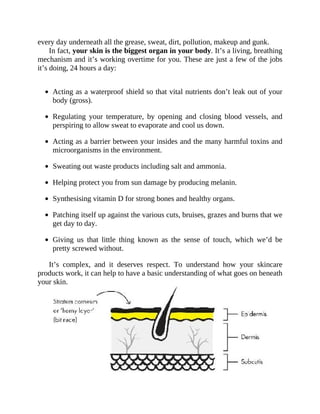
It’s	 complex,	 and	 it	 deserves	 respect.	 To	 understand	 how	 your	 skincare
products	work,	it	can	help	to	have	a	basic	understanding	of	what	goes	on	beneath
your	skin.
EPIDERMIS
This	is	the	outermost	part	of	the	skin,	and	the	bit	that	you	see.	It’s	made	up
of	keratinocytes	(our	skin	cells),	and	is	the	part	of	you	that	keeps	bacteria	at	bay.
It’s	your	first	line	of	defence.
Your	 epidermis	 is	 constantly	 renewing	 and	 regenerating,	 with	 new	 cells
made	in	the	lowest	layer,	the	basal	cells,	and	travelling,	over	the	course	of	about
a	 month,	 to	 the	 top.	 The	 ‘living’	 layers	 of	 cells	 are	 known	 as	 the	 ‘squamous
cells’,	which	eventually	become	a	layer	of	dead	keratinocytes	that	are	constantly
shedding	in	the	stratum	corneum.	This	process	slows	down	as	you	get	older.	So,
making	sure	you’re	keeping	your	skin	clean	and	exfoliated	is	important	if	you
don’t	want	your	complexion	to	look	dull	and	lifeless.
The	 bottom	 layer	 of	 the	 epidermis	 also	 produces	 melanin,	 which	 helps
protect	you	from	UV	rays	and	gives	your	skin	its	colour.	When	you	tan,	your
skin	is	actually	producing	more	melanin	in	an	attempt	to	shield	you	from	the
sun.
Over-the-counter	 skincare	 will	 only	 ever
treat	the	epidermis.	If	you	want	to	go	deeper,
you’ll	need	a	prescription	or	a	needle.
THE	DERMIS
This	 thicker	 layer	 of	 your	 skin	 contains	 the	 blood	 vessels	 and	 nerves	 that
give	 you	 your	 sense	 of	 touch.	 The	 connective	 tissues	 are	 made	 up	 of	 two
proteins:	collagen,	which	gives	skin	its	fullness	and	shape;	and	elastin,	which
gives	skin	its	resilience	and	its	ability	to	‘snap’	back	into	shape.	The	cells	that
make	 these	 proteins	 are	 bathed	 in	 hyaluronic	 acid,	 a	 cellular	 lipid	 that	 holds
water	and	gives	your	skin	its	bounce	and	texture.
When	you	are	young,	the	dermis	is	so	full	of	collagen	and	elastin	that	it	can
bounce	back	into	shape,	but	as	we	age,	they	break	down	faster	than	our	cells	can
replace	them,	and	this	leads	to	wrinkles	and	dry	skin.
The	 dermis	 also	 contains	 your	 hair	 follicles	 and	 oil	 glands,	 as	 well	 as	 the
beginning	of	your	pores,	which	push	hair,	sweat	and	oil	to	the	surface.
SUBCUTANEOUS	TISSUE
This	 is	 a	 layer	 of	 fat	 and	 tissue	 lying	 between	 your	 skin	 and	 muscles.	 It
protects	your	muscles	from	the	beating	your	skin	gets	every	day,	and	insulates
and	regulates	your	body’s	temperature	too.
The	subcutaneous	tissue	layer	tends	to	thin	as	we	age,	and	when	this	happens
our	 skin	 looks	 less	 smooth,	 and	 the	 underlying	 veins	 show	 through.	 It	 also
results	in	cellulite	in	other	areas	of	the	body.
Nobody’s	asking	you	to	go	back	to	biology	class,	but	if	you	understand	the
basics	of	how	your	skin	works,	you	can	start	to	understand	the	claims	that	the
skincare	industry	is	making,	what	works,	and	what’s	totally	impossible,	what	it
does	for	you,	and	what	you	can	do	for	it.
SKINCARE	FOR	ALL	SKIN	TONES
The	skincare	world	is	still	way	behind	where	it	should	be	when	it	comes	to
showing	darker	skins.	Ads,	packaging	and	magazines	still	don’t	feature	as	many
non-white	faces	as	they	should.	And	don’t	get	me	started	on	the	white-washing
of	the	‘wellness’	brigade.	The	advice	in	this	book	is	mostly	for	all	skin	tones,
however	there	are	a	few,	but	significant,	differences	across	skin	tones	when	it
comes	to	taking	care	of	your	skin	day-to-day.
THE	DIFFERENCES	BETWEEN	DARKER	AND
LIGHTER	SKIN	TONES:
The	obvious	difference	is	the	dispersion	of	melanin	in	darker	skin	tones.
Darker	 skin	 has	 more	 melanocytes	 producing	 melanin,	 which,	 as	 we’ve
seen,	is	what	gives	your	skin	its	colour.
The	skin	barrier	of	darker	skin	can	be	more	prone	to	disruption	through	a
process	of	trans-epidermal	water	loss	(TEWL),	because	of	lower	levels	of
ceramides	in	the	stratum	corneum.	This	means	skin	can	feel	rough	and	dry.
When	choosing	moisturisers,	those	with	darker	skin	may	find	it	helpful	to
use	 products	 that	 contain	 natural	 moisturising	 factors	 (NMF),	 or	 are
labelled	as	‘barrier	repair’	or	‘ceramide’	cream.
As	melanin	offers	protection	from	UV	rays,	darker	skins	have	a	natural	SPF
of	around	13.3	compared	to	white	skin’s	3.4	SPF.	This	does	not	mean	that
if	you	have	darker	skin	you	do	not	need	to	use	SPF.	You	do.
Studies	show	that	the	stratum	corneum	is	not	thicker	on	darker	skins,	but	it
is	more	compact.	This	is	good	news	for	the	elasticity	and	tone	of	darker
skin.
A	darker	skin	tone	is	more	prone	to	hypertrophic	or	keloid	scarring,	where
excess	collagen	creates	a	raised	scar.
The	skin	barrier	function	is	mentioned	frequently	in	this	book.	A	soft,
smooth-to-the-touch,	 plump	 skin	 is	 a	 sign	 of	 good	 barrier	 function.	 A
compromised	 barrier	 function	 will	 present	 as	 a	 dull	 skin	 that	 feels	rough
and/or	dry.
Post-inflammatory	hyperpigmentation	(PIH)	can	also	be	an	issue	in	darker
skins.	 The	 discolouration	 (caused	 by	 an	 increase	 in	 melanin)	 can	 occur
during	 the	 wound-healing	 process	 and	 remain	 after	 the	 skin	 has	 healed.
When	checking	ingredient	lists	on	products,	look	for	the	following	to	help
combat	this	pigmentation:
–	vitamin	C
–	kojic	acid
–	arbutin
–	licorice	extracts
–	mequinol
–	niacinamide
–	azelaic	acid
–	N-acetyl	glucosamine
–	hydroquinone
–	cysteamine	cream
–	tretinoin
And	I	can’t	say	it	enough	–	GET	YOUR	SPF	ON.
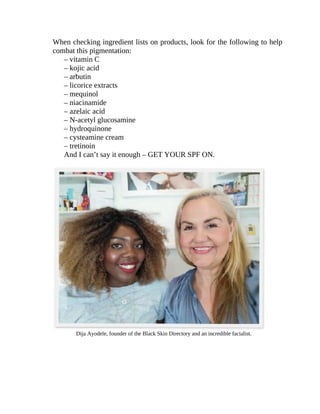
Dija	Ayodele,	founder	of	the	Black	Skin	Directory	and	an	incredible	facialist.
A	GOOD	SKINCARE	ROUTINE
WHERE	TO	START
Our	skin	is	the	biggest	organ	in	your	body,	and	it	deserves	a	bit	of	attention.
But	that	doesn’t	mean	we	all	need	to	be	scientists.	Get	into	a	few	good	habits
with	a	daily	routine	and	you’ll	soon	see	the	benefits.	A	routine	is	the	foundation
of	everything.	And	if	you	get	it	right,	you	can	set	your	skin	up	for	life.	Make	it	a
habit.	Morning	and	evening,	for	2–3	minutes,	or	longer	if	you	want	to	take	the
time	to	enjoy	it.	Make	sure	you	take	the	time.
It’s	easy	to	see	how	your	skincare	routine	can	be	a	little	overwhelming.	We
are	sold	so	many	products	these	days	–	there	is	something	for	everyone	–	but	if
you	have	more	than	two	serums,	which	do	you	use	first?	And	what	about	eye
cream?	 And	 double	 cleansing	 and,	 and…	 stop.	 Chill.	 These	 pages	 explain
exactly	what	needs	to	happen	at	each	stage	of	your	routine.
SOME	BASICS:
You’re	going	to	need	to	buy	some	flannels	or	washcloths.
There	is	no	mineral	oil	anywhere	in	my	routine.	I	don’t	like	it	on	my	skin.
Companies	 use	 it	 for	 two	 reasons:	 1)	 it’s	 not	 likely	 to	 cause	 an	 allergic
reaction,	and	2)	it’s	cheap.
There’s	nothing	foaming.
There’s	nothing	‘mattifying’	(see	here).
I	 don’t	 recommend	 using	 wipes	 unless	 you	 have	 no	 access	 to	 water
(hospitals,	fannies,	flights,	festivals	–	emergencies	only,	you	get	the	idea).
All	stages	are	suitable	for	all	skin	types,	unless	otherwise	stated.
When	I	talk	about	‘bookends’	in	this	chapter	(and	in	skincare	in	general),	I
mean	 cleansing	 and	 moisturising.	 Start	 with	 a	 good	 cleanse	 to	 prep	 your
skin,	and	finish	with	an	appropriate	moisturiser	to	seal	it	all	in	and	protect
your	skin.
BEFORE	WE	BEGIN:
If	it	ain’t	broke,	don’t	fix	it.	If	you	have	a	product	that	you’ve	known	and
loved	for	a	long	time,	and	it	works	for	you,	I’m	not	telling	you	to	change	it.	You
know	your	skin	best.
TOP	TIPS	FOR	GREAT	SKIN
Obviously	 everyone	 is	 different,	 but,	 in	 general,	 these	 are	 your	 basics	 if
you’re	wondering	where	to	start.
	
Cleanse	 your	 skin	 every	 night	 without	 fail	 –	 cleanliness	 is	 next	 to
Godliness.	Double	cleanse	if	you	are	wearing	makeup	or	sunscreen,	or	both
(which	applies	to	most	of	us).
A	little	tip	for	those	of	you	that	say	you	have	no	time:	either	take	your
makeup	off	as	soon	as	you	get	home	OR	take	your	makeup	off	before
you	take	your	bra	off	(if	you	sleep	in	your	bra	or	don’t	wear	one,	then
follow	the	first	tip!).
Cleanse	 your	 skin	 every	 morning.	 It	 obviously	 doesn’t	 have	 to	 be	 as
intense	 as	 the	 night-time	 cleanse,	 but	 a	 quick	 warm	 flannel	 and
milk/balm/gel	 wouldn’t	 go	 amiss	 to	 get	 rid	 of	 the	 overnight	 shedding.	 I
know	some	brands	say	you	don’t	need	to	cleanse	your	skin	in	the	morning.
That’s	okay.	They’re	wrong.
Wash	your	face	properly.	A	clean	canvas	makes	everything	better.	There
is	no	point	in	spending	your	hard-earned	cash	on	expensive	serums	if	you
are	using	wipes	or	winging	it	when	it	comes	to	cleansing.	See	here	for	more
on	cleansing.
Do	not	smoke.	That’s	really	the	beginning	and	end	of	it.
Get	 some	 sunshine.	 The	 term	 ‘everything	 in	 moderation’	 really	 applies
here.	I	work	indoors	all	day	and	live	in	the	northern	hemisphere.	I	don’t	get
a	lot	of	sun	so	I	supplement	with	vitamin	D	(under	doctor’s	advice).	I	don’t
use	 skincare	 with	 SPF:	 I	 apply	 it	 separately	 in	 between	 moisturiser	 and
foundation	or	primer.	SPF	is	too	active	an	ingredient	and	can	interfere	with
other	 anti-ageing	 ingredients,	 making	 all	 of	 your	 expensive	 moisturisers
potentially	redundant.
Yes,	obviously	too	much	sun	is	damaging	to	the	skin,	but	so	is	too	much
chlorine.	 And	 too	 much	 pollution.	 Get	 out	 there	 and	 get	 some	 sunshine.
Some	brands	would	have	us	believe	the	sun	is	the	ultimate	enemy.	That’s
only	true	if	you	don’t	respect	it.	Get	some	sun.	Not	a	lot,	some.	Just	don’t
be	stupid	about	it.
Use	a	high	SPF	(30+)	and	encourage	your	kids	to	use	it.	You	will	save
them	a	lot	of	time	trying	to	repair	sun	damage	in	later	years.
Use	good-quality	skincare.	I’m	not	talking	about	creams	that	cost	more
than	your	monthly	food	budget;	I’m	just	suggesting	you	step	away	from	the
cheap	packet	of	wipes	and	moisturisers	in	the	chemist	or	supermarket	and
step	it	up	a	gear.
Equate	your	skincare	spending	to	what	you	would	spend	on	a	handbag
or	shoes.	I’m	not	saying	you	should	–	I’m	saying	you	should	be	willing	to.
(See	Your	Kit.)
Get	enough	sleep.	When	you	are	not	getting	sufficient	rest,	it	shows	on
your	face.
TITTT:	 take	 it	 to	 the	 tits.	 Your	 neck	 and	 décolleté,	 which	 is	 a	 fancy
French	term	for	your	upper	chest	and	shoulder	area,	are	part	of	your	facial
skincare,	too.
Try	 to	 eat	 well.	 I’m	 not	 being	 a	 killjoy	 –	 a	 little	 of	 what	 you	 fancy
definitely	does	you	good	–	just	don’t	go	overboard.	Gut	health	is	linked	to
healthy	skin	function:	for	example,	taking	probiotics	is	thought	to	support	a
healthy	skin.
Drink	 enough	 water.	 This	 is	 important	 not	 only	 for	 the	 normal
functionality	 of	 your	 skin,	 but	 for	 your	 general	 good	 health,	 too.	 If	 your
urine	is	dark	and	you	suffer	from	a	lot	of	headaches,	you	would	do	well	to
up	your	H2O	levels.
Try	 to	 avoid	 stress.	 I	 know	 it’s	 much	 harder	 than	 it	 sounds,	 but	 do
whatever	you	need	to	do	to	keep	your	stress	levels	low.
MORNING	ROUTINE
The	main	point	of	the	morning	routine	is
to	prep	your	skin	for	the	day.
Taking	care	of	your	skin	in	the	morning	is
no	 different	 to	 having	 a	 shower	 before	 you
put	clean	knickers	on.
You	may	think	this	is	obvious,	but	I	am	contacted	regularly	by	people	who
say,	‘Do	I	really	need	to	cleanse	in	the	mornings?’	Yes.
I	don’t	know	about	you,	but	I	wake	up	with	a	lovely	glow	in	the	mornings	–
maybe	you	do	too?
It’s	called	sweat.	Please	wash	your	face.
SHOWER	FIRST
I	have	never	put	my	face	under	the	shower.	The	water	is	too	hot	for
your	face	(well,	my	choice	of	water	temperature	certainly	is).	You	also	have
the	surfactants	from	your	shampoo	running	all	over	your	face.	Stand	with
your	back	to	the	shower	and	your	chin	raised	–	like	the	shower	has	greatly
offended	you.
Cleanse	when	you	get	out	of	the	shower,	not	before.
FLANNELS
Flannels	get	your	skin	CLEAN.	Think	of	your	parents:	how	did	they
wash	you	when	you	were	a	kid?	They	used	a	flannel.
They	are	more	substantial	than	wipes	or	muslin,	are	far	more	effective
at	removing	dirt,	and	help	exfoliate	the	skin,	too.
Buy	eight	flannels	minimum	and	use	one	a	day	(you’ll	need	the	eighth
flannel	as	a	spare	on	wash	day):	start	with	a	fresh,	clean	flannel	for	your
morning	 cleanse	 and	 use	 the	 same	 flannel	 for	 your	 evening	 cleanse,
chucking	it	in	the	washing	basket	when	you’re	done.
You	don’t	have	to	spend	a	fortune	on	the	plushest,	fluffiest	flannels.
Any	will	do.	But	go	for	white	so	you	get	the	satisfaction	of	seeing	the	muck
come	off.
Machine-wash	 your	 flannels	 so	 they	 get	 properly	 clean,	 but	 avoid
using	fabric	softener,	as	traces	can	end	up	on	your	skin.
#CLEANSE
Any	non-foaming	cleanser	is	fine	–	milk,	balm	(a	little),	gel	–	as	long	as	it
doesn’t	turn	your	face	into	a	foam	bath,	carry	on.	Yes,	you	can	absolutely	use	the
same	 product	 in	 the	 morning	 that	 you	 use	 in	 the	 evening	 if	 you	 want	 to,	 but
you’re	only	cleansing	once.
Use	a	clean	flannel.
#EXFOLIATE
Rather	than	harsh	scrubs	(which	are	thankfully	going	out	of	fashion),	acids
are	about	taking	off	the	layer	of	dead	skin	cells	and,	depending	on	the	type	of
acid,	stimulating	the	skin.	Your	skin’s	surface	is	naturally	acidic,	and	acid
toners	lower	your	skin’s	pH.	They	have	the	effect	of	blowing	a	trumpet	in	your
ear.	Your	skin	is	forced	into	action.
Most	 brands	 make	 exfoliating/acid	 products	 that	 you	 use	 at	 the	 traditional
‘toner’	stage.	To	call	them	a	‘toner’	is	to	do	them	a	great	injustice	–	these	are	the
‘toners’	of	the	21	st	century.
Try	to	have	a	couple	of	exfoliating/acid	products	if	you	can:	a	milder	version
and	a	more	‘active’	one.	There’s	no	point	in	having	two	of	one	type.	Alternate
them	 daily.	 There	 are	 lots	 of	 different	 types	 of	 acid	 but	 the	 main	 ones	 are
glycolic,	lactic	and	salicylic.	If	you	can	only	afford	one,	either	buy	a	mild	one
and	use	it	twice	a	day,	or	a	stronger	one	and	use	it	in	the	evenings	only.	If	you
have	sensitive	skin,	or	you	are	just	concerned	about	using	acids,	start	by	using
them	twice	a	week	and	see	how	your	skin	reacts.
All	packaging	for	anything	with	any	acid	in	it	will	legally	have	to	say	‘avoid
eye	area’.	Unless	you	are	using	a	prescription	strength,	dermatologist-prescribed
hardcore	acid,	it’s	fine.	Apply	the	acidic	toners	on	cotton	pad	or	gauze	then	take
it	around	the	eyes	–	full	circle	–	upper	brow	to	corner	brow	and	under	eye	to
inner	eye	–	and	reverse.
Caveat:	 using	 acids	 twice	 a	 day	 or	 even	 daily	 may	 be	 too	 much	 or
unnecessary	for	some	skins,	especially	if	you	are	also	using	active	ingredients	in
other	products,	such	as	strong	retinoids	in	the	evenings.	If	you’re	new	to	acids,
start	slowly	and	follow	your	skin’s	response.
Go	 easy	 and	 listen	 to	 your	 skin.	 If	 you
have	 overdone	 it	 or	 your	 skin	 feels	 like
you’ve	gone	too	far,	acid	is	the	first	thing	you
should	drop.	Actives	are	the	second.
#SPRAY	HYDRATE
I	love	this	step.	It’s	the	start	of	the	hydrating	process	and	it	wakes	me	up.
Use	whatever	hydrating	flower	mist	or	water	you	like.	Any	spray	should	have
glycerin	 or	 hyaluronic	 acid	 in	 there	 somewhere,	 but	 something	 like	 a	 good-
quality	 rosewater	 is	 fine.	 I	 mean	 good	 quality	 –	 i.e.	 the	 INCI	 (International
Nomenclature	 of	 Cosmetic	 Ingredients)	 list	 is	 proper	 rosewater,	 not	 fragrance
(parfum)	and	colouring.	Check	your	ingredient	labels.
You	can	also	use	your	traditional	‘toner’	at	this	stage,	as	long	as	its	main
function	is	to	hydrate.	Some	traditional	toners	are	designed	to	‘mattify’	or	strip
back	sebum	and	this	is	not	what	we	want.	If	you	are	using	toner	in	this	way,
decant	it	into	a	spray	bottle	and	keep	it	as	a	spray,	too.	Try	to	avoid	alcohol	at
this	stage.
#APPLY	EYE	PRODUCT
Do	not	apply	your	eye	product	last.	No	matter	how	carefully	you	apply	your
serums	and	moisturisers	you	will	always	get	some	in	the	eye	area,	and	then	your
eye	product	won’t	be	absorbed	where	you	want	it	to	be.	Pointless.
Apply	eye	products	to	the	orbital	area	(the	area	covered	by	your	sunglasses)
before	serum,	moisturiser	and	SPF	(you	can	put	these	on	top	of	the	eye	product
if	you	fancy	it	and	it’s	not	a	contraindication).
#APPLY	SERUM/OILS
This	 step	 is	 what	 I	 am	 asked	 about	 the	 most.	 I	 use	 a	 mixture	 of	 oils	 and
serums,	and	application	goes	by	texture.
Serums	–	especially	water-based	ones	–	go	on	first.	Next,	a	couple	of	drops
of	facial	oil	(if	you	are	using	one),	topped	off	with	your	moisturiser.	In	the	case
of	a	heavily	siliconed	serum,	I	would	probably	skip	the	oil	and	go	straight	to
moisturiser.	 Spending	 20	 seconds	 ‘warming’	 your	 serum	 in	 your	 hands	 by
rubbing	them	together	is	a	complete	waste	of	time,	money	and	product,	unless
your	intention	is	to	have	fabulously	soft	palms	(see	here	for	my	‘therapist	hands’
technique	for	dispersing	product	in	the	palms	and	onto	the	fingers).
There	will	always	be	exceptions,	so	if	what	you	are	doing	works	for	you,
don’t	change	it	on	my	account.
#MOISTURISE
Choose	 your	 moisturiser	 according	 to	 your	 skin	 type,	 not	 skin	 condition.
Your	 moisturiser	 is	 your	 coat/protection.	 People	 tend	 to	 spend	 far	 too	 long
choosing	 their	 moisturiser	 and	 far	 too	 little	 time	 taking	 care	 of	 what	 goes	 on
beforehand:	 for	 example,	 using	 a	 quick	 swipe	 of	 a	 wipe,	 slapping	 on	 an
expensive	face	cream	and	then	wondering	why	their	skin	isn’t	great.
Remember	to	avoid	anything	‘mattifying’	–	a	promise	that’s	often	made	on
products	for	oily	skin.	Skin	is	not	designed	to	be	‘matte’.
Your	skin	has	plenty	of	time	to	be	matte
when	you’re	dead.
If	 your	 skin	 is	 excessively	 oily,	 just	 go	 for	 light	 hyaluronic	 acid	 serums,
which	 help	 lock	 in	 moisture,	 and	 oil-free	 moisturisers.	 No	 need	 to	 force	 the
issue.	Leave	that	to	your	makeup.
Whatever	moisturiser	you	are	using	that	is	right	for	your	skin,	whack	it	on
now.
SKINCARE	MYTH
YOUR	SKIN	‘SLEEPS’	DURING	THE
DAY
No.	Your	skin	does	not,	will	not,	and	has	never	‘slept’	during	the	day.
The	other	argument	for	using	different	products	in	the	evening	is	that
your	skin	‘may’	relax	a	little	while	it’s	not	busy	fighting	off	free	radicals.
Funnily	enough,	free	radicals	are	not	particularly	conscious	of	time	and	are,
in	fact,	around	us	24/7,	but	that’s	apparently	by-the-by	for	some	marketing
people.	If	you	wanted	to	really	annoy	someone	you	could	argue	that	as	soon
as	you	breathe	out	carbon	dioxide,	your	face	is	surrounded	by	a	cloud	of
free	radicals.
You	use	different	products	at	night	because	you	don’t	need	SPF	(or
thicker	‘protecting’	moisturisers),	which	means	you	can	use	lighter,	more
effective	formulations	–	serums/oils/retinoids	etc.	–	to	target	and	treat	skin
issues.
AM:	Protect
PM:	Treat	and	repair
‘Your	 skin	 is	 your	 biggest	 organ.’	 Replace	 the	 word	 ‘skin’	 in	 this
sentence	with	‘heart’,	‘brain’,	‘lungs’,	‘kidney’	or	‘liver’	and	see	how	long
you	would	be	alive	for.
‘Your	skin	sleeps	during	the	day’?
Right,	well,	that’s	me	dead	then.
#APPLY	SPF
I	 always	 recommend	 using	 a	 walnut-sized	 dollop	 of	 a	 separate	 SPF.	 A
moisturiser	with	added	SPF	will	not	benefit	the	skin	as	much	as	two	separate
products	will.	I	mean,	it’s	better	than	nothing,	but	wouldn’t	you	rather	be	safe
than	sorry?
Do	 not	 use	 an	 SPF	 instead	 of	 a
moisturiser.
That’s	 like	 going	 out	 all	 day	 with	 a
raincoat	 on	 and	 only	 bra	 and	 knickers
underneath.
Unless	 that	 is	 your	 everyday	 outfit	 of	 choice,	 I	 suggest	 you	 wear	 actual
clothes	(moisturiser)	underneath	your	raincoat	(SPF).	You	should	always	use	a
broad-spectrum	 sunscreen	 (see	 here)	 that	 protects	 against	 UVA	 rays,	 which
damage	your	skin’s	elasticity,	and	UVB	rays,	which	can	cause	skin	damage	and
alter	 the	 structure	 of	 cells,	 potentially	 leading	 to	 skin	 cancer.	 I	 would	 always
recommend	an	SPF30	or	higher.
Make	sure	you	apply	it	everywhere,	including	the	back	of	your	neck	and	the
top	of	your	ears.	Women	typically	apply	their	SPF	before	they	hit	the	beach	and
put	 their	 hair	 in	 a	 ponytail	 the	 minute	 they	 hit	 the	 sand.	 EARS!	 Even	 if	 you
aren’t	on	holiday.
To	 achieve	 the	 SPF	 on	 the	 label,	 you	 need	 2	 milligrams	 of	 sunscreen	 per
square	 centimetre	 of	 the	 area	 (see	 here	 and	 here	 for	 advice	 on	 product
quantities).	The	official	recommendations	change	regularly,	but	current	thinking
is	that	for	the	face,	it’s	a	good	amount	more	than	you	are	used	to	applying	as	a
moisturiser.	Double	it.
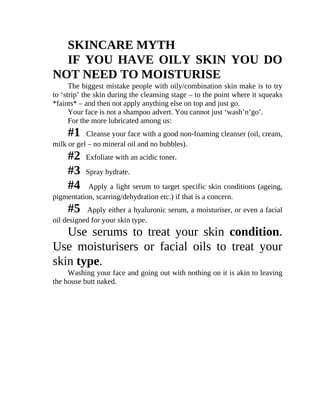
SKINCARE	MYTH
IF	 YOU	 HAVE	 OILY	 SKIN	 YOU	 DO
NOT	NEED	TO	MOISTURISE
The	biggest	mistake	people	with	oily/combination	skin	make	is	to	try
to	‘strip’	the	skin	during	the	cleansing	stage	–	to	the	point	where	it	squeaks
*faints*	–	and	then	not	apply	anything	else	on	top	and	just	go.
Your	face	is	not	a	shampoo	advert.	You	cannot	just	‘wash’n’go’.
For	the	more	lubricated	among	us:
#1			Cleanse	your	face	with	a	good	non-foaming	cleanser	(oil,	cream,
milk	or	gel	–	no	mineral	oil	and	no	bubbles).
#2			Exfoliate	with	an	acidic	toner.
#3			Spray	hydrate.
#4			Apply	a	light	serum	to	target	specific	skin	conditions	(ageing,
pigmentation,	scarring/dehydration	etc.)	if	that	is	a	concern.
#5			Apply	either	a	hyaluronic	serum,	a	moisturiser,	or	even	a	facial
oil	designed	for	your	skin	type.
Use	 serums	 to	 treat	 your	 skin	 condition.
Use	 moisturisers	 or	 facial	 oils	 to	 treat	 your
skin	type.
Washing	your	face	and	going	out	with	nothing	on	it	is	akin	to	leaving
the	house	butt	naked.
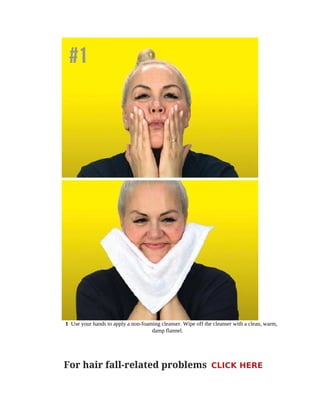
1		Use	your	hands	to	apply	a	non-foaming	cleanser.	Wipe	off	the	cleanser	with	a	clean,	warm,
damp	flannel.
For hair fall-related problems CLICK HERE
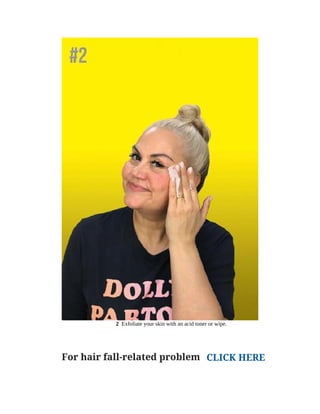
2		Exfoliate	your	skin	with	an	acid	toner	or	wipe.
For hair fall-related problem CLICK HERE
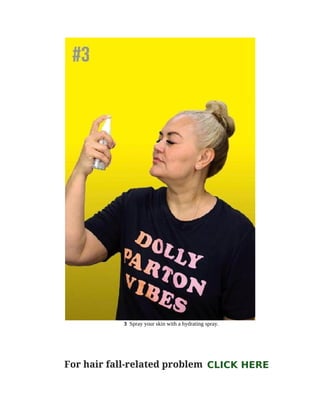
3		Spray	your	skin	with	a	hydrating	spray.
For hair fall-related problem CLICK HERE
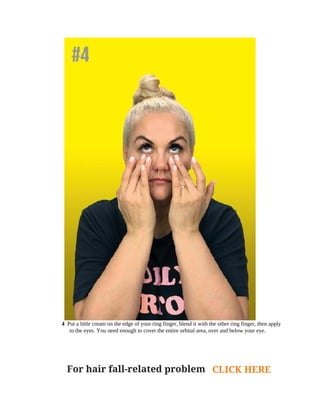
4		Put	a	little	cream	on	the	edge	of	your	ring	finger,	blend	it	with	the	other	ring	finger,	then	apply
to	the	eyes.	You	need	enough	to	cover	the	entire	orbital	area,	over	and	below	your	eye.
For hair fall-related problem CLICK HERE
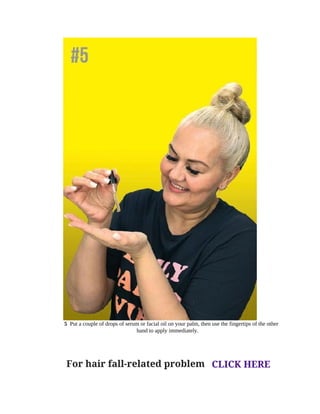
5		Put	a	couple	of	drops	of	serum	or	facial	oil	on	your	palm,	then	use	the	fingertips	of	the	other
hand	to	apply	immediately.
For hair fall-related problem CLICK HERE
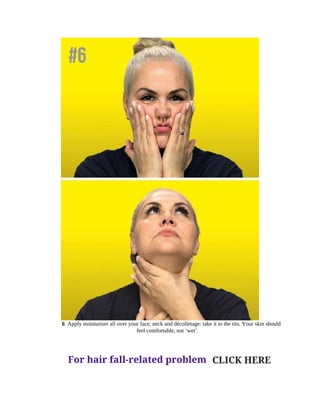
6		Apply	moisturiser	all	over	your	face,	neck	and	décolletage:	take	it	to	the	tits.	Your	skin	should
feel	comfortable,	not	‘wet’.
For hair fall-related problem CLICK HERE
7		Apply	SPF	after	your	moisturiser,	and	make	sure	you	use	enough.
For hair fall-related problem CLICK HERE
VITAMIN	D
Vitamin	D	is	crucial	for	your	overall	health.	I	tell	anyone	who	will
listen	 about	 all	 number	 of	 supplements,	 but	 vitamin	 D	 has	 been	 my
obsession	for	a	while.
Too	much	sun	can	be	bad	for	you	–	really	bad	for	you.	So,	too,	can	too
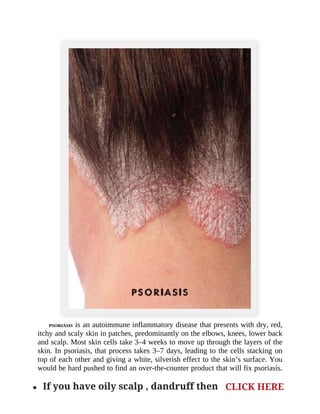
PSORIASIS	is	an	autoimmune	inflammatory	disease	that	presents	with	dry,	red,
itchy	and	scaly	skin	in	patches,	predominantly	on	the	elbows,	knees,	lower	back
and	scalp.	Most	skin	cells	take	3–4	weeks	to	move	up	through	the	layers	of	the
skin.	In	psoriasis,	that	process	takes	3–7	days,	leading	to	the	cells	stacking	on
top	of	each	other	and	giving	a	white,	silverish	effect	to	the	skin’s	surface.	You
would	be	hard	pushed	to	find	an	over-the-counter	product	that	will	fix	psoriasis.
. If you have oily scalp , dandruff then CLICK HERE
repairing	and	supporting.
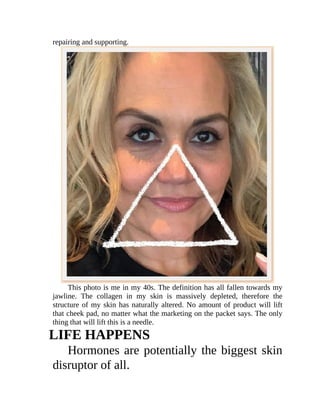
This	photo	is	me	in	my	40s.	The	definition	has	all	fallen	towards	my
jawline.	 The	 collagen	 in	 my	 skin	 is	 massively	 depleted,	 therefore	 the
structure	of	my	skin	has	naturally	altered.	No	amount	of	product	will	lift
that	cheek	pad,	no	matter	what	the	marketing	on	the	packet	says.	The	only
thing	that	will	lift	this	is	a	needle.
LIFE	HAPPENS
Hormones	are	potentially	the	biggest	skin
disruptor	of	all.
WHEN	 SHOULD	 I	 START	 USING
ANTI-AGEING	PRODUCTS?
SPF:	technically	from	birth,	but	most	companies	won’t	advocate	using	SPF
until	your	baby	is	6	months	old.	Keep	them	protected	from	direct	sunlight.
WELCOME	TO	THE	INDUSTRY!
So,	by	now	you	should	have	a	better	idea	what	your	skin	type	is,	how	to
treat	 it,	 and	 the	 products	 you	 need.	 Well,	 here’s	 the	 thing.	 The	 skincare
industry	makes	a	lot	of	money	by	confusing	you.	The	more	knowledge	you	have
about	the	products	available,	the	less	likely	you	are	to	be	persuaded	to	purchase
GLOSSARY
Here	are	a	few	terms	you’ll	come	across	as	you	enter	into	the	world	of
stincare,	along	with	some	of	my	own	favourites.


		500	Dalton	Rule
		
The	argument	that	a	compound	over	500	Daltons	cannot	effectively
penetrate	the	cutaneous	barrier.		
		
		acid	mantle
		
Your	sebum	mixed	with	your	sweat	forms	your	acid	mantle,	which	is	a
very	fine,	slightly	acidic	film	on	the	surface	of	your	skin	that	gives	you	extra
protection	from	bacteria	and	viruses	etc.		
		
		acne
		
or	‘acne	vulgaris’	is	a	skin	condition	that	presents	as	inflamed	skin	with
pustules,	papules	and	nodules.	It	is	not	isolated	to	teens	and	not	caused	by
dirt.	Hormones,	genetics	and	your	environment	are	the	key	factors	here.		
		
		AGEs
		
Advance	glycation	end	products	–	proteins	and	lipids	in	the	skin	that
have	been	altered	by	sugar	molecules	bonding	to	them.		
		
		AHA
		
Alpha	hydroxy	acid	(e.g.	lactic,	glycolic	acid)	–	chemicals	used	in
peels	to	resurface	the	outer	layer	of	the	epidermis	via	exfoliation.		
		
		alpha-lipoic	acid
		
An	enzyme	that,	applied	topically,	acts	as	an	antioxidant	and	is	thought
to	have	skin-calming	properties.		
		
		angel	dusting
		
The	highly	dubious	pratice	of	brands	adding	minuscule	amounts	of
active/expensive	ingredients	to	their	products	to	make	big	claims	on
packaging.		
		
		antioxidant
		
You’ll	see	this	word	used	numerous	times	in	marketing	(and	in	this
book).	Antioxidants	are	molecules	that	help	to	prevent	oxidation,	a	chemical
reaction	that	produces	free	radicals.		
		
		astaxanthin
		
A	powerful	antioxidant	that	can	also	be	taken	internally	via
supplementation.		
		
		azelaic	acid
		
A	fantastic	ingredient	used	as	a	leave-on	exfoliant,	with	proven	benefits
for	acne	skins	and	treating	discolouration	and/or	scarring.	Suitable	for	all
skins.		
		
		bakuchiol
		
A	plant-derived	product	considered	a	suitable	alternative	for	vitamin	A
during	pregnancy	and	breastfeeding,	as	it	is	shown	to	have	a	similar	effect
on	the	skin.		
		
		barrier	function
		
You	will	see	the	term	‘skin	barrier	function’	mentioned	frequently	in
this	book.	The	skin	barrier	resides	primarily	within	the	top	layer	of	the
epidermis,	also	known	as	the	stratum	corneum	or	‘horny	layer’.	A	soft,
plump	skin	is	a	sign	of	good	barrier	function.	A	compromised	barrier
function	will	present	as	dull	skin	that	feels	rough	and/or	dry.	Skin	barrier
function	is	vital	for	maintaining	the	temperature	of	the	skin	and	protection
against	environmental	aggressors,	and	maintains	proper	hydration	in	the
skin.		
		
		basal	cell	carcinoma
		
The	most	common	form	of	skin	cancer.		
		
		BHA
		
Beta	hydroxy	acid	(e.g.	salicylic	acid).		
		
		bookends
		
Cleansers	and	moisturisers	in	your	routine.		
		
		benzoyl	peroxide
		
An	OTC	acne	topical	treatment,	more	popular	in	the	US	than	in
Europe.		
		
		CIBTAC
		
A	qualfication	for	beauty	therapists:	Confederation	of	International
Beauty	Therapy	and	Cosmetologists.		
		
		ClDESCO
		
Comité	International	d’Esthétique	et	de	Cosmétology	–	international
beauty	therapy	and	aesthetics	examination	body.		
		
		collagen
		
The	scaffolding	of	the	skin	and	most	tissue	in	the	body.	A	protein	that
literally	gives	skin	its	structure.		
		
		comedogenic
		
Blocks	pores.		
		
		comedones
		
Small	black	or	skin-coloured	spots	caused	by	sebum	blockage.	Closed
comedones	=	whiteheads.	Open	comedones	=	blackheads.		
		
		Cosmelan
		
An	intensive	depigmentation	chemical	peel,	that	includes	an	in-clinic
treament	and	follow-up	creams.		
		
		coQ10/CoEnzymeQ10
		
Antioxidant.		
		
		cosmeceutical
		
A	made-up,	non-regulated	word	that	insinuates	that	the	product	will
alter	the	biologic	function	of	your	skin.	Marketing.
THE	BRANDS
Here	 are	 some	 of	 the	 brands	 and	 products	 that	 I	 am	 most	 frequently
asked	about.	The	list	is	by	no	means	exhaustive,	and	does	not	include	many
well-known	 brands	 unless	 I	 am	 consistently	 asked	 about	 them	 (or	 one	 of
their	 products).	 I	 have	 distinguished	 between	 brands	 that	 emphasise	 the
‘clean’,	plant-based	source	of	their	ingredients	and	those	that	are	science-
led	and	talk	more	about	the	product	formulas	and	results,	though	it’s	worth
remembering	that	everything	is	a	chemical,	and	everything	comes	out	of	a
lab.	Everything.


		WHO
		
		WHAT
		
		WHERE
		
		Alpha-H
		
Great	Australian	brand,	makers
of	Liquid	Gold.	Science-	and
formula-led.		
		
High	street/home
shopping/facials		
		
		ANR
		
Advanced	Night	Repair,	an
iconic	science-	and	formula-led
product	from	Estée	Lauder.	Suitable
for	all	skins,	especially	popular	with
35+.		
		
Widely	available		
		
		Anthelios
		
A	popular	pharmacy	SPF	by	La
Roche-Posay.	Multiple	options
available.	Science-	and	formula-
led.		
		
Widely	available		
		
		Arbonne
		
They	have	an	ingredients	policy
where	the	first	thing	listed	is	‘pure’.
Although	they	use	some	plant-based
ingredients,	but	not	a	lot.		
		
		Multi-level	marketing
		
		Aveda
		
The	original	‘natural’	brand,
except	they	really	are	ethical.		
		
Widely	available		
		
		Avène
		
French	pharmacy	brand	that
specialises	in	sensitive	skin.		
		
Widely	available		
		
		Beauty	Pie
aka	BP
		
A	science-	and	formula-led
beauty	club	with	multiple	levels	of
		
Online
monthly	subscription	fees.		
		
		belif
		
Korean	beauty	brand	that	is	a	hit
Stateside	for	Sephora.	I’m	a
particular	fan	of	the	moisturisers	–
they’re	brilliant.	They	claim	they
have	the	‘best’	and	‘purest’
ingredients,	which	gives	the
impression	they	are	a	‘natural’
brand,	but	this	is	nonsense.	(That’s
not	an	insult,	just	a	fact.)		
		
Sephora		
		
		Bioderma
		
French	pharmacy	brand	that
makes	the	most	famous			micellar
water.
		
Pharmacy		
		
		Bioeffect
		
Founded	in	Iceland	in	2010,
Bioeffect	is	based	on	an	engineered
plant-based	replica	of	EGF
(epidermal	growth	factor).		
		
High-end	retailers		
		
		Biologique
Recherche
		
A	French	professional	brand	that
makes	the	iconic	P50	and	some	of
the	smelliest,	yet	effective,	skincare
on	the	market.	Popular	with	older
skins.		
		
Professional/clinic
retailers/selected	online
stores		
		
		Caudalie
		
French	spa	brand	that	bases	its
products	on	the	power	of	grape	seeds
as			antioxidants.	Introduce
themselves	as	‘paraben-free	and
natural’	on	their	website	(rather
annoyingly,	as	I	think	they	are	more
scientific	than	the	impression	this
gives).
		
Space	NK/department
store/specialist	retailers		
		
		CeraVe
		
Lauched	in	the	USA	in	2006,
CeraVe	is	based	entirely	on
ceramides	and	replenishing	the	skin
barrier.		
		
Pharmacy		
		
		Cetaphil
		
The	infamous	cleanser	that	is
still,	baffingly,	a	top	seller	in	the
USA.	In	my	opinion,	water,	three
		parabens,	two	alcohols	and	SLS	do
not	a	‘suitable	for	dry	skin’	cleanser
		
Pharmacy
THANK	YOU
This	book	would	not	exist	without	my	readers.	Thank	you,	thank	you,	thank
you	for	trusting	me,	challenging	me	and	supporting	me.	A	special	mention	must
go	to	the	Skin	Freaks	group:	you’re	all	crazy	and	I	wouldn’t	have	it	any	other
way.	 And	 @lizalaska	 who	 coined	 #carolinehironsmademedoit	 and	 started	 a
movement	that	continues	to	astound	me.	THANK	YOU.
The	team	at	HarperCollins,	specifically	Lisa	Milton,	Kate	Fox,	Laura	Nickoll
and	Louise	Evans:	thank	you	for	your	patience.
Megan	Carver:	this	is	kind	of	all	your	fault.	Thank	you	for	telling	me	what	to
do	and	making	it	seem	not	only	feasible,	but	something	that	I	would	enjoy.	Bev
James:	 thank	 you	 for	 your	 guidance,	 support	 and	 your	 calm	 voice	 when	 I’m
having	a	meltdown.	Sarah	Gordon:	thank	you	for	being	completely	unflappable
and	 keeping	 me	 in	 line.	 If	 you	 were	 a	 football	 team,	 you’d	 be	 LFC.	 (Jürgen
Klopp	‘Na	Na	Na	Na	Na’	#YNWA.)
Contrary	to	popular	belief,	I	don’t	want	to	rock	the	boat.	I	don’t	enjoy	it.	But
sometimes	the	boat	just	needs	to	be	knocked	off	course	a	little.	So,	with	that	in
mind,	a	huge	thank	you	to	the	brands	and	retailers	that	stand	on	such	a	strong
foundation	 that	 they	 not	 only	 don’t	 mind	 being	 challenged,	 they	 actively
encourage	it.	There	are	many,	but	it	would	be	remiss	of	me	not	to	give	a	shout
out	to	Alpha-H,	Chantecaille,	Clarins,	Clinique,	Dr	Dennis	Gross,	Emma	Hardie,
Estée	 Lauder,	 Medik8,	 Indeed	 Labs,	 Josh	 Rosebrook,	 Kate	 Somerville,	 May
Lindstrom,	Murad,	OSKIA,	Pixi,	REN,	Sunday	Riley,	Jordan	Samuel,	The	Body
Shop,	 Votary,	 Zelens,	 Debenhams,	 Harvey	 Nichols,	 Harrods,	 John	 Lewis,
Liberty,	 Selfridges,	 Cult	 Beauty,	 Cloud	 10	 and	 Space	 NK,	 all	 of	 whom	 have
supported	 me	 over	 the	 past	 10	 years.	 Thank	 you.	 And	 to	 the	 PRs	 that	 have
sometimes	been	on	the	receiving	end	of	the	rocking	and	have	still	become	good
friends	–	thank	you	(and	sorry,	mate	 ).
Huge	 thanks	 also	 to	 my	 excellent	 doctor	 friends	 for	 their	 advice	 and
guidance:	Dr	Marko	Lens,	Dr	Emma	Wedgeworth,	Dr	Sam	Bunting,	Dr	Justine
Kluk	and	Dr	Joanna	Christou.
My	 ‘keep	 me	 put	 together’	 team:	 Josh	 Wood,	 Melanie	 Smith,	 Daxita
Vaghela	and	Mercedez	Mires.	I	love	you	all	for	making	me	‘look’	put	together
on	the	outside,	even	when	I	don’t	feel	it	on	the	inside.
Thanks	to	my	team	at	No.39:	LouLou,	Christopher,	Molly,	Lucy,	Dom,	Phil
and	 Alex.	 The	 A-Team.	 May	 we	 always	 drink	 tea,	 spend	 hours	 talking	 about
lunch	options	and	never	be	taupe.
Thanks	 to	 my	 family	 and	 friends	 in	 Liverpool,	 Warrington,	 West	 London
and	the	States,	and	my	girlfriends,	both	in	the	industry	and	outside	of	it:	Amanda
Bell,	Ateh	Jewel,	Anna	Newton,	Dija	Ayodele,	Charlene	Garvey,	Joanne	Meek,
Jen	Macrae,	Emma	Guns,	Emily	Dougherty,	Holly	Harper,	Emily	Jane	Johnston,
Hannah	 Martin,	 Heather	 McKay,	 Jamie	 Klinger,	 Jennifer	 Rock,	 Jini	 Sanassy,
Joanna	 Vargas,	 Kate	 Somerville,	 Lily	 Pebbles,	 Lorna	 Andrews,	 Michelle
George,	 Nadine	 Baggott,	 Renée	 Rouleau,	 Ruth	 Crilly,	 Sali	 Hughes,	 Teresa
Tarmey,	 Tracy	 Buchanan,	 Trinny	 Woodall,	 Petra	 Strand,	 Stephanie	 Nicole,
Sheila	 Lund-Pearson,	 Beatrice	 Aidin,	 Lauren	 Mills,	 Sarah	 Coonan,	 Jo
Tutchener-Sharp,	 Shoshana	 Gillis,	 Claire	 Coleman,	 Carly	 O’Brien,	 Zoe	 Cook,
Holly	 Brooke,	 Tracey	 Woodward,	 Funmi	 Fetto,	 Louise	 Woollam,	 Helen
Burnham,	Jorden	Whiffin,	Zoe	Sugg,	Field	of	Dreams.	Thanks,	bitches.
And	 the	 men:	 Sam	 Farmer,	 Kevin	 James	 Bennett,	 David	 Kirsch,	 Dom
Smales,	 George	 Hammer,	 Ian	 Marber,	 Mark	 Aldridge,	 James	 Lamb,	 Andy
Millward,	Tony	Oppe,	Johannes	Bjorklund	and	Felix	Strand	–	thanks,	chaps.
Thanks	to	my	family,	all	of	whom	supported	me	every	step	of	the	way:	Mum
and	Steve,	Dad	and	Theresa,	Christopher,	Michelle,	Ethan,	James	and	Heli	(who
DOES	read	my	blog).
And,	finally,	thanks	to	my	husband	Jim,	our	four	children	Ben,	Dan,	Ava	and
Max,	and	Lily	too.	All	of	this	would	be	utterly	pointless	without	you	all.	I	love
you.
Skincare guide by caroline hirons

Skincare guide by caroline hirons