C E NT R E F O R F U T U R E - R E A D Y G R A D U A T E S
13 Sep 2022 (Tues)
1600-1730h
Dr. Benjamin TAN
Postgraduate Career Advisor
Postgraduate, Graduate and Lifelong Learning
MIND THE GAP!
IDENTIFYING SKILLS
FOR YOUR CV
• Workshop will start at 1602h
• Rename yourself with your Matriculated name eg. Abc Xyz
• Slides will be sent to your NUS email id entered in your post-workshop survey
2.
C E NT R E F O R F U T U R E - R E A D Y G R A D U A T E S
Slides (pdf) will be sent to your NUS email id
after we received your post-workshop survey
3.
Dr Senthil RajaJayapal
senthilr@nus.edu.sg
College of Design and
Engineering,
SCALE Masters Programmes
Saw Swee Hock School of
Public Health, Yong Loo Lin
School of Medicine, Duke-
NUS Medical School
Ms Chan Choy Wah
choywahc@nus.edu.sg
College of Design and
Engineering, SCALE
Masters Programmes
SCALE Masters
Programmes
Mr Ryan Ang
ryanang@nus.edu.sg
School of Computing
Dr May Koh
k.may@nus.edu.sg
Faculty of Arts and
Social Sciences
Faculty of Science
Risk
Management
Institute (RMI)
Mr Raymond Wong
raymondwong@nus.edu.sg
Master of Computing
(Digital Fintech)
SCALE Masters
Programmes
Grad Sch for Integrative
Sciences and Engineering
(ISEP)
Dr Benjamin Tan
benjamin-tan@nus.edu.sg
College of Design and
Engineering
Faculty of Science
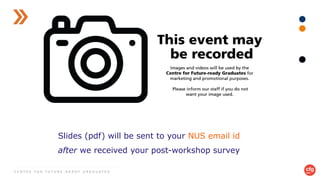
Postgraduate, Graduate & Lifelong Learning (PGL)
Career Advisory Team (wef Aug 2022)
4.
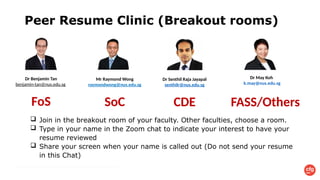
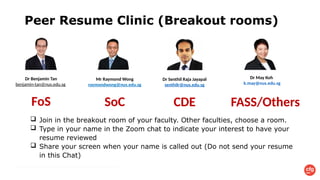
Peer Resume Clinic(Breakout rooms)
Dr Senthil Raja Jayapal
senthilr@nus.edu.sg
CDE
Dr May Koh
k.may@nus.edu.sg
FASS/Others
Mr Raymond Wong
raymondwong@nus.edu.sg
SoC
Join in the breakout room of your faculty. Other faculties, choose a room.
Type in your name in the Zoom chat to indicate your interest to have your
resume reviewed
Share your screen when your name is called out (Do not send your resume
in this Chat)
Dr Benjamin Tan
benjamin-tan@nus.edu.sg
FoS
5.
C E NT R E F O R F U T U R E - R E A D Y G R A D U A T E S
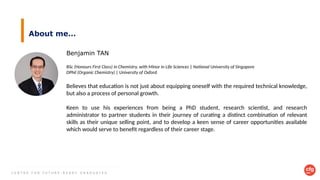
About me…
Benjamin TAN
BSc (Honours First Class) in Chemistry, with Minor in Life Sciences | National University of Singapore
DPhil (Organic Chemistry) | University of Oxford
Believes that education is not just about equipping oneself with the required technical knowledge,
but also a process of personal growth.
Keen to use his experiences from being a PhD student, research scientist, and research
administrator to partner students in their journey of curating a distinct combination of relevant
skills as their unique selling point, and to develop a keen sense of career opportunities available
which would serve to benefit regardless of their career stage.
6.
C E NT R E F O R F U T U R E - R E A D Y G R A D U A T E S
Overview
• Academia or Industry
• Importance of Planning Ahead, Identifying Skill Gaps
• Resume Format
• Basic Techniques for the Resume
• Putting the Resume Together
• Cover Letter
7.
C E NT R E F O R F U T U R E - R E A D Y G R A D U A T E S
Some Questions…
1. I envisioned myself to pursue a career in academia / industry.
2. I know how to equip myself with the right skill set for employment after my PhD
studies.
3. I can no longer continue to pursue research if I work in Industry. True or False??
8.
C E NT R E F O R F U T U R E - R E A D Y G R A D U A T E S
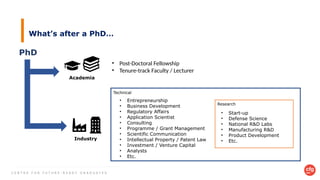
What’s after a PhD…
PhD
Academia
Industry
• Post-Doctoral Fellowship
• Tenure-track Faculty / Lecturer
Technical
Research
• Entrepreneurship
• Business Development
• Regulatory Affairs
• Application Scientist
• Consulting
• Programme / Grant Management
• Scientific Communication
• Intellectual Property / Patent Law
• Investment / Venture Capital
• Analysts
• Etc.
• Start-up
• Defense Science
• National R&D Labs
• Manufacturing R&D
• Product Development
• Etc.
9.
C E NT R E F O R F U T U R E - R E A D Y G R A D U A T E S
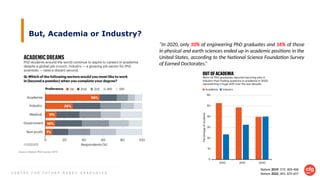
But, Academia or Industry?
Nature 2019, 575, 403-406
Nature 2022, 601, 655-657
“In 2020, only 10% of engineering PhD graduates and 16% of those
in physical and earth sciences ended up in academic positions in the
United States, according to the National Science Foundation Survey
of Earned Doctorates.”
10.
C E NT R E F O R F U T U R E - R E A D Y G R A D U A T E S
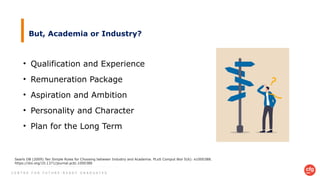
But, Academia or Industry?
Searls DB (2009) Ten Simple Rules for Choosing between Industry and Academia. PLoS Comput Biol 5(6): e1000388.
https://doi.org/10.1371/journal.pcbi.1000388
• Qualification and Experience
• Remuneration Package
• Aspiration and Ambition
• Personality and Character
• Plan for the Long Term
11.
C E NT R E F O R F U T U R E - R E A D Y G R A D U A T E S
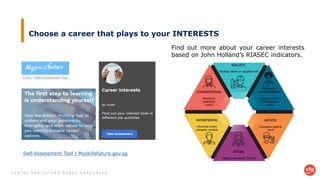
Choose a career that plays to your INTERESTS
Find out more about your career interests
based on John Holland’s RIASEC indicators.
Self-Assessment Tool | Myskillsfuture.gov.sg
12.
C E NT R E F O R F U T U R E - R E A D Y G R A D U A T E S
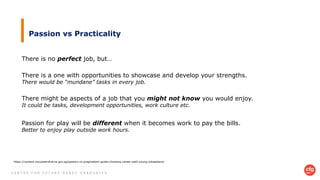
Passion vs Practicality
https://content.mycareersfuture.gov.sg/passion-vs-pragmatism-guide-choosing-career-path-young-jobseekers/
There is no perfect job, but…
There is a one with opportunities to showcase and develop your strengths.
There would be “mundane” tasks in every job.
Passion for play will be different when it becomes work to pay the bills.
Better to enjoy play outside work hours.
There might be aspects of a job that you might not know you would enjoy.
It could be tasks, development opportunities, work culture etc.
13.
C E NT R E F O R F U T U R E - R E A D Y G R A D U A T E S
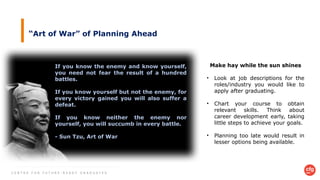
“Art of War” of Planning Ahead
If you know the enemy and know yourself,
you need not fear the result of a hundred
battles.
If you know yourself but not the enemy, for
every victory gained you will also suffer a
defeat.
If you know neither the enemy nor
yourself, you will succumb in every battle.
- Sun Tzu, Art of War
Make hay while the sun shines
• Look at job descriptions for the
roles/industry you would like to
apply after graduating.
• Chart your course to obtain
relevant skills. Think about
career development early, taking
little steps to achieve your goals.
• Planning too late would result in
lesser options being available.
14.
C E NT R E F O R F U T U R E - R E A D Y G R A D U A T E S
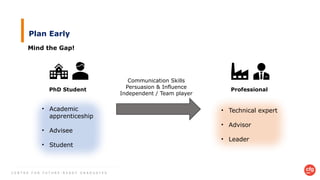
Plan Early
PhD Student Professional
Communication Skills
Persuasion & Influence
Independent / Team player
• Academic
apprenticeship
• Advisee
• Student
• Technical expert
• Advisor
• Leader
Mind the Gap!
15.
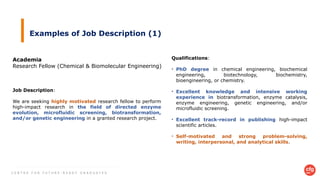
Examples of JobDescription (1)
C E N T R E F O R F U T U R E - R E A D Y G R A D U A T E S
Academia
Research Fellow (Chemical & Biomolecular Engineering)
Job Description:
We are seeking highly motivated research fellow to perform
high-impact research in the field of directed enzyme
evolution, microfluidic screening, biotransformation,
and/or genetic engineering in a granted research project.
Qualifications:
• PhD degree in chemical engineering, biochemical
engineering, biotechnology, biochemistry,
bioengineering, or chemistry.
• Excellent knowledge and intensive working
experience in biotransformation, enzyme catalysis,
enzyme engineering, genetic engineering, and/or
microfluidic screening.
• Excellent track-record in publishing high-impact
scientific articles.
• Self-motivated and strong problem-solving,
writing, interpersonal, and analytical skills.
16.
C E NT R E F O R F U T U R E - R E A D Y G R A D U A T E S
Examples of Job Description (2.1)
About You
• You’re a chemist who loves to solve difficult chemistry problems
and are not discouraged by challenges
• You’re a rigorous experimentalist who takes pride in your ability
to execute at the bench
• You’re collaborative by nature and are happy to jump in and
help
• You’re resourceful and like to work independently but are not
shy to ask for advice
• You’re conscientious and pay almost obsessive attention to
detail, documentation and organization are second nature
• You thrive in a fast-paced environment and enjoy pushing the
edge of what is possible
Scientist 1 – Chemistry [Drug Discovery Start-up]
Position
As a Scientist joining early at <company>, you will be an essential part of an interdisciplinary founding team of highly creative and talented
individuals with outstanding expertise in <company>’s core platform technologies. You will utilize data from our single particle tracking
platform and your knowledge of traditional medicinal and synthetic chemistry to advance our new drug discovery projects. By utilizing
<company>’s platform, you will help design compounds for therapeutic targets, which are inaccessible using conventional assays.
What You’ll Do
• Work with biologists, chemists and engineers to advance our
drive drug discovery pipeline
• Design novel compounds based on synthetic knowledge and
modern medicinal chemistry principles
• Independently plan and conduct multistep syntheses of
complex small molecules, including designing
• Utilize scientific literature and databases to design and
implement efficient synthetic routes
• Clearly analyze, troubleshoot, accurately document and
communicate experimental results
• Maintain a high level of scientific integrity, laboratory safety and
act as a resource for others
• Collaborate and communicate across a diverse research team
to successfully progress time-sensitive scientific goals
17.
C E NT R E F O R F U T U R E - R E A D Y G R A D U A T E S
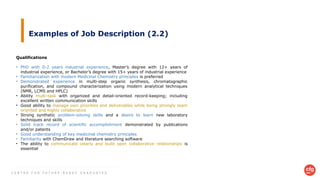
Examples of Job Description (2.2)
Qualifications
• PhD with 0-2 years industrial experience, Master’s degree with 12+ years of
industrial experience, or Bachelor’s degree with 15+ years of industrial experience
• Familiarization with modern Medicinal Chemistry principles is preferred
• Demonstrated experience in multi-step organic synthesis, chromatographic
purification, and compound characterization using modern analytical techniques
(NMR, LCMS and HPLC)
• Ability multi-task with organized and detail-oriented record-keeping; including
excellent written communication skills
• Good ability to manage own priorities and deliverables while being strongly team
oriented and highly collaborative
• Strong synthetic problem-solving skills and a desire to learn new laboratory
techniques and skills
• Solid track record of scientific accomplishment demonstrated by publications
and/or patents
• Good understanding of key medicinal chemistry principles
• Familiarity with ChemDraw and literature searching software
• The ability to communicate clearly and build open collaborative relationships is
essential
18.
C E NT R E F O R F U T U R E - R E A D Y G R A D U A T E S
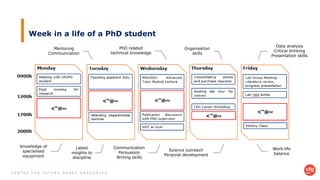
Week in a life of a PhD student
Monday Tuesday Wednesday Thursday Friday
0900h
1200h
1700h
2000h
PHD5001 Advanced
Topic Module Lecture
Teaching assistant duty Lab Group Meeting:
Literature review,
progress presentation
Meeting with UROPS
student
Eqpt training for
research
Publication discussion
with PhD supervisor
Hosting lab tour for
visitors Lab rota duties
Attending Departmental
Seminar
CFG Career Workshop
Consolidating stores
and purchase requests
<“@~
<“@~ <“@~
<“@~
<“@~
HIIT at Gym Pottery Class
Identify development opportunities
19.
C E NT R E F O R F U T U R E - R E A D Y G R A D U A T E S
Week in a life of a PhD student
Mentoring
Communication
Knowledge of
specialised
equipment
Data analysis
Critical thinking
Presentation skills
Science outreach
Personal development
PhD related
technical knowledge
Organisation
skills
Communication
Persuasion
Writing skills
Work-life
balance
Latest
insights to
discipline
20.
C E NT R E F O R F U T U R E - R E A D Y G R A D U A T E S
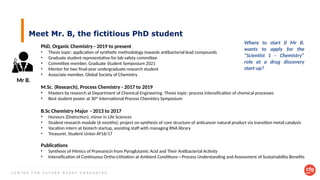
Meet Mr. B, the fictitious PhD student
PhD, Organic Chemistry - 2019 to present
• Thesis topic: application of synthetic methodology towards antibacterial lead compounds
• Graduate student representative for lab safety committee
• Committee member, Graduate Student Symposium 2021
• Mentor for two final-year undergraduate research student
• Associate member, Global Society of Chemistry
M.Sc. (Research), Process Chemistry - 2017 to 2019
• Masters by research at Department of Chemical Engineering. Thesis topic: process intensification of chemical processes
• Best student poster at 30th
International Process Chemistry Symposium
B.Sc Chemistry Major - 2013 to 2017
• Honours (Distinction), minor in Life Sciences
• Student research module (6 months); project on synthesis of core structure of anticancer natural product via transition metal catalysis
• Vacation intern at biotech startup, assisting staff with managing RNA library
• Treasurer, Student Union AY16/17
Mr B.
Publications
• Synthesis of Mimics of Pramanicin from Pyroglutamic Acid and Their Antibacterial Activity
• Intensification of Continuous Ortho-Lithiation at Ambient Conditions—Process Understanding and Assessment of Sustainability Benefits
Where to start if Mr B.
wants to apply for the
“Scientist 1 – Chemistry”
role at a drug discovery
start-up?
21.
C E NT R E F O R F U T U R E - R E A D Y G R A D U A T E S
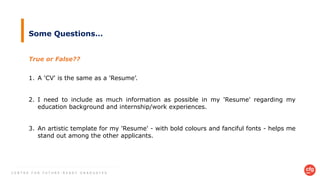
Some Questions…
1. A 'CV' is the same as a 'Resume’.
2. I need to include as much information as possible in my 'Resume' regarding my
education background and internship/work experiences.
3. An artistic template for my 'Resume' - with bold colours and fanciful fonts - helps me
stand out among the other applicants.
True or False??
22.
Adapted from Jobscan:Resume Writing Guide, “https://www.jobscan.co/resume-writing-guide”
C E N T R E F O R F U T U R E - R E A D Y G R A D U A T E S
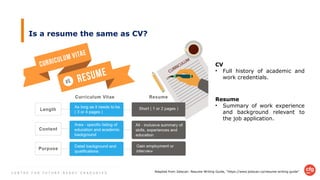
Is a resume the same as CV?
CV
• Full history of academic and
work credentials.
Resume
• Summary of work experience
and background relevant to
the job application.
23.
C E NT R E F O R F U T U R E - R E A D Y G R A D U A T E S
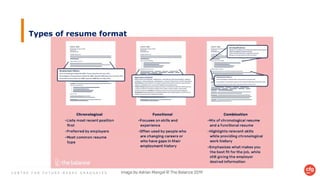
Types of resume format
24.
C E NT R E F O R F U T U R E - R E A D Y G R A D U A T E S
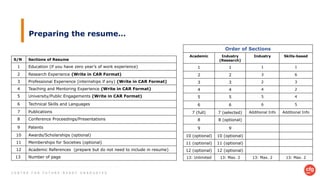
Preparing the resume…
Order of Sections
Academic Industry
(Research)
Industry Skills-based
1 1 1 1
2 2 3 6
3 3 2 3
4 4 4 2
5 5 5 4
6 6 6 5
7 (full) 7 (selected) Additional Info Additional Info
8 8 (optional)
9 9
10 (optional) 10 (optional)
11 (optional) 11 (optional)
12 (optional) 12 (optional)
13: Unlimited 13: Max. 2 13: Max. 2 13: Max. 2
S/N Sections of Resume
1 Education (if you have zero year’s of work experience)
2 Research Experience (Write in CAR Format)
3 Professional Experience (internships if any) (Write in CAR Format)
4 Teaching and Mentoring Experience (Write in CAR Format)
5 University/Public Engagements (Write in CAR Format)
6 Technical Skills and Languages
7 Publications
8 Conference Proceedings/Presentations
9 Patents
10 Awards/Scholarships (optional)
11 Memberships for Societies (optional)
12 Academic References (prepare but do not need to include in resume)
13 Number of page
25.
C E NT R E F O R F U T U R E - R E A D Y G R A D U A T E S
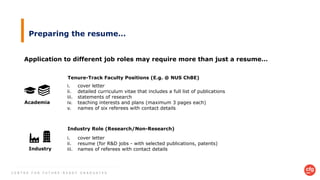
Preparing the resume…
Academia
Industry
i. cover letter
ii. detailed curriculum vitae that includes a full list of publications
iii. statements of research
iv. teaching interests and plans (maximum 3 pages each)
v. names of six referees with contact details
Tenure-Track Faculty Positions (E.g. @ NUS ChBE)
i. cover letter
ii. resume (for R&D jobs - with selected publications, patents)
iii. names of referees with contact details
Industry Role (Research/Non-Research)
Application to different job roles may require more than just a resume…
26.
C E NT R E F O R F U T U R E - R E A D Y G R A D U A T E S
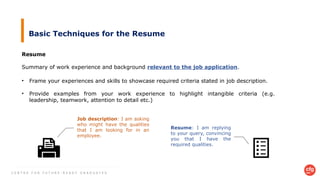
Basic Techniques for the Resume
Resume
Summary of work experience and background relevant to the job application.
• Frame your experiences and skills to showcase required criteria stated in job description.
• Provide examples from your work experience to highlight intangible criteria (e.g.
leadership, teamwork, attention to detail etc.)
Job description: I am asking
who might have the qualities
that I am looking for in an
employee.
Resume: I am replying
to your query, convincing
you that I have the
required qualities.
27.
C E NT R E F O R F U T U R E - R E A D Y G R A D U A T E S
Basic Techniques for the Resume
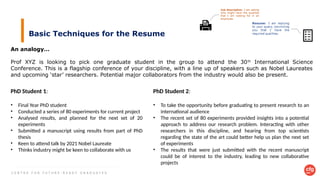
An analogy…
Prof XYZ is looking to pick one graduate student in the group to attend the 30th
International Science
Conference. This is a flagship conference of your discipline, with a line up of speakers such as Nobel Laureates
and upcoming ‘star’ researchers. Potential major collaborators from the industry would also be present.
PhD Student 1:
• Final Year PhD student
• Conducted a series of 80 experiments for current project
• Analysed results, and planned for the next set of 20
experiments
• Submitted a manuscript using results from part of PhD
thesis
• Keen to attend talk by 2021 Nobel Laureate
• Thinks industry might be keen to collaborate with us
PhD Student 2:
• To take the opportunity before graduating to present research to an
international audience
• The recent set of 80 experiments provided insights into a potential
approach to address our research problem. Interacting with other
researchers in this discipline, and hearing from top scientists
regarding the state of the art could better help us plan the next set
of experiments
• The results that were just submitted with the recent manuscript
could be of interest to the industry, leading to new collaborative
projects
28.
C E NT R E F O R F U T U R E - R E A D Y G R A D U A T E S
Basic Techniques for the Resume
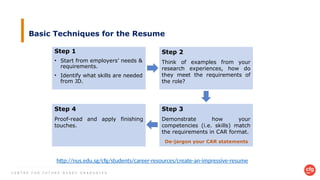
Step 1
• Start from employers’ needs &
requirements.
• Identify what skills are needed
from JD.
Step 2
Think of examples from your
research experiences, how do
they meet the requirements of
the role?
Step 3
Demonstrate how your
competencies (i.e. skills) match
the requirements in CAR format.
Step 4
Proof-read and apply finishing
touches.
http://nus.edu.sg/cfg/students/career-resources/create-an-impressive-resume
De-jargon your CAR statements
29.
C E NT R E F O R F U T U R E - R E A D Y G R A D U A T E S
Basic Techniques for the Resume
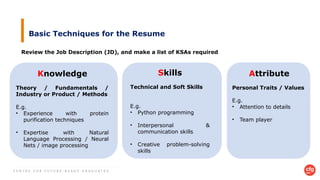
Review the Job Description (JD), and make a list of KSAs required
Knowledge
Theory / Fundamentals /
Industry or Product / Methods
E.g.
• Experience with protein
purification techniques
• Expertise with Natural
Language Processing / Neural
Nets / image processing
Skills
Technical and Soft Skills
E.g.
• Python programming
• Interpersonal &
communication skills
• Creative problem-solving
skills
Attribute
Personal Traits / Values
E.g.
• Attention to details
• Team player
30.
C E NT R E F O R F U T U R E - R E A D Y G R A D U A T E S
Identify the KSAs
About You
• You’re a chemist who loves to solve difficult chemistry problems
and are not discouraged by challenges
• You’re a rigorous experimentalist who takes pride in your ability
to execute at the bench
• You’re collaborative by nature and are happy to jump in and
help
• You’re resourceful and like to work independently but are not
shy to ask for advice
• You’re conscientious and pay almost obsessive attention to
detail, documentation and organization are second nature
• You thrive in a fast-paced environment and enjoy pushing the
edge of what is possible
Scientist 1 – Chemistry [Drug Discovery Start-up]
Position
As a Scientist joining early at <company>, you will be an essential part of an interdisciplinary founding team of highly creative and talented
individuals with outstanding expertise in <company>’s core platform technologies. You will utilize data from our single particle tracking
platform and your knowledge of traditional medicinal and synthetic chemistry to advance our new drug discovery projects. By utilizing
<company>’s platform, you will help design compounds for therapeutic targets, which are inaccessible using conventional assays.
What You’ll Do
• Work with biologists, chemists and engineers to advance our
drive drug discovery pipeline
• Design novel compounds based on synthetic knowledge and
modern medicinal chemistry principles
• Independently plan and conduct multistep syntheses of
complex small molecules, including designing
• Utilize scientific literature and databases to design and
implement efficient synthetic routes
• Clearly analyze, troubleshoot, accurately document and
communicate experimental results
• Maintain a high level of scientific integrity, laboratory safety and
act as a resource for others
• Collaborate and communicate across a diverse research team
to successfully progress time-sensitive scientific goals
31.
C E NT R E F O R F U T U R E - R E A D Y G R A D U A T E S
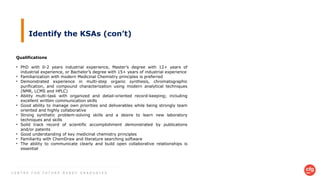
Identify the KSAs (con’t)
Qualifications
• PhD with 0-2 years industrial experience, Master’s degree with 12+ years of
industrial experience, or Bachelor’s degree with 15+ years of industrial experience
• Familiarization with modern Medicinal Chemistry principles is preferred
• Demonstrated experience in multi-step organic synthesis, chromatographic
purification, and compound characterization using modern analytical techniques
(NMR, LCMS and HPLC)
• Ability multi-task with organized and detail-oriented record-keeping; including
excellent written communication skills
• Good ability to manage own priorities and deliverables while being strongly team
oriented and highly collaborative
• Strong synthetic problem-solving skills and a desire to learn new laboratory
techniques and skills
• Solid track record of scientific accomplishment demonstrated by publications
and/or patents
• Good understanding of key medicinal chemistry principles
• Familiarity with ChemDraw and literature searching software
• The ability to communicate clearly and build open collaborative relationships is
essential
32.
C E NT R E F O R F U T U R E - R E A D Y G R A D U A T E S
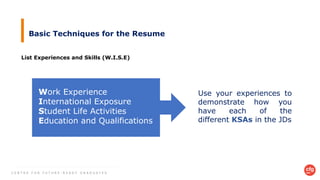
Basic Techniques for the Resume
List Experiences and Skills (W.I.S.E)
Work Experience
International Exposure
Student Life Activities
Education and Qualifications
Use your experiences to
demonstrate how you
have each of the
different KSAs in the JDs
33.
C E NT R E F O R F U T U R E - R E A D Y G R A D U A T E S
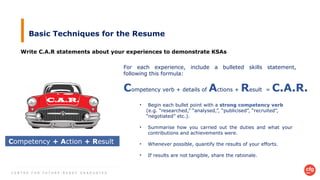
Basic Techniques for the Resume
Write C.A.R statements about your experiences to demonstrate KSAs
C.A.R.
Competency + Action + Result
For each experience, include a bulleted skills statement,
following this formula:
Competency verb + details of Actions + Result = C.A.R.
• Begin each bullet point with a strong competency verb
(e.g. “researched,” “analysed,”, “publicised”, “recruited”,
“negotiated” etc.).
• Summarise how you carried out the duties and what your
contributions and achievements were.
• Whenever possible, quantify the results of your efforts.
• If results are not tangible, share the rationale.
34.
C E NT R E F O R F U T U R E - R E A D Y G R A D U A T E S
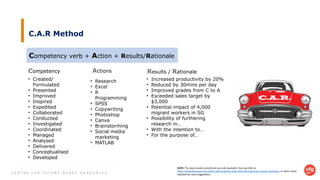
C.A.R Method
Competency Actions Results / Rationale
• Increased productivity by 20%
• Reduced by 30mins per day
• Improved grades from C to A
• Exceeded sales target by
$3,000
• Potential impact of 4,000
migrant workers in SG
• Possibility of furthering
research in…
• With the intention to…
• For the purpose of..
• Created/
Formulated
• Presented
• Improved
• Inspired
• Expedited
• Collaborated
• Conducted
• Investigated
• Coordinated
• Managed
• Analysed
• Delivered
• Conceptualised
• Developed
• Research
• Excel
• R
Programming
• SPSS
• Copywriting
• Photoshop
• Canva
• Brainstorming
• Social media
marketing
• MATLAB
NOTE: The above words and phrases are only examples. You may refer to
https://www.themuse.com/advice/185-powerful-verbs-that-will-make-your-resume-awesome, or other career
websites for more suggestions.
Competency verb + Action + Results/Rationale
C.A.R.
35.
C E NT R E F O R F U T U R E - R E A D Y G R A D U A T E S
C.A.R Method
NOTE: The above words and phrases are only examples. You may refer to
https://www.themuse.com/advice/185-powerful-verbs-that-will-make-your-r
esume-awesome
, or other career websites for more suggestions.
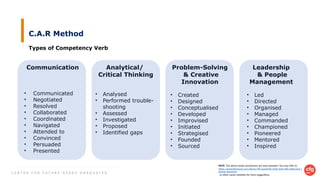
Communication
• Communicated
• Negotiated
• Resolved
• Collaborated
• Coordinated
• Navigated
• Attended to
• Convinced
• Persuaded
• Presented
Analytical/
Critical Thinking
• Analysed
• Performed trouble-
shooting
• Assessed
• Investigated
• Proposed
• Identified gaps
Problem-Solving
& Creative
Innovation
• Created
• Designed
• Conceptualised
• Developed
• Improvised
• Initiated
• Strategised
• Founded
• Sourced
Leadership
& People
Management
• Led
• Directed
• Organised
• Managed
• Commanded
• Championed
• Pioneered
• Mentored
• Inspired
Types of Competency Verb
36.
C E NT R E F O R F U T U R E - R E A D Y G R A D U A T E S
C.A.R Method
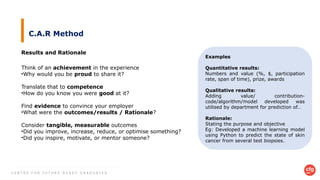
Results and Rationale
Think of an achievement in the experience
•Why would you be proud to share it?
Translate that to competence
•How do you know you were good at it?
Find evidence to convince your employer
•What were the outcomes/results / Rationale?
Consider tangible, measurable outcomes
•Did you improve, increase, reduce, or optimise something?
•Did you inspire, motivate, or mentor someone?
Examples
Quantitative results:
Numbers and value (%, $, participation
rate, span of time), prize, awards
Qualitative results:
Adding value/ contribution-
code/algorithm/model developed was
utilised by department for prediction of…
Rationale:
Stating the purpose and objective
Eg: Developed a machine learning model
using Python to predict the state of skin
cancer from several test biopsies.
37.
C E NT R E F O R F U T U R E - R E A D Y G R A D U A T E S
C.A.R Method - Examples
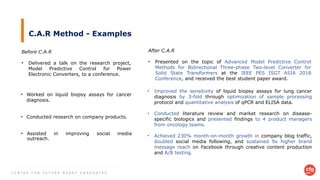
Before C.A.R
• Delivered a talk on the research project,
Model Predictive Control for Power
Electronic Converters, to a conference.
After C.A.R
• Presented on the topic of Advanced Model Predictive Control
Methods for Bidirectional Three-phase Two-level Converter for
Solid State Transformers at the IEEE PES ISGT ASIA 2018
Conference, and received the best student paper award.
• Worked on liquid biopsy assays for cancer
diagnosis.
• Conducted research on company products.
• Assisted in improving social media
outreach.
• Improved the sensitivity of liquid biopsy assays for lung cancer
diagnosis by 3-fold through optimization of sample processing
protocol and quantitative analysis of qPCR and ELISA data.
• Conducted literature review and market research on disease-
specific biologics and presented findings to 4 product managers
from oncology teams.
• Achieved 230% month-on-month growth in company blog traffic,
doubled social media following, and sustained 9x higher brand
message reach on Facebook through creative content production
and A/B testing.
38.
C E NT R E F O R F U T U R E - R E A D Y G R A D U A T E S
De-Jargoning your research
Why de-jargon?
Applying to an industry that is related to your field of research:
HR managers/executives reviewing your resumes might not have your background. (HR,
not the hiring managers, are often the first to look at your application).
Applying to an industry that is not related to your field of research:
Allows HR department and the hiring manager to understand what you have been doing
and how can it be relatable/applicable to the role you have applied.
39.
C E NT R E F O R F U T U R E - R E A D Y G R A D U A T E S
De-Jargoning your research
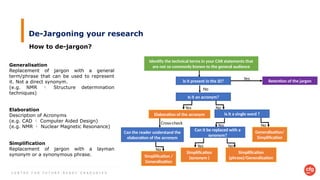
Identify the technical terms in your CAR statements that
are not so commonly known to the general audience
Is it an acronym?
Yes No
Elaboration of the acronym Is it a single word ?
Yes No
Can it be replaced with a
synonym?
Yes No
Simplification
(synonym )
Simplification
(phrase)/Generalisation
Generalisation/
Simplification
Can the reader understand the
elaboration of the acronym
No
Simplification /
Generalisation
Cross-check
Is it present in the JD?
Yes
No
Retention of the jargon
Generalisation
Replacement of jargon with a general
term/phrase that can be used to represent
it. Not a direct synonym.
(e.g. NMR Structure determination
techniques)
Elaboration
Description of Acronyms
(e.g. CAD Computer Aided Design)
(e.g. NMR Nuclear Magnetic Resonance)
Simplification
Replacement of jargon with a layman
synonym or a synonymous phrase.
How to de-jargon?
40.
C E NT R E F O R F U T U R E - R E A D Y G R A D U A T E S
De-Jargoning your research
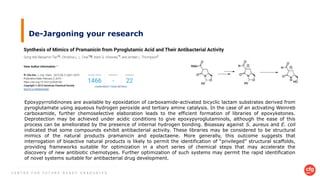
Epoxypyrrolidinones are available by epoxidation of carboxamide-activated bicyclic lactam substrates derived from
pyroglutamate using aqueous hydrogen peroxide and tertiary amine catalysis. In the case of an activating Weinreb
carboxamide, further chemoselective elaboration leads to the efficient formation of libraries of epoxyketones.
Deprotection may be achieved under acidic conditions to give epoxypyroglutaminols, although the ease of this
process can be ameliorated by the presence of internal hydrogen bonding. Bioassay against S. aureus and E. coli
indicated that some compounds exhibit antibacterial activity. These libraries may be considered to be structural
mimics of the natural products pramanicin and epolactaene. More generally, this outcome suggests that
interrogation of bioactive natural products is likely to permit the identification of “privileged” structural scaffolds,
providing frameworks suitable for optimization in a short series of chemical steps that may accelerate the
discovery of new antibiotic chemotypes. Further optimization of such systems may permit the rapid identification
of novel systems suitable for antibacterial drug development.
41.
C E NT R E F O R F U T U R E - R E A D Y G R A D U A T E S
De-Jargoning your research
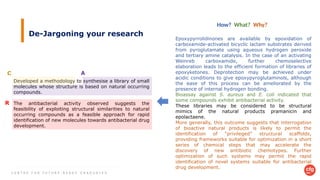
Epoxypyrrolidinones are available by epoxidation of
carboxamide-activated bicyclic lactam substrates derived
from pyroglutamate using aqueous hydrogen peroxide
and tertiary amine catalysis. In the case of an activating
Weinreb carboxamide, further chemoselective
elaboration leads to the efficient formation of libraries of
epoxyketones. Deprotection may be achieved under
acidic conditions to give epoxypyroglutaminols, although
the ease of this process can be ameliorated by the
presence of internal hydrogen bonding.
Bioassay against S. aureus and E. coli indicated that
some compounds exhibit antibacterial activity.
These libraries may be considered to be structural
mimics of the natural products pramanicin and
epolactaene.
More generally, this outcome suggests that interrogation
of bioactive natural products is likely to permit the
identification of “privileged” structural scaffolds,
providing frameworks suitable for optimization in a short
series of chemical steps that may accelerate the
discovery of new antibiotic chemotypes. Further
optimization of such systems may permit the rapid
identification of novel systems suitable for antibacterial
drug development.
Developed a methodology to synthesise a library of small
molecules whose structure is based on natural occurring
compounds.
The antibacterial activity observed suggests the
feasibility of exploiting structural similarities to natural
occurring compounds as a feasible approach for rapid
identification of new molecules towards antibacterial drug
development.
How? What? Why?
C A
R
42.
C E NT R E F O R F U T U R E - R E A D Y G R A D U A T E S
De-Jargoning your research
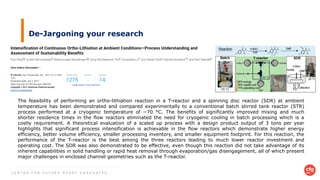
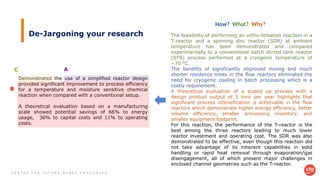
The feasibility of performing an ortho-lithiation reaction in a T-reactor and a spinning disc reactor (SDR) at ambient
temperature has been demonstrated and compared experimentally to a conventional batch stirred tank reactor (STR)
process performed at a cryogenic temperature of −70 °C. The benefits of significantly improved mixing and much
shorter residence times in the flow reactors eliminated the need for cryogenic cooling in batch processing which is a
costly requirement. A theoretical evaluation of a scaled up process with a design product output of 3 tons per year
highlights that significant process intensification is achievable in the flow reactors which demonstrate higher energy
efficiency, better volume efficiency, smaller processing inventory, and smaller equipment footprint. For this reaction, the
performance of the T-reactor is the best among the three reactors leading to much lower reactor investment and
operating cost. The SDR was also demonstrated to be effective, even though this reaction did not take advantage of its
inherent capabilities in solid handling or rapid heat removal through evaporation/gas disengagement, all of which present
major challenges in enclosed channel geometries such as the T-reactor.
43.
C E NT R E F O R F U T U R E - R E A D Y G R A D U A T E S
De-Jargoning your research The feasibility of performing an ortho-lithiation reaction in a
T-reactor and a spinning disc reactor (SDR) at ambient
temperature has been demonstrated and compared
experimentally to a conventional batch stirred tank reactor
(STR) process performed at a cryogenic temperature of
−70 °C.
The benefits of significantly improved mixing and much
shorter residence times in the flow reactors eliminated the
need for cryogenic cooling in batch processing which is a
costly requirement.
A theoretical evaluation of a scaled up process with a
design product output of 3 tons per year highlights that
significant process intensification is achievable in the flow
reactors which demonstrate higher energy efficiency, better
volume efficiency, smaller processing inventory, and
smaller equipment footprint.
For this reaction, the performance of the T-reactor is the
best among the three reactors leading to much lower
reactor investment and operating cost. The SDR was also
demonstrated to be effective, even though this reaction did
not take advantage of its inherent capabilities in solid
handling or rapid heat removal through evaporation/gas
disengagement, all of which present major challenges in
enclosed channel geometries such as the T-reactor.
Demonstrated the use of a simplified reactor design
provided significant improvement to process efficiency
for a temperature and moisture sensitive chemical
reaction when compared with a conventional setup.
A theoretical evaluation based on a manufacturing
scale showed potential savings of 66% to energy
usage, 36% to capital costs and 11% to operating
costs.
How? What? Why?
C A
R
44.
C E NT R E F O R F U T U R E - R E A D Y G R A D U A T E S
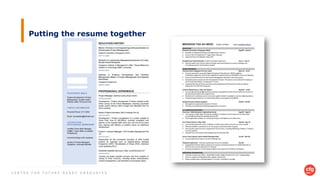
Putting the resume together
45.
C E NT R E F O R F U T U R E - R E A D Y G R A D U A T E S
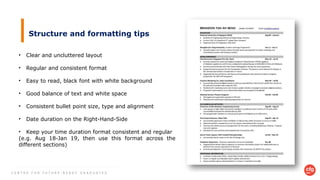
Structure and formatting tips
• Clear and uncluttered layout
• Regular and consistent format
• Easy to read, black font with white background
• Good balance of text and white space
• Consistent bullet point size, type and alignment
• Date duration on the Right-Hand-Side
• Keep your time duration format consistent and regular
(e.g. Aug 18-Jan 19, then use this format across the
different sections)
46.
C E NT R E F O R F U T U R E - R E A D Y G R A D U A T E S
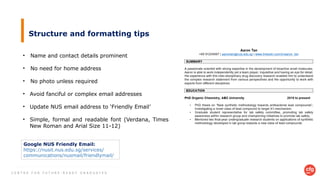
Structure and formatting tips
• Name and contact details prominent
• No need for home address
• No photo unless required
• Avoid fanciful or complex email addresses
• Update NUS email address to ‘Friendly Email’
• Simple, formal and readable font (Verdana, Times
New Roman and Arial Size 11-12)
Google NUS Friendly Email:
https://nusit.nus.edu.sg/services/
communications/nusmail/friendlymail/
47.
C E NT R E F O R F U T U R E - R E A D Y G R A D U A T E S
Structure and formatting tips
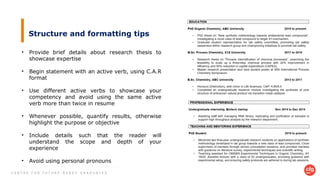
• Provide brief details about research thesis to
showcase expertise
• Begin statement with an active verb, using C.A.R
format
• Use different active verbs to showcase your
competency and avoid using the same active
verb more than twice in resume
• Whenever possible, quantify results, otherwise
highlight the purpose or objective
• Include details such that the reader will
understand the scope and depth of your
experience
• Avoid using personal pronouns
48.
C E NT R E F O R F U T U R E - R E A D Y G R A D U A T E S
Structure and formatting tips
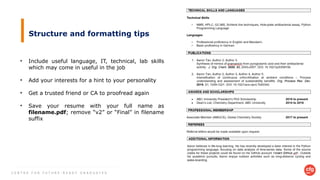
• Include useful language, IT, technical, lab skills
which may come in useful in the job
• Add your interests for a hint to your personality
• Get a trusted friend or CA to proofread again
• Save your resume with your full name as
filename.pdf; remove “v2” or “Final” in filename
suffix
49.
C E NT R E F O R F U T U R E - R E A D Y G R A D U A T E S
Cover Letter
• A 1-page persuasive letter that
complements your factual resume
• Can also be in the form of the email text
that you send the Resume with [for
Post-doctoral positions]
• The cover letter allows you to elaborate
on:
Why you are interested in the job
How your motivations & values align
with the organisation’s
Why the employer should grant you
an interview
Resume
• Summary of your education and
employment history, and other
skills attained
• Bullet listing
• Written in the third person
• Conveys objective information
and states the facts – the who,
what, when, and how
E.g. List of work experiences,
volunteering experiences, etc.
Cover Letter
• Explains why a select few
qualifications match the job
position
• Business letter format
• Written in the first person
• Conveys subjective information
and explains your qualification for
the job – the WHY
E.g. reasons for your interest in a
position/company, why the
culture and values of a company
appeals to you, etc.
50.
C E NT R E F O R F U T U R E - R E A D Y G R A D U A T E S
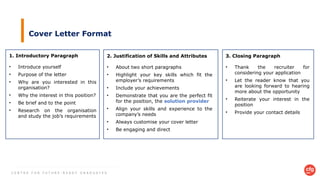
Cover Letter Format
1. Introductory Paragraph
• Introduce yourself
• Purpose of the letter
• Why are you interested in this
organisation?
• Why the interest in this position?
• Be brief and to the point
• Research on the organisation
and study the job’s requirements
3. Closing Paragraph
• Thank the recruiter for
considering your application
• Let the reader know that you
are looking forward to hearing
more about the opportunity
• Reiterate your interest in the
position
• Provide your contact details
2. Justification of Skills and Attributes
• About two short paragraphs
• Highlight your key skills which fit the
employer’s requirements
• Include your achievements
• Demonstrate that you are the perfect fit
for the position, the solution provider
• Align your skills and experience to the
company’s needs
• Always customise your cover letter
• Be engaging and direct
51.
C E NT R E F O R F U T U R E - R E A D Y G R A D U A T E S
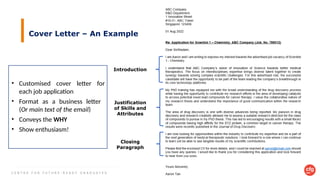
Cover Letter – An Example
Introduction
Justification
of Skills and
Attributes
Closing
Paragraph
• Customised cover letter for
each job application
• Format as a business letter
(Or main text of the email)
• Conveys the WHY
• Show enthusiasm!
52.
C E NT R E F O R F U T U R E - R E A D Y G R A D U A T E S
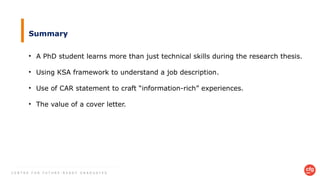
Summary
• A PhD student learns more than just technical skills during the research thesis.
• Using KSA framework to understand a job description.
• Use of CAR statement to craft “information-rich” experiences.
• The value of a cover letter.
53.
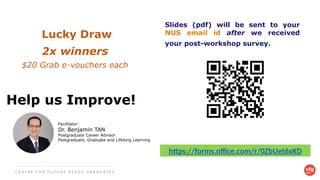
Help us Improve!
CE N T R E F O R F U T U R E - R E A D Y G R A D U A T E S
Slides (pdf) will be sent to your
NUS email id after we received
your post-workshop survey.
https://forms.office.com/r/0ZbUet6xKD
Facilitator:
Dr. Benjamin TAN
Postgraduate Career Advisor
Postgraduate, Graduate and Lifelong Learning
Lucky Draw
2x winners
$20 Grab e-vouchers each
54.
C E NT R E F O R F U T U R E - R E A D Y G R A D U A T E S
Upcoming Events
55.
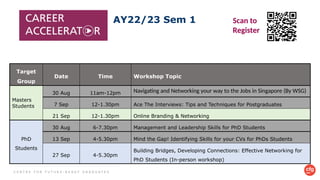
Target
Group
Date Time WorkshopTopic
Masters
Students
30 Aug 11am-12pm Navigating and Networking your way to the Jobs in Singapore (By WSG)
7 Sep 12-1.30pm Ace The Interviews: Tips and Techniques for Postgraduates
21 Sep 12-1.30pm Online Branding & Networking
PhD
Students
30 Aug 6-7.30pm Management and Leadership Skills for PhD Students
13 Sep 4-5.30pm Mind the Gap! Identifying Skills for your CVs for PhDs Students
27 Sep 4-5.30pm
Building Bridges, Developing Connections: Effective Networking for
PhD Students (In-person workshop)
AY22/23 Sem 1 Scan to
Register
C E N T R E F O R F U T U R E - R E A D Y G R A D U A T E S
56.
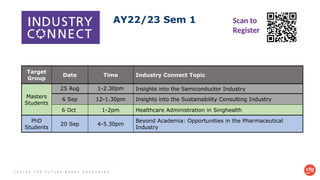
Target
Group
Date Time IndustryConnect Topic
Masters
Students
25 Aug 1-2.30pm Insights into the Semiconductor Industry
6 Sep 12-1.30pm Insights into the Sustainability Consulting Industry
6 Oct 1-2pm Healthcare Administration in Singhealth
PhD
Students
20 Sep 4-5.30pm
Beyond Academia: Opportunities in the Pharmaceutical
Industry
Scan to
Register
AY22/23 Sem 1
C E N T R E F O R F U T U R E - R E A D Y G R A D U A T E S
57.
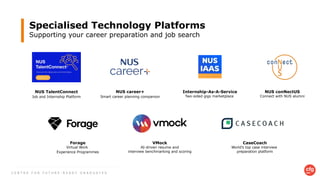
Specialised Technology Platforms
Supportingyour career preparation and job search
NUS TalentConnect
Job and InternshipPlatform
Internship-As-A-Service
Two-sided gigs marketplace
Forage
Virtual Work
Experience Programmes
VMock
AI-driven resume and
interview benchmarking and scoring
NUS career+
Smart career planning companion
CaseCoach
World’s top case interview
preparation platform
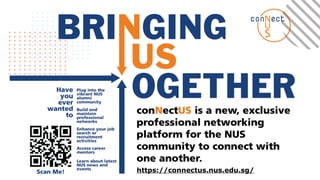
NUS conNectUS
Connect with NUS alumni
C E N T R E F O R F U T U R E - R E A D Y G R A D U A T E S
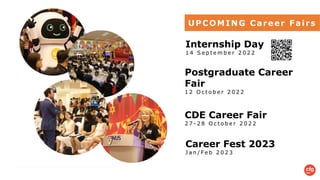
UPCOMING Career Fairs
CareerFest 2023
J a n / F e b 2 0 2 3
Internship Day
1 4 S e p t e m b e r 2 0 2 2
Postgraduate Career
Fair
1 2 O c t o b e r 2 0 2 2
CDE Career Fair
2 7 - 2 8 O c t o b e r 2 0 2 2
63.
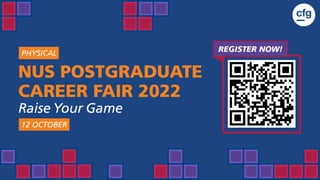
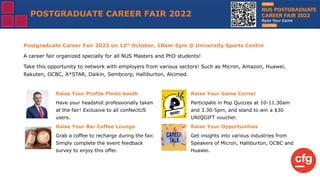
POSTGRADUATE CAREER FAIR2022
Postgraduate Career Fair 2022 on 12th
October, 10am-5pm @ University Sports Centre
A career fair organized specially for all NUS Masters and PhD students!
Take this opportunity to network with employers from various sectors! Such as Micron, Amazon, Huawei,
Rakuten, OCBC, A*STAR, Daikin, Sembcorp, Halliburton, Alcimed.
Raise Your Profile Photo booth
Have your headshot professionally taken
at the fair! Exclusive to all conNectUS
users.
Raise Your Bar Coffee Lounge
Grab a coffee to recharge during the fair.
Simply complete the event feedback
survey to enjoy this offer.
Raise Your Game Corner
Participate in Pop Quizzes at 10-11.30am
and 3.30-5pm, and stand to win a $30
UNIQGIFT voucher.
Raise Your Opportunities
Get insights into various industries from
Speakers of Micron, Halliburton, OCBC and
Huawei.
64.
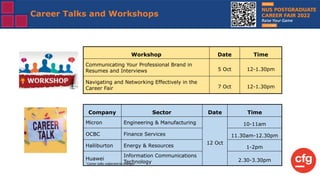
Career Talks andWorkshops
Workshop Date Time
Communicating Your Professional Brand in
Resumes and Interviews 5 Oct 12-1.30pm
Navigating and Networking Effectively in the
Career Fair 7 Oct 12-1.30pm
Company Sector Date Time
Micron Engineering & Manufacturing
12 Oct
10-11am
OCBC Finance Services 11.30am-12.30pm
Halliburton Energy & Resources 1-2pm
Huawei
Information Communications
Technology 2.30-3.30pm
*Career talks subjected to changes
65.
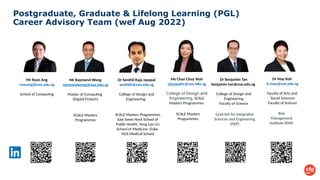
Dr Senthil RajaJayapal
senthilr@nus.edu.sg
College of Design and
Engineering,
SCALE Masters Programmes
Saw Swee Hock School of
Public Health, Yong Loo Lin
School of Medicine, Duke-
NUS Medical School
Ms Chan Choy Wah
choywahc@nus.edu.sg
College of Design and
Engineering, SCALE
Masters Programmes
SCALE Masters
Programmes
Mr Ryan Ang
ryanang@nus.edu.sg
School of Computing
Dr May Koh
k.may@nus.edu.sg
Faculty of Arts and
Social Sciences
Faculty of Science
Risk
Management
Institute (RMI)
Mr Raymond Wong
raymondwong@nus.edu.sg
Master of Computing
(Digital Fintech)
SCALE Masters
Programmes
Grad Sch for Integrative
Sciences and Engineering
(ISEP)
Dr Benjamin Tan
benjamin-tan@nus.edu.sg
College of Design and
Engineering
Faculty of Science
Postgraduate, Graduate & Lifelong Learning (PGL)
Career Advisory Team (wef Aug 2022)
66.
F I ND U S AT:
Yusof Ishak House, Level 2
31 Lower Kent Ridge Rd
Singapore 119078
https://www.facebook.com/nuscfg @nuscfg
NUS Centre for Future-
ready Graduates
Our Website
67.
C E NT R E F O R F U T U R E - R E A D Y G R A D U A T E S
Q&A
68.
Peer Resume Clinic(Breakout rooms)
Dr Senthil Raja Jayapal
senthilr@nus.edu.sg
CDE
Dr May Koh
k.may@nus.edu.sg
FASS/Others
Mr Raymond Wong
raymondwong@nus.edu.sg
SoC
Join in the breakout room of your faculty. Other faculties, choose a room.
Type in your name in the Zoom chat to indicate your interest to have your
resume reviewed
Share your screen when your name is called out (Do not send your resume
in this Chat)
Dr Benjamin Tan
benjamin-tan@nus.edu.sg
FoS
69.
74
This presentation isthe intellectual property of the
Centre for Future-ready Graduates (NUS).
Reproduction and distribution of the presentation
in part or in whole without written permission is prohibited.
Editor's Notes
#2 PollEv.com/li101 >>> PollEv used for online polling?
#3 PollEv.com/li101 >>> PollEv used for online polling?
#13 A PhD student has strengths in the technical skills learnt over the course of writing their thesis – don’t let that go to waste.
A jobs will have ‘challenging’ tasks; it is about finding the middle ground
#22 What you have now may/may not be sufficient to equip you for a desired role, but taking stock is the first step to address the gaps.
Realised that you have much more than you realised.
#23 An example of what experience a PhD student could have.
This is a list of experiences, NOT a CV.
#28 ✓
✕
Skills-based resumes are useful for students who have the technical skills but do not have work experience, or if your work experience is a different industry, but the technical skillsets that you have obtained is much more relevant than your previous job experience.
In this case, your skills section is going to be more relevant to the role that you are applying for than your professional experience section, so you can put it right after education.
#30 Crafting a Resume for a JD is like answer the Reading Task for IELTS, or Comprehension for GRE.
#34 Eikon Therapeutics (14 Jun 2022) [Based in US]
https://jobs.jobvite.com/eikontx/job/o5AZhfwF
Orange – soft skills; blue – technical skills
#42 The CAR framework is very useful in creating impactful points to talk about your experiences. Its an acronym, where C stands for competency, A stands for Action, and R stands for Results or Rationale.
C/Competency: You will want to start off with an impactful competency action verb. For example, Led a group of 8 members, you can immediately see that the competency mention here is leadership. READ
A/Action: Then you go on to describe what you actually did to demonstrate the leadership ability, and mention the approaches and methods used. In this case, it is to organize the annual panel discussion through detailed brainstorming sessions and working closely with external vendors
R: At the end you talk about the results or rationale. The event successfully attracted a breakthrough attendance of 500 participants. So results can be Quantitative or Qualitative. Numbers can add value to your statement, did you improve something by a certain %, or save a certain amount of money for the company. Qualitative results can be how you added value or contributed to the organization. For e.g. the model developed was utilised by the department for prediction of…
Lastly, if you cannot think of a quantitative or qualitative result, you can state the Rationale. Which is the purpose/goal of this experience
#43 Not much of an issue for academia roles, as the hiring manager (who is a technical expert in the field) very likely will read your resume directly
#49 Which would you choose?
So firstly, psychology research has shown that people normally read top to bottom and left to right, so the person’s focus is normally on the left side. The left side of the page is where you want to put down all the information that will bring you to the interview stage, such as your relevant experiences.
Another thing about columns, or text boxes, is that if the company you are applying to is using ATS (Applicant tracking system) to screen the resumes, first what the system does is to convert your resume to text format. Then it may read the resume left to right across two different columns, rather than top to bottom on the left column, then top to bottom on the right column. In that case, your resume will not make sense to them.

![C E N T R E F O R F U T U R E - R E A D Y G R A D U A T E S
Examples of Job Description (2.1)
About You
• You’re a chemist who loves to solve difficult chemistry problems
and are not discouraged by challenges
• You’re a rigorous experimentalist who takes pride in your ability
to execute at the bench
• You’re collaborative by nature and are happy to jump in and
help
• You’re resourceful and like to work independently but are not
shy to ask for advice
• You’re conscientious and pay almost obsessive attention to
detail, documentation and organization are second nature
• You thrive in a fast-paced environment and enjoy pushing the
edge of what is possible
Scientist 1 – Chemistry [Drug Discovery Start-up]
Position
As a Scientist joining early at <company>, you will be an essential part of an interdisciplinary founding team of highly creative and talented
individuals with outstanding expertise in <company>’s core platform technologies. You will utilize data from our single particle tracking
platform and your knowledge of traditional medicinal and synthetic chemistry to advance our new drug discovery projects. By utilizing
<company>’s platform, you will help design compounds for therapeutic targets, which are inaccessible using conventional assays.
What You’ll Do
• Work with biologists, chemists and engineers to advance our
drive drug discovery pipeline
• Design novel compounds based on synthetic knowledge and
modern medicinal chemistry principles
• Independently plan and conduct multistep syntheses of
complex small molecules, including designing
• Utilize scientific literature and databases to design and
implement efficient synthetic routes
• Clearly analyze, troubleshoot, accurately document and
communicate experimental results
• Maintain a high level of scientific integrity, laboratory safety and
act as a resource for others
• Collaborate and communicate across a diverse research team
to successfully progress time-sensitive scientific goals](https://image.slidesharecdn.com/skillsforcvphd2022-250225140100-93dc7c49/85/Skills-for-CV-PhD_2022-slide-deck-powerpoint-16-320.jpg)

![C E N T R E F O R F U T U R E - R E A D Y G R A D U A T E S
Identify the KSAs
About You
• You’re a chemist who loves to solve difficult chemistry problems
and are not discouraged by challenges
• You’re a rigorous experimentalist who takes pride in your ability
to execute at the bench
• You’re collaborative by nature and are happy to jump in and
help
• You’re resourceful and like to work independently but are not
shy to ask for advice
• You’re conscientious and pay almost obsessive attention to
detail, documentation and organization are second nature
• You thrive in a fast-paced environment and enjoy pushing the
edge of what is possible
Scientist 1 – Chemistry [Drug Discovery Start-up]
Position
As a Scientist joining early at <company>, you will be an essential part of an interdisciplinary founding team of highly creative and talented
individuals with outstanding expertise in <company>’s core platform technologies. You will utilize data from our single particle tracking
platform and your knowledge of traditional medicinal and synthetic chemistry to advance our new drug discovery projects. By utilizing
<company>’s platform, you will help design compounds for therapeutic targets, which are inaccessible using conventional assays.
What You’ll Do
• Work with biologists, chemists and engineers to advance our
drive drug discovery pipeline
• Design novel compounds based on synthetic knowledge and
modern medicinal chemistry principles
• Independently plan and conduct multistep syntheses of
complex small molecules, including designing
• Utilize scientific literature and databases to design and
implement efficient synthetic routes
• Clearly analyze, troubleshoot, accurately document and
communicate experimental results
• Maintain a high level of scientific integrity, laboratory safety and
act as a resource for others
• Collaborate and communicate across a diverse research team
to successfully progress time-sensitive scientific goals](https://image.slidesharecdn.com/skillsforcvphd2022-250225140100-93dc7c49/85/Skills-for-CV-PhD_2022-slide-deck-powerpoint-30-320.jpg)
![C E N T R E F O R F U T U R E - R E A D Y G R A D U A T E S
Cover Letter
• A 1-page persuasive letter that
complements your factual resume
• Can also be in the form of the email text
that you send the Resume with [for
Post-doctoral positions]
• The cover letter allows you to elaborate
on:
Why you are interested in the job
How your motivations & values align
with the organisation’s
Why the employer should grant you
an interview
Resume
• Summary of your education and
employment history, and other
skills attained
• Bullet listing
• Written in the third person
• Conveys objective information
and states the facts – the who,
what, when, and how
E.g. List of work experiences,
volunteering experiences, etc.
Cover Letter
• Explains why a select few
qualifications match the job
position
• Business letter format
• Written in the first person
• Conveys subjective information
and explains your qualification for
the job – the WHY
E.g. reasons for your interest in a
position/company, why the
culture and values of a company
appeals to you, etc.](https://image.slidesharecdn.com/skillsforcvphd2022-250225140100-93dc7c49/85/Skills-for-CV-PhD_2022-slide-deck-powerpoint-49-320.jpg)