Jason BrownSKEPTICAMP IN THEORY AND PRACTICEWho? What? Why? How?
First, a little historyBarCamp started in 2005Skepticamp was born in 2007In 2009, Martin Bridgstock brought the idea to BrisskepticonIn 2010, the idea was still fermentingTAM Australia provided the nudge we needed
So, what is it?SkeptiCamps are informal, community-organized conferences borne from the desire for people to share and learn in an open environment. Everyone from casual skeptics to the experienced participate, give talks and get to know each other.Diverging from the traditional lecture events which have dominated skepticism for decades, these ‘open events’ tear down the barriers to organizing substantive (and fun) events by building on the wildly-successful BarCampconference model from the tech community.
Open format doesn’t mean “no rules”Barcamp suggests eight rulesSkepticamp adds one more:“Be prepared to cite your sources on any claim that is likely to be challenged”
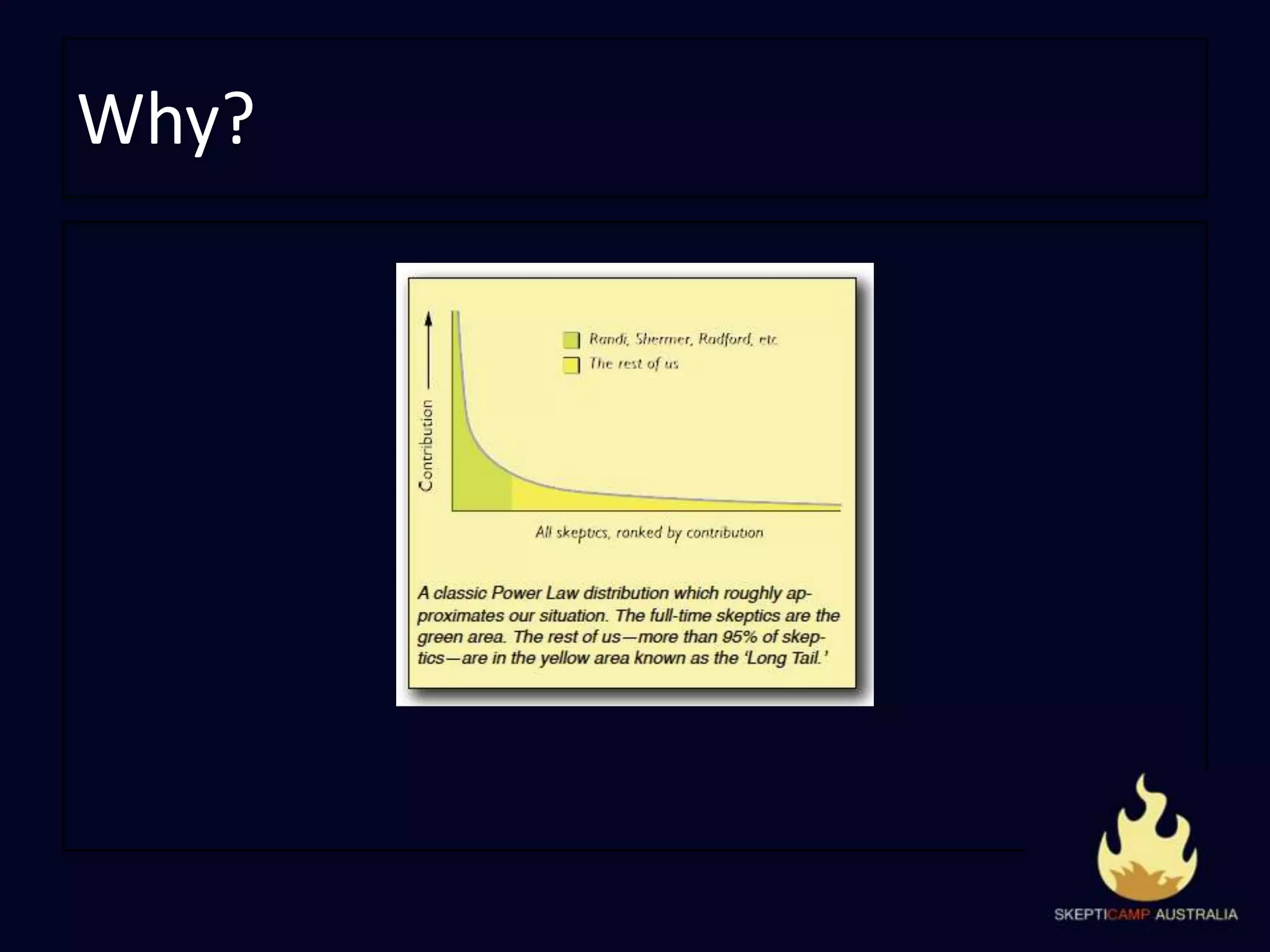
Why?
How?Attend. Well done, you’ve done that bit.Spread the wordOrganiseInfect others
Skepticamp Australiahttp://skepticampaustralia.orghttp://facebook.com/skepticampaustraliahttp://twitter.com/skepticampauhttp://groups.google.com/group/skepticamp-australiaTALK TO AN ORGANISER
Any Questions?

Skepticamp in theory and practice

Editor's Notes

  • #2 This is an adaptation of the short talk I gave at Skepticamp Sydney 2011 on the 30th April. It’s a bit padded out, but I encourage you to slow me down as much as you like with questions – that’s what Skepticamp is all about – the exchange of informationI break it into WHO – history and personalitiesWHAT – what is skepticampWHY – why do we do itAnd HOW – how is it done, and how do you get involved?
  • #3 This is the WhoBarCampis now a mature model, having appeared back in the dim, distant reaches of 2005. IT’s the model we’re based on, a collaborative unconferenceThe first experimental Skepticamp happened in Denver in 2007, co-organised by Reed Esau, Rich Ludwig and Crystal Yates-White, and marked a tipping point in low-cost user-driven events. Organisational tools such as Meetup.com, Facebook and other online technologies had driven the costs of promoting events downwards. BarCamp had provided the model. The boom in skeptical groups worldwide has given a sufficient user base.Reed Esau wrote a piece for Skeptic.com entitled “raising our game” in October 2008, advocating Skepticamp and outlining, in a scholarly fashion, the rationale behind the user-driven unconferencemodel. This was a major stepping stone in gaining widespread acceptance for Skepticamp in North AmericaIn 2009, Martin Bridgstock talked about Skepticamp at the Australian Skeptics National Conference in Brisbane. Much discussion was had during this event, and our own Dave The Happy Singer got involved and brought the idea back to Sydney, where I first started thinking about it properlyDiscussions went on occasionally, but the momentum was still lacking and we needed a nudgeTAM Australia gave us the nudge we needed. The night before TAM opened, Skepticator Live happened. Compered by myself and Dave the Happy Singer, this event was a popular hit, even though it made an overall financial loss. Fred Bremer of Vancouver Skeptics went as far as to nickname it Australia’s first Skepticamp.So Skepticamp was very much on my mind the next day when I spoke on an activism panel. When the question came up “What would I do if I had a budget”, there was really only one answer. And the rest is, as of today, history.
  • #4 But what does this mean?The format is this: a day of short timeslots, in a conference setting, open to anyone who wants to speak. 10 to 15 minutes to talk, and a similar period for questions, and an encouraging atmosphere to foster further discussionTheattendees *are* the speakers, organisers, sponsors and everything besides. No-one is a paid speaker, and no-one in the “organising committee” chose the speakers. Instead of a top-down event, as TAM, or Brisskepticon, or QED, Skepticamps are grassroots events, emergent from the community. There’s nothing, of course, wrong with a top-down event, but there’s plenty to say about its counterpartFor instance, it democratises the content. Even niche views or unpopular views have the chance to be heard. The skeptical “big end of town” have equal chances of participation to the newest of skeptics. The emphasis moves away from perceived “speaker quality” aspects and into quality of discourse instead.The scale allows for much more wide-ranging discussion and the low-cost format can cut lead times and allow for more frequent, smaller events with a lower barrier to entry. For instance, today was free to enter thanks to the efforts of organisers and sponsors. The emphasis is on openness, and that includes getting in to the event. Skepticamps run at as low a cost as possible, and are generally free to participants. Sydney was free to enter, and thanks to some generous sponsors, AS included, and attendee donations, we were able to not only provide lunch and prizes, but also a bar tab afterwards to keep the exchange going in a social setting. Future events will try their best to follow this format, and with ongoing commitment from sponsors, should grow and expand.
  • #5 1st Rule: You do talk about BarCamp.2nd Rule: You do blog about BarCamp.3rd Rule: If you want to present, you must write your topic and name in a presentation slot.4th Rule: Only three word intros.5th Rule: As many presentations at a time as facilities allow for.6th Rule: No pre-scheduled presentations, no tourists.7th Rule: Presentations will go on as long as they have to or until they run into another presentation slot.8th Rule: If this is your first time at BarCamp, you HAVE to present. (Ok, you don't really HAVE to, but try to find someone to present with, or at least ask questions and be an interactive participant.And the Skepticamp Rule, in fact the skeptic rule: Be prepared to cite your sources on any claim that is likely to be challenged
  • #6 Why?Because we as grassroots, part-time skeptics are part of the long tail. Many of us put an extraordinary amount of effort in, but our reach is limited. Grassroots deserve a platform, and Skepticamp can help provide that.There are a small number of very high impact, full-time skeptics, such asJames RandiPhil PlaitMichael ShermerDJ GrothePz Myers and Richard DawkinsAnd locally we have a number of luminaries who get semi-regular TV and radio exposure. However there are many thousands of skeptics out there with a lower reach, ranging from journalists, bloggers and tweeters, podcasters right down to casual skeptics who attend maybe one or two events a yearImagine a graph where the upward axis is impact, and the outward axis is individual skeptics ranked by their decreasing contribution, There’s plenty of impact to the left of the graph, but an equal or even greater area to the right at the grassroots end of the scale.Skepticamp is about striving enable the right-hand end of the graph, the “long tail”
  • #7 So how do we “do” skepticampFirst: attend. The events are up and running and they’re there for you the skepticsSecond, follow rules one and two: spread the word. Talk about it, write about it, sing about it, whateverThird: organise. Get involved. We have a wiki, a google group, discussion forums and plenty of channels whereby you can get in touch with the skepticamp team(s). Get involved as an organiser or a sponsor or a promoterFourth, infect others with the bug. It’s all about getting others fired up for skepticamp, and then getting them to infect others, like a giant zombie outbreak of skepticism
  • #8 Get involved to organise
  • #9 Get involved to organise