Course: Solid Mechanics - Degree in Architecture
Spaghetti truss competition
Sizing and optimizing truss members.
Instructor: Maribel Castilla @maribelcastilla
Course: Solid Mechanics. Degree in Architecture
Sizing and optimizing spaghetti truss members
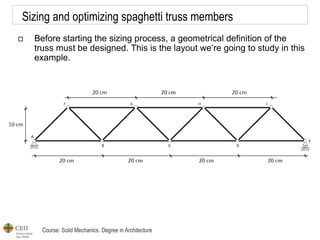
 Before starting the sizing process, a geometrical definition of the
truss must be designed. This is the layout we’re going to study in this
example.
Course: Solid Mechanics. Degree in Architecture
Sizing and optimizing spaghetti truss members
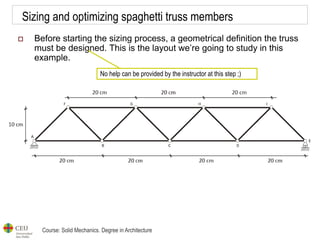
 Before starting the sizing process, a geometrical definition the truss
must be designed. This is the layout we’re going to study in this
example.
No help can be provided by the instructor at this step ;)
Course: Solid Mechanics. Degree in Architecture
Sizing and optimizing spaghetti truss members
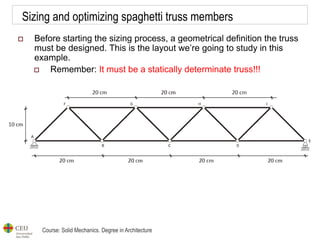
 Before starting the sizing process, a geometrical definition the truss
must be designed. This is the layout we’re going to study in this
example.
 Remember: It must be a statically determinate truss!!!
Course: Solid Mechanics. Degree in Architecture
Sizing and optimizing spaghetti truss members
 Let’s analyze one of the girders.
Course: Solid Mechanics. Degree in Architecture
Sizing and optimizing spaghetti truss members
 Let’s analyze one of the girders.
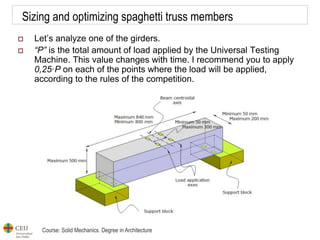
 “P” is the total amount of load applied by the Universal Testing
Machine. This value changes with time. I recommend you to apply
0,25·P on each of the points where the load will be applied,
according to the rules of the competition.
Course: Solid Mechanics. Degree in Architecture
Sizing and optimizing spaghetti truss members
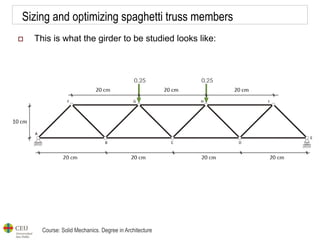
 This is what the girder to be studied looks like:
Course: Solid Mechanics. Degree in Architecture
Sizing and optimizing spaghetti truss members
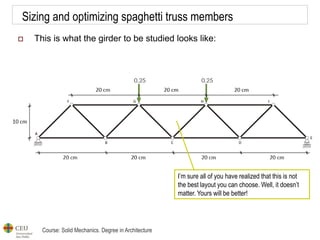
 This is what the girder to be studied looks like:
I’m sure all of you have realized that this is not
the best layout you can choose. Well, it doesn’t
matter. Yours will be better!
Course: Solid Mechanics. Degree in Architecture
Sizing and optimizing spaghetti truss members
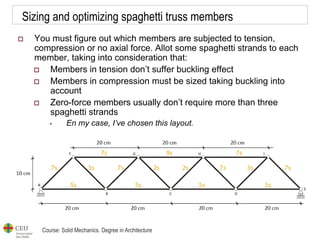
 You must figure out which members are subjected to tension,
compression or no axial force. Allot some spaghetti strands to each
member, taking into consideration that:
 Members in tension don’t suffer buckling effect
 Members in compression must be sized taking buckling into
account
 Zero-force members usually don’t require more than three
spaghetti strands
• En my case, I’ve chosen this layout.
Course: Solid Mechanics. Degree in Architecture
Sizing and optimizing spaghetti truss members
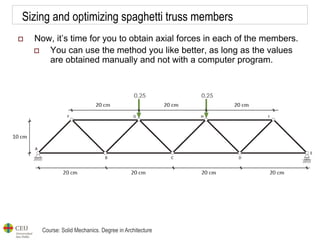
 Now, it’s time for you to obtain axial forces in each of the members.
 You can use the method you like better, as long as the values
are obtained manually and not with a computer program.
Course: Solid Mechanics. Degree in Architecture
Sizing and optimizing spaghetti truss members
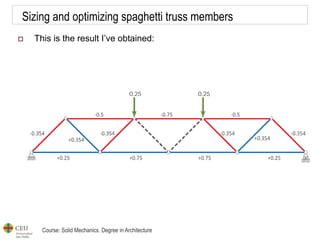
 This is the result I’ve obtained:
Course: Solid Mechanics. Degree in Architecture
Sizing and optimizing spaghetti truss members
 Next step: Take each of the members and stablish a relationship
between the axial force that it is bearing and the maximum axial
force that that member is able to bear with the amount of spaghetti
you allotted to it.
Course: Solid Mechanics. Degree in Architecture
Sizing and optimizing spaghetti truss members
 Next step: Take each of the members and stablish a relationship
between the axial force that it is bearing and the maximum axial
force that that member is able to bear with the amount of spaghetti
you allotted to it.
 For tidiness you can use a table or - better yet- a spread sheet like
Excel, LibreOffice, Google Docs...
Course: Solid Mechanics. Degree in Architecture
Sizing and optimizing spaghetti truss members
 Next step: Take each of the members and stablish a relationship
between the axial force that it is bearing and the maximum axial
force that that member is able to bear with the amount of spaghetti
you allotted to it.
 For tidiness you can use a table or - better yet- a spread sheet like
Excel, LibreOffice, Google Docs...
I’ll use Google sheets to be able to access my data from any of my devices
and to share them with my teammates easily.
Course: Solid Mechanics. Degree in Architecture
Sizing and optimizing spaghetti truss members
 Next step: Take each of the members and stablish a relationship
between the axial force that it is bearing and the maximum axial
force that that member is able to bear with the amount of spaghetti
you allotted to it.
 For tidiness you can use a table or - better yet- a spread sheet like
Excel, LibreOffice, Google Docs...
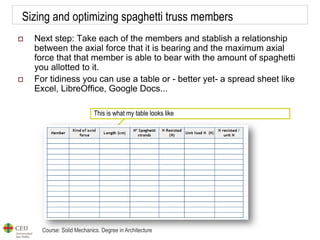
This is what my table looks like
Course: Solid Mechanics. Degree in Architecture
Sizing and optimizing spaghetti truss members
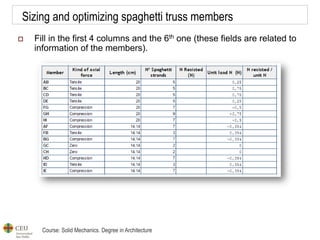
 Fill in the first 4 columns and the 6th one (these fields are related to
information of the members).
Course: Solid Mechanics. Degree in Architecture
Sizing and optimizing spaghetti truss members
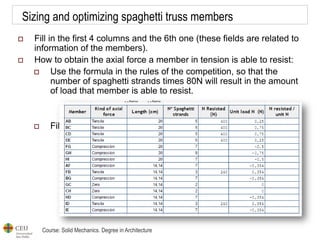
 Fill in the first 4 columns and the 6th one (these fields are related to
information of the members).
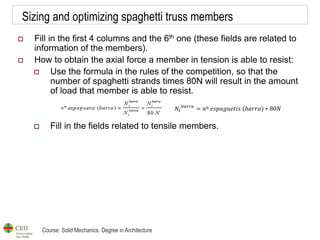
 How to obtain the axial force a member in tension is able to resist:
 Use the formula in the rules of the competition, so that the
number of spaghetti strands times 80N will result in the amount
of load that member is able to resist.
 Fill in the fields related to tensile members.
𝑁𝑡
𝑏𝑎𝑟𝑟𝑎
= 𝑛º 𝑒𝑠𝑝𝑎𝑔𝑢𝑒𝑡𝑖𝑠 𝑏𝑎𝑟𝑟𝑎 ∗ 80𝑁
Course: Solid Mechanics. Degree in Architecture
Sizing and optimizing spaghetti truss members
 Fill in the first 4 columns and the 6th one (these fields are related to
information of the members).
 How to obtain the axial force a member in tension is able to resist:
 Use the formula in the rules of the competition, so that the
number of spaghetti strands times 80N will result in the amount
of load that member is able to resist.
 Fill in the fields related to tensile members.
𝑁𝑡
𝑏𝑎𝑟𝑟𝑎
= 𝑛º 𝑒𝑠𝑝𝑎𝑔𝑢𝑒𝑡𝑖𝑠 𝑏𝑎𝑟𝑟𝑎 ∗ 80𝑁
Course: Solid Mechanics. Degree in Architecture
Sizing and optimizing spaghetti truss members
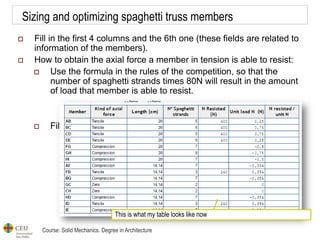
 Fill in the first 4 columns and the 6th one (these fields are related to
information of the members).
 How to obtain the axial force a member in tension is able to resist:
 Use the formula in the rules of the competition, so that the
number of spaghetti strands times 80N will result in the amount
of load that member is able to resist.
 Fill in the fields related to tensile members.
𝑁𝑡
𝑏𝑎𝑟𝑟𝑎
= 𝑛º 𝑒𝑠𝑝𝑎𝑔𝑢𝑒𝑡𝑖𝑠 𝑏𝑎𝑟𝑟𝑎 ∗ 80𝑁
This is what my table looks like now
Course: Solid Mechanics. Degree in Architecture
Sizing and optimizing spaghetti truss members
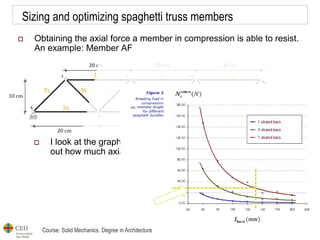
 Obtaining the axial force a member in compression is able to resist:
 The table provided in the rules of the competition is to be used
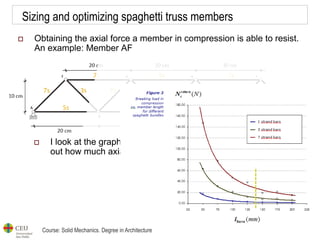
 This graph provides the relationship between the length of a
member and the compressive load it’s able to bear, depending
on its cross section
Course: Solid Mechanics. Degree in Architecture
Sizing and optimizing spaghetti truss members
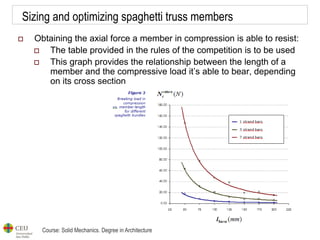
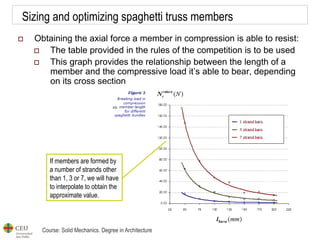
 Obtaining the axial force a member in compression is able to resist:
 The table provided in the rules of the competition is to be used
 This graph provides the relationship between the length of a
member and the compressive load it’s able to bear, depending
on its cross section
If members are formed by
a number of strands other
than 1, 3 or 7, we will have
to interpolate to obtain the
approximate value.
Course: Solid Mechanics. Degree in Architecture
Sizing and optimizing spaghetti truss members
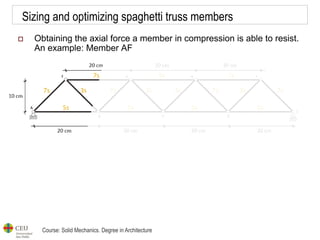
 Obtaining the axial force a member in compression is able to resist.
An example: Member AF
Course: Solid Mechanics. Degree in Architecture
Sizing and optimizing spaghetti truss members
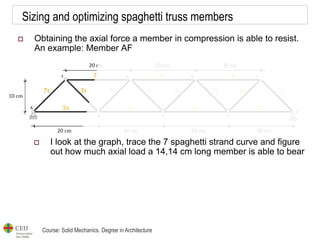
 Obtaining the axial force a member in compression is able to resist.
An example: Member AF
 I look at the graph, trace the 7 spaghetti strand curve and figure
out how much axial load a 14,14 cm long member is able to bear
Course: Solid Mechanics. Degree in Architecture
Sizing and optimizing spaghetti truss members
 Obtaining the axial force a member in compression is able to resist.
An example: Member AF
 I look at the graph, trace the 7 spaghetti strand curve and figure
out how much axial load a 14,14 cm long member is able to bear
Course: Solid Mechanics. Degree in Architecture
Sizing and optimizing spaghetti truss members
 Obtaining the axial force a member in compression is able to resist.
An example: Member AF
 I look at the graph, trace the 7 spaghetti strand curve and figure
out how much axial load a 14,14 cm long member is able to bear
Course: Solid Mechanics. Degree in Architecture
Sizing and optimizing spaghetti truss members
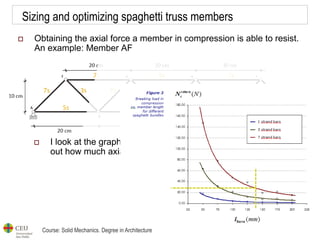
 Obtaining the axial force a member in compression is able to resist.
An example: Member AF
 I look at the graph, trace the 7 spaghetti strand curve and figure
out how much axial load a 14,14 cm long member is able to bear
Course: Solid Mechanics. Degree in Architecture
Sizing and optimizing spaghetti truss members
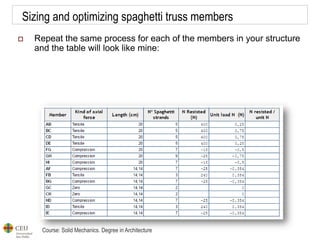
 Repeat the same process for each of the members in your structure
and the table will look like mine:
Course: Solid Mechanics. Degree in Architecture
Sizing and optimizing spaghetti truss members
 What happens with zero-members?
 These members are necessary, even if –apparently- they’re not
bearing any load.
 Most times, these members are responsible for preventing
buckling in compression members (and even ensuring the
statical determinacy of the structural system). Anyhow, the
amount of spaghetti strands needed is minimal for these
purposes.
 Follow your own criteria and intuition.
Course: Solid Mechanics. Degree in Architecture
Sizing and optimizing spaghetti truss members
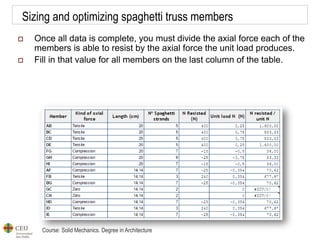
 Once all data is complete, you must divide the axial force each of the
members is able to resist by the axial force the unit load produces.
 Fill in that value for all members on the last column of the table.
Course: Solid Mechanics. Degree in Architecture
Sizing and optimizing spaghetti truss members
 Once all data is complete, you must divide the axial force each of the
members is able to resist by the axial force the unit load produces.
 Fill in that value for all members on the last column of the table.
Course: Solid Mechanics. Degree in Architecture
Sizing and optimizing spaghetti truss members
 Once all data is complete, you must divide the axial force each of the
members is able to resist by the axial force the unit load produces.
 Fill in that value for all members on the last column of the table.
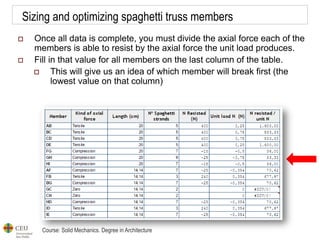
 This will give us an idea of which member will break first (the
lowest value on that column)
Course: Solid Mechanics. Degree in Architecture
Sizing and optimizing spaghetti truss members
 Once all data is complete, you must divide the axial force each of the
members is able to resist by the axial force the unit load produces.
 Fill in that value for all members on the last column of the table.
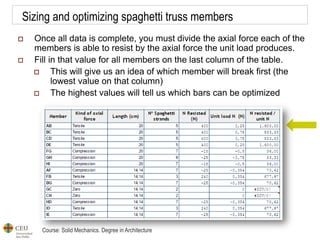
 This will give us an idea of which member will break first (the
lowest value on that column)
 The highest values will tell us which bars can be optimized
Course: Solid Mechanics. Degree in Architecture
Sizing and optimizing spaghetti truss members
 Once all data is complete, you must divide the axial force each of the
members is able to resist by the axial force the unit load produces.
 Fill in that value for all members on the last column of the table.
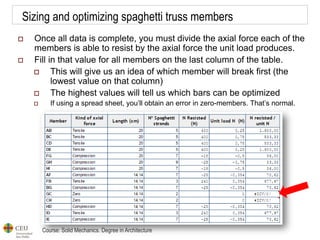
 This will give us an idea of which member will break first (the
lowest value on that column)
 The highest values will tell us which bars can be optimized
 If using a spread sheet, you’ll obtain an error in zero-members. That’s normal.
Course: Solid Mechanics. Degree in Architecture
Sizing and optimizing spaghetti truss members
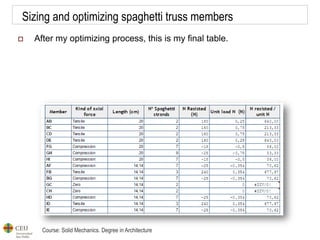
 After my optimizing process, this is my final table.
Course: Solid Mechanics. Degree in Architecture
Sizing and optimizing spaghetti truss members
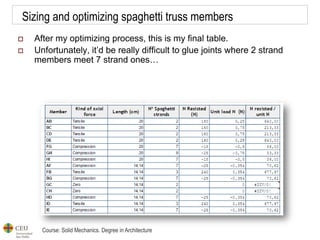
 After my optimizing process, this is my final table.
 Unfortunately, it’d be really difficult to glue joints where 2 strand
members meet 7 strand ones…
Course: Solid Mechanics. Degree in Architecture
Sizing and optimizing spaghetti truss members
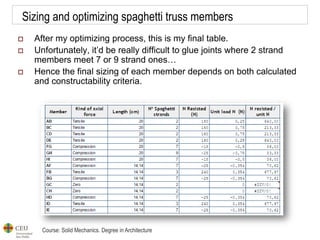
 After my optimizing process, this is my final table.
 Unfortunately, it’d be really difficult to glue joints where 2 strand
members meet 7 or 9 strand ones…
 Hence the final sizing of each member depends on both calculated
and constructability criteria.
Course: Solid Mechanics. Degree in Architecture
Sizing and optimizing spaghetti truss members
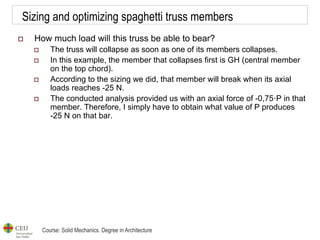
 How much load will this truss be able to bear?
Course: Solid Mechanics. Degree in Architecture
Sizing and optimizing spaghetti truss members
 How much load will this truss be able to bear?
 The truss will collapse as soon as one of its members collapses.
Course: Solid Mechanics. Degree in Architecture
Sizing and optimizing spaghetti truss members
 How much load will this truss be able to bear?
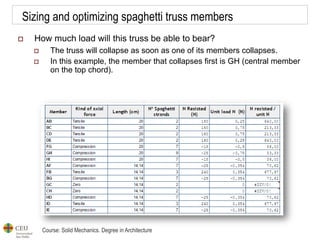
 The truss will collapse as soon as one of its members collapses.
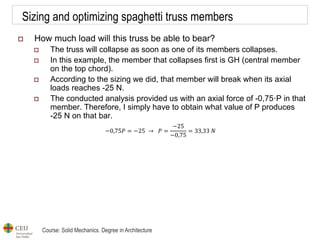
 In this example, the member that collapses first is GH (central member
on the top chord).
Course: Solid Mechanics. Degree in Architecture
 How much load will this truss be able to bear?
 The truss will collapse as soon as one of its members collapses.
 In this example, the member that collapses first is GH (central member
on the top chord).
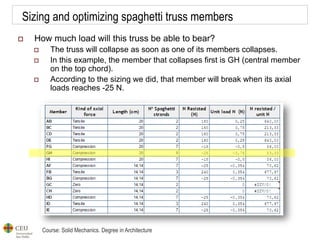
 According to the sizing we did, that member will break when its axial
loads reaches -25 N.
Sizing and optimizing spaghetti truss members
Course: Solid Mechanics. Degree in Architecture
Sizing and optimizing spaghetti truss members
 How much load will this truss be able to bear?
 The truss will collapse as soon as one of its members collapses.
 In this example, the member that collapses first is GH (central member
on the top chord).
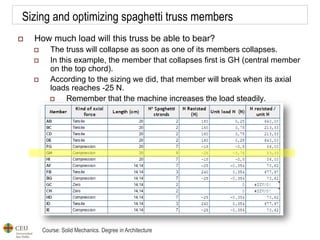
 According to the sizing we did, that member will break when its axial
loads reaches -25 N.
 Remember that the machine increases the load steadily.
Course: Solid Mechanics. Degree in Architecture
Sizing and optimizing spaghetti truss members
 How much load will this truss be able to bear?
 The truss will collapse as soon as one of its members collapses.
 In this example, the member that collapses first is GH (central member
on the top chord).
 According to the sizing we did, that member will break when its axial
loads reaches -25 N.
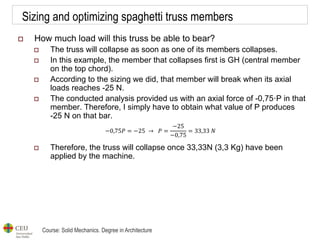
 The conducted analysis provided us with an axial force of -0,75·P in that
member. Therefore, I simply have to obtain what value of P produces
-25 N on that bar.
Course: Solid Mechanics. Degree in Architecture
Sizing and optimizing spaghetti truss members
 How much load will this truss be able to bear?
 The truss will collapse as soon as one of its members collapses.
 In this example, the member that collapses first is GH (central member
on the top chord).
 According to the sizing we did, that member will break when its axial
loads reaches -25 N.
 The conducted analysis provided us with an axial force of -0,75·P in that
member. Therefore, I simply have to obtain what value of P produces
-25 N on that bar.
−0,75𝑃 = −25 → 𝑃 =
−25
−0,75
= 33,33 𝑁
Course: Solid Mechanics. Degree in Architecture
Sizing and optimizing spaghetti truss members
 How much load will this truss be able to bear?
 The truss will collapse as soon as one of its members collapses.
 In this example, the member that collapses first is GH (central member
on the top chord).
 According to the sizing we did, that member will break when its axial
loads reaches -25 N.
 The conducted analysis provided us with an axial force of -0,75·P in that
member. Therefore, I simply have to obtain what value of P produces
-25 N on that bar.
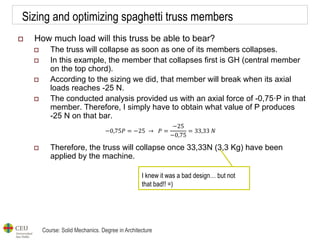
 Therefore, the truss will collapse once 33,33N (3,3 Kg) have been
applied by the machine.
−0,75𝑃 = −25 → 𝑃 =
−25
−0,75
= 33,33 𝑁
Course: Solid Mechanics. Degree in Architecture
Sizing and optimizing spaghetti truss members
 How much load will this truss be able to bear?
 The truss will collapse as soon as one of its members collapses.
 In this example, the member that collapses first is GH (central member
on the top chord).
 According to the sizing we did, that member will break when its axial
loads reaches -25 N.
 The conducted analysis provided us with an axial force of -0,75·P in that
member. Therefore, I simply have to obtain what value of P produces
-25 N on that bar.
 Therefore, the truss will collapse once 33,33N (3,3 Kg) have been
applied by the machine.
−0,75𝑃 = −25 → 𝑃 =
−25
−0,75
= 33,33 𝑁
I knew it was a bad design… but not
that bad!! =)
Course: Solid Mechanics. Degree in Architecture
Sizing and optimizing spaghetti truss members
 How much load will this truss be able to bear?
 The truss will collapse as soon as one of its members collapses.
 In this example, the member that collapses first is GH (central member
on the top chord).
 According to the sizing we did, that member will break when its axial
loads reaches -25 N.
 The conducted analysis provided us with an axial force of -0,75·P in that
member. Therefore, I simply have to obtain what value of P produces
-25 N on that bar.
 Therefore, the truss will collapse once 33,33N (3,3 Kg) have been
applied by the machine.
 If you want your truss to resist more load, you can increase the amount
of spaghetti in critical members (but in this case, for example, we were
already using 9-strand members.
−0,75𝑃 = −25 → 𝑃 =
−25
−0,75
= 33,33 𝑁
Course: Solid Mechanics. Degree in Architecture
Sizing and optimizing spaghetti truss members
 How much load will this truss be able to bear?
 The truss will collapse as soon as one of its members collapses.
 In this example, the member that collapses first is GH (central member
on the top chord).
 According to the sizing we did, that member will break when its axial
loads reaches -25 N.
 The conducted analysis provided us with an axial force of -0,75·P in that
member. Therefore, I simply have to obtain what value of P produces
-25 N on that bar.
 Therefore, the truss will collapse once 33,33N (3,3 Kg) have been
applied by the machine.
 If you want your truss to resist more load, you can increase the amount
of spaghetti in critical members (but in this case, for example, we were
already using 9-strand members.
 But the best approach would be redesigning the truss, even choosing a
different layout.
−0,75𝑃 = −25 → 𝑃 =
−25
−0,75
= 33,33 𝑁
Course: Solid Mechanics. Degree in Architecture
Sizing and optimizing spaghetti truss members
 Notice
 The actual resisted load will be affected by the meticulousness shown
during the building process (this happens in real life as well).
 Keeping both girders plane and parallel really improves performance.
 Both girders must be linked by braces forming triangles in order to
ensure global stability.
Course: Solid Mechanics. Degree in Architecture
Sizing and optimizing spaghetti truss members
 Notice
 The actual resisted load will be affected by the meticulousness shown
during the building process (this happens in real life as well).
 Keeping both girders plane and parallel really improves performance.
 Both girders must be linked by braces forming triangles in order to
ensure global stability.
Course: Solid Mechanics - Degree in Architecture
Spaghetti truss competition
Sizing and optimizing truss members.
Instructor: Maribel Castilla @maribelcastilla

Sizing trusses for spaghetti truss competition

  • 1.
    Course: Solid Mechanics- Degree in Architecture Spaghetti truss competition Sizing and optimizing truss members. Instructor: Maribel Castilla @maribelcastilla
  • 2.
    Course: Solid Mechanics.Degree in Architecture Sizing and optimizing spaghetti truss members  Before starting the sizing process, a geometrical definition of the truss must be designed. This is the layout we’re going to study in this example.
  • 3.
    Course: Solid Mechanics.Degree in Architecture Sizing and optimizing spaghetti truss members  Before starting the sizing process, a geometrical definition the truss must be designed. This is the layout we’re going to study in this example. No help can be provided by the instructor at this step ;)
  • 4.
    Course: Solid Mechanics.Degree in Architecture Sizing and optimizing spaghetti truss members  Before starting the sizing process, a geometrical definition the truss must be designed. This is the layout we’re going to study in this example.  Remember: It must be a statically determinate truss!!!
  • 5.
    Course: Solid Mechanics.Degree in Architecture Sizing and optimizing spaghetti truss members  Let’s analyze one of the girders.
  • 6.
    Course: Solid Mechanics.Degree in Architecture Sizing and optimizing spaghetti truss members  Let’s analyze one of the girders.  “P” is the total amount of load applied by the Universal Testing Machine. This value changes with time. I recommend you to apply 0,25·P on each of the points where the load will be applied, according to the rules of the competition.
  • 7.
    Course: Solid Mechanics.Degree in Architecture Sizing and optimizing spaghetti truss members  This is what the girder to be studied looks like:
  • 8.
    Course: Solid Mechanics.Degree in Architecture Sizing and optimizing spaghetti truss members  This is what the girder to be studied looks like: I’m sure all of you have realized that this is not the best layout you can choose. Well, it doesn’t matter. Yours will be better!
  • 9.
    Course: Solid Mechanics.Degree in Architecture Sizing and optimizing spaghetti truss members  You must figure out which members are subjected to tension, compression or no axial force. Allot some spaghetti strands to each member, taking into consideration that:  Members in tension don’t suffer buckling effect  Members in compression must be sized taking buckling into account  Zero-force members usually don’t require more than three spaghetti strands • En my case, I’ve chosen this layout.
  • 10.
    Course: Solid Mechanics.Degree in Architecture Sizing and optimizing spaghetti truss members  Now, it’s time for you to obtain axial forces in each of the members.  You can use the method you like better, as long as the values are obtained manually and not with a computer program.
  • 11.
    Course: Solid Mechanics.Degree in Architecture Sizing and optimizing spaghetti truss members  This is the result I’ve obtained:
  • 12.
    Course: Solid Mechanics.Degree in Architecture Sizing and optimizing spaghetti truss members  Next step: Take each of the members and stablish a relationship between the axial force that it is bearing and the maximum axial force that that member is able to bear with the amount of spaghetti you allotted to it.
  • 13.
    Course: Solid Mechanics.Degree in Architecture Sizing and optimizing spaghetti truss members  Next step: Take each of the members and stablish a relationship between the axial force that it is bearing and the maximum axial force that that member is able to bear with the amount of spaghetti you allotted to it.  For tidiness you can use a table or - better yet- a spread sheet like Excel, LibreOffice, Google Docs...
  • 14.
    Course: Solid Mechanics.Degree in Architecture Sizing and optimizing spaghetti truss members  Next step: Take each of the members and stablish a relationship between the axial force that it is bearing and the maximum axial force that that member is able to bear with the amount of spaghetti you allotted to it.  For tidiness you can use a table or - better yet- a spread sheet like Excel, LibreOffice, Google Docs... I’ll use Google sheets to be able to access my data from any of my devices and to share them with my teammates easily.
  • 15.
    Course: Solid Mechanics.Degree in Architecture Sizing and optimizing spaghetti truss members  Next step: Take each of the members and stablish a relationship between the axial force that it is bearing and the maximum axial force that that member is able to bear with the amount of spaghetti you allotted to it.  For tidiness you can use a table or - better yet- a spread sheet like Excel, LibreOffice, Google Docs... This is what my table looks like
  • 16.
    Course: Solid Mechanics.Degree in Architecture Sizing and optimizing spaghetti truss members  Fill in the first 4 columns and the 6th one (these fields are related to information of the members).
  • 17.
    Course: Solid Mechanics.Degree in Architecture Sizing and optimizing spaghetti truss members  Fill in the first 4 columns and the 6th one (these fields are related to information of the members).  How to obtain the axial force a member in tension is able to resist:  Use the formula in the rules of the competition, so that the number of spaghetti strands times 80N will result in the amount of load that member is able to resist.  Fill in the fields related to tensile members. 𝑁𝑡 𝑏𝑎𝑟𝑟𝑎 = 𝑛º 𝑒𝑠𝑝𝑎𝑔𝑢𝑒𝑡𝑖𝑠 𝑏𝑎𝑟𝑟𝑎 ∗ 80𝑁
  • 18.
    Course: Solid Mechanics.Degree in Architecture Sizing and optimizing spaghetti truss members  Fill in the first 4 columns and the 6th one (these fields are related to information of the members).  How to obtain the axial force a member in tension is able to resist:  Use the formula in the rules of the competition, so that the number of spaghetti strands times 80N will result in the amount of load that member is able to resist.  Fill in the fields related to tensile members. 𝑁𝑡 𝑏𝑎𝑟𝑟𝑎 = 𝑛º 𝑒𝑠𝑝𝑎𝑔𝑢𝑒𝑡𝑖𝑠 𝑏𝑎𝑟𝑟𝑎 ∗ 80𝑁
  • 19.
    Course: Solid Mechanics.Degree in Architecture Sizing and optimizing spaghetti truss members  Fill in the first 4 columns and the 6th one (these fields are related to information of the members).  How to obtain the axial force a member in tension is able to resist:  Use the formula in the rules of the competition, so that the number of spaghetti strands times 80N will result in the amount of load that member is able to resist.  Fill in the fields related to tensile members. 𝑁𝑡 𝑏𝑎𝑟𝑟𝑎 = 𝑛º 𝑒𝑠𝑝𝑎𝑔𝑢𝑒𝑡𝑖𝑠 𝑏𝑎𝑟𝑟𝑎 ∗ 80𝑁 This is what my table looks like now
  • 20.
    Course: Solid Mechanics.Degree in Architecture Sizing and optimizing spaghetti truss members  Obtaining the axial force a member in compression is able to resist:  The table provided in the rules of the competition is to be used  This graph provides the relationship between the length of a member and the compressive load it’s able to bear, depending on its cross section
  • 21.
    Course: Solid Mechanics.Degree in Architecture Sizing and optimizing spaghetti truss members  Obtaining the axial force a member in compression is able to resist:  The table provided in the rules of the competition is to be used  This graph provides the relationship between the length of a member and the compressive load it’s able to bear, depending on its cross section If members are formed by a number of strands other than 1, 3 or 7, we will have to interpolate to obtain the approximate value.
  • 22.
    Course: Solid Mechanics.Degree in Architecture Sizing and optimizing spaghetti truss members  Obtaining the axial force a member in compression is able to resist. An example: Member AF
  • 23.
    Course: Solid Mechanics.Degree in Architecture Sizing and optimizing spaghetti truss members  Obtaining the axial force a member in compression is able to resist. An example: Member AF  I look at the graph, trace the 7 spaghetti strand curve and figure out how much axial load a 14,14 cm long member is able to bear
  • 24.
    Course: Solid Mechanics.Degree in Architecture Sizing and optimizing spaghetti truss members  Obtaining the axial force a member in compression is able to resist. An example: Member AF  I look at the graph, trace the 7 spaghetti strand curve and figure out how much axial load a 14,14 cm long member is able to bear
  • 25.
    Course: Solid Mechanics.Degree in Architecture Sizing and optimizing spaghetti truss members  Obtaining the axial force a member in compression is able to resist. An example: Member AF  I look at the graph, trace the 7 spaghetti strand curve and figure out how much axial load a 14,14 cm long member is able to bear
  • 26.
    Course: Solid Mechanics.Degree in Architecture Sizing and optimizing spaghetti truss members  Obtaining the axial force a member in compression is able to resist. An example: Member AF  I look at the graph, trace the 7 spaghetti strand curve and figure out how much axial load a 14,14 cm long member is able to bear
  • 27.
    Course: Solid Mechanics.Degree in Architecture Sizing and optimizing spaghetti truss members  Repeat the same process for each of the members in your structure and the table will look like mine:
  • 28.
    Course: Solid Mechanics.Degree in Architecture Sizing and optimizing spaghetti truss members  What happens with zero-members?  These members are necessary, even if –apparently- they’re not bearing any load.  Most times, these members are responsible for preventing buckling in compression members (and even ensuring the statical determinacy of the structural system). Anyhow, the amount of spaghetti strands needed is minimal for these purposes.  Follow your own criteria and intuition.
  • 29.
    Course: Solid Mechanics.Degree in Architecture Sizing and optimizing spaghetti truss members  Once all data is complete, you must divide the axial force each of the members is able to resist by the axial force the unit load produces.  Fill in that value for all members on the last column of the table.
  • 30.
    Course: Solid Mechanics.Degree in Architecture Sizing and optimizing spaghetti truss members  Once all data is complete, you must divide the axial force each of the members is able to resist by the axial force the unit load produces.  Fill in that value for all members on the last column of the table.
  • 31.
    Course: Solid Mechanics.Degree in Architecture Sizing and optimizing spaghetti truss members  Once all data is complete, you must divide the axial force each of the members is able to resist by the axial force the unit load produces.  Fill in that value for all members on the last column of the table.  This will give us an idea of which member will break first (the lowest value on that column)
  • 32.
    Course: Solid Mechanics.Degree in Architecture Sizing and optimizing spaghetti truss members  Once all data is complete, you must divide the axial force each of the members is able to resist by the axial force the unit load produces.  Fill in that value for all members on the last column of the table.  This will give us an idea of which member will break first (the lowest value on that column)  The highest values will tell us which bars can be optimized
  • 33.
    Course: Solid Mechanics.Degree in Architecture Sizing and optimizing spaghetti truss members  Once all data is complete, you must divide the axial force each of the members is able to resist by the axial force the unit load produces.  Fill in that value for all members on the last column of the table.  This will give us an idea of which member will break first (the lowest value on that column)  The highest values will tell us which bars can be optimized  If using a spread sheet, you’ll obtain an error in zero-members. That’s normal.
  • 34.
    Course: Solid Mechanics.Degree in Architecture Sizing and optimizing spaghetti truss members  After my optimizing process, this is my final table.
  • 35.
    Course: Solid Mechanics.Degree in Architecture Sizing and optimizing spaghetti truss members  After my optimizing process, this is my final table.  Unfortunately, it’d be really difficult to glue joints where 2 strand members meet 7 strand ones…
  • 36.
    Course: Solid Mechanics.Degree in Architecture Sizing and optimizing spaghetti truss members  After my optimizing process, this is my final table.  Unfortunately, it’d be really difficult to glue joints where 2 strand members meet 7 or 9 strand ones…  Hence the final sizing of each member depends on both calculated and constructability criteria.
  • 37.
    Course: Solid Mechanics.Degree in Architecture Sizing and optimizing spaghetti truss members  How much load will this truss be able to bear?
  • 38.
    Course: Solid Mechanics.Degree in Architecture Sizing and optimizing spaghetti truss members  How much load will this truss be able to bear?  The truss will collapse as soon as one of its members collapses.
  • 39.
    Course: Solid Mechanics.Degree in Architecture Sizing and optimizing spaghetti truss members  How much load will this truss be able to bear?  The truss will collapse as soon as one of its members collapses.  In this example, the member that collapses first is GH (central member on the top chord).
  • 40.
    Course: Solid Mechanics.Degree in Architecture  How much load will this truss be able to bear?  The truss will collapse as soon as one of its members collapses.  In this example, the member that collapses first is GH (central member on the top chord).  According to the sizing we did, that member will break when its axial loads reaches -25 N. Sizing and optimizing spaghetti truss members
  • 41.
    Course: Solid Mechanics.Degree in Architecture Sizing and optimizing spaghetti truss members  How much load will this truss be able to bear?  The truss will collapse as soon as one of its members collapses.  In this example, the member that collapses first is GH (central member on the top chord).  According to the sizing we did, that member will break when its axial loads reaches -25 N.  Remember that the machine increases the load steadily.
  • 42.
    Course: Solid Mechanics.Degree in Architecture Sizing and optimizing spaghetti truss members  How much load will this truss be able to bear?  The truss will collapse as soon as one of its members collapses.  In this example, the member that collapses first is GH (central member on the top chord).  According to the sizing we did, that member will break when its axial loads reaches -25 N.  The conducted analysis provided us with an axial force of -0,75·P in that member. Therefore, I simply have to obtain what value of P produces -25 N on that bar.
  • 43.
    Course: Solid Mechanics.Degree in Architecture Sizing and optimizing spaghetti truss members  How much load will this truss be able to bear?  The truss will collapse as soon as one of its members collapses.  In this example, the member that collapses first is GH (central member on the top chord).  According to the sizing we did, that member will break when its axial loads reaches -25 N.  The conducted analysis provided us with an axial force of -0,75·P in that member. Therefore, I simply have to obtain what value of P produces -25 N on that bar. −0,75𝑃 = −25 → 𝑃 = −25 −0,75 = 33,33 𝑁
  • 44.
    Course: Solid Mechanics.Degree in Architecture Sizing and optimizing spaghetti truss members  How much load will this truss be able to bear?  The truss will collapse as soon as one of its members collapses.  In this example, the member that collapses first is GH (central member on the top chord).  According to the sizing we did, that member will break when its axial loads reaches -25 N.  The conducted analysis provided us with an axial force of -0,75·P in that member. Therefore, I simply have to obtain what value of P produces -25 N on that bar.  Therefore, the truss will collapse once 33,33N (3,3 Kg) have been applied by the machine. −0,75𝑃 = −25 → 𝑃 = −25 −0,75 = 33,33 𝑁
  • 45.
    Course: Solid Mechanics.Degree in Architecture Sizing and optimizing spaghetti truss members  How much load will this truss be able to bear?  The truss will collapse as soon as one of its members collapses.  In this example, the member that collapses first is GH (central member on the top chord).  According to the sizing we did, that member will break when its axial loads reaches -25 N.  The conducted analysis provided us with an axial force of -0,75·P in that member. Therefore, I simply have to obtain what value of P produces -25 N on that bar.  Therefore, the truss will collapse once 33,33N (3,3 Kg) have been applied by the machine. −0,75𝑃 = −25 → 𝑃 = −25 −0,75 = 33,33 𝑁 I knew it was a bad design… but not that bad!! =)
  • 46.
    Course: Solid Mechanics.Degree in Architecture Sizing and optimizing spaghetti truss members  How much load will this truss be able to bear?  The truss will collapse as soon as one of its members collapses.  In this example, the member that collapses first is GH (central member on the top chord).  According to the sizing we did, that member will break when its axial loads reaches -25 N.  The conducted analysis provided us with an axial force of -0,75·P in that member. Therefore, I simply have to obtain what value of P produces -25 N on that bar.  Therefore, the truss will collapse once 33,33N (3,3 Kg) have been applied by the machine.  If you want your truss to resist more load, you can increase the amount of spaghetti in critical members (but in this case, for example, we were already using 9-strand members. −0,75𝑃 = −25 → 𝑃 = −25 −0,75 = 33,33 𝑁
  • 47.
    Course: Solid Mechanics.Degree in Architecture Sizing and optimizing spaghetti truss members  How much load will this truss be able to bear?  The truss will collapse as soon as one of its members collapses.  In this example, the member that collapses first is GH (central member on the top chord).  According to the sizing we did, that member will break when its axial loads reaches -25 N.  The conducted analysis provided us with an axial force of -0,75·P in that member. Therefore, I simply have to obtain what value of P produces -25 N on that bar.  Therefore, the truss will collapse once 33,33N (3,3 Kg) have been applied by the machine.  If you want your truss to resist more load, you can increase the amount of spaghetti in critical members (but in this case, for example, we were already using 9-strand members.  But the best approach would be redesigning the truss, even choosing a different layout. −0,75𝑃 = −25 → 𝑃 = −25 −0,75 = 33,33 𝑁
  • 48.
    Course: Solid Mechanics.Degree in Architecture Sizing and optimizing spaghetti truss members  Notice  The actual resisted load will be affected by the meticulousness shown during the building process (this happens in real life as well).  Keeping both girders plane and parallel really improves performance.  Both girders must be linked by braces forming triangles in order to ensure global stability.
  • 49.
    Course: Solid Mechanics.Degree in Architecture Sizing and optimizing spaghetti truss members  Notice  The actual resisted load will be affected by the meticulousness shown during the building process (this happens in real life as well).  Keeping both girders plane and parallel really improves performance.  Both girders must be linked by braces forming triangles in order to ensure global stability.
  • 50.
    Course: Solid Mechanics- Degree in Architecture Spaghetti truss competition Sizing and optimizing truss members. Instructor: Maribel Castilla @maribelcastilla