Alcohol & Health Harm: the Scale of the
Problem
North-South Alcohol Conference
Armagh
26th January 2012
Ian Gilmore, University of Liverpool,
Chair, UK Alcohol Health Alliance
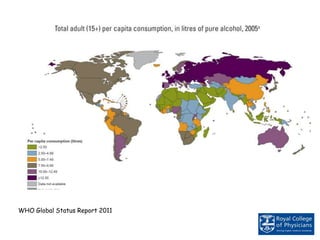
WHO Global Status Report 2011
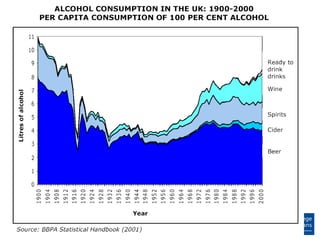
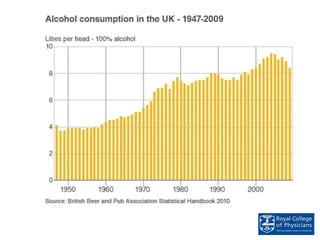
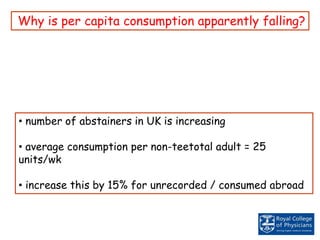
Why is per capita consumption apparently falling?
• number of abstainers in UK is increasing
• average consumption per non-teetotal adult = 25
units/wk
• increase this by 15% for unrecorded / consumed abroad
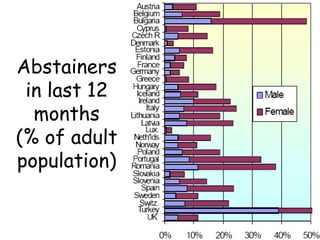
Abstainers
in last 12
months
(% of adult
population)
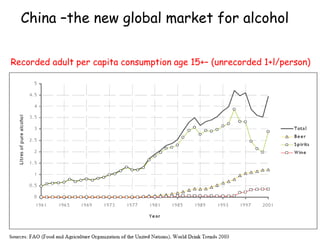
China –the new global market for alcohol
Recorded adult per capita consumption age 15+– (unrecorded 1+l/person)
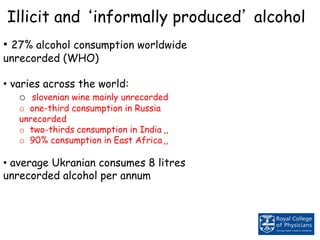
Illicit and ‘informally produced’ alcohol
• 27% alcohol consumption worldwide
unrecorded (WHO)
• varies across the world:
o slovenian wine mainly unrecorded
o one-third consumption in Russia
unrecorded
o two-thirds consumption in India ,,
o 90% consumption in East Africa,,
• average Ukranian consumes 8 litres
unrecorded alcohol per annum
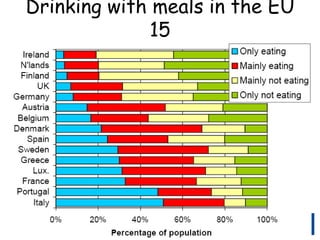
Drinking with meals in the EU
15
Source Eurobarometer 2003
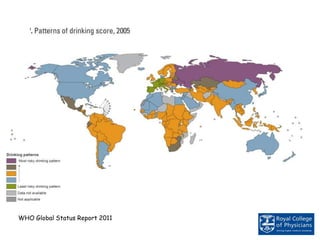
WHO Global Status Report 2011
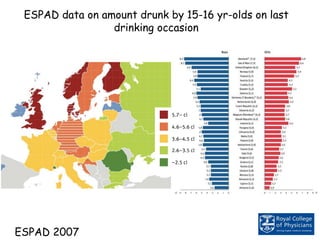
ESPAD data on amount drunk by 15-16 yr-olds on last
drinking occasion
ESPAD 2007
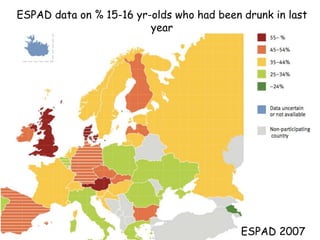
ESPAD data on % 15-16 yr-olds who had been drunk in last
year
ESPAD 2007
Consumption and young people
Good news and bad news…….
•Fewer 11-15 year olds admit to having
drunk alcohol in the UK
•However those that do are drinking more
Of women that drink hazardously - 81% do so to relieve
stress
Know Your Limits/YouGov; Netmums, 2008
Drinking to unwind after
stressful day…..
Women and alcohol
• Advertising and marketing – more
sophisticated and more aimed at women
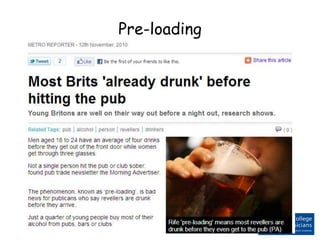
Pre-loading
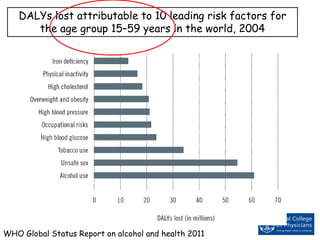
DALYs lost attributable to 10 leading risk factors for
the age group 15–59 years in the world, 2004
WHO Global Status Report on alcohol and health 2011
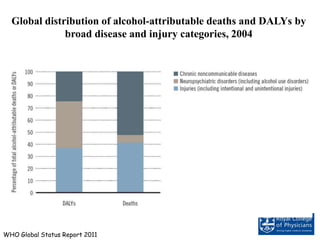
Global distribution of alcohol-attributable deaths and DALYs by
broad disease and injury categories, 2004
WHO Global Status Report 2011
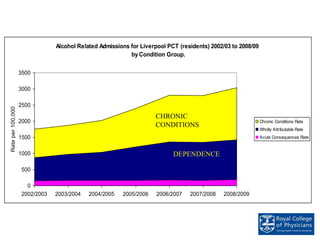
Alcohol Related Admissions for Liverpool PCT (residents) 2002/03 to 2008/09
by Condition Group.
0
500
1000
1500
2000
2500
3000
3500
2002/2003 2003/2004 2004/2005 2005/2006 2006/2007 2007/2008 2008/2009
Rate
per
100,000
Chronic Conditions Rate
Wholly Attributable Rate
Acute Consequences Rate
CHRONIC
CONDITIONS
DEPENDENCE
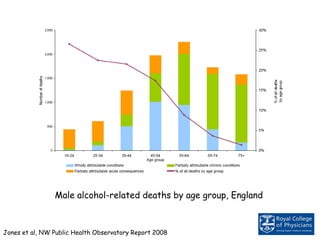
Male alcohol-related deaths by age group, England
Jones et al, NW Public Health Observatory Report 2008
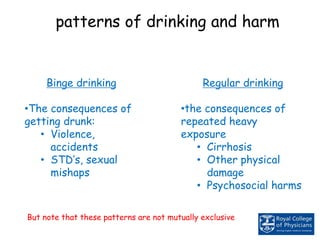
Binge drinking
•The consequences of
getting drunk:
• Violence,
accidents
• STD’s, sexual
mishaps
patterns of drinking and harm
Regular drinking
•the consequences of
repeated heavy
exposure
• Cirrhosis
• Other physical
damage
• Psychosocial harms
But note that these patterns are not mutually exclusive
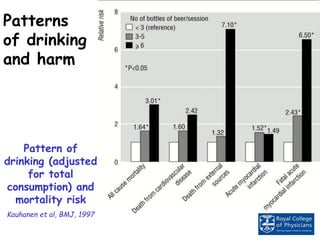
Pattern of
drinking (adjusted
for total
consumption) and
mortality risk
Kauhanen et al, BMJ, 1997
Patterns
of drinking
and harm
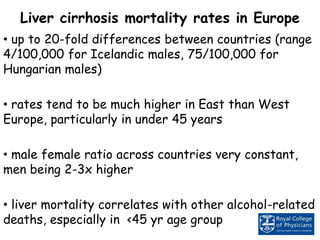
Liver cirrhosis mortality rates in Europe
• up to 20-fold differences between countries (range
4/100,000 for Icelandic males, 75/100,000 for
Hungarian males)
• rates tend to be much higher in East than West
Europe, particularly in under 45 years
• male female ratio across countries very constant,
men being 2-3x higher
• liver mortality correlates with other alcohol-related
deaths, especially in <45 yr age group
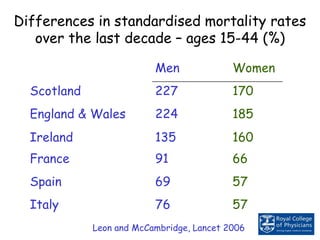
Men Women
Scotland 227 170
England & Wales 224 185
Ireland 135 160
France 91 66
Spain 69 57
Italy 76 57
Differences in standardised mortality rates
over the last decade – ages 15-44 (%)
Leon and McCambridge, Lancet 2006
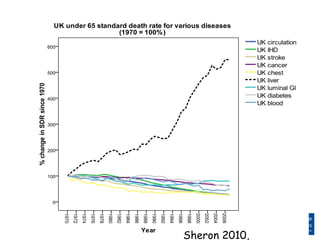
Sheron 2010,
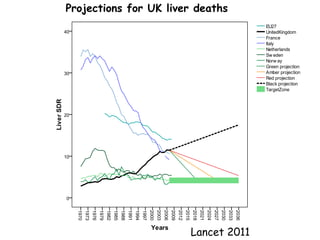
Projections for UK liver deaths
Lancet 2011
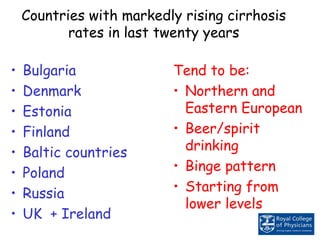
Countries with markedly rising cirrhosis
rates in last twenty years
• Bulgaria
• Denmark
• Estonia
• Finland
• Baltic countries
• Poland
• Russia
• UK + Ireland
Tend to be:
• Northern and
Eastern European
• Beer/spirit
drinking
• Binge pattern
• Starting from
lower levels
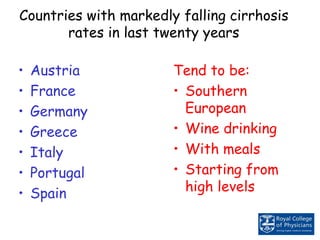
Countries with markedly falling cirrhosis
rates in last twenty years
• Austria
• France
• Germany
• Greece
• Italy
• Portugal
• Spain
Tend to be:
• Southern
European
• Wine drinking
• With meals
• Starting from
high levels
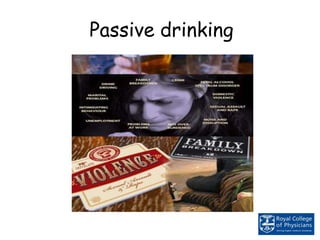
Passive drinking
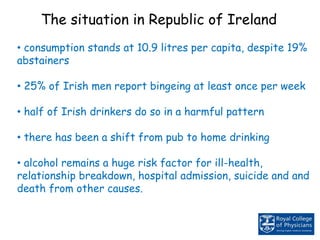
• consumption stands at 10.9 litres per capita, despite 19%
abstainers
• 25% of Irish men report bingeing at least once per week
• half of Irish drinkers do so in a harmful pattern
• there has been a shift from pub to home drinking
• alcohol remains a huge risk factor for ill-health,
relationship breakdown, hospital admission, suicide and and
death from other causes.
The situation in Republic of Ireland
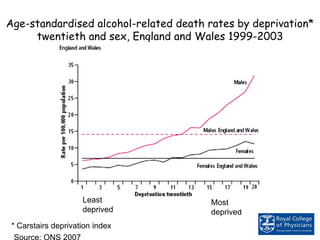
Age-standardised alcohol-related death rates by deprivation*
twentieth and sex, England and Wales 1999-2003
* Carstairs deprivation index
Most
deprived
Least
deprived
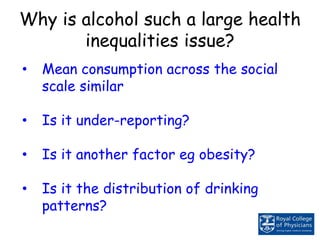
Why is alcohol such a large health
inequalities issue?
• Mean consumption across the social
scale similar
• Is it under-reporting?
• Is it another factor eg obesity?
• Is it the distribution of drinking
patterns?
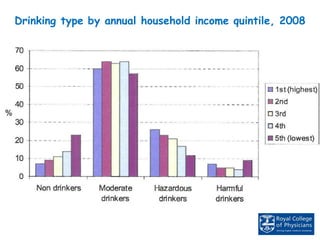
Drinking type by annual household income quintile, 2008
Three decades of evidence
• Alcohol control policies in public health
perspectives –Bruun et al , 1975
• Alcohol policy and the public good –
Edwards et al 1994
• Alcohol: no ordinary commodity – Babor et
al 2003 and 2010
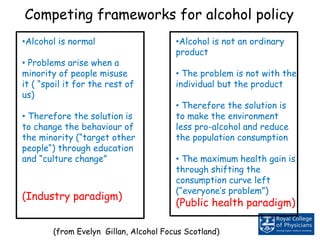
•Alcohol is normal
• Problems arise when a
minority of people misuse
it ( “spoil it for the rest of
us)
• Therefore the solution is
to change the behaviour of
the minority (“target other
people“) through education
and “culture change”
(Industry paradigm)
Competing frameworks for alcohol policy
•Alcohol is not an ordinary
product
• The problem is not with the
individual but the product
• Therefore the solution is
to make the environment
less pro-alcohol and reduce
the population consumption
• The maximum health gain is
through shifting the
consumption curve left
(“everyone’s problem”)
(Public health paradigm)
(from Evelyn Gillan, Alcohol Focus Scotland)
International evidence to ‘shift the curve’
and maximise health gain:
• availability
• promotion by the alcohol producers and
retailers
• price of alcohol
Impact of a 50p minimum unit
price
• Research into the
effect of a 50p
minimum price per unit
shows for every year
(England):
• 3,393 fewer deaths
• 97,900 fewer hospital
admissions
• 45,800 fewer crimes
• 296,900 fewer sick days
• And a total saving of
£15 billion over ten
years (health, crime,
social care.)
• Source: Chief Medical Officers Report 2008, Meier 2009
•Alcohol use is legal and firmly embedded in our society
and will remain so.
• The cardiovascular benefits, if real, are seen at very low
consumption levels, affect only the middle aged + and are
not a reason for non-drinkers to drink
• Health and other harms are a major societal issue and
are not confined to those who obviously misuse alcohol.
• We need to better understand the links to low socio-
economic status
Final thoughts…..
• While the relationship between population consumption
and harm are not perfect, the maximum health
improvements will be seen through shifting the whole
consumption curve downwards
• Individuals may choose to live with different levels of
risk associated with their pattern and volume of
consumption, but must be provided with good information
on those risks. This is not currently possible
• Within those who ‘choose’ to drink at higher levels there
will will be many with a degree of dependence on alcohol
who are not exercising ‘free will’, and we need to get
better at identifying and helping them.
Final thoughts… (2)
Sir_Ian_Gilmore_-_Jan_2012_website.ppt

Sir_Ian_Gilmore_-_Jan_2012_website.ppt

  • 1.
    Alcohol & HealthHarm: the Scale of the Problem North-South Alcohol Conference Armagh 26th January 2012 Ian Gilmore, University of Liverpool, Chair, UK Alcohol Health Alliance
  • 2.
    WHO Global StatusReport 2011
  • 5.
    Why is percapita consumption apparently falling? • number of abstainers in UK is increasing • average consumption per non-teetotal adult = 25 units/wk • increase this by 15% for unrecorded / consumed abroad
  • 6.
    Abstainers in last 12 months (%of adult population)
  • 7.
    China –the newglobal market for alcohol Recorded adult per capita consumption age 15+– (unrecorded 1+l/person)
  • 8.
    Illicit and ‘informallyproduced’ alcohol • 27% alcohol consumption worldwide unrecorded (WHO) • varies across the world: o slovenian wine mainly unrecorded o one-third consumption in Russia unrecorded o two-thirds consumption in India ,, o 90% consumption in East Africa,, • average Ukranian consumes 8 litres unrecorded alcohol per annum
  • 9.
    Drinking with mealsin the EU 15 Source Eurobarometer 2003
  • 10.
    WHO Global StatusReport 2011
  • 11.
    ESPAD data onamount drunk by 15-16 yr-olds on last drinking occasion ESPAD 2007
  • 12.
    ESPAD data on% 15-16 yr-olds who had been drunk in last year ESPAD 2007
  • 13.
    Consumption and youngpeople Good news and bad news……. •Fewer 11-15 year olds admit to having drunk alcohol in the UK •However those that do are drinking more
  • 14.
    Of women thatdrink hazardously - 81% do so to relieve stress Know Your Limits/YouGov; Netmums, 2008 Drinking to unwind after stressful day…..
  • 15.
    Women and alcohol •Advertising and marketing – more sophisticated and more aimed at women
  • 16.
  • 17.
    DALYs lost attributableto 10 leading risk factors for the age group 15–59 years in the world, 2004 WHO Global Status Report on alcohol and health 2011
  • 18.
    Global distribution ofalcohol-attributable deaths and DALYs by broad disease and injury categories, 2004 WHO Global Status Report 2011
  • 19.
    Alcohol Related Admissionsfor Liverpool PCT (residents) 2002/03 to 2008/09 by Condition Group. 0 500 1000 1500 2000 2500 3000 3500 2002/2003 2003/2004 2004/2005 2005/2006 2006/2007 2007/2008 2008/2009 Rate per 100,000 Chronic Conditions Rate Wholly Attributable Rate Acute Consequences Rate CHRONIC CONDITIONS DEPENDENCE
  • 20.
    Male alcohol-related deathsby age group, England Jones et al, NW Public Health Observatory Report 2008
  • 22.
    Binge drinking •The consequencesof getting drunk: • Violence, accidents • STD’s, sexual mishaps patterns of drinking and harm Regular drinking •the consequences of repeated heavy exposure • Cirrhosis • Other physical damage • Psychosocial harms But note that these patterns are not mutually exclusive
  • 23.
    Pattern of drinking (adjusted fortotal consumption) and mortality risk Kauhanen et al, BMJ, 1997 Patterns of drinking and harm
  • 24.
    Liver cirrhosis mortalityrates in Europe • up to 20-fold differences between countries (range 4/100,000 for Icelandic males, 75/100,000 for Hungarian males) • rates tend to be much higher in East than West Europe, particularly in under 45 years • male female ratio across countries very constant, men being 2-3x higher • liver mortality correlates with other alcohol-related deaths, especially in <45 yr age group
  • 25.
    Men Women Scotland 227170 England & Wales 224 185 Ireland 135 160 France 91 66 Spain 69 57 Italy 76 57 Differences in standardised mortality rates over the last decade – ages 15-44 (%) Leon and McCambridge, Lancet 2006
  • 26.
  • 27.
    Projections for UKliver deaths Lancet 2011
  • 28.
    Countries with markedlyrising cirrhosis rates in last twenty years • Bulgaria • Denmark • Estonia • Finland • Baltic countries • Poland • Russia • UK + Ireland Tend to be: • Northern and Eastern European • Beer/spirit drinking • Binge pattern • Starting from lower levels
  • 29.
    Countries with markedlyfalling cirrhosis rates in last twenty years • Austria • France • Germany • Greece • Italy • Portugal • Spain Tend to be: • Southern European • Wine drinking • With meals • Starting from high levels
  • 30.
  • 31.
    • consumption standsat 10.9 litres per capita, despite 19% abstainers • 25% of Irish men report bingeing at least once per week • half of Irish drinkers do so in a harmful pattern • there has been a shift from pub to home drinking • alcohol remains a huge risk factor for ill-health, relationship breakdown, hospital admission, suicide and and death from other causes. The situation in Republic of Ireland
  • 32.
    Age-standardised alcohol-related deathrates by deprivation* twentieth and sex, England and Wales 1999-2003 * Carstairs deprivation index Most deprived Least deprived
  • 33.
    Why is alcoholsuch a large health inequalities issue? • Mean consumption across the social scale similar • Is it under-reporting? • Is it another factor eg obesity? • Is it the distribution of drinking patterns?
  • 34.
    Drinking type byannual household income quintile, 2008
  • 35.
    Three decades ofevidence • Alcohol control policies in public health perspectives –Bruun et al , 1975 • Alcohol policy and the public good – Edwards et al 1994 • Alcohol: no ordinary commodity – Babor et al 2003 and 2010
  • 36.
    •Alcohol is normal •Problems arise when a minority of people misuse it ( “spoil it for the rest of us) • Therefore the solution is to change the behaviour of the minority (“target other people“) through education and “culture change” (Industry paradigm) Competing frameworks for alcohol policy •Alcohol is not an ordinary product • The problem is not with the individual but the product • Therefore the solution is to make the environment less pro-alcohol and reduce the population consumption • The maximum health gain is through shifting the consumption curve left (“everyone’s problem”) (Public health paradigm) (from Evelyn Gillan, Alcohol Focus Scotland)
  • 37.
    International evidence to‘shift the curve’ and maximise health gain: • availability • promotion by the alcohol producers and retailers • price of alcohol
  • 38.
    Impact of a50p minimum unit price • Research into the effect of a 50p minimum price per unit shows for every year (England): • 3,393 fewer deaths • 97,900 fewer hospital admissions • 45,800 fewer crimes • 296,900 fewer sick days • And a total saving of £15 billion over ten years (health, crime, social care.) • Source: Chief Medical Officers Report 2008, Meier 2009
  • 39.
    •Alcohol use islegal and firmly embedded in our society and will remain so. • The cardiovascular benefits, if real, are seen at very low consumption levels, affect only the middle aged + and are not a reason for non-drinkers to drink • Health and other harms are a major societal issue and are not confined to those who obviously misuse alcohol. • We need to better understand the links to low socio- economic status Final thoughts…..
  • 40.
    • While therelationship between population consumption and harm are not perfect, the maximum health improvements will be seen through shifting the whole consumption curve downwards • Individuals may choose to live with different levels of risk associated with their pattern and volume of consumption, but must be provided with good information on those risks. This is not currently possible • Within those who ‘choose’ to drink at higher levels there will will be many with a degree of dependence on alcohol who are not exercising ‘free will’, and we need to get better at identifying and helping them. Final thoughts… (2)