SUMMER INTERNSHIP PROJECT REPORT

                                 AT

   THE NEW INDIA ASSURANCE COMPANY LIMITED

A Project Report Submitted In Partial Fulfillment of the Requirements
                  For The Award of the Degree of


         POST GRADUATE DIPLOMA IN MANAGEMENT

                                TO

        M.S.RAMAIAH INSTITUTE OF MANAGEMENT
                                BY
                    ANAND VINODKUMAR (101203)

                    PGDM(AUTONOMOUS) 2010-12


                        Under the guidance of


                        Dr. G.P.SUDHAKAR


             M.S.RAMAIAH INSTITUTE MANAGEMENT
              NEW BEL ROAD, BANGALORE-560054


                                  1
STUDENT‘S DECLARATION


I hereby declare that the Project Report conducted at The New India Assurance
                               Company Limited


                  Under the guidance of Dr. G. P. Sudhakar


    Submitted in Partial fulfillment of the requirements for the Degree of

POST GRADUATE DIPLOMA IN MANAGEMENT (AUTONOMOUS)

                                     TO

           M.S.RAMAIAH INSTITUTE OF MANAGEMENT

 is my original work and the same has not been submitted for the award of any
       other Degree/Diploma/Fellowship or other similar titles or prizes


 Place: Bangalore                                ANAND VINODKUMAR

Date: 11-08-2011                                          Reg. No 101203


                                      2
3
CERTIFICATE


    This is to certify that the Project Report at The New India Assurance
   submitted in partial fulfillment of the requirements for the award of the
                                    degree of


  POST GRADUATE DIPLOMA IN MANAGEMENT (AUTONOMOUS)


                                     TO


                  M.S.RAMAIAH INSTITUTE OF MANAGEMENT


    Is a record of bonafide training carried out under my supervision and
 guidance and that no part of this report has been submitted for the award of
        any other degree/diploma/fellowship or similar titles or prizes.


FACULTY GUIDE
Signature:


Name: Dr.G.P.Sudhakar

Qualifications:                                    Seal of learning centre


                                       4
ACKNOWLEDGEMENT

I extend my special gratitude to our beloved Dean Dr.M.Chandrashekar &
Academic Head Shri.V.Narayanan & Programme Head Mrs.Jayashree
Kowtal for inspiring me to take up this project.

I wish to acknowledge my sincere gratitude and indebtedness to my project
guide Dr.G. P. Sudhakar of M.S. RAMAIAH INSTITUTE OF
MANAGEMENT Bangalore for his valuable guidance and constructive
suggestions in the preparation of project report.


                                                      ANAND VINODKUMAR


                                        5
Table of Contents
EXECUTIVE SUMMARY
CHAPTER I - INDUSTRY ANALYSIS
   Introduction to Insurance…………………………………………………………………...1
   Evolution of General Insurance Industry in India………………………………………….1
   Competition in the Industry……………………………………………………………..….2
   The Potential of New Entrants in the Industry……………………………………………..3
    The Power of Suppliers…….……………………………………………………………...4
    The Power of Customers…………………………………………………………………...4
    The Availability of Substitutes…………………………………………………………….5
CHAPTER II - COMPANY ANALYSIS
    The New India Assurance Co. Ltd………………………………………………………...6
    Marketing……………………………………………………………………………….….8
    Customers………………………………………………………………………………...16
    Competitor………………………………………………………………………………..18
    Human Resources…………………………………………………………………………22
    Operations…………………………………………………………………………………27
    Finance……………………………………………………………………………………30
    Organizational Hierarchy…………………………………………………………………31
    Environment……………………………..………………………………………………..33
    SWOT Analysis…………………………………….…………………………………….35
CHAPTER III – DISCUSSION ON TRAINING
     Roles and Responsibilities………………………………………………………………38
     Description of tasks handled…………………………………………………………….38
     Contribution to the organization………………………………………………………...39
CHAPTER IV – ANALYSIS OF RESEARCH
     Introduction…………………………………………………………………………….42
     Research Design……………………………………………………………………..…42
     Data Analysis and Interpretations………………………………………………………44
     Findings…………………………………………………………………………………64
     Recommendations………………………………………………………………………65
     Conclusion………………………………………………………………………………67
BIBLIOGRAPHY
ANNEXURE


                                  6
EXECUTIVE SUMMARY
The rapid growth of the Indian middle class strata in terms of both size and wealth has resulted in
the tremendous growth of the Indian Insurance Industry over the past decade. They are now
playing an increasingly important role in the financial services industry.
India's general insurance industry has witnessed a growth of 22% in premium income for the
fiscal year ended on March 2011. The industry has collected a total of Rs 425.66 billion from
premiums in the last fiscal. According to an industry study conducted by the Federation of Indian
Chambers of Commerce and Industry (FICCI) and the US-based Boston Consulting Group, India
will be among the top 15 non-life insurance markets by 2020. Indian health insurance represents
one the fastest growing and second largest non-life insurance segments in the country. As per
estimates, health insurance gross premium is expected to grow at a CAGR of around 26% during
2010-11 – 2013-14.
This increasing market is creating considerable competition among Indian insurance companies
in an industry that 20 years ago was relatively small. There are twenty four companies vying for
market share at present. While the industry has come a long way over the past decade, the big
challenge is profitability. The non-life insurance industry has cumulative underwriting losses of
nearly Rs.30,000 crore.
In such a scenario, it is essential to maintain the market share as well as ensure sustainable
growth. Over the past few years companies have run at losses with a view of gaining a foothold
in the industry. However, this practice cannot go on for long. Underwriting profitability has
emerged as a buzzword. It is of paramount importance that companies focus on prudent
underwriting to ensure sustainability.
The report is a compilation of all activities and observations carried out during the course of an 8
week internship at The New India Assurance Co. Ltd.
Chapter One focuses on the General Insurance Industry in India tracing its evolution and Porter‘s
Five Force Analysis of the Indian General Insurance Industry.
Chapter Two is a study of the New India Assurance Company with emphasis on their Products,
Marketing activities, Customers, Finance, HR, Operations. It includes a SWOT analysis of the
company.
Chapter Three is a discussion on the training undergone and the tasks handled during the course
of the internship. It includes a survey to determine the awareness and needs of prospective
customers with regard to Health Insurance
Chapter Four is a detailed study on the ―Profitability Analysis of various lines of business for the
past three years‖. The study of material facts is followed by observations and suggestions to
improve the profitability of the Company.


                                                 7
CHAPTER I - INDUSTRY ANALYSIS


1.1 INTRODUCTION TO INSURANCE –
Insurance may be defined as a contract between the insurer and insured under which insurer
indemnifies the loss of the insured against the identified perils for which mutually agreed upon
premium has been paid by the insured. The contract lays down the time framework within which
the losses will be met by the insurer.
Insurance in its present form in India is there for almost a century. People know life insurance
more than non life insurance. General Insurance is more known by its motor insurance because
third party motor insurance is compulsory. Life insurance is a tax saving, life and accidental
insurance and investment. However, general insurance is purely insurance. This has been one of
the major reasons for the relative unpopularity of General Insurance in India. However, the entry
of new players, the consequent expansion of offices, new channels of distribution, increase in
number of tied agents along with increasing awareness and acceptance of insurance have all
contributed to the massive expansion of the insurance sector in the last few years.

1.2 EVOLUTION OF GENERAL INSURANCE INDUSTRY IN INDIA –
       The history of general insurance dates back to the Industrial Revolution in the west and
       the consequent growth of sea-faring trade and commerce in the 17th century. It came to
       India as a legacy of British occupation. General Insurance in India has its roots in the
       establishment of Triton Insurance Company Ltd., in the year 1850 in Calcutta by the
       British. In 1907, the Indian Mercantile Insurance Ltd, was set up. This was the first
       company to transact all classes of general insurance business.
       1957 saw the formation of the General Insurance Council, a wing of the Insurance
       Association of India. The General Insurance Council framed a code of conduct for
       ensuring fair conduct and sound business practices.
       In 1968, the Insurance Act was amended to regulate investments and set minimum
       solvency margins. The Tariff Advisory Committee was also set up then.
       However, insurance for mainly restricted to big business houses and the upper strata of
       society. With a view of spreading insurance to all sections of the society, the process of
       nationalization of insurance companies was undertaken.
       In 1972 with the passing of the General Insurance Business (Nationalization) Act, general
       insurance business was nationalized with effect from 1st January, 1973. 107 insurers were
       amalgamated and grouped into four companies, namely National Insurance Company
       Ltd., the New India Assurance Company Ltd., the Oriental Insurance Company Ltd and
       the United India Insurance Company Ltd. The General Insurance Corporation of India
       was incorporated as a company in 1971 and it commence business on January 1st 1973.
       Nationalization led to the rapid spread of offices across the country as well as
       development of new products such as Cattle Insurance, agriculture Pump Set Insurance
       etc aimed at the rural sector.
       This period also saw the hiring of many professionals such as veterinary doctors, legal
       experts, chartered accountants and H.R professionals as specialists.


                                                8
Thus, nationalization led to more awareness and penetration of insurance to the semi-
     urban and rural areas.
     This millennium has seen insurance come a full circle in a journey extending to nearly
     200 years. The process of opening up of the sector had begun in the early 1990s and the
     last decade or so has seen it being implemented in a substantial manner. In 1993, the
     Government set up a committee under the chairmanship of RN Malhotra, former
     Governor of RBI, to propose recommendations for reforms in the insurance sector. The
     objective was to complement the reforms initiated in the financial sector. The committee
     submitted its report in 1994 wherein, among other things, it recommended that the private
     sector be permitted to enter the insurance industry. They stated that foreign companies be
     allowed to enter by floating Indian companies, preferably as a joint venture with Indian
     partners.
     Following the recommendations of the Malhotra Committee report, the Insurance
     Regulatory and Development Authority (IRDA) was constituted as an autonomous body
     to regulate and develop the insurance industry in 1999. The IRDA was incorporated as a
     statutory body in April, 2000. The key objectives of the IRDA include promotion of
     competition so as to enhance customer satisfaction through increased consumer choice
     and lower premiums, while ensuring the financial security of the insurance market.
     The IRDA opened up the market in August 2000 with the invitation for application for
     registrations. Foreign companies were allowed ownership of upto 26%. The Authority
     has the power to frame regulations under Section 114A of the Insurance Act, 1938 and
     has from 2000 onwards framed various regulations ranging from registration of
     companies for carrying on insurance business to protection of policyholders‘ interests.
     In December, 2000, the subsidiaries of the General Insurance Corporation of India were
     restructured as independent board run companies and at the same time GIC was
     converted into a national re-insurer. Parliament passed a bill de-linking the four
     subsidiaries from GIC in July, 2002.


1.3 COMPETITION IN THE INDUSTRY-

     India with about 200 million middle class household shows a huge untapped potential for
     players in the insurance industry. Saturation of markets in many developed economies
     has made the Indian market even more attractive for global insurance majors. The
     insurance sector in India has come to a position of very high potential and
     competitiveness in the market.
     Today there are 24 general insurance companies including the ECGC and Agriculture
     Insurance Corporation of India.
     In a de-tariffed environment, competition will manifest itself in prices, products,
     underwriting criteria, innovative sales methods and creditworthiness. Insurance
     companies will vie with each other to capture market share through better pricing and
     client segmentation.
     The General Insurance Industry is an ultra competitive one. Since the products offered by
     each of the competitors is more or less the same, the companies are focusing more on
     customer service in order to gain a competitive advantage. The figures show that the four
     public sector companies together account for 59.14%. The biggest private player in the


                                             9
General Insurance Sector is ICICI Lombard having a share of almost 9.5% followed by
     Bajaj Allianz which accounts for around 7.2%. The share of the public sector was
     58.84% for the financial year 2008-2009. Thus, it has been more or less the same.
     However, with the increase in the disposable income of the public and the increased
     awareness, the growth of the private sector in the coming years is inevitable especially
     specialized institutions viz. Star Health and Allied Insurance, Apollo Munich and Max
     BUPA which cater solely to the health sector.
     There may be room for many more players in a large underinsured market like India with
     a population of over one billion. But the reality is that the intense competition in the last
     five years and the impact of the wider network of the public sector companies has made it
     difficult for new entrants to keep pace with the leaders and thereby struggling to make
     any impact in the market so far.
     The battle has so far been fought in the big urban cities, but in the next few years,
     increased competition will drive insurers to rural and semi-urban markets.
     The private companies showed a growth of 22.49% over the past year while the public
     companies grew by 21.12%. The industry as a whole grew by 21.68%.
     When there are more competing insurance providers in the insurance industry the overall
     premium rates drop due to market compulsions.
      When premium rates drop significantly, the word spreads. Public demand for insurance
     increases with high correlation in regards to how affordable it is. When premium rates are
     very low people, who never would have otherwise, purchase insurance policies.


1.4 THE POTENTIAL OF NEW ENTRANTS INTO THE INDUSTRY-

     The General Insurance has seen an annual growth of about 15% over the last 10 years and
     the industry is today at an inflection point and is poised to grow at a much faster pace due
     to the rapidly growing middle class/high income segment, robust demand for motor cars
     and two wheelers, huge potential in the health sector and the untapped segments such as
     personal lines of insurance market and liability insurance.
     In recent times, we have seen the advent of many new Insurance companies targeting this
     lucrative Indian market.
     The opening up of insurance sector has seen many overseas brands making a foray into
     the country‘s market mainly due to the lowered entry barriers.
     Many famous Indian business houses like Tata, Bharati, Bajaj have also entered into this
     somewhat virgin market along with their fancied foreign partners viz AIG, AXA and
     Allianz respectively.
     The new entrants are making huge investment in the market since there is potential for
     long term growth, market share and ultimately profit.
     Another threat for many insurance companies is financial services companies like Banks
     and NBFCs entering the market. For eg- SBI General Insurance.
     These entities use their existing customer base to market their products and gain a
     foothold into the insurance sector.


                                              10
With the ongoing efforts to get the rural India financially included, there is a large
     opportunity to tap the semi-urban and rural markets which would be open for general
     insurance.
     However, the intense capital requirements and stringent norms are a potential stumbling
     block for new entrants.

1.5 THE POWER OF SUPPLIERS-

     If an insurer were to renege on the written promise it has made, for any reason, then the
     claim of an insured can only be re-established in a court of law, based on full disclosure
     of facts and other evidences; and ofcourse, at considerable initial legal expense and delay
     to the insured.
     The delicate power balance that exists in a transaction to dictate performance compliance
     shifts in favour of an insurer, once the deal is struck between the insurer and the insured.
     A certain helplessness is felt by an insured to ensure an insurer‘s performance
     compliance.
     The main strength of suppliers lies in the fact that insurance products can be bundled on
     the spot for sale. There is no need for a manufacturing process or facility.
     There is nothing extra needed in designing a cover, by which an insurer can distinguish
     himself except for his financial strength and service reputation or capability to act smart
     and fast.
     With products being more or less the same in insurance market, customers will gravitate
     towards subjective criteria in purchasing the insurance cover. Studies show that in 9 out
     of 10 cases when choosing products that are similar in quality and price, customers will
     go for a company that has a better image in his mind.
     Thus, the image of a company plays a major role in generating business for the company.
     Its reputation is a valuable asset which is given as much attention as that given to
     products and services.
     This is where the PSUs score over the newly incorporated general insurance companies
     and why they continue to enjoy a majority of the market share.
     Also, unlike the normal market model, it is the not the customers but the suppliers who
     determine the price of the product.

1.6 THE POWER OF CUSTOMERS –

     Insurance as they say is sold not bought. Hence, Consumers remain the most important
     centre of the insurance sector.
     The Customer profile has changed drastically in the last few years. The steady economic
     growth has ensured augmented banking and insurance services.
     The industry now deals with customers who have better buying power, know what they
     want and when, and are more demanding in terms of better service and speedier
     responses.
     People today don‘t want to accept the current value propositions, they want personalized
     interactions and they look for more and more features and add ons and better service.


                                              11
The insurance companies today must meet the need of the hour for more and more
     personalized approach for handling the customer. Today managing the customer
     intelligently is very critical for the insurer especially in the very competitive
     environment. Companies need to apply different set of rules and treatment strategies to
     different customer segments. However, to personalize interactions, insurers are required
     to capture customer information in an integrated system.
     With the explosion of Website and greater access to direct product or policy information,
     there is a need to developing better techniques to give customers a truly personalized
     experience. Personalization helps organizations to reach their customers with more
     impact and to generate new revenue through cross selling and up selling activities. To
     ensure that the customers are receiving personalized information, many organizations are
     incorporating knowledge database-repositories of content that typically include a search
     engine and lets the customers locate the all document and information related to their
     queries of request for services. Customers can hereby use the knowledge database to
     manage their products or the company information, claim records, and history of the
     service inquiry.
     After the entry of the foreign players the industry is seeing a lot of competition and thus
     improvement of the customer service in the industry. Computerization of operations and
     updating of technology has become imperative in the current scenario. Foreign players
     are bringing in international best practices in service through use of latest technologies.
     Customers are offered unbundled products with a variety of benefits as riders from which
     they can choose. More customers are buying products and services based on their true
     needs.
     Large corporate clients like airlines and pharmaceutical companies etc have a lot more
     bargaining power with insurance companies since they pay millions of rupees a year in
     premiums. Insurance companies try extremely hard to get high-margin corporate clients.


1.7 THE AVAILABILITY OF SUBSTITUTES-

     There are plenty of substitutes in the insurance industry. Most large insurance companies
     offer similar suites of services. Whether it is motor, personal line, commercial, health or
     fire insurance, chances are that there are competitors who can offer similar services.
     In some areas of insurance, however, the availability of substitutes is few and far
     between. For eg- Micro Insurance and Rural Insurance.
     Companies focusing on niche areas usually have a competitive advantage, but this
     advantage depends entirely on the size of the niche and on whether there are any barriers
     preventing other firms from entering.
     The new companies have also introduced many new products hitherto unknown to the
     Indian Insurance populace. New products and new companies have only expanded the
     choice of Indian consumers.


                                             12
CHAPTER II - COMPANY ANALYSIS

2.1 THE NEW INDIA ASSURANCE CO. LTD. –


The New India Assurance Co. Ltd was incorporated on July 23rd, 1919. It was founded by Sir
Dorab Tata. New India is the first fully Indian owned insurance company in India. Earlier it was
a subsidiary of the General Insurance Corporation of India (GIC). But as GIC became a
reinsurance company as according to IRDA Act 1999, all of its four primary insurance
subsidiaries (New India Assurance, United India Insurance, Oriental Insurance and National
Insurance) got sovereignty.
The New India Assurance Co. Ltd. is a leading global insurance group, with offices and branches
throughout India and various countries abroad. It is the only Indian company which has
successfully managed to develop considerable International operations and an extensive record
for successfully trading outside India. The company has its presence felt in nearly 27 countries
and accounts for more than 80% of the total overseas premium in India.
 The New India employs approximately 21000 employees, specialists and technically qualified
personnel at all levels of management who are empowered to underwrite and settle claims of
high magnitude. Government of India is the principal shareholder of the company.
With a wide range of policies New India has become one of the largest non-life insurance
companies, not only in India, but also in the Afro-Asian region.
The company aims to develop insurance business in the best interest of the society by providing


                                              13
financial security to individuals, trade, commerce and other segments of the society with high
quality services at an affordable cost.
New India is a pioneer among the Indian Companies on various fronts, right from insuring the
first domestic airlines to satellite insurance. Lately The New India Assurance Co. Ltd. has
insured the INSAT-2E.
New India Assurance was the first group to meet with the needs of the Indian Shipping Fleet, and
the initiators of engineering insurance and satellite insurances as well.
The company was the first to build an Aviation Insurance Department, way back in 1946, to
handle the requirements related to insurance of the Indian Shipping Fleet, to establish its own
Training School, to introduce the concept of 'Model Office Training', and to create a department
in Engineering insurance.
It was also the first Indian non-life company to cross Rupees 5000 Crores Gross Premium. In
order to maintain being the first always the company aims at continuing the procedure of
providing optimized services for individuals and organizations.
New India has been rated "A-" (Excellent) by A.M.Best Co., making it the only Indian insurance
company to have been rated by an international rating agency.
The company is headed by Mr. M. Ramadoss, Chairman and Managing Director of the company.
In the recent years it has succeeded in forging tie-ups with some of the leading public sector
banks in India like State Bank of India (SBI), Central Bank of India, Corporation Bank and
United Western Bank to increase its distribution network.


Mission-

       To develop general insurance business in the best interest of the community.
       To provide financial security to individuals, trade, commerce and all other segments of
       the society by offering insurance products and services of high quality at affordable cost.

Values-

       Highest priority to customer needs
       High Standards of Public Conduct
       Transparency in operations.


                                                14
2.2 MARKETING-
Products-

The company offers a wide portfolio of products which cater to a wide segment of people.
They can be classified as follows-
Personal-
       Pravasi Bhartiya Bima Yojana Policy
       Mediclaim Policy
       Family Floater Mediclaim Policy
       Janata Mediclaim Policy
       Senior Citizen Mediclaim Policy
       Personal Accident Policy
       Overseas Mediclaim Policy
       Householders Policy
       Motor Policy
       Money Insurance
       Rasta Apatti Kavach (Road Safety Insurance)
       Suhana Safar Policy
       TV/VCR/VCP Insurance
       Mobile/Cellular Phone Insurance
       Other Personal Insurance
       Group Mediclaim Policy

Commercial-
    Jewellers Block Policy
    Bankers Indemnity Policy
    Shopkeepers Policy
    Marine Cargo Policy
    Plate Glass Insurance
     Special Contingency Policy
    Neon Sign Insurance
    Multi Peril Policy for L.P.G. Dealers
    Fidelity Guarantee Insurance Policy
    Marine Hull Policy
     Aviation Insurance

Liability-
        Public Liability Policy
        Products Liability Policy
        Professional Indemnity Policy
        Directors and Officers Liability Policy
        Lift (Third Party) Insurance
        Employers' Liability Policy
        Carrier's Liability Insurance


                                                  15
Liability Insurance Act Policy
          Golfers Indemnity Insurance

Industrial-
      Fire Policy
      Burglary Policy
      Machinery Breakdown Policy
      Electronics Equipment Policy
      Consequential Loss Policy
      Contractors All Risk Policy
      Marine cum Erection / Storage cum Erection Policy
      Advanced Loss of Profit / Delay in Startup Policy
      Contractor Plant and Machinery Policy
       Mega Package Policies

Social-
          Universal Health Insurance Scheme for BPL families
          Universal Health Insurance Scheme for APL families
          Jan Arogya Bima Policy
           Raj Rajeshwari Mahila Kalyan Yojana
          Bhagyashree Child Welfare Policy
          Janata Personal Accident Insurance
          Student Safety Insurance
          Ashrya Bima Yojana
          Rural Insurance

Distribution Network-

Marketing is a predominant activity in the general insurance industry. The Insurance product is
intangible and requires a considerable amount of explanation of the intricacies of various
products. This has necessitated the need for competent, motivated and professional marketing
and distribution channels, in addition to direct selling, to communicate with a great number of
insured and uninsured customers, with their marketing messages and to expand their current
markets in terms of number of customers and premium volumes across the expanse of a vast
country like ours.
As the customer segment consist of various heterogeneous individuals, corporate insured and
other groups, with their own highly individualized insurance needs, the most effective way to
reach them has proved to be a big challenge to the insurers.
The distribution channel acts as the intermediary and as a personal go-between. It plays a crucial
role to build bridges of better understanding between the insurer and the insured.
In order to spread the awareness of insurance and increase coverage to the far corners of the
country, the opening up of the insurance sector has enlarged distribution from the earlier single
channel system of tied agencies to a multiple channel setup comprising Corporate Agents
including Bancassurance, Brokers and referrals/introducers and Agents etc. In one sense, the


                                                16
independent surveyors community too is a distribution channel legally recognized under the
Insurance Act for claims‘ services of assessment and determining the policy liability.
Corporate Agents is a concept introduced with a view of taking advantage of the presence of a
large number of entities with a sizeable client base, contacts and goodwill already operating in
the market with other activities
While corporate insured do get attention from direct selling staff of an insurer, the individual
insured, whose numbers are larger but the premiums are relatively lower require other secondary
distribution channels.
Despite, the emergence of new channels of distribution, agency channel remains the mainstay of
the sector, still contributing a lion‘s share of the business being generated by the insurers. During
the year 2010-11, in terms of premium generated, more than 80% of the business is coming from
the agency channel, around 3.8 % through brokers, around 0.54 % through corporate agents,
around 3.3% through bancassurance in the Pune Region.

Intermediaries

Agents
The agency system is pre-dominant as historically face to face contact was considered essential
in selling an Insurance product. Insurance agents are involved in the selling of one or more lines
of insurance policies and products. An agent is required to undergo Practical training of 100
hours and pass in an examination with 50% marks to be conducted by Insurance Institute of
India, Mumbai. New India has its own IRDA approved training centers to develop dedicated
agents.
Brokers
As per notification dated 16th Oct 2002 and INSURANCE REGULATORY AND
DEVELOPMENT AUTHORITY (INSURANCE BROKERS) REGULATIONS, 2002, IRDA
has allowed brokers to act as an intermediary to sell insurance policies in India. Though it was
introduced only in 203, it has made inroads into the world of corporate insurance. Brokers are
gaining ascendancy as professionals, as more and more corporate insured are changing over to
them. Brokers traditionally weaken the bargaining powers of insurers because of equality in
professional expertise between them and the premium clout of several customers backing their
punch. However, with commercial interests guiding everyone involved, all negotiating battles are
fought on the price front; and not on improving risk management practices of customers.
Professionalism at the level of all selling efforts is lacking. The New India Assurance Company
Ltd. has enlisted more than 280 brokers. Some of the brokers operating in Pune are FIRST
POLICY Insurance Advisors Pvt. Ltd, Chawla & Associates Insurance Services Pvt. Ltd, Life &
General Associates Pvt. Ltd., Nipun Ins. Brokers Pvt. Ltd., Surekh Ins. Services Pvt. Ltd., United
Risk Ins. Broking Co. Pvt. Ltd., Vantage Ins. Services Pvt. Ltd.

Bancassurance
Bancassurance means the sale of insurance products through a bank‘s distribution channels. This
model offers a seamless service of banking, life and non-life products. Bancassurance in India is
developing as an important channel for distribution to a growing class of customers. This is a
very customer friendly channel. As per the current regulations, banks can either opt to become a
corporate agent or a referral provider to an insurance company. The company has bancassurance


                                                 17
tie ups with the following banks-State Bank of India, Central Bank of India, Corporation Bank
and United Western Bank to increase its distribution network.
Third Party Administrators (TPA)
The job of a TPA is to maintain databases of policy holders and issue them identity cards with
unique identification numbers and handle all the post policy issues including claim settlements.
In case of a claim, policy holder has to inform TPA. On informing the TPA, policy holder will be
directed to a hospital where the TPA has a tied up arrangement. However, policy holder will
have the option to join any other hospital of his choice, but in such case payment shall be on
reimbursement basis. TPA issues an authorization letter to the hospital, for the treatment wherein
the TPA will pay for the treatment. TPA will be tracking the case of the insured at the hospital
and at the point of discharge; all the bills will be sent to TPA. TPA makes the payment to the
hospital. TPA then sends all the documents necessary for consideration of claims, along with
bills to the insurer and Insurer reimburses the TPA. New India has tied up with 18 TPAs viz
Mediassist India Pvt.Ltd., M D India Healthcare Services ( P ) Ltd., E Meditek Solutions
Ltd., Heritage Health Service Pvt. Ltd., Universal Medi-Aid Services Ltd., Focus Healthcare
Medicare TPA Services ( I ) Pvt.Ltd., Raksha TPA Pvt. Ltd., TTK Healthcare Services Pvt.Ltd.,
East West Assist Pvt. Ltd., Alankit Health Care Limited, Health India, Good Health Plan Ltd.,
Vipul Med Corp TPA Pvt. Ltd., Safeway Mediclaim Services Pvt. Ltd., Anmol Medicare Ltd.,
Dedicated Healthcare Services (India)Ltd., Genins India Ltd.
Surveyors
Surveyors play a crucial role between the Policy Holder (Insured) and the Policy issuer or
Underwriter or Insurer (Insurance Companies). Surveyor gives their expert report without any
prejudice to the Insurer (Insurance Company) with a recommendation specifying whether
indemnify or repudiate the claim lodged by the Insured.
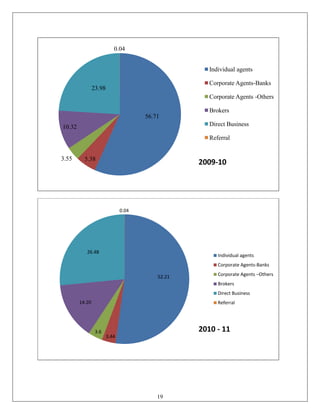
Following shows the channel wise distribution of premium over the past two years for the
company – (Rs.in lakhs)


                Channel                           2009-10                2010-11

 Individual agents                                       342689             475259.46

 Corporate Agents-Banks                                     32535             31333.68

 Corporate Agents –Others                                   21467             32757.58

 Brokers                                                    62360             129323.4

 Direct Business                                         144931             241063.74

 Referral                                                 268.61                436.22

 Grand Total                                             604251             910174.08


                                               18
0.04


                                                     Individual agents

                                                     Corporate Agents-Banks
                23.98
                                                     Corporate Agents -Others

                                                     Brokers
                                      56.71
10.32                                                Direct Business

                                                     Referral


3.55      5.38
                                                  2009-10


                               0.04


           26.48
                                                        Individual agents
                                                        Corporate Agents-Banks

                                          52.21         Corporate Agents –Others
                                                        Brokers
                                                        Direct Business
        14.20                                           Referral


                 3.6                              2010 - 11
                        3.44


                                          19
Pricing-


A fundamental principle of insurance pricing is that if insurers are to sell coverage willingly,
they must receive premiums that
( 1) are sufficient to fund their expected claim costs and administrative costs and
(2) provide an expected profit to compensate for the cost of obtaining the capital necessary to
support the sale of coverage."[Harrington 1999]
The pricing of insurance products starts from the pure premium calculation of the actuaries. It
includes the amount needed to cover expected losses and loss adjustment expenses. It is then
loaded for operating expenses including sales commission and other marketing costs, taxes and
the cost of handling claims. This component varies from one line of business to another. The law
of large numbers principle works while pricing a product i.e determining the premium. The
premium is based on rates. There are basically three recognized rating methods.
Judgment rating is used when the risk proposed to be bought is so unusual that little or no
statistical information about similar risk is available. Each exposure is individually evaluated,
and the rate is determined largely by the underwriter's judgment. When the judgment rating is
used, each premium is unique and is based on the opinion of the person making it.
Class rates are the most common rate in insurance business. Insured risks are classified on the
basis of one or several important features and all that belong to the same class are subject to the
same rate per unit of exposure. The rate charged reflects the claims experience for the class as a
whole. It is based on the assumption that future losses to insured will be determined largely by
the same set of factors.
Merit rating is a modification of the class rating. It modifies the class rate of a particular class
insured based on individual loss experience.

Promotion Strategy-

The aim of the company is to design the products from customer feedback to suit their specific
needs. The company focuses on delivering outcome rather than merely products. The company is
ramping up its knowledge database and is focusing on the customer base with a view to building
long term relationships. The role of field personnel is imperative for the promotion of the various
insurance covers and it is their responsibility to scout for these covers.
Electronic media, outdoor media and print media were utilized for publicity purpose. Hoardings
and glow signs were placed at many major road junctions, highways, railway stations and
airports. Advertisements were also displayed on transit media like buses, trains, baggage trolleys
and barricades.
Banner display at local events helped the company in brand building in rural areas.
The company participates in fairs, exhibitions and road shows and also sponsors various social
gatherings, sports and cultural events.
The company recently forayed into television and radio activities. The company also sponsored
the Mumbai Indians IPL T-20 team which has given tremendous visibility to the customers of all
ages and various groups not only nationwide but also global-wise.
The internet affords widespread access to a pool of new customers. Beyond the traditional means
of radio, print and television ads, the internet opens up the audience that insurers might reach.
This dimension has to do with delivering a marketing message to more customers than before.
Also the internet is an advertising vehicle. A website offers the insurer an opportunity to shape


                                                 20
and tailor its particular message to personal computer owners. The website newindia.co.in
displays financial ratings and statements, shows press releases and lists a range of product and
service offerings. It also showcases the newly developed products of the company. The cost of
advertising on the internet on a per reader basis is much lower than television, radio and print
advertising. The website also provides toll free numbers of the customer care and details of
nearby offices and claims hubs etc.


                                                21
Customer Service-

The company believes in the following dictum-
    ―The customer is the most important visitor on our premises. He is not dependant on us. We
    are dependent on him. He is not an interruption in our work. He is the purpose of it. He is not
    an outsider in our business. He is a part of it. We are not doing him a favour by serving. He is
    doing us a favour by giving us an opportunity to do so.‖
Thus, it is evident that the company lays utmost importance to customer service. Customer
services and grievance cells are well established at company‘s corporate offices and all Regional
Offices. ―May I Help You?‖ counters have been provided in all Regional Offices, Divisional
Offices and Branch Offices for customer service.
In order to ensure better and efficient customer service, the company has decided to launch a toll
free number on an All India basis, catering to the needs of the existing as well as prospective
clients.

Current Market Structure-

General Insurance Industry was under the complete control of the four Government Companies
for nearly three decades. After much deliberation, the market was opened for competition from
December 2000. The government delinked the four public sector companies from holding
company GIC to operate as independent companies. The IRDA has issued licenses to a number
of private General Insurance Companies.
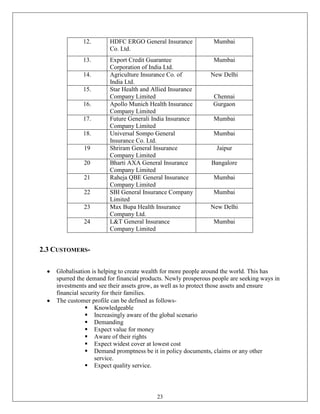
List of General Insurance Companies operating in the market as on date –

                 S.No             Name of the Company               Headquarters
                             Bajaj Allianz General Insurance           Pune
                   1.        Co. Ltd.
                   2.        ICICI Lombard General                      Mumbai
                             Insurance Co. Ltd.
                   3.        IFFCO Tokio General Insurance             Gurgaon
                             Co. Ltd.
                   4.        National Insurance Co.Ltd.                 Kolkata
                   5.        The New India Assurance Co.                Mumbai
                             Ltd.
                   6.        The Oriental Insurance Co. Ltd.          New Delhi
                   7.        Reliance General Insurance Co.            Mumbai
                             Ltd.
                   8.        Royal Sundaram Alliance                    Chennai
                             Insurance Co. Ltd
                   9.        Tata AIG General Insurance Co.             Mumbai
                             Ltd.
                  10.        United India Insurance Co. Ltd.            Chennai

                  11.        Cholamandalam MS General                   Chennai
                             Insurance Co. Ltd.


                                                22
12.       HDFC ERGO General Insurance             Mumbai
                        Co. Ltd.
              13.       Export Credit Guarantee                 Mumbai
                        Corporation of India Ltd.
              14.       Agriculture Insurance Co. of           New Delhi
                        India Ltd.
              15.       Star Health and Allied Insurance
                        Company Limited                         Chennai
              16.       Apollo Munich Health Insurance          Gurgaon
                        Company Limited
              17.       Future Generali India Insurance         Mumbai
                        Company Limited
              18.       Universal Sompo General                 Mumbai
                        Insurance Co. Ltd.
              19        Shriram General Insurance                Jaipur
                        Company Limited
              20        Bharti AXA General Insurance           Bangalore
                        Company Limited
              21        Raheja QBE General Insurance            Mumbai
                        Company Limited
              22        SBI General Insurance Company           Mumbai
                        Limited
              23        Max Bupa Health Insurance              New Delhi
                        Company Ltd.
              24        L&T General Insurance                   Mumbai
                        Company Limited


2.3 CUSTOMERS-

    Globalisation is helping to create wealth for more people around the world. This has
    spurred the demand for financial products. Newly prosperous people are seeking ways in
    investments and see their assets grow, as well as to protect those assets and ensure
    financial security for their families.
    The customer profile can be defined as follows-
                 Knowledgeable
                 Increasingly aware of the global scenario
                 Demanding
                 Expect value for money
                 Aware of their rights
                 Expect widest cover at lowest cost
                 Demand promptness be it in policy documents, claims or any other
                    service.
                 Expect quality service.


                                          23
Since, very individual is susceptible to risk; everyone is a customer or a potential
customer for the insurance industry.
In selling an insurance cover, each individual customer is unique both in his specific
insurance needs and in his buying preferences.
This uniqueness of each insured customer has put an enormous pressure on an insurer, in
terms of demonstrating its individualized insurance expertise of the marketing staff, the
time spent accessing and engaging its customers and the relative costs of doing them all
to get the business.
Marketing strategies will have specific focus based on the segment to which they are
catering to.
The company caters to a large cross section of lower, middle and upper sections of
society.
The customers are segmented along the following lines-
Corporate
Small Industries
New Ventures
Cooperatives
Individual Entrepreneurs
Rural Units
Personal Insurance Lines

Extensive market survey is carried out to determine the needs of the people and specific
policies are designed keeping in mind the needs of customers.
The company offers various generic policies which cater to a large number of people
such as, motor and basic fire policy.
The company also offers policies for individuals belonging to specific professions. For
eg- Doctor‘s Protection Shield has been designed keeping in mind the various hazards
doctors are exposed to.
The Office Protection Shield (General) offers protection to various items generally found
in the offices. However, there are specific Office Protection Shield policies for
professionals that provide professional indemnity for loss on material damage to property
and/or death or bodily injury to third party whilst rendering professional services.
Also, various tailor made policies are provided for organizations to cover their
employees. For eg- Group Mediclaim policy offers cover to a minimum of 100
employees subject to a minimum sum insured of Rs.1 lakh each. The premium in such
cases is determined by a number of factors pertaining to that organization alone such as
age of the employees, the risk that they are subject to, the claims ratio over the previous
years etc.
The rural consumer is now exhibiting an increasing propensity for insurance products. A
research conducted exhibited that the rural consumers are willing to dole out anything
between Rs 2,900 and Rs 3,500 as premium each year.


                                        24
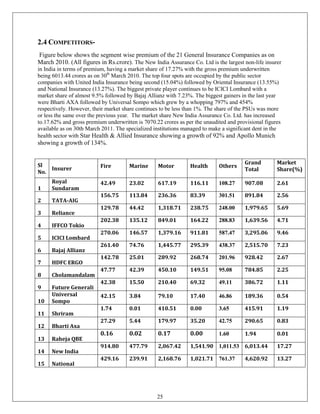
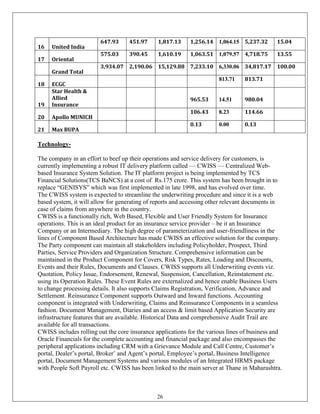
2.4 COMPETITORS-
Figure below shows the segment wise premium of the 21 General Insurance Companies as on
March 2010. (All figures in Rs.crore). The New India Assurance Co. Ltd is the largest non-life insurer
in India in terms of premium, having a market share of 17.27% with the gross premium underwritten
being 6013.44 crores as on 30th March 2010. The top four spots are occupied by the public sector
companies with United India Insurance being second (15.04%) followed by Oriental Insurance (13.55%)
and National Insurance (13.27%). The biggest private player continues to be ICICI Lombard with a
market share of almost 9.5% followed by Bajaj Allianz with 7.23%. The biggest gainers in the last year
were Bharti AXA followed by Universal Sompo which grew by a whopping 797% and 454%
respectively. However, their market share continues to be less than 1%. The share of the PSUs was more
or less the same over the previous year. The market share New India Assurance Co. Ltd. has increased
to.17.62% and gross premium underwritten is 7070.22 crores as per the unaudited and provisional figures
available as on 30th March 2011. The specialized institutions managed to make a significant dent in the
health sector with Star Health & Allied Insurance showing a growth of 92% and Apollo Munich
showing a growth of 134%.


Sl                                                                                     Grand         Market
    Insurer               Fire        Marine       Motor        Health      Others
No.                                                                                    Total         Share(%)

      Royal               42.49       23.02        617.19       116.11      108.27     907.08        2.61
1     Sundaram
                          156.75      113.84       236.36       83.39       301.51     891.84        2.56
2     TATA-AIG
                          129.78      44.42        1,318.71     238.75      248.00     1,979.65      5.69
3     Reliance
                          202.38      135.12       849.01       164.22      288.83     1,639.56      4.71
4     IFFCO Tokio
                          270.06      146.57       1,379.16     911.81      587.47     3,295.06      9.46
5     ICICI Lombard
                          261.40      74.76        1,445.77     295.39      438.37     2,515.70      7.23
6     Bajaj Allianz
                          142.78      25.01        289.92       268.74      201.96     928.42        2.67
7     HDFC ERGO
                          47.77       42.39        450.10       149.51      95.08      784.85        2.25
8     Cholamandalam
                          42.38       15.50        210.40       69.32       49.11      386.72        1.11
9     Future Generali
      Universal           42.15       3.84         79.10        17.40       46.86      189.36        0.54
10    Sompo
                          1.74        0.01         410.51       0.00        3.65       415.91        1.19
11    Shriram
                          27.29       5.44         179.97       35.20       42.75      290.65        0.83
12    Bharti Axa
                          0.16        0.02         0.17         0.00        1.60       1.94          0.01
13    Raheja QBE
                          914.80      477.79       2,067.42     1,541.90 1,011.53 6,013.44           17.27
14    New India
                          429.16      239.91       2,168.76     1,021.71 761.37        4,620.92      13.27
15    National


                                                  25
647.93      451.97     1,817.13    1,256.14 1,064.15 5,237.32         15.04
16   United India
                        575.03      390.45     1,610.19    1,063.51 1,079.57 4,718.75         13.55
17   Oriental
                        3,934.07 2,190.06 15,129.88 7,233.10 6,330.06 34,817.17 100.00
     Grand Total
                                                                       813.71    813.71
18   ECGC
     Star Health &
     Allied                                                965.53      14.51     980.04
19   Insurance
                                                           106.43      8.23      114.66
20   Apollo MUNICH
                                                           0.13        0.00      0.13
21   Max BUPA

Technology-

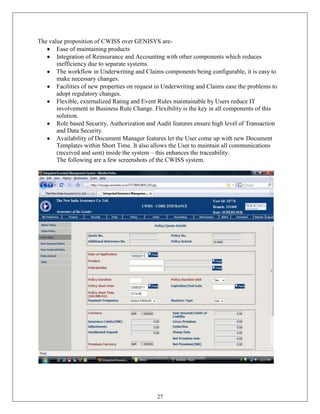
The company in an effort to beef up their operations and service delivery for customers, is
currently implementing a robust IT delivery platform called — CWISS — Centralized Web-
based Insurance System Solution. The IT platform project is being implemented by TCS
Financial Solutions(TCS BaNCS) at a cost of Rs.175 crore. This system has been brought in to
replace ―GENISYS‖ which was first implemented in late 1998, and has evolved over time.
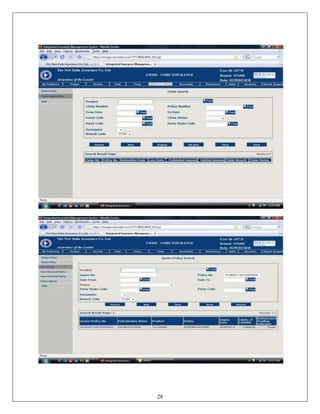
The CWISS system is expected to streamline the underwriting procedure and since it is a web
based system, it will allow for generating of reports and accessing other relevant documents in
case of claims from anywhere in the country.
CWISS is a functionally rich, Web Based, Flexible and User Friendly System for Insurance
operations. This is an ideal product for an insurance service provider – be it an Insurance
Company or an Intermediary. The high degree of parameterization and user-friendliness in the
lines of Component Based Architecture has made CWISS an effective solution for the company.
The Party component can maintain all stakeholders including Policyholder, Prospect, Third
Parties, Service Providers and Organization Structure. Comprehensive information can be
maintained in the Product Component for Covers, Risk Types, Rates, Loading and Discounts,
Events and their Rules, Documents and Clauses. CWISS supports all Underwriting events viz.
Quotation, Policy Issue, Endorsement, Renewal, Suspension, Cancellation, Reinstatement etc.
using its Operation Rules. These Event Rules are externalized and hence enable Business Users
to change processing details. It also supports Claims Registration, Verification, Advance and
Settlement. Reinsurance Component supports Outward and Inward functions. Accounting
component is integrated with Underwriting, Claims and Reinsurance Components in a seamless
fashion. Document Management, Diaries and an access & limit based Application Security are
infrastructure features that are available. Historical Data and comprehensive Audit Trail are
available for all transactions.
CWISS includes rolling out the core insurance applications for the various lines of business and
Oracle Financials for the complete accounting and financial package and also encompasses the
peripheral applications including CRM with a Grievance Module and Call Centre, Customer‘s
portal, Dealer‘s portal, Broker‘ and Agent‘s portal, Employee‘s portal, Business Intelligence
portal, Document Management Systems and various modules of an Integrated HRMS package
with People Soft Payroll etc. CWISS has been linked to the main server at Thane in Maharashtra.


                                              26
The value proposition of CWISS over GENISYS are-
       Ease of maintaining products
       Integration of Reinsurance and Accounting with other components which reduces
       inefficiency due to separate systems.
       The workflow in Underwriting and Claims components being configurable, it is easy to
       make necessary changes.
       Facilities of new properties on request in Underwriting and Claims ease the problems to
       adopt regulatory changes.
       Flexible, externalized Rating and Event Rules maintainable by Users reduce IT
       involvement in Business Rule Change. Flexibility is the key in all components of this
       solution.
       Role based Security, Authorization and Audit features ensure high level of Transaction
       and Data Security.
       Availability of Document Manager features let the User come up with new Document
       Templates within Short Time. It also allows the User to maintain all communications
       (received and sent) inside the system – this enhances the traceability.
       The following are a few screenshots of the CWISS system.


                                              27
28
2.5 HUMAN RESOURCES-


Executive Details

M.Ramadoss          Chairman cum Managing Director

A.R.Sekar           Director, Financial Advisor,
                    General Manager

I.S.Phukela         Director, General Manager

S.B.L.Gour          General Manager

K Sanath Kumar      General Manager

R K Deka            General Manager

Sadashiv Mishra     General Manager

S Sethuraman        General Manager


                                            29
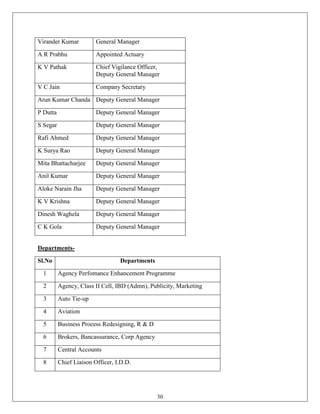
Virander Kumar           General Manager

A R Prabhu               Appointed Actuary

K V Pathak               Chief Vigilance Officer,
                         Deputy General Manager

V C Jain                 Company Secretary

Arun Kumar Chanda Deputy General Manager

P Dutta                  Deputy General Manager

S Segar                  Deputy General Manager

Rafi Ahmed               Deputy General Manager

K Surya Rao              Deputy General Manager

Mita Bhattacharjee       Deputy General Manager

Anil Kumar               Deputy General Manager

Aloke Narain Jha         Deputy General Manager

K V Krishna              Deputy General Manager

Dinesh Waghela           Deputy General Manager

C K Gola                 Deputy General Manager


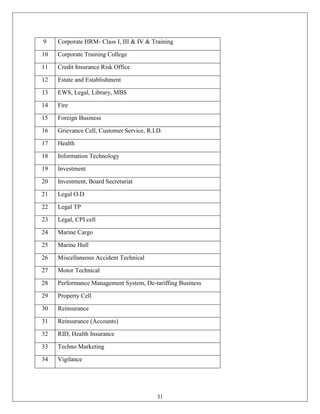
Departments-

Sl.No                             Departments

  1       Agency Perfomance Enhancement Programme

  2       Agency, Class II Cell, IBD (Admn), Publicity, Marketing

  3       Auto Tie-up

  4       Aviation

  5       Business Process Redesigning, R & D

  6       Brokers, Bancassurance, Corp Agency

  7       Central Accounts

  8       Chief Liaison Officer, I.D.D.


                                                30
9    Corporate HRM- Class I, III & IV & Training

10   Corporate Training College

11   Credit Insurance Risk Office

12   Estate and Establishment

13   EWS, Legal, Library, MBS

14   Fire

15   Foreign Business

16   Grievance Cell, Customer Service, R.I.D.

17   Health

18   Information Technology

19   Investment

20   Investment, Board Secretariat

21   Legal O.D

22   Legal TP

23   Legal, CPI cell

24   Marine Cargo

25   Marine Hull

26   Miscellaneous Accident Technical

27   Motor Technical

28   Performance Management System, De-tariffing Business

29   Property Cell

30   Reinsurance

31   Reinsurance (Accounts)

32   RID, Health Insurance

33   Techno Marketing

34   Vigilance


                                           31
Employee Strength-

             Category               Total number of Employees                    Function

 Class I                           5941                               Supervisory
 Class II                          2547                               Development Force
 Class III                         9032                               Clerical/Secretarial
 Class IV                          2049                               Sub staff/Drivers
 P. T. S.                          389

 Total                             19558

 Staff Position at Pune R.O-

          Officers           Development Class III  Class IV PTS Total
(DGM+CRM+MGR+Dy.MGR+A.M+A.O)   Officers  Employees Employees
            307                  171       668        114     17 1277

 Training-

    For Agents:
 In addition to their Corporate Training College (CTC), Mumbai, Zonal Training Centres (ZTC)
 at Kolkata and Chennai and 19 Regional Training centres (RTC) at Regional offices; the
 company have received accreditation for 23 other Agencies training centres in interior parts of
 the country. The training is for pre-licencing exam preparation and subsequent trainings for skill
 developments.

   For Staff:
 RTC and ZTC caters training to the employees under the zone/ regions, from time to time. ZTCs
 generally conduct trainings on special topics for which faculties are rare.College of Insurance
 (Under GIC ,Mumbai) also imparts training programmes for staff from Mumbai and Pune
 Regions only.On Management topics and specialized topics , there are external agency's training
 centers at various places throughout India.

    For Officers:
 RTC, ZTC & CTC make their yearly calendar for regular training, and special trainings on
 technological changes, departmental changes, for transfers and promotions. National Insurance
 Academy (NIA), Pune takes up specialized training programme on Insurance, IT, Law and
 Management topics. Officers are also nominated to various external institutions for training
 programmes/seminars and conferences. College of Insurance also caters to the needs of officers
 of Mumbai & Pune region. Being an International Company, the top executives and officers are
 nominated for overseas training, around 10 cases per year. 10 Computer Learning centres in
 large cities like Ahmedabad, Kanpur and Mumbai CTC etc have been created for Computer
 literacy training and specialized courses. The company has also initiated 'E- training', initially on
 Management courses with various outside agencies.


                                                  32
For SC/ST Staff:
Special Training programmes in preparation for competitive examination are organized in all
Regional Training Centres. Special training programmes and workshops in 2/3 batches per year
are also organized at all India level at some outside venues.Special attention is given to them
while nominating for training at various Institutes.

  For TPAS / Brokers/ Surveyors / Advocates:
Basing on the need to improve the productivity and professionalism and also to clear pending
cases in an effective way, special workshops are being organised under various Regional Offices.

   For Customers:
All Regional offices organise various workshops / seminars for their existing and prospective
clients throughout the year at various hired places.

  For Corporate Agents:
The company has initiated pre-licensing agency training for Corporate 'bancassurance' agents.
For first hand information and soft skill in Insurance Underwriting 3 days training programme
for Bank officials were taken up at around 10 places throughout India.


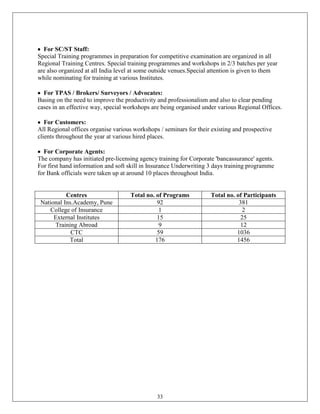
           Centres                  Total no. of Programs           Total no. of Participants
 National Ins.Academy, Pune                   92                               381
     College of Insurance                      1                                 2
      External Institutes                     15                                25
      Training Abroad                          9                                12
             CTC                              59                              1036
            Total                            176                              1456


                                               33
2.6 OPERATIONS –

Underwriting and Claims Management are the two most important aspects of the functioning of
an insurance company. The other operations are Actuarial Analysis, Investment and Reinsurance.
Out of any insurance contract, the customer has the following
expectations:
i. Adequate insurance coverage, which does not leave him high and dry in time of
need, with right pricing.
ii. Timely delivery of defect free policy documents with relevant endorsements /
warranties / conditions / guidelines.
iii. Should a claim happen, quick settlement to his satisfaction.
Underwriting is the process of classifying the potential insureds into the appropriate risk
classification in order to charge the appropriate rate. An underwriter decides whether or not to
insure exposures on which applications for insurance are submitted. There are separate
procedures for group underwriting and individual underwriting.
For any insurance contract to exist there has to be a proposal form. Any individual wishing to
take an insurance policy has to first fill the proposal form. Different forms are available for
different types of policy. (See Annexure for a Motor Proposal form)
The parties to the insurance contract are required to observe utmost good faith (Uberrimae fidei)
by disclosing all material information. Examples of material information are type of construction
of building in case of fire insurance, type of packing goods and material used in case of marine
cargo insurance, cubic capacity of vehicle in motor insurance, physical disabilities if any while
taking a personal accident policy. This allows the insurer to decide for a)acceptance of risk b)
fixing rate of premium c)terms and conditions of the contract. The proposal forms the basis for
any contract and any non disclosure of material facts makes the contract voidable.
In case of motor policies where there is a break in policy, a vehicle inspection is done. In case of
high risk proposals, technically qualified staff are enlisted to inspect the risk and provide an
assessment on the basis of which the policy is underwritten. A medical examination is also
necessary in case of Mediclaim policy for clients above the age of 45.
Once the proposal is accepted by the competent authority, it is underwritten. The underwriters
use the proposal form to fill in the prescribed details in the CWISS system. The underwriter must
employ sound judgment based on his or her years of experience to read beyond the basic facts
and get a true picture of the applicant and his lifestyle in case of health policies. Of course, the
underwriter certainly cannot - and isn't expected to - foresee all possible circumstances. The
underwriter's primary function is to protect the insurance company insofar as is possible against
adverse selection (very poor risks) and those parties who may have fraudulent intent. Once the
underwriter determines that risk can be accepted, the next decision is to apply the proper
premium rate. Premium rates are determined for classes of insured by the actuarial department.
An underwriter‘s role is to decide which class is appropriate for each insured. The business of
insurance inherently involves discrimination; otherwise, adverse selection would make insurance
unavailable. Once the premium is calculated, the draft is saved and then sent for collection.
The client then has to pay the premium to the cashier who then generates a collection receipt and
the policy. The policy then becomes active.


                                                34
RISK

                         OFFER                            ACCEPTANCE


             PROPOSER                                             INSURER


                     JOB OF PAYING                           QUOTE
                       PREMIUM

                                         PREMIUM


Actuarial analysis is a highly specialized mathematic analysis that deals with the financial and
risk aspects of insurance. Actuarial analysis takes past losses and projects them into the future to
determine the reserves an insurer needs to keep and the rates to charge. An actuary determines
proper rates and reserves, certifies financial statements, participates in product development, and
assists in overall management planning. The rates or premiums for insurance are based first and
foremost on the past experience of losses. Actuaries calculate the rates using various procedures
and techniques. The most modern techniques include sophisticated regression analysis and data
mining tools. In essence, the actuary first has to estimate the expected claim payments.
Investment income is a significant part of total income in most insurance companies. The
company invests in Government securities and Government guaranteed bonds including
Treasury Bills, Other Approved Securities, Debentures/Bonds, Infrastructure and Social Sector
projects.
Reinsurance is an arrangement by which an insurance company transfers all or a portion of its
risk under a contract (or contracts) of insurance to another company. The company transferring
risk in a reinsurance arrangement is called the ceding insurer. The company taking over the risk
in a reinsurance arrangement is the assuming reinsurer. In effect, the insurance company that
issued the policies is seeking protection from another insurer, the assuming reinsurer. Typically,
the reinsurer assumes responsibility for part of the losses under an insurance contract; however,
in some instances, the reinsurer assumes full responsibility for the original insurance contract.
A ceding company (the primary insurer) uses reinsurance mainly to protect itself against losses
in individual cases beyond a specified sum (i.e., its retention limit), but competition and the
demands of its sales force may require issuance of policies of greater amounts. A company that
issued policies no larger than its retention would severely limit its opportunities in the market.
Many insureds do not want to place their insurance with several companies, preferring to have
one policy with one company for each loss exposure. The national insurer is GIC


                                                 35
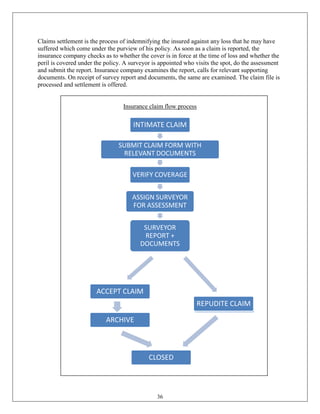
Claims settlement is the process of indemnifying the insured against any loss that he may have
suffered which come under the purview of his policy. As soon as a claim is reported, the
insurance company checks as to whether the cover is in force at the time of loss and whether the
peril is covered under the policy. A surveyor is appointed who visits the spot, do the assessment
and submit the report. Insurance company examines the report, calls for relevant supporting
documents. On receipt of survey report and documents, the same are examined. The claim file is
processed and settlement is offered.


                                  Insurance claim flow process

                                      INTIMATE CLAIM

                                SUBMIT CLAIM FORM WITH
                                 RELEVANT DOCUMENTS

                                      VERIFY COVERAGE


                                     ASSIGN SURVEYOR
                                     FOR ASSESSMENT


                                          SURVEYOR
                                          REPORT +
                                         DOCUMENTS


                       ACCEPT CLAIM
                                                                 REPUDITE CLAIM

                           ARCHIVE


                                            CLOSED


                                               36
2.7 FINANCE-
                                                                                           (in %)
                                                                     Upto the               Upto the
                                                                     Quarter                Quarter
Sl.No.                           Particulars
                                                                    Ending 31st           Ending 31st
                                                                     Mar.,2011             Mar.,2010
  1       Gross Premium Growth Rate                                        15.87                   9.97
  2       Gross Premium to Shareholders' Fund Ratio                            34.70                 30.77
  3       Growth Rate of Shareholders' Fund                                     2.75                 56.53
  4       Net Retention Ratio                                                  87.44                 84.55
  5       Net Commission Ratio                                                  9.02                  9.35
          Expense of Management to Gross Direct Premium
  6                                                                            32.78                 34.61
          Ratio
  7       Combined Ratio                                                   104.97                   108.66
  8       Technical Reserves to Net Premium Ratio                          177.84                   177.29
  9       Underwriting Balance Ratio                                           -36.75               -28.64
 10       Operationg Profit Ratio                                              -17.68                -8.38
 11       Liquid Assets to Liabilities Ratio                                   49.07                 48.28
 12       Net Earning Ratio                                                     -5.86                 6.74
 13       Return on Net Worth Ratio                                             -1.78                 1.75
          Available Solvency Margin to Required Solvency
 14                                                                             2.97                  3.55
          Margin Ratio

Equity Holding Pattern

      1     (a) No. of shares                         200000000    200000000            200000000      200000000
            (b) Percentage of shareholding (Indian
      2                                                    100/0       100/0                100/0             100/0
            / Foreign)
            ( c) %of Government holding (in case
      3                                                     100          100                  100              100
            of public sector insurance companies)
            (a) Basic and diluted EPS before
            extraordinary items (net of tax
      4                                                   -21.08      -21.08                20.23             20.23
            expense) for the period (not to be
            annualized)
            (b) Basic and diluted EPS after
            extraordinary items (net of tax
      5                                                   -21.08      -21.08                20.23             20.23
            expense) for the period (not to be
            annualized)
      6     (iv) Book value per share (Rs)                348.71      348.71               371.51            371.51


                                                     37
2.8 ORGANIZATIONAL HIERARCHY


                     CHAIRMAN CUM
                    MANAGING DIRECTOR


                    GENERAL MANAGERS


                      DEPUTY GENERAL
                        MANAGERS


                      CHIEF MANAGERS


                        MANAGERS


                    DEPUTY MANAGERS


                        ASSISTANT
                        MANAGERS


                      ADMINISTRATIVE
                        OFFICERS


                               38
Organization Structure-
Domestic:
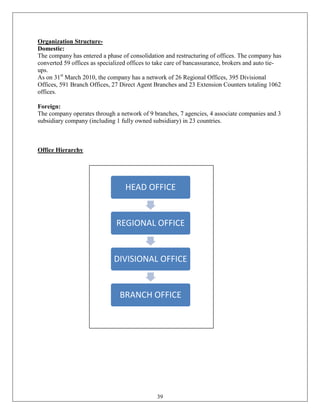
The company has entered a phase of consolidation and restructuring of offices. The company has
converted 59 offices as specialized offices to take care of bancassurance, brokers and auto tie-
ups.
As on 31st March 2010, the company has a network of 26 Regional Offices, 395 Divisional
Offices, 591 Branch Offices, 27 Direct Agent Branches and 23 Extension Counters totaling 1062
offices.

Foreign:
The company operates through a network of 9 branches, 7 agencies, 4 associate companies and 3
subsidiary company (including 1 fully owned subsidiary) in 23 countries.


Office Hierarchy


                                  HEAD OFFICE


                               REGIONAL OFFICE


                              DIVISIONAL OFFICE


                                BRANCH OFFICE


                                               39
2.9 ENVIRONMENT -
Social Environment –
Profit is not the first criterion of public sector units. Social welfare is the ultimate goal of
development of insurance sector. The government has devised a lot of social security measures
for India‘s rural, socially backward classes of people. Prices of such products are reduced.
Insurers are obliged to provide insurance to atleast 20000 lives each year. In case of general
insurance, this obligation includes the insurance of crops ( Sec.32 B and 32C of Insurance
Act,1938 and the IRDA regulations 2000.) The government has also introduced various schemes
such as ‗Rashtriya Krishi Bima Yojana‘ to provide insurance coverage to farmers in case of
failure of crops. ‗Solatium Scheme‘ for payment of compensation to victims of hit and run
accidents. In addition to this the company provides policies such as ‗Universal Health Insurance
Scheme‘ and ‗Jan Arogya Bima Policy‘ at nominal rates to the less-privileged. In a democratic
setup, insurance companies are accountable to the public through 1.)Parliament 2.)Audit
and3.)Annual reports as a social measure.


                          Social responsibilities of insurance business


                                         Promoters/
                                         Shareholders
                    Surveyors,
                                                                Consumer
                     Lawyers,
                                                                 Insured
                    Actuaries


                                          Insurance
           Suppliers                       Business                       Workers
                                           Insurers


                    Reinsurers                                   Managers


                                             TPAs


                                               40
Legal Environment -
The IRDA Act of 1999 was enacted with a view to regulate the Insurance Companies
irrespective of private and nationalized companies. Any insurance company is obliged to abide
by the rules and follow the guidelines as prescribed by IRDA from time to time. These include
the IRDA Regulation 2000 on ‗Appointed Actuary‘ and the ‗Obligations of Insurance to Rural
Social sectors‘ which specifies that the company has to undertake certain obligations pertaining
to the persons in Rural and Social Sectors in each financial year. ‗Assets, Liabilities and
Solvency Margin of Insurance‘ also specifies that the insurer has to maintain a solvency margin
as prescribed by IRDA. The ‗Investment Regulation‘ deals with type of investment in the
following segments – central government securities, state government securities and other
approved securities. The Motor Vehicles Act 1988 specifies the third party liability arising out of
the use of motor vehicles in a public place and compensation for the same.

Political Environment -
The Central Government being satisfied that it is necessary in the public interest to do so,
exempts the taxes leviable for schemes such as Cattle Insurance under IRDP (Irrigated Rural
Development Program), Janata Personal Accident Scheme, Agriculture Pump Set Insurance and
other such social welfare schemes.

Economic Environment -
Insurance is the result of various economic activities causing employment and is dependant on
the total net income, national economic and industrial development. On the other hand insurance
also has the responsibility to provide stability and security to economy and industry. The
company cannot behave with sole profit motives. Policies with less demand have become costlier
to the insurer but due to social obligations, the pricing remains subsidized. The premium
collected is not even sufficient to cover the cost of issuing the policies (stationery, man hours
involved, stamp duty) in case of certain schemes as such is operating at a loss ratio of above
100%. An insurer is not permitted to invest in private limited companies. Insurer is also not
permitted to keep more than 10% of his assets in fixed and current deposit or both in one banking
company.
Physical Environment –
If one area is endemic to one peril (For eg – Kutch, Gujarat is prone to earthquakes, Khopoli,
Maharashtra is prone to landslides) then to cover the insurance risk of that area, premium rates
will be higher than other areas.

Technological Environment -
The company introduced its first automated system ‗Genisys‘ in 1998. However, this was an
rudimentary system and the spread of technology for insurance services such as underwriting and
claims management was slow. It was only recently that the company has entered into online
transaction of business. It is needless to say that the technology provides better quality,
quickness, better space utilization and easier data storage. The spread of technology has also
helped improve the customer service.


                                                41
2.10 SWOT ANALYSIS-
Strengths-
The Company is without doubt the largest non-life insurance company in India. It is the market
leader in terms of premium underwritten in the fire (23% market share), marine (22%),
engineering (18%), health (21%) and liability (15%) sectors. The New India Assurance is a
pioneer non-life insurance company insuring all types of assets, belongings and lives of rural and
social sector in the country. A leading market position gives a company a stronghold within the
industry.
Financially the company is in a strong position with the profits after tax for the financial year
2009-10 being Rs.404 crores, an increase of 80% from the previous year. The gross direct
premium also recorded a good growth rate of 9.69% as against 4.39% growth registered during
2008-09. Continued good investment performance enabled the company to earn an investment
income of 2139 crores as against 1686 crores in the previous year.
The company has an available solvency margin of 6621 crores while the required solvency
margin under IRDA regulations is 1429.33 crores.
 Its widespread network of 1062 offices across the country helps in its product distribution to all
corners of the country. The company has experienced and technically competent staff who
understand the nuances of the insurance industry. Claim hubs have been created for centralized
claim processing in all Regional Office centres. This has helped the company achieve a very high
claims settlement ratio. The company has been able to bring down the average claim settlement
time from 137 days in 2008-09 to 88 days in 2009-10. It has been able to reduce its Motor T.P
losses which are severely affecting the profitability of all insurance companies thanks largely to
the diligent efforts taken to settle as many claims promptly through Lok Adalats and conciliation.
Large Corporate Regional Offices have helped provide dedicated service and organizational
focus to corporate clients and government accounts

Weakness-
During the financial year 2009-10 the underwriting deficit has gone up by 255 crores mainly due
to increased operating expenses and adjustments for the previous year. In these times of intense
competition where premium rates have bottomed out and companies are struggling for their very
survival due to a high combined ratio, the employees fail to realize the importance of customer
service in not only retaining but also generating fresh premium. Customers are made to wait for
service and are sometimes shunted from one counter to another.
Another major weakness is the treatment of agents who generate a majority of the premium for
the company. As per their own admission, they are treated worse than the sub staff and not
accorded the respect that they deserve from the employees. Also, there is a delay in payment of
the Agent‘s fees which is effectively the salary of the Agents.
The employees are not particularly well versed in the use of computers and in this day and age;
this is a major drawback. Also the computer systems in use are outdated and infested with
problems. The connectivity of the system is quite poor causing inordinate delay to the customers
who are made to wait for no fault of theirs.
The company recently implemented a new ERP package called CWISS. However, proper
planning has not been done before implementing this change. The employees weren‘t adequately
trained and a number of them are facing difficulties while working in the new system. Also, all
the existing policies have not been fully migrated to the new system. Hence, employees have to


                                                42
use both the systems (GENISYS and CWISS) simultaneously which is a major hassle. The
underwriters also face difficulties due to this.
The HR policies in practice are out of date and not in sync with the current times. Profit linked
incentives are provided to all employees and hence, there is hardly any motivation for the people
who work hard and those who don‘t. The company is losing productive man hours due to the
absence of a mechanized attendance system. Since there is no individual accountability, there
seems to be a certain lethargy in the attitude of a majority of the employees. There is a certain
lack of professionalism.
In quite a few cases, premium has been accepted from the customer. However the policy has not
been underwritten. This causes major issues in accounting and in the event of claims; the insurer
find themselves in a position where they are unable to register a claim.

Opportunity-
Insurance is a business of distress management and the process of claims management is the
final moment of truth. The claims manager should be sensitive to the needs of the claimant.
When it is obvious that the claim is legitimate, less importance should be laid on a slew of
formalities and the intent should be on settling the claim swiftly. If the company follows the
dictum of ―low on promise and high on delivery‖, it will lead to customer delight and result in a
long and lasting relationship between the insurer and the insured.
Being the largest company, New India has the built-in strength and the capacity to underwrite big
businesses. The company has the potential to focus on huge projects such as large infrastructure
projects, mega power plants. We are seeing rapid development across the country with express
highways, metro rails, international standard airports, port development, power plant projects
coming up across the country. These projects demand insurance cover of international standard
and the company will do well to tap into this new market by providing tailor made all risk
package policies.
The auto industry is also growing at rapid pace. As motor policies are compulsory in India, this
portfolio can give incremental rise to the premium of the company.
With rising awareness, all kinds of insurance especially health is now at the precipice of an
explosion. The penetration of insurance is hardly 3% of the population. This means there is a
potential of market of over 97% of the population. The company is now facing losses in the
Health Sector and the major reason for this is the small spread of risk and the problem of anti-
selection. Once this is sorted, this sector has the potential to be a source of immense profit for the
organization. Also an increase in the disposable income of individuals will give a boost to health
and other personal lines of insurance.
The insurance industry is seeing a double digit growth every year and new talent should be
recruited to take the business forward. The company needs to reinvent itself along the lines of
many nationalized banks.
If the company gains a more professional approach, it will help the company survive the intense
competition.
If every claim is attended to with compassion and enthusiasm and the claim settlement duration
is brought down further, it will enhance the reputation of the company.
The thrust on liability policies have not been much so far and not many people are aware of these
policies. There is tremendous potential if the company focuses on this untapped segment.


                                                 43
Threats-
When the customers are not afforded the service that they demand; it is but natural that they will
tend to go elsewhere. No doubt, this has been one of the major factors for the stupendous growth
of private sector insurance companies that pride themselves on providing excellent customer
service. The company risk losing out on corporate clients who can provide crores of rupees in
premium due to a perceived lack of support from the insurer.
If the management does nothing to ease the complaints of the Agents, they are likely to jump
ship and switch over to the private sector.
The non life insurance industry today faces its biggest challenge of mounting underwriting
losses. This has been primarily because of the lack of focus on prudent underwriting and
effective claims management.


                                                44
CHAPTER III-DISCUSSION ON TRAINING
3.1 ROLES AND RESPONSIBILITIES –
During the initial phase of the internship, my role as an intern was to get acquainted with the
various terms and concepts of the insurance industry. It was my responsibility to read up as much
on insurance and familiarize myself with the terms that are commonly used.
This was followed by a study on the transition and prospects of the Indian Insurance Industry in
order to gain an understanding about the evolution of the insurance sector in India, the functions
of insurance, the growth of the sector, the principles of insurance, the current market structure
etc.
 It was my responsibility to study the portfolio of products offered by the company, their
coverage, exclusions, premium calculations, features and claims procedure with special focus on
fire, marine, motor and health policies. I also had to study the different distribution channels, the
roles of these channels, their importance and their functioning. I was encouraged to interact with
the various intermediaries such as the Agents and the TPAs in order to gain an overall picture of
how the insurance industry works right from procuring the business to the settlement of claims.
I was also trained to use their ERP system called CWISS and get myself acquainted with its
entire functionality.

3.2 DESCRIPTION OF TASKS HANDLED -
Every Insurance company is required to disclose its annual business figures to the public. Hence,
at the end of every financial year, every branch of the company is required to prepare and send
its statistics to the respective Regional Office where it is assimilated and ultimately sent to the
Head Office.
I assisted in preparing the statement of operating performance for the year ending March 2011 of
the Divisonal Office. This included providing statistics of department wise details of premium
generated. The commission paid for each department, the commission as percentage to the
overall premium, the claims incurred in each department, the claims as a percentage of the
premium. This helps determine the claims ratio of each department, the underwriting
surplus/deficit and hence identify the most profitable lines of business. This also included a
yearly review of department wise performance upto March 2011 to determine the accretion
percentage of the various lines of business.
I also assisted in preparing the statement of settlement of claims which was to determine the
department wise claims disposal ratio and age wise settlement of claims in order to determine the
claim processing and settlement time.
The most important task given to me was the underwriting of policies to reduce the burden on
the underwriters. I had the opportunity to work on various types of policies including motor,
householder‘s policy, public liability insurance, and goat insurance. However the prime focus
was on health policies especially tailor made group policies which the company provides to
various corporate after obtaining permission from the Head Office. Some of the clients include
National Insurance Academy, Simmonds Marshall, MWH Resource Net Ltd, Millennium
Engineers and Contractors Pvt.Ltd. The following are a few screenshots of the underwriting
process for Millennium Engineers and Contractors Pvt.Ltd.


                                                 45
3.3 CONTRIBUTION TO THE ORGANIZATION
The various statements of operating performance had to be sent to the Regional Office within a
stipulated period of time. I assisted in the preparation of these statements and helped meet the
deadline as set by the Head Office. Due to a huge number of pending policies, there was a severe
strain on the underwriters. I was able to assist in underwriting a number of policies and updating
the insured list of various group policies which is pretty time consuming and thus helped reduce
some of the burden on the underwriters. I was able to update many such policies which had to be
migrated from the old ERP to the new system so that claims could be registered on these
policies. My research work provides an insight to the company regarding the performance of
their various portfolios. The company may wish to implement some of the suggestions which can
help improve the profitability of these portfolios.

The following are a few screenshots of the ERP package that I used to update the Tailor Made
Floater Group Mediclaim policy of Millenium Engineers and Contractors Pvt. Ltd.


                                               46
47
48
CHAPTER IV – ANALYSIS OF RESEARCH UNDERTAKEN

4.1 INTRODUCTION-
Insurance professionals make decisions everyday which ultimately impact the company‘s
bottom-line. It is very essential therefore to know how the profitability is measured by insurers.
Although there are numerous approaches, estimating insurer profitability is generally
accomplished by examining premiums and investment income and either underwriting results
(underwriting gain or loss) or overall operating performance (gain or loss from operations). An
insurer‘s profits depend heavily on the premium revenue the insurer generates. Insurers use rates
based on the insured's loss exposures to determine the premium to charge for insurance policies.
Premium growth is not always a positive indicator of an insurer's success. An insurer should
achieve premium growth by writing new policies rather than depending solely on insurance rate
increases or inflation. Rapid premium growth may be undesirable and could indicate lax
underwriting standards or inadequate premium levels. Inappropriate premium growth can
eventually lead to reduced profits as losses begin to exceed premiums collected for loss
exposures. To determine profitability, an insurer should consider whether growth resulted from a
competitive advantage, relaxed underwriting, inadequate insurance rates, or a combination of
these factors.
An alternative way to measure an insurer‘s profits is through overall results from operations. An
insurer‘s overall operating performance (gain or loss from operations) is its net underwriting gain
or loss plus its net investment gain or loss for a specific period. This overall figure gives a more
complete picture of an insurer‘s profitability because investment income generally helps to offset
any underwriting losses. The formula for overall gain or loss from operations is expressed as:
overall gain or loss from operations = net underwriting gain or loss + investment gain or loss.
Another key indicator of profitability is based on an insurer‘s underwriting results. Many
insurers use the combined ratio to measure the success of underwriting activities The combined
ratio is a profitability ratio that indicates whether an insurer has made an underwriting loss or
gain. When the combined ratio is exactly one hundred percent, it means every rupee is being
used to pay claims and cover operating cost with nothing remaining for insurer profit. When it is
greater than 100%, it means an underwriting loss occurs, more rupees are being paid out than
being taken in as premiums and when it is less than 100%, an underwriting profit occurs because
not all the premium is being used for claims and expenses.

4.2 RESEARCH DESIGN
Title of the Research Topic-
Profitability analysis of various lines of business for the past three years for the Pune R.O.

Statement of the Research Problem-
To analyze the underwriting performance of various lines of business that the company provides
and to determine the profitability.

Objectives-
      To study the growth in premium of various departments over the past three years at the
      Pune Regional Office. The various lines of business have been segmented as Fire,
      Marine, Motor, Health and other miscellaneous..


                                                 49
To determine the changing composition of contribution of various departments to the
       overall premium.
       To determine the underwriting profitability of the various lines of business over the past
       three years.
       To determine the contribution of each department to the overall claims.
       To examine the channel wise generation of premium.

Scope of the Study-
       The study on profitability is confined to three financial years starting from 2008-09.
       Of all the regional offices of the company, only the Pune R.O has been considered for
       analysis.
       For department-wise analysis, five sectors are considered namely Fire, Marine, Motor,
       Health and Other Miscellaneous which includes Public Liability, Householder‘s policy,
       Shopkeeper‘s policy etc.

Need and Importance of the Study-
 Insurance companies today are operating at a combined ratio of more than 120. In simple terms,
it means that if the income is 100, the outgo is 120. The companies are continuing to eat into
their investment income built over the years due to prudent investment. If underwriting
profitability is not focused upon then it won‘t be long before there aren‘t any reserves to eat into.
Thus, the immediate concern for the companies is to focus on prudent underwriting and bring the
claims ratio to a manageable level so that the company is not entirely dependant on the
investments to make a profit. The company can no longer afford to sacrifice profitability for the
sake of maintaining market share. The following analysis is an attempt to determine the most
profitable lines of business and suggestion thereof to improve the profitability of the various
lines of business.

Limitations of the Study-
      Although the combined ratio is the most-often-cited measure of underwriting success, the
      results that it produces are generally subject to an additional analysis of its components.
      Changes in premium volume, major catastrophic losses, and delays in loss reporting can
      distort the combined ratio, making it difficult to evaluate the effectiveness of
      underwriting.
      Since the study is confined only to the Pune Region, the findings may not be in sync with
      that of the entire company.

Data Sources-
      Primary Data Source
      The primary Data is collected through interaction with the project guide and the finance
      manager of the company.
      Secondary Data Source
      The Secondary Data is collected from the Trial Balance of the Pune R.O of the Company
      and the yearly performance figures as prepared by the company.


                                                 50
4.3 DATA ANALYSIS AND INTERPRETATION-
THE GROSS DIRECT PREMIUM FOR THREE YEARS (PUNE REGION)-
                                                                               (in Rs.lakhs)
      Department                 2008-09                2009-10                2010-11
           Fire                       2818.98                      3739.8            4179.65
          Marine                           852.2                   686.76            1403.04
          Motor                      15283.15                    15413.62           17767.01
          Health                       6133.3                     6984.24            8302.35
          Misc.                       4673.61                     5291.65            6940.91
          Total                      29761.24                    32116.07           38592.96

As above figure and the table reveal, the gross premium generated by the company has increased
over the last three years growing by margin of 7.9% from March 2009 to March 2010 and an
impressive 20% from March 2010 to March 2011. The figures reveal that the company is
generating increasing amounts of premium year on year which is a positive sign meaning the
company is able to maintain as well as generate fresh premium year on year


  20000

  18000

  16000

  14000

  12000
                                                                                     2008-09
  10000
                                                                                     2009-10
   8000                                                                              2010-11

   6000

   4000

   2000

      0
              Fire         Marine          Motor        Health         Misc.


                                               51
QUANTUM GROWTH OF PREMIUM-

          Department                March 2009-March 2010            March 2010-March 2011

                                             920.820                           439.85
             Fire
                                             -165.44                           716.28
            Marine
                                             130.47                           2353.39
            Motor
                                             850.94                           1318.11
            Health
                                             618.04                           1649.26
            Misc.
                                             2354.83                          6476.89
             Total


ACCRETION OF PREMIUM –


          Department                    Accretion(%)                  Accretion (%)
 Fire                                                   32.66                           11.76
 Marine                                                -19.41                           104.3
 Motor                                                   0.85                           15.27
 Health                                                 13.87                           18.87
 Misc.                                                  13.22                           31.17
 Total                                                   7.91                           20.16


If we look at the department wise accretion which is the growth in gross premium generated, we
can see that the fire portfolio showed the most growth from March 2009- March 2010 registering
a quantum growth of 920 lakhs, The marine portfolio fell steeply by 19% while the motor
portfolio remained more or less the same. Health and the other miscellaneous portfolio grew by
almost identical margins. During the next financial year, the motor department registered a
growth of 15.27% and generated additional premium to the tune of 2353 lakhs. The marine
department registered a growth of over 100% after the fall in the previous year. The health and
miscellaneous department continued their steady growth showing a rise of 18% and 31%
respectively over the previous years. Thus, we can see that these two lines of business are the
ones growing steadily over the last three years.


                                              52
20000

    18000

    16000

    14000
                                                                                       Fire
    12000
                                                                                       Marine
    10000
                                                                                       Motor
     8000                                                                              Health
     6000                                                                              Misc.

     4000

     2000

        0
                   2008-09              2009-10              2010-11


CHANGING COMPOSITION OF CONTRIBUTION OF VARIOUS PORTFOLIOS TO
TOTAL PREMIUM (IN %)


    Department           Fire          Marine           Motor          Health          Others


      2008-09                   9.47          2.86          51.35           20.61              15.70


      2009-10                11.64            2.14          47.99           21.75              16.48


      2010-11                10.83            3.64          46.04           21.51              17.98


The most prominent feature of the above graph is the decrease in the contribution of the motor
department to the overall premium. While it was above 51% in 2008-09, it has been brought
down steadily for the last two years and it now stands at just above 46%. This is a very
encouraging sign for the company since it has been struggling under the burden of Motor T.P
claims where there is unlimited liability and hence the operating ratio is well above 100 which
means the company is not even breaking even and is running at a loss. This has been one of the
major reasons for the overall underwriting deficit. The reduction in the overall contribution to
premium means the company is reducing its dependency on this sector and is concentrating more
on other profitable departments. The fire department has more or less maintained an average of


                                                  53
10% contribution to the total premium as has the health portfolio with a contribution of
approximately 20%. The other miscellaneous policies too have shown a rising trend over the past
three years and now contribute almost 18% of the total premium.


  60

  50

  40

                                                                                   2008-09
  30
                                                                                   2009-10
  20                                                                               2010-11

  10

   0
            Fire         Marine        Motor          Health       Others


UNDERWRITING STATISTICS FOR THREE YEARS OF PUNE R.O -


                                           2008-09
                                                                         (All figures in Rs lakhs)

 Dept.                               Incurred        Allocated      Total
           Premium     Commission     Claims         expenses       Outgo         CR      Profitability

    Fire
            2818.98         291.53      1161.97           643.16      2096.66    74.38           722.32

 Marine
               852.2        231.84       2574.4           145.82      2952.06    346.4         -2099.86

  Motor
           15283.15         901.94     12011.13          3486.91    16399.98    107.31         -1116.83

 Health
             6133.3         955.01      4475.31          1399.34    6829.669    111.35          -696.37

 Others
            4673.61         636.45      1583.06           1066.3      3285.81      70.3          1387.8

  Total
           29761.24        3016.77     21805.87          6741.55    31564.19    106.06               -1803


                                                54
2009-10


Dept.                              Incurred         Allocated     Total
         Premium Commission         Claims          expenses      Outgo      CR      Profitability

  Fire
           3739.8       375.88       2770.08             727.28    3873.24 103.57         -133.44

Marine
           686.76       124.81        619.07             100.16     844.04   122.9        -157.28

Motor
         15413.62       882.55      12930.87            2997.47   16810.89 109.06        -1397.27

Health
          6984.24       986.51       5269.55            1358.22    7614.28 109.02         -630.04

Others
          5291.65        721.3       2616.14            1029.06     4366.5   82.52         925.15

 Total
         32116.07      3091.05      24205.71             6212.2   33508.96 104.34        -1392.89


                                          2010-11


Dept.                               Incurred        Allocated     Total
         Premium     Commission      Claims         expenses      Outgo        CR       Profitability

  Fire
           4179.65        411.77       673.88           1259.29    2344.94   56.10374        1834.71

Marine
           1403.04        215.85          588            317.04    1120.89    79.8901          282.15

 Motor
          17767.01        925.51     11377.86           5353.03    17656.4   99.37744          110.61

Health
           8302.35       1032.76      6839.54           2501.42   10373.72   124.9492        -2071.37

Others
           6940.91        918.52      1875.72           2091.23    4885.47   70.38659        2055.44

 Total
          38592.96       3504.41        21355             11522   36381.41   94.26955        2211.55


                                               55
The combined ratio is the key indicator for the profitability of the various lines of business. It is
calculated on the basis of premium underwritten, commission paid, claims incurred and
management expenses.
Incurred claims is calculated as follows-
O/S claims (at the beginning of the year) + Claims intimated during the year – O/S claims (at the
end of the year)
Management expenses are apportioned to each portfolio by using a weighted average method as
shown below for the year 2010-11


  Department            Weightage          Gross Premium           Weightage          Allocated
                           (a)                   (b)             premium (a*b)
                                                                                  expenses(E*Ki/K)

              Fire                   1      K1=4179.65                  4179.65              1259.29

           Marine                 0.75      K2=1403.04                  1052.28                317.04

            Motor                    1      K3=17767.01                17767.01              5353.03

           Health                    1      K4=8302.35                  8302.35              2501.42

           Others                    1      K5=6940.91                  6940.91              2091.23

Where E = 11522 = Total management expenses
        K= Ʃ Ki
Total outgo = Commission paid + Incurred Claims + Allocated expenses
Combined Ratio (C.R) = Total outgo / Gross Premium
The combined ratio helps determine what percentage of the premium is incurred as expenses and
what percentage is saved.

CONTRIBUTION OF EACH SECTOR TO THE CLAIMS-

                                              2008-09

          Department                     Incurred claims             Share of total claims (%)
 Fire                                                  1161.97                                5.33
 Marine                                                 2574.4                               11.81
 Motor                                                12011.13                               55.08
 Health                                                4475.31                               20.52
 Misc.                                                 1583.06                                7.26
 Total                                                21805.87


                                                 56
2009-10

         Department   Incurred claims         Share of total claims (%)
Fire                                2770.08                          11.44
Marine                               619.07                           2.56
Motor                             12930.87                           53.42
Health                              5269.55                          21.77
Misc.                               2616.14                          10.81
Total                             24205.71


                          2010-11

         Department   Incurred claims         Share of total claims (%)
Fire                                 673.88                           3.16
Marine                                  588                           2.75
Motor                             11377.86                           53.28
Health                              6839.54                          32.03
Misc.                               1875.72                           8.78
Total                                21355


                             57
2008-09
           7.26 5.33
                            11.81
                                                           Fire
 20.52
                                                           Marine
                                                           Motor
                                                           Health
            55.08                                          Others


                                                 2009-10
         10.81       11.44          2.56

                                                           Fire
                                                           Marine
21.77
                                                           Motor
                                                           Health
                    53.42                                  Others


                 3.16 2.75
                                               2010-11
          8.78

                                                           Fire
                                                           Marine
32.03                                                      Motor

                      53.28                                Health
                                                           Others


                            58
As evident from the above figures and graphs, the two major contributors to the claims are the
motor portfolio and the health portfolio which together account for almost 80% of all claims.
Hence, controlling the claims of these sectors is crucial to the overall profitability of the
business. While there isn‘t much that can be done for the claims of motor department as the
compensation to be awarded in T.P claims is decided by the verdict of the court and the
insurance company is liable to pay the said sum, better measures can be adopted to reduce the
claims of health sector.


Following shows the combined ratio and underwriting profitability of various lines of business


          Department               2008-09                  2009-10                  2010-11

 Fire                                         74.38                     103.57                   56.10

 Marine                                       346.4                      122.9                   79.89

 Motor                                     107.31                       109.06                   99.37

 Health                                    111.35                       109.02               124.95

 Misc.                                         70.3                      82.52                   70.38

 Total                                     106.06                       104.34                   94.27


          Department                2008-09                 2009-10                  2010-11

 Fire                                     722.32                       -133.44             1834.71

 Marine                                 -2099.86                       -157.28              282.15

 Motor                                  -1116.83                      -1397.27              110.61

 Health                                   -696.37                      -630.04            -2071.37

 Misc.                                    1387.8                       925.15              2055.44

 Total                                      -1803                     -1392.89             2211.55


                                                59
Profitability of various lines of business
2500

2000

1500

1000
                                                         Fire
 500
                                                         Marine
      0                                                  Motor
            2008-09         2009-10          2010-11     Health
 -500
                                                         Others
-1000

-1500

-2000

-2500


          Combined Ratio of various lines of business
400

350

300
                                                         Fire
250
                                                         Marine
200                                                      Motor

150                                                      Health
                                                         Others
100

 50

  0
           2008-09         2009-10          2010-11


                                 60
From the above tables and graphs, we observe that there is no fixed pattern of profitability for
various lines of business. This serves to emphasis the uncertainty of the Insurance Business. A
single claim to the tune of few crores can cause a severe underwriting deficit. We can see that the
fire portfolio is generally profitable though it showed an underwriting deficit of 133.44 lakhs in
the year 2009-10, it was one of the most profitable lines in the other two years earning the
company a surplus of 722 and 1834 lakhs in the years 2008-09 and 2010-11. The marine
portfolio which was the least profitable in the year 2008-09 causing a loss of over Rs. 21 crore
and having a whopping claims ratio of 346% is now a profitable business earning a small
nevertheless significant surplus of Rs.2.8crore. As mentioned earlier, the motor portfolio is the
one causing maximum grief since no amount of prudent underwriting can help in case of suit
claims. Better reconciliation measures can help reduce some of the backlog. An encouraging sign
is the fact that the claims ratio was below 100% which is highly appreciable and praiseworthy in
the current scenario. Health sector, despite its potential continues to be a loss making line.
Though the claims ratio was above 100 in 2008-09 as well as 2009-10, it has swelled to almost
125% and is currently the most loss making line of business causing an underwriting deficit of
more than Rs.20 crore. The other miscellaneous lines of business have been a profitable line of
business for the past three years and the company would do well to invest its significant
resources in the promotion of these products. Overall the company has done well to show a profit
of Rs.22 crore in the financial year 2010-11 after being in the red for the past two years.


                        Overall underwriting performance


                                                                                 2211.55


              2008-09                        2009-10                        2010-11

                                                     -1392.89
                    -1803


                                                61
Following shows the channel wise distribution of premium over the past three years at Pune
R.O.(in lakhs)

     CHANNEL                    2008-09                 2009-10                  2010-11

Direct                          1204.33                  2387.4                  4438.40

Individual Agents               26277.5                 26898.09                 31131.42

Corporate Agents                264.49                   206.39                    210.6

Brokers                         1111.51                  1243.74                 1482.85

Bancassurance                   872.88                   1301.74                  1279.2

Referrals                        30.56                    78.71                    50.49

Total                          29761.24                 32116.07                 38592.96


Distribution of premium across various channels for the last three years at Pune R.O-


                                2.93            0.10
                     3.73                                4.04

              0.89


                                                                               Direct
                                                                               Individual Agents
                                                                               Corporate Agents
                                                                               Brokers
                                                                               Bancassurance
                                       88.29                                   Referrals


                                                                   2008-2009


                                               62
4.05 0.24
          3.87
0.64
                              7.43

                                                        Direct
                                                        Individual Agents
                                                        Corporate Agents
                                                        Brokers
                                                        Bancassurance
                        83.75                           Referrals


                                            2009-2010


                       0.13
       0.55
                     3.31
              3.84              11.5


                                                        Direct
                                                        Individual Agents
                                                        Corporate Agents
                                                        Brokers
                                                        Bancassurance
                        80.67
                                                        Referrals


                                            2010-2011


                                       63
Trend of the various channels over the past three years at Pune R.O

  100

   90

   80

   70
                                                                               Direct
   60                                                                          Individual Agents
   50                                                                          Corporate Agents
   40                                                                          Brokers

   30                                                                          Bancassurance
                                                                               Referrals
   20

   10

    0
              2008-09               2009-10               2010-11


From the above figures, it is clear that the Agency channel still is the main source of premium
for the company contributing to more than 80% of the premium earned. However, the important
fact to be noted is that though the gross premium generated by almost all the verticals has shown
a rising trend, the contribution of various verticals to the overall premium is changing. The
Agency is showing a downward trend for the past three years (more than 88% in 2008-09 to just
over 80% in 2010-11). The Direct Business channel has grown steadily from around 4% in 2008-
09 to more than 11% in 2010-11. The contribution of the other channels has been more or less
the same for the past three years. This is a good sign for the company since the channel expenses
for direct business is less and hence it can directly help improve the profitability.


                                               64
4.4 SUMMARY OF FINDINGS-
     The Gross Premium has risen considerably over the past three years. Motor continues to
     be the dominant contributor to the overall premium. Health is now the second largest
     premium generating business.
     The percentage contribution of various sectors to the overall business has seen a change.
     Motor which accounted for more than 50% of premium now stands at around 46%. The
     Health portfolio has remained pretty steady whereas the Other miscellaneous business
     has seen a small rise over three years.
     The other miscellaneous portfolio is the only one which has consistently shown a profit
     over three years. Fire has generally been a profitable portfolio although it showed a loss
     in the year 2009-10. Health is a major loss making business. In fact, in the year 2010-11,
     it was the only loss making portfolio causing losses to the tune of over Rs.20 crore.
     Motor is another department which has a very high claims ratio causing severe strain on
     the underwriting profitability.
     More than 50 % of the overall claims are from the motor department and that has been
     the trend for the last three years. Health and motor together account for more than 75% of
     the total claims and hence must be looked at carefully if the company wants to offset
     underwriting losses.
     The Agency channel is the major source of generating premium. However, the direct
     business channel is steadily gaining prominence and is now the second largest source of
     business for the company.


                                             65
SURVEY CONDUCTED AMONG THE I.T POPULATION IN PUNE
The above analysis showed that the Health Portfolio was the most loss making business.
However, the management of the company were of the opinion that this sector has tremendous
potential for growth and the major reason for the losses were due to the problem of adverse
selection of risks. They felt that this sector can see a turnaround if more youngsters are
encouraged to buy the health policies. In order to determine the spread of insurance and the
awareness of the young population regarding Health Insurance, a survey was conducted among
45 I.T professionals in Pune who are the ideal target population which the company wishes to
capture.

Methodology-
An online questionnaire was mailed to a number of employees in the various I.T companies in
Pune. Their responses were tabulated and a frequency plot was done to determine the relative
popularity of various options. A Likert Scale was used to determine the importance of various
features that prospective customers seek.

Data Sources-

       Primary Data – Data was collected by mailing a questionnaire to I.T Professionals of
       various companies in Pune.

Sample Size-
A sample size of 45 employees from 11 different companies was selected to administer the
questionnaire

ANALYSIS OF SURVEY
    36 out of the 45 respondents were consumers of Health Insurance. All 36 have Employer
     provided Health Cover. Only 17 out of those 36 had any health cover besides employer
     provided. Among those having additional cover, 9 had benefit plans of Life Insurance
     and only 8 had Mediclaim policy.


                                               Consumers
                                          9
                                                                         Yes    No
                                          36


                                               66
 When asked about the source of information for the policies, the following were the
   results


          Insurance Brokers        0

           Insurance Agents                                                            8

                Newspapers         0

                    Internet                          3

Advertisements (T.V/Radio)              1

             Family/Friends                                                                                          13

                               0            2                 4            6       8            10         12             14


  When asked about the reasons for purchasing additional policy, the following results
     were obtained


The facilities of Health Insurance influenced you                          3


           You spend frequently on your health                     1


                      On the advice of someone                         2


             Protection/Security/Peace of mind                                                                       16


                                       Tax Benefits                                                       13


                                                          0        2       4   6       8   10        12   14    16        18


                                                                  67
 The reasons for not purchasing additional policy were as follows –


                                Insufficient Funds                                                   11

 Lack of trust on the insurers during the time of
                                                                           4
                       claims

                  No returns in case of no claims                                          8


                 Lack of information/awareness                                             8


                         Don't feel the need for it                        4

Happy with the sum insured and the coverage of
                                                               1
         policy provided by employer

                                                      0            2   4       6       8        10    12


  16 out of 22 said they were willing to purchase additional policy if they were properly
       informed about the various policies. Their preference of companies is as below-


  10
   9
   8
   7
   6
   5                                                  9
   4
   3
   2                                                                               4
                     3
   1
   0
           Private Companies (ICICI     PSU companies (New India         Specialised institutions
         Lombard, Bajaj Alllianz et al)  Assurance, United India        catering solely to health
                                           Insurance, Oriental             insurance (Apollo
                                           Insurance, National         MUNICH, Max BUPA, STAR
                                               Insurance)                        Health)


                                                          68
 22 out of the 39 respondents said that they are aware of the terms and conditions of the
   policy and only 5 respondents said they were fully aware of the claims procedure of their
   policy.
  The reasons given by those 6 respondents who are not consumers of Health Insurance of
   any kind for not purchasing policy is as below -


                                     Insufficient funds                       3


Lack of trust on the insurers during the time of claims                               4


                       No returns in case of no claims                                4


                       Lack of information/awareness                                              6


                             Don't feel the need for it       0


                                                          0       1   2   3       4       5   6       7


  A five point Likert scale was used to determine the relative importance of various
   benefits that the customers seek while deciding to purchase a policy. The benefits were
   low premium, coverage for pre-existing diseases, family floater, hospitalization expenses,
   cashless facility, post hospitalization expenses, out patient charges, cost of medicines and
   doctor‘s consultation fees. The following are the results.


                                                      69
No importance               Low importance          Moderate importance                         Great importance            Utmost importance

                                                                           27
                                                                                                 24
                                                                                                                                 23                   23
                                         22
                                                         21                                                       21

                  17
                                                                                                                   16                                                   16
                    15                                  15                                                                                                          15
                                                                                                                                                       14
                                          13                              13                                                                                          13
                                                                                        11                                      11
                         8                                                                   8
                                                                                                                                      7           7
                                     6
                                                                                                              5
                                                   44                                                                       4
              3                  3                                    3                                   3
          2                                                       2                 2
                             1                 1                                                                                              1                 1
                                                              0                 0                     0                 0                 0                 0


 37 out of the 45 respondents felt that more emphasis should be laid on the marketing
  health plans considering the rising cost of healthcare in our country.


                                                                      18%


                                                                                    82%


                                                                  70
4.4 SUMMARY OF FINDINGS –
     Only 37% of the total sample has any additional cover besides the employer provided
     one. This shows that the company has hardly made a dent in the segment which they
     should ideally be targeting aggressively.
     Insurance Agents and Family/Friends are the major source of information for the
     customers.
     Security/Peace of mind is the most common reason for investing in Health Policies. Tax
     Benefits is also one of the major reasons.
     Insufficient funds, lack of returns in case of no claims and lack of awareness is cited as
     the most common reasons for not purchasing any additional policy.
     Majority of the people prefer the PSU rather than the private companies or the specialized
     institutions.
     The benefits are ranked in descending order of preference.
              Hospitalization expenses was rated as the most important benefit with a mean
              rating of 4.44
              This was followed by cashless facility with a mean rating of 4.2
              Family floater policy i.e a single sum insured for the entire family with a mean
              rating of 4.13
              Post hospitalization expenses and cost of medicines both had a mean rating of
              4.11
              Doctor‘s consultation fees had a mean rating of 3.97
              Coverage for pre-existing diseases had a mean rating of 3.95
              Outpatient charges had a mean rating of 3.73
              Low premium had a mean rating of 3.53
     82% of the respondents felt that more emphasis should be laid on the marketing of Health
     Plans in our country


                                             71
4.5 RECOMMENDATIONS –
   The Company should focus more on selling personal lines of insurance and on retail
    products. The Agency channel almost exclusively caters to the retailing of personal lines
    and a recent report concluded that the Agency Channel shall remain the largest channel
    for at least the next ten years. Thus, measures have to be taken to motivate the agents.
    The benefits of Agents clubs such as CMD club and GM club should be attractive and
    their disbursement must be prompt.
   The policies catering to special needs of the public such as Director‘s and Officer‘s
    Liability etc are quite limited in number and have not been properly marketed. This is an
    avenue which the company may explore. The company may also seek to tie-up with
    schools and colleges to provide insurance to the students and increasing the penetration
    of their products among the younger generation.
   The existing practice of the company offering tailor made group policies with loading for
    waiver of exclusions, should be restricted to only those corporate clients who place their
    entire business with the company so that the overall portfolio of the corporate is
    profitable.
   The problem of anti-selection is affecting the insurance companies in case of health
    insurance. The majority of the people taking these policies are those who are 50+ and in
    all likelihood, prone to medical expenses. Hence company is making huge losses.
    Company should target the young population so that their risk is sufficiently spread.
   Authorities may revisit the decision on commission structure. Business like Mediclaim
    which is generating huge load of losses should be disincentivized by means of no/very
    low commission. Survey fees especially for fire claims should be rationalized. The
    principle of more assessment more fees should be replaced by a more scientific scale of
    pay especially since fire premium is at an all time low.
   Star Health is showing a profit in Mediclaim. The major reason for this is the 80-20
    principle. The company has cap of 80% of the sum insured for a single incident. The
    probability of 2 claims by the same party within a year is very low hence the company in
    most cases is retaining 20% of premium in all cases. This can also be applied to the
    company.
   Agreements can be signed with TPAs so that their payment is on a profit sharing basis
    and not otherwise. Thus the company will not have to pay high TPA fees in addition to
    huge load of claims and commissions.
   Efforts should be made to visit the site of the claims, take an inventory of the loss, follow
    up for relevant documents, discuss with both surveyor and insured and arrive at the
    assessment of loss and stay engaged till the claim is settled. This can reduce the claim
    amount and also reduce the life cycle of settling claims.
   The company‘s financial health and reputation in the market depends on the efficient and
    timely settlement of claims. Such a vital activity should not be left entirely to the
    outsourced agency. The property claims are managed by surveyors, liability claims by
    lawyers and health claims by TPAs who are not as accountable for errors as the insurer.
   The company can be a watchdog on the activities of the intermediaries such as the
    surveyors, lawyers and TPAs in order to ensure their accountability to the insurer as well
    as the insured. For eg- The rules specify that the TPAs are supposed to visit the site of
    claims (i.e the hospital premises in case of hospitalization) and verify the genuineness of
    the claim but this is hardly the practice. In case of health policies, there is a distinct


                                              72
possibility of bogus claims. Thus visit to the site of claims is a must and stringent
    measures should be adopted to ensure the same.
   Companies can form claims management teams by choosing intelligent, honest and
    competent employees to do this job. If they visit the site of the claim, apply their basic
    intelligence, utilize their experience and participate actively in claims assessment,
    companies will most certainly regain their lost health and overturn underwriting losses.
   The Motor Third Party (T.P) claims are another area of concern. Since these cases are
    settled in court, there are lakhs of cases pending for years. This means that the
    beneficiaries are denied their rightful amounts for years and insurance companies are
    ordered to pay huge sums plus interest. One way to bring about a solution is to make a
    structured compensation irrespective of the person‘s earning capacity as in many foreign
    countries where the T.P business is in profit. If the company is empowered to settle such
    claims directly then the complicated procedures of going through court can be avoided.
    The poor can in turn get hassle free benefit without paying huge sums to the
    intermediaries like lawyers. This will relieve the company of back breaking load of T.P
    claims.
   Conferences on peripheral issues like accounts, audits, vigilance, official language, target
    fixation are arranged at star hotels and in hill stations at great cost to the company.
    Instead, conferences should be held on effective underwriting and judicious claims
    management as they are central and vital to the very success of the business since the
    company is operating at a very high combined ratio. It is through such conferences that
    causes of bad claims experiences can be identified, analyzed, shared and then utilized as
    lessons for building a sound underwriting model for the future.
   NGOs can be used as an effective distribution channel in the sale of insurance products
    particularly in the rural areas.
   The auto tie up is another area where companies are bleeding profusely. With such a high
    loss ratio the company may seek to pull out of the tie up since business has to be done
    with a view of generating operating surplus.
   The survey shows that there is a tremendous market among the young I.T population for
    the spread of Health plans. The fact that a majority of the respondents prefer public sector
    companies over the others is worth noting.
   The source of information is mainly family/friends and insurance agents. This shows that
    the impact of advertising is almost nil. As compared to other companies which have
    aggressive marketing campaigns, the company hardly focuses on this area and should
    rethink their strategy with respect to advertising.
   Lack of awareness/information is also one of the major reasons for the relative
    unpopularity of the health plans. Majority of the respondents aren‘t aware of the terms
    and conditions or the claims procedure of their policies. Thus, there is a need to educate
    the public.
   Lack of funds and no returns in case of no claims were also cited as reasons. This is
    however a myth. The premium is hardly a fraction of the sum insured. In the long run, the
    benefits far outstrip the cost incurred. A better class of agents is required to demonstrate
    the cost benefit analysis of these policies to the public.
   Low premium was the least important benefit that people said they seek. Thus, if the
    other benefits are provided, the company can charge the premium they see fit and people
    will be willing to buy.


                                             73
 Only one individual said they were happy with the sum insured and coverage provided by
     the employer. This indicates that there is under-insurance and the company should
     aggressively target this segment and make inroads so as to overcome the pitfalls of
     adverse selection.


4.6 CONCLUSION-
 The insurance sector is a colossal one and is growing at a speedy rate of 15-20%. Together with
banking services, insurance services add about 7% to the country‘s GDP. A well-developed and
evolved insurance sector is a boon for economic development as it provides long- term funds for
infrastructure development at the same time strengthening the risk taking ability of the country.
The market is yet largely untapped and estimates say that it is going to blossom in the coming
years. This offers tremendous growth opportunities. However, it is of utmost importance that the
companies focus on prudent underwriting in order to ensure profitability and not solely depend
on the investment income to offset their underwriting losses.


                                               74
BIBLIOGRAPHY-
   INDIAN INSURANCE INDUSTRY-TRANSITION AND PROSPECTS
   - D.C SRIVASTAVA &SHASHANK SRIVASTAVA
   INDIAN INSURANCE ENVIRONMENT
   -SCDL PUNE
   THE INVISIBLE SIDE OF INSURANCE CLAIMS
   -R.P.SAMAL
   NEW INDIA ASSURANCE CO.LTD ANNUAL REPORT 2009-10
   www.newindia.co.in
   www.irda.gov.in
   www.bimabazaar.com


                                  75
ANNEXURES-


             76
77
78
79
80

SIP report

  • 1.
    SUMMER INTERNSHIP PROJECTREPORT AT THE NEW INDIA ASSURANCE COMPANY LIMITED A Project Report Submitted In Partial Fulfillment of the Requirements For The Award of the Degree of POST GRADUATE DIPLOMA IN MANAGEMENT TO M.S.RAMAIAH INSTITUTE OF MANAGEMENT BY ANAND VINODKUMAR (101203) PGDM(AUTONOMOUS) 2010-12 Under the guidance of Dr. G.P.SUDHAKAR M.S.RAMAIAH INSTITUTE MANAGEMENT NEW BEL ROAD, BANGALORE-560054 1
  • 2.
    STUDENT‘S DECLARATION I herebydeclare that the Project Report conducted at The New India Assurance Company Limited Under the guidance of Dr. G. P. Sudhakar Submitted in Partial fulfillment of the requirements for the Degree of POST GRADUATE DIPLOMA IN MANAGEMENT (AUTONOMOUS) TO M.S.RAMAIAH INSTITUTE OF MANAGEMENT is my original work and the same has not been submitted for the award of any other Degree/Diploma/Fellowship or other similar titles or prizes Place: Bangalore ANAND VINODKUMAR Date: 11-08-2011 Reg. No 101203 2
  • 3.
  • 4.
    CERTIFICATE This is to certify that the Project Report at The New India Assurance submitted in partial fulfillment of the requirements for the award of the degree of POST GRADUATE DIPLOMA IN MANAGEMENT (AUTONOMOUS) TO M.S.RAMAIAH INSTITUTE OF MANAGEMENT Is a record of bonafide training carried out under my supervision and guidance and that no part of this report has been submitted for the award of any other degree/diploma/fellowship or similar titles or prizes. FACULTY GUIDE Signature: Name: Dr.G.P.Sudhakar Qualifications: Seal of learning centre 4
  • 5.
    ACKNOWLEDGEMENT I extend myspecial gratitude to our beloved Dean Dr.M.Chandrashekar & Academic Head Shri.V.Narayanan & Programme Head Mrs.Jayashree Kowtal for inspiring me to take up this project. I wish to acknowledge my sincere gratitude and indebtedness to my project guide Dr.G. P. Sudhakar of M.S. RAMAIAH INSTITUTE OF MANAGEMENT Bangalore for his valuable guidance and constructive suggestions in the preparation of project report. ANAND VINODKUMAR 5
  • 6.
    Table of Contents EXECUTIVESUMMARY CHAPTER I - INDUSTRY ANALYSIS Introduction to Insurance…………………………………………………………………...1 Evolution of General Insurance Industry in India………………………………………….1 Competition in the Industry……………………………………………………………..….2 The Potential of New Entrants in the Industry……………………………………………..3 The Power of Suppliers…….……………………………………………………………...4 The Power of Customers…………………………………………………………………...4 The Availability of Substitutes…………………………………………………………….5 CHAPTER II - COMPANY ANALYSIS The New India Assurance Co. Ltd………………………………………………………...6 Marketing……………………………………………………………………………….….8 Customers………………………………………………………………………………...16 Competitor………………………………………………………………………………..18 Human Resources…………………………………………………………………………22 Operations…………………………………………………………………………………27 Finance……………………………………………………………………………………30 Organizational Hierarchy…………………………………………………………………31 Environment……………………………..………………………………………………..33 SWOT Analysis…………………………………….…………………………………….35 CHAPTER III – DISCUSSION ON TRAINING Roles and Responsibilities………………………………………………………………38 Description of tasks handled…………………………………………………………….38 Contribution to the organization………………………………………………………...39 CHAPTER IV – ANALYSIS OF RESEARCH Introduction…………………………………………………………………………….42 Research Design……………………………………………………………………..…42 Data Analysis and Interpretations………………………………………………………44 Findings…………………………………………………………………………………64 Recommendations………………………………………………………………………65 Conclusion………………………………………………………………………………67 BIBLIOGRAPHY ANNEXURE 6
  • 7.
    EXECUTIVE SUMMARY The rapidgrowth of the Indian middle class strata in terms of both size and wealth has resulted in the tremendous growth of the Indian Insurance Industry over the past decade. They are now playing an increasingly important role in the financial services industry. India's general insurance industry has witnessed a growth of 22% in premium income for the fiscal year ended on March 2011. The industry has collected a total of Rs 425.66 billion from premiums in the last fiscal. According to an industry study conducted by the Federation of Indian Chambers of Commerce and Industry (FICCI) and the US-based Boston Consulting Group, India will be among the top 15 non-life insurance markets by 2020. Indian health insurance represents one the fastest growing and second largest non-life insurance segments in the country. As per estimates, health insurance gross premium is expected to grow at a CAGR of around 26% during 2010-11 – 2013-14. This increasing market is creating considerable competition among Indian insurance companies in an industry that 20 years ago was relatively small. There are twenty four companies vying for market share at present. While the industry has come a long way over the past decade, the big challenge is profitability. The non-life insurance industry has cumulative underwriting losses of nearly Rs.30,000 crore. In such a scenario, it is essential to maintain the market share as well as ensure sustainable growth. Over the past few years companies have run at losses with a view of gaining a foothold in the industry. However, this practice cannot go on for long. Underwriting profitability has emerged as a buzzword. It is of paramount importance that companies focus on prudent underwriting to ensure sustainability. The report is a compilation of all activities and observations carried out during the course of an 8 week internship at The New India Assurance Co. Ltd. Chapter One focuses on the General Insurance Industry in India tracing its evolution and Porter‘s Five Force Analysis of the Indian General Insurance Industry. Chapter Two is a study of the New India Assurance Company with emphasis on their Products, Marketing activities, Customers, Finance, HR, Operations. It includes a SWOT analysis of the company. Chapter Three is a discussion on the training undergone and the tasks handled during the course of the internship. It includes a survey to determine the awareness and needs of prospective customers with regard to Health Insurance Chapter Four is a detailed study on the ―Profitability Analysis of various lines of business for the past three years‖. The study of material facts is followed by observations and suggestions to improve the profitability of the Company. 7
  • 8.
    CHAPTER I -INDUSTRY ANALYSIS 1.1 INTRODUCTION TO INSURANCE – Insurance may be defined as a contract between the insurer and insured under which insurer indemnifies the loss of the insured against the identified perils for which mutually agreed upon premium has been paid by the insured. The contract lays down the time framework within which the losses will be met by the insurer. Insurance in its present form in India is there for almost a century. People know life insurance more than non life insurance. General Insurance is more known by its motor insurance because third party motor insurance is compulsory. Life insurance is a tax saving, life and accidental insurance and investment. However, general insurance is purely insurance. This has been one of the major reasons for the relative unpopularity of General Insurance in India. However, the entry of new players, the consequent expansion of offices, new channels of distribution, increase in number of tied agents along with increasing awareness and acceptance of insurance have all contributed to the massive expansion of the insurance sector in the last few years. 1.2 EVOLUTION OF GENERAL INSURANCE INDUSTRY IN INDIA – The history of general insurance dates back to the Industrial Revolution in the west and the consequent growth of sea-faring trade and commerce in the 17th century. It came to India as a legacy of British occupation. General Insurance in India has its roots in the establishment of Triton Insurance Company Ltd., in the year 1850 in Calcutta by the British. In 1907, the Indian Mercantile Insurance Ltd, was set up. This was the first company to transact all classes of general insurance business. 1957 saw the formation of the General Insurance Council, a wing of the Insurance Association of India. The General Insurance Council framed a code of conduct for ensuring fair conduct and sound business practices. In 1968, the Insurance Act was amended to regulate investments and set minimum solvency margins. The Tariff Advisory Committee was also set up then. However, insurance for mainly restricted to big business houses and the upper strata of society. With a view of spreading insurance to all sections of the society, the process of nationalization of insurance companies was undertaken. In 1972 with the passing of the General Insurance Business (Nationalization) Act, general insurance business was nationalized with effect from 1st January, 1973. 107 insurers were amalgamated and grouped into four companies, namely National Insurance Company Ltd., the New India Assurance Company Ltd., the Oriental Insurance Company Ltd and the United India Insurance Company Ltd. The General Insurance Corporation of India was incorporated as a company in 1971 and it commence business on January 1st 1973. Nationalization led to the rapid spread of offices across the country as well as development of new products such as Cattle Insurance, agriculture Pump Set Insurance etc aimed at the rural sector. This period also saw the hiring of many professionals such as veterinary doctors, legal experts, chartered accountants and H.R professionals as specialists. 8
  • 9.
    Thus, nationalization ledto more awareness and penetration of insurance to the semi- urban and rural areas. This millennium has seen insurance come a full circle in a journey extending to nearly 200 years. The process of opening up of the sector had begun in the early 1990s and the last decade or so has seen it being implemented in a substantial manner. In 1993, the Government set up a committee under the chairmanship of RN Malhotra, former Governor of RBI, to propose recommendations for reforms in the insurance sector. The objective was to complement the reforms initiated in the financial sector. The committee submitted its report in 1994 wherein, among other things, it recommended that the private sector be permitted to enter the insurance industry. They stated that foreign companies be allowed to enter by floating Indian companies, preferably as a joint venture with Indian partners. Following the recommendations of the Malhotra Committee report, the Insurance Regulatory and Development Authority (IRDA) was constituted as an autonomous body to regulate and develop the insurance industry in 1999. The IRDA was incorporated as a statutory body in April, 2000. The key objectives of the IRDA include promotion of competition so as to enhance customer satisfaction through increased consumer choice and lower premiums, while ensuring the financial security of the insurance market. The IRDA opened up the market in August 2000 with the invitation for application for registrations. Foreign companies were allowed ownership of upto 26%. The Authority has the power to frame regulations under Section 114A of the Insurance Act, 1938 and has from 2000 onwards framed various regulations ranging from registration of companies for carrying on insurance business to protection of policyholders‘ interests. In December, 2000, the subsidiaries of the General Insurance Corporation of India were restructured as independent board run companies and at the same time GIC was converted into a national re-insurer. Parliament passed a bill de-linking the four subsidiaries from GIC in July, 2002. 1.3 COMPETITION IN THE INDUSTRY- India with about 200 million middle class household shows a huge untapped potential for players in the insurance industry. Saturation of markets in many developed economies has made the Indian market even more attractive for global insurance majors. The insurance sector in India has come to a position of very high potential and competitiveness in the market. Today there are 24 general insurance companies including the ECGC and Agriculture Insurance Corporation of India. In a de-tariffed environment, competition will manifest itself in prices, products, underwriting criteria, innovative sales methods and creditworthiness. Insurance companies will vie with each other to capture market share through better pricing and client segmentation. The General Insurance Industry is an ultra competitive one. Since the products offered by each of the competitors is more or less the same, the companies are focusing more on customer service in order to gain a competitive advantage. The figures show that the four public sector companies together account for 59.14%. The biggest private player in the 9
  • 10.
    General Insurance Sectoris ICICI Lombard having a share of almost 9.5% followed by Bajaj Allianz which accounts for around 7.2%. The share of the public sector was 58.84% for the financial year 2008-2009. Thus, it has been more or less the same. However, with the increase in the disposable income of the public and the increased awareness, the growth of the private sector in the coming years is inevitable especially specialized institutions viz. Star Health and Allied Insurance, Apollo Munich and Max BUPA which cater solely to the health sector. There may be room for many more players in a large underinsured market like India with a population of over one billion. But the reality is that the intense competition in the last five years and the impact of the wider network of the public sector companies has made it difficult for new entrants to keep pace with the leaders and thereby struggling to make any impact in the market so far. The battle has so far been fought in the big urban cities, but in the next few years, increased competition will drive insurers to rural and semi-urban markets. The private companies showed a growth of 22.49% over the past year while the public companies grew by 21.12%. The industry as a whole grew by 21.68%. When there are more competing insurance providers in the insurance industry the overall premium rates drop due to market compulsions. When premium rates drop significantly, the word spreads. Public demand for insurance increases with high correlation in regards to how affordable it is. When premium rates are very low people, who never would have otherwise, purchase insurance policies. 1.4 THE POTENTIAL OF NEW ENTRANTS INTO THE INDUSTRY- The General Insurance has seen an annual growth of about 15% over the last 10 years and the industry is today at an inflection point and is poised to grow at a much faster pace due to the rapidly growing middle class/high income segment, robust demand for motor cars and two wheelers, huge potential in the health sector and the untapped segments such as personal lines of insurance market and liability insurance. In recent times, we have seen the advent of many new Insurance companies targeting this lucrative Indian market. The opening up of insurance sector has seen many overseas brands making a foray into the country‘s market mainly due to the lowered entry barriers. Many famous Indian business houses like Tata, Bharati, Bajaj have also entered into this somewhat virgin market along with their fancied foreign partners viz AIG, AXA and Allianz respectively. The new entrants are making huge investment in the market since there is potential for long term growth, market share and ultimately profit. Another threat for many insurance companies is financial services companies like Banks and NBFCs entering the market. For eg- SBI General Insurance. These entities use their existing customer base to market their products and gain a foothold into the insurance sector. 10
  • 11.
    With the ongoingefforts to get the rural India financially included, there is a large opportunity to tap the semi-urban and rural markets which would be open for general insurance. However, the intense capital requirements and stringent norms are a potential stumbling block for new entrants. 1.5 THE POWER OF SUPPLIERS- If an insurer were to renege on the written promise it has made, for any reason, then the claim of an insured can only be re-established in a court of law, based on full disclosure of facts and other evidences; and ofcourse, at considerable initial legal expense and delay to the insured. The delicate power balance that exists in a transaction to dictate performance compliance shifts in favour of an insurer, once the deal is struck between the insurer and the insured. A certain helplessness is felt by an insured to ensure an insurer‘s performance compliance. The main strength of suppliers lies in the fact that insurance products can be bundled on the spot for sale. There is no need for a manufacturing process or facility. There is nothing extra needed in designing a cover, by which an insurer can distinguish himself except for his financial strength and service reputation or capability to act smart and fast. With products being more or less the same in insurance market, customers will gravitate towards subjective criteria in purchasing the insurance cover. Studies show that in 9 out of 10 cases when choosing products that are similar in quality and price, customers will go for a company that has a better image in his mind. Thus, the image of a company plays a major role in generating business for the company. Its reputation is a valuable asset which is given as much attention as that given to products and services. This is where the PSUs score over the newly incorporated general insurance companies and why they continue to enjoy a majority of the market share. Also, unlike the normal market model, it is the not the customers but the suppliers who determine the price of the product. 1.6 THE POWER OF CUSTOMERS – Insurance as they say is sold not bought. Hence, Consumers remain the most important centre of the insurance sector. The Customer profile has changed drastically in the last few years. The steady economic growth has ensured augmented banking and insurance services. The industry now deals with customers who have better buying power, know what they want and when, and are more demanding in terms of better service and speedier responses. People today don‘t want to accept the current value propositions, they want personalized interactions and they look for more and more features and add ons and better service. 11
  • 12.
    The insurance companiestoday must meet the need of the hour for more and more personalized approach for handling the customer. Today managing the customer intelligently is very critical for the insurer especially in the very competitive environment. Companies need to apply different set of rules and treatment strategies to different customer segments. However, to personalize interactions, insurers are required to capture customer information in an integrated system. With the explosion of Website and greater access to direct product or policy information, there is a need to developing better techniques to give customers a truly personalized experience. Personalization helps organizations to reach their customers with more impact and to generate new revenue through cross selling and up selling activities. To ensure that the customers are receiving personalized information, many organizations are incorporating knowledge database-repositories of content that typically include a search engine and lets the customers locate the all document and information related to their queries of request for services. Customers can hereby use the knowledge database to manage their products or the company information, claim records, and history of the service inquiry. After the entry of the foreign players the industry is seeing a lot of competition and thus improvement of the customer service in the industry. Computerization of operations and updating of technology has become imperative in the current scenario. Foreign players are bringing in international best practices in service through use of latest technologies. Customers are offered unbundled products with a variety of benefits as riders from which they can choose. More customers are buying products and services based on their true needs. Large corporate clients like airlines and pharmaceutical companies etc have a lot more bargaining power with insurance companies since they pay millions of rupees a year in premiums. Insurance companies try extremely hard to get high-margin corporate clients. 1.7 THE AVAILABILITY OF SUBSTITUTES- There are plenty of substitutes in the insurance industry. Most large insurance companies offer similar suites of services. Whether it is motor, personal line, commercial, health or fire insurance, chances are that there are competitors who can offer similar services. In some areas of insurance, however, the availability of substitutes is few and far between. For eg- Micro Insurance and Rural Insurance. Companies focusing on niche areas usually have a competitive advantage, but this advantage depends entirely on the size of the niche and on whether there are any barriers preventing other firms from entering. The new companies have also introduced many new products hitherto unknown to the Indian Insurance populace. New products and new companies have only expanded the choice of Indian consumers. 12
  • 13.
    CHAPTER II -COMPANY ANALYSIS 2.1 THE NEW INDIA ASSURANCE CO. LTD. – The New India Assurance Co. Ltd was incorporated on July 23rd, 1919. It was founded by Sir Dorab Tata. New India is the first fully Indian owned insurance company in India. Earlier it was a subsidiary of the General Insurance Corporation of India (GIC). But as GIC became a reinsurance company as according to IRDA Act 1999, all of its four primary insurance subsidiaries (New India Assurance, United India Insurance, Oriental Insurance and National Insurance) got sovereignty. The New India Assurance Co. Ltd. is a leading global insurance group, with offices and branches throughout India and various countries abroad. It is the only Indian company which has successfully managed to develop considerable International operations and an extensive record for successfully trading outside India. The company has its presence felt in nearly 27 countries and accounts for more than 80% of the total overseas premium in India. The New India employs approximately 21000 employees, specialists and technically qualified personnel at all levels of management who are empowered to underwrite and settle claims of high magnitude. Government of India is the principal shareholder of the company. With a wide range of policies New India has become one of the largest non-life insurance companies, not only in India, but also in the Afro-Asian region. The company aims to develop insurance business in the best interest of the society by providing 13
  • 14.
    financial security toindividuals, trade, commerce and other segments of the society with high quality services at an affordable cost. New India is a pioneer among the Indian Companies on various fronts, right from insuring the first domestic airlines to satellite insurance. Lately The New India Assurance Co. Ltd. has insured the INSAT-2E. New India Assurance was the first group to meet with the needs of the Indian Shipping Fleet, and the initiators of engineering insurance and satellite insurances as well. The company was the first to build an Aviation Insurance Department, way back in 1946, to handle the requirements related to insurance of the Indian Shipping Fleet, to establish its own Training School, to introduce the concept of 'Model Office Training', and to create a department in Engineering insurance. It was also the first Indian non-life company to cross Rupees 5000 Crores Gross Premium. In order to maintain being the first always the company aims at continuing the procedure of providing optimized services for individuals and organizations. New India has been rated "A-" (Excellent) by A.M.Best Co., making it the only Indian insurance company to have been rated by an international rating agency. The company is headed by Mr. M. Ramadoss, Chairman and Managing Director of the company. In the recent years it has succeeded in forging tie-ups with some of the leading public sector banks in India like State Bank of India (SBI), Central Bank of India, Corporation Bank and United Western Bank to increase its distribution network. Mission- To develop general insurance business in the best interest of the community. To provide financial security to individuals, trade, commerce and all other segments of the society by offering insurance products and services of high quality at affordable cost. Values- Highest priority to customer needs High Standards of Public Conduct Transparency in operations. 14
  • 15.
    2.2 MARKETING- Products- The companyoffers a wide portfolio of products which cater to a wide segment of people. They can be classified as follows- Personal- Pravasi Bhartiya Bima Yojana Policy Mediclaim Policy Family Floater Mediclaim Policy Janata Mediclaim Policy Senior Citizen Mediclaim Policy Personal Accident Policy Overseas Mediclaim Policy Householders Policy Motor Policy Money Insurance Rasta Apatti Kavach (Road Safety Insurance) Suhana Safar Policy TV/VCR/VCP Insurance Mobile/Cellular Phone Insurance Other Personal Insurance Group Mediclaim Policy Commercial- Jewellers Block Policy Bankers Indemnity Policy Shopkeepers Policy Marine Cargo Policy Plate Glass Insurance Special Contingency Policy Neon Sign Insurance Multi Peril Policy for L.P.G. Dealers Fidelity Guarantee Insurance Policy Marine Hull Policy Aviation Insurance Liability- Public Liability Policy Products Liability Policy Professional Indemnity Policy Directors and Officers Liability Policy Lift (Third Party) Insurance Employers' Liability Policy Carrier's Liability Insurance 15
  • 16.
    Liability Insurance ActPolicy Golfers Indemnity Insurance Industrial- Fire Policy Burglary Policy Machinery Breakdown Policy Electronics Equipment Policy Consequential Loss Policy Contractors All Risk Policy Marine cum Erection / Storage cum Erection Policy Advanced Loss of Profit / Delay in Startup Policy Contractor Plant and Machinery Policy Mega Package Policies Social- Universal Health Insurance Scheme for BPL families Universal Health Insurance Scheme for APL families Jan Arogya Bima Policy Raj Rajeshwari Mahila Kalyan Yojana Bhagyashree Child Welfare Policy Janata Personal Accident Insurance Student Safety Insurance Ashrya Bima Yojana Rural Insurance Distribution Network- Marketing is a predominant activity in the general insurance industry. The Insurance product is intangible and requires a considerable amount of explanation of the intricacies of various products. This has necessitated the need for competent, motivated and professional marketing and distribution channels, in addition to direct selling, to communicate with a great number of insured and uninsured customers, with their marketing messages and to expand their current markets in terms of number of customers and premium volumes across the expanse of a vast country like ours. As the customer segment consist of various heterogeneous individuals, corporate insured and other groups, with their own highly individualized insurance needs, the most effective way to reach them has proved to be a big challenge to the insurers. The distribution channel acts as the intermediary and as a personal go-between. It plays a crucial role to build bridges of better understanding between the insurer and the insured. In order to spread the awareness of insurance and increase coverage to the far corners of the country, the opening up of the insurance sector has enlarged distribution from the earlier single channel system of tied agencies to a multiple channel setup comprising Corporate Agents including Bancassurance, Brokers and referrals/introducers and Agents etc. In one sense, the 16
  • 17.
    independent surveyors communitytoo is a distribution channel legally recognized under the Insurance Act for claims‘ services of assessment and determining the policy liability. Corporate Agents is a concept introduced with a view of taking advantage of the presence of a large number of entities with a sizeable client base, contacts and goodwill already operating in the market with other activities While corporate insured do get attention from direct selling staff of an insurer, the individual insured, whose numbers are larger but the premiums are relatively lower require other secondary distribution channels. Despite, the emergence of new channels of distribution, agency channel remains the mainstay of the sector, still contributing a lion‘s share of the business being generated by the insurers. During the year 2010-11, in terms of premium generated, more than 80% of the business is coming from the agency channel, around 3.8 % through brokers, around 0.54 % through corporate agents, around 3.3% through bancassurance in the Pune Region. Intermediaries Agents The agency system is pre-dominant as historically face to face contact was considered essential in selling an Insurance product. Insurance agents are involved in the selling of one or more lines of insurance policies and products. An agent is required to undergo Practical training of 100 hours and pass in an examination with 50% marks to be conducted by Insurance Institute of India, Mumbai. New India has its own IRDA approved training centers to develop dedicated agents. Brokers As per notification dated 16th Oct 2002 and INSURANCE REGULATORY AND DEVELOPMENT AUTHORITY (INSURANCE BROKERS) REGULATIONS, 2002, IRDA has allowed brokers to act as an intermediary to sell insurance policies in India. Though it was introduced only in 203, it has made inroads into the world of corporate insurance. Brokers are gaining ascendancy as professionals, as more and more corporate insured are changing over to them. Brokers traditionally weaken the bargaining powers of insurers because of equality in professional expertise between them and the premium clout of several customers backing their punch. However, with commercial interests guiding everyone involved, all negotiating battles are fought on the price front; and not on improving risk management practices of customers. Professionalism at the level of all selling efforts is lacking. The New India Assurance Company Ltd. has enlisted more than 280 brokers. Some of the brokers operating in Pune are FIRST POLICY Insurance Advisors Pvt. Ltd, Chawla & Associates Insurance Services Pvt. Ltd, Life & General Associates Pvt. Ltd., Nipun Ins. Brokers Pvt. Ltd., Surekh Ins. Services Pvt. Ltd., United Risk Ins. Broking Co. Pvt. Ltd., Vantage Ins. Services Pvt. Ltd. Bancassurance Bancassurance means the sale of insurance products through a bank‘s distribution channels. This model offers a seamless service of banking, life and non-life products. Bancassurance in India is developing as an important channel for distribution to a growing class of customers. This is a very customer friendly channel. As per the current regulations, banks can either opt to become a corporate agent or a referral provider to an insurance company. The company has bancassurance 17
  • 18.
    tie ups withthe following banks-State Bank of India, Central Bank of India, Corporation Bank and United Western Bank to increase its distribution network. Third Party Administrators (TPA) The job of a TPA is to maintain databases of policy holders and issue them identity cards with unique identification numbers and handle all the post policy issues including claim settlements. In case of a claim, policy holder has to inform TPA. On informing the TPA, policy holder will be directed to a hospital where the TPA has a tied up arrangement. However, policy holder will have the option to join any other hospital of his choice, but in such case payment shall be on reimbursement basis. TPA issues an authorization letter to the hospital, for the treatment wherein the TPA will pay for the treatment. TPA will be tracking the case of the insured at the hospital and at the point of discharge; all the bills will be sent to TPA. TPA makes the payment to the hospital. TPA then sends all the documents necessary for consideration of claims, along with bills to the insurer and Insurer reimburses the TPA. New India has tied up with 18 TPAs viz Mediassist India Pvt.Ltd., M D India Healthcare Services ( P ) Ltd., E Meditek Solutions Ltd., Heritage Health Service Pvt. Ltd., Universal Medi-Aid Services Ltd., Focus Healthcare Medicare TPA Services ( I ) Pvt.Ltd., Raksha TPA Pvt. Ltd., TTK Healthcare Services Pvt.Ltd., East West Assist Pvt. Ltd., Alankit Health Care Limited, Health India, Good Health Plan Ltd., Vipul Med Corp TPA Pvt. Ltd., Safeway Mediclaim Services Pvt. Ltd., Anmol Medicare Ltd., Dedicated Healthcare Services (India)Ltd., Genins India Ltd. Surveyors Surveyors play a crucial role between the Policy Holder (Insured) and the Policy issuer or Underwriter or Insurer (Insurance Companies). Surveyor gives their expert report without any prejudice to the Insurer (Insurance Company) with a recommendation specifying whether indemnify or repudiate the claim lodged by the Insured. Following shows the channel wise distribution of premium over the past two years for the company – (Rs.in lakhs) Channel 2009-10 2010-11 Individual agents 342689 475259.46 Corporate Agents-Banks 32535 31333.68 Corporate Agents –Others 21467 32757.58 Brokers 62360 129323.4 Direct Business 144931 241063.74 Referral 268.61 436.22 Grand Total 604251 910174.08 18
  • 19.
    0.04 Individual agents Corporate Agents-Banks 23.98 Corporate Agents -Others Brokers 56.71 10.32 Direct Business Referral 3.55 5.38 2009-10 0.04 26.48 Individual agents Corporate Agents-Banks 52.21 Corporate Agents –Others Brokers Direct Business 14.20 Referral 3.6 2010 - 11 3.44 19
  • 20.
    Pricing- A fundamental principleof insurance pricing is that if insurers are to sell coverage willingly, they must receive premiums that ( 1) are sufficient to fund their expected claim costs and administrative costs and (2) provide an expected profit to compensate for the cost of obtaining the capital necessary to support the sale of coverage."[Harrington 1999] The pricing of insurance products starts from the pure premium calculation of the actuaries. It includes the amount needed to cover expected losses and loss adjustment expenses. It is then loaded for operating expenses including sales commission and other marketing costs, taxes and the cost of handling claims. This component varies from one line of business to another. The law of large numbers principle works while pricing a product i.e determining the premium. The premium is based on rates. There are basically three recognized rating methods. Judgment rating is used when the risk proposed to be bought is so unusual that little or no statistical information about similar risk is available. Each exposure is individually evaluated, and the rate is determined largely by the underwriter's judgment. When the judgment rating is used, each premium is unique and is based on the opinion of the person making it. Class rates are the most common rate in insurance business. Insured risks are classified on the basis of one or several important features and all that belong to the same class are subject to the same rate per unit of exposure. The rate charged reflects the claims experience for the class as a whole. It is based on the assumption that future losses to insured will be determined largely by the same set of factors. Merit rating is a modification of the class rating. It modifies the class rate of a particular class insured based on individual loss experience. Promotion Strategy- The aim of the company is to design the products from customer feedback to suit their specific needs. The company focuses on delivering outcome rather than merely products. The company is ramping up its knowledge database and is focusing on the customer base with a view to building long term relationships. The role of field personnel is imperative for the promotion of the various insurance covers and it is their responsibility to scout for these covers. Electronic media, outdoor media and print media were utilized for publicity purpose. Hoardings and glow signs were placed at many major road junctions, highways, railway stations and airports. Advertisements were also displayed on transit media like buses, trains, baggage trolleys and barricades. Banner display at local events helped the company in brand building in rural areas. The company participates in fairs, exhibitions and road shows and also sponsors various social gatherings, sports and cultural events. The company recently forayed into television and radio activities. The company also sponsored the Mumbai Indians IPL T-20 team which has given tremendous visibility to the customers of all ages and various groups not only nationwide but also global-wise. The internet affords widespread access to a pool of new customers. Beyond the traditional means of radio, print and television ads, the internet opens up the audience that insurers might reach. This dimension has to do with delivering a marketing message to more customers than before. Also the internet is an advertising vehicle. A website offers the insurer an opportunity to shape 20
  • 21.
    and tailor itsparticular message to personal computer owners. The website newindia.co.in displays financial ratings and statements, shows press releases and lists a range of product and service offerings. It also showcases the newly developed products of the company. The cost of advertising on the internet on a per reader basis is much lower than television, radio and print advertising. The website also provides toll free numbers of the customer care and details of nearby offices and claims hubs etc. 21
  • 22.
    Customer Service- The companybelieves in the following dictum- ―The customer is the most important visitor on our premises. He is not dependant on us. We are dependent on him. He is not an interruption in our work. He is the purpose of it. He is not an outsider in our business. He is a part of it. We are not doing him a favour by serving. He is doing us a favour by giving us an opportunity to do so.‖ Thus, it is evident that the company lays utmost importance to customer service. Customer services and grievance cells are well established at company‘s corporate offices and all Regional Offices. ―May I Help You?‖ counters have been provided in all Regional Offices, Divisional Offices and Branch Offices for customer service. In order to ensure better and efficient customer service, the company has decided to launch a toll free number on an All India basis, catering to the needs of the existing as well as prospective clients. Current Market Structure- General Insurance Industry was under the complete control of the four Government Companies for nearly three decades. After much deliberation, the market was opened for competition from December 2000. The government delinked the four public sector companies from holding company GIC to operate as independent companies. The IRDA has issued licenses to a number of private General Insurance Companies. List of General Insurance Companies operating in the market as on date – S.No Name of the Company Headquarters Bajaj Allianz General Insurance Pune 1. Co. Ltd. 2. ICICI Lombard General Mumbai Insurance Co. Ltd. 3. IFFCO Tokio General Insurance Gurgaon Co. Ltd. 4. National Insurance Co.Ltd. Kolkata 5. The New India Assurance Co. Mumbai Ltd. 6. The Oriental Insurance Co. Ltd. New Delhi 7. Reliance General Insurance Co. Mumbai Ltd. 8. Royal Sundaram Alliance Chennai Insurance Co. Ltd 9. Tata AIG General Insurance Co. Mumbai Ltd. 10. United India Insurance Co. Ltd. Chennai 11. Cholamandalam MS General Chennai Insurance Co. Ltd. 22
  • 23.
    12. HDFC ERGO General Insurance Mumbai Co. Ltd. 13. Export Credit Guarantee Mumbai Corporation of India Ltd. 14. Agriculture Insurance Co. of New Delhi India Ltd. 15. Star Health and Allied Insurance Company Limited Chennai 16. Apollo Munich Health Insurance Gurgaon Company Limited 17. Future Generali India Insurance Mumbai Company Limited 18. Universal Sompo General Mumbai Insurance Co. Ltd. 19 Shriram General Insurance Jaipur Company Limited 20 Bharti AXA General Insurance Bangalore Company Limited 21 Raheja QBE General Insurance Mumbai Company Limited 22 SBI General Insurance Company Mumbai Limited 23 Max Bupa Health Insurance New Delhi Company Ltd. 24 L&T General Insurance Mumbai Company Limited 2.3 CUSTOMERS- Globalisation is helping to create wealth for more people around the world. This has spurred the demand for financial products. Newly prosperous people are seeking ways in investments and see their assets grow, as well as to protect those assets and ensure financial security for their families. The customer profile can be defined as follows-  Knowledgeable  Increasingly aware of the global scenario  Demanding  Expect value for money  Aware of their rights  Expect widest cover at lowest cost  Demand promptness be it in policy documents, claims or any other service.  Expect quality service. 23
  • 24.
    Since, very individualis susceptible to risk; everyone is a customer or a potential customer for the insurance industry. In selling an insurance cover, each individual customer is unique both in his specific insurance needs and in his buying preferences. This uniqueness of each insured customer has put an enormous pressure on an insurer, in terms of demonstrating its individualized insurance expertise of the marketing staff, the time spent accessing and engaging its customers and the relative costs of doing them all to get the business. Marketing strategies will have specific focus based on the segment to which they are catering to. The company caters to a large cross section of lower, middle and upper sections of society. The customers are segmented along the following lines- Corporate Small Industries New Ventures Cooperatives Individual Entrepreneurs Rural Units Personal Insurance Lines Extensive market survey is carried out to determine the needs of the people and specific policies are designed keeping in mind the needs of customers. The company offers various generic policies which cater to a large number of people such as, motor and basic fire policy. The company also offers policies for individuals belonging to specific professions. For eg- Doctor‘s Protection Shield has been designed keeping in mind the various hazards doctors are exposed to. The Office Protection Shield (General) offers protection to various items generally found in the offices. However, there are specific Office Protection Shield policies for professionals that provide professional indemnity for loss on material damage to property and/or death or bodily injury to third party whilst rendering professional services. Also, various tailor made policies are provided for organizations to cover their employees. For eg- Group Mediclaim policy offers cover to a minimum of 100 employees subject to a minimum sum insured of Rs.1 lakh each. The premium in such cases is determined by a number of factors pertaining to that organization alone such as age of the employees, the risk that they are subject to, the claims ratio over the previous years etc. The rural consumer is now exhibiting an increasing propensity for insurance products. A research conducted exhibited that the rural consumers are willing to dole out anything between Rs 2,900 and Rs 3,500 as premium each year. 24
  • 25.
    2.4 COMPETITORS- Figure belowshows the segment wise premium of the 21 General Insurance Companies as on March 2010. (All figures in Rs.crore). The New India Assurance Co. Ltd is the largest non-life insurer in India in terms of premium, having a market share of 17.27% with the gross premium underwritten being 6013.44 crores as on 30th March 2010. The top four spots are occupied by the public sector companies with United India Insurance being second (15.04%) followed by Oriental Insurance (13.55%) and National Insurance (13.27%). The biggest private player continues to be ICICI Lombard with a market share of almost 9.5% followed by Bajaj Allianz with 7.23%. The biggest gainers in the last year were Bharti AXA followed by Universal Sompo which grew by a whopping 797% and 454% respectively. However, their market share continues to be less than 1%. The share of the PSUs was more or less the same over the previous year. The market share New India Assurance Co. Ltd. has increased to.17.62% and gross premium underwritten is 7070.22 crores as per the unaudited and provisional figures available as on 30th March 2011. The specialized institutions managed to make a significant dent in the health sector with Star Health & Allied Insurance showing a growth of 92% and Apollo Munich showing a growth of 134%. Sl Grand Market Insurer Fire Marine Motor Health Others No. Total Share(%) Royal 42.49 23.02 617.19 116.11 108.27 907.08 2.61 1 Sundaram 156.75 113.84 236.36 83.39 301.51 891.84 2.56 2 TATA-AIG 129.78 44.42 1,318.71 238.75 248.00 1,979.65 5.69 3 Reliance 202.38 135.12 849.01 164.22 288.83 1,639.56 4.71 4 IFFCO Tokio 270.06 146.57 1,379.16 911.81 587.47 3,295.06 9.46 5 ICICI Lombard 261.40 74.76 1,445.77 295.39 438.37 2,515.70 7.23 6 Bajaj Allianz 142.78 25.01 289.92 268.74 201.96 928.42 2.67 7 HDFC ERGO 47.77 42.39 450.10 149.51 95.08 784.85 2.25 8 Cholamandalam 42.38 15.50 210.40 69.32 49.11 386.72 1.11 9 Future Generali Universal 42.15 3.84 79.10 17.40 46.86 189.36 0.54 10 Sompo 1.74 0.01 410.51 0.00 3.65 415.91 1.19 11 Shriram 27.29 5.44 179.97 35.20 42.75 290.65 0.83 12 Bharti Axa 0.16 0.02 0.17 0.00 1.60 1.94 0.01 13 Raheja QBE 914.80 477.79 2,067.42 1,541.90 1,011.53 6,013.44 17.27 14 New India 429.16 239.91 2,168.76 1,021.71 761.37 4,620.92 13.27 15 National 25
  • 26.
    647.93 451.97 1,817.13 1,256.14 1,064.15 5,237.32 15.04 16 United India 575.03 390.45 1,610.19 1,063.51 1,079.57 4,718.75 13.55 17 Oriental 3,934.07 2,190.06 15,129.88 7,233.10 6,330.06 34,817.17 100.00 Grand Total 813.71 813.71 18 ECGC Star Health & Allied 965.53 14.51 980.04 19 Insurance 106.43 8.23 114.66 20 Apollo MUNICH 0.13 0.00 0.13 21 Max BUPA Technology- The company in an effort to beef up their operations and service delivery for customers, is currently implementing a robust IT delivery platform called — CWISS — Centralized Web- based Insurance System Solution. The IT platform project is being implemented by TCS Financial Solutions(TCS BaNCS) at a cost of Rs.175 crore. This system has been brought in to replace ―GENISYS‖ which was first implemented in late 1998, and has evolved over time. The CWISS system is expected to streamline the underwriting procedure and since it is a web based system, it will allow for generating of reports and accessing other relevant documents in case of claims from anywhere in the country. CWISS is a functionally rich, Web Based, Flexible and User Friendly System for Insurance operations. This is an ideal product for an insurance service provider – be it an Insurance Company or an Intermediary. The high degree of parameterization and user-friendliness in the lines of Component Based Architecture has made CWISS an effective solution for the company. The Party component can maintain all stakeholders including Policyholder, Prospect, Third Parties, Service Providers and Organization Structure. Comprehensive information can be maintained in the Product Component for Covers, Risk Types, Rates, Loading and Discounts, Events and their Rules, Documents and Clauses. CWISS supports all Underwriting events viz. Quotation, Policy Issue, Endorsement, Renewal, Suspension, Cancellation, Reinstatement etc. using its Operation Rules. These Event Rules are externalized and hence enable Business Users to change processing details. It also supports Claims Registration, Verification, Advance and Settlement. Reinsurance Component supports Outward and Inward functions. Accounting component is integrated with Underwriting, Claims and Reinsurance Components in a seamless fashion. Document Management, Diaries and an access & limit based Application Security are infrastructure features that are available. Historical Data and comprehensive Audit Trail are available for all transactions. CWISS includes rolling out the core insurance applications for the various lines of business and Oracle Financials for the complete accounting and financial package and also encompasses the peripheral applications including CRM with a Grievance Module and Call Centre, Customer‘s portal, Dealer‘s portal, Broker‘ and Agent‘s portal, Employee‘s portal, Business Intelligence portal, Document Management Systems and various modules of an Integrated HRMS package with People Soft Payroll etc. CWISS has been linked to the main server at Thane in Maharashtra. 26
  • 27.
    The value propositionof CWISS over GENISYS are- Ease of maintaining products Integration of Reinsurance and Accounting with other components which reduces inefficiency due to separate systems. The workflow in Underwriting and Claims components being configurable, it is easy to make necessary changes. Facilities of new properties on request in Underwriting and Claims ease the problems to adopt regulatory changes. Flexible, externalized Rating and Event Rules maintainable by Users reduce IT involvement in Business Rule Change. Flexibility is the key in all components of this solution. Role based Security, Authorization and Audit features ensure high level of Transaction and Data Security. Availability of Document Manager features let the User come up with new Document Templates within Short Time. It also allows the User to maintain all communications (received and sent) inside the system – this enhances the traceability. The following are a few screenshots of the CWISS system. 27
  • 28.
  • 29.
    2.5 HUMAN RESOURCES- ExecutiveDetails M.Ramadoss Chairman cum Managing Director A.R.Sekar Director, Financial Advisor, General Manager I.S.Phukela Director, General Manager S.B.L.Gour General Manager K Sanath Kumar General Manager R K Deka General Manager Sadashiv Mishra General Manager S Sethuraman General Manager 29
  • 30.
    Virander Kumar General Manager A R Prabhu Appointed Actuary K V Pathak Chief Vigilance Officer, Deputy General Manager V C Jain Company Secretary Arun Kumar Chanda Deputy General Manager P Dutta Deputy General Manager S Segar Deputy General Manager Rafi Ahmed Deputy General Manager K Surya Rao Deputy General Manager Mita Bhattacharjee Deputy General Manager Anil Kumar Deputy General Manager Aloke Narain Jha Deputy General Manager K V Krishna Deputy General Manager Dinesh Waghela Deputy General Manager C K Gola Deputy General Manager Departments- Sl.No Departments 1 Agency Perfomance Enhancement Programme 2 Agency, Class II Cell, IBD (Admn), Publicity, Marketing 3 Auto Tie-up 4 Aviation 5 Business Process Redesigning, R & D 6 Brokers, Bancassurance, Corp Agency 7 Central Accounts 8 Chief Liaison Officer, I.D.D. 30
  • 31.
    9 Corporate HRM- Class I, III & IV & Training 10 Corporate Training College 11 Credit Insurance Risk Office 12 Estate and Establishment 13 EWS, Legal, Library, MBS 14 Fire 15 Foreign Business 16 Grievance Cell, Customer Service, R.I.D. 17 Health 18 Information Technology 19 Investment 20 Investment, Board Secretariat 21 Legal O.D 22 Legal TP 23 Legal, CPI cell 24 Marine Cargo 25 Marine Hull 26 Miscellaneous Accident Technical 27 Motor Technical 28 Performance Management System, De-tariffing Business 29 Property Cell 30 Reinsurance 31 Reinsurance (Accounts) 32 RID, Health Insurance 33 Techno Marketing 34 Vigilance 31
  • 32.
    Employee Strength- Category Total number of Employees Function Class I 5941 Supervisory Class II 2547 Development Force Class III 9032 Clerical/Secretarial Class IV 2049 Sub staff/Drivers P. T. S. 389 Total 19558 Staff Position at Pune R.O- Officers Development Class III Class IV PTS Total (DGM+CRM+MGR+Dy.MGR+A.M+A.O) Officers Employees Employees 307 171 668 114 17 1277 Training- For Agents: In addition to their Corporate Training College (CTC), Mumbai, Zonal Training Centres (ZTC) at Kolkata and Chennai and 19 Regional Training centres (RTC) at Regional offices; the company have received accreditation for 23 other Agencies training centres in interior parts of the country. The training is for pre-licencing exam preparation and subsequent trainings for skill developments. For Staff: RTC and ZTC caters training to the employees under the zone/ regions, from time to time. ZTCs generally conduct trainings on special topics for which faculties are rare.College of Insurance (Under GIC ,Mumbai) also imparts training programmes for staff from Mumbai and Pune Regions only.On Management topics and specialized topics , there are external agency's training centers at various places throughout India. For Officers: RTC, ZTC & CTC make their yearly calendar for regular training, and special trainings on technological changes, departmental changes, for transfers and promotions. National Insurance Academy (NIA), Pune takes up specialized training programme on Insurance, IT, Law and Management topics. Officers are also nominated to various external institutions for training programmes/seminars and conferences. College of Insurance also caters to the needs of officers of Mumbai & Pune region. Being an International Company, the top executives and officers are nominated for overseas training, around 10 cases per year. 10 Computer Learning centres in large cities like Ahmedabad, Kanpur and Mumbai CTC etc have been created for Computer literacy training and specialized courses. The company has also initiated 'E- training', initially on Management courses with various outside agencies. 32
  • 33.
    For SC/ST Staff: SpecialTraining programmes in preparation for competitive examination are organized in all Regional Training Centres. Special training programmes and workshops in 2/3 batches per year are also organized at all India level at some outside venues.Special attention is given to them while nominating for training at various Institutes. For TPAS / Brokers/ Surveyors / Advocates: Basing on the need to improve the productivity and professionalism and also to clear pending cases in an effective way, special workshops are being organised under various Regional Offices. For Customers: All Regional offices organise various workshops / seminars for their existing and prospective clients throughout the year at various hired places. For Corporate Agents: The company has initiated pre-licensing agency training for Corporate 'bancassurance' agents. For first hand information and soft skill in Insurance Underwriting 3 days training programme for Bank officials were taken up at around 10 places throughout India. Centres Total no. of Programs Total no. of Participants National Ins.Academy, Pune 92 381 College of Insurance 1 2 External Institutes 15 25 Training Abroad 9 12 CTC 59 1036 Total 176 1456 33
  • 34.
    2.6 OPERATIONS – Underwritingand Claims Management are the two most important aspects of the functioning of an insurance company. The other operations are Actuarial Analysis, Investment and Reinsurance. Out of any insurance contract, the customer has the following expectations: i. Adequate insurance coverage, which does not leave him high and dry in time of need, with right pricing. ii. Timely delivery of defect free policy documents with relevant endorsements / warranties / conditions / guidelines. iii. Should a claim happen, quick settlement to his satisfaction. Underwriting is the process of classifying the potential insureds into the appropriate risk classification in order to charge the appropriate rate. An underwriter decides whether or not to insure exposures on which applications for insurance are submitted. There are separate procedures for group underwriting and individual underwriting. For any insurance contract to exist there has to be a proposal form. Any individual wishing to take an insurance policy has to first fill the proposal form. Different forms are available for different types of policy. (See Annexure for a Motor Proposal form) The parties to the insurance contract are required to observe utmost good faith (Uberrimae fidei) by disclosing all material information. Examples of material information are type of construction of building in case of fire insurance, type of packing goods and material used in case of marine cargo insurance, cubic capacity of vehicle in motor insurance, physical disabilities if any while taking a personal accident policy. This allows the insurer to decide for a)acceptance of risk b) fixing rate of premium c)terms and conditions of the contract. The proposal forms the basis for any contract and any non disclosure of material facts makes the contract voidable. In case of motor policies where there is a break in policy, a vehicle inspection is done. In case of high risk proposals, technically qualified staff are enlisted to inspect the risk and provide an assessment on the basis of which the policy is underwritten. A medical examination is also necessary in case of Mediclaim policy for clients above the age of 45. Once the proposal is accepted by the competent authority, it is underwritten. The underwriters use the proposal form to fill in the prescribed details in the CWISS system. The underwriter must employ sound judgment based on his or her years of experience to read beyond the basic facts and get a true picture of the applicant and his lifestyle in case of health policies. Of course, the underwriter certainly cannot - and isn't expected to - foresee all possible circumstances. The underwriter's primary function is to protect the insurance company insofar as is possible against adverse selection (very poor risks) and those parties who may have fraudulent intent. Once the underwriter determines that risk can be accepted, the next decision is to apply the proper premium rate. Premium rates are determined for classes of insured by the actuarial department. An underwriter‘s role is to decide which class is appropriate for each insured. The business of insurance inherently involves discrimination; otherwise, adverse selection would make insurance unavailable. Once the premium is calculated, the draft is saved and then sent for collection. The client then has to pay the premium to the cashier who then generates a collection receipt and the policy. The policy then becomes active. 34
  • 35.
    RISK OFFER ACCEPTANCE PROPOSER INSURER JOB OF PAYING QUOTE PREMIUM PREMIUM Actuarial analysis is a highly specialized mathematic analysis that deals with the financial and risk aspects of insurance. Actuarial analysis takes past losses and projects them into the future to determine the reserves an insurer needs to keep and the rates to charge. An actuary determines proper rates and reserves, certifies financial statements, participates in product development, and assists in overall management planning. The rates or premiums for insurance are based first and foremost on the past experience of losses. Actuaries calculate the rates using various procedures and techniques. The most modern techniques include sophisticated regression analysis and data mining tools. In essence, the actuary first has to estimate the expected claim payments. Investment income is a significant part of total income in most insurance companies. The company invests in Government securities and Government guaranteed bonds including Treasury Bills, Other Approved Securities, Debentures/Bonds, Infrastructure and Social Sector projects. Reinsurance is an arrangement by which an insurance company transfers all or a portion of its risk under a contract (or contracts) of insurance to another company. The company transferring risk in a reinsurance arrangement is called the ceding insurer. The company taking over the risk in a reinsurance arrangement is the assuming reinsurer. In effect, the insurance company that issued the policies is seeking protection from another insurer, the assuming reinsurer. Typically, the reinsurer assumes responsibility for part of the losses under an insurance contract; however, in some instances, the reinsurer assumes full responsibility for the original insurance contract. A ceding company (the primary insurer) uses reinsurance mainly to protect itself against losses in individual cases beyond a specified sum (i.e., its retention limit), but competition and the demands of its sales force may require issuance of policies of greater amounts. A company that issued policies no larger than its retention would severely limit its opportunities in the market. Many insureds do not want to place their insurance with several companies, preferring to have one policy with one company for each loss exposure. The national insurer is GIC 35
  • 36.
    Claims settlement isthe process of indemnifying the insured against any loss that he may have suffered which come under the purview of his policy. As soon as a claim is reported, the insurance company checks as to whether the cover is in force at the time of loss and whether the peril is covered under the policy. A surveyor is appointed who visits the spot, do the assessment and submit the report. Insurance company examines the report, calls for relevant supporting documents. On receipt of survey report and documents, the same are examined. The claim file is processed and settlement is offered. Insurance claim flow process INTIMATE CLAIM SUBMIT CLAIM FORM WITH RELEVANT DOCUMENTS VERIFY COVERAGE ASSIGN SURVEYOR FOR ASSESSMENT SURVEYOR REPORT + DOCUMENTS ACCEPT CLAIM REPUDITE CLAIM ARCHIVE CLOSED 36
  • 37.
    2.7 FINANCE- (in %) Upto the Upto the Quarter Quarter Sl.No. Particulars Ending 31st Ending 31st Mar.,2011 Mar.,2010 1 Gross Premium Growth Rate 15.87 9.97 2 Gross Premium to Shareholders' Fund Ratio 34.70 30.77 3 Growth Rate of Shareholders' Fund 2.75 56.53 4 Net Retention Ratio 87.44 84.55 5 Net Commission Ratio 9.02 9.35 Expense of Management to Gross Direct Premium 6 32.78 34.61 Ratio 7 Combined Ratio 104.97 108.66 8 Technical Reserves to Net Premium Ratio 177.84 177.29 9 Underwriting Balance Ratio -36.75 -28.64 10 Operationg Profit Ratio -17.68 -8.38 11 Liquid Assets to Liabilities Ratio 49.07 48.28 12 Net Earning Ratio -5.86 6.74 13 Return on Net Worth Ratio -1.78 1.75 Available Solvency Margin to Required Solvency 14 2.97 3.55 Margin Ratio Equity Holding Pattern 1 (a) No. of shares 200000000 200000000 200000000 200000000 (b) Percentage of shareholding (Indian 2 100/0 100/0 100/0 100/0 / Foreign) ( c) %of Government holding (in case 3 100 100 100 100 of public sector insurance companies) (a) Basic and diluted EPS before extraordinary items (net of tax 4 -21.08 -21.08 20.23 20.23 expense) for the period (not to be annualized) (b) Basic and diluted EPS after extraordinary items (net of tax 5 -21.08 -21.08 20.23 20.23 expense) for the period (not to be annualized) 6 (iv) Book value per share (Rs) 348.71 348.71 371.51 371.51 37
  • 38.
    2.8 ORGANIZATIONAL HIERARCHY CHAIRMAN CUM MANAGING DIRECTOR GENERAL MANAGERS DEPUTY GENERAL MANAGERS CHIEF MANAGERS MANAGERS DEPUTY MANAGERS ASSISTANT MANAGERS ADMINISTRATIVE OFFICERS 38
  • 39.
    Organization Structure- Domestic: The companyhas entered a phase of consolidation and restructuring of offices. The company has converted 59 offices as specialized offices to take care of bancassurance, brokers and auto tie- ups. As on 31st March 2010, the company has a network of 26 Regional Offices, 395 Divisional Offices, 591 Branch Offices, 27 Direct Agent Branches and 23 Extension Counters totaling 1062 offices. Foreign: The company operates through a network of 9 branches, 7 agencies, 4 associate companies and 3 subsidiary company (including 1 fully owned subsidiary) in 23 countries. Office Hierarchy HEAD OFFICE REGIONAL OFFICE DIVISIONAL OFFICE BRANCH OFFICE 39
  • 40.
    2.9 ENVIRONMENT - SocialEnvironment – Profit is not the first criterion of public sector units. Social welfare is the ultimate goal of development of insurance sector. The government has devised a lot of social security measures for India‘s rural, socially backward classes of people. Prices of such products are reduced. Insurers are obliged to provide insurance to atleast 20000 lives each year. In case of general insurance, this obligation includes the insurance of crops ( Sec.32 B and 32C of Insurance Act,1938 and the IRDA regulations 2000.) The government has also introduced various schemes such as ‗Rashtriya Krishi Bima Yojana‘ to provide insurance coverage to farmers in case of failure of crops. ‗Solatium Scheme‘ for payment of compensation to victims of hit and run accidents. In addition to this the company provides policies such as ‗Universal Health Insurance Scheme‘ and ‗Jan Arogya Bima Policy‘ at nominal rates to the less-privileged. In a democratic setup, insurance companies are accountable to the public through 1.)Parliament 2.)Audit and3.)Annual reports as a social measure. Social responsibilities of insurance business Promoters/ Shareholders Surveyors, Consumer Lawyers, Insured Actuaries Insurance Suppliers Business Workers Insurers Reinsurers Managers TPAs 40
  • 41.
    Legal Environment - TheIRDA Act of 1999 was enacted with a view to regulate the Insurance Companies irrespective of private and nationalized companies. Any insurance company is obliged to abide by the rules and follow the guidelines as prescribed by IRDA from time to time. These include the IRDA Regulation 2000 on ‗Appointed Actuary‘ and the ‗Obligations of Insurance to Rural Social sectors‘ which specifies that the company has to undertake certain obligations pertaining to the persons in Rural and Social Sectors in each financial year. ‗Assets, Liabilities and Solvency Margin of Insurance‘ also specifies that the insurer has to maintain a solvency margin as prescribed by IRDA. The ‗Investment Regulation‘ deals with type of investment in the following segments – central government securities, state government securities and other approved securities. The Motor Vehicles Act 1988 specifies the third party liability arising out of the use of motor vehicles in a public place and compensation for the same. Political Environment - The Central Government being satisfied that it is necessary in the public interest to do so, exempts the taxes leviable for schemes such as Cattle Insurance under IRDP (Irrigated Rural Development Program), Janata Personal Accident Scheme, Agriculture Pump Set Insurance and other such social welfare schemes. Economic Environment - Insurance is the result of various economic activities causing employment and is dependant on the total net income, national economic and industrial development. On the other hand insurance also has the responsibility to provide stability and security to economy and industry. The company cannot behave with sole profit motives. Policies with less demand have become costlier to the insurer but due to social obligations, the pricing remains subsidized. The premium collected is not even sufficient to cover the cost of issuing the policies (stationery, man hours involved, stamp duty) in case of certain schemes as such is operating at a loss ratio of above 100%. An insurer is not permitted to invest in private limited companies. Insurer is also not permitted to keep more than 10% of his assets in fixed and current deposit or both in one banking company. Physical Environment – If one area is endemic to one peril (For eg – Kutch, Gujarat is prone to earthquakes, Khopoli, Maharashtra is prone to landslides) then to cover the insurance risk of that area, premium rates will be higher than other areas. Technological Environment - The company introduced its first automated system ‗Genisys‘ in 1998. However, this was an rudimentary system and the spread of technology for insurance services such as underwriting and claims management was slow. It was only recently that the company has entered into online transaction of business. It is needless to say that the technology provides better quality, quickness, better space utilization and easier data storage. The spread of technology has also helped improve the customer service. 41
  • 42.
    2.10 SWOT ANALYSIS- Strengths- TheCompany is without doubt the largest non-life insurance company in India. It is the market leader in terms of premium underwritten in the fire (23% market share), marine (22%), engineering (18%), health (21%) and liability (15%) sectors. The New India Assurance is a pioneer non-life insurance company insuring all types of assets, belongings and lives of rural and social sector in the country. A leading market position gives a company a stronghold within the industry. Financially the company is in a strong position with the profits after tax for the financial year 2009-10 being Rs.404 crores, an increase of 80% from the previous year. The gross direct premium also recorded a good growth rate of 9.69% as against 4.39% growth registered during 2008-09. Continued good investment performance enabled the company to earn an investment income of 2139 crores as against 1686 crores in the previous year. The company has an available solvency margin of 6621 crores while the required solvency margin under IRDA regulations is 1429.33 crores. Its widespread network of 1062 offices across the country helps in its product distribution to all corners of the country. The company has experienced and technically competent staff who understand the nuances of the insurance industry. Claim hubs have been created for centralized claim processing in all Regional Office centres. This has helped the company achieve a very high claims settlement ratio. The company has been able to bring down the average claim settlement time from 137 days in 2008-09 to 88 days in 2009-10. It has been able to reduce its Motor T.P losses which are severely affecting the profitability of all insurance companies thanks largely to the diligent efforts taken to settle as many claims promptly through Lok Adalats and conciliation. Large Corporate Regional Offices have helped provide dedicated service and organizational focus to corporate clients and government accounts Weakness- During the financial year 2009-10 the underwriting deficit has gone up by 255 crores mainly due to increased operating expenses and adjustments for the previous year. In these times of intense competition where premium rates have bottomed out and companies are struggling for their very survival due to a high combined ratio, the employees fail to realize the importance of customer service in not only retaining but also generating fresh premium. Customers are made to wait for service and are sometimes shunted from one counter to another. Another major weakness is the treatment of agents who generate a majority of the premium for the company. As per their own admission, they are treated worse than the sub staff and not accorded the respect that they deserve from the employees. Also, there is a delay in payment of the Agent‘s fees which is effectively the salary of the Agents. The employees are not particularly well versed in the use of computers and in this day and age; this is a major drawback. Also the computer systems in use are outdated and infested with problems. The connectivity of the system is quite poor causing inordinate delay to the customers who are made to wait for no fault of theirs. The company recently implemented a new ERP package called CWISS. However, proper planning has not been done before implementing this change. The employees weren‘t adequately trained and a number of them are facing difficulties while working in the new system. Also, all the existing policies have not been fully migrated to the new system. Hence, employees have to 42
  • 43.
    use both thesystems (GENISYS and CWISS) simultaneously which is a major hassle. The underwriters also face difficulties due to this. The HR policies in practice are out of date and not in sync with the current times. Profit linked incentives are provided to all employees and hence, there is hardly any motivation for the people who work hard and those who don‘t. The company is losing productive man hours due to the absence of a mechanized attendance system. Since there is no individual accountability, there seems to be a certain lethargy in the attitude of a majority of the employees. There is a certain lack of professionalism. In quite a few cases, premium has been accepted from the customer. However the policy has not been underwritten. This causes major issues in accounting and in the event of claims; the insurer find themselves in a position where they are unable to register a claim. Opportunity- Insurance is a business of distress management and the process of claims management is the final moment of truth. The claims manager should be sensitive to the needs of the claimant. When it is obvious that the claim is legitimate, less importance should be laid on a slew of formalities and the intent should be on settling the claim swiftly. If the company follows the dictum of ―low on promise and high on delivery‖, it will lead to customer delight and result in a long and lasting relationship between the insurer and the insured. Being the largest company, New India has the built-in strength and the capacity to underwrite big businesses. The company has the potential to focus on huge projects such as large infrastructure projects, mega power plants. We are seeing rapid development across the country with express highways, metro rails, international standard airports, port development, power plant projects coming up across the country. These projects demand insurance cover of international standard and the company will do well to tap into this new market by providing tailor made all risk package policies. The auto industry is also growing at rapid pace. As motor policies are compulsory in India, this portfolio can give incremental rise to the premium of the company. With rising awareness, all kinds of insurance especially health is now at the precipice of an explosion. The penetration of insurance is hardly 3% of the population. This means there is a potential of market of over 97% of the population. The company is now facing losses in the Health Sector and the major reason for this is the small spread of risk and the problem of anti- selection. Once this is sorted, this sector has the potential to be a source of immense profit for the organization. Also an increase in the disposable income of individuals will give a boost to health and other personal lines of insurance. The insurance industry is seeing a double digit growth every year and new talent should be recruited to take the business forward. The company needs to reinvent itself along the lines of many nationalized banks. If the company gains a more professional approach, it will help the company survive the intense competition. If every claim is attended to with compassion and enthusiasm and the claim settlement duration is brought down further, it will enhance the reputation of the company. The thrust on liability policies have not been much so far and not many people are aware of these policies. There is tremendous potential if the company focuses on this untapped segment. 43
  • 44.
    Threats- When the customersare not afforded the service that they demand; it is but natural that they will tend to go elsewhere. No doubt, this has been one of the major factors for the stupendous growth of private sector insurance companies that pride themselves on providing excellent customer service. The company risk losing out on corporate clients who can provide crores of rupees in premium due to a perceived lack of support from the insurer. If the management does nothing to ease the complaints of the Agents, they are likely to jump ship and switch over to the private sector. The non life insurance industry today faces its biggest challenge of mounting underwriting losses. This has been primarily because of the lack of focus on prudent underwriting and effective claims management. 44
  • 45.
    CHAPTER III-DISCUSSION ONTRAINING 3.1 ROLES AND RESPONSIBILITIES – During the initial phase of the internship, my role as an intern was to get acquainted with the various terms and concepts of the insurance industry. It was my responsibility to read up as much on insurance and familiarize myself with the terms that are commonly used. This was followed by a study on the transition and prospects of the Indian Insurance Industry in order to gain an understanding about the evolution of the insurance sector in India, the functions of insurance, the growth of the sector, the principles of insurance, the current market structure etc. It was my responsibility to study the portfolio of products offered by the company, their coverage, exclusions, premium calculations, features and claims procedure with special focus on fire, marine, motor and health policies. I also had to study the different distribution channels, the roles of these channels, their importance and their functioning. I was encouraged to interact with the various intermediaries such as the Agents and the TPAs in order to gain an overall picture of how the insurance industry works right from procuring the business to the settlement of claims. I was also trained to use their ERP system called CWISS and get myself acquainted with its entire functionality. 3.2 DESCRIPTION OF TASKS HANDLED - Every Insurance company is required to disclose its annual business figures to the public. Hence, at the end of every financial year, every branch of the company is required to prepare and send its statistics to the respective Regional Office where it is assimilated and ultimately sent to the Head Office. I assisted in preparing the statement of operating performance for the year ending March 2011 of the Divisonal Office. This included providing statistics of department wise details of premium generated. The commission paid for each department, the commission as percentage to the overall premium, the claims incurred in each department, the claims as a percentage of the premium. This helps determine the claims ratio of each department, the underwriting surplus/deficit and hence identify the most profitable lines of business. This also included a yearly review of department wise performance upto March 2011 to determine the accretion percentage of the various lines of business. I also assisted in preparing the statement of settlement of claims which was to determine the department wise claims disposal ratio and age wise settlement of claims in order to determine the claim processing and settlement time. The most important task given to me was the underwriting of policies to reduce the burden on the underwriters. I had the opportunity to work on various types of policies including motor, householder‘s policy, public liability insurance, and goat insurance. However the prime focus was on health policies especially tailor made group policies which the company provides to various corporate after obtaining permission from the Head Office. Some of the clients include National Insurance Academy, Simmonds Marshall, MWH Resource Net Ltd, Millennium Engineers and Contractors Pvt.Ltd. The following are a few screenshots of the underwriting process for Millennium Engineers and Contractors Pvt.Ltd. 45
  • 46.
    3.3 CONTRIBUTION TOTHE ORGANIZATION The various statements of operating performance had to be sent to the Regional Office within a stipulated period of time. I assisted in the preparation of these statements and helped meet the deadline as set by the Head Office. Due to a huge number of pending policies, there was a severe strain on the underwriters. I was able to assist in underwriting a number of policies and updating the insured list of various group policies which is pretty time consuming and thus helped reduce some of the burden on the underwriters. I was able to update many such policies which had to be migrated from the old ERP to the new system so that claims could be registered on these policies. My research work provides an insight to the company regarding the performance of their various portfolios. The company may wish to implement some of the suggestions which can help improve the profitability of these portfolios. The following are a few screenshots of the ERP package that I used to update the Tailor Made Floater Group Mediclaim policy of Millenium Engineers and Contractors Pvt. Ltd. 46
  • 47.
  • 48.
  • 49.
    CHAPTER IV –ANALYSIS OF RESEARCH UNDERTAKEN 4.1 INTRODUCTION- Insurance professionals make decisions everyday which ultimately impact the company‘s bottom-line. It is very essential therefore to know how the profitability is measured by insurers. Although there are numerous approaches, estimating insurer profitability is generally accomplished by examining premiums and investment income and either underwriting results (underwriting gain or loss) or overall operating performance (gain or loss from operations). An insurer‘s profits depend heavily on the premium revenue the insurer generates. Insurers use rates based on the insured's loss exposures to determine the premium to charge for insurance policies. Premium growth is not always a positive indicator of an insurer's success. An insurer should achieve premium growth by writing new policies rather than depending solely on insurance rate increases or inflation. Rapid premium growth may be undesirable and could indicate lax underwriting standards or inadequate premium levels. Inappropriate premium growth can eventually lead to reduced profits as losses begin to exceed premiums collected for loss exposures. To determine profitability, an insurer should consider whether growth resulted from a competitive advantage, relaxed underwriting, inadequate insurance rates, or a combination of these factors. An alternative way to measure an insurer‘s profits is through overall results from operations. An insurer‘s overall operating performance (gain or loss from operations) is its net underwriting gain or loss plus its net investment gain or loss for a specific period. This overall figure gives a more complete picture of an insurer‘s profitability because investment income generally helps to offset any underwriting losses. The formula for overall gain or loss from operations is expressed as: overall gain or loss from operations = net underwriting gain or loss + investment gain or loss. Another key indicator of profitability is based on an insurer‘s underwriting results. Many insurers use the combined ratio to measure the success of underwriting activities The combined ratio is a profitability ratio that indicates whether an insurer has made an underwriting loss or gain. When the combined ratio is exactly one hundred percent, it means every rupee is being used to pay claims and cover operating cost with nothing remaining for insurer profit. When it is greater than 100%, it means an underwriting loss occurs, more rupees are being paid out than being taken in as premiums and when it is less than 100%, an underwriting profit occurs because not all the premium is being used for claims and expenses. 4.2 RESEARCH DESIGN Title of the Research Topic- Profitability analysis of various lines of business for the past three years for the Pune R.O. Statement of the Research Problem- To analyze the underwriting performance of various lines of business that the company provides and to determine the profitability. Objectives- To study the growth in premium of various departments over the past three years at the Pune Regional Office. The various lines of business have been segmented as Fire, Marine, Motor, Health and other miscellaneous.. 49
  • 50.
    To determine thechanging composition of contribution of various departments to the overall premium. To determine the underwriting profitability of the various lines of business over the past three years. To determine the contribution of each department to the overall claims. To examine the channel wise generation of premium. Scope of the Study- The study on profitability is confined to three financial years starting from 2008-09. Of all the regional offices of the company, only the Pune R.O has been considered for analysis. For department-wise analysis, five sectors are considered namely Fire, Marine, Motor, Health and Other Miscellaneous which includes Public Liability, Householder‘s policy, Shopkeeper‘s policy etc. Need and Importance of the Study- Insurance companies today are operating at a combined ratio of more than 120. In simple terms, it means that if the income is 100, the outgo is 120. The companies are continuing to eat into their investment income built over the years due to prudent investment. If underwriting profitability is not focused upon then it won‘t be long before there aren‘t any reserves to eat into. Thus, the immediate concern for the companies is to focus on prudent underwriting and bring the claims ratio to a manageable level so that the company is not entirely dependant on the investments to make a profit. The company can no longer afford to sacrifice profitability for the sake of maintaining market share. The following analysis is an attempt to determine the most profitable lines of business and suggestion thereof to improve the profitability of the various lines of business. Limitations of the Study- Although the combined ratio is the most-often-cited measure of underwriting success, the results that it produces are generally subject to an additional analysis of its components. Changes in premium volume, major catastrophic losses, and delays in loss reporting can distort the combined ratio, making it difficult to evaluate the effectiveness of underwriting. Since the study is confined only to the Pune Region, the findings may not be in sync with that of the entire company. Data Sources- Primary Data Source The primary Data is collected through interaction with the project guide and the finance manager of the company. Secondary Data Source The Secondary Data is collected from the Trial Balance of the Pune R.O of the Company and the yearly performance figures as prepared by the company. 50
  • 51.
    4.3 DATA ANALYSISAND INTERPRETATION- THE GROSS DIRECT PREMIUM FOR THREE YEARS (PUNE REGION)- (in Rs.lakhs) Department 2008-09 2009-10 2010-11 Fire 2818.98 3739.8 4179.65 Marine 852.2 686.76 1403.04 Motor 15283.15 15413.62 17767.01 Health 6133.3 6984.24 8302.35 Misc. 4673.61 5291.65 6940.91 Total 29761.24 32116.07 38592.96 As above figure and the table reveal, the gross premium generated by the company has increased over the last three years growing by margin of 7.9% from March 2009 to March 2010 and an impressive 20% from March 2010 to March 2011. The figures reveal that the company is generating increasing amounts of premium year on year which is a positive sign meaning the company is able to maintain as well as generate fresh premium year on year 20000 18000 16000 14000 12000 2008-09 10000 2009-10 8000 2010-11 6000 4000 2000 0 Fire Marine Motor Health Misc. 51
  • 52.
    QUANTUM GROWTH OFPREMIUM- Department March 2009-March 2010 March 2010-March 2011 920.820 439.85 Fire -165.44 716.28 Marine 130.47 2353.39 Motor 850.94 1318.11 Health 618.04 1649.26 Misc. 2354.83 6476.89 Total ACCRETION OF PREMIUM – Department Accretion(%) Accretion (%) Fire 32.66 11.76 Marine -19.41 104.3 Motor 0.85 15.27 Health 13.87 18.87 Misc. 13.22 31.17 Total 7.91 20.16 If we look at the department wise accretion which is the growth in gross premium generated, we can see that the fire portfolio showed the most growth from March 2009- March 2010 registering a quantum growth of 920 lakhs, The marine portfolio fell steeply by 19% while the motor portfolio remained more or less the same. Health and the other miscellaneous portfolio grew by almost identical margins. During the next financial year, the motor department registered a growth of 15.27% and generated additional premium to the tune of 2353 lakhs. The marine department registered a growth of over 100% after the fall in the previous year. The health and miscellaneous department continued their steady growth showing a rise of 18% and 31% respectively over the previous years. Thus, we can see that these two lines of business are the ones growing steadily over the last three years. 52
  • 53.
    20000 18000 16000 14000 Fire 12000 Marine 10000 Motor 8000 Health 6000 Misc. 4000 2000 0 2008-09 2009-10 2010-11 CHANGING COMPOSITION OF CONTRIBUTION OF VARIOUS PORTFOLIOS TO TOTAL PREMIUM (IN %) Department Fire Marine Motor Health Others 2008-09 9.47 2.86 51.35 20.61 15.70 2009-10 11.64 2.14 47.99 21.75 16.48 2010-11 10.83 3.64 46.04 21.51 17.98 The most prominent feature of the above graph is the decrease in the contribution of the motor department to the overall premium. While it was above 51% in 2008-09, it has been brought down steadily for the last two years and it now stands at just above 46%. This is a very encouraging sign for the company since it has been struggling under the burden of Motor T.P claims where there is unlimited liability and hence the operating ratio is well above 100 which means the company is not even breaking even and is running at a loss. This has been one of the major reasons for the overall underwriting deficit. The reduction in the overall contribution to premium means the company is reducing its dependency on this sector and is concentrating more on other profitable departments. The fire department has more or less maintained an average of 53
  • 54.
    10% contribution tothe total premium as has the health portfolio with a contribution of approximately 20%. The other miscellaneous policies too have shown a rising trend over the past three years and now contribute almost 18% of the total premium. 60 50 40 2008-09 30 2009-10 20 2010-11 10 0 Fire Marine Motor Health Others UNDERWRITING STATISTICS FOR THREE YEARS OF PUNE R.O - 2008-09 (All figures in Rs lakhs) Dept. Incurred Allocated Total Premium Commission Claims expenses Outgo CR Profitability Fire 2818.98 291.53 1161.97 643.16 2096.66 74.38 722.32 Marine 852.2 231.84 2574.4 145.82 2952.06 346.4 -2099.86 Motor 15283.15 901.94 12011.13 3486.91 16399.98 107.31 -1116.83 Health 6133.3 955.01 4475.31 1399.34 6829.669 111.35 -696.37 Others 4673.61 636.45 1583.06 1066.3 3285.81 70.3 1387.8 Total 29761.24 3016.77 21805.87 6741.55 31564.19 106.06 -1803 54
  • 55.
    2009-10 Dept. Incurred Allocated Total Premium Commission Claims expenses Outgo CR Profitability Fire 3739.8 375.88 2770.08 727.28 3873.24 103.57 -133.44 Marine 686.76 124.81 619.07 100.16 844.04 122.9 -157.28 Motor 15413.62 882.55 12930.87 2997.47 16810.89 109.06 -1397.27 Health 6984.24 986.51 5269.55 1358.22 7614.28 109.02 -630.04 Others 5291.65 721.3 2616.14 1029.06 4366.5 82.52 925.15 Total 32116.07 3091.05 24205.71 6212.2 33508.96 104.34 -1392.89 2010-11 Dept. Incurred Allocated Total Premium Commission Claims expenses Outgo CR Profitability Fire 4179.65 411.77 673.88 1259.29 2344.94 56.10374 1834.71 Marine 1403.04 215.85 588 317.04 1120.89 79.8901 282.15 Motor 17767.01 925.51 11377.86 5353.03 17656.4 99.37744 110.61 Health 8302.35 1032.76 6839.54 2501.42 10373.72 124.9492 -2071.37 Others 6940.91 918.52 1875.72 2091.23 4885.47 70.38659 2055.44 Total 38592.96 3504.41 21355 11522 36381.41 94.26955 2211.55 55
  • 56.
    The combined ratiois the key indicator for the profitability of the various lines of business. It is calculated on the basis of premium underwritten, commission paid, claims incurred and management expenses. Incurred claims is calculated as follows- O/S claims (at the beginning of the year) + Claims intimated during the year – O/S claims (at the end of the year) Management expenses are apportioned to each portfolio by using a weighted average method as shown below for the year 2010-11 Department Weightage Gross Premium Weightage Allocated (a) (b) premium (a*b) expenses(E*Ki/K) Fire 1 K1=4179.65 4179.65 1259.29 Marine 0.75 K2=1403.04 1052.28 317.04 Motor 1 K3=17767.01 17767.01 5353.03 Health 1 K4=8302.35 8302.35 2501.42 Others 1 K5=6940.91 6940.91 2091.23 Where E = 11522 = Total management expenses K= Ʃ Ki Total outgo = Commission paid + Incurred Claims + Allocated expenses Combined Ratio (C.R) = Total outgo / Gross Premium The combined ratio helps determine what percentage of the premium is incurred as expenses and what percentage is saved. CONTRIBUTION OF EACH SECTOR TO THE CLAIMS- 2008-09 Department Incurred claims Share of total claims (%) Fire 1161.97 5.33 Marine 2574.4 11.81 Motor 12011.13 55.08 Health 4475.31 20.52 Misc. 1583.06 7.26 Total 21805.87 56
  • 57.
    2009-10 Department Incurred claims Share of total claims (%) Fire 2770.08 11.44 Marine 619.07 2.56 Motor 12930.87 53.42 Health 5269.55 21.77 Misc. 2616.14 10.81 Total 24205.71 2010-11 Department Incurred claims Share of total claims (%) Fire 673.88 3.16 Marine 588 2.75 Motor 11377.86 53.28 Health 6839.54 32.03 Misc. 1875.72 8.78 Total 21355 57
  • 58.
    2008-09 7.26 5.33 11.81 Fire 20.52 Marine Motor Health 55.08 Others 2009-10 10.81 11.44 2.56 Fire Marine 21.77 Motor Health 53.42 Others 3.16 2.75 2010-11 8.78 Fire Marine 32.03 Motor 53.28 Health Others 58
  • 59.
    As evident fromthe above figures and graphs, the two major contributors to the claims are the motor portfolio and the health portfolio which together account for almost 80% of all claims. Hence, controlling the claims of these sectors is crucial to the overall profitability of the business. While there isn‘t much that can be done for the claims of motor department as the compensation to be awarded in T.P claims is decided by the verdict of the court and the insurance company is liable to pay the said sum, better measures can be adopted to reduce the claims of health sector. Following shows the combined ratio and underwriting profitability of various lines of business Department 2008-09 2009-10 2010-11 Fire 74.38 103.57 56.10 Marine 346.4 122.9 79.89 Motor 107.31 109.06 99.37 Health 111.35 109.02 124.95 Misc. 70.3 82.52 70.38 Total 106.06 104.34 94.27 Department 2008-09 2009-10 2010-11 Fire 722.32 -133.44 1834.71 Marine -2099.86 -157.28 282.15 Motor -1116.83 -1397.27 110.61 Health -696.37 -630.04 -2071.37 Misc. 1387.8 925.15 2055.44 Total -1803 -1392.89 2211.55 59
  • 60.
    Profitability of variouslines of business 2500 2000 1500 1000 Fire 500 Marine 0 Motor 2008-09 2009-10 2010-11 Health -500 Others -1000 -1500 -2000 -2500 Combined Ratio of various lines of business 400 350 300 Fire 250 Marine 200 Motor 150 Health Others 100 50 0 2008-09 2009-10 2010-11 60
  • 61.
    From the abovetables and graphs, we observe that there is no fixed pattern of profitability for various lines of business. This serves to emphasis the uncertainty of the Insurance Business. A single claim to the tune of few crores can cause a severe underwriting deficit. We can see that the fire portfolio is generally profitable though it showed an underwriting deficit of 133.44 lakhs in the year 2009-10, it was one of the most profitable lines in the other two years earning the company a surplus of 722 and 1834 lakhs in the years 2008-09 and 2010-11. The marine portfolio which was the least profitable in the year 2008-09 causing a loss of over Rs. 21 crore and having a whopping claims ratio of 346% is now a profitable business earning a small nevertheless significant surplus of Rs.2.8crore. As mentioned earlier, the motor portfolio is the one causing maximum grief since no amount of prudent underwriting can help in case of suit claims. Better reconciliation measures can help reduce some of the backlog. An encouraging sign is the fact that the claims ratio was below 100% which is highly appreciable and praiseworthy in the current scenario. Health sector, despite its potential continues to be a loss making line. Though the claims ratio was above 100 in 2008-09 as well as 2009-10, it has swelled to almost 125% and is currently the most loss making line of business causing an underwriting deficit of more than Rs.20 crore. The other miscellaneous lines of business have been a profitable line of business for the past three years and the company would do well to invest its significant resources in the promotion of these products. Overall the company has done well to show a profit of Rs.22 crore in the financial year 2010-11 after being in the red for the past two years. Overall underwriting performance 2211.55 2008-09 2009-10 2010-11 -1392.89 -1803 61
  • 62.
    Following shows thechannel wise distribution of premium over the past three years at Pune R.O.(in lakhs) CHANNEL 2008-09 2009-10 2010-11 Direct 1204.33 2387.4 4438.40 Individual Agents 26277.5 26898.09 31131.42 Corporate Agents 264.49 206.39 210.6 Brokers 1111.51 1243.74 1482.85 Bancassurance 872.88 1301.74 1279.2 Referrals 30.56 78.71 50.49 Total 29761.24 32116.07 38592.96 Distribution of premium across various channels for the last three years at Pune R.O- 2.93 0.10 3.73 4.04 0.89 Direct Individual Agents Corporate Agents Brokers Bancassurance 88.29 Referrals 2008-2009 62
  • 63.
    4.05 0.24 3.87 0.64 7.43 Direct Individual Agents Corporate Agents Brokers Bancassurance 83.75 Referrals 2009-2010 0.13 0.55 3.31 3.84 11.5 Direct Individual Agents Corporate Agents Brokers Bancassurance 80.67 Referrals 2010-2011 63
  • 64.
    Trend of thevarious channels over the past three years at Pune R.O 100 90 80 70 Direct 60 Individual Agents 50 Corporate Agents 40 Brokers 30 Bancassurance Referrals 20 10 0 2008-09 2009-10 2010-11 From the above figures, it is clear that the Agency channel still is the main source of premium for the company contributing to more than 80% of the premium earned. However, the important fact to be noted is that though the gross premium generated by almost all the verticals has shown a rising trend, the contribution of various verticals to the overall premium is changing. The Agency is showing a downward trend for the past three years (more than 88% in 2008-09 to just over 80% in 2010-11). The Direct Business channel has grown steadily from around 4% in 2008- 09 to more than 11% in 2010-11. The contribution of the other channels has been more or less the same for the past three years. This is a good sign for the company since the channel expenses for direct business is less and hence it can directly help improve the profitability. 64
  • 65.
    4.4 SUMMARY OFFINDINGS- The Gross Premium has risen considerably over the past three years. Motor continues to be the dominant contributor to the overall premium. Health is now the second largest premium generating business. The percentage contribution of various sectors to the overall business has seen a change. Motor which accounted for more than 50% of premium now stands at around 46%. The Health portfolio has remained pretty steady whereas the Other miscellaneous business has seen a small rise over three years. The other miscellaneous portfolio is the only one which has consistently shown a profit over three years. Fire has generally been a profitable portfolio although it showed a loss in the year 2009-10. Health is a major loss making business. In fact, in the year 2010-11, it was the only loss making portfolio causing losses to the tune of over Rs.20 crore. Motor is another department which has a very high claims ratio causing severe strain on the underwriting profitability. More than 50 % of the overall claims are from the motor department and that has been the trend for the last three years. Health and motor together account for more than 75% of the total claims and hence must be looked at carefully if the company wants to offset underwriting losses. The Agency channel is the major source of generating premium. However, the direct business channel is steadily gaining prominence and is now the second largest source of business for the company. 65
  • 66.
    SURVEY CONDUCTED AMONGTHE I.T POPULATION IN PUNE The above analysis showed that the Health Portfolio was the most loss making business. However, the management of the company were of the opinion that this sector has tremendous potential for growth and the major reason for the losses were due to the problem of adverse selection of risks. They felt that this sector can see a turnaround if more youngsters are encouraged to buy the health policies. In order to determine the spread of insurance and the awareness of the young population regarding Health Insurance, a survey was conducted among 45 I.T professionals in Pune who are the ideal target population which the company wishes to capture. Methodology- An online questionnaire was mailed to a number of employees in the various I.T companies in Pune. Their responses were tabulated and a frequency plot was done to determine the relative popularity of various options. A Likert Scale was used to determine the importance of various features that prospective customers seek. Data Sources- Primary Data – Data was collected by mailing a questionnaire to I.T Professionals of various companies in Pune. Sample Size- A sample size of 45 employees from 11 different companies was selected to administer the questionnaire ANALYSIS OF SURVEY  36 out of the 45 respondents were consumers of Health Insurance. All 36 have Employer provided Health Cover. Only 17 out of those 36 had any health cover besides employer provided. Among those having additional cover, 9 had benefit plans of Life Insurance and only 8 had Mediclaim policy. Consumers 9 Yes No 36 66
  • 67.
     When askedabout the source of information for the policies, the following were the results Insurance Brokers 0 Insurance Agents 8 Newspapers 0 Internet 3 Advertisements (T.V/Radio) 1 Family/Friends 13 0 2 4 6 8 10 12 14  When asked about the reasons for purchasing additional policy, the following results were obtained The facilities of Health Insurance influenced you 3 You spend frequently on your health 1 On the advice of someone 2 Protection/Security/Peace of mind 16 Tax Benefits 13 0 2 4 6 8 10 12 14 16 18 67
  • 68.
     The reasonsfor not purchasing additional policy were as follows – Insufficient Funds 11 Lack of trust on the insurers during the time of 4 claims No returns in case of no claims 8 Lack of information/awareness 8 Don't feel the need for it 4 Happy with the sum insured and the coverage of 1 policy provided by employer 0 2 4 6 8 10 12  16 out of 22 said they were willing to purchase additional policy if they were properly informed about the various policies. Their preference of companies is as below- 10 9 8 7 6 5 9 4 3 2 4 3 1 0 Private Companies (ICICI PSU companies (New India Specialised institutions Lombard, Bajaj Alllianz et al) Assurance, United India catering solely to health Insurance, Oriental insurance (Apollo Insurance, National MUNICH, Max BUPA, STAR Insurance) Health) 68
  • 69.
     22 outof the 39 respondents said that they are aware of the terms and conditions of the policy and only 5 respondents said they were fully aware of the claims procedure of their policy.  The reasons given by those 6 respondents who are not consumers of Health Insurance of any kind for not purchasing policy is as below - Insufficient funds 3 Lack of trust on the insurers during the time of claims 4 No returns in case of no claims 4 Lack of information/awareness 6 Don't feel the need for it 0 0 1 2 3 4 5 6 7  A five point Likert scale was used to determine the relative importance of various benefits that the customers seek while deciding to purchase a policy. The benefits were low premium, coverage for pre-existing diseases, family floater, hospitalization expenses, cashless facility, post hospitalization expenses, out patient charges, cost of medicines and doctor‘s consultation fees. The following are the results. 69
  • 70.
    No importance Low importance Moderate importance Great importance Utmost importance 27 24 23 23 22 21 21 17 16 16 15 15 15 14 13 13 13 11 11 8 8 7 7 6 5 44 4 3 3 3 3 2 2 2 1 1 1 1 0 0 0 0 0 0  37 out of the 45 respondents felt that more emphasis should be laid on the marketing health plans considering the rising cost of healthcare in our country. 18% 82% 70
  • 71.
    4.4 SUMMARY OFFINDINGS – Only 37% of the total sample has any additional cover besides the employer provided one. This shows that the company has hardly made a dent in the segment which they should ideally be targeting aggressively. Insurance Agents and Family/Friends are the major source of information for the customers. Security/Peace of mind is the most common reason for investing in Health Policies. Tax Benefits is also one of the major reasons. Insufficient funds, lack of returns in case of no claims and lack of awareness is cited as the most common reasons for not purchasing any additional policy. Majority of the people prefer the PSU rather than the private companies or the specialized institutions. The benefits are ranked in descending order of preference. Hospitalization expenses was rated as the most important benefit with a mean rating of 4.44 This was followed by cashless facility with a mean rating of 4.2 Family floater policy i.e a single sum insured for the entire family with a mean rating of 4.13 Post hospitalization expenses and cost of medicines both had a mean rating of 4.11 Doctor‘s consultation fees had a mean rating of 3.97 Coverage for pre-existing diseases had a mean rating of 3.95 Outpatient charges had a mean rating of 3.73 Low premium had a mean rating of 3.53 82% of the respondents felt that more emphasis should be laid on the marketing of Health Plans in our country 71
  • 72.
    4.5 RECOMMENDATIONS –  The Company should focus more on selling personal lines of insurance and on retail products. The Agency channel almost exclusively caters to the retailing of personal lines and a recent report concluded that the Agency Channel shall remain the largest channel for at least the next ten years. Thus, measures have to be taken to motivate the agents. The benefits of Agents clubs such as CMD club and GM club should be attractive and their disbursement must be prompt.  The policies catering to special needs of the public such as Director‘s and Officer‘s Liability etc are quite limited in number and have not been properly marketed. This is an avenue which the company may explore. The company may also seek to tie-up with schools and colleges to provide insurance to the students and increasing the penetration of their products among the younger generation.  The existing practice of the company offering tailor made group policies with loading for waiver of exclusions, should be restricted to only those corporate clients who place their entire business with the company so that the overall portfolio of the corporate is profitable.  The problem of anti-selection is affecting the insurance companies in case of health insurance. The majority of the people taking these policies are those who are 50+ and in all likelihood, prone to medical expenses. Hence company is making huge losses. Company should target the young population so that their risk is sufficiently spread.  Authorities may revisit the decision on commission structure. Business like Mediclaim which is generating huge load of losses should be disincentivized by means of no/very low commission. Survey fees especially for fire claims should be rationalized. The principle of more assessment more fees should be replaced by a more scientific scale of pay especially since fire premium is at an all time low.  Star Health is showing a profit in Mediclaim. The major reason for this is the 80-20 principle. The company has cap of 80% of the sum insured for a single incident. The probability of 2 claims by the same party within a year is very low hence the company in most cases is retaining 20% of premium in all cases. This can also be applied to the company.  Agreements can be signed with TPAs so that their payment is on a profit sharing basis and not otherwise. Thus the company will not have to pay high TPA fees in addition to huge load of claims and commissions.  Efforts should be made to visit the site of the claims, take an inventory of the loss, follow up for relevant documents, discuss with both surveyor and insured and arrive at the assessment of loss and stay engaged till the claim is settled. This can reduce the claim amount and also reduce the life cycle of settling claims.  The company‘s financial health and reputation in the market depends on the efficient and timely settlement of claims. Such a vital activity should not be left entirely to the outsourced agency. The property claims are managed by surveyors, liability claims by lawyers and health claims by TPAs who are not as accountable for errors as the insurer.  The company can be a watchdog on the activities of the intermediaries such as the surveyors, lawyers and TPAs in order to ensure their accountability to the insurer as well as the insured. For eg- The rules specify that the TPAs are supposed to visit the site of claims (i.e the hospital premises in case of hospitalization) and verify the genuineness of the claim but this is hardly the practice. In case of health policies, there is a distinct 72
  • 73.
    possibility of bogusclaims. Thus visit to the site of claims is a must and stringent measures should be adopted to ensure the same.  Companies can form claims management teams by choosing intelligent, honest and competent employees to do this job. If they visit the site of the claim, apply their basic intelligence, utilize their experience and participate actively in claims assessment, companies will most certainly regain their lost health and overturn underwriting losses.  The Motor Third Party (T.P) claims are another area of concern. Since these cases are settled in court, there are lakhs of cases pending for years. This means that the beneficiaries are denied their rightful amounts for years and insurance companies are ordered to pay huge sums plus interest. One way to bring about a solution is to make a structured compensation irrespective of the person‘s earning capacity as in many foreign countries where the T.P business is in profit. If the company is empowered to settle such claims directly then the complicated procedures of going through court can be avoided. The poor can in turn get hassle free benefit without paying huge sums to the intermediaries like lawyers. This will relieve the company of back breaking load of T.P claims.  Conferences on peripheral issues like accounts, audits, vigilance, official language, target fixation are arranged at star hotels and in hill stations at great cost to the company. Instead, conferences should be held on effective underwriting and judicious claims management as they are central and vital to the very success of the business since the company is operating at a very high combined ratio. It is through such conferences that causes of bad claims experiences can be identified, analyzed, shared and then utilized as lessons for building a sound underwriting model for the future.  NGOs can be used as an effective distribution channel in the sale of insurance products particularly in the rural areas.  The auto tie up is another area where companies are bleeding profusely. With such a high loss ratio the company may seek to pull out of the tie up since business has to be done with a view of generating operating surplus.  The survey shows that there is a tremendous market among the young I.T population for the spread of Health plans. The fact that a majority of the respondents prefer public sector companies over the others is worth noting.  The source of information is mainly family/friends and insurance agents. This shows that the impact of advertising is almost nil. As compared to other companies which have aggressive marketing campaigns, the company hardly focuses on this area and should rethink their strategy with respect to advertising.  Lack of awareness/information is also one of the major reasons for the relative unpopularity of the health plans. Majority of the respondents aren‘t aware of the terms and conditions or the claims procedure of their policies. Thus, there is a need to educate the public.  Lack of funds and no returns in case of no claims were also cited as reasons. This is however a myth. The premium is hardly a fraction of the sum insured. In the long run, the benefits far outstrip the cost incurred. A better class of agents is required to demonstrate the cost benefit analysis of these policies to the public.  Low premium was the least important benefit that people said they seek. Thus, if the other benefits are provided, the company can charge the premium they see fit and people will be willing to buy. 73
  • 74.
     Only oneindividual said they were happy with the sum insured and coverage provided by the employer. This indicates that there is under-insurance and the company should aggressively target this segment and make inroads so as to overcome the pitfalls of adverse selection. 4.6 CONCLUSION- The insurance sector is a colossal one and is growing at a speedy rate of 15-20%. Together with banking services, insurance services add about 7% to the country‘s GDP. A well-developed and evolved insurance sector is a boon for economic development as it provides long- term funds for infrastructure development at the same time strengthening the risk taking ability of the country. The market is yet largely untapped and estimates say that it is going to blossom in the coming years. This offers tremendous growth opportunities. However, it is of utmost importance that the companies focus on prudent underwriting in order to ensure profitability and not solely depend on the investment income to offset their underwriting losses. 74
  • 75.
    BIBLIOGRAPHY- INDIAN INSURANCE INDUSTRY-TRANSITION AND PROSPECTS - D.C SRIVASTAVA &SHASHANK SRIVASTAVA INDIAN INSURANCE ENVIRONMENT -SCDL PUNE THE INVISIBLE SIDE OF INSURANCE CLAIMS -R.P.SAMAL NEW INDIA ASSURANCE CO.LTD ANNUAL REPORT 2009-10 www.newindia.co.in www.irda.gov.in www.bimabazaar.com 75
  • 76.
  • 77.
  • 78.
  • 79.
  • 80.