Single Particle and Single Molecule Tracking Multiple Measurements Provide Increased Tracking Accuracy Michael Chelen October 14th 2003 Biological Imaging and Fluorescence Microscopy
What is Particle Tracking Relative measurements Absolute measurements not required Brownian motion vs. restricted movement Labeled objects Real time observation of living cells Data oriented labeling
Labeling Single Particle Tracking Inorganic beads Smallest beads 40um  Crosslinked to target Single Molecule Tracking Single fluorophore molecule
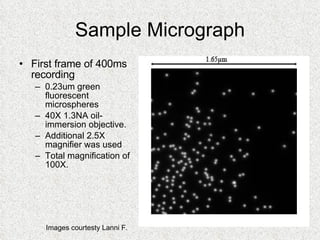
Sample Micrograph First frame of 400ms recording 0.23um green fluorescent microspheres 40X 1.3NA oil-immersion objective. Additional 2.5X magnifier was used Total magnification of 100X.  Images courtesty Lanni F.
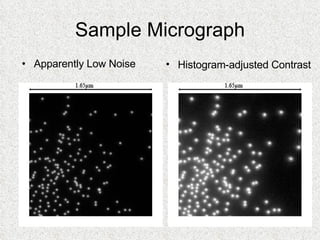
Sample Micrograph Apparently Low Noise Histogram-adjusted Contrast
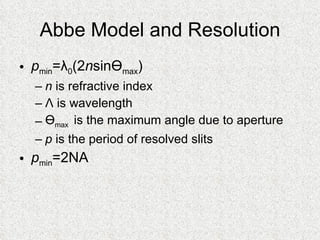
Abbe Model and Resolution p min = λ 0 (2 n sin Ө max ) n  is refractive index Λ  is wavelength Ө max  is the maximum angle due to aperture p  is the period of resolved slits p min =2NA
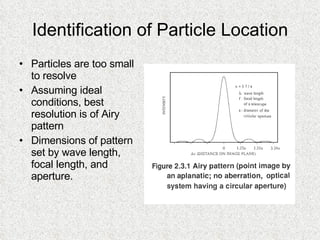
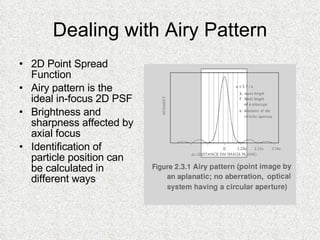
Identification of Particle Location Particles are too small to resolve Assuming ideal conditions, best resolution is of Airy pattern Dimensions of pattern set by wave length, focal length, and aperture.
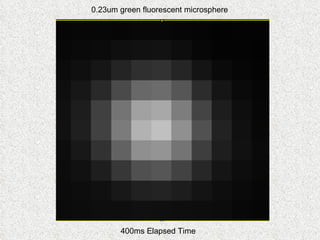
0.23um green fluorescent microsphere 400ms Elapsed Time
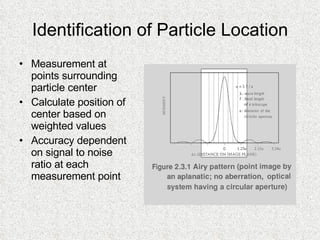
Identification of Particle Location Measurement at points surrounding particle center Calculate position of center based on weighted values Accuracy dependent on signal to noise ratio at each measurement point
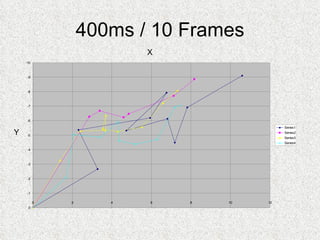
400ms / 10 Frames X Y
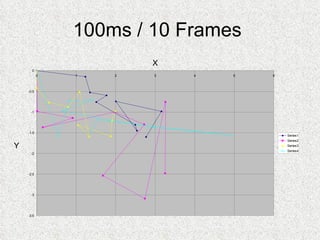
100ms / 10 Frames  X Y
Dealing with Airy Pattern 2D Point Spread Function Airy pattern is the ideal in-focus 2D PSF Brightness and sharpness affected by axial focus Identification of particle position can be calculated in different ways
Precision Suppose that the point-spread function of a microscope is given by psf(n), where n is measurement of pixels along an axis. For any point, psf(n) is the fraction of total photons detected at that point. M(n) is expected photon count Detection of photons has inherent variability Poisson Root-mean-square variation of M is SQRT(M) Also depends on background photon count, M 0 RMS noise is SQRT[M(n)] = SQRT[psf(n) M 0 ] M = Expected Photon Count M 0  = is total photon count above background For Pixel “n” expected photon count M(n) = psf(n) x M 0 Precision = RMS(ΔX) =
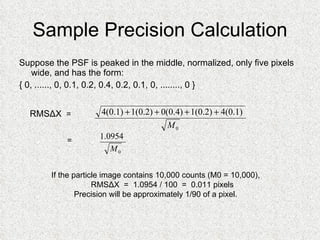
Sample Precision Calculation Suppose the PSF is peaked in the middle, normalized, only five pixels wide, and has the form: { 0, ......, 0, 0.1, 0.2, 0.4, 0.2, 0.1, 0, ........, 0 } RMSΔX   =  =  If the particle image contains 10,000 counts (M0 = 10,000), RMSΔX  =  1.0954 / 100  =  0.011 pixels Precision will be approximately 1/90 of a pixel.
References  Kues T, Peters R, Kubitscheck U,  Visualization and Tracking of Single Protein Molecules in the Cell Nucleus Lanni F. and Keller E.,  Imaging Neurons Japan Association of Remote Sensing http:// www.profc.udec.cl/~gabriel/tutoriales/rsnote/contents.htm Inoué, S.,  Imaging Superresolution, and Precision Measurement Lanni F., Email and Conversation

Single Particle Tracking

  • 1.
    Single Particle andSingle Molecule Tracking Multiple Measurements Provide Increased Tracking Accuracy Michael Chelen October 14th 2003 Biological Imaging and Fluorescence Microscopy
  • 2.
    What is ParticleTracking Relative measurements Absolute measurements not required Brownian motion vs. restricted movement Labeled objects Real time observation of living cells Data oriented labeling
  • 3.
    Labeling Single ParticleTracking Inorganic beads Smallest beads 40um Crosslinked to target Single Molecule Tracking Single fluorophore molecule
  • 4.
    Sample Micrograph Firstframe of 400ms recording 0.23um green fluorescent microspheres 40X 1.3NA oil-immersion objective. Additional 2.5X magnifier was used Total magnification of 100X. Images courtesty Lanni F.
  • 5.
    Sample Micrograph ApparentlyLow Noise Histogram-adjusted Contrast
  • 6.
    Abbe Model andResolution p min = λ 0 (2 n sin Ө max ) n is refractive index Λ is wavelength Ө max is the maximum angle due to aperture p is the period of resolved slits p min =2NA
  • 7.
    Identification of ParticleLocation Particles are too small to resolve Assuming ideal conditions, best resolution is of Airy pattern Dimensions of pattern set by wave length, focal length, and aperture.
  • 8.
    0.23um green fluorescentmicrosphere 400ms Elapsed Time
  • 9.
    Identification of ParticleLocation Measurement at points surrounding particle center Calculate position of center based on weighted values Accuracy dependent on signal to noise ratio at each measurement point
  • 10.
    400ms / 10Frames X Y
  • 11.
    100ms / 10Frames X Y
  • 12.
    Dealing with AiryPattern 2D Point Spread Function Airy pattern is the ideal in-focus 2D PSF Brightness and sharpness affected by axial focus Identification of particle position can be calculated in different ways
  • 13.
    Precision Suppose thatthe point-spread function of a microscope is given by psf(n), where n is measurement of pixels along an axis. For any point, psf(n) is the fraction of total photons detected at that point. M(n) is expected photon count Detection of photons has inherent variability Poisson Root-mean-square variation of M is SQRT(M) Also depends on background photon count, M 0 RMS noise is SQRT[M(n)] = SQRT[psf(n) M 0 ] M = Expected Photon Count M 0 = is total photon count above background For Pixel “n” expected photon count M(n) = psf(n) x M 0 Precision = RMS(ΔX) =
  • 14.
    Sample Precision CalculationSuppose the PSF is peaked in the middle, normalized, only five pixels wide, and has the form: { 0, ......, 0, 0.1, 0.2, 0.4, 0.2, 0.1, 0, ........, 0 } RMSΔX = = If the particle image contains 10,000 counts (M0 = 10,000), RMSΔX = 1.0954 / 100 = 0.011 pixels Precision will be approximately 1/90 of a pixel.
  • 15.
    References KuesT, Peters R, Kubitscheck U, Visualization and Tracking of Single Protein Molecules in the Cell Nucleus Lanni F. and Keller E., Imaging Neurons Japan Association of Remote Sensing http:// www.profc.udec.cl/~gabriel/tutoriales/rsnote/contents.htm Inoué, S., Imaging Superresolution, and Precision Measurement Lanni F., Email and Conversation