El síndrome de Niggle,
la orientación a objetos, y
la Familia de Juan Carlos I
Jorge Uriarte Aretxaga
@jorgeuriarte
http://www.slideshare.com/gailen/
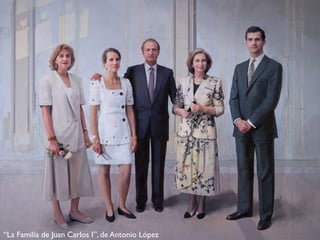
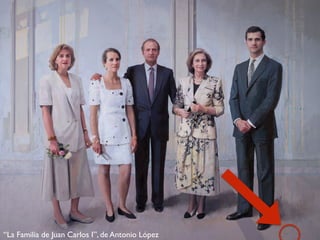
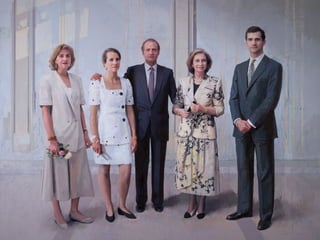
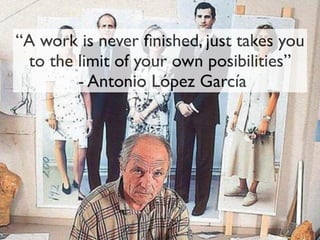
“La Familia de Juan Carlos I”, de Antonio López
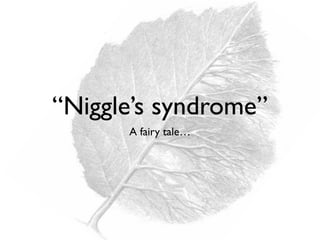
“Niggle’s syndrome”
A fairy tale…
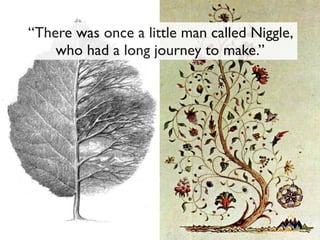
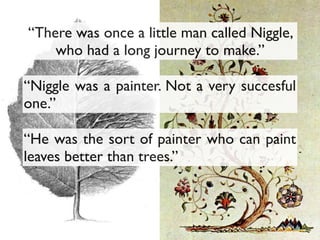
“There was once a little man called Niggle,
who had a long journey to make.”
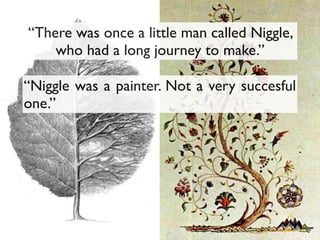
“Niggle was a painter. Not a very succesful
one.”
“There was once a little man called Niggle,
who had a long journey to make.”
“Niggle was a painter. Not a very succesful
one.”
“He was the sort of painter who can paint
leaves better than trees.”
“There was once a little man called Niggle,
who had a long journey to make.”
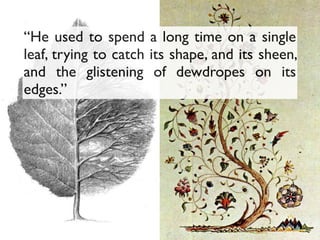
“He used to spend a long time on a single
leaf, trying to catch its shape, and its sheen,
and the glistening of dewdropes on its
edges.”
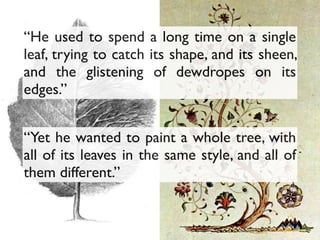
“Yet he wanted to paint a whole tree, with
all of its leaves in the same style, and all of
them different.”
“He used to spend a long time on a single
leaf, trying to catch its shape, and its sheen,
and the glistening of dewdropes on its
edges.”
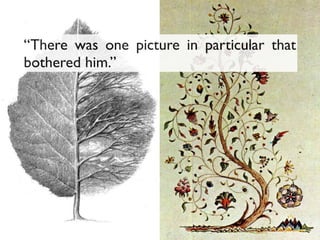
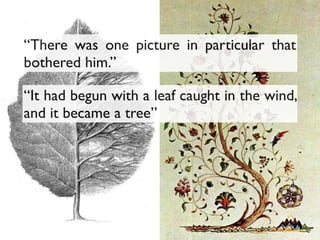
“There was one picture in particular that
bothered him.”
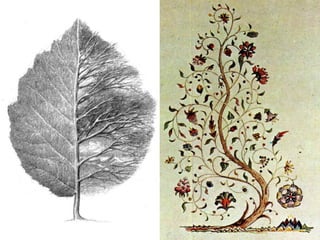
“It had begun with a leaf caught in the wind,
and it became a tree”
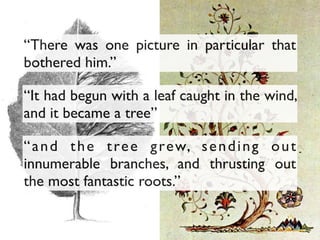
“There was one picture in particular that
bothered him.”
“It had begun with a leaf caught in the wind,
and it became a tree”
“There was one picture in particular that
bothered him.”
“and the tree grew, sending out
innumerable branches, and thrusting out
the most fantastic roots.”
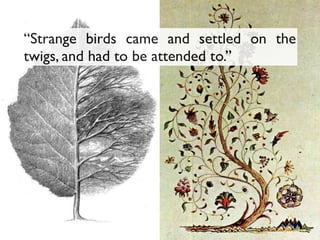
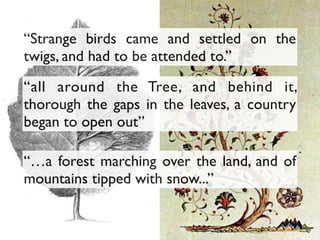
“Strange birds came and settled on the
twigs, and had to be attended to.”
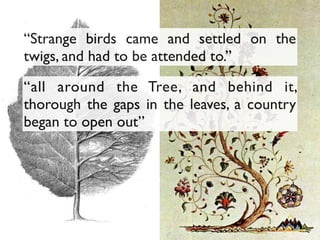
“all around the Tree, and behind it,
thorough the gaps in the leaves, a country
began to open out”
“Strange birds came and settled on the
twigs, and had to be attended to.”
“all around the Tree, and behind it,
thorough the gaps in the leaves, a country
began to open out”
“Strange birds came and settled on the
twigs, and had to be attended to.”
“…a forest marching over the land, and of
mountains tipped with snow...”
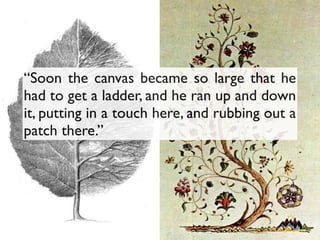
“Soon the canvas became so large that he
had to get a ladder, and he ran up and down
it, putting in a touch here, and rubbing out a
patch there.”
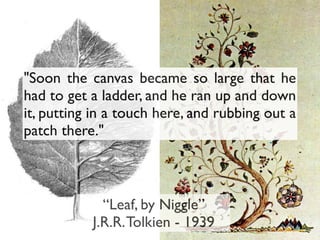
"Soon the canvas became so large that he
had to get a ladder, and he ran up and down
it, putting in a touch here, and rubbing out a
patch there."
“Leaf, by Niggle”
J.R.R.Tolkien - 1939
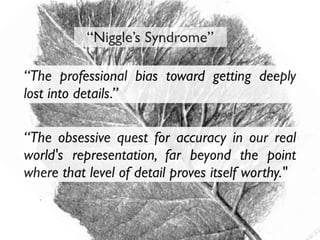
“The professional bias toward getting deeply
lost into details.”
“Niggle’s Syndrome”
“The obsessive quest for accuracy in our real
world's representation, far beyond the point
where that level of detail proves itself worthy."
How do we recognize Niggle’s
syndrome?
• At product “stories” level
• At a “technical” level
• At product,“stories” level:
• Too many things to do
• To many details in the wrong areas
• “Featuritis”
How do we recognize Niggle’s
syndrome?
How do we recognize Niggle’s
syndrome?
• At a “technical” level:
• Miniaturism in implementation
• Treating non-core parts as first-class
citizens
• Somehow unbalanced granularity
between the parts
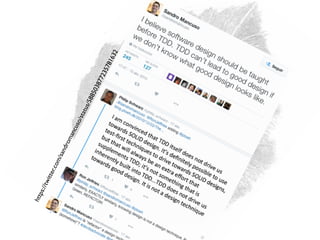
https://twitter.com/sandromancuso/status/588503877235781632
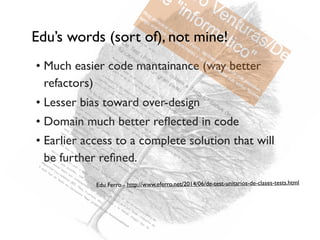
http://www.eferro.net/2014/06/de-test-unitarios-de-clases-tests.html
• Much easier code mantainance (way better
refactors)
• Lesser bias toward over-design
• Domain much better reflected in code
• Earlier access to a complete solution that will
be further refined.
Edu Ferro - http://www.eferro.net/2014/06/de-test-unitarios-de-clases-tests.html
Edu’s words (sort of), not mine!
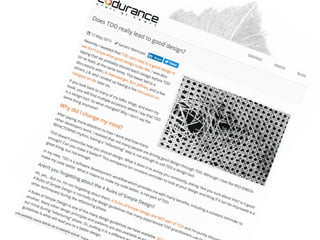
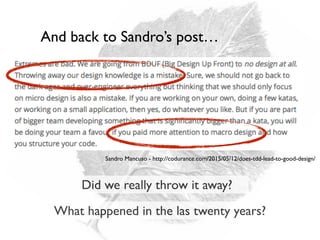
Sandro Mancuso - http://codurance.com/2015/05/12/does-tdd-lead-to-good-design/
And back to Sandro’s post…
Did we really throw it away?
What happened in the las twenty years?
So it’s not about tech granularity…
…it’s about design
So it’s not about tech granularity…
…it’s about design
And maybe design is essentially…
…it’s about design
And maybe design is essentially…
…the quest for the adequate
level of abstraction
So it’s not about tech granularity…
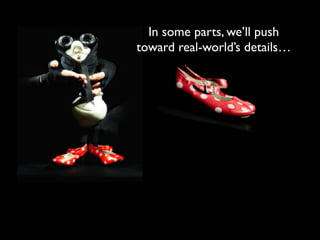
In some parts, we’ll push
toward real-world’s details…
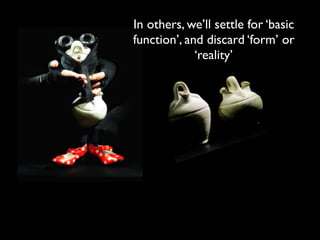
In others, we’ll settle for ‘basic
function’, and discard ‘form’ or
‘reality’
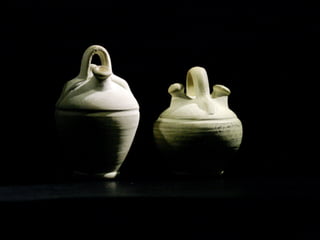
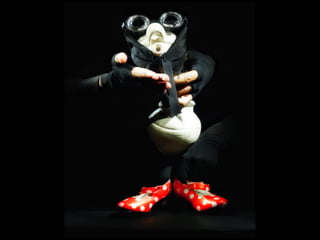
http://www.ymedioteatro.com/espectaculos/siete/
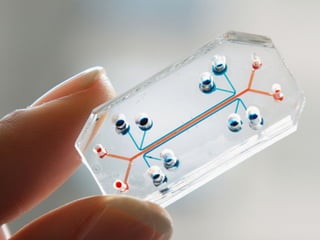
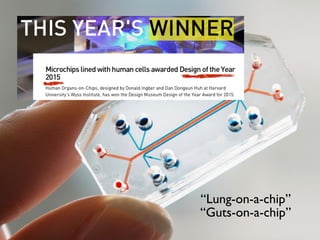
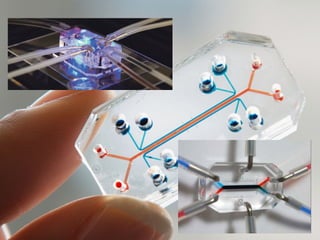
“Lung-on-a-chip”
“Guts-on-a-chip”
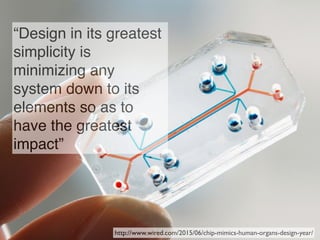
http://www.wired.com/2015/06/chip-mimics-human-organs-design-year/
“Design in its greatest
simplicity is
minimizing any
system down to its
elements so as to
have the greatest
impact”
And what about the
‘big’ scope?
What about the ‘big’ scope?
• Does having a vision implies BDUF and
featuritis?
• How much should we leave for discovery,
how much should we pre-define?
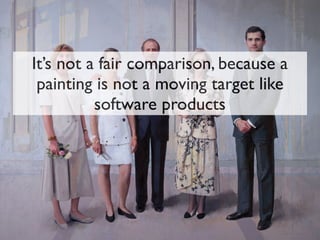
It’s not a fair comparison, because a
painting is not a moving target like
software products
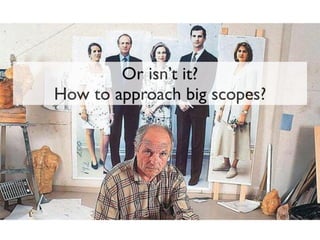
Or isn’t it?
How to approach big scopes?
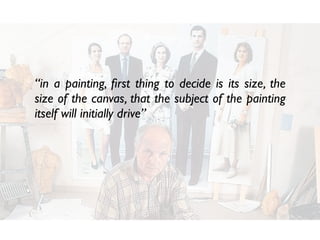
“in a painting, first thing to decide is its size, the
size of the canvas, that the subject of the painting
itself will initially drive”
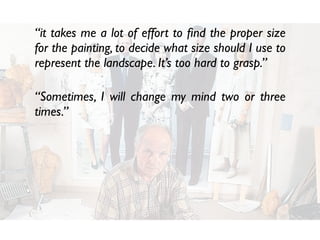
“it takes me a lot of effort to find the proper size
for the painting, to decide what size should I use to
represent the landscape. It’s too hard to grasp.”
“Sometimes, I will change my mind two or three
times.”
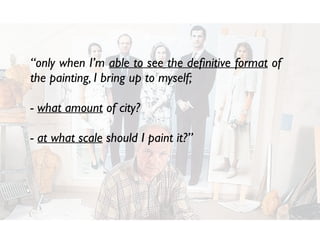
“only when I’m able to see the definitive format of
the painting, I bring up to myself;
- what amount of city?
- at what scale should I paint it?”
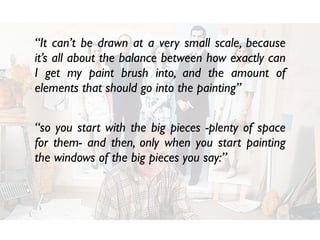
“It can’t be drawn at a very small scale, because
it’s all about the balance between how exactly can
I get my paint brush into, and the amount of
elements that should go into the painting”
“so you start with the big pieces -plenty of space
for them- and then, only when you start painting
the windows of the big pieces you say:”
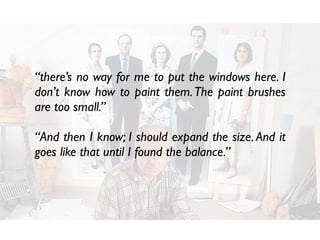
“there’s no way for me to put the windows here. I
don’t know how to paint them.The paint brushes
are too small.”
“And then I know; I should expand the size.And it
goes like that until I found the balance.”
“there’s no way for me to put the windows here. I
don’t know how to paint them.The paint brushes
are too small.”
“And then I know; I should expand the size.And it
goes like that until I found the balance.”
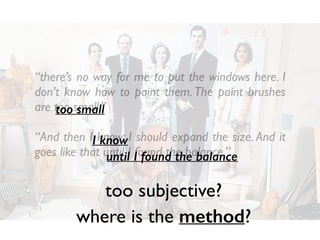
I know
too small
until I found the balance
too subjective?
where is the method?
And change?
What about dealing
with ‘change’?
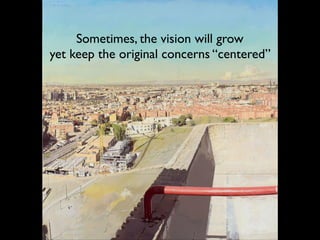
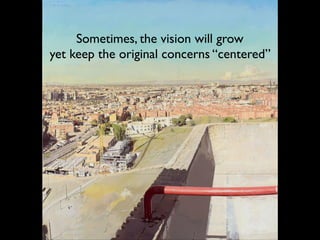
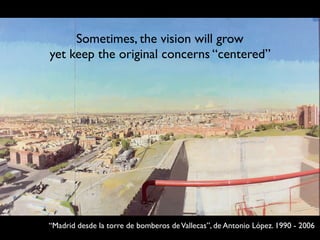
Sometimes, the vision will grow
yet keep the original concerns “centered”
Sometimes, the vision will grow
yet keep the original concerns “centered”
“Madrid desde la torre de bomberos deVallecas”, de Antonio López. 1990 - 2006
Sometimes, the vision will grow
yet keep the original concerns “centered”
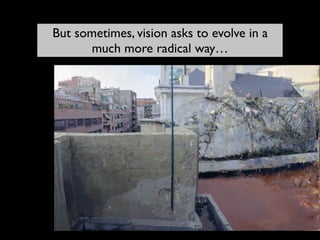
But sometimes, vision asks to evolve in a
much more radical way…
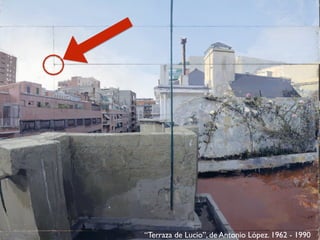
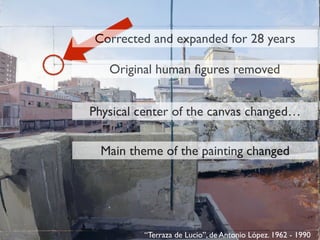
“Terraza de Lucio”, de Antonio López. 1962 - 1990
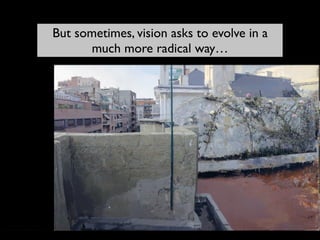
But sometimes, vision asks to evolve in a
much more radical way…
“Terraza de Lucio”, de Antonio López. 1962 - 1990
Physical center of the canvas changed…
Corrected and expanded for 28 years
Original human figures removed
Main theme of the painting changed
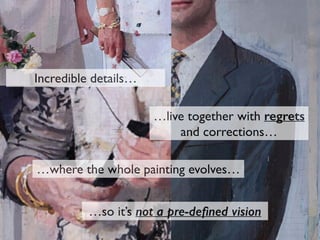
Incredible details…
…live together with regrets
and corrections…
…so it’s not a pre-defined vision
…where the whole painting evolves…
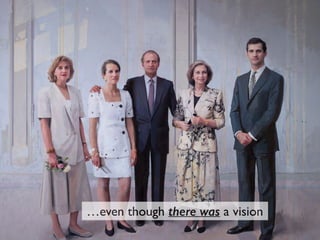
…even though there was a vision
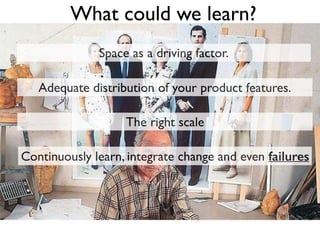
Space as a driving factor.
What could we learn?
Adequate distribution of your product features.
The right scale
Continuously learn, integrate change and even failures
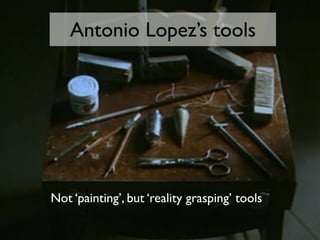
Not ‘painting’, but ‘reality grasping’ tools
Antonio Lopez’s tools
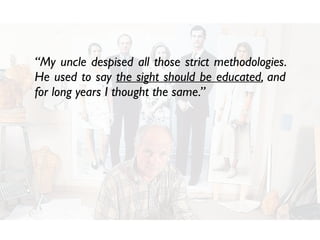
“My uncle despised all those strict methodologies.
He used to say the sight should be educated, and
for long years I thought the same.”
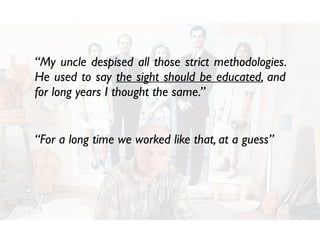
“For a long time we worked like that, at a guess”
“My uncle despised all those strict methodologies.
He used to say the sight should be educated, and
for long years I thought the same.”
But… but… we’ve got tools too!
• We’ve got SOLID, the Four Rules of Simple
Design, patterns, antipatterns…
• They will help us to identify BAD DESIGN
• But does not suffice to warrant a GOOD
one
But… but… we’ve got tools too!
Yep… in the technical side…
• We’ve got agile, incremental approaches…
• Inceptions, prototyping…
• User story splitting and mapping techniques…
• “Personas”
• Customer Journey
• “Design thinking”…
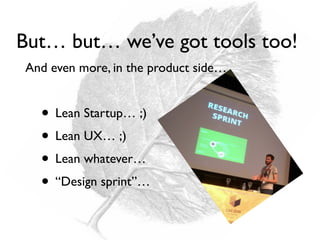
But… but… we’ve got tools too!
And even more, in the product side…
• Lean Startup… ;)
• Lean UX… ;)
• Lean whatever…
• “Design sprint”…
But… but… we’ve got tools too!
And even more, in the product side…
but again… even though they will help us
understand the reality we want to model…
But… but… we’ve got tools too!
…they do not suffice to consistently reach to a
GOOD PRODUCT DESIGN
but again… even though they will help us
understand the reality we want to model…
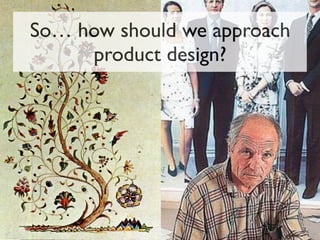
So… how should we approach
product design?
So… how should we approach
product design?
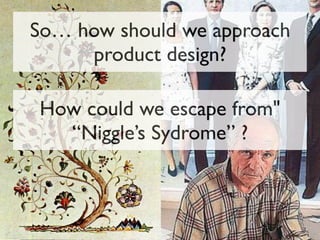
How could we escape from"
“Niggle’s Sydrome” ?
So… how should we approach
product design?
How could we escape from"
“Niggle’s Sydrome” ?
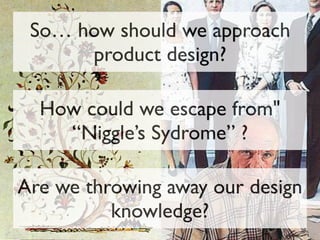
Are we throwing away our design
knowledge?
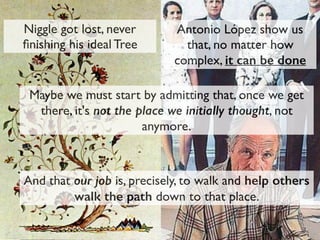
Niggle got lost, never
finishing his ideal Tree
Antonio López show us
that, no matter how
complex, it can be done
Maybe we must start by admitting that, once we get
there, it's not the place we initially thought, not
anymore.
And that our job is, precisely, to walk and help others
walk the path down to that place.
“A work is never finished, just takes you
to the limit of your own posibilities”
- Antonio López García
@jorgeuriarte

Sindrome de Niggle CAS2015

  • 1.
    El síndrome deNiggle, la orientación a objetos, y la Familia de Juan Carlos I Jorge Uriarte Aretxaga @jorgeuriarte http://www.slideshare.com/gailen/
  • 3.
    “La Familia deJuan Carlos I”, de Antonio López
  • 4.
    “La Familia deJuan Carlos I”, de Antonio López
  • 9.
  • 11.
    “There was oncea little man called Niggle, who had a long journey to make.”
  • 12.
    “Niggle was apainter. Not a very succesful one.” “There was once a little man called Niggle, who had a long journey to make.”
  • 13.
    “Niggle was apainter. Not a very succesful one.” “He was the sort of painter who can paint leaves better than trees.” “There was once a little man called Niggle, who had a long journey to make.”
  • 14.
    “He used tospend a long time on a single leaf, trying to catch its shape, and its sheen, and the glistening of dewdropes on its edges.”
  • 15.
    “Yet he wantedto paint a whole tree, with all of its leaves in the same style, and all of them different.” “He used to spend a long time on a single leaf, trying to catch its shape, and its sheen, and the glistening of dewdropes on its edges.”
  • 16.
    “There was onepicture in particular that bothered him.”
  • 17.
    “It had begunwith a leaf caught in the wind, and it became a tree” “There was one picture in particular that bothered him.”
  • 18.
    “It had begunwith a leaf caught in the wind, and it became a tree” “There was one picture in particular that bothered him.” “and the tree grew, sending out innumerable branches, and thrusting out the most fantastic roots.”
  • 19.
    “Strange birds cameand settled on the twigs, and had to be attended to.”
  • 20.
    “all around theTree, and behind it, thorough the gaps in the leaves, a country began to open out” “Strange birds came and settled on the twigs, and had to be attended to.”
  • 21.
    “all around theTree, and behind it, thorough the gaps in the leaves, a country began to open out” “Strange birds came and settled on the twigs, and had to be attended to.” “…a forest marching over the land, and of mountains tipped with snow...”
  • 22.
    “Soon the canvasbecame so large that he had to get a ladder, and he ran up and down it, putting in a touch here, and rubbing out a patch there.”
  • 23.
    "Soon the canvasbecame so large that he had to get a ladder, and he ran up and down it, putting in a touch here, and rubbing out a patch there." “Leaf, by Niggle” J.R.R.Tolkien - 1939
  • 24.
    “The professional biastoward getting deeply lost into details.” “Niggle’s Syndrome” “The obsessive quest for accuracy in our real world's representation, far beyond the point where that level of detail proves itself worthy."
  • 25.
    How do werecognize Niggle’s syndrome? • At product “stories” level • At a “technical” level
  • 26.
    • At product,“stories”level: • Too many things to do • To many details in the wrong areas • “Featuritis” How do we recognize Niggle’s syndrome?
  • 27.
    How do werecognize Niggle’s syndrome? • At a “technical” level: • Miniaturism in implementation • Treating non-core parts as first-class citizens • Somehow unbalanced granularity between the parts
  • 28.
  • 30.
  • 31.
    • Much easiercode mantainance (way better refactors) • Lesser bias toward over-design • Domain much better reflected in code • Earlier access to a complete solution that will be further refined. Edu Ferro - http://www.eferro.net/2014/06/de-test-unitarios-de-clases-tests.html Edu’s words (sort of), not mine!
  • 32.
    Sandro Mancuso -http://codurance.com/2015/05/12/does-tdd-lead-to-good-design/ And back to Sandro’s post… Did we really throw it away? What happened in the las twenty years?
  • 33.
    So it’s notabout tech granularity…
  • 34.
    So it’s notabout tech granularity… …it’s about design
  • 35.
    So it’s notabout tech granularity… …it’s about design And maybe design is essentially…
  • 36.
    …it’s about design Andmaybe design is essentially… …the quest for the adequate level of abstraction So it’s not about tech granularity…
  • 40.
    In some parts,we’ll push toward real-world’s details…
  • 41.
    In others, we’llsettle for ‘basic function’, and discard ‘form’ or ‘reality’
  • 42.
  • 44.
  • 46.
    http://www.wired.com/2015/06/chip-mimics-human-organs-design-year/ “Design in itsgreatest simplicity is minimizing any system down to its elements so as to have the greatest impact”
  • 47.
    And what aboutthe ‘big’ scope?
  • 49.
    What about the‘big’ scope? • Does having a vision implies BDUF and featuritis? • How much should we leave for discovery, how much should we pre-define?
  • 50.
    It’s not afair comparison, because a painting is not a moving target like software products
  • 51.
    Or isn’t it? Howto approach big scopes?
  • 52.
    “in a painting,first thing to decide is its size, the size of the canvas, that the subject of the painting itself will initially drive”
  • 53.
    “it takes mea lot of effort to find the proper size for the painting, to decide what size should I use to represent the landscape. It’s too hard to grasp.” “Sometimes, I will change my mind two or three times.”
  • 54.
    “only when I’mable to see the definitive format of the painting, I bring up to myself; - what amount of city? - at what scale should I paint it?”
  • 55.
    “It can’t bedrawn at a very small scale, because it’s all about the balance between how exactly can I get my paint brush into, and the amount of elements that should go into the painting” “so you start with the big pieces -plenty of space for them- and then, only when you start painting the windows of the big pieces you say:”
  • 56.
    “there’s no wayfor me to put the windows here. I don’t know how to paint them.The paint brushes are too small.” “And then I know; I should expand the size.And it goes like that until I found the balance.”
  • 57.
    “there’s no wayfor me to put the windows here. I don’t know how to paint them.The paint brushes are too small.” “And then I know; I should expand the size.And it goes like that until I found the balance.” I know too small until I found the balance too subjective? where is the method?
  • 58.
    And change? What aboutdealing with ‘change’?
  • 59.
    Sometimes, the visionwill grow yet keep the original concerns “centered”
  • 60.
    Sometimes, the visionwill grow yet keep the original concerns “centered”
  • 61.
    “Madrid desde latorre de bomberos deVallecas”, de Antonio López. 1990 - 2006 Sometimes, the vision will grow yet keep the original concerns “centered”
  • 62.
    But sometimes, visionasks to evolve in a much more radical way…
  • 63.
    “Terraza de Lucio”,de Antonio López. 1962 - 1990 But sometimes, vision asks to evolve in a much more radical way…
  • 64.
    “Terraza de Lucio”,de Antonio López. 1962 - 1990
  • 65.
    “Terraza de Lucio”,de Antonio López. 1962 - 1990 Physical center of the canvas changed… Corrected and expanded for 28 years Original human figures removed Main theme of the painting changed
  • 66.
    Incredible details… …live togetherwith regrets and corrections… …so it’s not a pre-defined vision …where the whole painting evolves…
  • 67.
  • 68.
    Space as adriving factor. What could we learn? Adequate distribution of your product features. The right scale Continuously learn, integrate change and even failures
  • 69.
    Not ‘painting’, but‘reality grasping’ tools Antonio Lopez’s tools
  • 70.
    “My uncle despisedall those strict methodologies. He used to say the sight should be educated, and for long years I thought the same.”
  • 71.
    “For a longtime we worked like that, at a guess” “My uncle despised all those strict methodologies. He used to say the sight should be educated, and for long years I thought the same.”
  • 74.
    But… but… we’vegot tools too!
  • 75.
    • We’ve gotSOLID, the Four Rules of Simple Design, patterns, antipatterns… • They will help us to identify BAD DESIGN • But does not suffice to warrant a GOOD one But… but… we’ve got tools too! Yep… in the technical side…
  • 76.
    • We’ve gotagile, incremental approaches… • Inceptions, prototyping… • User story splitting and mapping techniques… • “Personas” • Customer Journey • “Design thinking”… But… but… we’ve got tools too! And even more, in the product side…
  • 77.
    • Lean Startup…;) • Lean UX… ;) • Lean whatever… • “Design sprint”… But… but… we’ve got tools too! And even more, in the product side…
  • 78.
    but again… eventhough they will help us understand the reality we want to model… But… but… we’ve got tools too!
  • 79.
    But… but… we’vegot tools too! …they do not suffice to consistently reach to a GOOD PRODUCT DESIGN but again… even though they will help us understand the reality we want to model…
  • 80.
    So… how shouldwe approach product design?
  • 81.
    So… how shouldwe approach product design? How could we escape from" “Niggle’s Sydrome” ?
  • 82.
    So… how shouldwe approach product design? How could we escape from" “Niggle’s Sydrome” ? Are we throwing away our design knowledge?
  • 83.
    Niggle got lost,never finishing his ideal Tree Antonio López show us that, no matter how complex, it can be done Maybe we must start by admitting that, once we get there, it's not the place we initially thought, not anymore. And that our job is, precisely, to walk and help others walk the path down to that place.
  • 84.
    “A work isnever finished, just takes you to the limit of your own posibilities” - Antonio López García
  • 85.