CULTURE DAY
SINDHI CULTURE
INTRODUCTION
• Sindh is one of the four provinces of Pakistan and historical home of
Sindhi People.
• Sindh is also known as Bab-ul-Islam”(The gateway of Islam).
• Sindhi language is considered of the oldest language
• It is established that Sindhi was the first and earliest Language of east
in which QURAN was translated in the Eighth and Ninth Century.
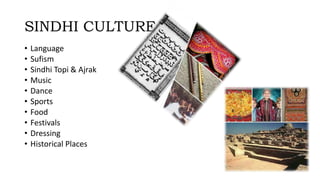
SINDHI CULTURE
• Language
• Sufism
• Sindhi Topi & Ajrak
• Music
• Dance
• Sports
• Food
• Festivals
• Dressing
• Historical Places
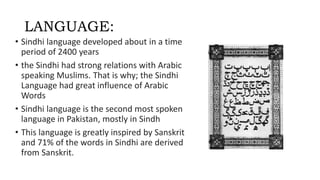
LANGUAGE:
• Sindhi language developed about in a time
period of 2400 years
• the Sindhi had strong relations with Arabic
speaking Muslims. That is why; the Sindhi
Language had great influence of Arabic
Words
• Sindhi language is the second most spoken
language in Pakistan, mostly in Sindh
• This language is greatly inspired by Sanskrit
and 71% of the words in Sindhi are derived
from Sanskrit.
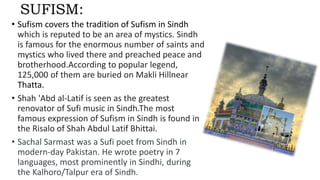
SUFISM:
• Sufism covers the tradition of Sufism in Sindh
which is reputed to be an area of mystics. Sindh
is famous for the enormous number of saints and
mystics who lived there and preached peace and
brotherhood.According to popular legend,
125,000 of them are buried on Makli Hillnear
Thatta.
• Shah 'Abd al-Latif is seen as the greatest
renovator of Sufi music in Sindh.The most
famous expression of Sufism in Sindh is found in
the Risalo of Shah Abdul Latif Bhittai.
• Sachal Sarmast was a Sufi poet from Sindh in
modern-day Pakistan. He wrote poetry in 7
languages, most prominently in Sindhi, during
the Kalhoro/Talpur era of Sindh.
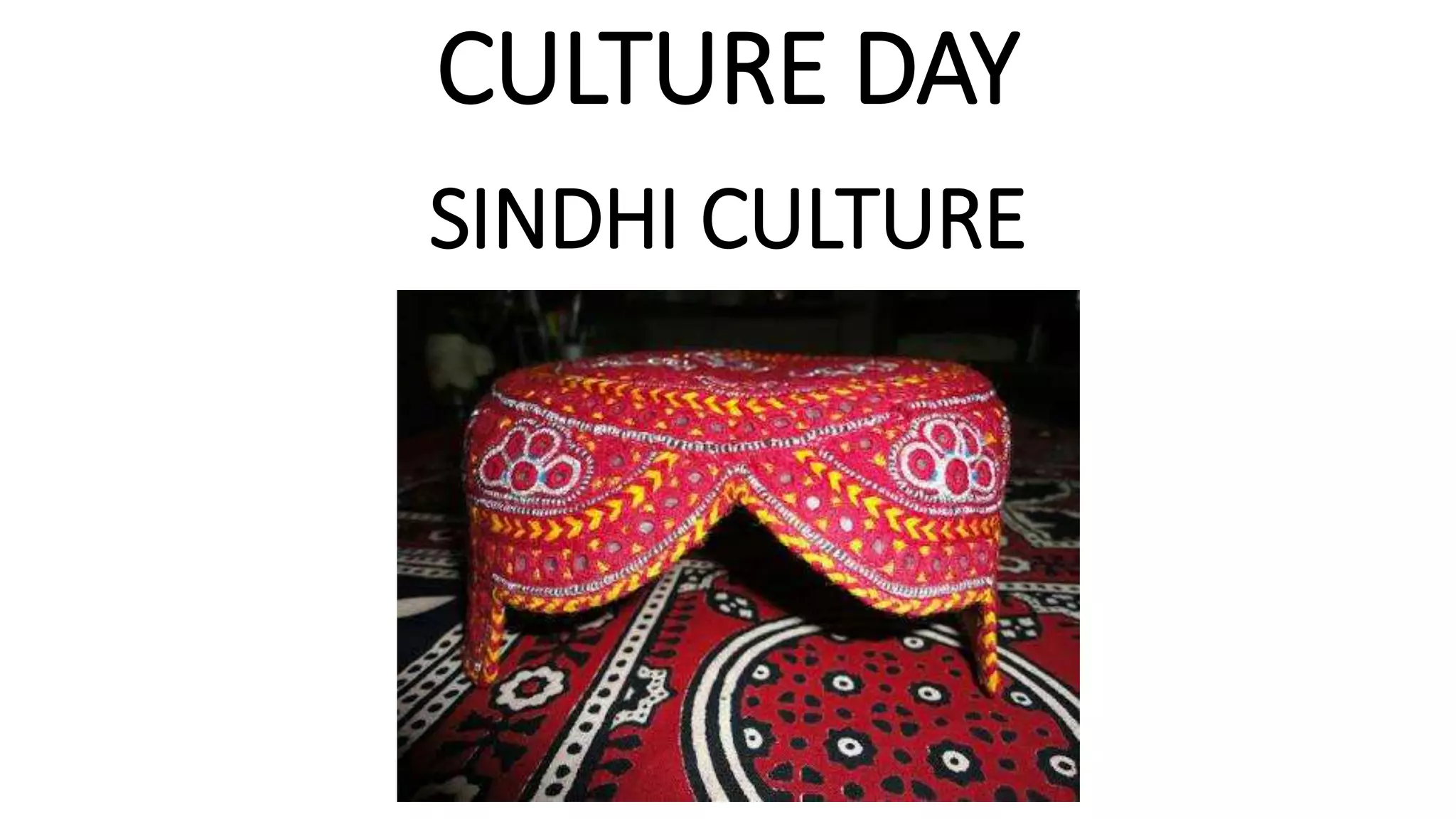
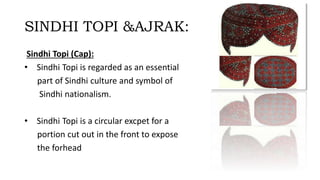
SINDHI TOPI &AJRAK:
Sindhi Topi (Cap):
• Sindhi Topi is regarded as an essential
part of Sindhi culture and symbol of
Sindhi nationalism.
• Sindhi Topi is a circular excpet for a
portion cut out in the front to expose
the forhead
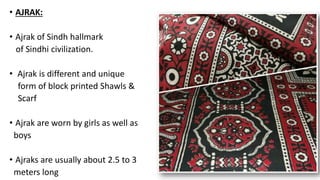
• AJRAK:
• Ajrak of Sindh hallmark
of Sindhi civilization.
• Ajrak is different and unique
form of block printed Shawls &
Scarf
• Ajrak are worn by girls as well as
boys
• Ajraks are usually about 2.5 to 3
meters long
MUSIC:
• Sindhi Music has it’s own unique quality, it is performed in many
different ways.
• Sufi Music it’s performed on shrines and others simple music
performed at studios and gatherings.
• Most famous Sindhi music is “Shah Jo Raag” overall in Sindh in which
30 basic surr are included and all these Surr are derived from “Shah
Jo Rissalo.
• Abida Parveen, Allan Fakir are famous singer of Sindhi Culture.
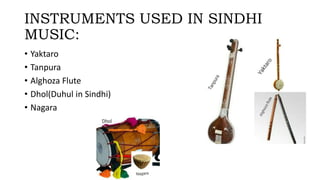
INSTRUMENTS USED IN SINDHI
MUSIC:
• Yaktaro
• Tanpura
• Alghoza Flute
• Dhol(Duhul in Sindhi)
• Nagara
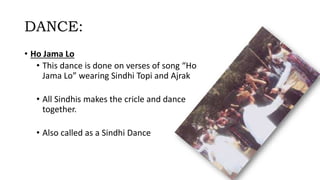
DANCE:
• Ho Jama Lo
• This dance is done on verses of song “Ho
Jama Lo” wearing Sindhi Topi and Ajrak
• All Sindhis makes the cricle and dance
together.
• Also called as a Sindhi Dance
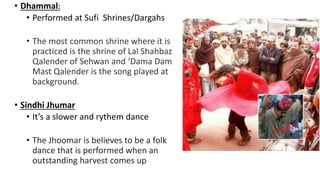
• Dhammal:
• Performed at Sufi Shrines/Dargahs
• The most common shrine where it is
practiced is the shrine of Lal Shahbaz
Qalender of Sehwan and ‘Dama Dam
Mast Qalender is the song played at
background.
• Sindhi Jhumar
• It’s a slower and rythem dance
• The Jhoomar is believes to be a folk
dance that is performed when an
outstanding harvest comes up
SPORTS
• There are many regional sports that are played in Sindh.
• Malakhiro is one of the famous sports in Sindh
• Malakhiro is traditional Sindhi Wrestling Competition.
• Other sports inculde “Wanjh Watti & Kodi Kodi” etc.
• Kodi Kodi is also a popular game of Sindh Province.
• It is a 2 team game played by 2 teams. One of the player from the
one group go to the other one and the other group has to catch
him and his goal is to touch one of them and run hurriedly back
to his group.
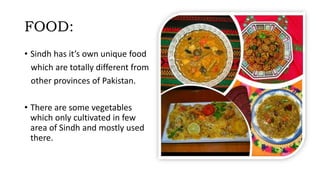
FOOD:
• Sindh has it’s own unique food
which are totally different from
other provinces of Pakistan.
• There are some vegetables
which only cultivated in few
area of Sindh and mostly used
there.
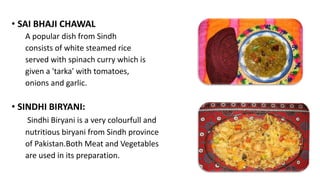
• SAI BHAJI CHAWAL
A popular dish from Sindh
consists of white steamed rice
served with spinach curry which is
given a 'tarka' with tomatoes,
onions and garlic.
• SINDHI BIRYANI:
Sindhi Biryani is a very colourfull and
nutritious biryani from Sindh province
of Pakistan.Both Meat and Vegetables
are used in its preparation.
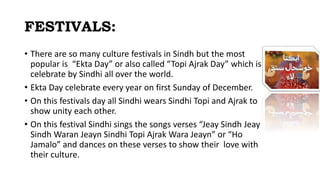
FESTIVALS:
• There are so many culture festivals in Sindh but the most
popular is “Ekta Day” or also called “Topi Ajrak Day” which is
celebrate by Sindhi all over the world.
• Ekta Day celebrate every year on first Sunday of December.
• On this festivals day all Sindhi wears Sindhi Topi and Ajrak to
show unity each other.
• On this festival Sindhi sings the songs verses “Jeay Sindh Jeay
Sindh Waran Jeayn Sindhi Topi Ajrak Wara Jeayn” or “Ho
Jamalo” and dances on these verses to show their love with
their culture.
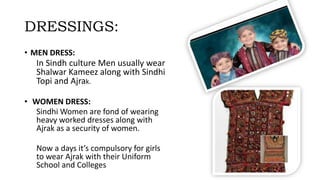
DRESSINGS:
• MEN DRESS:
In Sindh culture Men usually wear
Shalwar Kameez along with Sindhi
Topi and Ajrak.
• WOMEN DRESS:
Sindhi Women are fond of wearing
heavy worked dresses along with
Ajrak as a security of women.
Now a days it’s compulsory for girls
to wear Ajrak with their Uniform
School and Colleges
HISTORICAL PLACES:
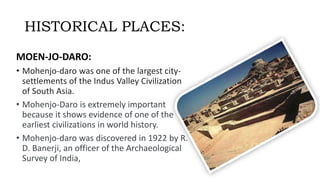
MOEN-JO-DARO:
• Mohenjo-daro was one of the largest city-
settlements of the Indus Valley Civilization
of South Asia.
• Mohenjo-Daro is extremely important
because it shows evidence of one of the
earliest civilizations in world history.
• Mohenjo-daro was discovered in 1922 by R.
D. Banerji, an officer of the Archaeological
Survey of India,
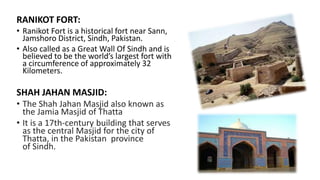
RANIKOT FORT:
• Ranikot Fort is a historical fort near Sann,
Jamshoro District, Sindh, Pakistan.
• Also called as a Great Wall Of Sindh and is
believed to be the world’s largest fort with
a circumference of approximately 32
Kilometers.
SHAH JAHAN MASJID:
• The Shah Jahan Masjid also known as
the Jamia Masjid of Thatta
• It is a 17th-century building that serves
as the central Masjid for the city of
Thatta, in the Pakistan province
of Sindh.
THANK YOU ALLJEAY SINDH
JEAY PAKISTAN

Sindhi culture

  • 1.
  • 2.
    INTRODUCTION • Sindh isone of the four provinces of Pakistan and historical home of Sindhi People. • Sindh is also known as Bab-ul-Islam”(The gateway of Islam). • Sindhi language is considered of the oldest language • It is established that Sindhi was the first and earliest Language of east in which QURAN was translated in the Eighth and Ninth Century.
  • 3.
    SINDHI CULTURE • Language •Sufism • Sindhi Topi & Ajrak • Music • Dance • Sports • Food • Festivals • Dressing • Historical Places
  • 4.
    LANGUAGE: • Sindhi languagedeveloped about in a time period of 2400 years • the Sindhi had strong relations with Arabic speaking Muslims. That is why; the Sindhi Language had great influence of Arabic Words • Sindhi language is the second most spoken language in Pakistan, mostly in Sindh • This language is greatly inspired by Sanskrit and 71% of the words in Sindhi are derived from Sanskrit.
  • 5.
    SUFISM: • Sufism coversthe tradition of Sufism in Sindh which is reputed to be an area of mystics. Sindh is famous for the enormous number of saints and mystics who lived there and preached peace and brotherhood.According to popular legend, 125,000 of them are buried on Makli Hillnear Thatta. • Shah 'Abd al-Latif is seen as the greatest renovator of Sufi music in Sindh.The most famous expression of Sufism in Sindh is found in the Risalo of Shah Abdul Latif Bhittai. • Sachal Sarmast was a Sufi poet from Sindh in modern-day Pakistan. He wrote poetry in 7 languages, most prominently in Sindhi, during the Kalhoro/Talpur era of Sindh.
  • 6.
    SINDHI TOPI &AJRAK: SindhiTopi (Cap): • Sindhi Topi is regarded as an essential part of Sindhi culture and symbol of Sindhi nationalism. • Sindhi Topi is a circular excpet for a portion cut out in the front to expose the forhead
  • 7.
    • AJRAK: • Ajrakof Sindh hallmark of Sindhi civilization. • Ajrak is different and unique form of block printed Shawls & Scarf • Ajrak are worn by girls as well as boys • Ajraks are usually about 2.5 to 3 meters long
  • 8.
    MUSIC: • Sindhi Musichas it’s own unique quality, it is performed in many different ways. • Sufi Music it’s performed on shrines and others simple music performed at studios and gatherings. • Most famous Sindhi music is “Shah Jo Raag” overall in Sindh in which 30 basic surr are included and all these Surr are derived from “Shah Jo Rissalo. • Abida Parveen, Allan Fakir are famous singer of Sindhi Culture.
  • 9.
    INSTRUMENTS USED INSINDHI MUSIC: • Yaktaro • Tanpura • Alghoza Flute • Dhol(Duhul in Sindhi) • Nagara
  • 10.
    DANCE: • Ho JamaLo • This dance is done on verses of song “Ho Jama Lo” wearing Sindhi Topi and Ajrak • All Sindhis makes the cricle and dance together. • Also called as a Sindhi Dance
  • 11.
    • Dhammal: • Performedat Sufi Shrines/Dargahs • The most common shrine where it is practiced is the shrine of Lal Shahbaz Qalender of Sehwan and ‘Dama Dam Mast Qalender is the song played at background. • Sindhi Jhumar • It’s a slower and rythem dance • The Jhoomar is believes to be a folk dance that is performed when an outstanding harvest comes up
  • 12.
    SPORTS • There aremany regional sports that are played in Sindh. • Malakhiro is one of the famous sports in Sindh • Malakhiro is traditional Sindhi Wrestling Competition. • Other sports inculde “Wanjh Watti & Kodi Kodi” etc. • Kodi Kodi is also a popular game of Sindh Province. • It is a 2 team game played by 2 teams. One of the player from the one group go to the other one and the other group has to catch him and his goal is to touch one of them and run hurriedly back to his group.
  • 13.
    FOOD: • Sindh hasit’s own unique food which are totally different from other provinces of Pakistan. • There are some vegetables which only cultivated in few area of Sindh and mostly used there.
  • 14.
    • SAI BHAJICHAWAL A popular dish from Sindh consists of white steamed rice served with spinach curry which is given a 'tarka' with tomatoes, onions and garlic. • SINDHI BIRYANI: Sindhi Biryani is a very colourfull and nutritious biryani from Sindh province of Pakistan.Both Meat and Vegetables are used in its preparation.
  • 15.
    FESTIVALS: • There areso many culture festivals in Sindh but the most popular is “Ekta Day” or also called “Topi Ajrak Day” which is celebrate by Sindhi all over the world. • Ekta Day celebrate every year on first Sunday of December. • On this festivals day all Sindhi wears Sindhi Topi and Ajrak to show unity each other. • On this festival Sindhi sings the songs verses “Jeay Sindh Jeay Sindh Waran Jeayn Sindhi Topi Ajrak Wara Jeayn” or “Ho Jamalo” and dances on these verses to show their love with their culture.
  • 16.
    DRESSINGS: • MEN DRESS: InSindh culture Men usually wear Shalwar Kameez along with Sindhi Topi and Ajrak. • WOMEN DRESS: Sindhi Women are fond of wearing heavy worked dresses along with Ajrak as a security of women. Now a days it’s compulsory for girls to wear Ajrak with their Uniform School and Colleges
  • 17.
    HISTORICAL PLACES: MOEN-JO-DARO: • Mohenjo-darowas one of the largest city- settlements of the Indus Valley Civilization of South Asia. • Mohenjo-Daro is extremely important because it shows evidence of one of the earliest civilizations in world history. • Mohenjo-daro was discovered in 1922 by R. D. Banerji, an officer of the Archaeological Survey of India,
  • 18.
    RANIKOT FORT: • RanikotFort is a historical fort near Sann, Jamshoro District, Sindh, Pakistan. • Also called as a Great Wall Of Sindh and is believed to be the world’s largest fort with a circumference of approximately 32 Kilometers. SHAH JAHAN MASJID: • The Shah Jahan Masjid also known as the Jamia Masjid of Thatta • It is a 17th-century building that serves as the central Masjid for the city of Thatta, in the Pakistan province of Sindh.
  • 19.
    THANK YOU ALLJEAYSINDH JEAY PAKISTAN