Sin, Repentance, and Grace
Sin(In addition to “original sin,” we talk of actual sin: mortal & venial. Actual sin “is an offense
against God in disobedience to His love. It wounds human nature and injures human
solidarity” (from the Compendium, # 392)),
Temptation
“Temptation is…an incitement to sin….Temptation is not in itself sin….as long as there is no
consent of the will, there is no sin” (http://www.newadvent.org/cathen/14504a.htm)), &
Conscience
“A conscience is that still small voice that people won't listen to.” (J. Cricket)
“Moral conscience…is a judgment of reason…[telling us]…to do good & avoid evil …. When
attentive to moral conscience, the prudent person can hear the voice of God”
(from the Compendium, #372)
“An upright & true moral conscience is formed by education & by assimilating the Word of
God & the teaching of the Church. It is supported by the gifts of the Holy Spirit & helped by
the advice of wise people. Prayer & an examination of conscience can also greatly assist”
(Compendium, #374))
We are responsible to learn what God
wants of us*. But living as God wants
us to live is NOT some sort of go-it-
alone “survivor” project,
nor a minimalist “follow the
rules/don’t get caught” game plan.
*God wants our eternal happiness!
He wants to assist us in His call to be
Christ – like and wants us to live with Him
forever in Heaven.
Review• God created a perfect, harmonious world for us,
where there would be no suffering or death.
• Our first parents rejected what God intended for all
humanity.
• We are born into “original sin.”
• Yet, what Christ offers in Redemption far surpasses
what we lost!
In our state of “original sin,”
we are inclined to make our
moral choices
in a far from perfect manner.
• In contrast to
– “Might is Right,”
– “Morals are Mores,”
– “Right is What Brings Pleasure,” and
– “Right is the Greatest Good for the Greatest Number,”
• God has left us with a better way of moral/ethical decision
making:
– “Natural (Moral) Law” is concerned with universal &
unchanging principles.
– Through the right use of reasoning, all can come to know
the Natural Law.
– “The natural law which is prescribed by the Creator on the
heart of every person consists in a participation in the
wisdom & goodness of God. It expresses that original
moral sense which enables one to discern by reason the
good & the bad. It is universal & immutable”
(Compendium, #416)
God left His “Natural (Moral)
Law” written upon every
human’s heart. In his letter to
the Romans, the Apostle Paul
spoke of how the "demands of
the law are written in their
hearts.”
375. What norms must conscience always follow?
“There are three general norms:
1) one may never do evil so that good may
result from it [i.e The ends don’t justify the
means.];
2) the so-called Golden Rule, ‘Whatever you
wish that men would do to you, do so to
them’ (Matthew 7:12);
3) charity always proceeds by way of respect for
one’s neighbor and his conscience,
even though this does not mean accepting
as good something that is objectively evil. ”
Even though the "demands of the law
are written in ...[our] hearts“,
Dr. Janet Smith says, “Just like our ears when
subjected to noises that are too loud & sharp, lose
some of their ability to hear, so too does our
moral 'sense' when subjected to too much
corruption lose its ability to judge what is right &
wrong.”
The sad fact that human beings can do terrible
things & believe that it’s OK is proof that we need
assistance in developing our consciences....
“An upright & true moral conscience is
formed by education & by assimilating
the Word of God & the teaching of the
Church. It is supported by the gifts of
the Holy Spirit & helped by the advice
of wise people. Prayer & an
examination of conscience can also
greatly assist” (Compendium, #374))
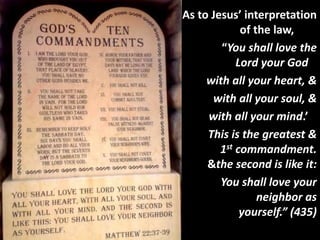
• As to Jesus’ interpretation
of the law,
“You shall love the
Lord your God
with all your heart, &
with all your soul, &
with all your mind.’
This is the greatest &
1st commandment.
&the second is like it:
You shall love your
neighbor as
yourself.” (435)
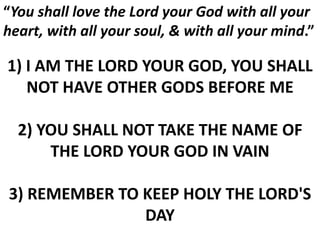
1) I AM THE LORD YOUR GOD, YOU SHALL
NOT HAVE OTHER GODS BEFORE ME
2) YOU SHALL NOT TAKE THE NAME OF
THE LORD YOUR GOD IN VAIN
3) REMEMBER TO KEEP HOLY THE LORD'S
DAY
“You shall love the Lord your God with all your
heart, with all your soul, & with all your mind.”
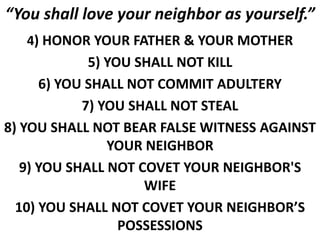
“You shall love your neighbor as yourself.”
4) HONOR YOUR FATHER & YOUR MOTHER
5) YOU SHALL NOT KILL
6) YOU SHALL NOT COMMIT ADULTERY
7) YOU SHALL NOT STEAL
8) YOU SHALL NOT BEAR FALSE WITNESS AGAINST
YOUR NEIGHBOR
9) YOU SHALL NOT COVET YOUR NEIGHBOR'S
WIFE
10) YOU SHALL NOT COVET YOUR NEIGHBOR’S
POSSESSIONS
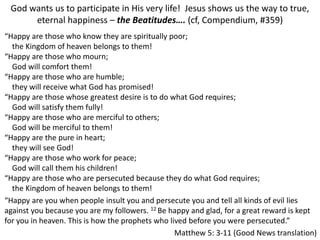
God wants us to participate in His very life! Jesus shows us the way to true,
eternal happiness – the Beatitudes…. (cf, Compendium, #359)
“Happy are those who know they are spiritually poor;
the Kingdom of heaven belongs to them!
“Happy are those who mourn;
God will comfort them!
“Happy are those who are humble;
they will receive what God has promised!
“Happy are those whose greatest desire is to do what God requires;
God will satisfy them fully!
“Happy are those who are merciful to others;
God will be merciful to them!
“Happy are the pure in heart;
they will see God!
“Happy are those who work for peace;
God will call them his children!
“Happy are those who are persecuted because they do what God requires;
the Kingdom of heaven belongs to them!
“Happy are you when people insult you and persecute you and tell all kinds of evil lies
against you because you are my followers. 12 Be happy and glad, for a great reward is kept
for you in heaven. This is how the prophets who lived before you were persecuted.”
Matthew 5: 3-11 (Good News translation)
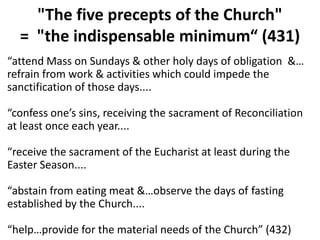
"The five precepts of the Church"
= "the indispensable minimum“ (431)
“attend Mass on Sundays & other holy days of obligation &…
refrain from work & activities which could impede the
sanctification of those days....
“confess one’s sins, receiving the sacrament of Reconciliation
at least once each year....
“receive the sacrament of the Eucharist at least during the
Easter Season....
“abstain from eating meat &…observe the days of fasting
established by the Church....
“help…provide for the material needs of the Church” (432)
•“Accepting God’s
mercy “requires
that we admit our
faults & confess
our sins.” (391)
• “A distinction is made between mortal & venial sin.” (394)
• “One commits a mortal sin when there are simultaneously
present: grave matter,
full knowledge,
& deliberate consent.
This sin destroys charity in us,
deprives us of sanctifying grace, &,
if unrepented, leads us
to the eternal death of hell.
It can be forgiven in the ordinary way by means of the
sacraments of Baptism & Penance or Reconciliation.” (395)
• “One commits a venial sin…when the matter involved is less
serious or, even if it is grave, when full knowledge or
complete consent are absent.” (396)
We are not alone in our efforts!
• Through the Sacraments, “the faithful receive
the grace of Christ & the gifts of the Holy
Spirit which give them the capability of living a
new life as children of God in Christ.” (357)
• Each one of us is made “in the image and
likeness of God”! – God doesn’t reject
anyone! He wants each of us - both our
bodies and our souls – in Heaven! (358)
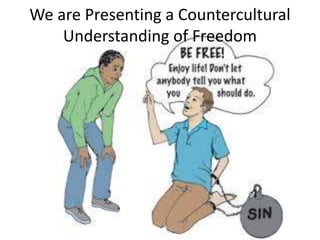
We are Presenting a Countercultural
Understanding of Freedom
Enslavement to Sin is NOT Freedom!
“Freedom is the power given by God to act or not to act, to do this or to
do that….
“The more one does what is good, the freer one becomes [A very
countercultural notion!].
“Freedom attains its proper perfection when it is directed toward God….
“The choice of evil is an abuse of freedom and leads to the slavery of
sin.” (363)
“Our freedom is weakened because of original sin. This weakness is
intensified because of successive sins. Christ, however, set us free….
With his grace, the Holy Spirit leads us to spiritual freedom to make us
free co-workers with Him in the Church & in the world.” (366)
We are creatures of habit. The more that we act uprightly, the easier it
becomes to live good – to live virtuously. The converse is also true….
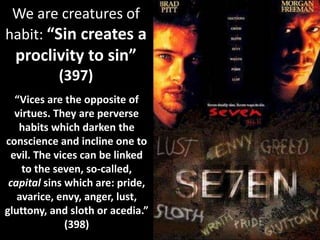
We are creatures of
habit: “Sin creates a
proclivity to sin”
(397)
“Vices are the opposite of
virtues. They are perverse
habits which darken the
conscience and incline one to
evil. The vices can be linked
to the seven, so-called,
capital sins which are: pride,
avarice, envy, anger, lust,
gluttony, and sloth or acedia.”
(398)
Remember:
Living as God wants us to live is
NOT a go-it-alone “survivor”
project,
nor a minimalist “follow the
rules/don’t get caught” game plan.
God’s Grace, communicated to us by the Sacraments,
Virtues, the Gifts of the Holy Spirit, and the Fruits of
the Holy Spirit assist us in His call to be Christ – like!
• “The Church is the community in which the
Christian receives the Word of God, the teachings
of the ‘Law of Christ’ (Galatians 6:2), and the grace
of the sacraments. Christians are united to the
Eucharistic sacrifice of Christ in such a way that
their moral life is an act of spiritual worship; and
they learn the example of holiness from the Virgin
Mary and the lives of the Saints.” (429)
• “It is the duty of the Magisterium…to preach the
faith….This…extends…to the specific precepts of
the natural law because their observance is
necessary for salvation” (430)
• A Christian’s moral life is
indispensable from proclaiming
the Gospel, because we “draw
others to faith in the true God,
build up the Church, inform the
world with the spirit of the
Gospel, & hasten the coming of
the Kingdom of God.” (433)
Repentance and Grace
We need to recognize and repent for
our sins, becoming more Christ-like
with God’s Grace
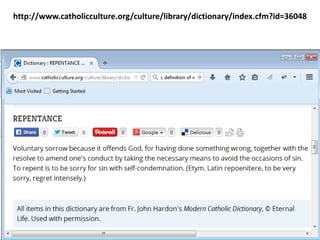
http://www.catholicculture.org/culture/library/dictionary/index.cfm?id=36048
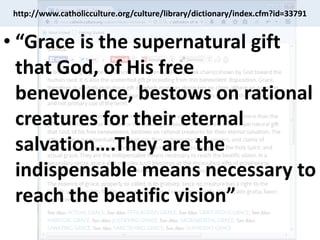
http://www.catholicculture.org/culture/library/dictionary/index.cfm?id=33791
• “Grace is the supernatural gift
that God, of His free
benevolence, bestows on rational
creatures for their eternal
salvation….They are the
indispensable means necessary to
reach the beatific vision”
• “All are invited by Jesus
to enter the Kingdom of
God. Even the worst of
sinners is called to
convert and to accept the
boundless mercy of the
Father. Already here on
earth, the Kingdom
belongs to those who
accept it with a humble
heart. To them the
mysteries of the Kingdom
are revealed.” (107)
He wants our Bodies & Souls in Heaven!
• “The Resurrection is the climax of the
Incarnation. It confirms the divinity of Christ and
all the things which he did and taught. It fulfills
all the divine promises made for us. Furthermore
the risen Christ, the conqueror of sin & death, is
the principle of our justification & our
Resurrection. It procures for us now the grace of
filial adoption which is a real share in the life of
the only begotten Son. At the end of time he will
raise up our bodies.” (131)
The Sacraments are Channels of God’s
Grace, Aiding Us in Our Lifelong
Conversion….Becoming, with His Grace,
Increasingly Less Selfish and More Like Jesus
• “In the liturgy of the Church, it is His own paschal
mystery that Christ signifies and makes present. By
giving the Holy Spirit to His apostles He entrusted
to them and their successors the power to make
present the work of salvation through the
Eucharistic sacrifice and the sacraments, in which
He Himself acts to communicate his grace to the
faithful of all times and places” (222)
• “For believers in Christ the sacraments,
even if they are not all given to each of
the faithful, are necessary for salvation
because they confer sacramental grace,
forgiveness of sins, adoption as children
of God, conformation to Christ the Lord
and membership in the Church. The Holy
Spirit heals and transforms those who
receive the sacraments.” (230)
• “Sacramental grace is the grace of
the Holy Spirit which is given by
Christ and is proper to each
sacrament. This grace helps the
faithful in their journey toward
holiness and so assists the Church
as well to grow in charity and in
her witness to the world.” (231)
Sin, repentance, and grace

Sin, repentance, and grace

  • 1.
  • 2.
    Sin(In addition to“original sin,” we talk of actual sin: mortal & venial. Actual sin “is an offense against God in disobedience to His love. It wounds human nature and injures human solidarity” (from the Compendium, # 392)), Temptation “Temptation is…an incitement to sin….Temptation is not in itself sin….as long as there is no consent of the will, there is no sin” (http://www.newadvent.org/cathen/14504a.htm)), & Conscience “A conscience is that still small voice that people won't listen to.” (J. Cricket) “Moral conscience…is a judgment of reason…[telling us]…to do good & avoid evil …. When attentive to moral conscience, the prudent person can hear the voice of God” (from the Compendium, #372) “An upright & true moral conscience is formed by education & by assimilating the Word of God & the teaching of the Church. It is supported by the gifts of the Holy Spirit & helped by the advice of wise people. Prayer & an examination of conscience can also greatly assist” (Compendium, #374))
  • 3.
    We are responsibleto learn what God wants of us*. But living as God wants us to live is NOT some sort of go-it- alone “survivor” project, nor a minimalist “follow the rules/don’t get caught” game plan. *God wants our eternal happiness! He wants to assist us in His call to be Christ – like and wants us to live with Him forever in Heaven.
  • 4.
    Review• God createda perfect, harmonious world for us, where there would be no suffering or death. • Our first parents rejected what God intended for all humanity. • We are born into “original sin.” • Yet, what Christ offers in Redemption far surpasses what we lost!
  • 5.
    In our stateof “original sin,” we are inclined to make our moral choices in a far from perfect manner.
  • 6.
    • In contrastto – “Might is Right,” – “Morals are Mores,” – “Right is What Brings Pleasure,” and – “Right is the Greatest Good for the Greatest Number,” • God has left us with a better way of moral/ethical decision making: – “Natural (Moral) Law” is concerned with universal & unchanging principles. – Through the right use of reasoning, all can come to know the Natural Law. – “The natural law which is prescribed by the Creator on the heart of every person consists in a participation in the wisdom & goodness of God. It expresses that original moral sense which enables one to discern by reason the good & the bad. It is universal & immutable” (Compendium, #416)
  • 7.
    God left His“Natural (Moral) Law” written upon every human’s heart. In his letter to the Romans, the Apostle Paul spoke of how the "demands of the law are written in their hearts.”
  • 8.
    375. What normsmust conscience always follow? “There are three general norms: 1) one may never do evil so that good may result from it [i.e The ends don’t justify the means.]; 2) the so-called Golden Rule, ‘Whatever you wish that men would do to you, do so to them’ (Matthew 7:12); 3) charity always proceeds by way of respect for one’s neighbor and his conscience, even though this does not mean accepting as good something that is objectively evil. ”
  • 9.
    Even though the"demands of the law are written in ...[our] hearts“, Dr. Janet Smith says, “Just like our ears when subjected to noises that are too loud & sharp, lose some of their ability to hear, so too does our moral 'sense' when subjected to too much corruption lose its ability to judge what is right & wrong.” The sad fact that human beings can do terrible things & believe that it’s OK is proof that we need assistance in developing our consciences....
  • 10.
    “An upright &true moral conscience is formed by education & by assimilating the Word of God & the teaching of the Church. It is supported by the gifts of the Holy Spirit & helped by the advice of wise people. Prayer & an examination of conscience can also greatly assist” (Compendium, #374))
  • 11.
    • As toJesus’ interpretation of the law, “You shall love the Lord your God with all your heart, & with all your soul, & with all your mind.’ This is the greatest & 1st commandment. &the second is like it: You shall love your neighbor as yourself.” (435)
  • 12.
    1) I AMTHE LORD YOUR GOD, YOU SHALL NOT HAVE OTHER GODS BEFORE ME 2) YOU SHALL NOT TAKE THE NAME OF THE LORD YOUR GOD IN VAIN 3) REMEMBER TO KEEP HOLY THE LORD'S DAY “You shall love the Lord your God with all your heart, with all your soul, & with all your mind.”
  • 13.
    “You shall loveyour neighbor as yourself.” 4) HONOR YOUR FATHER & YOUR MOTHER 5) YOU SHALL NOT KILL 6) YOU SHALL NOT COMMIT ADULTERY 7) YOU SHALL NOT STEAL 8) YOU SHALL NOT BEAR FALSE WITNESS AGAINST YOUR NEIGHBOR 9) YOU SHALL NOT COVET YOUR NEIGHBOR'S WIFE 10) YOU SHALL NOT COVET YOUR NEIGHBOR’S POSSESSIONS
  • 14.
    God wants usto participate in His very life! Jesus shows us the way to true, eternal happiness – the Beatitudes…. (cf, Compendium, #359) “Happy are those who know they are spiritually poor; the Kingdom of heaven belongs to them! “Happy are those who mourn; God will comfort them! “Happy are those who are humble; they will receive what God has promised! “Happy are those whose greatest desire is to do what God requires; God will satisfy them fully! “Happy are those who are merciful to others; God will be merciful to them! “Happy are the pure in heart; they will see God! “Happy are those who work for peace; God will call them his children! “Happy are those who are persecuted because they do what God requires; the Kingdom of heaven belongs to them! “Happy are you when people insult you and persecute you and tell all kinds of evil lies against you because you are my followers. 12 Be happy and glad, for a great reward is kept for you in heaven. This is how the prophets who lived before you were persecuted.” Matthew 5: 3-11 (Good News translation)
  • 15.
    "The five preceptsof the Church" = "the indispensable minimum“ (431) “attend Mass on Sundays & other holy days of obligation &… refrain from work & activities which could impede the sanctification of those days.... “confess one’s sins, receiving the sacrament of Reconciliation at least once each year.... “receive the sacrament of the Eucharist at least during the Easter Season.... “abstain from eating meat &…observe the days of fasting established by the Church.... “help…provide for the material needs of the Church” (432)
  • 16.
    •“Accepting God’s mercy “requires thatwe admit our faults & confess our sins.” (391)
  • 17.
    • “A distinctionis made between mortal & venial sin.” (394) • “One commits a mortal sin when there are simultaneously present: grave matter, full knowledge, & deliberate consent. This sin destroys charity in us, deprives us of sanctifying grace, &, if unrepented, leads us to the eternal death of hell. It can be forgiven in the ordinary way by means of the sacraments of Baptism & Penance or Reconciliation.” (395) • “One commits a venial sin…when the matter involved is less serious or, even if it is grave, when full knowledge or complete consent are absent.” (396)
  • 18.
    We are notalone in our efforts! • Through the Sacraments, “the faithful receive the grace of Christ & the gifts of the Holy Spirit which give them the capability of living a new life as children of God in Christ.” (357) • Each one of us is made “in the image and likeness of God”! – God doesn’t reject anyone! He wants each of us - both our bodies and our souls – in Heaven! (358)
  • 19.
    We are Presentinga Countercultural Understanding of Freedom
  • 20.
    Enslavement to Sinis NOT Freedom! “Freedom is the power given by God to act or not to act, to do this or to do that…. “The more one does what is good, the freer one becomes [A very countercultural notion!]. “Freedom attains its proper perfection when it is directed toward God…. “The choice of evil is an abuse of freedom and leads to the slavery of sin.” (363) “Our freedom is weakened because of original sin. This weakness is intensified because of successive sins. Christ, however, set us free…. With his grace, the Holy Spirit leads us to spiritual freedom to make us free co-workers with Him in the Church & in the world.” (366) We are creatures of habit. The more that we act uprightly, the easier it becomes to live good – to live virtuously. The converse is also true….
  • 21.
    We are creaturesof habit: “Sin creates a proclivity to sin” (397) “Vices are the opposite of virtues. They are perverse habits which darken the conscience and incline one to evil. The vices can be linked to the seven, so-called, capital sins which are: pride, avarice, envy, anger, lust, gluttony, and sloth or acedia.” (398)
  • 22.
    Remember: Living as Godwants us to live is NOT a go-it-alone “survivor” project, nor a minimalist “follow the rules/don’t get caught” game plan. God’s Grace, communicated to us by the Sacraments, Virtues, the Gifts of the Holy Spirit, and the Fruits of the Holy Spirit assist us in His call to be Christ – like!
  • 23.
    • “The Churchis the community in which the Christian receives the Word of God, the teachings of the ‘Law of Christ’ (Galatians 6:2), and the grace of the sacraments. Christians are united to the Eucharistic sacrifice of Christ in such a way that their moral life is an act of spiritual worship; and they learn the example of holiness from the Virgin Mary and the lives of the Saints.” (429) • “It is the duty of the Magisterium…to preach the faith….This…extends…to the specific precepts of the natural law because their observance is necessary for salvation” (430)
  • 24.
    • A Christian’smoral life is indispensable from proclaiming the Gospel, because we “draw others to faith in the true God, build up the Church, inform the world with the spirit of the Gospel, & hasten the coming of the Kingdom of God.” (433)
  • 25.
    Repentance and Grace Weneed to recognize and repent for our sins, becoming more Christ-like with God’s Grace
  • 26.
  • 27.
    http://www.catholicculture.org/culture/library/dictionary/index.cfm?id=33791 • “Grace isthe supernatural gift that God, of His free benevolence, bestows on rational creatures for their eternal salvation….They are the indispensable means necessary to reach the beatific vision”
  • 28.
    • “All areinvited by Jesus to enter the Kingdom of God. Even the worst of sinners is called to convert and to accept the boundless mercy of the Father. Already here on earth, the Kingdom belongs to those who accept it with a humble heart. To them the mysteries of the Kingdom are revealed.” (107)
  • 29.
    He wants ourBodies & Souls in Heaven! • “The Resurrection is the climax of the Incarnation. It confirms the divinity of Christ and all the things which he did and taught. It fulfills all the divine promises made for us. Furthermore the risen Christ, the conqueror of sin & death, is the principle of our justification & our Resurrection. It procures for us now the grace of filial adoption which is a real share in the life of the only begotten Son. At the end of time he will raise up our bodies.” (131)
  • 30.
    The Sacraments areChannels of God’s Grace, Aiding Us in Our Lifelong Conversion….Becoming, with His Grace, Increasingly Less Selfish and More Like Jesus • “In the liturgy of the Church, it is His own paschal mystery that Christ signifies and makes present. By giving the Holy Spirit to His apostles He entrusted to them and their successors the power to make present the work of salvation through the Eucharistic sacrifice and the sacraments, in which He Himself acts to communicate his grace to the faithful of all times and places” (222)
  • 31.
    • “For believersin Christ the sacraments, even if they are not all given to each of the faithful, are necessary for salvation because they confer sacramental grace, forgiveness of sins, adoption as children of God, conformation to Christ the Lord and membership in the Church. The Holy Spirit heals and transforms those who receive the sacraments.” (230)
  • 32.
    • “Sacramental graceis the grace of the Holy Spirit which is given by Christ and is proper to each sacrament. This grace helps the faithful in their journey toward holiness and so assists the Church as well to grow in charity and in her witness to the world.” (231)