THE HOLY SPIRIT SANCTIFYING WORK
EDITED BY GLENN PEASE
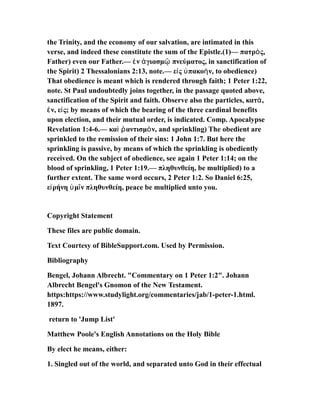
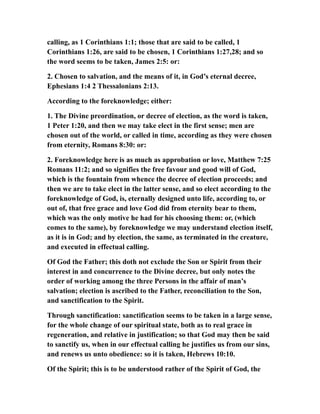
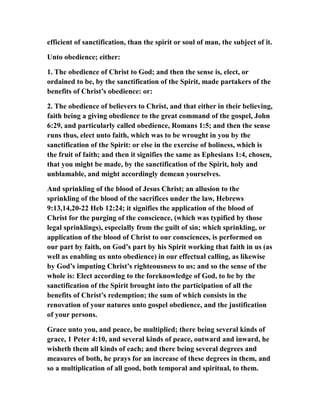
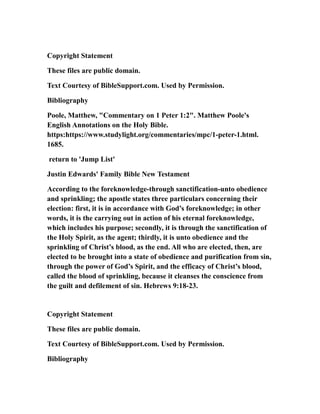
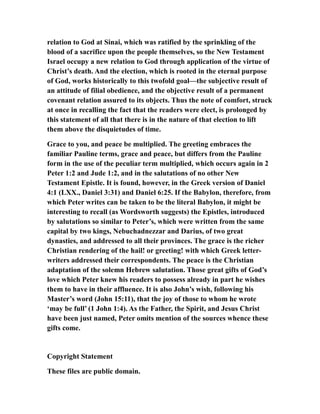
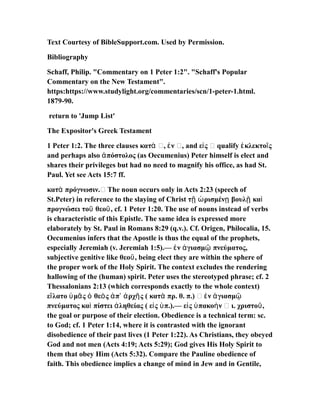
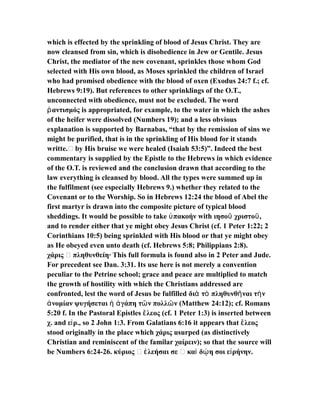
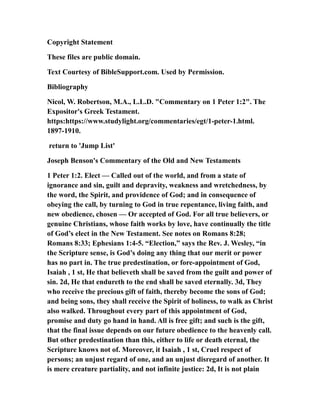
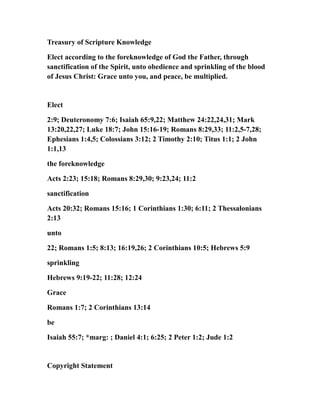
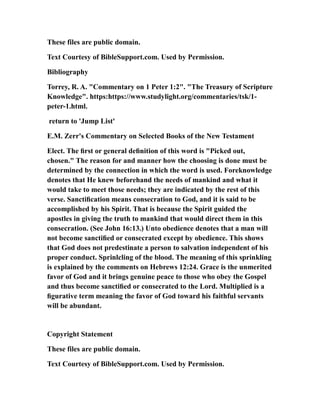
1 Peter 1:2 2who have been chosen according to
the foreknowledge of God the Father, through the
sanctifying work of the Spirit, to be obedient to
Jesus Christ and sprinkled with his blood: Grace
and peace be yours in abundance.
BIBLEHUB RESOURCES
Pulpit Commentary Homiletics
The Elect Of God
1 Peter 1:2
C. New
This is no mere Jewish title, for there are passages in the Epistle which
forbid the idea that it was addressed exclusively to Jews (1 Peter 1:18; 1
Peter 2:10; 1 Peter 4:3, 4). It is the title of the universal Church and the
individual believer. The verse is a summary of the most important and
difficult points of Christian doctrine; hardly a word in it but is
inexhaustible.
I. THE FACT OF DIVINE ELECTION STATED. Perhaps no greater
mystery in Scripture, and none more perverted; but if it is revealed
from heaven we need not be afraid of it; if it comes from God who
would draw all men unto him, only by misunderstanding it can it repel
them from him; if it be in this book, we cannot withhold it from
ourselves without spiritual loss. What is the Divine election? It is used in
Scripture in different connections - of election to an office (John 15:16);
of election to certain privileges, as the Jews (Psalm 135:4); but in a large
class of passages it clearly refers to the blessings of salvation (Romans
8:28-30; Ephesians 1:4, 5, 11; 2 Thessalonians 2:13; 1 Peter 1:2). This is
not election of a community, for it refers to matters necessarily
personal; e.g. "As many as were ordained to eternal life believed;" "All
that the Father giveth me must come to me, and him that," etc.;
"sanctification of the Spirit;" "belief of the truth;" "sprinkling of the
blood;" "conformed to his Son." It must be the Divine election of
individuals to eternal salvation. There are certain serious prejudices to
this doctrine - such as that it is opposed to the goodness and justice of
God. But that prejudice is unwarranted if the doctrine be really here,
for God cannot break the bounds of his nature, and these must
harmonize in some way, though as yet we see not how. At the same time,
notice that it is election to salvation, not to perdition; we are saved by
the sovereign grace of God, we are lost because of our own sin ("Come,
ye blessed of my Father! but it is only, Depart, ye cursed!"). Why does
not grace save all? All we know is that it does not, and that "the Lord is
righteous in all his ways," and what we know not now we shall know.
"What time I am afraid, I will trust in thee." Another prejudice: It
seems opposed to the freedom and responsibility of man. Certainly man
is free; he is commanded-to repent and believe, and held responsible for
not obeying, and is reasoned and pleaded with by God; and "How often
would I, but ye would not!" We cannot harmonize that with election, yet
they may both be true. If we make an objection in this to seeking
salvation, it is not as we act in other matters; we know that our recovery
from sickness is amongst what God has determined, yet we use means
for recovery, and are hopeless otherwise; so, as though there were no
foreordination to eternal life, we are responsible for employing the
means to secure it. If we are lost, it will not be because of foreordination,
but because in our freedom we failed to use the necessary means.
Another prejudice is that the doctrine seems opposed to the universal
offer of salvation. Salvation is offered to all; "God willeth not the death
of a sinner;" all are commanded to believe, and are condemned for not
believing. Then election is not out of harmony with that, and closes the
door to the salvation of none. We may not see the harmony, but God's
secret purposes cannot contradict his declared purposes.
II. CERTAIN PARTICULARS RESPECTING THIS DIVINE
ELECTION. Father, Son, and Spirit - the whole Godhead, so to speak,
combine to the redemption of a single soul.
1. The source of election . "The foreknowledge of God the Father." The
word "to know" in Scripture is often used for "to know with favor"
(Matthew 7:23; Romans 11:2; Romans 8:29). God knows, foreknows all,
so that the idea of foreknowledge with favor is involved in the
expression in these passages. So here; the same word as is translated
"foreordained" in ver. 20 - the foreknowledge of purpose, favor, as in
Ephesians 1:5, 9, 11. Our salvation is entirely on a Divine basis; we are
not elect because of anything in ourselves; we choose him because he
first chose us (Ephesians 1:4).
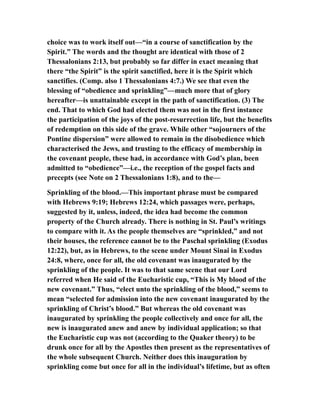
2. The working out of election: "The sanctification of the Spirit."
Sanctification in the sense of separation, something that comes before
"the sprinkling of the blood of Jesus Christ;" separation to God,
equivalent to the new birth; for only thus are we called out from the
world, from its joys, and sorrows, and principles, and attitude towards
God. This is the seal of election - the elect are the separated; the Spirit
separates for God those whom God chooses for himself. And this
separation is carried on to faith and every Christian grace, and final
perfection in heaven.
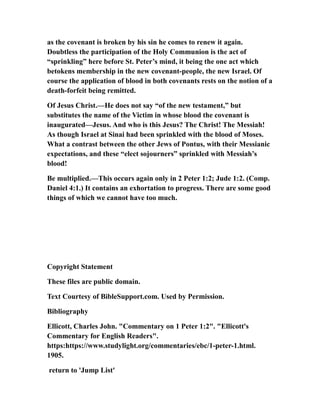
3. The end of election: "Obedience and sprinkling of the blood of Jesus
Christ." "Obedience" here can hardly mean "submission to law;" it
probably stands for the full expression, "the obedience of faith," as in
Romans 1:8 (comp. with Romans 16:19; 10:16; 2 Thessalonians 1:8; 1
Peter 4:17). The passage, then, is a striking parallel to 2 Thessalonians
2:13. The end of election is faith, and the consequent application of the
atoning blood. Because of what the sprinkling of that blood does for us:
justifies (Romans 3:9); cleanses (1 John 1:7); seals to us the blessings of
the covenant (1 Corinthians 11:25); heaven (Hebrews 10:19).
III. THE BENEFITS OF THE DIVINE ELECTION. "Grace and peace
multiplied." The fact of election can only be stated because there is
untold good in it. It is essentially the believer's doctrine. For such it is
full of encouragement and support.
1. It assures us of the certainty of multiplied grace. If God chose us to all
the blessings of perfect salvation, it is certain we shall have them.
Nothing can be more sure than God's eternal purpose.
2. And this assurance produces perfect peace. None can be afraid who
have (in the separation of the Spirit) the seal that they are divinely
elected to grace multiplied without end. - C.N.
Biblical Illustrator
If ye call on the Father.
1 Peter 1:17-21
What the name Father implies
John Rogers.
1. This condemns them that live wickedly and in their sins, and yet call
God Father. They might as well say anything. If one should fight against
the king and say he were a good subject; or say he is a man's servant,
and yet doth nothing that he is bidden.
2. But dost thou unfeignedly desire to fear God —(1) In thy general
calling as a Christian, to walk holily, righteously, and soberly? Fearest
thou to offend God thyself, or to see Him dishonoured by others? Carest
thou to please Him? Lovest thou to be in His presence? Dost thou
conscionably hear His Word, and patiently bear His corrections?(2) In
thy special calling art thou careful to glorify God, as a parent, child,
master, servant, etc., not only in ceasing to do evil, but in doing good,
yea, and labouring to do it well? Thou mayest comfortably and with
good leave call God Father, and make account of Him so to be, which is
the greatest privilege in the world.
(John Rogers.)
The judgment of the Father
S. A. Tipple.
In saying "if ye call on the Father," the apostle did not mean for a
moment to express any doubt; the "if" simply introduces a premise on
which a conclusion is to be based, as when St. Paul wrote, "If ye then be
risen with Christ, seek those things which are above." There was no
uncertainty as to whether the readers of the Epistle — Christianised
Jews scattered abroad — were calling upon the Father, or more
correctly, as to whether they were calling Him Father. That was just
what they were doing, having learned to do so in their conversion to the
Christian faith. They had always believed in a righteous, impartial
Governor of the world — the God, namely, of Moses and the prophets,
who was supremely the just One; and now, since their surrender to
Jesus as their Master, and their acceptance of His Gospel, they had
come to name this God, the Father. He whose throne was in the heavens,
who hated iniquity and ruled with faultless justice, He was the Father.
"And if He be," says the apostle, "pass, I pray you, the time of your
earthly sojourning, in fear." A true word, a word spoken in utter
sincerity, and representing what is fact, may yet prove very misleading
— may convey or suggest something contrary to truth. If language be a
vehicle of thought, it is far from being always an adequate or a safe
vehicle. Now the word, "Father," we might anticipate, would speak alike
to all. The relation which it designates is common enough. Yet how
differently the word may affect different individuals, what different
pictures it may conjure up before them! As to what it shall express to
any of us, much will depend upon the kind of domestic experience we
have had, upon the kind of home with which we are most familiar, in
which our childhood and youth were spent. Oh, the world of grand and
sweet meaning for you, in the word Father! What a solemn, noble,
gracious sound it has! But here is another, upon whose ear it falls with
no sound of music, in whose mind it is associated with harsh and
tyrannical exercise of authority. It brings to his recollection a testy,
passionate, wrath-provoking man, whose ways were hard to bear; or a
man, cold, stern, austere, whose presence chilled and rather
discomforted, or one who, while protecting and ministering, was
uncertain in judgment — now weakly lenient, now unreasonably and
unwholesomely strict. And St. Peter would seem to have apprehended
that it might be thus with his readers, that in calling the Divine
Governor, Father, they might scarcely be alive to all which the name
implied; for he proceeds to indicate to them how it behoved them to be
moved and affected by the sense of God's Fatherhood. "Since you
worship as the Father, Him, who without respect of persons judgeth
according to every man's work, pass the time of your sojourning in
fear." And it is very likely that this conclusion of his rather surprised
and staggered them. "In fear!" they would exclaim, perhaps; "should
he not have written, on the contrary, 'in comfort and peace,' 'in bright
courage and hope'"? Yes, yes, most surely; but then, it should inspire
you also with a great awe, and if it do not, the whole meaning of the
word Father cannot have been grasped by you; for the true Father is
not merely the gracious Protector, Succourer, Provider, but the constant,
persistent, earnest, unsparing Educator, also, whose love deals closely
and inexorably with each child of the family, in desire for his due
training and his best development. Now, as may have been the case with
the people whom St. Peter addressed, we perhaps, are possessed with
too poor and low an idea of fatherliness, and, more or less blinded by
that idea, need to be reminded of what he saw and sought to inculcate,
namely, that the Fatherhood of the Almighty is a very solemn reality,
and serves to render life very serious. There is, I think, a widespread
tendency to repose in it as involving rather less demand upon us for
moral care and earnestness, as allowing us to be rather less particular
about the cultivation of righteousness, rather less anxious concerning
our spiritual condition and quality. "Let us not be troubled greatly,"
they say to themselves — "let us not be troubled greatly if we are
negligent and unfaithful, and do not amend or improve as we should; is
not the Judge and Ruler the Father, and will He not therefore be gentle
with us; may He not therefore, overlook much, and make things
considerably pleasanter for us in the end than we deserve?" Are there
not those who reason thus from the thought of God's Fatherhood? Yet
did they consider and understand, the very thought in which they find
relief, would rather set them trembling. For, see, what government is so
close and penetrating as the government of a true father? Is there
anything in existence to compare with it? How very much it takes
cognisance of, to frown upon, and rebuke, which no other government
notices! Parents will often punish severely, where the police would never
interfere. The man whom the lad has to fear, when others show lenity, is
his father, and because he is the father. A father's rule, again, a true
father's rule, consists not merely in legislating and in punishing when
laws are broken, but in studying to train toward obedience — to school
and discipline, with the object of eliminating or checking what is wrong,
and guiding and helping to the formation of right habits. He not only
commands good conduct, and visits the opposite with his displeasure,
but endeavours in every way, and by every means, to influence to
goodness, and to educate the child on all sides, with whatever exercises
and appliances may seem fitting, to the best of which he is capable. To
this end, he watches over and pursues him. Do we not acknowledge, that
to be at all careless about the training of our children, and their culture
by us to better things, is to be unfatherly, and that the fondness which
passes by a fault demanding correction, rather than draw forth tears
and put to grief, is not true paternal love? If then there be a Divine
Governor of mankind, all-holy and just, the principle and spirit of
whose government is really paternal, is it not a profoundly serious thing
for us men, in our state of confessed imperfection, with so much in us
which as yet falls short of and is contrary to holiness? What hope can
there be of rest or happiness, what hope of acquittal, for unrighteous
souls, if God, the infinitely righteous, be the Father? Can He ever be
content to tolerate them as they are, to leave them as they are, unvisited,
unmeddled with? If He be indeed the Father, what chance can there be
for one of us, of our not receiving according to our works? Do you not
perceive the certainty, the inevitableness of due punishment upon the
supposition of His Fatherhood? I think of the suffering that must yet be
in store for such; for without suffering, how are these habits and
sympathies of theirs to be worked out? and I know, methinks, that they
will have to be worked out; that the great paternal love will not be able
to refrain from them, or stay its hand until they are.
(S. A. Tipple.)
Fatherly judgment and filial fear
A. Maclaren, D. D.
"Walk during the time of your sojourning here in fear." How does that
comport with the preceding glowing exhortation to "perfect hope"?
How does it fit in with the triumphant words in the earlier part of the
chapter about "joy unspeakable and full of glory"? Does it not come
like a douche of cold water on such thoughts? Peter thinks they can co-
exist; and, more singular still, that the same object can excite both. Nay!
there is no perfect hope which does not blend with it this fear; and joy
itself lacks dignity and nobleness unless it is sobered and elevated by an
infusion of it.
I. HERE WE HAVE, FIRST, A FATHERLY JUDGMENT. Mark the
meaning and the limits of the fatherly and filial relation which is laid at
the foundation of the exhortation of my text. "If ye call on the Father"
— he is speaking distinctly and exclusively to Christian people. Much
has been said in recent days, and said in many aspects nobly, and with
good results upon the theological thinking of our generation, about the
Fatherhood of God. But, we are never to forget that that one word
covers in the Bible two entirely distinct thoughts. In one aspect, God is
the Father of the spirits of all flesh by their derivation of life from Him.
But in another "to as many as believed on Him to them gave He power
to become sons of God." And it is on the latter Fatherhood and sonship
that the apostle builds the exhortation of my text. Well, then, further,
the apostle here desires to guard us against another of the errors which
are very common in this generation. The revolt against the sterner and
graver side of Christian truth has largely found footing in a mistaken
idea of the implications and bearing of that thought that God is our
Father. That relationship has been thought to swallow up all others, and
men have been unwilling to entertain the ideas of a righteous Governor,
a supreme Law giver, a retributive Judge. And Peter brings the two
ideas into juxtaposition, seeing no contradiction between them, but
rather that the one necessarily involves the other. Is it not so in your
own homes? Does your fatherhood swallow up your obligation to
estimate the moral worth of your child, and to proportion your conduct
accordingly? The judicial aspect is essential to the perfection of
Fatherhood; and every family on earth mirrors the fact to those that
have eyes to see. Mark, still further, the emphatic characteristics of this
paternal judgment which are set forth in my text. It is "without respect
of persons." Peter is going back on his old experience in that unique
word. Do you remember when it was that the scales fell from his eyes,
and he said, "I perceive that God is no respecter of persons"? It was in
the house of Cornelius in Caesarea. Note, further, that this paternal
judgment which comes on the child because he is a child, is a present
one. "Who judgeth," not "who wilt judge." Ah! day by day, moment by
moment, deed by deed, we are coming under the judicial light of God's
eye, and the judicial force of His hand. "The history of the world is the
judgment of the world," so the lives of individual Christians do record
and bear the results of a present judgment of the present Father. Then
mark, still further, what the thing judged by this present impartial
Fatherly judgment is "According to his work." The text does not say
"works," but "work" — that is, each man's life considered as a living
whole; the main drift and dominant purpose, rather than the isolated
single acts, are taken into view. Now, from all this, there just comes the
one point that I want to urge upon our hearts and consciences — viz.,
that Christian people are to expect, today and hereafter, the incidence of
a Father's judgment. The Jews came to Jesus Christ once and said,
"What shall we do that we might work the works of God?" His answer
made the same remarkable use of the singular instead of the plural to
which I have drawn attention as occurring in this text — "This is the
work of God, that ye believe on Him whom He hath sent." Yes! And if
we, in any real sense, are doing that one work of God — viz., believing
on Jesus Christ — our faith will be a productive mother of work which
He will look upon and accept as an odour of a sweet smell, "well-
pleasing unto God." There is a paternal judgment; and the works which
pass it are works done from the root and on the basis of faith in Jesus
Christ.
II. WE HAVE HERE A SON'S FEAR. Now, fear is, I suppose, best
explained as being the shrinking anticipation of evil. But, as the Old
Testament has taught us, there is a higher and a lower form of that
apprehension. In the higher it is sublimed into lowly reverence and awe,
which fears nothing so much as being alienated from God. And that is
the fear that my text would insist upon. The evil which a Christian man,
the son of the Father, and the subject of His judgment, has most to
apprehend — indeed, the only evil which he has really to apprehend —
is that he may be tempted to do wrong. So this fear has in it no torment,
but it has in it blessedness and purity and strength. It is perfectly
compatible with all these other emotions of which the lower form of fear
is the opposite; perfectly compatible with confidence, with hope, with
joy — nay I rather, without this wholesome and restraining dread of
incurring the displeasure of a loving Father, these exuberant and
buoyant graces lose their chiefest security. The fear which my text
enjoins is the armed guard, so to speak, that watches over these fair
virgins of hope and joy and confidence that beautify the Christian life.
If you wish your hope to be bright, fear; if you wish your joy to be solid,
fear; if you want your confidence in God to be unshaken, cherish utter
distrust of yourself, and fear. Fear only that you may depart from Him
in whom our hope, and our joy, and our confidence, have their roots.
That fear is the only guarantee for our security. The man that distrusts
himself and knows his danger, and clings to his refuge is safe. This son's
fear is the source of courage. The man whose whole apprehension of evil
is dread of sin is bold as a lion in view of all other dangers.
III. Lastly, HERE IS THE HOMECOMING, WHICH WILL FINISH
THE FEAR. "The time of your sojourning," says Peter. That thought
runs through the letter. It is addressed "to the strangers scattered
abroad," and in the next chapter he exhorts Christian people, as
"strangers and pilgrims," to "abstain from fleshly lusts." Here he puts a
term to this dread — "the time of your sojourning." Travellers in
foreign lands have to light their fires at night to keep off the lions, and to
set their guard to detect the stealthy approach of the foe, You and I,
whilst we travel in this earthly pilgrimage, have to be on our guard, lest
we should be betrayed. But we are going home. And when the child gets
to the Father's house it does not fear any more dangers, nor need bolts
and bars, nor guards and sentries. Why did God give us this capacity of
anticipating, and shrinking from, future evil? Was it only meant that its
red light should be a danger signal in reference to fleeting worldly evils?
Is there not a far worse possibility before us all? Let me press on you
this one question: Have you ever, in all the wide range which your fears
of a future have taken, extended it so far as to face this question, "What
will become of me when I come into contact with God the Judge and His
righteous tribunal?" You will come in contact with it. Let your fear
travel so far, and let it lead you to the one Refuge.
(A. Maclaren, D. D.)
Judgeth according to every man's work
God an impartial Judge
Plain Sermons by Contributors to, Tracts for the Times.
There is a verse in the Psalms which might not unfitly stand as a text for
this whole Epistle of St. Peter. It is at the end of the 111th Psalm, in
which David had been giving most high praise to God for His
distinguishing mercy towards His own chosen people. "The fear of the
Lord is the beginning of wisdom: a good understanding have all they
that do thereafter: the praise of it endureth forever." As much as to say,
that, great as the mercies are, which God has provided for His elect
people, they are not such as ought for a moment to set us free from that
godly fear, that religious and awful sense of God's unspeakable
presence, which is the beginning, the crown, of all spiritual wisdom. It
must be joined indeed with love, but we must never expect to turn it
entirely into such love as we feel towards those who are dear to us here
among men. In a word, the love and fear of God will grow up together
in a religious and thoughtful heart; as we come to know more of Him as
the greatest and best of fathers. Such is the Psalmist's account of the
fear of God: and lest any person, having an eye to the infinite blessings
of the gospel of Christ, made known to us but unknown to him, should
imagine that this description of God's fear is now as it were out of date,
I wish all Christians would observe how earnestly the very same lesson
is taught in the New Testament also. Our Lord forewarns us whom we
shall fear; Him, namely, who is able to cast both body and soul into hell.
And observe, He speaks thus, not to those who were still at a distance
from Him, but to His own chosen apostles and followers, to those whom
in the same discourse He calls His friends and His little flock. Surely this
one text is enough to do away with all presumptuous notions of any
persons ever becoming so good, or so high in God's favour, as to do
without the fear of God. It is true, St. John says, "Perfect love casteth
out fear," but what fear? surely not religious reverence of the ever-
present Almighty Father. St. Peter was in some measure afraid, lest the
Christians to whom he was writing should so dwell on favours received,
be so entirely taken up with the comfortable promises of the gospel, as
to forget the fear of God, and the plain duty of keeping the
commandments. As if he had said, It is our privilege to call God, Our
Father which art in heaven. Christ Himself in His own prayer has
authorised the faithful to do it. Here the irreligious pride of some men
might presently come in, and tempt them to imagine that God is partial
to them; that He favours them above others, and therefore they may
take liberties; He will not be so strict in requiring an account how they
have kept His laws. But St. Peter teaches us just the contrary: even as
the last of the prophets, Malachi, had taught before, looking forward by
the Spirit to a time when men, having greater privileges than ever,
would be in danger of abusing them more than ever. "If I be a Father,
where is Mine honour?" How can you call the great God of heaven and
earth by a name which brings Him so very near you, and not feel an
awful kind of thrill, a sense of His presence in your very heart? More
especially, when you add that which he takes notice of in the next place:
that this our heavenly Father is one who "without respect of persons
judgeth according to every man's work." This was in a great degree a
discovery of God's nature and character made by the Gospel. Before the
coming of our Lord and Saviour, neither Jew nor Gentile looked on the
God of heaven as being impartial, and judging without respect of
persons. As for the Gentiles, "They thought wickedly, that God was even
such an one as themselves." Again, even God's own people, the Jews,
were generally apt more or less to mistake the nature and meaning of
the great favour which God Almighty had shown them for so many ages.
They kept continually saying within themselves, "We have Abraham to
our Father"; in such a manner as if they were sure of especial
consideration to be had of them on that account merely; as if they might
be looser in their conduct than other men. When, therefore, both Jew
and Gentile were to be called into one great family in the name of our
Lord Jesus Christ, one of the things most necessary to be taught was,
"God is no respecter of persons," etc. This St. Peter had taught long ago
to the Jews, when, by especial direction of the Holy Ghost, he had to
convert and baptize Cornelius and his household; and now again he
repeats the same instruction to the converted Gentiles themselves, lest
they should abuse their own privileges, and fancy they were entitled to
favour at the hands of the most holy God, merely for being on His side.
Nor may we imagine that the apostle spoke to the men of those times
only; the Christians of all times are in danger of the same kind of error:
we are all too apt to indulge the childish imagination, that our own case
has something particular in it: that God Almighty therefore, just and
terrible as He is, will surely make exceptions in our favour. The reward,
then, of those who shall receive God's blessing at last will be strictly in
proportion, not to their deservings, but to their sincerity and steadiness
in working. "They will be justified," as St. Paul says, "by faith, without
works of any law"; yet, in another sense, they are justified by the works
of the gospel law, not by faith only. God graciously accepts, not their
bare nominal good meaning, but their good meaning proved by their
works. And there is no respect of persons on this plan: because the faith
meant is not a strong emotion; but it is the steady devotion of the heart
to do the will of God our Saviour, and not our own will. Therefore, let us
fear — for we have indeed great reason — lest, so much depending on
our own works, those works be found at the last day to be nothing at all,
or next to nothing. This consideration of itself is surely terrible enough;
but there is one thing yet remaining, which makes it yet more alarming
to the conscience: and it is that which St. Peter sets before us by his use
of the word "sojourning" in this passage. "Pass the time of your
sojourning here in fear." As much as to say, "Pass your time in fear, not
knowing how short it may be." The churchyards around us are fast
filling; it may be our own turn next; and how far have we advanced, by
the aid of God's Spirit, in that difficult work of putting off the mind of
this world, and putting on the mind of Christ?
(Plain Sermons by Contributors to "Tracts for the Times. ")
Pass the time of your sojourning here in fear
Fear of judgment to come, and of redemption accomplished
J. Leckie, D. D.
Before the word "fear" there are several reasons given for its exercise.
We call God Father. He who applies such a name to God must fear if he
thinks what this involves on his part. Especially when it is remembered
that while He is a Father He is also a Judge strictly righteous and
impartial. Succeeding it is another ground. We are redeemed. And our
redemption has been effected by the most costly sacrifice — the blood of
Christ. Those who believe that cannot but feel a peculiar obligation
lying upon them. They must be Christ's in heart and soul and action.
And they cannot but fear lest they should belie such a marvellous
consecration.
I. THE SPHERE AND OPERATION OF CHRISTIAN FEAR. There
are some to whom the importance attached to fear in this place and
elsewhere seems in contradiction to the teaching of the Apostle John,
who speaks of fear as being cast out by perfect love. But it is to be
observed that it is perfect love to which this prerogative is assigned. But
with imperfect love fear has an important sphere of action. It affords
stimulus to imperfect love and pushes it on to perfection. Those whom
the apostle exhorts to fear are the same whom he has exhorted to hope
to the end. They are men to whom Christ is precious, who love Him and
rejoice in Him with a joy unspeakable and full of glory. Fear existing
along with such elements cannot even burden. It balances, sobers,
solemnises, deepens, intensifies. But it is often urged that the actions
which are stimulated by fear have no moral worth, that fear is but a
form of selfishness, and that therefore no fruit produced by it, however
well it may look to the eye, can be truly acceptable to God. This has a
very specious look. It appears a particularly fine, exalted, spiritual
doctrine. And it really is so in its main features. It is true; but it is only a
half truth, and half truths are often the most dangerous of errors. What
is the other half of the truth? Although fear in itself and by itself cannot
produce truly good or spiritually right action, it yet performs a vital
function in keeping the soul awake. Fear rings the alarm bell and rouses
the conscience. It blows the trumpet of warning. It creates pause and
opportunity for all better and nobler things to make themselves heard.
It allows a man to become aware of the realities, and when he is once
placed in contact with them the best things begin. Everything depends
on being made earnest, sensitive, lifted into a sense of the eternal
verities. The highest principles, righteousness and love, are often in the
best of men forgetful and fickle. They are ensnared, oppressed, and
bewildered many a time, and need the keen influence of fear to bring
them to themselves again.
II. FEAR IN RELATION TO THE FATHER THAT JUDGETH. Fear is
obviously far from being the main feeling towards God as a Father.
Confidence and love are especially the feelings called out by the
Fatherhood of God. But God says, "If I be a Father, where is My fear?"
God claims fear as a Father — reverence, no doubt, mainly — honour,
awe in the realising of His infinitude; but something more than these,
something else. For God as a Father judgeth. Did He not judge and
condemn all sin He could be no true Father. Love must hate sin and
show its hatred. Father is no weak, soft, indulgent word. It means love,
and because it means love it means right, and undying opposition to evil,
The Father judgeth without respect of persons. There is no other Father
than the Father who judgeth. If I believe in a Father that judges, that
will certainly rouse me up — it will waken my slumbering energies, it
will cause me to look well to the state of my heart and life; but the word
Father will always keep the thought of judgment from overwhelming
me.
III. IN ORDER TO HAVE A TRUE CHRISTIAN FEAR WE MUST
PLACE TOGETHER JUDGMENT BY WORKS AND REDEMPTION
BY THE BLOOD OF CHRIST. The thought of judgment to come is
essential to the depth and the reality of life. Without this everything is
left in chaos. Conscience is not satisfied, nor is reason. But what reason
and conscience demand cannot but awaken fear. This fear is deepened
and yet transformed by the thought of redemption. Redemption seems
at first wholly opposed to judgment by works, far more than even the
Fatherhood of God does. For what does the Scripture mean by
redemption through the blood of Christ? It means that the Son of God
took our place and bore us on His heart in living and dying; it means
that the sacrifice of Christ is that moral vindication of law and right,
that tribute to the holiness of God which God accepts as sufficient
amends and reparation. By faith man falls in with this Divine
arrangement, identifies himself with it and is reconciled to God. And
this faith that accepts and trusts and frees from condemnation, also
works by love. Salvation by faith and judgment by works are therefore
no contradiction. It is judgment by faith taken in its flower and fruit.
But do we not see how fear awakes in the view of such a wonderful
redemption? There is something akin to fear raised in the soul by the
sight of sublimity. The wide expanse of the sky filled with sun shine or
peopled with worlds raises an awe sublime, but often weighing heavily
on the soul. Vast fervent love indeed banishes fear. It is the one thing
that does this. And yet such a love as this — so holy, so mysterious, so
resolute, so devoted — love coming from such a height, and going down
into such depths, cannot but awaken a certain awe. We are overawed by
the brilliancy of the light. "We fear the Lord and His goodness." And
then when a man thinks of being redeemed by such a sacrifice, when he
tries to realise at what a cost redemption has been effected, does not a
certain fear come over him lest he should prove miserably unworthy of
it all? But let not this fear in view of redemption be deemed inconsistent
with the joy and freedom which belong to the gospel. It is precisely the
man who has that realising sense of redemption which makes him afraid
of not proving worthy of it, who has also joy. These two, fear and joy,
grow out of the same root of redemption. The more joy in Christ any
man has, the more will he be afraid of not conforming sufficiently to
Christ.
(J. Leckie, D. D.)
God will be served in fear
Plain Sermons by Contributors to, Tracts for the Times.
If these words were not known for certain to be the words of Holy
Scripture they would appear to many very severe, very unfit to win
souls to God. "What!" it would be said, "are people to fear always? all
people, those who are farthest advanced in true religion and in the
comfort of the Holy Ghost? What, then, is to become of the natural
cheerfulness of youth; of the enjoyments inseparable from even health
and spirits, kind relations and friends; what of the testimony of a good
conscience? All this and more is said by different sorts of persons
against those who, following God's own method, would make them
serious in the true scriptural way; by teaching them, and encouraging
them in the true reverence. It may be of use to us if we consider what
those tempers are which are most apt to make men impatient of being
told to "pass the time of their sojourning here in fear." There is a
certain time of life in which we are almost all of us, more or less,
partakers of this pagan error of disliking all that is really serious, all
that would impress us thoroughly with the fear and dread of Almighty
God. When youth and strength are high, before we have tasted of our
Father's severer discipline, we shrink from the sadder lessons of
Scripture and the Church: we say to ourselves, "Surely this world, so
full of enjoyment, can never have been meant merely as a place for the
exercise of hard and severe penitence." If, then, any young person
happen now to be listening to me, let me beseech him to be aware of this
danger: to watch in himself that spirit of confidence and gaiety which,
under pretence of mere youthful cheerfulness, would lead him to make
light of God's most holy commandments. Let us only recollect ourselves,
how it is with us at our prayers. Are we not too much inclined to say
them over without seriously bringing before our minds the awful
presence of Him to whom we pray? This too is one of the reasons why
outward religion, the religion of the body, is of so very great
consequence; viz., that it helps very much to keep and improve in our
hearts the true and wholesome fear of God. Because in truth not only
does nature teach us to express our feelings in such postures, but also
these very bodies of ours, so fearfully and wonderfully made, are of
purpose so framed as to have an influence in their turn on our souls.
Soldiers, we know, in all armies, are made to march erect, and to be
firm and straight in all their bodily movements; not merely for the
appearance' sake, but because the very attitude, in some unaccountable
way, tends to make them bolder and firmer in mind; and in like manner
there is no question, that kneeling and other humble gestures in
devotion, practised not for form's sake, but in obedience to the Church,
and in the fear of God, would cherish and improve that very fear in our
hearts. Bishop Wilson has said, speaking of small instances of self-
denial, "Say not, It is a trifle, and not fit to offer in sacrifice to God."
And the same may be said of small occasions of nourishing the
remembrance of Him; of short prayers frequently through the day, of
turning every event and accident of life, not openly, but as much as may
be in secret, into an opportunity for devout prayer and recollection.
(Plain Sermons by Contributors to "Tracts for the Times.)
Godly fear
Abp. Leighton.
I. THE FEAR HERE RECOMMENDED is a holy self-suspicion and
fear of offending God, which may not only consist with assured hope of
salvation, and with faith, and love, and spiritual joy, but is their
inseparable companion, as all Divine graces are linked together. And, as
they dwell together, they grow or decrease together. The more a
Christian believes, and loves, and rejoices in the love of God, the more
unwilling surely he is to displease Him, and if in danger of displeasing
Him, the more afraid is he of it; and, on the other side, this fear being
the true principle of a wary and holy conversation, fleeing sin and the
occasions of sin and temptations to it, is as a watch or guard that keeps
out the enemies of the soul, and so preserves its inward peace, keeps the
assurance of faith and hope unmolested, and that joy which they cause
unimpaired, and the intercourse of love betwixt the soul and her beloved
uninterrupted. Certainly a good man is sometimes driven to wonder at
his own frailty and inconstancy. What strange differences will be
betwixt him and himself! How high and how delightful at some times
are his thoughts of God, and the glory of the life to come; and yet how
easily at another time base temptations will bemire him, or, at the least,
molest and vex him! And this keeps him in a continual fear, and that
fear in continual vigilance and circumspection. When he looks up to
God, and considers the truth of His promises, and the sufficiency of His
grace and protection, and the almighty strength of His Redeemer, these
things fill his soul with confidence and assurance; but when he turns his
eye downward again upon himself, and finds so much remaining
corruption within, and so many temptations and dangers and
adversaries without, this forces him not only to fear, but to despair of
himself; and it should do so, that his trust in God may be purer and
more entire. This fear is not cowardice. It does not debase, but it
elevates the mind; for it drowns all lower fears, and begets true
fortitude to encounter all dangers, for the sake of a good conscience and
the obeying of God. From this fear have sprung all the generous
resolutions and patient sufferings of the saints and martyrs. Because
they durst not sin against God, therefore they durst be imprisoned, and
impoverished, and tortured, and die for Him.
II. THE REASON they have here to persuade to this fear is twofold.
1. Their relation to God us their Father and their Judge. But as He is the
best Father, so consider that He is withal the greatest and most just
Judge. There is here the sovereignty of this Judge, the universality of
His judgment, and the equity of it. "Pass the time of your sojourning
here in fear." You are encompassed with enemies and snares; how can
you be secure in the midst of them? Perfect peace and security are
reserved for you at home, and that is the end of your fear.
III. THE TERM OR CONTINUANCE OF THIS FEAR. It continues all
the time of this sojourning life; it dies not before us: we and it shall
expire together. "Blessed is he that feareth always," says Solomon; in
secret and in society, in his own house and in God's. We must hear the
Word with fear, and preach it with fear, afraid to miscarry in our
intentions and manners. "Serve the Lord with fear," yea, in times of
inward comfort and joy, "rejoice with trembling"; not only when a man
feels most his own weakness, but when he finds himself strongest. None
are so high advanced in grace here below as to be out of need of this
grace; but when their sojourning shall be done, and they are come home
to their Father's house above, then no more fearing. No entrance for
dangers there, and therefore no fear.
(Abp. Leighton.)
The right feelings of the heavenly pilgrim
Essex Remembrancer.
I. THE NATURE OF TEE CHRISTIAN'S LIFE.
1. His past condition. Whence has the pilgrim come? From the city of
destruction.
2. His present state. He is a sojourner.
3. His future destination.
II. THE MANNER IN WHICH THE CHRISTIAN'S LIFE SHOULD
BE SPENT. In fear."
1. A fear of reverence. Contrast the Divine majesty with our meanness.
2. A fear of caution.
3. A fear of anxiety. It is better to err on the side of timidity than
presumption.
(Essex Remembrancer.)
The awe of the redeemed
U. R. Thomas.
I. Awe of the redeemed TOWARDS THE REDEEMING GOD. "If ye
call on Him as Father." Not simply appeal to Him, but acknowledge His
relationship to you, admit His claims on you.
II. Awe of the redeemed BECAUSE OF THEIR RECOLLECTION OF
THE EVIL FROM WHICH THEY HAVE BEEN REDEEMED.
1. A consciousness of being redeemed.
2. A consciousness of being redeemed from a habit of life that was evil.
3. A consciousness of being redeemed from an evil habit of life that was
inherited.
III. Awe of the redeemed BECAUSE OF THE COST BY WHICH
THEY HAVE BEEN REDEEMED.
1. This cost in contrast with the wealth of this world.
2. This cost as revealed in Jesus Christ.
3. This cost as known to the infinite heart of the Eternal God.
4. This cost as approved by God.
5. This cost as incurred for man's sake.
IV. Awe of the redeemed BECAUSE OF THE DESTINY TO WHICH
THEY HAVE BEEN REDEEMED. Faith and hope in God. God the
impregnable fortress, the enduring home.
(U. R. Thomas.)
The Christian's fear
G. Mathew, M. A.
I. First, I would remind you of THE AWFUL NATURE OF THAT
"FATHER" ON WHOM YOU PROFESS TO CALL.
1. Engaging, indeed, is the title under which your religion addresses you.
But that God, that Father, to whom you must one day go, is a Being so
pure that even the heavens are tainted in His sight.
2. It is not only your appearance before Him on that distant day that
makes your sojourning on earth so fearful; for every hour of your
existence here this incomprehensible and unseen Being is about your
path. No retirement by night is so dark but His eye can penetrate it; no
walk by day so intricate but He can follow it; no secret of the soul so
hidden but He can see it.
II. To the nature of that heavenly Father, into whose inheritance we are
invited, the text directs us to add THE JUDGMENT TO WHICH WE
SHALL ONE DAY BE SUMMONED.
III. The third argument which the apostle uses for religious fear is
drawn from THE MEANS ADOPTED THROUGH THE BLOOD OF
CHRIST FOR THE EVERLASTING SALVATION OF OUR SOULS.
IV. THE NATURE OF THE WORLD IN WHICH WE DWELL, AND
THE WEAKNESS OF THE HUMAN HEART. All the warnings that
are given us, all the hopes that are held out to us, remind us of the
danger of the state in which we dwell. The world, by professing to he
Christian, is more dangerous; because it has lost the appearance of
enmity, and has greater power over us by its failures. Look into your
own heart, and, remembering yourself as a being designed for
immortality, think on its wanderings, its coldness, its impurity, its
inconstancy, and say if anything was ever so poor, so frail, so blind, so
unprepared to meet its God!
(G. Mathew, M. A.)
The reverence due to God
D. Malcolm, LL. D.
I. THE NATURE OF THE FEAR WHICH IS HERE ENJOINED. Fear
is a passion implanted in our nature to deter us from what is hurtful,
and to guard us against danger. To lose the favour of the Almighty here,
and be eternally deprived of His presence hereafter, are evils the most
formidable to man. And while fear imprints these so deeply on the mind
as to produce an anxious dread of incurring His displeasure, and a
serious concern to gain His approbation, it becomes that religious
regulating principle which is here enjoined. There is a natural fear of
God impressed upon the minds of all. He has infused His fear into our
minds, that, by this rational awe, He might deter us from those practices
to which our corrupt nature too much inclines us, and, by the sword of
justice, overrule our affections, too refractory to be otherwise reclaimed.
It may be observed, farther, that the rational fear before us is equally
remote from that excess of fear which gives rise to superstition, and that
unwarranted defect of it from which profane levity proceeds. It is a
sober cheerfulness, a manly seriousness, which become the servants of
God. This demands no melancholy abstraction from the world; it
condemns the indulgence of no innocent delight. But calm and
temperate enjoyment is the utmost that is assigned to man. And hence
religion wisely recommends a spirit cheerful but composed, equally
remote from the humiliating depression of fear and the exulting levity of
joy. The propriety of fear as a regulating principle, not only religion, but
the nature of our present state, the business here assigned us, the
instability of all things round, and the awful concerns of futurity, concur
to establish and enforce.
II. IN WHAT MANNER IT SHOULD INFLUENCE OUR CONDUCT
IN THE PILGRIMAGE OF LIFE. To engage us to depart from evil and
to keep the commandments is the direct tendency of religious fear.
Calling forth our vigilance and circumspection, it will admonish us of
latent dangers, and lead us to a faithful discharge of every duty and a
serious preparation for eternity. Its influence will be habitual and
steady. In every state, and at all times, the serious impression will be
felt, by producing in our lives a constant fear of God, a virtuous
deportment in the world, and a holy reverence for ourselves. Let us first
consider its influence on our religious duties. To form right notions of
the Deity, cherish suitable affections, and express these by acts of
religious worship and a holy life, form the chief parts of piety. But not to
the more immediate acts of public and private devotion will this
influence be confined; it will extend to every act of religious obedience,
and to everything sacred. It will form the constant temper of the true
Christian, and direct the habitual tenor of this life. Nor is this
destructive to human enjoyment. The restraints it imposes are curbs on
vice; but real pleasure they extend and improve. It is rational enjoyment
which they prescribe, in place of momentary bliss.
III. MOTIVES TO ENGAGE ALL TO LIVE HERE IN FEAR.
1. The nature of our present state and our future prospects calls upon us
thus to fear. Can we rest in security where all is changing? Can we not
be apprehensive where all things cause alarm? We stand on the brink of
a precipice, from which the slightest breath may drive us headlong. Is
this a place, is this a time, to swell in fancied security, riot in unlawful
pleasure, and indulge in unbridled joy?
2. By living in fear we will escape unnumbered evils. From thoughtless
inattention fatal dangers arise — fatal not only to our worldly
prosperity, but to the far more important concerns of the soul.
3. It will promote the rational enjoyment of life. Always to tremble
destroys felicity, but cautious fear improves and extends it. To the man
that feareth always, no accident happens unexpected; no good gives
immoderate joy, nor no evil unnecessary alarm.
4. It will demonstrate our attachment to Jesus, and lead to the fulfilment
of the vows you solemnly came under at the table of your Lord.
5. It leads to happiness eternal. The time is at hand when fear shall no
more disquiet.
(D. Malcolm, LL. D.)
Fear of terror
T. Chalmers, D. D.
There is a fear towards God that might be denominated the fear of
terror. It is the affection of one who is afraid of Him. There is in it the
alarm of selfishness. It is at all times connected with a view of one's own
personal suffering; and the dire imagery of pain, and perhaps
irreversible wretchedness, is perhaps that which chiefly gives dismay
and disturbance to his soul. It carries in it no homage to the sacredness
of the Divinity, yet is aggravated by a sense of that sacredness; because
then God, regarded as a God of unappeasable jealousy, is deemed to be
intolerant of all evil; and the guilt-stricken soul, in looking up to the
holiness of the Lawgiver, looks forward to its own destruction in that
everlasting hell where the transgressors of the law find their doom. Now
it is obvious that, while haunted by a fear of this sort, there can be no
free or willing or generous obedience. There might be a service of
drudgery, but not a service of delight; such obedience as is extorted
from a slave by the whip of his overseer, but not a free-will offering of
love or of loyalty. It is reserved for the gospel of Jesus Christ to do away
this terror from the heart of man, and yet to leave untarnished the
holiness of God. It is the atonement that was made by Him which
resolves this mystery, providing at once for the deliverance of the sinner
and for the dignity of the Sovereign. But while this view of God in
Christ extinguishes one fear — the fear of terror — it awakens another
and an altogether distinct fear — the fear of reverence. God is no longer
regarded as the enemy of the sinner; but in thy Cross of the Redeemer,
where this enmity was slain, there is full demonstration of a moral
nature that is in utter repugnancy to sin. Now that we have entered into
reconciliation, we hear not the upbraidings of the Lawgiver for the
despite which in former days we have done unto His will. But the office
of the gospel is to regenerate as well as reconcile; and every disciple who
embraces it is met with the saying, "This is the will of God, even your
sanctification." Such is the wide difference between these two affections;
and, corresponding to this, there is a difference equally wide between
the legal and the evangelical dispensations. Under the former economy,
the alternative to do this and live is, that if you fail in doing this you will
perish everlastingly. Now let this be the great stimulus to the
performance of virtue, and then think of the spirit and of the inward
character wherewith they are impregnated. It is, in fact, a character of
the most intense selfishness. It is the fear of terror which goads him on
to all his obedience, and compels him to act religiously. For such a
religion as this it is not needed that he should have any capacity of
moral principle. It is enough if he have the capacity of animal pain. He
is driven along, not by the feelings of his spiritual, but by those of his
sentient nature. Now it is not so with the economy of the gospel. The
gate of heaven is thrown open at the outset to its disciples, and they are
invited with confident step to walk towards it. God holds Himself forth
not as a Judge who reckons, but as a Father who is reconciled to them.
(T. Chalmers, D. D.)
Sojourners on earth
Bp. Hall.
1. Our life is a sojourning on earth.
2. This sojourning hath a time.
3. This time must be passed.
4. This passage must be in fear.
5. This fear must be of a Father.
6. He is so a Father, that He is our Judge.
(Bp. Hall.)
Not redeemed with corruptible things
Redemption
Essex Remembrancer.
I. CONSIDER, WITH GRATEFUL EMOTION, THE MERCIFUL
AND IMPORTANT FACT OF MAN'S REDEMPTION.
1. On all hands it is acknowledged that redemption implies the pardon
of sin, but the dominion of sin must also be subdued.
2. Are you redeemed from a vain conversation, from a useless form of
religion, from an unspiritual profession of faith in the gospel, from
trifling and unprofitable behaviour, from the course of this world?
II. CONSIDER THE UTTER INADEQUACY OF HUMAN MEANS
TO HAVE ACCOMPLISHED THIS GREAT REDEMPTION.
III. THE EFFICACIOUS MEANS WHEREBY THIS GREAT
REDEMPTION HAS BEEN ACCOMPLISHED. Learn —
1. The necessity of faith.
2. Beware of entertaining unscriptural views of redemption.
(Essex Remembrancer.)
Christianity a redemptive power
D. Thomas, D. D.
I. IT IS A REDEMPTION FROM BAD CHARACTER.
1. Sin is a worthless life. A vain conversation.
2. It is a worthless life transmitted.
II. IT IS A REDEMPTION BY A COSTLY SACRIFICE.
1. By the sacrifice of a life.
2. By the sacrifice of a most perfect life.
III. IT IS A REDEMPTION ORDAINED BEFORE ALL TIME.
1. Unsought.
2. Unmerited.
3. Absolutely free.
(D. Thomas, D. D.)
The things of this world are insufficient to redeem from
John Rogers.
spiritual bondage: — The reasons hereof may be these:
1. God hath no need of any of these things, and they are His already
(Psalm 24:1; Psalm 50:10).
2. Our soul is an immortal and incorruptible thing, a creature that hath
a beginning, but never shall have end.
3. Sin is a transgression against an Infinite God, and so deserveth an
infinite punishment.
4. Many times even for a trespass committed against men, these things
will not be taken for a recompense.
5. These often, when God sends some bodily judgment, are unable to do
men any pleasure, nor can at all pacify God.
6. These cannot redeem a man's bodily life and save it from death, nor
can they prolong a man's life an hour beyond his appointed time; much
less can they redeem his soul.
7. These cannot purchase wit, learning, eloquence for those that want
them, much less sanctification and grace.
(John Rogers.)
Vain conversation received by tradition
Children infected by parental traditions
N. Byfield.
I. DIVERS SORTS OF EVILS HAVE BROKEN INTO THE LIFE OF
MAN BY THE TRADITIONS OF FATHERS, as —
1. Gross errors in opinion.
2. Divers superstitions in their life, as were the traditions of the
Pharisees.
3. Children learn divers sins only, or chiefly from their parents.
II. If any ask WHY THE TRADITIONS OF PARENTS SHOULD BE
SO INFECTIOUS.
1. Because they are cast into the natures of the children in the youngest
years, and so are the more infectious because they were first seasoned
with them.
2. Because of the affection children bear to their parents, and their
opinion of their sufficiency.
3. Because they are continually conversant with them, and so see no
other or no better precepts or examples.
III. The use may be for INSTRUCTION, BOTH TO PARENTS AND
CHILDREN.
1. Parents should be humbled under the consideration of the misery
they bring upon their children, both by propagation and tradition.
2. Children should also learn from hence(1) Not to rest wholly upon the
tradition of parents, anal to know it is not a sufficient rule to warrant
their actions.(2) What good is commended especially of the good fathers,
those we should embrace, and the rather for their sakes.
3. Shall not this evidently confute their gross folly, that so much urge the
traditions of the fathers?
4. Are men so zealous for the tradition of their fathers of the flesh; and
shall not we be much more zealous for the traditions of God Himself
delivered in His Word? His counsels are all perfect; there can be no
defect in them; and further, no parents can afford us such acceptation,
or reward for obedience.
(N. Byfield.)
Vain conversation
Abp. Leighton.
The mind of man, the guide and source of his actions, while it is
estranged from God, is nothing but a forge of vanities. St. Paul speaks
this of the Gentiles, that they became vain in their imaginations, and
their foolish heart was darkened, their great naturalists and
philosophers not excepted. And thus the Lord complains by Isaiah of the
extreme folly of His people (Isaiah 44:20), and by Jeremiah, that their
hearts are lodges of vain thoughts (Jeremiah 4:14), and these are the
true cause of a vain conversation. The whole course of a man's life out of
Christ is nothing but a continual trading in vanity, running a circle of
toil and labour, and reaping no profit at all. Now, since all a man's
endeavours aim at his satisfaction and contentment, that conversation
which gives him nothing of that, but removes him further from it, is
justly called vain conversation. Let the voluptuous person say upon his
death bed what pleasure or profit doth then abide with him of all his
former sinful delights. Let him tell if there remain anything of them all,
but that which he would gladly not have to remain, the sting of an
accusing conscience, which is as lasting as the delight of sin was short
and vanishing. Let the covetous and ambitious declare freely, even those
of them who have prospered most in their pursuits of riches and honour,
what ease all their possessions or titles do then help them to, whether
their pains are the less because their chests are full, or their houses
stately, or a multitude of friends and servants waiting on them with hat
and knee. And if all these things cannot ease the body, how much less
can they quiet the mind! It is a lamentable thing to be deluded a whole
lifetime with a false dream. Would it not grieve any labouring man to
work hard all the day, and have no wages to look for at night? It is a
greater loss to wear out our whole life, and in the evening of our days
find nothing but anguish and vexation. Let us then think this, that so
much of our life as is spent in the ways of sin is all lost, fruitless, and
vain conversation. And as the apostle says here, you are redeemed from
this conversation, this imports it to be a servile slavish condition, as the
other word, vain, expresses it to be fruitless. And this is the madness of a
sinner, that he fancies liberty in that which is the basest thraldom; as
those poor frantic persons that are lying ragged and bound in chains
imagine that they are kings, and that their irons are chains of gold, their
rags robes, and their filthy lodge a palace.
(Abp. Leighton.)
The precious blood of Christ
J. Cox.
I. WHAT PRECEDED IT. Blood of lambs, bulls, and goats, without
number, and through all ages. Types most costly. Prophecies grand and
minute.
II. THE PRODIGIES WHICH ATTENDED THE SHEDDING OF
THIS BLOOD. On previous occasions, when sacrifices had been
offered, there were tokens of God's favourable notice — Abel, Noah,
Abraham, Gideon, etc. But when was it heard that the sun was clothed
as in sackcloth, that the rocks were rent, the earth shaken, etc.
III. WHERE IT WAS PRESENTED (Hebrews 9:7, 12). The very life
laid down was taken up, and is lived on again in heaven in
circumstances of the highest glory and honour.
IV. WHAT IT PREVENTS. Condemnation, wrath, curse. This blood
will ward off all harm from those who trust it. Will not suffer Satan or
death to destroy any who are sheltered beneath it.
V. WHAT IT PROCURES.
1. For man generally.
(1)All temporal blessings.
(2)The offer of salvation.
2. For believers — redemption, even the forgiveness of sins (Ephesians
1:7).
VI. WHAT IT PRODUCES. The blood of Christ is omnipotent. It
prevails over guilt, fear and care. It casts down pride, casts out the
reigning power of sin, and introduces happiness, holiness, humility, and
hope.
VII. WHAT IT WILL PERPETUATE, AND SECURE FOREVER TO
ALL BELIEVERS. Abidance before the throne of God, union with the
redeemed of all ages, service in the heavenly temple, the absence of
sorrow, death, and sin.
(J. Cox.)
The precious blood of Christ
S. Martin.
1. Worlds in which there is no evil and no danger of evil arising would
not be supplied with means of prevention or of cure; but in our planet
we have remedies for almost all the ills which flesh is heir to, and there
are laws of compensation which show that the God of love does not
impose want and destitution willingly. Here, then, where even the juice
of the seawort is a cordial, and "its ashes feed the spark of life," where
the nightshade stops the painful vibration of the nerves, and brings
sweet sleep upon eyelids which have become stiff in unseasonable
wakefulness; here, where crowding insects cleanse and scavenge our
earth and her firmament, and where everything has its use; here we
have for the removal of sin the precious blood of Christ.
2. A ruler who never punishes his rebellious subjects, and who so
pardons as to reproach his own government and laws, will spread evil
by his so-called goodness, and will be cruel in his apparent kindness.
The problem to be solved is, How can God be just, and yet the Saviour
of the sinner? The solution of this problem is found in the precious
blood of Christ.
3. Christ, according to the Scriptures, is the Word made flesh. The blood
of Christ is the blood of the flesh in which God was manifest. All blood
is precious — precious the blood of Abel, the blood of the persecuted
prophets, etc., but there is no blood so precious as the blood of Christ.
4. Among the many things which we value, there is nothing which we so
prize as the offerings of disinterested love: these surpass in interest, if
not in value, the products of our labour and the blessings which we
inherit as a birthright, or which reach us through the ordinary channels
of Divine providence, and of our political and social institutions. Now
"greater love hath no man than this, that a man lay down his life for his
friends." The blood of Christ is a double illustration of disinterested
love: for while the Son gives Himself for us, the Father gives the Son to
be the Saviour of the world.
5. How marvellous in their variety and character are the effects of the
blood of Christ! It brings Jehovah forth from His secret place with the
light of love in His countenance, it arrests the course of the law in its
pursuit of the sinner, it magnifies the law, it restores access to God, it
cleanses, justifies, and redeems unto God. Never was blood like this.
6. There are different standards by which we value precious things.
Some things are valuable because of their utility, and other things
because of their singularity and rarity and beauty, but how few things
are beautiful and rare and useful! Precious stones are beautiful and
rare, but their utility is small; and the precious metals are valuable as
currency, but not comparable to iron or even to coal. When, however,
rarity is combined with utility, and an important service is to be
rendered by one being or by one thing, how precious that being or thing
becomes! The one medicine, a specific for some dire disease, the one
means of escape in the hour of peril, the forlorn hope of an army, the
only son of a widowed mother, are examples. And in this position stands
the blood of Christ. The blood of Christ cleanseth from all sin, but the
blood of Christ alone.
7. Alas! many of our precious things deteriorate. Time, that devours all
things, mars and breaks our choicest treasures. Business fails, commerce
is arrested, empires decline, the very Church of Christ becomes corrupt;
but among the things which are incorruptible and undefiled is the
precious blood of Christ.
8. Often have we heard men say, "Lo I here is the panacea! and lo!
there!" But where is the remedy for all disease, and where the universal
medicine? The blood of Christ cleanseth from all sin. It removes the
guilty smart from the conscience, and it relieves memory of its heaviest
burden, and takes from imagination all its horrible creations.
(S. Martin.)
Redeemed by blood
F. B. Meyer, B. A.
Probably it is the most momentous fact about us that we have been
redeemed. It is much to have been created. It is much to be endowed
with life in a world so full of marvellous possibilities as ours. It is much
to have a soul, which can call up the past, or interrogate the present, or
anticipate and prepare for the future. But it is more that we have been
redeemed. Redeemed, as Israel from the bondage of Egypt; or as a
slave, by his goel, from captivity to some rich creditor; or as the captive
of some hideous vice emancipated from its thrall.
I. THE COST OF OUR REDEMPTION HAS BEEN IMMENSE.
1. Negatively. "Not with corruptible things, as silver and gold." A
moneyed man, who has been accustomed to look on his wealth as the
key to every treasure-chest, is sometimes startled to find how little it can
really do. God could have given suns of gold, and stars of silver,
constellations of bodies glowing with precious metals, but none of these
would have been sufficient to free one soul from the curse or penalty of
sin, or to change it into a loyal and loving subject of His reign. The
Creator must give not things, but life — not His gifts, but Himself, ere
He could redeem.
2. Positively. "But with the precious blood of Christ." The blood is the
life. Life is man's supreme possession, and his supreme gift. And, in
addition, when blood is mentioned with the laying down of life, there is
the further thought of intense suffering, of violence, etc. The blood of
Jesus was precious, because of the dignity of His nature, and because of
His perfect character. Without blemish, that is, without personal sin.
Without spot, that is, not defiled by contact with sinners. And thus it
was adequate for the work of cleansing away the terrible aggregate of
sin.
II. THE OBJECT OF OUR REDEMPTION. "From your vain
conversation received by tradition from your fathers." It is our ransom
price, the purchase money of our entire being to be Christ's. The
purchaser of any slave regarded him as his chattel, his goods. His word
and will were absolute law. Such are the rights which our glorious
Master has over us. Who, then, of us can live as we have been wont,
following after vanity, treading in the footsteps of our fore fathers,
content to do as others before us? New claims have come in. Our
Redeemer is Lord.
III. THE CHARACTERISTIC OF THE REDEEMED. "Who by Him
do believe in God."
(F. B. Meyer, B. A.)
The precious blood of Christ
W. M. Bunting.
I. ESTIMATE IT IN ITS ADAPTATION TO ALL THE WANTS OF
MAN, AND ITS ANSWERABLENESS TO ALL THE PROPERTIES
OF GOD.
II. ESTIMATE THE PRECIOUSNESS OF THIS BLOOD BY ITS
INTRINSIC MERIT.
1. The first circumstance prominent in this description of our Saviour's
sacrifice, is that it is a direct oblation to God.
2. And this oblation of Himself to God contained an ample recognition
of the authority of God's law, and of His right to punish transgressors.
3. Another circumstance prominent in the description of the Saviour's
sacrifice is the intelligence and voluntariness of the victim.
4. Another circumstance — one which we believe was prefigured by the
sacrifices under the law, and one which substantiates the sacrifice of
Christ to have been a proper sacrifice — is that He was an unblemished
victim.
III. Compute the value of this precious blood WITH REFERENCE TO
THE PERSONAL VALUE OF THE SAVIOUR.
IV. CONSIDER THE VALUE ATTACHED TO THIS BLOOD BY THE
FATHER.
1. We might illustrate this by many tokens and testimonies of His
complacency towards His Son, before His sufferings and death.
2. Consider as another illustration of the preciousness of Christ's blood,
either in life or death, to the Father, the personal compensation He
awarded to Him for His sufferings.
V. And need I remind you of the IMMENSE GOOD THIS BLOOD IS
THE MEANS OF PROCURING TO MANKIND, to say nothing of the
lower orders of the creation, as a further illustration of this subject.
VI. By way of application, let us see WHETHER THIS BLOOD BE
NOT PRECIOUS TO EVERY RIGHTLY AFFECTED HUMAN
HEART. Mark its efficacy and power over every class of sinners, who
are resting upon its sovereign influence through the power of the Holy
Spirit. "To you He is precious."
(W. M. Bunting.)
The precious blood of Christ
A. C. Price.
The blood of Christ is precious —
I. When viewed in connection with THE FATHER'S PURPOSE AND
THE FATHER'S LOVE.
II. When viewed in connection with THE PERSON OF CHRIST.
III. When viewed in ITS BEARING UPON MAN.
(A. C. Price.)
The blood of Christ
J. T. Stannard.
I. Consider WHAT LIGHT IS SHED UPON THE INSTANCE OF
CHRIST SHEDDING HIS BLOOD FOR US BY THE EXPERIENCE
OF THE MANY ILLUSTRIOUS SAINTS AND HEROES "IN THE
NOBLE ARMY OF MARTYRS," WHO IN ALL LANDS AND AGES
HAVE LAID DOWN THEIR LIVES FOE THE SAKE OF THEIR
COUNTRY, OR ON BEHALF OF TRUTH, OF SCIENCE, AND
RELIGION. Would the blood in any single instance have had the
slightest moral or meritorious value apart from the character of the
person, apart from the fidelity, the endurance, the self-sacrifice of the
person? True, there are senses in which we say, "The blood of a living
thing is the life thereof," senses in which we say, with the great Harvey,
"the blood is the fountain of life, the first to live, and the last to die, and
the primary seat of the animal soul." But then, do we not always, in
deeper senses, distinguish between the blood and the life; do we not feel
always that the blood which can be seen is but the outward sign and
symbol of the inward life which cannot be seen; do we not feel that
though the blood is the seat, the centre, the channel of the life, the life
itself is as superior to the blood as the mind is to the brain which is its
centre, or the soul to the body which is its shell or form? Equally so,
when we speak of a man shedding his blood on the altar of his country
or his religion, we think not of the form or the sign, but of that which is
beneath and within; the extent to which the sufferer manfully endured,
the degree to which he spared not himself, the spirit in which for the
truth, or the cause, or the monarch, or the land, or the Lord he loved, he
willingly, resolutely gave the whole force of his moral nature, the whole
wealth of his heart, his character, and his soul. In like manner we should
think of the blood of Jesus Christ, which cleanseth us from all sin, not as
deriving its worth or its efficacy from anything that was outward or
physical or material, not as being vested in the blood itself as blood.
Should we not rather a thousand times say the preciousness of the blood
of Christ was in the inward and personal, the spiritual and Divine life
which dwelt and throbbed in that blood?
II. IN THE MINDS AND HEARTS OF THE EARLY CHRISTIANS
THE BLOOD OF CHRIST WAS REGARDED AS BUT A SYMBOL
OF, OR BUT ANOTHER NAME FOR, THE LOVE OF CHRIST.
"What is the blood of Christ?" asked Livingstone of his own solitary
soul in the last months of his African wanderings. "It is Himself. It is the
inherent and everlasting mercy of God made apparent to human eyes
and ears. The everlasting love was disclosed by our Lord's life and
death. It showed that God forgives, because He loves to forgive." Does
not St. Paul tell us that love is the highest virtue and grace of man? Does
not St. John tell us that the very essence of the name and nature of God
is love? Well, then, did the early Christians reason when they declared
that the blood is but the symbol of that which is the most precious,
perfect, and potent force in the whole universe — whether it be affirmed
of either God or man — love, unspeakable, all blessed, eternal love.
(J. T. Stannard.)
The precious blood of Christ
C. H. Spurgeon.
The precious blood of Christ is useful to God's people in a thousand
ways. After all, the real preciousness of a thing in the time of trial, must
depend upon its usefulness. You have heard the story of the man in the
desert, who stumbled, when near to die, upon a bag, and opened it,
hoping that it might be the wallet of some passerby, and he found in it
nothing but pearls! If they had been crusts of bread, how much more
precious would they have been! This may not be according to political
economy, but it is according to common sense.
I. The precious blood of Christ has a REDEEMING POWER. It
redeems from the law. Our law is fulfilled, for Christ is the end of the
law for righteousness.
II. The value of the blood lies much in its ATONING EFFICACY. We
are told in Leviticus, that "it is the blood which maketh an atonement
for the soul." God never forgave sin apart from blood under the law.
Christ, therefore, came and was punished in the place and stead of all
His people. There is none other plan by which sinners can be made at
one with God, except by Jesus' precious blood.
III. The precious blood of Jesus Christ has A CLEANSING POWER (1
John 1:7).
IV. A fourth property of the blood of Christ is ITS PRESERVING
POWER. Did not God see the blood before you and I saw it, and was
not that the reason why He spared our forfeited lives when, like barren
fig trees, we brought forth no fruit for Him? "When I see the blood I
will pass over you."
V. The blood of Christ is precious because of its PLEADING
PREVALENCE (Hebrews 12:24). When I cannot pray as I would, how
sweet to remember that the blood prays!
VI. Christ's blood is precious because of its MELTING INFLUENCE on
the human heart. Come for repentance, if you cannot come repenting.
VII. The same blood that melts has A GRACIOUS POWER TO
PACIFY.
VIII. ITS SANCTIFYING INFLUENCE (Hebrews 9:14).
IX. ITS POWER TO GIVE ENTRANCE. I am persuaded some of us do
not come near to God, because we forget the blood. If you try to have
fellowship with God in your graces, your experiences, your believings,
you will fail; but if you try to come near to God as you stand in Christ
Jesus, you will have courage to come; and on the other hand, God will
run to meet you when He sees you in the face of His anointed.
X. ITS CONFIRMING POWER. The promises are yea and amen, for
no other reason than this, because Christ Jesus died and rose again.
XI. ITS INVIGORATING POWER. "My blood is drink indeed." Oh,
whenever your spirit faints, this wine shall comfort you; when your
griefs are many, drink and forget your misery. O precious blood, how
many are thy uses! May I prove them all!
XII. The blood has AN OVERCOMING POWER. It is written in the
Revelation, "They overcame by the blood of the Lamb." How could they
do otherwise?
(C. H. Spurgeon.)
The atonement
Studies For The Pulpit.
I. IT IS PRECIOUS, BECAUSE THE BLOOD OF GOD'S ANOINTED.
II. IT IS PRECIOUS, FOR IT SATISFIED THE JUSTICE OF GOD
WHEN NOTHING ELSE COULD.
III. IT IS PRECIOUS, FOR IT IS PLEADED BEFORE GOD FOR
THE PARDON AND THE SANCTIFICATION OF SOULS.
IV. IT IS PRECIOUS, AS APPLIED TO THE CONSCIENCE BY THE
HOLY SPIRIT FOR JUSTIFICATION.
V. IT IS PRECIOUS BLOOD, AS APPLIED TO THE SOUL FOR
SANCTIFICATION.
VI. IT IS PRECIOUS, BECAUSE BY IT WE OVERCOME SIN AND
HELL. VII. IT IS PRECIOUS BLOOD, BECAUSE IT WILL BE THE
BELIEVER'S THEME IN HEAVEN. Application:
1. Which is most precious to you, gold and silver, and the precious
things of this world, or the precious blood of Christ?
2. Have you ever felt the preciousness of this blood?
3. Remember, there is no advantage to be gained from this precious
blood without an application of it to your soul.
4. Remember, that its value and virtue is just what it always was.
5. Be sure never to trample this precious blood under your feet, for its
consequences will be most tremendous (Hebrews 10:29, 30).
(Studies For The Pulpit.)
Soul redemption
Homilist.
These words lead us to look at soul redemption in three aspects —
I. As an ACCOMPLISHED FACT. "Forasmuch as ye know that ye were
not redeemed with corruptible things," etc.
II. As UNATTAINABLE BY WORLDLY WEALTH. "Not redeemed
with corruptible things as silver and gold."
III. As EFFECTED ONLY BY CHRIST. "But with the precious blood of
Christ."
(Homilist.)
Christ's precious blood
R. Simpson, M. A.
Precious blood indeed! who can estimate its value! the more it is known
the higher it rises in the estimation of those who are acquainted with it.
And yet it is neglected and despised by the generality of mankind.
Trifles light as air are preferred before it.
I. WHY IS IT PRECIOUS?
1. Consider whose blood it is. "The blood of Christ," the blood of our
elder Brother, of a Friend, of a Prophet, Priest, and King — the blood of
our incarnate God (Acts 20:28).
2. Regard it as the evidence of infinite love. For whom was it shed? The
Messiah was cut off, but not for Himself. "He was wounded for our
transgressions" (Isaiah 53:5). As the apostle argues (Romans 5:6-10).
3. Yet more precious will it appear if we notice the miseries from which
it frees us — and the unspeakable blessings it has purchased for us. "In
Him we have redemption through His blood, the forgiveness of sins
according to the riches of His grace" (Ephesians 1:7). "The blood of
Jesus Christ His Son cleanseth us from all sin" (1 John 1:7; Revelation
1:5, 6). "They who were sometimes far off are brought nigh by the blood
of Christ" (Ephesians 2:13). "Having made peace through the blood of
His Cross" (Colossians 1:20). "Being justified freely by His grace
through the redemption that is in Christ Jesus, whom God hath set
forth to be a propitiation through faith in His blood, to declare His
righteousness for the remission of sins that are past, through the
forbearance of God" (Romans 3:20-26; 1 John 2:1, 2; Hebrews 9:11-18).
Can a man realise these blessings and live in the habitual enjoyment of
them; and bear in mind the price paid to procure them, and not feel the
preciousness of the blood of Christ?
4. It is precious as affording an all-prevailing plea in our petitions at the
throne of grace — and an universal antidote to the temptations of Satan
and unbelief.
5. The efficacy of this blood enhances its preciousness. "Jesus by His one
oblation of Himself once offered has made a full, perfect, and sufficient
sacrifice, oblation, and satisfaction for the sins of the whole world."
"Behold the Lamb of God which taketh away the sins of the world"
(John 1:29). Who can comprehend the value of such a ransom!
6. The perpetuity of blessedness which it ensures. Whom it blesses it
blesses forever. Jesus by His own offering hath perfected forever them
that are sanctified (Hebrews 10:14).
II. TO WHOM THIS BLOOD IS PRECIOUS. Would to God that I
could say it is so to all! but alas! this is not the case. Neither is it true of
the many. The great majority "count the blood of the covenant
wherewith they are sanctified an unholy thing" (Hebrews 10:29). And
will you not commemorate the shedding of that blood?
(R. Simpson, M. A.)
Choice things costly
T. L. Cuyler, D. D.
Yonder ermine, flung so carelessly over the proud beauty's shoulder,
cost terrible battles with polar ice and hurricane. All choicest things are
reckoned the dearest. So is it, too, in heaven's inventories. The universe
of God has never witnessed aught to be reckoned in comparison with the
redemption of a guilty world. That mighty ransom no such contemptible
things as silver and gold could procure. Only by one price could the
church of God be redeemed from hell, and that the precious blood of the
Lamb without blemish or spot, the Lamb slain from the foundation of
the world.
(T. L. Cuyler, D. D.)
The cost of redemption
G. Everard.
A little boy about ten years old was once bidden by his father to go and
do some work in the field. He went as he was told, but took little pains
about it, and made very slow progress in his task. By and by his father
called him to him very kindly, and said, "Willy, can you tell me how
much you have cost me since you were born?" The father waited a
while, and then said that he reckoned he had "cost him a hundred
pounds." The lad opened his eyes and wondered at the expense he had
been. He seemed to see the hundred sovereigns all glittering before him,
and in his heart determined to repay his father by doing all he could to
please him. The reproof sank deeper into his heart than a hundred
stripes, When I read the story it occurred to me, "What have I cost my
Saviour?" Then I remembered the words, "Ye are not redeemed with
corruptible things, as silver and gold, but with the precious blood of
Christ, as of a lamb without blemish and without spot."
(G. Everard.)
Suitable return for Christ's blood shedding
In an Italian hospital was a severely wounded soldier. A lady visitor
spoke to him, dressed his wounds, smoothed his pillow, and made him
all right for the day. When leaving she took a bouquet of flowers, and
laid it beside his head. The soldier, with his pale face and eyes full of
tears, looked up, and said: "That is too much kindness." She was a lady
with a true Italian heart, and looking back to the soldier, she quietly
replied, "No, not too much for one drop of Italian blood." Shall we not
freely own that the consecration of all our powers of body and spirit is
not too much to give in return for the shedding of our Emmanuel's
blood on our behalf?
Redemption costly
William Robinson.
But why should so vast a price be required? Is man worth the cost? A
man may be bought in parts of the world for the value of an ox. It was
not man simply, but man in a certain relation, that had to be redeemed.
See one who has been all his days a drunken, idle, worthless fellow. All
appropriate to him the epithet "worthless" — worth nothing. But that
man commits a crime for which he is sentenced to be hanged, or to be
imprisoned for life. Go and try to buy him now. Redeem him and make
him your servant. Let the richest man in Cambridge offer every shilling
he possesses for that worthless man, and his offer would be wholly vain.
Why? Because now there is not only the man to be considered, but the
law. It needs a very great price to redeem one man from the curse of the
law of England; but Christ came to redeem all men from the curse of
the Divine law.
(William Robinson.)
A lamb without blemish and without spot
Christ's innocence
John Rogers.
1. This sets out His love so much the more, that being innocent, would
suffer for us wicked wretches.
2. This teaches us to imitate Him, and in all things to be innocent as He
was.
3. In that Christ being so innocent, was yet willing to suffer and offer
His blood, let Us imitate Him in this also; let us be patient in bearing
troubles and persecution; we must suffer for His cause (though
causelessly) cheerfully and willingly. We must also suffer patiently.
(John Rogers.)
Without spot
J. R. Macduff, D. D.
As one flaw or vein in the marble fatally damages the sculptor's work;
as one speck in the lens of a microscope or telescope destroys its use and
demands a recasting; as one leak would inevitably submerge the noblest
vessel that ever rode file waters; so one leak in the Mighty Ark of Mercy
would have been fatal to His qualifications as a ransom for the guilty.
(J. R. Macduff, D. D.)
Foreordained before the foundation of the world.
The ransom
J. C. Jones, D. D.
I. THE DIVINE FOREORDINATION OF THE SACRIFICE.
1. "Who verily was foreordained." The literal word here is
"foreknown." Before the world was God concentrated His thoughts
upon His Son, not only in His personal, but also in His official capacity
as the future Redeemer of mankind.
2. "Who was verily foreordained before the foundation of the world."
Before it in time. This affords a due to the occupation of the Divine
Mind before the creative fiat first broke on the silence of immensity.
3. "Who verily was foreordained before the foundation of the world, but
was manifest in these last times for you." A correspondence therefore
obtains between time and eternity, between the manifestation in history
and the prearrangement in the unfathomable abysses of the Divine
Mind. Foreordination implies a plan, a plan of the world and a plan of
salvation. The idea of redemption, of the Son as a propitiation for sin,
seems to be the first and most important thought of God. It was not an
after thought, but the ruling thought, and around it all other thoughts
were systematically arranged. Creation is to redemption what the
scaffolding is to the temple; when the latter will be finished, the former
will be consigned to the flames.
II. THE PRECIOUSNESS OF THE SACRIFICE.
III. THE EFFICIENCY OF THE SACRIFICE.
1. The efficiency of the sacrifice is to be seen in the fact that it satisfied
Divine justice, for the text informs us that "God raised Him up from the
dead and gave Him glory." The exact bearing of the atonement on the
Divine nature is a mystery we cannot fully explain. But whatever
hindrances to our salvation there were, arising out of the essential and
governmental righteousness of God, they were all removed by the death
of the Cross.
2. The second proof of the efficiency, and therefore of the sufficiency, of
the ransom is — that it actually delivers men from their "vain
conversation received by tradition from the fathers." Three
interpretations have been given of this phrase, but whichever
interpretation we take we find the sacrifice of Christ equally efficacious.
One interpretation is, that Christ's death has redeemed men from the
oppressive sway of religious traditionalism. A second interpretation is,
that by "vain conversation received by tradition from the fathers" we
are to understand the combined power of habit and example in
fashioning the course of men's lives. A further interpretation has been
suggested, namely, that by "vain conversation received by tradition
from the fathers" we are to understand original sin, the innate
depravity communicated from generation to generation according to the
law of heredity. And it must be conceded that this form of corruption is
the most difficult of all to be rooted out of our nature. But, thanks be to
God, the blood of Christ can wash out the dye; and we look confidently
forward to the day when we shall have been actually redeemed from evil
in every shape and form, when we shall be clean without and white
within, without spot or wrinkle or any such thing.
(J. C. Jones, D. D.)
The foreknown redemption
Abp. Leighton.
I. THE PURPOSE FOREKNOWN; but it is well rendered foreordained,
for this knowing is decreeing, and there is little profit in distinguishing
them. We say usually that where there is little wisdom there is much
chance, and, amongst men, some are far more foresighted than others;
yet the wisest and most provident men, wanting skill to design all things
aright and power to act as they contrive, meet with many unexpected
casualties and frequent disappointments in their undertakings. But with
God, where both wisdom and power are infinite, there can be neither
any chance nor resistance from without nor any imperfection at all in
the contrivance of things within Himself that can give cause to add, or
abate, or alter any thing in the frame of His purposes. The model of the
whole world and of all the course of time was with Him one and the
same from all eternity, and whatsoever is brought to pass is exactly
answerable to that pattern. Before man had made himself miserable,
yea, before either he or the world was made, this thought of boundless
love was in the bosom of God, to send His Son forth from thence, to
bring fallen man out of misery and restore him to happiness, and to do
this, not only by taking on his nature, but the curse, to shift it off from
us that were sunk under it, and to bear it Himself, and by bearing it to
take it away.
II. THE PERFORMANCE OF THIS PURPOSE. "Was manifest in
these last times for you." He was manifested by His incarnation,
manifested in the flesh, and manifested by His marvellous works and
doctrine, by His sufferings and death, resurrection and ascension, by the
sending down of the Holy Ghost according to His promise, and by the
preaching of the gospel.
III. THE APPLICATION OF THIS MANIFESTATION. "For you."
The apostle represents these things to those he writes to particularly for
their use. Therefore he applies it to them, but without prejudice to the
believers who went before or of those who were to follow in after ages.
He who is here said to be foreordained before the foundation of the
world is therefore called "A Lamb slain from the foundation of the
world." And as the virtue of His death looks backward to all preceding
ages, whose faith and sacrifices looked forward to it, so the same death
is of force and perpetual value to the end of the world.
(Abp. Leighton.)
For you, who by Him do believe in God
We cannot believe in God, but by the Sea
John Rogers.
For —
1. The Father dwelleth in the light that none can attain unto. How, then,
shall we come to Him of ourselves, we being so poor and weak, and He
of so infinite majesty? As in the summer we cannot directly look upon
the sun shining in his full strength, but may view it in a pail of water, so
must we see the Father in the Son, who is the image of the Father and
the ingraven form of His person.
2. God is infinitely just, and we extremely wicked; He a consuming fire,
and we stubble. How, then, can we come to Him, believe in Him, or take
comfort, but only in and by the Lord Jesus our Mediator?
(John Rogers.)
That raised Him up from the dead
A risen and glorified Saviour the ground of hope and confidence
J. Leifchild.
The apostle presents Christ under three grand aspects.
I. AS RAISED FROM THE DEAD BY THE POWER OF GOD THE
FATHER. The resurrection of Christ is a fundamental article of our
religion.
1. The resurrection of Christ was necessary. The graves of earthly
princes are the end of their glory, the termination of all their conquests;
the grave of Christ becomes the scene of His divinest achievement.
2. The resurrection of Christ is established, as a fact, on the surest basis.
Divine wisdom seems to have taken particular care to guard it against
all reasonable grounds of suspicion and doubt.
3. The resurrection of Christ was the acknowledged work of a Divine
power.
II. AS GLORIFIED BY THE FATHER SUBSEQUENTLY TO HIS
RESURRECTION.
1. The resurrection imparted to Him the glory of a Divine nature in the
conviction of mortals.(1) This it effected by removing the disgrace which
death attached to Him, in the professed character of a Divine deliverer,
and attesting Him to be the Prince of Life.(2) The resurrection gave Him
this glory also by putting the stamp of the Divine approbation on all His
assertions.
2. He was glorified with the investment of sovereign power in the nature
in which He rose from the dead. This is what is called His mediatorial
glory.
III. AS THE GROUND AND OCCASION OF A LIVELY FAITH AND
HOPE IN US TOWARDS GOD. "That your faith and hope might be in
God."
1. In His willingness to save sinners for His Son's sake.
2. Our faith and hope are in God, through Christ, in relation to the
possession of a future and blessed state in reserve for believers after
death.
3. Our faith and hope are in God, through Jesus Christ, in relation to
the restoration of our bodies at the last day from the gloom and
dishonour of the grave.
(J. Leifchild.)
STUDYLIGHT RESOURCES
Adam Clarke Commentary
Elect according to the foreknowledge of God - If the apostle had
directed his letter to persons elected to eternal life, no one, as Drs.
Lardner and Macknight properly argue, could have received such a
letter, because no one could have been sure of his election in this way till
he had arrived in heaven. But the persons to whom the apostle wrote
were all, with propriety, said to be elect according to the foreknowledge
of God; because, agreeably to the original purpose of God, discovered in
the prophetical writings, Jews and Gentiles, indiscriminately, were
called to be the visible Church, and entitled to all the privileges of the
people of God, on their believing the Gospel. In this sense the word
elected is used in other places of Scripture; see 1 Thessalonians 1:4, and
the note there.
The Rev. J. Wesley has an excellent note on this passage, which I shall
transcribe for the benefit of those of my readers who may not have his
works at hand.
"Strictly speaking, there is no foreknowledge, no more than
afterknowledge, with God; but all things are known to him as present,
from eternity to eternity. Election, in the scriptural sense, is God's doing
any thing that our merit or power has no part in. The true
predestination or foreappointment of God is,
He that believeth shall be saved from the guilt and power of sin.
He that endureth to the end shall be saved eternally.
They who receive the precious gift of faith thereby become the sons of
God; and, being sons, they shall receive the Spirit of holiness, to walk as
Christ also walked.
Throughout every part of this appointment of God, promise and duty go
hand in hand. All is free gift; and yet, such is the gift, that it depends in
the final issue on our future obedience to the heavenly call. But other
predestination than this, either to life or death eternal, the Scripture
knows not of: moreover,
It is cruel respect of persons; an unjust regard of one, and an unjust
disregard of another: it is mere creature partiality, and not infinite
justice.
It is not plain Scripture doctrine, (if true), but rather inconsistent with
the express written word that speaks of God's universal offers of grace;
his invitations, promises, threatenings, being all general.
We are bid to choose life, and reprehended for not doing it.
It is inconsistent with a state of probation in those that must be saved, or
must be lost.
It is of fatal consequence; all men being ready, on very slight grounds, to
fancy themselves of the elect number.
But the doctrine of predestination is entirely changed from what it
formerly was: now it implies neither faith, peace, nor purity; it is
something that will do without them all. Faith is no longer, according to
the modern predestination scheme, a Divine evidence of things not seen
wrought in the soul by the immediate power of the Holy Ghost; not an
evidence at all, but a mere notion: neither is faith made any longer a
means of holiness, but something that will do without it. Christ is no
more a Savior from sin, but a defense and a countenancer of it. He is no
more a fountain of spiritual life in the souls of believers, but leaves his
elect inwardly dry, and outwardly unfruitful; and is made little more
than a refuge from the image of the heavenly, even from righteousness,
peace, and joy in the Holy Ghost."
Through sanctification of the Spirit - through the renewing and
purifying influences of his Spirit on their souls, unto obedience - to
engage and enable them to yield themselves up to all holy obedience, the
foundation of all which is the sprinkling of the blood of Jesus Christ -
the atoning blood of Jesus Christ which was typified by the sprinkling of
the blood of sacrifices under the law, in allusion to which it is called the
blood of sprinkling.
Copyright Statement
These files are public domain.
Bibliography
Clarke, Adam. "Commentary on 1 Peter 1:2". "The Adam Clarke
Commentary". https:https://www.studylight.org/commentaries/acc/1-
peter-1.html. 1832.
return to 'Jump List'
Albert Barnes' Notes on the Whole Bible
Elect - That is, “chosen.” The meaning here is, that they were in fact
chosen. The word does not refer to the purpose to choose, but to the fact
that they were chosen or selected by God as His people. It is a word
commonly applied to the people of God as being chosen out of the
world, and called to be His. The use of the word does not determine
whether God had a previous eternal purpose to choose them or not.
That must be determined by something else than the mere use of the
term. This word has reference to the act of selecting them, without
throwing any light on the question why it was done. See Matthew 24:22,
Matthew 24:24, Matthew 24:31; Mark 13:20; Luke 18:7; Romans 8:33;
Colossians 3:12. Compare the notes at John 15:16. The meaning is, that
God had, on some account, a preference for them above others as his
people, and had chosen them from the midst of others to be heirs of
salvation. The word should be properly understood as applied to the act
of choosing them, not to the purpose to choose them; the fact of his
selecting them to be his, not the doctrine that he would choose them;
and is a word, therefore, which should be freely and gratefully used by
all Christians, for it is a word in frequent use in the Bible, and there is
nothing for which people should be more grateful than the fact that God
has chosen them to salvation. Elsewhere we learn that the purpose to
choose them was eternal, and that the reason of it was his own good
pleasure. See the notes at Ephesians 1:4-5. We are here also informed
that it was in accordance with “the foreknowledge of God the Father.”
According to the foreknowledge of God the Father - The Father is
regarded, in the Scriptures, as the Author of the plan of salvation, and
as having chosen His people to life, and given them to His Son to redeem
and save, John 6:37, John 6:65; John 17:2, John 17:6, John 17:11. It is
affirmed here that the fact that they were elect was in some sense in
accordance with the “foreknowledge of God.” On the meaning of the
phrase, see the notes at Romans 8:29. The passage does not affirm that
the thing which God “foreknew,” and which was the reason of their
being chosen, was, that they would of themselves be disposed to
embrace the offer of salvation. The foreknowledge referred to might
have been of many other things as constituting the reason which
operated in the case; and it is not proper to assume that it could have
been of this alone. It may mean that God foreknew all the events which
would ever occur, and that He saw reasons why they should be selected
rather than others; or that He foreknew all that could be made to bear
on their salvation; or that He foreknew all that He would himself do to
secure their salvation; or that He foreknew them as having been
designated by his own eternal counsels; or that He foreknew all that
could be accomplished by their instrumentality; or that He saw that
they would believe; but it should not be assumed that the word means
necessarily any one of these things.
The simple fact here affirmed, which no one can deny, is, that there was
foreknowledge in the case on the part of God. It was not the result of
Ignorance or of blind chance that they were selected. But if foreknown,
must it not be certain? How could a thing which is foreknown be
contingent or doubtful? The essential idea here is, that the original
choice was on the part of God, and not on their part, and that this
choice was founded on what He before knew to be best. He undoubtedly
saw good and sufficient reasons why the choice should fall on them. I do
not know that the reasons why he did it are revealed, or that they could
be fully comprehended by us if they were. I am quite certain that it is
not stated that it is because they would be more disposed of themselves
to embrace the Saviour than others; for the Scriptures abundantly
teach, what every regenerated person feels to be true, that the fact that
we are disposed to embrace the Saviour is to be traced to a divine
influence on our hearts, and not to ourselves. See John 6:65; Romans
9:16; Titus 3:5; Psalm 110:2-3.
Through sanctification of the Spirit - The Holy Spirit, the third person
of the Trinity. The Greek is, “by ( εν en) sanctification of the Spirit;”
that is, it was by this influence or agency. The election that was
purposed by the Father was carried into effect by the agency of the
Spirit in making them holy. The word rendered “sanctification”
( αγιασμος hagiasmos) is not used here in its usual and technical sense to
denote “the progressive holiness of believers,” but in its more primitive
and usual sense of “holiness.” Compare the notes at 1 Corinthians 1:30.
It means here the being made holy; and the idea is, that we become in
fact the chosen or elect of God by a work of the Spirit on our hearts
making us holy; that is, renewing us in the divine image. We are chosen
by the Father, but it is necessary that the heart should be renewed and
made holy by a work of grace, in order that we may actually become His
chosen people. Though we are sinners, He proposes to save us; but we
are not saved in our sins, nor can we regard ourselves as the children of
God until we have evidence that we are born again. The purpose of God
to save us found us unholy, and we become in fact His friends by being
renewed in the temper of our mind. A man has reason to think that he is
one of the elect of God, just so far as he has evidence that he has been
renewed by the Holy Spirit, and so far as he has holiness of heart and
life, and no further.
Unto obedience and sprinkling of the blood of Jesus Christ - This
expresses the design for which they had been chosen by the Father, and
renewed by the Spirit. It was that they might obey God, and lead holy
lives. On the phrase “unto obedience,” see the notes at Romans 1:5. The
phrase “unto sprinkling of the blood of Jesus Christ,” means to
cleansing from sin, or to holiness, since it was by the sprinkling of that
blood that they were to be made holy. See it explained in the notes at
Hebrews 9:18-23; Hebrews 12:24.
Grace unto you, and peace, be multiplied - See the notes at Romans 1:7.
The phrase “be multiplied” means, “may it abound,” or “may it be
conferred abundantly on you.” From this verse we may learn that they
who are chosen should be holy. Just in proportion as they have evidence
that God has chosen them at all, they have evidence that He has chosen
them to be holy; and, in fact, all the evidence which any man can have
that he is among the elect, is that he is practically a holy man, and
desires to become more and more so. No man can penetrate the secret
counsels of the Almighty. No one can go up to heaven, and inspect the
Book of Life to see if his name be there. No one should presume that his
name is there without evidence. No one should depend on dreams, or
raptures, or visions, as proof that his name is there. No one should
expect a new revelation declaring to him that he is among the elect. All
the proof which any man can have that he is among the chosen of God,
is to be found in the evidences of personal piety; and any man who is
willing to be a true Christian may have all that evidence in his own case.
If anyone, then, wishes to settle the question whether he is among the
elect or not, the way is plain. Let him become a true Christian, and the
whole matter is determined, for that is all the proof which anyone has
that he is chosen to salvation. Until a man is willing to do that, he should
not complain of the doctrine of election. If he is not willing to become a
Christian and to be saved, assuredly he should not complain that those
who are think that they have evidence that they are the chosen of God.
Copyright Statement
These files are public domain.
Bibliography
Barnes, Albert. "Commentary on 1 Peter 1:2". "Barnes' Notes on the
New Testament". https:https://www.studylight.org/commentaries/bnb/1-
peter-1.html. 1870.
return to 'Jump List'
John Gill's Exposition of the Whole Bible
Elect according to the foreknowledge of God the Father,.... Not to any
office, as to that of bishops or presbyters; for though the apostle writes
to some of them under this character, 1 Peter 5:1 yet not all; nor were
they so called, as a nation, for they were persons scattered about in
several countries; nor as a church, for they are not wrote to as such; nor
does this character merely design their effectual calling; though as that
is a fruit and evidence of election, it is sometimes so styled, and the
saints called by grace are said to be chosen; John 15:19 but it intends
the eternal election of those persons both to grace and glory; which the
apostle knew of, not by divine revelation, or any particular discovery
made to him; but he concluded it in a judgment of charity, they being all
under a profession of faith in Christ, and he having reason to believe
that the greater part of them were truly partakers of that faith which
demonstrated them to be the elect of God: the cause, spring, and source
of their election was, "the foreknowledge of God the Father": to whom
election is commonly ascribed, agreeably to the order of the divine
Persons in the Trinity, and their distinct parts in the economy of
salvation, though not to the exclusion of the Son and Spirit: and by this
his "foreknowledge" is meant, not his eternal, universal, and infallible
knowledge, and which is infinite, and reaches to all things and persons,
present, future, or possible, for this has for its objects persons whom
God never predestinated and chose: though certain it is that he knows
and foreknows all whom he does predestinate and choose; nor does it
intend the mere decree of election, or God's eternal purpose and
resolution to choose, but the spring and source of that act of his: and
much less does it mean a bare prescience of men, and choice of them,
upon a foresight of faith, holiness, good works, and perseverance
therein; for these are all, when genuine, the fruits and effects of election,
which are included in it, and secured and brought about by it; but the
sovereign grace, good will, and pleasure of God, or the everlasting love
of God the Father, which is the cause of, and has given birth to the act of
election, is meant by foreknowledge, joined with affection, delight, and
approbation; knowledge, and foreknowledge, as ascribed to the divine
Being, often signify such things; see Psalm 1:6 Romans 11:1 and such a
knowledge God the Father had of the persons of the elect from all
eternity; and which is the ground and foundation of his choosing them
to grace and glory, and not anything in them, or done by them, or
anything out of himself; no other reason can be given of it than his own
grace, his pure love, and sovereign good will and pleasure: the means
follow, through which they were chosen,
through sanctification of the Spirit; as in 2 Thessalonians 2:13. See Gill
on 2 Thessalonians 2:13. The ends to which the saints are chosen are,
unto obedience and sprinkling of the blood of Jesus Christ; by
"obedience" is meant either the obedience of elect men to Christ, which
lies in obeying the truth of the Gospel, called the obedience of faith; and
so is the same with the "belief of the truth", which goes along in election
with the sanctification of the Spirit, in 2 Thessalonians 2:13 and in
submission to Gospel ordinances, and doing all good works in the name,
faith, and strength of Christ; and which also are fruits and effects, and
so not causes of divine predestination; see Ephesians 2:10 and also
follow upon the sanctification of the Spirit; or else the obedience of
Christ is intended; and so the Arabic version renders it, "unto the
obedience of Jesus Christ"; which lay in his performing the precepts of
the law, and bearing the penalty of it, death; and by which the chosen
seed are justified, or made righteous in the sight of God, and have a title
to eternal life and glory, and are safe from wrath to come; and to the
enjoyment of this grace, they are chosen of God the Father; and
between these two, predestination and justification, there is a close and
inseparable connection; so that they that are interested in the one, are in
the other; see Romans 8:30, the sprinkling of the blood of Jesus Christ;
does not denote a small quantity of it, for it was shed and poured out in
great abundance; but is said in allusion to the sprinkling of the blood of
the passover lamb. Exodus 12:22 or to the sprinkling of the blood on the
book of the covenant, and on the people at Mount Sinai, Exodus 24:8 or
to other sprinklings of blood in their legal sacrifices: the application of
the blood of Christ to the heart, by the Spirit of God, for cleansing,
pardon, and justification, is meant; which affords true, solid, conscience
peace and joy now, and entitles to eternal happiness and glory; all which
are secured by electing grace. The salutation of these persons follows:
grace unto you, and peace, be multiplied; which is much the same that is
used by the Apostle Paul in all his epistles; see Gill on Romans 1:7, only
Peter adds the word "multiplied"; which makes it more express, and the
sense more clear: he means an enlarged view of interest in the love of
God, an increase of grace out of the fulness of it in Christ, and of Gospel
light, and of the several gifts of the Spirit; and also of all prosperity
outward and inward, of a conscience peace through the blood of Christ,
which passeth all understanding, and a more established and well
grounded hope of enjoying eternal peace hereafter. The phrase is
Jewish, and is used in their salutations in this form, , "let your peace be
multiplied"F20,
Copyright Statement
The New John Gill's Exposition of the Entire Bible Modernised and
adapted for the computer by Larry Pierce of Online Bible. All Rightes
Reserved, Larry Pierce, Winterbourne, Ontario.
A printed copy of this work can be ordered from: The Baptist Standard
Bearer, 1 Iron Oaks Dr, Paris, AR, 72855
Bibliography
Gill, John. "Commentary on 1 Peter 1:2". "The New John Gill
Exposition of the Entire Bible".
https:https://www.studylight.org/commentaries/geb/1-peter-1.html.
1999.
return to 'Jump List'
Geneva Study Bible
1 Elect according to the a foreknowledge of God the Father, through b
sanctification of the Spirit, unto obedience and sprinkling of the blood
of Jesus Christ: Grace unto you, and peace, be multiplied.
(1) Peter purposing to speak of the duties of a Christian life, reasons
first of the principles and beginnings of all Christian actions, rising far
higher than nature, and carrying us also far above the same. For he
shows that we who are otherwise by nature sinners, were through the
free mercy of God the Father first chosen from everlasting: then
according to that everlasting decree. We were by a certain second
creation made his sons in Christ his only begotten, by whose Spirit we
are inwardly changed and by whose blood we are also reconciled. To the
end, that as Christ himself rose again from the dead, we also might be
received into that same heavenly and everlasting glory.
(a) Or, according to the purpose of God, who never alters nor changes
the same.
(b) That being set apart from the rest of this wicked world, through the
working of the Holy Spirit, they should be consecrated to God;
(Ephesians 1:5)
Copyright Statement
These files are public domain.
Text Courtesy of BibleSupport.com. Used by Permission.
Bibliography
Beza, Theodore. "Commentary on 1 Peter 1:2". "The 1599 Geneva
Study Bible". https:https://www.studylight.org/commentaries/gsb/1-
peter-1.html. 1599-1645.
return to 'Jump List'
Commentary Critical and Explanatory on the Whole Bible
foreknowledge — foreordaining love (1 Peter 1:20), inseparable from
God‘s foreknowledge, the origin from which, and pattern according to
which, election takes place. Acts 2:23, and Romans 11:2, prove
“foreknowledge” to be foreordination. God‘s foreknowledge is not the
perception of any ground of action out of Himself; still in it liberty is
comprehended, and all absolute constraint debarred [Anselm in
Steiger]. For so the Son of God was “foreknown” (so the Greek for
“foreordained,” 1 Peter 1:20) to be the sacrificial Lamb, not against, or
without His will, but His will rested in the will of the Father; this
includes self-conscious action; nay, even cheerful acquiescense. The
Hebrew and Greek “know” include approval and acknowledging as
one‘s own. The Hebrew marks the oneness of loving and choosing, by
having one word for both, {(bachar} (Greek, “{(hairetizo},” Septuagint).
Peter descends from the eternal “election” of God through the new
birth, to the believer‘s “sanctification,” that from this he might again
raise them through the consideration of their new birth to a “living
hope” of the heavenly “inheritance” [Heidegger]. The divine three are
introduced in their respective functions in redemption.
through — Greek, “in”; the element in which we are elected. The
“election” of God realized and manifested itself “IN” their
sanctification. Believers are “sanctified through the offering of Christ
once for all” (Hebrews 10:10). “Thou must believe and know that thou
art holy; not, however, through thine own piety, but through the blood
of Christ” [Luther]. This is the true sanctification of the Spirit, to obey
the Gospel, to trust in Christ [Bullinger].
sanctification — the Spirit‘s setting apart of the saint as consecrated to
God. The execution of God‘s choice (Galatians 1:4). God the Father
gives us salvation by gratuitous election; the Son earns it by His blood-
shedding; the Holy Spirit applies the )merit of the Son to the soul by the
Gospel word )[Calvin]. Compare Numbers 6:24-26, the Old Testament
triple blessing.
unto obedience — the result or end aimed at by God as respects us, the
obedience which consists in faith, and that which flows from faith;
“obeying the truth through the Spirit” (1 Peter 1:22). Romans 1:5,
“obedience to the faith,” and obedience the fruit of faith.
sprinkling, etc. — not in justification through the atonement once for
all, which is expressed in the previous clauses, but (as the order proves)
the daily being sprinkled by Christ‘s blood, and so cleansed from all sin,
which is the privilege of one already justified and “walking in the light.”
Grace — the source of “peace.”
be multiplied — still further than already. Daniel 4:1, “Ye have now
peace and grace, but still not in perfection; therefore, ye must go on
increasing until the old Adam be dead” [Luther].
Copyright Statement
These files are a derivative of an electronic edition prepared from text
scanned by Woodside Bible Fellowship.
This expanded edition of the Jameison-Faussett-Brown Commentary is
in the public domain and may be freely used and distributed.
Bibliography
Jamieson, Robert, D.D.; Fausset, A. R.; Brown, David. "Commentary
on 1 Peter 1:2". "Commentary Critical and Explanatory on the Whole
Bible". https:https://www.studylight.org/commentaries/jfb/1-peter-
1.html. 1871-8.
return to 'Jump List'
William Godbey's Commentary on the New Testament
ARGUMENT 1
ELECTION
2. “Elect according to the foreknowledge of God the Father, through
sanctification of the Spirit.” In regeneration, we receive the nomination
as candidates for heaven. As it here says, in the sanctification of the
Holy Spirit we are elected into the heavenly inheritance. The Calvinistic
churches, which are founded on the doctrine of election, ought to be red-
hot sanctificationists because their election only becomes valid in the
sanctified experience, wrought in the heart by the Holy Spirit. If they
are not sanctified, their election inevitably turns out Satanic and sends
them to hell instead of to heaven. Hence this Scripture settles the
conclusion that the whole system of the Calvinistic theology hinges on
the sanctification of the Holy Ghost, or it inevitably capsizes, dumping
them into hell; therefore all the Calvinistic churches would consistently
make a life and death fight on the great and glorious experience of
entire sanctification, wrought in the heart by the Holy Spirit. While we
are nominated in conversion and elected in sanctification, we are
crowned in glorification. If Mr. McKinley, though now elected President
of the United States, should
die before March 4th, he will never be inaugurated nor encumber the
Presidential chair. Though sanctified people are already elected to the
glories of heaven, they are still on probation, liable to fall, forfeit their
election, die spiritually and lose their own souls. God help us to make
our calling and election sure. “Unto obedience and sprinkling of the
blood of Jesus Christ.” Our faithful obedience and co-operation with
God in this world and in the heavenly worlds through all eternity,
constitute the ad ultimatum for which we are called into existence.
Entire sanctification is absolutely necessary to eliminate all antagonism
and render us perfectly free and obedient as angels, not only through
life, but the flight of eternal ages. Some churches preach salvation by
obedience. They ought to be uncompromising sanctificationists, because
perfect and satisfactory obedience is utterly impossible till sanctification
has removed all depravity, and thus swept away all the antagonisms to
that complete and delightful obedience which alone can satisfy our
Heavenly Father. This lost world can only be saved by the blood of Jesus
Christ. Though that blood has been shed, it must come in contact with
human souls in order to save them. God’s true people are all faithful
sprinklers of the blood on the ruined millions of this fallen world. The
Word is the great medium through which the blood is sprinkled on the
people who hear it. The Gospel in sermon, exhortation, appeal, prayer,
testimony and song, sprinkles the cleansing blood of Jesus on all
receptive and appreciative hearers. This verse reveals the fact that the
sanctification wrought by the Holy Spirit is the condition of our election,
acceptable obedience and true efficiency in the sprinkling of the blood,
by which the world is to be saved.
ARGUMENT 2
SPIRITUALARITHMETIC
“Grace and peace unto you be multiplied.” The Bible contains but one
grand primal truth, i.e., sin and its remedy. This great compound truth
is elucidated by imagery infinitesimal, deduced from every conceivable
ramification of the material world, and especially domestic life. Here we
have mathematics tied in to elucidate the wonderful plan of salvation.
Regeneration is a wonderful addition, bringing life into the dead soul
and
adding the kingdom of God to a bankrupt spirit. Sanctification is
subtraction taking the hereditary sin element out of the heart, leaving it
in Edenic purity. Really there are only two fundamental rules in
arithmetic, i.e. addition and subtraction, multiplication being a rapid
form of addition and division an expeditious method of subtraction. Sin
goes out of the heart to make room for grace. Then multiplication
follows in the incoming floods of the Holy Ghost filling and inundating
the entire spiritual being with unutterable floods of rhapsody and
heavenly fruition, so we ere long find ourselves floating in an ocean
without bottom or bank. Then division follows as a normal fruitage of
multiplication. With thrilling enthusiasm we delight to impart the
heavenly benefaction to all we meet, thus dividing indefinitely and
unstintedly. Meanwhile the Omnipotent Giver incessantly supplies us
faster than we can possibly dispense. A penniless orphan boy in France,
feeling the innate predilection to seek happiness, observing the rich
moving in pomp and pageantry, soliloquizes, “I will get rich, and then I
know I will be happy.” He works hard, becomes a business expert, a
shrewd speculator, runs day and night, eventually gets vast money-
making enterprises on foot, and as the years roll on, accumulates a
princely fortune. In his enthusiasm he neglects matrimony and finds
himself a bachelor of sixty years, prematurely old, worn out with toil
and racked with rheumatism because of exposure. He is now a
millionaire, his finances dispersed in merchandise, real estate, railroads
and bank stocks. Again he soliloquizes, “Is life destined to be a failure? I
thought when I accumulated all the wealth heart can wish, I would
certainly be a happy man; but, alas! the happiness of my boyhood when
I toiled all day for my victuals and clothes, and slept soundly on a rick
of straw at night, has fled and left me a miserable old man, tortured
with rheumatic pains and burdened with innumerable cares and
responsibilities. I will make one more effort; selling out all my vast
estates for gold, I will put it in a bag and keep it hid in my house, then I
certainly can take my rest and enjoy the world and be happy, for the
gold will bring me everything heart can wish.” He proceeds at once,
turns all of his estates into glittering gold, brings it home, sits down in
his easy chair, perfectly free from every care and says, “Now I will be
happy.” Oh, how he has mistaken! He thinks every man he sees is a
robber, coming to kill him and take his gold. Sleep takes its flight. In the
dismal dreams of exhausted nature, he sees daggers gleaming in the
moonlight, and is affrighted by the reports of fire-arms. Again he
soliloquizes, “Alas for me! Would that I had never been born! Life is no
longer bearable. There is nothing left but suicide.” He goes down to the
beautiful river Seine to plunge beneath the rolling billow and put an end
to a life intolerably wretched. Standing on the bank contemplating the
fatal leap, putting his hand in his pocket, he lights on a few coins. Now
he soliloquizes, “It would not be right to plunge in with this money and
waste it, But what shall he do with it? For the first time in his life he
thinks about giving something to the poor. Espying a squalid hovel in a
rocky ravine, he goes to the door and overhears a voice within, “please
God, do send on the good man I saw last night in my dream. Come and
give me some money to buy bread for my starving children, for here my
husband lies dying on this bed, and my children are starving. Oh, send
on the good man.” Responsive to his rap, the door swings open.
Meanwhile he holds out the money to the woman, who praises God for
the answer to her prayer, certifying that he is the very man she saw in
her dream. The little children kiss the hand that ministers to their
wants, while the sick man calls the benefactor to his bed to receive his
dying blessing. Down on their knees the woman and children fall to pray
God’s blessing on their benefactor. The sick man joins them at the
throne of grace. The old iron heart of the miser begins to heave and
bound like a volcano with the first spiritual emotions he ever felt in all
his life. There and then he is powerfully converted to God, forgets all
about suicide, hastens to his bag of gold, gets an ample supply to relieve
the pauper, mounts the thoroughfares, goes on missions of mercy to the
ends of the earth, preaching Jesus and relieving all in distress. Wherever
poverty frowns and misery lingers, into lonely prisons and dark hovels,
there he goes, carrying the sunshine of both worlds, till he gives away
the vast fortune he had accumulated. Then the angels come for him and
take him to heaven. We narrate this incident to illustrate the wonders of
spiritual multiplication and division. The accumulation of this fortune
was the necessary antecedent to its disbursement among the suffering
poor. In spiritual mathematics we first receive the addition of a new
heart, then the sanctification of a clean heart, which is followed by
multiplication in the wonderful incoming floods of the Holy Ghost. This
is the transcendent qualification for a life truly efficient in soul saving.
Well did Jesus say, “The children of this world are wiser in their
generation than the children of light.” There is not a literary school in
America that would tolerate a
teacher incompetent to lead the pupils beyond addition. Yet the great
majority of the churches (the schools of Christ) are taught by preachers
who have never even reached subtraction, to say nothing of
multiplication and division. No wonder their members starve to death,
because division which can only follow multiplication, is the
dispensation of soul food. Good Lord, how long shall this spiritual
famine prevail in the churches?
Copyright Statement
These files are public domain.
Text Courtesy of BibleSupport.com. Used by Permission.
Bibliography
Godbey, William. "Commentary on 1 Peter 1:2". "William Godbey's
Commentary on the New Testament".
https:https://www.studylight.org/commentaries/ges/1-peter-1.html.
return to 'Jump List'
Robertson's Word Pictures in the New Testament
According to (κατα — kata). Probably to be connected with εκλεκτοις
— eklektois rather than with αποστολος — apostolos in spite of a rather
loose arrangement of words and the absence of articles in 1 Peter 1:1, 1
Peter 1:2.
The foreknowledge (προγνωσιν — prognoπρογινωσκω — proginoknow
beforehand, only twice in N.T. (here and Acts 2:23 in Peter‘s sermon). In
this Epistle Peter often uses substantives rather than verbs (cf. Romans
8:29).
Of God the Father (τεου πατρος — theou patros). Anarthous again and
genitive case. See πατηρ — pateesus Christ).
In sanctification of the Spirit (εν αγιασμωι πνευματος — en hagiasmos).
Clearly the Holy Spirit, though anarthrous like τεου πατρος — theou
patros Late word from αγιαζω — hagiazoαγιος — hagios), to
consecrate, as in 1 Thessalonians 4:7. The subjective genitive here,
sanctification wrought by the Spirit as in 2 Thessalonians 2:13 (where
the Trinity mentioned as here).
Unto obedience (εις υπακοην — eis hupakoeυπακουω —
hupakouo“to the truth,” result of “the sanctification.”
And sprinkling of the blood of Jesus Christ (ραντισμον αιματος Ιησου
Χριστου — rantismon haimatos Ieραντιζω — rantizo(Num 19:9, 13, 20,
etc.), but not in any non-biblical source so far as known, in N.T. only
here and Hebrews 12:24 (of the sprinkling of blood). Reference to the
death of Christ on the Cross and to the ratification of the New Covenant
by the blood of Christ as given in Hebrews 9:19.; Hebrews 12:24 with
allusion to Exodus 24:3-8. Paul does not mention this ritual use of the
blood of Christ, but Jesus does (Matthew 26:28; Mark 14:24). Hence it
is not surprising to find the use of it by Peter and the author of
Hebrews. Hort suggests that Peter may also have an ulterior reference
to the blood of the martyrs as in Revelation 7:14.; Revelation 12:11, but
only as illustration of what Jesus did for us, not as having any value.
The whole Epistle is a commentary upon προγνωσις τεου αγιασμος
πνευματοσ αιμα Χριστου — prognoπλητυντειη — hagiasmos
pneumatosπλητυνω — haima Christou (Bigg). Peter is not ashamed of
the blood of Christ.
Be multiplied (πλητυς — pleχαρις και ειρηνη — pleελεος — ple Peter
1:2; Judges 1:2, but nowhere else in N.T. salutations. Grace and peace
(ελεος — charis kai eire‘s Epistles (with eleos added in 1 Timothy and 2
Timothy).
Copyright Statement
The Robertson's Word Pictures of the New Testament. Copyright
Broadman Press 1932,33, Renewal 1960. All rights reserved. Used by
permission of Broadman Press (Southern Baptist Sunday School Board)
Bibliography
Robertson, A.T. "Commentary on 1 Peter 1:2". "Robertson's Word
Pictures of the New Testament".
https:https://www.studylight.org/commentaries/rwp/1-peter-1.html.
Broadman Press 1932,33. Renewal 1960.
return to 'Jump List'
Vincent's Word Studies
According to ( κατα
In virtue of; in accordance with.
Foreknowledge ( προγνωσιν )
Only here and Acts 2:23, in Peter's sermon at Pentecost. He is
distinguishing there betweenforeknowledge and determinate counsel.
The Father
Implying that the relation contemplated by the divine foreknowledge is
a new relation of sonship.
In sanctification ( εν αγιασμω
Compare 2 Thessalonians 2:13. The spiritual state in which the being
elected to salvation is realized. The word is peculiarly Pauline, occurring
eight times in Paul's epistles, and besides only here and Hebrews 12:14.
Unto obedience ( εις )
Note the three prepositions: according to ( καταεν ) sanctification; unto (
εις ) obedience. The ground, sphere, and end of spiritual sanctification.
Sprinkling ( ραντισμον )
Here in a passive sense - the being sprinkled. Properly, the ritualistic act
of sprinkling blood or water. See Numbers 19:19, Numbers 19:21.
Compare Hebrews 9:13; Hebrews 12:24:; Numbers 19:9, Numbers
19:13, where the water in which were the ashes of the red heifer is called
υδωρ ραντισμου
Jesus Christ
The foreknowledge of the Father, the sanctification of the Spirit, the
obedience and sprinkling of the blood of Jesus Christ the Son. The
Father foreknowing, the Son atoning, the Spirit applying the Son's work
in sanctifying. “The mystery of the Trinity and the economy of our
salvation are intimated in this verse” (Bengel).
Grace and peace ( χαρις - ειρηνη )
Pauline terms. See Romans 1:7. The salutation is peculiar by the
addition of be multiplied, which occurs 2 Peter 1:2; Judges 1:2, and
nowhere else in the salutations of the epistles. It is found, however, in the
Septuagint, Daniel 4:1(Sept. 3:31), and Daniel 6:25. Professor Salmond
observes: “If the Babylon from which Peter writes can be taken to be
the literal Babylon (see on 1 Peter 5:13), it might be interesting to recall
the epistles introduced by salutations so similar to Peter's, which were
written from the same capital by two kings, Nebuchadnezzar and
Darius, of two great dynasties, and addressed to all their provinces.”
Copyright Statement
The text of this work is public domain.
Bibliography
Vincent, Marvin R. DD. "Commentary on 1 Peter 1:2". "Vincent's
Word Studies in the New Testament".
https:https://www.studylight.org/commentaries/vnt/1-peter-1.html.
Charles Schribner's Sons. New York, USA. 1887.
return to 'Jump List'
Wesley's Explanatory Notes
Elect according to the foreknowledge of God the Father, through
sanctification of the Spirit, unto obedience and sprinkling of the blood
of Jesus Christ: Grace unto you, and peace, be multiplied.
According to the foreknowledge of God — Speaking after the manner of
men. Strictly speaking, there is no foreknowledge, no more than
afterknowledge, with God: but all things are known to him as present
from eternity to eternity. This is therefore no other than an instance of
the divine condescension to our low capacities.
Elect — By the free love and almighty power of God taken out of,
separated from, the world. Election, in the scripture sense, is God's
doing anything that our merit or power have no part in. The true
predestination, or fore-appointment of God is, 1. He that believeth shall
be saved from the guilt and power of sin2. He that endureth to the end
shall be saved eternally3. They who receive the precious gift of faith,
thereby become the sons of God; and, being sons, they shall receive the
Spirit of holiness to walk as Christ also walked. Throughout every part
of this appointment of God, promise and duty go hand in hand. All is
free gift; and yet such is the gift, that the final issue depends on our
future obedience to the heavenly call. But other predestination than this,
either to life or death eternal, the scripture knows not of. Moreover, it
is1. Cruel respect of persons; an unjust regard of one, and an unjust
disregard of another. It is mere creature partiality, and not infinite
justice2. It is not plain scripture doctrine, if true; but rather,
inconsistent with the express written word, that speaks of God's
universal offers of grace; his invitations, promises, threatenings, being
all general3. We are bid to choose life, and reprehended for not doing
it4. It is inconsistent with a state of probation in those that must be
saved or must be lost5. It is of fatal consequence; all men being ready,
on very slight grounds, to fancy themselves of the elect number. But the
doctrine of predestination is entirely changed from what it formerly
was. Now it implies neither faith, peace, nor purity. It is something that
will do without them all. Faith is no longer, according to the modern
predestinarian scheme, a divine "evidence of things not seen," wrought
in the soul by the immediate power of the Holy Ghost; not an evidence
at all; but a mere notion. Neither is faith made any longer a means of
holiness; but something that will do without it. Christ is no more a
Saviour from sin; but a defence, a countenancer of it. He is no more a
fountain of spiritual life in the soul of believers, but leaves his elect
inwardly dry, and outwardly unfruitful; and is made little more than a
refuge from the image of the heavenly; even from righteousness, peace,
and joy in the Holy Ghost.
Through sanctification of the Spirit — Through the renewing and
purifying influences of his Spirit on their souls.
Unto obedience — To engage and enable them to yield themselves up to
all holy obedience, the foundation of all which is, the sprinkling of the
blood of Jesus Christ - The atoning blood of Christ, which was typified
by the sprinkling of the blood of sacrifices under the law; in allusion to
which it is called "the blood of sprinkling."
Copyright Statement
These files are public domain and are a derivative of an electronic
edition that is available on the Christian Classics Ethereal Library
Website.
Bibliography
Wesley, John. "Commentary on 1 Peter 1:2". "John Wesley's
Explanatory Notes on the Whole Bible".
https:https://www.studylight.org/commentaries/wen/1-peter-1.html.
1765.
return to 'Jump List'
Abbott's Illustrated New Testament
Elect--unto obedience and sprinkling of the blood of Jesus Christ. The
believer is elect unto obedience, inasmuch as, from being a rebellious
transgressor, he is made henceforth obedient to the will of God; and he
is elect unto sprinkling of the blood of Christ, as, through the atonement
made by Christ, his past sins are forgiven. The figure of sprinkling with
blood, to denote the spiritual efficacy of Christ's death, seems to be
taken from some of the ceremonies of the Jewish law. (Exodus 24:8.)
Copyright Statement
These files are public domain.
Bibliography
Abbott, John S. C. & Abbott, Jacob. "Commentary on 1 Peter 1:2".
"Abbott's Illustrated New Testament".
https:https://www.studylight.org/commentaries/ain/1-peter-1.html.
1878.
return to 'Jump List'
Greek Testament Critical Exegetical Commentary
2.] according to (i. e. in pursuance of. The local meaning of κατά with an
accus., ‘along (down) the direction of,’ gives at once the derived meaning
here. κατ πρόγ. κ. τ. λ. follows κλεκτο ς, the emphatic position of theὰ ἐ ῖ
predicative epithet having as it were left its sound yet ringing in the ear,
so that this epexegesis of it, though unusual, does not occasion any
difficulty. Œc., as also Cyr.-alex. de Recta Fide (Huther), joins κατὰ
πρόλν. with πόστολος: which can hardly be) foreknowledge (notἀ
merely “prævisio fidei,” as Calov., but nearly synonymous with βουλή
or προορισμός. It may be, and often is, this “prævisio” merely: see the
word πρόγνωσις in Suicer, and Origen in Cramer’s Catena: but can
hardly be this here, where it is made distinctly to be the moving cause of
election. See again on 1 Peter 1:20, where the signification “fore-
decreed” is necessary to the context. “The difference between
προγιγνώσκειν and προορίζειν is this, that in the former idea, the fact of
knowledge is especially put forward, seeing that all God’s decrees rest
on the ground of His omniscience.” Huther. “Eligendos facit Deus, non
invenit,” is an important remark of Augustine. Cf. Hofmann’s
Schriftbeweis, i. 228 ff.) of God the Father (thus indicated, as leading on
to the great mystery of the Holy Trinity in the work of our salvation) in
(not “through,” as E. V.: the κατά betokens the origin, and enduring
pattern after which,— ν, the conditional and abiding element in which,ἐ
and ε ς, the result for which. So that ν is not = ε ς τ ε ναι ν as Deἰ ἐ ἰ ὸ ἶ ἐ
Wette) sanctification (reff.) of the Spirit (gen. subjective, or rather
efficient, the Spirit being the worker of the sanctification: πνεύματος,
not, as Beza, “vel spiritus sanctus, vel anima, quæ sanctificatur”) unto
(result as regards us—the fruit which we are to bring forth, and the
state into which we are to be brought) obedience (absolutely, Christian
obedience, the obedience of faith, as in 1 Peter 1:14; see reff.: not to be
taken with ησο χριστο , which belongs closely to α ματος) andἰ ῦ ῦ ἵ
sprinkling of the blood of Jesus Christ (i. e. admission into and standing
in that covenant, whose atoning medium is Christ’s blood,—and mode
of application, the sprinkling of that blood on the heart by faith. The
allusion is to Exodus 24:8, where the covenant was inaugurated by
sprinkling the blood on the people. This, as Huther remarks, was the
only occasion on which the blood was thus sprinkled on persons: for on
the great day of atonement, only the sacred vessels were thus sprinkled.
So also in Hebrews 9:13. But we need not confine the virtue of the
sprinkling to admission into the covenant. Doubtless its purifying power,
especially as connected with πακοή, is also in the mind of the Apostle.ὑ
And thus Hofmann, Schriftb. ii. 1. 305: maintaining that the Death of
Christ is not only, as looking back on the past, a propitiation for sin,
thereby removing the obstacle which stood in the way of God’s gracious
purpose towards man,—but also, looking forward to the future, a
capacitating of us for the participation in God’s salvation: just as Israel,
sin having been atoned for by the sacrifice itself, was admitted into the
actual state of reconciliation by the sprinkling on them of the sacrificial
blood.
The gen. α ματος is that of the object, or material with which: cf.ἵ
Hebrews 9:21, α ματι ράντισεν.ἵ ἐ
“By this description of the readers, an anticipation is given of the whole
train of thought in the Epistle: the aim of which is to impress the blessed
certainty of salvation, and with that, the obligations incurred by
receiving God’s gift.” Harless): grace and peace be multiplied onto you
(so, but more fully, in reff. 2 Pet. and Jude. “Pax a gratia distinguitur,
tanquam fructus et effectus a sua causa.” Gerhard. “Pax vestra
multiplicetur” is quoted as a Rabbinical salutation by Wetstein and
Schöttgen).
Copyright Statement
These files are public domain.
Text Courtesy of BibleSupport.com. Used by Permission.
Bibliography
Alford, Henry. "Commentary on 1 Peter 1:2". Greek Testament Critical
Exegetical Commentary.
https:https://www.studylight.org/commentaries/hac/1-peter-1.html.
1863-1878.
return to 'Jump List'
Scofield's Reference Notes
Elect
Election, Summary: In both Testaments the Hebrew and Greek words
are rendered "elect," "election," "choose," "chosen." In all cases they
mean, simply, "chosen," or "to choose"; and are used of both human
and divine choices.
(1) In the latter use election is: (a) corporate, as of the nation of Israel,
or the church Isaiah 45:4; Ephesians 1:4 and (b) individual 1 Peter 1:2
(2) Election is according to the foreknowledge of God 1 Peter 1:2 and
wholly of grace, apart from human merit; Romans 9:11; Romans 11:5;
Romans 11:6.
(3) Election proceeds from the divine volition John 15:16.
Election is, therefore:
(1) The sovereign act of God in grace whereby certain are chosen from
among mankind for Himself. John 15:19.
(2) The sovereign act of God whereby certain elect persons are chosen
for distinctive service for Him. Luke 6:13; Acts 9:15; 1 Corinthians
1:27; 1 Corinthians 1:28
Copyright Statement
These files are considered public domain and are a derivative of an
electronic edition that is available in the Online Bible Software Library.
Bibliography
Scofield, C. I. "Scofield Reference Notes on 1 Peter 1:2". "Scofield
Reference Notes (1917 Edition)".
https:https://www.studylight.org/commentaries/srn/1-peter-1.html.
1917.
return to 'Jump List'
James Nisbet's Church Pulpit Commentary
ELECTION
‘Elect … through sanctification of the Spirit’
1 Peter 1:2
The subject of Election is a difficult one, but as brought before us in our
text it is one of great simplicity.
I. Election first shows itself in a man’s separation from the world which
lieth in wickedness.—This is the first half of the meaning of the term
‘sanctification,’ if not the whole meaning, as used in the Old Testament,
the phraseology of which has pervaded and tinctured every fibre of St.
Peter’s mental constitution. The sanctification of the temple, its vessels,
its priests, means their dedication to the service of God, and their
withdrawal from secular purposes. And Christian believers are thus set
apart by the Spirit, spiritually consecrated to Divine service. Bodily, we
are not exhorted to come out and be separate, but spiritually a broad
line of demarcation should distinguish us from men whose whole lot is
in this life.
II. But more than separation from or nonconformity with the world is
here intended—the moral purification of our nature. When Holy Writ
speaks of Christ’s sanctification, obviously the meaning is His official
consecration to the work appointed Him by the Father. But when it
enjoins our sanctification, it incontrovertibly means the inward
refinement and moral purification of body, soul, and spirit. Election
then is indissolubly connected with holiness as the sphere in which it
moves, the atmosphere in which it breathes. No holiness—no election in
the past, no salvation in the future.
III. But the wording of the text leads us still further; this holiness is not
a limited, circumscribed result of the inward operation of the Spirit, but
an infusion into our nature of the very quality or attribute of holiness
inherent in Himself. The holiness of the believer is not a created, finite
thing, as that of the angel, but an active participation in the uncreated,
infinite holiness of God, in virtue of the personal indwelling of the Holy
Spirit.
Illustration
‘A firm persuasion of the electing love of God, coupled with an
experimental proof in our own consciousness of the sanctifying,
elevating influence of the Divine Spirit, acts as a powerful incentive, not
to indolence, but to strenuous striving after greater devotedness to God
and wider usefulness to man. Antinomianism may be the result, logical
or otherwise, of the doctrine of election as it has been sometimes taught;
but it is not the result contemplated in Holy Writ, nor the result reached
in the lives of those believers who accept the Gospel in the fulness and
the correlation of all its doctrines. The end in view, even in this high and
mysterious doctrine, is not controversy but obedience, the obedience of
the whole man to the whole Gospel, in the totality of its demands in
respect both of thinking and living.’
Copyright Statement
These files are public domain.
Text Courtesy of BibleSupport.com. Used by Permission.
Bibliography
Nisbet, James. "Commentary on 1 Peter 1:2". Church Pulpit
Commentary. https:https://www.studylight.org/commentaries/cpc/1-
peter-1.html. 1876.
return to 'Jump List'
John Trapp Complete Commentary
2 Elect according to the foreknowledge of God the Father, through
sanctification of the Spirit, unto obedience and sprinkling of the blood
of Jesus Christ: Grace unto you, and peace, be multiplied.
Ver. 2. Through sanctification unto obedience] To the means as well as to
the end, to sanctification as well as to salvation. Some there be (saith Mr
Philpot in an epistle of his to the congregation) that for an extreme
refuge in their evil doings, run to God’s election, saying, If I be elected I
shall be saved, whatever I do. But such be great tempters of God, and
abominable blasphemers of his holy election; these cast themselves
down from the pinnacle of the temple in presumption, that God may
preserve them by his angels through predestination. God’s election
ought to be with a simple eye considered, to make us more warily walk
according to his word, and not set cock in the hoop, and put all on God’s
back, to do wickedly at large. Thus he.
Grace unto you, and peace be multiplied] πληθυνθειη, or, enlarged to
the utmost, filled up and accomplished. He prays for further measures,
that they might be past the spoon and get to a well grown, fully grown
age in Christ, Ephesians 4:13, until they came to be fathers, gray
headed, experienced Christians, such as the Psalmist speaketh of,
Psalms 90:12-14.
Copyright Statement
These files are public domain.
Text Courtesy of BibleSupport.com. Used by Permission.
Bibliography
Trapp, John. "Commentary on 1 Peter 1:2". John Trapp Complete
Commentary. https:https://www.studylight.org/commentaries/jtc/1-
peter-1.html. 1865-1868.
return to 'Jump List'
Sermon Bible Commentary
1 Peter 1:2
Who would take happy views of religion, whoever would have full
assurance of his own salvation, must be accustomed to look for his
evidences, not in himself, nor in any abstract truth, but in the character,
and the work, and the person of God. In this respect, the doctrine of the
blessed Trinity is a very tower of confidence and strength to a Christian.
The offices of the Holy Three are so full, they so fit into each other and
make a harmony, they are so appropriate, each in its distinctness, and
they are so sufficient, all in their completeness, that they seem made for
this very purpose: to assure a man's soul and to leave no place for the
weakest doubt.
I. The beginning, the foundation, of the whole scheme of salvation, is the
electing grace of the Father. The election of the saved ranges without the
slightest reprobation of the lost; and the right application of the
doctrine is always an application of comfort. So St. Peter here implies,
in like manner St. Paul, always to strengthen and assure, and stir up to
holiness, afflicted Churches and tried believers.
II. Look at the path which election takes, by which it always travels,
without which it is no election at all: "through sanctification of the
Spirit." The great object of all election is the glory of God. The glory of
God is a happy, holy thing, the reflection of Himself. The Spirit carries
on His sanctifying work by implanting a new life, new principles, with
new affections, within a man's breast, which then act with a threefold
influence. First, they occupy the heart; then they keep down and
restrain the evil that was and still is there; and then they gather up and
absorb the bad nature, purify and elevate it towards the character of the
Divine: this is sanctification.
III. "Obedience and sprinkling of the blood of Christ." In that
obedience we were elected; for it we were created in Christ Jesus; God
willed it, God purposed it, and God means it.
J. Vaughan, Fifty Sermons, 5th series, p. 294.
References: 1 Peter 1:2.—Spurgeon, Sermons, vol. viii., No. 434; Ibid.,
Morning by Morning, p. 194.
Copyright Statement
These files are public domain.
Text Courtesy of BibleSupport.com. Used by Permission.
Bibliography
Nicoll, William R. "Commentary on 1 Peter 1:2". "Sermon Bible
Commentary". https:https://www.studylight.org/commentaries/sbc/1-
peter-1.html.
return to 'Jump List'
Thomas Coke Commentary on the Holy Bible
1 Peter 1:2. Elect according to the foreknowledge, &c.— Dr. Heylin
reads this verse, Whom God the Father, according to his foreknowledge,
has elected and sanctified by the Spirit, that they should obey Jesus
Christ, and be sprinkled with his blood. And he observes, that as the
Christian church succeeded to the Jewish, it has the same titles of elect
and sanctified; that is, consecrated to God, being separated from the
rest of the world by the peculiar illumination of the Holy Spirit. The
source of their redemption by Jesus Christ was the love of God the
Father, who designed before the coming of Christ, not only to call the
Jews, but also to take unto himself a chosen people from among the
Gentiles. It was not owing to the merit of those Gentiles, or granted as a
reward for their works of righteousness antecedent to their conversion,
that the gospel was sent among them; but to the foreknowledge and love
of God the Father. By the phrase the sprinkling of the blood the apostle
may refer to the Jewish ceremony of sprinkling the blood of the
sacrifices upon the people; whereby they entered into covenant with
God.
Copyright Statement
These files are public domain.
Text Courtesy of BibleSupport.com. Used by Permission.
Bibliography
Coke, Thomas. "Commentary on 1 Peter 1:2". Thomas Coke
Commentary on the Holy Bible.
https:https://www.studylight.org/commentaries/tcc/1-peter-1.html.
1801-1803.
return to 'Jump List'
Johann Albrecht Bengel's Gnomon of the New Testament
1 Peter 1:2. κατ πρόγνωσιν, according to the foreknowledge) Thisὰ
depends upon elect. Foreknowledge is also praised (referred to), 1 Peter
1:20. It includes also good-will and love.— θεο , of God) The mystery ofῦ
the Trinity, and the economy of our salvation, are intimated in this
verse, and indeed these constitute the sum of the Epistle.(1)— πατρ ς,ὸ
Father) even our Father.— ν γιασμ πνεύματος, in sanctification ofἐ ἁ ῷ
the Spirit) 2 Thessalonians 2:13, note.— ε ς πακο ν, to obedience)ἰ ὑ ὴ
That obedience is meant which is rendered through faith; 1 Peter 1:22,
note. St Paul undoubtedly joins together, in the passage quoted above,
sanctification of the Spirit and faith. Observe also the particles, κατ ,ὰ
ν, ε ς; by means of which the bearing of the three cardinal benefitsἐ ἰ
upon election, and their mutual order, is indicated. Comp. Apocalypse
Revelation 1:4-6.— κα αντισμ ν, and sprinkling) The obedient areὶ ῥ ὸ
sprinkled to the remission of their sins: 1 John 1:7. But here the
sprinkling is passive, by means of which the sprinkling is obediently
received. On the subject of obedience, see again 1 Peter 1:14; on the
blood of sprinkling, 1 Peter 1:19.— πληθυνθείη, be multiplied) to a
further extent. The same word occurs, 2 Peter 1:2. So Daniel 6:25,
ε ρήνη μ ν πληθυνθείη, peace be multiplied unto you.ἰ ὑ ῖ
Copyright Statement
These files are public domain.
Text Courtesy of BibleSupport.com. Used by Permission.
Bibliography
Bengel, Johann Albrecht. "Commentary on 1 Peter 1:2". Johann
Albrecht Bengel's Gnomon of the New Testament.
https:https://www.studylight.org/commentaries/jab/1-peter-1.html.
1897.
return to 'Jump List'
Matthew Poole's English Annotations on the Holy Bible
By elect he means, either:
1. Singled out of the world, and separated unto God in their effectual
calling, as 1 Corinthians 1:1; those that are said to be called, 1
Corinthians 1:26, are said to be chosen, 1 Corinthians 1:27,28; and so
the word seems to be taken, James 2:5: or:
2. Chosen to salvation, and the means of it, in God’s eternal decree,
Ephesians 1:4 2 Thessalonians 2:13.
According to the foreknowledge; either:
1. The Divine preordination, or decree of election, as the word is taken,
1 Peter 1:20, and then we may take elect in the first sense; men are
chosen out of the world, or called in time, according as they were chosen
from eternity, Romans 8:30: or:
2. Foreknowledge here is as much as approbation or love, Matthew 7:25
Romans 11:2; and so signifies the free favour and good will of God,
which is the fountain from whence the decree of election proceeds; and
then we are to take elect in the latter sense, and so elect according to the
foreknowledge of God, is, eternally designed unto life, according to, or
out of, that free grace and love God did from eternity bear to them,
which was the only motive he had for his choosing them: or, (which
comes to the same), by foreknowledge we may understand election itself,
as it is in God; and by election, the same, as terminated in the creature,
and executed in effectual calling.
Of God the Father; this doth not exclude the Son or Spirit from their
interest in and concurrence to the Divine decree, but only notes the
order of working among the three Persons in the affair of man’s
salvation; election is ascribed to the Father, reconciliation to the Son,
and sanctification to the Spirit.
Through sanctification: sanctification seems to be taken in a large sense,
for the whole change of our spiritual state, both as to real grace in
regeneration, and relative in justification; so that God may then be said
to sanctify us, when in our effectual calling he justifies us from our sins,
and renews us unto obedience: so it is taken, Hebrews 10:10.
Of the Spirit; this is to be understood rather of the Spirit of God, the
efficient of sanctification, than the spirit or soul of man, the subject of it.
Unto obedience; either:
1. The obedience of Christ to God; and then the sense is, elect, or
ordained to be, by the sanctification of the Spirit, made partakers of the
benefits of Christ’s obedience: or:
2. The obedience of believers to Christ, and that either in their believing,
faith being a giving obedience to the great command of the gospel, John
6:29, and particularly called obedience, Romans 1:5; and then the sense
runs thus, elect unto faith, which was to be wrought in you by the
sanctification of the Spirit: or else in the exercise of holiness, which is
the fruit of faith; and then it signifies the same as Ephesians 1:4, chosen,
that you might be made, by the sanctification of the Spirit, holy and
unblamable, and might accordingly demean yourselves.
And sprinkling of the blood of Jesus Christ; an allusion to the
sprinkling of the blood of the sacrifices under the law, Hebrews
9:13,14,20-22 Heb 12:24; it signifies the application of the blood of
Christ for the purging of the conscience, (which was typified by those
legal sprinklings), especially from the guilt of sin; which sprinkling, or
application of the blood of Christ to our consciences, is performed on
our part by faith, on God’s part by his Spirit working that faith in us (as
well as enabling us unto obedience) in our effectual calling, as likewise
by God’s imputing Christ’s righteousness to us; and so the sense of the
whole is: Elect according to the foreknowledge of God, to be by the
sanctification of the Spirit brought into the participation of all the
benefits of Christ’s redemption; the sum of which consists in the
renovation of your natures unto gospel obedience, and the justification
of your persons.
Grace unto you, and peace, be multiplied; there being several kinds of
grace, 1 Peter 4:10, and several kinds of peace, outward and inward, he
wisheth them all kinds of each; and there being several degrees and
measures of both, he prays for an increase of these degrees in them, and
so a multiplication of all good, both temporal and spiritual, to them.
Copyright Statement
These files are public domain.
Text Courtesy of BibleSupport.com. Used by Permission.
Bibliography
Poole, Matthew, "Commentary on 1 Peter 1:2". Matthew Poole's
English Annotations on the Holy Bible.
https:https://www.studylight.org/commentaries/mpc/1-peter-1.html.
1685.
return to 'Jump List'
Justin Edwards' Family Bible New Testament
According to the foreknowledge-through sanctification-unto obedience
and sprinkling; the apostle states three particulars concerning their
election: first, it is in accordance with God’s foreknowledge; in other
words, it is the carrying out in action of his eternal foreknowledge,
which includes his purpose; secondly, it is through the sanctification of
the Holy Spirit, as the agent; thirdly, it is unto obedience and the
sprinkling of Christ’s blood, as the end. All who are elected, then, are
elected to be brought into a state of obedience and purification from sin,
through the power of God’s Spirit, and the efficacy of Christ’s blood,
called the blood of sprinkling, because it cleanses the conscience from
the guilt and defilement of sin. Hebrews 9:18-23.
Copyright Statement
These files are public domain.
Text Courtesy of BibleSupport.com. Used by Permission.
Bibliography
Edwards, Justin. "Commentary on 1 Peter 1:2". "Family Bible New
Testament". https:https://www.studylight.org/commentaries/fam/1-
peter-1.html. American Tract Society. 1851.
return to 'Jump List'
Cambridge Greek Testament for Schools and Colleges
2. This verse probably refers both to St Peter’s own position as an
apostle of Jesus Christ and to that of his readers as the “chosen” people
of God. Just as in Romans 1:1; Romans 1:6-7, St Paul couples himself
and his readers together, he himself being “called to be an apostle”
(κλητ ς πόστολος) and they “called to be saints” (κλητο ς γίοις), soὸ ἀ ῖ ἁ
here St Peter regards both his own choice to be an apostle and that of
his readers to be the new Israel of God as being due to a divine purpose.
The verse seems certainly to describe the operation of the three Persons
in the Trinity in fitting men to be God’s fellow-workers in the world.
The Father in His eternal knowledge contemplates them as His chosen
agents, the Holy Spirit consecrates and hallows them continuously for
their work, which is to obey God’s will as covenanted members of Jesus
Christ His Son, by whose blood as the true covenant victim they are
sprinkled. For other passages where the threefold name is similarly
introduced cf. 1 Corinthians 12:4-6; 2 Corinthians 13:13; Ephesians 4:4-
6; 2 Thessalonians 2:13-14; Titus 3:4-6; Romans 8:16-17.
The occurrence of such passages presupposes a recognized, although
still unformulated, belief in the Holy Trinity, which can hardly have
originated without some authoritative utterance of our Lord such as the
great commission to baptize in the name of the Father, Son and Holy
Ghost in Matthew 28:19, or the discourse recorded in John 14.
The three clauses κατ , ν, ε ς, may be taken either as parallel to eachὰ ἐ ἰ
other as denoting three different aspects of the divine choice, ascribed to
the three Persons in the Holy Trinity, or more probably as successive
stages, each dependent upon the preceding: κατ , the standard of God’sὰ
eternal design; ν, the means by which it is worked out; ε ς, the aim ofἐ ἰ
that design.
The “call” to a position of privilege and therefore of service is a “link in
the chain of providential care which began in the eternal loving purpose
of God.” This thought is elaborated in fuller detail in Romans 8:28-30.
It is however somewhat remarkable that St Paul nowhere refers to “the
blood of sprinkling.”
κατ πρόγνωσιν. The substantive does not occur in the LXX. except inὰ
the Apocrypha. In the N.T. it only occurs again in St Peter’s speech on
the day of Pentecost (Acts 2:23) that Jesus was “delivered up by the
determinate counsel and foreknowledge of God.” The verb is used of
men “knowing beforehand” (Acts 26:5; 2 Peter 3:17), but in Romans
8:29 it is used of God “foreknowing” certain persons whom He also
predestinated and called; in Romans 11:2 it is used of the “people whom
God foreknew” as not being cast away by God despite appearances, and
in 1 Peter 1:20 it is used of Christ as the true paschal lamb “foreknown
before the foundation of the world.” So here St Peter regards God as
having from the first contemplated certain individuals like himself and
a society or “chosen people” like his readers to carry on the work of
Israel as His agents in the world. Cf. Isaiah 49:1 and Jeremiah 1:5,
“Before I formed thee in the belly I knew thee … I sanctified thee. I have
appointed thee a prophet unto the nations.”
θεο πατρός. Θεός is never a mere proper name in the N.T. but denotesῦ
the power, supremacy, authorship and superintendence of God. πατήρ is
frequently used to describe God as the Father of our Lord Jesus Christ,
but also of God as “our Father.” Sometimes (as probably here) the two
ideas are coupled together because it is only as “a member of Christ”
that a man becomes “the child of God” in the highest sense. So our Lord
spoke to His disciples of going to “My Father and your Father,” and in
Romans 8:29 St Paul says that God’s object in choosing men “to be
conformed to the image of his Son” was “that He might be the first-born
among many brethren.”
ν γιασμ πνεύματος might mean by the hallowing of our humanἐ ἁ ῷ
spirit, but the context implies that hallowing by the Holy Spirit is
intended. This is the process in which God’s choice takes effect in the
equipment of His agents. The root ( γ-), see note 1 Peter 1:15, means toἁ
set apart, so to consecrate. Apostles, prophets and every member of the
chosen people need a life-long hallowing for their special office. As
applied to the whole body of Christians cf. 2 Thessalonians 2:13, “God
chose you from the beginning unto salvation, ν γιασμ πνεύματος,”ἐ ἁ ῷ
from which passage St Peter may perhaps be borrowing.
ε ς πακοήν κ.τ.λ. This choosing by God, this hallowing processἰ ὑ
employed upon those chosen, is intended to result in (ε ς) theirἰ
obedience. Unless they fulfil that divine purpose, to have been “known
by God” will only increase their guilt. Cf. Amos 3:2, “You only have I
known of all the families of the earth: therefore I will visit upon you all
your iniquities.”
αντισμ ν α ματος. The only instances where persons were sprinkledῥ ὸ ἵ
with blood in the O.T. were (a) the sprinkling of a leper with the blood
of a bird, Leviticus 14:6-7; (b) the sprinkling of Aaron and his sons with
the blood of a ram to consecrate them for their priestly work (Exodus
29:21; Leviticus 8:30); (c) the sprinkling of the people by Moses at Sinai
when the covenant between God and Israel was ratified (Exodus 24:3-8).
It is possible that St Peter may be referring to the second of these as he
does elsewhere describe his readers as a body of priests to offer up
spiritual sacrifices, and this idea seems to be referred to also in Hebrews
10:22, where Christians having access into the Holy of Holies in the
blood of Jesus, their great High Priest, are bidden themselves to “draw
near” as priests whose hearts are sprinkled and their bodies bathed with
pure water, just as the High Priest was sprinkled with blood at his
consecration and also bathed before the day of Atonement. According to
Hort (1 Pet., p. 23), however, the reference here is to the sprinkling of
the whole people at Sinai. Moses proclaimed to the people all the words
of Jehovah and all the judgments, and they promise obedience. Then to
make it a binding covenant an altar is built and victims are killed by
representatives of each tribe. Half of the blood is poured upon the altar
as representing Jehovah, while the other half is sprinkled upon the
people as the other contracting party in the covenant. The people,
having heard the Book of the Covenant read, promise “All that Jehovah
hath spoken will we do and be obedient,” and the blood is described as
the “blood of the covenant.” This ceremony is referred to in Hebrews
9:7; Hebrews 9:11-22, where it is contrasted with the new covenant of
which Jesus is at once the mediator and the covenant victim. The blood
once shed upon the altar of the cross as the pledge of God’s share in the
covenant is also sprinkled upon the people as the pledge of their share in
it. Cf. also Hebrews 12:24.
The same idea is also suggested by our Lord’s words in instituting the
Sacrament of His Body and Blood, “This is My Blood of the Covenant”
or “the new Covenant in My Blood.” It is not only a continual
remembrance of the sacrifice of the death of Christ, of the blood
outpoured upon the altar of the Cross and accepted by God as the
pledge of His share in the Covenant as promising pardon, but it also
assures us that we are the covenanted people of God, “very members
incorporate in … the blessed company of all faithful people” and as such
pledged to obedience.
Dr Chase (Hastings, D. of B. III. 794) on the other hand argues that the
preposition ε ς, following as it does the ν γιασμ , must point to theἰ ἐ ἁ ῷ
goal of God’s divine purpose and not to the initial pledge of obedience,
when the Christian is first admitted into the new covenant by the initial
sprinkling of blood. He therefore suggests a reference to the sprinkling
with water (Numbers 19:9; Numbers 19:13; Numbers 19:20 f.) by which
a faithful Israelite, defiled by contact with a dead body, was sprinkled
with the water of separation. So the blood of Christ can purge the
conscience of the obedient Christian from dead works (Hebrews 9:14);
cf. also 1 John 1:7, “If we walk in the light … the blood of Jesus
cleanseth us from all sin.” In answer to this it may be urged that
initiation into the covenant points forward to a life of obedience as its
goal, and to be sprinkled with the blood of Christ, the covenant victim,
is not only an initial means of admission but also a source of continuous
cleansing in which “our souls are washed through His most precious
blood.” Again it also pledges us to share the sacrificial life of Christ by
“presenting ourselves, our souls and bodies as a living sacrifice” to God.
Just as in Baptism we are signed with the Cross not merely as a rite of
initiation but as a token that we must share Christ’s Cross and fight
manfully under His banner, so to be admitted into fellowship with
Christ by the blood of sprinkling involves fellowship with His sufferings,
and this idea would have special force for St Peter’s readers who were
face to face with persecution (cf. 2 Corinthians 1:5; Philippians 3:10,
etc.).
χάρις μ ν κα ε ρήνη. This is St Paul’s regular greeting except in 1 andὑ ῖ ὶ ἰ
2 Tim. where λεος is added. Some would regard it as a combination ofἔ
the Greek greeting χαίρειν and the Hebrew greeting = peace, but more
probably it represents the old priestly blessing (Numbers 6:24), “The
Lord be gracious to thee … and give thee peace.”
πληθυνθείη is perhaps borrowed from “Peace be multiplied to you,”
Daniel 4:1; Daniel 6:25. In the N.T. it occurs again in the salutation in 2
Pet. and Jude. St Peter asks that the trials through which his readers
have to pass may only increase God’s gifts of grace and peace.
Copyright Statement
These files are public domain.
Text Courtesy of BibleSupport.com. Used by Permission.
Bibliography
"Commentary on 1 Peter 1:2". "Cambridge Greek Testament for
Schools and Colleges".
https:https://www.studylight.org/commentaries/cgt/1-peter-1.html. 1896.
return to 'Jump List'
Hawker's Poor Man's Commentary
Elect according to the foreknowledge of God the Father, through
sanctification of the Spirit, unto obedience and sprinkling of the blood
of Jesus Christ: Grace unto you, and peace, be multiplied.
Reader! the oftener I read this precious verse, the more my soul
becomes impressed with the sublime truths contained in it. Was there
ever a form of words chosen, or can be chosen, to express the plainest
and most palpable truths by, than is here used; both to shew and
manifest the existence of the three distinct personalities of the Godhead,
and their distinct office-characters, as revealed to the Church of God in
Christ? What can more fully prove the joint operation of the Holy Three
in One, by way of defining their distinct personality; and, at the same
time, what more fully shew their oneness in all the essential nature and
design, and in their merciful tendencies to the Church? Let us briefly
consider each.
Elect, according to the foreknowledge of God the Father. This
foreknowledge doth not simply mean that divine perfection which
comprehends an intimate acquaintance with all things, and which hath
relation to all that is past, present, and future; but fore-appointment,
choice, election, purpose, will, and pleasure. And therefore hath a
special reference to what is uniformly ascribed, throughout the whole
scriptures, to the personal act of God the Father, in the economy of
grace. The Apostle Paul hath a similar phrase, when speaking with
peculiar respect to the personal act of God the Father, he ascribes the
election of the Church of God in Christ to him. According (saith he) as
he hath chosen the Church in him before the foundation of the world,
Ephesians 1:4.
The next act of grace the Apostle takes notice of is in the same direct
reference to the Person of God the Holy Ghost: Through sanctification
of the Spirit. Here is evidently included the gracious work of the Holy
Ghost, under all the branches of his sovereign power, in regeneration;
and the whole blessings of spiritual life arising out of it. And, in this
distinct agency of the Holy Ghost, the Person, and Godhead of the Lord
the Spirit, flowing from the same love and complacency to the Church
as the Father, are equally and expressly ascribed to Him, as his own
free, gracious, and sovereign acts.
The third enumeration of grace is in reference to the Lord Jesus Christ,
under the two great branches of his love to his Church, namely, his
obedience, and his death, which the Apostle names by the words, unto
obedience, and sprinkling of the blood of Jesus Christ. Some have
ventured to make the application of this obedience, as if was meant the
obedience of Christ's people. But not to mention that all the obedience
of creatures are but effects of grace, and not in any part the cause of
salvation; how highly unsuitable and improper would it be, to introduce
anything belonging to the creature, in the midst of those high and
distinguishing acts of sovereign grace and mercy, which belong only to
God, and which God in his threefold character of Person hath shewn the
Church? Surely nothing can be more plain and self-evident, than that
the Lord the Spirit, by his servant the Apostle, is here declaring to the
Church the foundation truth of our holy faith, of the existence of the
Three Persons in the Godhead; and that by these distinct acts of grace,
they are known in the Church: and, that they have mutually entered
into this Covenant-engagement with each other, for the accomplishment
of those gracious works to the Church. And hence, the benediction
which follows comes from those holy Persons unitedly; which, if the
obedience of the creature was admitted between, would render
improper, grace unto you, and peace be multiplied.
If the Reader will indulge me one moment, to offer a short reflection by
the way, as we go, I would say, on this blessed verse of God by the
Apostle, (which is an epitome, or compendium of all the precious things
of our holy faith;) what a full and complete provision is here at once
made, by and in the Persons of the Godhead themselves, for the present,
and everlasting security and welfare of the whole Church of God? The
Father's choice, in which there can be no change. The Son's obedience
and blood, to which there can be nothing added, and is of the same
everlasting efficacy, yesterday, and today, and forever. And the Holy
Ghost's regenerating, sanctifying grace, renewing and making holy, and
eternally keeping so, by which the chosen in Christ are blessed in time,
and blessed to all eternity! Oh! the preciousness of this Scripture!
And, what a miserable going off from this everlasting Covenant, which
is ordered in all things and sure, must that be, which some men are so
fond of, but which none of them ever found could make happy; that
these grand sources, act but as procuring causes, to bring men into an
ability of doing somewhat towards their own salvation; that their
obedience, joined to the sprinkling of the blood of Christ, may become
the united cause of their acceptance. And thus, they make no more of
the great and finished salvation of Christ, the regeneration of the heart
by the Holy Ghost, and the everlasting love of the Father in the choice of
the Church, to be holy, and without blame before him in love; than that
of vamping and brushing up the old nature anew, and sending it forth a
second time, at a peradventure, that man's free will may join God's
grace, and so the first disobedience of man by the fall, be repaired by
the after good behavior of the sinner; and Christ and he share the
merits jointly together, of eternal life and salvation? Reader! what think
you of this? Would you adventure your soul upon it? Would you think
such a righteousness as this safe to enter eternity with? Would you go
forth at the call of God into the eternal world with a covering so flimsy?
Reader! I know not what your views are: but I bless God that I have not
so learned Christ. But in how many hearts such an error reigns, in how
many congregations such an error is taught in this awful day, I leave
with the Lord. Sufficient be it for me, to bear, thus publicly, my
testimony against it.
Copyright Statement
These files are public domain.
Text Courtesy of BibleSupport.com. Used by Permission.
Bibliography
Hawker, Robert, D.D. "Commentary on 1 Peter 1:2". "Hawker's Poor
Man's Commentary".
https:https://www.studylight.org/commentaries/pmc/1-peter-1.html.
1828.
return to 'Jump List'
Whedon's Commentary on the Bible
2. Elect—Persons selected or chosen out of the multitudes of those
countries, leaving large numbers behind. There is no ground for the
assumption by expositors that this election is to eternal blessedness. Not
only is it without intimation in the passage, but it is distinctly stated to
be unto obedience and sprinkling of the blood of Jesus Christ, which
belong to this present life. Equally unfounded is the assumption that
foreknowledge signifies, or implies, the divine love, or counsel, or
purpose. It simply means, knowledge beforehand. See note on Romans
8:29. God’s foreknowledge always precedes election; and our apostle
here teaches that the election is grounded upon it.
Father—Each person of the blessed Trinity has his share in the work of
salvation.
Through sanctification—Separation from the world and holy
consecration to God, effected by the Holy Spirit, are the means of
entering the class of the elect.
Unto obedience—This is one of the objects and ends of the divine
choosing. Note on Romans 9:13, paragraph 5.
Sprinkling—A comparison of Exodus 24:6-8 with Hebrews 9:11-14,
shows that the reference is to the blood of Jesus Christ in its purifying,
rather than in its expiating power. Walking in all holy obedience, the
believer, trusting in the blood of the cross, realizes not only pardon, but
the continual cleansing of his soul.
Grace—See the forms of salutation in St. Paul. “May your peace be
multiplied,” was a form frequent with the rabbies.
Copyright Statement
These files are public domain.
Text Courtesy of BibleSupport.com. Used by Permission.
Bibliography
Whedon, Daniel. "Commentary on 1 Peter 1:2". "Whedon's
Commentary on the Bible".
https:https://www.studylight.org/commentaries/whe/1-peter-1.html.
1874-1909.
return to 'Jump List'
Peter Pett's Commentary on the Bible
‘(Elect) according to the foreknowledge of God the Father, in
sanctification of the Spirit, unto obedience and sprinkling of the blood
of Jesus Christ: Grace to you and peace be multiplied.’
And who are the ‘elect’? Here they are clearly defined, and it will be
noted that it is in terms of the activity of the whole Godhead, an activity
which results in our being fitted for His presence and becoming obedient
to His will.
· Firstly they have been chosen ‘according to the foreknowledge
(prognosis) of God the Father’. This word ‘foreknowledge’ does not just
signify ‘knowing about beforehand’. It involves a direct sovereign
activity of God whereby by His own will He enters into relationship with
all who are His from eternity past. In other words He has us marked
down for His own and relates to us from before the world began.
The ‘knowledge’ indicated by ‘gnosis’ is the ‘knowledge of experience’
in contrast with ‘the knowledge of the intellect’ (oida). A man ‘knows’
his wife when he engages in the most intimate activity with his wife
(Genesis 4:1). When God ‘knew’Abraham He was personally choosing
him out (Genesis 18:19). Christians are ‘known by God’ (1 Corinthians
8:3; Galatians 4:9) because He has entered into a special relationship
with them. It is a relationship word. We might therefore translate
prognosis as ‘entered into relationship with beforehand’.
We can compare here Acts 2:23 where Jesus was ‘delivered up by the
determinate counsel and foreknowledge (prognosis) of God’, signifying
that what happened to Him was the work of God, fixed by His counsel,
and experienced by Him even before it happened. God was with Him in
it before its occurrence. Compare also Romans 8:29, ‘whom He did
foreknow, them He did predestinate to be conformed to the image of His
Son, and whom He did predestinate them He also called.’ Once again
His foreknowing is the first stage of His activity. It begins the work of
God which He has determined from beginning to end. All began with
His active ‘foreknowing’ of them. Note that it wasthose spoken ofwho
were foreknown, not their future. He foreknewthem. Thus Paul could
declare that those whom God has foreknown could never be cast away
(Romans 11:1-2) because their destiny is the result of His active will.
They are His.
For this idea of being ‘known’ beforehand by God compare Genesis
18:19, “For I have known him, to the end that he may command his
children and his household after him, that they may keep the way of the
LORD, to do righteousness and justice; to the end that the LORD may
bring on Abraham what He has spoken of him.” There once again to
‘know’ meant to ‘set the mind on and choose out’.
· Secondly it is ‘in/by sanctification of the Spirit.’ These words are very
important because they indicate that the sanctifying (setting apart to
God) work of the Holy Spirit is assumed throughout the whole of the
letter. It undergirds everything that is said. Furthermore those who
preach the Gospel do so by ‘the Holy Spirit’ Who was sent forth from
Heaven (1 Peter 1:12). Those who have been born of God desire
‘spiritual’ (logikos) milk, the milk of the word (logos) which has caused
them to be ‘begotten’ by God (1 Peter 2:2 with 1 Peter 1:23), and are
built up a ‘spiritual’ (pneumatikos) house (1 Peter 2:5). If they are
reproached for the name of Christ ‘the Spirit of God rests on them’ (1
Peter 4:14). His presence is assumed at every stage in the work of
obedience which results from His sanctifying activity.
The word ‘sanctification’ means to be ‘set apart for a holy purpose’, and
where it is ‘of the Spirit’ it results in that person becoming ‘a new
creature in Christ Jesus’ (2 Corinthians 5:17), and being ‘begotten again
to a living hope’ (1 Peter 1:3). The fact that this phrase comes before
being ‘sprinkled with the blood of Jesus’, and results in entry into a
state of ‘obedience’, indicates that this sanctification is inclusive of an
initial activity of God prior to, and resulting in, salvation for the one in
question. It is initially by this activity of the Spirit that men and women
are brought to believe, and are transformed in the inner man (are
brought to the obedience of faith - Romans 1:5), while at the same time
being made pure by being ‘sprinkled with the blood of Jesus’. This
active work of the Spirit results in ‘belief of the truth’ (2 Thessalonians
2:13), and therefore in the response of faith that ensures the full
enjoyment of salvation, the consequence of which is that we are ‘in
Christ’, with our lives ‘hid with Christ in God’ (Colossians 3:4).
As a result we can be spoken of as ‘those who have been sanctified once
for all’ (1 Corinthians 1:2), even though we have not yet been made
completely holy inwardly. The Corinthians were in fact far from holy
inwardly. And yet they were seen as ‘sanctified once for all’. It means
that we have been set apart with perfection in view, because the glory of
God has descended on us as His Temple (1 Corinthians 6:19; compare
John 14:23). We have been taken over by God. And thus, because Christ
‘is made unto us sanctification’ (1 Corinthians 1:30) as He encloses us
within His own sanctifying of Himself (John 17:19), we are ‘perfected
for ever’ in His sight (Hebrews 10:14). In Him we have thereby been ‘set
apart as holy’, as being wholly for His use and glory, just as the
sanctified vessels in the Temple were wholly set apart as holy (although
the latter was not by the Spirit’, the Spirit introduces a new, living
element into sanctification as Peter makes clear in 1 Peter 1:3-5). We
can compare also, ‘you have been washed, you have been sanctified, you
have been justified in the name of the Lord Jesus and by the Spirit of
our God’ (1 Corinthians 6:11), where sanctification occurs in parallel
with justification, which incorporates a similar idea. This sanctification
is as true of the youngest believer as it is of one of sixty or more years
standing. They have been ‘begotten by God’, ‘born again’, ‘newly
created’, and ‘set apart as holy’ by God, in a work which will continue
on and bring them to perfection in the Day of Jesus Christ (Philippians
1:6). We should compare here Hebrews 10:14.
· Thirdly it is ‘Unto obedience.’ Obedience was central to the saving
work of Christ. ‘He learned obedience by the things which He suffered’
(Hebrews 5:8). This was not just something that happened on the way
but was an essential, for that was why He had come, to do the will of His
Father, and it was this obedience that fitted Him to be a sacrifice on our
behalf (Hebrews 10:5-10). So through the sanctifying work of the Spirit
we are united with Him in His obedience, an obedience which was
fulfilled on our behalf (compare Romans 5:19), and will be fulfilled in us
in our lives.
It is as a result of Christ’s will having been set to obey God in this way,
in other words ‘through His obedience’, that it became possible for us to
be sanctified through the offering of the body of Jesus Christ once for
all (Hebrews 10:10). But such a work on our behalf must itself
inevitably have its outward observed and inwardly experienced effect
within ourselves. Thus we are absorbed into His obedience and can be
called ‘children of obedience’ (1 Peter 1:14).
Being conjoined with Him in His obedience initially results in the first
acts of obedience which are ‘repentance’ (Acts 2:38; 1 Thessalonians
1:9) and ‘belief of the truth’ (2 Thessalonians 2:13), and this must result
in a continuing ‘obedience of faith ‘ (Romans 1:5; Romans 16:19;
Romans 16:26), which is an ongoing obedience (Romans 6:17-18) which
results from His working within us to will and to do of His good
pleasure (Philippians 2:13) as we ‘obey the Gospel’ (1 Peter 4:17;
Romans 10:16; 2 Thessalonians 1:8), and are ‘obedient to the truth’ (1
Peter 1:22). Thus by the sanctification of the Spirit the one foreknown of
God is borne forward by His irresistible will, becoming obedient as He
Who was foreknown of God was obedient in the face of suffering (1
Peter 1:19-20). This ‘required obedience’ will be outlined practically in 1
Peter 2:11 to 1 Peter 3:12.
It is unfortunately true that we may temporarily resist Him at times,
and fall short in our obedience, but if we are His we can be sure that at
such times our resistance will be taken note of and broken down by His
chastening or by His love through the Spirit, so that we are eventually
carried along in His purposes. Indeed we are warned that if we are
without this chastening, which results in such obedience, then it make it
clear that we are not true sons and daughters of God our Father at all
(Hebrews 12:8).
· Fourthly it accomplishes ‘the sprinkling of the blood of Jesus.’ This is
usually interpreted in terms of the sprinkling of the blood of the
covenant offerings on the altar and on the people in Exodus 24:1-11,
with the idea that those sprinkled are incorporated within the covenant.
We can compare with this, ‘this is My blood of the covenant which is
shed for many for the remission of sins’ (Matthew 26:28). And we would
not argue with this as being an aspect of its meaning. Certainly our
being set apart in holiness does bring us within the new covenant
(Galatians 3:17; Hebrews 8:8-12).
But it should be noted that the verbs used for sprinkling in Exodus 24
LXX are prosecho and kataskidazo while in LXX (which Peter was
using) the word used here, hrantismos (sprinkling), is used only in
respect of the sprinkling with the water of purification and expiation
into which had been mixed the ashes of a sacrificed heifer (Numbers
19:9; Numbers 19:13; Numbers 19:20-21; compare Numbers 8:7). This
water for purification or expiation was sprinkled on those who had been
defiled, but were now restored, and was in order to remove the taint of
their uncleanness, and it was used in conjunction with various offerings.
Connection with this aspect of cleansing comes out in that this letter is
mainly written to ex-Gentiles. All Gentiles were seen as ‘unclean’
because of the way that they lived, and the idea is that those who have
come to Jesus and have been sprinkled with His blood are now clean.
They are no longer ‘unclean Gentiles’. And we should notice in this
respect the call to be ‘holy’ in 1 Peter 1:15. These words are taken from
Leviticus 11:44 where they were a call to avoid all that leads to
uncleanness and to be holy. So there is a great emphasis here on being
made spiritually ‘clean’ and fit to come into God’s presence and enjoy
the promises. It is a further confirmation that they are a part of the new
Israel.
(The first thing that a Gentile who wanted to become a Jew in the time
of Christ had to do was have an initial once-for-all bath for the ‘removal
of uncleanness’. This is replaced here by the sprinkling of the blood of
Jesus).
All this would tie in with the idea that the blood is sprinkled on those
who have been brought into a state of obedience through the obedience
of Christ (see introduction). They have come under His covenant and
are now committed to Him. They have been spiritually ‘healed’ from
anything that was rendering them unclean. Thus they have also now
been sprinkled so as to purify them as a result of their ‘healing’, their
having been made clean by God.
This would further tie in with the idea of ‘sanctification’ above, and
indicate our being made clean, pure and acceptable to God. But here the
water of purification, which had initially been made into an atoning
medium through receiving the ashes of the heifer (Numbers 8:7), is seen
as replaced by the even more efficacious blood of Jesus (compare 1 John
1:7). And this idea of shed blood (1 Peter 1:19) incorporates within it the
whole compass of Old Testament sacrifices and offerings (Hebrews
10:12). It is because they have been sprinkled with His purifying blood
that they are sanctified in God’s eyes (compare Hebrews 10:14;
Hebrews 13:12). The verb hrantizo is also used in Psalms 51:7 (LXX
Psalms 50:9) of the sprinkling with hyssop, and there it was for the
removal of uncleanness seen in terms of sin. For the use of hyssop as a
sprinkler in this way see Numbers 19:6; Numbers 19:18; Leviticus 14:4
(but note also Exodus 12:22, although ‘sprinkling’ is not mentioned
there). So the main emphasis here would appear to be on the removal of
spiritual uncleanness.
However, all ceremonies undoubtedly included within them to some
extent both the thought of positive participation in the covenant, and of
the purifying in the eyes of God of the persons involved, and we may
similarly therefore see here both the idea of being brought into personal
participation within the covenant through His blood, and that of being
made pure in the eyes of God. As with entering into the state of
obedience (the equivalent of coming under the Kingly Rule of God), so
also with the sprinkling, it is initially once for all, but then continues on
as a necessary ongoing process (1 John 1:7).
So they are ‘chosen’ as those who have been ‘foreknown by God the
Father’, it is ‘in the sanctification of the Spirit’, and it is unto the
‘obedience and sprinkling of the blood of Jesus’. It will be noted that all
these themes will be taken up in what follows in this chapter. For the
‘sanctifying’ work of the Spirit see 1 Peter 1:3-5. For ‘obedience’ see 1
Peter 1:14; 1 Peter 1:23. For ‘setting apart in present holiness’ see 1
Peter 1:15-16. For the effectiveness of ‘the blood of Jesus’ see 1 Peter
1:18-19. For the significance of ‘foreknowledge’, and how it associates
us with Jesus Christ in His death see 1 Peter 1:20. Note also that
‘obedience and sprinkling of the blood of Jesus Christ’ are here in 1
Peter 1:2 closely connected in one phrase by the use of one preposition,
emphasising the closeness of the connection between them and
indicating that both are ‘of Jesus Christ’ (see introduction).
The Resources That We Can Draw On.
‘Grace to you and peace be multiplied.’ Here Peter now reminds us of
the resources that are available to us, resources which are ‘multiplied’ to
us by God (compare Ephesians 1:3-14). The first resource is ‘the grace
of God’, that is, the unmerited, undeserved compassionate activity of
Gods on our behalf mediated through Jesus Christ. (G-R-A-C-E =
God’s Riches At Christ’s Expense). Thus the Gospel is the Good News of
the grace of God (Acts 20-24). It is by the grace of God that we are
‘sanctified in the Spirit unto the obedience of Jesus Christ, and the
sprinkling of His blood’ (1 Peter 1:2). It was by the grace of God that the
church was first built up as the Spirit fulfilled His ministry (Acts 4:33;
Acts 11:23; Acts 13:43; Acts 14:26; Acts 15:11; Acts 18:27). For ‘grace’
indicates the undeserved, unmerited favour of God which is active
towards the weak and unworthy, revealed through the power of His
Spirit. It is totally apart from merit (Romans 11:6). It is the grace of
God which brings salvation to all men and women (Titus 2:11). It is by
His grace that we are declared righteous through the redemption which
is in Christ Jesus (Romans 3:24). It is in grace that we stand and hope in
the glory of God (Romans 5:2). It is by the grace of God, and His gift
through grace by our Lord Jesus Christ, that our offences have been
dealt with (Romans 5:15) enabling us to reign in life by Him (Romans
5:17). It is the grace of God which reigns (in us) through righteousness
unto eternal life (Romans 5:21). We owe everything that we are in
Christ to the grace of God (1 Corinthians 15:10). And in our lives God is
able to make all grace abound towards us, so that we having all
sufficiency in all good things might abound unto every good work (2
Corinthians 9:8). His grace is sufficient for us in our weakness (2
Corinthians 12:9). It is in His grace that we have been ‘engraced’ in the
Beloved, in Whom we have redemption through His blood, the
forgiveness of sins according to the riches of His grace (Ephesians 1:6-
7). It is by grace that we are saved (Ephesians 2:5-8). And so we could go
on. For His grace is revealed to us and made effective in us by the
working of His Spirit. In the words of Peter, grace is ‘multiplied’ to us.
And because we experience continually the grace of God we have
‘peace’, peace with God (Romans 5:1) because we are accounted as
righteous by Him, peace from God (Romans 1:7; 2 Corinthians 1:20;
Galatians 1:3) because He is concerned for our wellbeing and we walk in
faith before Him, and the peace of God which passes all understanding
filling our hearts in and through Christ Jesus (Philippians 4:7;
Colossians 3:15).
Note On The Triunity Implied in Peter’s Descriptions in 1 Peter 1:2-3.
In these introductory words Peter speaks of ‘God the Father’ (1 Peter
1:2), and then of ‘the God and Father of our Lord, Jesus Christ’ (1 Peter
1:3) This immediately implies a unique relationship of Father and Son.
This relationship is depicted especially clearly in John’s Gospel,
although also reflected in the other Gospels (see below on 1 Peter 1:3).
As ‘God the Father’ God is over all things (Malachi 2:10; Ephesians
3:14-15), but as the God and Father of our Lord Jesus Christ He has a
unique relationship with Him, and with those who are ‘in Him’.
Especially to be noted is the fact that in such a context Jesus can be
called ‘our Lord’, and this when speaking of Him in the same breath as
God the Father (see also Acts 2:36; Acts 7:59; Acts 20:21). It is ‘God the
Father’ and ‘Jesus our Lord’ to Whom we look.
In contrast to the Jew it was God Who was ‘our Lord’. And in the
ancient Gentile world divine beings were called ‘Lord’. No Jew who did
not recognise the divine nature of Christ would have so spoken of Him
in such direct relationship to God. We can compare how Paul similarly
uses the terms ‘God’ and ‘Lord’ so as to parallel Jesus with God (1
Corinthians 8:6). There is in this a clear indication of co-divinity.
Significant from this point of view is the reference to the ‘sanctification
of the Spirit’. While indicating a separateness of the Spirit, this need
only imply here the extension of God’s invisible activity (the idea behind
the term Spirit when used of God in the Old Testament), but Peter will
later refer to Him as also ‘the Spirit of Christ’ (1 Peter 1:11) indicating
that He can be the Spirit of both Father and Son, and in 1 Peter 1:12 He
is ‘the One sent from Heaven’, while in 1 Peter 4:14 the Spirit of God
rests on His people. Thus triunity is at least implied.
We should compare with Peter’s words (given in brackets in the
following quote) the description in 2 Thessalonians 2:13-14, ‘God chose
you from the beginning (elect according to the foreknowledge of God)
unto salvation in sanctification of the Spirit (in sanctification of the
Spirit) and belief of the truth (unto obedience), whereunto you were
called in our Gospel to the obtaining of the glory of our Lord Jesus
Christ (and the sprinkling of the blood of Jesus Christ).’ For other
triune statements of God see also Matthew 28:19; 2 Corinthians 13:14.
End of note.
Copyright Statement
These files are public domain.
Text Courtesy of BibleSupport.com. Used by Permission.
Bibliography
Pett, Peter. "Commentary on 1 Peter 1:2". "Peter Pett's Commentary
on the Bible ". https:https://www.studylight.org/commentaries/pet/1-
peter-1.html. 2013.
return to 'Jump List'
Expository Notes of Dr. Thomas Constable
Election originates in the eternal will and purpose of God the Father.
The foreknowledge (Gr. prognosin; cf. Acts 2:23) of God refers, of
course, to what God knows beforehand. God"s foreknowledge has an
element of determinism in it because whatever really happens that God
knows beforehand exists or takes place because of His sovereign will.
Therefore when Peter wrote that God chose according to His
foreknowledge he did not mean that God chose the elect because He
knew beforehand they would believe the gospel (the Arminian position).
God chose them because He determined beforehand that they would
believe the gospel (the Calvinist position; cf. Romans 8:29-30; Ephesians
1:3-6; 1 Thessalonians 1:4; 1 Peter 5:13). [Note: For further explanation
of the Calvinist position, see L. S. Chafer, Systematic Theology, 7:158-
60.]
"When applied to God"s knowledge of persons (whether of Jesus or his
people), "foreknowledge" is more than mere prescience, it involves
choice or determination as well (cf. Acts 2:23 -the only other NT use of
the noun-and Judges 9:6; also the verb proginoskein, "know," in
Romans 8:29; Romans 11:2, as well as 1 Peter 1:20). In this sense God
"knows" some people and not others, whereas a general prescience
would be all inclusive (cf. the particularized use of "know" in Amos 3:2;
Hosea 5:3; Hosea 12:1 [LXX]; 1 Corinthians 8:3; Galatians 4:9)." [Note:
Michaels, pp10-11.]
The Holy Spirit accomplished election when He separated the elect and
set them aside to a special calling. God"s purpose in election was that
we might obey God the Son and that He might sprinkle us with His
blood (cf. Ephesians 2:10).
"To "sprinkle with Christ"s blood" means to take a person into the
realm of influence of Christ"s dying, to align him or her with the One
who died. This alignment accomplishes, as the figure expresses
graphically, purification and thereby appropriation into a new
connection to God." [Note: Goppelt, p75. Cf. Bigg, p93.]
This is probably an allusion to covenant ratification (cf. Exodus 24:5-8).
Jesus" blood was the ratification of the New Covenant (cf. Matthew
26:27-28; Mark 14:23-24; Luke 22:20) since it was the basis for the
forgiveness of sins (as promised in Jeremiah 31:31-34). [Note: Buist M.
Fanning, "A Theology of Peter and Jude ," in A Biblical Theology of the
New Testament, pp441-42.]
"Peter"s choice of images confirms the impression that he writes to
communities of Gentiles as if they were a strange new kind of Jew."
[Note: Michaels, p13.]
In this verse Peter referred to all three members of the Trinity.
"The primary import of the three clauses [that begin 1 Peter 1:2] is to
open up clearly at the outset of the Epistle the transcendent origin,
nature, and purpose of the Church and its life." [Note: Selwyn, p119.]
Probably Peter had Old Testament sprinkling of blood in mind when he
wrote this verse. There are many Old Testament allusions in this epistle.
Sprinkling with blood in Israel resulted in cleansing ( Numbers 19:9),
bringing the person sprinkled under the terms and blessings of a
covenant ( Exodus 24:3-8), and induction into the priesthood and
kingship. Members of the priesthood enjoyed the privilege of mediating
between God and people ( Exodus 29:21; Leviticus 8:30). Members of
the royal line in Israel enjoyed the privilege of reigning under God. All
of these benefits belong to the Christian whom God has figuratively
sprinkled with the blood of Jesus Christ, the final sacrifice for our sins.
Obedience is our responsibility, and sprinkling is our privilege. Christ"s
blood covers our sins as sinners, cleanses our defilement as unclean
people, and consecrates our service as priests and kings.
"The author sees himself and his readers as a community situated in the
world in much the same way the Jews are situated, and sharing with the
Jews a common past." [Note: Michaels, p. l.]
Peter prayed for God"s fullest outpouring of His favor and help on his
readers. They needed this in view of their sufferings, which Peter
proceeded to discuss. His readers also needed God"s gift of peace since
they were suffering.
"In looking back over Peter"s designation of his readers, one is awed by
the sweep and richness of his statement. If one has been prone to think
of Peter primarily as an aggressive man of action, he here reveals
himself also as a man who had a firm grasp of the great spiritual
realities of the faith." [Note: Hiebert, pp73-74.]
Copyright Statement
These files are public domain.
Text Courtesy of BibleSupport.com. Used by Permission.
Bibliography
Constable, Thomas. DD. "Commentary on 1 Peter 1:2". "Expository
Notes of Dr. Thomas Constable".
https:https://www.studylight.org/commentaries/dcc/1-peter-1.html.
2012.
return to 'Jump List'
Schaff's Popular Commentary on the New Testament
1 Peter 1:2. The following words are connected not with the title apostle
of Jesus Christ, but with the designation elect sojourners. They are not a
vindication of the writer’s claim to be an apostle, such as Paul offers (1
Corinthians 1:1; 2 Corinthians 1:1, etc.), but a definition of the position
of the readers. The definition is given with a detail which shows the
security for their assured standing in grace to be nothing less than God
Himself in the fulness of that Trinitarian relation wherein His love
reveals itself.
According to the foreknowledge of God the Father. Their election is in
virtue of this, in pursuance of this (Alford), or has this for its norm. The
term foreknowledge (which is never used of the lost) is distinct at once
from allied terms expressing the idea of predestinating or fore-ordaining
(Romans 8:29; 1 Corinthians 2:7; Ephesians 1:5; Ephesians 1:11; Acts
4:28), and from those expressing the purpose, good pleasure, or counsel
of God. It is coupled with, but distinguished from, the latter by Peter in
Acts 2:23. It is more, however, than mere foresight. It is not the Divine
prescience of the reception to be given to the decree of salvation, as
distinguished from that decree itself. Neither does it imply that the
Divine election or purpose of grace proceeds upon the ground of the
Divine anticipation of character. It is knowledge, as distinguishable
from decree. But as, both in the Old Testament (Psalms 1:6; Psalms
36:10, etc.) and in the New (John 10:14-15; Galatians 4:9; 2 Timothy
2:19, etc.), the terms for knowledge occur with the intense sense of a
cognizance which claims its objects as its own and deals with them as
such, it is a recognition which, resting eternally on its objects, embraces
them as its own and cares for them as such. It is a foreknowledge,
therefore, which comes near the ideas of predestination and creative or
appropriating love, and which makes it certain that its objects shall be
in the relation which God purposes for them. In God Himself, as the
New Testament teaches, is the cause of the election. The name Father
here added to the word God implies further, that this relation of theirs
to which God’s foreknowledge looks is the expression of a new relation
which He bears to them. As elect, therefore, they are the objects not only
of a historical act of grace which took them out of the world of
heathenism, but also of an eternal recognition of God, in virtue of which
their election has its roots in the Divine Mind, and is assured not by any
single act of God’s love, but by a permanent relation of that love,
namely, His Fatherhood.
In sanctification of the Spirit. This points to the means by which, or
rather to the sphere within which, the election is made good. The term
here used for sanctification is a peculiarly Pauline term, being found
eight times in Paul’s Epistles, and elsewhere only in Hebrews 12:14, and
this one passage in Peter. It is also a distinctively scriptural and
ecclesiastical term, there being no certain occurrence of it in heathen
writers. It is generally, if not invariably, found with the neuter sense, not
with the active (Romans 6:19; Romans 6:22; 1 Corinthians 1:30; 1
Timothy 2:15; 1 Thessalonians 4:3-4; 1 Thessalonians 4:7; Hebrews
12:14; Hebrews 12:22; less certainly 2 Thessalonians 2:13). Here,
therefore, it expresses neither the act nor the process of sanctifying
(Luther, Huther, and most), nor yet the ethical quality of holiness, but
that state of separation or consecration into which God’s Spirit brings
God’s elect. If their election has its ground and norm in the
foreknowledge of the Father, it realizes itself now within the sphere or
condition of a patent separation from the world, which is effected by the
Spirit.
Unto obedience and sprinkling of the blood of Jesus Christ. These words
mark the twofold end contemplated in their election. Some place the
phrase of Jesus Christ under the regimen of the obedience as well as of
the sprinkling of the blood. If it were possible to take the latter as a
single idea, that connection would be intelligible. It might then be = unto
the obedience and the blood-sprinkling, which are both effected in us by
Jesus Christ. But as this is uncertain, while it is also awkward to attach
two different senses to the same case in one clause (some making it
obedience to Christ and sprinkling of the blood of Christ), it is best to
take the obedience here independently. It will then have not the more
limited sense of faith, but the larger sense in which the idea occurs again
at 1 Peter 1:14, in which Paul also uses it in Romans 6:16, and which is
expressed more specifically in such phrases as obedience to the faith
(Romans 1:5), the obedience of faith (Romans 16:26), the obedience of
Christ (2 Corinthians 10:5), obeying the truth (R. V. obedience to the
truth, 1 Peter 1:22). The second term is not one of those terms which are
common to Peter and Paul. It is peculiar in the New Testament to Peter
and the Epistle to the Hebrews. The noun occurs only here and in
Hebrews 12:24, in which latter passage it is used in reference to the
Sinaitic covenant. The verb occurs only in Hebrews (Hebrews 9:13;
Hebrews 9:19; Hebrews 9:21, Hebrews 10:22). It is to be explained
neither by the Levitical purification of the Israelite who had become
defiled by touching a dead body (for the sprinkling there was with
water, Numbers 19:13), nor by the ceremonial of the paschal lamb, nor
yet by that of the great Day of Atonement (for in these cases objects
were sprinkled, not persons), but by the ratification of the covenant
recorded in Exodus 24. As ancient Israel was introduced into a peculiar
relation to God at Sinai, which was ratified by the sprinkling of the
blood of a sacrifice upon the people themselves, so the New Testament
Israel occupy a new relation to God through application of the virtue of
Christ’s death. And the election, which is rooted in the eternal purpose
of God, works historically to this twofold goal—the subjective result of
an attitude of filial obedience, and the objective result of a permanent
covenant relation assured to its objects. Thus the note of comfort, struck
at once in recalling the fact that the readers were elect, is prolonged by
this statement of all that there is in the nature of that election to lift
them above the disquietudes of time.
Grace to you, and peace be multiplied. The greeting embraces the
familiar Pauline terms, grace and peace, but differs from the Pauline
form in the use of the peculiar term multiplied, which occurs again in 2
Peter 1:2 and Jude 1:2, and in the salutations of no other New
Testament Epistle. It is found, however, in the Greek version of Daniel
4:1 (LXX., Daniel 3:31) and Daniel 6:25. If the Babylon, therefore, from
which Peter writes can be taken to be the literal Babylon, it might be
interesting to recall (as Wordsworth suggests) the Epistles, introduced
by salutations so similar to Peter’s, which were written from the same
capital by two kings, Nebuchadnezzar and Darius, of two great
dynasties, and addressed to all their provinces. The grace is the richer
Christian rendering of the hail! or greeting! with which Greek letter-
writers addressed their correspondents. The peace is the Christian
adaptation of the solemn Hebrew salutation. Those great gifts of God’s
love which Peter knew his readers to possess already in part he wishes
them to have in their affluence. It is also John’s wish, following his
Master’s word (John 15:11), that the joy of those to whom he wrote
‘may be full’ (1 John 1:4). As the Father, the Spirit, and Jesus Christ
have been just named, Peter omits mention of the sources whence these
gifts come.
Copyright Statement
These files are public domain.
Text Courtesy of BibleSupport.com. Used by Permission.
Bibliography
Schaff, Philip. "Commentary on 1 Peter 1:2". "Schaff's Popular
Commentary on the New Testament".
https:https://www.studylight.org/commentaries/scn/1-peter-1.html.
1879-90.
return to 'Jump List'
The Expositor's Greek Testament
1 Peter 1:2. The three clauses κατ …, ν …, and ε ς … qualify κλεκτο ςὰ ἐ ἰ ἐ ῖ
and perhaps also πόστολος (as Oecumenius) Peter himself is elect andἀ
shares their privileges but had no need to magnify his office, as had St.
Paul. Yet see Acts 15:7 ff.
κατ πρόγνωσιν.… The noun occurs only in Acts 2:23 (speech ofὰ
St.Peter) in reference to the slaying of Christ τ ρισμέν βουλ καῇ ὡ ῃ ῇ ὶ
προγνώσει το θεο , cf. 1 Peter 1:20. The use of nouns instead of verbsῦ ῦ
is characteristic of this Epistle. The same idea is expressed more
elaborately by St. Paul in Romans 8:29 (q.v.). Cf. Origen, Philocalia, 15.
Oecumenius infers that the Apostle is thus the equal of the prophets,
especially Jeremiah (v. Jeremiah 1:5).— ν γιασμ πνεύματος,ἐ ἁ ῷ
subjective genitive like θεο , being elect they are within the sphere ofῦ
the proper work of the Holy Spirit. The context excludes the rendering
hallowing of the (human) spirit. Peter uses the stereotyped phrase; cf. 2
Thessalonians 2:13 (which corresponds exactly to the whole context)
ε λατο μ ς θε ς π ρχ ς ( κατ πρ. θ. π.) … ν γιασμἵ ὑ ᾶ ὁ ὸ ἀ ʼ ἀ ῆ ὰ ἐ ἁ ῷ
πνεύματος κα πίστει ληθείας ( ε ς π.).— ε ς πακο ν … ι. χριστο ,ὶ ἀ ἰ ὑ ἰ ὑ ὴ ῦ
the goal or purpose of their election. Obedience is a technical term: sc.
to God; cf. 1 Peter 1:14, where it is contrasted with the ignorant
disobedience of their past lives (1 Peter 1:22). As Christians, they obeyed
God and not men (Acts 4:19; Acts 5:29); God gives His Holy Spirit to
them that obey Him (Acts 5:32). Compare the Pauline obedience of
faith. This obedience implies a change of mind in Jew and in Gentile,
which is effected by the sprinkling of blood of Jesus Christ. They are
now cleansed from sin, which is disobedience in Jew or Gentile. Jesus
Christ, the mediator of the new covenant, sprinkles those whom God
selected with His own blood, as Moses sprinkled the children of Israel
who had promised obedience with the blood of oxen (Exodus 24:7 f.; cf.
Hebrews 9:19). But references to other sprinklings of the O.T.,
unconnected with obedience, must not be excluded. The word
αντισμός is appropriated, for example, to the water in which the ashesῥ
of the heifer were dissolved (Numbers 19); and a less obvious
explanation is supported by Barnabas, “that by the remission of sins we
might be purified, that is in the sprinkling of His blood for it stands
writte.… by His bruise we were healed (Isaiah 53:5)”. Indeed the best
commentary is supplied by the Epistle to the Hebrews in which evidence
of the O.T. is reviewed and the conclusion drawn that according to the
law everything is cleansed by blood. All the types were summed up in
the fulfilment (see especially Hebrews 9.) whether they related to the
Covenant or to the Worship. So in Hebrews 12:24 the blood of Abel the
first martyr is drawn into the composite picture of typical blood
sheddings. It would be possible to take πακοήν with ιησο χριστο ,ὑ ῦ ῦ
and to render either that ye might obey Jesus Christ (cf. 1 Peter 1:22; 2
Corinthians 10:5) being sprinkled with His blood or that ye might obey
as He obeyed even unto death (cf. Hebrews 5:8; Philippians 2:8).
χάρις … πληθυνθείη· This full formula is found also in 2 Peter and Jude.
For precedent see Dan. 3:31. Its use here is not merely a convention
peculiar to the Petrine school; grace and peace are multiplied to match
the growth of hostility with which the Christians addressed are
confronted, lest the word of Jesus be fulfilled δι τ πληθυνθ ναι τ νὰ ὸ ῆ ὴ
νομίαν ψυγήσεται γάπη τ ν πολλ ν (Matthew 24:12); cf. Romansἀ ἡ ἀ ῶ ῶ
5:20 f. In the Pastoral Epistles λεος (cf. 1 Peter 1:3) is inserted betweenἔ
χ. and ε ρ., so 2 John 1:3. From Galatians 6:16 it appears that λεοςἰ ἔ
stood originally in the place which χάρις usurped (as distinctively
Christian and reminiscent of the familar χαίρειν); so that the source will
be Numbers 6:24-26. κύριος … λεήσαι σε … κα δ η σοι ε ρήνην.ἐ ὶ ῴ ἰ
Copyright Statement
These files are public domain.
Text Courtesy of BibleSupport.com. Used by Permission.
Bibliography
Nicol, W. Robertson, M.A., L.L.D. "Commentary on 1 Peter 1:2". The
Expositor's Greek Testament.
https:https://www.studylight.org/commentaries/egt/1-peter-1.html.
1897-1910.
return to 'Jump List'
Joseph Benson's Commentary of the Old and New Testaments
1 Peter 1:2. Elect — Called out of the world, and from a state of
ignorance and sin, guilt and depravity, weakness and wretchedness, by
the word, the Spirit, and providence of God; and in consequence of
obeying the call, by turning to God in true repentance, living faith, and
new obedience, chosen — Or accepted of God. For all true believers, or
genuine Christians, whose faith works by love, have continually the title
of God’s elect in the New Testament. See notes on Romans 8:28;
Romans 8:33; Ephesians 1:4-5. “Election,” says the Rev. J. Wesley, “in
the Scripture sense, is God’s doing any thing that our merit or power
has no part in. The true predestination, or fore-appointment of God,
Isaiah , 1 st, He that believeth shall be saved from the guilt and power of
sin. 2d, He that endureth to the end shall be saved eternally. 3d, They
who receive the precious gift of faith, thereby become the sons of God;
and being sons, they shall receive the Spirit of holiness, to walk as Christ
also walked. Throughout every part of this appointment of God,
promise and duty go hand in hand. All is free gift; and such is the gift,
that the final issue depends on our future obedience to the heavenly call.
But other predestination than this, either to life or death eternal, the
Scripture knows not of. Moreover, it Isaiah , 1 st, Cruel respect of
persons; an unjust regard of one, and an unjust disregard of another. It
is mere creature partiality, and not infinite justice: 2d, It is not plain
Scripture doctrine, (if true,) but, rather, inconsistent with the express
written word, that speaks of God’s universal offers of grace; his
invitations, promises, threatenings, being all general. 3d, We are bid to
choose life, and reprehended for not doing 2:4th, It is inconsistent with a
state of probation in those that must be saved or must be lost. 5th, It is
of fatal consequence; all men being ready, on very slight grounds, to
fancy themselves of the elect number. But the doctrine of predestination
is entirely changed from what it formerly was. Now it implies neither
faith, peace, nor purity. It is something that will do without them all.
Faith is no longer, according to the modern predestinarian scheme, a
divine evidence of things not seen, wrought in the soul by the immediate
power of the Holy Ghost; not an evidence at all, but a mere notion.
Neither is faith made any longer a means of holiness; but something that
will do without it. Christ is no more a Saviour from sin; but a defence, a
countenancer of it. He is no more a fountain of spiritual life in the souls
of believers, but leaves his elect inwardly dry, and outwardly unfruitful;
and is made little more than a refuge from the image of the heavenly;
even from righteousness, peace, and joy in the Holy Ghost. According to
the foreknowledge of God — That is, speaking after the manner of men;
for, strictly speaking, there is no foreknowledge, any more than after-
knowledge, with God; but all things are known to him as present from
eternity to eternity.” As none but the truly penitent and believing have
in Scripture the title of God’s elect, so such may be properly styled, elect
according to the foreknowledge of God, because God knows beforehand
from eternity who will turn to him in repentance and faith, and who will
not; but, as Milton observes,
“Foreknowledge has no influence on their fault,
Which had no less proved certain unforeknown.”
Nor is there any inconsistency between the divine prescience and human
liberty; both are true, according to the Scripture; and doubtless God
can reconcile them, if we cannot. Macknight explains the clause thus:
“The persons to whom the apostle wrote were with propriety said to be
elected according to the foreknowledge of God, because, agreeably to
the original purpose of God, discovered in the prophetical writings,
Jews and Gentiles indiscriminately were made the visible church and
people of God, and entitled to all the privileges of the people of God, by
their believing the gospel,” namely, with a faith working by love to God
and man: “God’s foreknowledge of all believers to be his people,” [that
is, true, genuine believers, possessed of living, loving, and obedient faith;
for only such are God’s people,] “was revealed in the covenant with
Abraham. This the apostle mentions to show the Jews that the believing
Gentiles were no intruders into the church of God. He determined, from
the beginning, to make them his people. See Romans 11:2, where God is
said to have foreknown the whole Jewish nation; and 1 Peter 1:20,
where the sacrifice of Christ is said to be foreknown before the
foundation of the world.” Through sanctification of the Spirit —
Through the renewing and purifying influences of the Spirit on their
souls; for sanctification implies an internal change wrought in the heart,
the first part of which is termed regeneration, John 1:13, or a new
creation, 2 Corinthians 5:17; Titus 3:5; producing, 1st, Power over sin, 1
Peter 4:1-2; Romans 6.; over the world, 1 John 5:4; and the flesh,
Romans 8:2. 2d, Devotedness to God and his service in heart and life.
3d, A continually increasing conformity to the divine image. Unto
obedience — To engage and enable them to yield themselves up to all
holy obedience; namely, both internal, to the great law of love toward
God and man, with every holy disposition connected therewith; and
external, to all God’s known commands. And sprinkling of the blood of
Jesus — That is, through his atoning blood, which was typified by the
sprinkling of the blood of sacrifices under the law, in allusion to which it
is termed, (Hebrews 12:24,) the blood of sprinkling. This is the
foundation of all the rest, for by this we are, 1st, Introduced into a state
of justification and peace with God, being freed from a condemning
conscience, put in possession of the Holy Spirit, and rendered capable of
obeying, Hebrews 9:13-14; and hereby, 2d, Our obedience is rendered
acceptable to God, which it would not be if it were not sprinkled with
his blood, or recommended by his mediation. Grace unto you — The
unmerited favour and love of God, with those influences of the Spirit,
which are the effect thereof; and peace — All sorts of blessings; be
multiplied — Possessed in great abundance.
Copyright Statement
These files are public domain.
Text Courtesy of BibleSupport.com. Used by Permission.
Bibliography
Benson, Joseph. "Commentary on 1 Peter 1:2". Joseph Benson's
Commentary. https:https://www.studylight.org/commentaries/rbc/1-
peter-1.html. 1857.
return to 'Jump List'
George Haydock's Catholic Bible Commentary
Unto the obedience and sprinkling of the blood of Jesus Christ; i.e. to be
saved by the merits of his death and passion. (Witham) --- All the three
divine Persons conspire in the salvation of the elect. The Father as
principle of their election, by his eternal prescience; the Son as victim
for their sins, and the source of all merit; the Holy Ghost as the spirit of
adoption and love, animating and sanctifying them, and leading them to
glory.
Copyright Statement
These files are public domain.
Text Courtesy of BibleSupport.com. Used by Permission.
Bibliography
Haydock, George Leo. "Commentary on 1 Peter 1:2". "George
Haydock's Catholic Bible Commentary".
https:https://www.studylight.org/commentaries/hcc/1-peter-1.html.
1859.
return to 'Jump List'
Mark Dunagan Commentary on the Bible
1 Peter 1:2 ‘according to the foreknowledge of God the Father, by the
sanctifying work of the Spirit, that you may obey Jesus Christ and be
sprinkled with His blood: May grace and peace be yours in fullest
measure’
“according to the foreknowledge of God”-the previous determination or
purpose, pre-arrangement.
POINTS TO NOTE: 1. Sadly, many religious people have been mislead
by the Calvinistic concept that the ability to know the future
automatically means determining the future. Which of course isn’t true.
‘The whole theory supposes that when God foreknows a matter, the
person or persons involved within the sphere of His preknowledge
necessarily lose their freedom of choice.’ (Oberst p. 47) The death of
Jesus was pre-determined (Acts 2:23), but Jesus still had freewill (John
10:17-18). In addition, the future can be changed by how we behave
ourselves today (Jeremiah 18:7 ff; Jonah 3:9-10). 2. God didn’t
predetermine the salvation of specific individuals, rather, He
predetermined that salvation would be found in Jesus Christ (Ephesians
1:4-5), Jesus would die for the sins of the world (1 Peter 1:20), the gospel
would be the message which would be used to call men, the rules or type
of character expected of those who accept this call, and the relationship
they would enter into, i.e. the church (Ephesians 3:10-11). Thus, the
Father designed the plan whereby we could be saved.
“by the sanctifying work of the Spirit”-the word ‘sanctifying’ means:
‘consecration, purification, the state of being made holy’. This isn’t
something that is performed mysteriously or against our will. Rather,
Jesus made it clear that the medium which the Holy Spirit uses to bring
men and women to a state of purity is the Word of God (John 17:17; 2
Thessalonians 2:13; Ephesians 5:26). 1. The Word of God reveals the
conditions for gaining salvation. 2. The Word of God also reveals what
needs to be discarded and added to one’s life so that purity can be
maintained (Colossians 3:5 ff). Thus people who repent of sinful
lifestyles and become Christians are said to be ‘saints’ (1 Corinthians
1:2), i.e. consecrated ones, those set apart for God.
We must reject the idea that soon after one becomes a Christian or in
the process of becoming a Christian, the Holy Spirit miraculously comes
upon the believer and removes ever desire to sin. The rest of this letter
would have been unnecessary if such were the case. See also 1 John 1:8-
10; 1 John 2:1-3.
“that you may obey Jesus Christ”-Notice that the Holy Spirit doesn’t
lead a person to make up their own rules for how to become a Christian.
The person who is impressed with the Gospel message is prepared to do
whatever Jesus commands, including baptism (Mark 16:16). The
intended design of the Father’s plan is to bring man to a point of
obedience to the will of His Son. POINTS TO NOTE: 1. ‘May’-the
language of freewill. 2. ‘Obey’-man does have a role to play in his own
salvation. 3. ‘Jesus Christ’-God doesn’t recognize as valid--- obedience
to any other religious figure (John 14:6). 4. Obedience is part of the
“election” process, which definitely contradicts the fundamental idea of
Calvinistic Predestination. There is something which a man must ‘do’ to
be saved (Acts 2:37-38; 9:6=22:16; 16:30; 1 Peter 1:22 ‘Seeing ye have
purified your souls in your obedience to the truth.’)
“and be sprinkled with His blood”-Notice that the verse doesn’t say,
‘sprinkled in baptism’, for baptism is immersion (Romans 6:4).
POINTS TO NOTE: 1. Not until one obeys Jesus are they sprinkled
with His blood. This places some obedience upon the part of man as
necessary to be saved. It is in baptism that one comes into contact with
the benefits of Jesus’ blood (Compare Matthew 26:28=Acts 2:38). 2. The
word ‘sprinkled’ is used because in the O.T. blood was sprinkled to
make atonement (Hebrews 9:19; Exodus 24:8). 3. Notice in these verses
how the entire Godhead is involved in our salvation (Father, Holy Spirit,
Jesus Christ).
“May grace and peace be yours in fullest measure”-‘in ever greater
measure’ (Arndt p. 669). POINTS TO NOTE: 1. This fullness of grace
doesn’t give us the right to become careless and neither does it absolve
us from our personal responsibilities (the rest of the letter). 2. Peace
would include peace with God, peace with others, especially brethren,
and peace with ourselves. It is sad to see many Christians not having
peace in their relationship with God. Peter hopes that Christians could
find peace in serving God, in allowing Him to rule their lives, in
submitting to His will.
Thanksgiving For Our Great Salvation:
‘As the recipients of the apostle’s letter were in the midst of great
sufferings and persecution, Peter, to comfort the brethren, put them in
mind of the glories of that inheritance of which they were the heirs, by
thanking God for giving them the certain hope of a new life after
death..’(Oberst p. 39)
Copyright Statement
These files are public domain.
Text Courtesy of BibleSupport.com. Used by Permission.
Bibliography
Dunagan, Mark. "Commentary on 1 Peter 1:2". "Mark Dunagan
Commentaries on the Bible".
https:https://www.studylight.org/commentaries/dun/1-peter-1.html.
1999-2014.
return to 'Jump List'
E.W. Bullinger's Companion Bible Notes
Elect. Read before "strangers". See 1 Peter 1:1.
according to. App-104.
foreknowledge. See Acts 2:23.
God. App-98.
Father. App-98.
through. App-104.
sanctification, &c. See 2 Thessalonians 2:13.
Spirit. App-101.
sprinkling. See Hebrews 12:24.
blood. Figure of speech Metalepsis. App-6. Blood put for death, and
death for the redemption it brings.
Grace. App-184.
unto = to.
Copyright Statement
These files are public domain.
Text Courtesy of BibleSupport.com. Used by Permission.
Bibliography
Bullinger, Ethelbert William. "Commentary on 1 Peter 1:2". "E.W.
Bullinger's Companion bible Notes".
https:https://www.studylight.org/commentaries/bul/1-peter-1.html.
1909-1922.
return to 'Jump List'
Commentary Critical and Explanatory on the Whole Bible -
Unabridged
Elect according to the foreknowledge of God the Father, through
sanctification of the Spirit, unto obedience and sprinkling of the blood
of Jesus Christ: Grace unto you, and peace, be multiplied.
Foreknowledge - foreordaining love (1 Peter 1:20) inseparable from
God's foreknowledge, the origin from which, and pattern according to
which, election takes place. Acts 2:23, and Romans 11:2, prove
"foreknowledge" to be foreordination. God's foreknowledge is not the
perception of any ground of action out of Himself; still, in it liberty is
comprehended, and all absolute constraint debarred (Anselm in
Steiger). For so the Son of God was 'foreknown' (Greek for
"foreordained," 1 Peter 1:20) to be the sacrificial Lamb; not without
His will, but His will resting in the will of the Father. This includes self-
conscious action-nay, even cheerful acquiescence. The Scriptural
"know" includes approval and acknowledging as one's own. The
Hebrew marks the oneness of loving and choosing by having one word
for both [ baachar (Hebrew #977)] [Septuagint, hairetizoo]. Peter
descends from God's eternal 'election,' through the new birth, to
believers' "sanctification," that from this he may again raise them
through consideration of their new birth to a 'living hope' of the
heavenly "inheritance" (Heidegger). The divine three are introduced in
their respective functions in redemption.
Through - Greek, 'in:' the element in which we are elected. 'Election'
realizes itself 'IN' their sanctification. Believers are "sanctified through
the offering of Christ once for all" (Hebrews 10:10). 'Thou must believe
that thou art holy; not, however, through thine own piety, but through
the blood of Christ' (Luther). The true sanctification of the Spirit is to
obey the Gospel, to trust in Christ (Bullinger).
Sanctification - the Spirit's setting apart of the saint as consecrated to
God. The execution of God's choice (Galatians 1:4). God the Father
gives us salvation by gratuitous election: the Son earns it by His
bloodshedding: the Holy Spirit applies the Son's merits to the soul by
the Gospel word (Calvin). Compare Numbers 6:24-26, the Old
Testament triune blessing.
Unto obedience - the end aimed at by God as respects us, the obedience
which consists in, and that which flows from, faith: "obeying the truth
through the Spirit" (1 Peter 1:22; Romans 1:5).
Sprinkling ... Not justification through the atonement once for all, which
is expressed in the previous clauses, but (as the order proves) the daily
sprinkling by Christ's blood, cleansing from all sin, which is the
privilege of one already justified and "walking in the light" (1 John 1:7;
John 13:10).
Grace - the source of "peace."
Be multiplied - (Daniel 4:1.) 'Ye have peace and grace, but still not in
perfection: ye must go on increasing until the old Adam be dead'
(Luther).
Copyright Statement
These files are public domain.
Text Courtesy of BibleSupport.com. Used by Permission.
Bibliography
Jamieson, Robert, D.D.; Fausset, A. R.; Brown, David. "Commentary
on 1 Peter 1:2". "Commentary Critical and Explanatory on the Whole
Bible - Unabridged".
https:https://www.studylight.org/commentaries/jfu/1-peter-1.html.
1871-8.
return to 'Jump List'
The Bible Study New Testament
According to the purpose. The plan which God had already decided on,
was to save men and women through the Good News! See Colossians
1:20; Acts 2:23 and notes. Were made a holy people. This looks from
God's side. Compare Titus 3:5. To obey Jesus Christ. This looks from
man's side. We reach out through faith to seize the sacrifice of Christ
and make ourselves part of it! See notes on Acts 2:38; Acts 2:40. And be
cleansed. See Hebrews 12:24.
Copyright Statement
These files are public domain.
Bibliography
Ice, Rhoderick D. "Commentary on 1 Peter 1:2". "The Bible Study New
Testament". https:https://www.studylight.org/commentaries/ice/1-peter-
1.html. College Press, Joplin, MO. 1974.
return to 'Jump List'
Ellicott's Commentary for English Readers
(2) Elect.—A true chosen people. This word marks them off from the
rest of the Jewish settlers in those parts. It is an evasion of the difficulty
to say that they were elect only in the mass, as a body. The election was
individual and personal. God selected these particular Hebrews out of
the whole number, and made them Christians; but what He elected
them to is abundantly shown in the next words. For all their election
they are not certain of salvation, and their title of “elect” implies no
more than the fact that God has put them into the visible Church. (See
Notes on 1 Thessalonians 1:4, and 2 Peter 1:10.)
According to the foreknowledge of God.—The origin of this election, the
aim, and the means employed are now touched upon, and connected
with the three Divine Persons respectively. (1) The origin. Their election
is not accidental, nor yet something done on the spur of the moment, an
afterthought of God. but “according to the foreknowledge of God the
Father”—i.e., in execution of His fore-arranged scheme. The word
implies not simply a perception of the future, but the forming of a
decision. (Comp. the same word in 1 Peter 1:20, and in Romans 8:29;
Romans 11:2.) Though the thought is common also to St. Paul, St. Peter
was familiar with it before St. Paul’s conversion. (See Acts 2:23.) (2) The
means. The preconcerted scheme of God embraced not only the choice
of these particular persons for a blessing, but the lines on which the
choice was to work itself out—“in a course of sanctification by the
Spirit.” The words and the thought are identical with those of 2
Thessalonians 2:13, but probably so far differ in exact meaning that
there “the Spirit” is the spirit sanctified, here it is the Spirit which
sanctifies. (Comp. also 1 Thessalonians 4:7.) We see that even the
blessing of “obedience and sprinkling”—much more that of glory
hereafter—is unattainable except in the path of sanctification. (3) The
end. That to which God had elected them was not in the first instance
the participation of the joys of the post-resurrection life, but the benefits
of redemption on this side of the grave. While other “sojourners of the
Pontine dispersion” were allowed to remain in the disobedience which
characterised the Jews, and trusting to the efficacy of membership in
the covenant people, these had, in accordance with God’s plan, been
admitted to “obedience”—i.e., the reception of the gospel facts and
precepts (see Note on 2 Thessalonians 1:8), and to the—
Sprinkling of the blood.—This important phrase must be compared
with Hebrews 9:19; Hebrews 12:24, which passages were, perhaps,
suggested by it, unless, indeed, the idea had become the common
property of the Church already. There is nothing in St. Paul’s writings
to compare with it. As the people themselves are “sprinkled,” and not
their houses, the reference cannot be to the Paschal sprinkling (Exodus
12:22), but, as in Hebrews, to the scene under Mount Sinai in Exodus
24:8, where, once for all, the old covenant was inaugurated by the
sprinkling of the people. It was to that same scene that our Lord
referred when He said of the Eucharistic cup, “This is My blood of the
new covenant.” Thus, “elect unto the sprinkling of the blood,” seems to
mean “selected for admission into the new covenant inaugurated by the
sprinkling of Christ’s blood.” But whereas the old covenant was
inaugurated by sprinkling the people collectively and once for all, the
new is inaugurated anew and anew by individual application; so that
the Eucharistic cup was not (according to the Quaker theory) to be
drunk once for all by the Apostles then present as the representatives of
the whole subsequent Church. Neither does this inauguration by
sprinkling come but once for all in the individual’s lifetime, but as often
as the covenant is broken by his sin he comes to renew it again.
Doubtless the participation of the Holy Communion is the act of
“sprinkling” here before St. Peter’s mind, it being the one act which
betokens membership in the new covenant-people, the new Israel. Of
course the application of blood in both covenants rests on the notion of a
death-forfeit being remitted.
Of Jesus Christ.—He does not say “of the new testament,” but
substitutes the name of the Victim in whose blood the covenant is
inaugurated—Jesus. And who is this Jesus? The Christ! The Messiah!
As though Israel at Sinai had been sprinkled with the blood of Moses.
What a contrast between the other Jews of Pontus, with their Messianic
expectations, and these “elect sojourners” sprinkled with Messiah’s
blood!
Be multiplied.—This occurs again only in 2 Peter 1:2; Jude 1:2. (Comp.
Daniel 4:1.) It contains an exhortation to progress. There are some good
things of which we cannot have too much.
Copyright Statement
These files are public domain.
Text Courtesy of BibleSupport.com. Used by Permission.
Bibliography
Ellicott, Charles John. "Commentary on 1 Peter 1:2". "Ellicott's
Commentary for English Readers".
https:https://www.studylight.org/commentaries/ebc/1-peter-1.html.
1905.
return to 'Jump List'
Treasury of Scripture Knowledge
Elect according to the foreknowledge of God the Father, through
sanctification of the Spirit, unto obedience and sprinkling of the blood
of Jesus Christ: Grace unto you, and peace, be multiplied.
Elect
2:9; Deuteronomy 7:6; Isaiah 65:9,22; Matthew 24:22,24,31; Mark
13:20,22,27; Luke 18:7; John 15:16-19; Romans 8:29,33; 11:2,5-7,28;
Ephesians 1:4,5; Colossians 3:12; 2 Timothy 2:10; Titus 1:1; 2 John
1:1,13
the foreknowledge
Acts 2:23; 15:18; Romans 8:29,30; 9:23,24; 11:2
sanctification
Acts 20:32; Romans 15:16; 1 Corinthians 1:30; 6:11; 2 Thessalonians
2:13
unto
22; Romans 1:5; 8:13; 16:19,26; 2 Corinthians 10:5; Hebrews 5:9
sprinkling
Hebrews 9:19-22; 11:28; 12:24
Grace
Romans 1:7; 2 Corinthians 13:14
be
Isaiah 55:7; *marg: ; Daniel 4:1; 6:25; 2 Peter 1:2; Jude 1:2
Copyright Statement
These files are public domain.
Text Courtesy of BibleSupport.com. Used by Permission.
Bibliography
Torrey, R. A. "Commentary on 1 Peter 1:2". "The Treasury of Scripture
Knowledge". https:https://www.studylight.org/commentaries/tsk/1-
peter-1.html.
return to 'Jump List'
E.M. Zerr's Commentary on Selected Books of the New Testament
Elect. The first or general definition of this word is "Picked out,
chosen." The reason for and manner how the choosing is done must be
determined by the connection in which the word is used. Foreknowledge
denotes that He knew beforehand the needs of mankind and what it
would take to meet those needs; they are indicated by the rest of this
verse. Sanctification means consecration to God, and it is said to be
accomplished by his Spirit. That is because the Spirit guided the
apostles in giving the truth to mankind that would direct them in this
consecration. (See John 16:13.) Unto obedience denotes that a man will
not become sanctified or consecrated except by obedience. This shows
that God does not predestinate a person to salvation independent of his
proper conduct. Sprinlcling of the blood. The meaning of this sprinkling
is explained by the comments on Hebrews 12:24. Grace is the unmerited
favor of God and it brings genuine peace to those who obey the Gospel
and thus become sanctified or consecrated to the Lord. Multiplied is a
figurative term meaning the favor of God toward his faithful servants
will be abundant.
Copyright Statement
These files are public domain.
Text Courtesy of BibleSupport.com. Used by Permission.
Bibliography
Zerr, E.M. "Commentary on 1 Peter 1:2". E.M. Zerr's Commentary on
Selected Books of the New Testament.
https:https://www.studylight.org/commentaries/znt/1-peter-1.html.
1952.
return to 'Jump List'
Commentary by J.C.Philpot on select texts of the Bible
1 Peter 1:2
"Elect according to the foreknowledge of God the Father." 1 Peter 1:2
Foreknowledge of the persons of the elect in the divine economy
precedes election. "Whom he did foreknow he also did predestinate;"
and this foreknowledge was not any eternal foreview of their faith or
love in time, as if that were the ground of God"s choice of them; but it
implies, first, that thorough knowledge which God had of them, and of
all that should concern them, of all the depths of sin and rebellion,
disobedience and ungodliness, of which they might be guilty before
called by grace, and of all their grievous backslidings, slips, and falls,
with all the base returns that they should make for his goodness and
mercy toward them after he had touched their hearts by his finger.
And secondly and chiefly, it signifies the good will and pleasure, with
that everlasting love of God the Father, whereby he foreknew them with
a holy approbation of them, a divine affection toward them, and a holy
and unalterable delight in them as viewed in his dear Song of Solomon ,
chosen in him and accepted in the Beloved. And thus election is not, if
we may use the expression without irreverence, a dry choice of them in
Christ, but a choice of them as foreknowing, with a holy approbation,
each of his elect family, personally and individually, and however they
might differ among themselves in the infinite variety whereby one man
varies both naturally and spiritually from another, yet that his
approving knowledge of each and all of them in Christ Jesus was in
sweet harmony with his determinate choice. To realize this in soul
feeling, is very sweet and precious.
We do not know ourselves. We may have seen a little into our fallen
state by nature, and may know something of the dreadful evils that lurk
and work within; we may have had some passing skirmishes, or even
some hot battles with our proud, rebellious, unbelieving, infidel, and
desperately wicked heart, but we do not know ourselves as God knows
us. And though we may cry, "Search me, O God, and know my heart;
try me, and know my thoughts," yet how shallow for the most part and
superficial is that knowledge and experience of ourselves! How little do
we measure our sinfulness by the holiness of God, or look down into the
depths of our nature as they lie naked and open before the eyes of him
with whom we have to do! When, then, we think that he who knew from
the beginning all that we ever should be in the depths of the Adam fall,
yet chose us by determinate decree in his dear Son unto eternal life,
what a blessed lift does it give to the soul out of all those sinkings into
which a sight and sense of sin is continually casting it.
"Elect according to the foreknowledge of God the Father, through
sanctification of the Spirit, unto obedience and sprinkling of the blood
of Jesus Christ—Grace unto you, and peace, be multiplied." — 1 Peter
1:2
Peter declares that we are "elect unto obedience." Election unto eternal
life, unto salvation, unto the blood of sprinkling many gladly hear of,
receive, and profess. This, they say, is sweet and precious doctrine. And
so indeed it is. But do they find or feel any similar sweetness and
preciousness in being chosen and ordained to know and do the will of
God? Do they see and feel the blessedness of the precept being secured
by divine decree, as well as the promise; and that there is a constraining
power in the love of Christ under which they experience a holy and
sacred pleasure in no longer living unto themselves, but unto him who
died for them and rose again, similar in kind, if not in degree, to the
pleasure which they experience in knowing they were ordained unto
eternal life?
But until this obedience be rendered, until these good works be brought
forth, half of the sweetness and blessedness of real religion and of
salvation by grace is not felt or known, nor the liberty of the gospel
thoroughly realized or enjoyed, for the gospel must be obeyed and lived,
as well as received and believed, that its full, liberating, sanctifying
influences may be experienced as sweetening the narrow and rugged
path of doing and suffering the whole will of God.
"Grace unto you, and peace, be multiplied." 1 Peter 1:2
When we see and feel how we need GRACE every moment of our lives,
we at once perceive a beauty in the blessing thus asked for in an
abundant, overflowing measure. We cannot walk the length of the street
without sin. Our carnal minds, our vain imaginations, are all on the
lookout for evil. Sin presents itself at every avenue, and lurks like the
Arab in the wilderness, or the prowling night thief for every opportunity
of open or secret plunder. In fact, in ourselves, in our fallen nature,
except as restrained and influenced by grace, we sin with well-near
every breath that we draw. We need, therefore, grace upon grace, or, in
the words of the text, grace to be "multiplied" in proportion to our sins.
Shall I say in proportion? No, if sin abounds, as to our shame and
sorrow we know it does, we need grace to much more abound. When the
deep tide of sin flows in with the mud and mire, we need the spring tide
of grace to flow higher still, to carry out the slime and filth into the
depths of the ocean, so that when sought for they may no more be found.
Thus we need grace, free grace; grace today, grace tomorrow, grace this
moment, grace the next, grace all the day long; healing, reviving,
restoring, saving, sanctifying; and all this multiplied by all our needs
and woes, sins, slips and falls, unceasing and aggravated backslidings.
We need grace to believe, grace to hope, grace to love, grace to fight,
and grace to conquer; grace to stand, grace to live, and grace to die.
Every moment of our lives we need keeping, supporting, holding, and
withholding grace; for, as a good man has said, "If the Lord leaves us
for one moment, he leaves us that one moment too long."
But to "grace" the Apostle adds "PEACE." Sin breaks our peace, and
sets our souls at a distance from God; trials, also, and temptations, sins
and sorrows, occur every day to mar our rest; so we need peace to be
multiplied as well as grace. Peace like a river, of which the stream is
ever flowing; peace like the sea, of which the tides, if they do ebb, yet
rise higher than they fall. We need peace, also, to establish our hearts in
the truth, and in the love of it, so as to prevent our being carried about
with every wind of doctrine. We are often entangled in the wily snares of
Satan, and we need peace to be restored to our soul. When it is thus
sadly broken, and sin has filled us with guilt and terror, we need peace
to come and heal all those wounds, and establish our souls firmly in the
gospel of peace.
And when we shall be called upon to enter the dark valley of the shadow
of death, how then we shall need "peace to be multiplied," that we may
fear no evil, but find the comforting staff and supporting rod. Thus we
never can have too much grace or too much peace. The more we know
of sin the more shall we need grace, and the more we know of sorrow
the more we shall need peace.
END STUDYLIGHT RESOURCES
PRECEPT AUSTIN RESOURCES
BY THE SANCTIFYING WORK OF THE SPIRIT: en hagiasmo
pneumatos :
1Th 5:23, Acts 26:18, Heb 10:14, 1Co 1:30, 6:11
THE HOLY SPIRIT
SANCTIFIES US
As explained in more detail below (See hagiasmos), sanctification
sometimes refers to the work of the Spirit in a person AFTER we are
saved (and is synonymous with a walk of holiness or "present tense
salvation") but below are verses which use sanctification to refer to the
initial born again experience (as used in this passage by Peter)...
He 10:10 By this will we have been sanctified (perfect tense = set apart
at the time of initial salvation with ongoing effects or results - this also
speaks of the permanence of salvation or "eternal security" of the
believer) through the offering of the body of Jesus Christ once for all.
Comment: By contrast Heb 10:14 says "those who are sanctified" which
is present tense indicating an ongoing process of progressive
sanctification.
Acts 26:18 to open their (in context of Ac 26:17, the Gentiles) eyes (by
proclaiming the Gospel) so that they may turn from darkness (cp Col
1:13-note) to light and from the dominion (exousia = the "right" and the
"might") of Satan (He 2:14, 15-note) to God, that they may receive
forgiveness (aphesis) of sins and an inheritance among those who have
been sanctified (perfect tense = see He 10:10 above) by faith in Me.’
1 Corinthians 6:11 Such were some of you; but you were washed, but
you were sanctified, but you were justified in the name of the Lord Jesus
Christ and in the Spirit of our God
2Th 2:13 But we should always give thanks to God for you, brethren
beloved by the Lord, because God has chosen you from the beginning
for salvation through sanctification by the Spirit and faith in the truth.
14 It was for this He called you through our gospel, that you may gain
the glory of our Lord Jesus Christ.
Comment: By contrast 1Thes 5:23 is a prayer for progressive, ongoing
(not past tense) sanctification - "Now may the God of peace Himself
sanctify you entirely; and may your spirit and soul and body be
preserved complete, without blame at the coming of our Lord Jesus
Christ."
The Greek sentence has no word for "work" so that Young's Literal
version accurately reads...
in sanctification of the Spirit (As explained below the idea is "made a
holy people by God's Spirit"), to obedience and sprinkling of the blood
of Jesus Christ
Wuest expands the verse paraphrasing it as "those chosen out to be
recipients of the setting-apart work of the Spirit resulting in obedience
[of faith] and [this resulting] in the sprinkling of the blood of Jesus
Christ. [Sanctifying] grace to you, and [tranquilizing] peace be
multiplied."
What is Peter saying? The phrase sanctifying work of the Spirit means
that a person cannot be saved anytime they "decide" and any way they
"want" (cp Jesus' words in Jn 3:7,8 and Jn 1:12, 13, especially the
phrases "nor the will of the flesh, nor the will of man, but of God"!). A
person must be sanctified by the Holy Spirit of God the evidence of this
sanctifying work being that the person now chooses to obey God (cp the
Divine enablement of one who has been born again in Php 2:13-note, He
8:10, 11-note and the "new" responsibility of this regenerate individual
in Php 2:12-note). This is not an exaltation of works in which we could
ever boast, but instead is exaltation of the Holy Spirit. Salvation is the
work of God -- God chooses and the Holy Spirit sanctifies, even as
taught in Peter's opening "doxology"...
Blessed be the God and Father of our Lord Jesus Christ, Who (on what
basis did He choose to save us?) according to His great mercy (Wuest =
"who impelled by His abundant mercy") has caused us to be born again
(NIV = "In His great mercy He has given us new birth") to a living hope
through the resurrection of Jesus Christ from the dead, 4 to obtain an
inheritance which is imperishable and undefiled and will not fade away,
reserved in heaven for you,5 who are protected by the power of God
through faith for a salvation (future tense salvation) ready to be
revealed in the last time.
Fallen mankind have always sought a way to "earn" salvation as
evidenced by this question to Jesus...
They said therefore to Him, "What shall we do, that we may work the
works of God?" Jesus answered and said to them, "This is the work of
God, that you believe in Him whom He has sent." (Jn 6:28, 29)
Comment: He is not referring to a "meritorious" work by man. Man
cannot do any works that please God. So this is not referring to "work"
in the sense of something man conjures up and wills himself to do to
earn God's salvation. As Ryrie says "The only "work" that a man can
do that is acceptable to God is to believe in Christ (cf. 1Jn 3:23)." This is
the picture of a drowning man going under but raising his hand out for
help. The point is he can do nothing to save himself except cry out. That
is not a work on his part that earns any favor with God. The "works of
God" (Jn 6:28) are impossible to attain, requiring absolute obedience to
God's law (Dt 27:26; Jas 2:10) to be acceptable to God. Only Jesus, in
His perfect humanity, was able to accomplish this, but His righteousness
is imputed to all those who believe on Him apart from works (Ro 4:5-
note). This is possible only because He, perfectly righteous Himself,
could then voluntarily and in love bear "our sins in his own body on the
tree" (1Pe 2:24-note). Jesus had just cautioned His audience (and all
men of all ages) to work "not for the food which perishes, but for that
meat which endures" (Jn 6:27). He was not trying to "trap" them but to
get them to understand that the only "work" acceptable to God is belief
in His Son.
By - This preposition is actually the Greek preposition "en" which is
literally "in" which in this verse is used as what is referred to as the
"locative of sphere". Wuest explains that in this verse the locative of
sphere means that it was in the sphere of the sanctifying or...
setting apart work of the Spirit that the sinner was chosen. That is, God
the Father chose the sinner out from among mankind to be the recipient
of the setting-apart work of the Spirit, in which work the Holy Spirit
sets the sinner apart from his unbelief to the act of faith in the Lord
Jesus. The act of faith is spoken of here by the word “obedience,” which
is not the obedience of the saint, but that of the sinner to the Faith, for
this act is answered by his being cleansed in the precious blood of Jesus.
In Acts 6:7 we read that “a great company of the priests were obedient
to the faith.” Thus, the second step in the salvation of a sinner is taken
by the Holy Spirit who brings the one chosen to the act of faith in the
Lord Jesus as Saviour. (Wuest's Word Studies from the Greek New
Testament: Eerdmans) (Bolding added)
Barclay elaborates on the Spirit's "sanctifying work" writing that
"It is the Holy Spirit Who awakens within us the first faint longings for
God and His goodness. It is the Holy Spirit Who convicts us of our sin
and leads us to the Cross where that sin is forgiven. It is the Holy Spirit
Who enables us to be freed from the sins which have us in their grip and
to gain the virtues which are the fruit of the Spirit. It is the Holy Spirit
Who gives us the assurance that our sins are forgiven and that Jesus
Christ is Lord. The beginning, the middle and the end of the Christian
life are the work of the Holy Spirit." (Daily Study Bible Series - 1 Peter
1)
Marvin Vincent notes Peter's interesting use of prepositions in close
proximity...
"Note the three prepositions: according to (kata) the foreknowledge; in
(en) sanctification; unto (eis) obedience. The ground, sphere, and end of
spiritual sanctification."
Wiersbe sums up salvation in this section as follows...
We have been chosen by the Father, purchased by the Son, and set apart
by the Spirit. It takes all three if there is to be a true experience of
salvation.
Sanctifying (38) (hagiasmos [word study] from hagiazo [word study] =
sanctify from hagios [word study] = holy, set apart, consecrated) is a
word used "only by Biblical and ecclesiastical writings" (Thayer) and
which literally means sanctification which includes the ideas of
consecration, purification, dedication ("personal dedication to the
interests of the deity" BDAG) and holiness.
Hagiasmos was used in the Greek pagan religions to describe buildings,
altars or offerings set apart for religious purposes. The object set apart
was thus declared sacred, holy, devoted to religious purposes. It applied
also to the worshippers. They were set apart persons, thus religious
devotees of the temple.
The dominant idea of sanctification (dictionary discussion) is separation
from the secular and sinful and set apart for the sacred, (specifically in
the NT) for God’s special use (cp 2Ti 2:21, 22-note), all made possible by
the atoning work of Christ and the provision of His Spirit.
In position all believers are in Christ, and practically speaking
sanctification describes the Spirit enabled process by which the one in
Whom we live and Who lives in us (i.e., Christ, the Spirit of Christ - cp
Jn 14:20, Col 1:27-note, Ro 8:9-note) progressively becomes more and
more manifest in our daily conduct (cp 2Co 4:10, 11, 2:14, 15,16, Ro
8:29-note)
Bradford Mullen writes that...
The generic meaning of sanctification is "the state of proper
functioning." To sanctify someone or something is to set that person or
thing apart for the use intended by its designer. A pen is "sanctified"
when used to write. Eyeglasses are "sanctified" when used to improve
sight. In the theological sense, things are sanctified when they are used
for the purpose God intends. A human being is sanctified, therefore,
when he or she lives according to God's design and purpose...
Human beings ultimately cannot sanctify themselves. The Triune God
sanctifies. The Father sanctifies (1Co 1:30) by the Spirit (2Th 2:13; 1Pe
1:2) and in the name of Christ (1Co 6:11). Yet Christian faith is not
merely passive. Paul calls for active trust and obedience when he says,
"Since we have these promises, dear friends, let us purify ourselves
from everything that contaminates body and spirit, perfecting holiness
out of reverence for God" (2Co 7:1-note). No one may presume on
God's grace in sanctification. Peter reminds believers to be diligent in
making their calling and election sure (2Pe 1:10-note). (See Mullen's
well done lengthy "treatise" on Sanctification in Baker's Evangelical
Dictionary of Biblical Theology - Recommended!) (Bolding Added)
BDAG says hagiasmos is used...
in a moral sense for a process or, more often, its result (the state of being
made holy)
Wuest puts it this way - The word “sanctify” in the Greek means “to set
apart,” and the word “sanctification” refers to the setting apart process.
As explained more below, hagiasmos can refer either to a state of being
set apart from sin and the world unto God (equating with our initial
salvation) or secondly can refer to the process by which a saint becomes
progressively more set apart to God. Thus sanctification in one use takes
place at a moment in time (salvation and synonymous with justification
- See relationship of Justified, Sanctified, Glorified) but in the other use
sanctification is a continuous process which is lifelong and terminates
only when believers are glorified. Peter uses hagiasmos primarily with
the former meaning. The Holy Spirit is the agent in effecting both
aspects of sanctification.
Hagiasmos is used twice in the Septuagint (LXX) (Ezekiel 45:4, Amos
2:11) and 10 times in the NT...
Romans 6:19 (note) I am speaking in human terms because of the
weakness of your flesh. For just as you presented your members as
slaves to impurity and to lawlessness, resulting in further lawlessness, so
now present your members as slaves to righteousness, resulting in
sanctification.
Romans 6:22 (note) But now having been freed from sin and enslaved to
God, you derive your benefit, resulting in sanctification, and the
outcome, eternal life.
1 Corinthians 1:30 But by His doing you are in Christ Jesus, who
became to us wisdom from God, and righteousness and sanctification,
and redemption,
1Thessalonians 4:3 (note) For this is the will of God, your sanctification;
that is, that you abstain from sexual immorality;
1Thessalonians 4:4 (note) that each of you know how to possess his own
vessel in sanctification and honor
1Thessalonians 4:7 (note) For God has not called us for the purpose of
impurity, but in sanctification.
2Thessalonians 2:13 But we should always give thanks to God for you,
brethren beloved by the Lord, because God has chosen you from the
beginning for salvation through sanctification by the Spirit and faith in
the truth.
1Timothy 2:15 But women shall be preserved through the bearing of
children if they continue in faith and love and sanctity with self-
restraint.
Hebrews 12:14 (note) Pursue peace with all men, and the sanctification
without which no one will see the Lord.
1Peter 1:2 according to the foreknowledge of God the Father, by the
sanctifying work of the Spirit, that you may obey Jesus Christ and be
sprinkled with His blood: May grace and peace be yours in fullest
measure.
Wuest - This pre-salvation work of the Spirit is spoken of in Scripture as
the sanctification of the Spirit. It is the setting-apart work of the Spirit
in that He sets the unsaved person apart from his unbelief to the act of
faith, from his standing in the first Adam which brought him sin and
death, to a new standing in the Last Adam which brings him
righteousness and life. This we call positional sanctification."
The College Press NIV Commentary states that "The concept of
sanctification can be understood by comparing the sanctification of
people to the sanctification of the temple or its utensils. A sanctified
building, lampstand, or pot is designated to be used only in service to
God. A sanctified person has also been set apart for service. The Holy
Spirit both marks us for God’s service and empowers us to render that
service. (1 & 2 Peter: The College Press NIV Commentary. Joplin, MO:
College Press Publishing).
As discussed, Peter uses hagiasmos to describe the work of the Holy
Spirit in regeneration or the new birth, by which a sinner is taken out of
Adam and placed into Christ (cp 1Co 15:22), thus equating
sanctification in this context with salvation (or justification).
Writing to the Thessalonian believers (whose faith had been shaken by
false teachers cf 2Th 2:1, 2, 3, 4) Paul reminds them of the source and
security of their salvation, explaining that they are
brethren beloved (perfect tense = their permanent state) by the Lord,
because God has chosen you (election -- middle voice = for Himself)
from the beginning for salvation through sanctification (hagiasmos) by
the Spirit (God's part) and faith (man's part, realizing that even faith is
a gift) in the truth (believers need to stay "in the truth" for faith comes
by hearing and hearing by the Word of Christ). (2Th 2:13)
The Spirit (Jn 3:5, 6, 7, 8) uses the Word of Truth (the Gospel - see Ep
1:13-note, Col 1:5-note) to convict men of sin, righteousness and the
judgment to come (Jn 16:8), to point them to safety in the "Ark" of
Christ and to set them apart from the world.
Using the verbal root of hagiasmos (hagiazo), Paul declared to the
Ephesian elders
And now I commend you to God and to the word of His grace, which is
able to build you up and to give you the inheritance ("imperishable and
undefiled and will not fade away reserved in heaven" - 1Pe 1:4-note)
among all those who are sanctified (hagiazo - perfect tense pictures their
having been set apart occurring at a definite point of time in the past --
the moment they were born again by faith -- with the present result that
they are still set apart, that blessed condition continuing throughout this
life and the one to come!). (Acts 20:32)
John Macarthur comments on 1 Peter 1:2 explaining that
Election becomes a reality for the elect in the sphere of the sanctifying
work of the Holy Spirit...While the elect are elect from eternity, they are
saved in time..."Sanctifying" refers to the new birth--salvation,
regeneration, faith, repentance-- that the Spirit produces in the life of a
believer. It includes the concepts of being hallowed, consecrated, and
separated from the world. As Christians we are all elect from eternity.
But we were once part of the mass of unredeemed humanity. We existed
in that unredeemed condition until the Holy Spirit set us apart
("sanctified us") for salvation...the Spirit sets a believer apart
("sanctifies") from sin to God, from darkness to light, and from unbelief
to faith...The Father planned our salvation and Christ purchased it for
us, but it is the Spirit Who applies it. (parentheses and bolding added)
(See Chosen by God - Part 2 - scroll down)
The reader needs to be aware that sanctification can be a confusing
term because some uses of "sanctification" (sanctify, sanctified) in
Scripture refer primarily to our initial salvation ("positional
sanctification") whereas other uses refer to an ongoing process in the
believer's life.
John Macarthur notes that
Sanctification includes all aspects of the life of a believer. It is a synonym
for salvation, the critical work of the Holy Spirit at conversion whereby
we are set apart--born of the Spirit. Once that has taken place, the Holy
Spirit continues to work in us to make us more holy. That is the process
of sanctification, and it continues throughout our lives.
SANCTIFICATION:
USED TWO WAYS IN THE NEW TESTAMENT
(1) Our initial salvation experience:
A POINT IN TIME EVENT
OUR POSSESSION
OUR ETERNAL POSITION IN CHRIST
(2) Our daily growth in Christ-likeness:
A PROCESS
OUR DAILY PRACTICE
PROGRESSIVE
When we are initially saved, the Bible sometimes refers to this as
sanctified and so we Paul writes that...
we were sanctified (hagiazo - aorist tense = past action completed the
moment we believed!) (1Co 6:11-see note. cp Acts 20:32 where here the
speaks of our being set apart at a specific point in time in the past [the
moment we believed in the gospel of Jesus Christ Mk 1:1, Ro 1:9-note,
Ro 15:19-note, 1Co 9:12, 2Co 2:12, 9:13, 10:14, Gal 1:7, Php 1:27-note,
1Th 3:2-note, 2Th 1:8] and with the results continuing into the present =
we remain positionally set apart.)
At the moment we confessed "with (our) mouth Jesus as Lord, and
(believed) in (our) heart that God raised Him from the dead" (Ro 10:9-
note) we were saved, sanctified or set apart from Sin, Satan and this
present evil age (world) (Gal 1:4) and unto God for His good pleasure
(2Cor 5:9, Ep 5:8-note, Ep 5:9, 10-note, 1Th 2:4-note, He 13:20, 21-note)
and use (2Co 4:7, 2Ti 2:20, 21-note).
The epistle to the Hebrews records that "By this will we have been
sanctified (hagiazo) through the offering of the body of Jesus Christ
once for all. (He 10:10-note)
In Hebrews 10:10, sanctified is in the perfect tense which indicates a
past completed action (the moment of salvation, a one time event when
we taken out of Adam and were placed in Christ 1Co 15:22, transferred
from the kingdom of darkness to the Kingdom of light - Col 1:13, 14-
note) with present ongoing effects or results (i.e., holiness as a saint's
permanent possession -- once made holy in Christ you will always be
"holy" whether you feel holy or not.)
The writer of Hebrews then goes on to explain that "by one offering (of
His Own Body on the Cross) He (Christ, our Great High Priest) has
perfected (perfect tense = speaks of the permanence or eternality of this
perfection) for all time those who are sanctified (present tense, passive
voice {"divine passive" = God enables this progressive setting apart in
believers} = more literally = "are continuously being sanctified" =
speaks of the process of sanctification as discussed below). (He 10:14-
note)
W E Vine says that "Sanctification is the state predetermined by God
for believers, into which in grace He calls them, and in which they begin
their Christian course and so pursue it. Hence they are called “saints”
(hagioi)
Having been saved, sanctified or set apart in the past, now daily we are
being saved, sanctified or set apart from the world and unto God. (See
topic Three Tenses of Salvation - see also the lengthy discussion by
Lehman Strauss re Regeneration, Justification and Sanctification) The
first sanctification is a one time event, never to be repeated. The second
sanctification is a daily event and represents an ongoing process by
which the Spirit is continually conforming us into the image of God's
Son by producing internal transformation.
Paul says that "we all, with unveiled face (perfect tense = The veil was
taken off the day the Spirit gave birthed us into the Kingdom of God
and we received new life in Christ and the effects continue. The perfect
tense speaks of permanence of the "unveiling" which occurred when we
first received Christ - Jn 1:12, 13. The Spirit opened the eyes of our
heart - Acts 26:18, 16:14, 2Co 3:5, 6, 16. In Jesus the veil is "rent" - Heb
10:19, 20-note Mt 27:50,51 Mk15:38 Lk 23:45! Believers now under the
New Covenant do not lose the glory as did Moses under the Old
Covenant - 2Co 3:7, 8, 9, 10, 11, 12, 13) beholding (present tense =
continually contemplating without interruption. As one's lifestyle.) as in
a mirror (the Word of Truth - same phrase in Ps 119:43-note, 2Co 6:7,
Col 1:5-note, 2Ti 2:15-note, Jas 1:18-note) the glory of the Lord, are
being transformed (present tense = this is a process, not an arrival in
this present life! The = passive voice = so called "divine passive" = God
is the Energizer of our transformation. However note it is not "Let go
and Let God" for believers have a responsibility of "beholding") into
the same image from glory to glory, just as from the Lord, the Spirit.
(2Cor 3:18-note).
Jesus prayed for the sanctification of saints, asking His Father to
"Sanctify (aorist imperative) them in the Truth. Thy Word is Truth....
“For their sakes I sanctify Myself, that they themselves also may be
sanctified in truth. (Jn 17:17, 19) Note the intimate connection between
TRUTH (the Holy Word) and SANCTIFICATION (Holy People)! This
begs the question dear reader - Are you daily in the Word? Better yet,
the the living and active Word daily IN you, percolating through you,
renewing your mind, transforming you from glory to glory?
Sanctification is not like treading water -- you can't expect to remain at
the same stage of spiritual maturity (sanctification) if you are not
regularly imbibing the pure milk of the Word - No Word. No growth.
Know Word. Know growth!
Dearly beloved, if you are not in the Word daily (cf Mt 4:4), and the
Word is not in you and/or you are not obeying the Word (not
legalistically but enabled by the Spirit - Ezek 36:27, cp obedience of
faith), you will not experience significant progressive sanctification
(This brings to mind Rich Mullins great song Step by Step). Peter
charges believers (after exhorting them to lay aside "appetite
suppressing", growth stunting sins in 1Pe 2:1-note) to be
like newborn babes (and) long for (aorist imperative = a command
demanding urgent attention. Do this now! Don't delay! Do it effectively!
Develop an appetite for, have an insatiable craving for) the pure milk of
the word (unadulterated, no additives, not devotionals or books about
the Word but the "pure Word"), that by it (they) may grow in respect to
salvation (i.e., the process of sanctification or present tense salvation.")
(1Pe 2:2-note; cp Jer 15:16, Job 23:12-note)
THE BELIEVER'S
"POWER SOURCE"
ENABLING
PROGRESSIVE
SANCTIFICATION
The process of sanctification is dependent not only on the intake of the
Word, but on our response to the Word. Is the Word "in one ear and out
the other" (Jas 1:22-note) or does it truly impact your walk, beloved (or
do we walk away from it and forget it? - Jas 1:23, 24-note)?
Paul explains that our daily growth in Christ-likeness is a "cooperative
effort" writing that
if you are living (present tense = that is if the direction of your life is
continually) according to the flesh, you must die; but if by the Spirit
(this is God's part - His power in us to will and to work for His good
pleasure) you are putting (this part is our responsibility, it is present
tense - habitually, daily - the process of sanctification; cp same
"pattern" of God's part, our part in Ezek 36:27) to death the deeds of
the body (prompted by sin still resident in the physical body), you will
live. (Ro 8:13-note).
He reiterates this vitally important spiritual dynamic in Philippians
exhorting the saints to...
work out (present imperative = As the general direction of your life)
your salvation (equates with progressive, stepwise sanctification =
increasing in holiness = growth in Christ-likeness) with fear (1Pe 1:17-
note, 2Co 7:1-note) and trembling for it is God who is at work (energeo
in the present tense = continually) in you, both to will (His indwelling
Spirit gives us the "want to" [cp He 13:20, 21-note] - our fallen flesh
does not "want to" obey God's word! Never!) and to work (energeo in
the present tense = continually) for His good pleasure. (Php 2:12, 13-See
notes Php 2:12; 2:13)
In other words, the indwelling Holy Spirit is the believer's Source of
supernatural power (just try obeying continually in your own natural
strength!) continually enabling us to not "walk according to the flesh"
(Ro 8:4-note) but to "walk (present imperative) by the Spirit (for then)
you will (be empowered to) not carry out the desire of the flesh." (Gal
5:16-note; NB: The Spirit first! In other words, don't "invert" Gal 5:16
and try to keep a set of rules concocted to blunt the desires of your old
flesh nature! It won't work. It's called legalism [beware - legalism can
assume very subtle forms!] and the old flesh loves it! [see Ro 7:5-note].
Surrender your will to the Spirit's will [cp our Lord's perfect example -
Lk 22:42, 1Pe 2:21-note]. Each morning awaken with an "Ephesians
5:16 [note] mindset" and begin your day with the spiritual "breakfast of
champions" and a holy presentation [Ro 12:1-note, Ro 12:2-note]. Then
throughout the day, moment by moment, trial by trial, yield to Him. As
the "tests" come at you, learn to depend on His power, not your own
power to "weather the storm", whatever the "storm" is in your life!
There is no other way to be happy in Jesus, than to Trust and Obey in
the Spirit!)
Note that the process of sanctification although enabled by the Spirit is
the believer's responsibility and that holiness is not produced by
personal passivity or just letting go and letting God as some have
erroneously taught. We need to learn to trust the Holy Spirit to make us
holy...His sanctifying work alone saved us the first time and His
sanctifying work alone saves us every day and both are activated by
faith, a faith that obeys His still small voice without hesitation. That's
"walking in the Spirit". Walking is just learning to place one foot in
front of the other and then repeating that process. That's what it means
to be continually "filled with the Spirit". That's what it means to
continually be under the control of the Holy Spirit. (see related
resources Walking in the Spirit ; Filled with Spirit - Ephesians 5:18 or
see exposition of Ephesians 5:18)
As believers, we daily must remember who we are (in Christ) and
Whose we are (Christ's bride)
for God has not called (note calling is part of the salvation process) us
for the purpose of impurity (an unnatural pollution, context is speaking
of sexual uncleanness or filthiness), but in (in the sphere of)
sanctification (hagiasmos) (1Th 4:7-note).
Writing to the church at Corinth which was surrounded by pagan
society literally saturated with idolatry and immorality, Paul wrote
Therefore, having these promises (Read [meditate on] them in 2Cor
6:16,17,18 and also the three commands to Come out from their midst
and be separate....and do not touch what is unclean), beloved, let us
cleanse ourselves (katharizo) (our part in daily sanctification) from all
(even the "closets" of your heart - don't leave any "secret" places that
make provision for your flesh - Ro 13:14-note) defilement of flesh and
spirit, (continually, habitually [present tense]) perfecting holiness
(hagiosune) in the fear (phobos) of God (which is practically reflected in
a self-distrust, a serious caution, a tenderness of conscience, a
watchfulness against temptation and shrinking from whatever might
offend God and discredit the name of our Father 1Pe 1:17-note and
Christ our bridegroom - cp Re 19:7-note, Re 19:8-note). (2Cor 7:1-note)
Comment: Why do so few individuals in modern American
evangelicalism pursue holiness? Paul would say it is because they have
no fear of God, either as a Father or Judge {1Pe 1:17-note, He 12:28-
note}
Hagiasmos is used to the process of sanctification in Romans 6:19 Paul
writing to the Romans saints...
I am speaking in human terms because of the weakness of your flesh
(because of their intellectual difficulty in grasping divine truth which
often needs to be illustrated to be fully intelligible). For just as you
presented (paristemi = yielded, surrendered) your members as slaves to
impurity and to lawlessness, resulting in further lawlessness, so now
present (paristemi in the aorist imperative = once for all, yield - this
necessitates a deliberate decision on the believer's part) your members
(your faculties, the parts of your physical body, the headquarters from
which and through which sin operates, members might also include
mental faculties) as slaves to righteousness (right being and doing right),
resulting in sanctification (hagiasmos). (Ro 6:19-note)
In Romans 6:22 Paul goes on to explain
but now having been freed from sin (because of our union with Christ [=
"in Christ"] Who broke the tyranny, dominion and controlling power of
sin, Ro 6:2-note, Ro 6:11-note - not referring to the believer’s daily
struggle with sin but to a one-time, past completed event - now we are
“in Christ” and He died in our place and we are counted dead with
Him) and enslaved to God, you derive your benefit (reward, fruit - if
you present yourselves as slaves to God voluntarily, you can anticipate
the sweet fruit of progressive sanctification - holiness - and fullness of
eternal life cf. Jn 10:10; 17:3), resulting in sanctification (hagiasmos -
here referring to progressive, daily setting apart from the world and
unto God = a process which is not automatic but requires a daily,
moment by moment, decision of our will to live for God, not the world,
this process being enabled by the Holy Spirit), and the outcome, eternal
life. (Ro 6:22-note)
In his first epistle to the Corinthians Paul reminds us that our salvation
is all of God for it is by His
doing (Praise God, from Whom All Blessings Flow - the Initiator,
Sustainer and Completer of our salvation!) you are in Christ Jesus (see
in Christ and in Christ Jesus), Who became to us wisdom from God (Ro
11:36-note), and righteousness (2Pe 1:1-note, Therefore, let us proclaim
with the Psalmist - Ps 71:15-note, Ps 71:16-note) and sanctification
(hagiasmos - set apart to belong to God and to serve Him - this reference
is to positional sanctification = "in Christ" our eternally secure
position!) and redemption." (1Cor 1:30)
Christ is our Sanctification. In ourselves we have no personal holiness,
but in Christ we are positionally sanctified and by the Spirit of Christ's
power we will be transformed (being progressively sanctified) from one
degree of sanctification or holiness to another as discussed above.
Another example of Paul's use of sanctified in reference to the initial
salvation experience is in his description of the "before" and "after"
picture of some of the Corinthian saints --
Such were some of you (see 1Cor 6:9; 6:10); but you were washed, but
you were sanctified (hagiazo, aorist tense = at a definite point in time in
the past = moment of salvation), but you were justified in the name of
the Lord Jesus Christ and in the Spirit of our God." (1Cor 6:11)
Hagiasmos is used in Hebrews to describe progressive sanctification, the
author charging saints to
Pursue (present imperative - command to continually seek after) peace
with all men, and the sanctification (holiness and consecration) without
which no one will see the Lord." (He 12:14-note)
Comment: Don't misunderstand this command to pursue holiness -- the
writer is not saying that we can work our way to heaven. To the
contrary those who have been sanctified by the Spirit {genuinely saved}
will be enabled and empowered by the same Spirit to daily pursue
holiness with the result that the lost will see the Lord in their holy lives.
Mt 5:16-note) (See also J C Ryle's sermon on Hebrews 12:14.)
Ray Stedman explains that
if we truly practice a continual reckoning of ourselves as already
righteous within by a gracious act of God on the basis of the death and
resurrection of Jesus (Ed: That was Paul's command in Ro 6:11-note),
we will find ourselves strongly motivated to live righteously and
inwardly distressed (Ed: cp Ep 4:30-note, 1Th 5:19-note) at any failure
to do so. This inward distress will bring us again and again to the throne
of grace (He 4:16-note) for forgiveness and recovery. (See Stedman's
commentary - scroll down to section on "The Dangers to Watch For -
Hebrews 12:14-17 )
Easton's Bible Dictionary writes that...
Sanctification involves more than a mere moral reformation of
character, brought about by the power of the truth: it is the work of the
Holy Spirit bringing the whole nature more and more under the
influences of the new gracious principles implanted in the soul in
regeneration. In other words, sanctification is the carrying on to
perfection the work begun in regeneration, and it extends to the whole
man (Ro 6:13 [note]; Col 3:10 [note]; 1Jn 4:7; 1Cor 6:19). It is the
special office of the Holy Spirit in the plan of redemption to carry on
this work (1Cor 6:11; 2Th 2:13).
Faith is instrumental in securing sanctification, inasmuch as it (1)
secures union to Christ (Gal 2:20-note) and (2) brings the believer into
living contact with the truth, whereby he is led to yield obedience "to
the commands, trembling at the threatenings, and embracing the
promises of God for this life and that which is to come.
Wuest summarizes sanctification, positional and progressive, beginning
with the
"initial act of faith (that) brought ... justification, the removal of the
guilt and penalty of sin and the impartation of a positive righteousness,
Jesus Christ Himself, an act which occurs at the moment of believing,
and a position that remains static for time and eternity; sanctification,
positional, the act of the Holy Spirit taking the believing sinner out of
the first Adam with his (Adam’s) sin and death, and placing him in the
Last Adam (Jesus Christ, cp 1Co 15:22) with His righteousness (2Co
5:21) and life (Jn 14:19, 20:31, 1Jn 5:11, 12, Col 3:4-note), an act that
occurs at the moment of believing. Sanctification progressive, the
process by which the Holy Spirit eliminates sin from the experience of
the believer and produces His fruit, gradually conforming him into the
image of the Lord Jesus, a process that goes on all through the life of a
Christian...In progressive sanctification, the work of the Holy Spirit
producing in the lives of believers, a set apart life consistent with their
new position.
Hodge writes that "The more holy a man is, the more humble, self-
renouncing, self-abhorring, and the more sensitive to every sin he
becomes, and the more closely he clings to Christ. The moral
imperfections which cling to him he feels to be sins, which he laments
and strives to overcome. Believers find that their life is a constant
warfare, and they need to take the kingdom of heaven by storm, and
watch while they pray. They are always subject to the constant
chastisement of their Father's loving hand, which can only be designed
to correct their imperfections and to confirm their graces. And it has
been notoriously the fact that the best Christians have been those who
have been the least prone to claim the attainment of perfection for
themselves." (Outlines of Theology - Archibald Alexander Hodge)
Luther said "I believe that I cannot by my own reason or strength
believe in Jesus Christ my Lord, or come to him." (Theological
quarterly)
It is the Holy Spirit who awakens within us the first faint longings for
God and goodness. It is the Holy Spirit who convicts us of our sin and
leads us to the Cross where that sin is forgiven. It is the Holy Spirit who
enables us to be freed from the sins which have us in their grip and to
gain the virtues which are the fruit of the Spirit. It is the Holy Spirit
who gives us the assurance that our sins are forgiven and that Jesus
Christ is Lord. The beginning, the middle and the end of the Christian
life are the work of the Holy Spirit.

The holy spirit sanctifying work

  • 1.
    THE HOLY SPIRITSANCTIFYING WORK EDITED BY GLENN PEASE 1 Peter 1:2 2who have been chosen according to the foreknowledge of God the Father, through the sanctifying work of the Spirit, to be obedient to Jesus Christ and sprinkled with his blood: Grace and peace be yours in abundance. BIBLEHUB RESOURCES Pulpit Commentary Homiletics The Elect Of God 1 Peter 1:2 C. New This is no mere Jewish title, for there are passages in the Epistle which forbid the idea that it was addressed exclusively to Jews (1 Peter 1:18; 1 Peter 2:10; 1 Peter 4:3, 4). It is the title of the universal Church and the individual believer. The verse is a summary of the most important and difficult points of Christian doctrine; hardly a word in it but is inexhaustible. I. THE FACT OF DIVINE ELECTION STATED. Perhaps no greater mystery in Scripture, and none more perverted; but if it is revealed from heaven we need not be afraid of it; if it comes from God who would draw all men unto him, only by misunderstanding it can it repel them from him; if it be in this book, we cannot withhold it from
  • 2.
    ourselves without spiritualloss. What is the Divine election? It is used in Scripture in different connections - of election to an office (John 15:16); of election to certain privileges, as the Jews (Psalm 135:4); but in a large class of passages it clearly refers to the blessings of salvation (Romans 8:28-30; Ephesians 1:4, 5, 11; 2 Thessalonians 2:13; 1 Peter 1:2). This is not election of a community, for it refers to matters necessarily personal; e.g. "As many as were ordained to eternal life believed;" "All that the Father giveth me must come to me, and him that," etc.; "sanctification of the Spirit;" "belief of the truth;" "sprinkling of the blood;" "conformed to his Son." It must be the Divine election of individuals to eternal salvation. There are certain serious prejudices to this doctrine - such as that it is opposed to the goodness and justice of God. But that prejudice is unwarranted if the doctrine be really here, for God cannot break the bounds of his nature, and these must harmonize in some way, though as yet we see not how. At the same time, notice that it is election to salvation, not to perdition; we are saved by the sovereign grace of God, we are lost because of our own sin ("Come, ye blessed of my Father! but it is only, Depart, ye cursed!"). Why does not grace save all? All we know is that it does not, and that "the Lord is righteous in all his ways," and what we know not now we shall know. "What time I am afraid, I will trust in thee." Another prejudice: It seems opposed to the freedom and responsibility of man. Certainly man is free; he is commanded-to repent and believe, and held responsible for not obeying, and is reasoned and pleaded with by God; and "How often would I, but ye would not!" We cannot harmonize that with election, yet they may both be true. If we make an objection in this to seeking salvation, it is not as we act in other matters; we know that our recovery from sickness is amongst what God has determined, yet we use means for recovery, and are hopeless otherwise; so, as though there were no foreordination to eternal life, we are responsible for employing the means to secure it. If we are lost, it will not be because of foreordination, but because in our freedom we failed to use the necessary means. Another prejudice is that the doctrine seems opposed to the universal offer of salvation. Salvation is offered to all; "God willeth not the death of a sinner;" all are commanded to believe, and are condemned for not
  • 3.
    believing. Then electionis not out of harmony with that, and closes the door to the salvation of none. We may not see the harmony, but God's secret purposes cannot contradict his declared purposes. II. CERTAIN PARTICULARS RESPECTING THIS DIVINE ELECTION. Father, Son, and Spirit - the whole Godhead, so to speak, combine to the redemption of a single soul. 1. The source of election . "The foreknowledge of God the Father." The word "to know" in Scripture is often used for "to know with favor" (Matthew 7:23; Romans 11:2; Romans 8:29). God knows, foreknows all, so that the idea of foreknowledge with favor is involved in the expression in these passages. So here; the same word as is translated "foreordained" in ver. 20 - the foreknowledge of purpose, favor, as in Ephesians 1:5, 9, 11. Our salvation is entirely on a Divine basis; we are not elect because of anything in ourselves; we choose him because he first chose us (Ephesians 1:4). 2. The working out of election: "The sanctification of the Spirit." Sanctification in the sense of separation, something that comes before "the sprinkling of the blood of Jesus Christ;" separation to God, equivalent to the new birth; for only thus are we called out from the world, from its joys, and sorrows, and principles, and attitude towards God. This is the seal of election - the elect are the separated; the Spirit separates for God those whom God chooses for himself. And this separation is carried on to faith and every Christian grace, and final perfection in heaven. 3. The end of election: "Obedience and sprinkling of the blood of Jesus Christ." "Obedience" here can hardly mean "submission to law;" it probably stands for the full expression, "the obedience of faith," as in Romans 1:8 (comp. with Romans 16:19; 10:16; 2 Thessalonians 1:8; 1 Peter 4:17). The passage, then, is a striking parallel to 2 Thessalonians 2:13. The end of election is faith, and the consequent application of the atoning blood. Because of what the sprinkling of that blood does for us: justifies (Romans 3:9); cleanses (1 John 1:7); seals to us the blessings of
  • 4.
    the covenant (1Corinthians 11:25); heaven (Hebrews 10:19). III. THE BENEFITS OF THE DIVINE ELECTION. "Grace and peace multiplied." The fact of election can only be stated because there is untold good in it. It is essentially the believer's doctrine. For such it is full of encouragement and support. 1. It assures us of the certainty of multiplied grace. If God chose us to all the blessings of perfect salvation, it is certain we shall have them. Nothing can be more sure than God's eternal purpose. 2. And this assurance produces perfect peace. None can be afraid who have (in the separation of the Spirit) the seal that they are divinely elected to grace multiplied without end. - C.N. Biblical Illustrator If ye call on the Father. 1 Peter 1:17-21 What the name Father implies
  • 5.
    John Rogers. 1. Thiscondemns them that live wickedly and in their sins, and yet call God Father. They might as well say anything. If one should fight against the king and say he were a good subject; or say he is a man's servant, and yet doth nothing that he is bidden. 2. But dost thou unfeignedly desire to fear God —(1) In thy general calling as a Christian, to walk holily, righteously, and soberly? Fearest thou to offend God thyself, or to see Him dishonoured by others? Carest thou to please Him? Lovest thou to be in His presence? Dost thou conscionably hear His Word, and patiently bear His corrections?(2) In thy special calling art thou careful to glorify God, as a parent, child, master, servant, etc., not only in ceasing to do evil, but in doing good, yea, and labouring to do it well? Thou mayest comfortably and with good leave call God Father, and make account of Him so to be, which is the greatest privilege in the world. (John Rogers.) The judgment of the Father S. A. Tipple. In saying "if ye call on the Father," the apostle did not mean for a moment to express any doubt; the "if" simply introduces a premise on which a conclusion is to be based, as when St. Paul wrote, "If ye then be risen with Christ, seek those things which are above." There was no uncertainty as to whether the readers of the Epistle — Christianised Jews scattered abroad — were calling upon the Father, or more correctly, as to whether they were calling Him Father. That was just what they were doing, having learned to do so in their conversion to the Christian faith. They had always believed in a righteous, impartial Governor of the world — the God, namely, of Moses and the prophets, who was supremely the just One; and now, since their surrender to Jesus as their Master, and their acceptance of His Gospel, they had
  • 6.
    come to namethis God, the Father. He whose throne was in the heavens, who hated iniquity and ruled with faultless justice, He was the Father. "And if He be," says the apostle, "pass, I pray you, the time of your earthly sojourning, in fear." A true word, a word spoken in utter sincerity, and representing what is fact, may yet prove very misleading — may convey or suggest something contrary to truth. If language be a vehicle of thought, it is far from being always an adequate or a safe vehicle. Now the word, "Father," we might anticipate, would speak alike to all. The relation which it designates is common enough. Yet how differently the word may affect different individuals, what different pictures it may conjure up before them! As to what it shall express to any of us, much will depend upon the kind of domestic experience we have had, upon the kind of home with which we are most familiar, in which our childhood and youth were spent. Oh, the world of grand and sweet meaning for you, in the word Father! What a solemn, noble, gracious sound it has! But here is another, upon whose ear it falls with no sound of music, in whose mind it is associated with harsh and tyrannical exercise of authority. It brings to his recollection a testy, passionate, wrath-provoking man, whose ways were hard to bear; or a man, cold, stern, austere, whose presence chilled and rather discomforted, or one who, while protecting and ministering, was uncertain in judgment — now weakly lenient, now unreasonably and unwholesomely strict. And St. Peter would seem to have apprehended that it might be thus with his readers, that in calling the Divine Governor, Father, they might scarcely be alive to all which the name implied; for he proceeds to indicate to them how it behoved them to be moved and affected by the sense of God's Fatherhood. "Since you worship as the Father, Him, who without respect of persons judgeth according to every man's work, pass the time of your sojourning in fear." And it is very likely that this conclusion of his rather surprised and staggered them. "In fear!" they would exclaim, perhaps; "should he not have written, on the contrary, 'in comfort and peace,' 'in bright courage and hope'"? Yes, yes, most surely; but then, it should inspire you also with a great awe, and if it do not, the whole meaning of the word Father cannot have been grasped by you; for the true Father is
  • 7.
    not merely thegracious Protector, Succourer, Provider, but the constant, persistent, earnest, unsparing Educator, also, whose love deals closely and inexorably with each child of the family, in desire for his due training and his best development. Now, as may have been the case with the people whom St. Peter addressed, we perhaps, are possessed with too poor and low an idea of fatherliness, and, more or less blinded by that idea, need to be reminded of what he saw and sought to inculcate, namely, that the Fatherhood of the Almighty is a very solemn reality, and serves to render life very serious. There is, I think, a widespread tendency to repose in it as involving rather less demand upon us for moral care and earnestness, as allowing us to be rather less particular about the cultivation of righteousness, rather less anxious concerning our spiritual condition and quality. "Let us not be troubled greatly," they say to themselves — "let us not be troubled greatly if we are negligent and unfaithful, and do not amend or improve as we should; is not the Judge and Ruler the Father, and will He not therefore be gentle with us; may He not therefore, overlook much, and make things considerably pleasanter for us in the end than we deserve?" Are there not those who reason thus from the thought of God's Fatherhood? Yet did they consider and understand, the very thought in which they find relief, would rather set them trembling. For, see, what government is so close and penetrating as the government of a true father? Is there anything in existence to compare with it? How very much it takes cognisance of, to frown upon, and rebuke, which no other government notices! Parents will often punish severely, where the police would never interfere. The man whom the lad has to fear, when others show lenity, is his father, and because he is the father. A father's rule, again, a true father's rule, consists not merely in legislating and in punishing when laws are broken, but in studying to train toward obedience — to school and discipline, with the object of eliminating or checking what is wrong, and guiding and helping to the formation of right habits. He not only commands good conduct, and visits the opposite with his displeasure, but endeavours in every way, and by every means, to influence to goodness, and to educate the child on all sides, with whatever exercises and appliances may seem fitting, to the best of which he is capable. To
  • 8.
    this end, hewatches over and pursues him. Do we not acknowledge, that to be at all careless about the training of our children, and their culture by us to better things, is to be unfatherly, and that the fondness which passes by a fault demanding correction, rather than draw forth tears and put to grief, is not true paternal love? If then there be a Divine Governor of mankind, all-holy and just, the principle and spirit of whose government is really paternal, is it not a profoundly serious thing for us men, in our state of confessed imperfection, with so much in us which as yet falls short of and is contrary to holiness? What hope can there be of rest or happiness, what hope of acquittal, for unrighteous souls, if God, the infinitely righteous, be the Father? Can He ever be content to tolerate them as they are, to leave them as they are, unvisited, unmeddled with? If He be indeed the Father, what chance can there be for one of us, of our not receiving according to our works? Do you not perceive the certainty, the inevitableness of due punishment upon the supposition of His Fatherhood? I think of the suffering that must yet be in store for such; for without suffering, how are these habits and sympathies of theirs to be worked out? and I know, methinks, that they will have to be worked out; that the great paternal love will not be able to refrain from them, or stay its hand until they are. (S. A. Tipple.) Fatherly judgment and filial fear A. Maclaren, D. D. "Walk during the time of your sojourning here in fear." How does that comport with the preceding glowing exhortation to "perfect hope"? How does it fit in with the triumphant words in the earlier part of the chapter about "joy unspeakable and full of glory"? Does it not come like a douche of cold water on such thoughts? Peter thinks they can co- exist; and, more singular still, that the same object can excite both. Nay! there is no perfect hope which does not blend with it this fear; and joy itself lacks dignity and nobleness unless it is sobered and elevated by an
  • 9.
    infusion of it. I.HERE WE HAVE, FIRST, A FATHERLY JUDGMENT. Mark the meaning and the limits of the fatherly and filial relation which is laid at the foundation of the exhortation of my text. "If ye call on the Father" — he is speaking distinctly and exclusively to Christian people. Much has been said in recent days, and said in many aspects nobly, and with good results upon the theological thinking of our generation, about the Fatherhood of God. But, we are never to forget that that one word covers in the Bible two entirely distinct thoughts. In one aspect, God is the Father of the spirits of all flesh by their derivation of life from Him. But in another "to as many as believed on Him to them gave He power to become sons of God." And it is on the latter Fatherhood and sonship that the apostle builds the exhortation of my text. Well, then, further, the apostle here desires to guard us against another of the errors which are very common in this generation. The revolt against the sterner and graver side of Christian truth has largely found footing in a mistaken idea of the implications and bearing of that thought that God is our Father. That relationship has been thought to swallow up all others, and men have been unwilling to entertain the ideas of a righteous Governor, a supreme Law giver, a retributive Judge. And Peter brings the two ideas into juxtaposition, seeing no contradiction between them, but rather that the one necessarily involves the other. Is it not so in your own homes? Does your fatherhood swallow up your obligation to estimate the moral worth of your child, and to proportion your conduct accordingly? The judicial aspect is essential to the perfection of Fatherhood; and every family on earth mirrors the fact to those that have eyes to see. Mark, still further, the emphatic characteristics of this paternal judgment which are set forth in my text. It is "without respect of persons." Peter is going back on his old experience in that unique word. Do you remember when it was that the scales fell from his eyes, and he said, "I perceive that God is no respecter of persons"? It was in the house of Cornelius in Caesarea. Note, further, that this paternal judgment which comes on the child because he is a child, is a present one. "Who judgeth," not "who wilt judge." Ah! day by day, moment by
  • 10.
    moment, deed bydeed, we are coming under the judicial light of God's eye, and the judicial force of His hand. "The history of the world is the judgment of the world," so the lives of individual Christians do record and bear the results of a present judgment of the present Father. Then mark, still further, what the thing judged by this present impartial Fatherly judgment is "According to his work." The text does not say "works," but "work" — that is, each man's life considered as a living whole; the main drift and dominant purpose, rather than the isolated single acts, are taken into view. Now, from all this, there just comes the one point that I want to urge upon our hearts and consciences — viz., that Christian people are to expect, today and hereafter, the incidence of a Father's judgment. The Jews came to Jesus Christ once and said, "What shall we do that we might work the works of God?" His answer made the same remarkable use of the singular instead of the plural to which I have drawn attention as occurring in this text — "This is the work of God, that ye believe on Him whom He hath sent." Yes! And if we, in any real sense, are doing that one work of God — viz., believing on Jesus Christ — our faith will be a productive mother of work which He will look upon and accept as an odour of a sweet smell, "well- pleasing unto God." There is a paternal judgment; and the works which pass it are works done from the root and on the basis of faith in Jesus Christ. II. WE HAVE HERE A SON'S FEAR. Now, fear is, I suppose, best explained as being the shrinking anticipation of evil. But, as the Old Testament has taught us, there is a higher and a lower form of that apprehension. In the higher it is sublimed into lowly reverence and awe, which fears nothing so much as being alienated from God. And that is the fear that my text would insist upon. The evil which a Christian man, the son of the Father, and the subject of His judgment, has most to apprehend — indeed, the only evil which he has really to apprehend — is that he may be tempted to do wrong. So this fear has in it no torment, but it has in it blessedness and purity and strength. It is perfectly compatible with all these other emotions of which the lower form of fear is the opposite; perfectly compatible with confidence, with hope, with
  • 11.
    joy — nayI rather, without this wholesome and restraining dread of incurring the displeasure of a loving Father, these exuberant and buoyant graces lose their chiefest security. The fear which my text enjoins is the armed guard, so to speak, that watches over these fair virgins of hope and joy and confidence that beautify the Christian life. If you wish your hope to be bright, fear; if you wish your joy to be solid, fear; if you want your confidence in God to be unshaken, cherish utter distrust of yourself, and fear. Fear only that you may depart from Him in whom our hope, and our joy, and our confidence, have their roots. That fear is the only guarantee for our security. The man that distrusts himself and knows his danger, and clings to his refuge is safe. This son's fear is the source of courage. The man whose whole apprehension of evil is dread of sin is bold as a lion in view of all other dangers. III. Lastly, HERE IS THE HOMECOMING, WHICH WILL FINISH THE FEAR. "The time of your sojourning," says Peter. That thought runs through the letter. It is addressed "to the strangers scattered abroad," and in the next chapter he exhorts Christian people, as "strangers and pilgrims," to "abstain from fleshly lusts." Here he puts a term to this dread — "the time of your sojourning." Travellers in foreign lands have to light their fires at night to keep off the lions, and to set their guard to detect the stealthy approach of the foe, You and I, whilst we travel in this earthly pilgrimage, have to be on our guard, lest we should be betrayed. But we are going home. And when the child gets to the Father's house it does not fear any more dangers, nor need bolts and bars, nor guards and sentries. Why did God give us this capacity of anticipating, and shrinking from, future evil? Was it only meant that its red light should be a danger signal in reference to fleeting worldly evils? Is there not a far worse possibility before us all? Let me press on you this one question: Have you ever, in all the wide range which your fears of a future have taken, extended it so far as to face this question, "What will become of me when I come into contact with God the Judge and His righteous tribunal?" You will come in contact with it. Let your fear travel so far, and let it lead you to the one Refuge. (A. Maclaren, D. D.)
  • 12.
    Judgeth according toevery man's work God an impartial Judge Plain Sermons by Contributors to, Tracts for the Times. There is a verse in the Psalms which might not unfitly stand as a text for this whole Epistle of St. Peter. It is at the end of the 111th Psalm, in which David had been giving most high praise to God for His distinguishing mercy towards His own chosen people. "The fear of the Lord is the beginning of wisdom: a good understanding have all they that do thereafter: the praise of it endureth forever." As much as to say, that, great as the mercies are, which God has provided for His elect people, they are not such as ought for a moment to set us free from that godly fear, that religious and awful sense of God's unspeakable presence, which is the beginning, the crown, of all spiritual wisdom. It must be joined indeed with love, but we must never expect to turn it entirely into such love as we feel towards those who are dear to us here among men. In a word, the love and fear of God will grow up together in a religious and thoughtful heart; as we come to know more of Him as the greatest and best of fathers. Such is the Psalmist's account of the fear of God: and lest any person, having an eye to the infinite blessings of the gospel of Christ, made known to us but unknown to him, should imagine that this description of God's fear is now as it were out of date, I wish all Christians would observe how earnestly the very same lesson is taught in the New Testament also. Our Lord forewarns us whom we shall fear; Him, namely, who is able to cast both body and soul into hell. And observe, He speaks thus, not to those who were still at a distance from Him, but to His own chosen apostles and followers, to those whom in the same discourse He calls His friends and His little flock. Surely this one text is enough to do away with all presumptuous notions of any persons ever becoming so good, or so high in God's favour, as to do without the fear of God. It is true, St. John says, "Perfect love casteth out fear," but what fear? surely not religious reverence of the ever- present Almighty Father. St. Peter was in some measure afraid, lest the
  • 13.
    Christians to whomhe was writing should so dwell on favours received, be so entirely taken up with the comfortable promises of the gospel, as to forget the fear of God, and the plain duty of keeping the commandments. As if he had said, It is our privilege to call God, Our Father which art in heaven. Christ Himself in His own prayer has authorised the faithful to do it. Here the irreligious pride of some men might presently come in, and tempt them to imagine that God is partial to them; that He favours them above others, and therefore they may take liberties; He will not be so strict in requiring an account how they have kept His laws. But St. Peter teaches us just the contrary: even as the last of the prophets, Malachi, had taught before, looking forward by the Spirit to a time when men, having greater privileges than ever, would be in danger of abusing them more than ever. "If I be a Father, where is Mine honour?" How can you call the great God of heaven and earth by a name which brings Him so very near you, and not feel an awful kind of thrill, a sense of His presence in your very heart? More especially, when you add that which he takes notice of in the next place: that this our heavenly Father is one who "without respect of persons judgeth according to every man's work." This was in a great degree a discovery of God's nature and character made by the Gospel. Before the coming of our Lord and Saviour, neither Jew nor Gentile looked on the God of heaven as being impartial, and judging without respect of persons. As for the Gentiles, "They thought wickedly, that God was even such an one as themselves." Again, even God's own people, the Jews, were generally apt more or less to mistake the nature and meaning of the great favour which God Almighty had shown them for so many ages. They kept continually saying within themselves, "We have Abraham to our Father"; in such a manner as if they were sure of especial consideration to be had of them on that account merely; as if they might be looser in their conduct than other men. When, therefore, both Jew and Gentile were to be called into one great family in the name of our Lord Jesus Christ, one of the things most necessary to be taught was, "God is no respecter of persons," etc. This St. Peter had taught long ago to the Jews, when, by especial direction of the Holy Ghost, he had to convert and baptize Cornelius and his household; and now again he
  • 14.
    repeats the sameinstruction to the converted Gentiles themselves, lest they should abuse their own privileges, and fancy they were entitled to favour at the hands of the most holy God, merely for being on His side. Nor may we imagine that the apostle spoke to the men of those times only; the Christians of all times are in danger of the same kind of error: we are all too apt to indulge the childish imagination, that our own case has something particular in it: that God Almighty therefore, just and terrible as He is, will surely make exceptions in our favour. The reward, then, of those who shall receive God's blessing at last will be strictly in proportion, not to their deservings, but to their sincerity and steadiness in working. "They will be justified," as St. Paul says, "by faith, without works of any law"; yet, in another sense, they are justified by the works of the gospel law, not by faith only. God graciously accepts, not their bare nominal good meaning, but their good meaning proved by their works. And there is no respect of persons on this plan: because the faith meant is not a strong emotion; but it is the steady devotion of the heart to do the will of God our Saviour, and not our own will. Therefore, let us fear — for we have indeed great reason — lest, so much depending on our own works, those works be found at the last day to be nothing at all, or next to nothing. This consideration of itself is surely terrible enough; but there is one thing yet remaining, which makes it yet more alarming to the conscience: and it is that which St. Peter sets before us by his use of the word "sojourning" in this passage. "Pass the time of your sojourning here in fear." As much as to say, "Pass your time in fear, not knowing how short it may be." The churchyards around us are fast filling; it may be our own turn next; and how far have we advanced, by the aid of God's Spirit, in that difficult work of putting off the mind of this world, and putting on the mind of Christ? (Plain Sermons by Contributors to "Tracts for the Times. ") Pass the time of your sojourning here in fear Fear of judgment to come, and of redemption accomplished
  • 15.
    J. Leckie, D.D. Before the word "fear" there are several reasons given for its exercise. We call God Father. He who applies such a name to God must fear if he thinks what this involves on his part. Especially when it is remembered that while He is a Father He is also a Judge strictly righteous and impartial. Succeeding it is another ground. We are redeemed. And our redemption has been effected by the most costly sacrifice — the blood of Christ. Those who believe that cannot but feel a peculiar obligation lying upon them. They must be Christ's in heart and soul and action. And they cannot but fear lest they should belie such a marvellous consecration. I. THE SPHERE AND OPERATION OF CHRISTIAN FEAR. There are some to whom the importance attached to fear in this place and elsewhere seems in contradiction to the teaching of the Apostle John, who speaks of fear as being cast out by perfect love. But it is to be observed that it is perfect love to which this prerogative is assigned. But with imperfect love fear has an important sphere of action. It affords stimulus to imperfect love and pushes it on to perfection. Those whom the apostle exhorts to fear are the same whom he has exhorted to hope to the end. They are men to whom Christ is precious, who love Him and rejoice in Him with a joy unspeakable and full of glory. Fear existing along with such elements cannot even burden. It balances, sobers, solemnises, deepens, intensifies. But it is often urged that the actions which are stimulated by fear have no moral worth, that fear is but a form of selfishness, and that therefore no fruit produced by it, however well it may look to the eye, can be truly acceptable to God. This has a very specious look. It appears a particularly fine, exalted, spiritual doctrine. And it really is so in its main features. It is true; but it is only a half truth, and half truths are often the most dangerous of errors. What is the other half of the truth? Although fear in itself and by itself cannot produce truly good or spiritually right action, it yet performs a vital function in keeping the soul awake. Fear rings the alarm bell and rouses the conscience. It blows the trumpet of warning. It creates pause and opportunity for all better and nobler things to make themselves heard.
  • 16.
    It allows aman to become aware of the realities, and when he is once placed in contact with them the best things begin. Everything depends on being made earnest, sensitive, lifted into a sense of the eternal verities. The highest principles, righteousness and love, are often in the best of men forgetful and fickle. They are ensnared, oppressed, and bewildered many a time, and need the keen influence of fear to bring them to themselves again. II. FEAR IN RELATION TO THE FATHER THAT JUDGETH. Fear is obviously far from being the main feeling towards God as a Father. Confidence and love are especially the feelings called out by the Fatherhood of God. But God says, "If I be a Father, where is My fear?" God claims fear as a Father — reverence, no doubt, mainly — honour, awe in the realising of His infinitude; but something more than these, something else. For God as a Father judgeth. Did He not judge and condemn all sin He could be no true Father. Love must hate sin and show its hatred. Father is no weak, soft, indulgent word. It means love, and because it means love it means right, and undying opposition to evil, The Father judgeth without respect of persons. There is no other Father than the Father who judgeth. If I believe in a Father that judges, that will certainly rouse me up — it will waken my slumbering energies, it will cause me to look well to the state of my heart and life; but the word Father will always keep the thought of judgment from overwhelming me. III. IN ORDER TO HAVE A TRUE CHRISTIAN FEAR WE MUST PLACE TOGETHER JUDGMENT BY WORKS AND REDEMPTION BY THE BLOOD OF CHRIST. The thought of judgment to come is essential to the depth and the reality of life. Without this everything is left in chaos. Conscience is not satisfied, nor is reason. But what reason and conscience demand cannot but awaken fear. This fear is deepened and yet transformed by the thought of redemption. Redemption seems at first wholly opposed to judgment by works, far more than even the Fatherhood of God does. For what does the Scripture mean by redemption through the blood of Christ? It means that the Son of God took our place and bore us on His heart in living and dying; it means
  • 17.
    that the sacrificeof Christ is that moral vindication of law and right, that tribute to the holiness of God which God accepts as sufficient amends and reparation. By faith man falls in with this Divine arrangement, identifies himself with it and is reconciled to God. And this faith that accepts and trusts and frees from condemnation, also works by love. Salvation by faith and judgment by works are therefore no contradiction. It is judgment by faith taken in its flower and fruit. But do we not see how fear awakes in the view of such a wonderful redemption? There is something akin to fear raised in the soul by the sight of sublimity. The wide expanse of the sky filled with sun shine or peopled with worlds raises an awe sublime, but often weighing heavily on the soul. Vast fervent love indeed banishes fear. It is the one thing that does this. And yet such a love as this — so holy, so mysterious, so resolute, so devoted — love coming from such a height, and going down into such depths, cannot but awaken a certain awe. We are overawed by the brilliancy of the light. "We fear the Lord and His goodness." And then when a man thinks of being redeemed by such a sacrifice, when he tries to realise at what a cost redemption has been effected, does not a certain fear come over him lest he should prove miserably unworthy of it all? But let not this fear in view of redemption be deemed inconsistent with the joy and freedom which belong to the gospel. It is precisely the man who has that realising sense of redemption which makes him afraid of not proving worthy of it, who has also joy. These two, fear and joy, grow out of the same root of redemption. The more joy in Christ any man has, the more will he be afraid of not conforming sufficiently to Christ. (J. Leckie, D. D.) God will be served in fear Plain Sermons by Contributors to, Tracts for the Times. If these words were not known for certain to be the words of Holy Scripture they would appear to many very severe, very unfit to win
  • 18.
    souls to God."What!" it would be said, "are people to fear always? all people, those who are farthest advanced in true religion and in the comfort of the Holy Ghost? What, then, is to become of the natural cheerfulness of youth; of the enjoyments inseparable from even health and spirits, kind relations and friends; what of the testimony of a good conscience? All this and more is said by different sorts of persons against those who, following God's own method, would make them serious in the true scriptural way; by teaching them, and encouraging them in the true reverence. It may be of use to us if we consider what those tempers are which are most apt to make men impatient of being told to "pass the time of their sojourning here in fear." There is a certain time of life in which we are almost all of us, more or less, partakers of this pagan error of disliking all that is really serious, all that would impress us thoroughly with the fear and dread of Almighty God. When youth and strength are high, before we have tasted of our Father's severer discipline, we shrink from the sadder lessons of Scripture and the Church: we say to ourselves, "Surely this world, so full of enjoyment, can never have been meant merely as a place for the exercise of hard and severe penitence." If, then, any young person happen now to be listening to me, let me beseech him to be aware of this danger: to watch in himself that spirit of confidence and gaiety which, under pretence of mere youthful cheerfulness, would lead him to make light of God's most holy commandments. Let us only recollect ourselves, how it is with us at our prayers. Are we not too much inclined to say them over without seriously bringing before our minds the awful presence of Him to whom we pray? This too is one of the reasons why outward religion, the religion of the body, is of so very great consequence; viz., that it helps very much to keep and improve in our hearts the true and wholesome fear of God. Because in truth not only does nature teach us to express our feelings in such postures, but also these very bodies of ours, so fearfully and wonderfully made, are of purpose so framed as to have an influence in their turn on our souls. Soldiers, we know, in all armies, are made to march erect, and to be firm and straight in all their bodily movements; not merely for the appearance' sake, but because the very attitude, in some unaccountable
  • 19.
    way, tends tomake them bolder and firmer in mind; and in like manner there is no question, that kneeling and other humble gestures in devotion, practised not for form's sake, but in obedience to the Church, and in the fear of God, would cherish and improve that very fear in our hearts. Bishop Wilson has said, speaking of small instances of self- denial, "Say not, It is a trifle, and not fit to offer in sacrifice to God." And the same may be said of small occasions of nourishing the remembrance of Him; of short prayers frequently through the day, of turning every event and accident of life, not openly, but as much as may be in secret, into an opportunity for devout prayer and recollection. (Plain Sermons by Contributors to "Tracts for the Times.) Godly fear Abp. Leighton. I. THE FEAR HERE RECOMMENDED is a holy self-suspicion and fear of offending God, which may not only consist with assured hope of salvation, and with faith, and love, and spiritual joy, but is their inseparable companion, as all Divine graces are linked together. And, as they dwell together, they grow or decrease together. The more a Christian believes, and loves, and rejoices in the love of God, the more unwilling surely he is to displease Him, and if in danger of displeasing Him, the more afraid is he of it; and, on the other side, this fear being the true principle of a wary and holy conversation, fleeing sin and the occasions of sin and temptations to it, is as a watch or guard that keeps out the enemies of the soul, and so preserves its inward peace, keeps the assurance of faith and hope unmolested, and that joy which they cause unimpaired, and the intercourse of love betwixt the soul and her beloved uninterrupted. Certainly a good man is sometimes driven to wonder at his own frailty and inconstancy. What strange differences will be betwixt him and himself! How high and how delightful at some times are his thoughts of God, and the glory of the life to come; and yet how easily at another time base temptations will bemire him, or, at the least,
  • 20.
    molest and vexhim! And this keeps him in a continual fear, and that fear in continual vigilance and circumspection. When he looks up to God, and considers the truth of His promises, and the sufficiency of His grace and protection, and the almighty strength of His Redeemer, these things fill his soul with confidence and assurance; but when he turns his eye downward again upon himself, and finds so much remaining corruption within, and so many temptations and dangers and adversaries without, this forces him not only to fear, but to despair of himself; and it should do so, that his trust in God may be purer and more entire. This fear is not cowardice. It does not debase, but it elevates the mind; for it drowns all lower fears, and begets true fortitude to encounter all dangers, for the sake of a good conscience and the obeying of God. From this fear have sprung all the generous resolutions and patient sufferings of the saints and martyrs. Because they durst not sin against God, therefore they durst be imprisoned, and impoverished, and tortured, and die for Him. II. THE REASON they have here to persuade to this fear is twofold. 1. Their relation to God us their Father and their Judge. But as He is the best Father, so consider that He is withal the greatest and most just Judge. There is here the sovereignty of this Judge, the universality of His judgment, and the equity of it. "Pass the time of your sojourning here in fear." You are encompassed with enemies and snares; how can you be secure in the midst of them? Perfect peace and security are reserved for you at home, and that is the end of your fear. III. THE TERM OR CONTINUANCE OF THIS FEAR. It continues all the time of this sojourning life; it dies not before us: we and it shall expire together. "Blessed is he that feareth always," says Solomon; in secret and in society, in his own house and in God's. We must hear the Word with fear, and preach it with fear, afraid to miscarry in our intentions and manners. "Serve the Lord with fear," yea, in times of inward comfort and joy, "rejoice with trembling"; not only when a man feels most his own weakness, but when he finds himself strongest. None are so high advanced in grace here below as to be out of need of this
  • 21.
    grace; but whentheir sojourning shall be done, and they are come home to their Father's house above, then no more fearing. No entrance for dangers there, and therefore no fear. (Abp. Leighton.) The right feelings of the heavenly pilgrim Essex Remembrancer. I. THE NATURE OF TEE CHRISTIAN'S LIFE. 1. His past condition. Whence has the pilgrim come? From the city of destruction. 2. His present state. He is a sojourner. 3. His future destination. II. THE MANNER IN WHICH THE CHRISTIAN'S LIFE SHOULD BE SPENT. In fear." 1. A fear of reverence. Contrast the Divine majesty with our meanness. 2. A fear of caution. 3. A fear of anxiety. It is better to err on the side of timidity than presumption. (Essex Remembrancer.) The awe of the redeemed U. R. Thomas. I. Awe of the redeemed TOWARDS THE REDEEMING GOD. "If ye call on Him as Father." Not simply appeal to Him, but acknowledge His relationship to you, admit His claims on you.
  • 22.
    II. Awe ofthe redeemed BECAUSE OF THEIR RECOLLECTION OF THE EVIL FROM WHICH THEY HAVE BEEN REDEEMED. 1. A consciousness of being redeemed. 2. A consciousness of being redeemed from a habit of life that was evil. 3. A consciousness of being redeemed from an evil habit of life that was inherited. III. Awe of the redeemed BECAUSE OF THE COST BY WHICH THEY HAVE BEEN REDEEMED. 1. This cost in contrast with the wealth of this world. 2. This cost as revealed in Jesus Christ. 3. This cost as known to the infinite heart of the Eternal God. 4. This cost as approved by God. 5. This cost as incurred for man's sake. IV. Awe of the redeemed BECAUSE OF THE DESTINY TO WHICH THEY HAVE BEEN REDEEMED. Faith and hope in God. God the impregnable fortress, the enduring home. (U. R. Thomas.) The Christian's fear G. Mathew, M. A. I. First, I would remind you of THE AWFUL NATURE OF THAT "FATHER" ON WHOM YOU PROFESS TO CALL. 1. Engaging, indeed, is the title under which your religion addresses you. But that God, that Father, to whom you must one day go, is a Being so pure that even the heavens are tainted in His sight. 2. It is not only your appearance before Him on that distant day that
  • 23.
    makes your sojourningon earth so fearful; for every hour of your existence here this incomprehensible and unseen Being is about your path. No retirement by night is so dark but His eye can penetrate it; no walk by day so intricate but He can follow it; no secret of the soul so hidden but He can see it. II. To the nature of that heavenly Father, into whose inheritance we are invited, the text directs us to add THE JUDGMENT TO WHICH WE SHALL ONE DAY BE SUMMONED. III. The third argument which the apostle uses for religious fear is drawn from THE MEANS ADOPTED THROUGH THE BLOOD OF CHRIST FOR THE EVERLASTING SALVATION OF OUR SOULS. IV. THE NATURE OF THE WORLD IN WHICH WE DWELL, AND THE WEAKNESS OF THE HUMAN HEART. All the warnings that are given us, all the hopes that are held out to us, remind us of the danger of the state in which we dwell. The world, by professing to he Christian, is more dangerous; because it has lost the appearance of enmity, and has greater power over us by its failures. Look into your own heart, and, remembering yourself as a being designed for immortality, think on its wanderings, its coldness, its impurity, its inconstancy, and say if anything was ever so poor, so frail, so blind, so unprepared to meet its God! (G. Mathew, M. A.) The reverence due to God D. Malcolm, LL. D. I. THE NATURE OF THE FEAR WHICH IS HERE ENJOINED. Fear is a passion implanted in our nature to deter us from what is hurtful, and to guard us against danger. To lose the favour of the Almighty here, and be eternally deprived of His presence hereafter, are evils the most formidable to man. And while fear imprints these so deeply on the mind
  • 24.
    as to producean anxious dread of incurring His displeasure, and a serious concern to gain His approbation, it becomes that religious regulating principle which is here enjoined. There is a natural fear of God impressed upon the minds of all. He has infused His fear into our minds, that, by this rational awe, He might deter us from those practices to which our corrupt nature too much inclines us, and, by the sword of justice, overrule our affections, too refractory to be otherwise reclaimed. It may be observed, farther, that the rational fear before us is equally remote from that excess of fear which gives rise to superstition, and that unwarranted defect of it from which profane levity proceeds. It is a sober cheerfulness, a manly seriousness, which become the servants of God. This demands no melancholy abstraction from the world; it condemns the indulgence of no innocent delight. But calm and temperate enjoyment is the utmost that is assigned to man. And hence religion wisely recommends a spirit cheerful but composed, equally remote from the humiliating depression of fear and the exulting levity of joy. The propriety of fear as a regulating principle, not only religion, but the nature of our present state, the business here assigned us, the instability of all things round, and the awful concerns of futurity, concur to establish and enforce. II. IN WHAT MANNER IT SHOULD INFLUENCE OUR CONDUCT IN THE PILGRIMAGE OF LIFE. To engage us to depart from evil and to keep the commandments is the direct tendency of religious fear. Calling forth our vigilance and circumspection, it will admonish us of latent dangers, and lead us to a faithful discharge of every duty and a serious preparation for eternity. Its influence will be habitual and steady. In every state, and at all times, the serious impression will be felt, by producing in our lives a constant fear of God, a virtuous deportment in the world, and a holy reverence for ourselves. Let us first consider its influence on our religious duties. To form right notions of the Deity, cherish suitable affections, and express these by acts of religious worship and a holy life, form the chief parts of piety. But not to the more immediate acts of public and private devotion will this influence be confined; it will extend to every act of religious obedience,
  • 25.
    and to everythingsacred. It will form the constant temper of the true Christian, and direct the habitual tenor of this life. Nor is this destructive to human enjoyment. The restraints it imposes are curbs on vice; but real pleasure they extend and improve. It is rational enjoyment which they prescribe, in place of momentary bliss. III. MOTIVES TO ENGAGE ALL TO LIVE HERE IN FEAR. 1. The nature of our present state and our future prospects calls upon us thus to fear. Can we rest in security where all is changing? Can we not be apprehensive where all things cause alarm? We stand on the brink of a precipice, from which the slightest breath may drive us headlong. Is this a place, is this a time, to swell in fancied security, riot in unlawful pleasure, and indulge in unbridled joy? 2. By living in fear we will escape unnumbered evils. From thoughtless inattention fatal dangers arise — fatal not only to our worldly prosperity, but to the far more important concerns of the soul. 3. It will promote the rational enjoyment of life. Always to tremble destroys felicity, but cautious fear improves and extends it. To the man that feareth always, no accident happens unexpected; no good gives immoderate joy, nor no evil unnecessary alarm. 4. It will demonstrate our attachment to Jesus, and lead to the fulfilment of the vows you solemnly came under at the table of your Lord. 5. It leads to happiness eternal. The time is at hand when fear shall no more disquiet. (D. Malcolm, LL. D.) Fear of terror T. Chalmers, D. D. There is a fear towards God that might be denominated the fear of terror. It is the affection of one who is afraid of Him. There is in it the
  • 26.
    alarm of selfishness.It is at all times connected with a view of one's own personal suffering; and the dire imagery of pain, and perhaps irreversible wretchedness, is perhaps that which chiefly gives dismay and disturbance to his soul. It carries in it no homage to the sacredness of the Divinity, yet is aggravated by a sense of that sacredness; because then God, regarded as a God of unappeasable jealousy, is deemed to be intolerant of all evil; and the guilt-stricken soul, in looking up to the holiness of the Lawgiver, looks forward to its own destruction in that everlasting hell where the transgressors of the law find their doom. Now it is obvious that, while haunted by a fear of this sort, there can be no free or willing or generous obedience. There might be a service of drudgery, but not a service of delight; such obedience as is extorted from a slave by the whip of his overseer, but not a free-will offering of love or of loyalty. It is reserved for the gospel of Jesus Christ to do away this terror from the heart of man, and yet to leave untarnished the holiness of God. It is the atonement that was made by Him which resolves this mystery, providing at once for the deliverance of the sinner and for the dignity of the Sovereign. But while this view of God in Christ extinguishes one fear — the fear of terror — it awakens another and an altogether distinct fear — the fear of reverence. God is no longer regarded as the enemy of the sinner; but in thy Cross of the Redeemer, where this enmity was slain, there is full demonstration of a moral nature that is in utter repugnancy to sin. Now that we have entered into reconciliation, we hear not the upbraidings of the Lawgiver for the despite which in former days we have done unto His will. But the office of the gospel is to regenerate as well as reconcile; and every disciple who embraces it is met with the saying, "This is the will of God, even your sanctification." Such is the wide difference between these two affections; and, corresponding to this, there is a difference equally wide between the legal and the evangelical dispensations. Under the former economy, the alternative to do this and live is, that if you fail in doing this you will perish everlastingly. Now let this be the great stimulus to the performance of virtue, and then think of the spirit and of the inward character wherewith they are impregnated. It is, in fact, a character of the most intense selfishness. It is the fear of terror which goads him on
  • 27.
    to all hisobedience, and compels him to act religiously. For such a religion as this it is not needed that he should have any capacity of moral principle. It is enough if he have the capacity of animal pain. He is driven along, not by the feelings of his spiritual, but by those of his sentient nature. Now it is not so with the economy of the gospel. The gate of heaven is thrown open at the outset to its disciples, and they are invited with confident step to walk towards it. God holds Himself forth not as a Judge who reckons, but as a Father who is reconciled to them. (T. Chalmers, D. D.) Sojourners on earth Bp. Hall. 1. Our life is a sojourning on earth. 2. This sojourning hath a time. 3. This time must be passed. 4. This passage must be in fear. 5. This fear must be of a Father. 6. He is so a Father, that He is our Judge. (Bp. Hall.) Not redeemed with corruptible things Redemption Essex Remembrancer. I. CONSIDER, WITH GRATEFUL EMOTION, THE MERCIFUL AND IMPORTANT FACT OF MAN'S REDEMPTION. 1. On all hands it is acknowledged that redemption implies the pardon
  • 28.
    of sin, butthe dominion of sin must also be subdued. 2. Are you redeemed from a vain conversation, from a useless form of religion, from an unspiritual profession of faith in the gospel, from trifling and unprofitable behaviour, from the course of this world? II. CONSIDER THE UTTER INADEQUACY OF HUMAN MEANS TO HAVE ACCOMPLISHED THIS GREAT REDEMPTION. III. THE EFFICACIOUS MEANS WHEREBY THIS GREAT REDEMPTION HAS BEEN ACCOMPLISHED. Learn — 1. The necessity of faith. 2. Beware of entertaining unscriptural views of redemption. (Essex Remembrancer.) Christianity a redemptive power D. Thomas, D. D. I. IT IS A REDEMPTION FROM BAD CHARACTER. 1. Sin is a worthless life. A vain conversation. 2. It is a worthless life transmitted. II. IT IS A REDEMPTION BY A COSTLY SACRIFICE. 1. By the sacrifice of a life. 2. By the sacrifice of a most perfect life. III. IT IS A REDEMPTION ORDAINED BEFORE ALL TIME. 1. Unsought. 2. Unmerited. 3. Absolutely free.
  • 29.
    (D. Thomas, D.D.) The things of this world are insufficient to redeem from John Rogers. spiritual bondage: — The reasons hereof may be these: 1. God hath no need of any of these things, and they are His already (Psalm 24:1; Psalm 50:10). 2. Our soul is an immortal and incorruptible thing, a creature that hath a beginning, but never shall have end. 3. Sin is a transgression against an Infinite God, and so deserveth an infinite punishment. 4. Many times even for a trespass committed against men, these things will not be taken for a recompense. 5. These often, when God sends some bodily judgment, are unable to do men any pleasure, nor can at all pacify God. 6. These cannot redeem a man's bodily life and save it from death, nor can they prolong a man's life an hour beyond his appointed time; much less can they redeem his soul. 7. These cannot purchase wit, learning, eloquence for those that want them, much less sanctification and grace. (John Rogers.) Vain conversation received by tradition Children infected by parental traditions N. Byfield. I. DIVERS SORTS OF EVILS HAVE BROKEN INTO THE LIFE OF
  • 30.
    MAN BY THETRADITIONS OF FATHERS, as — 1. Gross errors in opinion. 2. Divers superstitions in their life, as were the traditions of the Pharisees. 3. Children learn divers sins only, or chiefly from their parents. II. If any ask WHY THE TRADITIONS OF PARENTS SHOULD BE SO INFECTIOUS. 1. Because they are cast into the natures of the children in the youngest years, and so are the more infectious because they were first seasoned with them. 2. Because of the affection children bear to their parents, and their opinion of their sufficiency. 3. Because they are continually conversant with them, and so see no other or no better precepts or examples. III. The use may be for INSTRUCTION, BOTH TO PARENTS AND CHILDREN. 1. Parents should be humbled under the consideration of the misery they bring upon their children, both by propagation and tradition. 2. Children should also learn from hence(1) Not to rest wholly upon the tradition of parents, anal to know it is not a sufficient rule to warrant their actions.(2) What good is commended especially of the good fathers, those we should embrace, and the rather for their sakes. 3. Shall not this evidently confute their gross folly, that so much urge the traditions of the fathers? 4. Are men so zealous for the tradition of their fathers of the flesh; and shall not we be much more zealous for the traditions of God Himself delivered in His Word? His counsels are all perfect; there can be no defect in them; and further, no parents can afford us such acceptation,
  • 31.
    or reward forobedience. (N. Byfield.) Vain conversation Abp. Leighton. The mind of man, the guide and source of his actions, while it is estranged from God, is nothing but a forge of vanities. St. Paul speaks this of the Gentiles, that they became vain in their imaginations, and their foolish heart was darkened, their great naturalists and philosophers not excepted. And thus the Lord complains by Isaiah of the extreme folly of His people (Isaiah 44:20), and by Jeremiah, that their hearts are lodges of vain thoughts (Jeremiah 4:14), and these are the true cause of a vain conversation. The whole course of a man's life out of Christ is nothing but a continual trading in vanity, running a circle of toil and labour, and reaping no profit at all. Now, since all a man's endeavours aim at his satisfaction and contentment, that conversation which gives him nothing of that, but removes him further from it, is justly called vain conversation. Let the voluptuous person say upon his death bed what pleasure or profit doth then abide with him of all his former sinful delights. Let him tell if there remain anything of them all, but that which he would gladly not have to remain, the sting of an accusing conscience, which is as lasting as the delight of sin was short and vanishing. Let the covetous and ambitious declare freely, even those of them who have prospered most in their pursuits of riches and honour, what ease all their possessions or titles do then help them to, whether their pains are the less because their chests are full, or their houses stately, or a multitude of friends and servants waiting on them with hat and knee. And if all these things cannot ease the body, how much less can they quiet the mind! It is a lamentable thing to be deluded a whole lifetime with a false dream. Would it not grieve any labouring man to work hard all the day, and have no wages to look for at night? It is a greater loss to wear out our whole life, and in the evening of our days
  • 32.
    find nothing butanguish and vexation. Let us then think this, that so much of our life as is spent in the ways of sin is all lost, fruitless, and vain conversation. And as the apostle says here, you are redeemed from this conversation, this imports it to be a servile slavish condition, as the other word, vain, expresses it to be fruitless. And this is the madness of a sinner, that he fancies liberty in that which is the basest thraldom; as those poor frantic persons that are lying ragged and bound in chains imagine that they are kings, and that their irons are chains of gold, their rags robes, and their filthy lodge a palace. (Abp. Leighton.) The precious blood of Christ The precious blood of Christ J. Cox. I. WHAT PRECEDED IT. Blood of lambs, bulls, and goats, without number, and through all ages. Types most costly. Prophecies grand and minute. II. THE PRODIGIES WHICH ATTENDED THE SHEDDING OF THIS BLOOD. On previous occasions, when sacrifices had been offered, there were tokens of God's favourable notice — Abel, Noah, Abraham, Gideon, etc. But when was it heard that the sun was clothed as in sackcloth, that the rocks were rent, the earth shaken, etc. III. WHERE IT WAS PRESENTED (Hebrews 9:7, 12). The very life laid down was taken up, and is lived on again in heaven in circumstances of the highest glory and honour. IV. WHAT IT PREVENTS. Condemnation, wrath, curse. This blood will ward off all harm from those who trust it. Will not suffer Satan or death to destroy any who are sheltered beneath it. V. WHAT IT PROCURES.
  • 33.
    1. For mangenerally. (1)All temporal blessings. (2)The offer of salvation. 2. For believers — redemption, even the forgiveness of sins (Ephesians 1:7). VI. WHAT IT PRODUCES. The blood of Christ is omnipotent. It prevails over guilt, fear and care. It casts down pride, casts out the reigning power of sin, and introduces happiness, holiness, humility, and hope. VII. WHAT IT WILL PERPETUATE, AND SECURE FOREVER TO ALL BELIEVERS. Abidance before the throne of God, union with the redeemed of all ages, service in the heavenly temple, the absence of sorrow, death, and sin. (J. Cox.) The precious blood of Christ S. Martin. 1. Worlds in which there is no evil and no danger of evil arising would not be supplied with means of prevention or of cure; but in our planet we have remedies for almost all the ills which flesh is heir to, and there are laws of compensation which show that the God of love does not impose want and destitution willingly. Here, then, where even the juice of the seawort is a cordial, and "its ashes feed the spark of life," where the nightshade stops the painful vibration of the nerves, and brings sweet sleep upon eyelids which have become stiff in unseasonable wakefulness; here, where crowding insects cleanse and scavenge our earth and her firmament, and where everything has its use; here we have for the removal of sin the precious blood of Christ. 2. A ruler who never punishes his rebellious subjects, and who so
  • 34.
    pardons as toreproach his own government and laws, will spread evil by his so-called goodness, and will be cruel in his apparent kindness. The problem to be solved is, How can God be just, and yet the Saviour of the sinner? The solution of this problem is found in the precious blood of Christ. 3. Christ, according to the Scriptures, is the Word made flesh. The blood of Christ is the blood of the flesh in which God was manifest. All blood is precious — precious the blood of Abel, the blood of the persecuted prophets, etc., but there is no blood so precious as the blood of Christ. 4. Among the many things which we value, there is nothing which we so prize as the offerings of disinterested love: these surpass in interest, if not in value, the products of our labour and the blessings which we inherit as a birthright, or which reach us through the ordinary channels of Divine providence, and of our political and social institutions. Now "greater love hath no man than this, that a man lay down his life for his friends." The blood of Christ is a double illustration of disinterested love: for while the Son gives Himself for us, the Father gives the Son to be the Saviour of the world. 5. How marvellous in their variety and character are the effects of the blood of Christ! It brings Jehovah forth from His secret place with the light of love in His countenance, it arrests the course of the law in its pursuit of the sinner, it magnifies the law, it restores access to God, it cleanses, justifies, and redeems unto God. Never was blood like this. 6. There are different standards by which we value precious things. Some things are valuable because of their utility, and other things because of their singularity and rarity and beauty, but how few things are beautiful and rare and useful! Precious stones are beautiful and rare, but their utility is small; and the precious metals are valuable as currency, but not comparable to iron or even to coal. When, however, rarity is combined with utility, and an important service is to be rendered by one being or by one thing, how precious that being or thing becomes! The one medicine, a specific for some dire disease, the one
  • 35.
    means of escapein the hour of peril, the forlorn hope of an army, the only son of a widowed mother, are examples. And in this position stands the blood of Christ. The blood of Christ cleanseth from all sin, but the blood of Christ alone. 7. Alas! many of our precious things deteriorate. Time, that devours all things, mars and breaks our choicest treasures. Business fails, commerce is arrested, empires decline, the very Church of Christ becomes corrupt; but among the things which are incorruptible and undefiled is the precious blood of Christ. 8. Often have we heard men say, "Lo I here is the panacea! and lo! there!" But where is the remedy for all disease, and where the universal medicine? The blood of Christ cleanseth from all sin. It removes the guilty smart from the conscience, and it relieves memory of its heaviest burden, and takes from imagination all its horrible creations. (S. Martin.) Redeemed by blood F. B. Meyer, B. A. Probably it is the most momentous fact about us that we have been redeemed. It is much to have been created. It is much to be endowed with life in a world so full of marvellous possibilities as ours. It is much to have a soul, which can call up the past, or interrogate the present, or anticipate and prepare for the future. But it is more that we have been redeemed. Redeemed, as Israel from the bondage of Egypt; or as a slave, by his goel, from captivity to some rich creditor; or as the captive of some hideous vice emancipated from its thrall. I. THE COST OF OUR REDEMPTION HAS BEEN IMMENSE. 1. Negatively. "Not with corruptible things, as silver and gold." A moneyed man, who has been accustomed to look on his wealth as the key to every treasure-chest, is sometimes startled to find how little it can
  • 36.
    really do. Godcould have given suns of gold, and stars of silver, constellations of bodies glowing with precious metals, but none of these would have been sufficient to free one soul from the curse or penalty of sin, or to change it into a loyal and loving subject of His reign. The Creator must give not things, but life — not His gifts, but Himself, ere He could redeem. 2. Positively. "But with the precious blood of Christ." The blood is the life. Life is man's supreme possession, and his supreme gift. And, in addition, when blood is mentioned with the laying down of life, there is the further thought of intense suffering, of violence, etc. The blood of Jesus was precious, because of the dignity of His nature, and because of His perfect character. Without blemish, that is, without personal sin. Without spot, that is, not defiled by contact with sinners. And thus it was adequate for the work of cleansing away the terrible aggregate of sin. II. THE OBJECT OF OUR REDEMPTION. "From your vain conversation received by tradition from your fathers." It is our ransom price, the purchase money of our entire being to be Christ's. The purchaser of any slave regarded him as his chattel, his goods. His word and will were absolute law. Such are the rights which our glorious Master has over us. Who, then, of us can live as we have been wont, following after vanity, treading in the footsteps of our fore fathers, content to do as others before us? New claims have come in. Our Redeemer is Lord. III. THE CHARACTERISTIC OF THE REDEEMED. "Who by Him do believe in God." (F. B. Meyer, B. A.) The precious blood of Christ W. M. Bunting.
  • 37.
    I. ESTIMATE ITIN ITS ADAPTATION TO ALL THE WANTS OF MAN, AND ITS ANSWERABLENESS TO ALL THE PROPERTIES OF GOD. II. ESTIMATE THE PRECIOUSNESS OF THIS BLOOD BY ITS INTRINSIC MERIT. 1. The first circumstance prominent in this description of our Saviour's sacrifice, is that it is a direct oblation to God. 2. And this oblation of Himself to God contained an ample recognition of the authority of God's law, and of His right to punish transgressors. 3. Another circumstance prominent in the description of the Saviour's sacrifice is the intelligence and voluntariness of the victim. 4. Another circumstance — one which we believe was prefigured by the sacrifices under the law, and one which substantiates the sacrifice of Christ to have been a proper sacrifice — is that He was an unblemished victim. III. Compute the value of this precious blood WITH REFERENCE TO THE PERSONAL VALUE OF THE SAVIOUR. IV. CONSIDER THE VALUE ATTACHED TO THIS BLOOD BY THE FATHER. 1. We might illustrate this by many tokens and testimonies of His complacency towards His Son, before His sufferings and death. 2. Consider as another illustration of the preciousness of Christ's blood, either in life or death, to the Father, the personal compensation He awarded to Him for His sufferings. V. And need I remind you of the IMMENSE GOOD THIS BLOOD IS THE MEANS OF PROCURING TO MANKIND, to say nothing of the lower orders of the creation, as a further illustration of this subject. VI. By way of application, let us see WHETHER THIS BLOOD BE NOT PRECIOUS TO EVERY RIGHTLY AFFECTED HUMAN
  • 38.
    HEART. Mark itsefficacy and power over every class of sinners, who are resting upon its sovereign influence through the power of the Holy Spirit. "To you He is precious." (W. M. Bunting.) The precious blood of Christ A. C. Price. The blood of Christ is precious — I. When viewed in connection with THE FATHER'S PURPOSE AND THE FATHER'S LOVE. II. When viewed in connection with THE PERSON OF CHRIST. III. When viewed in ITS BEARING UPON MAN. (A. C. Price.) The blood of Christ J. T. Stannard. I. Consider WHAT LIGHT IS SHED UPON THE INSTANCE OF CHRIST SHEDDING HIS BLOOD FOR US BY THE EXPERIENCE OF THE MANY ILLUSTRIOUS SAINTS AND HEROES "IN THE NOBLE ARMY OF MARTYRS," WHO IN ALL LANDS AND AGES HAVE LAID DOWN THEIR LIVES FOE THE SAKE OF THEIR COUNTRY, OR ON BEHALF OF TRUTH, OF SCIENCE, AND RELIGION. Would the blood in any single instance have had the slightest moral or meritorious value apart from the character of the person, apart from the fidelity, the endurance, the self-sacrifice of the person? True, there are senses in which we say, "The blood of a living thing is the life thereof," senses in which we say, with the great Harvey, "the blood is the fountain of life, the first to live, and the last to die, and
  • 39.
    the primary seatof the animal soul." But then, do we not always, in deeper senses, distinguish between the blood and the life; do we not feel always that the blood which can be seen is but the outward sign and symbol of the inward life which cannot be seen; do we not feel that though the blood is the seat, the centre, the channel of the life, the life itself is as superior to the blood as the mind is to the brain which is its centre, or the soul to the body which is its shell or form? Equally so, when we speak of a man shedding his blood on the altar of his country or his religion, we think not of the form or the sign, but of that which is beneath and within; the extent to which the sufferer manfully endured, the degree to which he spared not himself, the spirit in which for the truth, or the cause, or the monarch, or the land, or the Lord he loved, he willingly, resolutely gave the whole force of his moral nature, the whole wealth of his heart, his character, and his soul. In like manner we should think of the blood of Jesus Christ, which cleanseth us from all sin, not as deriving its worth or its efficacy from anything that was outward or physical or material, not as being vested in the blood itself as blood. Should we not rather a thousand times say the preciousness of the blood of Christ was in the inward and personal, the spiritual and Divine life which dwelt and throbbed in that blood? II. IN THE MINDS AND HEARTS OF THE EARLY CHRISTIANS THE BLOOD OF CHRIST WAS REGARDED AS BUT A SYMBOL OF, OR BUT ANOTHER NAME FOR, THE LOVE OF CHRIST. "What is the blood of Christ?" asked Livingstone of his own solitary soul in the last months of his African wanderings. "It is Himself. It is the inherent and everlasting mercy of God made apparent to human eyes and ears. The everlasting love was disclosed by our Lord's life and death. It showed that God forgives, because He loves to forgive." Does not St. Paul tell us that love is the highest virtue and grace of man? Does not St. John tell us that the very essence of the name and nature of God is love? Well, then, did the early Christians reason when they declared that the blood is but the symbol of that which is the most precious, perfect, and potent force in the whole universe — whether it be affirmed of either God or man — love, unspeakable, all blessed, eternal love.
  • 40.
    (J. T. Stannard.) Theprecious blood of Christ C. H. Spurgeon. The precious blood of Christ is useful to God's people in a thousand ways. After all, the real preciousness of a thing in the time of trial, must depend upon its usefulness. You have heard the story of the man in the desert, who stumbled, when near to die, upon a bag, and opened it, hoping that it might be the wallet of some passerby, and he found in it nothing but pearls! If they had been crusts of bread, how much more precious would they have been! This may not be according to political economy, but it is according to common sense. I. The precious blood of Christ has a REDEEMING POWER. It redeems from the law. Our law is fulfilled, for Christ is the end of the law for righteousness. II. The value of the blood lies much in its ATONING EFFICACY. We are told in Leviticus, that "it is the blood which maketh an atonement for the soul." God never forgave sin apart from blood under the law. Christ, therefore, came and was punished in the place and stead of all His people. There is none other plan by which sinners can be made at one with God, except by Jesus' precious blood. III. The precious blood of Jesus Christ has A CLEANSING POWER (1 John 1:7). IV. A fourth property of the blood of Christ is ITS PRESERVING POWER. Did not God see the blood before you and I saw it, and was not that the reason why He spared our forfeited lives when, like barren fig trees, we brought forth no fruit for Him? "When I see the blood I will pass over you." V. The blood of Christ is precious because of its PLEADING PREVALENCE (Hebrews 12:24). When I cannot pray as I would, how
  • 41.
    sweet to rememberthat the blood prays! VI. Christ's blood is precious because of its MELTING INFLUENCE on the human heart. Come for repentance, if you cannot come repenting. VII. The same blood that melts has A GRACIOUS POWER TO PACIFY. VIII. ITS SANCTIFYING INFLUENCE (Hebrews 9:14). IX. ITS POWER TO GIVE ENTRANCE. I am persuaded some of us do not come near to God, because we forget the blood. If you try to have fellowship with God in your graces, your experiences, your believings, you will fail; but if you try to come near to God as you stand in Christ Jesus, you will have courage to come; and on the other hand, God will run to meet you when He sees you in the face of His anointed. X. ITS CONFIRMING POWER. The promises are yea and amen, for no other reason than this, because Christ Jesus died and rose again. XI. ITS INVIGORATING POWER. "My blood is drink indeed." Oh, whenever your spirit faints, this wine shall comfort you; when your griefs are many, drink and forget your misery. O precious blood, how many are thy uses! May I prove them all! XII. The blood has AN OVERCOMING POWER. It is written in the Revelation, "They overcame by the blood of the Lamb." How could they do otherwise? (C. H. Spurgeon.) The atonement Studies For The Pulpit. I. IT IS PRECIOUS, BECAUSE THE BLOOD OF GOD'S ANOINTED. II. IT IS PRECIOUS, FOR IT SATISFIED THE JUSTICE OF GOD WHEN NOTHING ELSE COULD.
  • 42.
    III. IT ISPRECIOUS, FOR IT IS PLEADED BEFORE GOD FOR THE PARDON AND THE SANCTIFICATION OF SOULS. IV. IT IS PRECIOUS, AS APPLIED TO THE CONSCIENCE BY THE HOLY SPIRIT FOR JUSTIFICATION. V. IT IS PRECIOUS BLOOD, AS APPLIED TO THE SOUL FOR SANCTIFICATION. VI. IT IS PRECIOUS, BECAUSE BY IT WE OVERCOME SIN AND HELL. VII. IT IS PRECIOUS BLOOD, BECAUSE IT WILL BE THE BELIEVER'S THEME IN HEAVEN. Application: 1. Which is most precious to you, gold and silver, and the precious things of this world, or the precious blood of Christ? 2. Have you ever felt the preciousness of this blood? 3. Remember, there is no advantage to be gained from this precious blood without an application of it to your soul. 4. Remember, that its value and virtue is just what it always was. 5. Be sure never to trample this precious blood under your feet, for its consequences will be most tremendous (Hebrews 10:29, 30). (Studies For The Pulpit.) Soul redemption Homilist. These words lead us to look at soul redemption in three aspects — I. As an ACCOMPLISHED FACT. "Forasmuch as ye know that ye were not redeemed with corruptible things," etc. II. As UNATTAINABLE BY WORLDLY WEALTH. "Not redeemed with corruptible things as silver and gold."
  • 43.
    III. As EFFECTEDONLY BY CHRIST. "But with the precious blood of Christ." (Homilist.) Christ's precious blood R. Simpson, M. A. Precious blood indeed! who can estimate its value! the more it is known the higher it rises in the estimation of those who are acquainted with it. And yet it is neglected and despised by the generality of mankind. Trifles light as air are preferred before it. I. WHY IS IT PRECIOUS? 1. Consider whose blood it is. "The blood of Christ," the blood of our elder Brother, of a Friend, of a Prophet, Priest, and King — the blood of our incarnate God (Acts 20:28). 2. Regard it as the evidence of infinite love. For whom was it shed? The Messiah was cut off, but not for Himself. "He was wounded for our transgressions" (Isaiah 53:5). As the apostle argues (Romans 5:6-10). 3. Yet more precious will it appear if we notice the miseries from which it frees us — and the unspeakable blessings it has purchased for us. "In Him we have redemption through His blood, the forgiveness of sins according to the riches of His grace" (Ephesians 1:7). "The blood of Jesus Christ His Son cleanseth us from all sin" (1 John 1:7; Revelation 1:5, 6). "They who were sometimes far off are brought nigh by the blood of Christ" (Ephesians 2:13). "Having made peace through the blood of His Cross" (Colossians 1:20). "Being justified freely by His grace through the redemption that is in Christ Jesus, whom God hath set forth to be a propitiation through faith in His blood, to declare His righteousness for the remission of sins that are past, through the forbearance of God" (Romans 3:20-26; 1 John 2:1, 2; Hebrews 9:11-18). Can a man realise these blessings and live in the habitual enjoyment of
  • 44.
    them; and bearin mind the price paid to procure them, and not feel the preciousness of the blood of Christ? 4. It is precious as affording an all-prevailing plea in our petitions at the throne of grace — and an universal antidote to the temptations of Satan and unbelief. 5. The efficacy of this blood enhances its preciousness. "Jesus by His one oblation of Himself once offered has made a full, perfect, and sufficient sacrifice, oblation, and satisfaction for the sins of the whole world." "Behold the Lamb of God which taketh away the sins of the world" (John 1:29). Who can comprehend the value of such a ransom! 6. The perpetuity of blessedness which it ensures. Whom it blesses it blesses forever. Jesus by His own offering hath perfected forever them that are sanctified (Hebrews 10:14). II. TO WHOM THIS BLOOD IS PRECIOUS. Would to God that I could say it is so to all! but alas! this is not the case. Neither is it true of the many. The great majority "count the blood of the covenant wherewith they are sanctified an unholy thing" (Hebrews 10:29). And will you not commemorate the shedding of that blood? (R. Simpson, M. A.) Choice things costly T. L. Cuyler, D. D. Yonder ermine, flung so carelessly over the proud beauty's shoulder, cost terrible battles with polar ice and hurricane. All choicest things are reckoned the dearest. So is it, too, in heaven's inventories. The universe of God has never witnessed aught to be reckoned in comparison with the redemption of a guilty world. That mighty ransom no such contemptible things as silver and gold could procure. Only by one price could the church of God be redeemed from hell, and that the precious blood of the Lamb without blemish or spot, the Lamb slain from the foundation of
  • 45.
    the world. (T. L.Cuyler, D. D.) The cost of redemption G. Everard. A little boy about ten years old was once bidden by his father to go and do some work in the field. He went as he was told, but took little pains about it, and made very slow progress in his task. By and by his father called him to him very kindly, and said, "Willy, can you tell me how much you have cost me since you were born?" The father waited a while, and then said that he reckoned he had "cost him a hundred pounds." The lad opened his eyes and wondered at the expense he had been. He seemed to see the hundred sovereigns all glittering before him, and in his heart determined to repay his father by doing all he could to please him. The reproof sank deeper into his heart than a hundred stripes, When I read the story it occurred to me, "What have I cost my Saviour?" Then I remembered the words, "Ye are not redeemed with corruptible things, as silver and gold, but with the precious blood of Christ, as of a lamb without blemish and without spot." (G. Everard.) Suitable return for Christ's blood shedding In an Italian hospital was a severely wounded soldier. A lady visitor spoke to him, dressed his wounds, smoothed his pillow, and made him all right for the day. When leaving she took a bouquet of flowers, and laid it beside his head. The soldier, with his pale face and eyes full of tears, looked up, and said: "That is too much kindness." She was a lady with a true Italian heart, and looking back to the soldier, she quietly replied, "No, not too much for one drop of Italian blood." Shall we not freely own that the consecration of all our powers of body and spirit is
  • 46.
    not too muchto give in return for the shedding of our Emmanuel's blood on our behalf? Redemption costly William Robinson. But why should so vast a price be required? Is man worth the cost? A man may be bought in parts of the world for the value of an ox. It was not man simply, but man in a certain relation, that had to be redeemed. See one who has been all his days a drunken, idle, worthless fellow. All appropriate to him the epithet "worthless" — worth nothing. But that man commits a crime for which he is sentenced to be hanged, or to be imprisoned for life. Go and try to buy him now. Redeem him and make him your servant. Let the richest man in Cambridge offer every shilling he possesses for that worthless man, and his offer would be wholly vain. Why? Because now there is not only the man to be considered, but the law. It needs a very great price to redeem one man from the curse of the law of England; but Christ came to redeem all men from the curse of the Divine law. (William Robinson.) A lamb without blemish and without spot Christ's innocence John Rogers. 1. This sets out His love so much the more, that being innocent, would suffer for us wicked wretches. 2. This teaches us to imitate Him, and in all things to be innocent as He was. 3. In that Christ being so innocent, was yet willing to suffer and offer
  • 47.
    His blood, letUs imitate Him in this also; let us be patient in bearing troubles and persecution; we must suffer for His cause (though causelessly) cheerfully and willingly. We must also suffer patiently. (John Rogers.) Without spot J. R. Macduff, D. D. As one flaw or vein in the marble fatally damages the sculptor's work; as one speck in the lens of a microscope or telescope destroys its use and demands a recasting; as one leak would inevitably submerge the noblest vessel that ever rode file waters; so one leak in the Mighty Ark of Mercy would have been fatal to His qualifications as a ransom for the guilty. (J. R. Macduff, D. D.) Foreordained before the foundation of the world. The ransom J. C. Jones, D. D. I. THE DIVINE FOREORDINATION OF THE SACRIFICE. 1. "Who verily was foreordained." The literal word here is "foreknown." Before the world was God concentrated His thoughts upon His Son, not only in His personal, but also in His official capacity as the future Redeemer of mankind. 2. "Who was verily foreordained before the foundation of the world." Before it in time. This affords a due to the occupation of the Divine Mind before the creative fiat first broke on the silence of immensity. 3. "Who verily was foreordained before the foundation of the world, but was manifest in these last times for you." A correspondence therefore
  • 48.
    obtains between timeand eternity, between the manifestation in history and the prearrangement in the unfathomable abysses of the Divine Mind. Foreordination implies a plan, a plan of the world and a plan of salvation. The idea of redemption, of the Son as a propitiation for sin, seems to be the first and most important thought of God. It was not an after thought, but the ruling thought, and around it all other thoughts were systematically arranged. Creation is to redemption what the scaffolding is to the temple; when the latter will be finished, the former will be consigned to the flames. II. THE PRECIOUSNESS OF THE SACRIFICE. III. THE EFFICIENCY OF THE SACRIFICE. 1. The efficiency of the sacrifice is to be seen in the fact that it satisfied Divine justice, for the text informs us that "God raised Him up from the dead and gave Him glory." The exact bearing of the atonement on the Divine nature is a mystery we cannot fully explain. But whatever hindrances to our salvation there were, arising out of the essential and governmental righteousness of God, they were all removed by the death of the Cross. 2. The second proof of the efficiency, and therefore of the sufficiency, of the ransom is — that it actually delivers men from their "vain conversation received by tradition from the fathers." Three interpretations have been given of this phrase, but whichever interpretation we take we find the sacrifice of Christ equally efficacious. One interpretation is, that Christ's death has redeemed men from the oppressive sway of religious traditionalism. A second interpretation is, that by "vain conversation received by tradition from the fathers" we are to understand the combined power of habit and example in fashioning the course of men's lives. A further interpretation has been suggested, namely, that by "vain conversation received by tradition from the fathers" we are to understand original sin, the innate depravity communicated from generation to generation according to the law of heredity. And it must be conceded that this form of corruption is
  • 49.
    the most difficultof all to be rooted out of our nature. But, thanks be to God, the blood of Christ can wash out the dye; and we look confidently forward to the day when we shall have been actually redeemed from evil in every shape and form, when we shall be clean without and white within, without spot or wrinkle or any such thing. (J. C. Jones, D. D.) The foreknown redemption Abp. Leighton. I. THE PURPOSE FOREKNOWN; but it is well rendered foreordained, for this knowing is decreeing, and there is little profit in distinguishing them. We say usually that where there is little wisdom there is much chance, and, amongst men, some are far more foresighted than others; yet the wisest and most provident men, wanting skill to design all things aright and power to act as they contrive, meet with many unexpected casualties and frequent disappointments in their undertakings. But with God, where both wisdom and power are infinite, there can be neither any chance nor resistance from without nor any imperfection at all in the contrivance of things within Himself that can give cause to add, or abate, or alter any thing in the frame of His purposes. The model of the whole world and of all the course of time was with Him one and the same from all eternity, and whatsoever is brought to pass is exactly answerable to that pattern. Before man had made himself miserable, yea, before either he or the world was made, this thought of boundless love was in the bosom of God, to send His Son forth from thence, to bring fallen man out of misery and restore him to happiness, and to do this, not only by taking on his nature, but the curse, to shift it off from us that were sunk under it, and to bear it Himself, and by bearing it to take it away. II. THE PERFORMANCE OF THIS PURPOSE. "Was manifest in these last times for you." He was manifested by His incarnation, manifested in the flesh, and manifested by His marvellous works and
  • 50.
    doctrine, by Hissufferings and death, resurrection and ascension, by the sending down of the Holy Ghost according to His promise, and by the preaching of the gospel. III. THE APPLICATION OF THIS MANIFESTATION. "For you." The apostle represents these things to those he writes to particularly for their use. Therefore he applies it to them, but without prejudice to the believers who went before or of those who were to follow in after ages. He who is here said to be foreordained before the foundation of the world is therefore called "A Lamb slain from the foundation of the world." And as the virtue of His death looks backward to all preceding ages, whose faith and sacrifices looked forward to it, so the same death is of force and perpetual value to the end of the world. (Abp. Leighton.) For you, who by Him do believe in God We cannot believe in God, but by the Sea John Rogers. For — 1. The Father dwelleth in the light that none can attain unto. How, then, shall we come to Him of ourselves, we being so poor and weak, and He of so infinite majesty? As in the summer we cannot directly look upon the sun shining in his full strength, but may view it in a pail of water, so must we see the Father in the Son, who is the image of the Father and the ingraven form of His person. 2. God is infinitely just, and we extremely wicked; He a consuming fire, and we stubble. How, then, can we come to Him, believe in Him, or take comfort, but only in and by the Lord Jesus our Mediator? (John Rogers.)
  • 51.
    That raised Himup from the dead A risen and glorified Saviour the ground of hope and confidence J. Leifchild. The apostle presents Christ under three grand aspects. I. AS RAISED FROM THE DEAD BY THE POWER OF GOD THE FATHER. The resurrection of Christ is a fundamental article of our religion. 1. The resurrection of Christ was necessary. The graves of earthly princes are the end of their glory, the termination of all their conquests; the grave of Christ becomes the scene of His divinest achievement. 2. The resurrection of Christ is established, as a fact, on the surest basis. Divine wisdom seems to have taken particular care to guard it against all reasonable grounds of suspicion and doubt. 3. The resurrection of Christ was the acknowledged work of a Divine power. II. AS GLORIFIED BY THE FATHER SUBSEQUENTLY TO HIS RESURRECTION. 1. The resurrection imparted to Him the glory of a Divine nature in the conviction of mortals.(1) This it effected by removing the disgrace which death attached to Him, in the professed character of a Divine deliverer, and attesting Him to be the Prince of Life.(2) The resurrection gave Him this glory also by putting the stamp of the Divine approbation on all His assertions. 2. He was glorified with the investment of sovereign power in the nature in which He rose from the dead. This is what is called His mediatorial glory. III. AS THE GROUND AND OCCASION OF A LIVELY FAITH AND HOPE IN US TOWARDS GOD. "That your faith and hope might be in God."
  • 52.
    1. In Hiswillingness to save sinners for His Son's sake. 2. Our faith and hope are in God, through Christ, in relation to the possession of a future and blessed state in reserve for believers after death. 3. Our faith and hope are in God, through Jesus Christ, in relation to the restoration of our bodies at the last day from the gloom and dishonour of the grave. (J. Leifchild.) STUDYLIGHT RESOURCES Adam Clarke Commentary Elect according to the foreknowledge of God - If the apostle had directed his letter to persons elected to eternal life, no one, as Drs. Lardner and Macknight properly argue, could have received such a letter, because no one could have been sure of his election in this way till he had arrived in heaven. But the persons to whom the apostle wrote were all, with propriety, said to be elect according to the foreknowledge of God; because, agreeably to the original purpose of God, discovered in the prophetical writings, Jews and Gentiles, indiscriminately, were called to be the visible Church, and entitled to all the privileges of the people of God, on their believing the Gospel. In this sense the word elected is used in other places of Scripture; see 1 Thessalonians 1:4, and the note there. The Rev. J. Wesley has an excellent note on this passage, which I shall transcribe for the benefit of those of my readers who may not have his works at hand. "Strictly speaking, there is no foreknowledge, no more than
  • 53.
    afterknowledge, with God;but all things are known to him as present, from eternity to eternity. Election, in the scriptural sense, is God's doing any thing that our merit or power has no part in. The true predestination or foreappointment of God is, He that believeth shall be saved from the guilt and power of sin. He that endureth to the end shall be saved eternally. They who receive the precious gift of faith thereby become the sons of God; and, being sons, they shall receive the Spirit of holiness, to walk as Christ also walked. Throughout every part of this appointment of God, promise and duty go hand in hand. All is free gift; and yet, such is the gift, that it depends in the final issue on our future obedience to the heavenly call. But other predestination than this, either to life or death eternal, the Scripture knows not of: moreover, It is cruel respect of persons; an unjust regard of one, and an unjust disregard of another: it is mere creature partiality, and not infinite justice. It is not plain Scripture doctrine, (if true), but rather inconsistent with the express written word that speaks of God's universal offers of grace; his invitations, promises, threatenings, being all general. We are bid to choose life, and reprehended for not doing it. It is inconsistent with a state of probation in those that must be saved, or must be lost. It is of fatal consequence; all men being ready, on very slight grounds, to fancy themselves of the elect number. But the doctrine of predestination is entirely changed from what it formerly was: now it implies neither faith, peace, nor purity; it is something that will do without them all. Faith is no longer, according to the modern predestination scheme, a Divine evidence of things not seen
  • 54.
    wrought in thesoul by the immediate power of the Holy Ghost; not an evidence at all, but a mere notion: neither is faith made any longer a means of holiness, but something that will do without it. Christ is no more a Savior from sin, but a defense and a countenancer of it. He is no more a fountain of spiritual life in the souls of believers, but leaves his elect inwardly dry, and outwardly unfruitful; and is made little more than a refuge from the image of the heavenly, even from righteousness, peace, and joy in the Holy Ghost." Through sanctification of the Spirit - through the renewing and purifying influences of his Spirit on their souls, unto obedience - to engage and enable them to yield themselves up to all holy obedience, the foundation of all which is the sprinkling of the blood of Jesus Christ - the atoning blood of Jesus Christ which was typified by the sprinkling of the blood of sacrifices under the law, in allusion to which it is called the blood of sprinkling. Copyright Statement These files are public domain. Bibliography Clarke, Adam. "Commentary on 1 Peter 1:2". "The Adam Clarke Commentary". https:https://www.studylight.org/commentaries/acc/1- peter-1.html. 1832. return to 'Jump List' Albert Barnes' Notes on the Whole Bible Elect - That is, “chosen.” The meaning here is, that they were in fact chosen. The word does not refer to the purpose to choose, but to the fact that they were chosen or selected by God as His people. It is a word commonly applied to the people of God as being chosen out of the world, and called to be His. The use of the word does not determine
  • 55.
    whether God hada previous eternal purpose to choose them or not. That must be determined by something else than the mere use of the term. This word has reference to the act of selecting them, without throwing any light on the question why it was done. See Matthew 24:22, Matthew 24:24, Matthew 24:31; Mark 13:20; Luke 18:7; Romans 8:33; Colossians 3:12. Compare the notes at John 15:16. The meaning is, that God had, on some account, a preference for them above others as his people, and had chosen them from the midst of others to be heirs of salvation. The word should be properly understood as applied to the act of choosing them, not to the purpose to choose them; the fact of his selecting them to be his, not the doctrine that he would choose them; and is a word, therefore, which should be freely and gratefully used by all Christians, for it is a word in frequent use in the Bible, and there is nothing for which people should be more grateful than the fact that God has chosen them to salvation. Elsewhere we learn that the purpose to choose them was eternal, and that the reason of it was his own good pleasure. See the notes at Ephesians 1:4-5. We are here also informed that it was in accordance with “the foreknowledge of God the Father.” According to the foreknowledge of God the Father - The Father is regarded, in the Scriptures, as the Author of the plan of salvation, and as having chosen His people to life, and given them to His Son to redeem and save, John 6:37, John 6:65; John 17:2, John 17:6, John 17:11. It is affirmed here that the fact that they were elect was in some sense in accordance with the “foreknowledge of God.” On the meaning of the phrase, see the notes at Romans 8:29. The passage does not affirm that the thing which God “foreknew,” and which was the reason of their being chosen, was, that they would of themselves be disposed to embrace the offer of salvation. The foreknowledge referred to might have been of many other things as constituting the reason which operated in the case; and it is not proper to assume that it could have been of this alone. It may mean that God foreknew all the events which would ever occur, and that He saw reasons why they should be selected rather than others; or that He foreknew all that could be made to bear on their salvation; or that He foreknew all that He would himself do to
  • 56.
    secure their salvation;or that He foreknew them as having been designated by his own eternal counsels; or that He foreknew all that could be accomplished by their instrumentality; or that He saw that they would believe; but it should not be assumed that the word means necessarily any one of these things. The simple fact here affirmed, which no one can deny, is, that there was foreknowledge in the case on the part of God. It was not the result of Ignorance or of blind chance that they were selected. But if foreknown, must it not be certain? How could a thing which is foreknown be contingent or doubtful? The essential idea here is, that the original choice was on the part of God, and not on their part, and that this choice was founded on what He before knew to be best. He undoubtedly saw good and sufficient reasons why the choice should fall on them. I do not know that the reasons why he did it are revealed, or that they could be fully comprehended by us if they were. I am quite certain that it is not stated that it is because they would be more disposed of themselves to embrace the Saviour than others; for the Scriptures abundantly teach, what every regenerated person feels to be true, that the fact that we are disposed to embrace the Saviour is to be traced to a divine influence on our hearts, and not to ourselves. See John 6:65; Romans 9:16; Titus 3:5; Psalm 110:2-3. Through sanctification of the Spirit - The Holy Spirit, the third person of the Trinity. The Greek is, “by ( εν en) sanctification of the Spirit;” that is, it was by this influence or agency. The election that was purposed by the Father was carried into effect by the agency of the Spirit in making them holy. The word rendered “sanctification” ( αγιασμος hagiasmos) is not used here in its usual and technical sense to denote “the progressive holiness of believers,” but in its more primitive and usual sense of “holiness.” Compare the notes at 1 Corinthians 1:30. It means here the being made holy; and the idea is, that we become in fact the chosen or elect of God by a work of the Spirit on our hearts making us holy; that is, renewing us in the divine image. We are chosen by the Father, but it is necessary that the heart should be renewed and made holy by a work of grace, in order that we may actually become His
  • 57.
    chosen people. Thoughwe are sinners, He proposes to save us; but we are not saved in our sins, nor can we regard ourselves as the children of God until we have evidence that we are born again. The purpose of God to save us found us unholy, and we become in fact His friends by being renewed in the temper of our mind. A man has reason to think that he is one of the elect of God, just so far as he has evidence that he has been renewed by the Holy Spirit, and so far as he has holiness of heart and life, and no further. Unto obedience and sprinkling of the blood of Jesus Christ - This expresses the design for which they had been chosen by the Father, and renewed by the Spirit. It was that they might obey God, and lead holy lives. On the phrase “unto obedience,” see the notes at Romans 1:5. The phrase “unto sprinkling of the blood of Jesus Christ,” means to cleansing from sin, or to holiness, since it was by the sprinkling of that blood that they were to be made holy. See it explained in the notes at Hebrews 9:18-23; Hebrews 12:24. Grace unto you, and peace, be multiplied - See the notes at Romans 1:7. The phrase “be multiplied” means, “may it abound,” or “may it be conferred abundantly on you.” From this verse we may learn that they who are chosen should be holy. Just in proportion as they have evidence that God has chosen them at all, they have evidence that He has chosen them to be holy; and, in fact, all the evidence which any man can have that he is among the elect, is that he is practically a holy man, and desires to become more and more so. No man can penetrate the secret counsels of the Almighty. No one can go up to heaven, and inspect the Book of Life to see if his name be there. No one should presume that his name is there without evidence. No one should depend on dreams, or raptures, or visions, as proof that his name is there. No one should expect a new revelation declaring to him that he is among the elect. All the proof which any man can have that he is among the chosen of God, is to be found in the evidences of personal piety; and any man who is willing to be a true Christian may have all that evidence in his own case. If anyone, then, wishes to settle the question whether he is among the elect or not, the way is plain. Let him become a true Christian, and the
  • 58.
    whole matter isdetermined, for that is all the proof which anyone has that he is chosen to salvation. Until a man is willing to do that, he should not complain of the doctrine of election. If he is not willing to become a Christian and to be saved, assuredly he should not complain that those who are think that they have evidence that they are the chosen of God. Copyright Statement These files are public domain. Bibliography Barnes, Albert. "Commentary on 1 Peter 1:2". "Barnes' Notes on the New Testament". https:https://www.studylight.org/commentaries/bnb/1- peter-1.html. 1870. return to 'Jump List' John Gill's Exposition of the Whole Bible Elect according to the foreknowledge of God the Father,.... Not to any office, as to that of bishops or presbyters; for though the apostle writes to some of them under this character, 1 Peter 5:1 yet not all; nor were they so called, as a nation, for they were persons scattered about in several countries; nor as a church, for they are not wrote to as such; nor does this character merely design their effectual calling; though as that is a fruit and evidence of election, it is sometimes so styled, and the saints called by grace are said to be chosen; John 15:19 but it intends the eternal election of those persons both to grace and glory; which the apostle knew of, not by divine revelation, or any particular discovery made to him; but he concluded it in a judgment of charity, they being all under a profession of faith in Christ, and he having reason to believe that the greater part of them were truly partakers of that faith which demonstrated them to be the elect of God: the cause, spring, and source of their election was, "the foreknowledge of God the Father": to whom
  • 59.
    election is commonlyascribed, agreeably to the order of the divine Persons in the Trinity, and their distinct parts in the economy of salvation, though not to the exclusion of the Son and Spirit: and by this his "foreknowledge" is meant, not his eternal, universal, and infallible knowledge, and which is infinite, and reaches to all things and persons, present, future, or possible, for this has for its objects persons whom God never predestinated and chose: though certain it is that he knows and foreknows all whom he does predestinate and choose; nor does it intend the mere decree of election, or God's eternal purpose and resolution to choose, but the spring and source of that act of his: and much less does it mean a bare prescience of men, and choice of them, upon a foresight of faith, holiness, good works, and perseverance therein; for these are all, when genuine, the fruits and effects of election, which are included in it, and secured and brought about by it; but the sovereign grace, good will, and pleasure of God, or the everlasting love of God the Father, which is the cause of, and has given birth to the act of election, is meant by foreknowledge, joined with affection, delight, and approbation; knowledge, and foreknowledge, as ascribed to the divine Being, often signify such things; see Psalm 1:6 Romans 11:1 and such a knowledge God the Father had of the persons of the elect from all eternity; and which is the ground and foundation of his choosing them to grace and glory, and not anything in them, or done by them, or anything out of himself; no other reason can be given of it than his own grace, his pure love, and sovereign good will and pleasure: the means follow, through which they were chosen, through sanctification of the Spirit; as in 2 Thessalonians 2:13. See Gill on 2 Thessalonians 2:13. The ends to which the saints are chosen are, unto obedience and sprinkling of the blood of Jesus Christ; by "obedience" is meant either the obedience of elect men to Christ, which lies in obeying the truth of the Gospel, called the obedience of faith; and so is the same with the "belief of the truth", which goes along in election with the sanctification of the Spirit, in 2 Thessalonians 2:13 and in submission to Gospel ordinances, and doing all good works in the name, faith, and strength of Christ; and which also are fruits and effects, and
  • 60.
    so not causesof divine predestination; see Ephesians 2:10 and also follow upon the sanctification of the Spirit; or else the obedience of Christ is intended; and so the Arabic version renders it, "unto the obedience of Jesus Christ"; which lay in his performing the precepts of the law, and bearing the penalty of it, death; and by which the chosen seed are justified, or made righteous in the sight of God, and have a title to eternal life and glory, and are safe from wrath to come; and to the enjoyment of this grace, they are chosen of God the Father; and between these two, predestination and justification, there is a close and inseparable connection; so that they that are interested in the one, are in the other; see Romans 8:30, the sprinkling of the blood of Jesus Christ; does not denote a small quantity of it, for it was shed and poured out in great abundance; but is said in allusion to the sprinkling of the blood of the passover lamb. Exodus 12:22 or to the sprinkling of the blood on the book of the covenant, and on the people at Mount Sinai, Exodus 24:8 or to other sprinklings of blood in their legal sacrifices: the application of the blood of Christ to the heart, by the Spirit of God, for cleansing, pardon, and justification, is meant; which affords true, solid, conscience peace and joy now, and entitles to eternal happiness and glory; all which are secured by electing grace. The salutation of these persons follows: grace unto you, and peace, be multiplied; which is much the same that is used by the Apostle Paul in all his epistles; see Gill on Romans 1:7, only Peter adds the word "multiplied"; which makes it more express, and the sense more clear: he means an enlarged view of interest in the love of God, an increase of grace out of the fulness of it in Christ, and of Gospel light, and of the several gifts of the Spirit; and also of all prosperity outward and inward, of a conscience peace through the blood of Christ, which passeth all understanding, and a more established and well grounded hope of enjoying eternal peace hereafter. The phrase is Jewish, and is used in their salutations in this form, , "let your peace be multiplied"F20, Copyright Statement
  • 61.
    The New JohnGill's Exposition of the Entire Bible Modernised and adapted for the computer by Larry Pierce of Online Bible. All Rightes Reserved, Larry Pierce, Winterbourne, Ontario. A printed copy of this work can be ordered from: The Baptist Standard Bearer, 1 Iron Oaks Dr, Paris, AR, 72855 Bibliography Gill, John. "Commentary on 1 Peter 1:2". "The New John Gill Exposition of the Entire Bible". https:https://www.studylight.org/commentaries/geb/1-peter-1.html. 1999. return to 'Jump List' Geneva Study Bible 1 Elect according to the a foreknowledge of God the Father, through b sanctification of the Spirit, unto obedience and sprinkling of the blood of Jesus Christ: Grace unto you, and peace, be multiplied. (1) Peter purposing to speak of the duties of a Christian life, reasons first of the principles and beginnings of all Christian actions, rising far higher than nature, and carrying us also far above the same. For he shows that we who are otherwise by nature sinners, were through the free mercy of God the Father first chosen from everlasting: then according to that everlasting decree. We were by a certain second creation made his sons in Christ his only begotten, by whose Spirit we are inwardly changed and by whose blood we are also reconciled. To the end, that as Christ himself rose again from the dead, we also might be received into that same heavenly and everlasting glory. (a) Or, according to the purpose of God, who never alters nor changes the same.
  • 62.
    (b) That beingset apart from the rest of this wicked world, through the working of the Holy Spirit, they should be consecrated to God; (Ephesians 1:5) Copyright Statement These files are public domain. Text Courtesy of BibleSupport.com. Used by Permission. Bibliography Beza, Theodore. "Commentary on 1 Peter 1:2". "The 1599 Geneva Study Bible". https:https://www.studylight.org/commentaries/gsb/1- peter-1.html. 1599-1645. return to 'Jump List' Commentary Critical and Explanatory on the Whole Bible foreknowledge — foreordaining love (1 Peter 1:20), inseparable from God‘s foreknowledge, the origin from which, and pattern according to which, election takes place. Acts 2:23, and Romans 11:2, prove “foreknowledge” to be foreordination. God‘s foreknowledge is not the perception of any ground of action out of Himself; still in it liberty is comprehended, and all absolute constraint debarred [Anselm in Steiger]. For so the Son of God was “foreknown” (so the Greek for “foreordained,” 1 Peter 1:20) to be the sacrificial Lamb, not against, or without His will, but His will rested in the will of the Father; this includes self-conscious action; nay, even cheerful acquiescense. The Hebrew and Greek “know” include approval and acknowledging as one‘s own. The Hebrew marks the oneness of loving and choosing, by having one word for both, {(bachar} (Greek, “{(hairetizo},” Septuagint). Peter descends from the eternal “election” of God through the new birth, to the believer‘s “sanctification,” that from this he might again raise them through the consideration of their new birth to a “living hope” of the heavenly “inheritance” [Heidegger]. The divine three are
  • 63.
    introduced in theirrespective functions in redemption. through — Greek, “in”; the element in which we are elected. The “election” of God realized and manifested itself “IN” their sanctification. Believers are “sanctified through the offering of Christ once for all” (Hebrews 10:10). “Thou must believe and know that thou art holy; not, however, through thine own piety, but through the blood of Christ” [Luther]. This is the true sanctification of the Spirit, to obey the Gospel, to trust in Christ [Bullinger]. sanctification — the Spirit‘s setting apart of the saint as consecrated to God. The execution of God‘s choice (Galatians 1:4). God the Father gives us salvation by gratuitous election; the Son earns it by His blood- shedding; the Holy Spirit applies the )merit of the Son to the soul by the Gospel word )[Calvin]. Compare Numbers 6:24-26, the Old Testament triple blessing. unto obedience — the result or end aimed at by God as respects us, the obedience which consists in faith, and that which flows from faith; “obeying the truth through the Spirit” (1 Peter 1:22). Romans 1:5, “obedience to the faith,” and obedience the fruit of faith. sprinkling, etc. — not in justification through the atonement once for all, which is expressed in the previous clauses, but (as the order proves) the daily being sprinkled by Christ‘s blood, and so cleansed from all sin, which is the privilege of one already justified and “walking in the light.” Grace — the source of “peace.” be multiplied — still further than already. Daniel 4:1, “Ye have now peace and grace, but still not in perfection; therefore, ye must go on increasing until the old Adam be dead” [Luther]. Copyright Statement These files are a derivative of an electronic edition prepared from text
  • 64.
    scanned by WoodsideBible Fellowship. This expanded edition of the Jameison-Faussett-Brown Commentary is in the public domain and may be freely used and distributed. Bibliography Jamieson, Robert, D.D.; Fausset, A. R.; Brown, David. "Commentary on 1 Peter 1:2". "Commentary Critical and Explanatory on the Whole Bible". https:https://www.studylight.org/commentaries/jfb/1-peter- 1.html. 1871-8. return to 'Jump List' William Godbey's Commentary on the New Testament ARGUMENT 1 ELECTION 2. “Elect according to the foreknowledge of God the Father, through sanctification of the Spirit.” In regeneration, we receive the nomination as candidates for heaven. As it here says, in the sanctification of the Holy Spirit we are elected into the heavenly inheritance. The Calvinistic churches, which are founded on the doctrine of election, ought to be red- hot sanctificationists because their election only becomes valid in the sanctified experience, wrought in the heart by the Holy Spirit. If they are not sanctified, their election inevitably turns out Satanic and sends them to hell instead of to heaven. Hence this Scripture settles the conclusion that the whole system of the Calvinistic theology hinges on the sanctification of the Holy Ghost, or it inevitably capsizes, dumping them into hell; therefore all the Calvinistic churches would consistently make a life and death fight on the great and glorious experience of entire sanctification, wrought in the heart by the Holy Spirit. While we are nominated in conversion and elected in sanctification, we are crowned in glorification. If Mr. McKinley, though now elected President of the United States, should die before March 4th, he will never be inaugurated nor encumber the
  • 65.
    Presidential chair. Thoughsanctified people are already elected to the glories of heaven, they are still on probation, liable to fall, forfeit their election, die spiritually and lose their own souls. God help us to make our calling and election sure. “Unto obedience and sprinkling of the blood of Jesus Christ.” Our faithful obedience and co-operation with God in this world and in the heavenly worlds through all eternity, constitute the ad ultimatum for which we are called into existence. Entire sanctification is absolutely necessary to eliminate all antagonism and render us perfectly free and obedient as angels, not only through life, but the flight of eternal ages. Some churches preach salvation by obedience. They ought to be uncompromising sanctificationists, because perfect and satisfactory obedience is utterly impossible till sanctification has removed all depravity, and thus swept away all the antagonisms to that complete and delightful obedience which alone can satisfy our Heavenly Father. This lost world can only be saved by the blood of Jesus Christ. Though that blood has been shed, it must come in contact with human souls in order to save them. God’s true people are all faithful sprinklers of the blood on the ruined millions of this fallen world. The Word is the great medium through which the blood is sprinkled on the people who hear it. The Gospel in sermon, exhortation, appeal, prayer, testimony and song, sprinkles the cleansing blood of Jesus on all receptive and appreciative hearers. This verse reveals the fact that the sanctification wrought by the Holy Spirit is the condition of our election, acceptable obedience and true efficiency in the sprinkling of the blood, by which the world is to be saved. ARGUMENT 2 SPIRITUALARITHMETIC “Grace and peace unto you be multiplied.” The Bible contains but one grand primal truth, i.e., sin and its remedy. This great compound truth is elucidated by imagery infinitesimal, deduced from every conceivable ramification of the material world, and especially domestic life. Here we have mathematics tied in to elucidate the wonderful plan of salvation. Regeneration is a wonderful addition, bringing life into the dead soul
  • 66.
    and adding the kingdomof God to a bankrupt spirit. Sanctification is subtraction taking the hereditary sin element out of the heart, leaving it in Edenic purity. Really there are only two fundamental rules in arithmetic, i.e. addition and subtraction, multiplication being a rapid form of addition and division an expeditious method of subtraction. Sin goes out of the heart to make room for grace. Then multiplication follows in the incoming floods of the Holy Ghost filling and inundating the entire spiritual being with unutterable floods of rhapsody and heavenly fruition, so we ere long find ourselves floating in an ocean without bottom or bank. Then division follows as a normal fruitage of multiplication. With thrilling enthusiasm we delight to impart the heavenly benefaction to all we meet, thus dividing indefinitely and unstintedly. Meanwhile the Omnipotent Giver incessantly supplies us faster than we can possibly dispense. A penniless orphan boy in France, feeling the innate predilection to seek happiness, observing the rich moving in pomp and pageantry, soliloquizes, “I will get rich, and then I know I will be happy.” He works hard, becomes a business expert, a shrewd speculator, runs day and night, eventually gets vast money- making enterprises on foot, and as the years roll on, accumulates a princely fortune. In his enthusiasm he neglects matrimony and finds himself a bachelor of sixty years, prematurely old, worn out with toil and racked with rheumatism because of exposure. He is now a millionaire, his finances dispersed in merchandise, real estate, railroads and bank stocks. Again he soliloquizes, “Is life destined to be a failure? I thought when I accumulated all the wealth heart can wish, I would certainly be a happy man; but, alas! the happiness of my boyhood when I toiled all day for my victuals and clothes, and slept soundly on a rick of straw at night, has fled and left me a miserable old man, tortured with rheumatic pains and burdened with innumerable cares and responsibilities. I will make one more effort; selling out all my vast estates for gold, I will put it in a bag and keep it hid in my house, then I certainly can take my rest and enjoy the world and be happy, for the gold will bring me everything heart can wish.” He proceeds at once,
  • 67.
    turns all ofhis estates into glittering gold, brings it home, sits down in his easy chair, perfectly free from every care and says, “Now I will be happy.” Oh, how he has mistaken! He thinks every man he sees is a robber, coming to kill him and take his gold. Sleep takes its flight. In the dismal dreams of exhausted nature, he sees daggers gleaming in the moonlight, and is affrighted by the reports of fire-arms. Again he soliloquizes, “Alas for me! Would that I had never been born! Life is no longer bearable. There is nothing left but suicide.” He goes down to the beautiful river Seine to plunge beneath the rolling billow and put an end to a life intolerably wretched. Standing on the bank contemplating the fatal leap, putting his hand in his pocket, he lights on a few coins. Now he soliloquizes, “It would not be right to plunge in with this money and waste it, But what shall he do with it? For the first time in his life he thinks about giving something to the poor. Espying a squalid hovel in a rocky ravine, he goes to the door and overhears a voice within, “please God, do send on the good man I saw last night in my dream. Come and give me some money to buy bread for my starving children, for here my husband lies dying on this bed, and my children are starving. Oh, send on the good man.” Responsive to his rap, the door swings open. Meanwhile he holds out the money to the woman, who praises God for the answer to her prayer, certifying that he is the very man she saw in her dream. The little children kiss the hand that ministers to their wants, while the sick man calls the benefactor to his bed to receive his dying blessing. Down on their knees the woman and children fall to pray God’s blessing on their benefactor. The sick man joins them at the throne of grace. The old iron heart of the miser begins to heave and bound like a volcano with the first spiritual emotions he ever felt in all his life. There and then he is powerfully converted to God, forgets all about suicide, hastens to his bag of gold, gets an ample supply to relieve the pauper, mounts the thoroughfares, goes on missions of mercy to the ends of the earth, preaching Jesus and relieving all in distress. Wherever poverty frowns and misery lingers, into lonely prisons and dark hovels, there he goes, carrying the sunshine of both worlds, till he gives away the vast fortune he had accumulated. Then the angels come for him and
  • 68.
    take him toheaven. We narrate this incident to illustrate the wonders of spiritual multiplication and division. The accumulation of this fortune was the necessary antecedent to its disbursement among the suffering poor. In spiritual mathematics we first receive the addition of a new heart, then the sanctification of a clean heart, which is followed by multiplication in the wonderful incoming floods of the Holy Ghost. This is the transcendent qualification for a life truly efficient in soul saving. Well did Jesus say, “The children of this world are wiser in their generation than the children of light.” There is not a literary school in America that would tolerate a teacher incompetent to lead the pupils beyond addition. Yet the great majority of the churches (the schools of Christ) are taught by preachers who have never even reached subtraction, to say nothing of multiplication and division. No wonder their members starve to death, because division which can only follow multiplication, is the dispensation of soul food. Good Lord, how long shall this spiritual famine prevail in the churches? Copyright Statement These files are public domain. Text Courtesy of BibleSupport.com. Used by Permission. Bibliography Godbey, William. "Commentary on 1 Peter 1:2". "William Godbey's Commentary on the New Testament". https:https://www.studylight.org/commentaries/ges/1-peter-1.html. return to 'Jump List'
  • 69.
    Robertson's Word Picturesin the New Testament According to (κατα — kata). Probably to be connected with εκλεκτοις — eklektois rather than with αποστολος — apostolos in spite of a rather loose arrangement of words and the absence of articles in 1 Peter 1:1, 1 Peter 1:2. The foreknowledge (προγνωσιν — prognoπρογινωσκω — proginoknow beforehand, only twice in N.T. (here and Acts 2:23 in Peter‘s sermon). In this Epistle Peter often uses substantives rather than verbs (cf. Romans 8:29). Of God the Father (τεου πατρος — theou patros). Anarthous again and genitive case. See πατηρ — pateesus Christ). In sanctification of the Spirit (εν αγιασμωι πνευματος — en hagiasmos). Clearly the Holy Spirit, though anarthrous like τεου πατρος — theou patros Late word from αγιαζω — hagiazoαγιος — hagios), to consecrate, as in 1 Thessalonians 4:7. The subjective genitive here, sanctification wrought by the Spirit as in 2 Thessalonians 2:13 (where the Trinity mentioned as here). Unto obedience (εις υπακοην — eis hupakoeυπακουω — hupakouo“to the truth,” result of “the sanctification.” And sprinkling of the blood of Jesus Christ (ραντισμον αιματος Ιησου Χριστου — rantismon haimatos Ieραντιζω — rantizo(Num 19:9, 13, 20, etc.), but not in any non-biblical source so far as known, in N.T. only here and Hebrews 12:24 (of the sprinkling of blood). Reference to the death of Christ on the Cross and to the ratification of the New Covenant by the blood of Christ as given in Hebrews 9:19.; Hebrews 12:24 with allusion to Exodus 24:3-8. Paul does not mention this ritual use of the
  • 70.
    blood of Christ,but Jesus does (Matthew 26:28; Mark 14:24). Hence it is not surprising to find the use of it by Peter and the author of Hebrews. Hort suggests that Peter may also have an ulterior reference to the blood of the martyrs as in Revelation 7:14.; Revelation 12:11, but only as illustration of what Jesus did for us, not as having any value. The whole Epistle is a commentary upon προγνωσις τεου αγιασμος πνευματοσ αιμα Χριστου — prognoπλητυντειη — hagiasmos pneumatosπλητυνω — haima Christou (Bigg). Peter is not ashamed of the blood of Christ. Be multiplied (πλητυς — pleχαρις και ειρηνη — pleελεος — ple Peter 1:2; Judges 1:2, but nowhere else in N.T. salutations. Grace and peace (ελεος — charis kai eire‘s Epistles (with eleos added in 1 Timothy and 2 Timothy). Copyright Statement The Robertson's Word Pictures of the New Testament. Copyright Broadman Press 1932,33, Renewal 1960. All rights reserved. Used by permission of Broadman Press (Southern Baptist Sunday School Board) Bibliography Robertson, A.T. "Commentary on 1 Peter 1:2". "Robertson's Word Pictures of the New Testament". https:https://www.studylight.org/commentaries/rwp/1-peter-1.html. Broadman Press 1932,33. Renewal 1960. return to 'Jump List' Vincent's Word Studies According to ( κατα In virtue of; in accordance with.
  • 71.
    Foreknowledge ( προγνωσιν) Only here and Acts 2:23, in Peter's sermon at Pentecost. He is distinguishing there betweenforeknowledge and determinate counsel. The Father Implying that the relation contemplated by the divine foreknowledge is a new relation of sonship. In sanctification ( εν αγιασμω Compare 2 Thessalonians 2:13. The spiritual state in which the being elected to salvation is realized. The word is peculiarly Pauline, occurring eight times in Paul's epistles, and besides only here and Hebrews 12:14. Unto obedience ( εις ) Note the three prepositions: according to ( καταεν ) sanctification; unto ( εις ) obedience. The ground, sphere, and end of spiritual sanctification. Sprinkling ( ραντισμον ) Here in a passive sense - the being sprinkled. Properly, the ritualistic act of sprinkling blood or water. See Numbers 19:19, Numbers 19:21. Compare Hebrews 9:13; Hebrews 12:24:; Numbers 19:9, Numbers 19:13, where the water in which were the ashes of the red heifer is called υδωρ ραντισμου Jesus Christ The foreknowledge of the Father, the sanctification of the Spirit, the obedience and sprinkling of the blood of Jesus Christ the Son. The Father foreknowing, the Son atoning, the Spirit applying the Son's work in sanctifying. “The mystery of the Trinity and the economy of our salvation are intimated in this verse” (Bengel). Grace and peace ( χαρις - ειρηνη ) Pauline terms. See Romans 1:7. The salutation is peculiar by the addition of be multiplied, which occurs 2 Peter 1:2; Judges 1:2, and
  • 72.
    nowhere else inthe salutations of the epistles. It is found, however, in the Septuagint, Daniel 4:1(Sept. 3:31), and Daniel 6:25. Professor Salmond observes: “If the Babylon from which Peter writes can be taken to be the literal Babylon (see on 1 Peter 5:13), it might be interesting to recall the epistles introduced by salutations so similar to Peter's, which were written from the same capital by two kings, Nebuchadnezzar and Darius, of two great dynasties, and addressed to all their provinces.” Copyright Statement The text of this work is public domain. Bibliography Vincent, Marvin R. DD. "Commentary on 1 Peter 1:2". "Vincent's Word Studies in the New Testament". https:https://www.studylight.org/commentaries/vnt/1-peter-1.html. Charles Schribner's Sons. New York, USA. 1887. return to 'Jump List' Wesley's Explanatory Notes Elect according to the foreknowledge of God the Father, through sanctification of the Spirit, unto obedience and sprinkling of the blood of Jesus Christ: Grace unto you, and peace, be multiplied. According to the foreknowledge of God — Speaking after the manner of men. Strictly speaking, there is no foreknowledge, no more than afterknowledge, with God: but all things are known to him as present from eternity to eternity. This is therefore no other than an instance of the divine condescension to our low capacities. Elect — By the free love and almighty power of God taken out of, separated from, the world. Election, in the scripture sense, is God's doing anything that our merit or power have no part in. The true predestination, or fore-appointment of God is, 1. He that believeth shall
  • 73.
    be saved fromthe guilt and power of sin2. He that endureth to the end shall be saved eternally3. They who receive the precious gift of faith, thereby become the sons of God; and, being sons, they shall receive the Spirit of holiness to walk as Christ also walked. Throughout every part of this appointment of God, promise and duty go hand in hand. All is free gift; and yet such is the gift, that the final issue depends on our future obedience to the heavenly call. But other predestination than this, either to life or death eternal, the scripture knows not of. Moreover, it is1. Cruel respect of persons; an unjust regard of one, and an unjust disregard of another. It is mere creature partiality, and not infinite justice2. It is not plain scripture doctrine, if true; but rather, inconsistent with the express written word, that speaks of God's universal offers of grace; his invitations, promises, threatenings, being all general3. We are bid to choose life, and reprehended for not doing it4. It is inconsistent with a state of probation in those that must be saved or must be lost5. It is of fatal consequence; all men being ready, on very slight grounds, to fancy themselves of the elect number. But the doctrine of predestination is entirely changed from what it formerly was. Now it implies neither faith, peace, nor purity. It is something that will do without them all. Faith is no longer, according to the modern predestinarian scheme, a divine "evidence of things not seen," wrought in the soul by the immediate power of the Holy Ghost; not an evidence at all; but a mere notion. Neither is faith made any longer a means of holiness; but something that will do without it. Christ is no more a Saviour from sin; but a defence, a countenancer of it. He is no more a fountain of spiritual life in the soul of believers, but leaves his elect inwardly dry, and outwardly unfruitful; and is made little more than a refuge from the image of the heavenly; even from righteousness, peace, and joy in the Holy Ghost. Through sanctification of the Spirit — Through the renewing and purifying influences of his Spirit on their souls. Unto obedience — To engage and enable them to yield themselves up to all holy obedience, the foundation of all which is, the sprinkling of the blood of Jesus Christ - The atoning blood of Christ, which was typified
  • 74.
    by the sprinklingof the blood of sacrifices under the law; in allusion to which it is called "the blood of sprinkling." Copyright Statement These files are public domain and are a derivative of an electronic edition that is available on the Christian Classics Ethereal Library Website. Bibliography Wesley, John. "Commentary on 1 Peter 1:2". "John Wesley's Explanatory Notes on the Whole Bible". https:https://www.studylight.org/commentaries/wen/1-peter-1.html. 1765. return to 'Jump List' Abbott's Illustrated New Testament Elect--unto obedience and sprinkling of the blood of Jesus Christ. The believer is elect unto obedience, inasmuch as, from being a rebellious transgressor, he is made henceforth obedient to the will of God; and he is elect unto sprinkling of the blood of Christ, as, through the atonement made by Christ, his past sins are forgiven. The figure of sprinkling with blood, to denote the spiritual efficacy of Christ's death, seems to be taken from some of the ceremonies of the Jewish law. (Exodus 24:8.) Copyright Statement These files are public domain. Bibliography Abbott, John S. C. & Abbott, Jacob. "Commentary on 1 Peter 1:2". "Abbott's Illustrated New Testament".
  • 75.
    https:https://www.studylight.org/commentaries/ain/1-peter-1.html. 1878. return to 'JumpList' Greek Testament Critical Exegetical Commentary 2.] according to (i. e. in pursuance of. The local meaning of κατά with an accus., ‘along (down) the direction of,’ gives at once the derived meaning here. κατ πρόγ. κ. τ. λ. follows κλεκτο ς, the emphatic position of theὰ ἐ ῖ predicative epithet having as it were left its sound yet ringing in the ear, so that this epexegesis of it, though unusual, does not occasion any difficulty. Œc., as also Cyr.-alex. de Recta Fide (Huther), joins κατὰ πρόλν. with πόστολος: which can hardly be) foreknowledge (notἀ merely “prævisio fidei,” as Calov., but nearly synonymous with βουλή or προορισμός. It may be, and often is, this “prævisio” merely: see the word πρόγνωσις in Suicer, and Origen in Cramer’s Catena: but can hardly be this here, where it is made distinctly to be the moving cause of election. See again on 1 Peter 1:20, where the signification “fore- decreed” is necessary to the context. “The difference between προγιγνώσκειν and προορίζειν is this, that in the former idea, the fact of knowledge is especially put forward, seeing that all God’s decrees rest on the ground of His omniscience.” Huther. “Eligendos facit Deus, non invenit,” is an important remark of Augustine. Cf. Hofmann’s Schriftbeweis, i. 228 ff.) of God the Father (thus indicated, as leading on to the great mystery of the Holy Trinity in the work of our salvation) in (not “through,” as E. V.: the κατά betokens the origin, and enduring pattern after which,— ν, the conditional and abiding element in which,ἐ and ε ς, the result for which. So that ν is not = ε ς τ ε ναι ν as Deἰ ἐ ἰ ὸ ἶ ἐ Wette) sanctification (reff.) of the Spirit (gen. subjective, or rather efficient, the Spirit being the worker of the sanctification: πνεύματος, not, as Beza, “vel spiritus sanctus, vel anima, quæ sanctificatur”) unto (result as regards us—the fruit which we are to bring forth, and the state into which we are to be brought) obedience (absolutely, Christian obedience, the obedience of faith, as in 1 Peter 1:14; see reff.: not to be taken with ησο χριστο , which belongs closely to α ματος) andἰ ῦ ῦ ἵ
  • 76.
    sprinkling of theblood of Jesus Christ (i. e. admission into and standing in that covenant, whose atoning medium is Christ’s blood,—and mode of application, the sprinkling of that blood on the heart by faith. The allusion is to Exodus 24:8, where the covenant was inaugurated by sprinkling the blood on the people. This, as Huther remarks, was the only occasion on which the blood was thus sprinkled on persons: for on the great day of atonement, only the sacred vessels were thus sprinkled. So also in Hebrews 9:13. But we need not confine the virtue of the sprinkling to admission into the covenant. Doubtless its purifying power, especially as connected with πακοή, is also in the mind of the Apostle.ὑ And thus Hofmann, Schriftb. ii. 1. 305: maintaining that the Death of Christ is not only, as looking back on the past, a propitiation for sin, thereby removing the obstacle which stood in the way of God’s gracious purpose towards man,—but also, looking forward to the future, a capacitating of us for the participation in God’s salvation: just as Israel, sin having been atoned for by the sacrifice itself, was admitted into the actual state of reconciliation by the sprinkling on them of the sacrificial blood. The gen. α ματος is that of the object, or material with which: cf.ἵ Hebrews 9:21, α ματι ράντισεν.ἵ ἐ “By this description of the readers, an anticipation is given of the whole train of thought in the Epistle: the aim of which is to impress the blessed certainty of salvation, and with that, the obligations incurred by receiving God’s gift.” Harless): grace and peace be multiplied onto you (so, but more fully, in reff. 2 Pet. and Jude. “Pax a gratia distinguitur, tanquam fructus et effectus a sua causa.” Gerhard. “Pax vestra multiplicetur” is quoted as a Rabbinical salutation by Wetstein and Schöttgen). Copyright Statement These files are public domain. Text Courtesy of BibleSupport.com. Used by Permission.
  • 77.
    Bibliography Alford, Henry. "Commentaryon 1 Peter 1:2". Greek Testament Critical Exegetical Commentary. https:https://www.studylight.org/commentaries/hac/1-peter-1.html. 1863-1878. return to 'Jump List' Scofield's Reference Notes Elect Election, Summary: In both Testaments the Hebrew and Greek words are rendered "elect," "election," "choose," "chosen." In all cases they mean, simply, "chosen," or "to choose"; and are used of both human and divine choices. (1) In the latter use election is: (a) corporate, as of the nation of Israel, or the church Isaiah 45:4; Ephesians 1:4 and (b) individual 1 Peter 1:2 (2) Election is according to the foreknowledge of God 1 Peter 1:2 and wholly of grace, apart from human merit; Romans 9:11; Romans 11:5; Romans 11:6. (3) Election proceeds from the divine volition John 15:16. Election is, therefore: (1) The sovereign act of God in grace whereby certain are chosen from among mankind for Himself. John 15:19. (2) The sovereign act of God whereby certain elect persons are chosen for distinctive service for Him. Luke 6:13; Acts 9:15; 1 Corinthians 1:27; 1 Corinthians 1:28
  • 78.
    Copyright Statement These filesare considered public domain and are a derivative of an electronic edition that is available in the Online Bible Software Library. Bibliography Scofield, C. I. "Scofield Reference Notes on 1 Peter 1:2". "Scofield Reference Notes (1917 Edition)". https:https://www.studylight.org/commentaries/srn/1-peter-1.html. 1917. return to 'Jump List' James Nisbet's Church Pulpit Commentary ELECTION ‘Elect … through sanctification of the Spirit’ 1 Peter 1:2 The subject of Election is a difficult one, but as brought before us in our text it is one of great simplicity. I. Election first shows itself in a man’s separation from the world which lieth in wickedness.—This is the first half of the meaning of the term ‘sanctification,’ if not the whole meaning, as used in the Old Testament, the phraseology of which has pervaded and tinctured every fibre of St. Peter’s mental constitution. The sanctification of the temple, its vessels, its priests, means their dedication to the service of God, and their withdrawal from secular purposes. And Christian believers are thus set apart by the Spirit, spiritually consecrated to Divine service. Bodily, we are not exhorted to come out and be separate, but spiritually a broad line of demarcation should distinguish us from men whose whole lot is in this life. II. But more than separation from or nonconformity with the world is here intended—the moral purification of our nature. When Holy Writ speaks of Christ’s sanctification, obviously the meaning is His official
  • 79.
    consecration to thework appointed Him by the Father. But when it enjoins our sanctification, it incontrovertibly means the inward refinement and moral purification of body, soul, and spirit. Election then is indissolubly connected with holiness as the sphere in which it moves, the atmosphere in which it breathes. No holiness—no election in the past, no salvation in the future. III. But the wording of the text leads us still further; this holiness is not a limited, circumscribed result of the inward operation of the Spirit, but an infusion into our nature of the very quality or attribute of holiness inherent in Himself. The holiness of the believer is not a created, finite thing, as that of the angel, but an active participation in the uncreated, infinite holiness of God, in virtue of the personal indwelling of the Holy Spirit. Illustration ‘A firm persuasion of the electing love of God, coupled with an experimental proof in our own consciousness of the sanctifying, elevating influence of the Divine Spirit, acts as a powerful incentive, not to indolence, but to strenuous striving after greater devotedness to God and wider usefulness to man. Antinomianism may be the result, logical or otherwise, of the doctrine of election as it has been sometimes taught; but it is not the result contemplated in Holy Writ, nor the result reached in the lives of those believers who accept the Gospel in the fulness and the correlation of all its doctrines. The end in view, even in this high and mysterious doctrine, is not controversy but obedience, the obedience of the whole man to the whole Gospel, in the totality of its demands in respect both of thinking and living.’ Copyright Statement These files are public domain.
  • 80.
    Text Courtesy ofBibleSupport.com. Used by Permission. Bibliography Nisbet, James. "Commentary on 1 Peter 1:2". Church Pulpit Commentary. https:https://www.studylight.org/commentaries/cpc/1- peter-1.html. 1876. return to 'Jump List' John Trapp Complete Commentary 2 Elect according to the foreknowledge of God the Father, through sanctification of the Spirit, unto obedience and sprinkling of the blood of Jesus Christ: Grace unto you, and peace, be multiplied. Ver. 2. Through sanctification unto obedience] To the means as well as to the end, to sanctification as well as to salvation. Some there be (saith Mr Philpot in an epistle of his to the congregation) that for an extreme refuge in their evil doings, run to God’s election, saying, If I be elected I shall be saved, whatever I do. But such be great tempters of God, and abominable blasphemers of his holy election; these cast themselves down from the pinnacle of the temple in presumption, that God may preserve them by his angels through predestination. God’s election ought to be with a simple eye considered, to make us more warily walk according to his word, and not set cock in the hoop, and put all on God’s back, to do wickedly at large. Thus he. Grace unto you, and peace be multiplied] πληθυνθειη, or, enlarged to the utmost, filled up and accomplished. He prays for further measures, that they might be past the spoon and get to a well grown, fully grown age in Christ, Ephesians 4:13, until they came to be fathers, gray headed, experienced Christians, such as the Psalmist speaketh of, Psalms 90:12-14.
  • 81.
    Copyright Statement These filesare public domain. Text Courtesy of BibleSupport.com. Used by Permission. Bibliography Trapp, John. "Commentary on 1 Peter 1:2". John Trapp Complete Commentary. https:https://www.studylight.org/commentaries/jtc/1- peter-1.html. 1865-1868. return to 'Jump List' Sermon Bible Commentary 1 Peter 1:2 Who would take happy views of religion, whoever would have full assurance of his own salvation, must be accustomed to look for his evidences, not in himself, nor in any abstract truth, but in the character, and the work, and the person of God. In this respect, the doctrine of the blessed Trinity is a very tower of confidence and strength to a Christian. The offices of the Holy Three are so full, they so fit into each other and make a harmony, they are so appropriate, each in its distinctness, and they are so sufficient, all in their completeness, that they seem made for this very purpose: to assure a man's soul and to leave no place for the weakest doubt. I. The beginning, the foundation, of the whole scheme of salvation, is the electing grace of the Father. The election of the saved ranges without the slightest reprobation of the lost; and the right application of the doctrine is always an application of comfort. So St. Peter here implies, in like manner St. Paul, always to strengthen and assure, and stir up to holiness, afflicted Churches and tried believers.
  • 82.
    II. Look atthe path which election takes, by which it always travels, without which it is no election at all: "through sanctification of the Spirit." The great object of all election is the glory of God. The glory of God is a happy, holy thing, the reflection of Himself. The Spirit carries on His sanctifying work by implanting a new life, new principles, with new affections, within a man's breast, which then act with a threefold influence. First, they occupy the heart; then they keep down and restrain the evil that was and still is there; and then they gather up and absorb the bad nature, purify and elevate it towards the character of the Divine: this is sanctification. III. "Obedience and sprinkling of the blood of Christ." In that obedience we were elected; for it we were created in Christ Jesus; God willed it, God purposed it, and God means it. J. Vaughan, Fifty Sermons, 5th series, p. 294. References: 1 Peter 1:2.—Spurgeon, Sermons, vol. viii., No. 434; Ibid., Morning by Morning, p. 194. Copyright Statement These files are public domain. Text Courtesy of BibleSupport.com. Used by Permission. Bibliography Nicoll, William R. "Commentary on 1 Peter 1:2". "Sermon Bible Commentary". https:https://www.studylight.org/commentaries/sbc/1- peter-1.html. return to 'Jump List' Thomas Coke Commentary on the Holy Bible 1 Peter 1:2. Elect according to the foreknowledge, &c.— Dr. Heylin
  • 83.
    reads this verse,Whom God the Father, according to his foreknowledge, has elected and sanctified by the Spirit, that they should obey Jesus Christ, and be sprinkled with his blood. And he observes, that as the Christian church succeeded to the Jewish, it has the same titles of elect and sanctified; that is, consecrated to God, being separated from the rest of the world by the peculiar illumination of the Holy Spirit. The source of their redemption by Jesus Christ was the love of God the Father, who designed before the coming of Christ, not only to call the Jews, but also to take unto himself a chosen people from among the Gentiles. It was not owing to the merit of those Gentiles, or granted as a reward for their works of righteousness antecedent to their conversion, that the gospel was sent among them; but to the foreknowledge and love of God the Father. By the phrase the sprinkling of the blood the apostle may refer to the Jewish ceremony of sprinkling the blood of the sacrifices upon the people; whereby they entered into covenant with God. Copyright Statement These files are public domain. Text Courtesy of BibleSupport.com. Used by Permission. Bibliography Coke, Thomas. "Commentary on 1 Peter 1:2". Thomas Coke Commentary on the Holy Bible. https:https://www.studylight.org/commentaries/tcc/1-peter-1.html. 1801-1803. return to 'Jump List' Johann Albrecht Bengel's Gnomon of the New Testament 1 Peter 1:2. κατ πρόγνωσιν, according to the foreknowledge) Thisὰ depends upon elect. Foreknowledge is also praised (referred to), 1 Peter 1:20. It includes also good-will and love.— θεο , of God) The mystery ofῦ
  • 84.
    the Trinity, andthe economy of our salvation, are intimated in this verse, and indeed these constitute the sum of the Epistle.(1)— πατρ ς,ὸ Father) even our Father.— ν γιασμ πνεύματος, in sanctification ofἐ ἁ ῷ the Spirit) 2 Thessalonians 2:13, note.— ε ς πακο ν, to obedience)ἰ ὑ ὴ That obedience is meant which is rendered through faith; 1 Peter 1:22, note. St Paul undoubtedly joins together, in the passage quoted above, sanctification of the Spirit and faith. Observe also the particles, κατ ,ὰ ν, ε ς; by means of which the bearing of the three cardinal benefitsἐ ἰ upon election, and their mutual order, is indicated. Comp. Apocalypse Revelation 1:4-6.— κα αντισμ ν, and sprinkling) The obedient areὶ ῥ ὸ sprinkled to the remission of their sins: 1 John 1:7. But here the sprinkling is passive, by means of which the sprinkling is obediently received. On the subject of obedience, see again 1 Peter 1:14; on the blood of sprinkling, 1 Peter 1:19.— πληθυνθείη, be multiplied) to a further extent. The same word occurs, 2 Peter 1:2. So Daniel 6:25, ε ρήνη μ ν πληθυνθείη, peace be multiplied unto you.ἰ ὑ ῖ Copyright Statement These files are public domain. Text Courtesy of BibleSupport.com. Used by Permission. Bibliography Bengel, Johann Albrecht. "Commentary on 1 Peter 1:2". Johann Albrecht Bengel's Gnomon of the New Testament. https:https://www.studylight.org/commentaries/jab/1-peter-1.html. 1897. return to 'Jump List' Matthew Poole's English Annotations on the Holy Bible By elect he means, either: 1. Singled out of the world, and separated unto God in their effectual
  • 85.
    calling, as 1Corinthians 1:1; those that are said to be called, 1 Corinthians 1:26, are said to be chosen, 1 Corinthians 1:27,28; and so the word seems to be taken, James 2:5: or: 2. Chosen to salvation, and the means of it, in God’s eternal decree, Ephesians 1:4 2 Thessalonians 2:13. According to the foreknowledge; either: 1. The Divine preordination, or decree of election, as the word is taken, 1 Peter 1:20, and then we may take elect in the first sense; men are chosen out of the world, or called in time, according as they were chosen from eternity, Romans 8:30: or: 2. Foreknowledge here is as much as approbation or love, Matthew 7:25 Romans 11:2; and so signifies the free favour and good will of God, which is the fountain from whence the decree of election proceeds; and then we are to take elect in the latter sense, and so elect according to the foreknowledge of God, is, eternally designed unto life, according to, or out of, that free grace and love God did from eternity bear to them, which was the only motive he had for his choosing them: or, (which comes to the same), by foreknowledge we may understand election itself, as it is in God; and by election, the same, as terminated in the creature, and executed in effectual calling. Of God the Father; this doth not exclude the Son or Spirit from their interest in and concurrence to the Divine decree, but only notes the order of working among the three Persons in the affair of man’s salvation; election is ascribed to the Father, reconciliation to the Son, and sanctification to the Spirit. Through sanctification: sanctification seems to be taken in a large sense, for the whole change of our spiritual state, both as to real grace in regeneration, and relative in justification; so that God may then be said to sanctify us, when in our effectual calling he justifies us from our sins, and renews us unto obedience: so it is taken, Hebrews 10:10. Of the Spirit; this is to be understood rather of the Spirit of God, the
  • 86.
    efficient of sanctification,than the spirit or soul of man, the subject of it. Unto obedience; either: 1. The obedience of Christ to God; and then the sense is, elect, or ordained to be, by the sanctification of the Spirit, made partakers of the benefits of Christ’s obedience: or: 2. The obedience of believers to Christ, and that either in their believing, faith being a giving obedience to the great command of the gospel, John 6:29, and particularly called obedience, Romans 1:5; and then the sense runs thus, elect unto faith, which was to be wrought in you by the sanctification of the Spirit: or else in the exercise of holiness, which is the fruit of faith; and then it signifies the same as Ephesians 1:4, chosen, that you might be made, by the sanctification of the Spirit, holy and unblamable, and might accordingly demean yourselves. And sprinkling of the blood of Jesus Christ; an allusion to the sprinkling of the blood of the sacrifices under the law, Hebrews 9:13,14,20-22 Heb 12:24; it signifies the application of the blood of Christ for the purging of the conscience, (which was typified by those legal sprinklings), especially from the guilt of sin; which sprinkling, or application of the blood of Christ to our consciences, is performed on our part by faith, on God’s part by his Spirit working that faith in us (as well as enabling us unto obedience) in our effectual calling, as likewise by God’s imputing Christ’s righteousness to us; and so the sense of the whole is: Elect according to the foreknowledge of God, to be by the sanctification of the Spirit brought into the participation of all the benefits of Christ’s redemption; the sum of which consists in the renovation of your natures unto gospel obedience, and the justification of your persons. Grace unto you, and peace, be multiplied; there being several kinds of grace, 1 Peter 4:10, and several kinds of peace, outward and inward, he wisheth them all kinds of each; and there being several degrees and measures of both, he prays for an increase of these degrees in them, and so a multiplication of all good, both temporal and spiritual, to them.
  • 87.
    Copyright Statement These filesare public domain. Text Courtesy of BibleSupport.com. Used by Permission. Bibliography Poole, Matthew, "Commentary on 1 Peter 1:2". Matthew Poole's English Annotations on the Holy Bible. https:https://www.studylight.org/commentaries/mpc/1-peter-1.html. 1685. return to 'Jump List' Justin Edwards' Family Bible New Testament According to the foreknowledge-through sanctification-unto obedience and sprinkling; the apostle states three particulars concerning their election: first, it is in accordance with God’s foreknowledge; in other words, it is the carrying out in action of his eternal foreknowledge, which includes his purpose; secondly, it is through the sanctification of the Holy Spirit, as the agent; thirdly, it is unto obedience and the sprinkling of Christ’s blood, as the end. All who are elected, then, are elected to be brought into a state of obedience and purification from sin, through the power of God’s Spirit, and the efficacy of Christ’s blood, called the blood of sprinkling, because it cleanses the conscience from the guilt and defilement of sin. Hebrews 9:18-23. Copyright Statement These files are public domain. Text Courtesy of BibleSupport.com. Used by Permission. Bibliography
  • 88.
    Edwards, Justin. "Commentaryon 1 Peter 1:2". "Family Bible New Testament". https:https://www.studylight.org/commentaries/fam/1- peter-1.html. American Tract Society. 1851. return to 'Jump List' Cambridge Greek Testament for Schools and Colleges 2. This verse probably refers both to St Peter’s own position as an apostle of Jesus Christ and to that of his readers as the “chosen” people of God. Just as in Romans 1:1; Romans 1:6-7, St Paul couples himself and his readers together, he himself being “called to be an apostle” (κλητ ς πόστολος) and they “called to be saints” (κλητο ς γίοις), soὸ ἀ ῖ ἁ here St Peter regards both his own choice to be an apostle and that of his readers to be the new Israel of God as being due to a divine purpose. The verse seems certainly to describe the operation of the three Persons in the Trinity in fitting men to be God’s fellow-workers in the world. The Father in His eternal knowledge contemplates them as His chosen agents, the Holy Spirit consecrates and hallows them continuously for their work, which is to obey God’s will as covenanted members of Jesus Christ His Son, by whose blood as the true covenant victim they are sprinkled. For other passages where the threefold name is similarly introduced cf. 1 Corinthians 12:4-6; 2 Corinthians 13:13; Ephesians 4:4- 6; 2 Thessalonians 2:13-14; Titus 3:4-6; Romans 8:16-17. The occurrence of such passages presupposes a recognized, although still unformulated, belief in the Holy Trinity, which can hardly have originated without some authoritative utterance of our Lord such as the great commission to baptize in the name of the Father, Son and Holy Ghost in Matthew 28:19, or the discourse recorded in John 14. The three clauses κατ , ν, ε ς, may be taken either as parallel to eachὰ ἐ ἰ other as denoting three different aspects of the divine choice, ascribed to the three Persons in the Holy Trinity, or more probably as successive stages, each dependent upon the preceding: κατ , the standard of God’sὰ eternal design; ν, the means by which it is worked out; ε ς, the aim ofἐ ἰ that design.
  • 89.
    The “call” toa position of privilege and therefore of service is a “link in the chain of providential care which began in the eternal loving purpose of God.” This thought is elaborated in fuller detail in Romans 8:28-30. It is however somewhat remarkable that St Paul nowhere refers to “the blood of sprinkling.” κατ πρόγνωσιν. The substantive does not occur in the LXX. except inὰ the Apocrypha. In the N.T. it only occurs again in St Peter’s speech on the day of Pentecost (Acts 2:23) that Jesus was “delivered up by the determinate counsel and foreknowledge of God.” The verb is used of men “knowing beforehand” (Acts 26:5; 2 Peter 3:17), but in Romans 8:29 it is used of God “foreknowing” certain persons whom He also predestinated and called; in Romans 11:2 it is used of the “people whom God foreknew” as not being cast away by God despite appearances, and in 1 Peter 1:20 it is used of Christ as the true paschal lamb “foreknown before the foundation of the world.” So here St Peter regards God as having from the first contemplated certain individuals like himself and a society or “chosen people” like his readers to carry on the work of Israel as His agents in the world. Cf. Isaiah 49:1 and Jeremiah 1:5, “Before I formed thee in the belly I knew thee … I sanctified thee. I have appointed thee a prophet unto the nations.” θεο πατρός. Θεός is never a mere proper name in the N.T. but denotesῦ the power, supremacy, authorship and superintendence of God. πατήρ is frequently used to describe God as the Father of our Lord Jesus Christ, but also of God as “our Father.” Sometimes (as probably here) the two ideas are coupled together because it is only as “a member of Christ” that a man becomes “the child of God” in the highest sense. So our Lord spoke to His disciples of going to “My Father and your Father,” and in Romans 8:29 St Paul says that God’s object in choosing men “to be conformed to the image of his Son” was “that He might be the first-born among many brethren.” ν γιασμ πνεύματος might mean by the hallowing of our humanἐ ἁ ῷ spirit, but the context implies that hallowing by the Holy Spirit is
  • 90.
    intended. This isthe process in which God’s choice takes effect in the equipment of His agents. The root ( γ-), see note 1 Peter 1:15, means toἁ set apart, so to consecrate. Apostles, prophets and every member of the chosen people need a life-long hallowing for their special office. As applied to the whole body of Christians cf. 2 Thessalonians 2:13, “God chose you from the beginning unto salvation, ν γιασμ πνεύματος,”ἐ ἁ ῷ from which passage St Peter may perhaps be borrowing. ε ς πακοήν κ.τ.λ. This choosing by God, this hallowing processἰ ὑ employed upon those chosen, is intended to result in (ε ς) theirἰ obedience. Unless they fulfil that divine purpose, to have been “known by God” will only increase their guilt. Cf. Amos 3:2, “You only have I known of all the families of the earth: therefore I will visit upon you all your iniquities.” αντισμ ν α ματος. The only instances where persons were sprinkledῥ ὸ ἵ with blood in the O.T. were (a) the sprinkling of a leper with the blood of a bird, Leviticus 14:6-7; (b) the sprinkling of Aaron and his sons with the blood of a ram to consecrate them for their priestly work (Exodus 29:21; Leviticus 8:30); (c) the sprinkling of the people by Moses at Sinai when the covenant between God and Israel was ratified (Exodus 24:3-8). It is possible that St Peter may be referring to the second of these as he does elsewhere describe his readers as a body of priests to offer up spiritual sacrifices, and this idea seems to be referred to also in Hebrews 10:22, where Christians having access into the Holy of Holies in the blood of Jesus, their great High Priest, are bidden themselves to “draw near” as priests whose hearts are sprinkled and their bodies bathed with pure water, just as the High Priest was sprinkled with blood at his consecration and also bathed before the day of Atonement. According to Hort (1 Pet., p. 23), however, the reference here is to the sprinkling of the whole people at Sinai. Moses proclaimed to the people all the words of Jehovah and all the judgments, and they promise obedience. Then to make it a binding covenant an altar is built and victims are killed by representatives of each tribe. Half of the blood is poured upon the altar as representing Jehovah, while the other half is sprinkled upon the people as the other contracting party in the covenant. The people,
  • 91.
    having heard theBook of the Covenant read, promise “All that Jehovah hath spoken will we do and be obedient,” and the blood is described as the “blood of the covenant.” This ceremony is referred to in Hebrews 9:7; Hebrews 9:11-22, where it is contrasted with the new covenant of which Jesus is at once the mediator and the covenant victim. The blood once shed upon the altar of the cross as the pledge of God’s share in the covenant is also sprinkled upon the people as the pledge of their share in it. Cf. also Hebrews 12:24. The same idea is also suggested by our Lord’s words in instituting the Sacrament of His Body and Blood, “This is My Blood of the Covenant” or “the new Covenant in My Blood.” It is not only a continual remembrance of the sacrifice of the death of Christ, of the blood outpoured upon the altar of the Cross and accepted by God as the pledge of His share in the Covenant as promising pardon, but it also assures us that we are the covenanted people of God, “very members incorporate in … the blessed company of all faithful people” and as such pledged to obedience. Dr Chase (Hastings, D. of B. III. 794) on the other hand argues that the preposition ε ς, following as it does the ν γιασμ , must point to theἰ ἐ ἁ ῷ goal of God’s divine purpose and not to the initial pledge of obedience, when the Christian is first admitted into the new covenant by the initial sprinkling of blood. He therefore suggests a reference to the sprinkling with water (Numbers 19:9; Numbers 19:13; Numbers 19:20 f.) by which a faithful Israelite, defiled by contact with a dead body, was sprinkled with the water of separation. So the blood of Christ can purge the conscience of the obedient Christian from dead works (Hebrews 9:14); cf. also 1 John 1:7, “If we walk in the light … the blood of Jesus cleanseth us from all sin.” In answer to this it may be urged that initiation into the covenant points forward to a life of obedience as its goal, and to be sprinkled with the blood of Christ, the covenant victim, is not only an initial means of admission but also a source of continuous cleansing in which “our souls are washed through His most precious blood.” Again it also pledges us to share the sacrificial life of Christ by “presenting ourselves, our souls and bodies as a living sacrifice” to God.
  • 92.
    Just as inBaptism we are signed with the Cross not merely as a rite of initiation but as a token that we must share Christ’s Cross and fight manfully under His banner, so to be admitted into fellowship with Christ by the blood of sprinkling involves fellowship with His sufferings, and this idea would have special force for St Peter’s readers who were face to face with persecution (cf. 2 Corinthians 1:5; Philippians 3:10, etc.). χάρις μ ν κα ε ρήνη. This is St Paul’s regular greeting except in 1 andὑ ῖ ὶ ἰ 2 Tim. where λεος is added. Some would regard it as a combination ofἔ the Greek greeting χαίρειν and the Hebrew greeting = peace, but more probably it represents the old priestly blessing (Numbers 6:24), “The Lord be gracious to thee … and give thee peace.” πληθυνθείη is perhaps borrowed from “Peace be multiplied to you,” Daniel 4:1; Daniel 6:25. In the N.T. it occurs again in the salutation in 2 Pet. and Jude. St Peter asks that the trials through which his readers have to pass may only increase God’s gifts of grace and peace. Copyright Statement These files are public domain. Text Courtesy of BibleSupport.com. Used by Permission. Bibliography "Commentary on 1 Peter 1:2". "Cambridge Greek Testament for Schools and Colleges". https:https://www.studylight.org/commentaries/cgt/1-peter-1.html. 1896. return to 'Jump List' Hawker's Poor Man's Commentary
  • 93.
    Elect according tothe foreknowledge of God the Father, through sanctification of the Spirit, unto obedience and sprinkling of the blood of Jesus Christ: Grace unto you, and peace, be multiplied. Reader! the oftener I read this precious verse, the more my soul becomes impressed with the sublime truths contained in it. Was there ever a form of words chosen, or can be chosen, to express the plainest and most palpable truths by, than is here used; both to shew and manifest the existence of the three distinct personalities of the Godhead, and their distinct office-characters, as revealed to the Church of God in Christ? What can more fully prove the joint operation of the Holy Three in One, by way of defining their distinct personality; and, at the same time, what more fully shew their oneness in all the essential nature and design, and in their merciful tendencies to the Church? Let us briefly consider each. Elect, according to the foreknowledge of God the Father. This foreknowledge doth not simply mean that divine perfection which comprehends an intimate acquaintance with all things, and which hath relation to all that is past, present, and future; but fore-appointment, choice, election, purpose, will, and pleasure. And therefore hath a special reference to what is uniformly ascribed, throughout the whole scriptures, to the personal act of God the Father, in the economy of grace. The Apostle Paul hath a similar phrase, when speaking with peculiar respect to the personal act of God the Father, he ascribes the election of the Church of God in Christ to him. According (saith he) as he hath chosen the Church in him before the foundation of the world, Ephesians 1:4. The next act of grace the Apostle takes notice of is in the same direct reference to the Person of God the Holy Ghost: Through sanctification of the Spirit. Here is evidently included the gracious work of the Holy Ghost, under all the branches of his sovereign power, in regeneration; and the whole blessings of spiritual life arising out of it. And, in this distinct agency of the Holy Ghost, the Person, and Godhead of the Lord the Spirit, flowing from the same love and complacency to the Church
  • 94.
    as the Father,are equally and expressly ascribed to Him, as his own free, gracious, and sovereign acts. The third enumeration of grace is in reference to the Lord Jesus Christ, under the two great branches of his love to his Church, namely, his obedience, and his death, which the Apostle names by the words, unto obedience, and sprinkling of the blood of Jesus Christ. Some have ventured to make the application of this obedience, as if was meant the obedience of Christ's people. But not to mention that all the obedience of creatures are but effects of grace, and not in any part the cause of salvation; how highly unsuitable and improper would it be, to introduce anything belonging to the creature, in the midst of those high and distinguishing acts of sovereign grace and mercy, which belong only to God, and which God in his threefold character of Person hath shewn the Church? Surely nothing can be more plain and self-evident, than that the Lord the Spirit, by his servant the Apostle, is here declaring to the Church the foundation truth of our holy faith, of the existence of the Three Persons in the Godhead; and that by these distinct acts of grace, they are known in the Church: and, that they have mutually entered into this Covenant-engagement with each other, for the accomplishment of those gracious works to the Church. And hence, the benediction which follows comes from those holy Persons unitedly; which, if the obedience of the creature was admitted between, would render improper, grace unto you, and peace be multiplied. If the Reader will indulge me one moment, to offer a short reflection by the way, as we go, I would say, on this blessed verse of God by the Apostle, (which is an epitome, or compendium of all the precious things of our holy faith;) what a full and complete provision is here at once made, by and in the Persons of the Godhead themselves, for the present, and everlasting security and welfare of the whole Church of God? The Father's choice, in which there can be no change. The Son's obedience and blood, to which there can be nothing added, and is of the same everlasting efficacy, yesterday, and today, and forever. And the Holy Ghost's regenerating, sanctifying grace, renewing and making holy, and eternally keeping so, by which the chosen in Christ are blessed in time,
  • 95.
    and blessed toall eternity! Oh! the preciousness of this Scripture! And, what a miserable going off from this everlasting Covenant, which is ordered in all things and sure, must that be, which some men are so fond of, but which none of them ever found could make happy; that these grand sources, act but as procuring causes, to bring men into an ability of doing somewhat towards their own salvation; that their obedience, joined to the sprinkling of the blood of Christ, may become the united cause of their acceptance. And thus, they make no more of the great and finished salvation of Christ, the regeneration of the heart by the Holy Ghost, and the everlasting love of the Father in the choice of the Church, to be holy, and without blame before him in love; than that of vamping and brushing up the old nature anew, and sending it forth a second time, at a peradventure, that man's free will may join God's grace, and so the first disobedience of man by the fall, be repaired by the after good behavior of the sinner; and Christ and he share the merits jointly together, of eternal life and salvation? Reader! what think you of this? Would you adventure your soul upon it? Would you think such a righteousness as this safe to enter eternity with? Would you go forth at the call of God into the eternal world with a covering so flimsy? Reader! I know not what your views are: but I bless God that I have not so learned Christ. But in how many hearts such an error reigns, in how many congregations such an error is taught in this awful day, I leave with the Lord. Sufficient be it for me, to bear, thus publicly, my testimony against it. Copyright Statement These files are public domain. Text Courtesy of BibleSupport.com. Used by Permission. Bibliography Hawker, Robert, D.D. "Commentary on 1 Peter 1:2". "Hawker's Poor Man's Commentary".
  • 96.
    https:https://www.studylight.org/commentaries/pmc/1-peter-1.html. 1828. return to 'JumpList' Whedon's Commentary on the Bible 2. Elect—Persons selected or chosen out of the multitudes of those countries, leaving large numbers behind. There is no ground for the assumption by expositors that this election is to eternal blessedness. Not only is it without intimation in the passage, but it is distinctly stated to be unto obedience and sprinkling of the blood of Jesus Christ, which belong to this present life. Equally unfounded is the assumption that foreknowledge signifies, or implies, the divine love, or counsel, or purpose. It simply means, knowledge beforehand. See note on Romans 8:29. God’s foreknowledge always precedes election; and our apostle here teaches that the election is grounded upon it. Father—Each person of the blessed Trinity has his share in the work of salvation. Through sanctification—Separation from the world and holy consecration to God, effected by the Holy Spirit, are the means of entering the class of the elect. Unto obedience—This is one of the objects and ends of the divine choosing. Note on Romans 9:13, paragraph 5. Sprinkling—A comparison of Exodus 24:6-8 with Hebrews 9:11-14, shows that the reference is to the blood of Jesus Christ in its purifying, rather than in its expiating power. Walking in all holy obedience, the believer, trusting in the blood of the cross, realizes not only pardon, but the continual cleansing of his soul. Grace—See the forms of salutation in St. Paul. “May your peace be multiplied,” was a form frequent with the rabbies.
  • 97.
    Copyright Statement These filesare public domain. Text Courtesy of BibleSupport.com. Used by Permission. Bibliography Whedon, Daniel. "Commentary on 1 Peter 1:2". "Whedon's Commentary on the Bible". https:https://www.studylight.org/commentaries/whe/1-peter-1.html. 1874-1909. return to 'Jump List' Peter Pett's Commentary on the Bible ‘(Elect) according to the foreknowledge of God the Father, in sanctification of the Spirit, unto obedience and sprinkling of the blood of Jesus Christ: Grace to you and peace be multiplied.’ And who are the ‘elect’? Here they are clearly defined, and it will be noted that it is in terms of the activity of the whole Godhead, an activity which results in our being fitted for His presence and becoming obedient to His will. · Firstly they have been chosen ‘according to the foreknowledge (prognosis) of God the Father’. This word ‘foreknowledge’ does not just signify ‘knowing about beforehand’. It involves a direct sovereign activity of God whereby by His own will He enters into relationship with all who are His from eternity past. In other words He has us marked down for His own and relates to us from before the world began. The ‘knowledge’ indicated by ‘gnosis’ is the ‘knowledge of experience’ in contrast with ‘the knowledge of the intellect’ (oida). A man ‘knows’ his wife when he engages in the most intimate activity with his wife (Genesis 4:1). When God ‘knew’Abraham He was personally choosing him out (Genesis 18:19). Christians are ‘known by God’ (1 Corinthians 8:3; Galatians 4:9) because He has entered into a special relationship
  • 98.
    with them. Itis a relationship word. We might therefore translate prognosis as ‘entered into relationship with beforehand’. We can compare here Acts 2:23 where Jesus was ‘delivered up by the determinate counsel and foreknowledge (prognosis) of God’, signifying that what happened to Him was the work of God, fixed by His counsel, and experienced by Him even before it happened. God was with Him in it before its occurrence. Compare also Romans 8:29, ‘whom He did foreknow, them He did predestinate to be conformed to the image of His Son, and whom He did predestinate them He also called.’ Once again His foreknowing is the first stage of His activity. It begins the work of God which He has determined from beginning to end. All began with His active ‘foreknowing’ of them. Note that it wasthose spoken ofwho were foreknown, not their future. He foreknewthem. Thus Paul could declare that those whom God has foreknown could never be cast away (Romans 11:1-2) because their destiny is the result of His active will. They are His. For this idea of being ‘known’ beforehand by God compare Genesis 18:19, “For I have known him, to the end that he may command his children and his household after him, that they may keep the way of the LORD, to do righteousness and justice; to the end that the LORD may bring on Abraham what He has spoken of him.” There once again to ‘know’ meant to ‘set the mind on and choose out’. · Secondly it is ‘in/by sanctification of the Spirit.’ These words are very important because they indicate that the sanctifying (setting apart to God) work of the Holy Spirit is assumed throughout the whole of the letter. It undergirds everything that is said. Furthermore those who preach the Gospel do so by ‘the Holy Spirit’ Who was sent forth from Heaven (1 Peter 1:12). Those who have been born of God desire ‘spiritual’ (logikos) milk, the milk of the word (logos) which has caused them to be ‘begotten’ by God (1 Peter 2:2 with 1 Peter 1:23), and are built up a ‘spiritual’ (pneumatikos) house (1 Peter 2:5). If they are reproached for the name of Christ ‘the Spirit of God rests on them’ (1 Peter 4:14). His presence is assumed at every stage in the work of
  • 99.
    obedience which resultsfrom His sanctifying activity. The word ‘sanctification’ means to be ‘set apart for a holy purpose’, and where it is ‘of the Spirit’ it results in that person becoming ‘a new creature in Christ Jesus’ (2 Corinthians 5:17), and being ‘begotten again to a living hope’ (1 Peter 1:3). The fact that this phrase comes before being ‘sprinkled with the blood of Jesus’, and results in entry into a state of ‘obedience’, indicates that this sanctification is inclusive of an initial activity of God prior to, and resulting in, salvation for the one in question. It is initially by this activity of the Spirit that men and women are brought to believe, and are transformed in the inner man (are brought to the obedience of faith - Romans 1:5), while at the same time being made pure by being ‘sprinkled with the blood of Jesus’. This active work of the Spirit results in ‘belief of the truth’ (2 Thessalonians 2:13), and therefore in the response of faith that ensures the full enjoyment of salvation, the consequence of which is that we are ‘in Christ’, with our lives ‘hid with Christ in God’ (Colossians 3:4). As a result we can be spoken of as ‘those who have been sanctified once for all’ (1 Corinthians 1:2), even though we have not yet been made completely holy inwardly. The Corinthians were in fact far from holy inwardly. And yet they were seen as ‘sanctified once for all’. It means that we have been set apart with perfection in view, because the glory of God has descended on us as His Temple (1 Corinthians 6:19; compare John 14:23). We have been taken over by God. And thus, because Christ ‘is made unto us sanctification’ (1 Corinthians 1:30) as He encloses us within His own sanctifying of Himself (John 17:19), we are ‘perfected for ever’ in His sight (Hebrews 10:14). In Him we have thereby been ‘set apart as holy’, as being wholly for His use and glory, just as the sanctified vessels in the Temple were wholly set apart as holy (although the latter was not by the Spirit’, the Spirit introduces a new, living element into sanctification as Peter makes clear in 1 Peter 1:3-5). We can compare also, ‘you have been washed, you have been sanctified, you have been justified in the name of the Lord Jesus and by the Spirit of our God’ (1 Corinthians 6:11), where sanctification occurs in parallel with justification, which incorporates a similar idea. This sanctification
  • 100.
    is as trueof the youngest believer as it is of one of sixty or more years standing. They have been ‘begotten by God’, ‘born again’, ‘newly created’, and ‘set apart as holy’ by God, in a work which will continue on and bring them to perfection in the Day of Jesus Christ (Philippians 1:6). We should compare here Hebrews 10:14. · Thirdly it is ‘Unto obedience.’ Obedience was central to the saving work of Christ. ‘He learned obedience by the things which He suffered’ (Hebrews 5:8). This was not just something that happened on the way but was an essential, for that was why He had come, to do the will of His Father, and it was this obedience that fitted Him to be a sacrifice on our behalf (Hebrews 10:5-10). So through the sanctifying work of the Spirit we are united with Him in His obedience, an obedience which was fulfilled on our behalf (compare Romans 5:19), and will be fulfilled in us in our lives. It is as a result of Christ’s will having been set to obey God in this way, in other words ‘through His obedience’, that it became possible for us to be sanctified through the offering of the body of Jesus Christ once for all (Hebrews 10:10). But such a work on our behalf must itself inevitably have its outward observed and inwardly experienced effect within ourselves. Thus we are absorbed into His obedience and can be called ‘children of obedience’ (1 Peter 1:14). Being conjoined with Him in His obedience initially results in the first acts of obedience which are ‘repentance’ (Acts 2:38; 1 Thessalonians 1:9) and ‘belief of the truth’ (2 Thessalonians 2:13), and this must result in a continuing ‘obedience of faith ‘ (Romans 1:5; Romans 16:19; Romans 16:26), which is an ongoing obedience (Romans 6:17-18) which results from His working within us to will and to do of His good pleasure (Philippians 2:13) as we ‘obey the Gospel’ (1 Peter 4:17; Romans 10:16; 2 Thessalonians 1:8), and are ‘obedient to the truth’ (1 Peter 1:22). Thus by the sanctification of the Spirit the one foreknown of God is borne forward by His irresistible will, becoming obedient as He Who was foreknown of God was obedient in the face of suffering (1 Peter 1:19-20). This ‘required obedience’ will be outlined practically in 1
  • 101.
    Peter 2:11 to1 Peter 3:12. It is unfortunately true that we may temporarily resist Him at times, and fall short in our obedience, but if we are His we can be sure that at such times our resistance will be taken note of and broken down by His chastening or by His love through the Spirit, so that we are eventually carried along in His purposes. Indeed we are warned that if we are without this chastening, which results in such obedience, then it make it clear that we are not true sons and daughters of God our Father at all (Hebrews 12:8). · Fourthly it accomplishes ‘the sprinkling of the blood of Jesus.’ This is usually interpreted in terms of the sprinkling of the blood of the covenant offerings on the altar and on the people in Exodus 24:1-11, with the idea that those sprinkled are incorporated within the covenant. We can compare with this, ‘this is My blood of the covenant which is shed for many for the remission of sins’ (Matthew 26:28). And we would not argue with this as being an aspect of its meaning. Certainly our being set apart in holiness does bring us within the new covenant (Galatians 3:17; Hebrews 8:8-12). But it should be noted that the verbs used for sprinkling in Exodus 24 LXX are prosecho and kataskidazo while in LXX (which Peter was using) the word used here, hrantismos (sprinkling), is used only in respect of the sprinkling with the water of purification and expiation into which had been mixed the ashes of a sacrificed heifer (Numbers 19:9; Numbers 19:13; Numbers 19:20-21; compare Numbers 8:7). This water for purification or expiation was sprinkled on those who had been defiled, but were now restored, and was in order to remove the taint of their uncleanness, and it was used in conjunction with various offerings. Connection with this aspect of cleansing comes out in that this letter is mainly written to ex-Gentiles. All Gentiles were seen as ‘unclean’ because of the way that they lived, and the idea is that those who have come to Jesus and have been sprinkled with His blood are now clean. They are no longer ‘unclean Gentiles’. And we should notice in this
  • 102.
    respect the callto be ‘holy’ in 1 Peter 1:15. These words are taken from Leviticus 11:44 where they were a call to avoid all that leads to uncleanness and to be holy. So there is a great emphasis here on being made spiritually ‘clean’ and fit to come into God’s presence and enjoy the promises. It is a further confirmation that they are a part of the new Israel. (The first thing that a Gentile who wanted to become a Jew in the time of Christ had to do was have an initial once-for-all bath for the ‘removal of uncleanness’. This is replaced here by the sprinkling of the blood of Jesus). All this would tie in with the idea that the blood is sprinkled on those who have been brought into a state of obedience through the obedience of Christ (see introduction). They have come under His covenant and are now committed to Him. They have been spiritually ‘healed’ from anything that was rendering them unclean. Thus they have also now been sprinkled so as to purify them as a result of their ‘healing’, their having been made clean by God. This would further tie in with the idea of ‘sanctification’ above, and indicate our being made clean, pure and acceptable to God. But here the water of purification, which had initially been made into an atoning medium through receiving the ashes of the heifer (Numbers 8:7), is seen as replaced by the even more efficacious blood of Jesus (compare 1 John 1:7). And this idea of shed blood (1 Peter 1:19) incorporates within it the whole compass of Old Testament sacrifices and offerings (Hebrews 10:12). It is because they have been sprinkled with His purifying blood that they are sanctified in God’s eyes (compare Hebrews 10:14; Hebrews 13:12). The verb hrantizo is also used in Psalms 51:7 (LXX Psalms 50:9) of the sprinkling with hyssop, and there it was for the removal of uncleanness seen in terms of sin. For the use of hyssop as a sprinkler in this way see Numbers 19:6; Numbers 19:18; Leviticus 14:4 (but note also Exodus 12:22, although ‘sprinkling’ is not mentioned there). So the main emphasis here would appear to be on the removal of spiritual uncleanness.
  • 103.
    However, all ceremoniesundoubtedly included within them to some extent both the thought of positive participation in the covenant, and of the purifying in the eyes of God of the persons involved, and we may similarly therefore see here both the idea of being brought into personal participation within the covenant through His blood, and that of being made pure in the eyes of God. As with entering into the state of obedience (the equivalent of coming under the Kingly Rule of God), so also with the sprinkling, it is initially once for all, but then continues on as a necessary ongoing process (1 John 1:7). So they are ‘chosen’ as those who have been ‘foreknown by God the Father’, it is ‘in the sanctification of the Spirit’, and it is unto the ‘obedience and sprinkling of the blood of Jesus’. It will be noted that all these themes will be taken up in what follows in this chapter. For the ‘sanctifying’ work of the Spirit see 1 Peter 1:3-5. For ‘obedience’ see 1 Peter 1:14; 1 Peter 1:23. For ‘setting apart in present holiness’ see 1 Peter 1:15-16. For the effectiveness of ‘the blood of Jesus’ see 1 Peter 1:18-19. For the significance of ‘foreknowledge’, and how it associates us with Jesus Christ in His death see 1 Peter 1:20. Note also that ‘obedience and sprinkling of the blood of Jesus Christ’ are here in 1 Peter 1:2 closely connected in one phrase by the use of one preposition, emphasising the closeness of the connection between them and indicating that both are ‘of Jesus Christ’ (see introduction). The Resources That We Can Draw On. ‘Grace to you and peace be multiplied.’ Here Peter now reminds us of the resources that are available to us, resources which are ‘multiplied’ to us by God (compare Ephesians 1:3-14). The first resource is ‘the grace of God’, that is, the unmerited, undeserved compassionate activity of Gods on our behalf mediated through Jesus Christ. (G-R-A-C-E = God’s Riches At Christ’s Expense). Thus the Gospel is the Good News of the grace of God (Acts 20-24). It is by the grace of God that we are ‘sanctified in the Spirit unto the obedience of Jesus Christ, and the sprinkling of His blood’ (1 Peter 1:2). It was by the grace of God that the church was first built up as the Spirit fulfilled His ministry (Acts 4:33;
  • 104.
    Acts 11:23; Acts13:43; Acts 14:26; Acts 15:11; Acts 18:27). For ‘grace’ indicates the undeserved, unmerited favour of God which is active towards the weak and unworthy, revealed through the power of His Spirit. It is totally apart from merit (Romans 11:6). It is the grace of God which brings salvation to all men and women (Titus 2:11). It is by His grace that we are declared righteous through the redemption which is in Christ Jesus (Romans 3:24). It is in grace that we stand and hope in the glory of God (Romans 5:2). It is by the grace of God, and His gift through grace by our Lord Jesus Christ, that our offences have been dealt with (Romans 5:15) enabling us to reign in life by Him (Romans 5:17). It is the grace of God which reigns (in us) through righteousness unto eternal life (Romans 5:21). We owe everything that we are in Christ to the grace of God (1 Corinthians 15:10). And in our lives God is able to make all grace abound towards us, so that we having all sufficiency in all good things might abound unto every good work (2 Corinthians 9:8). His grace is sufficient for us in our weakness (2 Corinthians 12:9). It is in His grace that we have been ‘engraced’ in the Beloved, in Whom we have redemption through His blood, the forgiveness of sins according to the riches of His grace (Ephesians 1:6- 7). It is by grace that we are saved (Ephesians 2:5-8). And so we could go on. For His grace is revealed to us and made effective in us by the working of His Spirit. In the words of Peter, grace is ‘multiplied’ to us. And because we experience continually the grace of God we have ‘peace’, peace with God (Romans 5:1) because we are accounted as righteous by Him, peace from God (Romans 1:7; 2 Corinthians 1:20; Galatians 1:3) because He is concerned for our wellbeing and we walk in faith before Him, and the peace of God which passes all understanding filling our hearts in and through Christ Jesus (Philippians 4:7; Colossians 3:15). Note On The Triunity Implied in Peter’s Descriptions in 1 Peter 1:2-3. In these introductory words Peter speaks of ‘God the Father’ (1 Peter 1:2), and then of ‘the God and Father of our Lord, Jesus Christ’ (1 Peter 1:3) This immediately implies a unique relationship of Father and Son.
  • 105.
    This relationship isdepicted especially clearly in John’s Gospel, although also reflected in the other Gospels (see below on 1 Peter 1:3). As ‘God the Father’ God is over all things (Malachi 2:10; Ephesians 3:14-15), but as the God and Father of our Lord Jesus Christ He has a unique relationship with Him, and with those who are ‘in Him’. Especially to be noted is the fact that in such a context Jesus can be called ‘our Lord’, and this when speaking of Him in the same breath as God the Father (see also Acts 2:36; Acts 7:59; Acts 20:21). It is ‘God the Father’ and ‘Jesus our Lord’ to Whom we look. In contrast to the Jew it was God Who was ‘our Lord’. And in the ancient Gentile world divine beings were called ‘Lord’. No Jew who did not recognise the divine nature of Christ would have so spoken of Him in such direct relationship to God. We can compare how Paul similarly uses the terms ‘God’ and ‘Lord’ so as to parallel Jesus with God (1 Corinthians 8:6). There is in this a clear indication of co-divinity. Significant from this point of view is the reference to the ‘sanctification of the Spirit’. While indicating a separateness of the Spirit, this need only imply here the extension of God’s invisible activity (the idea behind the term Spirit when used of God in the Old Testament), but Peter will later refer to Him as also ‘the Spirit of Christ’ (1 Peter 1:11) indicating that He can be the Spirit of both Father and Son, and in 1 Peter 1:12 He is ‘the One sent from Heaven’, while in 1 Peter 4:14 the Spirit of God rests on His people. Thus triunity is at least implied. We should compare with Peter’s words (given in brackets in the following quote) the description in 2 Thessalonians 2:13-14, ‘God chose you from the beginning (elect according to the foreknowledge of God) unto salvation in sanctification of the Spirit (in sanctification of the Spirit) and belief of the truth (unto obedience), whereunto you were called in our Gospel to the obtaining of the glory of our Lord Jesus Christ (and the sprinkling of the blood of Jesus Christ).’ For other triune statements of God see also Matthew 28:19; 2 Corinthians 13:14. End of note.
  • 106.
    Copyright Statement These filesare public domain. Text Courtesy of BibleSupport.com. Used by Permission. Bibliography Pett, Peter. "Commentary on 1 Peter 1:2". "Peter Pett's Commentary on the Bible ". https:https://www.studylight.org/commentaries/pet/1- peter-1.html. 2013. return to 'Jump List' Expository Notes of Dr. Thomas Constable Election originates in the eternal will and purpose of God the Father. The foreknowledge (Gr. prognosin; cf. Acts 2:23) of God refers, of course, to what God knows beforehand. God"s foreknowledge has an element of determinism in it because whatever really happens that God knows beforehand exists or takes place because of His sovereign will. Therefore when Peter wrote that God chose according to His foreknowledge he did not mean that God chose the elect because He knew beforehand they would believe the gospel (the Arminian position). God chose them because He determined beforehand that they would believe the gospel (the Calvinist position; cf. Romans 8:29-30; Ephesians 1:3-6; 1 Thessalonians 1:4; 1 Peter 5:13). [Note: For further explanation of the Calvinist position, see L. S. Chafer, Systematic Theology, 7:158- 60.] "When applied to God"s knowledge of persons (whether of Jesus or his people), "foreknowledge" is more than mere prescience, it involves choice or determination as well (cf. Acts 2:23 -the only other NT use of
  • 107.
    the noun-and Judges9:6; also the verb proginoskein, "know," in Romans 8:29; Romans 11:2, as well as 1 Peter 1:20). In this sense God "knows" some people and not others, whereas a general prescience would be all inclusive (cf. the particularized use of "know" in Amos 3:2; Hosea 5:3; Hosea 12:1 [LXX]; 1 Corinthians 8:3; Galatians 4:9)." [Note: Michaels, pp10-11.] The Holy Spirit accomplished election when He separated the elect and set them aside to a special calling. God"s purpose in election was that we might obey God the Son and that He might sprinkle us with His blood (cf. Ephesians 2:10). "To "sprinkle with Christ"s blood" means to take a person into the realm of influence of Christ"s dying, to align him or her with the One who died. This alignment accomplishes, as the figure expresses graphically, purification and thereby appropriation into a new connection to God." [Note: Goppelt, p75. Cf. Bigg, p93.] This is probably an allusion to covenant ratification (cf. Exodus 24:5-8). Jesus" blood was the ratification of the New Covenant (cf. Matthew 26:27-28; Mark 14:23-24; Luke 22:20) since it was the basis for the forgiveness of sins (as promised in Jeremiah 31:31-34). [Note: Buist M. Fanning, "A Theology of Peter and Jude ," in A Biblical Theology of the New Testament, pp441-42.] "Peter"s choice of images confirms the impression that he writes to communities of Gentiles as if they were a strange new kind of Jew." [Note: Michaels, p13.] In this verse Peter referred to all three members of the Trinity.
  • 108.
    "The primary importof the three clauses [that begin 1 Peter 1:2] is to open up clearly at the outset of the Epistle the transcendent origin, nature, and purpose of the Church and its life." [Note: Selwyn, p119.] Probably Peter had Old Testament sprinkling of blood in mind when he wrote this verse. There are many Old Testament allusions in this epistle. Sprinkling with blood in Israel resulted in cleansing ( Numbers 19:9), bringing the person sprinkled under the terms and blessings of a covenant ( Exodus 24:3-8), and induction into the priesthood and kingship. Members of the priesthood enjoyed the privilege of mediating between God and people ( Exodus 29:21; Leviticus 8:30). Members of the royal line in Israel enjoyed the privilege of reigning under God. All of these benefits belong to the Christian whom God has figuratively sprinkled with the blood of Jesus Christ, the final sacrifice for our sins. Obedience is our responsibility, and sprinkling is our privilege. Christ"s blood covers our sins as sinners, cleanses our defilement as unclean people, and consecrates our service as priests and kings. "The author sees himself and his readers as a community situated in the world in much the same way the Jews are situated, and sharing with the Jews a common past." [Note: Michaels, p. l.] Peter prayed for God"s fullest outpouring of His favor and help on his readers. They needed this in view of their sufferings, which Peter proceeded to discuss. His readers also needed God"s gift of peace since they were suffering. "In looking back over Peter"s designation of his readers, one is awed by the sweep and richness of his statement. If one has been prone to think of Peter primarily as an aggressive man of action, he here reveals
  • 109.
    himself also asa man who had a firm grasp of the great spiritual realities of the faith." [Note: Hiebert, pp73-74.] Copyright Statement These files are public domain. Text Courtesy of BibleSupport.com. Used by Permission. Bibliography Constable, Thomas. DD. "Commentary on 1 Peter 1:2". "Expository Notes of Dr. Thomas Constable". https:https://www.studylight.org/commentaries/dcc/1-peter-1.html. 2012. return to 'Jump List' Schaff's Popular Commentary on the New Testament 1 Peter 1:2. The following words are connected not with the title apostle of Jesus Christ, but with the designation elect sojourners. They are not a vindication of the writer’s claim to be an apostle, such as Paul offers (1 Corinthians 1:1; 2 Corinthians 1:1, etc.), but a definition of the position of the readers. The definition is given with a detail which shows the security for their assured standing in grace to be nothing less than God Himself in the fulness of that Trinitarian relation wherein His love reveals itself. According to the foreknowledge of God the Father. Their election is in virtue of this, in pursuance of this (Alford), or has this for its norm. The term foreknowledge (which is never used of the lost) is distinct at once from allied terms expressing the idea of predestinating or fore-ordaining (Romans 8:29; 1 Corinthians 2:7; Ephesians 1:5; Ephesians 1:11; Acts 4:28), and from those expressing the purpose, good pleasure, or counsel
  • 110.
    of God. Itis coupled with, but distinguished from, the latter by Peter in Acts 2:23. It is more, however, than mere foresight. It is not the Divine prescience of the reception to be given to the decree of salvation, as distinguished from that decree itself. Neither does it imply that the Divine election or purpose of grace proceeds upon the ground of the Divine anticipation of character. It is knowledge, as distinguishable from decree. But as, both in the Old Testament (Psalms 1:6; Psalms 36:10, etc.) and in the New (John 10:14-15; Galatians 4:9; 2 Timothy 2:19, etc.), the terms for knowledge occur with the intense sense of a cognizance which claims its objects as its own and deals with them as such, it is a recognition which, resting eternally on its objects, embraces them as its own and cares for them as such. It is a foreknowledge, therefore, which comes near the ideas of predestination and creative or appropriating love, and which makes it certain that its objects shall be in the relation which God purposes for them. In God Himself, as the New Testament teaches, is the cause of the election. The name Father here added to the word God implies further, that this relation of theirs to which God’s foreknowledge looks is the expression of a new relation which He bears to them. As elect, therefore, they are the objects not only of a historical act of grace which took them out of the world of heathenism, but also of an eternal recognition of God, in virtue of which their election has its roots in the Divine Mind, and is assured not by any single act of God’s love, but by a permanent relation of that love, namely, His Fatherhood. In sanctification of the Spirit. This points to the means by which, or rather to the sphere within which, the election is made good. The term here used for sanctification is a peculiarly Pauline term, being found eight times in Paul’s Epistles, and elsewhere only in Hebrews 12:14, and this one passage in Peter. It is also a distinctively scriptural and ecclesiastical term, there being no certain occurrence of it in heathen writers. It is generally, if not invariably, found with the neuter sense, not with the active (Romans 6:19; Romans 6:22; 1 Corinthians 1:30; 1 Timothy 2:15; 1 Thessalonians 4:3-4; 1 Thessalonians 4:7; Hebrews 12:14; Hebrews 12:22; less certainly 2 Thessalonians 2:13). Here,
  • 111.
    therefore, it expressesneither the act nor the process of sanctifying (Luther, Huther, and most), nor yet the ethical quality of holiness, but that state of separation or consecration into which God’s Spirit brings God’s elect. If their election has its ground and norm in the foreknowledge of the Father, it realizes itself now within the sphere or condition of a patent separation from the world, which is effected by the Spirit. Unto obedience and sprinkling of the blood of Jesus Christ. These words mark the twofold end contemplated in their election. Some place the phrase of Jesus Christ under the regimen of the obedience as well as of the sprinkling of the blood. If it were possible to take the latter as a single idea, that connection would be intelligible. It might then be = unto the obedience and the blood-sprinkling, which are both effected in us by Jesus Christ. But as this is uncertain, while it is also awkward to attach two different senses to the same case in one clause (some making it obedience to Christ and sprinkling of the blood of Christ), it is best to take the obedience here independently. It will then have not the more limited sense of faith, but the larger sense in which the idea occurs again at 1 Peter 1:14, in which Paul also uses it in Romans 6:16, and which is expressed more specifically in such phrases as obedience to the faith (Romans 1:5), the obedience of faith (Romans 16:26), the obedience of Christ (2 Corinthians 10:5), obeying the truth (R. V. obedience to the truth, 1 Peter 1:22). The second term is not one of those terms which are common to Peter and Paul. It is peculiar in the New Testament to Peter and the Epistle to the Hebrews. The noun occurs only here and in Hebrews 12:24, in which latter passage it is used in reference to the Sinaitic covenant. The verb occurs only in Hebrews (Hebrews 9:13; Hebrews 9:19; Hebrews 9:21, Hebrews 10:22). It is to be explained neither by the Levitical purification of the Israelite who had become defiled by touching a dead body (for the sprinkling there was with water, Numbers 19:13), nor by the ceremonial of the paschal lamb, nor yet by that of the great Day of Atonement (for in these cases objects were sprinkled, not persons), but by the ratification of the covenant recorded in Exodus 24. As ancient Israel was introduced into a peculiar
  • 112.
    relation to Godat Sinai, which was ratified by the sprinkling of the blood of a sacrifice upon the people themselves, so the New Testament Israel occupy a new relation to God through application of the virtue of Christ’s death. And the election, which is rooted in the eternal purpose of God, works historically to this twofold goal—the subjective result of an attitude of filial obedience, and the objective result of a permanent covenant relation assured to its objects. Thus the note of comfort, struck at once in recalling the fact that the readers were elect, is prolonged by this statement of all that there is in the nature of that election to lift them above the disquietudes of time. Grace to you, and peace be multiplied. The greeting embraces the familiar Pauline terms, grace and peace, but differs from the Pauline form in the use of the peculiar term multiplied, which occurs again in 2 Peter 1:2 and Jude 1:2, and in the salutations of no other New Testament Epistle. It is found, however, in the Greek version of Daniel 4:1 (LXX., Daniel 3:31) and Daniel 6:25. If the Babylon, therefore, from which Peter writes can be taken to be the literal Babylon, it might be interesting to recall (as Wordsworth suggests) the Epistles, introduced by salutations so similar to Peter’s, which were written from the same capital by two kings, Nebuchadnezzar and Darius, of two great dynasties, and addressed to all their provinces. The grace is the richer Christian rendering of the hail! or greeting! with which Greek letter- writers addressed their correspondents. The peace is the Christian adaptation of the solemn Hebrew salutation. Those great gifts of God’s love which Peter knew his readers to possess already in part he wishes them to have in their affluence. It is also John’s wish, following his Master’s word (John 15:11), that the joy of those to whom he wrote ‘may be full’ (1 John 1:4). As the Father, the Spirit, and Jesus Christ have been just named, Peter omits mention of the sources whence these gifts come. Copyright Statement These files are public domain.
  • 113.
    Text Courtesy ofBibleSupport.com. Used by Permission. Bibliography Schaff, Philip. "Commentary on 1 Peter 1:2". "Schaff's Popular Commentary on the New Testament". https:https://www.studylight.org/commentaries/scn/1-peter-1.html. 1879-90. return to 'Jump List' The Expositor's Greek Testament 1 Peter 1:2. The three clauses κατ …, ν …, and ε ς … qualify κλεκτο ςὰ ἐ ἰ ἐ ῖ and perhaps also πόστολος (as Oecumenius) Peter himself is elect andἀ shares their privileges but had no need to magnify his office, as had St. Paul. Yet see Acts 15:7 ff. κατ πρόγνωσιν.… The noun occurs only in Acts 2:23 (speech ofὰ St.Peter) in reference to the slaying of Christ τ ρισμέν βουλ καῇ ὡ ῃ ῇ ὶ προγνώσει το θεο , cf. 1 Peter 1:20. The use of nouns instead of verbsῦ ῦ is characteristic of this Epistle. The same idea is expressed more elaborately by St. Paul in Romans 8:29 (q.v.). Cf. Origen, Philocalia, 15. Oecumenius infers that the Apostle is thus the equal of the prophets, especially Jeremiah (v. Jeremiah 1:5).— ν γιασμ πνεύματος,ἐ ἁ ῷ subjective genitive like θεο , being elect they are within the sphere ofῦ the proper work of the Holy Spirit. The context excludes the rendering hallowing of the (human) spirit. Peter uses the stereotyped phrase; cf. 2 Thessalonians 2:13 (which corresponds exactly to the whole context) ε λατο μ ς θε ς π ρχ ς ( κατ πρ. θ. π.) … ν γιασμἵ ὑ ᾶ ὁ ὸ ἀ ʼ ἀ ῆ ὰ ἐ ἁ ῷ πνεύματος κα πίστει ληθείας ( ε ς π.).— ε ς πακο ν … ι. χριστο ,ὶ ἀ ἰ ὑ ἰ ὑ ὴ ῦ the goal or purpose of their election. Obedience is a technical term: sc. to God; cf. 1 Peter 1:14, where it is contrasted with the ignorant disobedience of their past lives (1 Peter 1:22). As Christians, they obeyed God and not men (Acts 4:19; Acts 5:29); God gives His Holy Spirit to them that obey Him (Acts 5:32). Compare the Pauline obedience of faith. This obedience implies a change of mind in Jew and in Gentile,
  • 114.
    which is effectedby the sprinkling of blood of Jesus Christ. They are now cleansed from sin, which is disobedience in Jew or Gentile. Jesus Christ, the mediator of the new covenant, sprinkles those whom God selected with His own blood, as Moses sprinkled the children of Israel who had promised obedience with the blood of oxen (Exodus 24:7 f.; cf. Hebrews 9:19). But references to other sprinklings of the O.T., unconnected with obedience, must not be excluded. The word αντισμός is appropriated, for example, to the water in which the ashesῥ of the heifer were dissolved (Numbers 19); and a less obvious explanation is supported by Barnabas, “that by the remission of sins we might be purified, that is in the sprinkling of His blood for it stands writte.… by His bruise we were healed (Isaiah 53:5)”. Indeed the best commentary is supplied by the Epistle to the Hebrews in which evidence of the O.T. is reviewed and the conclusion drawn that according to the law everything is cleansed by blood. All the types were summed up in the fulfilment (see especially Hebrews 9.) whether they related to the Covenant or to the Worship. So in Hebrews 12:24 the blood of Abel the first martyr is drawn into the composite picture of typical blood sheddings. It would be possible to take πακοήν with ιησο χριστο ,ὑ ῦ ῦ and to render either that ye might obey Jesus Christ (cf. 1 Peter 1:22; 2 Corinthians 10:5) being sprinkled with His blood or that ye might obey as He obeyed even unto death (cf. Hebrews 5:8; Philippians 2:8). χάρις … πληθυνθείη· This full formula is found also in 2 Peter and Jude. For precedent see Dan. 3:31. Its use here is not merely a convention peculiar to the Petrine school; grace and peace are multiplied to match the growth of hostility with which the Christians addressed are confronted, lest the word of Jesus be fulfilled δι τ πληθυνθ ναι τ νὰ ὸ ῆ ὴ νομίαν ψυγήσεται γάπη τ ν πολλ ν (Matthew 24:12); cf. Romansἀ ἡ ἀ ῶ ῶ 5:20 f. In the Pastoral Epistles λεος (cf. 1 Peter 1:3) is inserted betweenἔ χ. and ε ρ., so 2 John 1:3. From Galatians 6:16 it appears that λεοςἰ ἔ stood originally in the place which χάρις usurped (as distinctively Christian and reminiscent of the familar χαίρειν); so that the source will be Numbers 6:24-26. κύριος … λεήσαι σε … κα δ η σοι ε ρήνην.ἐ ὶ ῴ ἰ
  • 115.
    Copyright Statement These filesare public domain. Text Courtesy of BibleSupport.com. Used by Permission. Bibliography Nicol, W. Robertson, M.A., L.L.D. "Commentary on 1 Peter 1:2". The Expositor's Greek Testament. https:https://www.studylight.org/commentaries/egt/1-peter-1.html. 1897-1910. return to 'Jump List' Joseph Benson's Commentary of the Old and New Testaments 1 Peter 1:2. Elect — Called out of the world, and from a state of ignorance and sin, guilt and depravity, weakness and wretchedness, by the word, the Spirit, and providence of God; and in consequence of obeying the call, by turning to God in true repentance, living faith, and new obedience, chosen — Or accepted of God. For all true believers, or genuine Christians, whose faith works by love, have continually the title of God’s elect in the New Testament. See notes on Romans 8:28; Romans 8:33; Ephesians 1:4-5. “Election,” says the Rev. J. Wesley, “in the Scripture sense, is God’s doing any thing that our merit or power has no part in. The true predestination, or fore-appointment of God, Isaiah , 1 st, He that believeth shall be saved from the guilt and power of sin. 2d, He that endureth to the end shall be saved eternally. 3d, They who receive the precious gift of faith, thereby become the sons of God; and being sons, they shall receive the Spirit of holiness, to walk as Christ also walked. Throughout every part of this appointment of God, promise and duty go hand in hand. All is free gift; and such is the gift, that the final issue depends on our future obedience to the heavenly call. But other predestination than this, either to life or death eternal, the Scripture knows not of. Moreover, it Isaiah , 1 st, Cruel respect of persons; an unjust regard of one, and an unjust disregard of another. It is mere creature partiality, and not infinite justice: 2d, It is not plain
  • 116.
    Scripture doctrine, (iftrue,) but, rather, inconsistent with the express written word, that speaks of God’s universal offers of grace; his invitations, promises, threatenings, being all general. 3d, We are bid to choose life, and reprehended for not doing 2:4th, It is inconsistent with a state of probation in those that must be saved or must be lost. 5th, It is of fatal consequence; all men being ready, on very slight grounds, to fancy themselves of the elect number. But the doctrine of predestination is entirely changed from what it formerly was. Now it implies neither faith, peace, nor purity. It is something that will do without them all. Faith is no longer, according to the modern predestinarian scheme, a divine evidence of things not seen, wrought in the soul by the immediate power of the Holy Ghost; not an evidence at all, but a mere notion. Neither is faith made any longer a means of holiness; but something that will do without it. Christ is no more a Saviour from sin; but a defence, a countenancer of it. He is no more a fountain of spiritual life in the souls of believers, but leaves his elect inwardly dry, and outwardly unfruitful; and is made little more than a refuge from the image of the heavenly; even from righteousness, peace, and joy in the Holy Ghost. According to the foreknowledge of God — That is, speaking after the manner of men; for, strictly speaking, there is no foreknowledge, any more than after- knowledge, with God; but all things are known to him as present from eternity to eternity.” As none but the truly penitent and believing have in Scripture the title of God’s elect, so such may be properly styled, elect according to the foreknowledge of God, because God knows beforehand from eternity who will turn to him in repentance and faith, and who will not; but, as Milton observes, “Foreknowledge has no influence on their fault, Which had no less proved certain unforeknown.” Nor is there any inconsistency between the divine prescience and human liberty; both are true, according to the Scripture; and doubtless God can reconcile them, if we cannot. Macknight explains the clause thus: “The persons to whom the apostle wrote were with propriety said to be elected according to the foreknowledge of God, because, agreeably to
  • 117.
    the original purposeof God, discovered in the prophetical writings, Jews and Gentiles indiscriminately were made the visible church and people of God, and entitled to all the privileges of the people of God, by their believing the gospel,” namely, with a faith working by love to God and man: “God’s foreknowledge of all believers to be his people,” [that is, true, genuine believers, possessed of living, loving, and obedient faith; for only such are God’s people,] “was revealed in the covenant with Abraham. This the apostle mentions to show the Jews that the believing Gentiles were no intruders into the church of God. He determined, from the beginning, to make them his people. See Romans 11:2, where God is said to have foreknown the whole Jewish nation; and 1 Peter 1:20, where the sacrifice of Christ is said to be foreknown before the foundation of the world.” Through sanctification of the Spirit — Through the renewing and purifying influences of the Spirit on their souls; for sanctification implies an internal change wrought in the heart, the first part of which is termed regeneration, John 1:13, or a new creation, 2 Corinthians 5:17; Titus 3:5; producing, 1st, Power over sin, 1 Peter 4:1-2; Romans 6.; over the world, 1 John 5:4; and the flesh, Romans 8:2. 2d, Devotedness to God and his service in heart and life. 3d, A continually increasing conformity to the divine image. Unto obedience — To engage and enable them to yield themselves up to all holy obedience; namely, both internal, to the great law of love toward God and man, with every holy disposition connected therewith; and external, to all God’s known commands. And sprinkling of the blood of Jesus — That is, through his atoning blood, which was typified by the sprinkling of the blood of sacrifices under the law, in allusion to which it is termed, (Hebrews 12:24,) the blood of sprinkling. This is the foundation of all the rest, for by this we are, 1st, Introduced into a state of justification and peace with God, being freed from a condemning conscience, put in possession of the Holy Spirit, and rendered capable of obeying, Hebrews 9:13-14; and hereby, 2d, Our obedience is rendered acceptable to God, which it would not be if it were not sprinkled with his blood, or recommended by his mediation. Grace unto you — The unmerited favour and love of God, with those influences of the Spirit, which are the effect thereof; and peace — All sorts of blessings; be
  • 118.
    multiplied — Possessedin great abundance. Copyright Statement These files are public domain. Text Courtesy of BibleSupport.com. Used by Permission. Bibliography Benson, Joseph. "Commentary on 1 Peter 1:2". Joseph Benson's Commentary. https:https://www.studylight.org/commentaries/rbc/1- peter-1.html. 1857. return to 'Jump List' George Haydock's Catholic Bible Commentary Unto the obedience and sprinkling of the blood of Jesus Christ; i.e. to be saved by the merits of his death and passion. (Witham) --- All the three divine Persons conspire in the salvation of the elect. The Father as principle of their election, by his eternal prescience; the Son as victim for their sins, and the source of all merit; the Holy Ghost as the spirit of adoption and love, animating and sanctifying them, and leading them to glory. Copyright Statement These files are public domain. Text Courtesy of BibleSupport.com. Used by Permission. Bibliography Haydock, George Leo. "Commentary on 1 Peter 1:2". "George Haydock's Catholic Bible Commentary". https:https://www.studylight.org/commentaries/hcc/1-peter-1.html. 1859.
  • 119.
    return to 'JumpList' Mark Dunagan Commentary on the Bible 1 Peter 1:2 ‘according to the foreknowledge of God the Father, by the sanctifying work of the Spirit, that you may obey Jesus Christ and be sprinkled with His blood: May grace and peace be yours in fullest measure’ “according to the foreknowledge of God”-the previous determination or purpose, pre-arrangement. POINTS TO NOTE: 1. Sadly, many religious people have been mislead by the Calvinistic concept that the ability to know the future automatically means determining the future. Which of course isn’t true. ‘The whole theory supposes that when God foreknows a matter, the person or persons involved within the sphere of His preknowledge necessarily lose their freedom of choice.’ (Oberst p. 47) The death of Jesus was pre-determined (Acts 2:23), but Jesus still had freewill (John 10:17-18). In addition, the future can be changed by how we behave ourselves today (Jeremiah 18:7 ff; Jonah 3:9-10). 2. God didn’t predetermine the salvation of specific individuals, rather, He predetermined that salvation would be found in Jesus Christ (Ephesians 1:4-5), Jesus would die for the sins of the world (1 Peter 1:20), the gospel would be the message which would be used to call men, the rules or type of character expected of those who accept this call, and the relationship they would enter into, i.e. the church (Ephesians 3:10-11). Thus, the Father designed the plan whereby we could be saved. “by the sanctifying work of the Spirit”-the word ‘sanctifying’ means: ‘consecration, purification, the state of being made holy’. This isn’t something that is performed mysteriously or against our will. Rather, Jesus made it clear that the medium which the Holy Spirit uses to bring men and women to a state of purity is the Word of God (John 17:17; 2 Thessalonians 2:13; Ephesians 5:26). 1. The Word of God reveals the conditions for gaining salvation. 2. The Word of God also reveals what needs to be discarded and added to one’s life so that purity can be
  • 120.
    maintained (Colossians 3:5ff). Thus people who repent of sinful lifestyles and become Christians are said to be ‘saints’ (1 Corinthians 1:2), i.e. consecrated ones, those set apart for God. We must reject the idea that soon after one becomes a Christian or in the process of becoming a Christian, the Holy Spirit miraculously comes upon the believer and removes ever desire to sin. The rest of this letter would have been unnecessary if such were the case. See also 1 John 1:8- 10; 1 John 2:1-3. “that you may obey Jesus Christ”-Notice that the Holy Spirit doesn’t lead a person to make up their own rules for how to become a Christian. The person who is impressed with the Gospel message is prepared to do whatever Jesus commands, including baptism (Mark 16:16). The intended design of the Father’s plan is to bring man to a point of obedience to the will of His Son. POINTS TO NOTE: 1. ‘May’-the language of freewill. 2. ‘Obey’-man does have a role to play in his own salvation. 3. ‘Jesus Christ’-God doesn’t recognize as valid--- obedience to any other religious figure (John 14:6). 4. Obedience is part of the “election” process, which definitely contradicts the fundamental idea of Calvinistic Predestination. There is something which a man must ‘do’ to be saved (Acts 2:37-38; 9:6=22:16; 16:30; 1 Peter 1:22 ‘Seeing ye have purified your souls in your obedience to the truth.’) “and be sprinkled with His blood”-Notice that the verse doesn’t say, ‘sprinkled in baptism’, for baptism is immersion (Romans 6:4). POINTS TO NOTE: 1. Not until one obeys Jesus are they sprinkled with His blood. This places some obedience upon the part of man as necessary to be saved. It is in baptism that one comes into contact with the benefits of Jesus’ blood (Compare Matthew 26:28=Acts 2:38). 2. The word ‘sprinkled’ is used because in the O.T. blood was sprinkled to make atonement (Hebrews 9:19; Exodus 24:8). 3. Notice in these verses how the entire Godhead is involved in our salvation (Father, Holy Spirit, Jesus Christ). “May grace and peace be yours in fullest measure”-‘in ever greater
  • 121.
    measure’ (Arndt p.669). POINTS TO NOTE: 1. This fullness of grace doesn’t give us the right to become careless and neither does it absolve us from our personal responsibilities (the rest of the letter). 2. Peace would include peace with God, peace with others, especially brethren, and peace with ourselves. It is sad to see many Christians not having peace in their relationship with God. Peter hopes that Christians could find peace in serving God, in allowing Him to rule their lives, in submitting to His will. Thanksgiving For Our Great Salvation: ‘As the recipients of the apostle’s letter were in the midst of great sufferings and persecution, Peter, to comfort the brethren, put them in mind of the glories of that inheritance of which they were the heirs, by thanking God for giving them the certain hope of a new life after death..’(Oberst p. 39) Copyright Statement These files are public domain. Text Courtesy of BibleSupport.com. Used by Permission. Bibliography Dunagan, Mark. "Commentary on 1 Peter 1:2". "Mark Dunagan Commentaries on the Bible". https:https://www.studylight.org/commentaries/dun/1-peter-1.html. 1999-2014. return to 'Jump List' E.W. Bullinger's Companion Bible Notes Elect. Read before "strangers". See 1 Peter 1:1. according to. App-104. foreknowledge. See Acts 2:23.
  • 122.
    God. App-98. Father. App-98. through.App-104. sanctification, &c. See 2 Thessalonians 2:13. Spirit. App-101. sprinkling. See Hebrews 12:24. blood. Figure of speech Metalepsis. App-6. Blood put for death, and death for the redemption it brings. Grace. App-184. unto = to. Copyright Statement These files are public domain. Text Courtesy of BibleSupport.com. Used by Permission. Bibliography Bullinger, Ethelbert William. "Commentary on 1 Peter 1:2". "E.W. Bullinger's Companion bible Notes". https:https://www.studylight.org/commentaries/bul/1-peter-1.html. 1909-1922. return to 'Jump List' Commentary Critical and Explanatory on the Whole Bible - Unabridged Elect according to the foreknowledge of God the Father, through sanctification of the Spirit, unto obedience and sprinkling of the blood of Jesus Christ: Grace unto you, and peace, be multiplied.
  • 123.
    Foreknowledge - foreordaininglove (1 Peter 1:20) inseparable from God's foreknowledge, the origin from which, and pattern according to which, election takes place. Acts 2:23, and Romans 11:2, prove "foreknowledge" to be foreordination. God's foreknowledge is not the perception of any ground of action out of Himself; still, in it liberty is comprehended, and all absolute constraint debarred (Anselm in Steiger). For so the Son of God was 'foreknown' (Greek for "foreordained," 1 Peter 1:20) to be the sacrificial Lamb; not without His will, but His will resting in the will of the Father. This includes self- conscious action-nay, even cheerful acquiescence. The Scriptural "know" includes approval and acknowledging as one's own. The Hebrew marks the oneness of loving and choosing by having one word for both [ baachar (Hebrew #977)] [Septuagint, hairetizoo]. Peter descends from God's eternal 'election,' through the new birth, to believers' "sanctification," that from this he may again raise them through consideration of their new birth to a 'living hope' of the heavenly "inheritance" (Heidegger). The divine three are introduced in their respective functions in redemption. Through - Greek, 'in:' the element in which we are elected. 'Election' realizes itself 'IN' their sanctification. Believers are "sanctified through the offering of Christ once for all" (Hebrews 10:10). 'Thou must believe that thou art holy; not, however, through thine own piety, but through the blood of Christ' (Luther). The true sanctification of the Spirit is to obey the Gospel, to trust in Christ (Bullinger). Sanctification - the Spirit's setting apart of the saint as consecrated to God. The execution of God's choice (Galatians 1:4). God the Father gives us salvation by gratuitous election: the Son earns it by His bloodshedding: the Holy Spirit applies the Son's merits to the soul by the Gospel word (Calvin). Compare Numbers 6:24-26, the Old Testament triune blessing. Unto obedience - the end aimed at by God as respects us, the obedience which consists in, and that which flows from, faith: "obeying the truth through the Spirit" (1 Peter 1:22; Romans 1:5).
  • 124.
    Sprinkling ... Notjustification through the atonement once for all, which is expressed in the previous clauses, but (as the order proves) the daily sprinkling by Christ's blood, cleansing from all sin, which is the privilege of one already justified and "walking in the light" (1 John 1:7; John 13:10). Grace - the source of "peace." Be multiplied - (Daniel 4:1.) 'Ye have peace and grace, but still not in perfection: ye must go on increasing until the old Adam be dead' (Luther). Copyright Statement These files are public domain. Text Courtesy of BibleSupport.com. Used by Permission. Bibliography Jamieson, Robert, D.D.; Fausset, A. R.; Brown, David. "Commentary on 1 Peter 1:2". "Commentary Critical and Explanatory on the Whole Bible - Unabridged". https:https://www.studylight.org/commentaries/jfu/1-peter-1.html. 1871-8. return to 'Jump List' The Bible Study New Testament According to the purpose. The plan which God had already decided on, was to save men and women through the Good News! See Colossians 1:20; Acts 2:23 and notes. Were made a holy people. This looks from God's side. Compare Titus 3:5. To obey Jesus Christ. This looks from man's side. We reach out through faith to seize the sacrifice of Christ and make ourselves part of it! See notes on Acts 2:38; Acts 2:40. And be cleansed. See Hebrews 12:24.
  • 125.
    Copyright Statement These filesare public domain. Bibliography Ice, Rhoderick D. "Commentary on 1 Peter 1:2". "The Bible Study New Testament". https:https://www.studylight.org/commentaries/ice/1-peter- 1.html. College Press, Joplin, MO. 1974. return to 'Jump List' Ellicott's Commentary for English Readers (2) Elect.—A true chosen people. This word marks them off from the rest of the Jewish settlers in those parts. It is an evasion of the difficulty to say that they were elect only in the mass, as a body. The election was individual and personal. God selected these particular Hebrews out of the whole number, and made them Christians; but what He elected them to is abundantly shown in the next words. For all their election they are not certain of salvation, and their title of “elect” implies no more than the fact that God has put them into the visible Church. (See Notes on 1 Thessalonians 1:4, and 2 Peter 1:10.) According to the foreknowledge of God.—The origin of this election, the aim, and the means employed are now touched upon, and connected with the three Divine Persons respectively. (1) The origin. Their election is not accidental, nor yet something done on the spur of the moment, an afterthought of God. but “according to the foreknowledge of God the Father”—i.e., in execution of His fore-arranged scheme. The word implies not simply a perception of the future, but the forming of a decision. (Comp. the same word in 1 Peter 1:20, and in Romans 8:29; Romans 11:2.) Though the thought is common also to St. Paul, St. Peter was familiar with it before St. Paul’s conversion. (See Acts 2:23.) (2) The means. The preconcerted scheme of God embraced not only the choice of these particular persons for a blessing, but the lines on which the
  • 126.
    choice was towork itself out—“in a course of sanctification by the Spirit.” The words and the thought are identical with those of 2 Thessalonians 2:13, but probably so far differ in exact meaning that there “the Spirit” is the spirit sanctified, here it is the Spirit which sanctifies. (Comp. also 1 Thessalonians 4:7.) We see that even the blessing of “obedience and sprinkling”—much more that of glory hereafter—is unattainable except in the path of sanctification. (3) The end. That to which God had elected them was not in the first instance the participation of the joys of the post-resurrection life, but the benefits of redemption on this side of the grave. While other “sojourners of the Pontine dispersion” were allowed to remain in the disobedience which characterised the Jews, and trusting to the efficacy of membership in the covenant people, these had, in accordance with God’s plan, been admitted to “obedience”—i.e., the reception of the gospel facts and precepts (see Note on 2 Thessalonians 1:8), and to the— Sprinkling of the blood.—This important phrase must be compared with Hebrews 9:19; Hebrews 12:24, which passages were, perhaps, suggested by it, unless, indeed, the idea had become the common property of the Church already. There is nothing in St. Paul’s writings to compare with it. As the people themselves are “sprinkled,” and not their houses, the reference cannot be to the Paschal sprinkling (Exodus 12:22), but, as in Hebrews, to the scene under Mount Sinai in Exodus 24:8, where, once for all, the old covenant was inaugurated by the sprinkling of the people. It was to that same scene that our Lord referred when He said of the Eucharistic cup, “This is My blood of the new covenant.” Thus, “elect unto the sprinkling of the blood,” seems to mean “selected for admission into the new covenant inaugurated by the sprinkling of Christ’s blood.” But whereas the old covenant was inaugurated by sprinkling the people collectively and once for all, the new is inaugurated anew and anew by individual application; so that the Eucharistic cup was not (according to the Quaker theory) to be drunk once for all by the Apostles then present as the representatives of the whole subsequent Church. Neither does this inauguration by sprinkling come but once for all in the individual’s lifetime, but as often
  • 127.
    as the covenantis broken by his sin he comes to renew it again. Doubtless the participation of the Holy Communion is the act of “sprinkling” here before St. Peter’s mind, it being the one act which betokens membership in the new covenant-people, the new Israel. Of course the application of blood in both covenants rests on the notion of a death-forfeit being remitted. Of Jesus Christ.—He does not say “of the new testament,” but substitutes the name of the Victim in whose blood the covenant is inaugurated—Jesus. And who is this Jesus? The Christ! The Messiah! As though Israel at Sinai had been sprinkled with the blood of Moses. What a contrast between the other Jews of Pontus, with their Messianic expectations, and these “elect sojourners” sprinkled with Messiah’s blood! Be multiplied.—This occurs again only in 2 Peter 1:2; Jude 1:2. (Comp. Daniel 4:1.) It contains an exhortation to progress. There are some good things of which we cannot have too much. Copyright Statement These files are public domain. Text Courtesy of BibleSupport.com. Used by Permission. Bibliography Ellicott, Charles John. "Commentary on 1 Peter 1:2". "Ellicott's Commentary for English Readers". https:https://www.studylight.org/commentaries/ebc/1-peter-1.html. 1905. return to 'Jump List'
  • 128.
    Treasury of ScriptureKnowledge Elect according to the foreknowledge of God the Father, through sanctification of the Spirit, unto obedience and sprinkling of the blood of Jesus Christ: Grace unto you, and peace, be multiplied. Elect 2:9; Deuteronomy 7:6; Isaiah 65:9,22; Matthew 24:22,24,31; Mark 13:20,22,27; Luke 18:7; John 15:16-19; Romans 8:29,33; 11:2,5-7,28; Ephesians 1:4,5; Colossians 3:12; 2 Timothy 2:10; Titus 1:1; 2 John 1:1,13 the foreknowledge Acts 2:23; 15:18; Romans 8:29,30; 9:23,24; 11:2 sanctification Acts 20:32; Romans 15:16; 1 Corinthians 1:30; 6:11; 2 Thessalonians 2:13 unto 22; Romans 1:5; 8:13; 16:19,26; 2 Corinthians 10:5; Hebrews 5:9 sprinkling Hebrews 9:19-22; 11:28; 12:24 Grace Romans 1:7; 2 Corinthians 13:14 be Isaiah 55:7; *marg: ; Daniel 4:1; 6:25; 2 Peter 1:2; Jude 1:2 Copyright Statement
  • 129.
    These files arepublic domain. Text Courtesy of BibleSupport.com. Used by Permission. Bibliography Torrey, R. A. "Commentary on 1 Peter 1:2". "The Treasury of Scripture Knowledge". https:https://www.studylight.org/commentaries/tsk/1- peter-1.html. return to 'Jump List' E.M. Zerr's Commentary on Selected Books of the New Testament Elect. The first or general definition of this word is "Picked out, chosen." The reason for and manner how the choosing is done must be determined by the connection in which the word is used. Foreknowledge denotes that He knew beforehand the needs of mankind and what it would take to meet those needs; they are indicated by the rest of this verse. Sanctification means consecration to God, and it is said to be accomplished by his Spirit. That is because the Spirit guided the apostles in giving the truth to mankind that would direct them in this consecration. (See John 16:13.) Unto obedience denotes that a man will not become sanctified or consecrated except by obedience. This shows that God does not predestinate a person to salvation independent of his proper conduct. Sprinlcling of the blood. The meaning of this sprinkling is explained by the comments on Hebrews 12:24. Grace is the unmerited favor of God and it brings genuine peace to those who obey the Gospel and thus become sanctified or consecrated to the Lord. Multiplied is a figurative term meaning the favor of God toward his faithful servants will be abundant. Copyright Statement These files are public domain. Text Courtesy of BibleSupport.com. Used by Permission.
  • 130.
    Bibliography Zerr, E.M. "Commentaryon 1 Peter 1:2". E.M. Zerr's Commentary on Selected Books of the New Testament. https:https://www.studylight.org/commentaries/znt/1-peter-1.html. 1952. return to 'Jump List' Commentary by J.C.Philpot on select texts of the Bible 1 Peter 1:2 "Elect according to the foreknowledge of God the Father." 1 Peter 1:2 Foreknowledge of the persons of the elect in the divine economy precedes election. "Whom he did foreknow he also did predestinate;" and this foreknowledge was not any eternal foreview of their faith or love in time, as if that were the ground of God"s choice of them; but it implies, first, that thorough knowledge which God had of them, and of all that should concern them, of all the depths of sin and rebellion, disobedience and ungodliness, of which they might be guilty before called by grace, and of all their grievous backslidings, slips, and falls, with all the base returns that they should make for his goodness and mercy toward them after he had touched their hearts by his finger. And secondly and chiefly, it signifies the good will and pleasure, with that everlasting love of God the Father, whereby he foreknew them with a holy approbation of them, a divine affection toward them, and a holy and unalterable delight in them as viewed in his dear Song of Solomon , chosen in him and accepted in the Beloved. And thus election is not, if we may use the expression without irreverence, a dry choice of them in Christ, but a choice of them as foreknowing, with a holy approbation, each of his elect family, personally and individually, and however they might differ among themselves in the infinite variety whereby one man varies both naturally and spiritually from another, yet that his approving knowledge of each and all of them in Christ Jesus was in sweet harmony with his determinate choice. To realize this in soul
  • 131.
    feeling, is verysweet and precious. We do not know ourselves. We may have seen a little into our fallen state by nature, and may know something of the dreadful evils that lurk and work within; we may have had some passing skirmishes, or even some hot battles with our proud, rebellious, unbelieving, infidel, and desperately wicked heart, but we do not know ourselves as God knows us. And though we may cry, "Search me, O God, and know my heart; try me, and know my thoughts," yet how shallow for the most part and superficial is that knowledge and experience of ourselves! How little do we measure our sinfulness by the holiness of God, or look down into the depths of our nature as they lie naked and open before the eyes of him with whom we have to do! When, then, we think that he who knew from the beginning all that we ever should be in the depths of the Adam fall, yet chose us by determinate decree in his dear Son unto eternal life, what a blessed lift does it give to the soul out of all those sinkings into which a sight and sense of sin is continually casting it. "Elect according to the foreknowledge of God the Father, through sanctification of the Spirit, unto obedience and sprinkling of the blood of Jesus Christ—Grace unto you, and peace, be multiplied." — 1 Peter 1:2 Peter declares that we are "elect unto obedience." Election unto eternal life, unto salvation, unto the blood of sprinkling many gladly hear of, receive, and profess. This, they say, is sweet and precious doctrine. And so indeed it is. But do they find or feel any similar sweetness and preciousness in being chosen and ordained to know and do the will of God? Do they see and feel the blessedness of the precept being secured by divine decree, as well as the promise; and that there is a constraining power in the love of Christ under which they experience a holy and sacred pleasure in no longer living unto themselves, but unto him who died for them and rose again, similar in kind, if not in degree, to the pleasure which they experience in knowing they were ordained unto eternal life?
  • 132.
    But until thisobedience be rendered, until these good works be brought forth, half of the sweetness and blessedness of real religion and of salvation by grace is not felt or known, nor the liberty of the gospel thoroughly realized or enjoyed, for the gospel must be obeyed and lived, as well as received and believed, that its full, liberating, sanctifying influences may be experienced as sweetening the narrow and rugged path of doing and suffering the whole will of God. "Grace unto you, and peace, be multiplied." 1 Peter 1:2 When we see and feel how we need GRACE every moment of our lives, we at once perceive a beauty in the blessing thus asked for in an abundant, overflowing measure. We cannot walk the length of the street without sin. Our carnal minds, our vain imaginations, are all on the lookout for evil. Sin presents itself at every avenue, and lurks like the Arab in the wilderness, or the prowling night thief for every opportunity of open or secret plunder. In fact, in ourselves, in our fallen nature, except as restrained and influenced by grace, we sin with well-near every breath that we draw. We need, therefore, grace upon grace, or, in the words of the text, grace to be "multiplied" in proportion to our sins. Shall I say in proportion? No, if sin abounds, as to our shame and sorrow we know it does, we need grace to much more abound. When the deep tide of sin flows in with the mud and mire, we need the spring tide of grace to flow higher still, to carry out the slime and filth into the depths of the ocean, so that when sought for they may no more be found. Thus we need grace, free grace; grace today, grace tomorrow, grace this moment, grace the next, grace all the day long; healing, reviving, restoring, saving, sanctifying; and all this multiplied by all our needs and woes, sins, slips and falls, unceasing and aggravated backslidings. We need grace to believe, grace to hope, grace to love, grace to fight, and grace to conquer; grace to stand, grace to live, and grace to die. Every moment of our lives we need keeping, supporting, holding, and withholding grace; for, as a good man has said, "If the Lord leaves us for one moment, he leaves us that one moment too long."
  • 133.
    But to "grace"the Apostle adds "PEACE." Sin breaks our peace, and sets our souls at a distance from God; trials, also, and temptations, sins and sorrows, occur every day to mar our rest; so we need peace to be multiplied as well as grace. Peace like a river, of which the stream is ever flowing; peace like the sea, of which the tides, if they do ebb, yet rise higher than they fall. We need peace, also, to establish our hearts in the truth, and in the love of it, so as to prevent our being carried about with every wind of doctrine. We are often entangled in the wily snares of Satan, and we need peace to be restored to our soul. When it is thus sadly broken, and sin has filled us with guilt and terror, we need peace to come and heal all those wounds, and establish our souls firmly in the gospel of peace. And when we shall be called upon to enter the dark valley of the shadow of death, how then we shall need "peace to be multiplied," that we may fear no evil, but find the comforting staff and supporting rod. Thus we never can have too much grace or too much peace. The more we know of sin the more shall we need grace, and the more we know of sorrow the more we shall need peace. END STUDYLIGHT RESOURCES PRECEPT AUSTIN RESOURCES BY THE SANCTIFYING WORK OF THE SPIRIT: en hagiasmo pneumatos : 1Th 5:23, Acts 26:18, Heb 10:14, 1Co 1:30, 6:11 THE HOLY SPIRIT SANCTIFIES US As explained in more detail below (See hagiasmos), sanctification sometimes refers to the work of the Spirit in a person AFTER we are saved (and is synonymous with a walk of holiness or "present tense
  • 134.
    salvation") but beloware verses which use sanctification to refer to the initial born again experience (as used in this passage by Peter)... He 10:10 By this will we have been sanctified (perfect tense = set apart at the time of initial salvation with ongoing effects or results - this also speaks of the permanence of salvation or "eternal security" of the believer) through the offering of the body of Jesus Christ once for all. Comment: By contrast Heb 10:14 says "those who are sanctified" which is present tense indicating an ongoing process of progressive sanctification. Acts 26:18 to open their (in context of Ac 26:17, the Gentiles) eyes (by proclaiming the Gospel) so that they may turn from darkness (cp Col 1:13-note) to light and from the dominion (exousia = the "right" and the "might") of Satan (He 2:14, 15-note) to God, that they may receive forgiveness (aphesis) of sins and an inheritance among those who have been sanctified (perfect tense = see He 10:10 above) by faith in Me.’ 1 Corinthians 6:11 Such were some of you; but you were washed, but you were sanctified, but you were justified in the name of the Lord Jesus Christ and in the Spirit of our God 2Th 2:13 But we should always give thanks to God for you, brethren beloved by the Lord, because God has chosen you from the beginning for salvation through sanctification by the Spirit and faith in the truth. 14 It was for this He called you through our gospel, that you may gain the glory of our Lord Jesus Christ. Comment: By contrast 1Thes 5:23 is a prayer for progressive, ongoing (not past tense) sanctification - "Now may the God of peace Himself sanctify you entirely; and may your spirit and soul and body be preserved complete, without blame at the coming of our Lord Jesus Christ." The Greek sentence has no word for "work" so that Young's Literal version accurately reads...
  • 135.
    in sanctification ofthe Spirit (As explained below the idea is "made a holy people by God's Spirit"), to obedience and sprinkling of the blood of Jesus Christ Wuest expands the verse paraphrasing it as "those chosen out to be recipients of the setting-apart work of the Spirit resulting in obedience [of faith] and [this resulting] in the sprinkling of the blood of Jesus Christ. [Sanctifying] grace to you, and [tranquilizing] peace be multiplied." What is Peter saying? The phrase sanctifying work of the Spirit means that a person cannot be saved anytime they "decide" and any way they "want" (cp Jesus' words in Jn 3:7,8 and Jn 1:12, 13, especially the phrases "nor the will of the flesh, nor the will of man, but of God"!). A person must be sanctified by the Holy Spirit of God the evidence of this sanctifying work being that the person now chooses to obey God (cp the Divine enablement of one who has been born again in Php 2:13-note, He 8:10, 11-note and the "new" responsibility of this regenerate individual in Php 2:12-note). This is not an exaltation of works in which we could ever boast, but instead is exaltation of the Holy Spirit. Salvation is the work of God -- God chooses and the Holy Spirit sanctifies, even as taught in Peter's opening "doxology"... Blessed be the God and Father of our Lord Jesus Christ, Who (on what basis did He choose to save us?) according to His great mercy (Wuest = "who impelled by His abundant mercy") has caused us to be born again (NIV = "In His great mercy He has given us new birth") to a living hope through the resurrection of Jesus Christ from the dead, 4 to obtain an inheritance which is imperishable and undefiled and will not fade away, reserved in heaven for you,5 who are protected by the power of God through faith for a salvation (future tense salvation) ready to be revealed in the last time. Fallen mankind have always sought a way to "earn" salvation as evidenced by this question to Jesus... They said therefore to Him, "What shall we do, that we may work the
  • 136.
    works of God?"Jesus answered and said to them, "This is the work of God, that you believe in Him whom He has sent." (Jn 6:28, 29) Comment: He is not referring to a "meritorious" work by man. Man cannot do any works that please God. So this is not referring to "work" in the sense of something man conjures up and wills himself to do to earn God's salvation. As Ryrie says "The only "work" that a man can do that is acceptable to God is to believe in Christ (cf. 1Jn 3:23)." This is the picture of a drowning man going under but raising his hand out for help. The point is he can do nothing to save himself except cry out. That is not a work on his part that earns any favor with God. The "works of God" (Jn 6:28) are impossible to attain, requiring absolute obedience to God's law (Dt 27:26; Jas 2:10) to be acceptable to God. Only Jesus, in His perfect humanity, was able to accomplish this, but His righteousness is imputed to all those who believe on Him apart from works (Ro 4:5- note). This is possible only because He, perfectly righteous Himself, could then voluntarily and in love bear "our sins in his own body on the tree" (1Pe 2:24-note). Jesus had just cautioned His audience (and all men of all ages) to work "not for the food which perishes, but for that meat which endures" (Jn 6:27). He was not trying to "trap" them but to get them to understand that the only "work" acceptable to God is belief in His Son. By - This preposition is actually the Greek preposition "en" which is literally "in" which in this verse is used as what is referred to as the "locative of sphere". Wuest explains that in this verse the locative of sphere means that it was in the sphere of the sanctifying or... setting apart work of the Spirit that the sinner was chosen. That is, God the Father chose the sinner out from among mankind to be the recipient of the setting-apart work of the Spirit, in which work the Holy Spirit sets the sinner apart from his unbelief to the act of faith in the Lord Jesus. The act of faith is spoken of here by the word “obedience,” which is not the obedience of the saint, but that of the sinner to the Faith, for this act is answered by his being cleansed in the precious blood of Jesus. In Acts 6:7 we read that “a great company of the priests were obedient
  • 137.
    to the faith.”Thus, the second step in the salvation of a sinner is taken by the Holy Spirit who brings the one chosen to the act of faith in the Lord Jesus as Saviour. (Wuest's Word Studies from the Greek New Testament: Eerdmans) (Bolding added) Barclay elaborates on the Spirit's "sanctifying work" writing that "It is the Holy Spirit Who awakens within us the first faint longings for God and His goodness. It is the Holy Spirit Who convicts us of our sin and leads us to the Cross where that sin is forgiven. It is the Holy Spirit Who enables us to be freed from the sins which have us in their grip and to gain the virtues which are the fruit of the Spirit. It is the Holy Spirit Who gives us the assurance that our sins are forgiven and that Jesus Christ is Lord. The beginning, the middle and the end of the Christian life are the work of the Holy Spirit." (Daily Study Bible Series - 1 Peter 1) Marvin Vincent notes Peter's interesting use of prepositions in close proximity... "Note the three prepositions: according to (kata) the foreknowledge; in (en) sanctification; unto (eis) obedience. The ground, sphere, and end of spiritual sanctification." Wiersbe sums up salvation in this section as follows... We have been chosen by the Father, purchased by the Son, and set apart by the Spirit. It takes all three if there is to be a true experience of salvation. Sanctifying (38) (hagiasmos [word study] from hagiazo [word study] = sanctify from hagios [word study] = holy, set apart, consecrated) is a word used "only by Biblical and ecclesiastical writings" (Thayer) and which literally means sanctification which includes the ideas of consecration, purification, dedication ("personal dedication to the interests of the deity" BDAG) and holiness. Hagiasmos was used in the Greek pagan religions to describe buildings,
  • 138.
    altars or offeringsset apart for religious purposes. The object set apart was thus declared sacred, holy, devoted to religious purposes. It applied also to the worshippers. They were set apart persons, thus religious devotees of the temple. The dominant idea of sanctification (dictionary discussion) is separation from the secular and sinful and set apart for the sacred, (specifically in the NT) for God’s special use (cp 2Ti 2:21, 22-note), all made possible by the atoning work of Christ and the provision of His Spirit. In position all believers are in Christ, and practically speaking sanctification describes the Spirit enabled process by which the one in Whom we live and Who lives in us (i.e., Christ, the Spirit of Christ - cp Jn 14:20, Col 1:27-note, Ro 8:9-note) progressively becomes more and more manifest in our daily conduct (cp 2Co 4:10, 11, 2:14, 15,16, Ro 8:29-note) Bradford Mullen writes that... The generic meaning of sanctification is "the state of proper functioning." To sanctify someone or something is to set that person or thing apart for the use intended by its designer. A pen is "sanctified" when used to write. Eyeglasses are "sanctified" when used to improve sight. In the theological sense, things are sanctified when they are used for the purpose God intends. A human being is sanctified, therefore, when he or she lives according to God's design and purpose... Human beings ultimately cannot sanctify themselves. The Triune God sanctifies. The Father sanctifies (1Co 1:30) by the Spirit (2Th 2:13; 1Pe 1:2) and in the name of Christ (1Co 6:11). Yet Christian faith is not merely passive. Paul calls for active trust and obedience when he says, "Since we have these promises, dear friends, let us purify ourselves from everything that contaminates body and spirit, perfecting holiness out of reverence for God" (2Co 7:1-note). No one may presume on God's grace in sanctification. Peter reminds believers to be diligent in making their calling and election sure (2Pe 1:10-note). (See Mullen's well done lengthy "treatise" on Sanctification in Baker's Evangelical
  • 139.
    Dictionary of BiblicalTheology - Recommended!) (Bolding Added) BDAG says hagiasmos is used... in a moral sense for a process or, more often, its result (the state of being made holy) Wuest puts it this way - The word “sanctify” in the Greek means “to set apart,” and the word “sanctification” refers to the setting apart process. As explained more below, hagiasmos can refer either to a state of being set apart from sin and the world unto God (equating with our initial salvation) or secondly can refer to the process by which a saint becomes progressively more set apart to God. Thus sanctification in one use takes place at a moment in time (salvation and synonymous with justification - See relationship of Justified, Sanctified, Glorified) but in the other use sanctification is a continuous process which is lifelong and terminates only when believers are glorified. Peter uses hagiasmos primarily with the former meaning. The Holy Spirit is the agent in effecting both aspects of sanctification. Hagiasmos is used twice in the Septuagint (LXX) (Ezekiel 45:4, Amos 2:11) and 10 times in the NT... Romans 6:19 (note) I am speaking in human terms because of the weakness of your flesh. For just as you presented your members as slaves to impurity and to lawlessness, resulting in further lawlessness, so now present your members as slaves to righteousness, resulting in sanctification. Romans 6:22 (note) But now having been freed from sin and enslaved to God, you derive your benefit, resulting in sanctification, and the outcome, eternal life. 1 Corinthians 1:30 But by His doing you are in Christ Jesus, who became to us wisdom from God, and righteousness and sanctification, and redemption, 1Thessalonians 4:3 (note) For this is the will of God, your sanctification;
  • 140.
    that is, thatyou abstain from sexual immorality; 1Thessalonians 4:4 (note) that each of you know how to possess his own vessel in sanctification and honor 1Thessalonians 4:7 (note) For God has not called us for the purpose of impurity, but in sanctification. 2Thessalonians 2:13 But we should always give thanks to God for you, brethren beloved by the Lord, because God has chosen you from the beginning for salvation through sanctification by the Spirit and faith in the truth. 1Timothy 2:15 But women shall be preserved through the bearing of children if they continue in faith and love and sanctity with self- restraint. Hebrews 12:14 (note) Pursue peace with all men, and the sanctification without which no one will see the Lord. 1Peter 1:2 according to the foreknowledge of God the Father, by the sanctifying work of the Spirit, that you may obey Jesus Christ and be sprinkled with His blood: May grace and peace be yours in fullest measure. Wuest - This pre-salvation work of the Spirit is spoken of in Scripture as the sanctification of the Spirit. It is the setting-apart work of the Spirit in that He sets the unsaved person apart from his unbelief to the act of faith, from his standing in the first Adam which brought him sin and death, to a new standing in the Last Adam which brings him righteousness and life. This we call positional sanctification." The College Press NIV Commentary states that "The concept of sanctification can be understood by comparing the sanctification of people to the sanctification of the temple or its utensils. A sanctified building, lampstand, or pot is designated to be used only in service to God. A sanctified person has also been set apart for service. The Holy Spirit both marks us for God’s service and empowers us to render that
  • 141.
    service. (1 &2 Peter: The College Press NIV Commentary. Joplin, MO: College Press Publishing). As discussed, Peter uses hagiasmos to describe the work of the Holy Spirit in regeneration or the new birth, by which a sinner is taken out of Adam and placed into Christ (cp 1Co 15:22), thus equating sanctification in this context with salvation (or justification). Writing to the Thessalonian believers (whose faith had been shaken by false teachers cf 2Th 2:1, 2, 3, 4) Paul reminds them of the source and security of their salvation, explaining that they are brethren beloved (perfect tense = their permanent state) by the Lord, because God has chosen you (election -- middle voice = for Himself) from the beginning for salvation through sanctification (hagiasmos) by the Spirit (God's part) and faith (man's part, realizing that even faith is a gift) in the truth (believers need to stay "in the truth" for faith comes by hearing and hearing by the Word of Christ). (2Th 2:13) The Spirit (Jn 3:5, 6, 7, 8) uses the Word of Truth (the Gospel - see Ep 1:13-note, Col 1:5-note) to convict men of sin, righteousness and the judgment to come (Jn 16:8), to point them to safety in the "Ark" of Christ and to set them apart from the world. Using the verbal root of hagiasmos (hagiazo), Paul declared to the Ephesian elders And now I commend you to God and to the word of His grace, which is able to build you up and to give you the inheritance ("imperishable and undefiled and will not fade away reserved in heaven" - 1Pe 1:4-note) among all those who are sanctified (hagiazo - perfect tense pictures their having been set apart occurring at a definite point of time in the past -- the moment they were born again by faith -- with the present result that they are still set apart, that blessed condition continuing throughout this life and the one to come!). (Acts 20:32) John Macarthur comments on 1 Peter 1:2 explaining that
  • 142.
    Election becomes areality for the elect in the sphere of the sanctifying work of the Holy Spirit...While the elect are elect from eternity, they are saved in time..."Sanctifying" refers to the new birth--salvation, regeneration, faith, repentance-- that the Spirit produces in the life of a believer. It includes the concepts of being hallowed, consecrated, and separated from the world. As Christians we are all elect from eternity. But we were once part of the mass of unredeemed humanity. We existed in that unredeemed condition until the Holy Spirit set us apart ("sanctified us") for salvation...the Spirit sets a believer apart ("sanctifies") from sin to God, from darkness to light, and from unbelief to faith...The Father planned our salvation and Christ purchased it for us, but it is the Spirit Who applies it. (parentheses and bolding added) (See Chosen by God - Part 2 - scroll down) The reader needs to be aware that sanctification can be a confusing term because some uses of "sanctification" (sanctify, sanctified) in Scripture refer primarily to our initial salvation ("positional sanctification") whereas other uses refer to an ongoing process in the believer's life. John Macarthur notes that Sanctification includes all aspects of the life of a believer. It is a synonym for salvation, the critical work of the Holy Spirit at conversion whereby we are set apart--born of the Spirit. Once that has taken place, the Holy Spirit continues to work in us to make us more holy. That is the process of sanctification, and it continues throughout our lives. SANCTIFICATION: USED TWO WAYS IN THE NEW TESTAMENT (1) Our initial salvation experience: A POINT IN TIME EVENT OUR POSSESSION
  • 143.
    OUR ETERNAL POSITIONIN CHRIST (2) Our daily growth in Christ-likeness: A PROCESS OUR DAILY PRACTICE PROGRESSIVE When we are initially saved, the Bible sometimes refers to this as sanctified and so we Paul writes that... we were sanctified (hagiazo - aorist tense = past action completed the moment we believed!) (1Co 6:11-see note. cp Acts 20:32 where here the speaks of our being set apart at a specific point in time in the past [the moment we believed in the gospel of Jesus Christ Mk 1:1, Ro 1:9-note, Ro 15:19-note, 1Co 9:12, 2Co 2:12, 9:13, 10:14, Gal 1:7, Php 1:27-note, 1Th 3:2-note, 2Th 1:8] and with the results continuing into the present = we remain positionally set apart.) At the moment we confessed "with (our) mouth Jesus as Lord, and (believed) in (our) heart that God raised Him from the dead" (Ro 10:9- note) we were saved, sanctified or set apart from Sin, Satan and this present evil age (world) (Gal 1:4) and unto God for His good pleasure (2Cor 5:9, Ep 5:8-note, Ep 5:9, 10-note, 1Th 2:4-note, He 13:20, 21-note) and use (2Co 4:7, 2Ti 2:20, 21-note). The epistle to the Hebrews records that "By this will we have been sanctified (hagiazo) through the offering of the body of Jesus Christ once for all. (He 10:10-note) In Hebrews 10:10, sanctified is in the perfect tense which indicates a past completed action (the moment of salvation, a one time event when we taken out of Adam and were placed in Christ 1Co 15:22, transferred from the kingdom of darkness to the Kingdom of light - Col 1:13, 14- note) with present ongoing effects or results (i.e., holiness as a saint's
  • 144.
    permanent possession --once made holy in Christ you will always be "holy" whether you feel holy or not.) The writer of Hebrews then goes on to explain that "by one offering (of His Own Body on the Cross) He (Christ, our Great High Priest) has perfected (perfect tense = speaks of the permanence or eternality of this perfection) for all time those who are sanctified (present tense, passive voice {"divine passive" = God enables this progressive setting apart in believers} = more literally = "are continuously being sanctified" = speaks of the process of sanctification as discussed below). (He 10:14- note) W E Vine says that "Sanctification is the state predetermined by God for believers, into which in grace He calls them, and in which they begin their Christian course and so pursue it. Hence they are called “saints” (hagioi) Having been saved, sanctified or set apart in the past, now daily we are being saved, sanctified or set apart from the world and unto God. (See topic Three Tenses of Salvation - see also the lengthy discussion by Lehman Strauss re Regeneration, Justification and Sanctification) The first sanctification is a one time event, never to be repeated. The second sanctification is a daily event and represents an ongoing process by which the Spirit is continually conforming us into the image of God's Son by producing internal transformation. Paul says that "we all, with unveiled face (perfect tense = The veil was taken off the day the Spirit gave birthed us into the Kingdom of God and we received new life in Christ and the effects continue. The perfect tense speaks of permanence of the "unveiling" which occurred when we first received Christ - Jn 1:12, 13. The Spirit opened the eyes of our heart - Acts 26:18, 16:14, 2Co 3:5, 6, 16. In Jesus the veil is "rent" - Heb 10:19, 20-note Mt 27:50,51 Mk15:38 Lk 23:45! Believers now under the New Covenant do not lose the glory as did Moses under the Old Covenant - 2Co 3:7, 8, 9, 10, 11, 12, 13) beholding (present tense = continually contemplating without interruption. As one's lifestyle.) as in
  • 145.
    a mirror (theWord of Truth - same phrase in Ps 119:43-note, 2Co 6:7, Col 1:5-note, 2Ti 2:15-note, Jas 1:18-note) the glory of the Lord, are being transformed (present tense = this is a process, not an arrival in this present life! The = passive voice = so called "divine passive" = God is the Energizer of our transformation. However note it is not "Let go and Let God" for believers have a responsibility of "beholding") into the same image from glory to glory, just as from the Lord, the Spirit. (2Cor 3:18-note). Jesus prayed for the sanctification of saints, asking His Father to "Sanctify (aorist imperative) them in the Truth. Thy Word is Truth.... “For their sakes I sanctify Myself, that they themselves also may be sanctified in truth. (Jn 17:17, 19) Note the intimate connection between TRUTH (the Holy Word) and SANCTIFICATION (Holy People)! This begs the question dear reader - Are you daily in the Word? Better yet, the the living and active Word daily IN you, percolating through you, renewing your mind, transforming you from glory to glory? Sanctification is not like treading water -- you can't expect to remain at the same stage of spiritual maturity (sanctification) if you are not regularly imbibing the pure milk of the Word - No Word. No growth. Know Word. Know growth! Dearly beloved, if you are not in the Word daily (cf Mt 4:4), and the Word is not in you and/or you are not obeying the Word (not legalistically but enabled by the Spirit - Ezek 36:27, cp obedience of faith), you will not experience significant progressive sanctification (This brings to mind Rich Mullins great song Step by Step). Peter charges believers (after exhorting them to lay aside "appetite suppressing", growth stunting sins in 1Pe 2:1-note) to be like newborn babes (and) long for (aorist imperative = a command demanding urgent attention. Do this now! Don't delay! Do it effectively! Develop an appetite for, have an insatiable craving for) the pure milk of the word (unadulterated, no additives, not devotionals or books about the Word but the "pure Word"), that by it (they) may grow in respect to salvation (i.e., the process of sanctification or present tense salvation.")
  • 146.
    (1Pe 2:2-note; cpJer 15:16, Job 23:12-note) THE BELIEVER'S "POWER SOURCE" ENABLING PROGRESSIVE SANCTIFICATION The process of sanctification is dependent not only on the intake of the Word, but on our response to the Word. Is the Word "in one ear and out the other" (Jas 1:22-note) or does it truly impact your walk, beloved (or do we walk away from it and forget it? - Jas 1:23, 24-note)? Paul explains that our daily growth in Christ-likeness is a "cooperative effort" writing that if you are living (present tense = that is if the direction of your life is continually) according to the flesh, you must die; but if by the Spirit (this is God's part - His power in us to will and to work for His good pleasure) you are putting (this part is our responsibility, it is present tense - habitually, daily - the process of sanctification; cp same "pattern" of God's part, our part in Ezek 36:27) to death the deeds of the body (prompted by sin still resident in the physical body), you will live. (Ro 8:13-note). He reiterates this vitally important spiritual dynamic in Philippians exhorting the saints to... work out (present imperative = As the general direction of your life) your salvation (equates with progressive, stepwise sanctification = increasing in holiness = growth in Christ-likeness) with fear (1Pe 1:17- note, 2Co 7:1-note) and trembling for it is God who is at work (energeo in the present tense = continually) in you, both to will (His indwelling Spirit gives us the "want to" [cp He 13:20, 21-note] - our fallen flesh does not "want to" obey God's word! Never!) and to work (energeo in
  • 147.
    the present tense= continually) for His good pleasure. (Php 2:12, 13-See notes Php 2:12; 2:13) In other words, the indwelling Holy Spirit is the believer's Source of supernatural power (just try obeying continually in your own natural strength!) continually enabling us to not "walk according to the flesh" (Ro 8:4-note) but to "walk (present imperative) by the Spirit (for then) you will (be empowered to) not carry out the desire of the flesh." (Gal 5:16-note; NB: The Spirit first! In other words, don't "invert" Gal 5:16 and try to keep a set of rules concocted to blunt the desires of your old flesh nature! It won't work. It's called legalism [beware - legalism can assume very subtle forms!] and the old flesh loves it! [see Ro 7:5-note]. Surrender your will to the Spirit's will [cp our Lord's perfect example - Lk 22:42, 1Pe 2:21-note]. Each morning awaken with an "Ephesians 5:16 [note] mindset" and begin your day with the spiritual "breakfast of champions" and a holy presentation [Ro 12:1-note, Ro 12:2-note]. Then throughout the day, moment by moment, trial by trial, yield to Him. As the "tests" come at you, learn to depend on His power, not your own power to "weather the storm", whatever the "storm" is in your life! There is no other way to be happy in Jesus, than to Trust and Obey in the Spirit!) Note that the process of sanctification although enabled by the Spirit is the believer's responsibility and that holiness is not produced by personal passivity or just letting go and letting God as some have erroneously taught. We need to learn to trust the Holy Spirit to make us holy...His sanctifying work alone saved us the first time and His sanctifying work alone saves us every day and both are activated by faith, a faith that obeys His still small voice without hesitation. That's "walking in the Spirit". Walking is just learning to place one foot in front of the other and then repeating that process. That's what it means to be continually "filled with the Spirit". That's what it means to continually be under the control of the Holy Spirit. (see related resources Walking in the Spirit ; Filled with Spirit - Ephesians 5:18 or see exposition of Ephesians 5:18)
  • 148.
    As believers, wedaily must remember who we are (in Christ) and Whose we are (Christ's bride) for God has not called (note calling is part of the salvation process) us for the purpose of impurity (an unnatural pollution, context is speaking of sexual uncleanness or filthiness), but in (in the sphere of) sanctification (hagiasmos) (1Th 4:7-note). Writing to the church at Corinth which was surrounded by pagan society literally saturated with idolatry and immorality, Paul wrote Therefore, having these promises (Read [meditate on] them in 2Cor 6:16,17,18 and also the three commands to Come out from their midst and be separate....and do not touch what is unclean), beloved, let us cleanse ourselves (katharizo) (our part in daily sanctification) from all (even the "closets" of your heart - don't leave any "secret" places that make provision for your flesh - Ro 13:14-note) defilement of flesh and spirit, (continually, habitually [present tense]) perfecting holiness (hagiosune) in the fear (phobos) of God (which is practically reflected in a self-distrust, a serious caution, a tenderness of conscience, a watchfulness against temptation and shrinking from whatever might offend God and discredit the name of our Father 1Pe 1:17-note and Christ our bridegroom - cp Re 19:7-note, Re 19:8-note). (2Cor 7:1-note) Comment: Why do so few individuals in modern American evangelicalism pursue holiness? Paul would say it is because they have no fear of God, either as a Father or Judge {1Pe 1:17-note, He 12:28- note} Hagiasmos is used to the process of sanctification in Romans 6:19 Paul writing to the Romans saints... I am speaking in human terms because of the weakness of your flesh (because of their intellectual difficulty in grasping divine truth which often needs to be illustrated to be fully intelligible). For just as you presented (paristemi = yielded, surrendered) your members as slaves to impurity and to lawlessness, resulting in further lawlessness, so now
  • 149.
    present (paristemi inthe aorist imperative = once for all, yield - this necessitates a deliberate decision on the believer's part) your members (your faculties, the parts of your physical body, the headquarters from which and through which sin operates, members might also include mental faculties) as slaves to righteousness (right being and doing right), resulting in sanctification (hagiasmos). (Ro 6:19-note) In Romans 6:22 Paul goes on to explain but now having been freed from sin (because of our union with Christ [= "in Christ"] Who broke the tyranny, dominion and controlling power of sin, Ro 6:2-note, Ro 6:11-note - not referring to the believer’s daily struggle with sin but to a one-time, past completed event - now we are “in Christ” and He died in our place and we are counted dead with Him) and enslaved to God, you derive your benefit (reward, fruit - if you present yourselves as slaves to God voluntarily, you can anticipate the sweet fruit of progressive sanctification - holiness - and fullness of eternal life cf. Jn 10:10; 17:3), resulting in sanctification (hagiasmos - here referring to progressive, daily setting apart from the world and unto God = a process which is not automatic but requires a daily, moment by moment, decision of our will to live for God, not the world, this process being enabled by the Holy Spirit), and the outcome, eternal life. (Ro 6:22-note) In his first epistle to the Corinthians Paul reminds us that our salvation is all of God for it is by His doing (Praise God, from Whom All Blessings Flow - the Initiator, Sustainer and Completer of our salvation!) you are in Christ Jesus (see in Christ and in Christ Jesus), Who became to us wisdom from God (Ro 11:36-note), and righteousness (2Pe 1:1-note, Therefore, let us proclaim with the Psalmist - Ps 71:15-note, Ps 71:16-note) and sanctification (hagiasmos - set apart to belong to God and to serve Him - this reference is to positional sanctification = "in Christ" our eternally secure position!) and redemption." (1Cor 1:30) Christ is our Sanctification. In ourselves we have no personal holiness,
  • 150.
    but in Christwe are positionally sanctified and by the Spirit of Christ's power we will be transformed (being progressively sanctified) from one degree of sanctification or holiness to another as discussed above. Another example of Paul's use of sanctified in reference to the initial salvation experience is in his description of the "before" and "after" picture of some of the Corinthian saints -- Such were some of you (see 1Cor 6:9; 6:10); but you were washed, but you were sanctified (hagiazo, aorist tense = at a definite point in time in the past = moment of salvation), but you were justified in the name of the Lord Jesus Christ and in the Spirit of our God." (1Cor 6:11) Hagiasmos is used in Hebrews to describe progressive sanctification, the author charging saints to Pursue (present imperative - command to continually seek after) peace with all men, and the sanctification (holiness and consecration) without which no one will see the Lord." (He 12:14-note) Comment: Don't misunderstand this command to pursue holiness -- the writer is not saying that we can work our way to heaven. To the contrary those who have been sanctified by the Spirit {genuinely saved} will be enabled and empowered by the same Spirit to daily pursue holiness with the result that the lost will see the Lord in their holy lives. Mt 5:16-note) (See also J C Ryle's sermon on Hebrews 12:14.) Ray Stedman explains that if we truly practice a continual reckoning of ourselves as already righteous within by a gracious act of God on the basis of the death and resurrection of Jesus (Ed: That was Paul's command in Ro 6:11-note), we will find ourselves strongly motivated to live righteously and inwardly distressed (Ed: cp Ep 4:30-note, 1Th 5:19-note) at any failure to do so. This inward distress will bring us again and again to the throne of grace (He 4:16-note) for forgiveness and recovery. (See Stedman's commentary - scroll down to section on "The Dangers to Watch For - Hebrews 12:14-17 )
  • 151.
    Easton's Bible Dictionarywrites that... Sanctification involves more than a mere moral reformation of character, brought about by the power of the truth: it is the work of the Holy Spirit bringing the whole nature more and more under the influences of the new gracious principles implanted in the soul in regeneration. In other words, sanctification is the carrying on to perfection the work begun in regeneration, and it extends to the whole man (Ro 6:13 [note]; Col 3:10 [note]; 1Jn 4:7; 1Cor 6:19). It is the special office of the Holy Spirit in the plan of redemption to carry on this work (1Cor 6:11; 2Th 2:13). Faith is instrumental in securing sanctification, inasmuch as it (1) secures union to Christ (Gal 2:20-note) and (2) brings the believer into living contact with the truth, whereby he is led to yield obedience "to the commands, trembling at the threatenings, and embracing the promises of God for this life and that which is to come. Wuest summarizes sanctification, positional and progressive, beginning with the "initial act of faith (that) brought ... justification, the removal of the guilt and penalty of sin and the impartation of a positive righteousness, Jesus Christ Himself, an act which occurs at the moment of believing, and a position that remains static for time and eternity; sanctification, positional, the act of the Holy Spirit taking the believing sinner out of the first Adam with his (Adam’s) sin and death, and placing him in the Last Adam (Jesus Christ, cp 1Co 15:22) with His righteousness (2Co 5:21) and life (Jn 14:19, 20:31, 1Jn 5:11, 12, Col 3:4-note), an act that occurs at the moment of believing. Sanctification progressive, the process by which the Holy Spirit eliminates sin from the experience of the believer and produces His fruit, gradually conforming him into the image of the Lord Jesus, a process that goes on all through the life of a Christian...In progressive sanctification, the work of the Holy Spirit producing in the lives of believers, a set apart life consistent with their new position.
  • 152.
    Hodge writes that"The more holy a man is, the more humble, self- renouncing, self-abhorring, and the more sensitive to every sin he becomes, and the more closely he clings to Christ. The moral imperfections which cling to him he feels to be sins, which he laments and strives to overcome. Believers find that their life is a constant warfare, and they need to take the kingdom of heaven by storm, and watch while they pray. They are always subject to the constant chastisement of their Father's loving hand, which can only be designed to correct their imperfections and to confirm their graces. And it has been notoriously the fact that the best Christians have been those who have been the least prone to claim the attainment of perfection for themselves." (Outlines of Theology - Archibald Alexander Hodge) Luther said "I believe that I cannot by my own reason or strength believe in Jesus Christ my Lord, or come to him." (Theological quarterly) It is the Holy Spirit who awakens within us the first faint longings for God and goodness. It is the Holy Spirit who convicts us of our sin and leads us to the Cross where that sin is forgiven. It is the Holy Spirit who enables us to be freed from the sins which have us in their grip and to gain the virtues which are the fruit of the Spirit. It is the Holy Spirit who gives us the assurance that our sins are forgiven and that Jesus Christ is Lord. The beginning, the middle and the end of the Christian life are the work of the Holy Spirit.