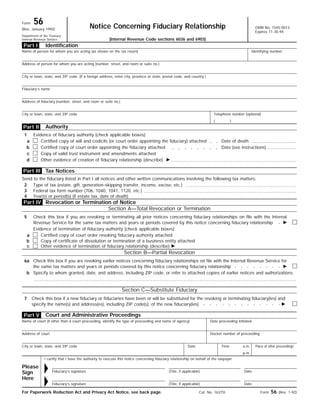
Form 56 OMB No. 1545-0013
Expires 11-30-94
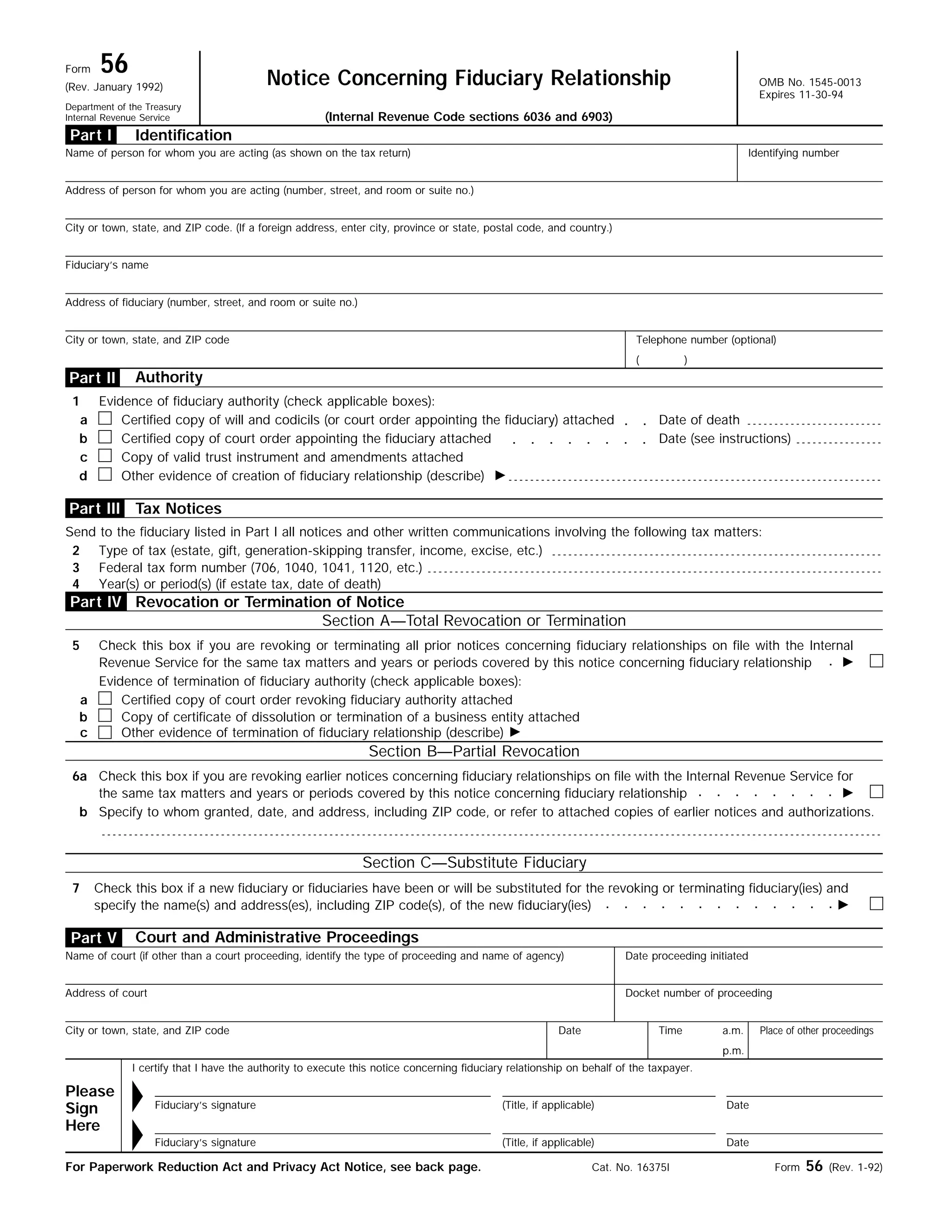
Notice Concerning Fiduciary Relationship(Rev. January 1992)
Department of the Treasury
Internal Revenue Service (Internal Revenue Code sections 6036 and 6903)
Identification
Name of person for whom you are acting (as shown on the tax return) Identifying number
Address of person for whom you are acting (number, street, and room or suite no.)
City or town, state, and ZIP code. (If a foreign address, enter city, province or state, postal code, and country.)
Fiduciary’s name
Address of fiduciary (number, street, and room or suite no.)
Telephone number (optional)City or town, state, and ZIP code
Authority
Evidence of fiduciary authority (check applicable boxes):1
Date of deathCertified copy of will and codicils (or court order appointing the fiduciary) attacheda
Date (see instructions)Certified copy of court order appointing the fiduciary attachedb
Copy of valid trust instrument and amendments attachedc
Other evidence of creation of fiduciary relationship (describe) ᮣd
Tax Notices
Send to the fiduciary listed in Part I all notices and other written communications involving the following tax matters:
Type of tax (estate, gift, generation-skipping transfer, income, excise, etc.)2
Federal tax form number (706, 1040, 1041, 1120, etc.)3
Year(s) or period(s) (if estate tax, date of death)4
Revocation or Termination of Notice
Section A—Total Revocation or Termination
Check this box if you are revoking or terminating all prior notices concerning fiduciary relationships on file with the Internal
Revenue Service for the same tax matters and years or periods covered by this notice concerning fiduciary relationship ᮣ
5
Evidence of termination of fiduciary authority (check applicable boxes):
Certified copy of court order revoking fiduciary authority attacheda
Copy of certificate of dissolution or termination of a business entity attachedb
Other evidence of termination of fiduciary relationship (describe) ᮣc
Section B—Partial Revocation
Check this box if you are revoking earlier notices concerning fiduciary relationships on file with the Internal Revenue Service for
the same tax matters and years or periods covered by this notice concerning fiduciary relationship ᮣ
6a
Specify to whom granted, date, and address, including ZIP code, or refer to attached copies of earlier notices and authorizations.b
Section C—Substitute Fiduciary
Check this box if a new fiduciary or fiduciaries have been or will be substituted for the revoking or terminating fiduciary(ies) and
specify the name(s) and address(es), including ZIP code(s), of the new fiduciary(ies) ᮣ
7
Court and Administrative Proceedings
Name of court (if other than a court proceeding, identify the type of proceeding and name of agency) Date proceeding initiated
Docket number of proceedingAddress of court
City or town, state, and ZIP code Date Time a.m. Place of other proceedings
p.m.
I certify that I have the authority to execute this notice concerning fiduciary relationship on behalf of the taxpayer.
Please
Sign
Here
ᮣ Fiduciary’s signature (Title, if applicable) Date
ᮣ Date(Title, if applicable)Fiduciary’s signature
For Paperwork Reduction Act and Privacy Act Notice, see back page. Form 56 (Rev. 1-92)
Part V
Part IV
Part I
Part II
Part III
( )
Cat. No. 16375I
Page 2Form 56 (Rev. 1-92)
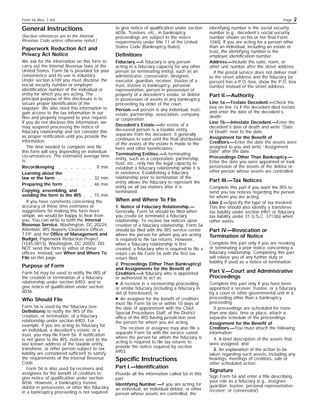
General Instructions
Terminating Entities.—A terminating
entity, such as a corporation, partnership,
trust, etc., only has the legal capacity to
establish a fiduciary relationship while it is
in existence. Establishing a fiduciary
relationship prior to termination of the
entity allows the fiduciary to represent the
entity on all tax matters after it is
terminated.
Part II.—Authority
Line 1a.—Testate Decedent.—Check the
box on line 1a if the decedent died testate
and enter the date of the decedent’s
death.
The time needed to complete and file
this form will vary depending on individual
circumstances. The estimated average time
is:
Definitions
Recordkeeping 8 min.
Fiduciary.—A fiduciary is any person
acting in a fiduciary capacity for any other
person (or terminating entity), such as an
administrator, conservator, designee,
executor, guardian, receiver, trustee of a
trust, trustee in bankruptcy, personal
representative, person in possession of
property of a decedent’s estate, or debtor
in possession of assets in any bankruptcy
proceeding by order of the court.
Line 1b.—Intestate Decedent.—Enter the
decedent’s date of death and write “Date
of Death” next to the date.
Learning about the
law or the form 32 min.
Preparing the form 46 min.
Copying, assembling, and
sending the form to the IRS 15 min.
If you have comments concerning the
accuracy of these time estimates or
suggestions for making this form more
simple, we would be happy to hear from
you. You can write to both the Internal
Revenue Service, Washington, DC 20224,
Attention: IRS Reports Clearance Officer,
T:FP; and the Office of Management and
Budget, Paperwork Reduction Project
(1545-0013), Washington, DC 20503. DO
NOT send the form to either of these
offices. Instead, see When and Where To
File on this page.
Assignment for the Benefit of
Creditors.—Enter the date the assets were
assigned to you and write “Assignment
Date” after the date.
Person.—A person is any individual, trust,
estate, partnership, association, company
or corporation.
Proceedings Other Than Bankruptcy.—
Enter the date you were appointed or took
possession of the assets of the debtor or
other person whose assets are controlled.
Decedent’s Estate.—An estate of a
deceased person is a taxable entity
separate from the decedent. It generally
continues to exist until the final distribution
of the assets of the estate is made to the
heirs and other beneficiaries.
Part III.—Tax Notices
Complete this part if you want the IRS to
send you tax notices regarding the person
for whom you are acting.
Line 2.—Specify the type of tax involved.
This line should also identify a transferee
tax liability under section 6901 or fiduciary
tax liability under 31 U.S.C. 3713(b) when
either exists.
Part IV.—Revocation or
Termination of Notice
Purpose of Form
When and Where To File
Complete this part only if you are revoking
or terminating a prior notice concerning a
fiduciary relationship. Completing this part
will relieve you of any further duty or
liability if used as a notice of termination.
1. Notice of Fiduciary Relationship.—
Generally, Form 56 should be filed when
you create (or terminate) a fiduciary
relationship. To receive tax notices upon
creation of a fiduciary relationship, Form 56
should be filed with the IRS service center
where the person for whom you are acting
is required to file tax returns. However,
when a fiduciary relationship is first
created, a fiduciary who is required to file a
return can file Form 56 with the first tax
return filed.
Part V.—Court and Administrative
Proceedings
Complete this part only if you have been
appointed a receiver, trustee, or a fiduciary
by a court or other governmental unit in a
proceeding other than a bankruptcy
proceeding.
2. Proceedings (Other Than Bankruptcy)
and Assignments for the Benefit of
Creditors.—A fiduciary who is appointed
or authorized to act as:
If proceedings are scheduled for more
than one date, time or place, attach a
separate schedule of the proceedings.
● A receiver in a receivership proceeding
or similar fiduciary (including a fiduciary in
aid of foreclosure), or
● An assignee for the benefit of creditors
must file Form 56 on or within 10 days of
the date of appointment with the Chief,
Special Procedures Staff, of the District
office of the IRS having jurisdiction over
the person for whom you are acting.
1. A brief description of the assets that
were assigned, and
2. An explanation of the action to be
taken regarding such assets, including any
hearings, meetings of creditors, sale or
other scheduled action.
Who Should File
Form 56 is used by the fiduciary (see
Definitions) to notify the IRS of the
creation, or termination, of a fiduciary
relationship under section 6903. For
example, if you are acting as fiduciary for
an individual, a decedent’s estate, or a
trust, you may file Form 56. If notification
is not given to the IRS, notices sent to the
last known address of the taxable entity,
transferee, or other person subject to tax
liability are considered sufficient to satisfy
the requirements of the Internal Revenue
Code.
Signature
Sign Form 56 and enter a title describing
your role as a fiduciary (e.g., assignee;
guardian; trustee; personal representative;
receiver; or conservator).
Specific Instructions
Part I.—Identification
Provide all the information called for in this
part.
Assignment for the Benefit of
Creditors.—You must attach the following
information:
Paperwork Reduction Act and
Privacy Act Notice
We ask for the information on this form to
carry out the Internal Revenue laws of the
United States. Form 56 is provided for your
convenience and its use is voluntary.
Under section 6109 you must disclose the
social security number or employer
identification number of the individual or
entity for which you are acting. The
principal purpose of this disclosure is to
secure proper identification of the
taxpayer. We also need this information to
gain access to the tax information in our
files and properly respond to your request.
If you do not disclose this information, we
may suspend processing the notice of
fiduciary relationship and not consider this
as proper notification until you provide the
information.
Form 56 may be used to notify the IRS of
the creation or termination of a fiduciary
relationship under section 6903; and to
give notice of qualification under section
6036.
Address.—Include the suite, room, or
other unit number after the street address.
If the postal service does not deliver mail
to the street address and the fiduciary (or
person) has a P.O. box, show the P.O. box
number instead of the street address.
(Section references are to the Internal
Revenue Code unless otherwise noted.)
Form 56 is also used by receivers and
assignees for the benefit of creditors to
give notice of qualification under section
6036. However, a bankruptcy trustee,
debtor in possession, or other like fiduciary
in a bankruptcy proceeding is not required
The receiver or assignee may also file a
separate Form 56 with the service center
where the person for whom the fiduciary is
acting is required to file tax returns to
provide the notice required by section
6903.
to give notice of qualification under section
6036. Trustees, etc., in bankruptcy
proceedings are subject to the notice
requirements under title 11 of the United
States Code (Bankruptcy Rules).
Identifying Number.—If you are acting for
an individual, an individual debtor, or other
person whose assets are controlled, the
identifying number is the social security
number (e.g., decedent’s social security
number shown on his or her final Form
1040). If you are acting for a person other
than an individual, including an estate or
trust, the identifying number is the
employer identification number.

sims218

  • 1.
    Form 56 OMBNo. 1545-0013 Expires 11-30-94 Notice Concerning Fiduciary Relationship(Rev. January 1992) Department of the Treasury Internal Revenue Service (Internal Revenue Code sections 6036 and 6903) Identification Name of person for whom you are acting (as shown on the tax return) Identifying number Address of person for whom you are acting (number, street, and room or suite no.) City or town, state, and ZIP code. (If a foreign address, enter city, province or state, postal code, and country.) Fiduciary’s name Address of fiduciary (number, street, and room or suite no.) Telephone number (optional)City or town, state, and ZIP code Authority Evidence of fiduciary authority (check applicable boxes):1 Date of deathCertified copy of will and codicils (or court order appointing the fiduciary) attacheda Date (see instructions)Certified copy of court order appointing the fiduciary attachedb Copy of valid trust instrument and amendments attachedc Other evidence of creation of fiduciary relationship (describe) ᮣd Tax Notices Send to the fiduciary listed in Part I all notices and other written communications involving the following tax matters: Type of tax (estate, gift, generation-skipping transfer, income, excise, etc.)2 Federal tax form number (706, 1040, 1041, 1120, etc.)3 Year(s) or period(s) (if estate tax, date of death)4 Revocation or Termination of Notice Section A—Total Revocation or Termination Check this box if you are revoking or terminating all prior notices concerning fiduciary relationships on file with the Internal Revenue Service for the same tax matters and years or periods covered by this notice concerning fiduciary relationship ᮣ 5 Evidence of termination of fiduciary authority (check applicable boxes): Certified copy of court order revoking fiduciary authority attacheda Copy of certificate of dissolution or termination of a business entity attachedb Other evidence of termination of fiduciary relationship (describe) ᮣc Section B—Partial Revocation Check this box if you are revoking earlier notices concerning fiduciary relationships on file with the Internal Revenue Service for the same tax matters and years or periods covered by this notice concerning fiduciary relationship ᮣ 6a Specify to whom granted, date, and address, including ZIP code, or refer to attached copies of earlier notices and authorizations.b Section C—Substitute Fiduciary Check this box if a new fiduciary or fiduciaries have been or will be substituted for the revoking or terminating fiduciary(ies) and specify the name(s) and address(es), including ZIP code(s), of the new fiduciary(ies) ᮣ 7 Court and Administrative Proceedings Name of court (if other than a court proceeding, identify the type of proceeding and name of agency) Date proceeding initiated Docket number of proceedingAddress of court City or town, state, and ZIP code Date Time a.m. Place of other proceedings p.m. I certify that I have the authority to execute this notice concerning fiduciary relationship on behalf of the taxpayer. Please Sign Here ᮣ Fiduciary’s signature (Title, if applicable) Date ᮣ Date(Title, if applicable)Fiduciary’s signature For Paperwork Reduction Act and Privacy Act Notice, see back page. Form 56 (Rev. 1-92) Part V Part IV Part I Part II Part III ( ) Cat. No. 16375I
  • 2.
    Page 2Form 56(Rev. 1-92) General Instructions Terminating Entities.—A terminating entity, such as a corporation, partnership, trust, etc., only has the legal capacity to establish a fiduciary relationship while it is in existence. Establishing a fiduciary relationship prior to termination of the entity allows the fiduciary to represent the entity on all tax matters after it is terminated. Part II.—Authority Line 1a.—Testate Decedent.—Check the box on line 1a if the decedent died testate and enter the date of the decedent’s death. The time needed to complete and file this form will vary depending on individual circumstances. The estimated average time is: Definitions Recordkeeping 8 min. Fiduciary.—A fiduciary is any person acting in a fiduciary capacity for any other person (or terminating entity), such as an administrator, conservator, designee, executor, guardian, receiver, trustee of a trust, trustee in bankruptcy, personal representative, person in possession of property of a decedent’s estate, or debtor in possession of assets in any bankruptcy proceeding by order of the court. Line 1b.—Intestate Decedent.—Enter the decedent’s date of death and write “Date of Death” next to the date. Learning about the law or the form 32 min. Preparing the form 46 min. Copying, assembling, and sending the form to the IRS 15 min. If you have comments concerning the accuracy of these time estimates or suggestions for making this form more simple, we would be happy to hear from you. You can write to both the Internal Revenue Service, Washington, DC 20224, Attention: IRS Reports Clearance Officer, T:FP; and the Office of Management and Budget, Paperwork Reduction Project (1545-0013), Washington, DC 20503. DO NOT send the form to either of these offices. Instead, see When and Where To File on this page. Assignment for the Benefit of Creditors.—Enter the date the assets were assigned to you and write “Assignment Date” after the date. Person.—A person is any individual, trust, estate, partnership, association, company or corporation. Proceedings Other Than Bankruptcy.— Enter the date you were appointed or took possession of the assets of the debtor or other person whose assets are controlled. Decedent’s Estate.—An estate of a deceased person is a taxable entity separate from the decedent. It generally continues to exist until the final distribution of the assets of the estate is made to the heirs and other beneficiaries. Part III.—Tax Notices Complete this part if you want the IRS to send you tax notices regarding the person for whom you are acting. Line 2.—Specify the type of tax involved. This line should also identify a transferee tax liability under section 6901 or fiduciary tax liability under 31 U.S.C. 3713(b) when either exists. Part IV.—Revocation or Termination of Notice Purpose of Form When and Where To File Complete this part only if you are revoking or terminating a prior notice concerning a fiduciary relationship. Completing this part will relieve you of any further duty or liability if used as a notice of termination. 1. Notice of Fiduciary Relationship.— Generally, Form 56 should be filed when you create (or terminate) a fiduciary relationship. To receive tax notices upon creation of a fiduciary relationship, Form 56 should be filed with the IRS service center where the person for whom you are acting is required to file tax returns. However, when a fiduciary relationship is first created, a fiduciary who is required to file a return can file Form 56 with the first tax return filed. Part V.—Court and Administrative Proceedings Complete this part only if you have been appointed a receiver, trustee, or a fiduciary by a court or other governmental unit in a proceeding other than a bankruptcy proceeding. 2. Proceedings (Other Than Bankruptcy) and Assignments for the Benefit of Creditors.—A fiduciary who is appointed or authorized to act as: If proceedings are scheduled for more than one date, time or place, attach a separate schedule of the proceedings. ● A receiver in a receivership proceeding or similar fiduciary (including a fiduciary in aid of foreclosure), or ● An assignee for the benefit of creditors must file Form 56 on or within 10 days of the date of appointment with the Chief, Special Procedures Staff, of the District office of the IRS having jurisdiction over the person for whom you are acting. 1. A brief description of the assets that were assigned, and 2. An explanation of the action to be taken regarding such assets, including any hearings, meetings of creditors, sale or other scheduled action. Who Should File Form 56 is used by the fiduciary (see Definitions) to notify the IRS of the creation, or termination, of a fiduciary relationship under section 6903. For example, if you are acting as fiduciary for an individual, a decedent’s estate, or a trust, you may file Form 56. If notification is not given to the IRS, notices sent to the last known address of the taxable entity, transferee, or other person subject to tax liability are considered sufficient to satisfy the requirements of the Internal Revenue Code. Signature Sign Form 56 and enter a title describing your role as a fiduciary (e.g., assignee; guardian; trustee; personal representative; receiver; or conservator). Specific Instructions Part I.—Identification Provide all the information called for in this part. Assignment for the Benefit of Creditors.—You must attach the following information: Paperwork Reduction Act and Privacy Act Notice We ask for the information on this form to carry out the Internal Revenue laws of the United States. Form 56 is provided for your convenience and its use is voluntary. Under section 6109 you must disclose the social security number or employer identification number of the individual or entity for which you are acting. The principal purpose of this disclosure is to secure proper identification of the taxpayer. We also need this information to gain access to the tax information in our files and properly respond to your request. If you do not disclose this information, we may suspend processing the notice of fiduciary relationship and not consider this as proper notification until you provide the information. Form 56 may be used to notify the IRS of the creation or termination of a fiduciary relationship under section 6903; and to give notice of qualification under section 6036. Address.—Include the suite, room, or other unit number after the street address. If the postal service does not deliver mail to the street address and the fiduciary (or person) has a P.O. box, show the P.O. box number instead of the street address. (Section references are to the Internal Revenue Code unless otherwise noted.) Form 56 is also used by receivers and assignees for the benefit of creditors to give notice of qualification under section 6036. However, a bankruptcy trustee, debtor in possession, or other like fiduciary in a bankruptcy proceeding is not required The receiver or assignee may also file a separate Form 56 with the service center where the person for whom the fiduciary is acting is required to file tax returns to provide the notice required by section 6903. to give notice of qualification under section 6036. Trustees, etc., in bankruptcy proceedings are subject to the notice requirements under title 11 of the United States Code (Bankruptcy Rules). Identifying Number.—If you are acting for an individual, an individual debtor, or other person whose assets are controlled, the identifying number is the social security number (e.g., decedent’s social security number shown on his or her final Form 1040). If you are acting for a person other than an individual, including an estate or trust, the identifying number is the employer identification number.