by Narendra Mulani
Companies can get stuck
trying to analyze all that’s
possible and all that they
could do through
analytics, when they
should be taking that next
step of recognizing what’s
important and what they
should be doing — for
their customers,
stakeholders, and
employees.
Companies
should pursue a
simpler path to
uncovering the
insight in
their data and
making insight-
driven decisions
that add value.
Steps to simplify analytics
strategy
Accelerate the data
Fast data = fast insight = fast outcomes
Ways to delegate the work to your
analytics technologies:
At its core, next-
gen business
intelligence is
bringing data and
analytics to life to
help companies
improve and
optimize their
decision-making
and organizational
performance.
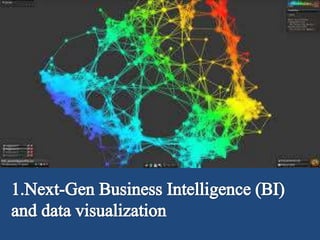
BI does this by turning
an organization’s data
into an asset by having
the right data, at the right
time and place (mobile,
laptop, etc), and
displayed in the right
visual form (heat map,
charts, etc) for each
individual decision-
maker, so they can use it
to reach their desired
outcome..
3.Analytics Applications
Applications can simplify advanced analytics
as they put the power of analytics easily and
elegantly into the hands of the business user
to make data-driven business decisions.
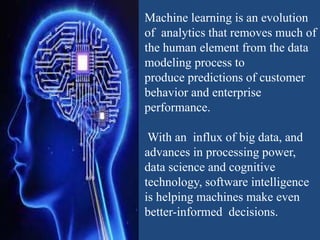
Machine learning is an evolution
of analytics that removes much of
the human element from the data
modeling process to
produce predictions of customer
behavior and enterprise
performance.
With an influx of big data, and
advances in processing power,
data science and cognitive
technology, software intelligence
is helping machines make even
better-informed decisions.
5.Recognize that each path
to data insight is unique
The path to insight doesn’t come in one single form.
There are many different elements in play, and they
are always changing — business goals, technologies,
data types, data sources, and then some are in a state
of flux.
No matter what combination of culture and
technology exists for a business, each path to analytics
insight should be individually paved with an outcome-
driven mindset.
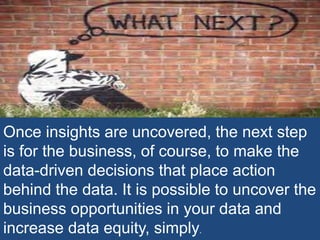
Once insights are uncovered, the next step
is for the business, of course, to make the
data-driven decisions that place action
behind the data. It is possible to uncover the
business opportunities in your data and
increase data equity, simply.
Managerial
Relevance
A Manager should employ steps
discussed in ii insight in his/ her
organisation to make the analysis
simpler: A proper supply chain should be
built to accelerate the data.
Also a manager should try to have
advanced technology for the organization
because n organization equipped with
advanced technology have an ease with
analytics.
For a known
problem area but
with an unknown
solution, the
company could
take a discovery-
based approach
to look for
patterns in the
data to find
interesting
correlations that
may be predictive
For a known
problem with a
known solution
the company
could take a
hypothesis-
based
approach by
starting with
the outcome .
PRESENTED BY:
POOJA
KESERWANI

Simplify Your Analytics Strategy

  • 1.
  • 3.
    Companies can getstuck trying to analyze all that’s possible and all that they could do through analytics, when they should be taking that next step of recognizing what’s important and what they should be doing — for their customers, stakeholders, and employees.
  • 4.
    Companies should pursue a simplerpath to uncovering the insight in their data and making insight- driven decisions that add value.
  • 5.
    Steps to simplifyanalytics strategy
  • 6.
    Accelerate the data Fastdata = fast insight = fast outcomes
  • 7.
    Ways to delegatethe work to your analytics technologies:
  • 9.
    At its core,next- gen business intelligence is bringing data and analytics to life to help companies improve and optimize their decision-making and organizational performance.
  • 10.
    BI does thisby turning an organization’s data into an asset by having the right data, at the right time and place (mobile, laptop, etc), and displayed in the right visual form (heat map, charts, etc) for each individual decision- maker, so they can use it to reach their desired outcome..
  • 12.
    3.Analytics Applications Applications cansimplify advanced analytics as they put the power of analytics easily and elegantly into the hands of the business user to make data-driven business decisions.
  • 14.
    Machine learning isan evolution of analytics that removes much of the human element from the data modeling process to produce predictions of customer behavior and enterprise performance. With an influx of big data, and advances in processing power, data science and cognitive technology, software intelligence is helping machines make even better-informed decisions.
  • 15.
    5.Recognize that eachpath to data insight is unique The path to insight doesn’t come in one single form. There are many different elements in play, and they are always changing — business goals, technologies, data types, data sources, and then some are in a state of flux. No matter what combination of culture and technology exists for a business, each path to analytics insight should be individually paved with an outcome- driven mindset.
  • 16.
    Once insights areuncovered, the next step is for the business, of course, to make the data-driven decisions that place action behind the data. It is possible to uncover the business opportunities in your data and increase data equity, simply.
  • 17.
  • 18.
    A Manager shouldemploy steps discussed in ii insight in his/ her organisation to make the analysis simpler: A proper supply chain should be built to accelerate the data. Also a manager should try to have advanced technology for the organization because n organization equipped with advanced technology have an ease with analytics.
  • 19.
    For a known problemarea but with an unknown solution, the company could take a discovery- based approach to look for patterns in the data to find interesting correlations that may be predictive For a known problem with a known solution the company could take a hypothesis- based approach by starting with the outcome .
  • 20.