SIMPLE MACHINE
(Pulley and its types)
TABLE OF CONTENTS
Introduction
to simple
machine
01
Introduction
to pulley
(Types of
pulley )
02
Conclusion
03
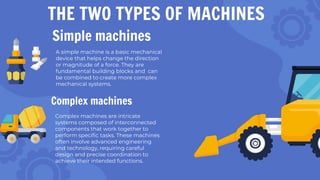
A simple machine is a basic mechanical
device that helps change the direction
or magnitude of a force. They are
fundamental building blocks and can
be combined to create more complex
mechanical systems.
Simple machines
Complex machines
Complex machines are intricate
systems composed of interconnected
components that work together to
perform specific tasks. These machines
often involve advanced engineering
and technology, requiring careful
design and precise coordination to
achieve their intended functions.
THE TWO TYPES OF MACHINES
Introduction
to simple
machine
01
INTRODUCTION
Simple machine are fundamental
devices are the building blocks of
more complex machinery, making
our daily tasks easier. From levers to
pulleys, simple machines showcase
the elegance of physics in action,
demonstrating how small changes
can lead to significant mechanical
advantages. Let's explore these basic
tools that have played a vital role in
shaping our modern world.
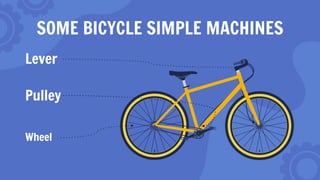
Wheel
Lever
SOME BICYCLE SIMPLE MACHINES
Pulley
THE IMPORTANCE OF SIMPLE MACHINES
● Efficiency: Simple machines provide mechanical
advantage, allowing us to accomplish tasks with less
effort. They magnify force or change direction,
making work more efficient. |
● Everyday Life: Simple machines are all around us –
from door handles (lever) to scissors (lever and
wedge) – they make daily tasks manageable and
convenient.
● Construction: Construction equipment, such as
cranes (lever and pulley) and ramps, leverage simple
machines to move heavy materials efficiently.
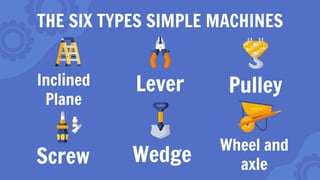
Pulley
Inclined
Plane
Lever
Screw Wedge
Wheel and
axle
THE SIX TYPES SIMPLE MACHINES
Introduction
to pulley
(Types of
pulley)
02
Single moveable pulley
Thus this type of pulley helps to
magnify the effort but doesn't not
help to change the direction of the
effort
Combined pulley
load
Movable pulley
Effort
In combine pulley MA and VR increases with
increase in the number of wheels used. So VR
of a pulley is given by the simple formula
(except in single movable pulley where VR is
always two)
VR = No of discs used
= no of rope segments that support
the load
Conclusion
03
Conclusion
In summary, a pulley is a simple machine that consists of a
wheel or drum with a grooved rim and an axle. It is used in
conjunction with a rope, belt, or chain to change the
direction or magnitude of a force, making it easier to lift or
move heavy objects. Pulleys are crucial tools in various
industries and applications, offering mechanical advantage
and facilitating the movement of loads.
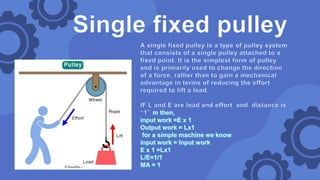
Fixed Pulley: This type is anchored to a stationary point
and only changes the direction of the force applied. It
doesn't offer a mechanical advantage but is valuable for
redirecting forces, as seen in flagpoles.
Movable Pulley: Attached to the load, it moves along with it.
When combined with a fixed pulley, it reduces the force
required to lift the load, distributing the weight between
tension and lifting force.
Simple machine (pulley and its types).pptx

Simple machine (pulley and its types).pptx

  • 1.
  • 2.
    TABLE OF CONTENTS Introduction tosimple machine 01 Introduction to pulley (Types of pulley ) 02 Conclusion 03
  • 3.
    A simple machineis a basic mechanical device that helps change the direction or magnitude of a force. They are fundamental building blocks and can be combined to create more complex mechanical systems. Simple machines Complex machines Complex machines are intricate systems composed of interconnected components that work together to perform specific tasks. These machines often involve advanced engineering and technology, requiring careful design and precise coordination to achieve their intended functions. THE TWO TYPES OF MACHINES
  • 4.
  • 5.
    INTRODUCTION Simple machine arefundamental devices are the building blocks of more complex machinery, making our daily tasks easier. From levers to pulleys, simple machines showcase the elegance of physics in action, demonstrating how small changes can lead to significant mechanical advantages. Let's explore these basic tools that have played a vital role in shaping our modern world.
  • 6.
  • 7.
    THE IMPORTANCE OFSIMPLE MACHINES ● Efficiency: Simple machines provide mechanical advantage, allowing us to accomplish tasks with less effort. They magnify force or change direction, making work more efficient. | ● Everyday Life: Simple machines are all around us – from door handles (lever) to scissors (lever and wedge) – they make daily tasks manageable and convenient. ● Construction: Construction equipment, such as cranes (lever and pulley) and ramps, leverage simple machines to move heavy materials efficiently.
  • 8.
  • 9.
  • 12.
    Single moveable pulley Thusthis type of pulley helps to magnify the effort but doesn't not help to change the direction of the effort
  • 13.
    Combined pulley load Movable pulley Effort Incombine pulley MA and VR increases with increase in the number of wheels used. So VR of a pulley is given by the simple formula (except in single movable pulley where VR is always two) VR = No of discs used = no of rope segments that support the load
  • 14.
  • 15.
    Conclusion In summary, apulley is a simple machine that consists of a wheel or drum with a grooved rim and an axle. It is used in conjunction with a rope, belt, or chain to change the direction or magnitude of a force, making it easier to lift or move heavy objects. Pulleys are crucial tools in various industries and applications, offering mechanical advantage and facilitating the movement of loads. Fixed Pulley: This type is anchored to a stationary point and only changes the direction of the force applied. It doesn't offer a mechanical advantage but is valuable for redirecting forces, as seen in flagpoles. Movable Pulley: Attached to the load, it moves along with it. When combined with a fixed pulley, it reduces the force required to lift the load, distributing the weight between tension and lifting force.