Varying Sentence Structure
Adding Variety to Sentence Structure
To make your writing more interesting,
you should try to vary your sentences in
terms of length and structure. You can
make some of your sentences long and
others short. Read the two paragraphs
on the next page.
Two Paragraphs
Read the paragraphs below. Choose
the paragraph that is more effective.
I love living in the city. I have a wonderful view of the
entire city. I have an apartment. I can see the Golden
Gate Bridge. I can see many cargo ships pass under the
bridge each day. I like the restaurants in San Francisco.
I can find wonderful food from just about
every country. I don’t like the traffic in the city.
I love living in the city of San Francisco. I have a
wonderful view of the entire city from my apartment
window. In addition, I can see the Golden Gate Bridge
under which many cargo ships pass each day. I also
like San Francisco because I can find
wonderful restaurants with food from just about every
country; however, I don’t like the traffic in the city.
How do you vary sentence structure?
You will want to use a variety of
sentence structures in your writing.
There are three types of sentences we
will study in this lesson:
- Simple Sentence
- Compound Sentence
- Complex Sentence
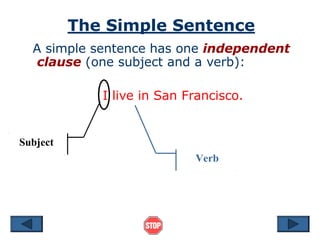
The Simple Sentence
A simple sentence has one independent
clause (one subject and a verb):
I live in San Francisco.
Subject
Verb
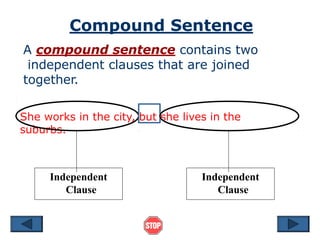
Compound Sentence
A compound sentence contains two
independent clauses that are joined
together.
She works in the city, but she lives in the
suburbs.
Independent
Clause
Independent
Clause
Compound Sentence
You can make a compound sentence
by joining two logically related
independent clauses by using…
- a semicolon
- a coordinating conjunction
- a transition
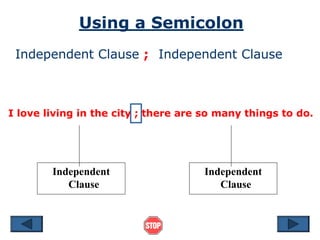
Using a Semicolon
Independent Clause ; Independent Clause
I love living in the city ; there are so many things to do.
Independent
Clause
Independent
Clause
Using a Coordinating Conjunction
Independent Clause ,coordinating conjunction Independent Clause
He couldn’t watch the show , so he decided to
ta
Independent
Clause
pe it.
Independent
Clause
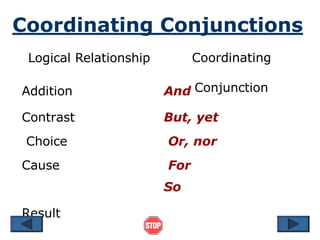
Coordinating Conjunctions
Logical Relationship Coordinating
Conjunction
Addition
Contrast
Choice
Cause
Result
And
But, yet
Or, nor
For
So
FANBOYS
For

And 
Nor 
But 
Or 
Yet 
So 
F
A
N
B
O
Another way to remember these is…
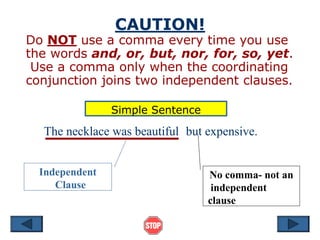
CAUTION!
Do NOT use a comma every time you use
the words and, or, but, nor, for, so, yet.
Use a comma only when the coordinating
conjunction joins two independent clauses.
Independent
Clause
No comma- not an
independent
clause
The necklace was beautiful but expensive.
Simple Sentence
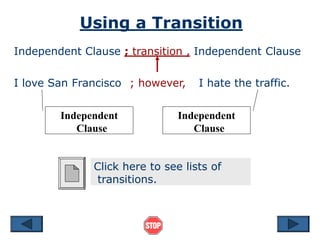
Using a Transition
Independent Clause ; transition , Independent Clause
I love San Francisco ; however, I hate the traffic.
Independent
Clause
Independent
Clause
Click here to see lists of
transitions.
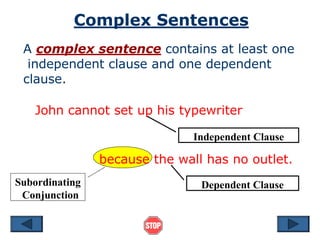
because the wall has no outlet.
Complex Sentences
A complex sentence contains at least one
independent clause and one dependent
clause.
John cannot set up his typewriter
Independent Clause
Dependent Clause
Subordinating
Conjunction
Example- Complex Sentence
A complex sentence contains at least one
independent clause and one dependent
clause.
She will go to school in the city
until she finds a job.
Independent Clause
Dependent Clause
Subordinating
Conjunction
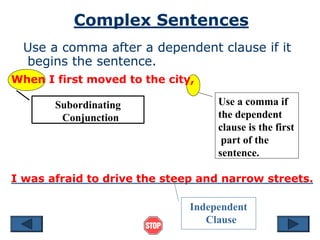
Complex Sentences
Use a comma after a dependent clause if it
begins the sentence.
When I first moved to the city,
Subordinating
Conjunction
I was afraid to drive the steep and narrow streets.
Independent
Clause
Use a comma if
the dependent
clause is the first
part of the
sentence.
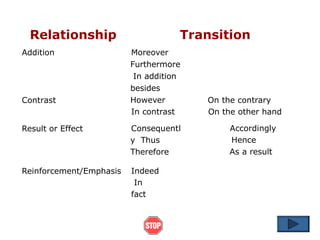
Relationship Transition
Addition
Reinforcement/Emphasis Indeed
In
fact
Contrast
Result or Effect
Moreover
Furthermore
In addition
besides
However
In contrast
Consequentl
y Thus
Therefore
On the contrary
On the other hand
Accordingly
Hence
As a result
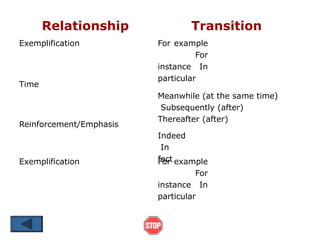
Reinforcement/Emphasis
Exemplification For example
For
instance In
particular
Exemplification
Time
Relationship Transition
For example
For
instance In
particular
Meanwhile (at the same time)
Subsequently (after)
Thereafter (after)
Indeed
In
fact

Simple, compound and complex sentence.pptx

  • 1.
  • 2.
    Adding Variety toSentence Structure To make your writing more interesting, you should try to vary your sentences in terms of length and structure. You can make some of your sentences long and others short. Read the two paragraphs on the next page.
  • 3.
    Two Paragraphs Read theparagraphs below. Choose the paragraph that is more effective. I love living in the city. I have a wonderful view of the entire city. I have an apartment. I can see the Golden Gate Bridge. I can see many cargo ships pass under the bridge each day. I like the restaurants in San Francisco. I can find wonderful food from just about every country. I don’t like the traffic in the city. I love living in the city of San Francisco. I have a wonderful view of the entire city from my apartment window. In addition, I can see the Golden Gate Bridge under which many cargo ships pass each day. I also like San Francisco because I can find wonderful restaurants with food from just about every country; however, I don’t like the traffic in the city.
  • 4.
    How do youvary sentence structure? You will want to use a variety of sentence structures in your writing. There are three types of sentences we will study in this lesson: - Simple Sentence - Compound Sentence - Complex Sentence
  • 5.
    The Simple Sentence Asimple sentence has one independent clause (one subject and a verb): I live in San Francisco. Subject Verb
  • 6.
    Compound Sentence A compoundsentence contains two independent clauses that are joined together. She works in the city, but she lives in the suburbs. Independent Clause Independent Clause
  • 7.
    Compound Sentence You canmake a compound sentence by joining two logically related independent clauses by using… - a semicolon - a coordinating conjunction - a transition
  • 8.
    Using a Semicolon IndependentClause ; Independent Clause I love living in the city ; there are so many things to do. Independent Clause Independent Clause
  • 9.
    Using a CoordinatingConjunction Independent Clause ,coordinating conjunction Independent Clause He couldn’t watch the show , so he decided to ta Independent Clause pe it. Independent Clause
  • 10.
    Coordinating Conjunctions Logical RelationshipCoordinating Conjunction Addition Contrast Choice Cause Result And But, yet Or, nor For So
  • 11.
    FANBOYS For  And  Nor  But Or  Yet  So  F A N B O Another way to remember these is…
  • 12.
    CAUTION! Do NOT usea comma every time you use the words and, or, but, nor, for, so, yet. Use a comma only when the coordinating conjunction joins two independent clauses. Independent Clause No comma- not an independent clause The necklace was beautiful but expensive. Simple Sentence
  • 13.
    Using a Transition IndependentClause ; transition , Independent Clause I love San Francisco ; however, I hate the traffic. Independent Clause Independent Clause Click here to see lists of transitions.
  • 14.
    because the wallhas no outlet. Complex Sentences A complex sentence contains at least one independent clause and one dependent clause. John cannot set up his typewriter Independent Clause Dependent Clause Subordinating Conjunction
  • 15.
    Example- Complex Sentence Acomplex sentence contains at least one independent clause and one dependent clause. She will go to school in the city until she finds a job. Independent Clause Dependent Clause Subordinating Conjunction
  • 16.
    Complex Sentences Use acomma after a dependent clause if it begins the sentence. When I first moved to the city, Subordinating Conjunction I was afraid to drive the steep and narrow streets. Independent Clause Use a comma if the dependent clause is the first part of the sentence.
  • 17.
    Relationship Transition Addition Reinforcement/Emphasis Indeed In fact Contrast Resultor Effect Moreover Furthermore In addition besides However In contrast Consequentl y Thus Therefore On the contrary On the other hand Accordingly Hence As a result
  • 18.
    Reinforcement/Emphasis Exemplification For example For instanceIn particular Exemplification Time Relationship Transition For example For instance In particular Meanwhile (at the same time) Subsequently (after) Thereafter (after) Indeed In fact